🔥 Would you like to save this?
Welcome to the Farmhouse home decor style guide where you can see photos of all interiors in the Farmhouse style including kitchens, living rooms, bedrooms, dining rooms, foyers and more.
In order to come up with the very specific design ideas, we create most designs with the assistance of state-of-the-art AI interior design software. Also, assume links that take you off the site are affiliate links such as links to Amazon. this means we may earn a commission if you buy something.
Related: All interior design styles | All residential architectural styles | Grey Gardens Estate | Shiplap Alternatives
Farmhouse Style Interior Examples (by Room)
The following are photo examples of Farmhouse style interiors (room-by-room). Below each photo are links that take you to extensive Farmhouse style photo galleries for each room.
The following examples are from this house (Designed by Chango&Co.).
Living Rooms

See more Farmhouse style living rooms here.
This is a bright living room with a white wooden ceiling that has white exposed wooden beams matching with the white walls that bring in an abundance of natural lighting through the surrounding tall windows that lighten up the gray comfortable sofas.
Kitchens

See more Farmhouse style kitchens here.
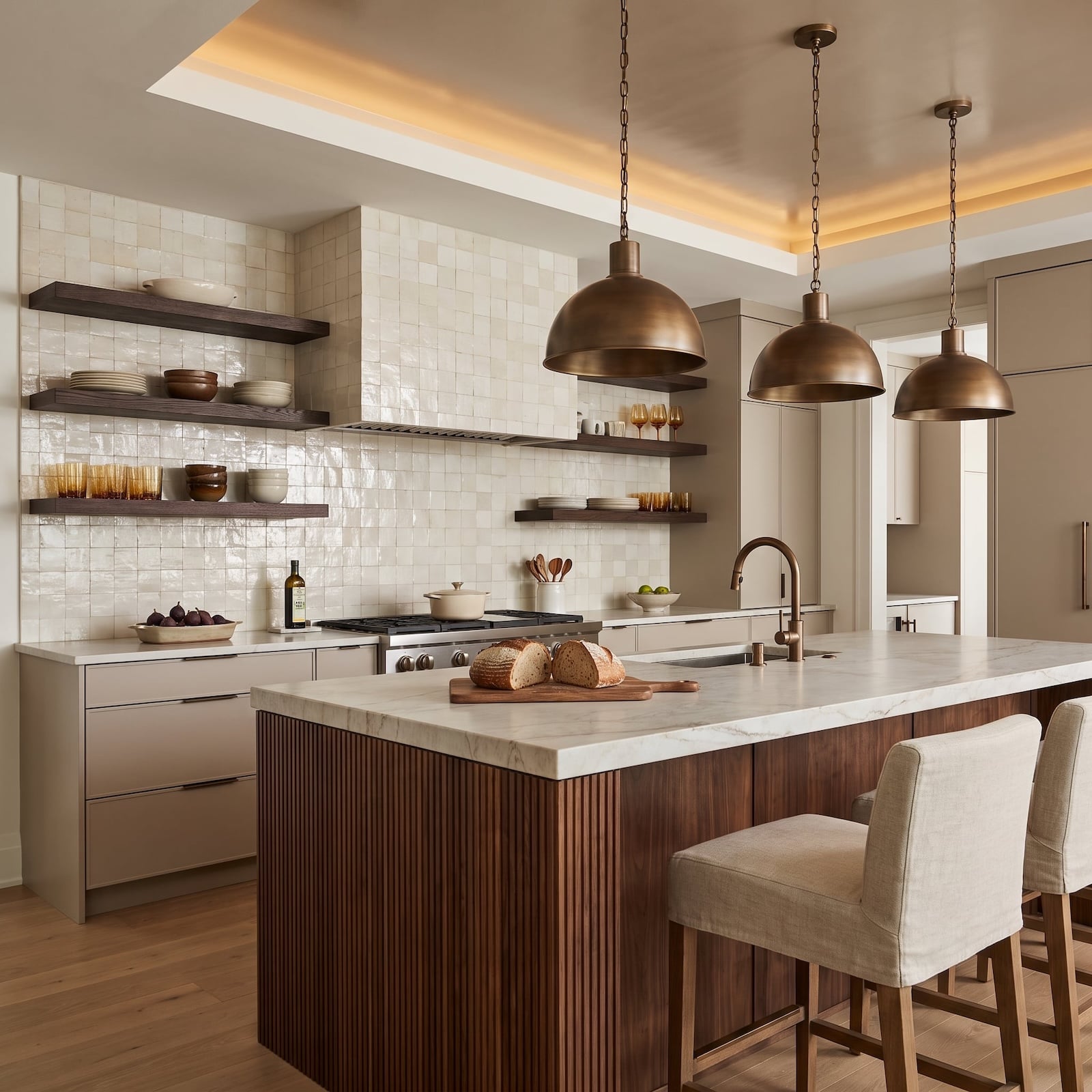
This brilliant and bright spacious kitchen has a couple of exposed wooden beams on its white ceiling that complements the gray shaker cabinets and drawers of the large L-shaped peninsula and its kitchen island in the middle of the dark hardwood flooring.
Dining Rooms

See more Farmhouse style dining rooms here.
This dining room has a white ceiling dominated by the exposed wooden beams that match the hardwood flooring and the large rectangular wooden dining table surrounded by brilliant red-orange wooden chairs and topped with a peculiar modern chandelier.
Bedrooms

See more Farmhouse style bedrooms here.
This Farmhouse-style bedroom has a gray four-poster bed that matches the fireplace in the corner with a dark gray mantle that stands out against the white walls. This is also contrasted by the large wooden beams of the white cathedral ceiling.
Bathrooms

See more Farmhouse style bathrooms here.
This charming bathroom has a glass-enclosed shower area that has black frames matching the black flooring tiles that contrast the white walls and white ceiling. This is adorned with wooden beams and a pair of black semi-flush mount lights.
Entry Halls

See more Farmhouse style entry halls here.
This is a beautiful and simple welcoming foyer with a pair of red wooden main doors that have glass panels on them bringing in an abundance of natural lighting to the dark hardwood flooring and white shiplap ceiling bearing pendant lights.
Farmhouse Style Home Landscaping

See more Farmhouse style home landscaping ideas here.
This landscaping is perfect for those house parties and Sunday barbecues. The well-manicured lawn of grass is more of a functional outdoor area that can be used for every occasion. The lawn and the short shrubs are more of a complement to the house exterior rather than catch the attention themselves.
Farmhouse Home Exterior Examples
Check out these spectacular homes showcasing the Farmhouse style architecture.
1. Spacious Single Family Three Bed Farmhouse

This is a charming Farmhouse-style home with A-frame roofs and white frames to its glass windows that stand out against the gray house exterior walls with shingles. This matches with the dark gray roof of this home that seems to grow from the grassy hill.

See more. Source: Architectural Designs
This is a backyard view of the house. You can see here that it is filled with warm yellow lights cascading from its wide glass windows that offer a view of the lush green landscaping surrounding the house with a lovely stone walkway on the side.
2. The Grayson, a Contemporary Home by Webb & Brown-Neaves

This bright home welcomes the sunrise with its bright exterior walls and warm welcoming lights coming to the interiors. There is a charming second-floor balcony that has a white trellis above it and white railings that match with the fence of the ground floor.

See more. Designed by Webb & Brown-Neaves
This side view of the house features all the large outdoor spots that this house has. It has another large balcony on the second floor with an A-frame roof and a large stone column for the chimney. This stands out amidst all the white elements of the home.
3. Hamptons Family Getaway by Chango & Co.

See more. Designed by Chango & Co.
This bright and white Farmhouse-style home has two floors filled with wide glass windows that stand out against the white exterior walls. These are complemented by the A-frame roof with a distressed light gray tone. The house forms an L-shape that makes room for the backyard pool.
4. 3-Bed Modern Farmhouse with Two-story Great Room

🔥 Would you like to save this?
This brilliant front view of the house showcases multiple A-frame roofs giving it a unique aesthetic pairing of white exterior walls and gray roofing that also matches the brick walls that adorn certain low points of the foundation of the house.

See more. Source: Architectural Designs
This side view of this lovely home offers more of those gray brick walls. It also forms a column that reaches up to form a chimney that blends with the gray roofing. This is paired with tall tinted windows that mirror the bright blue sky.
5. 5-Bed Luxury Modern Farmhouse with Private Apartment

The dark gray roofing of this Farmhouse-style home works well with the beige exterior walls that stand proud and offer history in its traditional look. This home is surrounded by a lush landscape filled with green lawns of grass and towering pine trees.

See more. Source: Architectural Designs
This view of the house offers a closer look at the wide well-manicured lawn of grass in the backyard. There are also some shrubs planted by the stone steps leading to the house that has large sliding glass doors on the side leading to the living room.
6. Westport Modern Farmhouse by Chango & Co.

See more. Designed by Chango & Co
The brilliant white walls of this Farmhouse-style home is counterbalanced by the gray gable and valley roof that matches with the gray stone fence surrounding the property that has wide lawns of grass with shrubs and medium-sized trees.
What is Farmhouse Home Decor?
No style of home building and home decoration is more American than farmhouse style. Farmhouses, of course, used to be the dominant design for homes of working farmers. Farmhouse style still connotes a connection to the land, to nature, and to independent, rural living. And probably because of the popularity of farm-to-table cuisine, farmhouse style is going through a renaissance in both urban and rural settings.
Farmhouse style is relaxing. It’s restorative. Farmhouses are sturdy and cozy. The farmhouse style isn’t compatible with elaborate millwork, loud colors, or complex layouts. It’s a symmetrical style that is practical, easy to build, and easy to furnish. And you are sure to recognize farmhouse style when you see it.
Interior style features
Farmhouse style is adaptable and inclusive — within limits. The editor in chief of Country Living Kim Leggett put it this way: You can vet farmhouse style by asking yourself whether something wants you to fidget with it or it makes you want to linger and relax. If it makes you want to tinker with it, it’s not farmhouse style. If it makes you want to relax and linger, it probably belongs in your farmhouse.
Authentic farmhouses provide adequate kitchen space. No galley kitchens here. The farmhouse was the place families canned, dried, pickled, and preserved provisions for the whole year. Modern farmhouses always provide ample kitchen space.
Authentic farmhouses provide entertaining space. Every farmhouse had a parlor. This front room provided a space for weddings, christenings, funerals, and reunions, which were generally small gatherings. But every farmhouse has a social room.
In the days when America was a rural nation, family members usually piled into the same bedroom. There would never be more bedrooms than family members before all the children reach adulthood. And farmhouses had certain recognizable features of interior decoration that can be replicated today.
- Wallpaper was a must. The family might fill in chinks in the beadboard or lumber used to make the wall with cotton or muslin before the wallpaper was laid down. Farmhouse wallpaper usually featured delicate designs and soft papers, in contrast with the more garish and colorful designs popular in the Victorian style.
- Nothing says “farmhouse” quite like ticking. This striped cotton fabric can still be used for upholstery, throw pillows and curtains.
- Farmhouses were illuminated with natural light, candles, and kerosene lamps. Even today, farmhouse interiors feature soft lighting.
- The possessions of a farm family were acquired over time. They told a story. Modern farmhouses still feature eclectic conditions of gently (and not so gently) used furniture and a variety of pots, pans, and crockery, often displayed in cabinets with glass windows. These possessions were stored on shelves, not in overhead cabinets. Why wouldn’t you want all these important elements of your farmhouse’s interior decoration on full display?
- Farmhouses were usually furnished with furniture that was made rather than bought. Homemade furniture still fits a farmhouse look.
- In traditional farmhouses, ceilings were low, and doors were narrow. These aren’t features of new construction today.
Exterior style features
Farmhouses often have porches that extend the length of the house. One hundred years ago, these porches were a place to store firewood and to remove muddy boots before coming into the house.
Farmhouses have fireplaces. Traditionally, the fireplace provided warmth and a second cooking area. Today the fireplace is often the focal point of a living room or family room.
Farmhouses almost always have numerous windows. The only way to cool the house during the summer was to open a window, so multiple windows were a must. Windows might have to be sealed with “window cozies” to keep out winter cold.
Close inspection of the exteriors of old farmhouses can yield some interesting details.
It hasn’t always been possible to run down to the home supply store and pick up a few cans of premixed paints in the exact shades you want for your house. Farmhouses typically had wood panel siding that was decorated with paint from a can stirred with a stick. Brushes left brush marks. “Earth paints” emulate this effect today (although you don’t have to stir them with a stick). Stone and masonry features can be offset with gray pants. Blue paints are surely as effective today as they were in the 1800s for shooing away “haints” (wandering spirits). But if you own a farmhouse, you can’t go wrong painting the exterior white.
Furniture style
When you are matching furniture to your farmhouse, think about what the piece would look like if you had to make it yourself. Farmhouse furniture exposes natural, minimally treated wood. There is no intricate millinery. There can be a variety of textures and colors in the fabric used to upholster farmhouse furniture, but all of them are designed for living, not for looking. Farmhouse furniture isn’t stuffy.
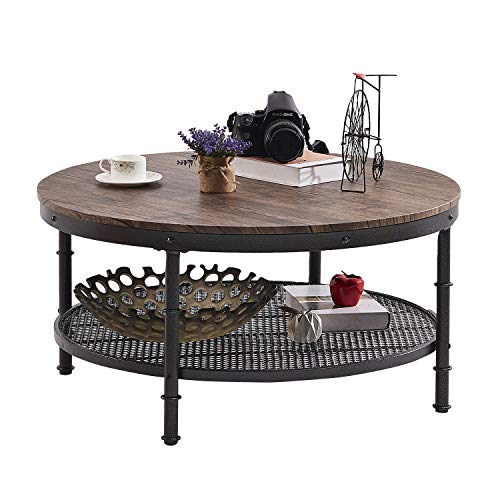
Farmhouse furniture makes the best use of every inch of space in the farmhouse. A coffee table might double as a storage unit.
Every farmhouse would have a sideboard for its dining area. We might use a buffet sideboard as bar storage, but this extra room for setting out dishes of food would have also served as a storage area.
Rustic furniture nearly always works in a farmhouse. You can even buy rustic farmhouse furniture already in a distressed finish.
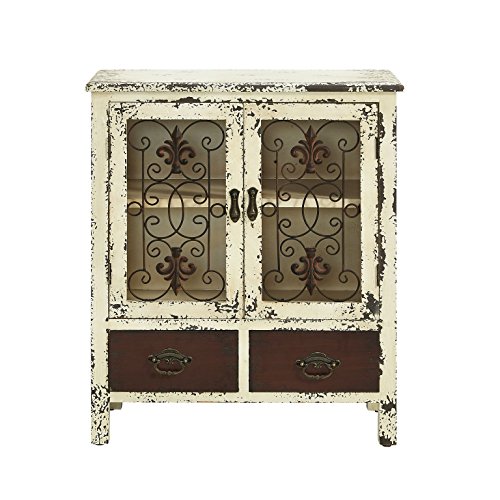
You don’t have to create your own furniture from “tree to table,” although you can, but almost any rustic furniture style, even furniture you create from wooden pallets, blends into farmhouse décor.
These guidelines will help you find your unique farmhouse style no matter where your house is built.
- Color choices should be kept simple. You don’t always have to paint trim a different color. Farmhouse style allows for smooth transitions. It’s OK to use a single calming color, such as alabaster, baby blue, gray, or tan.
- When you do mix up colors, make sure they are compatible. The decorator’s tool for this task is a color wheel. Colors on opposite sides of the wheel are compatible. Remember, the essence of farmhouse style is to be inviting and relaxing. Your color choices should not draw attention to themselves.
- Choose a focal point for every entry and every room. It’s fine to be eclectic, but you don’t want to be cluttered. The eyes need a landing point to begin their journey through every room. For the parlor, it might be an interesting sofa or sideboard. For a bedroom, it might be a headboard. For the living room, it might be the fireplace.
- Remember the rule of three. Odd numbers of collectibles are more aesthetically pleasing than even numbers. Two vases on a table are less pleasing than one or three. Two sofas in your sitting room are less visually attractive than one.
- Find pieces that speak to you. They don’t’ have to be showy or out there. They just have to reflect your deepest personal preferences.
Materials
Traditional farmhouses were built with the materials farmers could most easily obtain, wood and cloth. Stone and brick might be used sparingly for the fireplace and hearth, but it would be almost unheard of for a farmhouse to be built with brick or stone exterior walls. Even the most luxurious farmhouses were primarily built with wood, with paper for interior decoration.
Farmhouse style is compatible with metal roofs. Metal roofs offer excellent protection against fire, wind, and weather, and may last as long as the house. Their durability matches the spirit of farmhouse design. Shake-style shingle roofs are also practical in many situations, and even asphalt shingles can work, just not rolled roofing in asphalt or hot mix.
Styles that mix well with farmhouse style
Some designers combine farmhouse and boho styles for an edgy feel. Others combine farmhouse and beach styles for an even more relaxing vibe. Woven furniture from the boho movement has found its way into farmhouse design.
Elements of Victorian design can work well in a farmhouse interior. Both farmhouse and Victorian-style lend themselves to picturesque, eclectic collections of furniture, pottery, and lighting fixtures. Victorian cut glass can glisten in a farmhouse buffet. You may even decorate an entire room in the Victorian style in a farmhouse without invoking a clash of design styles. Just don’t get carried away, and don’t mix Victorian and rustic.
It’s possible to go too rustic with farmhouse style. Log cabin style and farmhouse style bear many similarities, but just don’t mix. On the other hand, “rustic” in the sense of hand-hewn is exactly what farmhouse style is all about. The tiny imperfections of handmade furniture and interior décor tell a story, and the farmhouse style can become a great repository of family history.
Brief historic overview of farmhouse style
American farmhouse style grew up in the Midwest in the 1800s. The dominant farmhouse designs followed construction practices promoted by German and Scandinavian immigrant craftspeople, but farmhouses weren’t really thought of as a style. They were more of a way of life. It wasn’t until the late 1800s that farmers had opportunities to buy store-bought furniture, and even wallpaper was more of a twentieth-century innovation.
Conditions on the American frontier were challenging, and everything in a farmhouse had to serve a purpose. The house did more than just keep families out of the weather. It also was a place of comfort and shared history. But resources for ornamentation were limited and all luxuries were small.
About 1930, vast numbers of Americans started leaving their farms for jobs in cities. It was about this time that farmhouses became a “style” of construction and decoration that reminded former farm families of their rural roots. Because the farmhouse style is very practical, it became confused with shabby chic. Both styles utilize distressed materials. But while shabby chic’s distressed materials make a statement, farmhouse distressed materials simply reflect the need to use things until they wear out.
In the second half of the twentieth century, farmhouse style took a sharp turn toward kitsch — the opposite real farmhouse décor. Elements of rural living that weren’t necessarily part of farmhouse style were brought into homes that weren’t on farms. Burma Shave signs, faux painted signs offering eggs for 25 cents a dozen, crockery in the shapes of pigs and chickens, and rooster curtains, all in simple colors such as red, white, and black because of common fixtures in middle-class homes. But all of that went away in the 1990s.
In the twenty-first century, few people have done more to popularize farmhouse style than HGTV’s Chip and Joanna Gaines. Their love of shiplap reflects their choice of a rural lifestyle, and their creation of farmhouse-compatible interior décor has gone a long way to educate the public about the possibilities of farmhouse style. And because farmhouse style has become so popular, it is possible to identify emerging trends in farmhouse decoration:
- The country style focuses on collections. It can be showy. It is easy to blow your budget when you are decorating in country style.
- The classic farmhouse is cozy without being cluttered. It is understated but it maintains a certain level of sophistication. Shiplap walls, wide plank floors, country designs, and lots of wrought and cast iron add style without excessive expense.
- Modern farmhouse style emphasizes earthy colors and pastels. It has dropped the red, black, and white popular 50 years ago. To add bright colors, it’s become fashionable to add flowers.
- Farmhouse design has always been based on wood. Modern farmhouse design just isn’t a farmhouse with lots of wood.
- Your great-great-grandma on the farm probably didn’t have subway tile in her kitchen. That’s a modern innovation of farmhouse style. But your great-great-grandparents might have had striped and floral prints, gingham, and lots of design features incorporating bird and cattle images.
Why farmhouse style looks great
When you are in a farmhouse, you are at home. The decoration in your farmhouse isn’t there to impress a design expert. It’s there to make your life more comfortable. Farmhouses capture the stories of our lives and remind us of a life well lived.