🔥 Would you like to save this?
Retired military submarines don’t usually end up as living spaces. They rust at dockyards, get scrapped for parts, or sit as forgotten relics of naval history. A handful of them, though, have taken a very different path.
In order to come up with the very specific design ideas, we create most designs with the assistance of state-of-the-art AI interior design software. Also, assume links that take you off the site are affiliate links such as links to Amazon. this means we may earn a commission if you buy something.
What makes this collection worth studying is the sheer range of outcomes. Some conversions strip the vessel down to raw steel and rebuild from scratch. Others preserve the original hardware, periscopes and pressure gauges included, and treat them as design features. The results run from spartan off-grid hideaways to fully fitted homes with heated floors, custom cabinetry, and proper plumbing. Each one started as a decommissioned hull nobody wanted.
Here are 30 ways people have turned obsolete military submarines into actual places to live.
30. Mahogany Shelving and Leather Club Chairs Claim a Decommissioned Submarine Hull
This is Magic👇
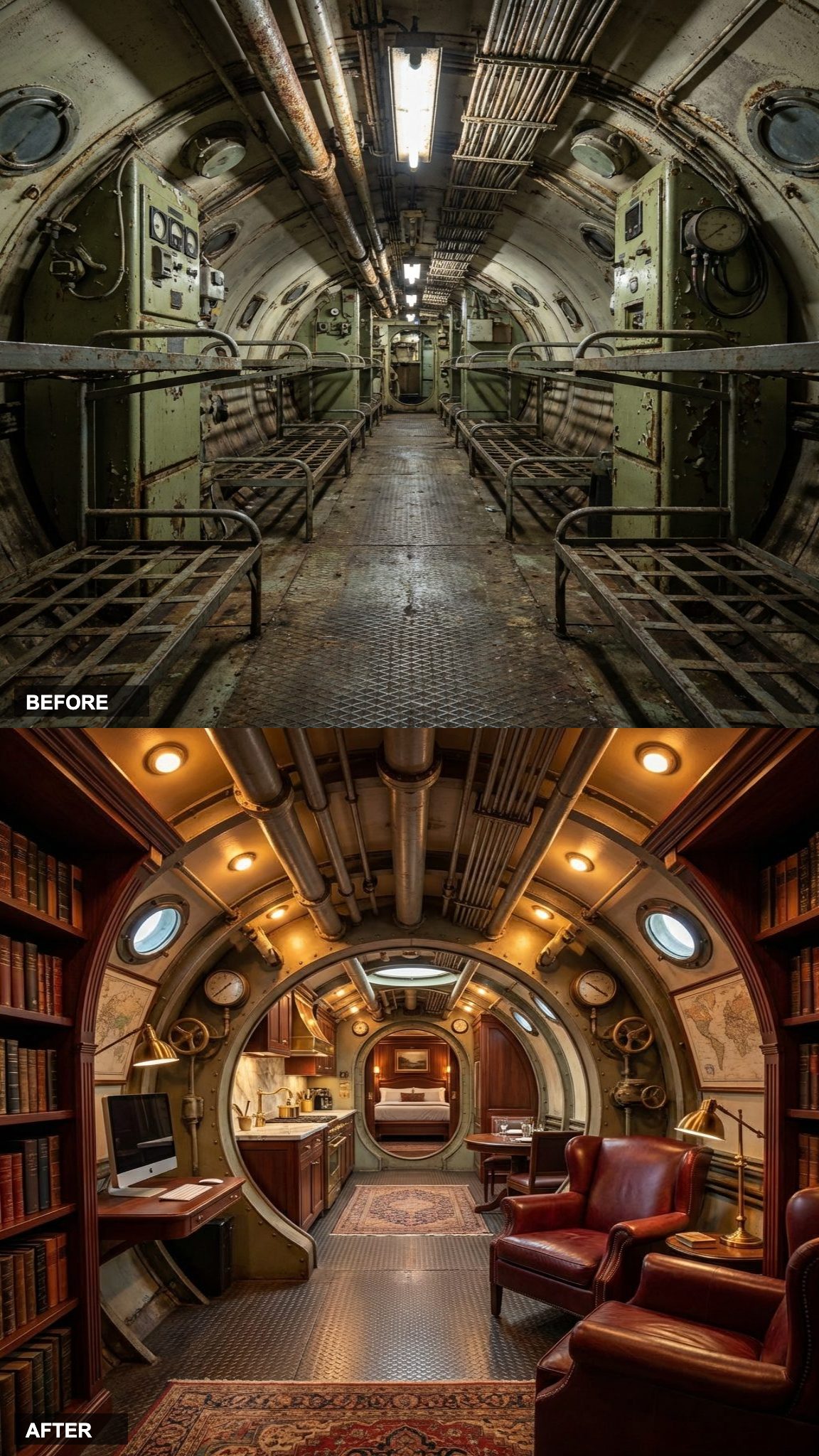
Brass-toned table lamps cast pools of amber across floor-to-ceiling bookshelves packed with leather-bound volumes, while the original diamond-plate steel floor remains underfoot, grounded by a Persian rug in rust and ivory. Pressure gauges and hand-wheel valves stay bolted to the curved hull walls, now framed by mahogany millwork rather than removed.
A Chesterfield-style armchair in oxblood leather anchors the reading corner. Beyond a circular bulkhead arch, a marble-topped galley counter and a dedicated computer workstation sit side by side, and a second arch frames a sleeping cabin at the far end. A world map hangs flat against the curved wall opposite the bookshelves.
Color Story: Oxblood leather, aged brass, and olive-toned steel create a palette that feels pulled from a Victorian cartographer’s study rather than a naval vessel. The depth comes from keeping the hull’s original green-grey patina instead of painting it over. Against dark wood, that corroded metal reads as a finish in its own right.
29. Nautical Rope Trim and Porthole Views Anchor a Submarine’s Open Living Plan
I Love this Transformation👇
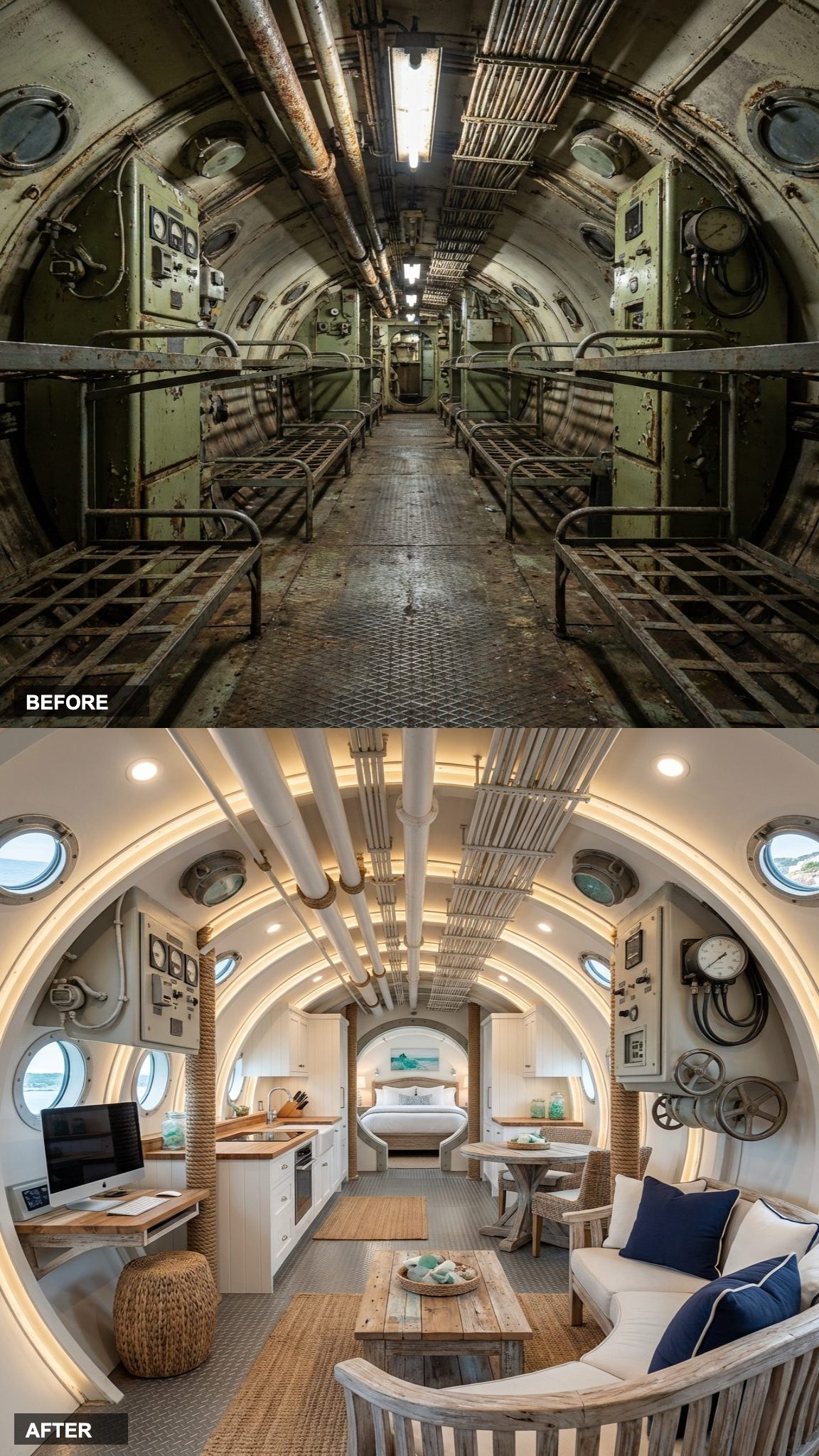
Painted pipes run the curved ceiling length in white, stripped of rust and reframed as architectural detail. Jute rugs, rope-wrapped table legs, and slatted wood furniture push a coastal vernacular throughout the space. A butcher-block kitchen counter sits beside white shaker cabinets, while a low reclaimed-plank coffee table anchors the sofa grouping upholstered in oatmeal linen with navy accent cushions. Porthole windows at both ends pull in natural light and ocean views.
Quick Fix: Painting original pipes the same white as surrounding walls rather than concealing them cuts renovation costs significantly while preserving the vessel’s structural character. Designers call this approach “honest restoration,” and it works especially well in cylindrical hulls where pipe runs follow the natural curve of the ceiling.
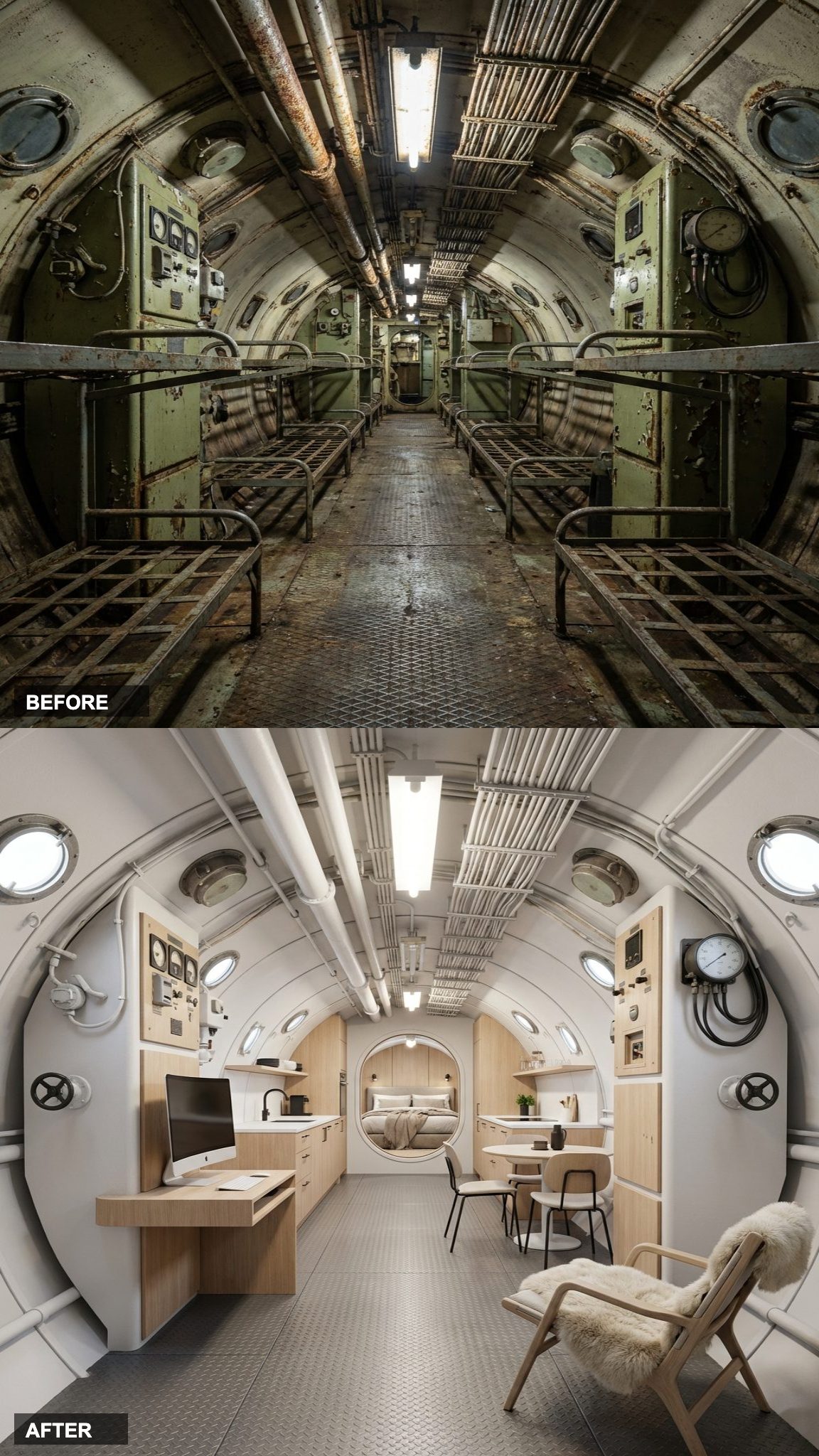
28. Birch Plywood and White Paint Reclaim a Submarine’s Sleeping Corridor
Watch the Transformation👇
Flat-front cabinetry in light birch plywood lines both sides of the curved hull, with floating desks cantilevered directly from the walls at standing height. The ceiling pipes, painted solid white, read as architectural detail rather than mechanical infrastructure. A circular porthole cut into the dividing wall frames a sleeping alcove fitted with a low platform bed and linen bedding. Slim black-legged dining chairs pull up to a round table on the starboard side, while a sheepskin-draped wood chair anchors the foreground.
27. Steampunk Finishes and Warm Edison Light Inside a Converted Military Hull
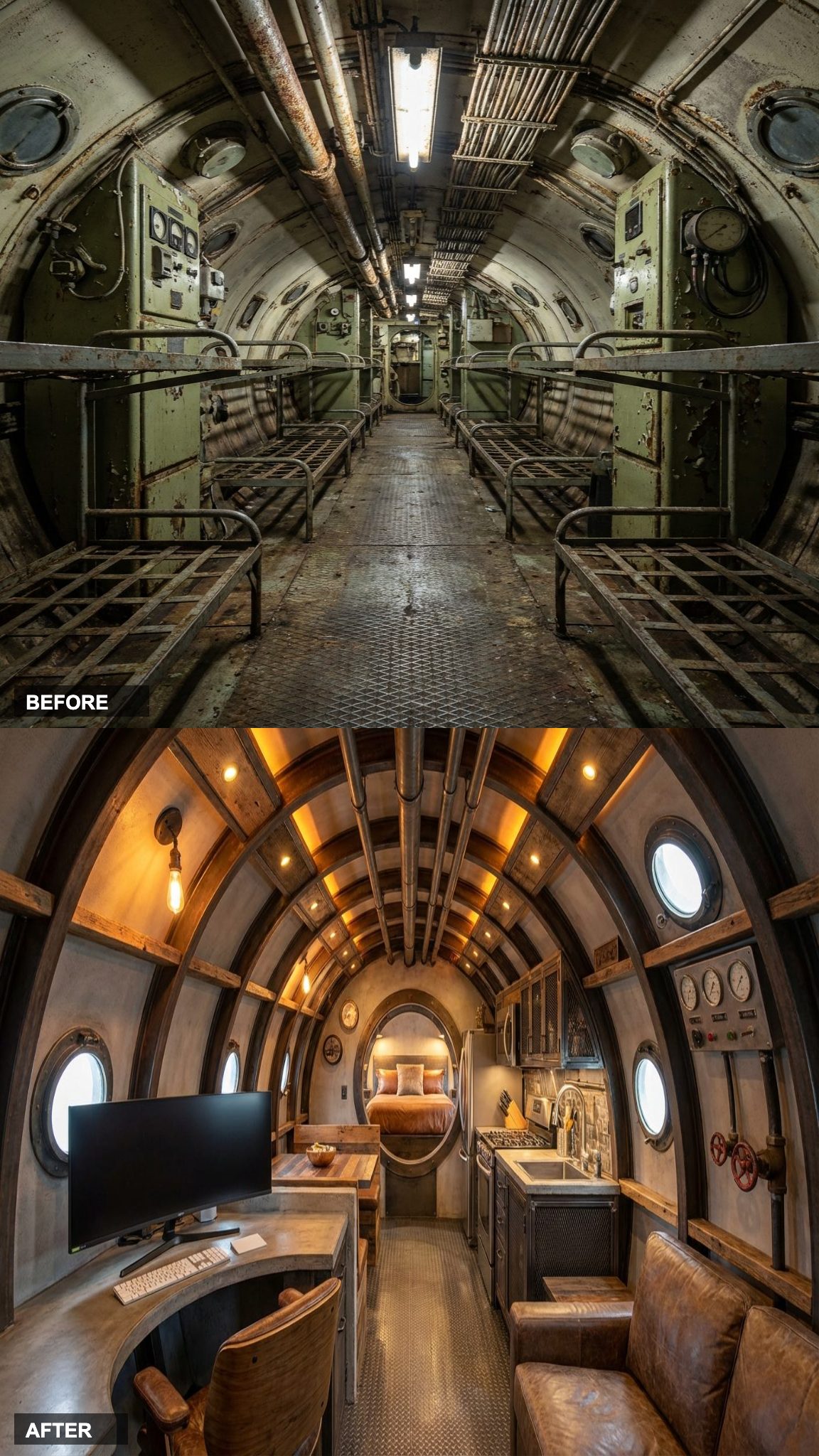
Reclaimed wood paneling lines the curved ribs of the hull, paired with a diamond-plate steel floor that carries over from the vessel’s original construction. Warm amber light from Edison bulb sconces and a continuous strip of recessed ceiling lights runs the full length of the interior, drawing the eye toward an oval porthole-framed bedroom at the far end. Pressure gauges and a red valve wheel remain mounted to the starboard wall, functioning as decor without pretense.
A butcher-block countertop runs along the galley section, flanked by dark metal cabinetry. Brown leather seating sits at the fore end, and a workstation with raw-edge wood shelving holds a widescreen monitor. Round porthole windows on both sides let in diffused natural light, balancing the otherwise warm-toned interior.
26. Porthole Bedroom and Concrete Desk Surface Inside a Converted Naval Hull
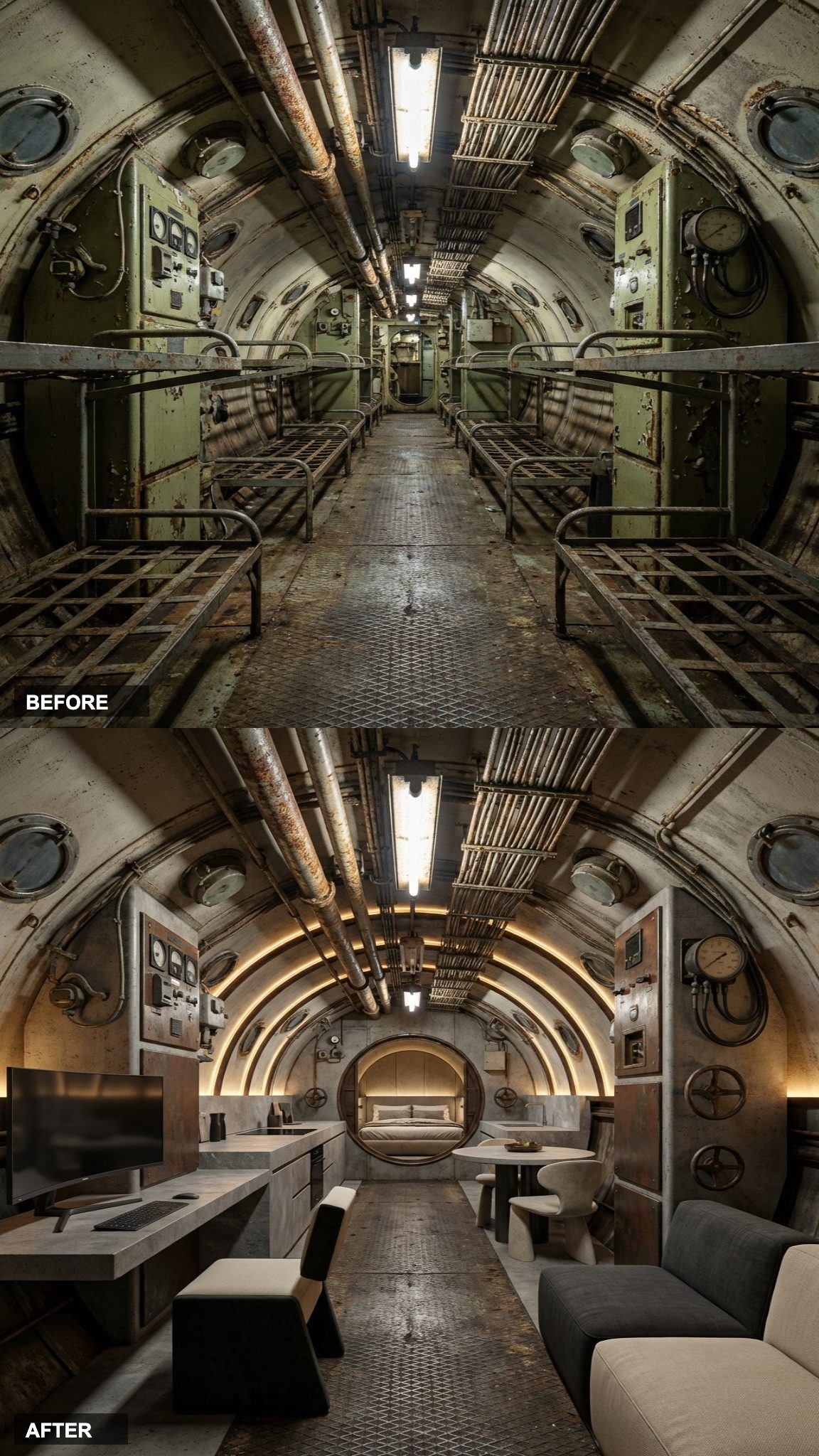
Warm LED strip lighting arcs along the curved ribs, drawing the eye toward a circular porthole-framed bed niche upholstered in ivory linen. A concrete-topped workstation with flat-drawer cabinetry anchors the port side, paired with a matte black keyboard and monitor.
Soft furnishings and layered lighting take the conversion concept even further in this next space.
25. Porthole Light and Linen Sofas Fill a Submarine’s Curved Living Corridor
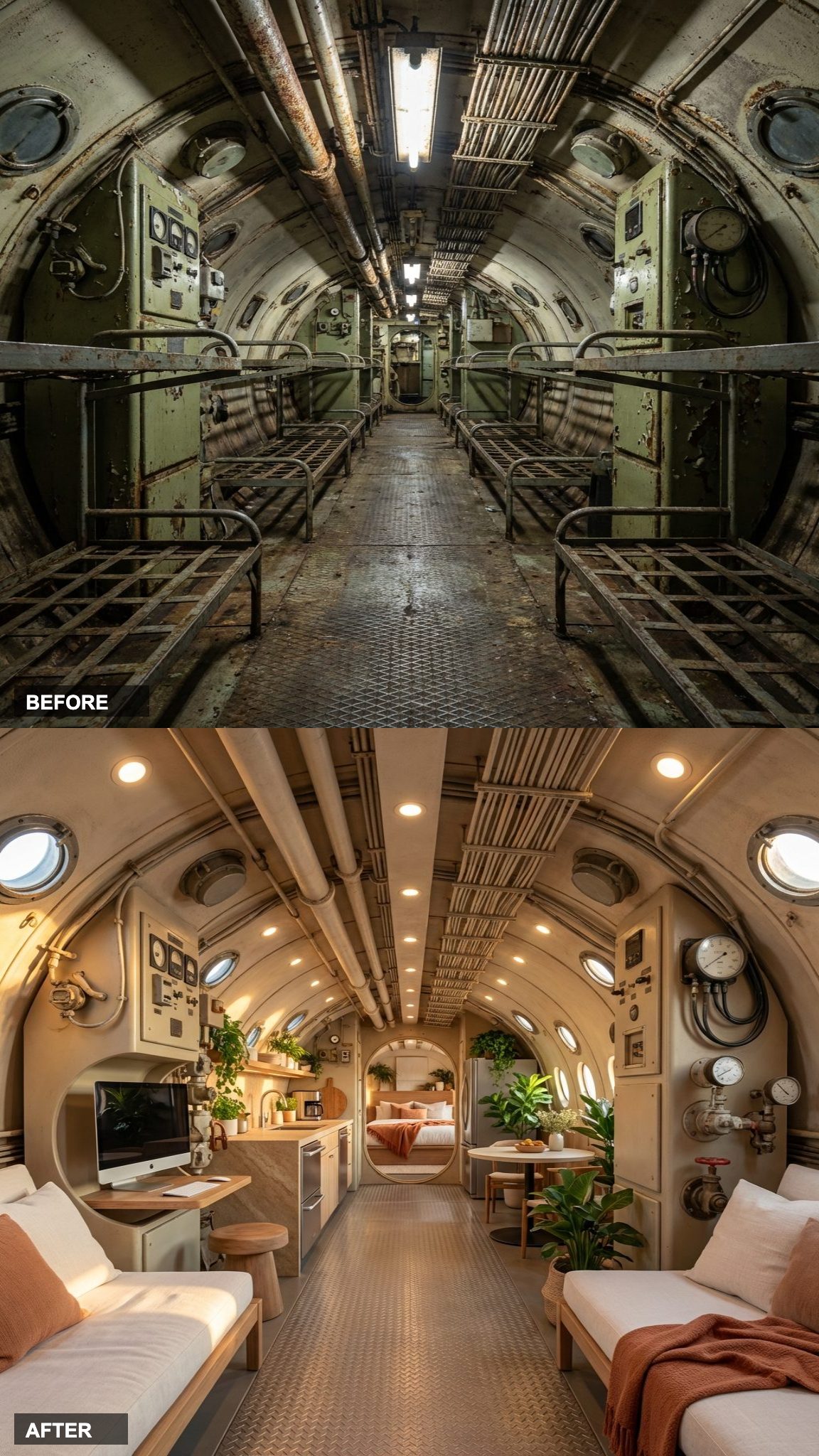
Cream linen sofas anchor the foreground on both sides of the diamond-plate floor, still original to the hull. Recessed ceiling lights run the barrel vault’s length, supplemented by sconce-style wall fixtures that cast amber pools across beige plaster walls. An iMac sits on a raw oak desk with turned-leg stools, while a circular arch cutout frames a bedroom beyond, its salmon bedding visible through the opening. Tropical plants in terracotta pots soften the pipe runs overhead, and a round dining table with white ceramic vessels sits mid-corridor between the seating zones.
24. Walnut Millwork and Porthole Glass Reshape a Cold Steel Corridor Into Living Space
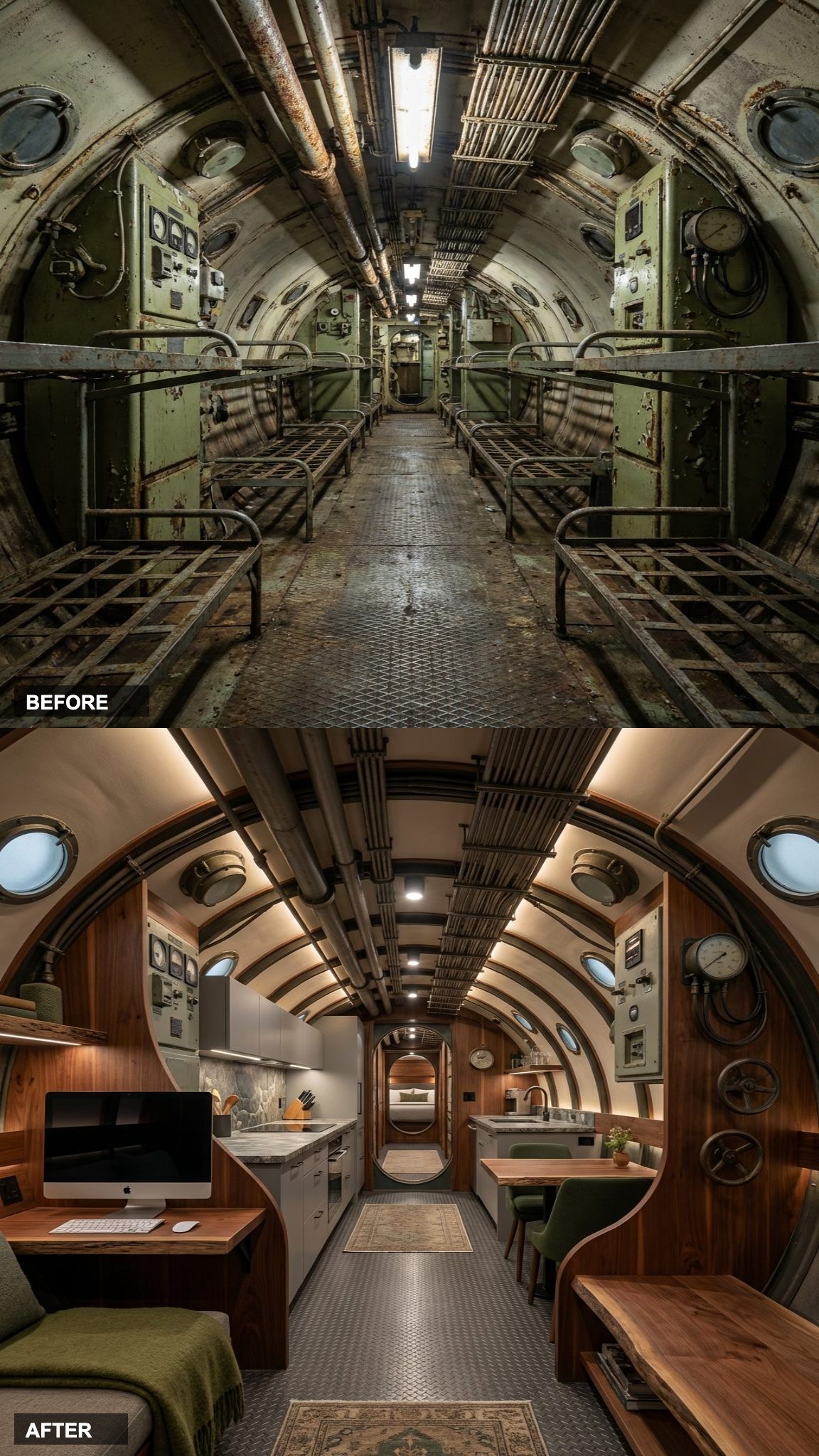
Dark walnut panels line the curved hull walls, wrapping around original porthole frames that now glow with backlit frosted glass. Overhead, the existing pipe runs stay visible but painted out in matte gray, tucked against ribbed ceiling arches lit by recessed downlights in a warm 2700K tone. The original diamond-plate steel floor remains underfoot, softened by a runner rug in muted earth tones.
A live-edge walnut dining table anchors the starboard side, paired with a green bouclé chair. Port side holds a white iMac workstation on a straight-grain walnut desk. Farther down the corridor, white shaker-style cabinetry flanks a galley kitchen with a marble-look composite countertop. A circular hatch threshold frames the bedroom at the far end, where a pendant lamp hangs centered over the bed.
A circular hatch threshold frames the bedroom at the far end, where a pendant lamp hangs centered over the bed.
23. Japanese Minimalism and Paper Lanterns Inside a Converted Military Hull
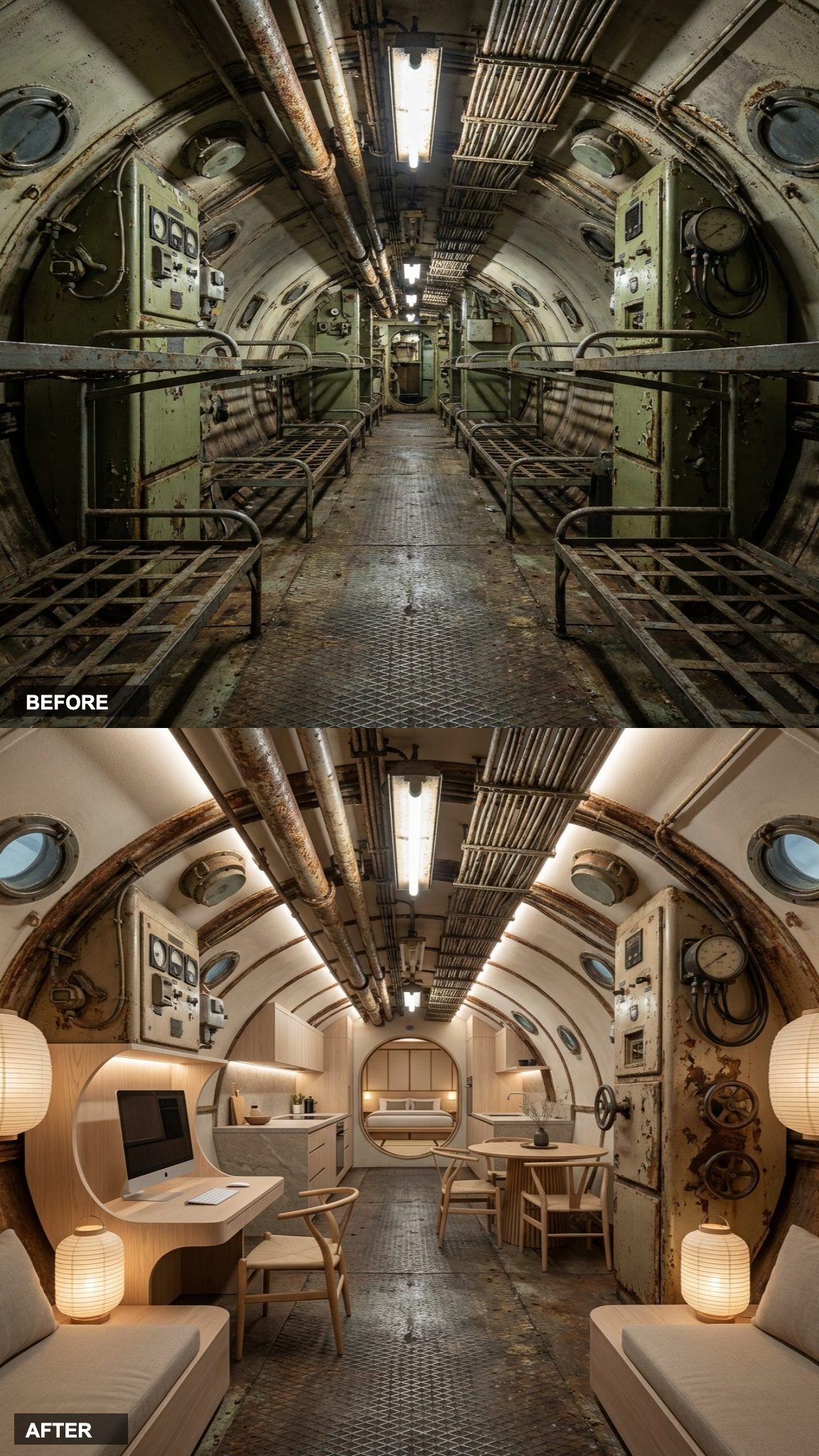
Birch furniture with circular cutout detailing anchors both the desk station and the circular doorway frame leading to a sleeping alcove beyond. Paper lanterns in warm white cast soft pools across the hex-tile floor. A round dining table with wishbone chairs sits center-corridor. The original ceiling pipes, porthole rings, and rusted bulkhead hardware stay fully intact overhead and along both walls.
Style Tip: Pairing light natural wood with original rust and peeling paint works because the contrast reads as intentional rather than unfinished. The key is keeping the new furnishings light in both color and visual weight so the industrial shell remains the dominant material story.
Living walls and lush greenery push the submarine conversion concept into entirely new territory.
22. Ferns, Porthole Glass, and Reclaimed Wood Turn a Naval Hull Into a Verdant Micro-Home
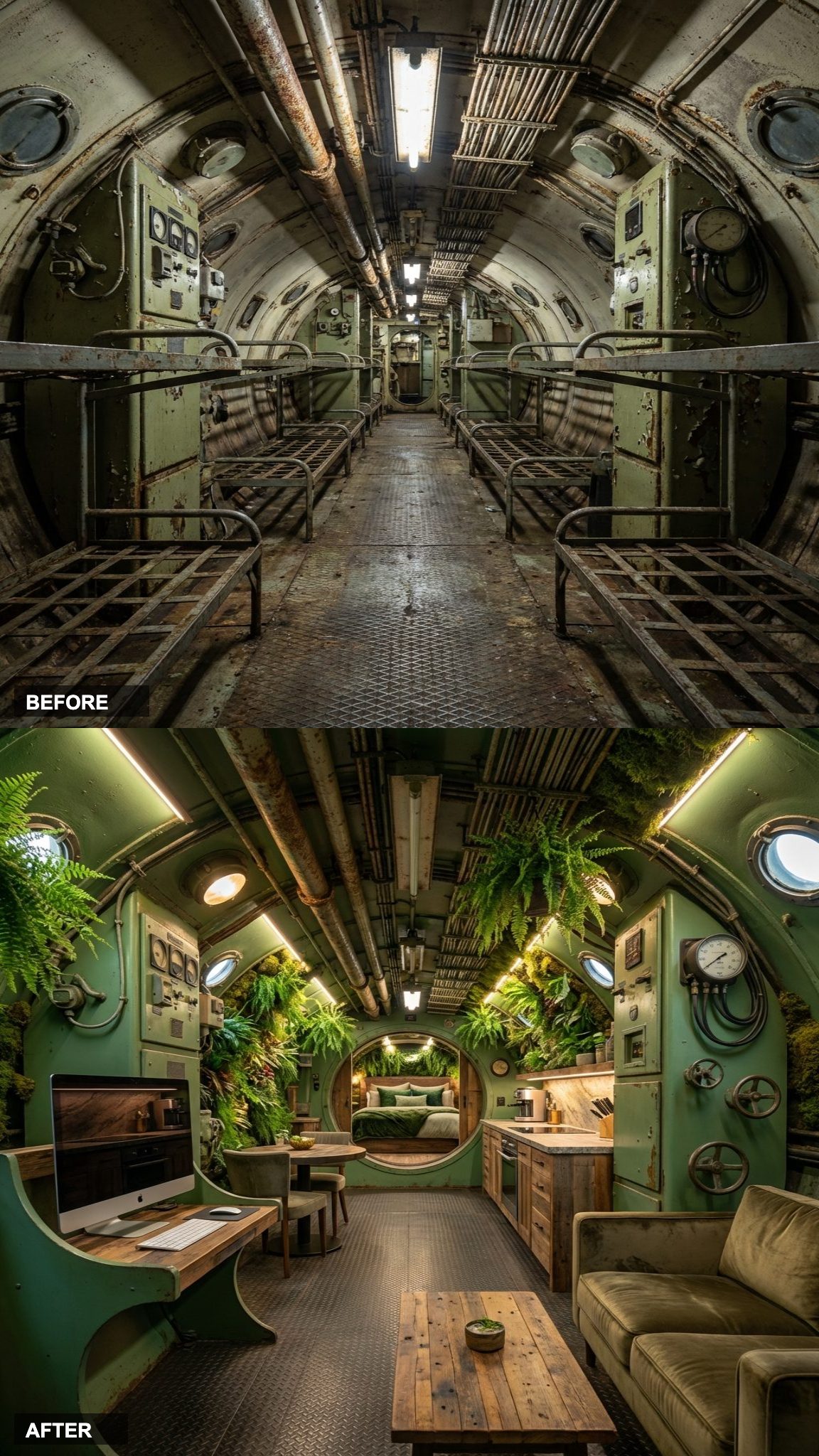
Moss and sword ferns cover the curved walls from floor to ceiling, rooted into vertical planting panels that follow the hull’s natural arc. Strip lighting tucked along the ceiling spine washes the greenery in warm amber, making the original pipes and gauge clusters read as deliberate design features rather than leftovers. The original round porthole windows remain intact, now backlit to glow like small moons against the green-painted steel.
A round arch cut through the bulkhead frames the sleeping nook beyond, where a low platform bed sits centered beneath more hanging ferns. On the port side, butcher-block countertops and raw wood cabinetry define a narrow kitchen run. Opposite, a desk surface in matching wood holds an iMac. A velvet sofa anchors the foreground beside a plank coffee table with visible grain and knots.
21. Matte Black Steel and Porthole Glass Reshape a Hull Into a Moody Live-Work Suite
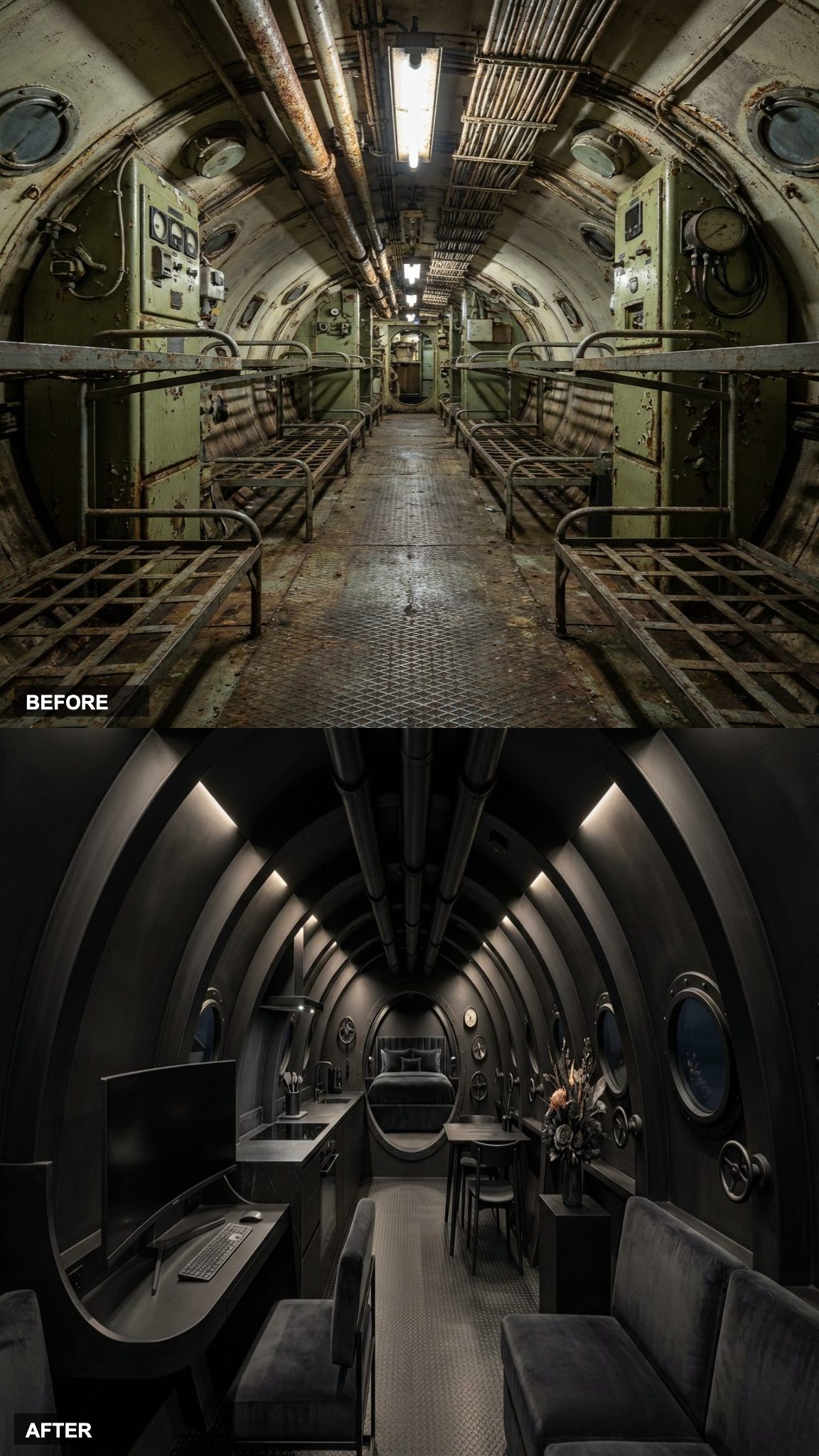
Gunmetal paint covers every curved surface, from the ribbed hull walls to the barrel-vaulted ceiling, pulling the entire corridor into a single monochromatic register. Strip lighting runs along the upper arch, casting a low, directional glow rather than flooding the space with ambient light.
A compact workstation with a matte keyboard and monitor anchors the left side, while a dining table and upholstered chairs in charcoal fabric sit mid-corridor. At the far end, a platform bed frames the sleeping zone. Original porthole openings remain, now glazed and backlit to suggest depth beyond the hull.
Budget Tip: Spray-applied rubberized paint sold at auto-supply stores costs a fraction of specialty marine coatings and bonds well to steel surfaces, making it a practical choice for anyone working with a salvaged hull on a tight budget. One gallon typically covers around 25 square feet on curved or textured metal, so measure hull surface area carefully before ordering.
20. Rustic Lodge Furnishings and Stone Arches Claim a Steel Military Hull
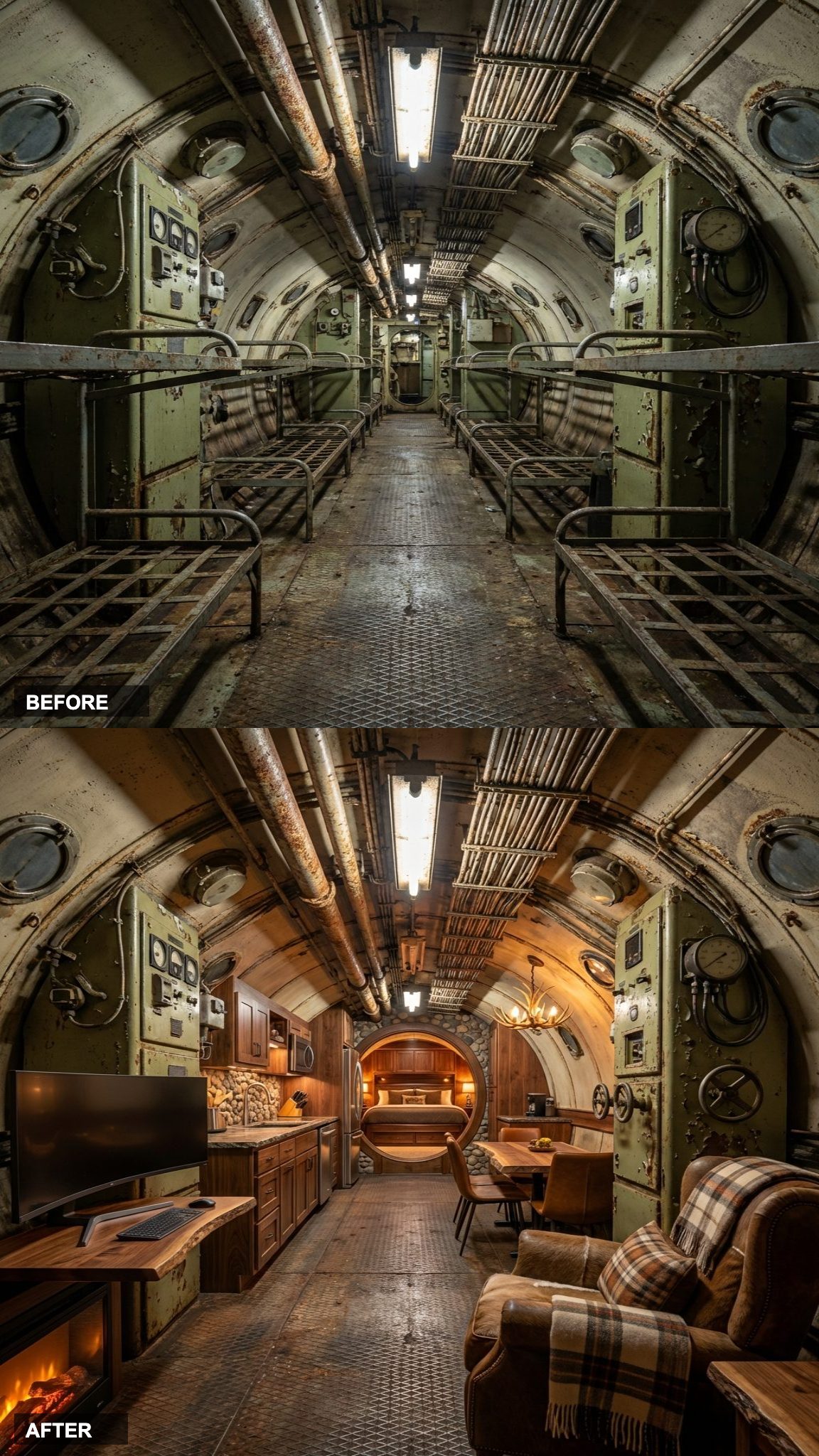
Plaid wool throws, a live-edge desk, and an antler chandelier pull the space toward a mountain cabin register without hiding a single rivet or pipe.
Style Math: Layering two contradictory design languages, industrial military hardware alongside lodge-style wood cabinetry and stone masonry, works here because neither side surrenders to the other. The stone arch framing the sleeping alcove borrows from wine cellar architecture, a technique that visually separates zones inside a single narrow corridor without adding a wall. Budget-conscious converters can source reclaimed barn wood cabinet faces to replicate the warm grain tones seen on the kitchen run, often at lower cost than custom millwork.
19. Limed Oak Millwork and Porthole Glass Soften a Submarine Hull Into a Luxury Suite
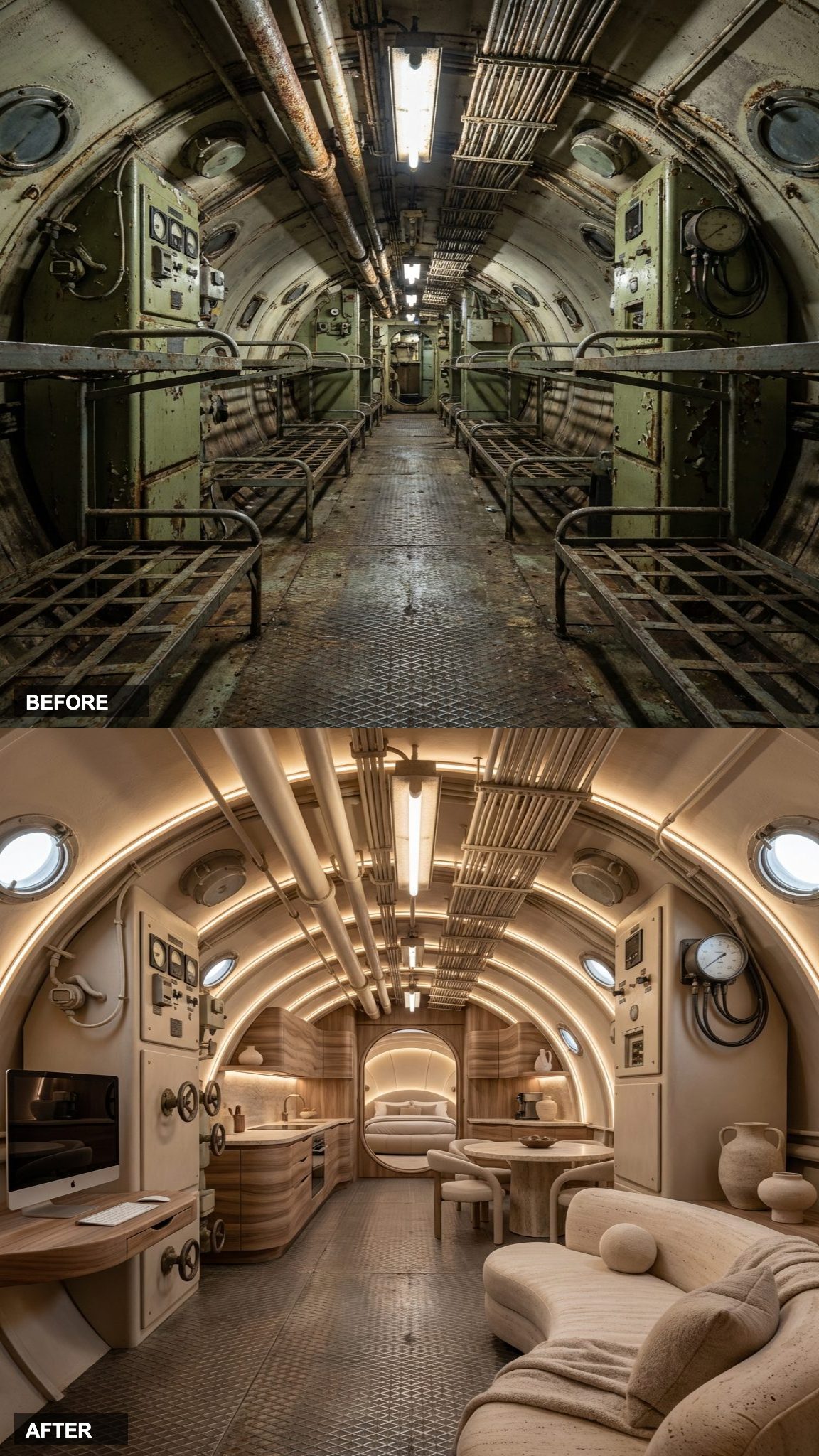
Limed oak cabinetry wraps the curved hull walls in horizontal grain lines that echo the vessel’s ribbed steel skeleton. A round dining table with a limestone-look top sits beside a low bouclé sofa, while a bed niche framed in matching wood panels anchors the far end. Warm LED strip lighting traces every arch overhead.
Pro Tip: Bouclé upholstery, typically associated with flat-walled apartments, holds its shape surprisingly well inside curved submarine hulls because the fabric’s looped texture is flexible enough to wrap custom curved frames without distortion. Sourcing frames from a boat upholstery shop rather than a furniture manufacturer typically reduces lead time and cost on radius pieces.
18. Zen Living and River Pebbles Rewire a Naval Hull’s Crew Quarters

🔥 Would you like to save this?
Smooth river pebbles line a shallow water feature along the port side, where a small cascade feeds into a stone basin beside a curved oak desk. The workstation holds a monitor and sits adjacent to a compact kitchen finished in marble-look panels with flat-front cabinetry. Recessed ceiling fixtures replace all overhead fluorescents, and the original pipes run the full length of the barrel vault, painted to match the plaster-toned walls.
The starboard side holds a low oak coffee table flanked by linen sofas with oversized square cushions. Bonsai trees in ceramic pots anchor both ends of the seating area, and bamboo slat screens divide the sleeping compartment from the lounge. The circular hatch door at the far end frames the bed beyond it.
Ask Yourself: Incorporating a water feature into a steel hull requires a waterproof liner bonded directly to the metal substrate before any stone or pebble work begins. Even a slow seep can accelerate rust inside a sealed hull. Ask yourself whether the long-term maintenance commitment fits your renovation timeline before committing to moving water indoors.
17. Mid-Century Walnut and Recessed Light Rewire a Submarine Hull Into a Live-Work Retreat
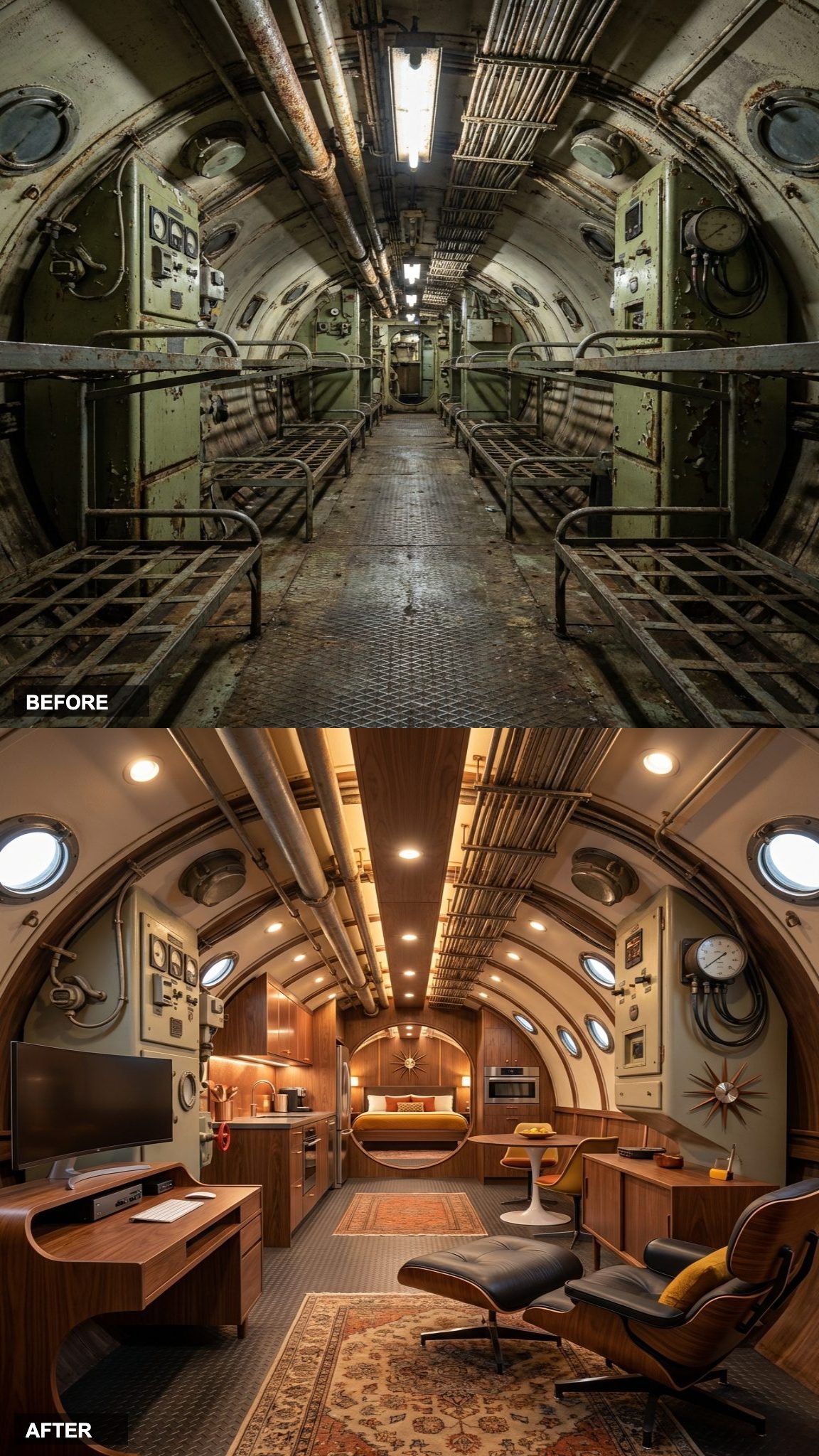
Warm walnut paneling lines every curved wall from the entry zone to the sleeping alcove at the far end, unifying a space that could have read as fragmented. An Eames lounge chair with its black leather cushion sits on a Persian-style rug in burnt orange and ivory, positioned beside a tulip-base side table in white. The original overhead pipes remain exposed along the ceiling barrel but are painted to match the surrounding cream tone, letting the recessed can lighting draw the eye instead.
A built-in walnut desk with flush drawer pulls occupies the port wall, paired with a flat-screen monitor. Behind it, a compact kitchen run includes what appears to be stainless appliance faces and under-cabinet task lighting. The sleeping area beyond the arch holds a low platform bed with mustard-toned bedding. Porthole windows on both sides provide the only natural light source, their round frames left in original metal finish against the paneled walls.
Common Mistake: When converting an original hull’s overhead pipe runs, one of the most common mistakes is painting them a contrasting color to signal intentionality. Painting them the same tone as the ceiling surface reads far cleaner and keeps the eye moving toward furniture and lighting rather than stopping at infrastructure. The contrast approach almost always makes a tight cylindrical space feel more cluttered, not more industrial-chic.
16. Copper Pipe Ceilings and Chesterfield Leather Claim a Submarine Hull as Luxury Living
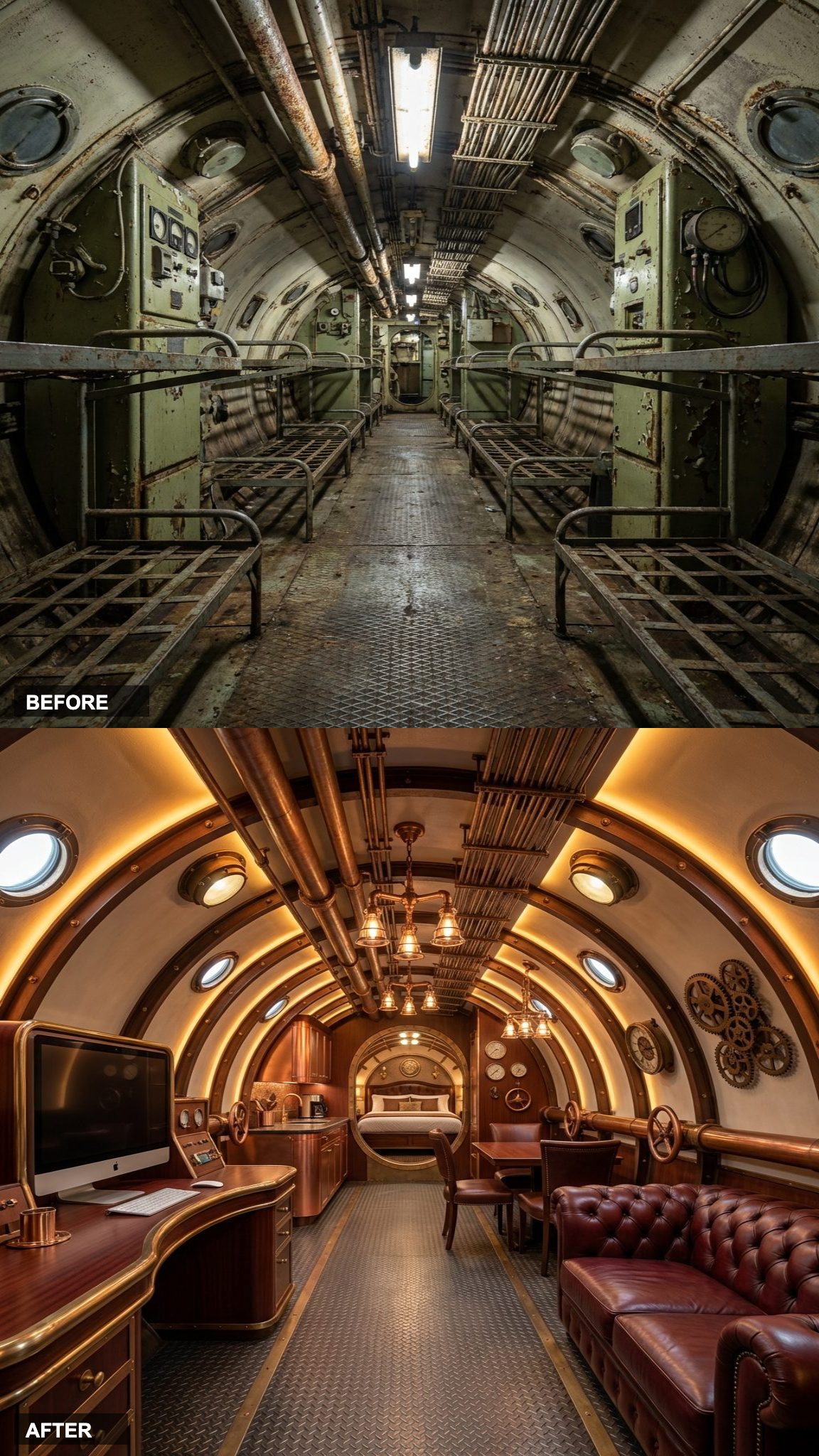
Burnished copper pipe runs left fully exposed along an arched ceiling do more decorative work here than any chandelier could.
A pendant cluster of cage-style Edison fixtures hangs at center corridor, casting amber pools across diamond-plate flooring that was never replaced, just cleaned. Mahogany millwork lines both walls in warm reddish-brown panels, and a tufted Chesterfield sofa in oxblood leather anchors the right side without crowding the narrow walkway. Circular porthole windows trimmed in polished bronze punctuate the hull at regular intervals, and decorative gear clusters mounted to the wall read as sculptural rather than mechanical.
A bed tucked into a framed arch at the far end gives the sleeping area its own defined zone without a door. The desk setup on the left incorporates a flat-screen monitor flush with the millwork, keeping technology present but not dominant. Strip lighting recessed along the upper hull curve washes the ceiling in gold, making the copper pipes above feel less industrial and more architectural.
15. Gold Sunburst Metalwork and Emerald Velvet Remake a Hull Into Art Deco Quarters
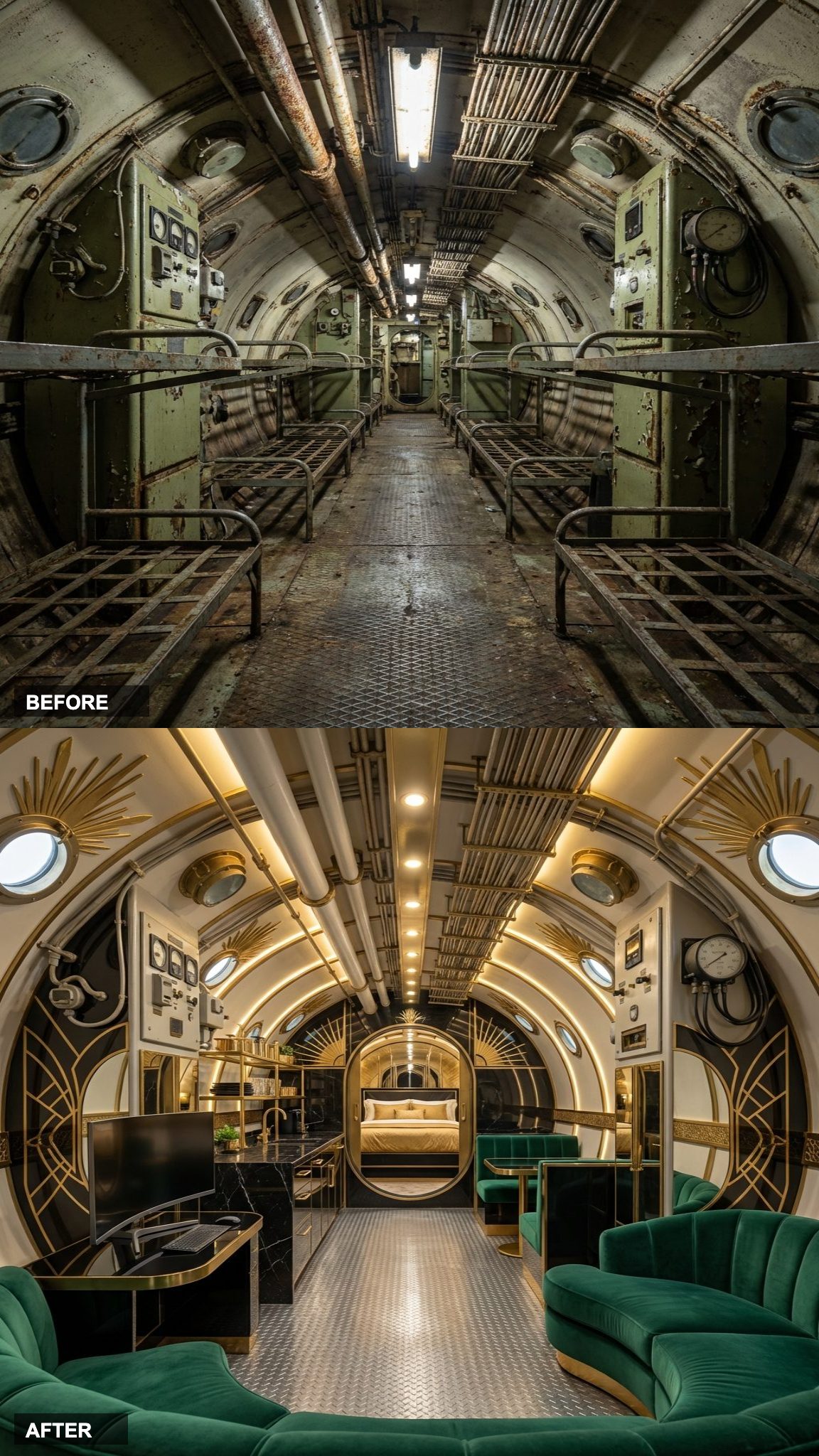
Gold sunburst wall sconces frame each porthole, and the pattern repeats in the arched partition separating the living area from the bedroom beyond. Black marble countertops with gold veining anchor the kitchenette on the left, while emerald velvet curved sofas fill the foreground with deep color.
Recessed ceiling spots run the length of the barrel vault, supplemented by warm cove lighting that traces the pipe runs overhead. The floor is diamond-pattern tile in a pewter tone, and the bedroom, glimpsed through a circular gold-trimmed arch, holds a bed dressed in champagne linens.
Try This: Gold leaf appliqué film, sold in craft and auto-detailing supply stores, bonds directly to painted metal surfaces and can replicate the look of hand-applied gilding on sunburst fixtures at a fraction of the fabrication cost. It holds up well in low-humidity interiors and can be sealed with a matte varnish to prevent peeling at the edges.
14. Neon Arc Lighting and Matte Charcoal Steel Rebuild a Hull Into a Cyberpunk Retreat
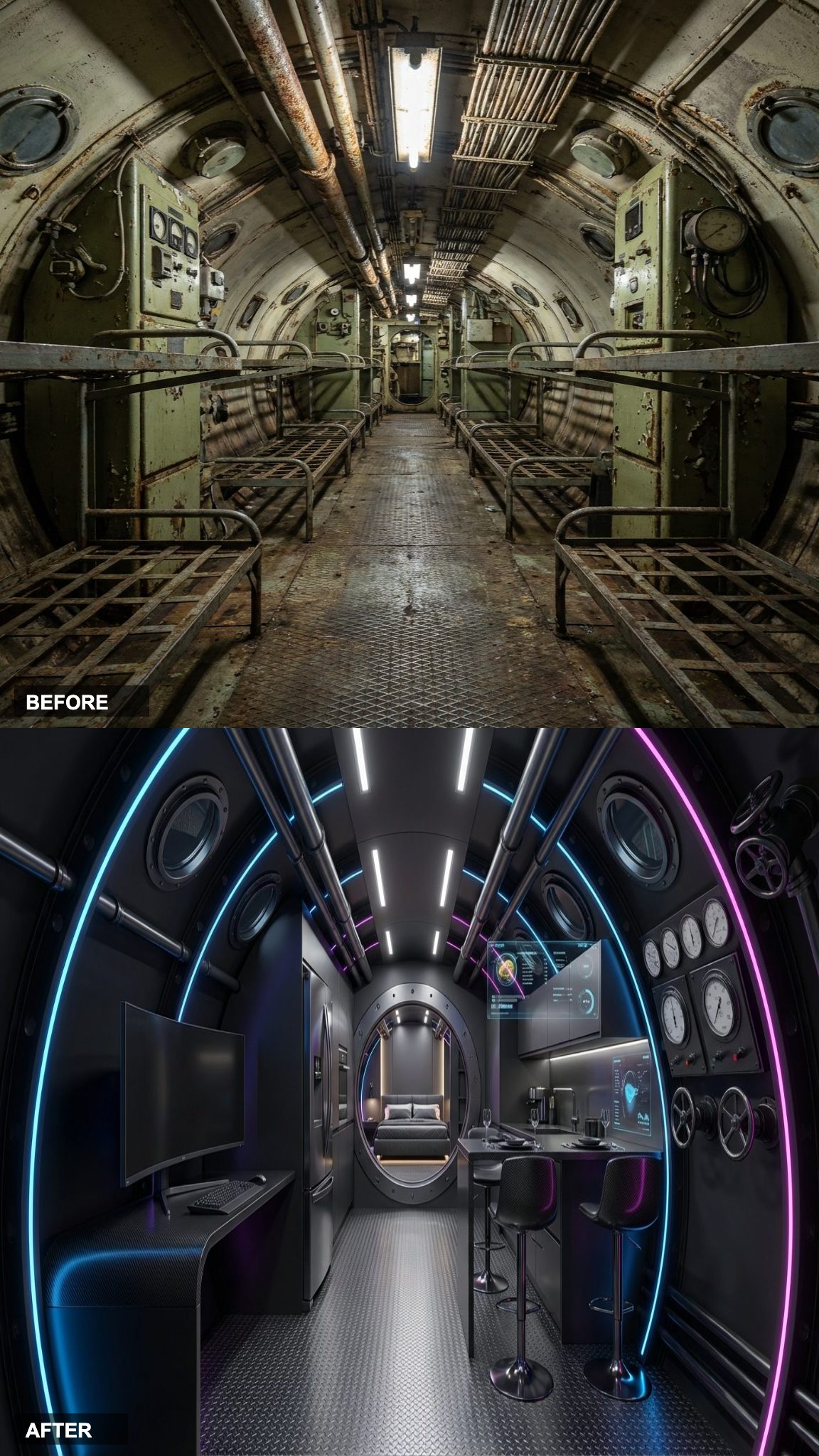
Cyan and violet neon strips trace the full curve of the arched hull ceiling, casting colored light across matte charcoal steel panels without a single warm-toned surface in the room. The diamond-plate floor, painted dark gray, anchors the space while keeping the industrial substrate visible underfoot. A curved monitor desk sits port-side, paired with backlit bar stools at a narrow counter on the starboard wall.
Through a circular pressure door, a bed with charcoal upholstery sits framed like a porthole view. Analog pressure gauges remain mounted to the bulkhead alongside a glowing digital display screen, placing mechanical history directly beside contemporary tech without apology.
Why the Neon Arc Works Structurally, Not Just Visually
LED neon flex strips bonded along the interior curve of a submarine hull follow the natural radius of the steel frame, which means no custom bracketing is required. The arch acts as a ready-made channel. Running two separate color temperatures, cool cyan overhead and warm violet at the perimeter, creates depth perception in a space that is inherently narrow, making the tube feel wider than its actual diameter without any structural alteration.
13. Warm-Edged Strip Lighting and Poured Concrete Counters Settle Into a Naval Hull
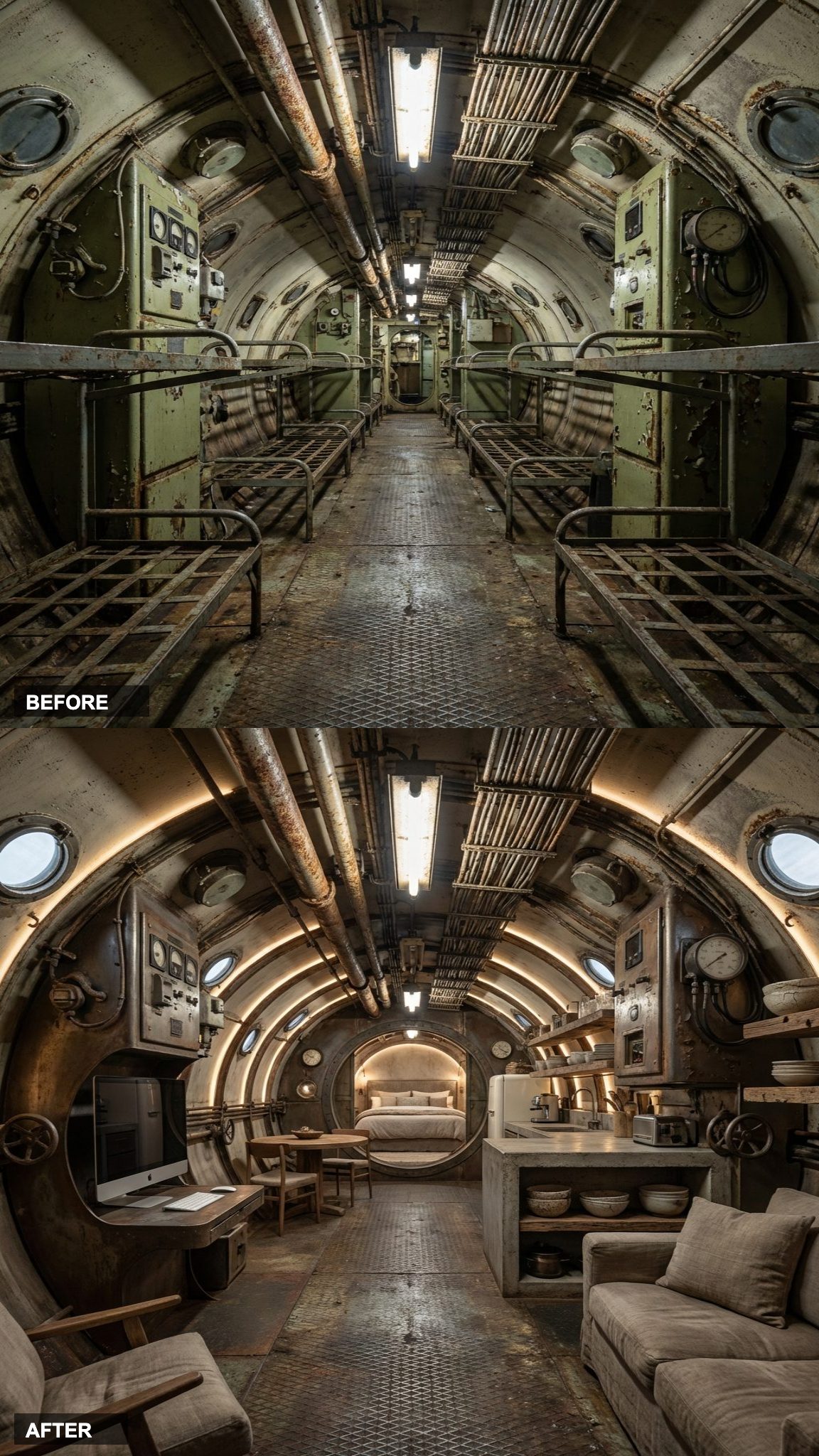
Strip lighting runs the full curve of the hull’s ribs, casting amber light across original pipe runs that remain exposed overhead. A poured concrete island anchors the kitchen side, topped with ceramic bowls in matte white. Open wood shelving holds cookware above a compact refrigerator. Opposite, a linen sofa faces a round wood dining table with bentwood chairs. At the far end, a circular hatch frames a bed with white hotel-weight bedding. Porthole windows on both walls let in daylight.
- Concrete countertops resist moisture better than wood alternatives inside sealed steel hulls, making them a practical choice beyond their aesthetic role
- Circular LED strip lighting tucked into hull rib recesses costs less to install than custom cove lighting and follows the curve without modification
- Open shelving in a narrow tube layout prevents the visual compression that upper cabinet doors create, keeping the central corridor from feeling like a corridor at all
12. Polished Brass Fittings and Cherry Cabinetry Remake a Hull Into Nautical Quarters
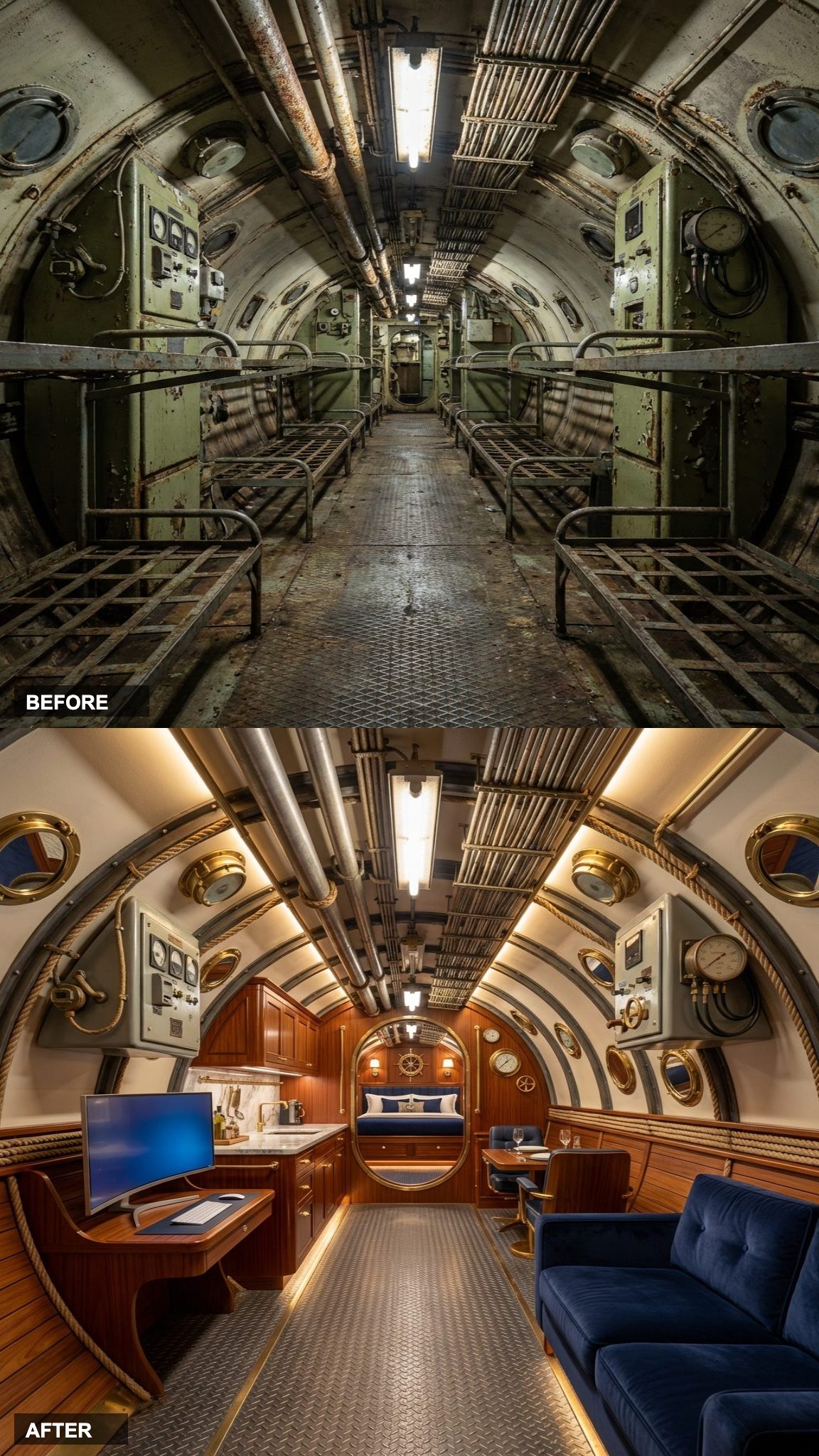
Cherry wood cabinetry runs the full length of one bulkhead wall, housing a workstation with a marble-look countertop and a monitor at seated height. Brass porthole frames, rope coils used as trim detail, and ship’s wheel medallions mounted near the oval bed surround keep the nautical reference specific rather than decorative. The ceiling retains its original pipe runs, now polished chrome rather than painted over, lit from below by warm tube fixtures. Navy velvet upholsters a tufted sofa on the starboard side, and the diamond-plate floor receives a dark stain that reads closer to teak than steel.
11. Tropical Rattan and Terrazzo Floors Settle Into a Submarine Hull as Coastal Living Quarters

Terrazzo flooring with coral-toned aggregate runs the full length of the hull, anchoring rattan chairs and a round dining table in the foreground. Porthole windows carry palm tree views, while LED strip lighting tucked beneath overhead pipe runs casts the white-painted ceiling in amber. A bedroom visible through a circular arched opening features a green-and-coral patterned duvet. On the left, an iMac sits on a terrazzo-topped desk beside a white sink cabinet.
10. Boho-Industrial Lighting and Butcher Block Counters Settle a Submarine Hull Into Live-Work Life

Warm amber underlighting runs the full length of the curved hull ceiling, casting the exposed overhead pipes in a burnt sienna glow that reads more like a wine cellar than a vessel. On the left wall, a wall-mounted desk in pale birch holds an iMac and rattan side chairs. Open shelving on the right displays raw clay vessels and ceramic pitchers against white cabinetry with a butcher block counter surface.
Dried pampas grass in a floor vase anchors the transition between the work zone and a galley kitchen, while a low arched passageway at the far end frames a bed dressed in terracotta linens. Circular porthole sconces at mid-wall height replace all overhead glare with diffused pools of light. Retaining the original pressure gauges and coiled pipes along the starboard wall keeps the hull’s identity intact without making the space feel like a museum exhibit.
9. Maple Ply Cabinetry and Porthole Clusters Pull a Submarine Hull Into Livable Order

Flat-front cabinetry in what reads as maple-toned ply runs the full length of both walls, keeping the eye moving toward a oval-framed bedroom alcove at the far end. The floor retains its original diamond-plate steel pattern, now cleaned and left unsealed, so the industrial substrate stays readable beneath the domestic program above. A single linear LED strip mounted flush to the ceiling vault handles most of the ambient load, while recessed under-cabinet lighting separates the kitchen counter from the wall plane behind it.
On the left, an iMac sits on a dedicated desk run, signaling that the layout treats work as a fixed function rather than an afterthought. Original pressure gauges, pipe clusters, and porthole rings remain bolted in place throughout, none of them painted over or reframed. Keeping hardware at its original oxidized silver finish while surrounding it with pale wood is a calibration worth noting: the contrast holds because neither material competes for the same visual register.
8. Matte Black Steel and Recessed White Light Retrofit a Hull Into a Live-In Command Suite

Every surface has been coated in a uniform matte charcoal-black finish, applied directly over the original steel hull, overhead pipe runs, wall panels, and diamond-plate flooring alike. The monochrome treatment unifies what was once a visually fractured space without hiding its mechanical bones. A single fluorescent tube fixture runs the ceiling centerline, casting a clinical white beam down the corridor’s length.
The furniture placement reads like a studio apartment compressed into a tube: a low platform daybed sits foreground left alongside a desk with a flat monitor and keyboard, while a bar-height table with metal stools occupies the right midpoint. A compact sofa anchors the far end beneath a curved archway. The original circular porthole frames remain intact on both walls, now painted flush with the surrounding panels so they register as architectural detail rather than salvage.
7. Sage Paint and Pink Velvet Pull a Decommissioned Hull Into Residential Life

Olive sage covers every original wall panel, porthole surround, and pipe run, unifying hardware that would otherwise read as industrial clutter. Recessed downlights replace fluorescent tubes overhead, casting a rose-tinted wash across painted ceiling pipes that now feel deliberate rather than exposed. A velvet sofa in dusty blush anchors the forward living area, its cushions softened further by cream throw pillows.
The galley kitchen runs along the starboard wall with cream shaker cabinets, stainless appliances, and open shelving. A curved workstation with a matching sage base holds a desktop monitor at the port side, connecting office and kitchen functions within a single sightline. Through the aft arch, a pink upholstered headboard marks the sleeping compartment, keeping the entire layout readable end to end without a single partition wall.
6. Persian Rugs and Moroccan Lanterns Settle Into a Submarine Hull as Bohemian Living Quarters

🔥 Would you like to save this?
Walnut-stained wood paneling lines the curved walls from floor to ceiling, and the original torpedo tube pipes running overhead have been left exposed but cleaned to a warm rust-brown patina. Recessed dome lights replace institutional fluorescents, washing the barrel vault in soft amber. Two velvet sofas, one deep teal and one burgundy, anchor the living area on either side of a hand-knotted Persian rug in brick red and ivory. Macramé wall hangings suspend from the port and starboard sides near original porthole frames, now cleaned to show the steel ring detail.
A copper arched hood marks the kitchen zone, and a marble-topped counter sits opposite it. At the far end, a second arched opening frames the sleeping alcove where a bed dressed in a red medallion coverlet sits beneath clusters of brass Moroccan pendant lanterns. The original circular valve wheel on the starboard wall has been left in place as a fixed element rather than concealed. Every zone reads as distinct, yet the palette of burgundy, rust, amber, and walnut holds the entire length of the hull together without a break.
5. Matte Black Pipes and Amber Strip Lighting Settle a Hull Into a Dark Industrial Studio

Concentric steel ribs arch overhead, painted matte black and outlined by recessed amber strip lighting that traces each curve back toward a circular bulkhead door framing a low platform bed. To the left, a desk with a dark wood surface and a monitor on a matte black stand anchors a work zone directly beneath a round porthole. Opposite, open shelving with dark countertop material holds kitchen goods beside original pressure gauges left mounted to the wall. A charcoal upholstered armchair sits at the foreground with a folded knit throw draped over its arm.
4. Ivory Bouclé and Brass Pipe Runs Pull a Decommissioned Hull Into a Luxury Live-In Suite

Herringbone-pattern hardwood flooring runs the full length of the hull, anchoring furniture arrangements that include cloud-shaped bouclé armchairs, a marble-slab coffee table, and a round dining set with barrel-back chairs in matching cream upholstery. Original pipe runs along the arched ceiling have been finished in brushed brass, lit from below by continuous warm LED strips that follow each curve down to the walls.
Fluted white wall paneling lines both sides of the interior, interrupted by porthole windows and brass gear-shaped wall fixtures. A marble-topped desk with an iMac sits portside, adjacent to what appears to be a compact kitchen run. At the far end, a circular arched alcove frames a low platform bed, its own recessed halo light treating it as a focal point rather than an afterthought.
3. Marble Counters and Porthole Rings Pull a Soviet-Era Hull Into White Studio Living

Glossy white paint covers every curved wall and arched ceiling panel, erasing decades of corrosion without concealing the hull’s original geometry. The original diamond-plate steel floor remains exposed underfoot, sealed and left unpainted. A marble-topped kitchen counter runs along the starboard side, anchored by a carved marble fireplace surround beneath it. Opposite, a glass-and-chrome ghost chair sits at a slim acrylic desk with an iMac. Original overhead pipe runs and the arched bulkhead rings are painted the same white as the walls, letting the tunnel’s natural rhythm do the visual work.
2. Walnut Paneling and Bouclé Seating Pull a Military Hull Into Warm-Lit Living

Teak-toned wall paneling lines the curved hull from floor to arch, paired with cream bouclé upholstery on a low curved sofa and matching accent chairs. A diamond-pattern floor in neutral grey runs the full length of the corridor, anchoring a wood-topped coffee table at center. Polished chrome pipe runs overhead catch the amber glow from flush linear fixtures, while original porthole rings are preserved and reglazed. A workspace with a walnut radius desk and iMac sits starboard, opposite framed gauges left in situ as art. The far end narrows into a bedroom alcove framed by an arch with integrated LED cove lighting.
1. Wabi-Sabi Joinery and a Japanese Shoji Alcove Bed Pull a Hull Into Layered Living

Reclaimed pine workbenches run along the port wall beside an iMac displaying trading charts, while raw ceramic vessels and woven textiles anchor the workspace in craft rather than tech. A circular hatch frames a shoji-screened sleeping alcove with linen bedding, keeping the bedroom visually separate without walls. Exposed overhead pipes stay unpainted, lit from below by fluorescent strip fixtures that cast amber across the corroded hull ceiling.
Shoji screens inside a submarine porthole opening cost far less than custom millwork and deliver the same visual boundary between sleep and living zones.