🔥 Would you like to save this?
Centuries of wind and silence had done their work on these cliffs — hollowing chambers into the canyon face, leaving behind raw sedimentary walls, fractured floors, and the kind of light that arrives sideways and leaves early. Nobody was building penthouses here. Then AI design concepts changed the terms of the conversation entirely. The 37 bedrooms in this gallery begin with identical raw material: the same unstable rock, the same brutal exposure, the same cave that stopped being inhabited roughly a thousand years ago. What each one proposes is a different answer to the same provocative question — how far can you push luxury into a space that was never meant to hold it? The results range from rigorous material studies in alabaster and blackened oak to fully loaded interiors where every surface earns its presence.
In order to come up with the very specific design ideas, we create most designs with the assistance of state-of-the-art AI interior design software. Also, assume links that take you off the site are affiliate links such as links to Amazon. this means we may earn a commission if you buy something.
37. Carved Into Canyon Rock, This Bedroom Sleeps Beneath 800-Year-Old Stone
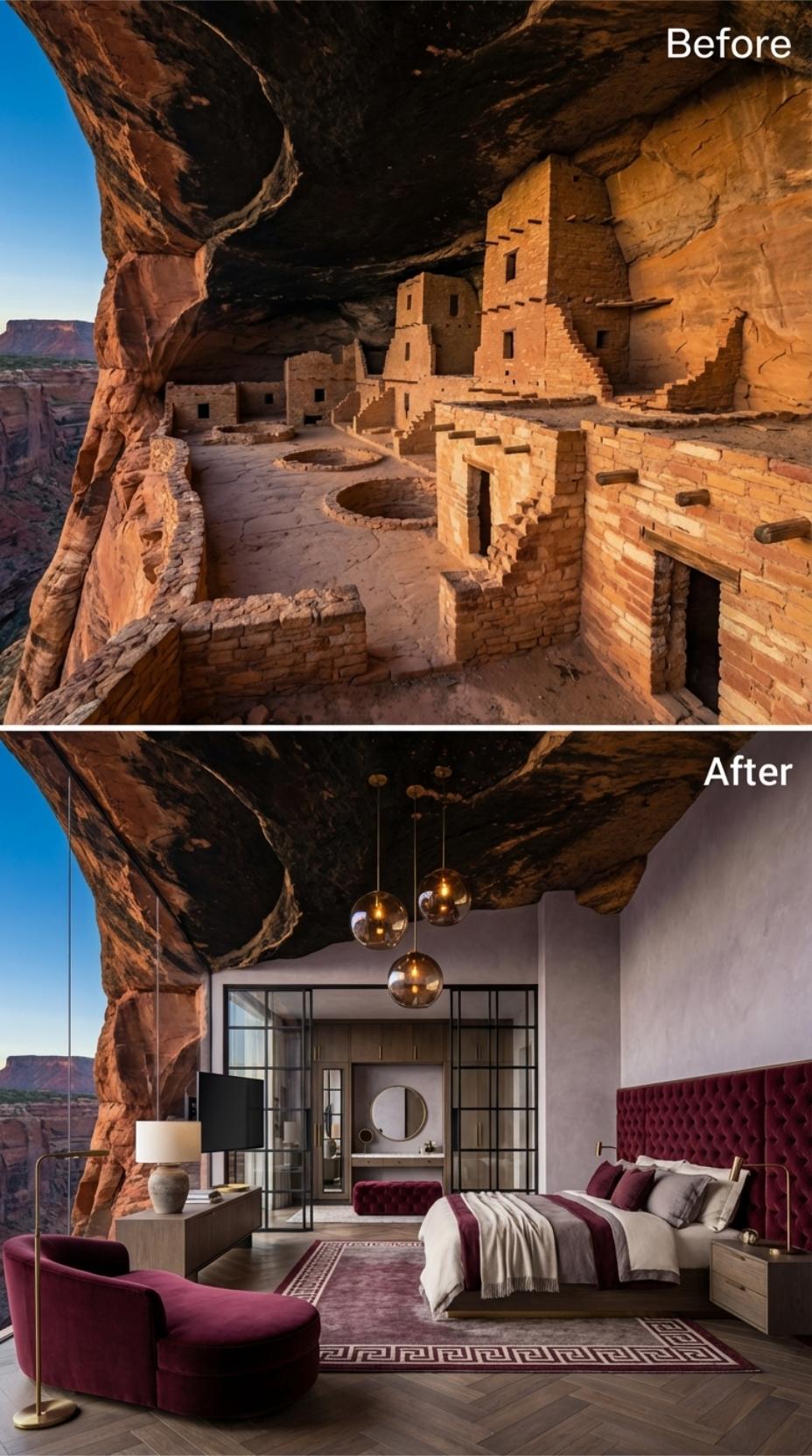
Burgundy velvet upholsters both the tufted headboard and the curved sofa, anchoring a palette that plays against plastered gray walls. Globe pendant lights in a bronzed finish hang at staggered heights above the bed. A Greek key rug grounds the hardwood floor beneath.
36. Raw Cave Ceiling, Linen Bed, Glass Wall: One Room Holds All Three
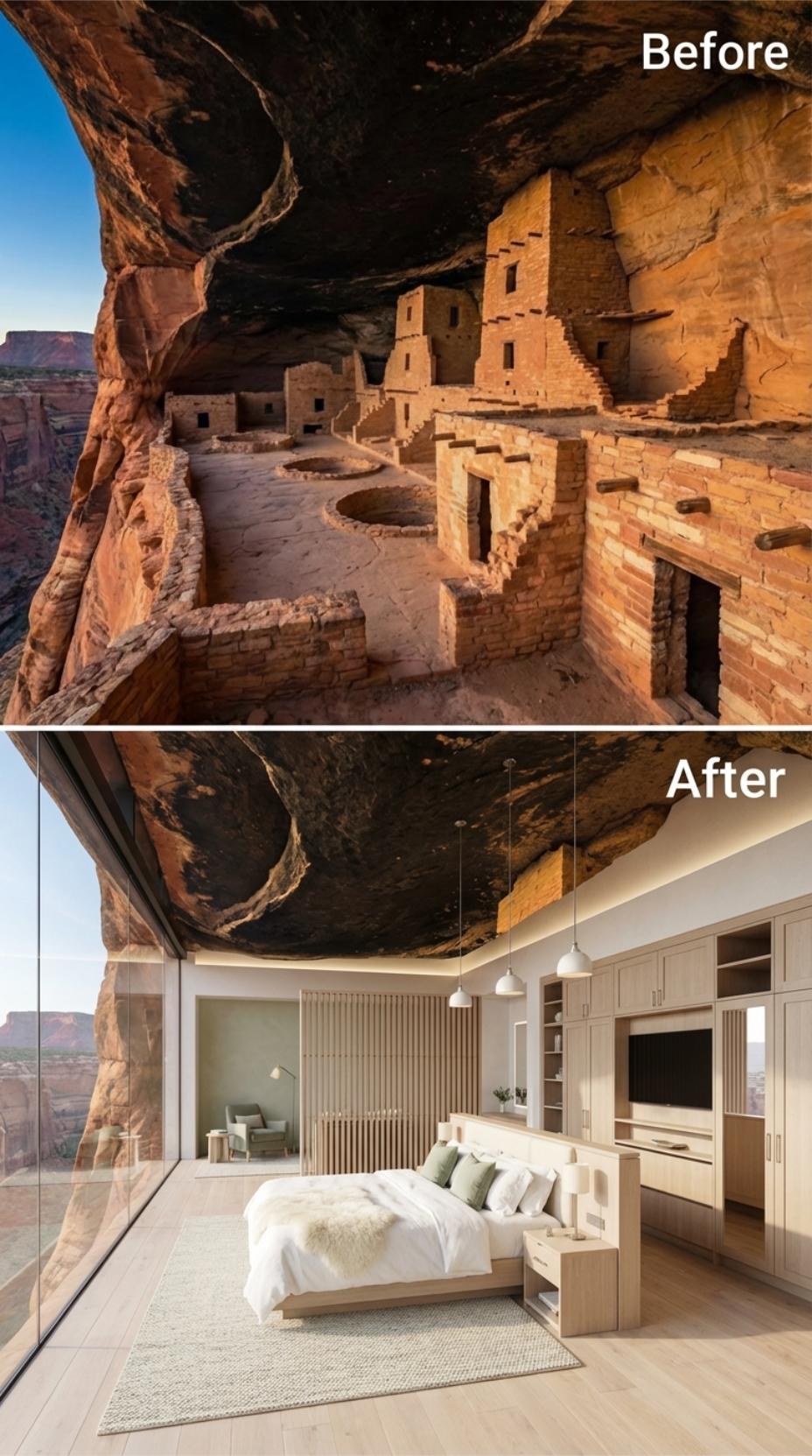
Floor-to-ceiling glass panels replace what was once open air, framing a canyon view without interrupting it. The raw volcanic rock ceiling stays fully exposed overhead, its dark swirling surface left untouched above recessed LED strip lighting that runs along a dropped soffit perimeter. Against that rough geology, the room plants itself in light oak millwork: floor-to-ceiling cabinetry with flat-front doors, a built-in media wall, and open shelving in the same warm wood tone throughout.
The platform bed sits low on wide-plank flooring, dressed in white linen with sage green throw pillows. Pendant lights on extended white cords hang above the bed. A sage green accent chair occupies the far left corner near a slatted wood partition wall, and a neutral wool area rug grounds the sleeping zone without competing with the geology overhead.
35. Suspended Brass Globes, Floating Stairs, Raw Rock: One Cave Holds All of It
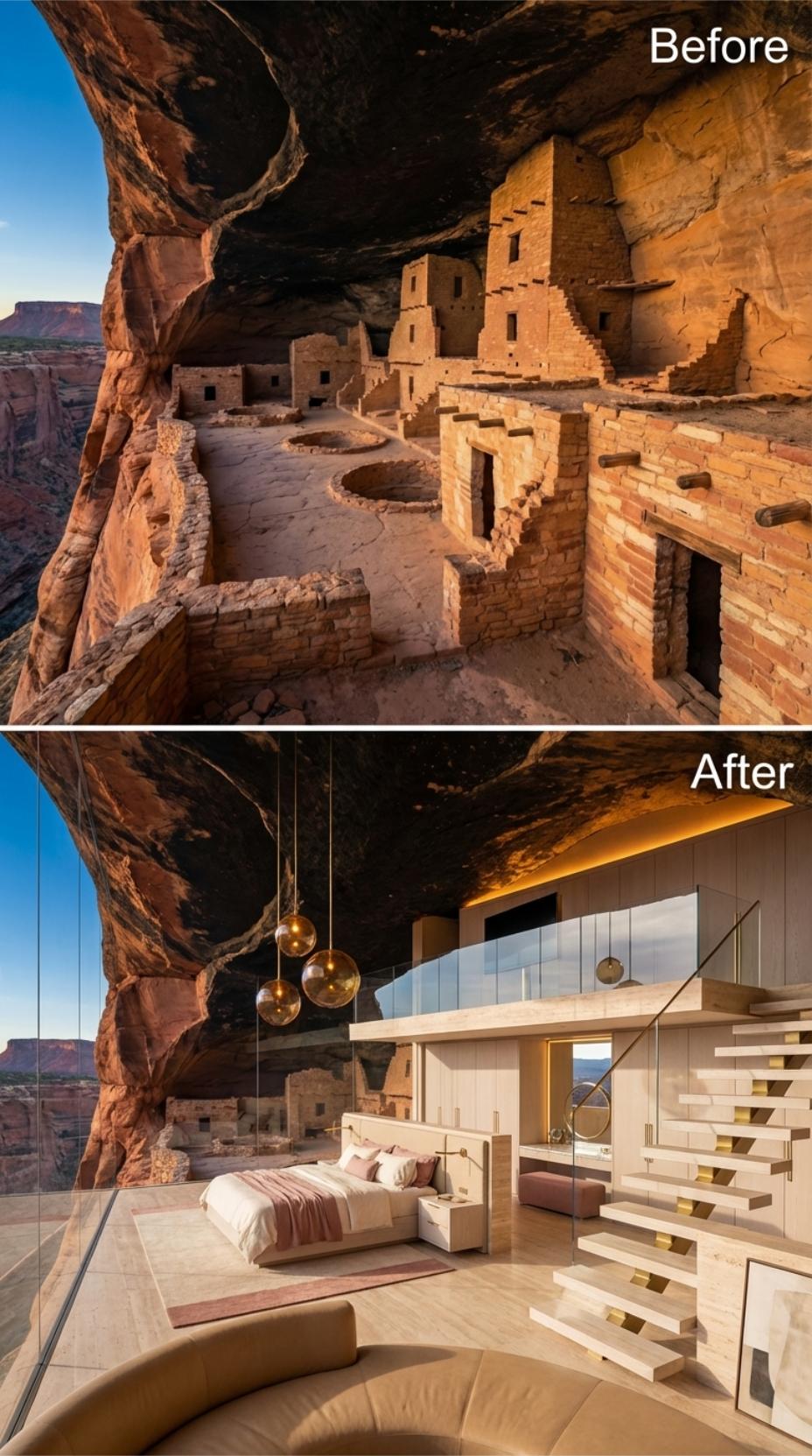
Brass pendant spheres hang from the cave ceiling on slender rods above a platform bed dressed in blush linen. Cantilevered limestone stairs with brass-inlaid risers climb toward a glass-railed mezzanine.
The Floating Staircase as Structural Centerpiece
Each tread appears to project directly from the wall without visible support, cut from the same pale limestone used throughout the floor. Brass detailing runs along the riser edge, tying the staircase to the pendant fixtures above. The glass balustrade keeps the upper level visually open, so the raw cave ceiling remains the dominant surface in the room.
34. Warm Wood, Canyon Light, and a Bed Built for the Edge of the World
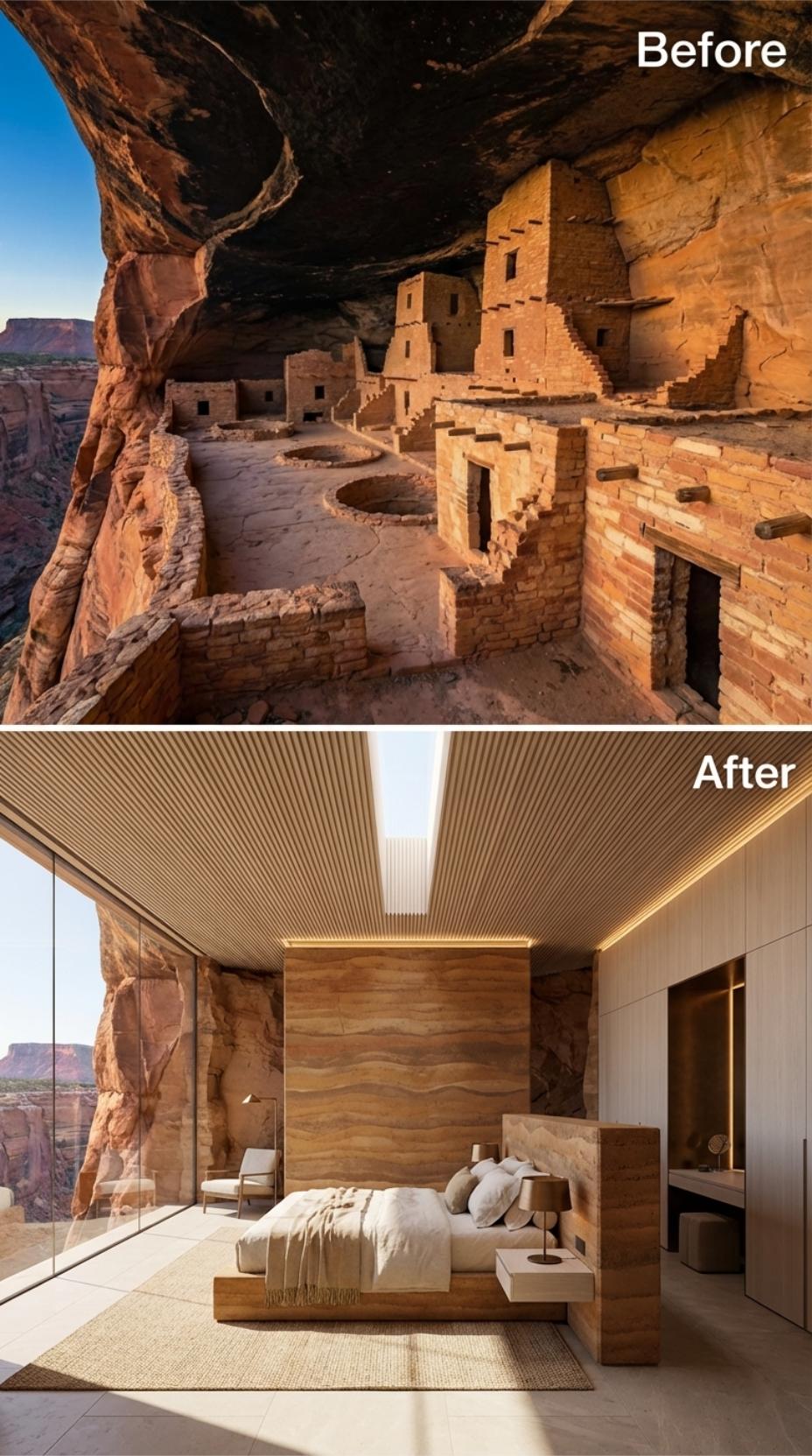
Warm-toned oak panels line the wall behind the bed, their horizontal grain echoing the layered sandstone visible through floor-to-ceiling glass on the left. The bed frame sits low and wide, constructed from the same matte wood, dressed in linen the color of unbleached cotton. Ambient LED strips run along the ceiling perimeter, casting a soft wash over ribbed white slats overhead.
The natural cliff face remains exposed on the right side of the room, left raw and unfinished. A fluted column of stone acts as a nightstand. Slim recessed cabinetry in warm greige flanks the entry side. Outside the glass wall, red rock formations drop into the canyon below.
Did You Know: The cliff dwellings shown in the before image are likely inspired by Ancestral Puebloan sites like those at Mesa Verde National Park, where structures were built directly into sandstone alcoves as early as 600 CE. These alcoves provided natural temperature regulation, staying cool in summer and retaining heat in winter. Modern designers working with cave and cliff sites often reference this passive climate logic when planning ventilation and insulation strategies.
33. Concrete, Canyon Air, and a Bed That Floats Above the Desert Floor
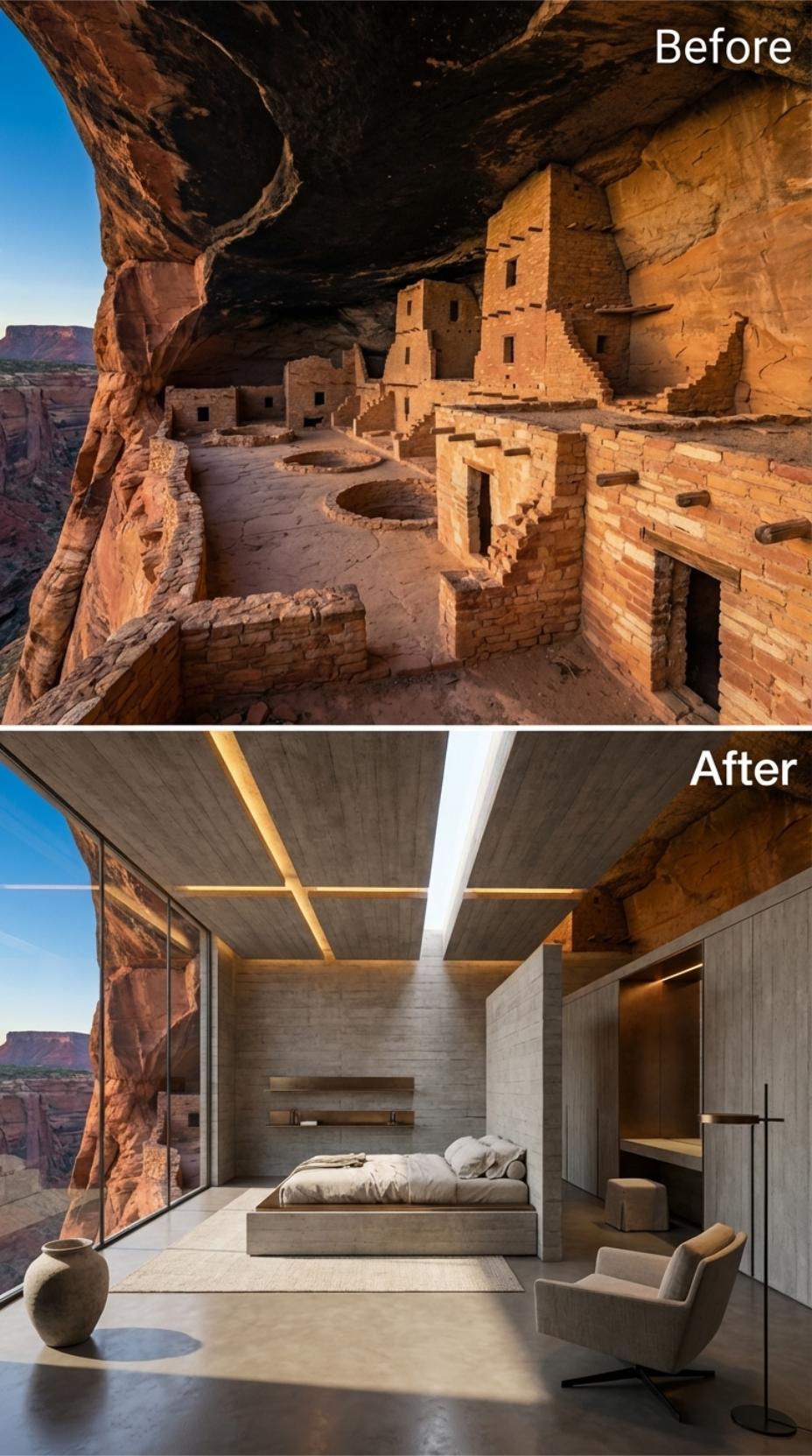
Poured concrete covers every surface here: ceiling, walls, floor, and even the low platform bed frame. Recessed LED strips run in parallel lines across the ceiling, casting a honey-colored wash that softens the industrial finish. The rock face of the cliff breaks through the right wall, left raw and unfinished against the smooth gray panels beside it.
Floor-to-ceiling glass closes off the open canyon edge, framing red rock formations without a single structural column interrupting the view. A low-profile armchair in stone-colored bouclé sits beside a minimal floor lamp. One ceramic vessel, unglazed and wide-mouthed, anchors the left corner. The rug is ivory, cut to fit just beneath the bed.
The Psychology Behind This: Spaces that pair man-made materials with exposed natural surfaces trigger what researchers call biophilic contrast, a neurological response where the brain registers both safety and wildness at once. Sleeping inside that tension, with concrete above and open sky at the glass, may explain why cave-integrated interiors consistently rank among the most emotionally affecting spaces people report visiting. That specific pairing of enclosure and exposure mirrors conditions humans evolved to seek out when choosing shelter.
32. Marble Slabs, Canyon Glass, and a Bed Suspended in Ancient Air
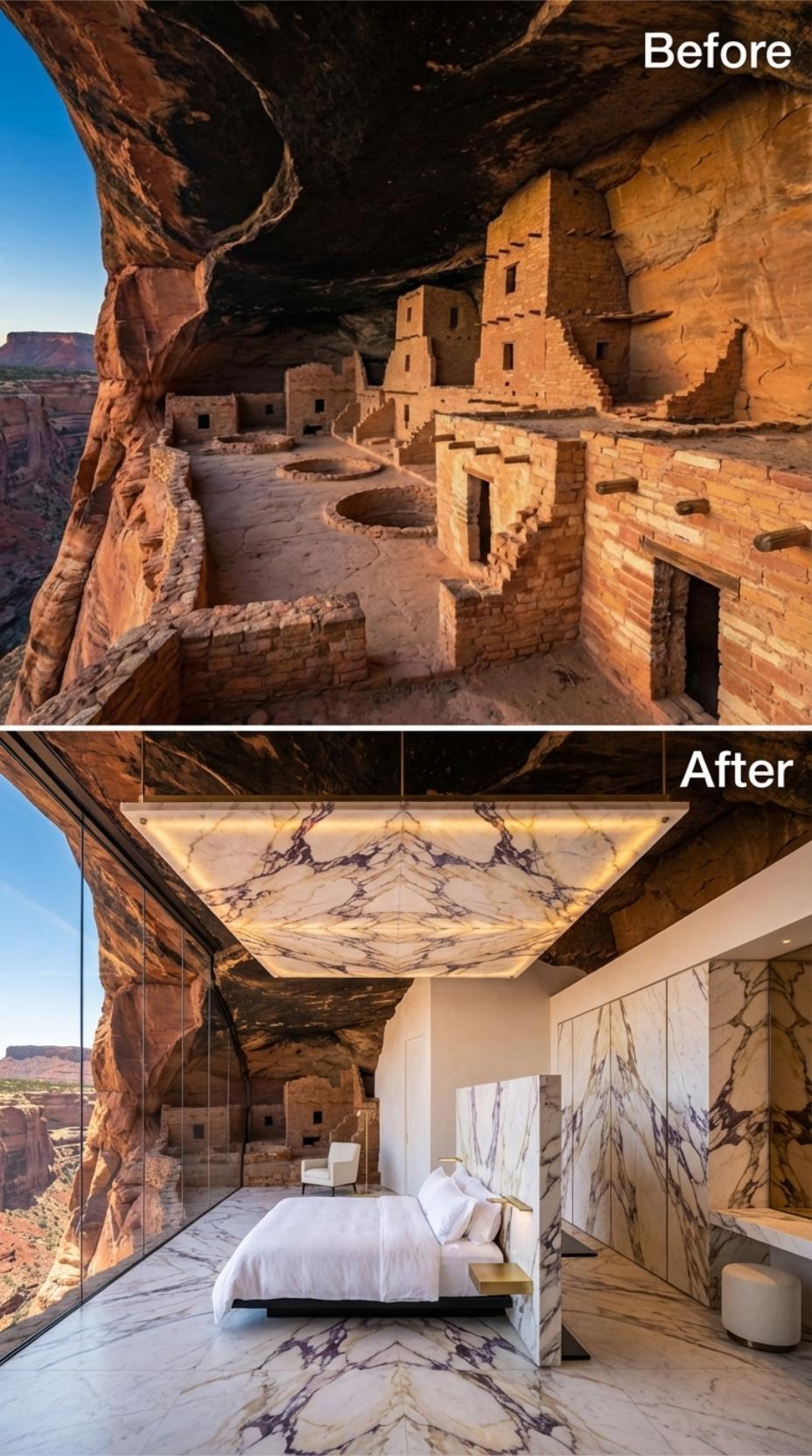
Veined white-and-violet marble covers every flat surface in this bedroom: the floor, the freestanding headboard panel, the wardrobe doors, and a backlit ceiling panel that hovers above the platform bed on a recessed LED track. The stone pattern is bookmatched across the ceiling piece, creating a mirrored symmetry that pulls the eye upward into the raw sandstone overhang just beyond it.
A full glass wall runs along the canyon-facing side, leaving the red rock formations outside fully visible from the bed. The mattress sits low on a dark platform frame, dressed in white linen. A single upholstered chair in off-white fabric occupies the far corner beside a brushed gold side table.
By The Numbers: Bookmatched stone slabs require cutting a single block and opening it like a book so both halves mirror each other exactly, a technique that can double material waste compared to standard slab cutting. Achieving a continuous match across a ceiling panel, floor, and vertical wall in the same room demands precise templating before any stone is cut. Projects using this level of stone continuity typically require a dedicated stone fabricator working on-site during installation.
Not every cave bedroom relies on raw texture alone — some let the view do the heavy lifting.
31. Gold-Lit Walls, Glass Canyon Edge, and Linen Piled Three Pillows Deep
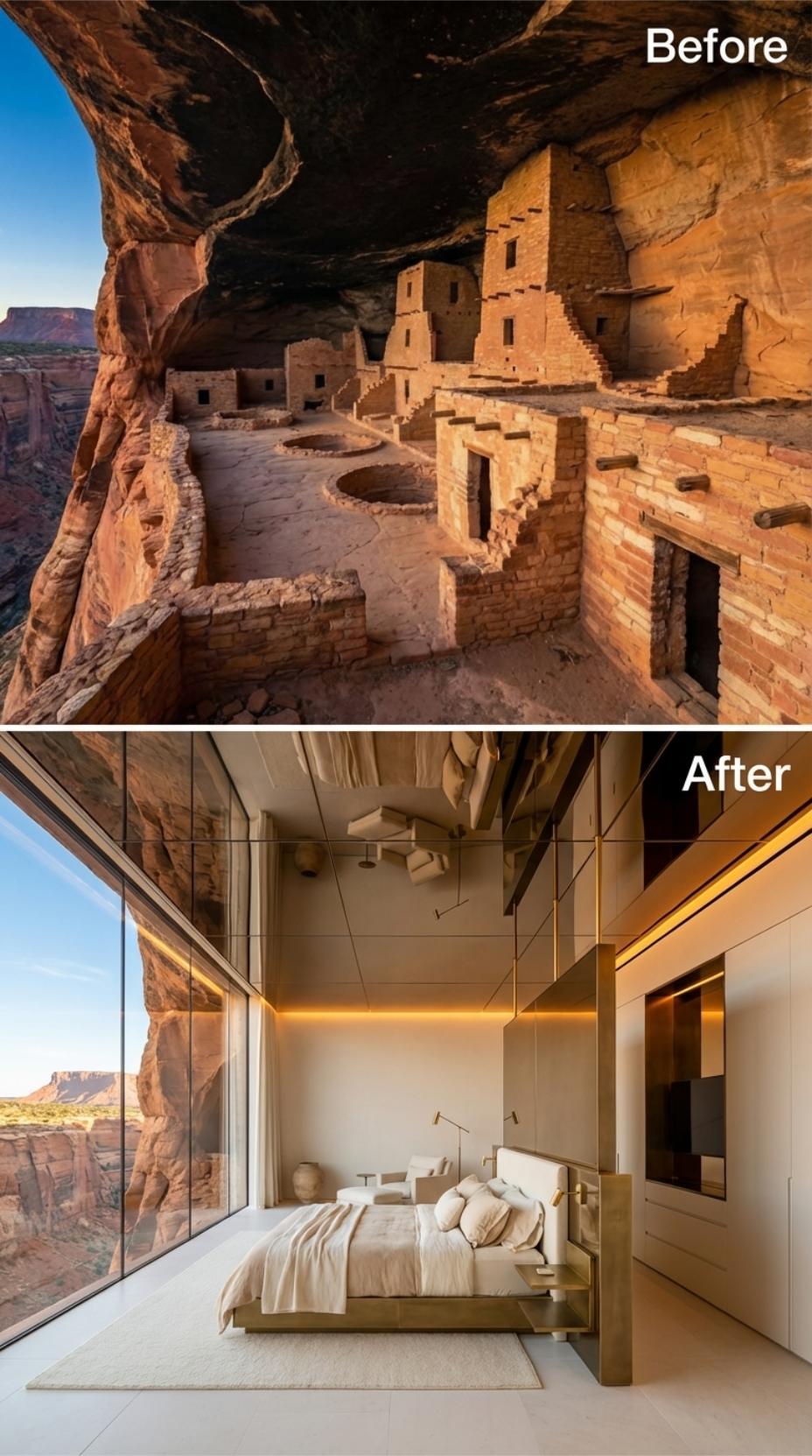
Cream plaster panels line the walls in a grid pattern, each seam catching the amber glow from recessed strip lighting tucked along the ceiling perimeter. The bed sits low on a platform base finished in brushed gold, dressed entirely in unbleached linen with oversized pillow stacking. A single arc floor lamp in antique brass rises beside the nightstand.
Floor-to-ceiling glass on two sides replaces any need for art. The canyon drops away beyond the glazing, its red sandstone walls visible in the middle distance under a clear desert sky. The ceiling above reflects the rock formation outside, pulled in through the glass like a second room layered on top of the first.
30. Coffered Ceiling, Canyon Glass, and Shelves Built Floor to Ceiling in Dark Oak
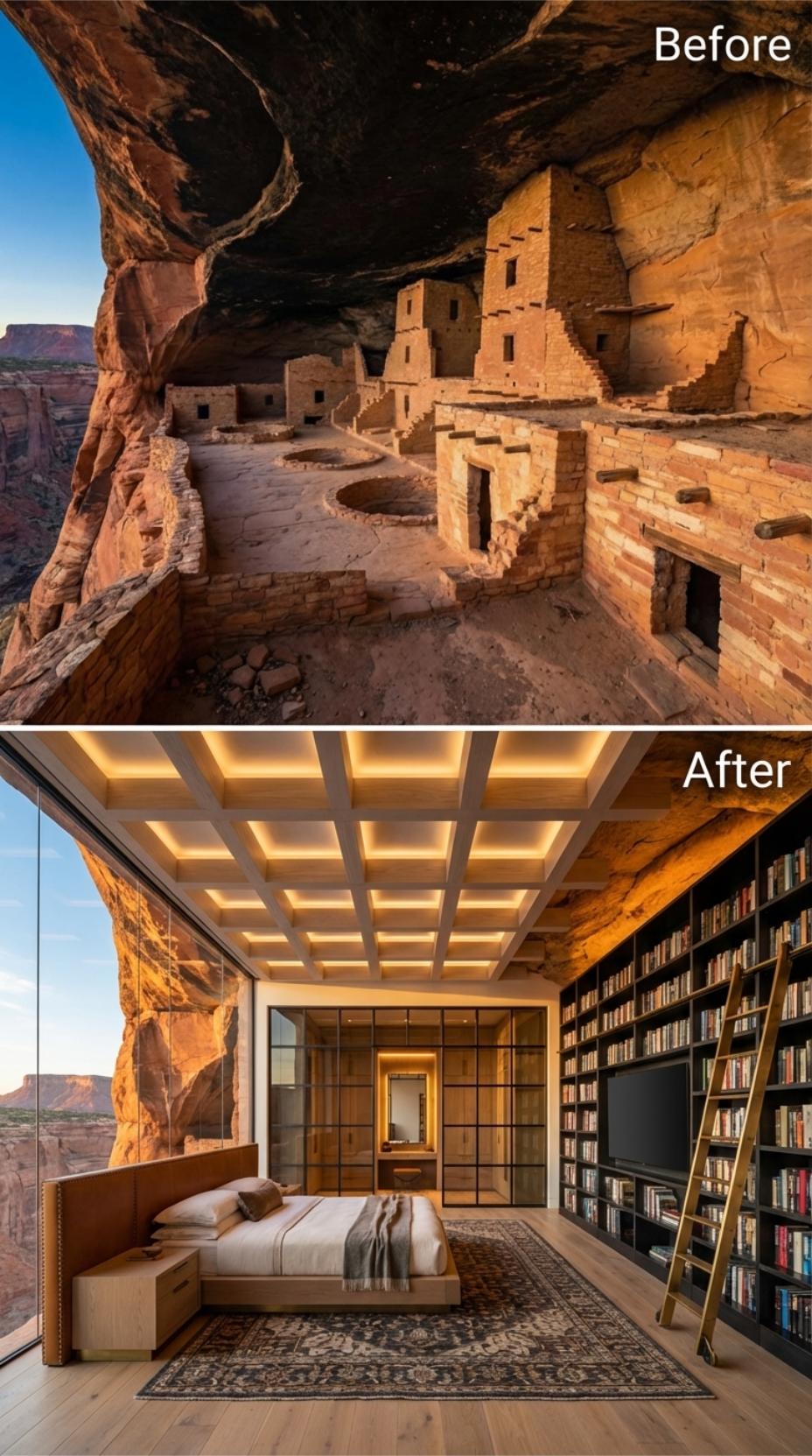
Warm amber light pools inside a grid of coffered panels overhead, each recessed bay edged in strip lighting that casts an even glow across the room without a single visible bulb. The bed sits low on a platform of what appears to be quarter-sawn oak, anchored by a padded caramel leather headboard and dressed in neutral linen. Beneath it, a Persian-style rug in muted ochre and charcoal grounds the sleeping area against wide-plank hardwood floors.
The right wall disappears entirely behind built-in shelving in dark-stained wood, stacked with books floor to shelf-top and accessed by a rolling brass ladder. A flat-panel screen sits flush within the shelving grid. On the left, floor-to-ceiling glass frames a sheer canyon drop and red sandstone walls glowing in late-afternoon sun, with steel-framed glass partition panels dividing the sleeping zone from what reads as a dressing or vanity area behind.
- Rolling library ladders require a mounted rail track rated for the full span of shelving, typically installed before books are loaded
- Dark-stained oak shelving absorbs light rather than reflecting it, which is why designers often pair it with warm overhead sources rather than cool daylight bulbs
- Low-platform beds without footboards visually extend a room’s square footage by keeping sightlines clear across the floor plane
29. Ivory Linen, Glass Canyon Wall, and Rock That’s Been Here Since Forever
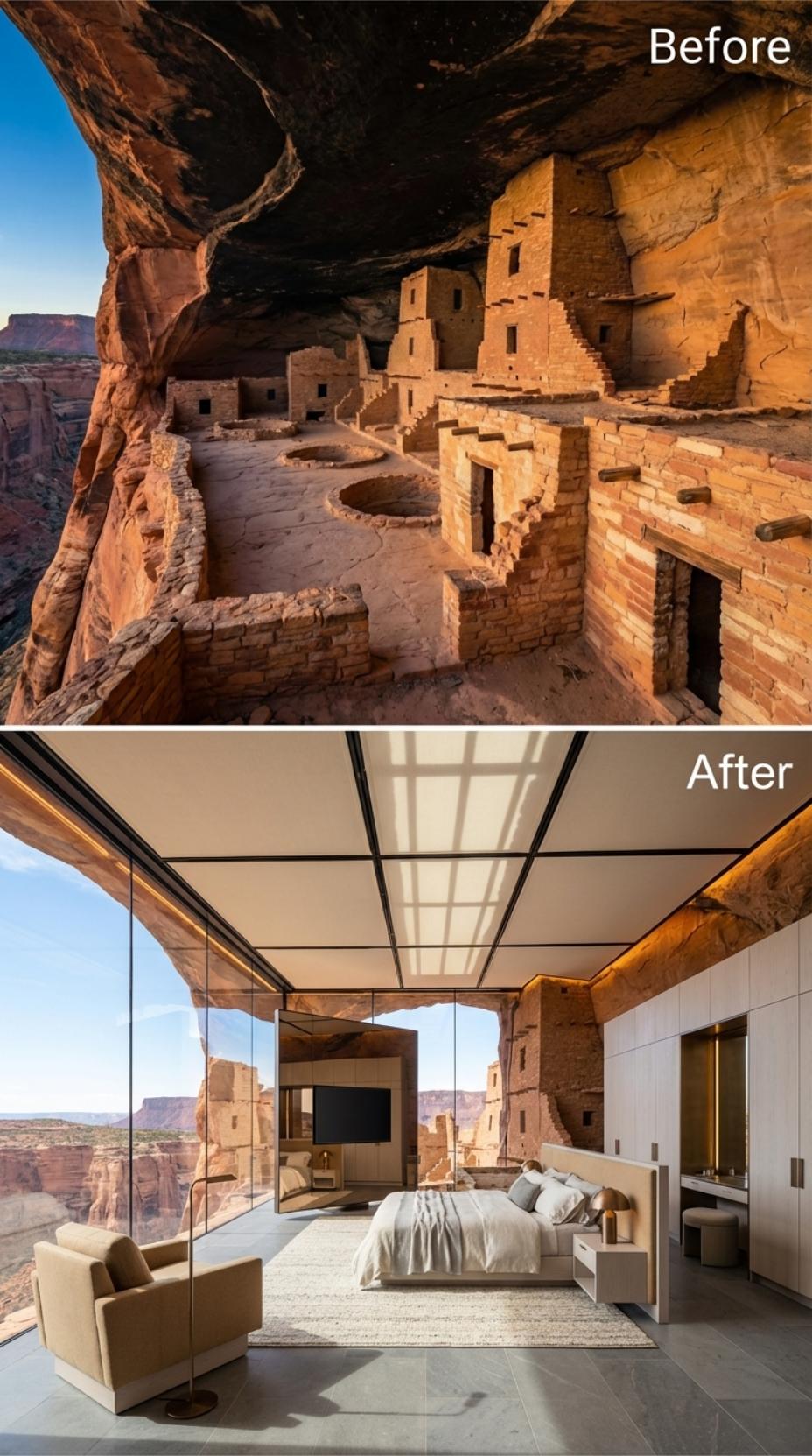
Sandstone cliffs don’t usually frame a king bed, but here they do.
Floor-to-ceiling glass panels run the full width of the room, pressing the canyon directly against the sleeping space with no visual buffer. The bed sits low on a platform base upholstered in oatmeal-toned fabric, dressed in layered linen with a neutral headboard panel that reads almost architectural. A single armchair in camel-colored upholstery anchors the left corner. Recessed strip lighting runs along the rock ceiling line, casting amber along the sandstone overhang. The ceiling itself is a white stretched panel framed by black steel mullions, pulling controlled light down into the room without competing with the raw geology behind the glass.
28. Marble Wrapped Ceiling to Floor, Gold Trim, and a Bed Facing Open Canyon Sky
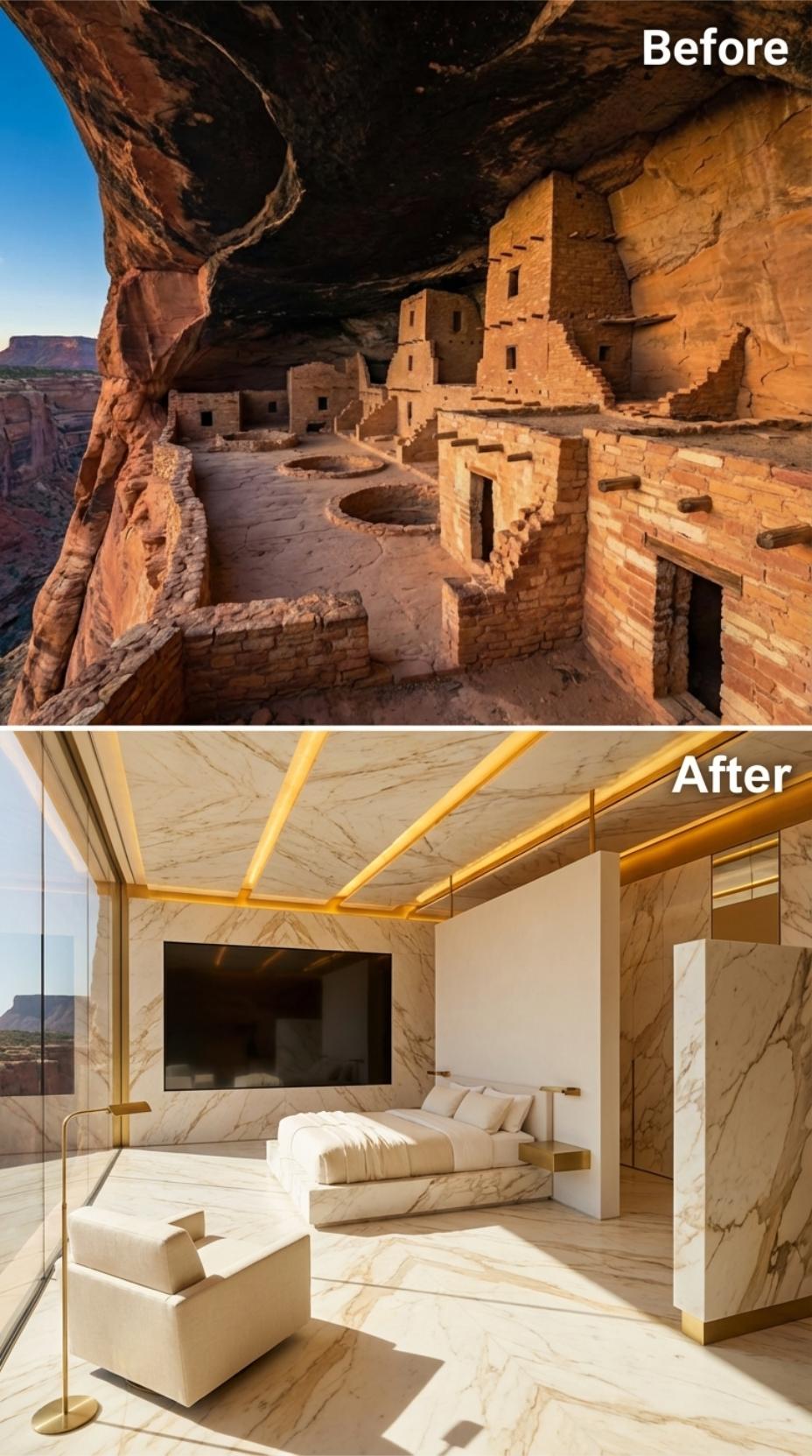
Calacatta-style marble clads every surface, including the ceiling, where gold-finished ribs run in parallel lines above a low platform bed dressed in ivory.
Worth Knowing: Repeating a single stone pattern across walls, floors, and ceilings is called material continuity, and designers use it to make a room feel larger by removing visual interruptions at the seams. In cave conversions, it also softens the psychological contrast between the raw exterior and the finished interior.
27. Moon-Lit Canyon Glass, Pendant Globes, and Linen Piled Into a Cave Bedroom
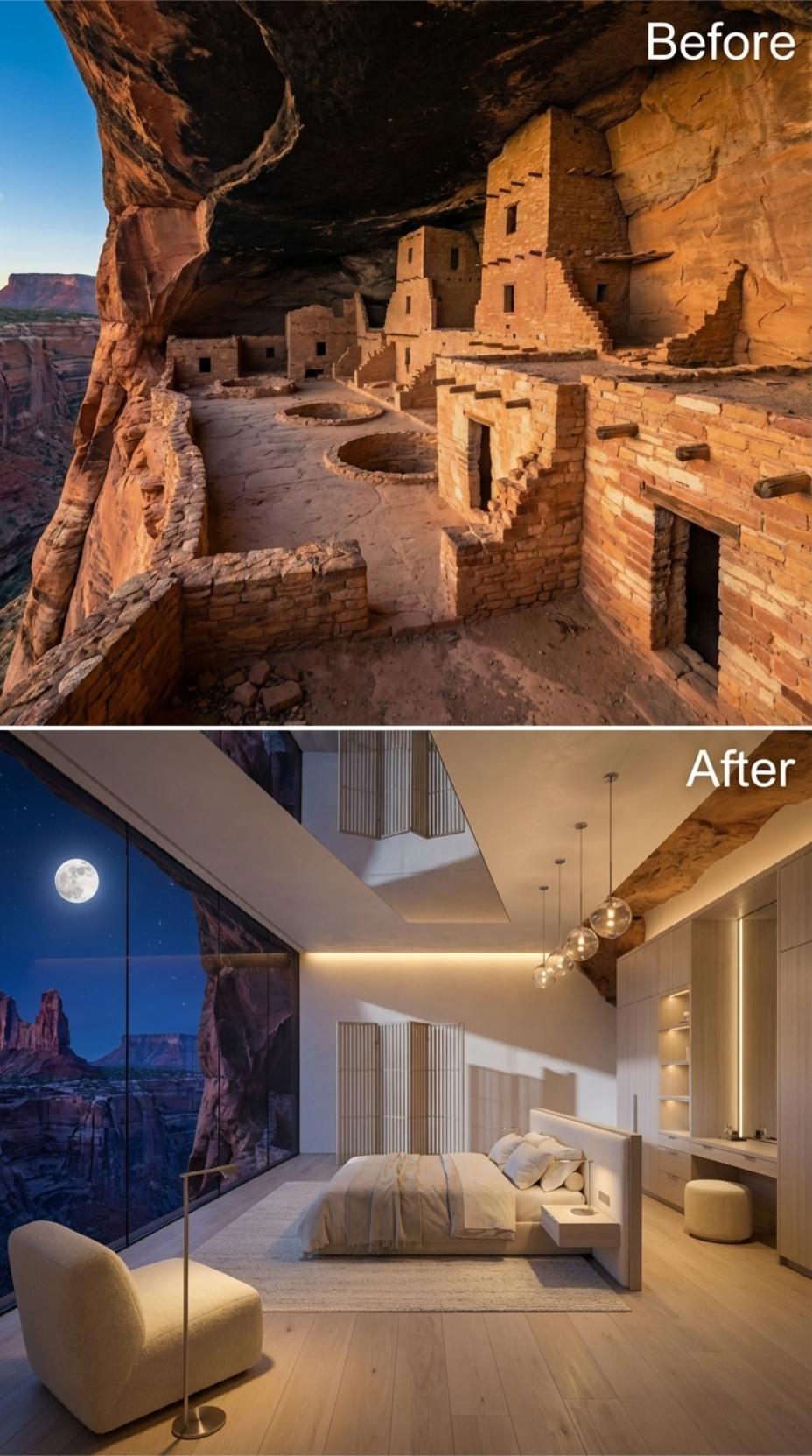
Six globe pendants hang at staggered heights above the bed, and none of them touch the raw sandstone ceiling curving behind them.
The ceiling splits into two distinct planes: one finished in smooth white plaster, the other left as exposed cave rock with its original amber striations intact. Below it, light oak flooring runs wall to wall, and the bed sits on a low platform dressed in ivory linen with oversized pillows stacked four deep. A floor-to-ceiling glass wall on the left side opens to a canyon view at night, with a full moon visible above the rock formations outside.
Built-in cabinetry in matte greige wraps the right wall, with vertical slatted wood panels breaking the flatness between shelving units. A round ottoman in oatmeal boucle sits near a floor lamp with a slender brass stem. The vanity area at the far right uses recessed strip lighting to separate the cabinet column from the wall behind it, creating depth without additional fixtures.
26. Sandstone Walls, Double-Sided Fireplace, and Linen Piled Into a Canyon Alcove
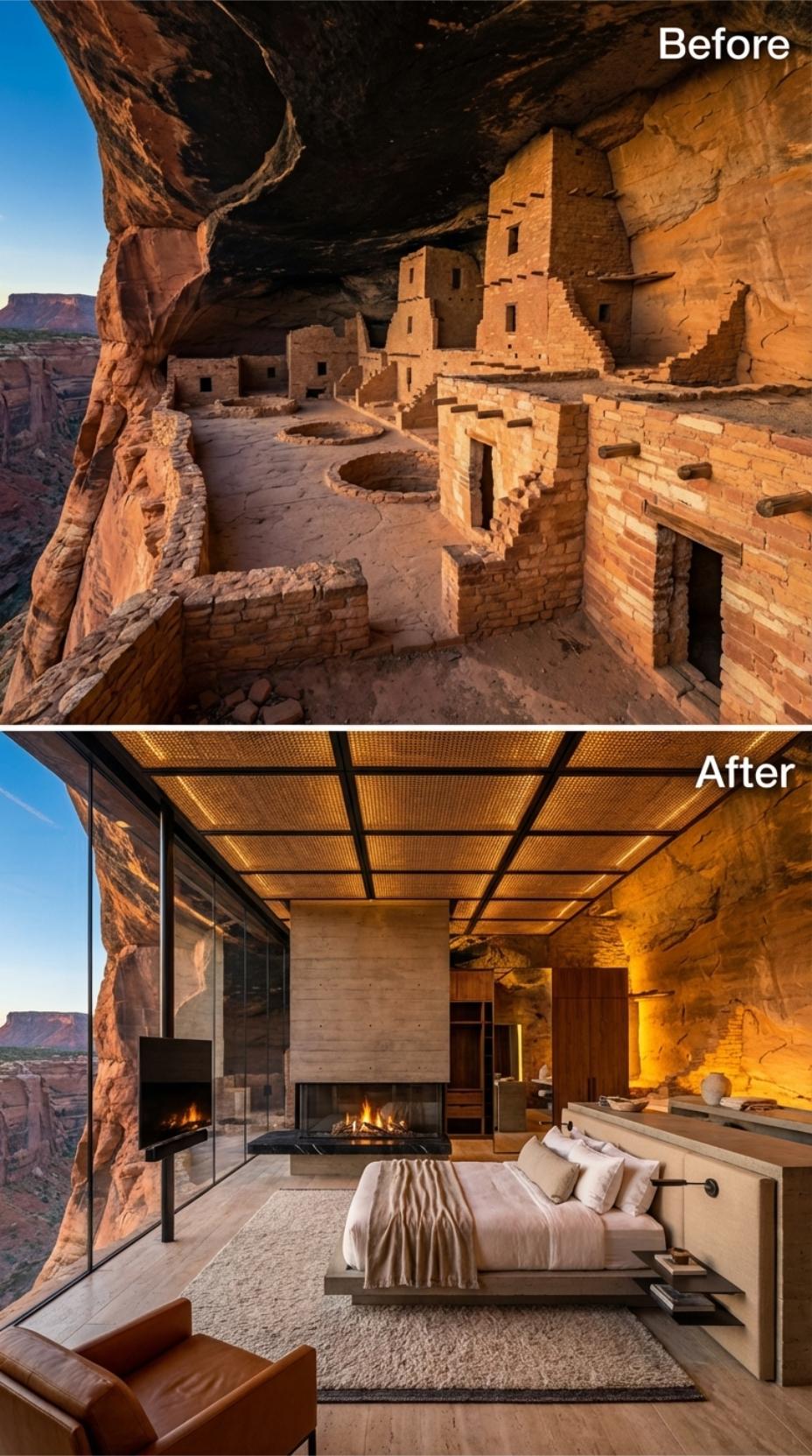
Raw sandstone walls glow amber under recessed lighting tucked behind a grid-pattern ceiling of dark steel and woven cane panels. A double-sided gas fireplace sits centered on a travertine surround, flanked by floor panels in the same matte stone. The bed platform sits low, dressed in ivory and oat linen with layered pillows. Full-height glass opens the entire left wall to the canyon.
Ask Yourself: whether a room needs artwork when the geology behind the headboard has been forming for 270 million years. Designers working with exposed rock often strip back every other decorative layer, letting material age do the work that paint and prints usually handle.
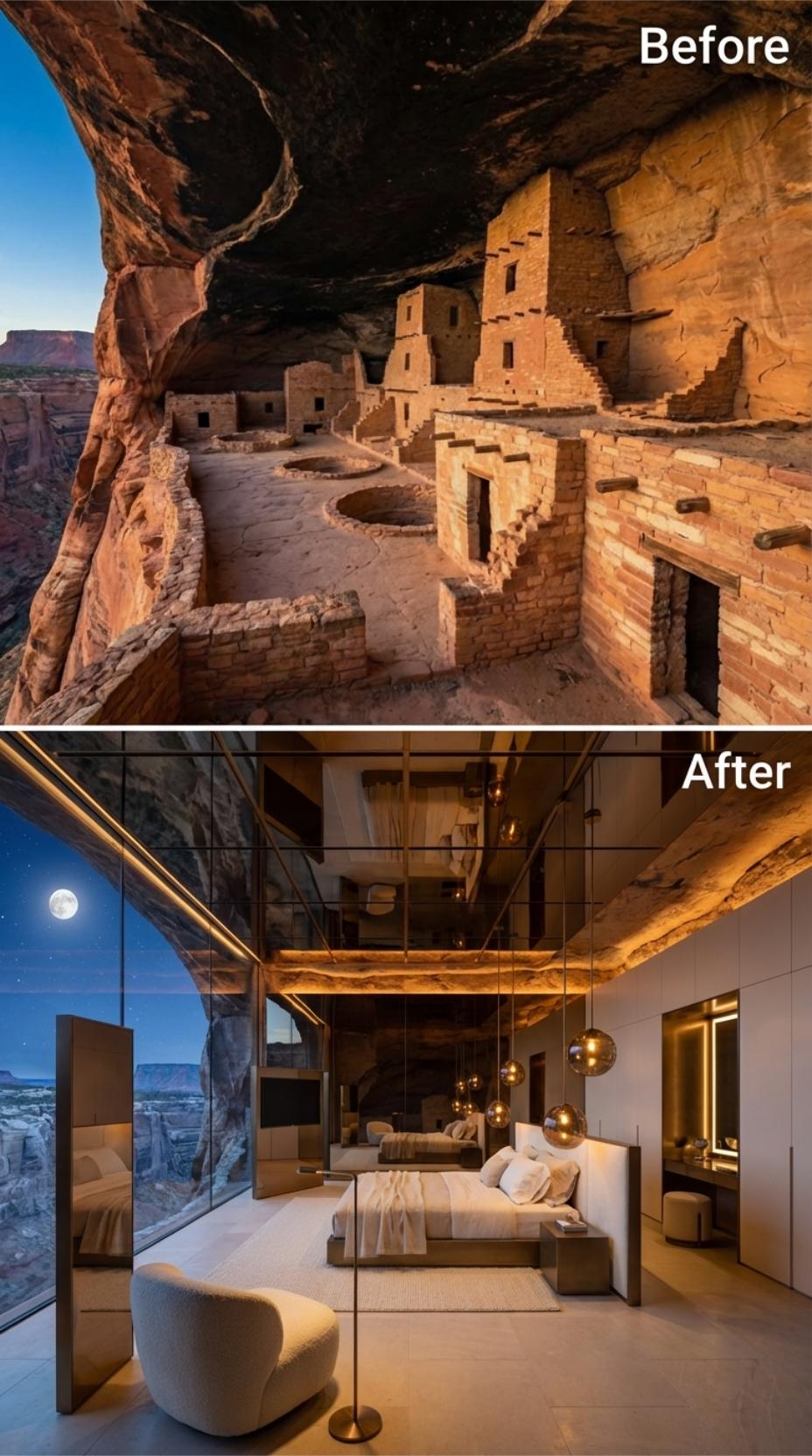
25. Pendant Globes, Canyon Glass, and a Cave Bedroom Built Under a Full Moon
🔥 Would you like to save this?
Brushed bronze pendant globes hang at three different heights above a low-profile bed dressed in ivory linen. Floor panels run in a pale neutral tone, and glass walls on two sides pull the canyon and night sky directly into the room. The natural rock overhang, lit from below with amber strip lighting, becomes the ceiling.
In The Details: Pendant clusters work best in cave conversions when fixtures are hung at staggered heights, because uniform drops visually flatten a ceiling that already has dramatic natural contour. Designers often use globe pendants with a warm 2700K light temperature specifically to echo the amber tone of sandstone walls, so the artificial light reads as an extension of the geology rather than a contrast to it. In spaces where the ceiling is uneven stone, recessed lighting is rarely an option, making suspended fixtures the primary architectural lighting solution.
24. Slatted Timber Ceiling, Canyon Glass Wall, and Linen Bedding in Bone White
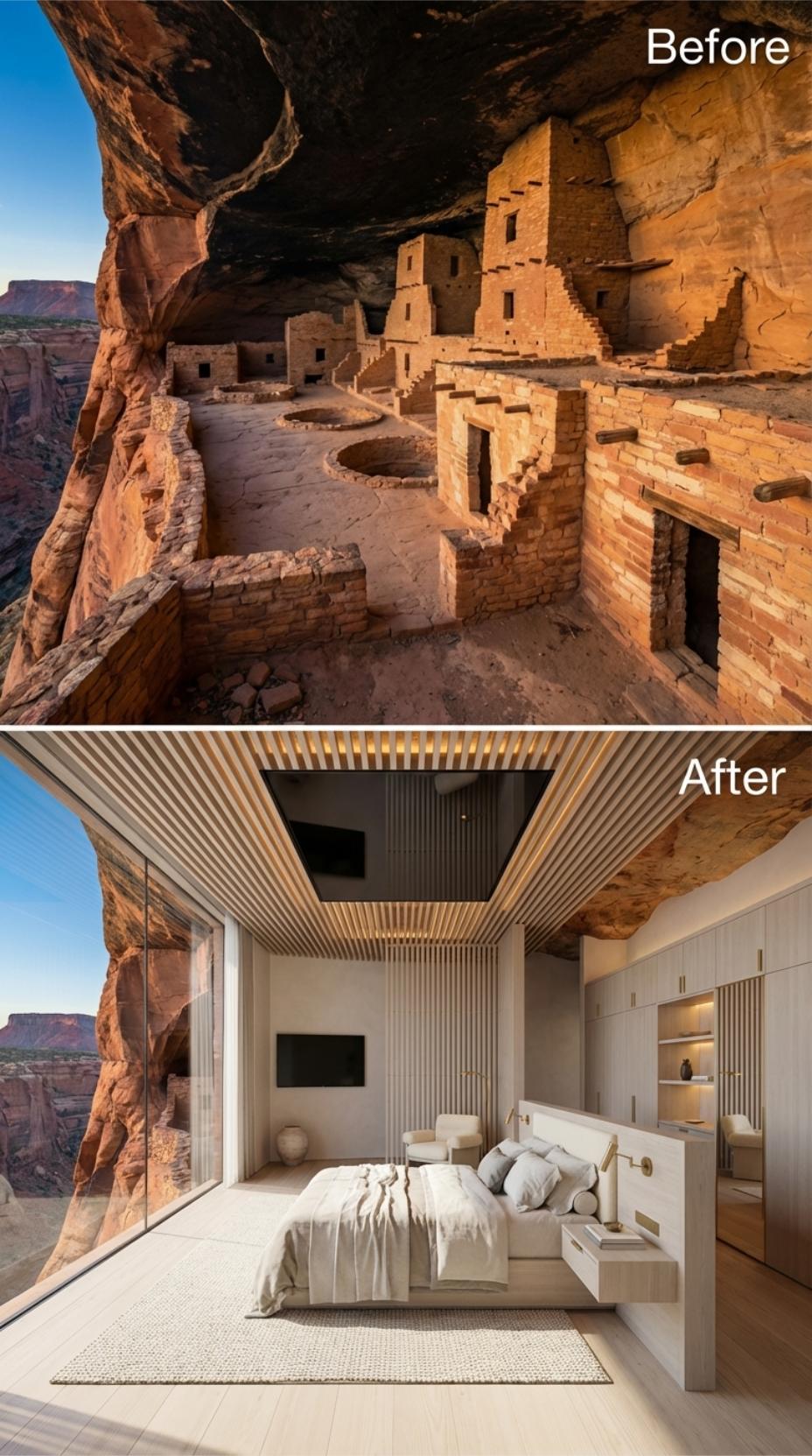
Pale wood slats run the full length of the ceiling in tight, evenly spaced rows, with recessed amber strip lighting tucked between them to cast a low, directional glow across the room. The cave’s original sandstone overhang is left exposed at the rear, visible above a run of floor-to-ceiling cabinetry finished in matte greige with integrated pulls and open display niches.
At the center, a platform bed dressed in bone-white linen sits on a dotted wool rug. Two low armchairs anchor the foot of the bed. Glass spans the entire canyon-facing wall, no frame interrupting the view of red rock cliffs and open sky beyond.
Color Story: Designers building off exposed cave ceilings often pull warm amber undertones from the natural stone into the artificial lighting scheme, using bulbs in the 2200K to 2700K range to keep the two surfaces reading as part of the same palette rather than competing with each other. In this room, the strip lighting tucked between ceiling slats sits close enough to that range that the timber and the sandstone above it appear to share a single light source. That continuity is not accidental; it is one of the quieter decisions that separates a finished cave conversion from a room that simply has a rock ceiling.
23. Brass Ceiling, Canyon Glass, and a Navy Headboard Anchoring the Desert Space
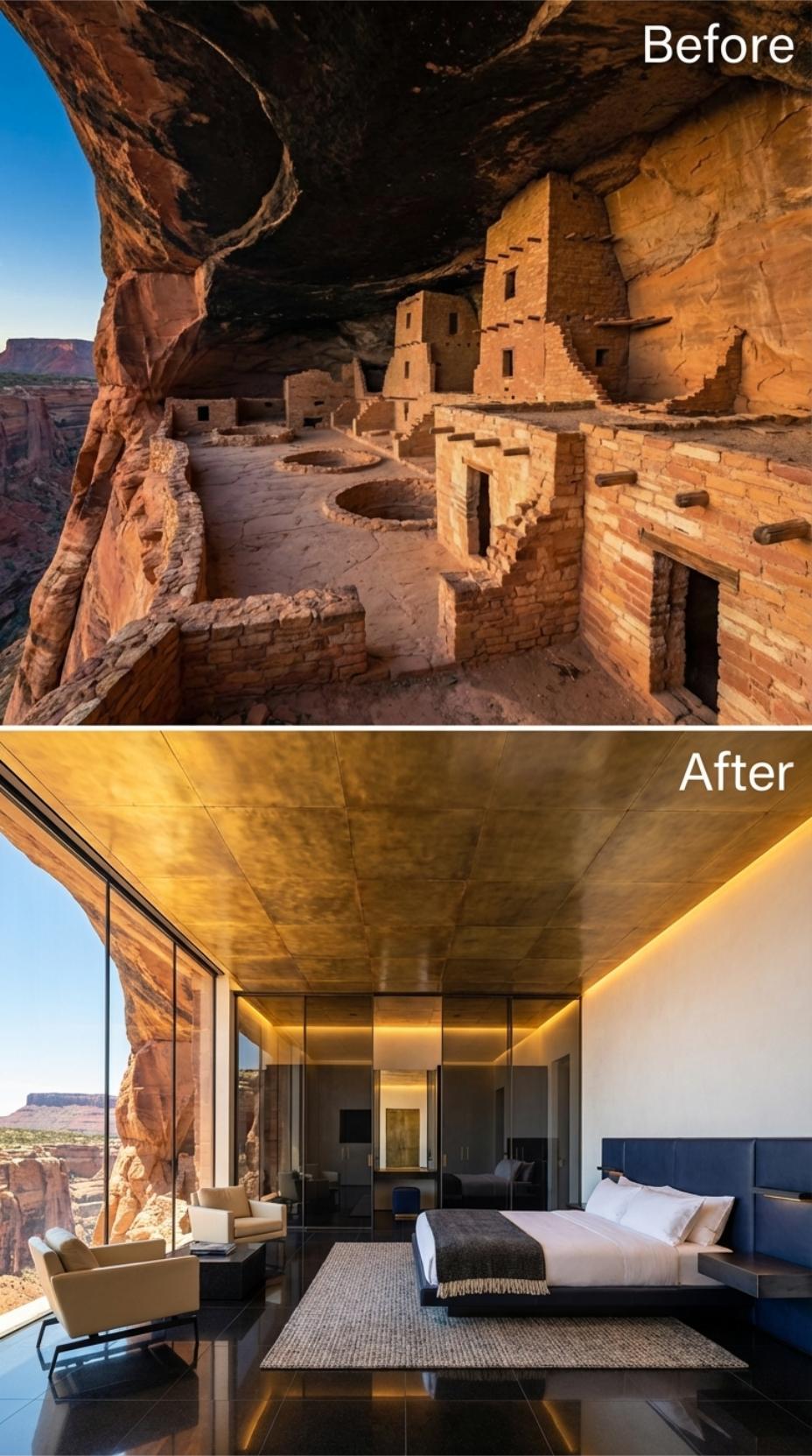
Gold-leafed brass panels line the entire ceiling, catching the ambient strip lighting tucked along the perimeter and bouncing a molten warmth across the room without a single overhead fixture interrupting the plane. The floor-to-ceiling glass wall opens directly onto canyon rock, and the contrast between polished dark flooring and the eroded sandstone outside does more visual work than any art piece could.
A king bed with a navy blue upholstered headboard sits centered on a low-pile woven rug in natural flax. Two sand-colored lounge chairs with slim black frames anchor the glass side, positioned to face the drop. Mirrored panels on the interior wall double the depth of the room and reflect the brass ceiling back on itself.
Editor’s Note: Brass and gold-leafed ceiling treatments have seen a significant surge in high-end residential projects over the past decade, largely driven by hospitality design influencing private builds. Unlike painted finishes, genuine brass panels develop a patina over time that shifts with temperature and humidity, meaning this ceiling will look different in five years than it does today. Designers often seal the surface at installation to slow oxidation, but some clients deliberately leave it unsealed to let the material age alongside the rock surrounding it.
22. Terrazzo Floors, Curved Sage Velvet, and a Cave Ceiling Left Exactly As Found
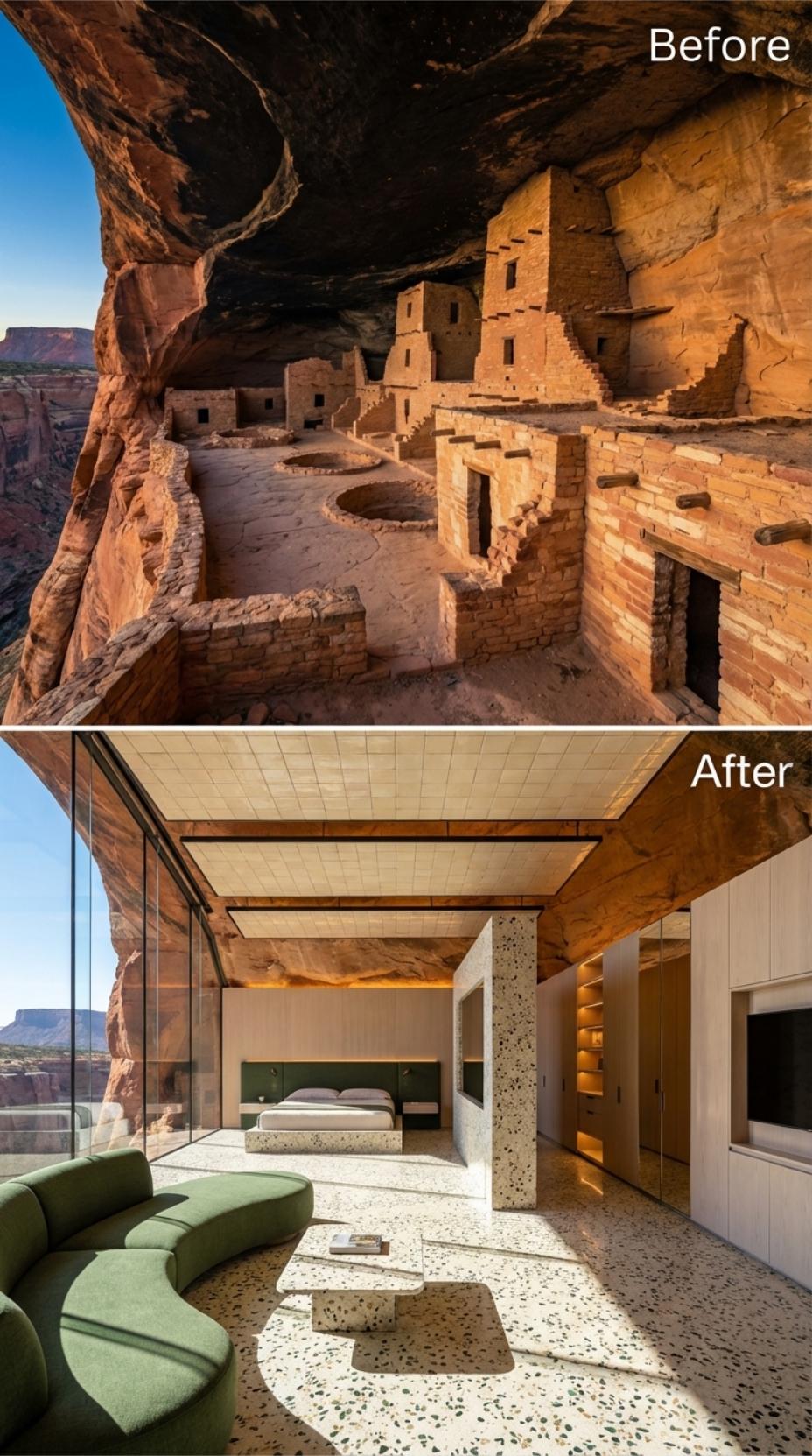
Terrazzo covers every horizontal surface here, its white base scattered with irregular black and grey aggregate that pulls the eye from the curved sofa all the way to the bed platform. That sofa is upholstered in sage green fabric, its kidney shape sitting low and wide against the glass wall, where canyon mesas hold the horizon line steady in the distance.
The cave ceiling does nothing but exist, and that turns out to be enough. Below it, a terrazzo column divides the living area from the sleeping zone without closing off the sightline. White cabinetry runs flush along the right wall, and the headboard panel is upholstered in deep forest green, echoing the sofa across the room without matching it exactly.
Pro Tip: Terrazzo is experiencing a significant revival in high-end residential projects because its aggregate composition can be custom specified, allowing designers to pull exact tones from surrounding natural materials like cave stone or canyon sandstone. Unlike poured concrete, terrazzo is non-porous once sealed, making it a practical choice for spaces where moisture control inside a rock formation is already a structural concern.
21. Faceted Steel Ceiling, Canyon Glass Wall, and a Bedroom Suspended Over Desert Red Rock
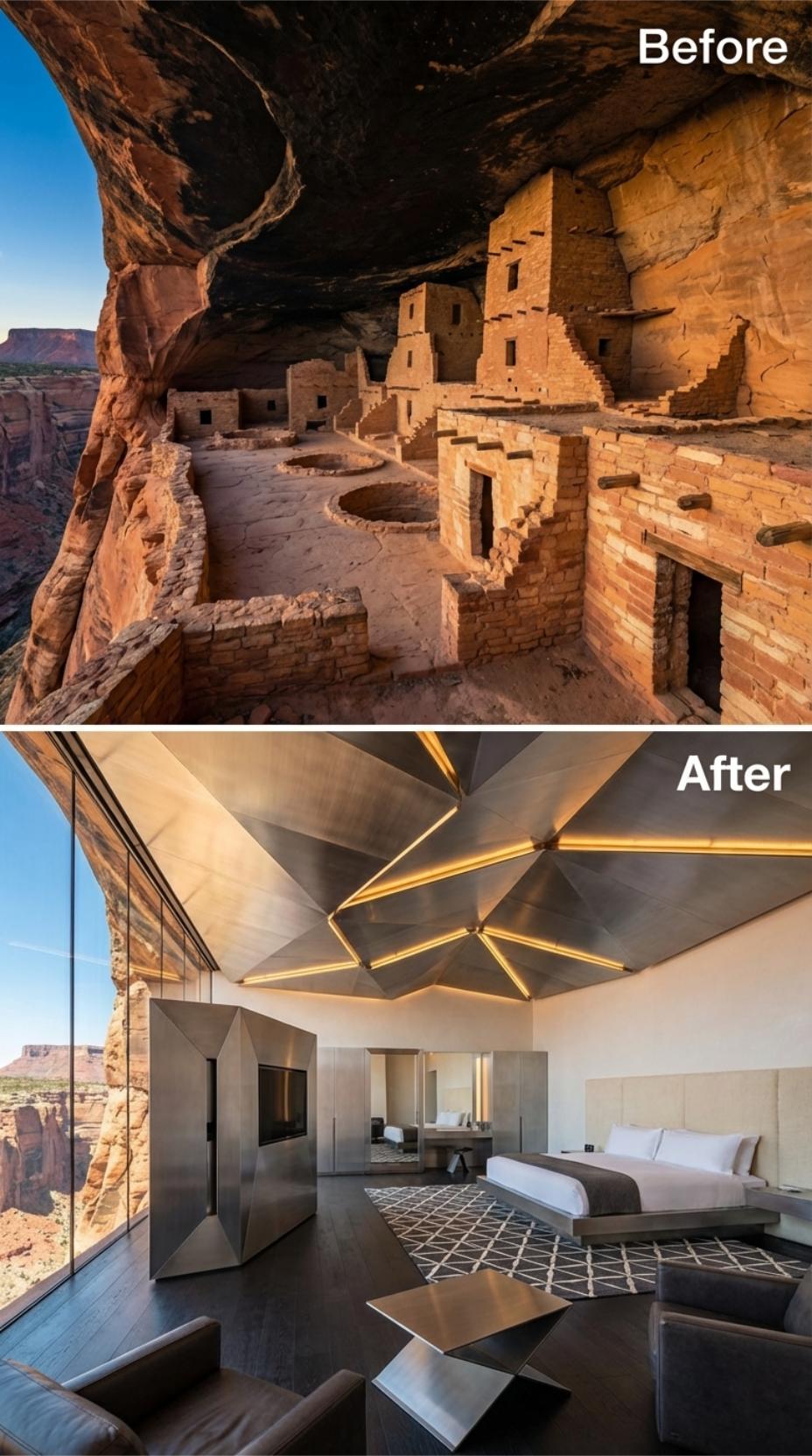
Geometric steel panels fold across the ceiling in sharp triangular planes, each seam backlit with amber LED strips that cast a low, directional glow across the room. Dark hardwood flooring runs the full length of the space, grounded by a geometric-patterned area rug in charcoal and ivory. Against the left wall, a faceted steel fireplace surround rises floor-level to mid-height, its angular profile echoing the ceiling geometry directly above it.
Floor-to-ceiling glass along the canyon side pulls the red rock mesa into the room without a single interruption. Linen bedding in white sits against an upholstered headboard in warm greige. Low-profile seating in dark leather anchors the sitting area near the glass.
Why the Backlit Steel Ceiling Works Harder Than It Looks
Folded metal ceilings in cave conversions serve a structural purpose beyond aesthetics: the angular planes redirect sound, preventing the flat echo that hollow rock chambers naturally produce. The amber LED strips recessed into each seam mimic the color temperature of firelight, which keeps the eye reading the space as warm despite the industrial material. Specifying steel over plaster or timber here also allows the ceiling panels to be prefabricated off-site and installed in sections, a practical advantage when working inside a cliff formation with limited access for heavy equipment.
20. Backlit Onyx Ceiling Grid, Canyon Glass, and Linen Bedding in Bone White
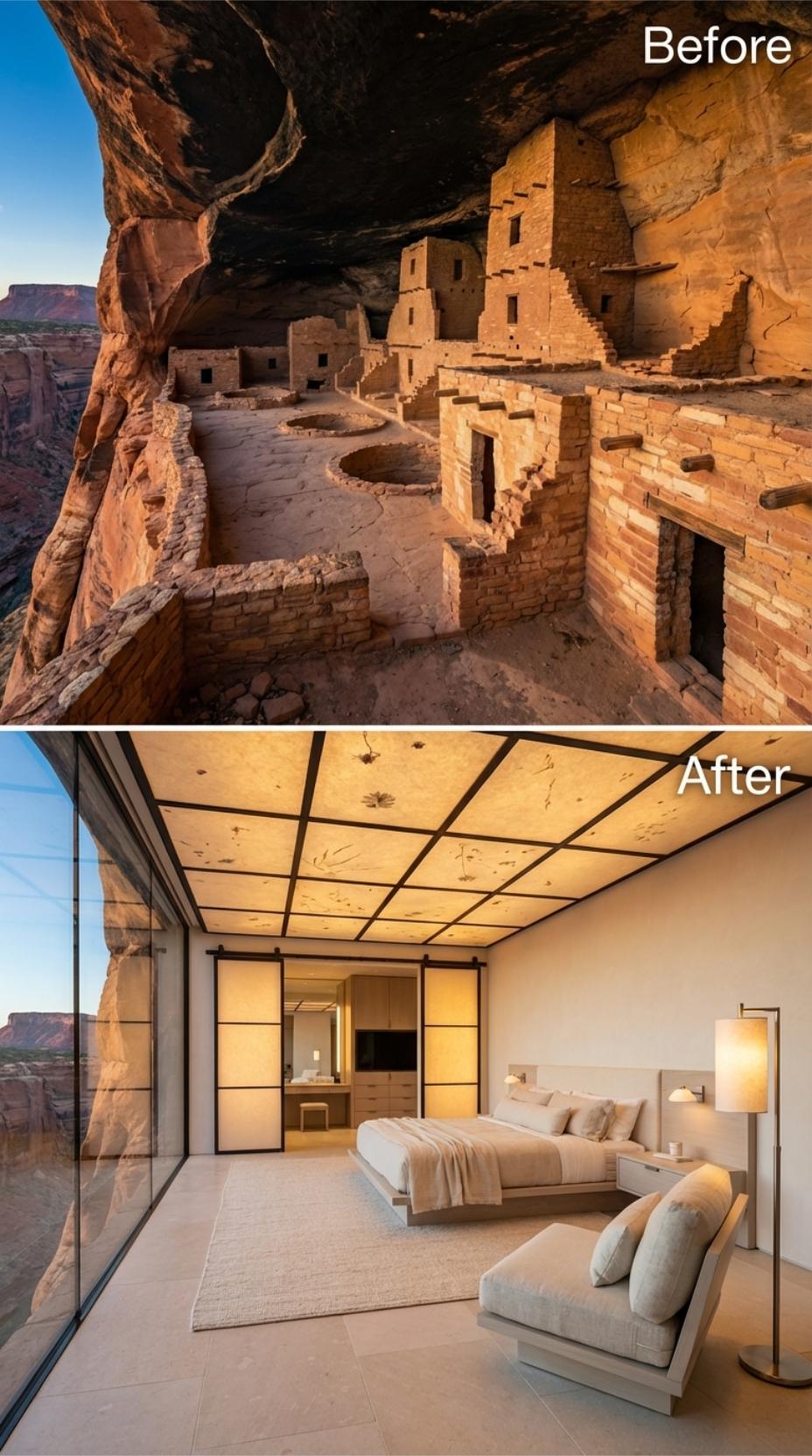
Onyx panels set into a black steel grid cover the entire ceiling, each slab lit from behind so the natural veining glows amber across the room. The bed sits centered on polished concrete floors, dressed in bone white linen with no pattern, no contrast piping. A low daybed in the same fabric anchors the foot of the bed.
Floor-to-ceiling glass runs the full left wall, framing red canyon walls and open sky without obstruction. Sliding steel-framed panels divide the sleeping area from a dressing room behind. A single brass floor lamp provides the only directional light source in the room.
History Corner: Ancestral Puebloan cliff dwellings were positioned inside south-facing alcoves to capture winter sun and stay shaded during summer months, a passive solar strategy that predates modern architecture by nearly a thousand years. That same orientation logic still informs how contemporary architects site glass walls in canyon-adjacent builds, maximizing light without overheating the interior.
19. Draped Cream Ceiling Panels, Canyon Glass, and Concrete Floors Cut Into Desert Rock
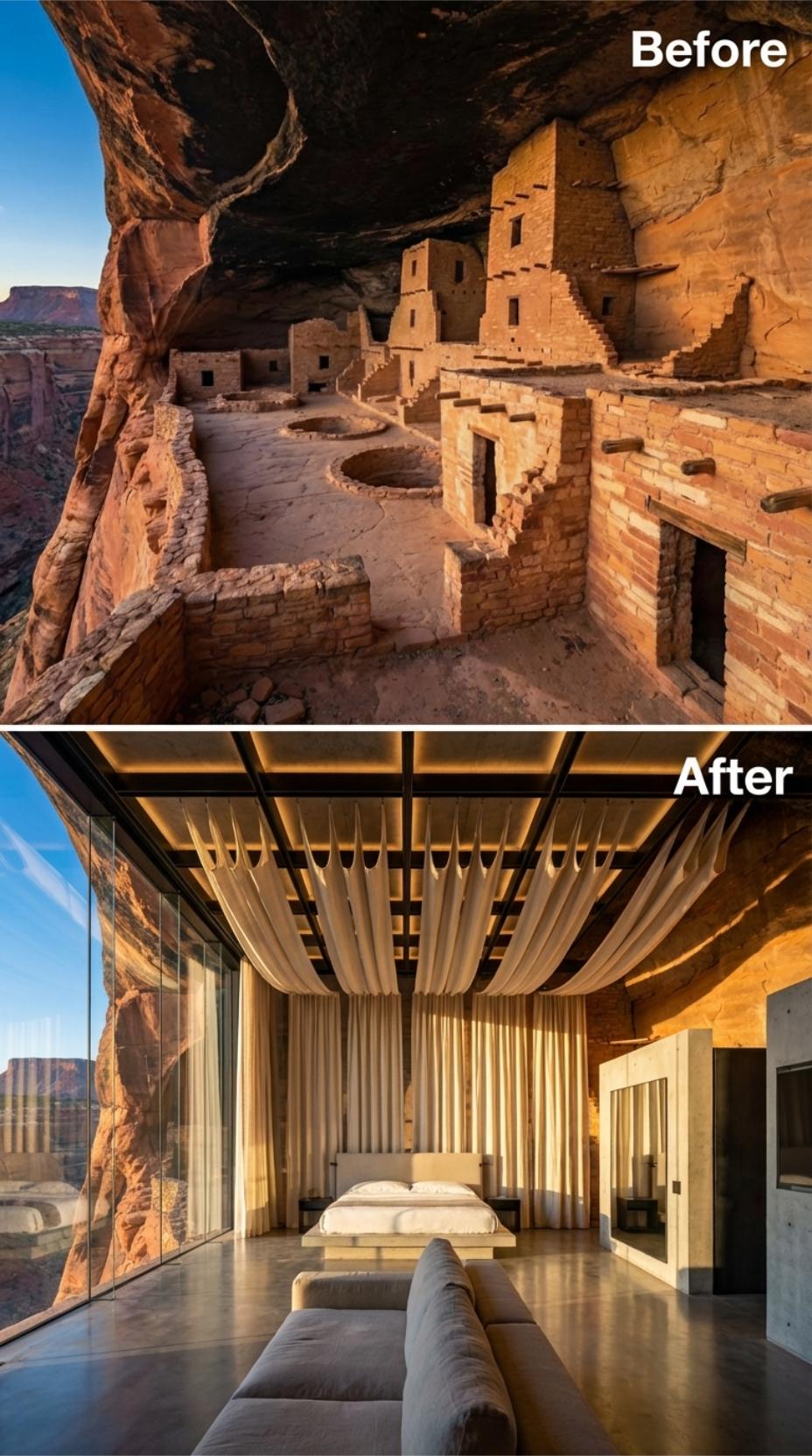
Soft cream fabric panels hang suspended from a dark steel ceiling grid, each drape catching the amber warmth of recessed strip lighting overhead. Polished concrete floors reflect the canyon view through a full glass wall that runs the entire length of the room. A platform bed in bone white linen sits centered against the back wall, flanked by exposed sandstone on the right side.
Why It Works: Fabric ceiling treatments in cave conversions serve a functional purpose beyond aesthetics: soft textiles absorb sound that would otherwise bounce off hard stone and glass surfaces, reducing echo in rooms where parallel walls and rock ceilings create natural reverberation. Designers working with exposed geology often introduce one soft overhead element precisely to counteract this acoustic effect.
18. Arched Plaster Corridors, Warm Cove Lighting, and a Bedroom Built Into Canyon Rock
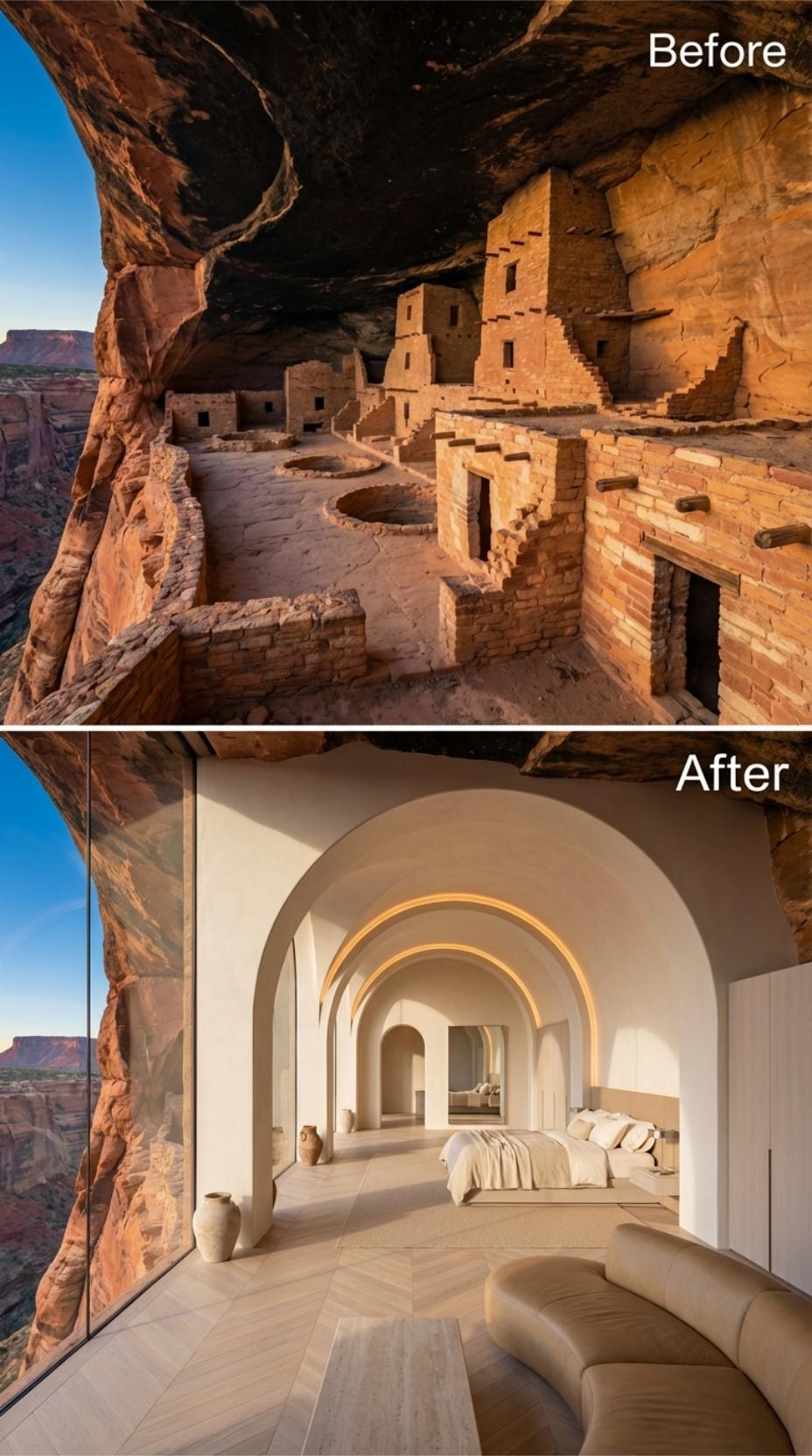
Barrel vaults repeat down the corridor in smooth plaster finished in warm white, each arch lit from within by a continuous cove strip that casts amber light across the ceiling curve. The floor runs in large-format limestone tiles laid without visible grout breaks, pulling the eye toward a bed dressed in layered linen in undyed cream. Floor-to-ceiling glass panels on the left wall hold the canyon cliff face inches away. A curved bench in oatmeal bouclé anchors the foreground. Ceramic vessels in unglazed bisque sit at the base of the glass.
Barrel vaults repeat down the corridor in smooth plaster, each arch lit from within by a continuous cove strip that casts amber light across the ceiling curve.
17. Curved Emerald Leather, Bookmatched Marble, and a Cave Ceiling Sealed in Black Lacquer
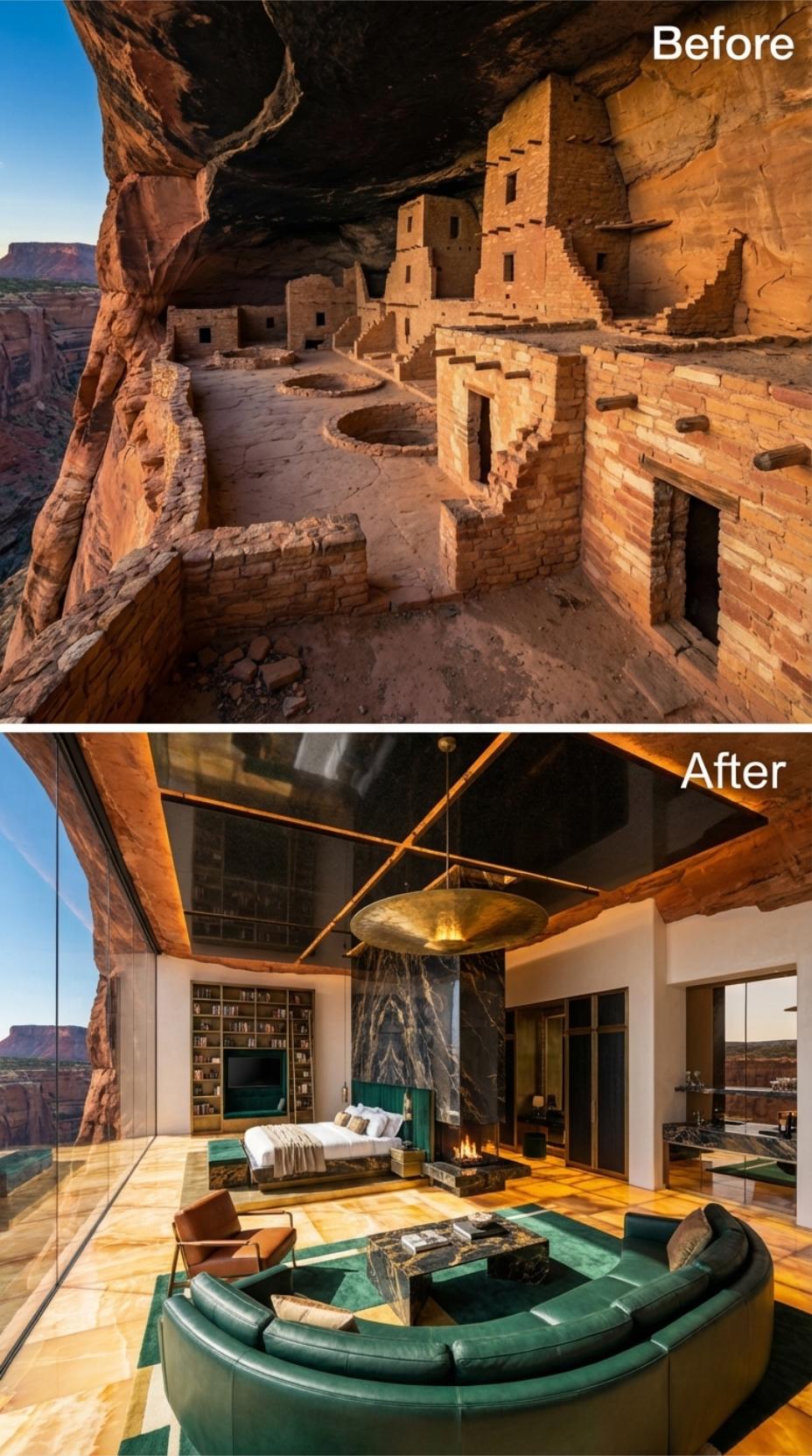
Dark lacquered panels grid the natural cave ceiling in brass-inlaid geometry, a treatment that draws the eye upward without competing with the canyon view framed through full-height glass. A saucer pendant in hammered gold brass drops low over the conversation area, casting warm pooled light across honey-toned travertine floors laid in a large-format grid pattern.
Curved sectional seating in deep emerald leather anchors the room’s center, paired with a marble-topped coffee table in black and gold veining. Behind it, a bookmatched stone fireplace surround rises floor to ceiling, flanked by a built-in bookcase system finished in warm brass and dark wood. A platform bed sits directly in front of it, dressed in white linen against the stone.
Trend Alert: Curved sectional sofas have moved decisively into bedroom suites at the upper end of the residential market, functioning as room dividers that define a lounge zone without requiring walls. In open-plan cave conversions where structural partitions are often impossible, the silhouette of the furniture does the architectural work instead. Specifying a curved form in a high-sheen leather rather than fabric also reduces maintenance concerns in desert climates where dust infiltration through glass walls is a recurring issue.
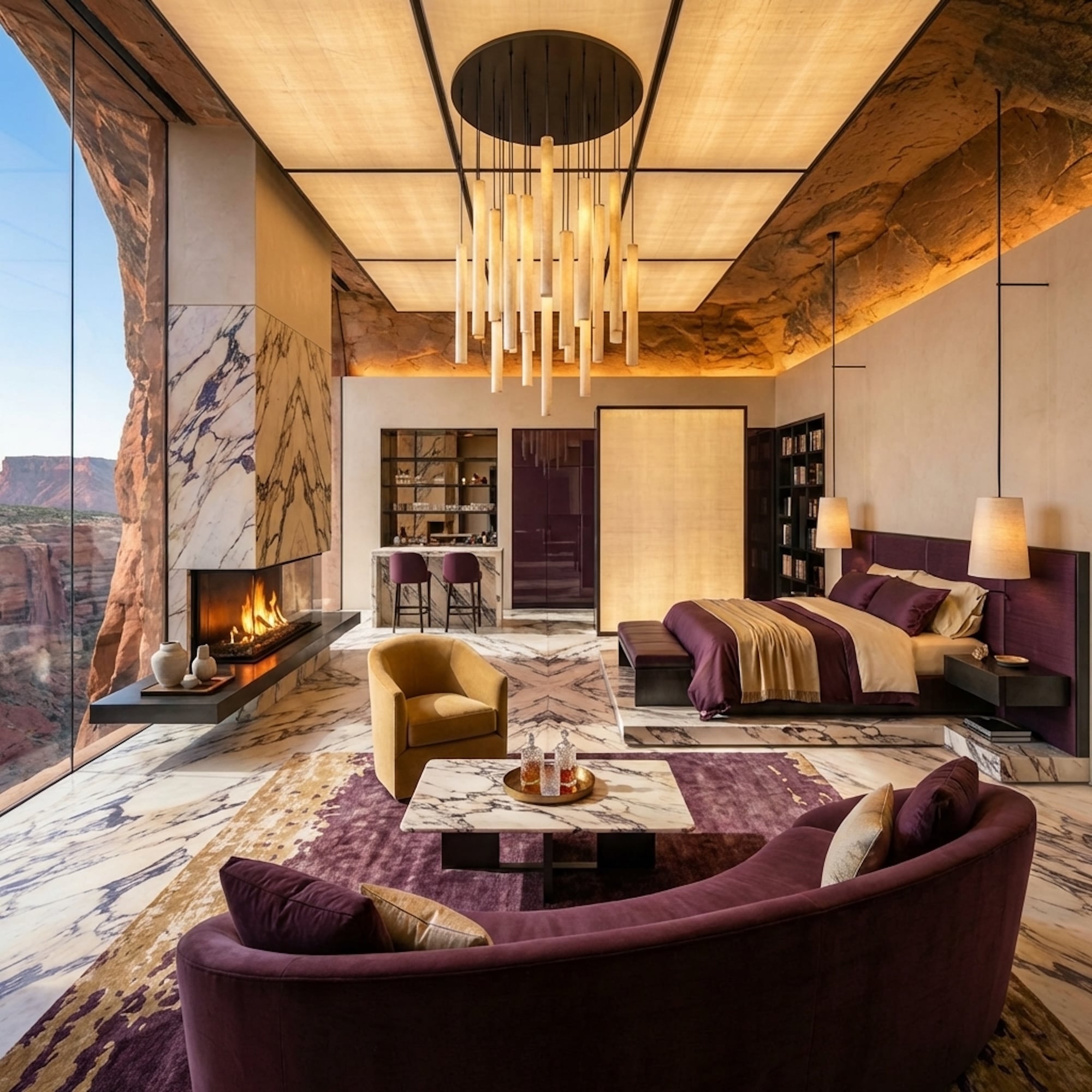
16. Marble Floors, Purple Velvet, and a Pendant Cluster Floating Inside Canyon Rock
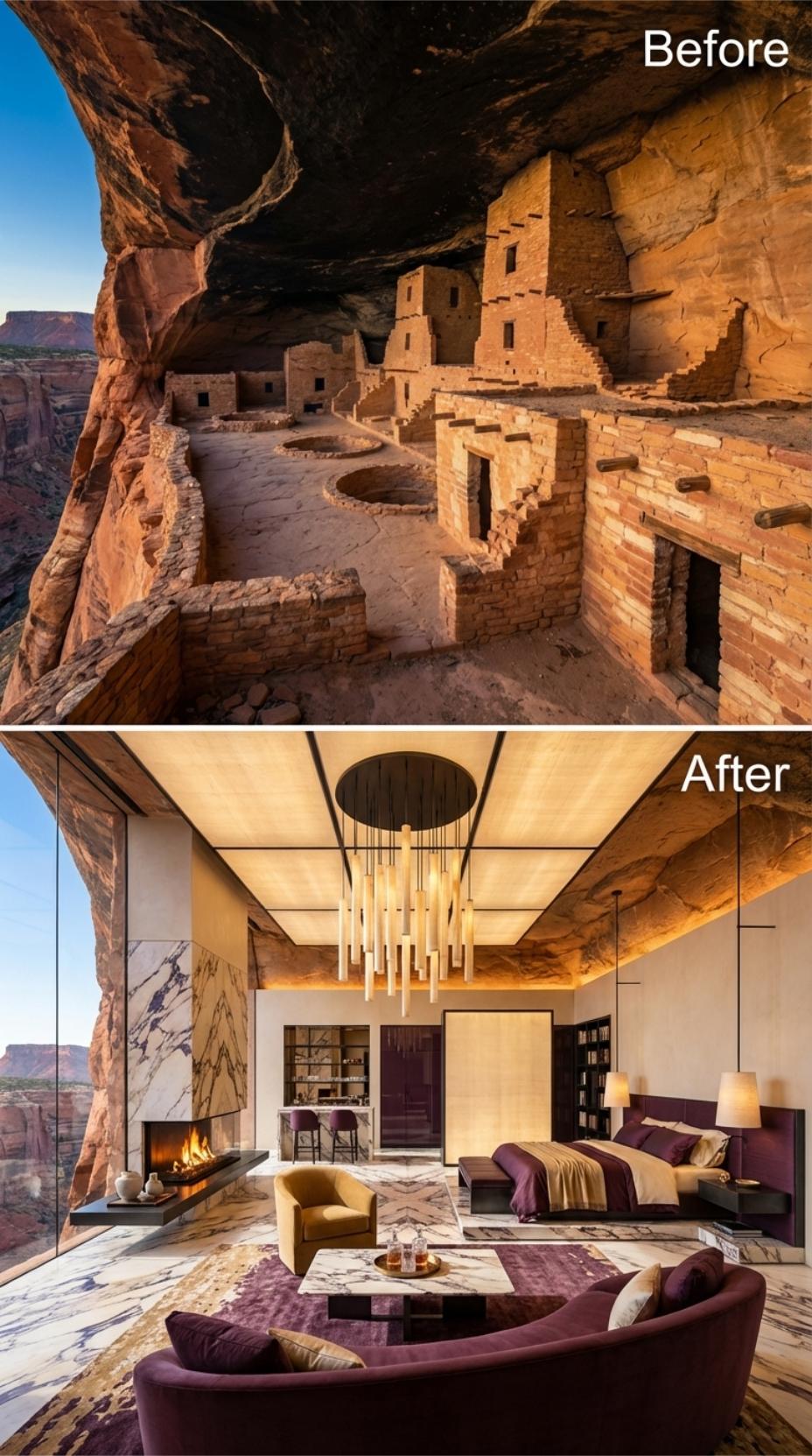
Calacatta marble runs continuously across the floor and up the walls in bookmatched slabs, with deep burgundy veining pulling the room’s color story toward plum. The sectional sofa wraps in matte aubergine velvet, anchored by a curved profile that separates the lounge zone from the sleeping area without a single partition wall. A linear fireplace sits flush into the marble surround on the left wall, framed by full-height glass that opens directly onto the canyon drop below.
Cylindrical brass pendant tubes hang at staggered lengths from a circular ceiling mount, casting pooled warmth down onto a champagne armchair and a marble-topped coffee table. The bed sits against a plaster headboard panel in pale gold, flanked by slim reading lamps in linen shades. Exposed sandstone rock emerges along the upper right wall, left unfinished, with amber cove lighting grazing its surface from below.
15. Illuminated Onyx Grid, Floor-to-Ceiling Canyon Glass, and a Fireplace Carved From Desert Stone
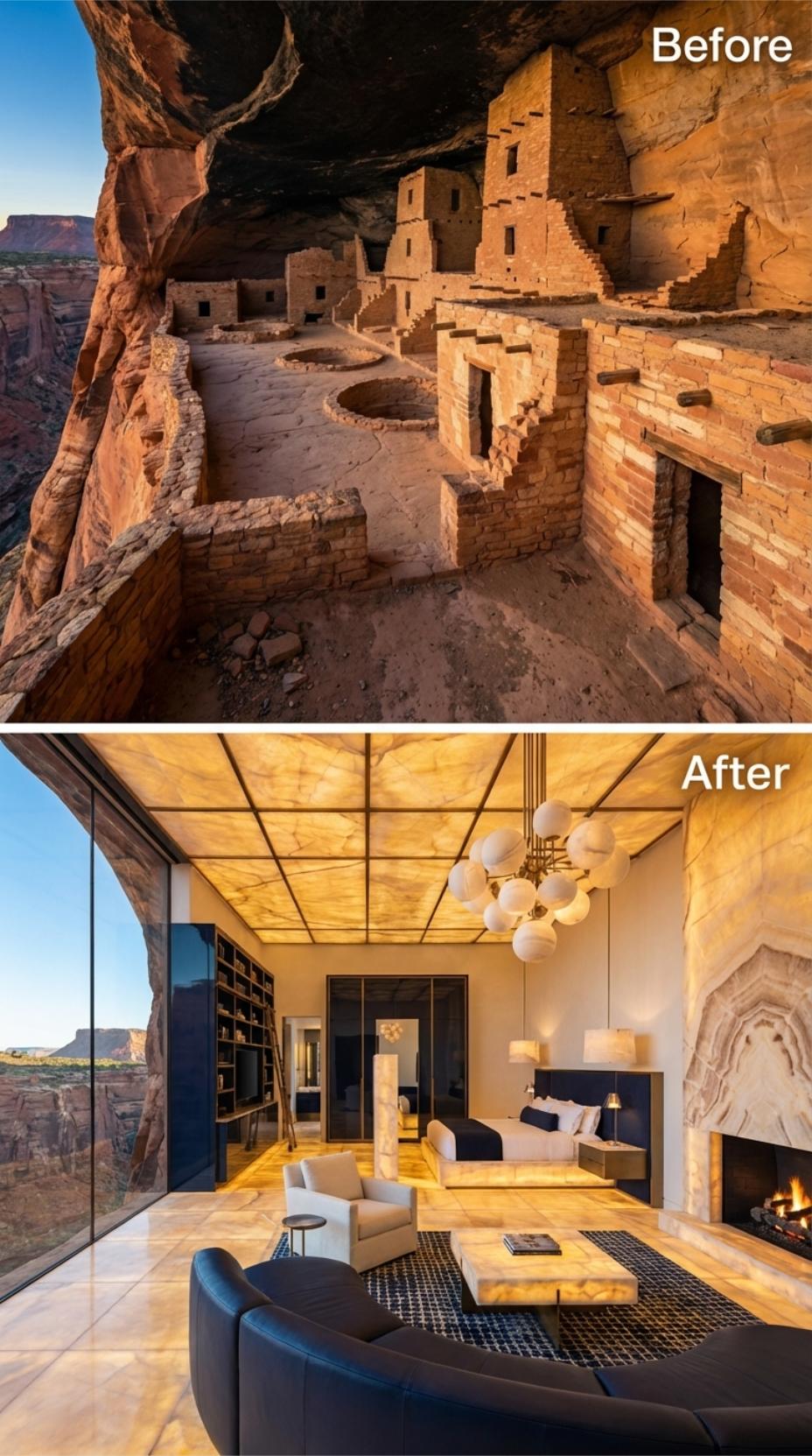
Backlit panels of honey-toned onyx tile the entire ceiling in a grid pattern, each section glowing amber from behind like light passing through a thin slice of mineral. Floor-to-ceiling glass runs the full width of the left wall, framing the canyon drop without interruption. A globe pendant cluster hangs at varied drops from a central ceiling point, its matte white spheres arranged on radiating brass arms.
The floor is laid in large-format stone tile, its veining pulled directly from the onyx overhead. Two cream upholstered armchairs anchor a low rectangular coffee table in matching stone. Against the right wall, a sculpted plaster fireplace surround features Gothic-influenced relief carving, and a wood-burning fire throws amber light across the navy bedding beyond it.
14. Exposed Beam Ceiling, Stone Fireplace Surround, and Hardwood Floors Inside Canyon Rock
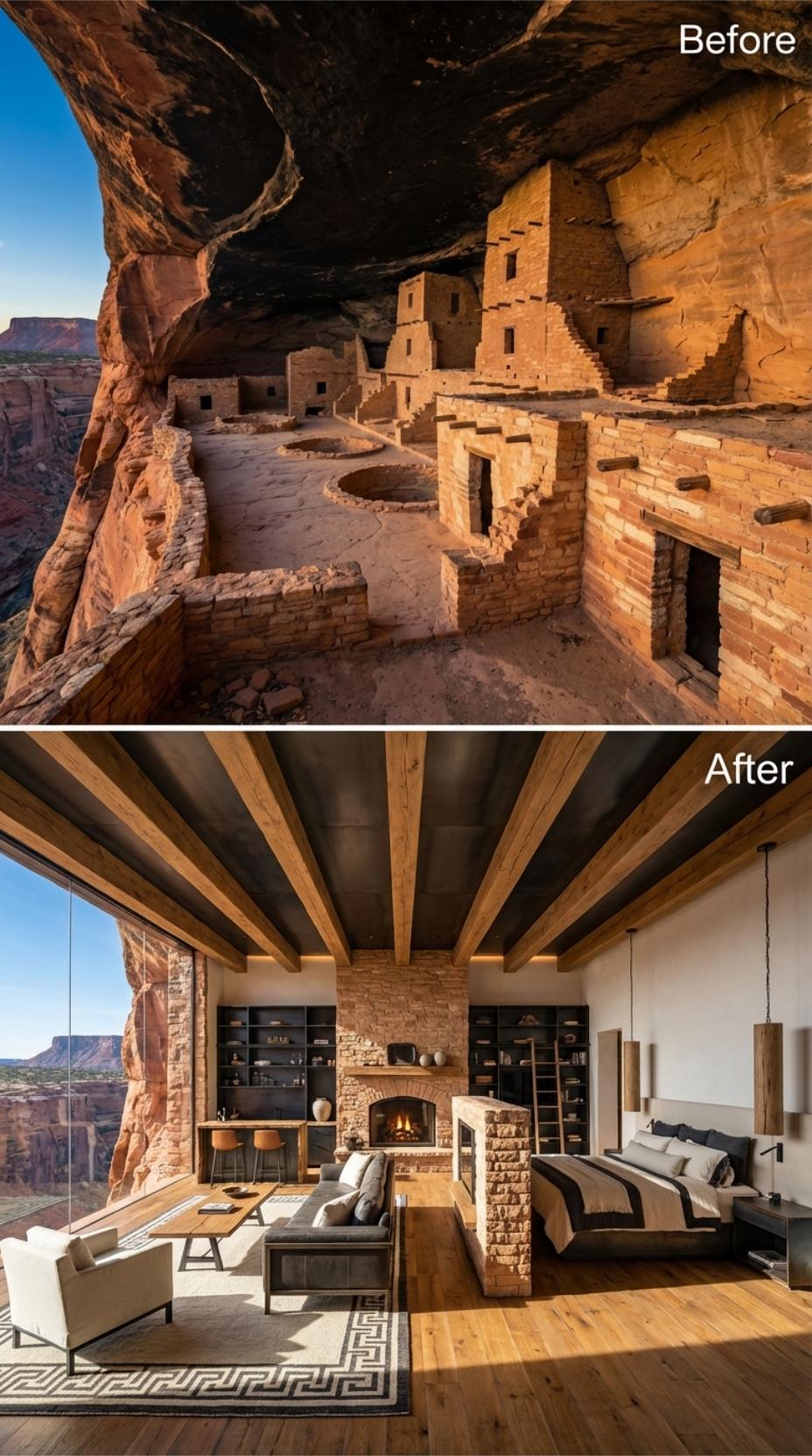
Wide-plank oak floors run beneath a ceiling of raw timber beams set against dark-stained planking, anchoring a bedroom suite that opens through full-height glass to red rock canyon views.
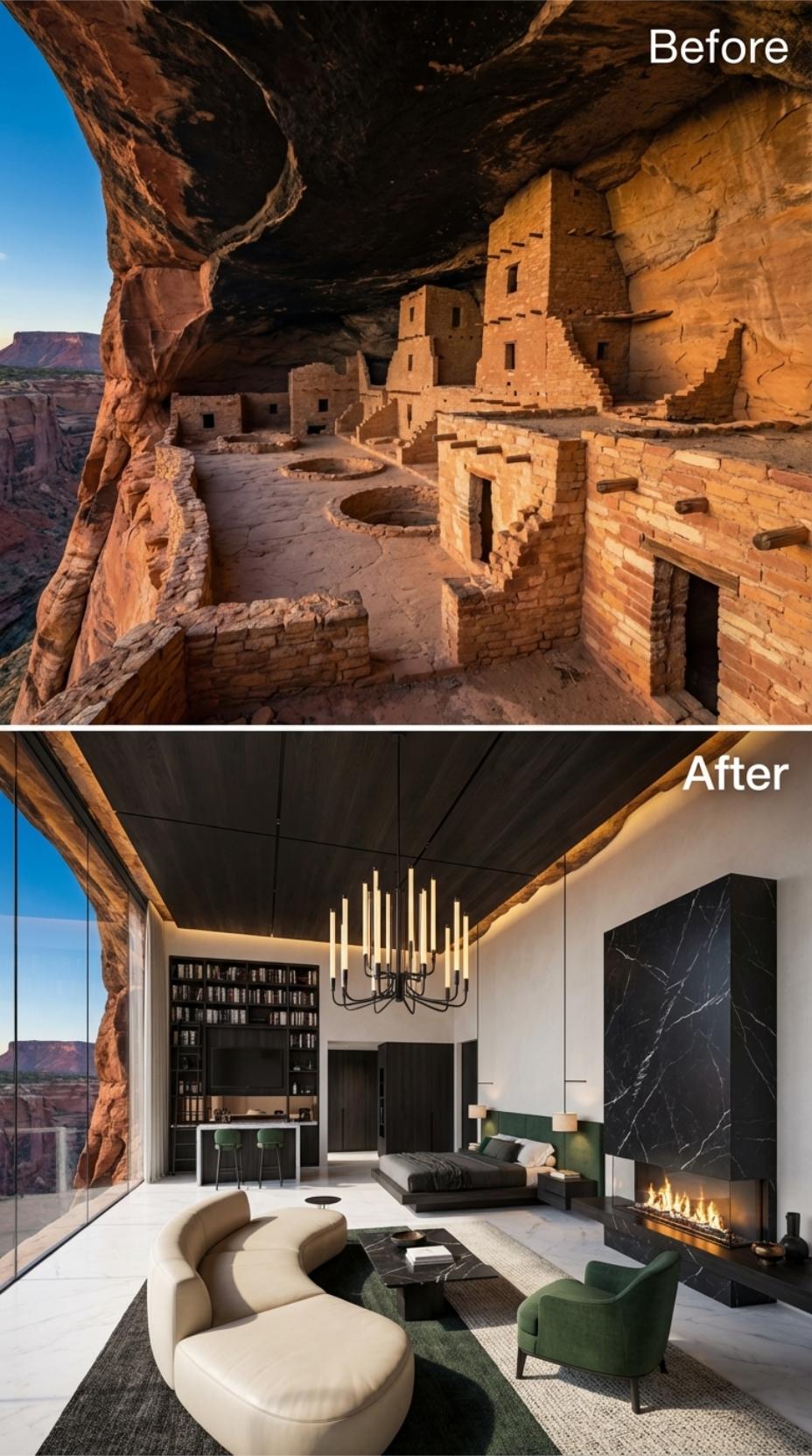
13. Black Marquina Marble, Curved Cream Leather, and a Cave Ceiling Sealed Over Canyon Glass
🔥 Would you like to save this?
Raw sandstone forms the cave ceiling overhead, left unfinished where it meets a matte black panel system that runs the full length of the room. Floor-to-ceiling glass opens directly onto canyon red rock. A candelabra-style chandelier with cylindrical white tapers hangs above a curved cream leather sectional. The fireplace surround climbs nearly to the ceiling in bookmatched black Marquina marble with white veining. Green velvet armchairs anchor the seating arrangement opposite a built-in dark wood library wall.
12. Sandstone Cave Ceiling, Recessed Fire Pit, and a Glass Wall Framing Canyon Depth
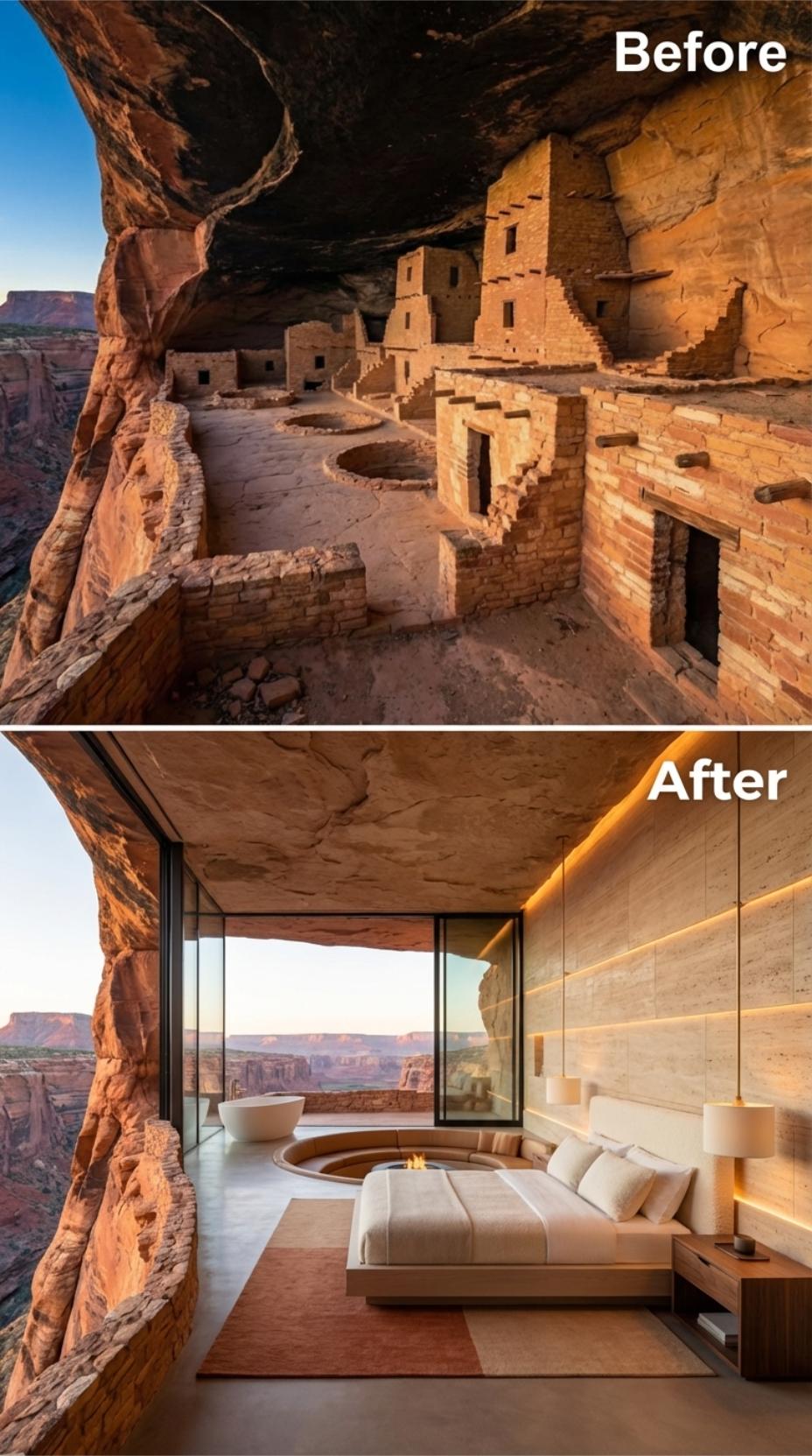
Warm walnut cladding lines the headboard wall in horizontal strips, lit from behind by continuous amber LED channels. A sunken circular fire pit sits flush with the concrete floor at the foot of the platform bed, its curved travertine surround echoing the canyon’s own geology overhead.
11. Linen Bedding, Freestanding Stone Tub, and Pendant Cylinders Hung From Raw Cave Rock
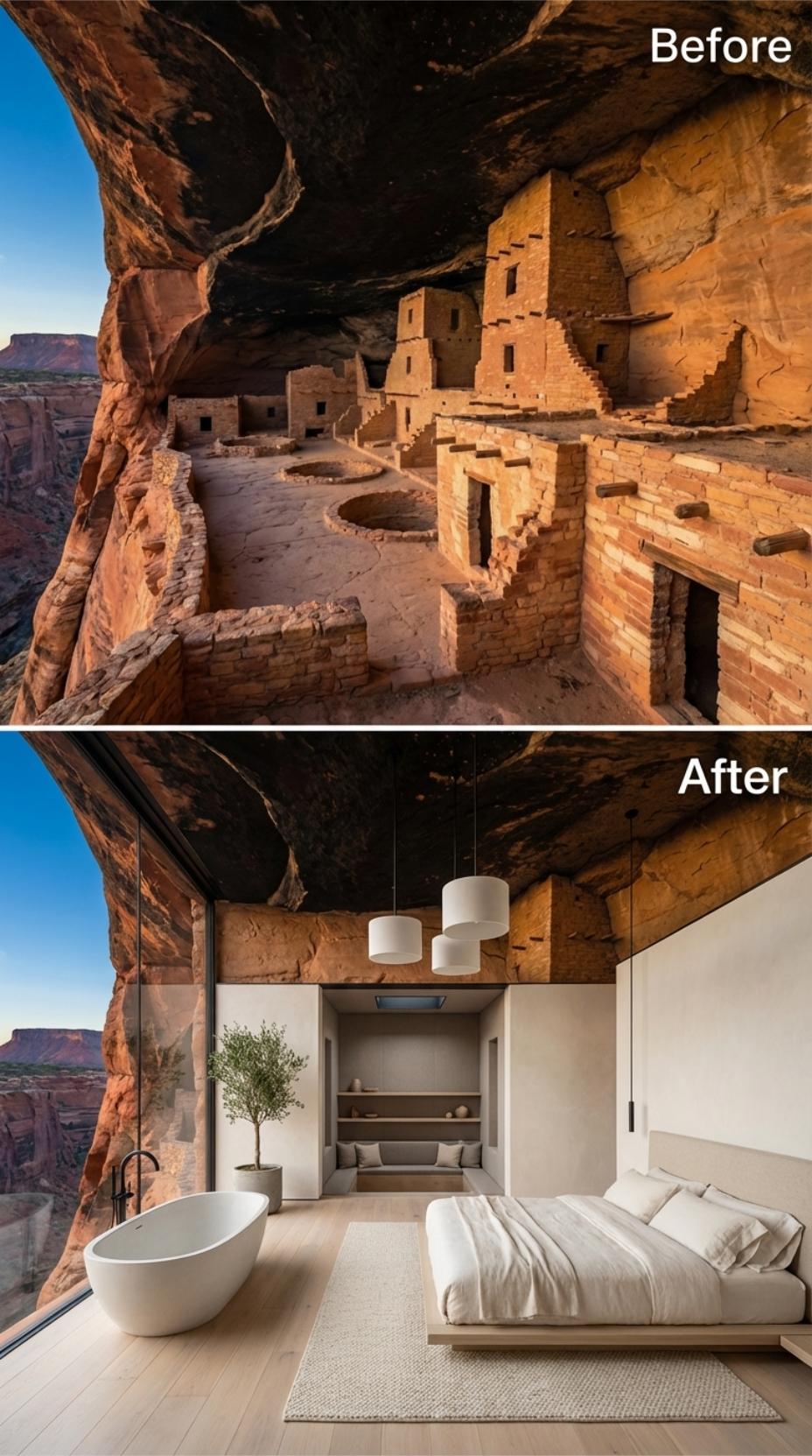
Three drum pendants in white linen hang at staggered drops from the cave ceiling directly above a low-profile platform bed dressed in bone linen. A freestanding soaking tub in matte white sits flush against floor-to-ceiling glass, positioning the bather directly above the canyon drop. Light ash flooring runs wall to wall, and a potted olive tree anchors the left corner beside a black matte freestanding faucet.
10. Suspended Brass Bed Frame, Cognac Leather Seating, and a Cave Ceiling Left Completely Intact
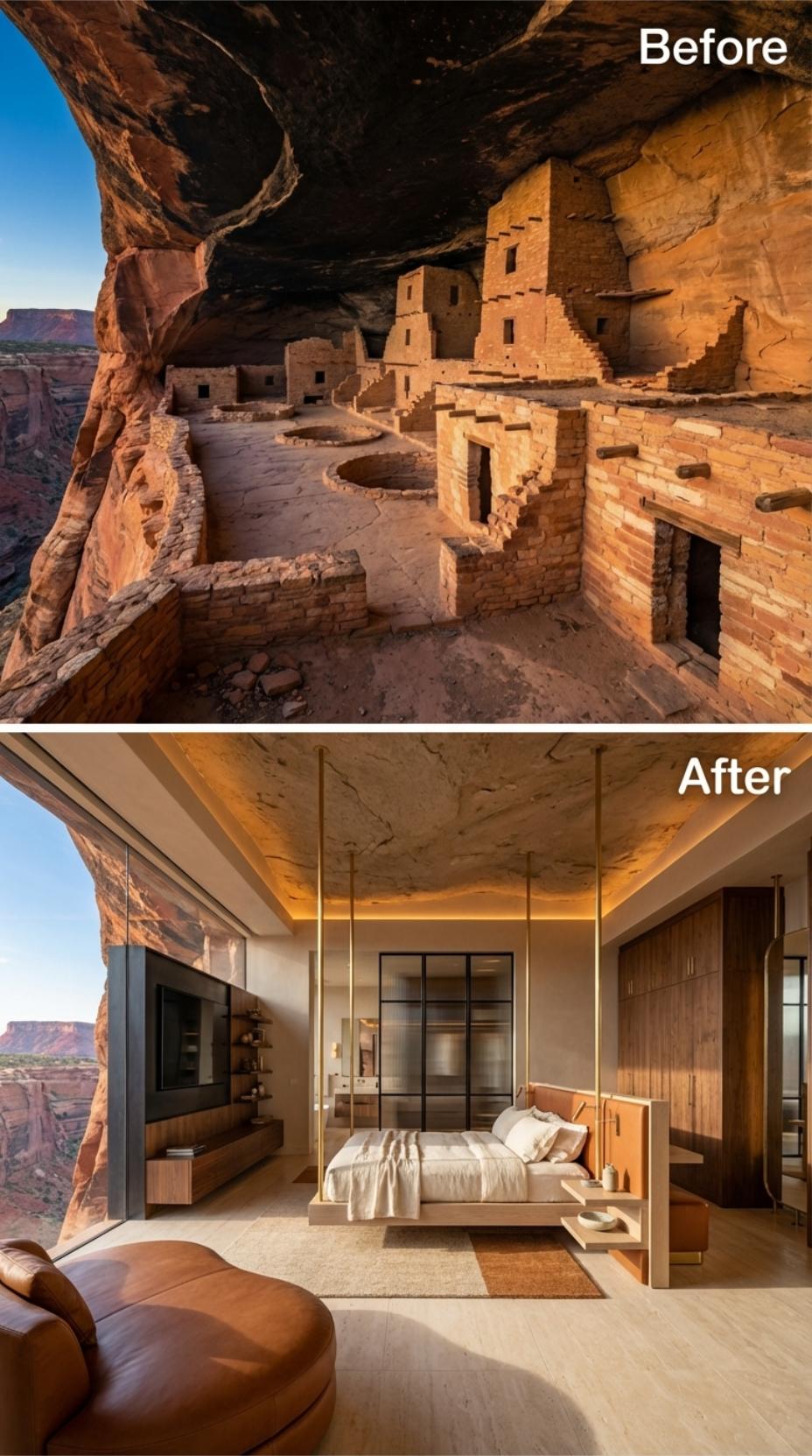
Gold brass cables drop from a recessed tray ceiling to suspend a platform bed with a wrapped cognac headboard panel, keeping the floor plane uninterrupted beneath it. The ceiling above the tray is raw sandstone, unfinished and uncoated, its natural fracture lines picked up by the amber cove lighting running the perimeter of the dropped frame.
Floor-to-ceiling glass on the left wall opens the room to canyon depth, with walnut millwork panels and built-in shelving flanking a wall-mounted television. A round-armed leather sofa in saddle brown anchors the foreground. Wardrobe storage behind the bed uses a grid of black steel and frosted glass panels, giving the room a division between sleeping and dressing zones without a physical wall.
9. Floating Stair, Cave Rock Ceiling, and Glass Panels Anchored Into Canyon Stone
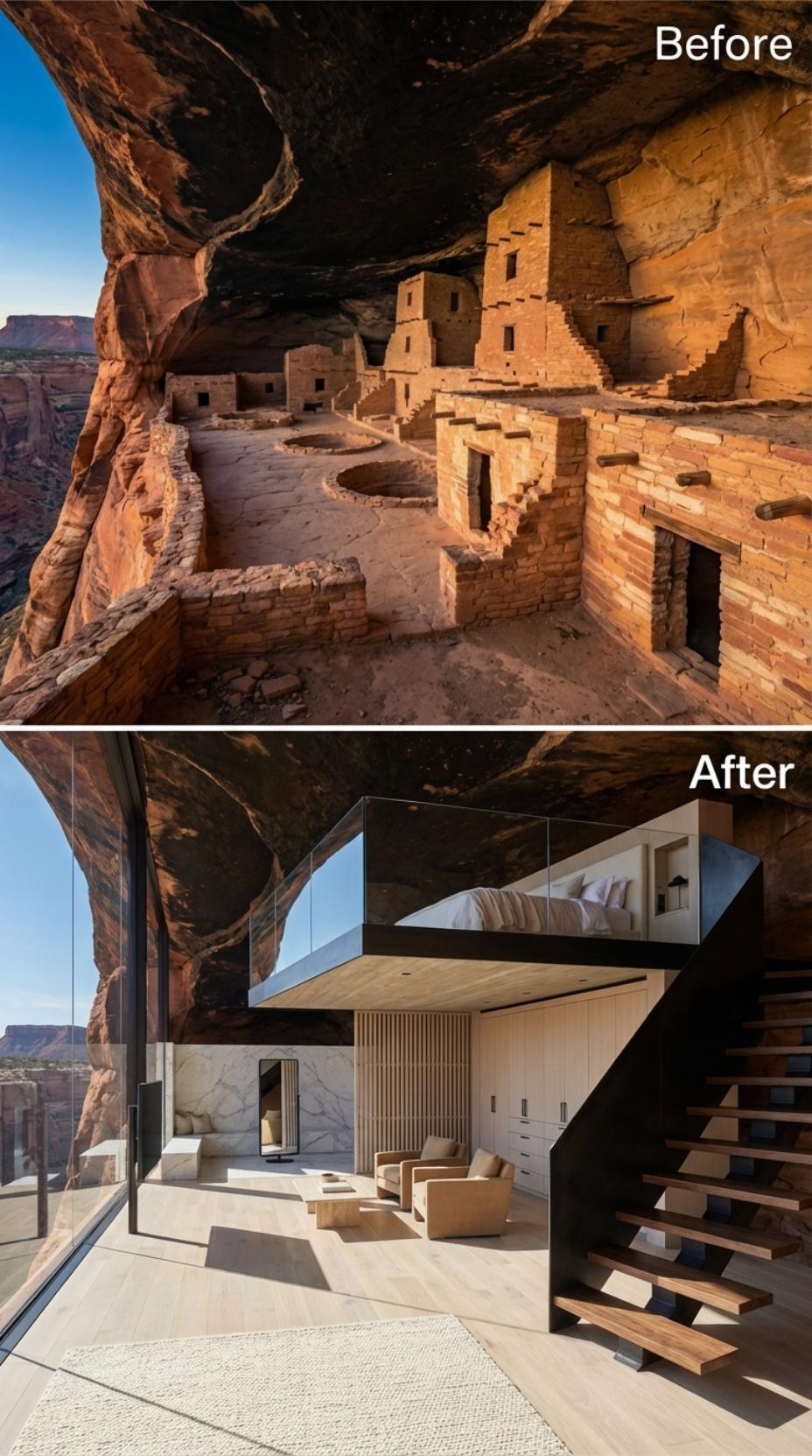
Cantilevered wood treads in what reads as white oak extend from a black steel stringer along the right wall, with no visible risers, leaving the staircase open to the room below. The cave ceiling overhead is left entirely exposed, its dark oxidized surface providing contrast against the pale travertine-clad walls and floor. Glass panels run along the upper level’s open edge, giving the bedroom loft an unobstructed view down into the living area.
Below, two sand-colored lounge chairs sit on a woven ivory rug, positioned around a low wood side table. Vertical slatted wood panels mounted between the marble wall sections add texture without weight. Full-height storage units flank the upper bedroom in a matte white finish, keeping the sleeping area spare. The glass facade at the far left opens the entire volume toward the canyon, with red mesa formations visible in the distance.
8. Sunken Bed Platform, Floor-to-Ceiling Canyon Glass, and Cove Lighting Edged in Natural Rock
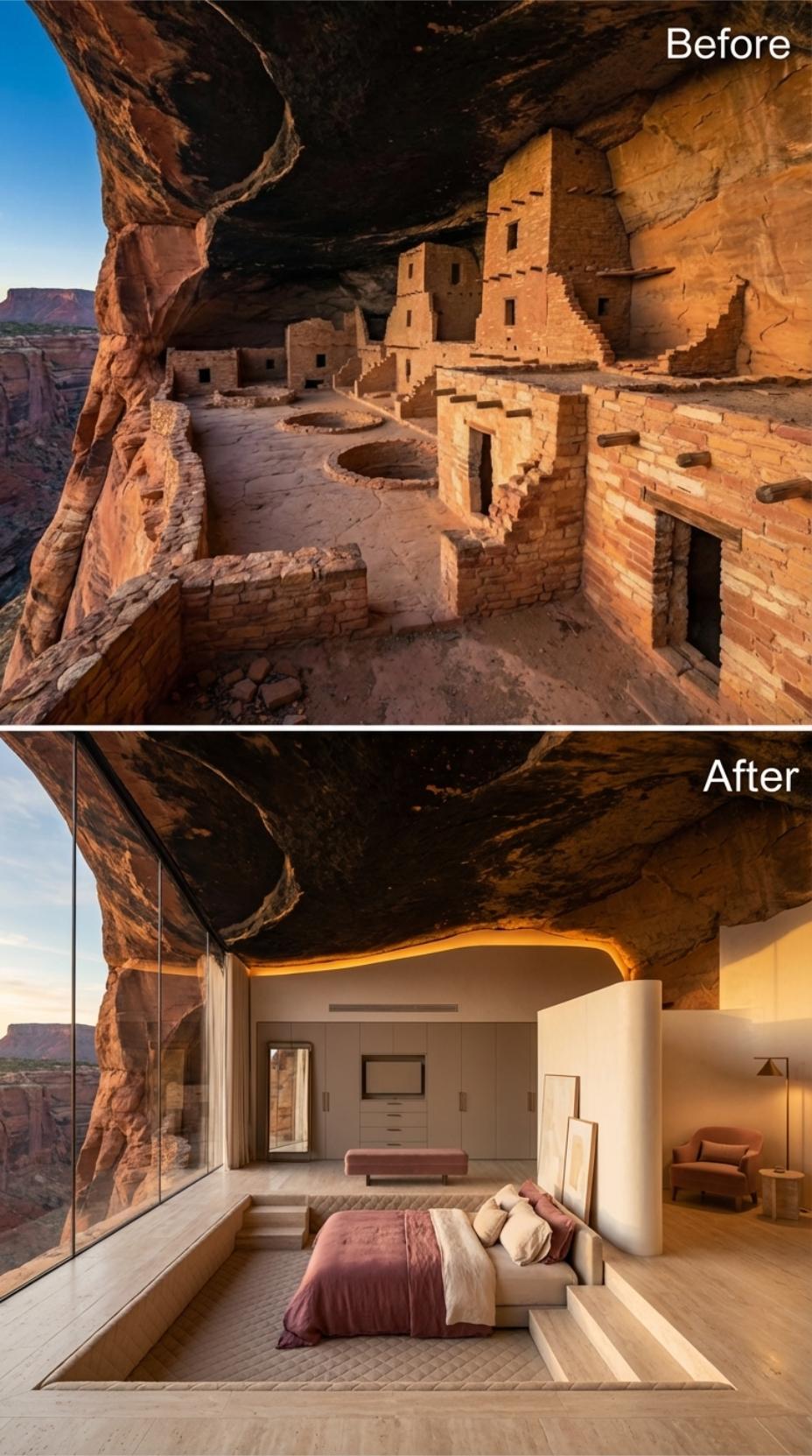
Plaster walls in a pale greige finish meet raw cave ceiling without transition trim, and amber cove lighting traces that junction across the full width of the room. The bed sits inside a recessed platform framed by stepped sandstone-toned surround, dressed in dusty rose linen with layered cream pillows. A blush velvet bench anchors the foot of the platform while a muted terracotta armchair occupies the far corner beside a floor lamp with a cylindrical shade.
7. Black Marble Fire Platform, Floor-to-Canyon Glass, and Open Shelving Cut Into Cave Rock
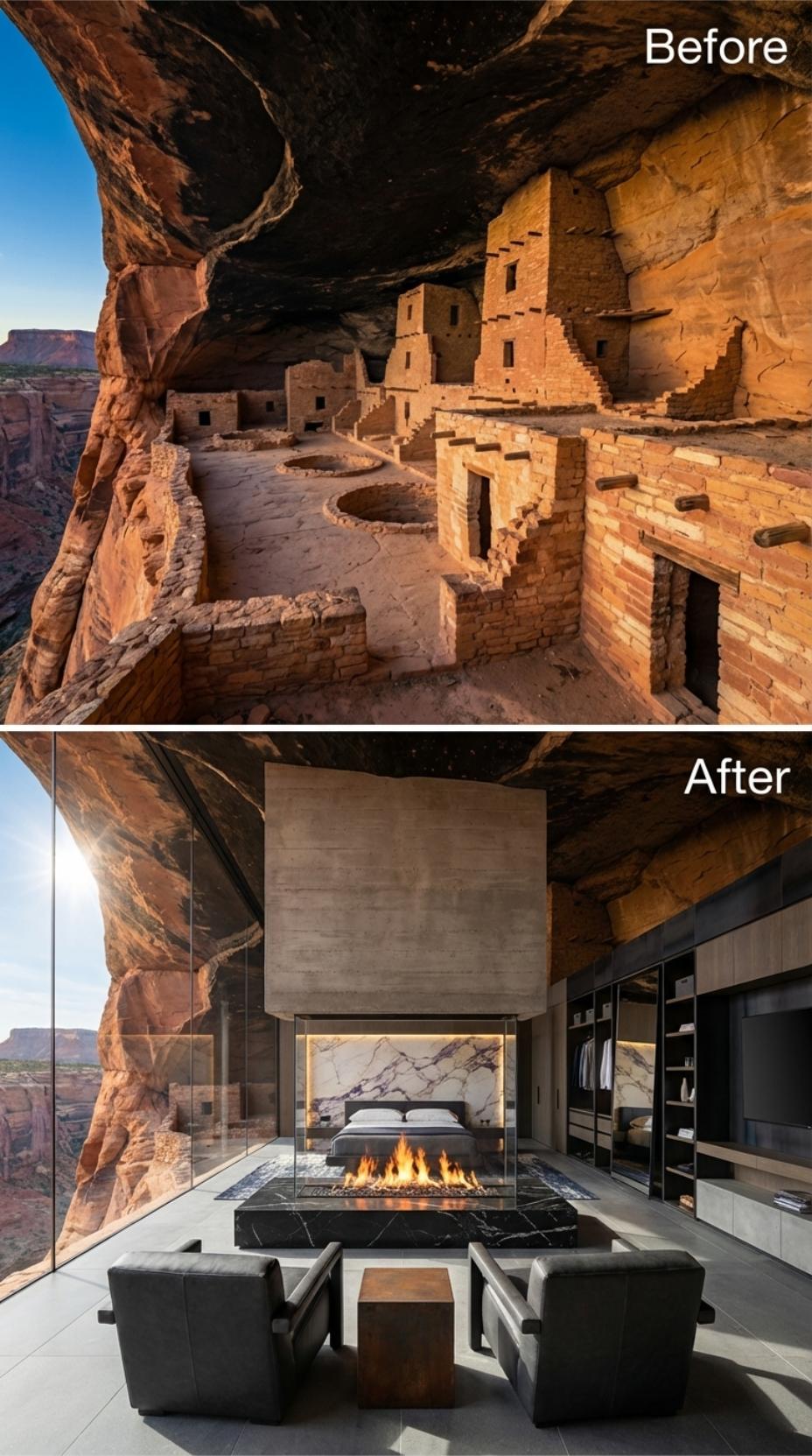
Concrete anchors the bedroom wall behind the bed, left completely unfinished in texture and color, while black marble wraps the fire platform that sits between the seating area and the headboard. Flames burn at floor level inside a glass-enclosed pit, creating a heat source that doubles as a room divider. Two leather chairs face inward toward the fire, flanking a wood block side table with no additional ornamentation.
Floor-to-ceiling glass panels run the full width of the cave opening, pulling canyon light directly into the room without obstruction. Open shelving built into the right wall holds folded linens and hanging garments, functioning as both wardrobe and storage in a single built-in unit. The natural rock ceiling arches overhead, untouched and unpainted, contrasting sharply against the polished stone surfaces below.
6. Slatted Oak Headboard, Globe Pendant Trio, and Canyon Glass Sealed Into Cave Rock
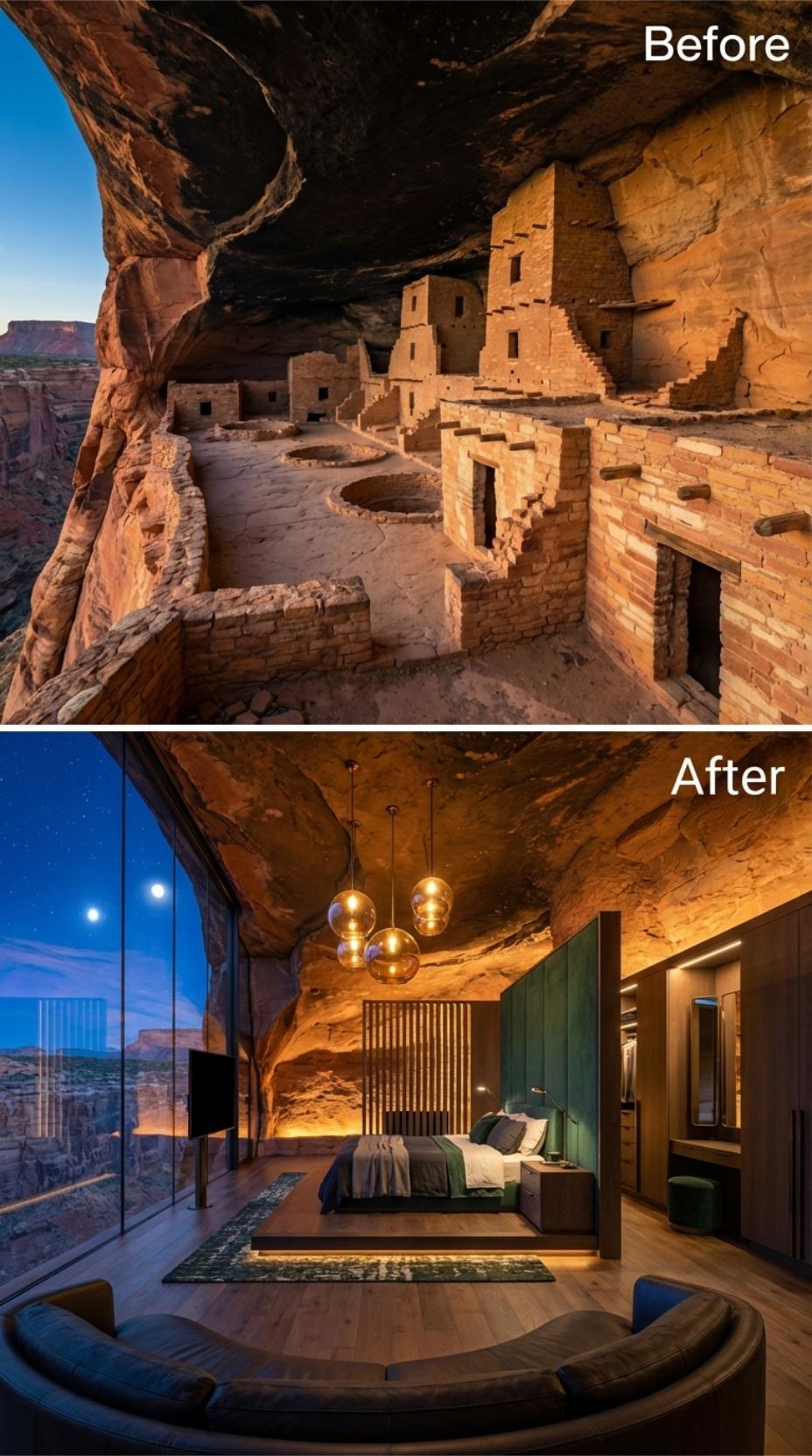
Pendant lighting does the heavy lifting here. Three globe fixtures in a brushed brass finish hang at varying drops above a platform bed, pulling amber light across the cave ceiling without competing with the rock’s natural texture. The headboard behind the bed consists of vertical oak slats spaced evenly, functioning as a visual buffer between the soft bedding and the raw sandstone wall.
Floor-to-ceiling glass runs the full left side of the room, framing a moonlit canyon view at night. Dark green velvet at the headboard and a patterned wool rug anchor the color palette low in the room. A curved wood sofa base in the foreground and a wardrobe with integrated mirror and strip lighting along the right wall complete the layout without crowding the cave opening overhead.
5. Walnut Millwork, Shoji-Panel Wardrobes, and Canyon Glass Flush Against Cave Rock
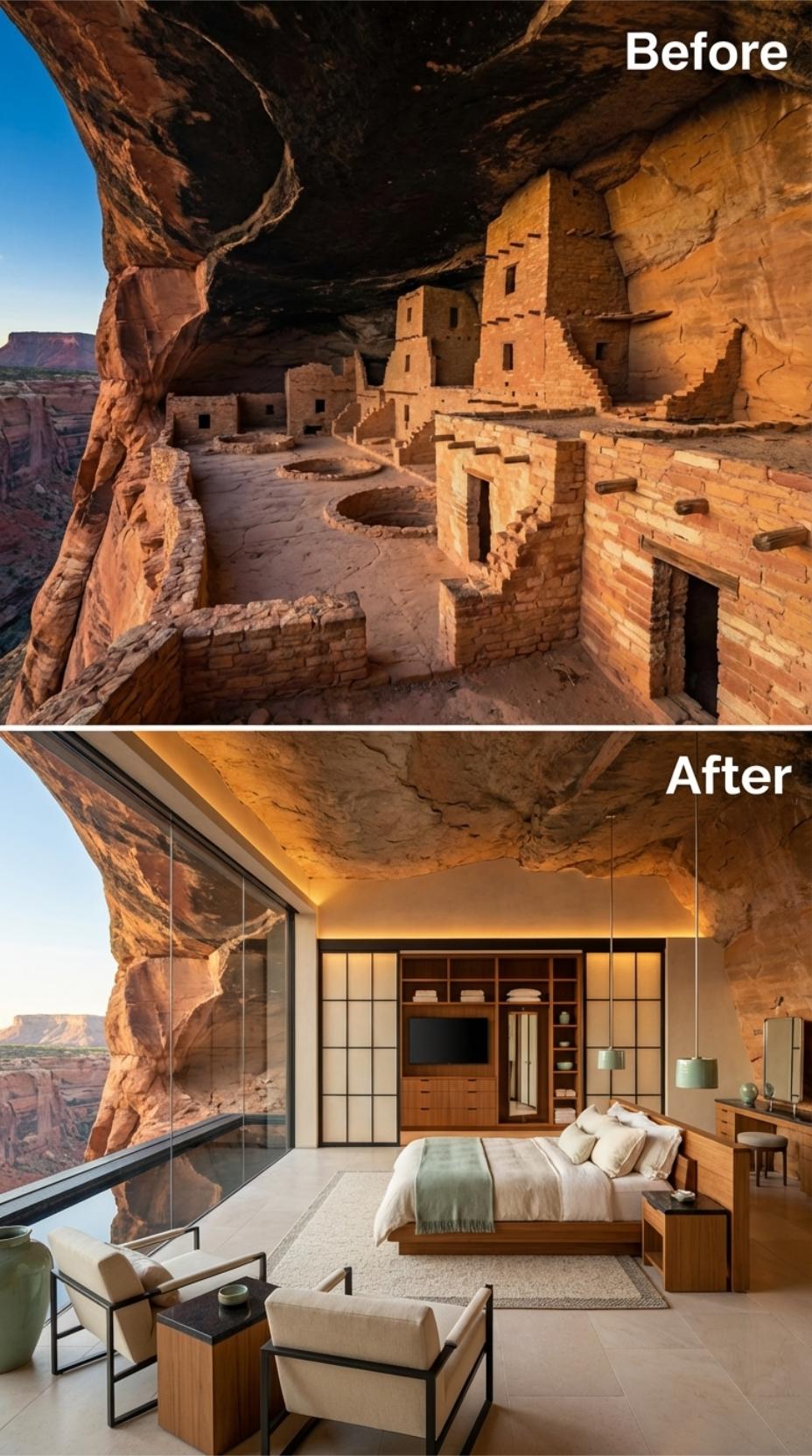
Warm walnut millwork runs floor to ceiling along the back wall, housing an integrated television unit flanked by open shelving with recessed lighting along each shelf edge. Shoji-style panels with grid detailing frame either side of the unit, their cream-toned paper inserts softening the wood grain without competing with it. The bed sits on a raised platform with crisp white linens and a sage runner across the foot.
Floor-to-ceiling glass seals the canyon-facing edge of the room, with the raw sandstone overhang left exposed overhead and lit from below by a cove strip that traces the rock contour. Two square-armed chairs in off-white upholstery anchor a seating area near the glass, paired with a low black steel side table. A single pendant in celadon ceramic hangs near the vanity corner, where a wood-framed mirror and matching stool complete the arrangement.
Cove lighting that follows the contour of natural rock does more spatial work than any chandelier could.
4. Cognac Leather Armchairs, Polished Concrete Floors, and Canyon Glass Sealed Into Cave Rock
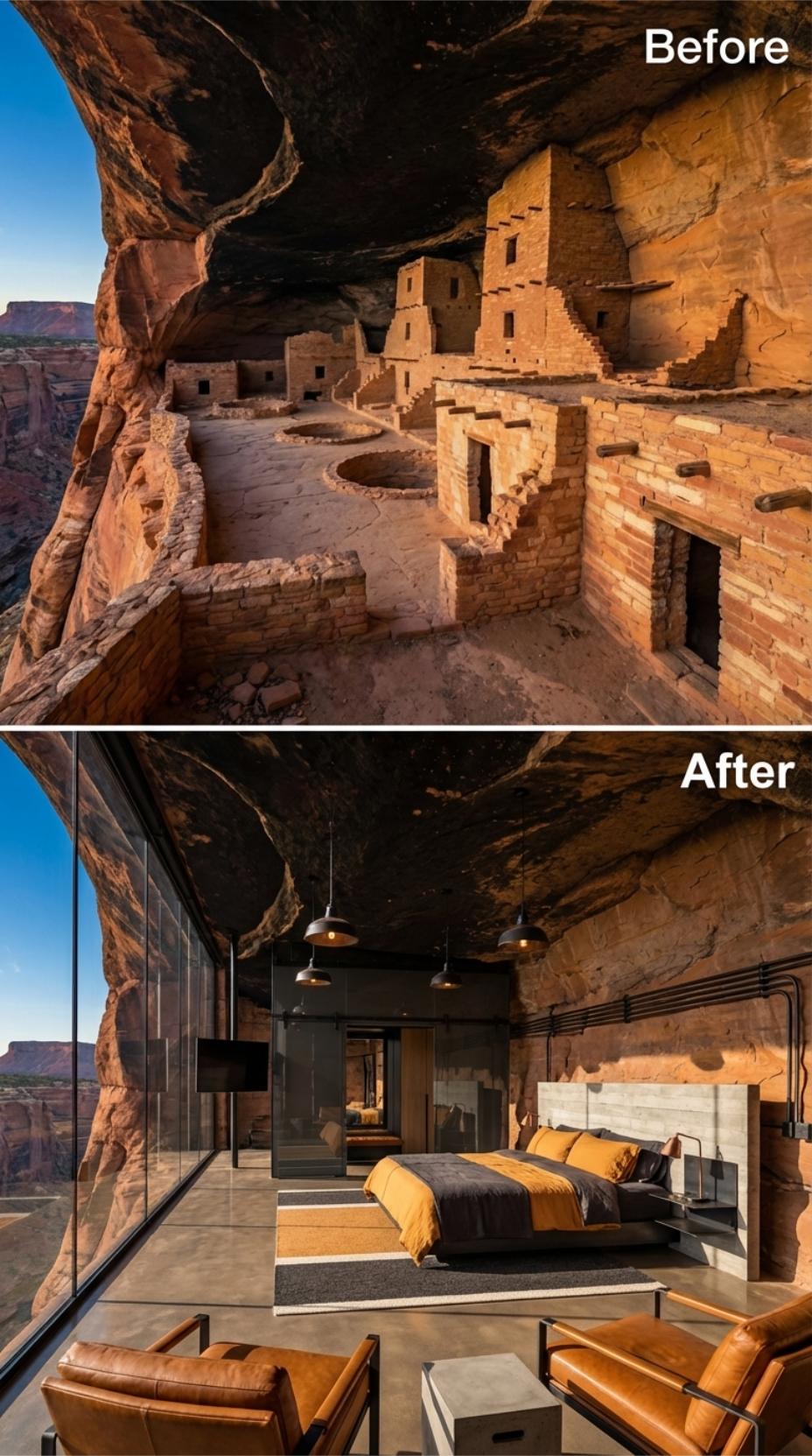
🔥 Would you like to save this?
Polished concrete floors anchor a suite where raw sandstone ceiling curves overhead uninterrupted. A platform bed with a concrete panel headboard sits centered beneath black industrial pendants, dressed in charcoal and amber bedding. Cognac leather armchairs face the glass wall.
3. Woven Fabric Ceiling, Canyon Glass Wall, and Bleached Oak Millwork Set Into Cave Rock
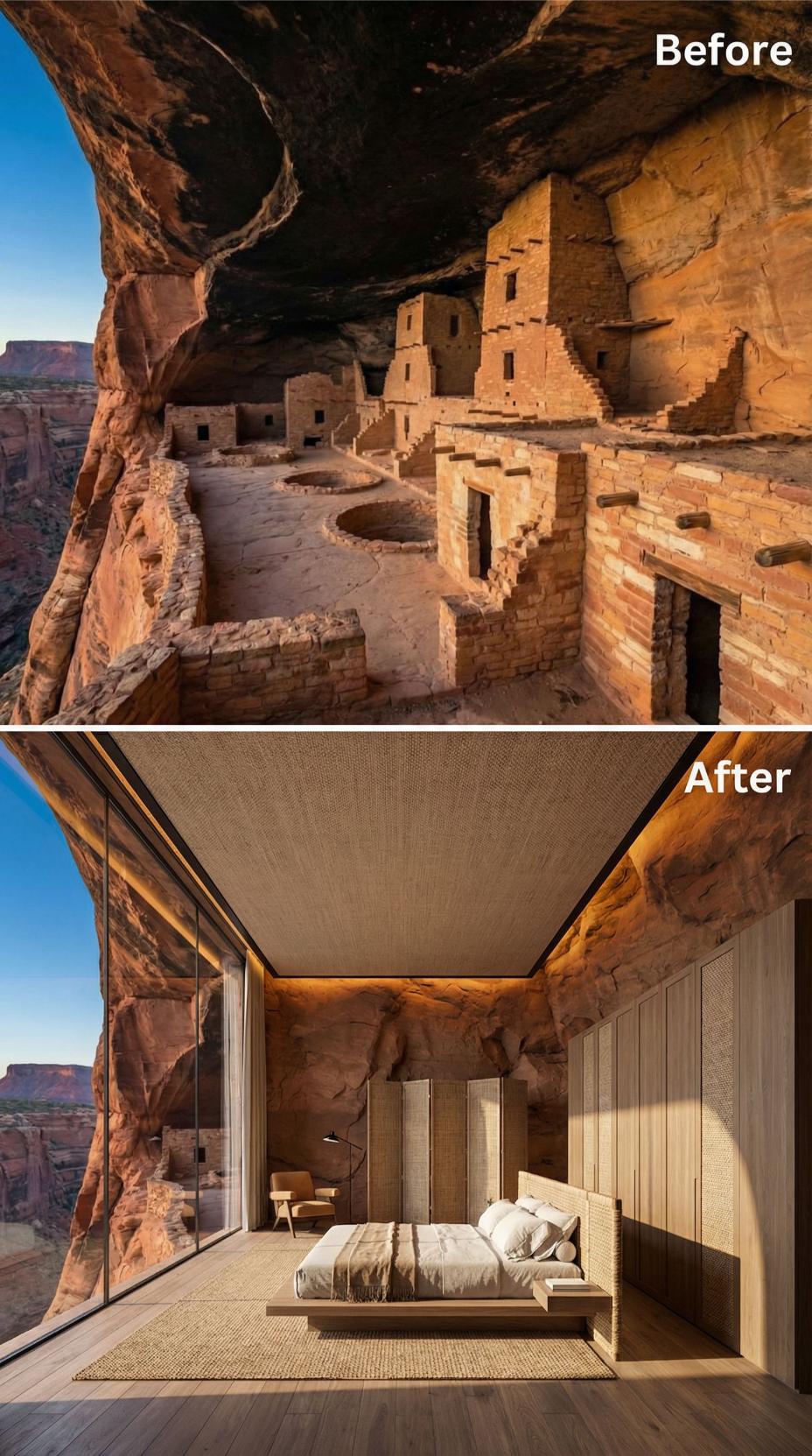
Bleached oak cabinetry lines the right wall from floor to ceiling, its vertical grain running uninterrupted beside exposed sandstone that glows amber under recessed strip lighting. A platform bed with a woven rattan headboard sits centered on a jute area rug, dressed in undyed linen. Floor-to-ceiling glass panels open the cave mouth to canyon air and red rock buttes beyond.
2. Emerald Velvet Bed Platform, Marble-Clad Shelving Tower, and Glass Sealed Into Cave Rock
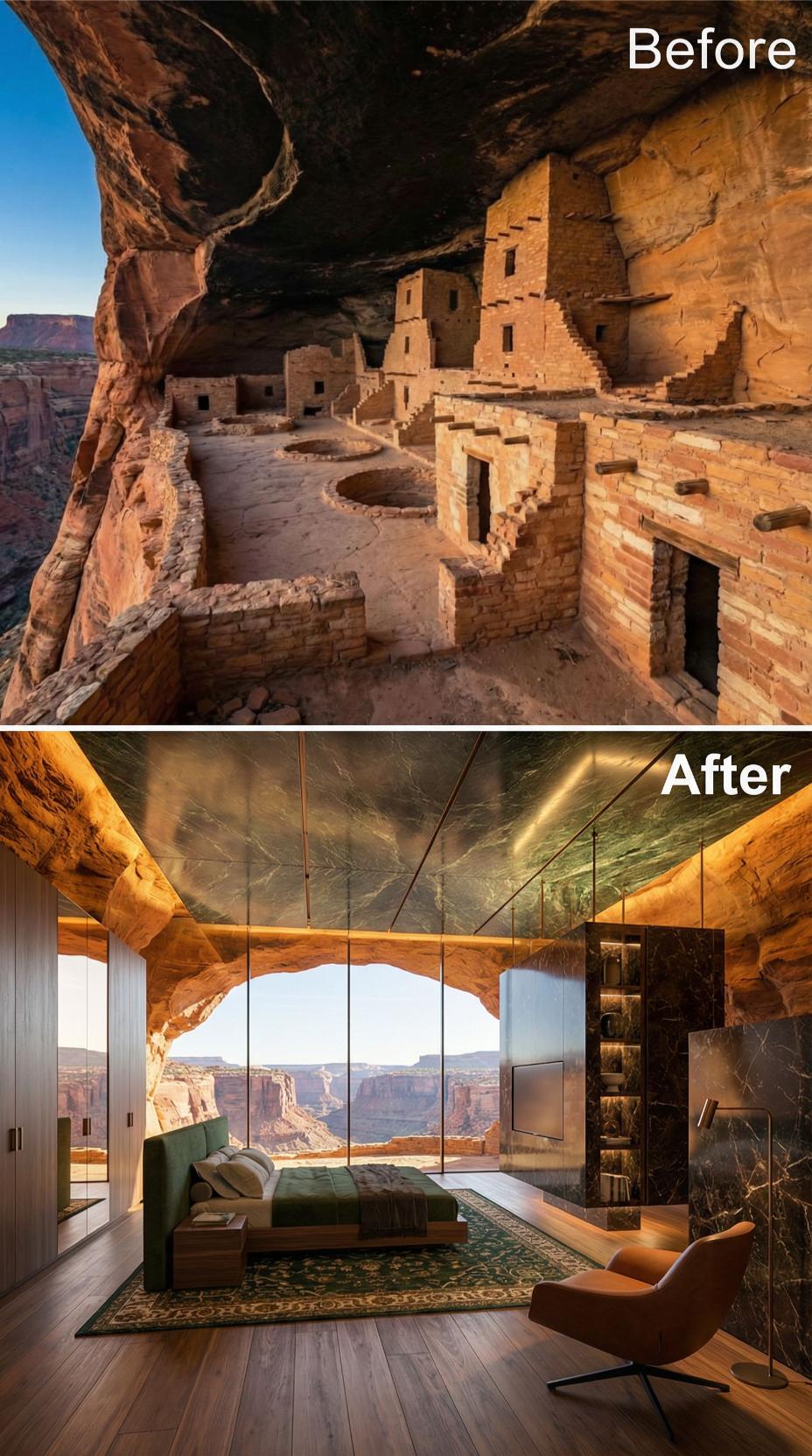
Dark green velvet upholsters a low platform bed anchored on wide-plank oak flooring, paired with a Persian rug in forest and ochre tones. Floor-to-ceiling glass panels follow the natural arch of the cave opening, framing unobstructed canyon views. A freestanding marble tower with integrated shelving and backlit niches anchors the right wall, finished in black and gold-veined stone. Amber cove lighting traces the rock ceiling overhead.
1. Barrel-Vaulted White Plaster Ceiling, Cream Linen Bed, and Floor-to-Canyon Glass
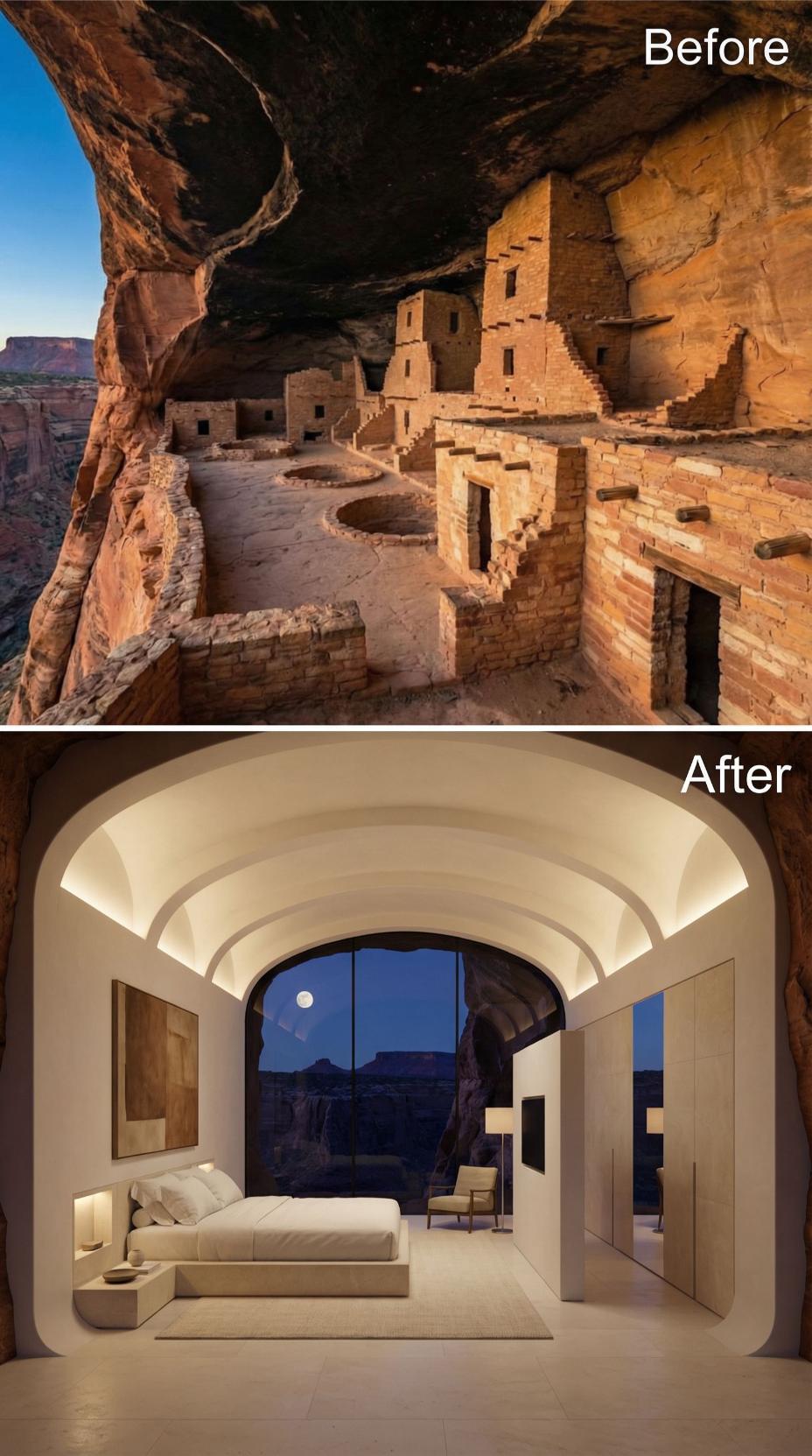
Softly lit cove strips trace each vault rib overhead while a low-profile cream linen platform bed anchors the room against raw canyon rock visible at the perimeter.