🔥 Would you like to save this?
Red marble in a kitchen isn’t a safe choice, and that’s exactly why it’s gaining ground. Designers who’ve spent years working around white Carrara and gray quartzite are increasingly reaching for something that actually demands attention, and red marble delivers that without apology.
In order to come up with the very specific design ideas, we create most designs with the assistance of state-of-the-art AI interior design software. Also, assume links that take you off the site are affiliate links such as links to Amazon. this means we may earn a commission if you buy something.
The veining alone, whether deep burgundy cutting through cream or rust bleeding into near-black, reads as genuinely architectural rather than decorative. Most kitchens playing with it look confident. A handful look chaotic. That gap is worth understanding before committing. What’s driving the shift is a broader fatigue with neutral-everything kitchen design. Homeowners who renovated five years ago with greige cabinets and white stone are now craving contrast that doesn’t come from a hardware swap. Red marble offers that on a structural level, built into the countertop or backsplash itself, not layered on top. The 33 designs ahead show exactly how wide the range runs.
33. White Cabinets, Copper Pans, and Red Marble That Refuses to Share the Spotlight
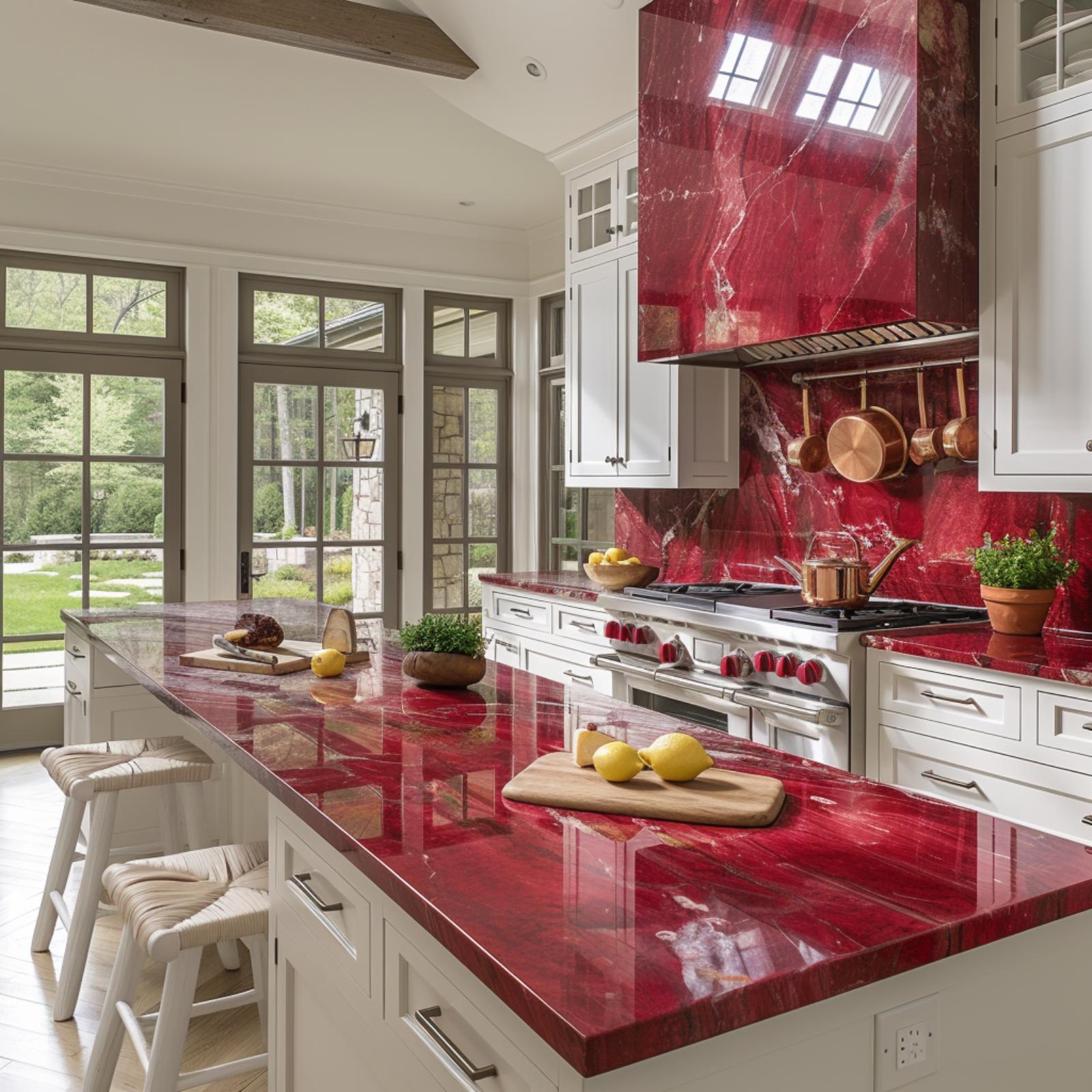
Copper cookware hung from a rail against the backsplash does something unexpected here: it reads as warm accent rather than utilitarian storage, largely because the red marble already carries so much visual temperature. The range hood cladding matches the countertop and backsplash from the same slab, which keeps what could be a chaotic wall from fragmenting into competing surfaces.
Outside, greenery presses against the French doors and floods the space with diffused natural light. That contrast, cool and leafy against deep red stone, is what stops the kitchen from feeling heavy. The rush-seat bar stools don’t fight for attention, and that restraint is exactly right.
32. Rouge Marble, Rattan Cabinets, and a Kitchen That Refuses to Whisper
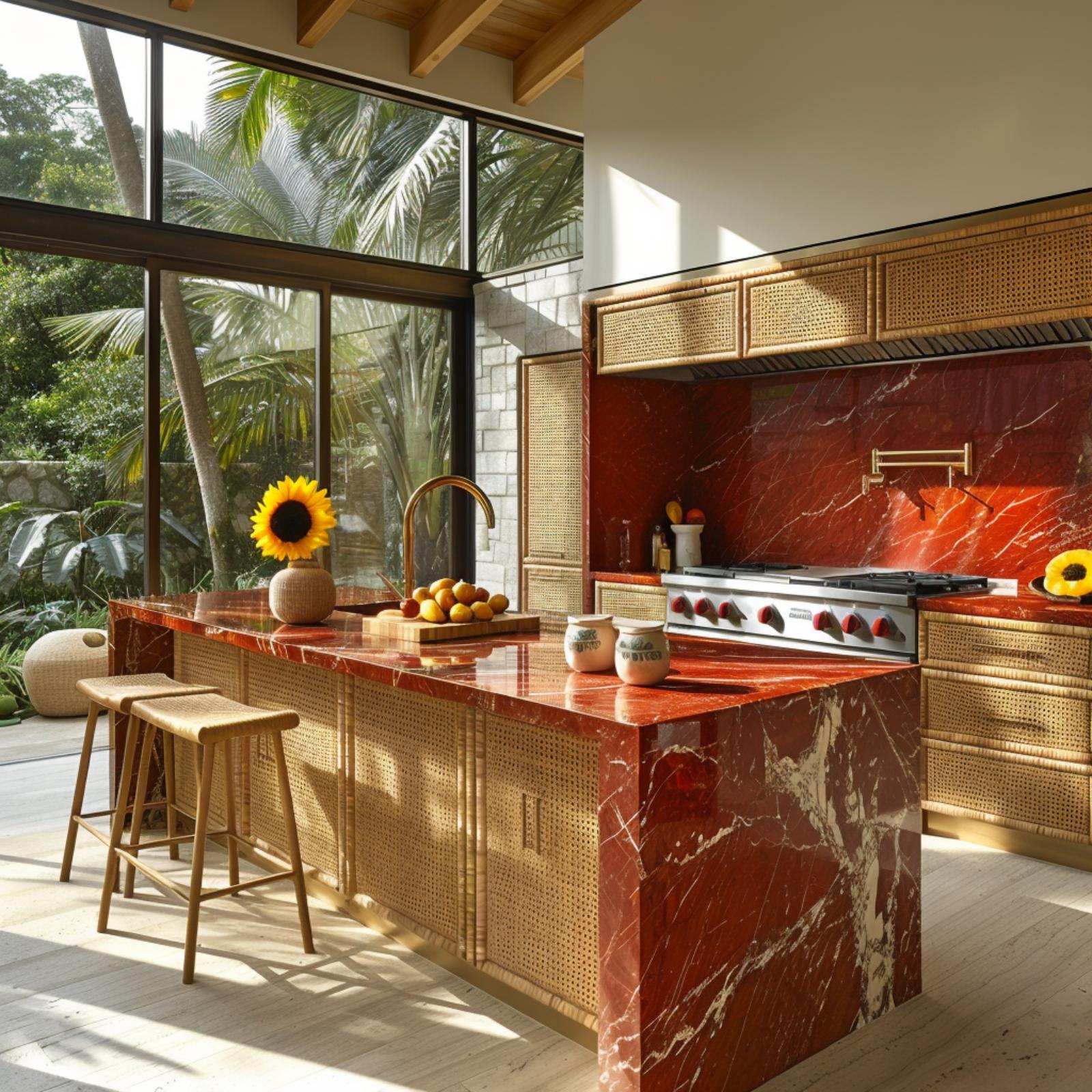
Red Rosso Levanto marble runs across both the island and the backsplash, creating a rare continuity that makes the veining feel architectural rather than decorative. Woven rattan cabinet fronts soften what could’ve been an overwhelming palette. The brass faucet and pot filler tie it together without competing.
31. Rosso Levanto Marble, Floor-to-Ceiling Books, and Zero Apologies
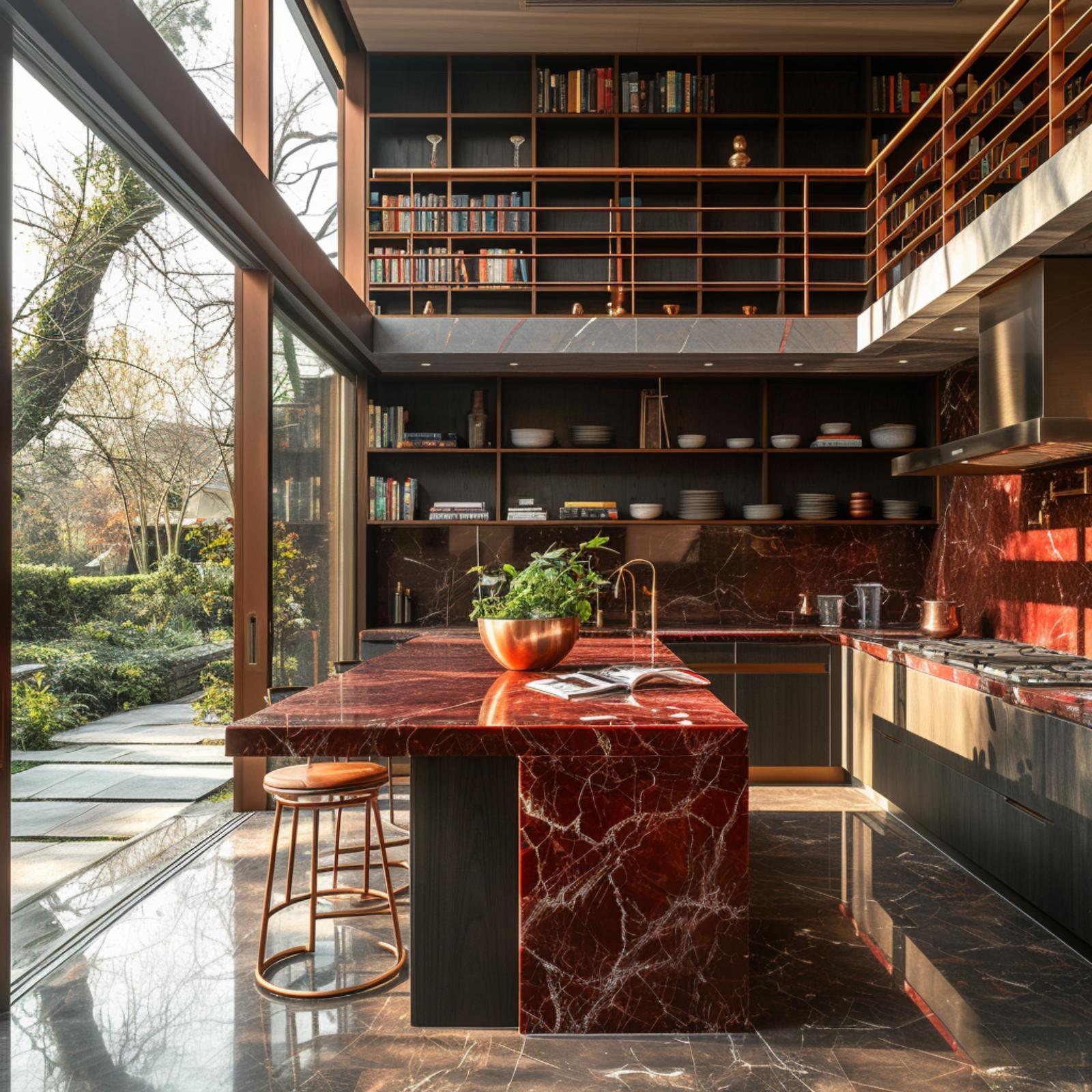
Crimson marble with white veining runs the full vertical face of the island and wraps the backsplash, creating a visual weight that most kitchens wouldn’t dare attempt. Copper-finished open shelving climbs two stories, mixing cookbooks with ceramic bowls in a way that blurs kitchen and library. It works because neither element competes. The floor-to-ceiling glass wall pulls in garden light that catches the marble’s polish, and the copper bar stool keeps the material story honest rather than accidental.
30. Rosso Francia Marble, Arched Windows, and a Kitchen That Earns Every Glance
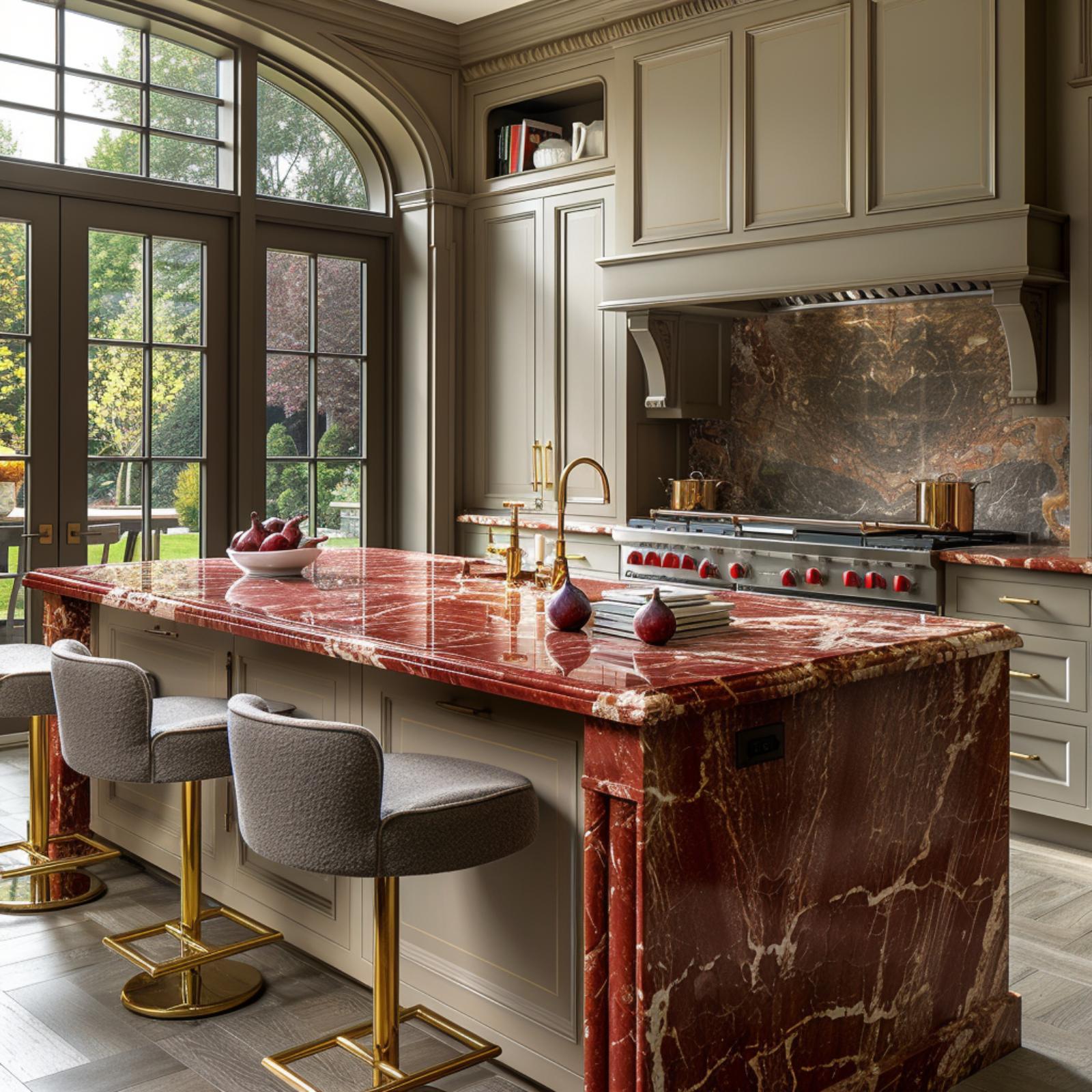
Saturated Rosso Francia marble wraps the entire island, top to waterfall sides, in deep burgundy and cream veining that reads almost geological. Paired with sage-green cabinetry and brass hardware, the combination shouldn’t work as well as it does. But it does.
The arched transom window does real compositional work here, framing the garden beyond and softening what might otherwise feel heavy. Boucle bar stools on gold-toned frames hold their own without competing. The slab backsplash behind the range continues the stone story without repeating it exactly, which is the smarter move.
By The Numbers: The island here is wrapped in the same marble slab on all four sides, a detail that significantly increases material cost but reads as furniture rather than construction. Full-height stone waterfall islands can require slabs cut from matched book-opened sections to keep the veining continuous. The brass fixtures and stool bases appear to share a single finish, a quiet coordination that keeps the palette from fracturing.
29. Dark Green Cabinets, Red Marble Everywhere, and a Kitchen That Knows Exactly What It’s Doing
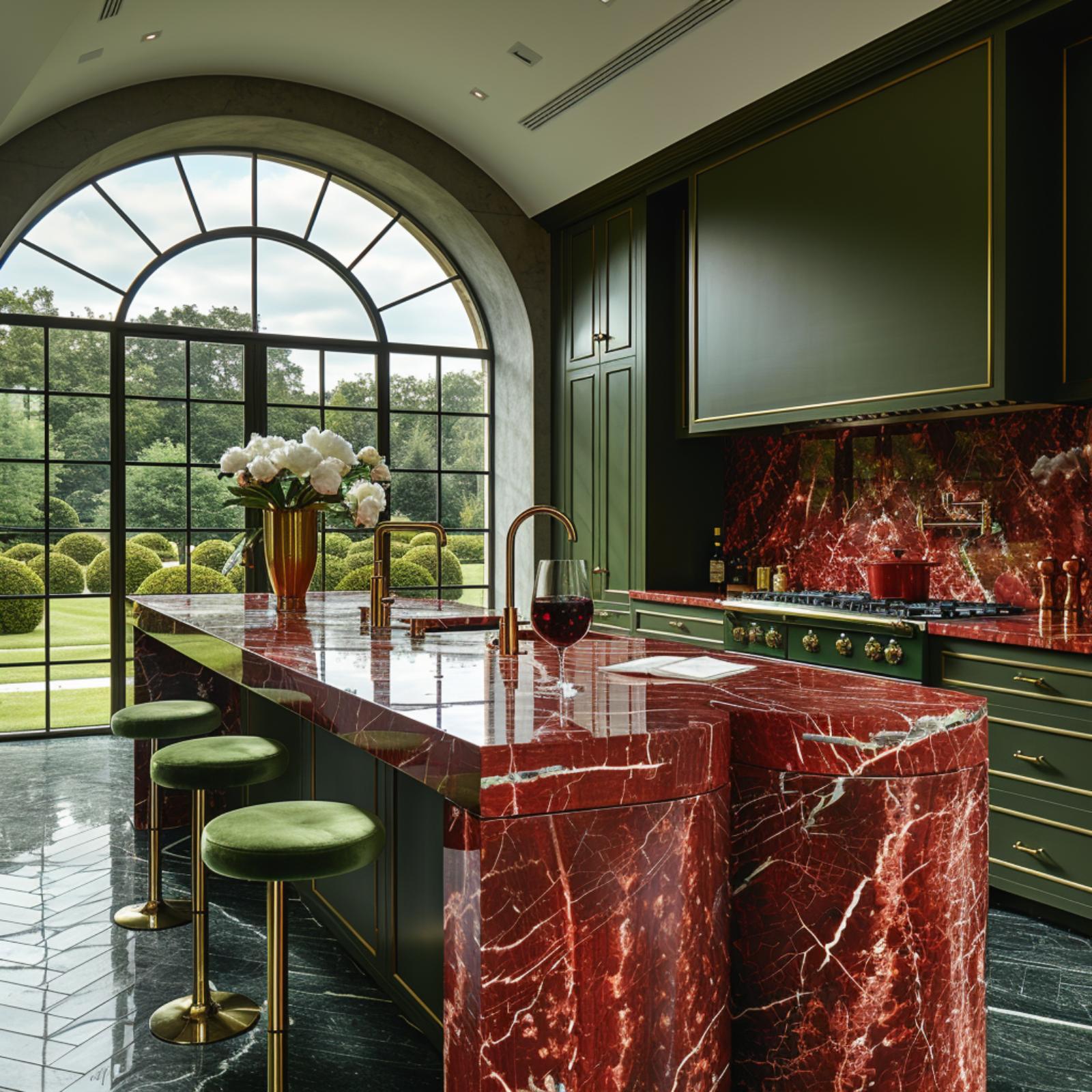
Rosso Levanto wraps the island’s waterfall edge in thick, uninterrupted slabs, and the veining reads almost wet under the recessed lighting. Brass hardware and gold-trimmed cabinet frames pull the green and red together without softening either one.
- Pairing warm brass fixtures with cool marble veining keeps the palette from feeling too warm
- Dark cabinetry in forest green avoids competing with red stone by staying matte and flat
- An arched window with formal garden views gives the eye somewhere to rest between all that pattern
28. Bordeaux Marble, Velvet Barstools, and a Kitchen That Commands the Room
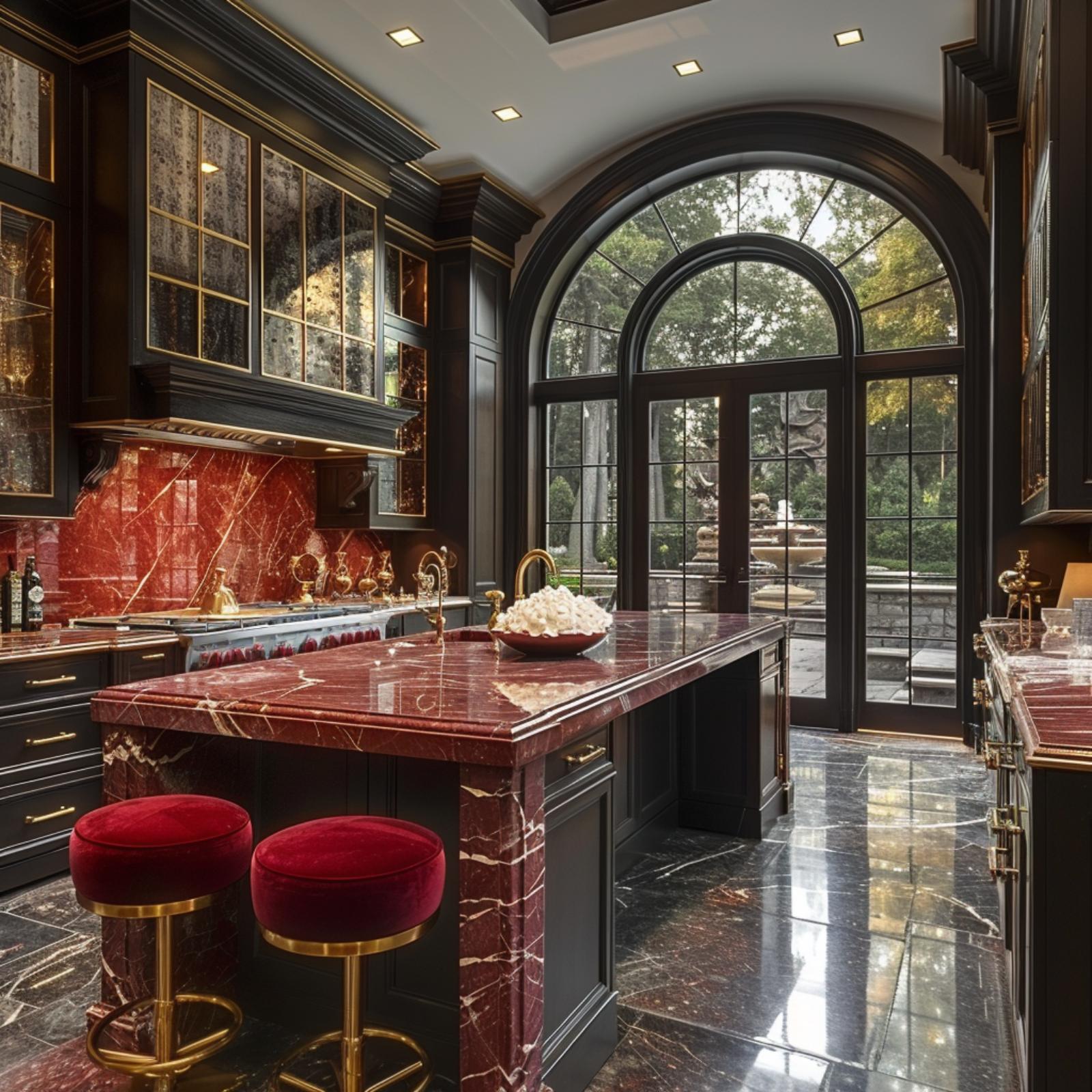
Gold hardware does a lot of work here, tying together dark cabinetry, a dramatic Rosso Levanto island, and two velvet barstools with brass bases that look more like cocktail lounge seating than kitchen furniture. The arched transom window pulls natural light directly onto the countertop, which means the marble’s deep burgundy veining shifts depending on the hour. Antiqued mirror cabinet inserts on the upper left add reflection without polish, keeping the overall mood dark rather than glam.
The arched transom window pulls natural light directly onto the countertop, which means the marble’s deep burgundy veining shifts depending on the hour.
27. Rosso Marble, Teal Velvet, and a Breakfast Nook That Steals the Kitchen’s Thunder
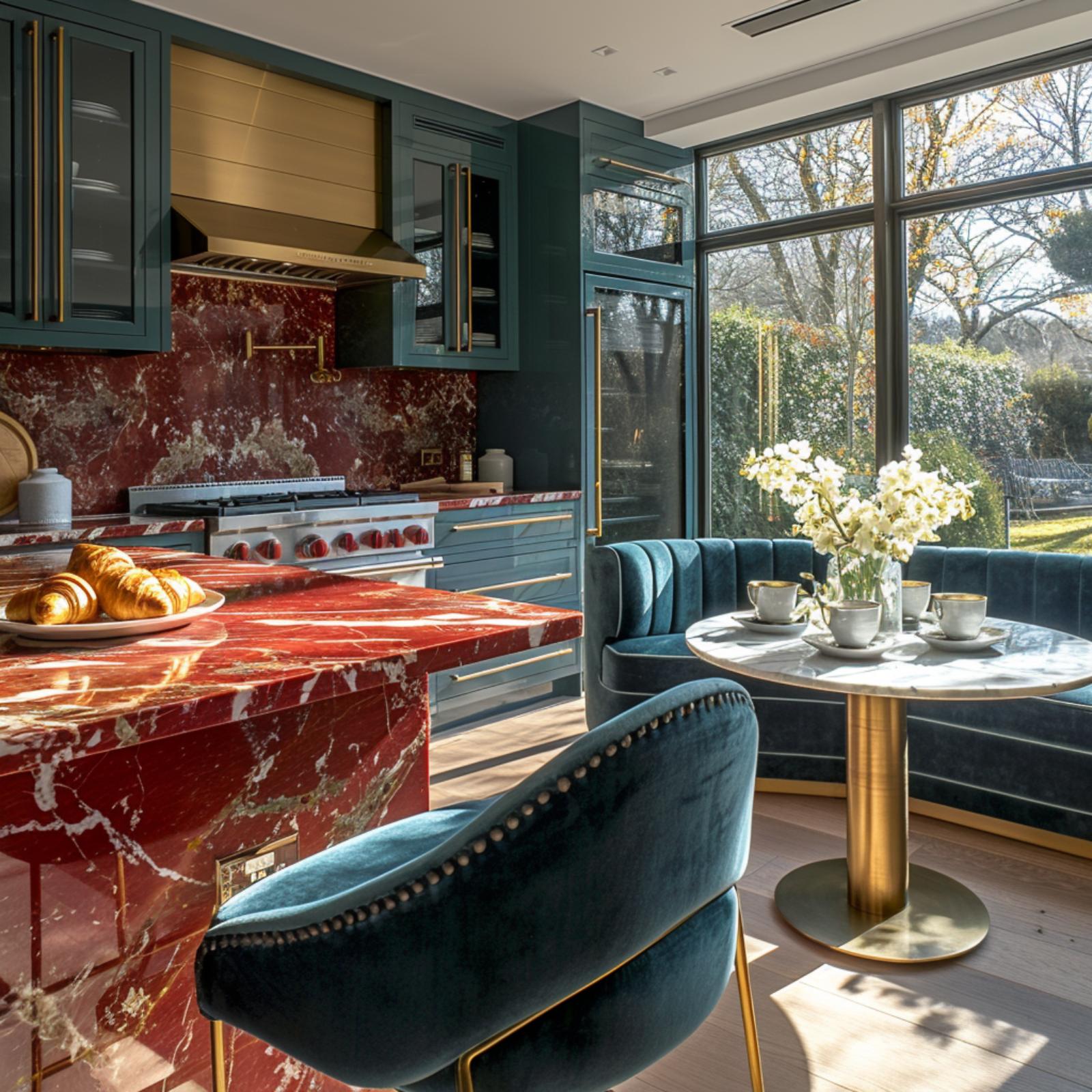
Dark teal cabinetry with brass pulls runs the full length of this kitchen, but the marble does the talking. The island countertop is Rosso Levanto, veined in cream and gold-ochre, and the backsplash behind the range continues the same slab — a move that locks the color story together rather than letting it scatter.
The breakfast nook earns its place. Channeled teal velvet wraps a curved banquette, pairing with a bistro-scale round table on a brass pedestal. White orchids sit at the center, and floor-to-ceiling steel-framed windows flood the corner with natural light. It’s a room with two distinct moods sharing one floor plan, and somehow neither one flinches.
Trend Alert: Pairing a bold stone with velvet seating in the same color family is one of the cleaner tricks in high-contrast kitchen design. The shared teal tone between the cabinetry and upholstery keeps a visually busy space from reading as chaotic. When the stone is already doing a lot, the furniture needs to calm down, not compete.
26. Galley Layout, Red Marble Counters, and a Skylight That Changes Everything
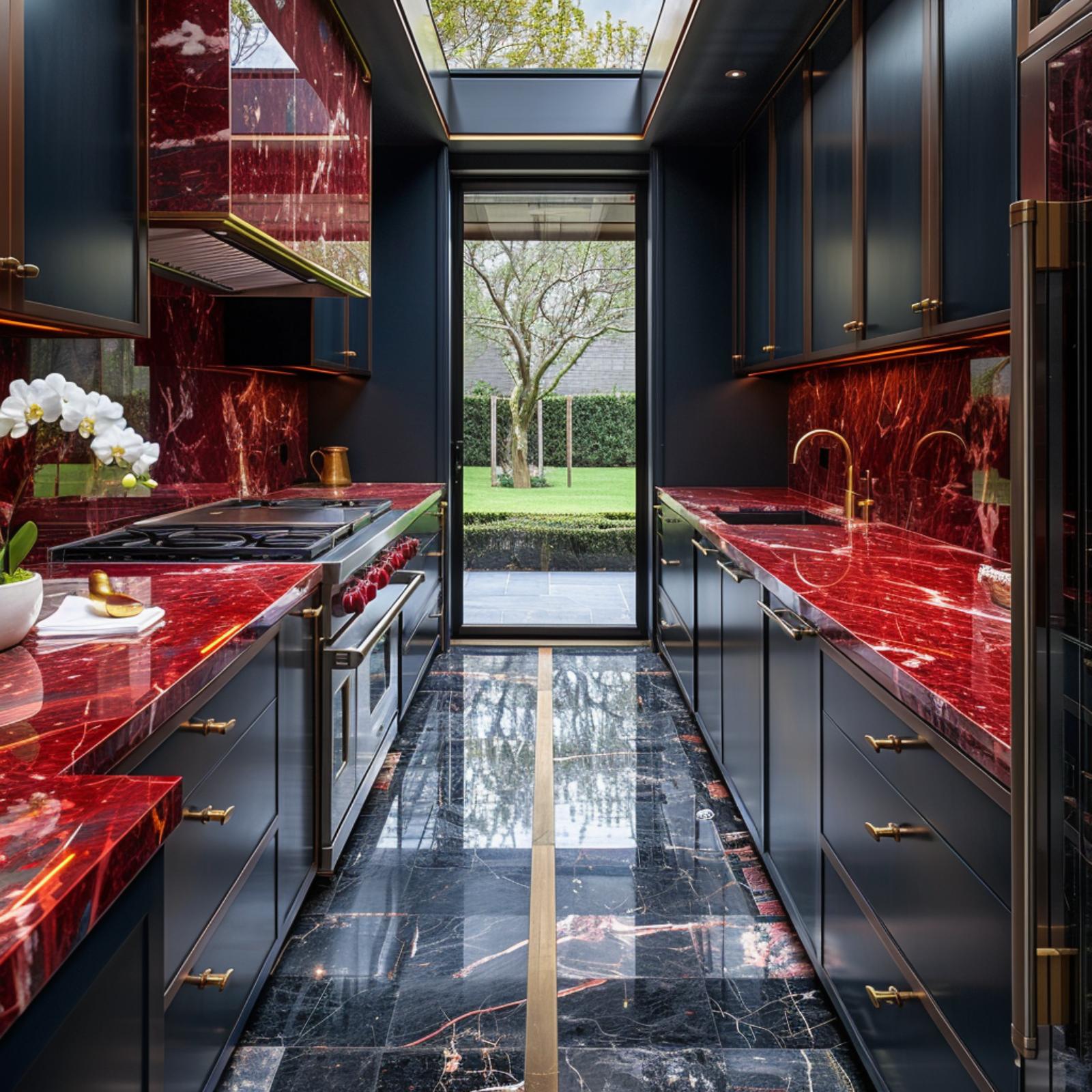
Marble this saturated needs space to breathe, and a galley layout doesn’t offer much of it. That’s what makes this kitchen surprisingly effective: the narrow corridor forces the eye straight toward the glass door at the end, where a garden view opens up and relieves the visual pressure completely.
Navy cabinetry with brass hardware runs both walls, and the red marble carries through on counters, backsplash, and upper cabinet faces simultaneously. That repetition is intentional. It keeps the pattern from reading as accent and pushes it into something closer to architecture.
Editor’s Note: Galley kitchens are often dismissed as purely functional, but the layout has a real compositional advantage: everything lines up on a single sightline, so a strong material choice like this marble gets framed rather than scattered. The skylight overhead adds natural light without interrupting the wall runs, which is genuinely hard to pull off in a corridor this narrow.
25. Rosso Imperiale Marble, a Conservatory Kitchen, and Sunlight That Does All the Work
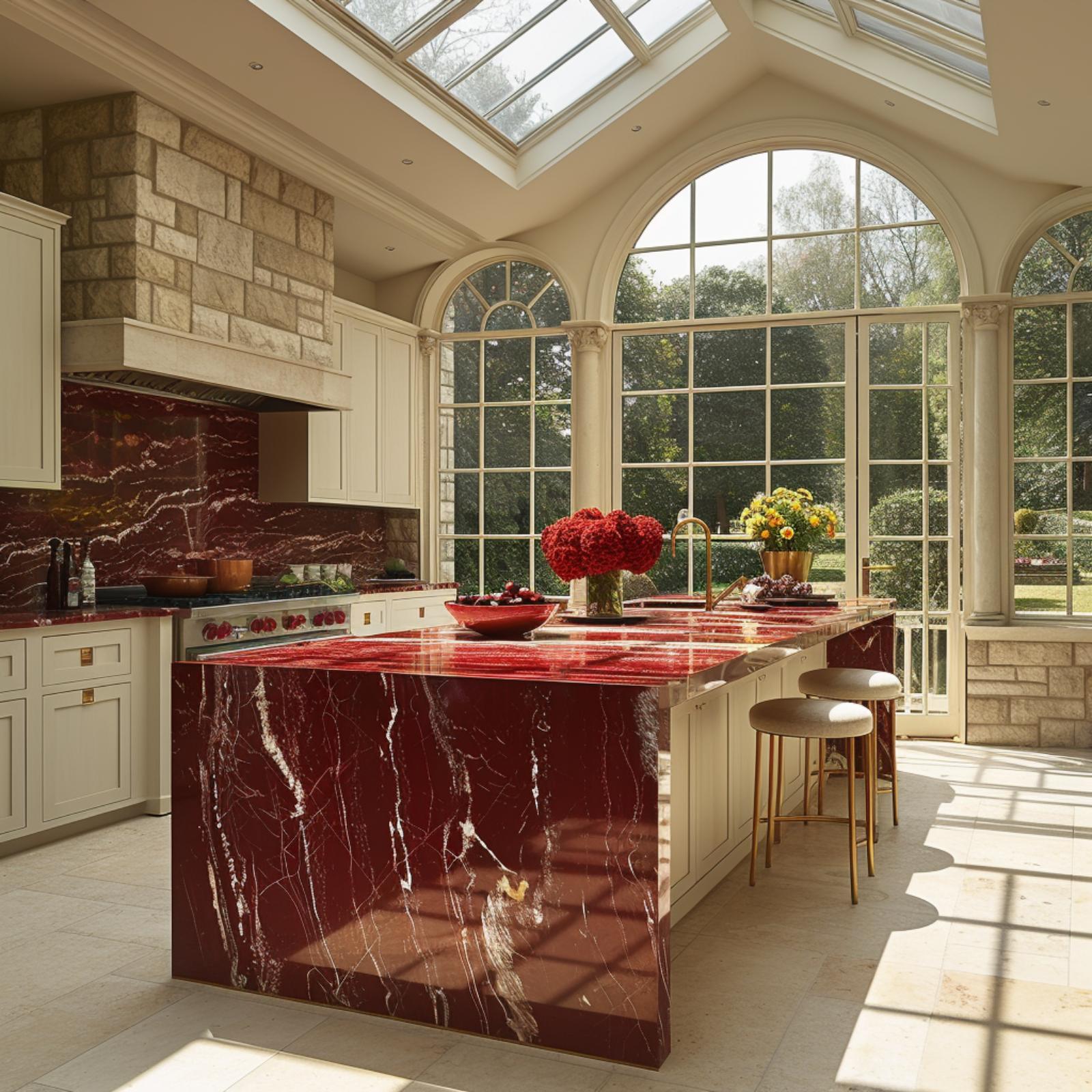
Wherever the eye lands in this space, it finds the same deep burgundy stone with white veining that runs like frost across glass. The island countertop carries it. The backsplash behind the range carries it. Even the waterfall edge on the island’s side panel continues the slab uninterrupted, floor to counter, so the stone reads as one continuous surface rather than applied material.
What makes this kitchen feel less like a showroom and more like a room is the architecture doing the heavy lifting. Those arched conservatory windows flood the limestone floor with grid-patterned light, and the stone hood surround keeps things grounded. Brass hardware on the barstools and cabinetry pulls everything into the same warm register without trying too hard.
Did You Know: Conservatory-style kitchen extensions became popular in English country houses during the late Victorian era, originally as greenhouse spaces that gradually absorbed cooking functions. Today, architects often treat the junction between kitchen and glazed extension as the most important design moment in the whole floor plan, since it’s where two very different spatial logics meet. Getting the transition right usually determines whether the kitchen feels like it belongs to the house or was added to it.
24. Warm Oak Cabinets, Red Marble Counters, and French Doors That Pull Their Weight
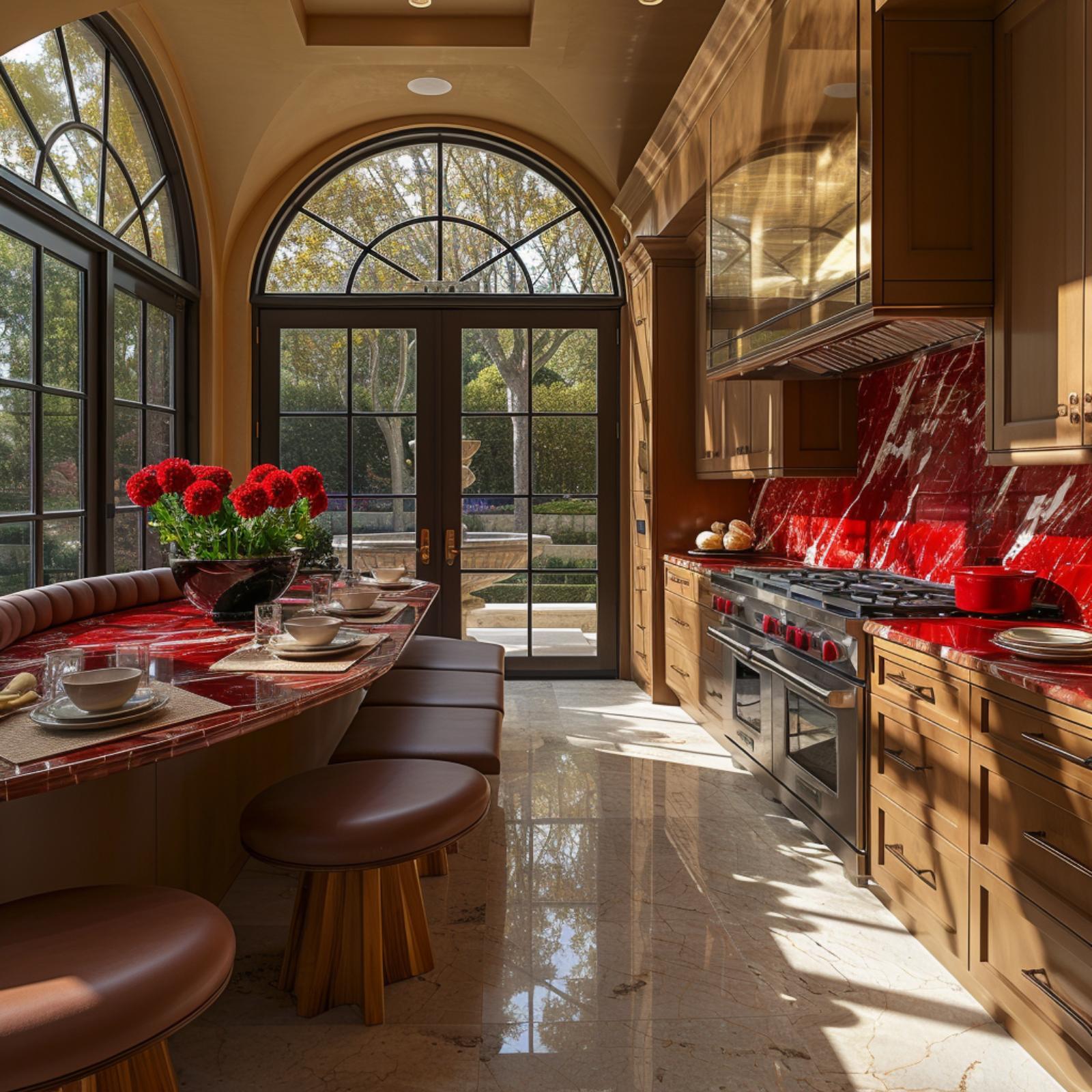
Veined red marble runs continuously from the countertop up the full backsplash behind the range, which keeps the cooking wall from feeling like a collection of separate decisions. The range hood sits flush with the upper cabinets, and that restraint matters. It’s a busy wall. It can afford one less thing competing for attention.
The banquette nook does something clever: the same red marble wraps the table surface, so the dining area doesn’t feel borrowed from a different room. Arched French doors with a Palladian transom above them anchor the far end, and the marble floor reflects enough light to make the whole corridor feel wider than it probably is.
Try This: If you’re considering running marble up a full backsplash, have the fabricator book-match the slab to the countertop so the veining flows as one continuous surface rather than two separate cuts. It requires ordering from the same block, so plan this before the stone is purchased, not after.
23. Navy Cabinets, Red Marble Island, and Floor-to-Ceiling Glass That Earns Its Place
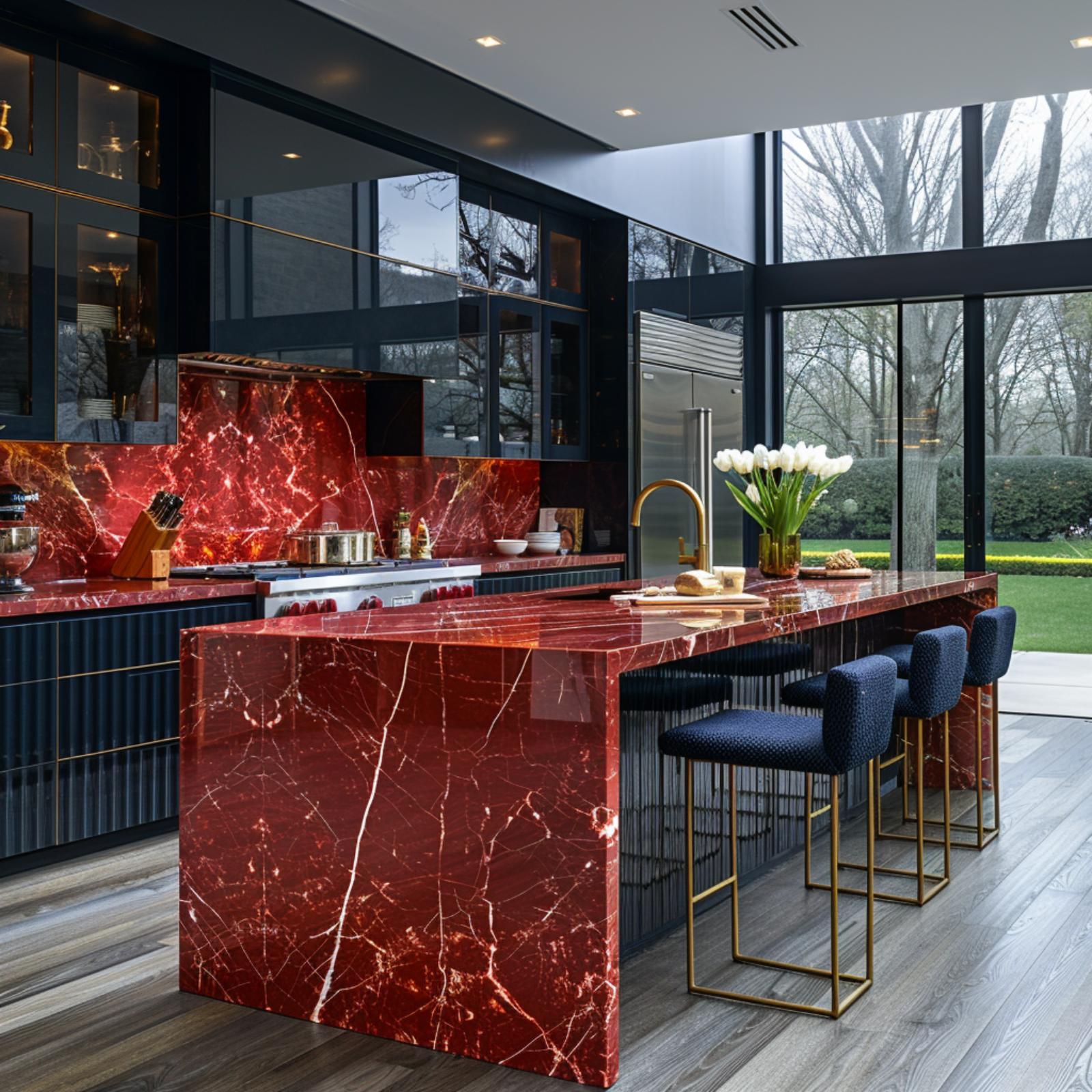
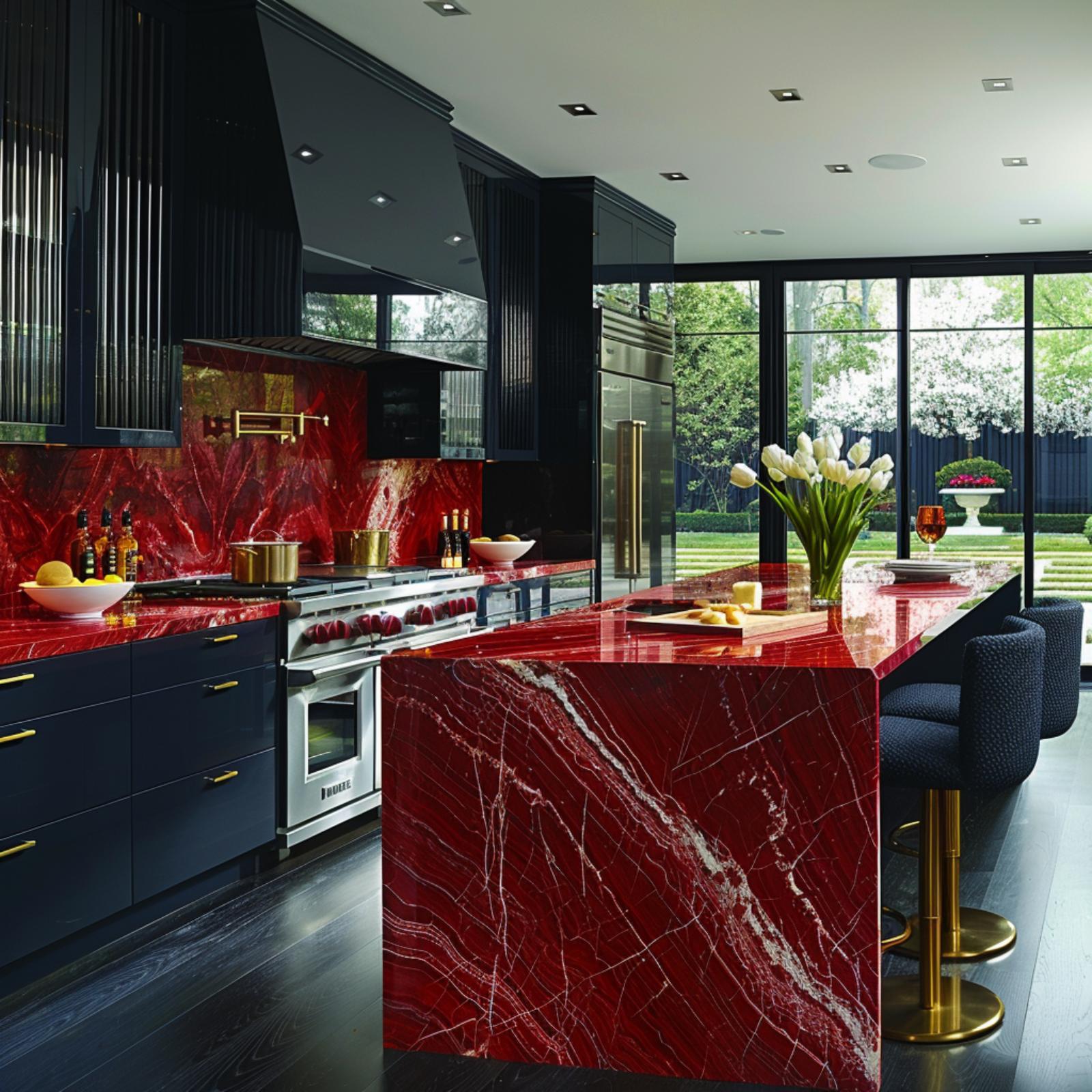
Rosso Francia marble runs the full island and backsplash here, but the detail worth noticing is how the slab wraps the island’s waterfall edge without interruption. The veining reads almost like brushwork against the navy fluted cabinet fronts, and the brass faucet and barstool frames keep the metal consistent throughout.
The floor-to-ceiling steel-framed windows do real work. They prevent the dark cabinetry and bold stone from closing the space down, and the bare winter trees outside add an unexpectedly graphic backdrop. White tulips on the island are a small, smart counterpoint.
Ask Yourself: Before committing to a bold stone like this, pull samples into the actual room at different times of day. Natural light shifts dramatically, and a slab that reads warm and dramatic at noon can turn heavy by late afternoon. How a stone behaves in your specific light matters more than how it photographs.
22. Crimson Velvet, Red Marble Dining Table, and Cabinets That Don’t Compete
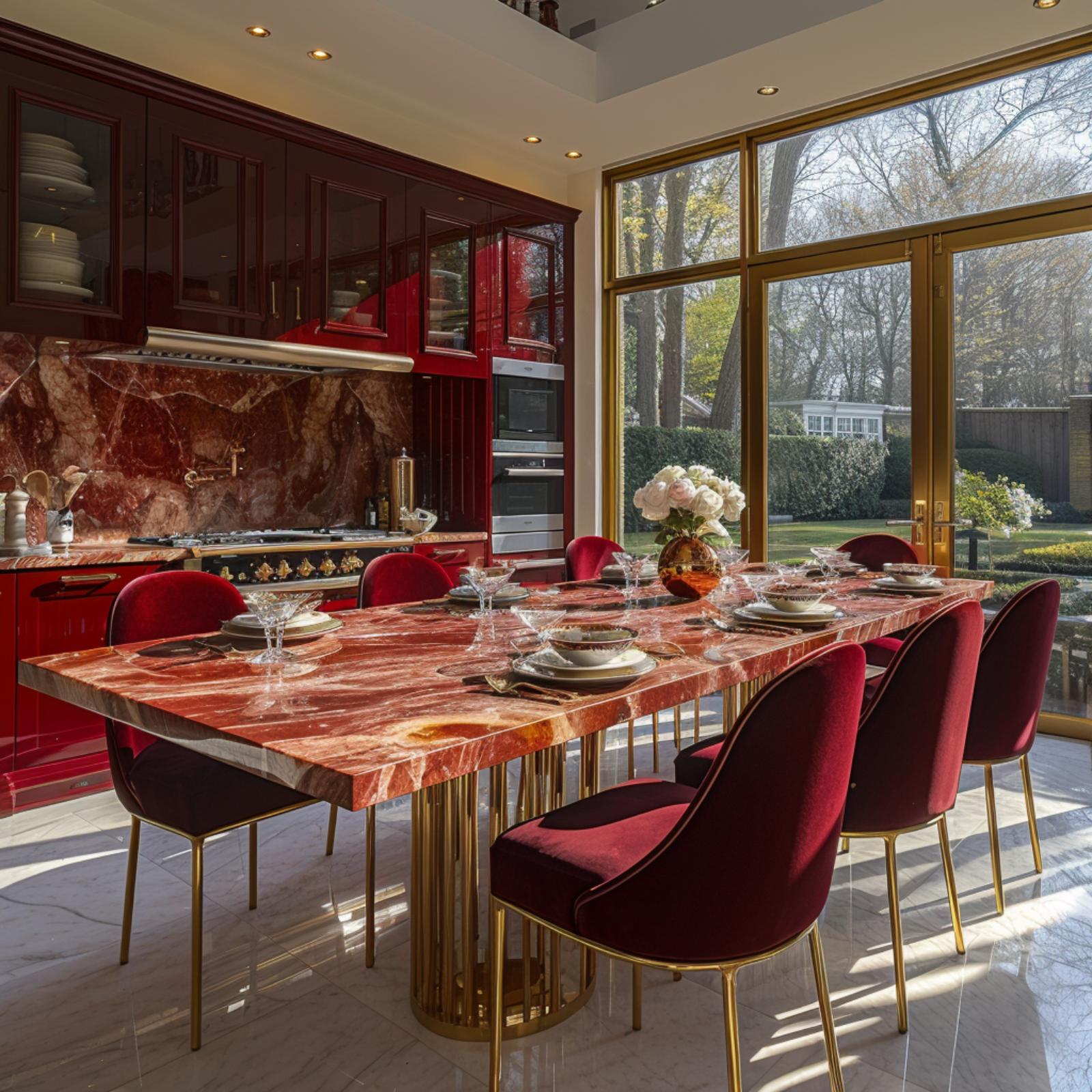
Lacquered burgundy cabinetry keeps the kitchen zone visually contained while the marble dining table, set on a cylindrical brass pedestal, pulls the eye toward the garden-facing glass. The velvet chairs match the cabinets closely enough that the seating reads as intentional rather than accessorized. Sunlight through those gold-framed doors does the rest.
Why the Brass Pedestal Base Changes Everything Here
Most marble dining tables rest on four legs, which keeps the base visually lightweight but disconnected from the stone above. The ribbed brass cylinder here treats the base as architecture rather than support, and the warm metal pulls the gold from the window frames across the room. It’s a detail that makes the table feel commissioned rather than purchased.
21. Rouge Marble, a Stone Range Hood, and Cabinets That Actually Deserve the Attention
🔥 Would you like to save this?
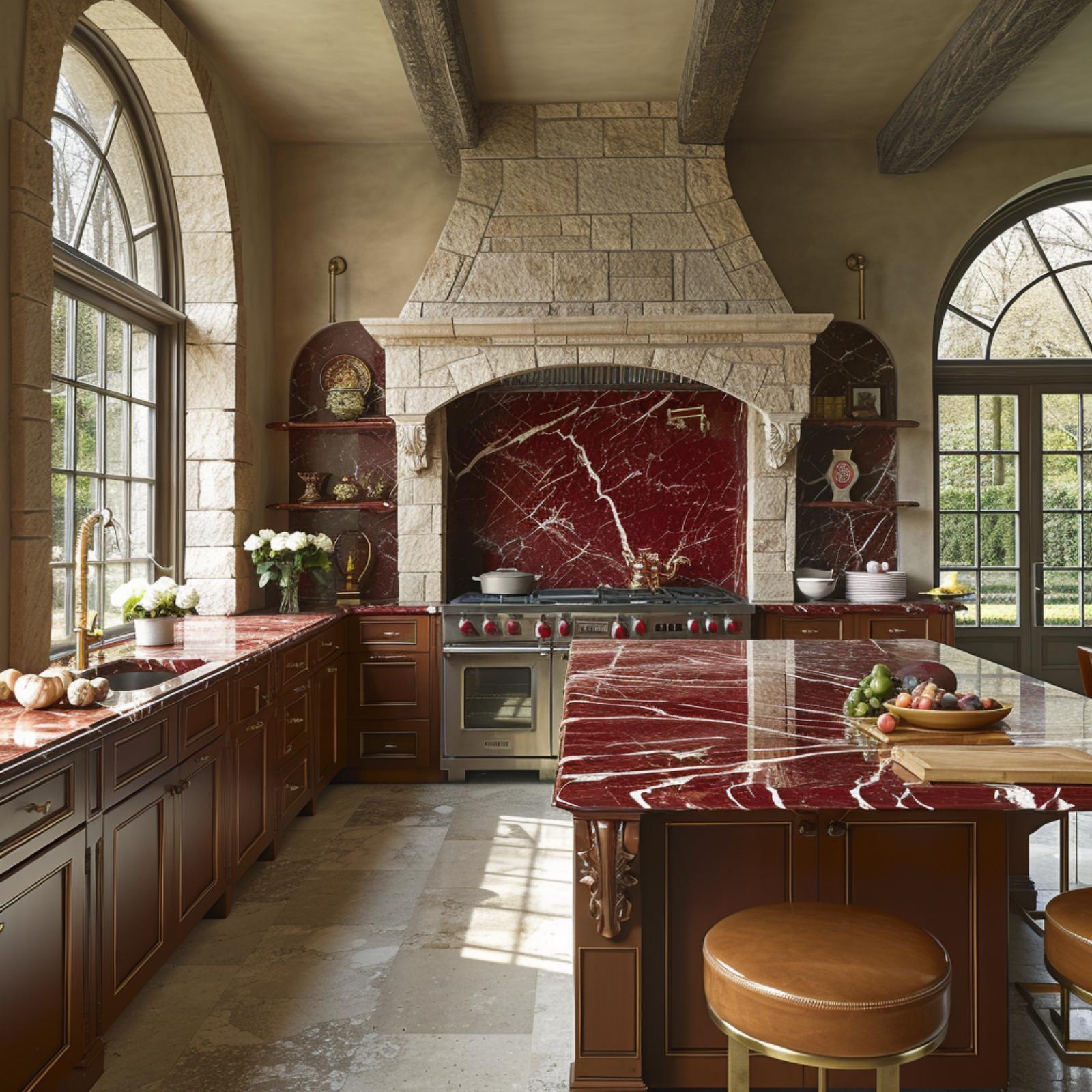
Few kitchens commit this hard to a single stone. The Rosso Levanto-style marble here runs the island top, the perimeter counters, and the full backsplash behind the range, and the veining carries across all three surfaces with enough consistency that it reads as one material, not three separate decisions. Against mahogany-toned cabinetry with brass hardware, it doesn’t feel like too much. It feels resolved.
The range hood is the detail that holds everything together. Stone-coursed and corbeled, it’s built like a hearth surround, which gives the range wall the weight it needs to anchor a room with arched windows on two sides and limestone floors underfoot.
Why It Works: When stone appears on the backsplash, counters, and island in the same space, fabricators typically need to source slabs from the same block to keep veining coherent. That’s not always possible with rarer red marbles, so confirming slab availability before finalizing a design like this is a practical first step, not an afterthought.
20. Sage Cabinets, Red Marble Island, and a Garden View That Ties It Together
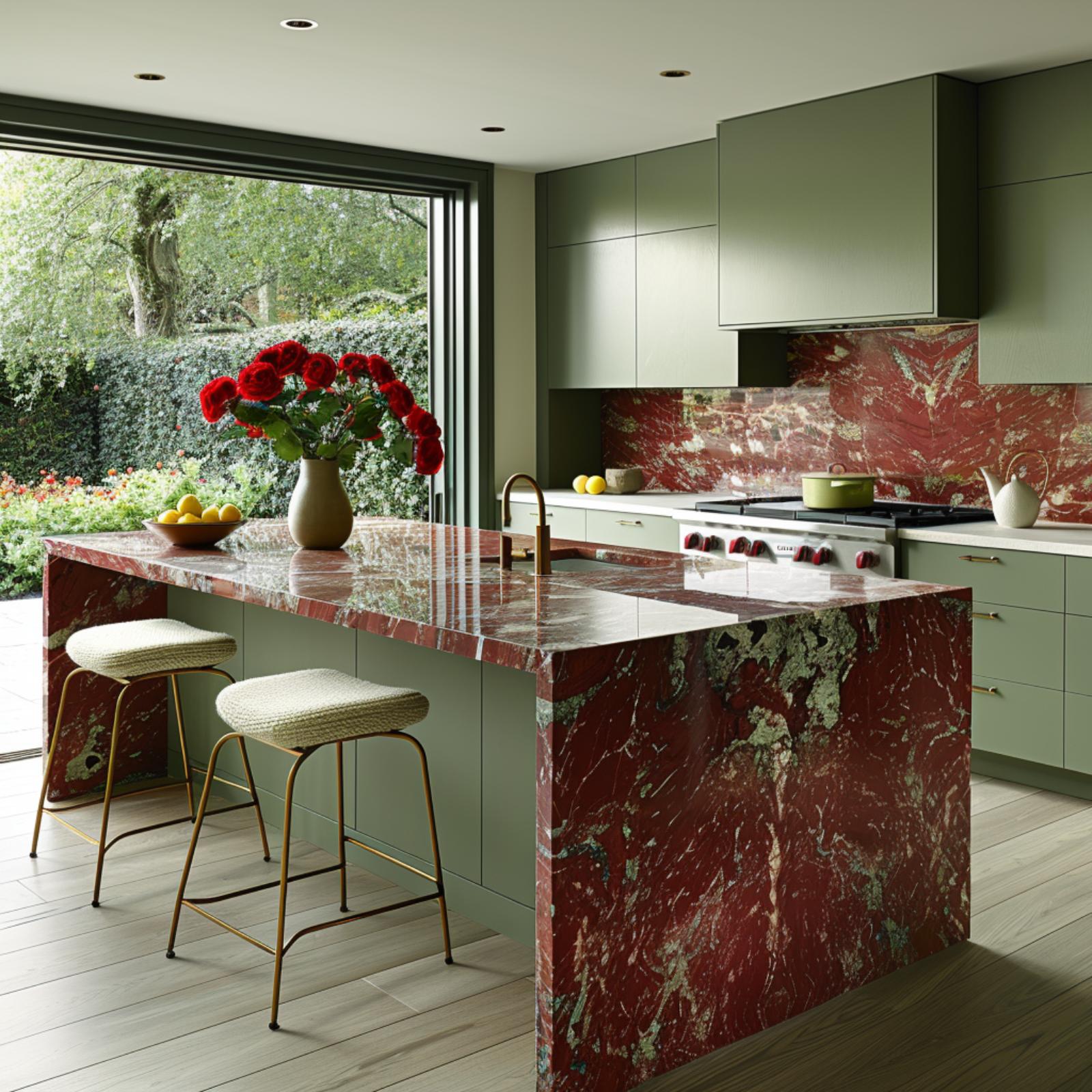
Red marble wraps the island on every visible face, and the backsplash picks up the same stone behind the range. What keeps it from tipping into excess is the sage green cabinetry, which is flat-fronted and hardware-minimal enough to read as a neutral.
The brass faucet and barstool legs are doing quiet coordination work. Textured boucle seats pull the warmth down from the countertop. And the sliding glass wall behind the island doesn’t just bring in light, it frames the garden like a backdrop that was always part of the plan.
The Psychology Behind This: Red is one of the few colors that triggers both appetite and alertness, which may explain why kitchens in bold stones tend to feel more energized than rooms using the same palette in paint. Pairing it against green, its direct complement on the color wheel, doesn’t calm the red down so much as give it a place to land. The result reads as intentional rather than aggressive.
Not every bold kitchen relies on contrast — sometimes the drama comes from doubling down instead.
19. Olive Cabinetry, Red Marble Counters, and Garden Doors That Pull the Room Open
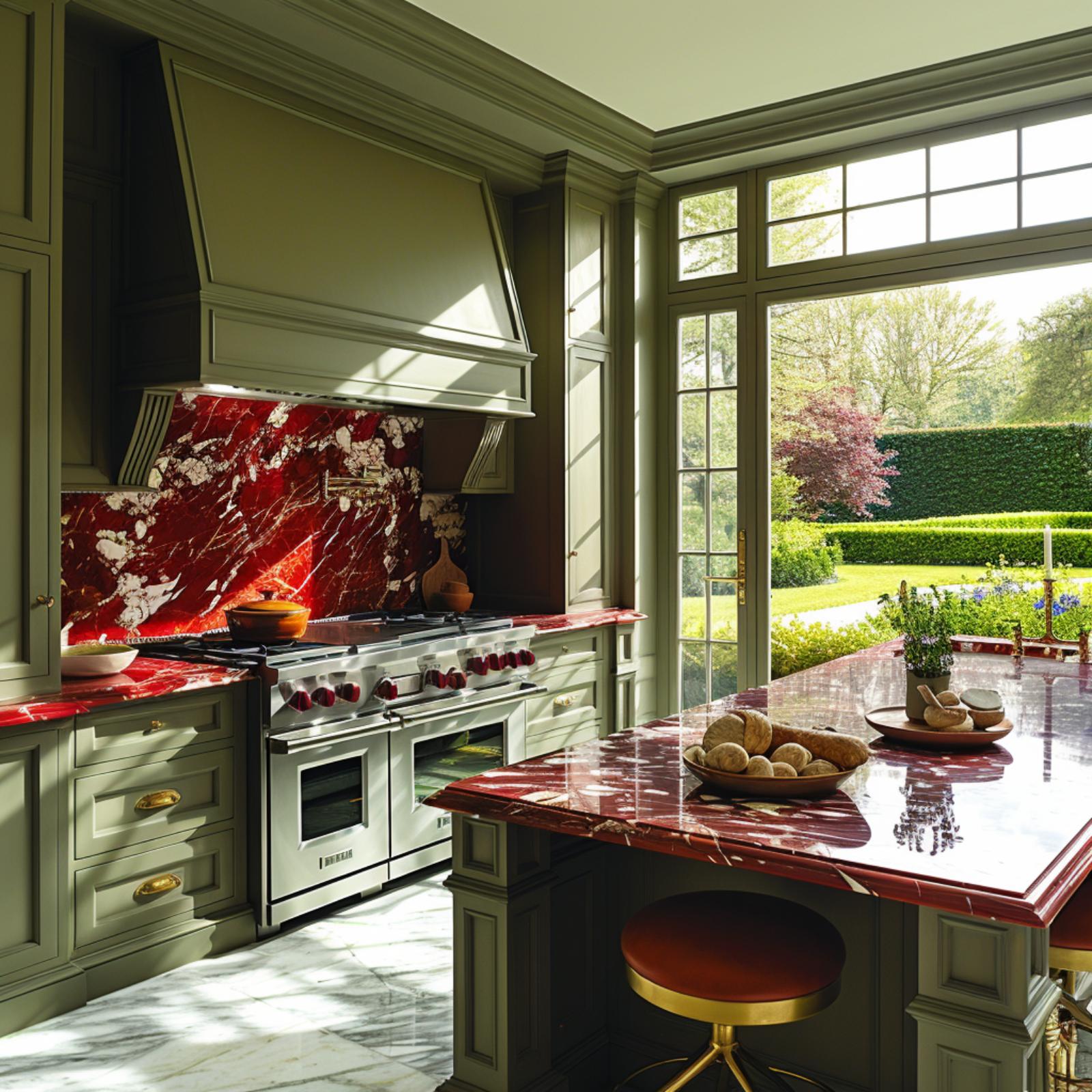
Sage-green cabinetry with brass pulls runs the full perimeter here, and the counters are a deep crimson marble with white veining that bleeds right up the backsplash behind the range. The pro-style stainless cooktop holds its own without competing. What actually makes this room readable is the restraint: no upper cabinet clutter, no patterned tile interrupting the stone.
The French doors do real work. They flood the space with natural light and frame a formal garden beyond, which softens a palette that could easily read as heavy. The island barstool has a cognac leather seat on a brass base, one of the few warm accents that doesn’t feel like an afterthought. Honest opinion: the marble backsplash cut this close to the hood is a risk that pays off here, but it needs a confident fabricator and a well-matched slab to avoid looking patchy.
18. Rosso Marble, Glazed Cream Cabinets, and a Lavender Garden That Earns Its Seat at the Table
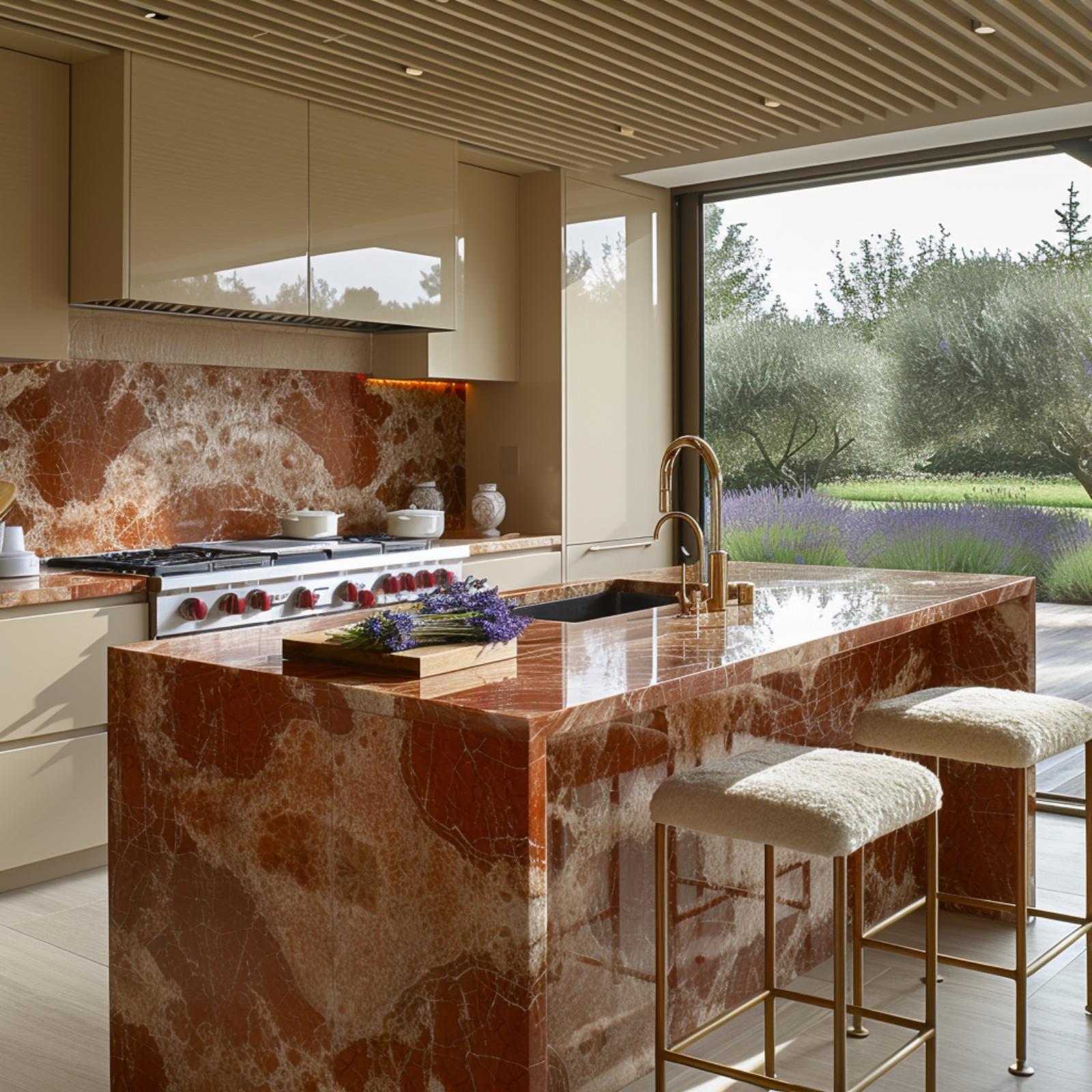
The view outside is doing real design work here, not just filling a window.
Blooming lavender rows and olive trees sit just beyond a floor-to-ceiling sliding door, and the purple tones land directly against the warm terra-cotta veining of the marble island. That’s not a coincidence you can plan exactly, but it’s worth designing toward. The brass faucet is noticeably off-center from the sink, which actually reads well from this angle.
Glazed cream cabinets keep the back wall quiet so the stone backsplash carries the drama uninterrupted. The slatted wood ceiling adds horizontal rhythm without competing. Boucle stools on brass frames pull double duty, echoing the metal finishes while softening a room that could otherwise tip cold.
17. Olive Cabinets, Red Marble Island, and Brass Details That Refuse to Blend In
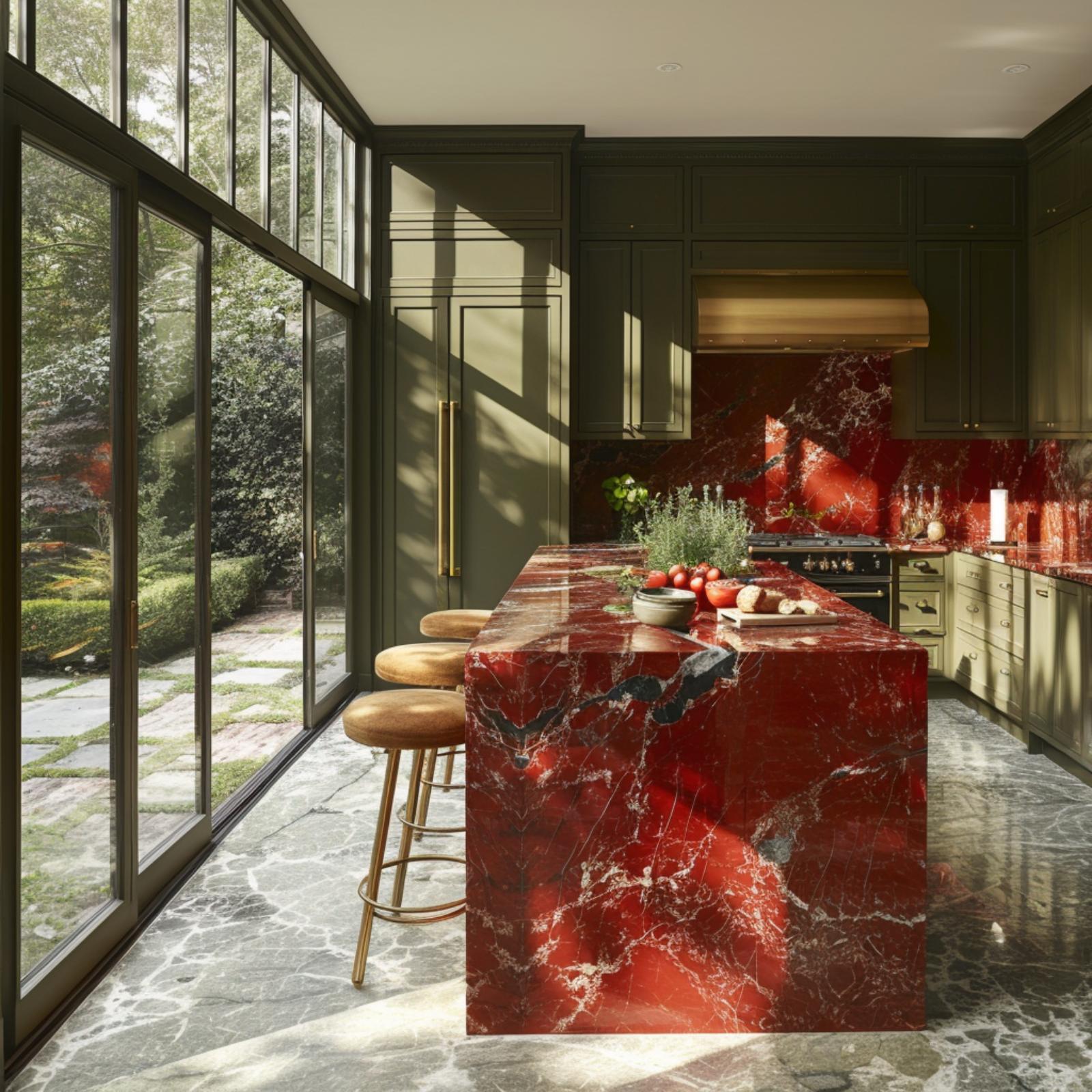
Saturated red marble runs across the island waterfall edge, the backsplash, and the perimeter counters, yet the room doesn’t feel overwhelmed. That’s largely the olive cabinetry doing its job: the muted green reads as a foil rather than a competitor, keeping the stone in focus without surrendering entirely to it.
Brass hardware and a brass range hood anchor the warm side of the palette. Two round leather barstools pull up to the island without any visual fuss. And beyond the floor-to-ceiling steel-framed glass, a proper garden does what no indoor element could: it resets the eye before it brings it back inside.
Worth Knowing: When marble wraps a full waterfall island and continues as the backsplash, installers need to account for significant weight load on the cabinetry below. Standard cabinet boxes often require reinforcement before a stone this thick can be safely supported on all sides. It’s a structural conversation worth having with your contractor before the slabs are ever cut.
16. Cream Cabinets, Red Marble Everywhere, and a Pool View That Refuses to Quit
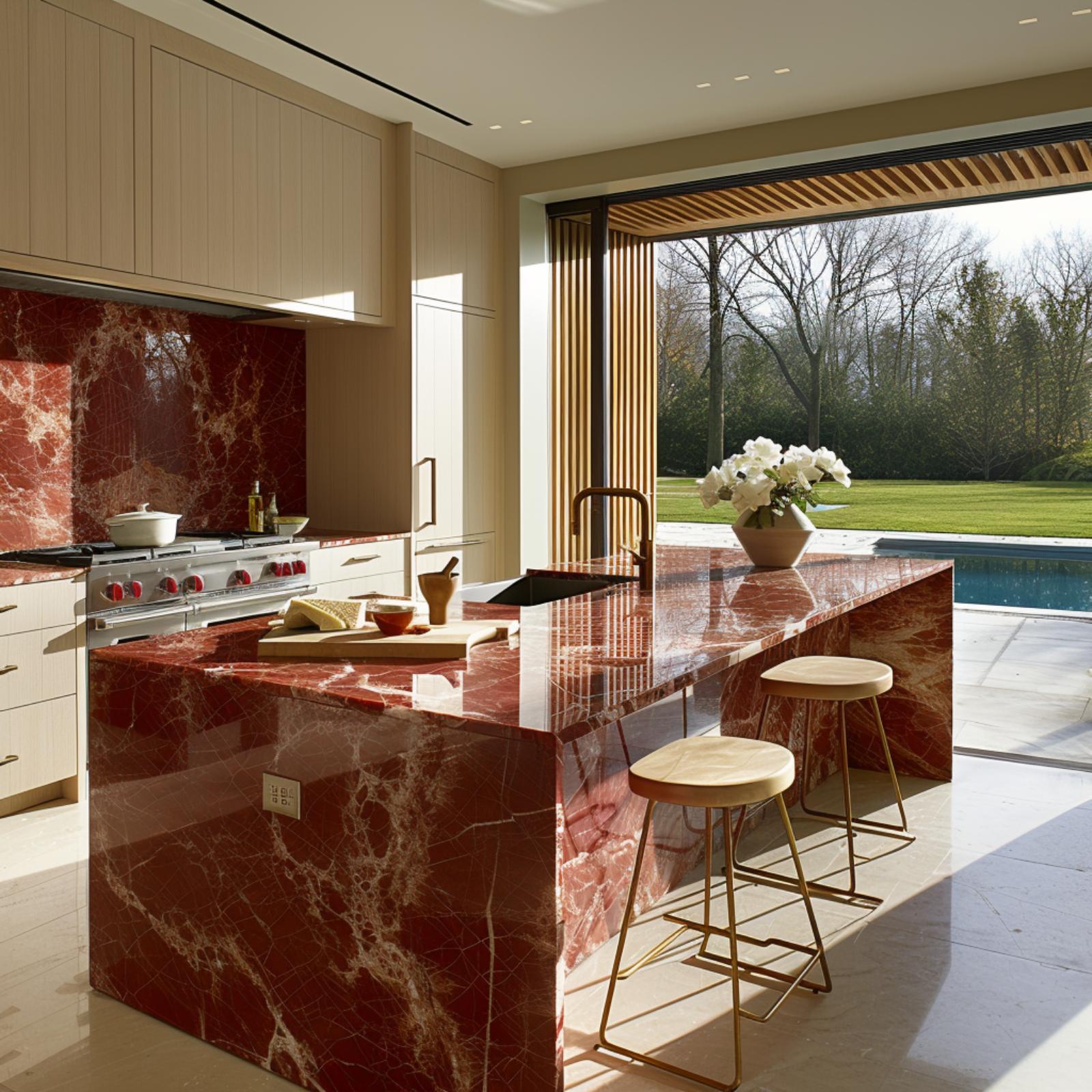
Slabs of deep crimson marble run the full length of the backsplash and wrap the island top and sides in one continuous material story, which is a bold ask of any space but lands here because the cream cabinetry stays completely out of the way. Gold-legged counter stools with pale wood seats keep the seating light enough that the stone does the heavy lifting. And that open sliding wall doesn’t hurt.
Quick Fix: Polished marble shows every fingerprint, especially on dark stones like this one. A honed or leathered finish on the island sides, which get the most hand contact, can reduce visible smudging without sacrificing the drama of the veining on the countertop surface.
15. Cream Cabinets, Red Marble, and a Skylight That Makes the Stone Do Something Different
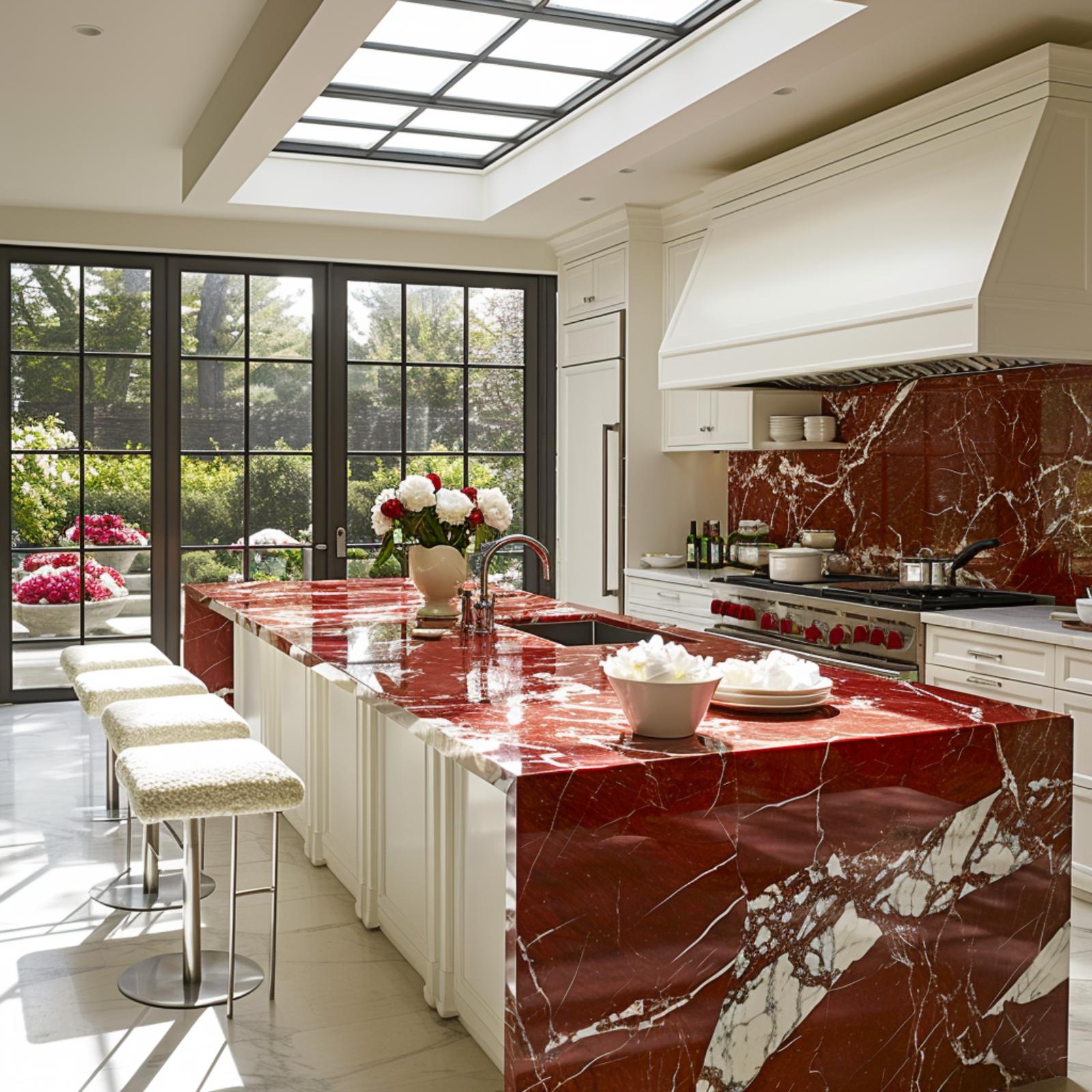
Natural light hits differently when it comes from above. The gridded skylight here floods the island from a direct overhead angle, which means the Rosso Francia marble reads brighter and more complex mid-day than it would under recessed cans alone. White veining that might look subtle in a showroom catches that vertical light and almost glows.
The island’s waterfall edge is thick enough to read as a single architectural statement rather than a countertop on legs. Paired with upholstered barstools in a cream boucle fabric, the composition stays balanced without softening the stone’s intensity. The backsplash runs the same marble behind the range, and the white plaster hood above it keeps the wall from becoming overwhelming. French doors at the far end let the garden work as a natural counterpoint to all that interior drama.
The gridded skylight floods the island from a direct overhead angle, which means the marble reads brighter and more complex mid-day than it would under recessed cans alone.
14. Dark Cabinets, Red Marble Island, and a Garden View That Refuses to Stay Outside
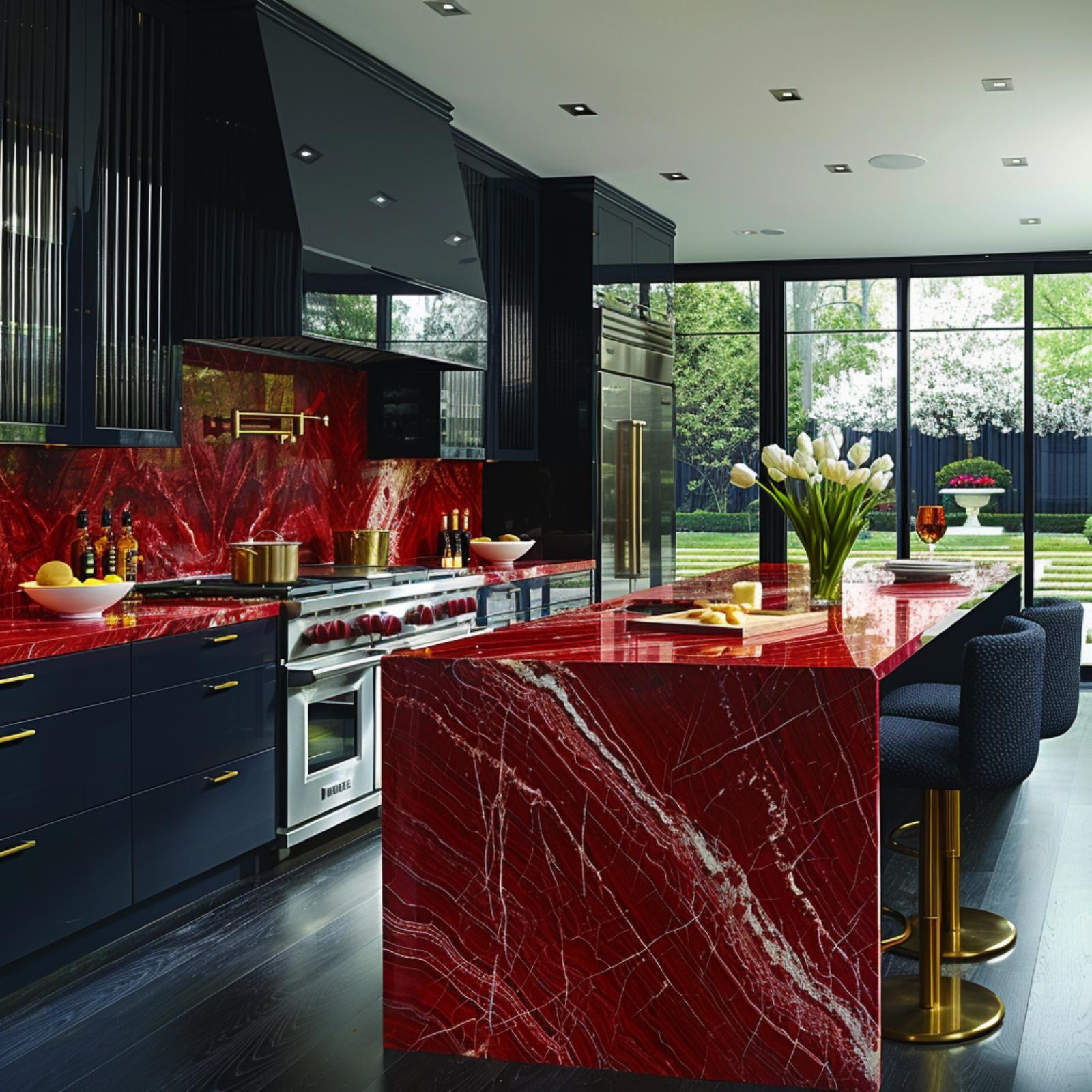
Gold hardware against navy cabinetry is a combination that’s been done, but what keeps it from feeling predictable here is the red marble running continuous from island to backsplash. The veining on the island’s waterfall edge is bold enough to read as a structural element rather than surface decoration.
The large-format glass wall at the rear does real work. It floods the stone with natural light, which shifts the marble’s tone from deep crimson in the morning to something closer to ruby by afternoon. White tulips on the island provide the only soft note in an otherwise hard-material room.
Material Matters: Marble slabs with dramatic movement like this one are typically cut from quarries in Brazil or Turkey, where iron oxide deposits create the deep red pigmentation. Because no two slabs carry identical veining, fabricators working on an island-plus-backsplash installation should source all pieces from the same block before cutting begins. Substituting a slab mid-project is one of the most common and costly mistakes in bold stone installations.
13. Painted Ceiling, Red Marble Counters, and Arched Windows That Earn Every Square Foot
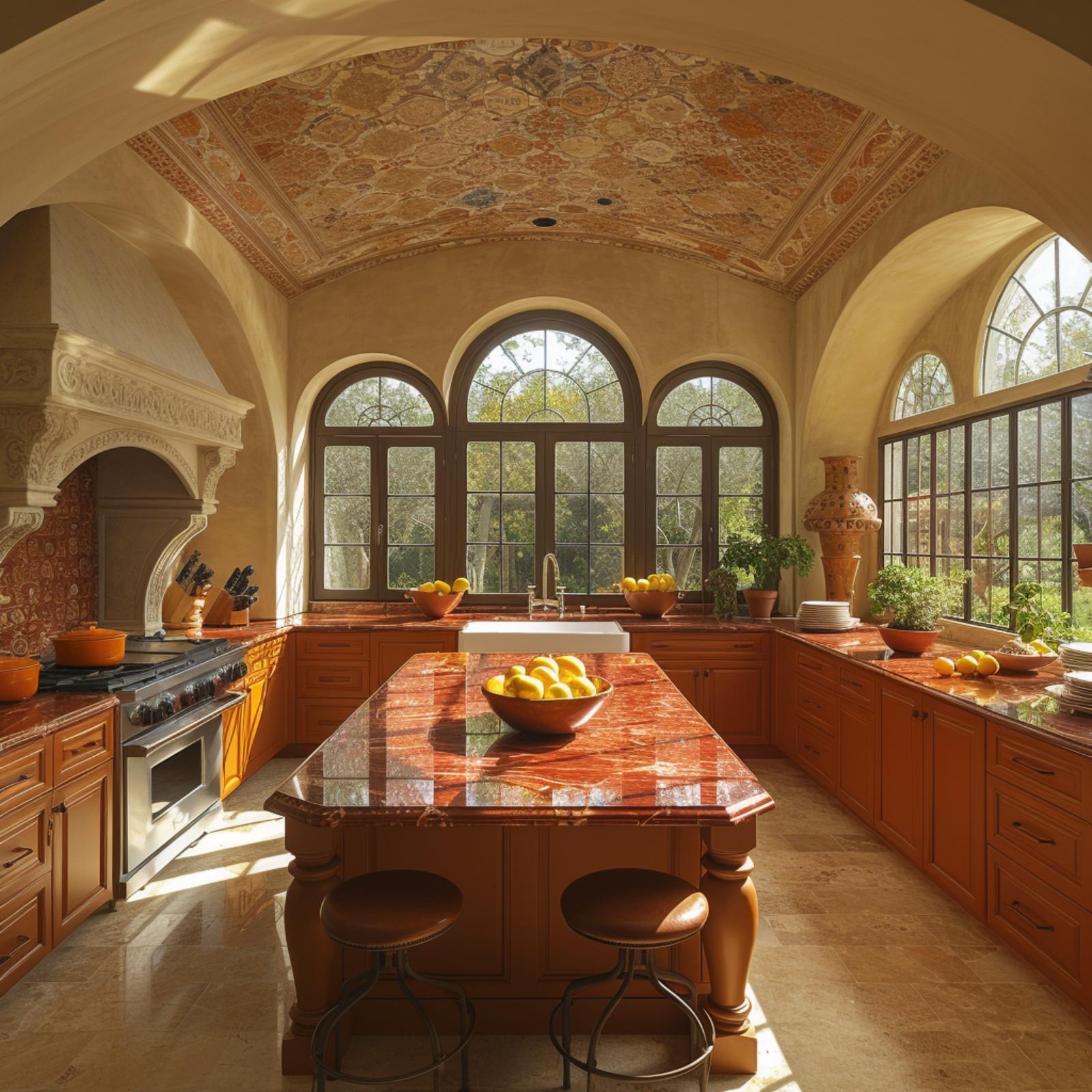
Terracotta-toned cabinetry and a vaulted ceiling covered in hand-painted medallion frescoes set the tone before the marble even registers. The island countertop in deep rouge with white veining sits at the center, grounded by turned wood legs that read more like antique furniture than built-in cabinetry.
What makes the room work is restraint where you’d least expect it. The ornate carved range hood, the barrel-vaulted ceiling, the arched windows flooding the back wall with garden light — none of it competes because the color palette stays in the same warm ochre and rust family throughout. The marble doesn’t interrupt the room. It anchors it.
12. Cream Cabinets, Gold Trim, and Red Marble That Earns Every Surface It Covers
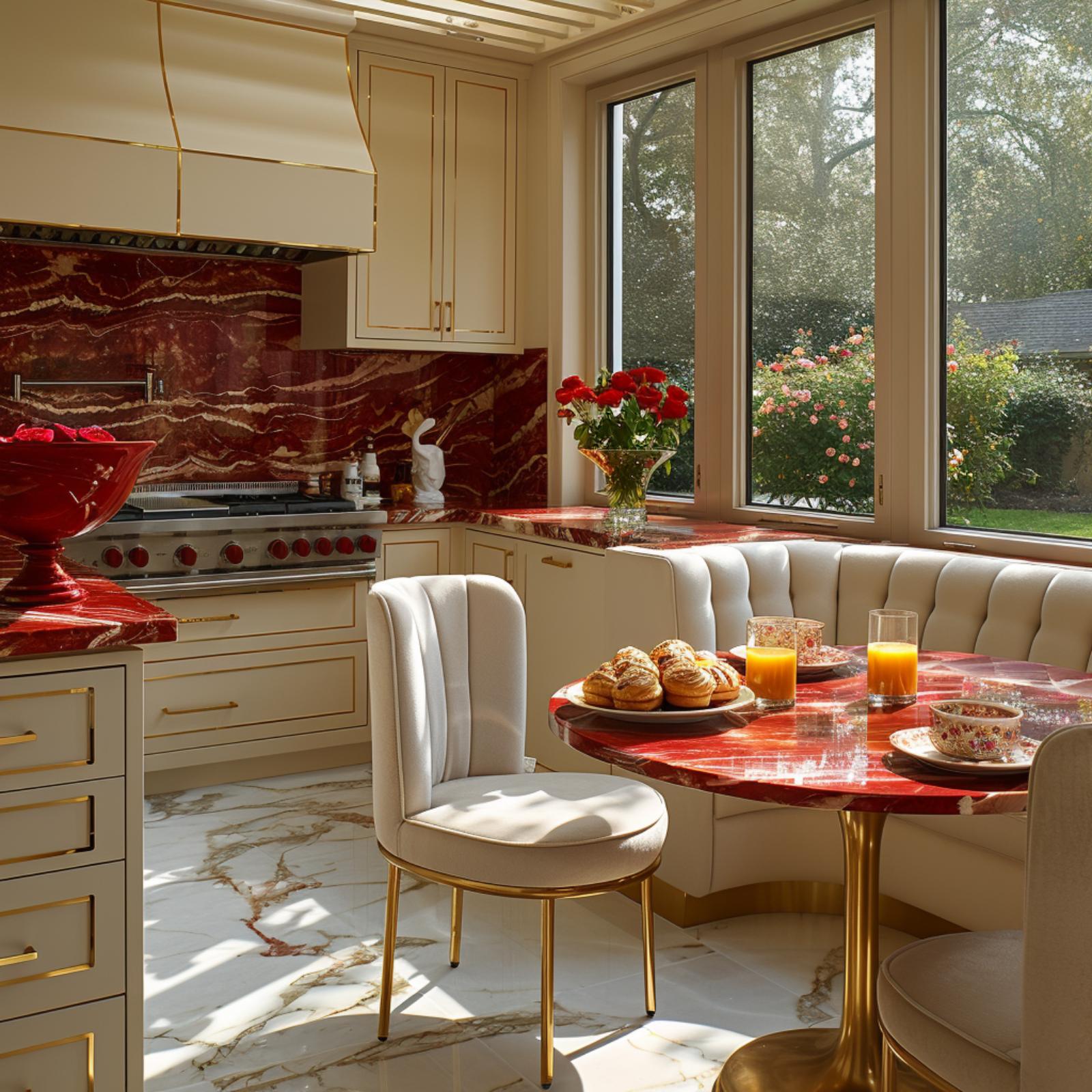
Rosso marble runs from the countertops up the full backsplash and reappears on the round breakfast table, tying the cooking zone to the dining nook without repeating the same finish twice. The table has a tulip-style gold base, which keeps the lower half of the room from feeling heavy.
The banquette is upholstered in channel-tufted cream fabric, a deliberate contrast that gives the eye somewhere to rest. Cabinet hardware is gold bar pulls, matching the hood trim and chair legs. Outside, flowering shrubs in pink and red press right up to the windows, making the stone feel less like a design choice and more like something the room grew toward naturally.
11. Walnut Cabinetry, Red Marble Island, and Concrete Overhead That Somehow Softens Everything
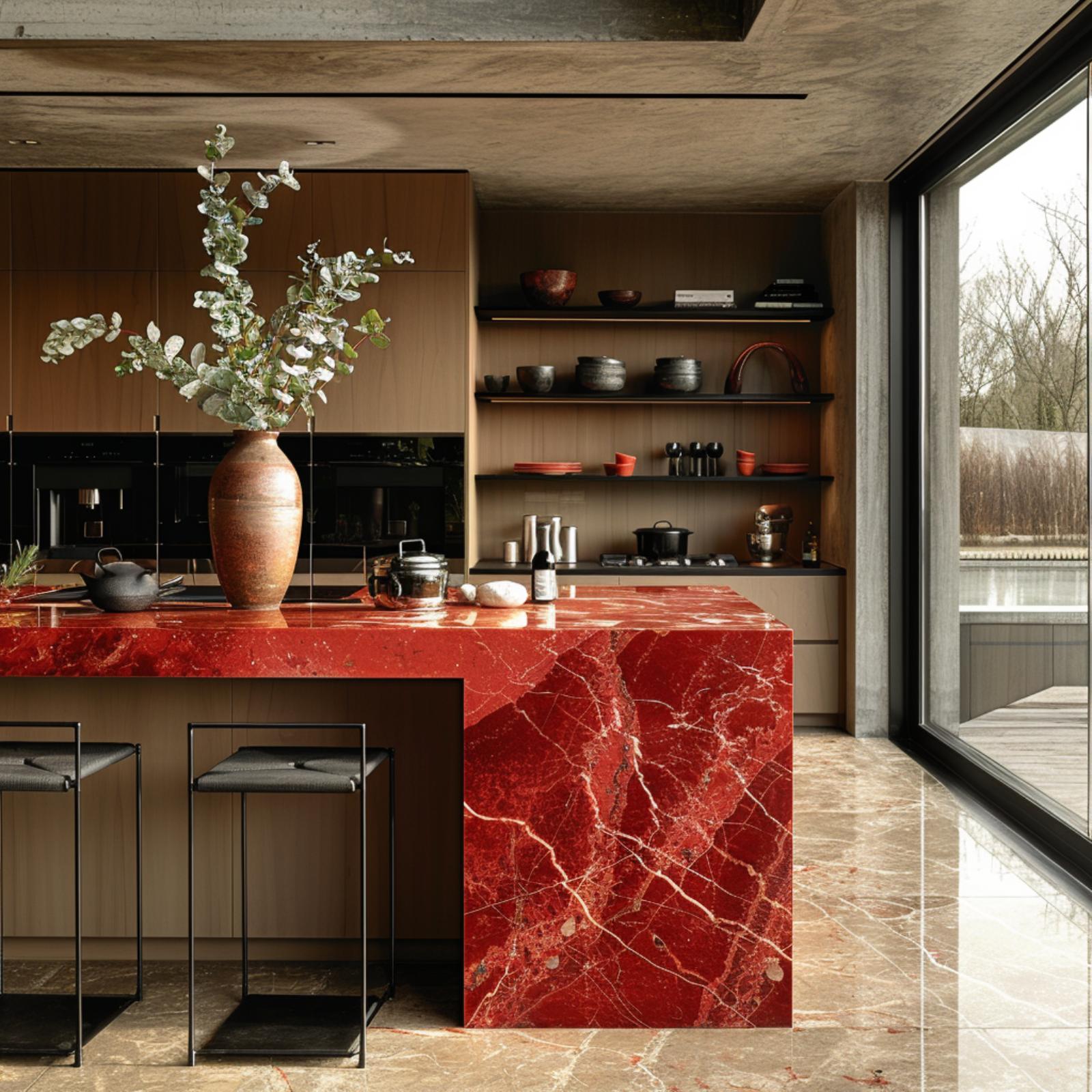
Warm walnut flat-fronts run floor to ceiling without hardware, letting the red marble island carry the room’s visual weight entirely on its own. Open shelving breaks the run of cabinetry and holds dark stoneware alongside a few red ceramic bowls, a pairing that looks deliberate rather than accidental. The concrete ceiling could easily feel cold here, but it doesn’t.
10. Lacquered Taupe Cabinets, Red Marble Island, and Bar Stools That Know Their Role
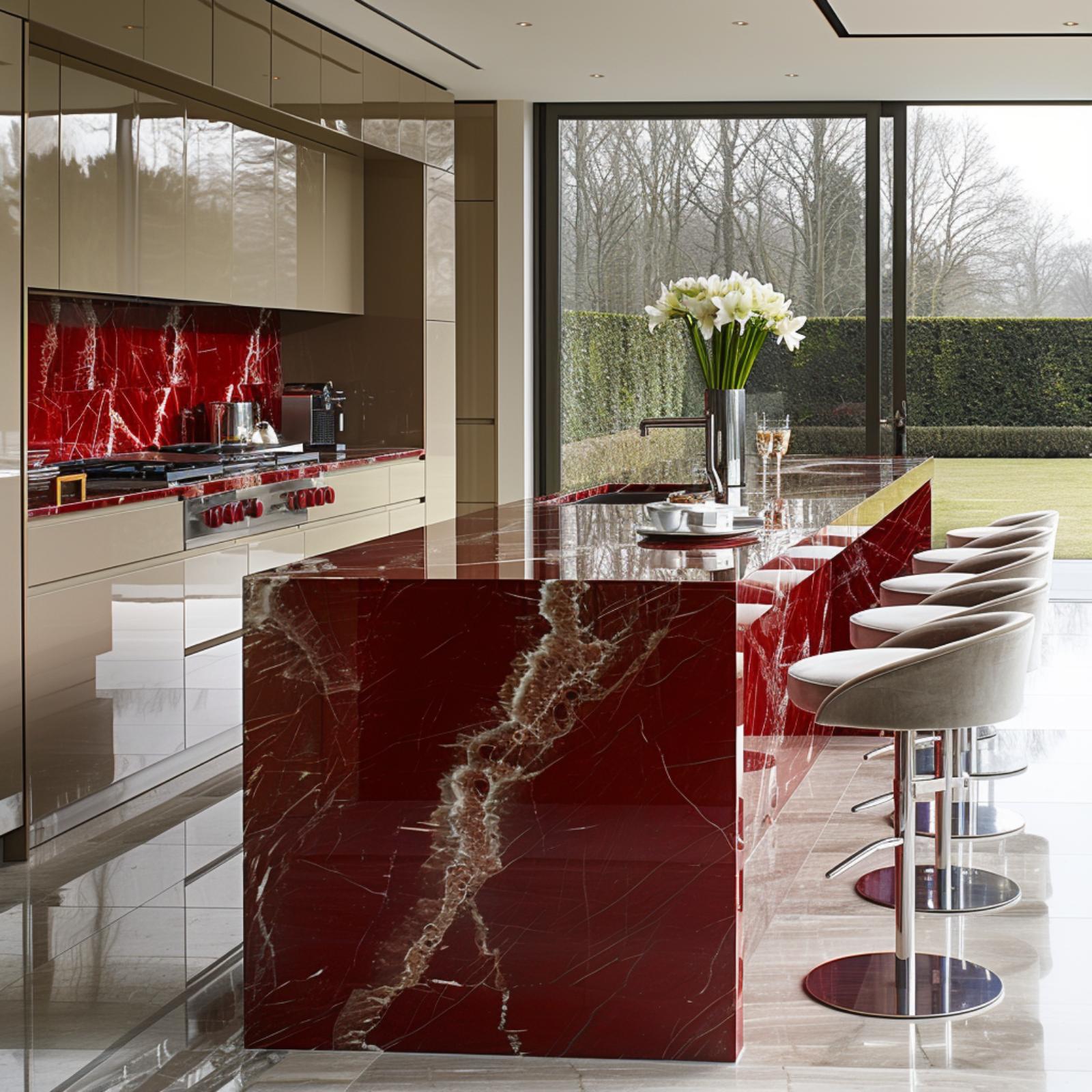
Polished Rosso marble runs the full waterfall island and wraps the backsplash behind the range, with white veining that cuts across the stone at a diagonal rather than drifting softly. The cabinet finish is a high-gloss taupe, close enough to champagne that it reads warm without competing. Bar stools in a rounded, backless silhouette line up along the island’s long edge, their upholstered seats pulling the beige tone from the cabinets. It’s a pairing that keeps the room from tipping into pure drama. Floor-to-ceiling glazing does the rest, pulling bare winter trees into the frame and reminding you that all this polish has an outside.
9. White Cabinets, Exposed Beams, and Red Marble That Owns Every Surface It Touches
🔥 Would you like to save this?
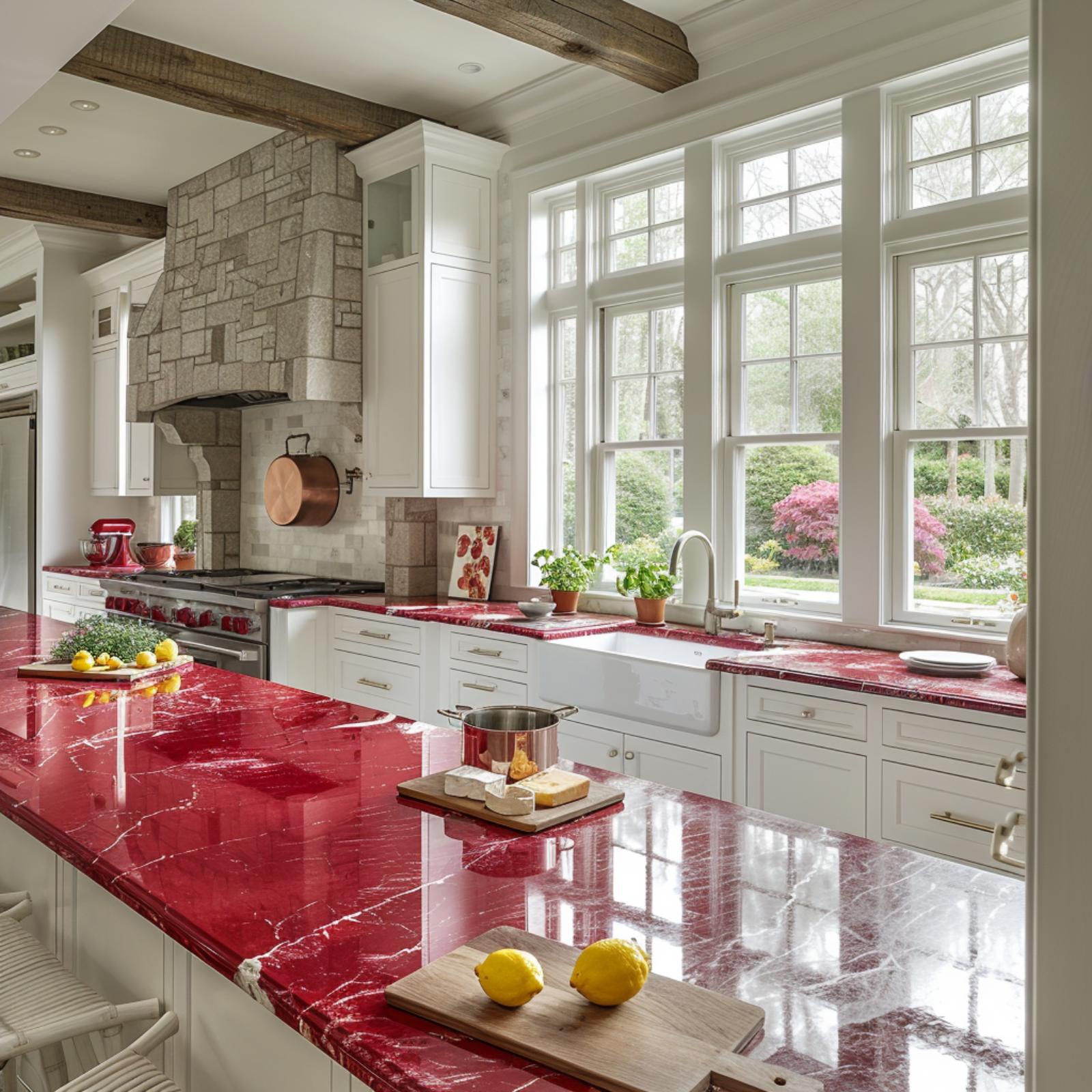
Crimson marble with white veining runs across both the island and the perimeter counters, and the continuity makes the whole room feel committed rather than experimental. Rustic oak ceiling beams do real work here, pulling the stone’s intensity back toward something livable. The stone range hood surround and farmhouse sink keep the material language grounded, while that wall of divided-light windows floods the space with enough daylight that the red reads warm rather than aggressive.
8. Walnut Cabinets, Red Marble Everywhere, and Brass That Doesn’t Apologize
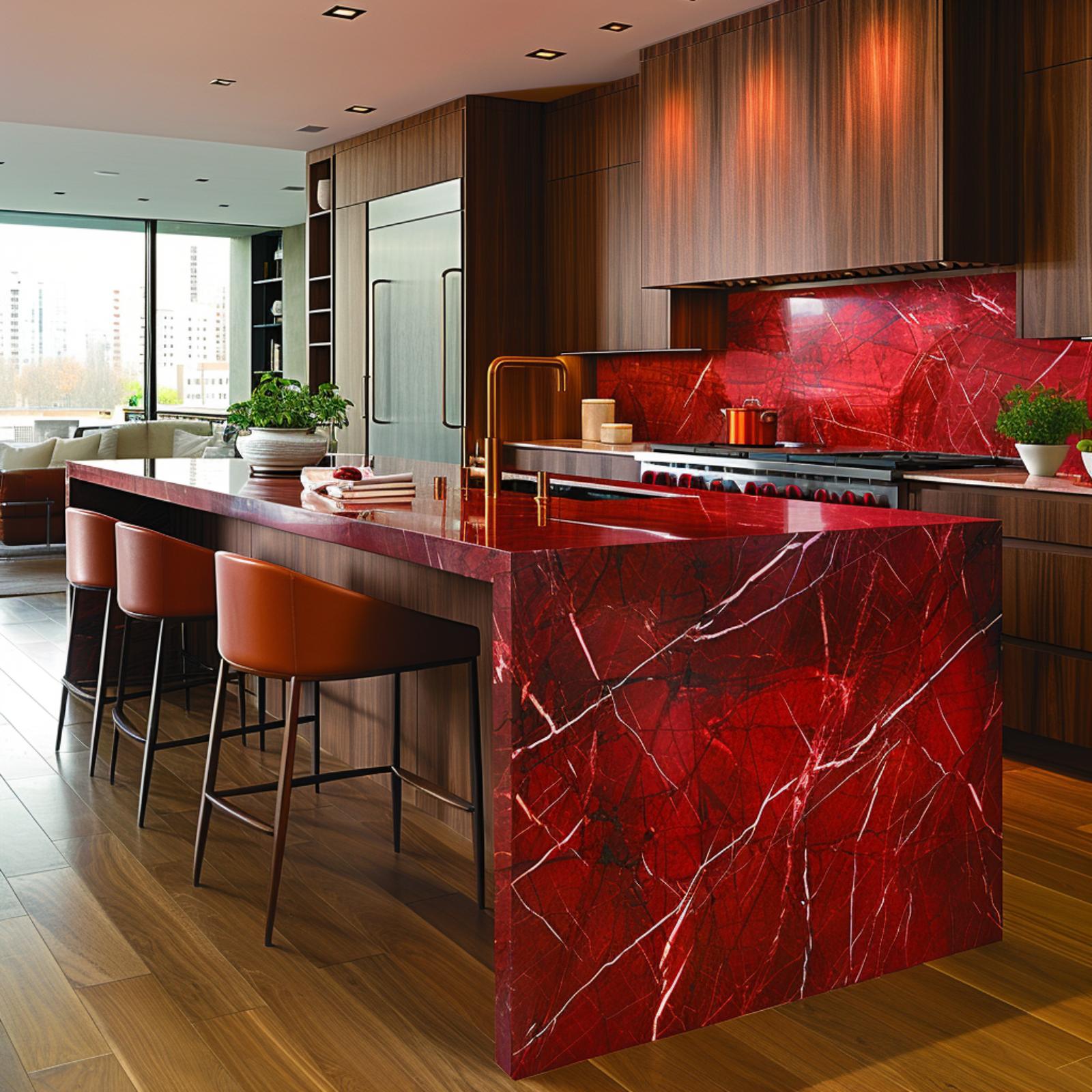
Red marble runs the full waterfall island and repeats on the backsplash behind the range, so the kitchen doesn’t let your eye rest anywhere neutral. The walnut cabinetry keeps it grounded. Cognac leather bar stools pull the wood tones forward without competing with the stone.
7. Black Cabinets, Red Marble Everywhere, and Brass Hardware That Pulls No Punches
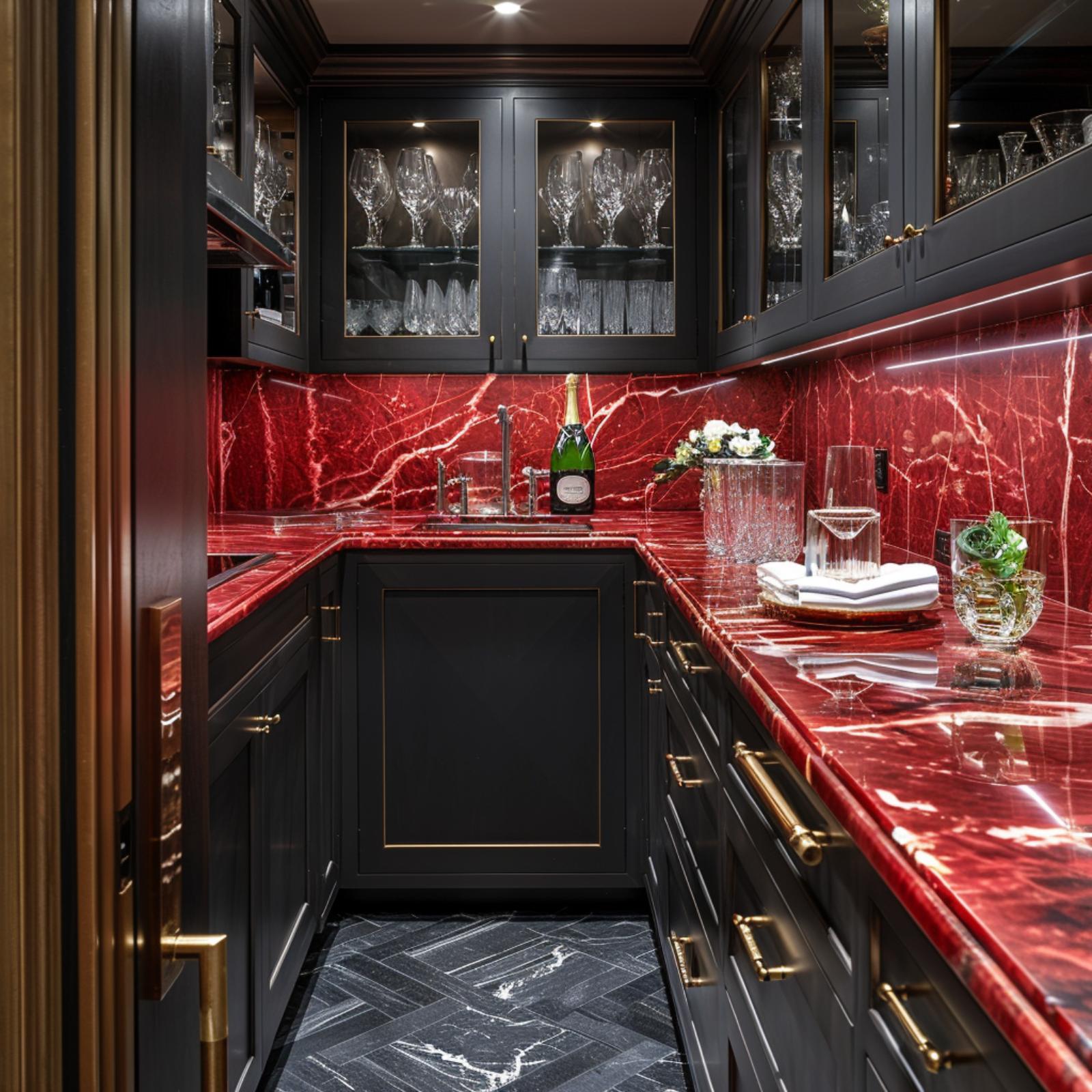
Veining so white and sharp it almost looks backlit against the deep red stone covering every counter and backsplash surface. The black cabinetry with gold-trimmed glass fronts keeps the glassware visible without competing. Brass pulls run the full length of the lower drawers, and that consistency matters more than it might seem.
6. Glossy Taupe Cabinets, Wicker Stools, and Red Marble That Goes Floor to Ceiling
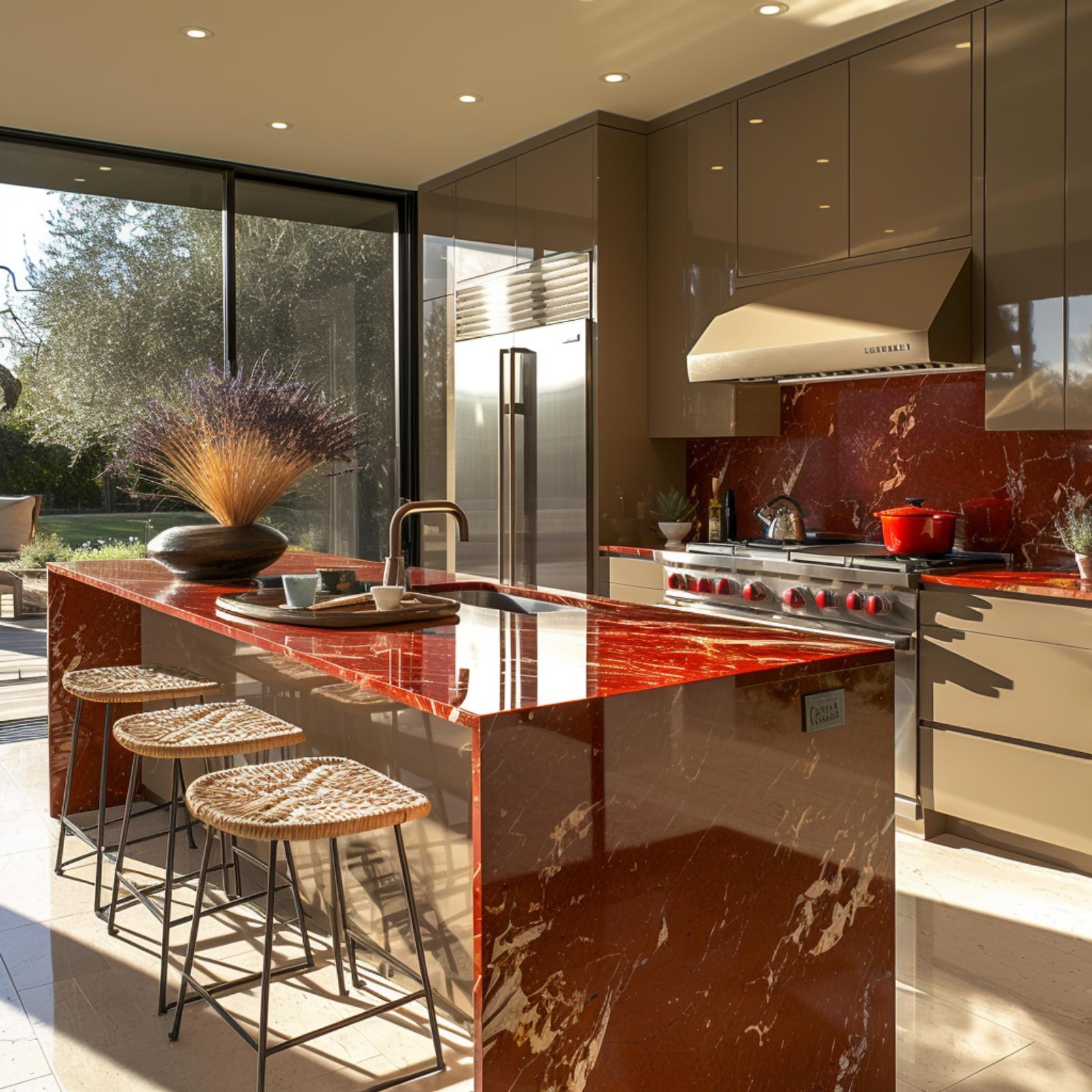
Floor-to-ceiling glazing on two sides pulls the garden directly into the sightline, which means the stone competes with actual trees and afternoon sun. It holds up. The island here uses the same slab on the waterfall face as the countertop, and the veining lines up across the horizontal and vertical planes, a detail that requires careful templating at the fabrication stage.
Glossy taupe cabinets keep the perimeter quiet enough that the backsplash behind the range doesn’t feel like overkill. Wicker stools on black metal frames add texture without warmth, which is the right call when the stone is already doing that job. The stainless range and hood anchor the cooking zone without drawing attention away from the stone. That’s a harder balance to pull off than it looks.
5. Teal Cabinets, Red Marble Everywhere, and Gold Bar Stools That Anchor the Room
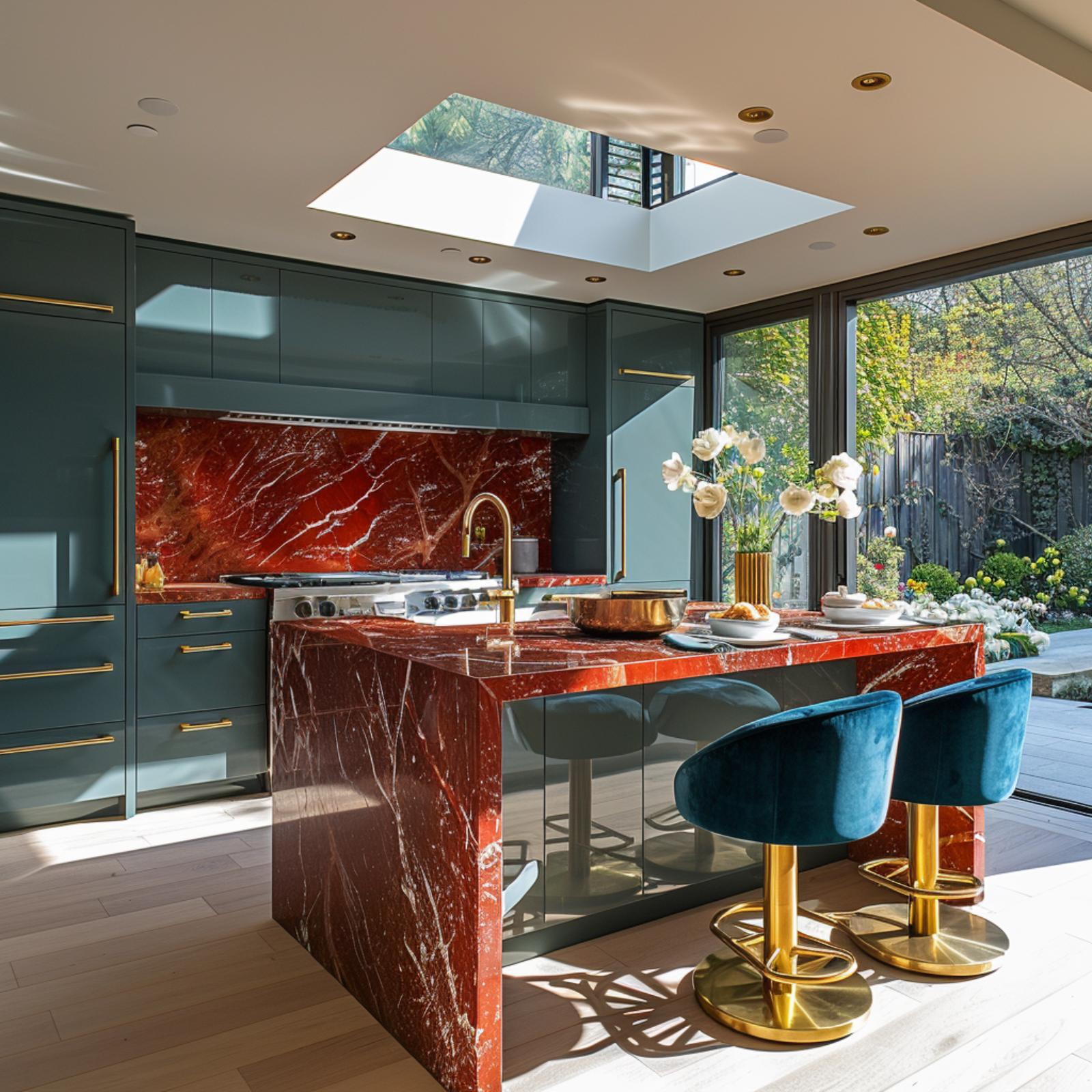
Glossy teal cabinetry with brass pulls runs floor to ceiling on two walls, and the red marble doesn’t stop at the island. It continues as a full backsplash behind the range, keeping the stone in constant conversation with itself. Two velvet bar stools in the same teal as the cabinets sit on gold pedestal bases, which ties the hardware finish back into the seating without feeling forced. The skylight overhead does real work here, pulling daylight directly onto the marble’s white veining.
4. Skylight, Red Marble Everywhere, and White Stools That Know When to Step Back
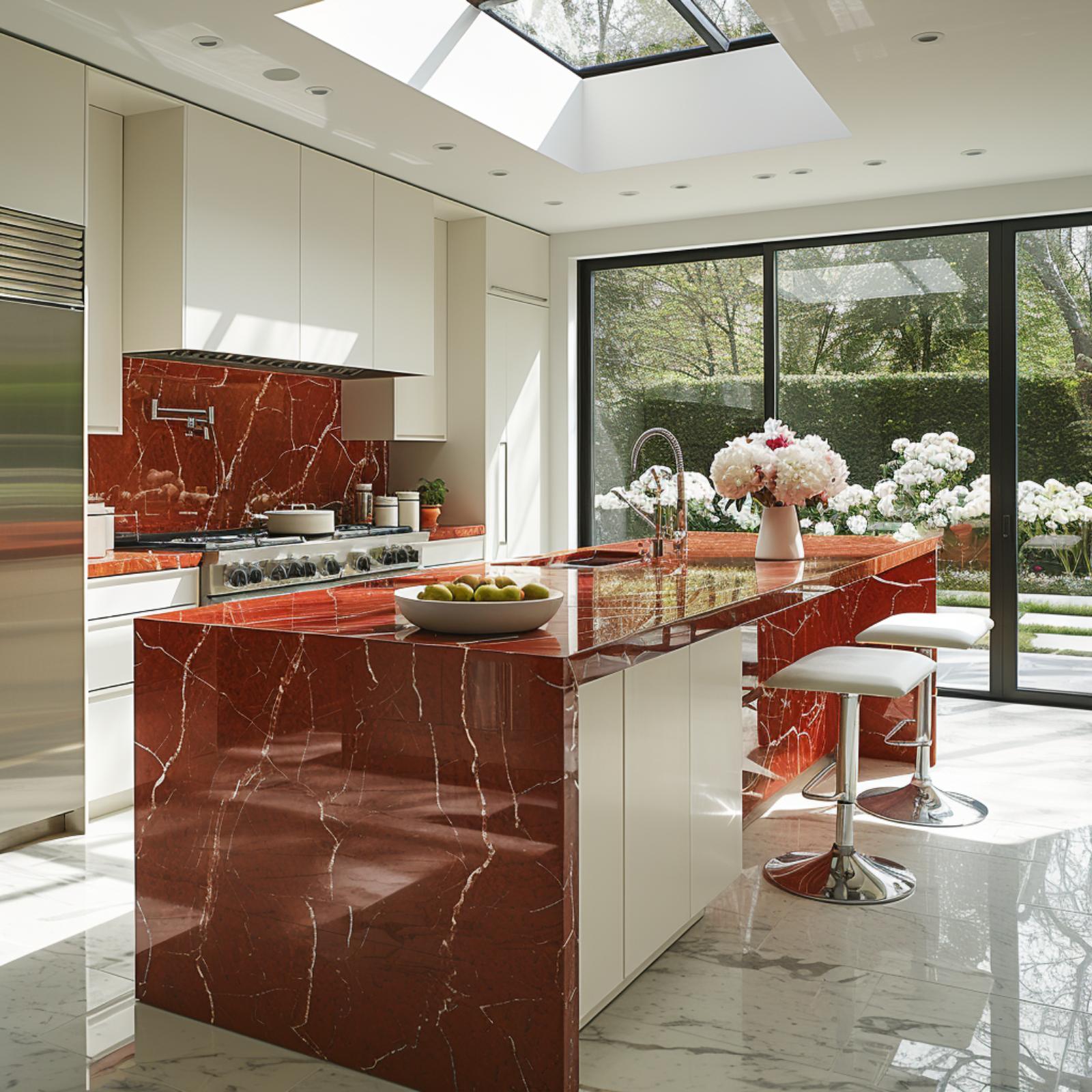
Ivory cabinetry runs floor to ceiling without hardware, which keeps the eye from fragmenting across the room. That restraint matters here, because the marble is doing a lot. The island is wrapped on every visible face in the same deep red stone, veined in white, and the backsplash continues it behind the range without interruption. It reads as one decision, not several.
What earns this kitchen its composure is the skylight. Natural light from above hits the polished surface differently than side windows would, pulling out the stone’s depth rather than flattening it. The chrome bar stools don’t compete. Neither does the bowl of green apples sitting on the counter, which, intentionally or not, is the only cool note in the room.
3. Dark Cabinets, Red Marble Everywhere, and Bar Stools That Don’t Flinch
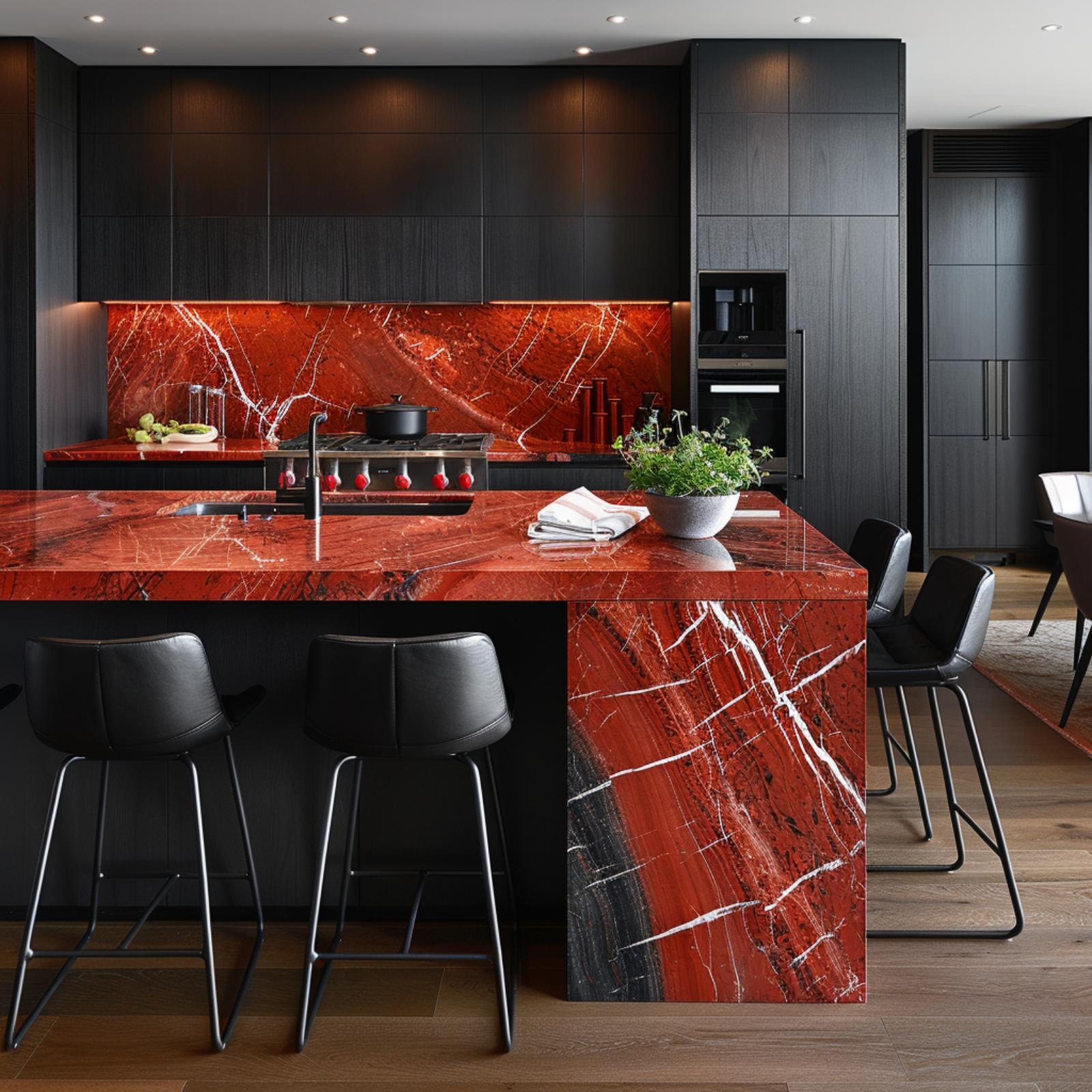
Matte black cabinetry runs floor to ceiling on every wall, and the contrast with the red-and-white marble isn’t subtle. It’s confrontational in the best way. The island is waterfall-edged, with the slab continuing down the full side panel, and the backsplash behind the cooktop picks up the same stone so the eye reads the entire kitchen as one composition.
What makes it work is restraint in everything else. The bar stools are black leather with minimal frames. The plant on the island is the only softness in the room. Even the recessed lighting overhead is spaced to illuminate without showboating. Some kitchens need accessories to pull them together. This one doesn’t.
2. Glossy Taupe Above, Red Marble Below, and Bar Stools That Hold Their Ground
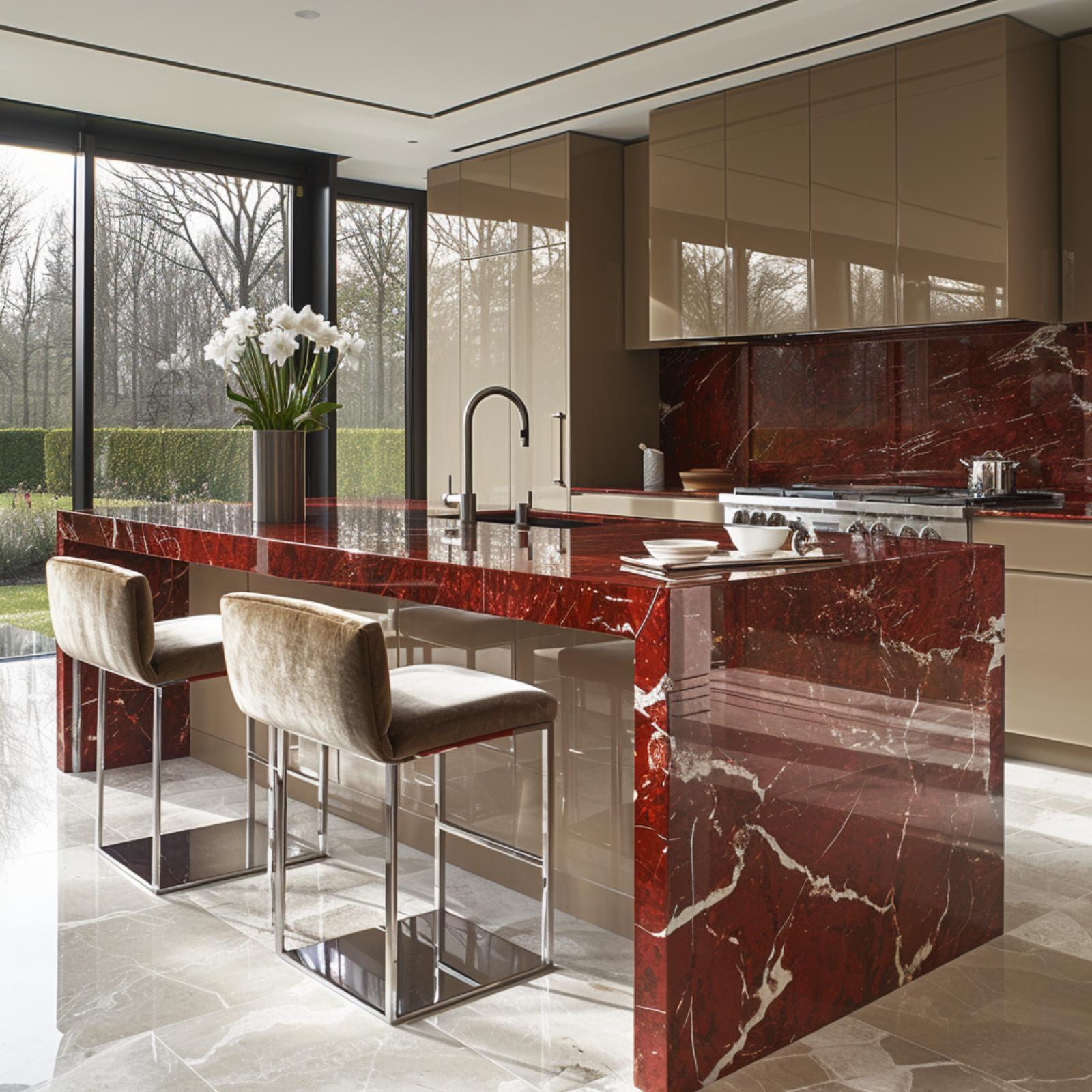
Velvet bar stools in a muted bronze-taupe sit against an island clad floor-to-face in deep crimson marble with white veining. The pairing works because the stools don’t compete. High-gloss taupe cabinetry overhead keeps the upper half quiet, letting the stone carry the room entirely on its own terms.
1. Walnut Cabinets, Red Marble That Closes the Loop, and Bar Stools Worth the Final Look
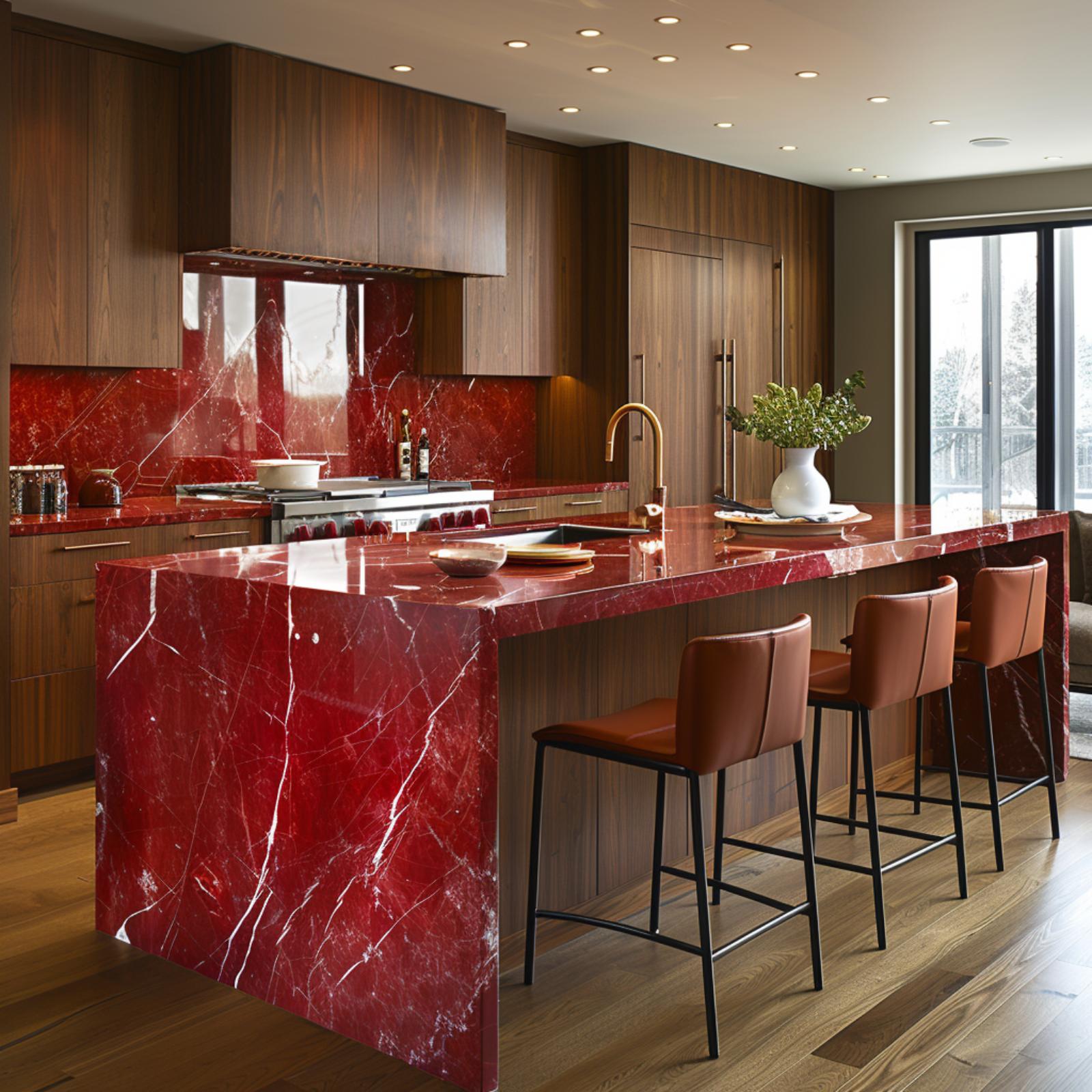
Dark walnut cabinetry runs floor to ceiling on three walls, and the grain is consistent enough that it reads more like paneling than storage. The red marble doesn’t just sit on the island, it continues as the backsplash behind the range, which means there’s no visual escape from it. That’s not a criticism. It’s a commitment, and the space earns it.
Cognac leather bar stools with black metal legs land exactly where they should, warm enough to hold their own against the marble without competing. A brass gooseneck faucet and a single white vase with greenery are the only things breaking the red-and-walnut conversation. Recessed ceiling lights keep the drama on the surfaces, not above them.