🔥 Would you like to save this?
The grandest design decision anyone can make is to build a home inside something that was never meant to hold one. Converting the Art Deco grand salon of a retired 1930s ocean liner into a private residence is exactly that kind of decision. It demands respect for the original architecture: the lacquered panels, the geometric inlays, the sheer scale of a room designed to impress wealthy transatlantic passengers. These 33 before-and-after homes prove that the bones of a neglected vessel can support something genuinely livable and extraordinary. What was once a dilapidated ship, stripped of its glamour and left to rust, becomes the framework for homes that no ground-based construction could replicate. The original period detailing does the heavy lifting. AI design working within these spaces had to solve real problems, from salt damage to irregular load-bearing structures, and the results reflect that honest, specific work.
In order to come up with the very specific design ideas, we create most designs with the assistance of state-of-the-art AI interior design software. Also, assume links that take you off the site are affiliate links such as links to Amazon. this means we may earn a commission if you buy something.
33. Coffered Ceilings Kept, Warm Wood Transformed with Raw Concrete
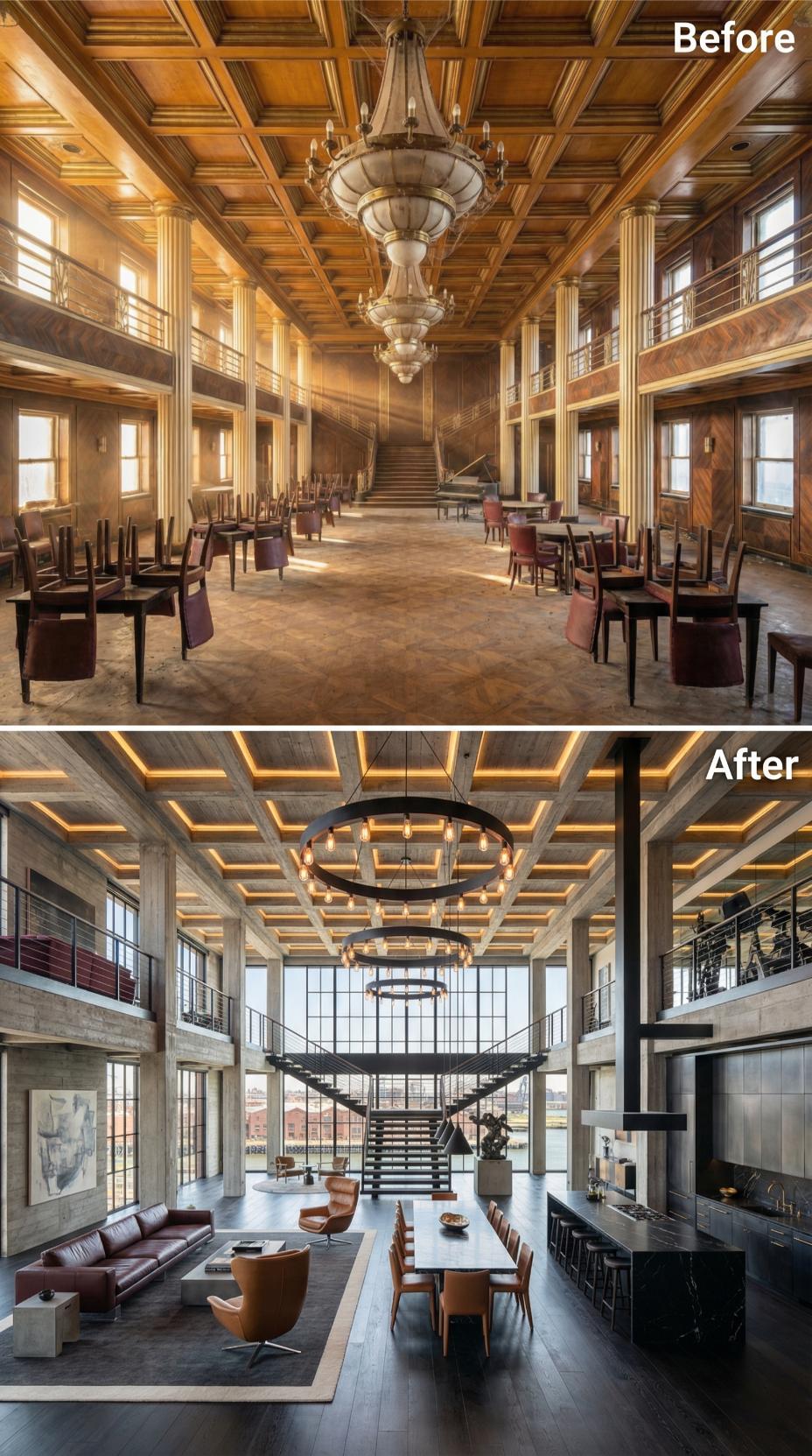
Exposed concrete replaced the walnut paneling, while LED cove lighting now traces the original coffered grid where gilded moldings once ran. A tiered black steel ring chandelier hangs where the alabaster fixture did, and a floating steel staircase occupies the same axis as the original grand stair.
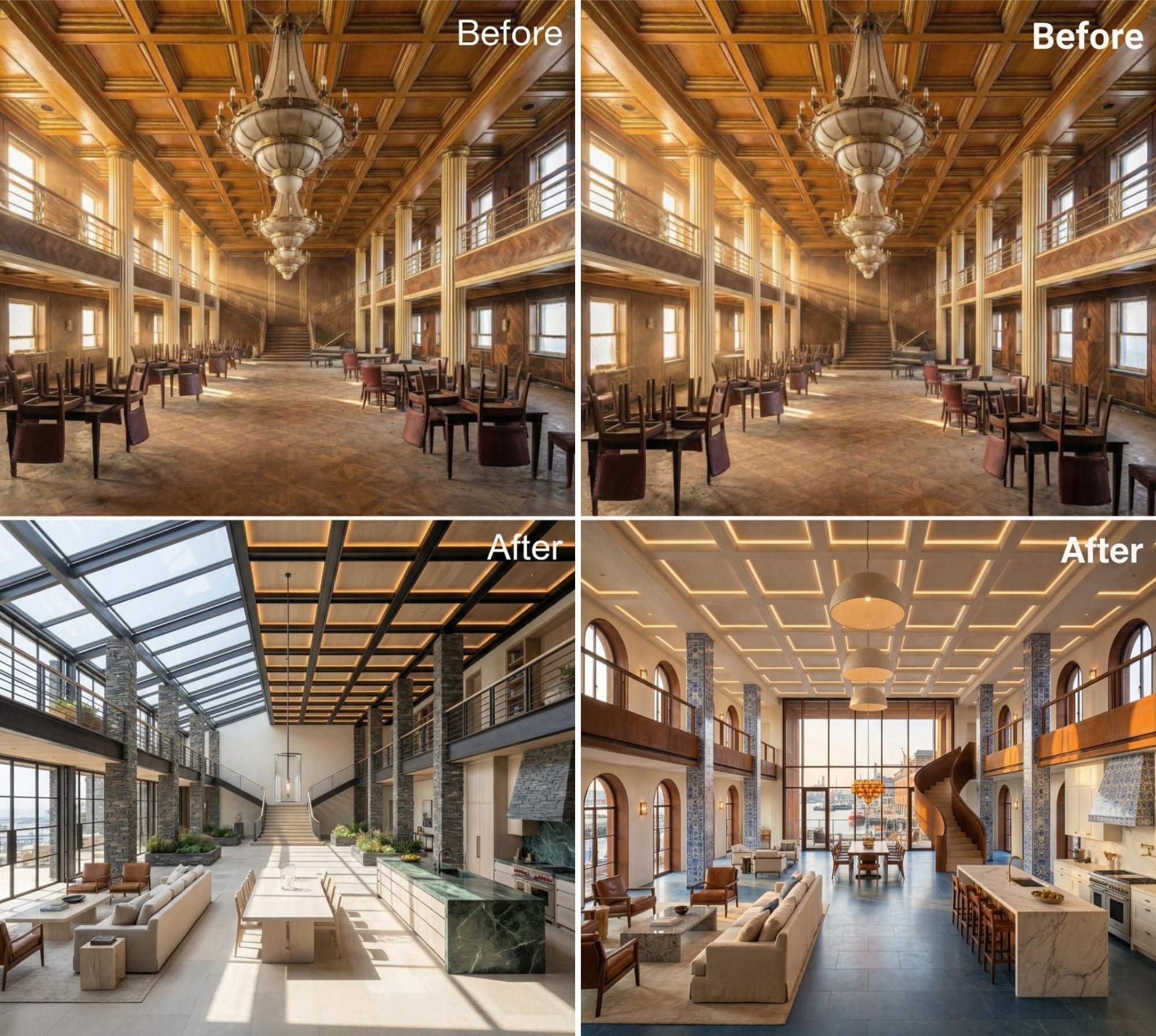
32. From Mahogany Ballroom to Travertine Living Hall: One Ship’s Grand Salon Reborn
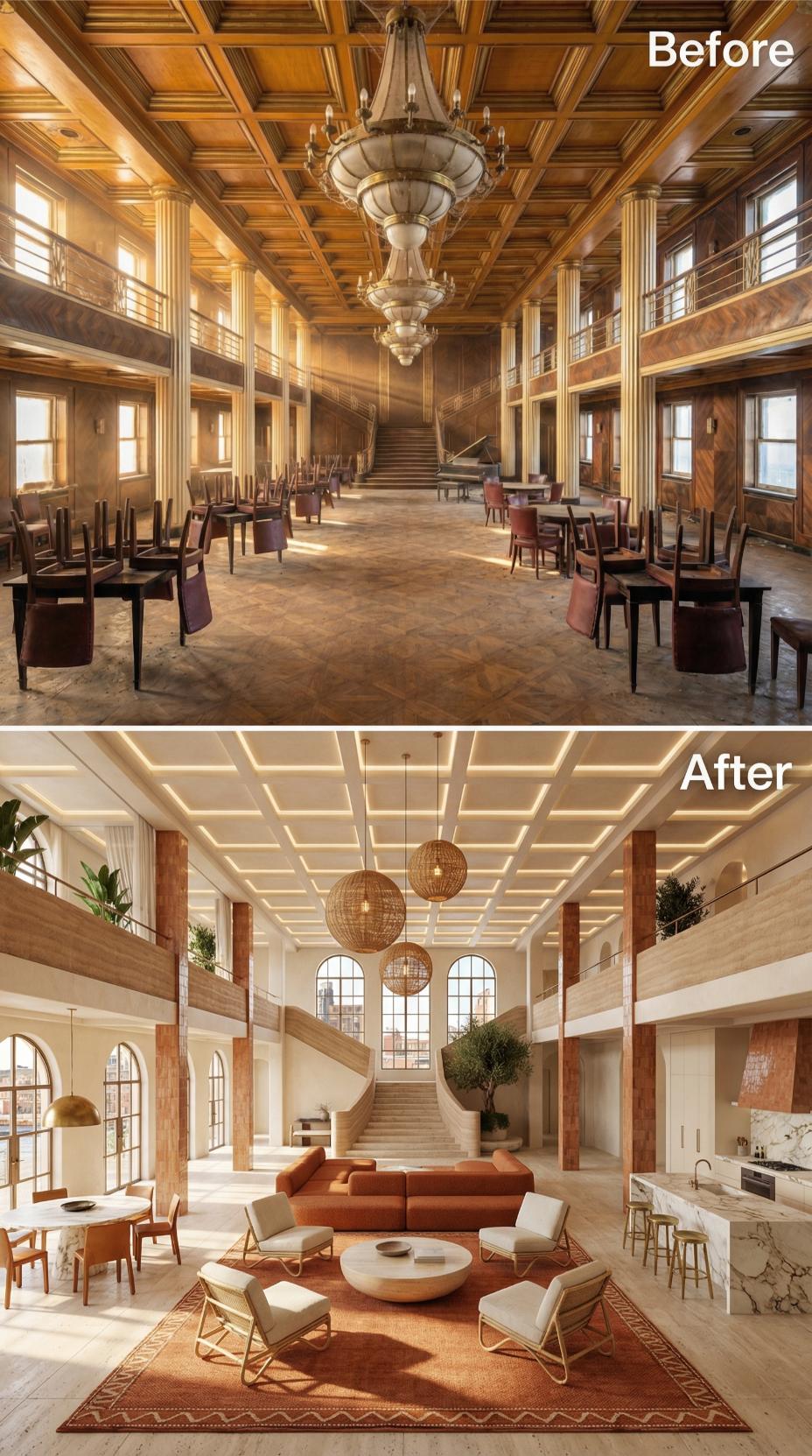
Where dark-stained wood paneling and coffered mahogany once absorbed every ray of light, the renovation introduced cream travertine cladding across the original columns and white plaster infills between the coffered grid, now lit from within by continuous LED strips. The parquet floor gave way to large-format stone, and the imposing crystal chandelier was replaced by three woven rattan pendants hung at staggered heights.
The seating plan centers on a terracotta-upholstered sectional sofa paired with linen armchairs on a rust-toned bordered wool rug. A circular white plaster coffee table anchors the arrangement. To the right, a marble waterfall-edge island with brass fixtures signals a kitchen zone, while arched steel-frame windows now frame the mezzanine staircase, replacing the original rectangular sashes entirely.
31. Midnight Navy Coffered Ceiling, Black Marquina Marble Floor, One Grand Salon Reborn
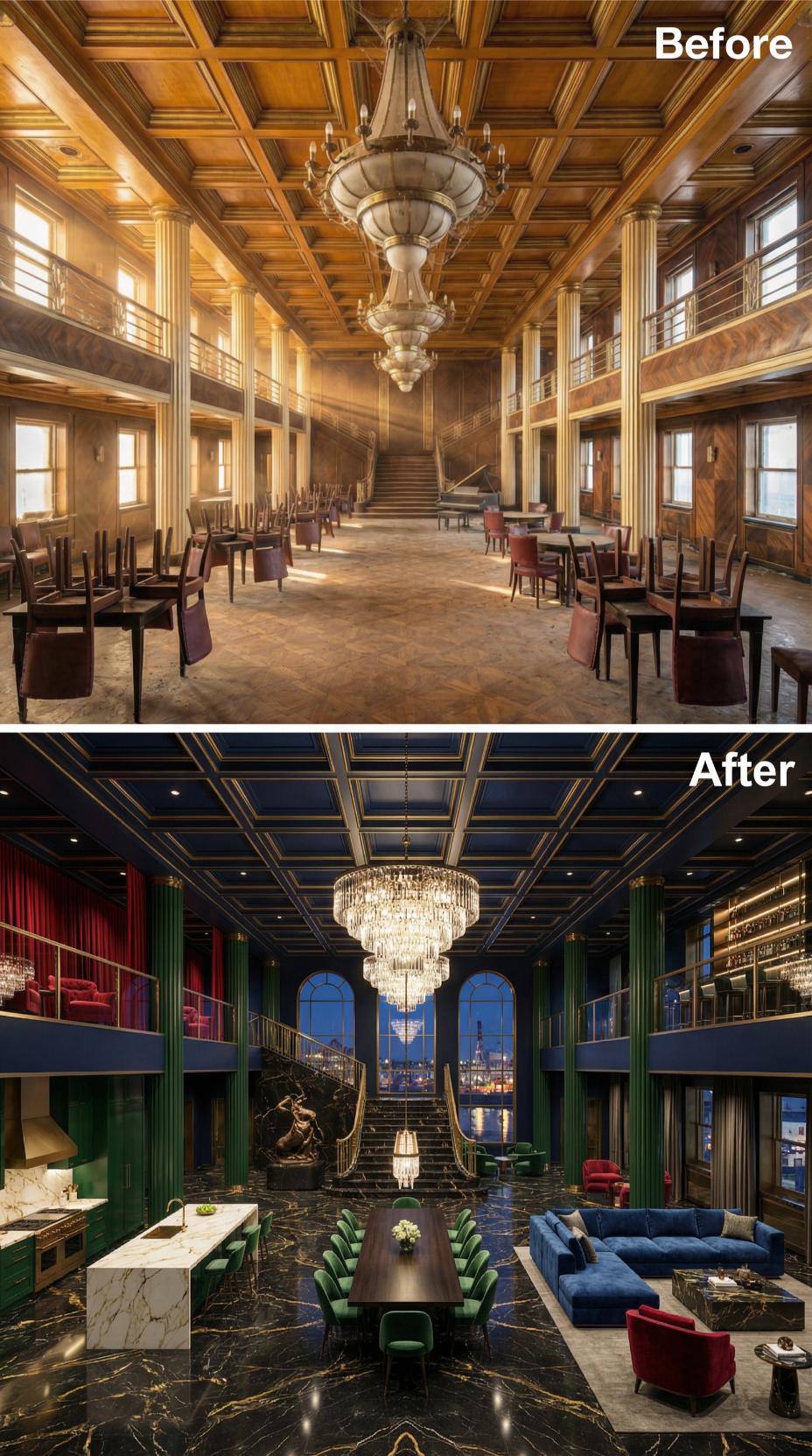
Dark navy lacquer with gold trim now coats the original coffered ceiling, while black Marquina marble flooring replaces worn parquet below a tiered crystal chandelier.
The Chandelier Swap That Anchors Everything
The original single-tier alabaster chandelier gave way to a cascading multi-tier crystal fixture with stacked circular bands, scaled to fill the double-height volume. Its warm light refracts across the black and gold veining of the marble floor, drawing the eye from the open kitchen island on the left straight through to the arched windows at the stair landing. Emerald lacquered columns flank that central axis, their finish echoing the velvet dining chairs pulled up to a dark wood table beneath the fixture.
30. Bleached Oak and Wicker Replace Gold Leaf in a Grand Salon Reborn as Open Living
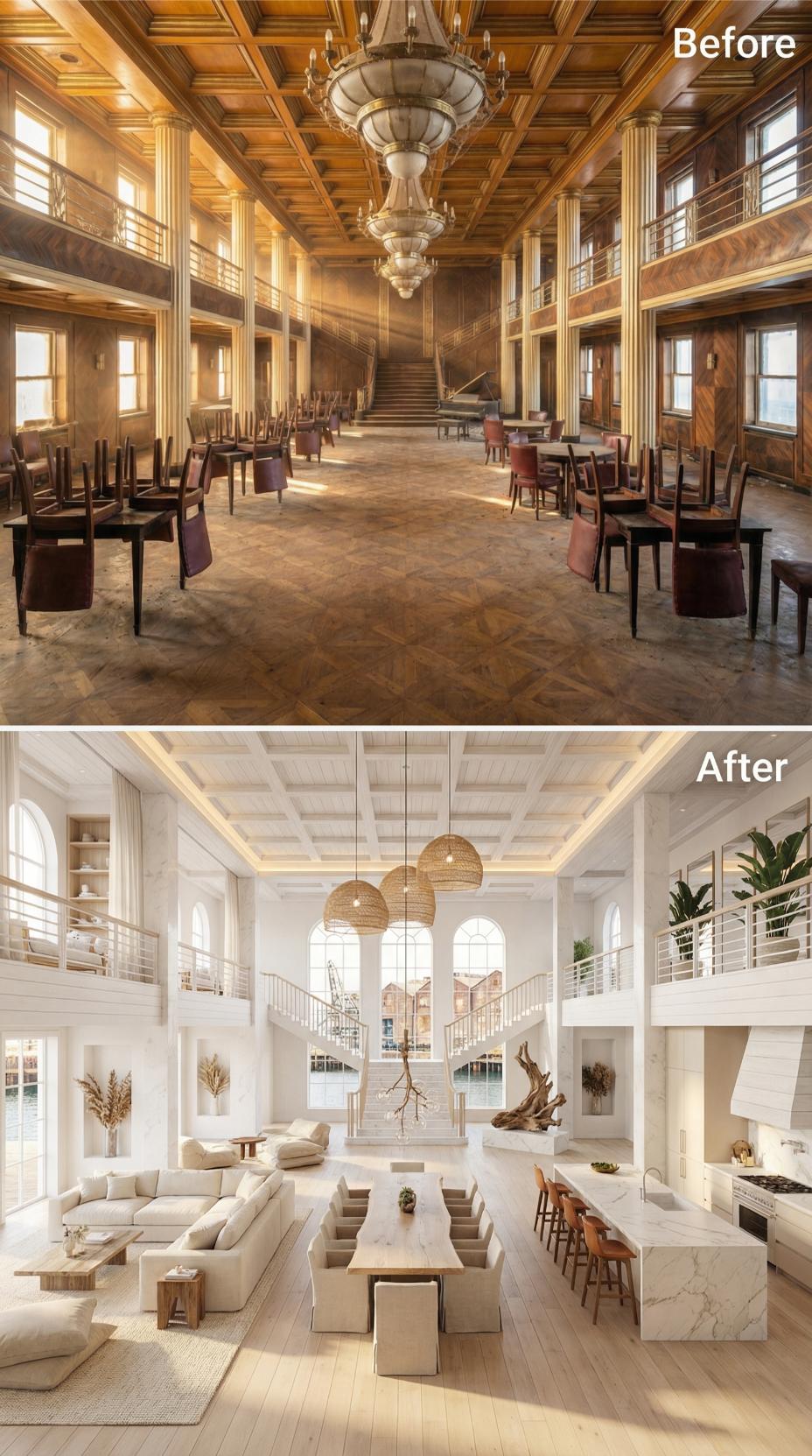
Coffered ceiling geometry survived the gut renovation, now finished in white-painted wood rather than the original carved mahogany. Warm-white LED coves trace each recessed panel from the inside, replacing the brass chandelier with three oversized wicker globe pendants hung at staggered heights above the central dining table.
Below, the floor shifts to wide-plank bleached oak, running the full length of the space and anchoring cream linen sectionals on a jute area rug. A waterfall-edge island in white marble with visible grey veining separates the living area from the kitchen, where cognac leather barstools provide the only saturated color in an otherwise all-neutral palette. Driftwood sculpture on the counter and dried pampas grass in tall ceramic vessels echo natural textures without pattern or print.
The Psychology Behind This: Replacing ornate, dark surfaces with white and natural materials in a high-ceilinged space triggers a measurable shift in perceived openness, even when square footage stays constant. Psychologists call this “visual expansion,” where neutral surfaces allow the brain to read depth rather than stop at contrast. The result is a space that feels larger than the original, despite sharing the same structural footprint.
29. Skylight Cut Through the Coffered Deck, Japanese Minimalism Moves In
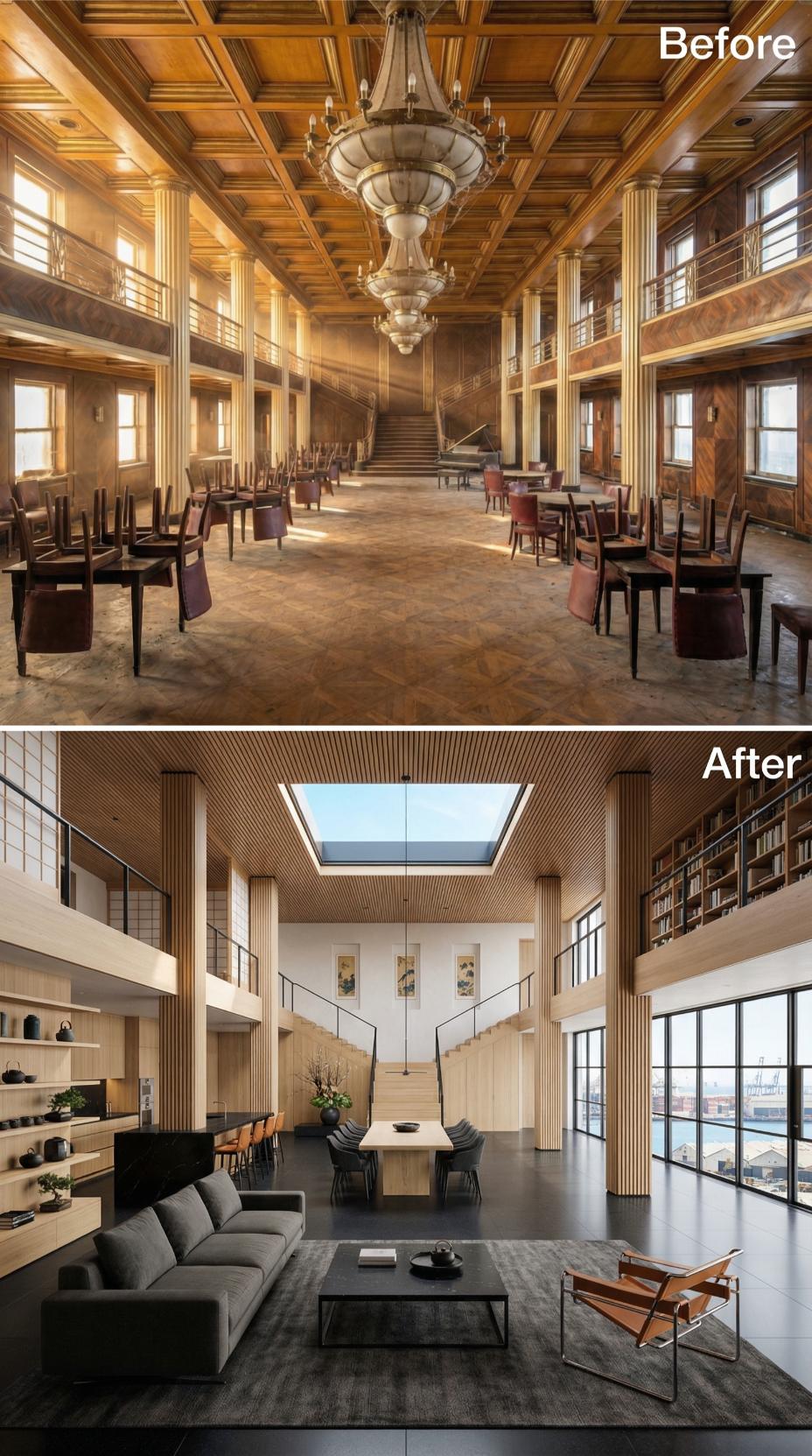
Vertical slatted light wood panels replace the original mahogany wainscoting, running floor to double-height ceiling and giving the salon’s columnar bones a quieter rhythm. A large rectangular skylight replaces what was once plaster crown molding and gilded coffers, pulling natural light directly onto a travertine-topped dining table surrounded by upholstered charcoal chairs.
The living area anchors around a low-profile sofa in heathered grey fabric, paired with a leather-and-chrome Wassily-style chair in cognac. Dark slate flooring grounds the composition without competing. Floor-to-ceiling steel-framed glazing on the starboard side opens a full harbor view, replacing the liner’s original porthole fenestration entirely.
Trend Alert: Japandi interiors, the hybrid of Japanese wabi-sabi and Scandinavian functionalism, have gained significant traction in adaptive reuse projects because the aesthetic tolerates high ceilings and raw structural remnants without requiring them to be concealed. Slatted wood cladding in particular has become a go-to finish for disguising aged walls while maintaining warmth and acoustic softness. Sales data from 2023 shows slatted panel wall systems among the fastest-growing interior millwork categories in North America.
28. Raw Concrete Kept the Bones, a Linear Fire Table Claimed the Floor
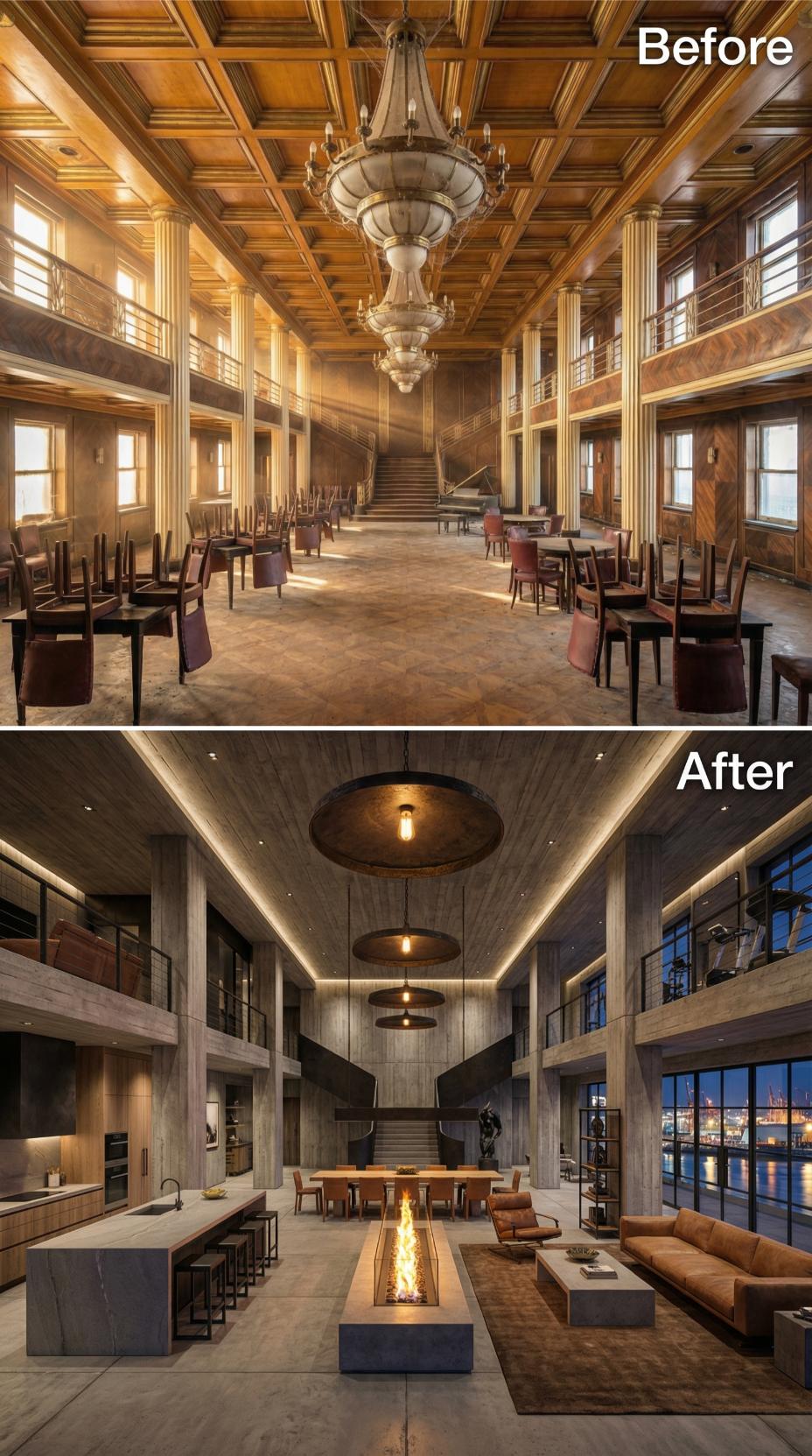
The coffered wood ceiling and its gilded chandelier are gone. In their place, board-formed concrete runs wall to wall, punctuated by LED cove lighting that traces the perimeter in a continuous warm strip. A long concrete fire table anchors the central axis, its open flame aligned with the original staircase beyond.
The kitchen island to the left uses honed stone in a charcoal-grey tone, paired with bar stools in blackened steel. On the opposite side, caramel leather sofas face a low travertine coffee table. Floor-to-ceiling steel-framed windows on the far wall reveal a harbor at night.
Designer’s Secret: Centering a fire feature on the same axis as a legacy architectural element, here the original grand staircase, creates visual depth without adding any additional structure. Designers call this borrowed symmetry, and it costs nothing beyond careful placement during the planning phase.
27. Pale Limestone, a Lap Pool Down the Center, and Zero Nostalgia for the Original Ballroom
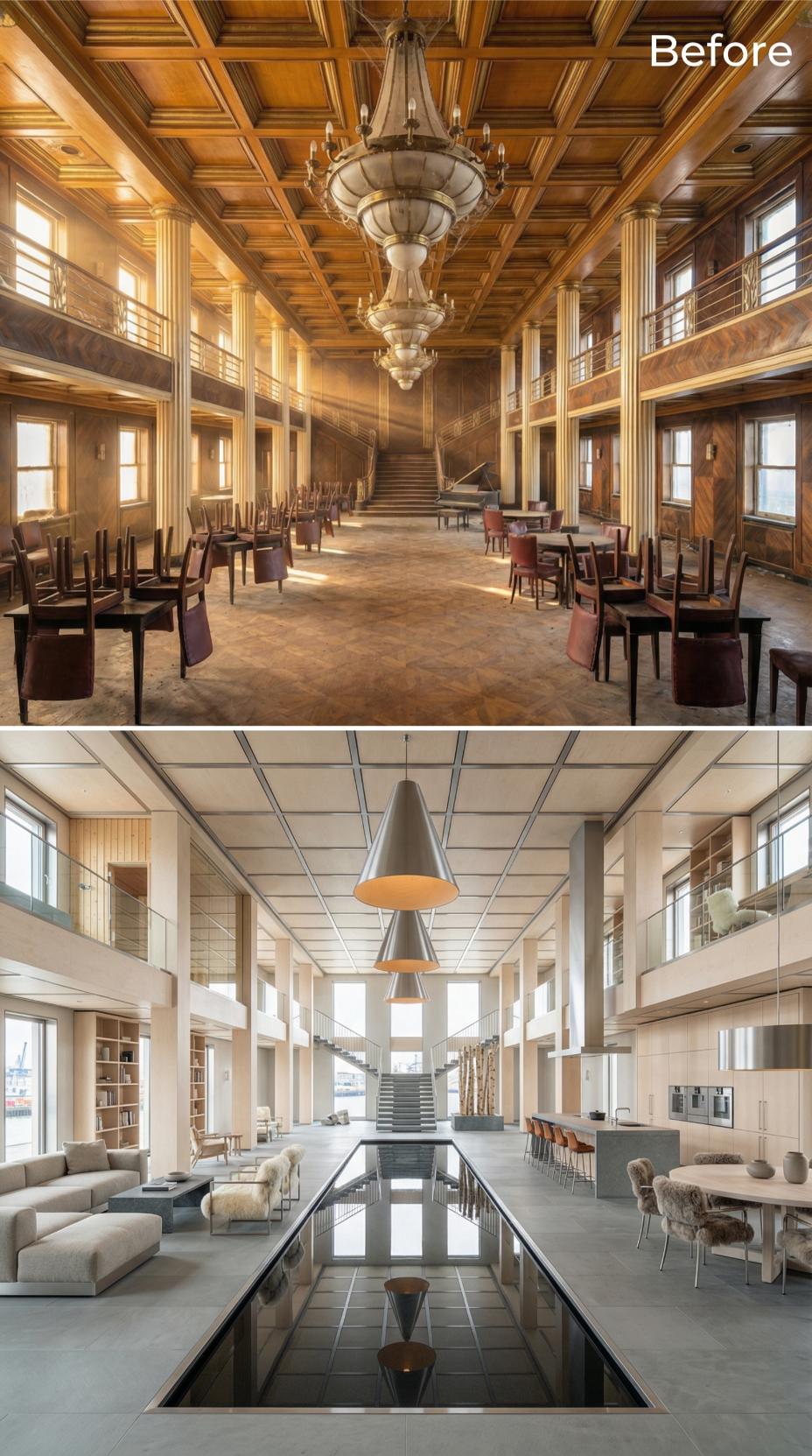
Designers sank a full-length lap pool into the floor of a 1930s grand salon, and it reads as the most logical decision in the room.
Reflected light from the pool’s black-tiled surface bounces up toward a grid ceiling finished in pale plaster panels, making the original double-height volume feel taller without touching the structure. A conical brushed-steel pendant hangs on axis with the staircase, its copper interior casting a warm downlight across the water below.
On the port side, a run of light gray modular sofas anchors a sitting area without crowding the sightline. Starboard holds a kitchen counter in what appears to be honed concrete, paired with terracotta bar stools. Glass balustrades on the mezzanine replaced the original carved wood railings, letting borrowed light push deeper into the plan. Fur-draped dining chairs at a round table in bleached wood close out the aft end without competing with the architecture.
26. Painted White and Stripped of Dark Wood, the Grand Salon Became a Home
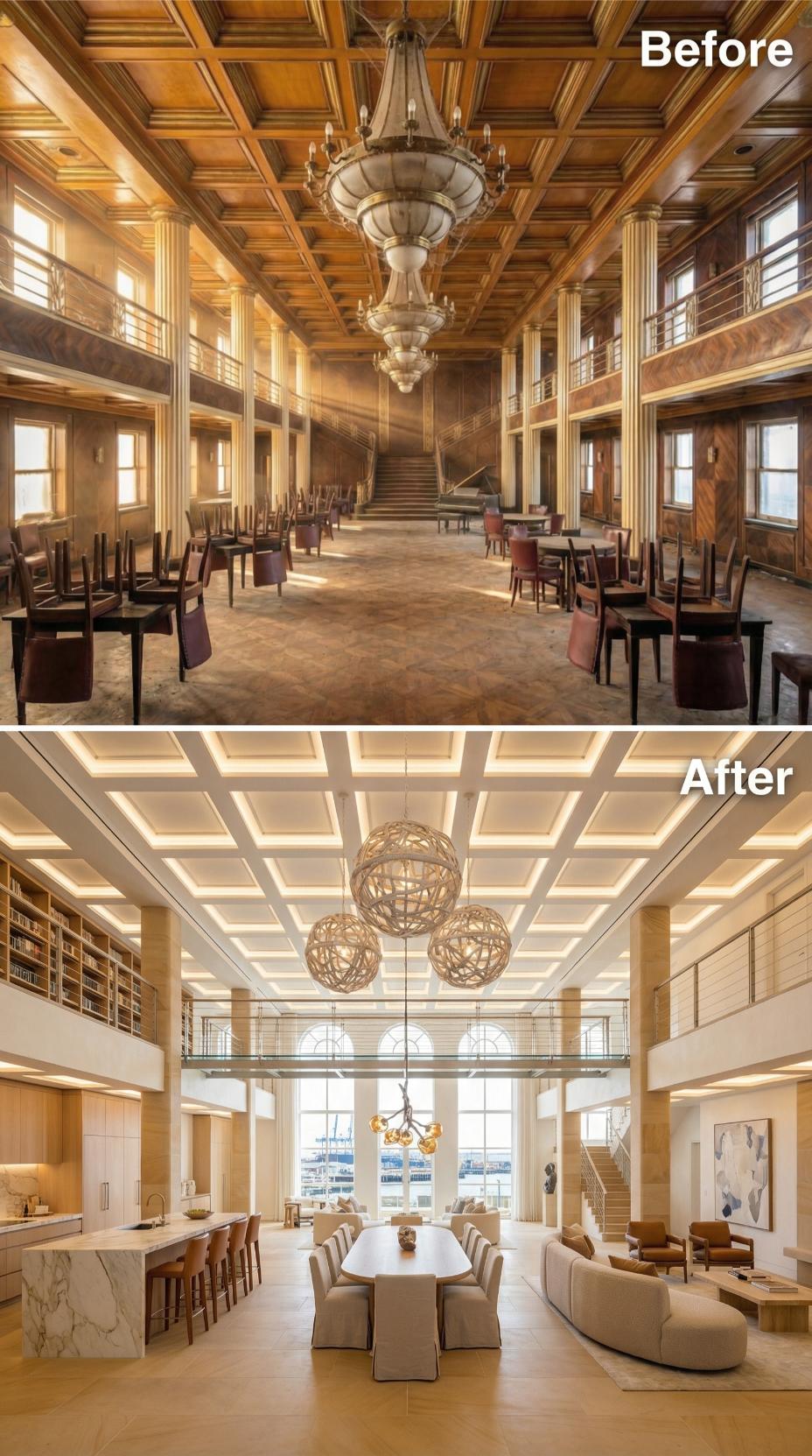
Ivory plaster now coats the coffered ceiling grid, with recessed LED strips running each coffer edge in place of the original gilded chandelier arms. Three woven-sphere pendants in natural rattan hang at staggered heights above a long dining table dressed in linen slipcover chairs. A waterfall-edge island in book-matched Calacatta marble anchors the kitchen zone to the left, paired with warm cognac leather counter stools. Bleached limestone tile runs the full floor plane, uninterrupted from kitchen through dining into the curved sectional seating at the far right.
Three woven-sphere pendants in natural rattan hang at staggered heights above a long dining table dressed in linen slipcover chairs.
25. Warm Wood Gone, Bleached Plank and Marble Island Take the Grand Salon Floor
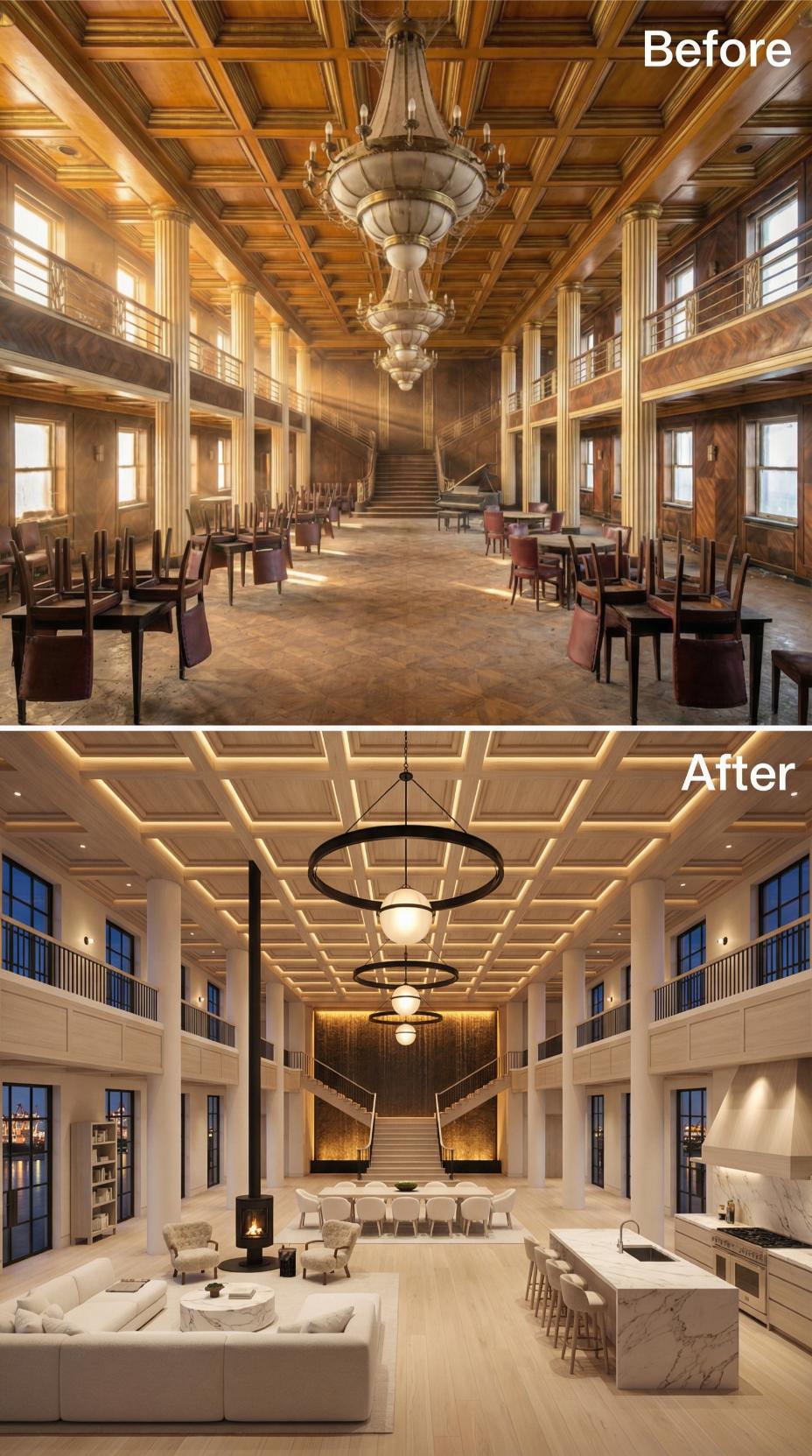
Cream plaster now covers what was once paneled walnut, and the coffered ceiling grid reads lighter for it, its recessed LED strips replacing the amber glow of candle-arm chandeliers. A circular black-steel pendant with globe diffusers hangs on axis with the original staircase, which has been re-clad in a hammered gold-leaf finish that draws the eye down the full length of the room.
At floor level, wide-plank bleached oak runs past a sectional sofa in off-white bouclé, a suspended wood-burning stove on a black steel flue, and a marble kitchen island with a waterfall edge in book-matched Calacatta veining. The windows, reglazed in black steel frames, turn the city lights into a backdrop that the original oak-stained panes never allowed.
Quick Fix: Retrofitting LED strip lighting into existing coffered ceiling grid channels is one of the more cost-effective upgrades in adaptive reuse work, since the shadow lines already built into the architecture conceal the hardware without requiring new bulkheads. A warm white color temperature around 2700K preserves the ballroom-era atmosphere while meeting modern residential light levels. Many conversion projects use this approach to avoid cutting into historically significant plasterwork.
24. Bold Color Blocked the Grand Salon Where Mahogany Once Ruled Every Surface
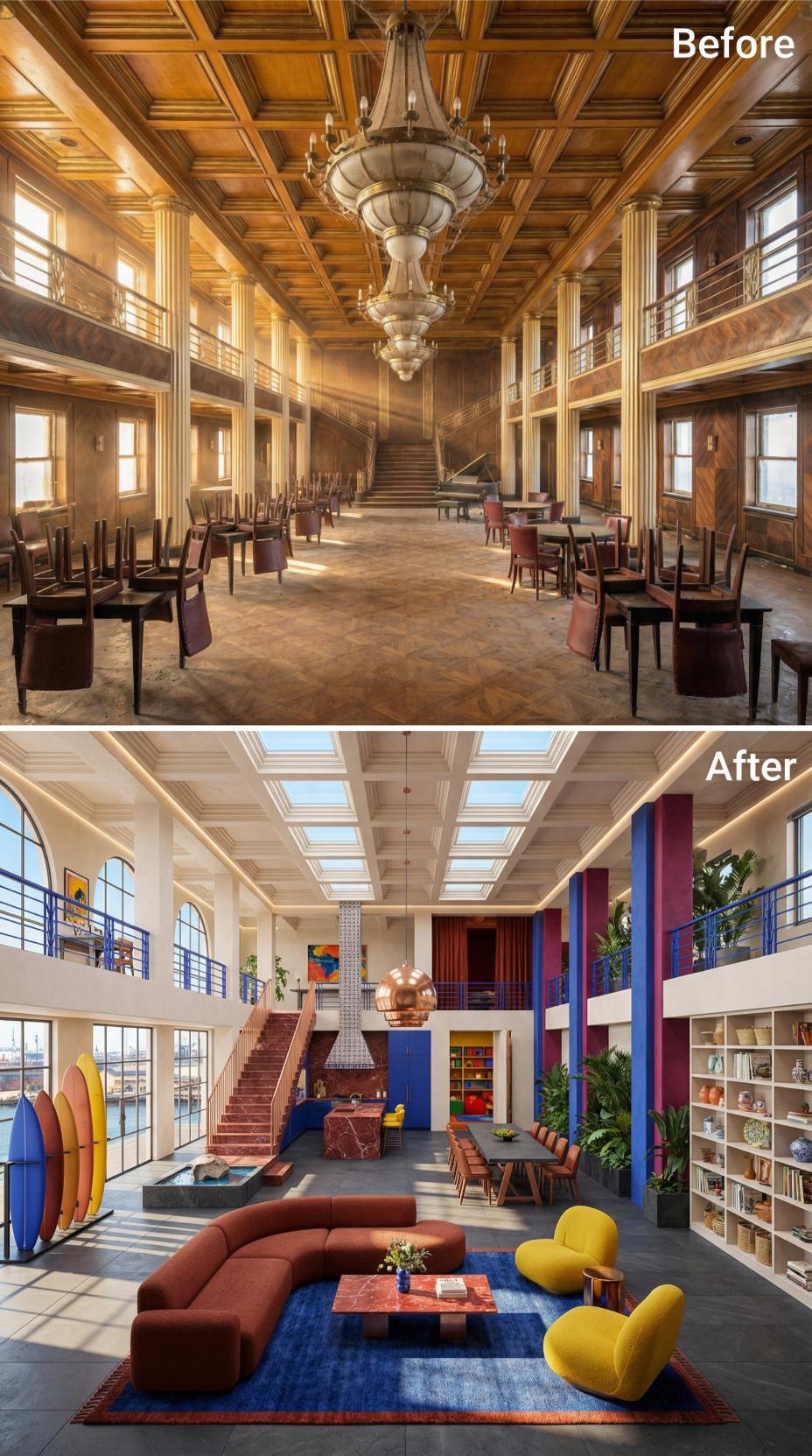
Cobalt blue columns and magenta accent walls now occupy the same structural grid that once held dark-stained mahogany paneling. Skylights cut into the coffered deck flood the slate-tiled floor with daylight the original chandelier never could. A curved rust-red sectional anchors a deep navy area rug, and two yellow bouclé lounge chairs pull the primary seating zone away from the dining table behind it.
Copper pendant fixtures hang above a red marble kitchen island. Surfboards lean against the port-side wall where formal dining chairs once stood in rows. Built-in shelving in raw birch runs the full length of the starboard side.
- Skylights added to an existing coffered ceiling structure can increase natural light penetration by up to 40 percent over window-only configurations
- Color blocking structural columns in contrasting hues visually separates functional zones in open-plan spaces without building walls
- Bouclé upholstery performs well in high-traffic adaptive reuse interiors because the looped yarn resists pilling under sustained daily use
Wicker and rattan take a different direction here, staying warm but scaling up considerably in volume.
23. Wicker Pendants, Marble Island, Kayaks on the Wall: Grand Salon as Family Compound
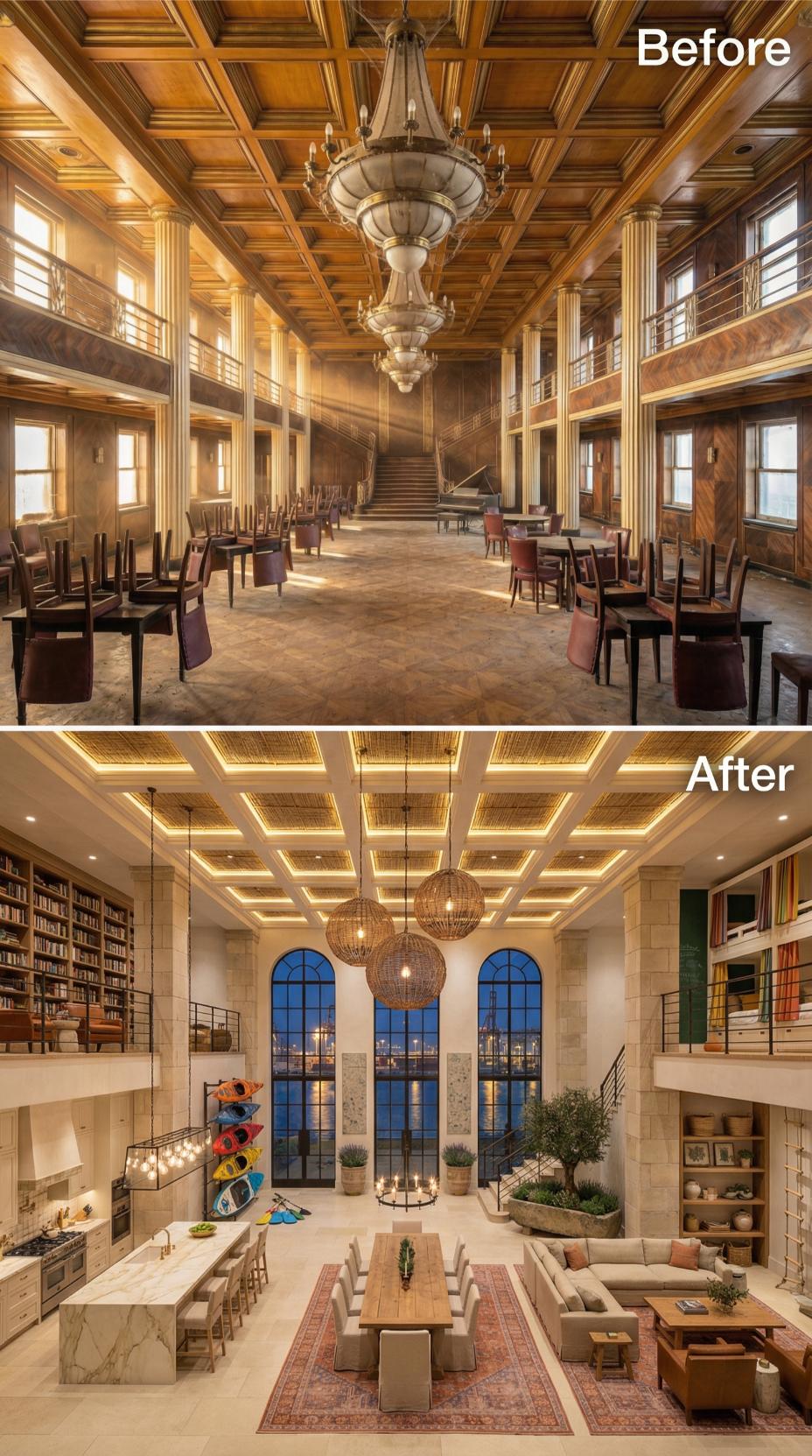
Rattan-wrapped sphere pendants hang from a coffered ceiling now lined with LED strip lighting and woven bamboo panels, replacing the original gilded mahogany entirely. A waterfall-edge marble island anchors the kitchen zone on the left, while a long farmhouse dining table in raw oak seats the center axis. Stacked kayaks in primary colors mount a steel rack near the arched steel-frame windows, which frame a harbor at dusk. Floor-to-ceiling bookshelves line both mezzanine levels, and a live olive tree grows beside the sectional.
22. Silver Lacquer, Crystal Tiers, and Navy Velvet Claim a 1930s Grand Salon
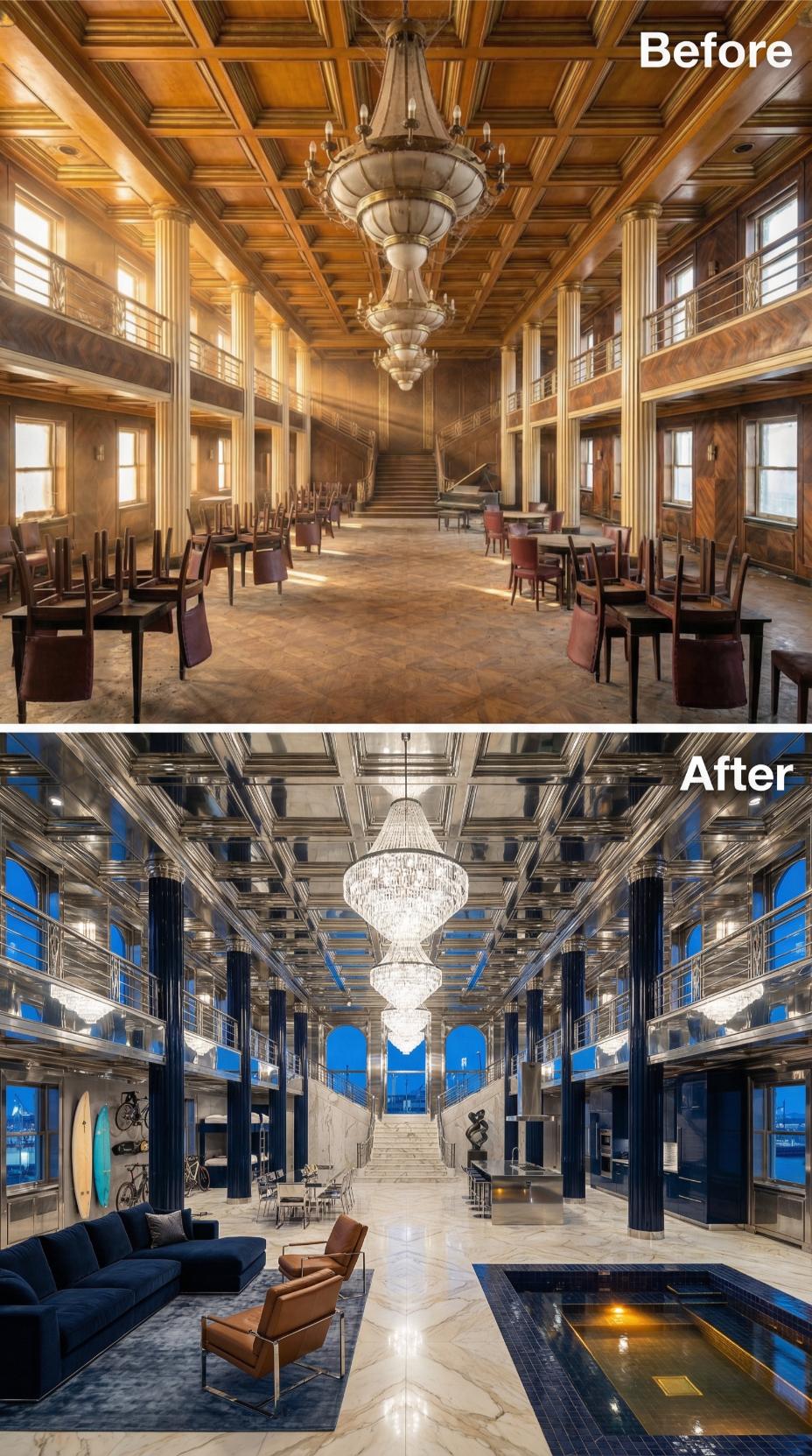
Polished nickel panels now line the coffered ceiling grid where warm mahogany once absorbed the light. The original column rhythm survives, clad in deep navy lacquer, anchoring a floor of cream travertine laid in a herringbone pattern that runs the full length of the hall toward the restored grand staircase.
A three-tier crystal chandelier, far larger than the brass fixture it replaced, hangs at center axis. Below it, a sunken pool with a bronze basin replaces the original parquet dance floor. Navy velvet sectional seating and a cognac leather chair occupy the port side, while a surfboard rack and bicycle storage claim the starboard wall without apology.
By The Numbers: The sunken water feature occupying the former dance floor sits roughly 18 inches below the travertine field level, a depth commonly used in residential reflecting pools to allow surface tension effects without requiring pool safety fencing in most jurisdictions. Nickel-finish ceiling panels, when applied over an existing coffered grid, can increase light reflectivity in a room by 40 to 60 percent compared to painted wood. The original column spacing, preserved here at approximately 12-foot intervals, met modern residential load calculations without structural reinforcement.
21. Coffered Plaster, a Walnut Dining Table, and Warm Herringbone Reclaim a Grand Salon
🔥 Would you like to save this?
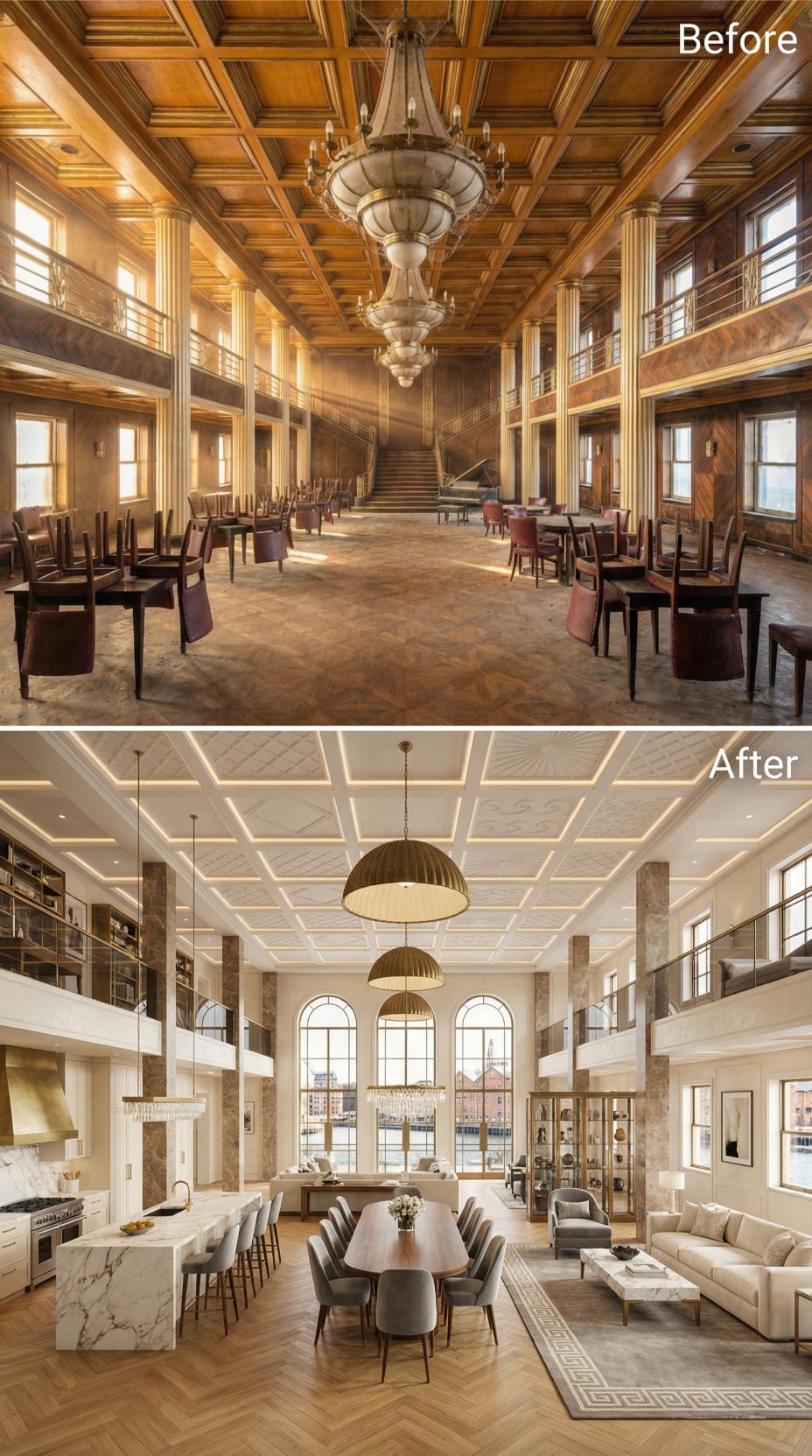
Where dark-stained wood panels once absorbed what little light reached the floor, painted plaster coffered ceilings now reflect it across the full length of the space. LED cove lighting runs each grid channel, casting an even wash that the original bronze chandeliers never could. A single oversized brass dome pendant anchors the dining zone below, its ribbed shade directing light straight onto a walnut dining table ringed by upholstered chairs in charcoal linen.
The kitchen island, clad in Calacatta marble with a waterfall edge, sits perpendicular to the dining axis. White shaker cabinetry runs beneath a brass range hood. On the opposite end, a cream sofa and glass display cabinet organize the living zone around an area rug with a Greek key border in taupe and ivory. Original columns remain, now faced in veined stone rather than gilded wood.
Style Tip: When converting a double-height historic space into residential use, preserving the coffered ceiling grid and relighting it from within solves two problems at once: it honors the original architecture while meeting the higher lumen output a home kitchen and dining area require. Specifying warm white LEDs in the 2700K to 3000K range keeps the effect from reading as commercial.
20. Dark Marble, Warm Leather, and LED Coffered Grid Replace a Faded Ocean Liner Ballroom
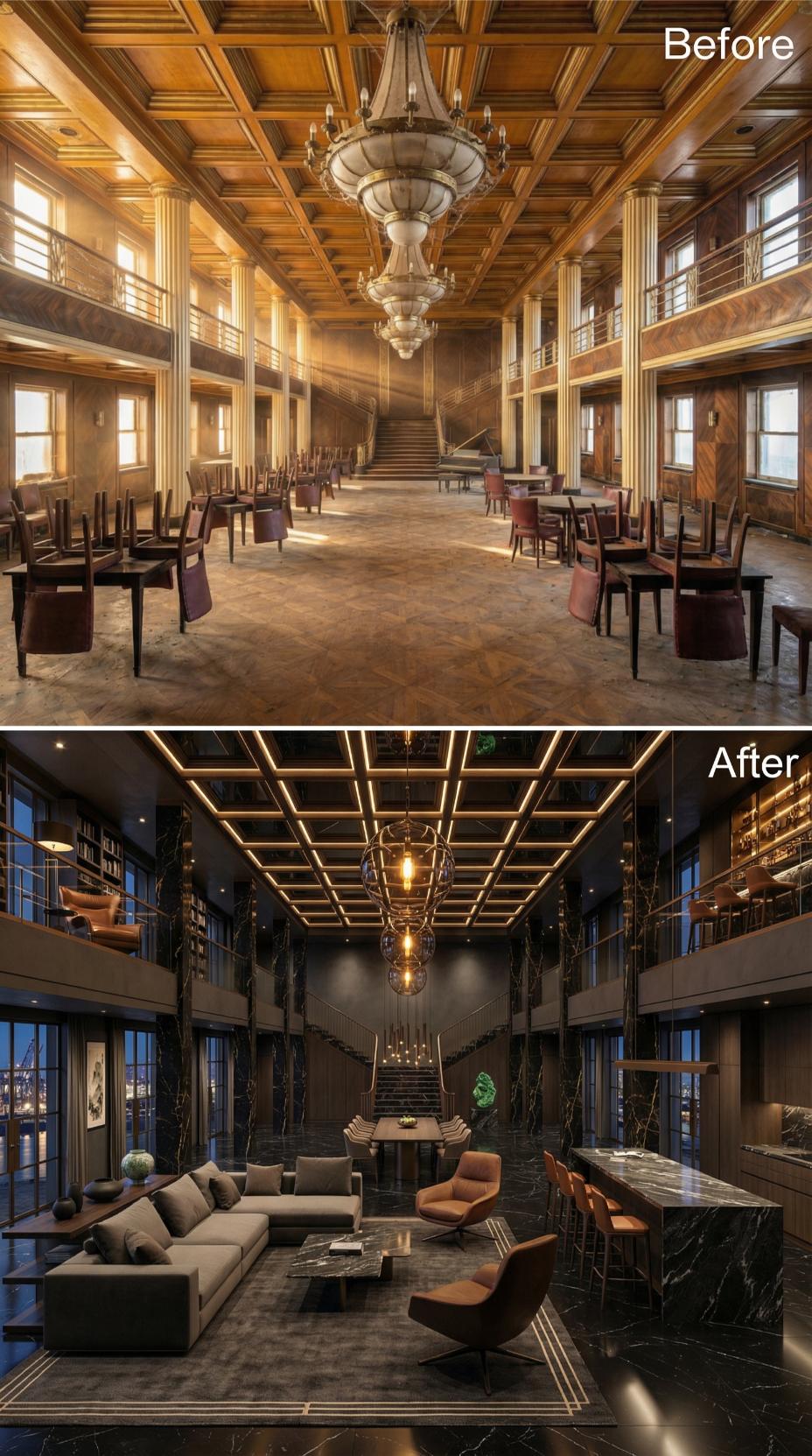
Black Marquina marble covers the bar counter and flooring, its gold veining picked up by the warm-white LED strips recessed into the existing coffered ceiling grid above. Cognac leather chairs anchor a sectional conversation area mid-floor, while open shelving lines the mezzanine rail where fluted columns once drew the eye upward.
History Corner: Grand salons on 1930s ocean liners typically spanned two full decks in height, a structural decision made to signal prestige to first-class passengers rather than for any practical purpose. That double-height volume is precisely what makes these spaces viable for residential conversion today, since modern building codes rarely permit new construction at equivalent ceiling heights in private homes.
19. Travertine Columns, LED Coffered Grid, and Cognac Leather Replace Gilded Ballroom Darkness
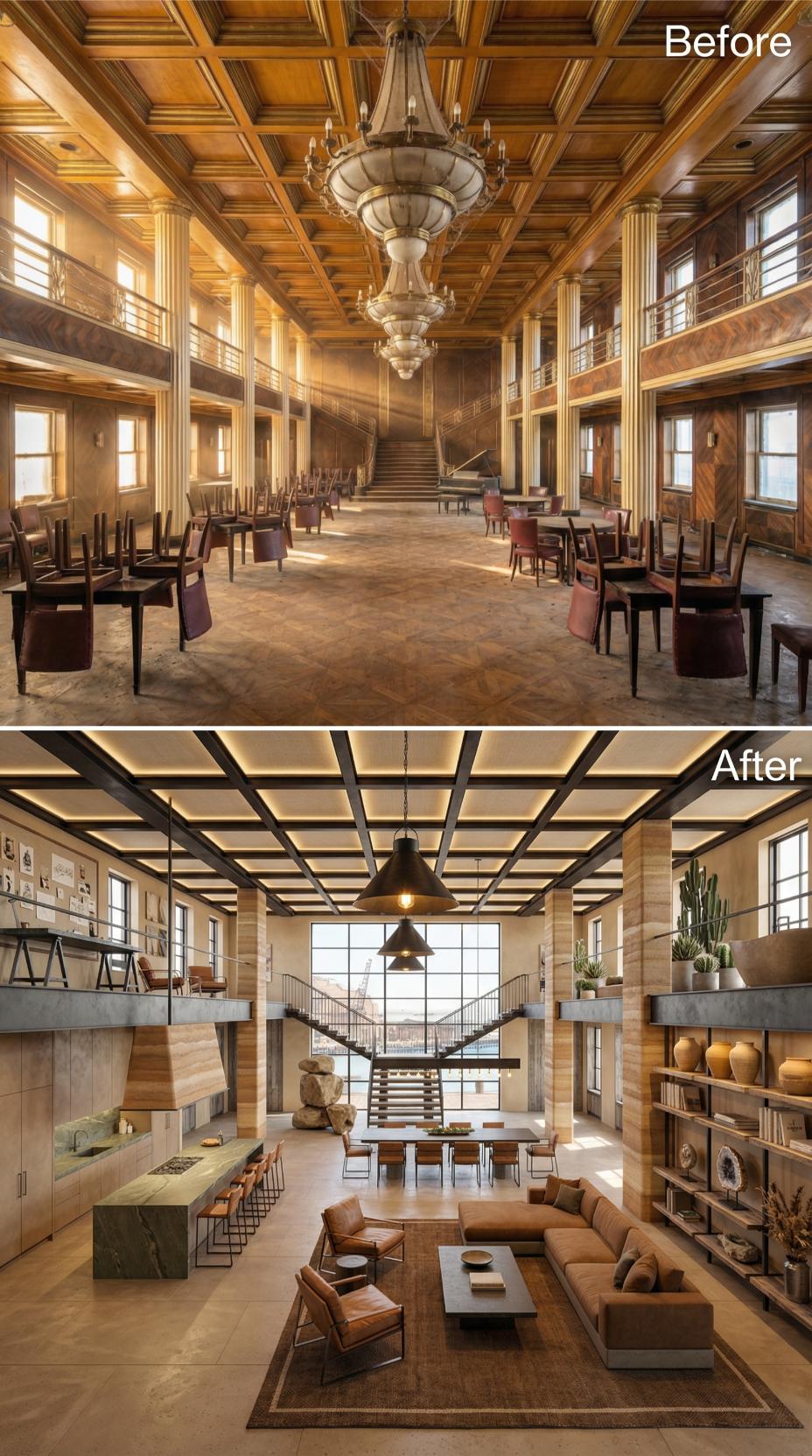
Sand-toned travertine cladding now covers the original column shafts, pulling warmth from the stone rather than from stained wood. Black steel ribs divide the coffered ceiling into a geometric grid with LED strips recessed along each channel, casting even ambient light across the entire double-height volume. On the left, a green marble island anchors a kitchen bar lined with black metal stools. Open shelving on the right holds ceramic vessels and books. Cognac leather chairs and a low sectional define the seating zone closest to camera, arranged around a concrete slab coffee table on a jute rug.
Color Story: Travertine and cognac leather occupy opposite ends of the warm neutral spectrum, with the stone running cool and the leather pulling amber. Pairing them across a large floor plan prevents either material from reading as dominant. The green marble island functions as the single chromatic break, grounding the kitchen end without introducing a second accent color elsewhere in the room.
18. Onyx Ceiling Panels, a Globe Pendant, and Bleached Travertine Gut a 1930s Grand Salon
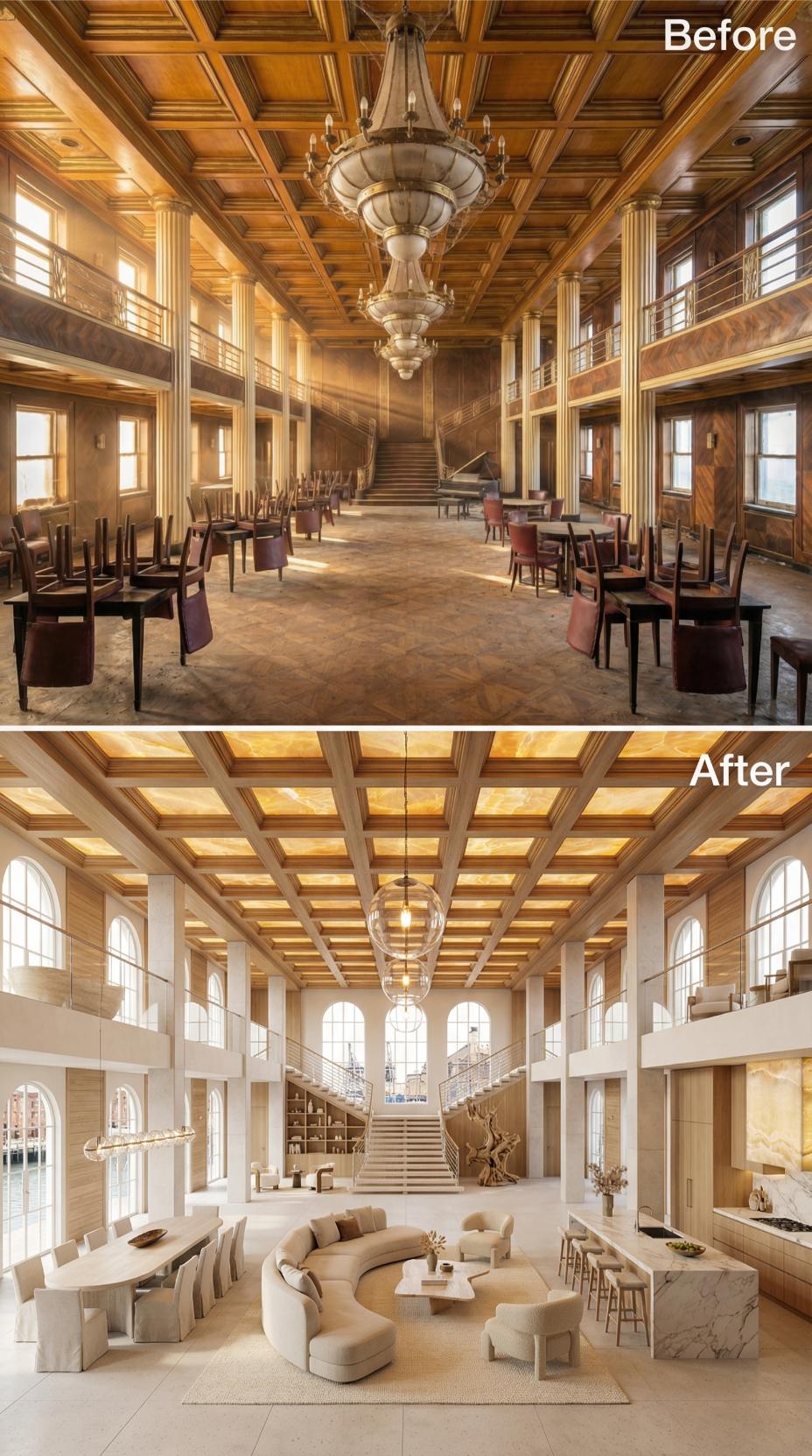
Backlit onyx inserts replace the original dark wood coffered panels, casting amber warmth across walls clad in honed travertine. A blown-glass globe pendant anchors the central axis above a curved sectional in oatmeal bouclé fabric.
Common Mistake: Designers often prioritize the ceiling or the floor in a high-volume conversion, but neglecting wall treatment in a double-height space leaves the middle third of the room visually unresolved. In this renovation, continuous travertine cladding from baseboard to second-level rail keeps the eye moving through the full vertical range rather than stalling at furniture height.
17. Coffered Ceiling Painted Dark, Marble Columns Kept, Grand Salon Becomes Deluxe Residence
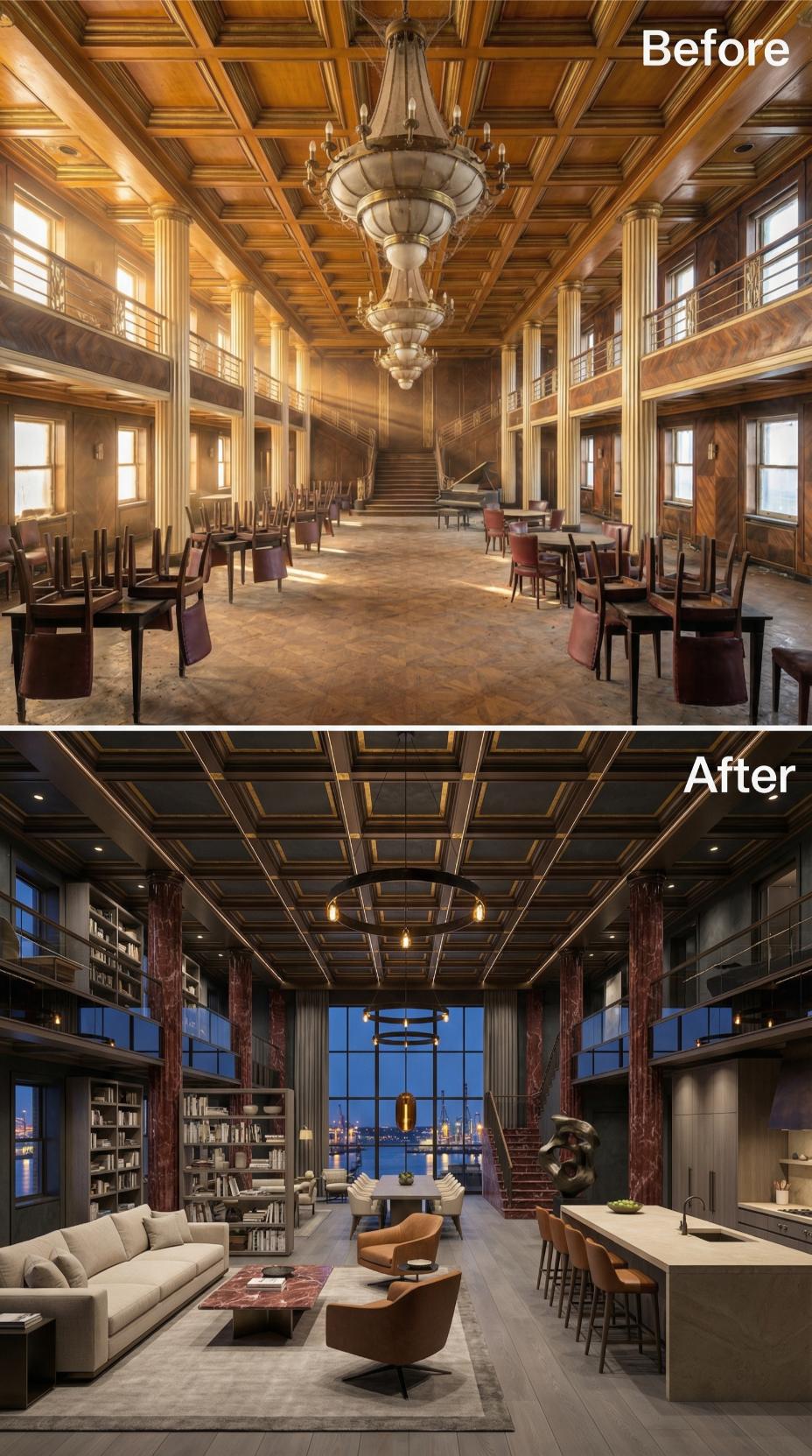
Designers painted the original coffered grid near-black and retained the gold trim channels, which reverses the warmth of the before state without removing the architectural bones. Rouge marble columns replace the original gilded pilasters and anchor the double-height walls at regular intervals. Floor-level seating groups a long cream sofa, a cognac swivel chair, and a slab-leg coffee table in veined red marble. Built-in bookshelves line the port wall in matte charcoal. A kitchen island with a stone waterfall edge and leather bar stools occupies the starboard side.
Why It Works: Keeping the coffered grid while repainting it a near-black tone is a reversal strategy that preserves structural authenticity while shifting the entire mood of the volume. The gold trim channels, original to the 1930s liner construction, now read as accent lines rather than the dominant surface feature they were. That inversion costs far less than replacement and delivers a result no new build can replicate.
Not every conversion reaches for drama; some let raw architectural bones carry the weight instead.
16. Skylight Cut, Travertine Laid, Grand Salon Reborn as an Open-Plan Residence
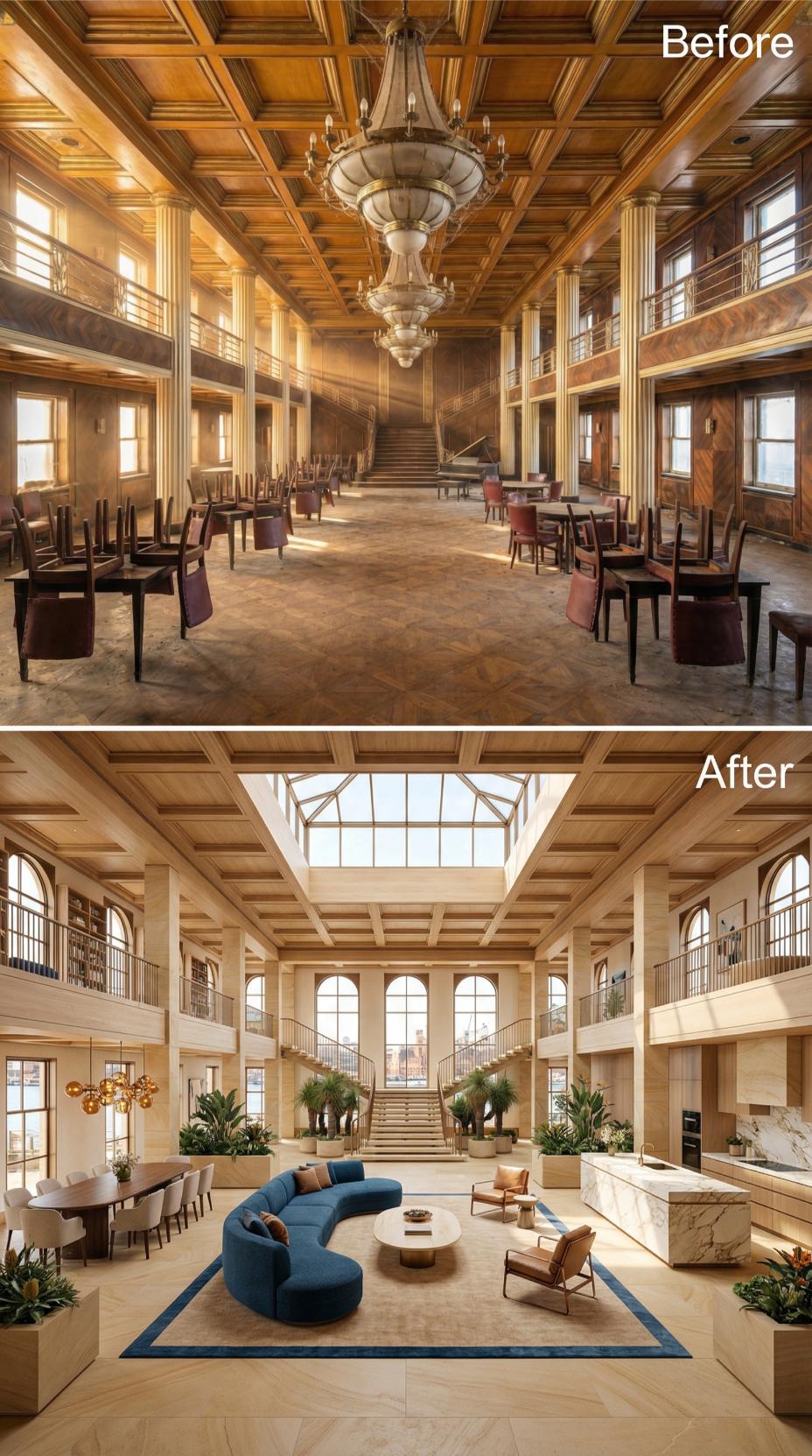
Dark coffered wood gave way to bleached wood beam work and a full-length skylight punched through the ceiling plane, flooding the double-height salon with natural light that the original 1930s chandelier never could. The staircase, now flanked by potted palms and open metal railings, anchors the far wall while arched window surrounds replace what were once porthole-scaled openings.
At floor level, a curved navy sectional sofa sits on a wool area rug with a deep blue border, paired with tan leather accent chairs around a drum coffee table in brushed brass. To the right, a marble-topped island with a waterfall edge defines a kitchen zone without a wall. Pendant clusters in aged brass hang over a long dining table on the opposite side, keeping the plan open across its full width.
15. Brick Columns, Skylights, and Burgundy Velvet Gut a Grand Salon’s Gilded Shell
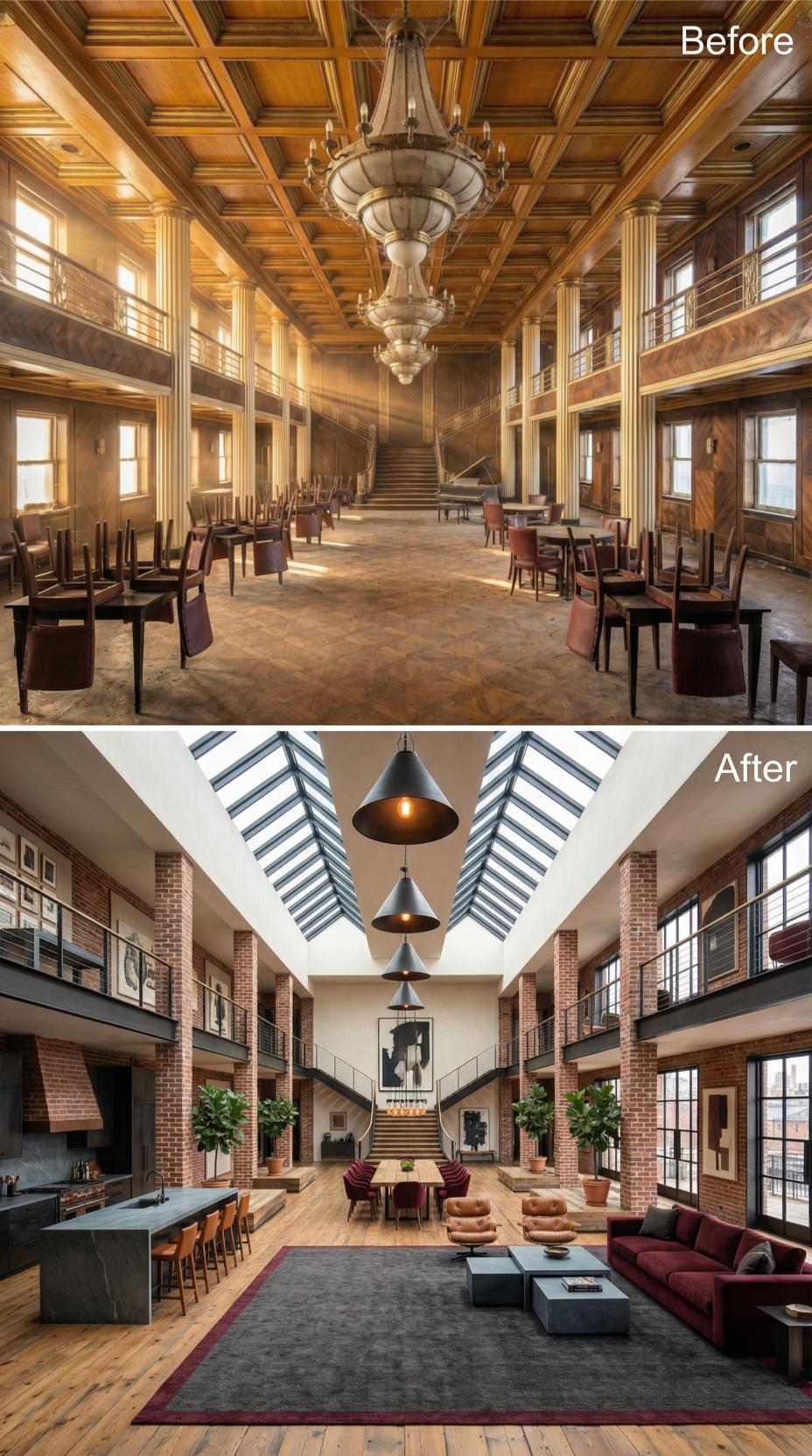
Exposed brick columns replace the original lacquered wood cladding, while a continuous sawtooth skylight runs the full ceiling spine, flooding wide-plank pine floors with natural light. Matte black cone pendants hang in a descending trio at center. A burgundy sectional anchors the living zone opposite a kitchen counter in slate-grey stone with leather bar stools.
Budget Tip: Installing sawtooth or clerestory skylights into an existing double-height roof shell often costs less than a full rooftop addition because the structural ridge is already in place. In adaptive reuse projects, reusing that original framing can shave weeks off permitting timelines and reduce material waste significantly.
14. Glass Roof, Stacked Stone Columns, Green Marble Island Replace Gilded Liner Ballroom
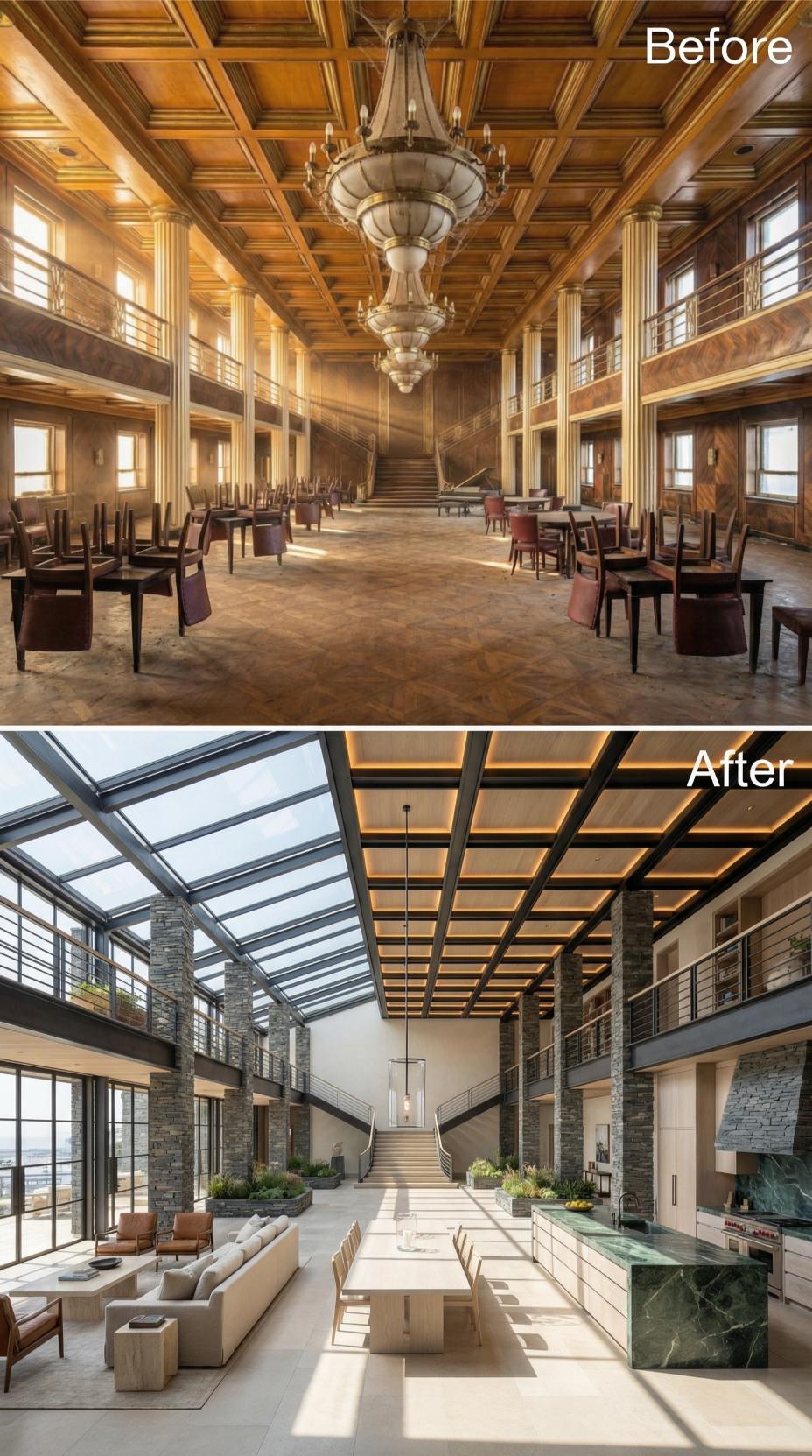
Stacked slate columns anchor the double-height volume where fluted mahogany pilasters once stood, while a sawtooth glass roof floods the former salon with daylight the original 1930s interior never received. A green marble island with thick waterfall edges grounds the kitchen zone on the right. Cream sectional seating and a long travertine dining table fill the port side, with leather chairs pulled close.
13. Gold Coffered Grid, Crystal Chandelier, Blue Zellige Tile Reclaim a 1930s Grand Salon
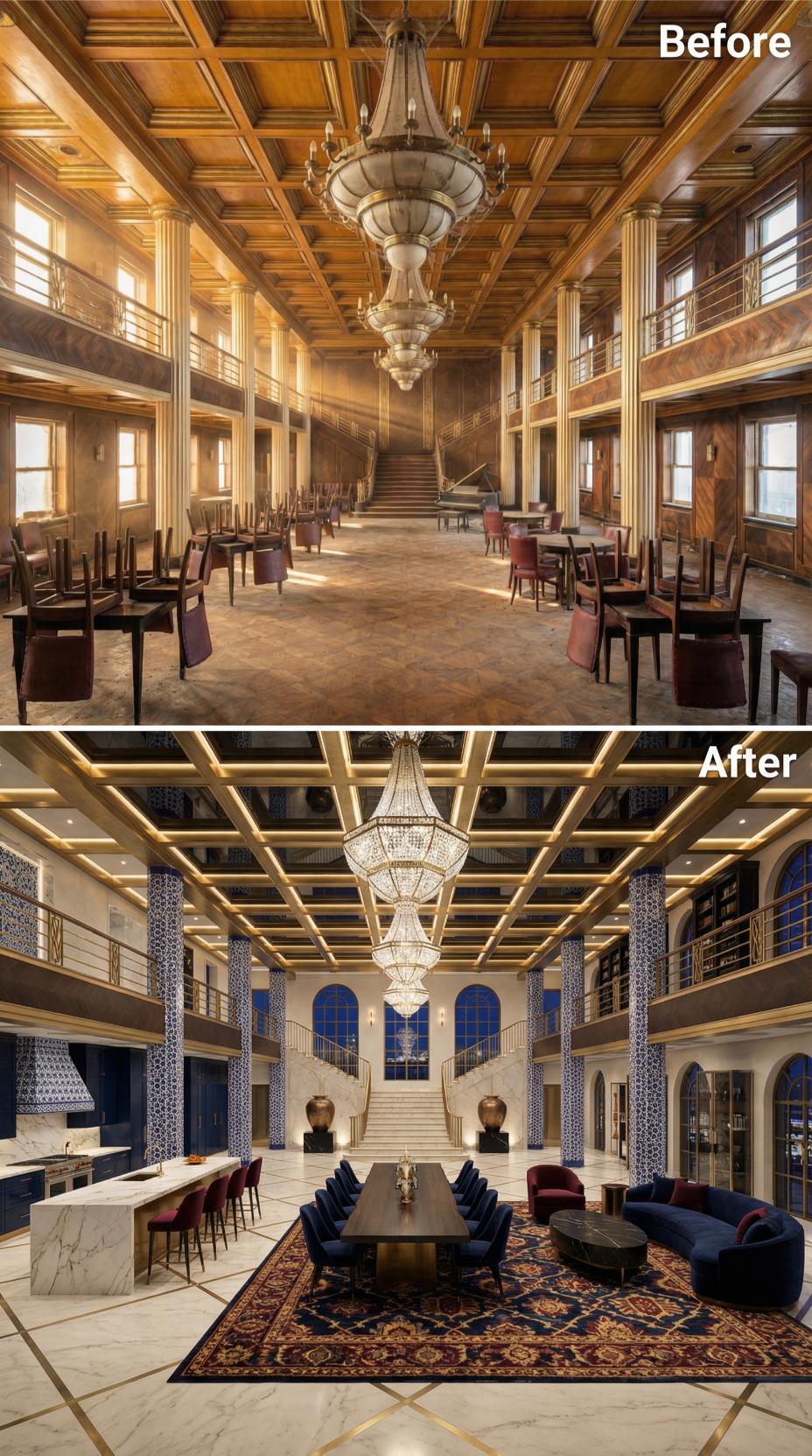
Warm walnut paneling and a candle-armed chandelier gave way to a white plaster ceiling with brass-trimmed coffers lit by recessed strip lighting, while a multi-tier crystal chandelier now anchors the full double-height volume. Zellige tile in cobalt and white sheathes the columns floor to balcony rail, and arched windows with deep navy glazing replace the liner’s original rectangular portholes.
A dark wood dining table seats twelve under the chandelier, flanked by navy velvet upholstered chairs, with a Persian rug in crimson and gold defining the seating zone. A marble island with waterfall edges and navy cabinetry occupies the port side, and a curved burgundy sofa closes the starboard lounge corner near brass balcony railings.
12. Skylight Cut Into Liner Roof, Cream Sofas and Marble Island Laid Below
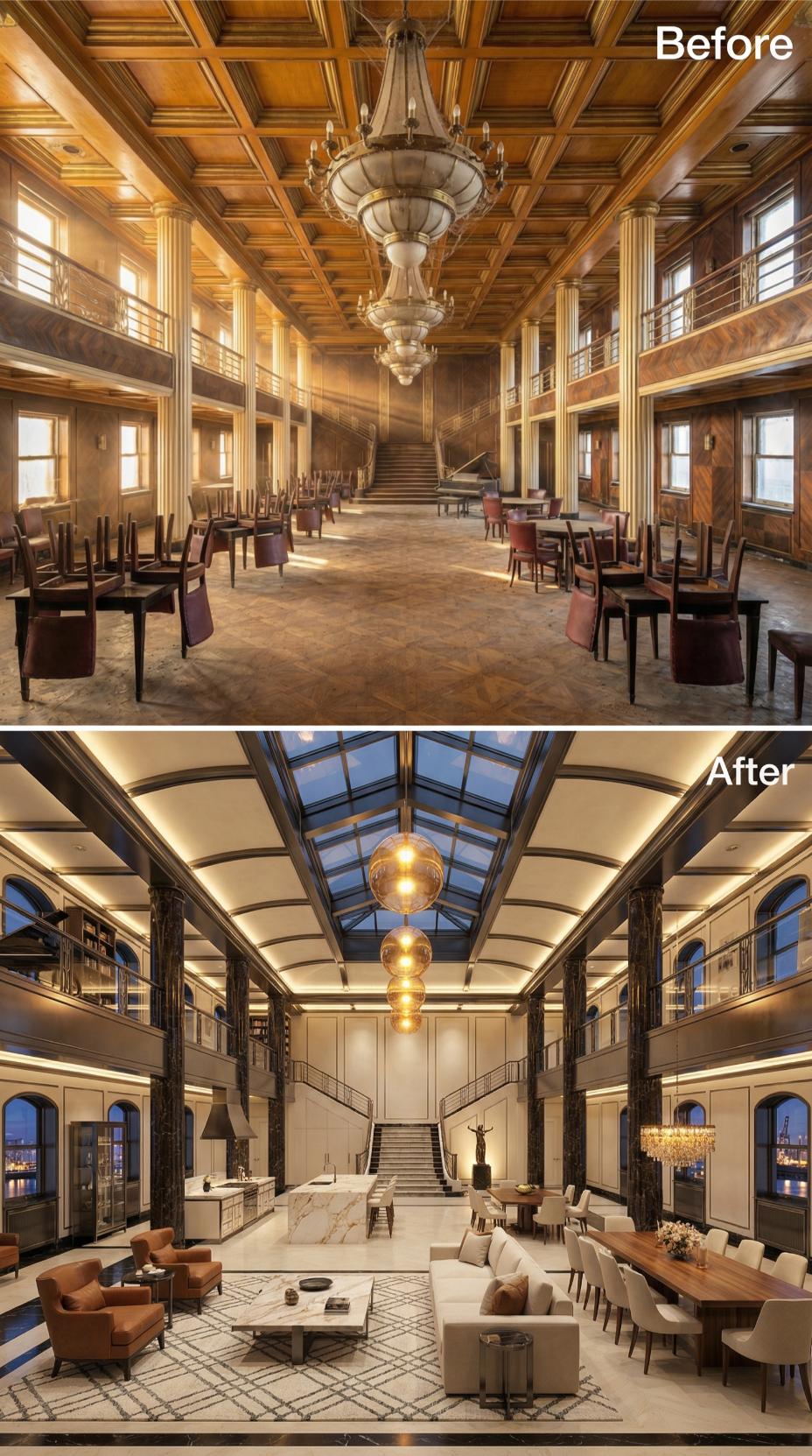
Barrel-vaulted skylights replace the coffered walnut ceiling, flooding the double-height hall with natural light while globe pendants in brushed brass handle evening coverage. Cream linen sofas anchor the living zone over a geometric wool rug, and a marble-topped island with a waterfall edge defines the kitchen without walls.
11. Plaster Ceiling Dropped, Brass Pendants Hung, Grand Salon Reborn as Open-Plan Residence
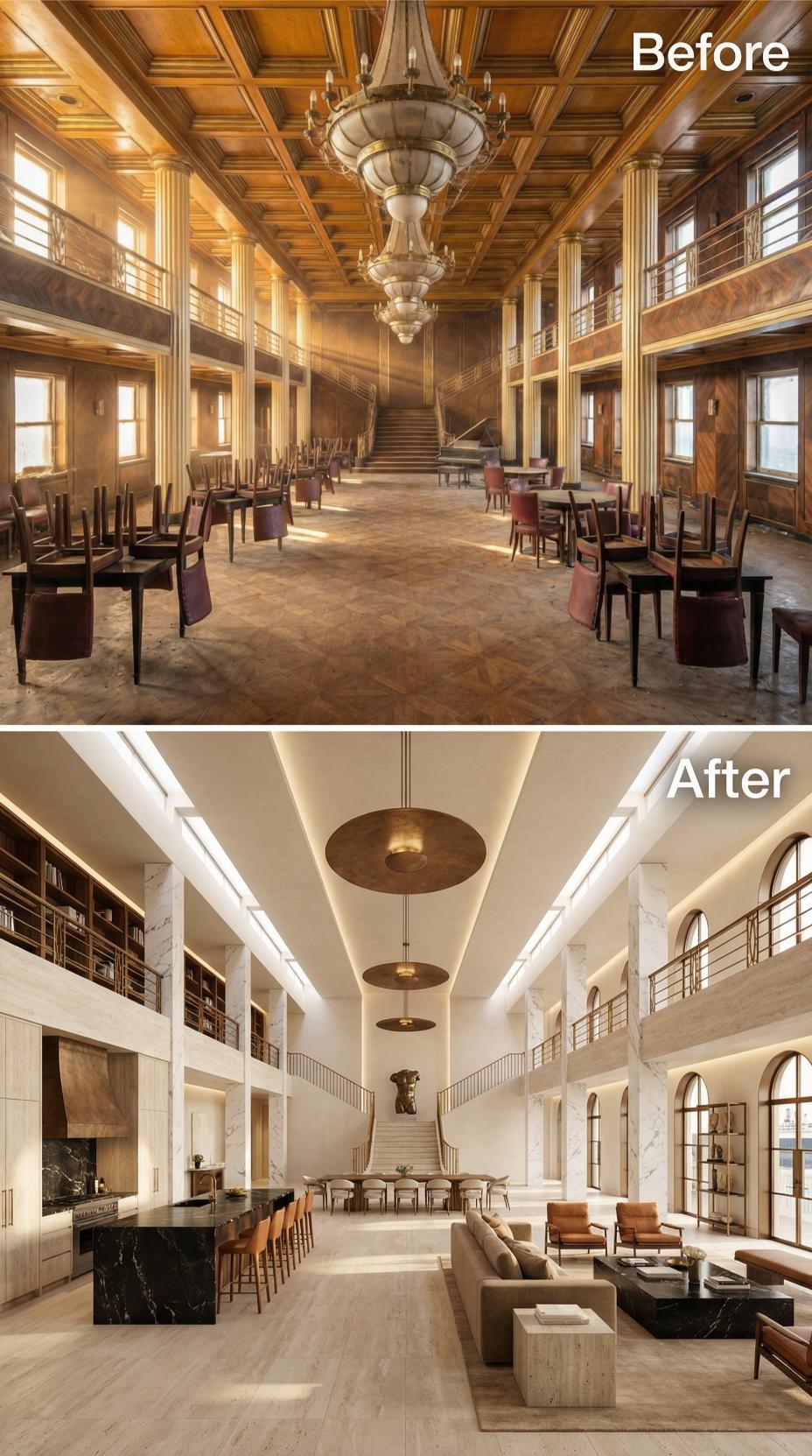
Creamy plaster replaced the original walnut coffered ceiling entirely, with recessed linear LED strips and three tiered brass disc pendants now handling all overhead light. Below, wide-plank pale oak flooring runs the full length of the double-height hall, anchoring a black marble kitchen island with leather barstools on the port side and a low sectional in greige fabric opposite.
10. Skylight Cut, Coffered Ceiling Gone, Grand Salon Floors With White Oak and Marble
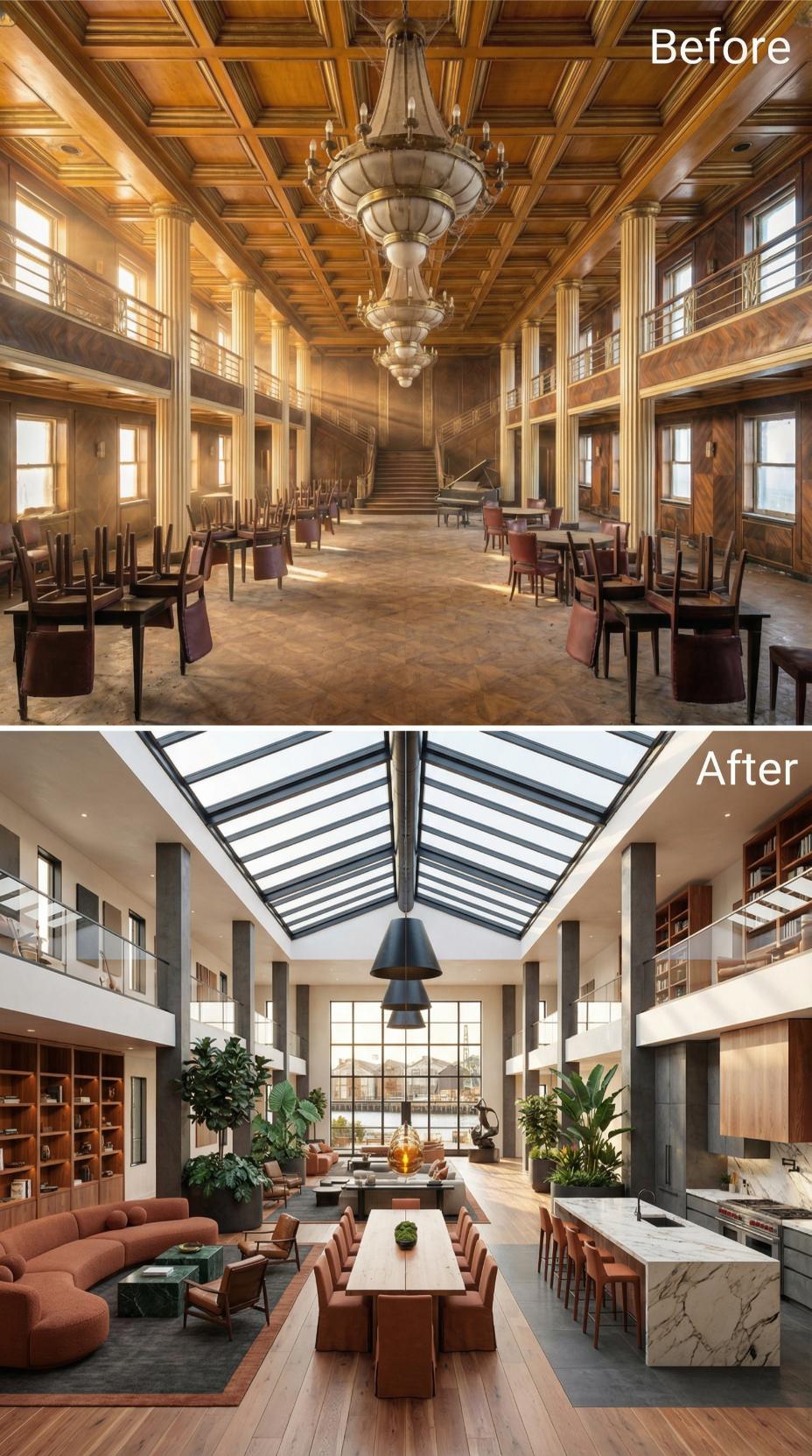
Where a gilded coffered ceiling and dusty parquet once defined a 1930s liner ballroom, a ridge skylight now runs the full length of the roof, flooding the interior with daylight. The original double-height shell is intact, but the walls are now white plaster with charcoal steel columns standing in place of the ornate gilded pilasters. A glass-panel mezzanine rail replaces the carved balustrade above.
Below, warm-toned open shelving in what reads as walnut lines the left wall, while a waterfall-edge marble island anchors the kitchen at right. Rust-orange curved sectionals and leather dining chairs pull the color register back toward the liner’s original palette, though nothing else does.
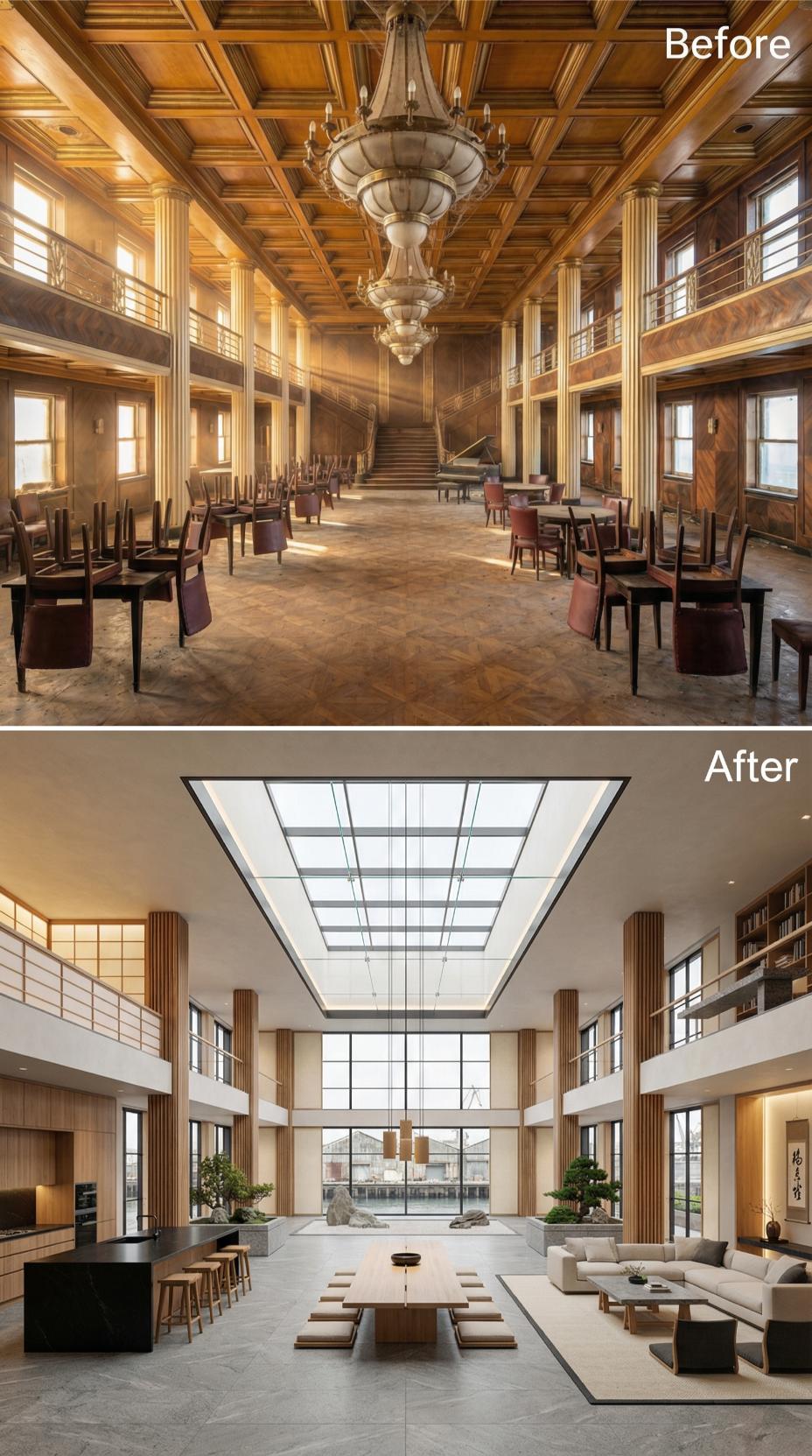
9. Skylight Punched Through, Bonsai and Linen Sofas Replace Grand Salon Gilt
🔥 Would you like to save this?
Bleached oak slat columns rise where the liner’s gilded pilasters once stood, their vertical grain echoing the original rhythm without the weight of lacquer and gold leaf. A glass skylight spans the full length of the ceiling, flooding grey stone floor tiles with daylight the coffered mahogany roof had blocked for decades. Pendant cylinders in brushed brass hang from the skylight frame at staggered heights above a low dining table surrounded by floor cushions.
The seating area anchors the far right with a cream linen sectional, a low travertine coffee table, and a potted bonsai planted directly into a gravel garden set flush with the floor. Shelving in natural ash lines the upper mezzanine rail. Calligraphy scrolls hang on the plaster wall, adding ink-black vertical marks against the otherwise uninterrupted cream palette.
8. Mirrored Gold Lattice Ceiling, Cascading Crystal Chandelier, Marble Floor Reclaim Liner Grand Salon
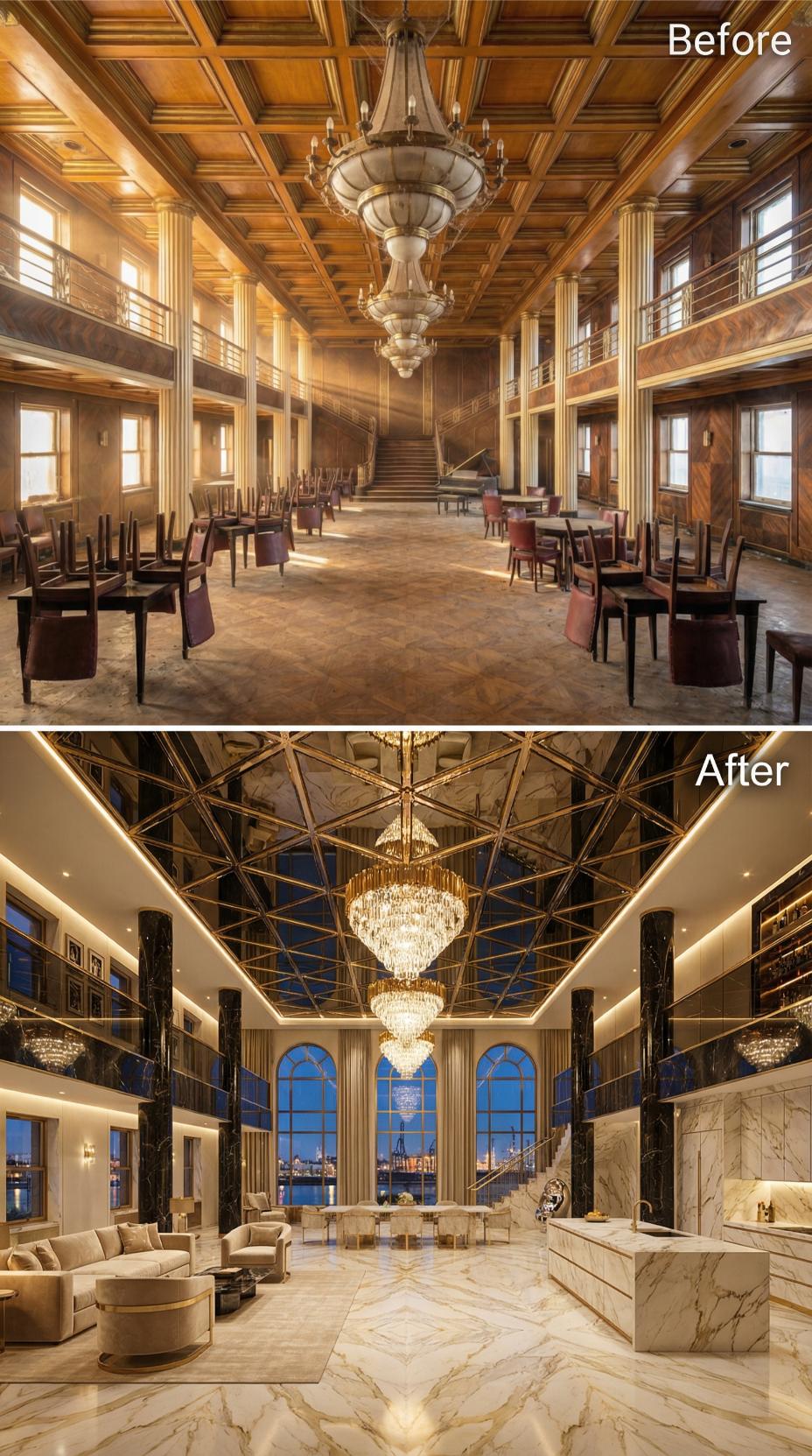
Gold geometric lattice work spans a mirrored ceiling above columns clad in black veined marble, while a multi-tiered crystal chandelier anchors the central axis. Cream bouclé sofas curve around a low travertine table, and a waterfall-edge marble island defines the kitchen zone at right. Arched windows frame a city skyline beyond.
7. Perforated Steel Drum, Walnut Columns, Green Marble Island Gut the Gilded Liner Shell
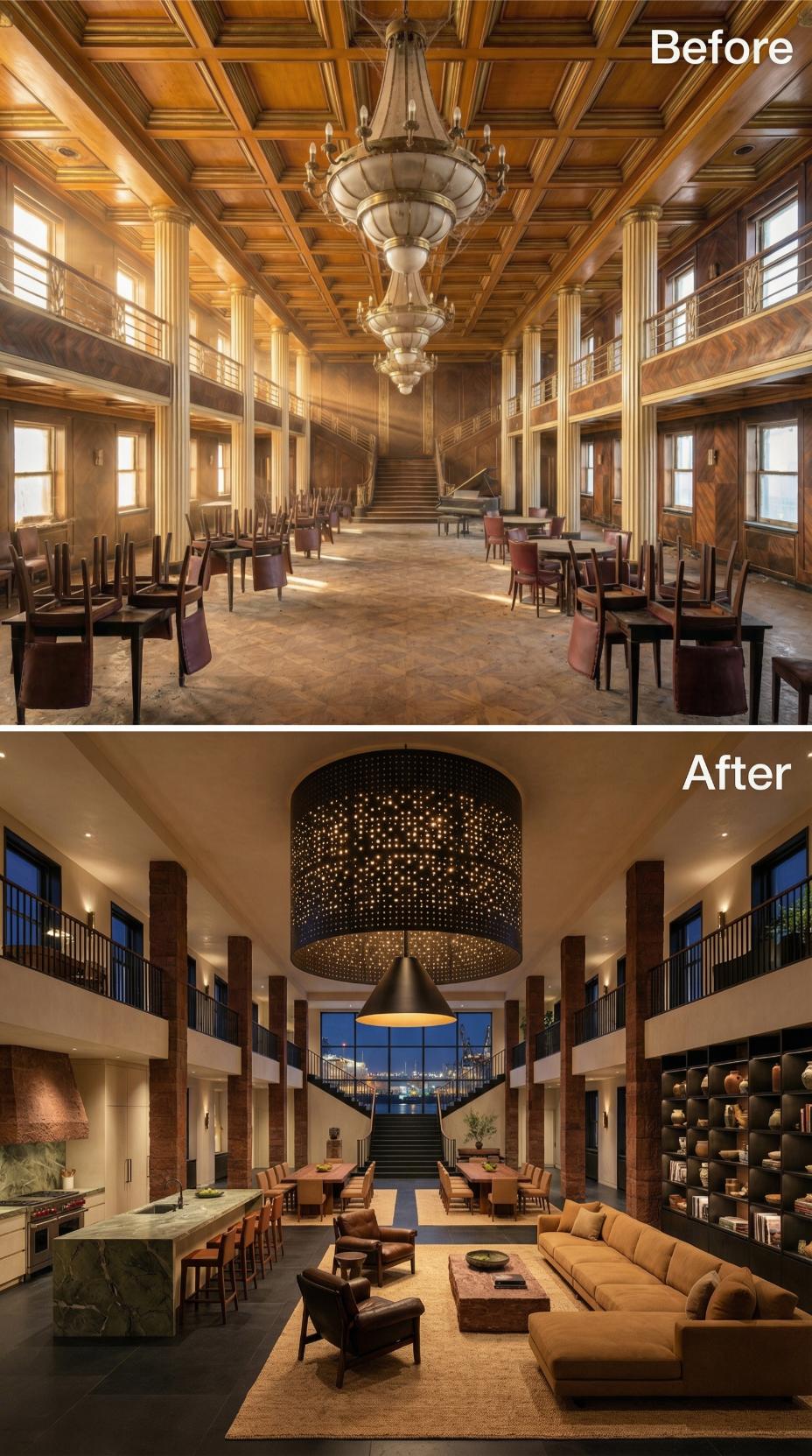
Every remnant of the 1930s wood-paneled coffered ceiling is gone. In its place, a cylindrical steel pendant the diameter of a dining table hangs centered on the room’s vertical axis, its perforated drum scattering pinpoint light across cream plaster walls. The original double-height volume and grand staircase remain, but the staircase now frames a floor-to-ceiling window reading the nighttime harbor beyond.
At ground level, a green marble island anchors the kitchen to the left, its veining running counter to the clean vertical lines of the columns. Seating splits between a sectional in camel-tone fabric and a pair of leather armchairs in near-black. Open shelving units line the right wall, filled with ceramic vessels in ochre, rust, and matte brown rather than books.
6. Coffered Wood Shell Stripped Back, White Marble and Bonsai Laid Into the Hull
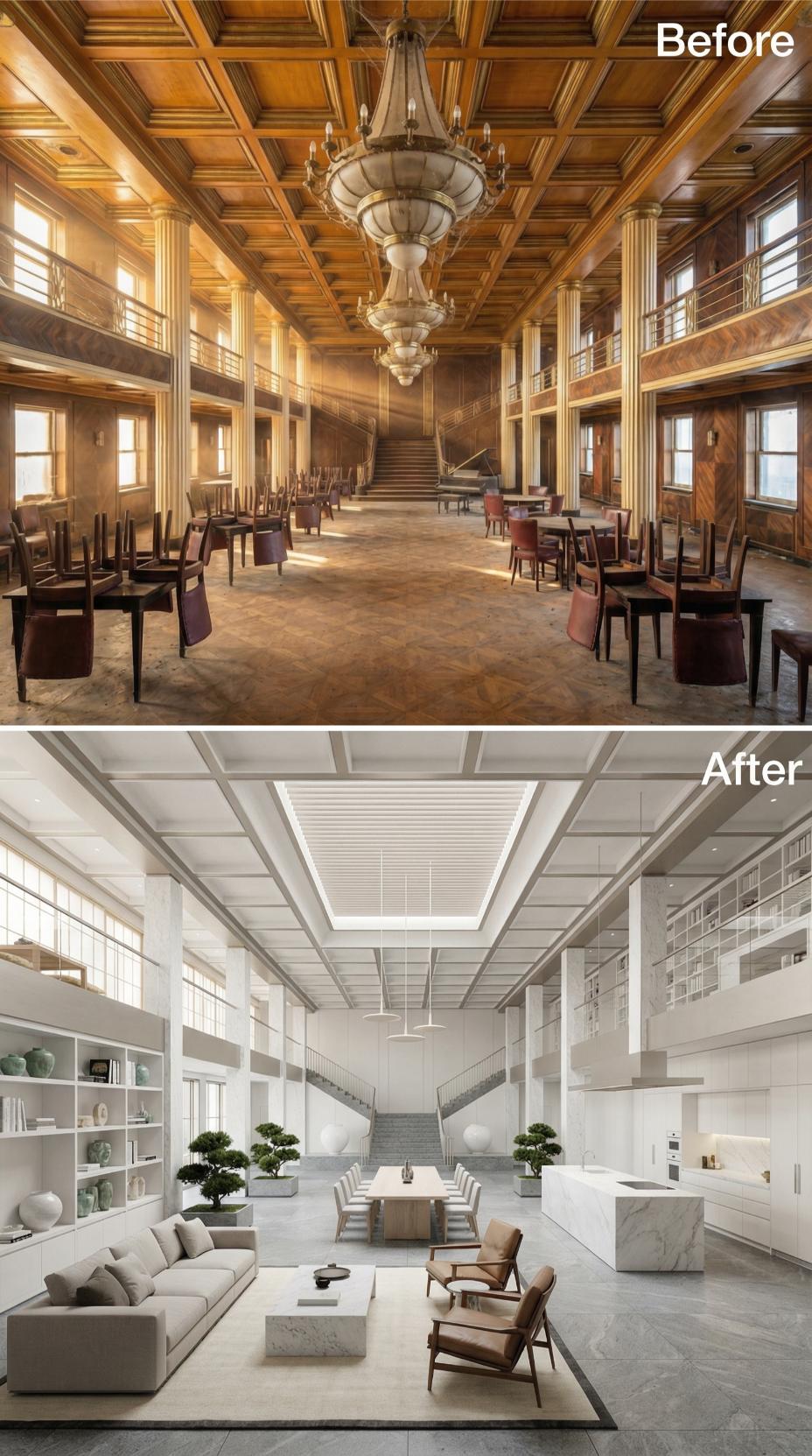
Flat white paint now covers every surface the original walnut veneer and gilded column capitals once occupied, including the coffered ceiling grid, which retains its recessed geometry but reads as a graphic pattern rather than an ornamental one. Pendant lights on thin cables drop from the central bay. Below, a long marble dining table runs the full axis toward the staircase, flanked by upholstered chairs in oatmeal fabric. Bonsai specimens in white ceramic pots anchor the transition between dining and living zones.
The living arrangement uses a low-profile linen sofa, a travertine slab coffee table, and a pair of teak-framed lounge chairs in cognac leather. Open shelving units finished in matte white line the port wall, holding celadon ceramics and books. The kitchen counter on the starboard side is honed Calacatta marble with flush cabinetry and no visible hardware.
5. Dark Steel Roof Grid, Exposed Brick Columns, Raw Oak Floor Reclaim the Liner’s Gilded Hull
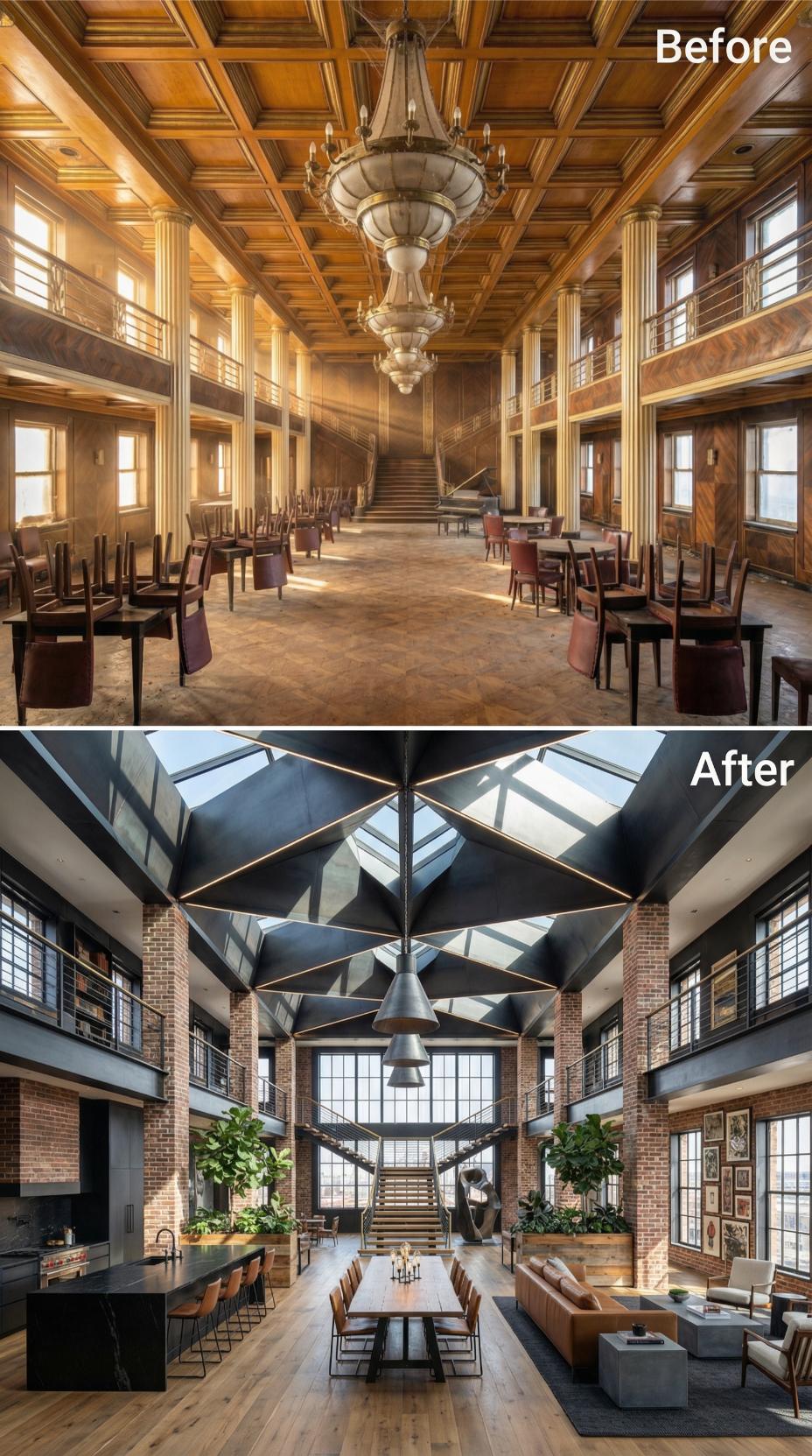
Painted black structural steel now forms a faceted skylight grid overhead, pulling daylight into a footprint that once held a coffered walnut ceiling and a period chandelier. Brick columns flank the central axis where fluted wood pilasters once stood, and wide-plank white oak runs the length of the floor.
A long dining table in raw wood seats twelve beneath a conical pendant in brushed steel. To the right, a tan leather sectional anchors the living zone. The kitchen runs along the port wall with a black stone island, matte black cabinetry, and counter-height chairs in caramel leather.
4. Coffered Shell Plastered White, Blue Zellige Columns and Spiral Stair Installed Below
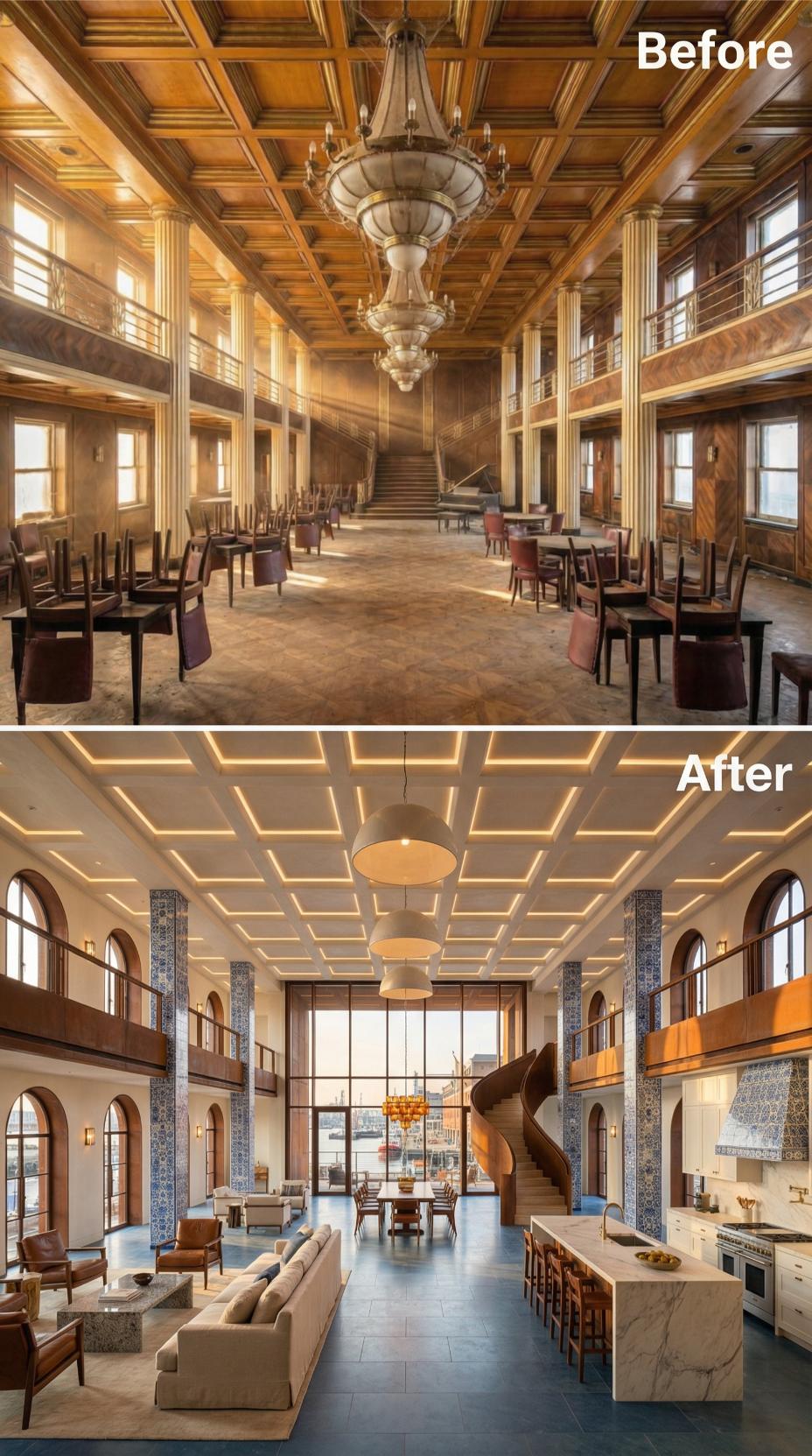
Recessed LED strips now run the perimeter of each coffered panel in the ceiling grid, replacing what was once a wood-clad box hung with a single chandelier. The columns, formerly plain pilasters against dark walnut wainscoting, are now clad floor to capital in hand-painted blue-and-white Portuguese azulejo tile. A spiral staircase in dark-stained wood occupies the axis where the original straight stair once climbed toward the upper deck.
The floor shifts from parquet to large-format slate-blue stone tile, laid without pattern breaks across the living area, dining zone, and kitchen island run. That island is faced in veined white marble with bar-height wood stools pulled up along one side. Arched window surrounds replace the original rectangular frames, softening the hull’s hard geometry without obscuring the harbor view anchoring the far wall.
3. Dark-Stained Coffered Grid, Stone Columns, Barrel Chandelier Reclaim the Liner Hull
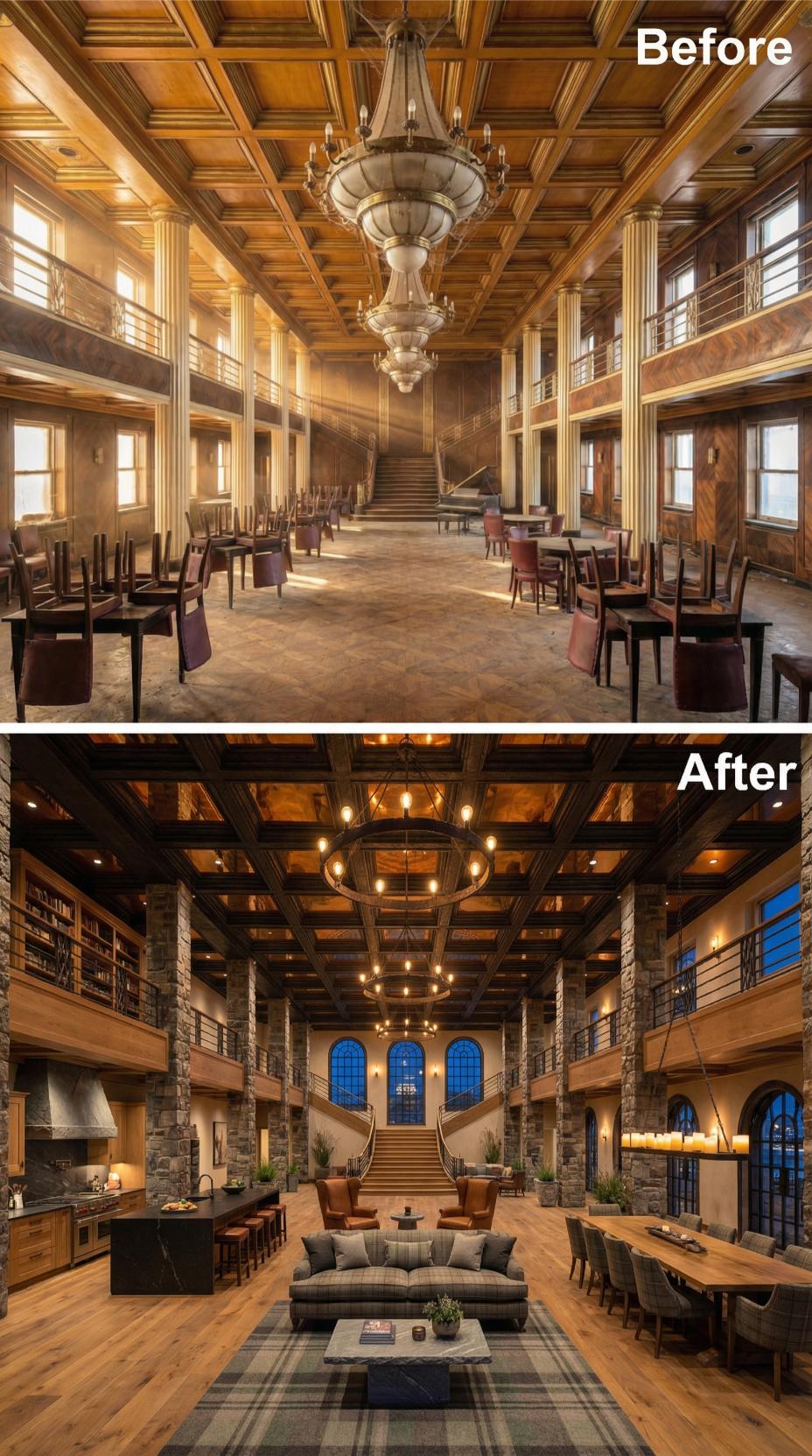
Painted beams dropped to near-black contrast against honey-toned wood panels above, while stacked-stone columns replace the original gilt pilasters and wide-plank oak covers the parquet below.
2. Gilt Columns Relit in Brass, Onyx Panels and a Mirrored Sphere Dropped Into the Liner Shell
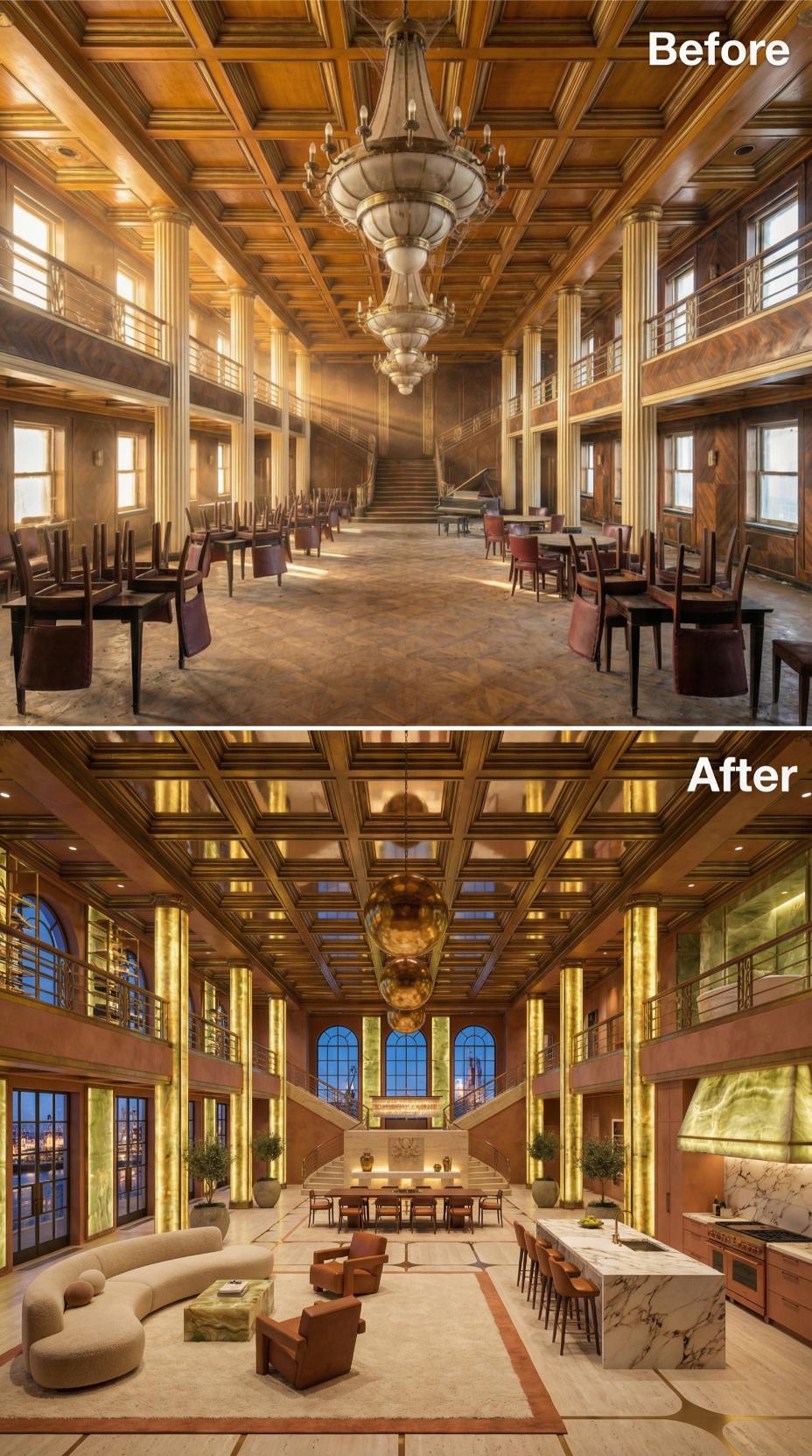
Onyx-clad columns now replace the original wood-paneled pilasters, backlit so the green stone reads almost luminous against the coffered walnut grid above. A single oversized mirrored bronze sphere pendant hangs where the candelabra chandelier once was, pulling ambient light downward onto cream bouclé curved sofas and cognac leather armchairs below.
Arched windows at the far end frame a city skyline at dusk, while a marble waterfall-edge kitchen island in veined white and rust occupies the starboard side. The original double-height mezzanine rail survives, now finished in blackened steel. Herringbone stone floors run the full length underfoot.
1. Warm White Coffered Ceiling, Nero Marquina Columns, Terrazzo Floor Reclaim the Liner Shell
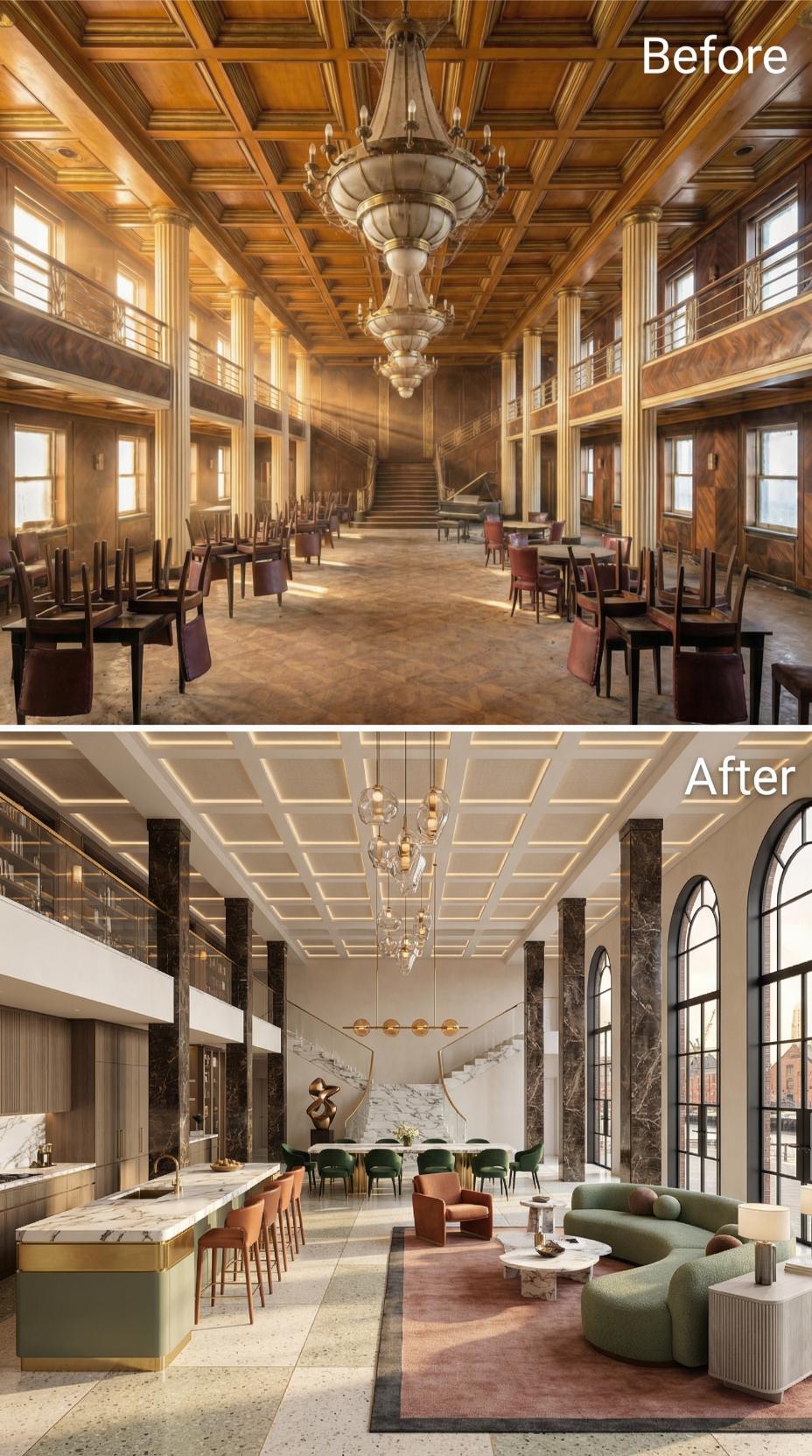
Warm white plaster fills the original coffered grid, now backlit with recessed LED strips tracing each panel edge, while nero marquina marble clads the retained columns in place of the liner’s gilt-painted originals. A sage green island with brass-edged countertops anchors the kitchen run along the port wall, paired with terracotta bar stools in saddle leather. Green velvet dining chairs pull the same sage tone across the central axis, where a cluster of globe pendants in smoked glass drops from a brass spine. Terrazzo flooring in cream and blush aggregate ties the full length of the space together.