🔥 Would you like to save this?
Abandoned lighthouse keeper’s quarters sit at one of architecture’s most productive intersections — extraordinary location, extraordinary constraint. Built for maritime function rather than human comfort, these thick-walled Mediterranean stone complexes were designed to withstand the coast rather than celebrate it. That resistance turns out to be an asset. When designers work within structures that refuse conventional thinking — stubborn masonry, irregular floor plans, vaulted engine rooms, salt-worn facades — the results tend to be more resolved than projects built without friction. The constraints do the editing that unlimited budgets and blank sites often fail to produce. What follows documents that process at its most ambitious: 29 decommissioned lighthouse complexes shown before transformation and after, each pushed to the absolute limit of contemporary luxury design. The tower, in every case, remains. It was never the problem. It was always the point.
In order to come up with the very specific design ideas, we create most designs with the assistance of state-of-the-art AI interior design software. Also, assume links that take you off the site are affiliate links such as links to Amazon. this means we may earn a commission if you buy something.
29. Barrel Vault Bones Reborn: Rusted Machinery Out, Marble and Warm Oak In
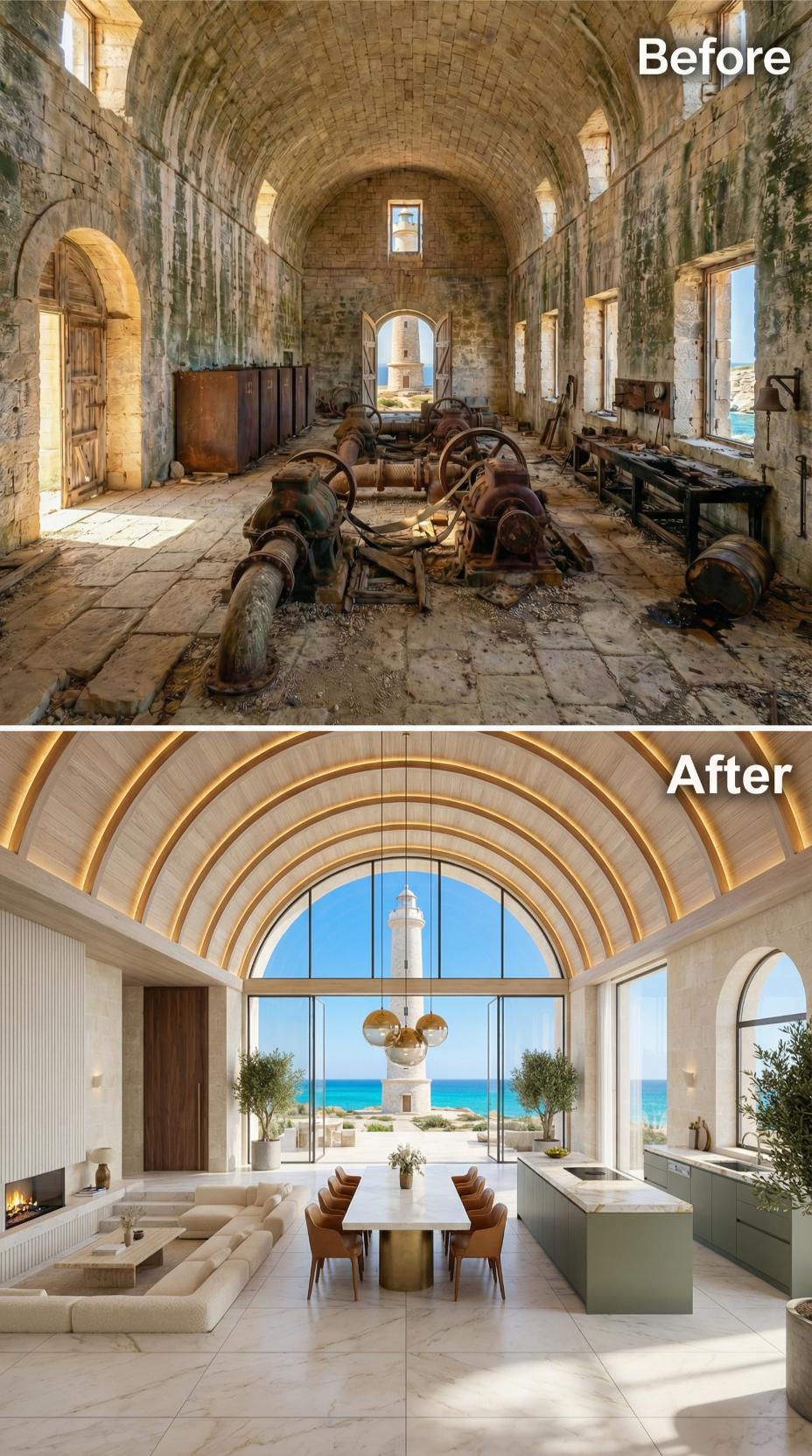
What was once a vaulted stone hall filled with corroded iron machinery and crumbling flagstone floors now functions as an open-plan living and dining space. The original barrel vault structure was retained and lined with pale limestone cladding, its arched ribs accented by recessed warm-amber LED strips that follow each curve to the apex.
A floor-to-ceiling arched glass wall at the far end frames a whitewashed lighthouse tower against turquoise water. Sage-green cabinetry with integrated pulls lines the kitchen island, topped with white veined marble. Leather dining chairs in cognac sit around a brass-legged table beneath three globe pendants in brushed gold.
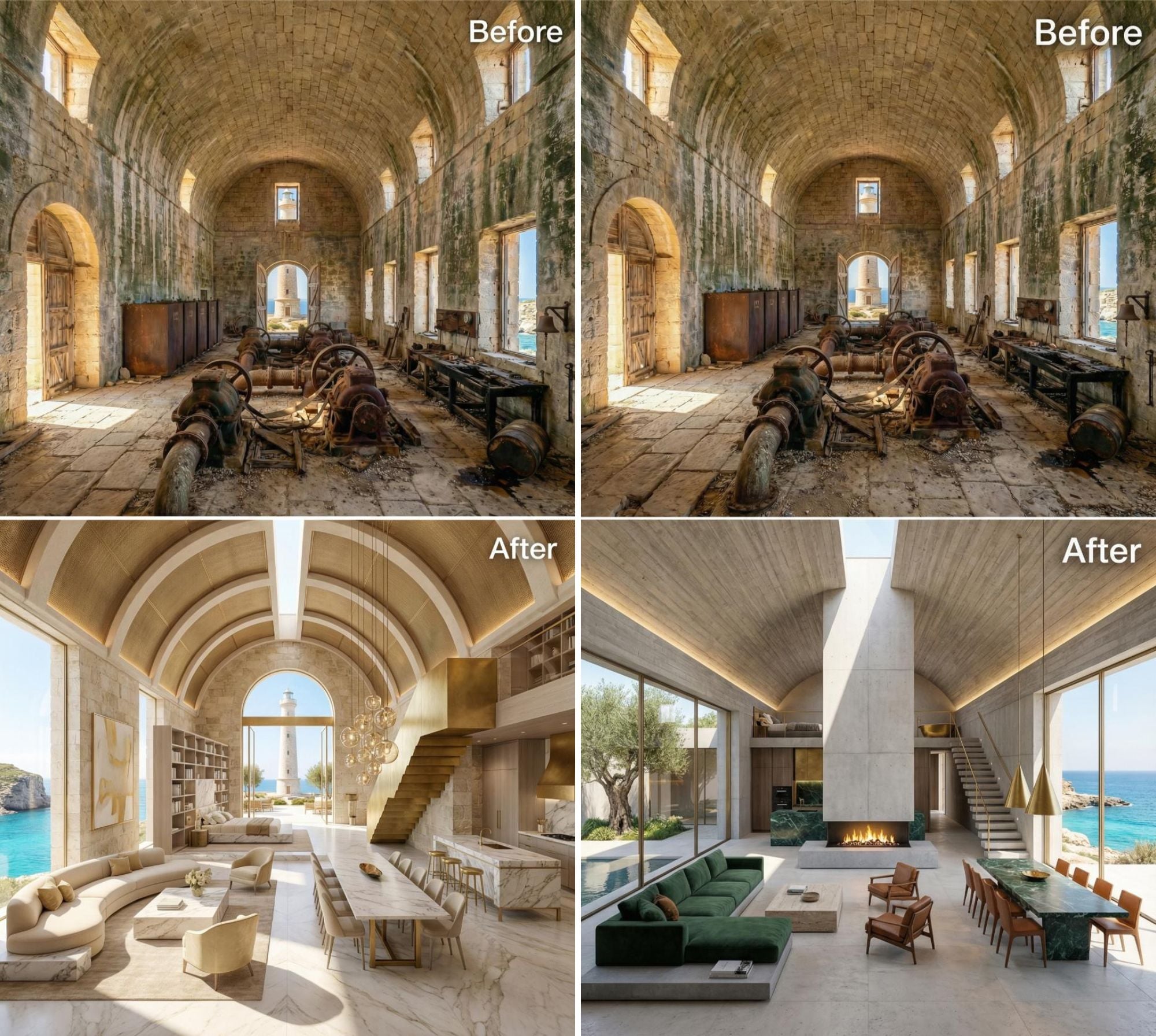
28. Stone Barrel Vault, Marble Island, Fireplace at Center: One Room Does It All
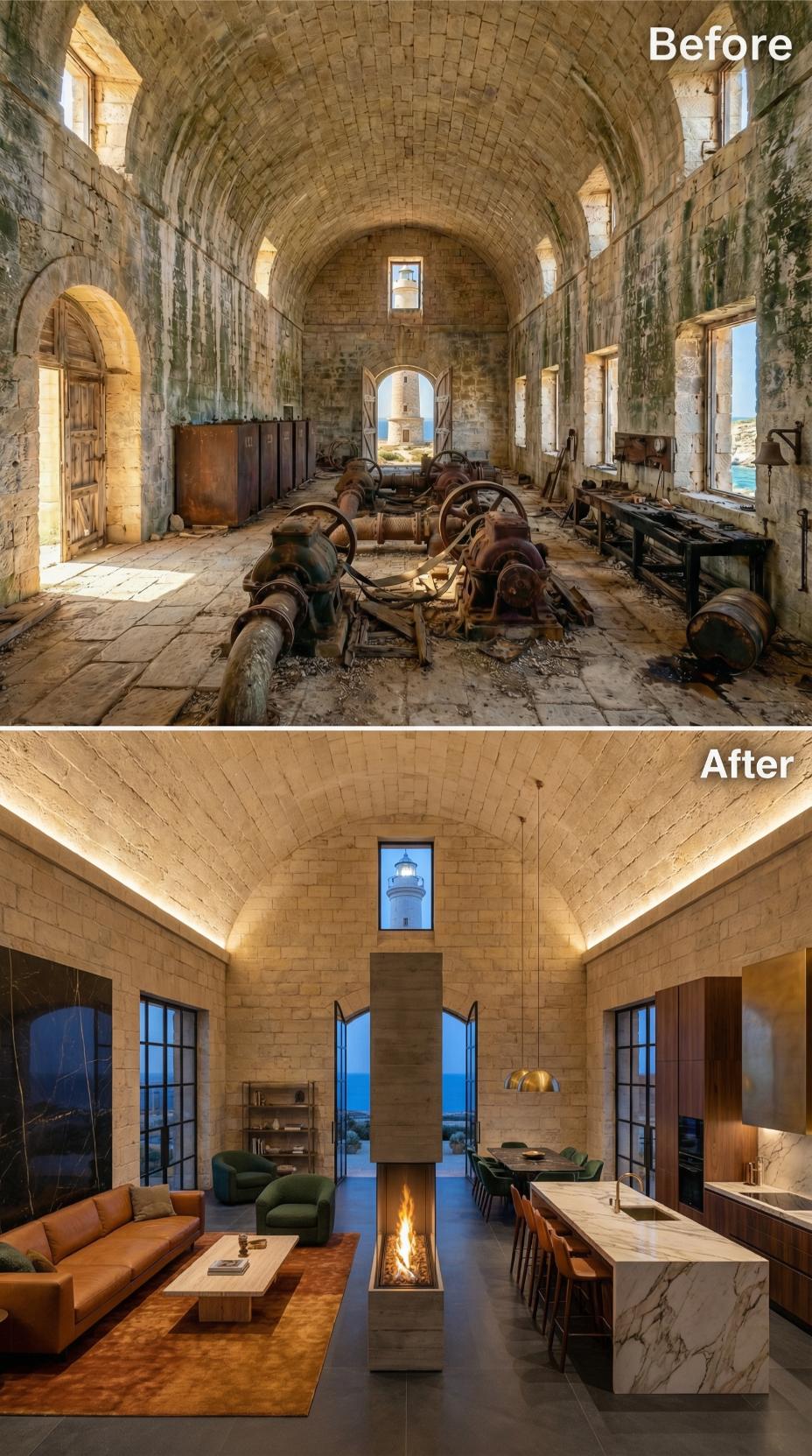
Rusted winches and collapsed debris have given way to a living-dining-kitchen layout that runs the full length of the original barrel-vaulted nave. The cleaned limestone voussoirs remain exposed overhead, now lit from below by a continuous warm strip of LED cove lighting that traces the curve of the arch. A double-sided gas fireplace anchors the room’s midpoint, its concrete surround rising to meet a tall slot window framing the lighthouse tower beyond.
On the left, a tan leather sofa faces green velvet club chairs over a rust-orange wool rug. To the right, a waterfall-edge marble island in white with grey veining runs parallel to walnut cabinetry fitted with matte black hardware. Pendant lights in brushed brass hang above the dining table, where dark green upholstered chairs echo the seating on the opposite side of the room.
27. Tatami Zones and Slab Stone Islands Inside a Barrel-Vaulted Stone Shell
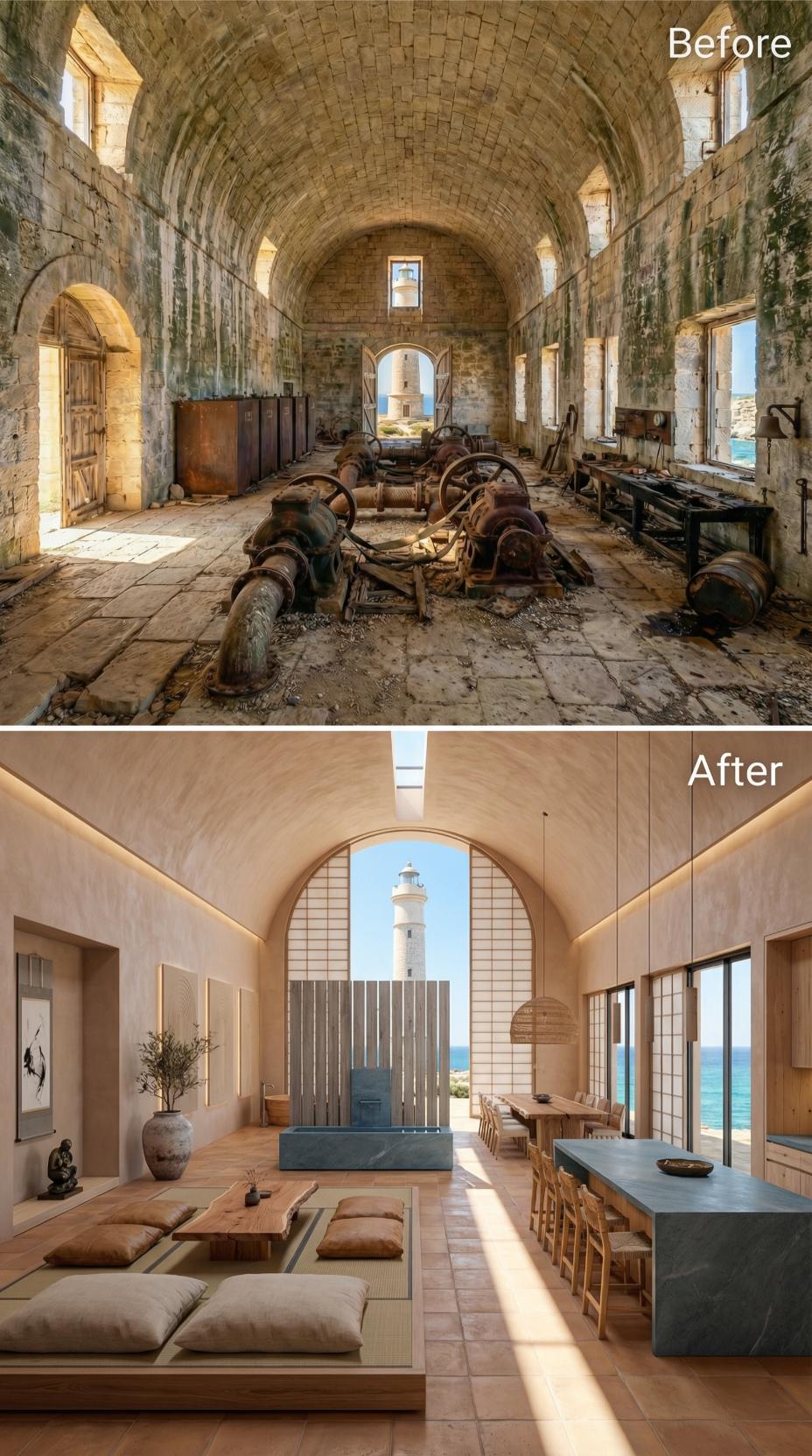
Layers of rust and debris gave way to floor-level seating platforms covered in woven tatami, low linen cushions, and a live-edge timber coffee table. A teal-grey slab stone island anchors the right side, paired with natural oak dining chairs. Shoji-style rice paper panels filter the Mediterranean light, while cove lighting traces the plastered vault overhead. The lighthouse frames the arched opening perfectly.
Designer’s Secret: The low seating platform was engineered at two distinct heights to subtly divide lounging from dining without using a single partition wall. Keeping furniture below the springing line of the vault preserves the full arc visually, making the ceiling read taller than the structural drawings suggest. The tatami grid was sized to match the tile module on the floor, tying both zones together through repetition of scale rather than color.
26. Gold Ring Ceiling, Navy Rug, Lighthouse View: Dark Luxury Inside Ancient Stone Walls
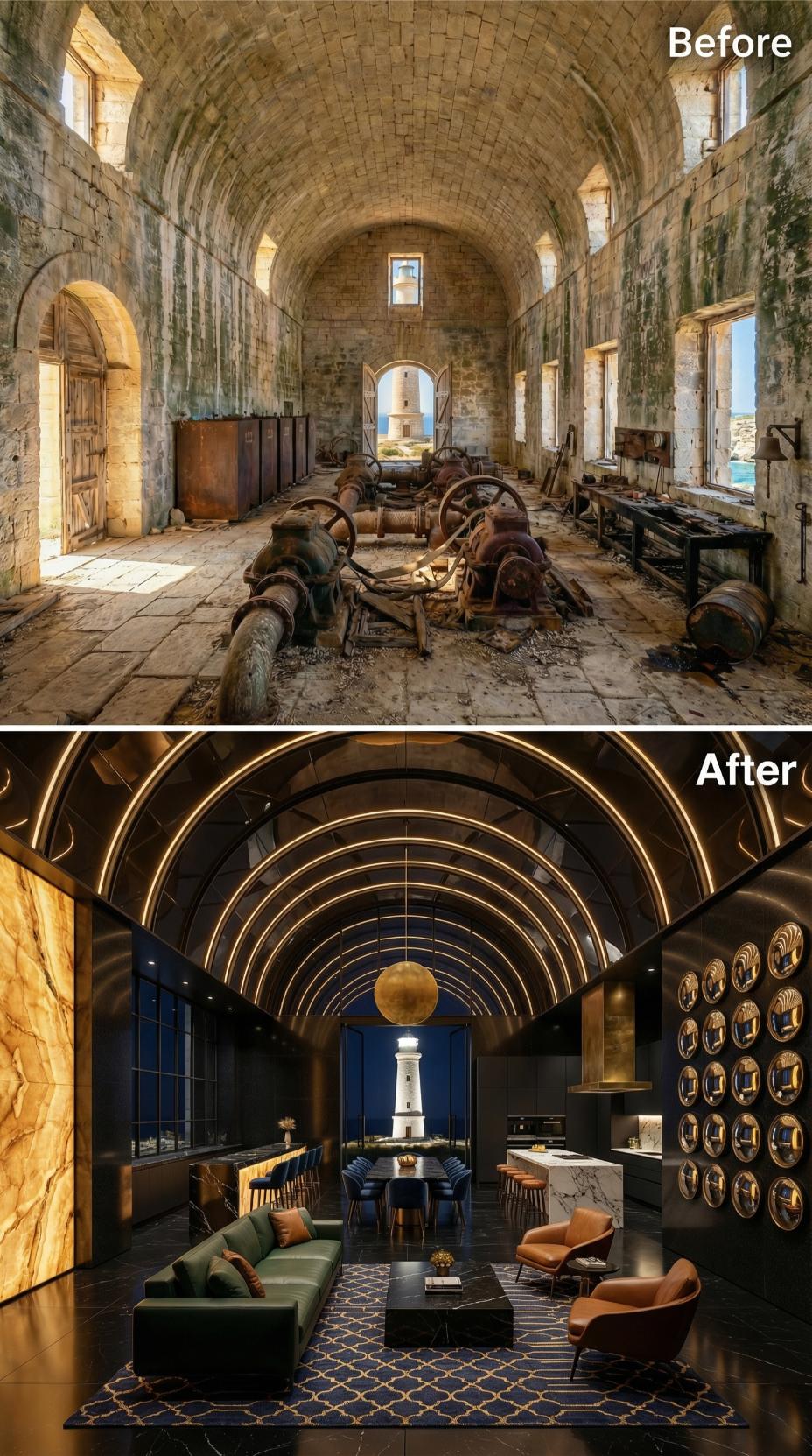
Concentric brass-trimmed arches line the barrel vault ceiling, each ring fitted with warm LED strip lighting that pulls the eye toward a backlit lighthouse framed dead center through floor-to-ceiling navy glass panels. The original stone structure disappears behind dark paneling finished in a near-black tone, while one wall is clad in honey-veined amber marble slabs that catch the light differently at every angle.
Furnishings split across two distinct zones without a single dividing wall. A forest-green velvet sofa anchors the lounge side, paired with cognac leather accent chairs on a navy Moroccan-lattice rug in gold. Across the room, a black marble dining table surrounded by ink-blue upholstered chairs leads to a kitchen island topped in white Calacatta, set against dark cabinetry. A grid of circular brass medallions covers the right wall entirely.
The Lighthouse as Focal Point, Not Backdrop
Rather than treating the lighthouse outside as scenery, the designers placed it in direct axial alignment with the room’s central pendant, a matte gold sphere suspended from the vault’s apex. The backlit navy panel framing the view acts as a built-in picture window, giving the structure the visual weight of a piece of art. That decision locks the exterior landmark into the interior composition, so the room reads as incomplete without it.
25. Indoor Pool, Glass Vault, Open Fire: Barrel Stone Gets a Luxury Second Life
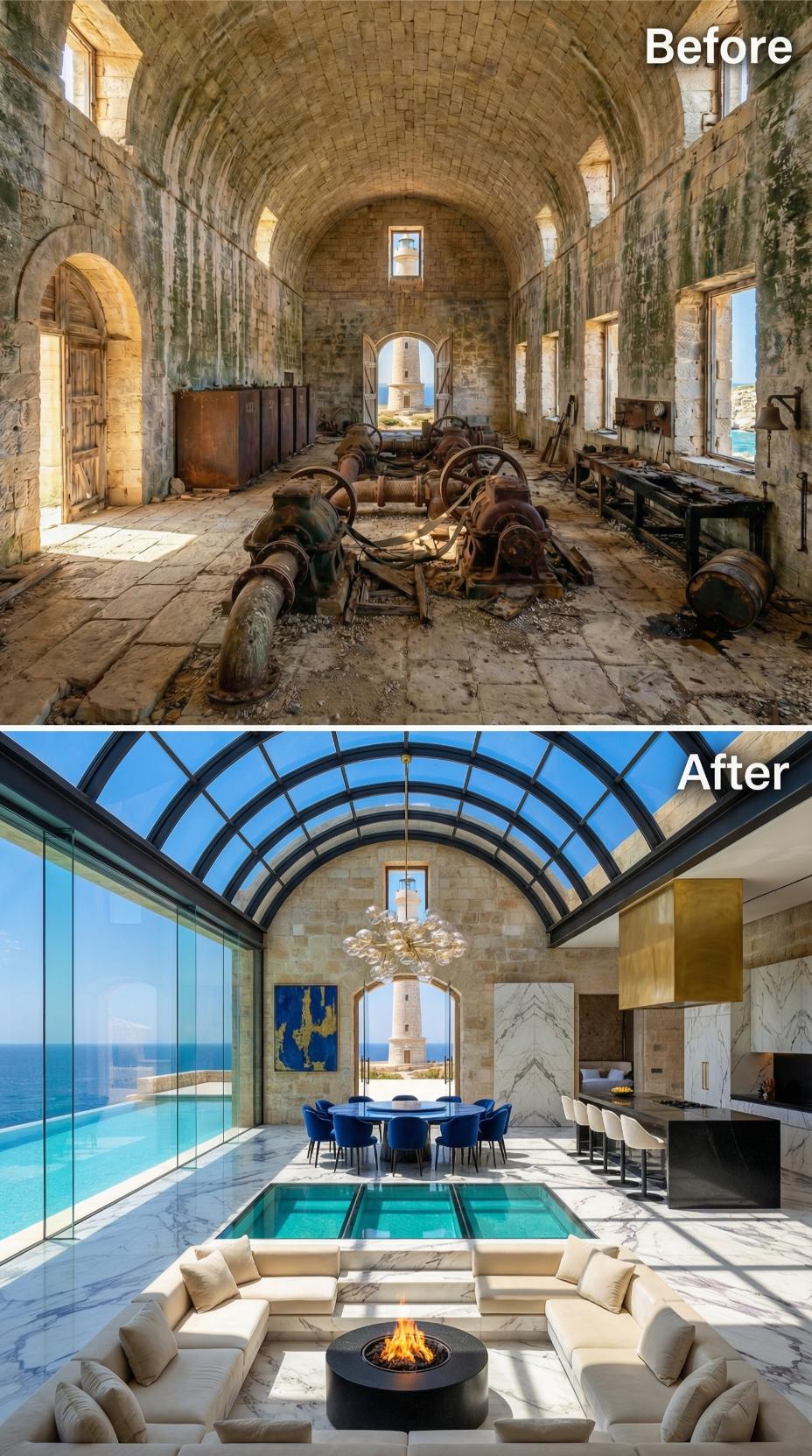
Architects kept the original limestone barrel vault intact and cut a glass skylight panel directly into the crown, letting the Mediterranean sky read as a fifth wall. The stone texture underneath remains unplastered and unfinished, visible against polished white marble floors veined in soft grey.
At ground level, a sunken rectangular pool sits inside the main living volume, flanked by a cream bouclé sectional arranged in a U-shape around a round black fire table. Beyond the pool, a navy velvet dining set anchors the mid-zone, its circular table sitting beneath a globe cluster chandelier with amber glass spheres. The lighthouse tower frames itself through the arched opening at the far end, functioning as a built-in focal point the designers left entirely untouched.
Did You Know: Mediterranean coastal renovations that preserve original masonry rather than cladding it often qualify for heritage conservation grants across EU member states, which can offset up to 40 percent of structural restoration costs. In this project, retaining the unplastered limestone walls was both an aesthetic choice and a financial strategy. Designers increasingly advocate for this approach as insurance against rising reclaimed stone costs across Southern Europe.
24. Glass Floor, Perforated Vault, Lighthouse Framed: Stone Walls Get a New Life
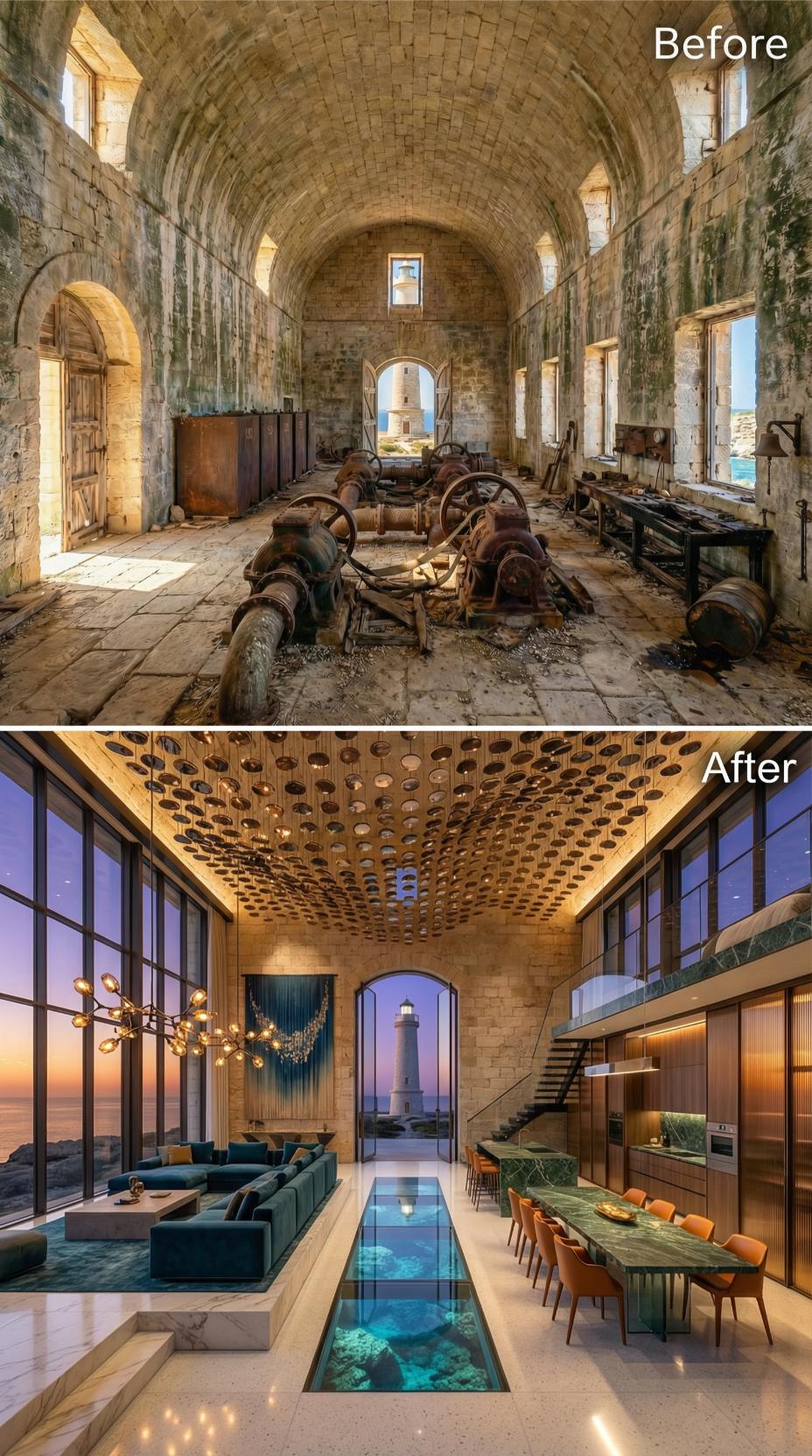
The original barrel vault survives intact, but the ceiling now carries a perforated wood panel system with circular cutouts that cast pooled shadows across the room at dusk. Warm amber uplighting runs the perimeter, turning the stone walls from a liability into the dominant decorative surface.
A glass-floored lap channel runs the full length of the room, revealing coral formations below the waterline. Teal velvet sectional seating anchors the left zone, balanced on the right by a green marble dining table with amber leather chairs and a kitchen run in warm walnut cabinetry. A branching brass chandelier with exposed globe bulbs marks the division between the two areas without any wall interrupting the sightline to the arched lighthouse view.
Ask Yourself: Before committing to open-plan living, consider whether your existing structure already defines zones through architecture alone. Here, the stone arch, the glass channel, and the ceiling treatment each do the work that walls would otherwise handle. Identifying those built-in dividers early can save significant renovation budget.
23. Copper Vault, Indoor Pool, Lighthouse Still Watching Through the Arch
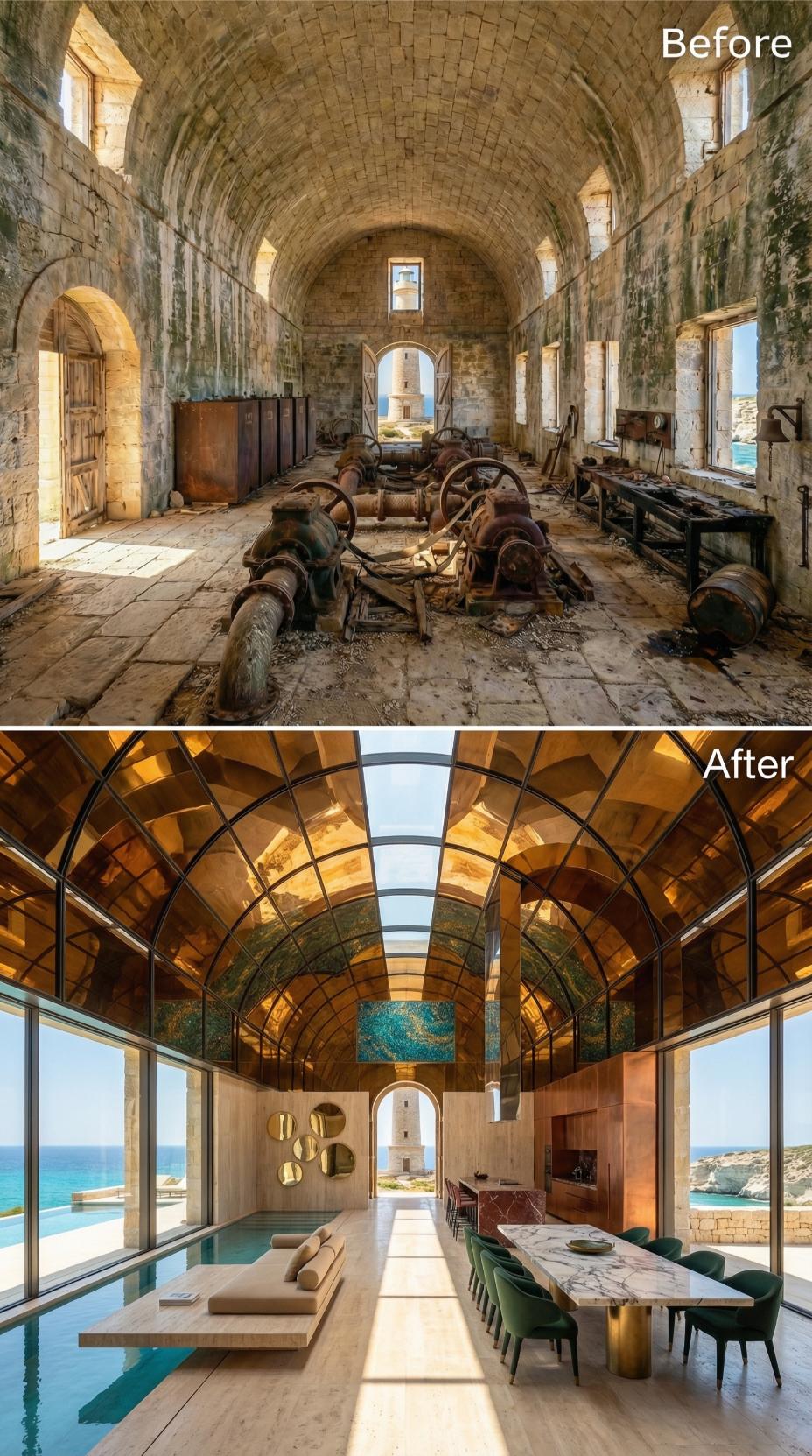
Corroded winches and stone grit gave way to a barrel vault clad in amber-toned copper paneling, split lengthwise by a skylight that pulls the Aegean directly into the ceiling plane. On the left, a travertine day bed floats beside a narrow lap pool tiled in turquoise. On the right, a white marble slab dining table seats eight on forest-green velvet chairs with tapered black legs. Floor-to-ceiling glass now replaces the original rubble-filled window openings on both flanks, and the lighthouse still reads through the far arch, unchanged.
Editor’s Note: Copper cladding applied to historic masonry vaults requires a ventilated air gap between the metal skin and the original stone to prevent trapped moisture from accelerating deterioration of the underlying mortar. In this renovation, that gap doubles as a concealed channel for recessed lighting, which accounts for the even amber wash across the vault surface visible in the after image. Specifying dual-purpose cavities like this is one way adaptive reuse projects absorb modern infrastructure without cutting into protected historic fabric.
22. Warm Glass Vault, Pendant Cluster, Suspended Fireplace: Coastal Ruin Finds Its Voice
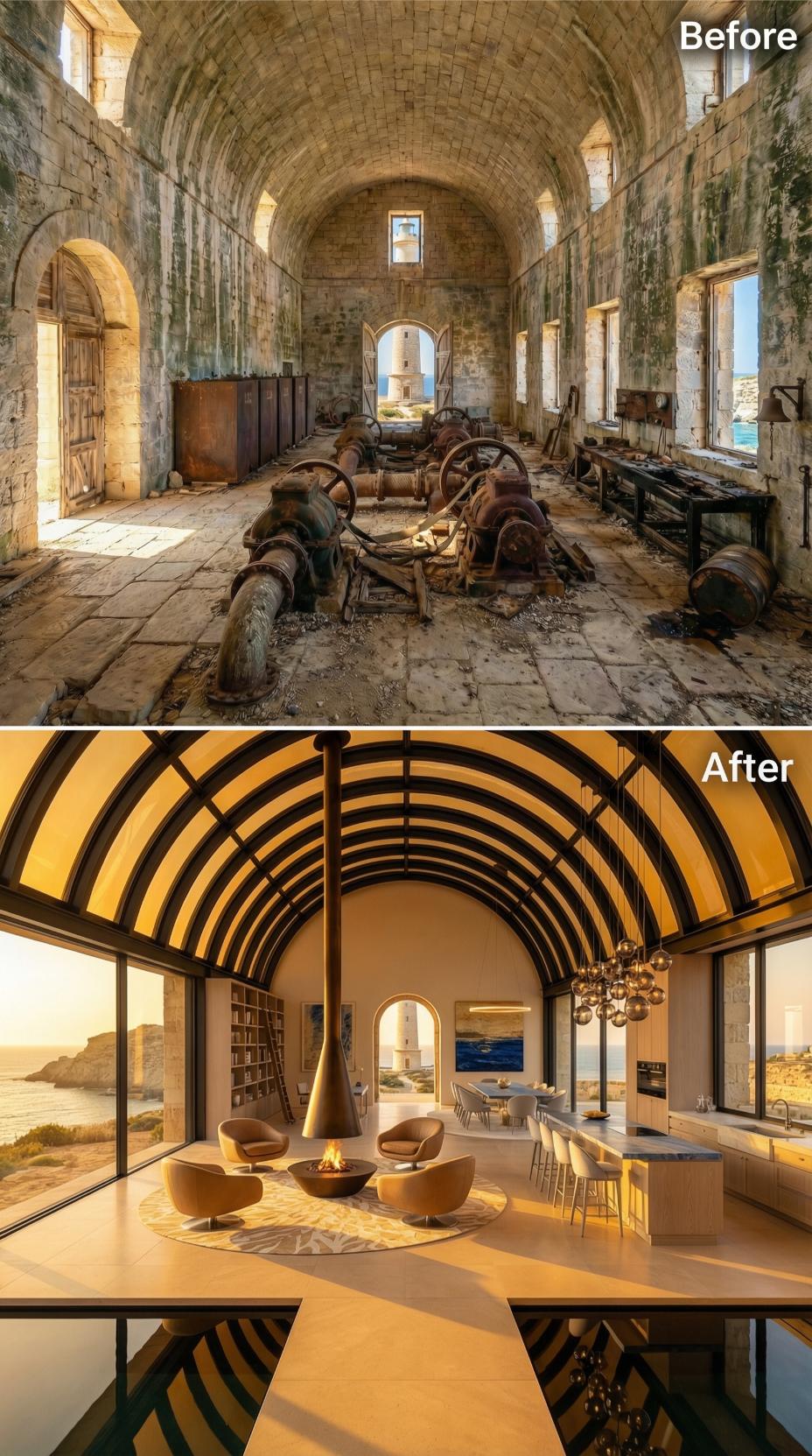
Barrel-vaulted glass ribs now arch overhead in a deep amber tone, replacing centuries of bare limestone with a steel-framed glazed ceiling that floods the interior in golden coastal light. A conical suspended fireplace in brushed bronze anchors the seating circle, where four pod-shaped chairs in caramel bouclé face inward on a geometric area rug. Beyond them, a marble kitchen island stretches toward floor-to-ceiling glazing, and a cluster of smoked-glass globe pendants hangs low over the dining chairs. Through the original stone arch at the far end, the whitewashed lighthouse tower remains perfectly framed.
- Suspended fireplaces require ceiling-rated flue systems rated for the full vault height, not standard residential clearances
- Globe pendants with smoked glass diffuse light more evenly across curved ceilings than open-bulb alternatives
- Steel ribs bonded to historic stone vaults perform better long-term when set in isolation channels that allow independent thermal movement
21. Faceted Mirror Vault, Wine Wall, Leather Sofa: Ruin Becomes a Coastal Living Room
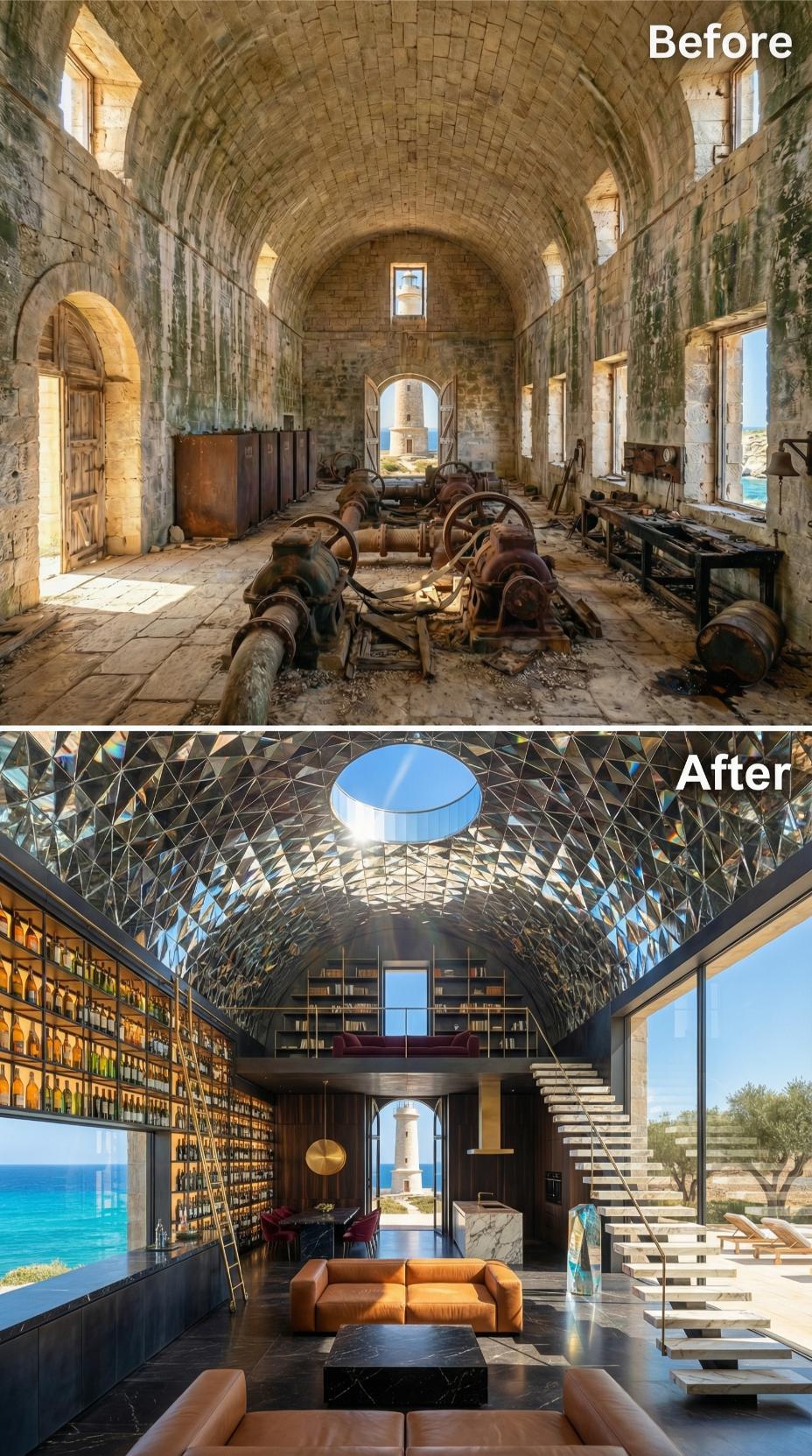
Geometric mirror panels tile the entire barrel vault in triangulated facets, scattering prismatic light through a circular oculus cut at the crown. Amber leather sofas anchor the floor plan below a black marble slab coffee table, while floor-to-ceiling shelving holds hundreds of wine bottles behind library ladders.
Color Story: Cognac leather paired with black marble and gold pendants pulls warm tones from the mirror facets above without competing with the turquoise sea visible through the full-height glazing. The triangulated ceiling panels shift color depending on the hour, reading copper at dawn and silver-blue by midday. Limiting the soft furnishing palette to two tones lets the ceiling carry the visual weight without crowding the room.
20. Iridescent Glass Vault, Leather Sectional, Lighthouse Framed at the Far Wall
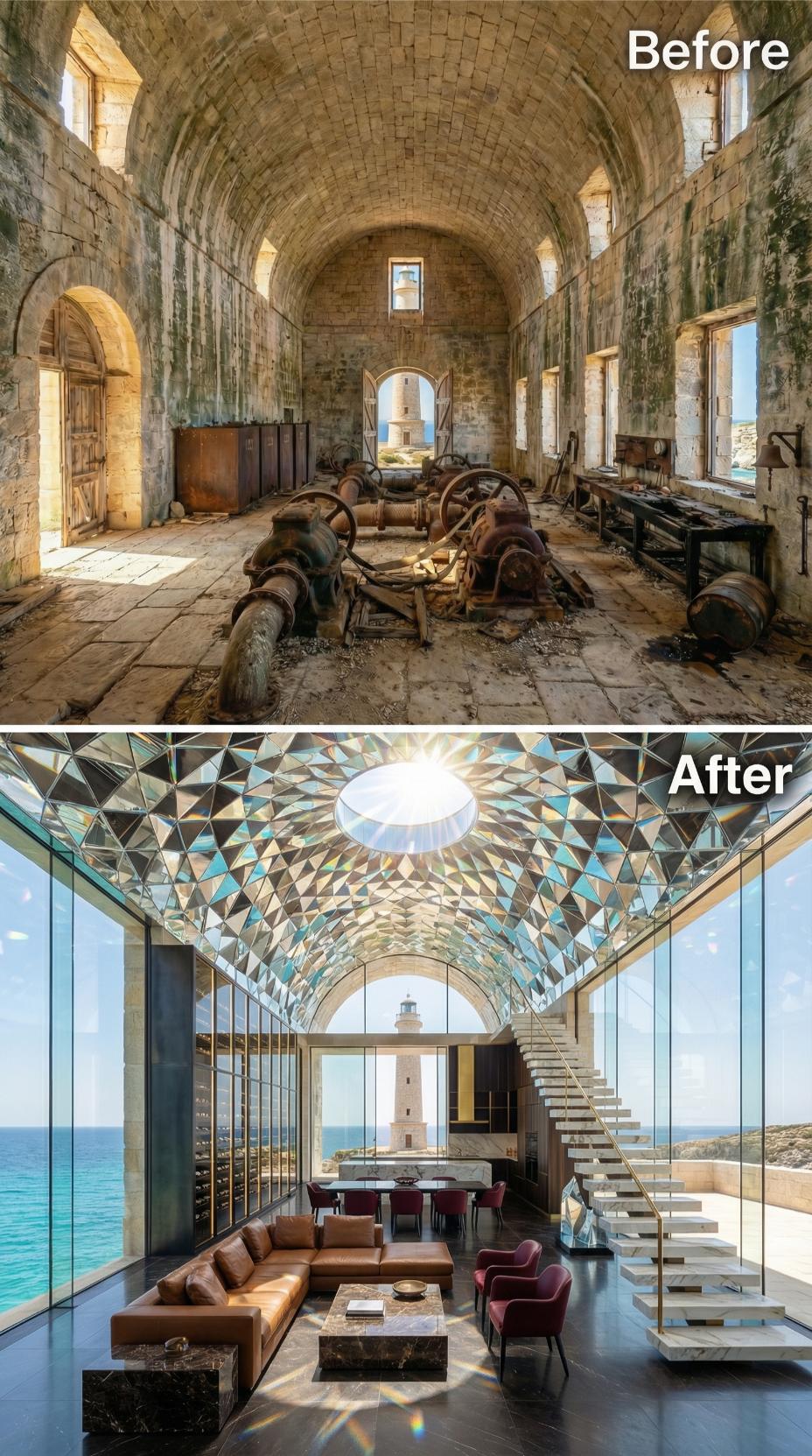
Triangular mirror facets tile the entire barrel vault, each panel catching coastal light differently depending on the hour. A caramel leather sectional anchors the floor plan, paired with burgundy armchairs and a dark emperador marble coffee table. Floating stone stairs with a brass rail climb the right wall toward an upper level.
Quick Fix: Mirrored ceiling installations in vaulted spaces work best when panels are set at slightly varied angles rather than flush, because the deliberate tilt scatters light across the room instead of concentrating glare in a single spot. In renovation projects with existing barrel vaults, this technique also draws the eye upward and makes the original arch geometry more legible, not less.
19. Teal Velvet, Wine Floor, Lighthouse at Dusk: Ruin Rebuilt from the Ground Up
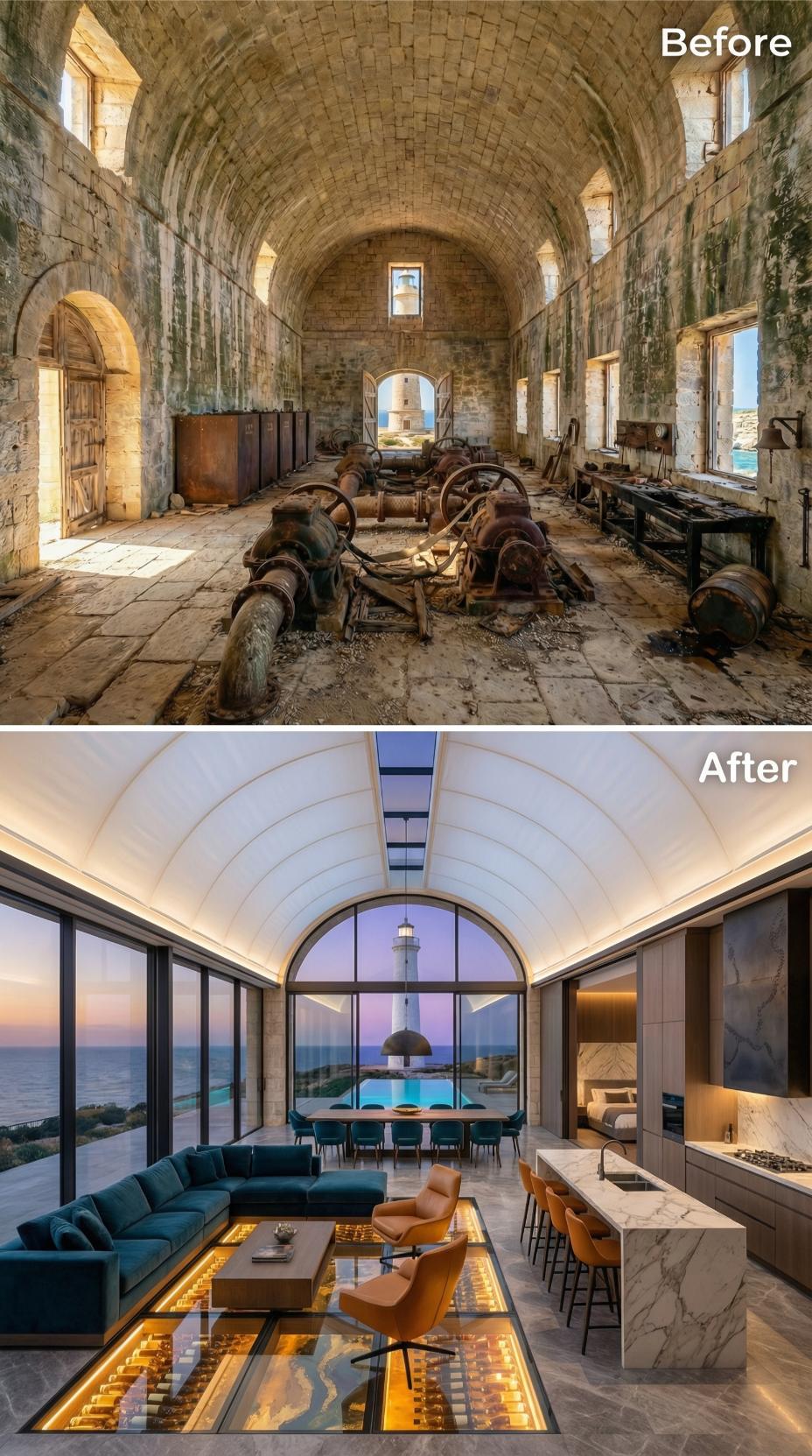
Beneath that barrel vault, a glass floor panel lit from below holds an entire wine collection visible through the living room.
White plaster now coats the original stone vault, with LED strip lighting tracing each rib from base to crown. The teal sectional sofa anchors the near end of the room, paired with cognac leather swivel chairs and a low wood-and-glass coffee table. Floor-to-ceiling glazing replaces what were once arched stone openings, and the far wall frames the lighthouse tower against a pink-to-violet dusk sky, with a pool visible just beyond the glass. A marble island with a waterfall edge and integrated sink defines the kitchen zone to the right, its warm white veining echoing the vault overhead.
Open-plan layouts in spaces this long risk feeling directionless, but here the wine floor acts as a visual anchor, drawing the eye downward before the lighthouse pulls it back toward the horizon. The dining table with charcoal upholstered chairs sits mid-room, positioned so every seat holds that view.
18. Spiral Staircase in Brass, Green Marble Underfoot, Lighthouse Still Centered in the Arch
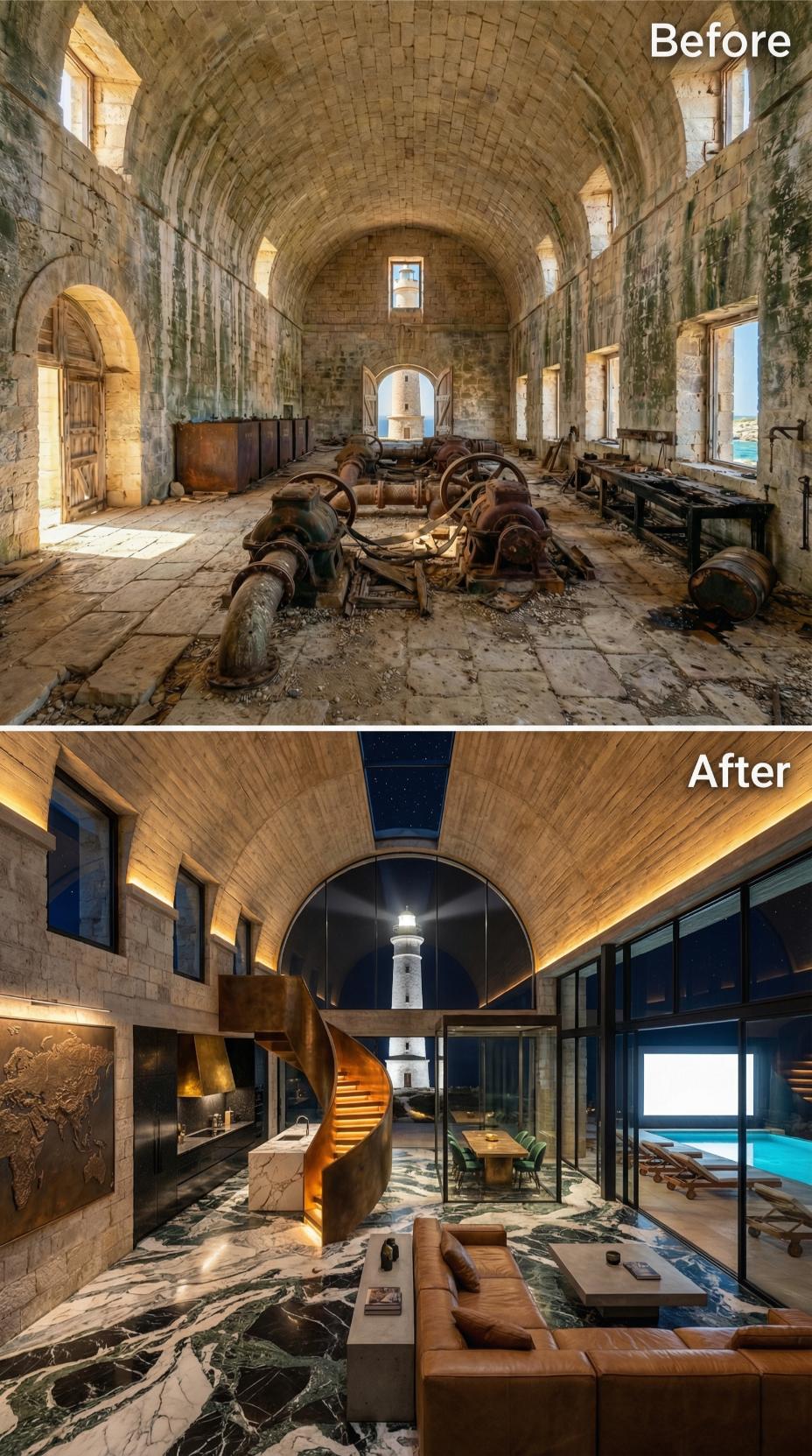
Rust-eaten machinery and rubble once covered the entire floor of this barrel-vaulted hall. Now, slabs of dark green marble veined in white and cream run wall to wall beneath a living room, kitchen island, and dining table arranged along a single open axis.
The most striking element is the freestanding spiral staircase in aged brass, positioned just left of center where it catches the warm LED cove lighting running the full perimeter of the vault. A leather sectional in cognac anchors the near end. Beyond the kitchen island in matte stone, a glass-framed arch still frames the lighthouse tower outside, lit against a night sky.
The Psychology Behind This: Placing a spiral staircase off-center in a symmetrical vaulted room introduces deliberate tension that draws the eye through the space rather than stopping it at any single point. Studies in environmental psychology suggest asymmetrical focal elements increase the time people spend visually exploring a room, which makes spaces feel larger than their measured dimensions. In a converted historic structure, that effect also shifts attention away from imperfections in the original masonry.
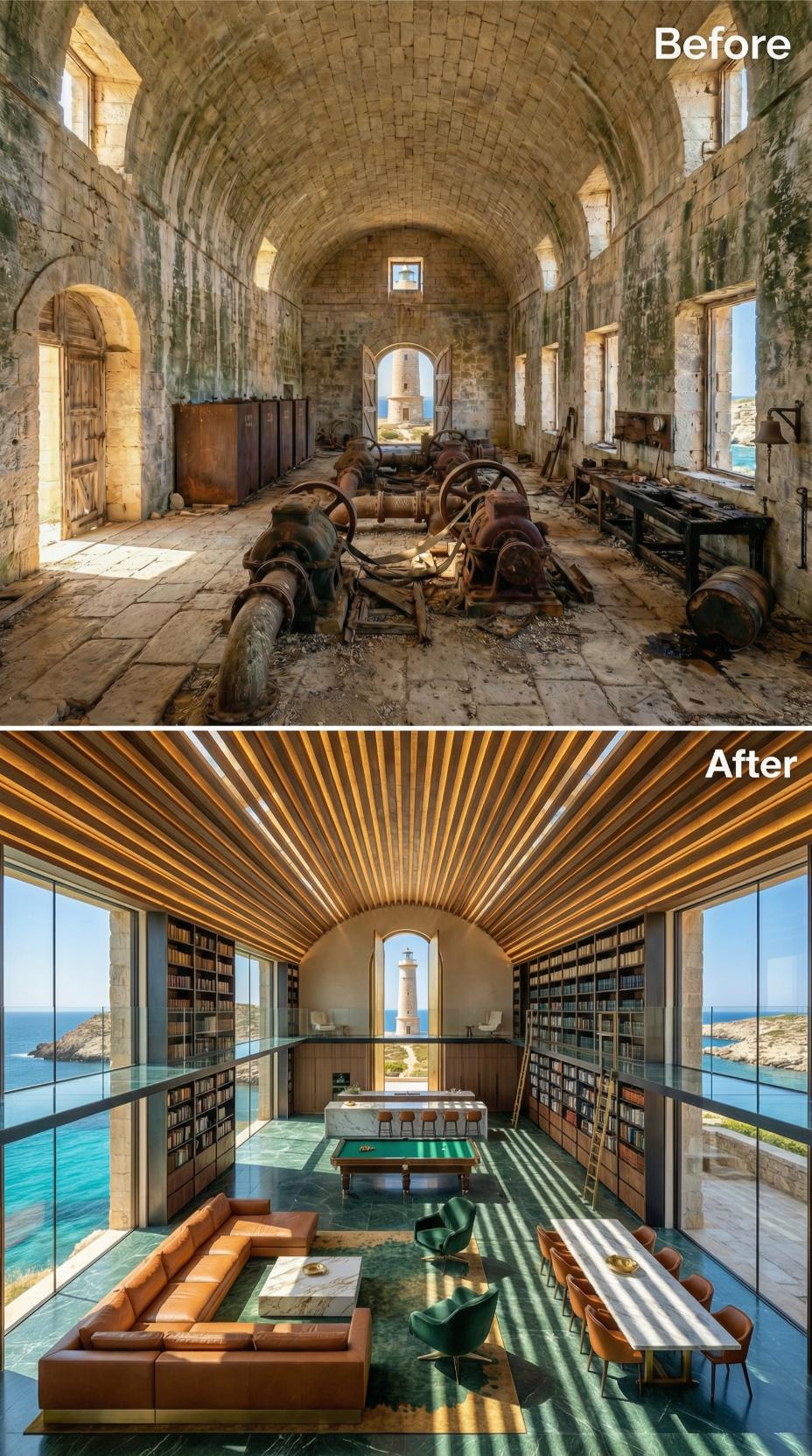
17. Wooden Ribs, Green Marble, Leather Sectional: Rust and Ruin Give Way to Coastal Library
🔥 Would you like to save this?
Warm oak slats line the barrel vault in evenly spaced ribs, replacing centuries of exposed limestone with a ceiling that reads almost like the hull of an inverted boat. Floor-to-ceiling bookshelves in dark-stained timber run the full length of both walls, while green marble tiles anchor the floor in deep, veined slabs. A cognac leather sectional claims the near end of the room.
Structural glass panels have replaced the original solid side walls entirely, opening the interior to unobstructed sea views on both flanks. A billiard table in bottle-green baize sits at mid-room, and a long dining table in pale stone with tan leather chairs extends toward the arch, where the lighthouse still holds its position in the opening.
Style Tip: When bookshelves span the full vertical height of a vaulted room, a library ladder on a rail becomes a functional necessity rather than an ornamental choice. Specifying a rolling brass-rail ladder adds warmth in metal tone and keeps the shelving usable above eye level. Libraries designed this way can hold up to 40 percent more volumes than shelving capped at standard ceiling height.
16. Marble Island, Copper Pendants, Barrel Vault Opened to Sky: Ruin Becomes a Kitchen
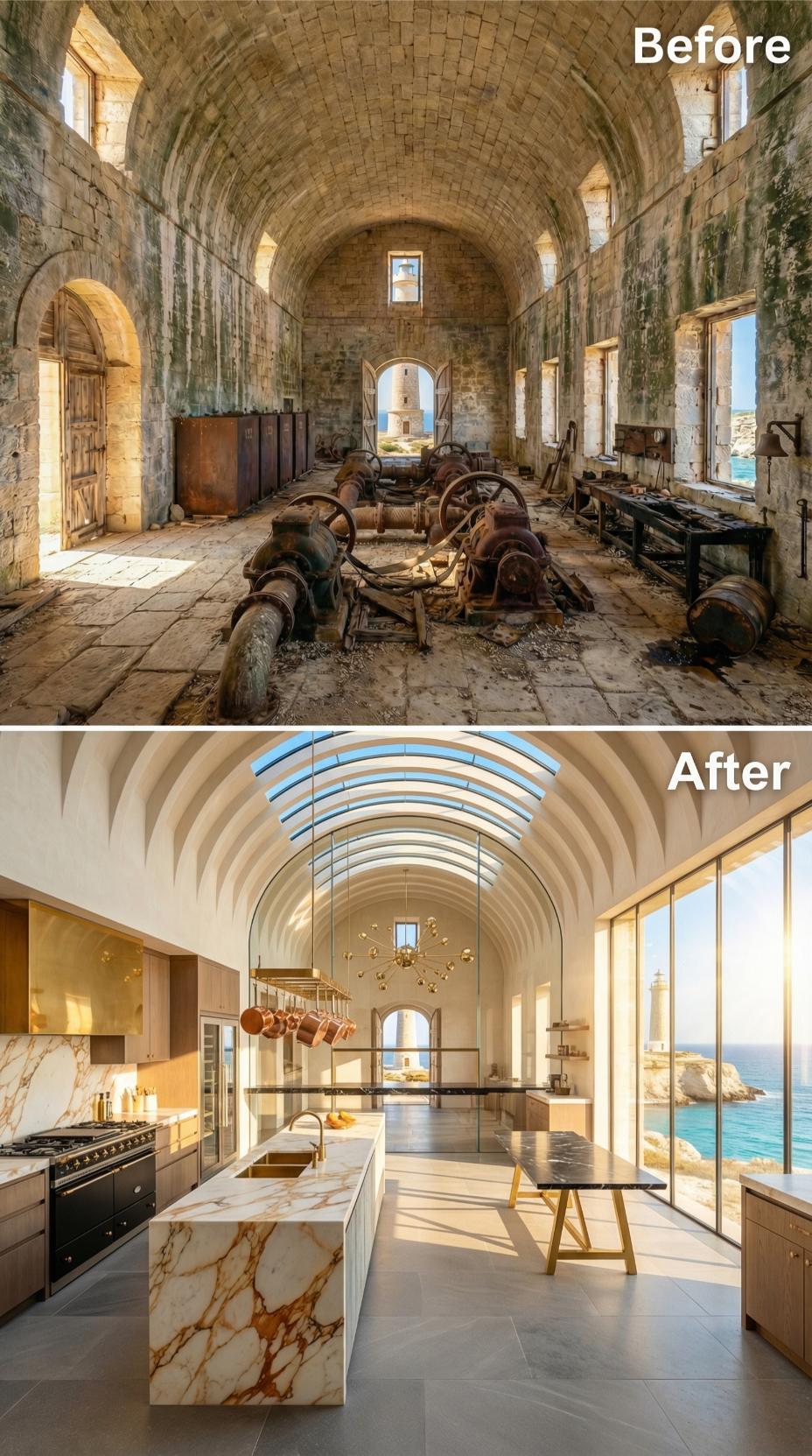
Gold-veined Calacatta marble wraps the waterfall island in a single continuous slab, its warm rust streaking picking up the copper finish on the pot rail hung from a ceiling rib. Plaster has replaced raw limestone on the vault, now punctuated by a glass skylight running its full length. Cabinet fronts in pale natural oak sit beside a matte black range. Floor-to-ceiling glazing on the right wall pulls the lighthouse and coastline directly into the room.
Common Mistake: Renovators often add a pot rail as an afterthought, bolting it into drywall without accounting for the combined weight of cast iron cookware. In a vaulted masonry structure like this one, the rail should anchor into the original stone ribs or a hidden steel crossmember, not the plaster skin applied over them. Getting that detail wrong means the hardware pulls free under load.
From the intimacy of a library corner, the eye now opens onto a full living volume.
15. Barrel Vault Scrubbed Clean, Marble Table Set, Lighthouse Centered Through the Arch
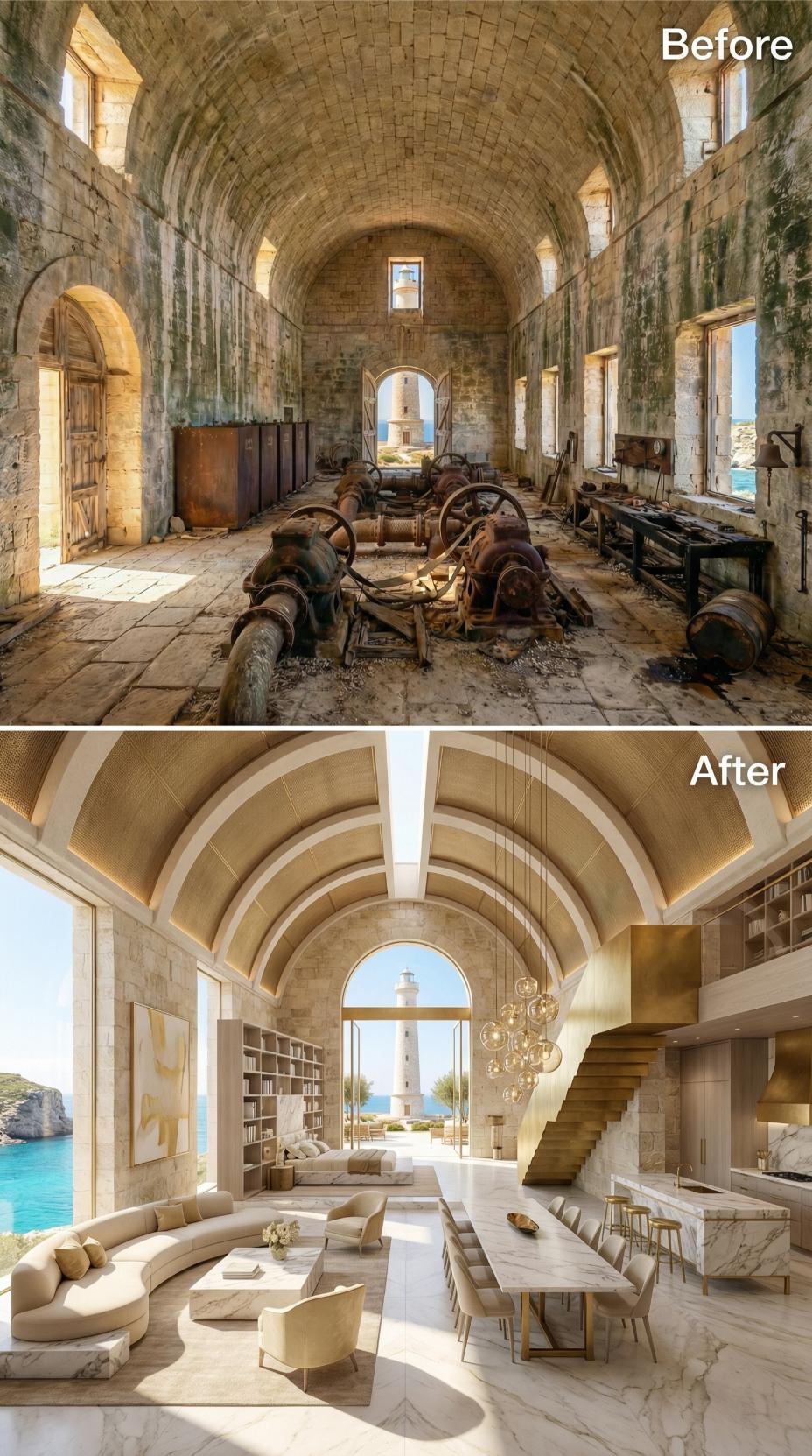
Rusted winch machinery and centuries of salt damage once occupied this stone hall. Now a curved cream sectional anchors the living zone on polished travertine, while a long marble dining table with ghost-grey veining stretches toward the kitchen island clad in the same stone. Brushed brass barstools line the island’s near edge. A cluster of globe pendants in smoked amber glass hangs at three staggered drop lengths above the table.
Built-in shelving in bleached oak runs floor to wall along the right side, and a floating staircase in pale stone with a brass rail ascends toward a mezzanine. The central arch has been fully opened, placing the lighthouse directly in the sightline from every seat in the room. Stone from the original vault was cleaned, not replaced, and the exposed coursework of the barrel ceiling remains visible through applied plaster ribs, keeping the ruin’s memory intact inside a room that now functions as a home.
14. Cylindrical Wine Tower, Marble Island, Stone Vault Washed in Amber
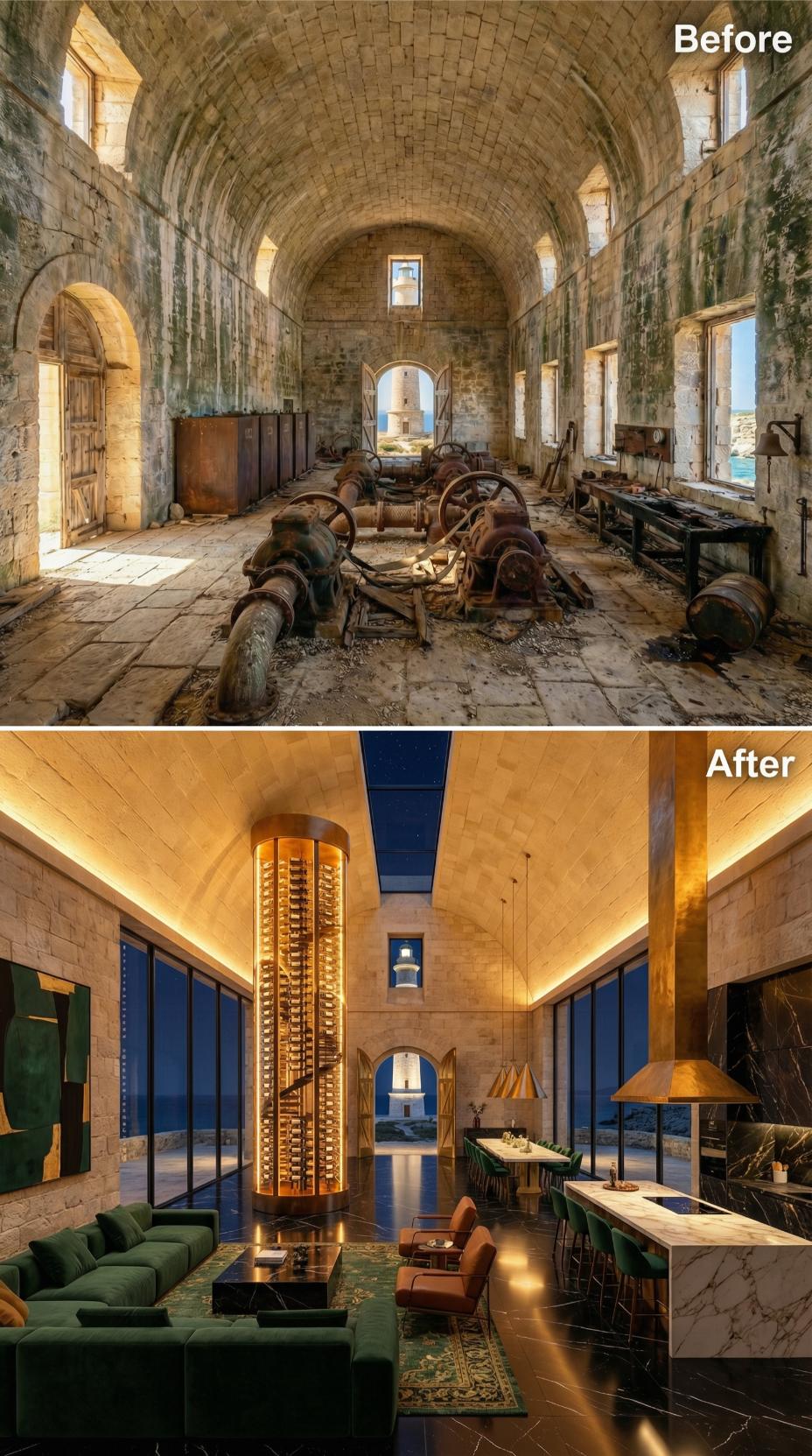
Rusted machinery once sat mid-floor where a cylindrical wine tower now anchors the room. The column is clad in brass-toned metal and backlit from within, holding what appears to be several hundred bottles on spiral display racks. Strip lighting runs the full perimeter where the vault meets the vertical walls, casting even amber across the cleaned limestone coursework. The original arched opening at the far end remains untouched, still framing the lighthouse across the water.
On the right, a marble kitchen island with a white-and-grey veined surface runs parallel to the long axis. Green velvet dining chairs face a dark-stained table. A copper hood hangs above the cooking surface, and black marble cladding rises behind it. The sofa in the foreground is deep green, low-slung, and sectional. Dark reflective floor tiles replace the rubble-strewn flagstone entirely.
- Perimeter cove lighting placed at the vault spring line keeps direct glare off the stone while still revealing its texture.
- A cylindrical display structure in a rectangular room creates a visual anchor without interrupting sightlines to the far arch.
- Matching the hood metal finish to the wine column ties two opposite ends of the room together without repeating any other element.
13. Orchid Chandelier, Marble Floors, Barrel Vault Clad in Pale Timber: Ruin Rebuilt in White
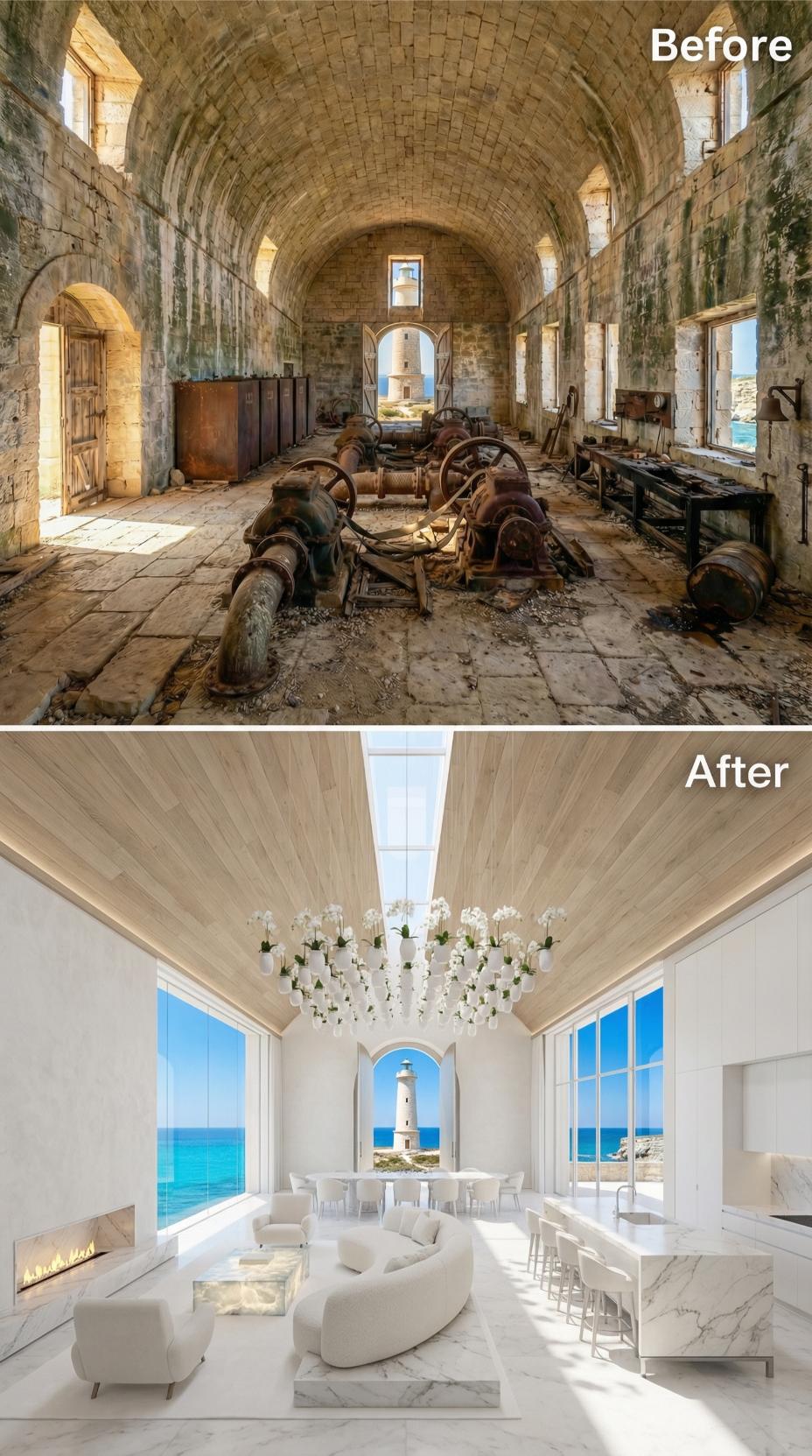
Bleached oak planks now line the barrel vault where stone once crumbled, and a large-scale chandelier hung with white orchid pots anchors the center of the room above a cloud-shaped bouclé sectional.
Bleached oak planks now line the barrel vault where stone once crumbled.
12. Barrel Vault in Oiled Walnut, Cognac Leather Below, Sea Framed Through Every Wall
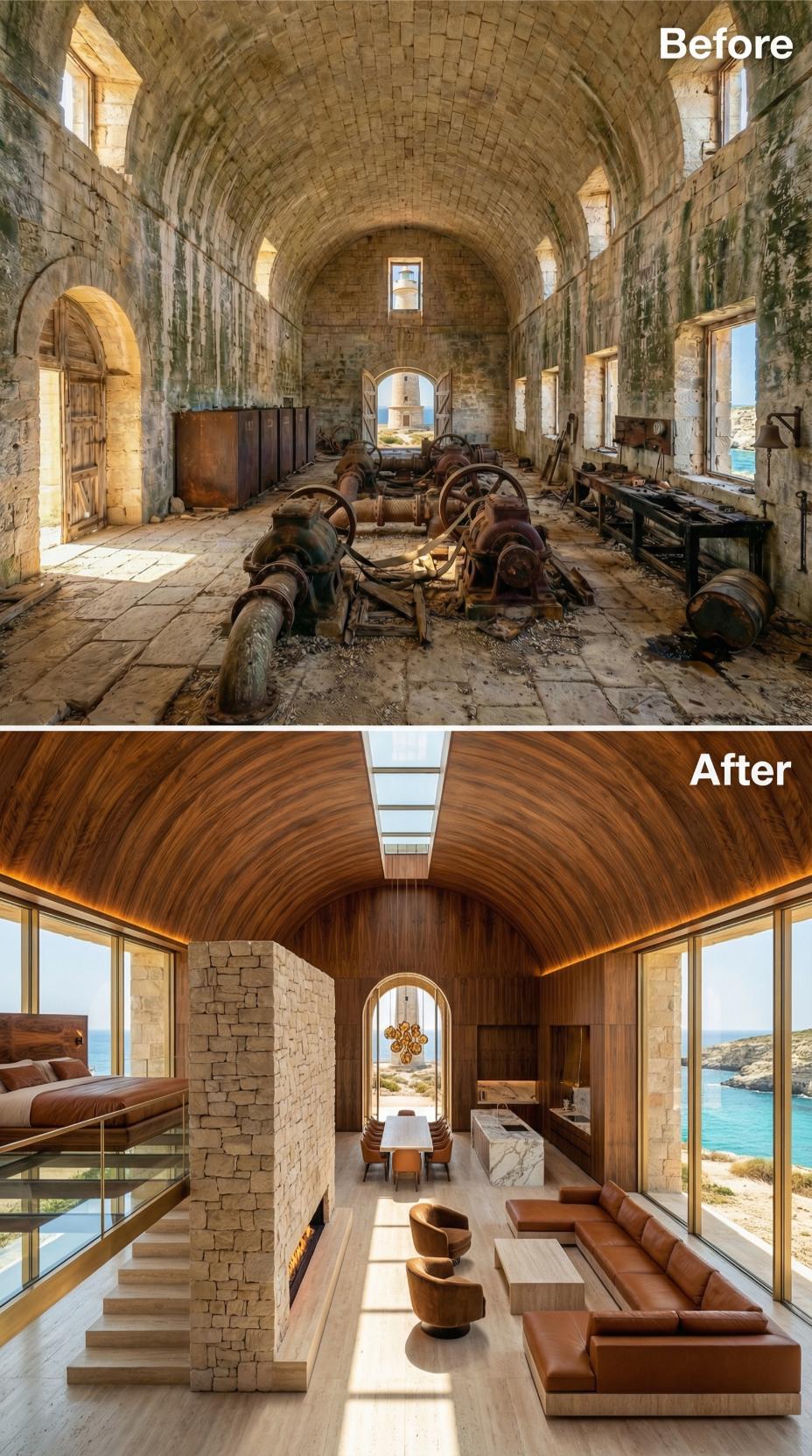
Rust-pitted machinery and crumbling stone gave way to a barrel vault lined entirely in oiled walnut veneer, its grain running lengthwise to pull the eye toward a lit skylight at the crown. Ambient cove lighting runs the full perimeter where the wood meets the wall, casting a low amber wash across the limestone masonry left deliberately exposed on the central dividing column. A sectional in cognac leather anchors the living zone, paired with barrel-back lounge chairs in the same hide.
Floor-to-ceiling glazing on both flanking walls opens the room to the Aegean, with the lighthouse visible through the far arch, centered as precisely as any architect could plan. A marble waterfall island marks the dining end, surrounded by upholstered side chairs in cognac-toned fabric. The mezzanine bedroom, raised behind a glass balustrade, hovers above the living level without walling it off, sharing the same walnut ceiling that ties the entire volume together.
11. Barrel Vault Kept Bare, Fireplace Cuts Through Center, Sea Fills the Right Wall
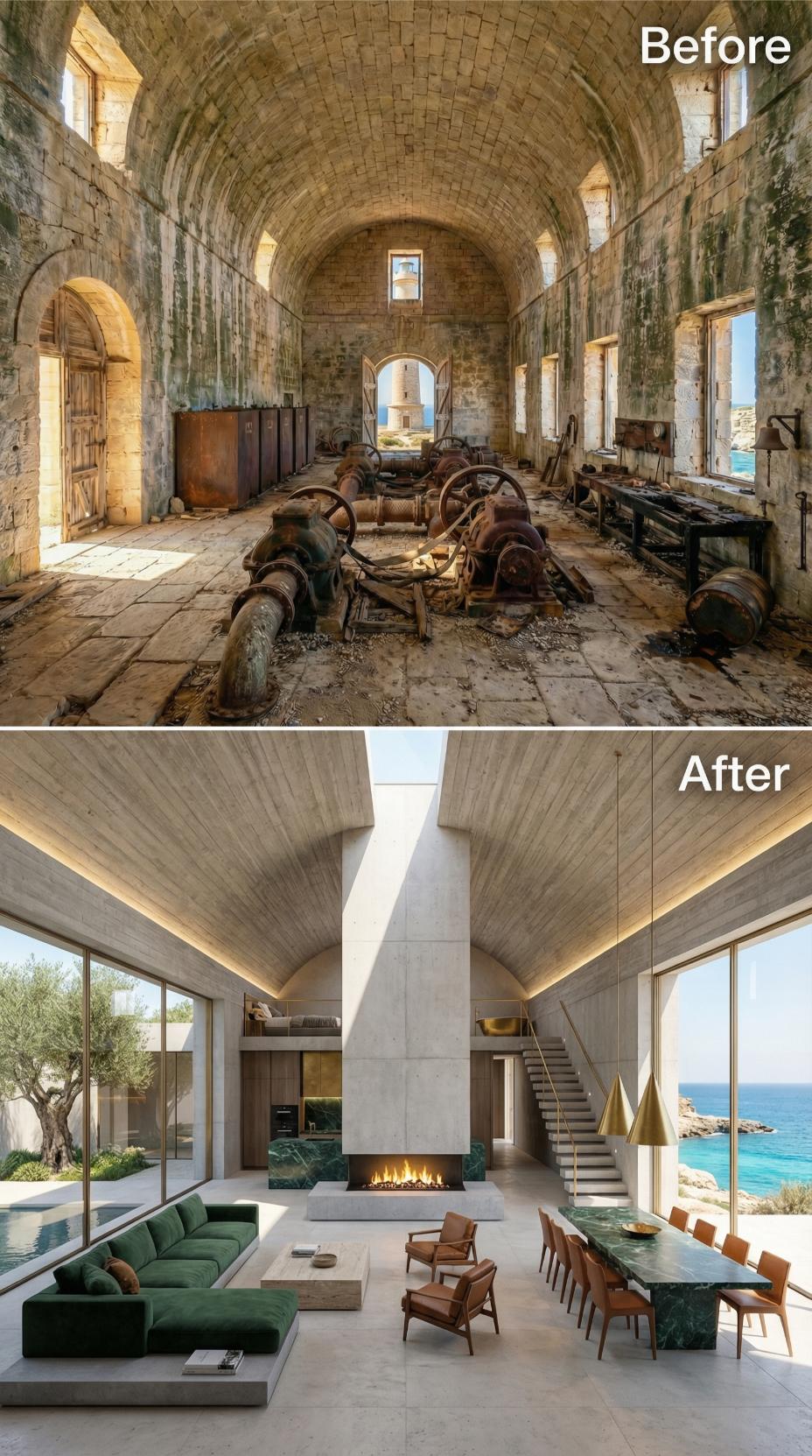
Corroded machinery and decades of salt-driven decay occupied this stone vault before renovation. What replaced it keeps the barrel vault intact but strips it to raw concrete, lit from below by a continuous cove strip that runs the full perimeter.
A concrete chimney breast rises floor to ridge, housing a recessed gas fireplace framed in green marble. To its left, a deep green velvet sectional sits on a limestone-toned floor beside a slab coffee table. Cognac leather armchairs face the fire. On the right, a green marble dining table seats eight on tan leather chairs, with brass cone pendants dropping at two heights above it. Floor-length glazing on both sides pulls in an olive courtyard to the left and open turquoise water to the right. Concrete stairs with no balustrade climb behind the fireplace toward a mezzanine level barely visible above.
Brass pendants at two drop heights above the dining table keep the eye moving rather than settling on the vault above.
10. Honeycomb Vault, Olive Trees in Brass Pots, Ruin Opens to Sea
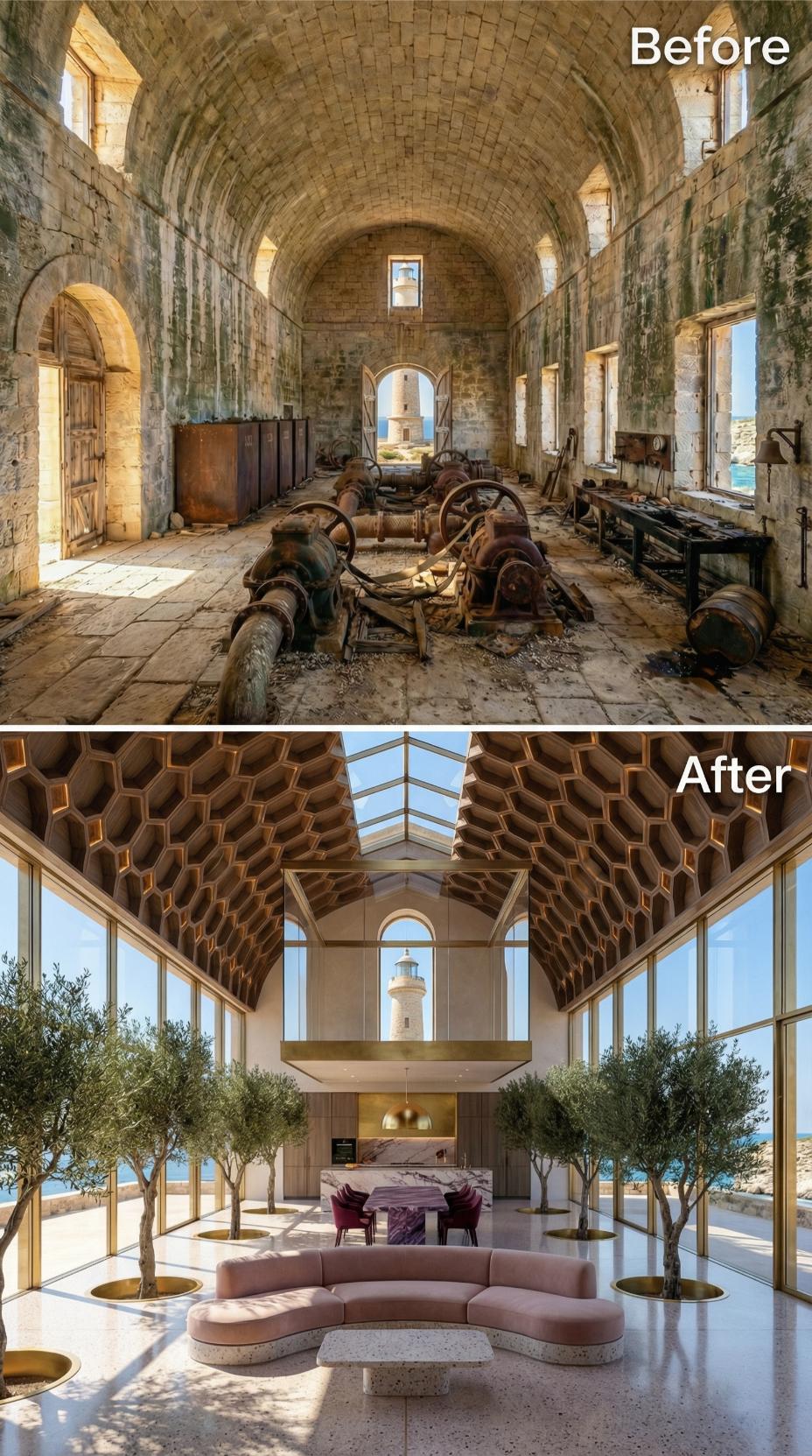
Hexagonal coffers in dark stained timber cover the entire barrel vault, each cell edged with recessed amber lighting that replaces what was once a crumbling stone ceiling thick with moss. Floor-to-ceiling glass panels now occupy the long walls where rough masonry once blocked the coastline entirely, and a ridge skylight runs the central axis above. Pink curved velvet seating anchors the foreground on polished terrazzo, while four olive trees planted in oversized brass bowls line the room on both sides. A marble dining table in deep burgundy sits mid-space beneath pendant lighting, flanked by dark plum velvet chairs. The lighthouse remains visible through the original arched opening at the far wall.
9. Stone Vault Restored, Skylight Cut, Sofa and Kitchen Sharing One Long Room

Barrel vault masonry was cleaned and left exposed rather than plastered over, with LED strip lighting run along both sides at cornice level to outline the curve at night. A rectangular skylight opens the crown of the vault to sky, letting in the kind of ambient light no pendant can replicate.
The living area anchors around a slate-blue sectional sofa and a low marble-topped coffee table, while brown leather armchairs pull the seating toward a dining cluster in the mid-zone. On the right, a kitchen island in white stone sits beneath flush cabinetry with no visible hardware. Olive trees in plain floor pots hold either end of the room, and the lighthouse framed through the far arch has not moved an inch.
8. Lapis Vault, Star-Field Floor, Lighthouse Framed Behind Floor-to-Ceiling Glass
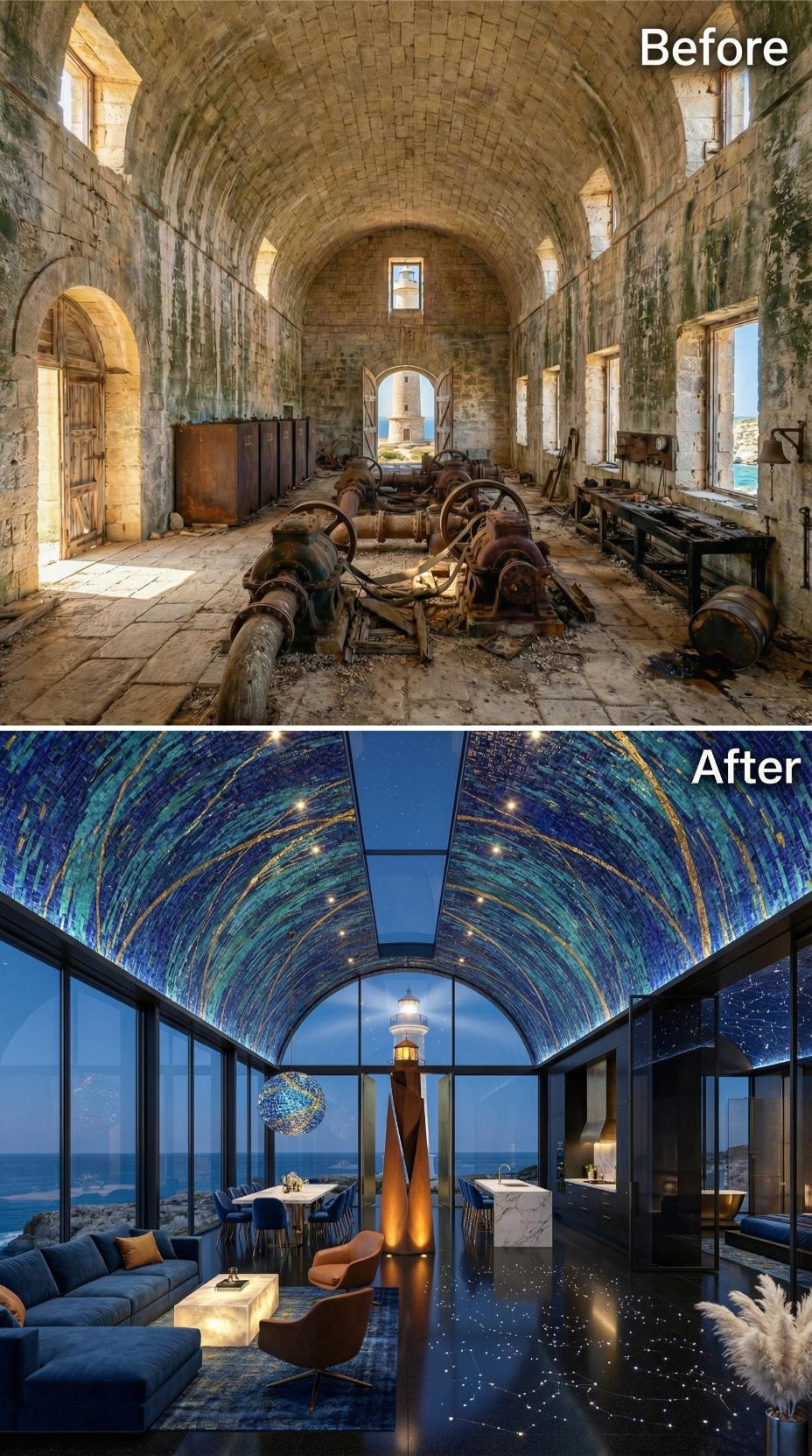
Iridescent mosaic tiles in deep cobalt, teal, and gold stripe the entire barrel vault, catching the recessed spots embedded between the ribs and throwing color down onto a polished black floor embedded with fiber-optic points. The effect reads less like decoration and more like sleeping under open sky.
Below, a modular sofa in navy velvet sits opposite two cognac armchairs, with a backlit alabaster coffee table bridging the pair. Floor-to-ceiling glazing replaces every original stone wall on the long sides, and through the arched end, a slender copper-clad lighthouse sculpture stands centered against the actual lighthouse outside, doubling the silhouette deliberately.
7. Sage Plaster Vault, Brass Mobile Overhead, Marble Island Anchoring the Far Wall
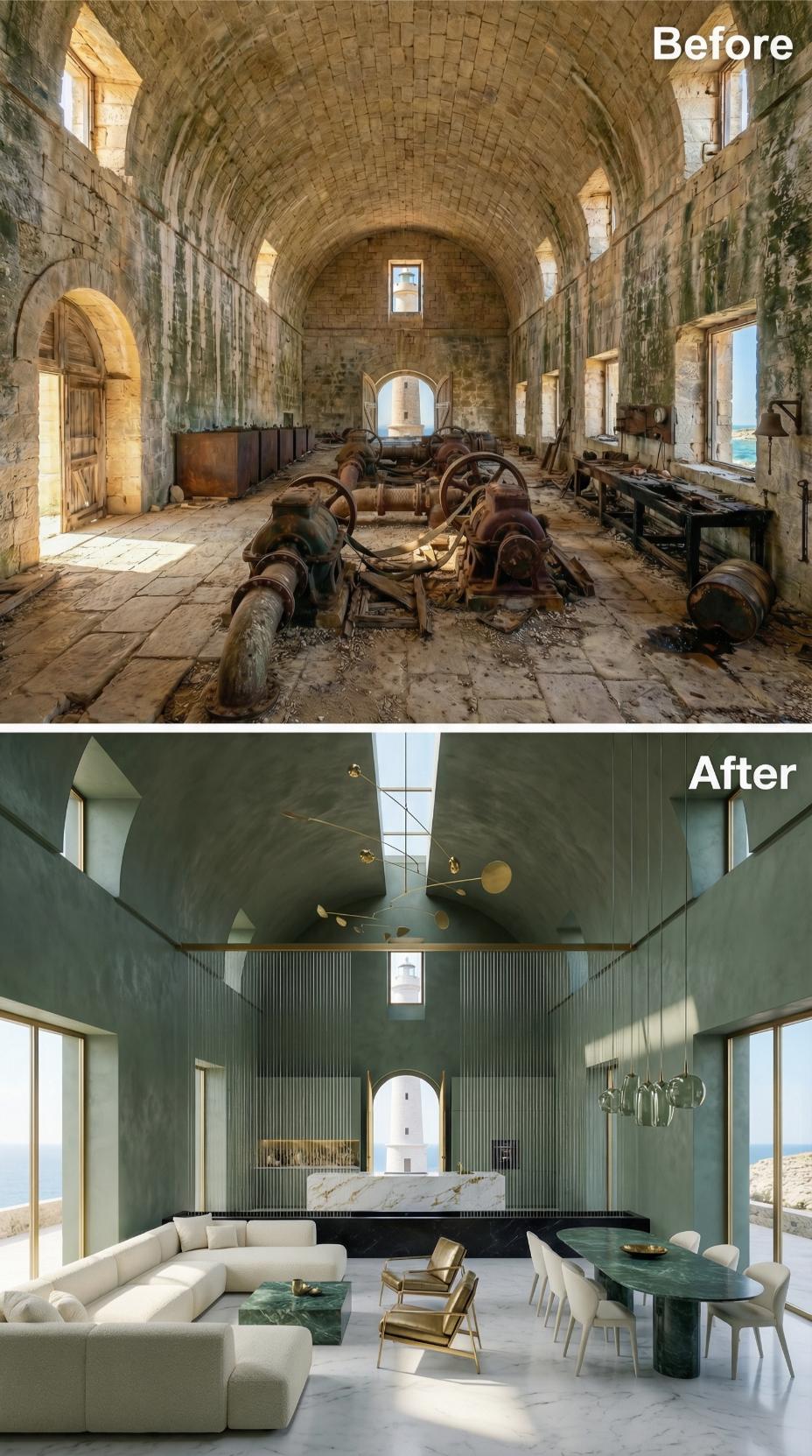
Sage-green plaster coats the barrel vault and wall panels while a brass kinetic mobile hangs mid-vault above cream bouclé sofas and a green marble oval dining table ringed by white upholstered chairs.
—
Hanging a kinetic brass mobile inside a vaulted ceiling draws the eye upward without requiring a conventional chandelier, letting the architecture itself do the structural work.
6. Vault Washed in Warm Light, Green Velvet Below, Lighthouse Framed at Midnight
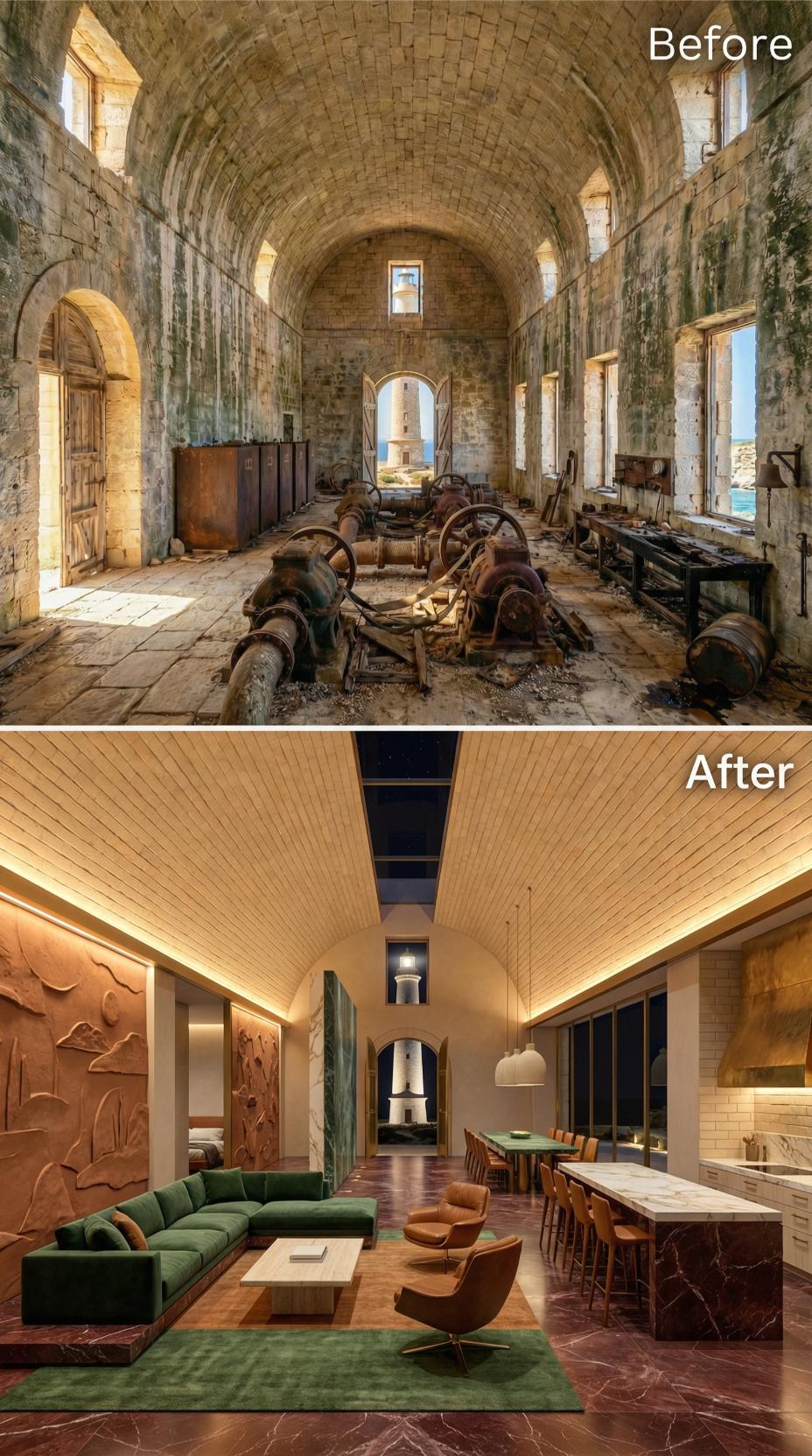
Warm LED cove lighting runs the full length of the barrel vault, bleaching the pale plaster gold while a green velvet sectional anchors the living zone on a matching wool rug. Cognac swivel chairs face a stone-topped coffee table, and red marble tile floors extend past a long dining table with leather side chairs toward a white subway-tile kitchen with a dark marble island.
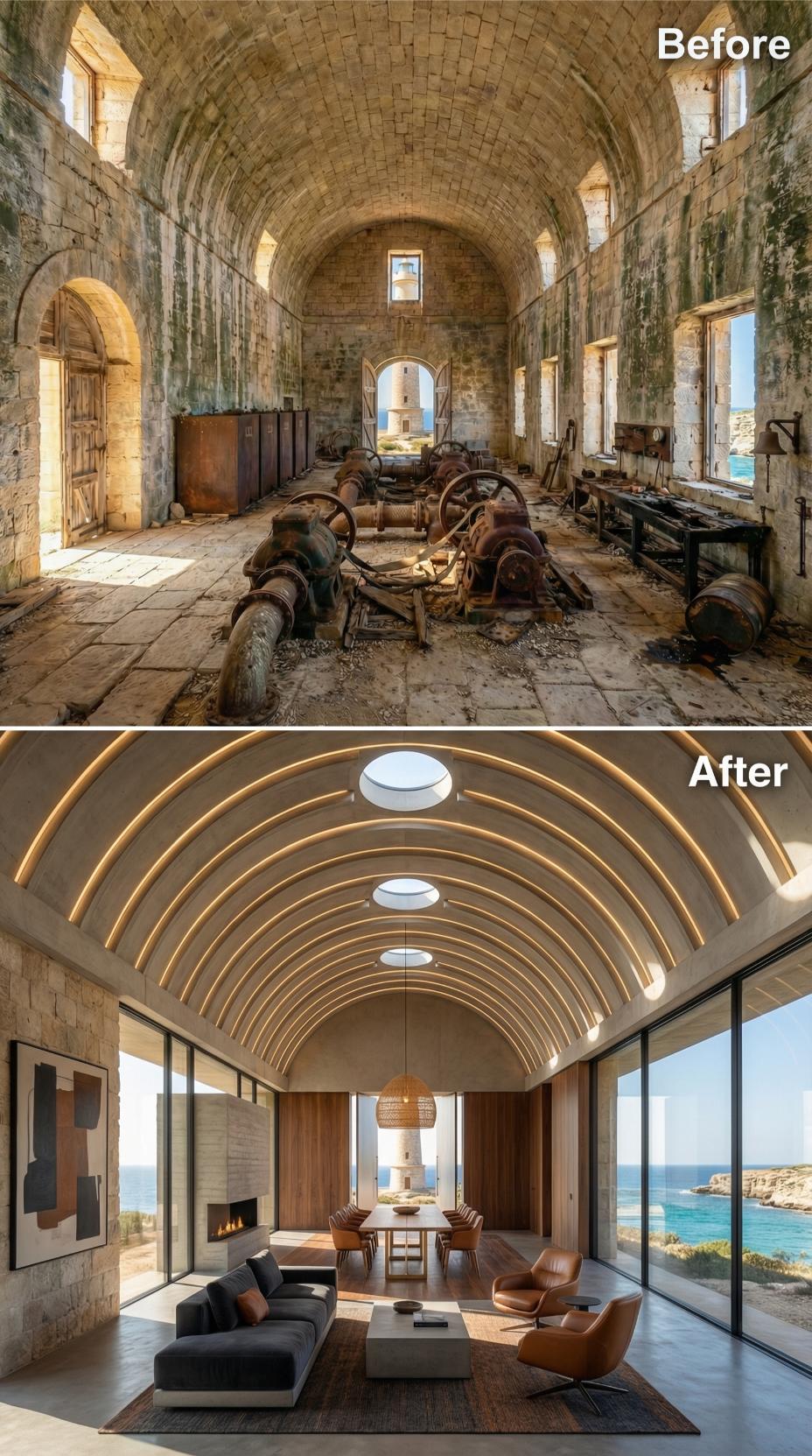
5. Ribbed Vault Lined in LED Strip Light, Stone Walls Kept, Sea Held in Glass
🔥 Would you like to save this?
Parallel timber ribs run the full curve of the barrel vault, each one backlit with recessed LED strip lighting that casts warm amber across the plaster between them. A circular skylight punctuates the crown. Below, a charcoal linen sofa anchors the near end while cognac leather armchairs face a low concrete coffee table. The dining area sits further back, centered on a walnut table beneath a woven rattan pendant. Floor-to-ceiling steel-framed glass panels replace what were once small punched windows, and a lighthouse tower stands framed directly on axis through the rear opening, the turquoise coastline spreading wide on both sides.
4. Pale Timber Vault, Terra Cotta Pendants Suspended on Cord, Lighthouse Framed in Glass
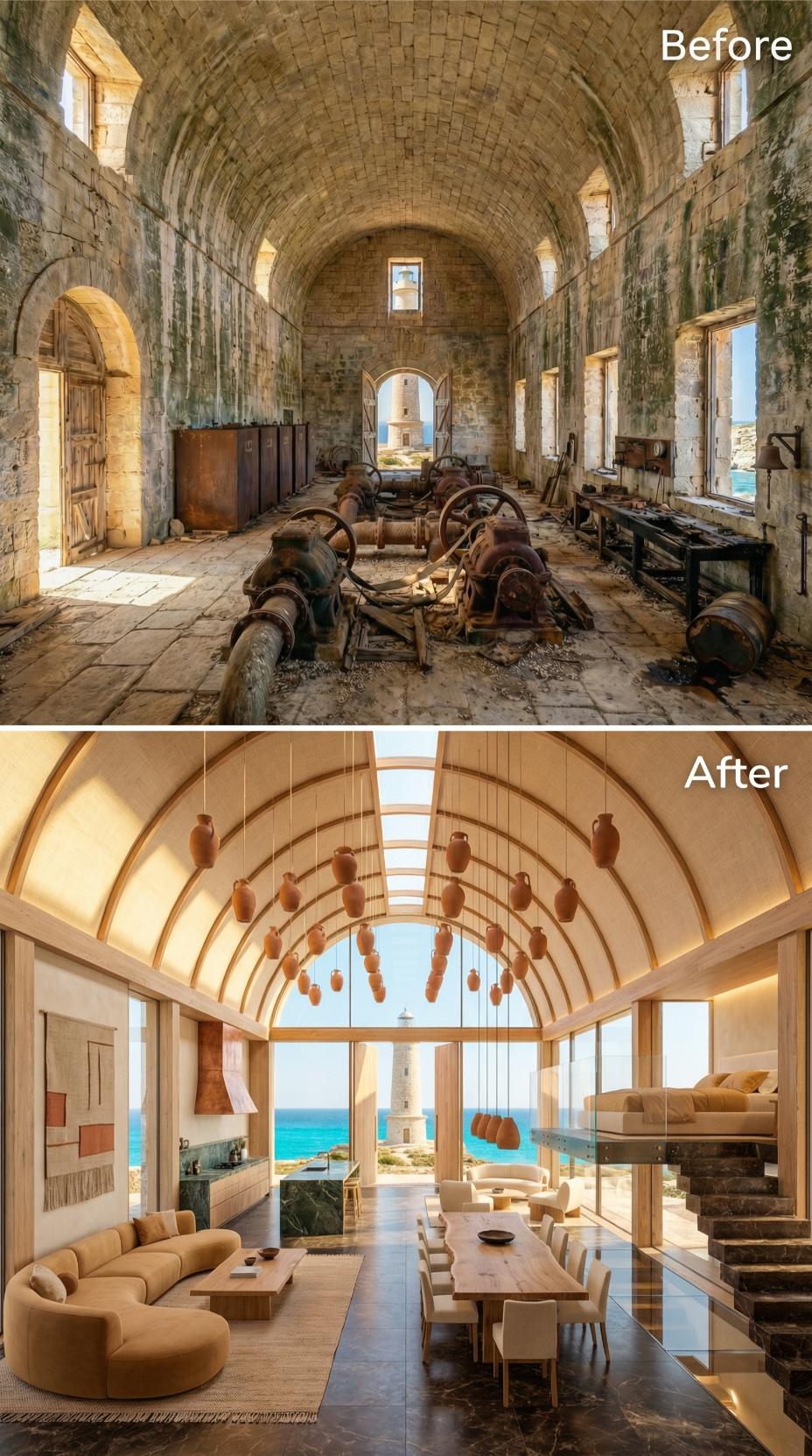
Ribbed pale timber now lines the barrel vault where mossy limestone once shed flakes onto rusted machinery below. Suspended terra cotta amphora-form pendants hang at staggered cord lengths along the vault’s centerline, pulling warm earth tones down into a dining table flanked by ivory linen chairs. A curved mustard-upholstered sofa anchors the living zone to the left, set over a natural fiber rug, while dark marble stairs rise on the right behind glass paneling.
3. Cobalt Tile Vault, Glass Chandelier, Lighthouse Burning at the Far Arch

Every surface of the barrel vault is covered in cobalt blue ceramic tile, lit from both sides by recessed LED strips that run the full length of the spring line. The chandelier drops on a single point above the seating area, its frame hung with individual blue and teal glass pendants that catch the vault light.
A curved sectional in royal blue velvet anchors the left side of the room, paired with a white marble round coffee table and two upholstered accent chairs. The kitchen island to the right is clad in white Calacatta marble with gold veining, and a brass dome hood hangs centered above the cooktop. Through the restored stone arch at the far end, the lighthouse stands illuminated against a night sky.
2. Copper Vault, Glass Conservatory at Center, Ochre Sofas Facing Open Sea
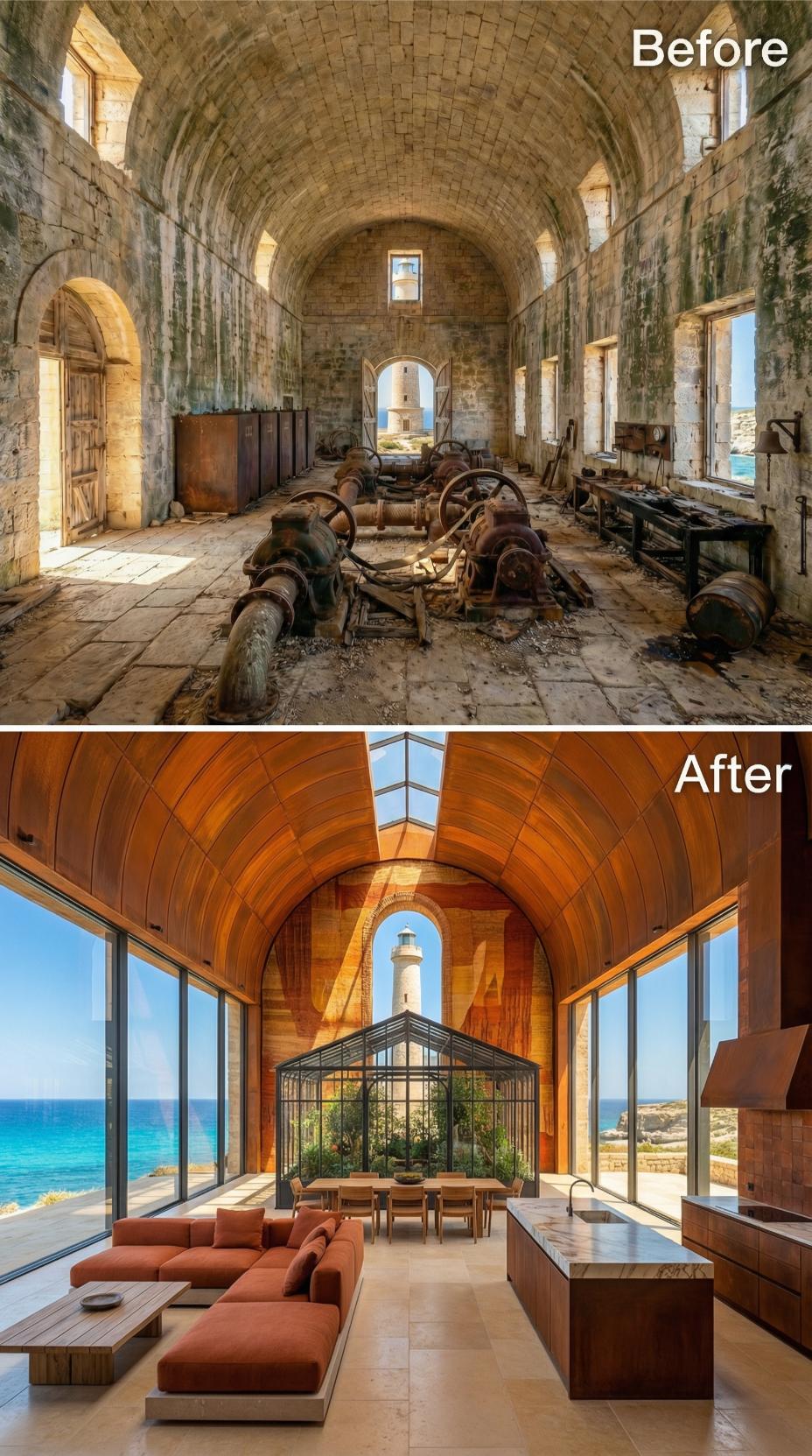
Warm-toned timber panels line the restored barrel vault from springer to crown, their reddish-brown grain running parallel to the curve overhead. Floor-to-ceiling glass replaced the original stone end walls entirely, pulling unobstructed views of turquoise water and the standing lighthouse into the room. A black steel conservatory structure sits centered on axis, planted with greenery and framing the lighthouse beyond it. Burnt-orange sectional sofas occupy the near half of the plan, set low on a stone-tile floor, while a marble-topped kitchen counter runs along the right wall in dark-stained cabinetry.
1. Polished Steel Vault, Burgundy Velvet Below, Lighthouse Burning Through the Arch
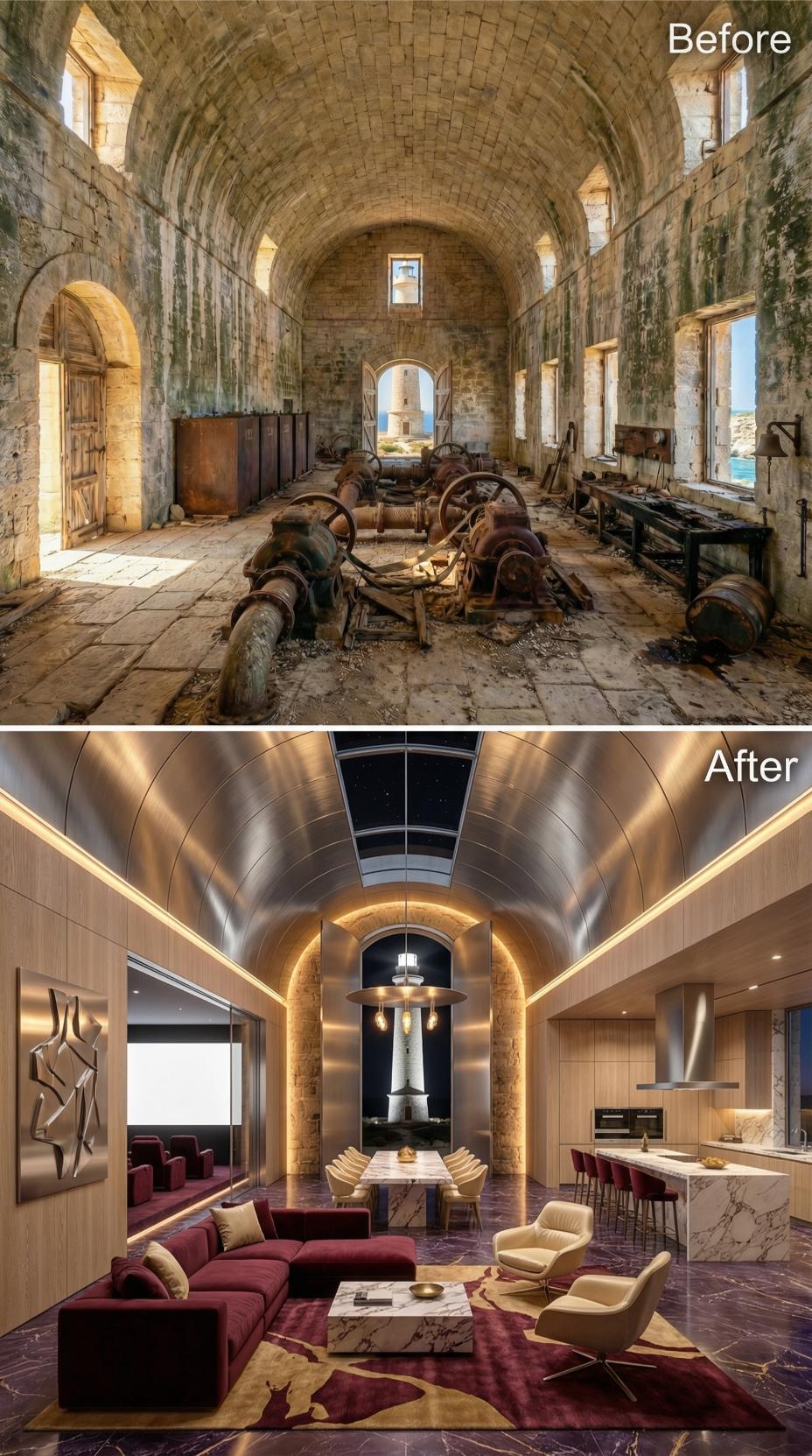
Brushed steel panels line the barrel vault from spring point to crown, interrupted at center by a skylight strip open to a night sky. Below, a burgundy velvet sectional anchors a patterned wool rug in deep red and gold, while cream leather chairs pull away from the marble coffee table. Flat-front oak cabinetry runs the full length of the kitchen wall, paired with a waterfall-edge marble island and crimson bar stools.