🔥 Would you like to save this?
The backyard deck spent decades being treated like an afterthought — a place to grill, stack unused chairs, and ignore from October through March. That default thinking is finally losing ground. What makes this collection worth a real look is how deliberately these designs borrow from interior logic: rugs that anchor a seating area the way they would in a den, pendant lighting hung at conversation height, built-in shelving that doesn’t pretend to be outdoor furniture. It’s not about making a deck look like a living room. It’s about giving it the same sense of intention. A few of these pull it off without feeling forced. Some try too hard and still land somewhere interesting. Thirty-one designs, ranging from modest suburban builds to sprawling covered structures. Readers can decide which ones actually work.
In order to come up with the very specific design ideas, we create most designs with the assistance of state-of-the-art AI interior design software. Also, assume links that take you off the site are affiliate links such as links to Amazon. this means we may earn a commission if you buy something.
31. Stone, Cedar, and Charcoal Gray Pull an Indoor Room Straight Onto the Deck
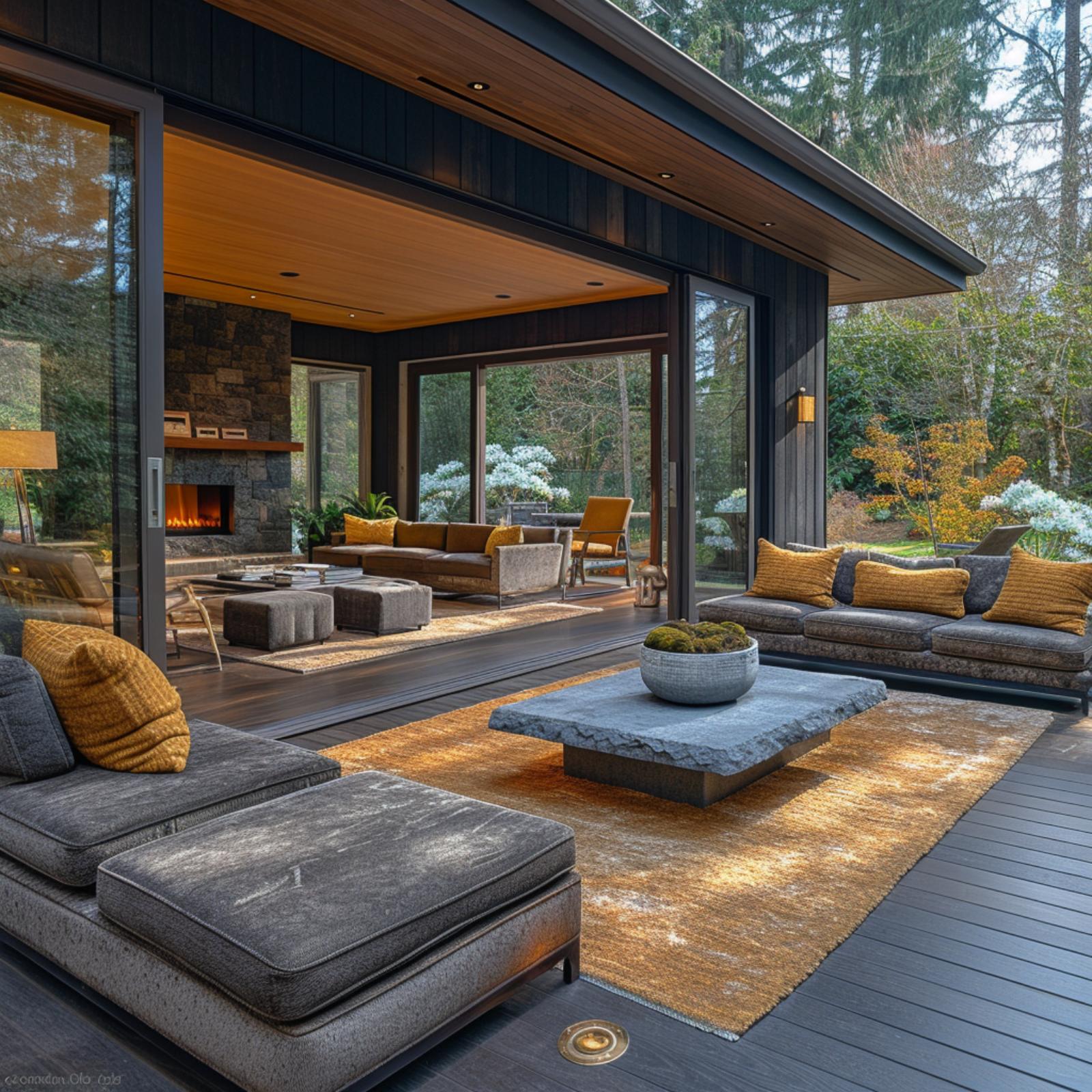
Sliding glass walls open completely here, letting the stone fireplace inside read as a focal point from the outdoor seating area. Gray modular sofas on the deck mirror the interior sectionals almost exactly, and the amber-gold rug grounds both zones with the same warm tone. A raw stone coffee table with a moss-filled bowl sits at the center of it all.
30. Boucle Sofas and a Pool Deck That Blurs Every Boundary Between Inside and Out
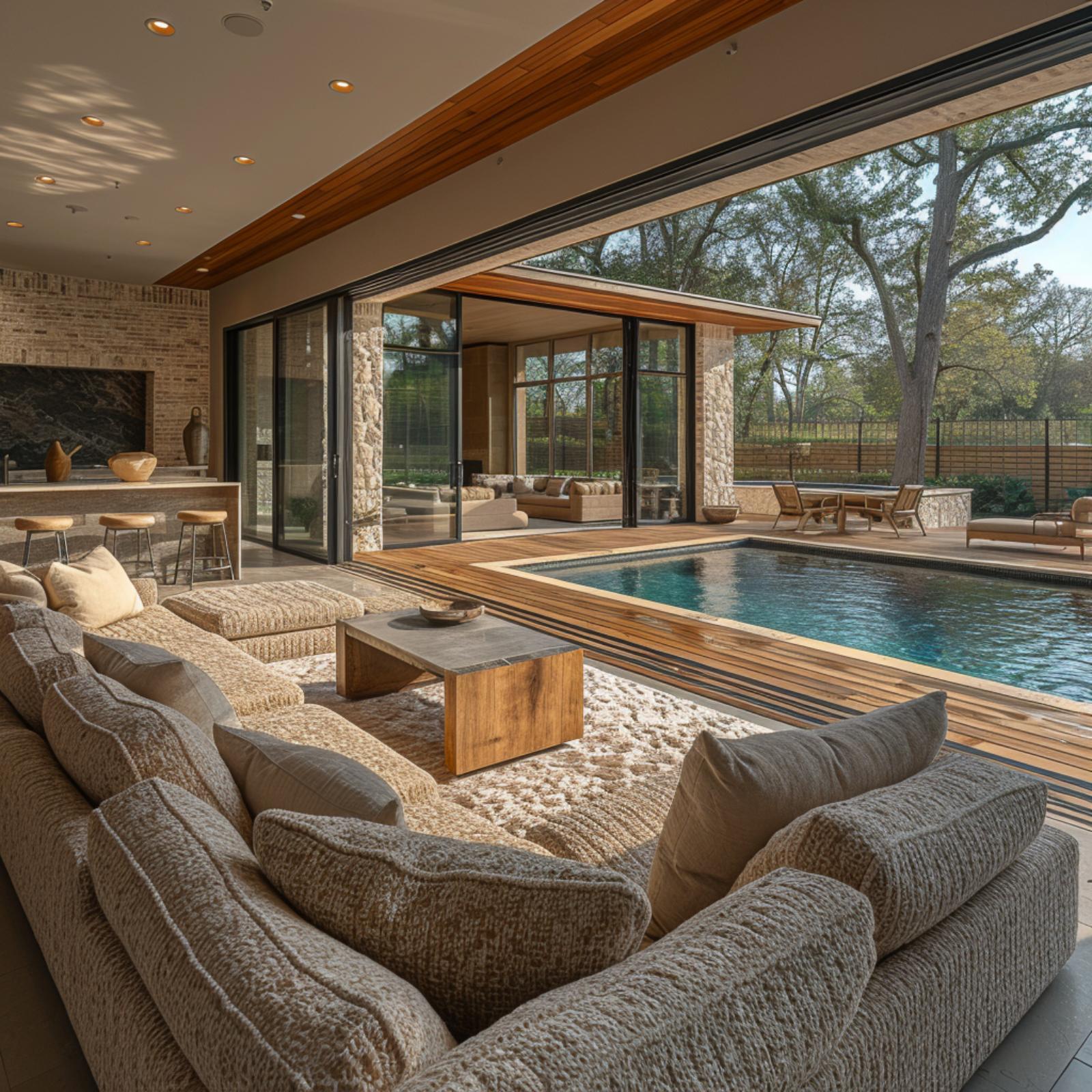
Large-format pocket doors retract completely, so the indoor lounge and the teak deck read as one continuous floor plane. The sectional’s boucle fabric and chunky reclaimed wood coffee table belong inside, yet they’re positioned just feet from pool water. Stone columns anchor the threshold without closing it off.
29. Teak Decking and a Stone Facade That Make the Pool Feel Like the Living Room Floor
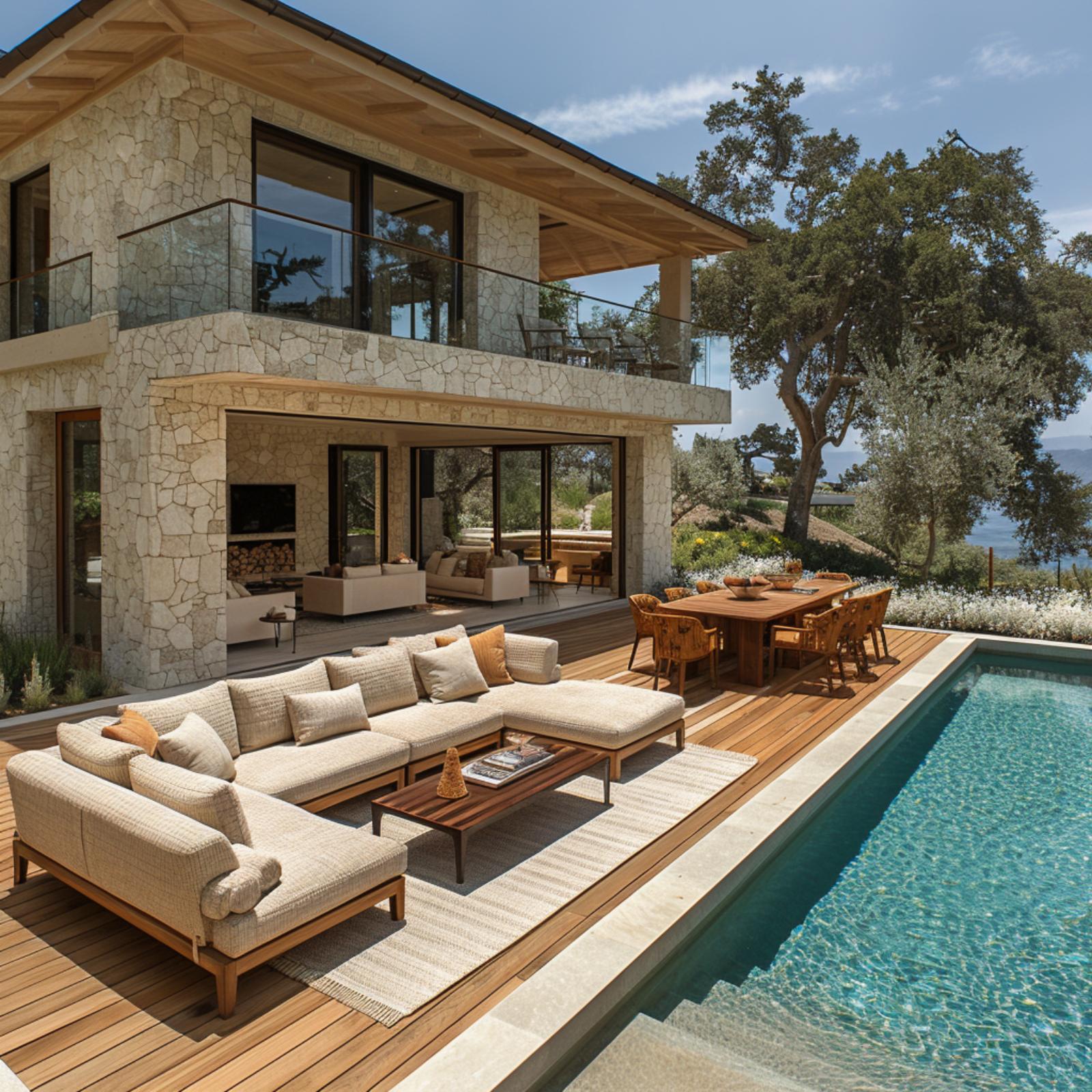
Natural stone cladding wraps the two-story exterior in a mosaic of warm ivory and sand, and inside, the same neutral palette carries right out through the open bifold doors onto the teak deck. The sectional sofa out here is sizable, with deep cushions in an oatmeal-toned woven fabric and a wood-framed coffee table that matches the decking species almost exactly. That’s not an accident.
A teak dining table seats eight on the far end of the deck, positioned close enough to the pool edge to feel deliberate. The upper balcony adds a glass rail that keeps sightlines open to the water and the oak trees beyond. Nothing competes. Every material choice points in the same direction.
28. Flat Roof, Glass Walls, and a Sunken Deck That Pulls the Sofa Poolside
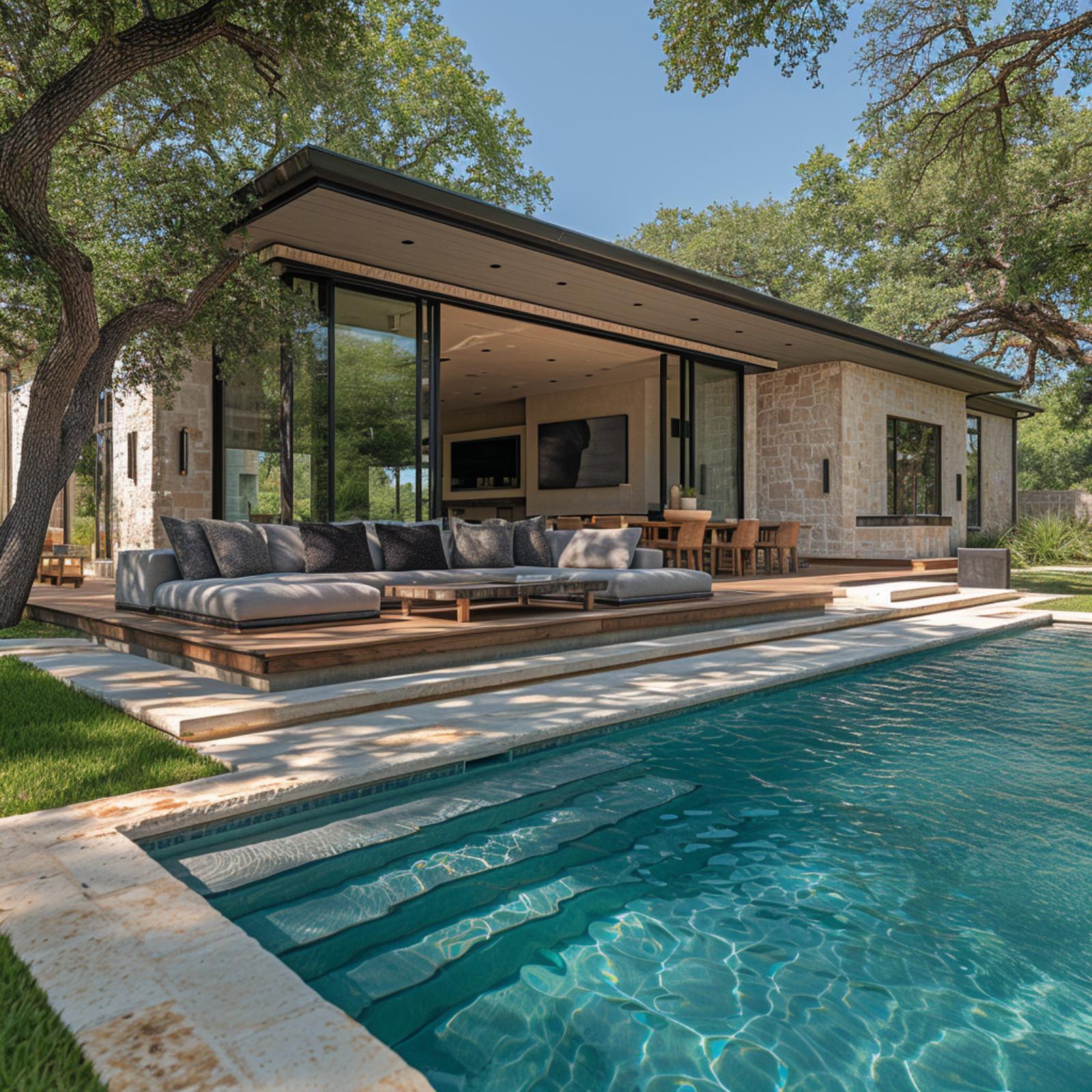
Warm ipe decking steps down to meet the pool coping, and that transition does most of the work here. A low-profile sectional in heathered gray sits on a platform just inches above water level, arranged exactly as it would be inside. Floor-to-ceiling glass panels fold back completely, so the mounted television and dining area behind them read as one continuous room.
Pro Tip: When designing a deck meant to feel like interior square footage, the deck surface material should match or closely complement the interior flooring. Here, the ipe tones echo the wood ceiling soffit visible through the glass, which is what makes the inside and outside feel connected rather than adjacent. Keep furniture legs low and scale generous, the way this sectional does, so sight lines stay uninterrupted from pool’s edge to back wall.
27. Pocket Doors Gone, Pool Deck Becomes the Sixth Room in the House
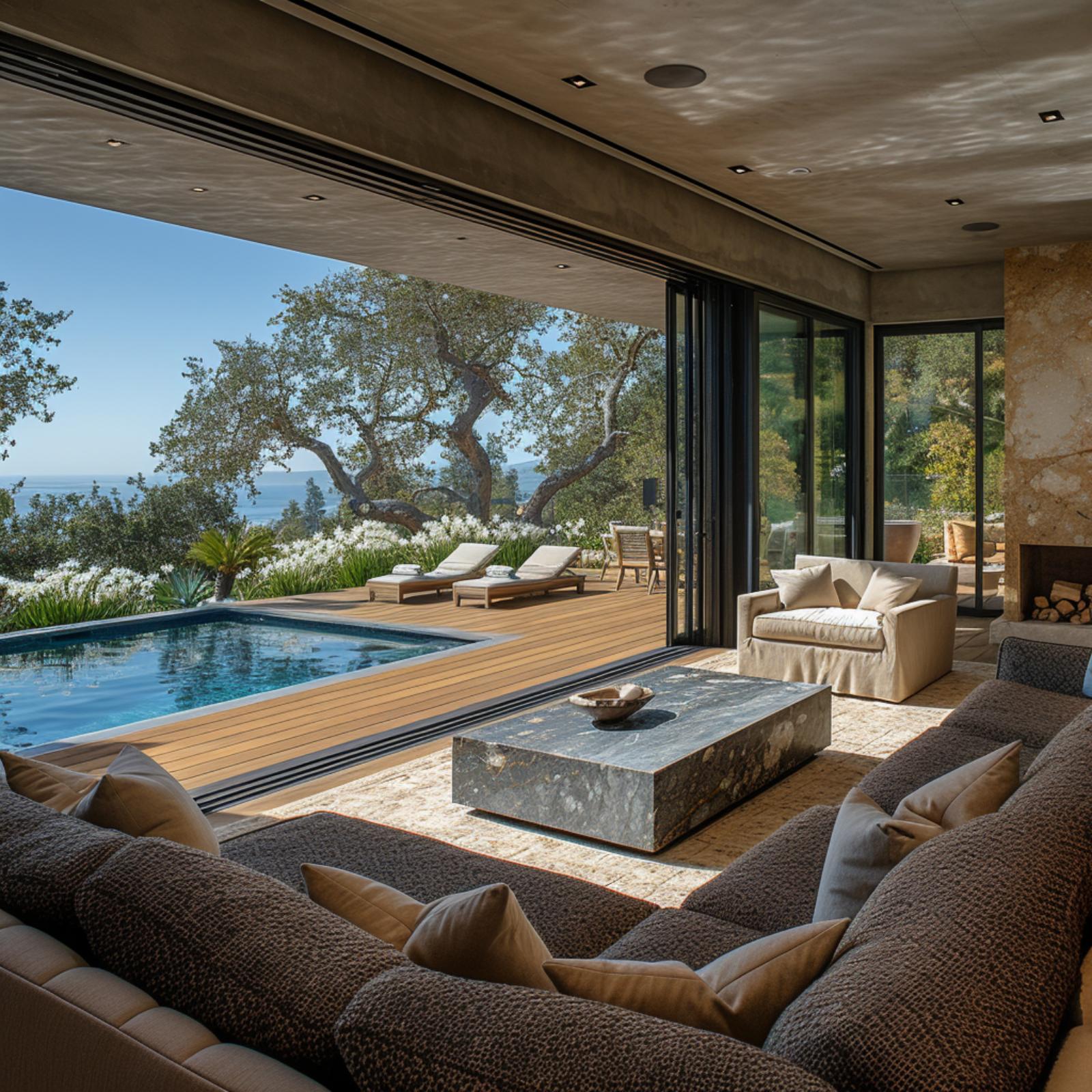
Concrete plaster on the ceiling carries the same matte, ochre-toned finish as the stone accent wall flanking the fireplace, and that repetition is what pulls the eye outward rather than stopping it at the threshold. The chunky travertine coffee table sits on an area rug that bridges interior tile and wood decking without apology. It works because the furniture scale doesn’t shrink outside. Lounge chairs on the teak deck match the sofa’s proportions indoors, so the pool area reads as another room, not a yard.
Why the Ceiling Finish Matters More Than the Flooring Here
Most indoor-outdoor designs focus on matching floor surfaces, but the plaster ceiling extending over the covered portion of this space does something the floor can’t: it creates a continuous overhead plane that the eye registers as one room. When that plane breaks, the brain registers a boundary. Here, it doesn’t break, so neither does the sense of enclosure.
26. Marble Slab Coffee Table, Stone Walls, and a Pool Deck That Lives Like Interior Square Footage
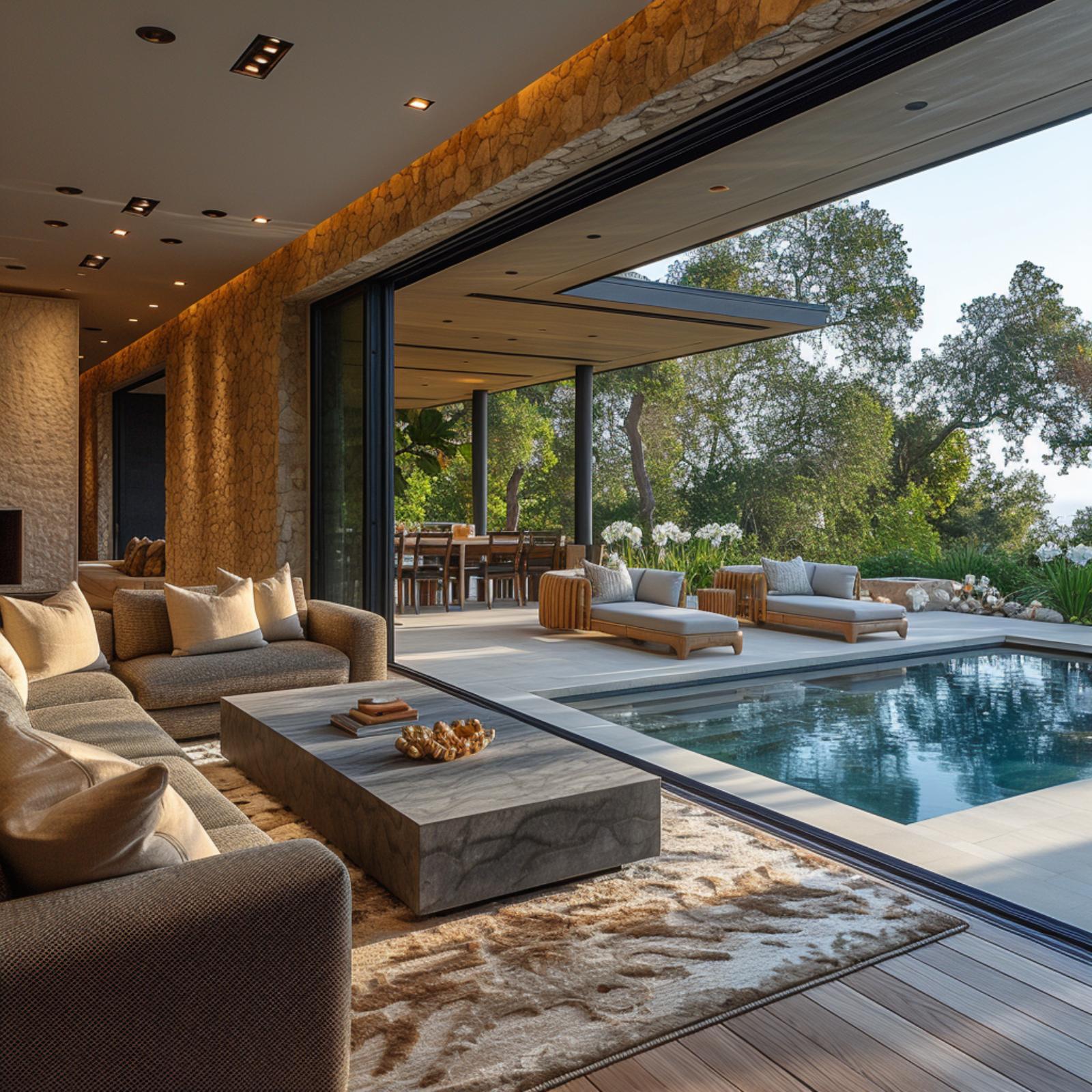
Recessed can lighting runs continuously from the interior ceiling out through the covered patio, and that unbroken line does more than any single furniture choice to sell the illusion of one room. The stone accent wall doesn’t stop at the door frame. It carries outside, and the eye follows it there.
The sectional inside sits on a patterned area rug with sandy tones that echo the travertine pool deck. Both surfaces are pale, matte, and horizontal. Teak-slatted outdoor loungers and a dining table beyond the glass keep the material story going rather than starting over. White agapanthus blooms along the far edge are the only thing that breaks the neutral register, and honestly, the space needs that.
Recessed can lighting runs continuously from the interior ceiling out through the covered patio, and that unbroken line does more than any single furniture choice to sell the illusion of one room.
Where the last design leaned on marble and stone, this one trades hard surfaces for softness.
25. Fire Pit, Flat Roof, and a Gray Sectional That Forgot It Was Outside
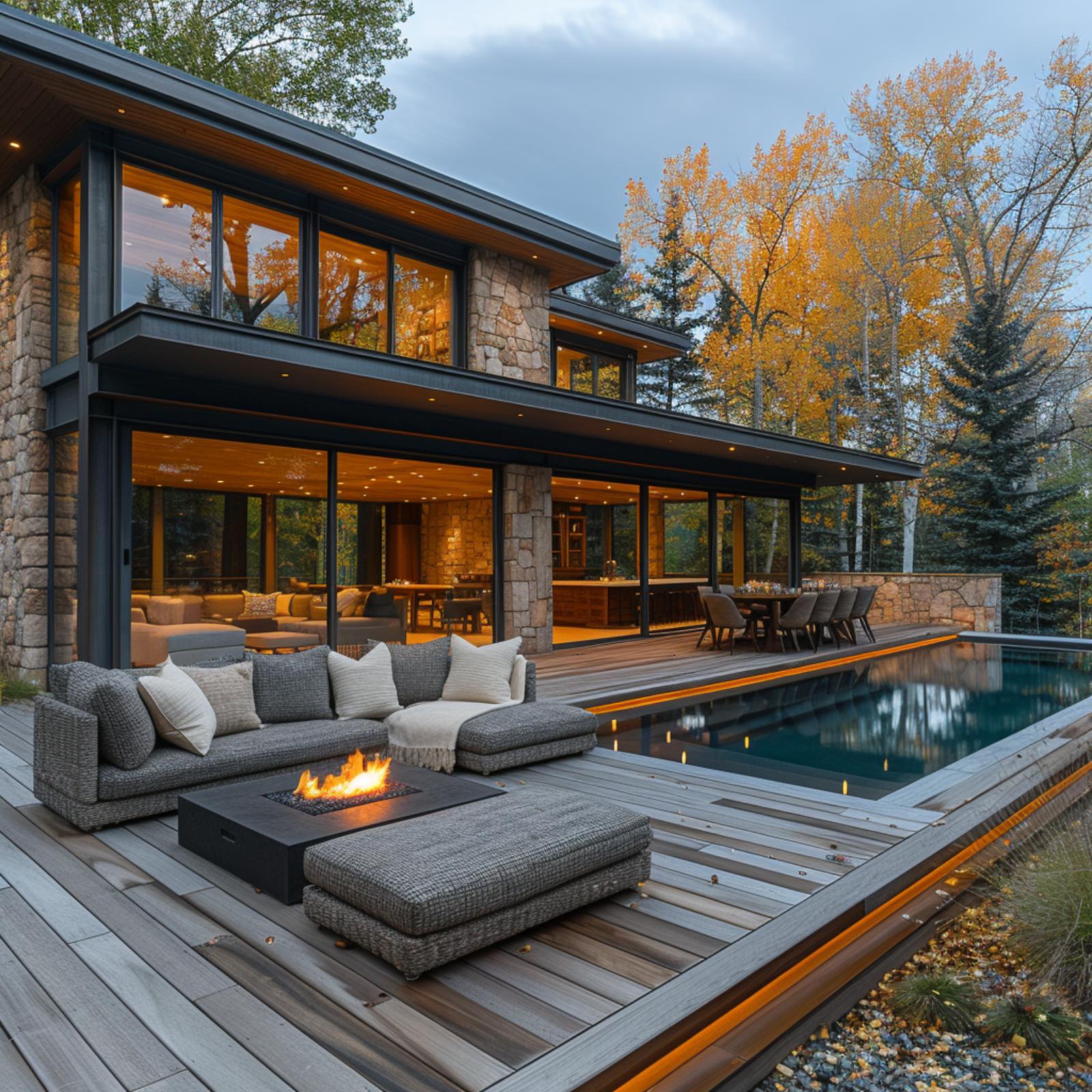
Gray woven-fabric sectional seating arranged around a gas fire pit table doesn’t read as patio furniture. It reads as a living room that someone slid outdoors whole. The flat roof overhang pulls the interior’s cedar ceiling plane straight over the deck, so the threshold between inside and out is more suggested than real. Stone cladding on the structural columns carries the same rough-cut texture visible through the floor-to-ceiling glass, and that repetition does most of the work. Under-deck lighting along the pool edge keeps the space from going dark at dusk, which means it stays usable well past the point most outdoor rooms quit.
24. Travertine Spa, Teak Decking, and a Sectional That Never Got the Outdoor Memo
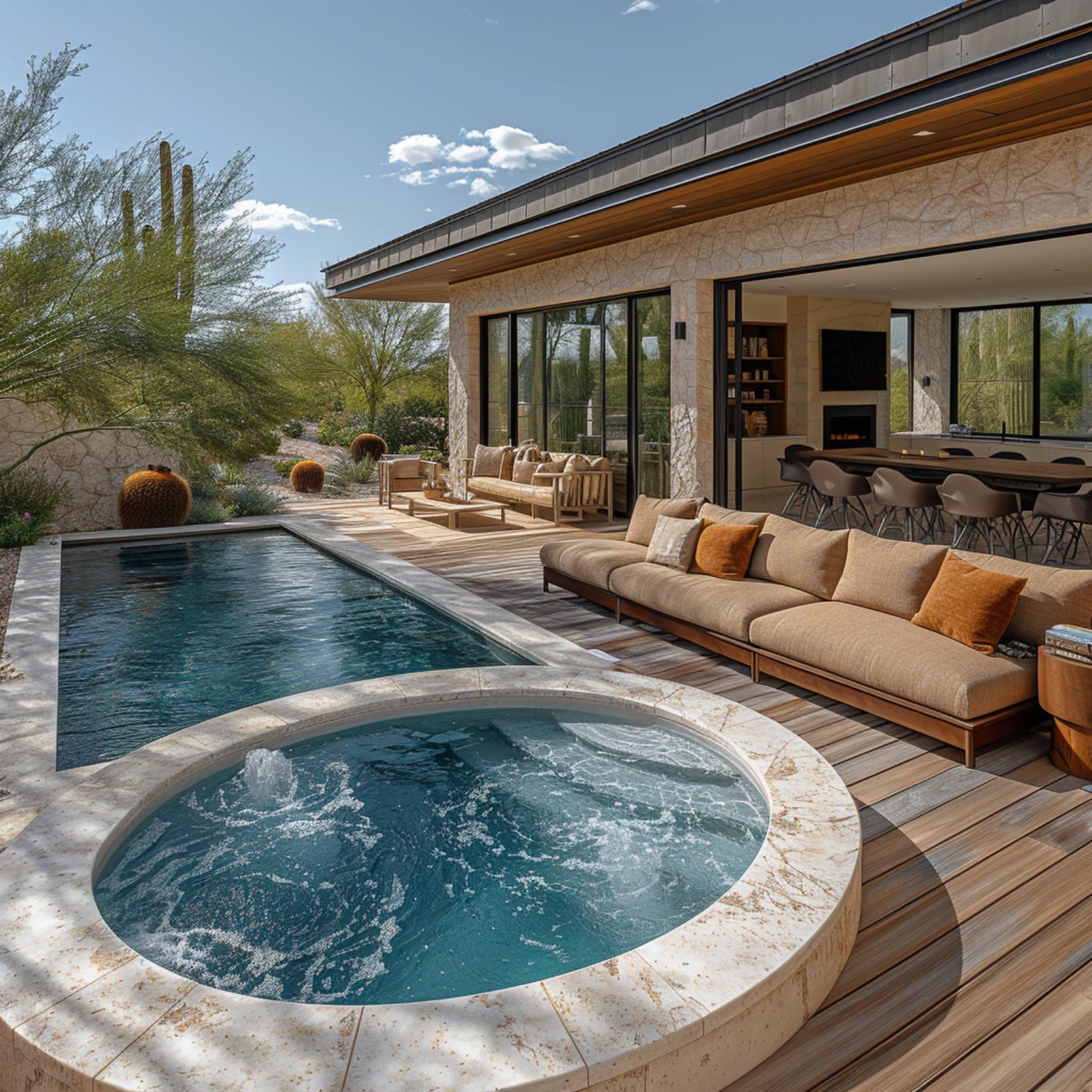
The circular spa surround is travertine, and it connects directly to the lap pool without a single material break. That continuity does most of the work. The teak deck planks run parallel to the sofa, grounding the seating area the way a area rug anchors a living room.
Trend Alert: Round spas are gaining traction as a design move that softens the hard geometry of rectangular lap pools. Pairing a circular water feature with linear decking creates visual contrast that keeps an outdoor space from reading as flat or predictable. It’s a detail more often seen in hospitality design that’s now showing up in residential backyards.
23. Floor-to-Ceiling Glass and a Walnut Deck That Refuses to End at the Door
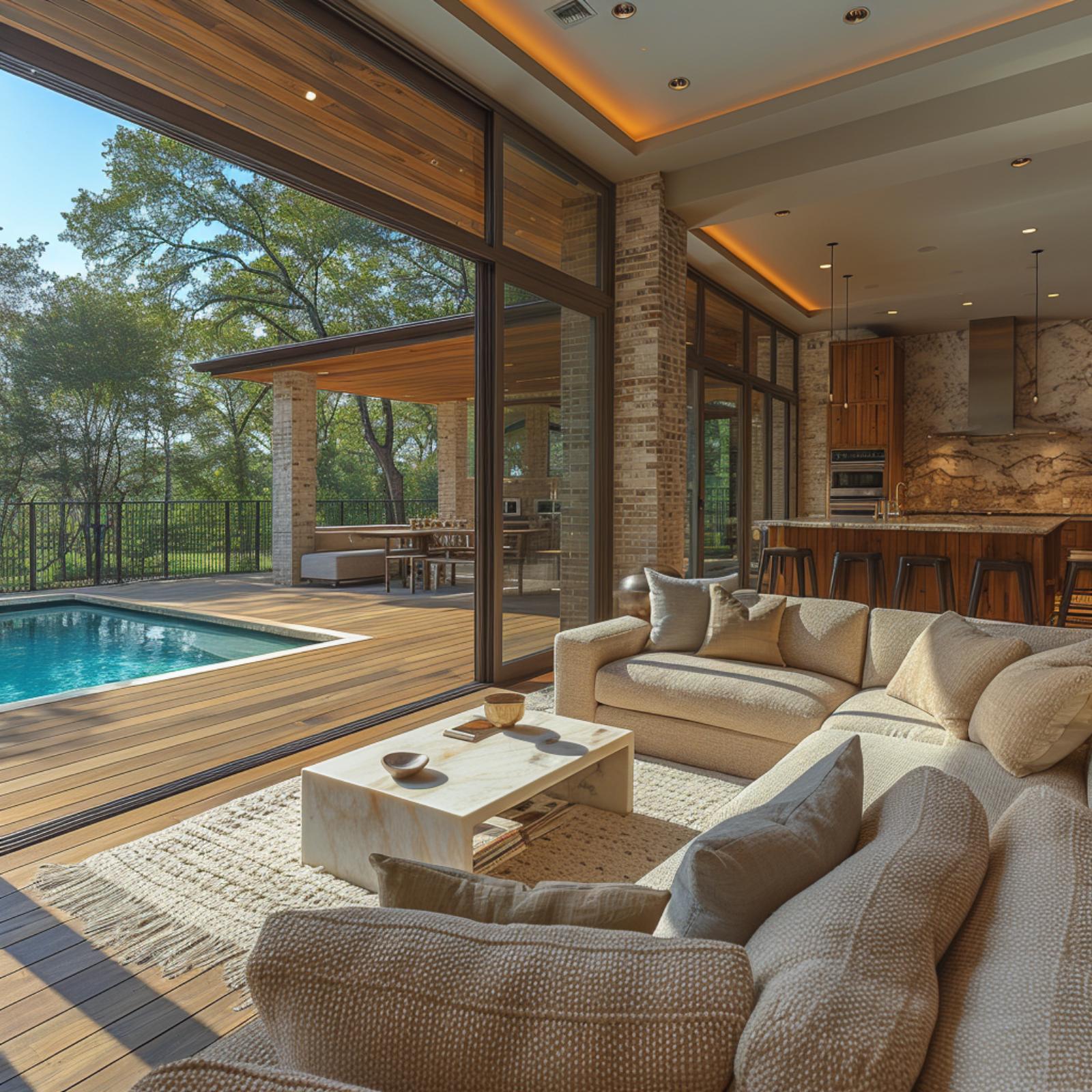
Cream boucle sectionals sit directly in front of floor-to-ceiling glass panels that pocket away, letting the wood deck read as a continuation of the interior floor. An onyx or travertine coffee table anchors the seating group with the same material weight as the kitchen island visible behind it. That island, wrapped in warm walnut cabinetry and backed by a veined stone hood surround, pulls the outdoor zone into the same material conversation as the cooking space. It works because nothing stops at the threshold.
Ask Yourself: Before opening up a wall with floor-to-ceiling glass panels, ask yourself whether your interior finishes can carry that visual weight outdoors. If the deck material and the indoor flooring don’t share a similar tone or grain, the eye reads them as two separate rooms rather than one continuous space.
22. Vineyard Views and a Stone Corner That Make the Deck Feel Inevitable
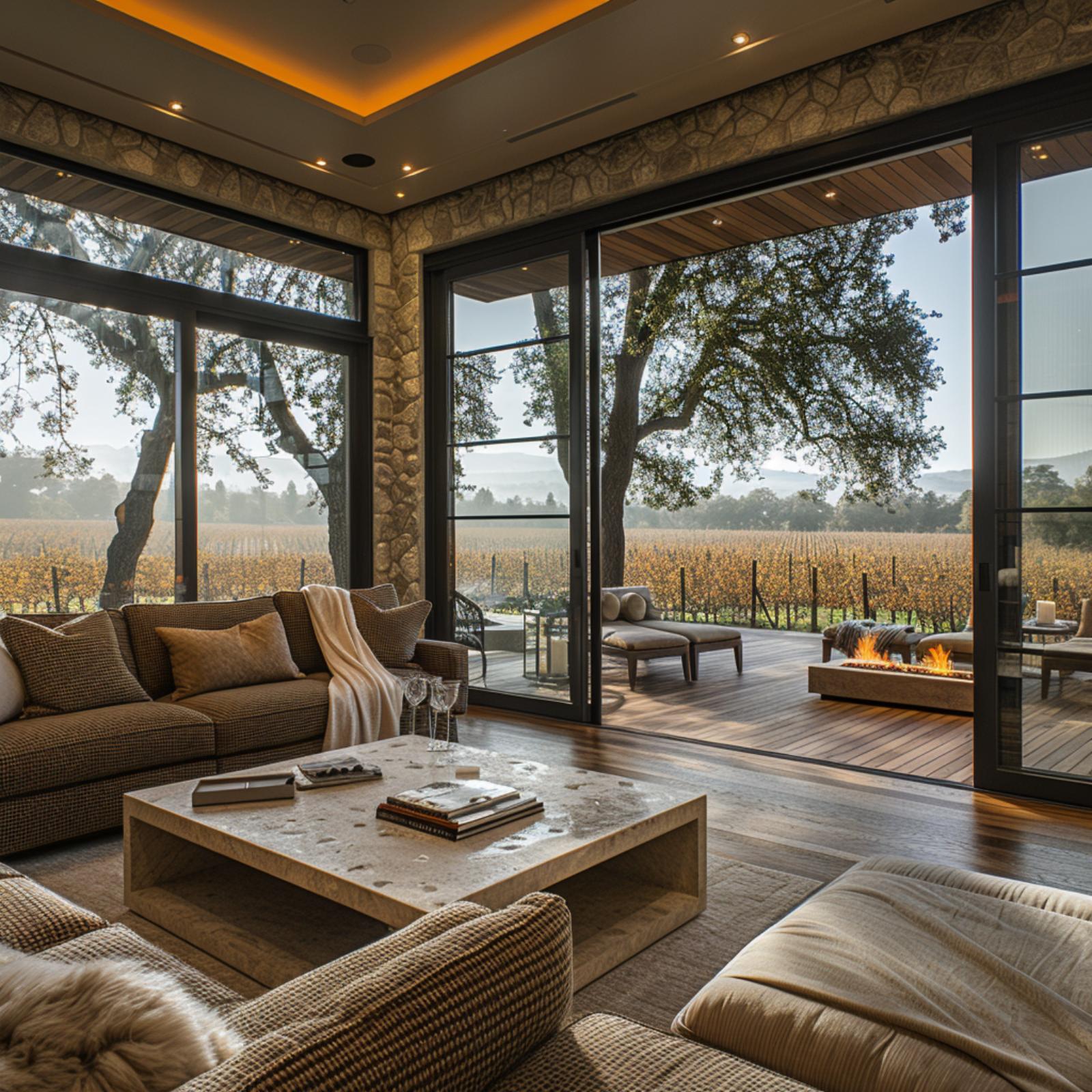
Houndstooth-upholstered sofas and a travertine slab coffee table set the interior tone, then the deck picks it up without missing a beat, matching the warm hardwood flooring and carrying a fire pit where the rug would be.
Color Story: Amber, tobacco brown, and the gold of dormant vineyard rows create a palette that practically designs itself here. The interior textiles don’t compete with that view, they echo it. Choosing upholstery in earth tones that mirror the seasonal color outside is one of the quieter tricks in residential design.
21. Dark Decking, a Hot Tub, and Dining Chairs That Think They’re Inside
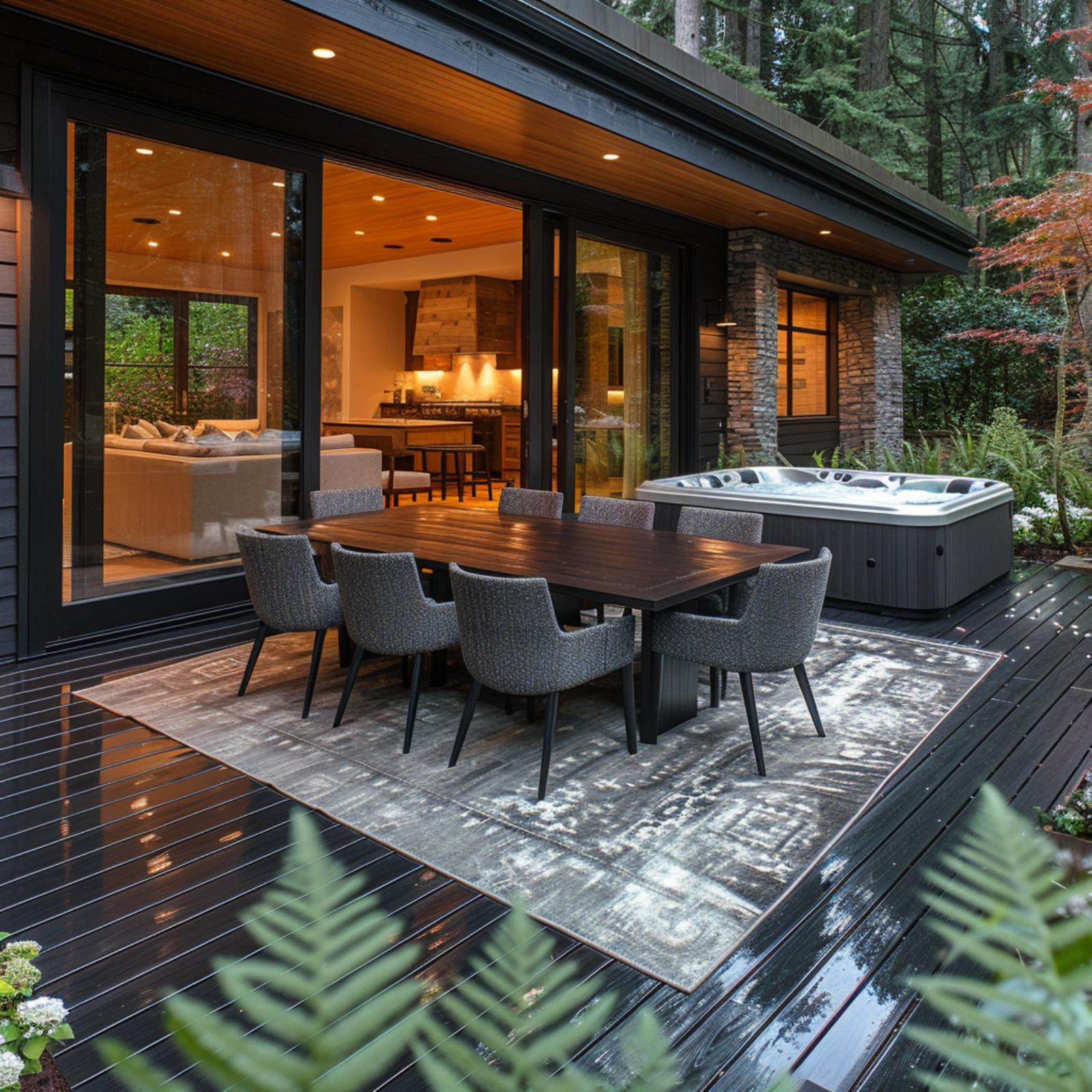
Putting an outdoor rug under a dining table is the single fastest way to signal that a deck is furniture territory, not foot traffic territory.
Dark composite planks run the full width of this deck, and their near-black finish reads less like traditional lumber and more like stained hardwood flooring you’d find in a modern dining room. Six upholstered chairs in charcoal tweed sit around a walnut-stained rectangular table, which is exactly the kind of pairing you’d expect in an interior space. Behind the glass, warm-toned wood ceiling panels and recessed can lighting spill amber light outward, making the inside visible enough to feel continuous without competing. The hot tub tucked against the stacked-stone column doesn’t disrupt the dining zone; it actually anchors the far corner the way a side piece would in a living room.
20. Oak Trees, Ocean Horizon, and a Sectional That Refuses the Indoors-Outdoors Divide
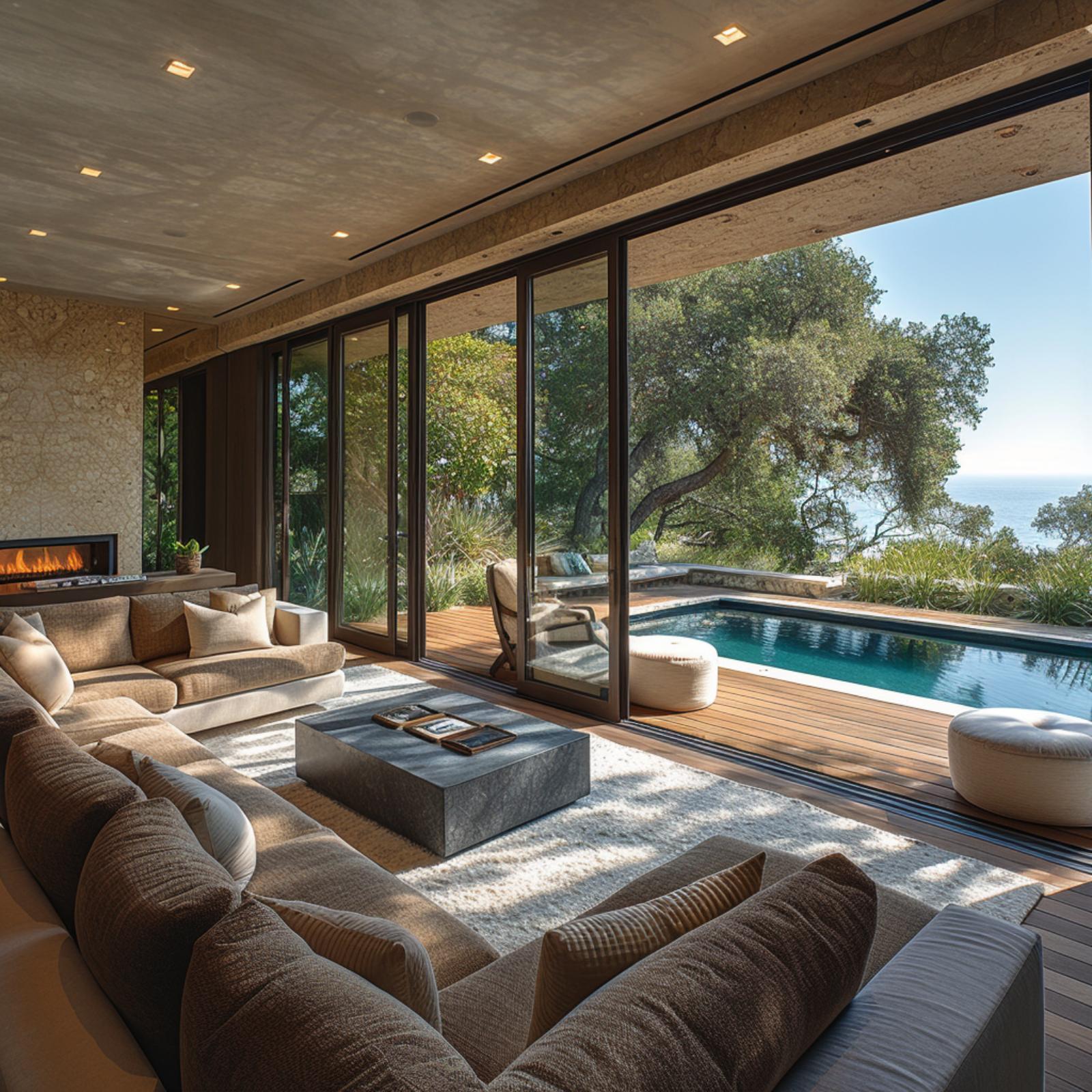
Folding glass panels slide fully out of the way here, leaving nothing between the chenille sectional and the teak deck except a flush threshold you’d barely notice underfoot. The concrete coffee table anchors the seating arrangement inside while visually connecting to the pool coping just beyond it.
Common Mistake: Homeowners often spend heavily on interior furniture and finishes, then treat the deck as an afterthought. If the wood decking color and the interior flooring tone don’t share at least one common undertone, the eye reads them as two separate spaces no matter how wide the opening gets. Getting that material relationship right before construction begins costs nothing.
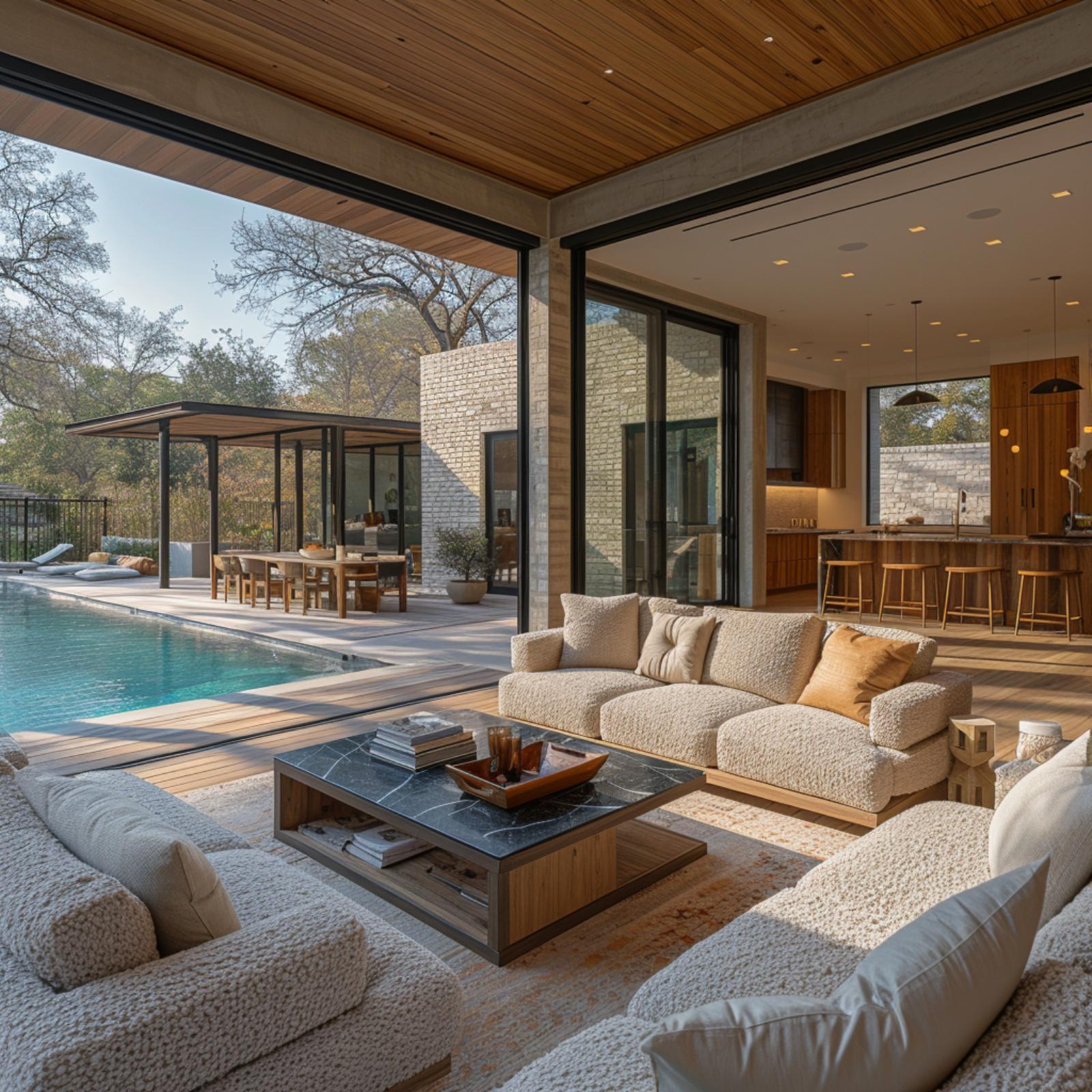
19. Cedar Ceiling, Boucle Sofas, and a Pool Deck That Answers to the Living Room
🔥 Would you like to save this?
Cedar planks run across the ceiling from inside to out without interruption, and that single material decision does most of the heavy lifting here. Boucle sectionals in warm ivory sit on a patterned area rug that has no business being this close to a pool. But there it is.
Outside, a teak deck wraps the lap pool toward a pergola-covered dining area with wood chairs that share the same tone as the cabinetry inside. The kitchen’s bar stools, finished in brushed gold, align visually with the warm stone exterior wall. Nothing announces where the house ends.
Why the Ceiling Does More Work Than the Walls Here
In most indoor-outdoor transitions, glass panels or pocket doors get the credit for creating flow. Here, it’s the cedar ceiling that actually earns it. By carrying the same tongue-and-groove wood overhead from the living room through to the covered outdoor zone, the eye reads one continuous room rather than two adjacent ones. Walls can be interrupted by thresholds, columns, and frames. Ceilings rarely are, which makes them a quieter and often more persuasive tool for connecting spaces.
18. Ivory Boucle, Teak Decking, and a Fireplace That Forgot to Stay Inside
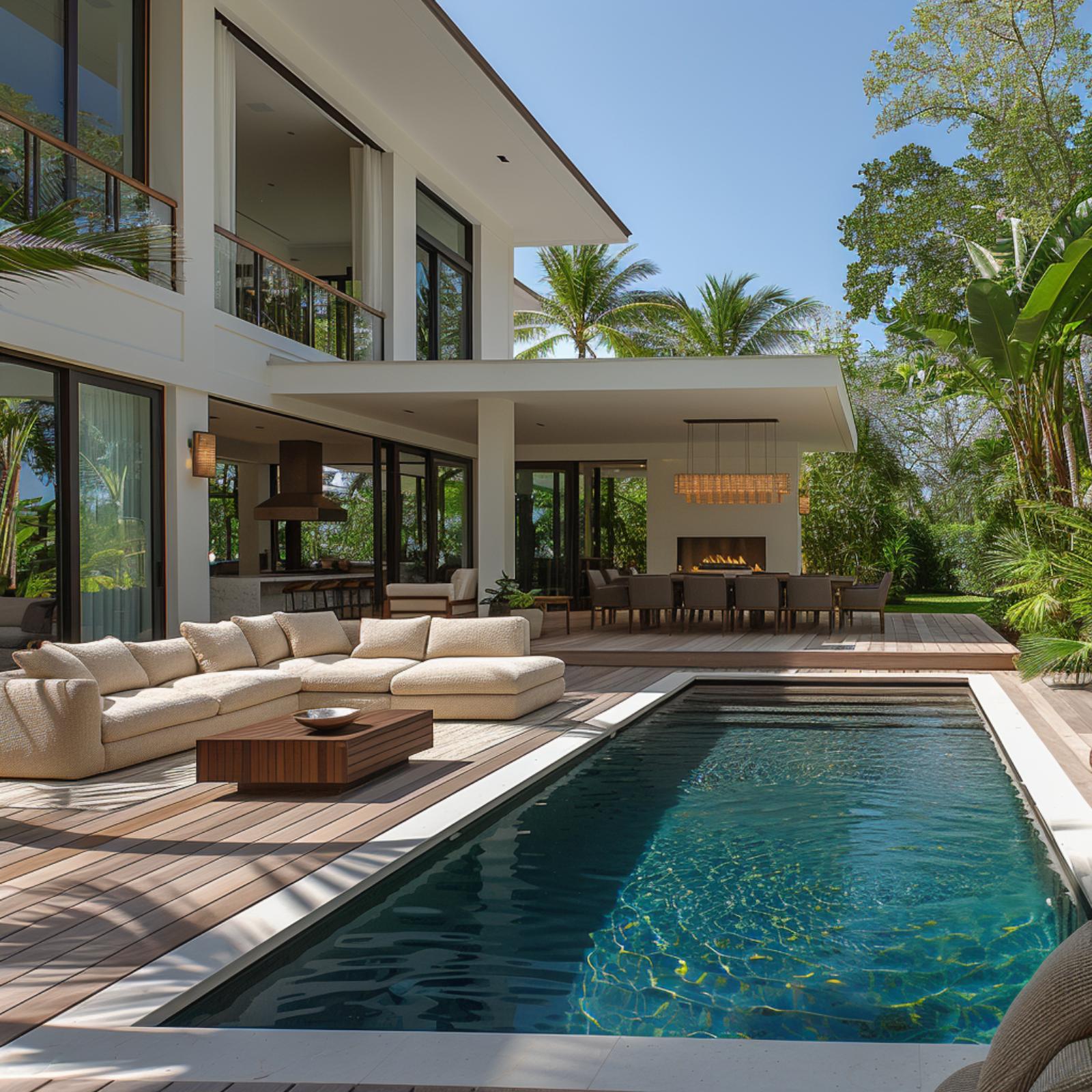
Pale boucle upholstery on a generous L-shaped sectional sits directly poolside, separated from the interior kitchen by nothing more than open glass doors. That kind of placement only works when the deck surface earns it. Here, the horizontal-slat teak decking runs in one unbroken plane from the sofa zone through to a raised dining area, where a linear suspended pendant casts amber light over a long table. The fireplace anchors the far wall like it belongs in a living room. It does.
The two-story facade behind it reads almost entirely as glass, which means the interior and exterior share the same light at the same time of day. Tropical palms soften what would otherwise be a hard architectural edge.
In The Details: Suspended pendants are traditionally considered interior fixtures, but installing one under a covered outdoor overhang reframes the dining area as a proper room. The key isn’t the fixture itself but whether the ceiling above it has enough enclosure to make the light feel contained rather than lost. A flat soffit like this one provides exactly that sense of shelter.
17. Wood Ceiling, Boucle Sectional, and a Pool Deck That Takes Its Cues from the Living Room
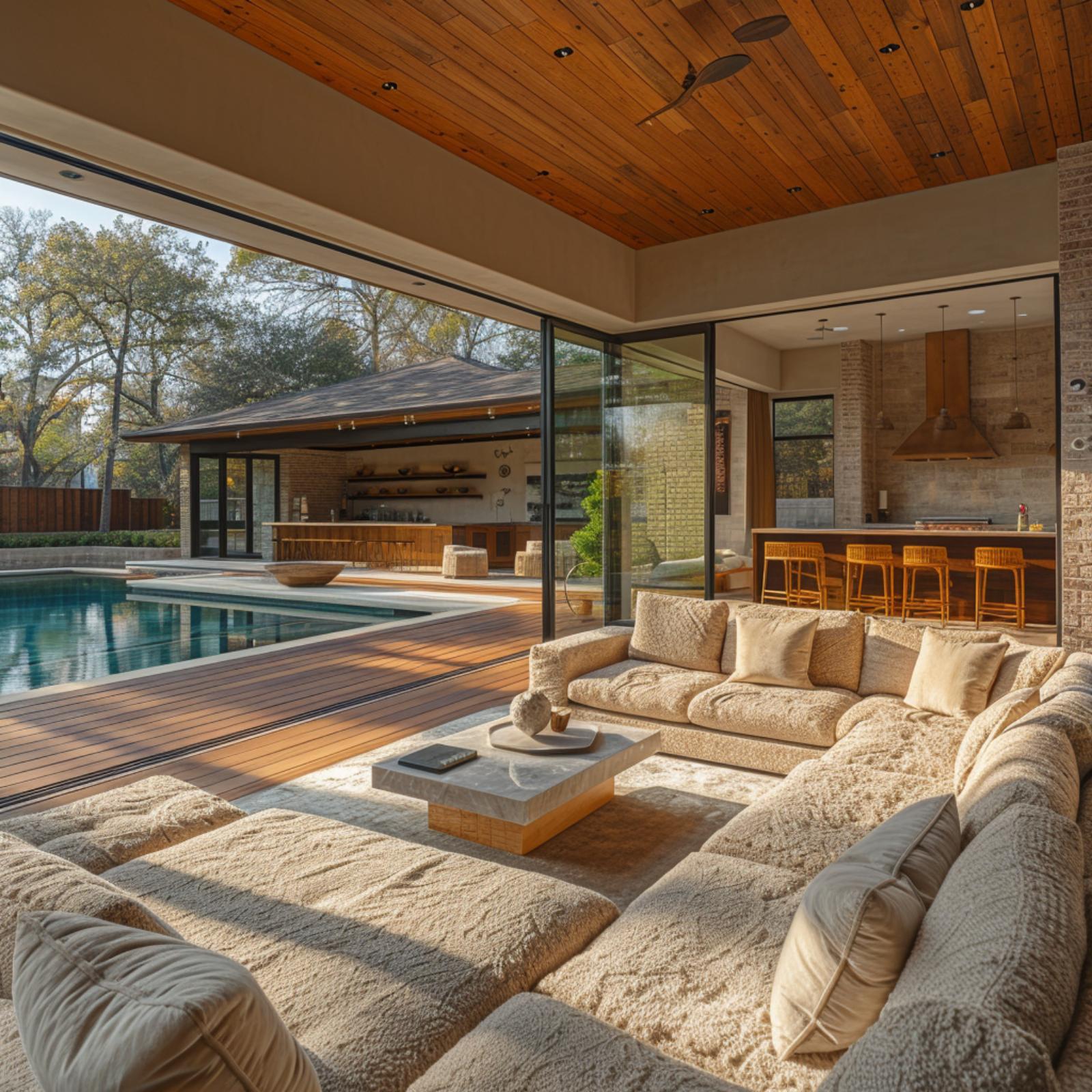
Tongue-and-groove cedar planks run the full length of the ceiling, pulling warmth downward into a space anchored by an oversized boucle sectional in sand. That sectional is the tell. Its scale and fabric belong in a formal living room, yet it sits within arm’s reach of a pool deck laid in rich ipe boards.
Floor-to-ceiling glass panels on a corner track disappear entirely, and the bar stools at the interior island repeat the same amber tone as the decking outside. Nothing signals a boundary. The stone column to the right does real structural work without feeling heavy, and the marble coffee table keeps the seating arrangement grounded.
Worth Knowing: Ceiling material is one of the most underused tools for connecting indoor and outdoor zones. Running the same wood species from an interior ceiling out through a covered overhang draws the eye outward and makes the covered deck read as part of the room rather than an add-on. It’s a simpler move than most people expect, and it tends to cost less than matching flooring across the threshold.
16. Saguaro-Framed Decking, Glass Railings, and a Sectional That Clocked Out of the Indoors
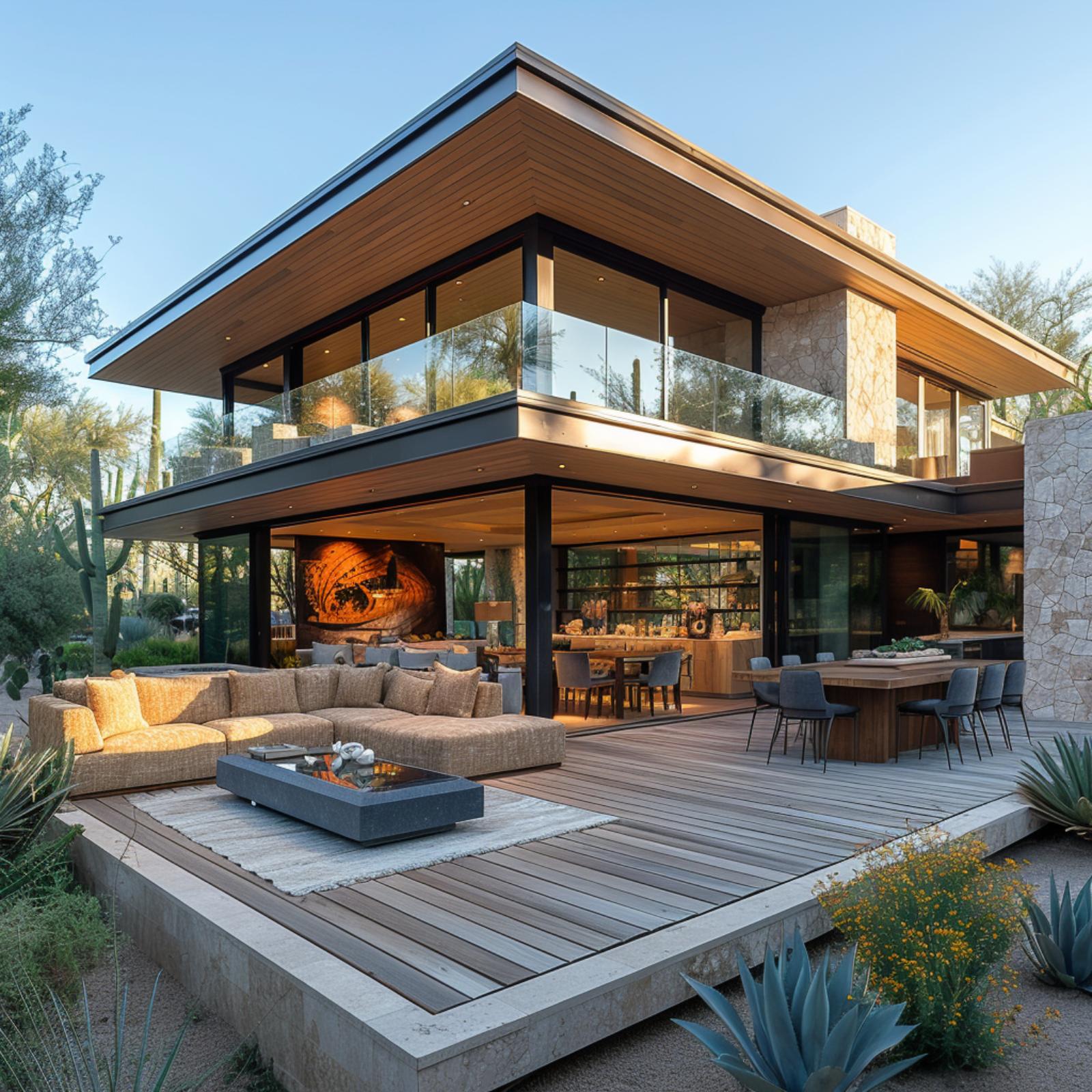
Warm-toned wood decking runs flush with a raised concrete border, and that platform anchors a sectional in a nubby sand-colored fabric that reads as living room furniture first, outdoor furniture second. The stone cladding on the upper volume ties the exterior shell to the interior palette without forcing it.
Wide sliding panels dissolve the wall entirely. Inside, a dining area with charcoal chairs and what looks like a kitchen island beyond it reads as one continuous room. The saguaros and agave just happen to be part of the view.
- Glass railings on the upper level preserve sightlines without interrupting the architecture
- Raised decking platforms define zones outdoors the way area rugs do inside
- Stone cladding repeated on both interior and exterior walls keeps the eye from registering a boundary
15. Limestone Walls, Bubbling Jets, and a Deck That Reports to the Living Room
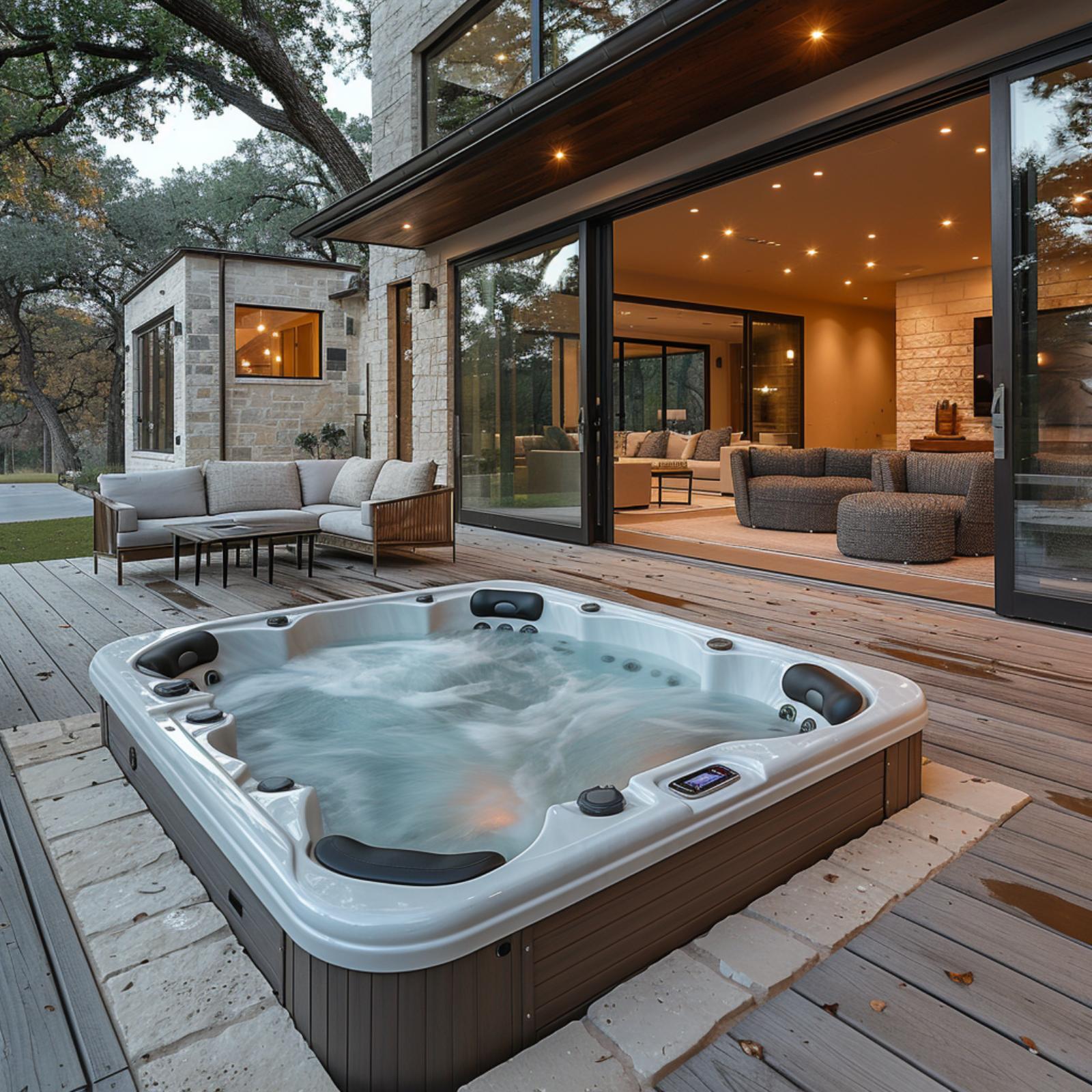
Wet jets are already running, and the deck hasn’t asked permission from anyone. White acrylic shell, dark cabinet skirting, and headrests positioned at each corner give this spa the footprint of indoor furniture placed outdoors with full confidence.
Fun Fact: Hot tubs installed flush with or recessed into deck framing tend to read as built-in architectural features rather than appliances dropped onto a patio. That distinction matters more than most homeowners expect when they’re trying to close the visual gap between interior and exterior space.
Stone accents appeared inside the last design, but here they anchor the entire indoor-outdoor conversation.
14. Charcoal Decking, Stone Fireplace Wall, and Sliding Glass That Dissolved the Back Wall
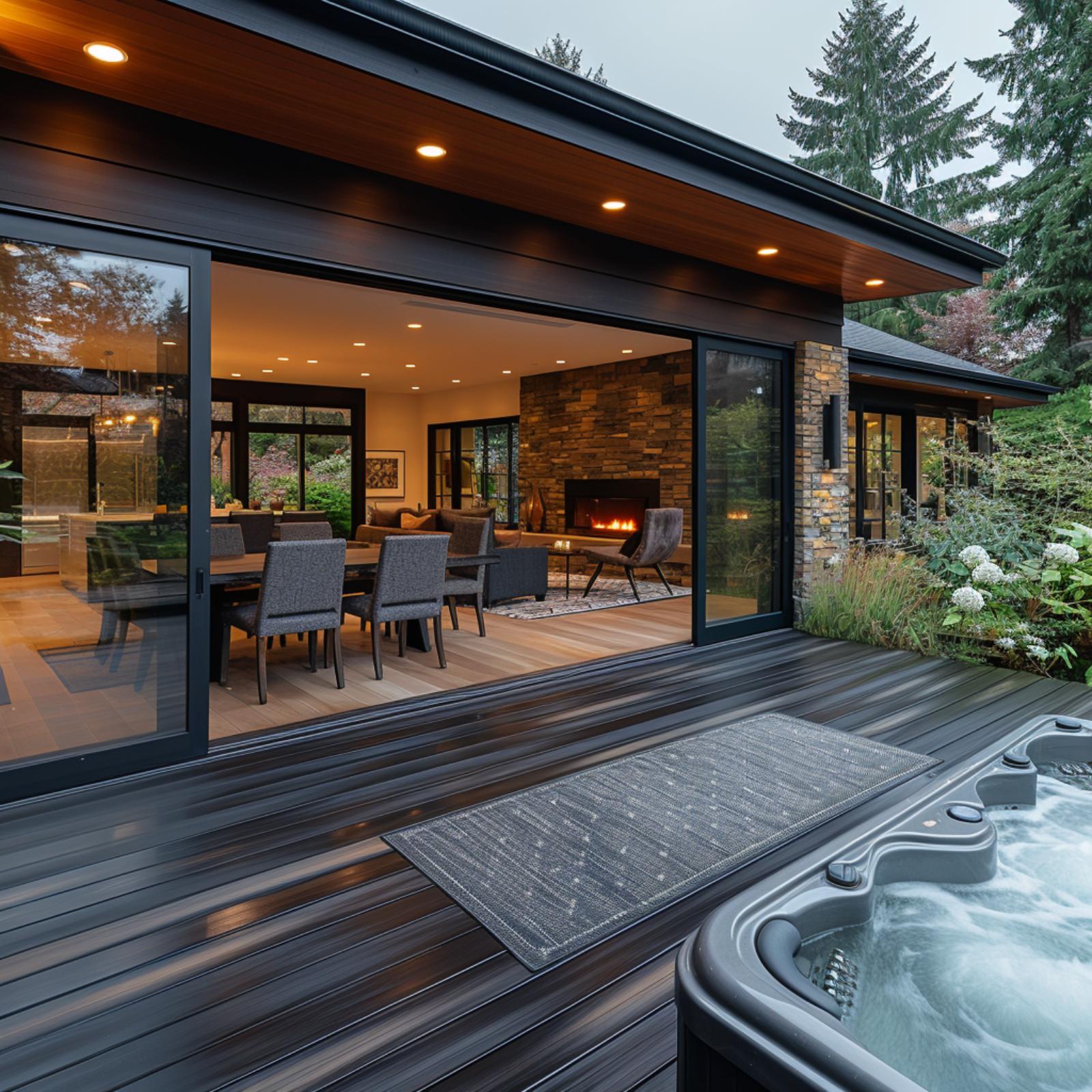
Grooved charcoal composite decking runs right up to floor-to-ceiling sliding glass panels, and inside, wide-plank light hardwood picks up without hesitation. That hand-off is doing a lot of work. The stone fireplace wall visible from the deck isn’t decorative framing, it’s the room’s focal point regardless of where you’re standing.
A small outdoor rug sits beside the hot tub, which is the detail worth pausing on. Rugs on decks often read as apologetic, but placed here it signals that someone genuinely considered the hot tub surround as a room rather than a utility zone. Recessed ceiling lights under the overhang match the interior spacing closely enough that the ceiling reads as one continuous plane.
13. Concrete Fire Table, Open Glass Wall, Vineyard Rows, and Zero Apology for Blurring the Line
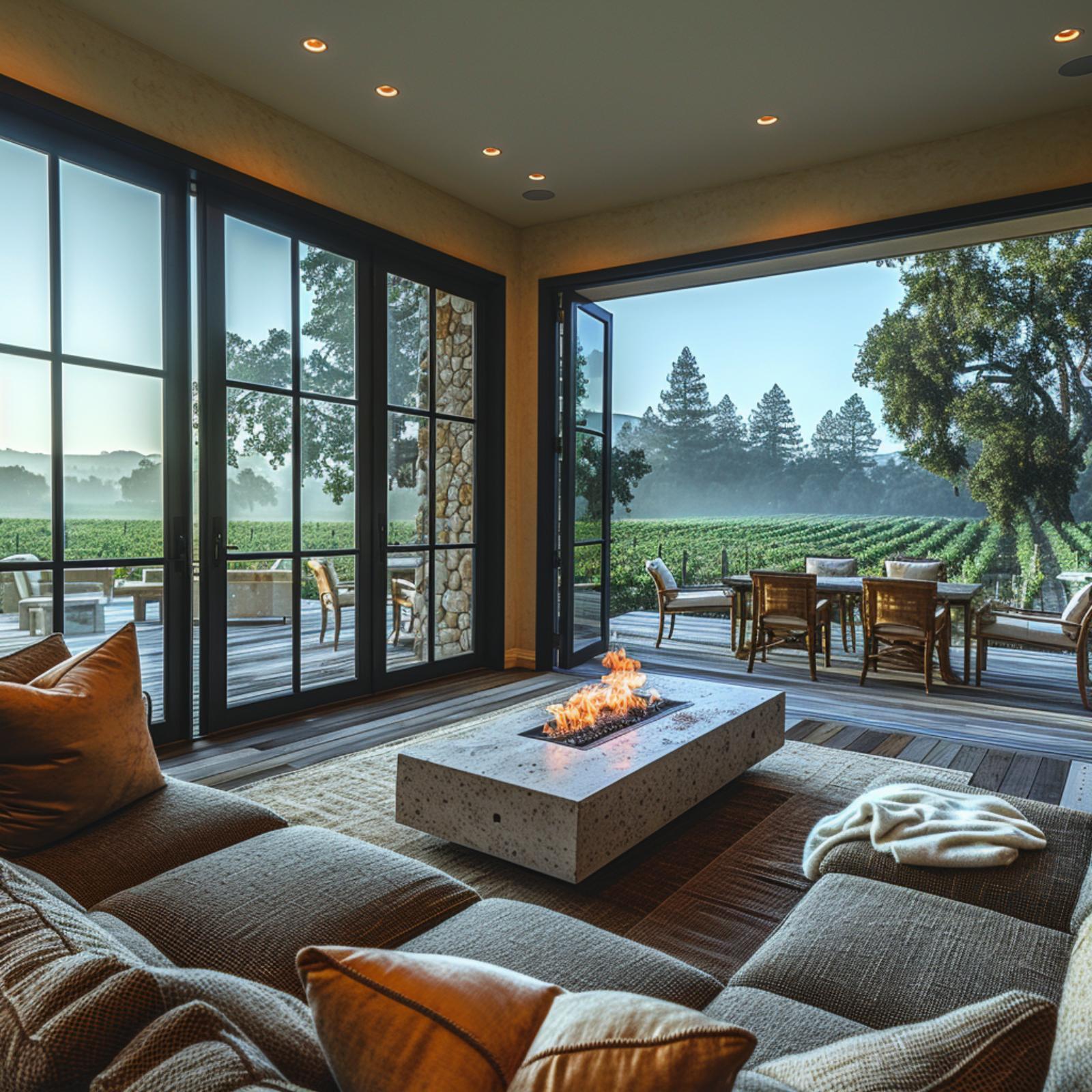
Stone-aggregate fire table anchors the seating area where the glass wall folds away entirely, leaving nothing between the sectional and the deck dining set outside.
Style Math: A fire table that sits coffee-table height reads as furniture, not a feature. That single decision is what lets this space avoid the campfire aesthetic and stay firmly in living room territory. Scale and finish do the convincing.
12. Bifold Glass, Brick Fireplace Wall, and a Pool Deck That Stopped Asking Permission
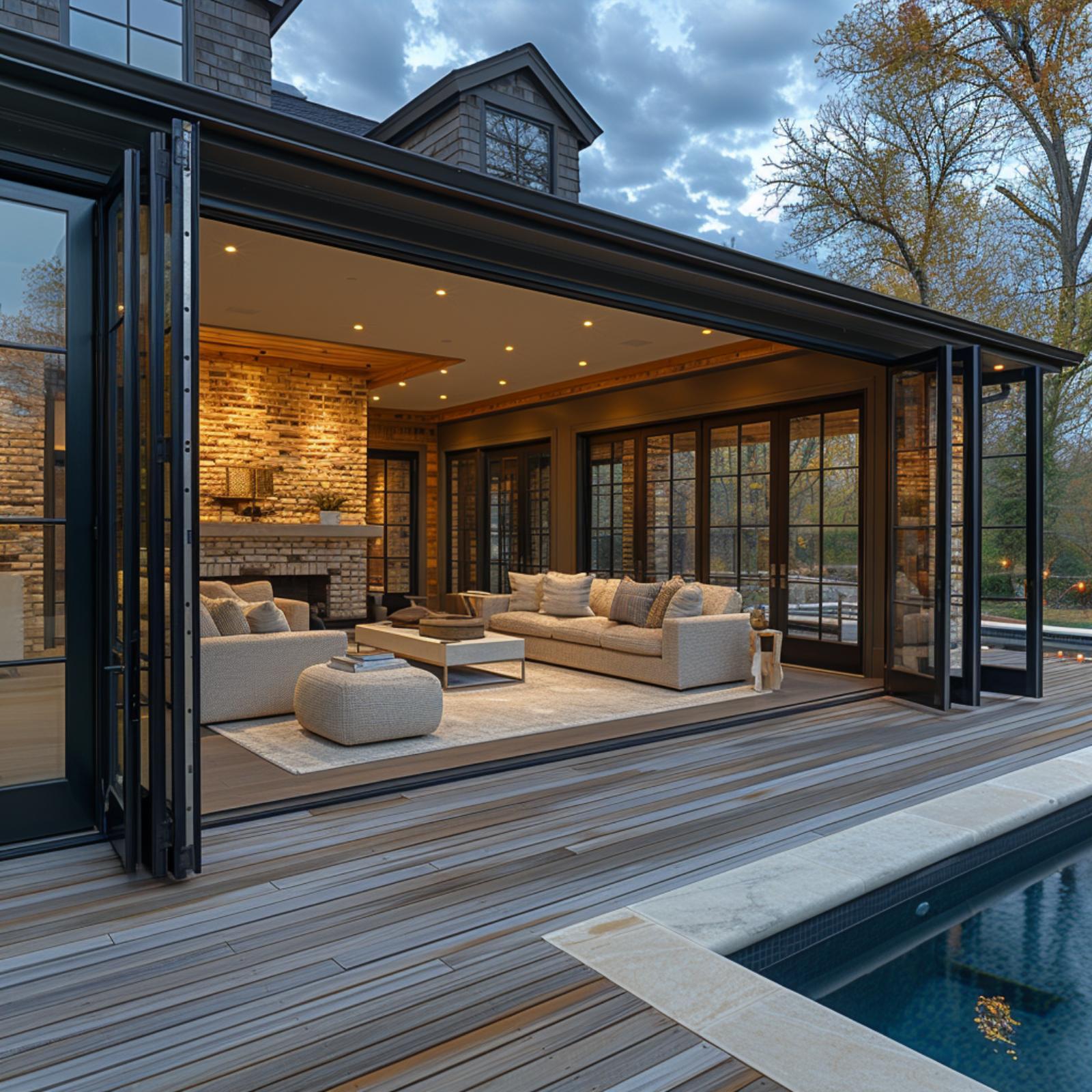
Stacked-panel bifold doors fold completely out of the way here, leaving no threshold between the cream sectional inside and the weathered wood decking outside. Recessed ceiling lights carry the same warm temperature as the fireplace wall’s lit brick, so the eye reads it all as one room. The pool sits right at deck level, no barrier, no step down.
The Psychology Behind This: Removing a physical boundary doesn’t automatically make two spaces feel connected, but matching the light temperature across both zones does most of that work neurologically. When the brain receives consistent warmth cues, it stops registering a transition and starts reading the whole area as a single environment.
11. Black Frames, Marble Coffee Table, and a Pool Deck That Lives on the Interior’s Terms
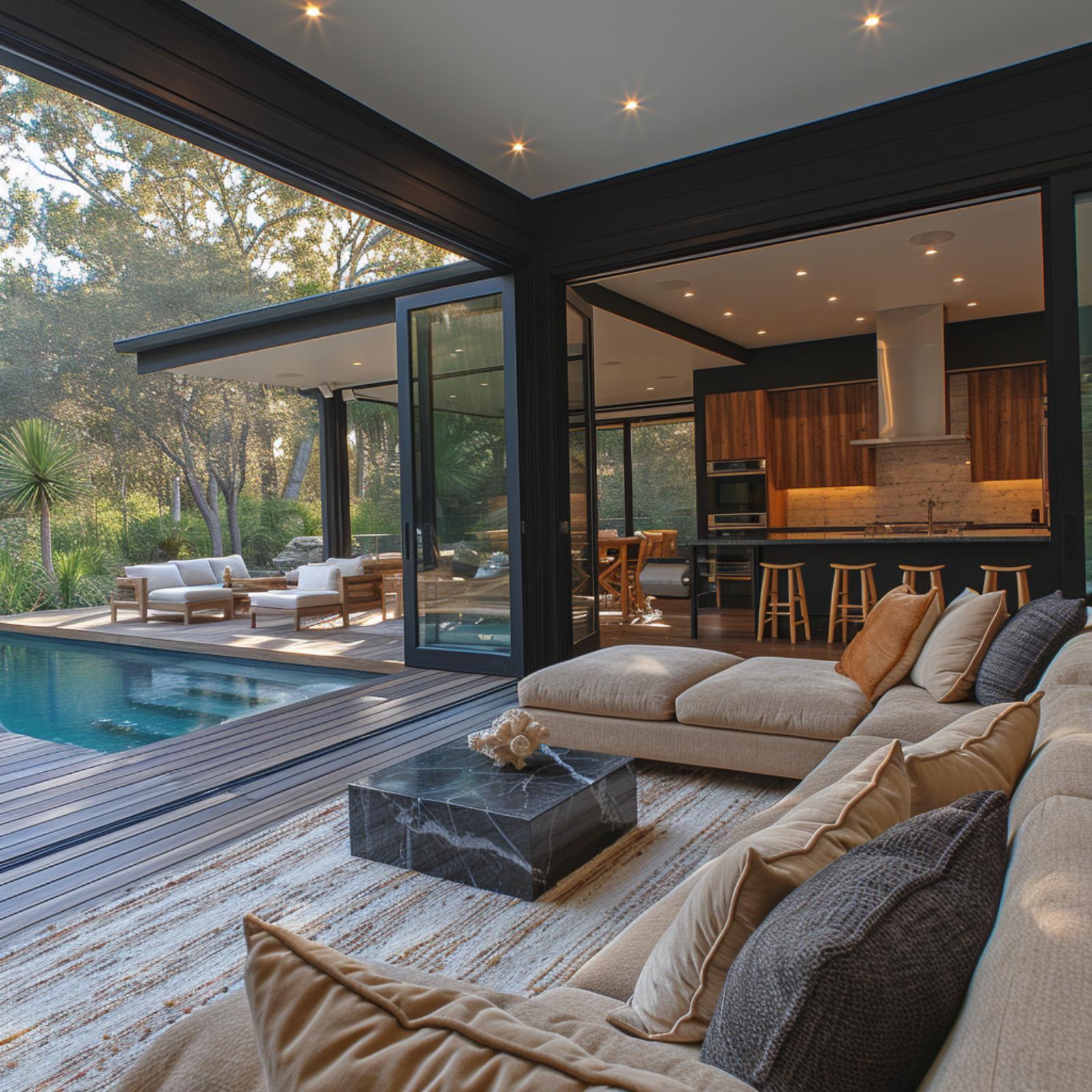
Black steel frames do a lot of work here. They define the threshold between inside and out without actually closing it off, so the living room and the pool deck read as one continuous zone rather than two separate decisions.
The sectional is oversized and low-profile, upholstered in a cream fabric that anchors the space without fighting the warm walnut cabinetry visible through the pass-through glass behind it. A dark marble block coffee table sits at the center, its veining picked up by the black framing overhead. Bar stools in natural wood line the kitchen island. The wood deck outside matches the interior floor tone closely enough that the eye doesn’t stop at the threshold.
By The Numbers: Folding and sliding glass wall systems have grown considerably in residential adoption over the past decade, with multi-panel pocket door configurations now available in frame profiles as narrow as two inches. Narrower frames mean more glass and less visual interruption, which matters when the goal is preserving sightlines from a sofa to a pool deck.
10. Travertine Cladding, Desert Cacti, and Decking That Earns Its Place Inside the Floor Plan
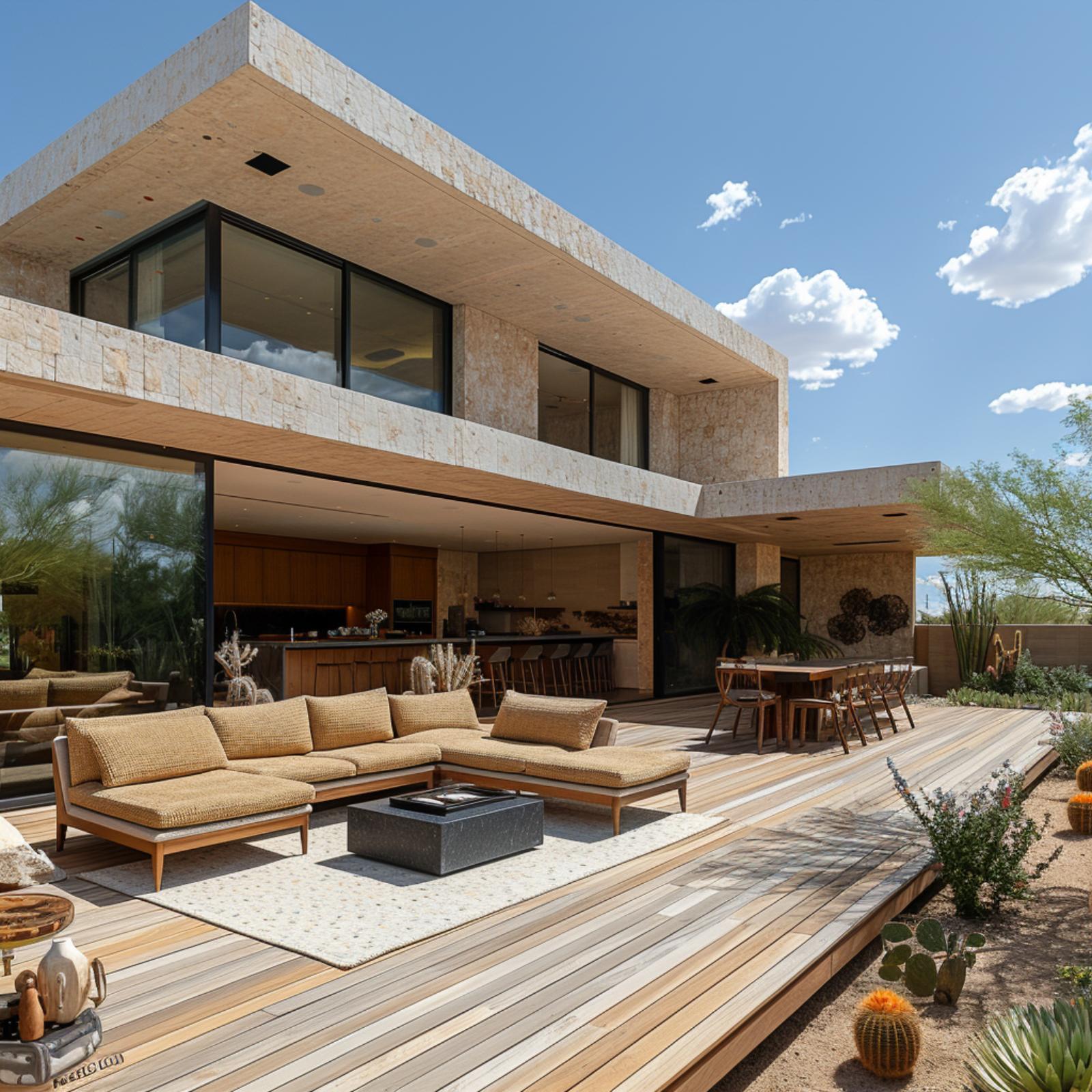
Travertine tile cladding wraps the exterior in the same warm cream tones carried through the interior, so the eye doesn’t register a break. The sectional’s woven tan upholstery reads more like a linen sofa than outdoor furniture. That matters. A wood deck laid in horizontal planks pulls the sightline outward, while the open kitchen behind it stays fully visible, functioning as a back wall rather than a barrier.
History Corner: The concept of the indoor-outdoor room has roots in mid-century California modernism, where architects like Richard Neutra used floor-to-ceiling glass and continuous floor planes to dissolve the boundary between conditioned space and the natural environment. Desert regions amplified this approach because the climate made covered outdoor living genuinely functional for most of the year, not just seasonally.
9. Folding Glass Wall, Infinity Edge, and Decking That Earns a Place on the Area Rug
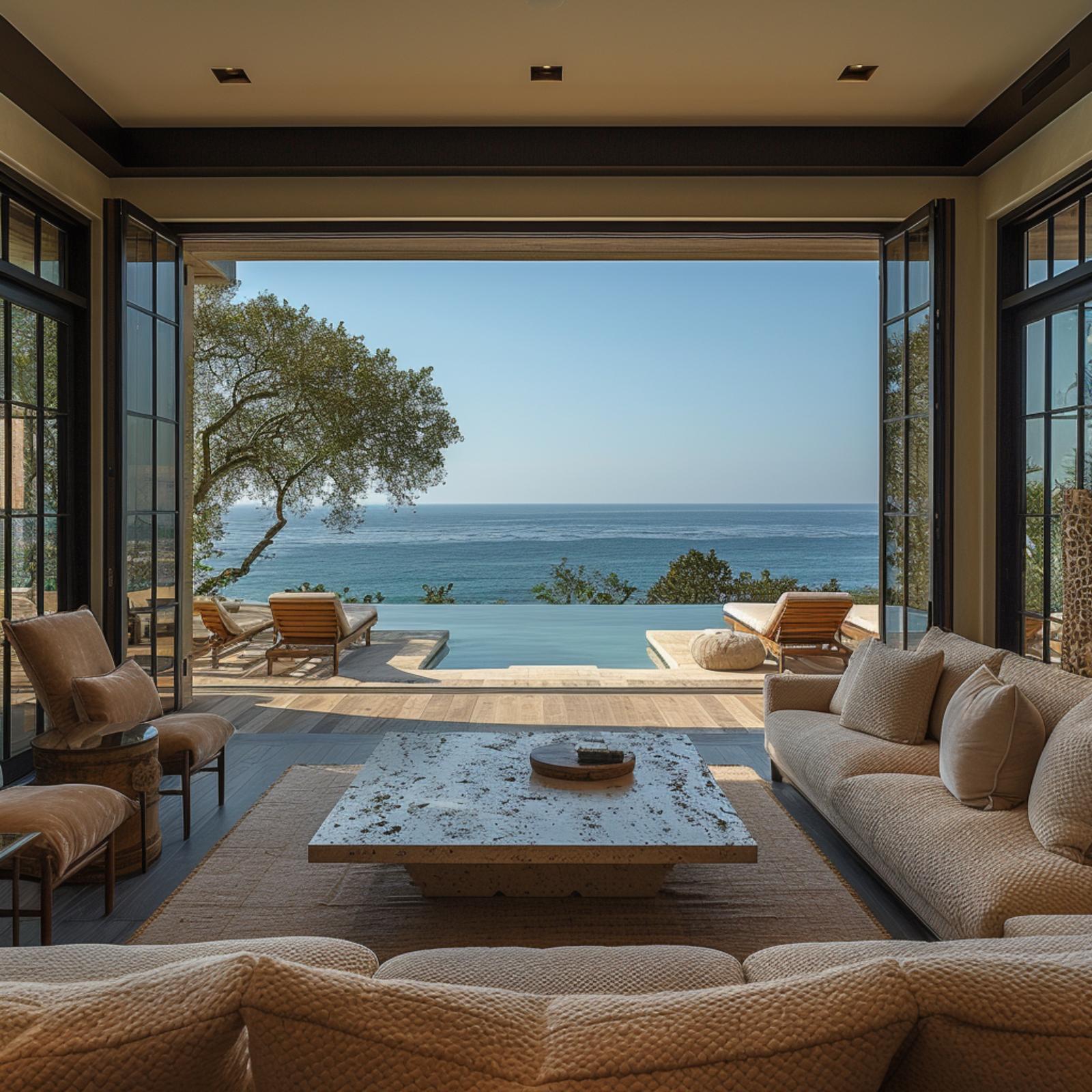
Dark-framed folding glass panels retract completely here, and the interior slate-tone floor meets the pale wood deck without a threshold bump to interrupt the eye. The cream sectional and stone coffee table sit close enough to the pool that the lounge chairs outside feel like overflow seating, not a separate zone entirely.
What makes it click is the infinity edge. By eliminating the pool’s far wall visually, the water reads as an extension of the floor plane rather than a vessel dropped into the yard. The olive tree anchors the left side without competing with the architecture.
8. Exposed Concrete Ceiling, Cliffside Views, and Decking That Answers to the Living Room
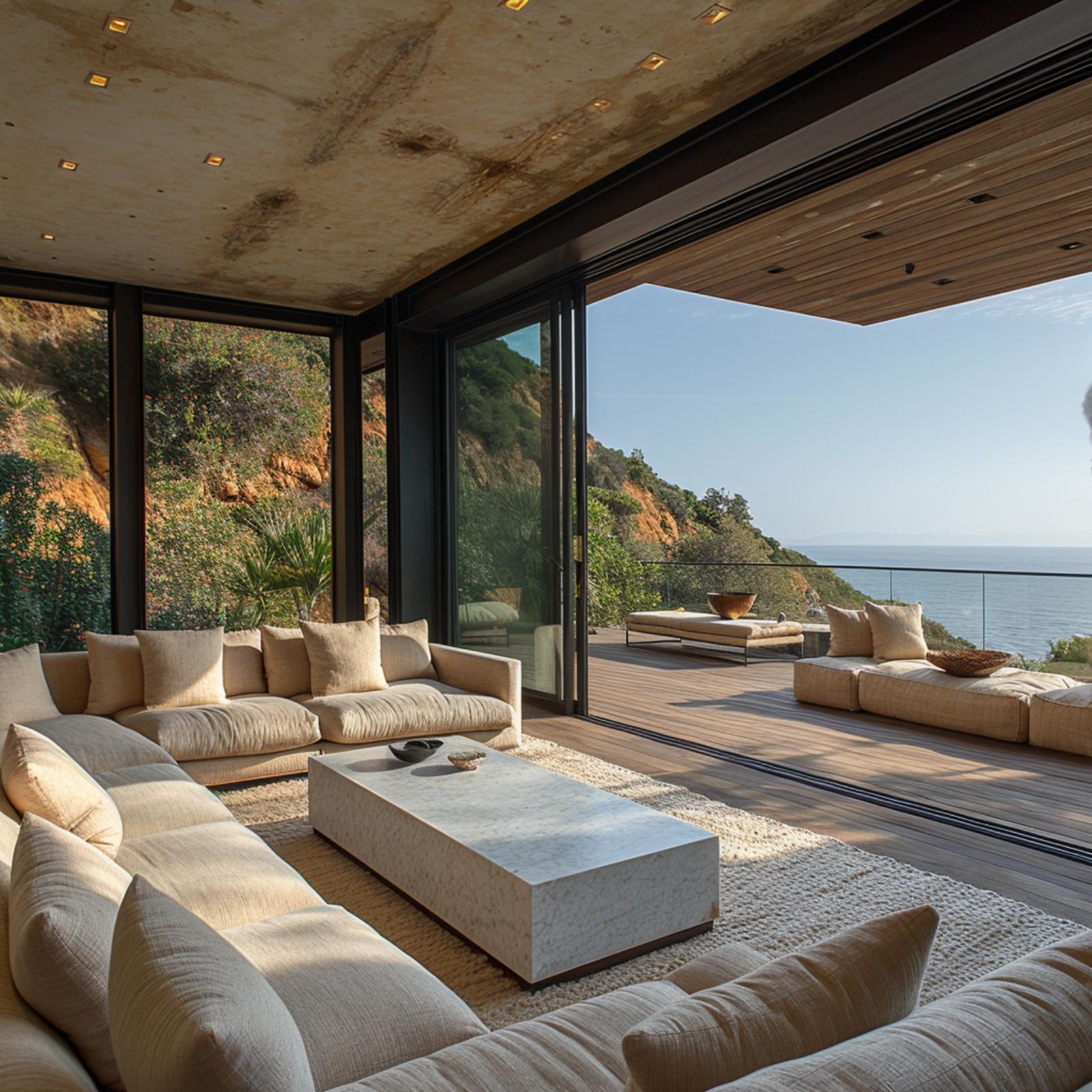
Exposed concrete overhead, warm recessed pins dotting its surface, and linen-toned sectionals arranged around a stone coffee table — the interior already has conviction before the glass wall opens. And when it does open, the teak decking picks up exactly where the interior rug leaves off, no visual stutter between the two zones.
What keeps this from reading as two separate rooms is the ceiling transition. Inside, raw concrete. Outside, tongue-and-groove wood planking under the overhang. The shift is deliberate, not careless, and it marks the covered deck as its own architectural moment rather than a leftover. The cliffside vegetation pressing against the glass does the rest.
7. Bleached Cedar Ceiling, Marble Slab Table, and a Deck the Ocean Already Claimed
🔥 Would you like to save this?
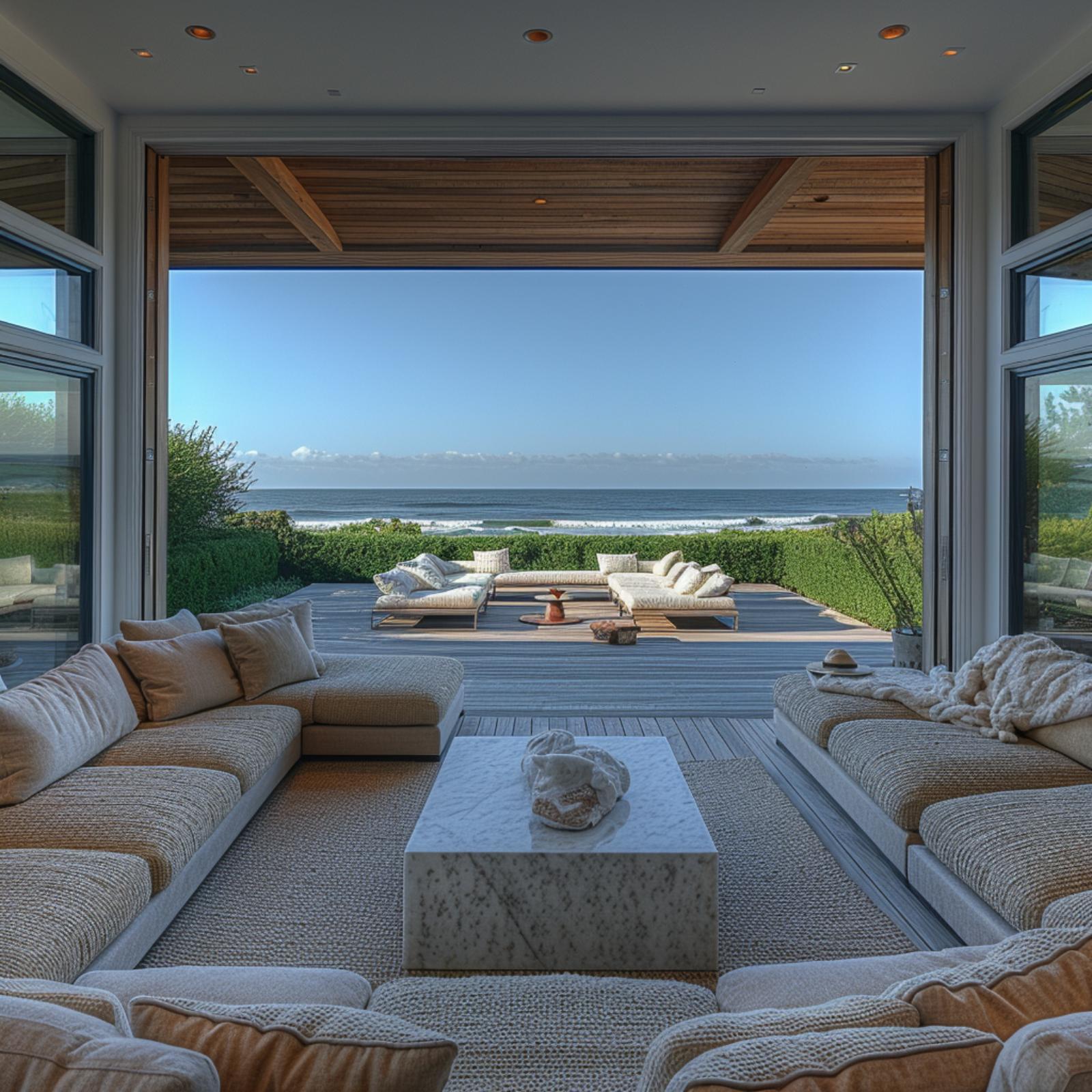
That coral sitting on the marble coffee table does more design work than it looks like it should, anchoring the whole room to its beachfront address without a single framed print in sight. Sliding glass panels fold away entirely, and the gray deck planks carry the eye straight out to the outdoor sectional before the ocean takes over.
6. Snow-Dusted Firs, a Linear Fire Table, and Decking That Never Clocked Out
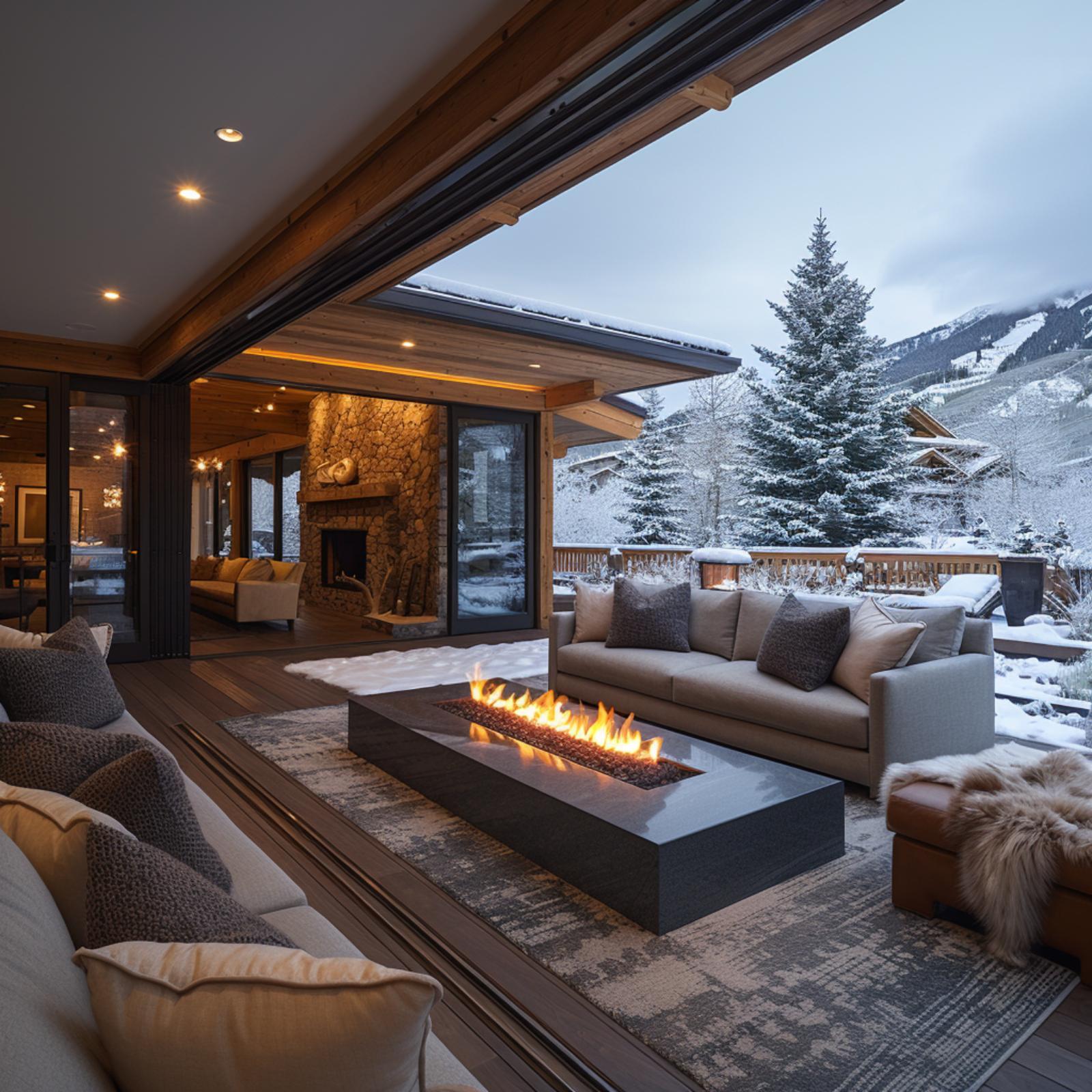
Cedar beams carry from the interior ceiling straight through to the covered deck, and that continuity does more work than any throw pillow could. The linear gas fire table sits at sofa height, flanked by taupe upholstered seating and a fur-draped leather ottoman that reads as a living room floor plan, not patio furniture.
5. Steel Frames, Shingle Siding, and Decking That Already Moved In
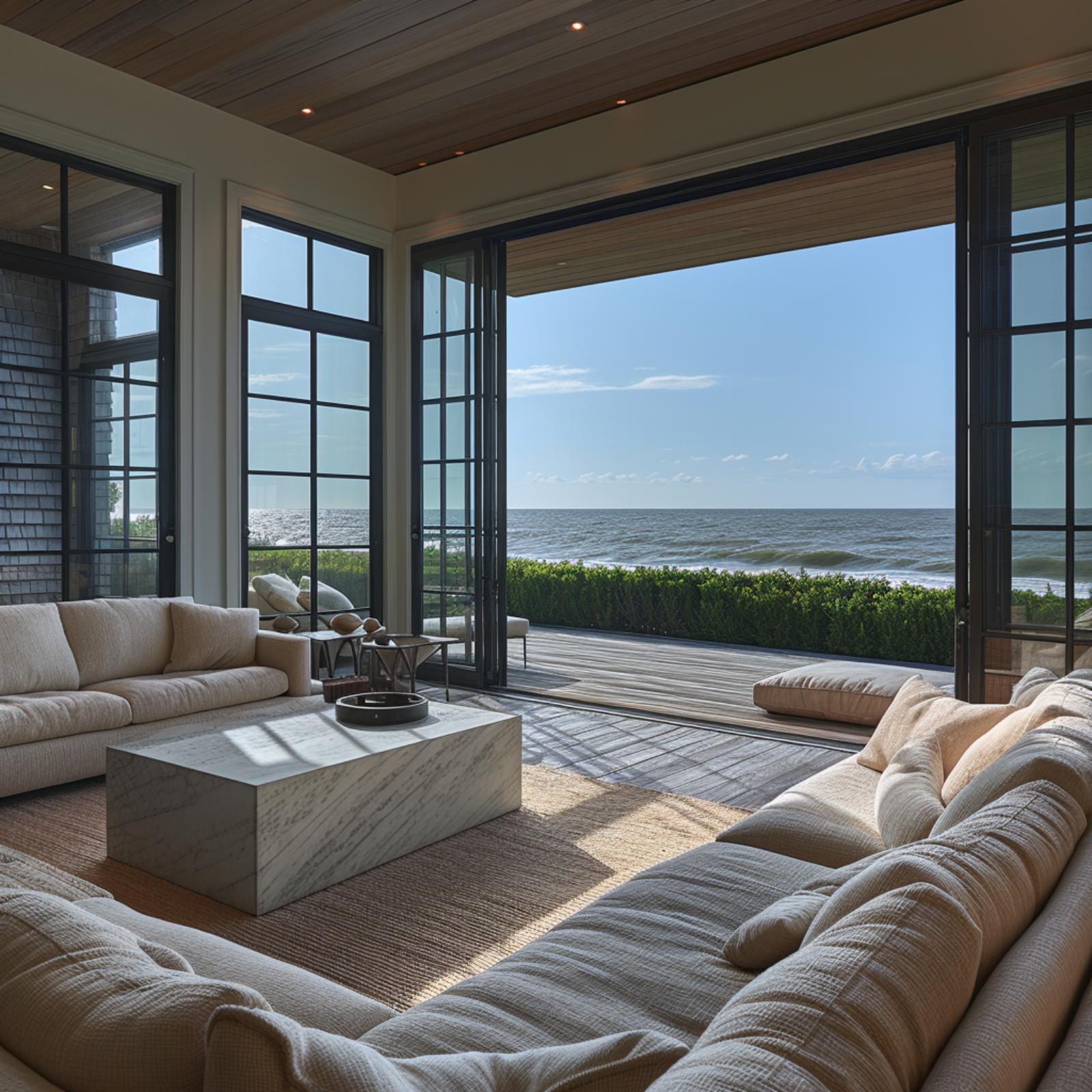
Weathered wood decking runs directly off the living room floor, and the steel-framed glass wall that folds away makes the handoff feel less like a design decision and more like inevitability. Cream linen sofas, a marble slab coffee table, and a jute area rug set an interior tone that the deck doesn’t abandon at the threshold.
What holds it together is restraint. The hedgerow acts as a soft boundary between the deck and the ocean beyond, giving the eye somewhere to rest before the water takes over. No pergola, no outdoor furniture overload. Just boards, light, and a view that does the heavy lifting.
4. Warm Linen Sofas, an Infinity Edge, and Decking That Already Has a Street Address
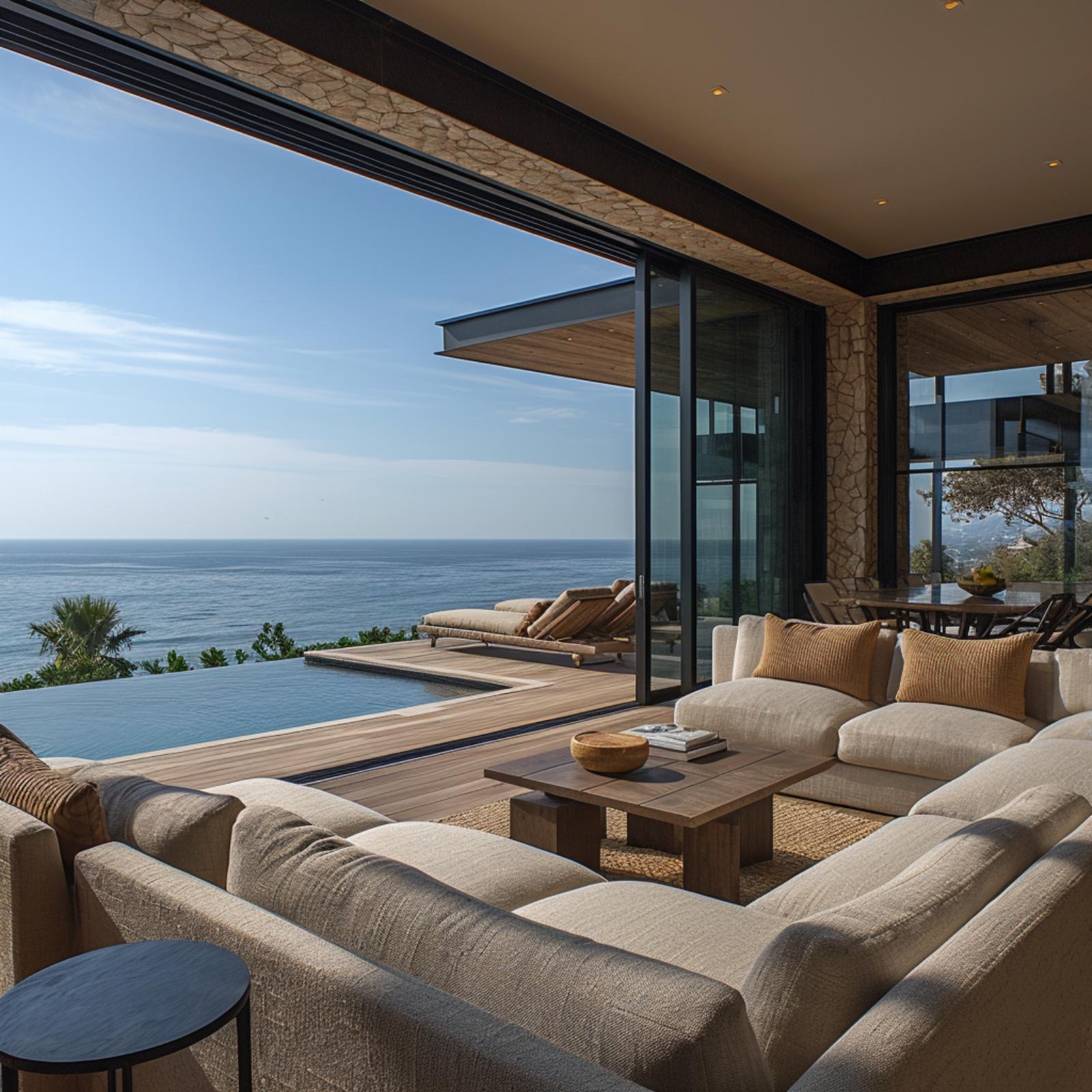
Teak decking runs flush to the interior’s jute area rug, and that continuity does more work than any single furniture choice could. The sectional is upholstered in an oatmeal linen weave, with amber and tobacco throw pillows that pick up the warm stone cladding framing the glass wall. Outside, lounge chairs mirror the interior’s relaxed posture almost exactly. It’s hard to say where hosting ends and sunbathing begins.
3. Wood Ceiling, Black Frames, and a Bar Cart That Already Belongs Outside
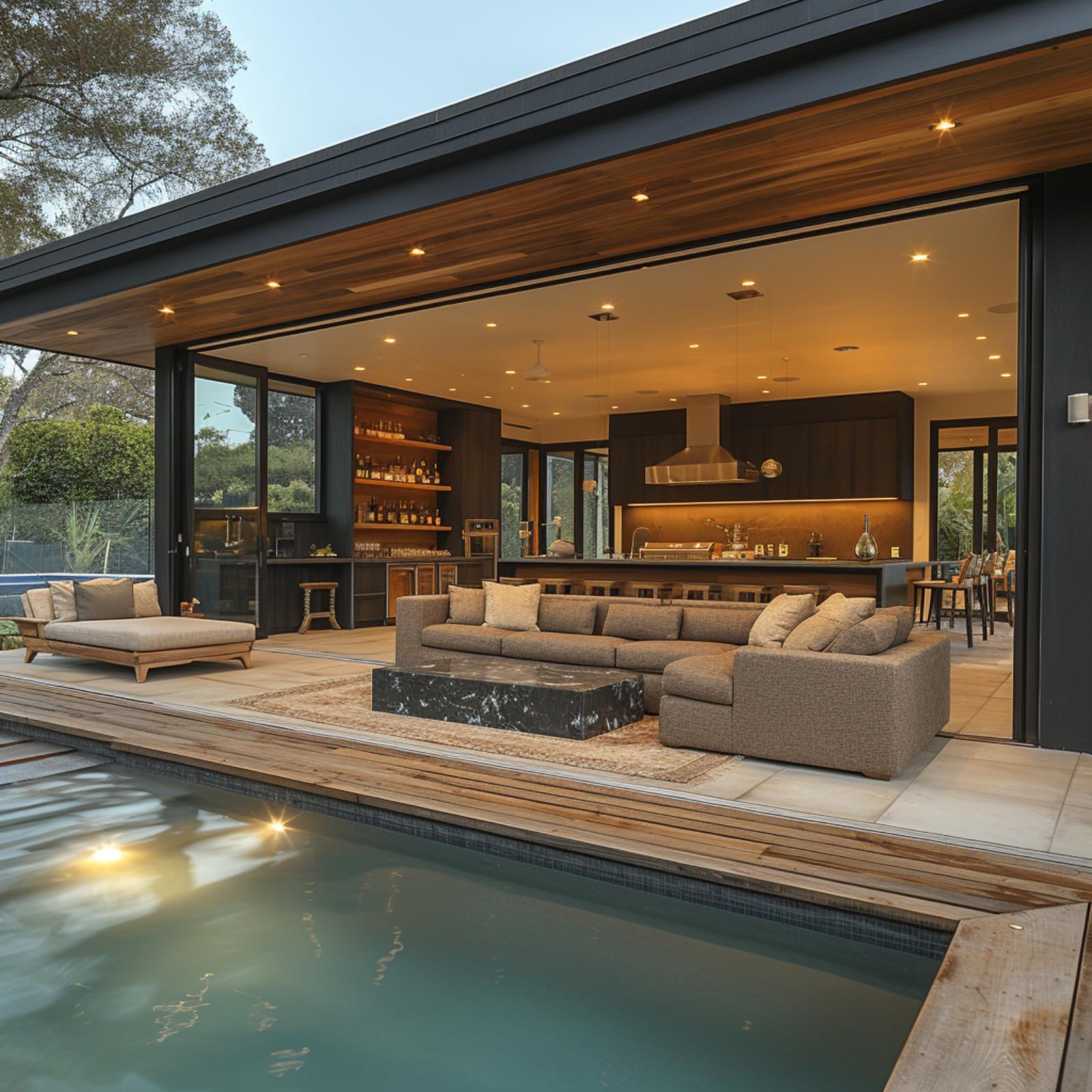
Warm-toned wood planks run the full depth of the covered ceiling, pulling the interior’s amber glow right out to the pool edge without interruption. The kitchen’s steel range hood and dark cabinetry read clearly from the deck, which matters more than most people realize. When interior fixtures are visible from outside, they become part of the outdoor composition whether you planned for it or not.
The sectional sits on a woven rug with a black granite coffee table anchoring it. That’s interior logic applied outdoors, without hesitation. A bar wall stocked floor-to-shelf sits just inside the open glass pocket door, close enough to the deck that the boundary between entertaining spaces is essentially decorative at this point.
2. Lit From Within: Warm Wood Ceiling, Glass Walls, and a Pool Deck That Already Clocked In
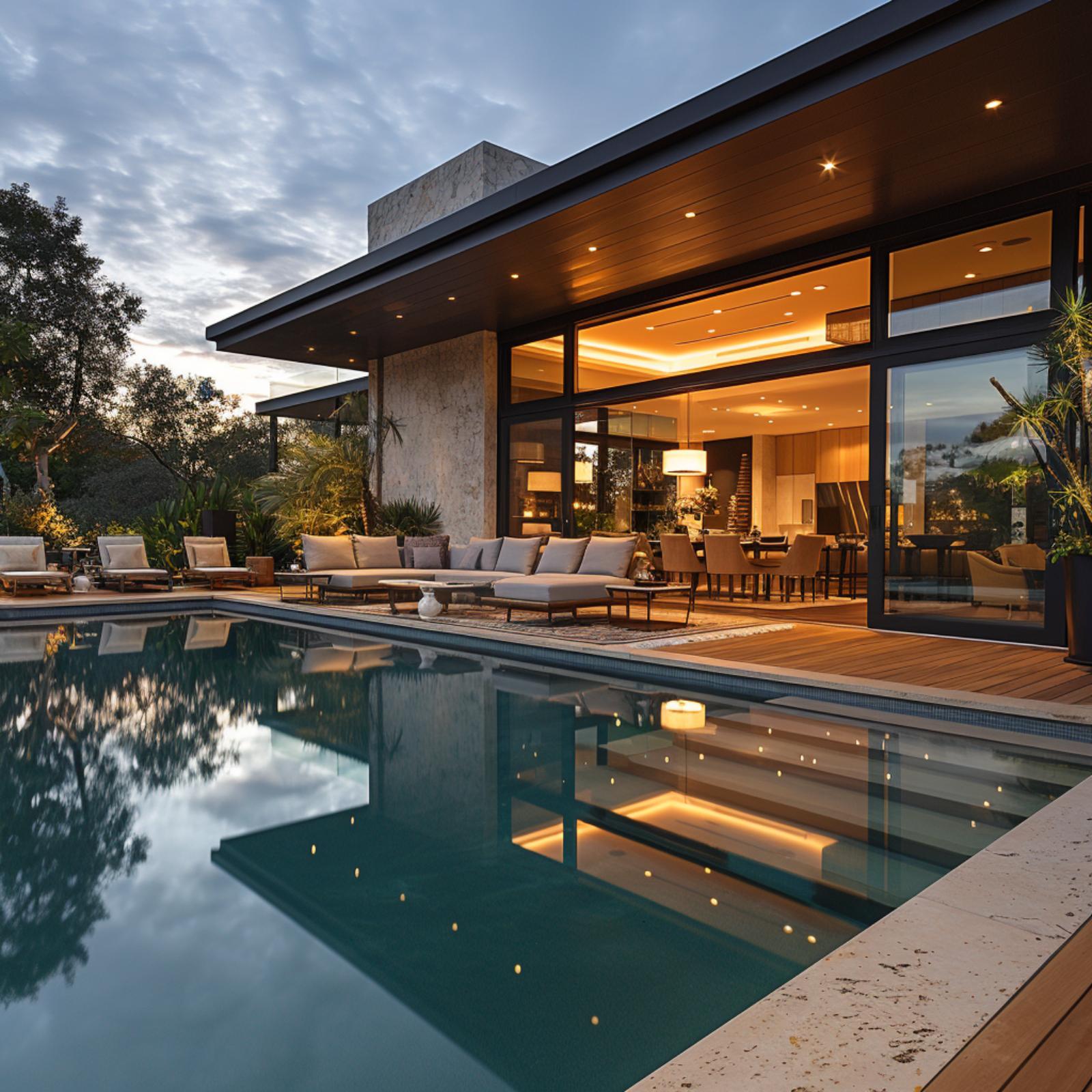
Recessed deck lighting embedded in the entry steps does something smart: it erases the threshold before anyone crosses it. The wood-plank ceiling runs unbroken from interior to overhang, and the sectional on the deck shares the same neutral linen palette as the furniture visible through the glass.
1. White Roof Planes, Glass Walls Wide Open, and Decking That Already Pays Rent
Floor-to-ceiling sliding panels have been pushed fully aside here, and the interior dining table sits close enough to the pool deck that the distinction between rooms feels more administrative than architectural. Cream upholstery on low-profile sofas with honey-toned wood bases carries the palette straight from inside, with no color shift to signal a threshold.
The wood decking runs parallel to the pool edge and stops at the same sight line as the interior flooring. It’s a small decision that does a lot of work. Somewhere between the outdoor sectional and the dining chairs visible just inside, the living room simply ran out of walls.