🔥 Would you like to save this?
A kitchen remodel argument started over coffee. Not money. Not timing. Cabinet colors. One wanted safe and timeless. The other decided to quietly ask AI what was possible and suddenly the entire project changed direction. At first, she was furious. AI designing a kitchen? Without asking? Absolutely not. Then the images started appearing. Bold ideas. Smart layouts. Unexpected details neither had considered. Somewhere between skepticism and surprise, opinions changed. These 31 AI-generated kitchen ideas show exactly how one risky move turned into design inspiration nobody saw coming.
In order to come up with the very specific design ideas, we create most designs with the assistance of state-of-the-art AI interior design software. Also, assume links that take you off the site are affiliate links such as links to Amazon. this means we may earn a commission if you buy something.
31. Navy Cabinets, Gold Hardware, and a Coffered Ceiling That Means Business
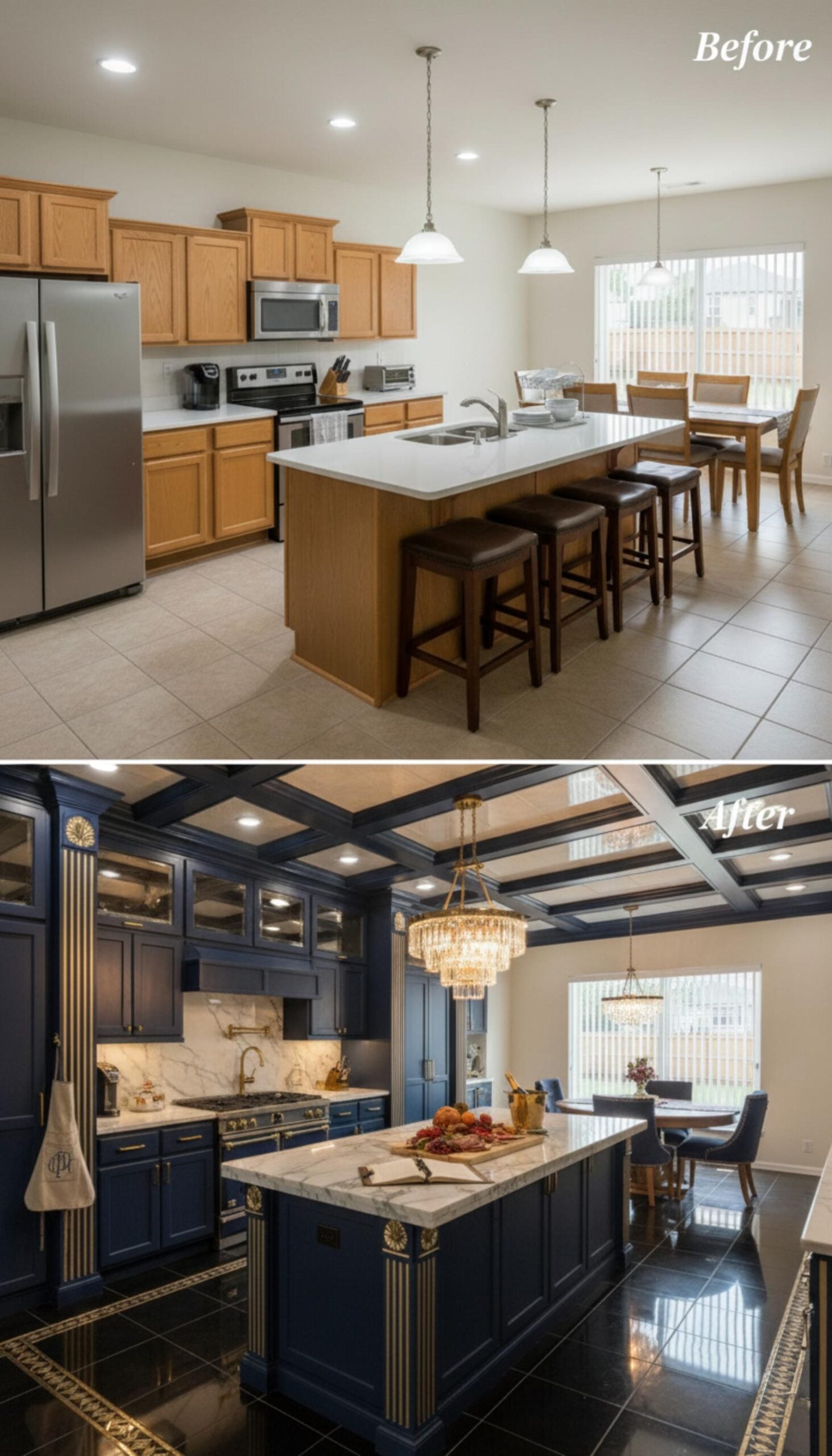
Deep navy cabinetry runs floor to ceiling, paired with brass hardware and fluted pilaster columns at the island corners. Calacatta marble slabs cover both the island and backsplash, their gold veining picking up the warm metal tones throughout. A coffered ceiling with dark painted beams adds architectural weight overhead, while two tiered crystal chandeliers anchor the space above the island.
Dark polished floor tiles reflect the cabinet color and create a high-contrast base. The dining area beyond features upholstered chairs in a charcoal fabric, replacing the previous wood seating. A pot filler in an antique brass finish sits above a professional-grade range, completing the shift toward a kitchen built for serious use.
30. Coffered Ceiling Panels and Dark Walnut Cabinets Rewrite the Rules of Kitchen Gravity
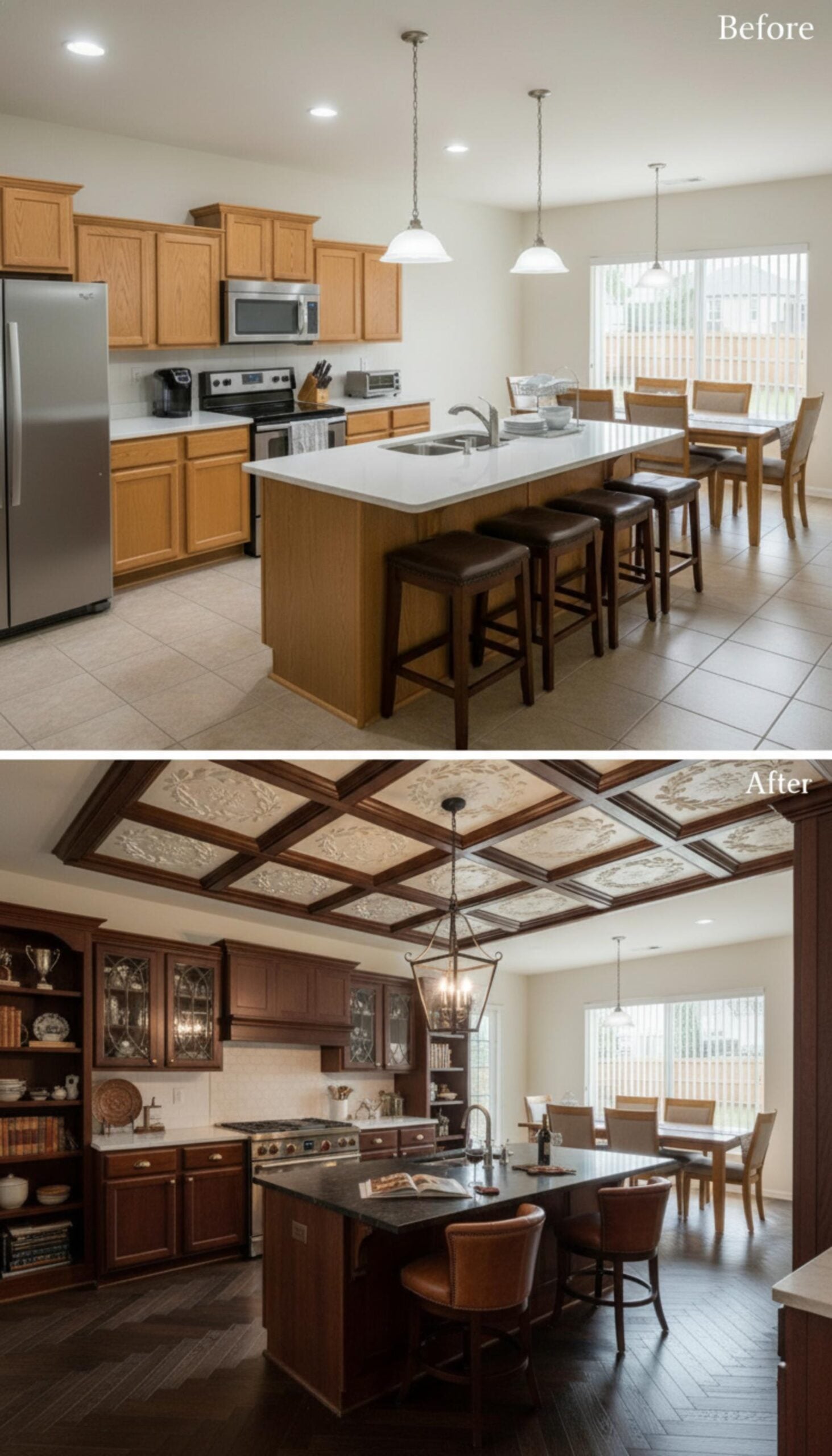
Ornate plaster medallions set into dark walnut coffered ceiling beams pull every eye upward. A lantern-style chandelier with candelabra arms anchors the island below, where leather barrel chairs meet a slab countertop in charcoal granite.
29. Matte Charcoal Cabinets and a Wood-Plank Ceiling Box Pull This Kitchen Into Focus
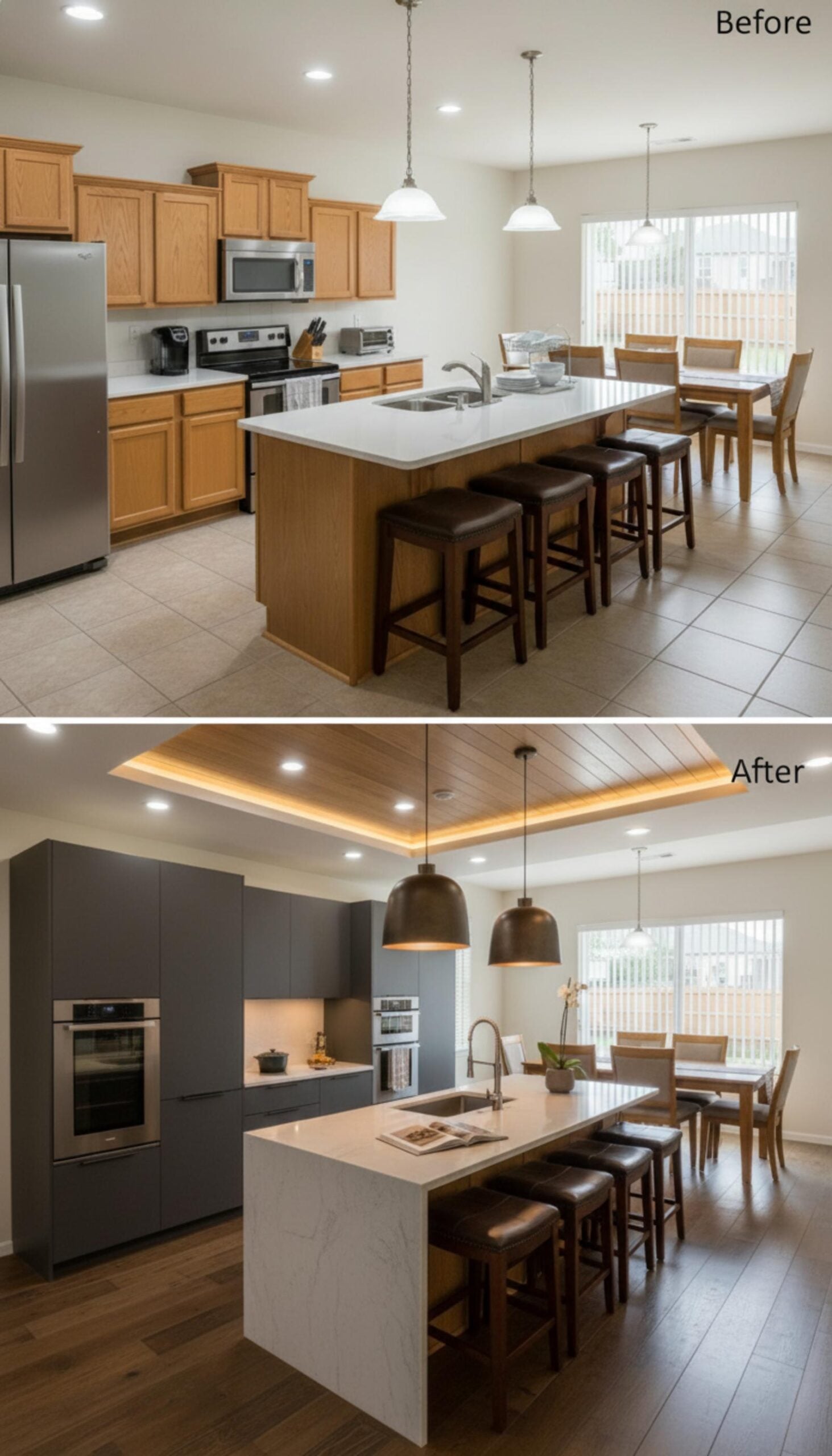
Flat-front cabinets in matte charcoal gray run floor to ceiling, paired with a wall oven stack and integrated refrigerator that keep the surface lines unbroken. A tray ceiling inset with shiplap-style wood planks and warm LED strip lighting draws the eye up without adding visual clutter. Dark hardwood flooring replaces what reads as builder-grade tile, grounding the space considerably. Pendant lights in a brushed bronze dome finish hang over a waterfall-edge island topped in white marble-look quartz.
28. Forest Green Cabinets, a Wood Range Hood, and Marble Waterfall Island Walk Into a Kitchen
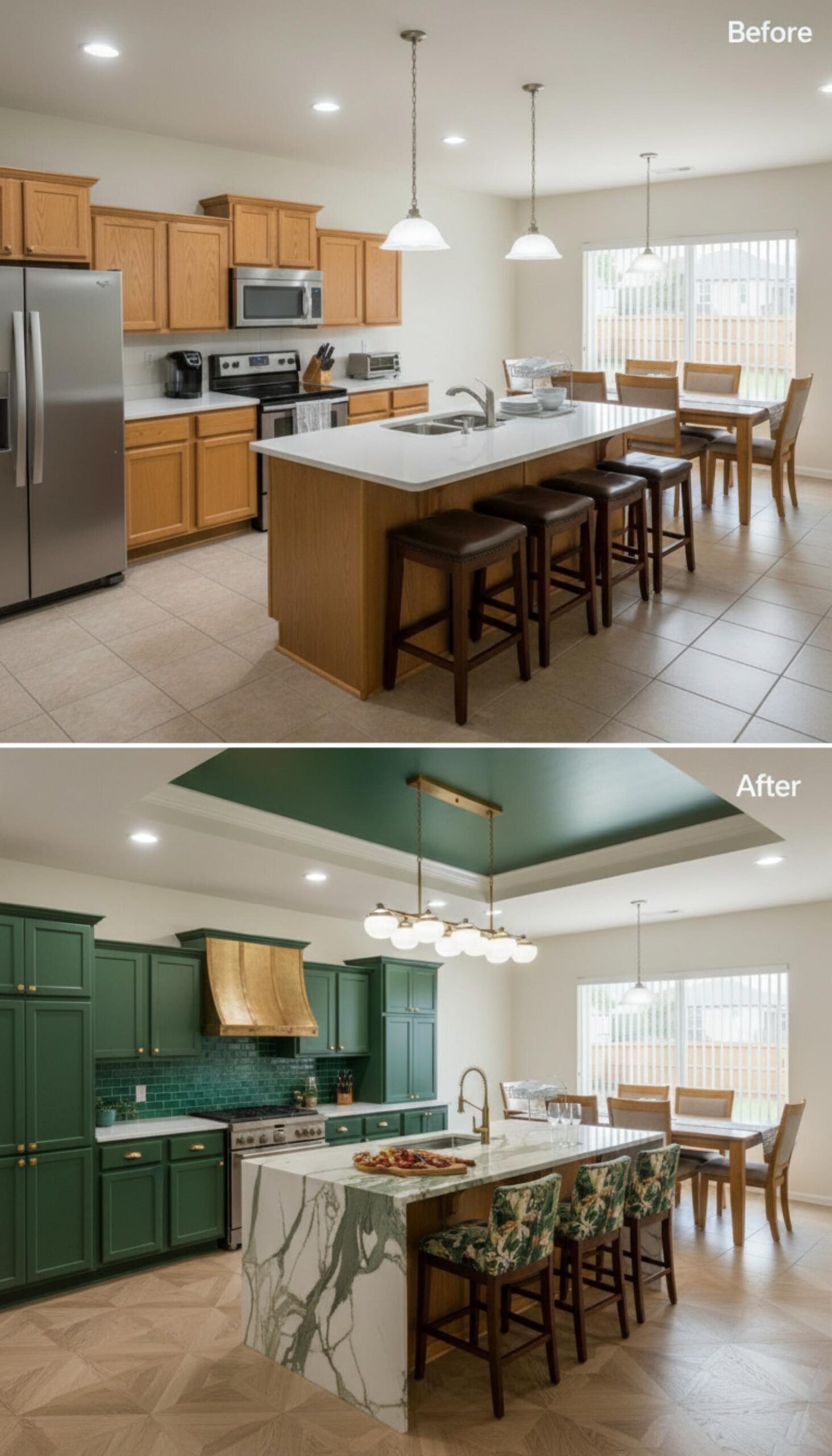
Painted forest green cabinets run floor to ceiling and wrap the perimeter, paired with brass hardware and a custom wood range hood in a warm natural grain. Green subway tile forms the backsplash behind the range. The island countertop is white marble with dramatic grey veining that cascades down the waterfall edge. Floral-print upholstered stools anchor the island seating, while a brass multi-globe pendant hangs centered over the workspace. A tray ceiling painted the same forest green as the cabinets locks the color palette overhead.
Art Nouveau makes a rare appearance in residential kitchens, and this one commits fully.
27. Copper Range Hood, Stained Glass Cabinets, and a Coffered Ceiling Drenched in Mahogany
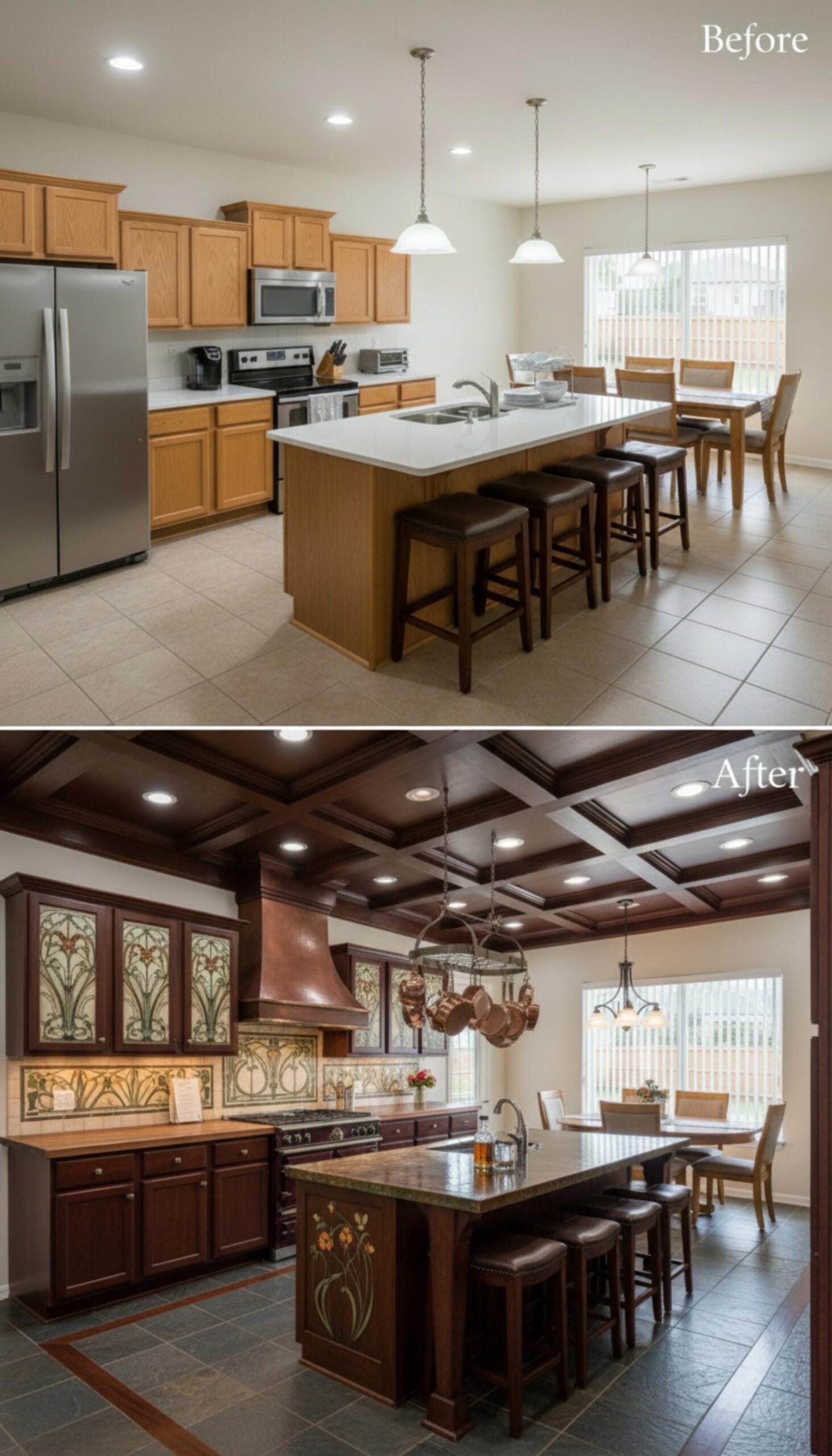
Mahogany-stained cabinetry runs floor to ceiling, its upper doors fitted with art nouveau stained glass panels in botanical motifs of amber, sage, and ivory. A hammered copper range hood anchors the cooking wall above a dark professional range, flanked by an illustrated tile backsplash that mirrors the cabinet glass patterns.
The coffered ceiling uses the same dark wood finish, creating a grid of recessed squares that pull the eye upward. A wrought iron pot rack hangs over the granite island, which features a hand-painted floral motif on its base. Slate floor tiles in charcoal and rust replace what was there before, bordered by inlaid accent strips.
26. Black Lacquer Cabinets, Green Marble, and a Coffered Ceiling Painted Like a Cathedral
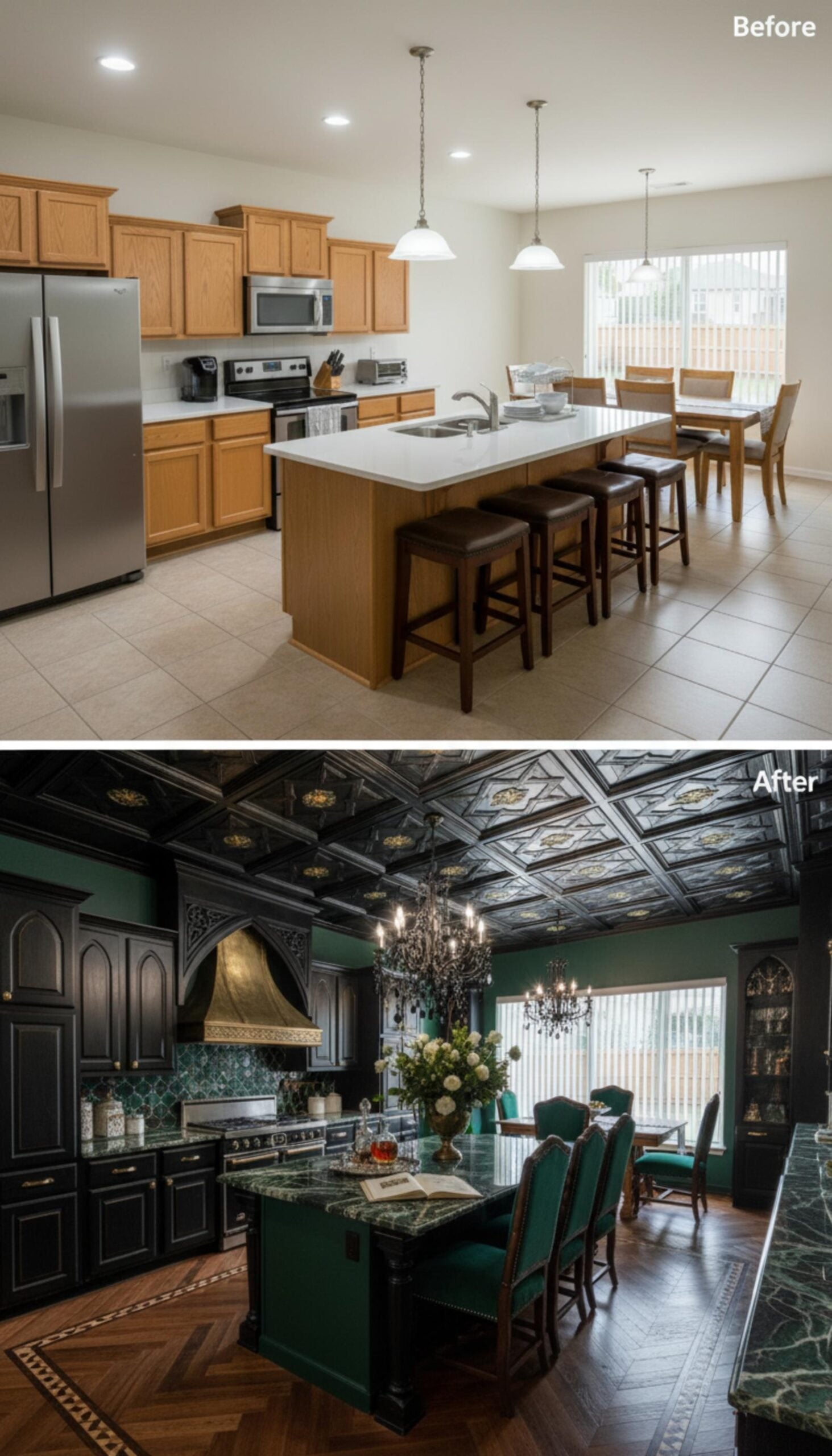
Black lacquer cabinets with arched door profiles and brass hardware line every wall, anchoring a kitchen that treats drama as a structural principle. Green marble countertops wrap the island and continue onto what appears to be a bar counter at the right edge of the frame. A gold-finished range hood with an arched cutout takes the place of a standard range surround. The backsplash runs Moroccan-pattern tile in teal and white behind the range.
Overhead, a coffered ceiling finished in black carries painted medallions in gold and deep teal at each panel intersection. A wrought-iron chandelier with taper-style candle bulbs hangs at center. Herringbone hardwood flooring with an inlaid border runs underfoot. Island seating comes from carved wood chairs upholstered in teal velvet with brass nail-head trim.
25. Concrete Island Siding, Warm Oak Hardwood, and Pendant Clusters That Pull Everything Down to Earth
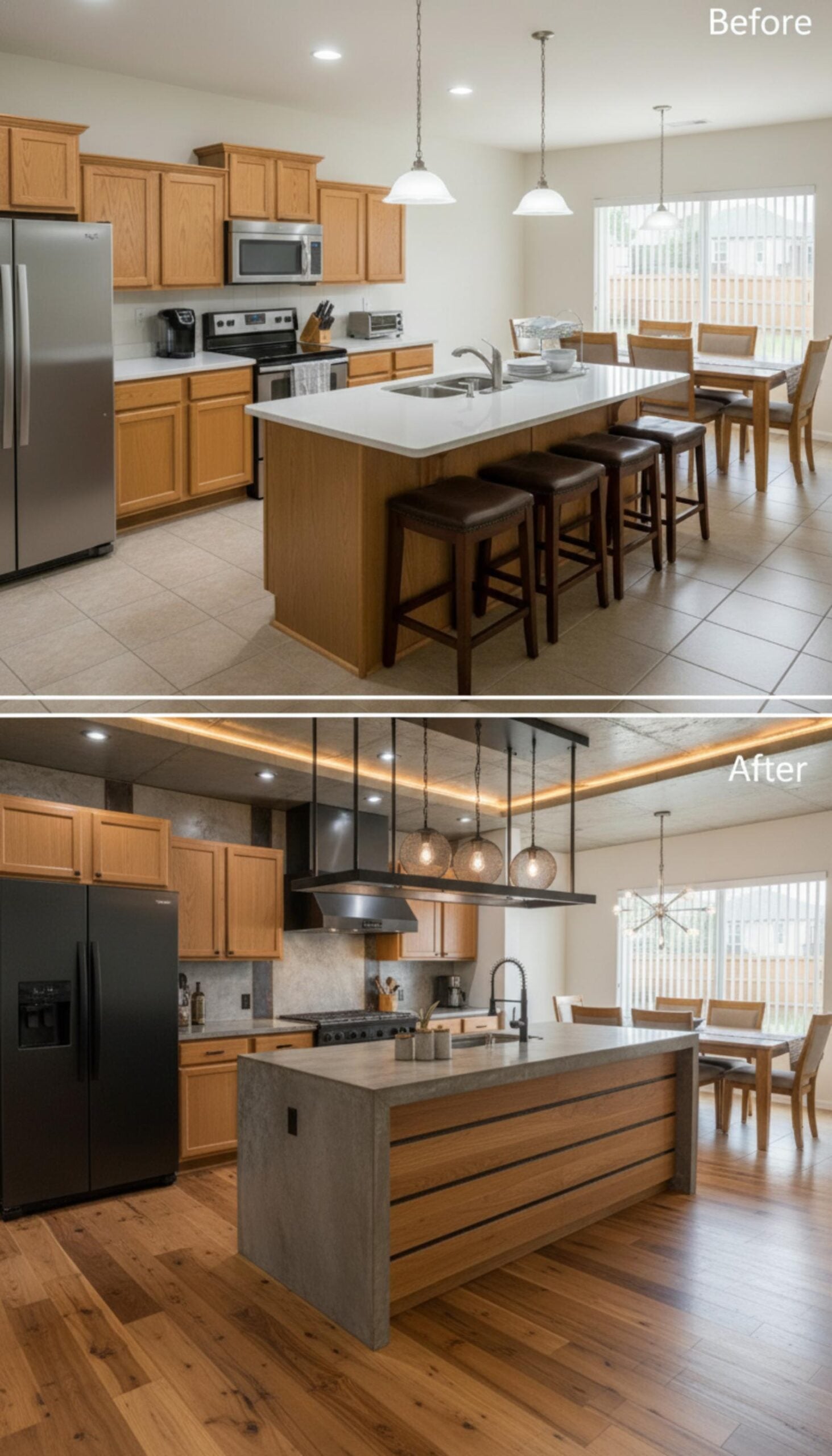
Knotty oak hardwood floors replace tile throughout, grounding the space in texture. The island pairs a concrete countertop with horizontal wood slat paneling on its sides, finished with thin dark inlaid strips. Above it, a rectangular metal fixture suspends four amber glass globe pendants at staggered heights. Warm LED strip lighting runs the tray ceiling perimeter, casting a low amber wash across the room.
Designer’s Secret: The concrete-and-wood island combination works because each material handles a different visual job: concrete reads as weight and permanence, while the horizontal wood slats introduce warmth and grain direction. Designers often use this pairing specifically to avoid the cold, monolithic look that an all-concrete island can produce. The inlaid dark strips on the wood panel face act as shadow lines, giving the island visual depth without added hardware.
24. Cream Cabinets, Blue Delft Tile, and a Crystal Chandelier That Rewrites Kitchen Formality
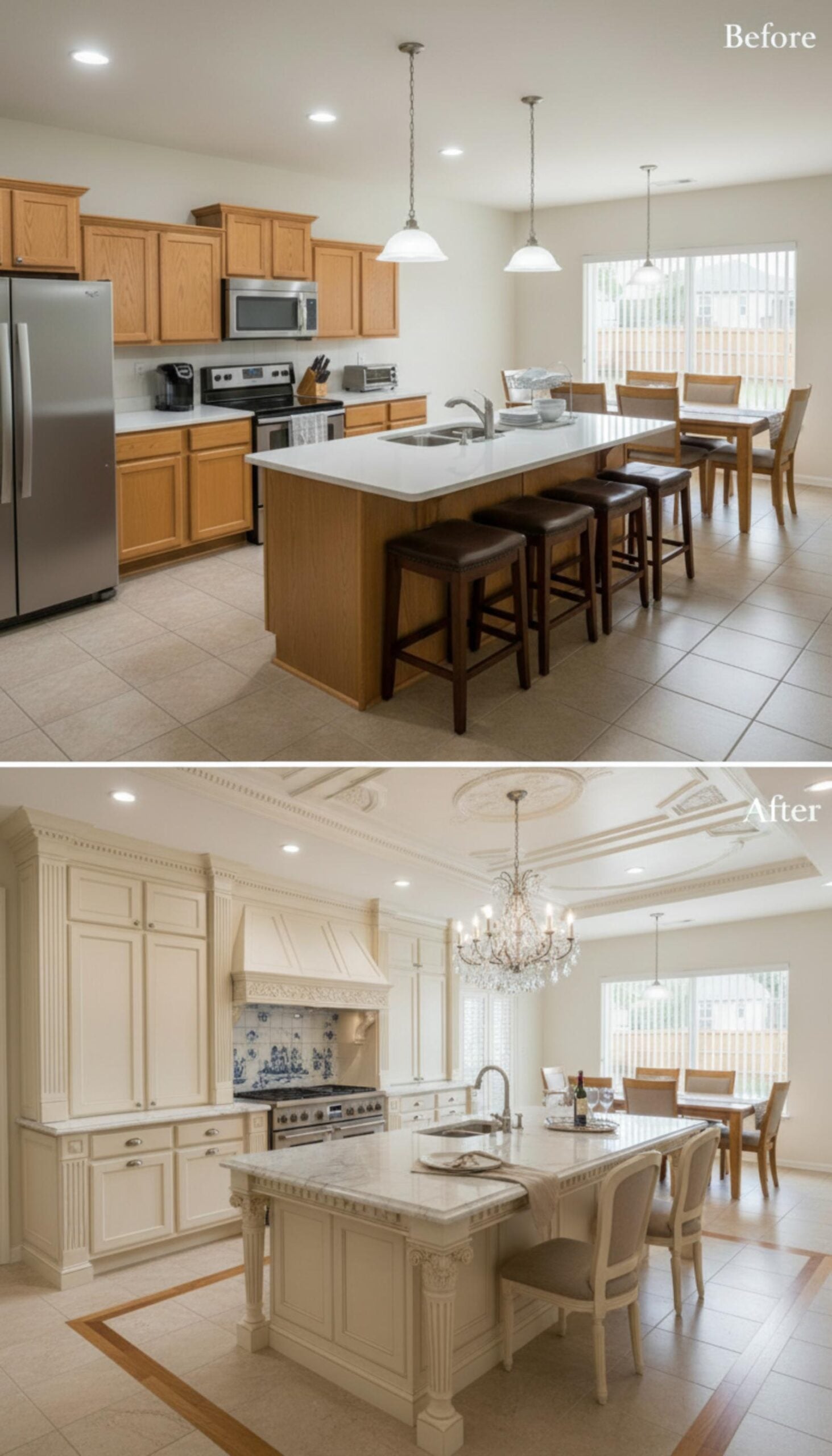
Cream-painted cabinetry runs floor to ceiling with fluted pilasters, dentil molding along the crown, and panel-and-raised-door construction that reads more like furniture than millwork. The range hood carries the same finish, framing a hand-painted blue-and-white Delft tile backsplash above a professional-grade stainless range. A tray ceiling with coffered detailing and a medallion anchors the crystal chandelier directly over the island.
Marble countertops cover both the perimeter runs and the island, which features carved bracket feet and an apron with rope-twist detailing. Brushed nickel cup pulls and bin pulls keep the hardware consistent across every door and drawer. Light porcelain tile on the floor picks up a warm wood border inlay that defines the kitchen footprint without raising the floor height.
Quick Fix: Delft tile panels used as a range backsplash are hand-painted in the Netherlands and sized to order, meaning no two installations look identical. Homeowners who go this route typically commission the tile before finalizing hood dimensions, since the tile layout should dictate the surround width rather than the other way around.
23. Sodalite Blue Island Slab, Gold Range Hood, and a Coffered Ceiling Lit From Within
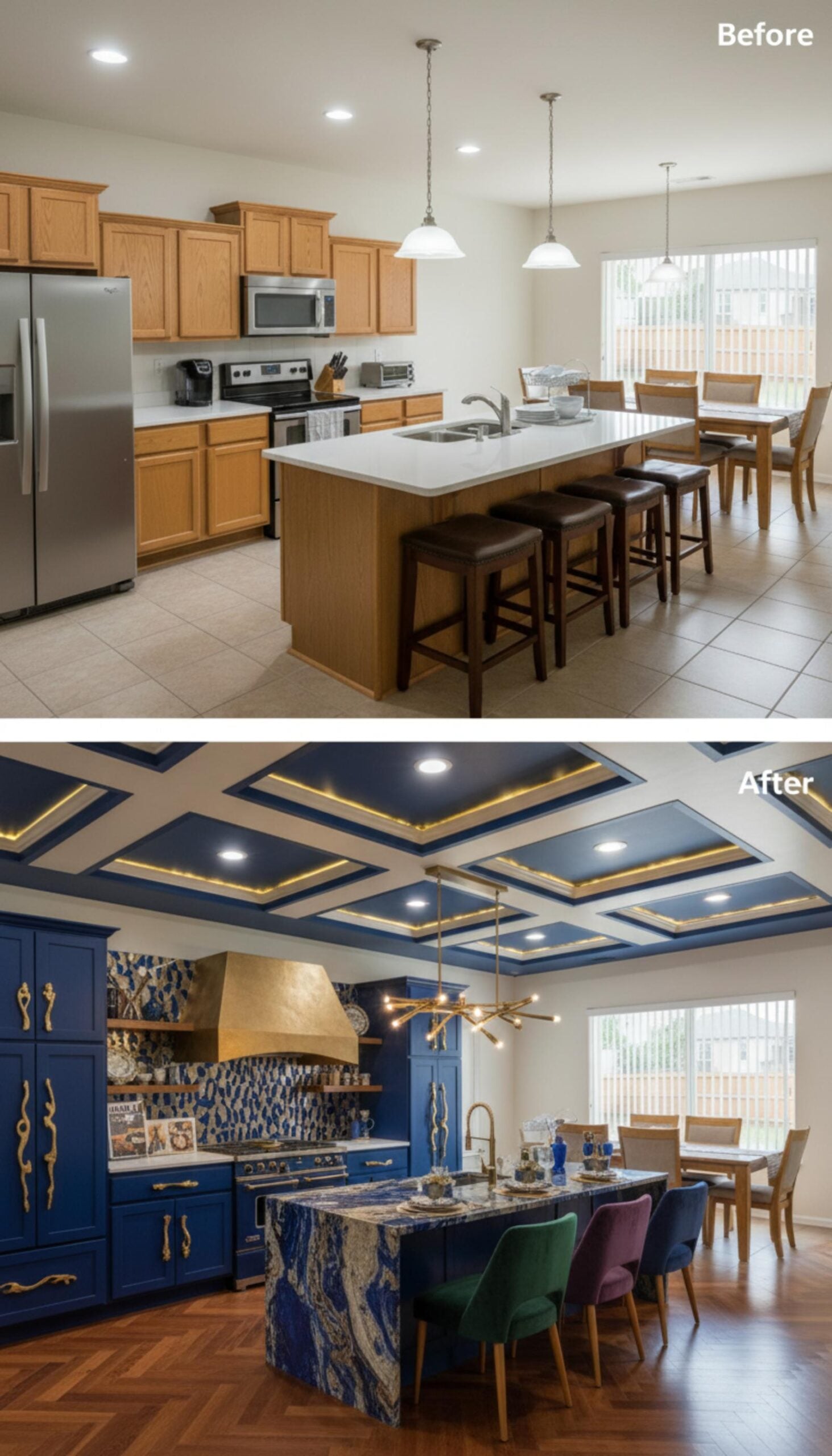
Sodalite granite wraps the island base and countertop in veined blue and white, while navy-lacquered cabinets carry gold hardware with serpentine pulls. Warm LED strip lighting runs the perimeter of each coffered ceiling panel, casting amber along the molding edges.
22. Matte Black Cabinets, Blonde Wood Ceiling, and Three Cone Pendants Over a Dark Granite Island
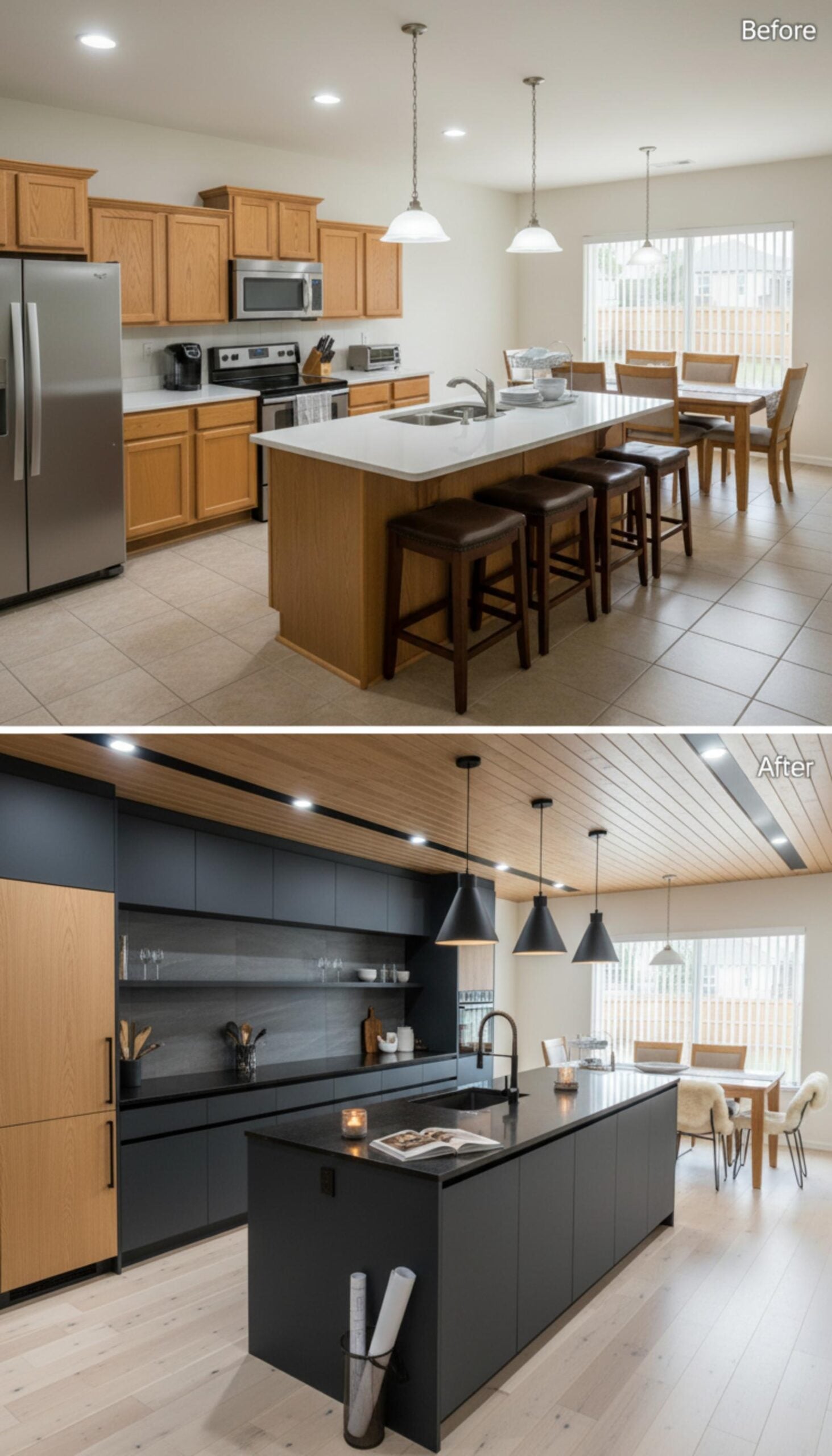
Flat slab cabinetry in matte charcoal runs floor to ceiling on two walls, broken at one end by natural birch panels that match the tongue-and-groove ceiling cladding above. That ceiling detail is doing real work here, pulling warmth into a palette that would otherwise read as severe. Recessed spots mount flush into the ceiling’s wood slats, while three black cone pendants hang at staggered heights above the island.
The island countertop appears to be honed black granite, with an under-mount sink and a matte black gooseneck faucet. Open shelving on the back wall holds glassware and small vessels at eye level, avoiding the visual weight of upper cabinet doors. Light hardwood flooring, likely a white oak with a natural finish, keeps the floor from competing with the cabinetry above it.
History Corner: Open shelving in kitchens dates to 19th-century farmhouse design, where displaying dishes was purely practical, not decorative. By the early 20th century, the Hoosier cabinet began replacing open shelves with enclosed storage as dust and hygiene became household priorities. The open shelf revival in modern kitchens is partly a rejection of that closed-off utility, returning display to the everyday workflow of cooking.
21. Bold Orange and Blue Coffered Ceiling Turns a Basic Kitchen Into a Color Manifesto
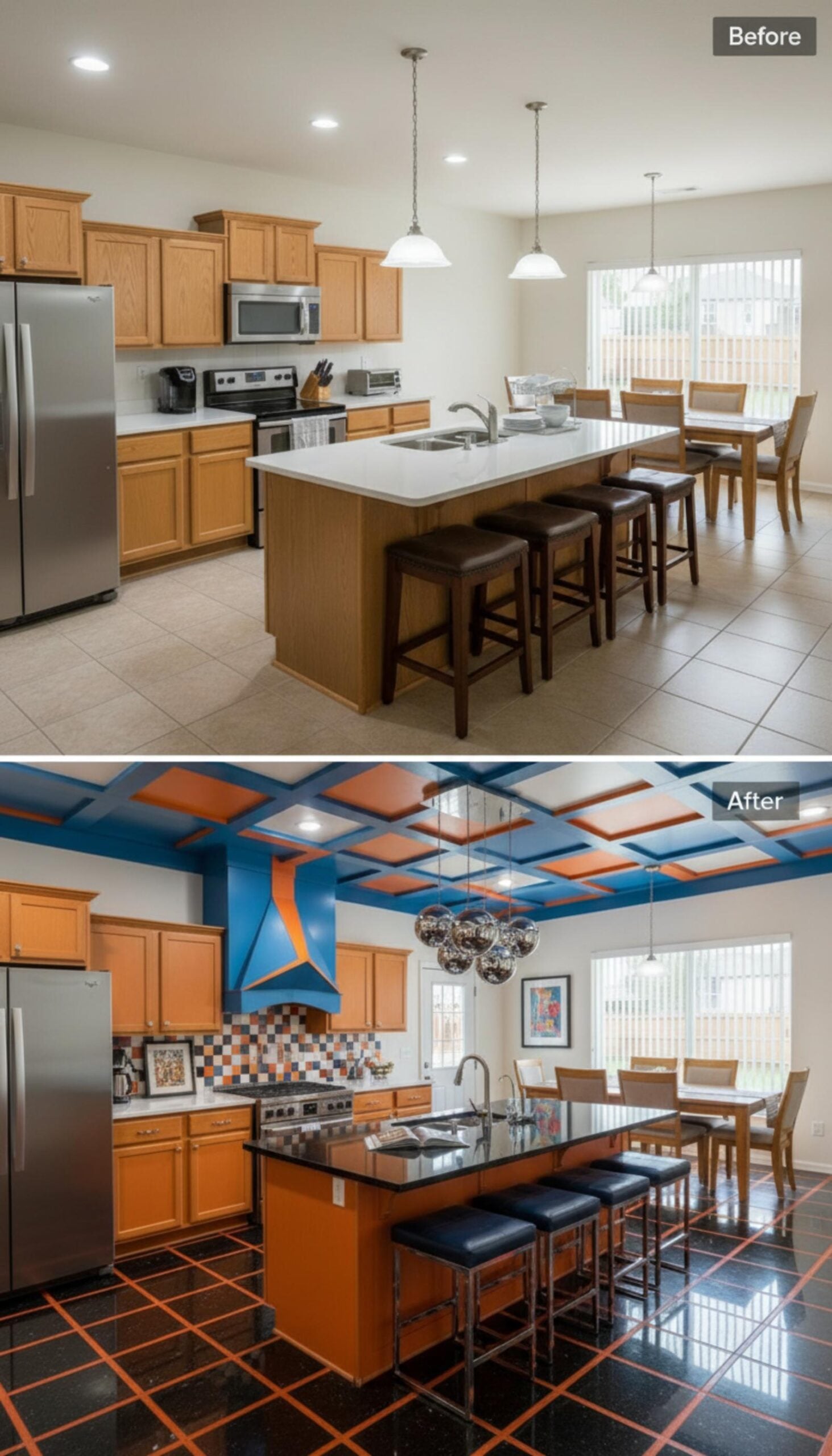
Cobalt blue frames a coffered ceiling where each recessed panel is painted burnt orange, creating a grid overhead that pulls every eye upward before landing anywhere else. The range hood repeats the same two colors in angular geometric planes, connecting ceiling to cooktop in a way that feels intentional rather than decorative. A blue-and-white checkerboard backsplash runs behind the range, and the original honey-toned oak cabinets stay in place, now reading warmer against the saturated tones around them.
Black granite covers the island countertop with a high-polish finish, and chrome globe pendant clusters hang at mid-height over the island. Glossy black floor tiles are laid in a grid divided by orange grout lines, echoing the ceiling pattern at ground level. Bar stools with black leather seats line the island on chrome frames.
20. Rococo Plasterwork on the Ceiling, Carved Cabinet Panels, and Gold Fixtures Signal a Full Commitment
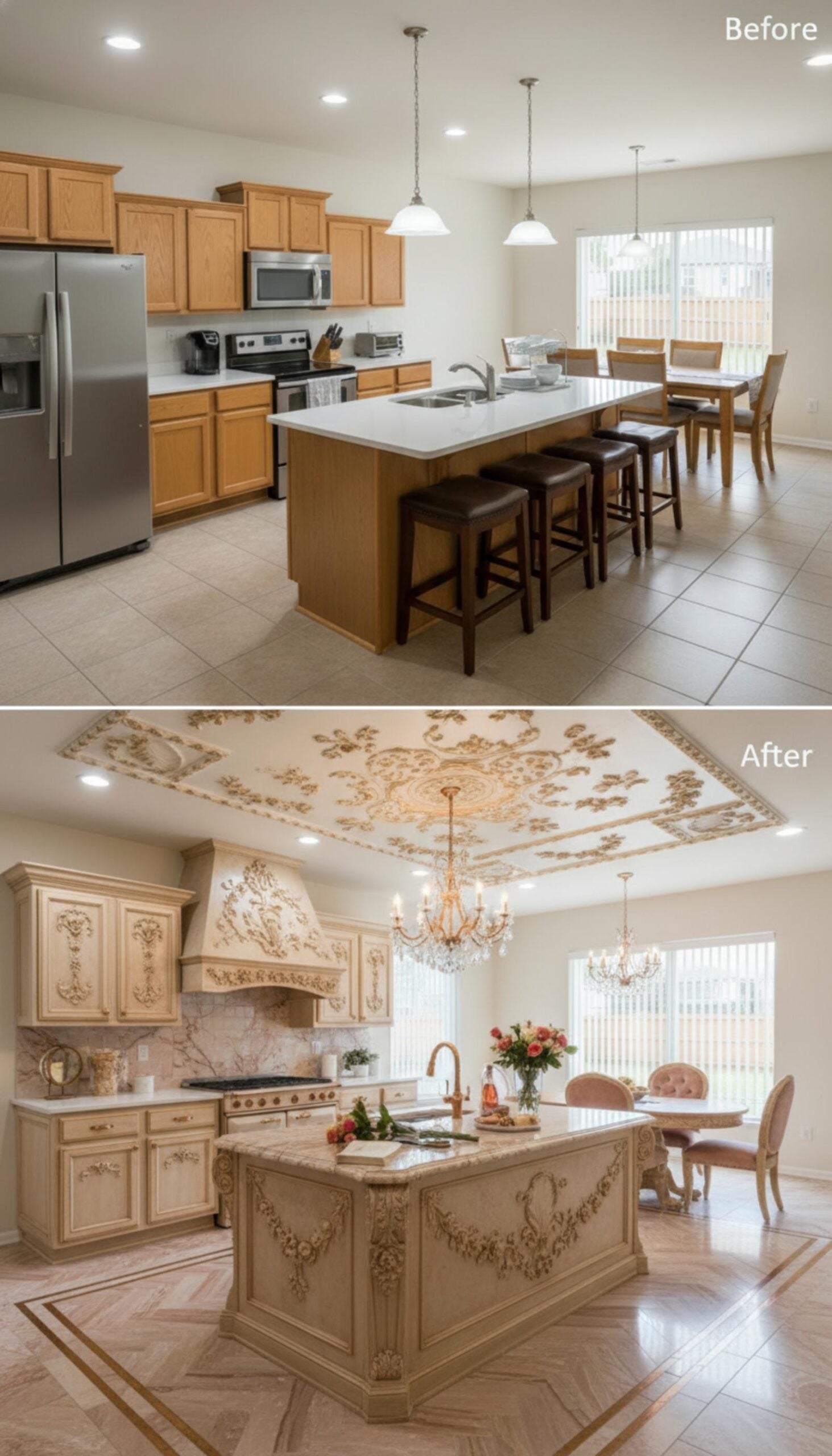
Cream lacquered cabinets with hand-carved floral relief panels cover every wall surface, and the carved detail continues across the range hood, which sits against a rose-veined marble backsplash slab. Brushed gold hardware and a rose gold faucet keep the metal palette consistent. The island base carries the same carved swag-and-garland motif as the perimeter cabinets, topped with edge-profiled granite in warm beige and cream.
Above, a tray ceiling is covered in painted Rococo scrollwork and floral medallions bordered by a gilded frame, and two crystal-armed chandeliers hang from it rather than a single centered fixture. The floor shifts to a herringbone pattern with an inlaid border in contrasting tile. Pink velvet dining chairs at a round pedestal table anchor the breakfast area.
- Rococo carved cabinet doors require hand-finishing because routers cannot replicate the depth variation of chisel work
- Tray ceilings gain visual weight when painted with pattern rather than left as a recessed plain surface
- Matching the metal finish across hardware, faucet, and chandelier arms is the fastest way to unify an otherwise complex room
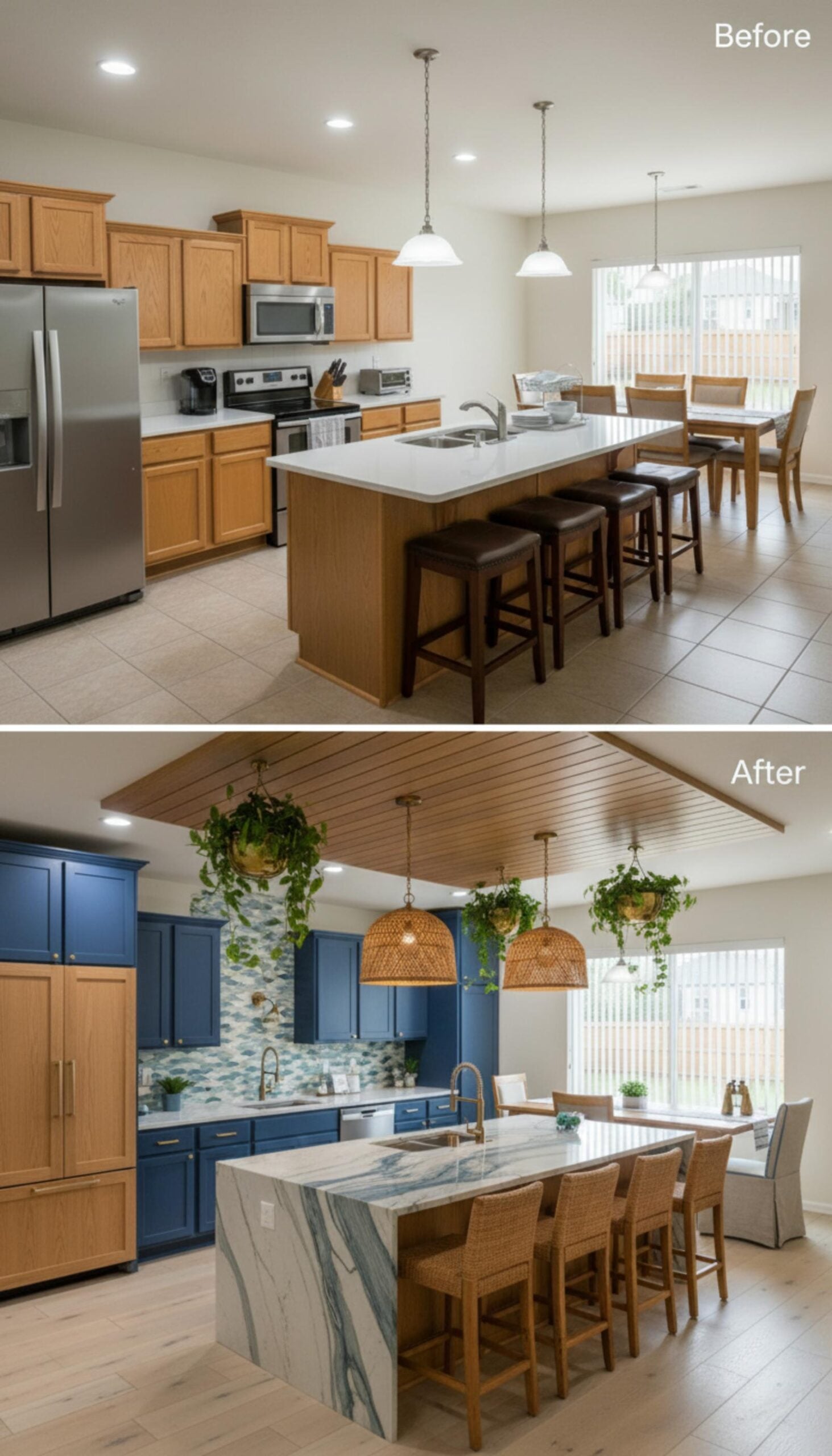
19. Navy Blue Cabinets, Rattan Pendants, and a Marble Waterfall Island Anchor a Coastal Kitchen
🔥 Would you like to save this?
Navy blue shaker cabinets line the perimeter walls, paired with brass hardware and a blue-and-white geometric mosaic tile backsplash that reads almost like glazed ceramic art. Woven rattan dome pendants hang over a waterfall island faced in dramatically veined marble, its blue-grey streaks pulling the cabinet color down into the stone. Wood-plank ceiling cladding warms the overhead plane, and rattan counter stools complete the coastal register without leaning into cliché.
18. Glossy Burgundy Cabinets, Zebra Wood Island Siding, and Cove Lighting Built Into a Tray Ceiling
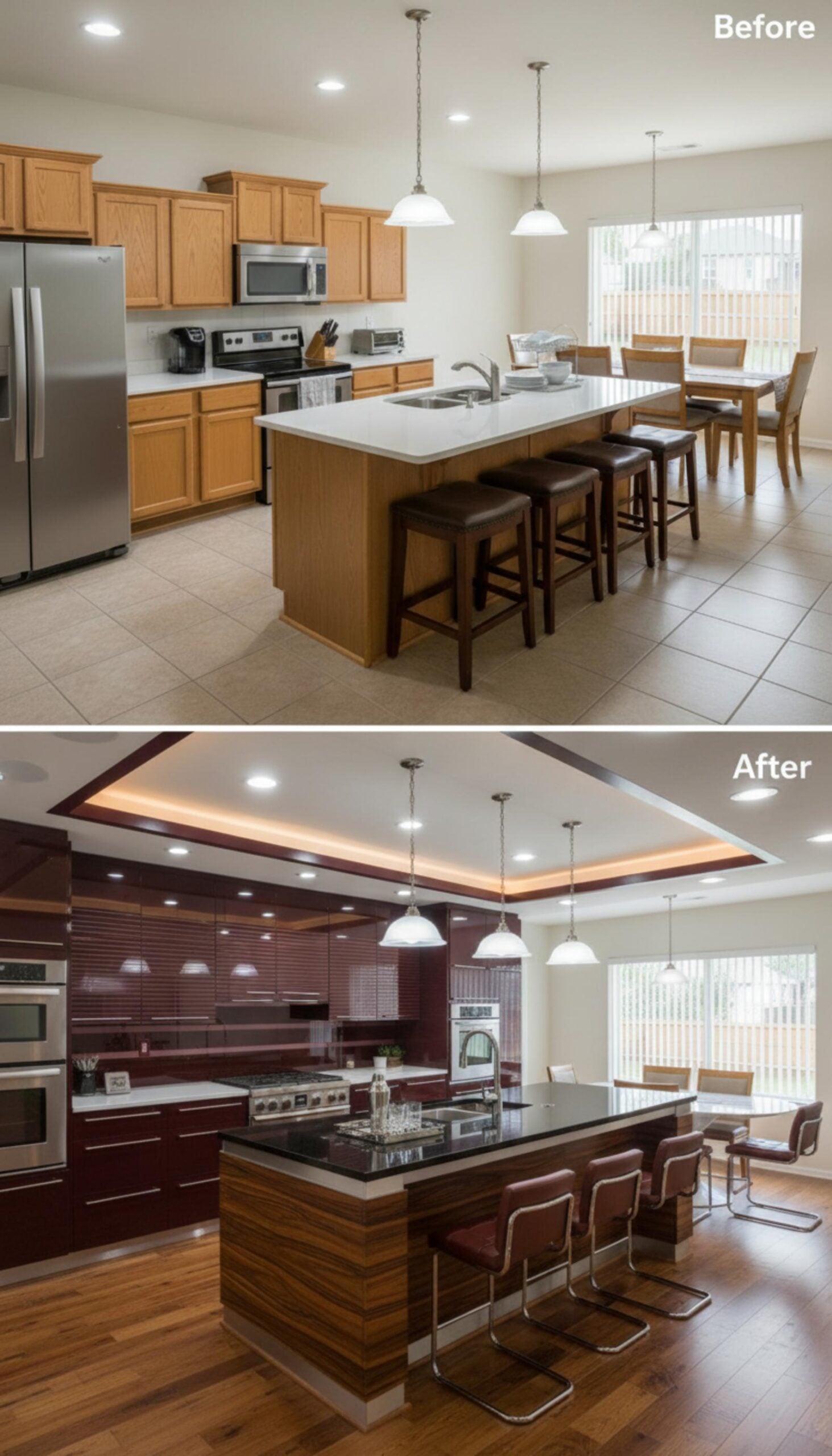
High-gloss burgundy cabinetry runs floor to ceiling on every wall, its lacquered finish catching the recessed lights with a depth that flat paint could never produce. The island base is wrapped in zebra wood veneer, its dark striping cutting horizontally around the perimeter. Black granite tops the island, and the original pendant fixtures remain, now reading differently against the darker palette.
A tray ceiling with warm amber cove lighting defines the kitchen zone without a single wall or partition. The dining area stays open just beyond, where chrome cantilever chairs pull up to a round table. Hardwood flooring in a warm medium tone runs through both spaces, tying the shift in materials together without forcing it.
Why Cove Lighting Inside a Tray Ceiling Works Better Than Pendants Alone
Cove lighting installed along the inner ledge of a tray ceiling emits upward-facing ambient light that bounces off the recessed plane above, softening the entire room without creating direct glare. In a kitchen with high-gloss cabinet surfaces, this matters considerably, since point-source lighting aimed at lacquered doors produces harsh reflections that flatten the finish visually. The warm amber tone used here also counterbalances the cool steel of the double wall ovens, keeping the room from reading as cold despite the dominance of dark surfaces.
17. Gothic Range Hood, Patterned Cement Tile Backsplash, and Dark Coffered Ceiling Work in Formation
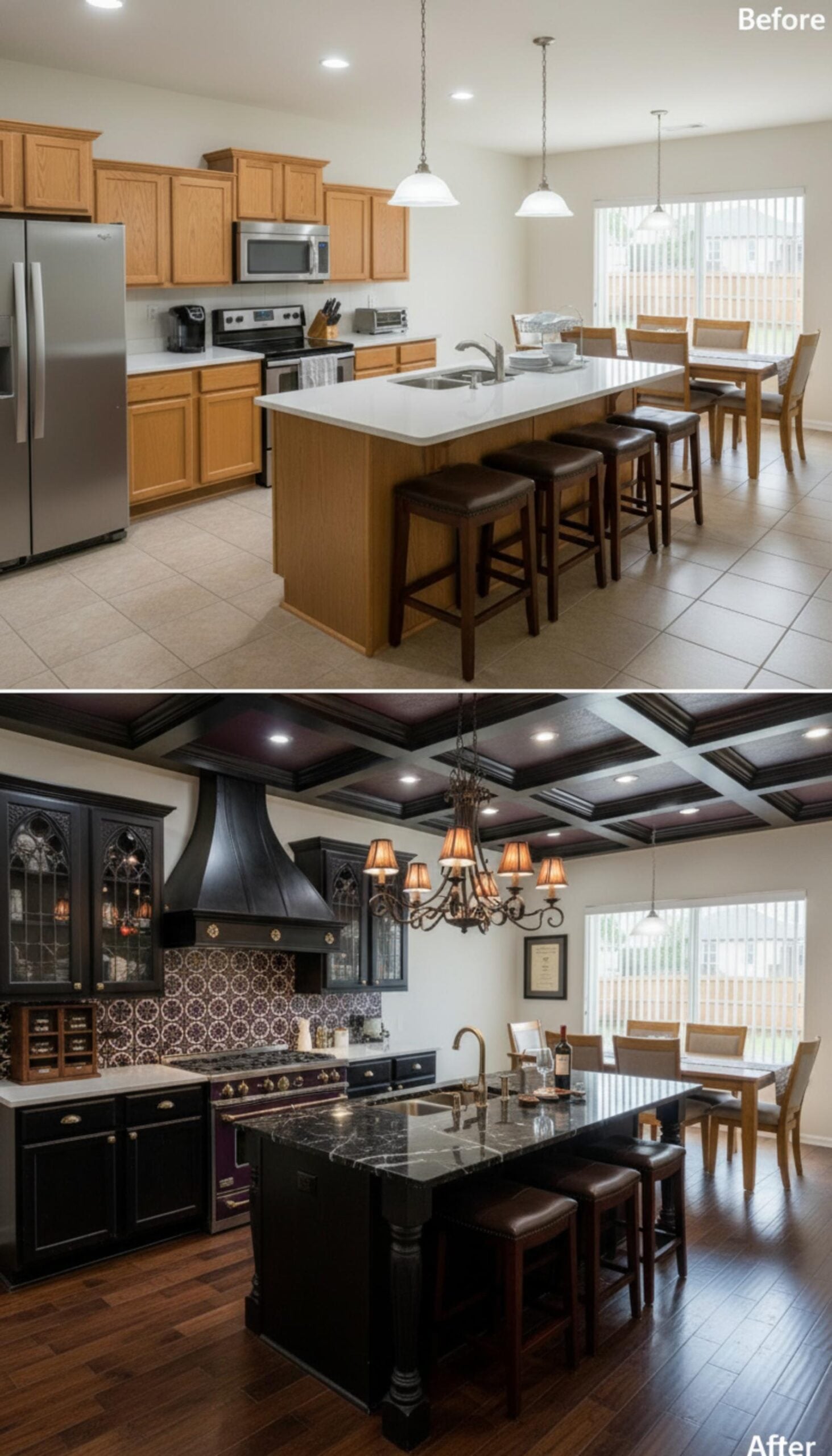
Dark-stained cabinets with brass hardware line the perimeter, flanked by glass-front upper cabinets featuring Gothic arch mullions. A matte black range hood anchors the cooking wall above a purple-bodied range and a field of white-on-white patterned cement tile. Hardwood floors in a deep walnut stain run throughout.
The coffered ceiling uses dark-painted beams to frame each recessed panel, and a wrought iron chandelier with amber fabric shades hangs over the island. That island countertop is dark marble with white veining, finished with an undermount sink and brass faucet.
16. Taupe Flat-Front Cabinets, Waterfall Granite Island, and Cove-Lit Tray Ceiling Rewrite the Room’s Whole Register
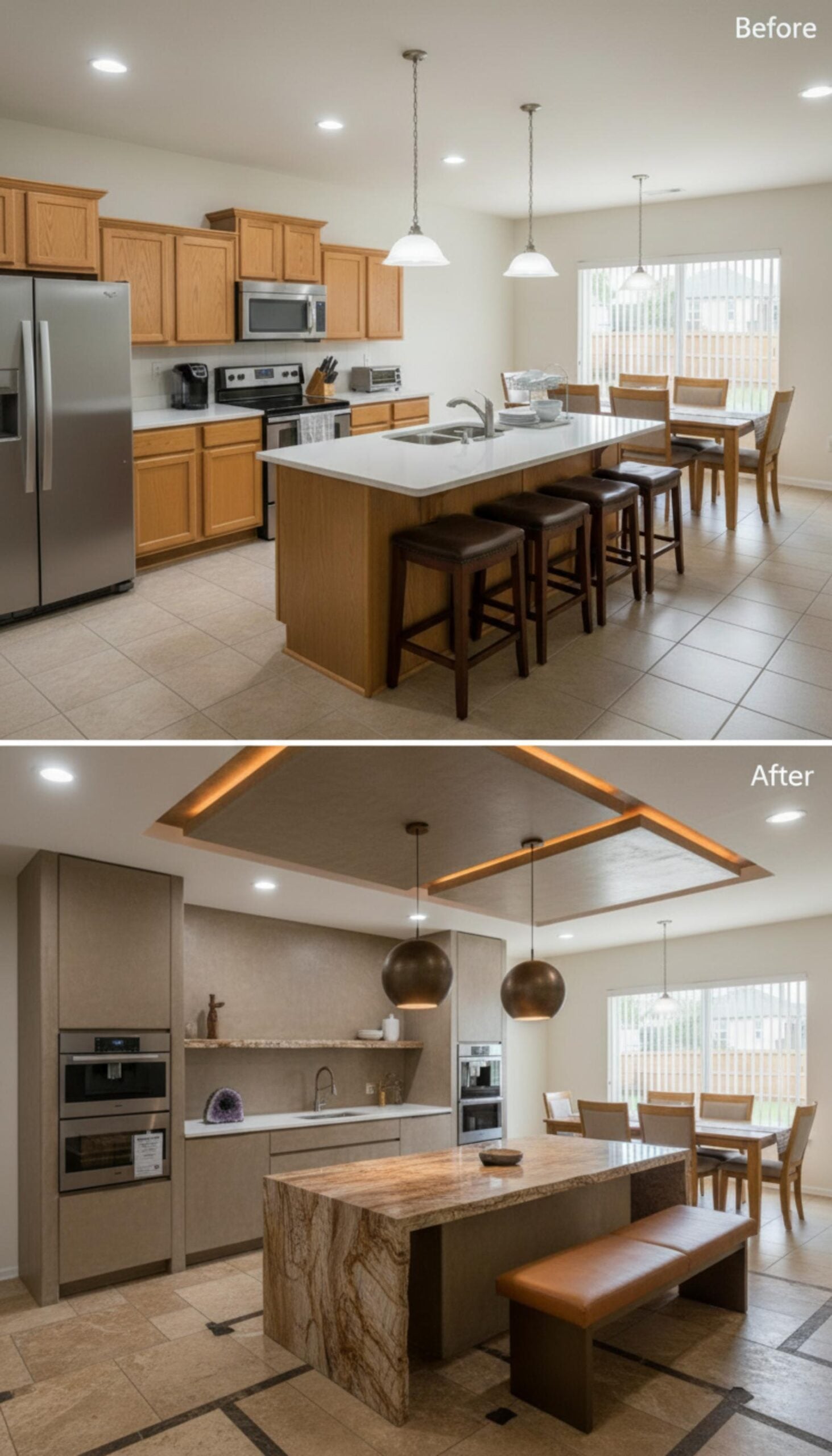
Greige flat-front cabinetry runs floor to ceiling on two walls, with open shelving breaking the upper run to display ceramics and a raw amethyst cluster. The island is clad entirely in bookmatched granite with amber and rust veining, waterfall edges on both ends. Spherical bronze pendants drop from a geometric tray ceiling edged in warm LED cove lighting.
Color Story: The warm amber undertones in the island’s granite veining were almost certainly a deliberate match to the cove lighting temperature, which reads around 2700K. Choosing a stone slab for its ability to mirror an artificial light source rather than its pattern alone is a more advanced design decision than most residential kitchens attempt. Lighting temperature and material tone working in agreement make the island appear internally lit rather than simply illuminated from above.
15. Walnut Flat-Fronts, Black Marble Everywhere, and Cove Lighting That Rewrites the Ceiling’s Job
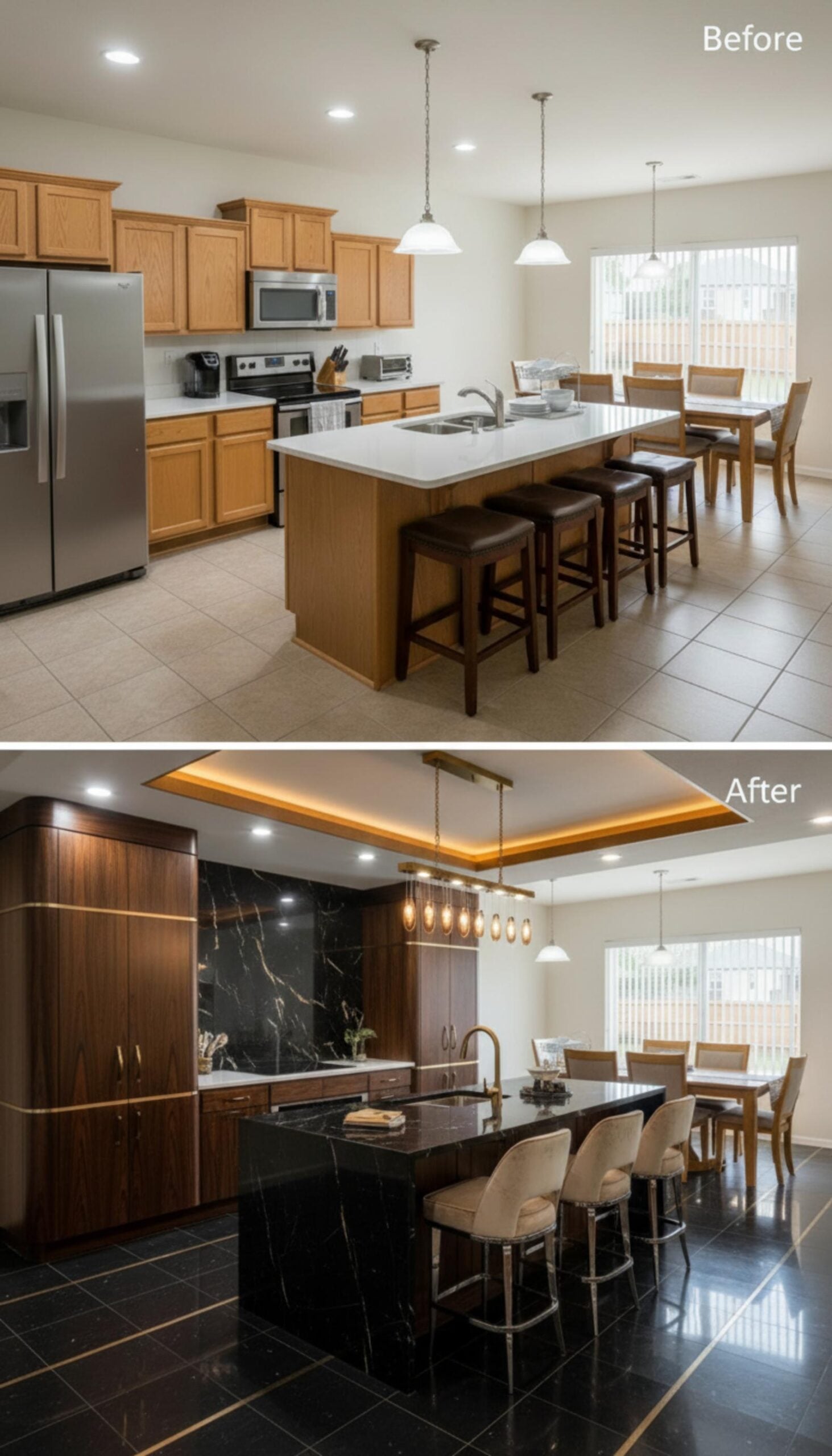
Walnut cabinetry with horizontal grain runs floor to ceiling, framed by thin brass inlay strips that catch the warm light pooling from a tray ceiling’s cove. The island is clad entirely in black marble with gold veining, matched by the full-height backsplash behind the range wall. Upholstered bar stools in ivory bring contrast without interrupting the room’s depth.
Brass inlay on flat-front walnut cabinets is doing more compositional work here than most pendant fixtures ever could.
14. Forest Green Cabinets, a Living Plant Wall, and Exposed Ceiling Beams Pull a Kitchen Into the Canopy
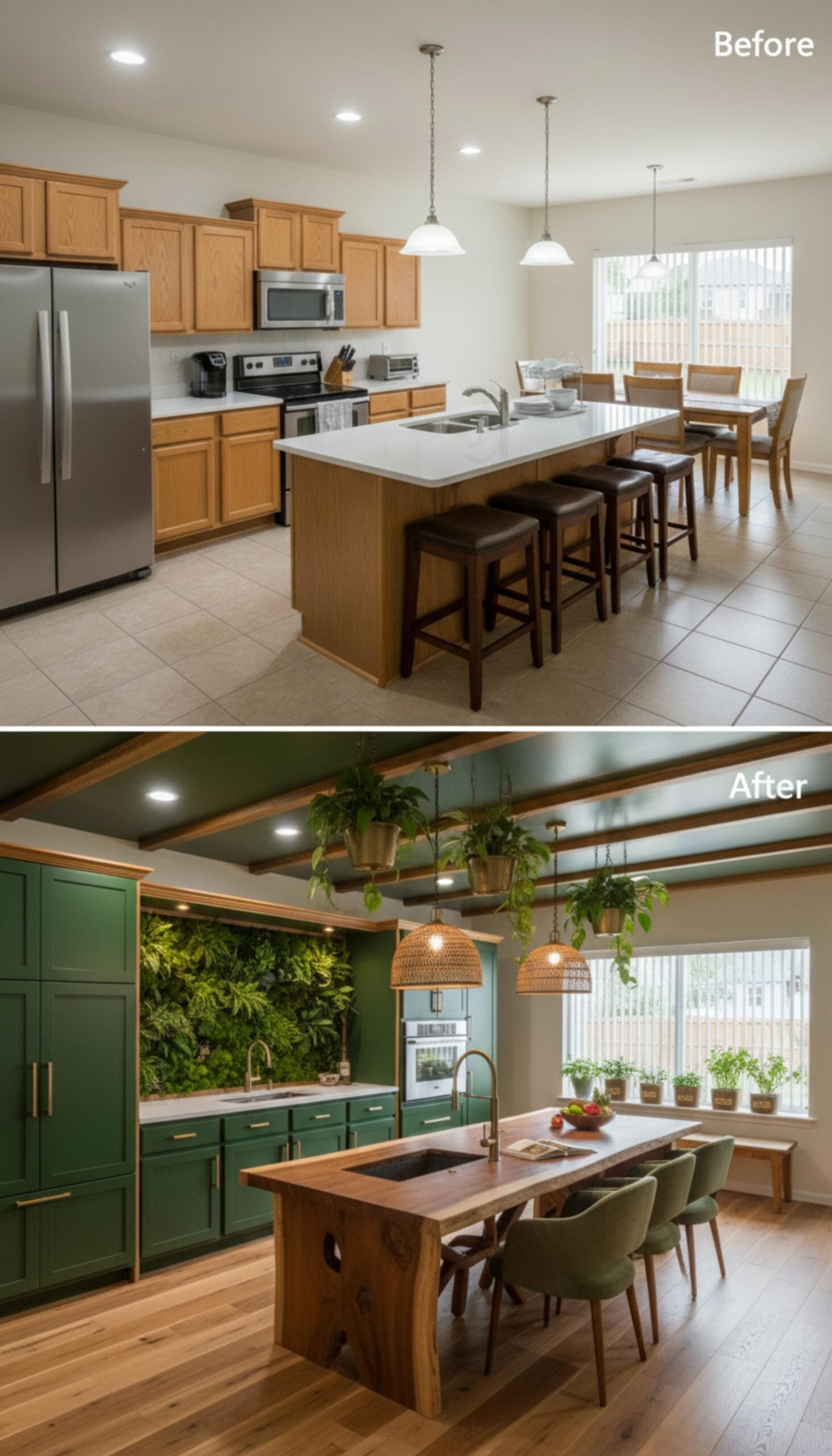
Deep forest green shaker cabinets with brass pulls line the walls alongside a vertical moss and fern installation that functions as the backsplash. Hardwood floors in a natural hickory tone replace tile. The island uses a live-edge walnut slab countertop. Woven rattan pendant lights hang above it, and wood ceiling beams run the length of the room at regular intervals against a painted green ceiling.
Pro Tip: Vertical living walls in kitchens require a dedicated irrigation system and grow lighting calibrated to the plant species selected. Without both, foliage density drops within a few months. Designers typically spec hardy ferns, pothos, and philodendrons for low-maintenance kitchen installations because they tolerate humidity fluctuations near cooking zones.
13. Copper Hardware, Graphite Cabinets, and a Coffered Ceiling Trimmed in Rose Metal
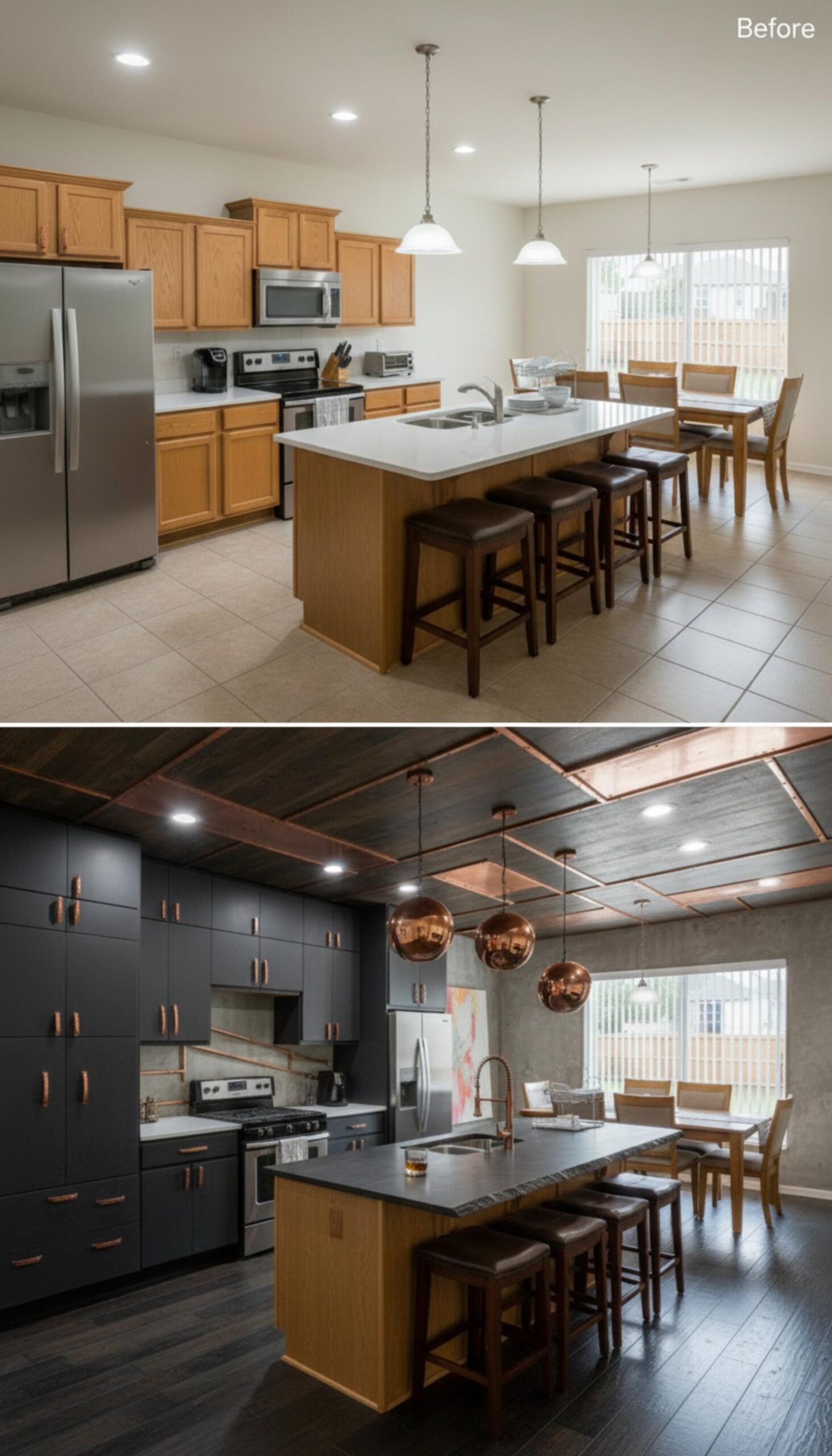
Graphite flat-front cabinets run floor to ceiling, paired with copper bar pulls that read warm against the matte finish. The island top switches to a near-black slab, and copper globe pendants hang at staggered heights above it, pulling the metal accent down from the ceiling into the work zone.
The coffered ceiling is the room’s real architectural statement. Dark wood panels are framed by copper-toned trim, creating a grid that holds recessed lighting at each intersection. Dark hardwood flooring anchors the whole composition and keeps the palette consistent from floor to overhead.
12. Gold Laurel Appliqués, Black Coffered Ceiling, and Marble Greek Key Floors Declare a New Hierarchy
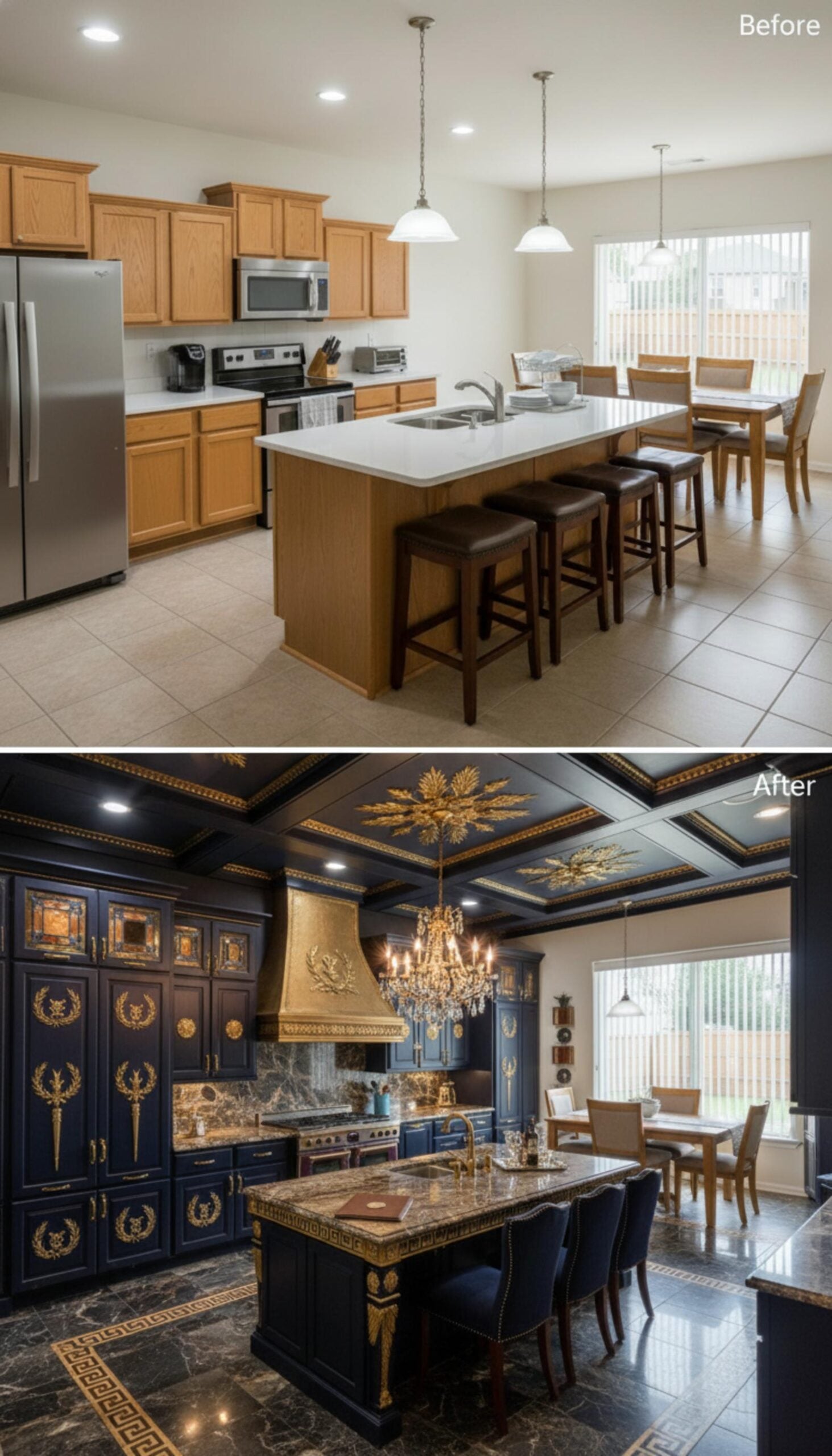
Midnight blue cabinets carry hand-applied gold laurel wreaths and torch motifs, a level of ornamental detail borrowed from Empire-period furniture. The range hood is sheathed in hammered gold leaf with acanthus relief work, and the backsplash behind it uses slabs of brown-and-gold veined marble in a book-matched pattern. Overhead, a coffered ceiling painted black gets edged in gilded molding, with a central medallion of painted gold foliage anchoring a crystal chandelier with candelabra arms.
The island countertop is dark emperador marble with gold edge banding, and the floor below it lays out a Greek key border in contrasting black and cream stone tile. Blue velvet nailhead chairs pull to the island on one side. Every surface in this kitchen operates as part of a single decorative system rather than a collection of separate finishes.
Style Math: Empire-style kitchens draw from early 19th-century Napoleonic design, which used military symbols like laurels, torches, and eagles to signal status through architecture. Applied gilding on cabinet doors requires a gesso base coat, multiple layers of sizing, and genuine gold or composition leaf pressed by hand, making each panel unique. Rooms this densely ornamented typically follow one rule: keep every element within the same tonal family, or the result reads as chaos rather than opulence.
11. Red Lacquer Fridge, Glossy White Flat-Fronts, and a Floating Ceiling Panel That Changes the Room’s Atmosphere
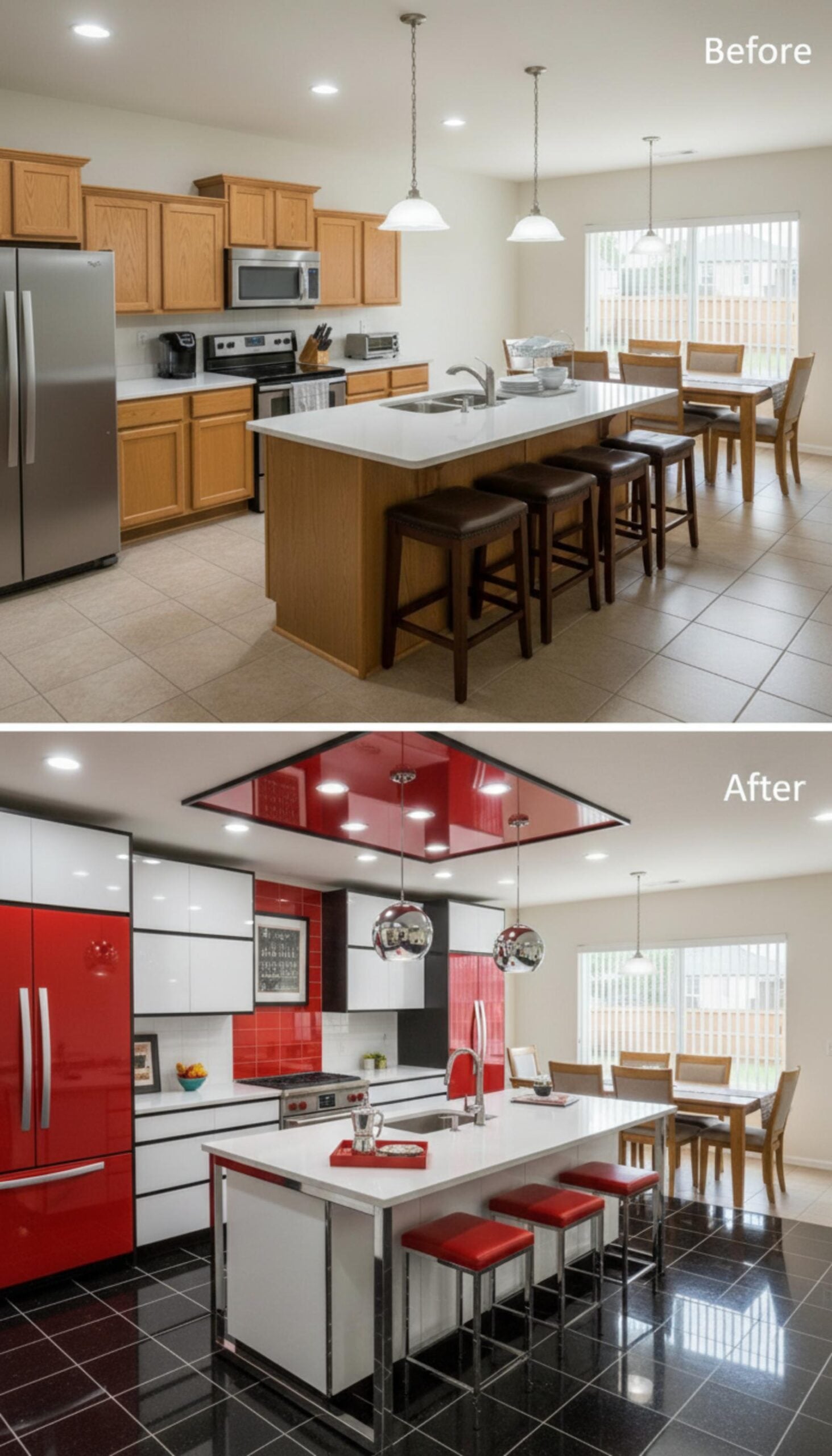
Red does the heavy lifting here. The refrigerator panel, backsplash tile, and island bar stools all share the same saturated crimson, which keeps what could read as chaos locked into a deliberate system. White high-gloss flat-front cabinetry runs the perimeter walls, reflecting light back into the space without interruption. A dropped ceiling panel finished in red lacquer floats above the island zone, recessed lights punched through it at intervals, functioning as both a lighting fixture and an architectural boundary between cooking and dining.
The island itself is white with chrome-edged detailing and a white quartz surface. Mirrored globe pendants hang at staggered heights below the ceiling panel, amplifying the recessed light through reflection rather than additional wattage. Black large-format floor tile, polished to a mirror finish, anchors the palette at grade level and ties the black wall accents together across the room.
10. Exposed Beam Coffered Ceiling, Hand-Painted Range Hood Tile, and Knotty Oak Cabinets Lock In a Tuscan Register
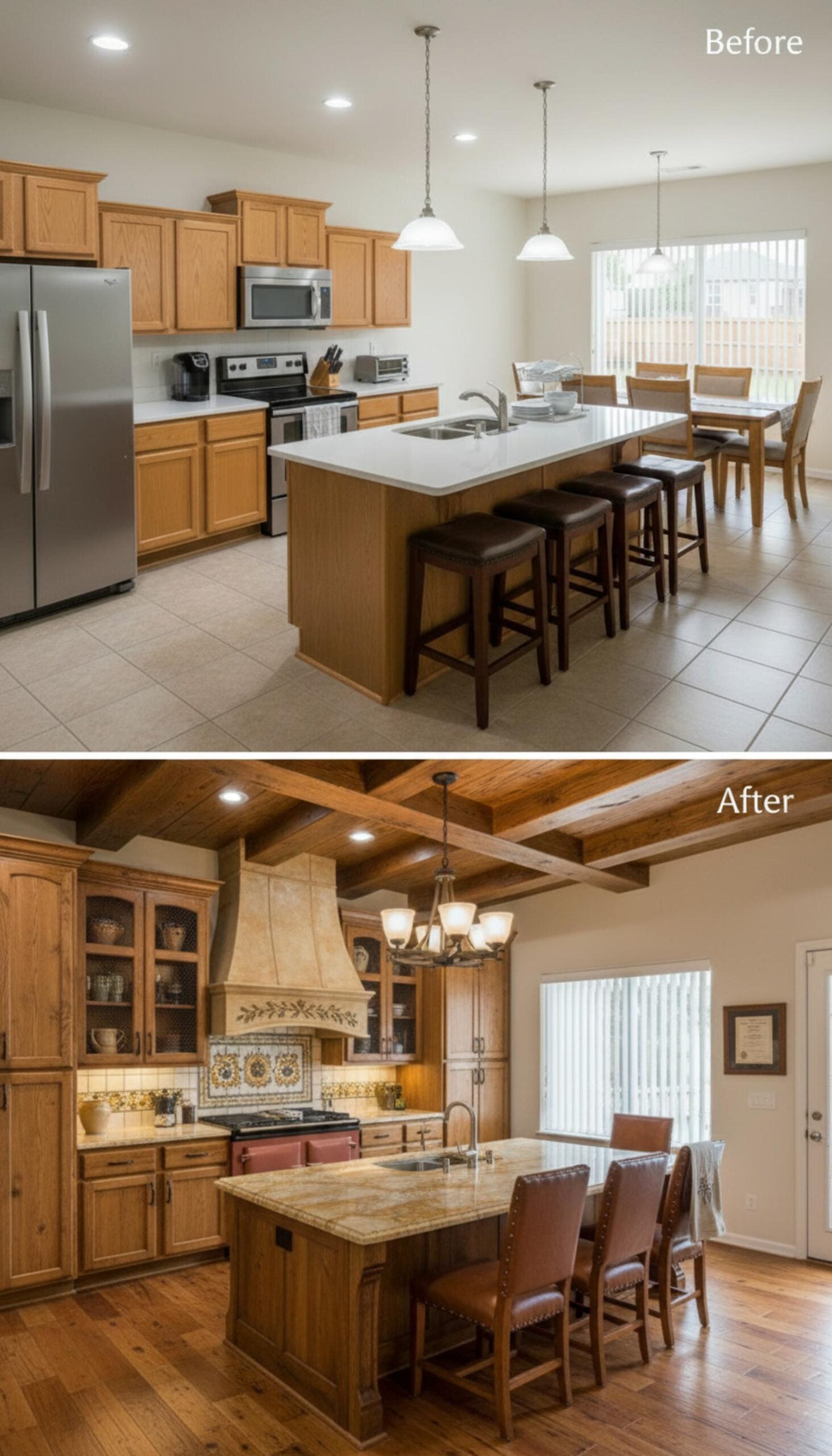
Structural wood beams divide the ceiling into a coffered grid, each bay finished in the same warm oak tone as the cabinet faces below, pulling the eye upward and anchoring the room’s vertical axis. A chandelier with candelabra-style arms drops over the island at counter height, casting amber light across granite with gold and cream veining. The island itself seats four in leather chairs with nailhead trim, a detail that signals dining-room formality inside a working kitchen.
The range hood is the room’s focal point: a plastered surround painted in an off-white finish frames a decorative tile mural with sunflower and olive branch motifs in mustard, rust, and cobalt. Knotty oak cabinet doors feature wire-mesh inserts on the upper row, exposing dishware rather than hiding it. Wide-plank hardwood floors in a medium honey stain run the full length of the space, tying every warm-toned surface together without any single material competing for dominance.
The range hood’s plastered surround frames a decorative tile mural with sunflower and olive branch motifs in mustard, rust, and cobalt.
9. Gloss-White Flat-Fronts, Mirrored Ceiling Panel, and Chrome Globe Pendants Redefine the Room’s Ceiling Plane
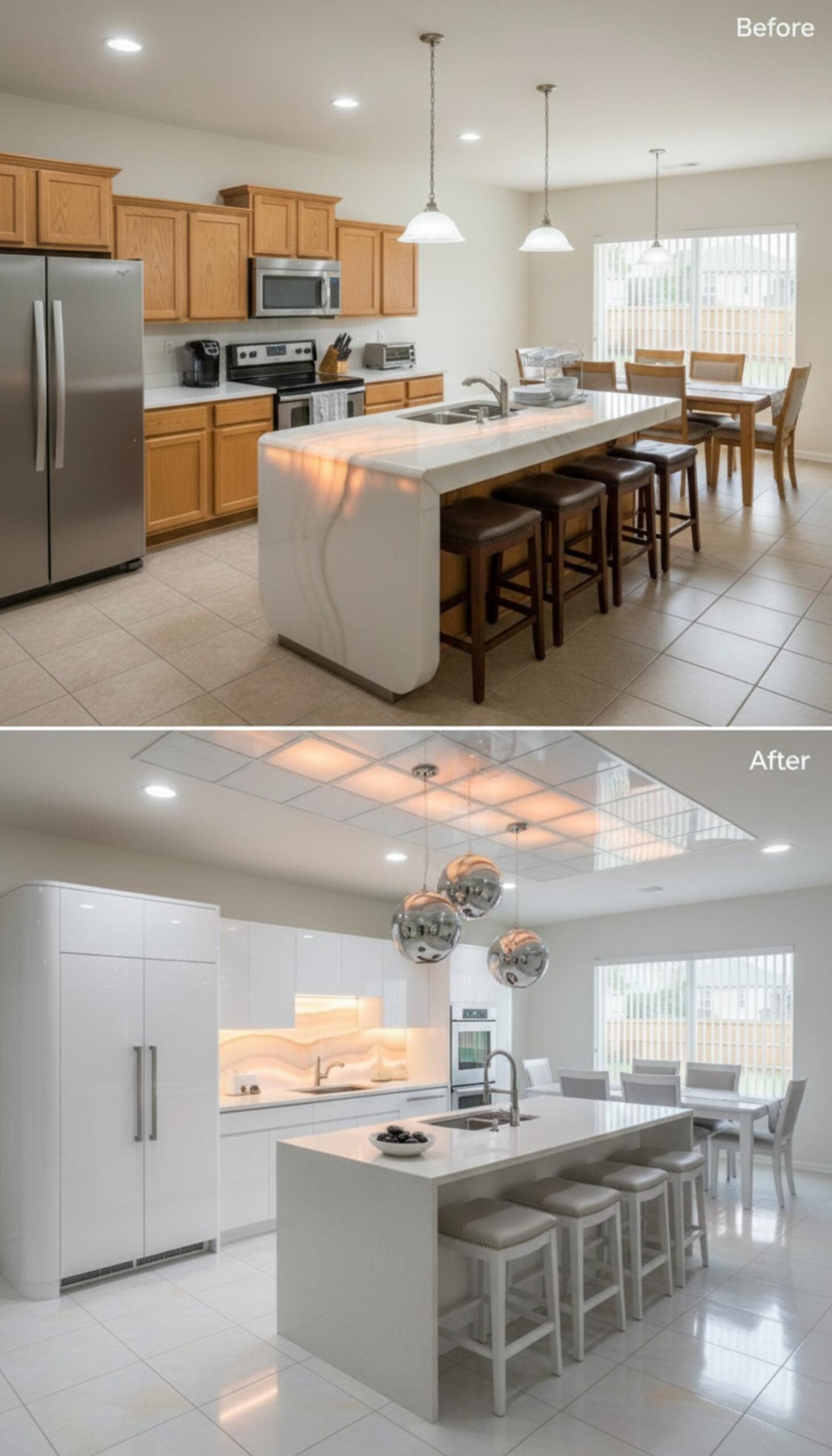
Every cabinet in the after kitchen runs floor to ceiling in high-gloss white with no visible hardware except long, brushed-bar pulls. The island shifts to a solid quartz waterfall in soft warm white, and the bar stools swap dark leather for upholstered seats in light greige. A mirrored ceiling panel sits above the cooking zone, reflecting the under-cabinet lighting back into the room and doubling the perceived depth overhead.
Three chrome globe pendants hang in a staggered cluster above the island, their reflective surfaces picking up the mirrored ceiling above. The dining area keeps the same palette, with gray upholstered chairs replacing the wood originals. The floor tile remains but reads differently under the brighter, cooler ambient light.
Fun Fact: Mirrored ceiling panels became a fixture in high-end residential design after appearing in European hospitality interiors during the 1970s and 1980s, where they were used to make low-ceilinged dining rooms feel taller. In residential kitchens, the same principle applies, but the panels also serve a secondary function by reflecting task lighting downward, which can reduce the number of recessed fixtures a room actually needs.
8. Sage Green Raised-Panel Cabinets, Wood Coffered Ceiling, and a Chandelier That Resets the Room’s Tone
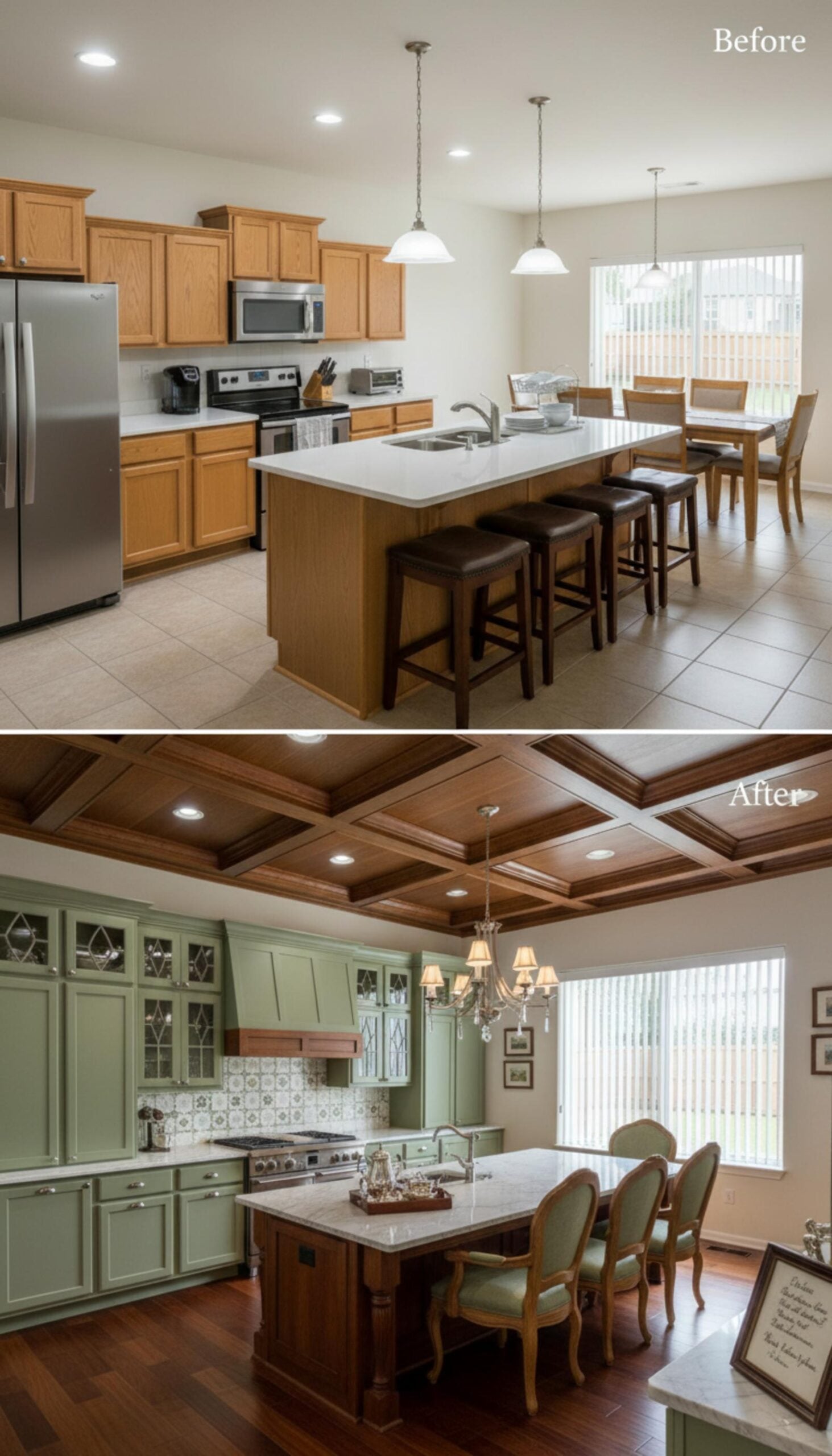
Sage green raised-panel cabinets run the full perimeter, their finish sitting closer to muted olive than mint. Upper cabinets feature diamond-pattern leaded glass inserts, and brushed nickel cup pulls keep the hardware restrained. A custom wood range hood in medium-toned walnut anchors the cooking wall, flanked by patterned encaustic tile in a geometric repeat.
The coffered ceiling is the room’s most committed move: walnut-stained box beams form a grid overhead, replacing a flat drywall plane with something that reads as architectural furniture. A candelabra-style chandelier with linen shades hangs over the island, which carries a marble or quartz top on dark-stained legs. Hardwood flooring replaced tile throughout.
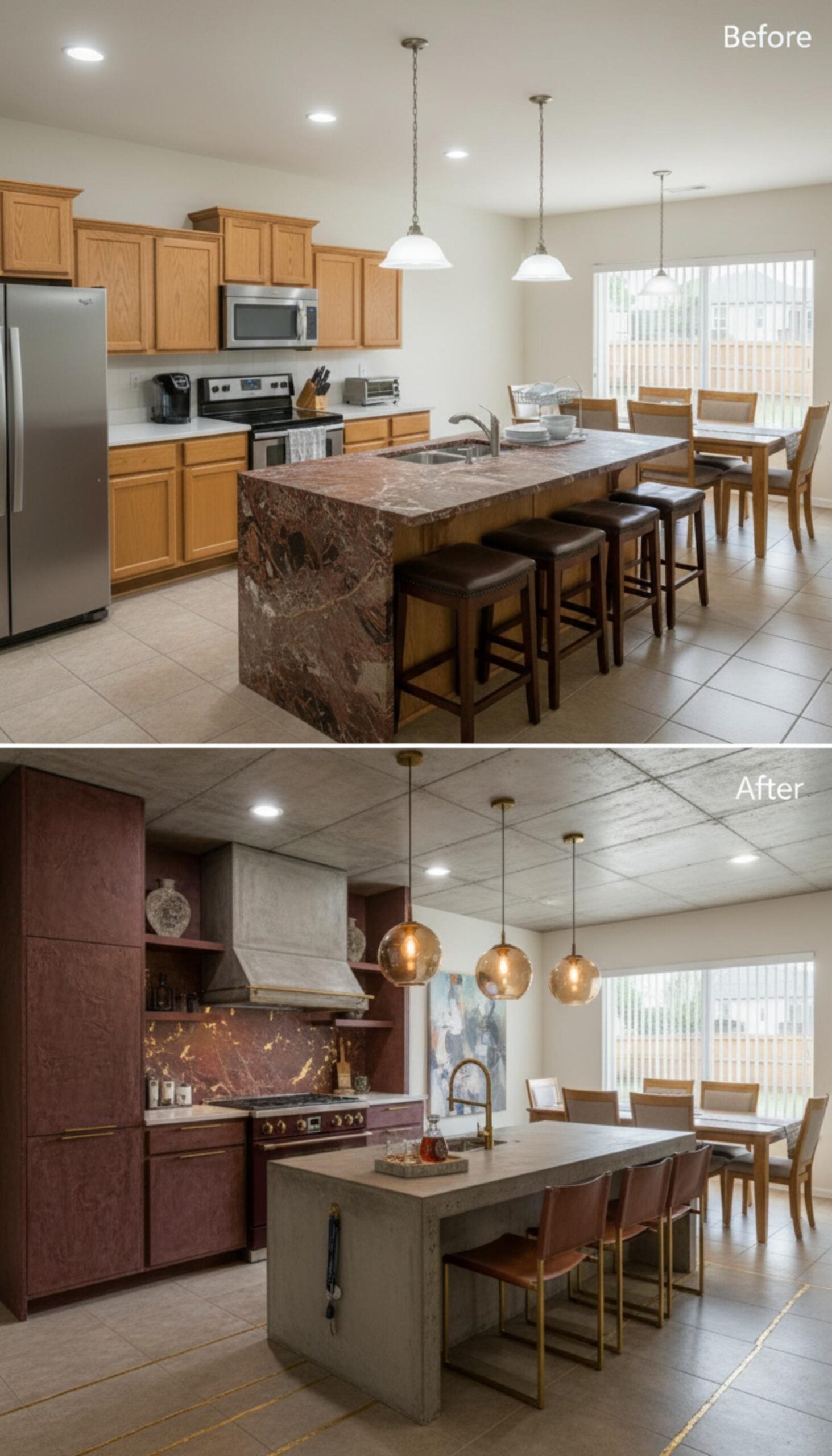
7. Burgundy Flat-Fronts, Concrete Island, and Amber Globe Pendants Rewrite a Kitchen’s Social Register
🔥 Would you like to save this?
Painted in a muted burgundy with visible texture, the flat-front cabinets read closer to raw plaster than lacquer, which keeps the palette from tipping into gloss. A concrete island with a waterfall edge anchors the room without hardware or ornament. Three amber blown-glass globe pendants hang on brass stems above it, pulling warmth from the marble backsplash behind the range, where red and gold veining runs vertically like a deliberate focal wall. The range hood is finished in the same raw concrete tone as the island, tying both zones together.
6. Blue Lacquer Cabinets, Gold Chinoiserie Painting, and Green Marble Waterfall Island Shift the Register Entirely
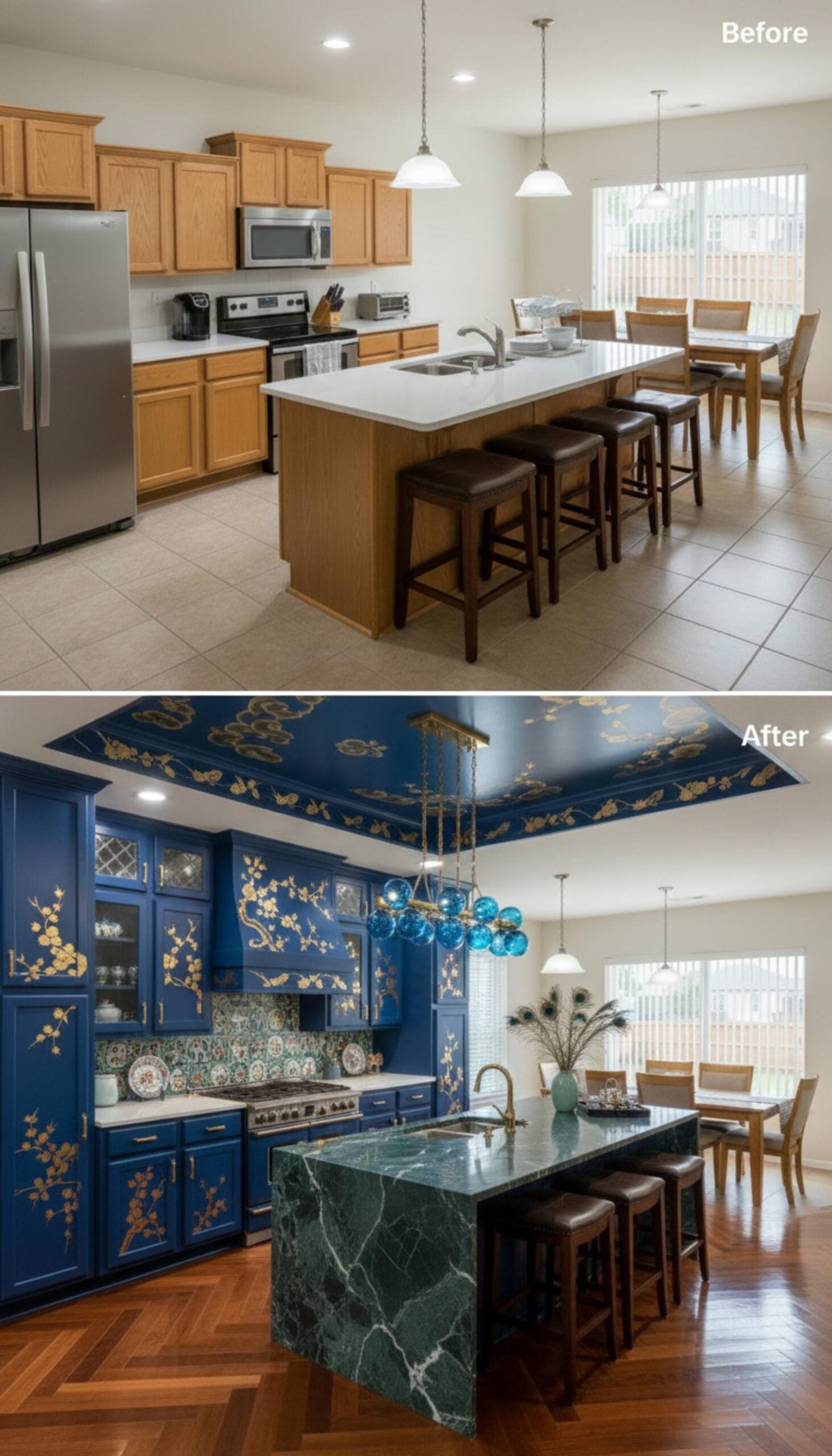
Navy lacquer cabinets run floor to ceiling, hand-painted with gold cherry blossom and dragon motifs that belong to the chinoiserie tradition, a European interpretation of East Asian decorative arts that peaked in the 18th century. The range hood receives the same painted treatment, and a field-tile backsplash in green, red, and cream geometric pattern holds its own against the dominant blue. A cluster pendant of blue glass globes on brass chain drops over the island.
The island surface is green marble with white veining, waterfall-cut on both sides, which means the slab wraps continuously from countertop to floor without a seam break. Herringbone hardwood replaces tile underfoot. The ceiling above the kitchen zone is painted the same navy as the cabinets and carries the gold botanical motif upward, creating a canopy effect that contains the space without lowering it visually.
5. Pink Range Hood, Crystal Chandelier, and Greek Key Floor Inlay Rewrite Kitchen Status
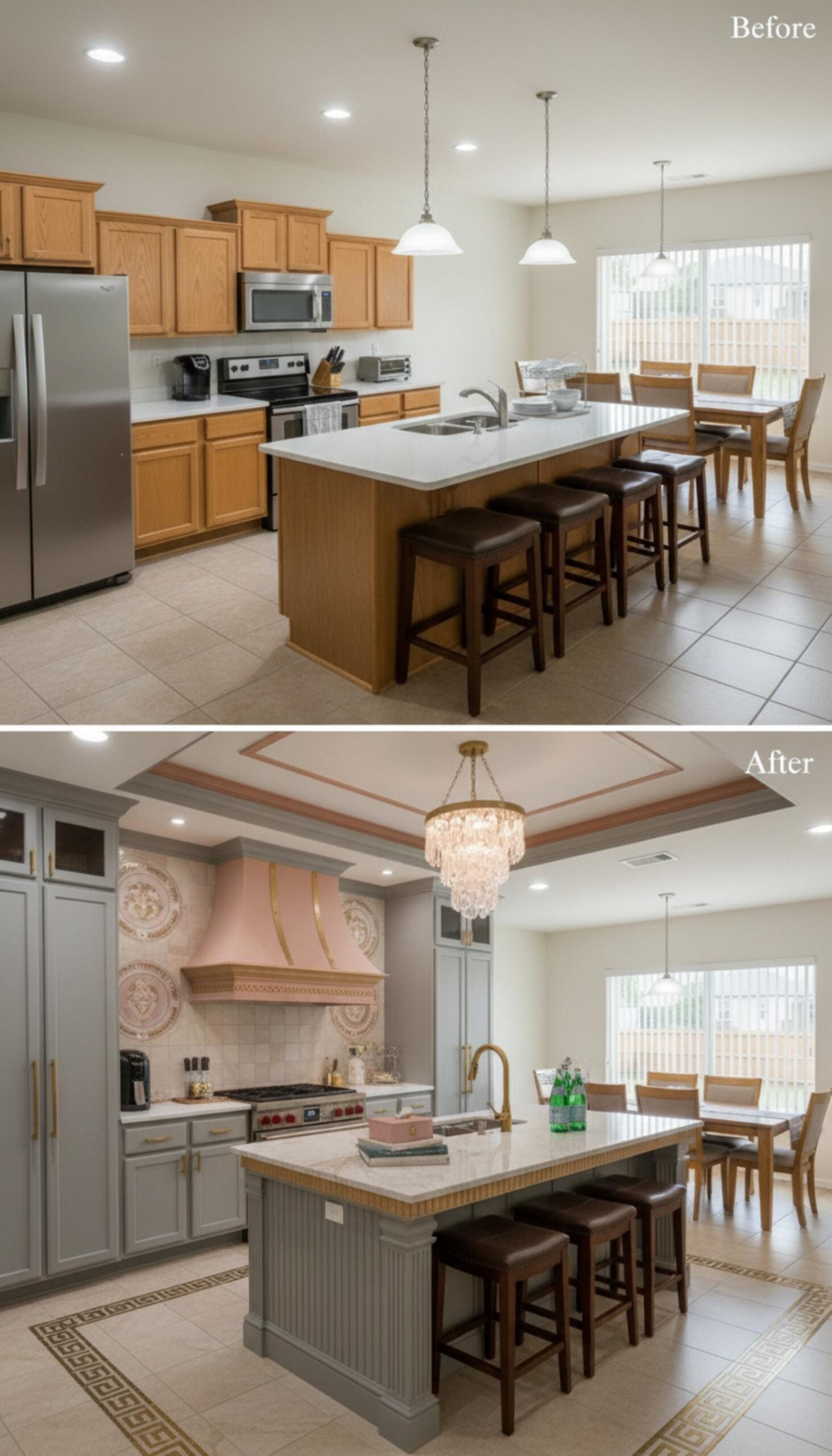
Gray raised-panel cabinets finished in a cool greige tone run floor to ceiling, fitted with brass pulls that read warmer against the painted wood. The range hood commands the back wall in blush pink with gold stripe detailing and a decorative medallion pattern on the backsplash tile behind it. A tray ceiling frames the space with rose-copper banding along its inner edge, giving the room a defined crown without any added millwork below it.
A crystal chandelier with brass chain hangs over the island, which carries a white stone countertop edged in a reeded gold band. The existing floor tile gains a Greek key border inlay in a contrasting neutral, drawing a boundary around the kitchen zone without raising the floor plane.
4. Matte Black Flat-Fronts, Walnut Slat Ceiling, and a Wood-Grain Island Counter Signal a Serious Upgrade
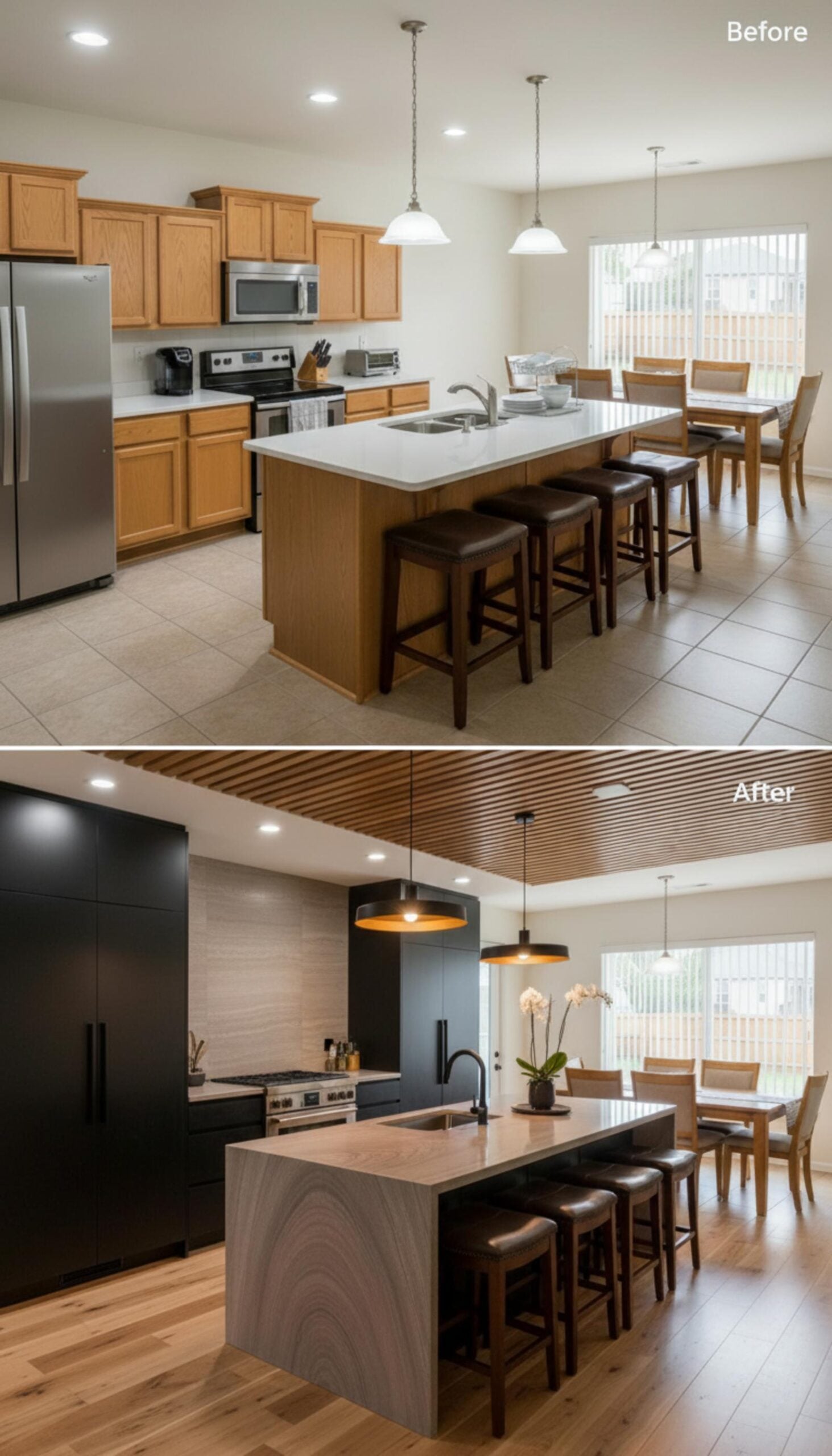
Black flat-front cabinetry runs floor to ceiling on two walls, paired with matte black hardware and a black refrigerator panel that reads as a single unbroken mass. The island counter displays pronounced walnut grain in a waterfall edge, and the slat wood ceiling above grounds the whole composition without a single ornamental detail required.
3. Royal Blue Lacquer, Gold Sunburst Ceiling Medallion, and Sodalite Marble Island Make a Clear Announcement
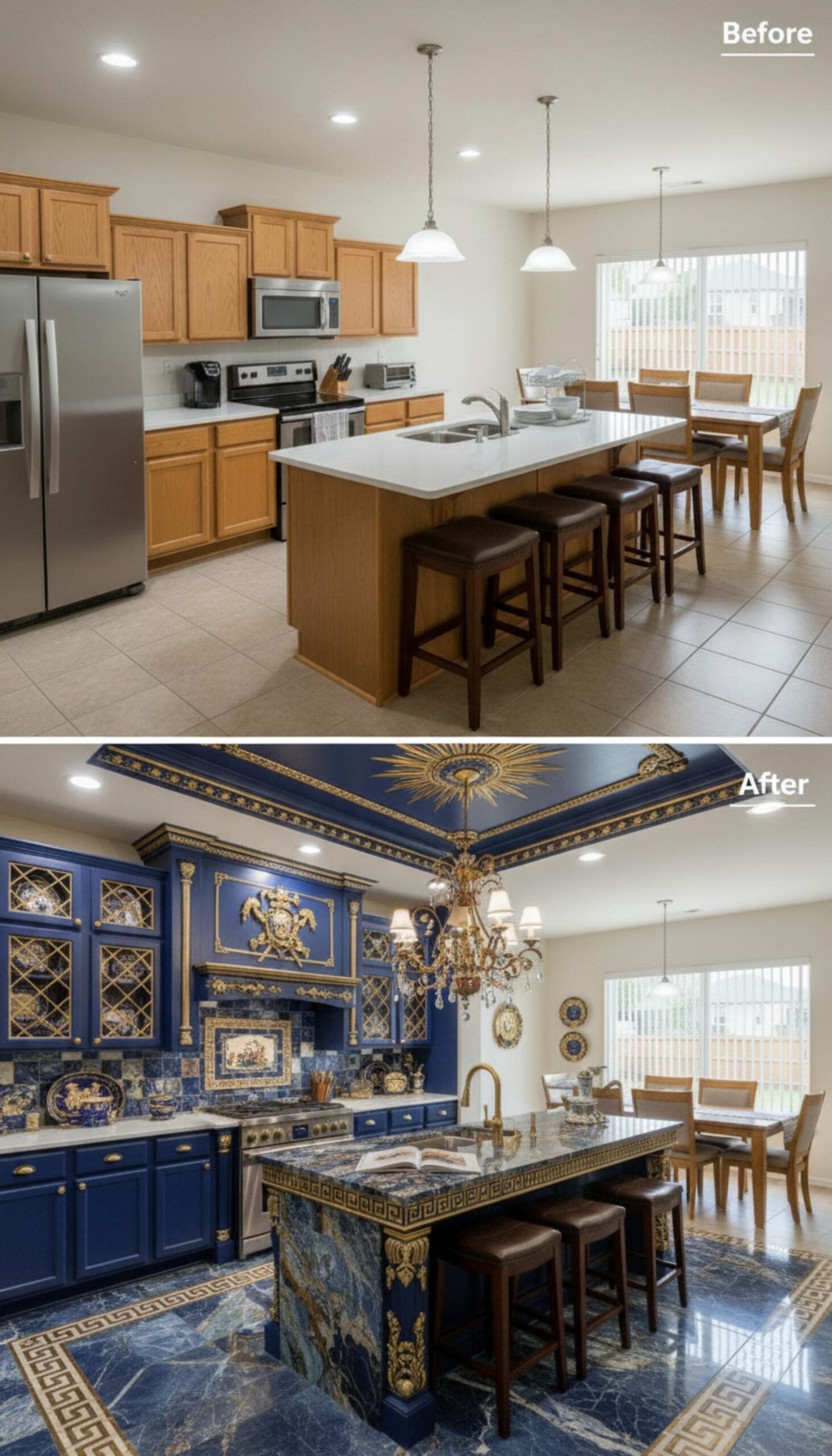
Cobalt lacquer cabinets trimmed in gold appliqués set the dominant key, while a tray ceiling painted deep blue carries a sunburst medallion and Greek-key crown molding that pulls the eye upward. The island cladding is sodalite marble, veined in white and edged in raised gold molding.
2. Gold Drip Cabinets, Backlit Onyx Island, and a Sculpted Ceiling Turn One Kitchen Into a Statement
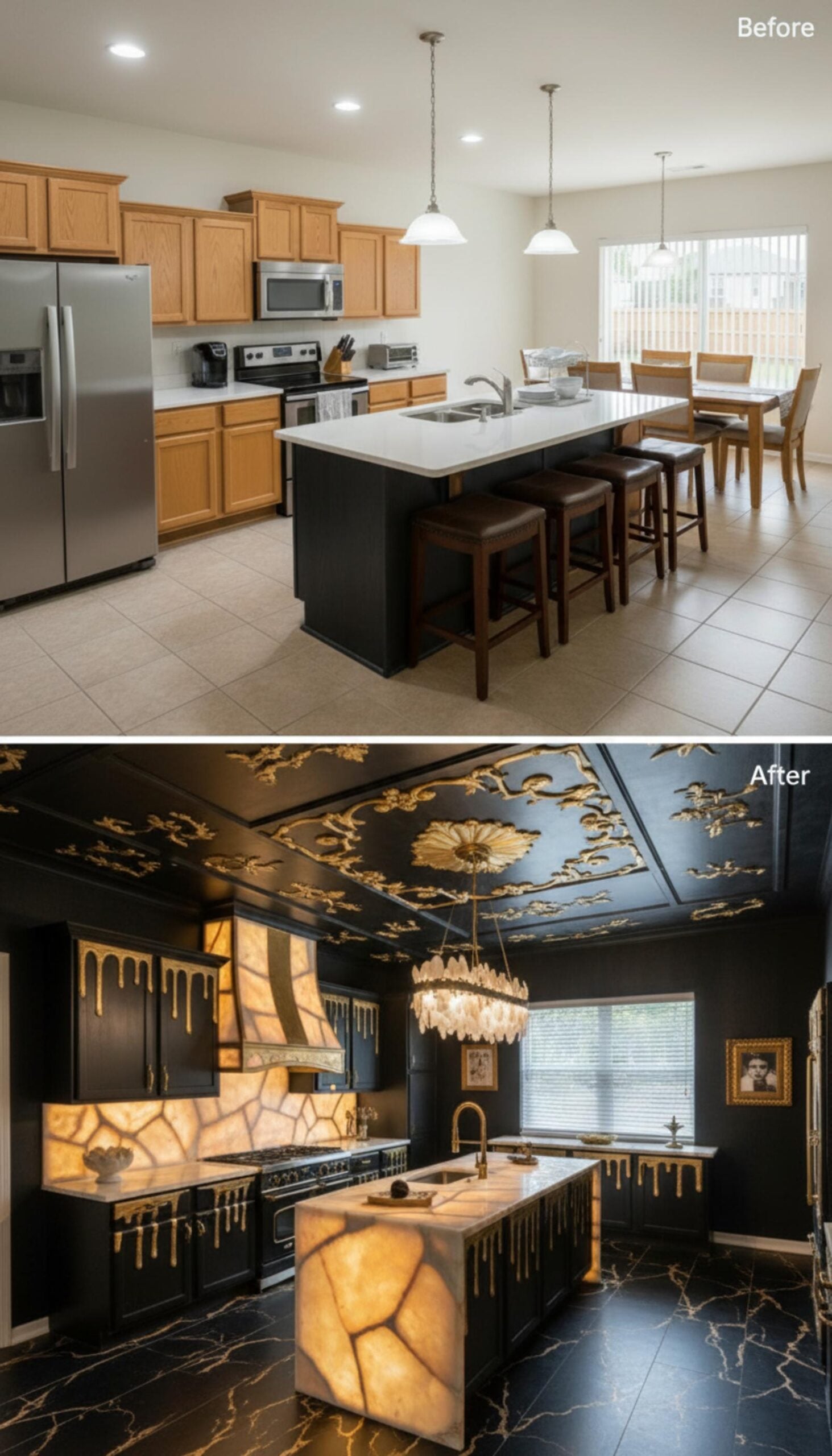
Flat-front black cabinets run the full perimeter, each panel finished with applied gold drip detailing that reads more like casting than paint. The range hood carries the same treatment, flanked by a backlit onyx backsplash panel that glows amber where the stone is thinnest. Black-veined marble tile covers the floor in large format slabs.
The island base uses the same backlit onyx as the hood surround, creating a visual anchor that pulls both walls into conversation. Above, a black ceiling carries gold bas-relief botanical appliqués across its entire surface. A multi-tier glass chandelier hangs at center, its brass fittings matching the sink hardware below.
1. Gold Stenciled Cabinets, Rouge Marble Island, and a Painted Ceiling Close Out the Series
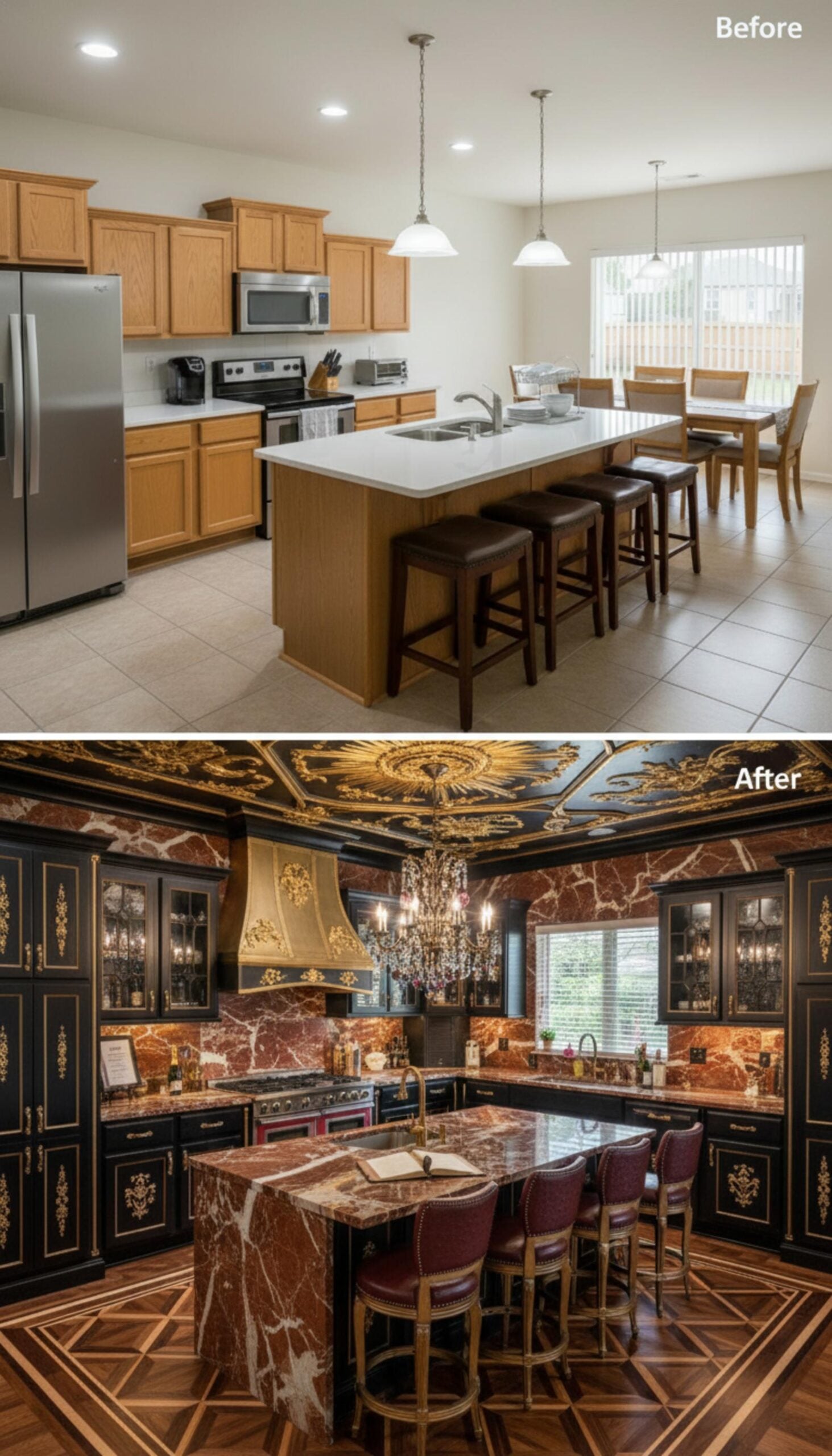
Rosso Francia marble covers the island, countertops, and backsplash in deep burgundy with cream veining, creating a material continuity that reads as intentional rather than excessive. The cabinets are lacquered black with hand-applied gold stenciling in a baroque cartouche pattern, paired with brass hardware. Overhead, a painted ceiling carries a sunburst medallion surrounded by scrollwork in gold leaf on black ground, a treatment derived from 17th-century French palatial interiors. The range hood matches the cabinet finish with its own gold motif.
Burgundy leather barstools with nailhead trim line the island. A crystal chandelier with candelabra bulbs hangs at center. Underfoot, a parquet floor with a geometric border inlay in contrasting wood species anchors the room’s footprint. No surface in this kitchen is asking for attention. Every surface already has it.