🔥 Would you like to save this?
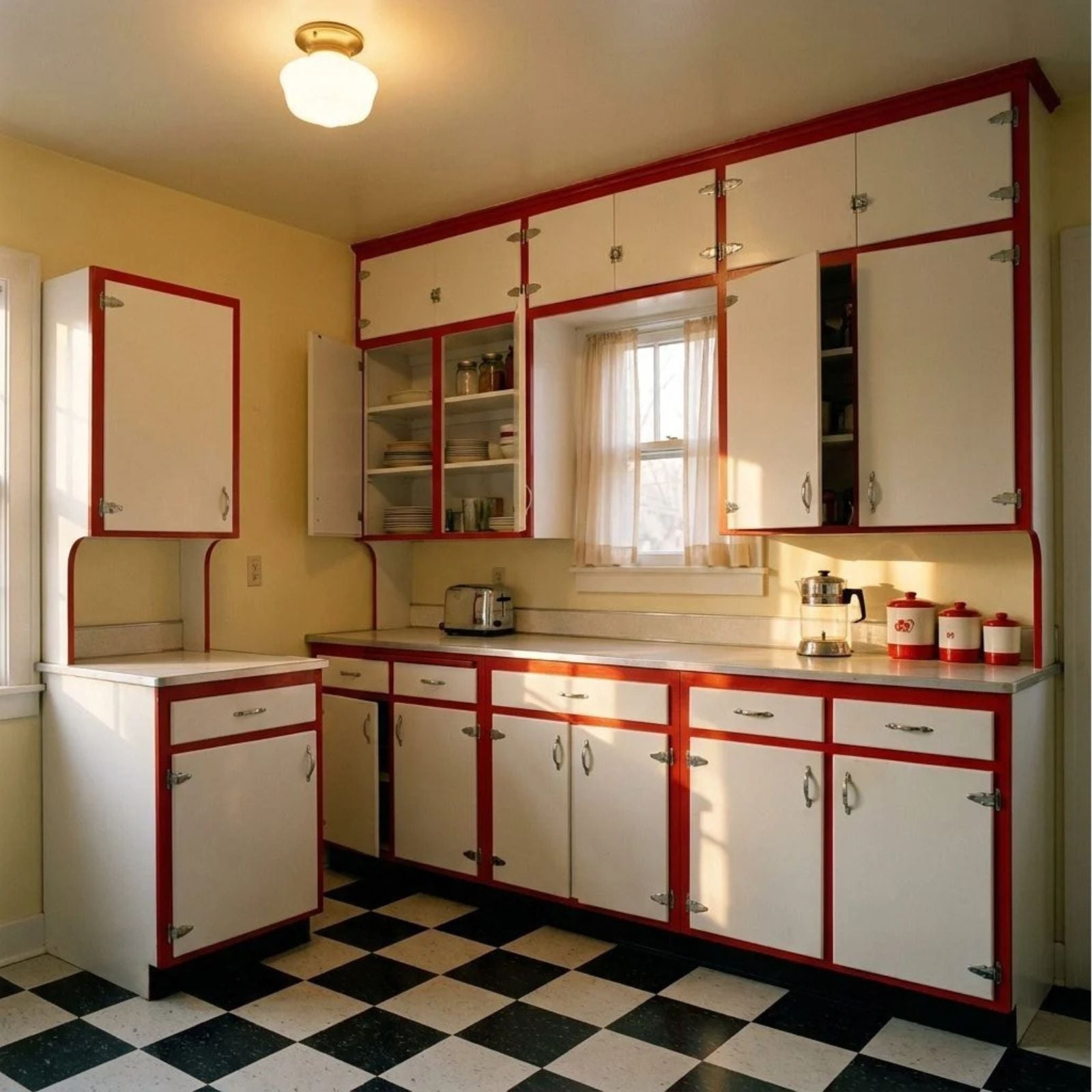
Walk into a 1940s American kitchen and your senses get hit immediately: the faint smell of percolating coffee, the squeak of linoleum underfoot, the soft hum of a rounded refrigerator that somehow made the whole room feel alive. These kitchens weren’t designed to impress guests, they were built to work, to feed families through rationing and recovery, and to do it with a particular kind of practical beauty we’ve completely forgotten how to replicate. Some of these details will stop you cold.
38. Enameled Steel Cabinets in White with Red or Black Trim
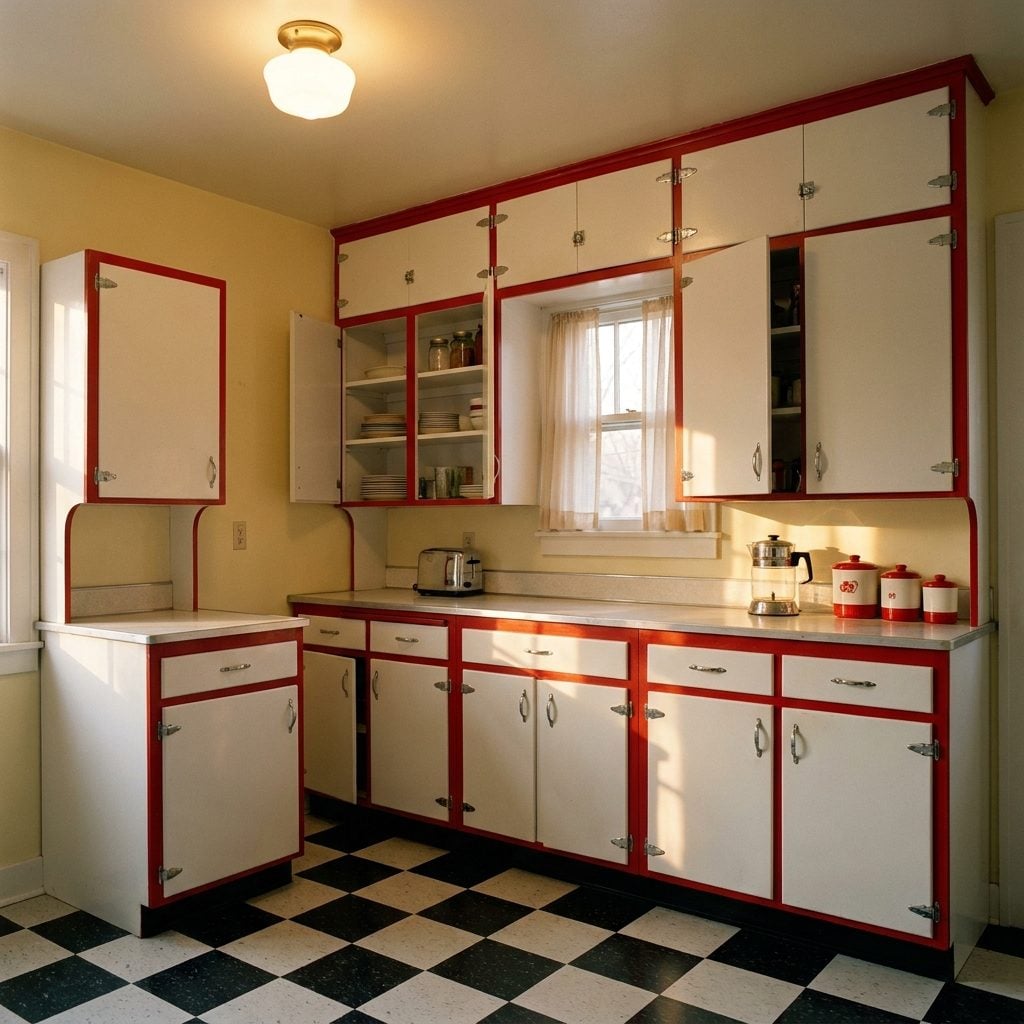
Those cabinets were cold to the touch and rang like a bell if you knocked them with a pot. Smooth, hard, almost clinical white enamel over steel, with a thin stripe of red or black along every edge. They looked like they belonged in a diner, and in a way, they did, postwar American kitchens were deeply influenced by commercial food service aesthetics.
In order to come up with the very specific design ideas, we create most designs with the assistance of state-of-the-art AI interior design software. Also, assume links that take you off the site are affiliate links such as links to Amazon. this means we may earn a commission if you buy something.
The latches had a satisfying click. The interiors were painted the same white, so everything inside was easy to spot. If the enamel chipped, and it always chipped eventually, it showed a gray steel edge underneath, and no amount of touch-up paint matched perfectly. For modern kitchen inspiration, people look back at these setups more than you’d think.
37. Linoleum Flooring in Checkerboard or Intricate Floral Patterns
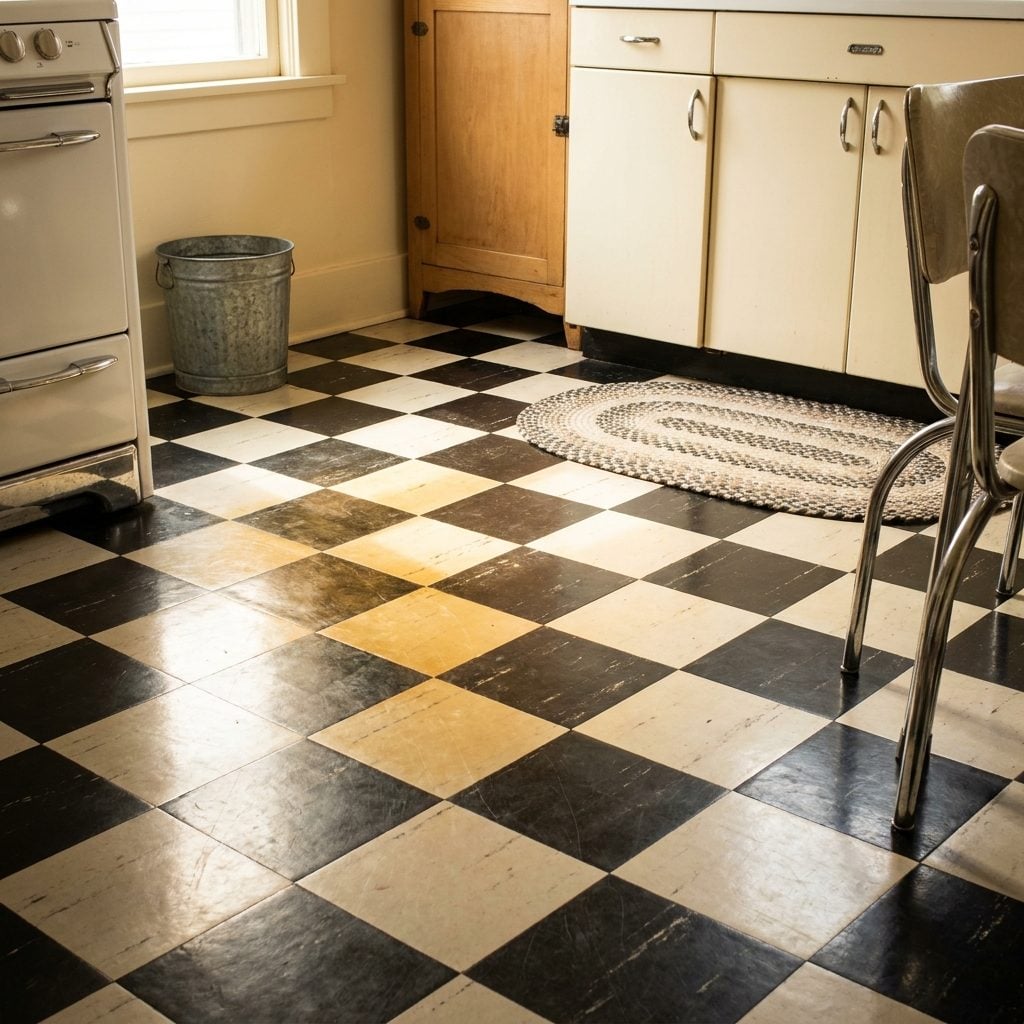
It had a smell. Warm and slightly waxy, especially in summer when it softened just a little underfoot near the stove. Real linoleum, not vinyl, actual linseed-oil linoleum, came in patterns that were printed all the way through, so wear showed gradually as fading rather than a sudden ugly patch.
The checkerboard versions were the most graphic: two-inch squares in black and white, or sometimes deep red and cream, running from wall to wall. The floral patterns were quieter, repeating medallions, stylized tulips, basketweave borders near the baseboards. Either way, the kitchen floor was doing something visually. It was not beige. It was never just beige.
36. Chrome-Trimmed Dinette Sets with Formica Tops
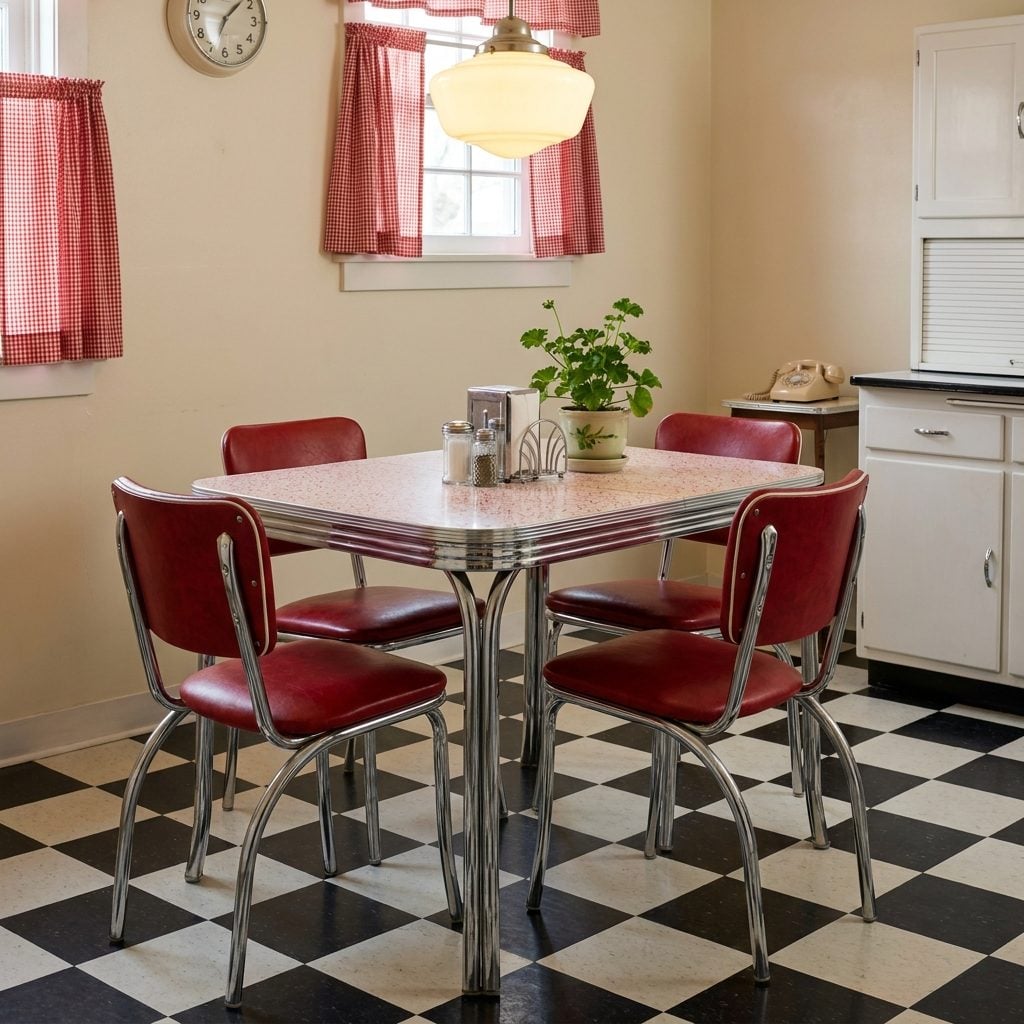
The table edge was a strip of chrome, slightly rounded, that would eventually separate from the Formica core and develop a gap where crumbs went to live forever. The top itself might be boomerang-patterned, or solid red, or white with gray flecks, whatever it was, it wiped clean in one swipe. That was the entire appeal.
These sets came as matched suites: table plus four chairs, sometimes six, all in the same color family. The chrome legs caught the light from every direction. After enough years, the chrome developed small rust spots near the floor where it met the linoleum in the damp air near the sink. Nobody threw them out for that. You just learned which spots to avoid.
35. Vinyl-Upholstered Dinette Chairs in Colors That Had No Business Being That Bold
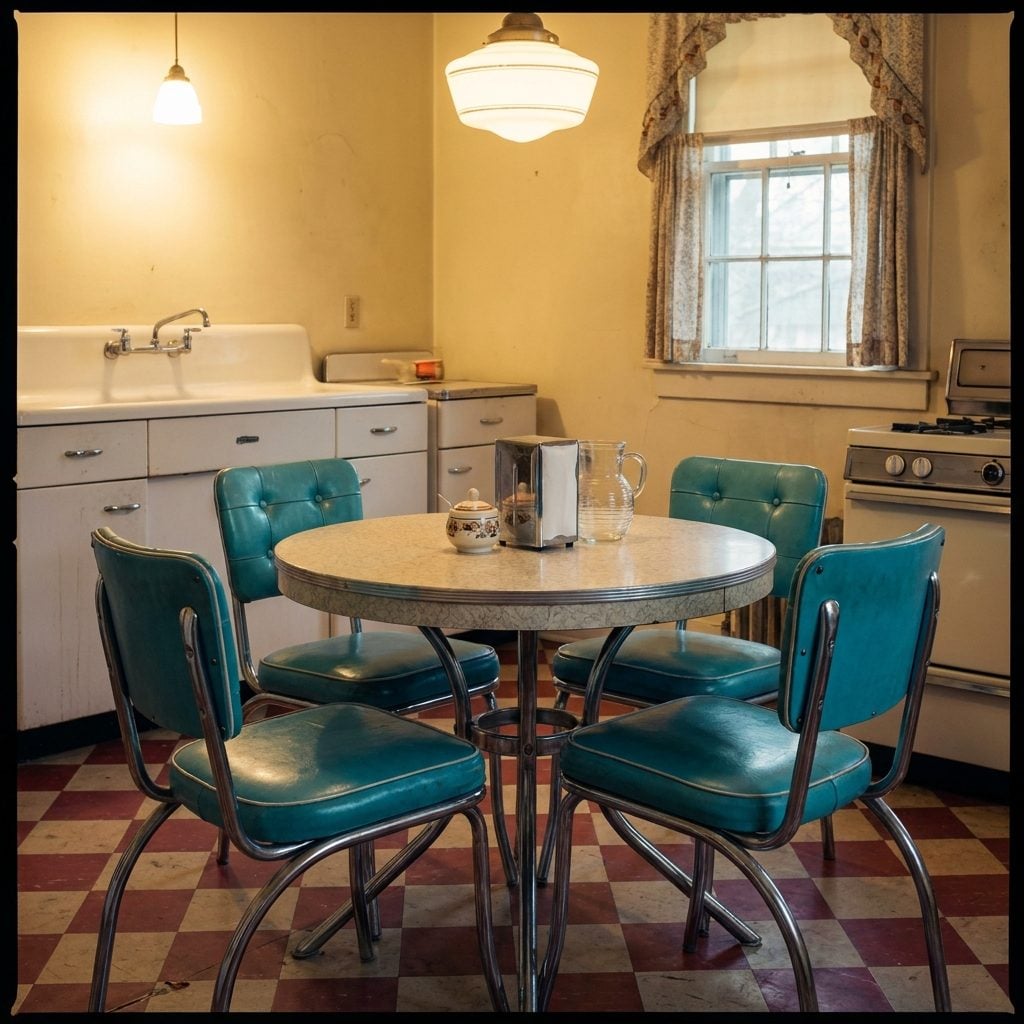
Turquoise. Tomato red. Canary yellow. Chrome. The 1940s kitchen chair was not shy.
The vinyl was tufted or smooth, stretched tight over a thin pad of cotton batting. It cracked eventually, first at the front edge where everyone sat, then along the seams. Families patched them with matching vinyl tape from the hardware store, which never matched. The chrome legs got bent when someone leaned back too far and then got slightly straightened and never looked quite right again.
The remarkable thing is how much life happened on those chairs. Homework. Arguments. Birthday cake. Long phone calls with the cord stretched from the wall. They weren’t comfortable exactly, but they were there, solid and present, every single day.
34. The Built-In Breakfast Nook That Made Every Morning Feel Like a Diner Booth
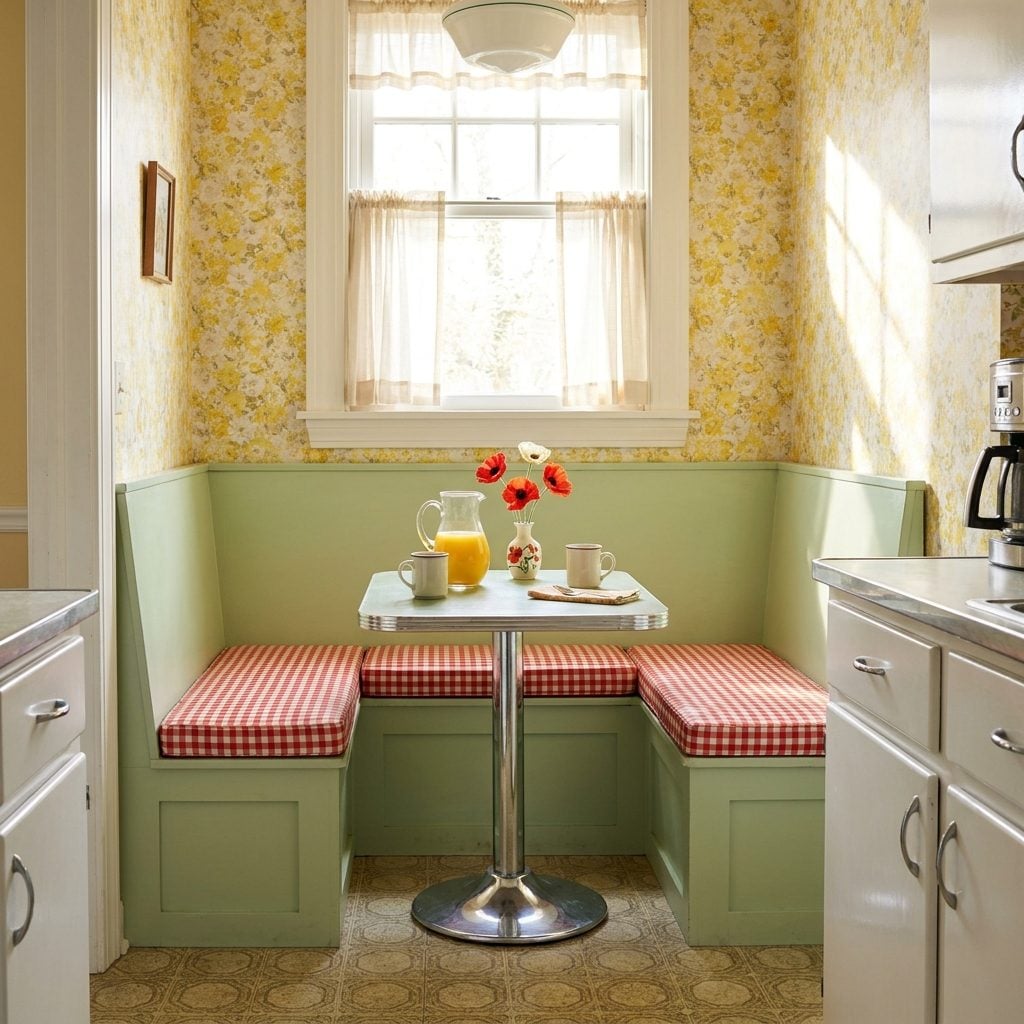
Tucked into a corner of the kitchen, the breakfast nook was two benches and a table that went nowhere, bolted to the walls, built-in like furniture that had been grown rather than moved in. The bench seats sometimes had lift-up lids with storage underneath, which sounds useful until you remember that the storage was full of things no one could identify.
The table was usually a simple painted wood top with a chrome or wood pedestal. The benches had cushions in oilcloth or vintage vinyl bench cushion fabric, wipe-clean, because someone was always spilling their orange juice. Sitting in a breakfast nook felt different from sitting at a table. You couldn’t just push back and stand up whenever you wanted. You had to make a decision. That forced a kind of slow-down that the open-plan kitchen never replaced.
33. The Wringer Washing Machine Parked Right There in the Kitchen
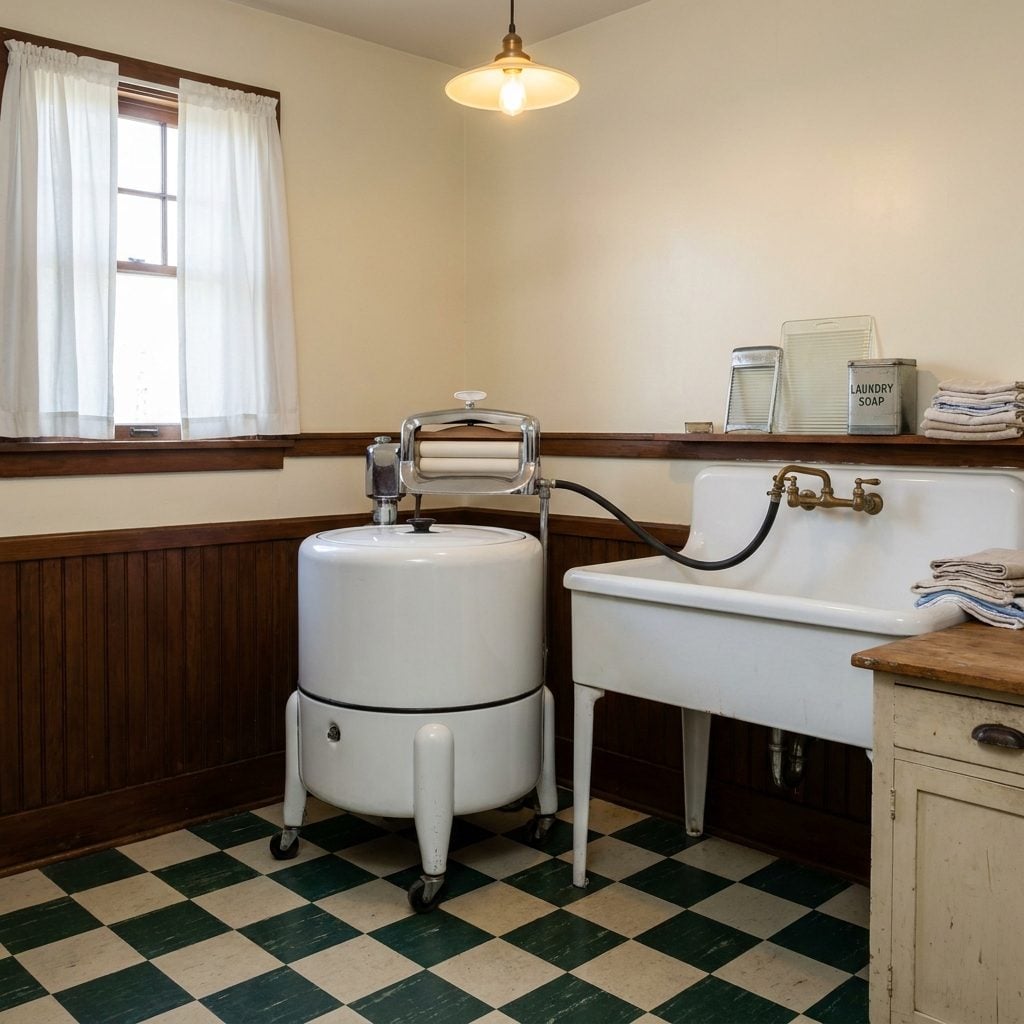
It rolled on casters, rubber-wheeled, to a position near the sink on laundry day, which was Monday, because Monday was always laundry day. The machine had two rollers at the top, driven by a small motor, that you fed wet clothes through. The rollers pressed out the water, and the clothes came out the other side flat and almost dry. Children were warned about the wringer on a near-daily basis.
Having the washing machine in the kitchen sounds odd now, but it made complete functional sense. Hot water came from the sink. The drain was right there. The kitchen had the hardest floor. In houses without a separate laundry room, which was most houses in 1945, this was simply where the machine lived. It doubled as a surface the rest of the week, covered with a piece of oilcloth.
32. The Rounded-Shoulder Refrigerator with Chrome Handles That Looked Like It Was from Another Planet
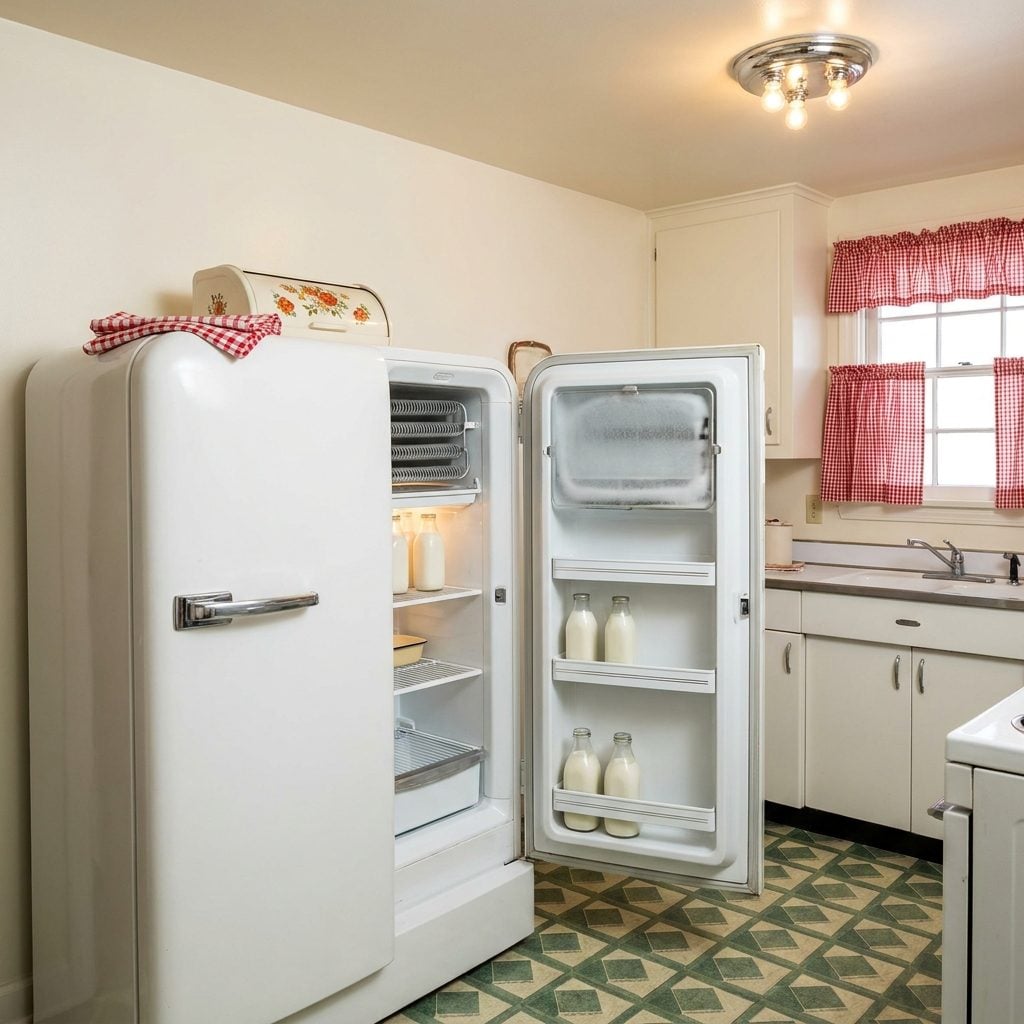
No refrigerator has ever looked more like a refrigerator than the ones made in the 1940s. Rounded top corners, a single wide door, a chrome handle shaped like a thick horizontal bar, the whole thing had the quiet authority of something that weighed four hundred pounds and knew it.
The exterior was almost always white porcelain enamel, sometimes with a subtle cream tint. The chrome handle was cool and smooth and had a satisfying resistance when you pulled it. Inside: a tiny freezer compartment at the top (more on that in a moment), two or three wire shelves, and a crisper drawer that may or may not have ever crisped anything.
“The 1940s refrigerator didn’t try to disappear into the kitchen. It stood there like a piece of furniture that also happened to keep your milk cold.”
The compressor hummed at a steady low frequency you eventually stopped hearing entirely, until the day it stopped and the silence woke you up at 3am.
31. The Monitor-Top Refrigerator That Was Already Ancient When You Saw It
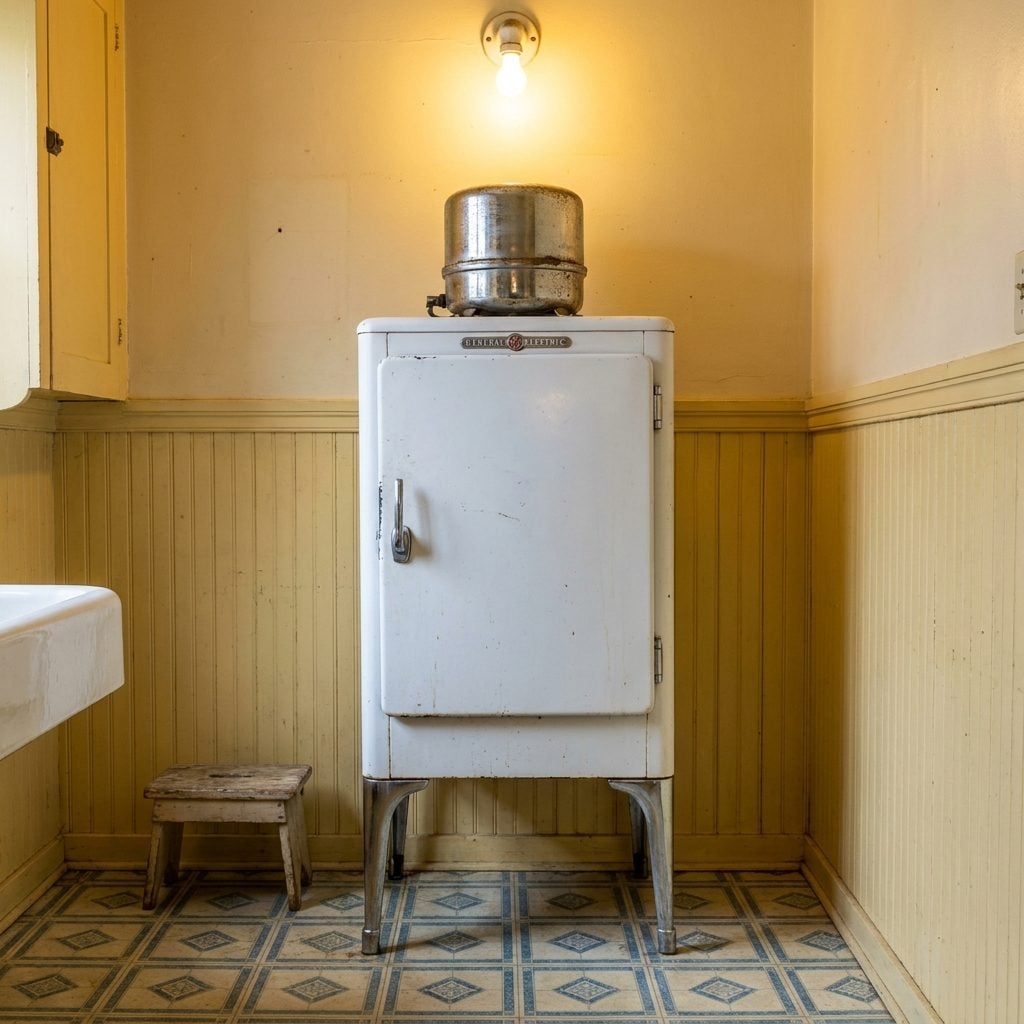
If the rounded-shoulder fridge was the 1940s standard, the monitor-top was the machine it was replacing, a hulking General Electric design from the late 1920s and early 1930s with a cylindrical compressor unit sitting on top like a hat. By 1945 these were already fifteen years old, and plenty of families still had one running in the kitchen, or pushed to the corner of the basement, or working quietly in someone’s farmhouse as the second fridge.
The compressor housing gave it an unmistakable silhouette. The cabinet below was white enamel on a steel frame, standing on tall legs, all that empty space underneath collecting dust and the occasional escaped marble. They were almost indestructible, which is why so many survived into the 1950s and beyond. Some are still running today.
30. The Little Freezer Compartment That Fit Exactly One Ice Cube Tray
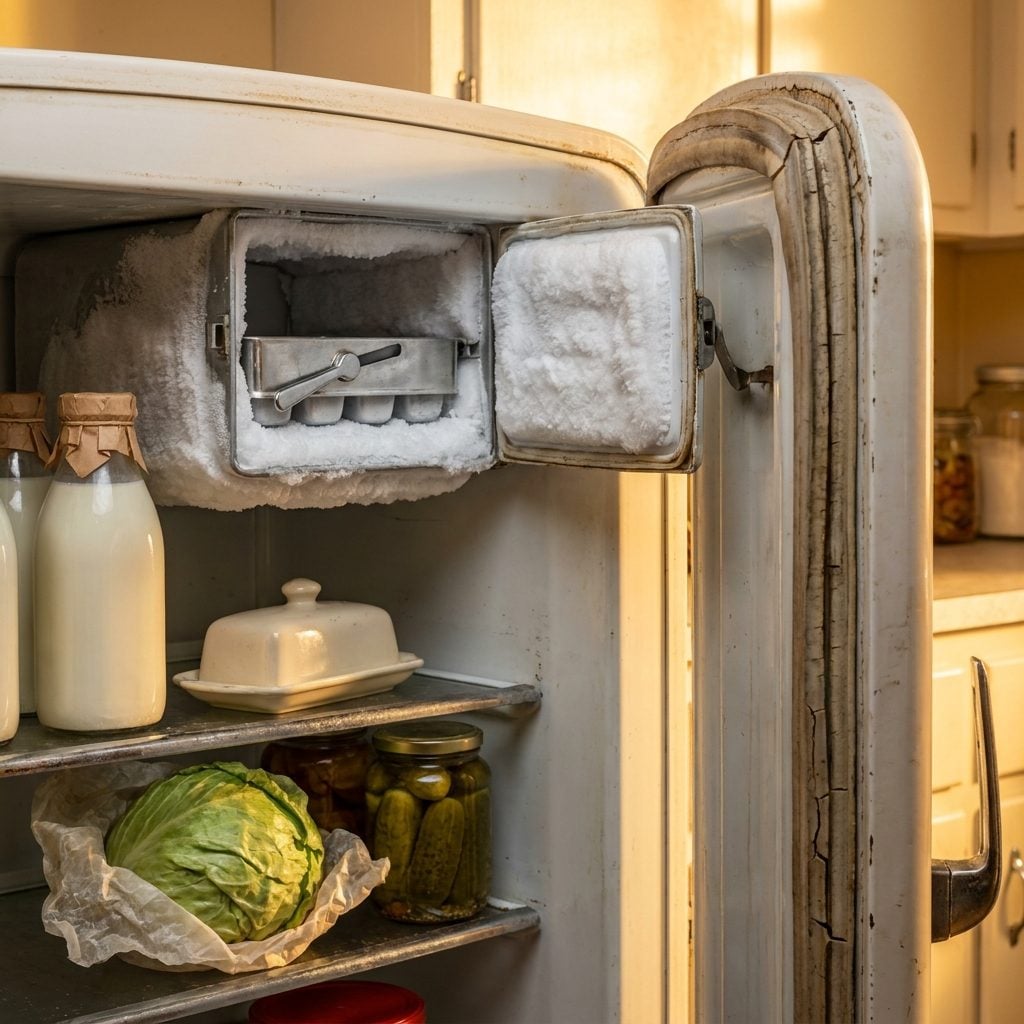
A shelf. A very cold shelf, really, just a small recessed section at the top of the refrigerator interior, enclosed behind its own little door or sometimes just exposed to the refrigerator air. It was permanently frosted over within two weeks of any defrost. The ice cube tray was a metal tray with a lever mechanism that you pulled up to crack the cubes free, and it always jammed at least a little.
True “deep freeze” was a luxury appliance in the 1940s, something farm families got to store a half-hog’s worth of meat. For most urban and suburban households, this tiny compartment was the entire frozen food universe. You could fit: one tray of ice cubes, and maybe a small package of frozen peas if you tilted it just right. That was it. That was your freezer.
29. Freestanding Gas Ranges with Chrome Legs That Stood on the Floor Like Furniture
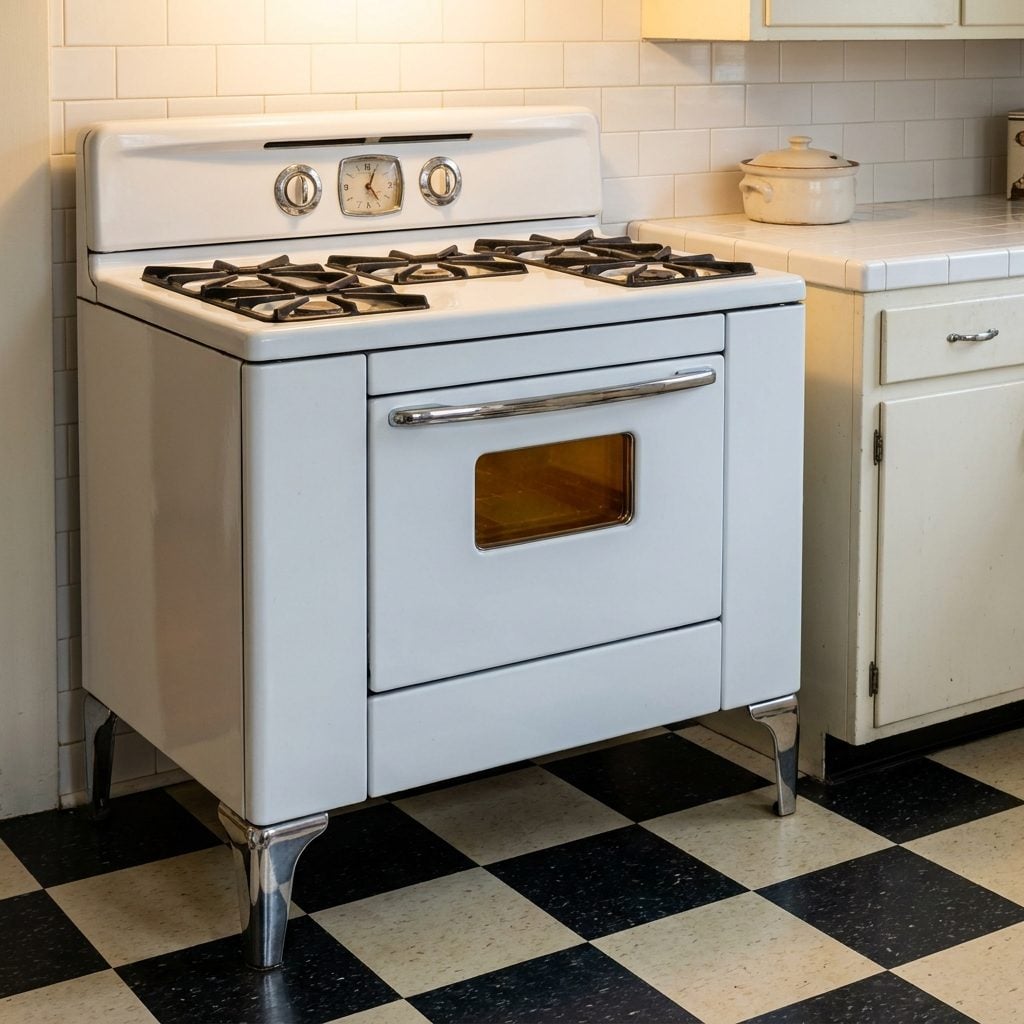
The 1940s gas range stood up off the floor on four chrome legs, usually four to six inches high, which sounds like a minor detail until you realize it meant you could sweep under it. The gap was narrow but intentional. The range was not built-in, not surrounded by cabinetry, not integrated into anything. It stood alone, like a piece of furniture that happened to be on fire inside.
The body was white porcelain enamel over cast iron, heavy enough that it didn’t budge when you slammed the oven door. The vintage chrome gas range burner grates were cast iron, removable, and always slightly greasy regardless of how recently someone had cleaned them. The oven door had a chrome handle and a small window of thick amber-tinted glass that showed you essentially nothing about what was happening inside.
28. The Raised Control Panel Behind the Burners, Like a Cockpit Nobody Questioned
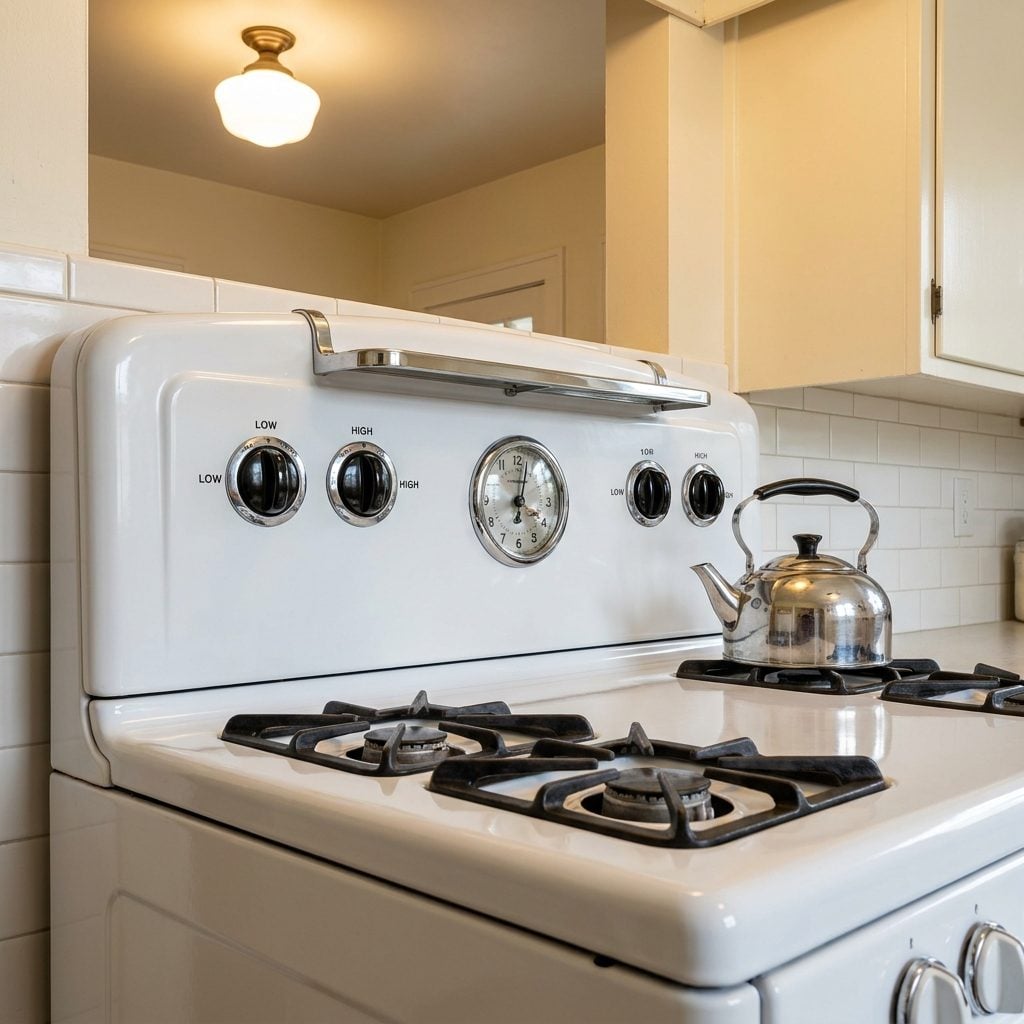
On a 1940s freestanding range, the controls didn’t sit in a row along the front. They lived on a raised panel that rose up behind the burners like a small dashboard, a vertical or angled face studded with chrome-ringed bakelite dials, a clock (always the clock), sometimes a small warming shelf on top.
This arrangement made sense in a kitchen where the cook stood over the range and looked down. Everything was legible from above. The dials were large, clearly numbered, and satisfying to turn, a full quarter-rotation click from HI to LO. The clock was a separate mechanical unit inset into the panel face. It was almost always two minutes off and nobody ever adjusted it.
When slide-in ranges began appearing in the late 1950s, the backsplash panel disappeared almost overnight. Suddenly the controls were on the front. The raised panel went from standard to eccentric to invisible in about a decade. Looking at home trends from that period, the shift was rapid and total.
27. The Side Storage Drawers Built Right Into the Range
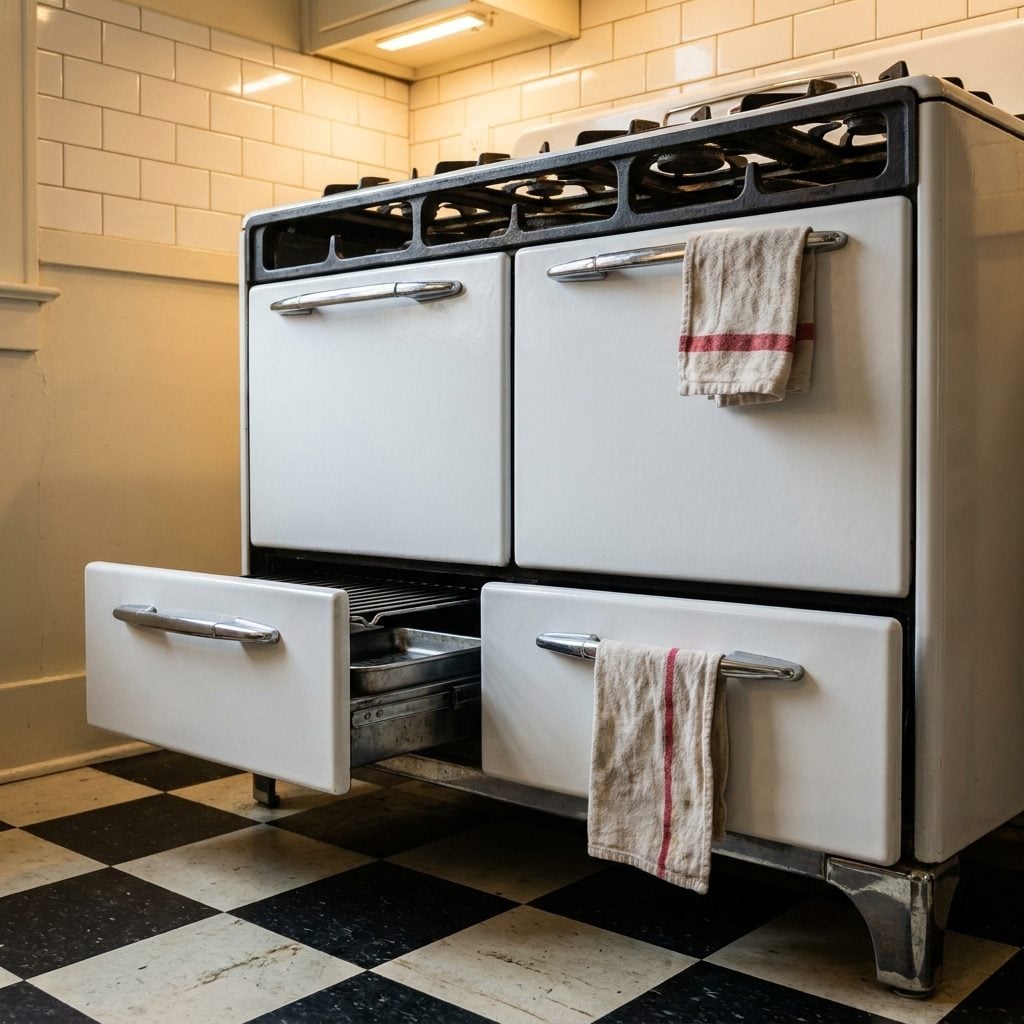
Below the oven, and sometimes flanking it on either side, the 1940s range had drawers. Not just the broiler drawer at the very bottom, actual storage drawers, sometimes two or three, with chrome pulls, built into the body of the appliance itself. One usually held a broiler pan. One held pot lids. One held a mess of kitchen tools and the manual for the range that nobody had read since 1948.
This was the range understanding itself as furniture. It wasn’t just a cooking appliance, it was a storage unit, a piece of the kitchen’s organizational logic, part of the room in a way that modern slide-in ranges have completely abandoned. Today you’d add a small kitchen renovation project to recover that storage. Back then, the stove just came with it.
26. The Chambers Stove That Cooked Dinner While You Were at Church
🔥 Would you like to save this?
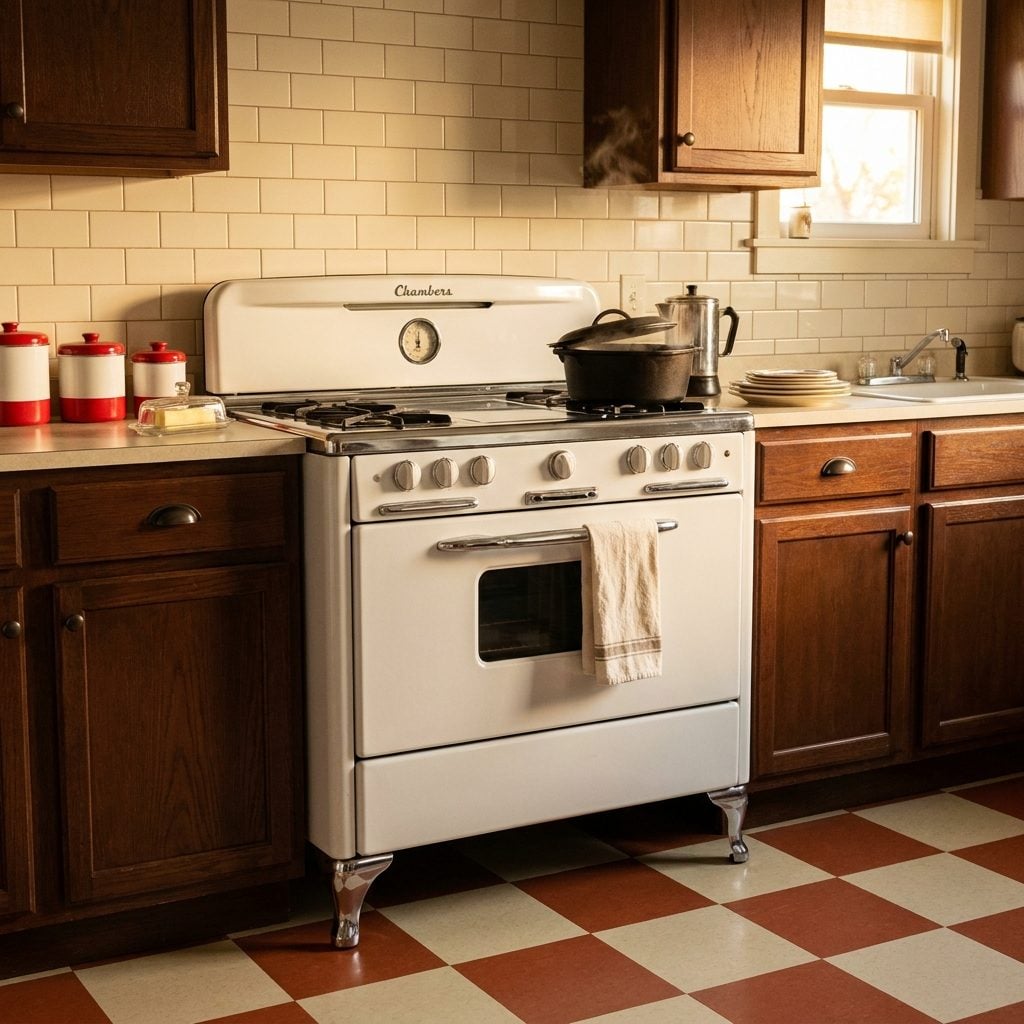
You loaded the pot, turned the burner on, then turned it off, and dinner cooked itself. The Chambers stove ran on retained heat, meaning its insulated firebox kept food simmering long after the flame died. Families set a roast before Sunday services and came home to a finished meal. The enameled surface was usually white with chrome trim, and the whole unit sat on squat legs like a small refrigerator made of optimism.
Nothing in modern kitchen inspiration quite replicates what that stove represented: a machine designed around trust. You trusted the physics, and the physics delivered every single time. Collectors still hunt them down at estate sales today.
25. The Built-In Hoosier Cabinet With Its Own Flour Sifter and Secret Compartments
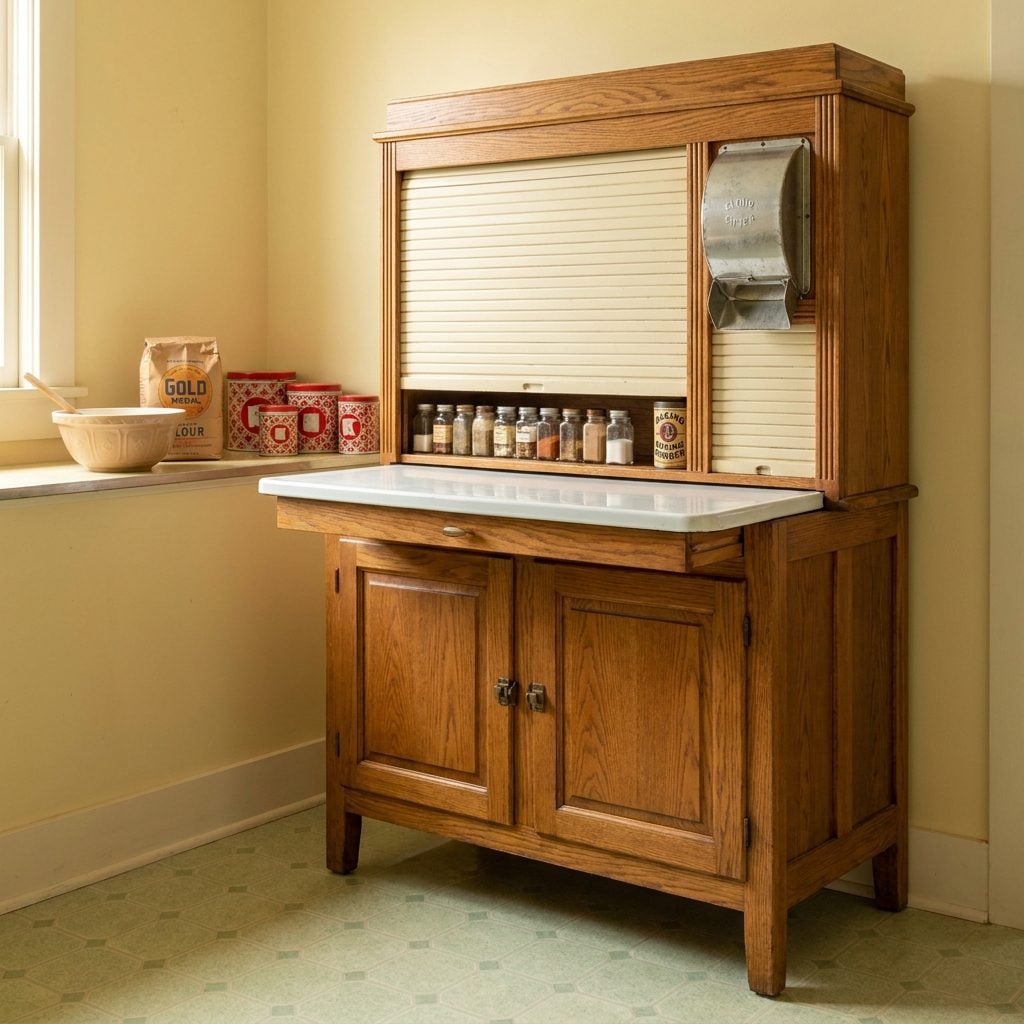
A Hoosier cabinet was essentially a kitchen assistant you could close up and ignore. The top section held a built-in metal flour bin with a sifter chute, you’d pull the handle and sifted flour dropped into a bowl waiting below. The tambour roll-front hid spice jars, recipe cards, a sugar canister. The whole unit smelled faintly of flour and something sweet, even years after it stopped being used for baking.
These were freestanding pieces, not built-ins, which confused everyone who assumed they came with the house. Most got painted over in the 1950s or moved to the garage. The ones that survived untouched are genuinely worth something now.
24. The Pull-Out Enamel Work Surface That Appeared Out of Nowhere
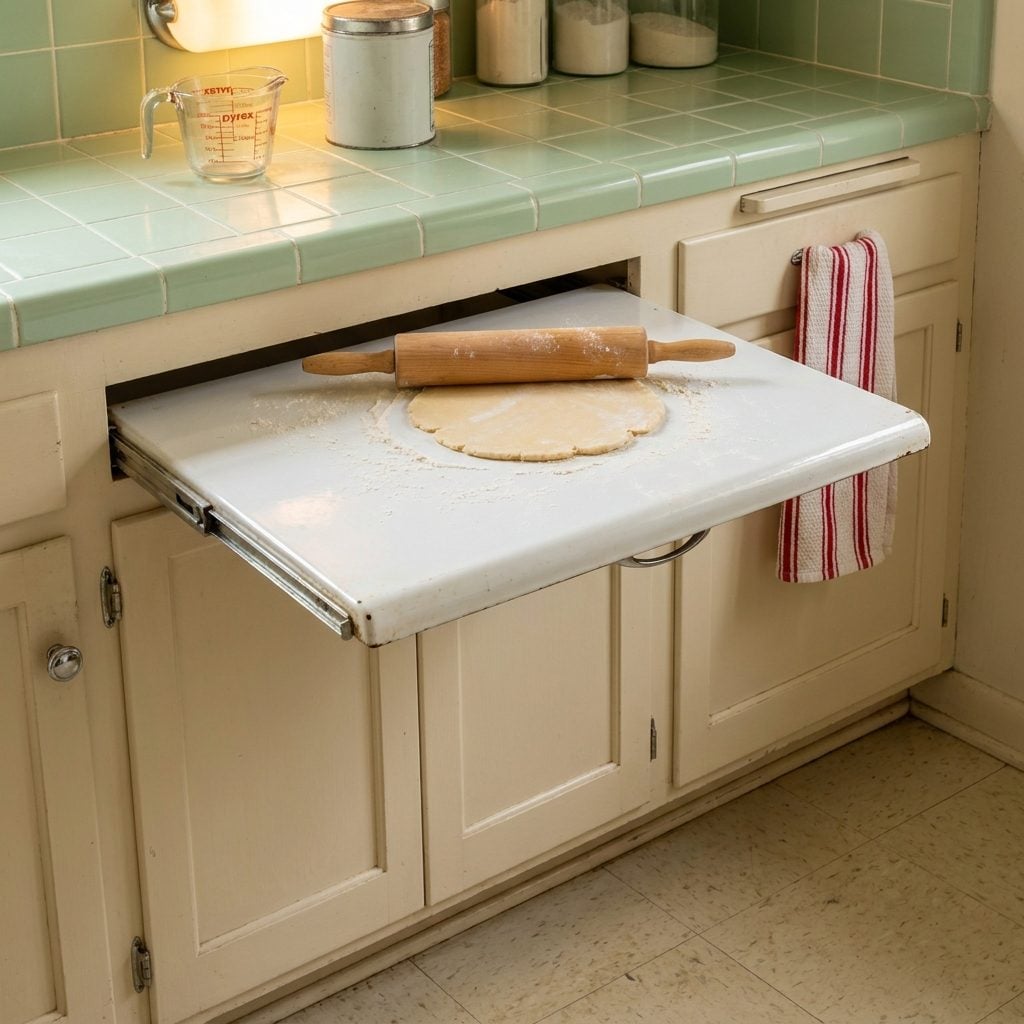
One yank and you had a whole extra counter. The pull-out enamel work surface was standard issue in 1940s kitchen cabinetry: a flat porcelain-enameled board, usually white or pale cream, that slid out from below the counter on wooden runners when you needed to roll dough or assemble a pie. It was cool to the touch, which made it ideal for pastry work, and it slid back flush when you were done like it had never existed.
23. Open Shelves Where the Good Dishes Lived Every Single Day
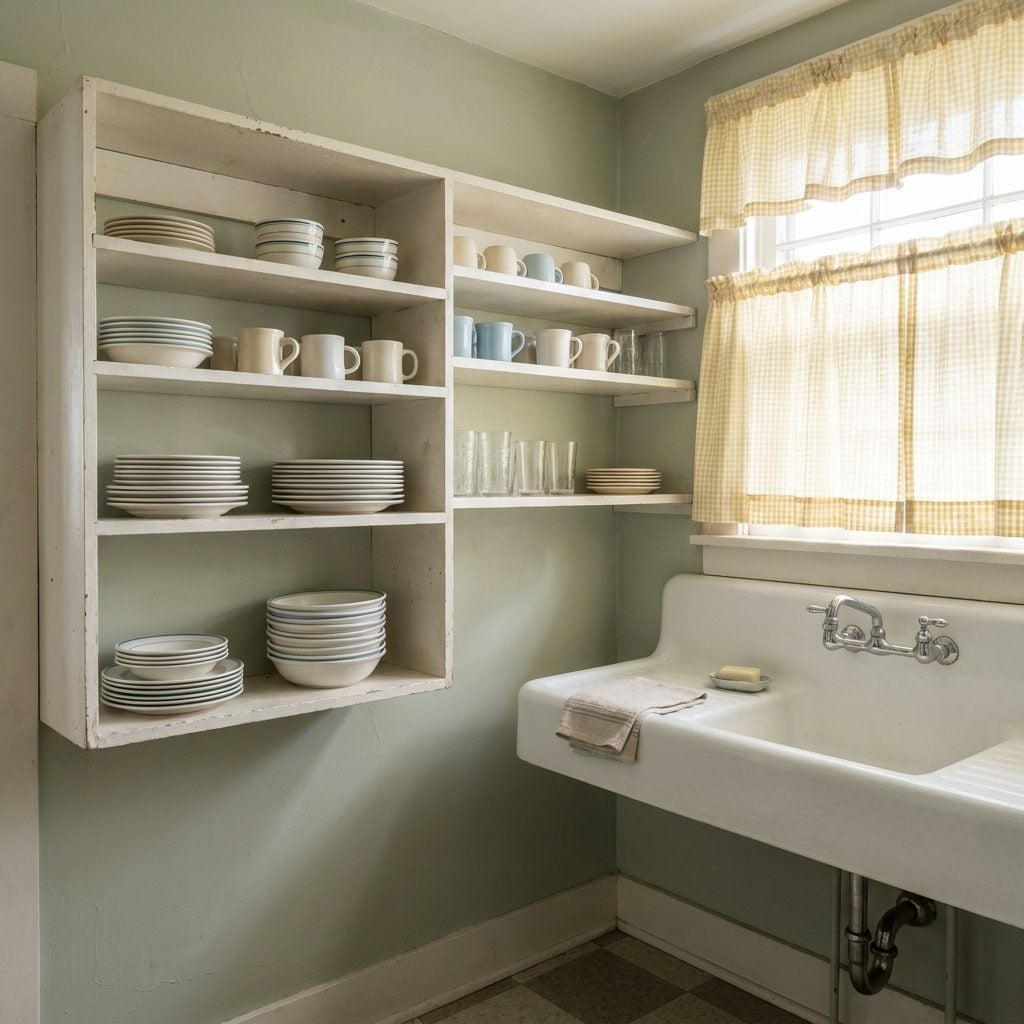
There was no cabinet door between you and your everyday dishes. In 1940s kitchens, open wooden shelves, sometimes painted to match the walls, sometimes bare, held the plates, bowls, and cups that came down every morning and went back up every night. Nothing was stored or reserved. The dishes you used were the ones on display, stacked neatly with the rims all facing the same direction because that’s just how it was done.
It wasn’t a design statement. Nobody called it a look. It was just practical storage in a room that had limited cabinet space and zero pretension about what belonged where. The fact that this now reads as a studied aesthetic choice says more about us than them.
22. Glass-Front Upper Cabinets That Made the Kitchen Feel Like a Shop
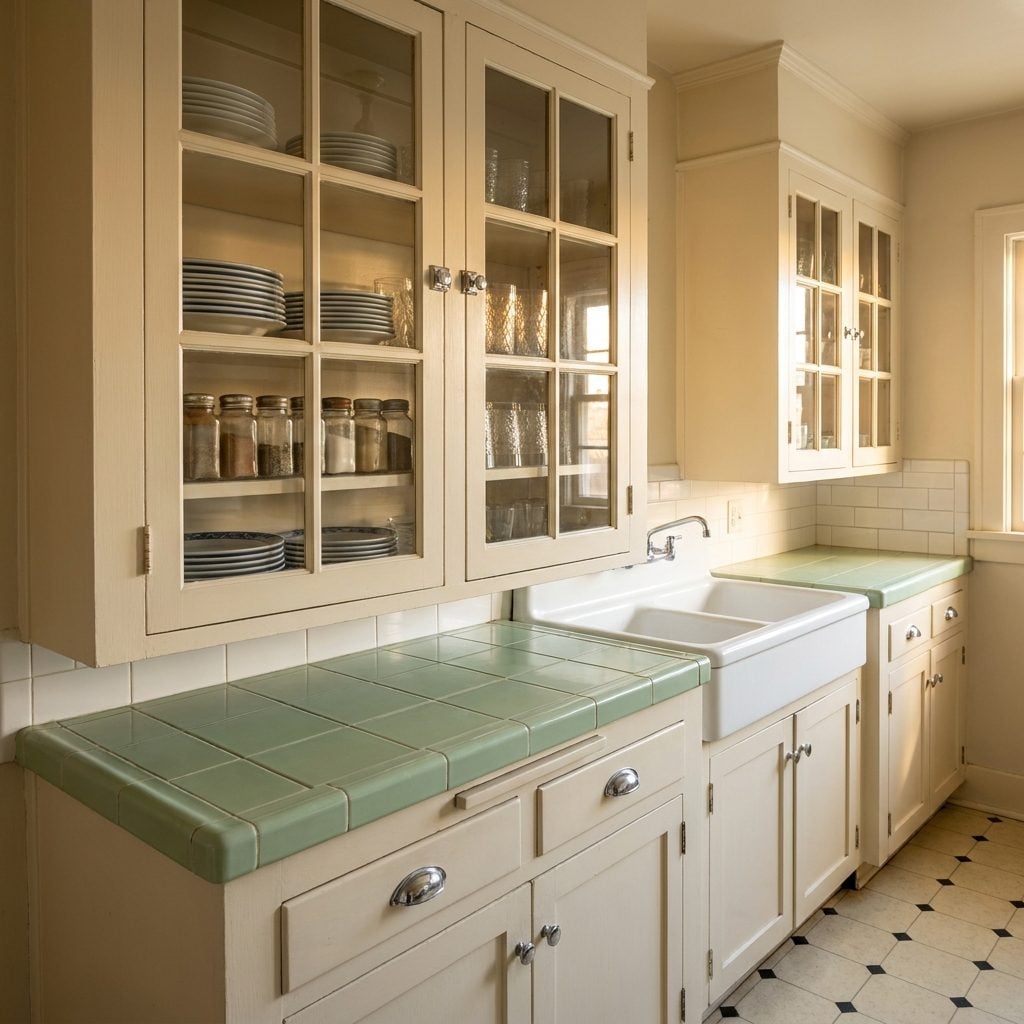
Small-pane glass-front upper cabinets gave 1940s kitchens a quality that felt almost formal, like a butler’s pantry that had decided to show up in an everyday home. The glass was usually divided by narrow wood muntins into six or nine individual panes, and the light caught the rims of stacked dishes inside in a way that made the whole room feel considered.
Families kept their better glassware in there: pressed glass tumblers, a set of crystal inherited from someone’s mother, maybe a row of matching canisters. The cabinet contents were on mild display at all times, which meant everything inside had to earn its spot.
21. Jadeite Glassware in That Particular Shade of Pale Green That No One Has Ever Quite Replicated
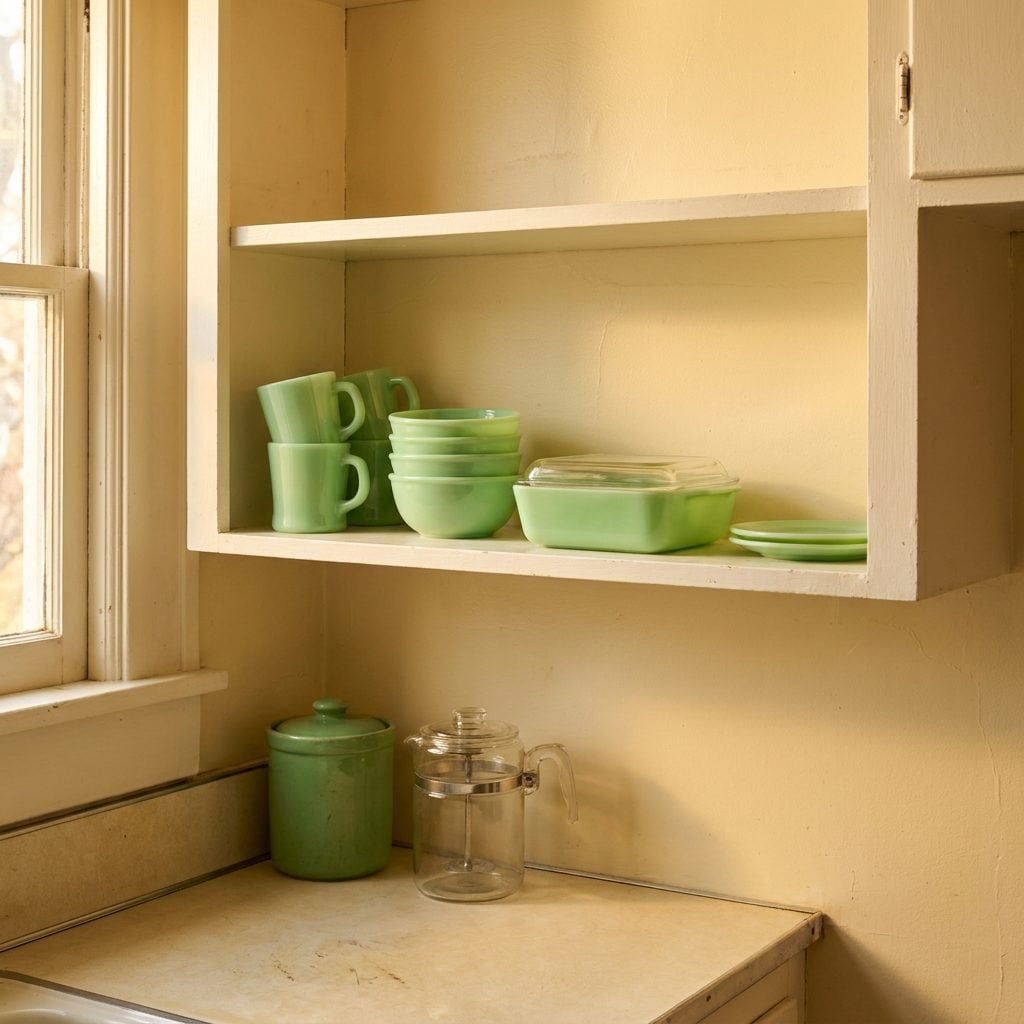
Jadeite was everywhere in the 1940s kitchen, and if you grew up around it, no other green looks quite the same. That milky, opaque, slightly blue-shifted pale green had a specific quality in morning light, it almost glowed on the shelf. Fire-King made most of what you’ll still find at estate sales: mugs with D-ring handles, coffee cups, cereal bowls with the slightly thick rim, rectangular refrigerator dishes with glass lids.
It was durable, chip-resistant, and cheap enough to be fully functional kitchen ware. The fact that people now collect individual coffee mugs for sixty dollars each would have made any 1940s housewife fall down laughing.
20. Fiestaware in Colors You Could See From the Next Room
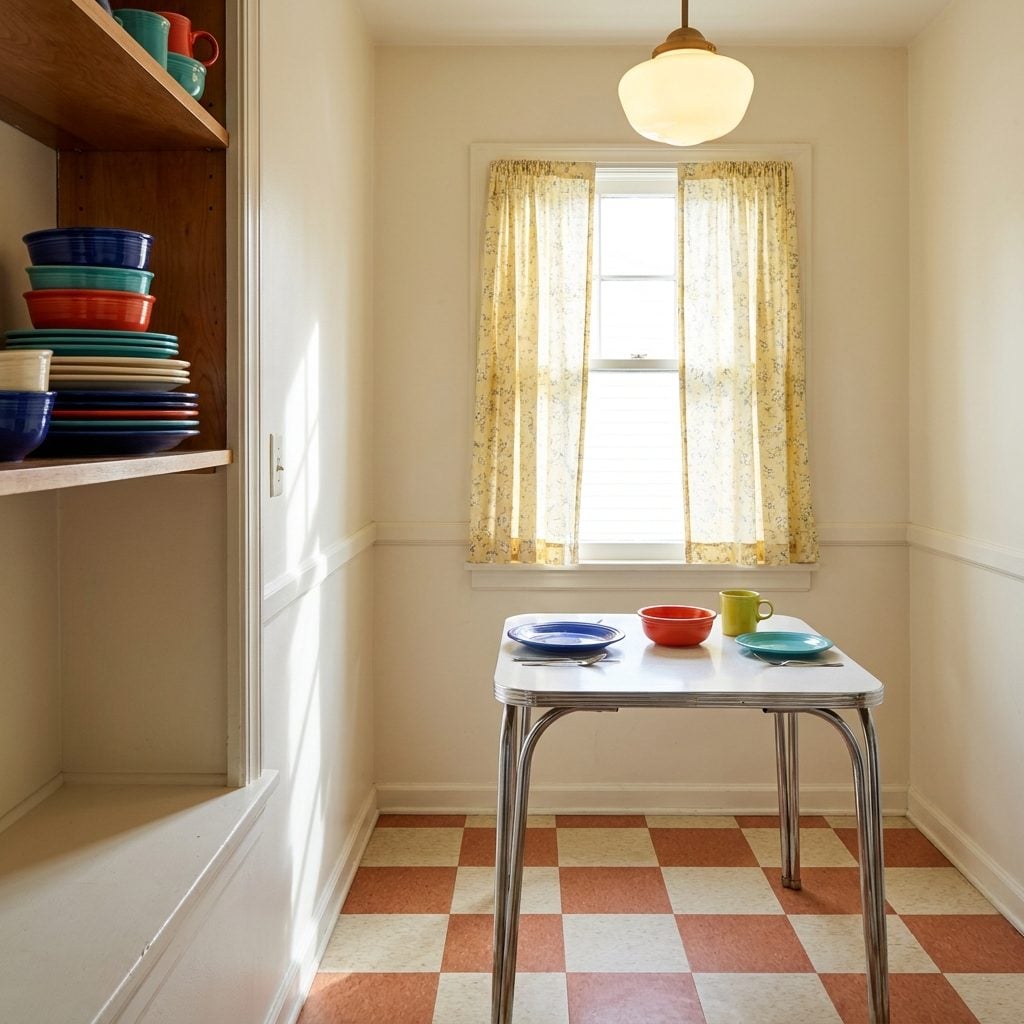
Fiestaware didn’t decorate a table, it announced one. Homer Laughlin introduced these thick, solid-color dishes in 1936, and by the 1940s they were in kitchens everywhere: cobalt blue, vivid red-orange, chartreuse, turquoise, a deep forest green. You didn’t match your plates to each other. You mixed them intentionally, every meal a different configuration of color, like setting the table was a small act of composition.
The plates were heavy in a way that felt honest. Stack five of them and the cabinet shelf would flex slightly. Stacked in a mixed-color column on an open shelf, they looked like something between folk art and a laboratory sample set. Nothing since has quite replicated that particular boldness in everyday ceramic.
“Every color had its own personality at the table, and no one asked them to match.”
19. The Pyrex Nesting Bowl Set in Primary Colors That Took Up the Whole Shelf
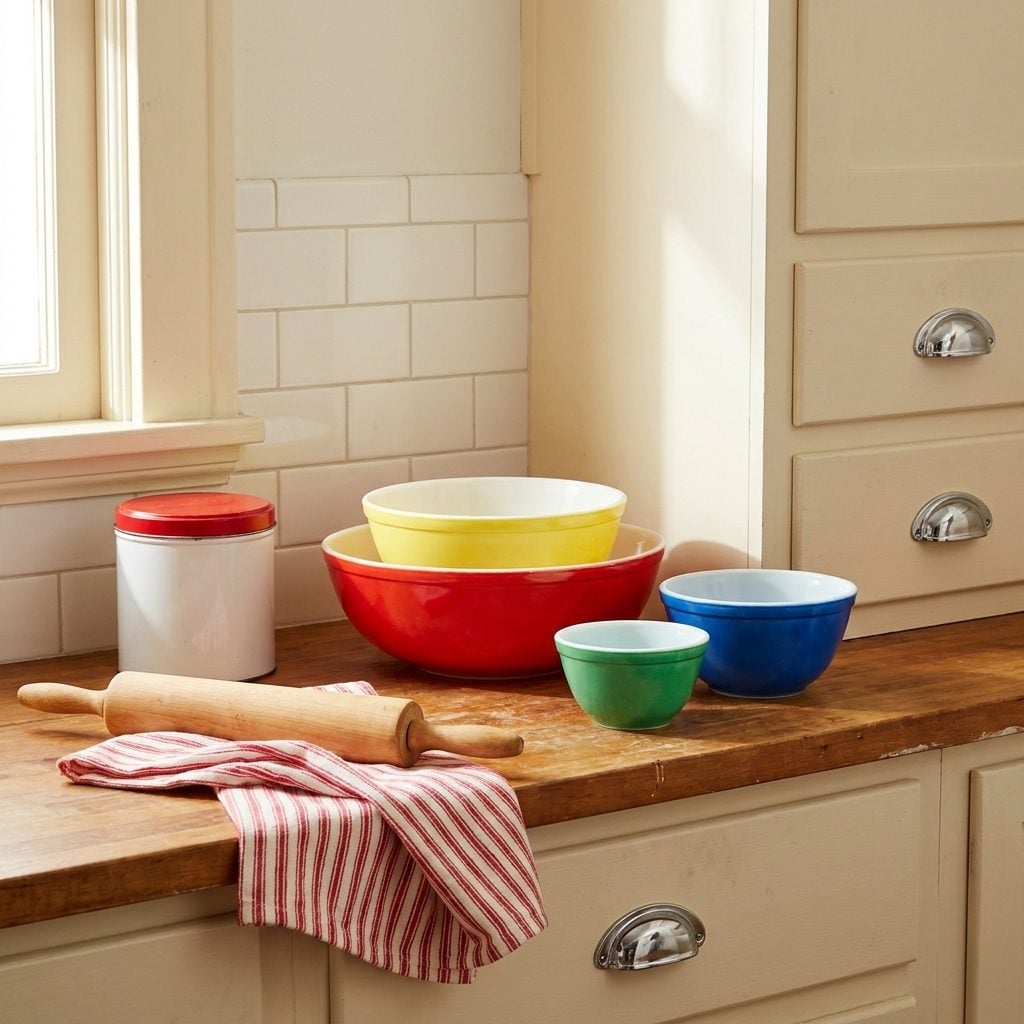
Four bowls, four colors, zero wasted space, that was the entire pitch. The original Pyrex primary color nesting set came in red, yellow, blue, and a greenish-primary that wasn’t quite any of those three. The smallest sat inside the next, then the next, then the largest: a matryoshka doll of mixing bowls that collapsed into almost nothing and expanded into a complete batterie de cuisine the moment you needed to make anything. The largest was wide enough to mix a double batch of cookies. The smallest was the right size for beating two eggs.
Every 1940s kitchen had them, and they were used hard, not saved, not displayed on principle, just grabbed and washed and grabbed again. The ones with the white exterior and primary-colored interior were from the late 1940s run. If yours had a small chip on the lip, that was a mark of actual use, not a reason to throw them out.
18. The Cast Iron Skillet That Never Fully Cooled Down
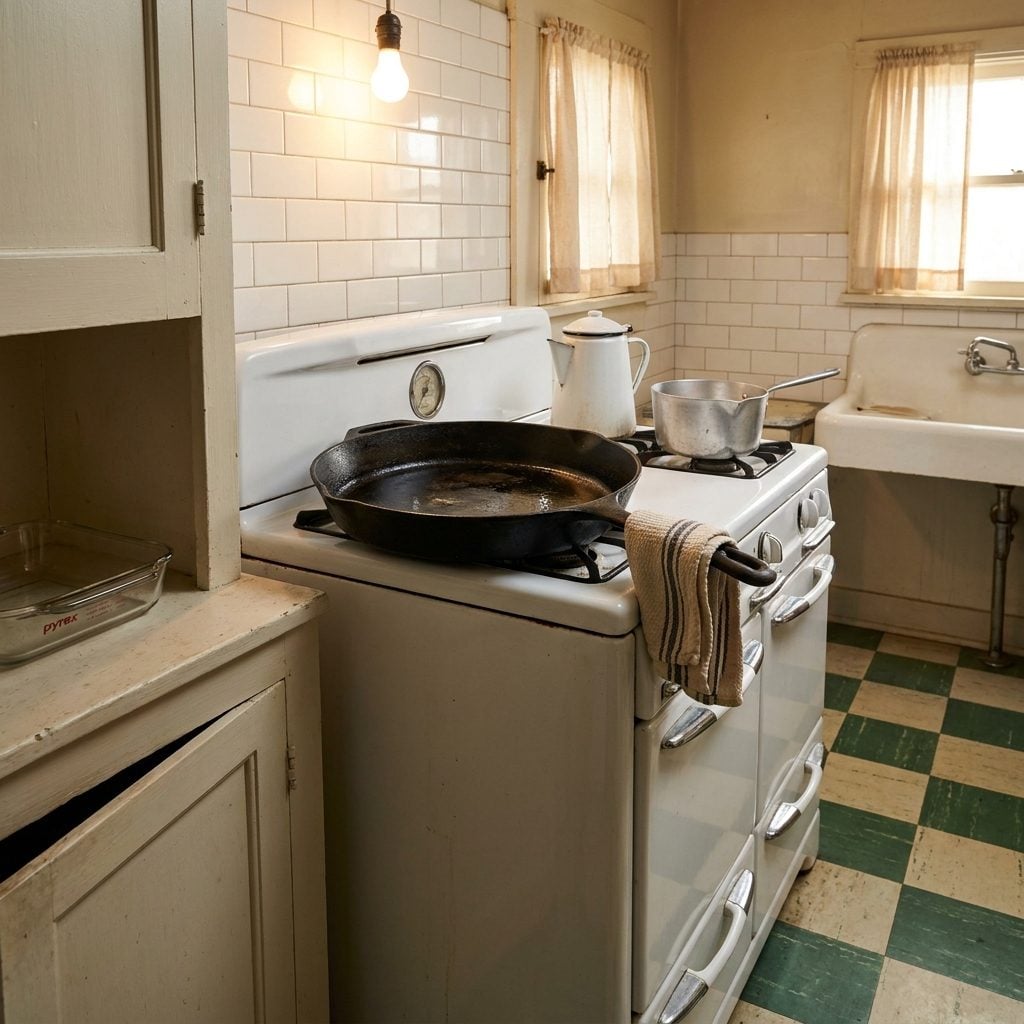
It lived on the stove because that’s where it lived. The cast iron skillet in a 1940s kitchen wasn’t stored in a cabinet between uses, it sat on a back burner, seasoned black and slick, always available. Bacon went in it every morning. Cornbread on Sunday. The occasional steak, pressed flat with a second pan on top. The handle was always slightly warm even when the burner was off.
Cast iron required nothing except use. You wiped it down, maybe ran a little hot water through, then dried it on the still-warm burner and put it back. No soap, no dishwasher, no cabinet. Just the stove and the fat already in the pan. For anyone researching a small kitchen renovation, it’s worth noting what these kitchens accomplished with almost no counter space and exactly one pan.
17. The Pot Rack or Wall Hooks That Turned the Kitchen Into a Working Kitchen
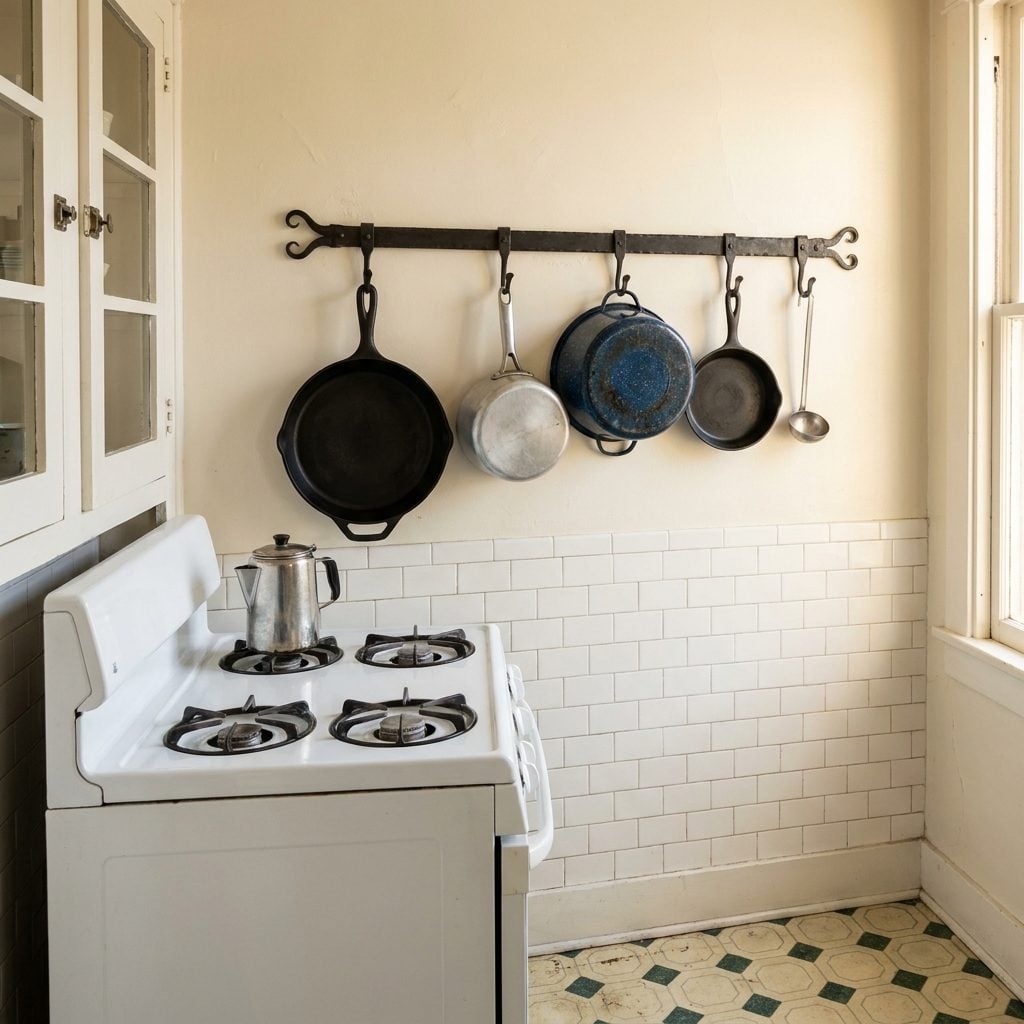
A row of iron hooks screwed directly into the wall above the stove, or a simple ceiling-mounted rack of wrought iron, and suddenly the entire kitchen read as a place where serious cooking happened. In the 1940s, hanging pots wasn’t a design move, it was just where pots went when counter space was scarce and cabinet shelves were already full of flour, sugar, coffee cans, and canned goods stacked three deep.
The arrangement was always slightly chaotic: a cast iron skillet at one end, a dented aluminum colander on a hook that wasn’t quite the right size, an enamel pot with a slightly warped lid hanging beside it. Everything slightly mismatched. All of it in daily rotation. Wrought iron pot racks are still sold today, though now they come with instructions about “kitchen aesthetic”, something no one in 1944 would have understood or needed.
16. The Hand-Cranked Meat Grinder Clamped to the Edge of the Counter
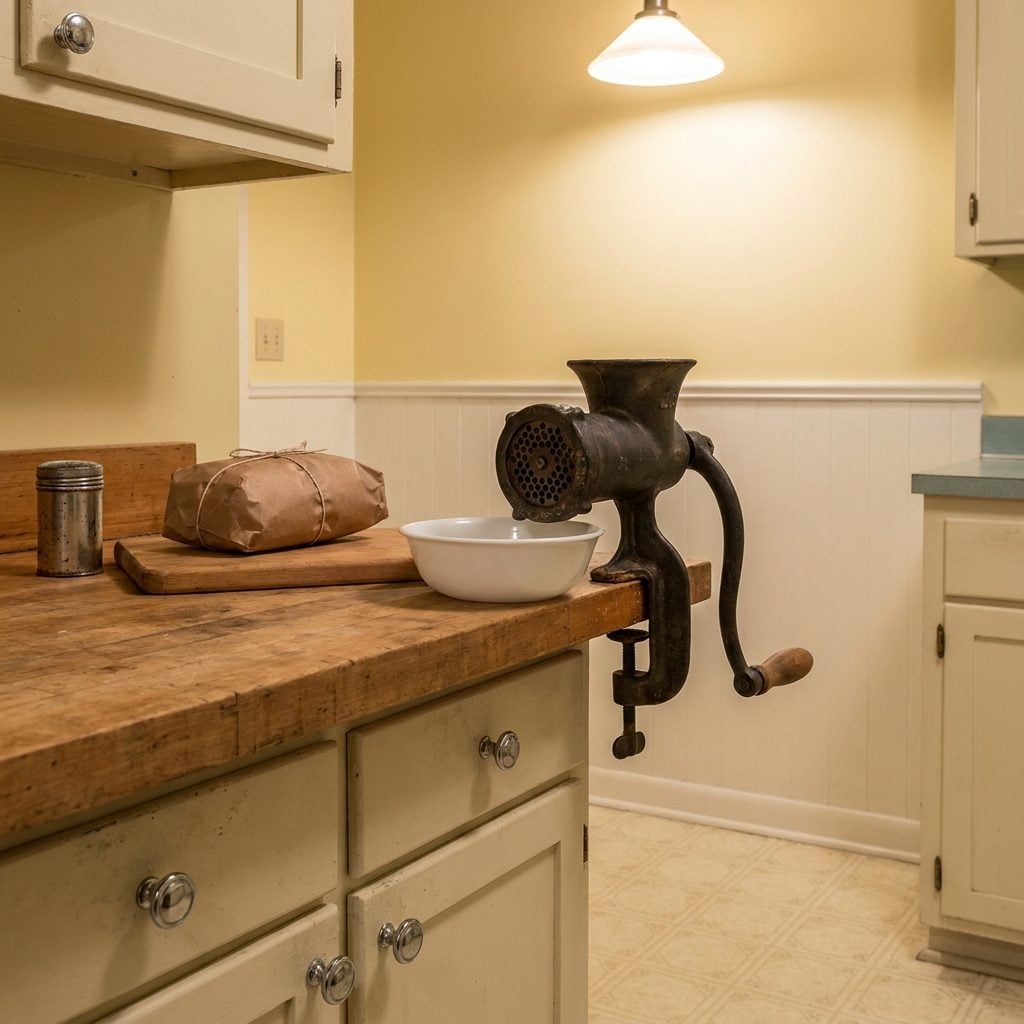
That clamp. The way the cast iron screw clamp bit into the wooden counter edge, slightly marring the finish over years of use, leaving a permanent shadow in the wood. The hand-cranked meat grinder was bolted to the counter edge every time it was needed and removed every time it wasn’t, but the little worn patch on the counter edge stayed forever, like a signature.
You fed chunks of chuck roast in from the top and turned the crank with your right hand while guiding meat with your left. The coils of ground meat emerging from the plate on the front made a specific sound, soft, rhythmic, slightly wet, that was completely ordinary in the 1940s and would alarm a modern kitchen entirely.
15. The Manual Eggbeater Hanging on Its Hook, Ready for Sunday Cake
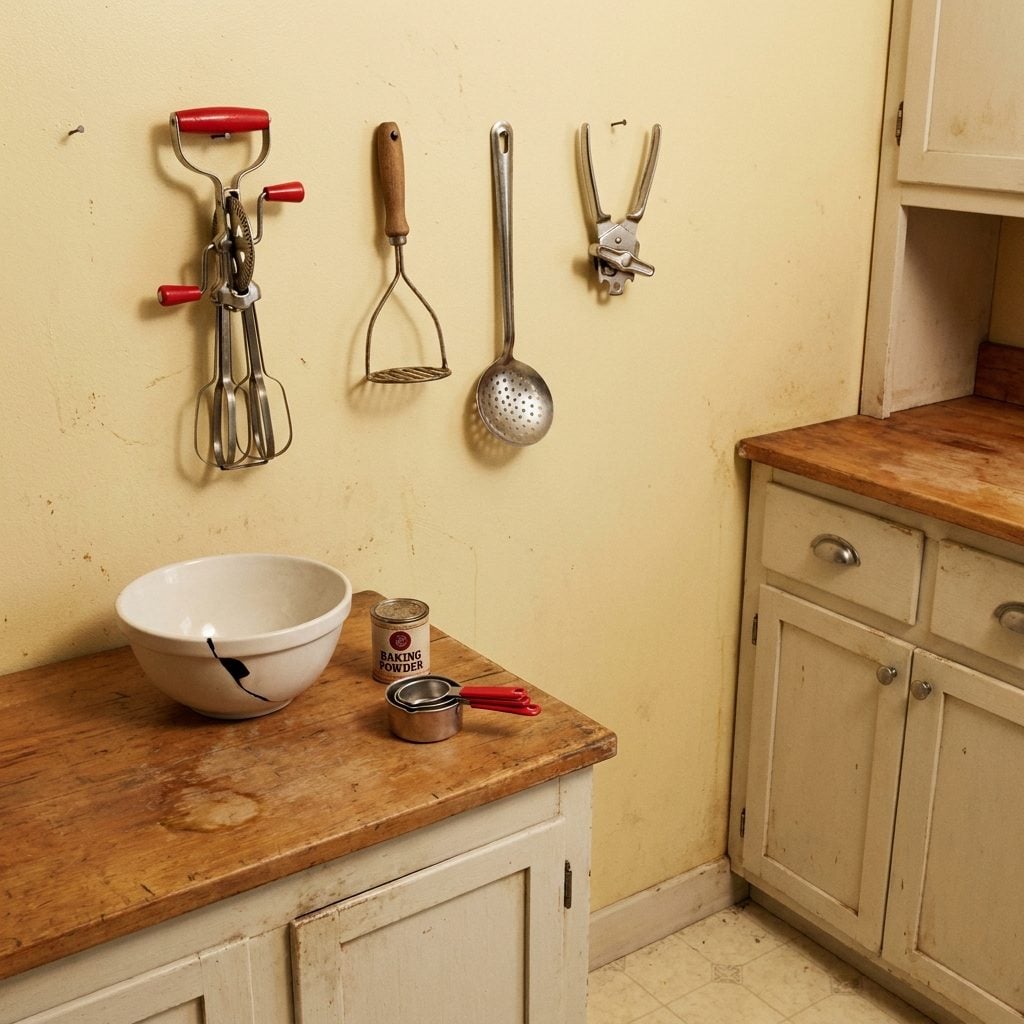
A good manual eggbeater had a satisfying mechanical quality that no electric mixer has ever replicated. The gear mechanism clicked slightly with each rotation, the twin wire beaters spinning in opposite directions, and you could feel the resistance change as cream thickened or eggs foamed up into something pale and doubled in volume. It was made of tinned steel with a red wooden handle, and it hung on a hook inside a cabinet door or on the wall beside the stove.
Along with the eggbeater, the wall beside the counter in most 1940s kitchens held its companion tools: a flat rotary can opener with a butterfly handle, a wooden-handled potato masher with a zigzag wire head, a long-handled slotted spoon in tinned steel. Each one hung on its own nail, arranged in the rough order of frequency of use, in a cluster that was equal parts tool storage and domestic portrait.
14. The Stovetop Percolator That Announced Breakfast Before Anyone Was Awake
🔥 Would you like to save this?
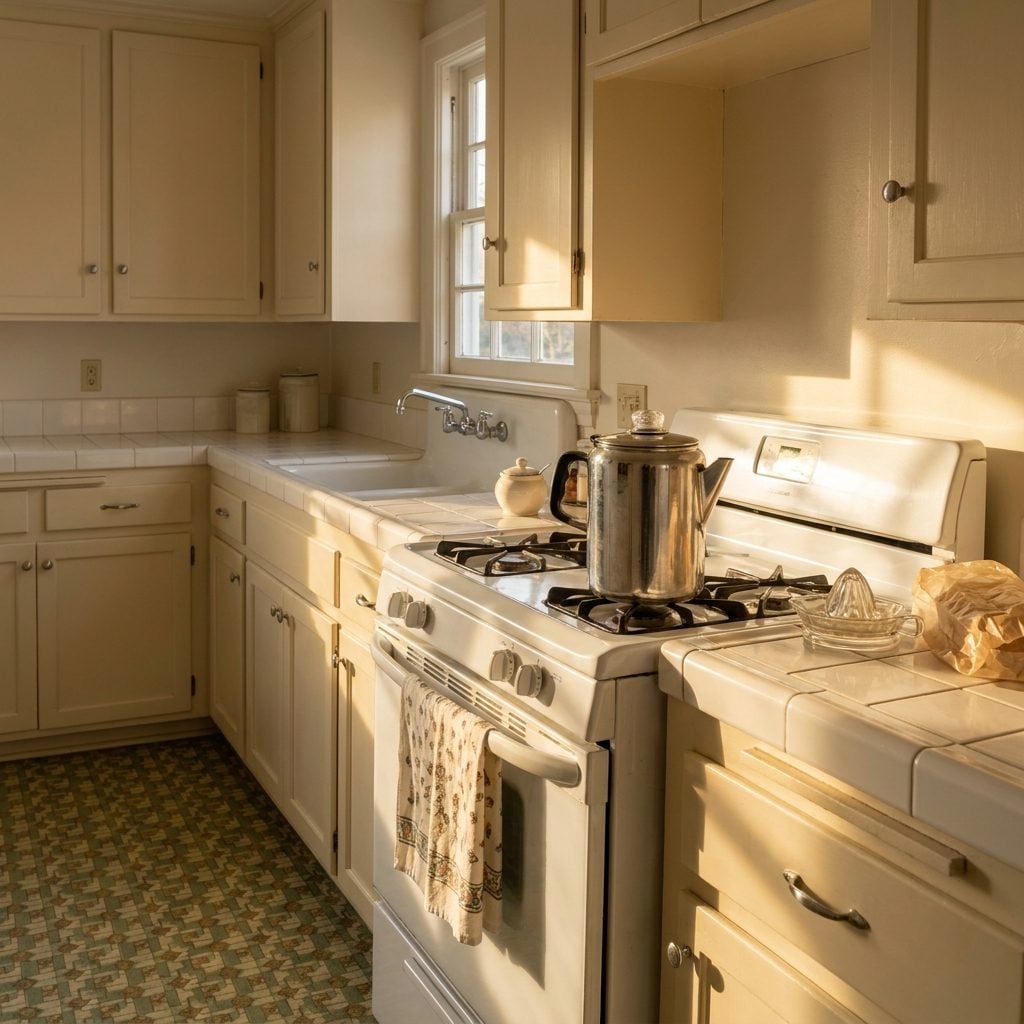
You heard it before you smelled it. That rhythmic, percussive gurgle from the stovetop percolator was the original alarm clock in a 1940s kitchen, the coffee cycling up through the glass knob on the lid in little amber bursts. The knob itself was a design detail nobody talks about enough: a small dome of glass, slightly yellowed with age, that let you watch the brew darken from pale gold to deep brown.
Most were aluminum or enamel-coated steel, and they sat on a gas burner on low heat, keeping coffee warm the way a slow simmer keeps soup. The percolator didn’t make good coffee by modern standards, but it made the kitchen smell like morning, which turned out to be the more important job.
13. Enameled Metal Bread Boxes in Red, Green, or That Specific Shade of Cream
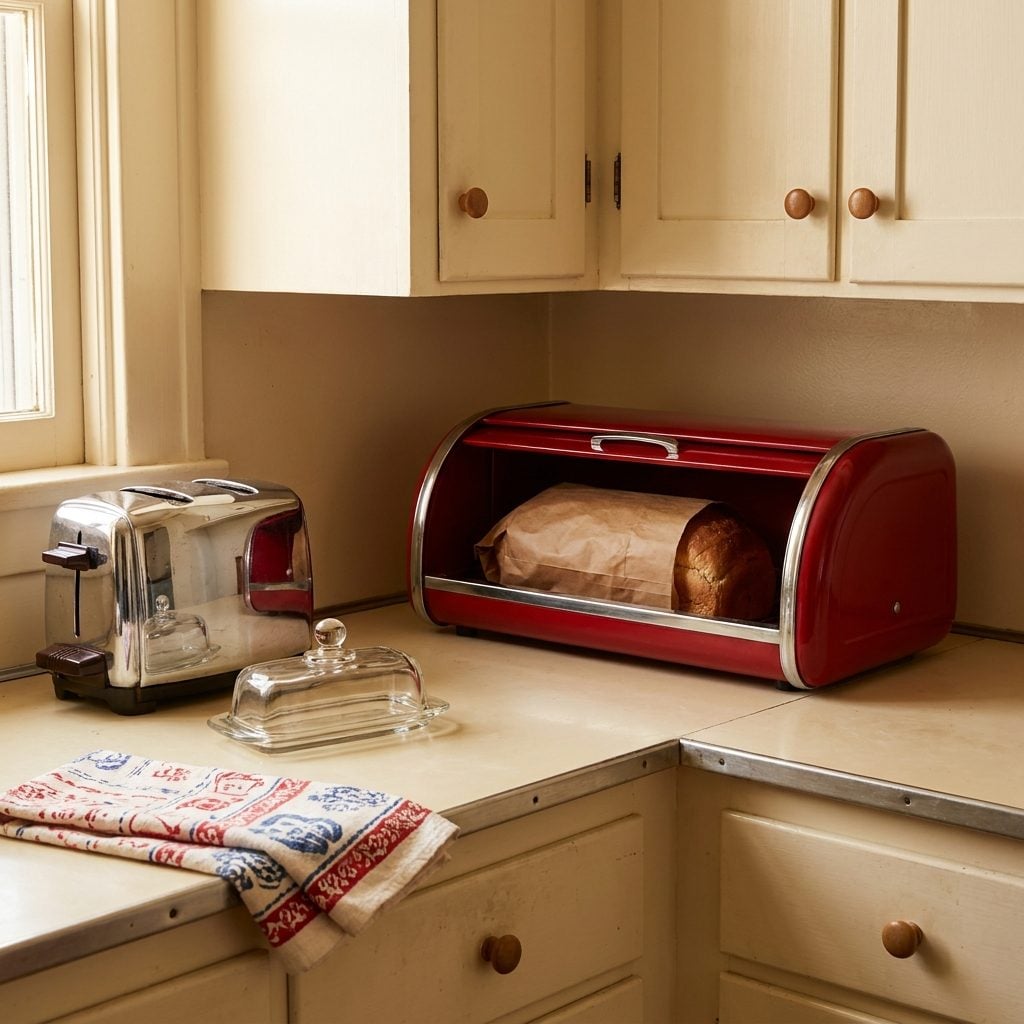
Every kitchen counter had one, and it always lived in the same spot, usually pushed to the back corner near the toaster or the window. The enameled metal bread box was boxy, utilitarian, and came in a narrow range of colors: bright red, forest green, chrome, or a slightly off-white cream that aged to the color of old piano keys. The lid slid up or rolled back on a hinge, and the inside smelled like bread even when it was empty.
Nobody questioned why it existed. It kept the loaf from going stale too fast in dry kitchens and kept the counter from looking chaotic. Somehow it did both. Retro bread boxes have crept back into modern kitchen inspiration boards, which tracks, because the original design was never actually broken.
12. The Matching Canister Set That Held Everything in One Tidy Row
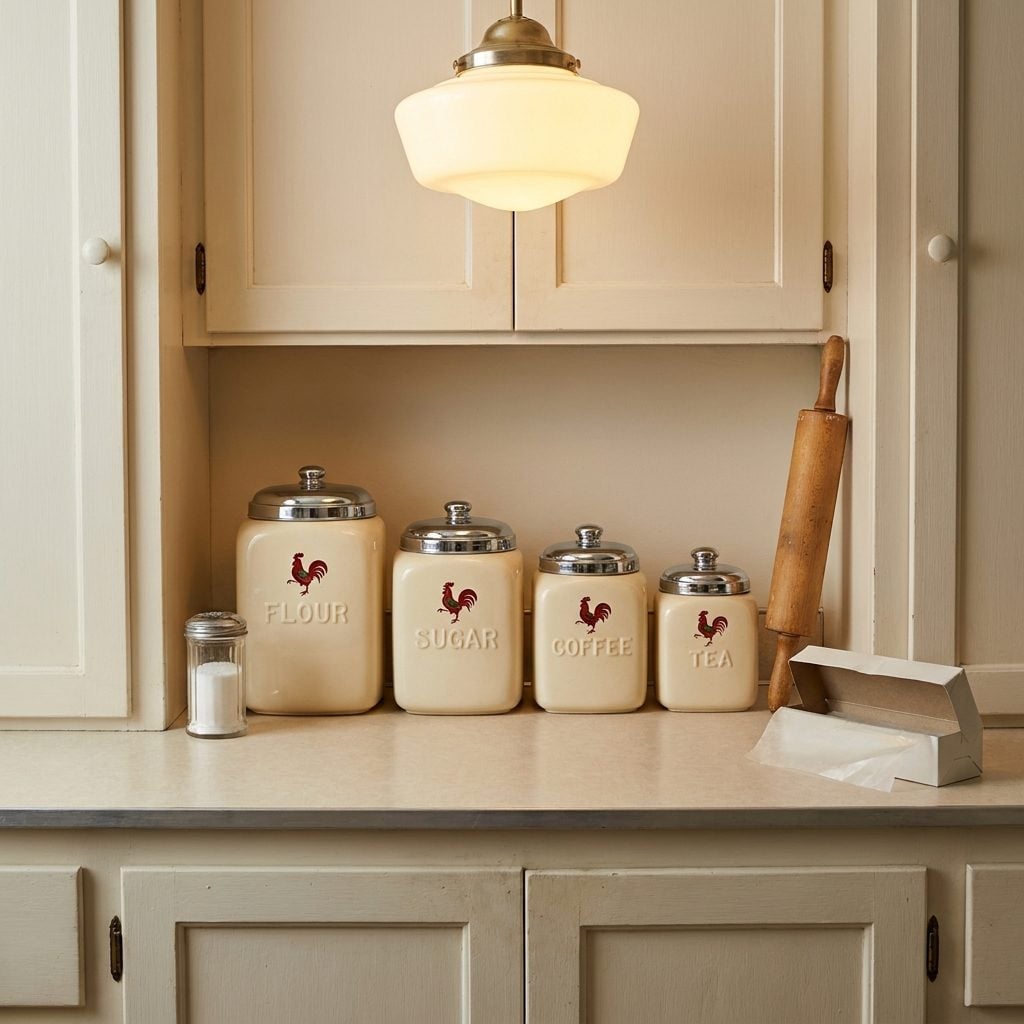
Four canisters, always four. Flour, sugar, coffee, tea, labeled in hand-painted script or pressed metal letters and lined up on the counter in descending size like a little ceramic family. The sets came in ceramic, enamelware, or tin, and the matching was the point: the kitchen felt put-together as long as those four canisters were lined up.
Cream with red roosters. Blue and white Dutch motifs. Solid pastel with chrome lids. Whatever the pattern, the set represented a kind of domestic optimism: the idea that a well-organized kitchen was a well-organized life. You could find entire sets at estate sales until about fifteen years ago. Now they’re on Etsy for forty dollars each, sold individually.
11. Ruffled Gingham Curtains That Were Half Decoration, Half Privacy Solution
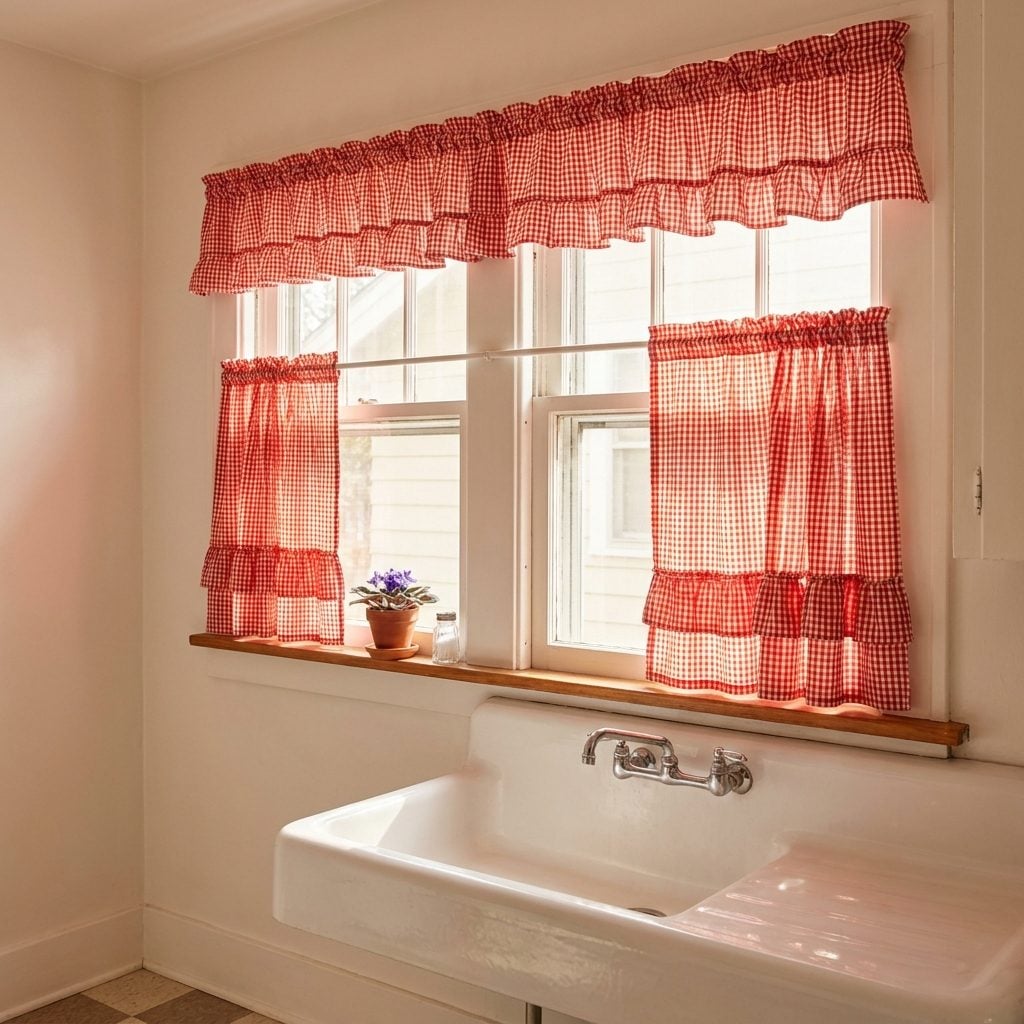
Red and white. Blue and white. Sometimes yellow. The ruffled gingham curtain above the kitchen sink was one of the most load-bearing design decisions in the entire 1940s house, even though nobody called it that. It softened the window without blocking light, gave the kitchen a sense of completeness, and tied the whole room together with a cheerfulness that felt almost performative.
The ruffle at the top was the detail. Not a simple panel, not a Roman shade: a gathered, slightly starched ruffle that required ironing on Saturdays and still managed to look slightly wrinkled by Tuesday. The home trends of that era treated the kitchen curtain as seriously as the living room drapes, which says something about how differently domestic space was valued.
10. The Single Window Above the Sink That Framed the Whole Kitchen
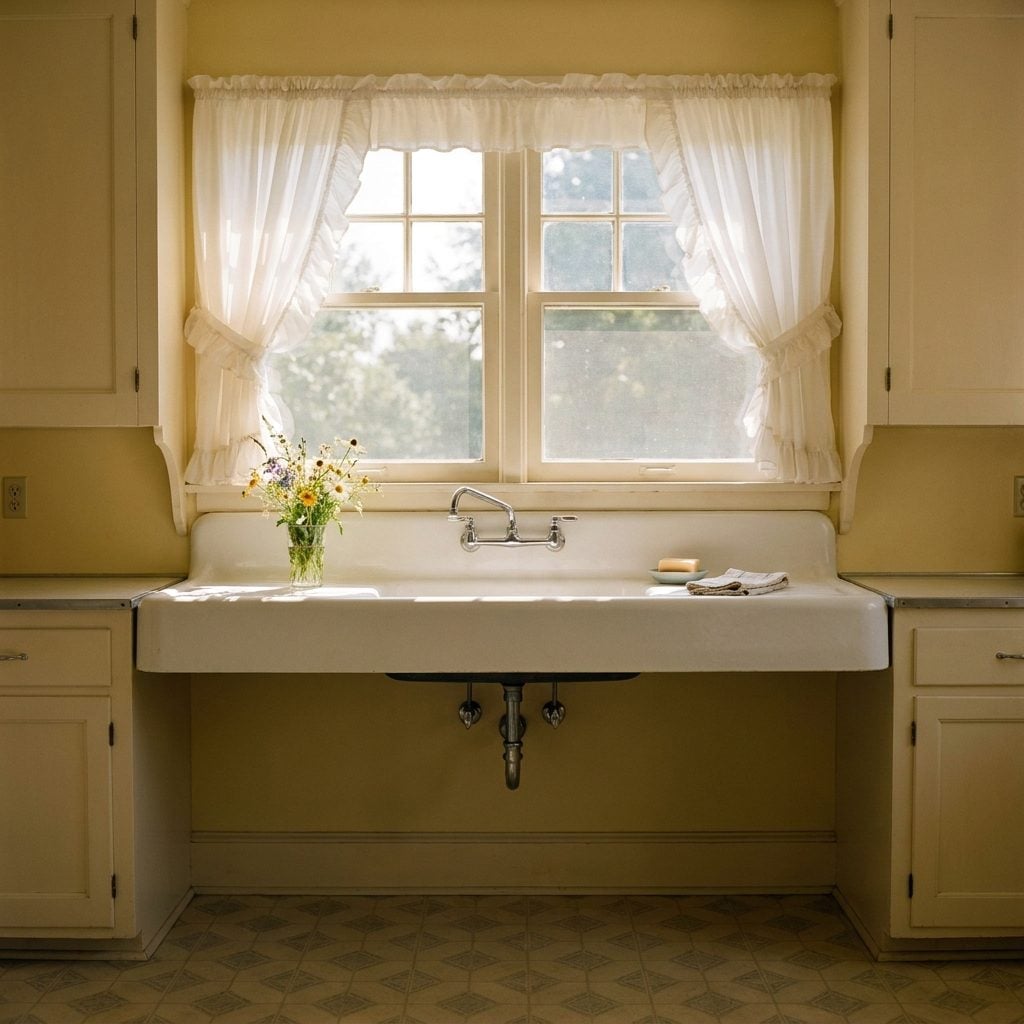
Every 1940s kitchen was organized around that one window. It sat centered above the sink, almost always double-hung, and the light it threw changed the character of the entire room depending on which direction the house faced. Morning kitchens faced east and were blinding by eight o’clock. North-facing kitchens had that flat, even light that made everything look slightly cinematic.
The window wasn’t just functional ventilation and light. It was the focal point of the kitchen the way a fireplace was the focal point of the living room. You washed dishes facing it. You watched the yard through it. Somebody was always standing at that window, looking at something.
“The light from that window made everything, even peeling potatoes, feel like it was happening somewhere important.”
9. Deep Porcelain Farmhouse Sinks That Could Bathe a Child or Wash a Harvest
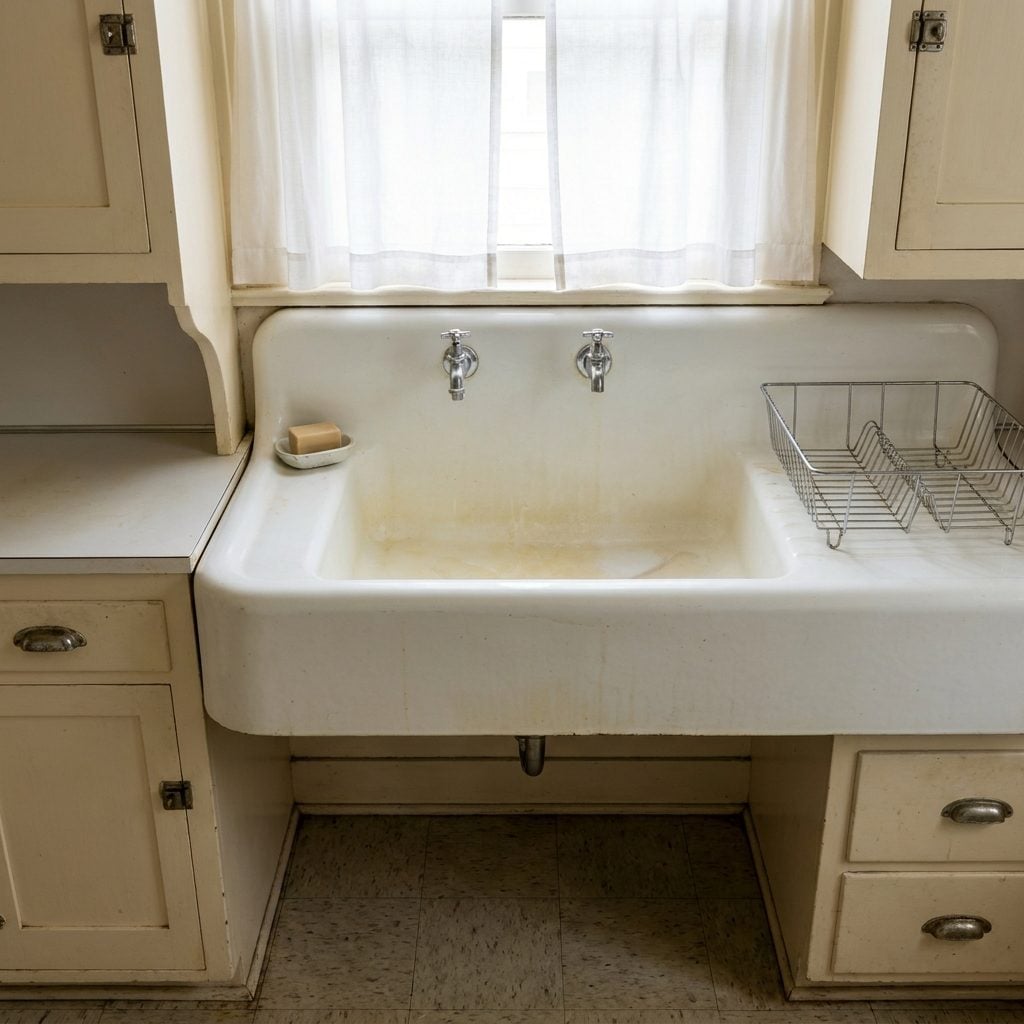
The original farmhouse sink wasn’t a design trend. It was plumbing infrastructure. Deep, wide, and built from heavy cast iron coated in white or off-white porcelain, the apron-front sink of the 1940s kitchen was sized for serious work: scrubbing root vegetables, rinsing canning jars, soaking cast-iron pans overnight. The basin was so deep you had to lean into it slightly to reach the drain.
The porcelain chipped. Dark stains settled into the chips despite every cleaning effort. The faucets were separate handles: one for hot, one for cold, because mixer taps were not yet universal. It sounds inefficient now. At the time it was just how you washed your hands. The irony is that this sink, the farmhouse kitchen icon, has spent the last decade as one of the most sought-after upgrades in renovated homes, selling for four figures at kitchen showrooms.
8. The Built-In Drainboard: A Practical Feature That Quietly Disappeared
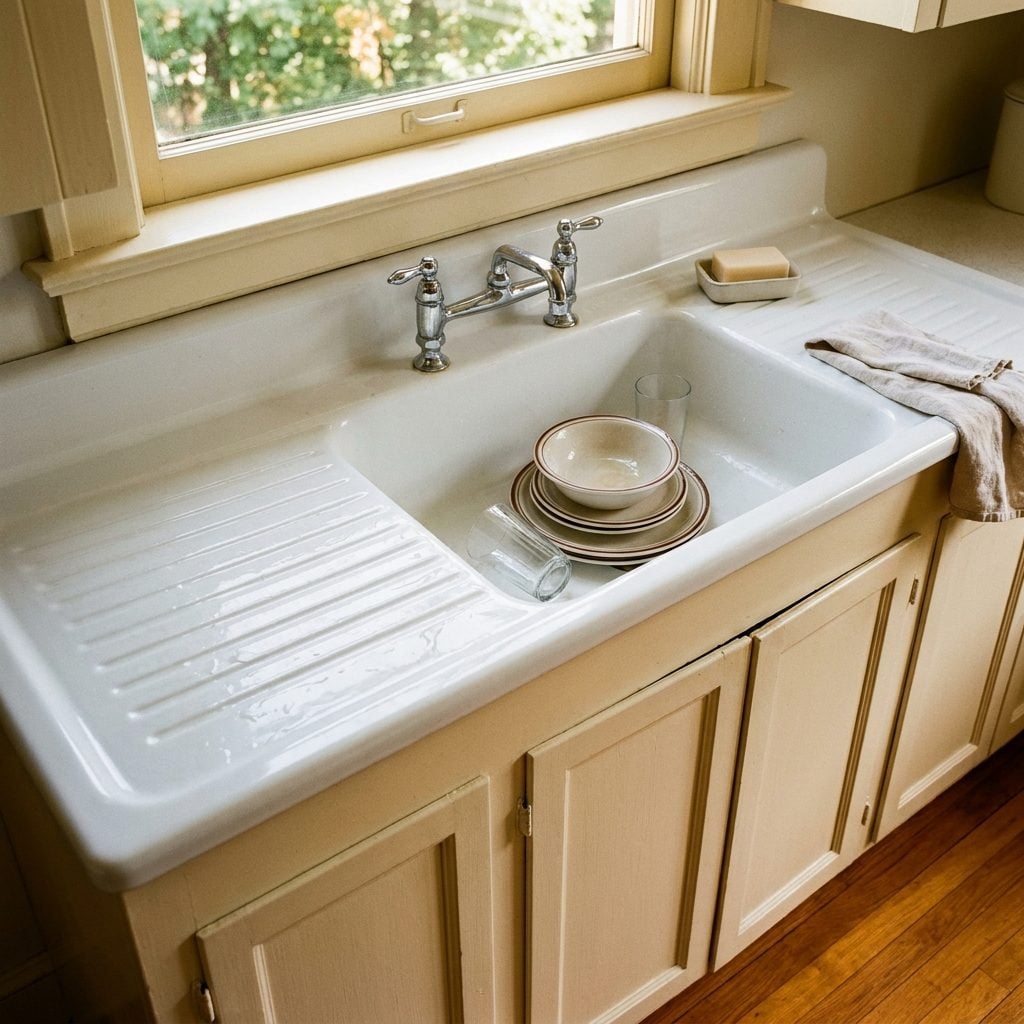
The integrated drainboard was exactly what it sounds like: a sloped, grooved surface cast directly into or attached beside the sink basin, designed so that rinsed dishes could air-dry without a separate rack. In the 1940s kitchen, this was standard. The drainboard was part of the sink unit, either in matching porcelain or a separate enameled steel panel, and it sloped gently toward the basin so water ran back in on its own.
It was efficient in the quiet, unshowy way that a lot of 1940s design was efficient. No rubber mat. No wooden drying rack that warped and smelled like mildew by July. Just a sloped surface doing exactly one job forever. When modular sink configurations replaced built-in units, the drainboard disappeared almost overnight, and we replaced it with things that need to be washed themselves.
7. Pastel 4×4 Tile Backsplashes With Those Thin Pencil-Trim Accent Lines
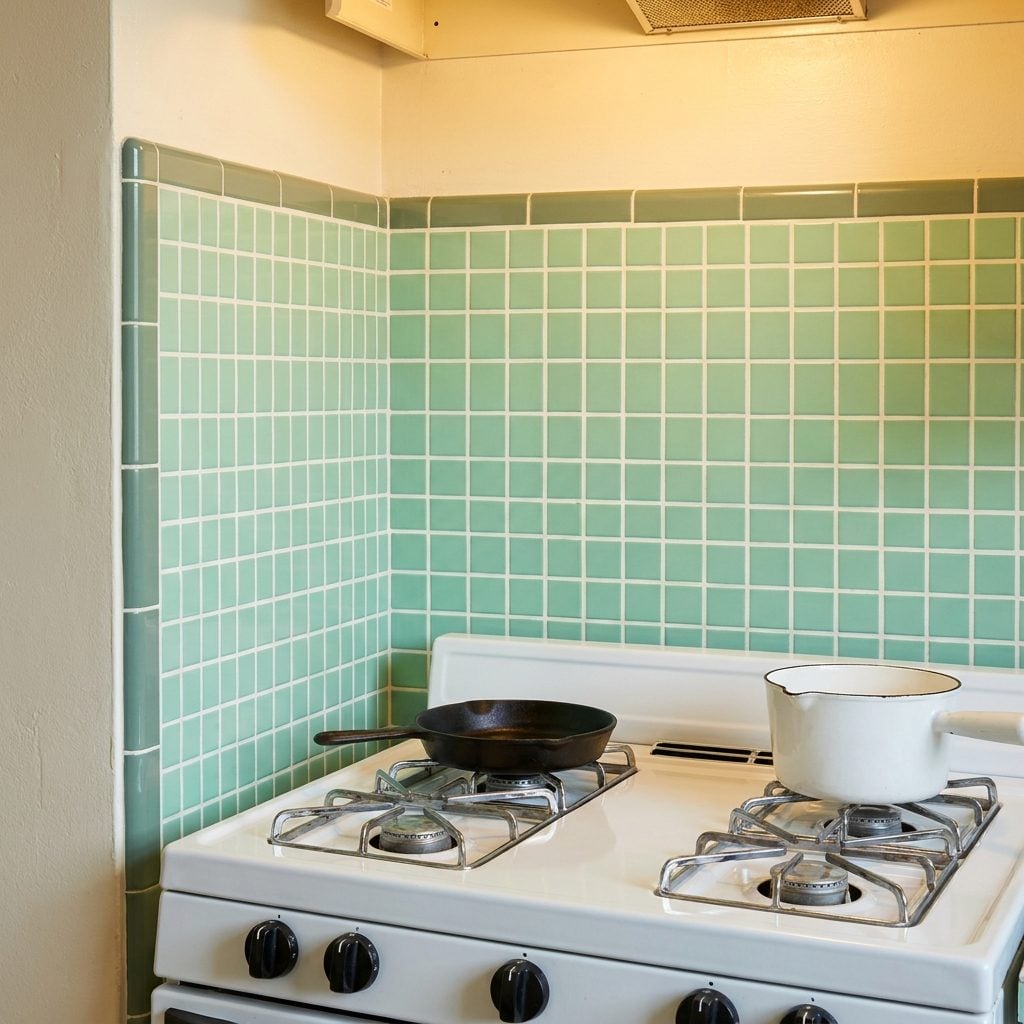
Mint green. Pale yellow. Dusty pink. The 4×4 ceramic tile backsplash was the 1940s kitchen’s answer to decoration that could also be wiped down, and it came in every color that would now be described as a muted pastel. The tiles were small and square, set in tight grids with white grout, and the real detail was the border: a single row of slightly narrower pencil-trim tiles in a contrasting color or a simple bullnose cap that finished the edge with a quiet formality.
Those backsplashes were almost always in the same places: behind the range and along the sink wall, rarely wrapping the whole kitchen. They did not pretend to be more than they were. And that thin pencil trim, that one-inch strip of darker or shinier tile running along the top row, is the kind of detail you can stare at for a while before you realize why the backsplash looks so considered.
6. Rounded Cabinet Edges and Small Chrome Pulls That Were Pure Streamline Moderne
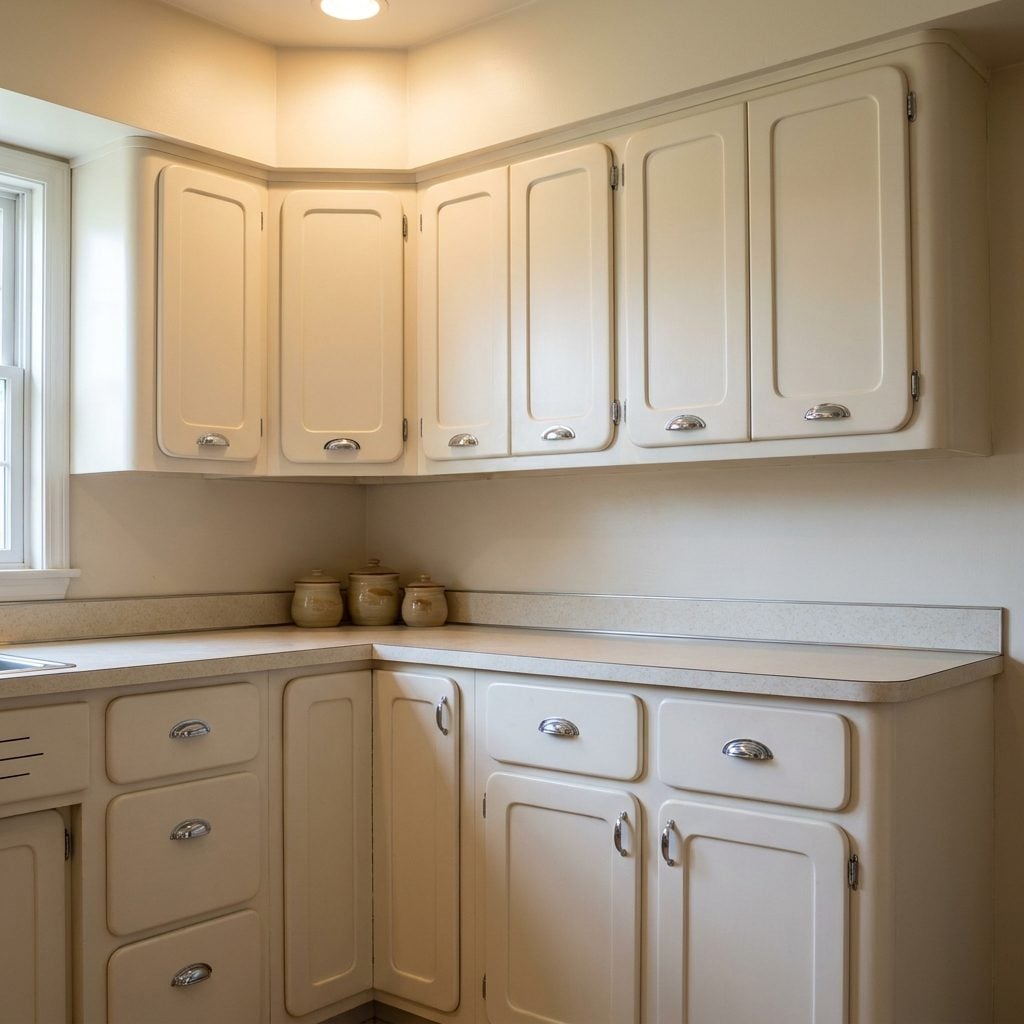
The 1940s was the decade when American kitchen cabinetry absorbed the visual language of the streamline moderne movement. Corners were rounded. Edges were curved. The sharp 90-degree profile that defines contemporary cabinet design simply wasn’t the ideal. These cabinets had a softness to them, a slightly heavy, sculpted quality, often painted in creamy white or pale gray with small chrome or nickel bin-pull handles.
The hardware was modest by today’s standards: small, simple, functional. A bin pull, a tiny cup pull, sometimes a small round knob. Nothing oversized. The cabinet faces themselves were the design statement, with their subtle curves and recessed panels. Seeing that rounded edge profile now, even in a photograph, is like watching an old movie. The whole era comes back in one detail.
5. The Wall-Mounted Rotary Phone That Made the Kitchen the Communication Hub
🔥 Would you like to save this?
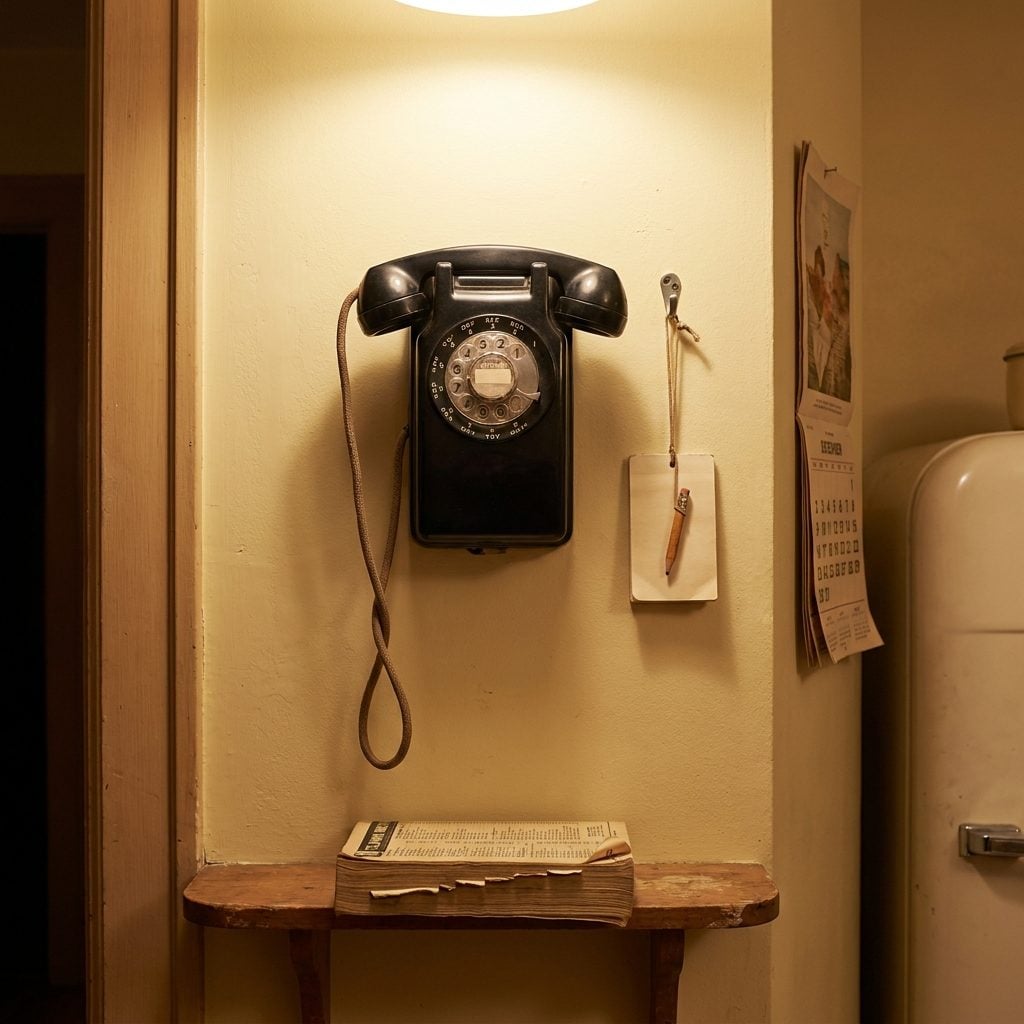
It was mounted next to the door to the dining room, or on the wall beside the refrigerator, or tucked into the corner near the window. Always at exactly the height where you had to stretch slightly to reach it. The rotary telephone in a 1940s kitchen was typically black Bakelite, wall-mounted with a cloth-covered cord that coiled down from the handset, and using it required standing in one spot, which is why every kitchen call was necessarily brief.
The phone book lived in the drawer below or on the shelf nearby. The notepad and pencil were on a hook beside the phone. You dialed by sticking your finger in the numbered hole and pulling the rotary disk to the stop, then releasing it. Seven times minimum. The sound it made, that mechanical clatter of the dial spinning back, is one of the most specific sounds of the mid-century American home.
4. The Bakelite Kitchen Radio That Played the Same Programs Every Morning
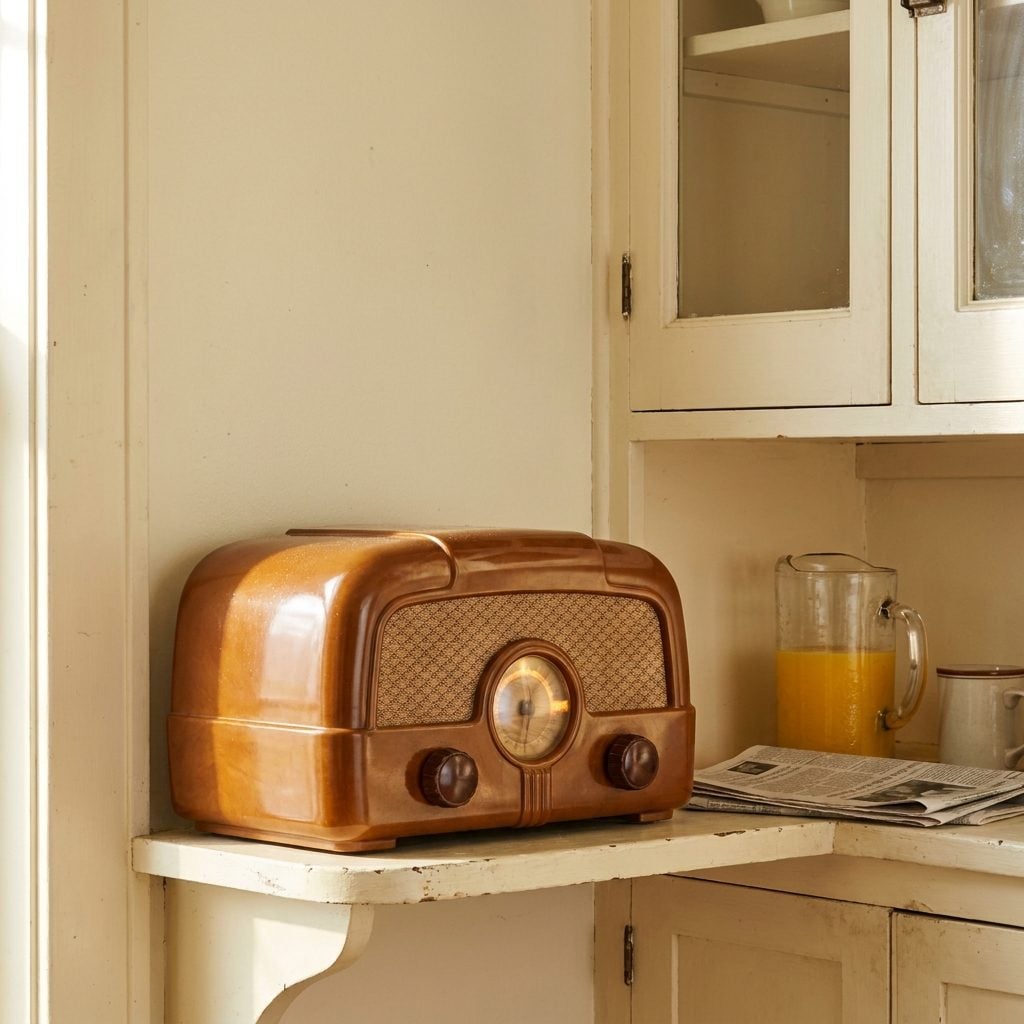
Soap operas at ten. News at noon. The kitchen radio of the 1940s ran on a daily schedule more rigid than any streaming algorithm. The sets themselves were compact, designed to sit on a shelf or countertop, with those distinctively curved Bakelite housings in caramel brown, ivory, or forest green, a fabric speaker grille stretched over the front, and large dial knobs that clicked satisfyingly from station to station.
The radio sat on a shelf near the window or on the counter beside the bread box, and it ran all day as background the way a television runs now. Stations shifted to evening programming after dinner and the set went quiet, but for most of the working day it was on. The sound it produced was thin and slightly tinny by modern standards. Nobody noticed. It was the sound the kitchen was supposed to make.
3. The Victory Garden Canning Corner: Mason Jars, Pressure Cookers, and Pure Determination
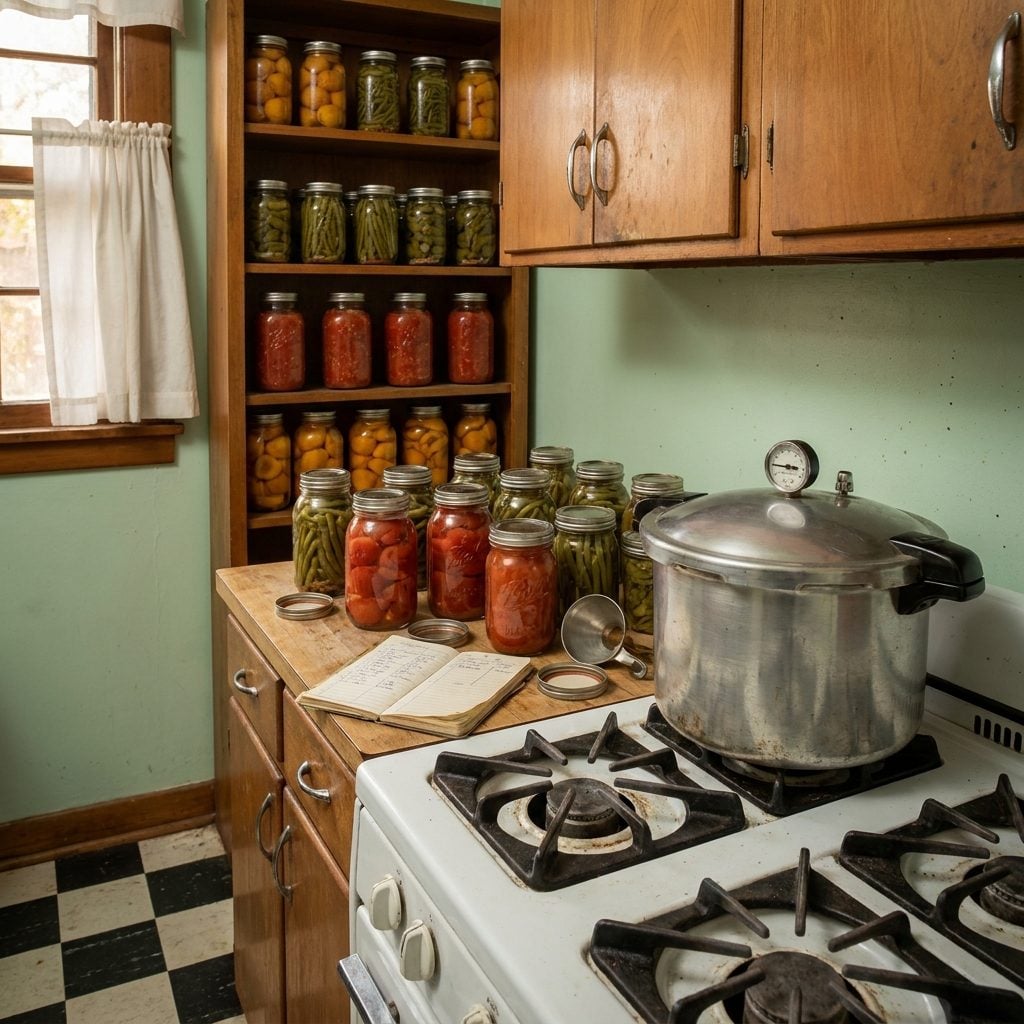
Every 1940s kitchen had a corner that smelled permanently of hot steam and vinegar. The pressure cooker sat on the back burner like a piece of heavy artillery, hissing and rattling while rows of Ball Mason jars lined up on the counter waiting their turn. Rubber sealing rings, jar lifters, and a worn copy of the USDA canning guide lived in the same drawer all summer long.
This wasn’t a hobby. With rationing tight and the government actively urging families to grow and preserve their own food through the Victory Garden program, canning was survival strategy with a domestic face. Women who’d never touched a pressure cooker in 1940 were running small-scale preservation operations by 1943. Those jars of green beans and stewed tomatoes on the cellar shelf weren’t just food storage. They were proof of competence.
2. The Ration Book Drawer: Stamps, Coupon Books, and the Arithmetic of Enough
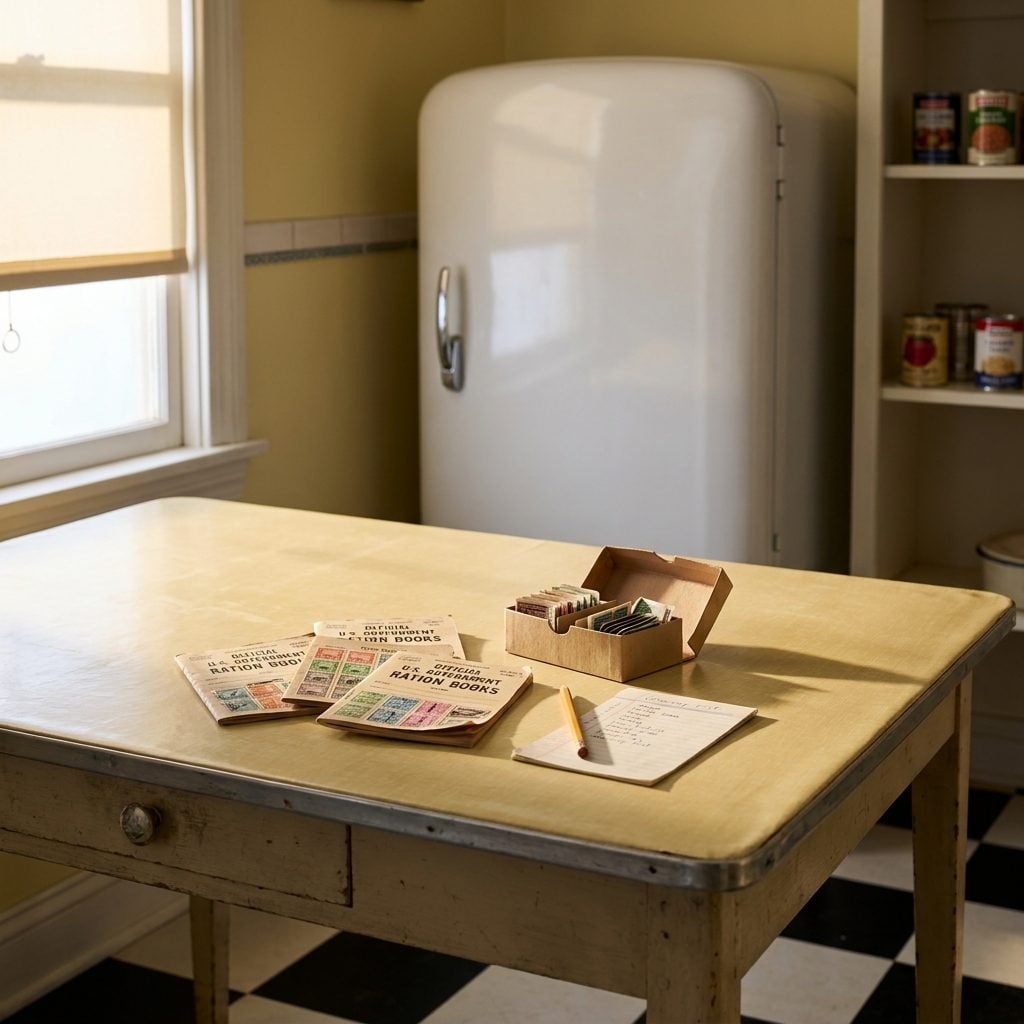
There was a specific kitchen drawer in every American home between 1942 and 1945. It held the ration books. Not just one, but four or five, one per family member, their pale blue and red stamps arranged in perforated rows covering sugar, butter, meat, canned goods, and shoes. You checked that drawer before you went to the grocery store the way you’d check your wallet today.
Some families kept a small metal or cardboard stamp holder near the cookbooks to stay organized. The books themselves were issued by the Office of Price Administration, printed on thin paper that softened with handling, and losing one was a genuine household crisis. The kitchen was where the budgeting happened, literally at the table, counting out stamps against a week’s worth of meals before anyone started cooking. No one had a word for this yet, but it was the original home trends in meal planning.
1. The Wall-Mounted Can Opener and Knife Sharpener That Never Left Their Post
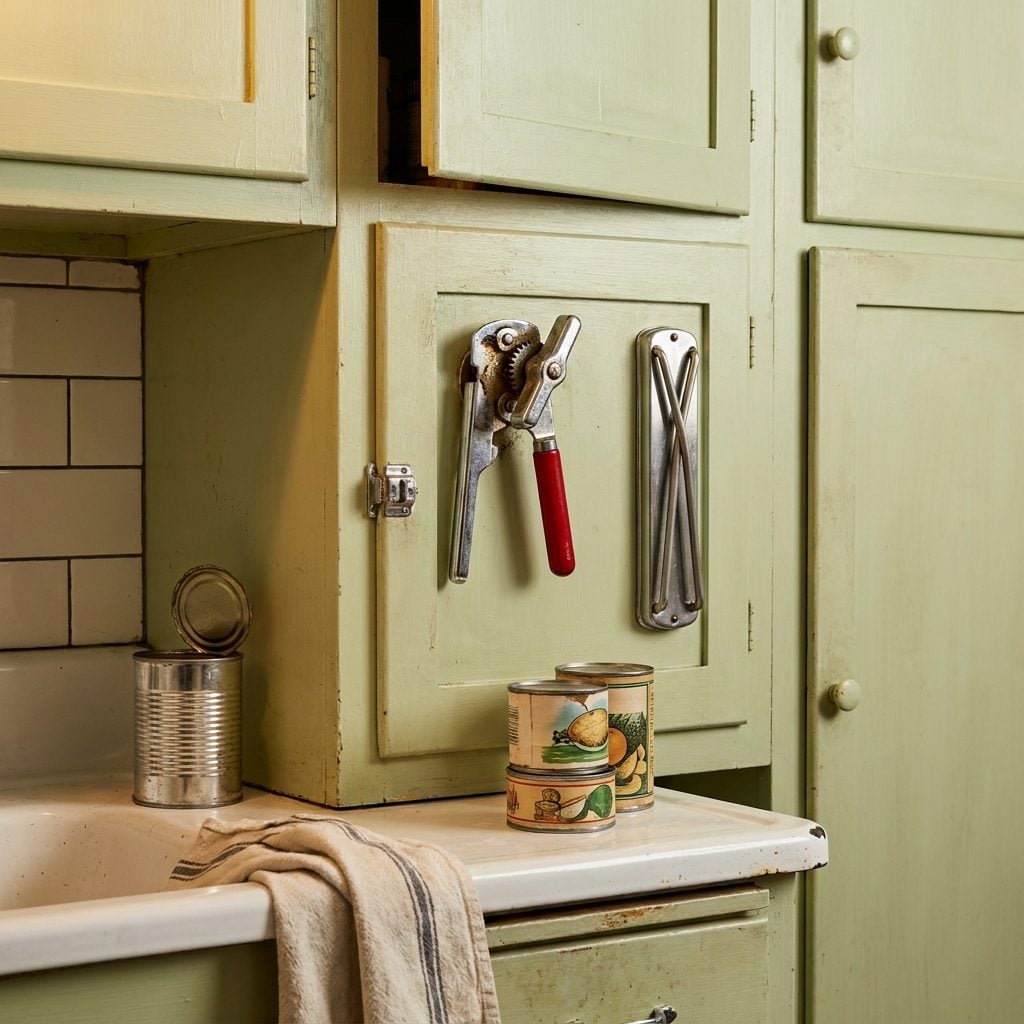
Screwed directly into the cabinet face or door frame at about shoulder height, the wall-mounted can opener was as permanent a kitchen fixture as the sink. The kind with the butterfly key handle and the serrated cutting wheel, usually enameled red or left bare chrome, slightly sticky near the gear from years of peach juice and tomato paste. You never wondered where the can opener was. It was always right there.
Just a few inches away hung its partner: the wall-mounted knife sharpener. A slim steel unit with two angled carbide or ceramic rods, you’d pull a knife blade through it with a quick, practiced drag before any serious cutting. Both tools operated on the same philosophy that defined 1940s kitchen design: mount it, fix it, keep your hands free and your counter clear. For anyone exploring small kitchen renovation ideas today, this philosophy of vertical, fixed utility is quietly making a comeback.