🔥 Would you like to save this?
Somewhere along a forgotten stretch of coastline, a decommissioned aircraft carrier sat rusting for years, its steel hull slowly surrendering to salt air and neglect. What happened next has very little to do with salvage and everything to do with ambition. The raw bones of these massive naval vessels became the starting point for extraordinary residential transformations — homes built inside spaces that once launched fighter jets, their vast hangar decks and industrial steel structures reimagined with unlimited budgets and no constraints on the designs.
In order to come up with the very specific design ideas, we create most designs with the assistance of state-of-the-art AI interior design software. Also, assume links that take you off the site are affiliate links such as links to Amazon. this means we may earn a commission if you buy something.
The results carry real history in their walls, not as decoration but as structure — the riveted steel, the coffered beam grids, the cavernous scale all present and accounted for beneath materials that could not contrast more sharply with their origins. This collection of before-and-after images documents exactly how that transformation played out across wildly different conceptual visions.
32. From Rusted Hangar Bay to Waterfront Living Room with Floor-to-Ceiling Views
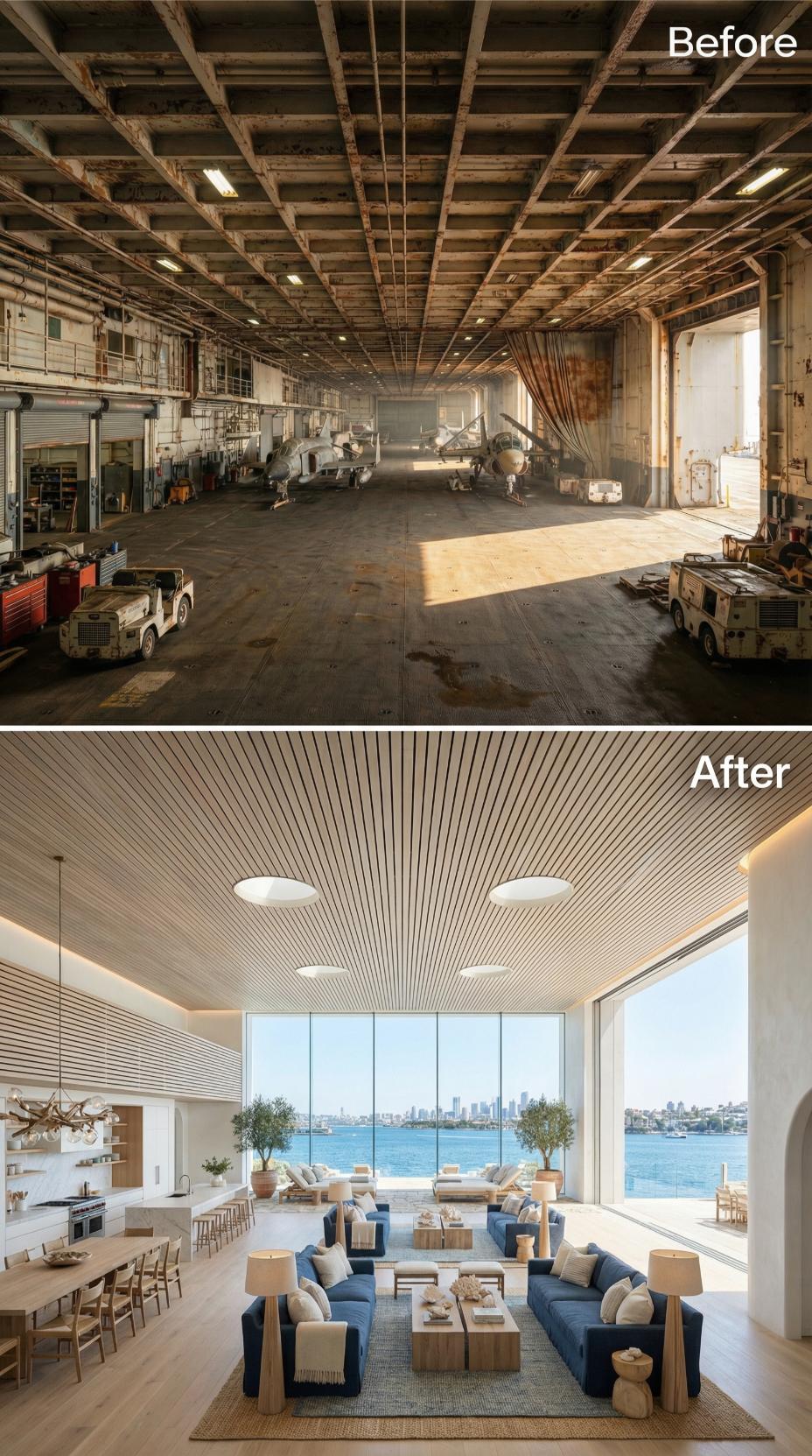
Raw steel beams and aircraft tow vehicles gave way to white-oak slatted ceiling panels that arc gently overhead, their linear rhythm softened by recessed cove lighting along the perimeter walls. Three oval flush-mount fixtures punctuate the ceiling at even intervals, drawing the eye toward a wall of frameless floor-to-ceiling glass that opens the room to a harbor view with a city skyline beyond.
The seating arrangement anchors around two navy linen sectionals flanking a low-profile wood-plank coffee table on a woven jute rug. Warm sand-toned floor lamps with drum shades flank the grouping, while potted olive trees in terracotta containers mark the transition to glass. To the left, a dining area runs along a light-stained oak table with ladder-back chairs, backed by open marble shelving and a professional-grade stainless range.
31. Barrel-Vaulted Glass Roof Crowns What Was Once a Fighter Jet Bay
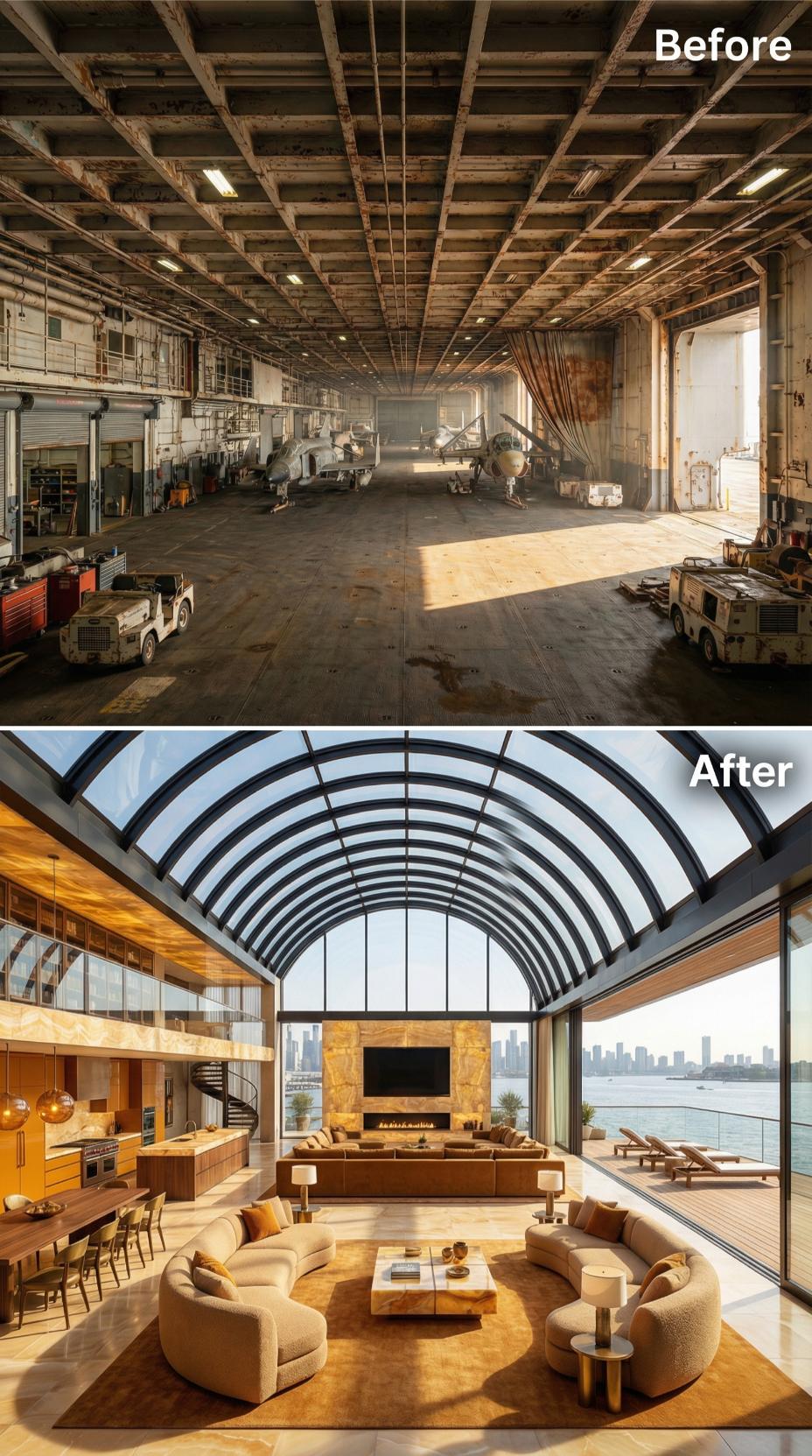
Curved steel ribs now hold panels of clear glass where military aircraft once sat dormant under corroded ceiling joists. The living area anchors itself around two arced sectionals upholstered in bouclé fabric, arranged to face a slab-fronted fireplace clad in book-matched honey onyx. Walnut cabinetry lines the open kitchen behind, paired with a dining table in the same warm-toned wood grain. A city skyline and open water read clearly through floor-to-ceiling glazing on the far wall, with a teak deck and lounge chairs visible just beyond the threshold.
Curved steel ribs now hold panels of clear glass where military aircraft once sat dormant under corroded ceiling joists.
30. Jet Bay Bones Buried Beneath Herringbone Brick Vaulting and Amber Glass Light
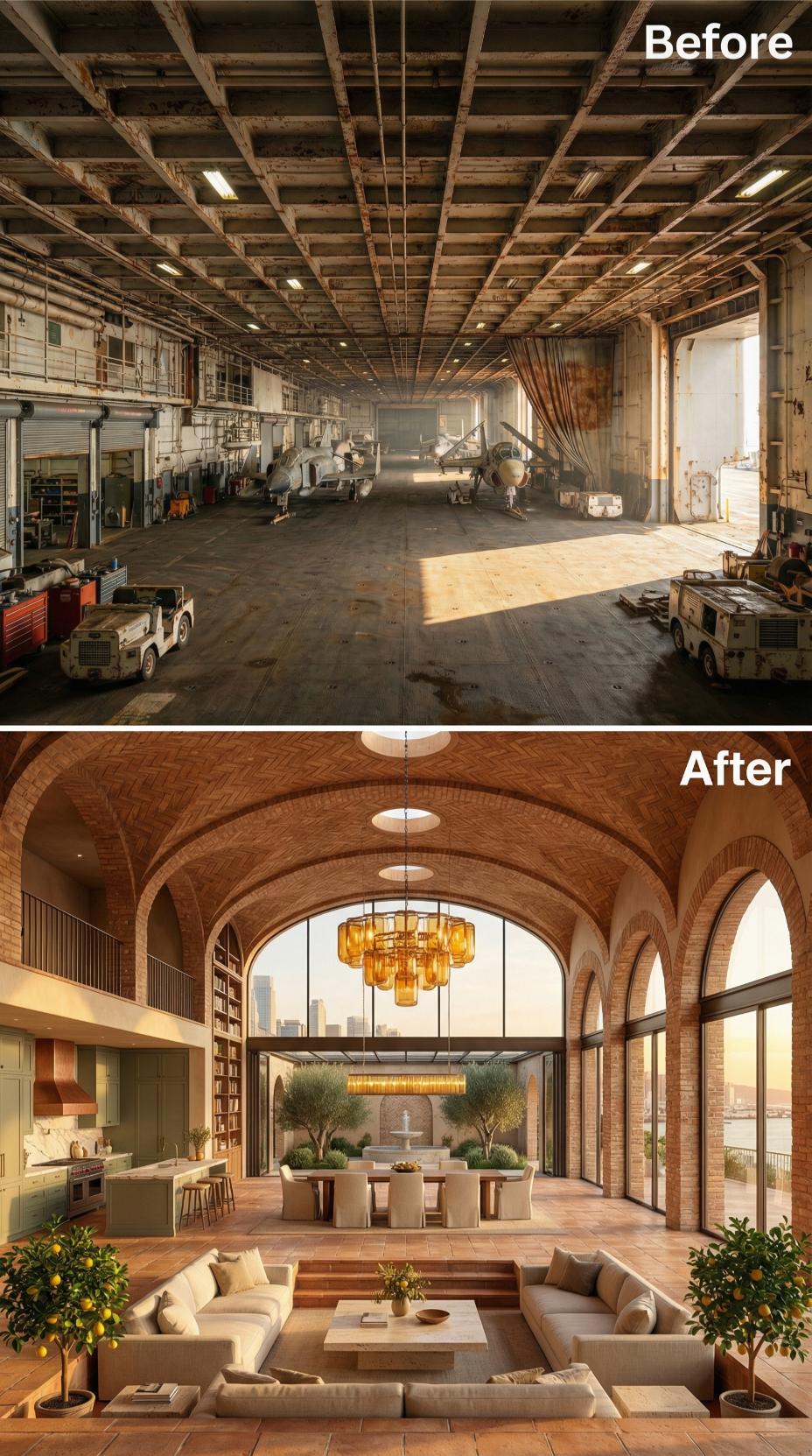
Catalan-style brick vaulting arches across the full ceiling span, laid in a herringbone pattern that pulls warm ochre tones through the entire room. A cluster chandelier of amber glass cylinders anchors the dining zone, casting honey-colored light over a solid wood table surrounded by linen upholstered chairs. Potted citrus trees in terracotta flank a sectional sofa dressed in cream fabric, while floor-to-ceiling arched windows frame a city skyline at golden hour.
Did You Know: Aircraft carrier hangar decks were engineered to withstand the weight of fully loaded fighter jets, which means the steel substructure beneath this conversion can support loads far exceeding any residential building code requirement. Designers working on carrier conversions often leave portions of the original deck plating exposed beneath new flooring as both a structural asset and a nod to the ship’s operational history.
29. Steel Bones, Stone Floors, and Leather Transform Space
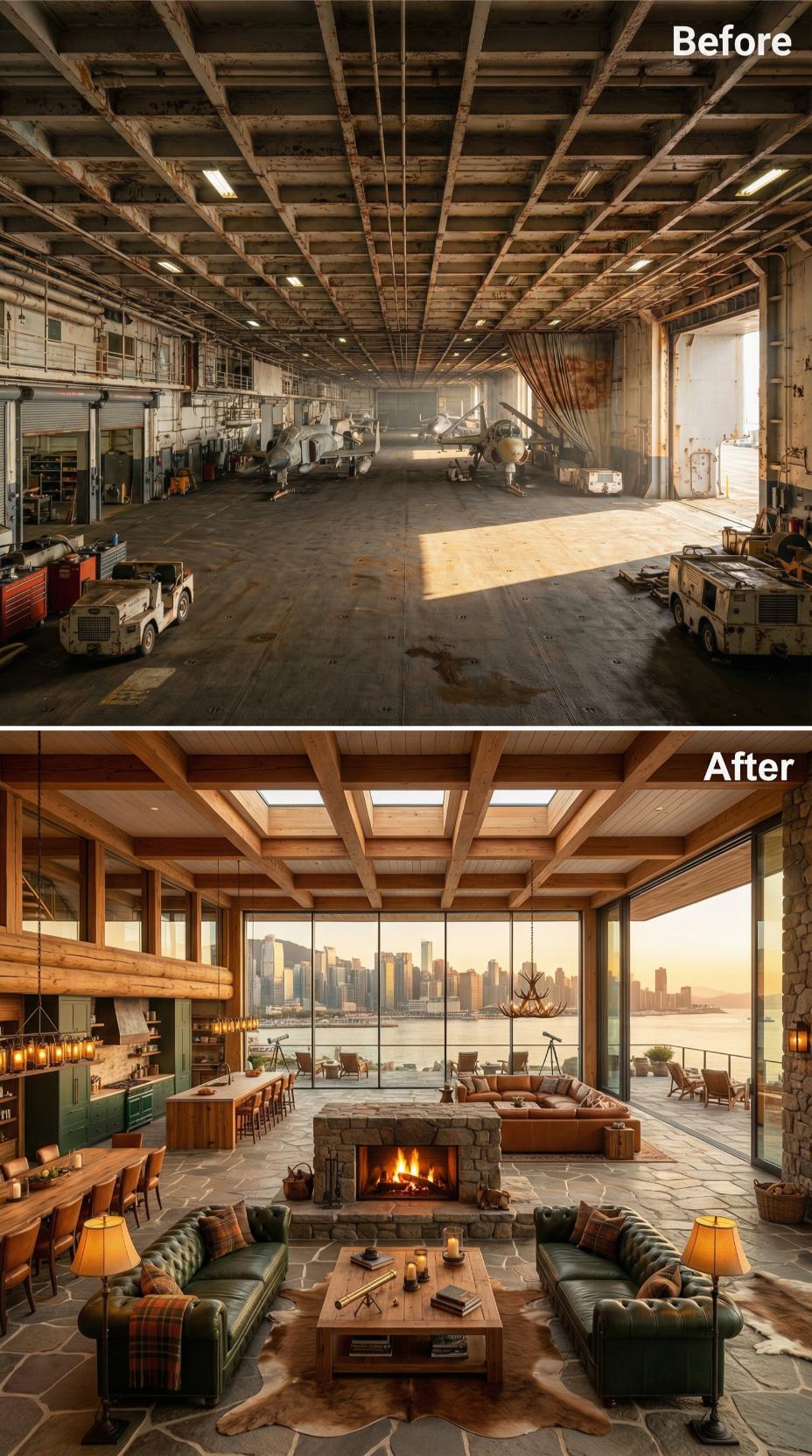
Hangar deck steel that once held 30-ton aircraft now sits beneath flagstone flooring quarried in irregular polygonal cuts.
The designers kept the coffered ceiling grid intact, cladding each structural bay in warm douglas fir planks and cutting skylights directly into the panels to pull in natural light. A central stone fireplace built from stacked fieldstone anchors the room without touching a single original beam above it.
Green leather Chesterfield sofas in a deep forest tone flank the fireplace on three sides, while a caramel-colored sectional in full-grain leather faces the city. Floor-to-ceiling glazing replaced the hangar bay opening, framing a waterfront skyline at golden hour. An antler chandelier and a cluster of brass lanterns over the bar counter balance the weight of the room without competing with the view outside.
28. Hangar Bay to Waterfront Living Room — Milk-White Sofas, Green Velvet, Open Sky
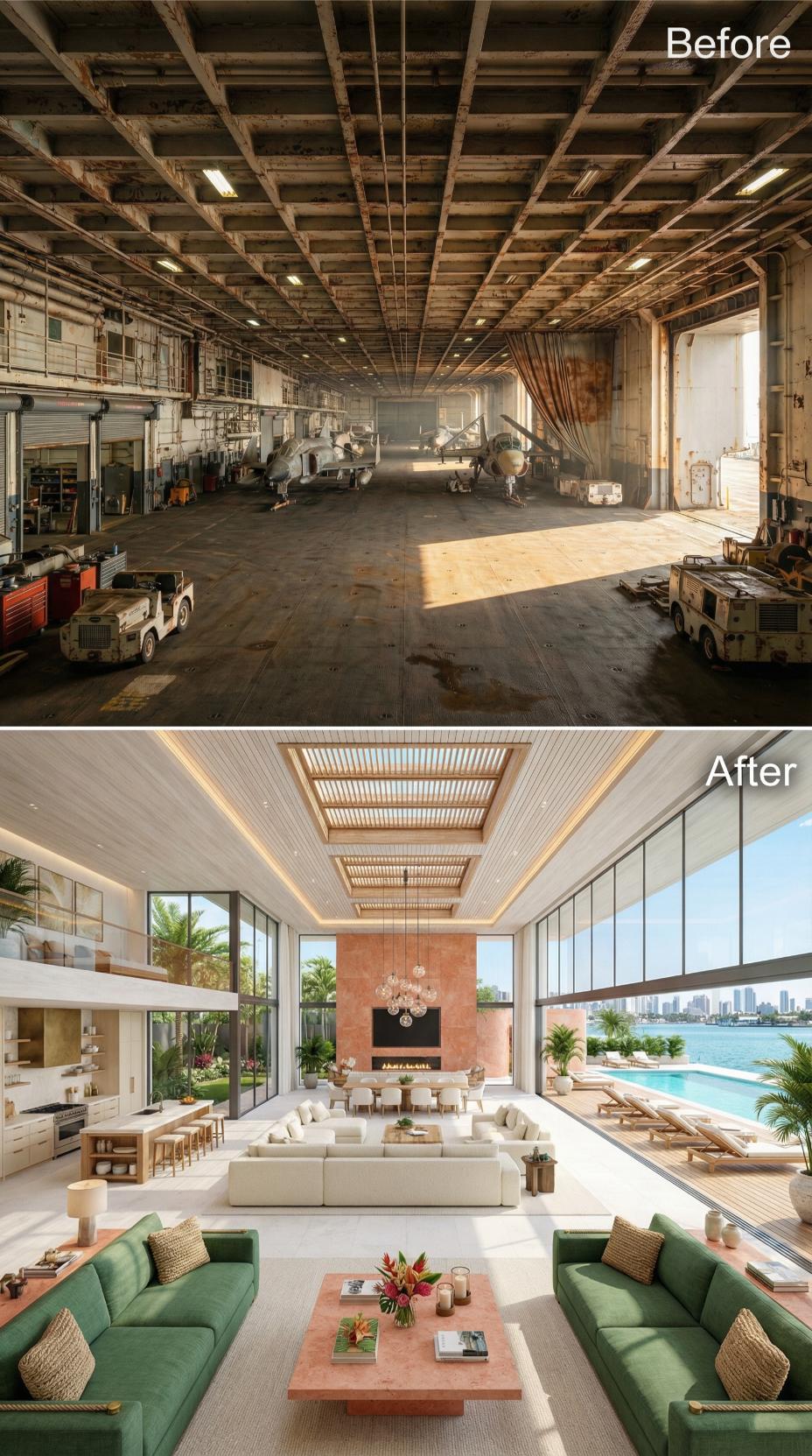
Bleached white oak planks line the ceiling in parallel runs, their rhythm echoing the structural grid of the original hangar bay directly above. A coffered skylight cuts through the center, framed in natural wood trim with warm recessed lighting along each beam. Below it, a terracotta-clad fireplace column anchors the room with a gas insert set flush into the stone face.
Two forest-green velvet sectionals flank a salmon-toned travertine coffee table. The primary seating group uses cream bouclé upholstery across a deep modular sofa configuration. Floor-to-ceiling steel-framed glass panels open the east wall to a pool deck and a city skyline visible across open water, with palm canopies softening the transition between interior and exterior.
History Corner: Aircraft carriers were designed with hangar bays positioned below the flight deck, typically spanning the full width of the ship to allow simultaneous maintenance of dozens of aircraft. The USS Forrestal, one of the largest carriers ever decommissioned, held a hangar bay measuring over 740 feet in length. That scale is precisely what makes these conversions capable of housing living spaces that no land-based structure could replicate at the same volume.
27. Walnut Ceiling Ribs, Fireplace Stone, and a Bar That Runs the Length of a Runway
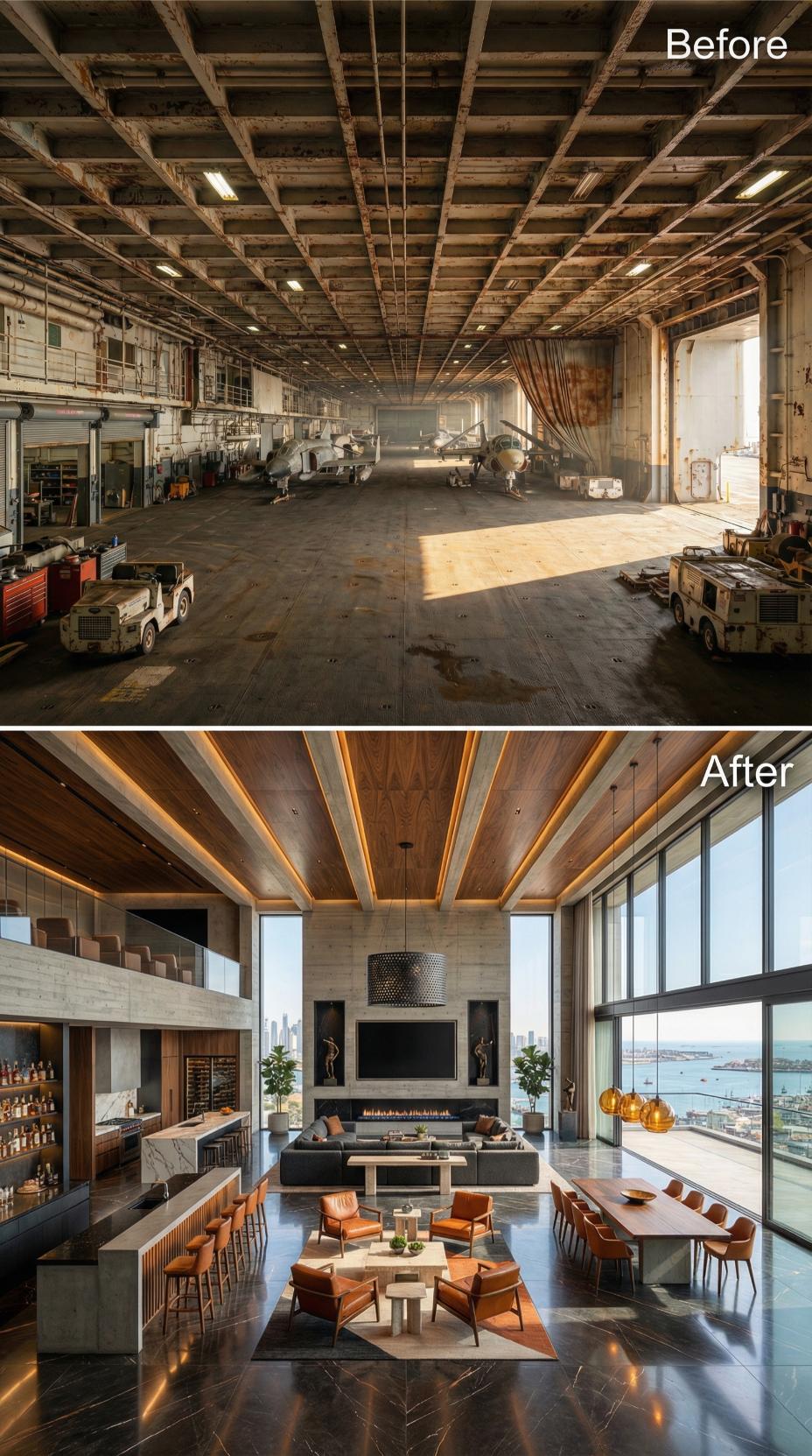
Warm walnut planks line the coffered ceiling in a pattern that mirrors the original structural ribs of the hangar bay, now backlit with recessed amber strip lighting. A floor-to-ceiling concrete fireplace wall anchors the room, flanked by bronze figurative sculptures set into niches. Dark marble floors with pronounced veining run beneath clusters of cognac leather armchairs and a sectional sofa in charcoal bouclé.
A full-length bar occupies the left wall, finished in honed white marble countertops with open bottle shelving running two tiers high. The dining area pulls toward the floor-to-ceiling glazing on the right, where harbor views stretch to the city skyline. Amber globe pendants hang over the dining table in staggered clusters, repeating the warm metal tones carried throughout the space.
Common Mistake: Designers often install dramatic pendant lighting before finalizing ceiling height clearances in adaptive reuse projects, only to discover the fixtures hang too low once furniture is placed beneath them. In a space with original structural beams dictating ceiling planes at irregular intervals, pendant drop lengths need to be calculated against the finished floor level, not the raw ceiling. Mapping furniture placement first and working upward saves costly reinstallation.
26. Oval Skylights Cut Into Blackened Steel Where Fighter Jets Once Sat
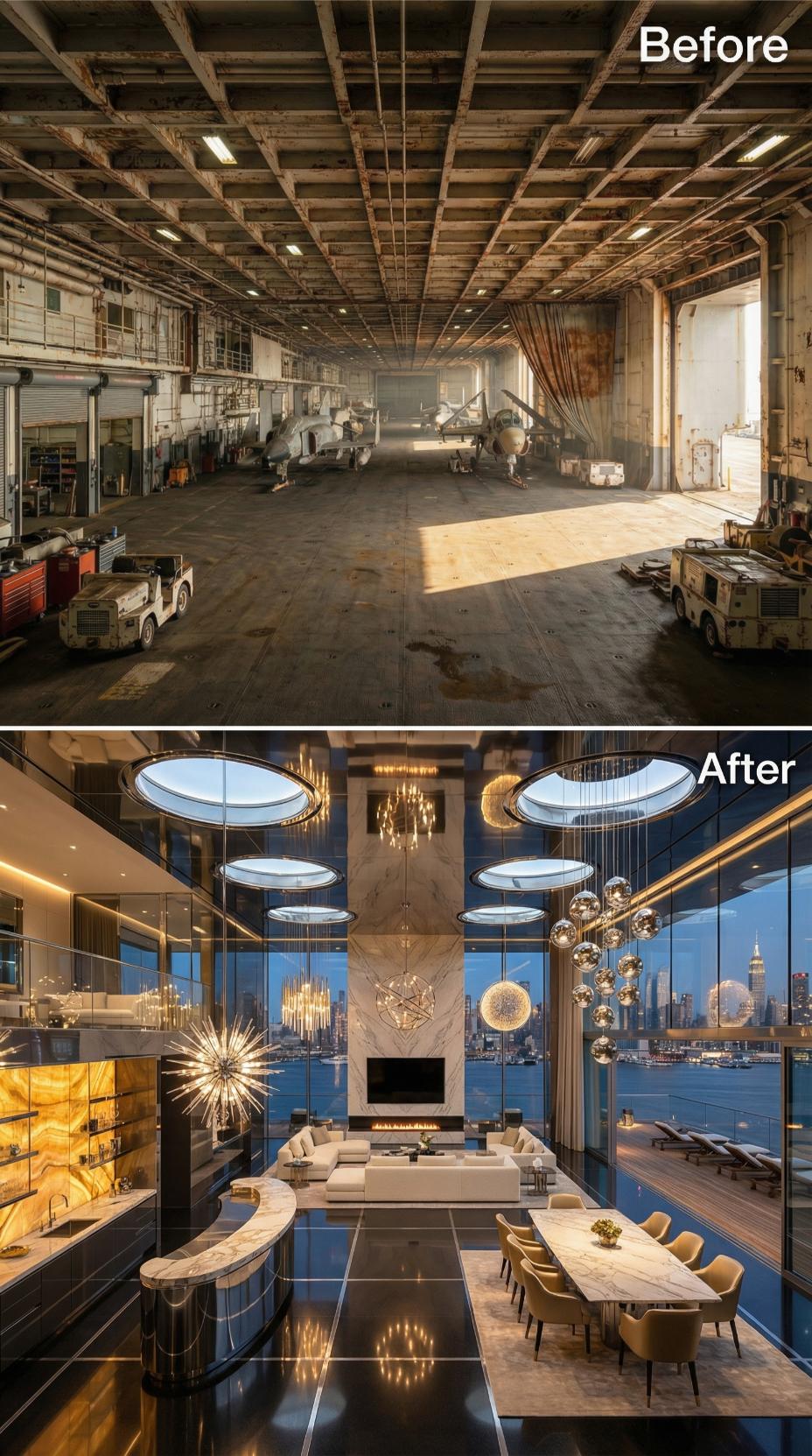
Polished black granite tiles run the full length of the main floor, their mirror finish doubling every chandelier above. The pendant clusters range from a sputnik burst in brushed brass to a cascade of chrome spheres suspended at staggered heights, none of which match, and that tension is precisely the point. Circular porthole skylights, framed in dark metal, punctuate the ceiling at regular intervals and flood the space with daylight the hangar never once saw.
A curved marble kitchen counter anchors the left side, its veining in cream and soft grey echoing the marble fireplace surround centered on the far wall. Floor-to-ceiling glass panels open the entire rear elevation to a waterfront city view, with what appears to be the Manhattan skyline visible at dusk. Gold-toned dining chairs in a brushed velvet finish seat at least ten around a slab-top table on a low-pile area rug.
Material Matters: Circular skylights in adaptive reuse projects are rarely decorative choices alone. On decommissioned naval vessels, round hull openings already exist in the superstructure, and skilled architects often work these penetrations into the ceiling plane rather than welding them shut, reducing both structural modification costs and material waste during conversion.
25. Olive Trees, Arched Stone, and a Fireplace Centered in a Former Jet Bay
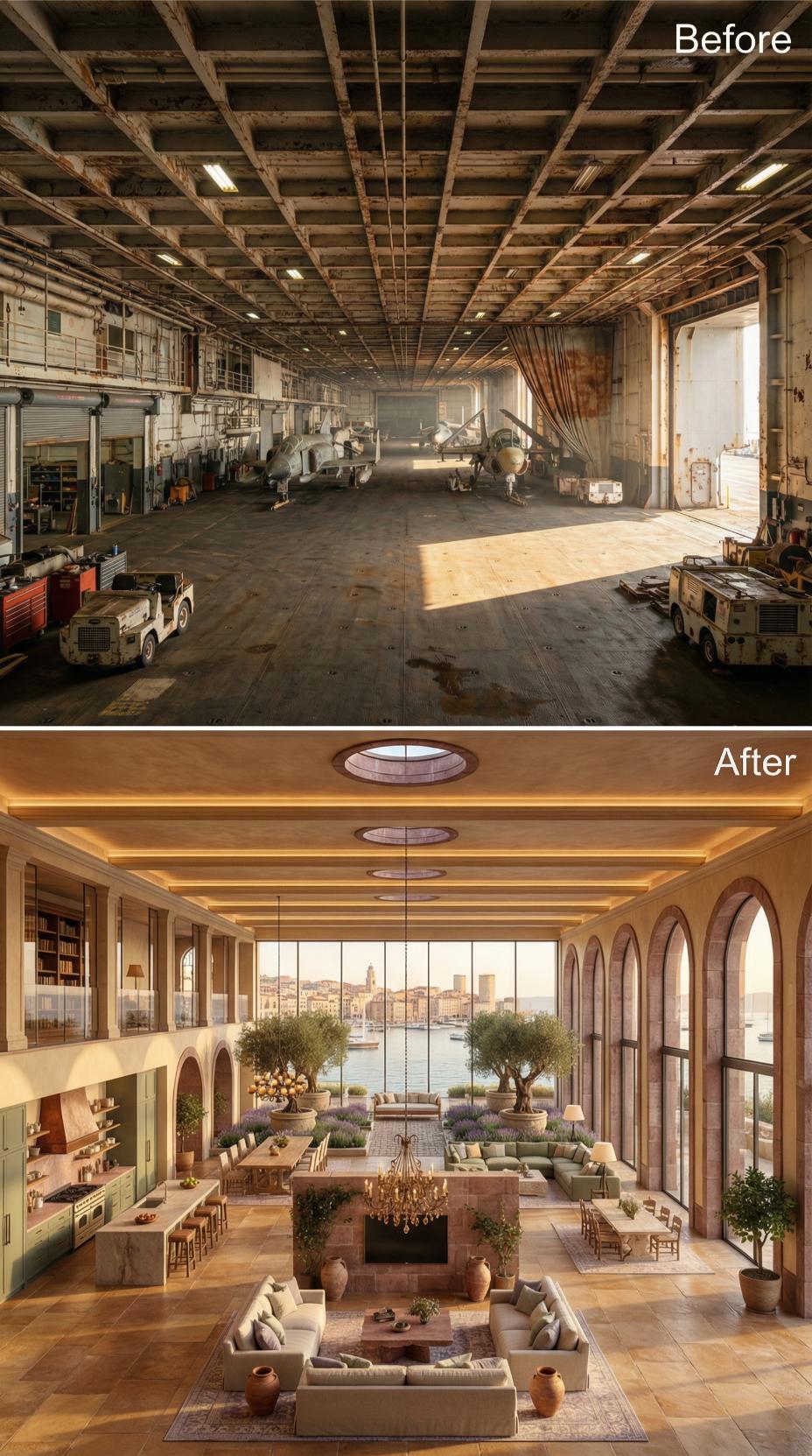
Sage-green cabinetry lines the kitchen wall to the left, paired with marble countertops and open shelving holding cookware and stacked books. A long island with warm wood detailing separates that prep zone from the main living area, where multiple sectional sofas in oatmeal linen face a stone fireplace built from rough-cut travertine blocks. Above it, a chandelier with brass candlestick arms drops into the center of the room.
What was once a cavernous steel bay now reads as a Mediterranean courtyard pulled indoors. Potted olive trees anchor the midpoint of the space, flanked by lavender plantings in terracotta urns. The ceiling steps down in layered plaster coffers with recessed amber strip lighting. Arched window bays run the full length of the right wall, and floor-to-ceiling glass at the far end frames a harbor view of a limestone city across the water. Stone tile flooring in a large-format irregular pattern covers every inch of what was previously bare aircraft-grade steel deck plating.
- Travertine fireplace surrounds can absorb significant structural anchoring into a steel subfloor without requiring additional concrete pours
- Olive trees grown in containers require root barriers when placed over preserved naval steel to prevent corrosive moisture buildup
- Arched window openings cut into the hull sides of carrier conversions must be engineered around existing frame ribs, which often dictate final arch width
24. Hangar Deck Gone, Walnut Ribs and Emerald Marble Take Its Place
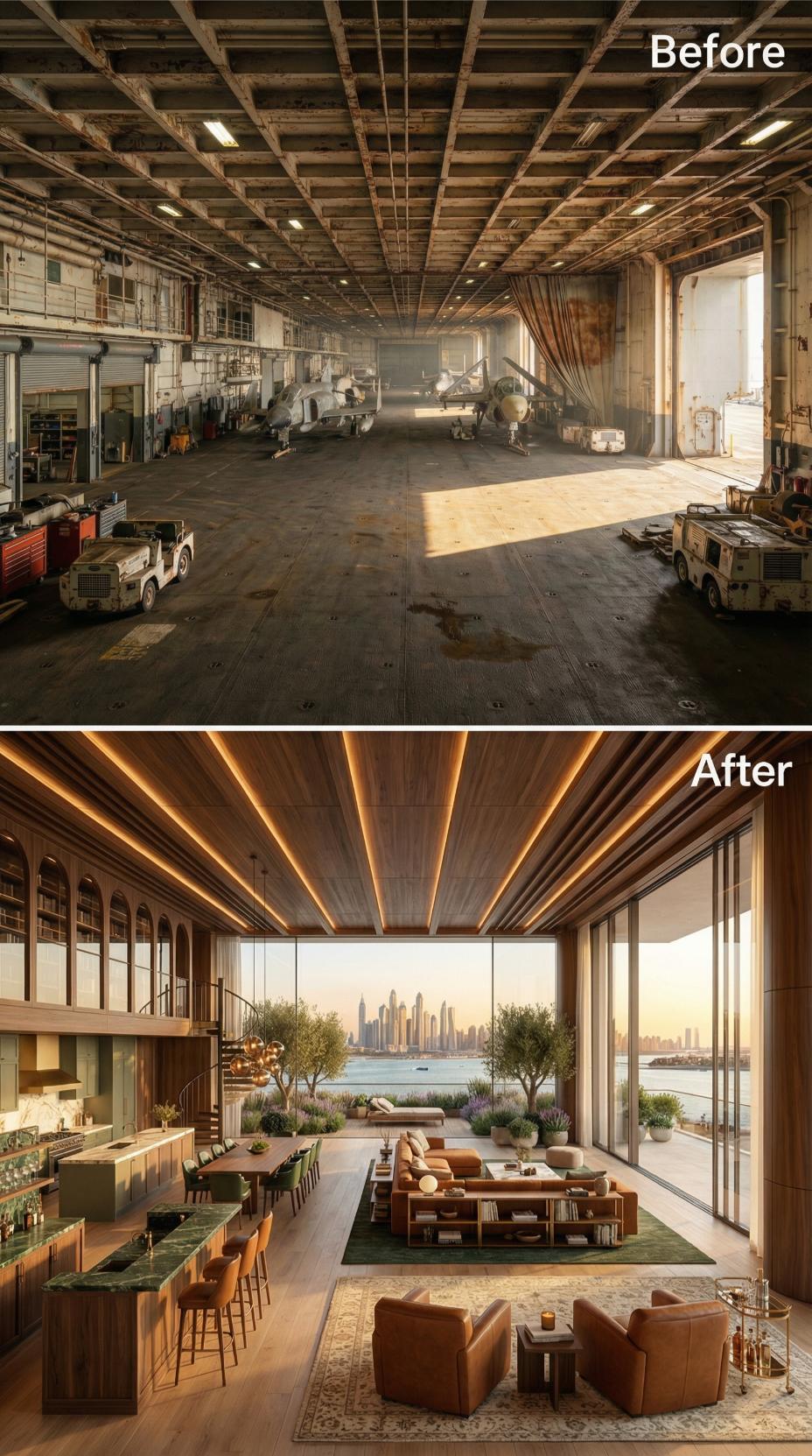
Recessed LED strips run the full length of wood-paneled ceiling ribs, casting amber light down onto wide-plank oak floors that stretch toward floor-to-ceiling glass. The view beyond that glass is a city skyline at golden hour, framed by olive trees planted directly in the terrace deck. On the left, a kitchen island surfaces in deep green marble with visible veining, paired with leather bar stools in cognac and cabinetry finished in matte sage. Arched glazed shelving lines the far wall in a configuration that reads more library than storage.
A leather sectional in burnt sienna anchors the central seating area over a forest green area rug. Smaller club chairs in the same cognac leather pull the palette forward. The layering of warm browns, deep greens, and natural wood prevents any single material from dominating the room.
Pro Tip: Hangar bays on Nimitz-class carriers could exceed 25 feet in ceiling height, which gives adaptive reuse designers enough vertical clearance to introduce full mezzanine levels, dropped ceiling planes, and recessed lighting soffits without sacrificing the open-volume feel that makes these conversions so spatially distinct from conventional residential builds.
23. Paper Lanterns by the Hundreds, Low Tables, and a Skyline Framed in Former Steel
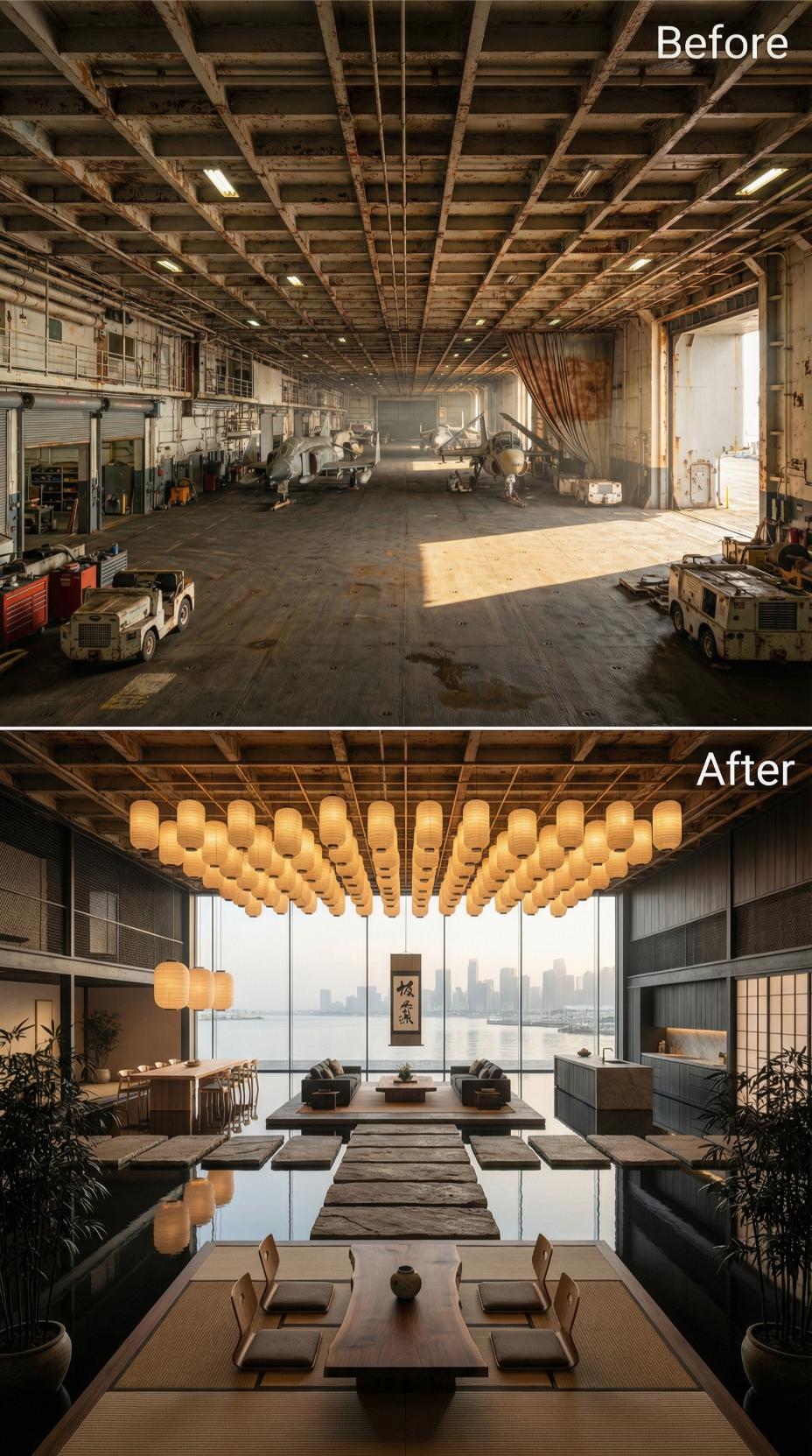
Dozens of cylindrical rice-paper lanterns hang in regimented rows from the original coffered steel ceiling, their amber glow washing the low-slung dining tables in warm gold. The tables themselves are live-edge slabs, likely zelkova or elm, set close to the floor and flanked by floor cushions and legless chairs in the style of traditional Japanese zashiki seating. Floor-to-ceiling glass now closes off what was once an open hangar mouth, placing a full harbor skyline and waterline directly behind a hanging ink-brush scroll.
- Japanese paper lanterns lose roughly 30 percent of their perceived warmth when hung above 12 feet, making the retained low ceiling here a functional lighting decision
- Live-edge dining tables in zashiki-style arrangements require floor-level structural anchoring that benefits directly from the carrier deck’s original steel substrate
- Adaptive reuse projects that retain original ceiling grid patterns reduce demolition costs by an average of 18 percent compared to full gut renovations
22. Skylight Panels, Marble Floors, and a Grand Piano Where Jets Once Parked
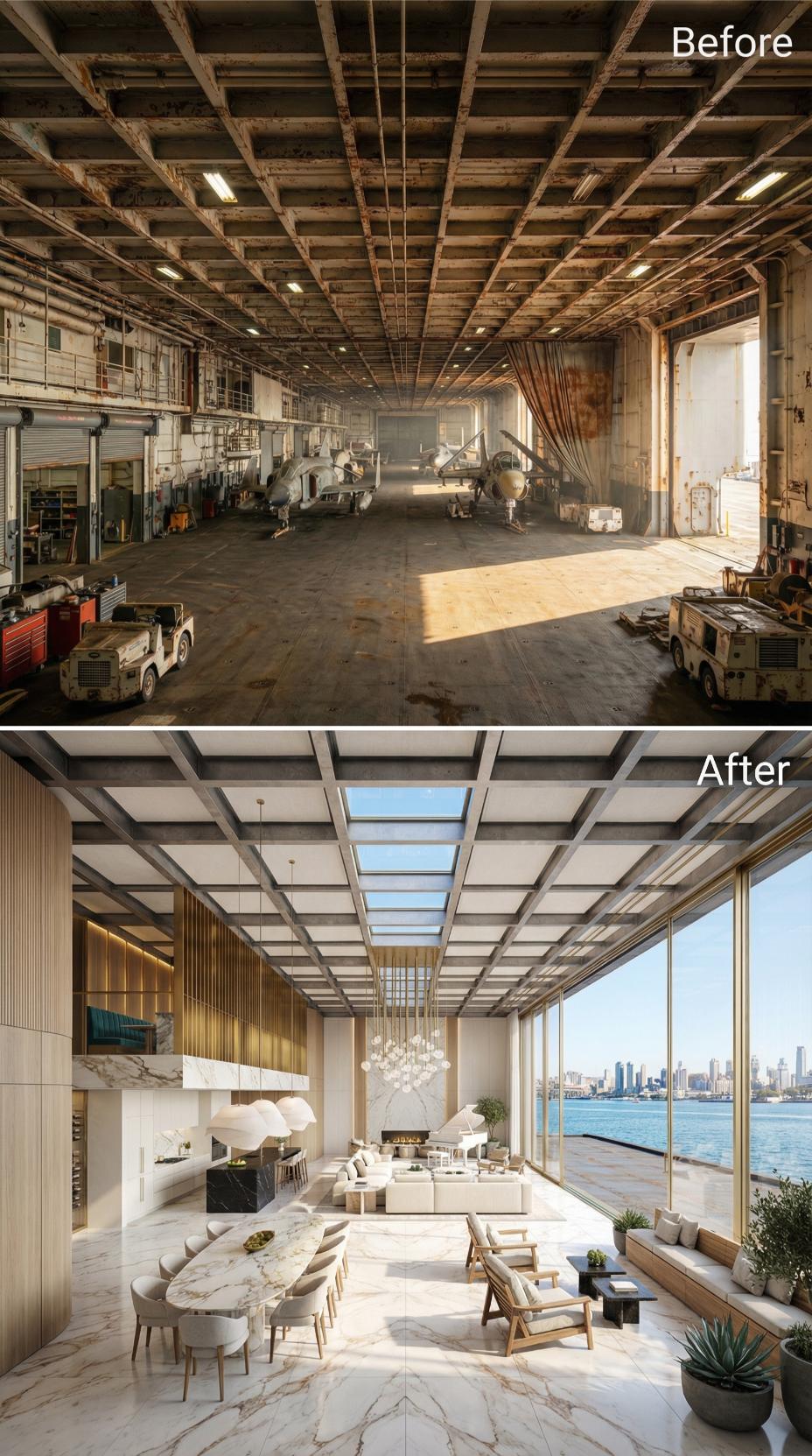
Calacatta marble tiles run wall to wall across what was once bare steel decking, their gold veining catching light that falls through a row of rectangular skylights cut directly into the original coffered ceiling grid. The grid itself remains exposed, its industrial geometry now painted out in pale concrete tones rather than stripped back to rust. A cluster of globe pendants hangs from a brass rod system at mid-span, positioned above a seating arrangement of cream linen sofas and oak-framed lounge chairs.
Floor-to-ceiling glazing along the starboard wall opens the entire room to a harbor view, with a city skyline sitting low on the water behind it. A white grand piano anchors the far corner near a linear fireplace set into vertical wood slat paneling. The dining table is slab marble on a dark base, surrounded by bouclé chairs in off-white. Every finish here reads pale, warm, or reflective, which makes the sheer scale of the former hangar feel residential rather than cavernous.
Trend Alert: Rectangular skylights installed into existing structural ceiling grids are gaining ground in adaptive reuse residential projects as an alternative to full glass roofs. They preserve the visual rhythm of the original framework while introducing controlled daylight without the thermal load of an all-glass ceiling. On a vessel-based conversion, they also avoid compromising the load-bearing integrity of the original steel coffers.
21. Bamboo, Bonsai, and Coffered Wood Ceilings Reclaimed from a Warship’s Hull

Blonde wood slats line the ceiling in a coffered grid, warm light bleeding through recessed panels cut directly into the original structural framing. Ground-level seating anchors the near end of the space: a pair of oversized linen sectionals, a low slab coffee table in dark hardwood, and bonsai specimens placed with the kind of deliberate restraint that reads as confidence rather than decoration.
Floor-to-ceiling glazing runs the full rear wall, framing a harbor skyline and stands of live bamboo rooted indoors. Shoji-screen panels flank the left wall. A second seating zone sits deeper in the plan, pulled tight around a flat-panel fireplace in matte black, with charcoal tile floors running uninterrupted from front to back.
Worth Knowing: Bamboo planted inside adaptive reuse residential projects is rarely a purely aesthetic decision. Its root systems require isolation barriers to prevent structural penetration, meaning designers working with existing steel deck plates often commission custom steel planters that bolt directly into the original carrier floor grid, using the same mounting geometry once reserved for aircraft tie-down fittings.
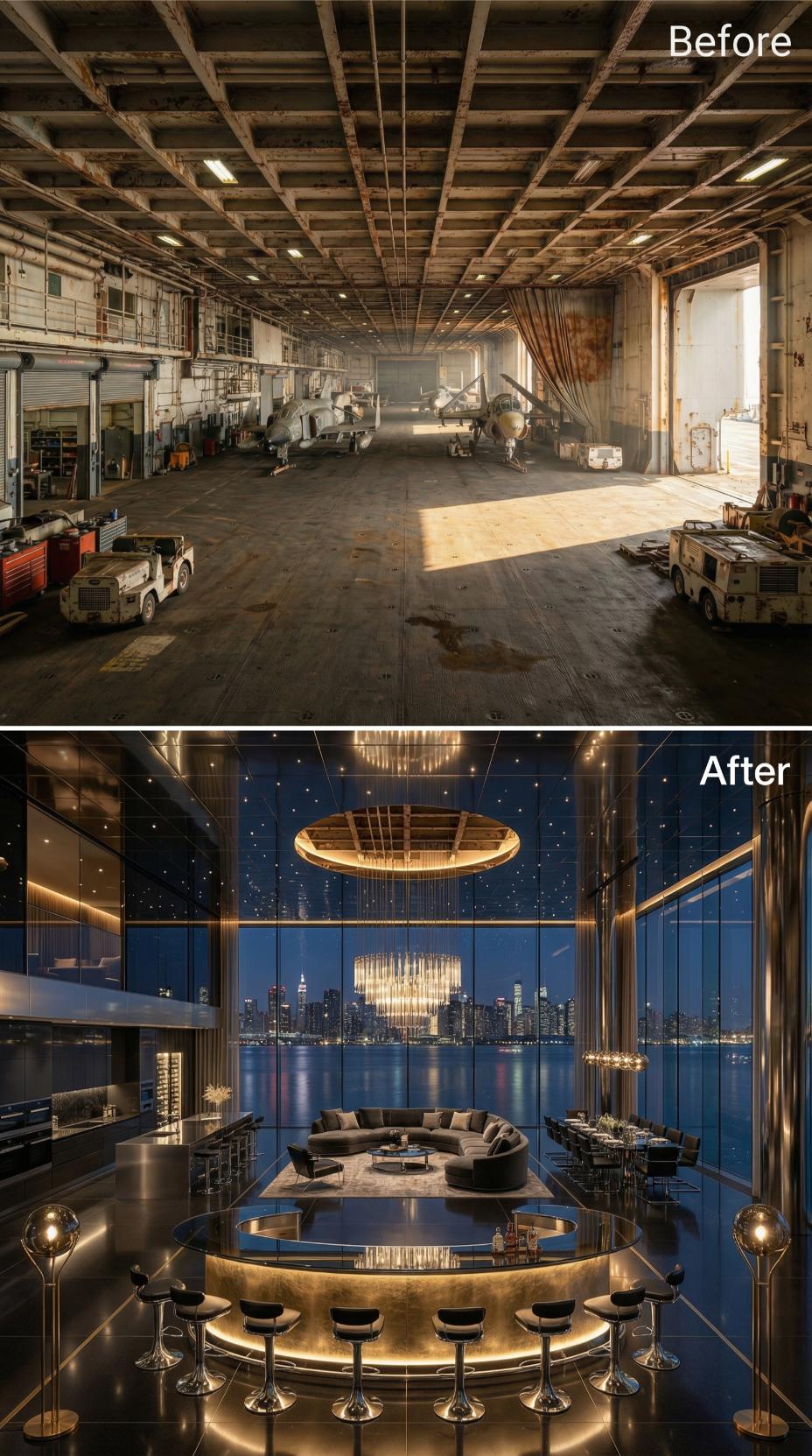
20. Sunken Bar Ring, Brass Uplighting, and a Skyline Wall Replaces Hangar Door
🔥 Would you like to save this?
Circular bar seating drops below floor level on a platform edged in brushed brass strip lighting, surrounding a raised conversation pit anchored by a curved sectional in charcoal velvet. Above it all, a tiered crystal chandelier hangs from what reads as a coffered oval recess, its warm gold reflected across floor-to-ceiling glass panels that open onto a full city skyline across open water at night.
Fun Fact: Sunken conversation pits fell out of residential fashion after the 1970s largely due to safety code concerns, but adaptive reuse projects on decommissioned vessels have brought them back. The naturally recessed structural zones in carrier hangar decks, originally designed to channel fuel and equipment lines below deck level, give designers a ready-made depression to work with rather than excavating new construction.
19. Stacked Slate Fireplace, Skylight Ribs, and a Waterfront Wall Where Rust Once Ruled
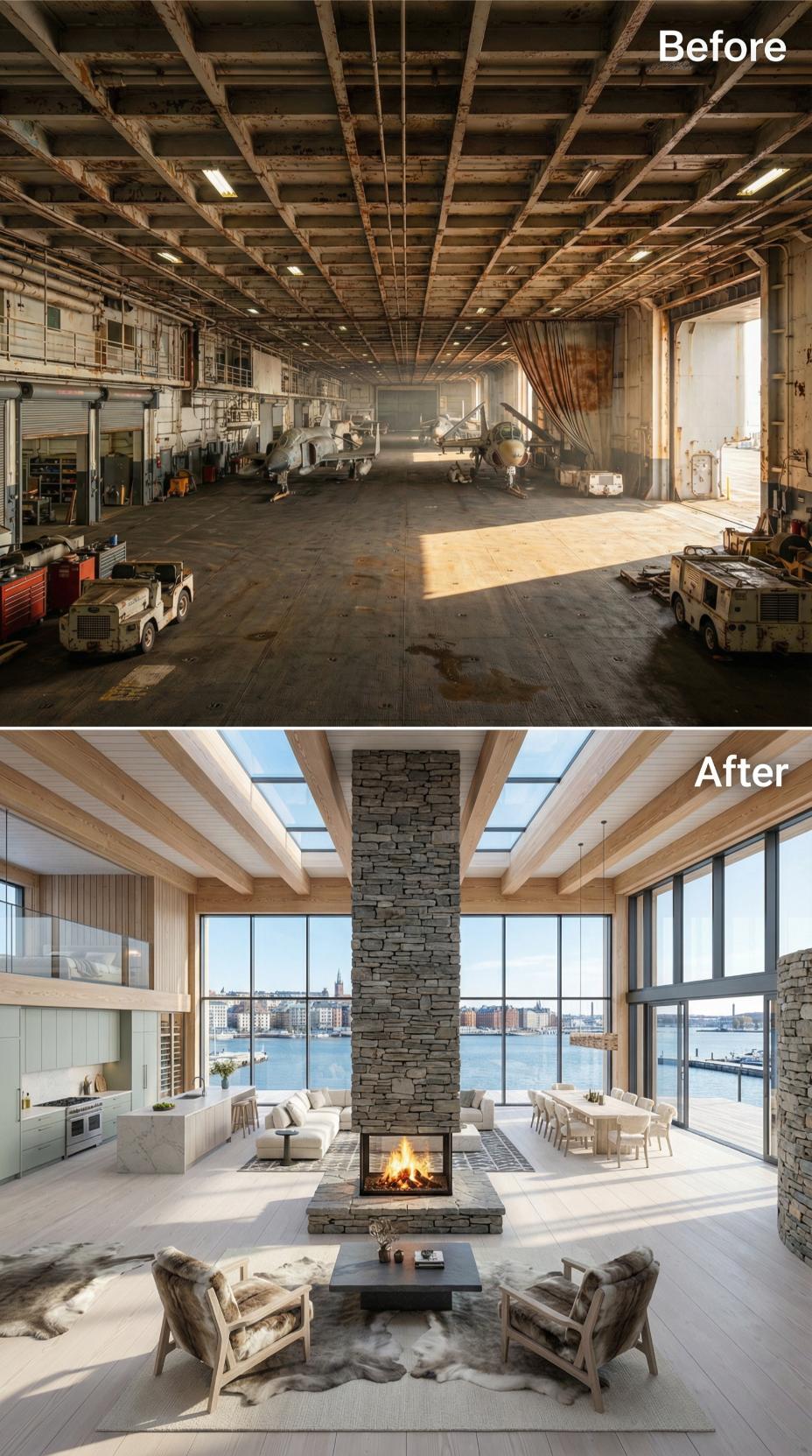
Light pine beams run the length of a vaulted ceiling where corrugated steel once trapped diesel fumes. A floor-to-ceiling slate chimney anchors the room, its stacked-stone coursing rising past the roofline with a double-sided firebox at its base. White oak plank flooring, fur-draped wood-frame chairs, and a low square table in matte charcoal pull the seating zone tight around the flame. Floor-to-ceiling glass panels open onto a harbor view that runs the full width of the former hangar bay.
Budget Tip: Reclaimed steel beams from decommissioned vessels can be sandblasted and sealed for roughly 40 percent less than sourcing equivalent structural steel new. Pairing salvaged metal with fresh-milled softwood cladding, as seen in the ceiling treatment here, keeps material costs in check without sacrificing scale. Sourcing the stone for a feature chimney locally rather than importing quarried slate can shave another 15 to 20 percent off the masonry budget.
18. Gold Disc Ceiling, Floor-to-Ceiling Glass, and Sofas Sized for a Hangar
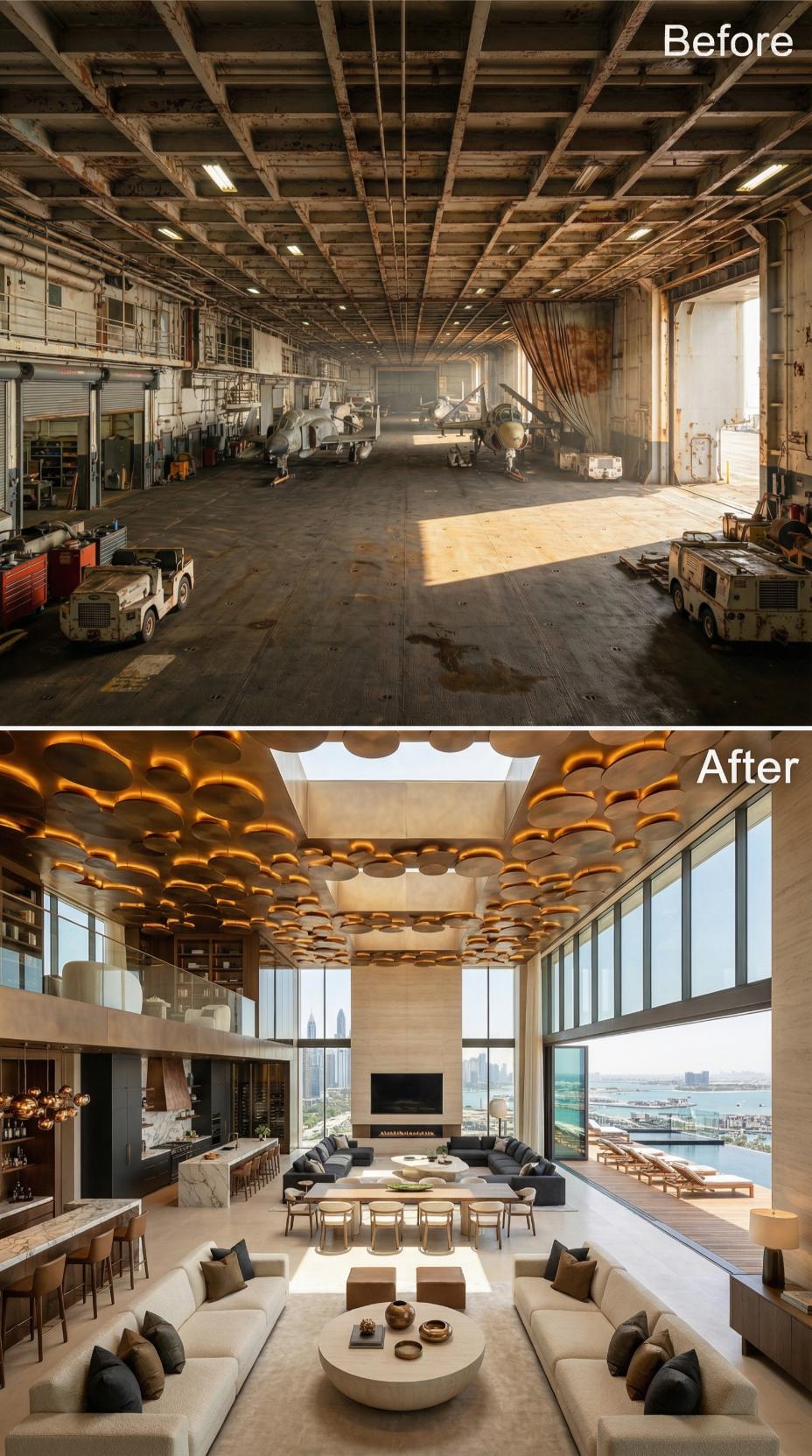
Overlapping bronze discs cover the entire ceiling, each one backlit with amber light that pools between the curved forms like something between sculpture and acoustic tile. Below them, cream linen sectionals anchor a living zone that runs nearly the full length of the former bay, flanked by a marble-topped kitchen counter on one side and open water views on the other.
Ask Yourself: If your ceiling becomes the focal point, every surface beneath it needs to recede. Notice how the cream, sand, and charcoal palette in this room keeps the eye moving upward rather than competing with the disc installation above.
17. Mezzanine Library, Skylight Ribs, and Glass Walls Facing Open Water
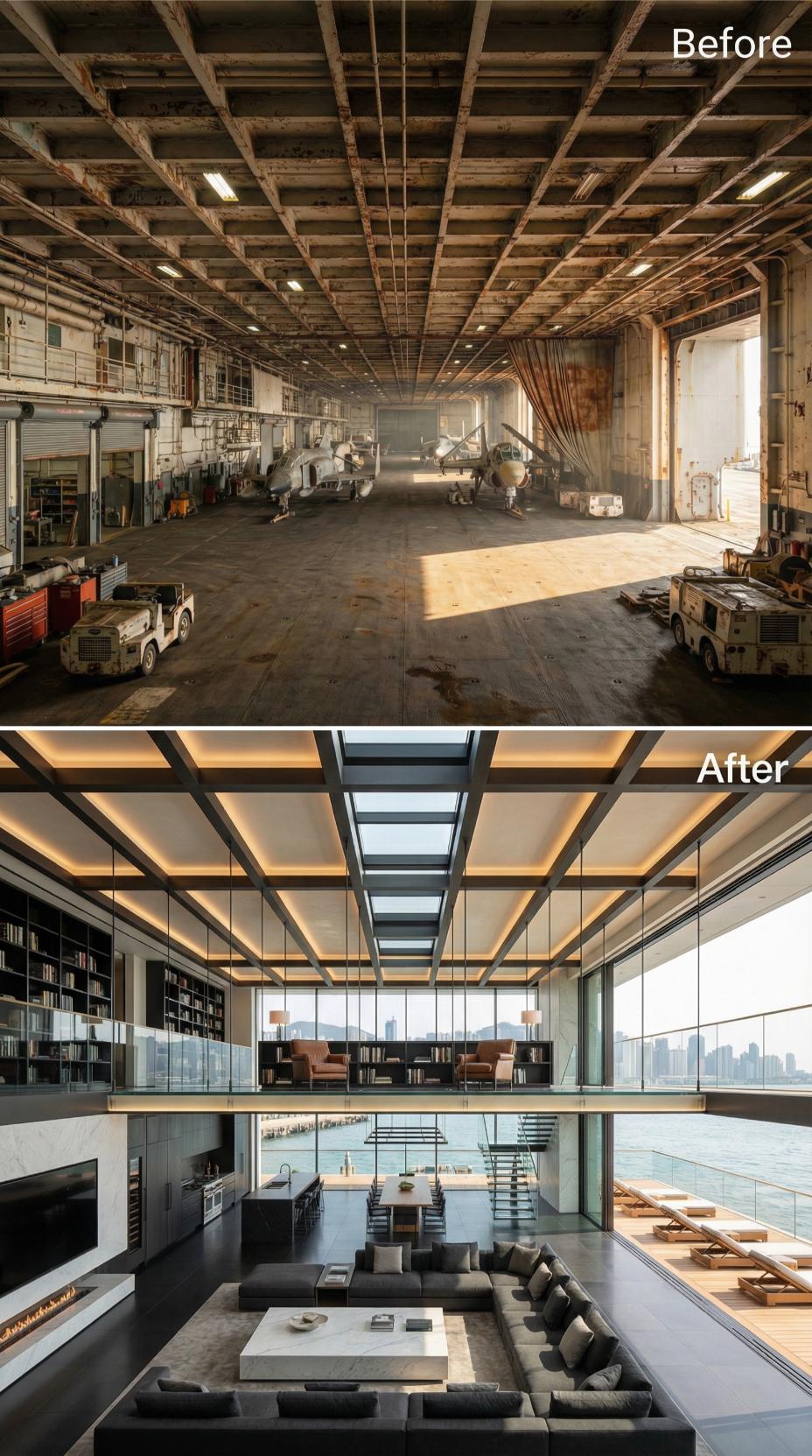
The coffered ceiling grid runs the full length of the space, its dark steel beams fitted with flush warm-tone LED strips that wash each panel in amber. Below it, the lower level arranges a sectional sofa in charcoal fabric around a slab coffee table in honed limestone, with a gas fireplace set flush into a marble surround on the far wall.
A steel staircase with open risers connects to a mezzanine level lined with floor-to-ceiling bookshelves in dark-stained wood, flanked by two leather club chairs in cognac. Floor-to-ceiling glass panels replace the hangar bay opening entirely, framing a city skyline across the water and flooding both levels with natural light.
How the Mezzanine Solves the Volume Problem
Hangar bays converted to residential use often suffer from a single flaw: too much vertical space with no programmatic reason to fill it. Inserting a partial mezzanine level, as done here, breaks the height into two livable zones without closing off the sightlines between them. The glass balustrade on the upper level keeps the visual connection intact, so both floors still read as one continuous space rather than two stacked rooms.
16. Skylight Ribs, Onyx Ceiling Panels, and Green Velvet Sofas Floating Above a Waterfront Wall
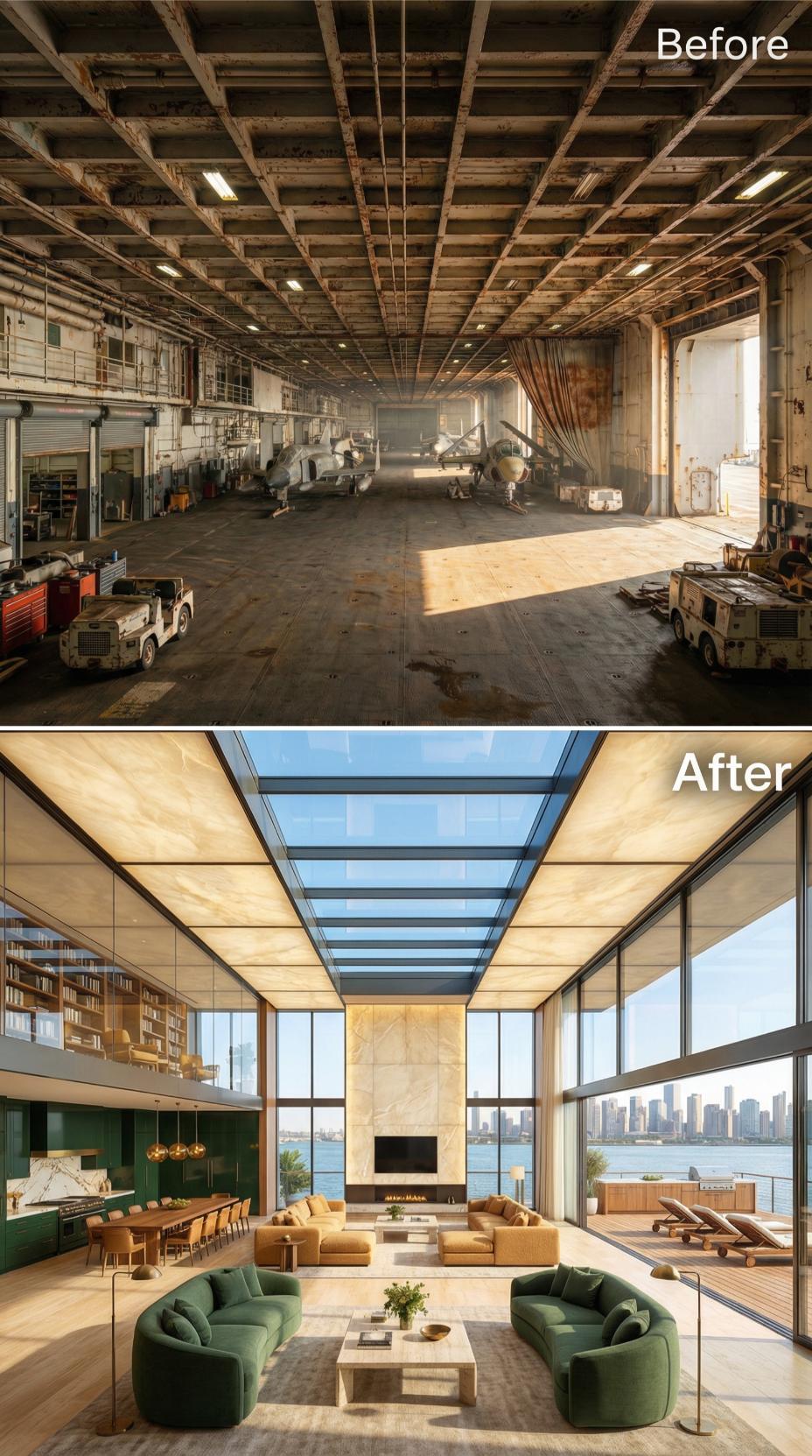
Four glass skylight bays cut through translucent onyx ceiling panels flood the main floor with natural light, while the warm amber glow from the backlit stone gives the room a quality closer to candlelight than daylight. Marble cladding runs floor to ceiling on the fireplace column, flanked by floor-to-ceiling glass walls that frame open water and a city skyline beyond.
Two curved green velvet sofas anchor the conversation area, paired with low-profile mustard upholstered seating and a travertine coffee table. A mezzanine level with built-in bookshelves overlooks the room from above left, while a green-cabinetry kitchen with pendant brass lighting sits just beyond the dining table.
The Psychology Behind This: Curved furniture in a room this large does specific psychological work. Hard-edged pieces would read as isolated islands inside a former hangar, but the arc of each sofa pulls sightlines inward, creating a sense of intimacy the square footage alone never could. Occupants register the scale of the space without feeling exposed by it.
Where the previous space leaned on stone and firelight, this one bets entirely on ceiling drama.
15. Wave-Form Plaster Ceiling, Green Marble Bar, and Floor-to-Ceiling Glass Facing Open Water
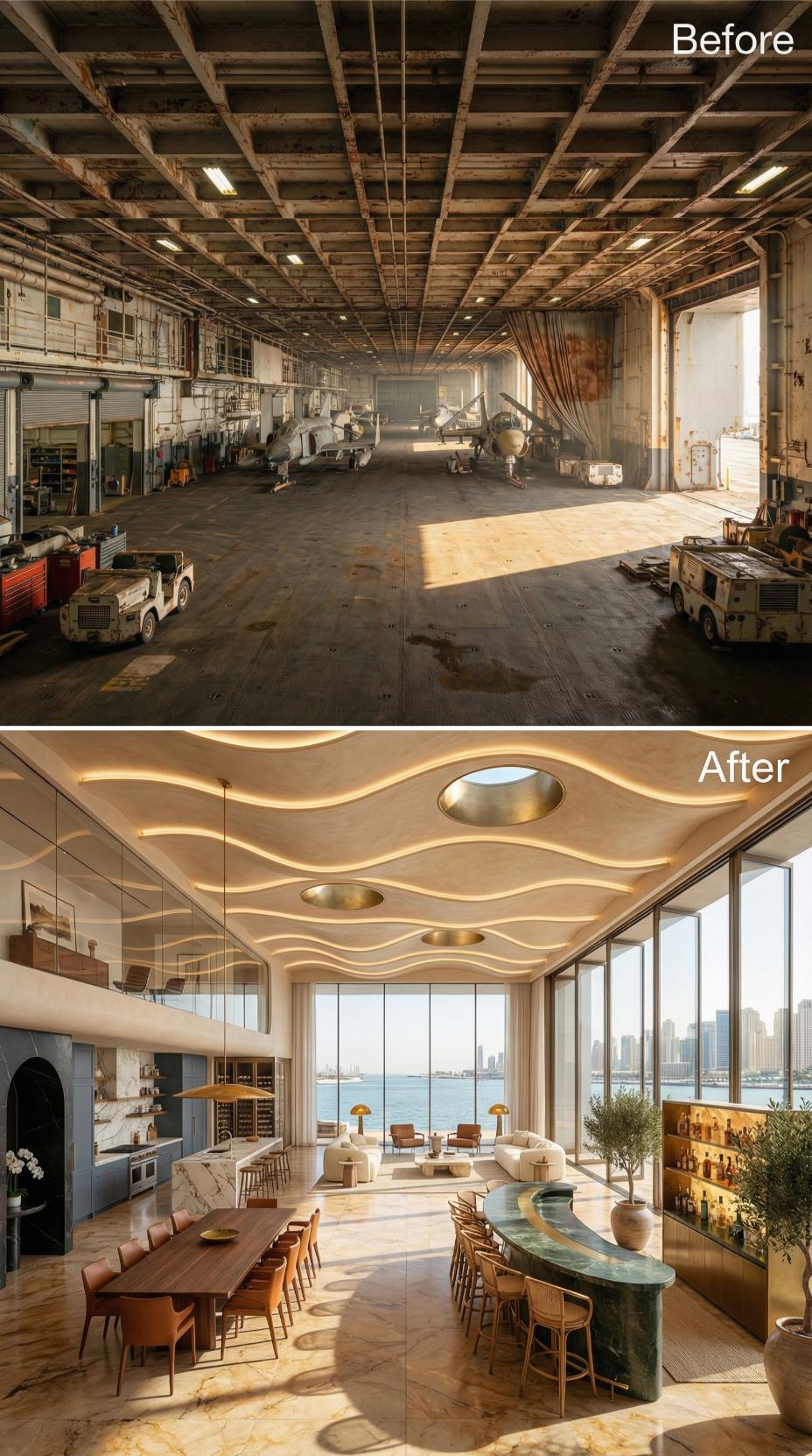
Undulating plaster ribs ripple across the full ceiling length, each wave edge backlit with continuous warm LED strip lighting and punctuated by two recessed brass bowl fixtures. Nothing about that ceiling reads industrial. It reads sculptural, which makes the contrast with the before state almost disorienting.
Below it, a walnut dining table seats at least twelve, paired with cognac leather side chairs. A curved bar counter in veined green marble anchors the right side of the room, backed by an open brass shelving unit stocked with bottles. Floor-to-ceiling glazing runs the entire far wall, pulling in unobstructed water and city skyline views. On the left, slate-blue cabinetry and a marble island define the kitchen zone without closing it off. Cream upholstered sofas cluster near the glass, and a potted olive tree in a wide ceramic vessel grounds the center of the room without competing with any single surface.
14. Warm Fir Skylight Ribs, Amber Velvet Sofas, and a City Skyline Through Full-Height Glass
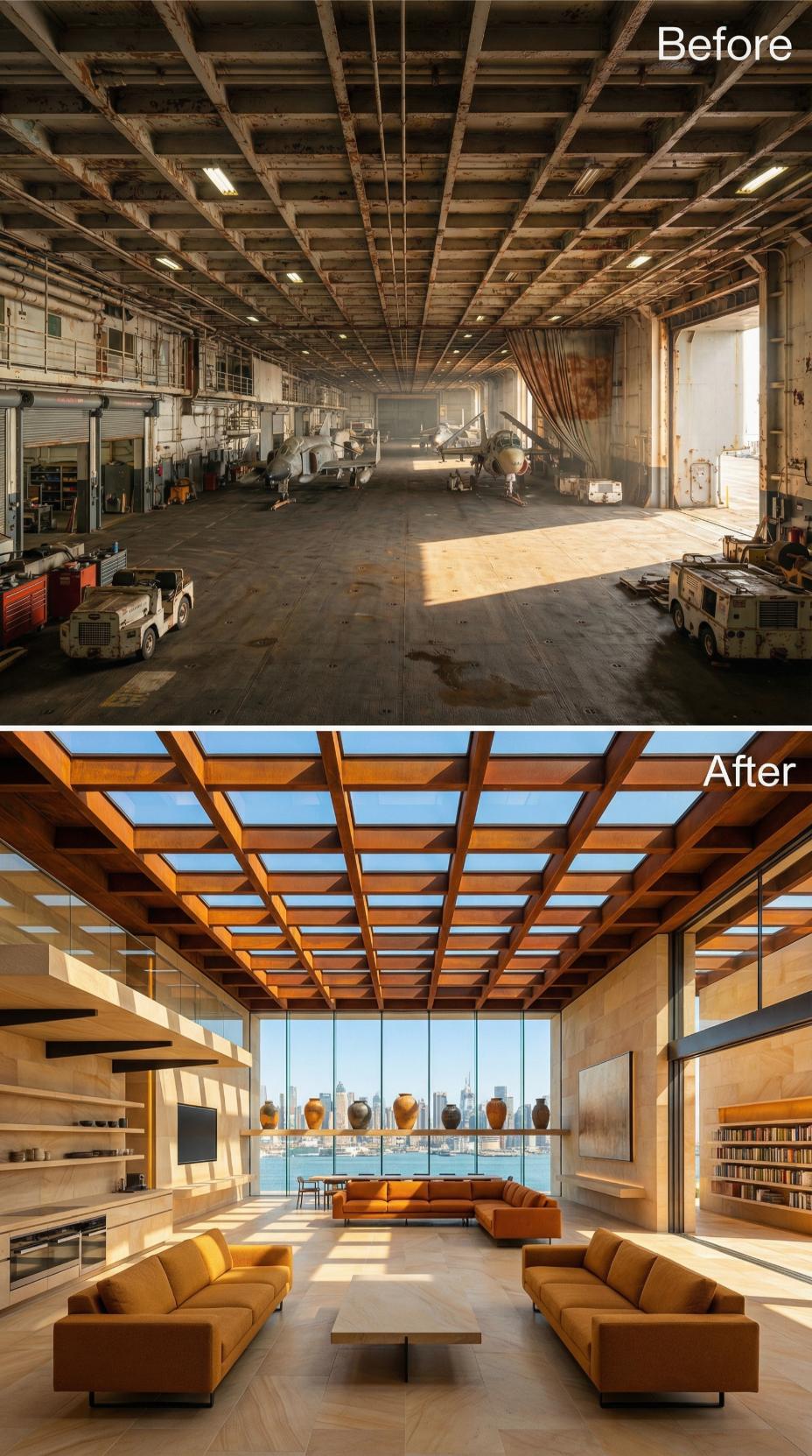
Honey-toned fir beams form a coffered grid overhead, with glazed panels set between each rib flooding the floor in natural light. Rust-colored velvet sectionals anchor the center on pale oak flooring, while ceramic amphora vessels line the glass wall facing open water and a city skyline beyond.
13. Walnut Bookshelves, Herringbone Oak Floors, and a Chandelier Cascade Where Jet Fuel Once Pooled
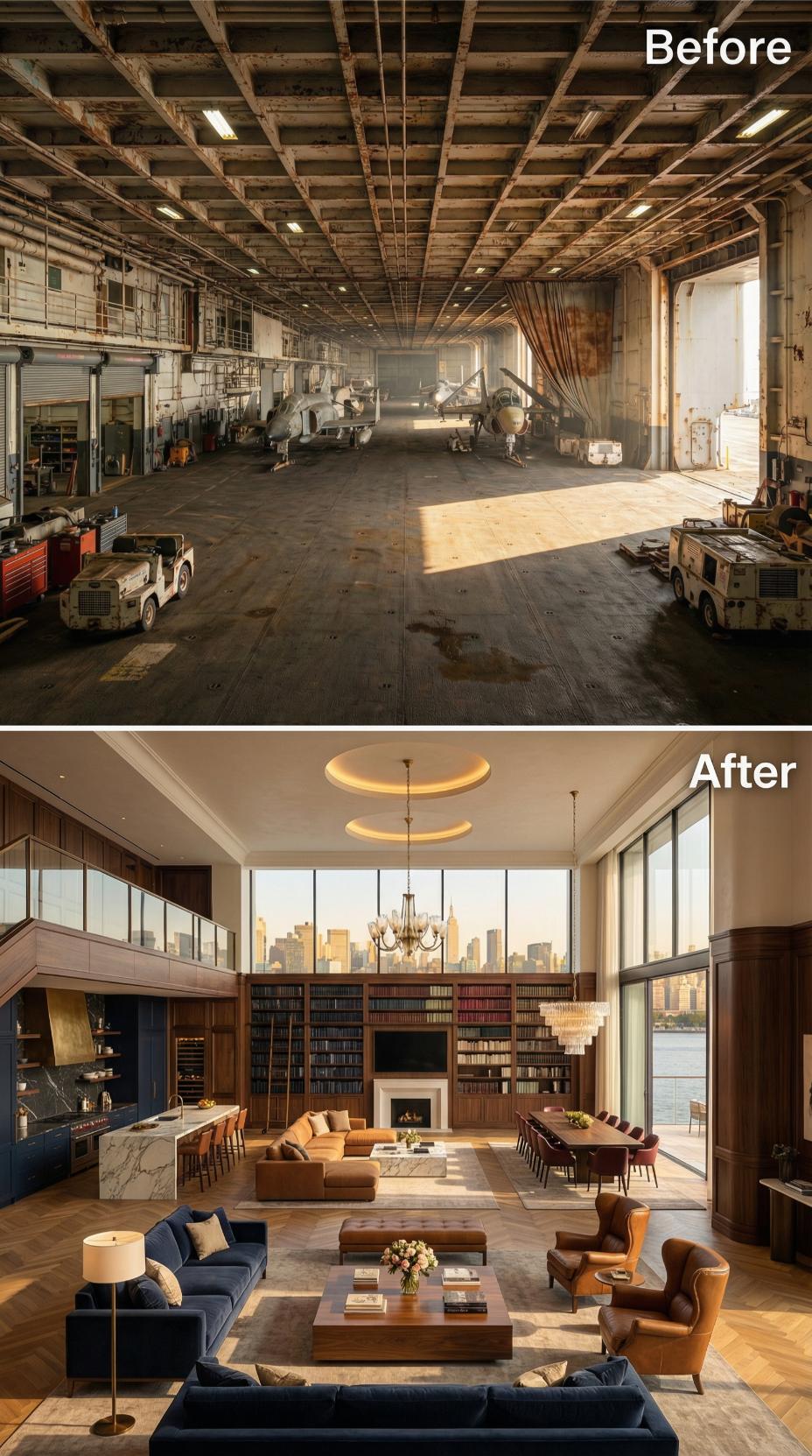
Warm walnut millwork lines the back wall floor to ceiling, housing what appears to be thousands of volumes flanking a white marble fireplace surround. Cognac leather wingbacks and a tufted leather ottoman anchor the room’s center while navy velvet sofas define the outer edge of the seating zone. Overhead, a recessed oval coffer with amber uplighting holds a tiered crystal chandelier, and herringbone-laid oak flooring runs the full length of the space toward floor-to-ceiling glass framing a city skyline and open water beyond.
12. Linen Ceiling, Navy Sectional, and Floor-to-Ceiling Glass Cut Through a Carrier’s Hull
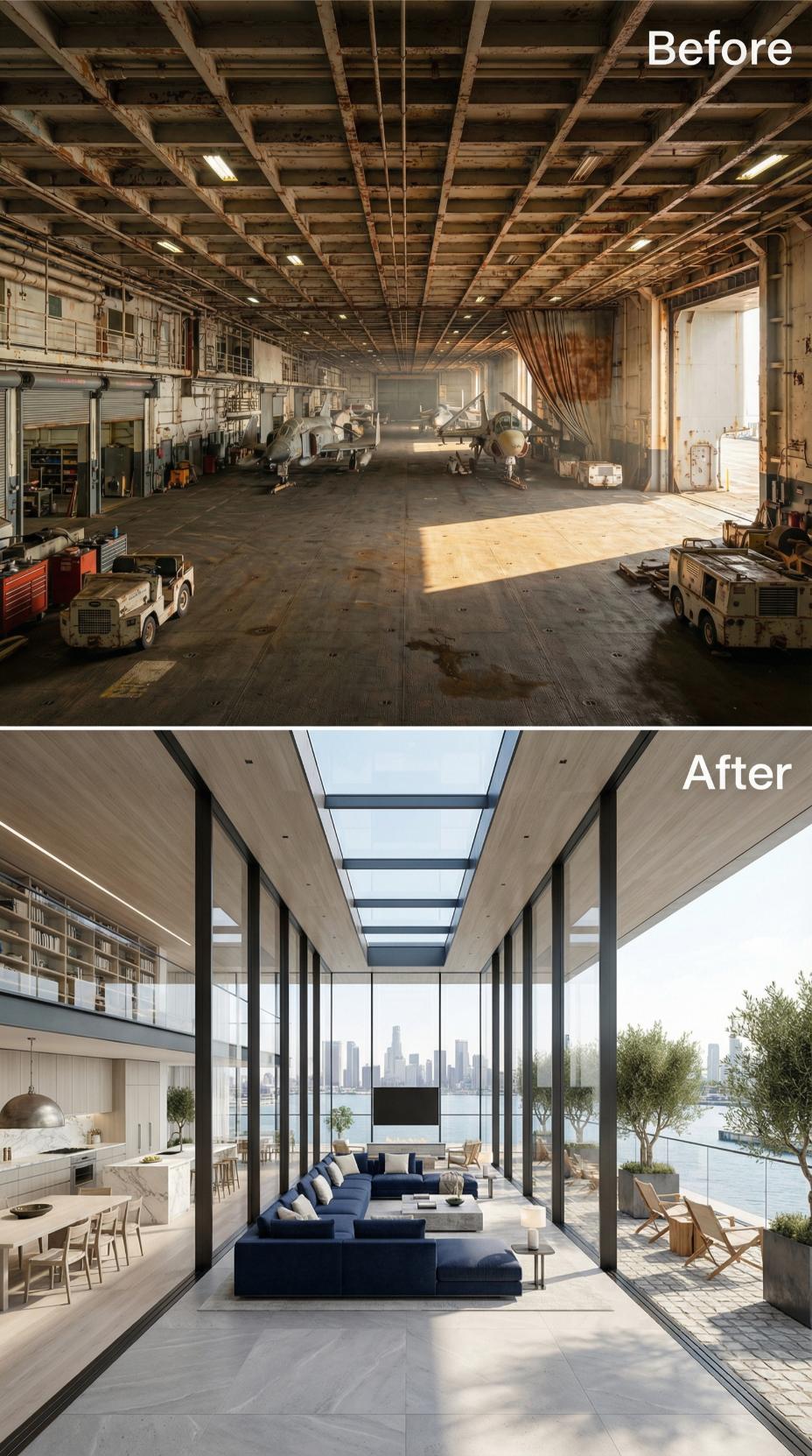
Pale linen-toned wood planks run the full length of the ceiling, their grain direction pulling the eye toward a continuous skylight strip framed in matte black steel. Below it, a navy blue sectional anchors the center of the space with enough mass to hold its own against the scale of the former hangar deck.
Floor-to-ceiling glass panels replace what was once a rusted steel wall, opening directly onto a waterfront terrace where olive trees grow in concrete planters beside low teak lounge chairs. Inside, a marble island separates the kitchen from the living zone, and open shelving lines the mezzanine level above. Porcelain tile flooring in large-format grey slabs runs uninterrupted from kitchen to glass wall, keeping every surface beneath the skylight deliberately quiet.
11. Brass Bar, Coffered Cream Ceiling, and Waterfront Glass Spanning a Former Hangar Bay
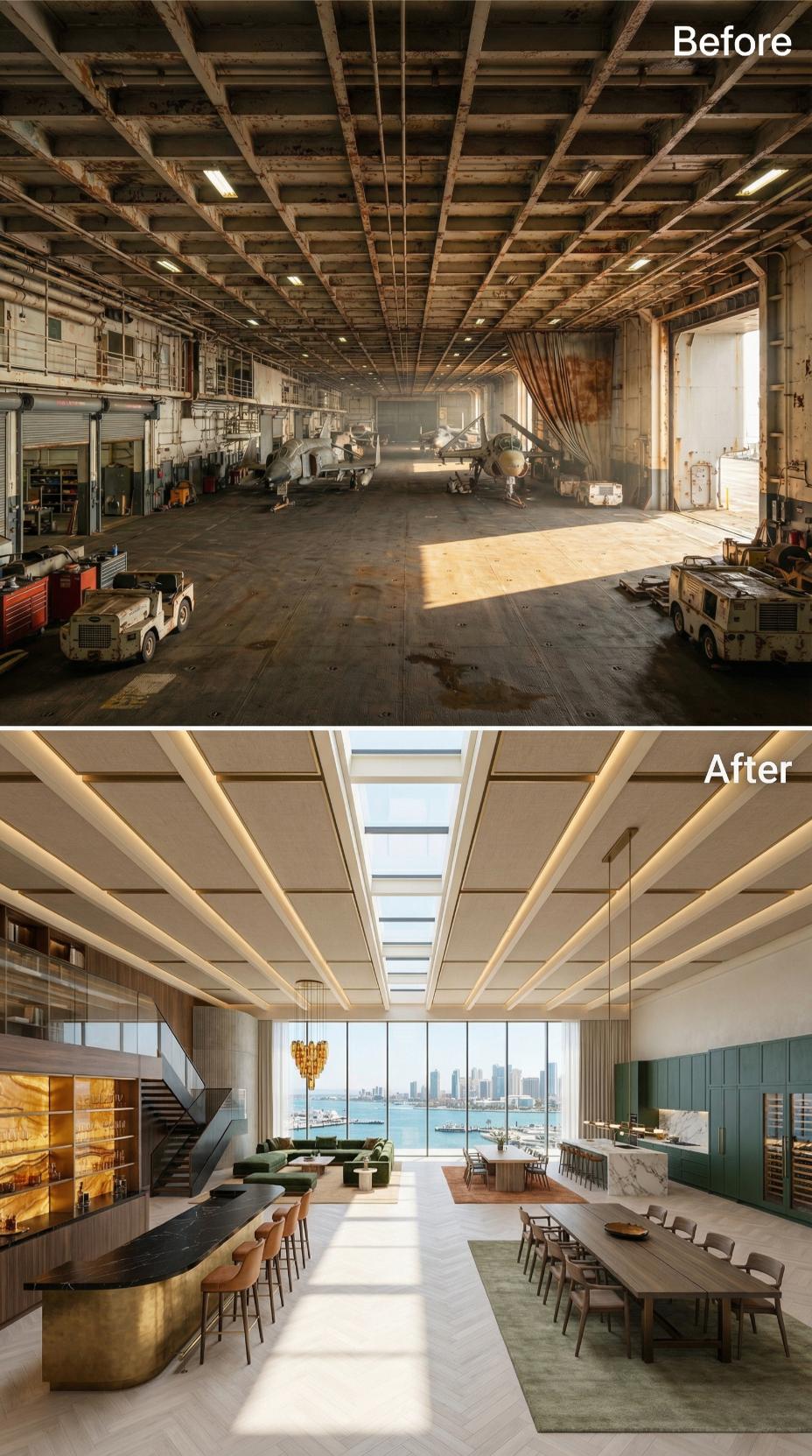
Ivory stone floors run the full length of what was once a working hangar deck, now divided into a bar zone, lounge, and dining area without a single wall breaking the sightline. A curved brass-clad bar anchors the left side, its stools upholstered in cognac leather. Green velvet sectional seating faces floor-to-ceiling glass overlooking open water and a city skyline beyond. On the right, a teal-painted panel wall backs a marble-topped island and a long dining table surrounded by wood-frame chairs. Recessed LED strips trace the coffered ceiling grid, preserving the structural rhythm of the original ship while removing every trace of rust beneath it.
10. Marble Floors, Orb Chandelier, and a Manhattan Skyline Framed by Full-Height Glass Panels
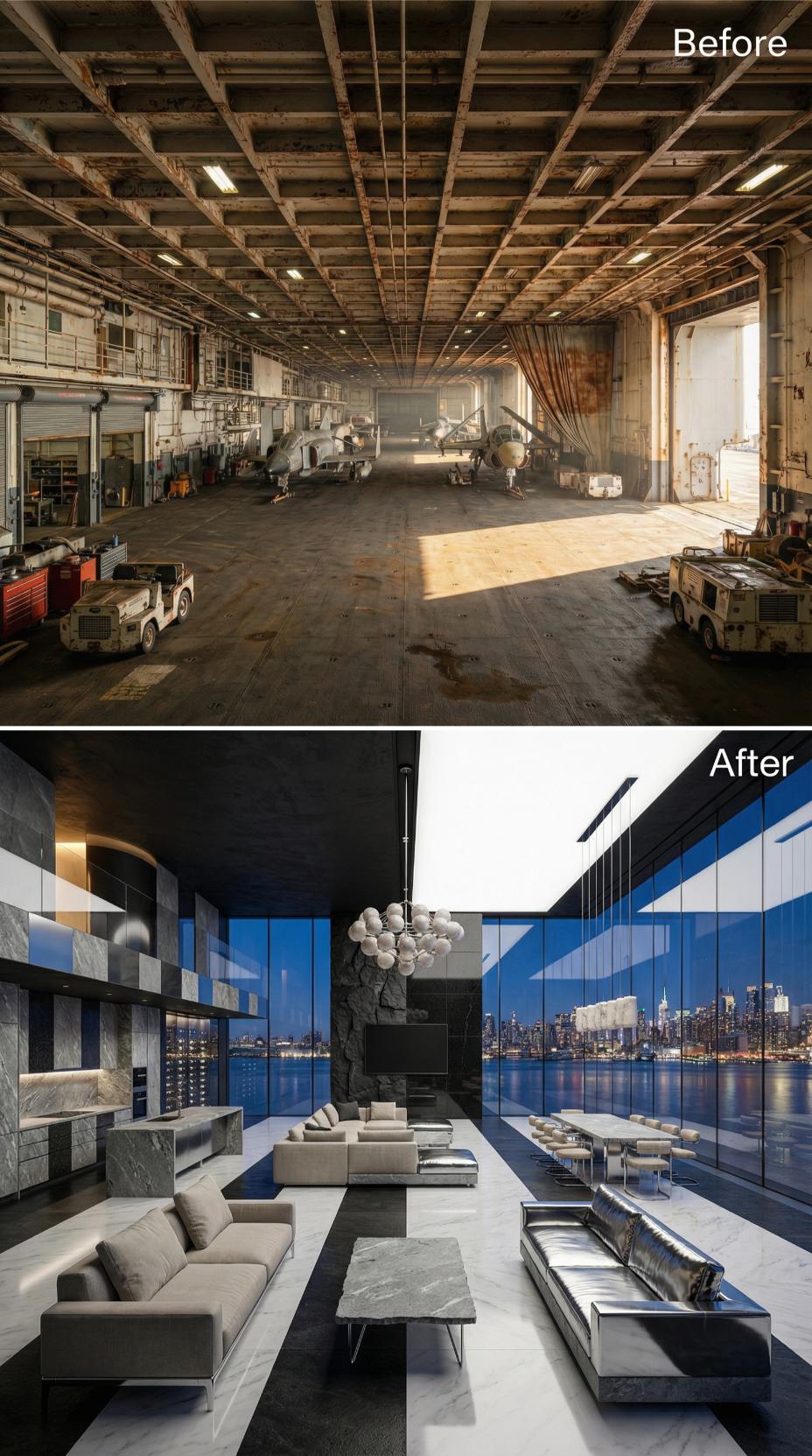
Grey and white marble tiles run the full length of the floor in alternating matte strips, anchoring sectional sofas upholstered in sand linen against a dark ceiling that still reads industrial. A cluster chandelier of frosted globe bulbs drops from center, while floor-to-ceiling glass panels open the entire wall to a lit Manhattan skyline reflected across open water below.
9. Barrel Vault in Birch Slats, Oval Skylights, and a Kitchen Island Cut from White Marble
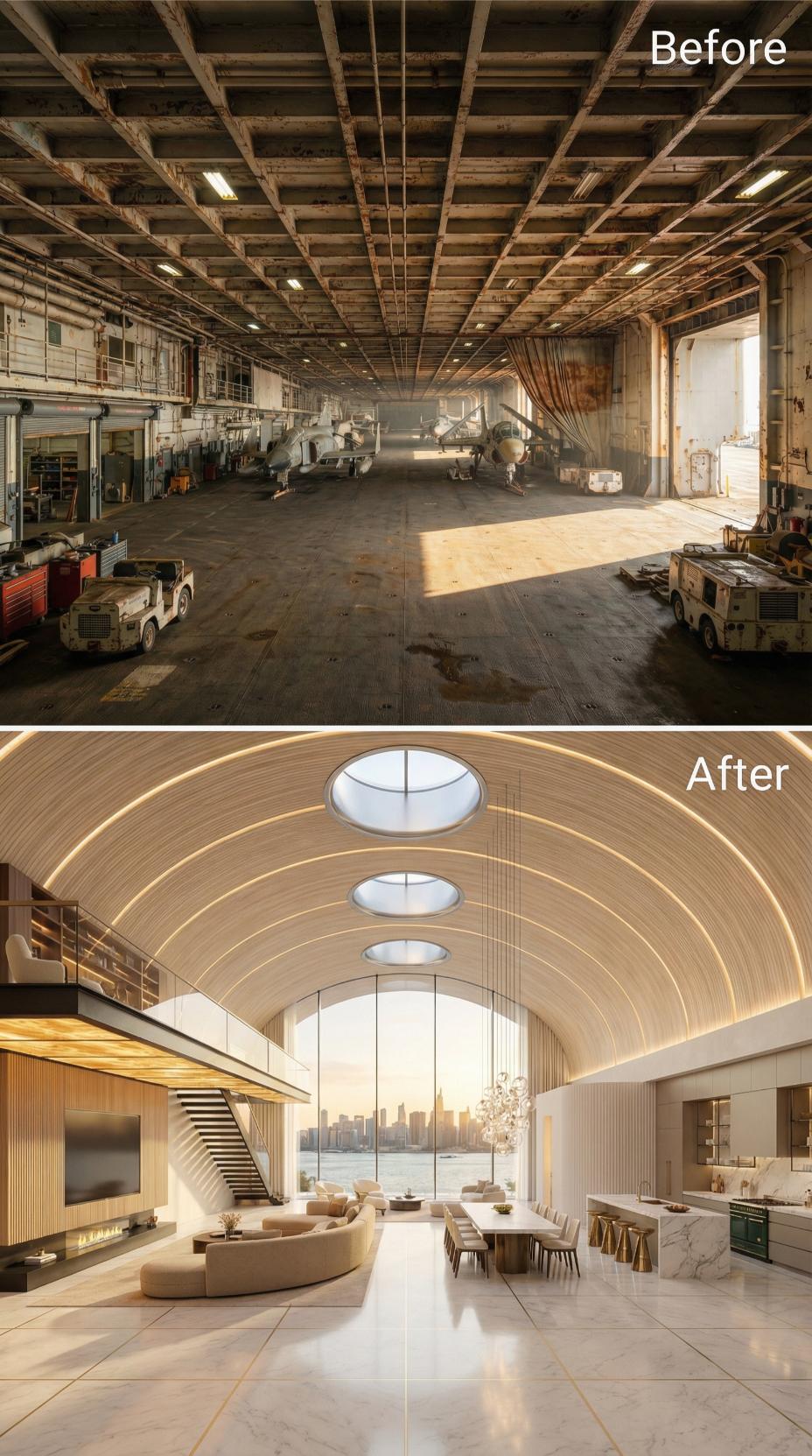
Birch slats run the full arc of a barrel-vaulted ceiling, with recessed LED strips tracing each rib to produce layered bands of amber light across the curve. Two oval skylights punch through at the crown. Below them, a mezzanine with glass railings steps back far enough to let the vault read as one continuous surface from the entry to the waterfront window wall.
Sand-toned large-format porcelain tiles carry the floor from a curved sectional in cream fabric through a rectangular dining table with brass-legged stools to a marble island with a waterfall edge. The range alcove is finished in dark forest green against white cabinetry. Outside the full-height glazed arch, a city skyline sits low on the water, visible only because the hangar opening that once rolled back for aircraft has been replaced entirely with glass.
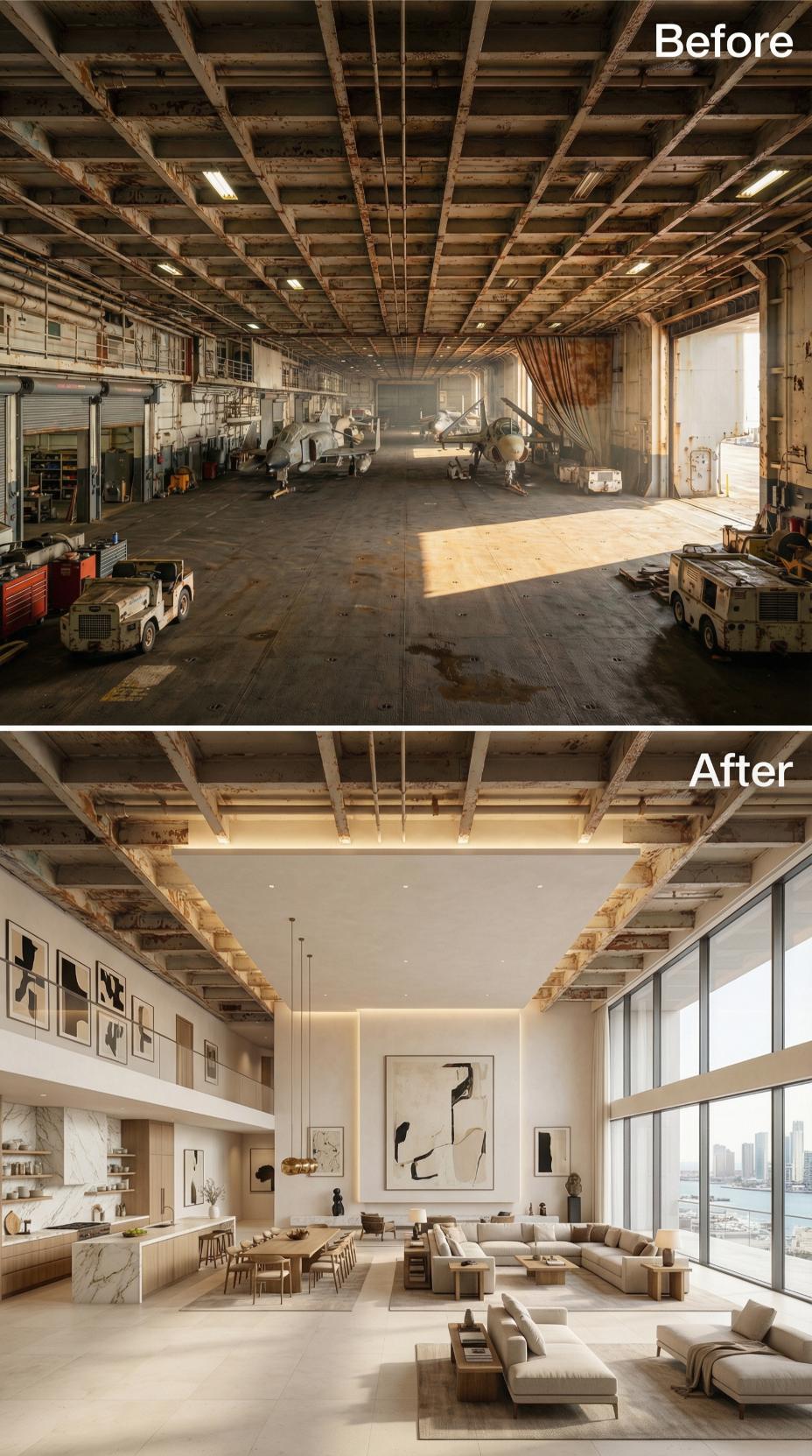
8. Rust-Stained Ceiling Ribs, Linen Sectionals, and Floor-to-Ceiling Glass Over a City Harbor
🔥 Would you like to save this?
Raw steel ceiling ribs, still showing oxidation streaks, frame a dropped white plaster soffit where recessed downlights replace the original fluorescent strips, and a sectional in oatmeal linen anchors the open-plan living zone below a large-format abstract canvas.
7. Coffered Cream Ceiling with LED Ribs, Curved White Sectional, and Waterfront Glass at Dusk
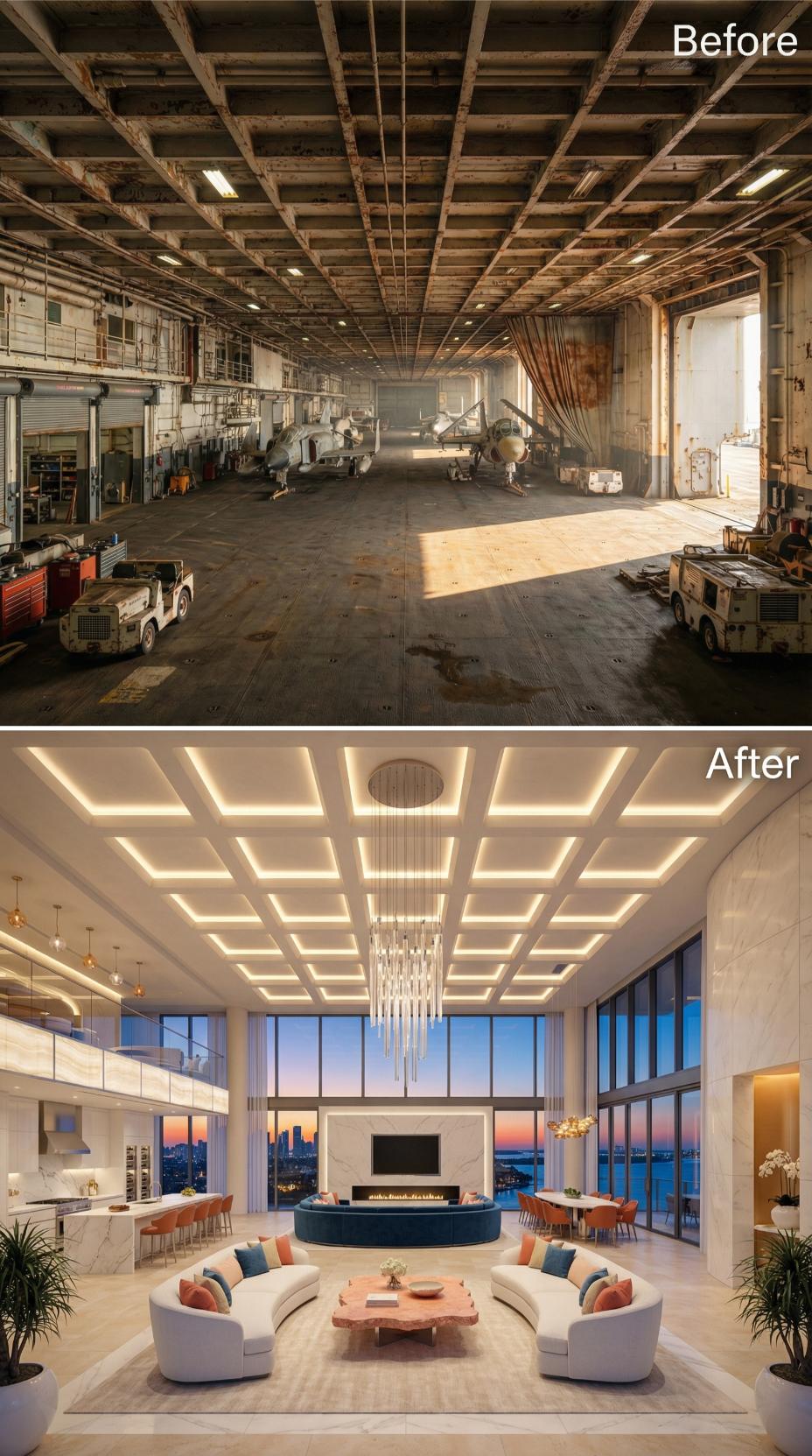
Jet aircraft once sat where a circular travertine coffee table now anchors a curved, cream upholstered sectional. The ceiling grid, clearly derived from the carrier’s original structural framing, has been finished in plaster white with recessed LED strips tracing every coffer edge, producing a warm amber glow that reads almost like candlelight at scale. A cascading pendant chandelier drops through the center void, its slender rods suggesting movement without overwhelming the room below.
Coral and teal scatter cushions break the neutral palette just enough to register against floor-to-ceiling glazing on two sides, where a harbor skyline sits at dusk. A teal drum ottoman faces the fireplace wall, which is clad in book-matched marble behind a wall-mounted television. Off to the left, a marble waterfall island defines the kitchen zone without a partition wall in sight.
6. Coffered Steel Ribs Refinished in Cream, Navy Velvet Sectionals, and a Black Marble Column at Harbor Glass
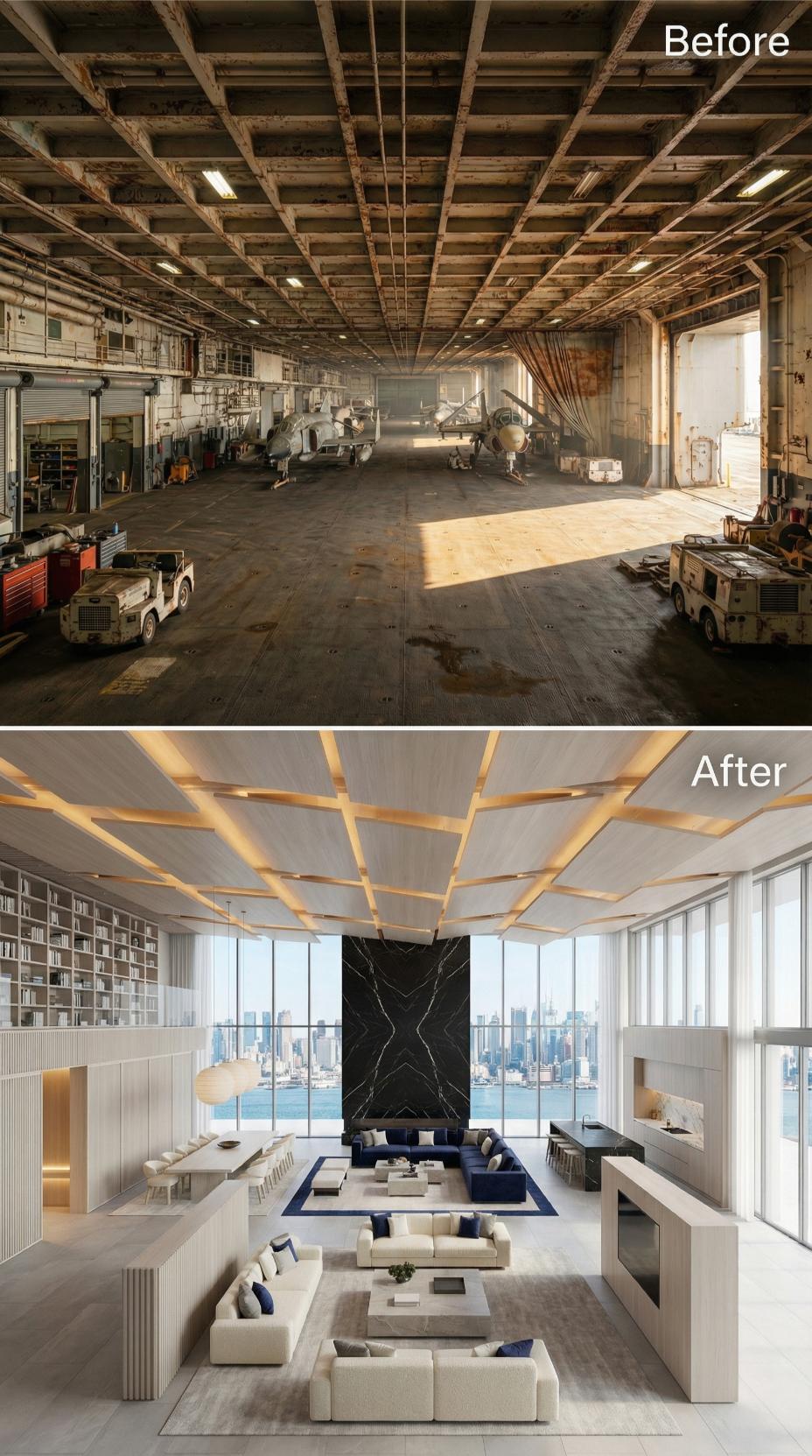
Designers kept the original structural ceiling grid intact, stripping the rust and refinishing each rib in a cream-toned finish with recessed LED strips running the channels between panels. Below it, a sunken seating zone holds a navy velvet sectional arranged around a low white marble coffee table, anchored by a deep blue area rug. A floor-to-ceiling black marble column with mirror-cut veining bisects the full-height glass wall, framing unobstructed views of the harbor and city skyline beyond.
5. Organic Plaster Ceiling Pods, Cognac Sectional, and a City Skyline Through Full-Height Glass
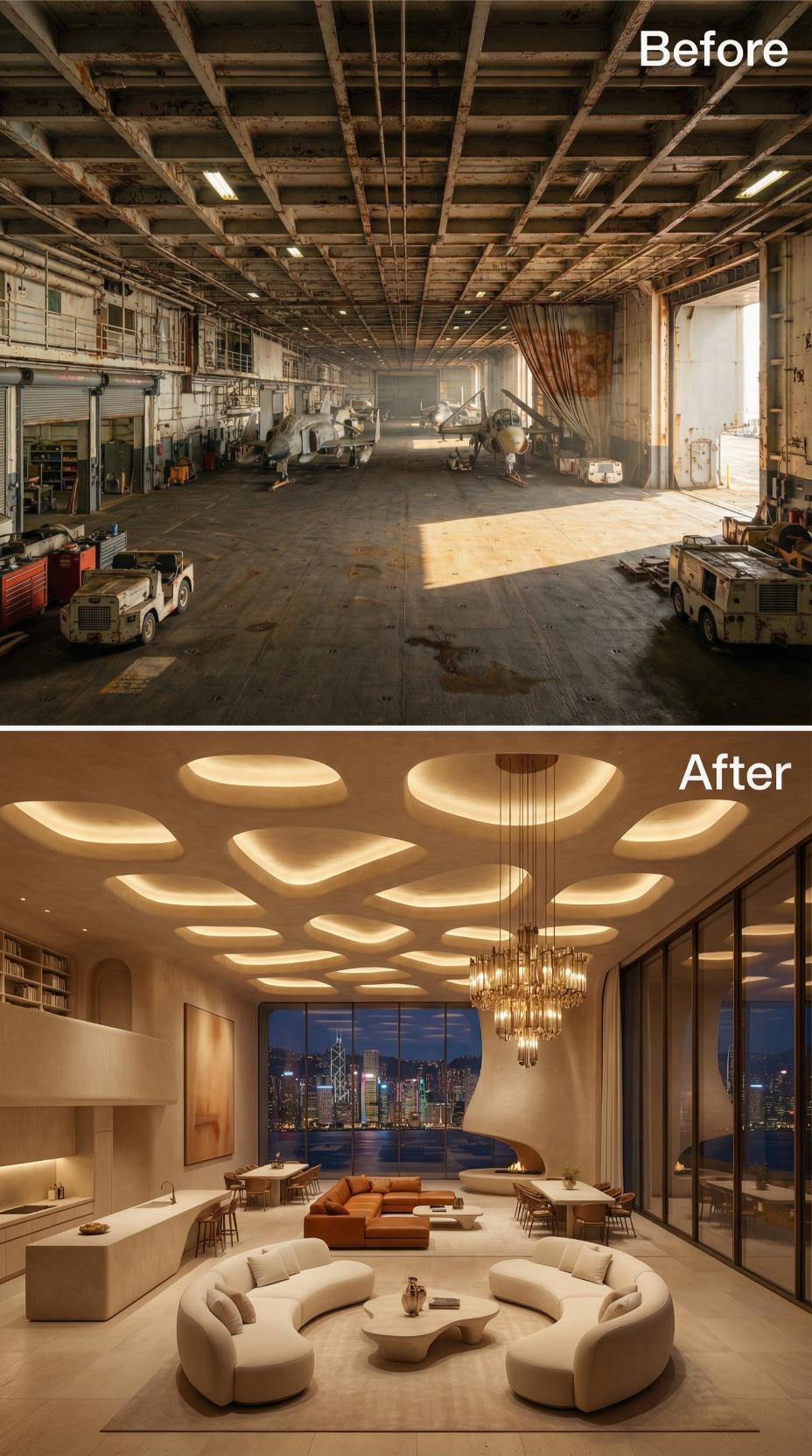
Clustered ceiling pods finished in smooth plaster emit recessed amber light across a room that once housed military aircraft. A curved cream bouclé sectional anchors the center, paired with a cognac leather sofa behind it and a low round stone coffee table. Brass pendant rods descend from the pod cluster into a chandelier that holds cylindrical glass shades. Floor-to-ceiling glazing on two sides frames a lit harbor skyline at night.
4. Steel Ceiling Grid Glazed Open, Marble Island Anchored Left, Terracotta Sectional Curved Right
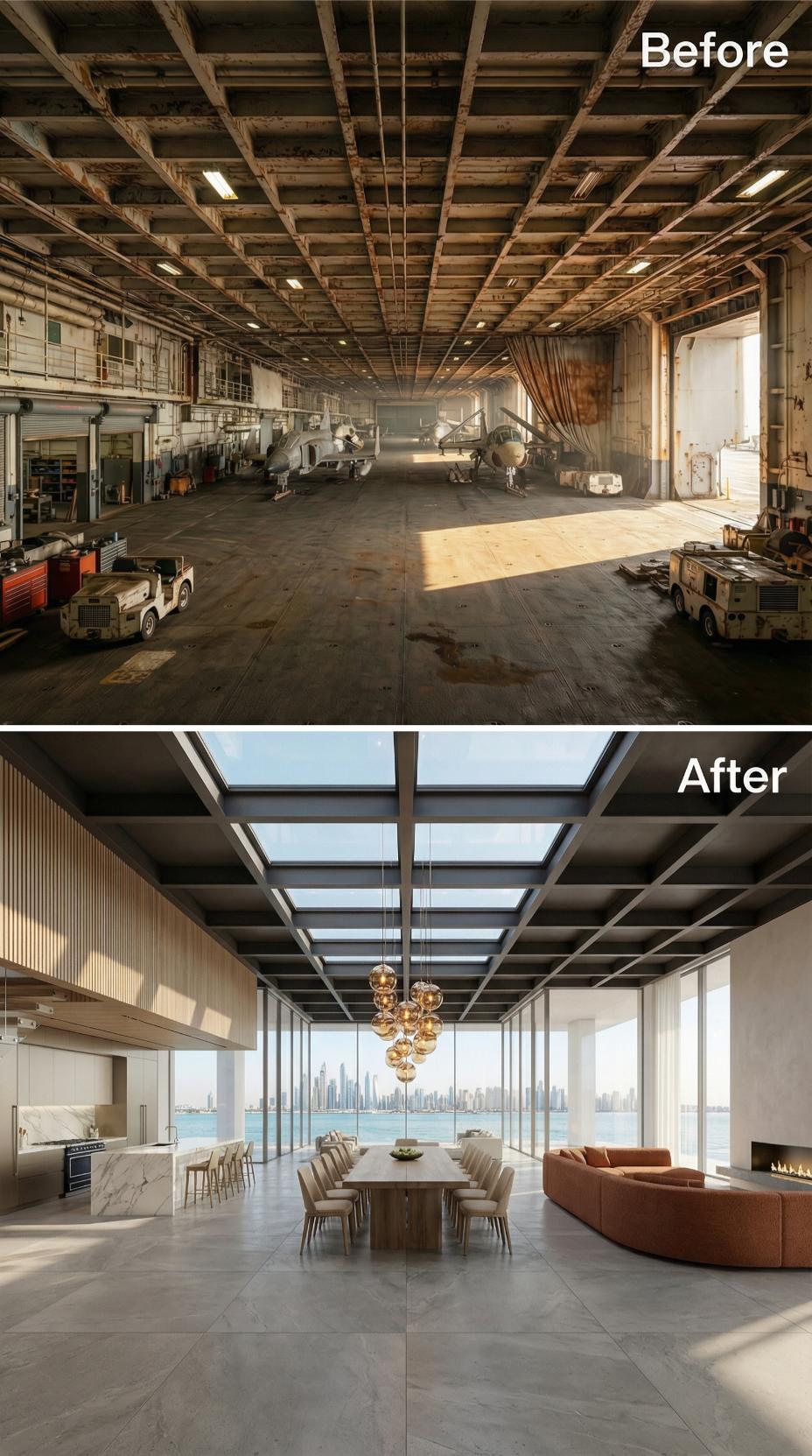
Exposed steel ribs span the full ceiling length, their coffered grid now filled with glass panels that pull open sky directly into the dining zone. A long stone-top table seats twelve beneath a cluster of amber globe pendants. To the right, a curved terracotta sectional wraps a gas fireplace set flush into a concrete surround, while a marble waterfall island anchors the kitchen at left, its white veining running unbroken to the floor.
3. Concave Plaster Ceiling Pods, Cream Sectional Blocks, and Harbor Glass Facing the City Skyline
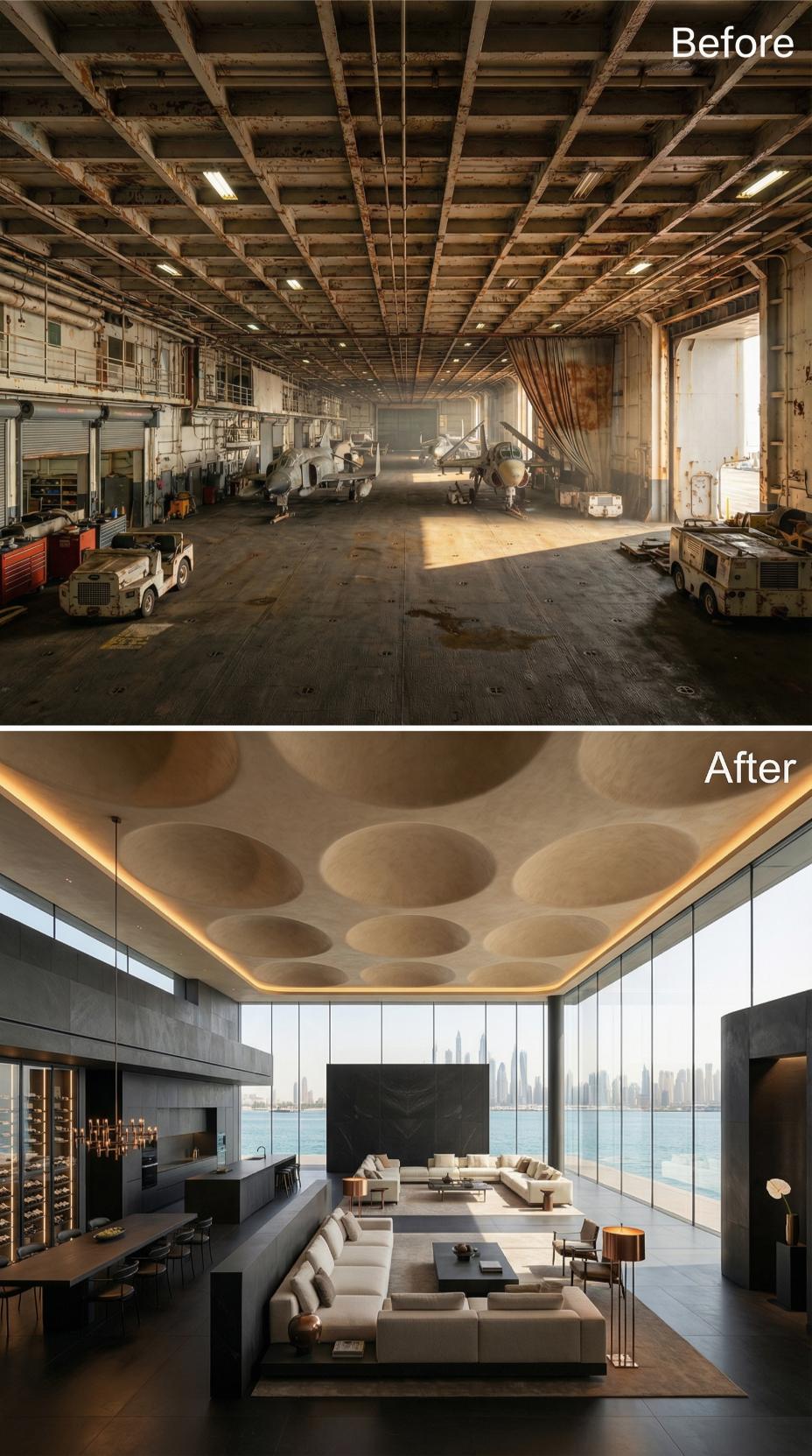
Sculptural dome recesses pressed into a sand-toned plaster ceiling replace what was once a grid of rusted structural ribs, with perimeter LED cove lighting tracing the ceiling’s edge. Below, modular cream fabric sectionals form a double-loop arrangement around a low rectangular wood coffee table, while full-height glass walls on two sides pull an open harbor and city skyline directly into the room. A wine rack column fitted with warm brass fixtures anchors the kitchen left, beside a dark wood dining bar with black steel stools.
2. Porthole Walls, Navy Velvet Sectionals, and a Gold-Trimmed Salon Cut from a Carrier Hangar
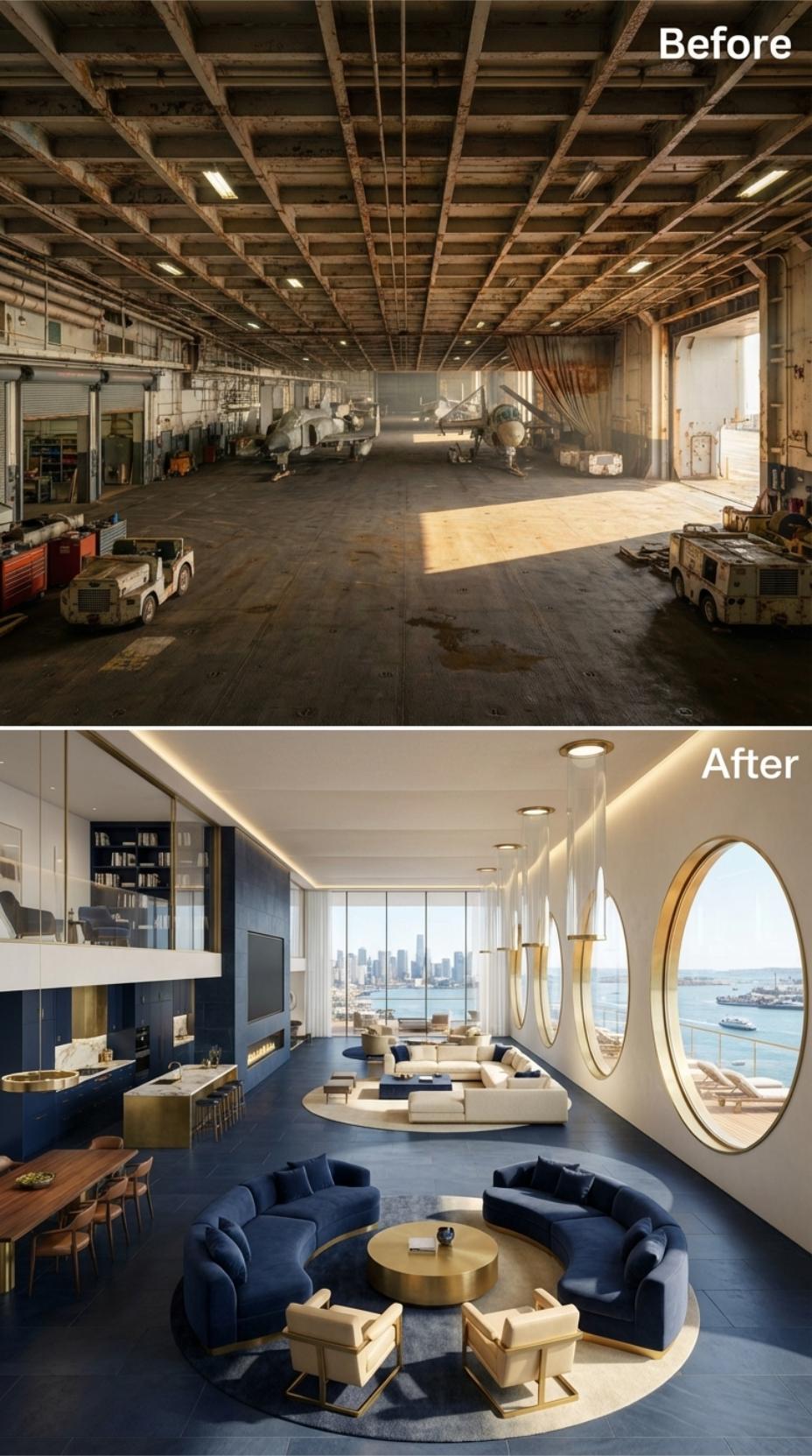
Where the hangar bay once stored helicopters and military ground vehicles under a corroded steel grid ceiling, the finished interior runs deep navy across every wall surface, with cream and gold sectional groupings arranged in two distinct conversation zones. The foreground features a curved navy velvet sofa paired with gold-framed armchairs around a brushed brass drum table. Behind it, a cream modular sectional anchors a second seating area closer to the floor-to-ceiling harbor glass.
Oversized oval portholes trimmed in brass punch through the starboard hull wall, framing a waterfront view that includes open water and a city skyline beyond. A bar counter finished in dark cabinetry with brass hardware runs along the port side, backed by open shelving. Recessed ceiling coves deliver warm LED wash lighting across the entire length of the space, replacing what had been exposed industrial fluorescents bolted to rusted structural ribs.
1. Carrier Hangar Deck Reborn as a Glass-Ceilinged Urban Sanctuary
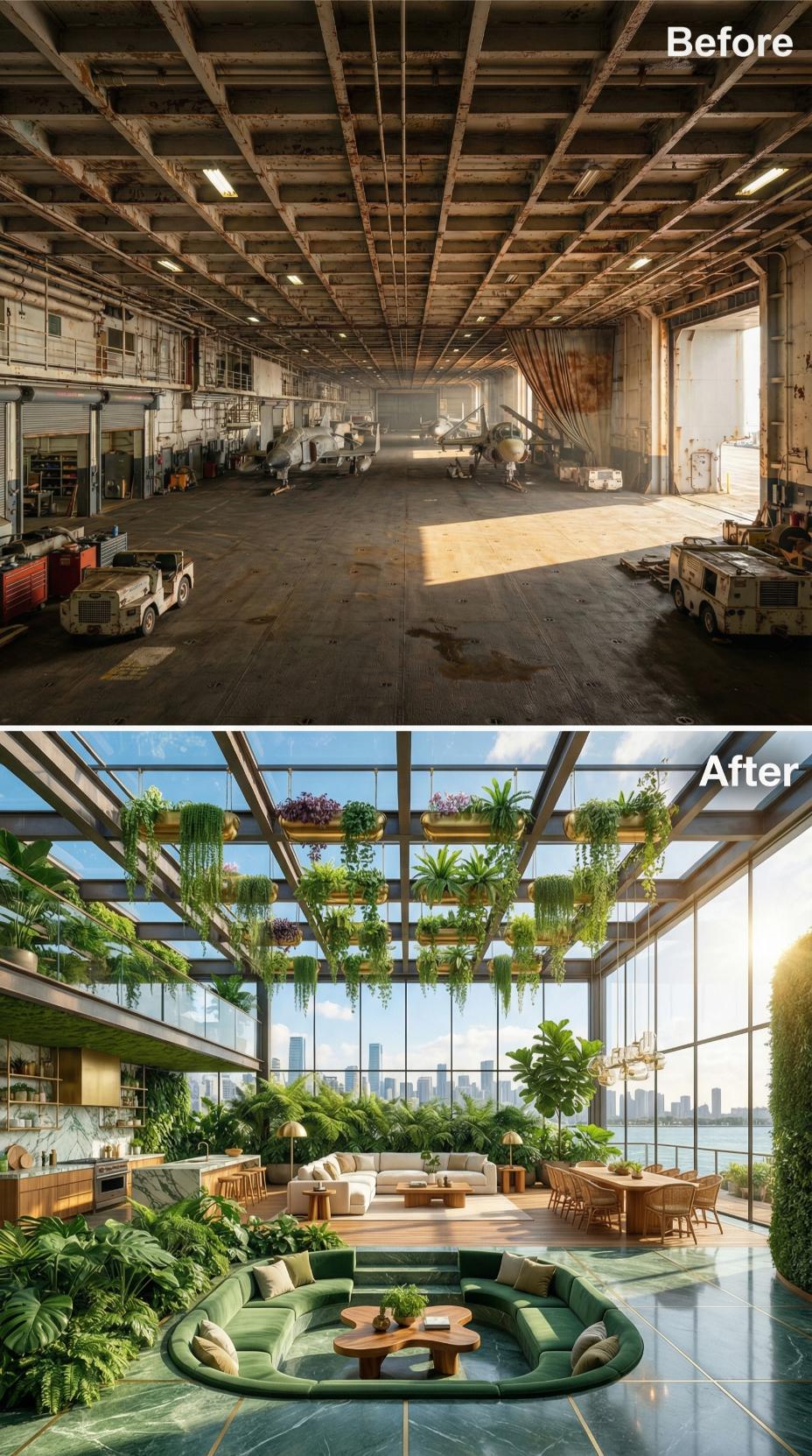
Where military aircraft once sat on weathered steel decking, a sunken circular sectional in deep forest green velvet now anchors the living space. The curved sofa wraps around a live-edge wood coffee table set against green marble tile flooring, while suspended gold-finish planters trail cascading ferns and trailing pothos across the full ceiling span.
Floor-to-ceiling glass panels replaced the original blast doors, opening the entire far wall to a waterfront city skyline. A marble-topped kitchen with warm wood shelving lines the left, and rattan dining chairs define a secondary seating zone to the right. Hanging brass pendants punctuate the plant canopy overhead.