🔥 Would you like to save this?
Harvest gold. Avocado green. A drawer that was basically a graveyard for twist ties and expired coupons. The 1970s kitchen operated on its own logic, part function, part aesthetic crime scene, entirely beloved by everyone who grew up in one. If you spent any time in a kitchen between 1970 and 1979, certain objects and details are burned into your memory like the pattern on the linoleum floor. Here are 33 of them.
31. The Harvest Gold Appliances That Never Quite Matched Each Other
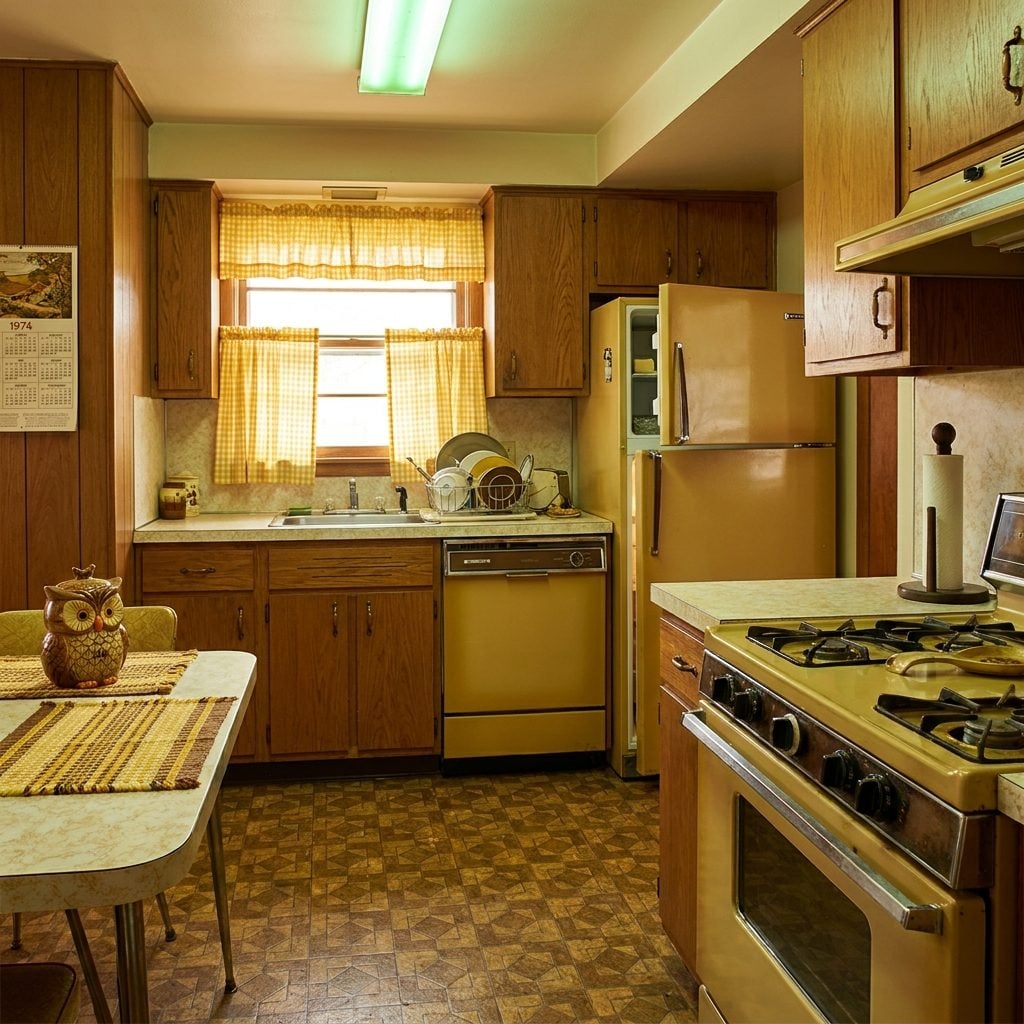
Three appliances, three completely different yellows. The fridge was that pale, greenish harvest gold. The dishwasher leaned more toward pure mustard. The range had gone a kind of deep ochre that nobody had a name for. Nobody in the house seemed to notice or care, and honestly that was the right call.
In order to come up with the very specific design ideas, we create most designs with the assistance of state-of-the-art AI interior design software. Also, assume links that take you off the site are affiliate links such as links to Amazon. this means we may earn a commission if you buy something.
Harvest gold was the dominant color in American kitchens for a solid decade, introduced by appliance manufacturers as a sophisticated alternative to plain white. It peaked around 1972 and was completely extinct by 1982. Every single unit aged differently depending on how much direct sunlight it got, which is how one kitchen could contain three distinct shades of the same “color.” A design philosophy that would give a contemporary kitchen designer a full stress episode.
30. Avocado Green Refrigerator, Burnt Orange Countertops, No Notes
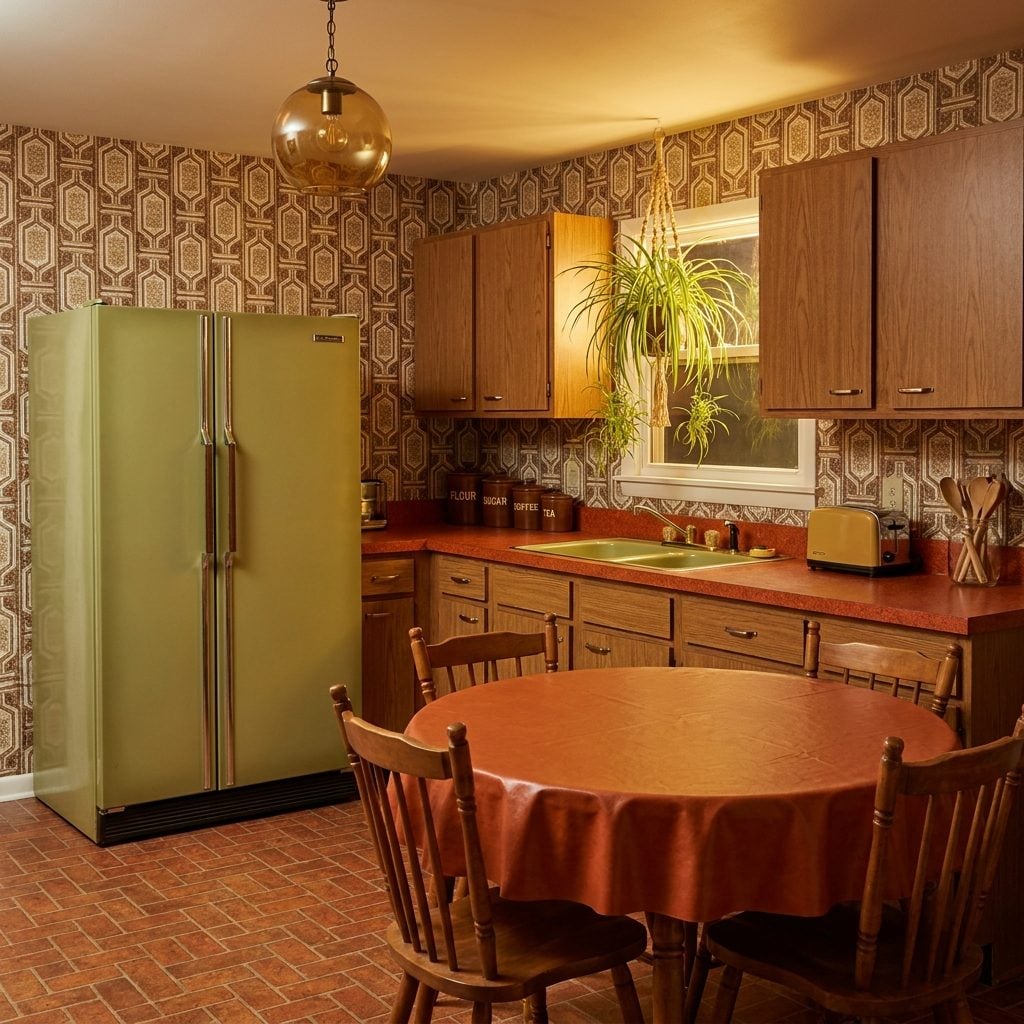
Avocado green and burnt orange. Together. On purpose. And here’s the thing: it worked, in the sense that it made complete visual sense within its own universe. You walked into a kitchen like this and it felt totally coherent. Step outside that decade and it looks like someone dared a colorblind person to design a kitchen.
This combination showed up in homes from coast to coast from roughly 1968 through the late 1970s. The avocado refrigerator against the burnt orange counter, sometimes with a harvest gold range thrown in for maximum sensory chaos. Designers today would call this “maximalist earth tone layering.” Then, it was just Tuesday.
29. The Wall-Mounted Rotary Phone With the Cord That Reached Every Room
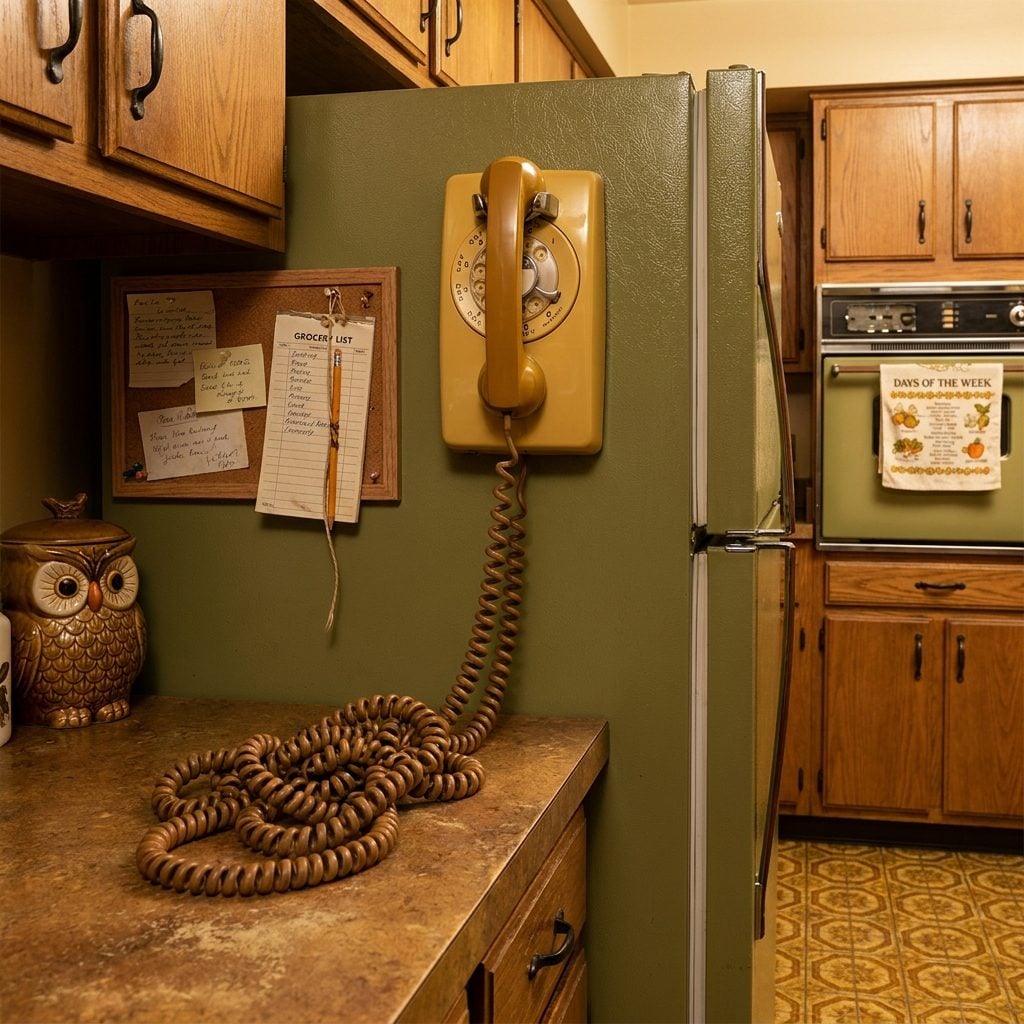
That cord. Twenty feet minimum, twisted into a permanent double helix from a decade of being yanked around corners, stretched into the hallway, and wrapped around someone’s finger during a forty-five minute conversation about nothing. You could cross the entire kitchen while still technically on the phone. You could stir a pot, open the fridge, and wave someone away from the stove, all while pressed against the handset.
The wall phone was the household’s central nervous system. Important numbers were written directly on the wall around it. The notepad beside it was always half-used. And the rotary dial had a satisfying mechanical weight to each pull that no touchscreen has ever come close to replicating.
“The kitchen phone wasn’t just a phone. It was the family message center, the gossip station, and the one device everyone in the house was always waiting their turn to use.”
28. Plastic Grapes Over the Breakfast Nook, Swaying in the Central Air
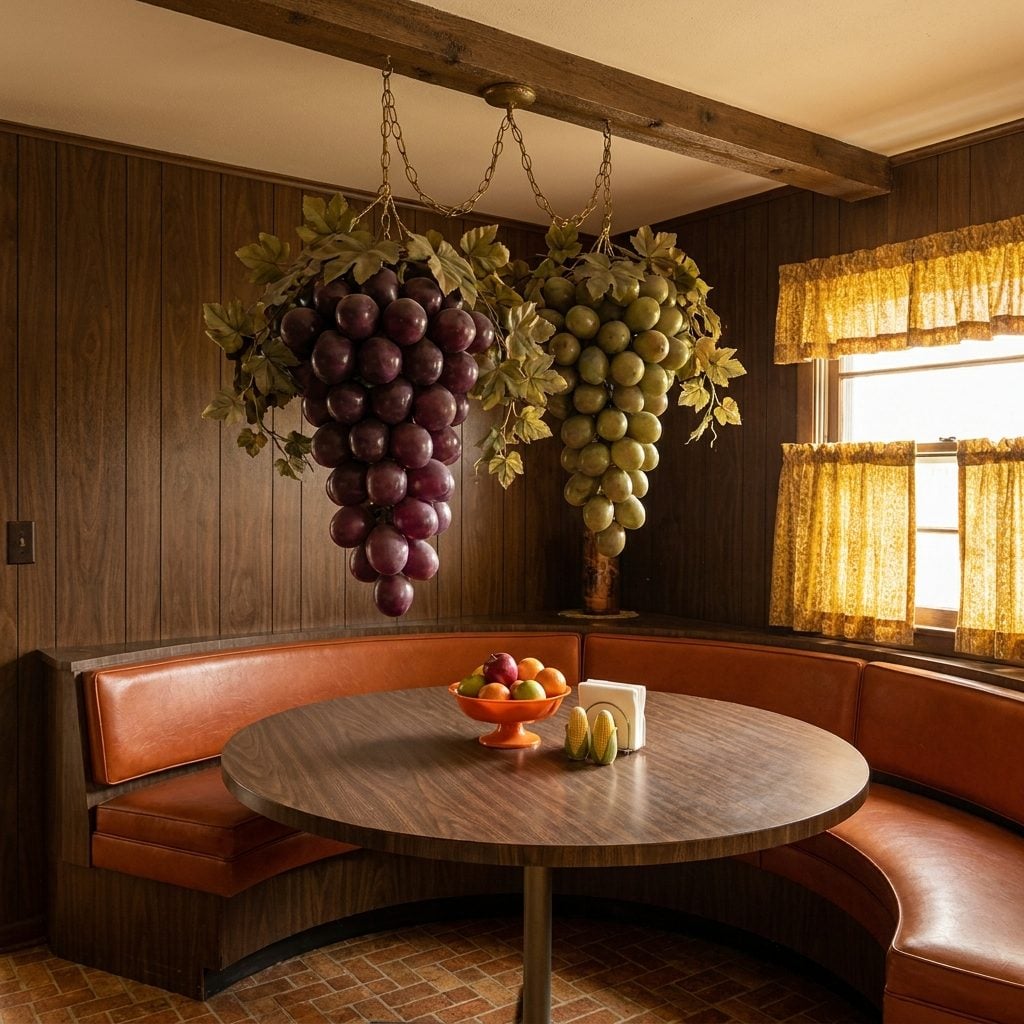
Nobody bought the plastic grapes once. They just appeared, the way certain decor items always did in the 1970s: through a gift, a swap meet, a grandmother’s bequest. And once they were up on that fake beam, they were permanent. You’d dust around them, straighten them after they got knocked by a taller family member, replace the odd grape that fell off. But you never took them down.
The plastic fruit trend was genuinely everywhere. Grapes were the prestige option, the oversized purple clusters with the little plastic tendril curls. Some kitchens had whole fruit bowls of the stuff sitting on the counter, and no one ever questioned why.
27. The Ashtray Right There Next to the Salt and Pepper Shakers
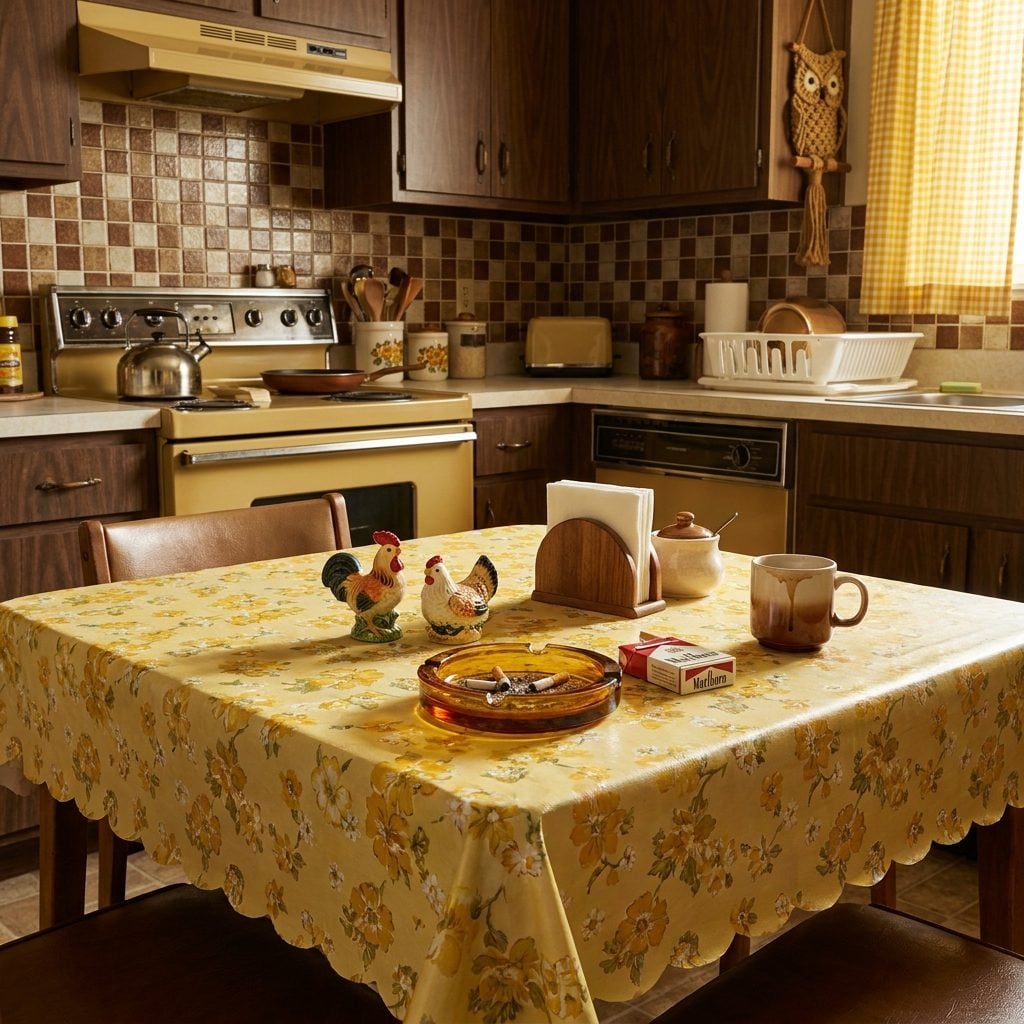
Right next to the salt. Not in another room, not tucked away, not hidden when company came. The ashtray lived on the kitchen table like a condiment, as permanent a fixture as the sugar bowl. People smoked at the kitchen table while drinking coffee, while the kids ate breakfast, while dinner was being finished on the stove six feet away.
This wasn’t considered rude or unusual. It was just what kitchens contained. The ashtray got emptied, wiped out, and set back down. Some households had matched sets, a ceramic rooster salt and pepper shaker situation paired with a coordinating ashtray. True home inspiration, 1970s edition.
26. The Ceramic Rooster Collection That Colonized Every Horizontal Surface
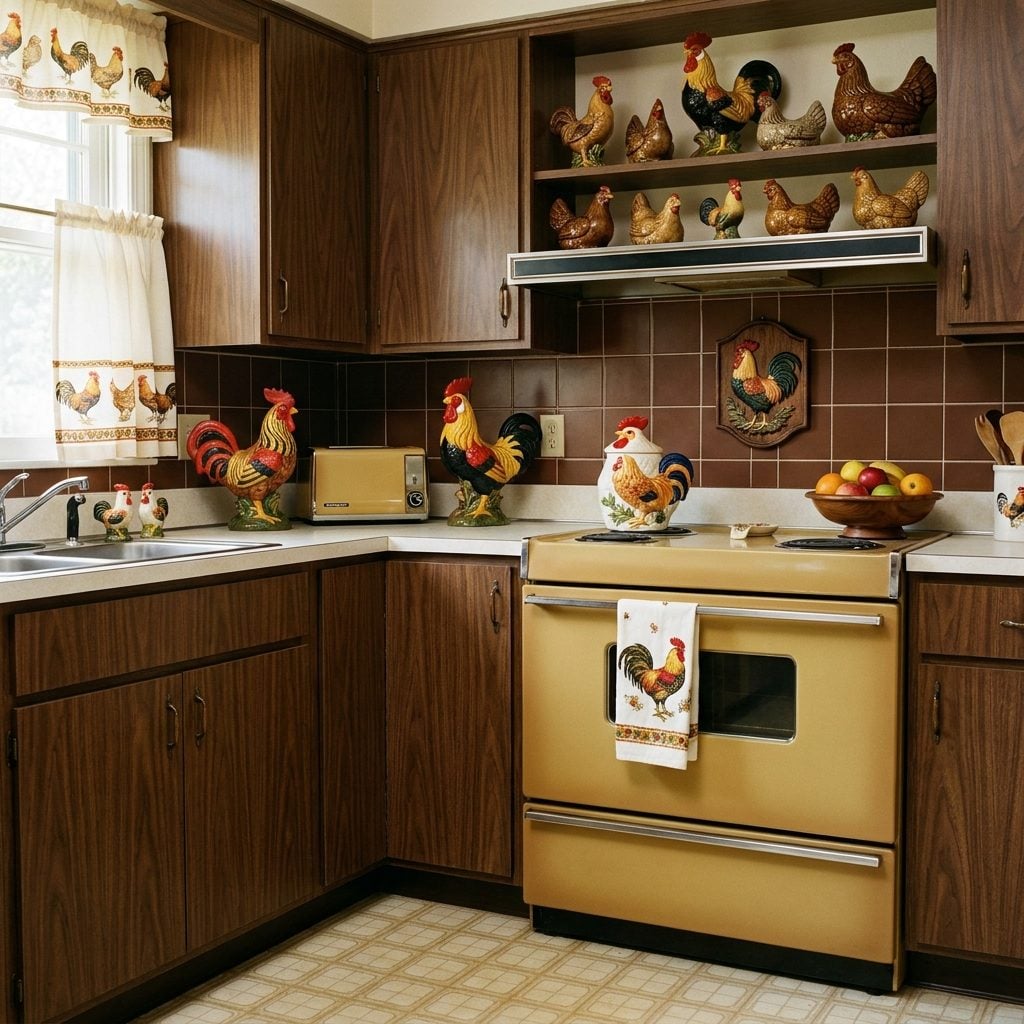
It started with one. A gift from a sister-in-law, a ceramic rooster with a hand-painted comb, placed on the counter near the stove. Then someone noticed and gave another. Then another. By 1976 there were fourteen of them across four surfaces and nobody was going to stop it.
The rooster kitchen was its own specific 1970s subculture. The roosters came in every medium: ceramic, brass, macramé, printed on the curtains, embroidered on the dish towels. Some kitchens went full commitment and had a rooster clock, a rooster paper towel holder, rooster canisters. The rooster collection was a form of identity, this is a warm kitchen, a country kitchen, a kitchen with personality. And honestly? It was.
25. The Shag Carpet That Didn’t Stop at the Kitchen Doorway
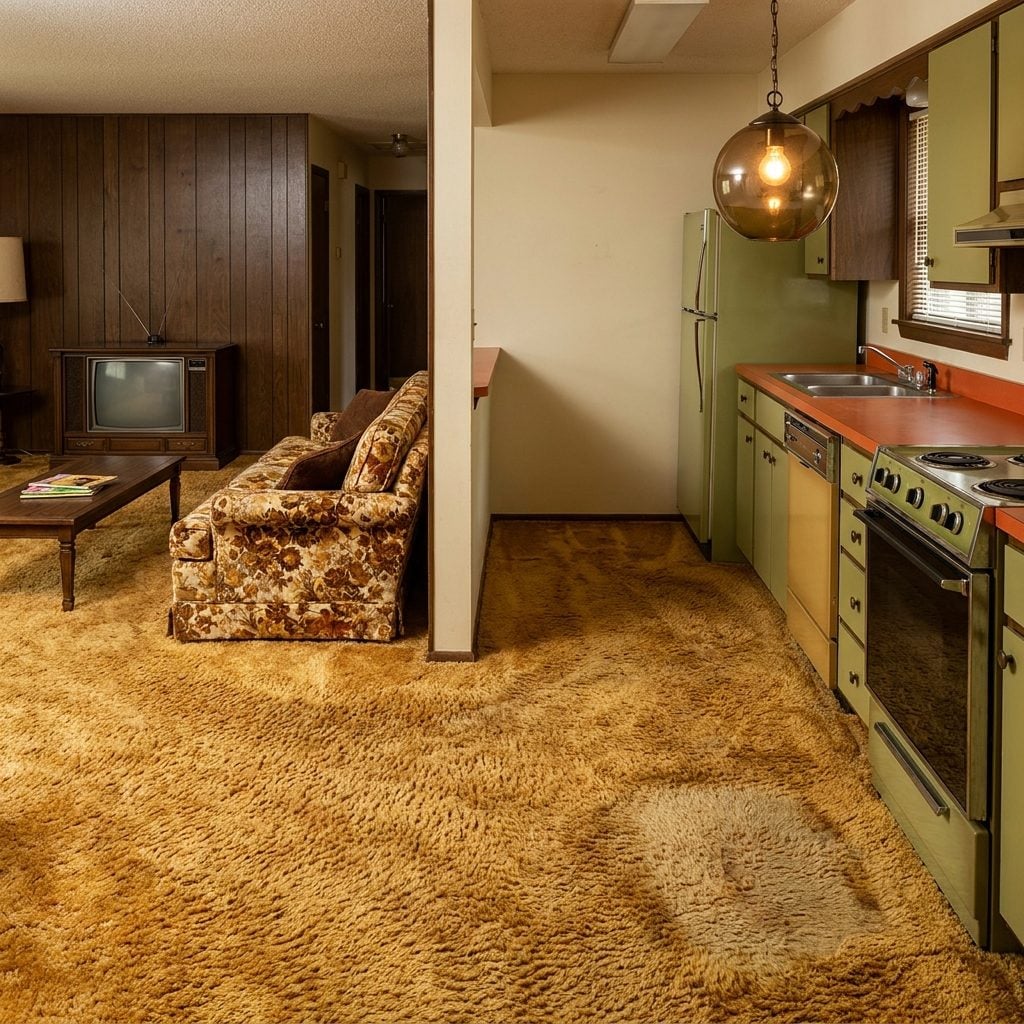
It went right up to the stove. Not stopping at some natural break point, not ending at a sensible threshold, the shag carpet just kept going, under the refrigerator, past the dishwasher, right up to the base of the cabinets. Someone installed it this way on purpose and signed off on it.
The thinking, if there was any, was that carpet made the kitchen feel warmer and more connected to the rest of the open-plan living space. What it actually did was absorb every grease splatter, every spilled coffee, and every dropped egg for the next fifteen years. Vacuuming around the stove burners is an experience that nobody who lived through it has fully processed. The boho kitchen decor revival has brought back a lot of things from this era, but not this one. Some decisions stay retired.
24. Mushroom-Print Wallpaper That Somehow Clashed With AND Matched the Floral Curtains at the Same Time
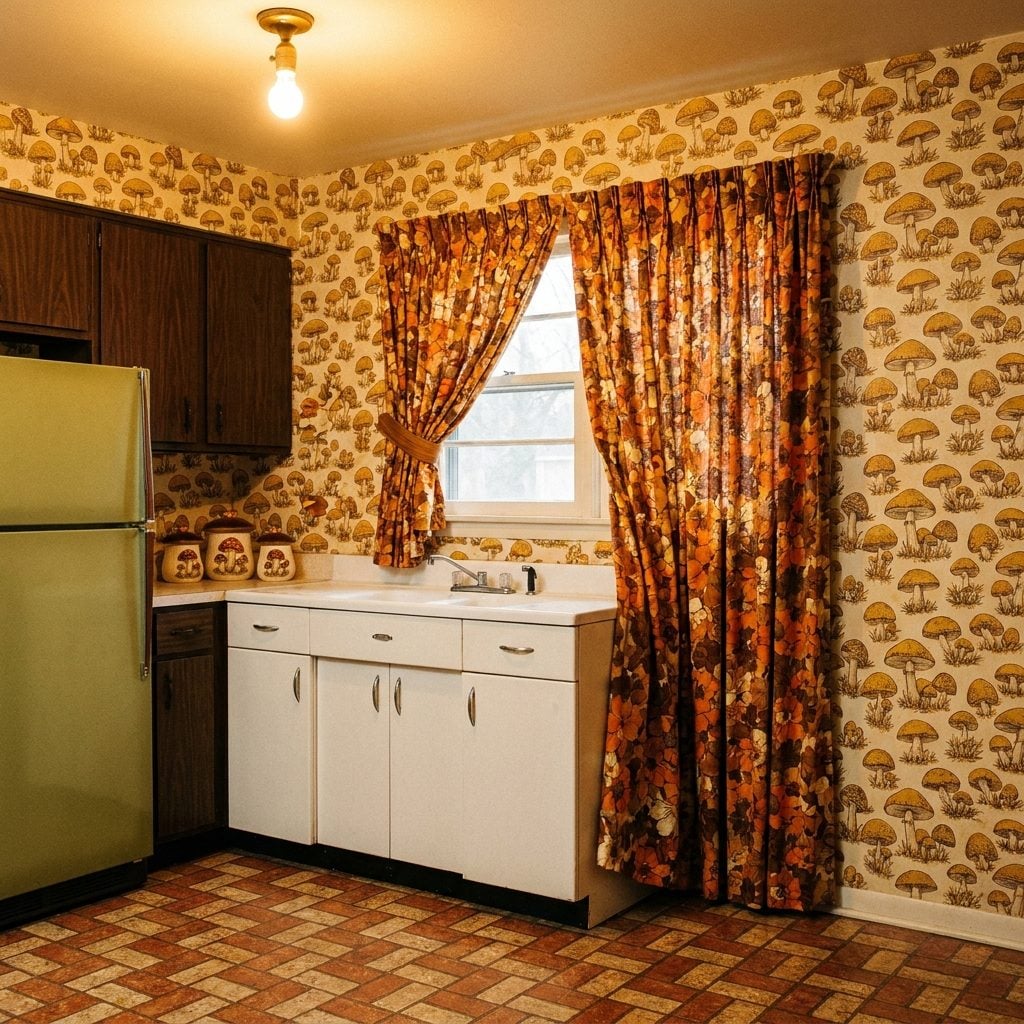
Nobody coordinated this. Nobody sat down with a mood board and decided that a mushroom-print wallpaper and a large-floral curtain fabric would live together in the same six-foot wall space. It just happened, a roll of wallpaper from the hardware store, a remnant of curtain fabric from a fabric shop three towns over, and somehow the orange and brown DNA running through both made the whole thing feel completely intentional. It wasn’t. It absolutely wasn’t.
This was peak 1970s kitchen decorating: the philosophy that if two things shared at least one color on the wheel, they matched. Mushroom motifs specifically were everywhere from about 1971 to 1978, appearing on wallpaper, ceramic canisters, dish towels, and oven mitts, often all in the same kitchen simultaneously. Gen Z homeowners hunting for home inspiration would find the combination genuinely bewildering. We found it completely normal.
23. The Under-Cabinet Paper Towel Holder That Left a Perfect Grease Ring on the Wood Above It
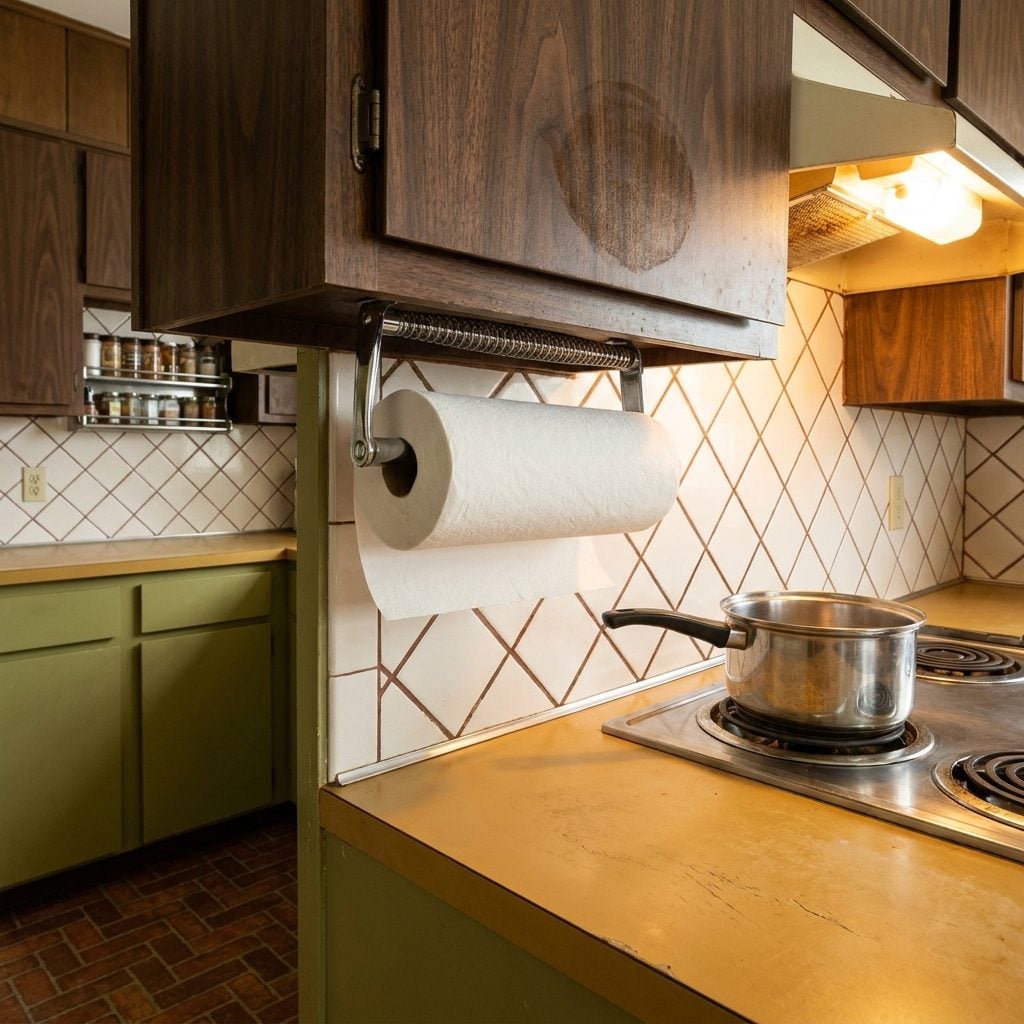
That grease ring. Every single one of these chrome under-cabinet paper towel holders eventually produced a perfect, ghostly halo on the wood above it, a permanent record of proximity to the stove, of steam and bacon fat and decades of tearing off one square at a time. You can still find them in houses that haven’t been renovated since Carter was president.
The logic was sound: mount the paper towels under the cabinet, keep the counter clear, have them exactly where you need them at the stove. The execution was a chrome spring mechanism that required both hands and a specific wrist torque to reload. Tearing a single sheet without pulling four of them off the roll was considered a minor life skill.
22. The Chrome Diner Table With Vinyl Chairs That Were Already Cracking When Your Parents Bought Them
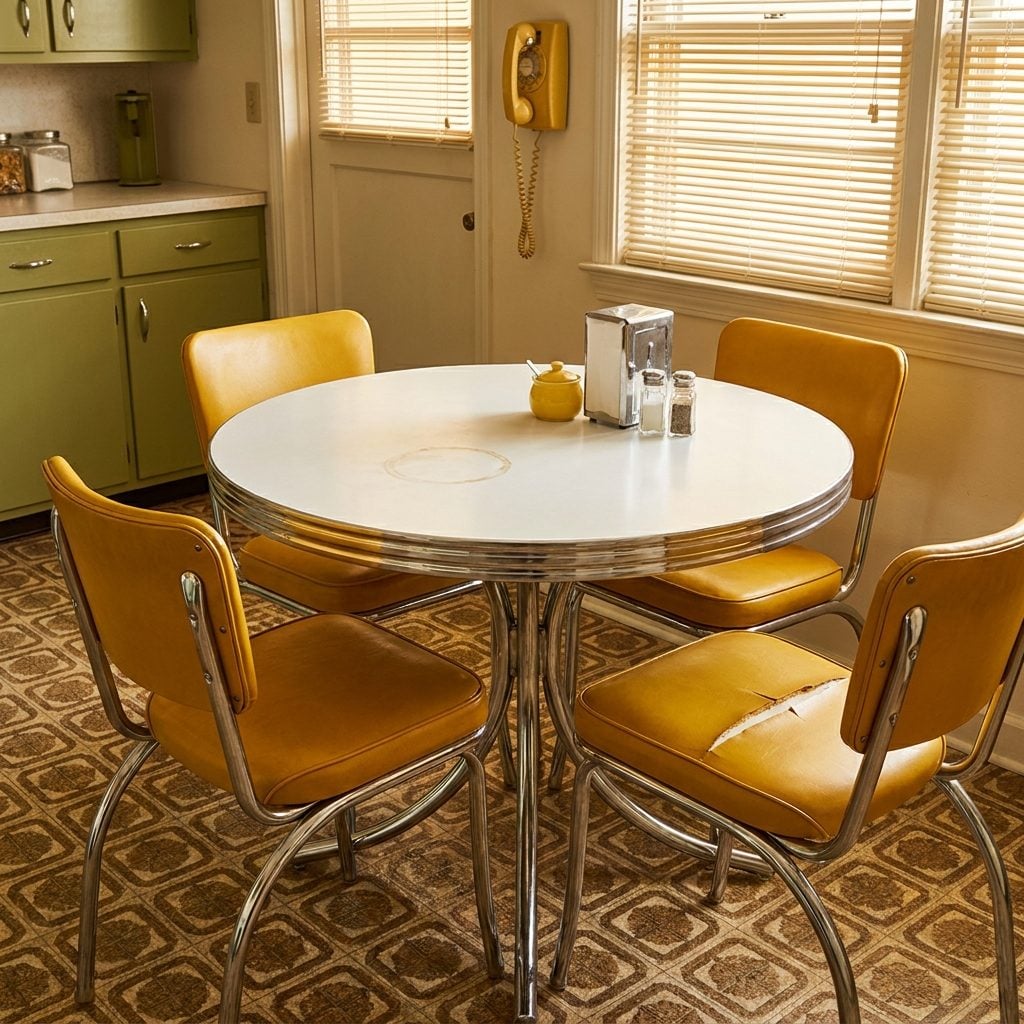
The vinyl started cracking before you were old enough to remember it not cracking. That was just the condition of the chairs, a permanent state of mild structural failure held together by habit and the understanding that nobody was going to buy new ones. You learned to sit slightly to the left on that one chair, the one with the big split across the seat, so the foam didn’t pinch the back of your thigh.
Chrome dinette sets were actually a 1950s design that hung on hard through the 1970s in American kitchens, especially in working-class homes where they represented a certain durability. The Formica tabletop was indestructible. The chairs were not. The mismatch between those two facts defined the set.
21. Macramé Plant Hangers Dangling Directly Over the Sink, Always Dripping
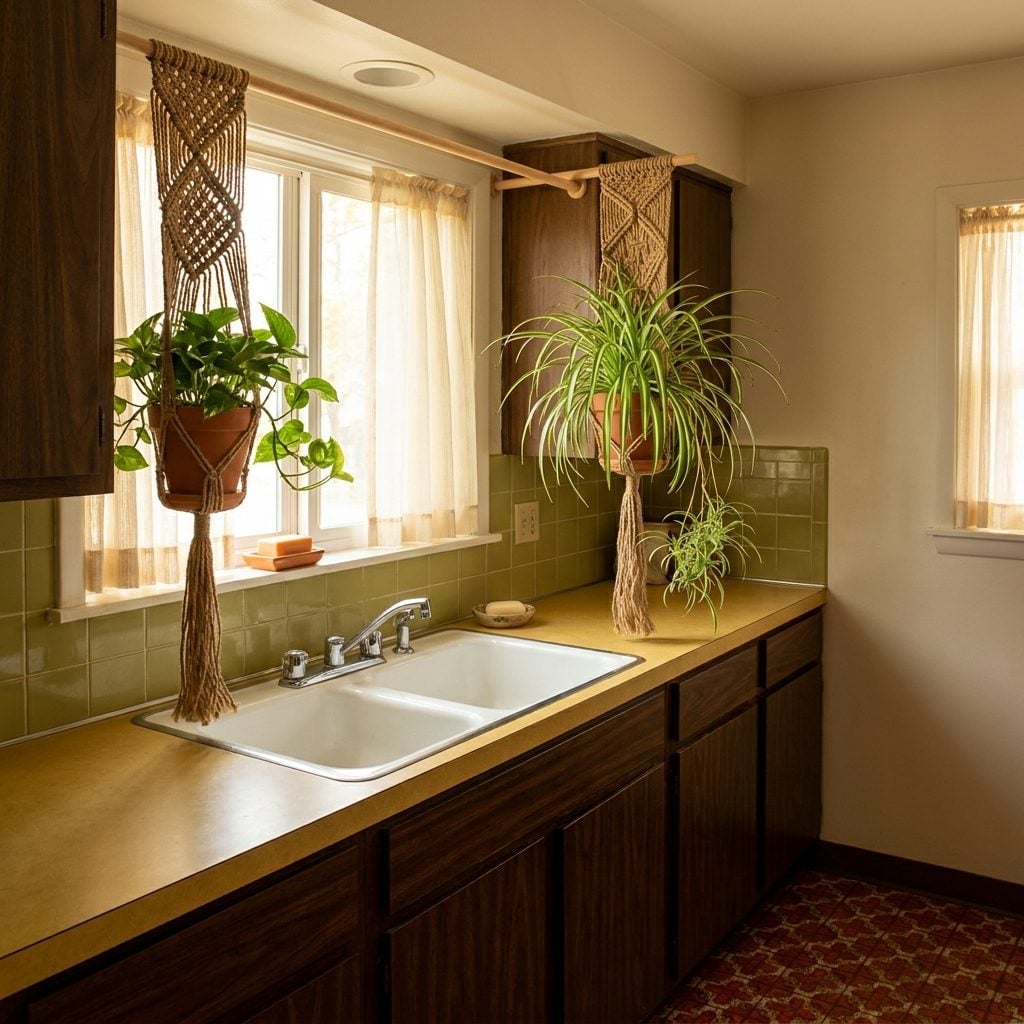
Watering these required commitment. You had to lean completely over a sink full of dishes, reach up past the fern, tip a watering can at a forty-five degree angle, and then watch as half the water immediately dripped off the macramé fringe and onto the dishes you just washed. This was accepted. Nobody questioned it.
Macramé plant hangers were the DIY project of the decade, sold in kit form at craft stores, featured in every women’s magazine from 1971 onward, and produced by approximately every aunt in America during a single three-year window. They were made of natural jute, occasionally dyed in rust or forest green, and almost always hung in front of the kitchen window where the light was best and the mess was most inconvenient.
20. The Decorative Spoon Rack With Oversized Wooden Forks and Spoons That Were Never Used for Anything
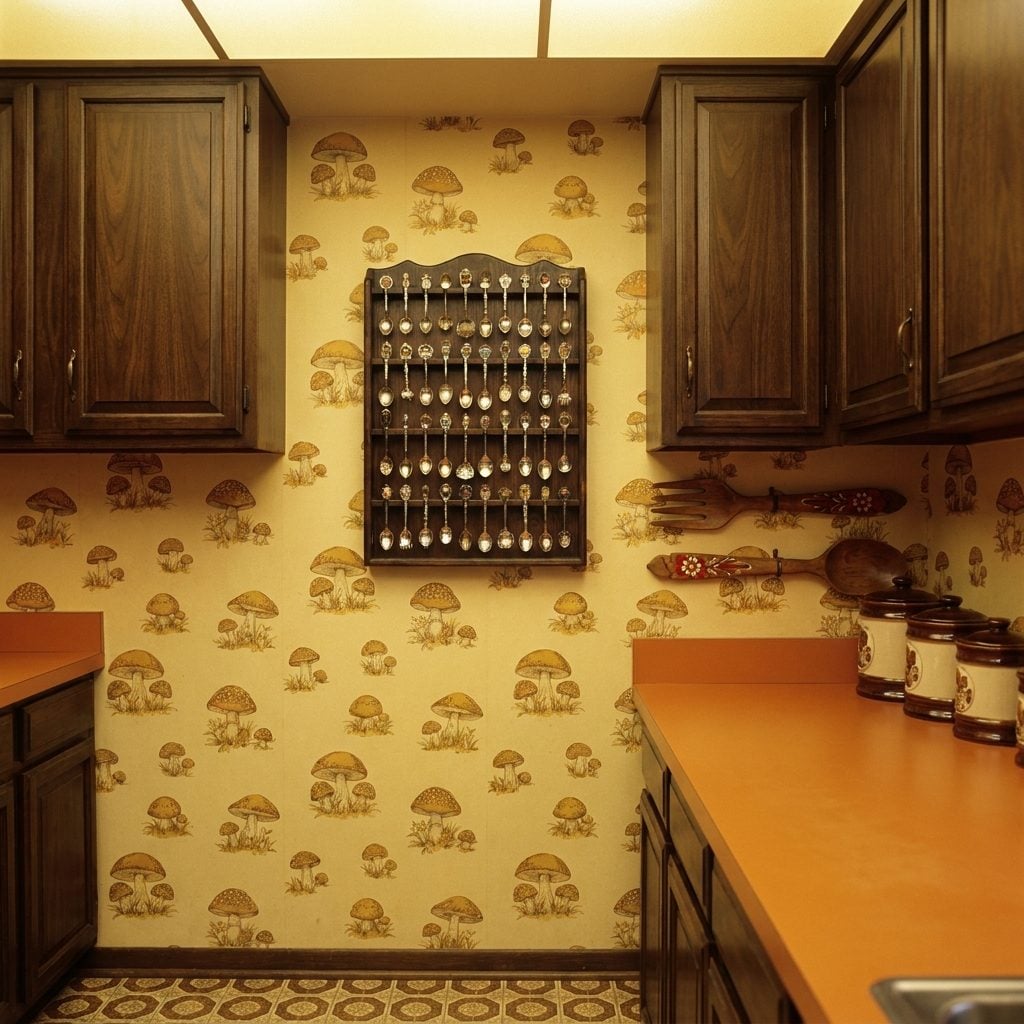
These were not utensils. They were art. The giant wooden fork and spoon mounted side by side on the kitchen wall served no culinary function whatsoever, they were roughly the size of a tennis racket and hung at eye level like a still life painting that happened to look like it belonged in a restaurant. You could not use them to serve anything. That was not the point.
They came from import stores, craft fairs, and Italian delis, and they appeared in kitchens across America with a consistency that suggests a mass coordinated effort nobody planned. Sometimes painted with fruit. Sometimes left natural. Sometimes a matched set, sometimes not. The decorative spoon rack alongside them held twelve souvenir spoons from places like Niagara Falls and Branson, Missouri, none of which could be traced to an actual family trip anyone remembered taking.
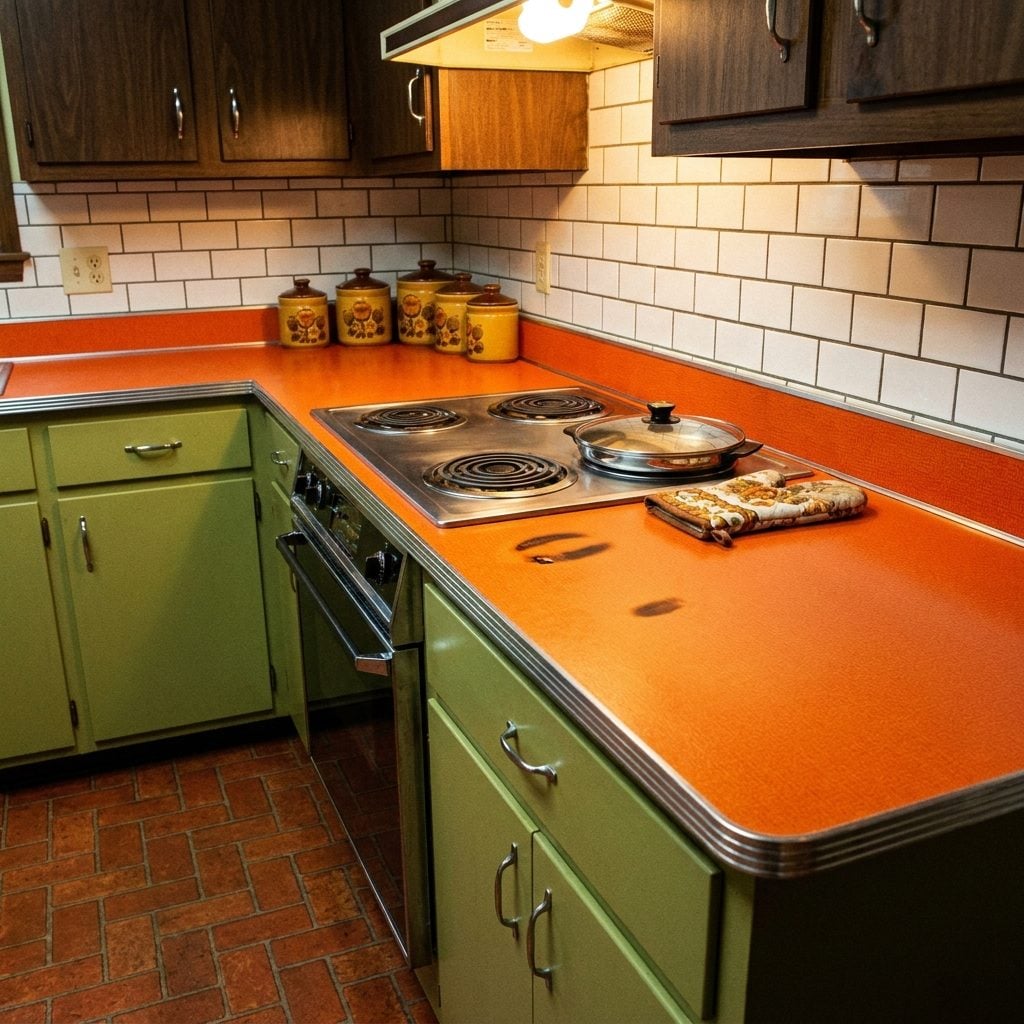
19. Blinding Orange Laminate Countertops With at Least Two Permanent Burn Marks From Someone’s Cigarette
🔥 Would you like to save this?
Orange. Not terracotta. Not burnt sienna. Not warm amber. Pure, unapologetic, eye-searingly orange laminate, the color of a traffic cone in full afternoon sun. This was a deliberate choice made by someone who stood in a showroom, looked at the samples, and picked this one on purpose. And honestly, in context, with the walnut cabinets and the avocado appliances, it almost worked.
The burn marks were inevitable and universal. Someone rested a cigarette on the counter edge while both hands were full, and that was that. Laminate burns are permanent and specific-looking, a small brown oval with a slightly raised edge. You could find at least two in every 1970s kitchen if you looked. Sometimes a small kitchen design could hide them. Most could not.
18. The Kitchen Smoking Station: Table Lighter, Ceramic Cigarette Canister, and an Ashtray That Was Never Quite Clean
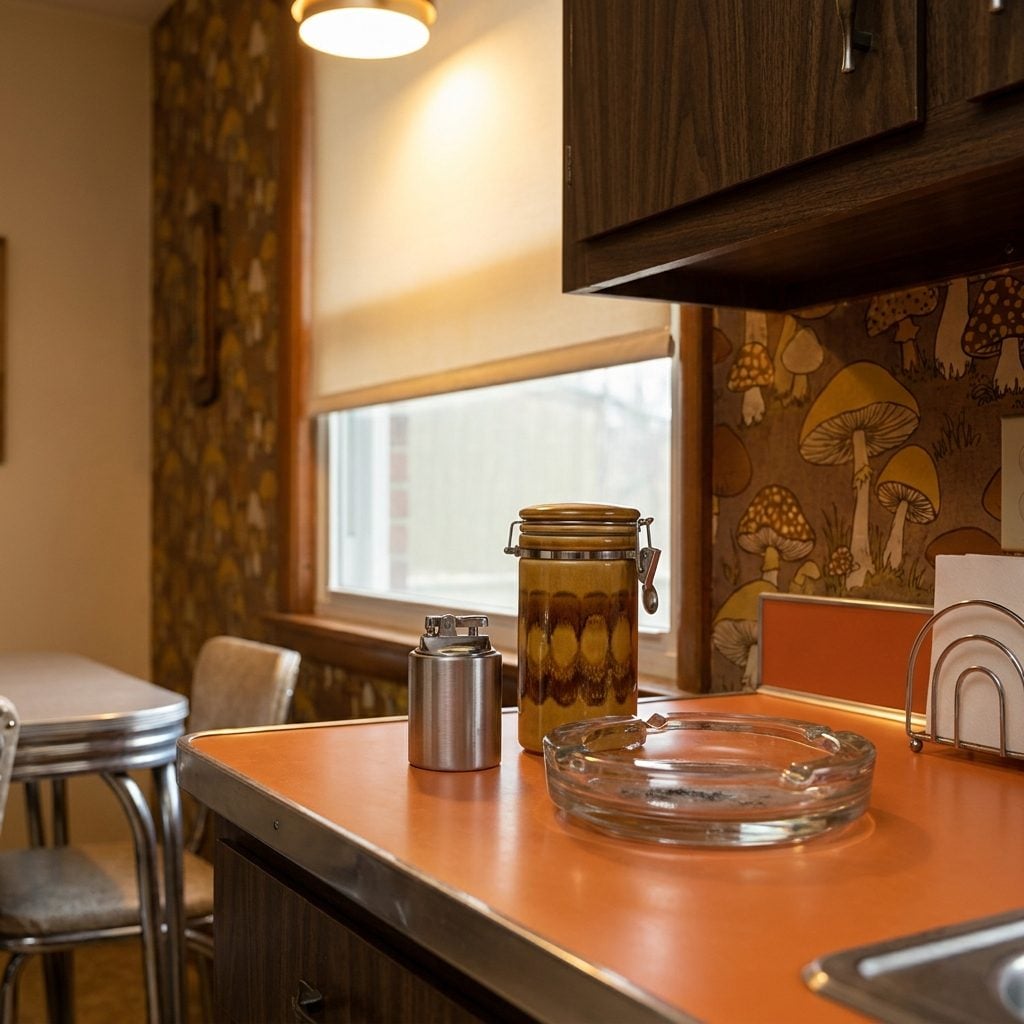
It was just part of the counter. Not hidden, not tucked away, the table lighter, the ceramic cigarette canister, and the ashtray sat on the kitchen counter the way the coffee maker and the toaster did. A permanent fixture. Adults smoked in the kitchen while cooking, while eating, while talking on the wall phone, and nobody found this unusual because it was completely normal.
The table lighter was often a proper piece, chrome, cylindrical, with a satisfying flip mechanism. The cigarette canister had a hinged lid and sat next to the salt and pepper shakers with the same casual authority. The ashtray was usually glass, always slightly grey no matter how recently it had been wiped, and it moved around the counter as needed like a spatula or a potholder.
“The ashtray was usually glass, always slightly grey no matter how recently it had been wiped.”
17. The Wooden Bowl of Fake Fruit That Sat on the Counter for Approximately 40 Years Without Moving
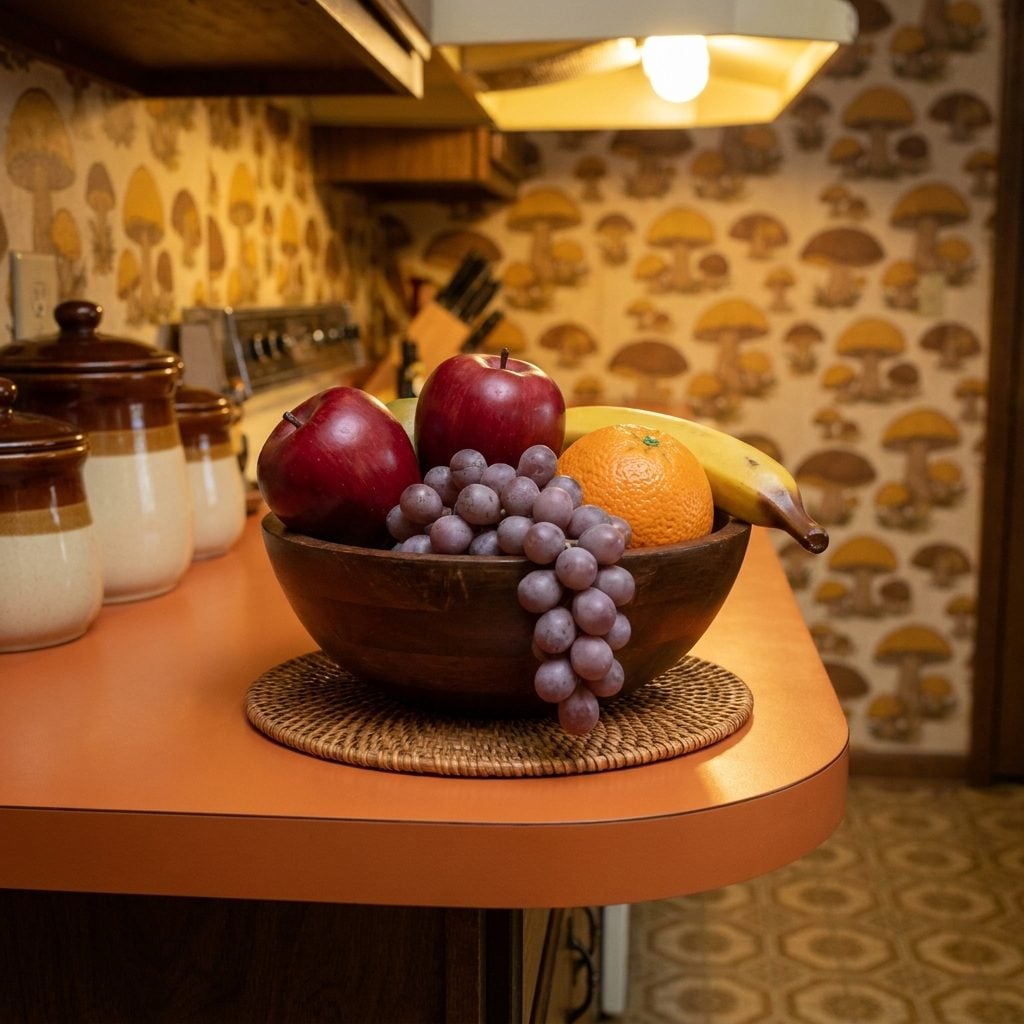
At some point before your memory starts, someone placed this bowl of fake fruit on the kitchen counter. It was there when you were born. It was there when you left for college. It is possibly still there right now.
The wax apples had a specific quality: deeply convincing from four feet away, deeply wrong up close, with that painted highlight that no real apple has ever had. The grapes were plastic and slightly tacky to the touch. The banana had a brown spot near the tip that appeared around 1974 and never changed. Nobody dusted this bowl. Nobody moved it. It held a position of quiet, permanent authority on that counter the way a cathedral holds a position in a town, simply because it had always been there and nobody could imagine the landscape without it.
16. The Indoor Barbecue Grill Built Right Into the Kitchen Counter
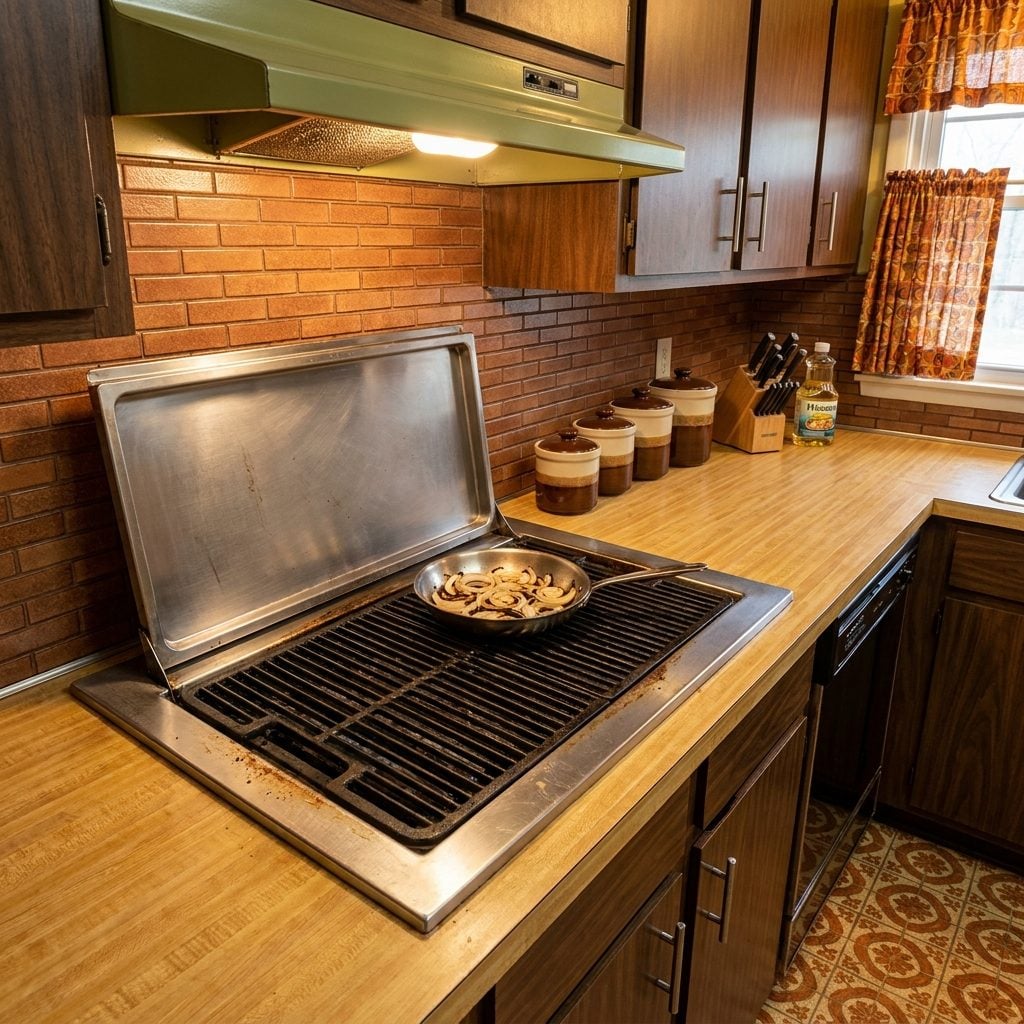
Every now and then you find a feature in an old house that stops you cold and makes you realize the 1970s were operating on a completely different set of assumptions about risk. The built-in indoor countertop grill was exactly that. Wired directly into the kitchen circuit, recessed into the harvest gold laminate like it belonged there, it was meant to bring the backyard into the kitchen, and it absolutely brought the smoke with it.
Ventilation was, generously speaking, optimistic. Most of these setups had a metal hood overhead that moved air around without really going anywhere useful. The whole kitchen smelled like charcoal by Tuesday. Gen Z homeowners staring at a listing photo with one of these still intact would probably assume it was a decorative feature. It was not.
15. Dark Wood Cabinets Glazed in So Much Orange Varnish You Could See Your Reflection
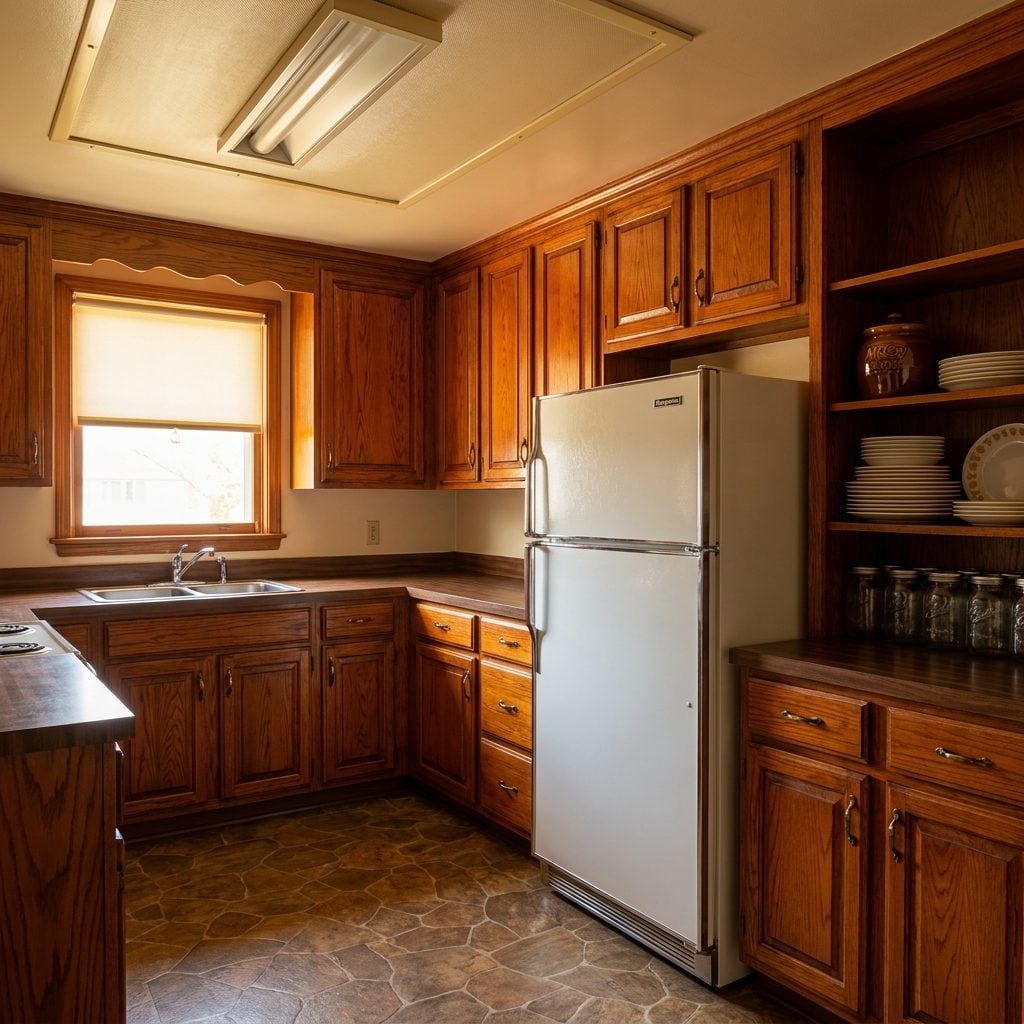
There was a specific color that lived in every 1970s kitchen, and it wasn’t quite brown and it wasn’t quite orange. It was the color that happened when oak cabinets got hit with the strongest varnish available and then just kept getting hit with more varnish every five years because that’s what you did. The result was a finish so thick and amber-toned it looked like the cabinets had been dipped in iced tea.
Nobody questioned it. It was just what wood looked like indoors. The varnish yellowed the whole room, bounced that orange cast off the harvest gold appliances, and made even a noon-bright kitchen feel like early evening. If you want to understand why the 1980s went completely overboard with white paint, spend five minutes standing in one of these kitchens.
14. The Tiny Kitchen TV Perched Four Inches from the Toaster
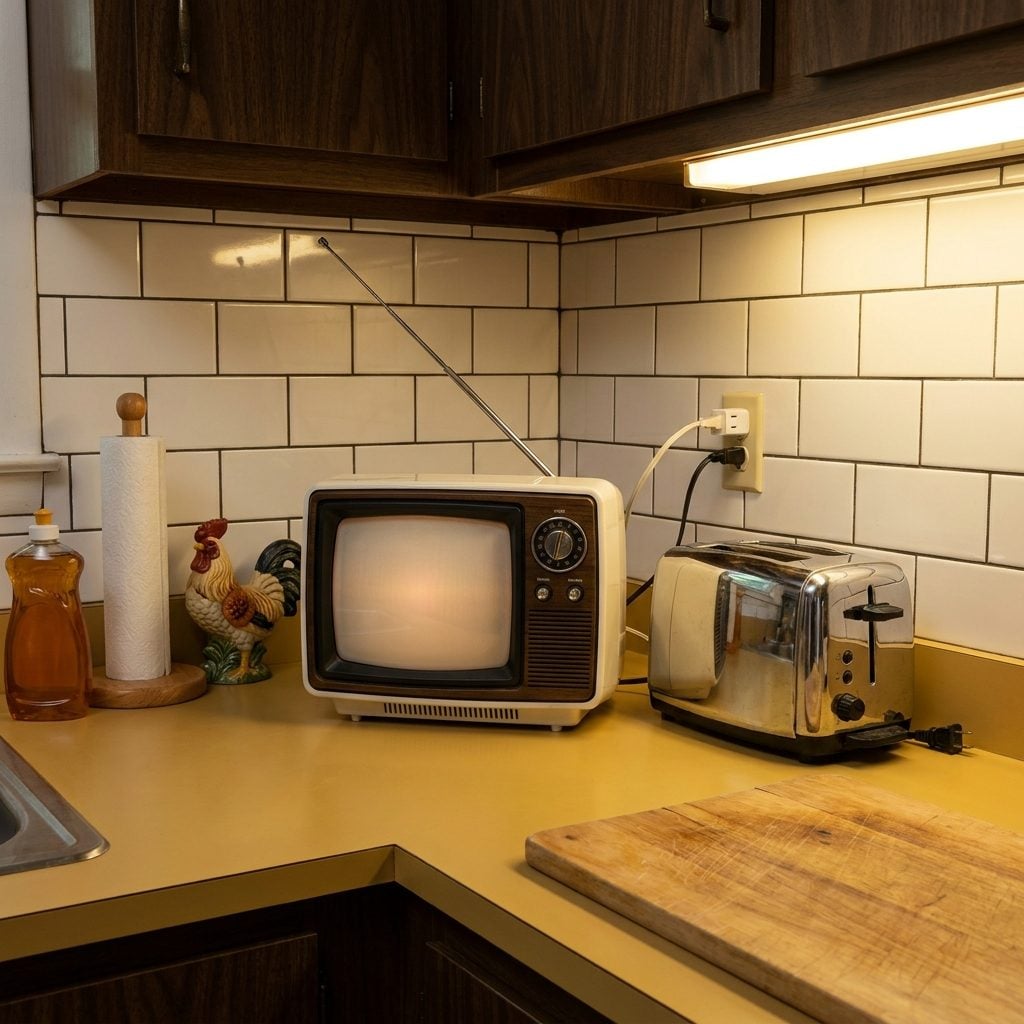
The kitchen TV had no business being where it was. It sat on the counter between the toaster and the canister set, antenna cocked at whatever angle had finally, miraculously, pulled in Channel 4 without too much static. The cord shared an outlet with the toaster through a two-prong adapter that was definitely not code-compliant by any decade’s standards. Nobody cared. The whole point was watching the noon news while making lunch, and it worked.
These were almost always black and white sets, even well into the 1970s, because nobody was putting a color TV in a room where grease could get on it. When the microwave arrived and took over that corner of the counter, the kitchen TV moved to the top of the refrigerator. And somehow that was even more precarious.
13. The Breadbox Taking Up Half the Counter Like It Paid Rent
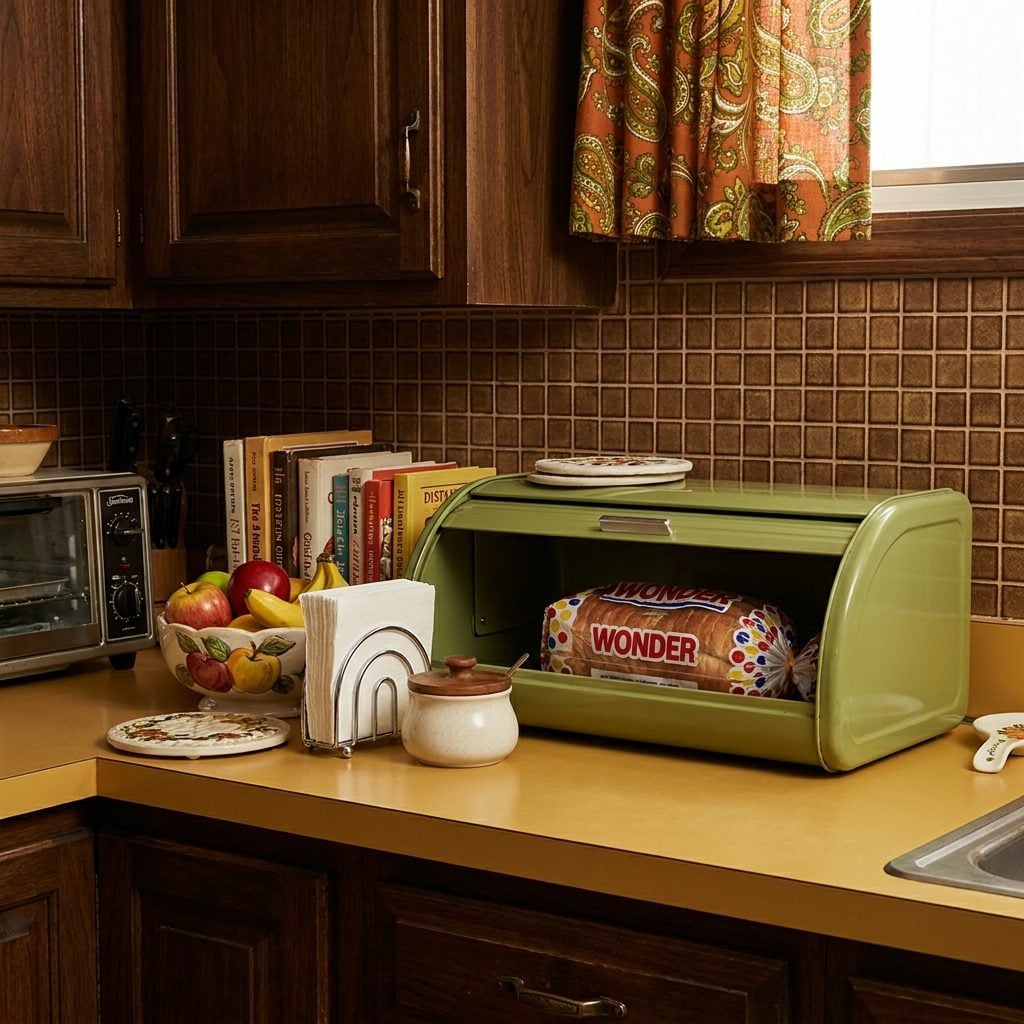
The breadbox wasn’t a decorative choice. It was infrastructure. In a pre-resealable-bag era, bread went stale in hours if left out, and the refrigerator made it gummy, so the breadbox was the actual solution. The problem was that the breadbox was enormous, roughly the footprint of a small microwave, in avocado green or harvest gold or sometimes a deeply committed chocolate brown enamel. It owned its counter space with total confidence.
Inside you’d usually find: one loaf of white sandwich bread, maybe the tail end of a second loaf, and for some reason always one dinner roll from three days ago. The roll-top lid made a very satisfying metallic sound that is genuinely difficult to describe to someone who’s never heard it. A small kitchen design today barely has room for a paper towel holder, let alone a breadbox the size of a carry-on suitcase.
12. The Wall of Copper Molds That Were Absolutely Never Used for Cooking
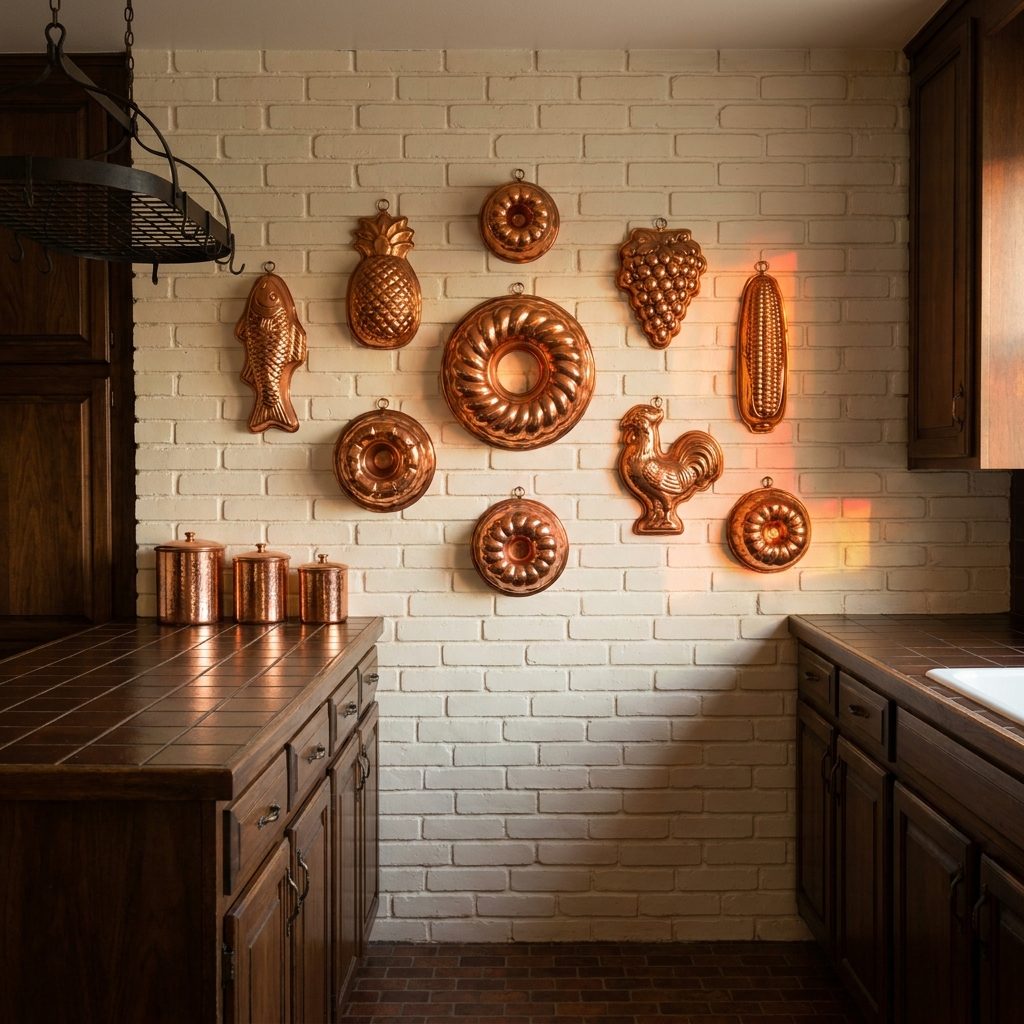
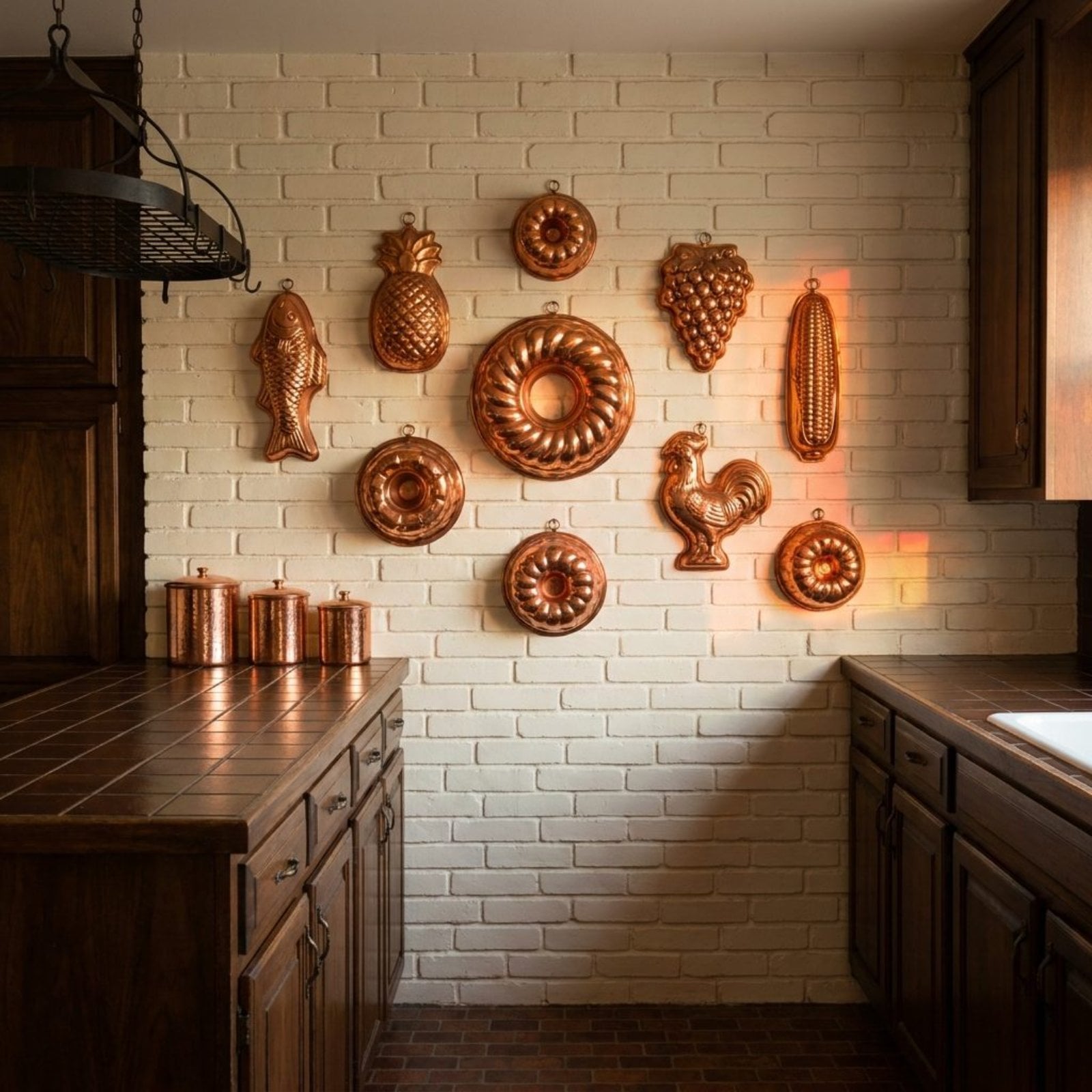
Not one of them ever touched Jell-O. The copper molds were purely visual, hung on the kitchen wall in a careful grid pattern like a gallery installation that happened to be themed around fish and pineapples. They were acquired at craft fairs, antique shops, and from older relatives who had actually used them in the 1940s for things involving aspic. By the 1970s their function was entirely aesthetic: they were warm, they were handmade-looking, and they made the kitchen feel like it had a past.
There’s actually a design logic here that holds up. Copper catches light in a way that nothing else does, and a wall of varied molds creates texture and visual rhythm in a room that’s otherwise all flat cabinet faces. Today’s equivalent is probably a shiplap accent wall, and I will go to my grave believing the copper molds were more interesting.
11. The Under-Cabinet Electric Can Opener That Was Basically a Permanent Fixture
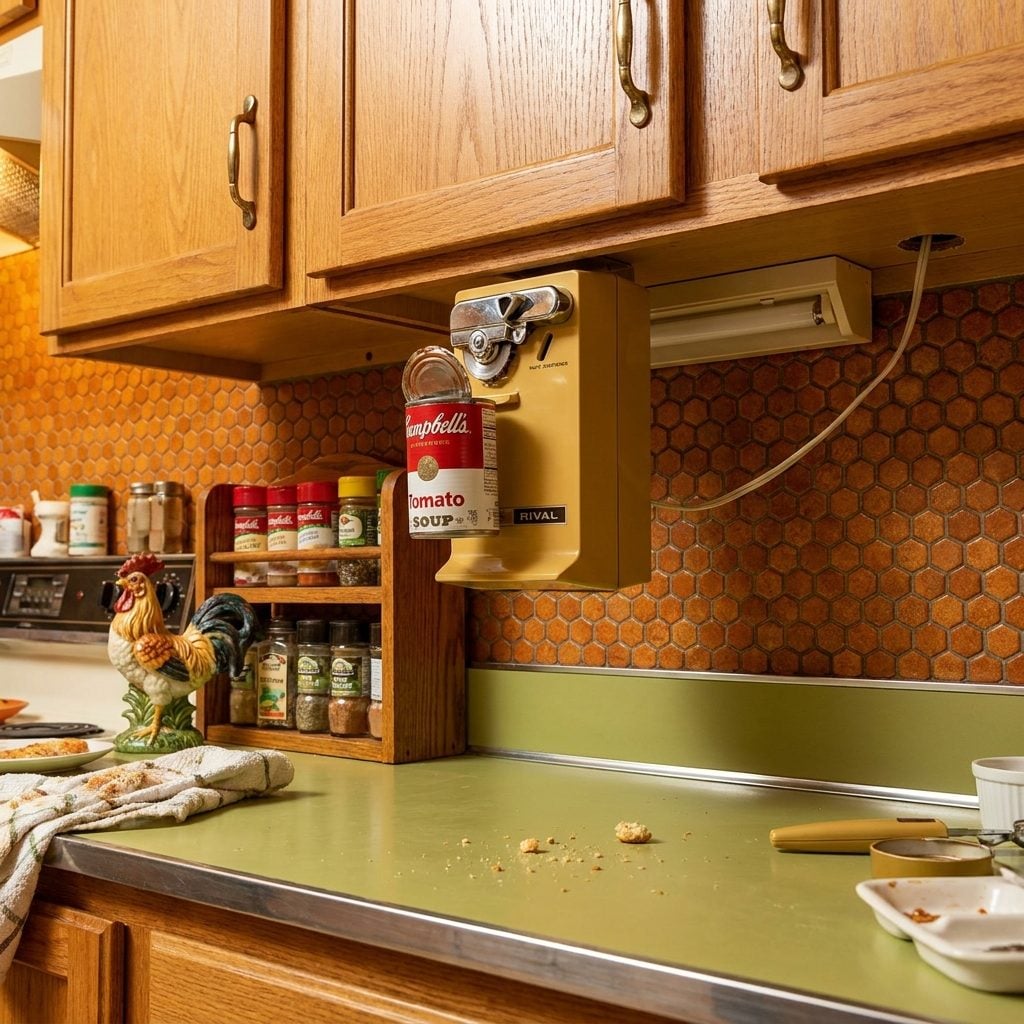
Mounting the electric can opener under the cabinet was considered genuinely clever space management in 1972, and honestly it wasn’t a bad idea. It kept the appliance accessible while freeing up the counter below, a principle that would show up again decades later in narrow kitchen decor trends. The unit was bolted directly into the cabinet bottom with two screws and never moved again, because why would it.
Almost every model had a knife sharpener built into the side that nobody used correctly. You dragged the blade through twice, felt like something had happened, and kept using a dull knife anyway. The can opener itself worked perfectly until about 1989, at which point it either died or the house sold and the new owners stared at it for six months before finally unscrewing it.
10. The Built-In Vinyl Breakfast Booth That Was Impossible to Clean and Impossible to Leave
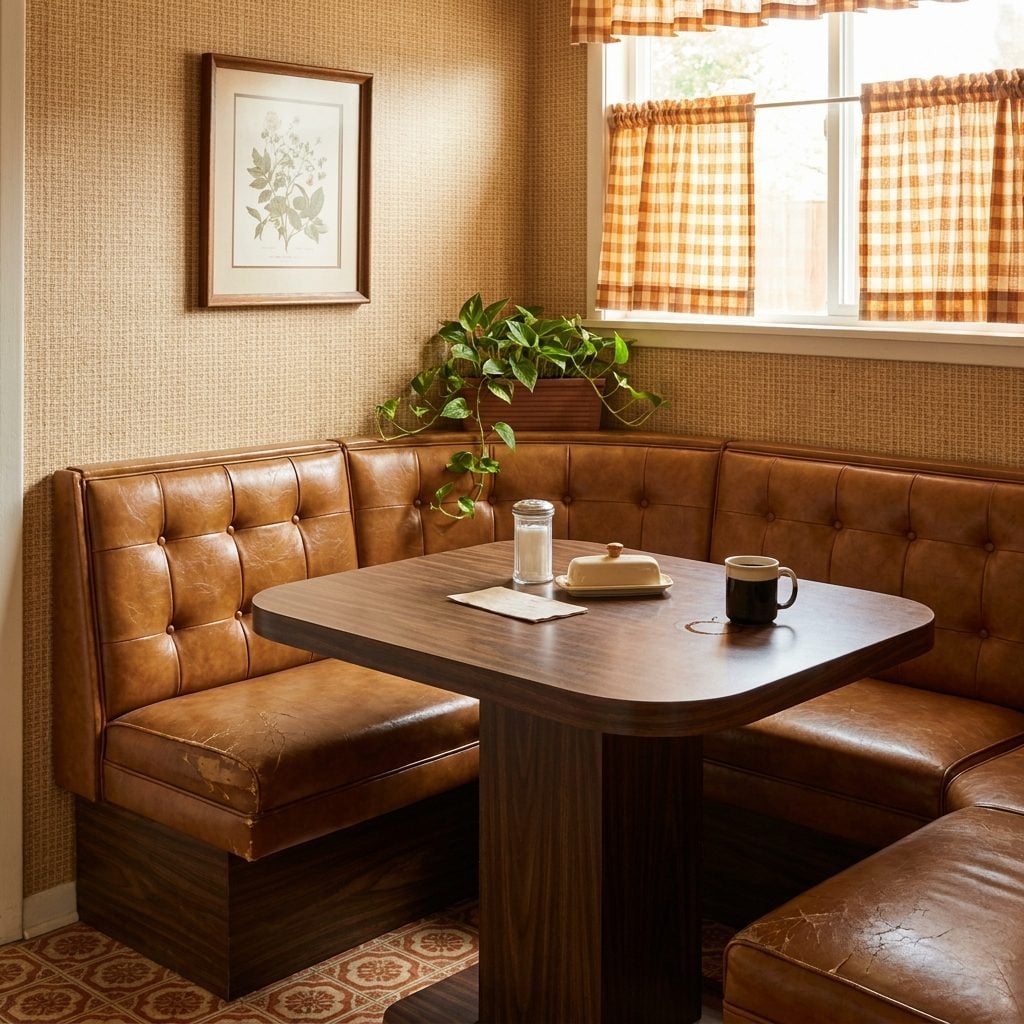
Slipping into the breakfast booth meant committing. You sat down, the vinyl made a sound, your thighs stuck immediately, and the table was just close enough that getting back out required a specific pivot maneuver that everyone in the family had quietly memorized. Nobody complained. The booth was the best seat in the house for coffee and cereal and staying a little longer than you meant to on a Saturday morning.
The vinyl cushions cracked first along the seams, then across the seat. By the early 1980s most of these had a roll of electrical tape somewhere nearby for maintenance. Cleaning under the table was a project requiring actual commitment, crumbs accumulated in the bench gap with total dedication. The booth was attached to the wall. It was, structurally speaking, part of the house. Some of them still are.
The breakfast booth was where homework got done, where arguments got resolved, and where nobody ever actually wanted to be the one sitting against the wall.
9. Goose-and-Bonnet Wallpaper Border: A Decorating Choice That Demands Answers
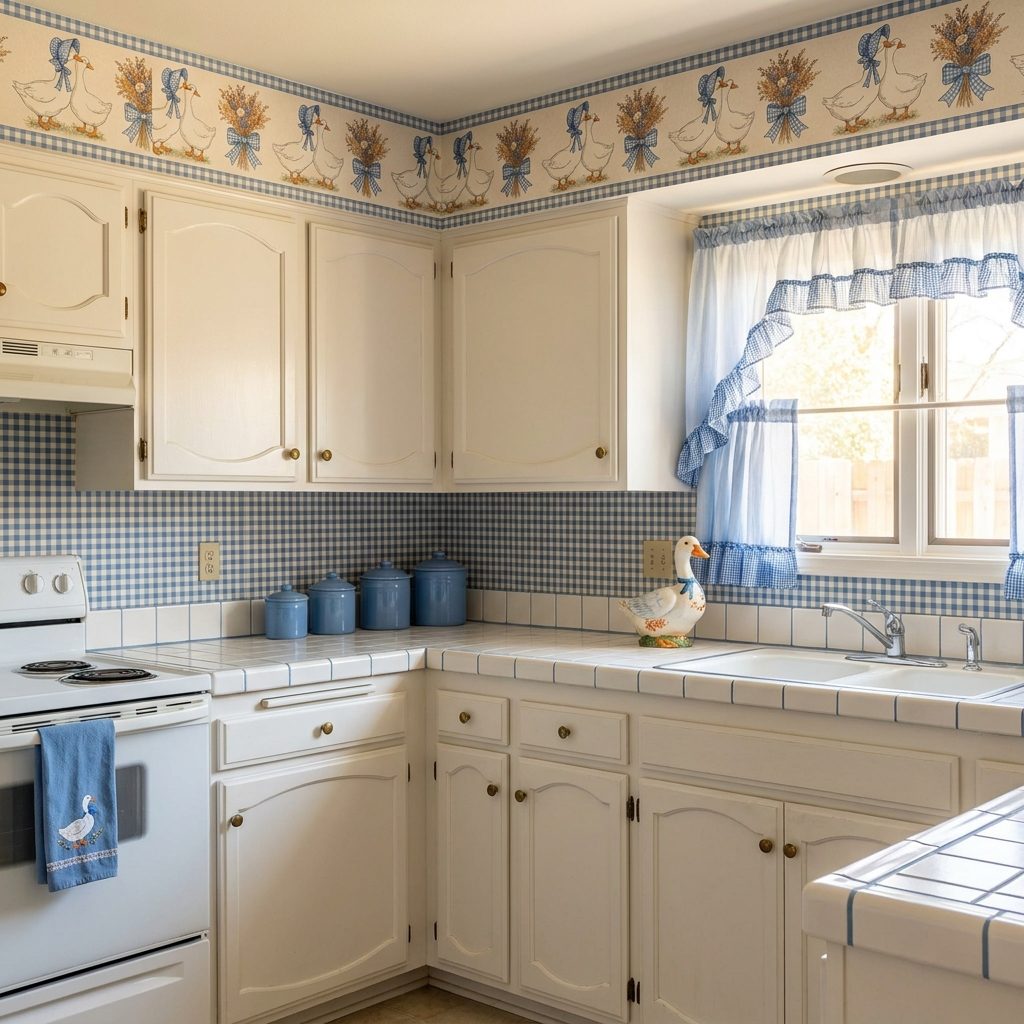
The geese were always wearing bonnets. This was non-negotiable. You could find wallpaper borders with geese in bows, geese in hats, geese carrying baskets, geese near barns, but the bonnet was the classic form, and once you committed to the goose border, you committed hard. Matching dish towels. A ceramic goose by the sink. Possibly a goose doorstop. It was a whole home inspiration ecosystem built around a bird that nobody in the household had ever met personally.
Country kitchen style was serious business in the late 1970s and through most of the 1980s, and the goose-and-bonnet border was its most recognizable shorthand. The strange thing is that it worked on its own terms, the blue and white palette, the gingham, the ruffled curtains, it was a completely coherent decorating vision. It just happened to involve geese. Dressed. In formal headwear.
8. The Fridge Door That Was Half Bulletin Board, Half Museum of Everywhere Mom Had Ever Been
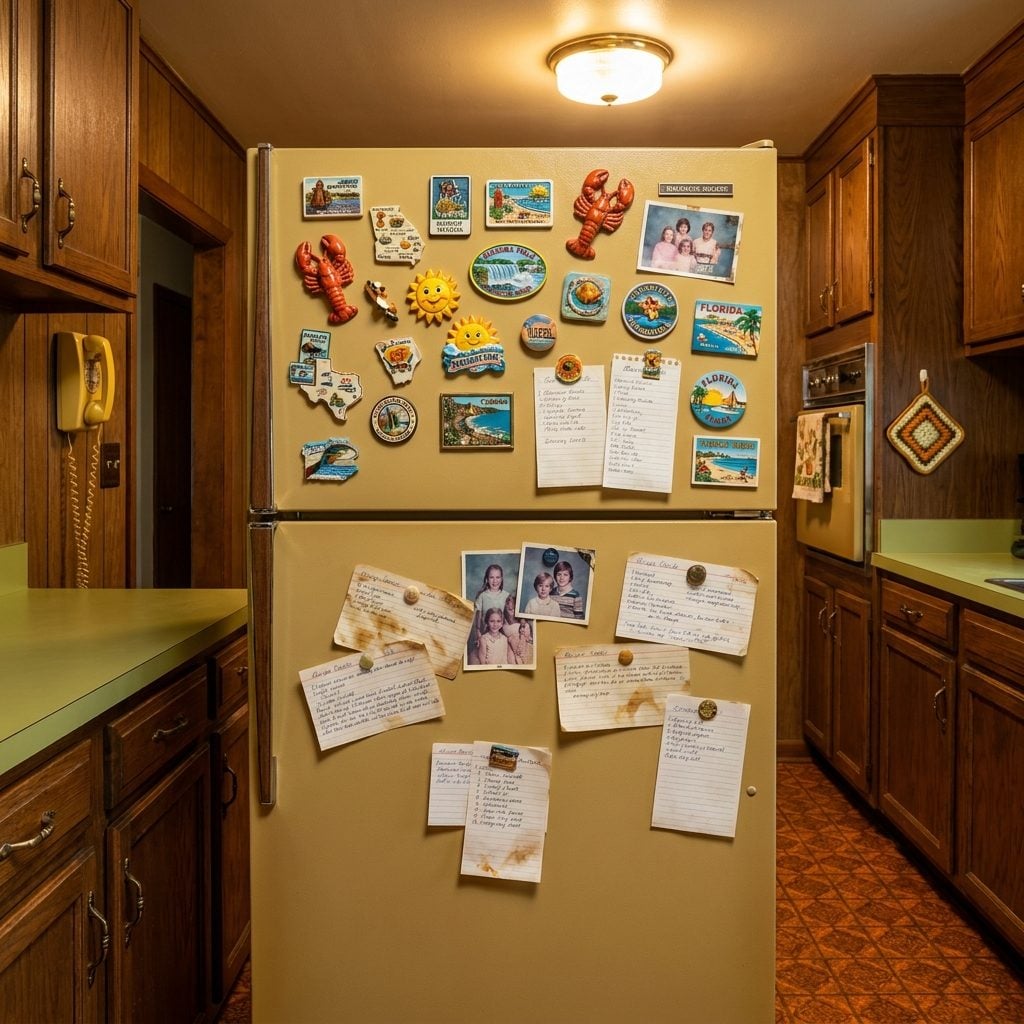
Every inch of that fridge door was accounted for. There was the lobster magnet from the Maine trip, the ceramic sun from Myrtle Beach, the flat state-shaped magnet from a highway rest stop in Tennessee nobody remembered stopping at. Pinned underneath all of it: a torn-out recipe for “Company Casserole” from a 1971 issue of Family Circle, held in place at one corner, flapping every time someone opened the door.
The recipe cards themselves were a whole archive. Some were clipped, some were handwritten on index cards in ballpoint pen, some were so greasy from the stove they’d turned translucent at the edges. Nobody filed them. The fridge door was the file system. It worked, mostly.
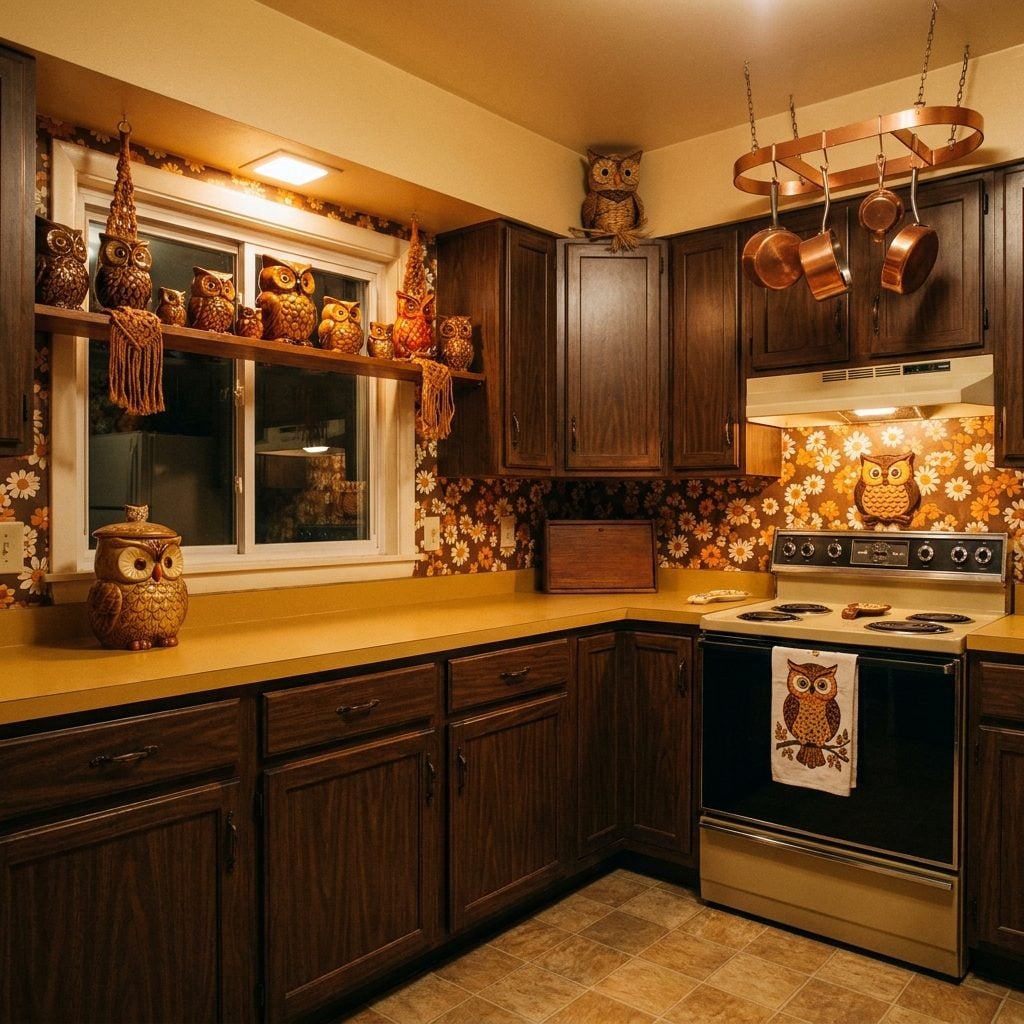
7. The Owls, Oh God, the Ceramic Owls on Every Available Surface
🔥 Would you like to save this?
No one alive can fully explain the owls. They were everywhere, on every surface, in every material: ceramic, macrame, wicker, cast iron, printed on dish towels, molded into cookie jars. The big ones had removable heads. For storage, presumably, though nobody stored anything in them.
Owls were wise. That was the reasoning, apparently. So having seventeen of them watching you eat breakfast was some kind of ambient encouragement to think deeply while you poured your Tang.
They disappeared so completely by 1985 that it’s almost hard to believe they were a genuine, widespread phenomenon and not a collective false memory. They were not a false memory. Your grandma had six.
6. The Swag Lamp Hanging Low Over the Kitchen Table Like It Had Important Business There
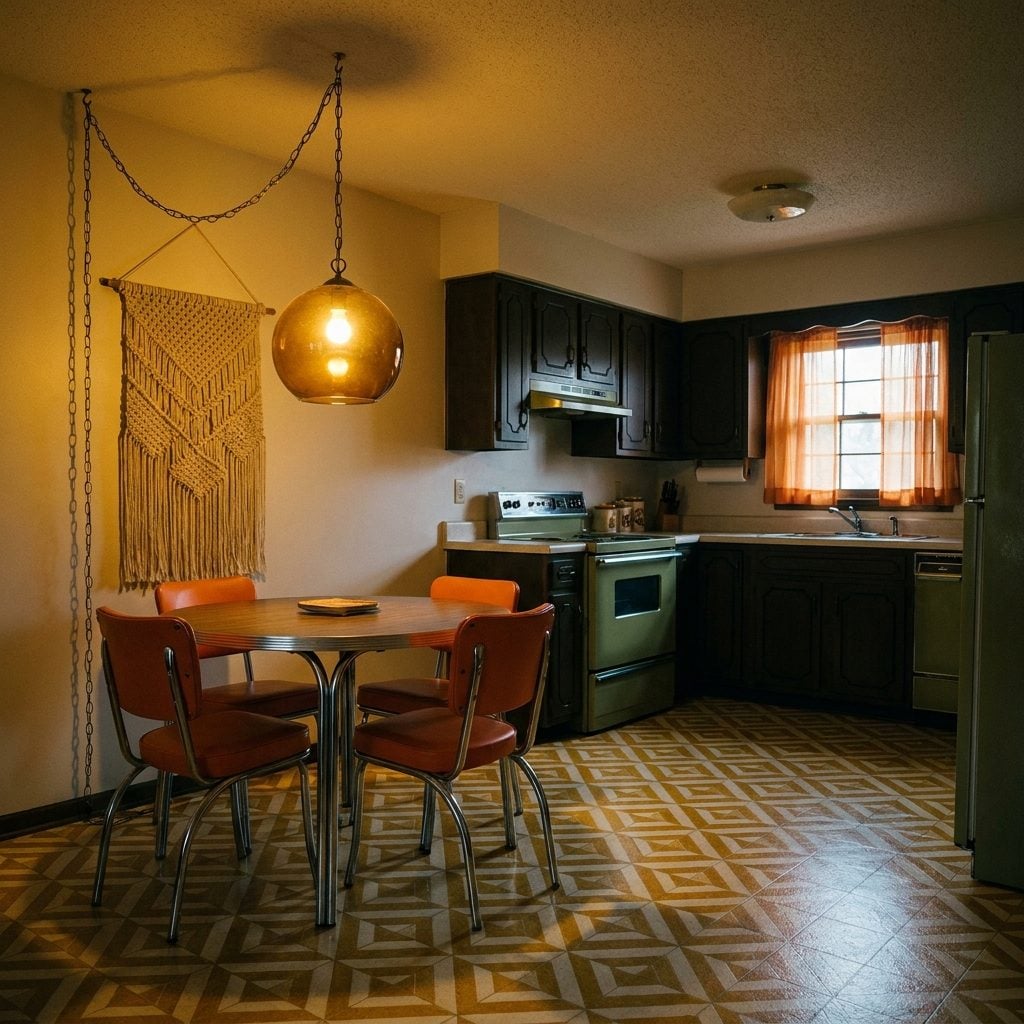
It hung from a single chain hooked directly into the drywall, no wiring, no electrician, just a plug that ran along the ceiling to the nearest outlet and a prayer it would hold. The shade was usually amber glass or wicker, and it threw the most flattering, honey-colored light you’d ever seen at a kitchen table.
Every dinner felt slightly dramatic under it. Homework felt more important. Arguments felt more cinematic. When it swayed slightly from an open window, the whole room moved with it.
“Dinner under a swag lamp in 1974 felt like eating at a restaurant, even if the restaurant was serving fish sticks.”
5. Brown Glass Canisters That Announced FLOUR, SUGAR, COFFEE Like They Were Broadcasting It
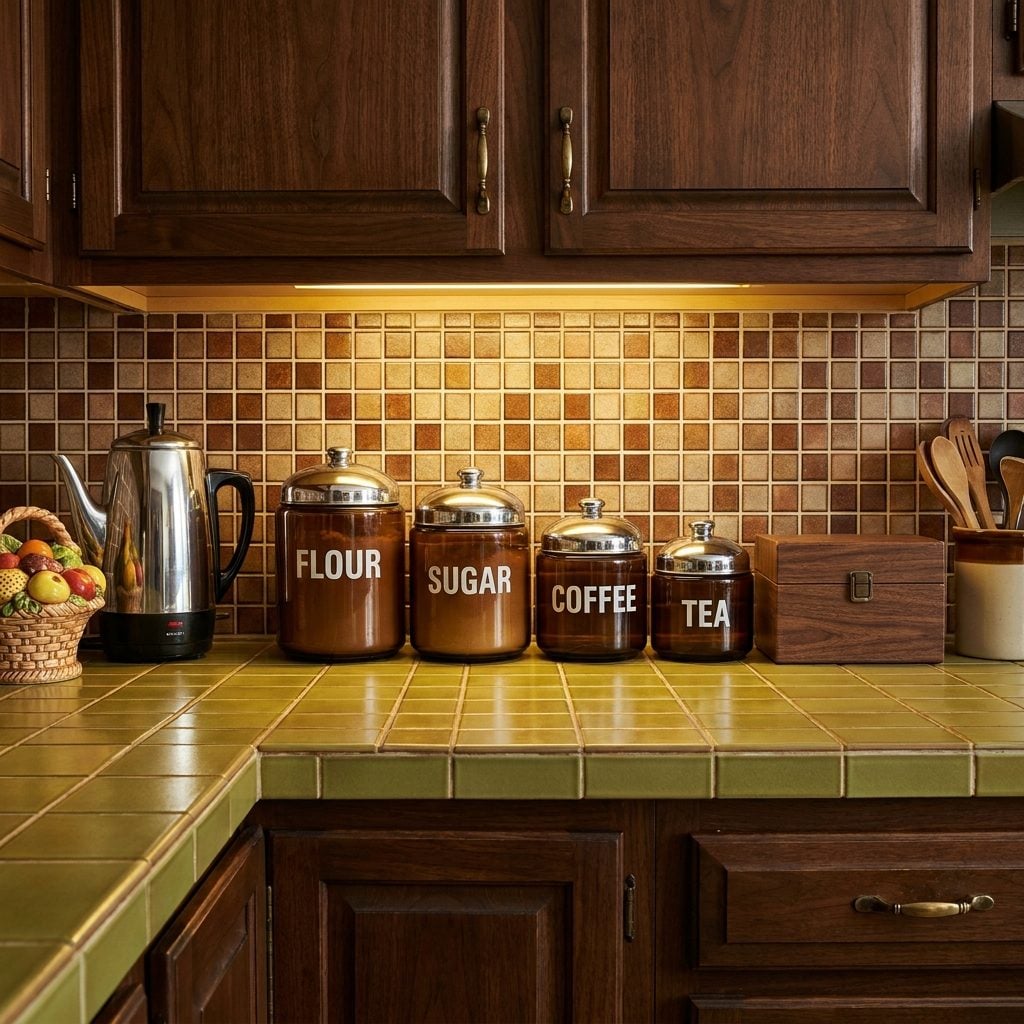
They sat in a descending row on the counter: FLOUR, SUGAR, COFFEE, TEA. Brown smoked glass with chrome lids and lettering large enough to read from across the room. They coordinated with everything because everything in that kitchen was already some shade of brown, amber, or harvest gold.
The practical joke built into this set: the FLOUR and SUGAR canisters looked identical in size and the labels, after a few years of counter grease and steam, were not always easy to read at a glance. At least one batch of cookies in every family’s history was ruined this way. This is not speculation.
4. Linoleum in Patterns So Loud They Basically Had Their Own Personality
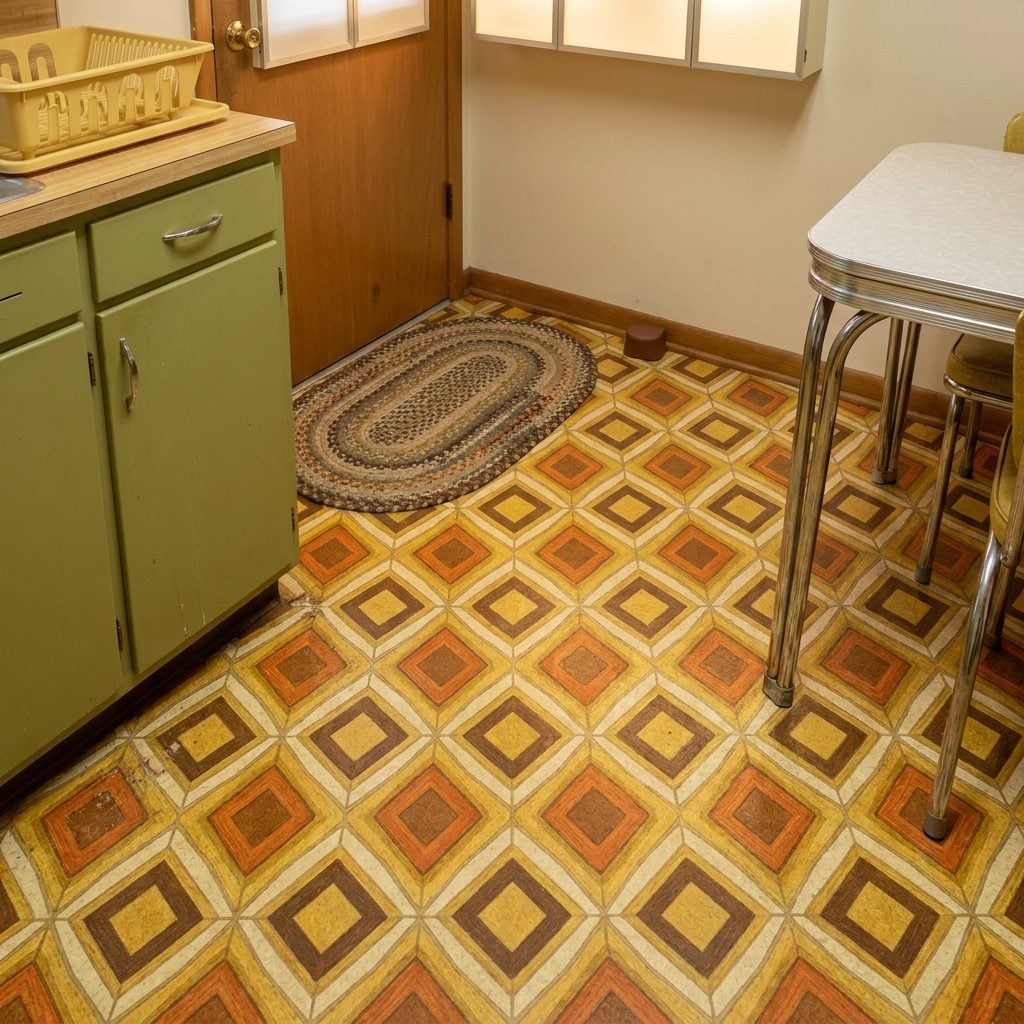
The patterns on 1970s linoleum floors weren’t subtle. We’re talking interlocking diamonds in burnt orange and chocolate brown. Hexagons in harvest gold and cream. Geometric repeats that, if you stared at them too long while eating cereal, started to pulse slightly. They were visually aggressive in the most committed possible way.
They also hid everything, which was the practical genius underneath the aesthetic chaos. Crumbs, spills, general kitchen debris: gone. You could run a small kitchen design entirely around the floor pattern because the floor did the heavy lifting. Modern white tile is beautiful and unforgiving. The linoleum of 1974 was loud, warm, and never made you feel bad about how you lived.
3. The Fondue Pot: Always Within Arm’s Reach, Endlessly Ready for a Party That Might Happen
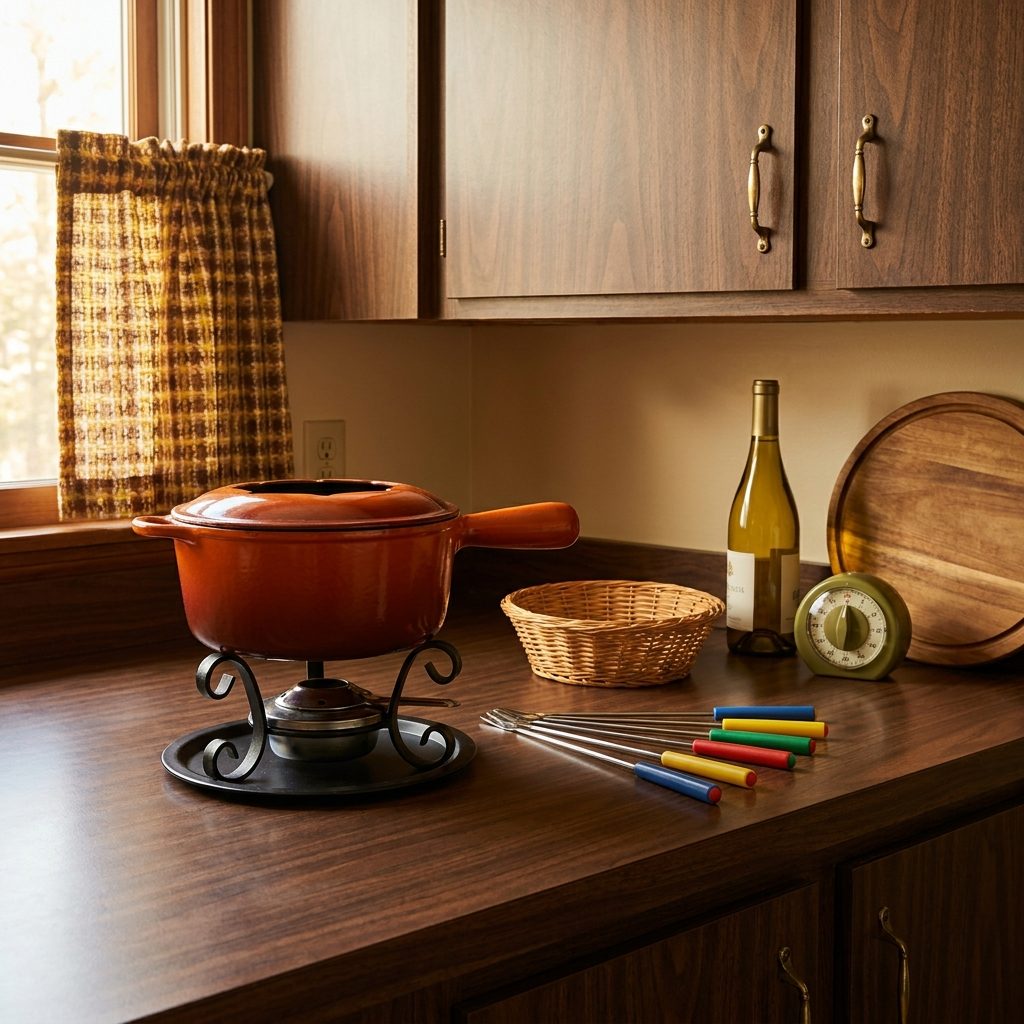
The fondue pot occupied a position of semi-permanent readiness in the 1970s kitchen. It wasn’t stored in the back of a cabinet like seasonal equipment. It was out, on the counter or a low shelf, its enameled cast iron body in orange or harvest gold, the colored-handle forks fanned beside it. Company was always potentially coming.
Cheese fondue, chocolate fondue, beef bourguignon fondue: the pot handled all of it with the same quiet authority. It made dinner interactive and slightly dangerous, which was exactly the dinner party energy of 1974. Then the 1980s arrived, and the fondue pot went into the back of the cabinet, where it stayed for about forty years until someone rediscovered it and called it “retro entertaining.”
2. Fake Brick Paneling Installed With Full Confidence and Absolutely No Irony
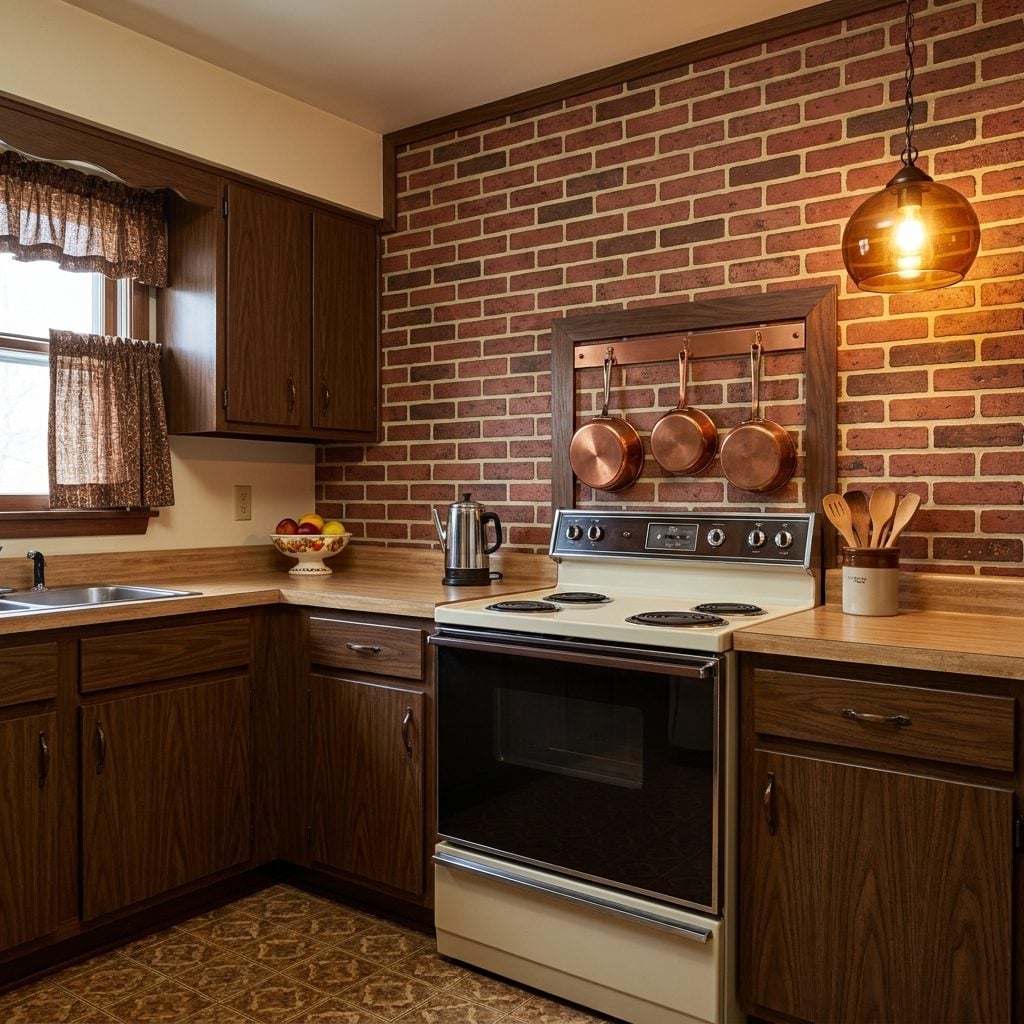
It was a sheet of printed or embossed material approximately an eighth of an inch thick, installed against drywall, and absolutely nobody had questions about this. The faux brick accent wall said “rustic farmhouse character” in 1976 as clearly as shiplap said it in 2016, and it arrived with the same total cultural confidence. You hung copper pots on it. You mounted a shelf on it. You had dinner in front of it without a second thought.
The dead giveaway was always the corners, where the sheet ended too cleanly. Real brick doesn’t stop like that. But the goal was the warmth of the idea, not a structural audit, and on those terms it genuinely delivered. For home inspiration beyond the era, the impulse to add a textured, warm-toned accent wall to a kitchen has never actually left us. It just upgraded its materials.
1. The Tupperware Cabinet That Was Basically a Booby Trap
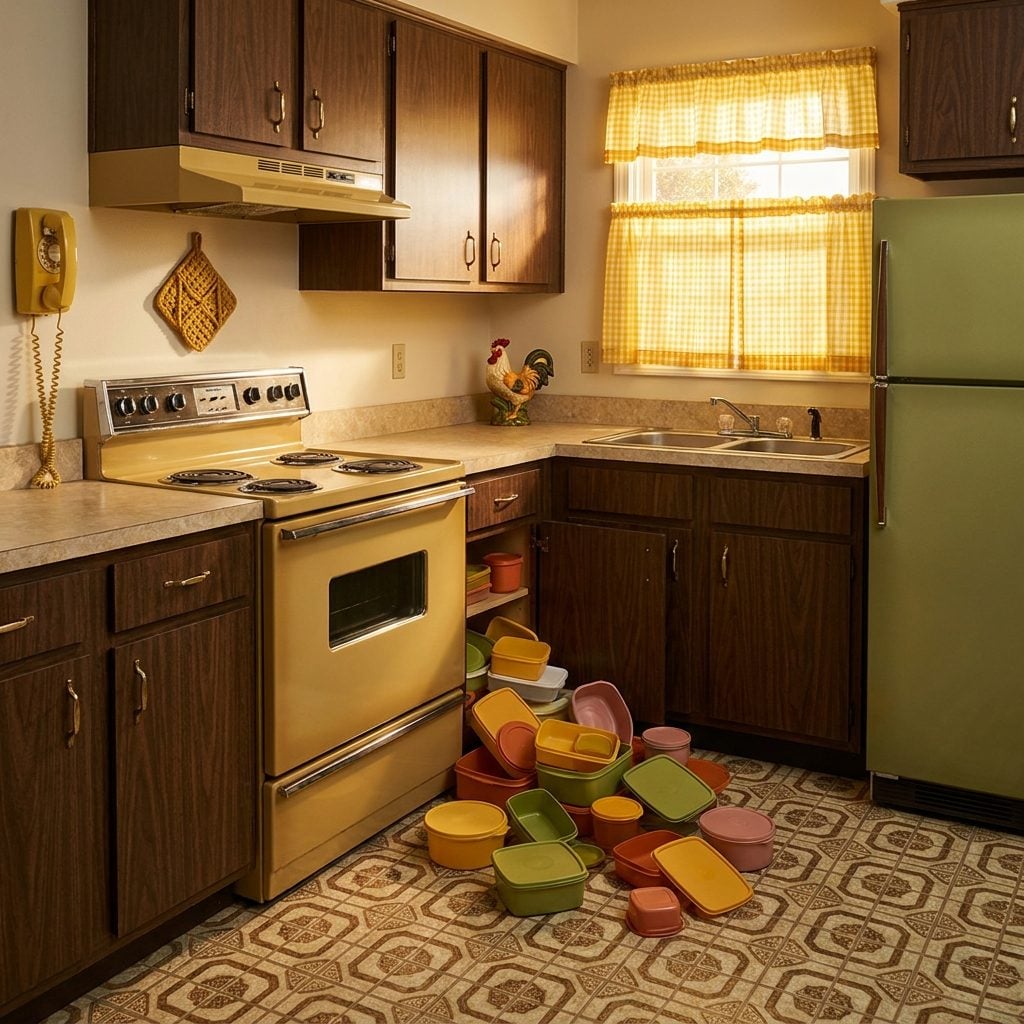
You didn’t open that cabinet. You braced for it. One finger on the handle, knees bent, because every single person in the house knew what was about to happen. The lids were never with their containers. The containers were never stacked. It was just a compressed mass of harvest gold, avocado green, and burnt orange plastic, held in place entirely by the door.
Tupperware in the ’70s wasn’t just storage, it was a whole social economy. Your mom went to the parties, came home with pieces she didn’t need, and jammed them into that cabinet with the confidence of someone who would deal with it later. Later never came. The wobbling tower just grew. And somehow, despite the chaos, she could reach in blind and pull out exactly the right size bowl for leftover chili.