🔥 Would you like to save this?
Victorian pumping stations were not built to be modest. Thick brick walls, ornate ironwork, barrel-vaulted engine halls designed with a civic ambition that modern construction rarely bothers to match — these buildings were made for permanence. Then the pumps stopped, and like most industrial structures that outlive their purpose, they were left to negotiate quietly with time.
In order to come up with the very specific design ideas, we create most designs with the assistance of state-of-the-art AI interior design software. Also, assume links that take you off the site are affiliate links such as links to Amazon. this means we may earn a commission if you buy something.
These 34 before and after transformations, each designed entirely by AI, answer what happens next — and without compromise. Engine halls become open-plan residences. Machinery plinths become kitchen islands. Vaulted brick ceilings are the first thing every design preserves and the last thing anyone would want to change. The results are not restorations. They are what happens when unlimited imagination meets a building that was already extraordinary and simply needed someone to notice.
34. Barrel Vaults, Brass Pendants, and the Ghost of a Steam Engine
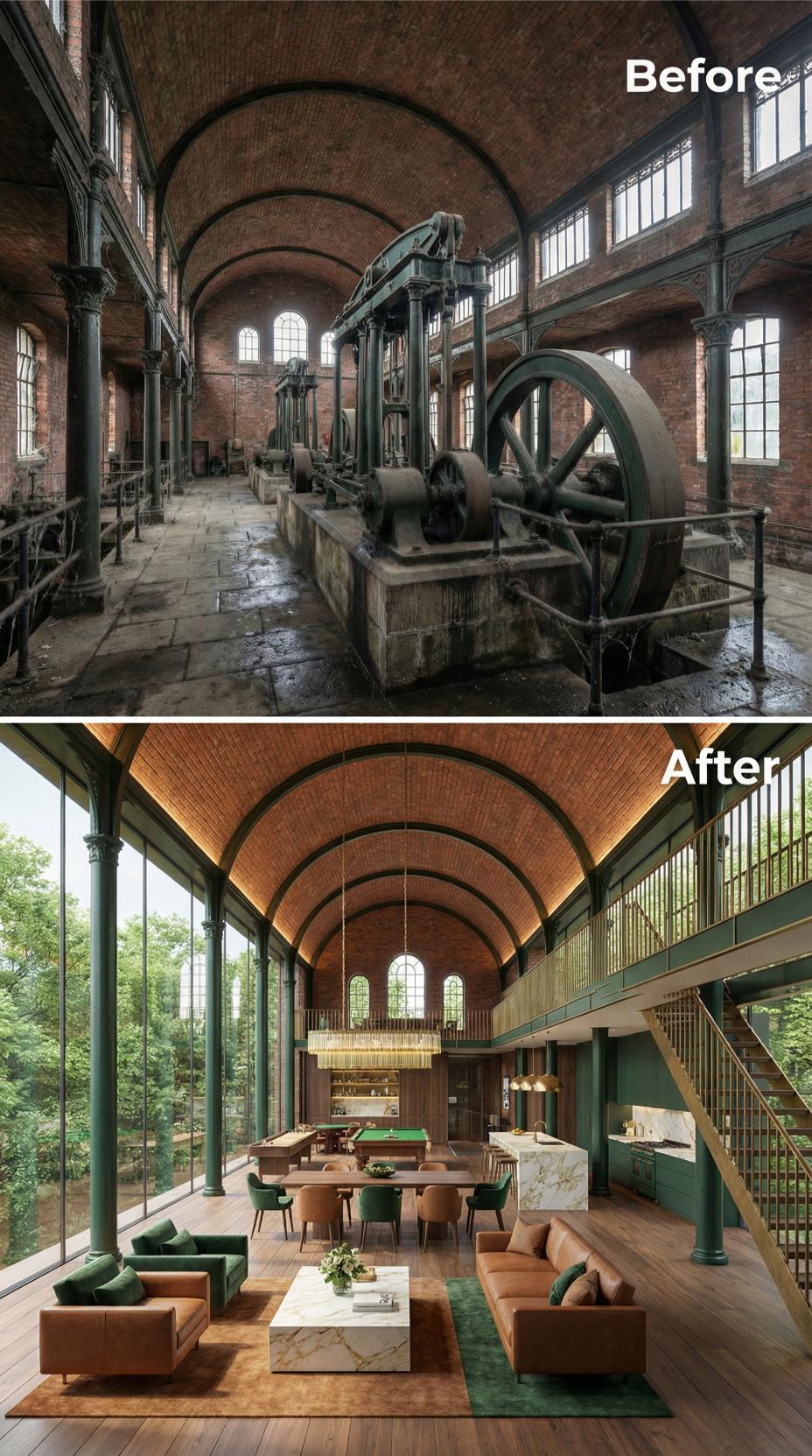
The barrel-vaulted brick ceiling, original to the Victorian structure, now glows amber under concealed LED strip lighting rather than sitting in damp shadow. Floor-to-ceiling glass walls replaced the industrial cladding on one side, flooding the space with natural light. Cognac leather sectionals anchor the living zone on a dark walnut floor, while emerald velvet dining chairs and a green billiard table echo the original cast-iron columns, which were kept and repainted in deep forest green. A waterfall-edge marble island in cream and gold veining marks the kitchen boundary, and a brass multi-tier chandelier hangs at the room’s center.
33. Warm Ochre Vaults, Floor-to-Ceiling Glass, and a Library Wall That Earns Its Keep
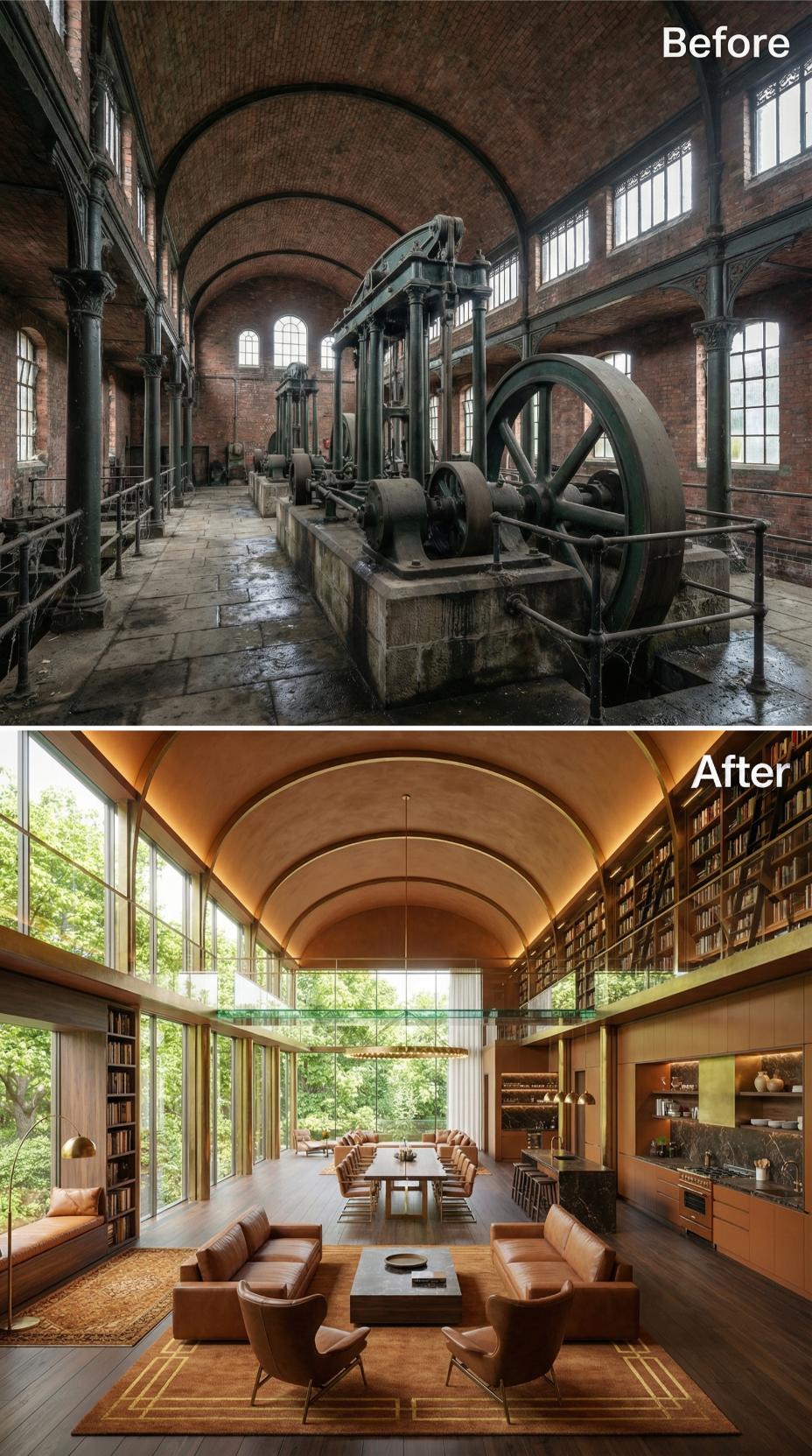
Where cast-iron machinery once sat on stone plinths beneath soot-darkened brick arches, the barrel-vaulted ceiling now reads as a plaster surface washed in amber from recessed cove lighting. Floor-to-ceiling glazing replaced the original clerestory windows on the far wall, pulling green tree canopy directly into the sightline. A sectional in cognac leather anchors the living area on an ochre wool rug with a geometric border in gold.
The dining table, likely walnut with a matte finish, seats twelve beneath a rectangular pendant cluster in aged brass. Bookshelves in warm oak run the full length of the right wall, top to bottom, interrupted only by what appears to be a kitchen section with dark marble countertops and panel-front cabinetry. The spatial hierarchy is clear: reading at the perimeter, cooking mid-wall, living and dining down the center axis.
32. Barrel Vault Intact, Steam Engine Gone, Herringbone Oak In Its Place
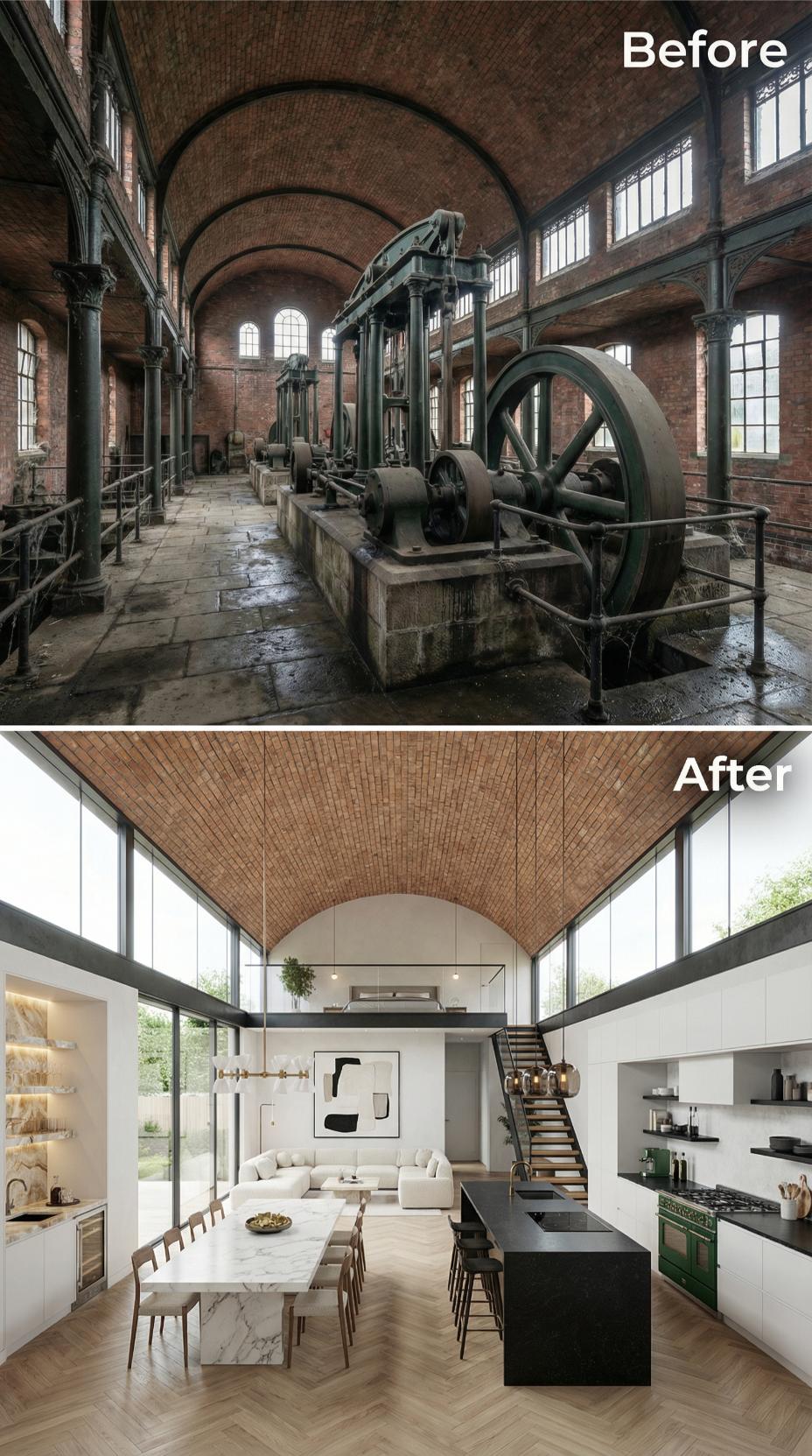
Cleaned and restored, the original brick barrel vault now crowns an open-plan living space flooded with light from floor-to-ceiling glazing on both flanks. A marble-topped dining table anchors the left zone, paired with wood-framed chairs in a warm walnut tone. The kitchen runs along the right wall with flat-front white cabinetry, a black granite island, and a forest-green range cooker. Underfoot, chevron-laid oak planks pull the two zones into a single continuous field.
31. Vaulted Brick Overhead, Curved Linen Sofa Below, and a Kitchen That Finally Makes Sense
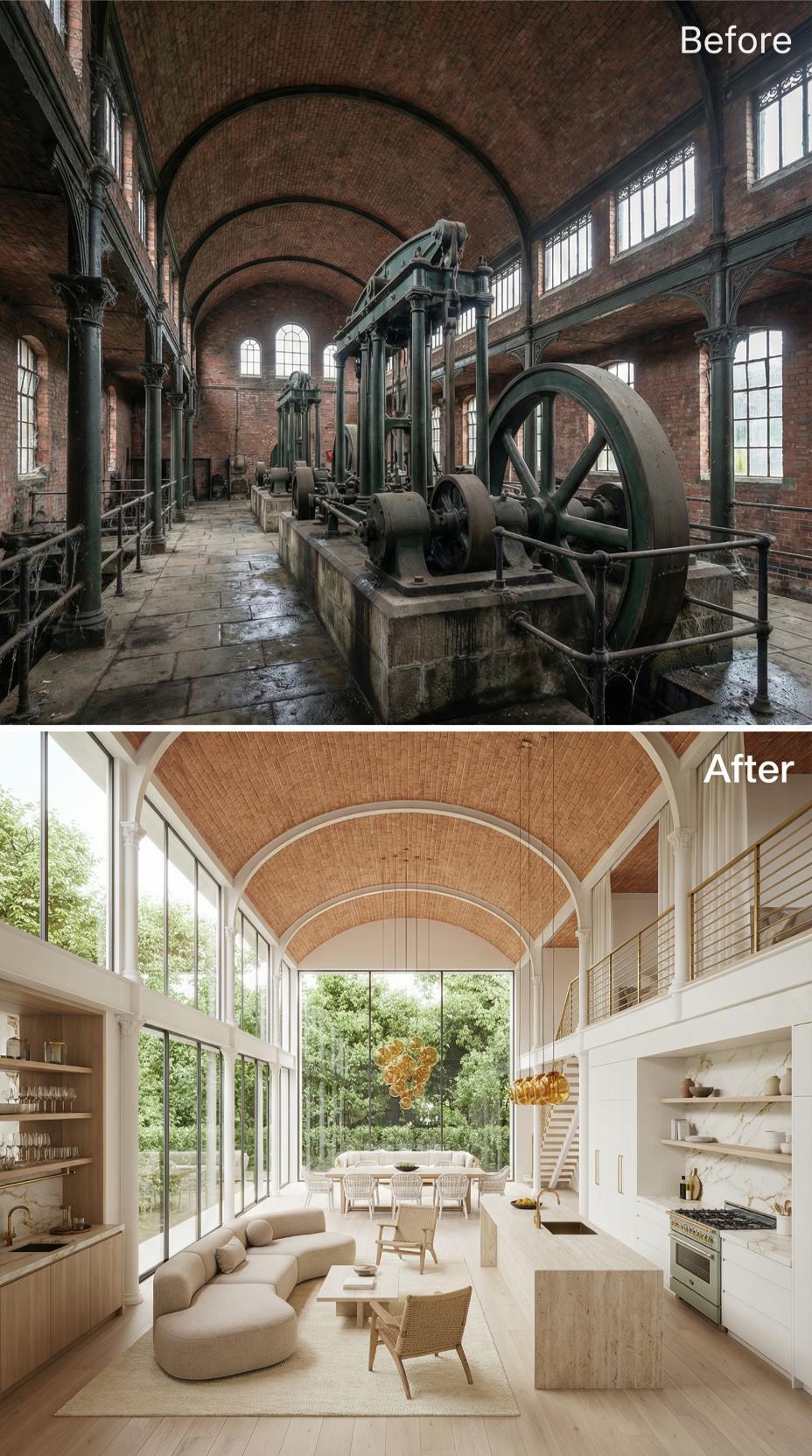
Exposed brick arches run the full length of the barrel vault, cleaned up but left raw, while white-painted haunches anchor the transition to floor-to-ceiling glazing at the far end. Seating centers on a curved sectional in oat-toned linen, paired with woven rattan chairs and a travertine coffee table. To the right, open shelving in light oak flanks a marble slab backsplash above a sage-green range with brass hardware.
Designer’s Secret: Keeping the original brick vault unpainted preserves the thermal mass of the Victorian masonry, which naturally moderates interior temperature without additional insulation. The amber blown-glass pendants clustered at mid-span were deliberately hung low to bring the eye down and make the double-height space feel inhabited rather than cavernous. That single choice does more for livability than any square footage on a listing sheet.
30. Dark Green Brick, Leather Sectional, and a Flywheel That Finally Got to Rest
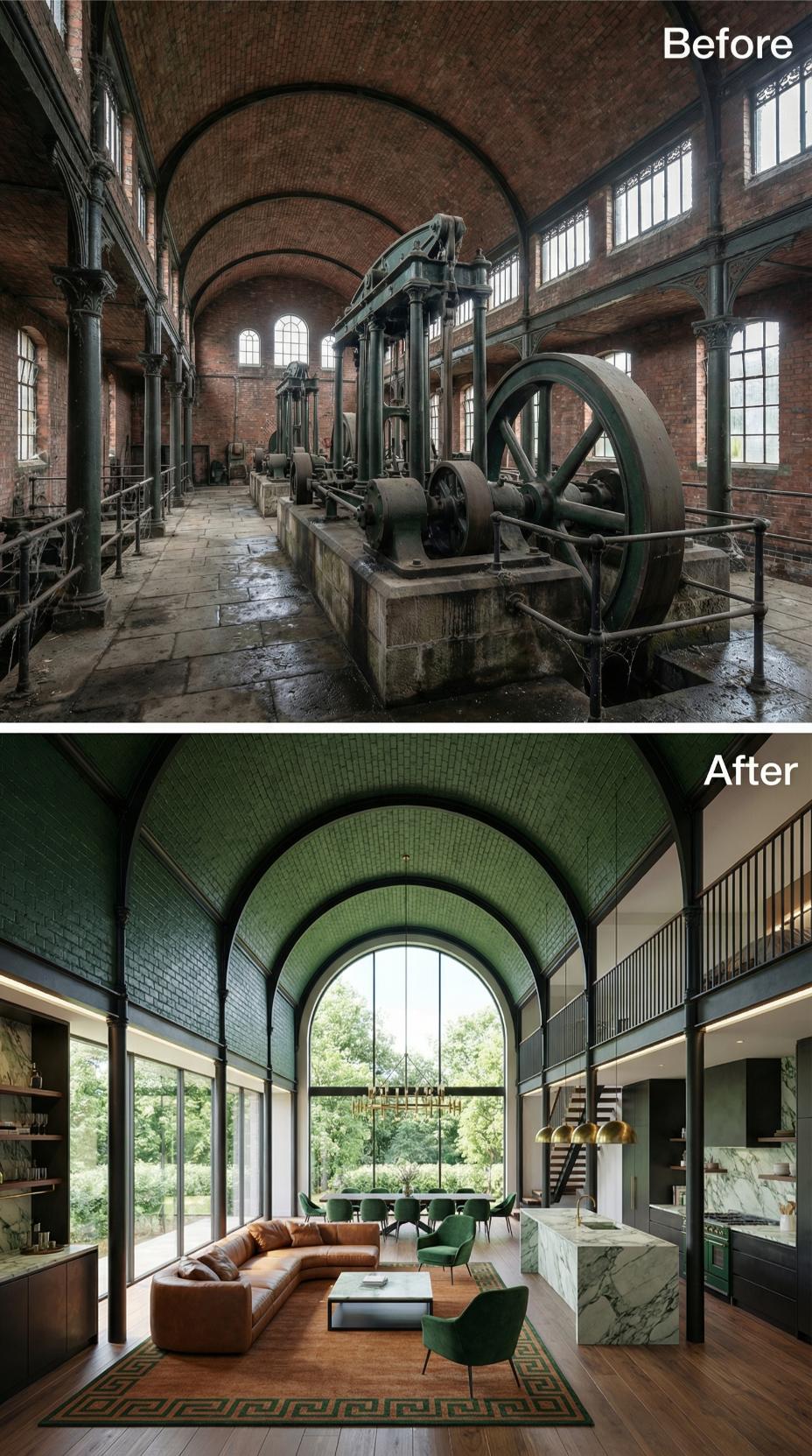
Paint-free brick, now finished in deep forest green, covers every surface from floor to vaulted ceiling, making the arched barrel vault feel more deliberate than decorative. A tan leather sectional anchors the living area beneath brass pendant clusters, while a marble island with pronounced grey veining defines the kitchen without a wall to separate them. Green velvet chairs pull the ceiling color down to eye level.
Try This: Painting reclaimed brick a single saturated color, rather than leaving it raw or whitewashing it, creates visual cohesion across irregular masonry surfaces without hiding the texture. Forest green works particularly well in spaces with high ceilings because it absorbs light from above and draws the eye back down to furnishings. If the color feels too dark for your space, test it first on a single arch panel before committing to full coverage.
29. Copper Tones, Curved Brick, and a Kitchen Island Cut from Rose Marble
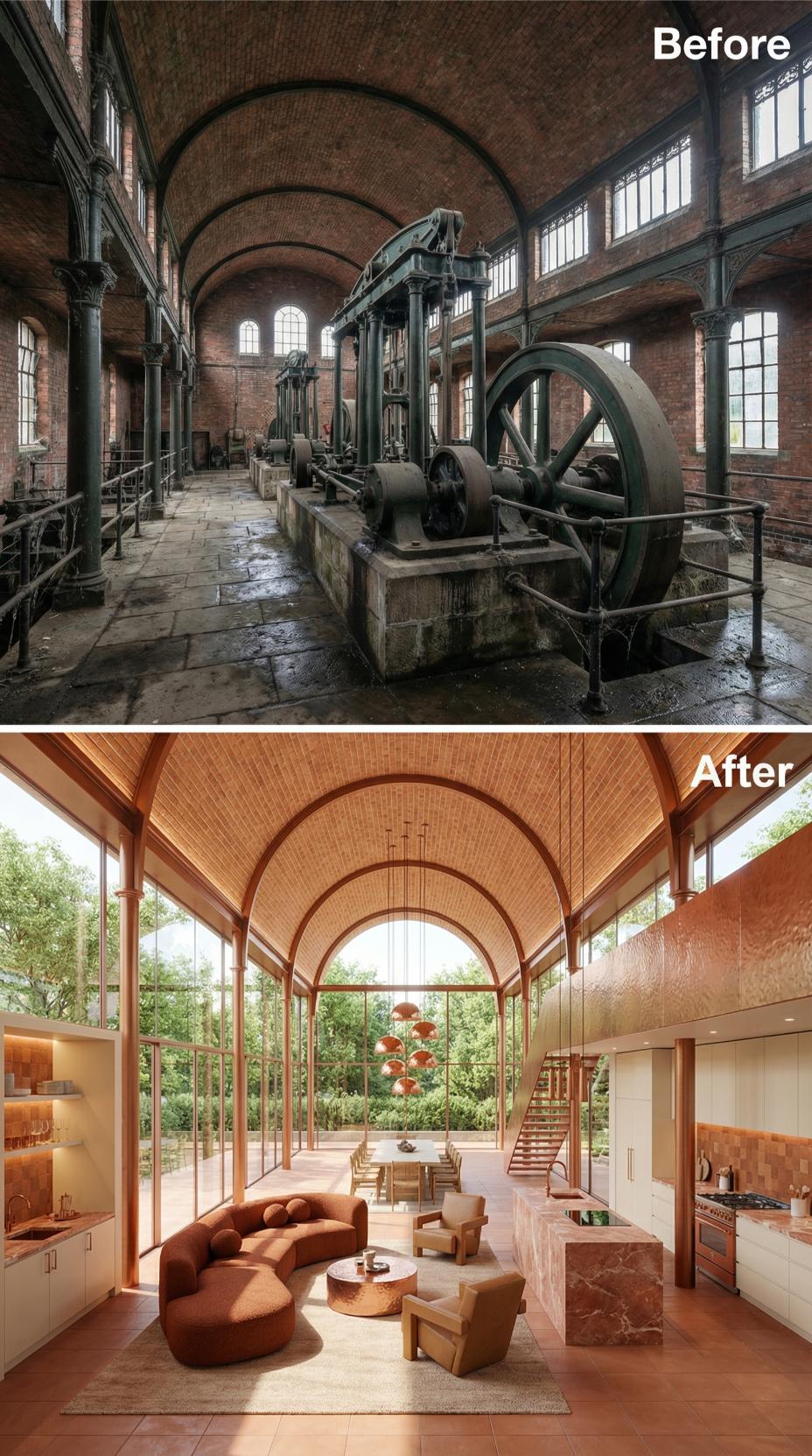
Rust-colored brick arches run the full length of the barrel vault, left unpainted so the warm terracotta tones read as a single continuous surface overhead. The old stone floor and rusted machinery are gone entirely. In their place: polished concrete pavers, a curved sectional upholstered in burnt sienna bouclé, and a round copper-topped coffee table that picks up the metalwork references without leaning industrial.
Floor-to-ceiling glazing replaces the narrow arched windows at the far end, flooding the dining zone with direct green views. The kitchen anchors the right side with flat-front white cabinetry, a veined rose marble island, and subway tile in a warm terracotta glaze. Pendant clusters in aged brass copper hang low over both the dining table and sofa grouping, pulling the two zones into conversation without physically dividing them.
Did You Know: Adaptive reuse projects that retain original barrel vaults often benefit from glazing the end walls rather than the sides, because end glazing preserves the structural rhythm of the arches while dramatically increasing perceived depth. Victorian pumping stations were typically oriented so their long axis tracked the equipment lines, which means end walls almost always face outward toward open ground, making them ideal candidates for full-height glazing in residential conversions.
28. Navy Vault, Brass Columns, and a Living Room That Swallowed a Steam Hall Whole
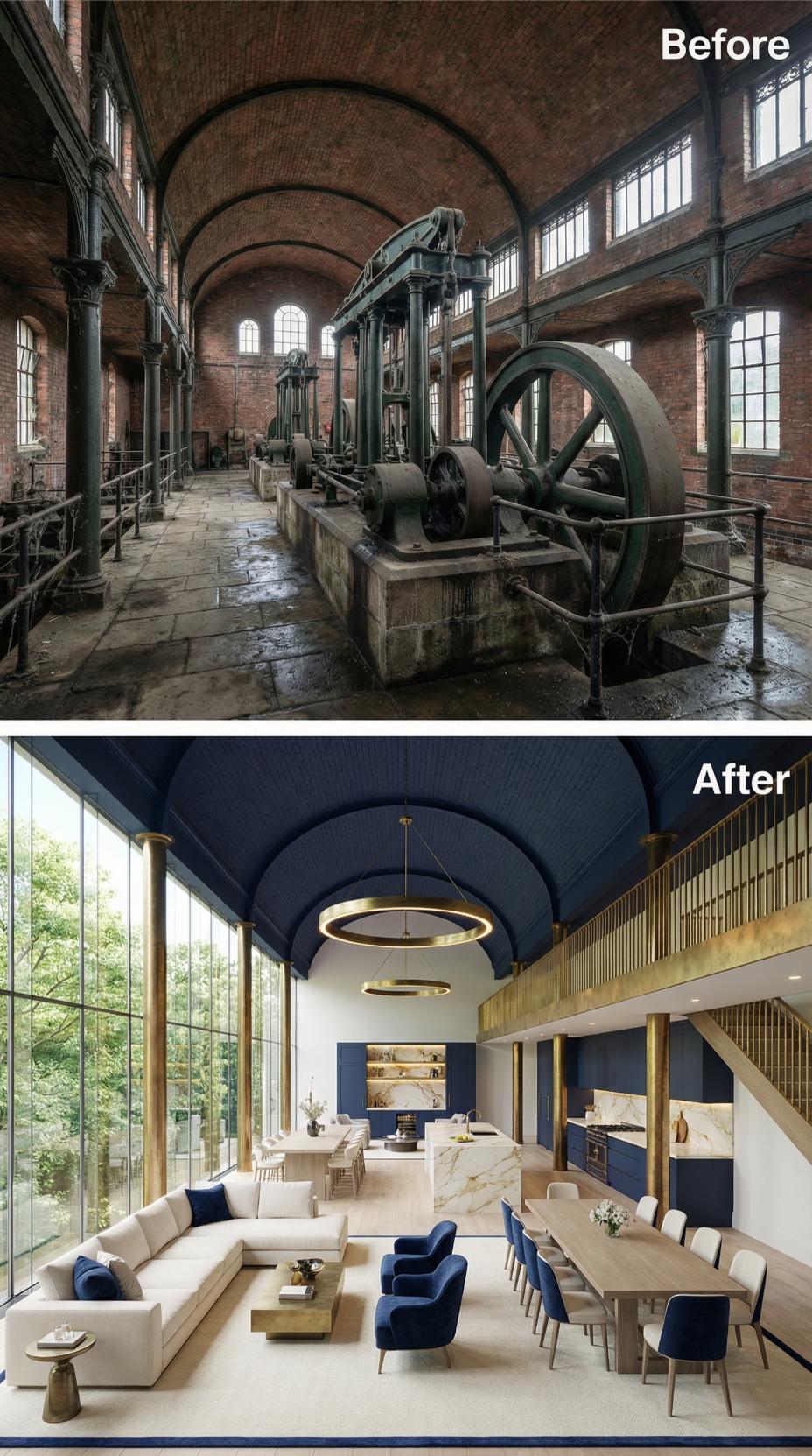
Saturated navy coats the barrel vault ceiling, turning the original brick arch into something that reads almost like lacquered wood. Brass-clad columns replaced the cast iron originals at the same structural points, anchoring a double-height living zone that runs the full length of the former pump hall.
Cream boucle sectionals face a pair of deep blue velvet armchairs across a bronze-framed coffee table. A marble island in veined gold-and-white anchors the kitchen at the rear, where navy cabinetry with recessed handles carries the ceiling color down to bench height. Floor-to-ceiling steel-framed glazing along one side wall floods the space with light the original clerestory windows never could.
Material Matters: Brass cladding applied over existing structural columns rather than replacing them outright cuts both cost and construction time while maintaining the load path of the original Victorian ironwork. In large-volume conversions, wrapping rather than rebuilding can reduce structural intervention by a significant margin. The technique also preserves the column diameter, which in this space keeps the proportional rhythm the Victorian engineers originally calculated.
27. Coral Cabinetry, Terrazzo Floors, and a Pool Where the Steam Engines Stood
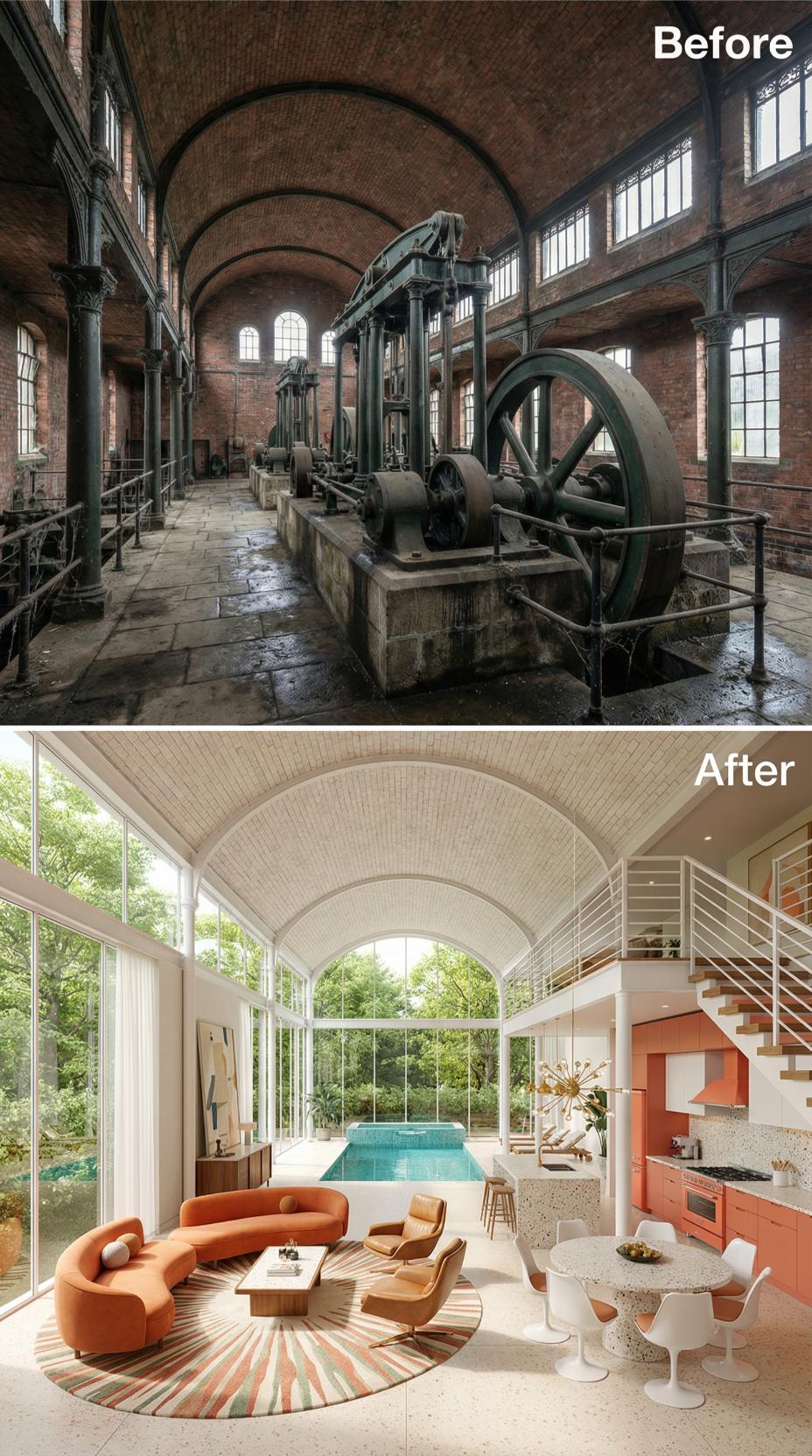
Whitewashed brick follows the barrel vault overhead, its lime finish softening what was once a dark, iron-stained industrial hall. An orange curved sofa anchors the living area on a striped circular rug, paired with tan leather armchairs and a low wood coffee table. Behind it, a terrazzo island separates the kitchen, where coral-painted cabinetry runs the full wall beside a matching range hood and professional-grade stove.
Floor-to-ceiling glass fills the arched end wall, and through it sits an indoor lap pool framed by trees. A mezzanine level with open steel cable railings and a white-painted stair floats above the kitchen. Tulip-style dining chairs cluster around a round white stone table, keeping the floor plan readable across what was once an engine floor.
How Terrazzo Reads Against Barrel Vault Brick at This Scale
Terrazzo flooring, poured in a white base with scattered aggregate, reflects light back up into the vault without competing with the masonry above it. At this square footage, a single continuous pour eliminates the visual interruption of grout lines, which would fragment the scale of the room. The material choice also connects the floor tonally to the whitewashed brick ceiling, giving the two surfaces a quiet relationship across a very large vertical span.
26. Iron Flywheel Out, Concrete Island In, Barrel Vault Untouched
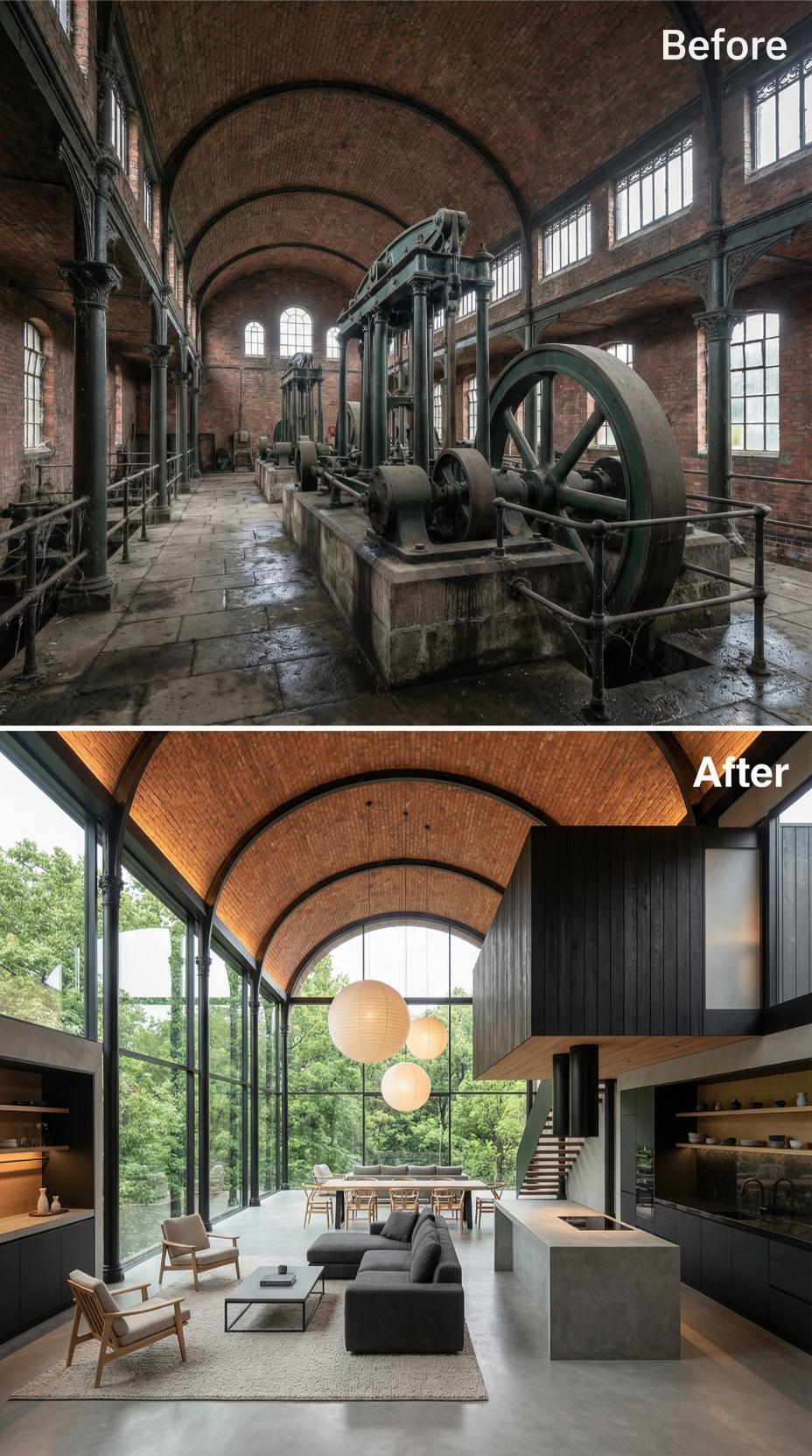
Lit from below by paper globe pendants in warm amber, the barrel vault reads less like preserved masonry and more like a living ceiling that shifts with the light. Dark charcoal vertical-panel cladding lines the lower walls, grounding the space without competing with the brick above. A poured-concrete kitchen island anchors the right side of the floor plan, its matte gray surface left unpolished. Open oak shelving runs the length of the kitchen wall, each shelf loaded with ceramics in clay and cream tones.
Floor-to-ceiling steel-framed glazing at the far end pulls the tree canopy directly into the room, while a floating staircase in blackened steel climbs the back wall. The sectional sofa sits low in charcoal upholstery on a natural-fiber rug, and a pair of wood-framed chairs in raw linen face it across a black-steel coffee table.
Ask Yourself: whether your pendant lighting is scaled to the ceiling height rather than the furniture below. In a double-height room, fixtures that read as oversized at eye level often disappear once you account for the full volume above them. Cluster sizing up before you commit to a single pendant.
25. Flywheel Hall to Living Room: Barrel Vault, Rattan Pendants, and a Pool Beyond the Glass
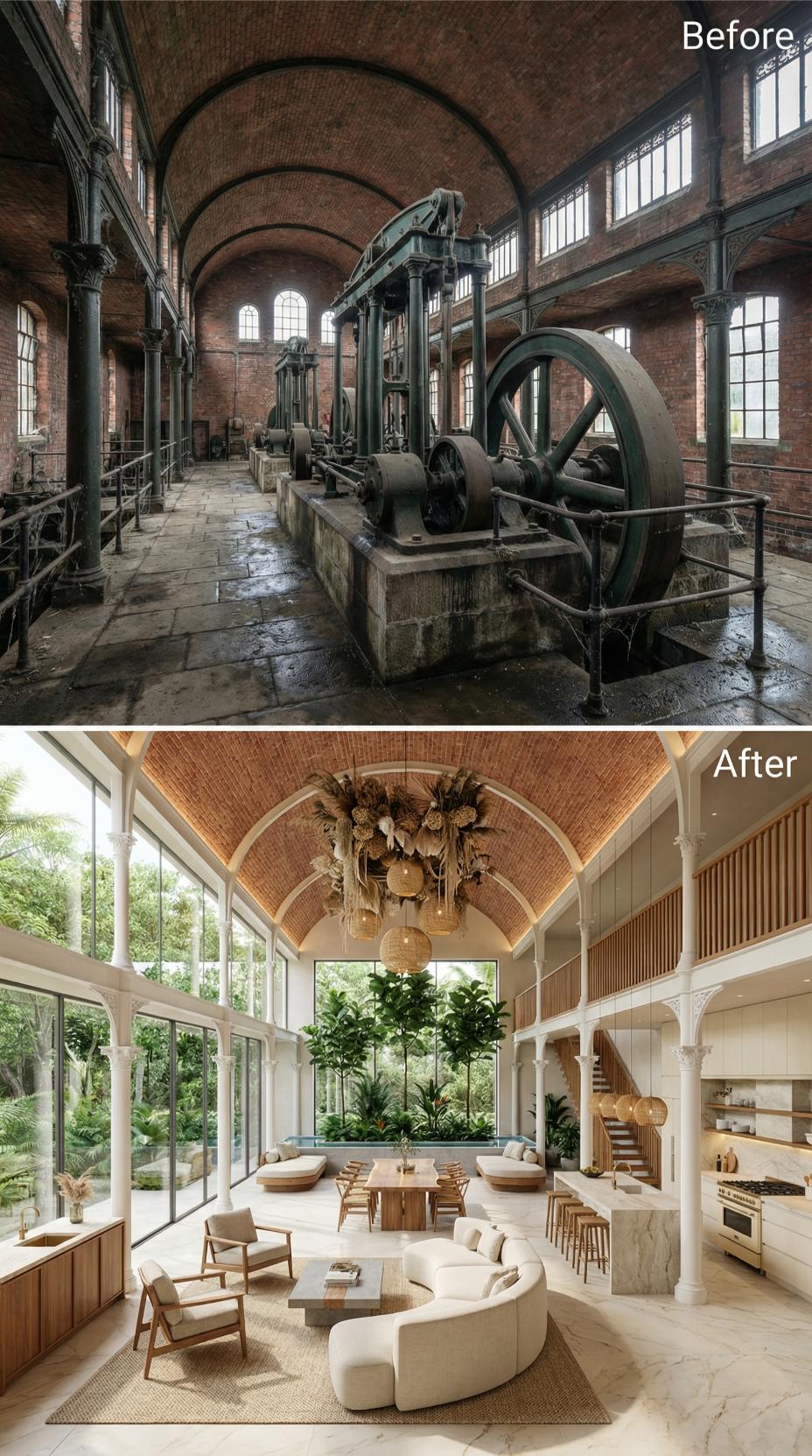
Raw Victorian brick crowns the barrel vault overhead while white-painted cast-iron columns, their original corbeled capitals intact, anchor the open plan below. A curved linen sectional anchors the seating zone, paired with wood-frame armchairs in a natural finish and a low concrete dining table. Rattan globe pendants cluster beneath a dried botanical installation suspended from the vault’s crown.
Why It Works: Retaining the original cast-iron columns and repainting them white rather than cladding or replacing them keeps the structural rhythm of the Victorian hall readable from every angle in the room. That rhythm does the spatial organizing work that a much larger furniture budget might otherwise attempt. Full-height glazing at the end wall pulls a dense tree canopy into the sightline, making the pool terrace feel like a continuation of the interior rather than a separate space.
24. Cast-Iron Columns Standing, Flywheel Gone, Glass Walls Doing the Heavy Lifting Now
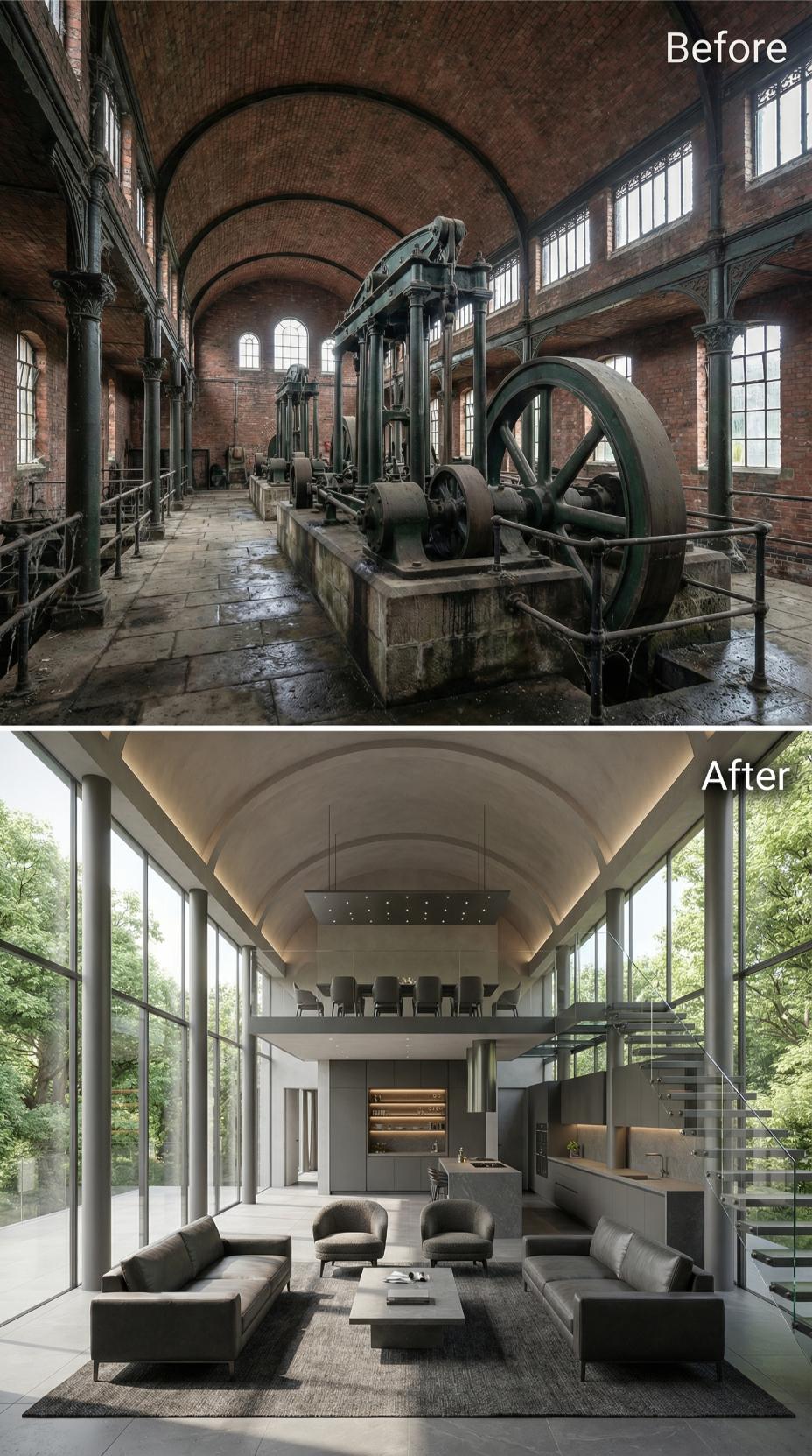
Smooth plaster has replaced exposed brick across the barrel vault, its surface now carrying recessed LED cove lighting that washes the curve in warm white without a single pendant competing for ceiling space. Below, a sectional in charcoal bouclé anchors the living zone, paired with a low concrete coffee table and a wall of backlit open shelving finished in the same warm grey as the cabinetry. Floor-to-ceiling steel-framed glazing runs the full length of both sides, flooding the hall with diffused green light from the tree canopy beyond.
- Plastering over the vault interior rather than painting brick reduces acoustic echo in double-height rooms by softening the sound-reflective masonry surface.
- Steel-framed full-height glazing on both long walls increases natural light penetration without compromising the structural load path carried by the original columns.
- Floating a mezzanine dining level above the main living zone, rather than partitioning horizontally, preserves sightlines to the vault while doubling usable floor area.
23. Barrel Vault Painted Black, Flywheel Hall Replaced by Shearling and Suspended Fire
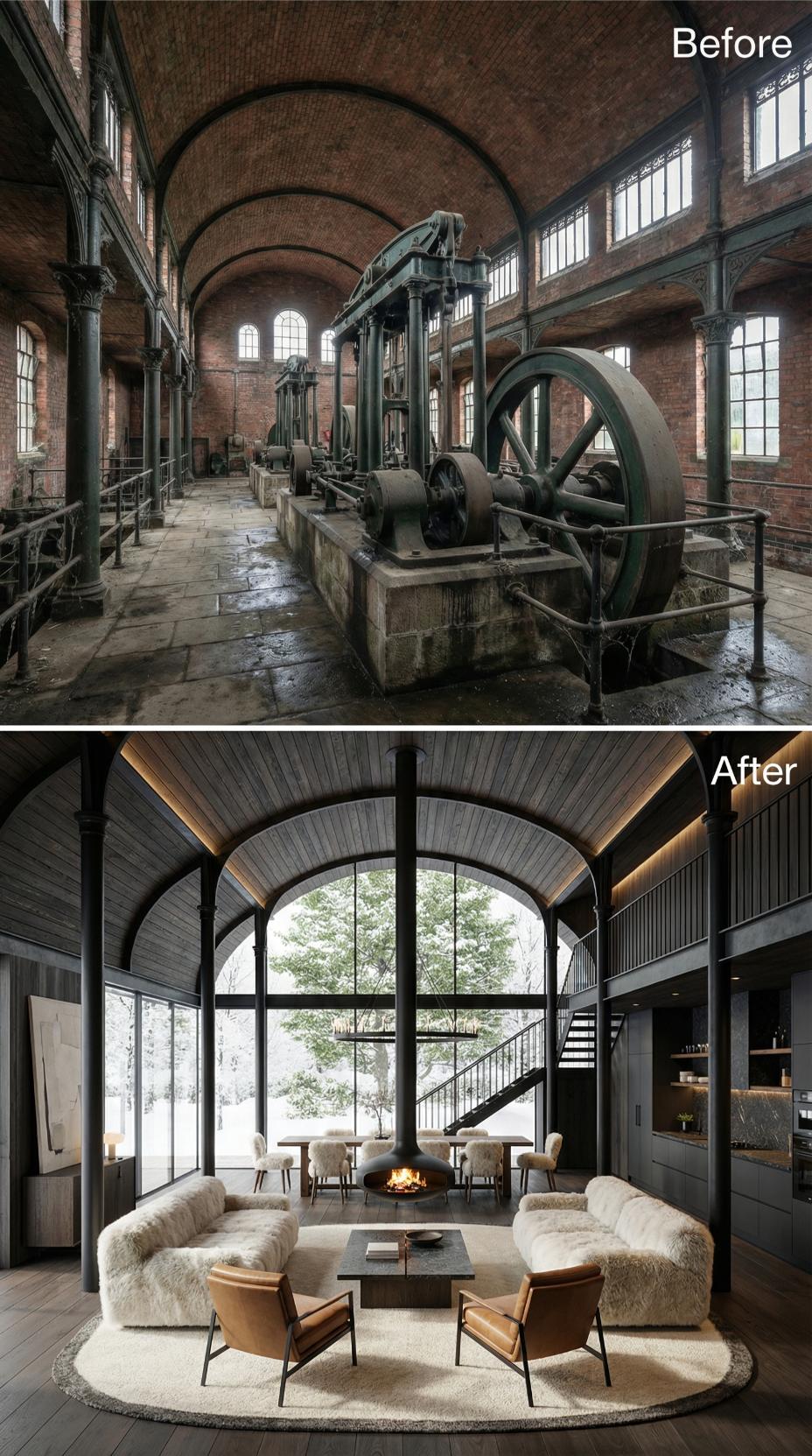
Black-stained timber cladding lines the barrel vault, a finish that reads almost charred against the arched steel columns painted to match. The original cast-iron columns remain, now anchoring a living room built around a suspended wood-burning fireplace at its center. Shearling sofas curve inward on a round cream rug, flanked by two cognac leather armchairs with hairpin-style legs.
A full-height arched window wall at the far end looks out onto snow-covered trees, pulling winter light deep into the floor plan. A mezzanine level with open steel railings and a spiral staircase sits to the right, with built-in shelving and what appears to be a wet bar tucked beneath it.
Worth Knowing: Suspended or pendant-hung fireplaces, sometimes called focal fireplaces, require structural attachment points rated well above the unit’s weight, since dynamic load from a swinging or rotating firebox can exceed static calculations by a significant margin. In double-height adaptive reuse spaces, they perform particularly well because the combustion byproducts rise naturally through the tall volume rather than radiating heat low where occupants sit. Consulting a structural engineer before specifying one in a masonry conversion is not optional.
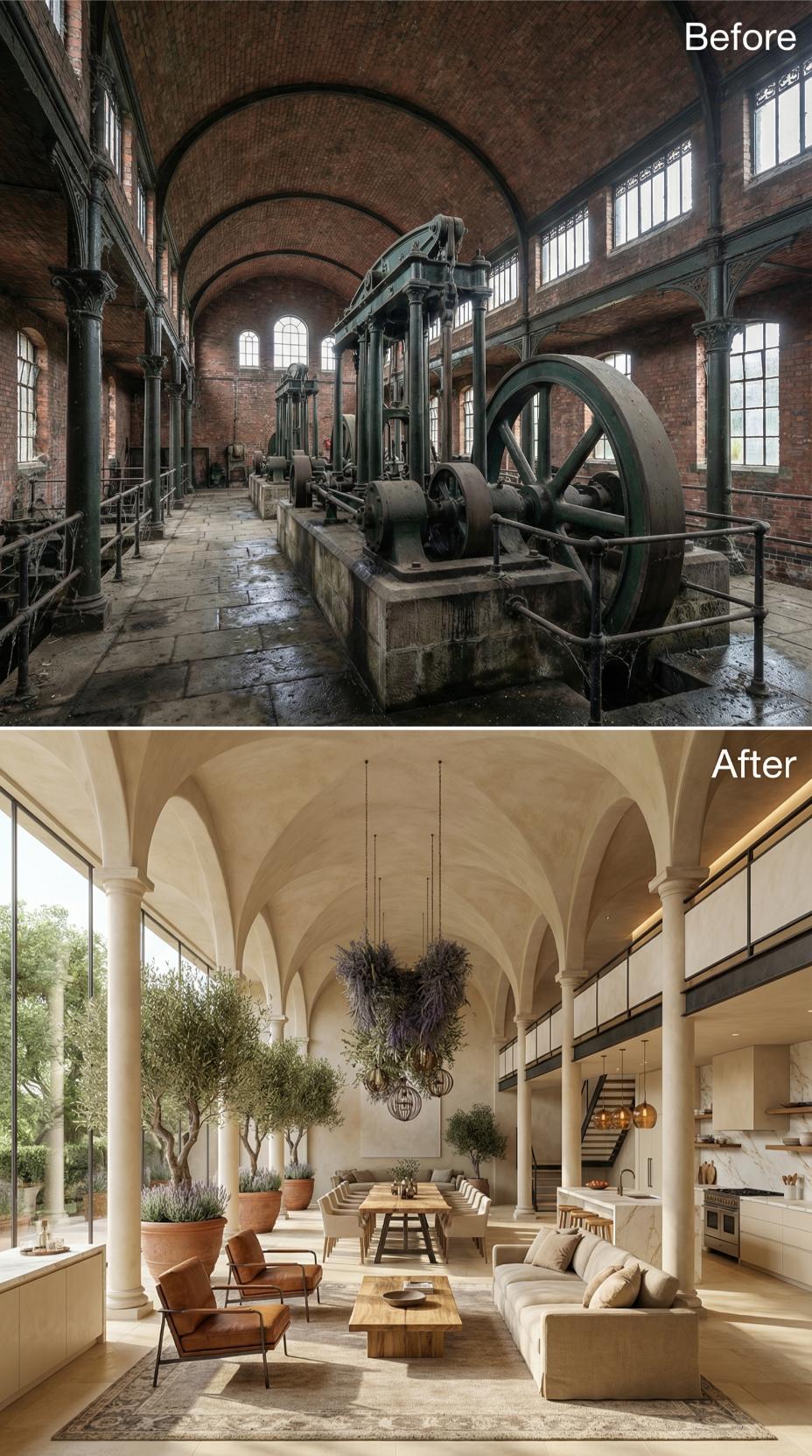
22. Groin Vault Plastered White, Flywheel Hall Replaced by Olive Trees and Linen
🔥 Would you like to save this?
Plaster now covers the groin vault in warm limestone white, and the cast-iron columns have been rendered to match, erasing the soot-darkened brick entirely. Potted olive trees anchor the corners, a solid oak dining table runs the central axis, and a cream linen sectional faces a low wood coffee table on a sisal-blend rug.
Style Tip: When plastering over Victorian brick vaults, a lime-based render rather than gypsum allows the masonry to breathe and release moisture, preventing the salt crystallization that causes plaster to flake within a few years. Dried lavender suspended from the vault crown, as seen here, also pulls fragrance downward as warm air rises, making the hanging botanical installation functional rather than purely decorative.
Where the last section kept things pale and restrained, this one goes deep into saturated green.
21. Emerald Columns, Gold Ceiling Coves, and Velvet Curved Sofas Where the Flywheel Ran
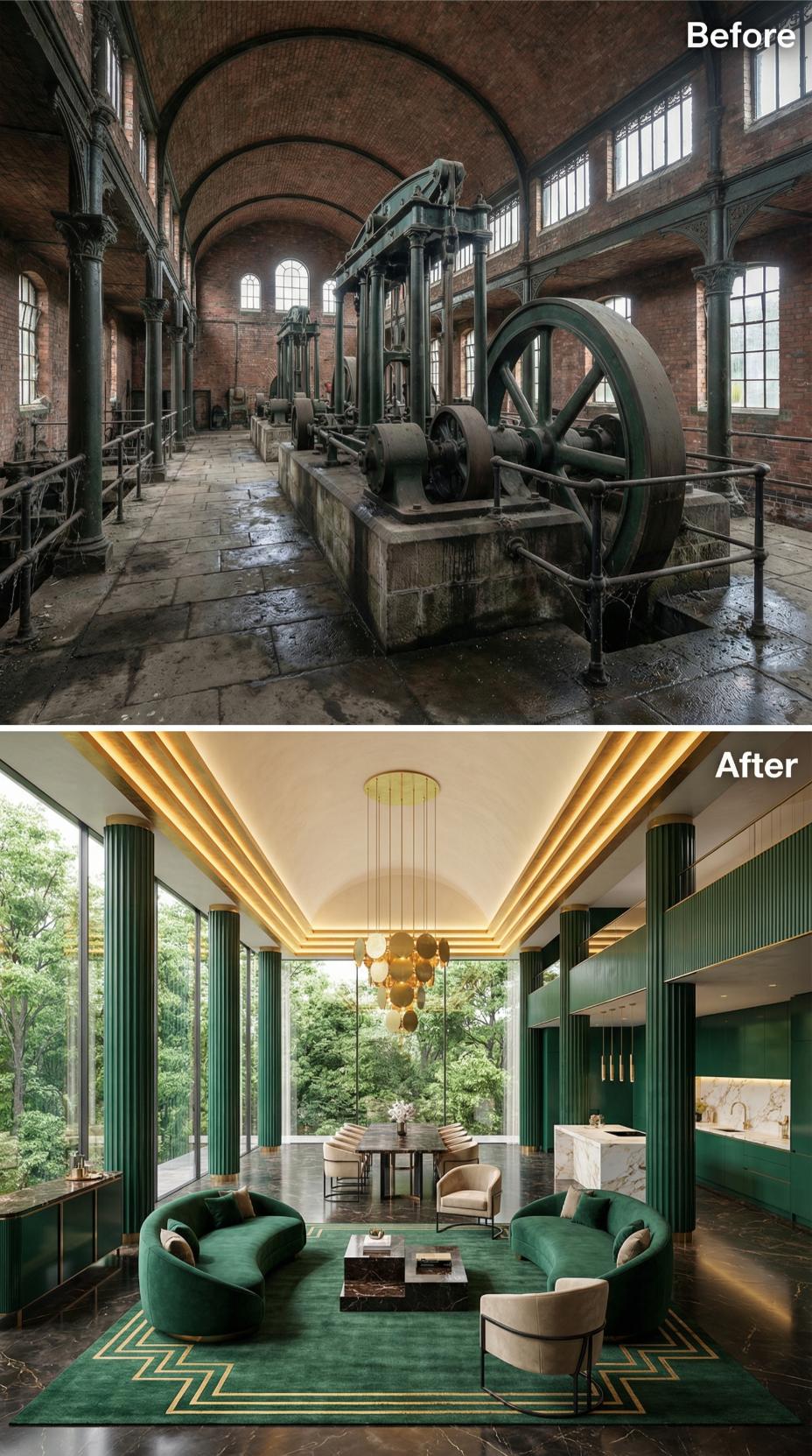
Fluted emerald columns topped with gold bands anchor a double-height room furnished with curved velvet sofas in matching bottle green, set atop a geometric rug with gold Greek-key borders. Warm cove lighting traces the coffered ceiling above a sculptural chandelier hung with overlapping brass discs.
transition: Repainting original structural columns in a single color that matches the primary furnishing fabric is a technique borrowed from historic house museums, where visual continuity across architectural and decorative elements reduces the sense of a room assembled from parts. In a conversion of this scale, it reads as intention rather than coincidence.
20. Sunken Fire Pit, Copper Pendants, and Cacti Where the Steam Engines Thundered
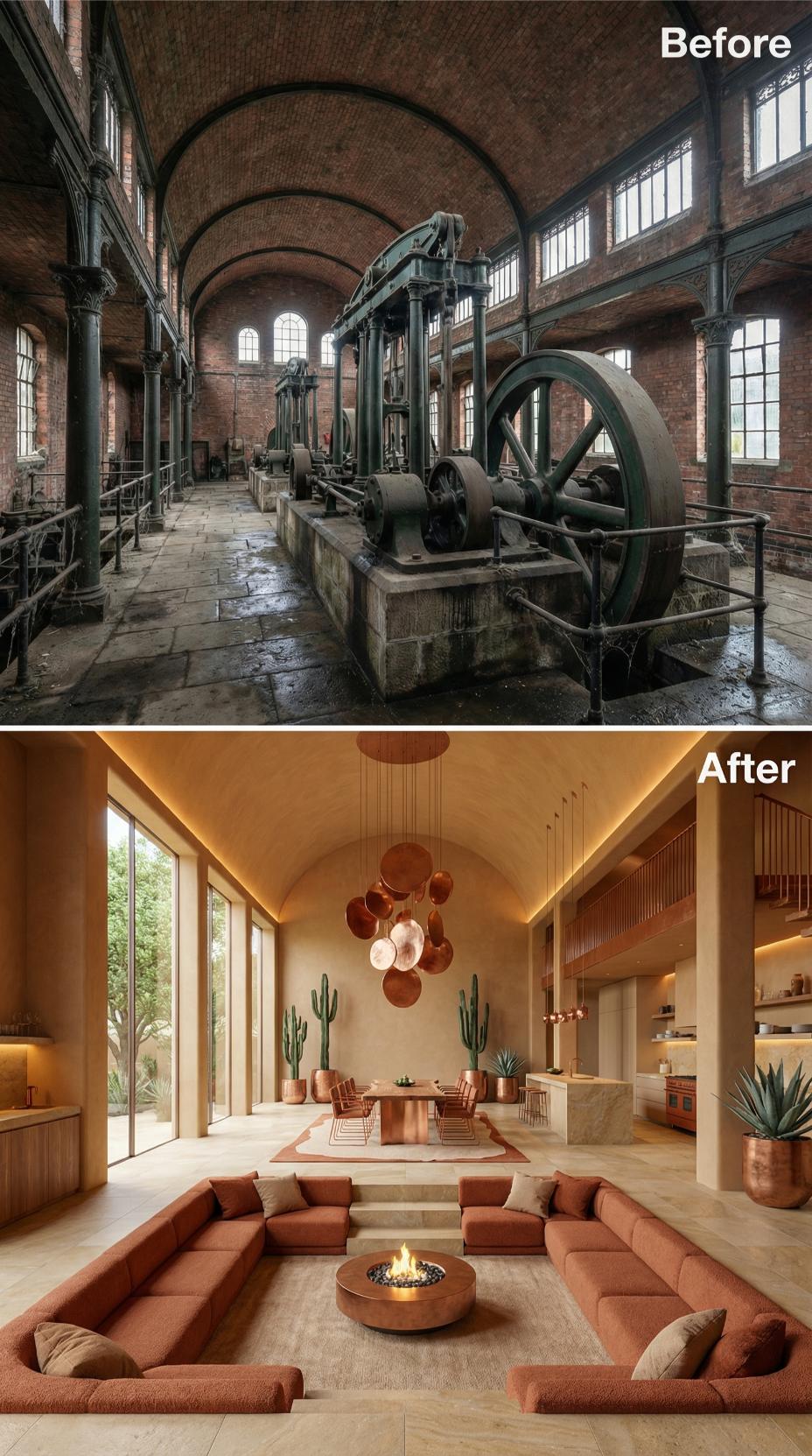
Dropping the seating area below floor level in a Victorian pumping station is either a bold structural decision or a very expensive mistake, and here it is neither.
The sunken conversation pit is upholstered in burnt sienna fabric and arranged around a round fire table with a live flame, its rim finished in the same terracotta-adjacent tone as the sofas. Above, a cluster of copper disc pendants hangs from the barrel vault on thin cables, each disc a different diameter, catching warm light against the plastered ceiling. Potted saguaro cacti in copper-finished planters anchor the transition between the pit and the dining zone, where copper-tube chairs surround a wood-and-metal table. The kitchen sits to the right behind an island with what appears to be a limestone or pale travertine surround, and a mezzanine level with slatted timber railings closes the far end of the space.
19. Barrel Vault Kept, Flywheel Hall Gone, Cognac Leather and Warm Plaster Moving In
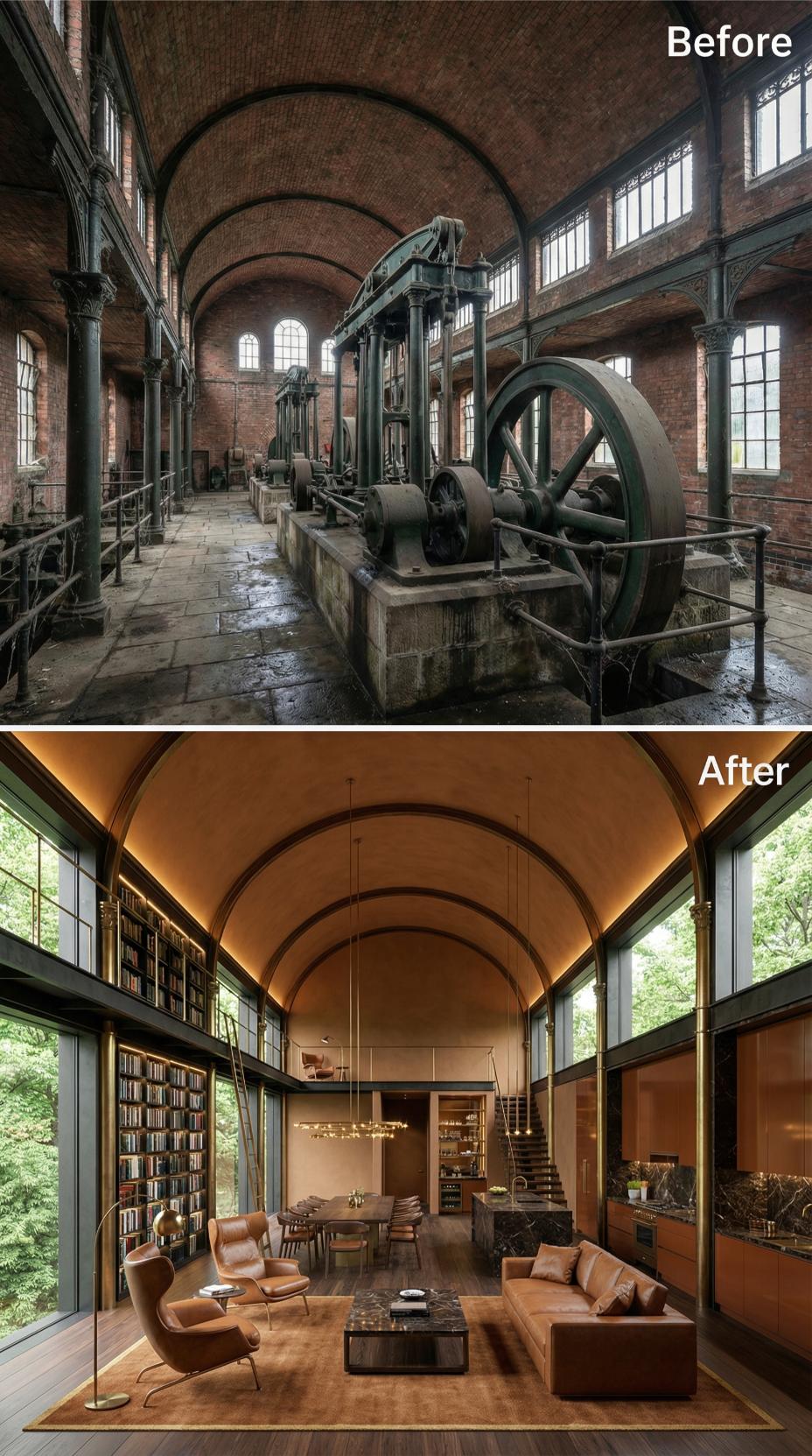
Warm amber cove lighting traces the full length of the barrel vault, turning plastered masonry into something closer to a lantern than a ceiling. The structural columns remain, repainted in a dark bronze-green finish that anchors the vertical rhythm without demanding attention. Below, a cognac leather sectional faces a slab-top coffee table in veined dark marble, and a pair of curved lounge chairs in the same tan leather pull the seating zone together without matching it exactly.
A floor-to-ceiling bookcase runs the full upper-level mezzanine along the left wall, backed by warm cabinet lighting. The kitchen at right shows flat-front cabinetry in a burnt sienna finish with what appears to be a dark emperador marble countertop. Brass pendant rods drop from the vault’s crown over the dining table below, catching the amber light without competing with it.
Trend Alert: Cove lighting integrated directly into a barrel vault’s springing line, where the curve begins its rise from the wall, distributes light across the full ceiling surface without any single fixture reading as a focal point. This technique works especially well in adaptive reuse spaces where the architecture itself is the feature, and visible bulbs or pendants would break the continuity of the original form. For Victorian masonry vaults, warm-toned LED strips in the 2700K range reinforce the natural red and ochre tones already present in aged brick and lime render.
18. Onyx Panel, Cognac Sectional, and Barrel Vault Brick Glowing Under Cove Light
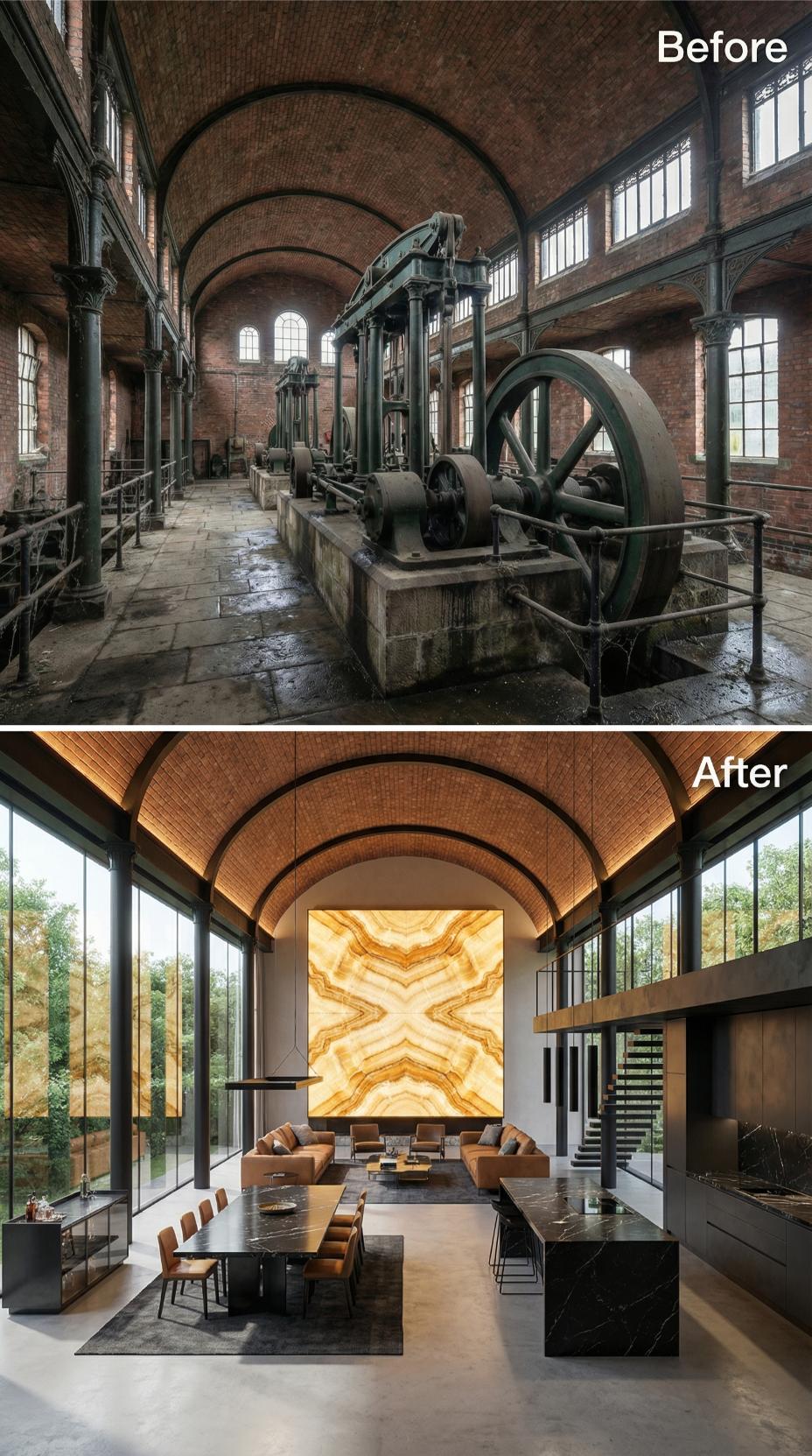
Amber-lit cove lighting runs along the springing line of the original brick vault, washing the full curve in warm gold without a single fixture breaking the ceiling plane. Below it, a cognac leather sectional and two lounge chairs face a backlit onyx panel mounted flush to the end wall, its honey-and-amber veining giving the room its focal point.
Dark marble countertops anchor both the kitchen island and the long dining table. Floor-to-ceiling glazing replaced the original brick side walls entirely, pulling in tree canopy on both sides. A steel staircase with open treads climbs the right wall.
Pro Tip: Backlit onyx panels work differently from artwork because the stone itself becomes the light source, and the veining pattern shifts in appearance depending on the thickness of the slab and the color temperature of the lamp behind it. Warmer bulbs in the 2700K range pull out the amber and gold tones in honey onyx, while cooler sources push the same stone toward green. Specifying the backlight before selecting the slab, rather than after, gives far more predictable results.
17. Exposed Oak Trusses, Marble Backsplash, and Flywheel Hall Reborn in Linen and Light
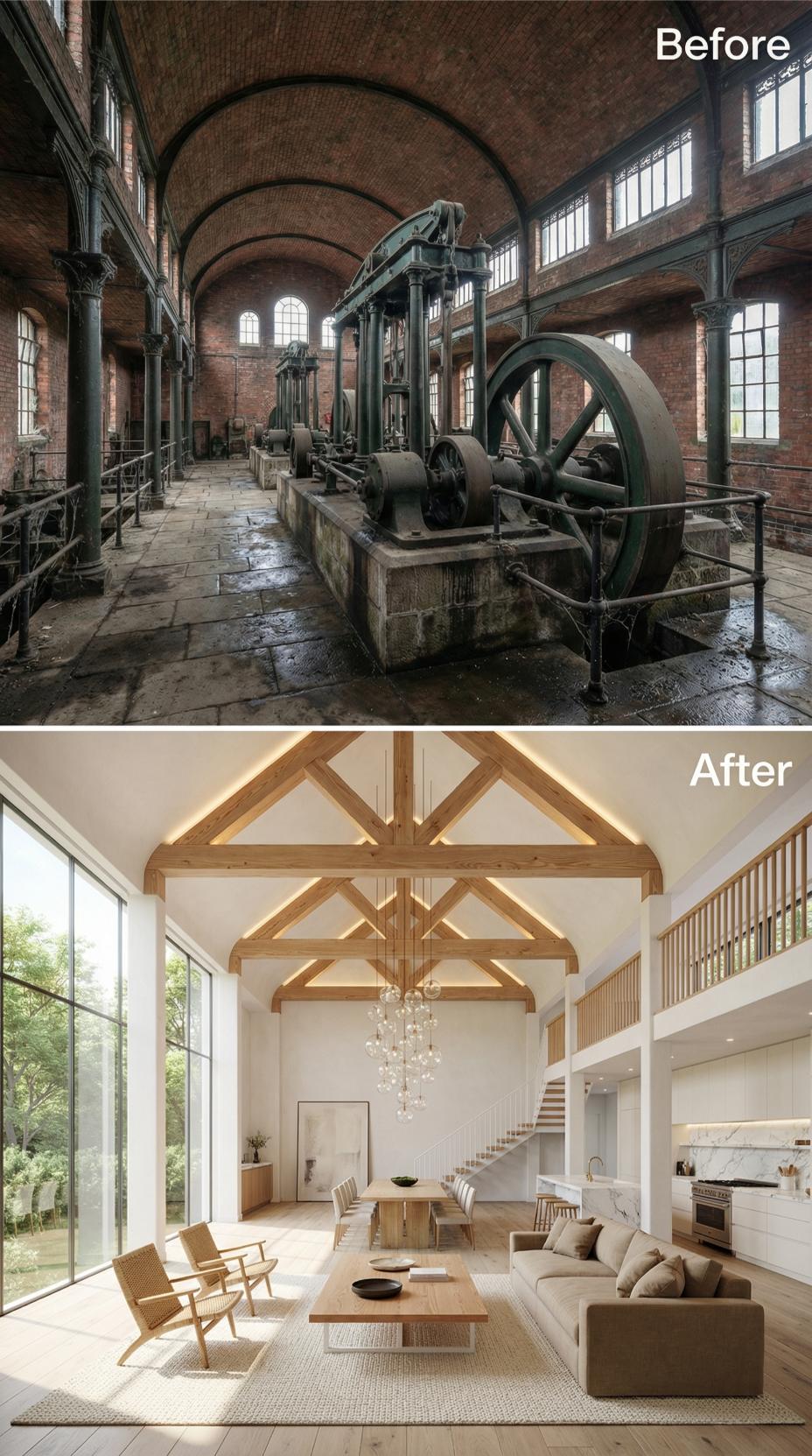
Honey-toned oak king post trusses span the vaulted ceiling in a repeating A-frame rhythm, each beam backlit by a warm strip that traces the ridge line. Below them, a bubble glass chandelier drops at dining height over a solid-oak table. The living area runs toward floor-to-ceiling steel-framed glazing on the left, while a white oak staircase with open timber balustrades connects to a mezzanine level above the kitchen. That kitchen reads in white shaker cabinetry against a slab marble backsplash, with what appears to be a stainless range beneath.
A bubble glass chandelier drops at dining height over a solid-oak table, anchoring the hall that once shook with steam engine machinery.
16. Barrel Vault Plastered Dark, Home Cinema Rising Where the Flywheel Ran
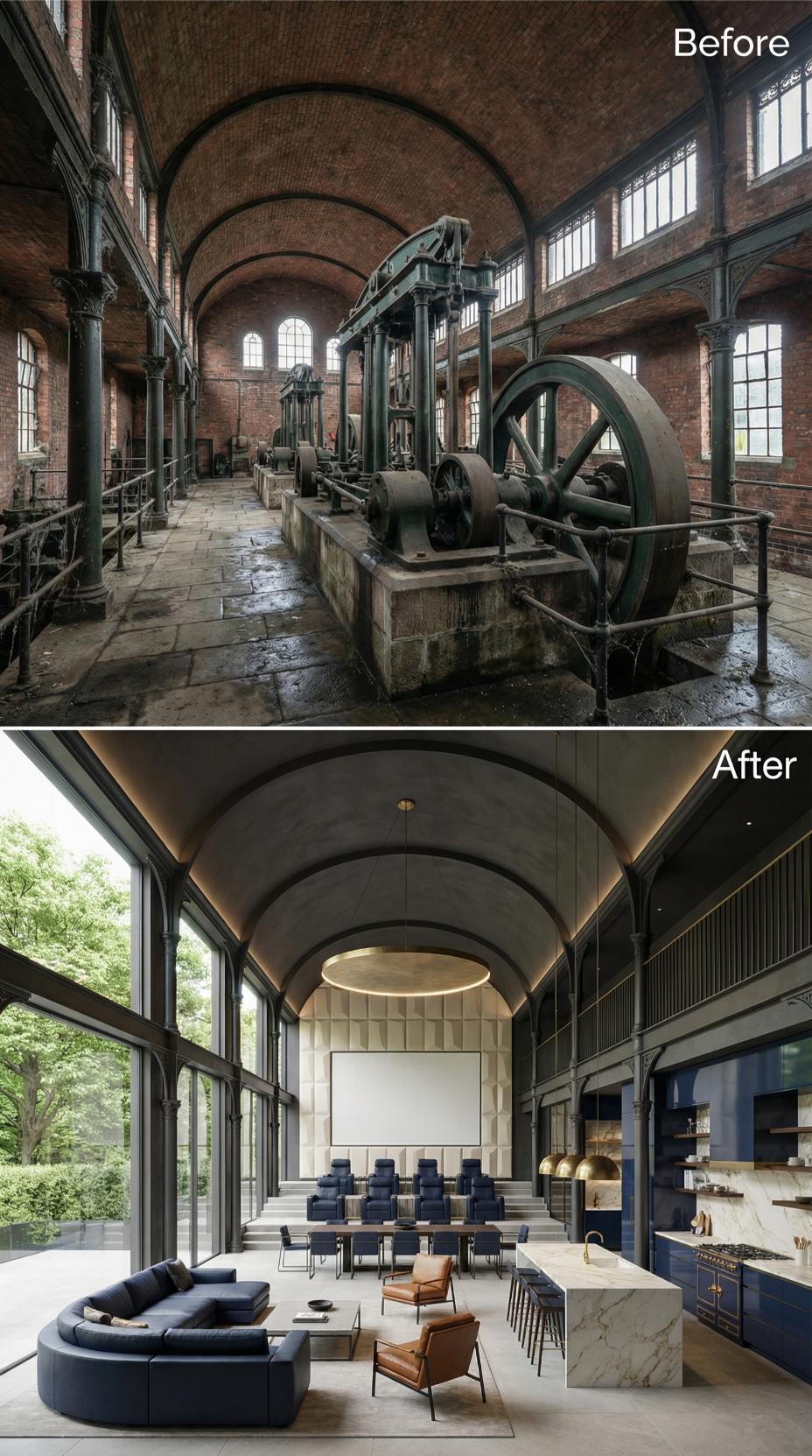
Sixteen navy recliner seats sit exactly where steam-driven machinery once shook the floor.
Concrete render in charcoal grey now coats the barrel vault, stripping back the Victorian brick while keeping the arch profile intact. A circular brass pendant, roughly two metres across, anchors the ceiling above a marble kitchen island with waterfall edges. Navy cabinetry lines the right wall, fitted with brass hardware, flanked by open shelving holding brass dome pendants at counter height.
The spatial layout does something unusual: living area, kitchen, and tiered cinema occupy a single open floor without partition walls, relying on level changes and furniture placement to define each zone. Curved navy sofas anchor the lounge, paired with cognac leather chairs. Floor-to-ceiling glazing replaces what was once a solid brick end wall, pulling tree canopy directly into sightlines from every seat.
bold_hook: Tiered home cinema floors built inside adaptive reuse shells often require structural engineers to assess the original foundation before any stepped concrete pour begins, because Victorian pump house floors were engineered for equipment load distribution, not the concentrated point loads that cinema risers create along their front edges.
15. Barrel Vault Lit Gold, Cast-Iron Columns Kept White, Indoor Pool Sliding In Below
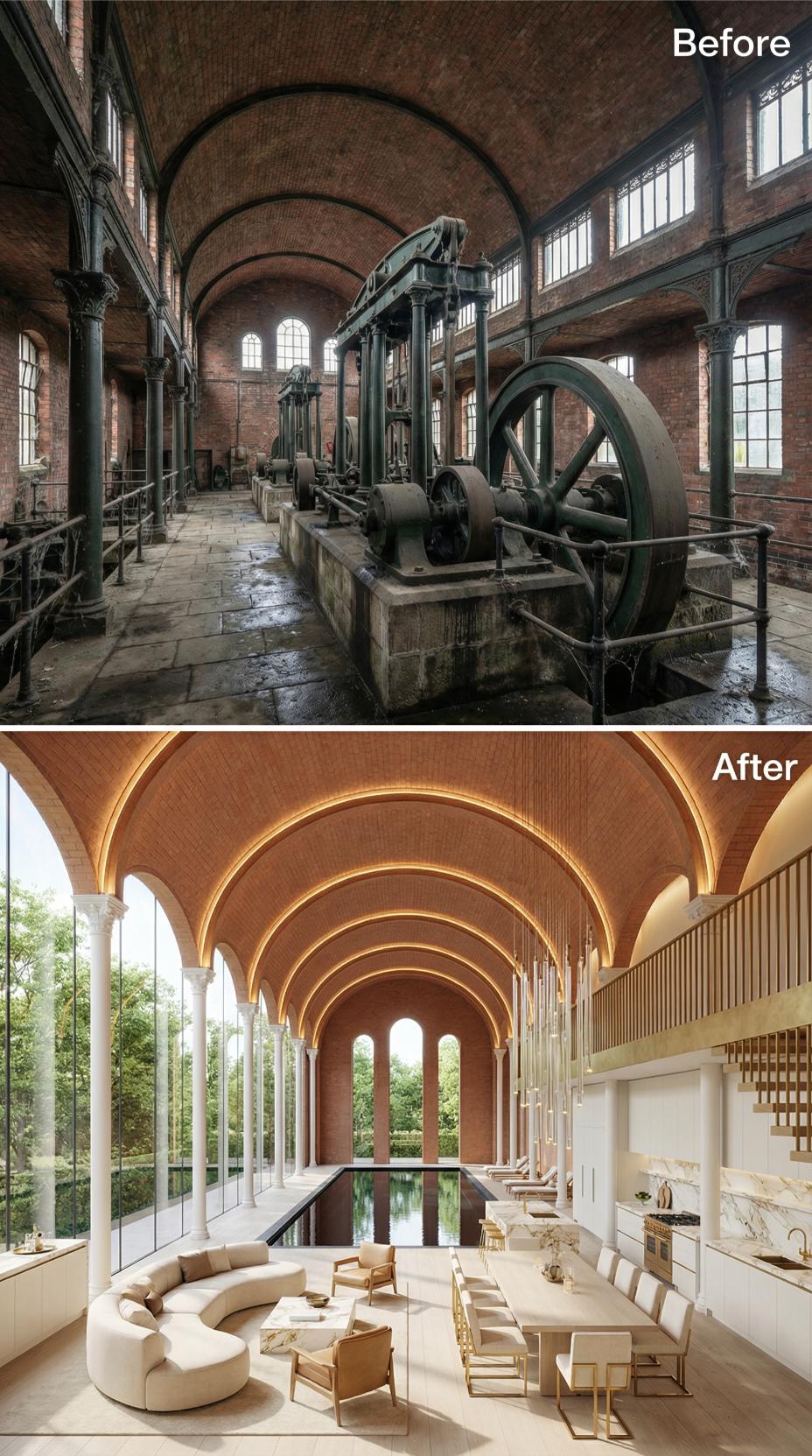
Cove lighting tucked along the springing line of each barrel vault arch washes the reclaimed brick in a consistent amber band, making the ceiling read as one continuous surface rather than a series of independent arches. White-painted cast-iron columns survive from the pumping station’s original structural grid, now framing floor-to-ceiling glazing that opens the long wall to a garden. A lap pool runs beneath that glass line, its dark water reflecting the arch sequence above.
Seating anchors the near end: a curved cream bouclé sectional pairs with open-frame armchairs in natural oak and oatmeal linen. A long dining table in pale wood stretches toward a kitchen finished in white marble slab countertops and panel-front cabinetry. Pendant rods drop at intervals from the vault, thin enough to disappear against the brick.
- Lap pools placed directly inside a vaulted shell benefit from drainage channels set below the original stone floor level, avoiding cuts to historic foundation walls
- Bouclé fabric holds its texture under high-humidity conditions better than velvet, making it a practical choice near indoor water features
- Marble countertop slabs with low-contrast veining read as quieter against white cabinetry than book-matched high-contrast cuts, which can compete with architectural surfaces at scale
14. Barrel Vault Lit by Cove Strip, Flywheel Hall Now a Living Room with Marble and Cognac Leather
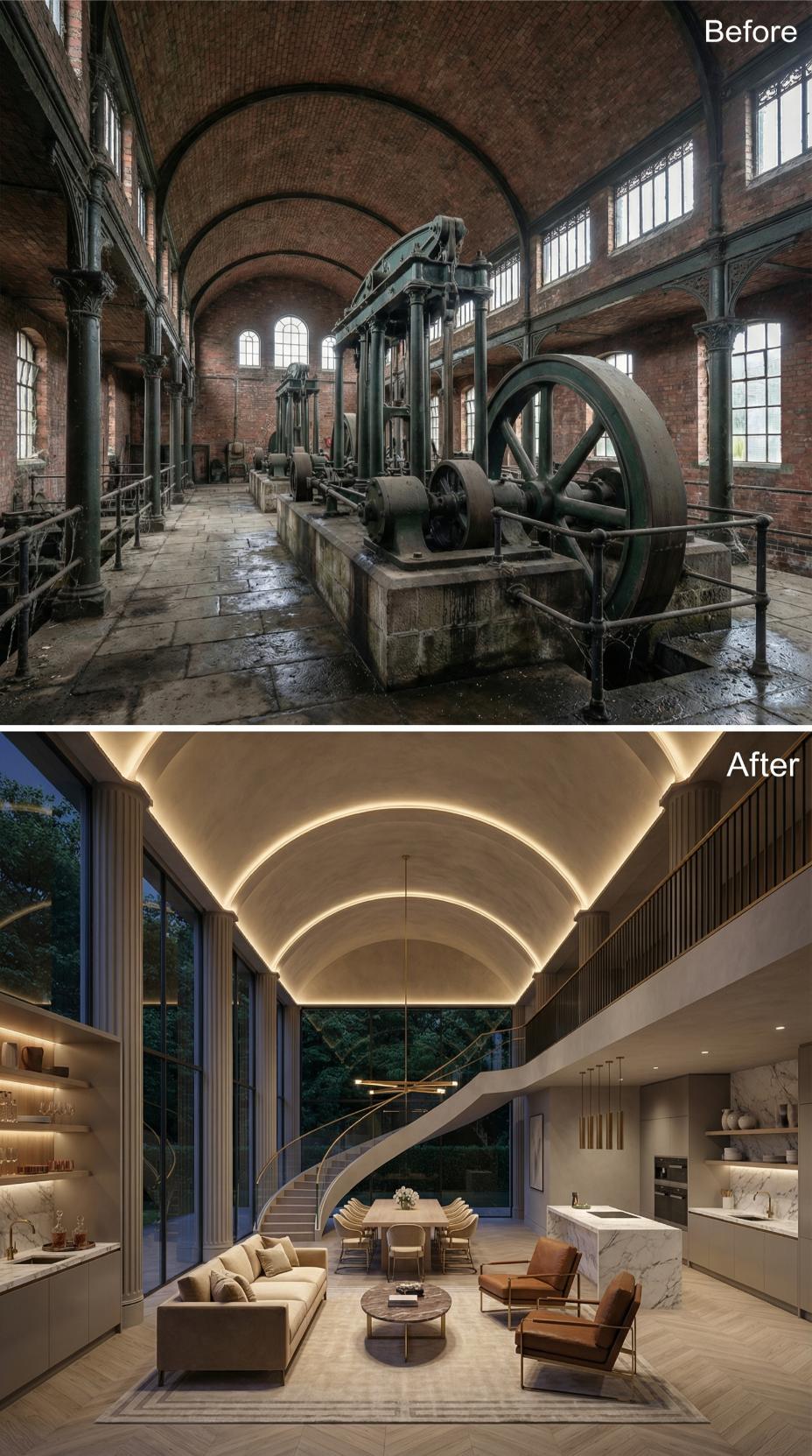
LED strip lighting runs along each springing line of the plastered barrel vault, casting graduated light across the curved ceiling without a single visible fixture interrupting the arc. Below it, a cream sectional sofa anchors the living zone, flanked by two cognac leather armchairs on brass legs. A round travertine coffee table sits at the center.
At the far end, floor-to-ceiling glazing replaces what were once arched clerestory windows, framing mature trees beyond. A curved open-riser staircase with a brass handrail rises to a mezzanine level fitted with vertical steel balusters. The kitchen island is clad in white marble with thick waterfall edges, and wall shelving in natural oak carries ceramic vessels throughout.
Quick Fix: Cove lighting performs differently depending on the color of the surface it washes. A light plaster vault reflects strip light broadly and softly across the entire arc, while an unpainted brick vault absorbs more of that output and concentrates warmth closer to the springing line. Choosing the vault finish before specifying lumen output prevents under-lit results that no amount of supplementary lighting can fully correct.
13. Midnight Blue Vault, Gold Column Cladding, and Marble Chevron Where Steam Engines Stood
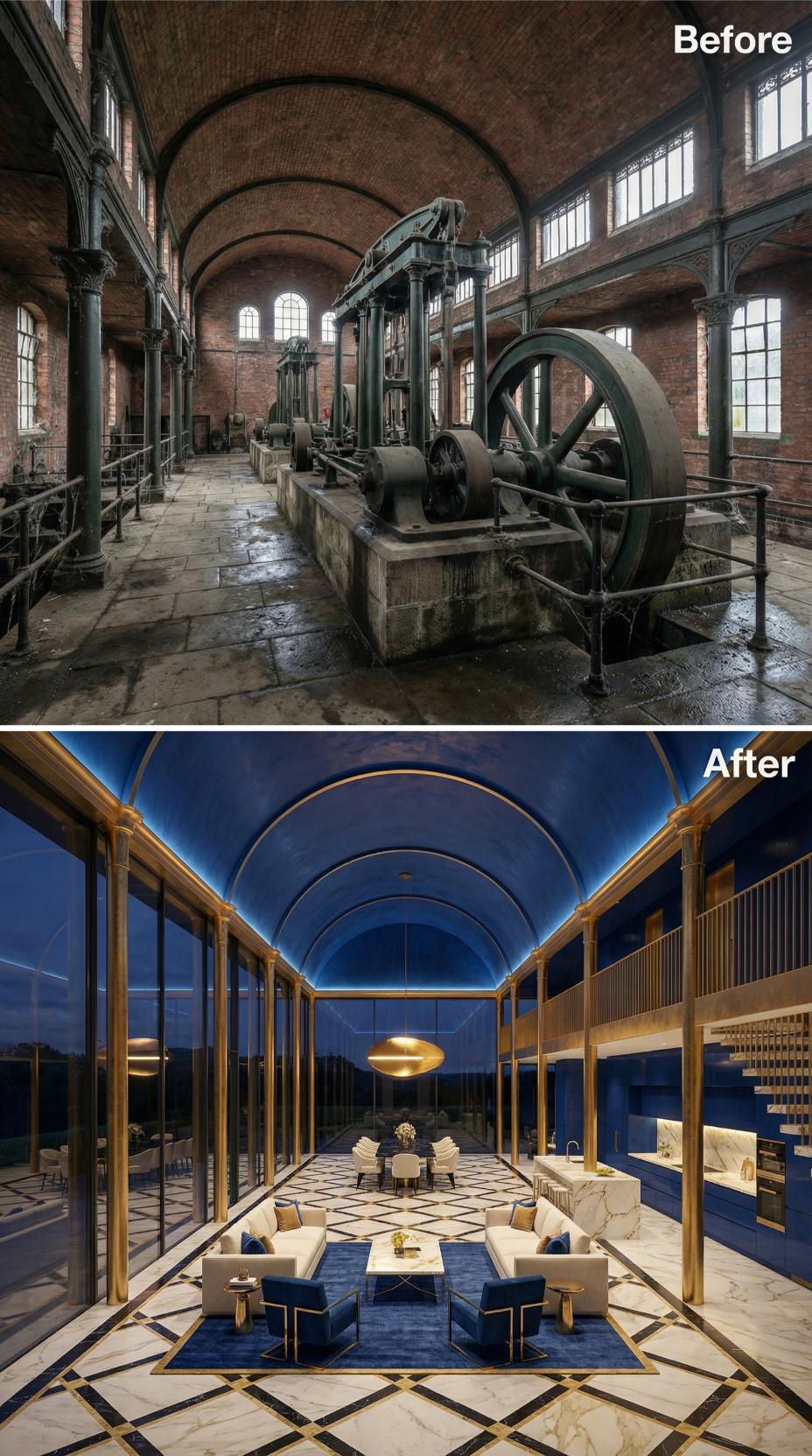
Royal blue render coats the barrel vault from springing line to crown, lit by a continuous strip that reads more electric than architectural. Cast-iron columns survive, wrapped in brushed gold rather than painted out. Below them, a marble floor runs a diamond-grid pattern in cream and charcoal, anchored by a navy wool rug. Cream sectional sofas face off across a low marble coffee table, with sapphire velvet armchairs tucking in at each end. A gold oval pendant drops from center vault. To the right, a waterfall-edge marble island marks the kitchen zone, its cabinetry finished in the same deep blue as the vault above.
12. Barrel Vault Brick Kept Raw, Glass Walls Opened Up, Cognac Leather and a Wet Bar Moving In
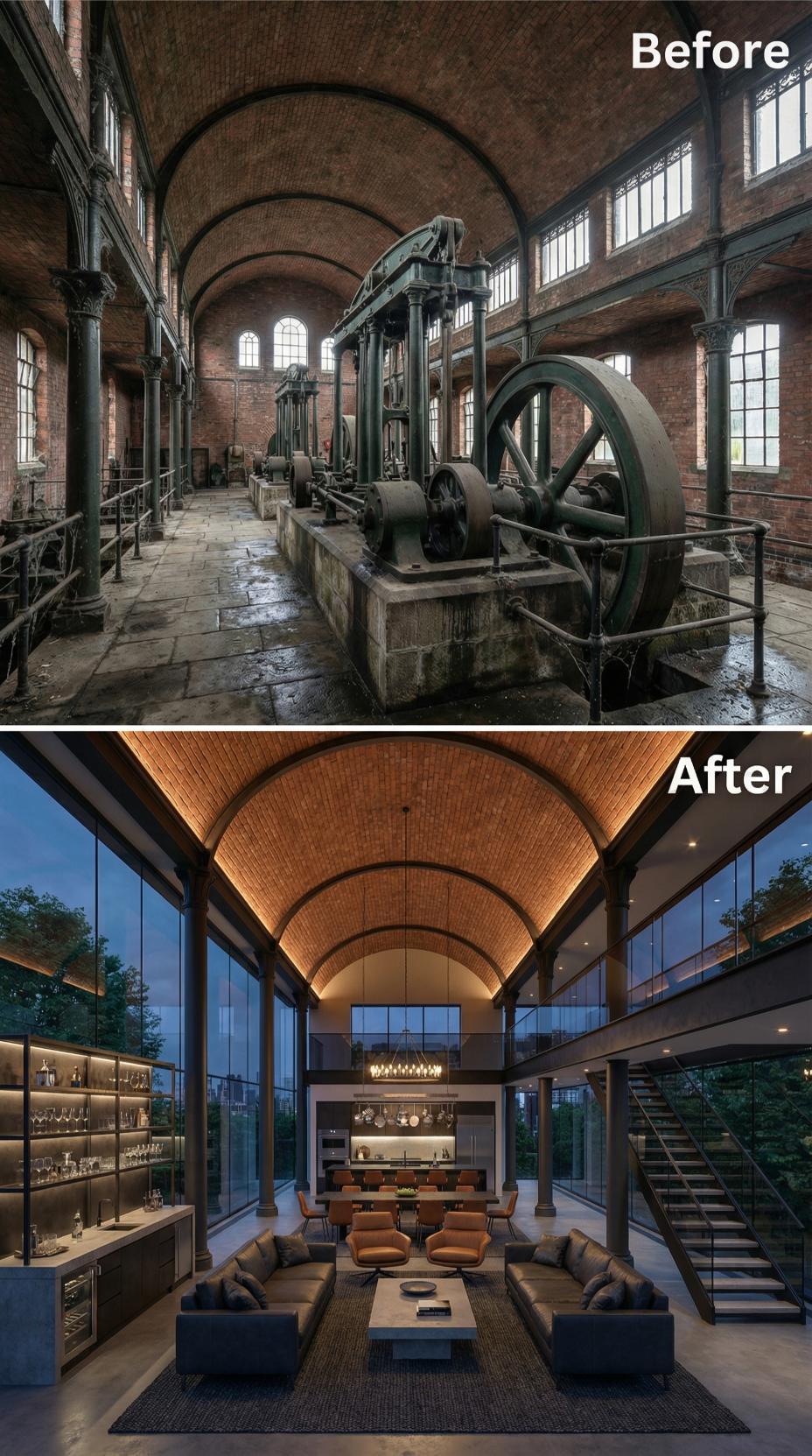
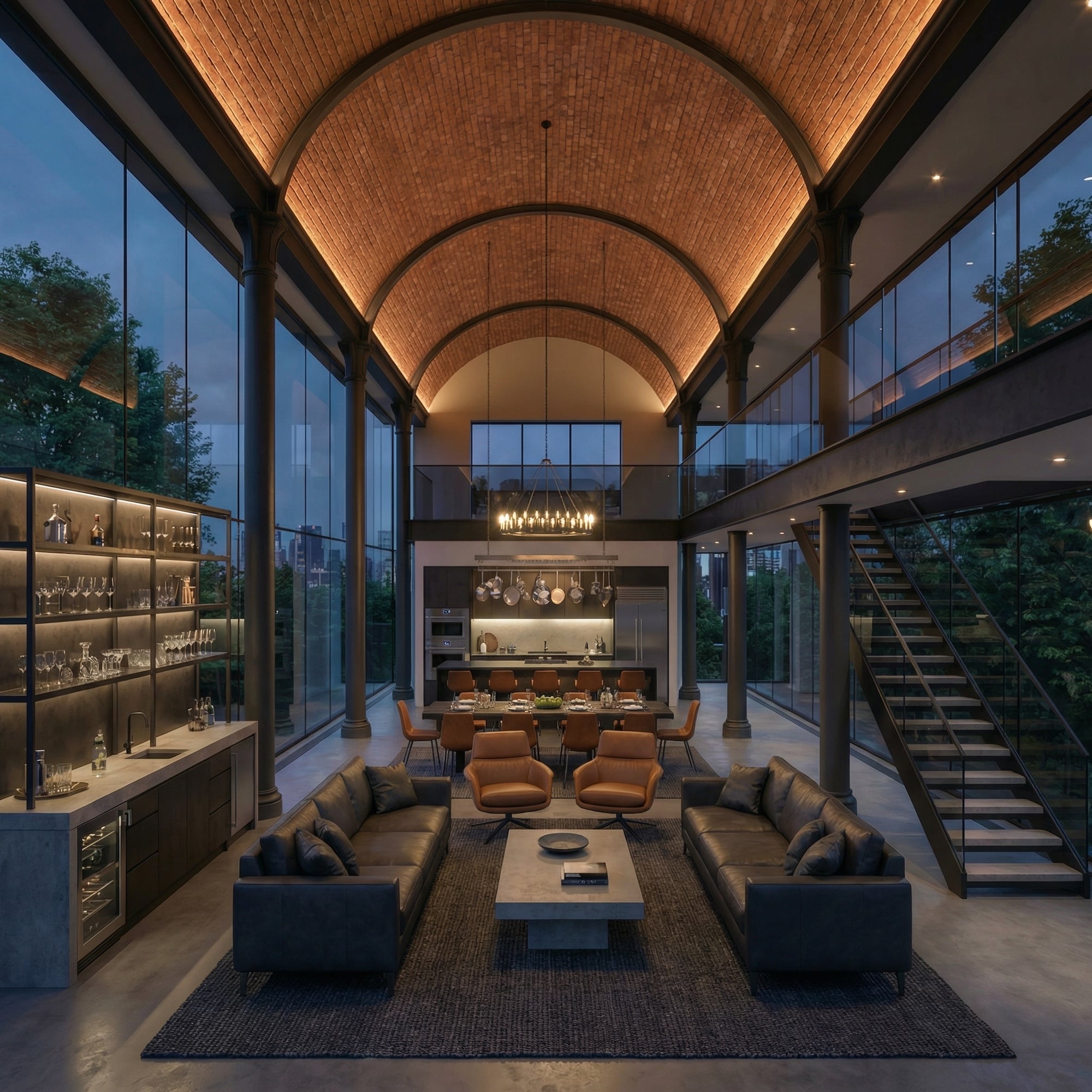
Six decades of grease and rust gave way to dark gray sectional sofas, a low slab coffee table, and four cognac leather armchairs arranged around a central seating area beneath the original brick barrel vault, now backlit by a continuous warm strip running along its springing line. Cast-iron structural columns remain exposed at the perimeter.
Floor-to-ceiling glazing replaces the original masonry side walls entirely, pulling in a dusk skyline on both flanks. A built-in bar cabinet with backlit glass shelving lines the left wall, displaying stemware and decanters. An open-tread steel staircase rises along the right side toward a mezzanine level, its minimal profile keeping sightlines clear across the full double-height volume.
11. Flywheel Hall to Living Room: Barrel Vault Kept, Tile Wall Lit, Dark Wood Throughout
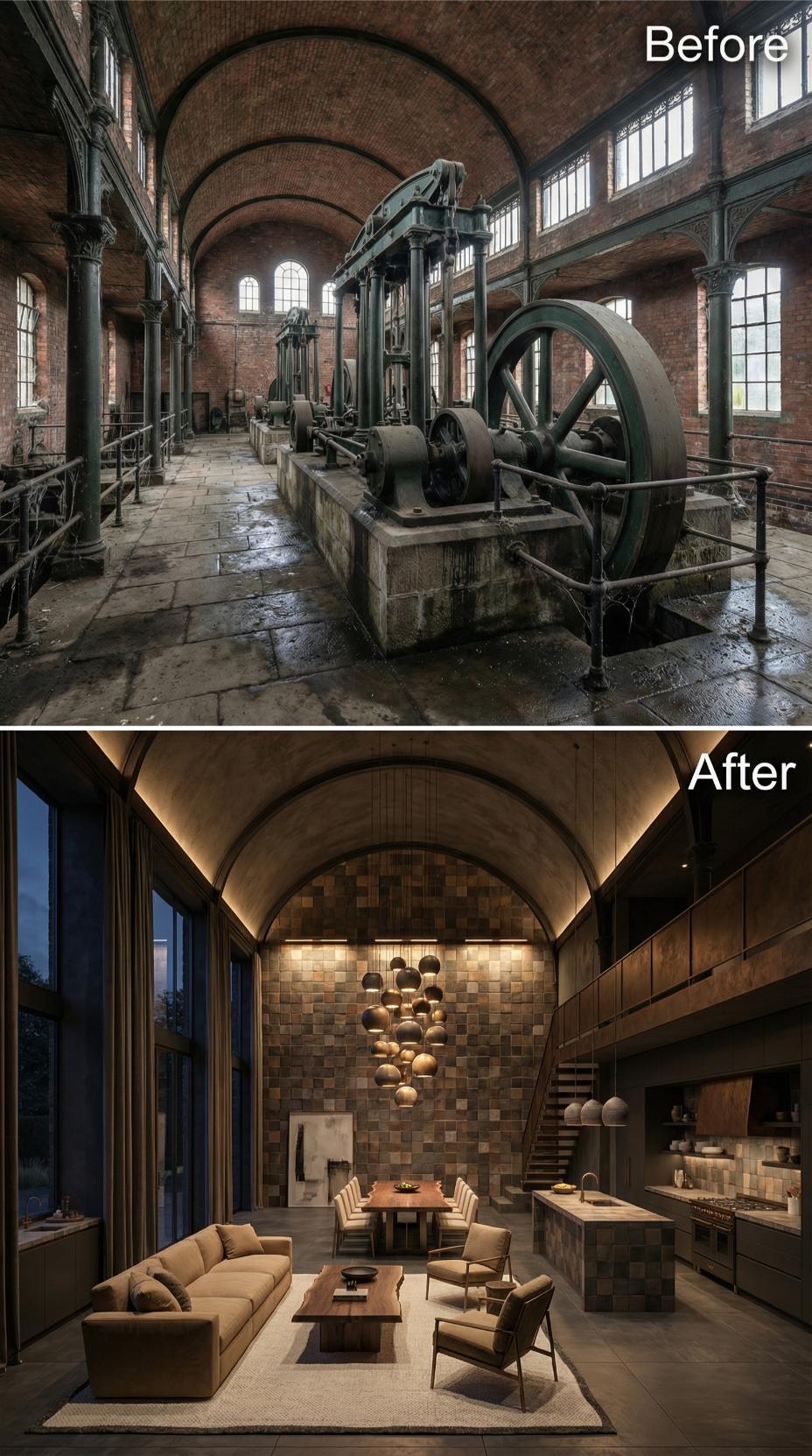
Salvaged brick vaulting runs the full ceiling length, now finished in a warm plaster coat that catches cove strip lighting at the springing line. Below it, a textured tile feature wall built from square-cut stone blocks in caramel and charcoal tones anchors the dining zone, where a cluster of bronze globe pendants hangs at two different drop heights rather than a single uniform level.
Furnishings stay in a narrow palette: sand-colored upholstery on the sofa and dining chairs, a live-edge walnut coffee table, and dark-stained cabinetry wrapping the mezzanine kitchen above. A straight-run steel stair connects the levels without interrupting sightlines to the original vault.
10. Flywheel Hall Buried Under Living Vines, Marble Island, and Cream Linen
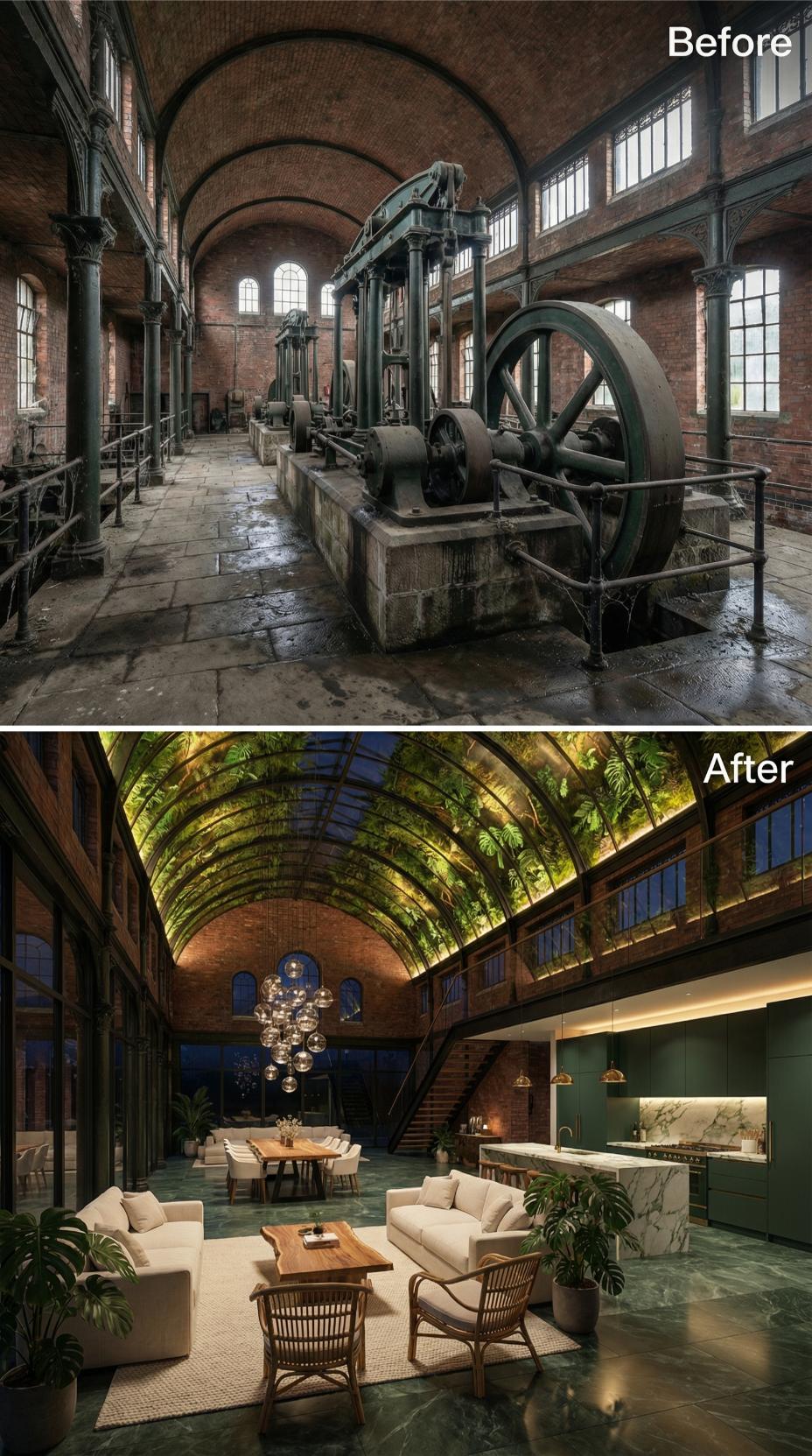
🔥 Would you like to save this?
Green-planted arches now crown the barrel vault, with trailing ferns and broad-leaf tropicals rooted along the full curve of the Victorian brickwork and lit from behind by warm strip lighting that turns the canopy a deep moss-gold. Below it, a living area anchors around two cream linen sofas, a live-edge wood coffee table, and rattan arm chairs set over a natural-fiber rug. Hunter-green cabinetry lines the kitchen to the right, fronted by a waterfall-edge marble island with visible grey veining. Spherical glass pendant clusters drop from the upper level on staggered cables, scaling to the double-height room rather than the furniture.
9. Flywheel Hall Stripped to Barrel Vault, Clad in Douglas Fir, Lit from the Springing Line
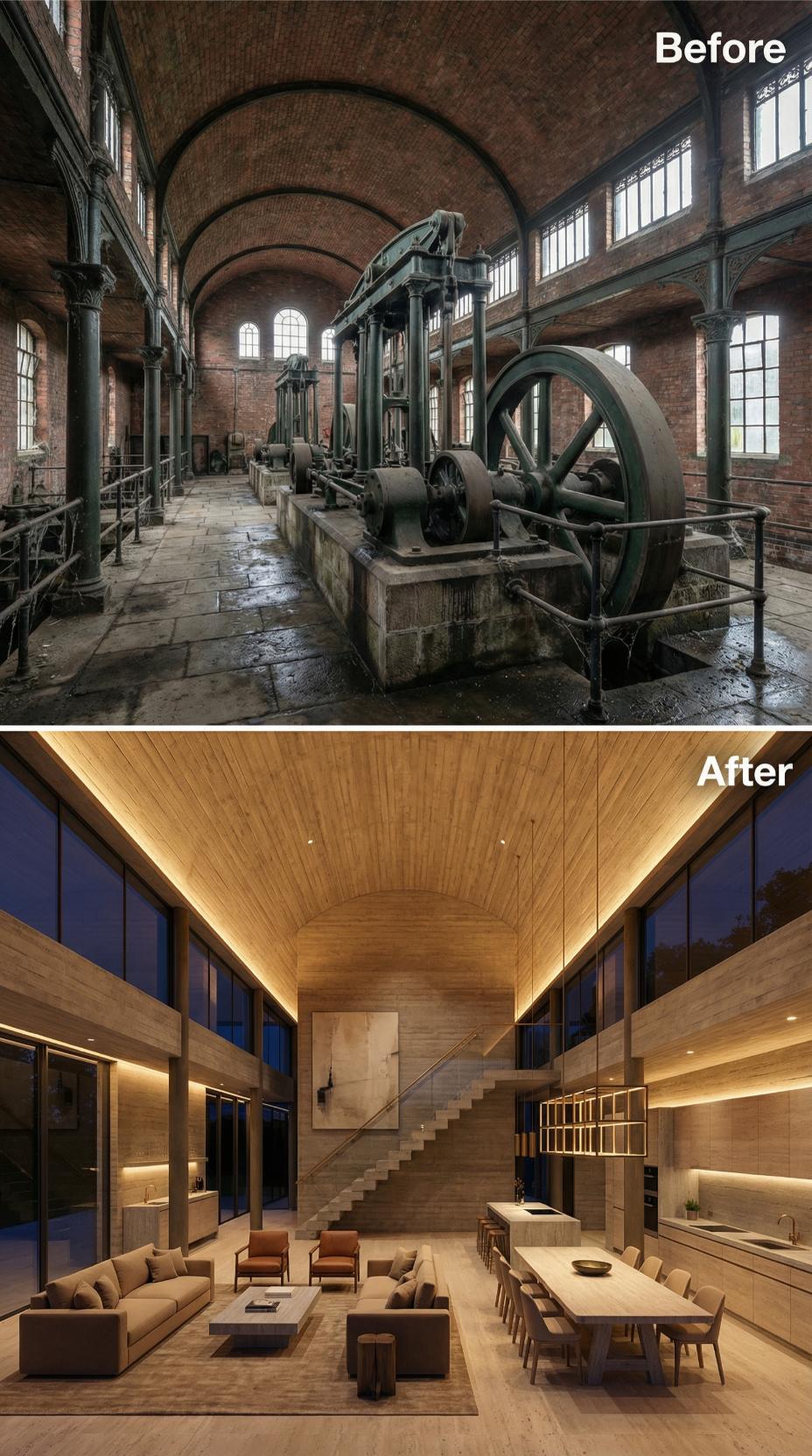
Douglas fir planking runs the full length of the barrel vault, its grain aligned longitudinally to draw the eye from entry to rear wall. Cove strip lighting sits precisely at the springing line, washing the curved ceiling in a diffused gold that reads warmer against the fir than it would against plaster. Below, a linen sectional anchors the living zone, paired with cognac leather armchairs. A cantilevered staircase with glass balustrade rises along the right wall without touching the vault above.
The dining table seats twelve beneath a rectangular open-shelf pendant in a brass finish. Floor-to-ceiling glazing on both flanks replaces the original arched clerestory windows, pulling in the night sky. Cabinet fronts in the kitchen run flat and handle-free in a sand-toned lacquer, and the island countertop appears to be honed limestone in a pale buff.
8. Barrel Vault Plastered Warm, Walnut Lining the Walls, Grand Piano Anchoring the Far End
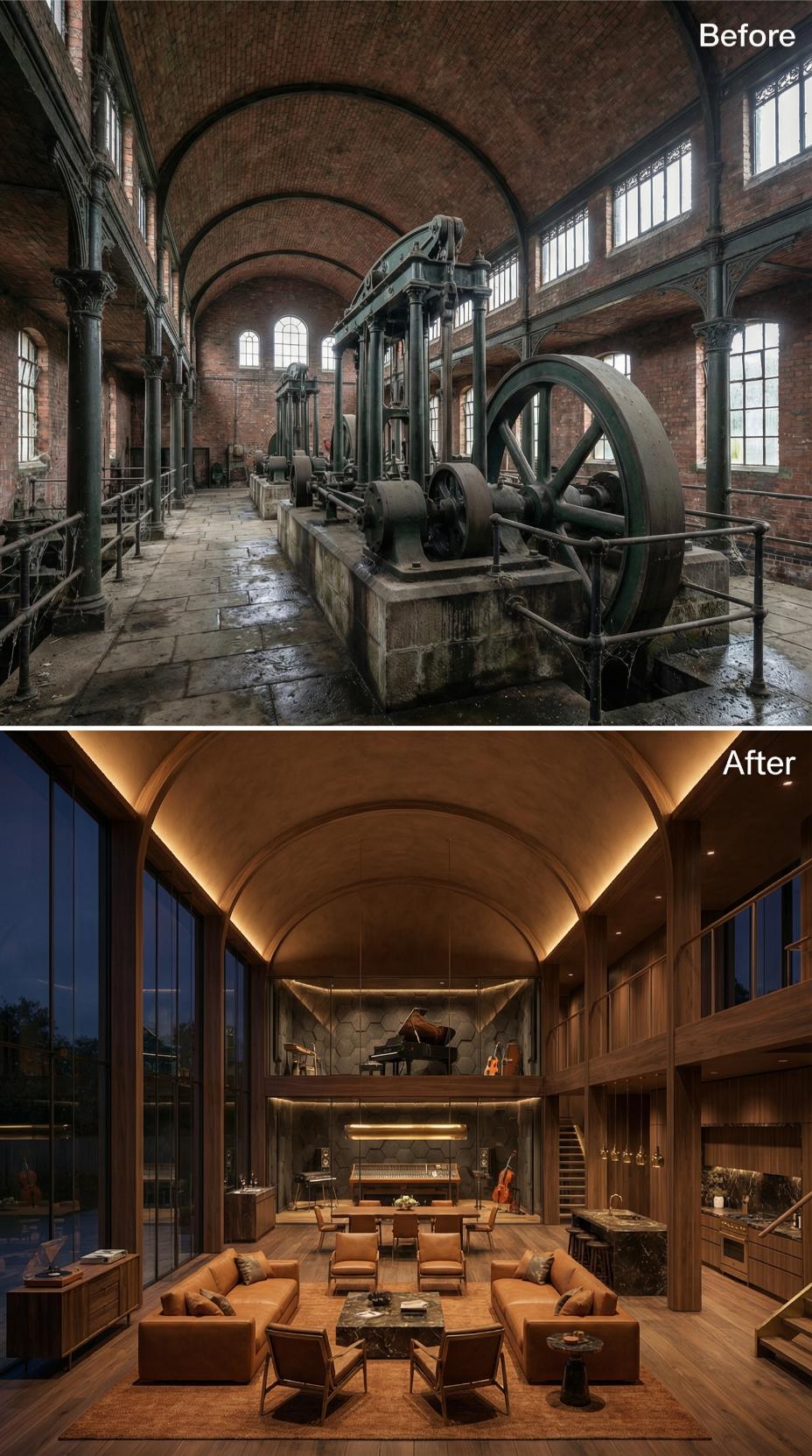
Warm plaster covers the vault where exposed brick once absorbed grime, and LED cove strips at the springing line wash the curve in gold without a single visible fixture. Cognac leather sofas face a mixer console, with a grand piano and upright cello visible beyond.
7. Barrel Vault Plastered Cream, Mezzanine Added, Cognac Sofas Anchoring the New Floor Plan
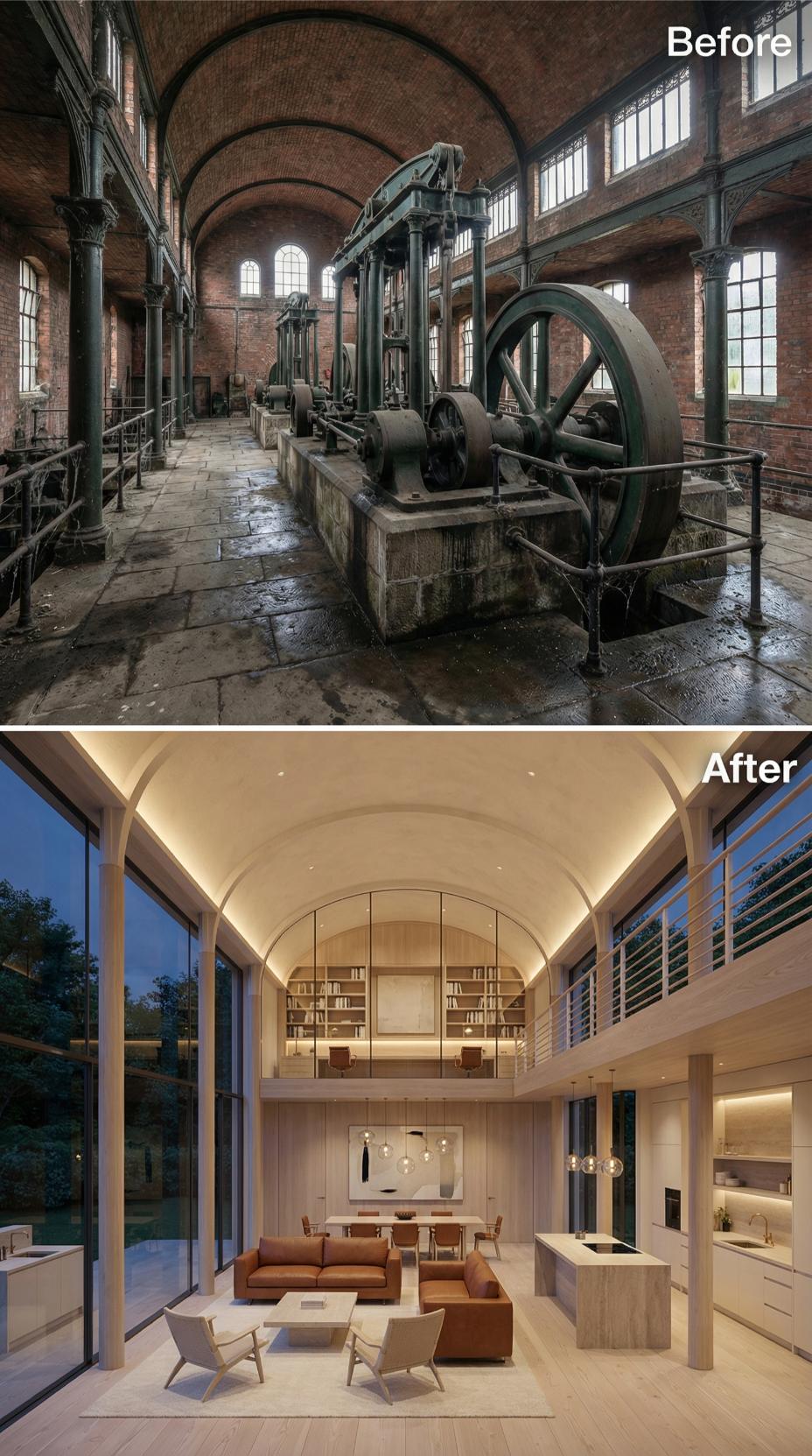
Plaster covers the vault in a flat warm white, with cove strip lighting tracing the springing line above floor-to-ceiling steel-framed glazing. Two cognac leather sofas face a low marble coffee table, backed by a dining set in pale oak and a kitchen island with an integrated cooktop.
6. Barrel Vault Plastered Ivory, Cove Strip Running the Full Length, Sofas in Oatmeal Bouclé
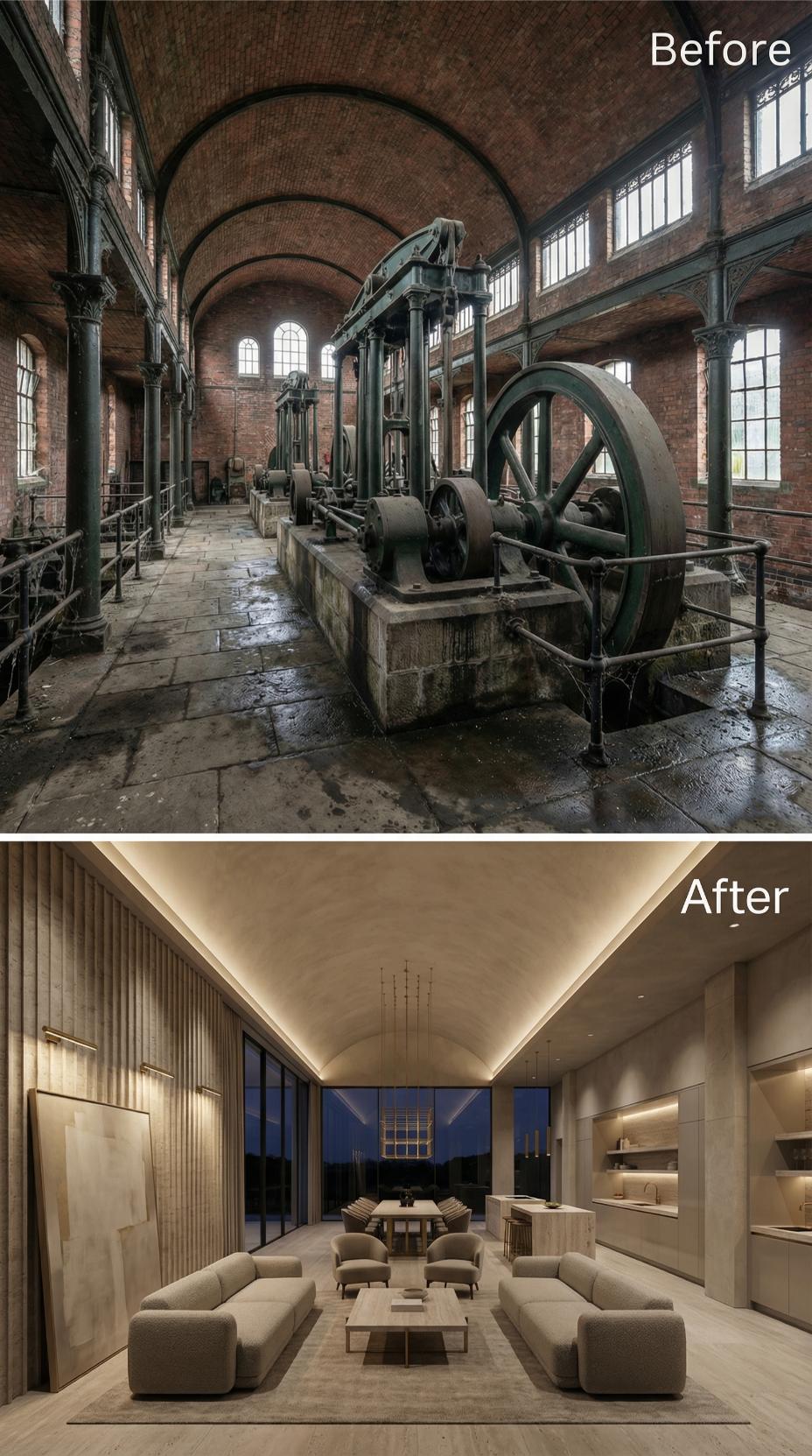
Lime plaster covers the entire vault in a single flat ivory tone, and a recessed cove strip at the springing line washes the curve with amber light that reads warm against the pale finish. Three oatmeal bouclé sofas anchor a symmetrical seating plan around a stone-topped coffee table, while fluted timber panels line the rear wall beside a kitchen run in matte taupe cabinetry. Floor-to-ceiling glazing at the far end frames a dusk sky, with what appears to be a lit courtyard structure visible beyond the glass.
5. Flywheel Hall Replastered Ivory, Mezzanine Inserted, Bouclé Sofas Anchoring the Open Plan
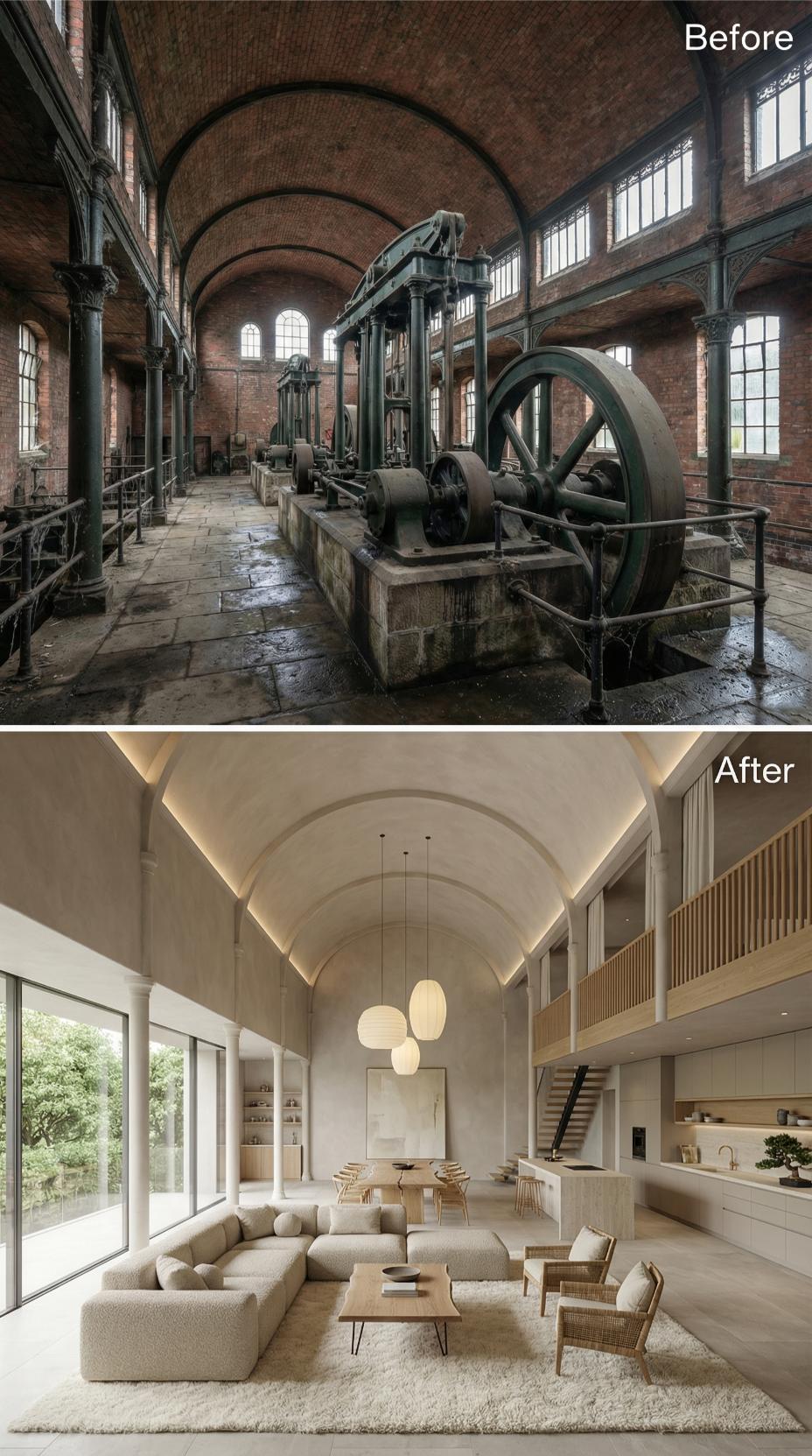
Barrel vault replastered in off-white, pendant globes in washi paper hang at mid-height, and a mezzanine with slatted oak balustrade now occupies the former upper gallery level where clerestory windows once lit idle machinery.
4. Flywheel Hall Replastered White, Wine Wall Centered, Mezzanine Cut Into Both Flanks
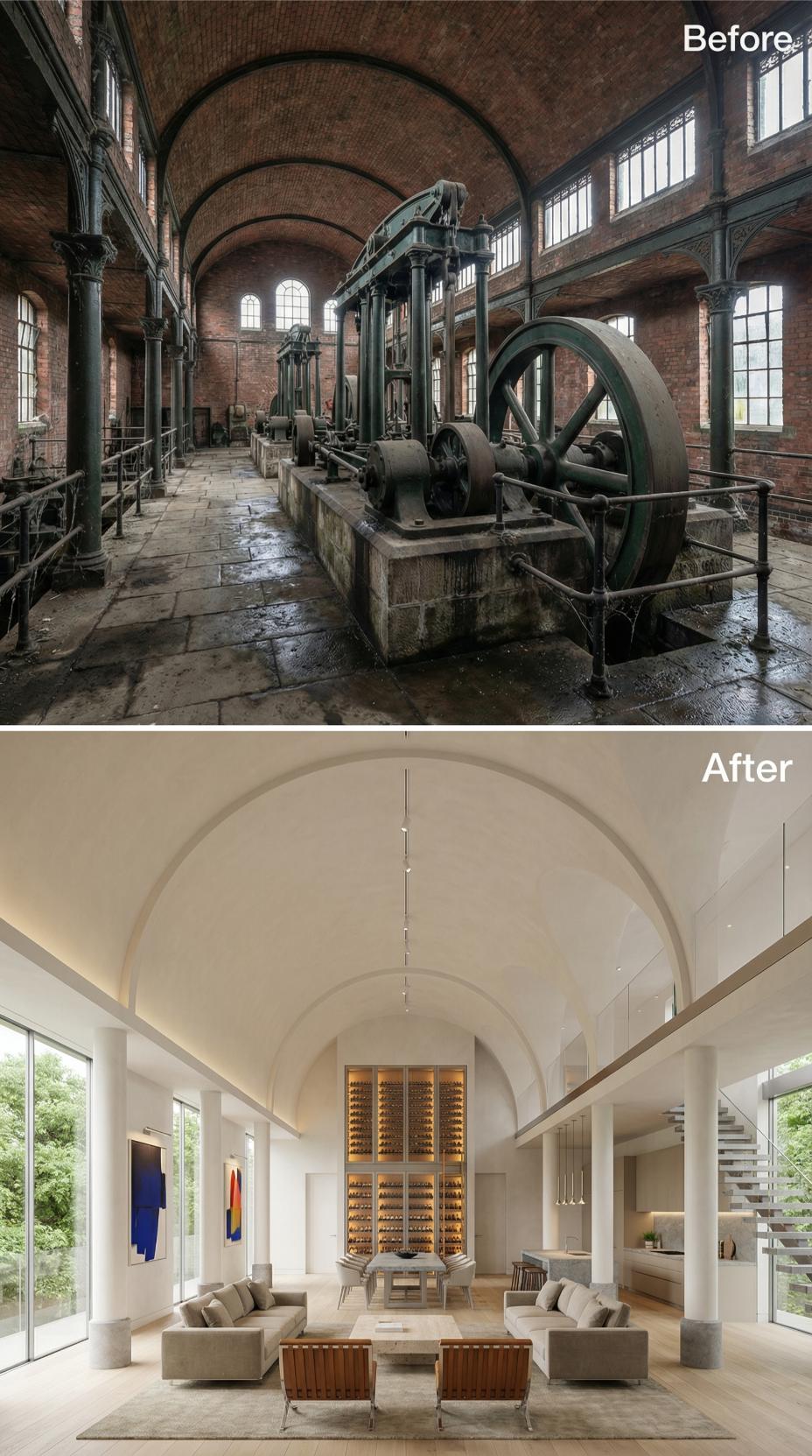
Once the engine room held a flywheel the size of a car, the entire hall has been replastered in flat white, erasing the exposed brick entirely and letting the barrel vault read as pure geometry. A floor-to-ceiling wine rack, backlit with warm amber, anchors the far end where the machinery once sat, flanked by open mezzanine levels with glass balustrades on both sides.
Seating is arranged symmetrically in oatmeal linen sofas with two cognac leather Barcelona-style chairs facing each other across a rectangular wood coffee table. Full-height glass panels replace the original masonry at ground level, flooding the floor in daylight. Cast columns, now painted white, remain exactly where Victorian engineers placed them.
The wine wall does the same visual work the flywheel once did: it stops the eye and holds the full length of the room in tension.
3. Flywheel Hall Replastered Ivory, Globe Chandelier Installed, Bouclé Curved Sofa Centered Below
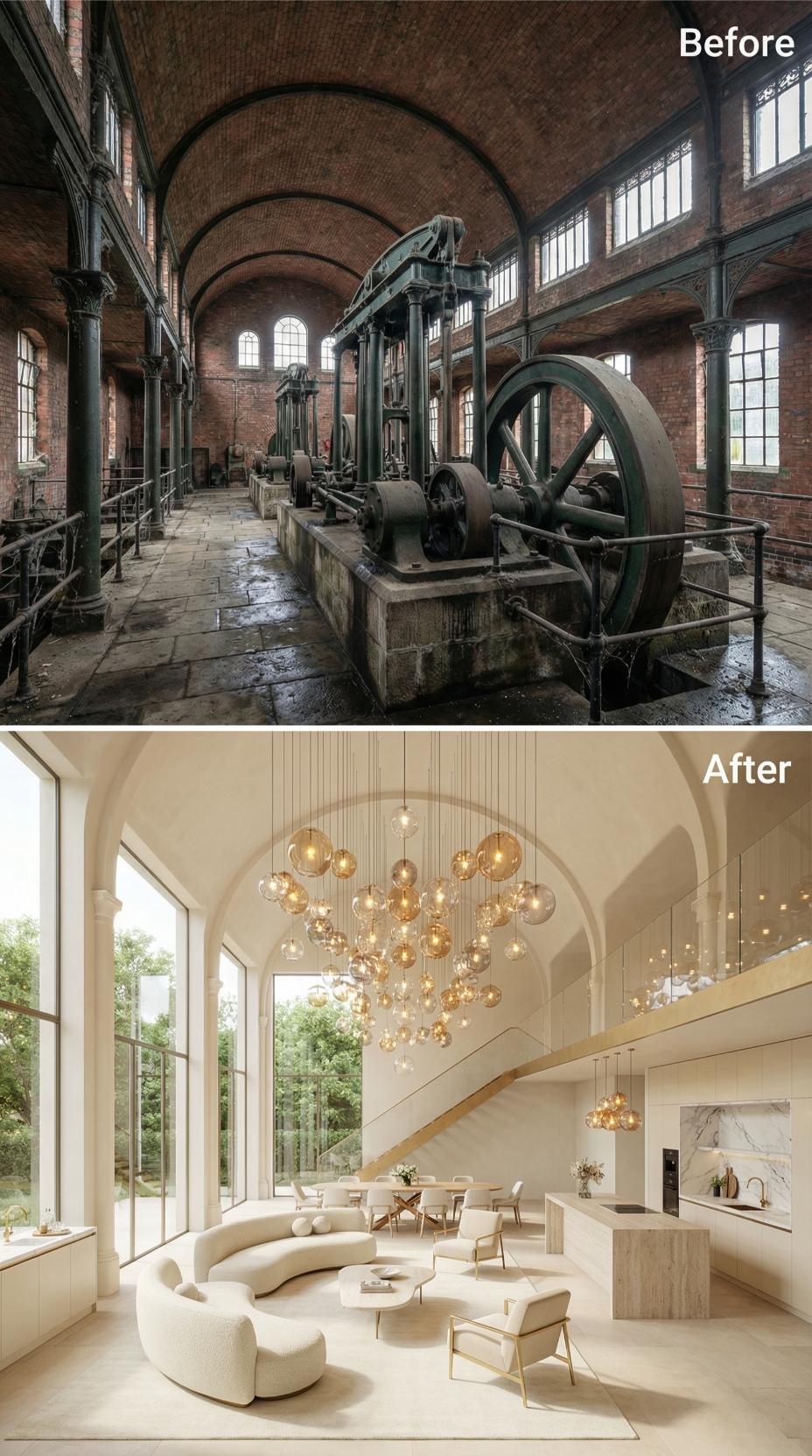
Ivory plaster covers the barrel vault and columns, while a cascading cluster of amber glass globe pendants drops from the crown. Below, a curved bouclé sectional anchors the living zone beside a marble-topped kitchen island with integrated cabinetry in a matching cream finish.
2. Flywheel Hall Replastered Blush, Cove-Lit Vaults Running the Full Length, Marble Island Anchoring the Right
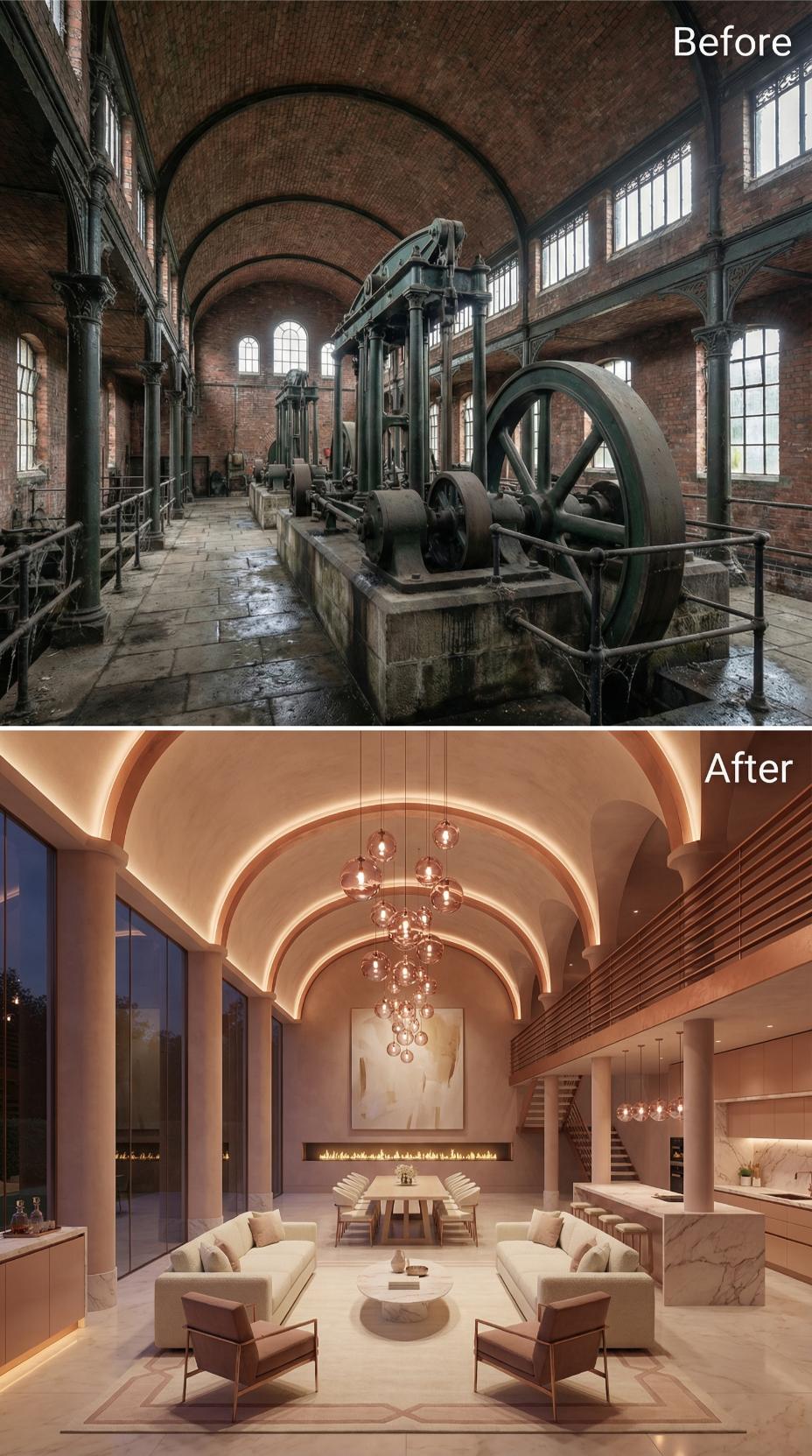
Rust-stained brick and a Victorian flywheel gave way to plaster finished in a warm sand tone, with LED strip lighting pressed into the springing line of each groin vault so the curves read as a continuous rhythm overhead. A cluster chandelier carrying amber glass spheres drops from the central bay, its scale matched to the ceiling height rather than the furniture below. Floor-to-ceiling glazing replaces the end wall, framing a night exterior and pulling daylight the full depth of the plan.
At floor level, cream bouclé sofas form a U-shaped conversation group around a round stone coffee table, with a linear gas fireplace set flush into a plaster panel behind the dining position. To the right, a marble island with book-matched veining and low-profile bar stools marks the kitchen zone, where pendant lights on individual drops mirror the chandelier’s amber glass. An open-tread stair with horizontal timber balustrading rises to a mezzanine level, keeping the upper structure visible without closing off the vault above.
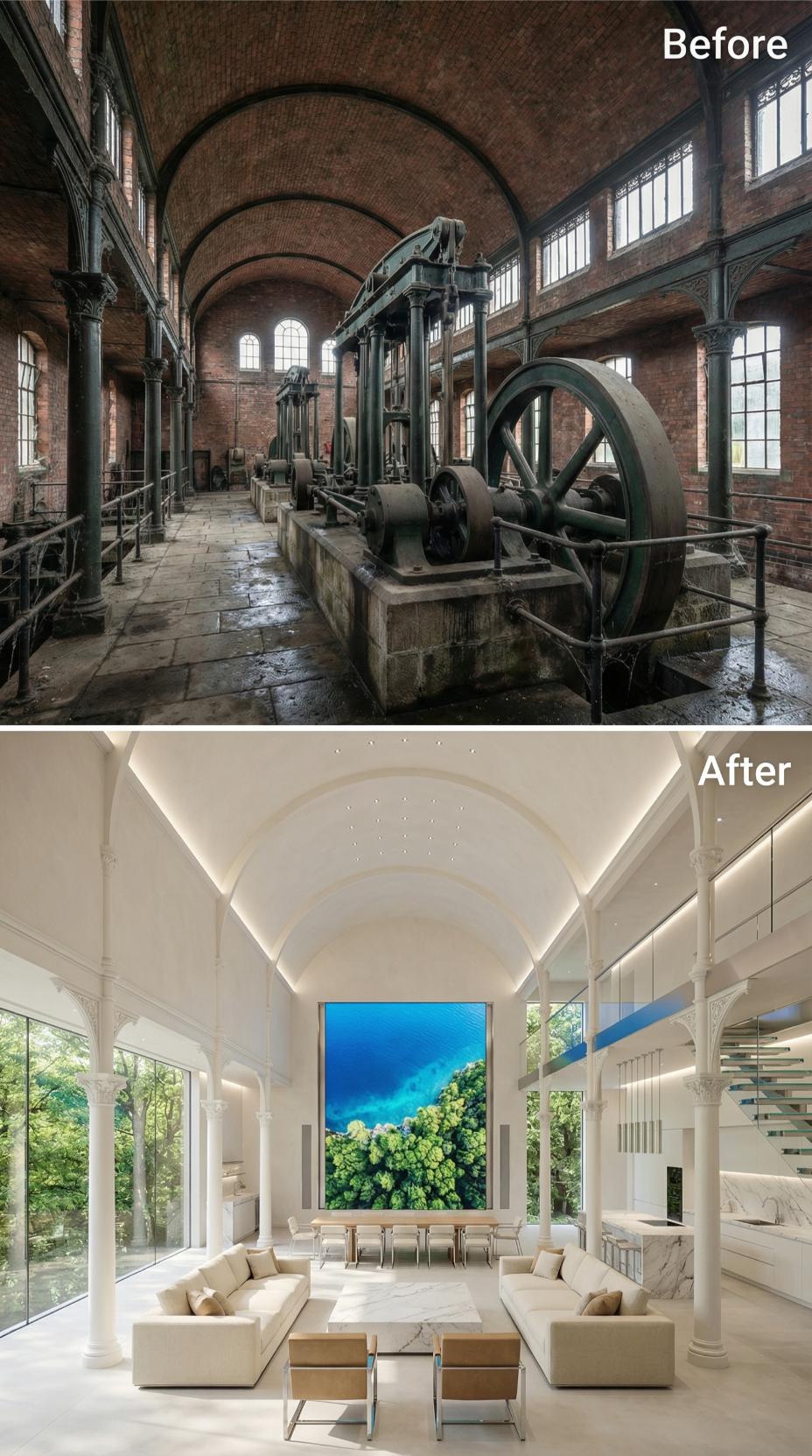
1. Flywheel Hall Replastered Chalk White, Cove Strip Running the Vault, Aerial Canvas Anchoring the Wall
🔥 Would you like to save this?
Four cast-iron columns, repainted white and left structurally intact, still mark the rhythm of the original engine hall. The barrel vault above them has been replastered in chalk white and fitted with a continuous LED cove strip at the springing line, washing the curve in indirect light rather than punctuating it with pendants. Floor-to-ceiling glazing replaces the brick end wall on the left flank, pulling in a canopy of mature trees that reads almost green against the white interior.
Seating runs in two facing cream sofas with loose cushions in warm tan, arranged around a marble-topped coffee table on a polished concrete floor. At the far end, an oversized aerial photograph of turquoise water and forest canopy is mounted flush to the wall, scaled to fill the full double-height void. A floating staircase with glass treads rises on the right. The kitchen island behind it is faced in white marble with a waterfall edge, its surface uninterrupted by visible hardware.