🔥 Would you like to save this?
Cabinets hide a lot of sins. Open shelving doesn’t get that luxury, which is exactly why so many designers are drawn to it and exactly why so many home cooks quietly regret it by month three. What makes this particular collection worth a close look is the range. Some of these kitchens are working with tight square footage and minimal natural light, conditions where exposed shelving usually fails. Others have the ceiling height and breathing room to make it look easy. A few pull off something harder: they look lived-in without looking messy, which is genuinely difficult to do. Twenty-eight designs, wildly different budgets and styles. Readers can decide for themselves whether open shelving earns its reputation or just photographs well.
In order to come up with the very specific design ideas, we create most designs with the assistance of state-of-the-art AI interior design software. Also, assume links that take you off the site are affiliate links such as links to Amazon. this means we may earn a commission if you buy something.
28. Open Shelving Done Right: Walnut, Marble, and Brass Pull It Together
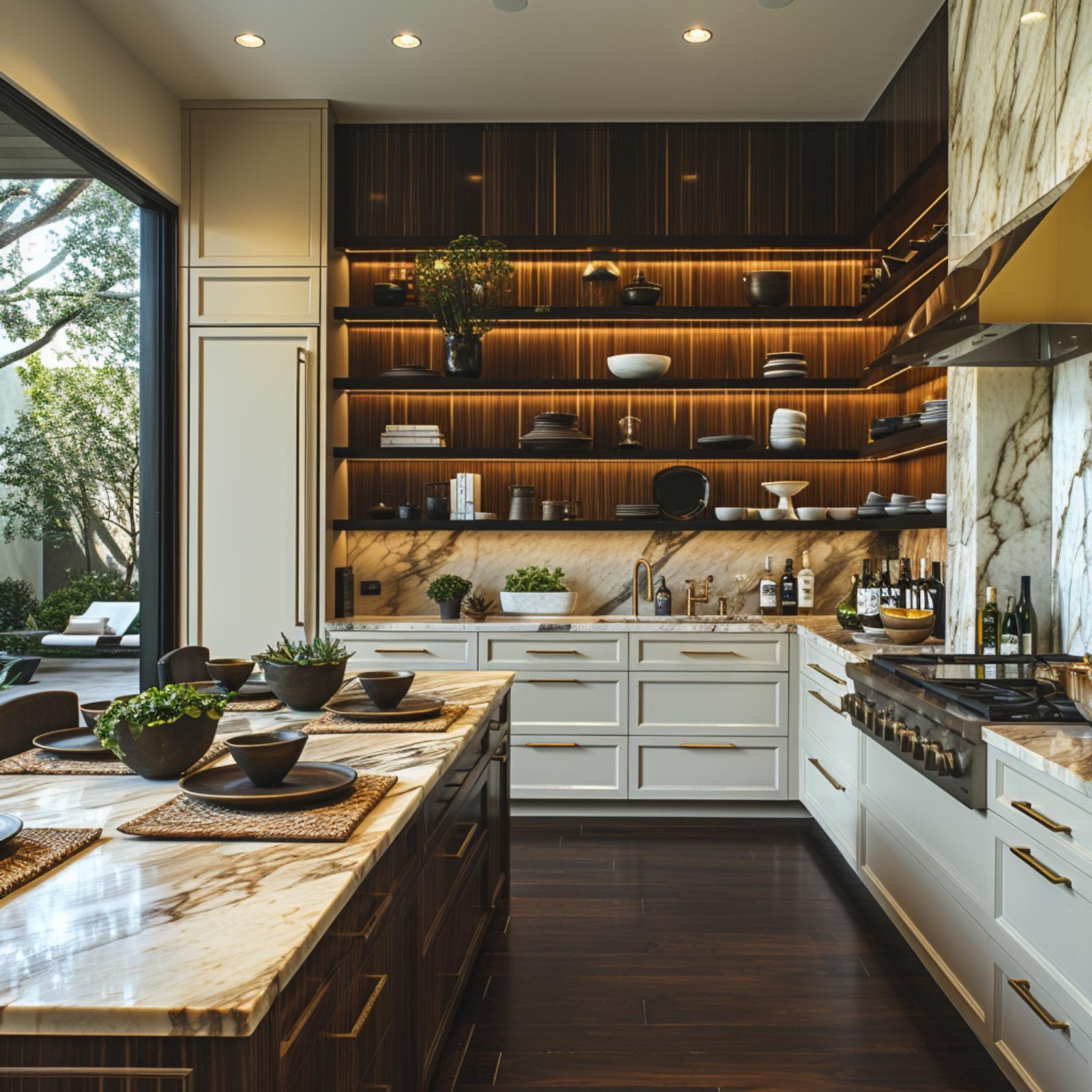
Backlit walnut shelving lines the entire back wall, and the warm amber glow makes the stacked ceramics read more like a display than storage. Gold bar pulls on white shaker cabinets tie directly to the brass faucet, so nothing feels accidental. The island’s live-edge marble slab is the real anchor here.
27. Travertine Hood, Open Shelves, Zero Apologies
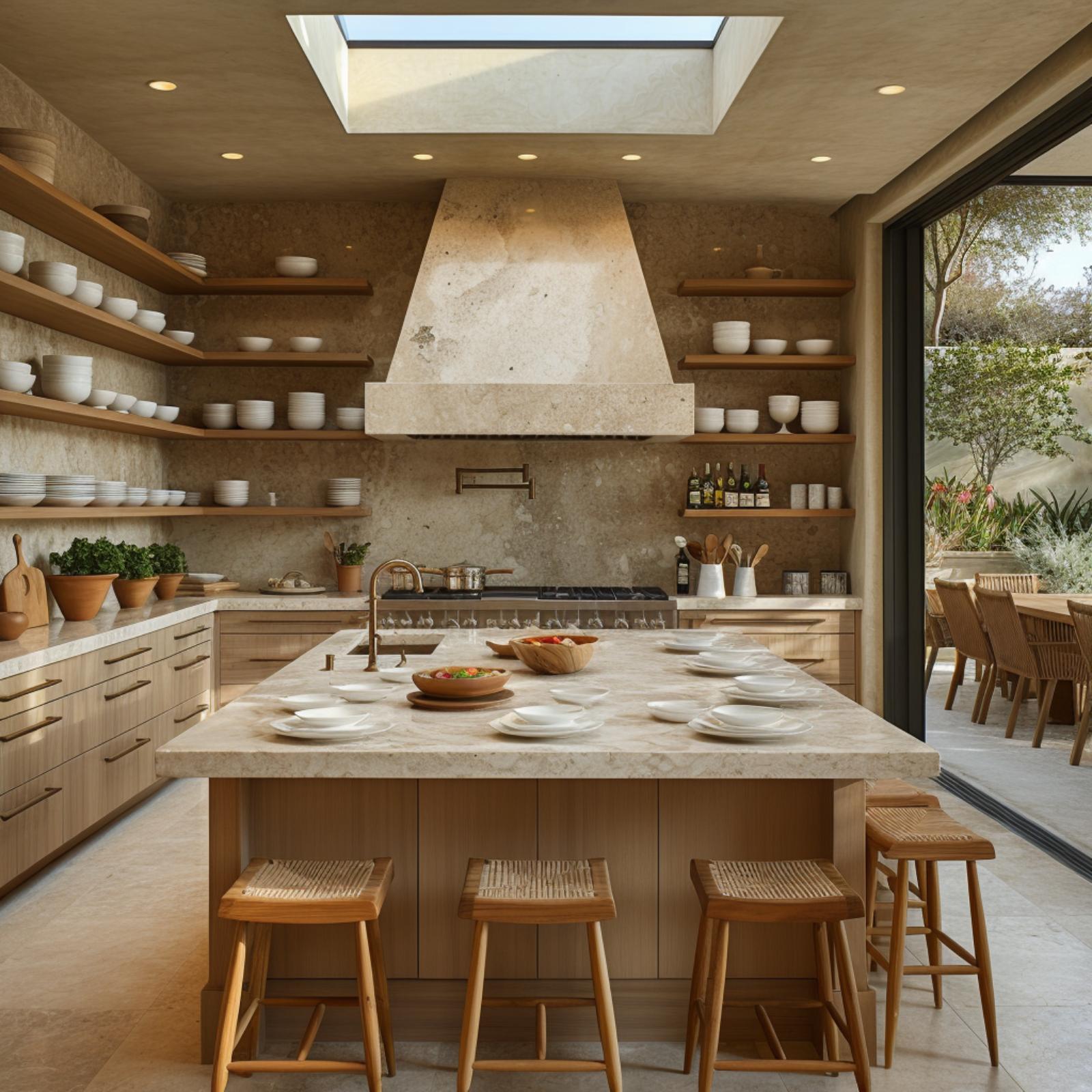
Lime-washed travertine wraps the range hood and backsplash in the same material, so nothing competes. White ceramics stack across oak shelving without fuss. It works because it’s honest.
26. Sage Cabinets, Brass Hood, Marble Everywhere: Open Shelving Earns Its Keep
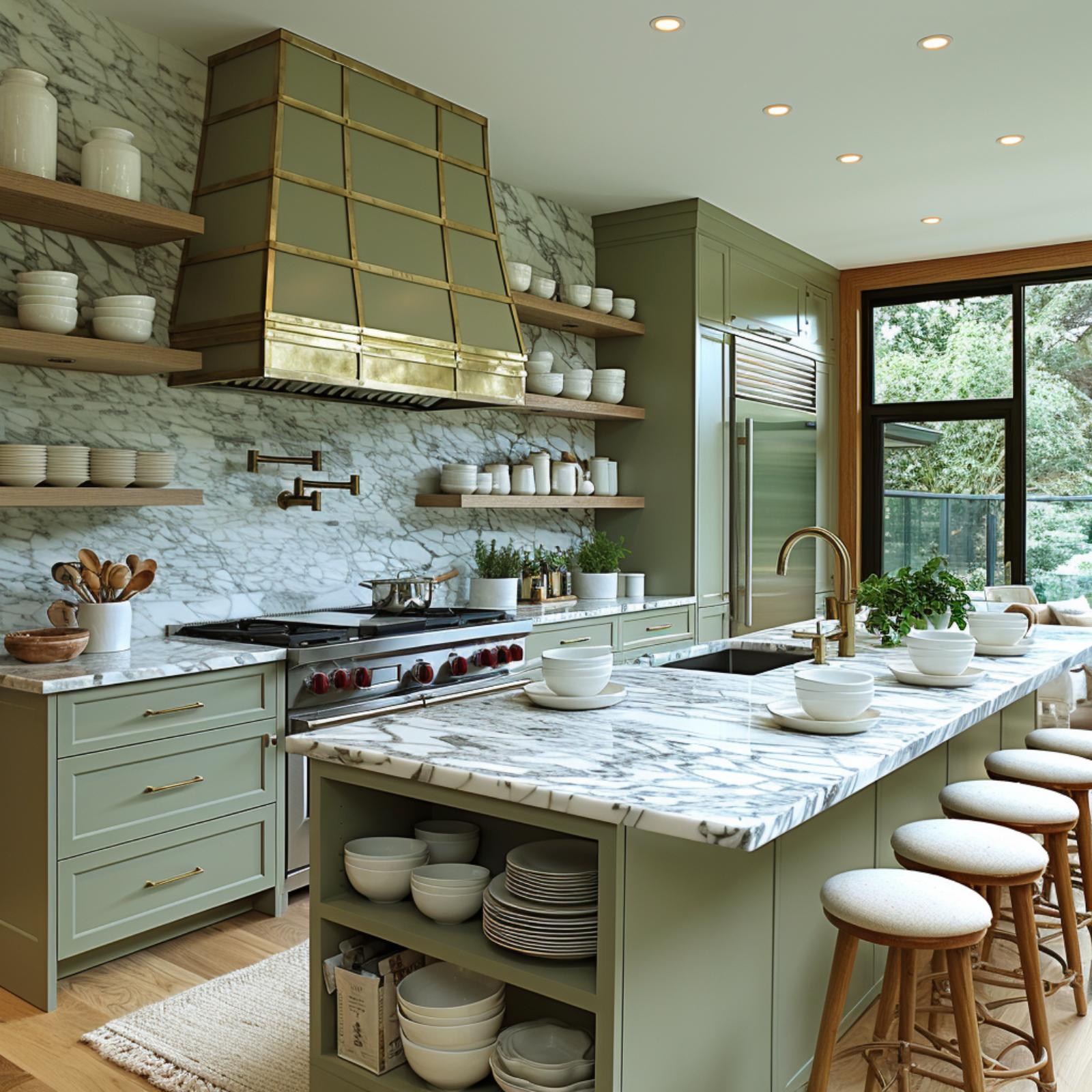
Sage green cabinets with brass pulls run the full length of this kitchen, and the palette holds together because every other surface stays white or marble. The range hood does a lot of work here: painted the same sage and framed in brass, it ties the cabinetry to the open shelves without feeling like a separate statement.
What keeps the shelving from looking chaotic is restraint. Every piece on those wood shelves is white ceramic, no exceptions. That kind of discipline is harder than it looks, and it’s probably what separates kitchens that photograph well from ones that just feel cluttered in real life.
25. Olive Cabinets, a Brass Hood, and Open Shelves That Actually Pull Their Weight
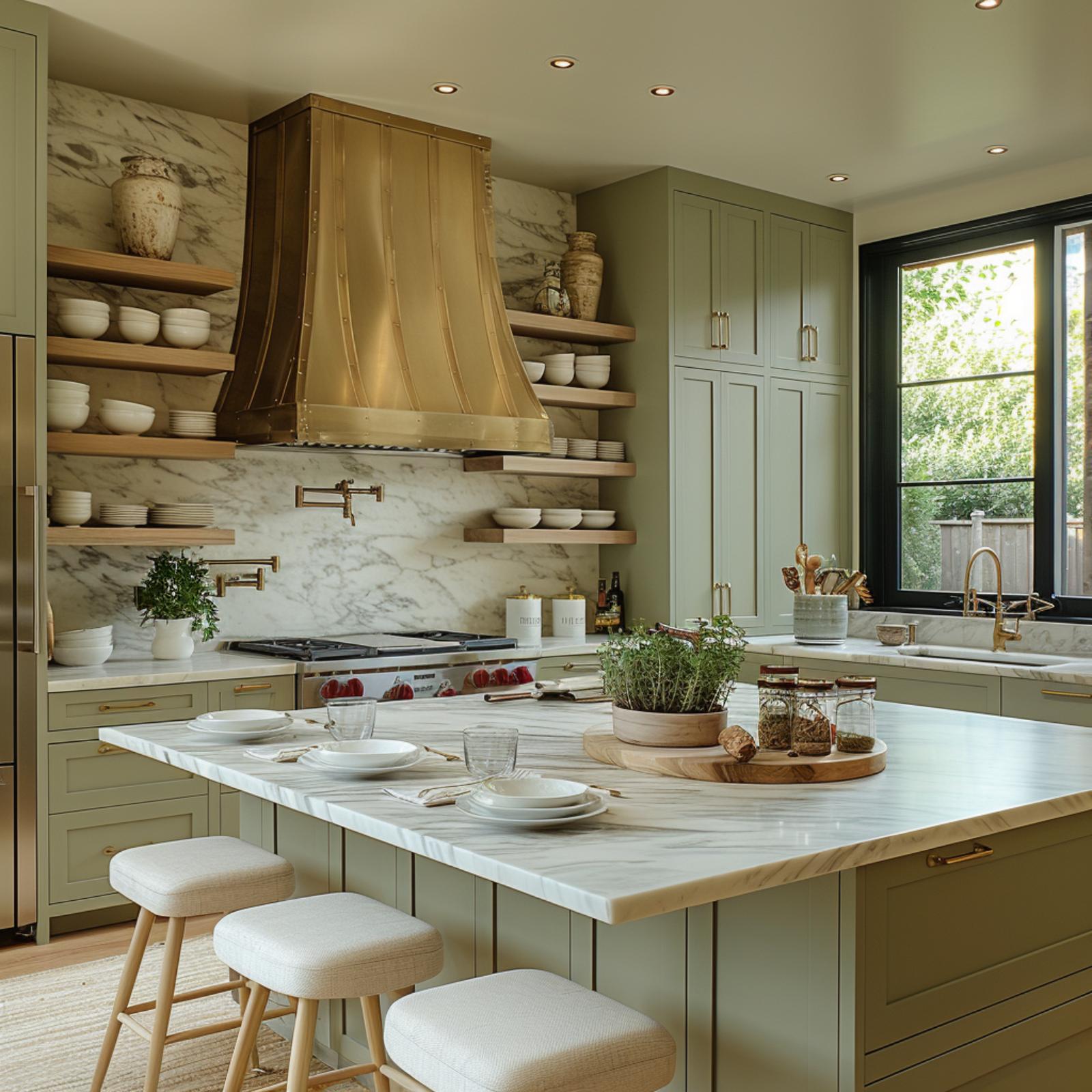
Soft olive cabinetry runs the perimeter, and the brass range hood is the obvious focal point. It’s oversized, curved, and completely unafraid to take up space. The marble slab backsplash behind it reads more like wall art than tile work, with gray veining that connects visually to the island countertop.
Oak floating shelves hold white ceramic bowls and stacked plates. Nothing fancy, but the restraint is what makes it work. Three upholstered stools in cream bouclé tuck under the island, and brass hardware ties the whole palette together without repeating itself too loudly.
24. Open Shelves, Painted Island, Mosaic Backsplash: Green Done With Conviction
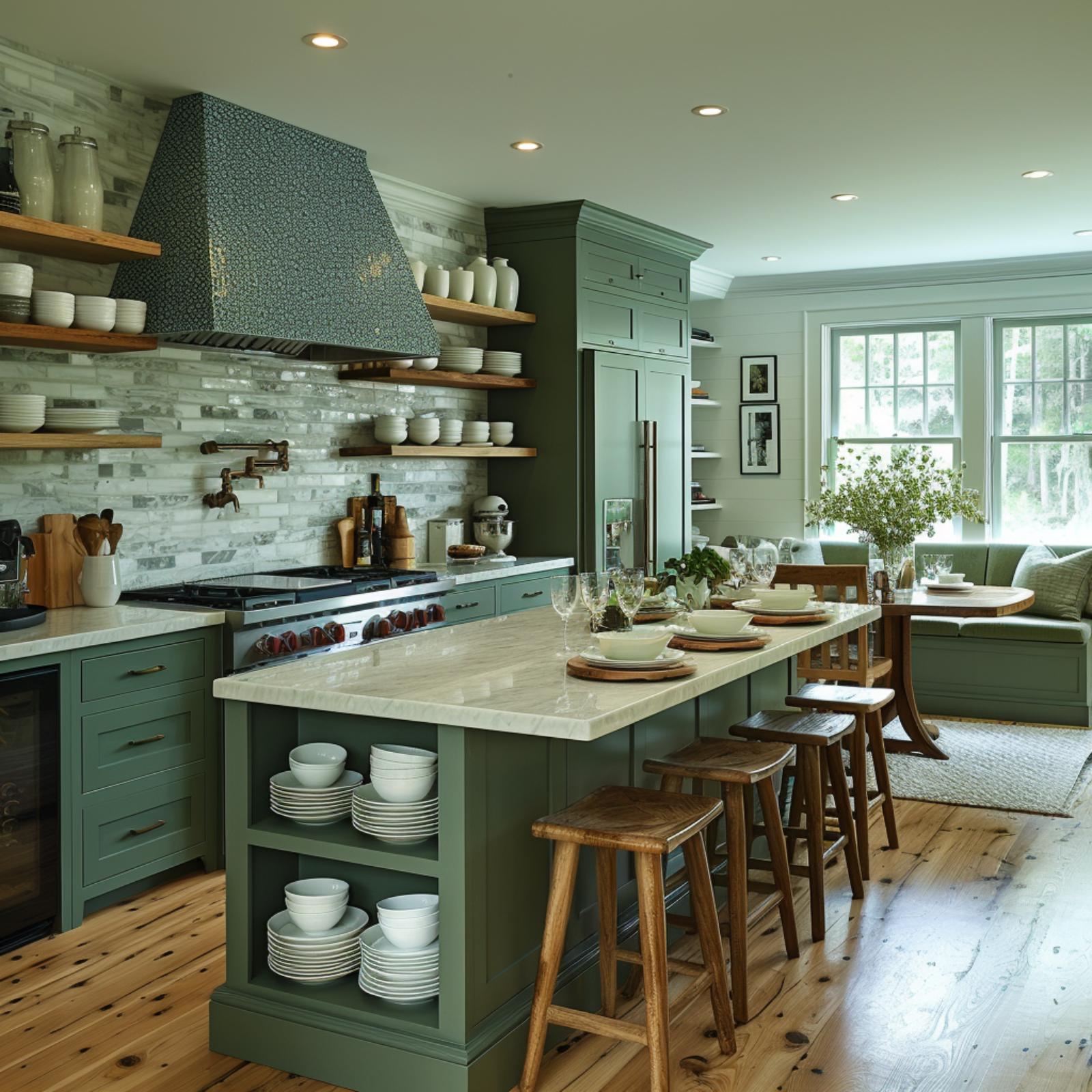
Olive-painted cabinets carry the whole room, but it’s the patterned range hood, covered in what looks like an embossed botanical print, that stops the eye first. Pine floors add warmth against cool marble countertops. Open shelves in natural wood hold white ceramics without pretense, and the island’s built-in shelving keeps the dishware visible and reachable. It works.
Ask Yourself: Consider whether your cabinet color is strong enough to anchor open shelving or whether it’ll read as visual noise once the shelves go in. A color with real depth, like this olive, tends to hold the room together when storage is exposed.
23. Blue-Gray Cabinets, Gold-Veined Marble, and Open Shelves That Hold Their Own
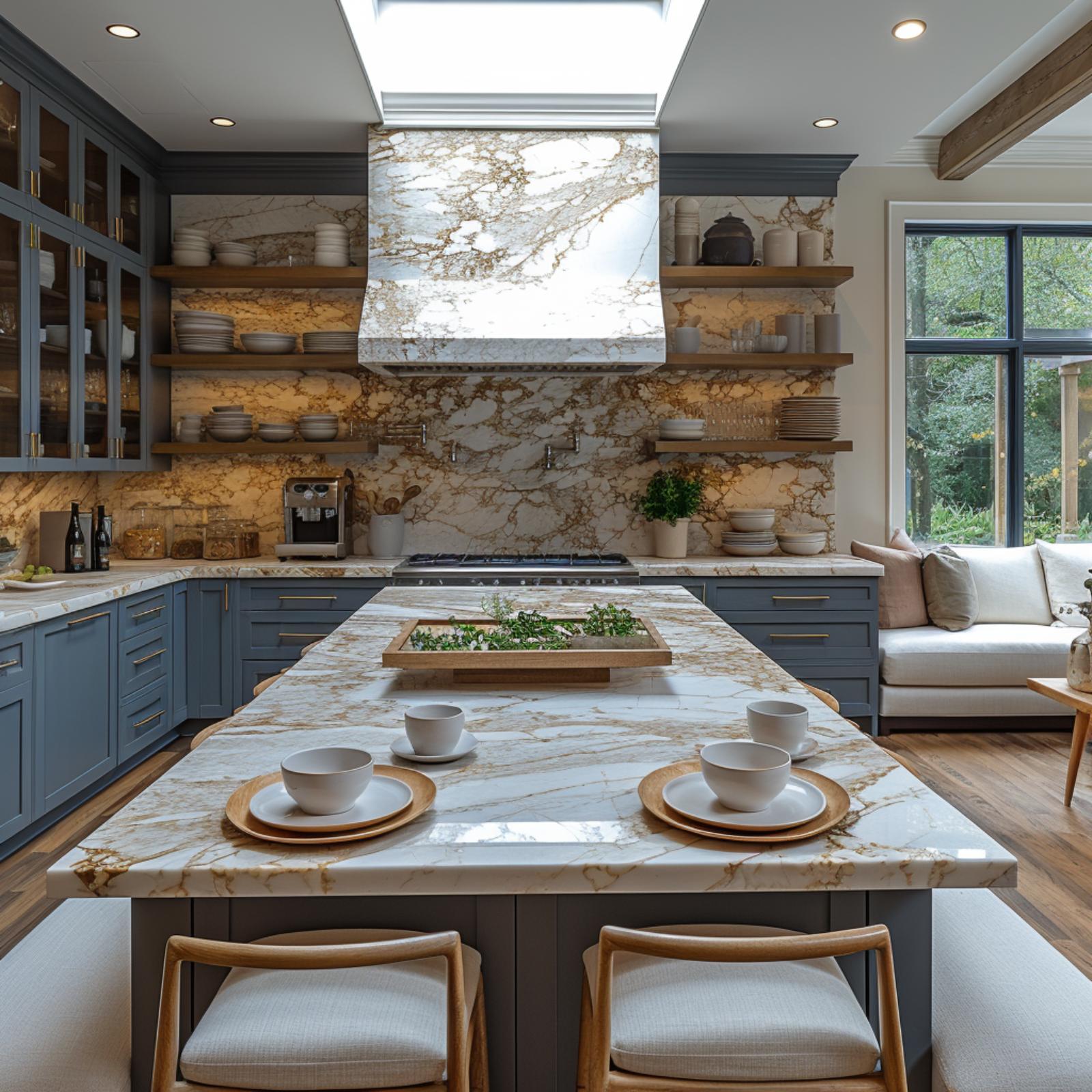
Slate-blue cabinetry with brass pulls does a lot of the heavy lifting here, giving the open walnut shelves something solid to lean against. Without that cabinet color, the shelving might read as clutter. With it, they read as intentional.
The real commitment is the marble. It runs across the counters, up the backsplash, and wraps the hood in one continuous sweep of white and amber veining. That kind of repetition is what keeps open shelving from fragmenting a space visually.
Without that cabinet color, the shelving might read as clutter. With it, they read as intentional.
22. Muted Green Cabinets, Wood Shelves, and a Hood That Earns the Spotlight
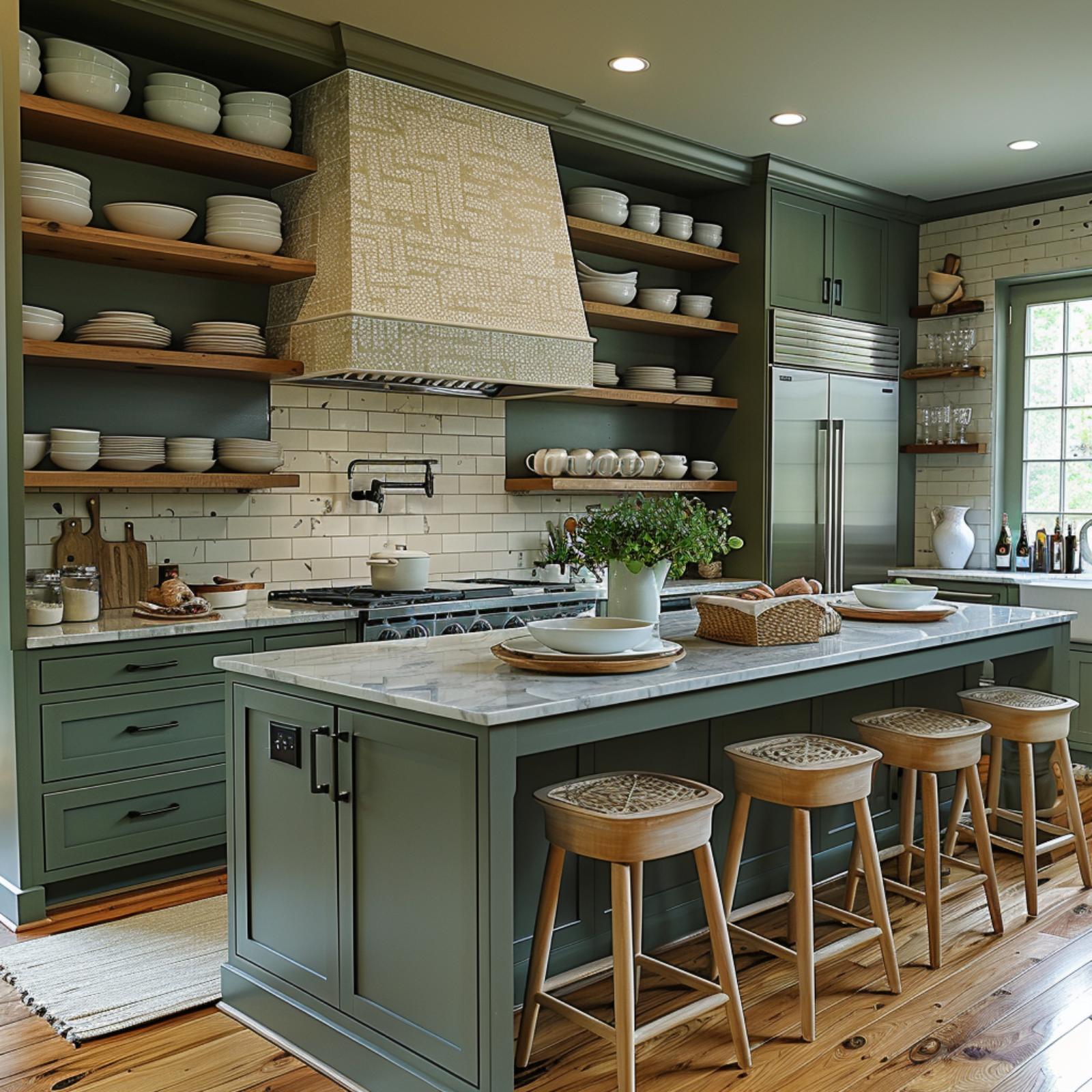
Dusty green cabinets set a grounded tone here, and the open shelving doesn’t fight them. Warm wood shelves loaded with white ceramics keep the eye moving without creating chaos. The range hood deserves a closer look: a textured, almost woven-pattern finish that reads more artisan than industrial.
The marble island countertop picks up cool gray tones that balance the warmth of the hardwood floor. Four backless wood stools with woven seats add just enough texture without competing. It works because the palette stays disciplined.
Quick Fix: Open shelving can make a kitchen feel cluttered fast if the dishware isn’t consistent in color or material. Sticking to one finish across your displayed pieces, like all-white ceramics, gives shelves the visual calm they need to read as intentional rather than disorganized. It’s a simple constraint with a big payoff.
21. Warm Wood Shelves, a Textured Hood, and Green Cabinets That Commit
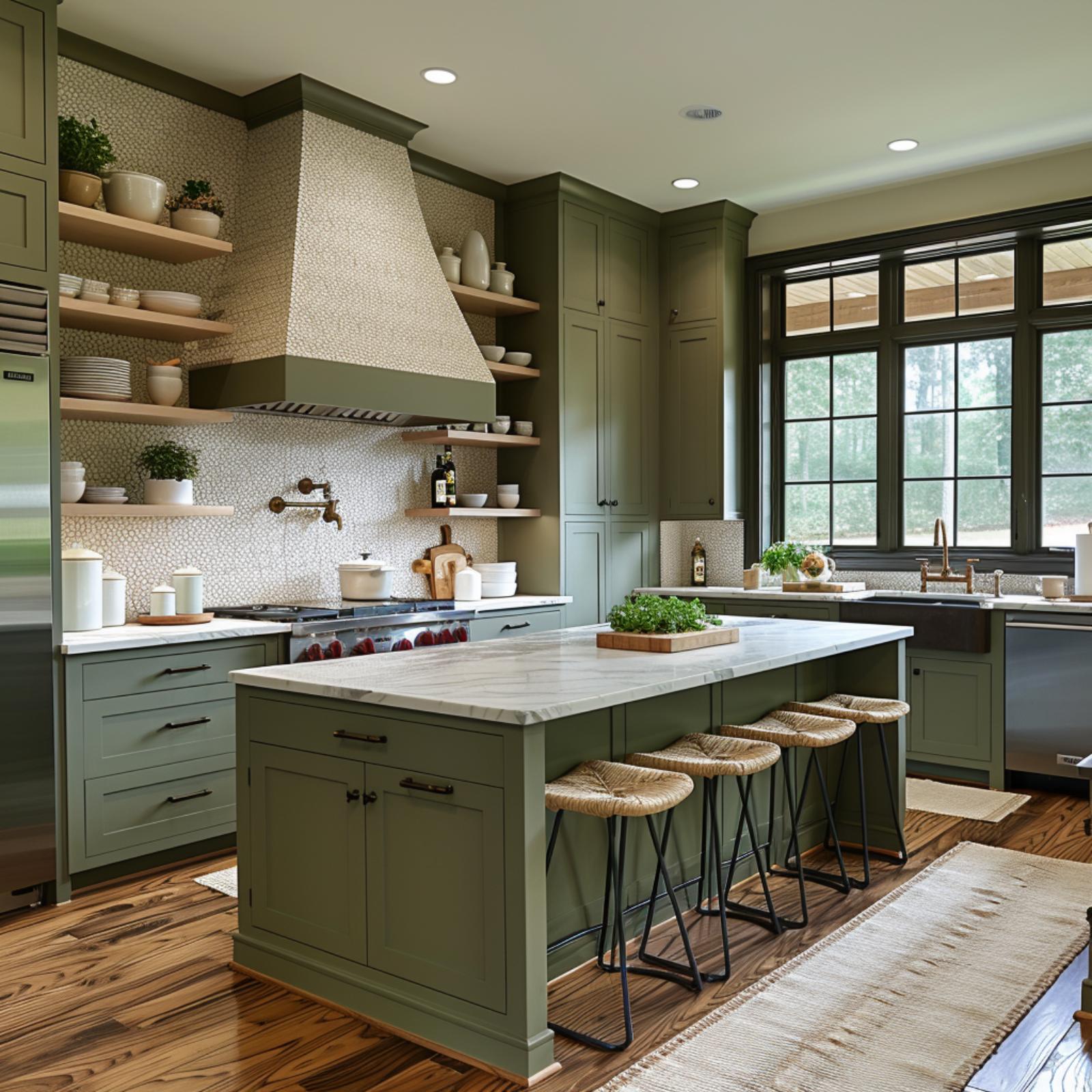
Olive green cabinets in a shaker profile run floor to ceiling here, and they don’t apologize for taking up space. The range hood is the real conversation starter: a sculptural plaster form wrapped in what appears to be a pebbled or hand-applied texture, pale enough to contrast the cabinetry without competing with it. Floating shelves in a light natural wood carry white ceramics and a few potted plants, keeping the display calm.
The island earns its footprint with a veined marble top and woven rattan barstools on black iron frames. Dark-framed windows pull the exterior treeline into the room. Open shelving works here because the dishware stays tonal and the wood tone repeats across the island cutting board and the shelves themselves.
Pro Tip: Repeating one material in at least two spots, like the wood tone carried from shelves to cutting board here, gives a kitchen visual continuity without requiring everything to match. It’s a low-effort move that keeps open shelving from reading as random. Don’t underestimate how much that small echo does for the overall composition.
20. Shiplap, Teal Cabinets, and Open Shelves That Don’t Apologize for Being Practical
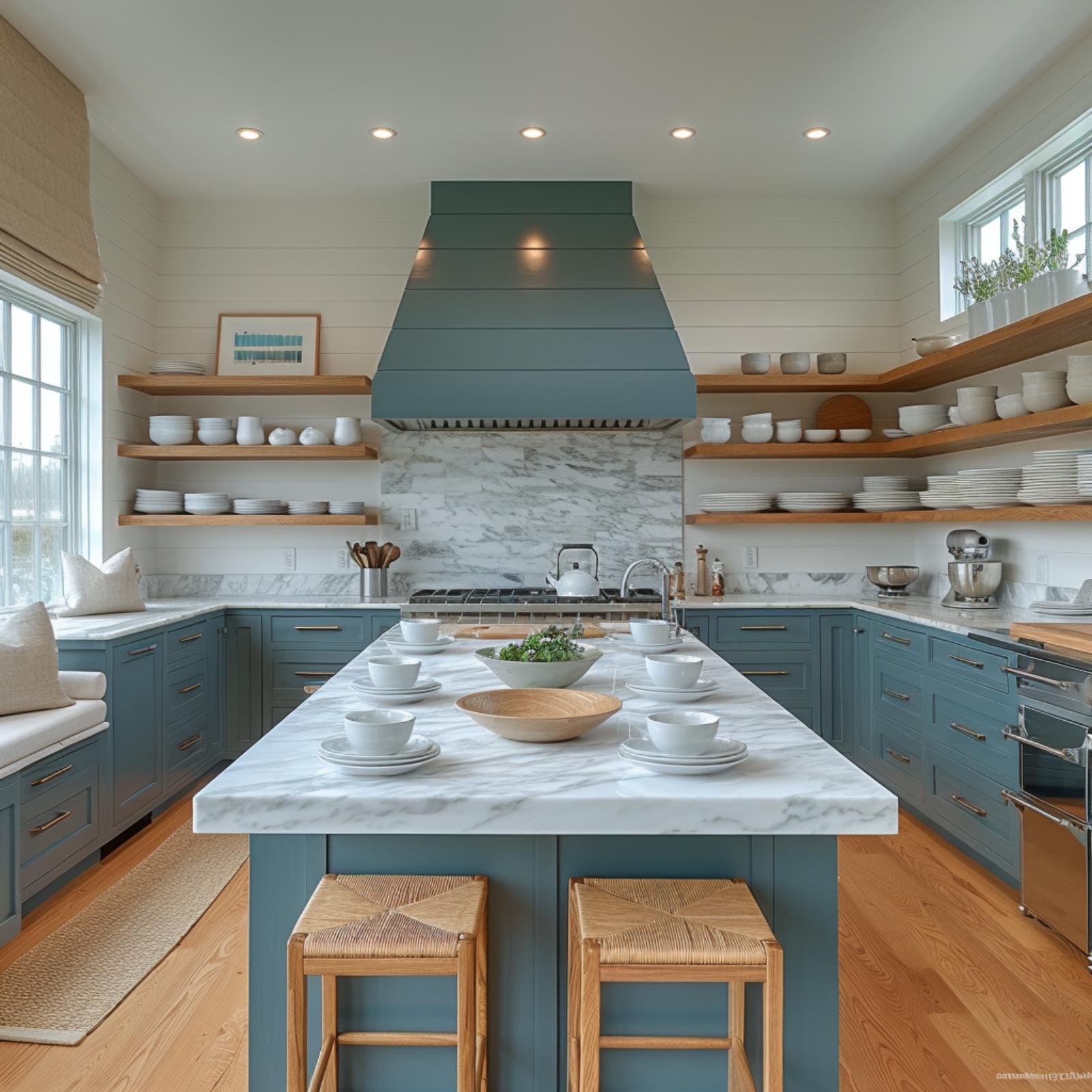
Teal-painted cabinets with brushed gold hardware set a confident tone, and the white oak open shelves stacked with uniform white dishware keep things from tipping into chaos. The marble island countertop is thick-edged and substantial. Two rush-seat stools ground the island without fussing over it. That teal range hood, matching the cabinetry below, ties the whole vertical axis together.
In The Details: Open shelving works best when every displayed item could pass as part of a set. Mixing finishes, textures, or colors across shelves forces the eye to keep moving and never settle. Uniform white ceramic, like what’s displayed here, gives the shelves a finished look without requiring a stylist.
19. Navy Cabinets, a Brass Hood, and Open Shelves That Actually Earn Their Place
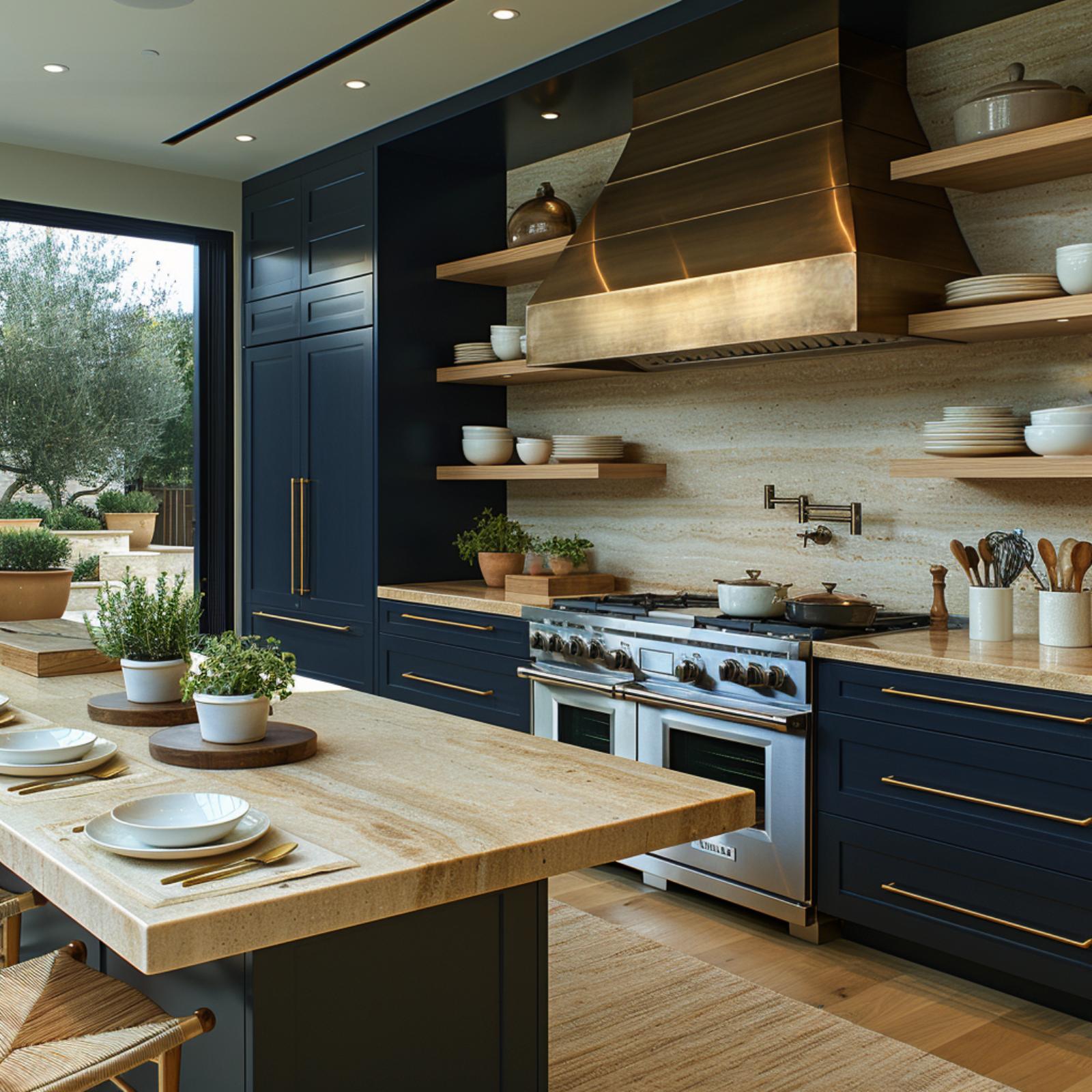
Navy shaker cabinets with brass pulls set a strong enough foundation that the open shelving flanking the hood doesn’t feel like a risk. It feels like a decision. The travertine backsplash runs floor to ceiling behind the range, and the warm veining in that stone ties directly to the countertop material, so the shelf brackets aren’t floating in a visual vacuum.
What keeps it from tipping into clutter is restraint. White ceramics only, stacked consistently, with a pot filler in an antique brass finish adding hardware weight without competing. The range hood itself reads almost architectural here, more bronze sculpture than kitchen appliance.
Fun Fact: Travertine has been used in kitchens and homes for thousands of years, with some of the most famous examples found in ancient Roman architecture. Its natural vein patterns mean no two slabs are identical, which is part of why it’s regained popularity as a backsplash material. Designers often choose it specifically because the variation does visual work that solid stone simply can’t.
18. Dark Cabinets, a Bronze Hood, and Open Shelves Loaded With White Ceramics
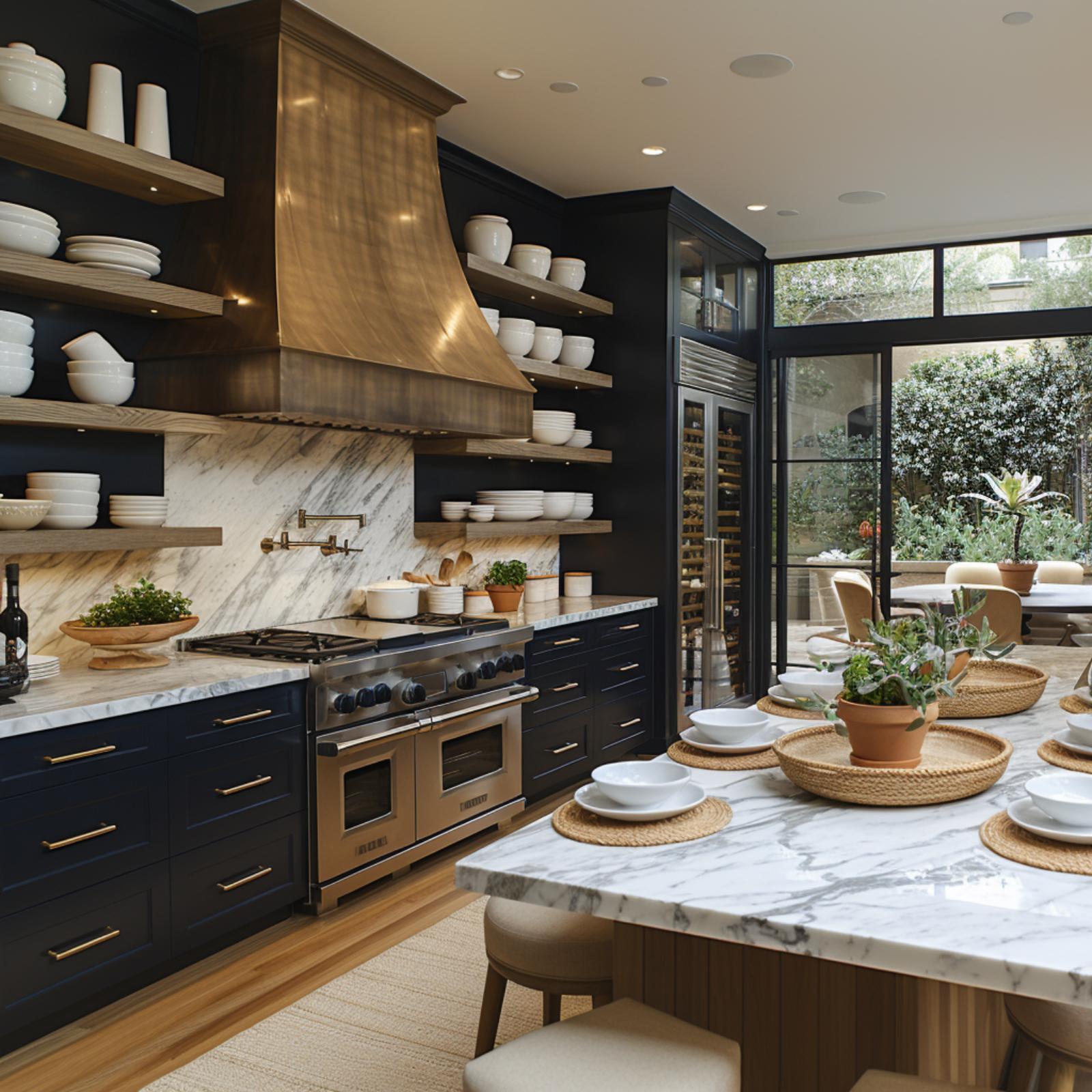
Charcoal-navy cabinetry runs the full length of this kitchen, and the brass hardware keeps it from reading as heavy. Open shelves in light wood carry nothing but white ceramics, which is exactly what makes it work. Consistency across every shelf does more than any styling trick could.
The marble island and backsplash share the same veining, so the two surfaces feel connected rather than coincidental. A wine fridge built into the cabinet run near the glass doors is a quiet detail most people would miss at first glance.
Why the Bronze Hood Works Harder Than It Looks
Most range hoods in dark kitchens are painted to match the cabinetry or clad in the same finish. Here, the curved bronze hood reads as a separate element entirely, closer to furniture than fixture. That distinction matters because it draws the eye up without competing with the marble backsplash directly behind it, and the warm metal tone keeps the navy-heavy room from going cold.
17. Fluted Everything, Warm Wood Shelves, and Cabinets That Don’t Need Color to Win
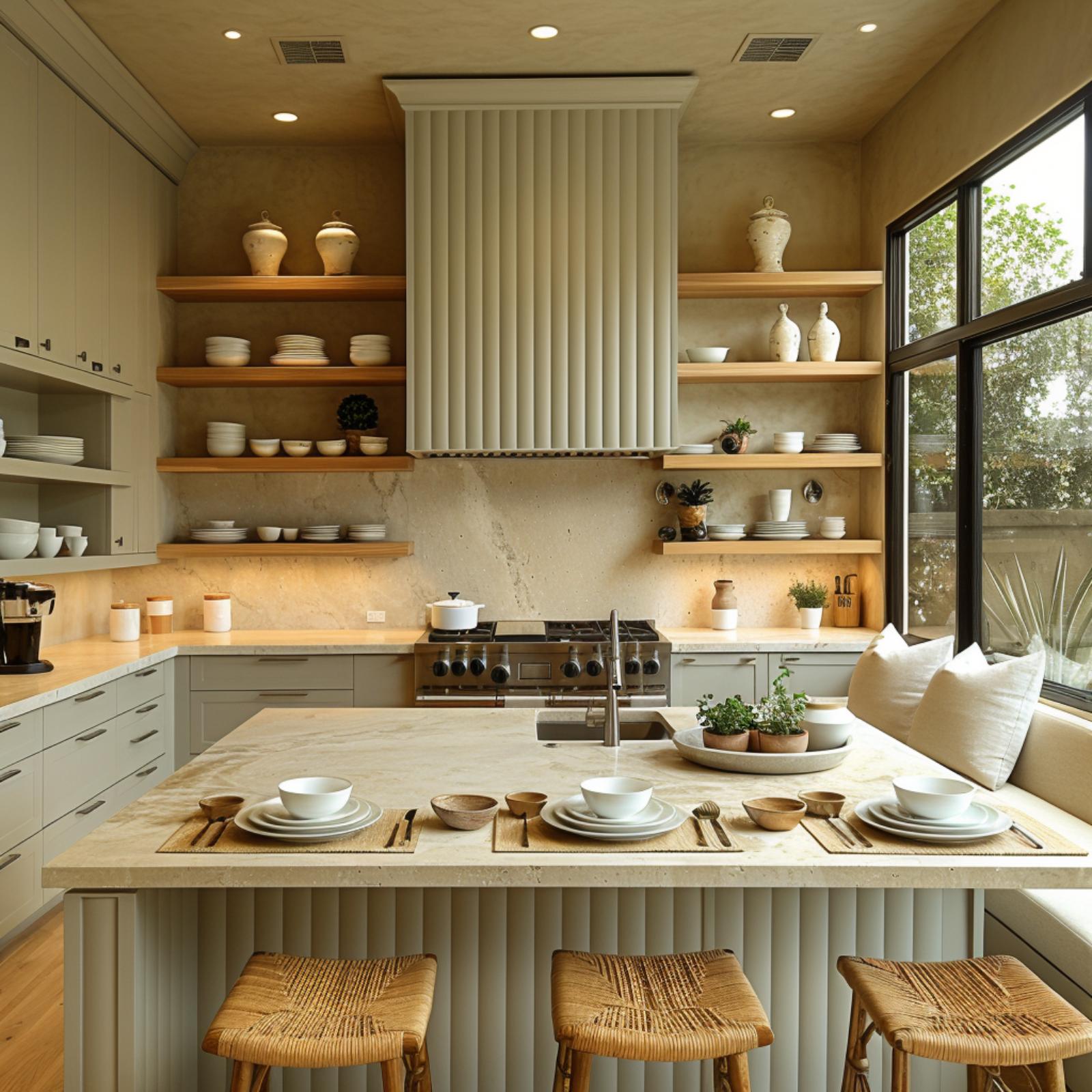
Greige cabinets don’t usually command attention, but pair them with a fluted hood surround that mirrors the island’s paneling and suddenly there’s a design logic that holds the whole room together. The marble countertops carry enough movement to keep the palette from going flat, and the open wood shelves do exactly what they should: hold white ceramics without competing for attention.
The woven rattan barstools are the right call here. They bring texture without adding color, which matters when the shelving is this exposed. A built-in banquette tucked near the window keeps the layout from feeling like it’s only about the cook.
Did You Know: Fluted millwork, the vertical ridged detailing seen on the hood and island here, has roots in classical Greek and Roman architecture, where it appeared on columns. Its recent return in kitchen design marks one of the stronger crossovers from formal architectural tradition into everyday residential spaces. Unlike shiplap or beadboard, fluting casts subtle shadows that shift with the light throughout the day.
16. Forest Green Cabinets, a Wood Hood, and Open Shelves That Refuse to Apologize
🔥 Would you like to save this?
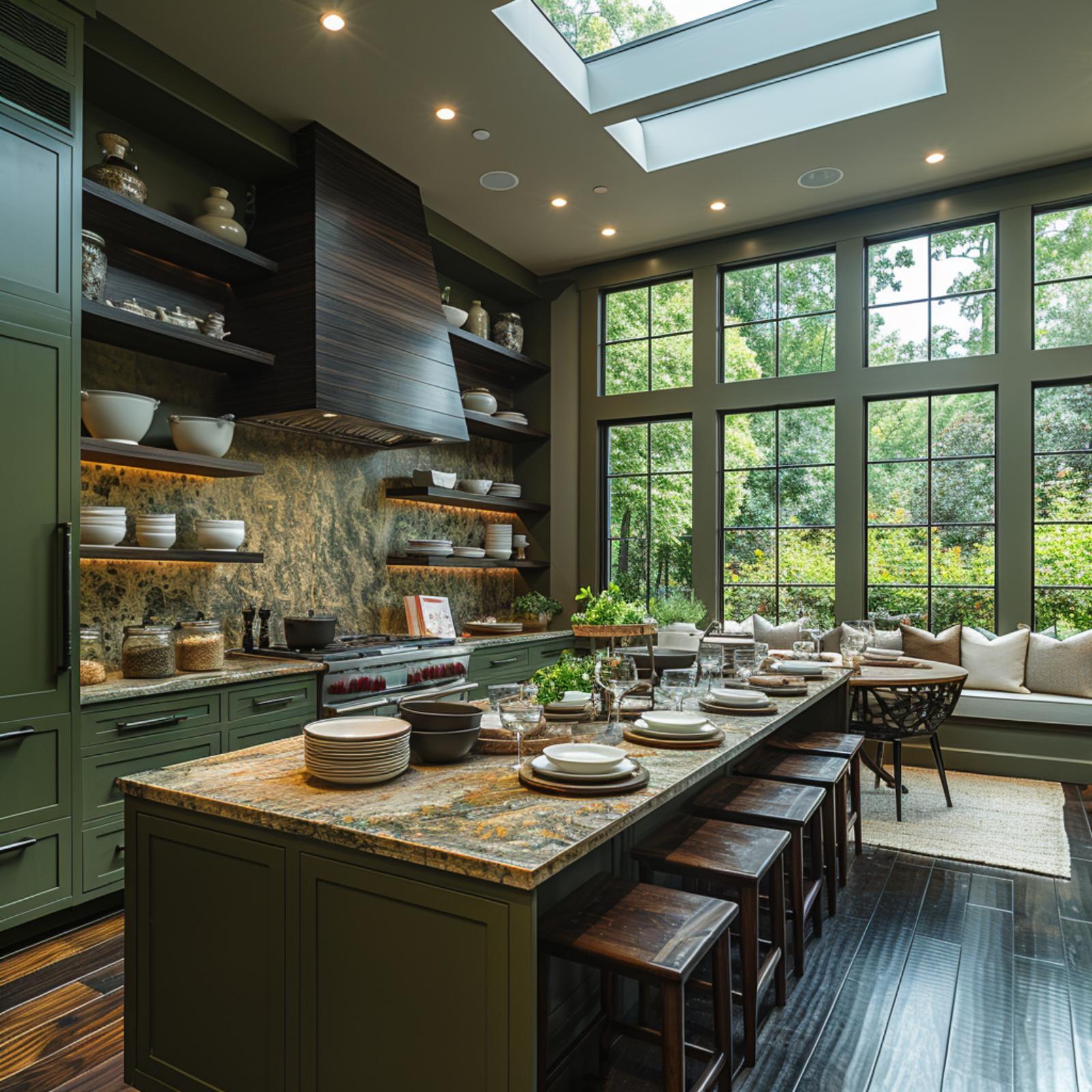
Floor-to-ceiling steel-frame windows do half the work here, flooding the space with enough natural light to make the open shelving look intentional rather than improvised.
The forest green cabinets and island read as one grounded decision, and the bookmatched stone countertops, with their amber and grey veining, carry that earthy palette without competing. Dark walnut open shelves display an all-white ceramic collection so consistent it could pass as a single purchase. That discipline is what keeps the shelves from reading as clutter. A skylight doubles down on the natural light from the windows, meaning the stone backsplash behind the range gets properly lit rather than lost in shadow. The window seat tucked into the corner suggests this kitchen gets used as a gathering space, not just a cooking one.
15. Stone Hood, Open Shelves, and Gray Cabinets That Know Exactly What They’re Doing
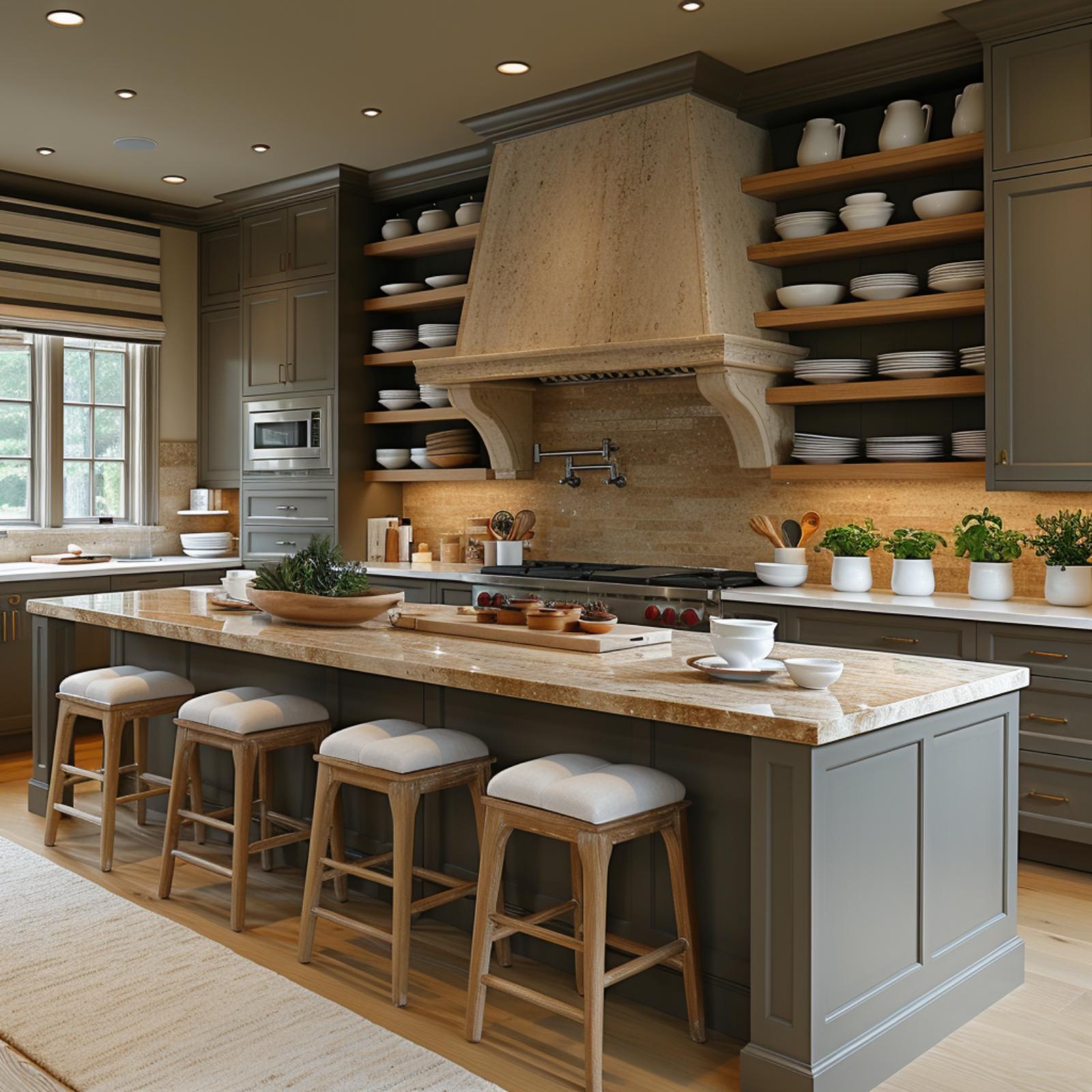
Gray-green cabinets anchor the perimeter while a travertine range hood pulls every warm tone in the room into focus. The open walnut shelves don’t just display white ceramics; they organize them with enough consistency that the whole wall reads as intentional. Four backless stools with upholstered seats line the island, keeping the seating casual without sacrificing polish.
Editor’s Note: Pot fillers, like the articulating wall-mount visible here above the range, have made a quiet comeback in kitchens that prioritize function alongside aesthetics. They eliminate carrying a heavy pot from the sink, which sounds minor until you’re cooking for a crowd. If you’re planning a renovation, rough-in plumbing for one early since retrofitting the water line after tile is set gets expensive fast.
14. Dark Red Hood, Forest Green Cabinets, and Open Shelves That Earn Every Inch
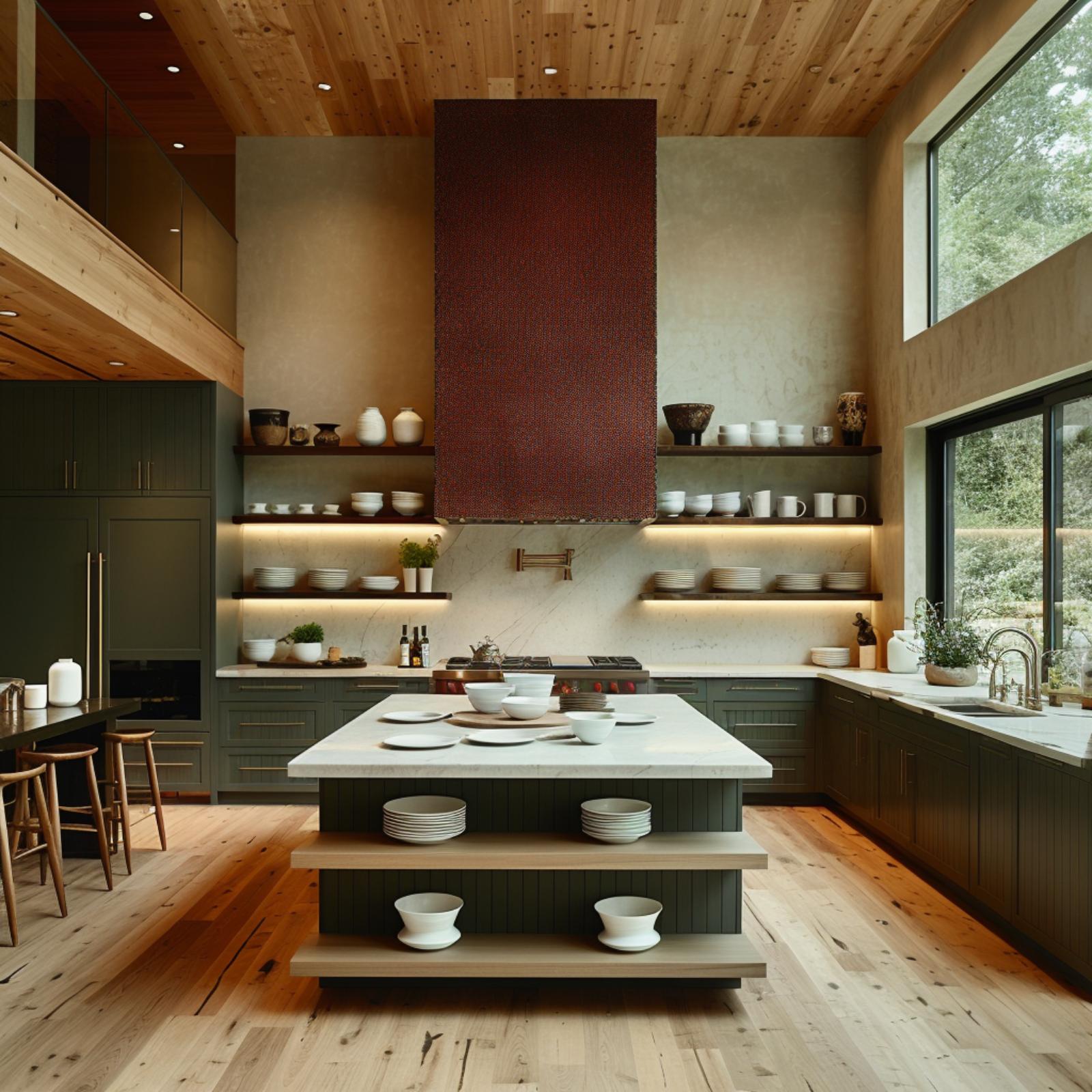
Forest green beadboard cabinetry runs the full perimeter, grounding a kitchen where a hammered dark-red range hood does the heavy lifting visually. Lit from below, the open walnut shelves hold white ceramics exclusively. No exceptions, and it shows.
Budget Tip: Range hoods tend to be one of the pricier custom elements in a kitchen renovation, but a fabricator working in patinated steel or textured copper alternatives can often replicate a high-end look at a lower cost than solid copper. Getting quotes from metal fabricators directly, rather than through a kitchen showroom, frequently cuts the markup significantly.
13. Deep Green Cabinets, Marble Everywhere, and Open Shelves That Actually Stay Organized
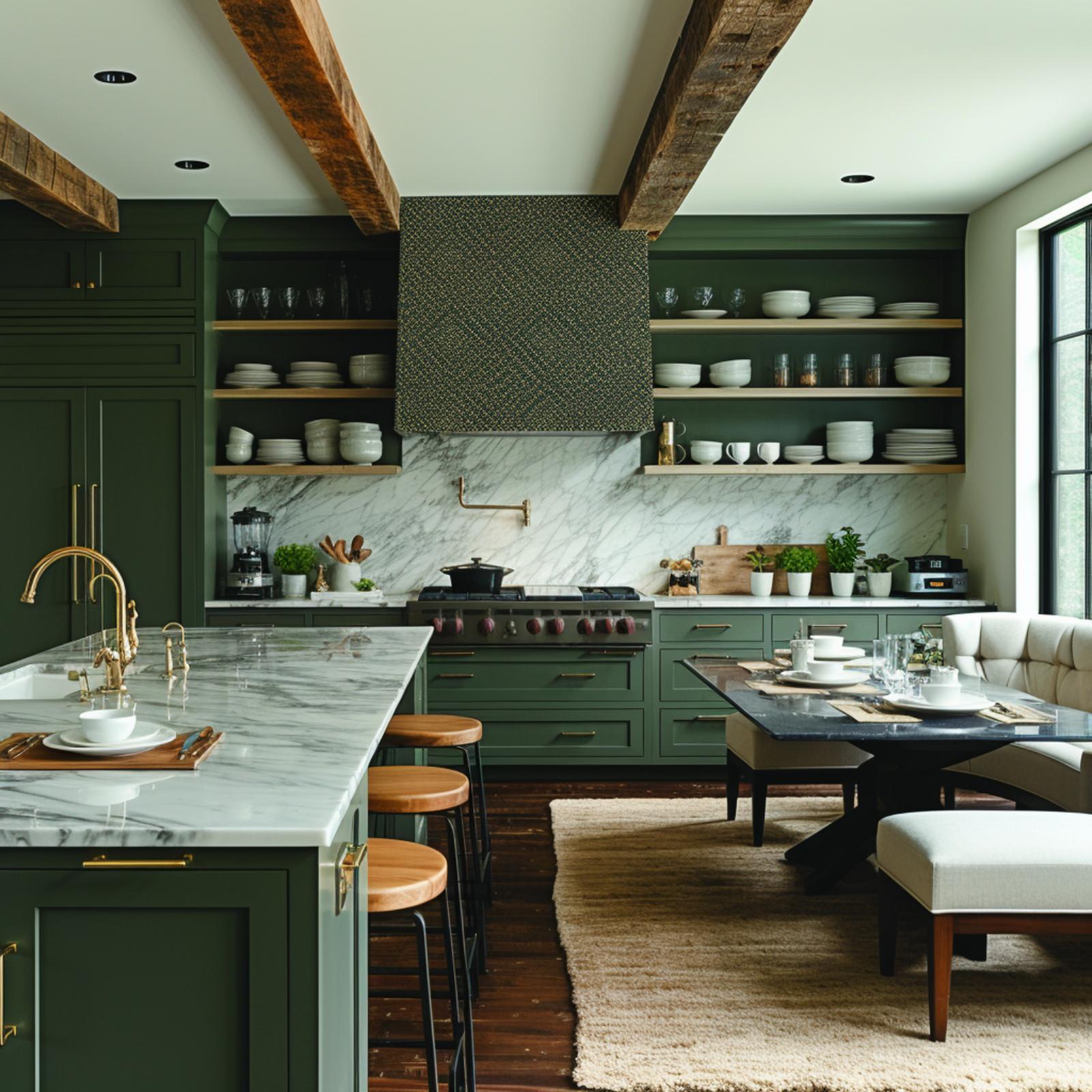
Sage-painted cabinetry runs floor to ceiling here, and the marble slab backsplash ties directly into the island countertop, giving the space a through-line that holds the open shelving together. White ceramics do all the heavy lifting on those wood shelves.
Try This: Repeating your countertop material on the backsplash is one of the quieter ways to make open shelving feel intentional rather than incidental. When the background reads as one continuous surface, the eye has a resting place between displayed objects. It’s a layout decision that pays off more than most people expect before they try it.
12. Marble Shelves, a Plaster Hood, and Dark Green Cabinets That Pull the Whole Room Together
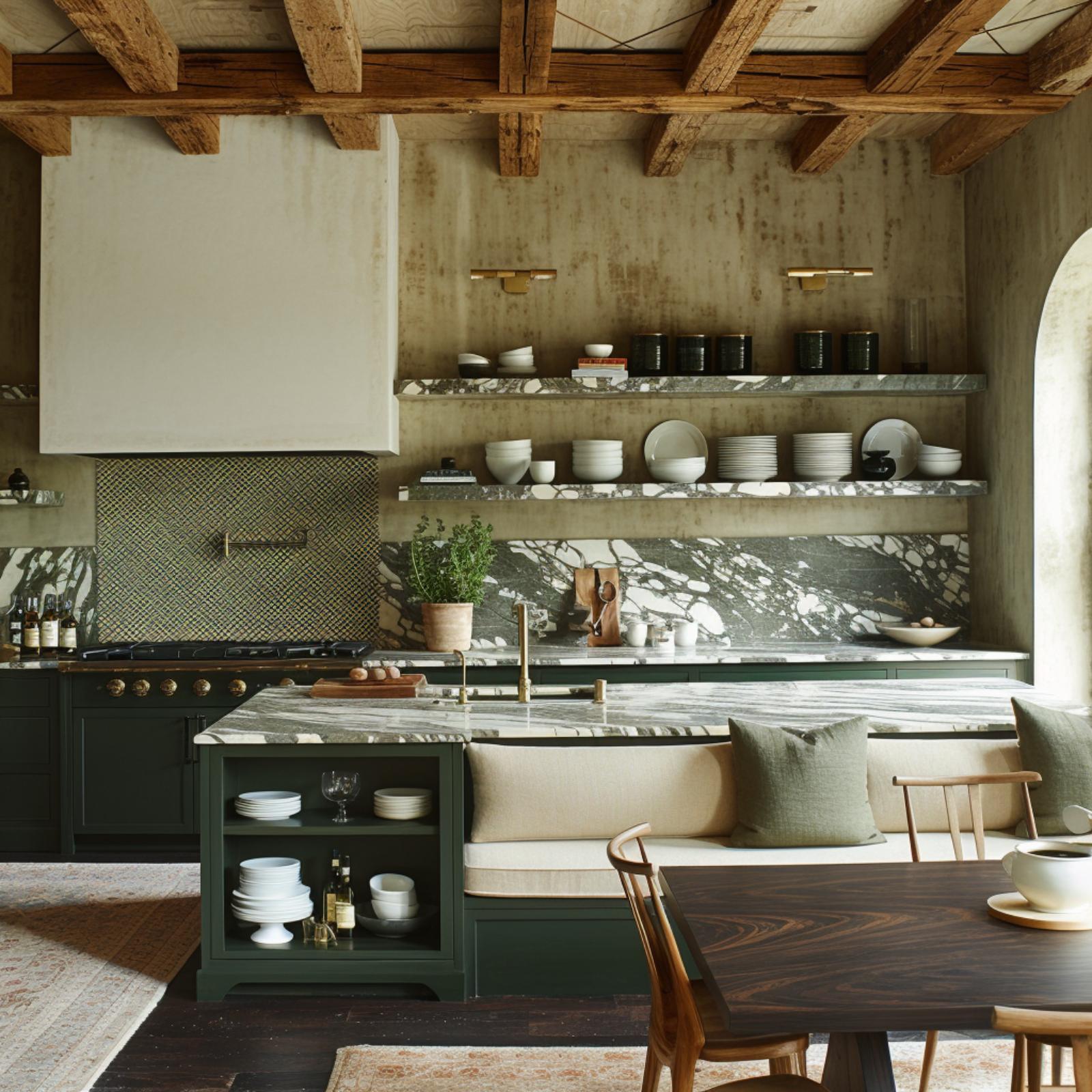
Marble as a shelf material sounds impractical until you see it done like this.
Dark green cabinets anchor the island and lower run, and the tone is deep enough to hold its own against the veined marble countertops and matching backsplash. The shelves aren’t wood here — they’re marble too, edge-on slabs that read almost like ledges, and that repetition of the same stone across counters, backsplash, and shelving is what keeps the open storage from feeling random. Brass wall sconces sit above each shelf, small fixtures that add warmth without demanding attention.
Exposed wood ceiling beams and a plastered range hood bring texture that the stone can’t. The hood in particular earns its size: it’s a big form, but the rough plaster finish keeps it from reading as heavy. White ceramics fill the shelves in consistent stacks, and the lack of color variation across the displayed pieces is doing a lot of quiet work here.
11. Burgundy Cabinets, Reclaimed Wood Overhead, and Open Shelves That Mean Business
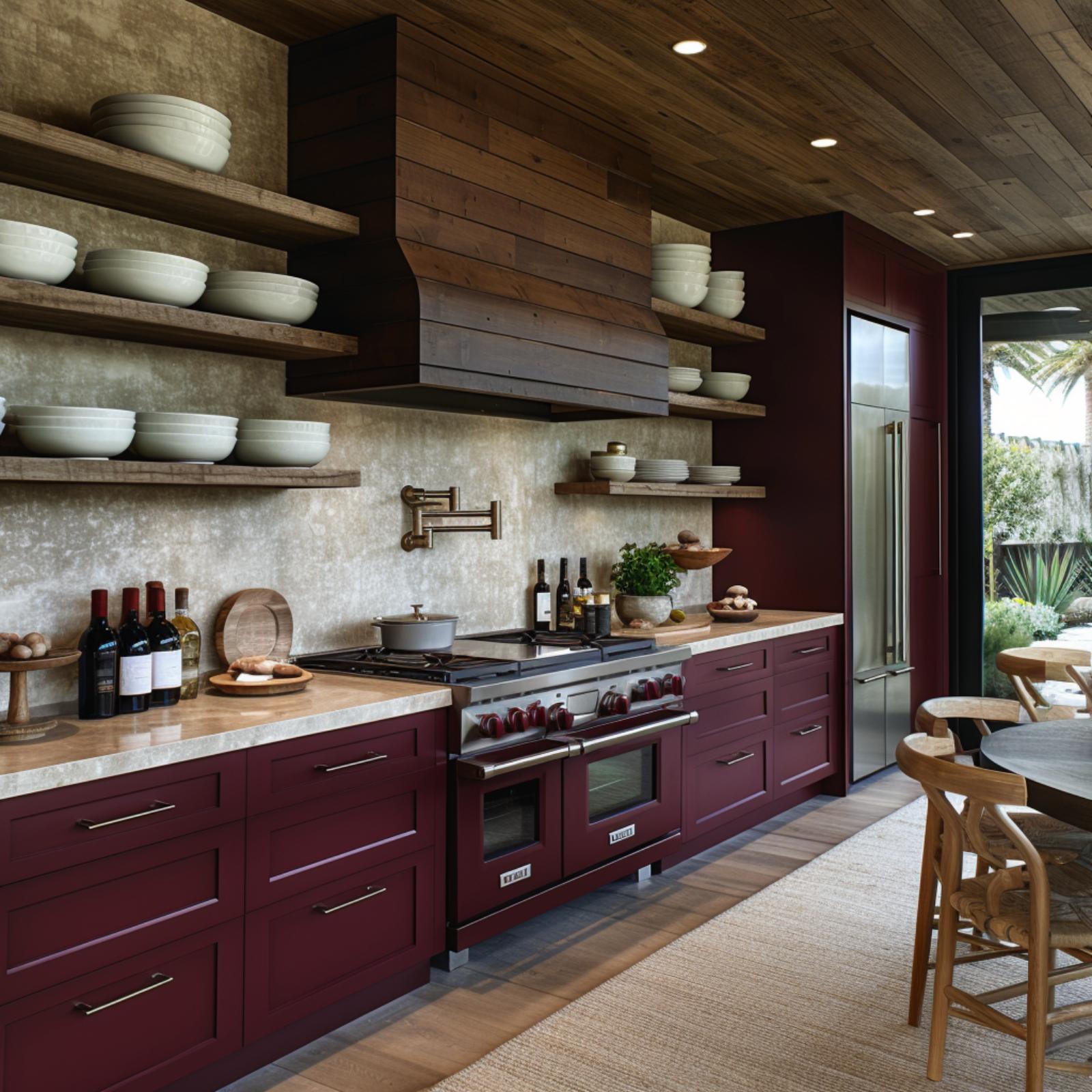
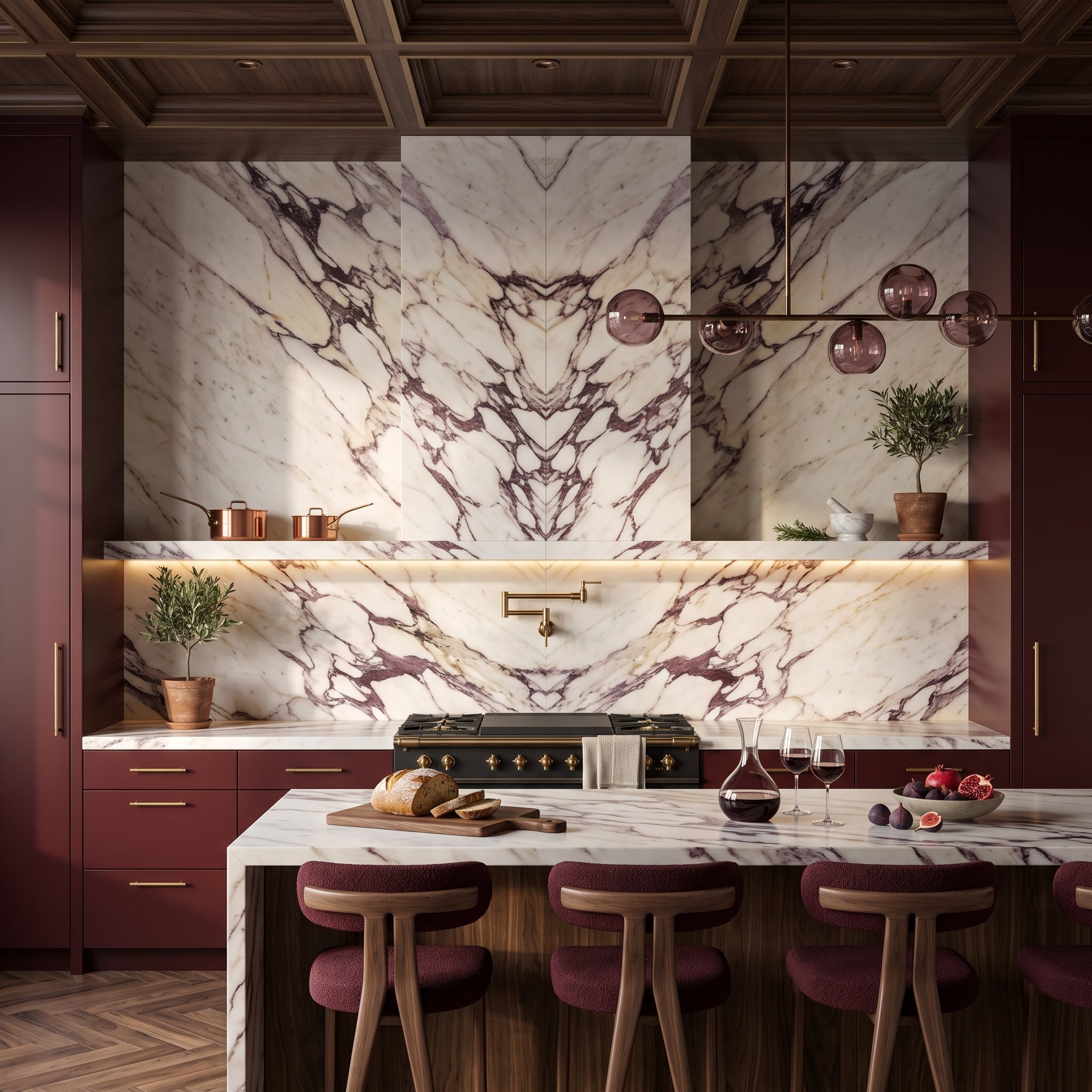
Bordeaux-painted lower cabinets set a tone that most kitchens don’t have the nerve to commit to, and the range matches them knob for knob. Aged wood planks on the ceiling and hood surround keep the warmth grounded rather than theatrical.
- Matching the range color to the cabinet finish unifies appliances into the design rather than leaving them as afterthoughts
- Reclaimed ceiling planks and a wood hood surround work as a single continuous material rather than two separate choices
- Brass hardware reads warm against burgundy without competing with the stainless range for attention
Where the last kitchen leaned into richness, this one pulls back toward restraint without losing any presence.
10. Walnut Shelves, a Blue Textured Hood, and Black Stone That Holds Its Own
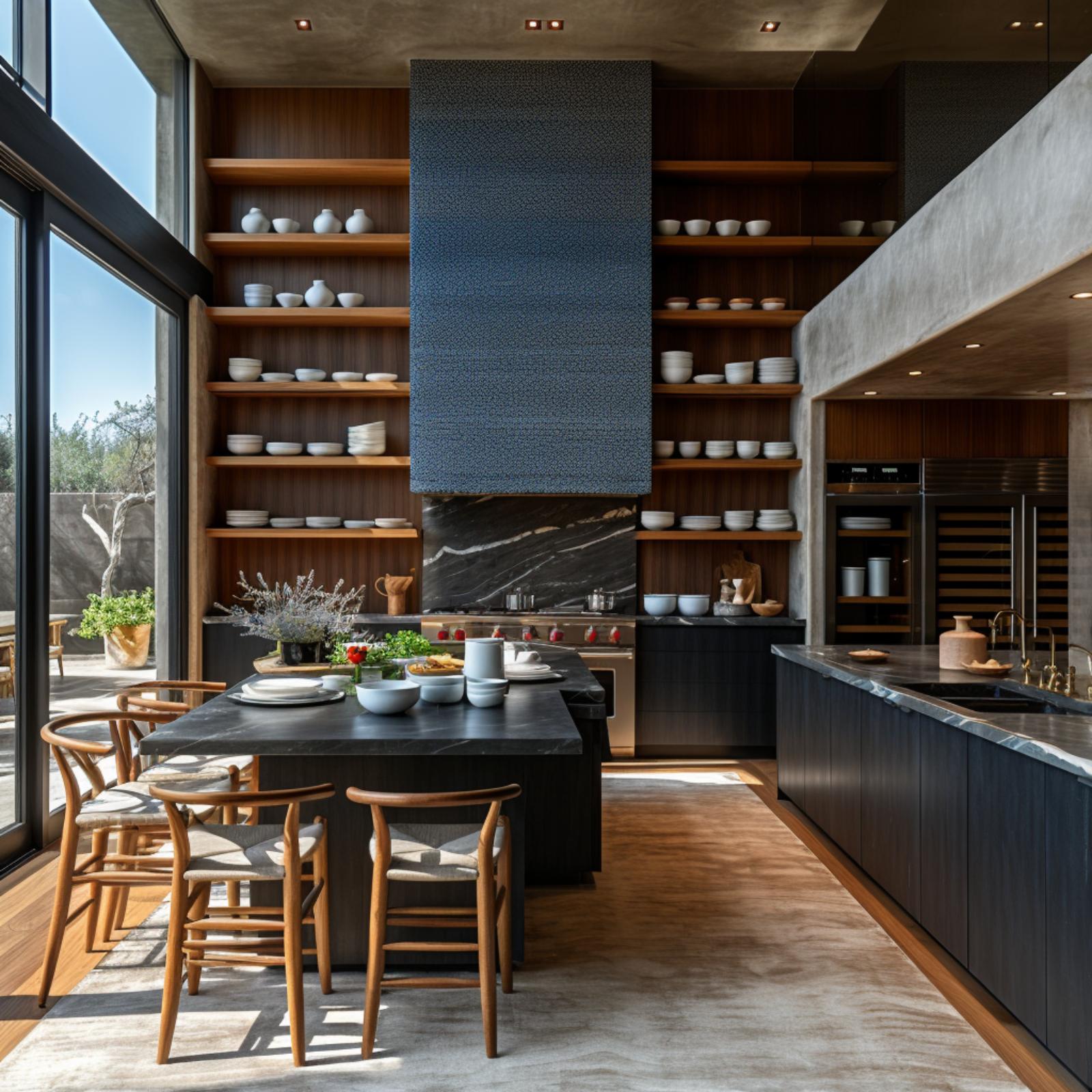
Warm walnut open shelving runs floor to ceiling on both sides of a large hood wrapped in a deep blue woven or textured panel material, and the pairing shouldn’t work as well as it does. Every shelf holds white ceramics only. No exceptions, no mixing. That discipline is what keeps forty-plus displayed pieces from reading as clutter.
The island countertop is black marble with visible veining, and it doubles as a dining surface with wishbone chairs pulled up to it. A wine cooler is visible on the right wall, tucked into the same wood surround as the shelving. Concrete ceiling, floor-to-ceiling glazing on the left, and brass fixtures at the sink. Each material gets one job and does it.
9. Black Marble Hood, Open Wood Shelves, and Cream Cabinets That Hold the Room Together
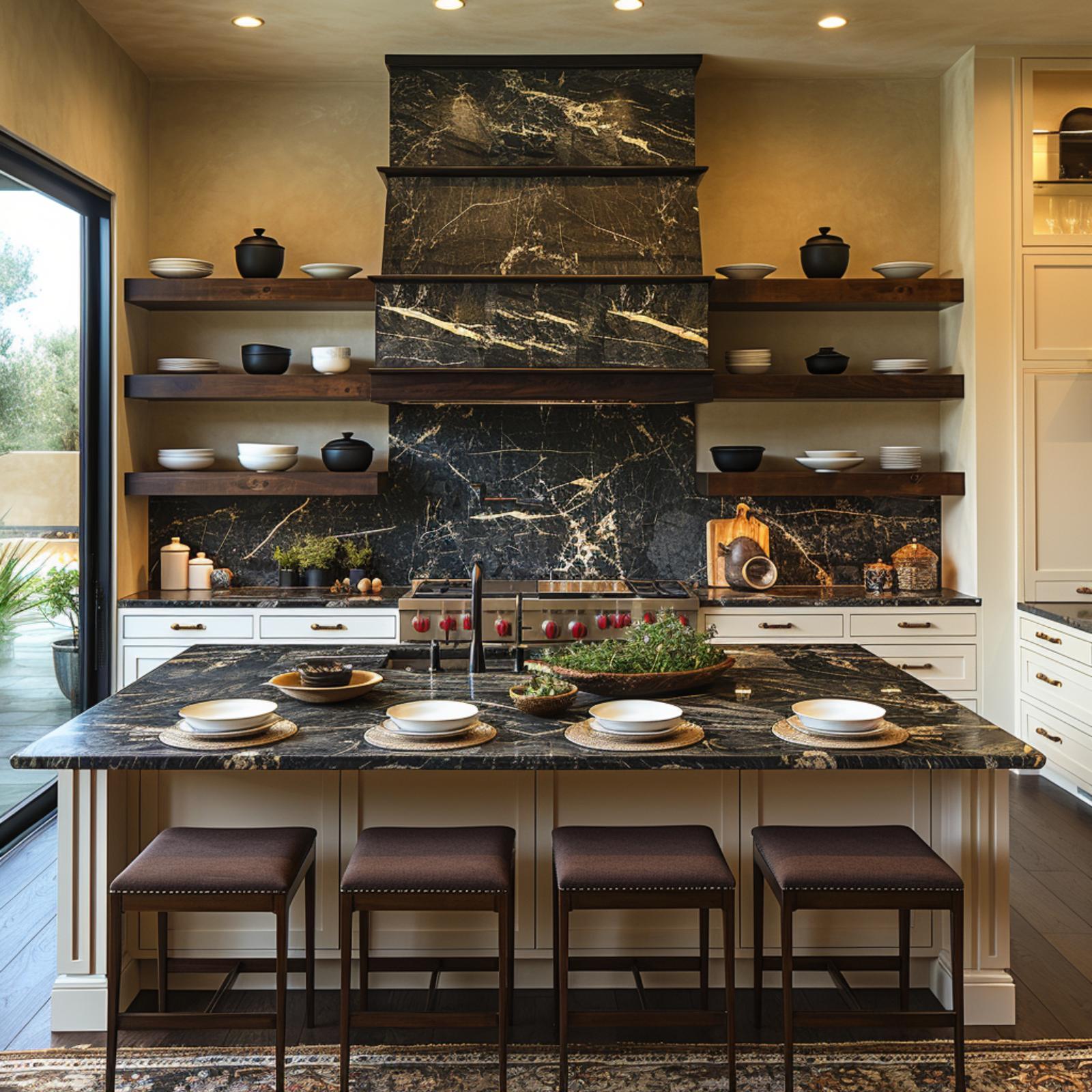
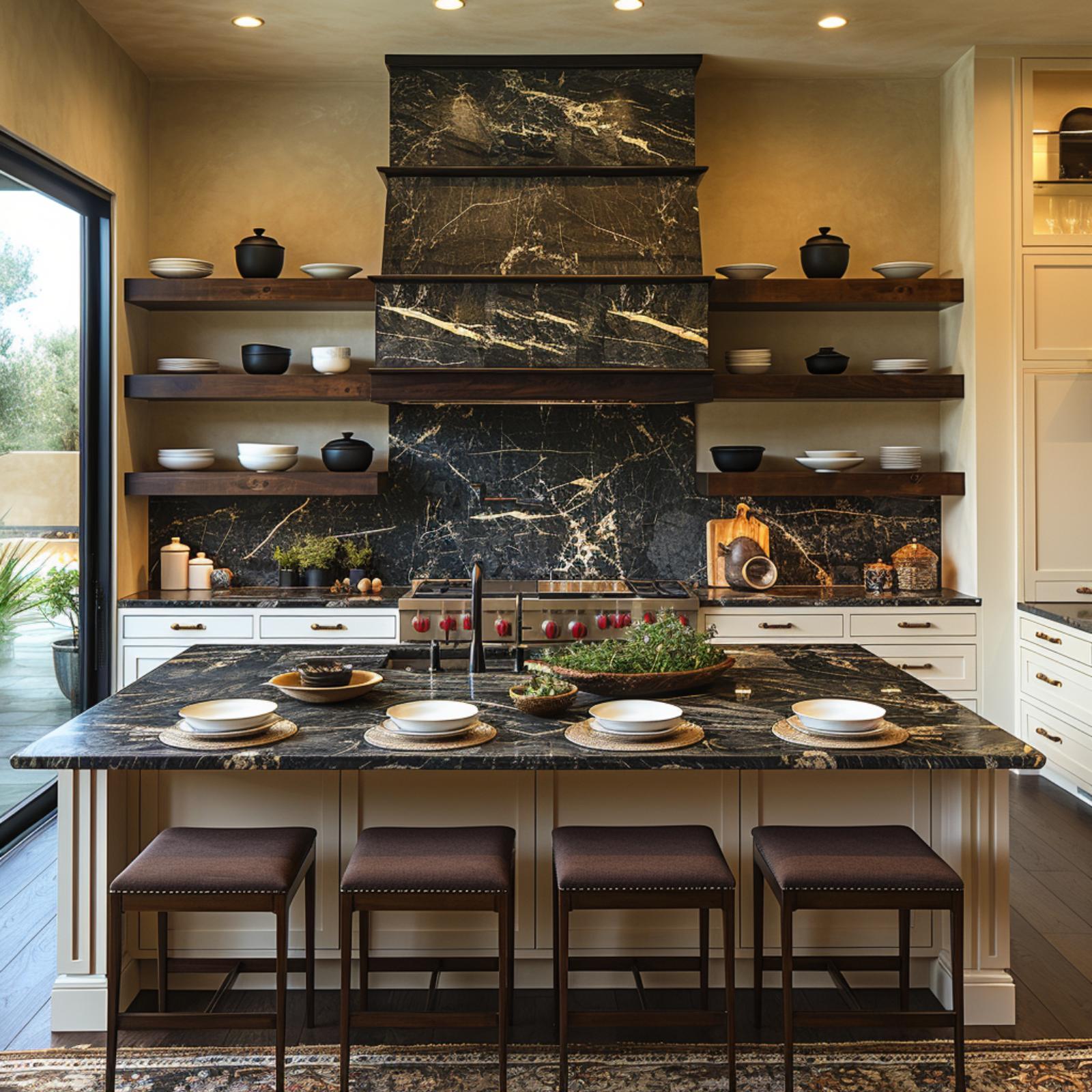
Black-and-gold marble covers everything here, from the island countertop to the full range hood surround, and the repetition does real work. Dark espresso open shelves carry white ceramics and matte black lidded bowls, keeping the display legible against that dramatic stone backdrop.
Style Math: Extending a countertop material up through the hood surround gives open shelving a visual anchor it wouldn’t otherwise have. The eye reads the shelves as part of a deliberate composition rather than an afterthought bolted to a wall. It’s one of the more cost-efficient ways to make a single material feel like a design decision rather than a budget pick.
8. Russet Plaster Walls, a Patinated Hood, and Open Shelves That Earn the Warmth
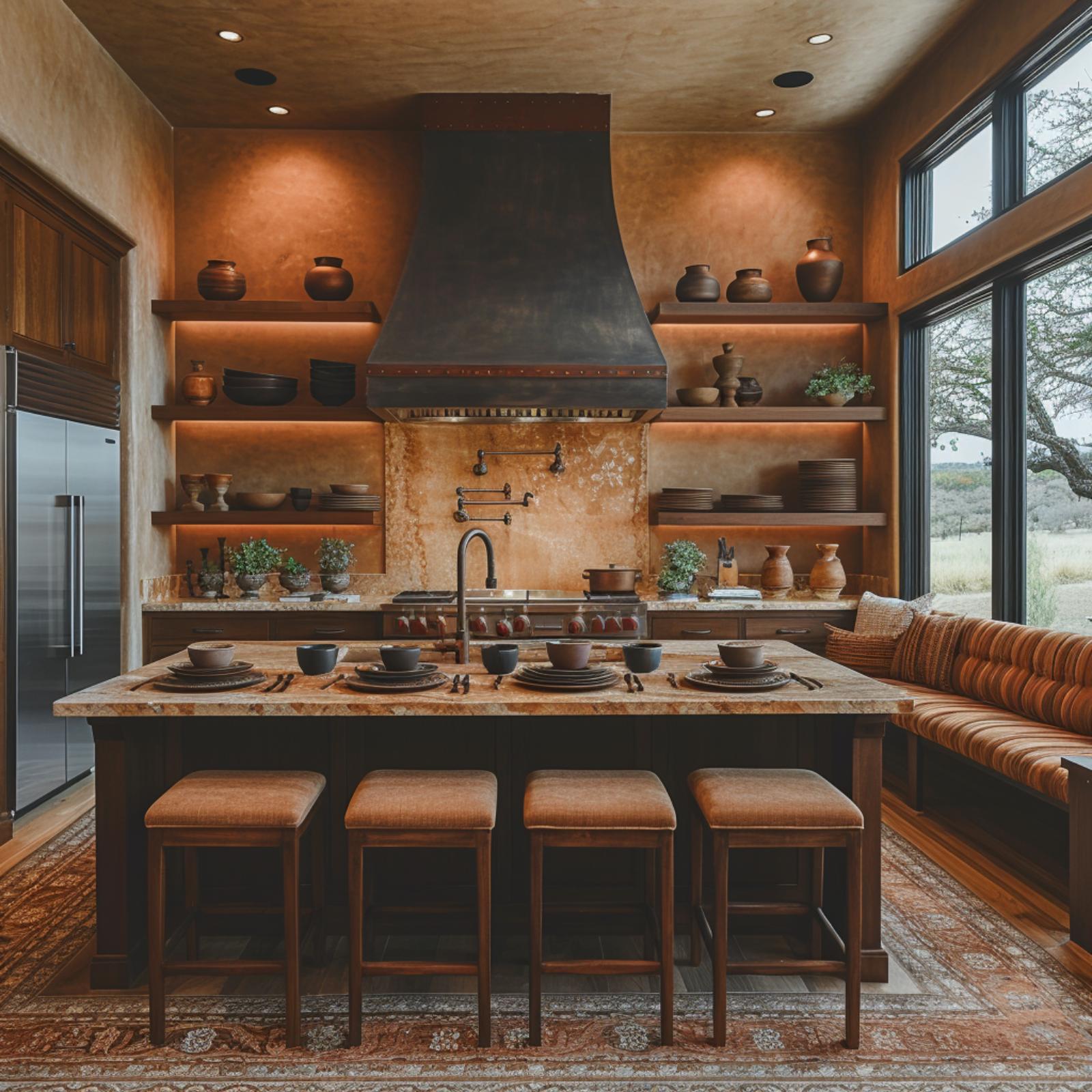
Earthy ochre plaster walls do most of the heavy lifting here, giving the open shelves a backdrop that makes every clay vessel and ceramic bowl read as intentional. The patinated metal hood is the focal point. Four backless stools in cognac fabric anchor the island without competing with it.
7. Walnut Cabinets, a Black Range Hood, and Open Shelves That Don’t Flinch
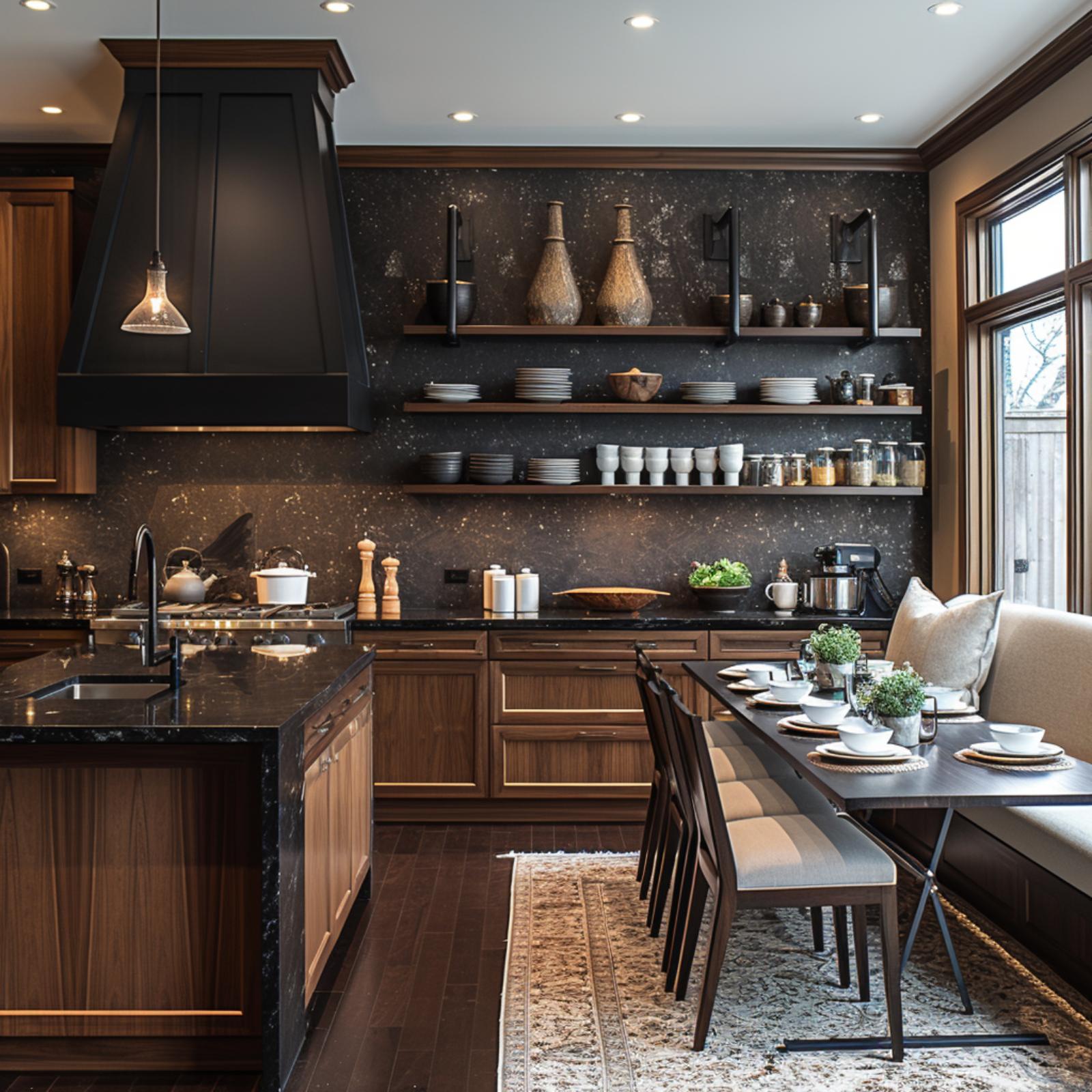
Walnut cabinetry with raised-panel detailing runs the length of the kitchen, grounded by black granite countertops with visible movement in the stone. The range hood is matte black with a box-crown silhouette, and it commands the wall without competing with the shelves flanking it.
Three floating walnut shelves hold a tight mix of stoneware plates, ceramic vessels, and glass jars with enough consistency that nothing fights for attention. Open shelving can read as chaos when items are too varied in scale, but the graduated arrangement here, larger vases on top and smaller pieces stepping down, keeps the eye moving without losing the thread.
6. Terracotta Cabinets, a Marble Backsplash, and Open Shelves That Actually Earn the Wall Space
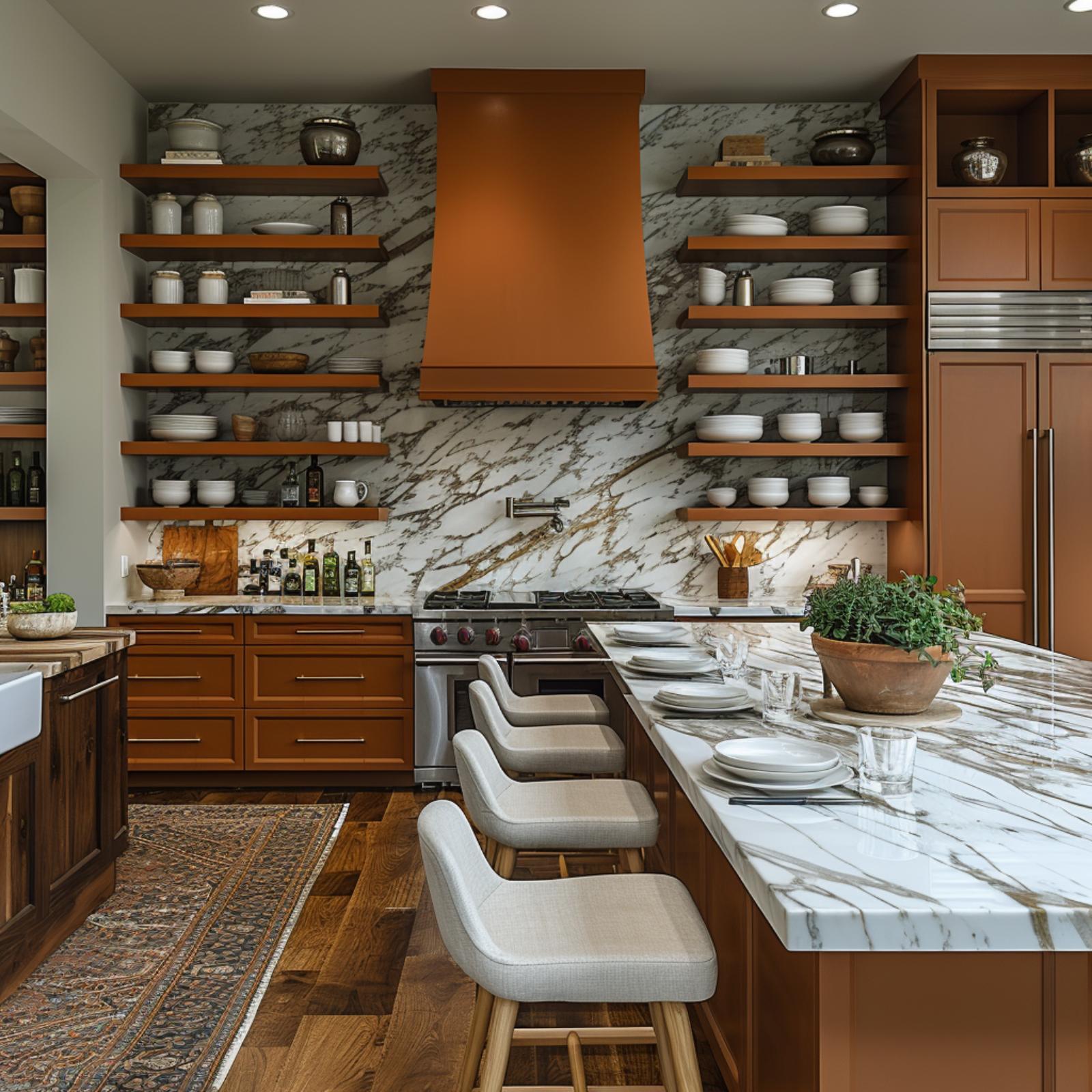
Burnt-orange cabinetry and a matching range hood in the same matte finish give the open shelving a strong anchor it can rely on. White dishware lines every shelf consistently. It holds together because nothing competes.
5. Plum Cabinets, a Brass Hood, and Open Shelves That Don’t Apologize for Either
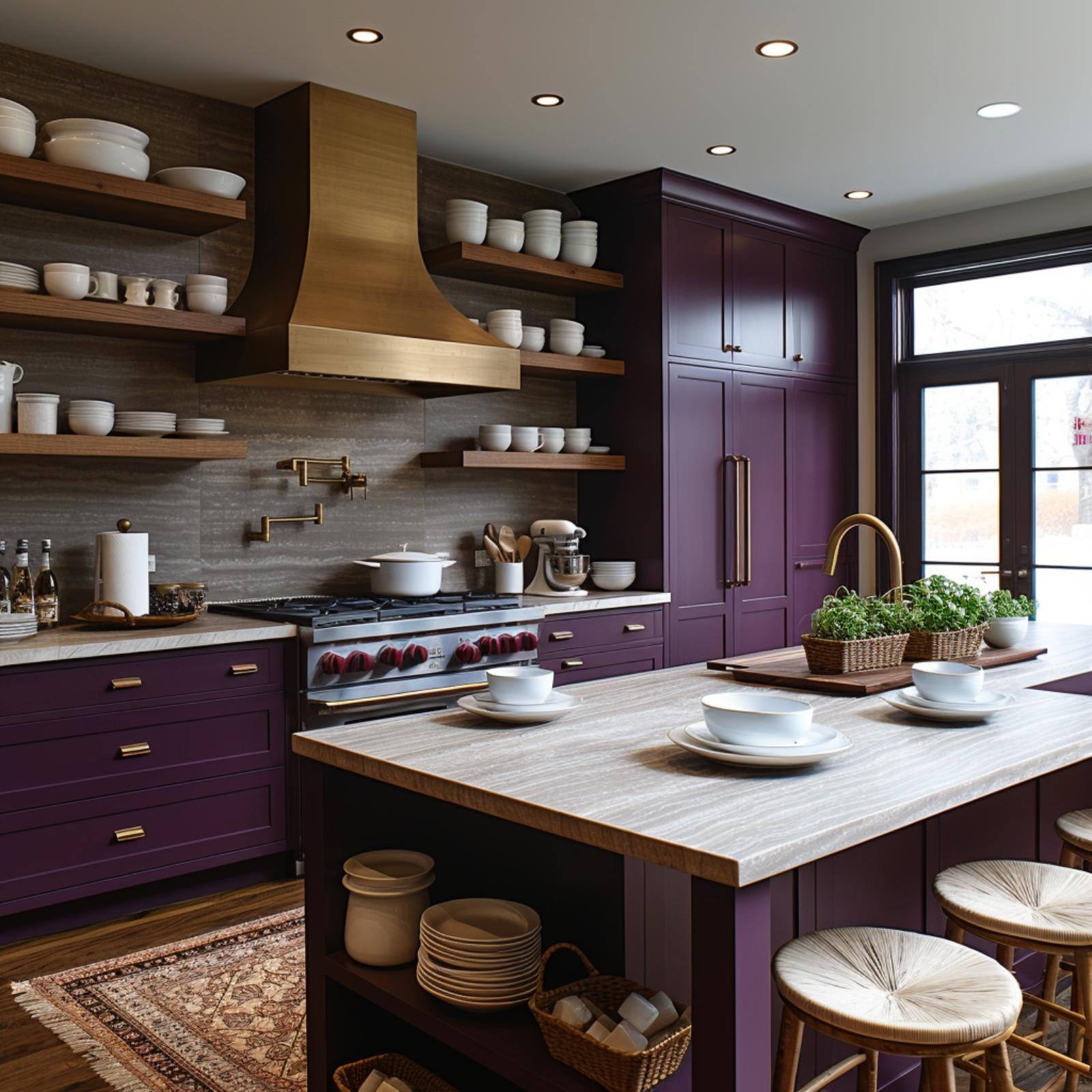
Purple cabinets this saturated usually need something to keep them grounded, and here it’s the brass hardware and matching range hood doing that work. The open walnut shelves carry the same warm tone as the wood floors, so the plum doesn’t read as isolated. Everything displayed on those shelves is white, and that consistency is the only reason it doesn’t feel chaotic.
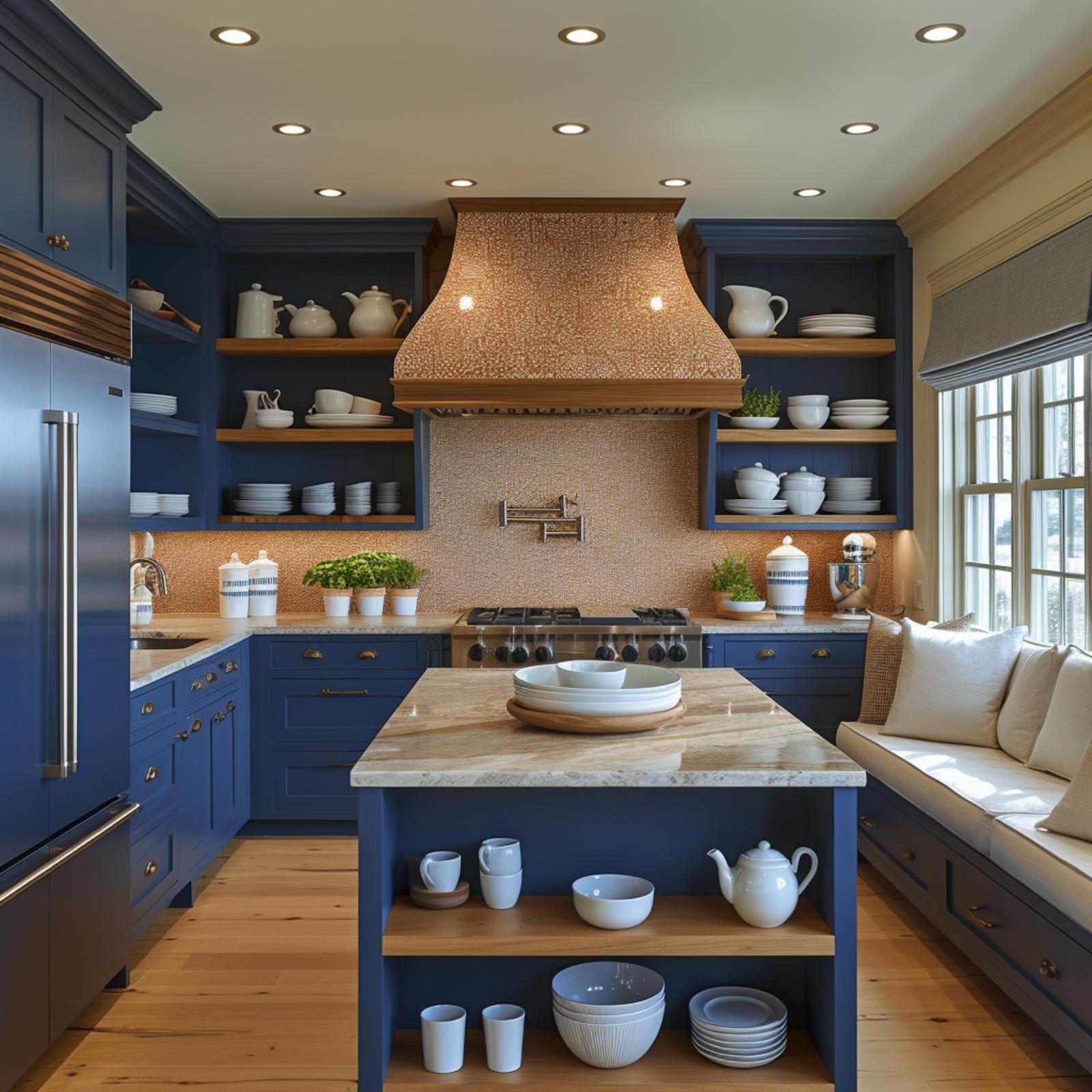
4. Navy Cabinets, a Copper Mosaic Hood, and Open Shelves That Pull Their Weight
🔥 Would you like to save this?
Navy shaker cabinets with brass hardware set a strong foundation, but it’s the copper penny-tile hood surround that does the unexpected work here. That same mosaic material runs down the backsplash, so the open wood shelves read as part of a deliberate composition rather than an afterthought. White dishware displayed consistently across every shelf keeps the visual load manageable. The island’s stone countertop echoes the perimeter, and the built-in bench with cushioned seating tucks the dining function in without requiring a separate room.
3. Reclaimed Beams, Gold-Veined Marble, and Open Shelves That Keep Their Composure
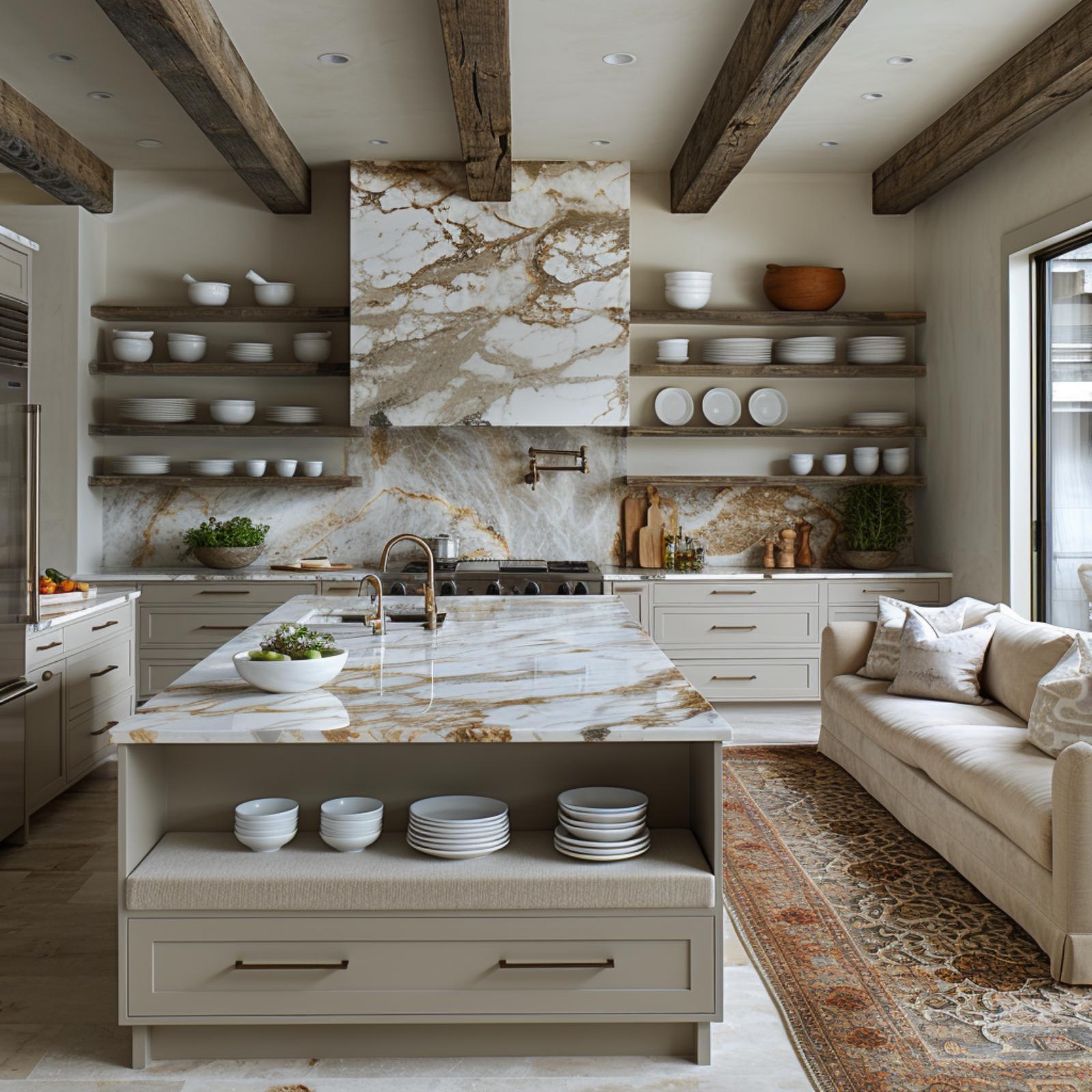
Rough-hewn ceiling beams sit directly above one of the more polished material choices in recent kitchen design: a slab hood surround in white marble with heavy gold and amber veining that runs floor-to-ceiling. The contrast shouldn’t work as well as it does. Open wood shelves flank both sides, stacked with white dishware that reads almost monastic against the drama of the stone.
The island carries the same marble, which ties the room together without any extra effort. A Persian-style rug bleeds into the adjacent sitting area, where a linen sofa signals this space isn’t purely functional. Open shelving tends to expose how consistent a homeowner’s taste actually is. Here, it holds up.
2. Sage Cabinets, Exposed Beams, and a Matte Black Hood That Anchors Every Shelf Above It
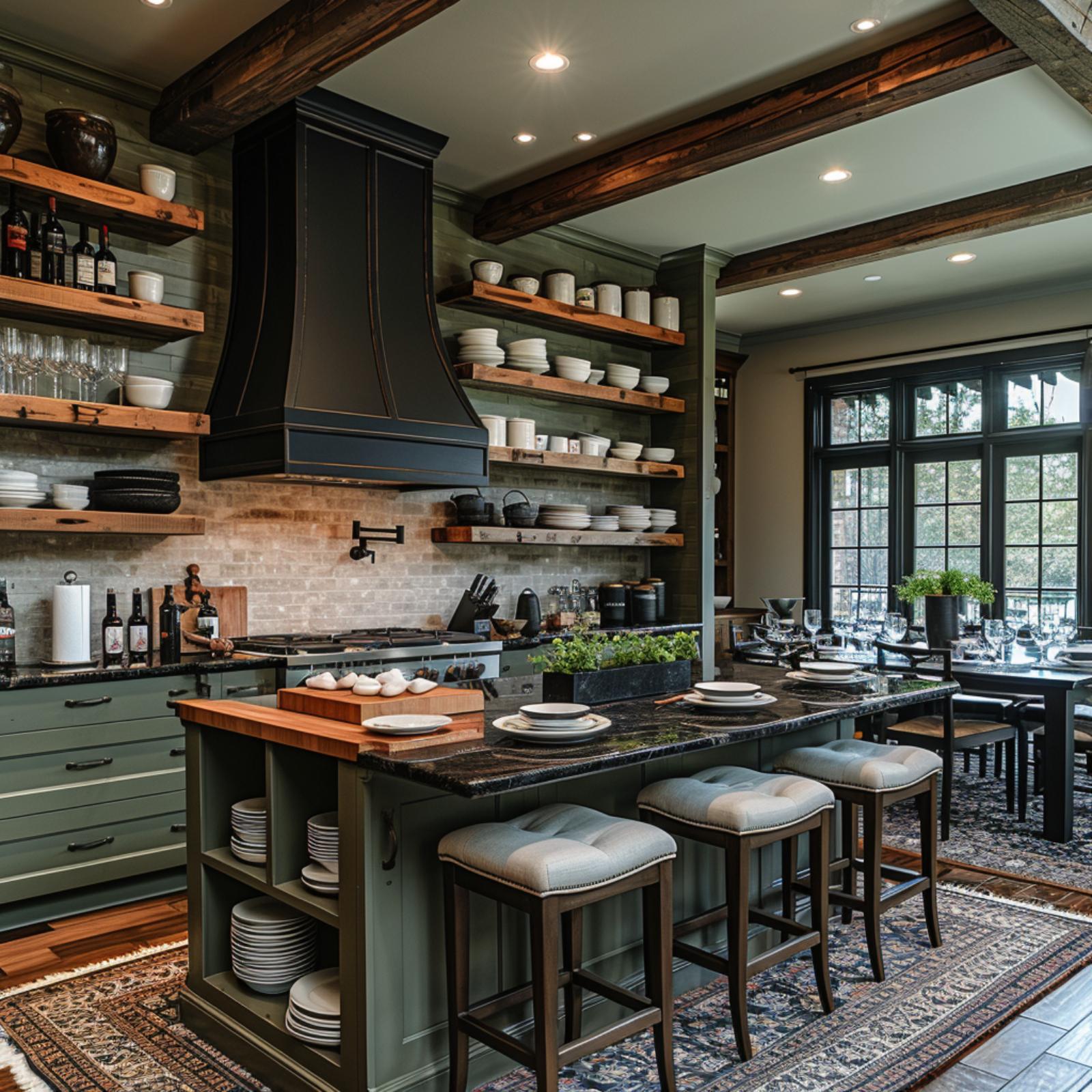
Sage green cabinets sit low while reclaimed wood shelves climb the full height of the wall, stacked with white ceramic and cast iron in a palette consistent enough to hold together. The matte black range hood pulls the eye upward without competing. It earns its scale.
Open shelving on this much wall only works if the floor keeps pace. The Persian-style rug grounds the island seating and quietly ties the lower half of the room to the upper, so the display shelves don’t feel like they’re floating above a disconnected kitchen. Butcher block inset into the dark granite island top adds a second material that genuinely earns its place rather than decorating for decoration’s sake.
1. Reclaimed Wood Ceiling, a Matte Black Hood, and Open Shelves That Refuse to Compete
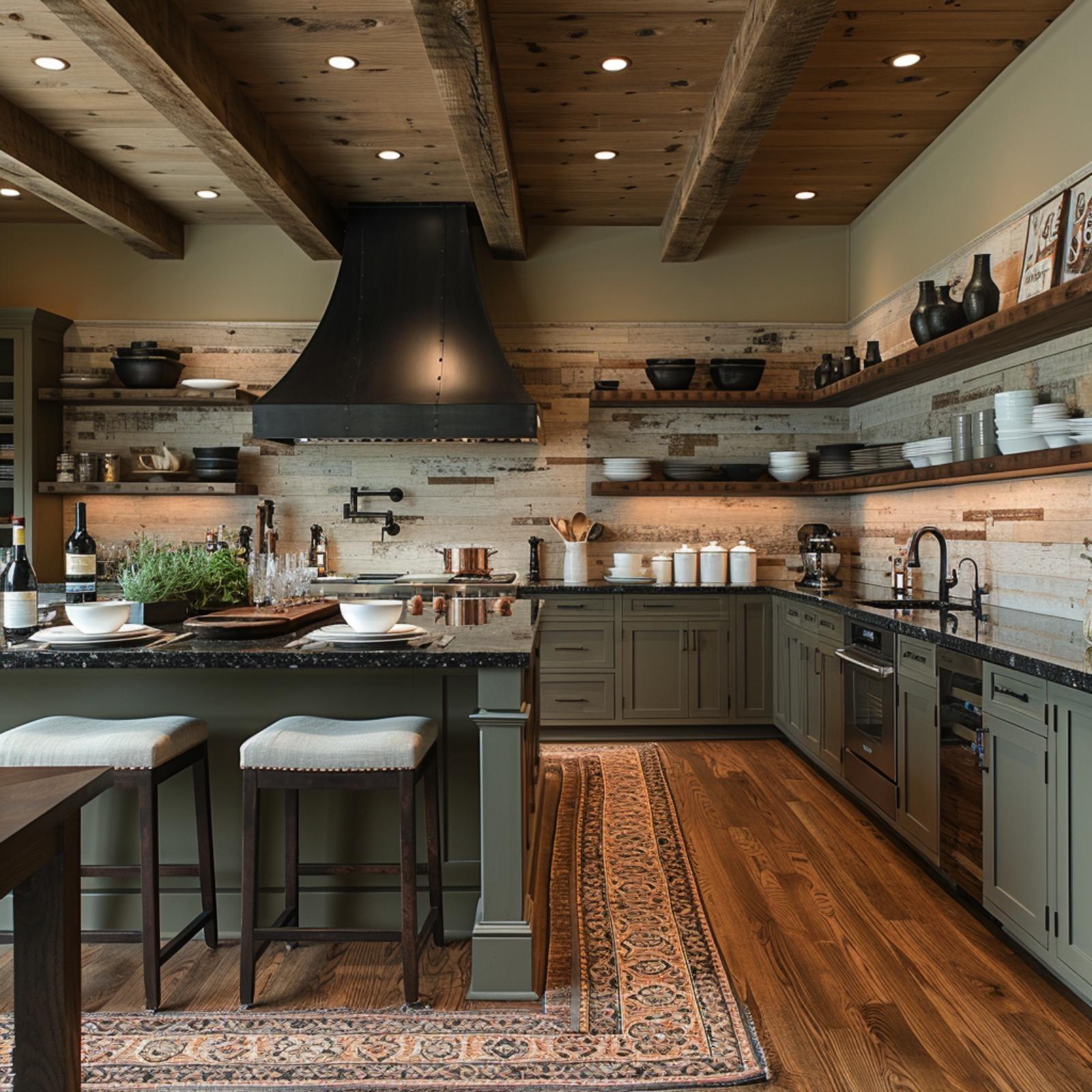
Olive-toned cabinets sit below granite counters, and the reclaimed wood backsplash running floor to ceiling does most of the visual heavy lifting. Open shelves hold their own because the dishware doesn’t fight back.