🔥 Would you like to save this?
You’ve been conditioned to believe a proper dining room requires six identical chairs pulled up to one table, every spindle and cushion a perfect clone of the next. But here’s something interior designers have quietly known for years: your brain doesn’t actually like that. In fact, research in environmental psychology suggests that too much visual repetition can make a space feel sterile, institutional, even mildly threatening.
In order to come up with the very specific design ideas, we create most designs with the assistance of state-of-the-art AI interior design software. Also, assume links that take you off the site are affiliate links such as links to Amazon. this means we may earn a commission if you buy something.
The rooms you remember most fondly, the ones where you lingered over a third glass of wine or stayed talking until midnight, almost certainly didn’t match. That’s not a coincidence. There are at least fifteen distinct psychological mechanisms that explain why mixed chairs feel more inviting, more personal, and paradoxically more cohesive than a matching set ever could. Some of these reasons are rooted in evolutionary biology. Others trace back to your childhood. A few will genuinely surprise you.
The Visual Frequency Your Brain Mistakes for ‘Alive’
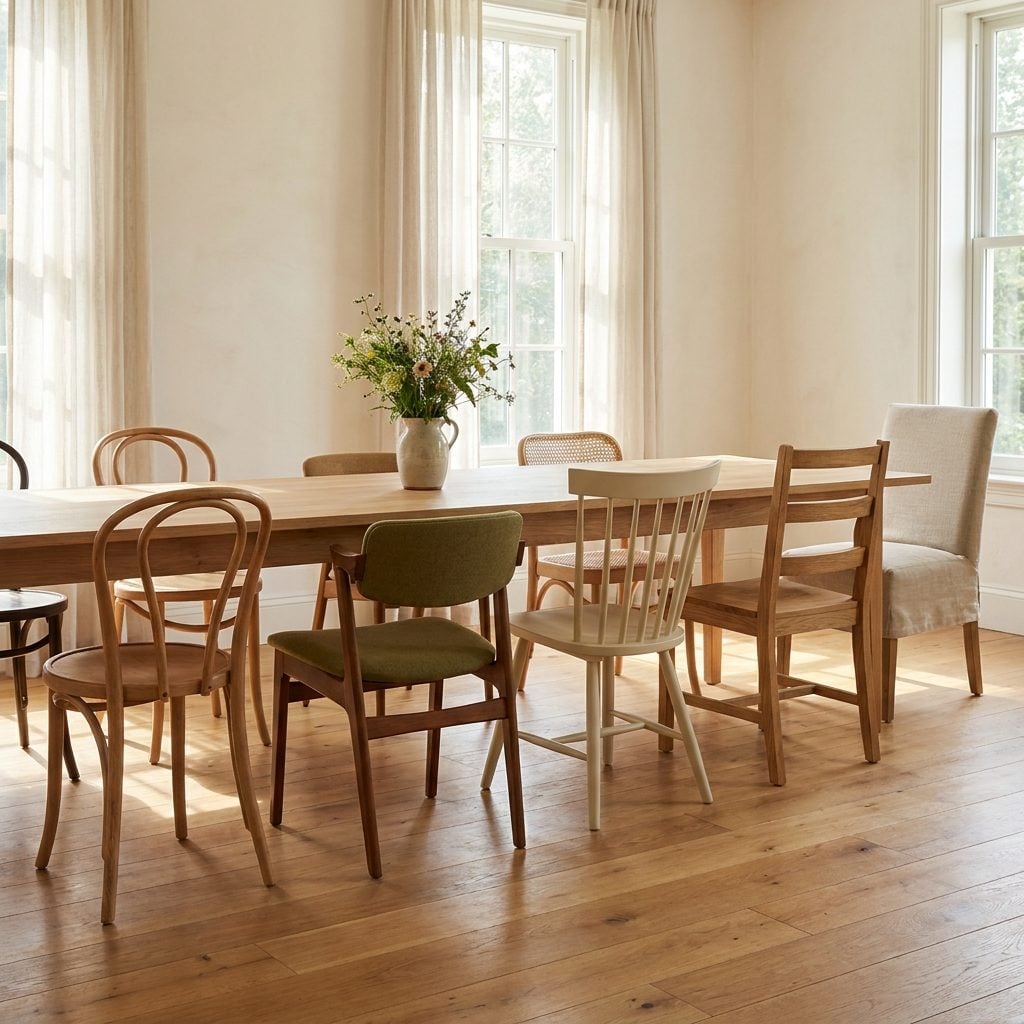
Your brain is not scanning a room for individual objects. It is scanning for patterns of complexity, the kind it evolved to recognize in grasslands, forests, and riverbeds. When you walk into a dining room where every chair is identical, the visual frequency flatlines. Uniform repetition reads as manufactured, static, inert. But introduce variation (a woven rattan chair here, a velvet side chair there, wood tones that shift from walnut to ash), and the room starts to hum at a frequency your nervous system recognizes as organic.
According to (Source), our visual processing system is “acutely tuned to the visual complexity of the natural environment.” Researchers found that people consistently preferred scenes with natural scaling hierarchies and moderate fractal complexity over stark, repetitive alternatives. A dining table surrounded by varied chairs mirrors that same organized-but-not-uniform pattern you’d find in a clearing of wildflowers: no two exactly alike, yet all clearly belonging to the same ecosystem.
Why Perfect Symmetry Triggers a Subtle Feeling of Dread
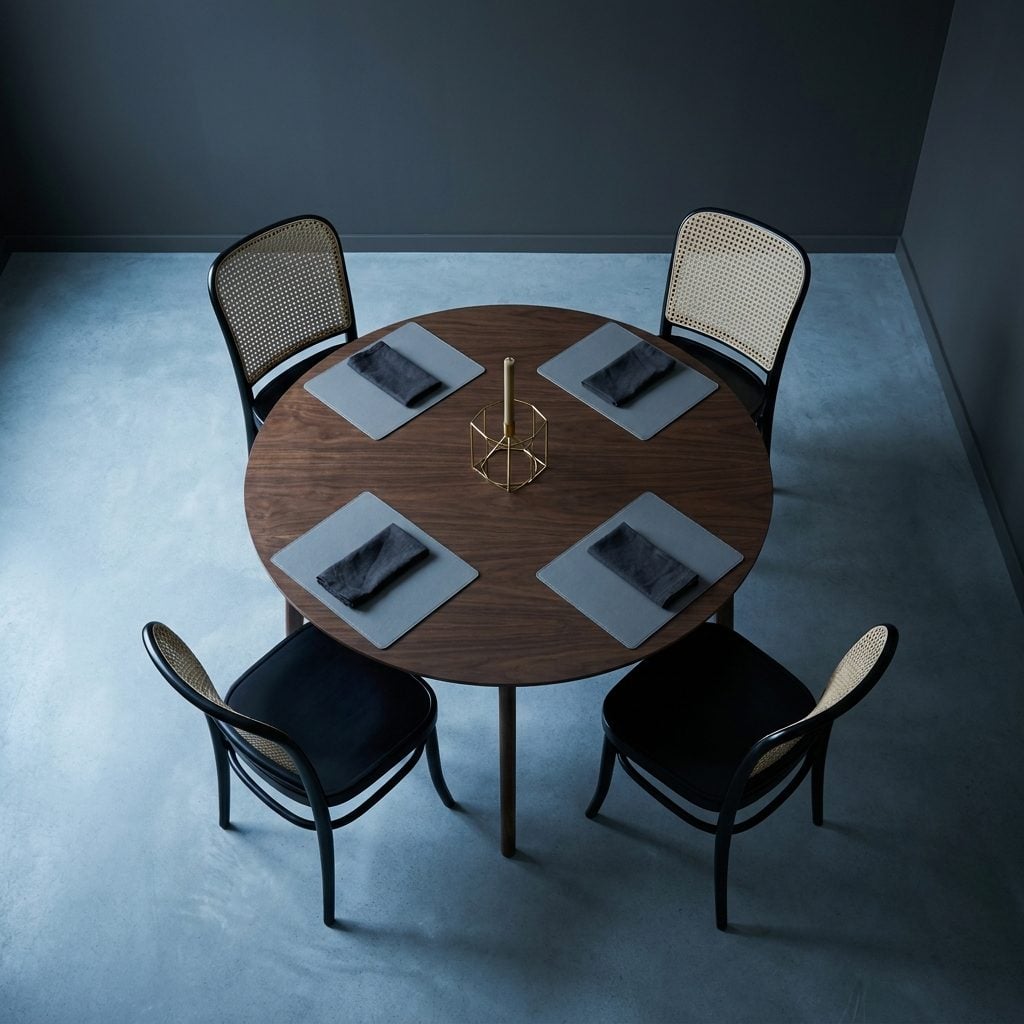
Six identical chairs around a table should feel orderly. So why does it sometimes feel like a waiting room?
The answer connects to something robotics engineers discovered decades ago. In 1970, Japanese professor Masahiro Mori identified the uncanny valley: the phenomenon where things that are almost, but not quite, human trigger deep unease. A Psychology Today article on the uncanny valley (Source) explains that our brains respond with “heightened sensitivity to subtleties deviating from the familiar human experience.” That principle extends beyond robots. Perfect bilateral symmetry in a room sends a signal your brain can’t fully reconcile: this looks arranged, but nothing in nature arranges itself this precisely.
A row of matching chairs occupies a strange middle ground. Not chaotic enough to feel alive, not personal enough to feel like home. Your subconscious registers the room as a display, not a dwelling. Mix in one unexpected chair (a different height, a contrasting texture, even just a throw draped over the arm) and that tension dissolves. Imperfection is the proof of habitation.
The Cognitive Bias That Makes You Think Matching Equals Quality
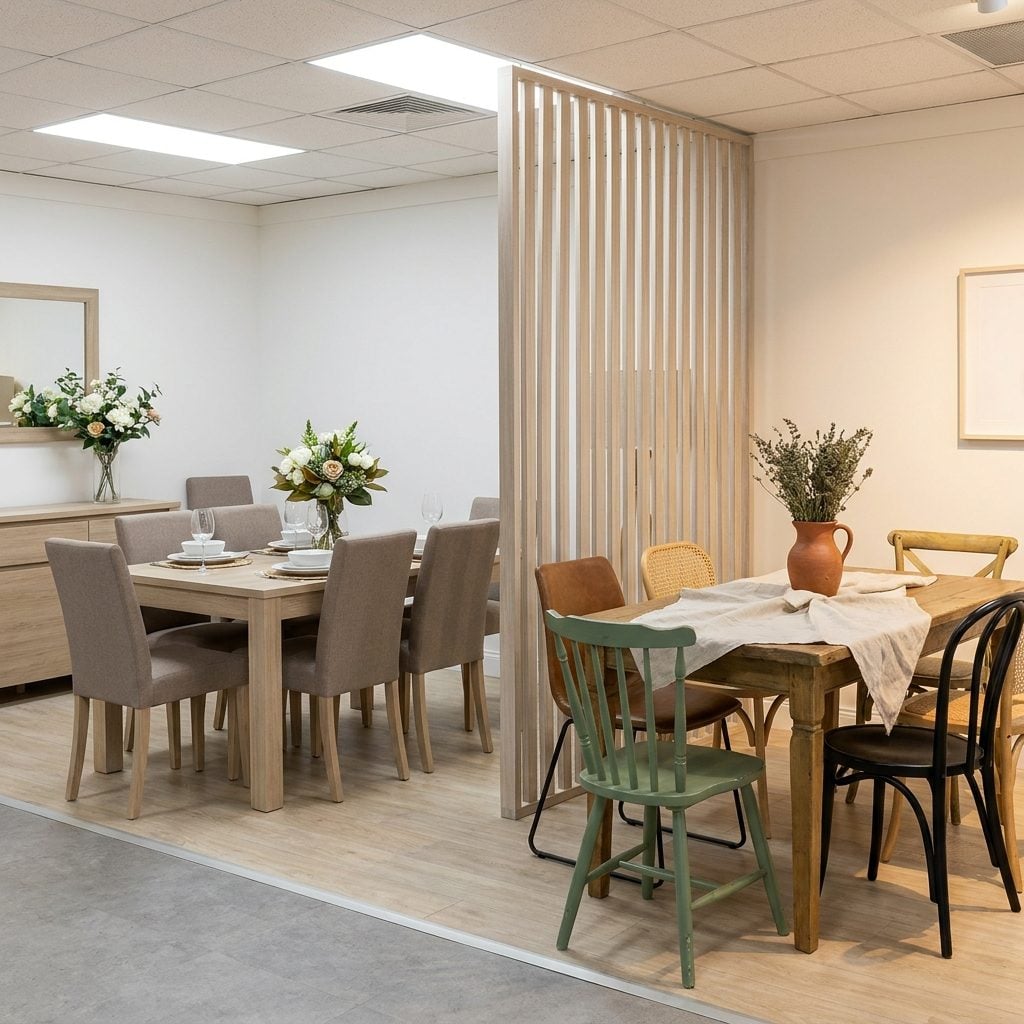
Here is the bias nobody talks about in home design: uniformity feels expensive because retail trained you to think that way. Walk into a furniture showroom, and every piece in a vignette matches. Same wood tone. Same upholstery. Same collection name. That visual consistency becomes shorthand for quality in your brain, a heuristic (a mental shortcut) that says “coordinated equals considered.”
Psychologists call a related phenomenon the fluency heuristic: if something is processed quickly and smoothly by the brain, we assume it has higher value. A matched dining set requires almost zero cognitive effort to evaluate, so it feels “right.” But that ease of processing is not the same as depth of experience. It is the visual equivalent of elevator music: pleasant, forgettable, requiring nothing from you. The irony? When you see a japandi dining room with a mix of wood species, textured linen, and a single painted accent chair, your brain works slightly harder. And that extra engagement is precisely what makes the room memorable.
How Your Eye Actually Moves Through a Room (And Why Identical Chairs Stop It Cold)
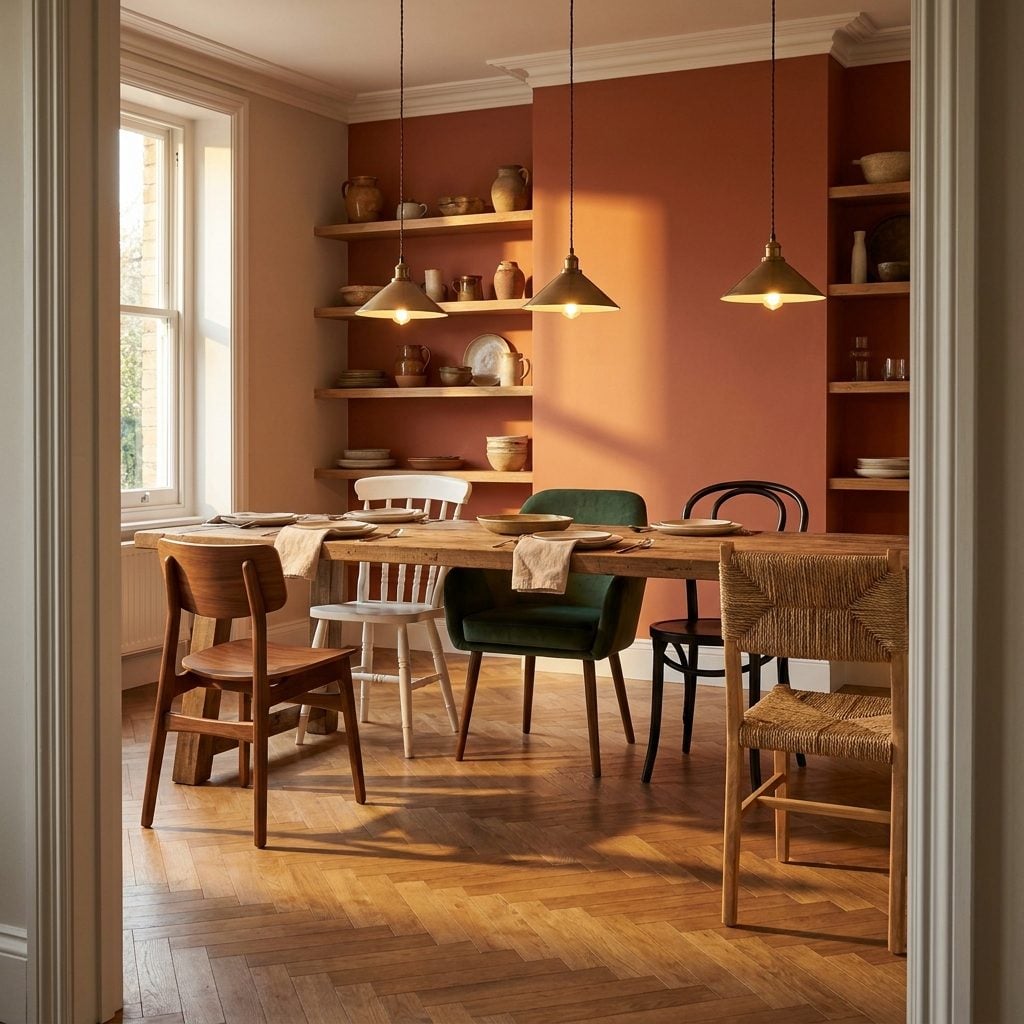
Eye-tracking studies in architectural research reveal something designers have intuited for centuries: the human gaze does not sweep evenly across a space. It jumps between points of visual interest, fixating on areas of contrast, texture change, or unexpected form. Researchers studying how people visually explore buildings found that complex, detail-rich spaces invite the eye to linger and explore, while uniform modern interiors get scanned quickly with “no clear fixation points,” as noted in (Source).
Picture your eye as a stone skipping across water. Each point of contrast (a tufted dining chair against a wooden spindle chair, a curve next to a straight line) is a ripple that catches the stone and keeps it moving. A set of six identical chairs offers the eye one landing point. It touches down, registers “same, same, same,” and moves on to the window, the light fixture, anything else. The chairs become invisible. Mismatched seating, on the other hand, turns a single table into a visual journey with five or six distinct stops.
The Wabi-Sabi Shortcut That Tricks Your Brain Into Feeling Calm
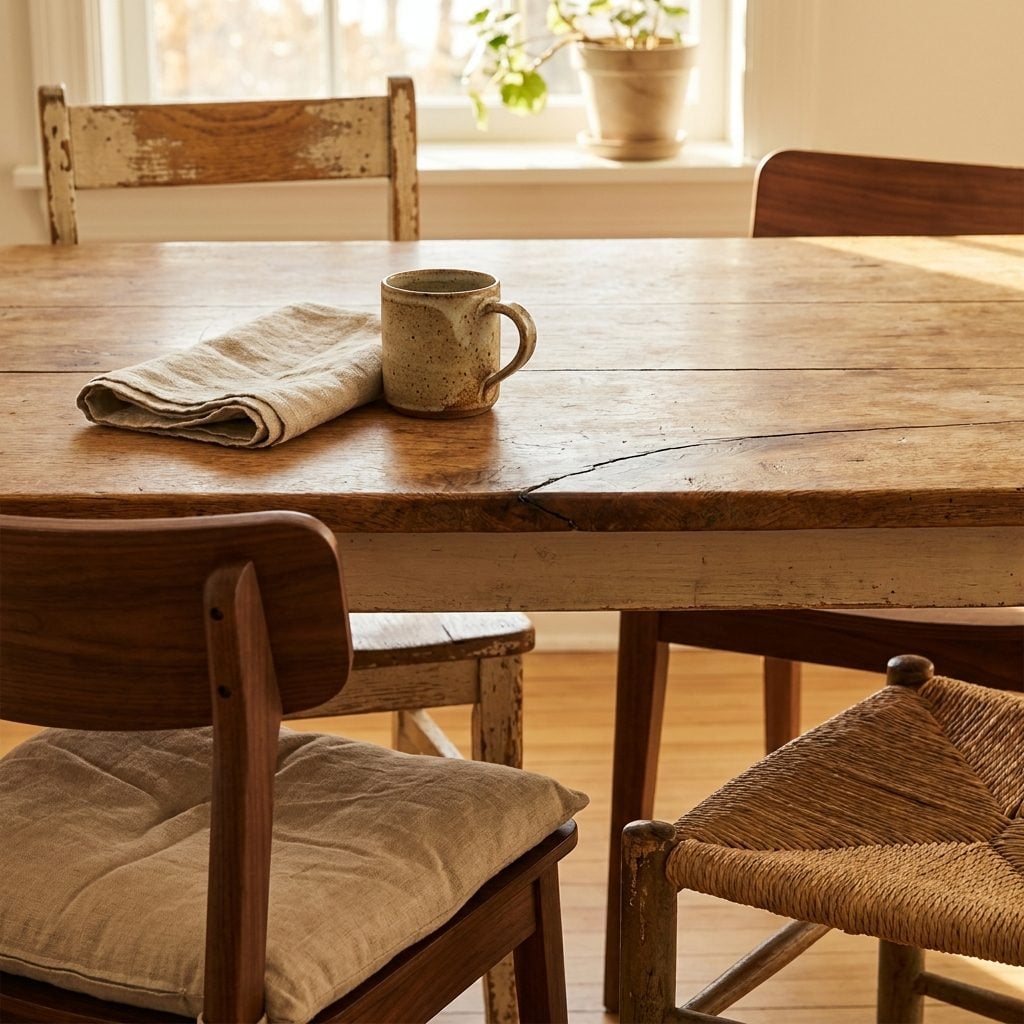
There is a reason the most relaxing rooms you have ever entered were not the most polished. They were the ones with visible wear on the table edge, a slight wobble in a hand-thrown ceramic bowl, linen that wrinkled the moment you set it down. Your brain reads these small imperfections as signals of safety, because they are the visual language of something that has been used, tested, and found trustworthy.
The Japanese philosophy of wabi-sabi, which celebrates impermanence and imperfection, has deep roots in psychological research. As a Psychology Today article on wabi-sabi and imperfection (Source) explains, wabi-sabi is “a philosophy and aesthetic that centers around an appreciation of imperfection, impermanence, and incompleteness.” Modern psychology has found that this kind of acceptance is closely linked to reduced anxiety and greater emotional resilience. Perfectionism, by contrast, fuels chronic stress and self-doubt.
Applying this to your dining room is simpler than you think. A set of matching chairs says “purchased.” A collection of different chairs, each with its own history (the oak chair from an estate sale, the painted one your partner refinished, the modern one you splurged on), says “gathered.” And “gathered” tells your nervous system: someone lives here. Someone relaxed enough to stop curating and start collecting.
Why Dinner Parties at Grandma’s House Felt Warmer Than Any Designer Showroom
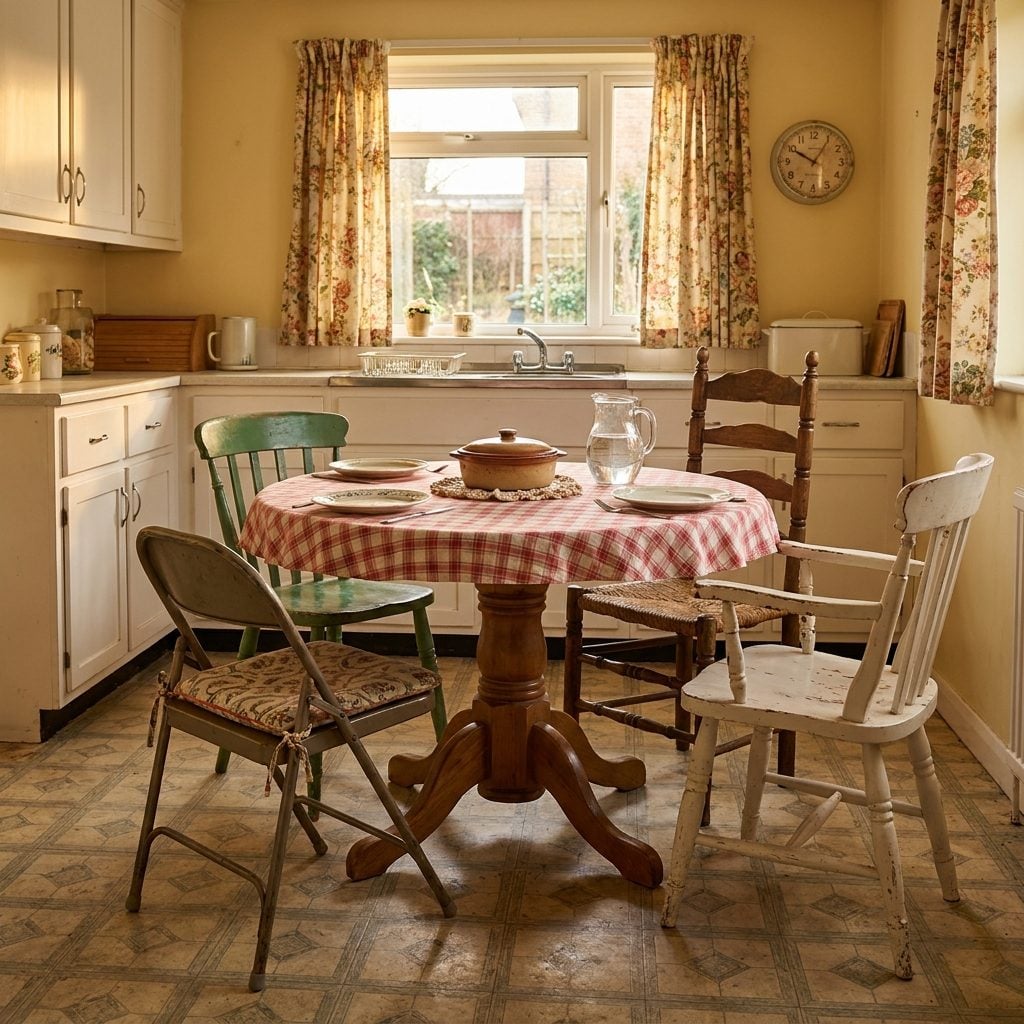
Close your eyes for a second. Think about the warmest meal you have ever had at someone else’s table. Odds are good it was not in a room that “went together.” It was a kitchen with faded floral wallpaper, a table with a wobbly leg propped by a folded napkin, chairs dragged in from other rooms because more family showed up than expected. Nothing matched, and you felt completely at ease.
That feeling has a name. Nostalgia, psychologically speaking, functions as what researchers call a “homeostatic emotion”: it activates when we feel disconnected and works to restore feelings of belonging and self-continuity. Studies have shown that nostalgic feelings can increase self-esteem and foster social connectedness. Interior designer Amity Worrel writes that clients consistently “gravitate toward items with a sense of nostalgia,” choosing the wallpaper that reminds them of holiday dinners or reupholstering the armchairs they climbed into as kids.
Mismatched chairs carry that same emotional payload. Each one can anchor a different memory: the chair from your first apartment, the one you found at a country dining room flea market, the folding chair pulled out when your brother brought his new girlfriend. A matched set tells one story. A collected set tells yours.
The Status Signal That Shifted Without You Noticing
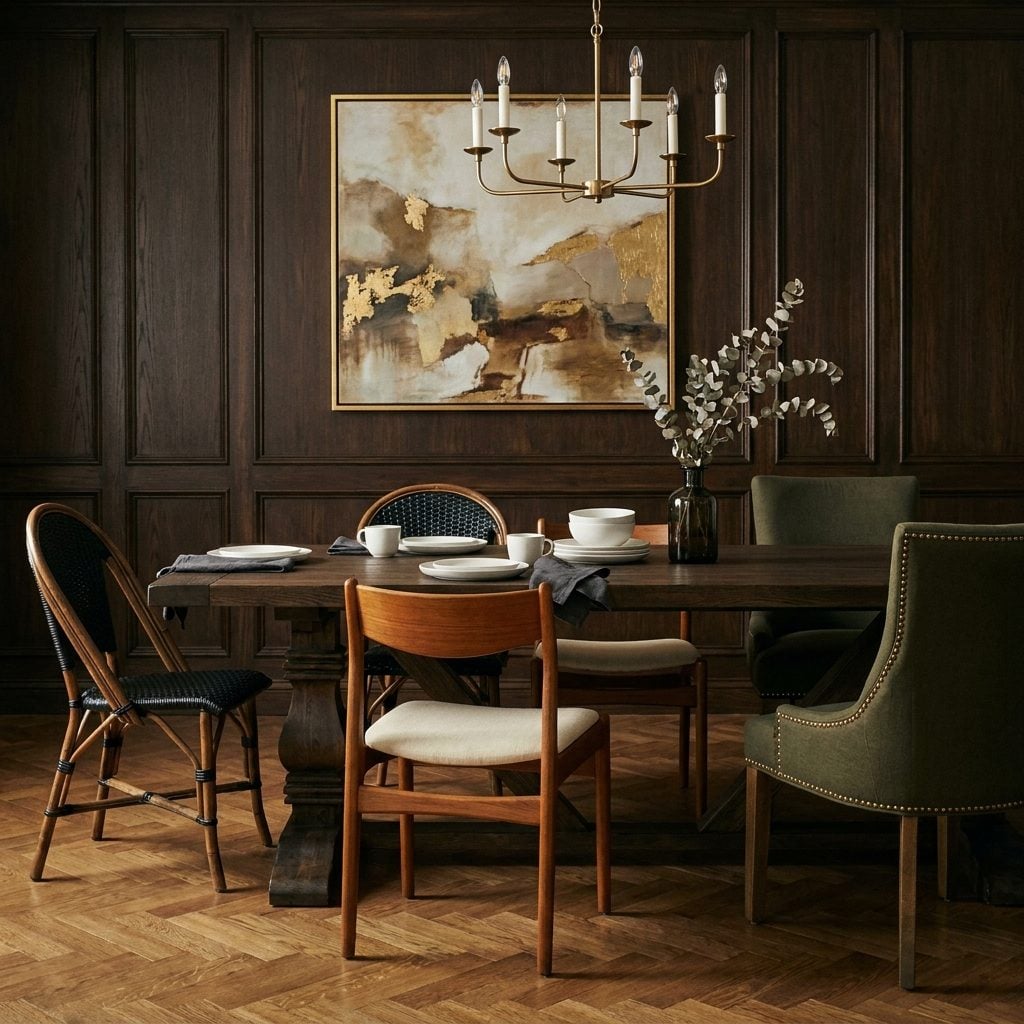
For most of the 20th century, a perfectly matched dining set was a status marker. It meant you could afford to buy eight coordinating pieces at once, from a single manufacturer, probably delivered by men in white gloves. The matched set said: I have arrived.
That signal has quietly inverted. Scroll through any high-end shelter magazine today, and the most aspirational dining rooms are conspicuously unmatched. A dark dining room with a Georgian table and Scandinavian chairs. A Parsons table circled by vintage school chairs and one upholstered host seat in moss green velvet. The new status signal is not “I can afford the set” but “I have the taste, time, and access to find individual pieces that work together.” It is curation over coordination. And curation implies cultural capital: the knowledge to mix eras, the confidence to break rules, the patience to wait for the right find.
This shift tracks with broader cultural movements away from conspicuous consumption and toward what sociologists call “inconspicuous consumption,” spending that signals taste rather than wealth. Your signs your kitchen is trying too hard might include everything matching a little too neatly.
The Number of Mismatched Objects Your Brain Can Handle Before It Panics
So if mixing is better, why not go full chaos? Pull eight completely different chairs from eight different decades, throw them around a table, and call it eclectic? Because your brain has a threshold, and crossing it turns visual interest into visual stress.
Cognitive load theory, originally developed for educational design, applies directly to how we process interior spaces. Your working memory can comfortably hold about four to seven distinct visual “chunks” at once. Environmental psychologist Sally Augustin notes in Psychology Today (Source) that “too little to see stresses us just as much as too much” and that the goal is “medium levels of visual complexity.” A dining table with five wildly different chairs in five clashing colors exceeds the comfortable threshold. Your brain stops finding connections and starts just cataloging differences, which feels like work.
The sweet spot? A unifying thread. That thread can be:
- Color family: different chair styles, all in neutral tones or all in wood
- Era: mixed silhouettes from roughly the same period
- Material: varied designs, but all in natural wood or all with upholstered seats
Keep one variable consistent and let the others roam free. That gives your brain enough variety to stay engaged and enough coherence to relax into the scene. It is the same principle behind why a wildflower meadow feels peaceful but a pile of random objects on a sidewalk does not. The meadow has a unifying ground: the soil. Your dining room design needs one, too.
Why One Chair in a Different Material Changes How the Whole Room Smells to Your Memory
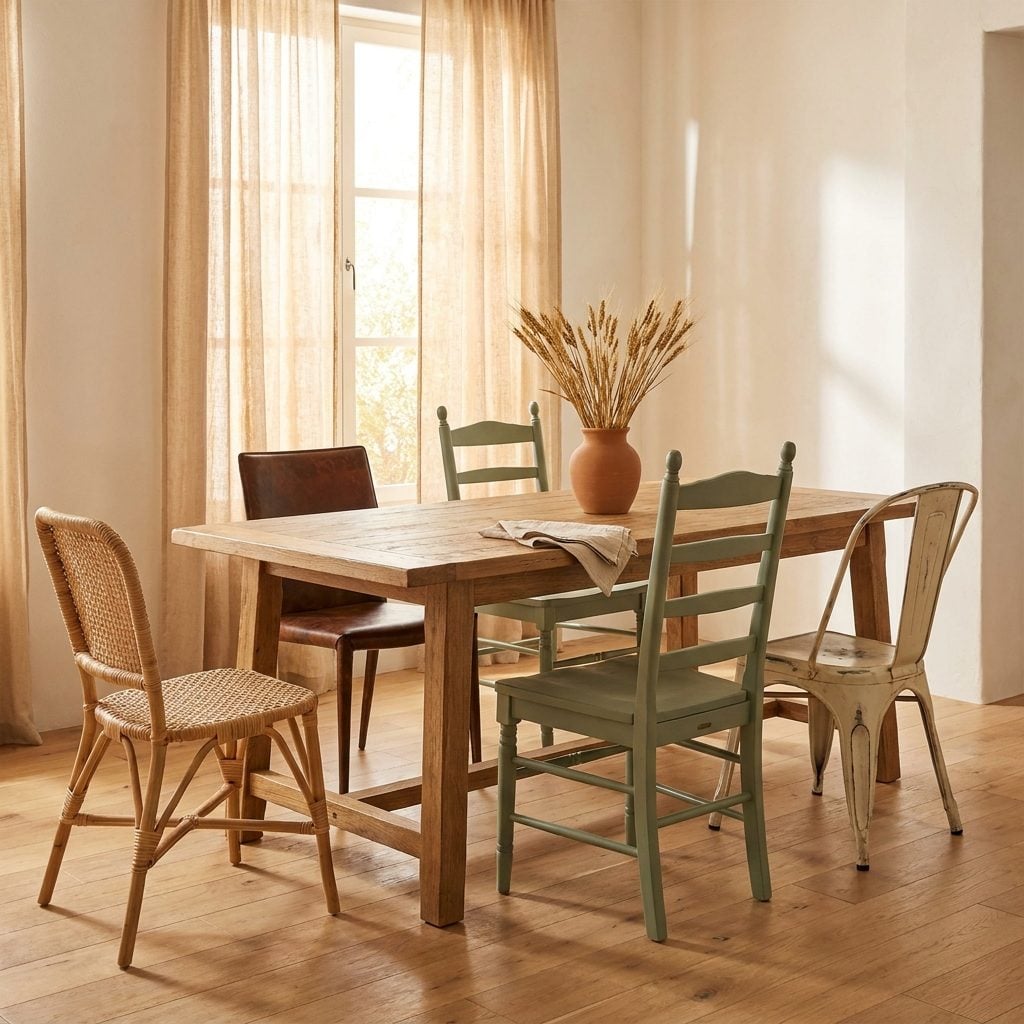
Picture a dining table surrounded by five identical oak chairs. Now swap one for a woven rattan chair. You probably can’t smell it from across the room, but your brain fills in the gap anyway. That single rattan seat triggers an olfactory ghost: the faint sweetness of dried grass, maybe a memory of a grandmother’s porch or a market in a warm country. This isn’t imagination run wild. According to Harvard neuroscientist Venkatesh Murthy (Source), odors take a direct route to the limbic system, including the amygdala and hippocampus, the regions tied to emotion and recall. Your brain doesn’t need to actually detect a scent to activate that pathway. Simply seeing a material you associate with a specific smell can reactivate the sensory memory.
A 2004 fMRI study published in Neuron found that primary olfactory cortex activates during successful retrieval of objects previously paired with odors, even when no scent is present at recall. So when mismatched chairs introduce a second or third material into your dining room, they’re layering invisible sensory data. A leather dining chair among linen-upholstered ones. A painted metal bistro seat among wood. Each material carries its own phantom scent, and your brain processes the room as richer and more layered because of it. That’s not something a matched set can do.
The Gestalt Principle That Holds Mismatched Sets Together Without You Realizing
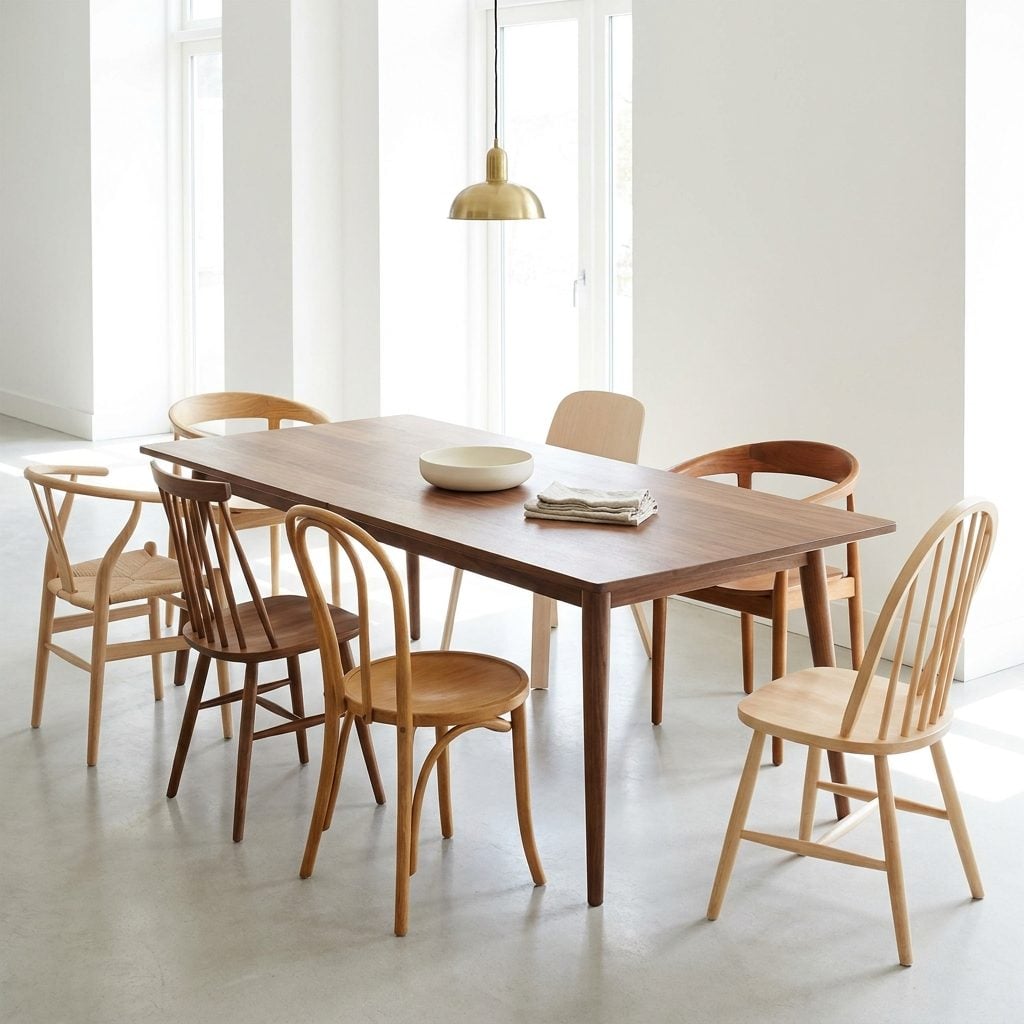
Your brain is performing a quiet act of visual diplomacy every time it looks at a set of mismatched dining chairs. It’s called the Gestalt principle of similarity, and it’s one of the oldest observations in perceptual psychology, dating back to Max Wertheimer, Kurt Koffka, and Wolfgang Köhler in the early 1900s. The core idea is disarmingly simple: elements that share even one visible trait, like color, shape, or size, get mentally grouped into a coherent whole. According to the Nielsen Norman Group’s guide to the similarity principle (Source), the items don’t need to be identical. They just need to share at least one visible trait to be perceived as part of the same group.
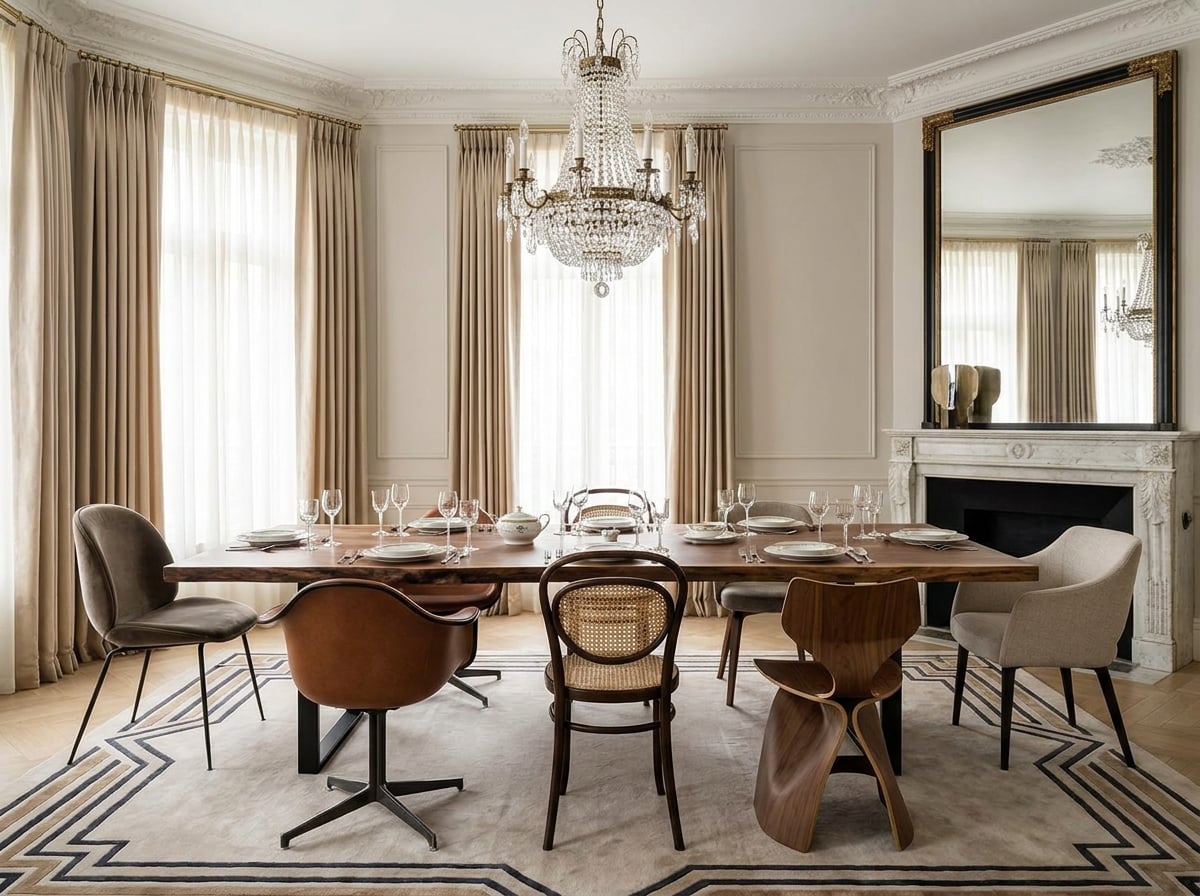
This is why a set of six completely different dining chairs can look intentional rather than chaotic, provided they share a single unifying attribute. Same seat height. Same wood tone. Same curved backrest profile. Your brain latches onto that one thread of similarity and weaves the rest into a coherent story, ignoring the differences. Interior designer Rebecca Hughes explained to Livingetc that “when furniture, colors, and shapes feel connected, our brains naturally see a space as calm, balanced, and inviting.”
The real trick for mismatched japandi dining room arrangements? You need enough similarity to trigger the grouping instinct but enough difference to keep the eye engaged. That tension is the sweet spot.
How Visual Complexity Lowers Your Cortisol (Up to a Point)
There’s a reason you feel calmer in a room that has something interesting to look at versus one that’s sterile and bare. Visual richness, within a certain range, actually appears to lower physiological stress markers. A scoping review published in BMJ Open (Source) examining 14 studies on viewing visual artwork found that 13 of 14 studies measuring self-reported stress showed reductions after participants engaged with visually complex imagery. Multiple studies in the review also recorded decreases in systolic blood pressure.
Now apply that to your dining room. A perfectly matched set of eight identical chairs creates visual monotony. Your eye scans, finds nothing new, and disengages. A fully chaotic jumble of unrelated furniture creates too much complexity, which can tip the brain into cognitive overload. But a thoughtfully mismatched arrangement? That sits in the sweet spot researchers sometimes call “optimal complexity”: enough variation to keep the visual cortex pleasantly occupied, not so much that it triggers anxiety.
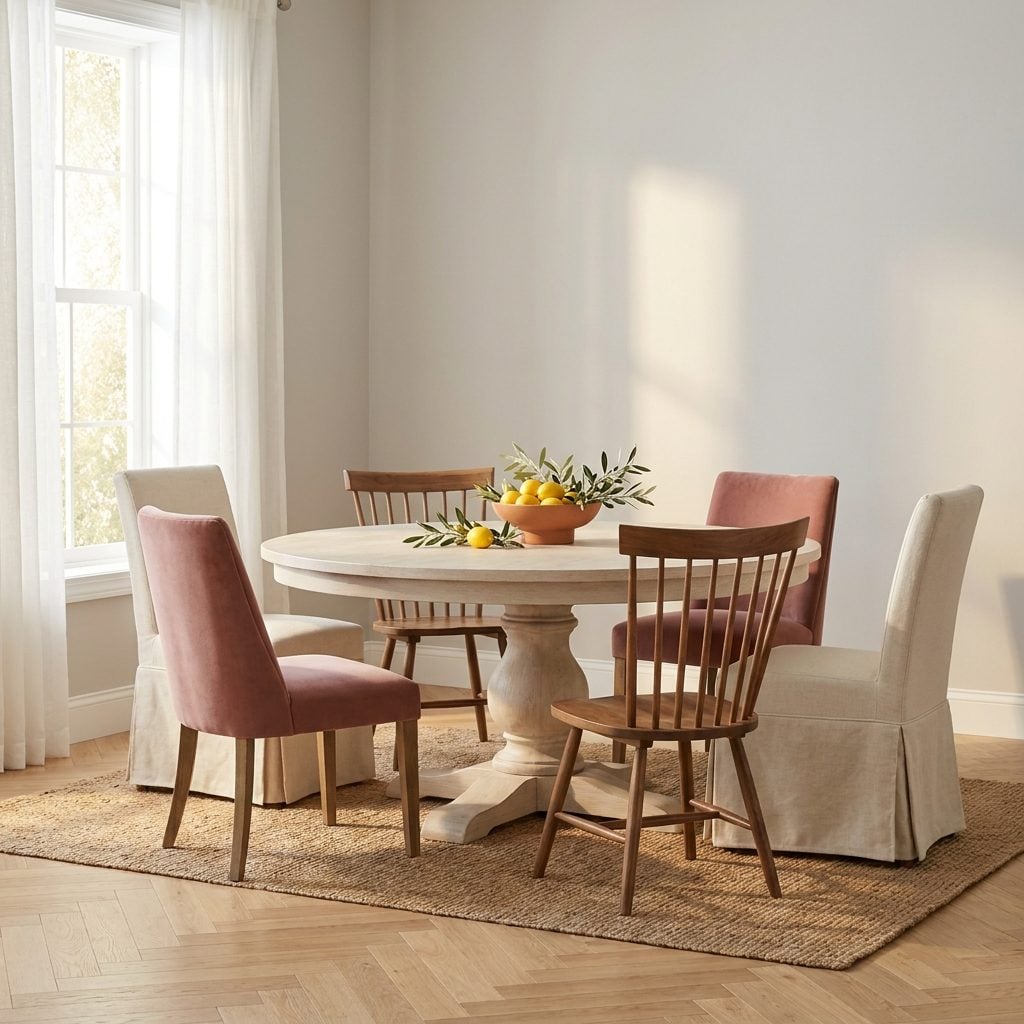
Think about it this way. Two velvet dining chairs in a dusty rose, two wooden Windsor chairs in walnut, and two upholstered end chairs in cream linen. Your eye has a journey to take. That journey, that moderate visual engagement, may be part of what makes the room feel like a place you actually want to linger.
The Evolutionary Reason Your Brain Rewards You for Finding the Pattern in Chaos
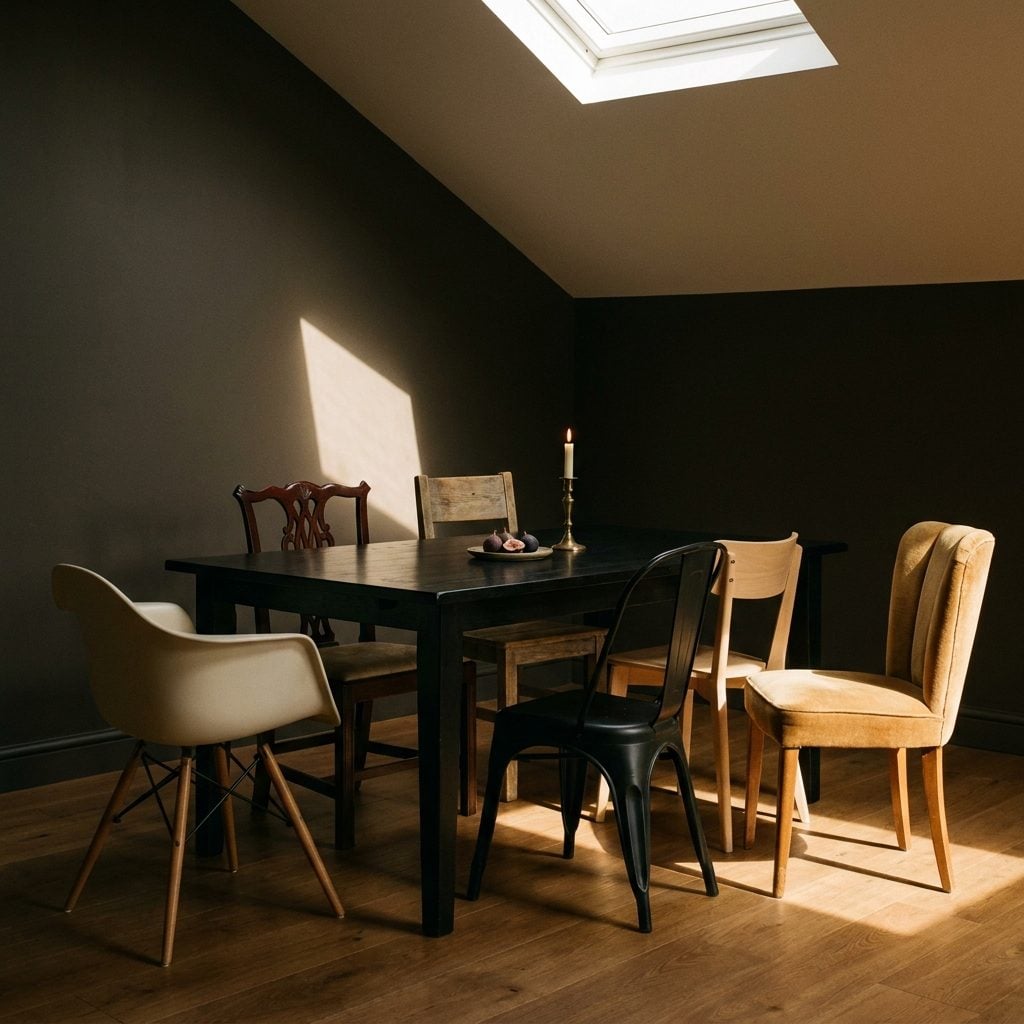
Walk into a dining room with six wildly different chairs and notice the moment your brain clicks. There it is: they all have tapered legs. Or they’re all roughly the same height. Or they all share a warm honey tone. That click? It feels good. It’s not just aesthetic satisfaction. It may be a reward signal.
The dopamine system, one of the brain’s most fundamental reward circuits, is heavily implicated in pattern detection and prediction. According to a review in Physiological Reviews, dopamine neurons fire not just when a reward is received but when the brain successfully predicts one. The initial detection response is “very fast and highly sensitive,” occurring at latencies below 100 milliseconds. This system evolved to help early humans rapidly detect meaningful patterns in their environment, distinguishing edible berries from poisonous ones, safe paths from dangerous ones.
A matched dining set offers your brain nothing to solve. The pattern is handed to you on a plate, literally. But a mismatched collection creates a micro-puzzle. Your visual system scans, searches, and then discovers the unifying thread. That small “aha” moment may activate the same reward prediction pathways that helped your ancestors survive. The discovery feels earned, and that’s precisely why a room you had to “figure out” often feels more satisfying than one that was obvious from the doorway.
Why the Chair You Sit in Becomes ‘Yours’ Within Minutes
🔥 Would you like to save this?
You’ve been to enough dinner parties to know this feeling. You pull out a chair, sit down, and by the time the second course arrives, that chair belongs to you. If you step away and someone takes it, there’s a flash of irritation that has nothing to do with logic. This is the endowment effect at work.
First described by Nobel Prize-winning economist Richard Thaler, the endowment effect is the phenomenon where people assign higher value to objects simply because they possess them. In classic experiments by Kahneman, Knetsch, and Thaler, participants given a coffee mug demanded roughly twice the price to sell it as buyers were willing to pay, even though they’d owned it for only minutes. According to research published in Judgment and Decision Making (Source), even brief physical possession of an object enhances feelings of ownership, which in turn fully mediates the increase in monetary valuation.
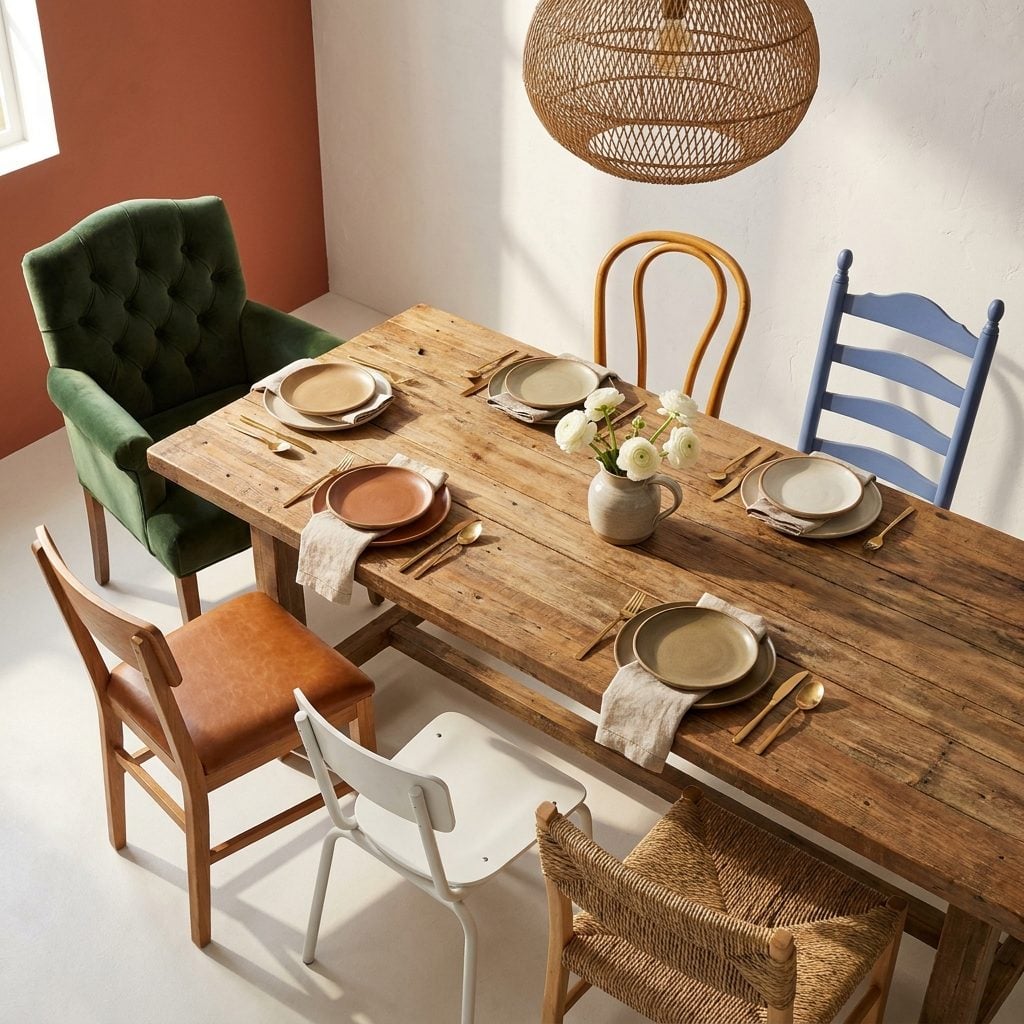
Here’s why this matters for mismatched chairs. When every seat at the table is different, you don’t just pick a chair. You pick your chair. The green velvet armchair at the head. The little bentwood cafe chair by the window. The endowment effect kicks in faster because the object of your ownership is distinctive. You can’t claim a chair that looks exactly like the five others. But a unique one? That’s yours. And that possessive attachment, psychologically speaking, makes the meal more personal and the room more memorable.
The Color Thread Trick That Fools Your Brain Into Seeing Unity
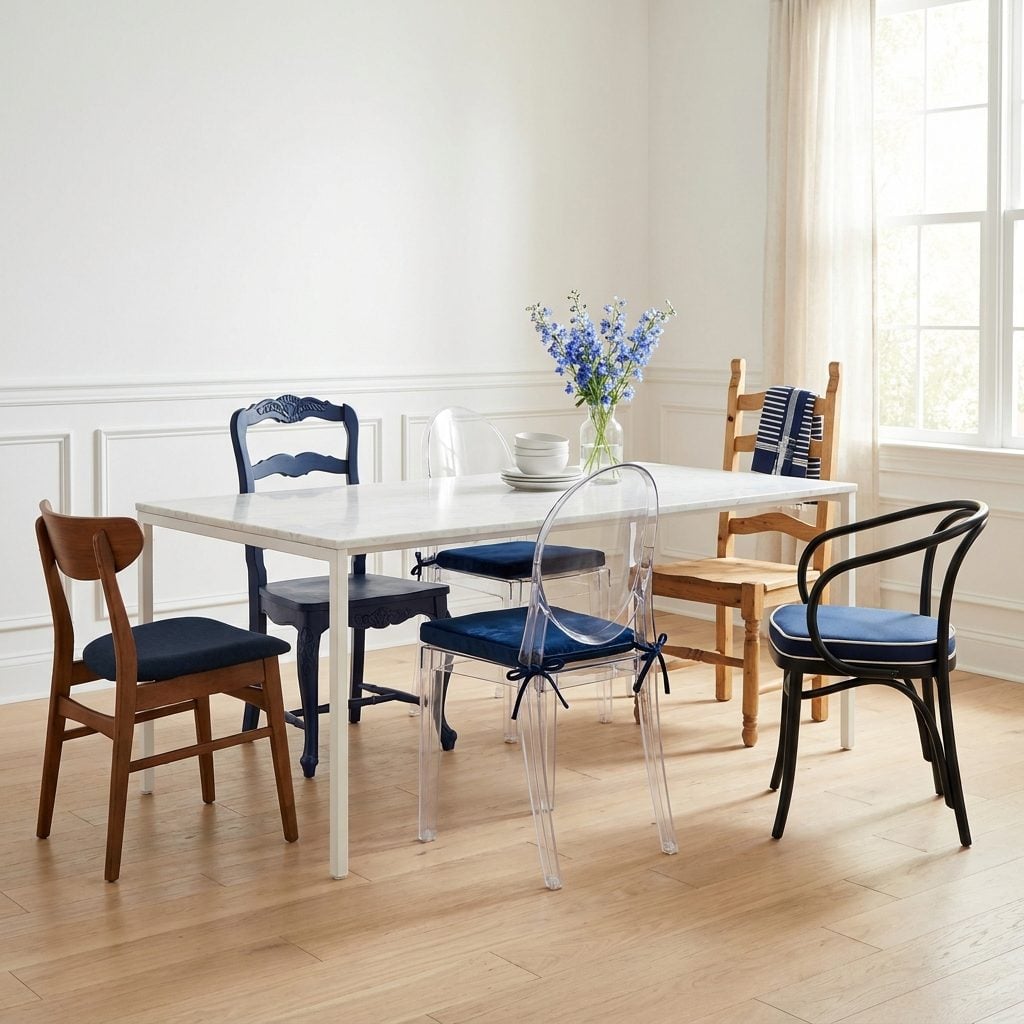
Color is the single most powerful grouping cue your brain recognizes. Stronger than shape. Stronger than size. Stronger than proximity. According to the Nielsen Norman Group (Source), “a shared blue color creates the perception of rows, despite the columnar arrangement of shapes.” In other words, color can override spatial logic.
This is the secret weapon of every designer who has ever pulled off a mismatched chair arrangement. You don’t need the chairs to match in form, era, style, or material. You just need one color to appear in each of them. A brass and off-white palette is a perfect example: a linen seat pad here, a painted leg there, an upholstered cushion on a third. The shapes are all over the map, but your brain sees ivory and instantly files them into a single group.
The Threshold Effect
There’s a subtlety here worth knowing. The color thread doesn’t need to be dominant. It doesn’t need to be the main color of each chair. A mere accent will do, a navy piping on one cushion, a navy seat on another, a navy painted frame on a third. Your brain is extraordinarily efficient at spotting these quiet repetitions. In fact, the less obvious the thread, the more satisfying it can feel when your visual system “discovers” it, which loops right back to the pattern-reward response we discussed earlier.
Why Perfectly Curated Rooms Make You Afraid to Sit Down
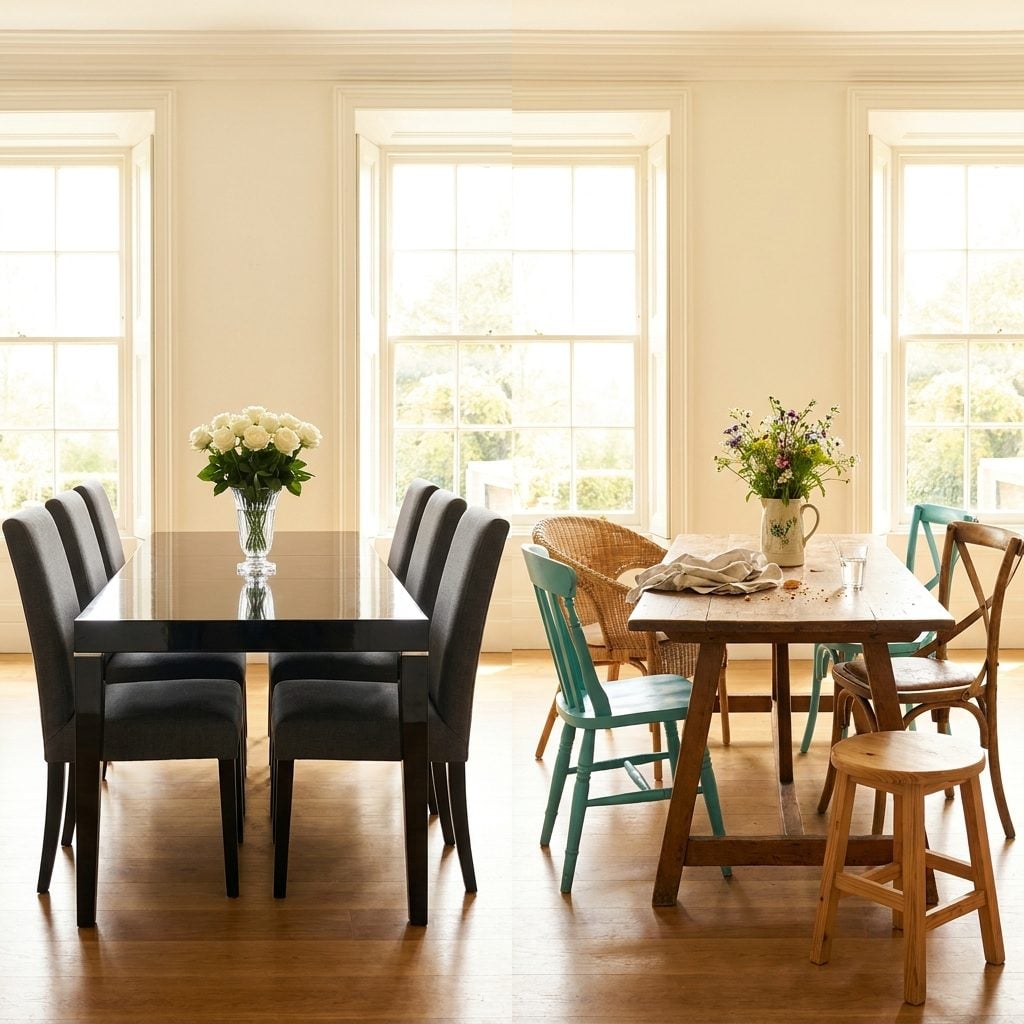
You know the room. Every chair matches. The table is flawless. The flowers look arranged by algorithm. And you feel, inexplicably, like you shouldn’t touch anything. This isn’t a character flaw. It’s your brain processing a social signal that the room’s perfection is communicating: this space was not designed for you to use.
There’s a documented tension between aesthetic perfection and perceived usability in designed environments. When every element signals precision and control, the room begins to read less like a living space and more like a display, and displays are for looking, not for living. This is one of the subtle signs your kitchen (or dining room) has tipped from inviting to intimidating.
Mismatched chairs send a radically different message. They say: this room has been lived in. Someone chose each seat for a reason, maybe practicality, maybe whim, maybe a great find at a flea market. The imperfection signals permission. It communicates that this is a space where spills happen, where conversations get loud, where elbows go on the table. And that permission, that psychological safety, is precisely what makes you want to pull up a chair and stay.
The Bottom Line
The rooms you never want to leave aren’t the ones where everything matches, they’re the ones where your brain has just enough variation to stay engaged and just enough coherence to feel safe. That sweet spot between chaos and order is what your nervous system reads as “home.” So the next time you’re tempted to buy a set of six identical chairs, buy five instead, and let the sixth one be the reason someone pulls it out and says, “I want this one.”