🔥 Would you like to save this?
Yellow front doors have a reputation for being bold, and that reputation is earned. A deep goldenrod or a bright sunflower shade signals something about the people inside before anyone rings the bell. It is one of the few exterior choices that reads as genuinely cheerful without veering into kitsch, provided the tone is right. Paired with the wrong trim or siding color, yellow can feel accidental. Chosen with intention, it becomes the most memorable thing on the block.
In order to come up with the very specific design ideas, we create most designs with the assistance of state-of-the-art AI interior design software. Also, assume links that take you off the site are affiliate links such as links to Amazon. this means we may earn a commission if you buy something.
Color psychology backs this up. Yellow sits at the warm end of the spectrum and draws the eye faster than most hues. Real estate professionals have noted that distinctive front door colors improve a home’s curb presence, and yellow specifically tends to read as welcoming rather than aggressive. The 35 designs ahead cover a wide range of yellows, from pale butter to saturated ochre, across architectural styles that prove this color works in more contexts than most homeowners expect.
35. Warm Amber on the Front Door, Travertine Walls, Cedar Soffits: Dusk Done Right
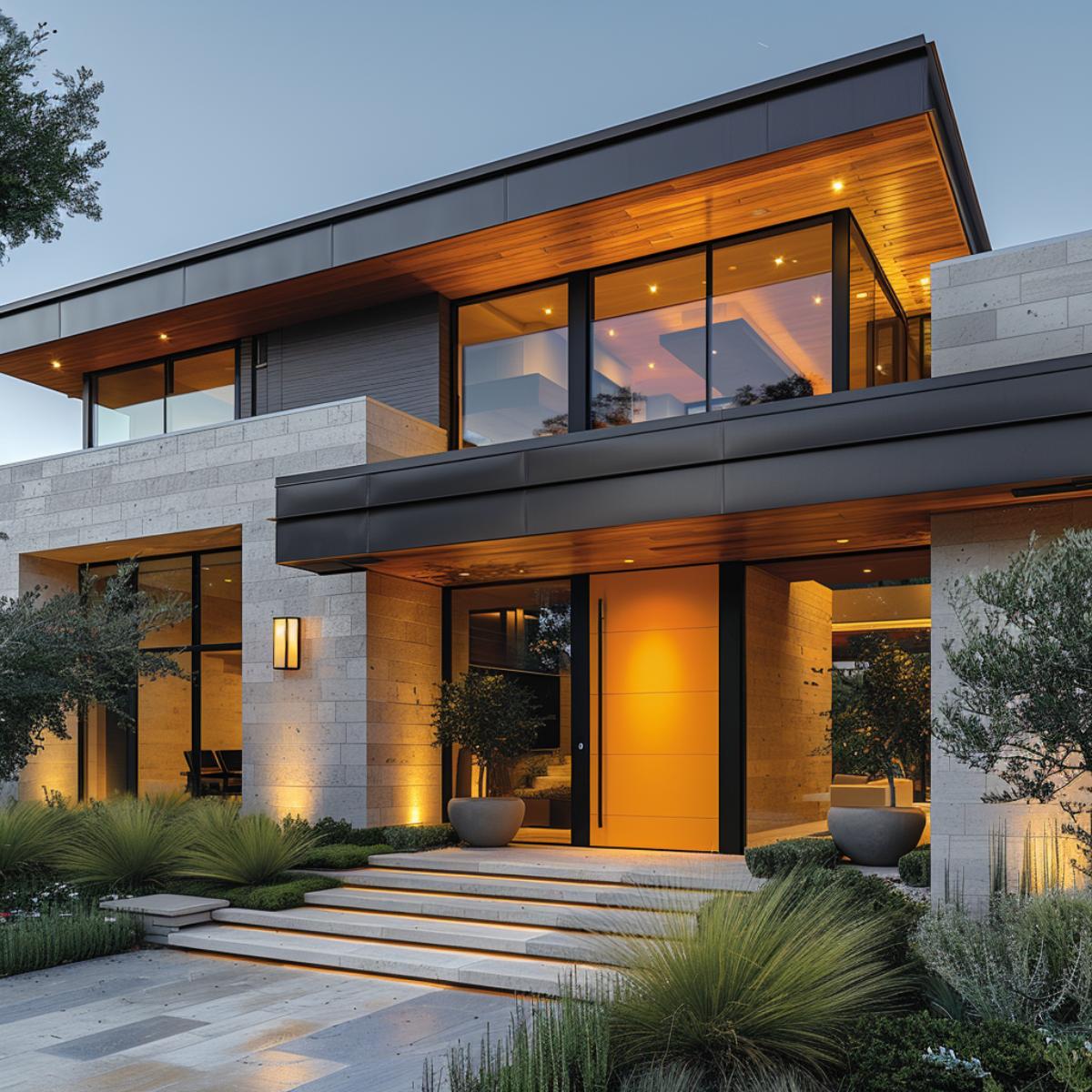
The pivot door’s flat amber-orange finish pulls every warm tone in the facade into focus, anchoring a composition built from travertine block cladding, cedar tongue-and-groove soffits, and black powder-coated steel window frames. Recessed downlights in the entry ceiling cast amber pools across stone steps, while concrete bowl planters flank the threshold with small olive trees.
34. Yellow Front Door, Stone Base, Timber Frame: Mountain Modern at Its Best
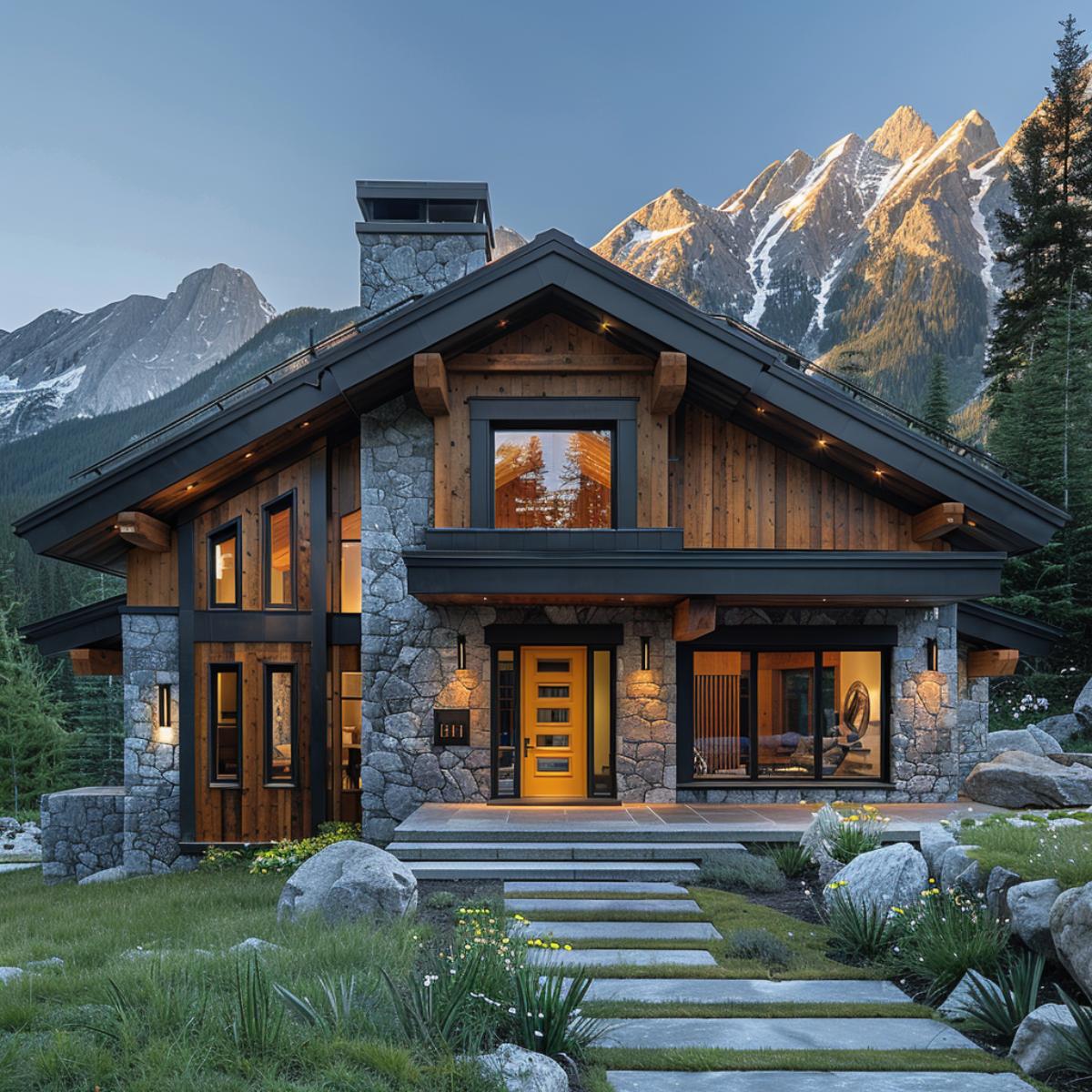
Reclaimed vertical cedar planks cover the upper facade, paired with rough-cut granite stone cladding on the ground level and dark charcoal window trim throughout. Warm amber light spills through the sidelights flanking the yellow horizontal-panel front door, drawing the eye straight up the stepped concrete path. Exposed timber knee brackets anchor the roofline above.
33. Saffron Door, White Stucco, Marble Steps: A Coastal Cliffside Entry That Commits
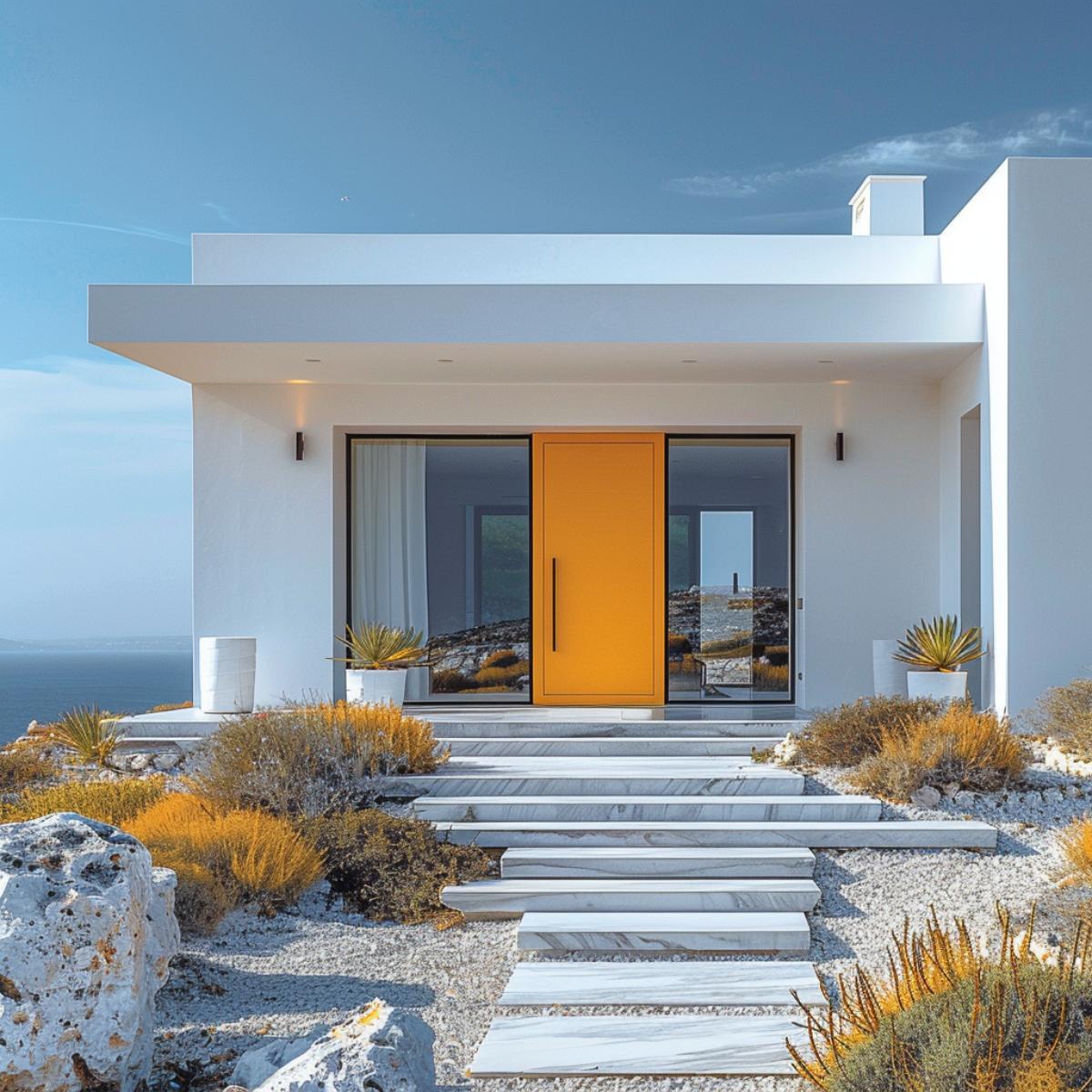
Flat-roof construction keeps the profile spare against an open blue sky, while a solid saffron-orange pivot door pulls focus across white stucco walls. Marble steps, veined in grey, lead up through gravel and dry coastal scrub in amber and ochre tones.
In The Details: The pivot door’s vertical black pull bar is a deliberate contrast against the warm saffron panel, a pairing that keeps the entry from reading as casual. White cylindrical planters holding agave add sculptural weight without softening the geometry. On the left, a sliver of open sea confirms the clifftop position this facade was designed to hold.
32. Navy Horizontal Siding, Glowing Glass Panels, Prairie-Style Roofline: Yellow Does the Work
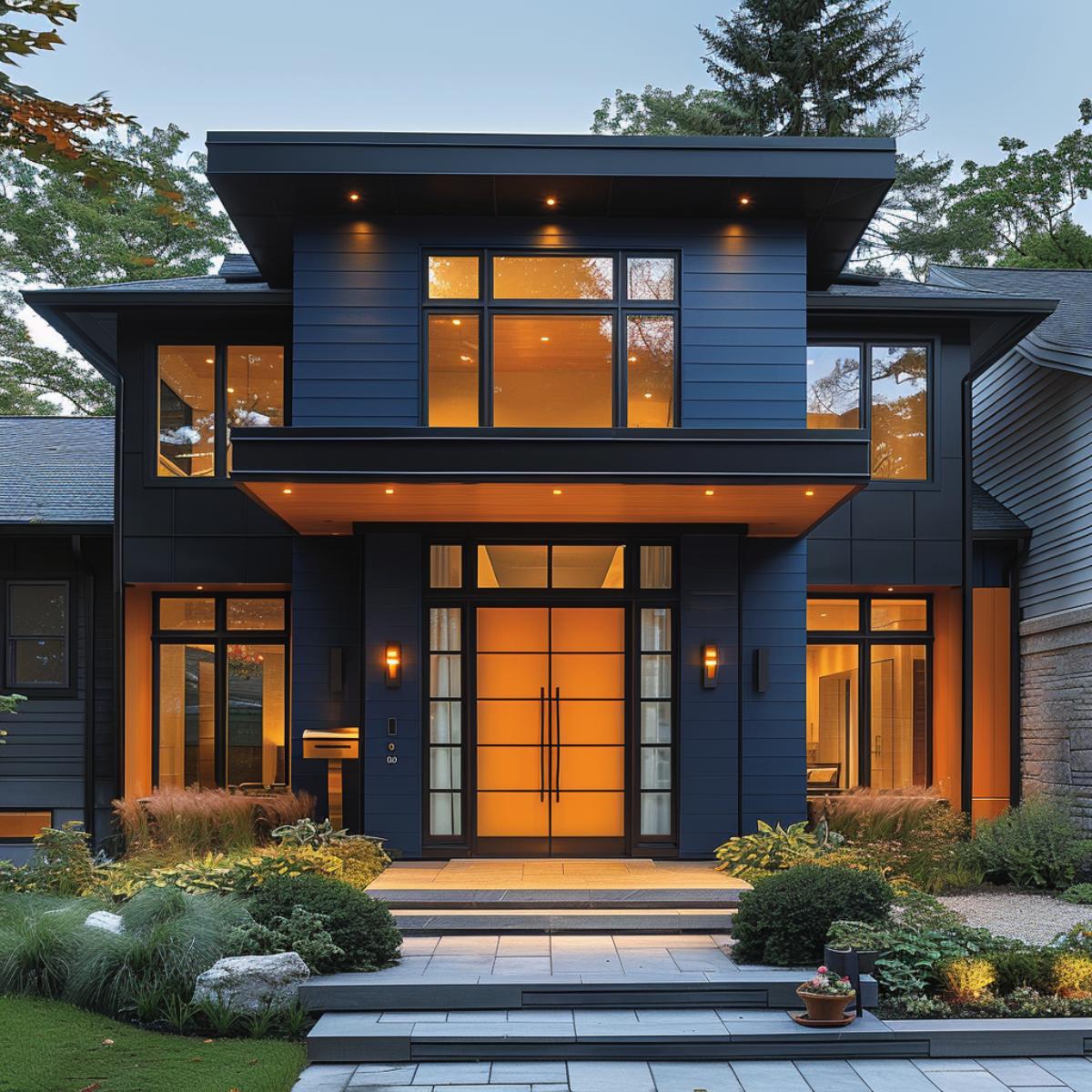
Warm amber glass on the front entry system reads almost backlit at dusk, which is exactly the effect the design is working toward. The door’s gridded black frame divides the panel into six sections, giving structure to what could otherwise feel like a wash of orange light against dark navy lap siding.
Recessed downlights line both the upper roofline soffit and the covered entry canopy, their warm-white output reinforcing the amber tone rather than competing with it. Ornamental grasses and low boxwood massing at the base of the entry steps keep the planting scheme tight. Stone pavers in a large-format rectangular pattern lead directly to the threshold with no visual interruption.
Did You Know: Yellow and amber-toned front doors have been shown to increase perceived warmth and approachability in residential curb appeal studies, making them particularly effective in regions where exterior color palettes skew cool or gray. Navy siding acts as a neutral foil in this context, functioning much the way a dark mat frames a bright print. Choosing a gridded glass door rather than a solid panel allows interior lighting to become part of the exterior design after sundown.
Stone and timber carry forward here, but the door color shifts the entire conversation.
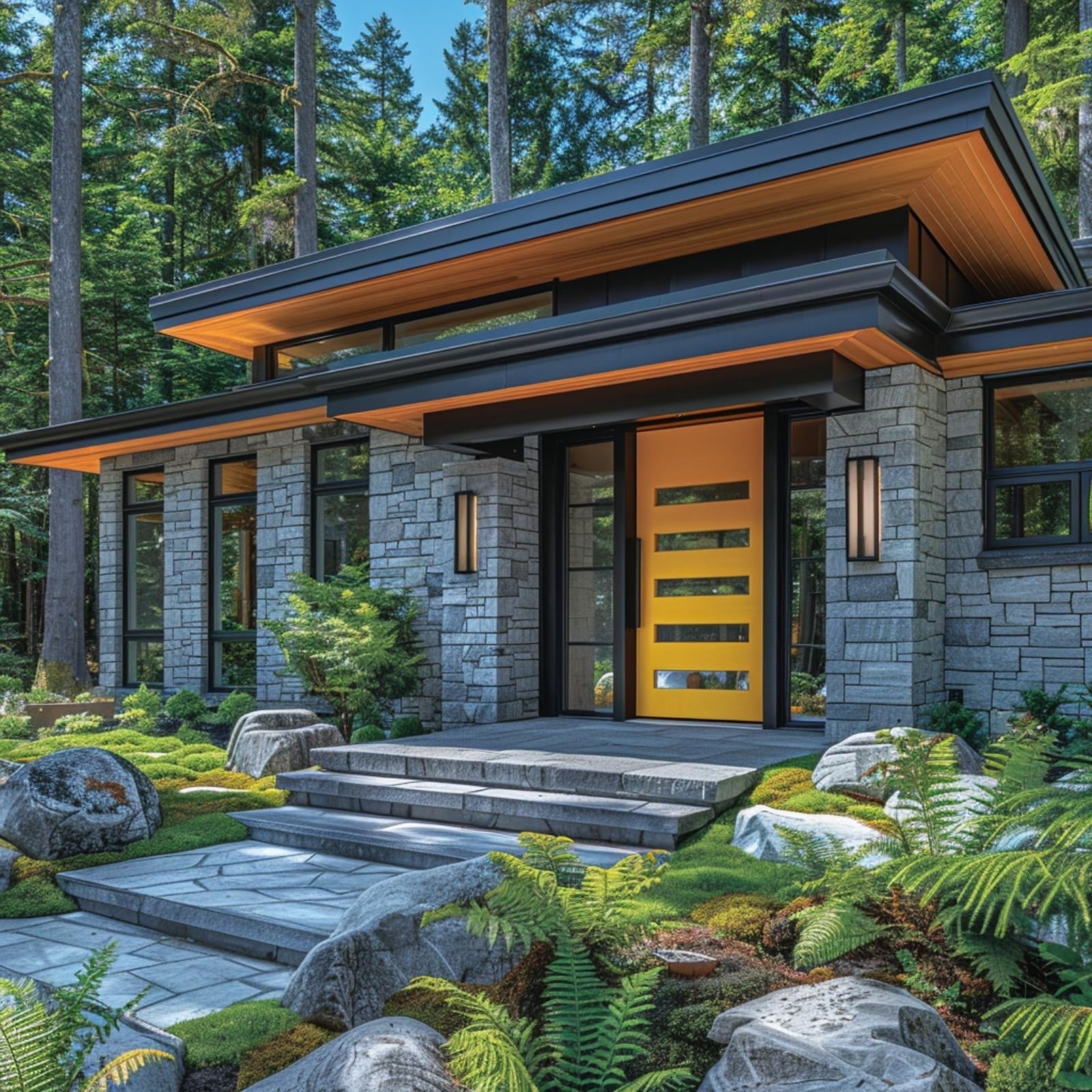
31. Marigold Door, Granite Cladding, Cedar Soffit: Forest Modern With a Bold Center
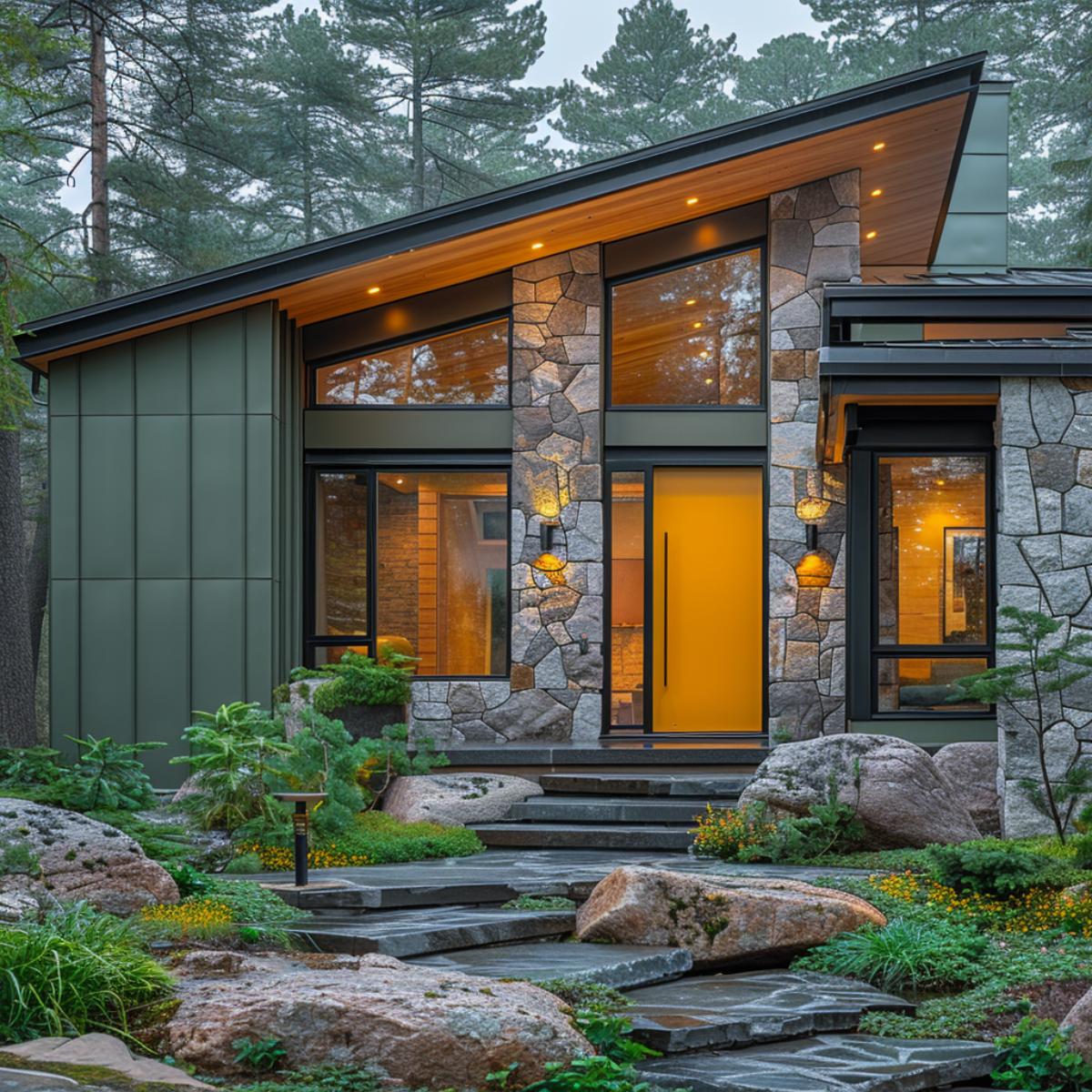
Irregular granite stones wrap the entry surround in a pattern that ranges from pale silver to rust-brown, giving the facade texture without uniformity. The marigold door sits flush within a black steel frame, its flat matte finish absorbing the glow from two amber globe sconces mounted directly into the stonework. Cedar planks line the soffit overhead, their grain running parallel to the roofline in a warm honey tone.
Slate steps cut in staggered horizontal slabs lead through a mix of native groundcover, small boulders, and what appear to be dwarf ferns. Sage green metal panels extend to the left, providing a flat counterpoint to the rough stone. Recessed can lights in the soffit cast downward pools of light that make the marigold door visible well before reaching the threshold.
30. Gold Door, Red Plaster, Bonsai on the Porch: Japanese-Modern Finds Its Voice
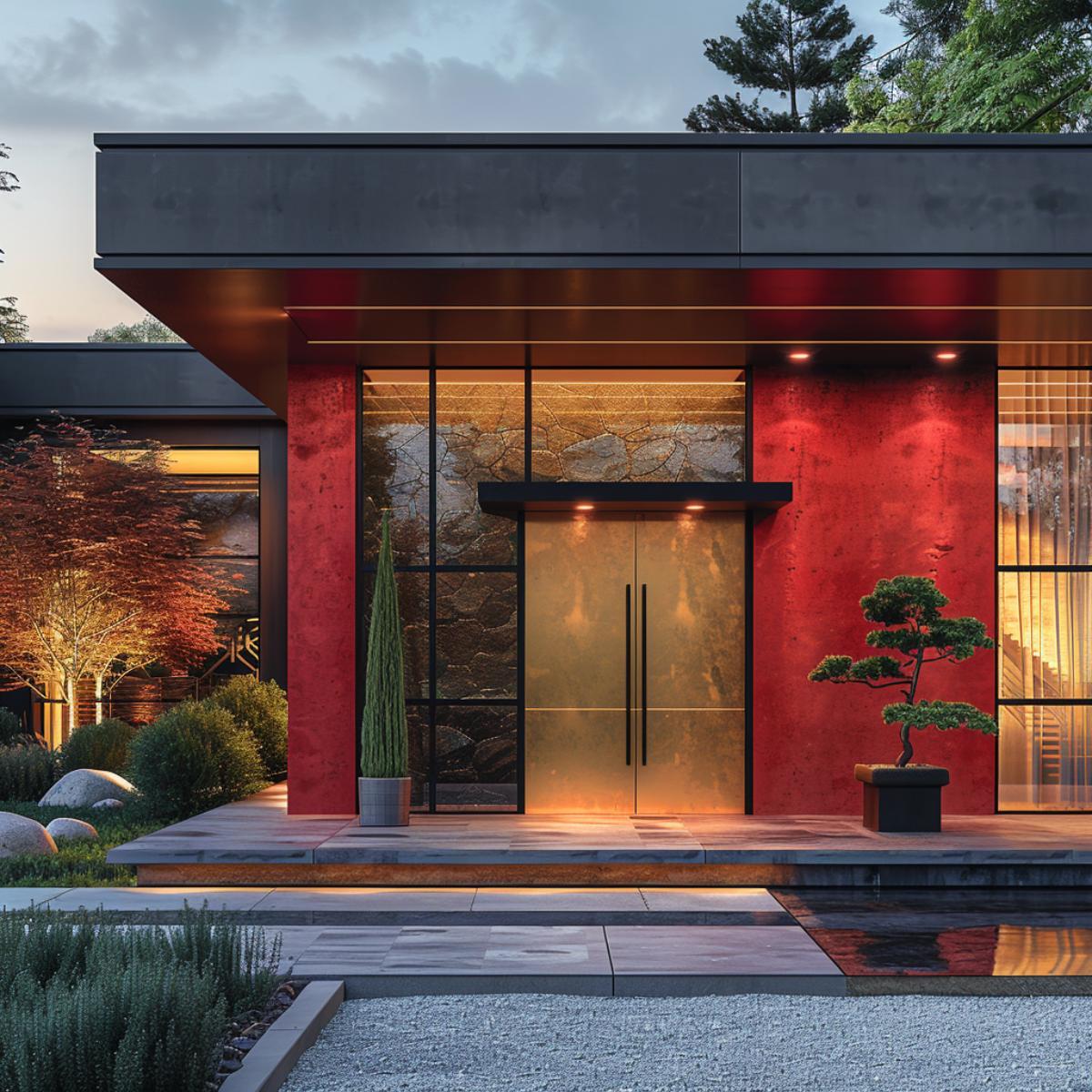
Burnished gold double doors anchor a deep crimson plaster facade, with black steel framing the flanking glass panels on either side. Recessed ceiling lights cast amber pools across the concrete porch deck, and a sculpted bonsai in a square black planter holds the right edge with quiet authority.
A slim cypress in a metal pot flanks the left door panel, while a Japanese maple glows orange-red beyond the entry overhang. The flat canopy in dark concrete extends well past the facade, grounding the composition without fuss.
Style Math: Red plaster plus gold metallic panels follows a ratio designers call 60-30-10 in reverse, letting the accent color dominate while neutrals do the supporting work. That inversion is exactly what makes entries like this register as intentional rather than accidental. Pairing a living element like a shaped bonsai with hard architectural surfaces keeps the boldness from tipping into coldness.
29. Jungle-Set Entry, Concrete Shell, Glowing Yellow Door: Dusk Earns Its Drama
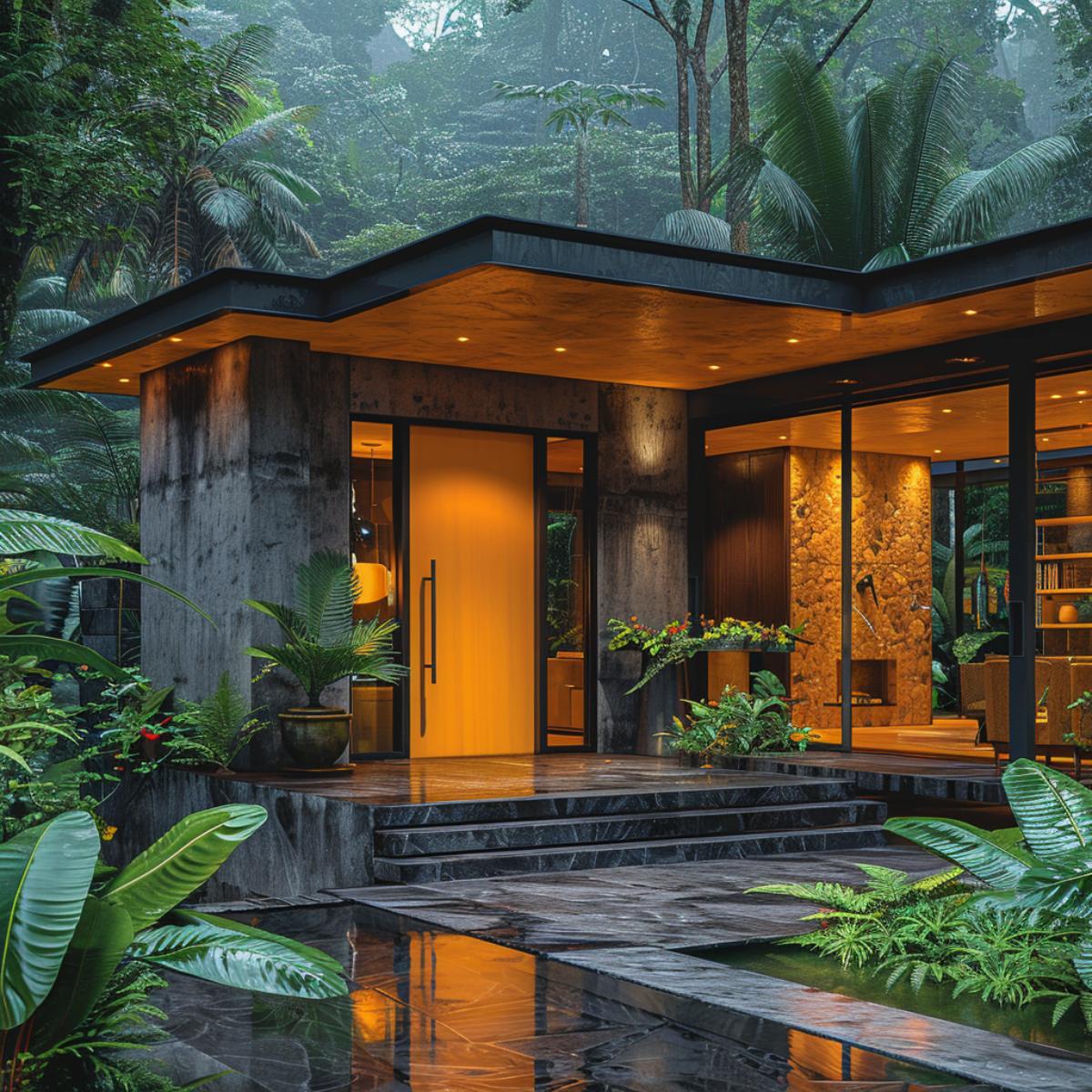
Darkened board-formed concrete anchors the entry while a flat yellow door pulls every eye straight to center.
Why the Wet Stone Path Matters More Than It Looks
Polished dark granite pavers extend from the base steps outward, and rain has left them reflective enough to mirror the door’s amber glow. That reflection doubles the visual weight of the yellow without adding a single additional fixture. Designers working with moody jungle sites often rely on this ground-plane bounce effect to carry warm color into spaces where canopy shade would otherwise swallow it entirely.
28. Natural Stone Pillars, Floor-to-Ceiling Glass, Honey-Toned Pivot Door: Mountain Dusk Delivered
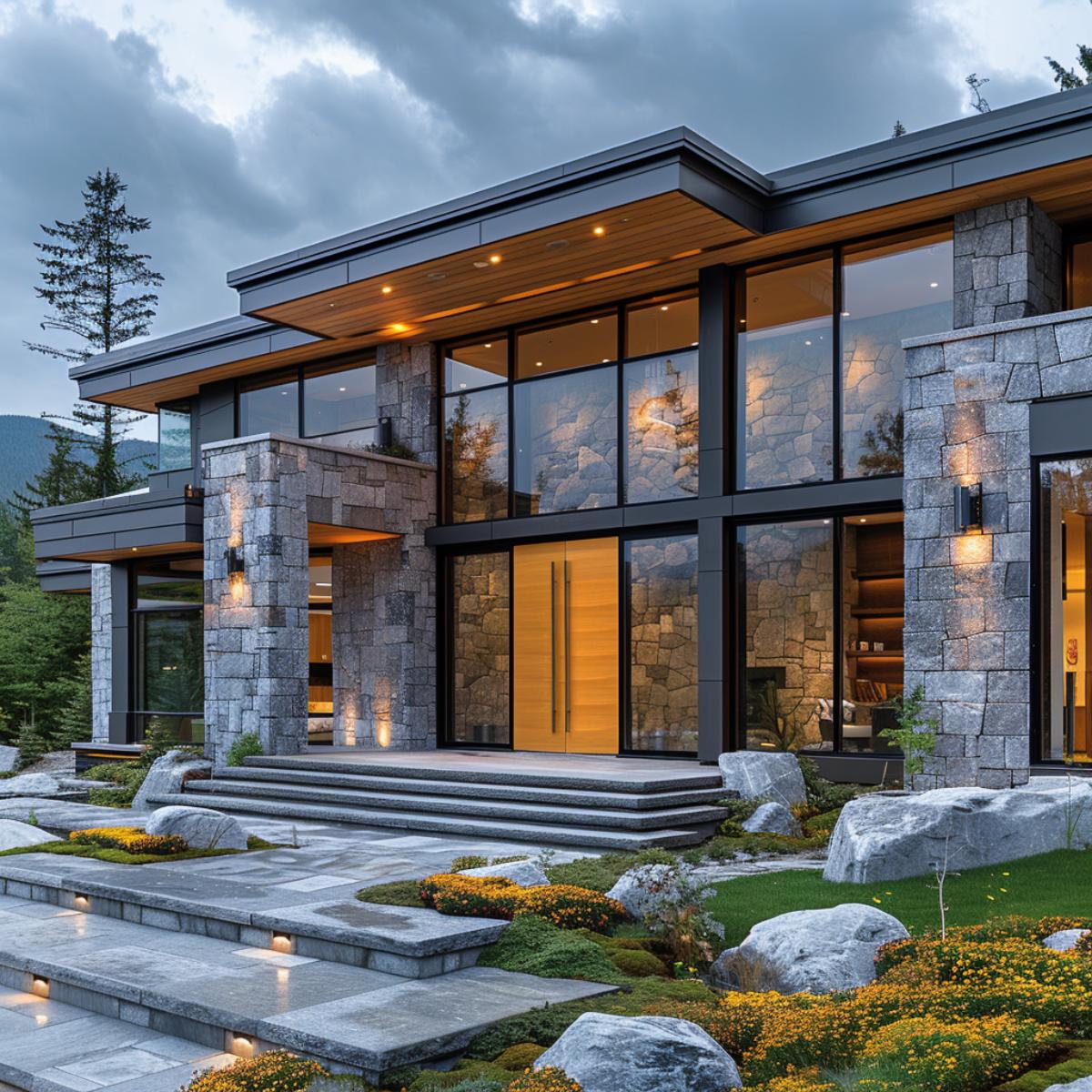
Granite does the heavy lifting here, and the door just closes the deal.
Rough-cut granite columns anchor both sides of the entry, their irregular grey and silver tones pulling directly from the mountain range visible behind the property. The pivot door runs tall in honey-toned wood, its vertical grain catching the warm recessed lighting overhead in a way that reads almost backlit at dusk. Black aluminum window frames grid the facade in sharp horizontal and vertical lines, keeping the natural stone from softening into something rustic. Landscape boulders left raw along the approach echo the cladding without repeating it exactly, and low yellow flowering ground cover adds color at grade level without competing with the door. Designers often note that pairing a warm wood-toned entry with grey stone creates a visual anchor point that draws the eye center before the viewer registers anything else about the facade.
27. Honey Pivot Door, Desert Xeriscape, Two-Story Glass Wall: Dusk Has an Opinion
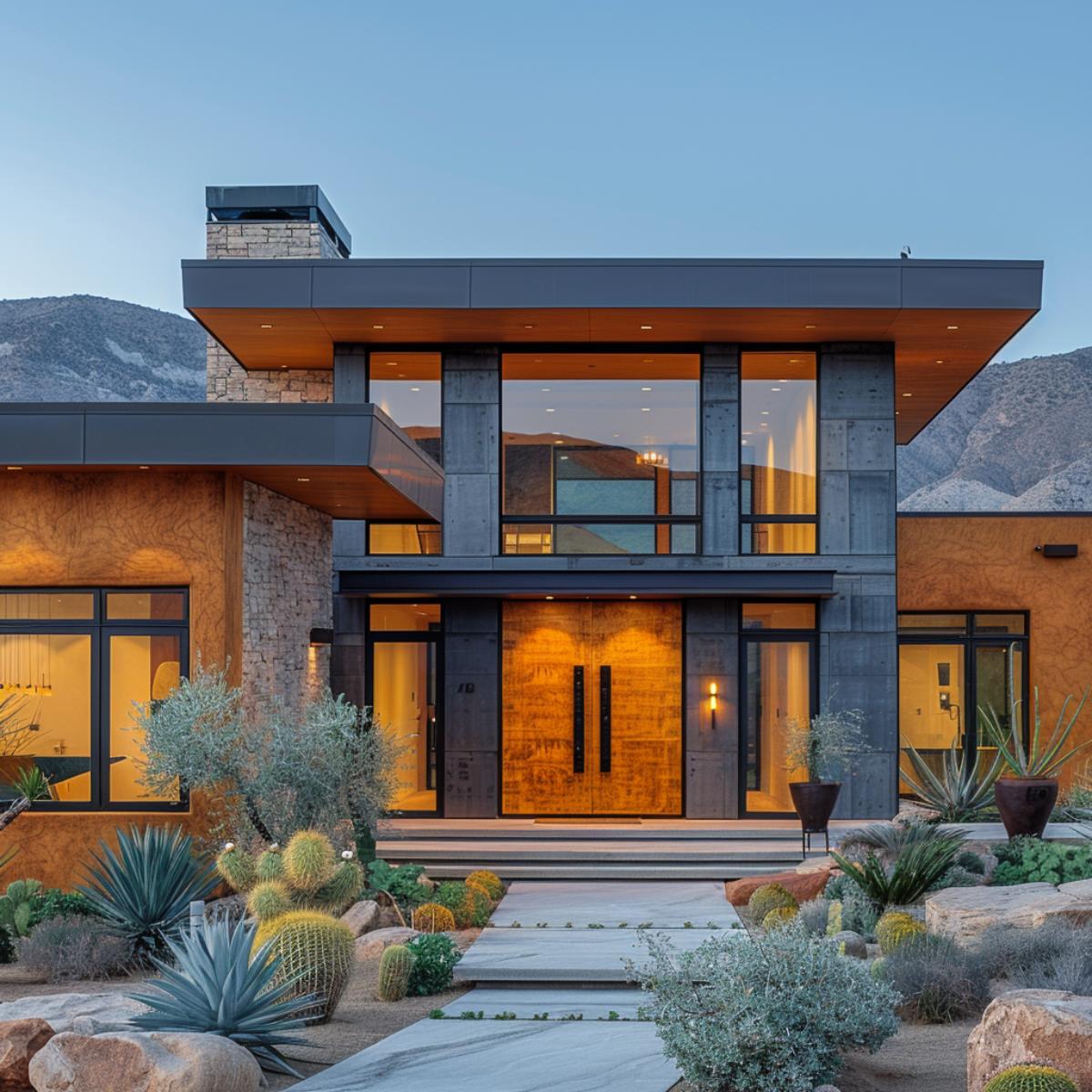
Burlwood panels dominate the double pivot door, their grain catching warm interior light and reading closer to amber than yellow at dusk. Concrete board-form cladding flanks the entry on both sides, its gray tone pulling the composition toward restraint without cooling it entirely. Above, a cantilevered flat soffit lined with tongue-and-groove cedar draws the eye upward to a two-story glazed wall framed in black steel.
The xeriscape foreground earns its place. Barrel cacti, blue agave, and silver-leafed shrubs are arranged around boulders and a concrete stepstone path, creating depth without turf. A stone chimney mass anchors the upper left corner, and recessed ceiling fixtures cast tight pools of light that keep the entry glowing after sunset without washing out the door’s natural wood character.
- Board-form concrete paired with burlwood creates a texture contrast that reduces the need for decorative accessories at the entry
- Black steel window framing in a two-story glazed wall reads as a neutral grid, letting warm interior light set the color tone instead
- Desert xeriscape plantings cut irrigation demands significantly compared to traditional lawn entries, a practical advantage in arid climates
26. Oxidized Metal Door, Board-Formed Concrete, Saguaro Entry: Desert Modern Commits to Gold
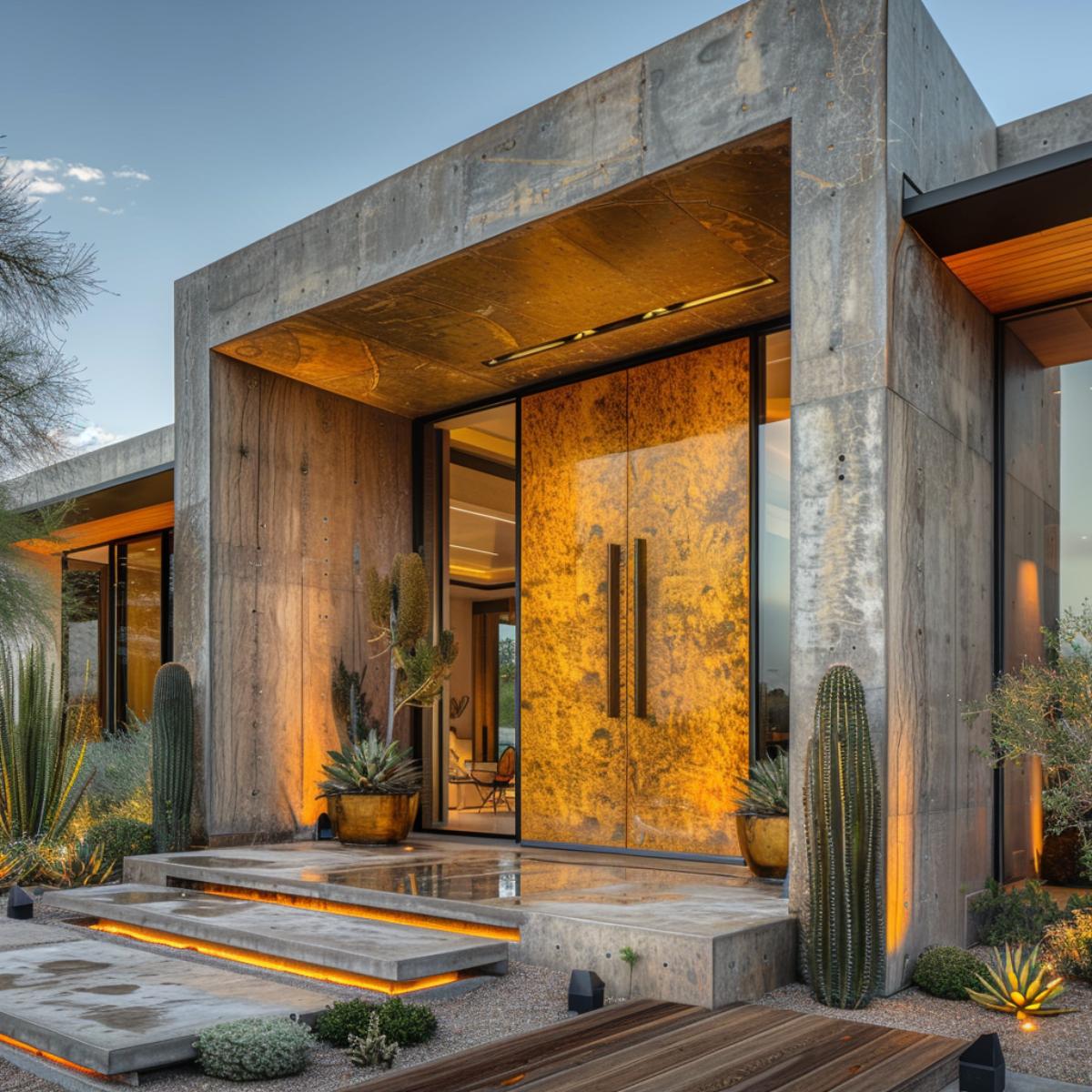
Cor-Ten steel panels clad the pivot door in a patina that shifts from rust-orange at the edges to deep amber at center, lit from above by recessed linear fixtures embedded in the poured concrete soffit. Saguaro cacti flank the entry on decomposed granite, while concrete steps with LED strip underlighting trace the path to the threshold.
Budget Tip: Cor-Ten steel, while premium as a door cladding material, can be replicated on a budget using oxidized metal paint finishes applied over a standard fiberglass door slab. The effect mimics natural rust patina without the structural weight or custom fabrication cost. Many homeowners achieve a near-identical warm amber result for under $400 in materials.
25. Curved Yellow Canopy, Wood Soffit, Glass Walls: Where Geometry Does the Talking
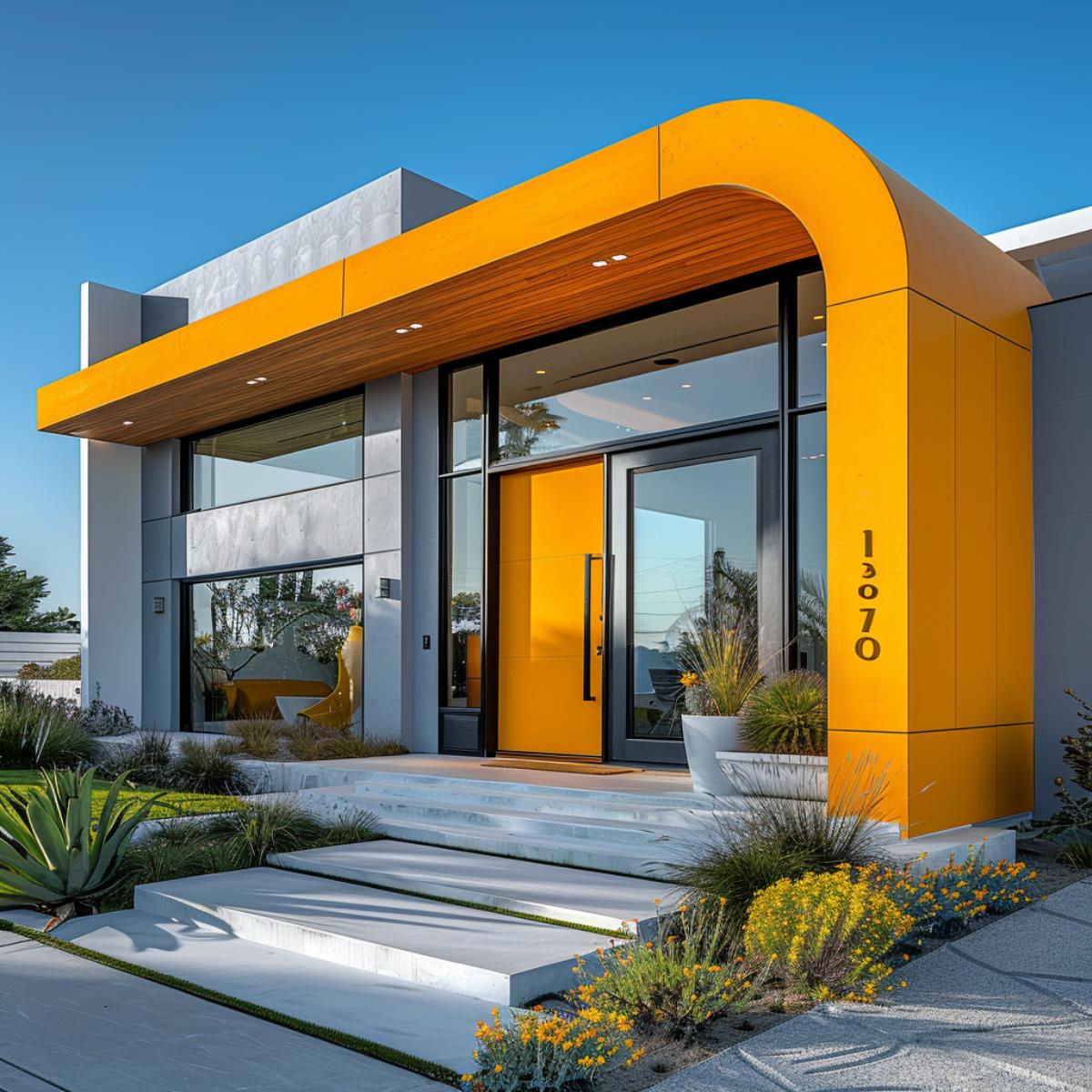
An arched canopy clad in saturated amber-yellow wraps the entire entry portal, its rounded corners breaking from the flat planes of the white concrete facade behind it. The underside shifts to horizontal wood slat panels, likely teak or iroko, with recessed downlights set flush into the grain. Below, a matching yellow pivot door carries a vertical matte-black pull bar anchored to a slim black steel frame flanked by full-height glass sidelights.
Wide concrete steps in a pale gray aggregate finish lead up from a xeriscape bed planted with agave, ornamental grasses, and low yellow flowering ground cover that echoes the canopy color intentionally. The house number, rendered in bold block numerals directly on the yellow cladding, skips the separate sign entirely. Inside the glass, a sculptural yellow chair is just visible, suggesting the color choice was never limited to the exterior alone.
The house number rendered directly on the yellow cladding skips the separate sign entirely, collapsing wayfinding and design into one surface.
24. Solar Yellow Door, Board-and-Batten Navy Cladding, Cedar Soffit: Coastal Modern Commits
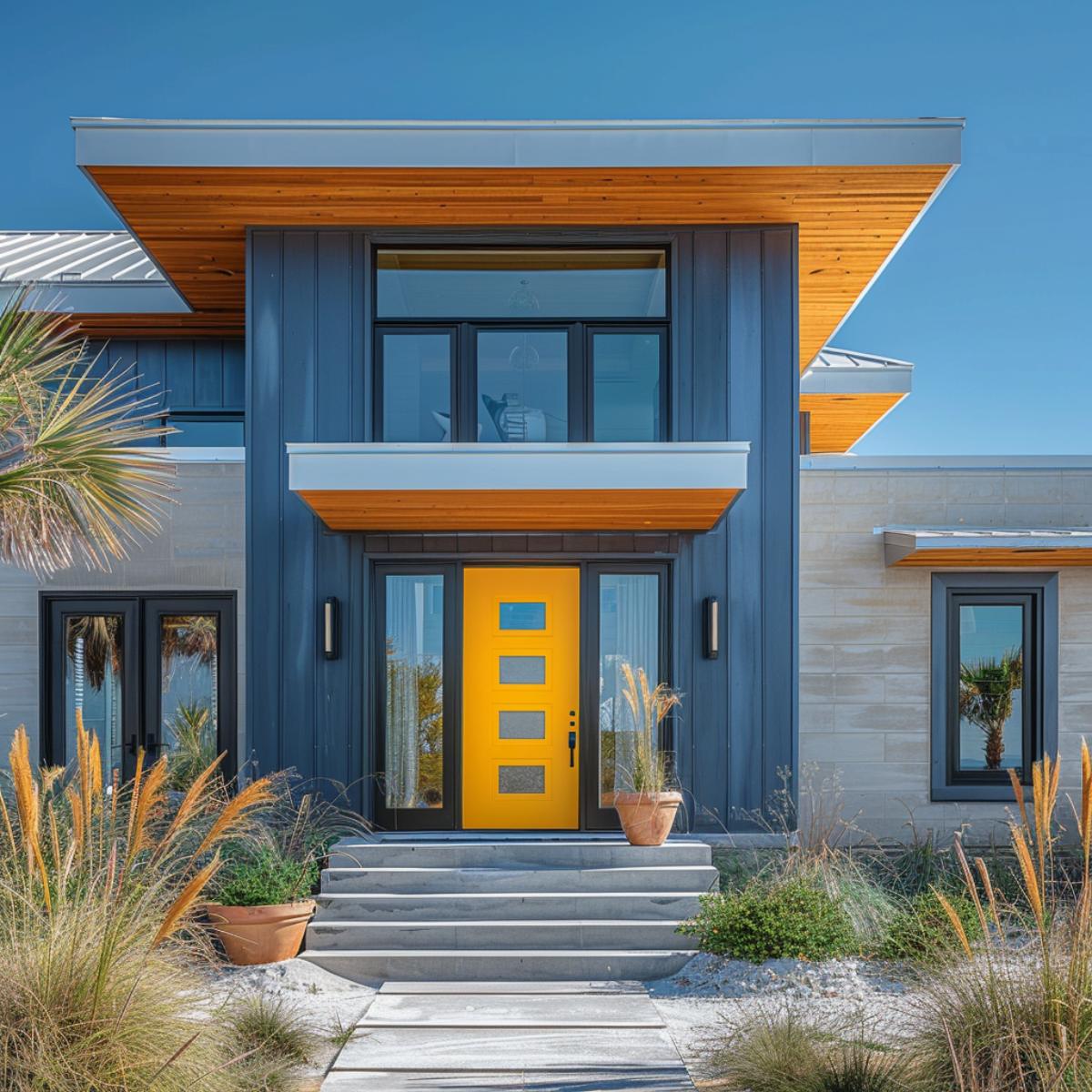
Cedar tongue-and-groove soffits run horizontally beneath two cantilevered overhangs, their warm grain pulling against vertical board-and-batten panels finished in slate navy. The yellow door anchors the entry with three inset glass lites stacked in a column, framed by narrow sidelights and wall-mounted black cylinder sconces.
Limestone or cast-concrete cladding wraps the right wing, shifting the palette without competing. Ornamental grasses and terracotta pots keep the planting informal, which lets the architecture carry the formality. The gray stepped entry platform and wood-plank path read as deliberate ground-level geometry.
Quick Fix: Pairing a bold door color with board-and-batten siding works best when the siding runs vertical and the door hardware runs dark, as it does here with the matte black lockset. That hardware choice quietly unifies the window frames, sconces, and door cladding into a single finish thread across the facade. Designers sometimes call this a finish anchor, one recurring tone that prevents a multi-material exterior from reading as accidental.
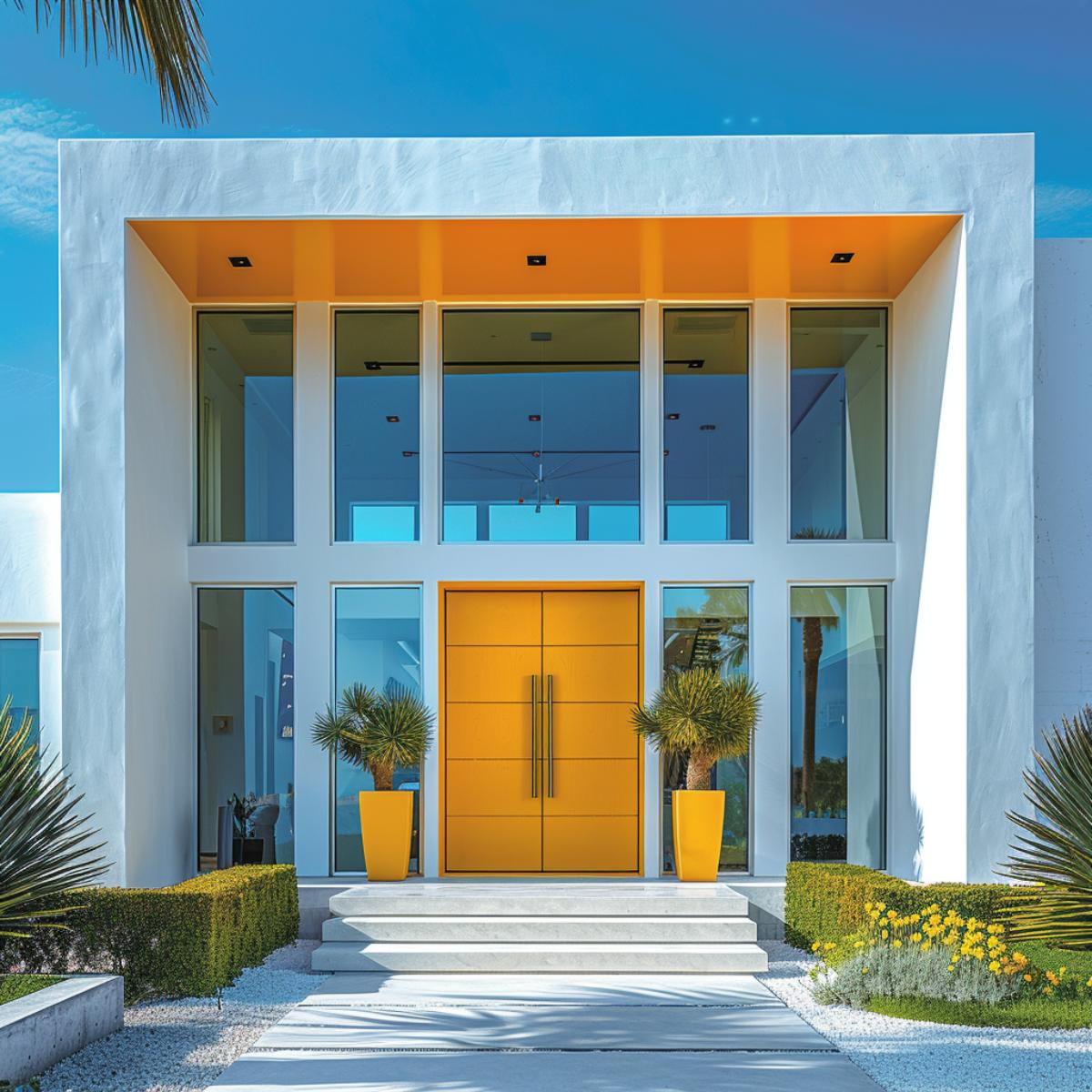
23. White Stucco Shell, Orange Soffit, Double Yellow Door: Palm Springs Knows What It’s Doing
🔥 Would you like to save this?
Two matching yellow planters anchoring either side of a double-panel door is either a risk or a rule. Here, it reads as the latter. The door’s matte amber finish repeats in the recessed soffit ceiling above, pulling the color from the ground plane up into the architecture itself, so nothing reads as accidental.
Floor-to-ceiling glass flanks the entry on three sides, and a sculptural ceiling fan with spoke arms is visible through the glazing. Trimmed boxwood hedges meet white gravel ground cover at the base of three concrete steps. The palette is essentially three notes: white stucco, amber, and glass.
Designer’s Secret: Yellow used on both a door and a soffit ceiling creates what designers call color echoing, where a hue appears in two different planes to give it architectural weight rather than decorative novelty. This technique is especially effective when the connecting material, here white stucco, is completely neutral. The result reads as intentional rather than coincidental, which is the difference between a color choice and a color decision.
22. Dark Concrete Box, Glowing Amber Entry, Reflective Stone Path: Yellow Holds the Room
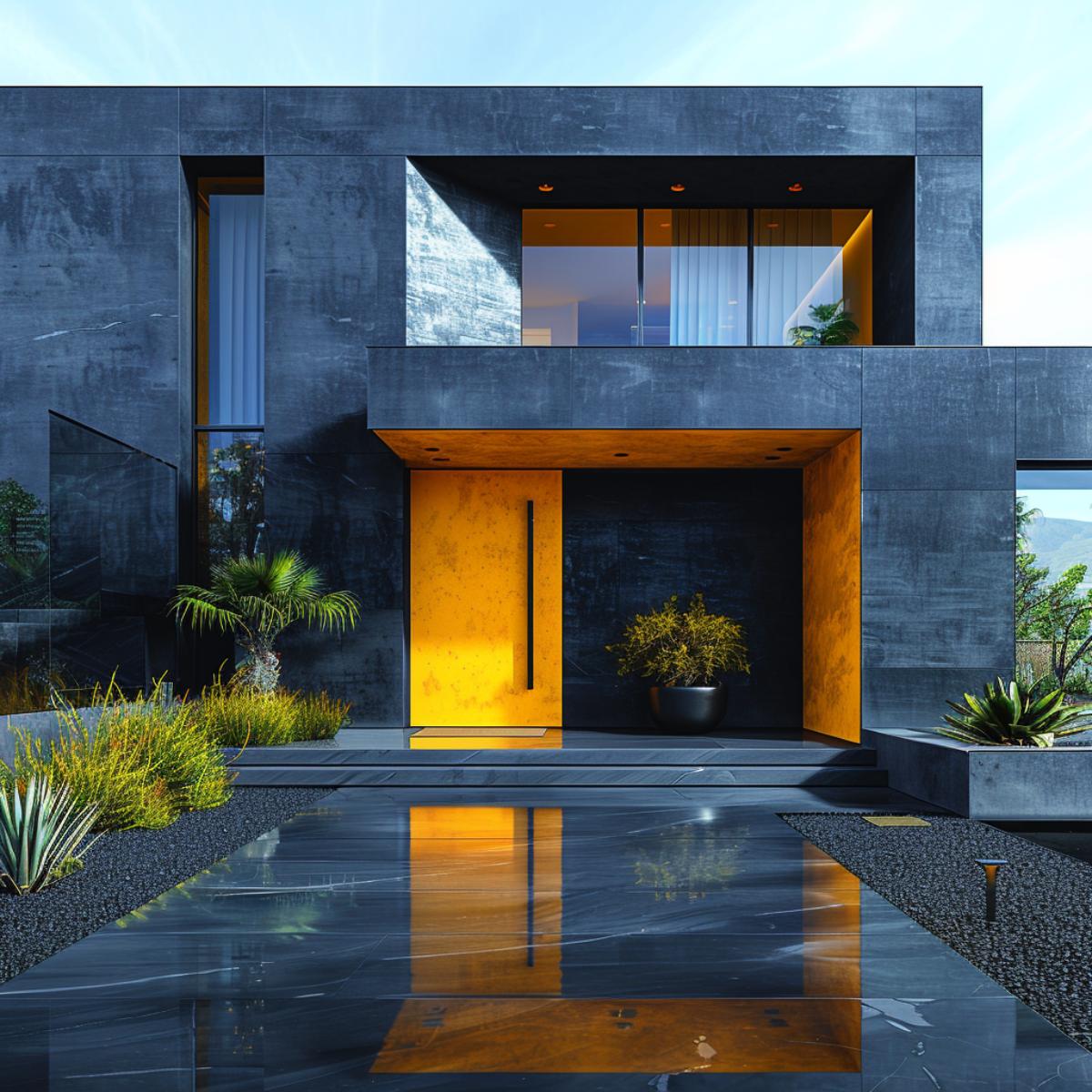
Black board-formed concrete panels cover the entire facade, and the recessed entry pocket cuts deep enough to cast its own shadow at dusk. Inside that recess, an amber-lacquered pivot door glows against a matching orange soffit ceiling, both lit from recessed ceiling cans that push the color outward onto the polished dark stone path below. The reflection in that path doubles the effect without adding a single fixture. Desert xeriscape plantings, including low agave and ornamental grasses, frame the entry without softening the architecture’s hard geometry.
- Recessed entry pockets amplify door color by concentrating light in a contained shadow box rather than dispersing it across an open facade
- Dark stone pavers with a high-polish finish act as a ground-level mirror, multiplying the effect of any warm-toned entry light source
- Limiting warm tones strictly to the door and soffit plane keeps the rest of the facade reading as intentional restraint rather than unfinished contrast
21. Charcoal Townhouse Gut, Floor-to-Ceiling Glass Curtain Wall, Yellow Pivot Door: Urban Infill Picks a Side
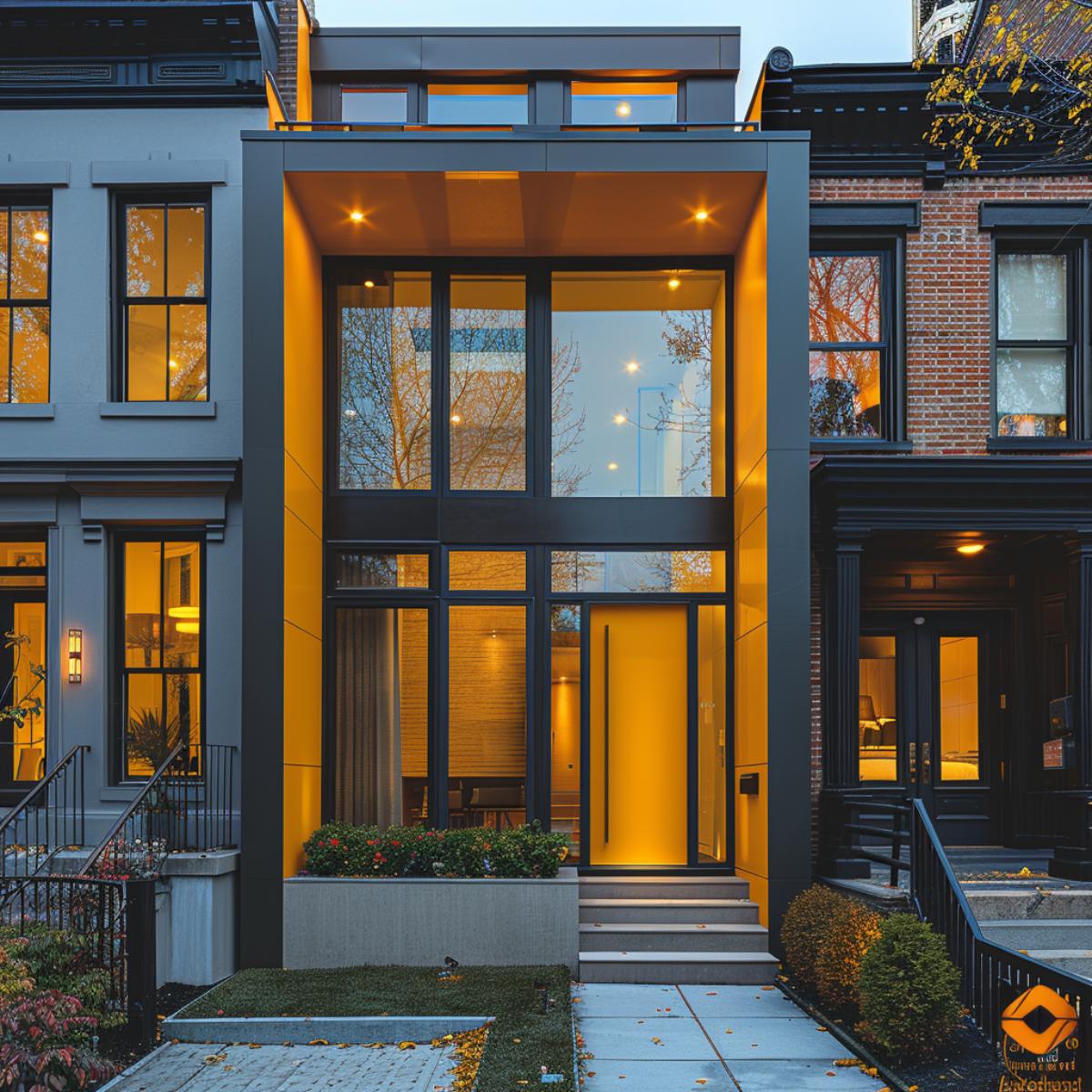
Sandwiched between a limestone rowhouse and a brick Victorian, this modern infill makes no attempt to blend in. Dark gray composite panels wrap the facade in a matte finish that reads almost anthracite at dusk. Floor-to-ceiling glass runs the full height of the entry bay, divided by black aluminum mullions into a grid that gives the glazing structure without weight.
The yellow pivot door anchors the ground level with a flat, saturated panel that glows from inside the glass enclosure. Recessed ceiling fixtures in the canopy overhead wash the entry ceiling in warm amber, reinforcing the door’s tone without a second source. Low concrete planters hold clipped evergreen shrubs, keeping the foreground clean. The rooftop addition, set back slightly, adds a third floor without crowding the street facade.
Style Tip: Infill architecture, where a new build replaces a single lot between existing structures, presents one of the strongest cases for a bold door color. When neighboring facades are brick or stone and carry strong texture, a flat chromatic panel like this yellow pivot reads as deliberate contrast rather than visual noise. Designers working on infill projects often choose one saturated element to signal the new build’s identity without competing across the entire facade.
20. White Stucco, Textured Facade, Saffron Door: Desert Modern Picks Its Moment
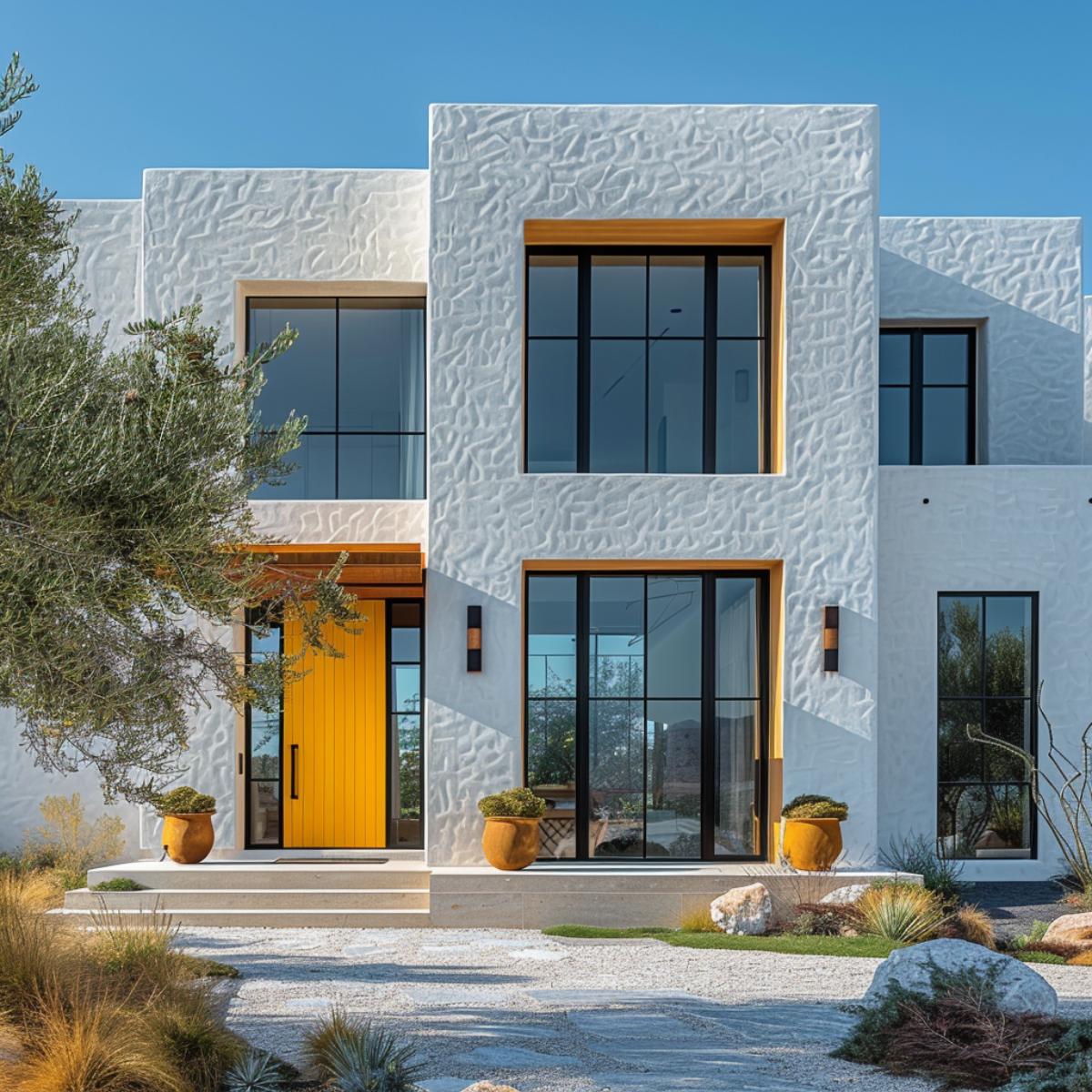
Rough stucco cladding in bright white covers the two-story facade, its hammered texture catching direct sunlight in a way that flat paint never could. The saffron vertical-plank door sits under a warm wood soffit, flanked by matte black wall sconces and framed by black-mullioned glass panels on either side. Terracotta urns planted with low shrubs anchor the entry platform.
The upper floor repeats the black-framed window detail at a larger scale, which keeps the proportions from feeling top-heavy. Gravel, boulders, and ornamental grasses replace conventional lawn, a move that suits the arid setting without requiring a single word of explanation.
Common Mistake: Matching your door color to decorative pots or planters, as done here with the saffron door and terracotta urns, is a technique that works only when the tones are close but not identical. Choosing pots in the exact same hue as the door flattens the entry visually, removing the subtle tension that makes the pairing interesting. A slight shift in warmth or saturation between the two elements is what gives the composition depth.
19. Dark Marble Cladding, Snow-Peak Views, Amber Pivot Door: The Entry Has Conviction
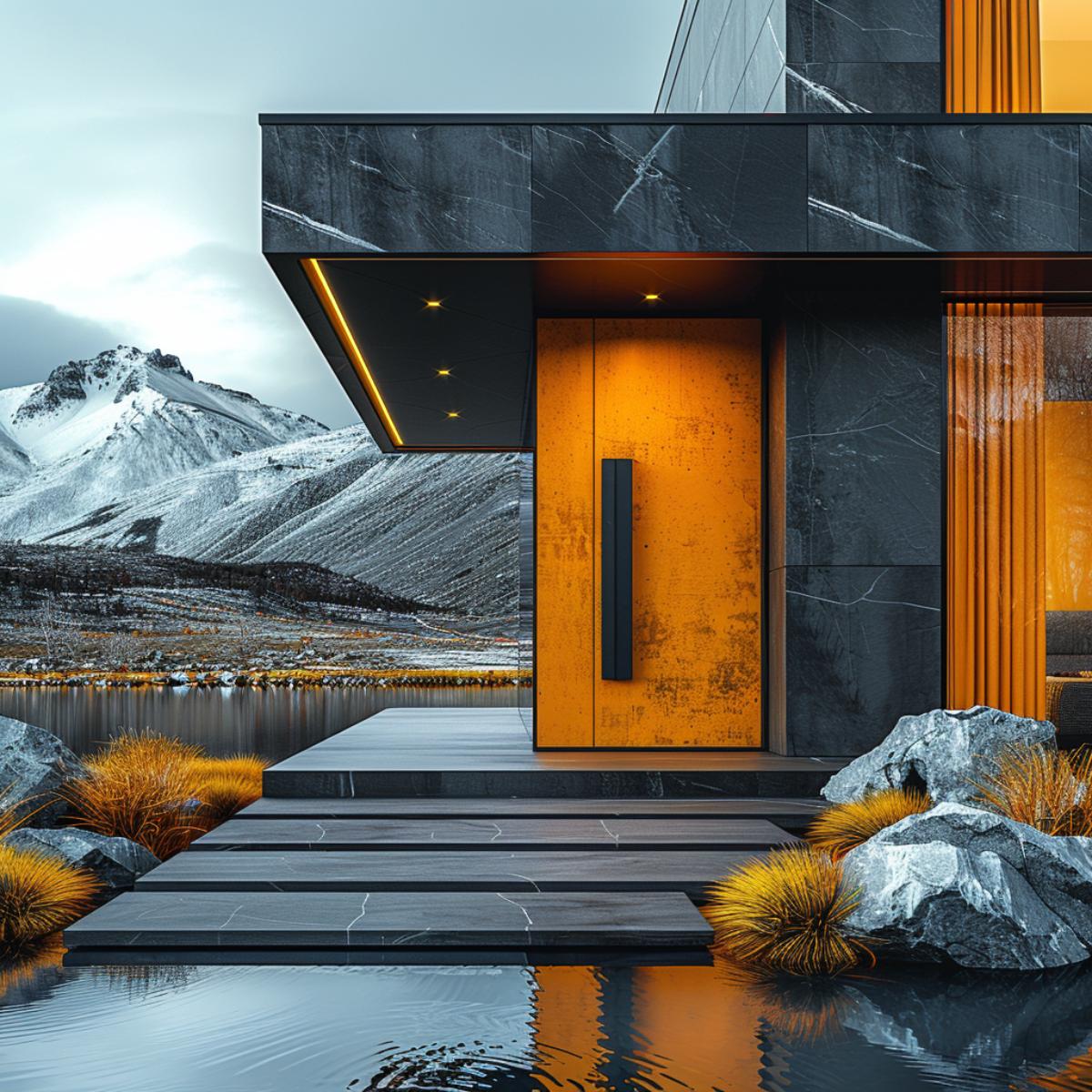
Nero Marquina-style marble panels wrap the facade in deep charcoal veining, setting a tone that the amber-patinated pivot door refuses to soften. The door’s surface reads like aged brass or oxidized copper, its texture uneven in a way that suggests material history rather than factory finish. A slim vertical pull bar in matte black anchors the center. Recessed ceiling spots cast warm light across the entry deck’s slate-toned steps, where gold ornamental grasses and raw boulders replace conventional shrubs entirely.
Editor’s Note: Textured door finishes like patinated metal or oxidized copper work harder than flat paint in cold-climate builds because the surface variation catches light differently as the sun angle shifts throughout winter months. Here, the amber door reads almost bronze at midday and deepens toward burnt orange under the recessed entry spots at dusk. Specifying a hand-applied patina finish rather than a printed laminate gives the door surface that depth without requiring a custom metal fabrication budget.
18. Weathered Steel Door, Green Board-Formed Concrete, Saguaro Entry: Gold Earns Its Place
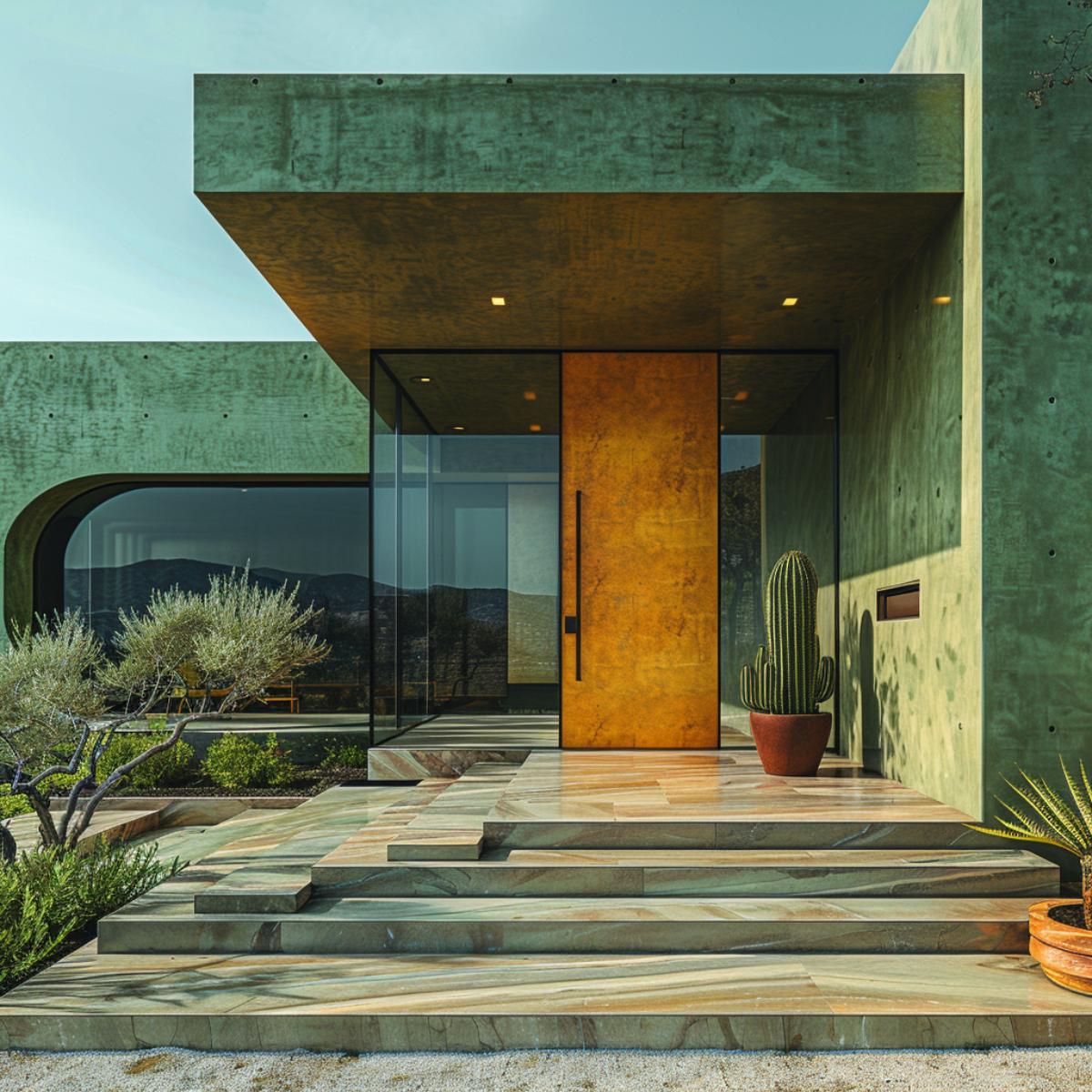
Green-tinted board-formed concrete gives this exterior its desert-modern credibility, the tie-rod holes left visible across every panel as a deliberate structural confession. Against that muted backdrop, the pivot door in oxidized amber steel reads less like a color choice and more like a material argument. Multicolored quartzite paving runs from the street to the covered entry in staggered slab format, the veining pulling warm and cool tones simultaneously.
A saguaro cactus in a terracotta pot anchors the right side of the entry without competing for attention. To the left, a curved aperture cut into the concrete frames a mountain view through floor-to-ceiling glass. The cantilevered concrete overhang above the entry drops recessed ceiling lights that reinforce the amber warmth of the door at dusk.
By The Numbers: Oxidized steel doors develop their patina differently depending on regional humidity, with arid climates like the Sonoran Desert producing slower, more uniform color shifts than coastal environments. In dry zones, the amber-to-rust progression can take three to five years to fully stabilize. Homeowners who want a locked-in finish early can seal the surface with a clear matte penetrating oil, which halts oxidation at whatever stage it has reached.
17. Stone Columns, Amber Soffit Glow, Cedar Cladding: Dusk Renders Its Verdict
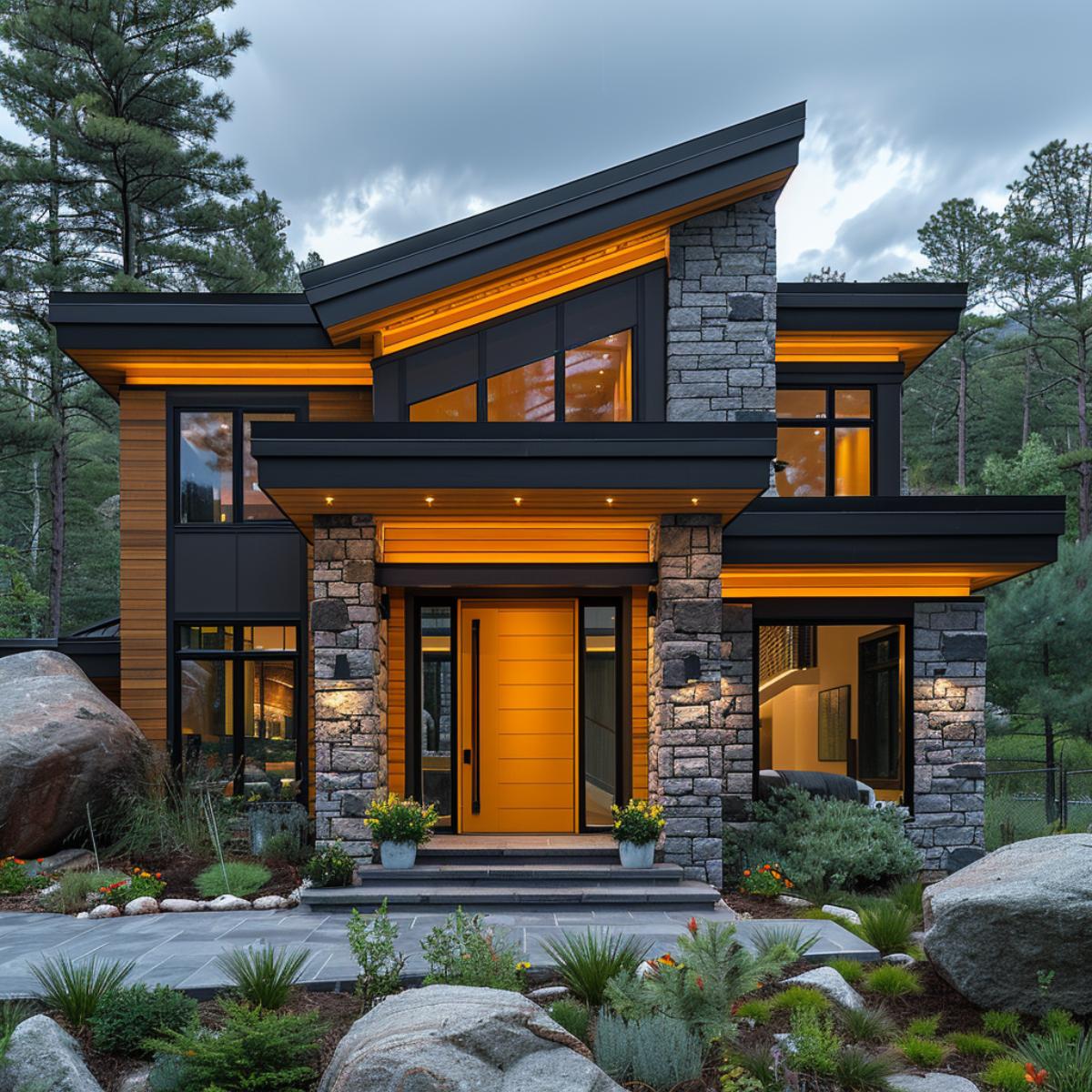
Stacked granite columns anchor each side of the entry, their irregular coursing a direct counterweight to the flat-panel amber door below. The door reads closer to harvest gold than true yellow, and the black vertical pull hardware keeps it from drifting into rustic territory. Recessed canopy downlights wash the soffit ceiling in the same warm register as the door, a move that makes the entrance feel deliberate rather than accidental.
Upper-story clerestory windows set within dark fascia boards pull interior amber light outward, blurring the line between inside and outside at dusk. Cedar horizontal cladding fills the wall planes between stone and glass, its grain visible even at this distance. Boulders integrated into the xeriscape plantings repeat the grey tones of the granite columns, which is how the exterior holds together without feeling overworked.
The door reads closer to harvest gold than true yellow, and the black vertical pull hardware keeps it from drifting into rustic territory.
16. Travertine Walls, Wood Soffit Recessed Lights, Cedar Pivot Door: Stone Does Not Apologize
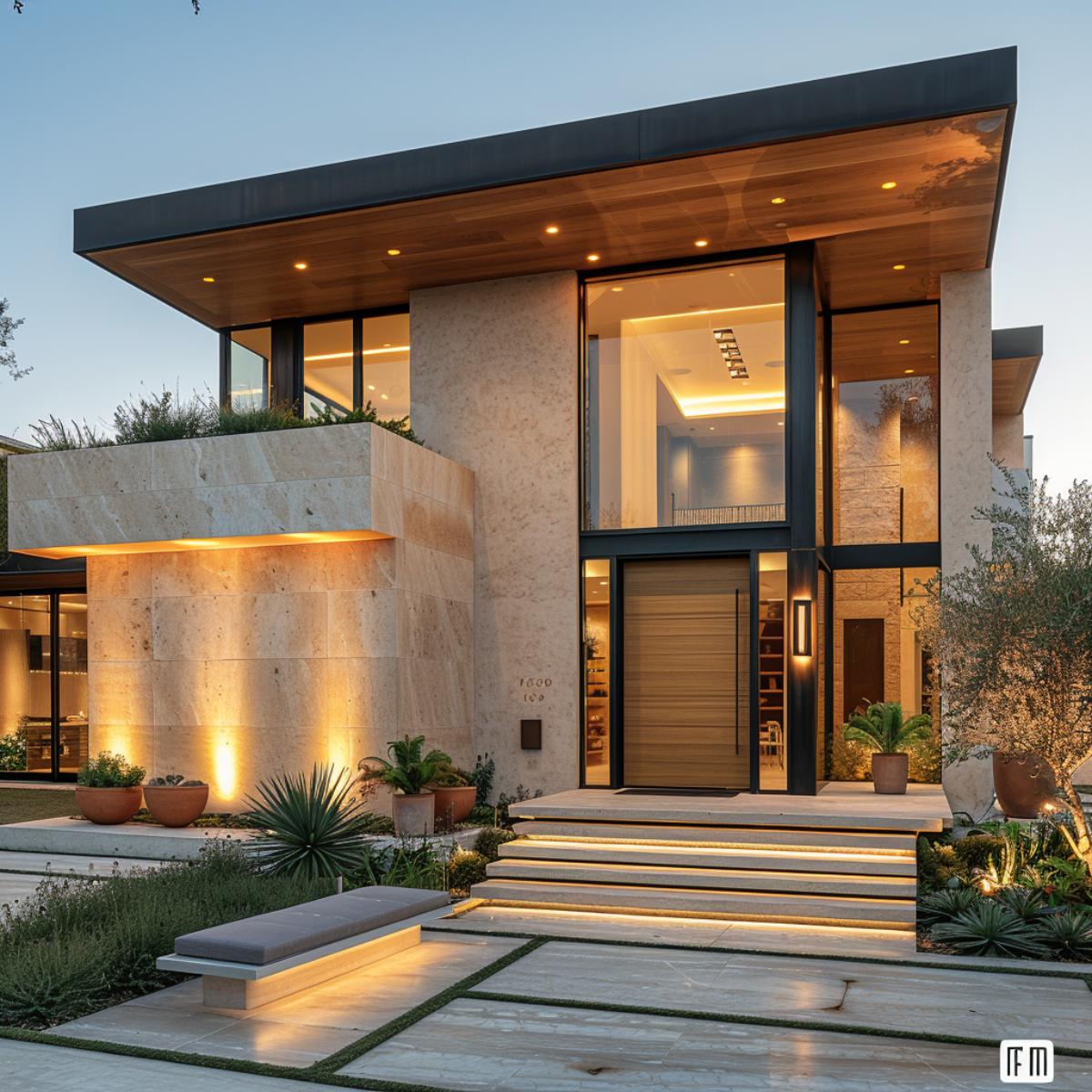
Travertine cladding covers most of the facade here, its beige and cream veining running in large-format panels that read almost monolithic at dusk. The flat roofline extends forward into a generous overhang, its underside finished in warm-toned wood planks with recessed pot lights that wash the entry in amber at dusk. Floor-to-ceiling glass flanks a pivot door finished in horizontal cedar strips, the grain running left to right in a pattern that softens the stone’s weight without competing with it.
LED strip lighting runs beneath each stair tread, casting thin lines of gold across the limestone steps. Terracotta pots anchor the planting beds on both sides, holding agave and low Mediterranean shrubs. A bench seat sits flush with the driveway plane, upholstered in charcoal gray, its geometry matching the dark metal frames on every window.
Color Story: Cedar used as a door finish rather than a wall material shifts its visual role entirely. Against travertine, it reads as an accent rather than a structural element, which is why the door pulls attention without requiring a contrasting paint color. Designers call this material-as-color substitution, and it works particularly well on facades where stone already occupies the dominant visual register.
15. Travertine Block, Glass Balustrade, Wood Pivot Door: Stone Takes the Lead
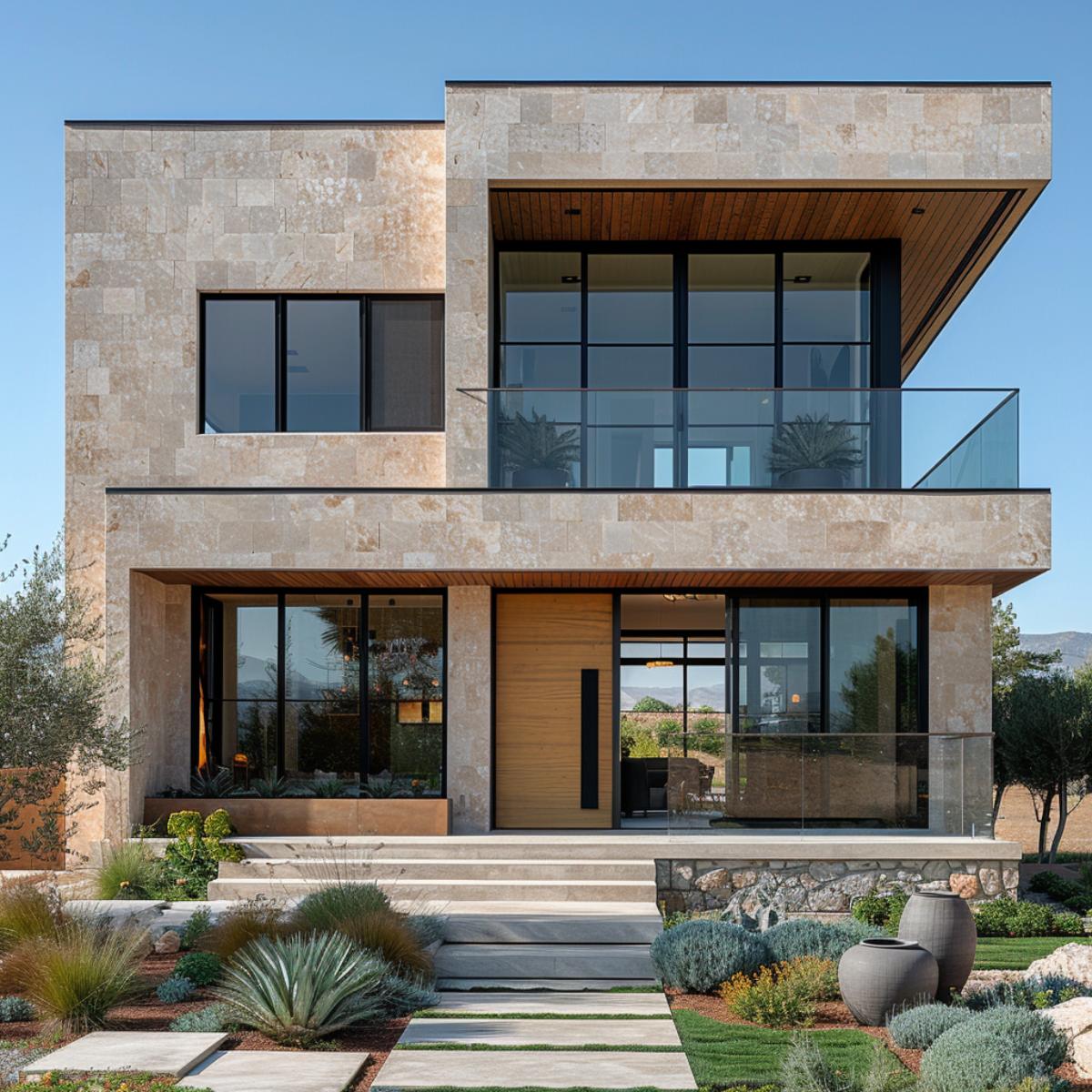
Warm travertine tile cladding wraps both stories of this two-volume facade, its grid pattern interrupted only by black-framed floor-to-ceiling glass. The pivot door, clad in light wood grain, reads almost quietly against the stone, which is precisely the point. Wood soffits on both levels pull the entry and balcony into visual alignment.
14. Graphite Stone Facade, Yellow Double Door, Amber Soffit Ceiling: Entry as Argument
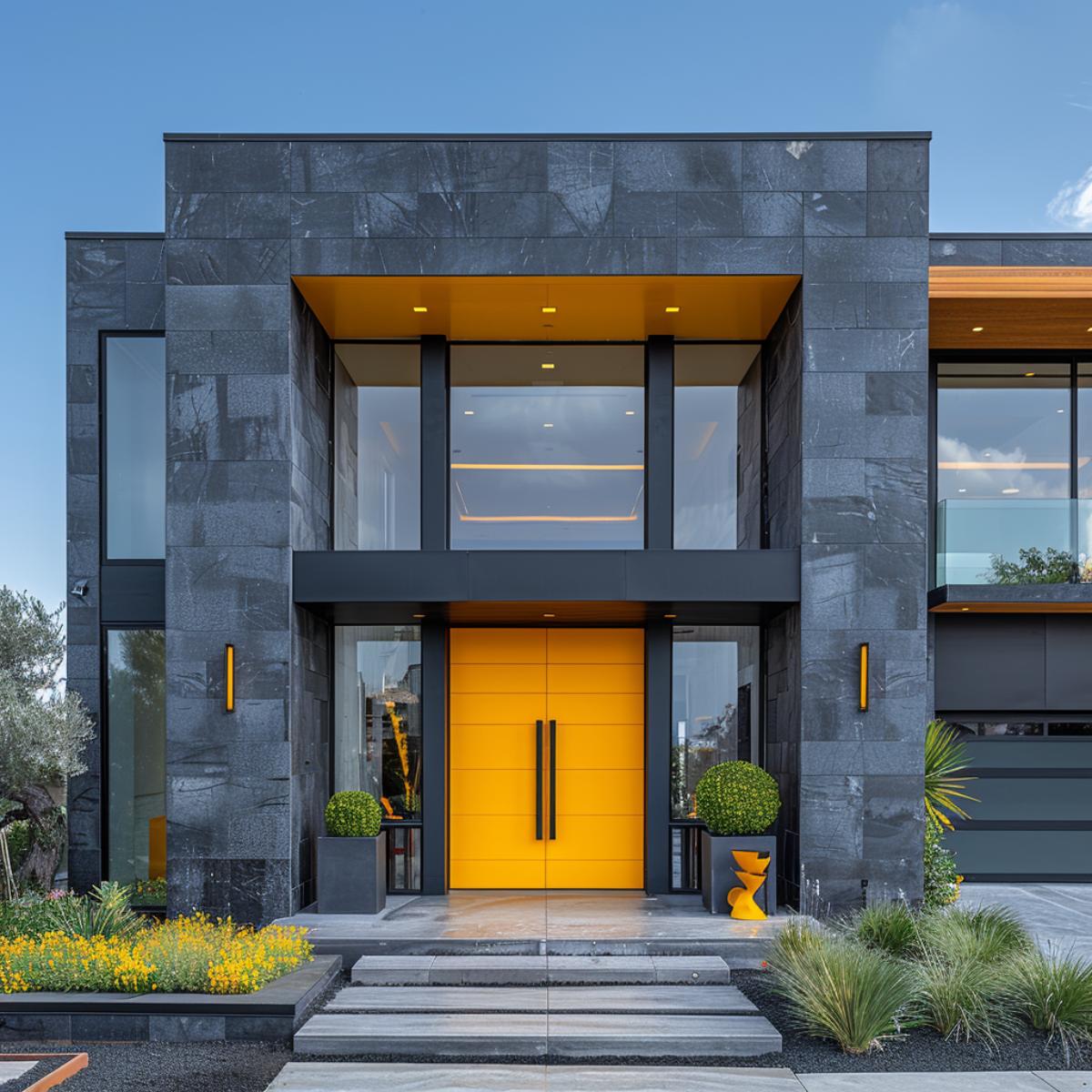
Dark granite cladding covers the entire facade in irregular, large-format panels that absorb light rather than reflect it. Against that surface, the double yellow door reads less like a color choice and more like a structural decision. Black vertical pull bars anchor each panel. Recessed lights in the amber soffit ceiling pick up the door’s hue, creating a layered repetition across two horizontal planes above the entry.
Clipped boxwood spheres in charcoal planters flank the door without softening it. Yellow wildflowers in the foreground beds and a sculptural yellow object near the steps extend the color downward into the hardscape zone, giving the palette a vertical range that most single-accent entries never achieve.
13. Golden Stucco Facade, Steel-Frame Glass Wall, Copper Pivot Door: Desert Modern Commits Fully
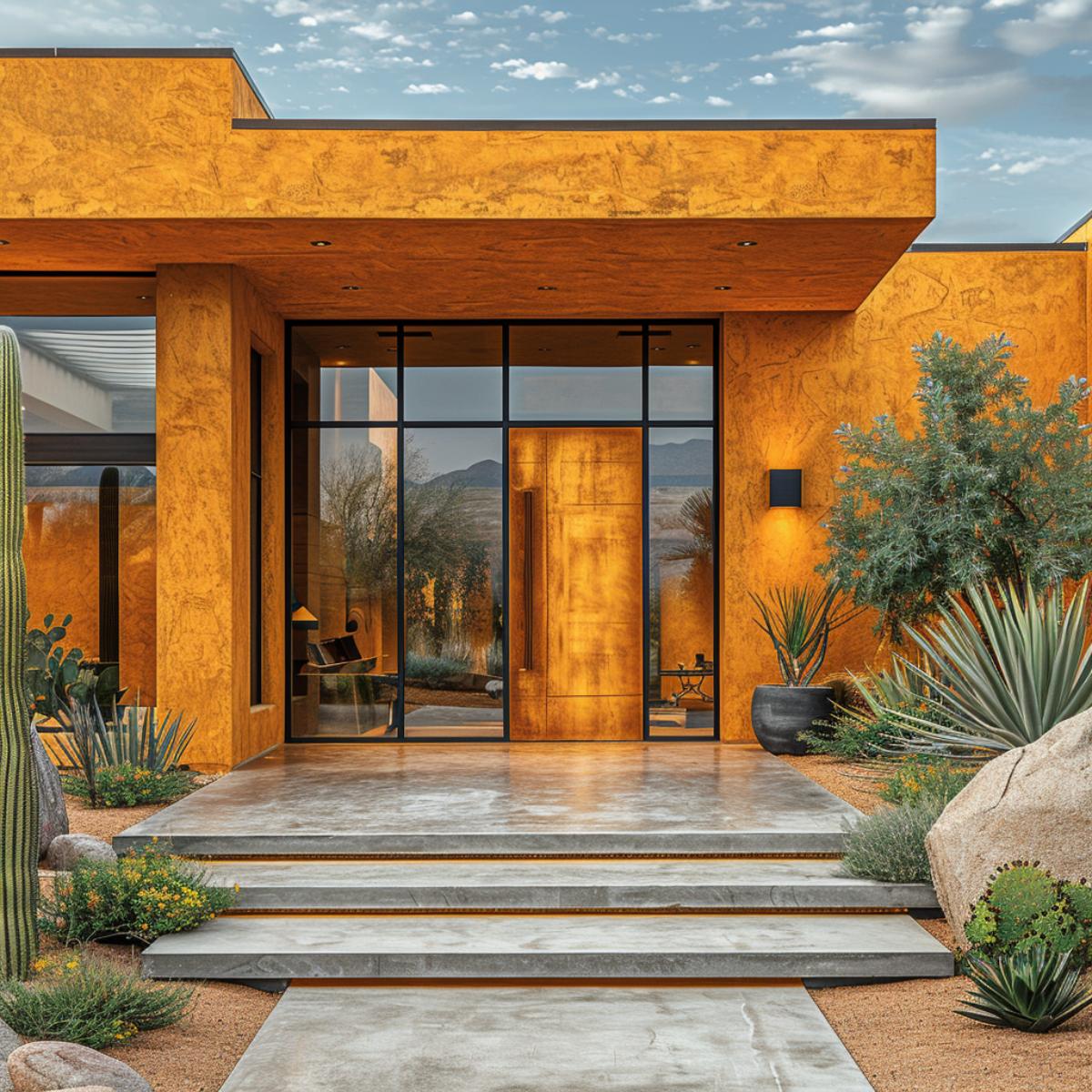
Ochre-toned plaster wraps the entire facade in a single unbroken field of color, making the steel-frame glass curtain wall beside the copper pivot door read as a cut rather than an addition. Concrete steps in honed grey anchor the entry without competing.
12. Buff Stucco, Floor-to-Ceiling Glass, Copper Pivot Door: Desert Modern Holds Its Ground
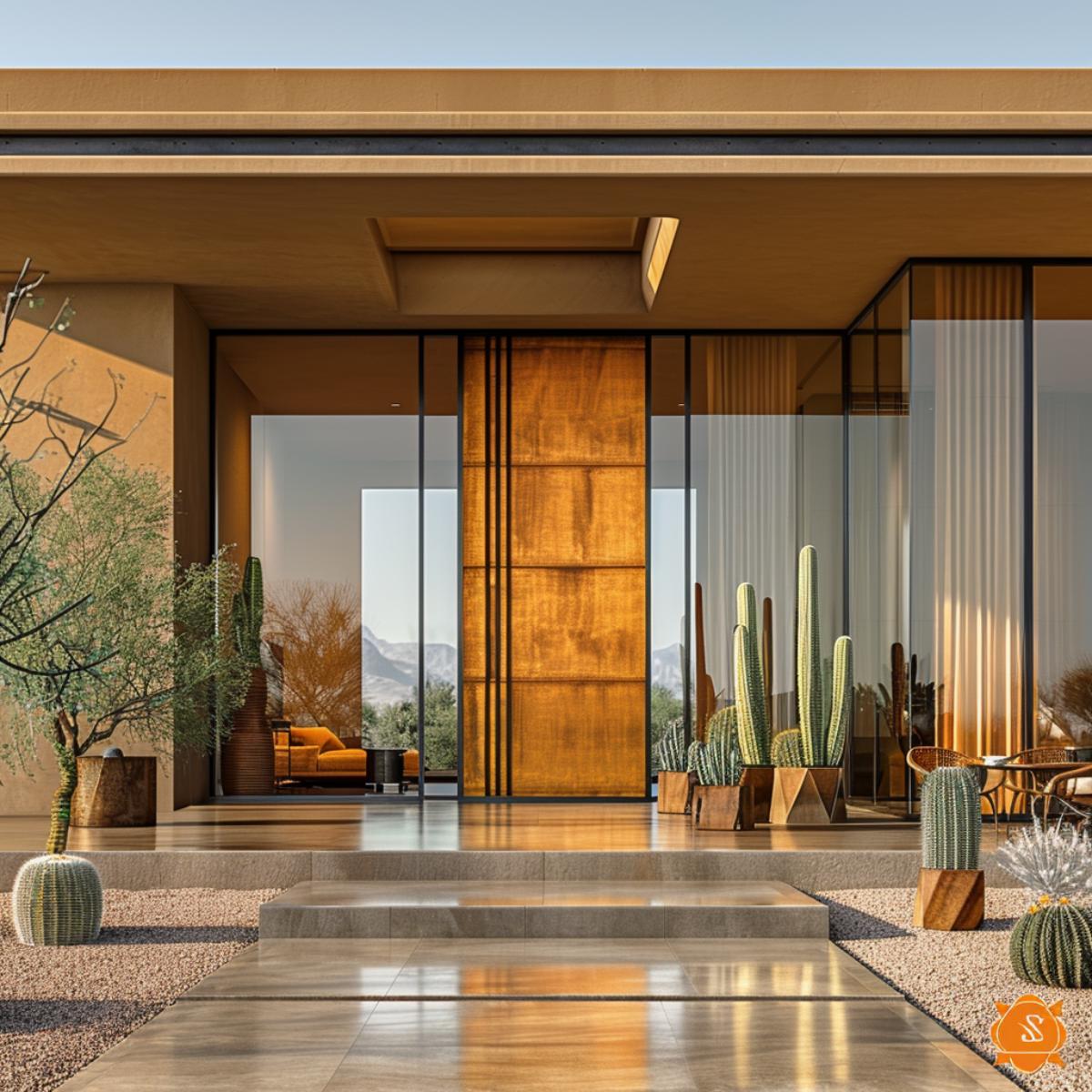
Crushed granite gravel replaces lawn entirely, and barrel cacti sit low against the approach while columnar saguaros rise in geometric planters made from raw-edged wood blocks. The pivot door itself is clad in copper-toned panels with visible vertical seaming, anchored by a thin black steel frame that extends into a full curtain wall on the right. Inside, through the glass, a mustard-upholstered chair reads as a deliberate color echo of the entry door.
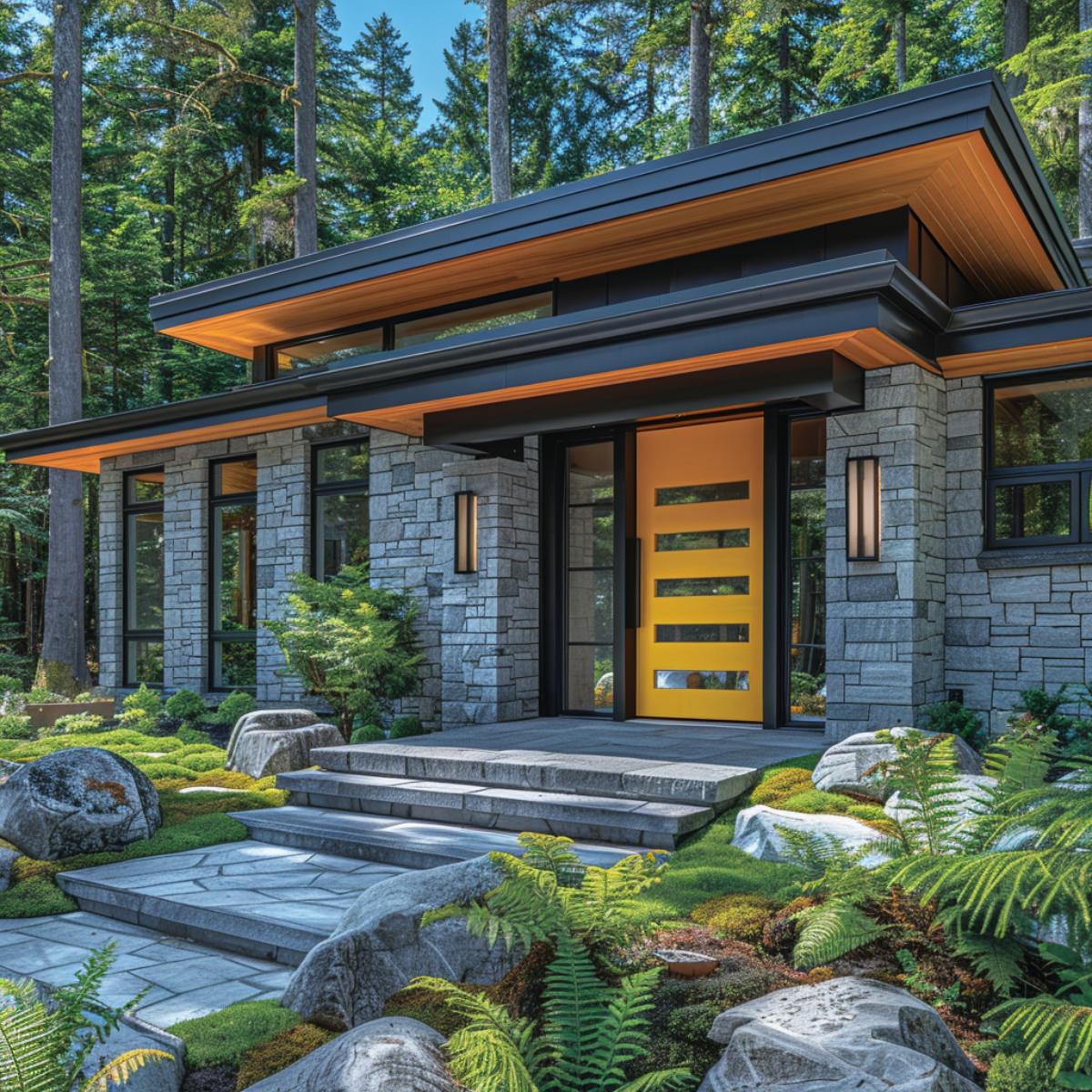
11. Gray Stacked Stone, Cedar Soffit, Yellow Door: Forest Modern Declares Itself
🔥 Would you like to save this?
Gray ledgestone cladding wraps the exterior in tight horizontal courses, giving the facade a texture that reads differently at every hour of the day. Against that cool, flat tone, the wood soffit ceiling — likely cedar, given its reddish-amber grain — adds warmth from above rather than from the sides. The yellow door, finished in what appears to be a flat or satin paint in a school-bus-adjacent amber-gold, carries four horizontal glass lites that interrupt the panel without softening its authority.
The approach does specific work here. Flagstone pavers lead through a composition of boulders, ferns, and low ground cover that has not been manicured into submission. Wall sconces flank the entry in a matte black finish, pulling the black window frames forward as a system. Designers sometimes call this kind of repetition visual threading, where one finish appears across multiple elements to hold the palette together without requiring a single dominant material to carry all the weight.
10. Ledger Stone Facade, Recessed Soffit Lights, Amber Pivot Door: Natural Materials Take Sides
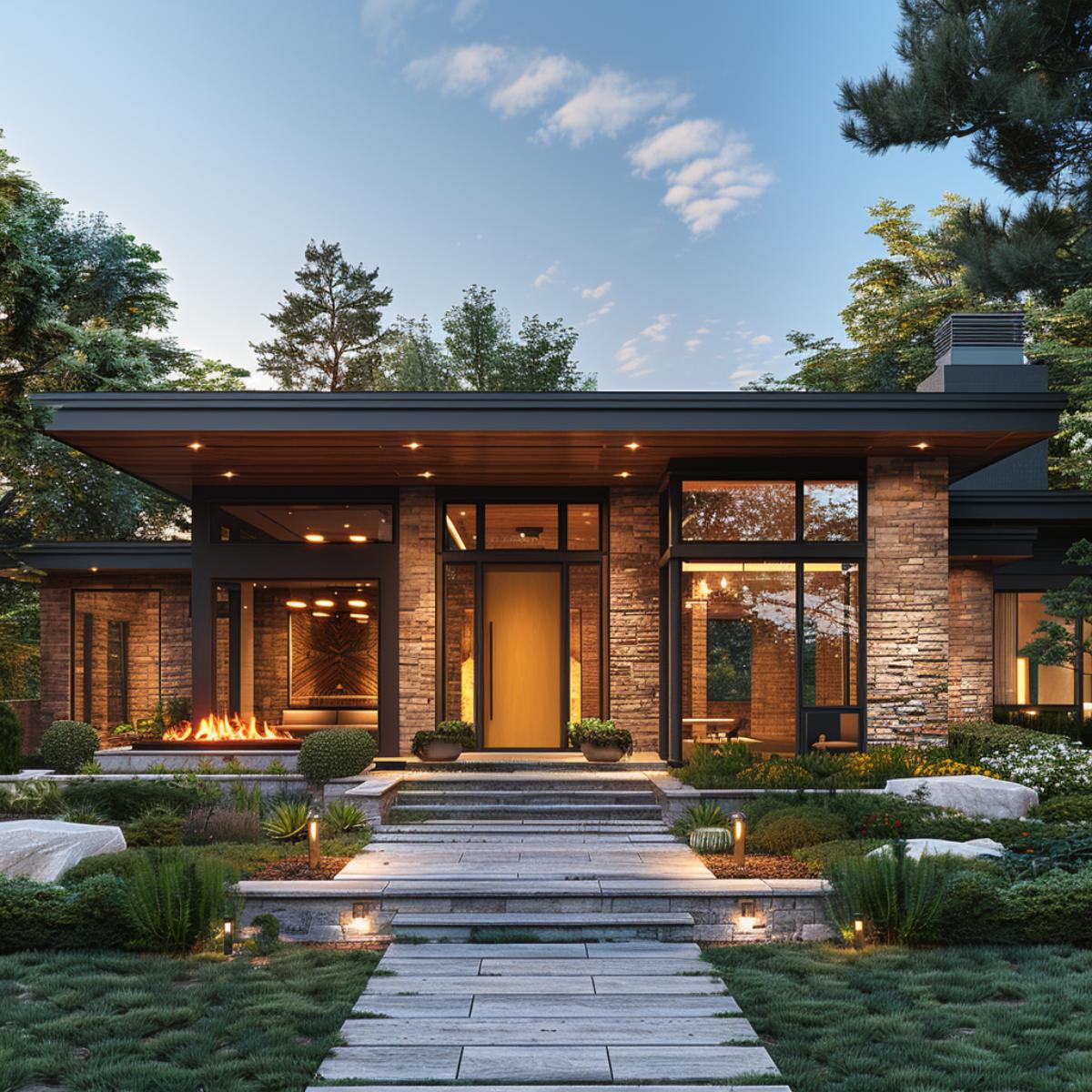
Coursed ledger stone in rust and sand tones wraps the facade while a wide flat roof overhang with recessed pot lights frames the amber pivot door at center. The stone’s horizontal layering pulls the eye left toward an outdoor fireplace set flush into the entry platform, making the approach feel deliberate rather than decorative.
Ledger stone’s horizontal coursing creates a natural directional pull that a smooth facade simply cannot replicate at this scale.
9. Blue Lap Siding, Stone Base, Yellow Craftsman Door: Coastal Modern Picks a Side
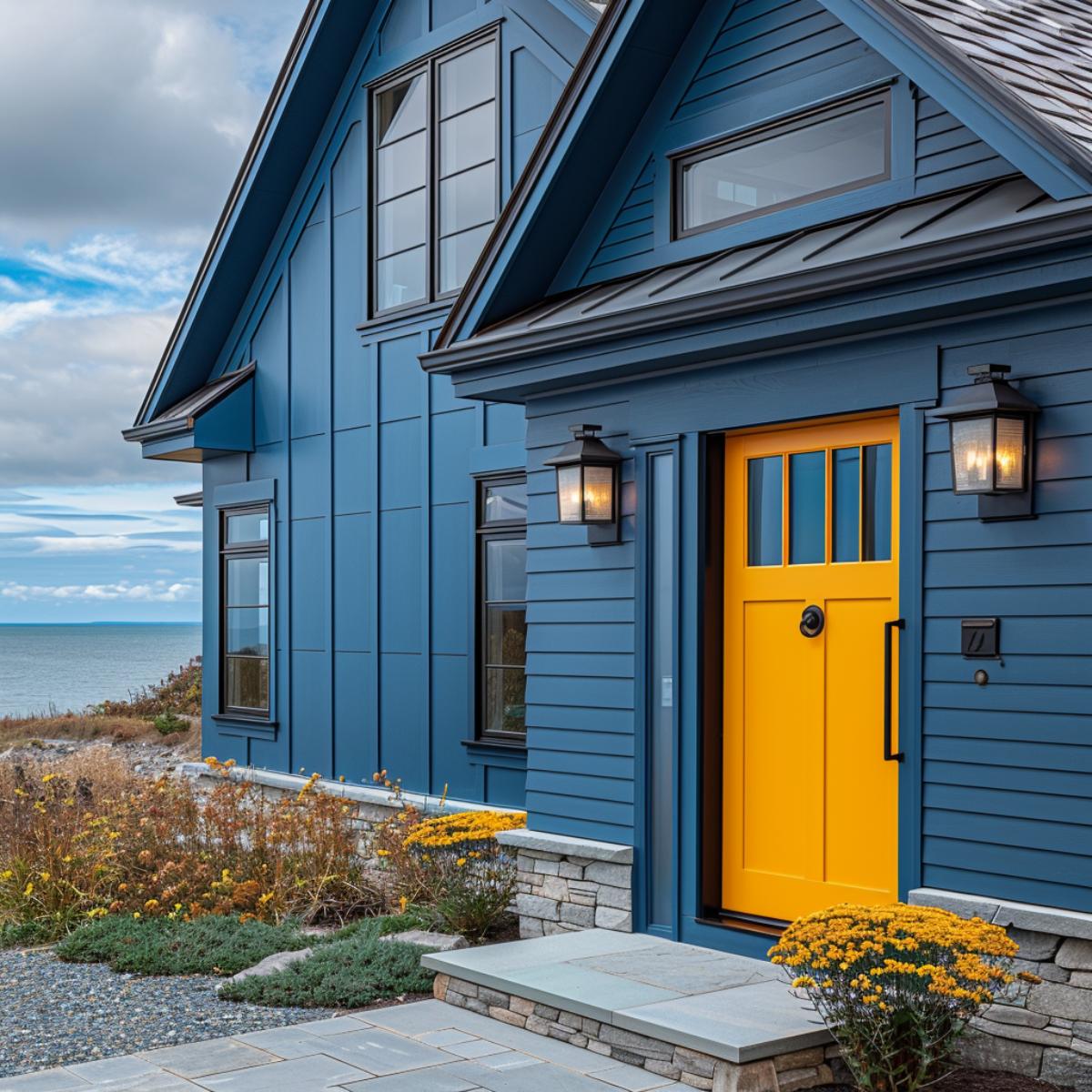
Navy board-and-batten lap siding covers the facade in a flat, matte finish that reads closer to slate blue under overcast coastal light. The entry door is Craftsman-style, painted in a saturated amber-yellow with three transom lites across the upper panel and a round black knob centered on the lower rail. Two oil-rubbed bronze lantern sconces flank the door, their seeded glass panels lit against the grey sky.
The foundation course is dry-stacked fieldstone, and the entry stoop uses large-format bluestone pavers set flush with the ground. Yellow chrysanthemums in the planting beds mirror the door color without any deliberate arrangement. Designers call this unplanned color repetition incidental echo, and it works precisely because it was not forced. The ocean horizon sits low in the background, which means the door reads against water and sky rather than a neighboring structure.
8. White Sculpted Stucco, Arched Glass, Terracotta Urns: The Entry Holds Court
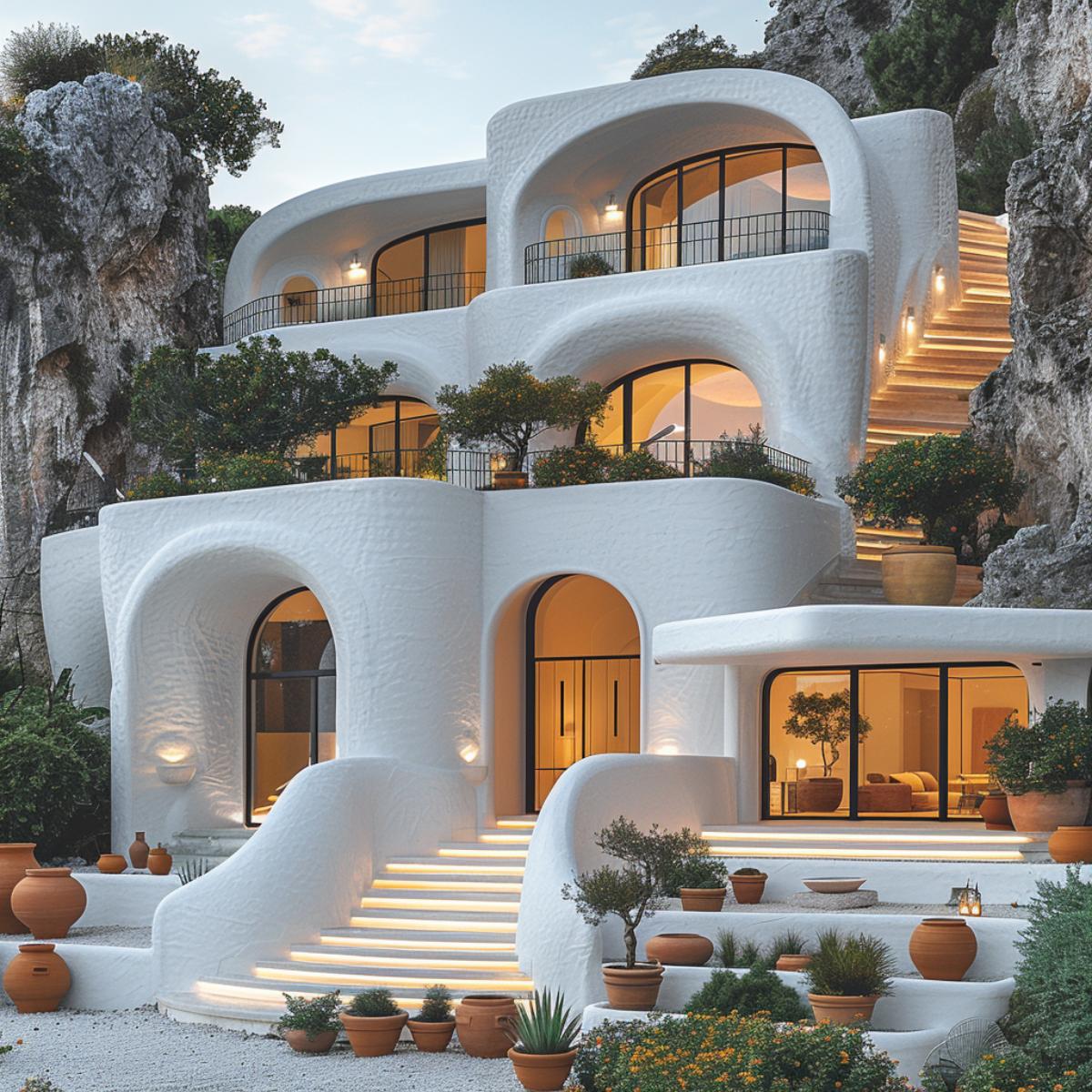
Built into limestone rock faces on both sides, this multi-level structure uses white textured stucco with a hand-applied finish that reads almost like rough plaster under dusk lighting. The arched openings carry black steel frames, and the warm amber glow from inside presses against the glass with enough intensity to make the facade read as lit from within rather than lit from without. LED strip lighting runs beneath each stair tread, casting a horizontal band of gold across the bleached gravel courtyard below.
Terracotta urns of varying heights line the entry platform and lower steps in groupings that feel deliberate rather than decorative. Landscape designers call this anchoring, where oversized vessels establish visual weight at grade level so the eye doesn’t float upward too fast. The exterior staircase on the right side uses what appears to be warm-toned wood treads set against the white stucco wall, adding a material contrast that pulls the vertical circulation into its own visual lane.
7. Whitewashed Stucco, Citrus Urns, Yellow Arch Door: Mediterranean Cliffside Commits
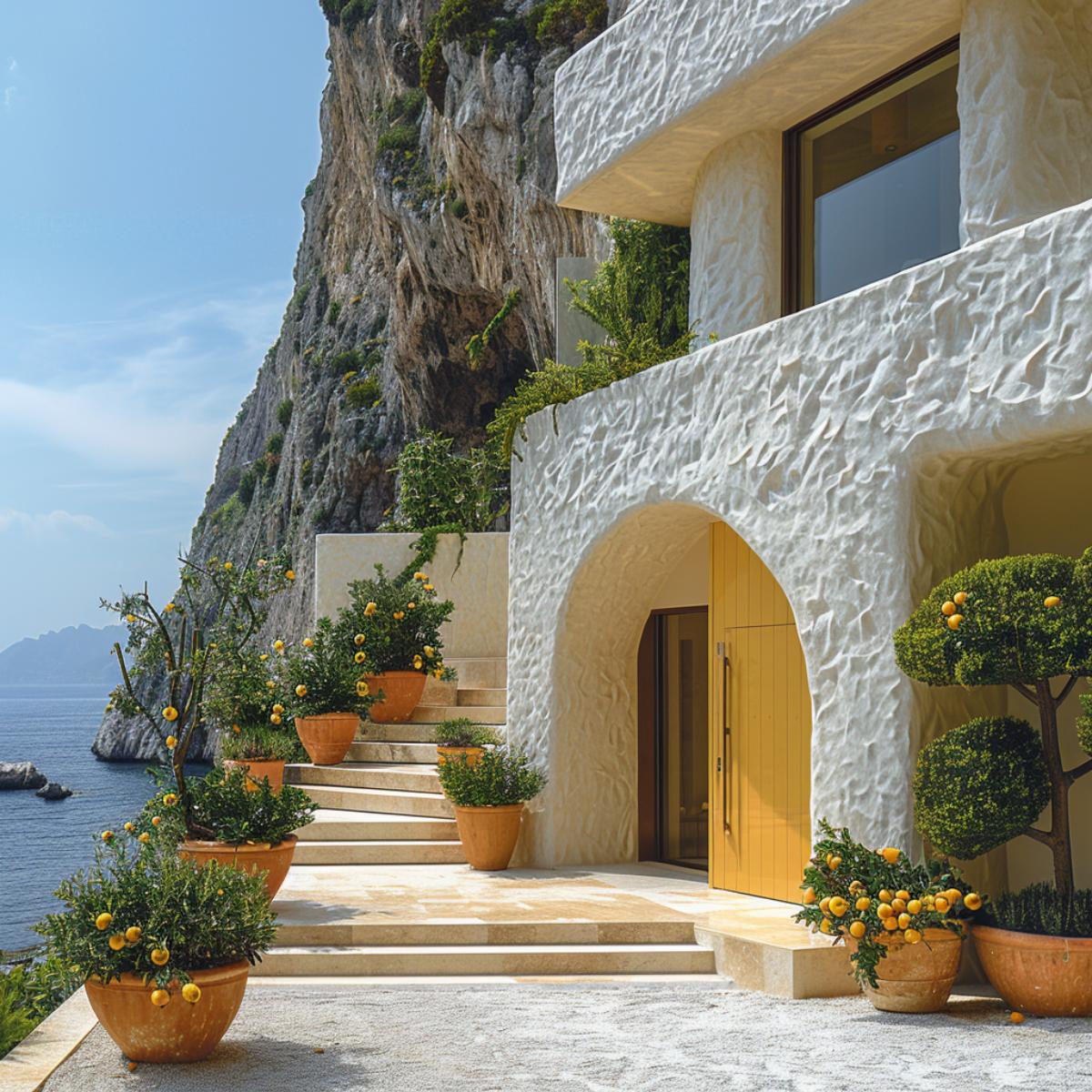
Rough-textured white stucco covers every exterior surface here, its hammered, almost crumpled finish catching Mediterranean light differently at every angle. The arched entry frames a yellow door in a saturated, sun-bleached tone, flanked by clipped topiary standards in terracotta pots and lower citrus trees heavy with fruit. Stone travertine pavers run from the forecourt up wide, shallow steps, anchoring the pale facade against the sheer limestone cliff rising behind it.
Designers call this kind of entry “axial framing,” where a single arched opening pulls every surrounding element toward one focal point. The yellow door works here because it is neither gold nor mustard. It reads as direct sunlight hitting a flat surface, which mirrors the environment rather than competing with it. The brown frame insert keeps the arch from going soft.
6. Limestone Block, Copper Soffit, Burnished Double Door: Coastal Stone Draws the Line
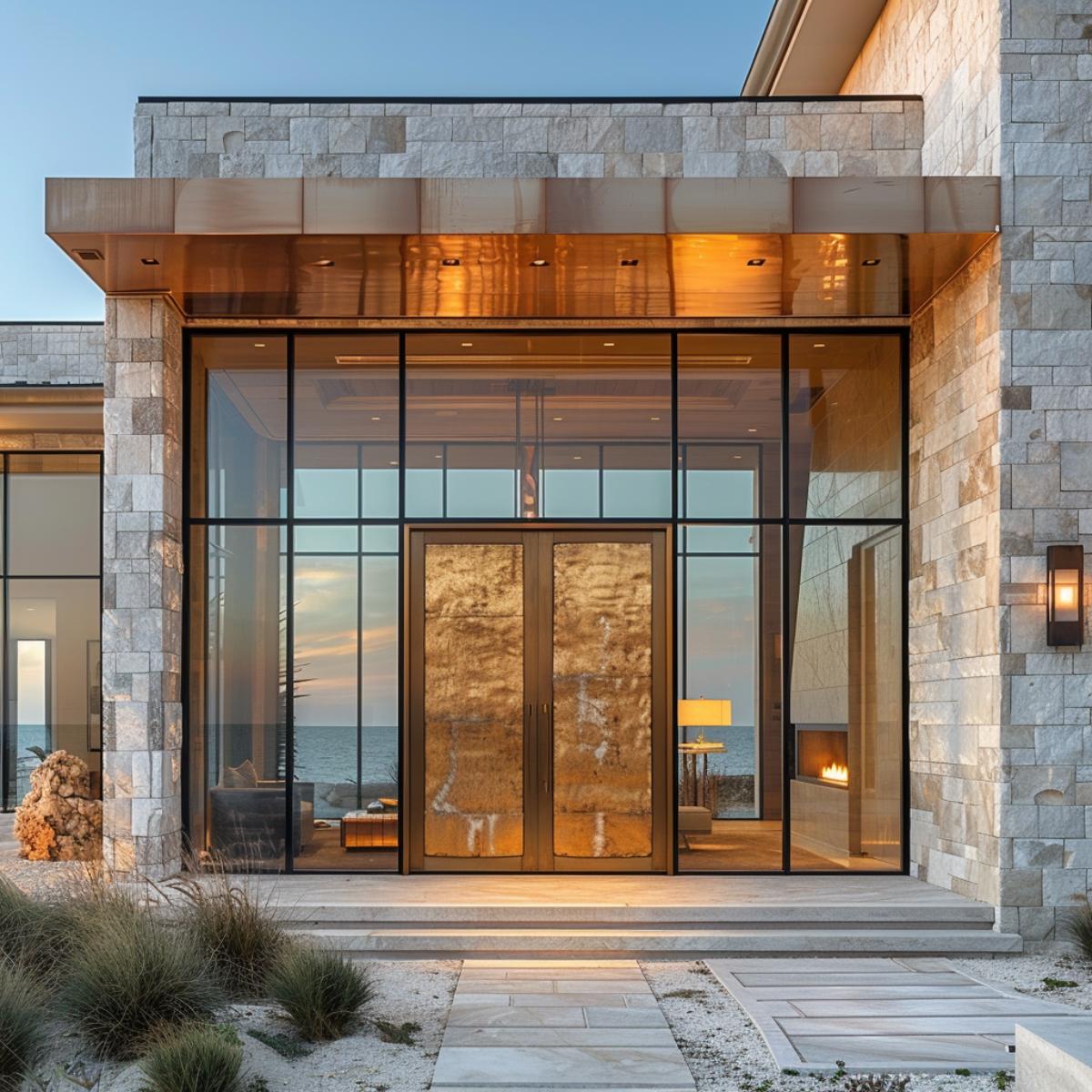
Split-face limestone cladding in cream and sand tones wraps the full facade here, its rough coursing interrupted only by a wide cantilevered soffit clad entirely in burnished copper sheet. That ceiling plane does something specific: it holds warm amber light from recessed downlights and bounces it back toward the entry, making the space glow at dusk without a single decorative fixture in view.
The double doors themselves are paneled in what appears to be hand-hammered or acid-etched copper, set within a black steel frame system that runs floor to ceiling on both sides. Through the glass, an ocean horizon sits dead center, framed like a painting. A lamp with a white shade sits to the right, and a linear gas fireplace burns low. The stone path leading to the entry runs in staggered rectangular slabs, matching the facade material closely enough to feel intentional.
Copper on the soffit and the door creates a vertical axis of warmth that pulls the eye from ground level straight through the entry.
5. Verdigris Stucco, Tall Steel-Frame Glass, Blonde Wood Pivot Door: Green Goes All In
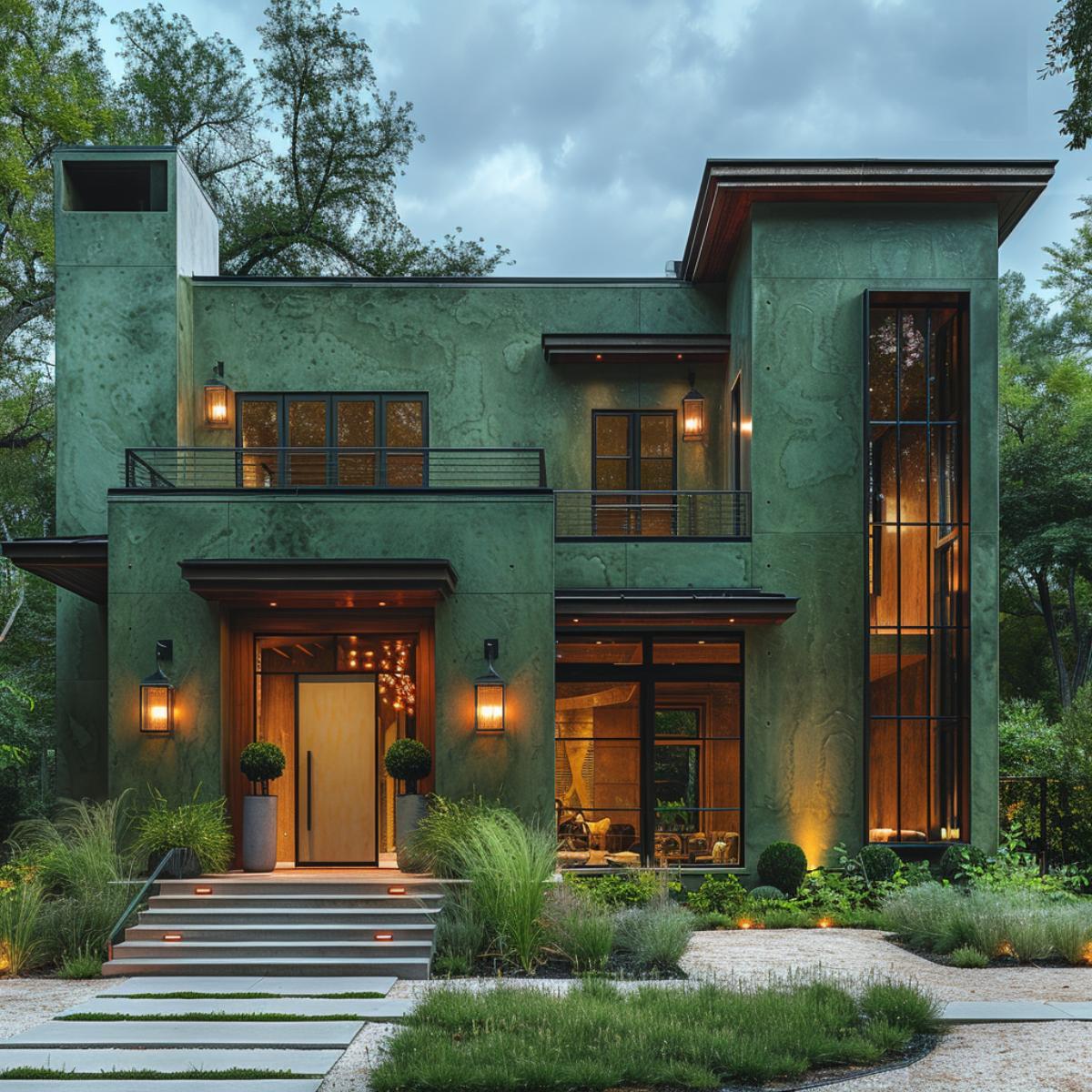
Patinated green stucco wraps both stories in a finish that reads closer to oxidized copper than painted concrete, giving the facade an aged quality no standard exterior paint achieves. The pivot door sits in natural blonde wood, likely maple or light ash, flanked by two black metal lanterns and a cedar-lined soffit overhead. That vertical steel-frame window tower running floor to second level pulls interior amber light outward at dusk, doing more visual work than any single fixture.
4. White Stucco, Wood Soffit, Arched Steel Frame: Natural Cedar Holds the Center
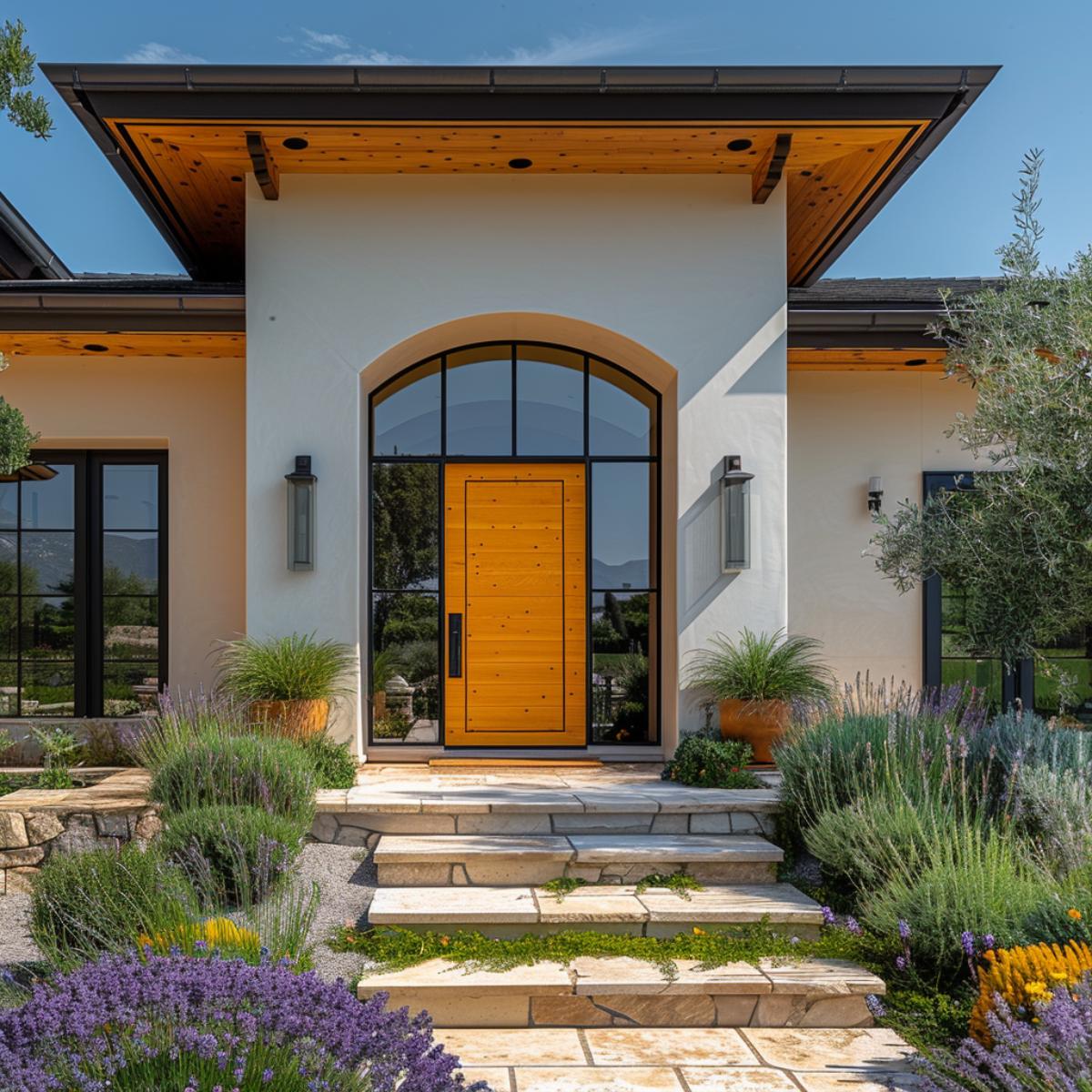
Flat white stucco frames an arched steel-and-glass surround, with the natural cedar door panel sitting at the center of that arch rather than filling it entirely. The black steel grid carries across the full opening, which means the door reads as one element within a larger glazed composition rather than as the sole focal point. A tongue-and-groove cedar soffit overhead repeats the door’s wood tone in a horizontal plane, pulling the eye upward. Lavender, ornamental grasses, and yellow-flowering groundcover push color toward the base of the entry, letting the hardscape steps in buff limestone stay neutral between the planting and the door.
When the door material echoes the ceiling material directly above it, the entry stops feeling like a single feature and starts reading as a composed vertical sequence.
3. Cor-Ten Frame, Floor-to-Ceiling Glass, Saffron Double Door: Desert Modern Goes Bold
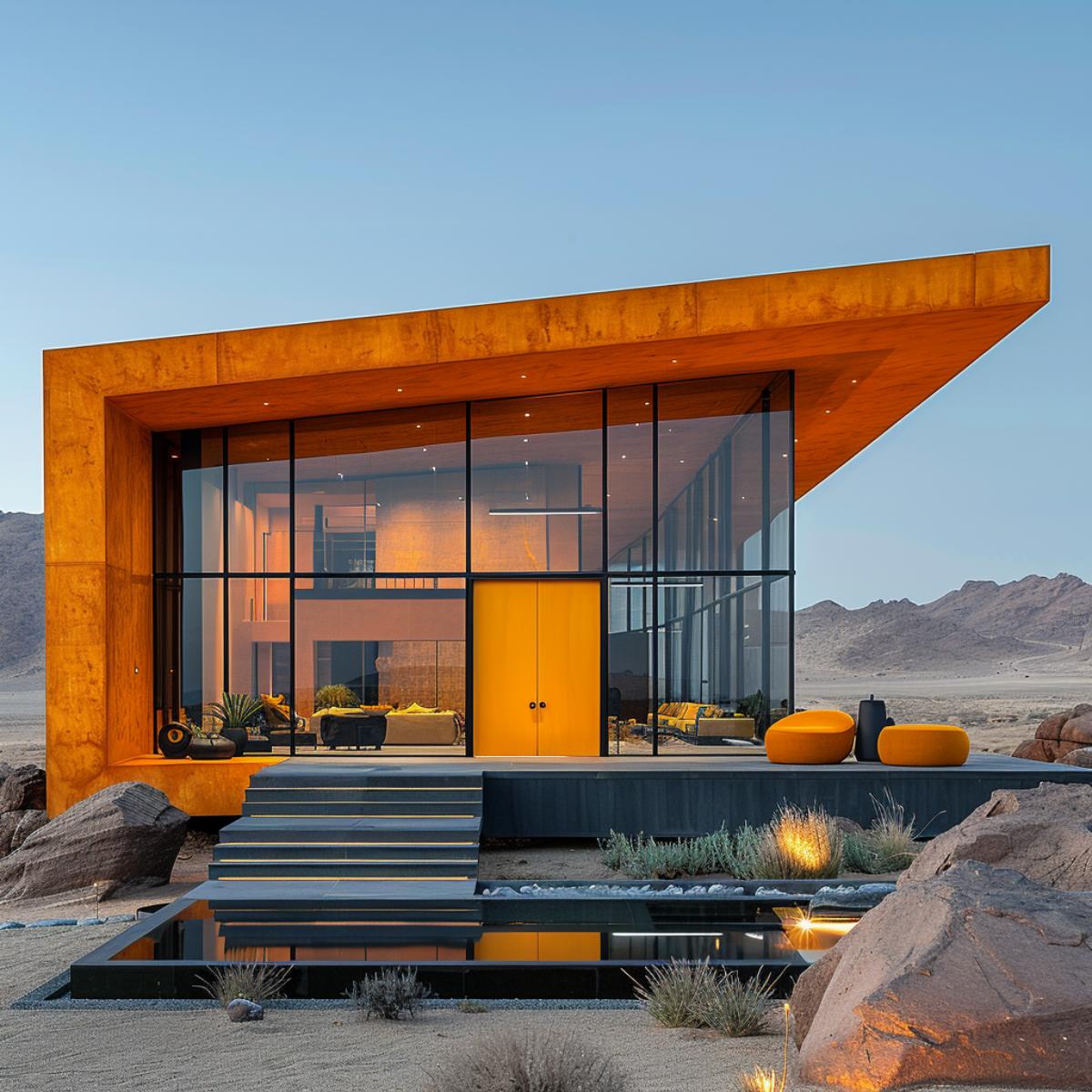
Weathered Cor-Ten steel wraps the outer frame in oxidized amber, a finish that reads almost geological against the rocky desert floor. Black steel mullions divide the glass facade into a grid, and a double door in saturated saffron yellow sits centered behind it, flanked by visible interior furnishings in matching yellow upholstery.
A shallow water feature with dark stone coping runs across the entry platform, its surface catching the warm interior light. Two round ottoman forms in burnt orange anchor the terrace alongside a black ceramic vessel. Unlike door colors that simply contrast their surroundings, this one repeats the palette of the structure itself, making the entry feel like an architectural decision rather than a decorative one.
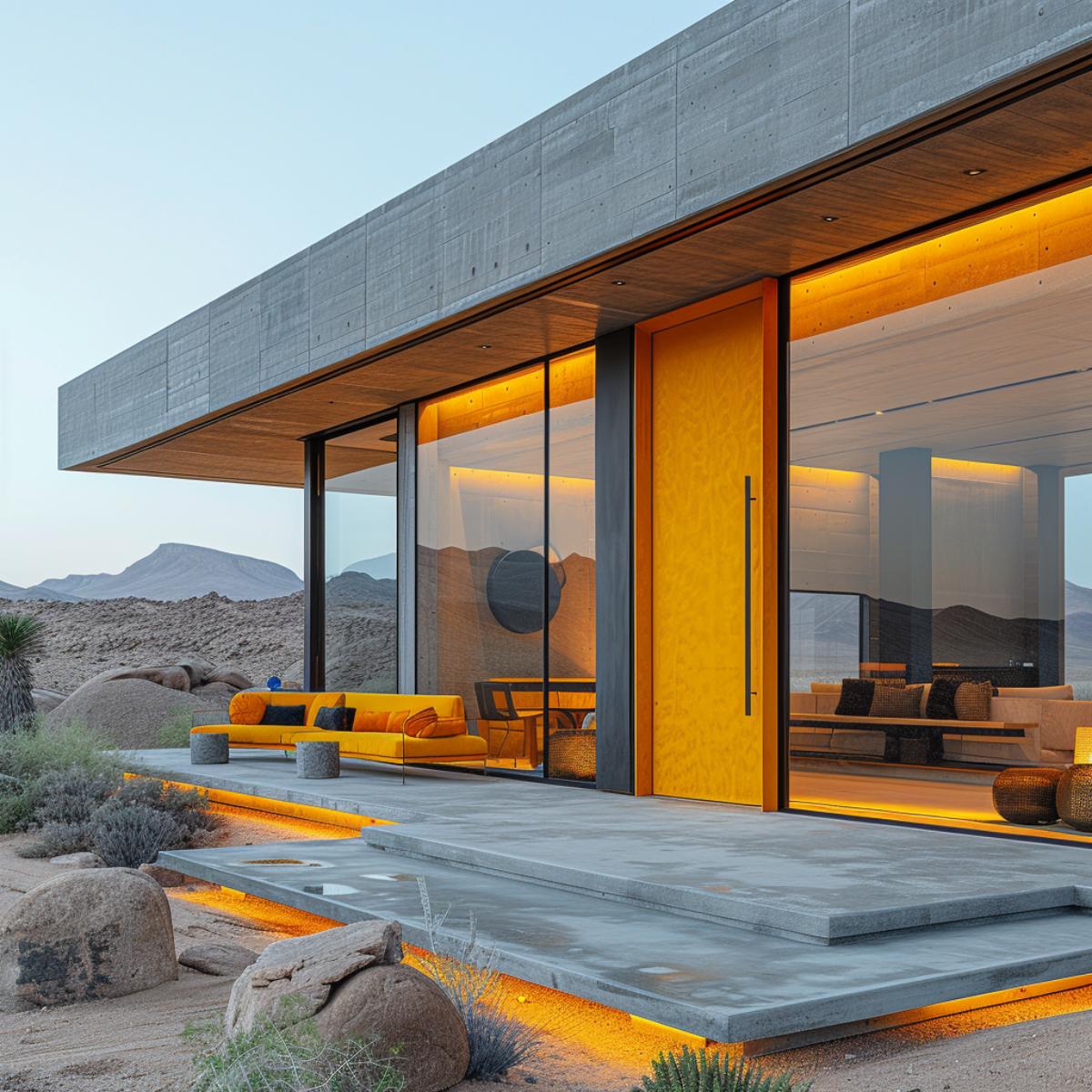
2. Board-Form Concrete, Amber Pivot Door, Floor-to-Ceiling Glass: Desert Modern Commits Hard
🔥 Would you like to save this?
Board-form concrete dominates the roofline and upper facade, its horizontal pour lines left exposed and unfinished. Against that raw gray mass, a saffron pivot door with a full-height matte black pull handle reads as a deliberate provocation rather than a decorative choice. Amber LED strip lighting runs beneath the concrete deck platform and across the soffit interior, casting the entry in warm underglow that amplifies the door’s yellow at dusk.
Beyond the glass walls, yellow upholstered outdoor seating with charcoal throw pillows sits on the concrete terrace, pulling the door color into the living zone. Desert boulders and sparse xeric plantings replace conventional landscaping, which pushes all visual weight back onto the architecture itself. When a facade offers almost no ornamentation, a single color has to carry the entire identity of the home. Here, it does.
1. Flat Roof, Cedar Soffit, Yellow Pivot Door: Desert Xeriscaping Picks Its Champion
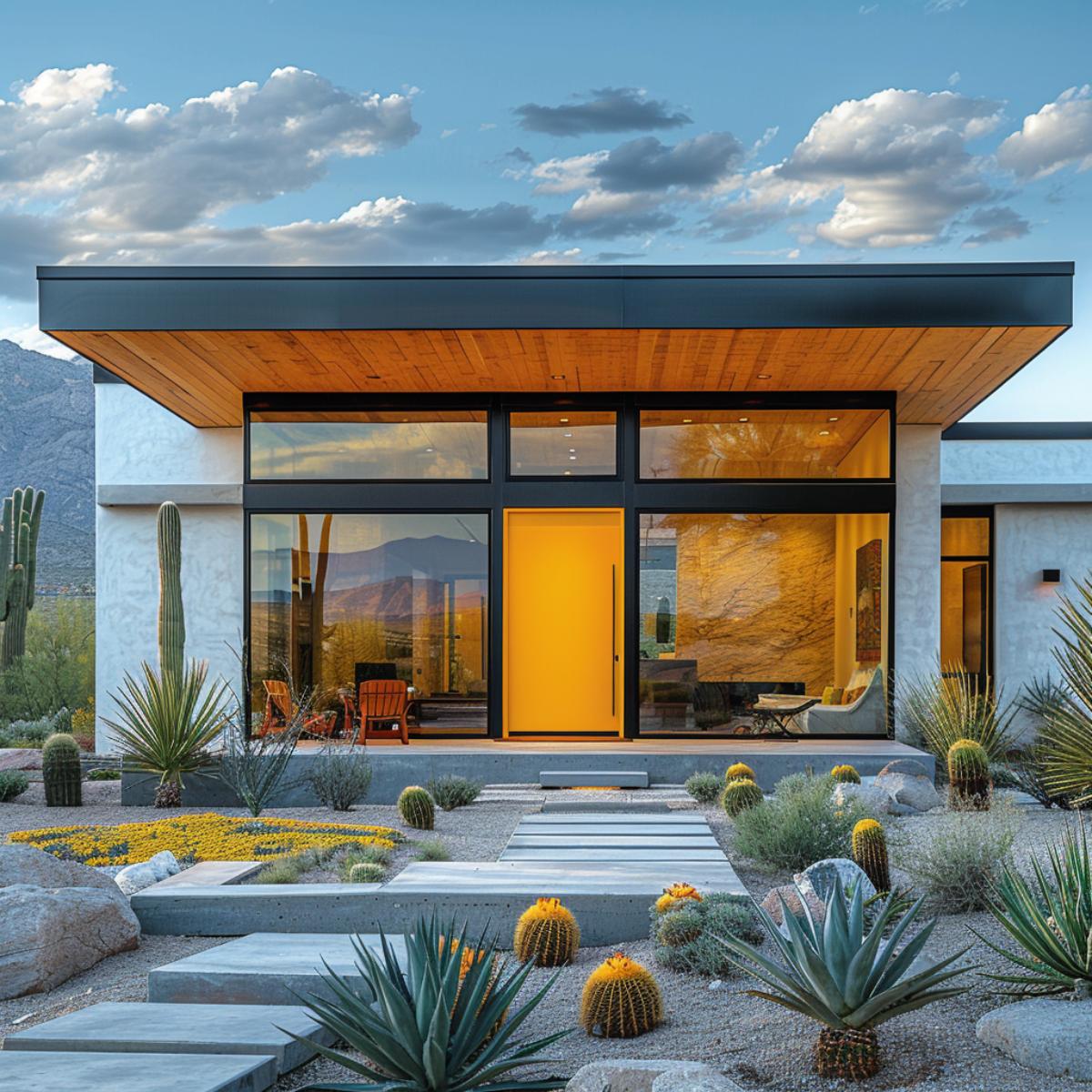
White stucco walls frame a wall of black steel-mullioned glass that runs nearly the full width of the facade, with a cedar-planked soffit overhead warming the entry in amber. Centered in that glass wall, a matte yellow pivot door pulls the eye before anything else registers. The xeriscape foreground earns its place: barrel cacti with orange-tipped crowns, blue agave rosettes, and a concrete paver path draw the approach without competing.
Yellow works here because the door sits inside a glass wall rather than in front of a solid one, giving the color a frame rather than a backdrop.