🔥 Would you like to save this?
A two-car garage slab is basically a blank rectangle just sitting there, which means the only real question is how you carve it up. These 23 floor plans tackle that rectangle from every angle: galley kitchens, Murphy beds, split bathrooms, open studios, and layouts that squeeze a full one-bedroom apartment out of roughly 400 to 600 square feet without making you feel like you’re living inside a shoebox.
In order to come up with the very specific design ideas, we create most designs with the assistance of state-of-the-art AI interior design software. Also, assume links that take you off the site are affiliate links such as links to Amazon. this means we may earn a commission if you buy something.
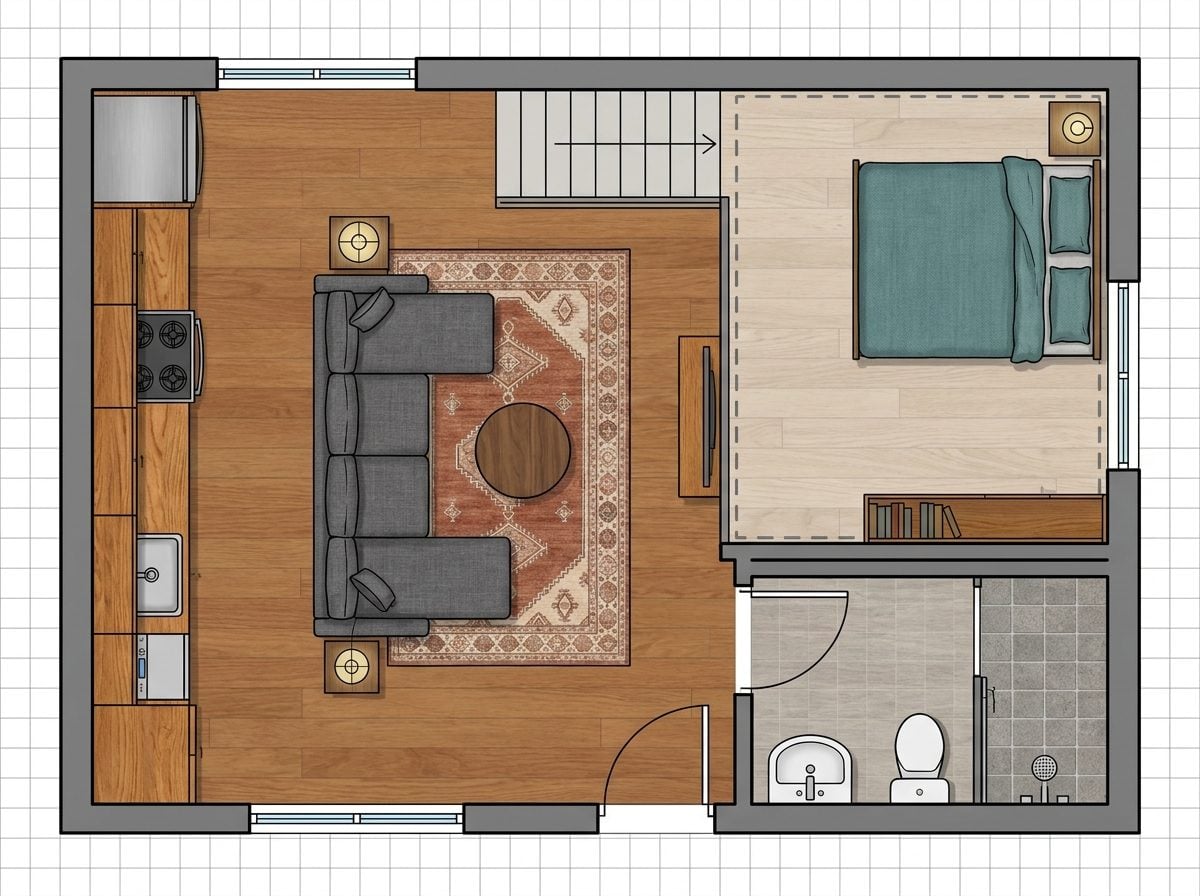
Split-Level Loft Garage Conversion with Mezzanine Sleeping Platform
Garages with enough ceiling height, usually 10 feet or more, unlock a layout trick that flat conversions can’t touch: the sleeping mezzanine. By tucking the bed onto a raised platform accessed by a compact staircase, you completely free up the ground floor. The result is a living space that genuinely breathes, with a real kitchen, a full sofa, and room to move without squeezing past the foot of a bed.
The staircase doubles as storage when you build in pull-out drawers on each riser. Keep the mezzanine ceiling low and cozy, around 7 feet is enough for sleeping, which actually makes it feel more like a private retreat than a loft that tries too hard. A low profile platform bed is the right call here; anything with a tall headboard will fight the ceiling.
Courtyard-Facing Open Plan with Sliding Glass Garage Door Wall
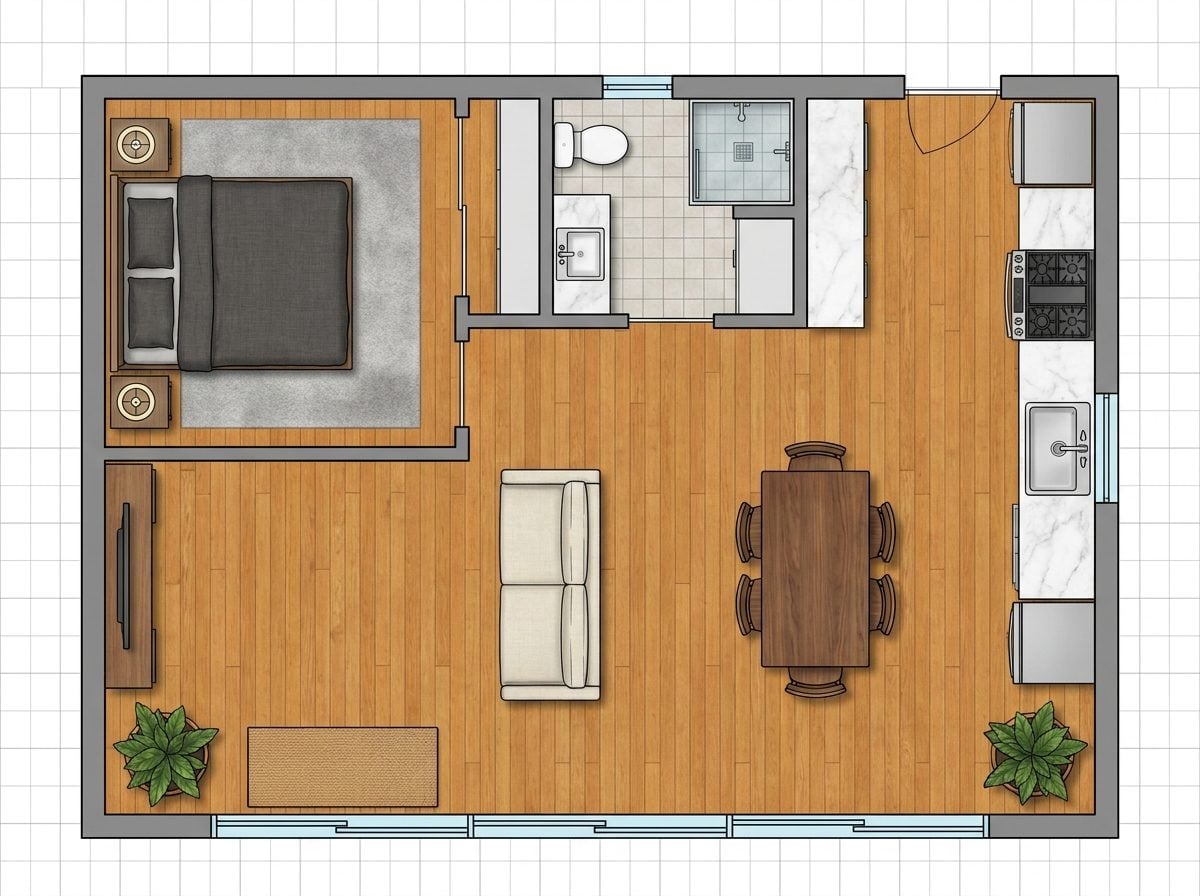
The original garage door opening is the most underused asset in any garage conversion. Instead of patching it with drywall and adding a modest window, this layout replaces the full front wall with a sliding glass door system, turning the apartment’s main face into something closer to a pavilion. When the panels stack open, the living and dining zone flows directly outside.
Traffic here is beautifully logical: you enter through the glass wall, hit the living area immediately, and the bedroom and kitchen both sit toward the rear, out of the sightline from outside. It’s a plan that suits mild climates especially well, and the glass floods a space that’s usually starved of natural light. Pair it with natural fiber area rugs to blur the line between indoors and out.
Railroad-Style Garage Apartment with Back-to-Back Wet Walls
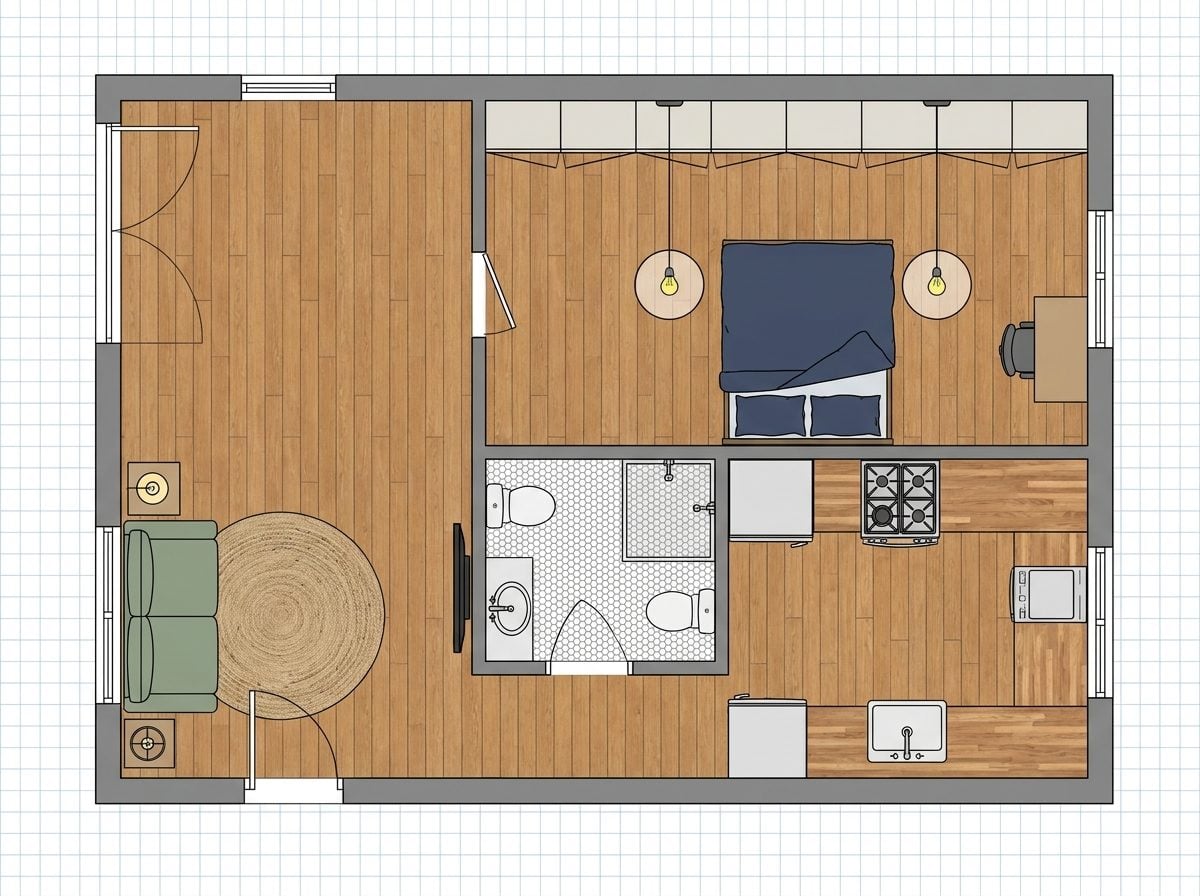
Some two-bay garages are long and relatively narrow, closer to 40 feet deep than 20. This railroad layout treats that proportion as a feature, not a problem. Zone one is living, zone two is kitchen-and-bath back-to-back on shared plumbing walls, zone three is the bedroom with a full wall of built-in storage behind the bed.
Running the kitchen and bathroom back-to-back is one of the smartest cost moves in small-space planning. One plumbing stack serves both rooms, which trims renovation costs considerably. The corridor running through the center keeps each zone legible and avoids the claustrophobic pinch you get when furniture crowds a hallway. For the small family room zone at the front, a loveseat beats a full sofa every time in this proportion.
Japandi Garage Studio with Concealed Bedroom Behind Shoji Screens
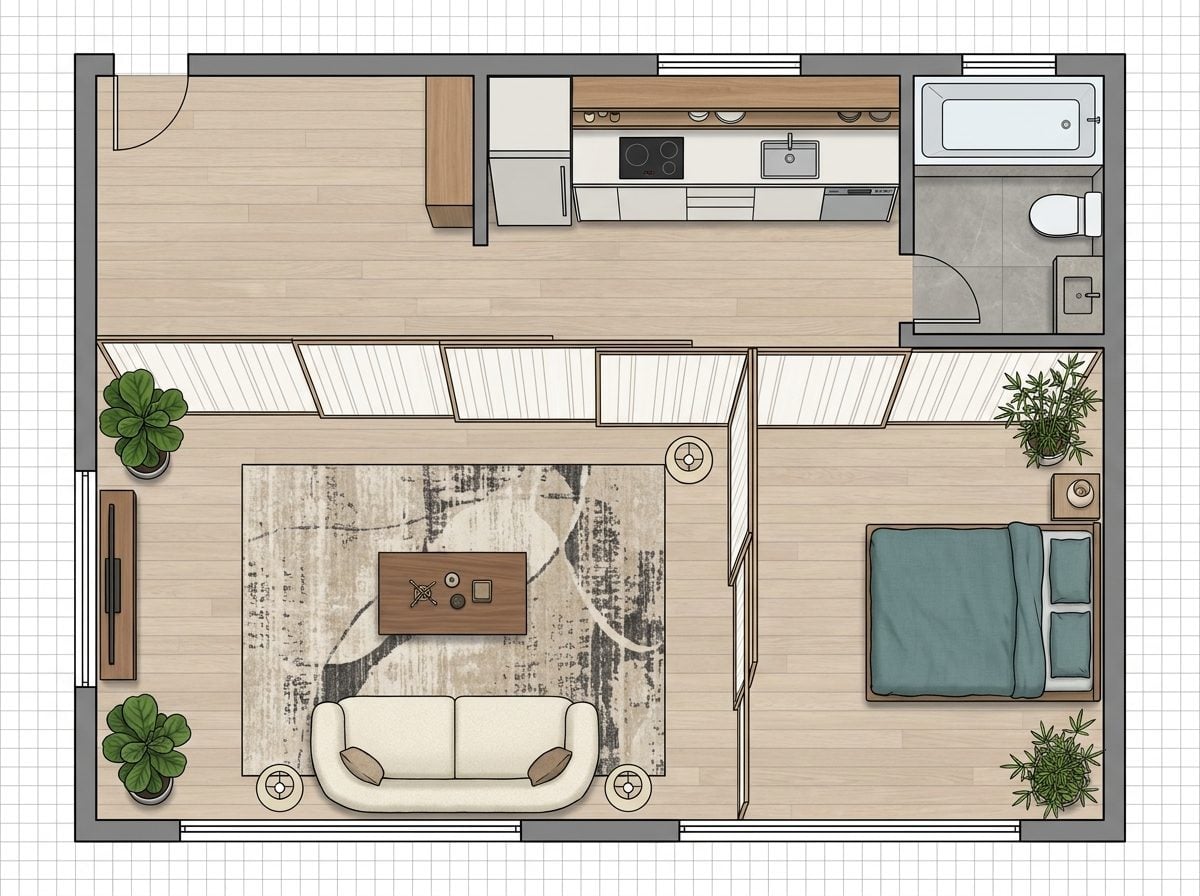
Privacy in a single open room usually comes from a partition wall, but a partition wall kills the light and the spatial calm that makes small spaces feel livable. Sliding shoji screens solve this better than almost anything else at this scale.
The screens can slide fully open during the day, letting the space read as one continuous room. Close them at night and the sleeping area becomes genuinely separate, soft light filters through the translucent panels instead of hard shadows. The teal bed against the pale ash floor and white screens is one of those combinations that photographs beautifully and feels even better in person. A boucle sofa in the living zone keeps the tactile warmth going without competing with the bedroom palette.
Industrial Garage Conversion with Exposed Structural Grid and Workshop Corner
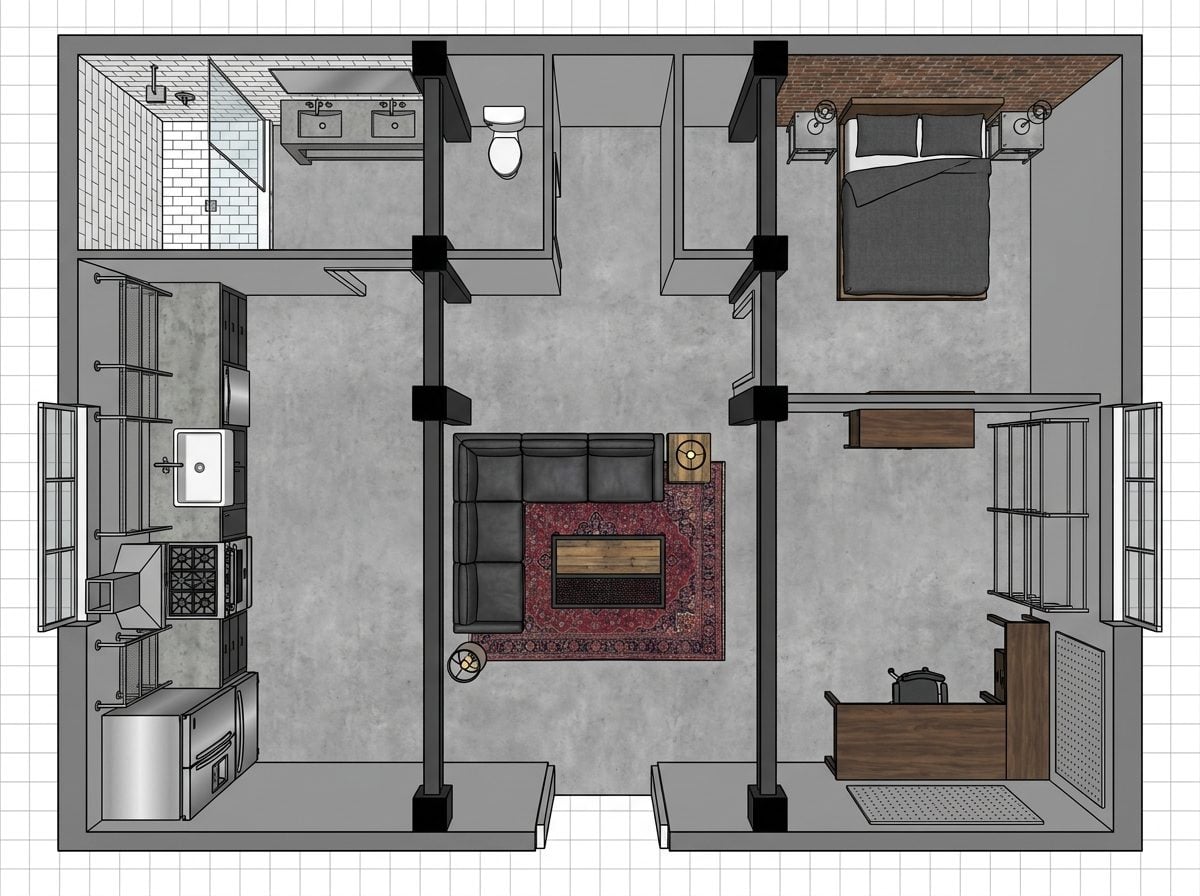
Not every garage conversion needs to pretend it was always a house. This layout keeps the bones visible, structural columns, concrete floors, a pegboard wall, and works the workshop aesthetic into the apartment identity rather than papering over it.
- The workshop desk at the front is separated from the living zone by nothing more than a change in activity, which is enough when the ceiling is open and the sightlines are long.
- Placing the kitchen and bathroom back-to-back on the left wall keeps plumbing consolidated and gives the right half of the plan over entirely to living and working.
- A charcoal leather sectional against a vintage Persian rug does most of the heavy lifting for warmth in an otherwise hard-material space.
Corner-Bedroom Garage Plan with Dedicated Dining Room and Full Pantry
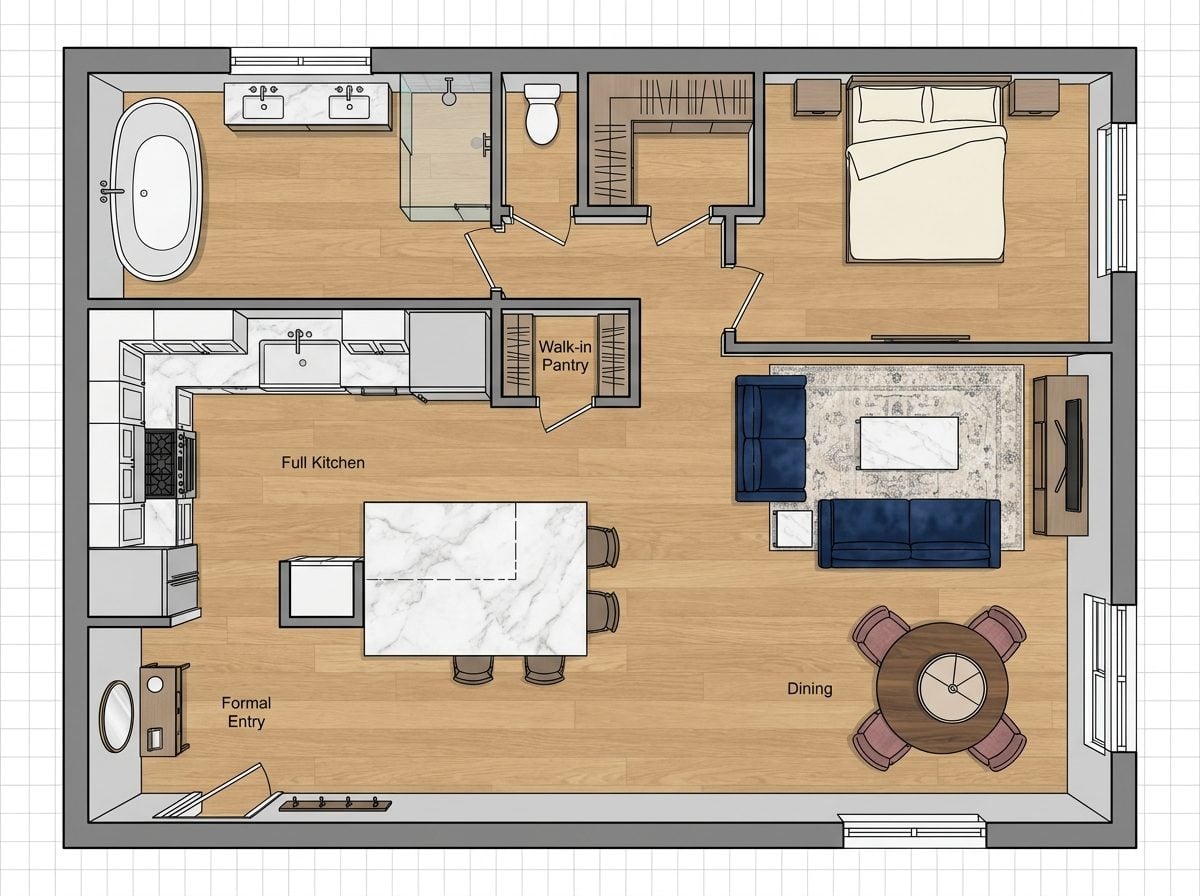
The assumption that a garage conversion is automatically a studio situation is worth questioning. A two-car garage footprint, typically around 400 to 440 square feet, is enough to fit a real entry, a separate dining space, a kitchen with a pantry, a living room, a full bath, and a proper bedroom, as long as you’re disciplined about furniture scale.
The pantry is what makes this plan feel genuinely adult. In a small sitting room or compact apartment, storage is always the first thing to get cut and the first thing you miss. The navy velvet sofa facing a marble coffee table in the center zone feels a scale above what most garage conversions manage.
Murphy Bed Garage Apartment with a Gym Corner and Home Office Wall
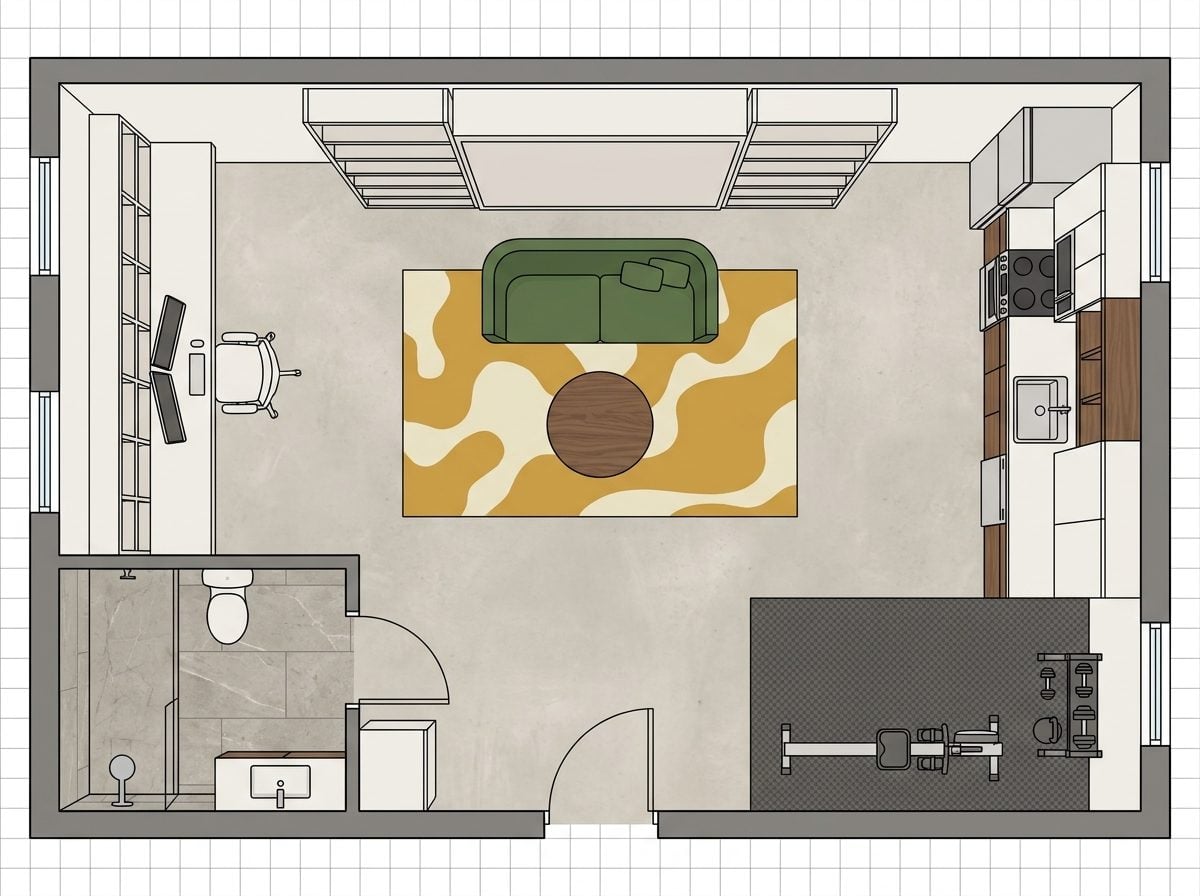
The Murphy bed apartment has a reputation problem, mostly because people design the rest of the space as if it’s a regular bedroom with a fold-away trick. This plan goes the other direction: it treats the Murphy bed as one tool in a space designed for a genuinely active, working life.
The gym corner takes up about 60 square feet in the front right, which sounds like a lot until you realize it replaces a gym membership and a commute. The home office spans the entire left wall at desk height, which means real monitor space, not a laptop on a kitchen counter. A mid-century green velvet sofa keeps the center from feeling utilitarian. When the Murphy bed folds down at night, it reaches roughly where the coffee table sits, so the round walnut coffee table needs to be on casters.
Biophilic Garage Conversion with Interior Garden Wall and Skylight Bed Zone
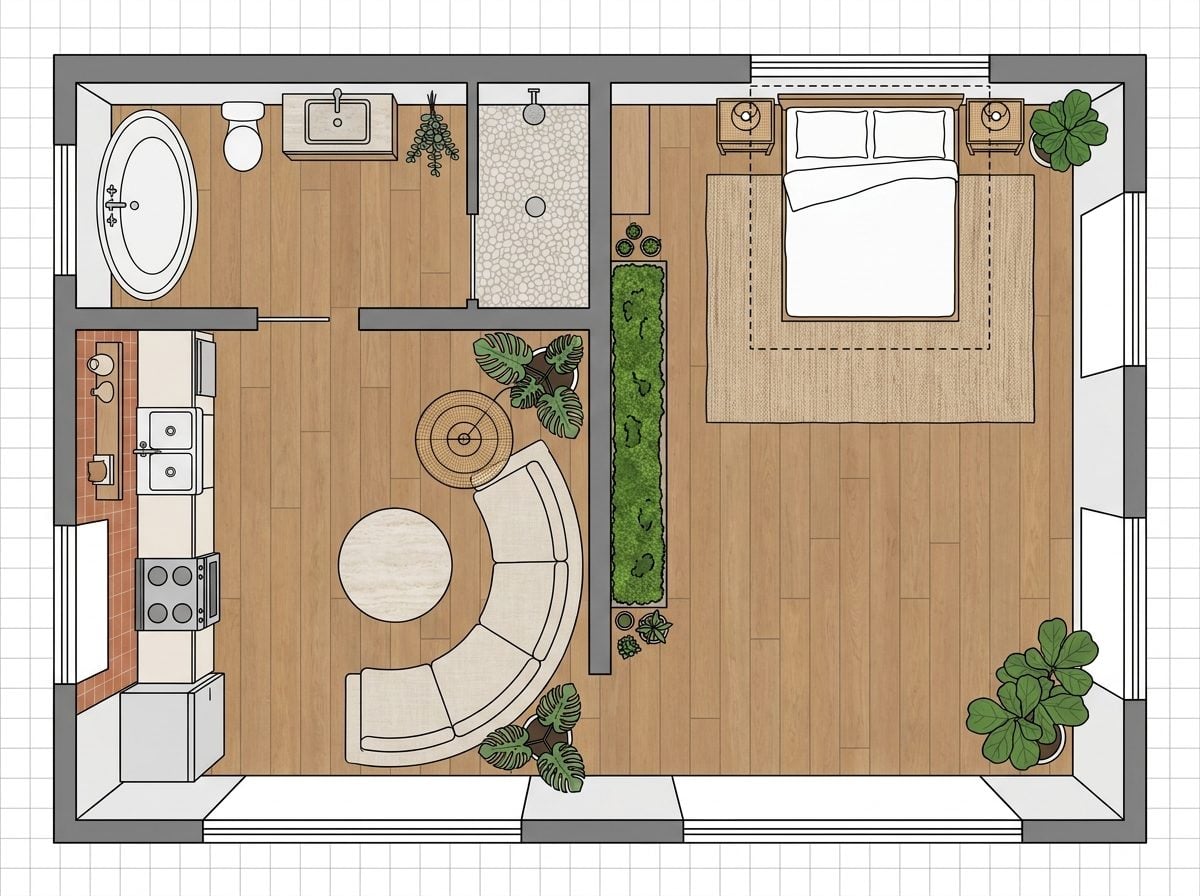
Garages are, by design, hostile to plants, dark, sealed, artificially lit. Turning one into a biophilic apartment isn’t just a design choice; it’s a kind of deliberate correction.
The living moss wall serves as the room divider between the kitchen and the living zone, replacing a solid partition with something that processes air, absorbs sound, and changes slowly over time. A skylight cut directly above the sleeping area means the bedroom gets morning light without any windows on the side walls, useful if the garage shares a property line. The light living room feel comes from the linen sofa, travertine table, and natural textures layered together rather than from any single statement piece. A rattan nightstand beside the bed and a stone vessel sink in the bath keep the material language coherent all the way through.
The Breezeway Borrower: Side-Entry Layout with Mudroom Buffer Zone
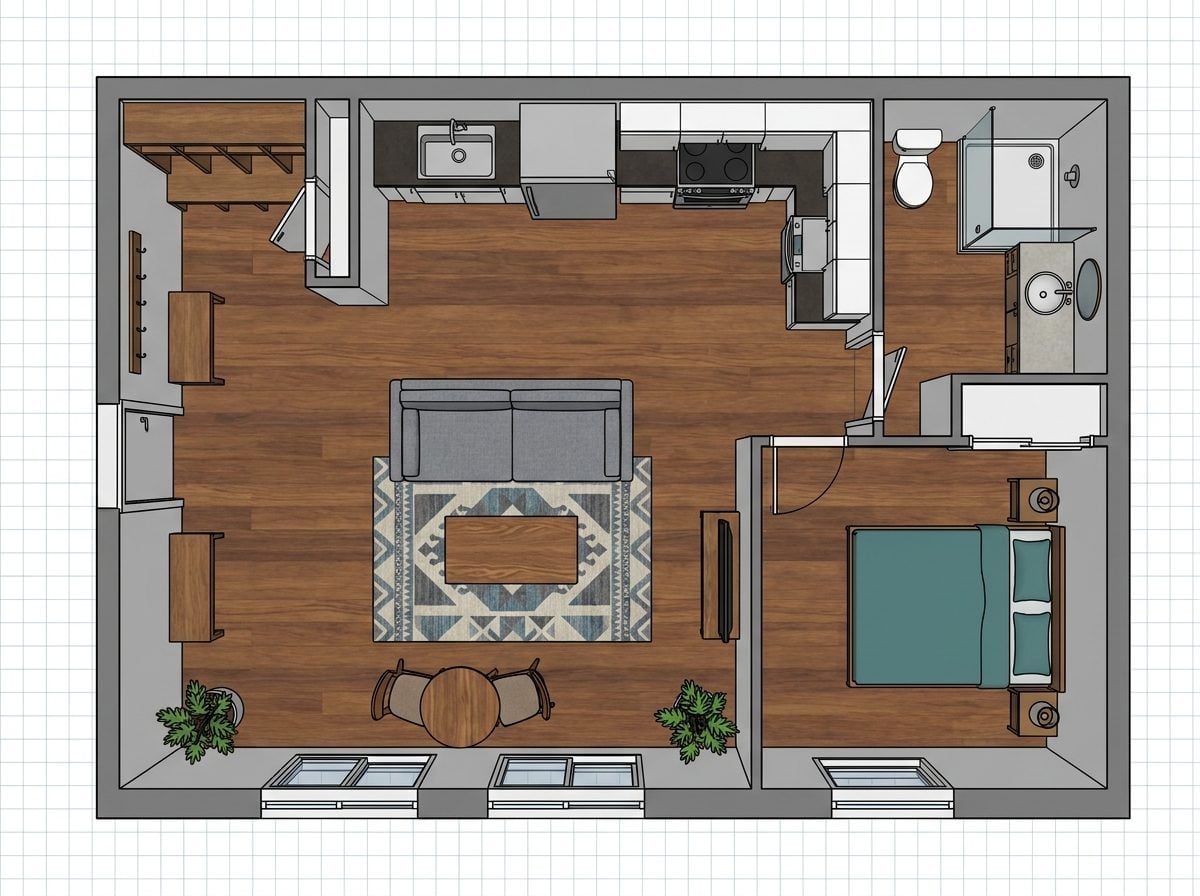
Most garage conversions fail right at the door. You walk in and immediately you’re in the living room, which is fine until someone shows up while you’re still in your socks and there’s nowhere to drop a bag, hang a coat, or breathe. This layout steals a narrow slice of the front entry to create a proper mudroom buffer, bench, hooks, a shallow closet, before the apartment actually begins.
From there, the open-plan living and dining zone flows naturally toward the rear kitchen wall. The bedroom tucks into one back corner behind a partial wall (no door needed if you live alone, add a barn door if you don’t), and the bathroom claims the opposite rear corner. Traffic never crosses the sleeping area. That’s the whole trick.
Loft-Ready Skeleton: Double-Height Sleeping Loft Above a Compact Studio Base
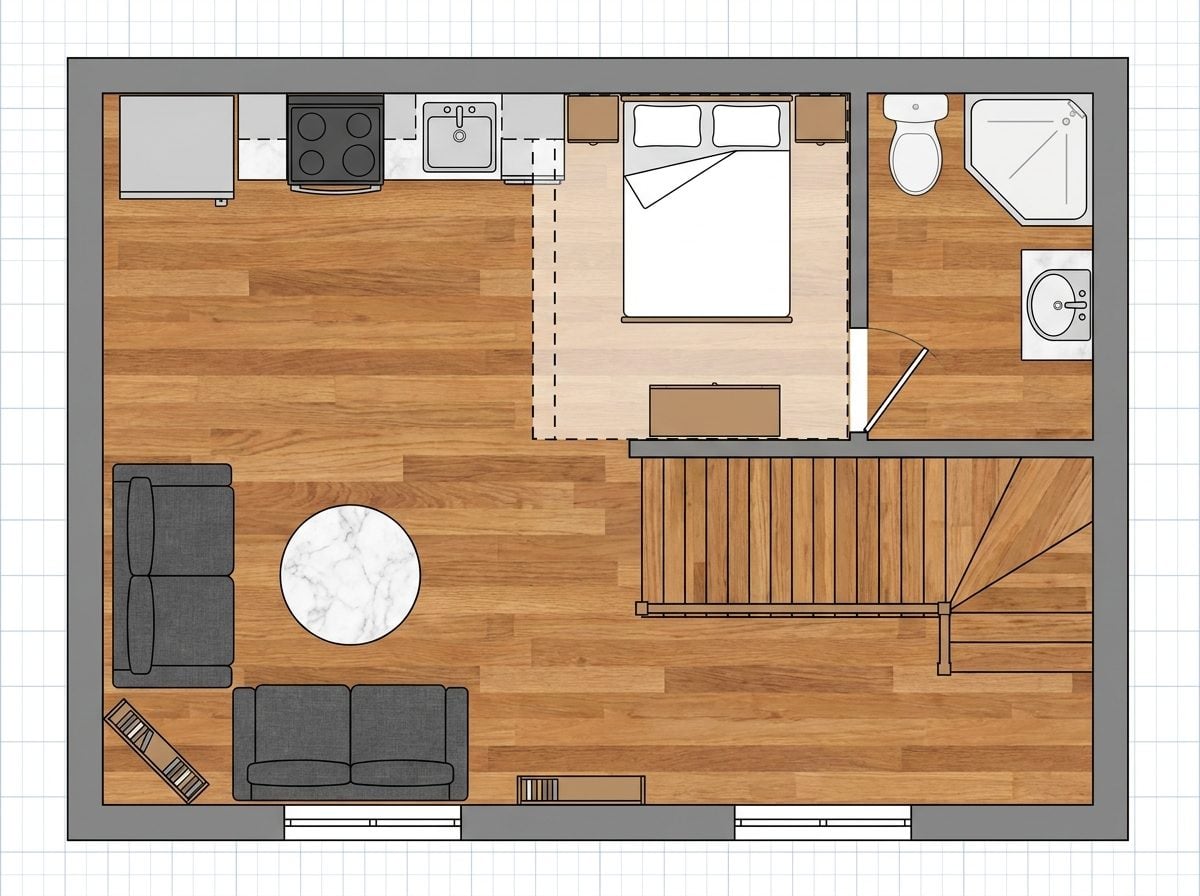
Garages with generous ceiling height, anything above ten feet, are begging for a sleeping loft. The floor plan below looks almost like a studio: living area up front, compact galley kitchen and bathroom tucked under the loft platform at the rear. An open wood-tread staircase climbs along one side wall without eating much floor space.
Up top, the bedroom is private in the best possible way. You’re physically separated from the living zone without a single interior door, and the height gives the whole apartment a feeling of volume that most 400-square-foot spaces never achieve. Pair this with tall front windows and the ground floor reads large.
The Dividing Line: Floor-to-Ceiling Bookshelf Wall as the Only Room Separator
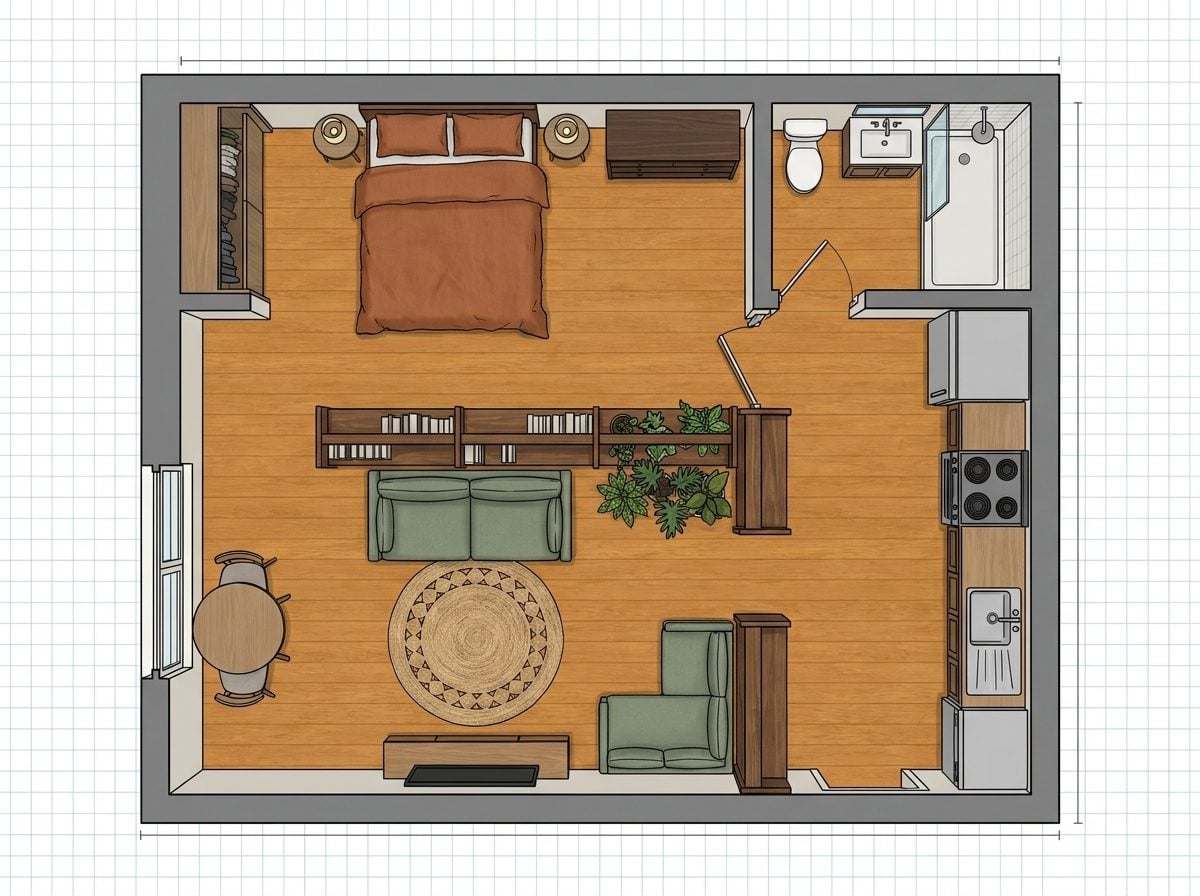
Here’s a layout that commits to openness while still giving the bedroom a defined edge. A floor-to-ceiling double-sided open bookshelf divider runs across the width of the apartment, leaving a walkthrough gap on one end. From the living side, it’s storage and display. From the bedroom side, it’s a headboard wall with built-in depth.
The kitchen runs along one full long wall in a simple galley line, keeping it completely out of the circulation path. Bathroom goes in the rear corner. This layout works especially well if you own a lot of books and have absolutely no desire to build interior walls. I respect that approach completely.
Courtyard-Facing Glass Wall Layout with Interior Garden Corridor
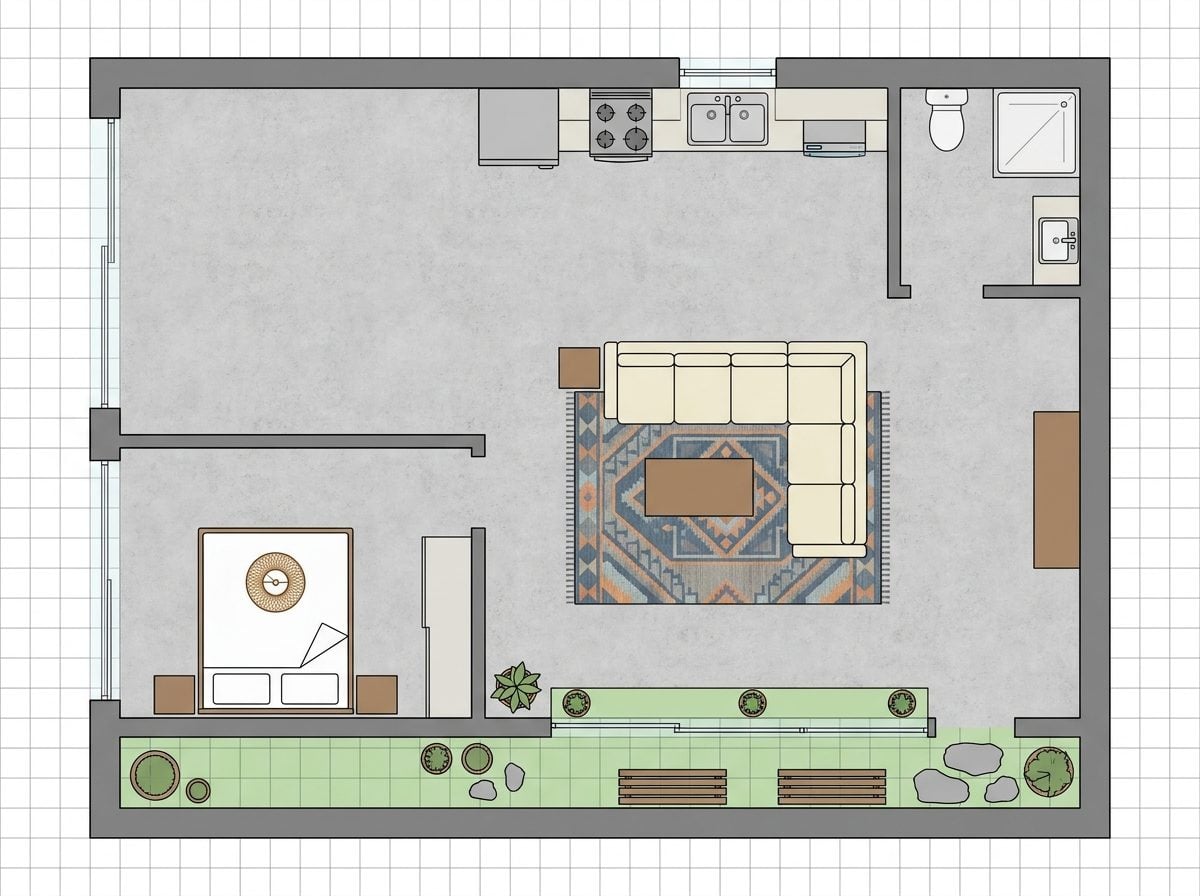
Glass where the garage doors used to be is the single most dramatic move in any conversion. This layout leans into it by placing the living area directly behind the glass wall, flooding the whole apartment with front light. A narrow interior garden corridor runs the length of one side wall, essentially a planted buffer that adds privacy from the street while pulling green into the floor plan.
The bedroom claims one front quadrant, separated from the living zone by a low partial wall that doesn’t kill the light. Kitchen and bath stack neatly along the rear. For a light living room feeling in a space that once had two hulking garage doors, this approach is hard to beat.
The Long Shot: Single-File Layout Where Every Zone Has Its Own Wall
🔥 Would you like to save this?
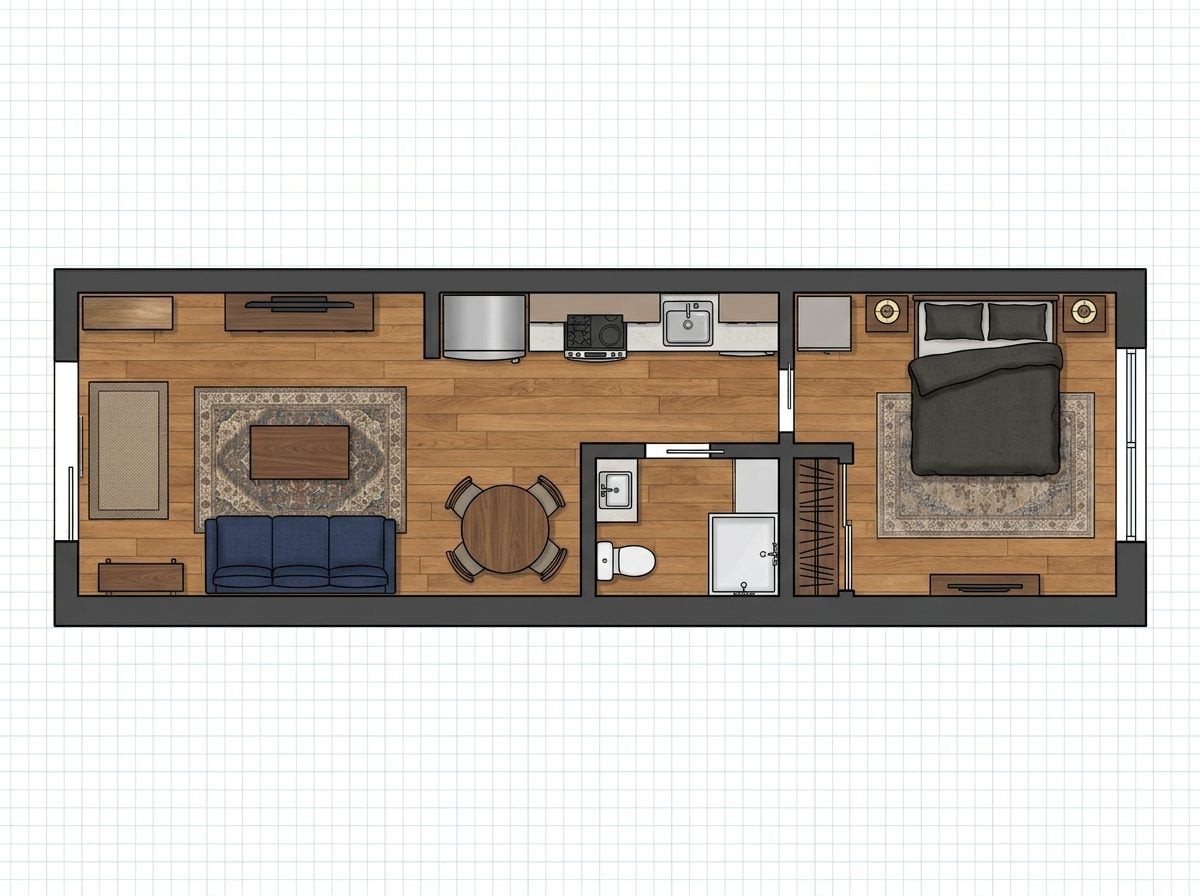
Long, narrow garage footprints fight every conventional layout instinct. Instead of cramming zones sideways, this plan runs them front-to-back in sequence: entry, living, dining, kitchen, bathroom alcove, bedroom. Each zone owns its wall. Each transition is natural. You never cross through one room to reach another.
The navy blue fabric sofa anchors the living zone mid-plan, which keeps it from drifting too close to the front door. The bedroom at the far end has a window centered on the rear wall, the payoff for all that linear discipline. It’s a surprisingly calm way to live once you stop expecting the space to be square.
Wet Wall Strategy: All Plumbing Stacked on One Wall, Everything Else Free
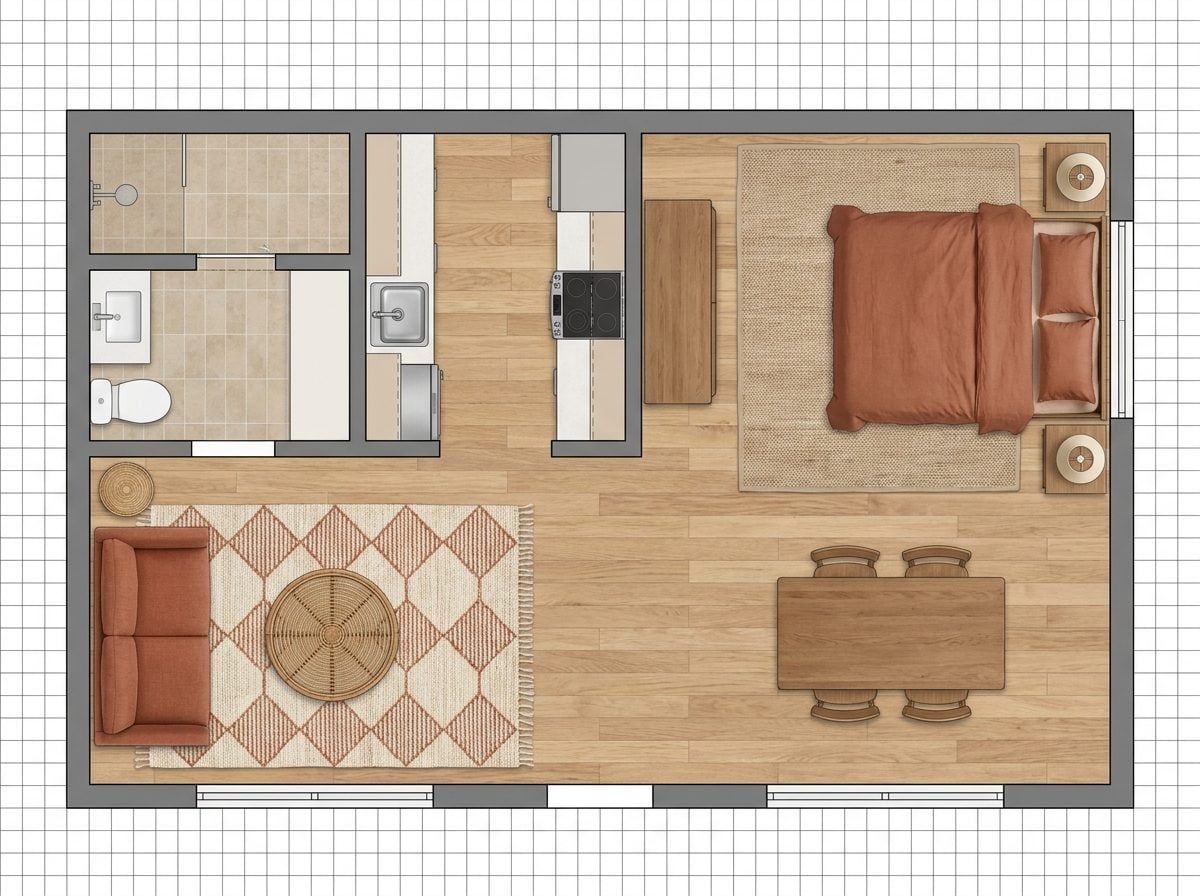
Plumbing is expensive to run. Every foot of pipe between your bathroom and your kitchen adds cost and complexity. This layout stacks every single plumbing fixture, shower, toilet, sink, dishwasher, kitchen sink, stove connections, against one shared interior wall. Construction cost drops. Dramatically.
The rest of the floor plan stays completely free, which means the bedroom isn’t a room at all, it’s a zone defined by a large woven area rug and furniture placement. Open-plan bedrooms aren’t for everyone, but for one person in a sub-500-square-foot apartment, the spatial generosity is worth it. Think of this as the efficient version of a loft.
Split-Level Suggestion: Raised Platform Bedroom Above Sunken Living Pit
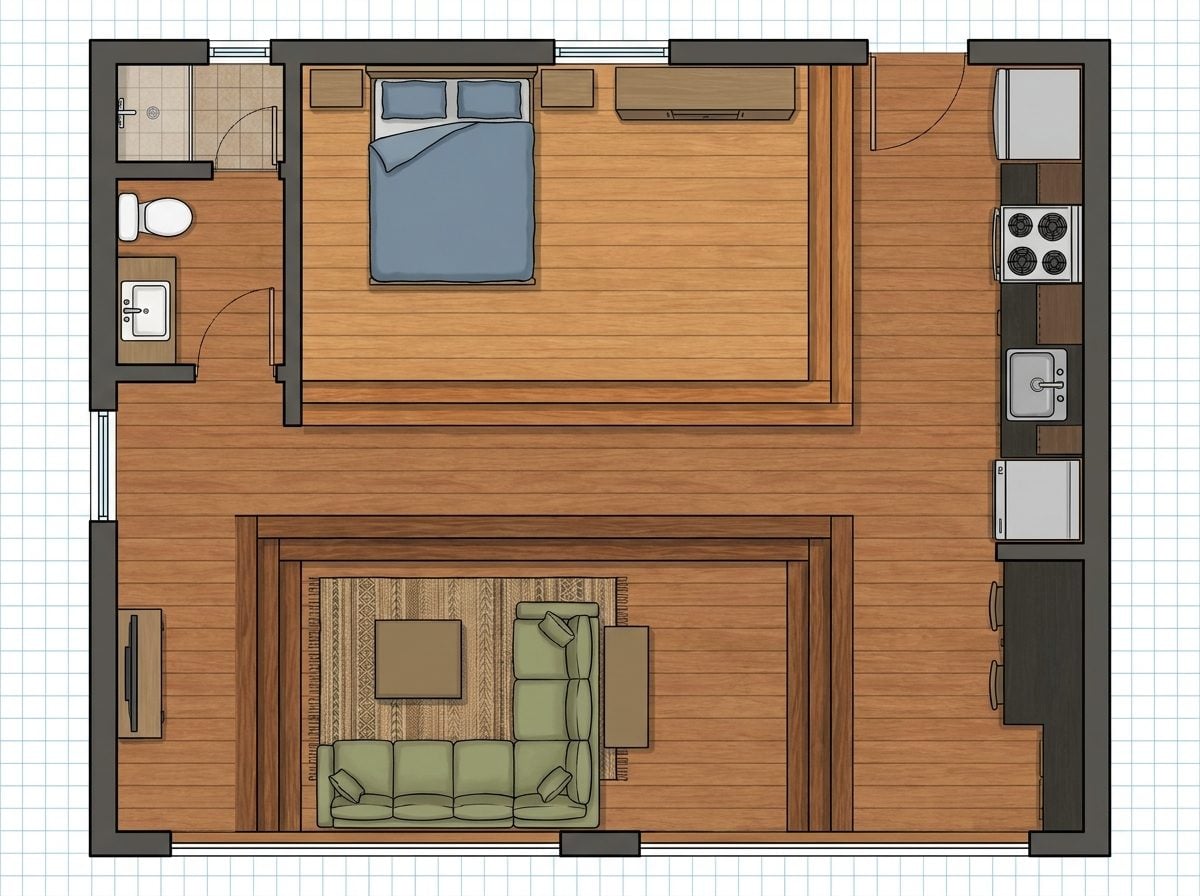
Level changes are architecture’s quietest room divider. No wall, no door, no partition, just a step down into the living pit and a step up into the sleeping platform. The sitting room decor conversation pit anchors the front of the plan with a wraparound olive sectional, while the raised bedroom platform at the rear creates an instinctive sense of separation and privacy.
The kitchen lines one side wall at main floor level, bridging the two zones without committing to either. This is the layout for someone who has strong opinions about spatial experience and doesn’t mind explaining to guests why they need to watch their step. I think it’s worth it.
The Corner Pivot: Diagonal Bedroom Wall Creates Two Distinct Triangular Zones
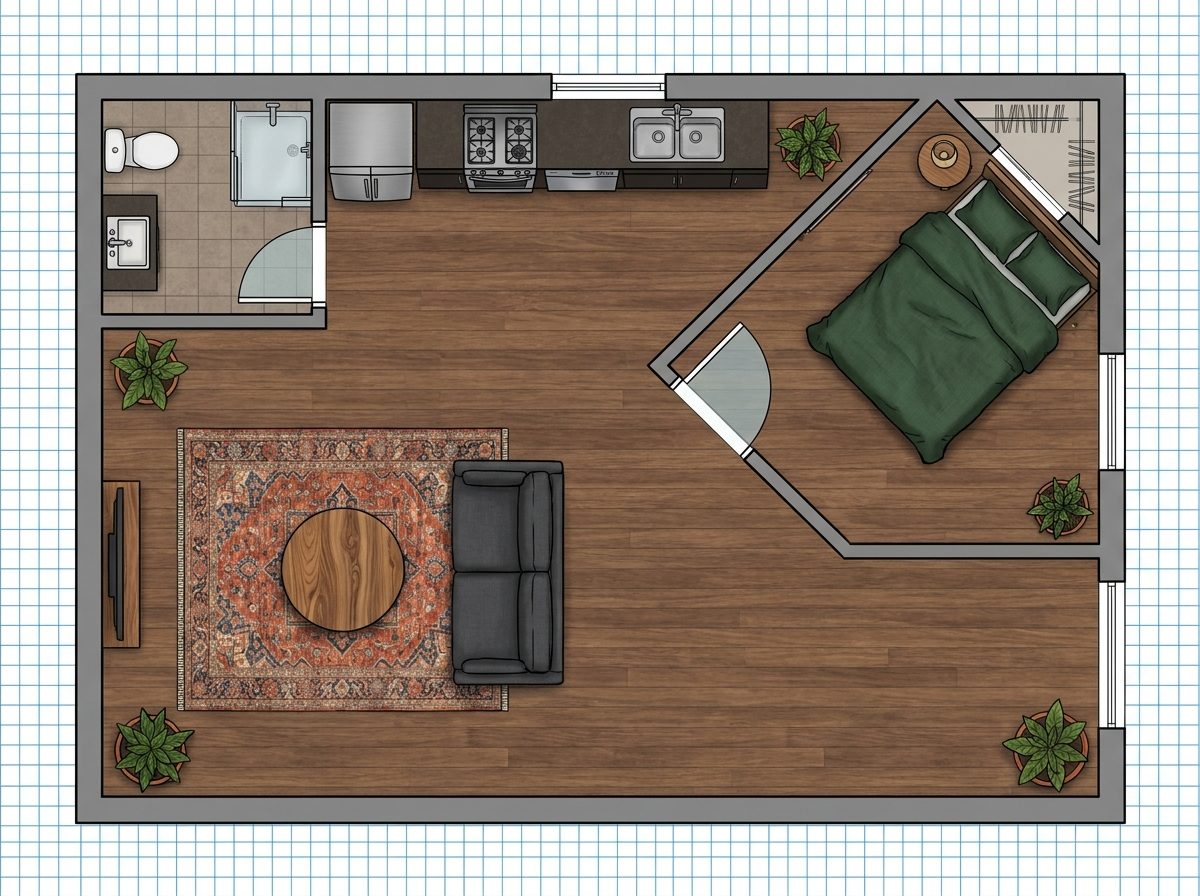
A diagonal wall in a rectangular space sounds like a renovation nightmare. It’s actually one of the most effective moves in a converted garage. The angled partition carves a private triangular bedroom from one rear corner, and the irregular geometry it leaves behind in the living zone makes the whole apartment feel larger than the square footage suggests.
- The diagonal wall creates two strong focal points from the entry instead of one flat wall.
- Angled surfaces break up sound differently, which helps in an open-plan apartment.
- A frosted glass door on the diagonal keeps light flowing while maintaining privacy.
The kitchen and bathroom stack cleanly along the two rear straight walls. For a small family room scale space that needs to punch above its weight, geometry is your best tool.
The Tandem Studio: Deep-Bay Layout with Sleeping Alcove and Full Kitchen Along One Wall
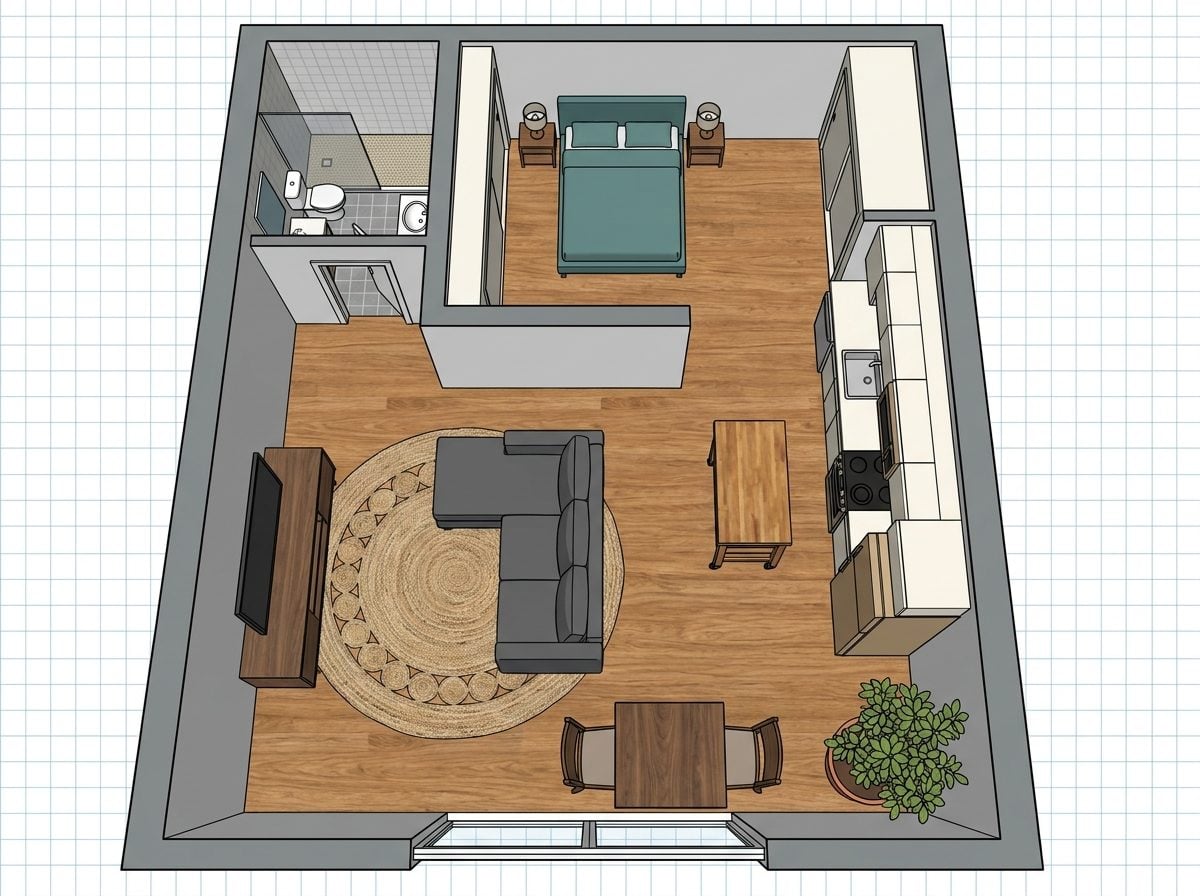
Long and lean, this layout uses every inch of the garage’s depth without wasting a square foot. The two original bays translate into a front-to-back sequence of zones: living and dining up front near the light, cooking along one full side wall, and sleeping tucked into a defined alcove at the rear. It’s a smart move to push the galley kitchen cabinets against the long wall rather than breaking the plan into competing islands of furniture, the corridor that forms naturally becomes your main circulation path, and it never feels cramped if you keep it clear.
The sleeping alcove is the secret win here. A partial half-wall gives the bed its own defined territory without swallowing the ceiling height or blocking borrowed light from the front windows. Pair that teal upholstered headboard against white walls and the back of the space feels intentional rather than leftover. This approach works especially well if you’re imagining a small family room vibe up front, open, airy, and relaxed, with the private zone earning its privacy through architecture rather than just a curtain.
Barrel Vault Ceiling Garage Conversion with Sleeping Loft and Live-Work Studio Below
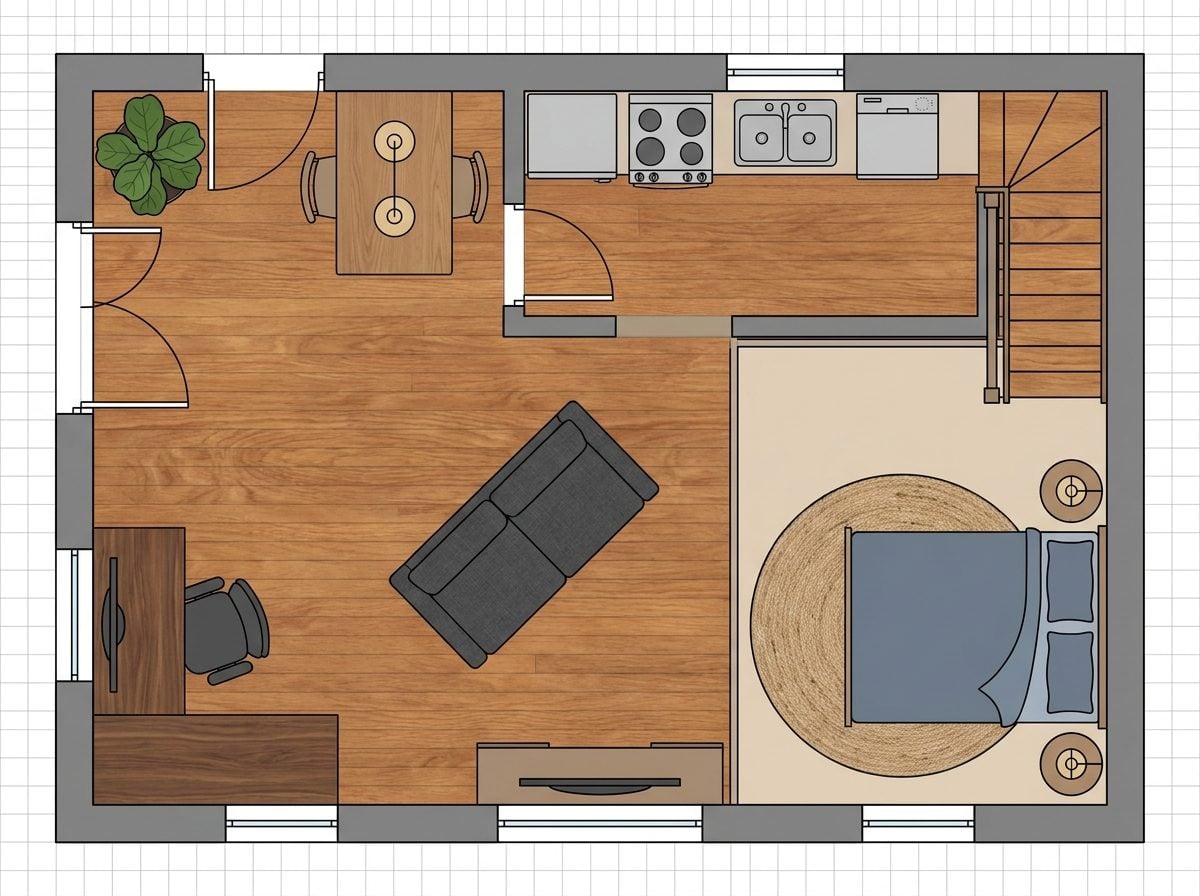
Loft sleeping platforms are the secret weapon of any narrow garage conversion. By pushing the bed up and overhead, the entire ground floor opens into a proper live-work studio with room for a real desk, a sitting area, and a galley kitchen that doesn’t feel like an afterthought. The stair runs along the right wall and doubles as shelf storage beneath each tread.
The workstation anchors the left wall under the original garage door opening (now a wall of industrial windows), so natural light hits the desk all morning. A charcoal loveseat and low media console face each other across a jute rug, carving out a distinct lounge zone without a single partition wall.
Courtyard-Facing Garage Apartment with Wraparound Built-Ins and Murphy Bed Alcove
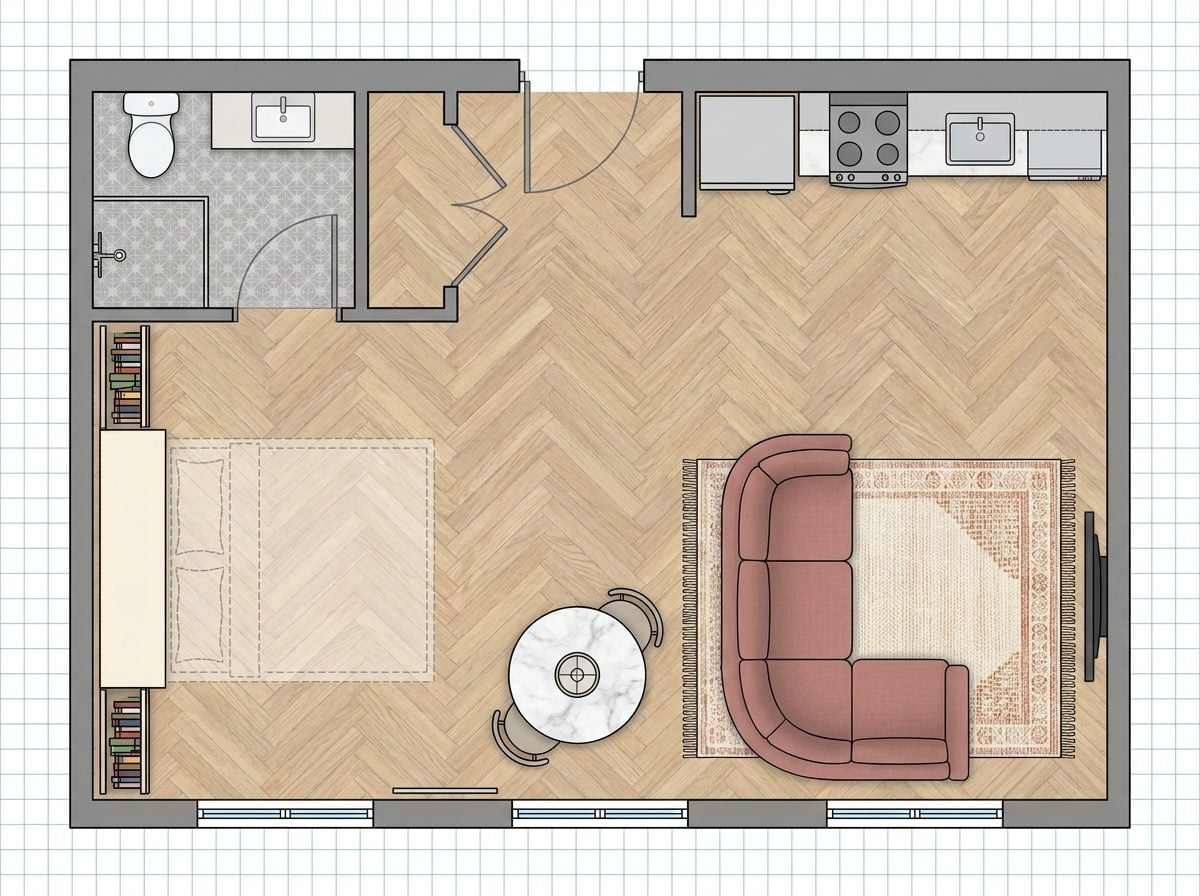
The Murphy bed alcove here isn’t a compromise, it’s the entire organizing idea. Built-in bookshelves flank the closed cabinet on both sides, so during waking hours this wall reads as a library, not a hiding spot for a bed. Combined with the round marble dining table and a dusty rose sectional sofa, the apartment feels like a real home rather than a shrunken one.
Traffic flows in a clean oval: door to kitchen to dining to living and back. Nothing blocks the courtyard windows, so morning light runs unobstructed across the herringbone floor. For anyone interested in small sitting room arrangements that feel generous, this wraparound built-in strategy is hard to beat.
Split-Level Garage Conversion with Sunken Living Room and Raised Bedroom Platform
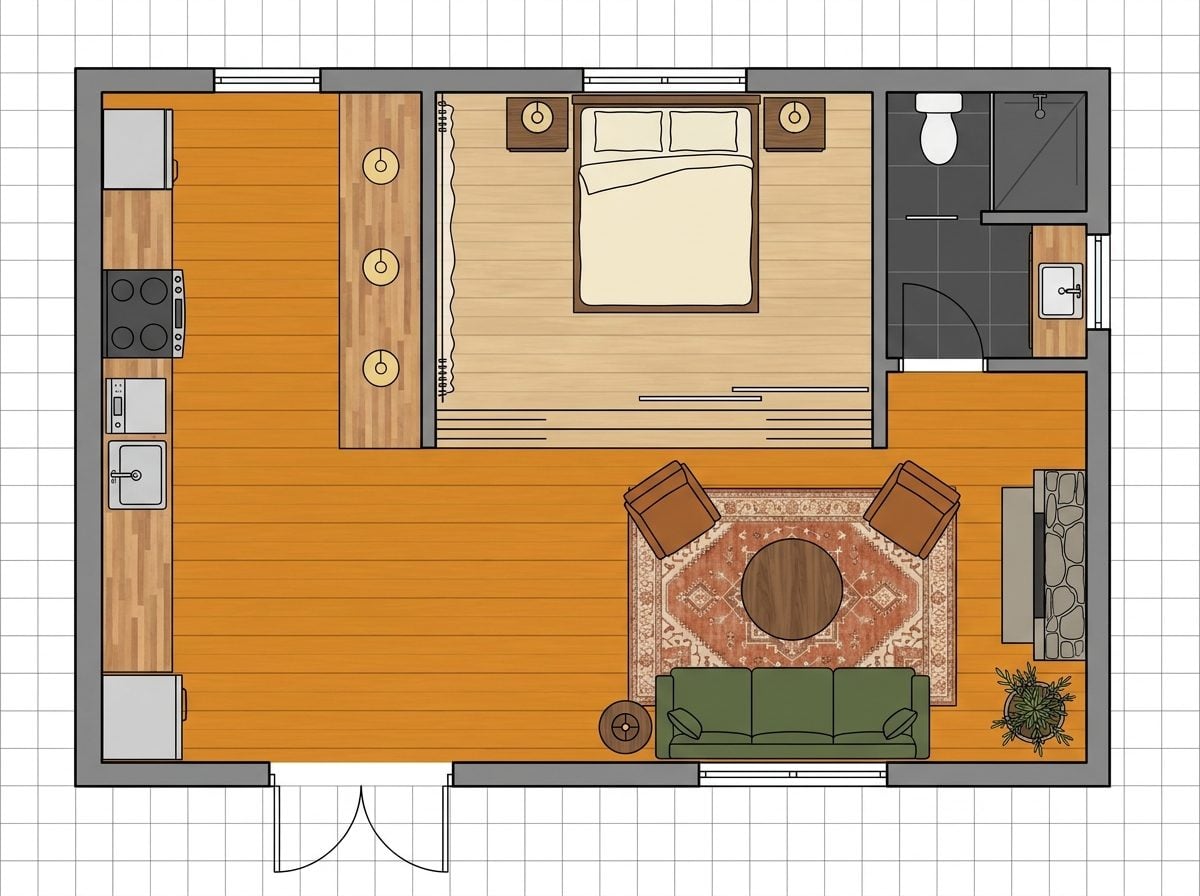
A sunken living room inside a garage conversion sounds like overkill until you realize it solves two problems at once: it defines zones without walls, and it gives the sleeping platform a natural visual boundary without a door. The step down is only six inches but it reads as a full room change in practice.
The olive green sofa and cognac leather accent chairs around the fireplace create a conversation pit energy that makes the living zone feel deliberate rather than leftover. Upstairs (or rather, up-platform), the queen bed sits on a low walnut frame with sheer curtains on a ceiling track providing optional privacy during the day.
Scandinavian Minimalist Garage Apartment with Freestanding Bathtub and Open Wet Room
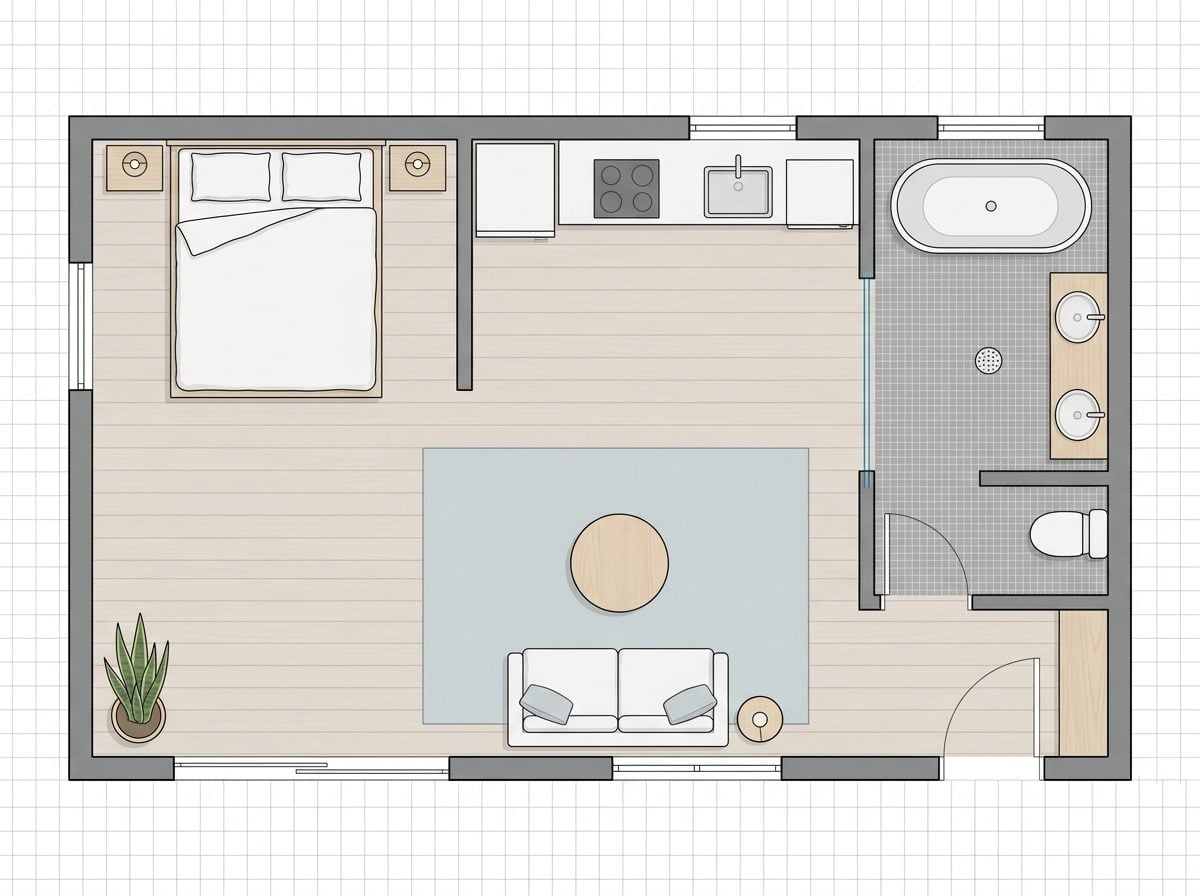
Putting a freestanding bathtub in sightline of the bedroom is a move borrowed from boutique hotels, and it works in a garage apartment for the same reason it works there: it makes a small space feel like a destination rather than a compromise. The frameless glass partition keeps the wet room open to the bedroom visually while containing water where it belongs.
Everything else in this layout commits to restraint. White oak flooring, white cabinetry, a white platform bed frame, a matte white freestanding bathtub. The only warmth comes from a pale blue-gray rug and a single snake plant in the corner. It’s the kind of apartment that photographs well and, more importantly, feels very calm to actually live in.
Industrial Chic Garage-to-Apartment with Exposed Ductwork Ceiling and Polished Concrete Floors
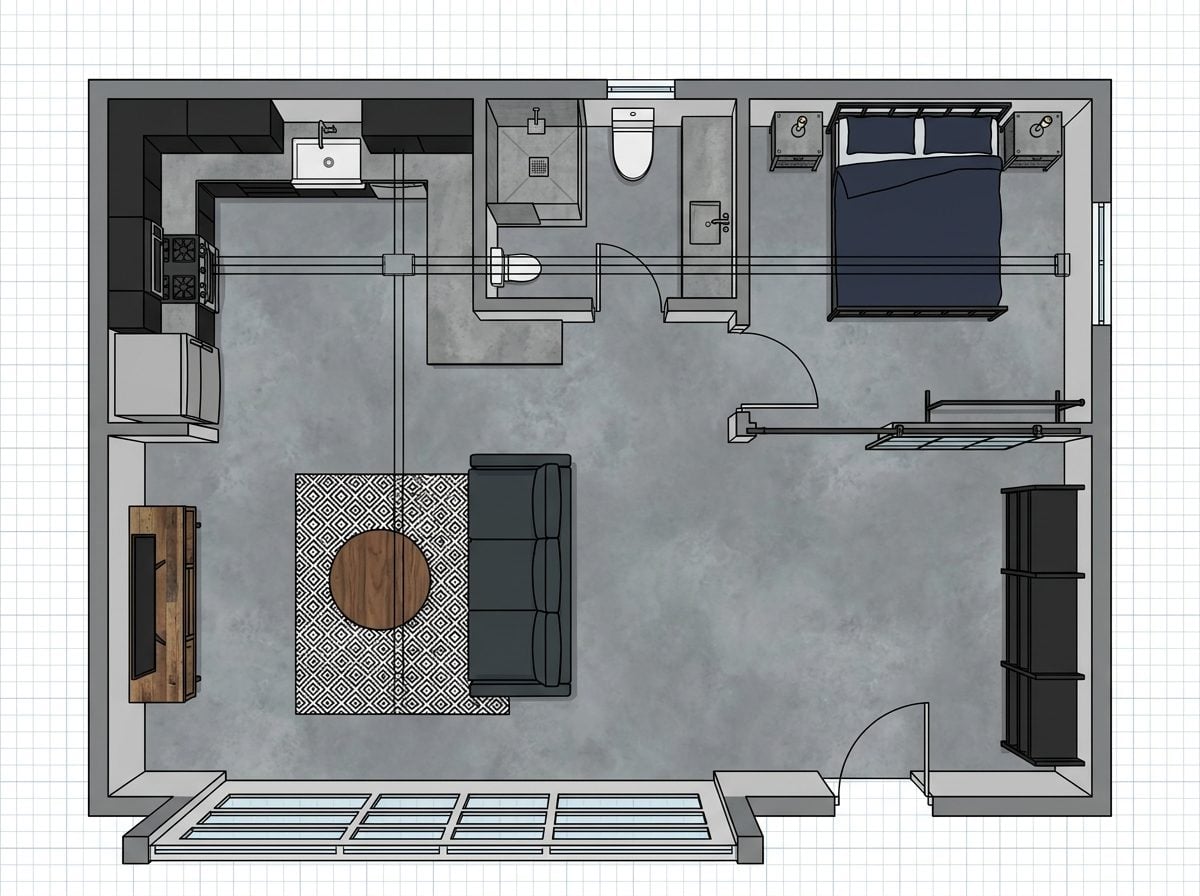
Raw, purposeful, and completely unapologetic about its origins, this layout leans into the garage’s industrial bones rather than hiding them. Polished concrete floors stay exposed. The kitchen runs matte black cabinetry against the back wall. A steel-and-glass sliding barn door tracks across the bedroom opening rather than swinging into valuable floor space.
- The open-plan kitchen and living zone share one connected sightline from front to back, making the footprint feel longer than it is.
- The barn door track eliminates the door-swing dead zone, recovering roughly eight square feet of usable floor.
- Overhead ductwork is left visible rather than boxed in, so ceiling height reads as maximum even where HVAC runs.
A reclaimed wood media console and geometric black and white area rug keep the palette grounded without going cold.
Biophilic Garage Apartment with Indoor Garden Wall, Corner Greenhouse Nook, and Warm Rattan Living Zone
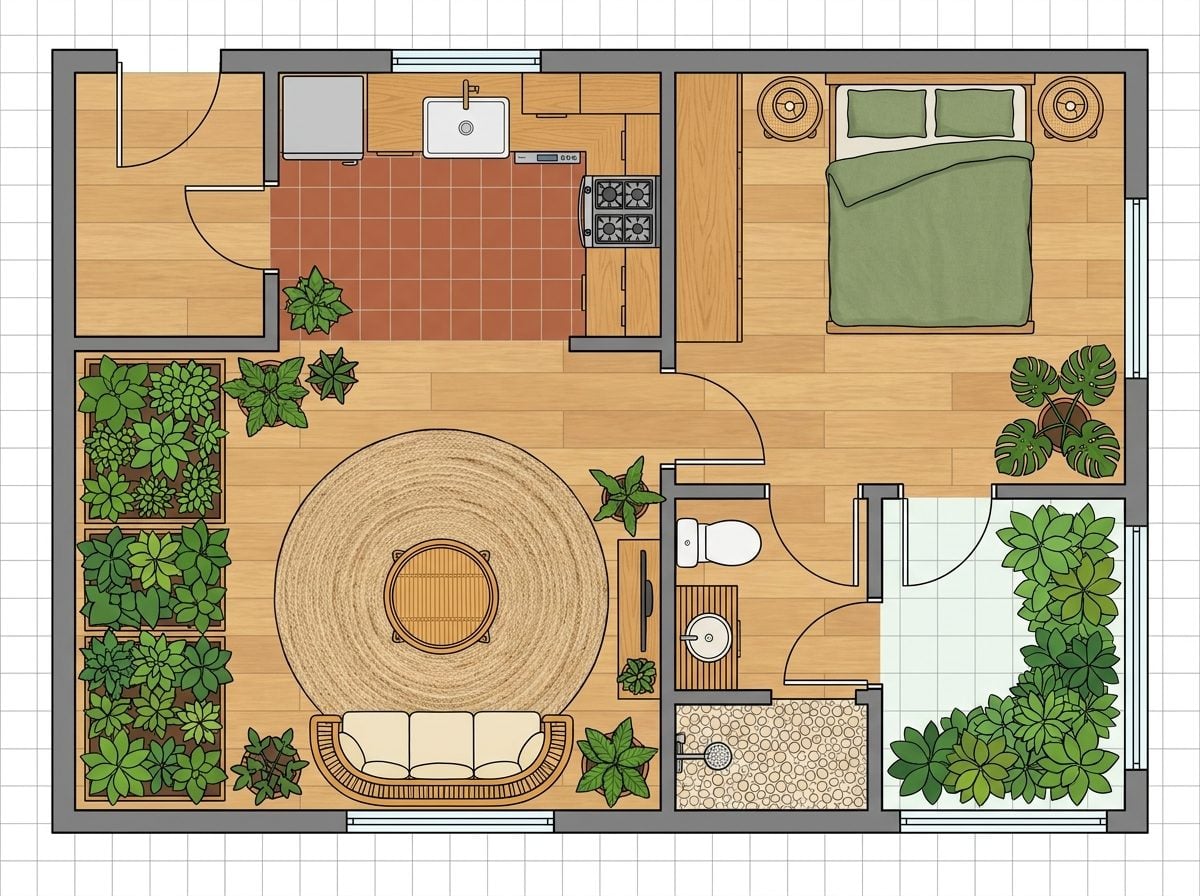
Biophilic design in a garage conversion isn’t just about scattering houseplants around. This layout bakes greenery into the architecture: a corner greenhouse nook replaces what would have been dead corner space, and a full indoor garden wall runs along the interior partition, functioning as both decor and a literal air-quality system. The result is an apartment that smells like a nursery in the best possible way.
The curved honey rattan sofa and jute area rug reinforce the organic palette in the living zone, while terracotta tile in the kitchen and a sage linen duvet in the bedroom pull the earth tones through every room. This kind of light living room philosophy, grounded in natural materials and greenery, makes even 450 square feet feel genuinely restorative.