🔥 Would you like to save this?
Your entryway isn’t a dumping ground — it’s a curated drop zone and there’s a difference. Yes, the dog leash is on the floor. Yes, that’s three tote bags and a receipt from 2023. But what if the chaos had a $250,000 backdrop? These before-and-after transformations prove that people who treat their foyer like a second closet deserve the most jaw-dropping entry of all. Stunning storage never looked so lived-in.
In order to come up with the very specific design ideas, we create most designs with the assistance of state-of-the-art AI interior design software. Also, assume links that take you off the site are affiliate links such as links to Amazon. this means we may earn a commission if you buy something.
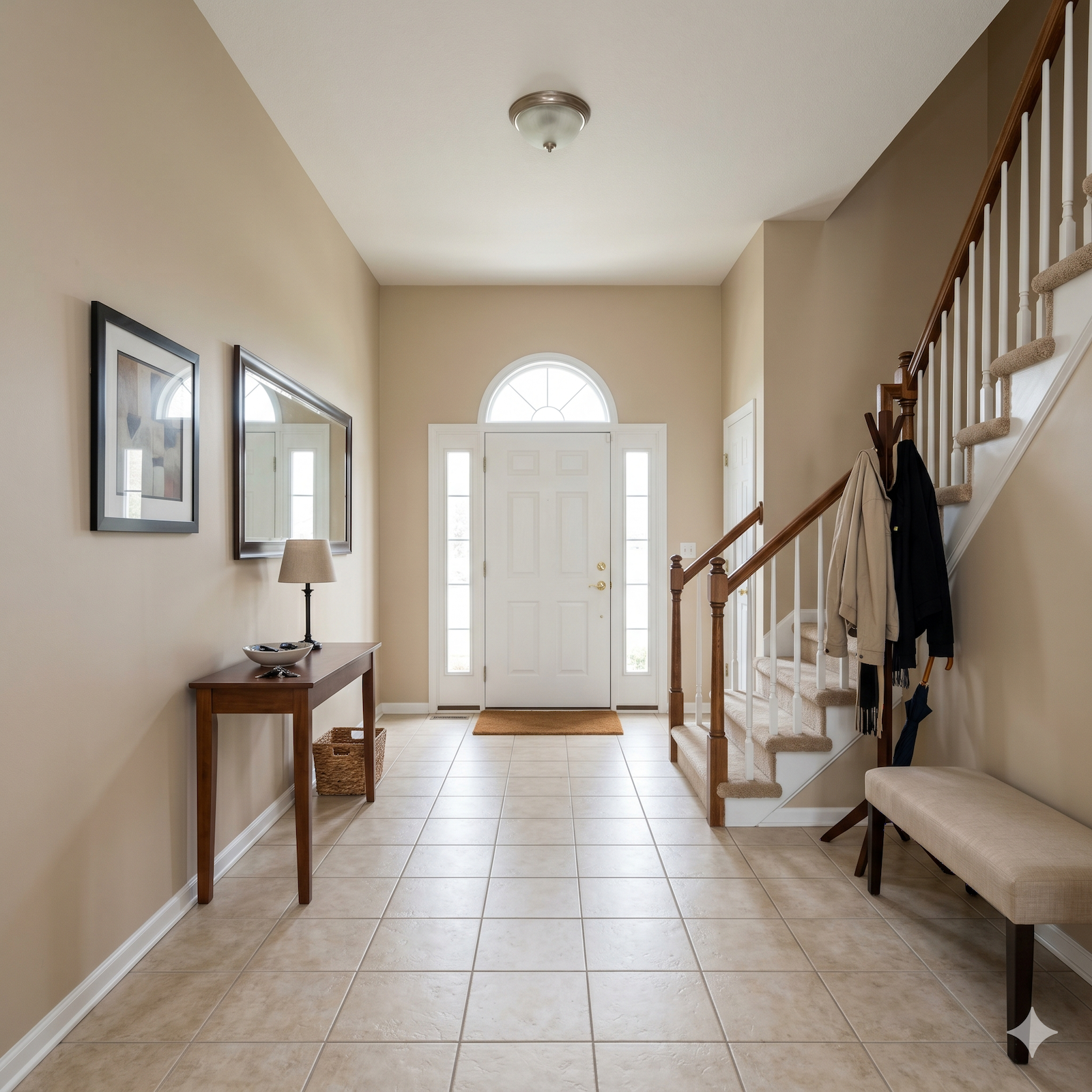
The foyer is the first room guests see and the last one homeowners think about. For a lot of people, it becomes a catch-all: coats piled on a single hook, shoes scattered across the floor, mail stacked on whatever surface happens to be nearby. Builder-grade entryways don’t help. They arrive with flat paint, hollow-core doors, and zero storage built in, which practically invites the chaos. The tension is real: the space sets the tone for the entire home, yet it gets treated like a mudroom, a coat closet, and a junk drawer rolled into one.
This collection of 34 before-and-after foyers shows what happens when homeowners stop ignoring the problem and start fixing it. Some added hooks, benches, and cubbies. Others tackled the walls, the lighting, or the floor entirely. The befores are recognizable. The afters prove that a neglected entryway, no matter how small or awkward, can become a space that actually works.
34. Mid-Century Foyer With Striped Ceiling and Red Accent Wall
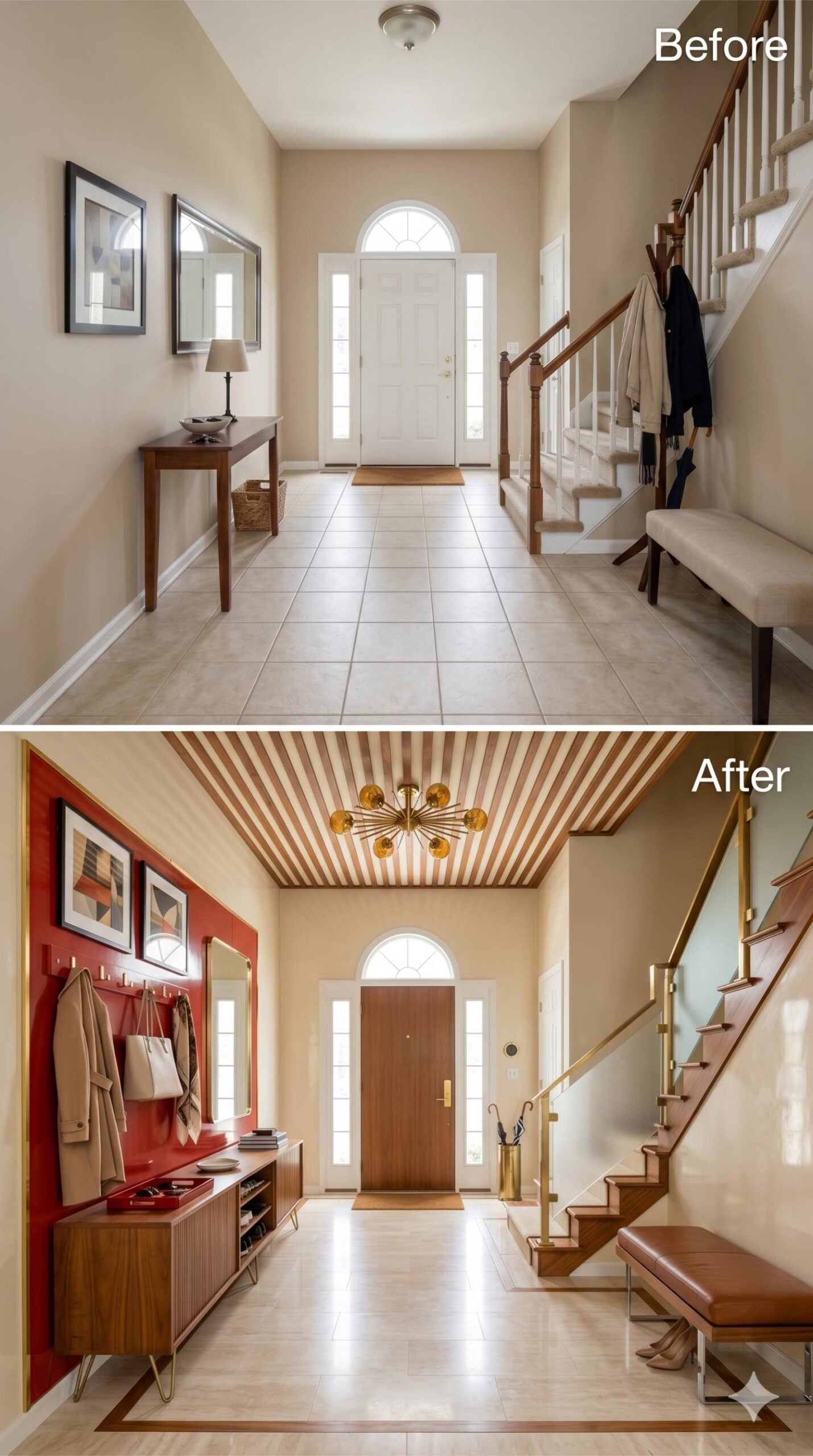
Walnut cabinetry on hairpin legs runs along the left wall beneath a deep red painted panel, where brass coat hooks hold bags and outerwear. A Sputnik-style chandelier with amber glass globes anchors the striped wood-and-cream ceiling detail above. The staircase trades painted balusters for glass panels with brass handrails, and a leather bench in cognac sits at its base.
33. Navy Walls and Herringbone Parquet Turn a Foyer Into an Art Deco Statement
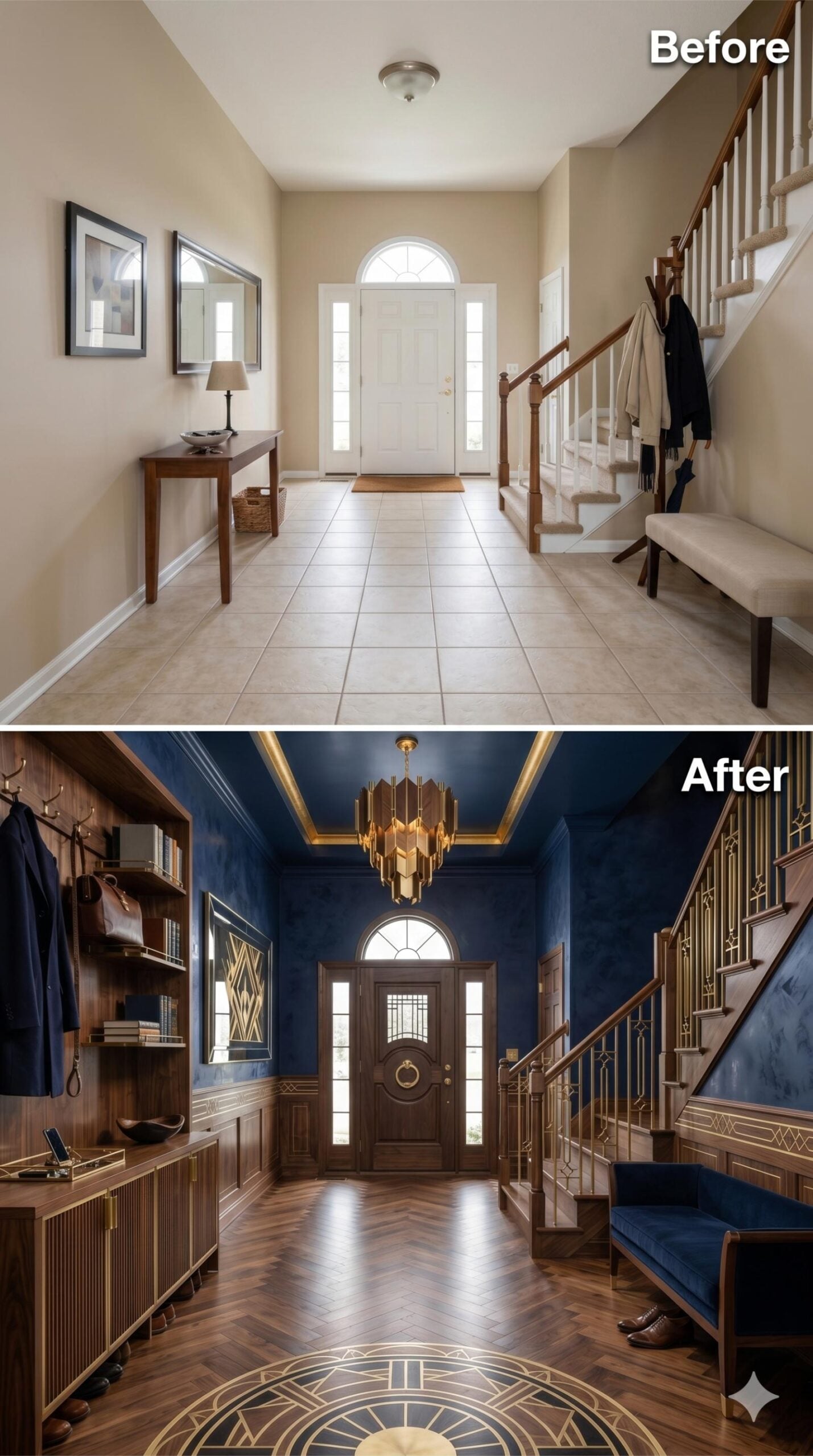
Deep navy venetian plaster covers the walls from wainscoting height to a tray ceiling trimmed in gold leaf detailing, while a geometric brass chandelier anchors the space overhead. Dark-stained oak herringbone parquet flooring features an inlaid brass medallion at the entry threshold. Built-in walnut shelving with fluted cabinet fronts and brass pulls lines the left wall, functioning as both coat storage and display.
32. Sage Plaster Walls and Beam Ceiling Turn a Foyer Into a Functional Mudroom
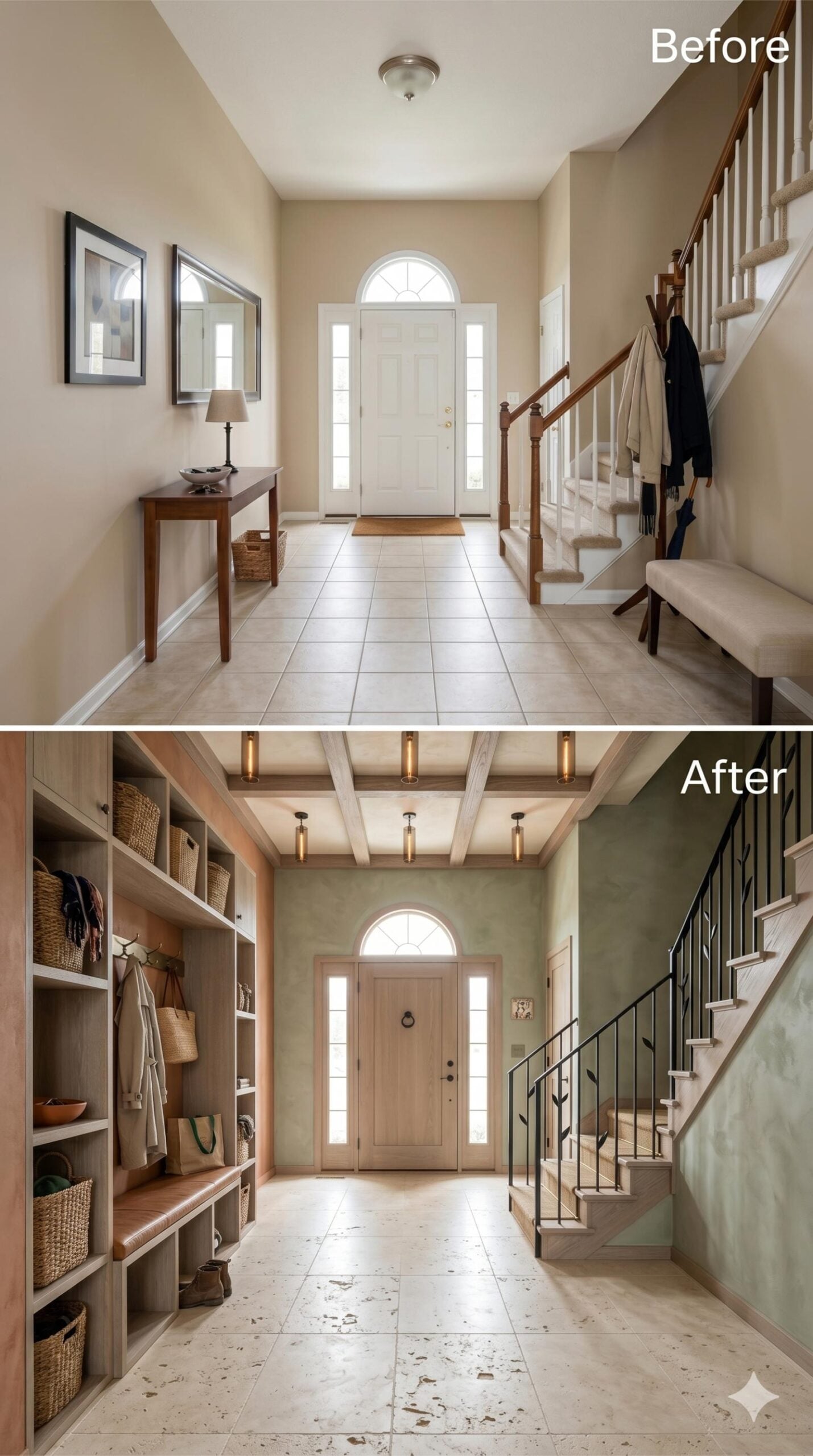
Exposed wood ceiling beams frame pendant lights with warm-toned metal housings, while sage green plaster walls anchor the space against bleached oak built-ins. Open shelving holds woven baskets, hooks carry linen bags, and a leather bench seat runs the length of the storage wall. The staircase railing switches from wood spindles to wrought iron with leaf detailing.
31. Burgundy Wainscoting and Gold Inlay Marble Give This Foyer Full Art Deco Authority
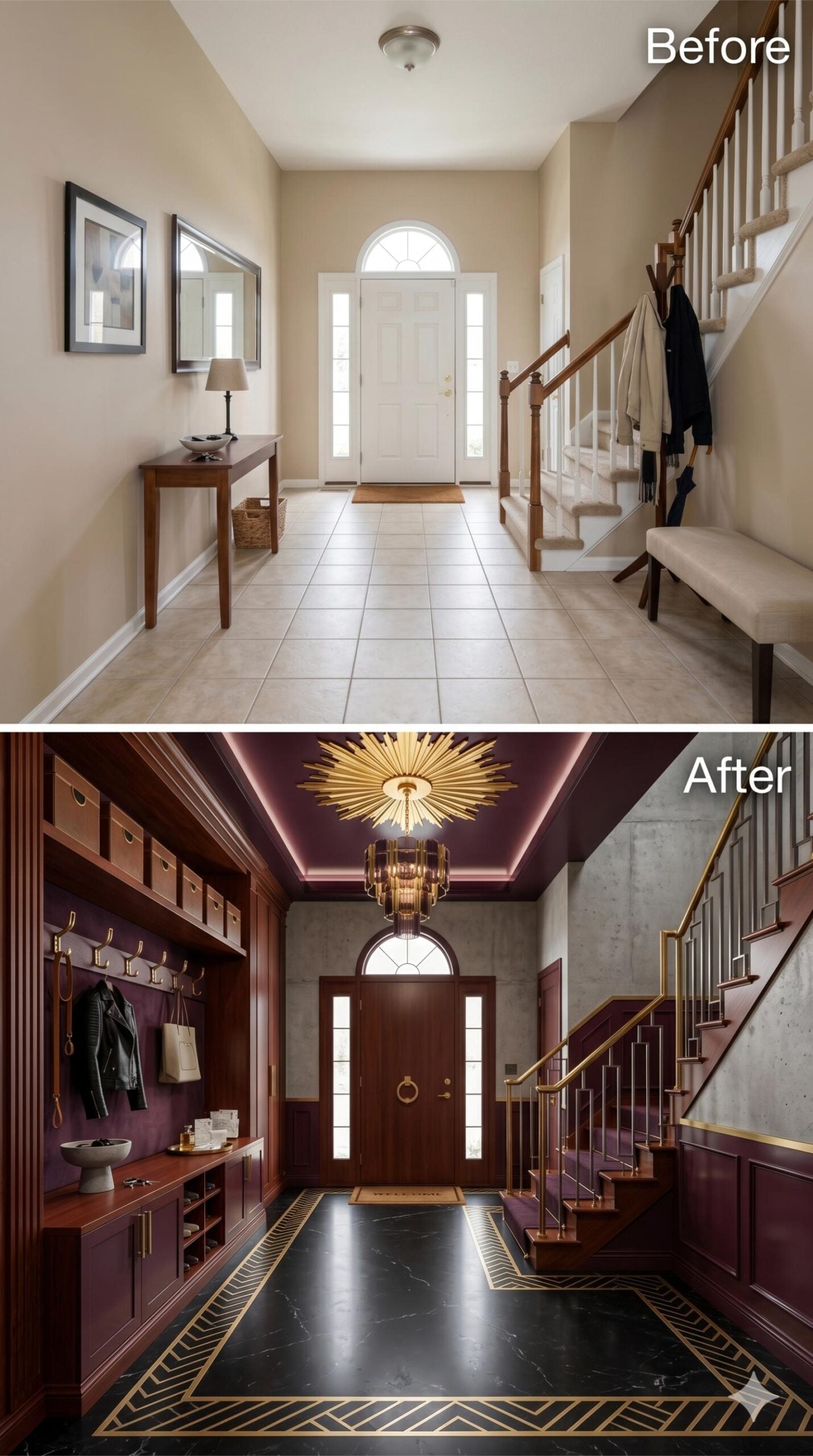
Mahogany built-ins line the left wall with brass hook rails, open shoe cubbies, and linen storage boxes. Black marble flooring carries a geometric gold inlay border. A sunburst ceiling medallion anchors the coffered plum ceiling above a brass chandelier.
Quick Fix: Swapping basic tile for black marble with brass inlay borders makes the strongest visual statement per square foot of any foyer upgrade. The inlay pattern pulls the eye toward the entry door and defines the space without any furniture doing the work.
30. Coffered Ceiling and Built-In Cubbies Make Every Inch of This Foyer Work
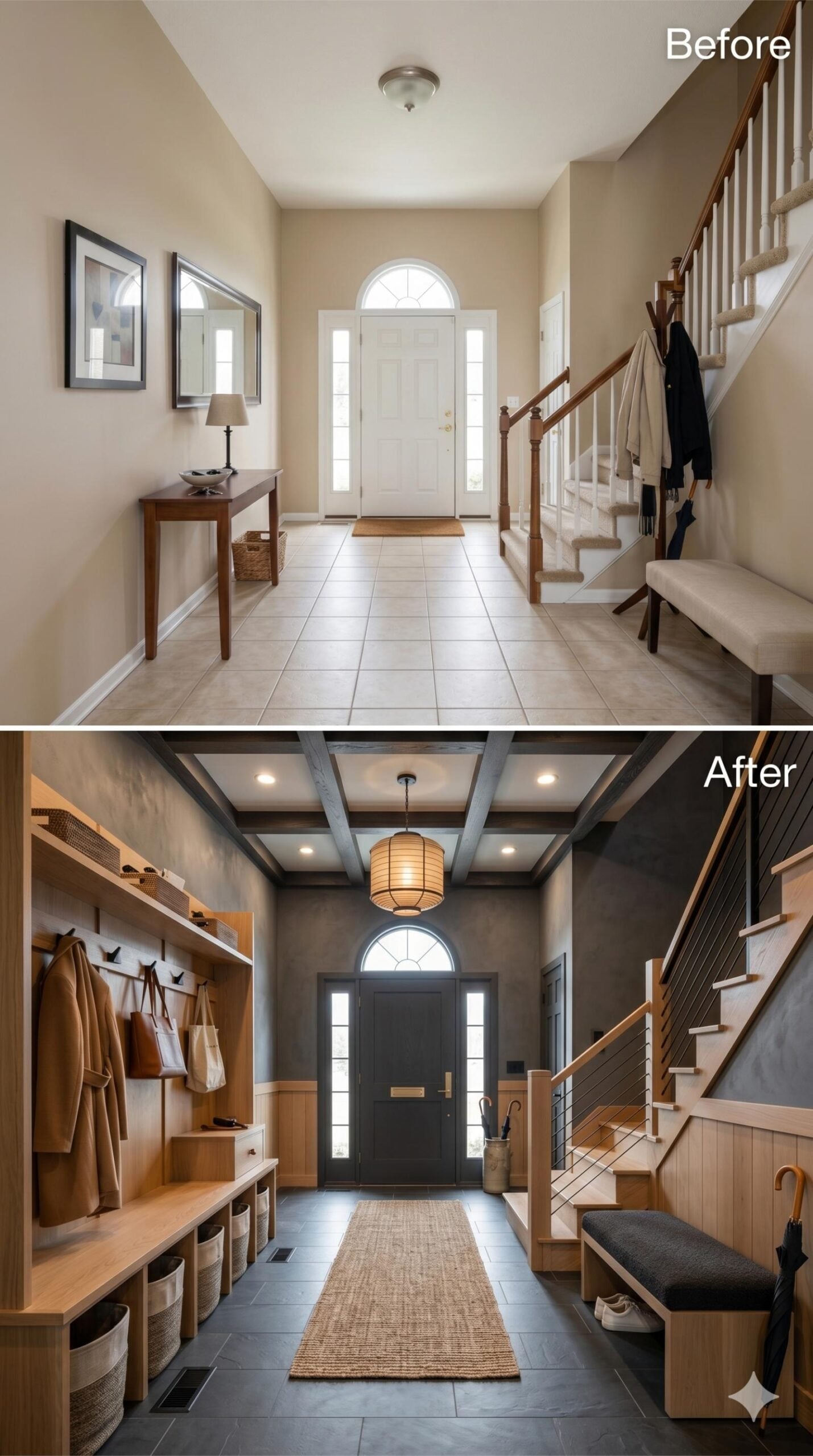
Dark slate floor tiles anchor the space while natural oak built-ins line the left wall, housing woven baskets, open shoe cubbies, and coat hooks at two heights. A paper lantern pendant hangs from a coffered ceiling with charcoal-painted beams. The front door, repainted slate gray with brass hardware, reads as intentional rather than incidental.
Ask Yourself: Does your entryway have at least one surface dedicated to each category of daily gear: shoes, bags, and outerwear? If not, the clutter you’re managing is a layout problem, not a habits problem.
29. Coffered Beams and Cherry Built-Ins Turn One Foyer Into a Craftsman Masterpiece
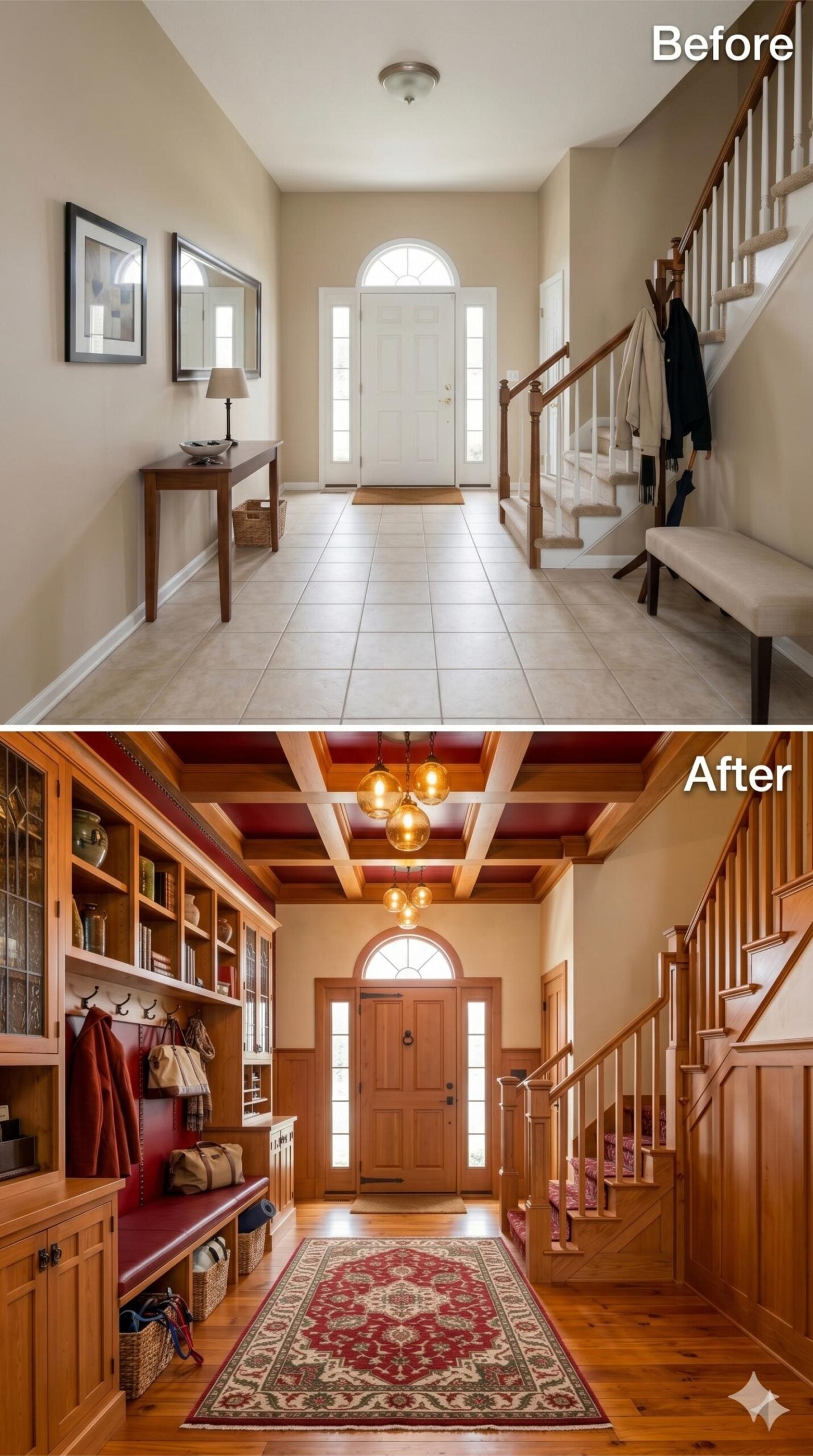
Warm-toned cherry cabinetry lines the left wall floor to ceiling, combining open shelving, glass-front display cases, and a built-in bench with a red leather seat cushion. Iron coat hooks anchor the lower section, keeping bags and outerwear off the floor without sacrificing an inch of shelf space. Pendant globe lights in an amber finish hang from a coffered ceiling painted deep red between the beams, pulling the wood tones upward.
The original white door gave way to a solid raised-panel entry door in natural knotty alder, flanked by sidelights that still let in daylight. A Persian-style runner in crimson and ivory grounds the hardwood floor and draws the eye straight to the entry. The staircase received matching wood trim, tying the renovation together as one continuous material story.
Trend Alert: Craftsman-style built-ins are returning as the preferred answer to foyer storage because they read as architecture rather than furniture. Homeowners choosing this approach gain a wall of functional storage that appraisers typically count as a permanent improvement to the home’s value. Unlike freestanding coat racks or console tables, integrated cabinetry survives every style refresh without looking dated.
28. Birch Shelving, Slatted Ceilings, and Sage Paint Turn a Foyer Into a Mudroom Worth Keeping
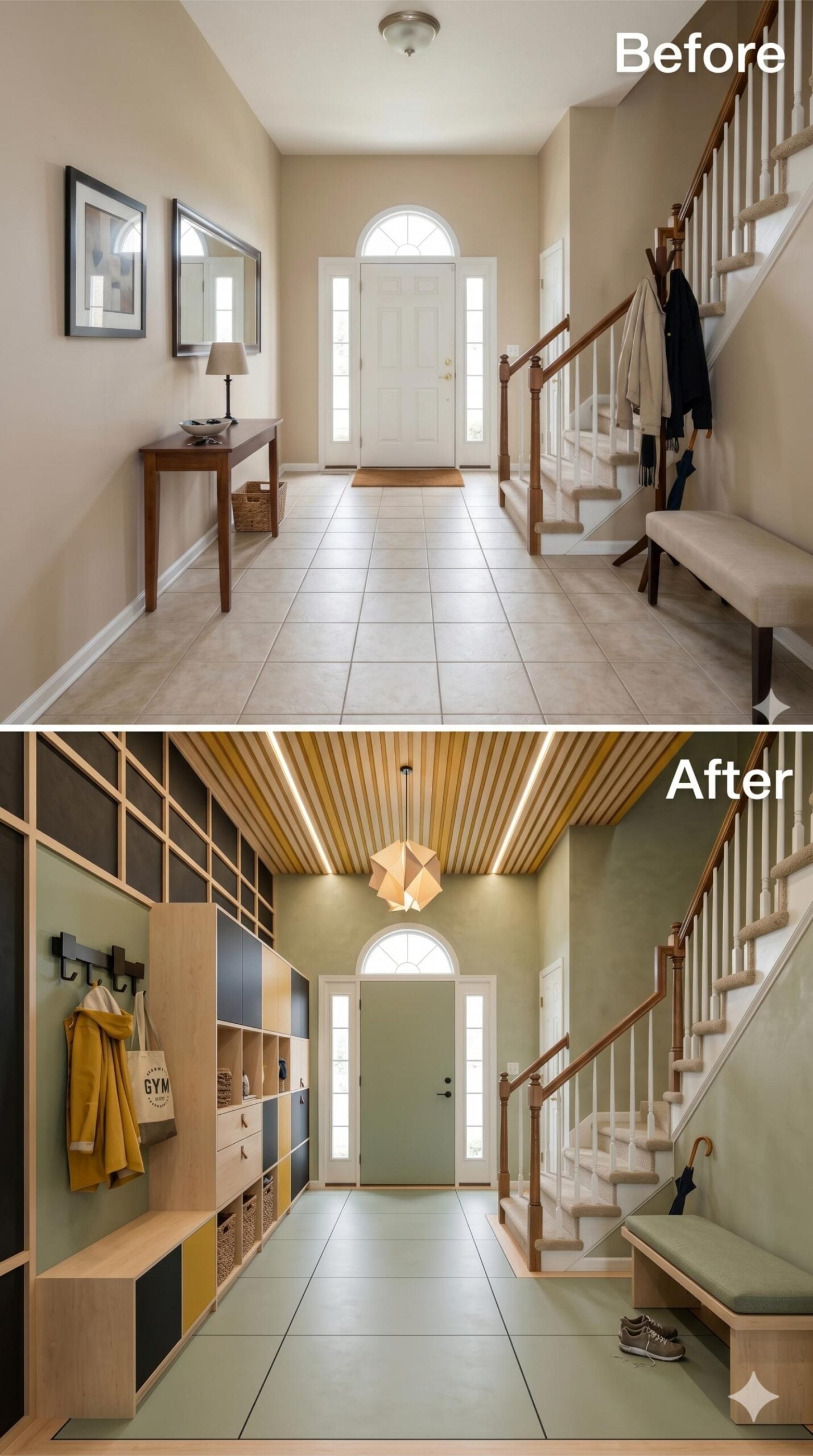
Birch open shelving runs the full length of the left wall, paired with charcoal cabinet inserts and black matte coat hooks that hold daily gear without apology. A geometric origami pendant in amber paper hangs from a slatted wood ceiling fitted with recessed LED strip lighting. Sage green paint covers every wall, grounding the space without competing with the natural wood tones. A bench with a sage cushion sits beside the staircase, and large-format floor tile in a matching muted green ties the layout together.
A geometric origami pendant in amber paper hangs from a slatted wood ceiling fitted with recessed LED strip lighting.
27. Emerald Damask Walls and Gold Ironwork Make This Foyer Impossible to Walk Past Quickly
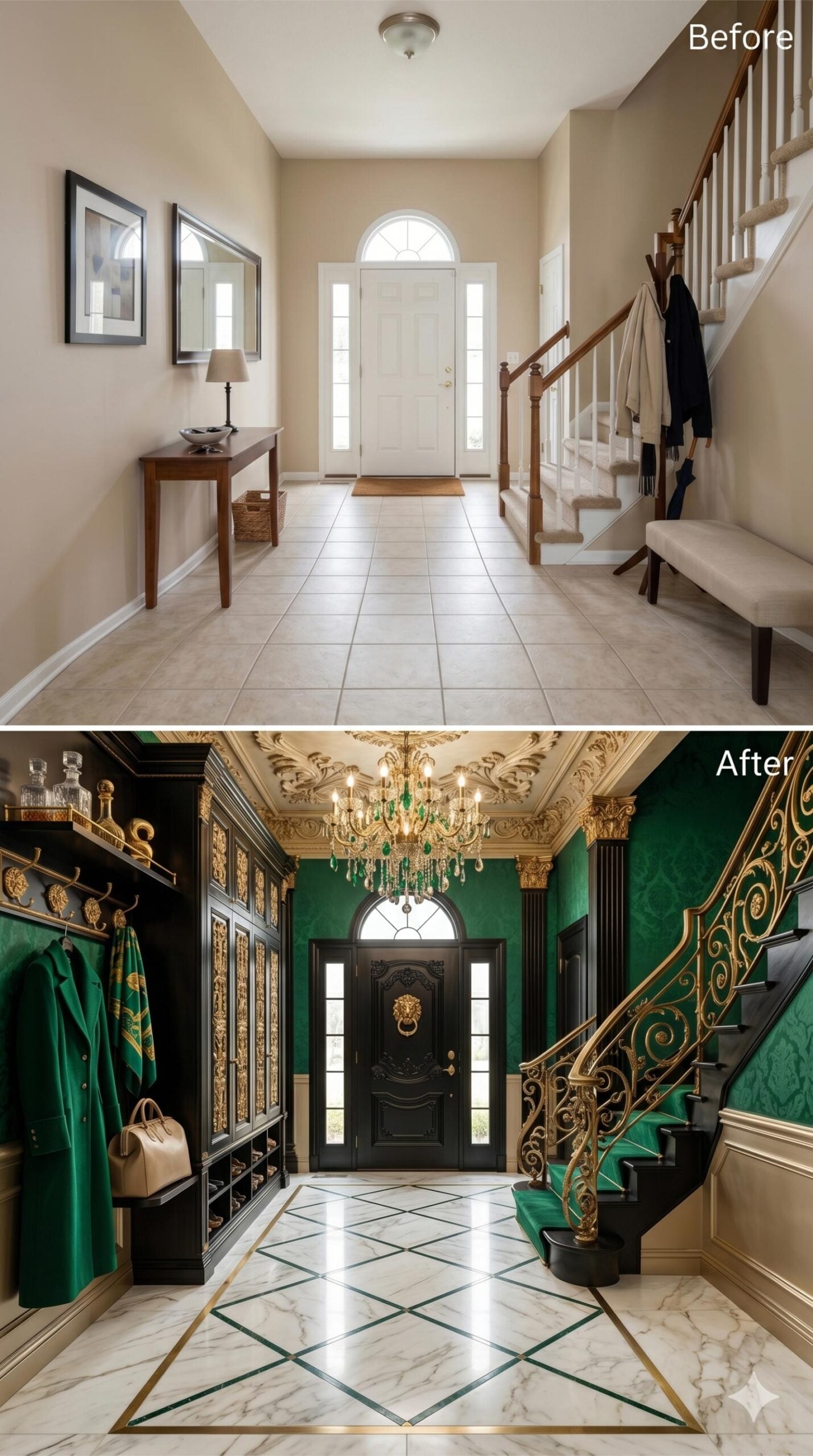
Emerald damask wallpaper covers every wall from wainscoting to ceiling, giving the space a richness that flat paint could never produce. The ceiling features sculpted plaster acanthus-leaf molding finished in aged gold, centered by a crystal and green-gem chandelier that casts warm light across the marble floor below.
That floor deserves its own attention: white marble tiles set on the diagonal with gold and emerald inlay borders trace a diamond grid across the full entry. The staircase railing swaps wood balusters for wrought iron scrollwork in black and gold. A built-in mudroom wall in black lacquer with gold-relief panel detailing handles coats, bags, and shoes without sacrificing the room’s formal character.
The staircase railing swaps wood balusters for wrought iron scrollwork in black and gold.
26. Reclaimed Wood Shelving and Cage Pendants Give This Foyer Industrial Backbone
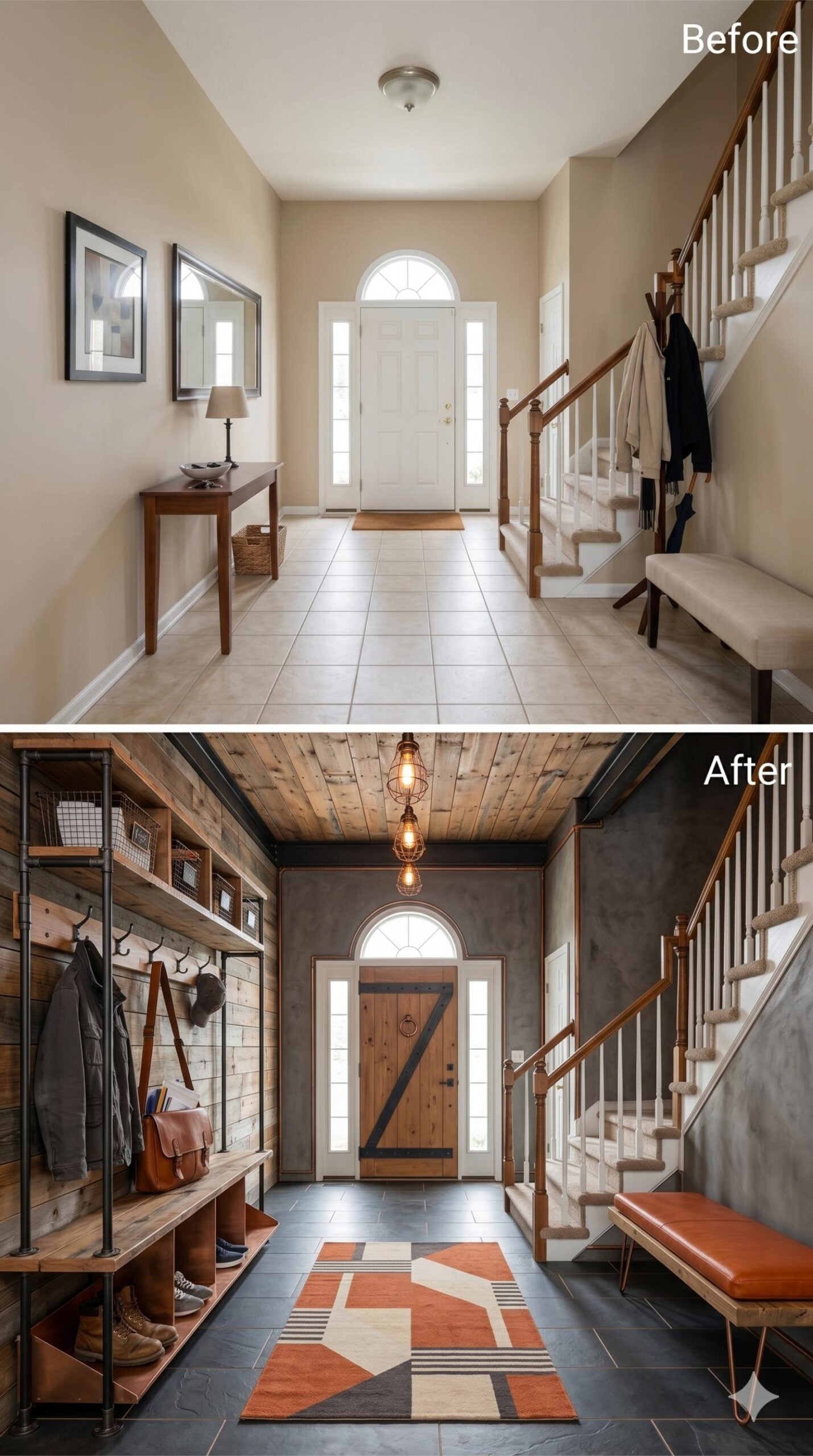
Pipe-frame shelving lines the left wall from floor to ceiling, holding wire baskets, leather bags, and rows of boots on raw wood planks. The wall behind it uses shiplap in a weathered grey-brown finish, while the ceiling switches to tongue-and-groove planks in a lighter natural pine. Two cage pendant lights with Edison bulbs hang at different heights, casting amber pools down the slate tile floor.
A geometric runner in burnt orange, cream, and charcoal anchors the center of the space. The front door is clad in knotty cedar with black metal Z-bracing and a ring pull. On the stair side, a leather bench in cognac sits below the banister, replacing the need for a separate seating zone. The walls shift to a textured concrete finish in dark grey, which absorbs light rather than reflecting it.
- Pipe-frame shelving costs roughly 40 percent less than custom cabinetry while holding comparable weight loads
- Slate tile holds up to outdoor footwear better than ceramic because its surface texture hides scratches
- Tongue-and-groove wood ceilings add acoustic dampening in hard-surface entryways where sound otherwise bounces
25. Navy Lacquer Ceilings and a Crystal Chandelier Make This Foyer Demand Attention
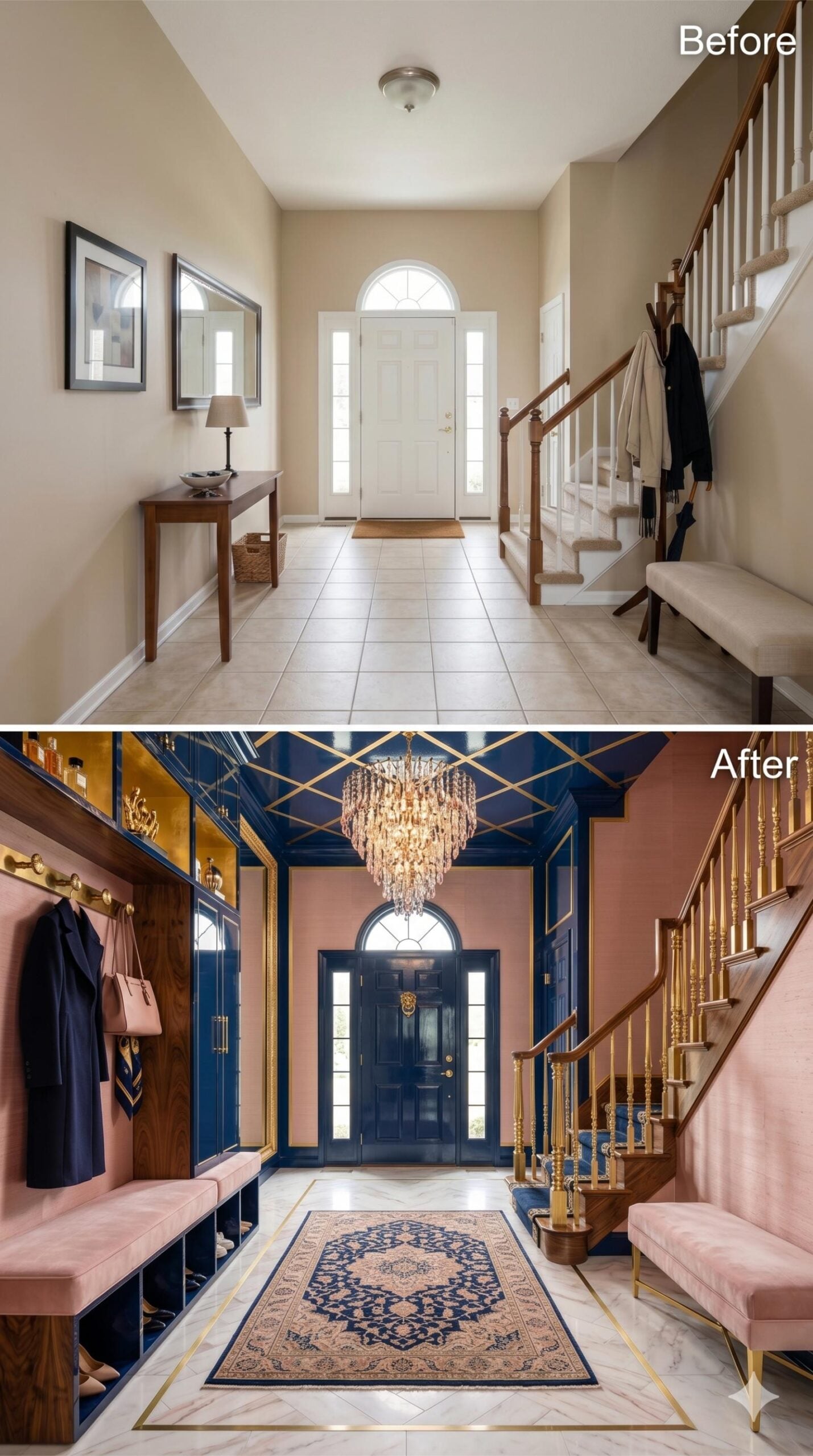
Painting a ceiling navy and finishing it with gold lattice trim is the kind of decision that separates a foyer from a lobby.
Pink plaster walls hold their own against the high-gloss navy ceiling overhead, where a geometric gold grid pattern frames a cascading crystal chandelier as the room’s centerpiece. Built-in navy cabinetry with brass pulls lines the left wall, topped with open display shelving backed in antique gold. A tufted blush bench runs the length of the cubby storage below it. Marble flooring with a brass border inlay anchors the room, layered with a navy and blush Persian-style runner. The staircase railing gets brass balusters, pulling the metal finish through every vertical plane. Coat hooks in unlacquered brass sit beside the built-ins, keeping daily outerwear off the floor without requiring a separate piece of furniture.
24. Art Nouveau Ceiling Murals and Light Maple Built-Ins Redefine Foyer Storage
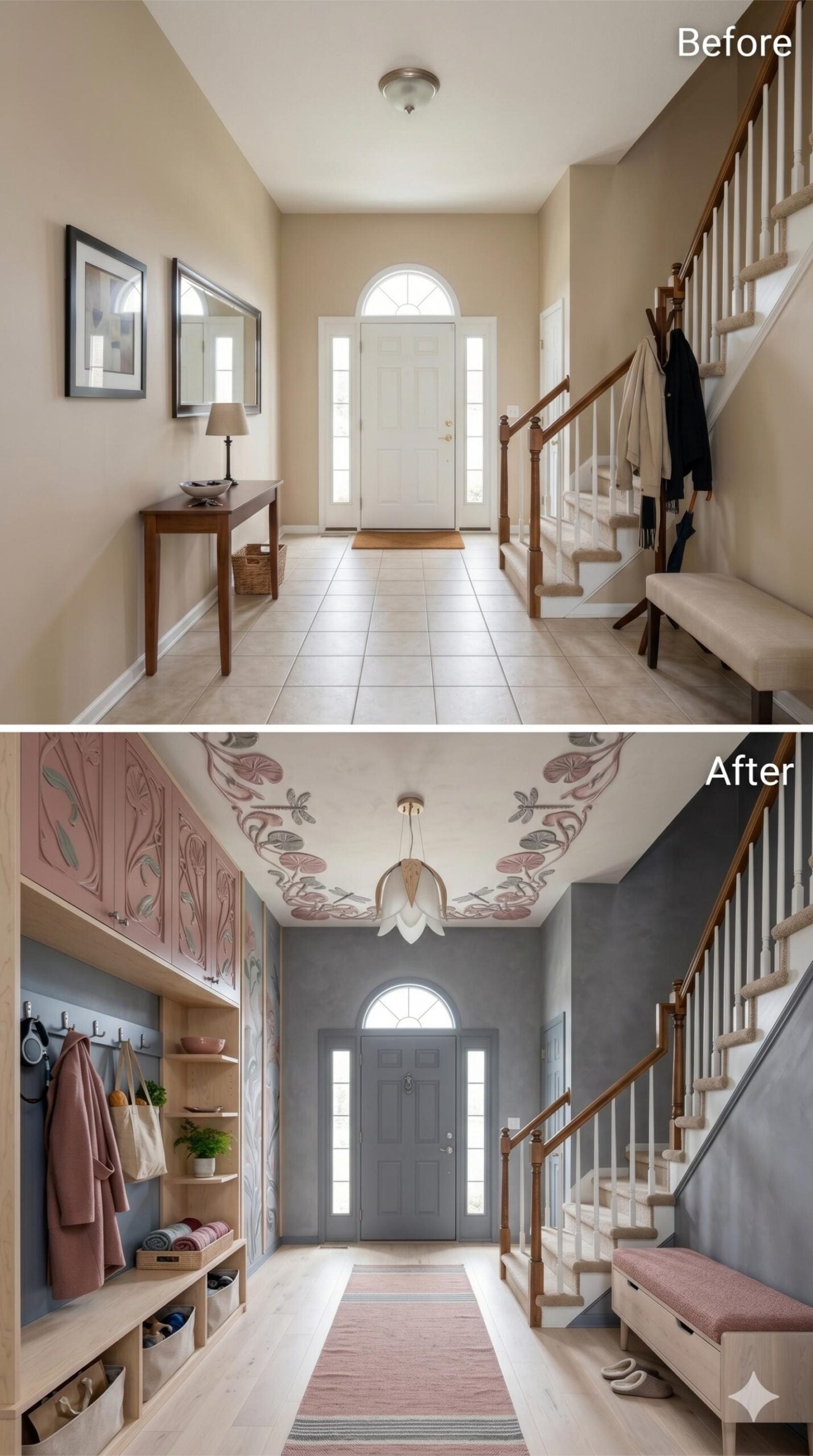
Bleached maple shelving runs the full length of the left wall, organizing shoes, baskets, and outerwear hooks at separate heights so each category has a dedicated zone. The cabinet doors above carry carved floral relief panels painted in dusty rose and sage, a detail that reads as architectural millwork rather than decoration added after the fact.
The real commitment is overhead. A hand-painted Art Nouveau mural wraps the ceiling in trailing botanicals rendered in muted rose, grey, and cream, anchoring a pendant light shaped like a magnolia bloom. The front door and walls are finished in a flat blue-grey plaster tone, and whitewashed plank flooring runs underfoot with a cotton runner in blush and taupe stripe. Under-stair storage drawers in the same maple finish close out the layout without wasting a square foot.
Color Story: The wall color here is a flat blue-grey with the texture of troweled plaster, which absorbs light differently throughout the day and keeps the space from reading cold despite the cool undertone. Dusty rose appears in three places: the cabinet panel paint, the ceiling mural, and the woven runner, a repetition that makes the palette feel intentional rather than accidental. Repeating an accent color in at least three surfaces is one of the simplest ways to make a multi-material space hold together visually.
23. Art Nouveau Ceiling Murals and Blush Cabinet Fronts Make Storage Feel Like Architecture
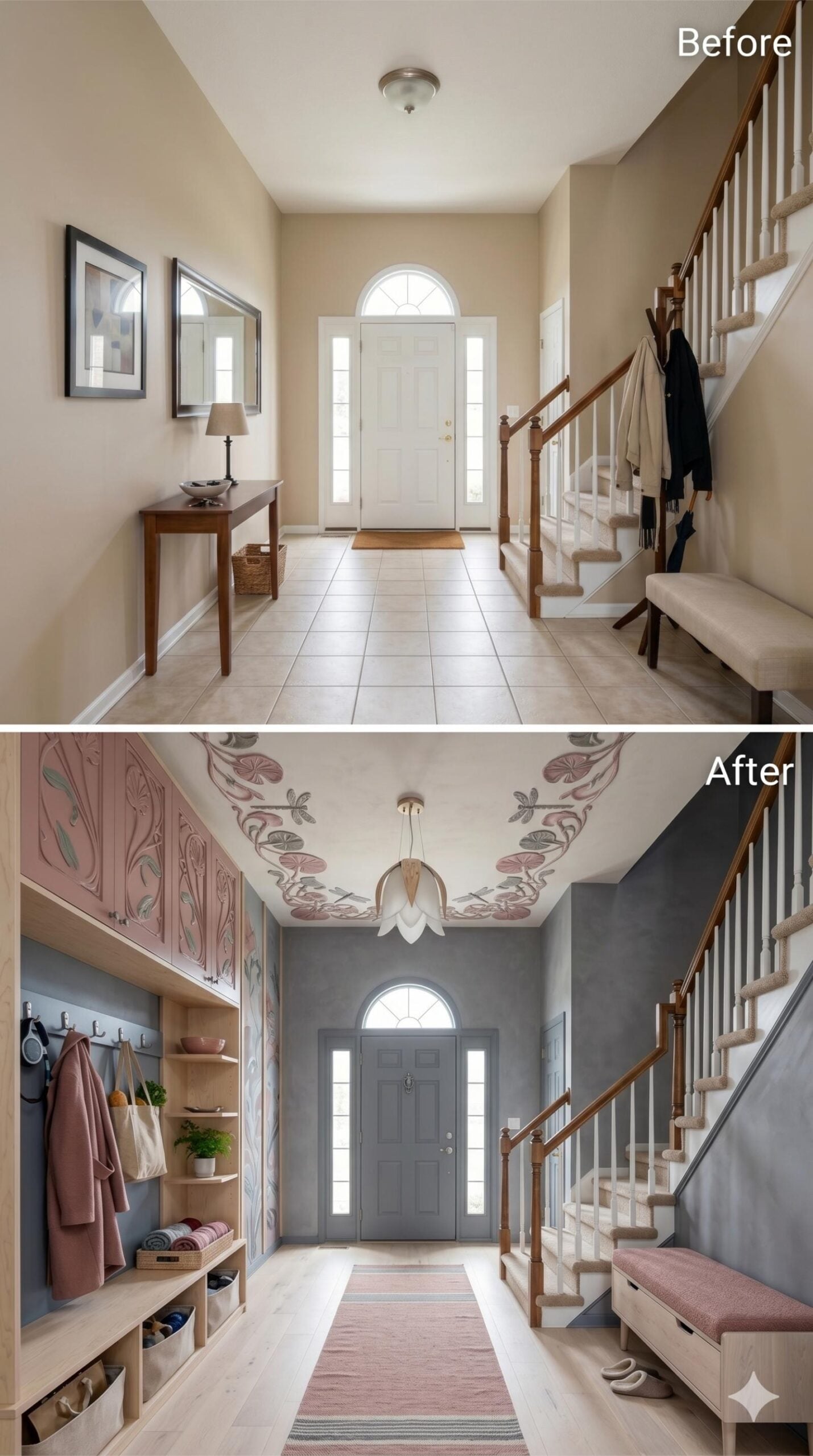
Light maple open shelving lines the left wall floor to ceiling, with cabinet doors painted a dusty rose and carved with botanical relief patterns that echo the hand-painted mural spreading across the ceiling above. That mural features stylized lotus leaves and pod shapes rendered in muted rose and grey-green, anchoring a pendant light shaped like a white tulip bloom. The wall paint shifts to a concrete grey, applied with a texture that reads more mineral than flat.
The floor transitions from tile to wide-plank blonde wood, grounded by a striped cotton runner in blush and grey. Hooks, open cubbies, shoe slots, and shelving divide the left wall into zones for outerwear, bags, and footwear without a single drawer pull in sight.
Style Tip: Ceiling murals work in foyers specifically because the space is narrow enough that the eye travels upward naturally. A botanical motif painted in low-saturation tones like dusty rose and sage reads as architectural detail rather than decoration. Commissioning a local muralist to extend a design from the ceiling onto upper cabinet faces, as seen here, creates visual continuity that no wallpaper can replicate.
Raw materials and organic textures take over where formal architectural detailing left off.
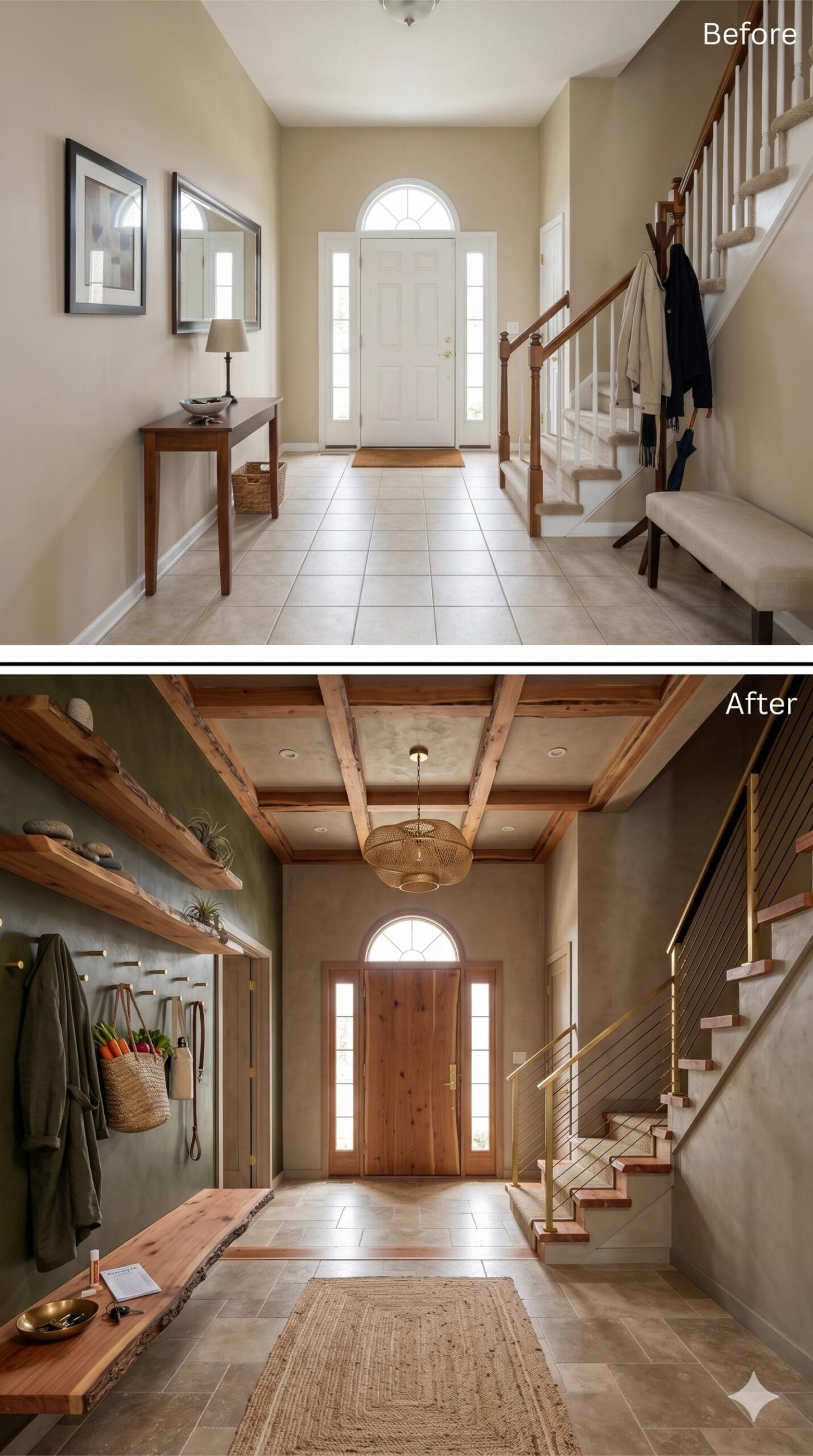
22. Live-Edge Cedar, Cable Railings, and Olive Plaster Pull a Foyer Into the Present
🔥 Would you like to save this?
Olive-toned plaster walls anchor the space while knotty cedar floating shelves with live edges run the full length of the left wall, holding air plants and stones at varying heights. Brass peg hooks replace a coat closet entirely. The staircase loses its wood balustrade for steel cable and a brass handrail. Overhead, exposed cedar beams frame a recessed plaster ceiling panel, and a woven rattan globe pendant drops from center. Travertine tile replaces the original grid format underfoot, and a jute runner runs the length of the hall.
21. Carved Walnut Panels, Red Crystal Chandelier, and Damask Walls Declare a Foyer’s Full Intentions
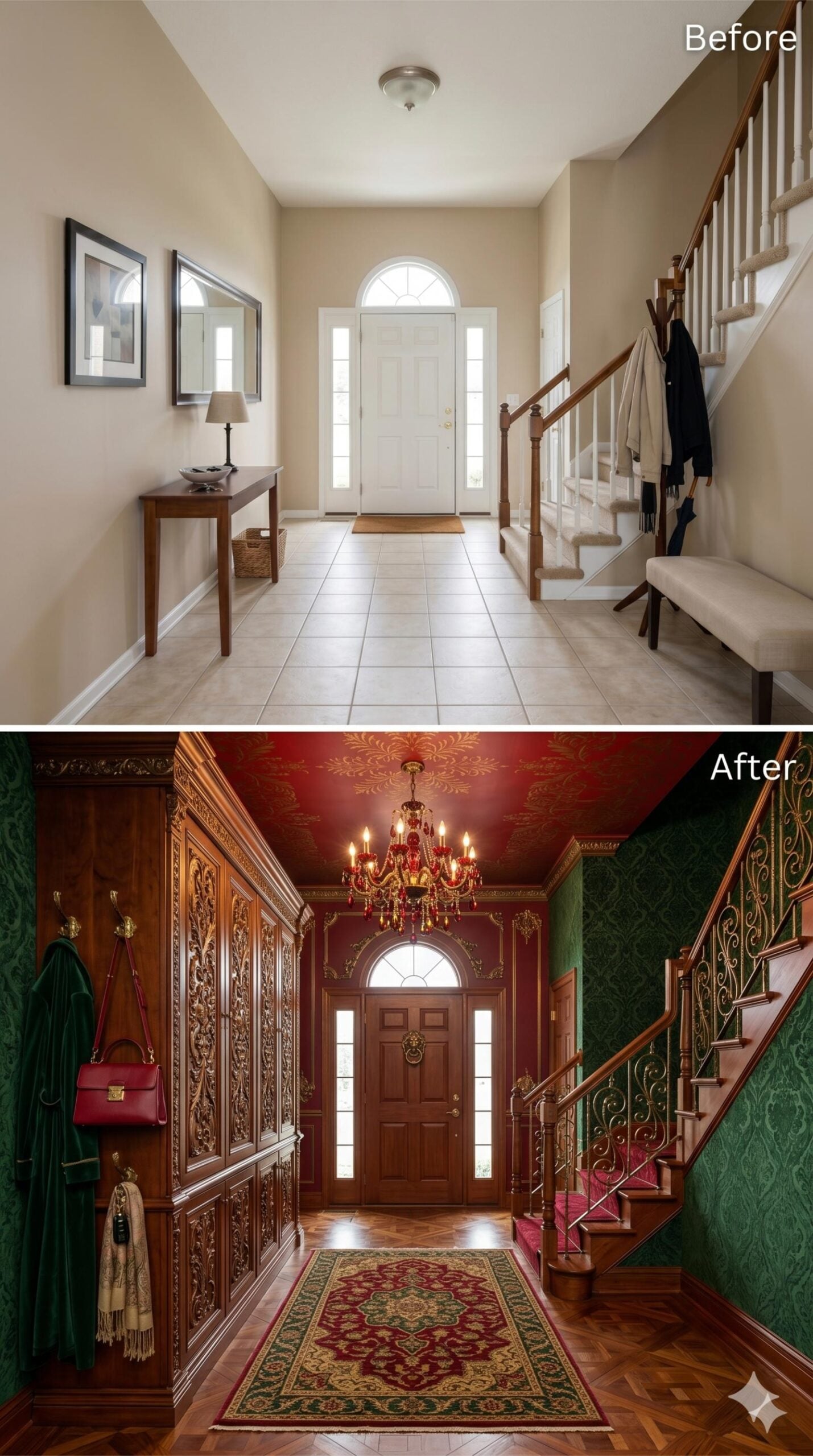
Intricate relief-carved walnut panels line the left wall floor to ceiling, their botanical motifs cut deep enough to cast shadows under candlelight. A red crystal chandelier with exposed candelabra arms hangs centered beneath a crimson ceiling covered in gold damask wallpaper, pulling every surface into a deliberate conversation. The front door is solid walnut with a lion’s head brass knocker, framed by sidelights and a fanlight window that mirrors the original architecture.
Green damask wallpaper covers the stairwell wall, complemented by wrought iron balustrades with scroll detailing and a dark walnut handrail. Herringbone hardwood runs the full length of the floor beneath a red Persian runner with ivory and gold medallion patterning. Brass coat hooks mounted directly to the carved panel provide actual utility without interrupting the visual weight of the wall.
The Psychology Behind This: Spaces with high visual complexity at eye level and above tend to slow a person’s pace through them, which is why foyers designed this way feel larger than their square footage suggests. The brain spends more time processing layered pattern and texture, effectively stretching the perceived time spent in the space. Designers use this effect intentionally in narrow entries where square footage cannot be added but spatial experience still can.
20. Rope Chandelier, Shiplap Ceiling, and Navy Stair Runner Pull a Foyer Toward the Coast
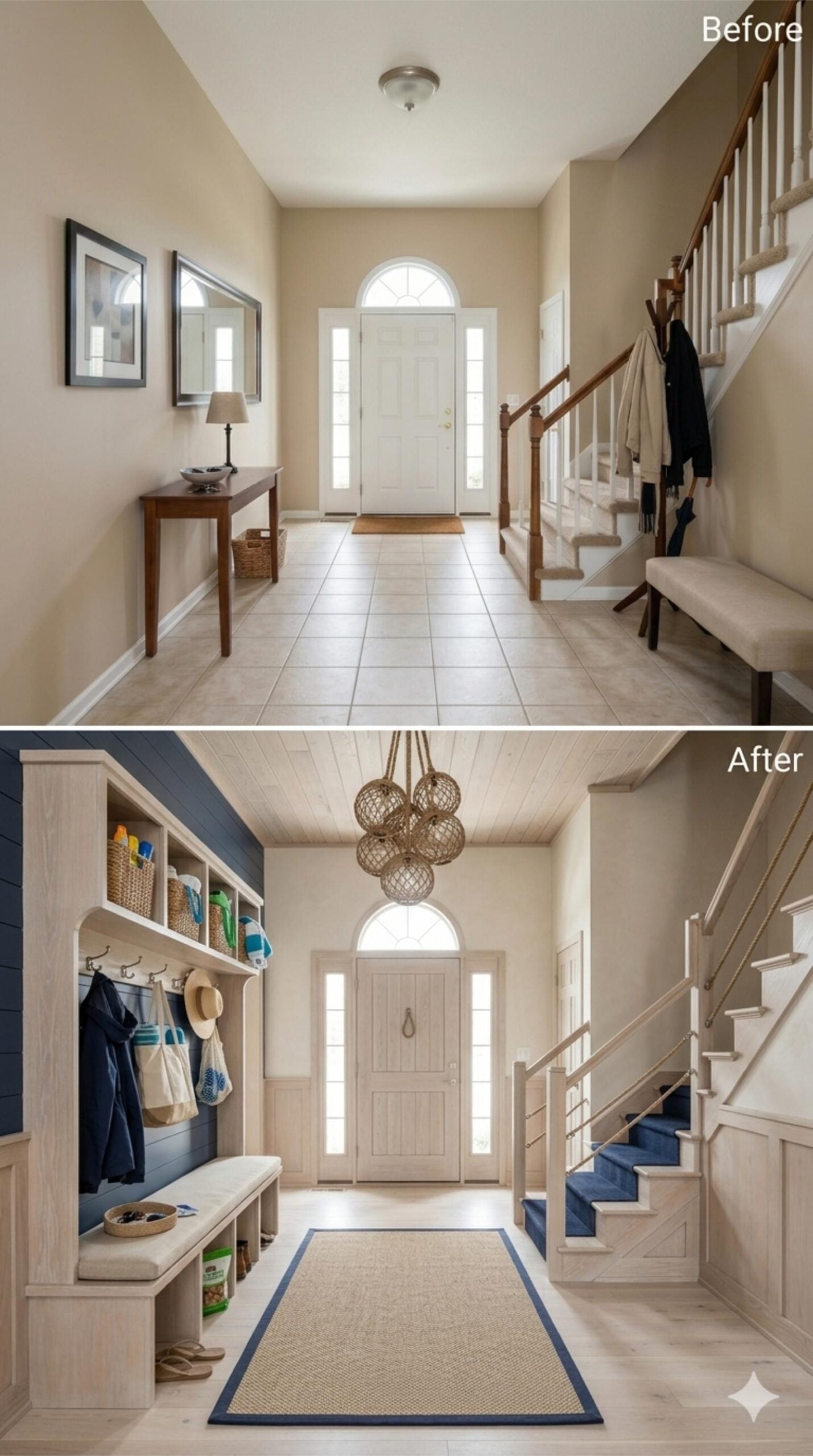
Nautical rope pendants clustered into a chandelier above a foyer floor is a design choice that earns its keep.
The whitewashed shiplap ceiling sets the tone before anything else registers. Below it, a built-in mudroom wall in bleached oak runs the full length of the left side, with open cubbies stacked above coat hooks and a upholstered bench seat over lower storage. A navy shiplap accent wall behind the built-ins grounds the pale woodwork.
The front door gets a panel upgrade with a rope pull, keeping the coastal thread consistent. On the right, the staircase loses its dark wood rail in favor of rope-wrapped balusters and whitewashed treads over a navy runner. A sisal runner with a navy border anchors the center of the floor.
19. Gothic Plasterwork Ceiling, Black Walls, and Gold Stenciling Make Storage Feel Like a Rite of Passage
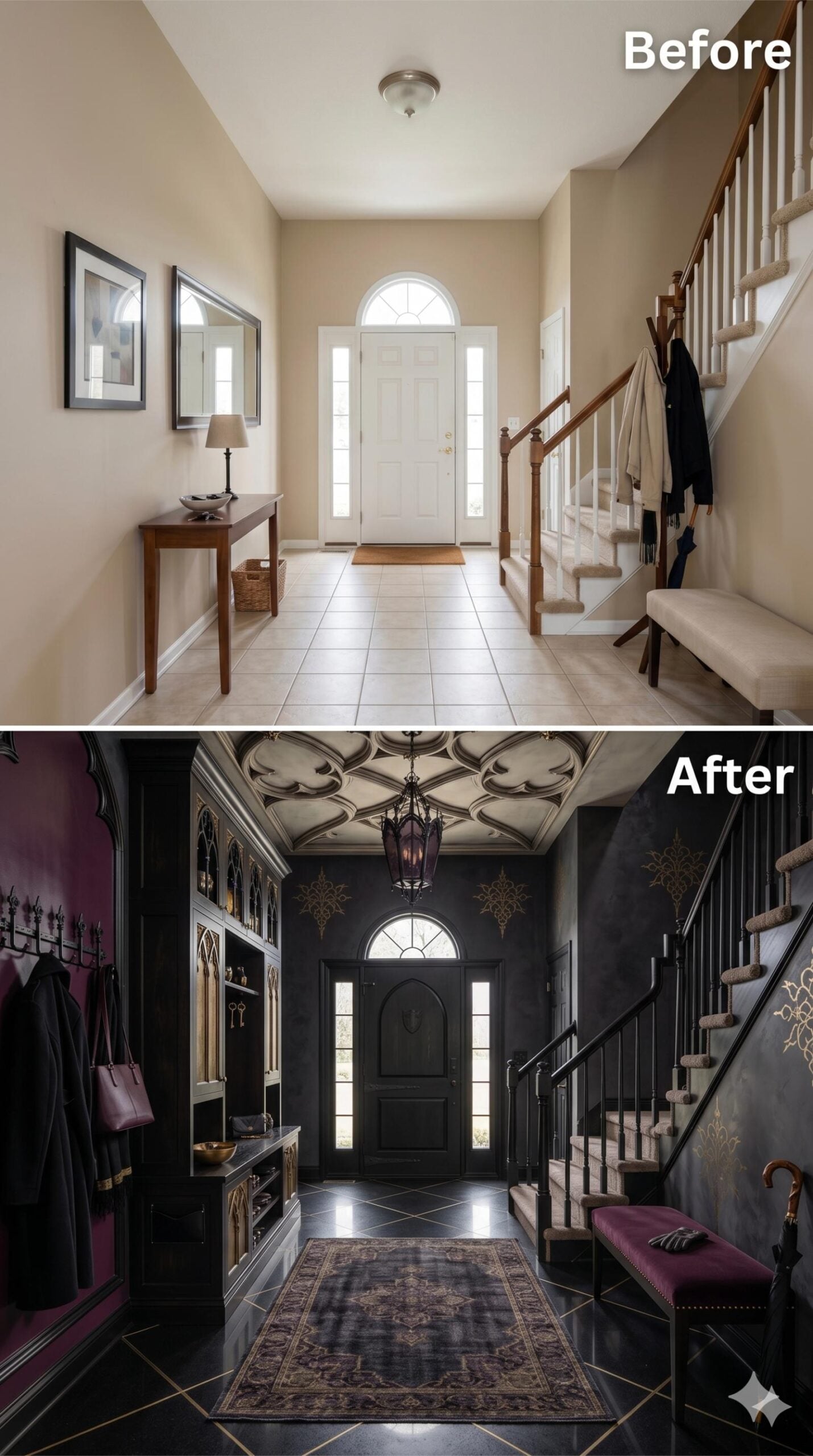
Dark charcoal plaster walls carry hand-stenciled gold Gothic motifs that repeat at measured intervals up toward the staircase. The ceiling is the room’s anchor: a vaulted Gothic tracery pattern rendered in off-white plasterwork with ribbed arches that converge at a wrought iron lantern pendant with smoked glass panels. Underfoot, black tile with diagonal gold grout lines runs the length of the foyer beneath a wool runner in burgundy and charcoal.
Built-in shelving along the left wall uses pointed arch detailing on each cabinet opening, finished in matte black with aged brass hardware. A plum velvet bench sits at the base of the staircase. Matte black newel posts replace the original wood, and the stair wall carries a second layer of gold stenciling at dado height.
Worth Knowing: Gothic arch detailing on cabinet openings is not just decorative. Repeating an architectural motif across both the ceiling and the millwork creates visual coherence that makes built-in storage read as part of the original structure rather than an addition. Designers call this technique “motif threading,” and it works in spaces of any size.
Not every successful foyer makeover reaches for drama; some earn their impact through material warmth and spatial logic.
18. Terracotta Ceiling, Maple Built-Ins, and a Leather Wall Panel Give Storage a Backbone
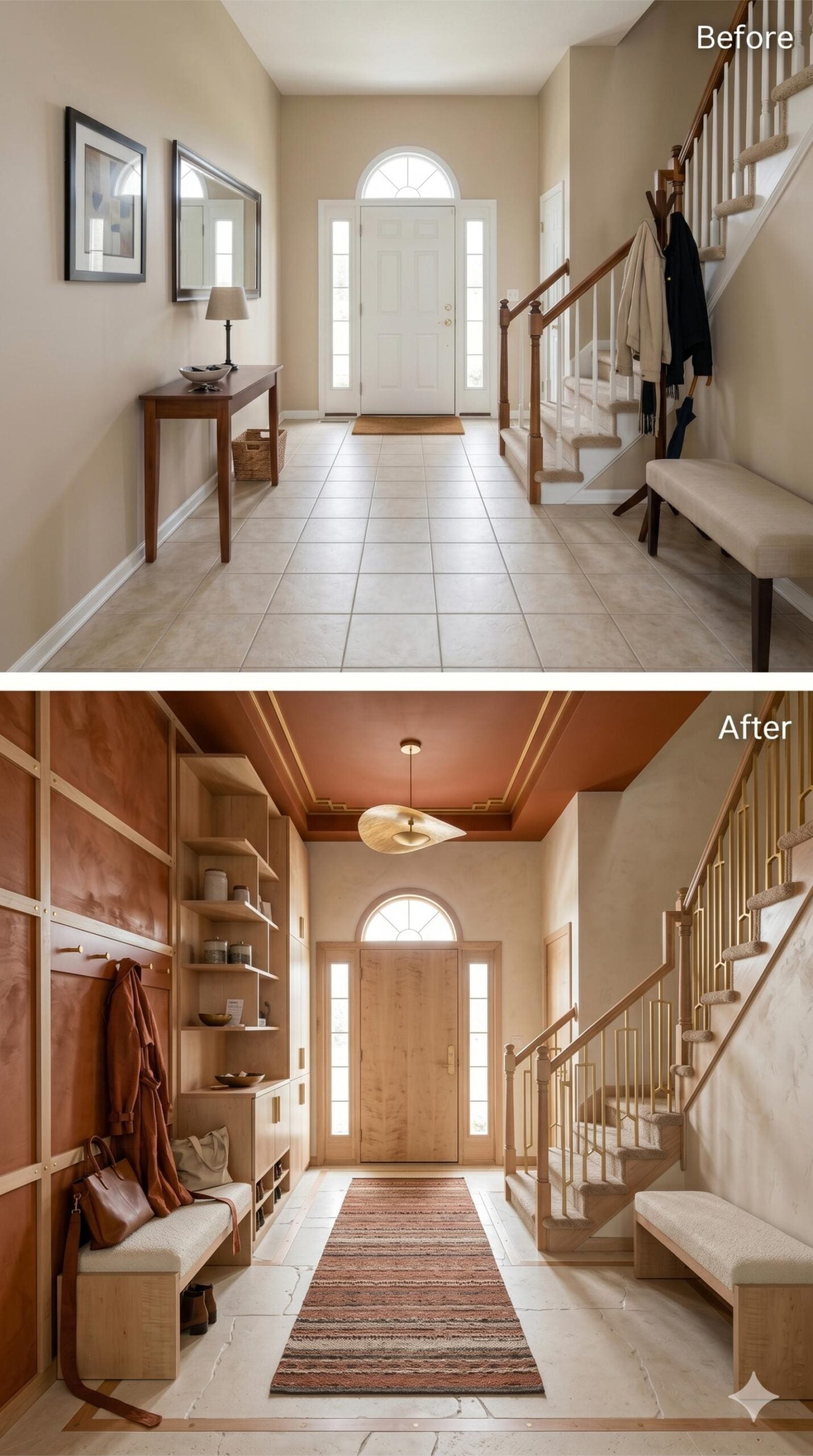
Flat maple shelving runs floor to ceiling along the left wall, framing open cubbies sized for ceramics, baskets, and folded items with no wasted vertical space. A leather panel in burnt sienna anchors the wall below the shelving, fitted with brass hook hardware at coat height. The ceiling shifts the entire mood: a deep terracotta paint stops at a stepped tray detail trimmed in matching millwork, pulling the eye up without any art required. A low-profile pendant with a woven shade hangs centered beneath it.
A striped runner in rust and cream defines the path from door to stair. The staircase balusters have been refinished in a pale sand tone that reads as bleached oak, keeping the right side of the foyer from competing with the built-in storage wall. Shoe storage tucks into closed cubbies at bench height, leaving the upholstered seat surface clear.
17. Royal Blue Lacquer, Sputnik Chandelier, and Hexagon Tile Give a Foyer Real Conviction
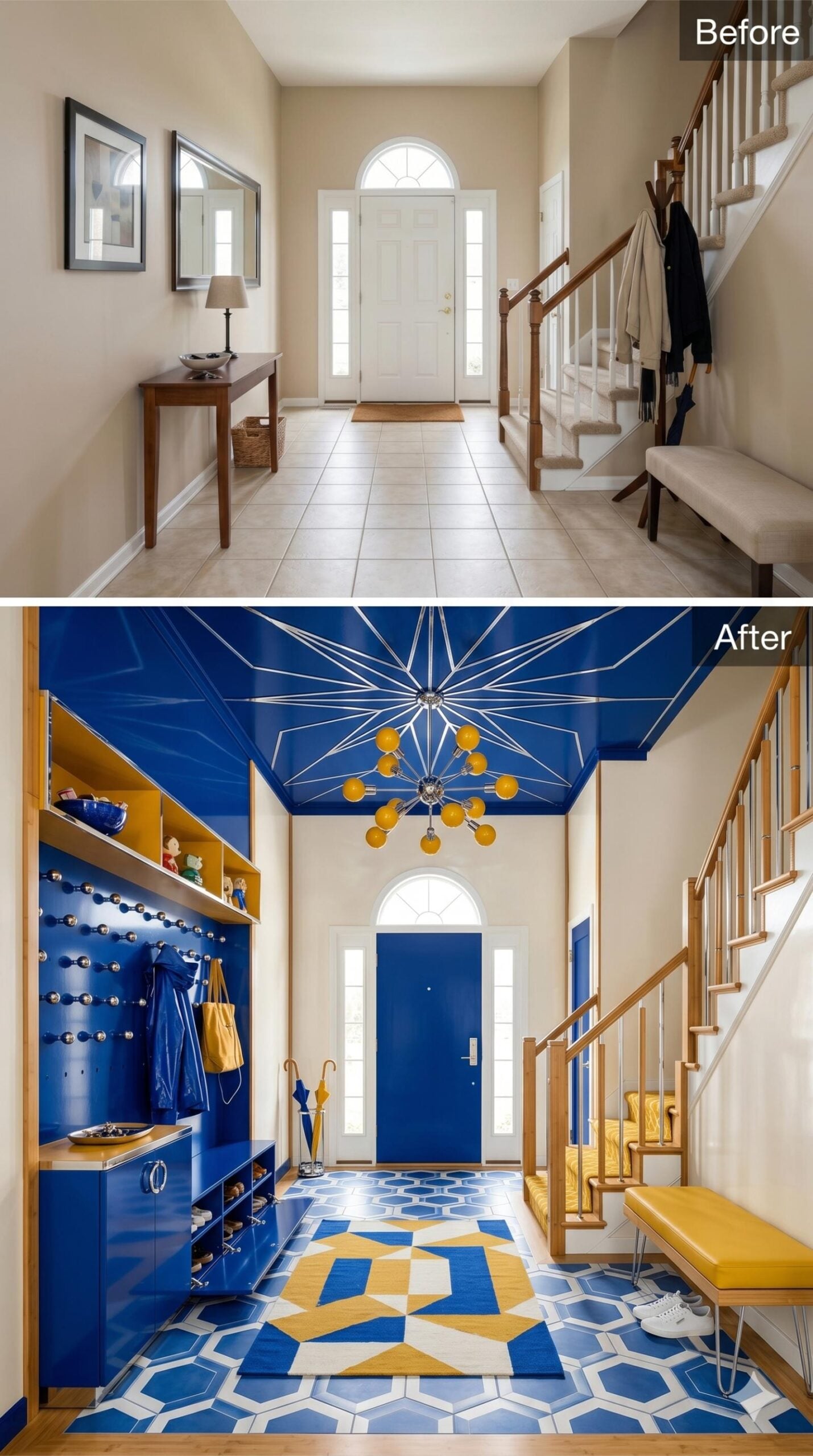
Cobalt lacquer covers the built-in cabinetry and wraps up onto a geometric ceiling treatment, where chrome ribs radiate outward from a sputnik-style fixture hung with amber globe bulbs. The color holds its intensity without competing with the cream walls, which stay neutral to give the eye somewhere to rest.
Open shelving with yellow-painted interiors lines the left wall alongside a studded blue panel fitted with hooks. Hexagon floor tile in blue and white anchors a bold area rug in cobalt, gold, and white geometric blocks. A yellow leather bench on hairpin legs sits at the base of the stair rail.
Material Matters: Lacquer finishes on cabinet fronts reflect light in a way that matte paint cannot, which makes them particularly effective in foyers where artificial lighting does most of the work. High-gloss cabinetry also wipes clean faster than any porous surface, a practical advantage in a space that handles wet coats, muddy shoes, and daily traffic. Pairing that finish with interior shelving in a contrasting color, as the yellow interiors here demonstrate, keeps open storage from reading as visually flat.
16. Forest Green Built-Ins, a Striped Barrel Ceiling, and Brass Hardware Pull a Foyer Into Focus
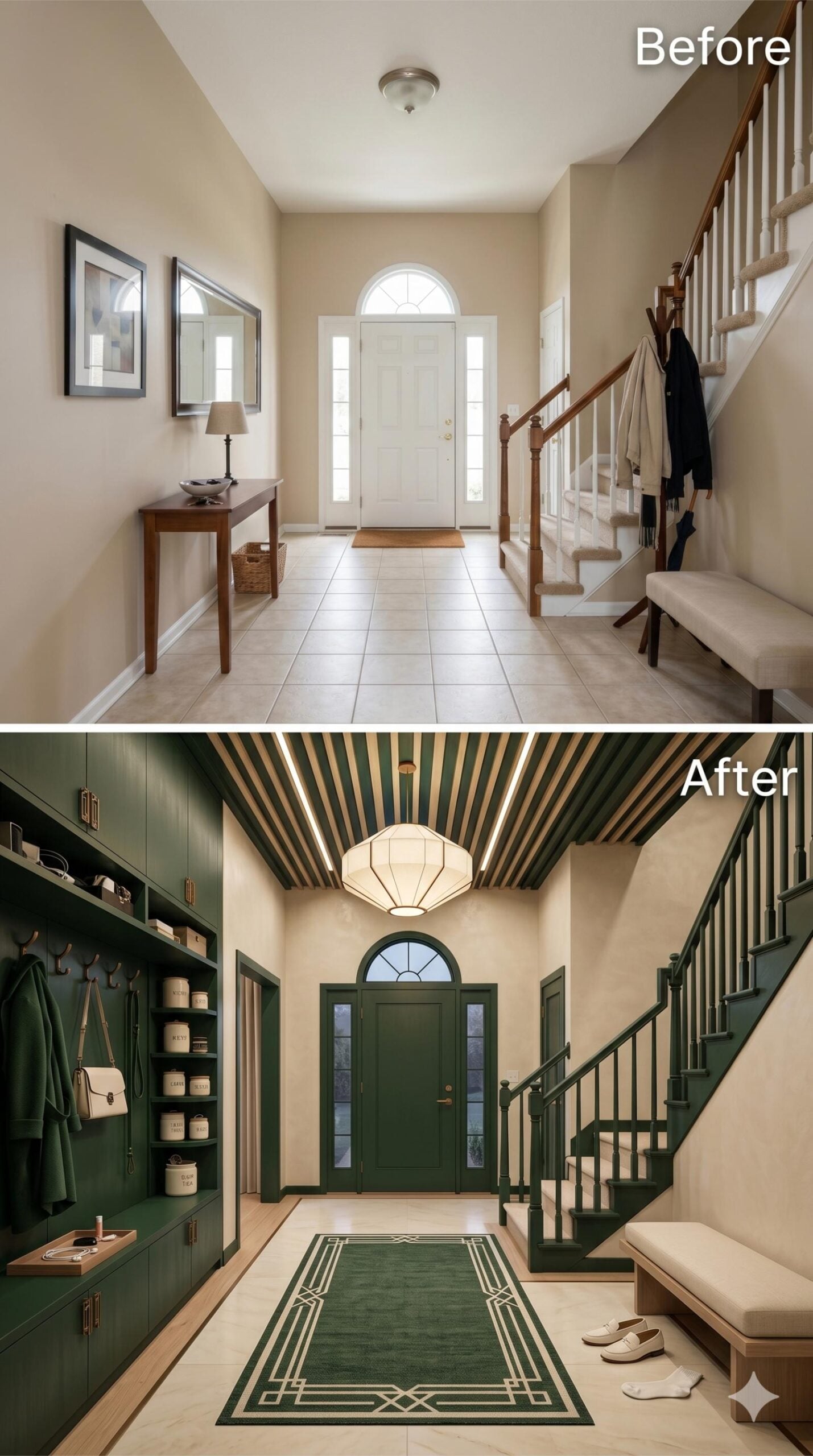
Deep forest green cabinet fronts line the left wall floor to ceiling, fitted with brass bin pulls and open shelving stocked with labeled canisters. A barrel-vaulted ceiling painted in alternating cream and hunter green stripes draws the eye straight to the arched transom door, now finished in matching green. A geometric wool runner in green and cream anchors the floor.
Why It Works: Painting a barrel vault in alternating stripes is one of the few ceiling treatments that simultaneously adds perceived height and compresses the horizontal space, which makes a wide foyer feel more like a room with a purpose. The trick works here because the stripe colors pull directly from the cabinet finish, so the ceiling reads as part of the same design system rather than a separate decision. Repeating a color across three planes, millwork, ceiling, and stair railing, is what separates a foyer that feels designed from one that feels decorated.
15. Wrought Iron Chandelier, Coffered Ceiling, and Terracotta Tile Give a Foyer Its Character Back
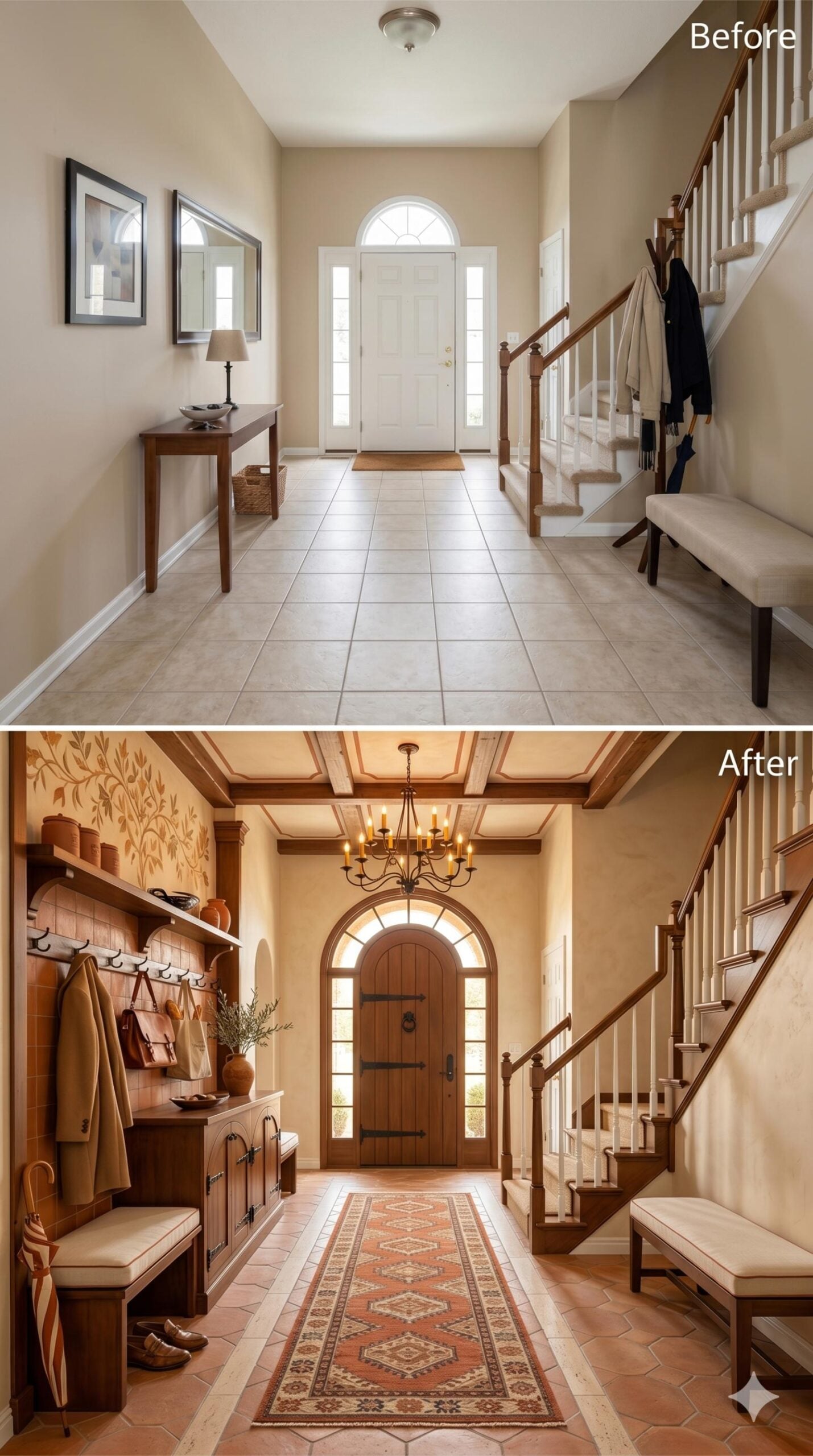
Warm ochre plaster walls carry a botanical stencil pattern that climbs toward a coffered ceiling trimmed in dark-stained wood. An eight-arm wrought iron chandelier with candle-style bulbs anchors the ceiling. Diagonal terracotta floor tile runs beneath a wool runner patterned in rust and cream geometric medallions. Built-in mudroom cabinetry in aged oak lines the left wall, fitted with iron hook rails and open shelving for pottery and baskets.
Designer’s Secret: Coffered ceilings reduce the vertical scale of a tall foyer entry, which makes furniture and built-ins read as proportional rather than undersized. Adding a single overhead fixture centered within the coffer grid draws the eye upward deliberately rather than letting the ceiling read as dead space. Ochre or warm plaster tones on foyer walls tend to extend the color temperature of candescent lighting, so the space holds its warmth even under cooler overhead sources.
14. Concrete Walls, Rose Crystal Chandelier, and Oak Built-Ins Give a Foyer Real Purpose
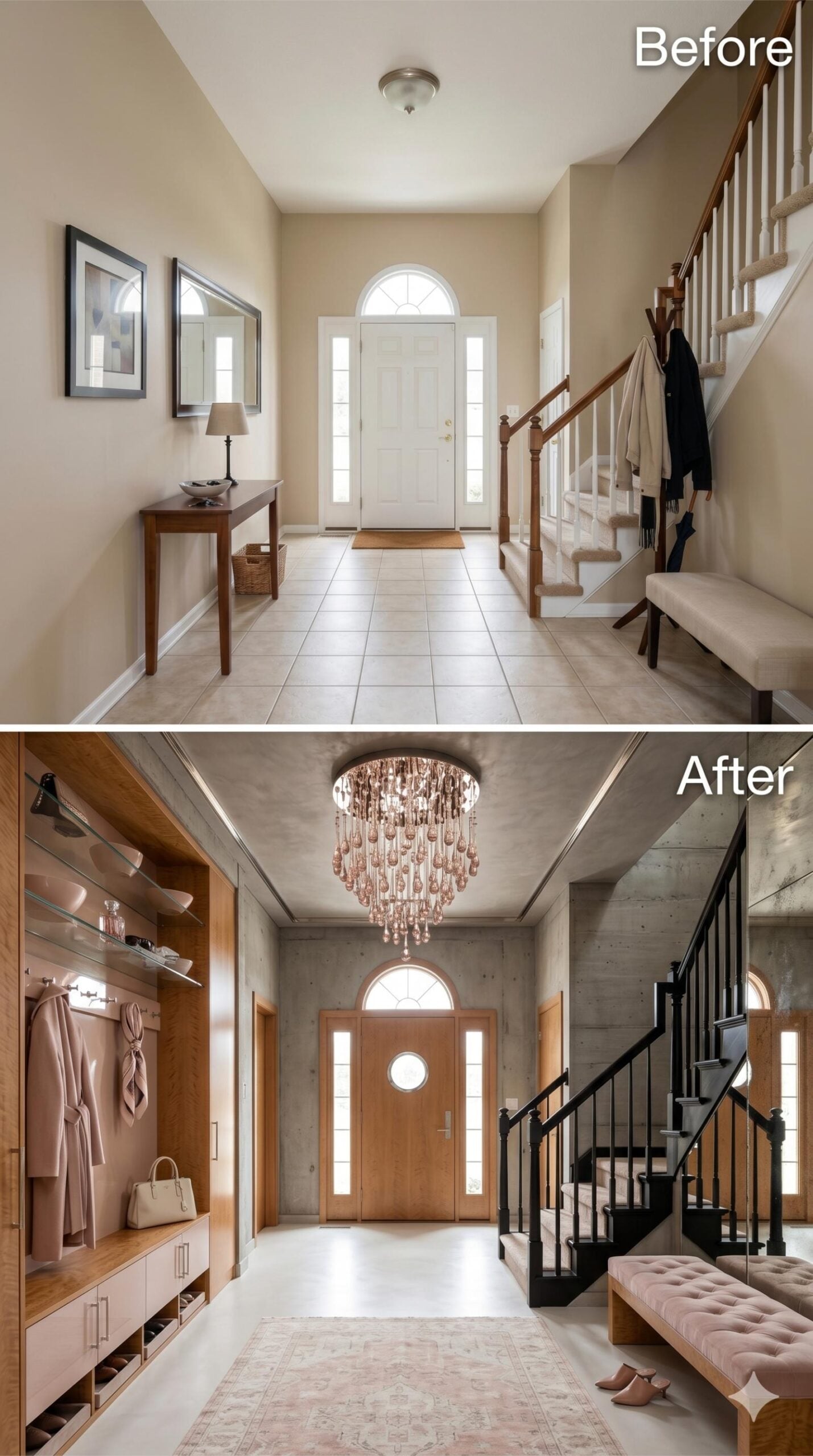
Raw concrete wall texture sets the tone here, running floor to ceiling in a finish that reads closer to board-formed cast concrete than painted drywall. Against that industrial backdrop, white oak built-ins line the left wall with open glass shelves, hanging rods, and shoe cubbies below drawers, all pulled together with brushed nickel hardware. A rose crystal chandelier with cascading drop pendants anchors the ceiling.
The staircase railing swaps wood balusters for matte black steel, and a blush tufted bench sits at its base. A vintage-style runner in dusty rose grounds the white tile floor without competing with the woodwork overhead.
Try This: Replacing painted drywall with a board-formed concrete finish or a concrete-look plaster adds visual weight to an entryway without requiring structural changes. Contractors can apply a skim coat product that mimics the texture and tone of poured concrete over existing walls in a single weekend. The technique works particularly well in foyers because the narrow proportions make the texture feel intentional rather than industrial.
13. Plaid Runner, Coffered Ceiling, and Burgundy Leather Give a Foyer Real Gravity
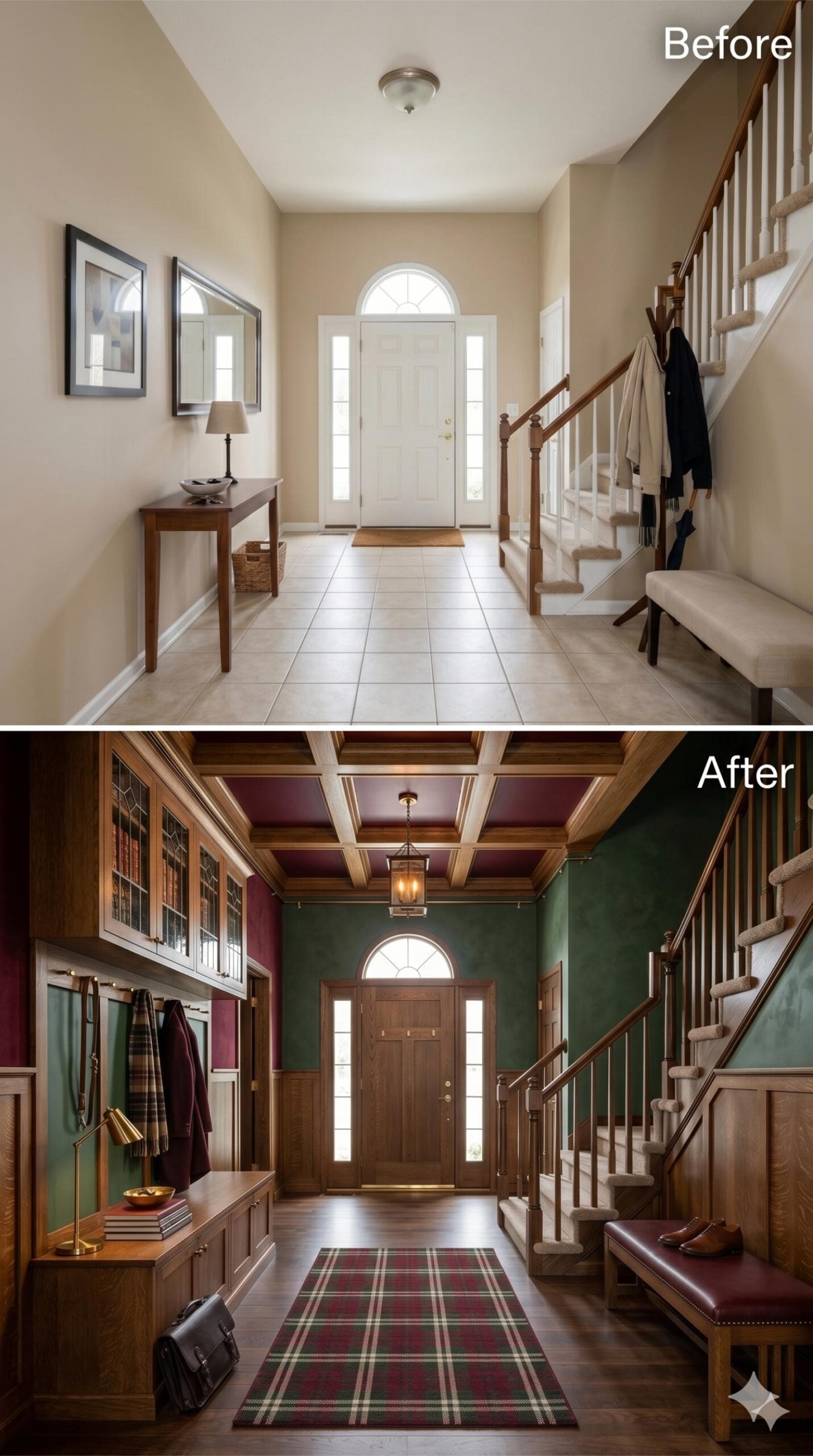
Oak wainscoting runs the full length of both walls, topped by hunter green plaster that shifts toward teal under the pendant’s candlelight glow. Upper cabinets with leaded glass fronts line the left wall, giving books and objects a place that reads as built architecture rather than added storage. A brass lantern-style pendant drops from a coffered ceiling painted deep burgundy between the wood-trimmed beams.
A tartan runner in red, green, and cream anchors the hardwood floor and pulls every wall color into the center of the room. A leather bench with burgundy upholstery and nailhead trim sits against the stair side, with oxford shoes tucked underneath. Brass hardware and a brass desk lamp on the console keep the metal finish consistent throughout.
Why Coffered Ceilings Work Differently When the Recesses Are Painted a Saturated Color
Most coffered ceilings use a single neutral across both the beams and the recesses, which produces depth without drama. Painting the recesses burgundy while keeping the beams in natural oak creates a visual inversion that draws the eye upward and holds it there. In a foyer where vertical height might otherwise feel disconnected from the activity below, that contrast pulls the ceiling plane back into the room’s conversation.
12. Slatted Wood Ceiling, Cobalt Blue Accent Wall, and Rice Paper Pendant Give Storage Real Structure
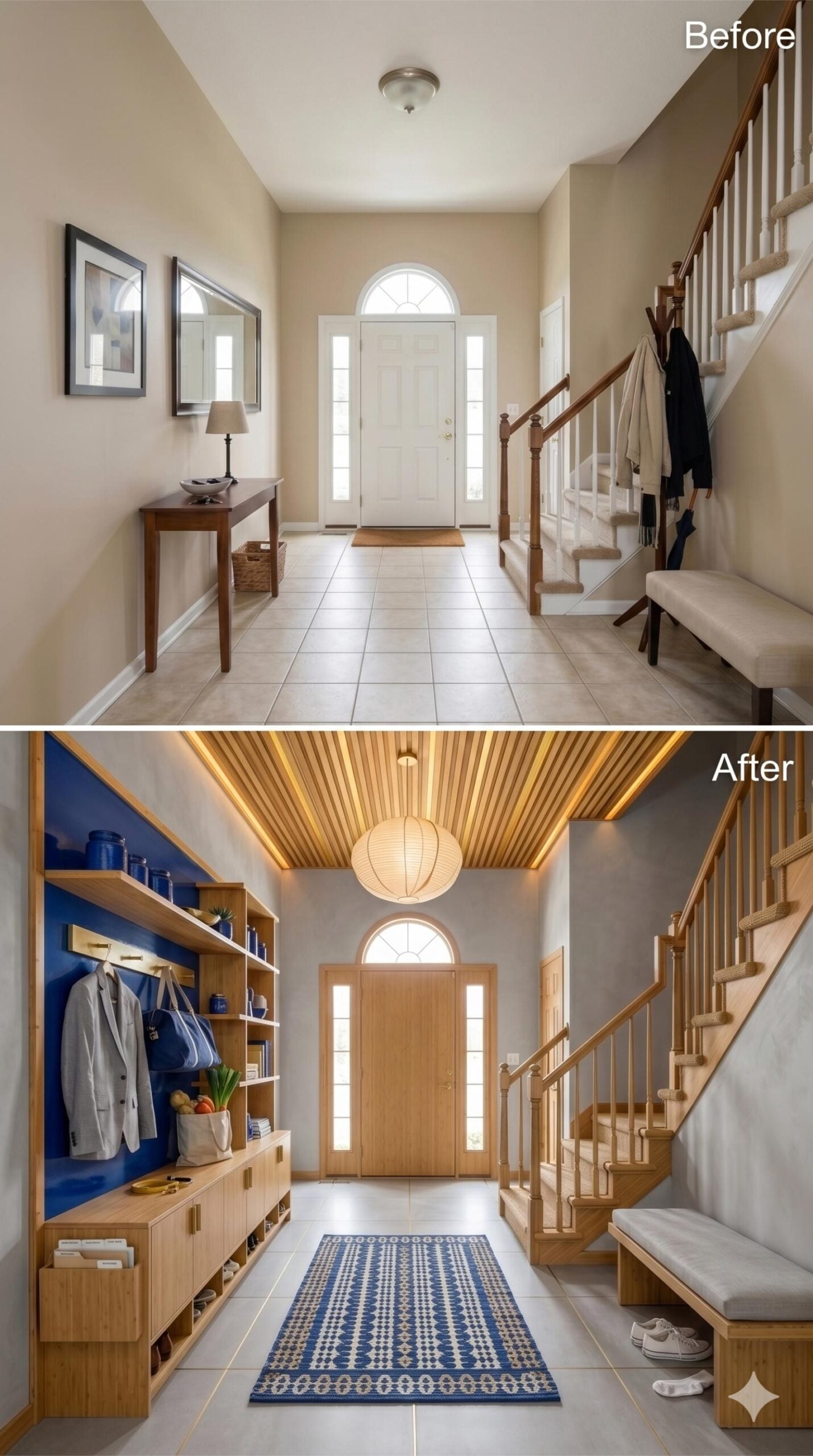
Light maple built-ins line the left wall against a cobalt blue painted accent, housing hooks, open shelving, and lower cabinets with brass pulls. A slatted wood ceiling with recessed LED strip lighting runs the full length of the foyer, and a rice paper globe pendant anchors the center.
By The Numbers: Slatted wood ceilings reflect sound differently than drywall, reducing the echo that makes tiled entryways feel hollow. Installing LED strip lighting along the perimeter of a slat ceiling adds ambient light without requiring a single additional fixture. Built-in mudroom cabinetry returns an average of 67 cents per dollar at resale when it reads as part of the original architecture rather than a retrofit.
11. Red Lacquer Cabinets, Geometric Ceiling Molding, and Terrazzo Floor Give a Foyer Real Edge
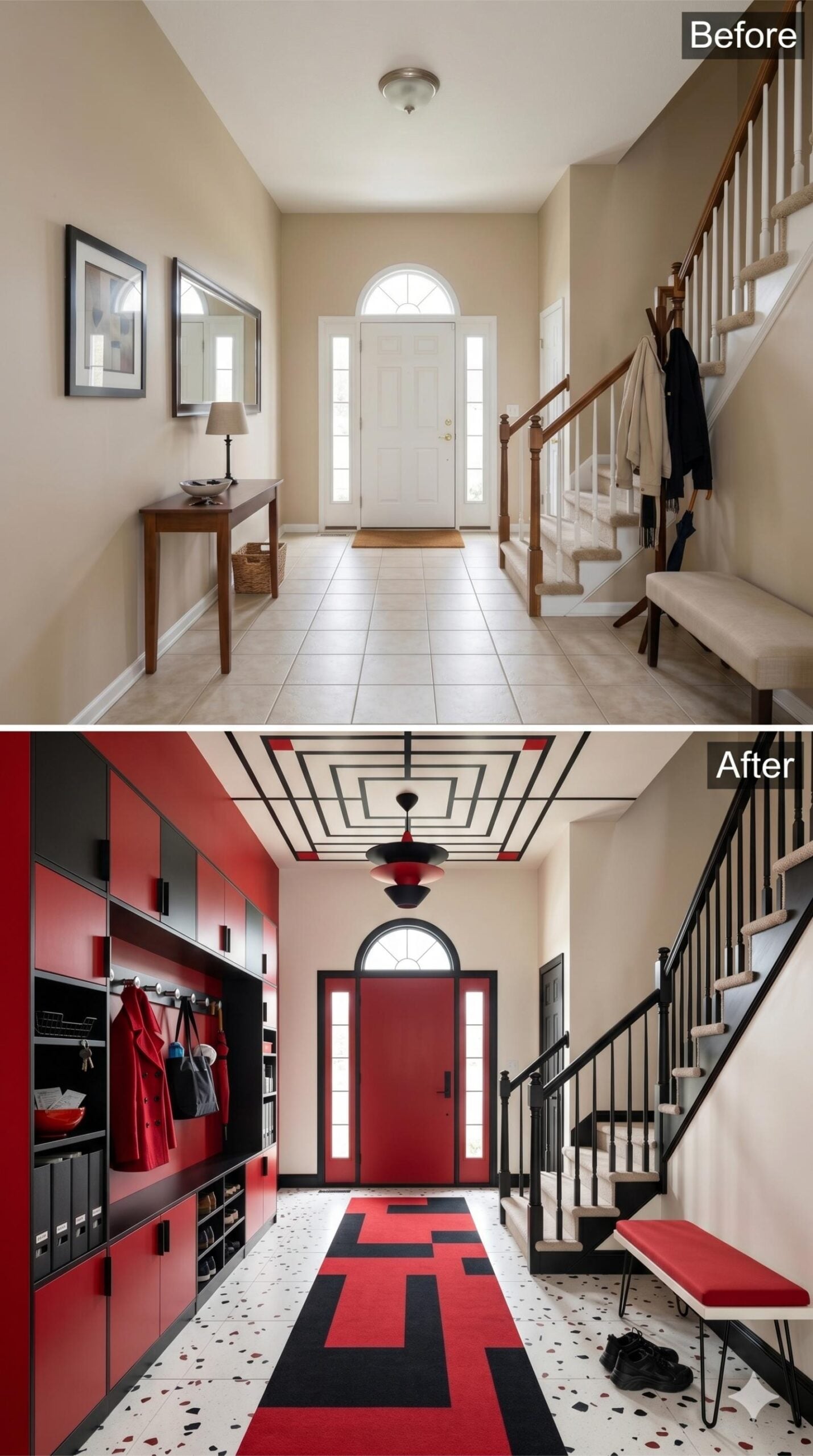
Crimson flat-front cabinetry lines the left wall floor to ceiling, fitted with matte black hardware and open cubbies for shoes, hooks for coats, and shelf slots for binders. A geometric ceiling medallion in black and red frames a pendant with a tiered black metal shade. Below, terrazzo flooring anchors a bold red and black runner in a Greek key pattern.
Fun Fact: Art Deco geometric ceiling treatments like the one shown here originated in 1920s hotel lobbies, where architects needed to signal arrival and grandeur within a compressed vertical space. Painting or installing molding in concentric rectangular frames draws the eye upward and makes a standard eight- or nine-foot ceiling read taller than it measures.
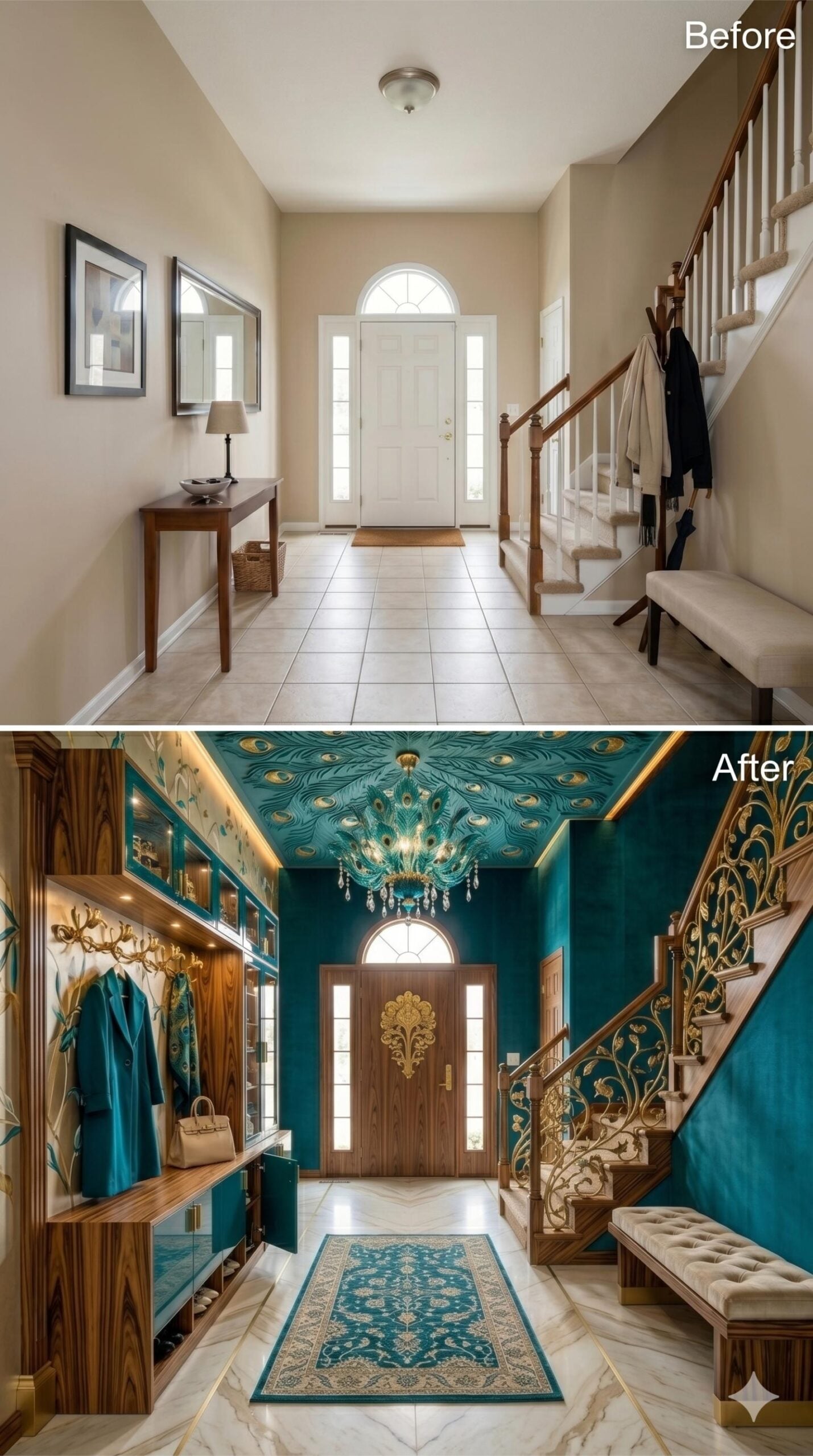
10. Peacock Ceiling Mural, Gold Ironwork Banister, and Teal Velvet Walls Give a Foyer Real Drama
🔥 Would you like to save this?
Walnut built-ins with teal lacquer cabinet fronts line the left wall, topped with lit display shelving and fitted with recessed shoe storage below. A chandelier in teal and crystal anchors the peacock-feather ceiling mural painted in teal and gold.
Common Mistake: Many homeowners install coat hooks without accounting for bag storage beneath them, which forces bags onto the floor and defeats the entire system. A shelf or tray positioned directly below the hook row keeps bags off the ground and doubles the functional output of the same wall space.
9. Reclaimed Wood Ceiling, Wire Basket Shelving, and a Globe Pendant Cluster Give a Foyer Real Grit
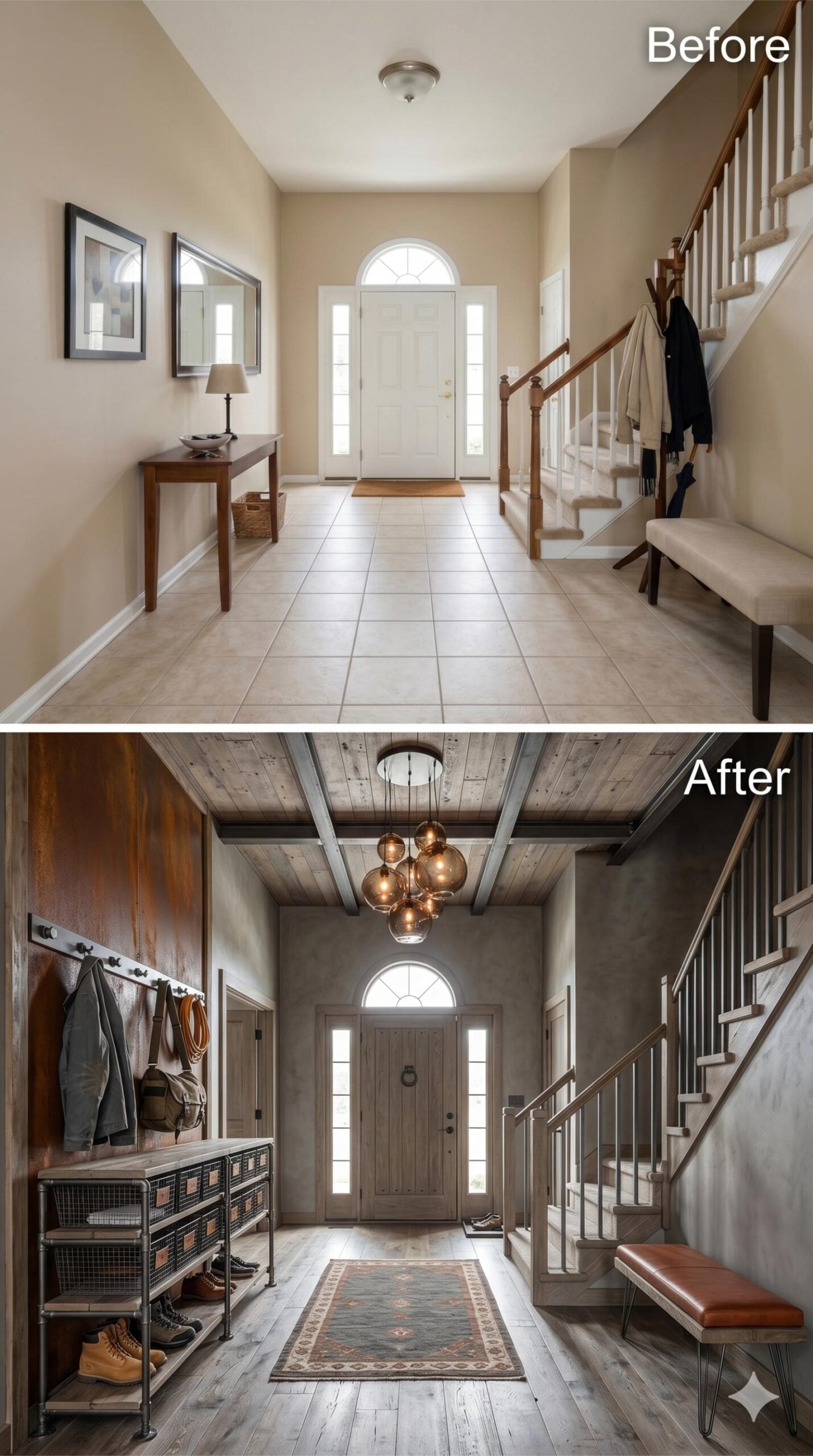
Shiplap-style planks run the full length of the ceiling in weathered grey-brown wood, paired with exposed steel beams that carry the industrial weight down into the room. A cluster of amber globe pendants hangs low enough to feel intentional rather than decorative. The front door is solid wood with a wrought iron knocker, replacing what was once a painted panel.
On the left wall, pipe-frame shelving holds wire mesh baskets and open cubbies stacked with boots and shoes at floor level. Iron coat hooks mount directly to a rusted steel panel above. A runner in muted geometric pattern anchors the center of the reclaimed hardwood floor, and a cognac leather bench on hairpin legs sits against the stair wall.
Did You Know: Hairpin legs on entryway benches became popular in industrial design because they keep the visual floor plane open, making a narrow foyer read as wider than it measures. Pairing them with a leather seat rather than upholstered fabric makes the bench easier to wipe down, which matters in a space that handles wet coats and muddy boots daily. The combination of pipe-frame shelving and wire mesh baskets in this design follows the same logic: every material here was chosen to age visibly rather than show wear.
8. Navy Ceiling with Gold Sunburst Molding and Coral Chandelier Make Storage Feel Like Architecture
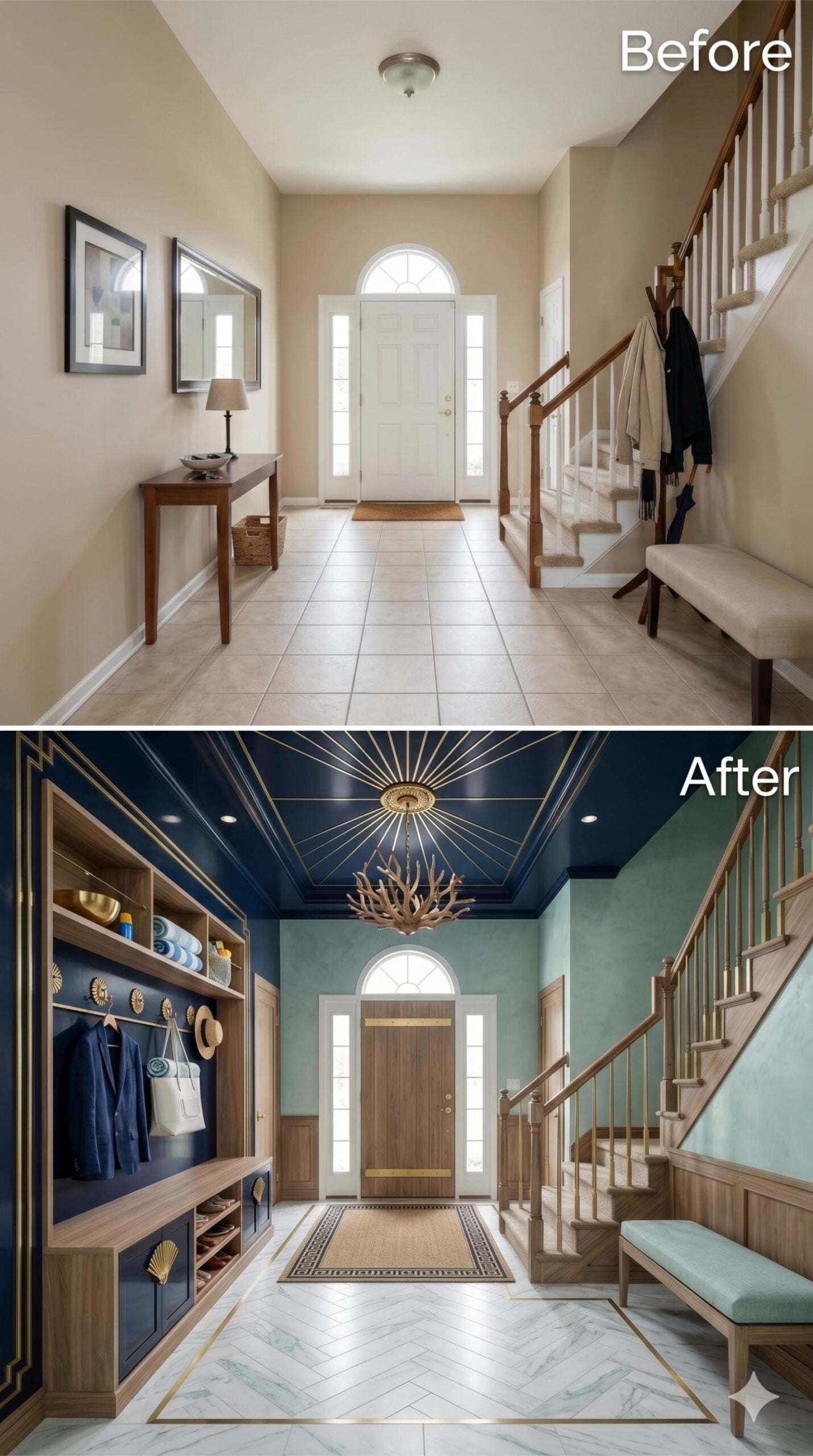
Rift-cut wood shelving runs floor to ceiling on the left wall, framed by navy lacquer panels edged in brass trim. The built-in system handles outerwear, bags, shoes, and household gear without a single piece of freestanding furniture doing the heavy lifting. Sun-shaped brass wall hooks anchor the coat section, and open cubbies keep everyday items visible without creating chaos.
The ceiling does the most unexpected work here. A navy tray ceiling with radiating gold molding draws the eye up while the coral branch chandelier drops it back down, creating a visual loop that makes the corridor read longer than it is. Sage green plaster walls meet the staircase landing, where the wood banister and a mint upholstered bench carry the palette through to the second floor. Marble herringbone flooring with a Greek key border inset near the door ties the pattern work back to the ceiling geometry.
History Corner: Herringbone as a floor pattern dates to ancient Rome, where engineers used the interlocking brick layout in roads because the diagonal orientation distributes weight more evenly across the surface. By the 17th century, French parquet makers had adapted the pattern for interior wood flooring in palace galleries, where the long diagonal lines were used deliberately to exaggerate the perceived length of formal reception halls.
Not every foyer renovation leans on contrast — some build their identity through layered richness instead.
7. Mauve Walls, Coffered Plasterwork, and Dark Mahogany Built-Ins Give a Foyer Real Weight
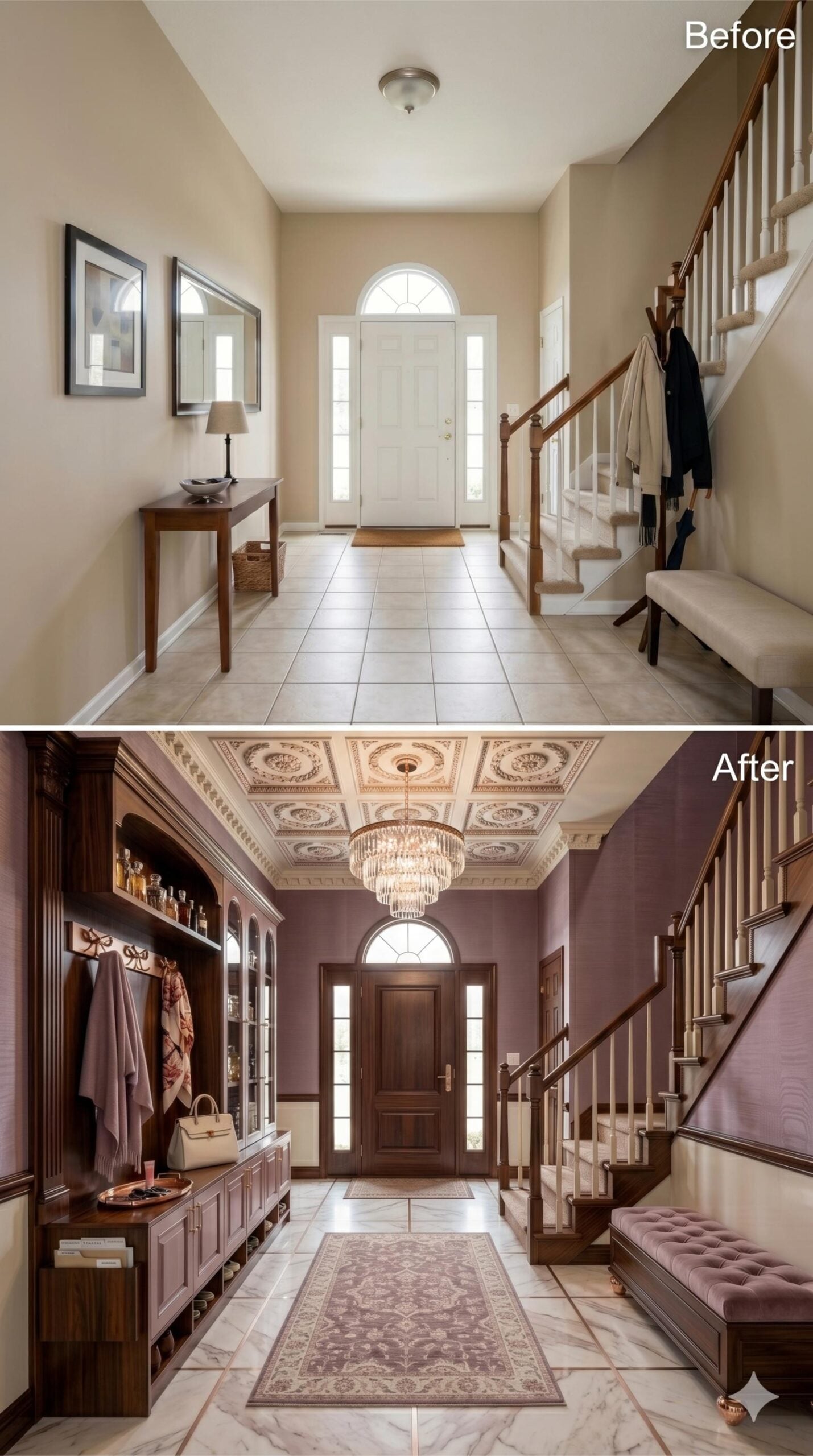
Dusty mauve plaster walls set the tone, and the coffered ceiling above them, filled with raised floral medallions and geometric borders, does the structural heavy lifting. A tiered crystal chandelier drops from the center coffer, catching light across its stacked rings. The door surround is dark mahogany, matching the floor-to-ceiling built-in on the left wall, which combines glass-front cabinets with open coat hooks and a lower bench with shoe cubbies below.
A tufted velvet bench in muted rose anchors the staircase side, while a Persian-style runner in blush and ivory runs the full length of the marble tile floor. The tile itself uses inset border strips to break the field into panels, giving the floor a formal grid that echoes the ceiling above it.
transition: Crystal chandeliers are often oversized for standard foyer ceilings, but a tiered design with a narrow footprint solves this. The vertical stacking adds drama without requiring the ceiling clearance that a wide single-tier fixture demands, making it one of the more practical choices for entries with modest ceiling height.
6. Cobalt Plaster Walls, Blue Globe Pendants, and a Dark Ceiling Turn a Foyer Into a Proper Arrival
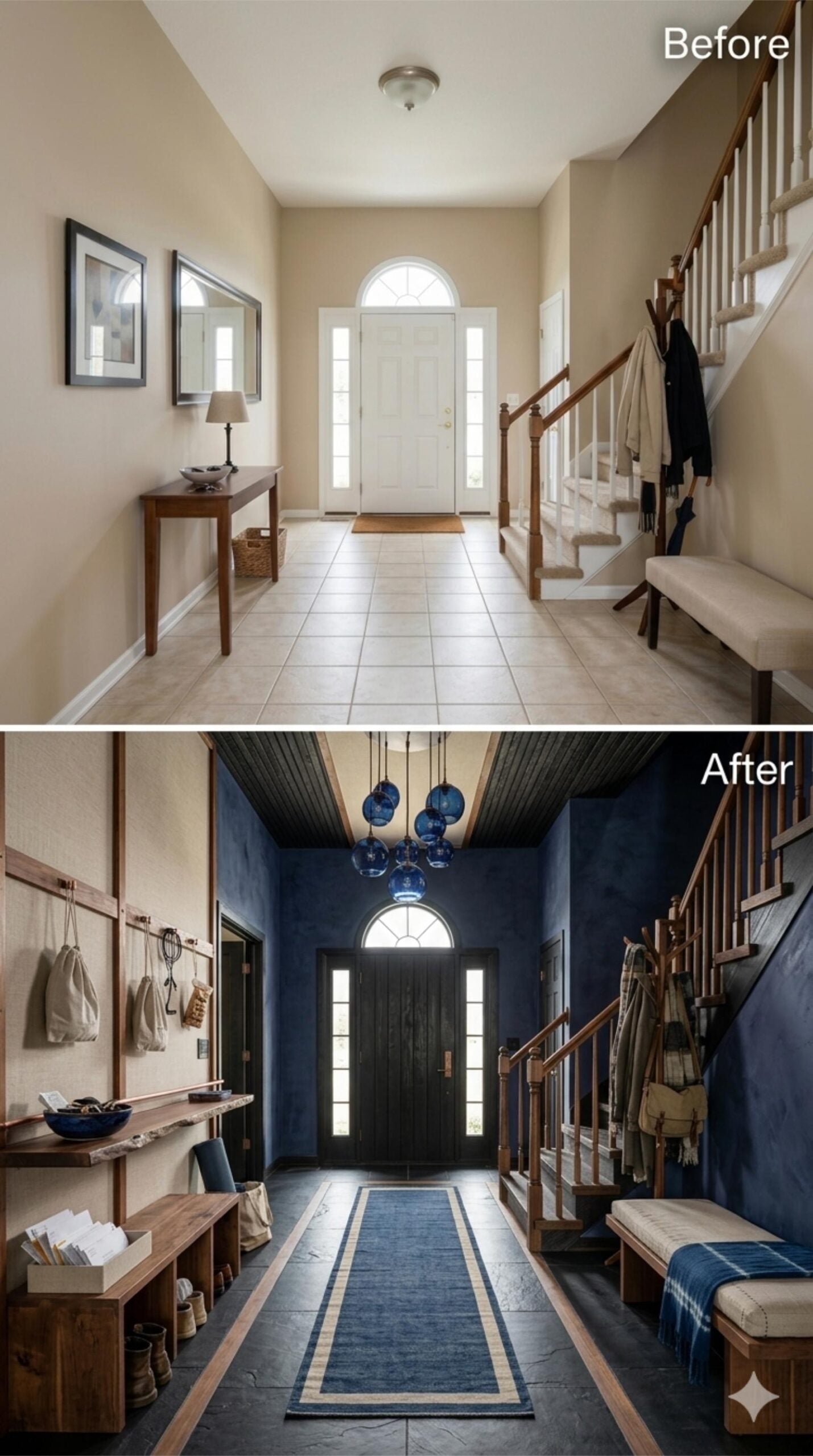
Indigo plaster covers the walls in a texture that catches light unevenly, giving the space depth that flat paint cannot produce. A cluster of cobalt blown-glass globe pendants drops from a planked ceiling finished in near-black stain. Slate flooring replaces the original tile, anchored by a navy runner with a cream border.
Why Blown-Glass Globe Clusters Work Better in Foyers Than Single Pendants
A single pendant centered in a long foyer creates one focal point and leaves the surrounding ceiling visually empty. Clustering multiple globes at staggered drop heights fills the vertical plane without requiring additional fixtures. The cobalt glass shown here also reflects the wall color back into the space, which tightens the palette and makes the whole room read as intentional rather than assembled.
5. Teal Damask Wallpaper, Ornate Plaster Medallion, and Dark Built-Ins Give a Foyer Real Ceremony
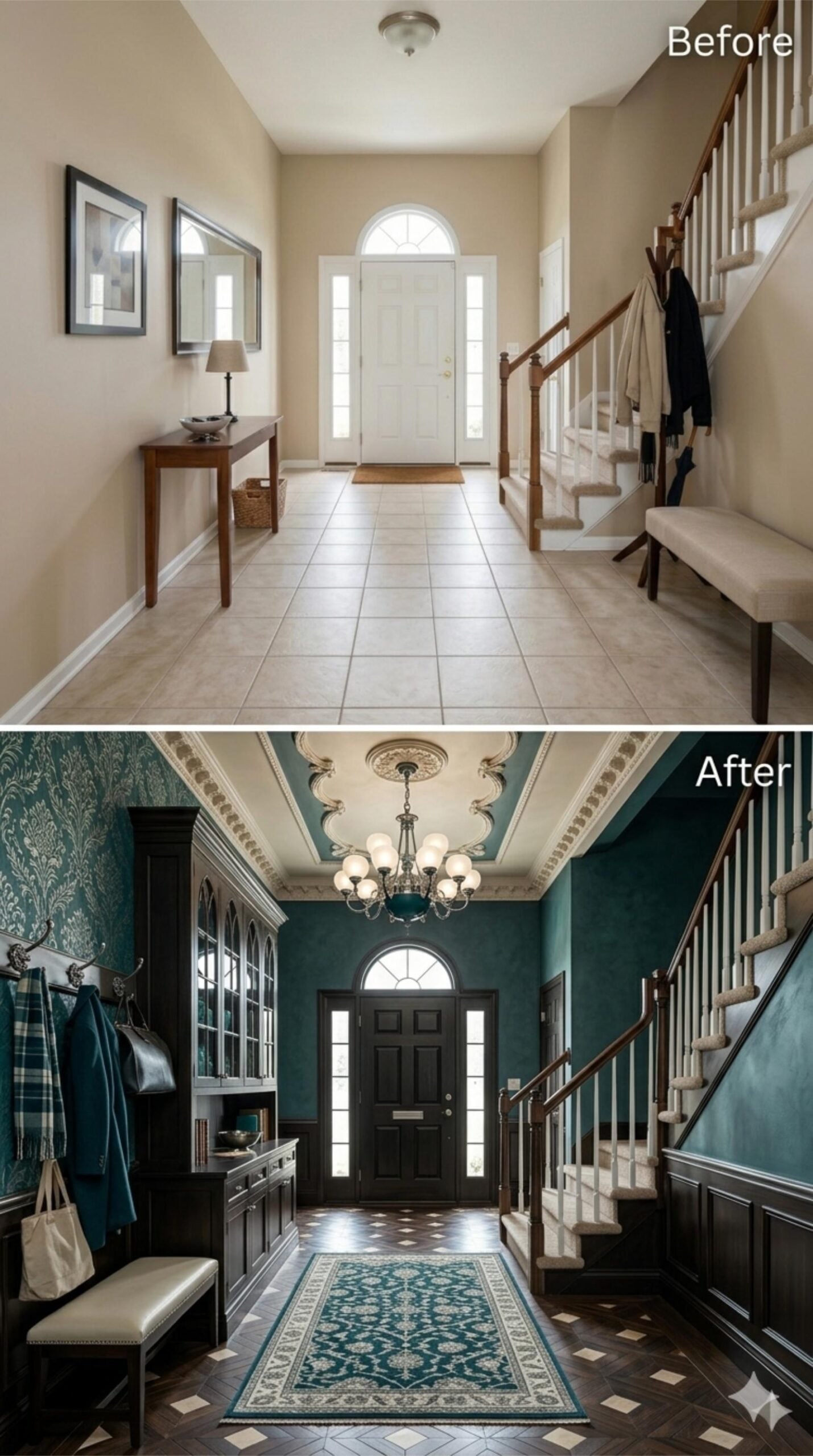
Deep teal damask wallpaper covers the walls from wainscoting height to crown, its repeat pattern dense enough to read as texture from across the room. A plaster ceiling medallion anchors a bronze chandelier with milk-glass globe shades, and the surrounding plasterwork scrolls outward in relief against a cream field. The front door is painted near-black, with raised panel detailing and a brass kick plate.
Dark-stained built-ins line the left wall with glass-front upper cabinets and solid lower drawers, while a cushioned bench in cream upholstery sits below a row of antler-style iron hooks. Dark parquet flooring in a diamond inlay pattern runs the full length of the hall, grounded by a teal runner with an ivory floral border that pulls the wall color down to floor level.
- Damask wallpaper in a large-scale repeat creates visual rhythm without requiring additional wall art.
- Glass-front upper cabinets keep stored items visible, which reduces the tendency to overstuff them.
- Parquet flooring in a diagonal diamond pattern draws the eye toward the door, reinforcing the sense of depth in a narrow hall.
4. Birch Built-Ins, a Botanical Pendant, and Slatted Ceiling Give Storage Real Warmth
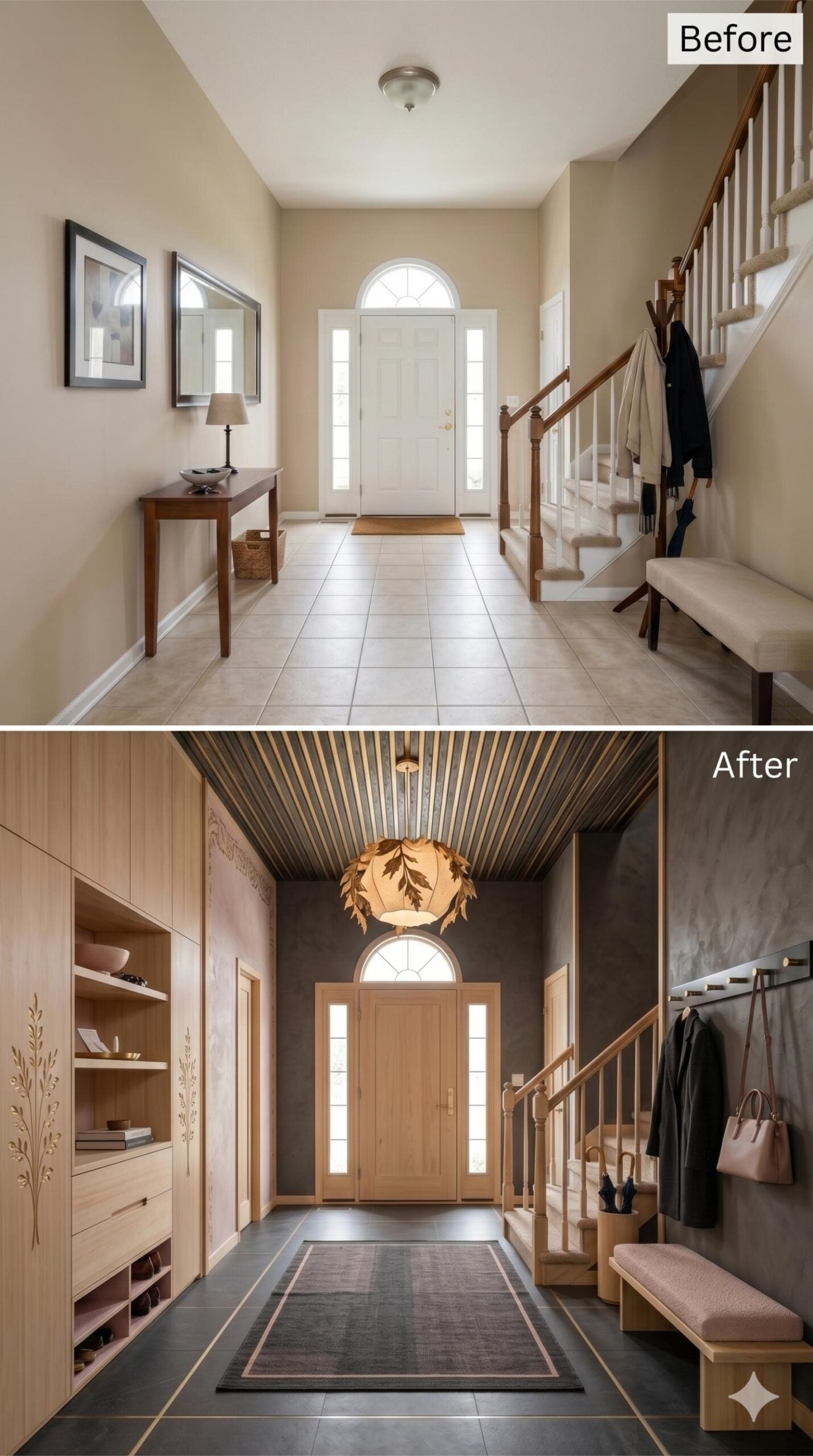
Flat-cut birch millwork lines the left wall floor to ceiling, combining open shelving, drawers, and dedicated shoe cubbies at the base. Botanical motifs are etched directly into the cabinet panels, giving the wood a crafted quality that factory cabinetry never achieves. The front door and stair rail have been refinished in matching birch, pulling the material across the full width of the space.
A troweled grey plaster finish covers the walls, and a slatted wood ceiling with alternating dark strips runs the length of the foyer. A pendant wrapped in layered wood-cut leaves anchors the center of the ceiling and casts warm directional light down the runner. On the right, a wall-mounted horizontal rail holds hooks at coat height, with a cushioned bench below and open floor space beneath for bags.
In The Details: Etching decorative motifs directly into flat-cut wood panels rather than applying overlay trim is a technique borrowed from furniture-making, and it keeps cabinet faces looking intentional rather than dressed up. It also means the pattern ages with the wood rather than lifting or separating over time. Foyers with this level of millwork detail tend to hold their perceived value longer than those with painted MDF alternatives.
3. Black Diamond Ceiling Tiles, Honey Oak Built-Ins, and a Globe Pendant Cluster Demand Attention
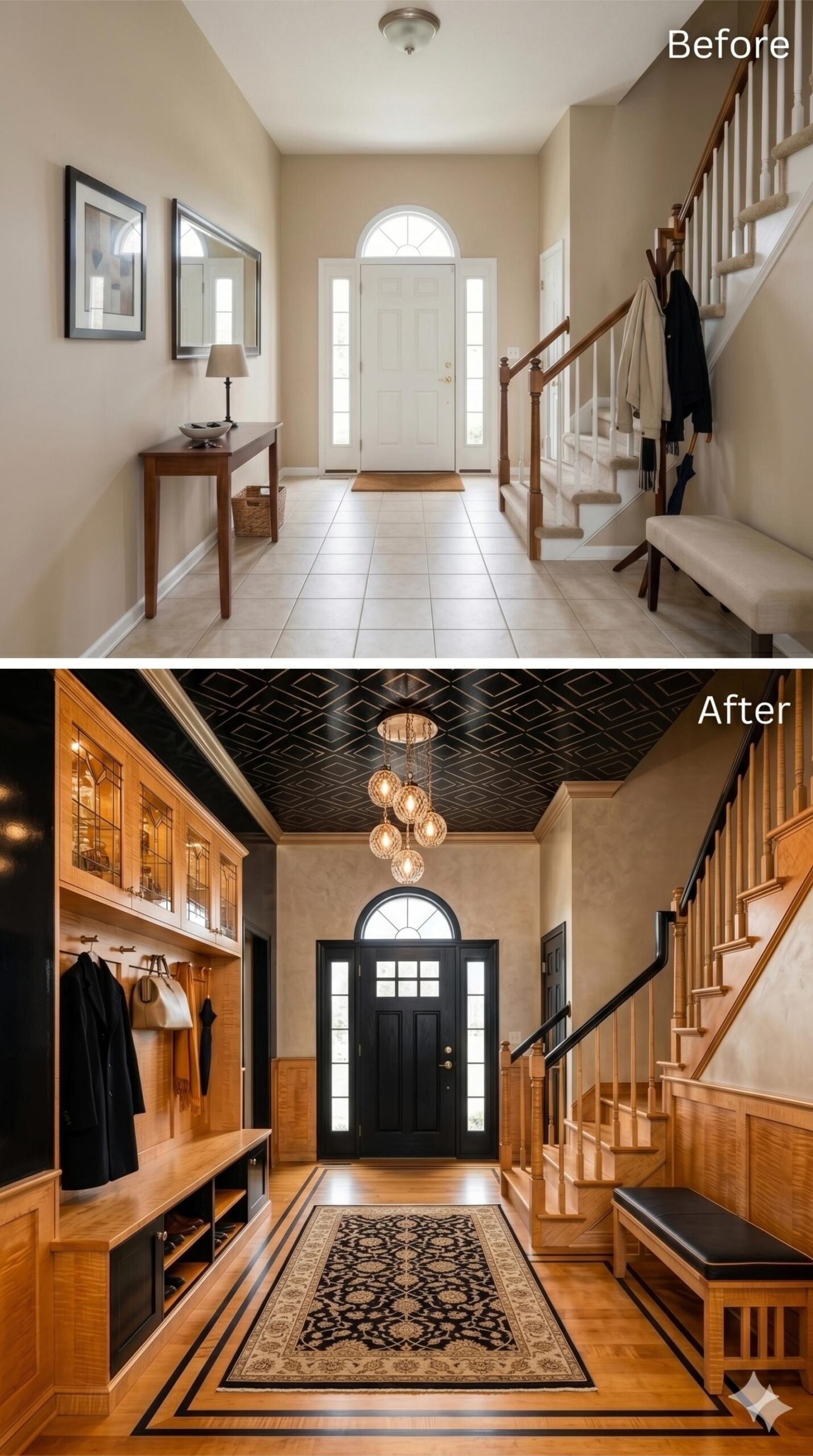
Pressed-tin ceiling tiles painted matte black in a diamond lattice pattern anchor the entire composition, while honey-toned oak built-ins line the left wall with glass-front upper cabinets and open shoe cubbies below.
Budget Tip: Decorative ceiling tiles made from lightweight polystyrene or PVC cost a fraction of plasterwork and install directly over existing drywall with adhesive. A single foyer ceiling measuring roughly 80 square feet can be tiled in an afternoon for under $200, making it one of the highest-impact upgrades by dollar spent. Painting them a dark color before installation adds depth that paint on flat drywall cannot replicate.
2. Exposed Oak Beams, a Moss Wall, and Trailing Ivy Give a Foyer Real Roots
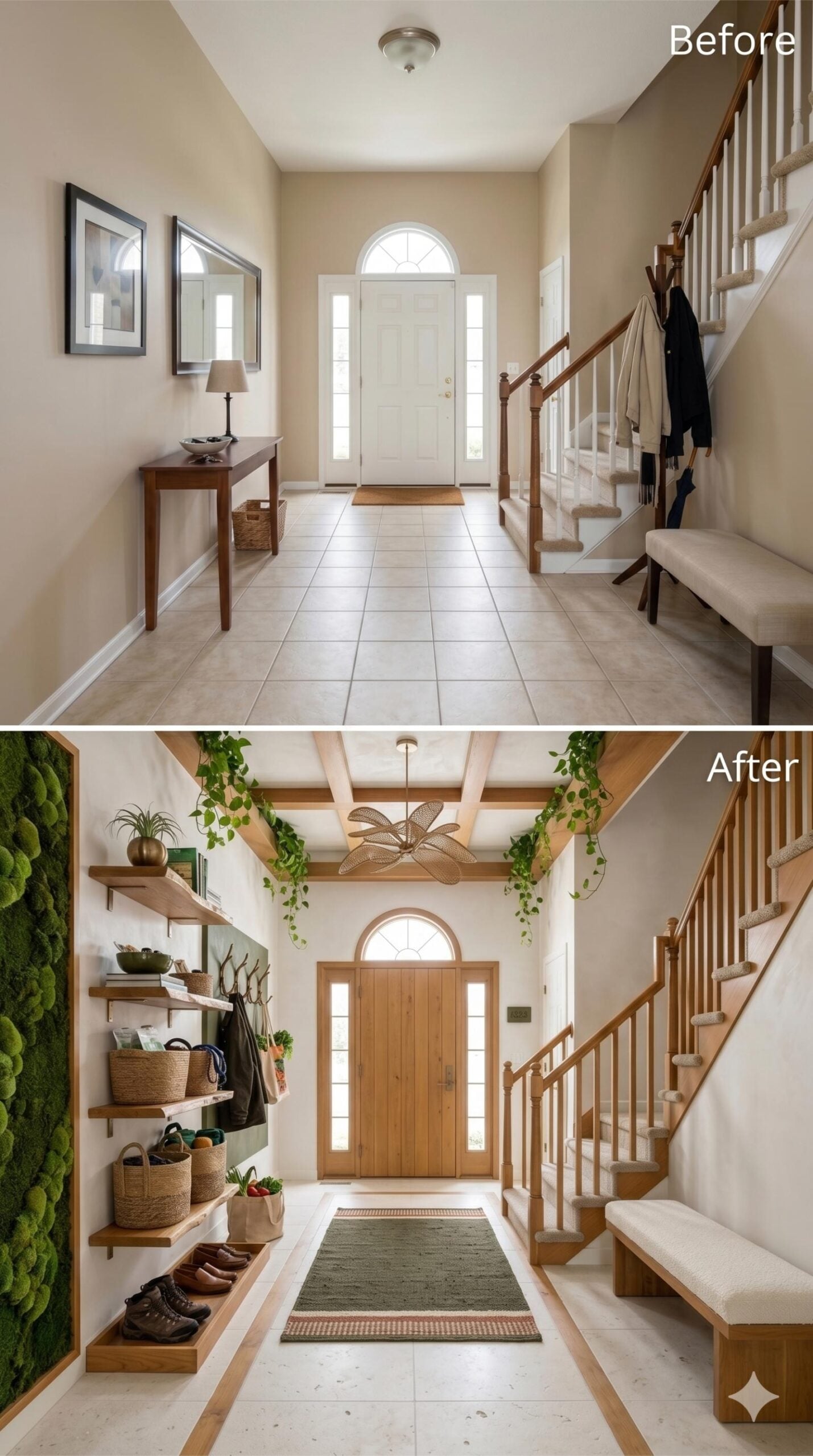
Open oak shelving runs the full height of the left wall, with shoe storage built directly into the lowest level as a dedicated floor-level tray. Above it, woven seagrass baskets hold bags and daily gear on mid-height shelves, while a preserved moss panel anchors the wall in deep forest green. The front door has been replaced with natural oak, its warm grain pulling the wood tones across the ceiling beams overhead.
Pothos vines trail from the upper beam line, softening the structure without obscuring it. A rattan ceiling fan with leaf-shaped blades sits flush between two beams, replacing the original flush-mount fixture. Layered runner rugs in sage and terracotta cover the tile. Plants positioned at shelf height add depth without requiring any architectural change. The result is a foyer that handles shoes, bags, coats, and baskets through a single shelving wall rather than scattered furniture.
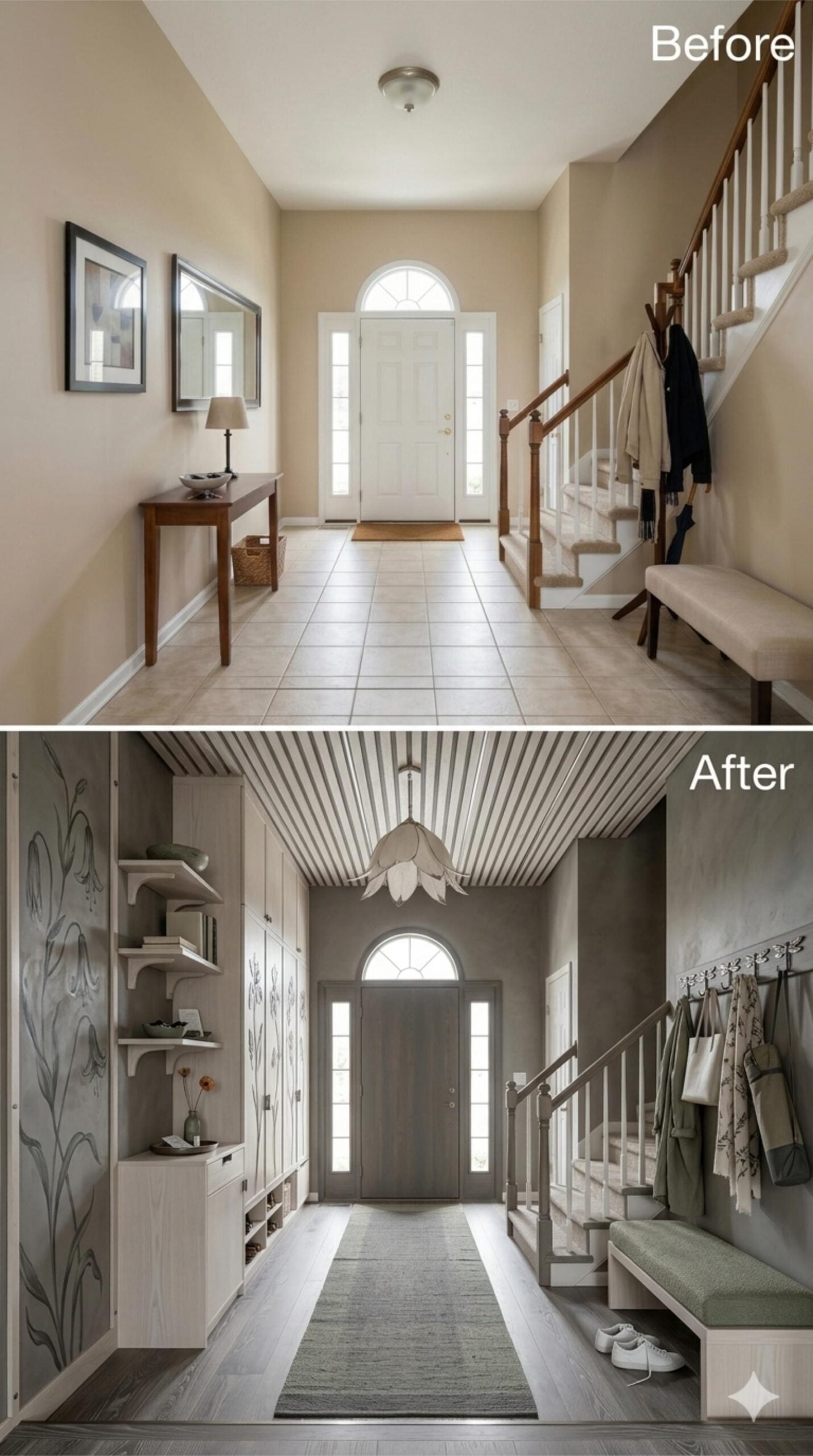
1. Grey Plaster Walls, Botanical Ceiling Panels, and Built-In Shoe Cubbies Make Storage Disappear Into Architecture
🔥 Would you like to save this?
Warm grey plaster walls meet floor-to-ceiling built-ins in bleached oak, with open shelving, cabinet doors, and dedicated shoe cubbies running the full length of the left wall. A hand-painted floral mural covers the cabinet panels in soft sage line work. Overhead, white-painted slat panels radiate outward from a lotus-shaped fabric pendant, drawing the eye up through the narrow corridor.