🔥 Would you like to save this?
You don’t notice it at first. The extra minutes. The door closed a little longer than necessary. The quiet.
In order to come up with the very specific design ideas, we create most designs with the assistance of state-of-the-art AI interior design software. Also, assume links that take you off the site are affiliate links such as links to Amazon. this means we may earn a commission if you buy something.
Then it clicks. This isn’t just a bathroom. It’s a reading room with plumbing.
For decades, people have quietly carved out time here. A few pages before the day starts. A mental reset after it doesn’t go as planned. It’s one of the last places where you can sit, uninterrupted, and actually focus on something that isn’t demanding anything back.
These 35 before and after primary bathrooms lean into that reality. Better lighting. Smarter layouts. Spots to set a book or a tablet without balancing it on your knee like a circus act. Some go subtle. Some fully commit.
Either way, they all acknowledge the same thing. This room was never just about getting ready. It was always about getting a few minutes to yourself.
Dark Concrete, Wood Slat Ceiling, and the End of Builder-Grade Forever
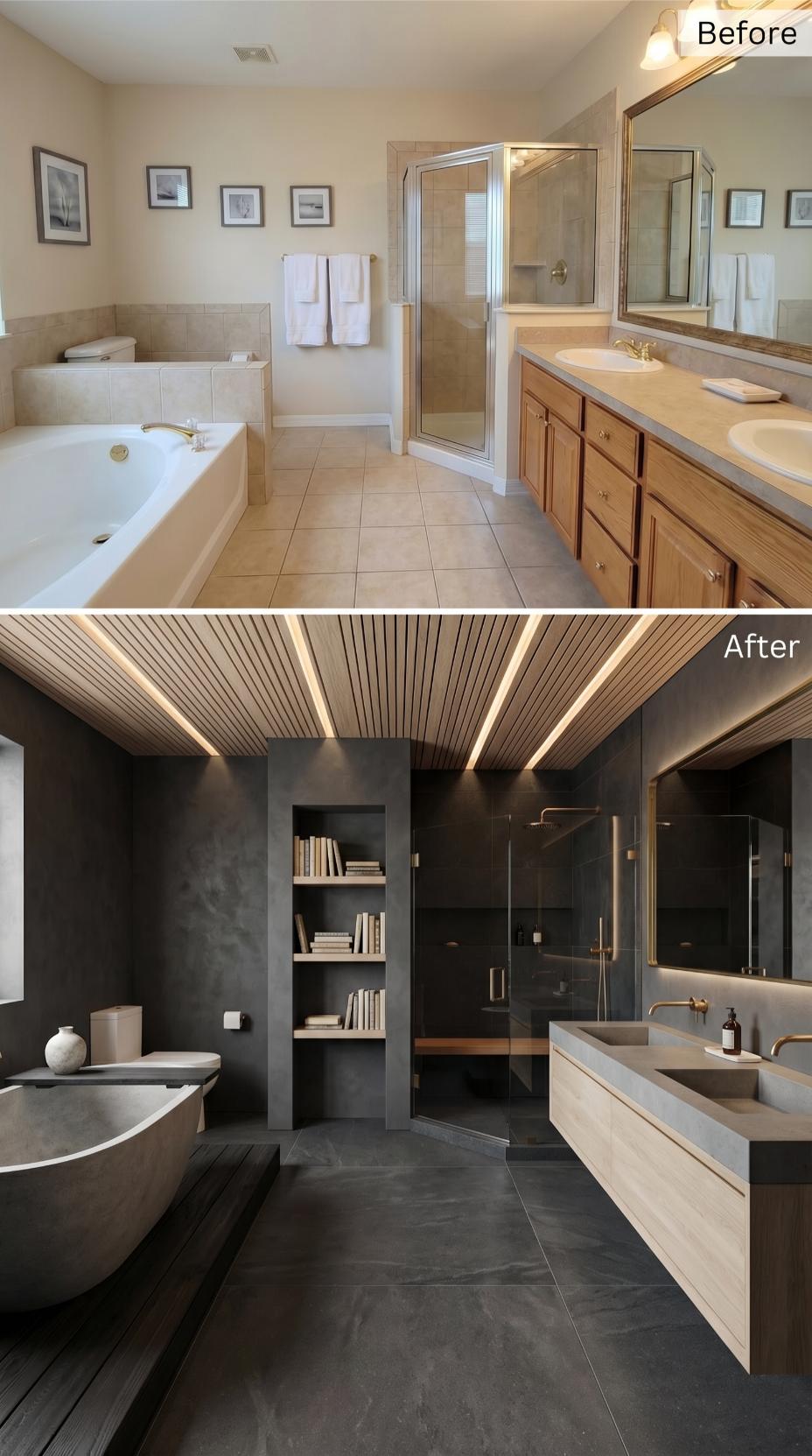
Warm beige tile and oak cabinetry with brass knobs gave way to microcement walls in charcoal, large-format slate floor tiles, and a floating light-wood vanity topped with a concrete vessel sink. A slatted wood ceiling with recessed LED strips runs the full length of the room, pulling the eye toward a glass-enclosed shower fitted with brushed brass fixtures and a teak bench seat.
Navy Walls, Coffered Ceiling, and Zero Apologies for Going Bold
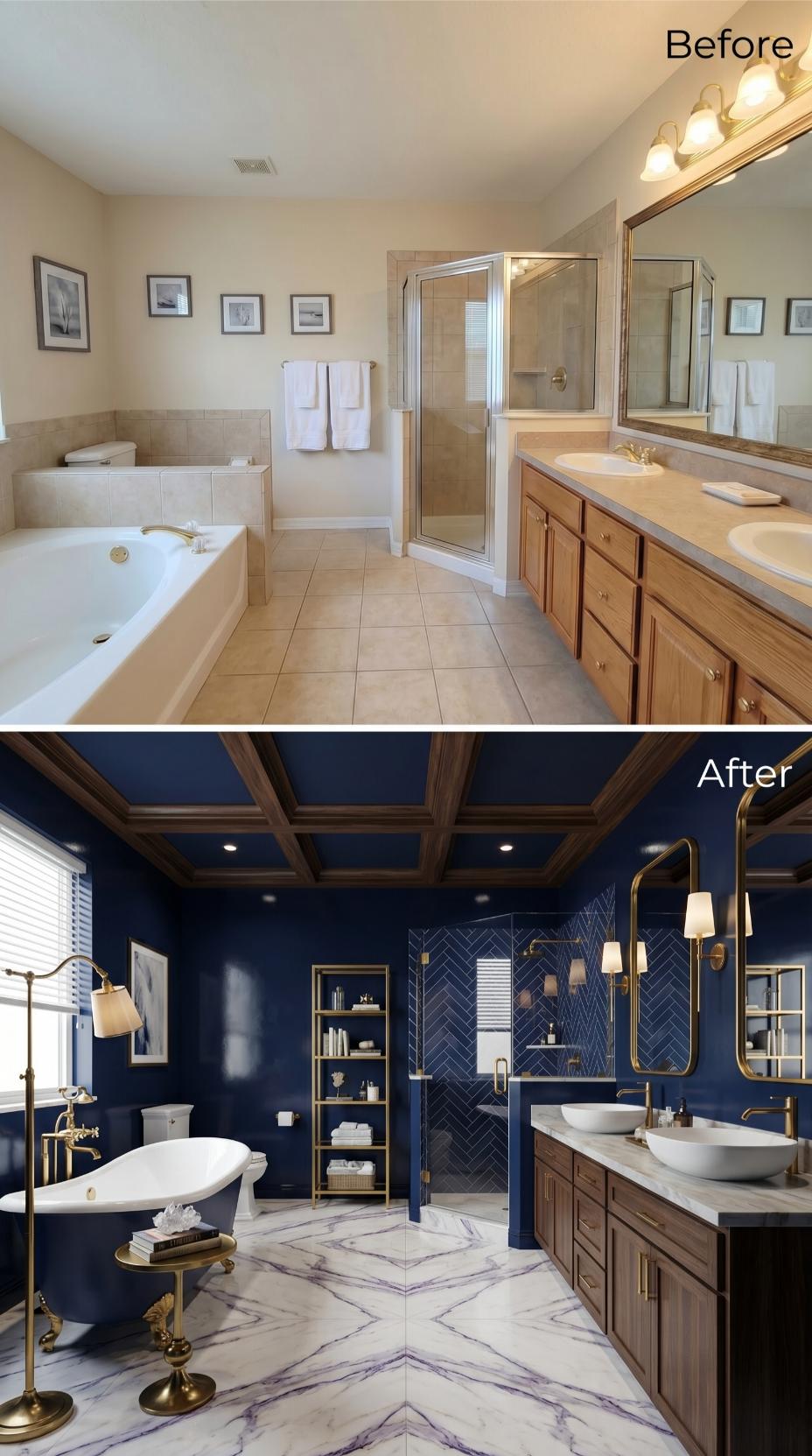
Beige tile, oak cabinets, and a drop-in soaker tub gave way to navy-painted walls paired with a walnut coffered ceiling and recessed lighting. The freestanding clawfoot tub sits on white marble flooring laid in a large-scale diamond pattern with purple veining. Brushed brass fixtures appear throughout: floor-mount tub fillers, sconce lighting, and open gold shelving.
Vessel sinks in white ceramic top what appears to be the original vanity cabinet, now updated with brass hardware. Navy herringbone tile lines the shower wall behind frameless glass. For anyone who disappears into the bathroom with a novel for an hour, this room finally gives them a reason to stay longer.
Exposed Cedar Beams, a Black Soaking Tub, and Bookshelves Built Into the Wall
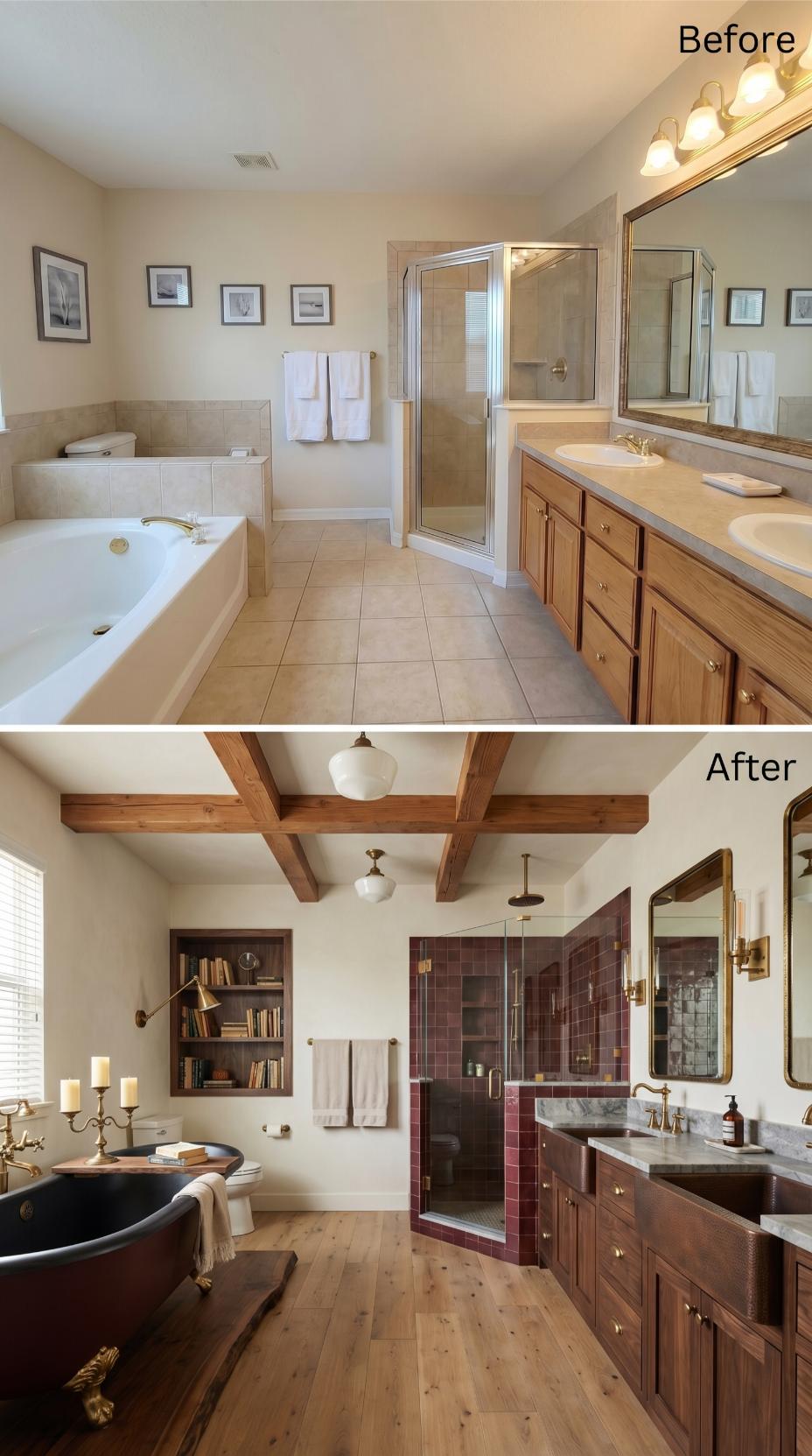
Builder-grade tile floors and a drop-in tub surrounded by oak cabinetry gave this primary bathroom a dated, mid-2000s rental quality. The after version operates in a completely different register. Wide-plank white oak flooring replaces the large-format beige tile, and exposed cedar ceiling beams add structural character the original space never had. Schoolhouse pendants with brass fittings hang from the beam grid, supplementing wall sconces mounted beside gold-framed mirrors.
The vanity runs in dark-stained wood with marble countertops and hammered copper undermount sinks. Deep burgundy zellige tile lines the walk-in shower floor to ceiling. A built-in niche beside the toilet holds actual bookshelves. The freestanding soaking tub is matte black cast iron with claw-foot detailing, flanked by pillar candles on a brass candelabra. Every finish decision points toward the same place: a bathroom built for the person who genuinely needs somewhere to sit and read.
Worth Knowing: The built-in bookshelf niche beside the toilet is framed in the same dark-stained wood as the vanity, making it look intentional rather than improvised. Zellige tile, which is hand-pressed Moroccan clay tile, carries natural variation in glaze depth from brick to plum across individual pieces. That inconsistency is what makes the shower wall look layered rather than flat.
Walnut Slat Walls, Terrazzo Floors, and a Sputnik Chandelier That Changed Everything
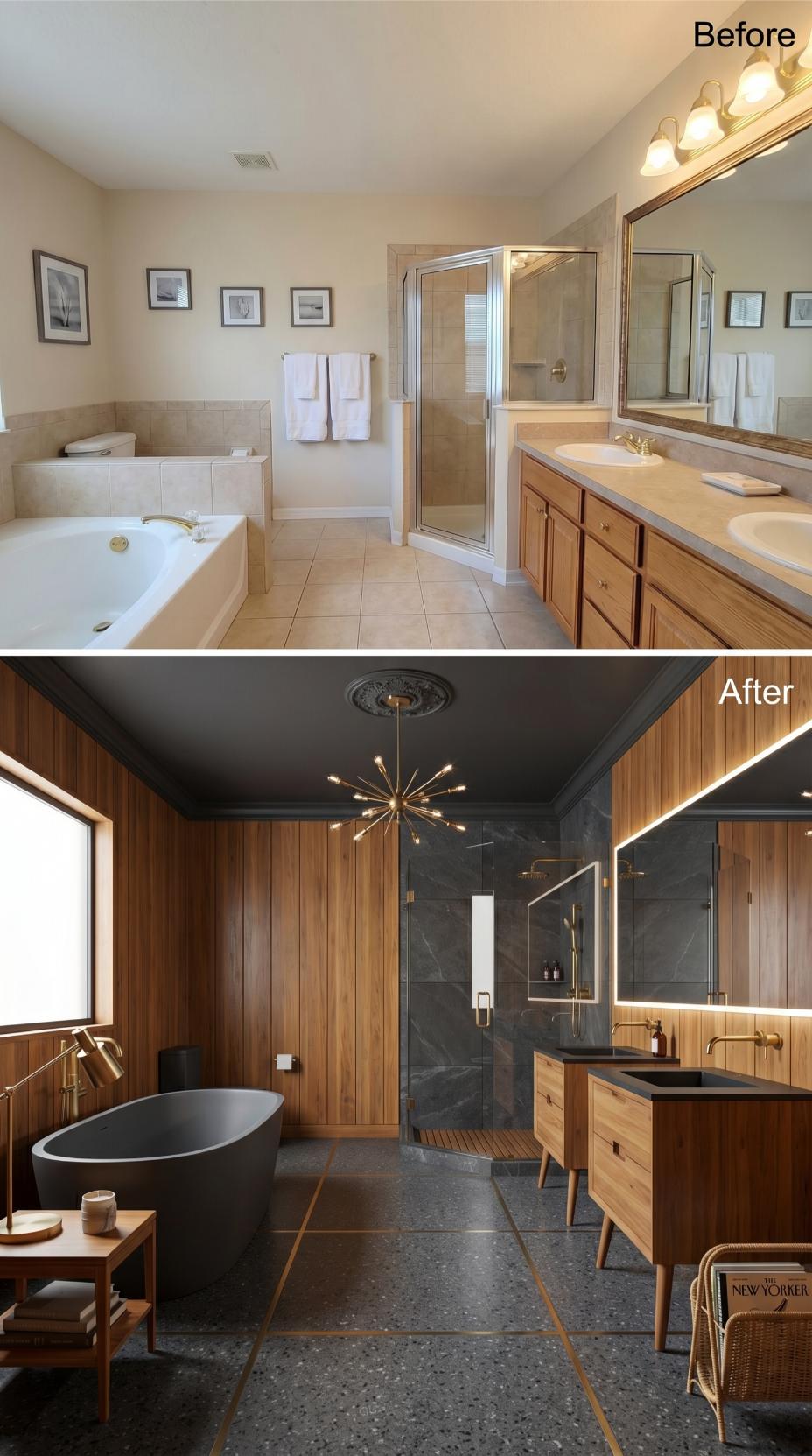
Vertical walnut slat paneling replaced every beige-painted surface, running floor to ceiling on three walls while a dark terrazzo floor with brass inlay lines grounds the room. The freestanding concrete soaking tub sits in charcoal matte against that wood backdrop, and a mid-century vanity on tapered legs holds two undermount black stone sinks with unlacquered brass wall-mount faucets.
Budget Tip: Terrazzo floors look expensive but can be achieved on a budget using terrazzo-style porcelain tile, which runs significantly less per square foot than poured concrete. Pairing it with a single brass inlay strip focuses the eye without requiring full custom installation costs.
Green Marble, Moss Walls, and a Slatted Ceiling That Rewired the Whole Room
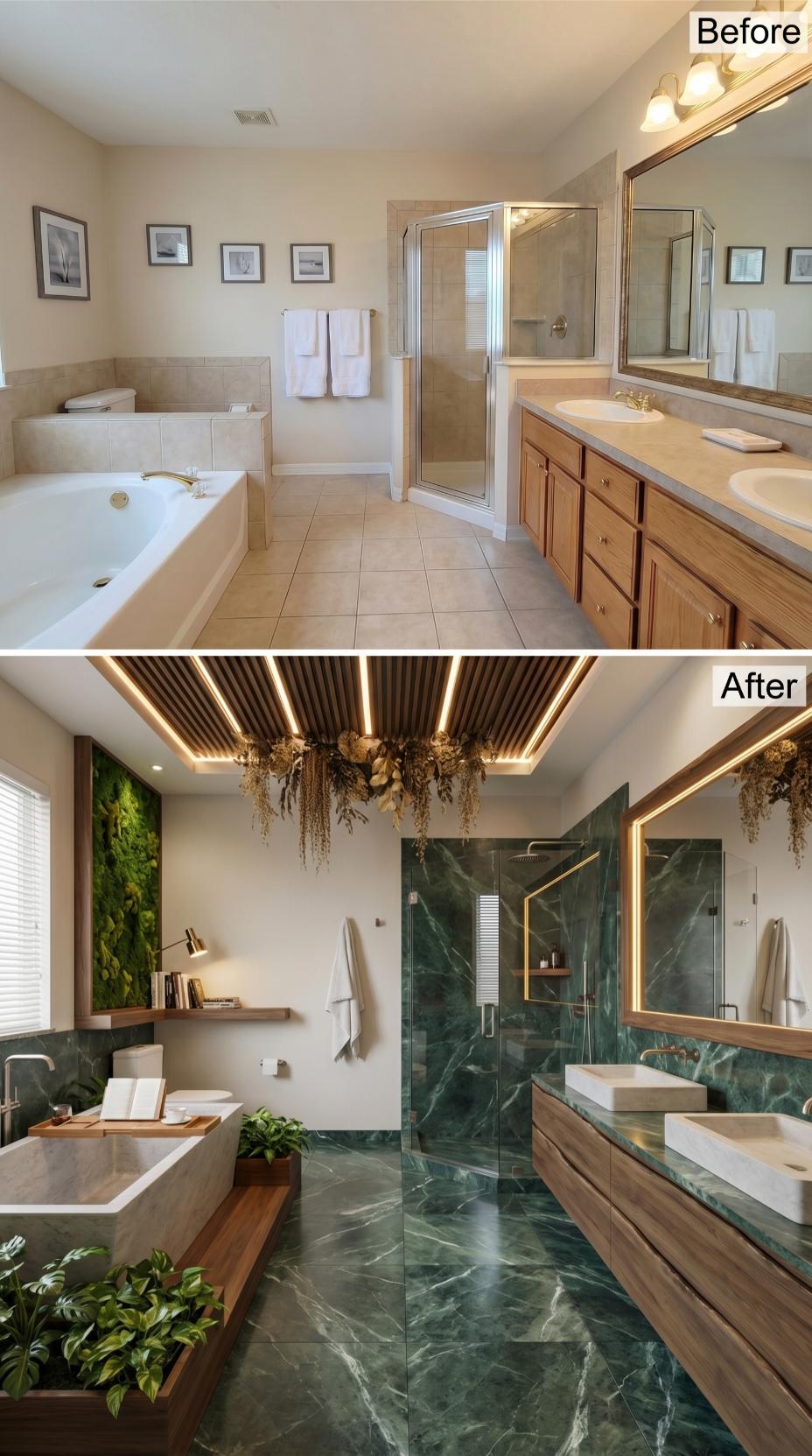
Dark green marble runs floor-to-ceiling in the shower and across the vanity deck, anchored by a floating walnut cabinet with no visible hardware. A living moss panel replaces framed art beside the freestanding tub, and LED strips recessed into wood ceiling slats replace the old brass bar light entirely.
In The Details: Green marble tile varies dramatically in veining from slab to slab, so designers typically order 15 to 20 percent extra material to ensure pattern continuity across large surfaces like shower walls and floors. The vessel sinks here sit directly on the marble-topped vanity without a recessed basin, which keeps the countertop profile clean but requires a taller faucet with at least a 7-inch spout height to clear the rim.
Shiplap Ceiling, Freestanding Tub, and a Vanity That Finally Earned Its Wall
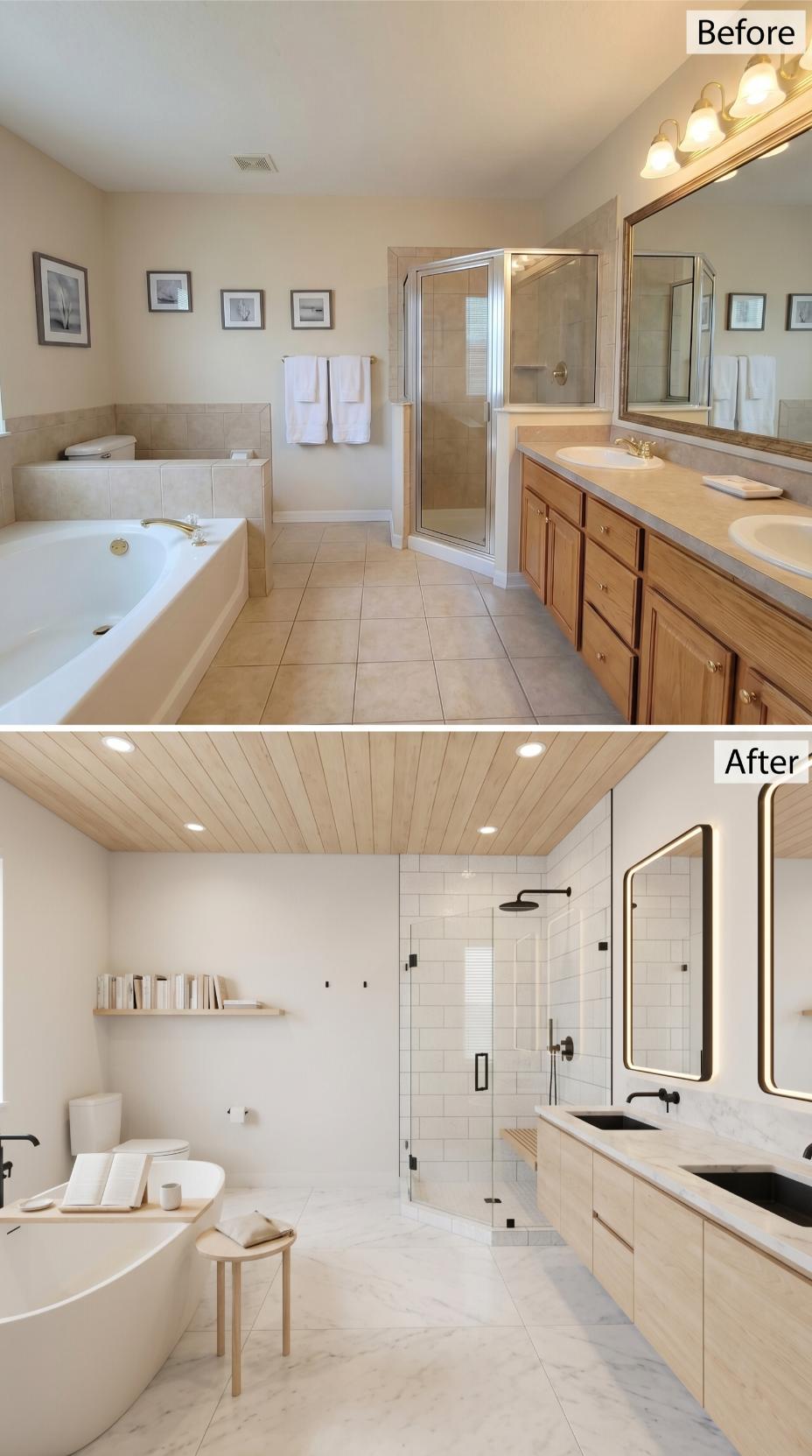
Oak-stained builder cabinets and a brass globe light strip gave way to flat-front cabinetry in light birch with matte black wall-mount faucets. The countertop shifted to white marble with soft grey veining, and the under-mount sinks are black composite. Two LED-backlit rectangular mirrors replaced a single frameless expanse. Above it all, tongue-and-groove wood planks run the length of the ceiling, installed horizontally, with recessed can lights cut directly into them.
The freestanding soaking tub sits low on marble-look porcelain floor tile with subtle movement in the pattern. A walk-in shower enclosure uses frameless glass with black hardware and a rain head, the walls clad in large-format white subway tile stacked in a straight grid. A floating shelf holds books rather than décor. The toilet now sits beside it without apology.
Did You Know: Tongue-and-groove wood plank ceilings, often called shiplap ceilings, add acoustic softness to hard-surface rooms like bathrooms because wood absorbs sound rather than reflecting it. In a room tiled floor to wall, that difference is noticeable the moment someone runs the shower. Primed MDF versions cost significantly less than solid wood and hold paint or stain reliably in humid environments when properly sealed.
Gothic Maximalism, Black Marble Floors, and Gold That Refuses to Be Subtle
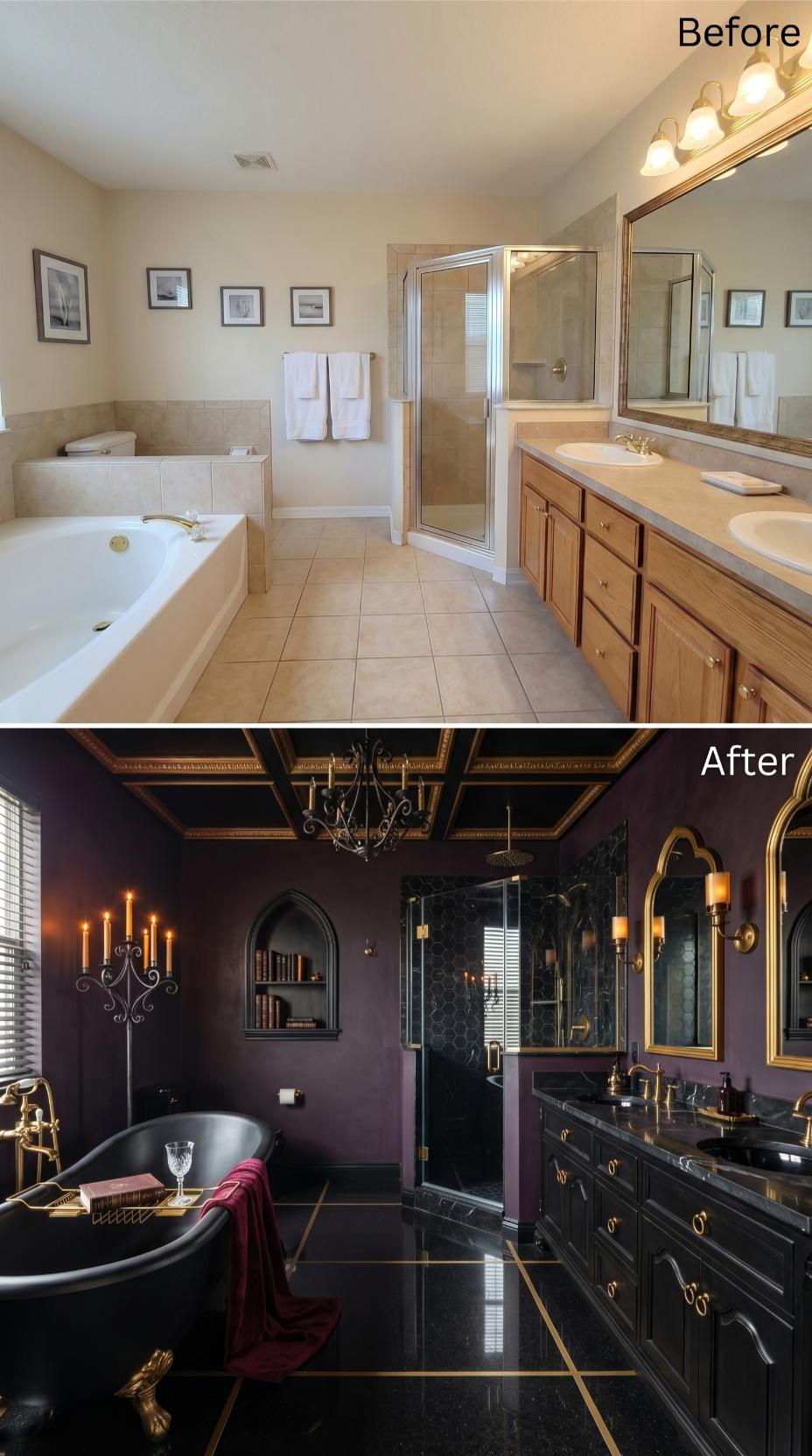
Plum-saturated walls, a matte black clawfoot soaking tub, and black marble floor tile inlaid with gold-toned grout lines replaced every inch of the original beige ceramic and honey-oak cabinetry. Wrought iron candelabras flank the tub where builder-grade light bars once hung, and an ornate chandelier drops from a coffered ceiling trimmed in gold molding.
- Black marble countertops with gold pulls on the vanity cabinets cost significantly more than standard quartz but reflect candlelight in ways flat stone cannot
- Coffered ceiling grids painted the same dark tone as the walls read as architectural detail rather than contrast, making the room feel taller
- Clawfoot tubs require floor-mounted faucet risers, which add plumbing complexity but free up the tub deck for styling like books and crystal glassware
Concrete Everything, a Pendant Light That Means Business, and No More Honey-Oak Cabinets
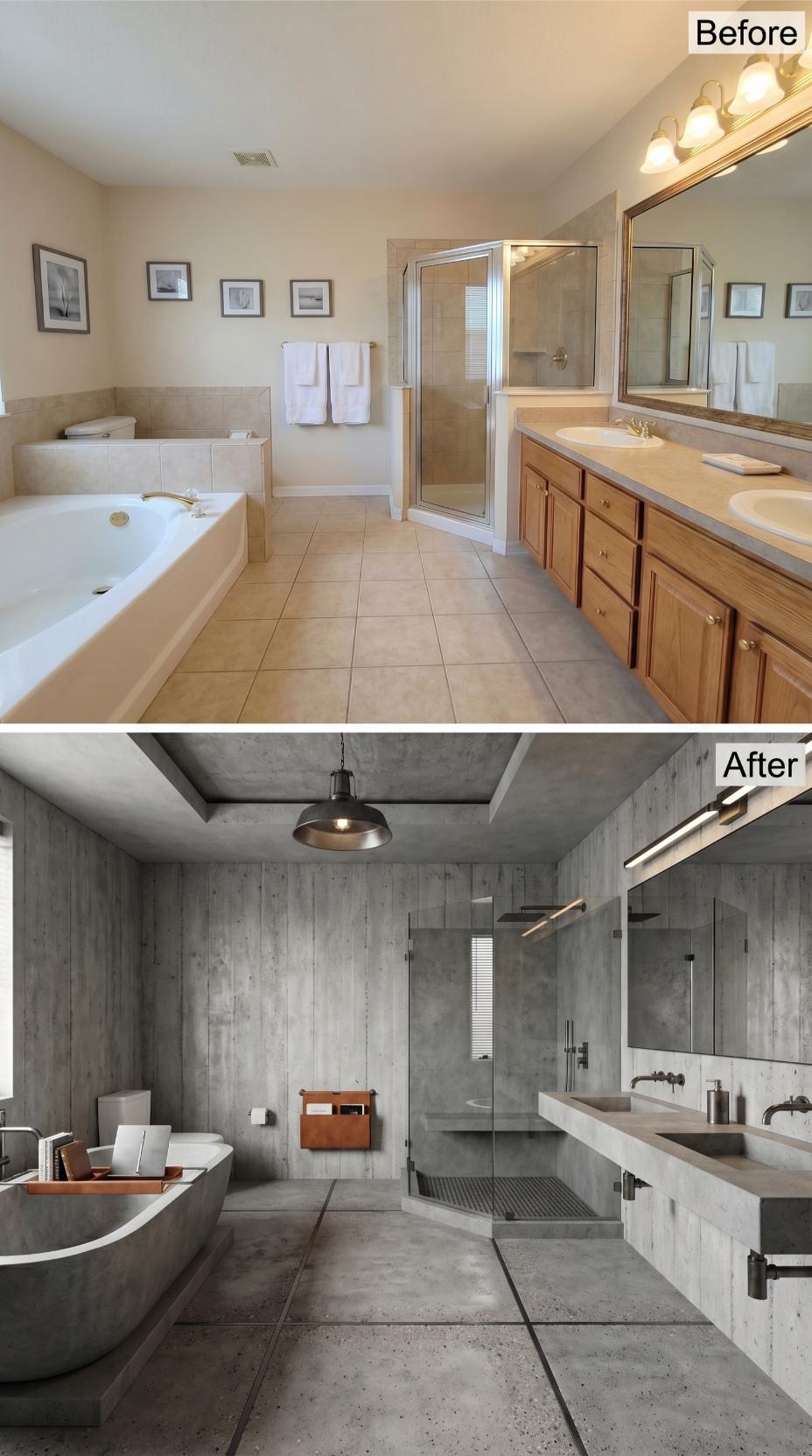
Raw board-formed concrete covers every wall surface from floor to ceiling, and the freestanding tub is cast from the same material, making the whole room read as one continuous poured structure. The pendant fixture hanging at center ceiling is an industrial dome style with a matte black finish, replacing what was once a brass Hollywood bar light above a builder vanity. Floating concrete countertops extend the full length of the right wall, supported by nothing visible, with wall-mount faucets in an oil-rubbed finish sitting directly against the concrete backsplash.
- Polished concrete floors can be ground and sealed in place over existing tile slabs, skipping a full demo in some cases
- Board-formed concrete walls get their linear wood-grain texture from the plywood forms pressed against wet concrete during the pour
- Wall-mount faucets require in-wall rough-in during framing, so they must be planned before drywall or concrete is applied
Sage Green Walls, Gold Botanical Fixtures, and a Clawfoot Tub That Earned a Book Stand
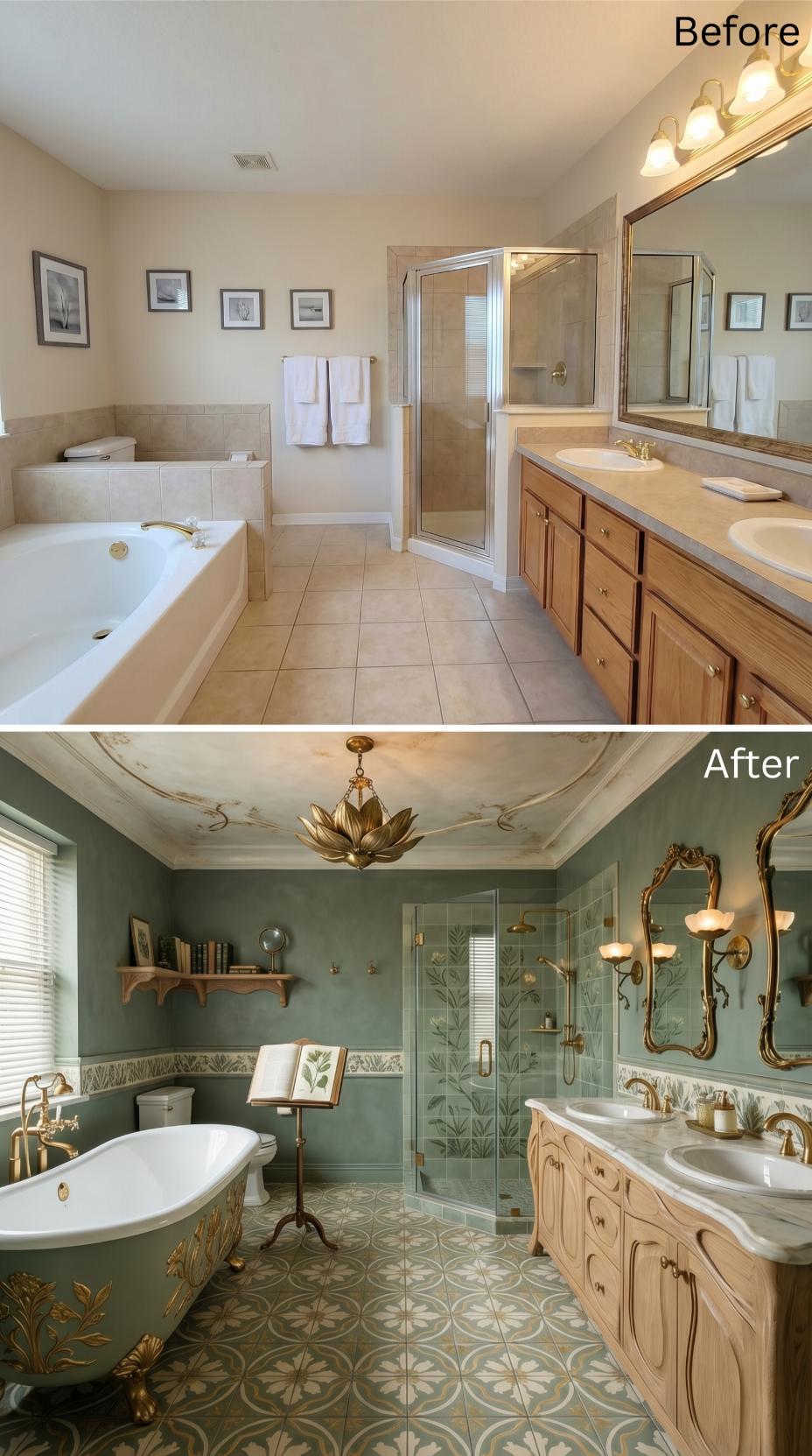
Sage plaster walls carry hand-painted botanical tile at the border, while encaustic cement floors in a cream-and-green medallion pattern replace the original large-format beige squares. A brass lotus pendant anchors the vaulted ceiling, which received a painted mural treatment with trailing vine details. The clawfoot tub sits on gilded claw feet with matching brass faucetry, and a brass book stand positioned beside it confirms exactly what this room was designed for. Carved light-wood cabinetry with ornate detailing pairs with marble countertops and baroque-framed mirrors finished in aged gold.
A brass book stand positioned beside the clawfoot tub confirms exactly what this room was designed for.
Slate Blue Shiplap, a Clawfoot Tub on Gold Feet, and Herringbone Wood-Look Floors
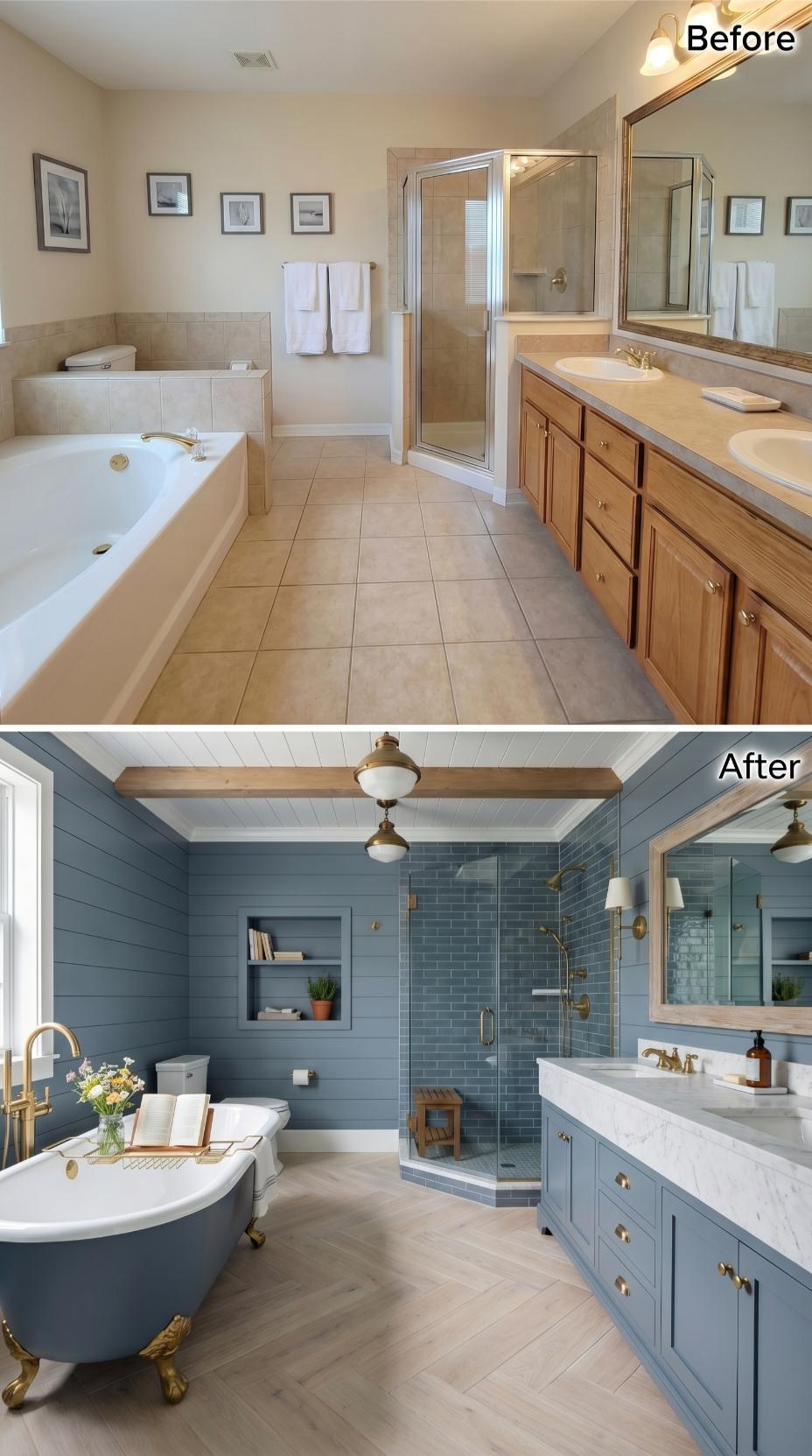
Slate blue shiplap walls run floor to ceiling, anchoring a clawfoot tub painted to match and fitted with brass floor-mount faucets. The herringbone porcelain tile mimics pale oak and replaces the original builder beige underfoot. Brass pendant fixtures and a wood-framed vanity mirror pull the hardware finish into every corner.
The Psychology Behind This: Blue is consistently ranked among the colors most associated with mental deceleration, making it a logical choice for a room where slowing down is the entire point. The shiplap paneling reinforces this by adding horizontal lines that widen the visual field and reduce the sense of enclosure. Rooms designed around a single repeated color and finish tend to feel more resolved, which makes it easier for the brain to disengage from task-mode.
Gold Cornice Molding, a Crystal Chandelier, and the Clawfoot Tub That Replaced a Jetted Box
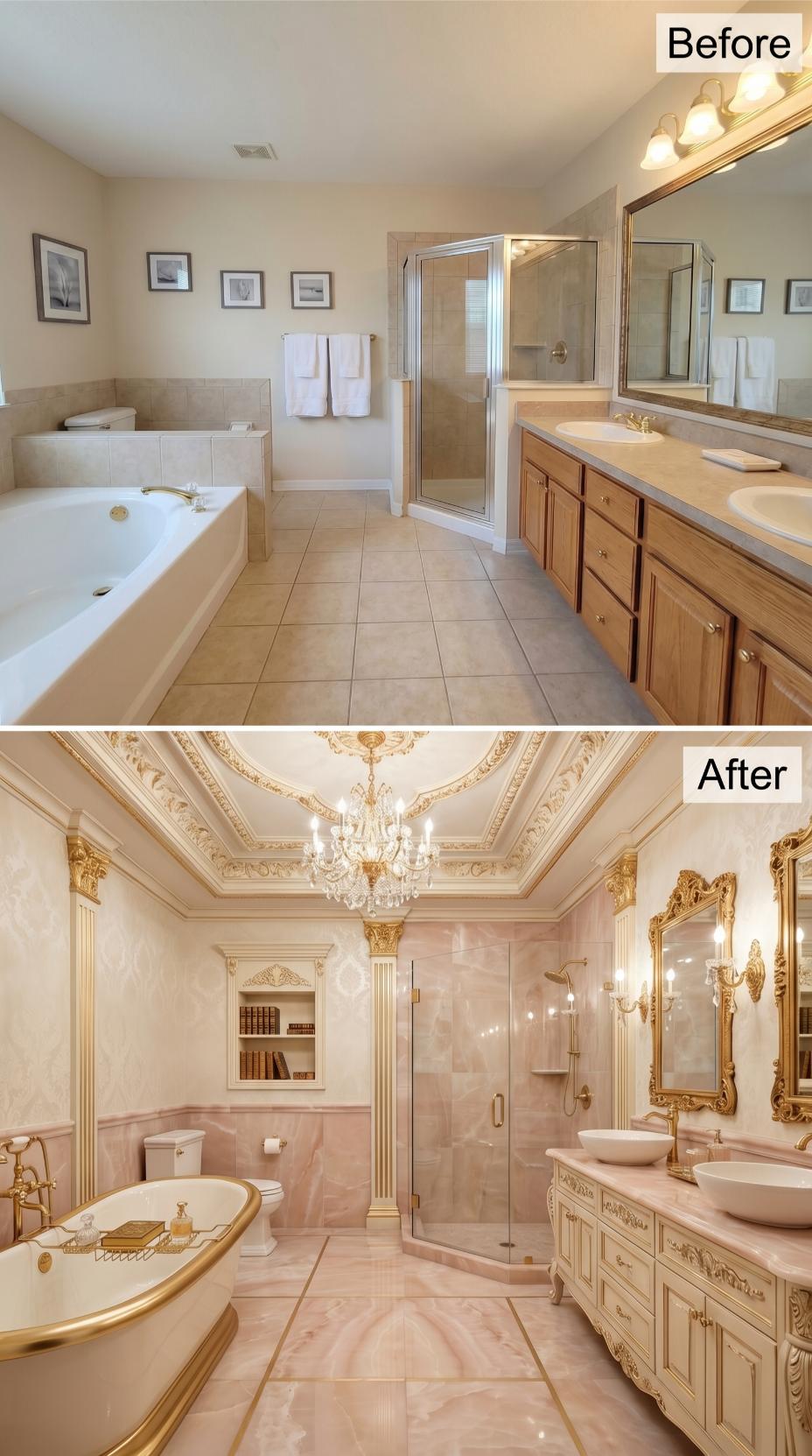
Cream-painted cabinetry with carved baroque detailing and brass hardware replaces the honey-oak vanity, while rose-veined marble tile climbs the walls and a freestanding tub with gold rim trim takes the corner previously occupied by a builder-grade whirlpool.
Fun Fact: Crystal chandeliers in bathrooms date to 18th-century European palace design, where bathing rooms were treated as ceremonial spaces rather than utilitarian ones. Modern versions use moisture-rated canopy mounts to handle humidity without compromising the fixture. A chandelier hung at roughly seven feet from floor to lowest crystal keeps the drama without obstructing sightlines across the room.
Where the last room leaned on traditional elegance, this one swings hard in the opposite direction.
Exposed Ceiling Joists, Dark Brick Walls, and Edison Cages That Replaced Every Builder Instinct
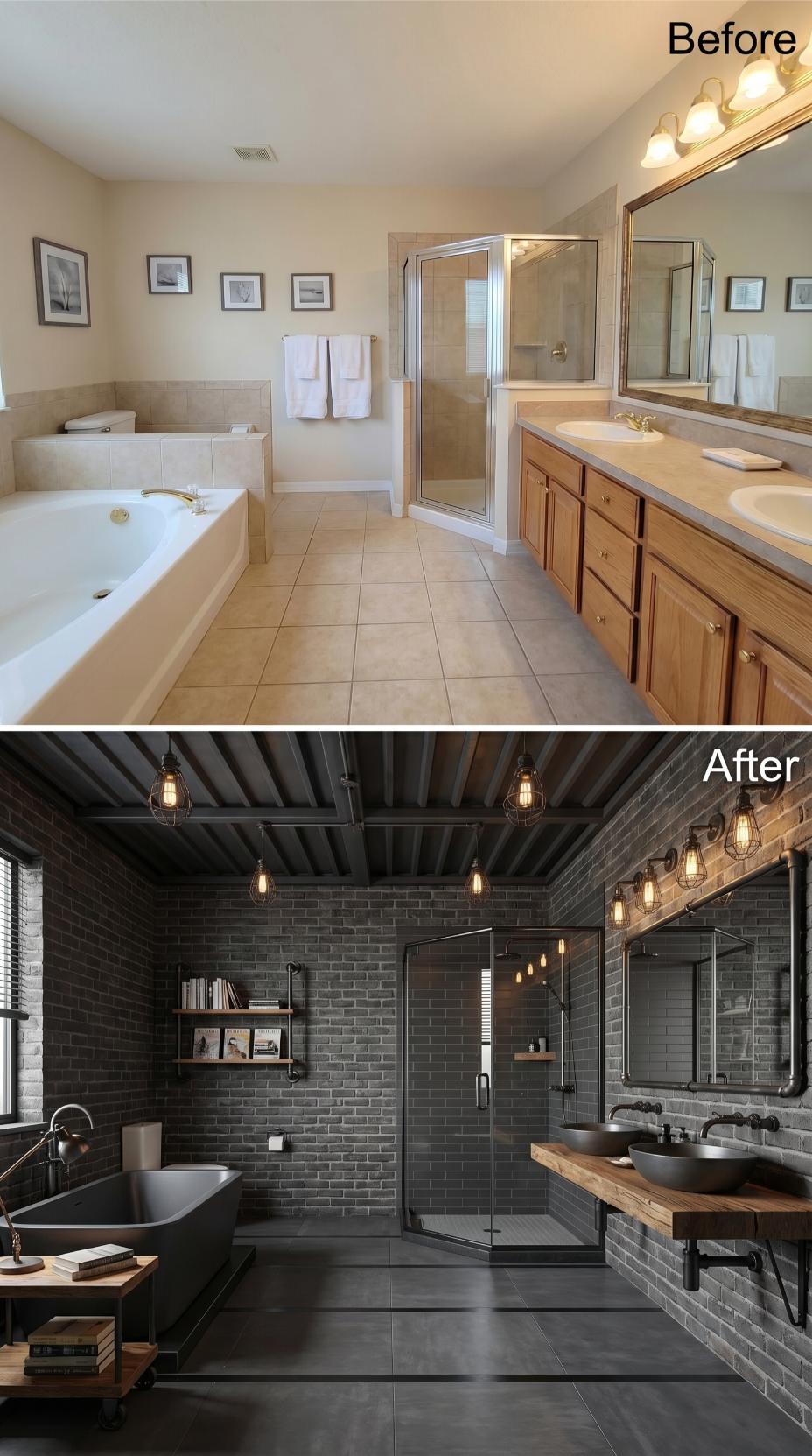
Gray brick runs floor to ceiling on every wall, and the exposed joist ceiling is painted the same charcoal, collapsing the boundary between surface and structure. Vessel sinks sit in a raw-edge wood slab, with matte black pipe fittings doing the work that brass hardware once did in the before. The freestanding tub, cast in flat gray, anchors the left side of the room beneath a cage-bulb pendant that hangs low enough to feel intentional. Industrial pipe shelving holds books within arm’s reach of the toilet, which is exactly the point.
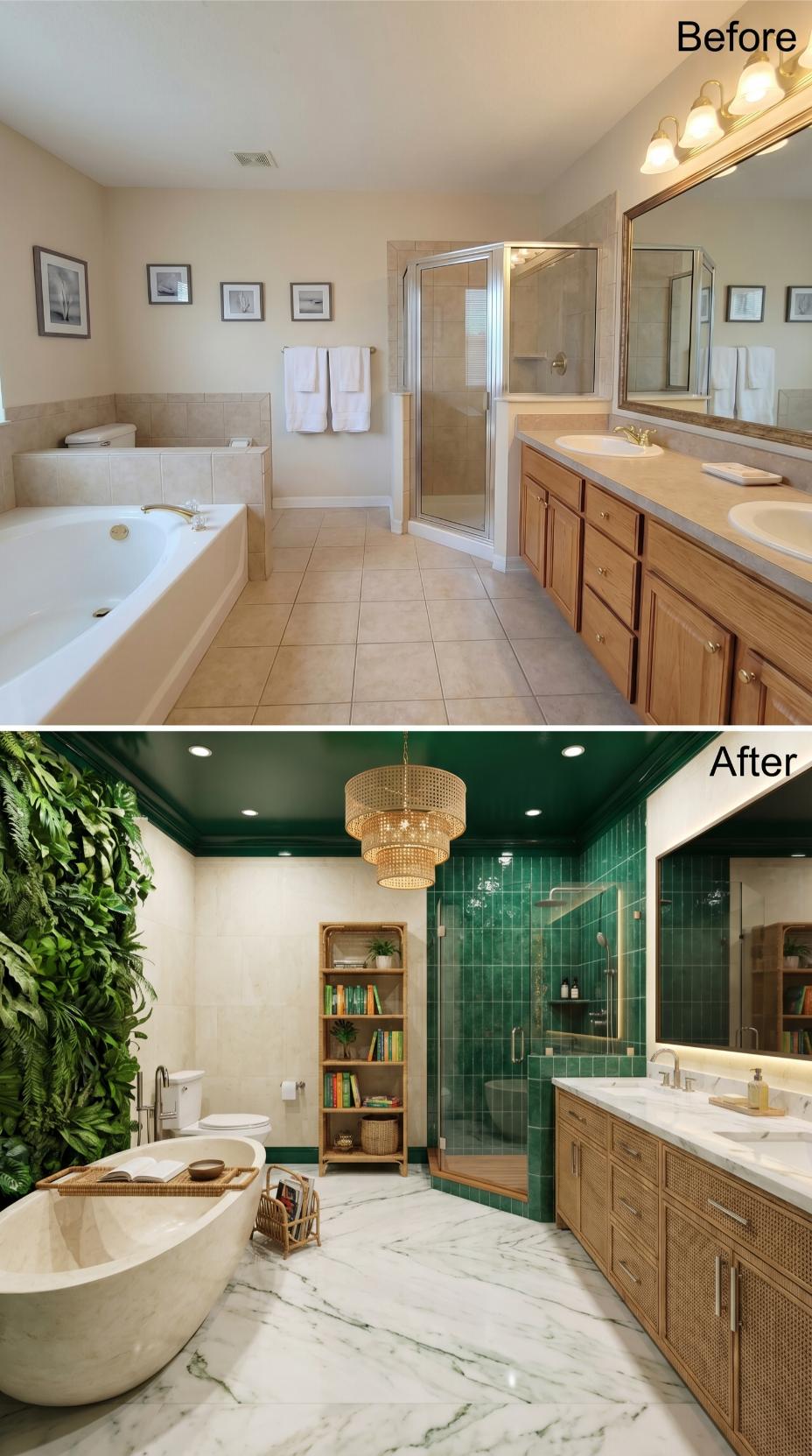
Emerald Tile, a Rattan Chandelier, and Bookshelves That Belong in a Bathroom
🔥 Would you like to save this?
Beige tile floors, honey-oak cabinetry, and a jetted tub surround built from the same dated ceramic as the walls — the before photo is a perfect record of what happens when nothing in a room has a point of view. The after rewrites every surface with intention. Marble-look porcelain floors run wall to wall, the shower is lined floor to ceiling in glossy emerald subway tile with brushed gold hardware, and a living plant wall anchors the left side with dense tropical foliage pressed against venetian plaster.
The ceiling is painted deep forest green with white crown molding defining the break, and a tiered rattan chandelier hangs at center. Oak cabinetry returns, but now it’s cane-front paneling with a white marble countertop and integrated underlighting. A freestanding bone-white soaking tub sits on bamboo legs with a woven tray across it holding a book and a ceramic bowl. The rattan bookshelf beside the shower holds actual books, spine-out, organized by color.
Try This: Painting only the ceiling a saturated color, rather than the walls, concentrates visual drama overhead without shrinking a room’s perceived square footage. In rooms with white or plaster walls, a green or navy ceiling reads as an architectural canopy rather than an enclosure. It’s one of the few high-impact moves that costs under fifty dollars in paint.
Marigold Walls, Moroccan Lanterns, and a Clawfoot Tub That Finally Has Something to Look At
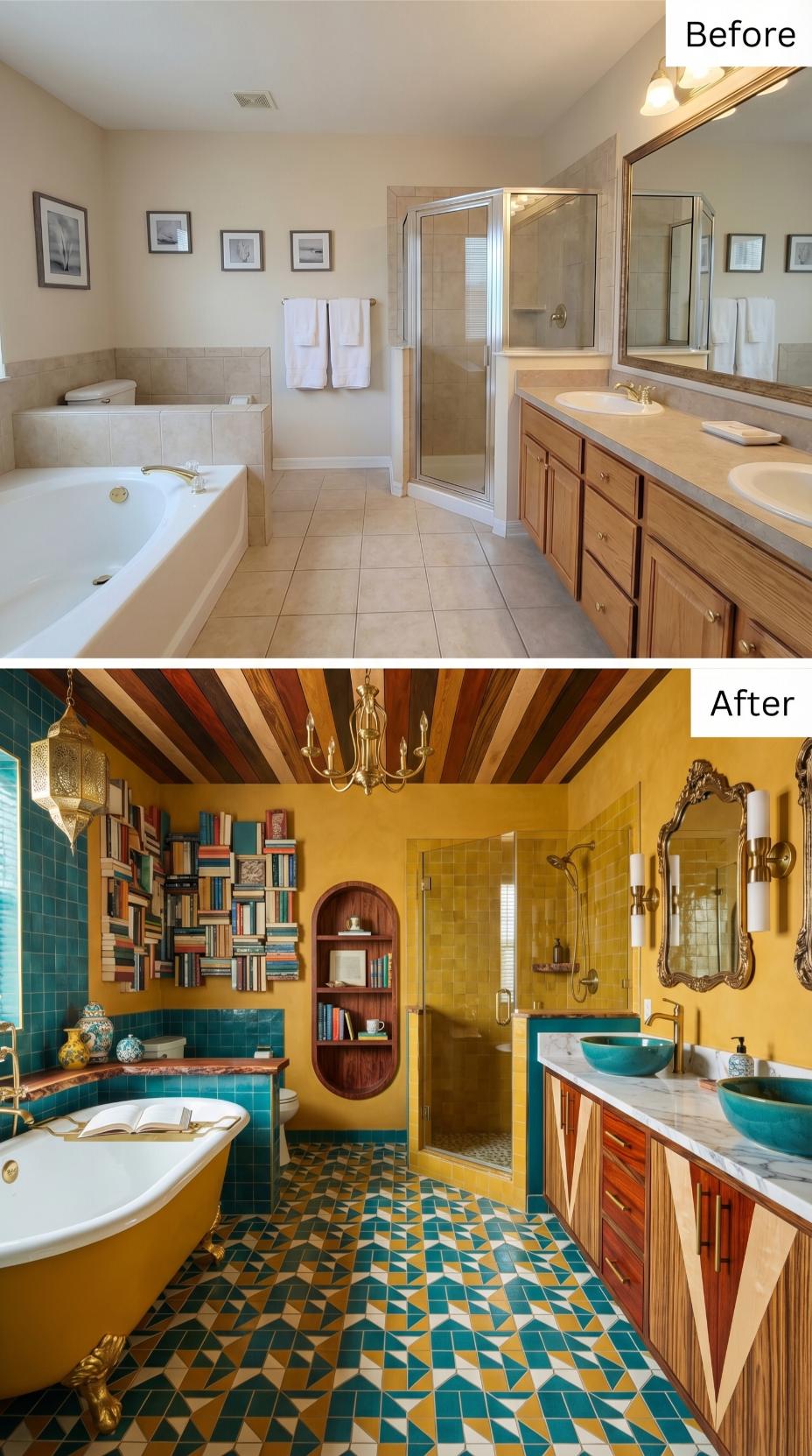
Bold marigold yellow covers every wall, anchored below by teal zellige-style tile and a geometric cement floor in teal, gold, and cream triangles. A brass chandelier and hanging Moroccan lanterns replace the builder light bar entirely. The clawfoot tub sits on gilded claw feet beside stacked books mounted directly to the wall. Teal vessel sinks rest on a wood vanity with an ornate brass-framed mirror overhead.
Trend Alert: Cement encaustic tile, like the geometric pattern covering this floor, is typically fired at lower temperatures than ceramic, which makes it more porous and requires sealing every one to two years to prevent staining in wet environments. Homeowners who skip that step often discover the grout lines absorbing color from bath products within the first year.
Travertine Walls, a Slatted Tray Ceiling, and the Floating Vanity That Buried the Oak Cabinets
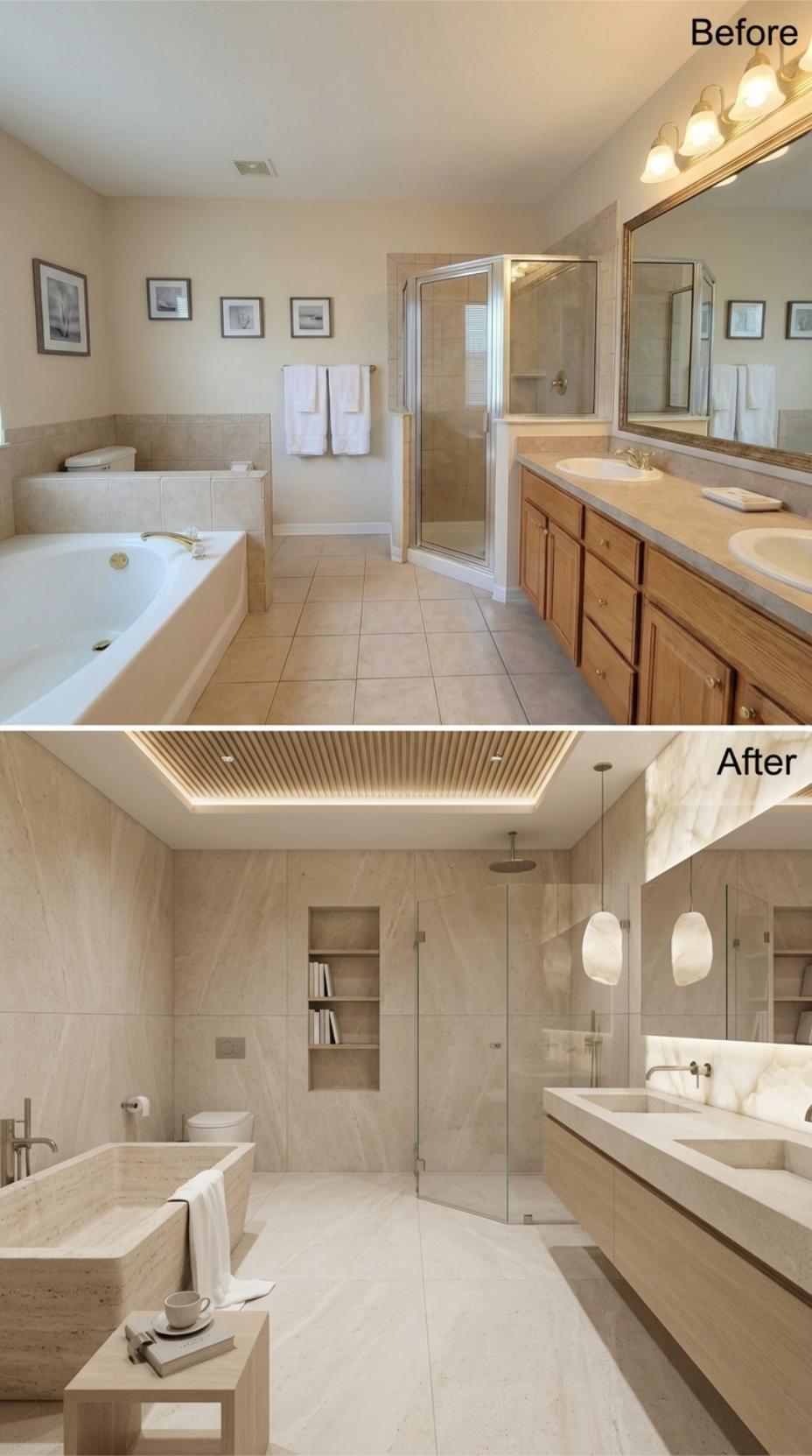
Wall-to-wall travertine tile in a warm ivory tone replaced every surface, while a wood-slat tray ceiling with recessed LED strip lighting pulled the eye upward in a room that used to stop at a builder-grade light bar.
Why the Slatted Tray Ceiling Does More Work Than It Appears To
Wood slat ceilings installed within a recessed tray create two effects simultaneously: the recess adds perceived height, and the slats introduce a material that absorbs sound rather than bouncing it off tile. In a bathroom this large, that acoustic shift is noticeable. Designers often use poplar or finger-jointed pine for slat installations in humid environments because both species accept paint and sealant without warping under moisture exposure the way raw oak can.
Navy Shiplap, a Rope Chandelier, and Blue Marble That Replaced Forty Square Feet of Beige
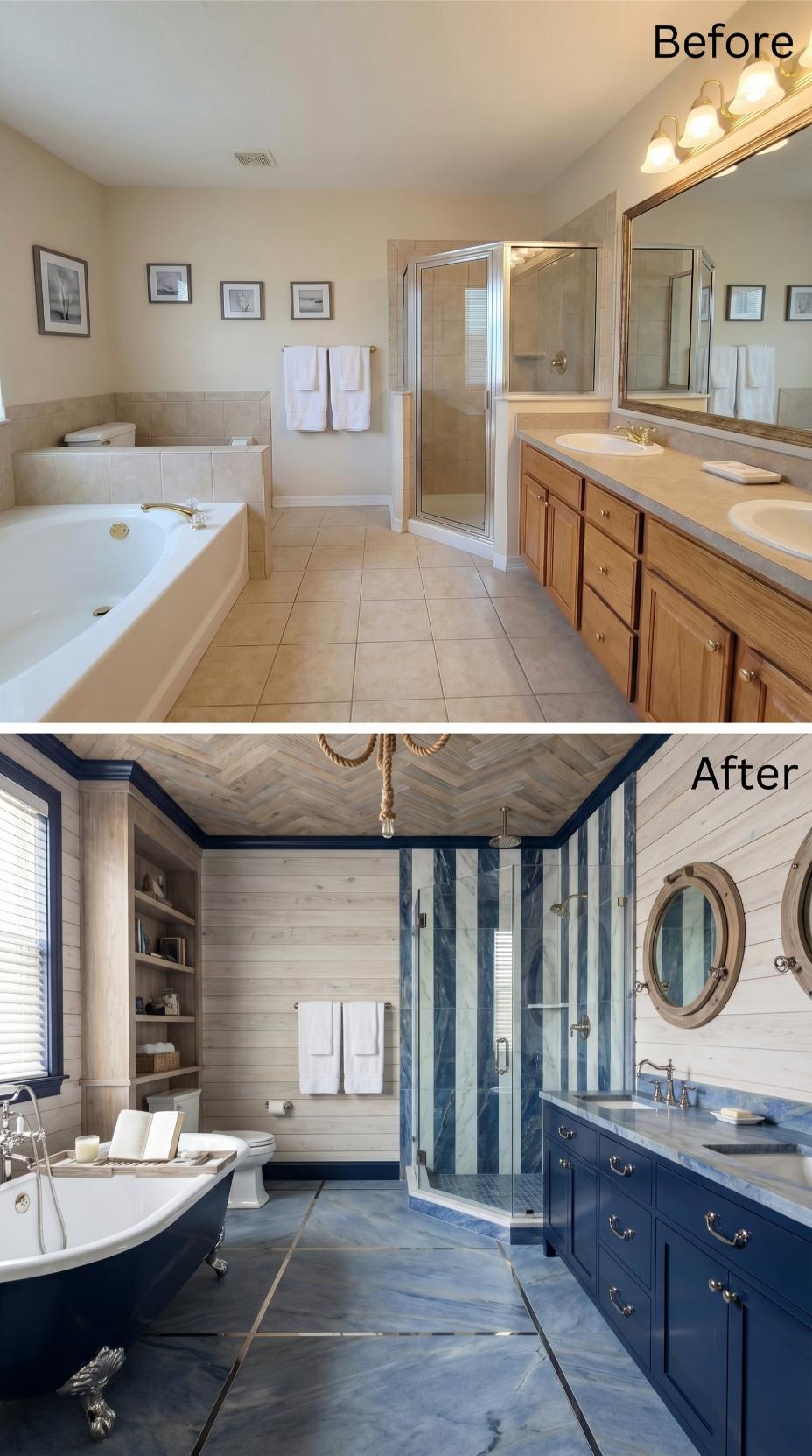
Painted navy cabinets with brushed nickel cup pulls anchor the double vanity beneath a blue-veined marble countertop, while whitewashed shiplap walls and a herringbone wood-plank ceiling pull the room toward coastal without going kitsch. The clawfoot tub, finished in navy to match, sits on cast-iron feet opposite built-in open shelving.
Style Tip: Rope chandeliers, typically made from twisted jute or manila fibers, are naturally moisture-tolerant and work well in bathrooms with good ventilation. Pairing one with a herringbone wood ceiling amplifies the nautical reference without requiring a single piece of anchor hardware. The porthole mirrors above this vanity reinforce the theme while staying proportional to the wall space.
Travertine Tub Surround, Backlit Tray Ceiling, and Gold-Veined Stone Inside the Shower
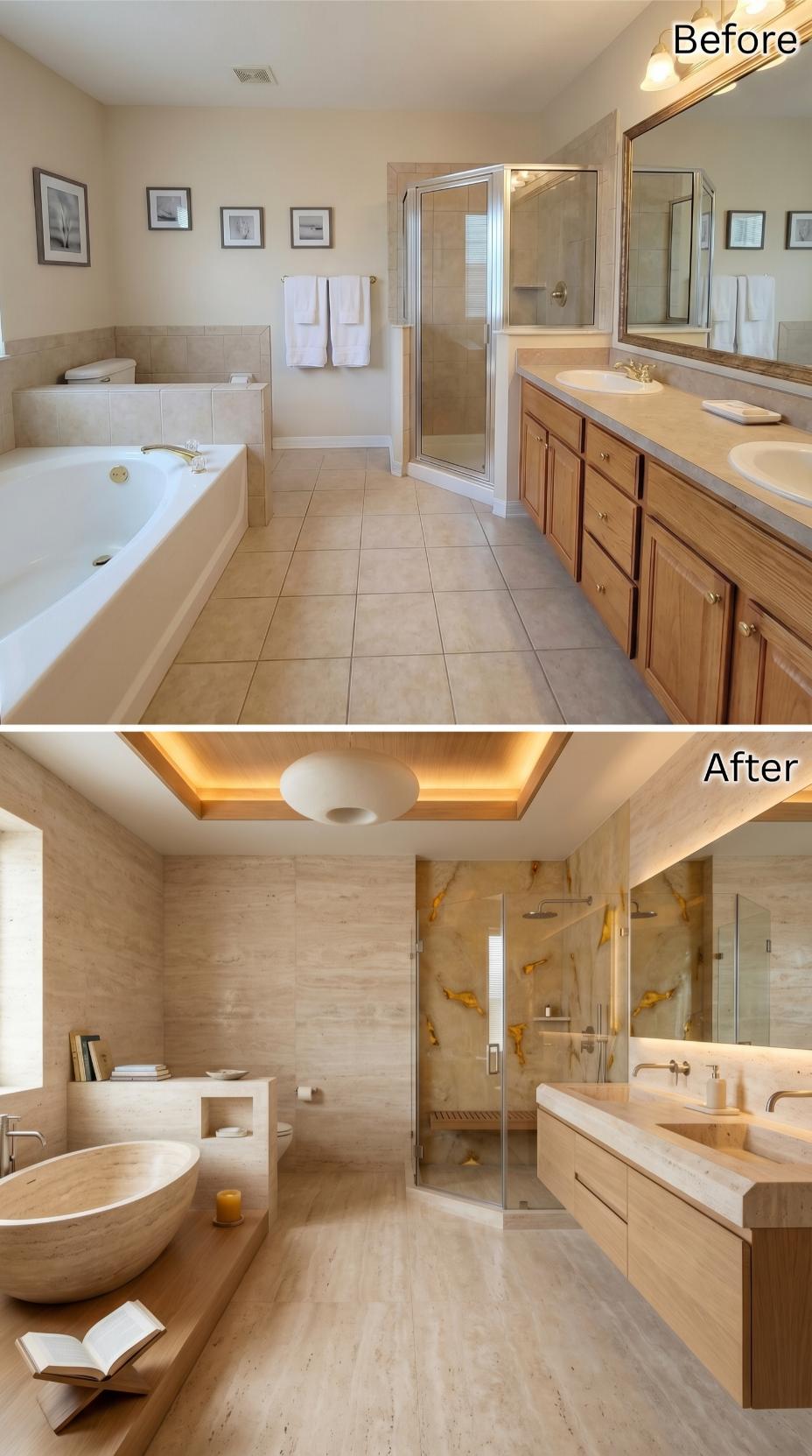
Oak cabinets and dated brass fixtures gave way to floor-to-ceiling travertine cladding that runs uninterrupted across walls, floors, and the floating vanity apron. The freestanding tub is carved from solid travertine, sitting on a wide wood platform with open niches below for storage. Inside the shower, slab panels streaked with amber and gold veining replace the old corner enclosure entirely. Warm-white LED strip lighting rims a recessed tray ceiling, casting indirect light that flatters the stone’s natural variation.
Ask Yourself: Travertine is a porous limestone, so any travertine surface in a wet bathroom needs a penetrating sealer applied at installation and reapplied every one to two years to prevent staining. If you are picking your own slab, hold it up to a light source to check for voids and hollow pockets, which are common in travertine and should be filled before installation.
Black Lacquer Walls, a Red Clawfoot Tub, and Art Deco Gold That Buried the Builder Grade
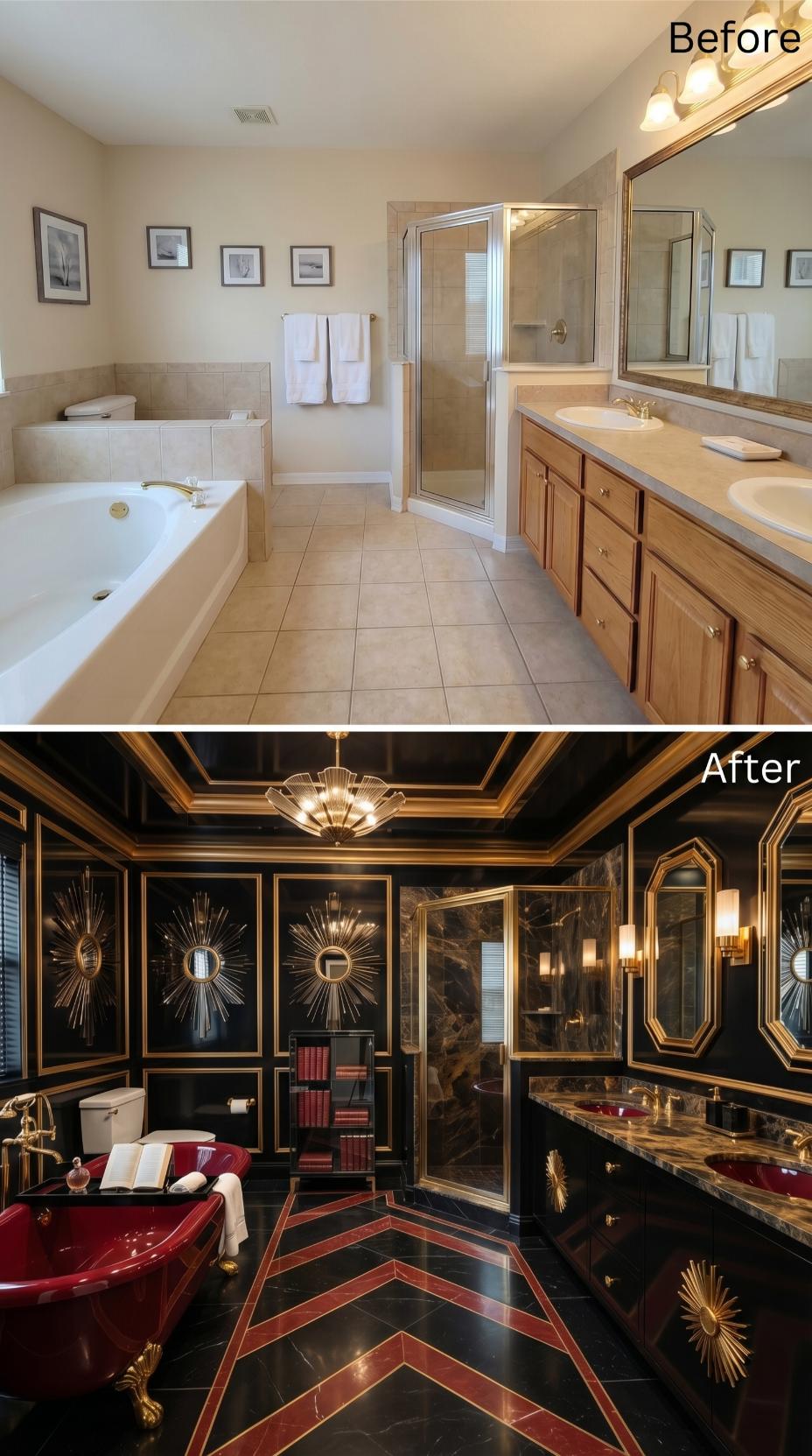
Chevron-patterned marble floors in black and crimson set the direction for everything else in this room. Gold claw feet anchor a red freestanding tub that reads more like furniture than plumbing. Sunburst mirrors in aged gold punctuate the lacquered black wall panels, which are trimmed with gold molding in a recessed grid pattern. A fan-style chandelier hangs from a coffered ceiling edged in the same gold finish.
The double vanity runs along the right wall with dark marble countertops, red vessel sinks, and gold sconce fixtures flanking an octagonal mirror. A glass shower enclosure framed in gold sits at center-back, clad in veined dark marble. Open shelving beside it holds red-spined books, making the reading habit part of the architecture rather than an afterthought.
Why the Chevron Floor Reads as a Design Decision, Not a Pattern Choice
Chevron and herringbone are often confused, but chevron tiles cut at an angle so that each row forms a continuous zigzag point, while herringbone simply staggers rectangular tiles. Here, the red inlay follows the chevron precisely, which required custom cutting at every border intersection. That level of precision signals intentional design and is one reason the floor commands attention before anything else in the room does.
Plum Venetian Plaster, a Copper Soaking Tub, and Marble That Replaced Every Beige Tile
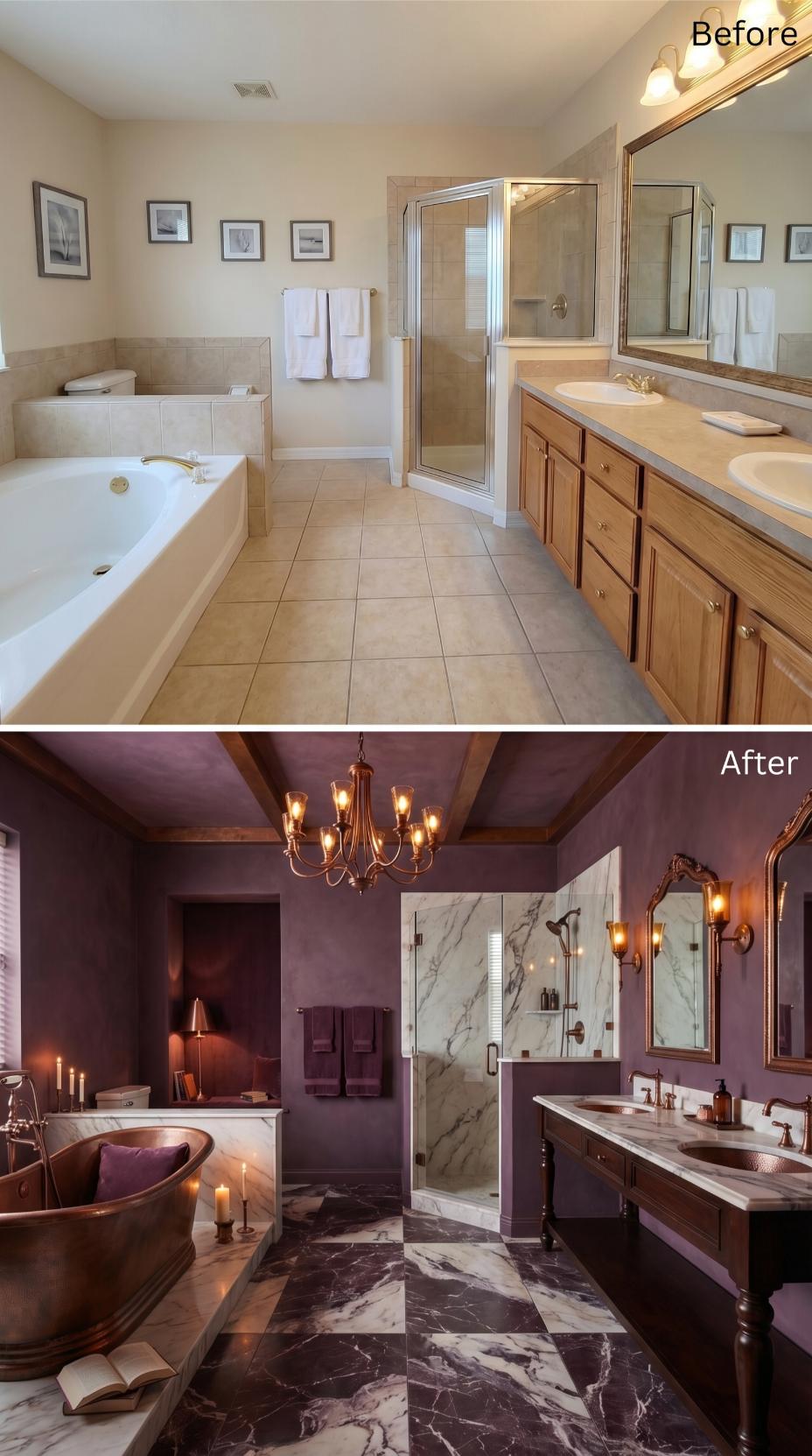
Where builder-grade oak cabinets and a jetted white tub once occupied this primary bathroom, a copper vessel soaking tub now sits on a checkerboard marble floor with dark burgundy and white veining. The walls are finished in deep plum Venetian plaster, which catches candlelight differently at every hour. A bronze chandelier with exposed Edison-style bulbs hangs from a wood-beamed ceiling medallion, and wall sconces with amber glass flank ornate bronze-framed mirrors above the double vanity.
The vanity itself features dark espresso-stained cabinetry with turned legs, an undermount copper basin, and a white marble counter with subtle gray veining. Inside the walk-in shower, floor-to-ceiling slab marble with dramatic movement replaced what the before photo confirms was standard tile surround. Purple Turkish towels hang from a simple bronze bar near the shower entry.
- Venetian plaster requires multiple thin coats applied by hand, and its depth of finish cannot be replicated with standard latex paint
- Copper tubs develop a natural patina over time, and many owners apply beeswax monthly to control oxidation and maintain an even tone
- Checkerboard marble floors should be installed with matching grout color to the lighter stone to avoid the grid reading as too rigid in smaller rooms
Marble Walls, a Clawfoot Tub on Bronze Feet, and Ceiling Panels That Finished What the Builder Started
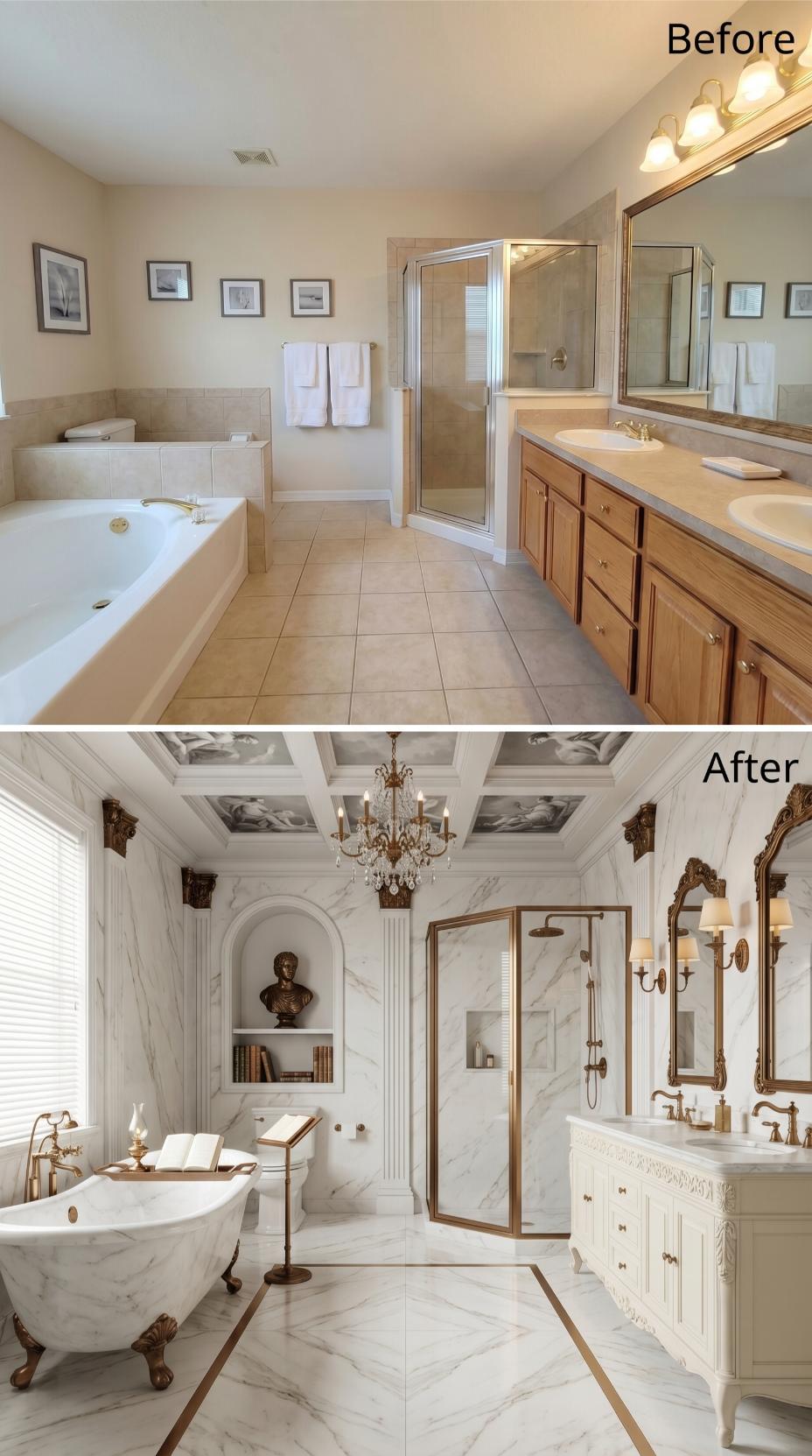
Builder-grade oak cabinets, beige tile, and a jetted drop-in tub defined the before. The after replaced all of it with floor-to-ceiling Calacatta marble, a freestanding clawfoot tub with bronze claw feet, and a coffered ceiling inset with grisaille-style painted panels that read like transferred fresco fragments.
Antique brass fixtures run throughout: shower frame, faucet bodies, wall sconces flanking the ornate gilded mirror, and cabinet hardware on the painted cream vanity. A crystal candelabra chandelier anchors the center of the room. The arched niche beside the toilet holds a classical bust and stacked books, functioning as both display shelf and the reason this bathroom was designed for people who never leave quickly.
Quick Fix: Clawfoot tubs with metal feet require the feet to be floor-mounted through the finished tile, which means the exact tub placement must be decided before tile installation begins. Moving the tub even a few inches after the fact means cutting into finished marble. Lock in the position during the rough-in stage and mark it clearly on the subfloor before any stone goes down.
Dark Walnut Paneling, Emerald Marble, and a Library Ladder That Has No Business Being This Practical
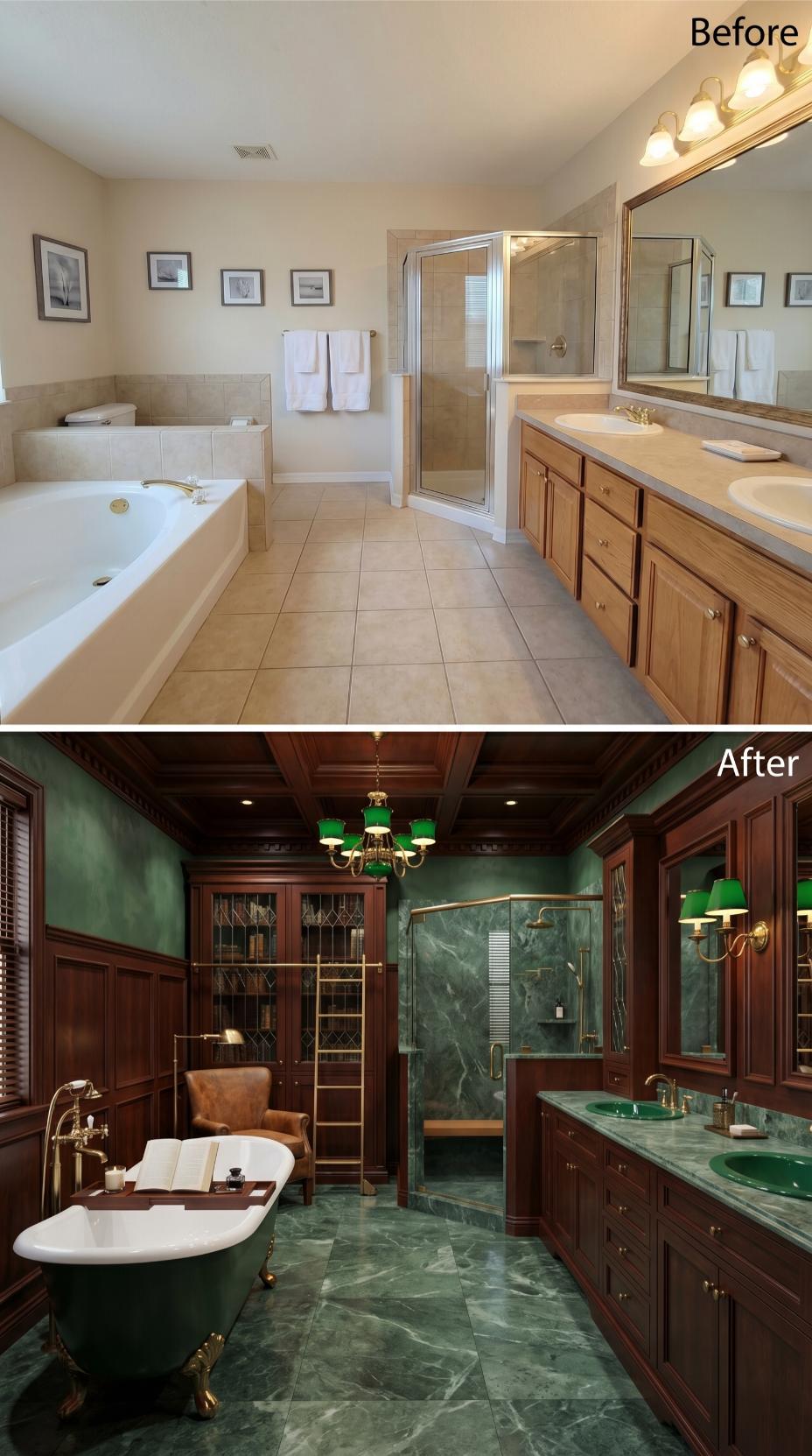
The before bathroom had oak cabinets, beige tile, and a jetted tub that read as an afterthought. What replaced it operates on a completely different register. Deep mahogany wainscoting runs floor to ceiling, anchoring walls painted in forest green Venetian plaster. A brass chandelier with emerald glass shades hangs from a coffered wood ceiling, and a rolling library ladder on a brass rail serves the built-in leaded-glass cabinet beside the shower.
The clawfoot tub sits center-left on green-veined marble slab flooring, paired with a leather wingback chair that treats the soaking area as a reading room. The double vanity runs the full right wall in the same dark stained wood, topped with green marble and fitted with round vessel sinks and unlacquered brass faucets. The walk-in shower uses matching marble on every surface, floor to ceiling.
Pro Tip: Unlacquered brass fixtures develop a natural patina over time as the finish oxidizes with air and water exposure, gradually shifting from bright gold to a warmer, darker tone. Homeowners who prefer a consistent finish should opt for satin brass instead, which carries a protective lacquer coating that holds its color for years without polishing.
Blush Venetian Plaster, a Crystal Chandelier, and a Painted Clawfoot Tub That Retired the Oak Vanity
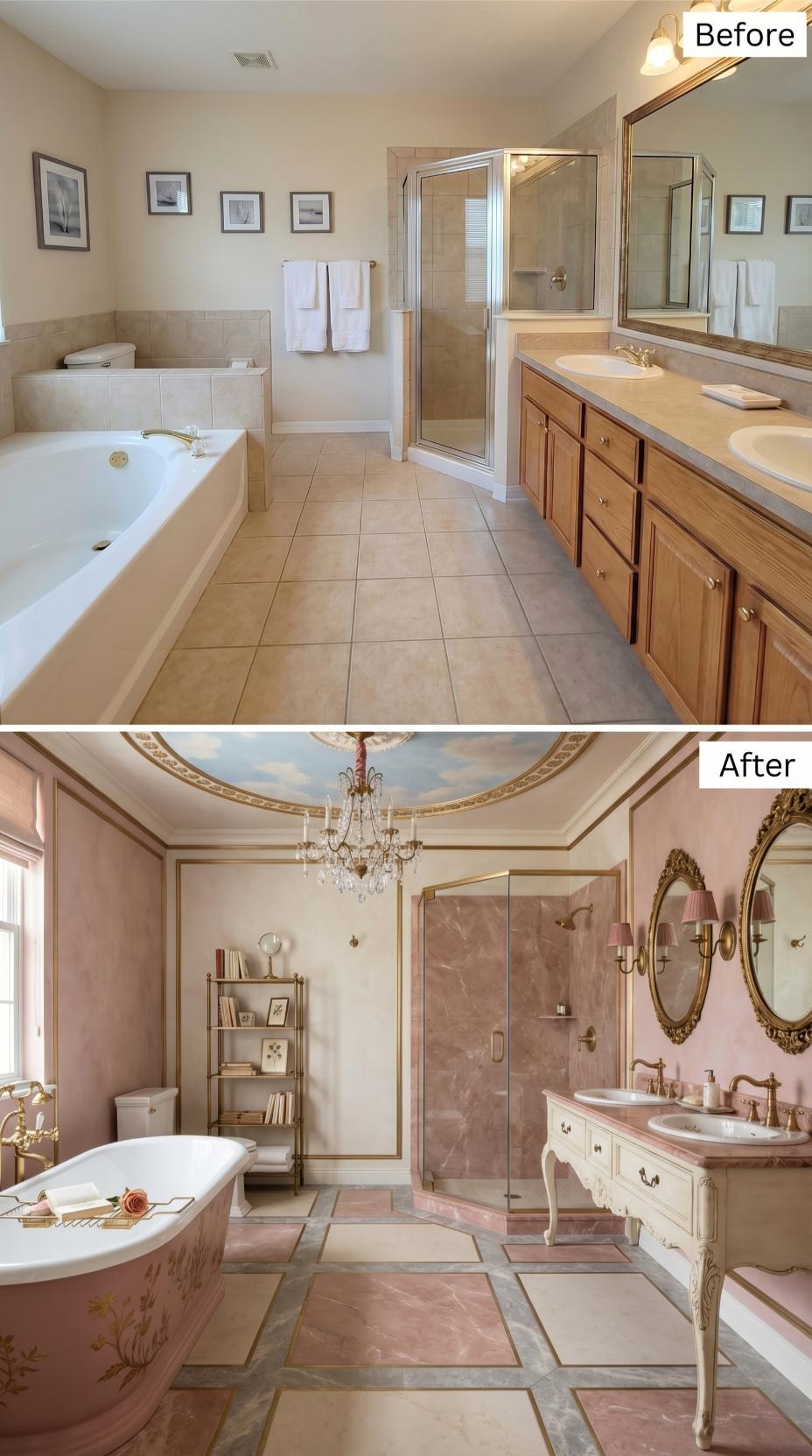
Somebody looked at a perfectly functional builder bathroom and decided it needed a ceiling fresco.
Blush Venetian plaster covers the walls from baseboard to crown molding, where a trompe l’oeil sky mural fills a coffered oval ringed with gilded trim. A brass-and-crystal chandelier drops from the center of that oval. The original oak cabinetry is gone, replaced by a French provincial vanity in cream lacquer with cabriole legs, a rose marble countertop, and two undermount sinks fitted with cross-handle brass faucets. An ornate oval mirror in a gilded carved frame hangs above. The freestanding tub has been painted blush with gold botanical detailing along its exterior, and a brass caddy tray crosses the rim. Rose marble panels line the shower enclosure where builder-grade glass doors once stood.
From lacquered walls and clawfoot drama, the next renovation trades European references for something rooted in the American Southwest.
Adobe Plaster Walls, Exposed Vigas, and Copper Sinks That Replaced Oak Cabinets
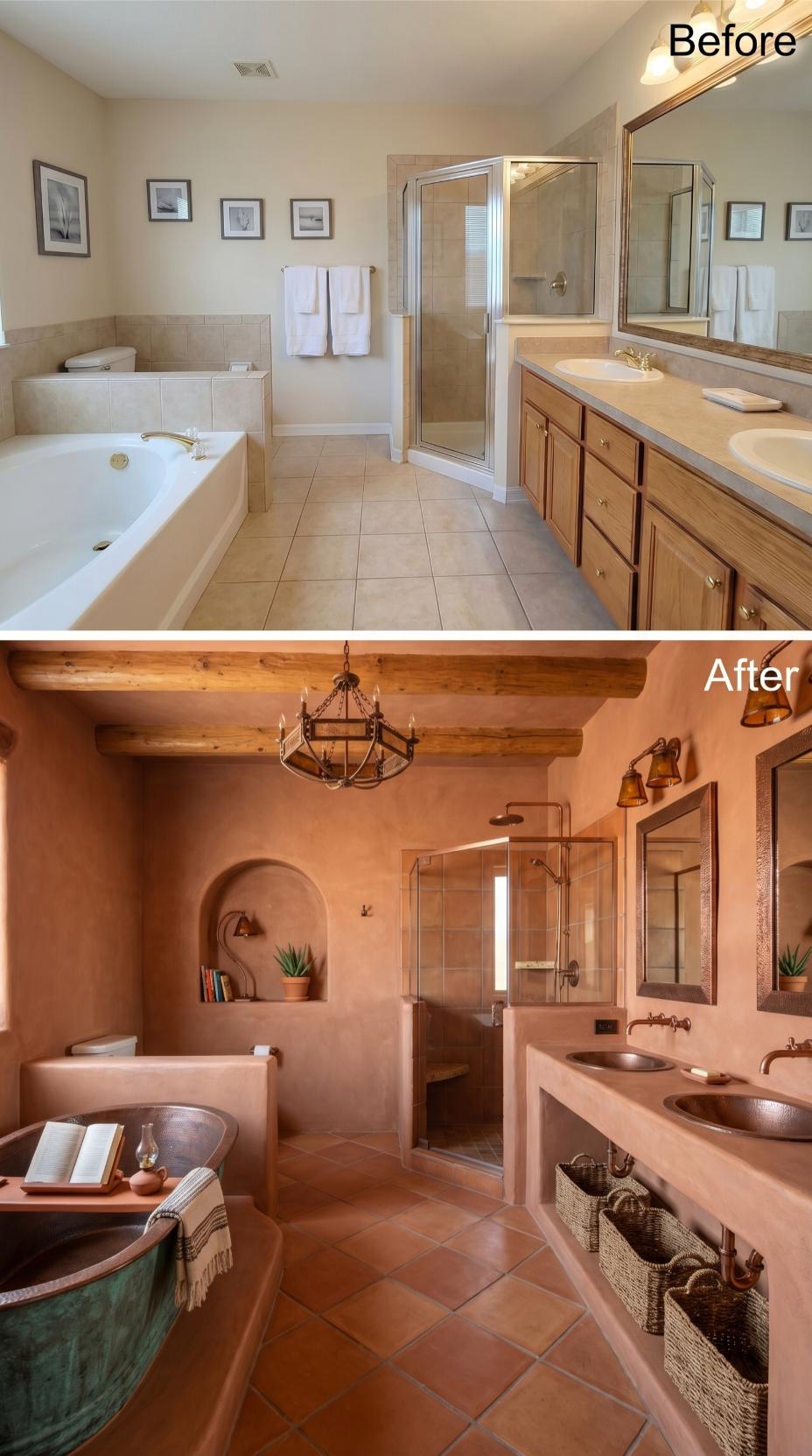
Raw earthen plaster covers every wall surface in a warm terracotta tone, applied directly over what had been standard drywall with brass-hardware oak cabinetry below. Exposed wooden vigas cross the ceiling, and a wrought-iron lantern chandelier hangs from them on a chain. The soaking tub is hammered copper with a patinated green exterior, positioned inside a plaster knee wall beside an arched niche holding books and succulents.
The vanity is a continuous plaster slab with two round hammered copper vessel sinks and wall-mount faucets in an oil-rubbed bronze finish. Woven seagrass baskets hang from the open vanity base where cabinet doors used to be. Saltillo-style terra cotta floor tile runs throughout, replacing the original beige ceramic. Small copper sconces flank a wood-framed mirror on the right wall, tying the metal finishes together without matching them exactly.
Not every section in this article swings toward quiet luxury — some swing considerably harder.
Tortoiseshell Walls, Blue Marble Floors, and Gold Trim That Retired Every Beige Tile
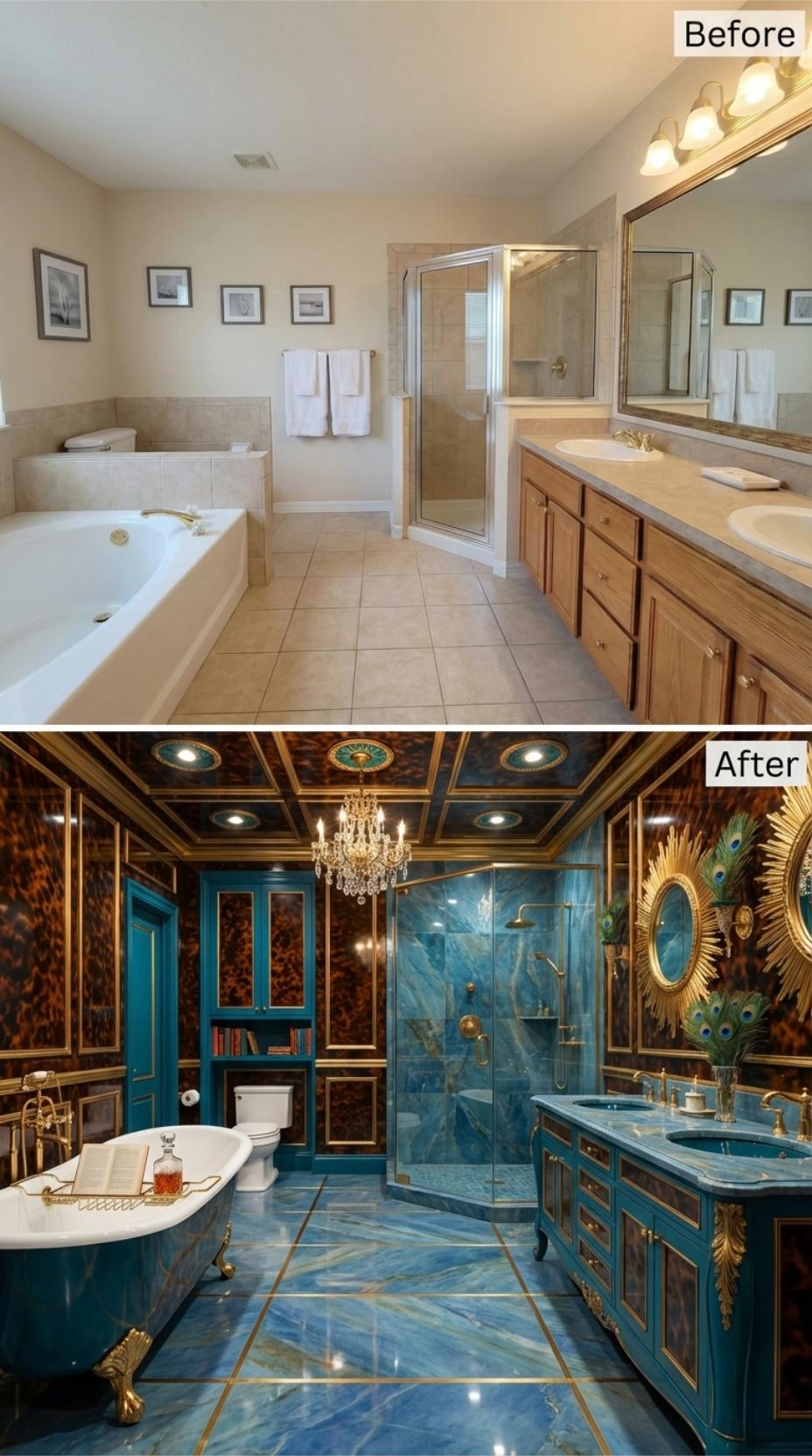
Lapis-blue marble runs floor-to-ceiling inside the walk-in shower and continues across the floor in large-format slabs with inlaid gold border strips at each grout line. The freestanding clawfoot tub sits on cast brass feet, painted in the same deep teal as the vanity cabinetry, which features carved acanthus-leaf hardware and double undermount sinks under brushed gold faucets.
Above it all, a coffered ceiling finished in tortoiseshell lacquer panels is trimmed with gold molding and centered on a crystal chandelier. A sunburst mirror in aged gold anchors the vanity wall alongside a vase of peacock feathers, which pull the teal and gold palette together without any effort from the accessories. The built-in bookcase beside the toilet is lacquered teal and framed in gold trim, making it read as cabinetry rather than an afterthought.
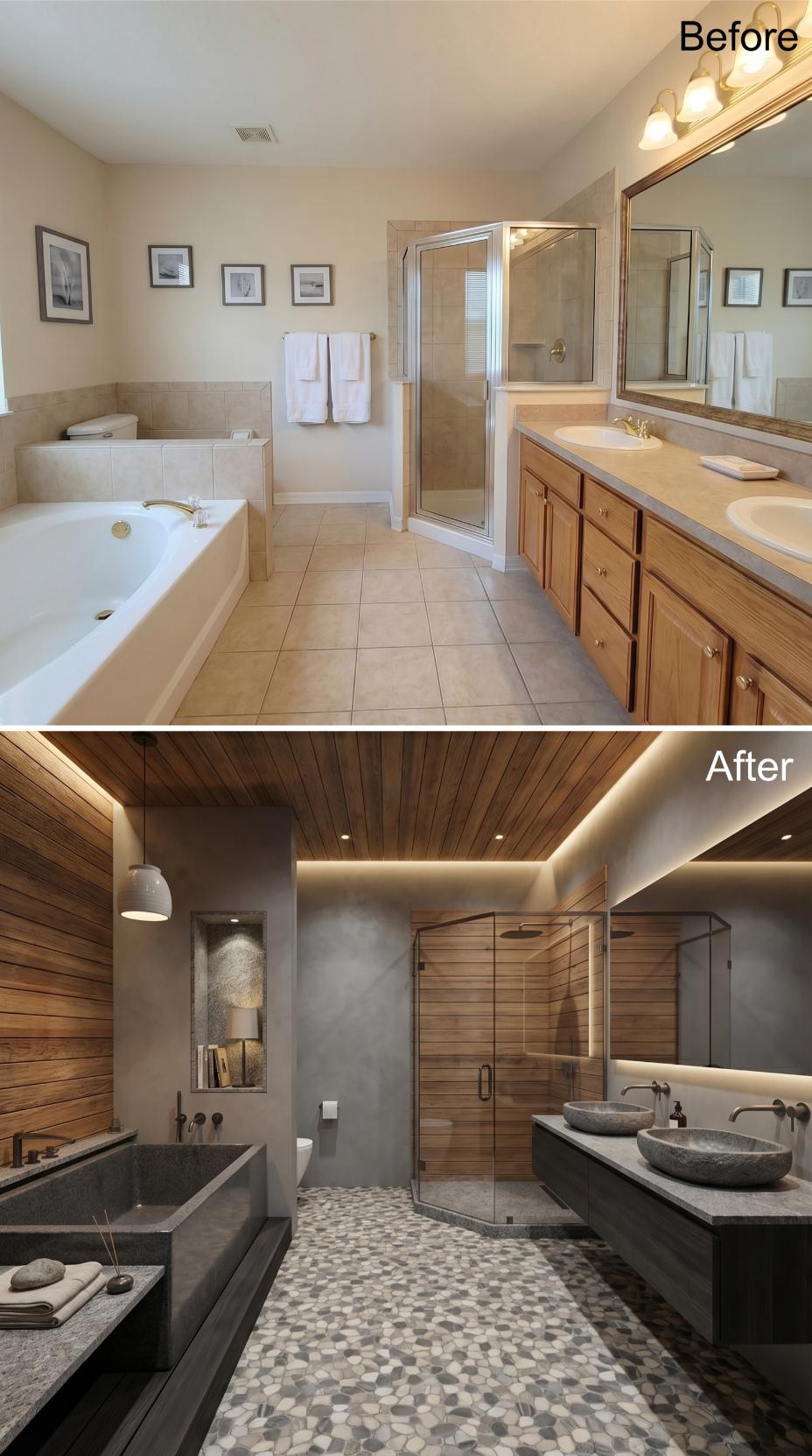
Concrete Tub Surround, Wood-Planked Ceiling, and River Stone Sinks That Finished the Job
🔥 Would you like to save this?
Every original surface is gone. Cedar or teak planks run horizontally across both the walls and ceiling, and LED strip lighting traces the perimeter of a dropped soffit to throw warm indirect light across the whole room. The floor shifts from smooth concrete at the walls to a geometric mosaic of cut stone in the center, a pattern that reads almost like scattered pebbles. The soaking tub sits inside a poured concrete surround with a wide deck, replacing what was once a white jetted tub framed in beige ceramic.
Two vessel sinks carved from river stone sit on a dark concrete countertop, paired with wall-mount faucets in an oil-rubbed or brushed bronze finish. The frameless glass shower enclosure uses the same horizontal wood planking inside, keeping the material consistent rather than breaking the room into zones. A recessed niche with its own accent light sits beside the shower column.
Designer’s Secret: Vessel sinks carved from natural stone, like river rock or basalt, are never perfectly symmetrical, which means two sinks from the same quarry batch can look noticeably different side by side. Designers working with stone vessels typically select both pieces in person rather than ordering online, checking that the surface texture and overall silhouette are compatible before committing to the installation.
Sputnik Chandelier, Wood-Plank Ceiling, and a Lava Lamp That Finished the 70s Revival
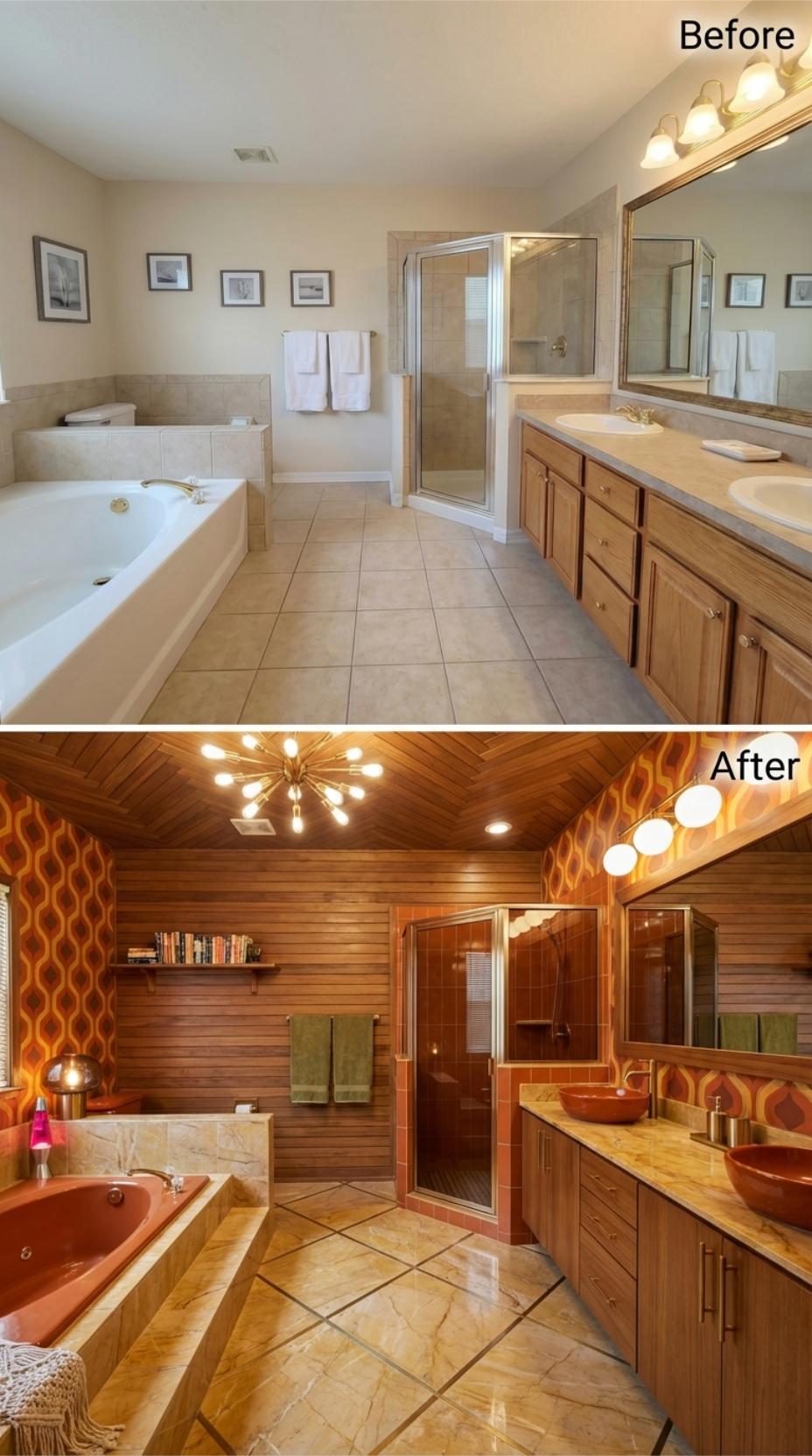
Horizontal cedar paneling covers every wall, a herringbone-planked ceiling drops a brass sputnik chandelier overhead, and ogee-patterned wallpaper in burnt orange and gold flanks both sides of the vanity.
Style Math: Warm-toned ogee wallpaper, sometimes called a Moroccan trellis pattern, repeats a shape rooted in 14th-century Islamic geometric tile work. Red vessel sinks sit on a honey-toned wood countertop, replacing the original undermount whites. Pairing warm wood tones with saturated red accents is a classic 1970s design strategy that reads deliberately retro rather than dated when executed consistently across every surface in the room.
Black Tile, Iridescent Wall Finish, and a Globe Chandelier That Buried the Beige
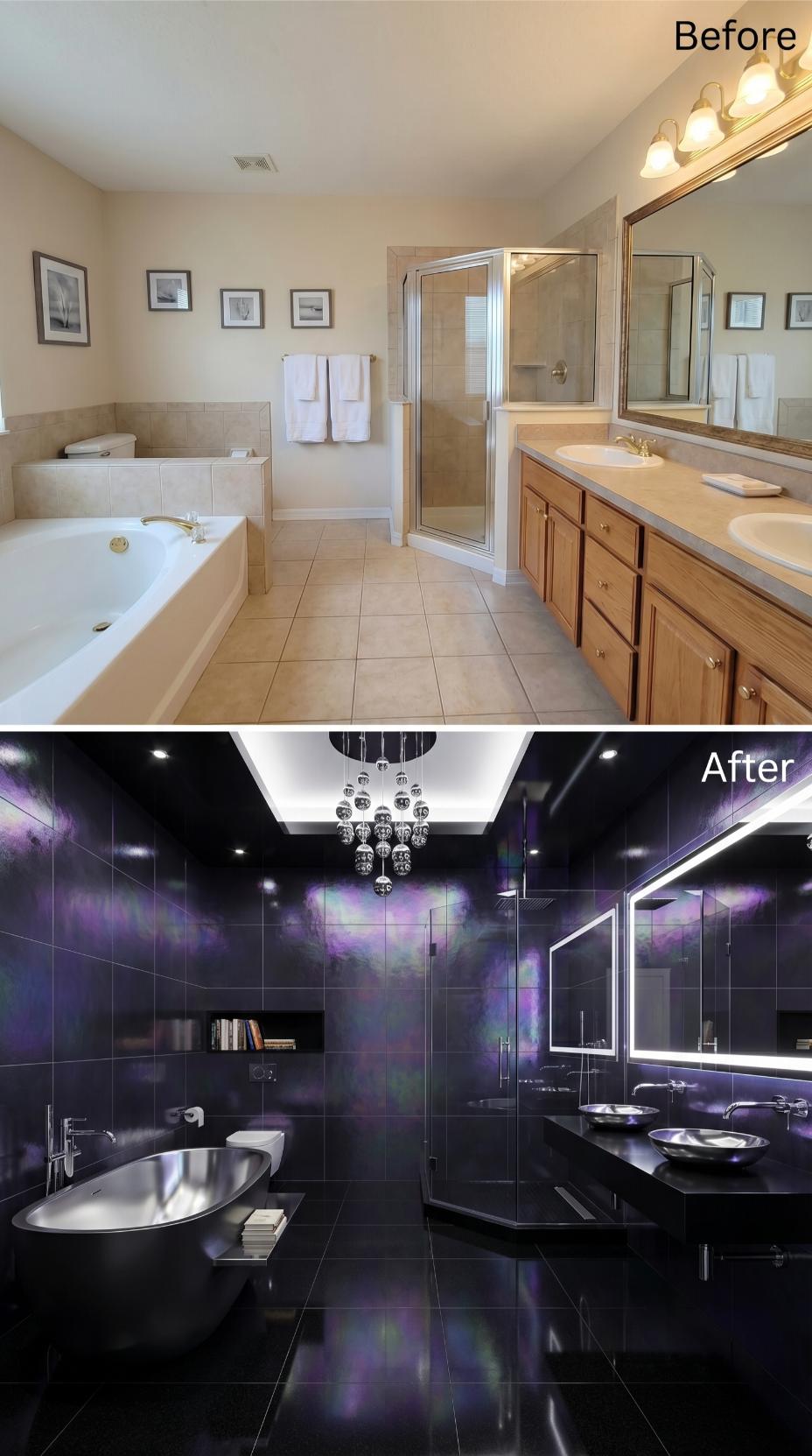
Polished black porcelain covers every surface floor to ceiling, and the walls carry an iridescent finish that shifts between violet and deep purple depending on where the recessed lighting hits. The freestanding tub is matte black with a white interior, sitting low on a platform base. Rectangular LED mirrors replace the wood-framed builder mirror entirely.
A tray ceiling with cove lighting frames a cascading globe pendant, its chrome spheres dropping at staggered heights. Twin vessel sinks sit on a black stone vanity shelf. The original oak cabinets are gone.
Common Mistake: Black tile grout is one of the most commonly mismatched elements in dark bathroom renovations. Designers specify unsanded grout for joints under 1/8 inch and sanded for anything wider, but the grout color itself should be tested on a small section first because black grout can dry several shades lighter than it appears in the bag, especially in low-humidity climates.
Shiplap Ceiling, Botanical Clawfoot Tub, and Farmhouse Vanity That Finished Off the Oak Cabinets
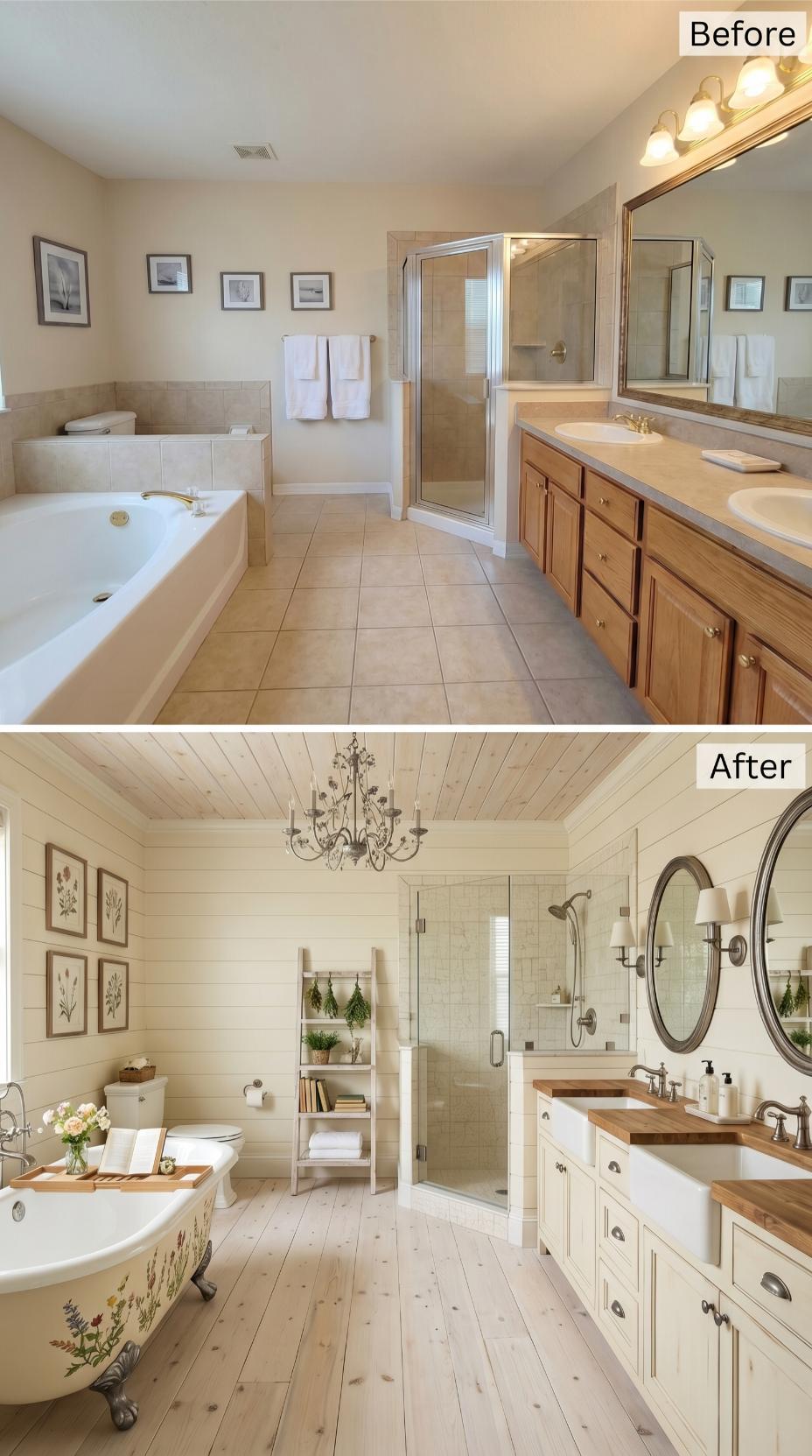
Painted botanicals on a clawfoot tub are not a common design decision, and that is exactly what makes this bathroom work.
Wide-plank pine floors replace the original beige tile throughout, and a tongue-and-groove wood ceiling draws the eye up toward a wrought-iron chandelier with candle-style arms. The vanity cabinet switches from honey oak to cream-painted wood with antique nickel pulls, topped with butcher block rather than the original laminate countertop. Oval mirrors with dark bronze frames replace the flat builder-grade rectangle above dual apron-front sinks.
A lean ladder shelf in whitewashed wood holds rolled towels and potted herbs near the glass shower enclosure. Botanical art prints in thin wood frames hang in a tight grid on the shiplap wall. Clawfoot tubs with painted exteriors are worth noting for one practical reason: the paint finish on cast iron requires oil-based enamel, not standard latex, or it will peel within a single season of heavy use.
Limewash Walls, a Recessed Oval Ceiling, and Round Backlit Mirrors That Finished Off the Oak Vanity
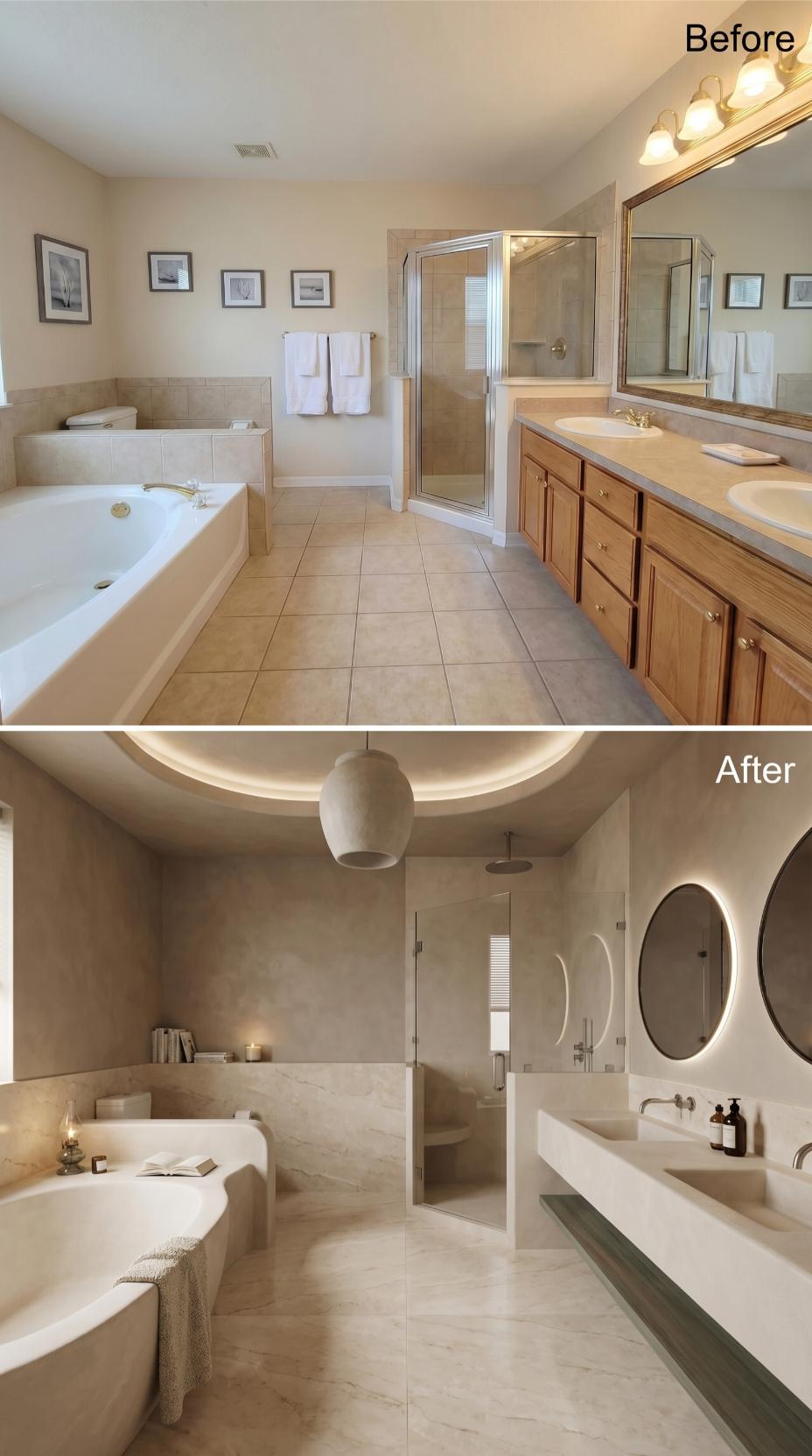
Oak cabinets with brass knobs and a builder-grade strip light bar above a wood-framed mirror gave way to something considerably more deliberate. Limewash covers every wall in a warm greige tone, a troweled finish that catches light differently at each hour. Floating above the room, a recessed oval ceiling coffers inward and holds a ring of indirect LED strip lighting, eliminating the need for any overhead fixture. A ceramic pendant in an unglazed matte finish drops from the center.
Two round backlit mirrors now anchor the vanity wall, their dark frames cutting a clean circle against the limewash. Below them, a cantilevered solid-surface sink runs the full counter length with no visible support, paired with wall-mounted spout faucets in a brushed steel finish. Recessed ledge shelving beside the soaking tub holds books and candles without interrupting the plaster surface. The walk-in glass shower panel is frameless and floor-to-ceiling, with a ceiling-mounted rain head.
A cantilevered solid-surface sink runs the full counter length with no visible support, paired with wall-mounted spout faucets in brushed steel.
Crimson Coffered Ceiling, Chrome Clawfoot Tub, and Subway Tile That Buried the Oak Vanity
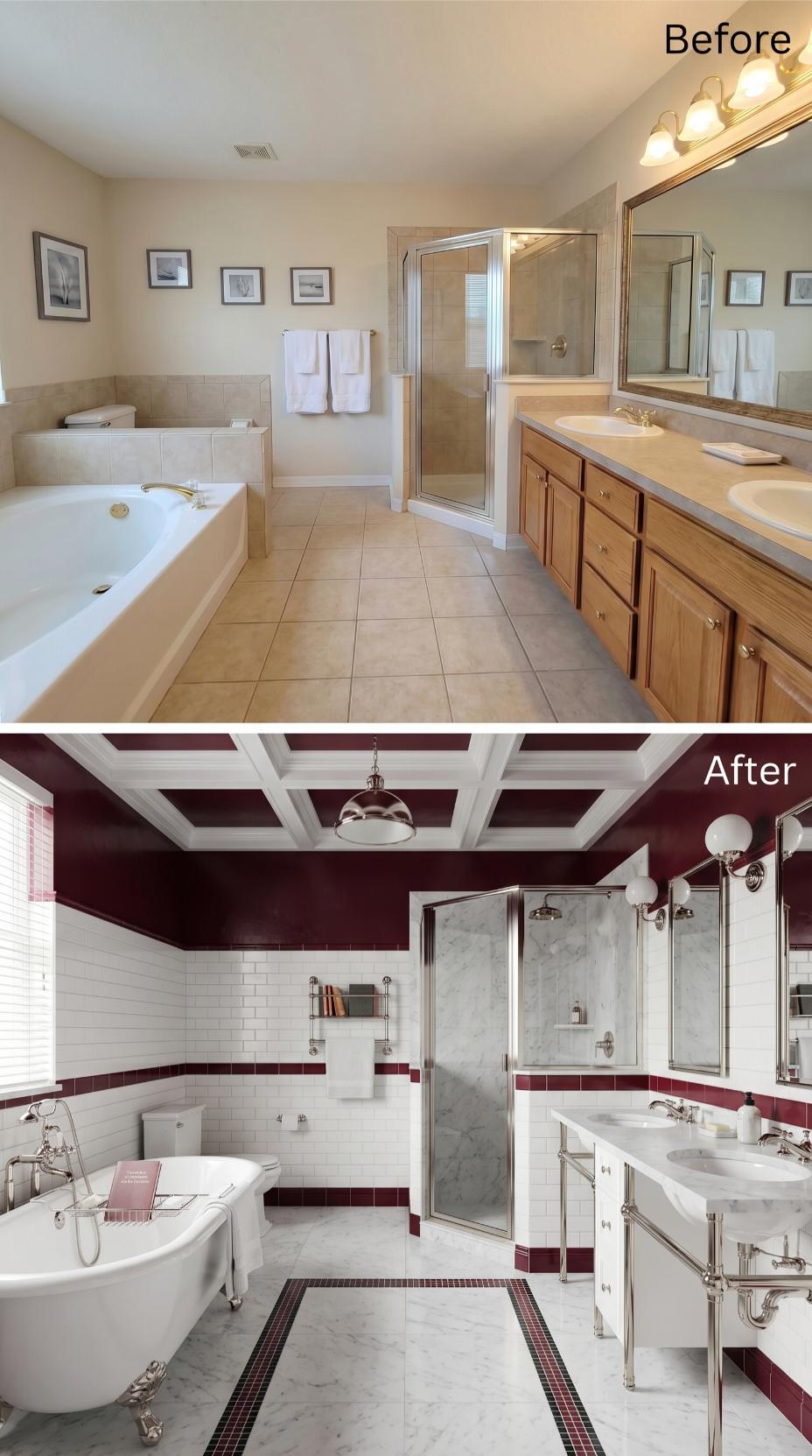
Subway tile runs floor to wainscot height, capped with a burgundy ceramic border that reappears on the ceiling panels framed in white coffered molding. Chrome legs lift the freestanding soaker tub off marble mosaic floors while a pendant light drops from the center coffered bay. The built-in vanity is gone, replaced by two wall-mount sinks on exposed chrome legs with separate deck-mount faucets.
Material Matters: Coffered ceilings in bathrooms are typically built using MDF or poplar lumber assembled in a grid pattern, then painted the same color as the surrounding ceiling surface to read as a unified architectural element rather than applied trim. Painting both the coffers and the field the same saturated color, as seen here in deep burgundy, makes the ceiling feel carved rather than constructed. In wet environments, MDF coffers require a moisture-resistant primer and semi-gloss or satin finish paint to prevent swelling at the seams over time.
Cobalt Tile, Terrazzo Floors, and a Red Clawfoot Tub That Ended the Builder-Grade Era
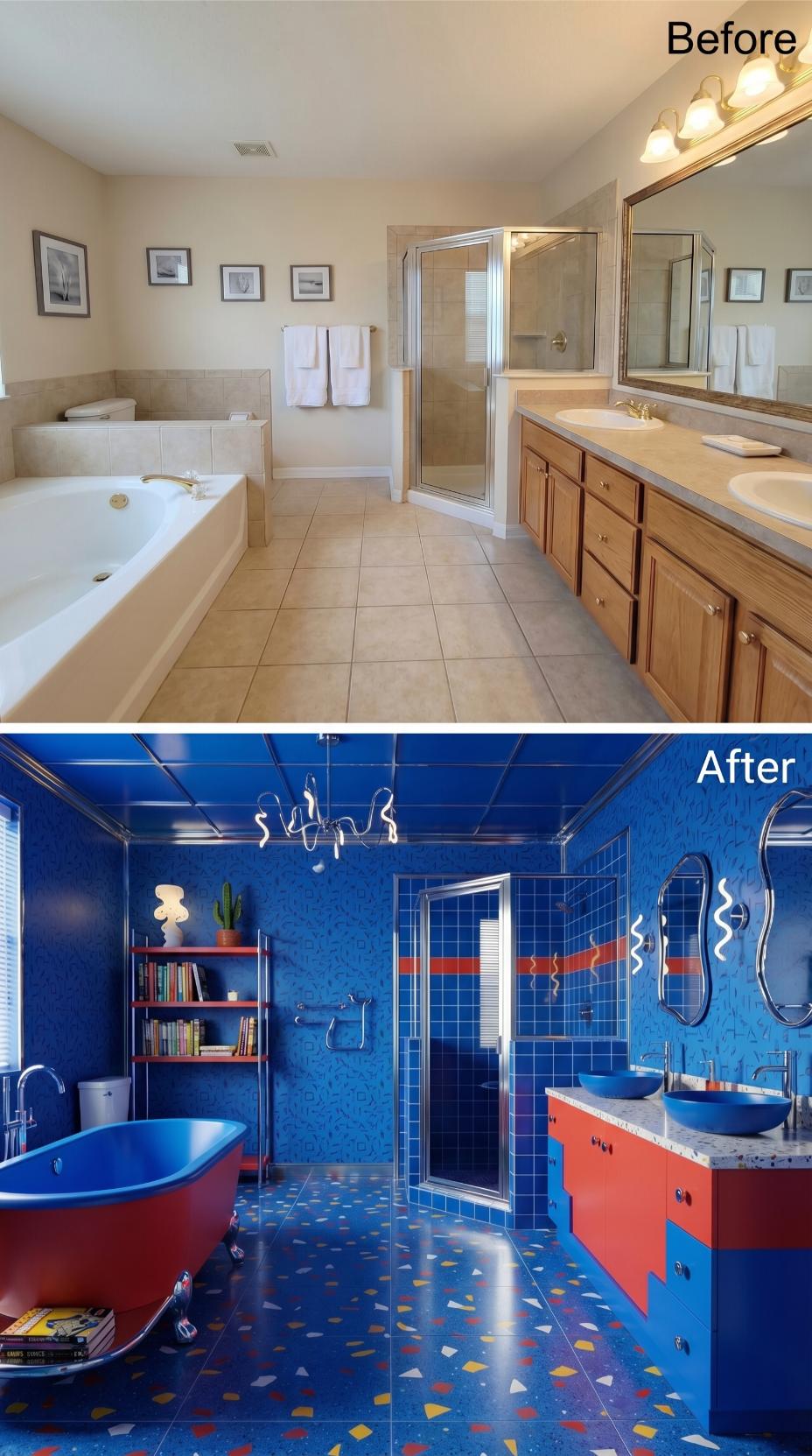
Saturated royal blue covers every surface here, from the small-format square wall tile to the drop ceiling panels, creating a room where the color itself becomes the architecture. Red lacquer cabinet fronts anchor the double vanity, topped with a white terrazzo slab and paired with bowl-style blue vessel sinks. A freestanding clawfoot tub painted red and blue sits against a bookshelf unit with orange-painted shelves.
Editor’s Note: Painting a freestanding tub requires a two-part epoxy or marine-grade paint rated for prolonged water contact, not standard latex or chalk-finish paint, which will peel within weeks. Cobalt blue, like the shade dominating this room, belongs to the same pigment family used in traditional Portuguese azulejo tile, which has been produced continuously since the 15th century.
Gold Mosaic Walls, an Onyx Freestanding Tub, and a Crystal Chandelier Recessed Into a Coffered Dome
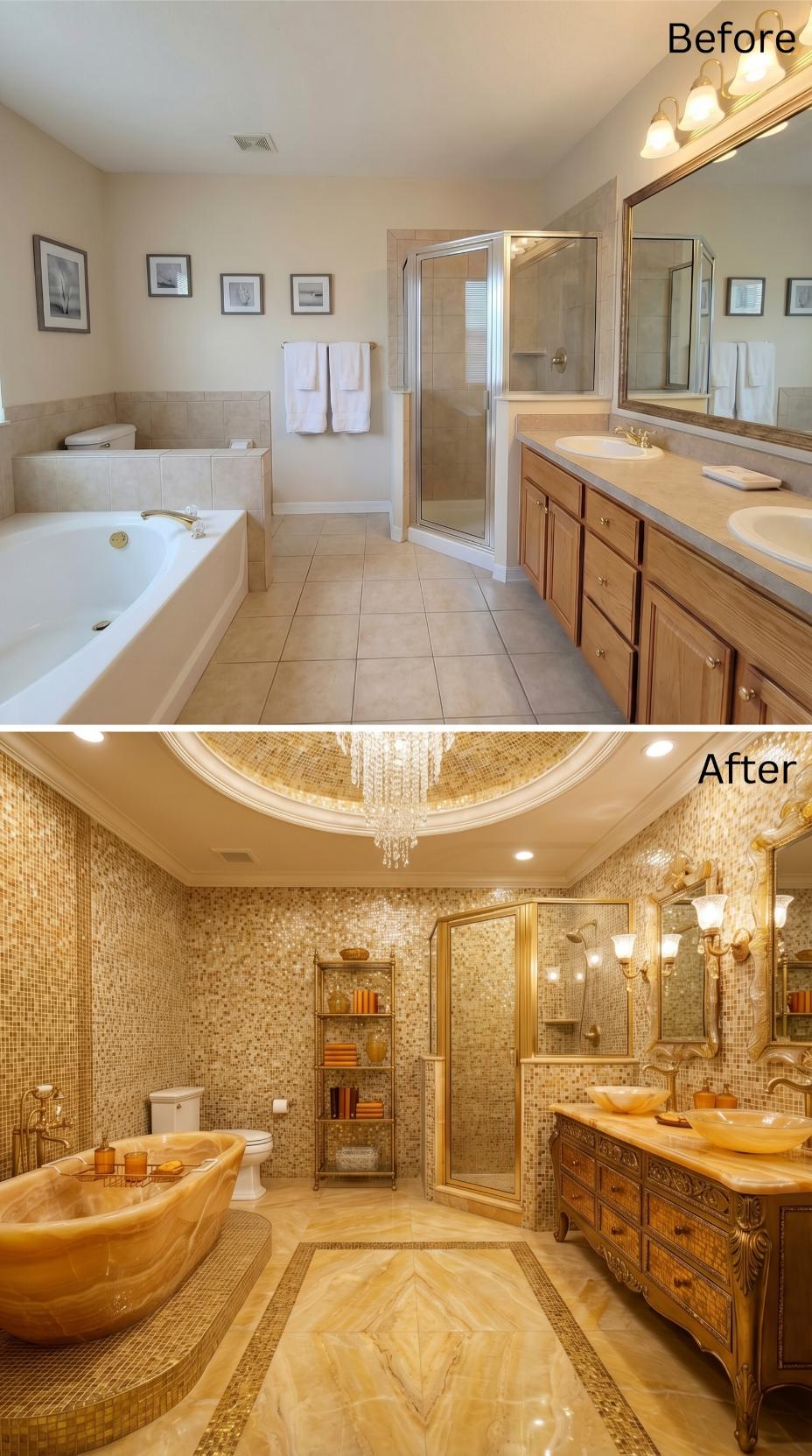
Builder-grade oak vanity and plain ceramic tile gave way to floor-to-ceiling gold glass mosaic, a carved onyx soaking tub, and an ornate wood vanity with vessel sinks in matching honey onyx.
Why It Works: Mosaic tile installed floor-to-ceiling on all four walls creates a continuous reflective surface that multiplies light from every fixture in the room. Gold glass tesserae, unlike ceramic, have a translucent quality that shifts color depending on the angle of incoming light, making the walls read differently at morning versus evening. The recessed dome ceiling with a crystal chandelier at center acts as a focal point that draws the eye up and prevents the heavily tiled walls from feeling enclosed.
Dark Sinai Marble, Slatted Wood Ceiling, and a Concrete Freestanding Tub That Replaced the Oak
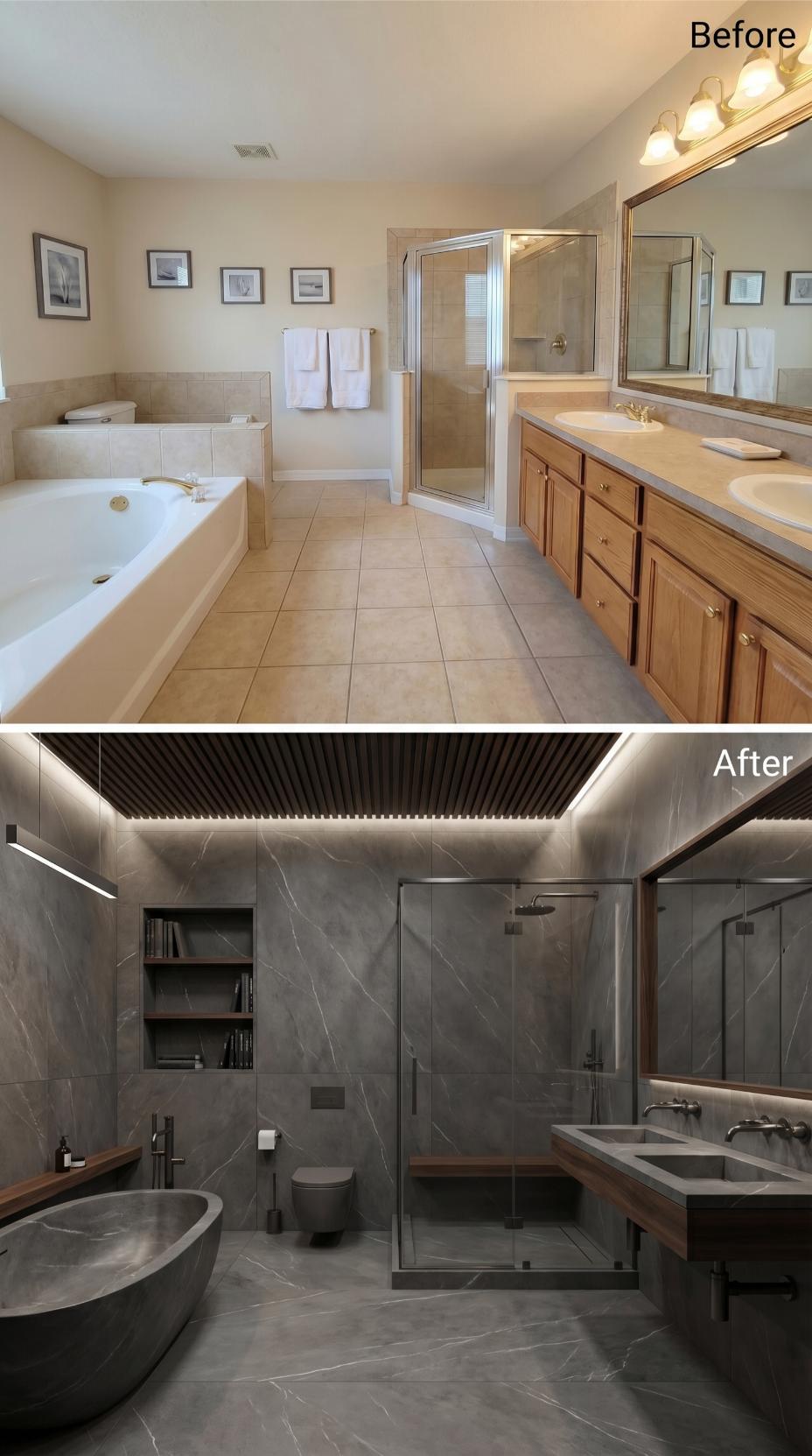
Gray Sinai marble tile covers every wall and the floor in large-format slabs, with the veining running consistently enough to suggest full stone rather than porcelain. The freestanding tub is cast concrete, shaped with a curved silhouette and fitted with wall-mount fixtures in a matte gunmetal finish. A slatted wood ceiling panel, stained dark walnut, floats above the center of the room with LED strip lighting tucked along its perimeter, throwing indirect warmth downward.
The vanity countertop is poured concrete, cantilevered from the wall on a wood shelf with no visible legs. Built-in shelving beside the toilet holds books with spines outward, framed in the same dark-stained wood as the vanity shelf. Pendant linear lighting runs along the side wall. Nothing from the original honey oak cabinetry or brass hardware survived the renovation, and the room is quieter for it.
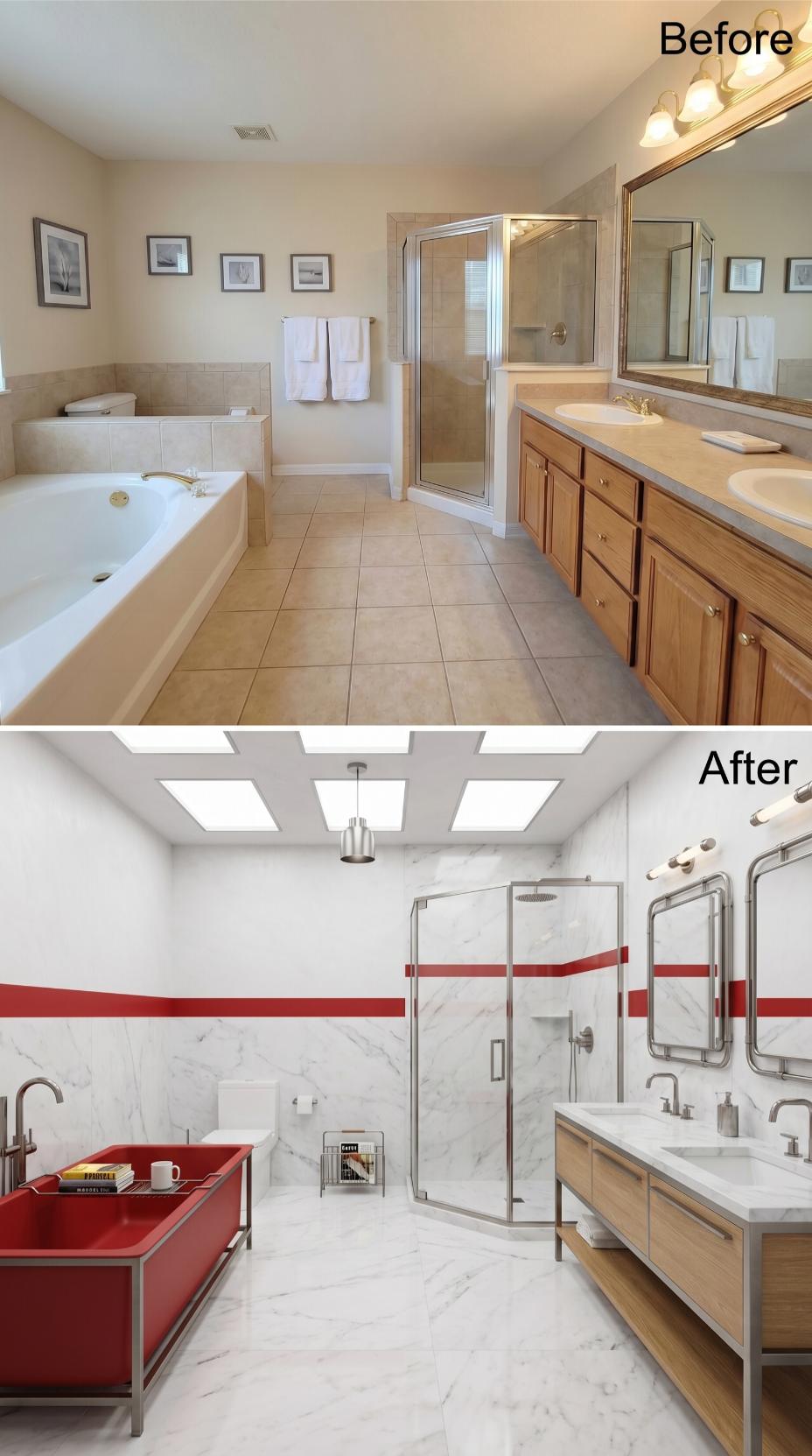
Red Soaking Tub, Carrara Wall Panels, and Brushed Nickel Vanity That Retired the Oak Cabinets
🔥 Would you like to save this?
Warm-toned builder cabinets and beige ceramic tile gave way to floor-to-ceiling Carrara marble panels with a horizontal crimson accent band running wall to wall at mid-height. The freestanding soaking tub is lacquered in the same red, set on a brushed nickel frame with exposed legs, keeping the color from reading as accidental.
White marble floors continue the veining pattern from the walls, and the floating rift-cut wood vanity sits below a quartz countertop with dual nickel faucets. Industrial-style mirrors with pipe-bracket frames and a row of globe vanity lights finish the space. Flat-panel skylights replace the original brass fixtures overhead.
Marble Freestanding Tub, Slatted Wood Ceiling, and LED Cove Lighting That Retired the Beige
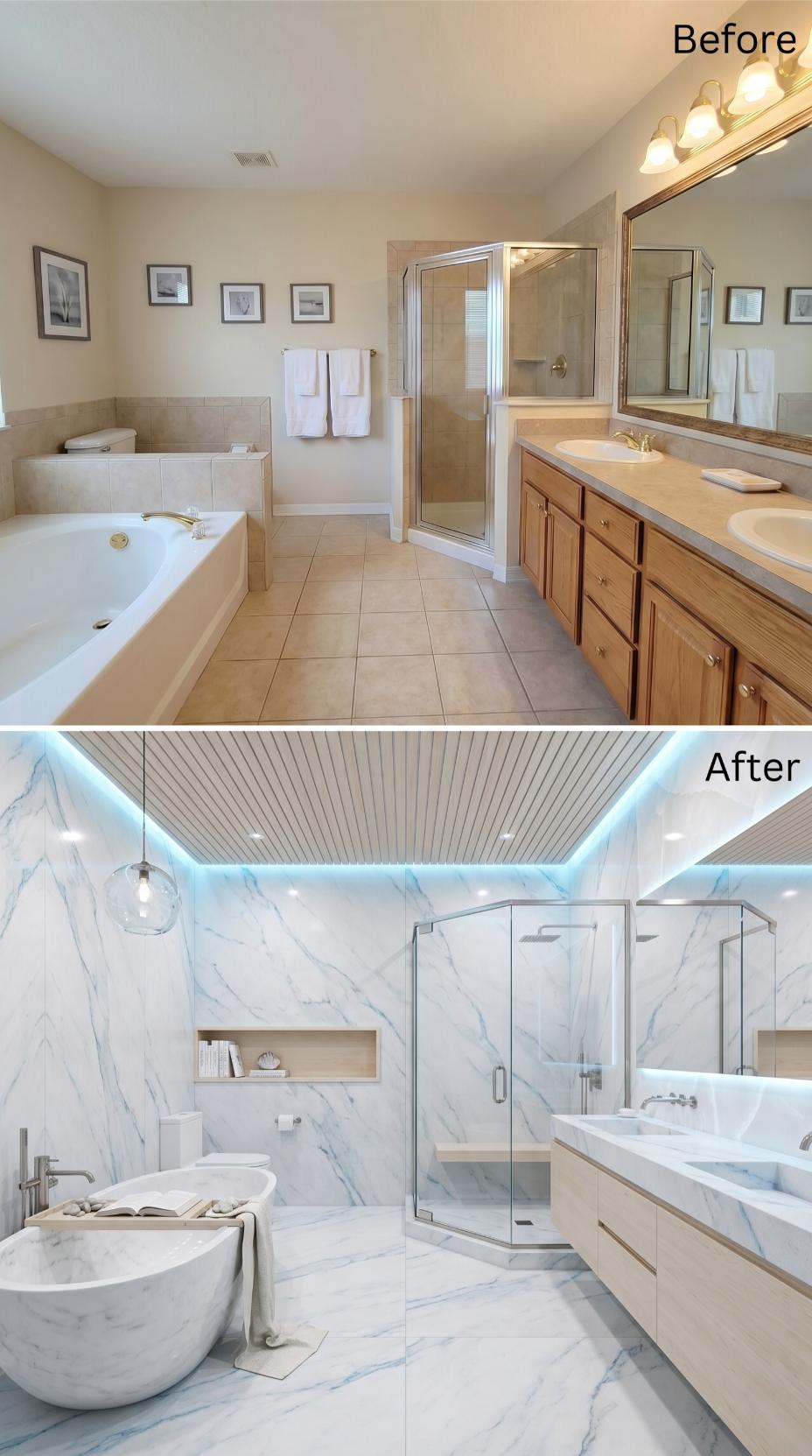
Veined white Calacatta marble covers every wall surface and the floor in large-format slabs, with the veining mitered at corners to create a continuous chevron pattern. A carved marble freestanding soaker tub sits on the same marble floor, eliminating the visual break a separate surround would have created. The frameless glass shower enclosure houses a built-in bench and a rain-head fixture.
Suspended LED cove lighting runs the perimeter of a slatted wood ceiling, casting blue-tinted ambient light across the room. A recessed wood niche beside the tub provides display storage without punching through marble. The floating vanity with flat-panel drawers uses a brushed warm-wood finish, and wall-mounted brushed nickel faucets keep the countertop completely clear. A single glass pendant drops at the tub end, adding a point-source accent to what is otherwise entirely indirect lighting.