🔥 Would you like to save this?
The carpet was probably mauve. Or maybe that dusty blue-green that existed nowhere in nature but somehow ended up in every split-level in America. The bedroom door had a lock you absolutely weren’t allowed to use, and the window faced the neighbor’s identical house six feet away. If you grew up in the suburbs in the ’80s, your bedroom was a specific, almost universal thing, and these 29 details will bring it back instantly.
31. Glow-in-the-Dark Plastic Stars You Pressed Against the Ceiling at 8 PM and Stared at Until Midnight
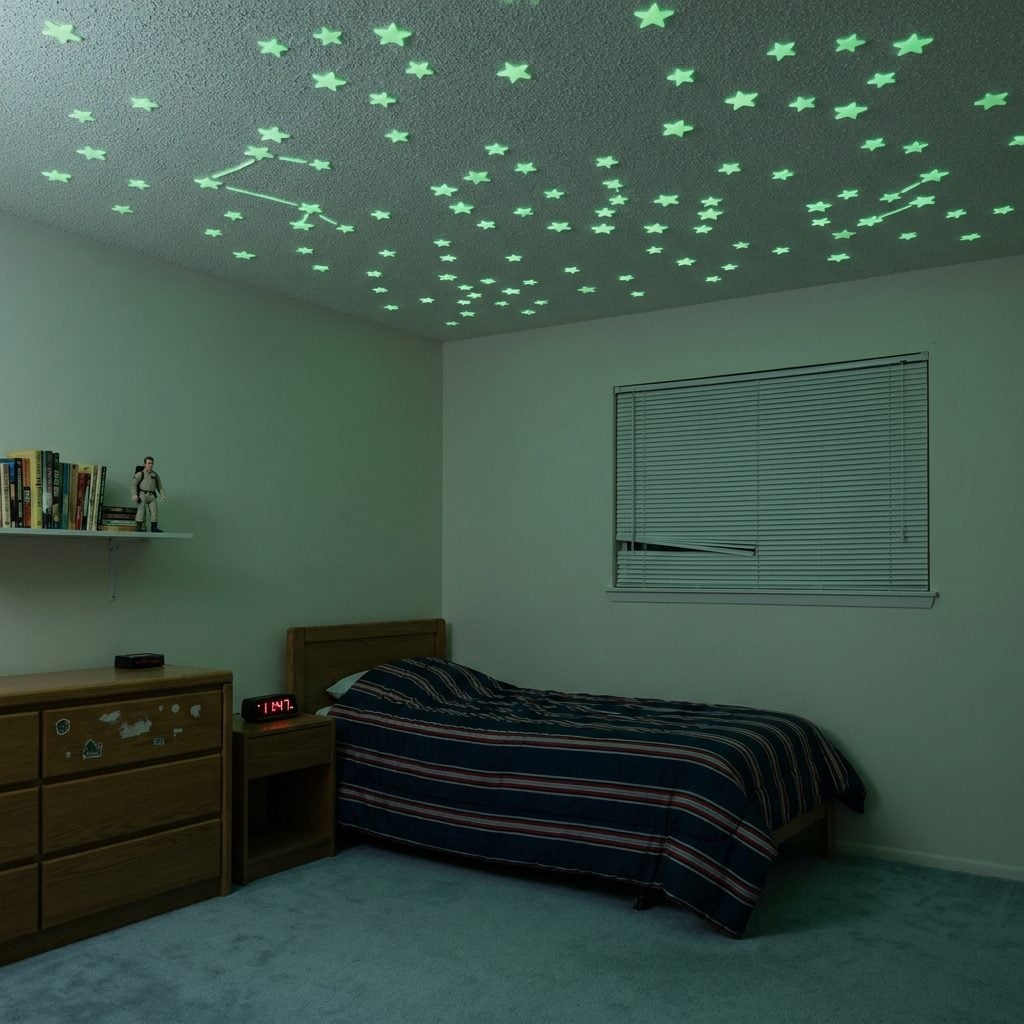
You charged them with a flashlight held directly against the ceiling, which did absolutely nothing, and then lay there watching them fade from bright yellow-green to the dimmest possible suggestion of a glow around 1 a.m. The arrangement was never anything close to Orion. It was more like “shapes a kid could reach while kneeling on a pillow.”
In order to come up with the very specific design ideas, we create most designs with the assistance of state-of-the-art AI interior design software. Also, assume links that take you off the site are affiliate links such as links to Amazon. this means we may earn a commission if you buy something.
Nobody questioned why we wanted to sleep under a fake sky made of sticky plastic. That was just something you did. Some of those stars are probably still up there in childhood bedrooms across America, pressed into popcorn ceilings for thirty-five years, still faintly phosphorescing for absolutely no one.
30. The Wallpaper Border That Ran Exactly 18 Inches From the Ceiling and Never Quite Lined Up at the Corner
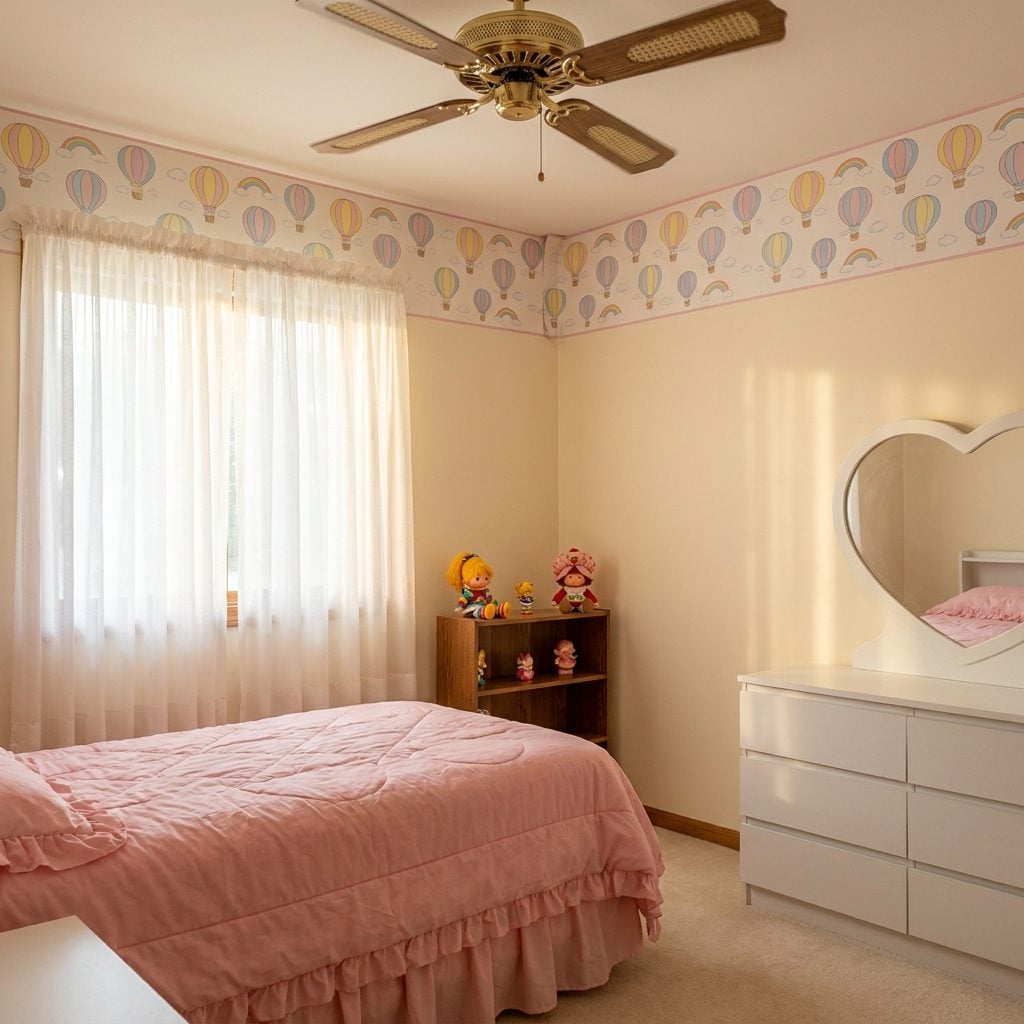
Hot air balloons. Teddy bears holding balloons. Geometric triangles in teal and coral. Rainbows so optimistic it physically hurts to look at now. Whatever the pattern, it ran the entire perimeter of the room at exactly the height your parents could reach without getting off the step stool, which is why every corner had that telltale half-inch overlap that nobody ever fixed.
The border was doing a lot of heavy lifting in 1980s kid-room decor. It was the thing that said “this room was designed, actually” while everything else said “we got the comforter set from Sears and matched from there.” When the border finally started peeling at the seams and curling forward like a little flag, you picked at it constantly. You couldn’t not.
29. Wall-to-Wall Carpet in Dusty Mauve That Was Flat as a Pancake in Front of the Dresser
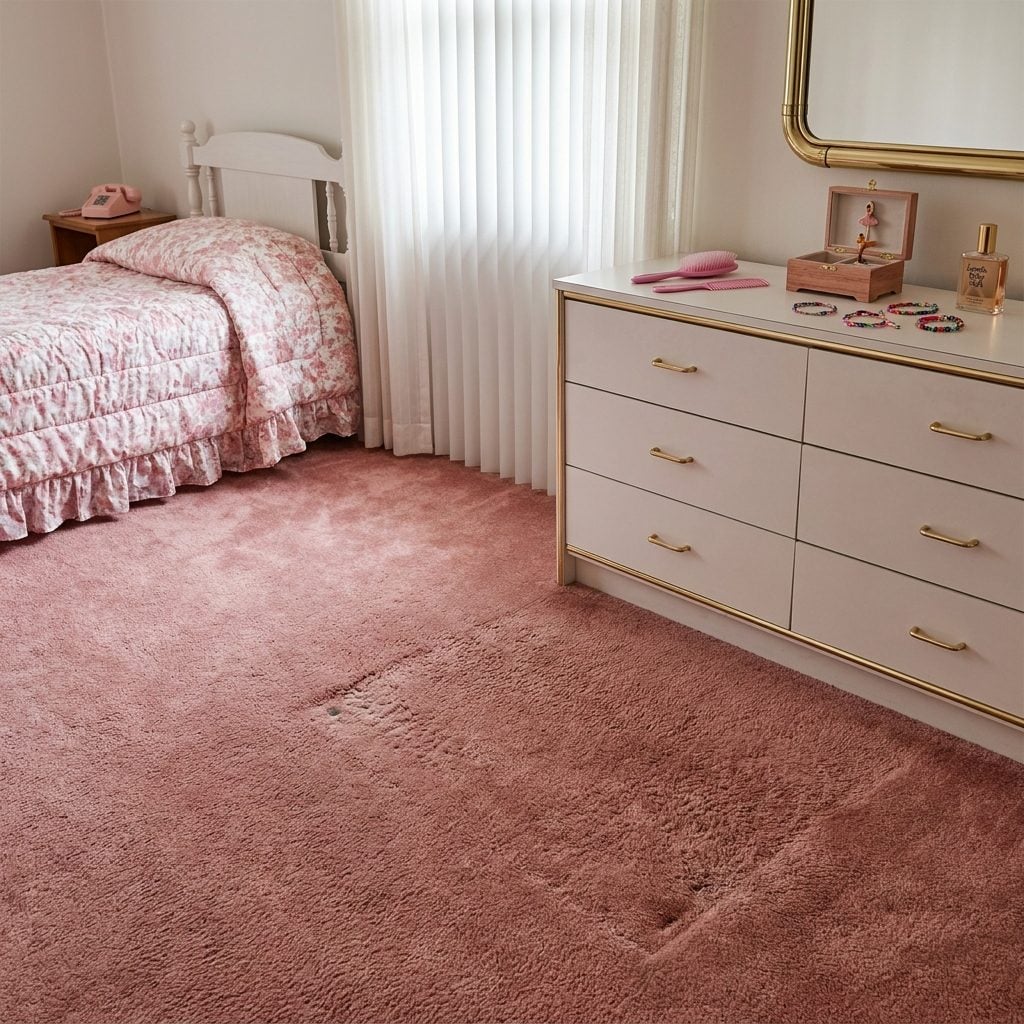
Dusty mauve. Baby pink. That specific shade of pale blue that designers now charitably call “powder.” Whatever the color, it covered every inch of floor and climbed halfway up your baseboards, and it was impeccably plush the day it was installed and worn into submission within three years.
The flat patch in front of the dresser was a perfect record of your daily life. That rectangle of compressed carpet fibers was you, every morning, standing there deciding what to wear, and every night brushing your hair. The rest of the room could look decent. That spot looked like a footpath. For more on how a small sitting room handles flooring decisions now, the contrast with 1980s carpet culture is pretty remarkable.
What Our Readers Say
- Today, when Home Stratosphere readers love a bedroom and tap a reason, overall style comes out on top, with cosy a close second and colour a distant third.
From Home Stratosphere reader polls and votes.
28. The Waterbed with the Built-In Headboard That Had Its Own Shelf, Mirror, and Tiny Bedside Lamp
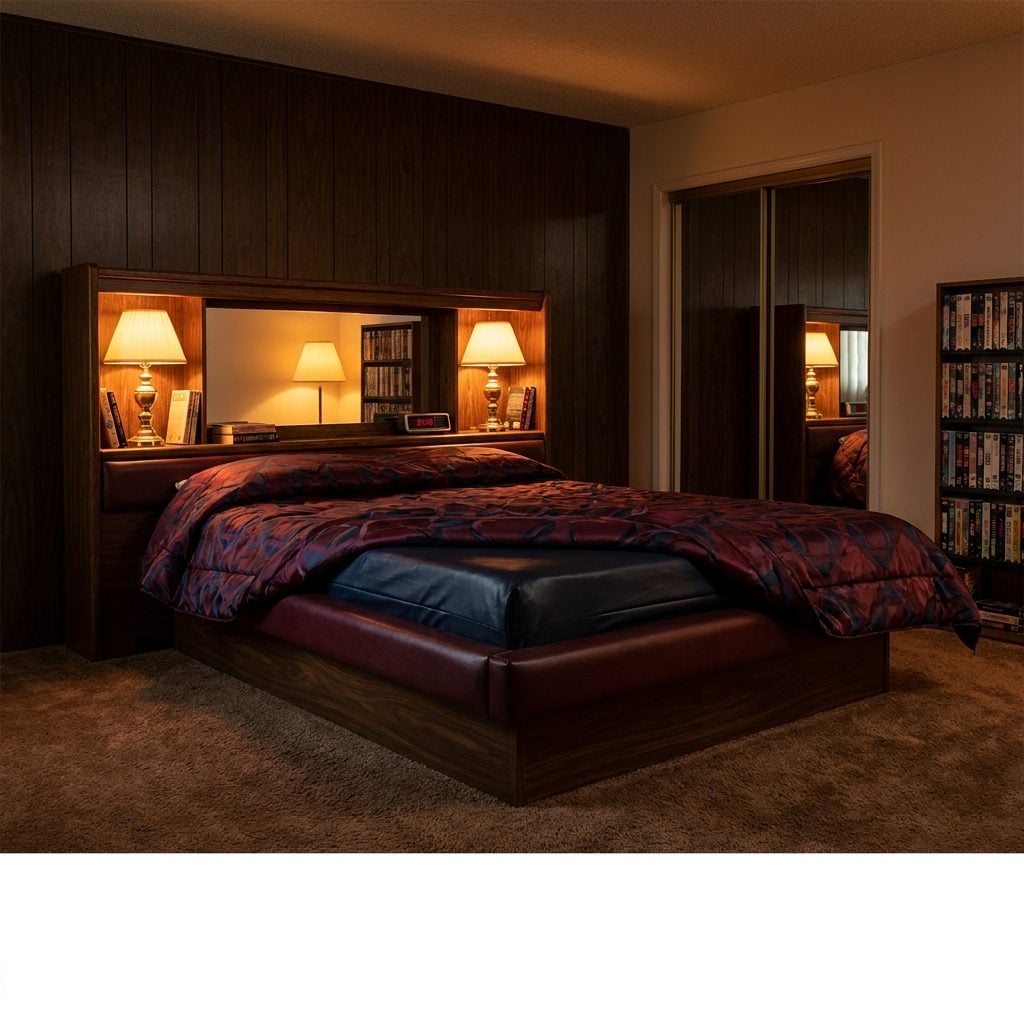
The headboard was half the point. It wasn’t just a bed, it was a piece of furniture with built-in storage, a mirror, two reading lights, and usually a small carpeted platform on top where someone had placed a Garfield alarm clock and a copy of “Clan of the Cave Bear.” The whole unit looked like it belonged in a luxury hotel that had made some very specific aesthetic choices.
Actually sleeping in a waterbed was another matter. The heating coil that kept it from being 55 degrees ran up the electricity bill noticeably, the liner occasionally developed a slow leak that you’d notice only when your comforter felt vaguely damp, and getting out of bed fast was simply not an option. Every morning was a slow-motion roll to the edge. But the sloshing sound when you flopped onto it? That was genuinely satisfying.
27. The Bunk Bed with a Desk Underneath That Was Technically a “Study Space” but Became a Fort by Week Two
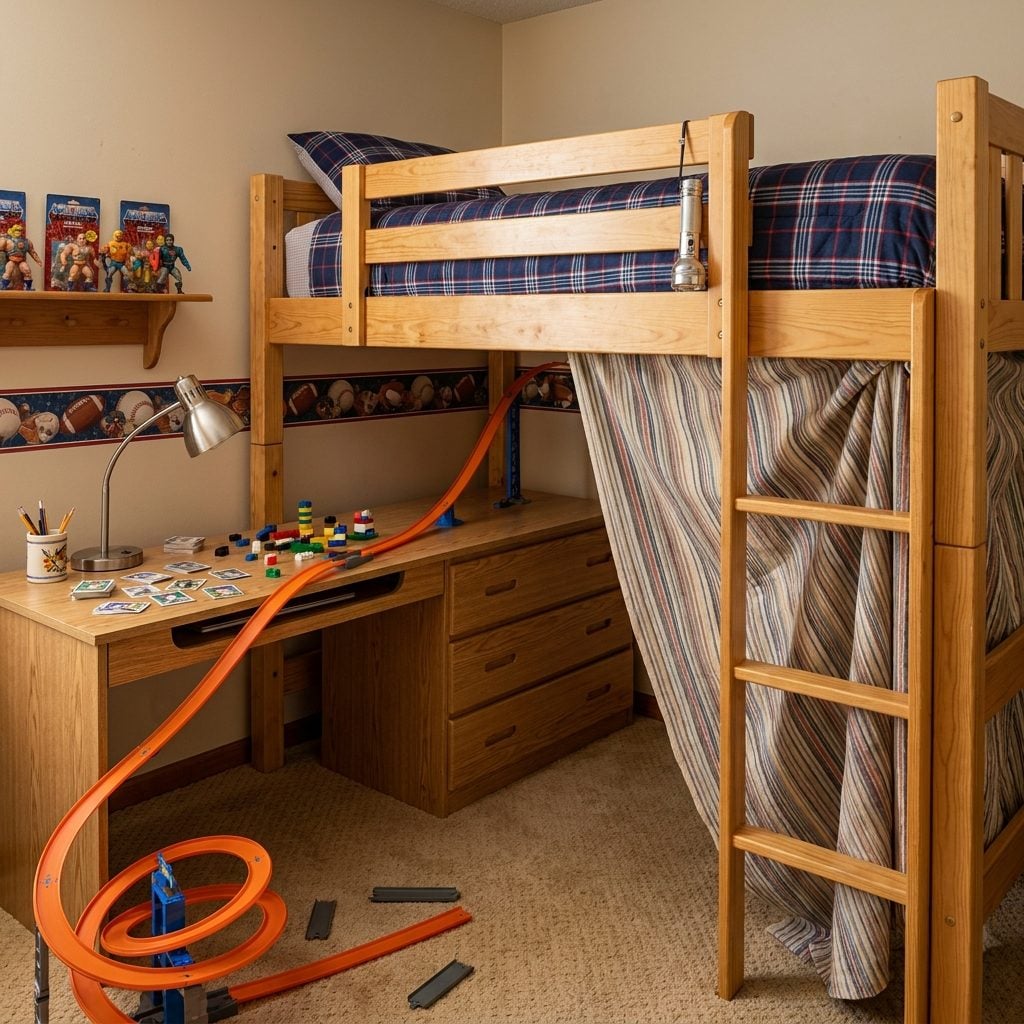
The catalog called the desk space a “homework station.” Children called it a garage, a cockpit, a base of operations, and occasionally a jail depending on what game was happening that afternoon. The blanket draped from the top bunk was up within two weeks of assembly and came down only for washing.
The real design genius of the bunk bed with desk was how well it worked as a colorful game room compressed into eight square feet. Hot Wheels track attached to the desk edge and spiraled to the floor. Star Wars figures lined the safety rail. The whole structure was living proof that kids don’t need square footage, they need vertical territory.
26. The Brass-Framed Bed with the Ruffled Floral Comforter Set That Matched the Curtains, Lampshade, and Dust Ruffle
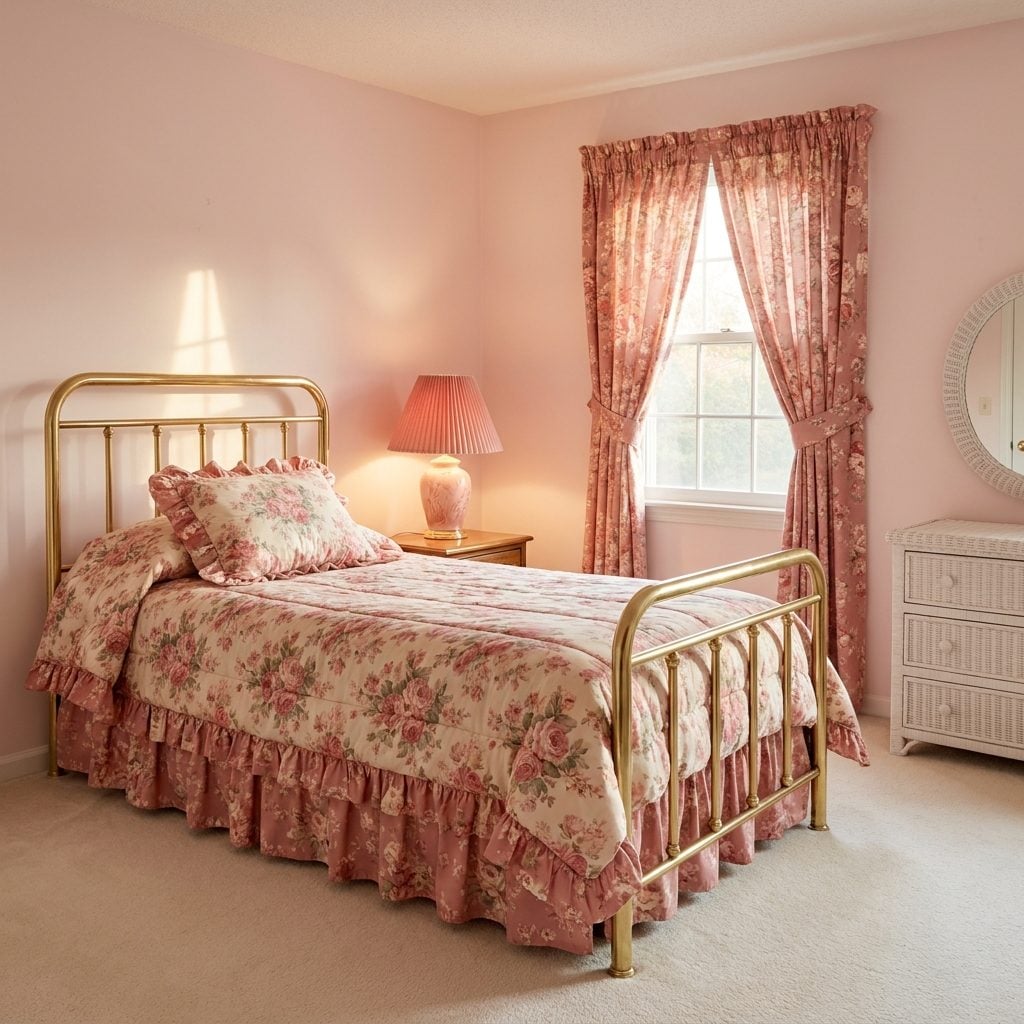
Somewhere in a JCPenney home catalog from 1987 was a photograph of this exact room, and your mom found it. The comforter matched the curtains. The curtains matched the lampshade. The lampshade matched the dust ruffle. A dust ruffle existed. This was the 1980s version of a fully coordinated interior, and it was achieved by purchasing every item in the same bedding collection at once.
The brass headboard was cold in winter and left a bar-shaped mark on your forehead if you fell asleep reading against it. The ruffled shams went on the floor the second you got into bed and stayed there. You never once put them back voluntarily. That was understood by everyone.
Not everything from that catalog page has faded: traditional-style bedrooms still get more hearts from our readers than the other bedroom images in the same articles.
25. The Digital Alarm Clock with Red LED Numbers That Lit Up Half the Room
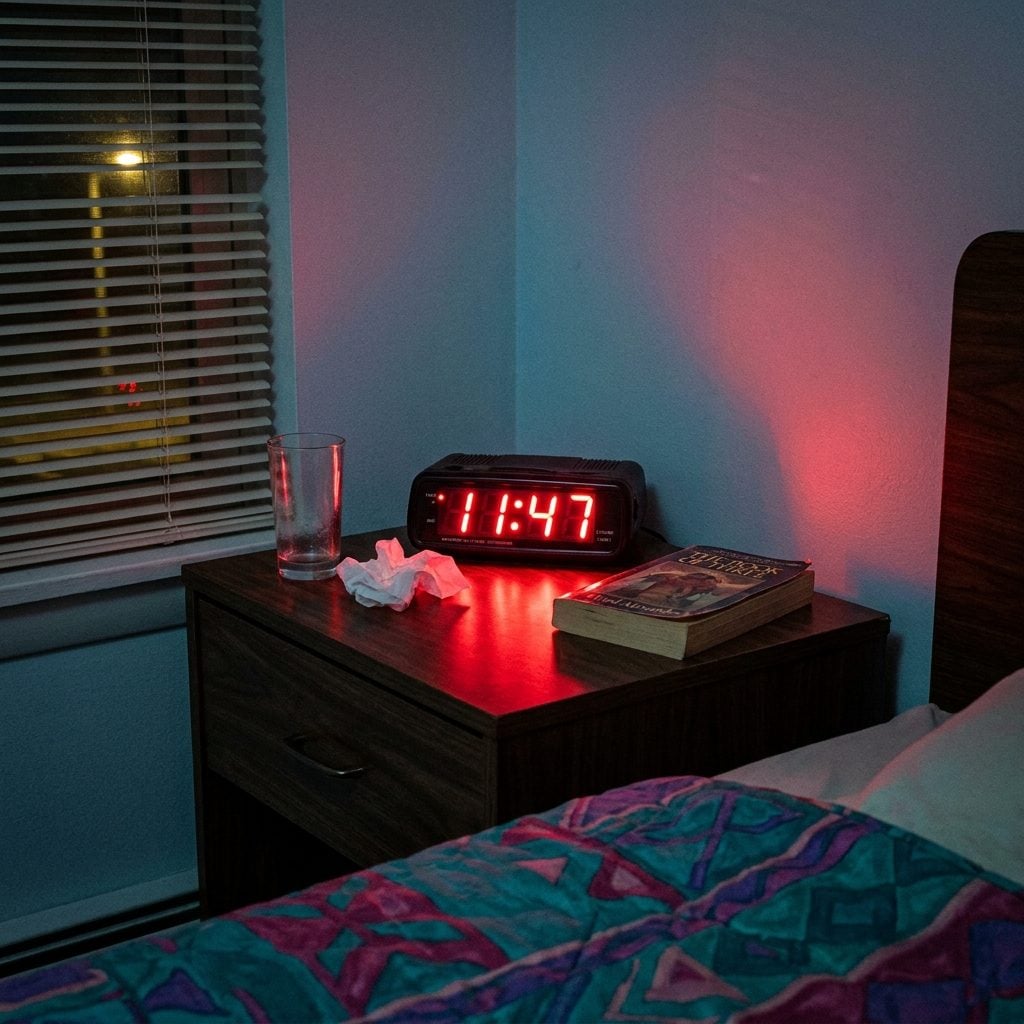
That red glow. You could read it through your eyelids. Every kid in the ’80s had one of these blocky plastic rectangles on the nightstand — usually a GE or Spartus model — and the numbers burned so bright they turned your ceiling into a crimson light show.
Falling asleep meant staring at those digits, doing mental math about how many hours you had before school. The alarm itself was an unholy buzzing that could wake the dead, and the snooze button on top was the size of a coaster because the manufacturer clearly knew you’d be slapping it blind at 6 AM. Nobody overslept in a room with one of these. Nobody slept well, either.
24. A Dresser Covered in Tiny Plastic Trophies from Soccer, Bowling, and Participation Ribbons
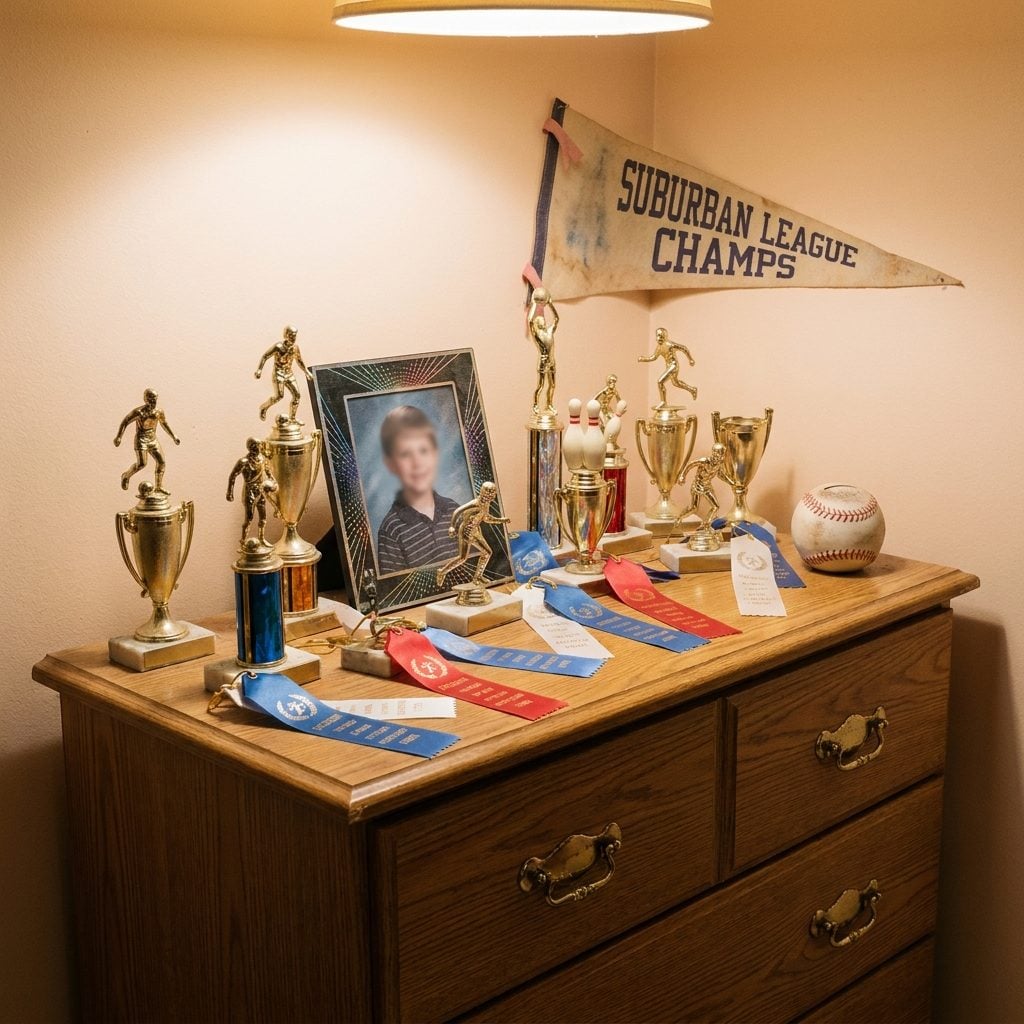
Every single one of us got a trophy. That was the beautiful, slightly absurd contract of 1980s suburban youth sports. You showed up to six Saturday morning soccer games, stood in a field picking dandelions while the ball rolled past, and three weeks later you had a six-inch gold-toned plastic monument to your effort on the dresser.
They accumulated fast. Bowling league. Softball. That one swim meet you did reluctantly. Each trophy was basically identical — fake marble base, thin gold column, tiny figure frozen in athletic glory at the top — and they collected dust in a way that suggested permanence, as if your mother genuinely planned to display them forever. The participation ribbons were even better: silky, wrinkled things in red or blue, safety-pinned to the dresser mirror or stuffed behind the trophies. Nobody questioned the system. We just kept adding to the shrine.
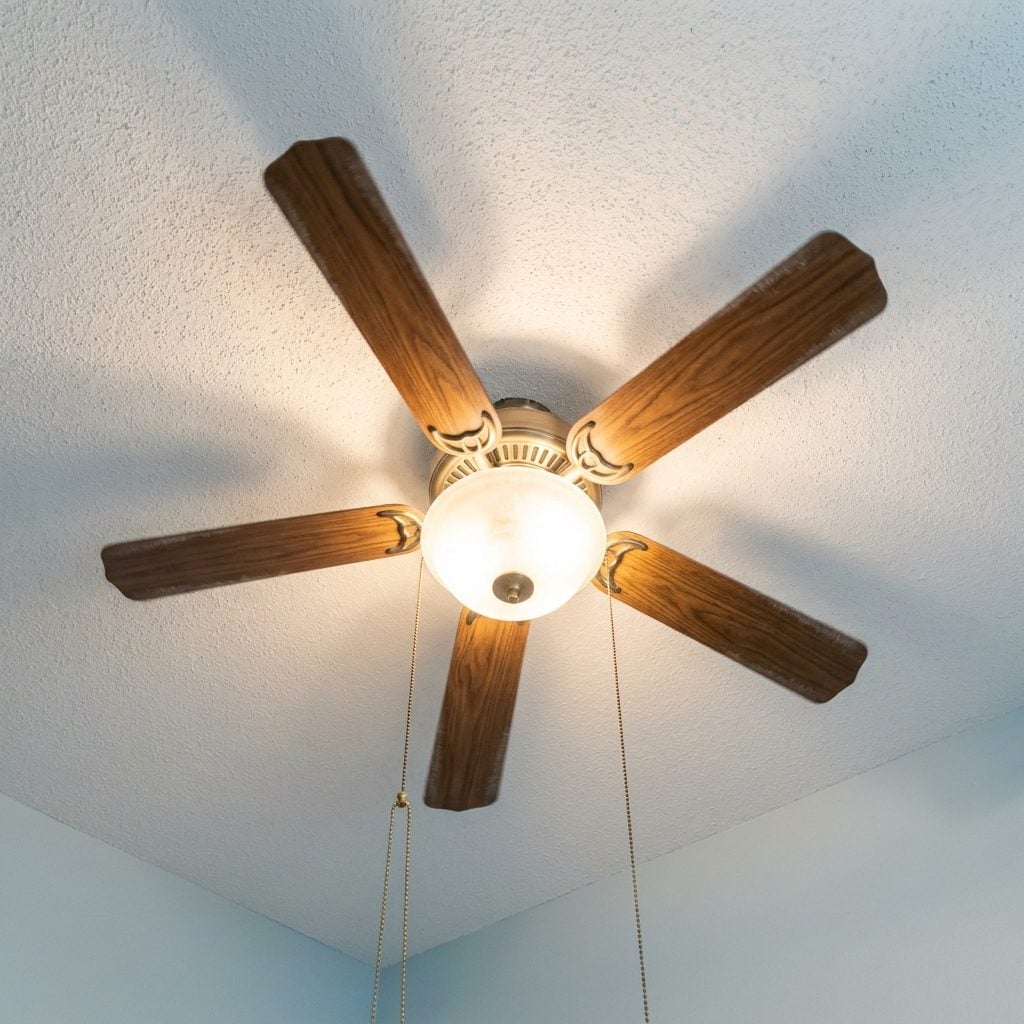
23. The Ceiling Fan with Faux Wood Blades and a Pull Chain That Clicked on Every Rotation
Click. Click. Click.
That sound was the unofficial white noise machine of every suburban bedroom in the ’80s — one pull chain slightly loose, or a blade barely warped, delivering a tiny metallic tick each rotation that you stopped hearing after three minutes but that drove overnight guests completely insane.
The blades were always that fake wood laminate, peeling just slightly at the tips. And the frosted glass globe underneath collected a small graveyard of dead bugs that cast weird shadows when the light was on. Nobody ever cleaned it. I’m convinced some of those fans are still spinning in the same houses right now, clicking away, the dead bugs petrified like amber.
22. A Stack of Choose Your Own Adventure, Goosebumps, and Garfield Books Stuffed Beside the Bed
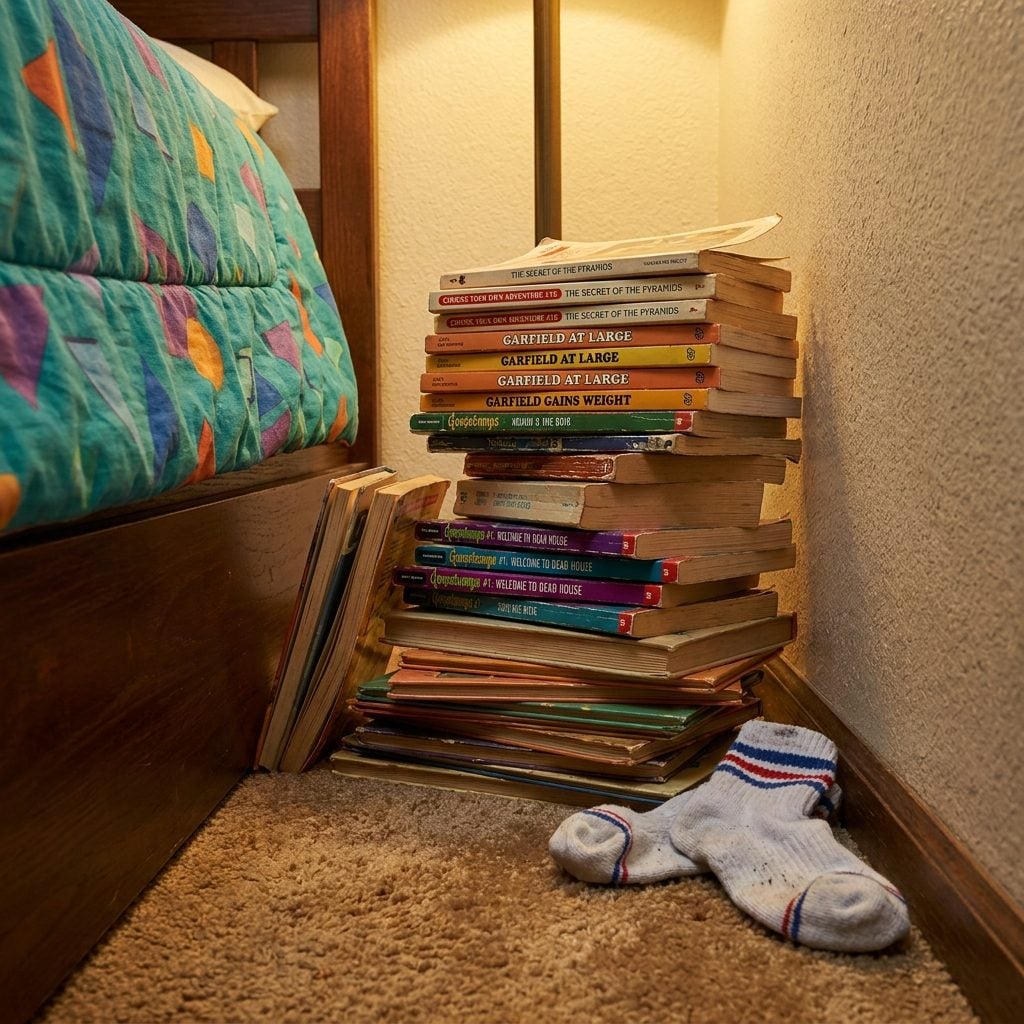
There was no bookshelf. Or there was, but it was full of something else entirely, so the books just piled up in that weird canyon between the mattress and the wall — Garfield collections on the bottom because they were fat and stable, Choose Your Own Adventure in the middle with spines cracked at the “bad ending” pages, Goosebumps on top if you were lucky enough to have an older sibling who handed them down.
You’d read with a flashlight under the covers long past bedtime, turning to page 73 and then immediately checking page 44 to see what would’ve happened if you’d gone left instead. Everyone cheated. The system practically demanded it.
21. The Tangled Pile of Atari or Nintendo Controller Cords Permanently Sitting Under the TV Cart
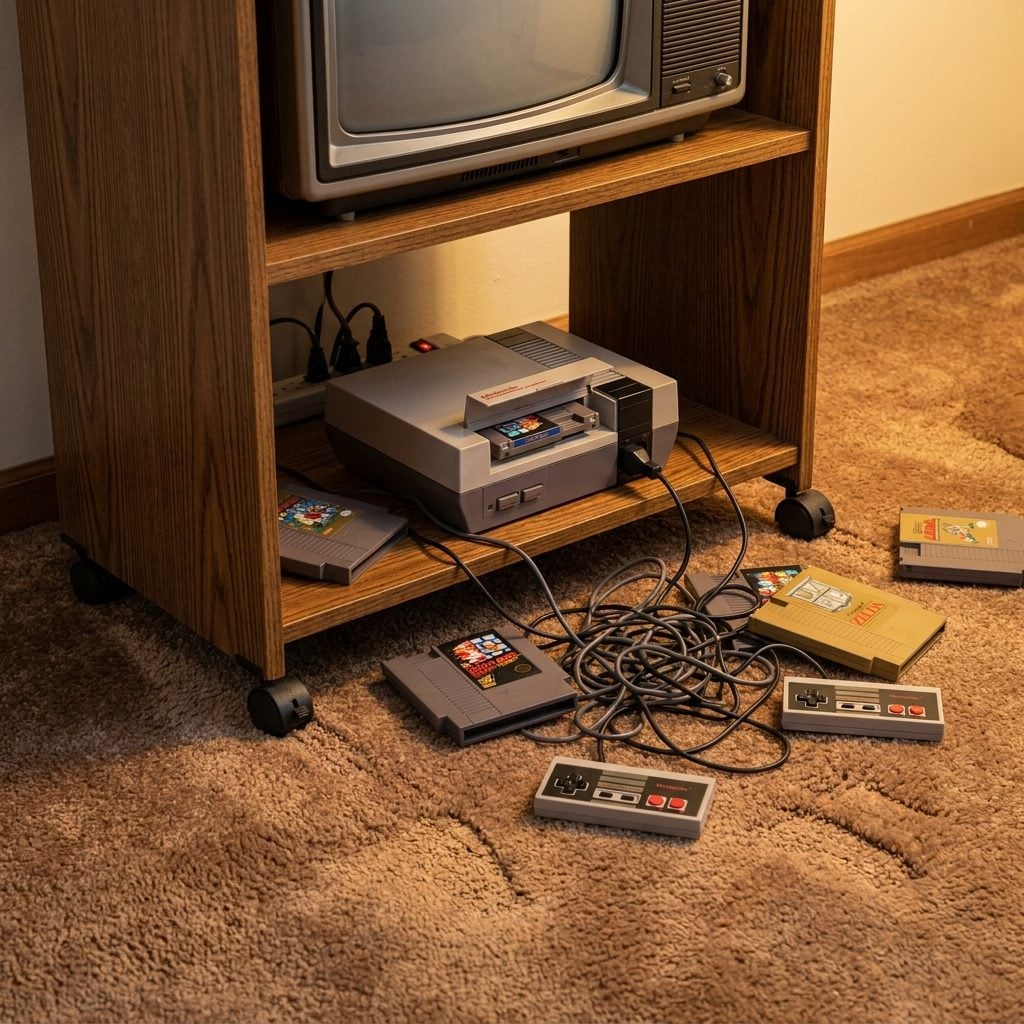
Nobody ever untangled them. Not once. Those cords lived in a permanent knot under the TV cart like some kind of domestic rat king, and every time you wanted to play you’d yank one controller free and hope the other end was still connected to something.
The TV cart itself deserves its own eulogy: wobbly particle board on caster wheels that rolled unevenly across the carpet, holding a 13-inch CRT that weighed roughly the same as a small engine block. The NES sat underneath with its front flap perpetually open, a cartridge jutting out at an angle because you’d blown on the contacts and shoved it back in crooked. The whole setup looked like a fire hazard. We treated it like an altar.
20. A Shoebox Filled with Friendship Bracelets, Folded Notes, Baseball Cards, and Random Arcade Tokens
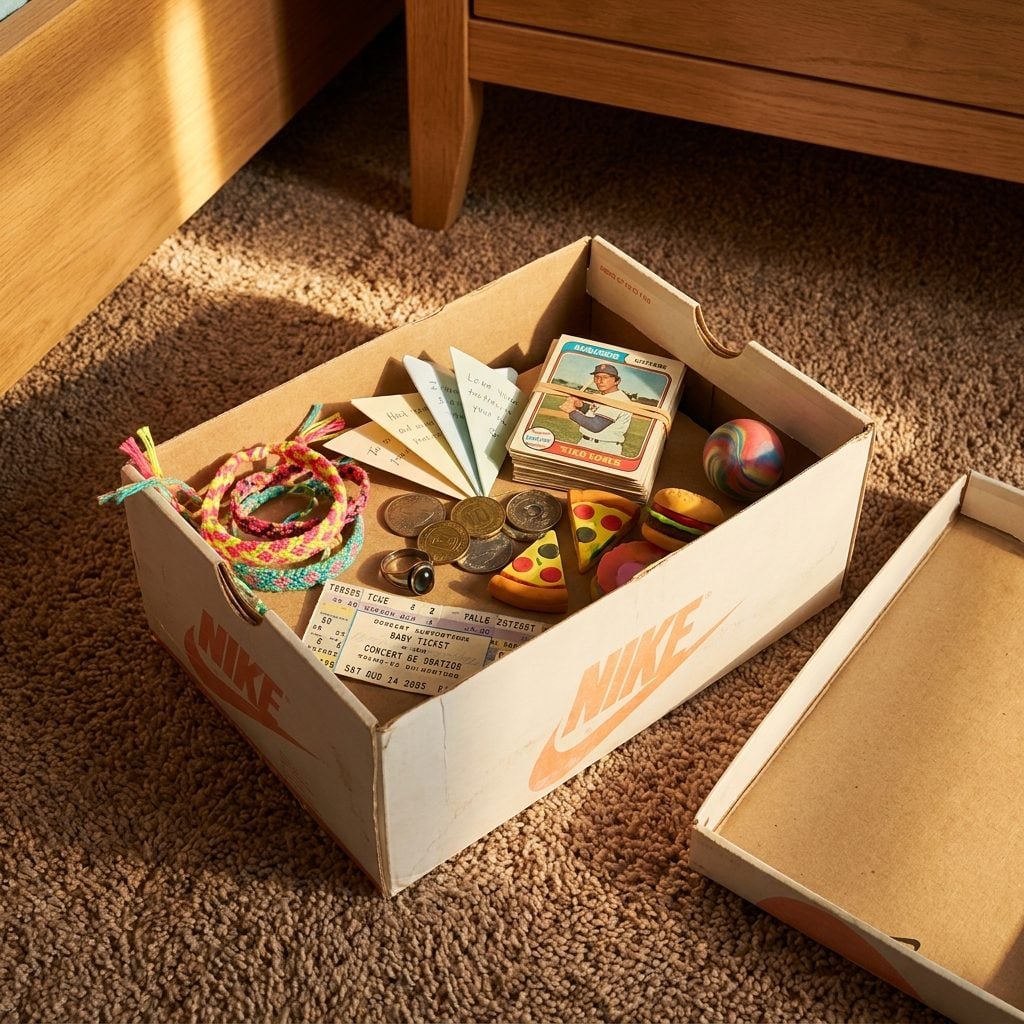
This was the vault. Always a Nike or Adidas shoebox, slightly crushed at one corner, tucked under the bed or buried in the closet behind a stack of board games. Inside: your entire social life compressed into maybe forty square inches.
Friendship bracelets in neon thread. Notes folded into tight triangles with “DO NOT READ” written on the outside — which of course meant everyone read them. A rubber-banded stack of baseball cards you were sure would be worth something someday. (They weren’t.) Arcade tokens from places that had already closed. A mood ring permanently stuck on blue. There was no organizing principle. You just dropped things in when they mattered and forgot about them until you moved out of the house years later and found the whole thing again, and suddenly it was 1987 and you could smell the cafeteria.
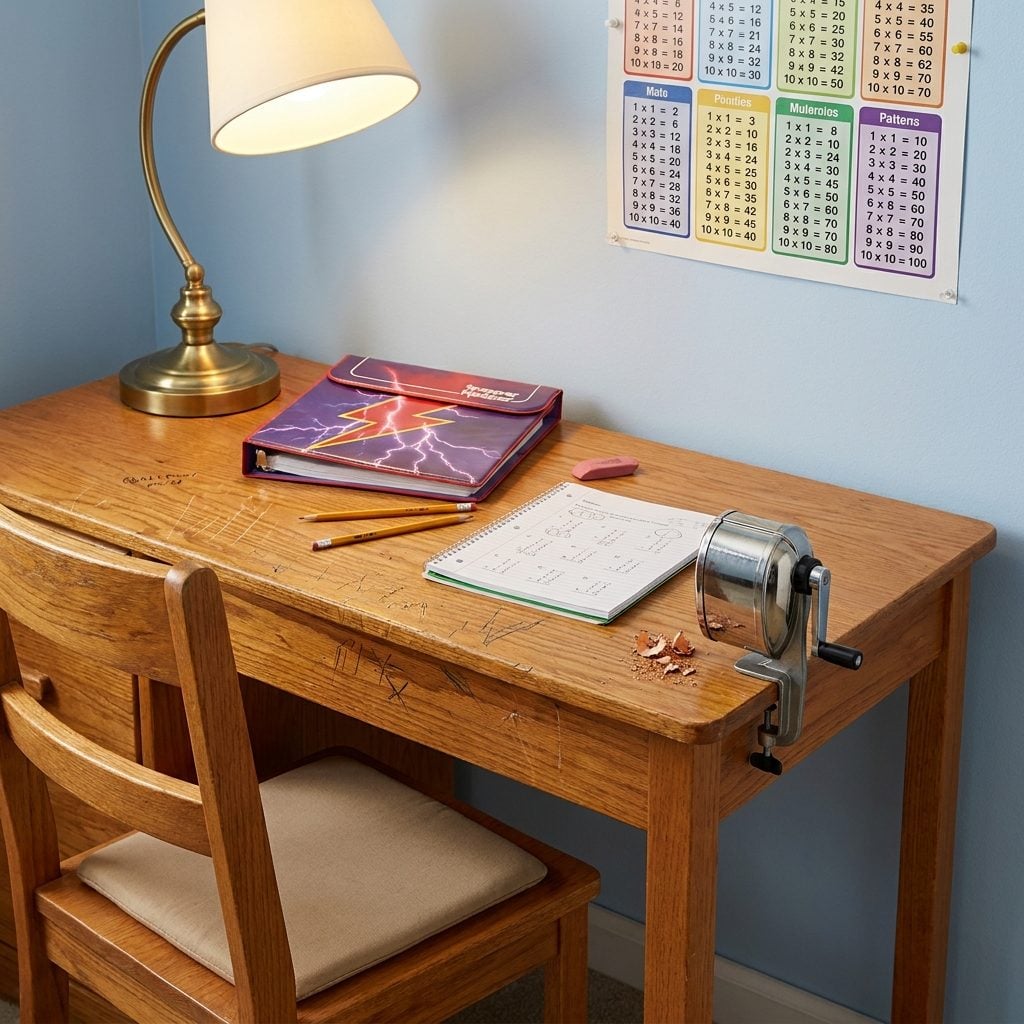
19. The Desk with a Built-In Pencil Sharpener and Deep Grooves from Years of Homework
🔥 Would you like to save this?
You could run your finger along that surface and feel the history of every report, every long division problem, every cursive letter you practiced before abandoning cursive forever by fifth grade. Grooves deep enough to catch pencil lead. Some kids carved their initials. Others just pressed too hard during fractions.
And that pencil sharpener bolted to the corner — chrome body, black crank handle, a satisfying grinding sound audible from the hallway. The little shavings drawer underneath was perpetually overflowing because emptying it was apparently nobody’s job. The desk was probably from Sears, built from solid pine that was somehow both indestructible and constantly dented. My parents still have one in the basement. I can’t prove that, but I also can’t imagine they’d ever throw it away.
18. A Lava Lamp Bubbling Beside a Stack of Cassette Singles and Half-Used Batteries
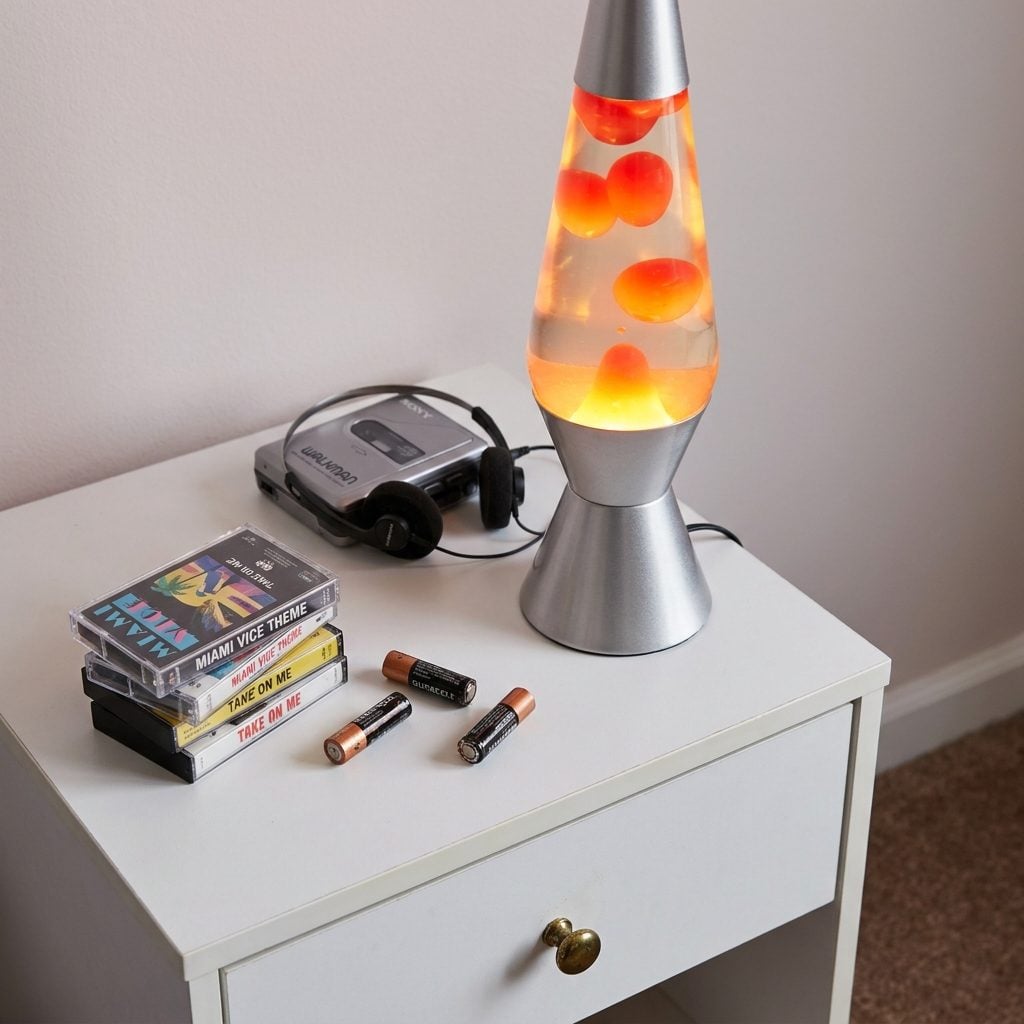
The lava lamp was the first piece of decor any of us ever chose deliberately — sat on the nightstand like a tiny hypnotic window, blobs separating and merging while you waited for the radio to play your song so you could hit record on the tape deck.
Beside it: the graveyard of spent batteries. Half still had a little charge left, maybe, so you kept them “just in case” in a loose pile that never got smaller. The cassette singles came from the drugstore checkout, purchased with allowance money. Debbie Gibson. Bon Jovi. Something your older cousin gave you that you pretended to like but secretly listened to more than anything else.
17. A Pair of Metal Roller Skates Shoved into the Closet Beside an Oversized Gym Bag
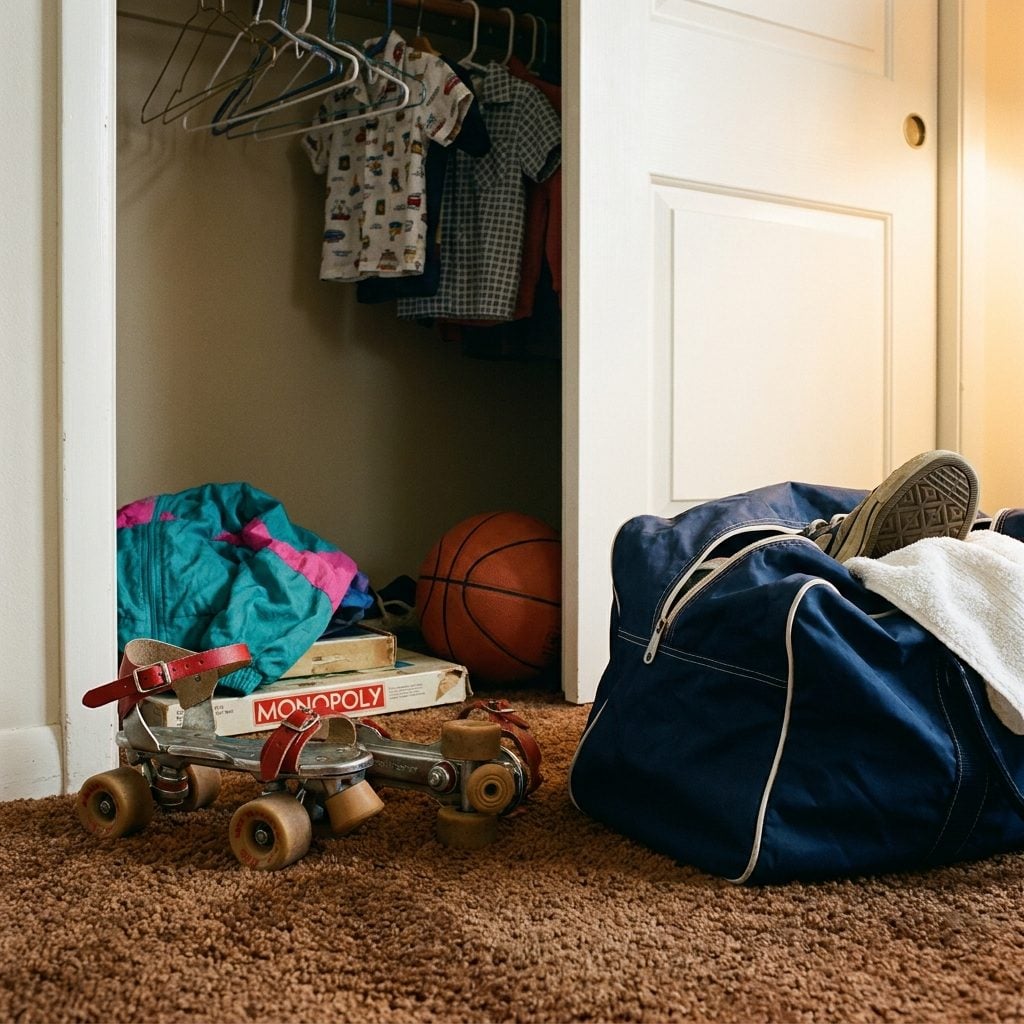
Loud. Metal wheels on concrete made a sound like a small earthquake, and every kid on the block could hear you coming from three houses away. The adjustable kind had a key you wore on a string around your neck and lost within the first week, permanently locking the skates at whatever size they’d last been cranked to.
They lived in the closet because where else would they go? Wedged next to a gym bag that smelled like it had never been washed — because it hadn’t — on a closet floor that was basically a landfill of sporting equipment used twice, outgrown sneakers, and board games with missing pieces. Those skates sat there for years. Every six months you’d pull them out, skate for twenty minutes, remember the sidewalk cracks were terrifying, and shove them right back in.
16. The Faded Sleeping Bag Spread Across the Floor While a Portable Radio Quietly Played All Night
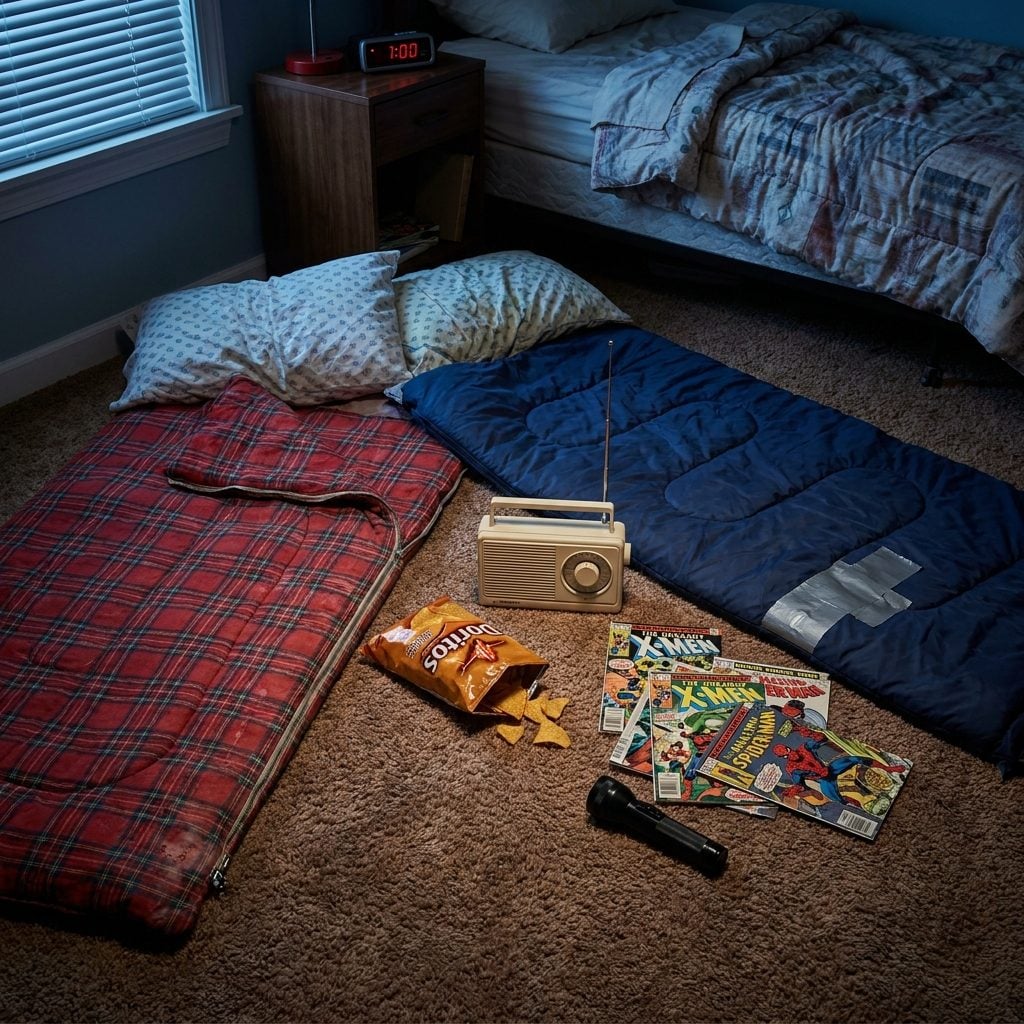
This is the one that gets you. Not because the sleeping bag was special — it wasn’t — but because of what it meant: someone was staying over, school was tomorrow but nobody cared yet, and the whole night stretched ahead like it might never end.
Same sleeping bag every time. Faded flannel lining, a zipper that jammed halfway, a smell equal parts campfire and basement. You’d spread it on the carpet next to the bed and throw down a flat pillow that offered absolutely no neck support. The portable radio — usually a cream-colored GE or Panasonic — sat between you playing Casey Kasem’s countdown at a volume just loud enough to hear but quiet enough that your parents wouldn’t yell from down the hall.
You’d talk for hours about nothing. Scary stories. Rumors about kids at school. Plans for a summer still months away. Then one of you would fall asleep mid-sentence and the other would lie there listening to the radio, watching the clock’s red glow crawl toward midnight, feeling completely and perfectly safe in a way that’s hard to explain to anyone who didn’t grow up in a room exactly like this one. I don’t know how to describe it better than that. Maybe you don’t need me to.
15. Mirrored Closet Doors That Rattled Like a Freight Train Every Time You Slid Them Open
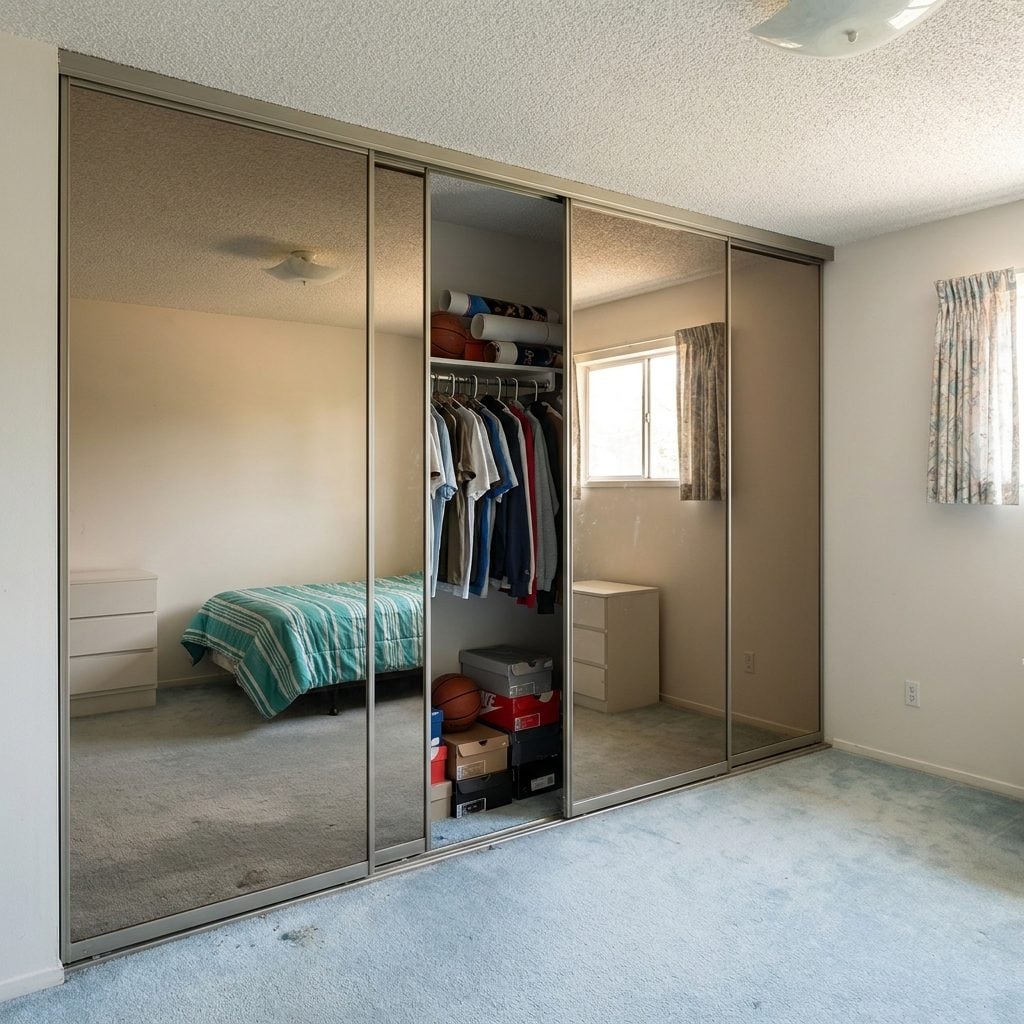
That bottom metal track collected so much carpet fluff and dust that the doors eventually stopped sliding smoothly and started grinding along the rail with a noise that could wake everyone in the house. You learned to lift slightly while sliding. Everyone with these doors learned to lift slightly while sliding. Nobody ever cleaned the track.
The mirror panels themselves were the real deal. A whole wall of your reflection meant you could watch yourself do anything from three angles, which is either great or terrible depending on the situation. They also made the room look twice as big, which is probably why builders installed them in every new subdivision from 1975 to 1994. For comparison, check out how a light living room handles reflection and brightness today, with considerably less grinding.
14. The Bi-Fold Louvered Closet Doors That Never Closed All the Way and Trapped Fingers at Least Once a Month
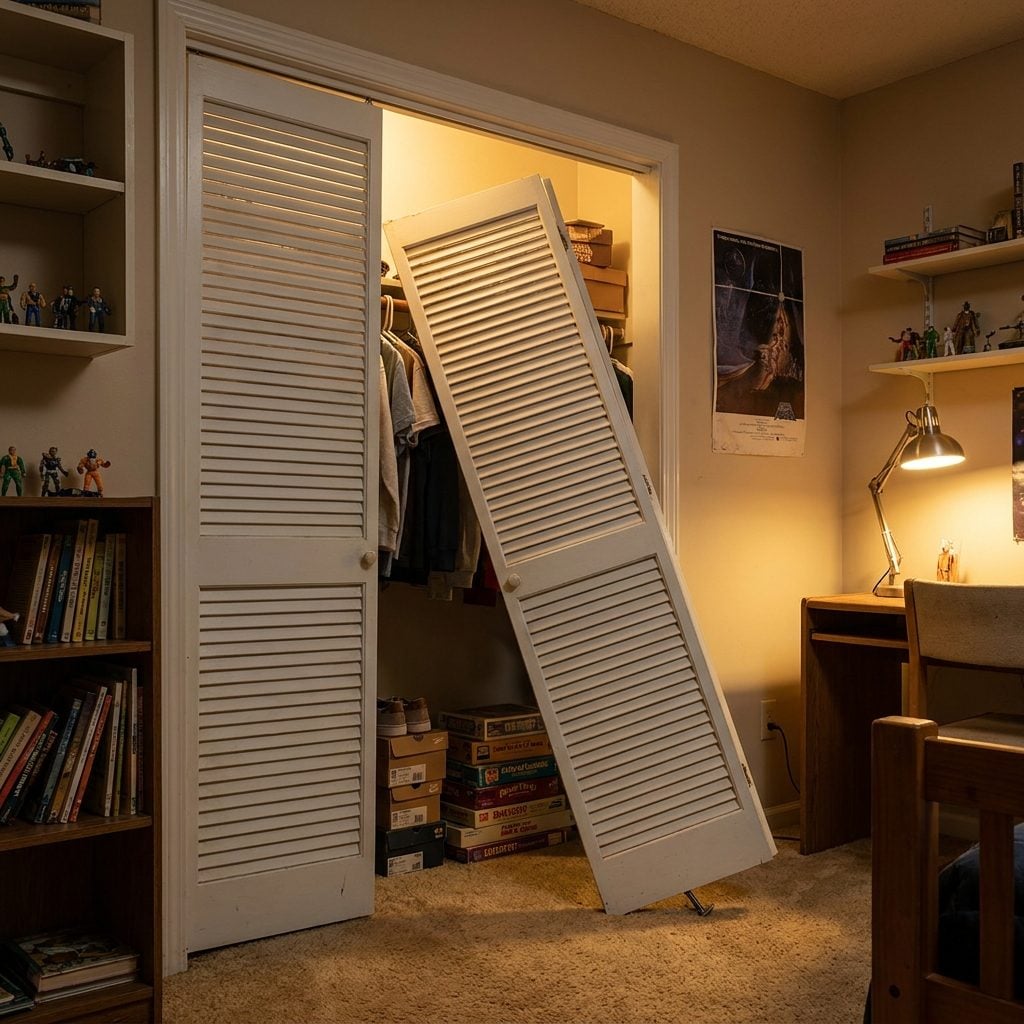
One pivot pin always sat about a millimeter out of its bracket, which meant the whole door tilted at a faint angle for the entire time you lived in that house. You could close it to 95 percent. That last 5 percent was a negotiation that sometimes lasted until you just gave up and went to bed with the closet open.
The louvered slats were theoretically for ventilation, which sounds like a story someone made up to justify why your closet door looked like a shutter from a beach house. They also meant the light from inside the closet leaked into the room in thin horizontal stripes, which is a special kind of unsettling at 2 a.m. when you were already convinced something was in there. Every single one of these doors is somewhere in a house right now, still not closing properly, waiting for someone to fix the pivot pin.
13. The Giant Lamborghini Countach Poster Taped Directly to the Wall
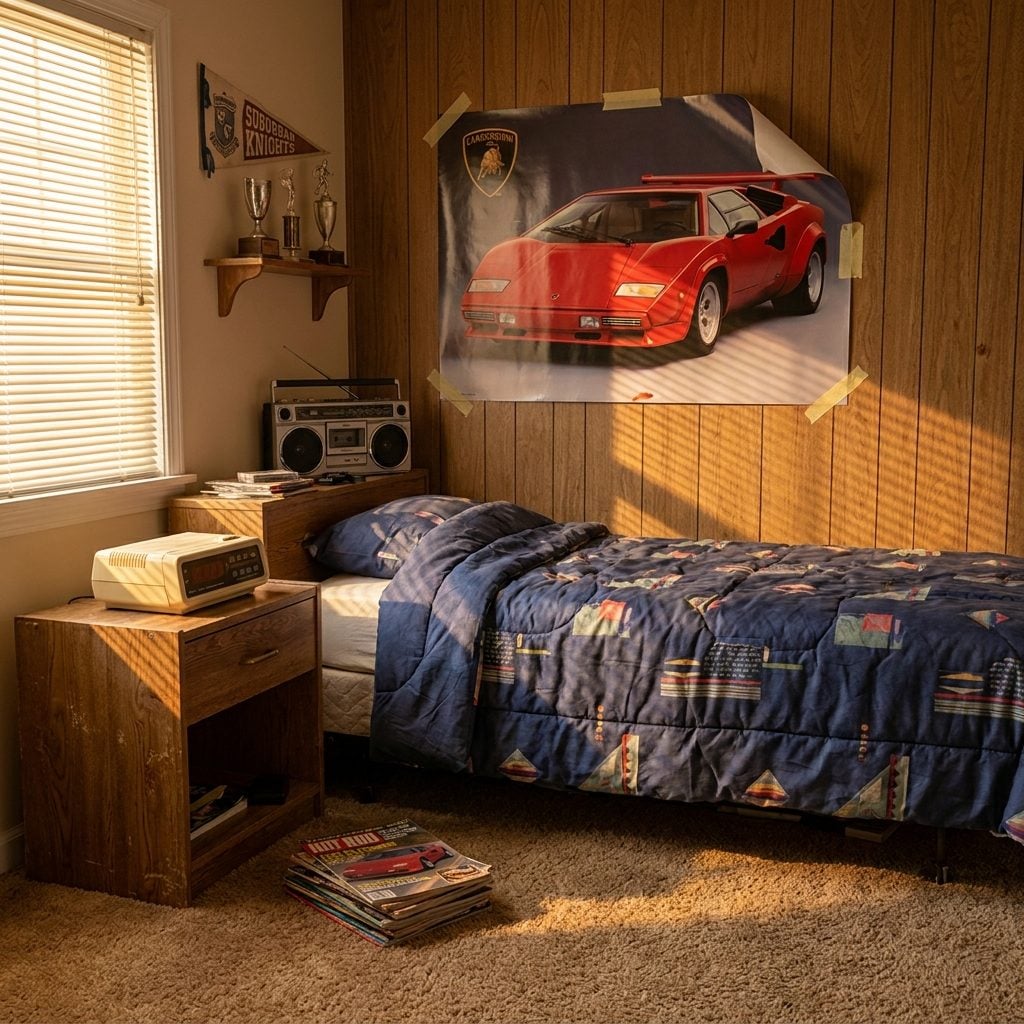
That poster wasn’t decoration. It was a manifesto. Every suburban kid with a bedroom wall and a dream taped up either the Countach, a hair metal band shot in dry ice fog, or a glossy headshot of whatever teen idol currently occupied the center of their chest. The tape job was always optimistic at first, four neat corners, and then one side would peel and it’d stay that way for two years, curling slowly toward the floor like it was losing faith alongside you.
The Countach in particular was practically a rite of passage. That wedge-shaped, scissor-doored, completely impractical supercar appeared on more bedroom walls than any piece of actual art. Nobody we knew had ever seen one in person. That was kind of the point.
12. Tiger Beat and BOP Pull-Outs Wallpapering Every Inch of Available Space
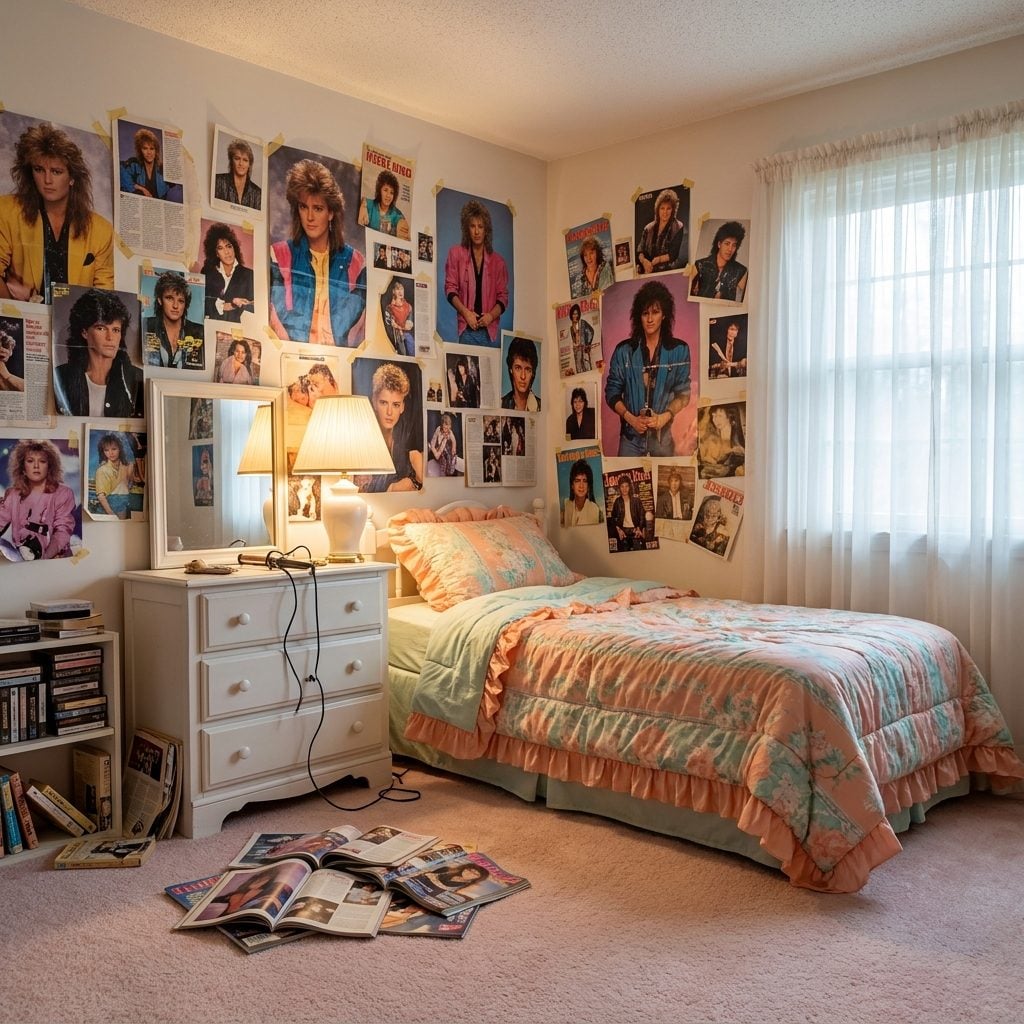
Every inch of wall that wasn’t already claimed by furniture was fair game. The pull-outs came out of the magazines in one careful motion, you learned quickly not to rip, and went up with whatever tape or pushpin was nearby. Over time the walls became a kind of archaeological record of every crush, every phase, every shift in musical loyalty.
The curling edges were the real detail. No matter how carefully you taped them, the corners always lifted. In the winter they’d go flat again and in the summer they’d curl back up. A full Tiger Beat bedroom in July looked like it was slowly trying to peel itself off the wall and escape.
11. The Lisa Frank Trapper Keeper Open on the Bed, Surrounded by Gel Pens and Loose Homework
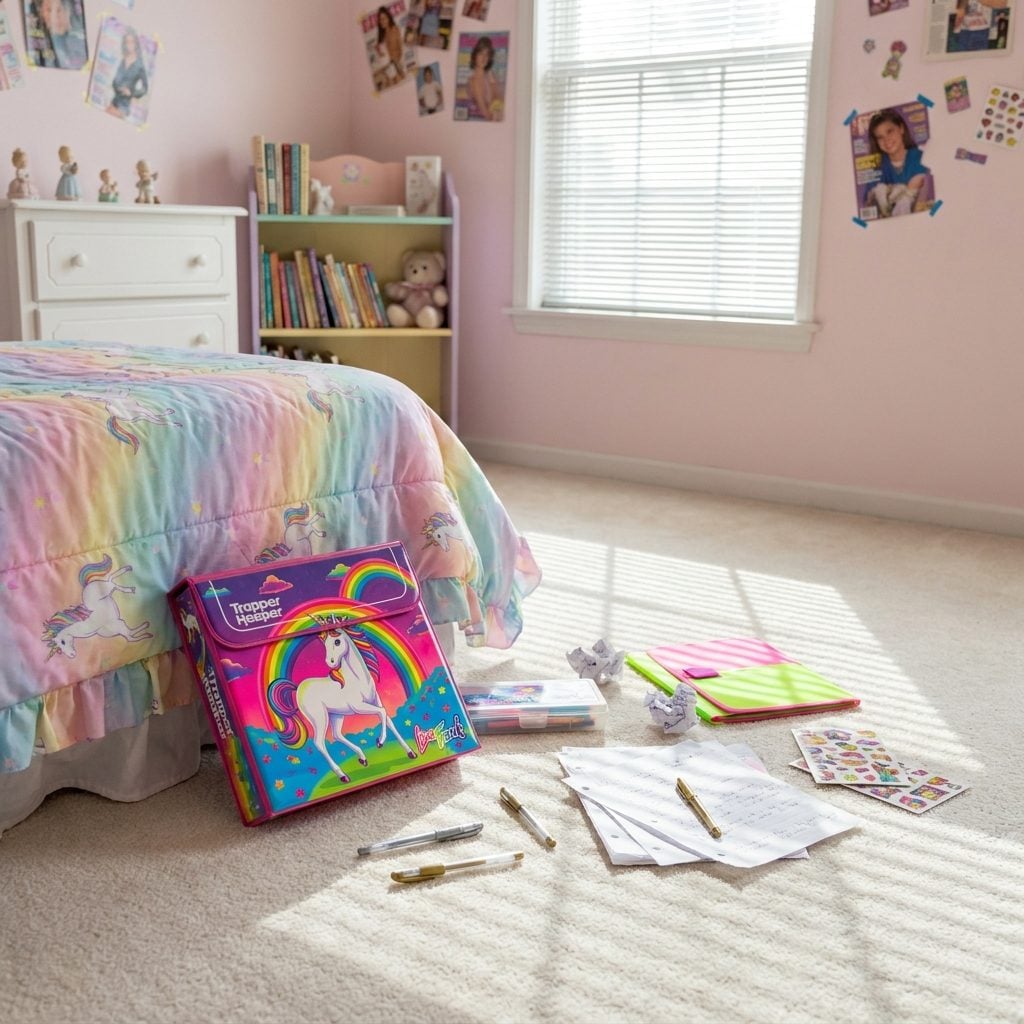
Nothing in the known universe was as visually aggressive as a Lisa Frank Trapper Keeper. Neon unicorns. Rainbow leopards. Tropical fish in colors fish do not come in. You didn’t just carry it to school, you presented it. The Velcro closure made a satisfying rip sound that could be heard from two rows away in a quiet classroom, which was either embarrassing or thrilling depending on your confidence level that day.
The gel pens are the underrated co-star of this memory. Silver and gold metallic ink on dark paper felt like actual witchcraft in 1988. The homework was, of course, never actually done.
10. A Lite-Brite Left Plugged In All Night With a Half-Finished Masterpiece Inside
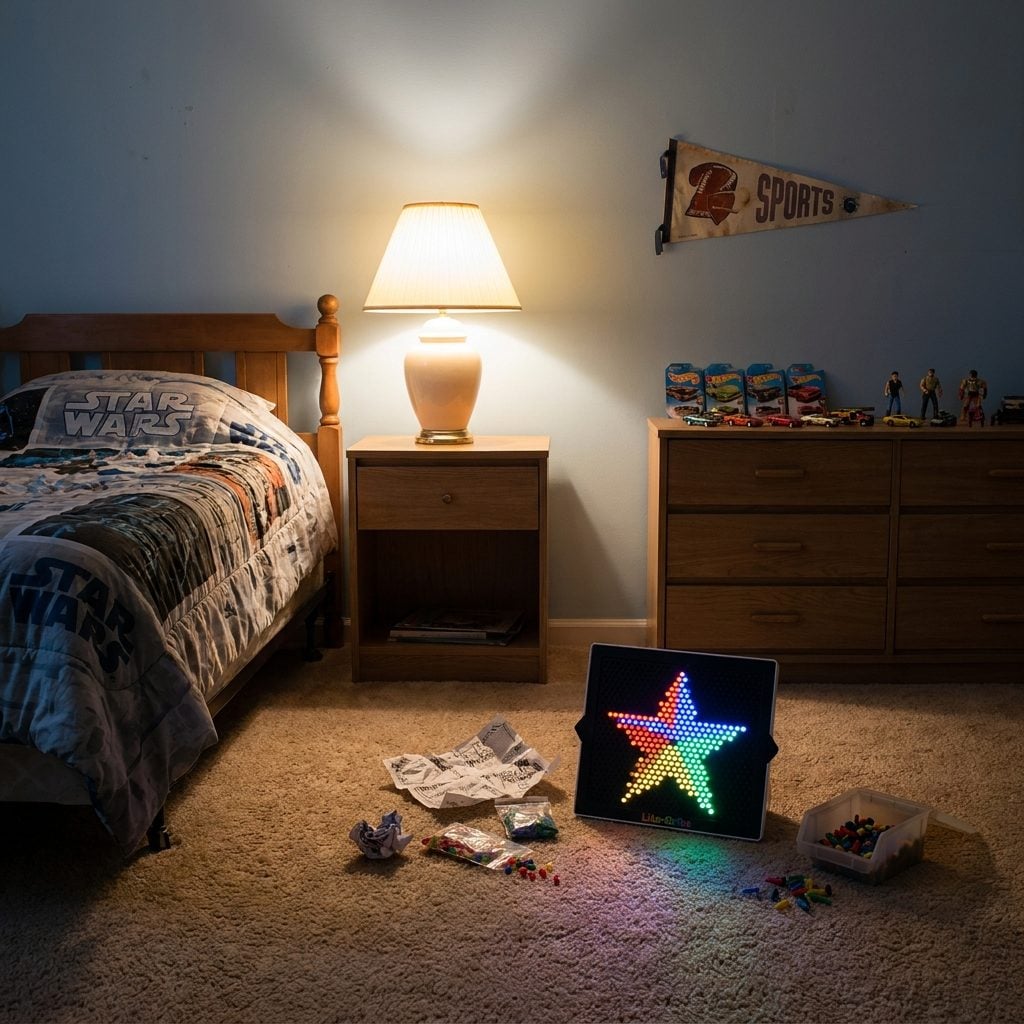
The Lite-Brite was always half-finished. That was its natural state. You’d start with enormous ambition, the butterfly, the clown, something from the included design sheets, and then lose interest somewhere around the wings and just leave it glowing on the floor. The colored pegs you didn’t use would end up in the carpet by morning, where they became a barefoot hazard roughly equivalent to Legos.
There was something genuinely beautiful about that warm, multicolored glow in a dark room, though. It had no business being as soothing as it was. A toy designed to make pictures somehow doubled as a night light, a mood lamp, and a minor fire hazard all at once.
9. The Push-Button Phone With the Curly Cord Stretched Across the Entire Room
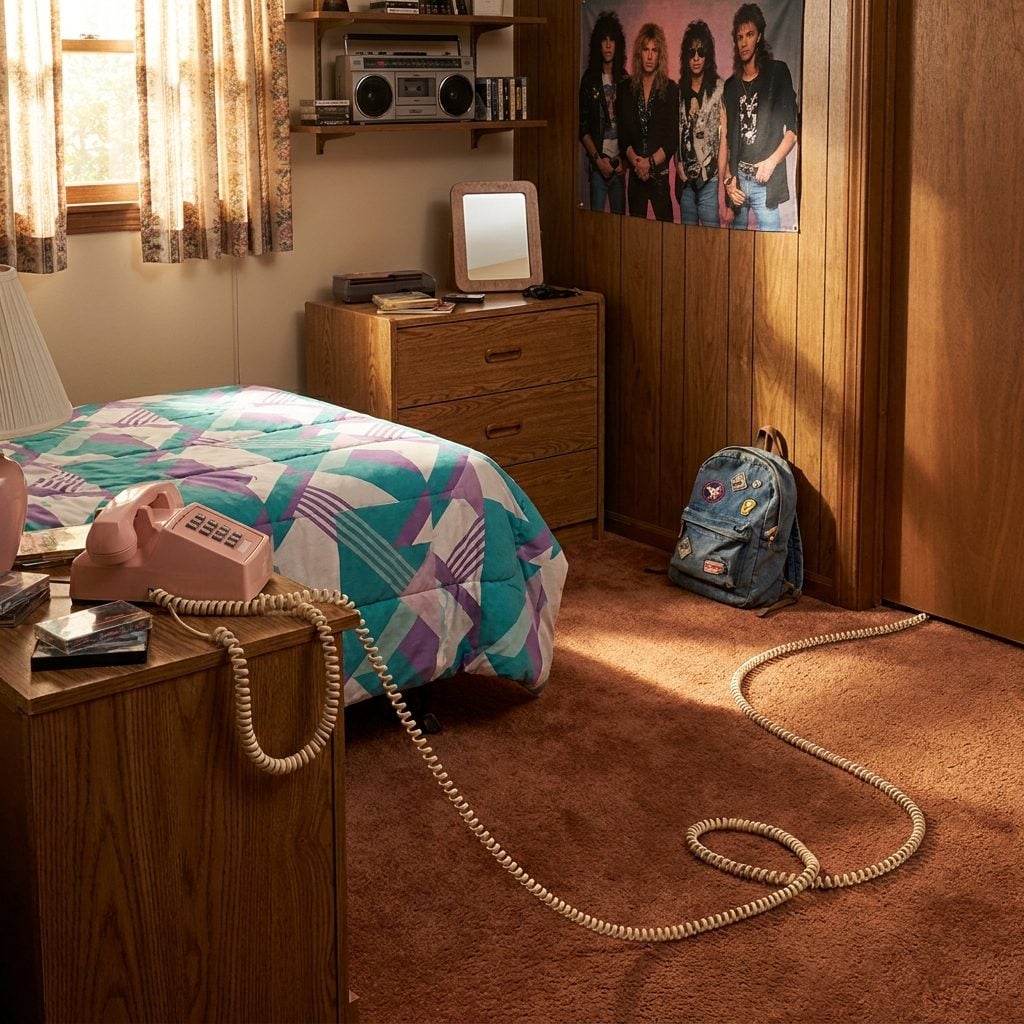
That cord was rated for about three feet of stretch. We pulled it across fifteen. The curly cord on an 80s bedroom phone was essentially a measure of how much privacy you needed, on a normal day it sat loosely coiled, and on a day involving drama it was pulled taut around the doorframe with the door shut as far as the cord would allow, which was never fully shut, which everyone in the house understood to mean do not knock.
The push-button phone itself was an upgrade over rotary. You could dial fast, which mattered when you were trying to beat your sibling to calling the same person. For more on how the small family room and bedroom often shared the same phone line in these houses, the floor plans tell the whole story.
8. The Hollywood Vanity Mirror With the Ring of Glowing Round Bulbs
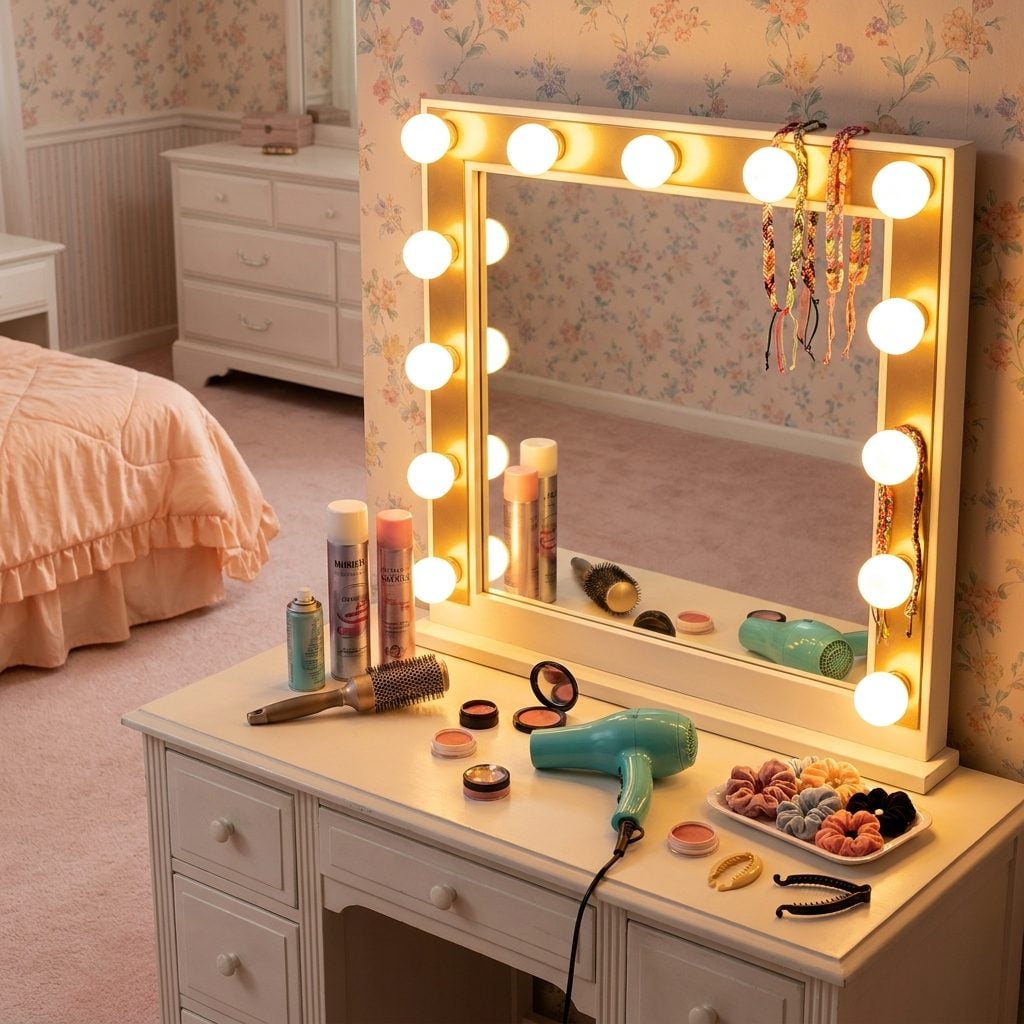
This mirror made you feel like a backstage movie star even if you were in a split-level in Ohio getting ready for a Friday night at the mall. The round bulbs cast that specific warm, shadowless glow that made everything look slightly better than it was, which is exactly what a fifteen-year-old needed before leaving the house. The teal bed or pastel ruffle comforter visible just behind it in most of these bedrooms completed the contrast beautifully.
The vanity surface was always a disaster. Aerosol hairspray had lightly coated every single item within a two-foot radius. Scrunchies hung off the mirror frame. Banana clips were everywhere. It was less a beauty station and more an active archaeological dig, but the lighting was phenomenal.
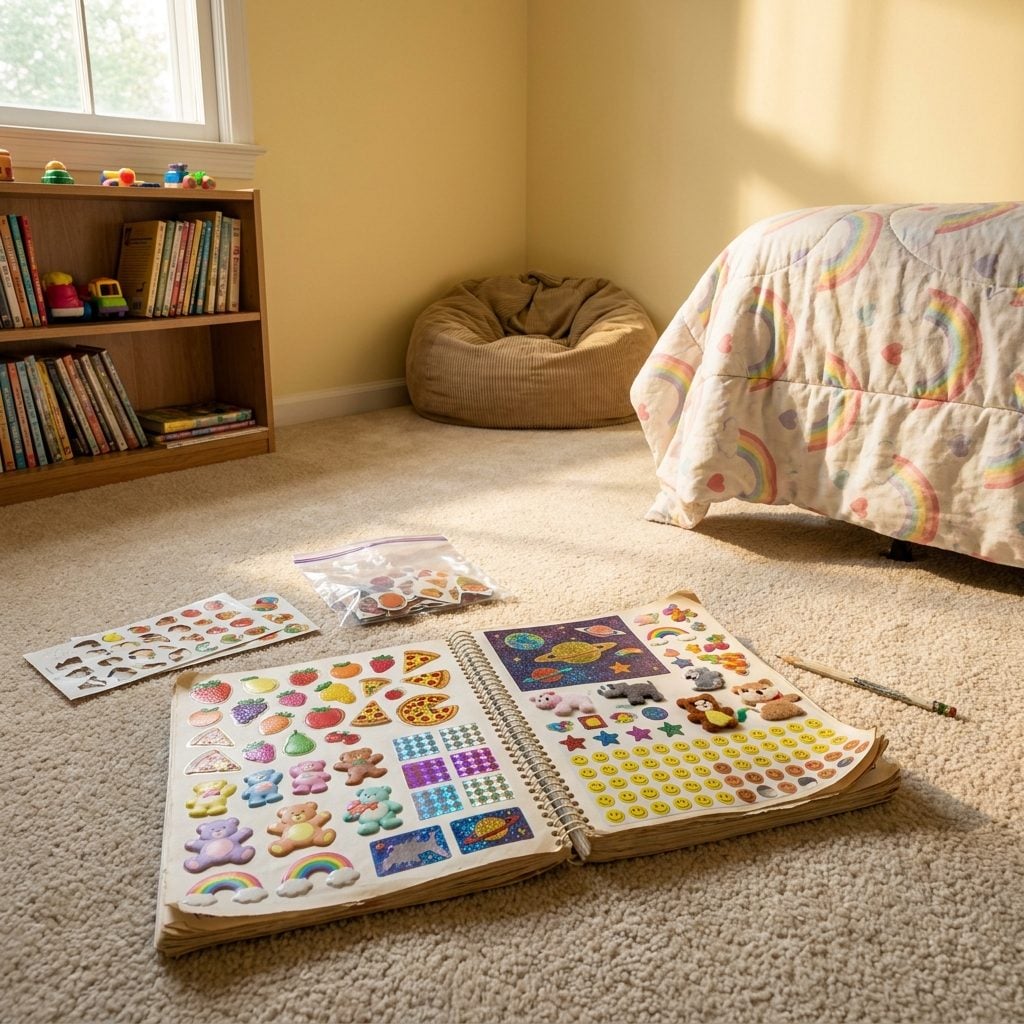
7. The Sticker Album Stuffed With Scratch-and-Sniff, Puffy, and Holographic Treasures
🔥 Would you like to save this?
The sticker album was not a casual object. It had a system. Scratch-and-sniff went on specific pages, organized loosely by scent category. Puffy stickers got their own section because they were too three-dimensional to sit flat against holographics. The rare prismatic sticker, the kind that shifted colors when you tilted it, was placed with the same reverence other people give to museum paintings.
Trading stickers was a whole economy. You never traded a scratch-and-sniff that still had its scent. Everyone knew this. Offering a smelled-out strawberry for an unscratched watermelon was considered a social offense.
6. The Row of Cabbage Patch Kids on the Shelf, Adoption Papers Tucked In Beside Them
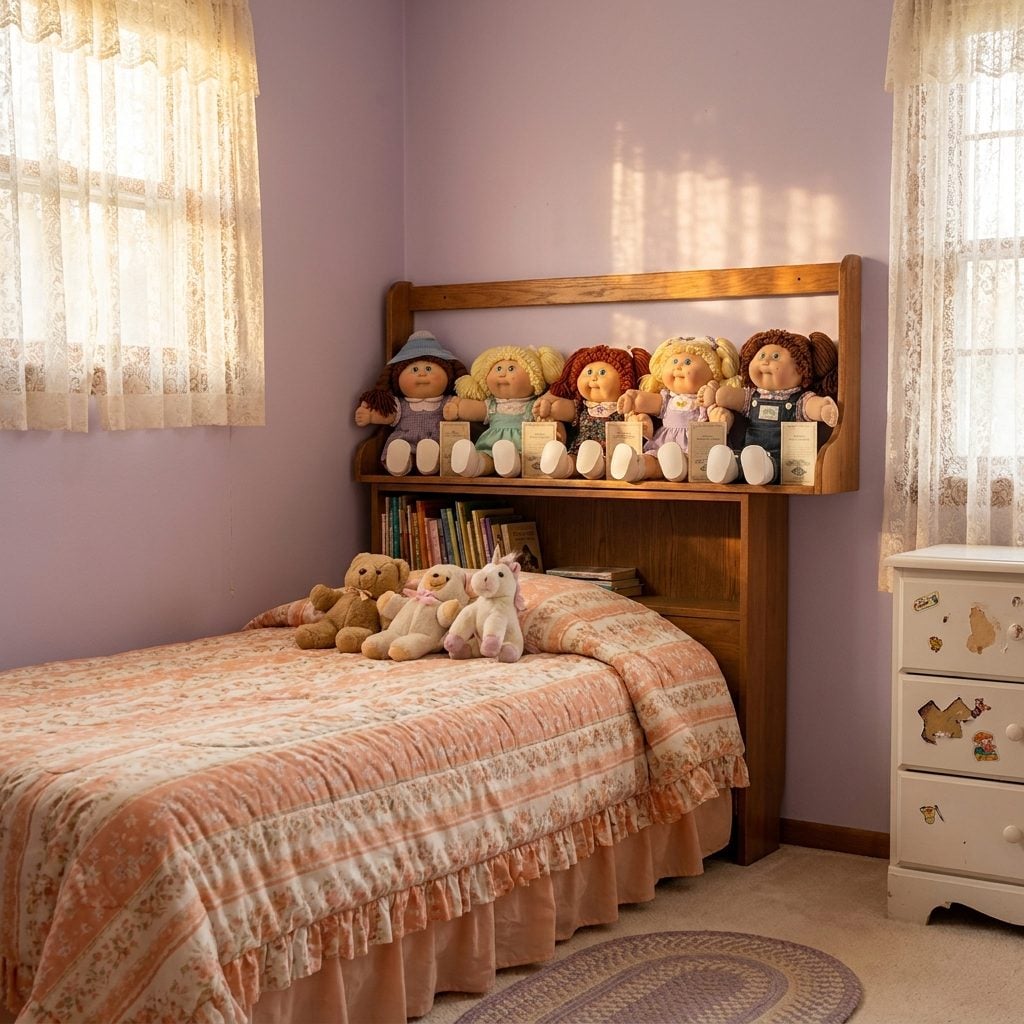
They weren’t toys, technically. They were adopted children, and the distinction mattered deeply to every eight-year-old who owned one. The adoption papers were not thrown away. They were folded carefully and stored either inside the box, in a drawer, or, in the most devoted cases, tucked right there on the shelf beside the doll like a tiny legal document proving the relationship was real and official.
The names were non-negotiable. Whatever the birth certificate said, that was the name. You didn’t rename a Cabbage Patch Kid any more than you’d rename an actual child. The yarn hair, the slightly bewildered vinyl face, the stuffed fabric body that never quite sat up straight on its own, all of it was taken completely seriously, which, honestly, is the correct response.
The adoption papers weren’t a gimmick. To a kid in 1984, they were the whole point.
5. The Shelf of My Little Ponies With Manes Brushed Into Permanent, Unforgivable Frizz
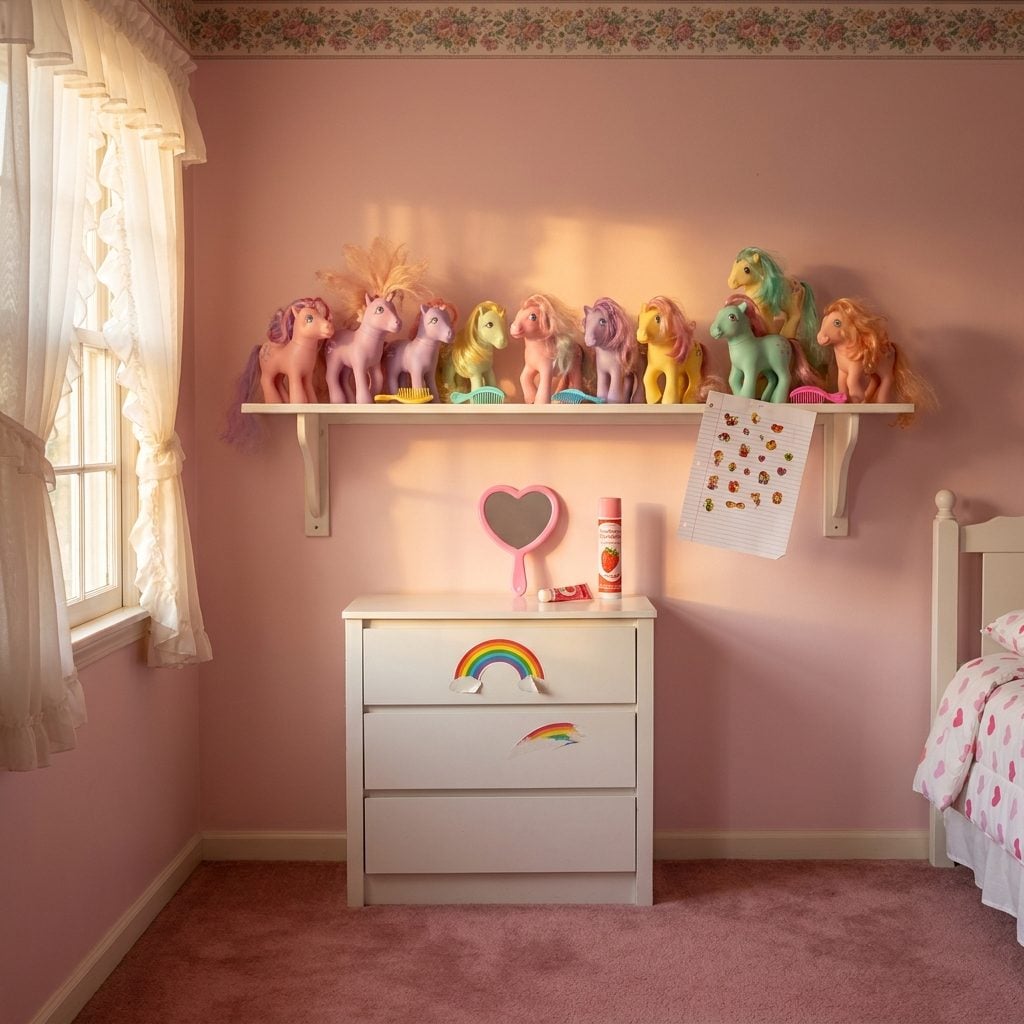
Every single one of them had been brushed within an inch of their lives. Not gently, not with patience, but with the full-armed, rapid-fire enthusiasm of a seven-year-old who had just discovered the tiny plastic comb that came in the box. Cotton Candy’s mane was a pink cloud of pure frizz. Firefly’s was horizontal. Medley looked like she’d put her hoof in an electrical socket.
The cruel irony is that the more you loved them, the worse they looked. The ponies on the back of the shelf, the ones you couldn’t reach, those ones had perfect silky manes. The favorites, the ones handled daily, were absolute disasters. They stood in their little row looking simultaneously cherished and destroyed, which honestly might be the most accurate metaphor for childhood anyone has ever produced.
4. The Overflowing Toy Box That Was Basically a Mass Grave for Barbies, He-Man Figures, and Every Happy Meal Toy Ever Made
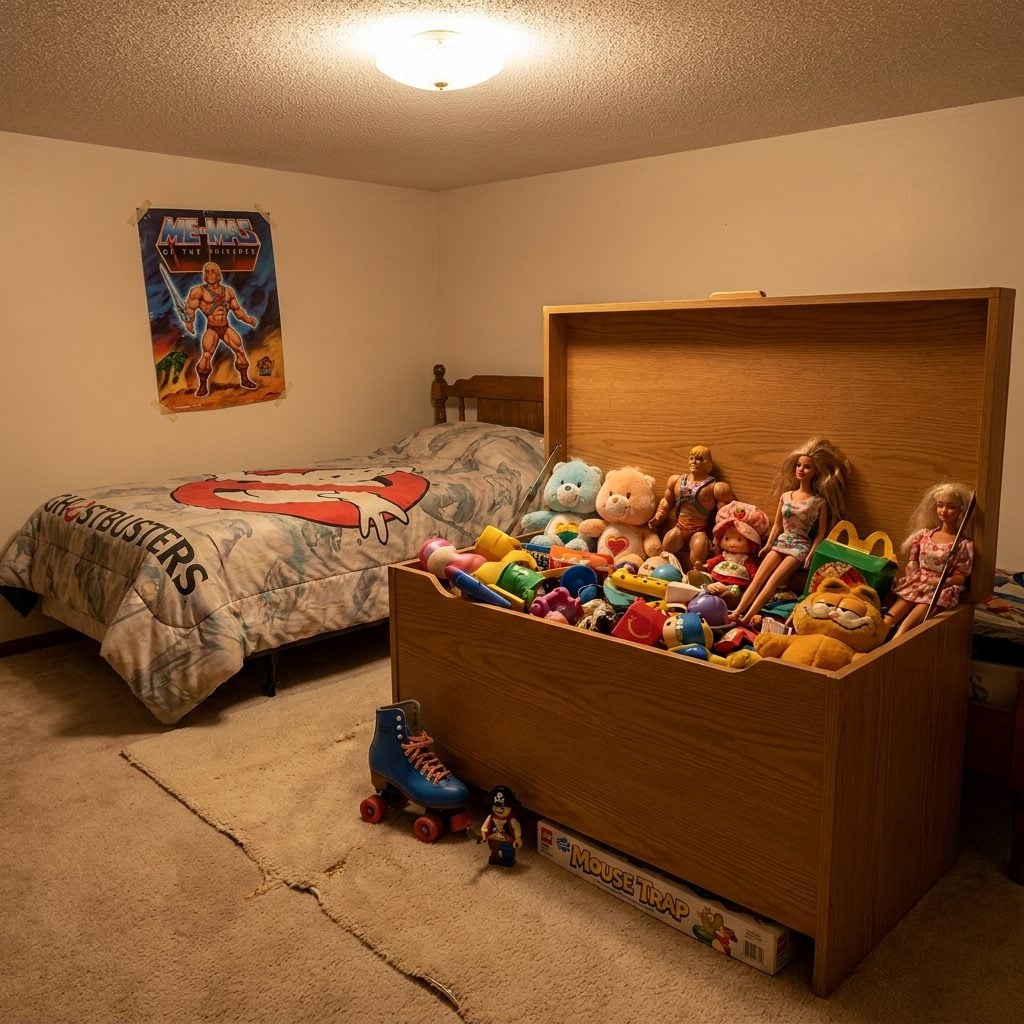
Nobody actually put toys in the toy box. The toy box was where toys went when someone said “clean your room” with enough menace that you started scooping things off the floor with both arms. Organization had nothing to do with it.
What ended up in there was an anthropological record of a childhood: a Barbie in one pump, three He-Man figures (no weapons), a Care Bear with a suspicious stain on its tummy symbol, and somewhere near the bottom, a Happy Meal toy still in the bag from 1987. That box was a colorful game room compressed into two cubic feet of pure chaos. And yet somehow, you always knew exactly what was in there and roughly where to find it.
3. Milk Crates Stacked Into Shelving for Your Complete Sweet Valley High and Baby-Sitters Club Collection
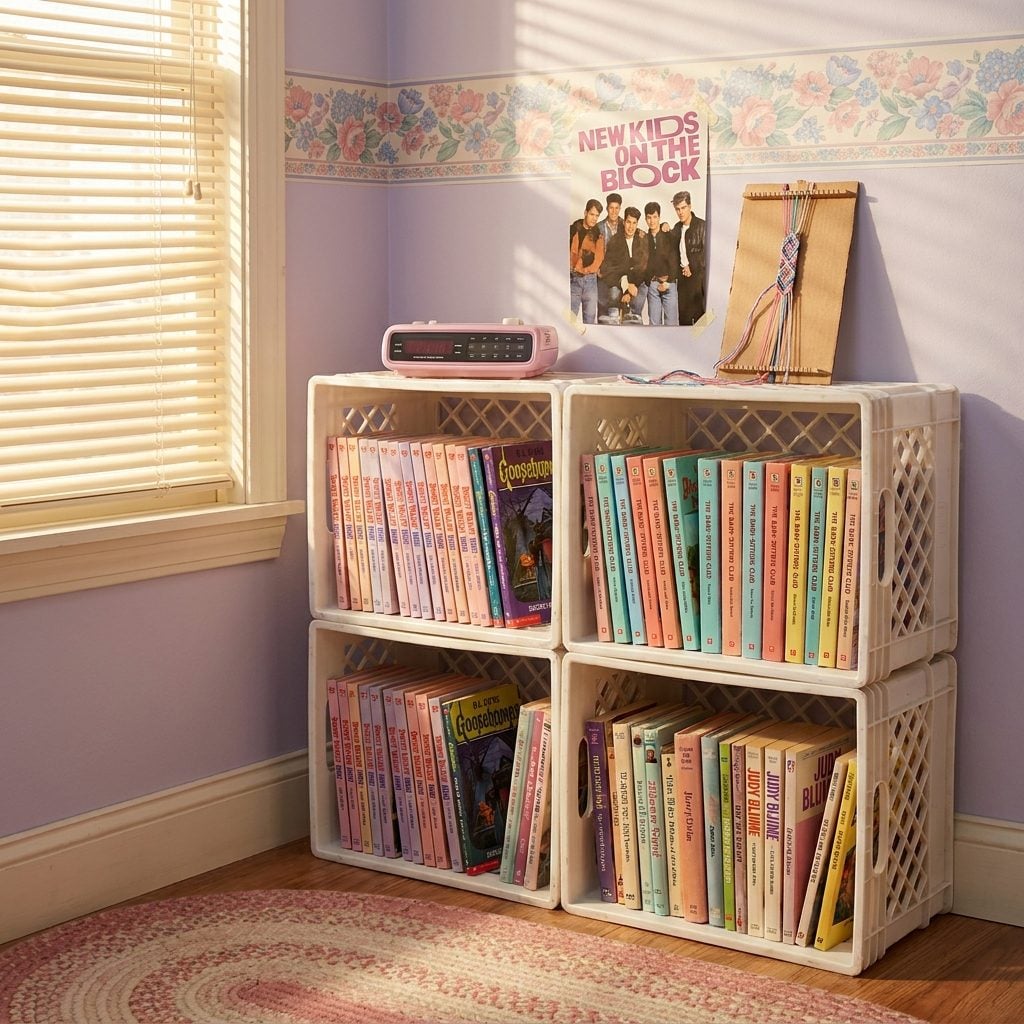
Those milk crates weren’t organized. They were curated, every Sweet Valley High book in order, spine out, so you could verify at a glance whether you had the one where Elizabeth got amnesia (you did, twice, both copies). The Baby-Sitters Club books filled an entire crate on their own. Kristy, Claudia, Mary Anne, Stacey, each one a different cover color, lined up like a pastel library that your mom did not build for you.
Milk crates cost nothing because they fell off trucks or appeared in alleys, and stacking them was a genuine act of DIY design that nobody called DIY design at the time. They were heavy, they were slightly grimy, and they somehow made a bedroom feel like a serious person lived there. A person with books.
2. The Vertical Blinds That Clattered Every Time Someone Walked Past, or the Bent Aluminum Mini Blinds You Were Definitely Not Supposed to Touch
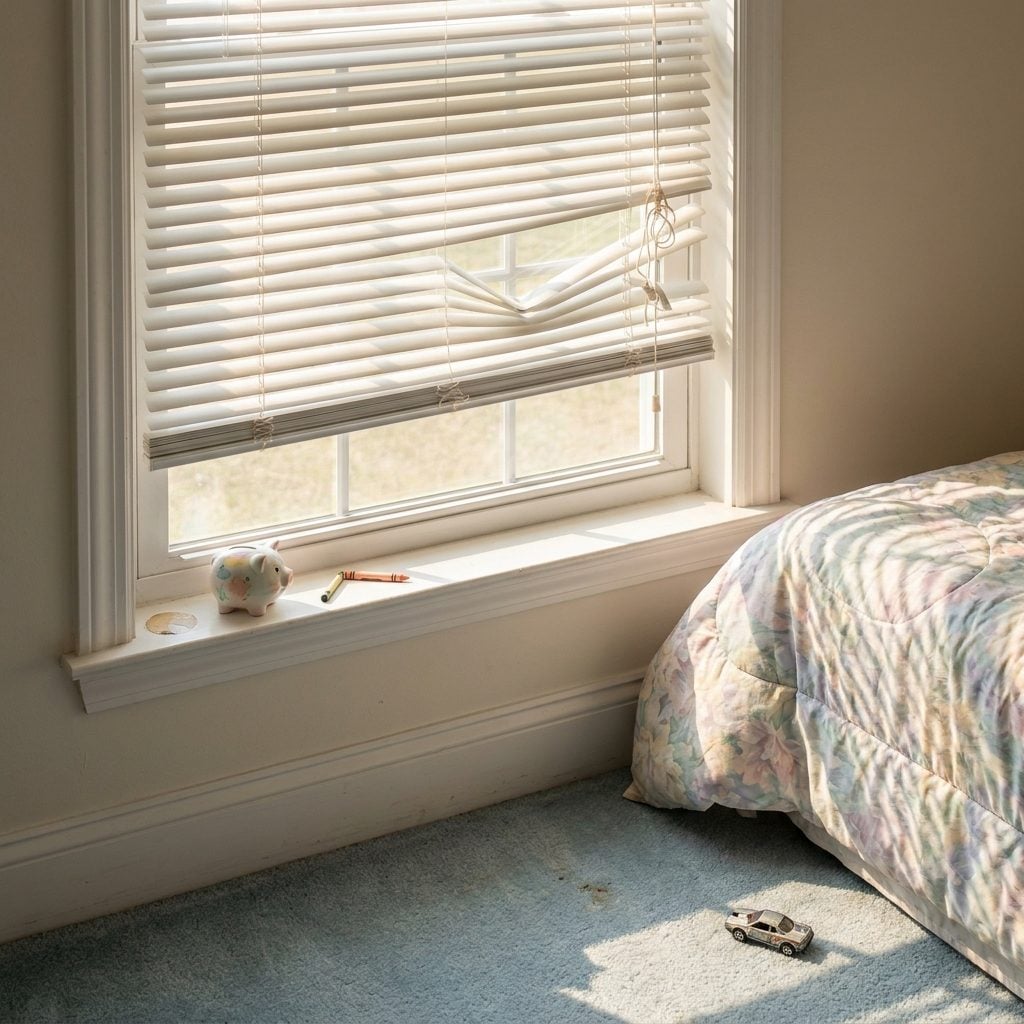
You were told, clearly and more than once, not to touch the mini blinds. The instruction lasted approximately forty-eight hours before someone, you, a sibling, a friend who came over and immediately did the thing, grabbed a slat to look outside and bent it into a permanent obtuse angle. From that day forward, every view out that window came with a small architectural interruption.
Vertical blinds were somehow worse. They clattered when the heat kicked on. They clattered when someone walked by. They clattered when absolutely nothing happened, in the middle of the night, for no reason. One slat was always missing, leaving a gap that let in a perfect shaft of early morning light directly onto your face at 6 a.m. on a Saturday.
Blinds have held on better than you might think: when we asked our readers what they have on their windows at home, curtains, shutters and blinds came out as a near three-way split.
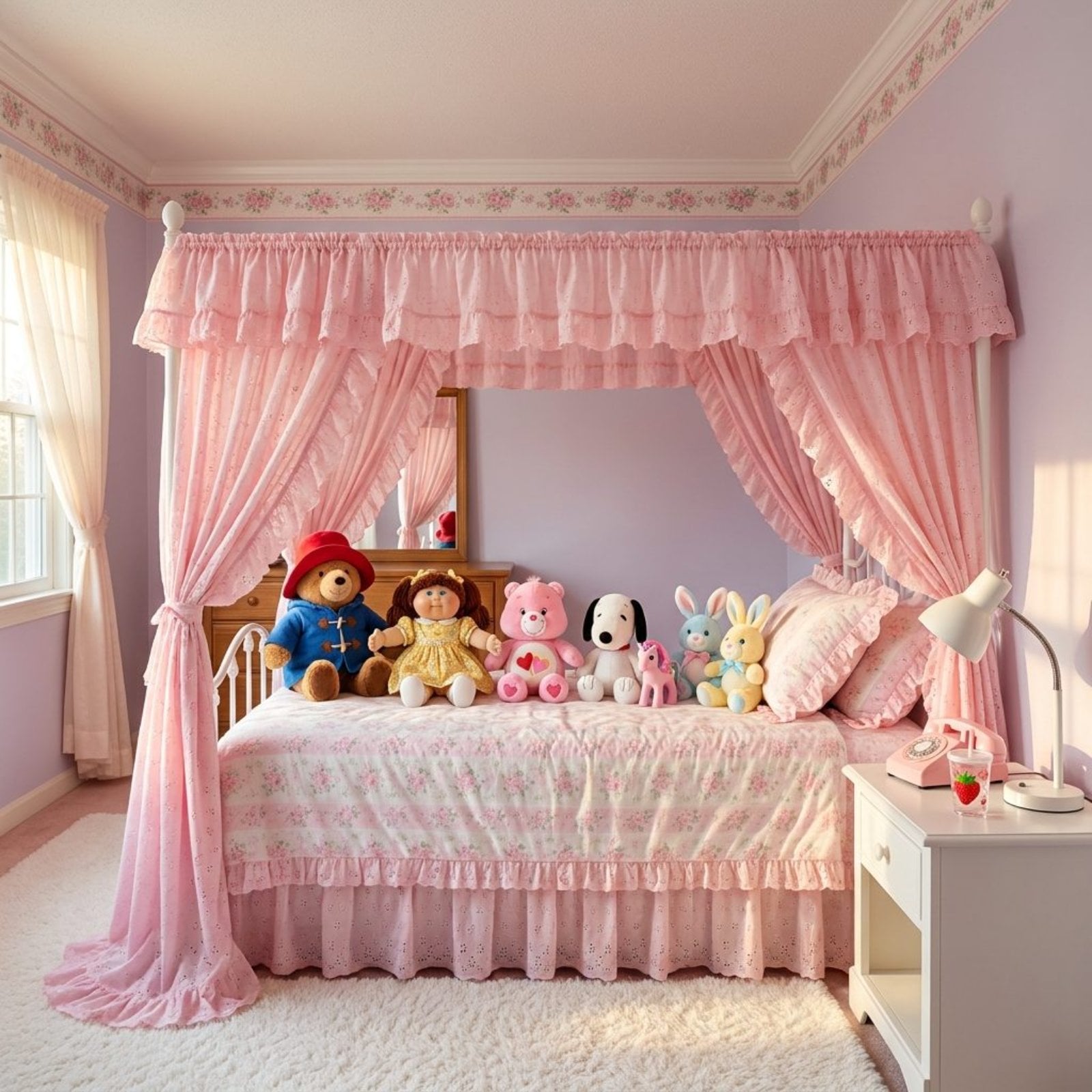
1. The Pastel Canopy Bed in Pink Eyelet Ruffles With Every Stuffed Animal Arranged in Perfect Formation at the Headboard
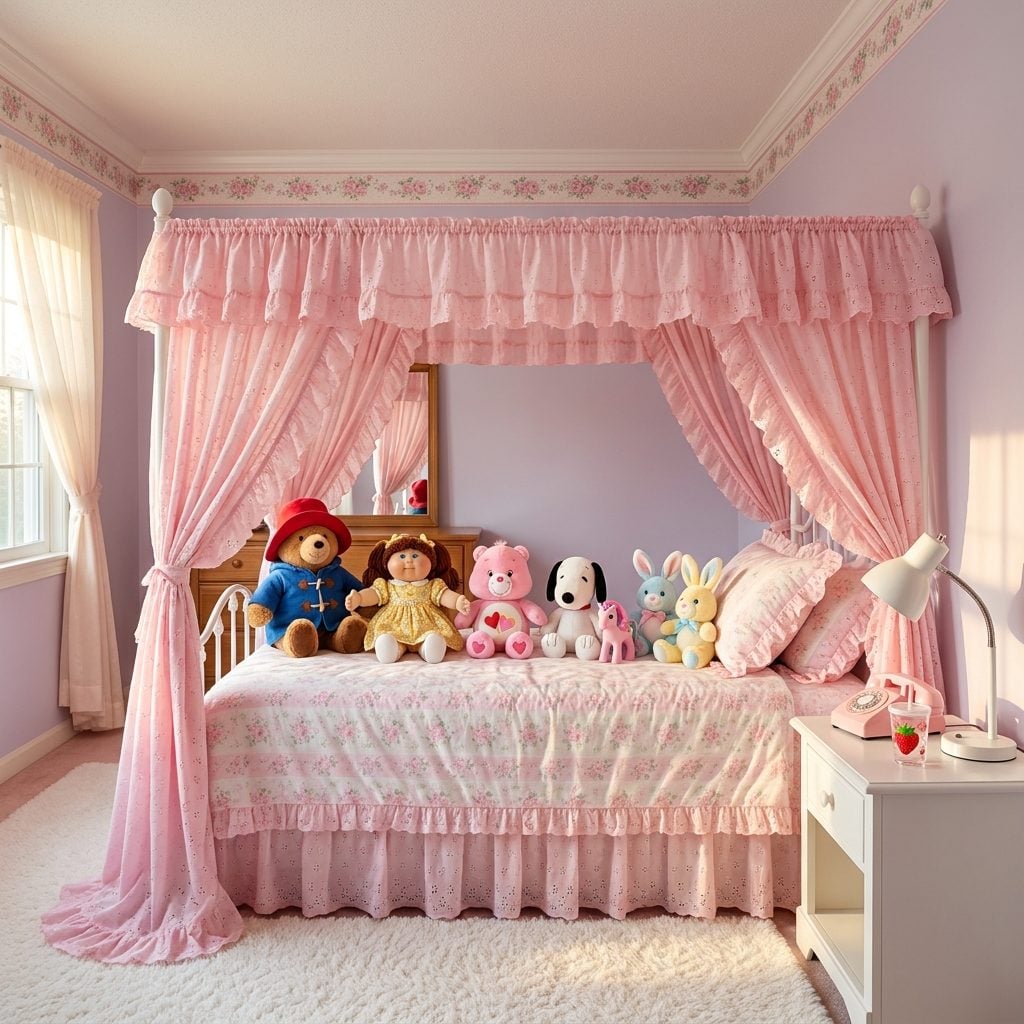
The stuffed animals were not decoration. They had assigned spots, established hierarchy, and political relationships that only the owner fully understood. The Cabbage Patch Kid with the yarn hair went on the left, always. The large Paddington Bear anchored the center. The smaller animals formed rows behind the pillows, faces forward, like a very soft and agreeable army waiting for inspection.
Making the bed meant restoring this arrangement exactly, and there was something almost ceremonial about it. The canopy itself was its own reward: that pink eyelet ruffled fabric overhead made a twin bed feel like a piece of serious furniture, like a piece of sitting room decor that happened to be in a child’s room.
If you had one of these beds, you understood, even at age eight, that you had something. The canopy was status. The ruffle was confidence. The stuffed animals were a civilization, and you were its architect.