🔥 Would you like to save this?
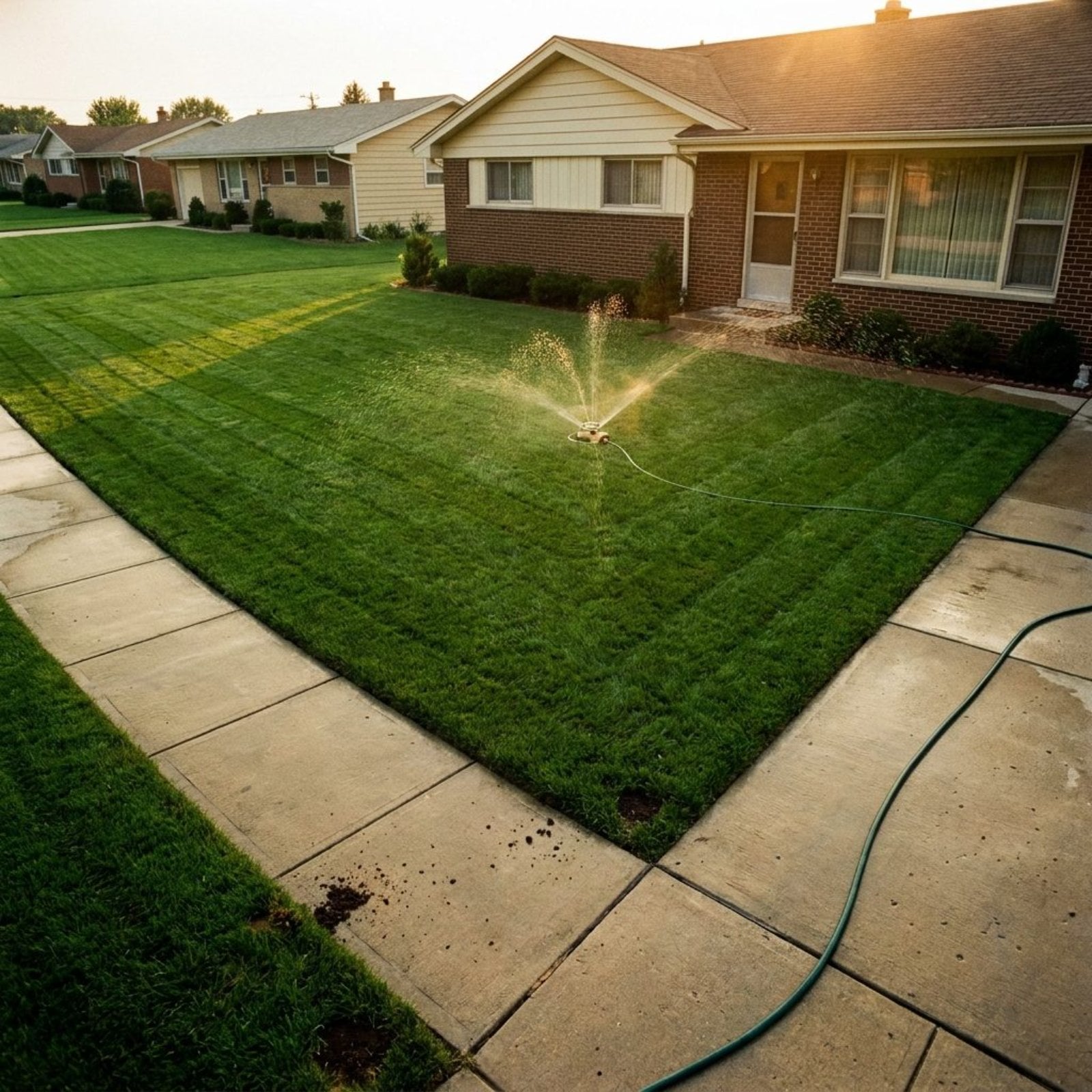
The sprinkler was always running a little too long, leaving that one patch of sidewalk permanently dark with water. Somewhere down the block, a screen door slapped shut. The air smelled like cut grass and hot concrete and whatever your neighbor was doing with that charcoal chimney. Every front yard on the street told you something about the family inside, and somehow, they all told you the same thing, too.
These are the details that made a 1970s front yard unmistakable. See how many you remember.
In order to come up with the very specific design ideas, we create most designs with the assistance of state-of-the-art AI interior design software. Also, assume links that take you off the site are affiliate links such as links to Amazon. this means we may earn a commission if you buy something.
35. The One Straight Concrete Walkway That Got You from the Driveway to the Front Door and Nowhere Else
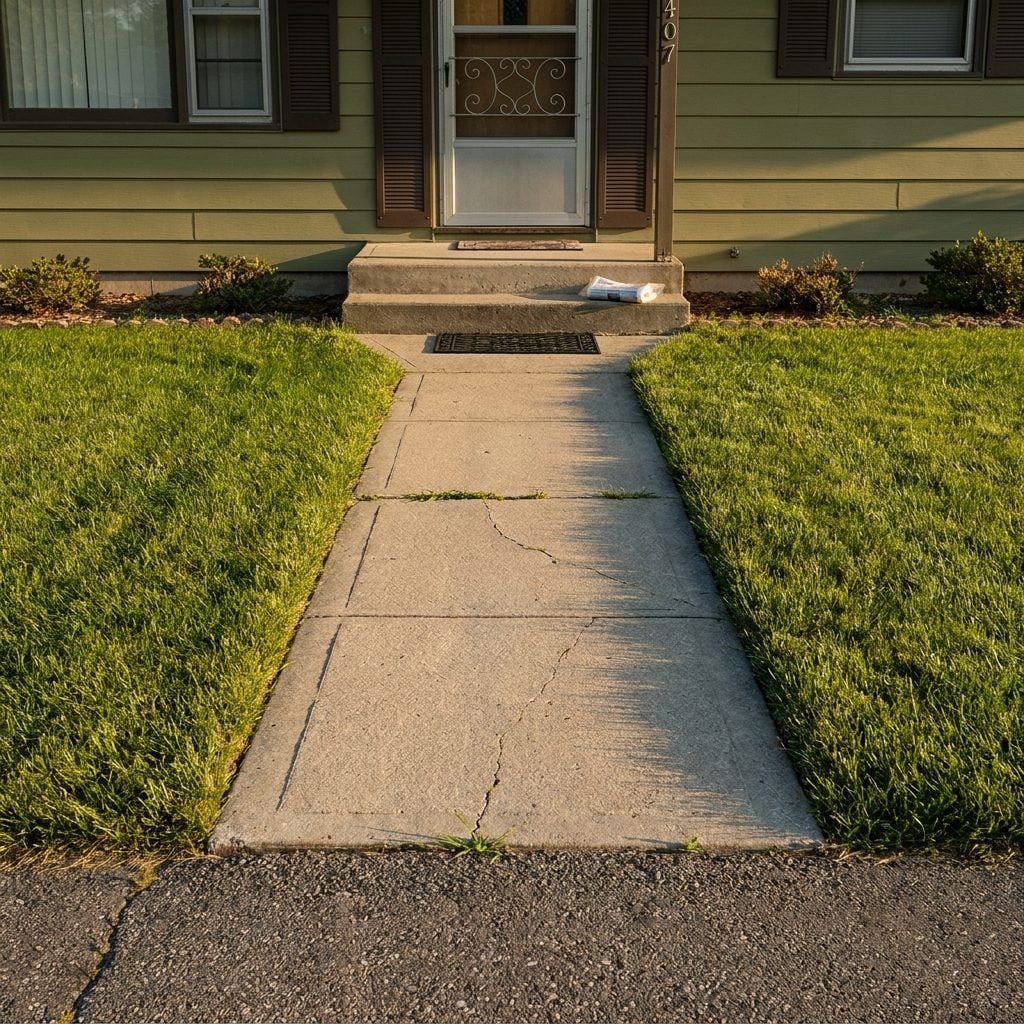
No curves, no flagstone, no artful meandering through a perennial garden. Just four feet of gray concrete, broom-finished and ruthlessly straight, connecting point A to point B like a sentence stripped of every adjective.
Every fourth slab had an expansion joint, and at least one of those joints had cracked anyway, sprouting a defiant tuft of crabgrass that nobody could quite kill. The walkway was poured when the house was built and never reconsidered. It did its job. You walked on it. End of arrangement.
34. The Narrow Asphalt Driveway with That Little Extra Parking Pad Nobody Could Quite Fit a Car On
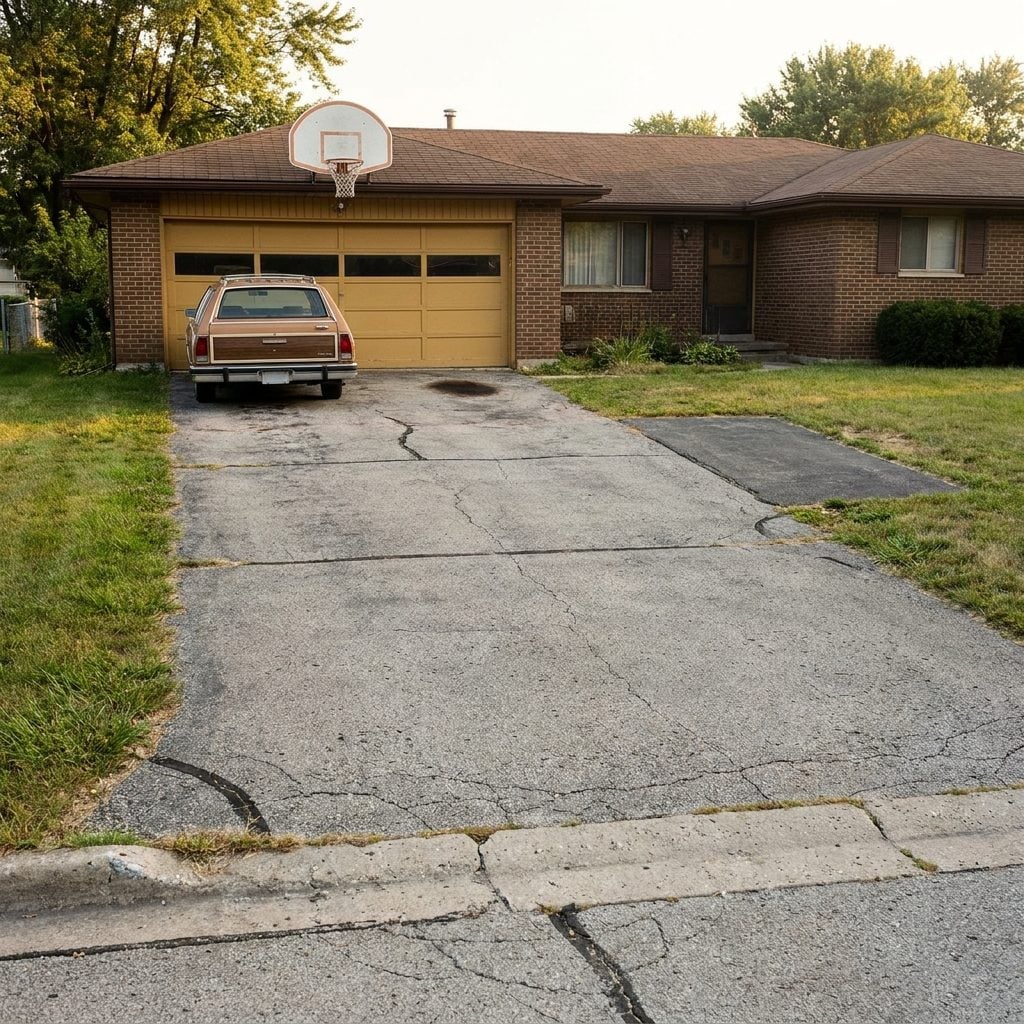
That parking pad. Every neighborhood had the same optimistic little rectangle of asphalt jutting off the main driveway, theoretically for a second car. In practice, it held a Big Wheel, a bag of rock salt, and the perpetual hope that company would figure out how to park there without rolling onto the grass.
The driveway itself was narrow enough that opening a car door required the spatial awareness of a parallel parker in Manhattan. Oil stains in front of the garage told the whole automotive history of every vehicle the family had ever owned, a geological record in petroleum. Nobody sealed their asphalt. Cracks kept spreading, tar patches kept multiplying, and the whole surface eventually looked like a road map of a very small, very broken country.
33. Those Clipped Yews and Junipers Hugging the Foundation Like They Were Afraid to Let Go
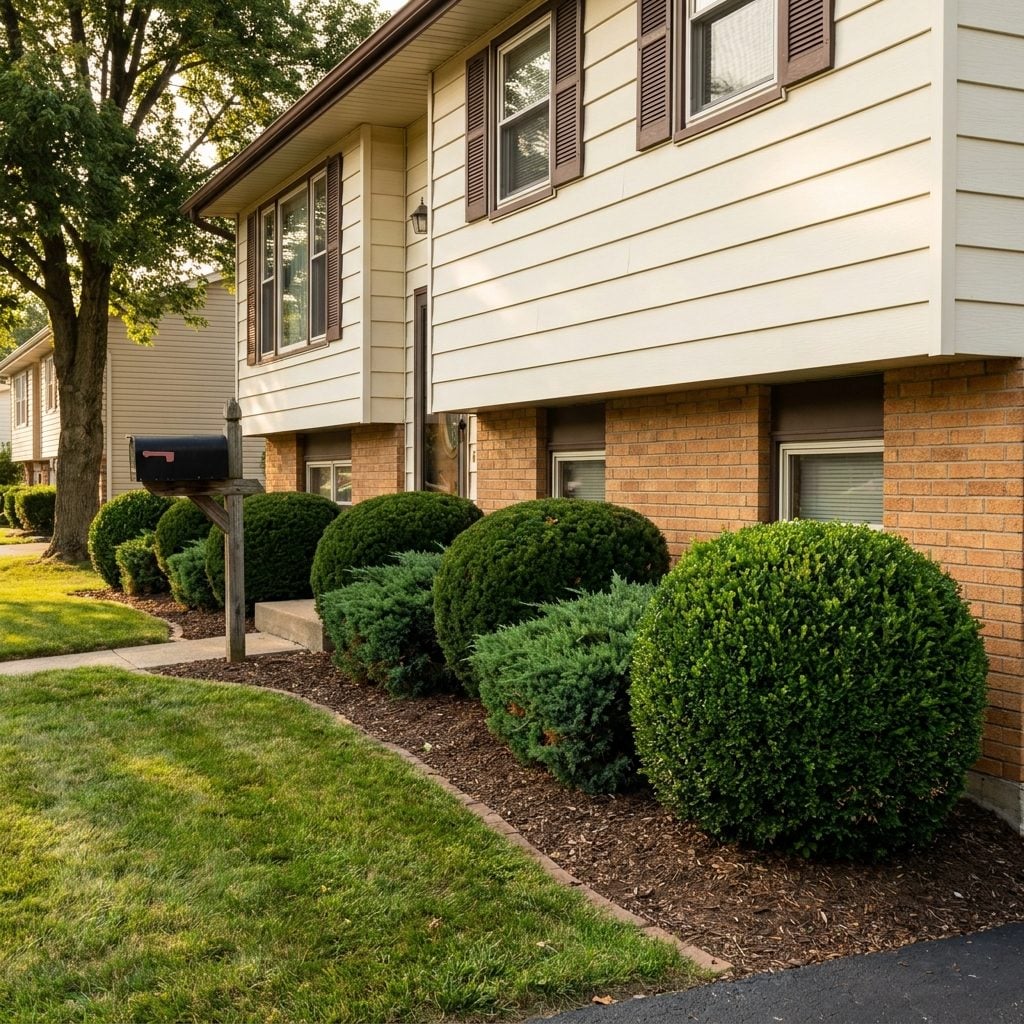
Every ranch house in America wore the same green belt of clipped evergreens around its midsection like a corset. Yews on the corners, junipers filling the gaps, maybe a boxwood or two if the homeowner was feeling ambitious. They hid the concrete foundation. Full stop, that was their sole reason for existing.
Dad attacked them with hedge shears twice a year, flattening the tops and squaring the sides until they looked like upholstered furniture. Nobody asked whether these plants were happy. Nobody wondered if the junipers were suffocating the basement windows. Neatness was everything, and neatness meant rectangles.
I’ll say this much: those yews were indestructible. Hack them to stumps and they’d come roaring back. Some of those original foundation plantings from the early seventies are still there, wider than the house now, swallowing the entire first floor like something out of a cautionary fairy tale.
32. The One Big Tree in the Center of the Yard That Made the Whole Property Feel Permanent
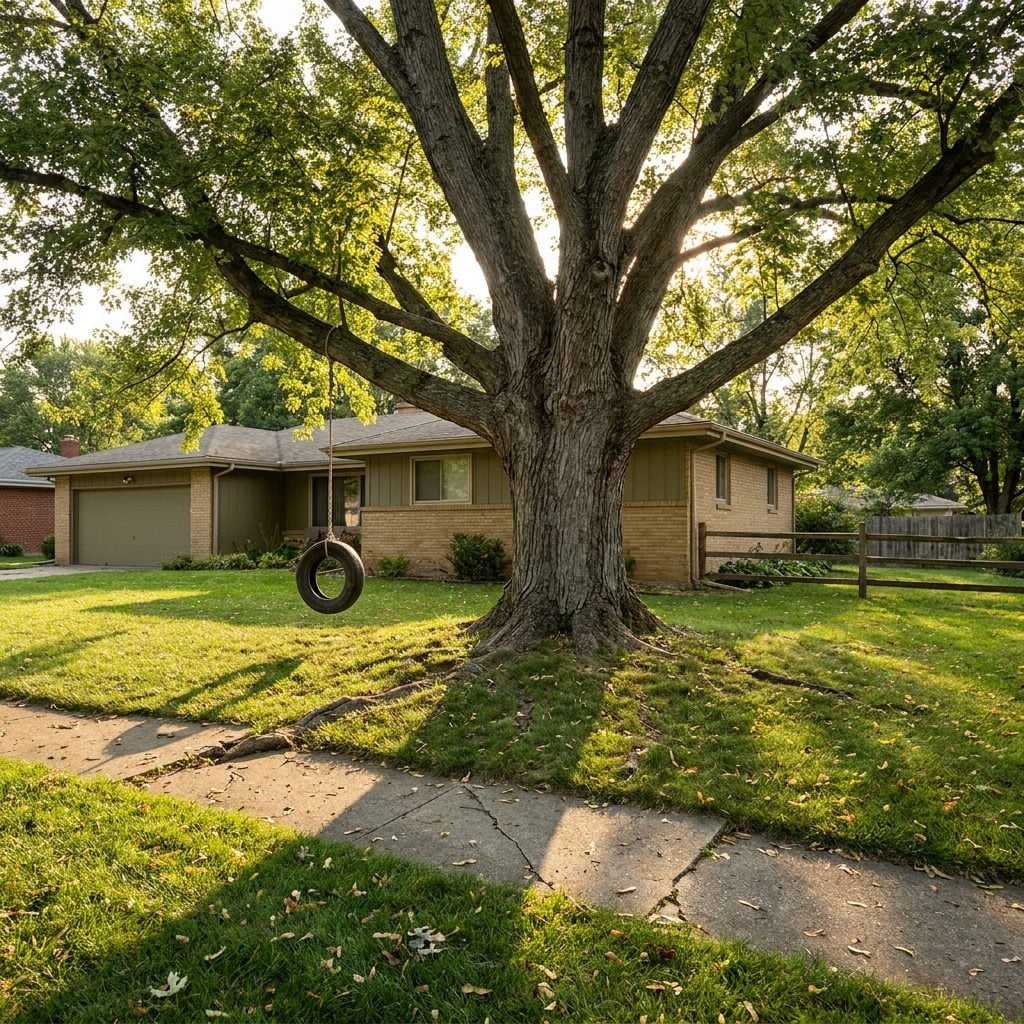
Already old when the family moved in. Silver maple, sugar maple, or, if someone’s mother had a romantic streak, a weeping cherry that wept pink petals onto the lawn every April. It anchored the yard the way a fireplace anchors a living room.
Silver maples were the most common and the most destructive. Roots that buckled sidewalks. Roots that invaded sewer lines. Helicopter seeds that clogged gutters by the thousands every fall. None of it mattered. The shade was worth everything. On a July afternoon the temperature under that canopy dropped dramatically, and everyone on the block knew which yards had the good trees and which didn’t. That knowledge carried a quiet social weight nobody acknowledged out loud.
31. Elm Trees Lining the Street in Rows, Some Already Losing the Battle with Dutch Elm Disease
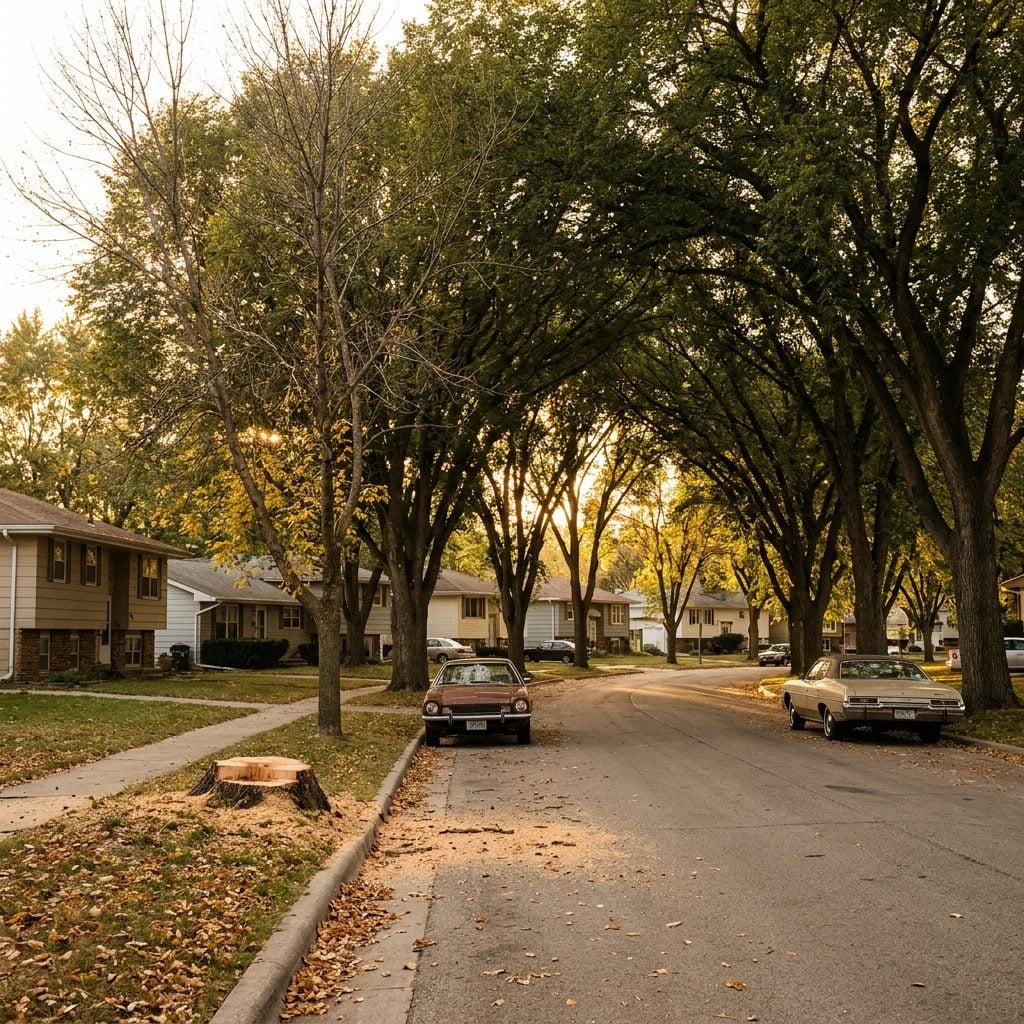
You could tell which streets had been planted with elms because the canopy turned the road into a green tunnel, branches arching from both sides, meeting in the middle like the vaulted ceiling of a church. Without exaggeration, one of the most beautiful things in American suburban life.
And then they started dying.
By the mid-seventies, Dutch elm disease had already ripped through whole neighborhoods. One tree with a yellow crown in June, dead branches by August, a stump by October. The city would come with a truck and a chainsaw, and suddenly there was a gap in the canopy like a knocked-out tooth. Light hit the street differently after that. Everyone noticed. Nobody quite had the words for what was gone.
30. Forsythia Bushes Exploding in Neon Yellow Like They Had Something to Prove

Nothing else was blooming yet. The lawn still half-brown, the trees still bare, and then this enormous bush went nuclear with yellow flowers, announcing spring with all the subtlety of a car alarm.
Every yard had one, usually at the property line, usually overgrown because who bothers to prune forsythia? It just did its thing: two weeks of ridiculous color, then green leaves for the rest of the year, then total invisibility until the following March when it screamed back to life all over again.
29. The Lilac Bush Along the Property Line That Made the Whole Block Smell Like Someone’s Grandmother
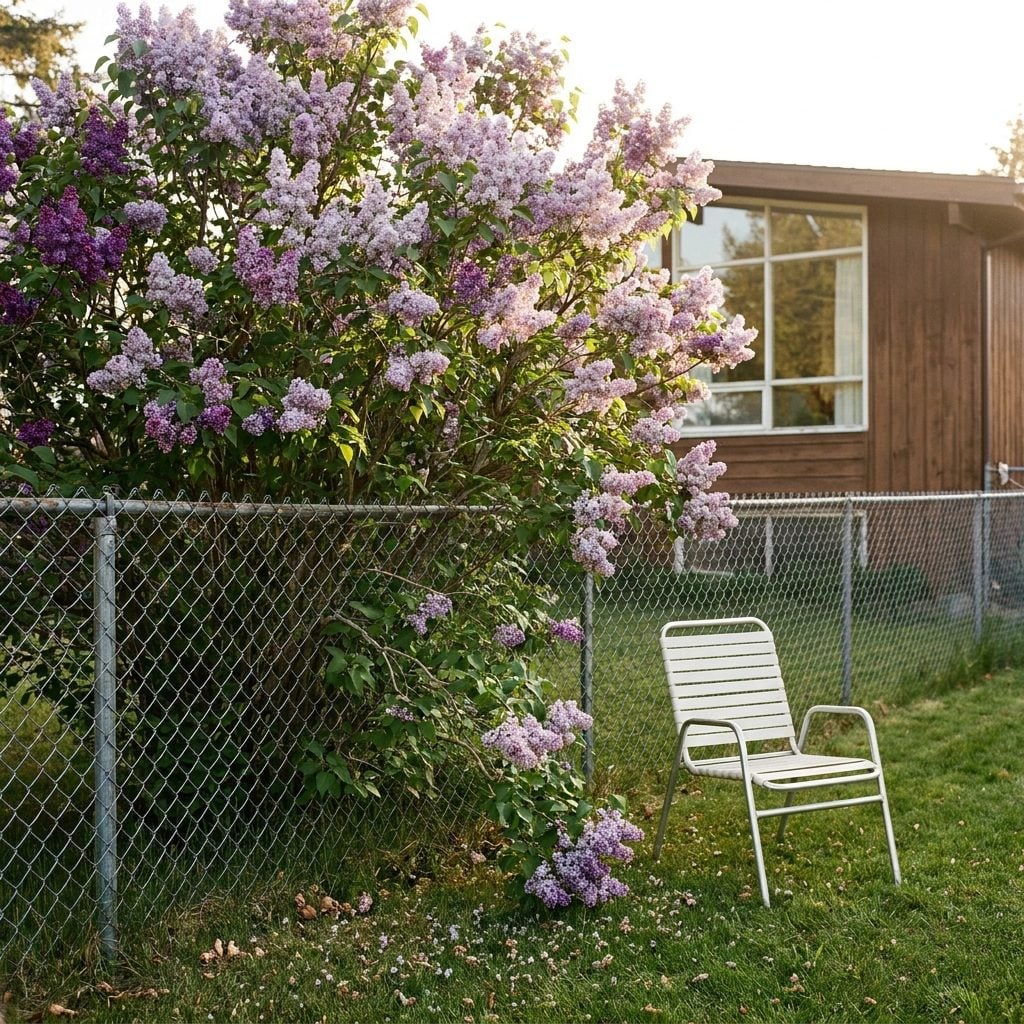
You smelled it before you saw it. That heavy, almost powdery sweetness drifting across the yard on a warm evening in late May, lilacs don’t politely suggest their presence. They saturate an entire neighborhood with perfume for about two weeks, and then they’re done, and you spend the next fifty weeks waiting.
Always along the fence line, which meant the fragrance belonged to both yards and neither. Cutting a few branches to bring inside was expected, practically a civic ritual. Grandmothers arranged them in mason jars on the kitchen table. The blooms wilted fast indoors, dropping purple petals across the counter, but nobody cared. That smell in the kitchen was worth every bit of the mess.
28. Rhododendrons and Azaleas Packed So Tight Against the House You Couldn’t Find the Foundation
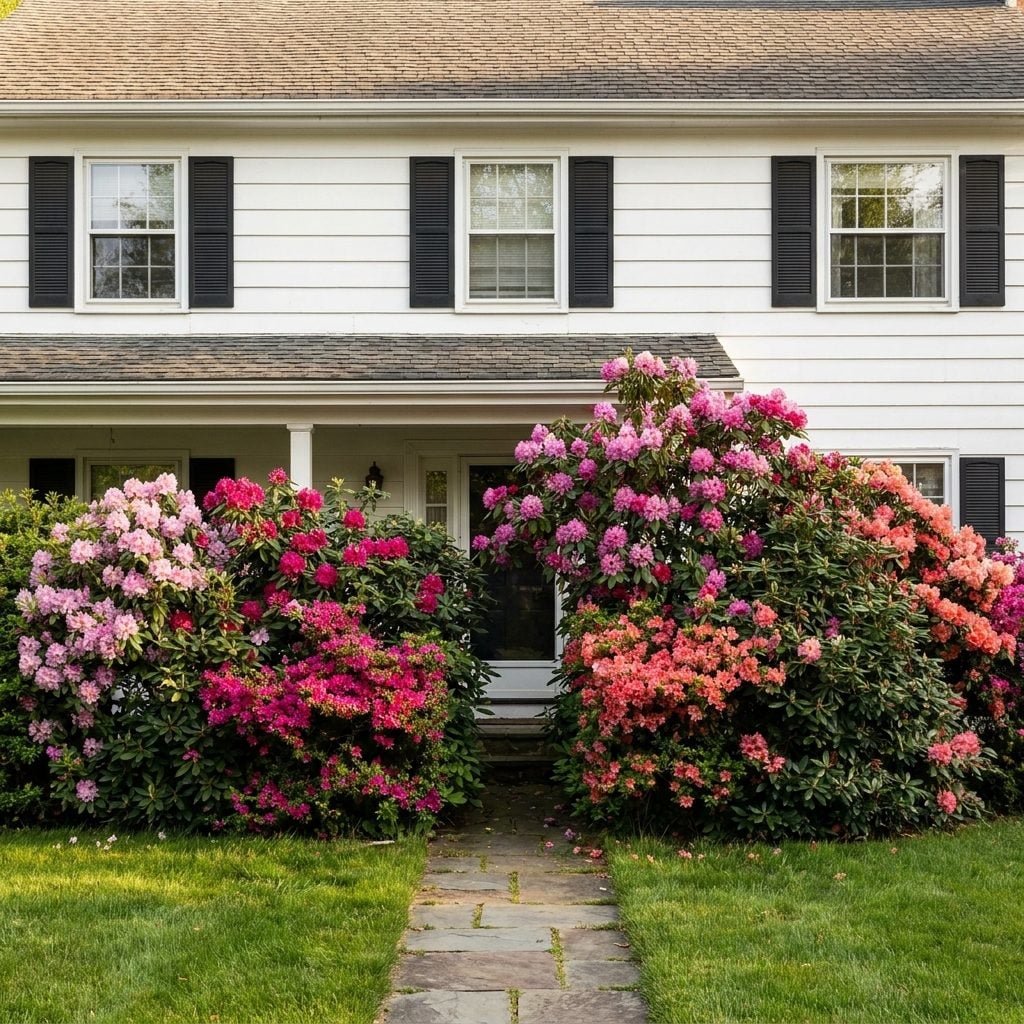
Rhododendrons started out as a polite foundation planting. Give them twenty years and they became the foundation. Those glossy-leaved monsters grew and grew until they blocked windows, consumed walkways, and created a dark, mulchy cave between the house wall and the hedge that hadn’t seen sunlight since the Nixon administration.
The azaleas were supposed to be the delicate cousins. They were not. They packed in just as tight, blooming in that specific shade of hot coral pink that seemed to exist only in the seventies, a color that matched nothing and clashed with everything and somehow looked fantastic anyway. Together, rhododendrons and azaleas turned the front of the house into something between an English country garden and a botanical siege. Pulling them out took a chainsaw and a truck.
27. The Circular Rose Bed in the Middle of the Lawn That Dad Swore He’d Maintain This Year
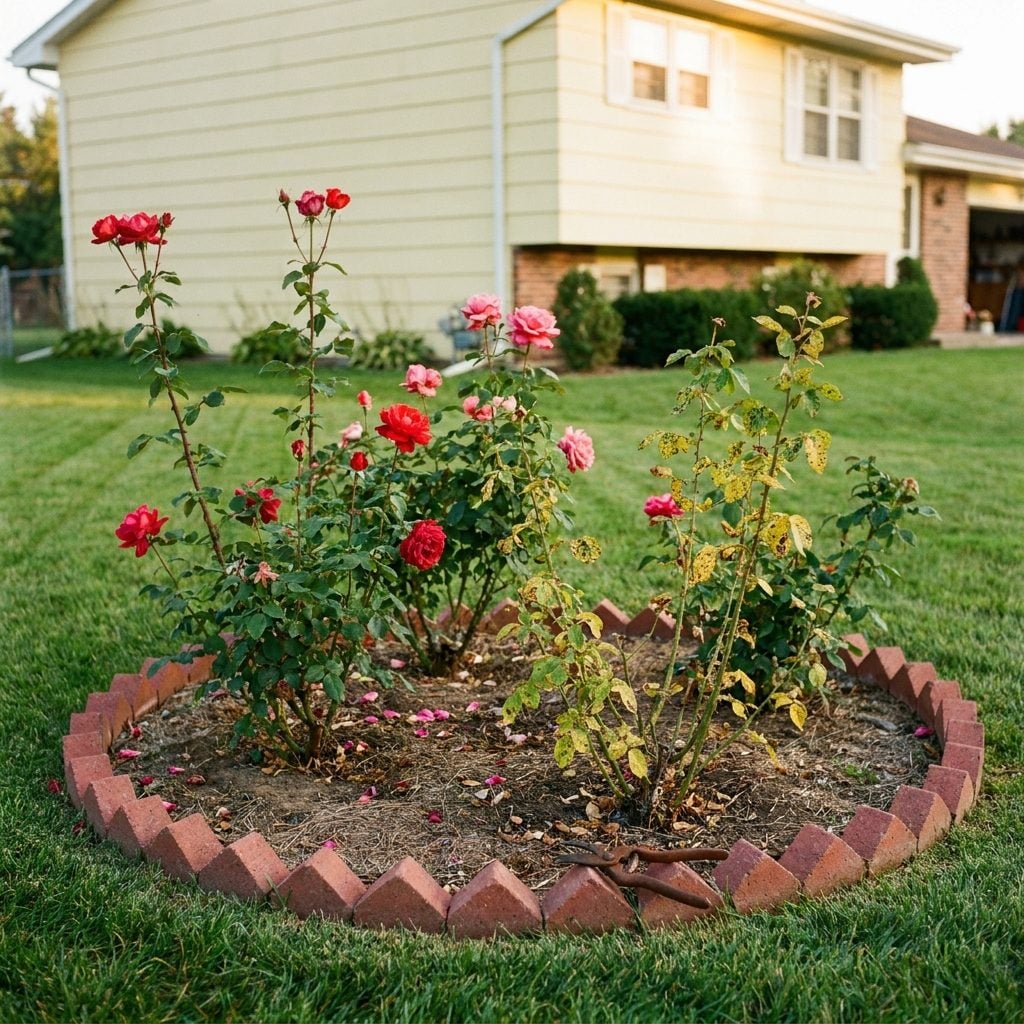
Hybrid tea roses were the most high-maintenance plants in the American front yard, and everyone kept planting them anyway.
The bed was always circular, always edged in bricks set at a jaunty angle, always placed in the middle of the lawn like a small monument to optimism. Inside that circle, six or seven rose bushes fought black spot, Japanese beetles, and aphids while the homeowner sprayed increasingly toxic chemicals at them with a pump sprayer from the hardware store. An arms race nobody could win.
Some dads genuinely loved their roses, pruned correctly, mulched, fed on schedule. Most started strong in April and surrendered by July. By August the bed looked abandoned: leggy canes, spent blooms turning brown, a ring of fallen petals on the mulch that nobody deadheaded. You’d walk past and think, “Well, there’s always next year.”
26. Marigolds and Petunias Lining Every Walkway in Matching Rows Like Tiny Soldiers
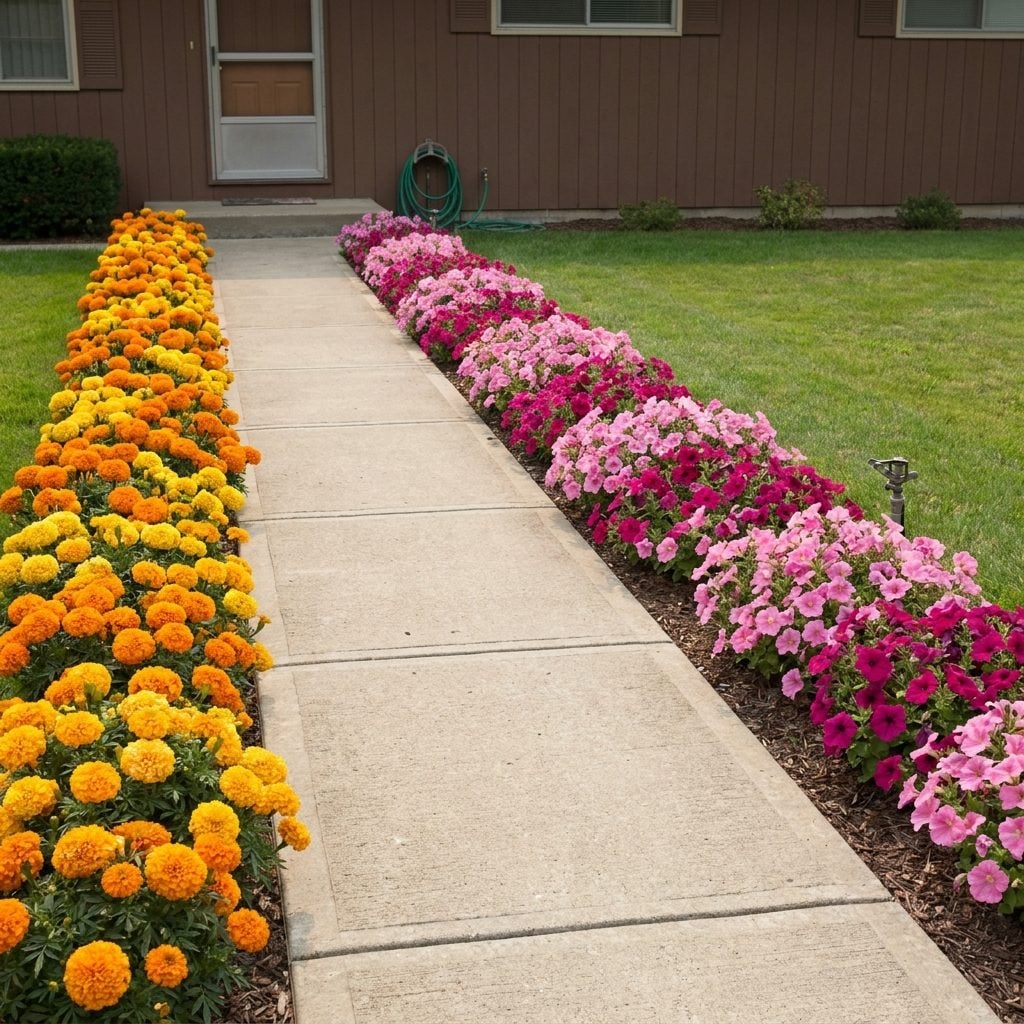
The Saturday morning trip to the garden center in May: one flat of marigolds, one flat of petunias, home by noon. That covered the annual planting plan for a staggering share of American front yards through the seventies and into the eighties.
Marigolds went on the sunny side. Petunias filled everywhere else. Both came in those flimsy plastic six-packs that disintegrated the second you tried to pop a plant out, a small engineering failure repeated millions of times every spring. Planting happened on your knees with a hand trowel, spacing each one about eight inches apart with the precision of someone who’d performed this exact ritual every Memorial Day weekend for a decade straight and could do it in their sleep.
Cheerful. Cheap. They asked almost nothing of you. And by October, the first frost turned them to black mush overnight, which was fine, everyone was ready to stop watering them by then anyway.
25. That Enormous Clump of Pampas Grass That Made Every Front Yard Look Like a Telenovela Set
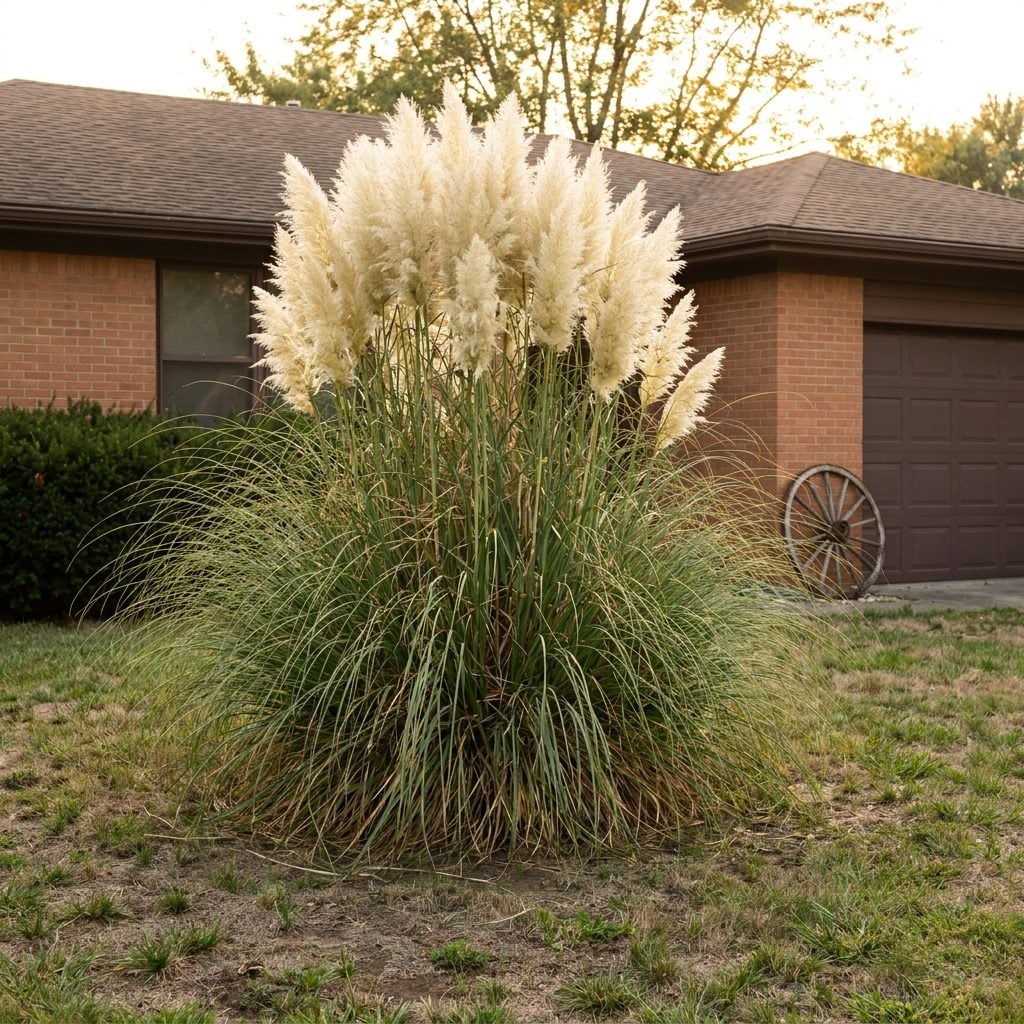
Where did people get the idea that a nine-foot ornamental grass from South America belonged in a suburban front yard in Ohio? Wherever the impulse came from, it spread through the seventies like a fever, one house on the block would plant a clump, and within two years, three more followed.
Pampas grass looked gorgeous for maybe four months, when those massive white plumes caught the light and swayed in the breeze like something lifted from a nature documentary. The rest of the year? Giant dead bird’s nest. And the blades were razor-sharp, they could genuinely draw blood, which your kids would discover roughly thirty seconds after you told them not to touch it. Removing an established clump required a mattock, a truck, and language inappropriate for the front yard.
But in September, when the plumes were fresh and the light was gold, you could almost, almost, see why everyone planted it.
24. White River Rock and Red Lava Rock: The Mulch Nobody Had to Replace
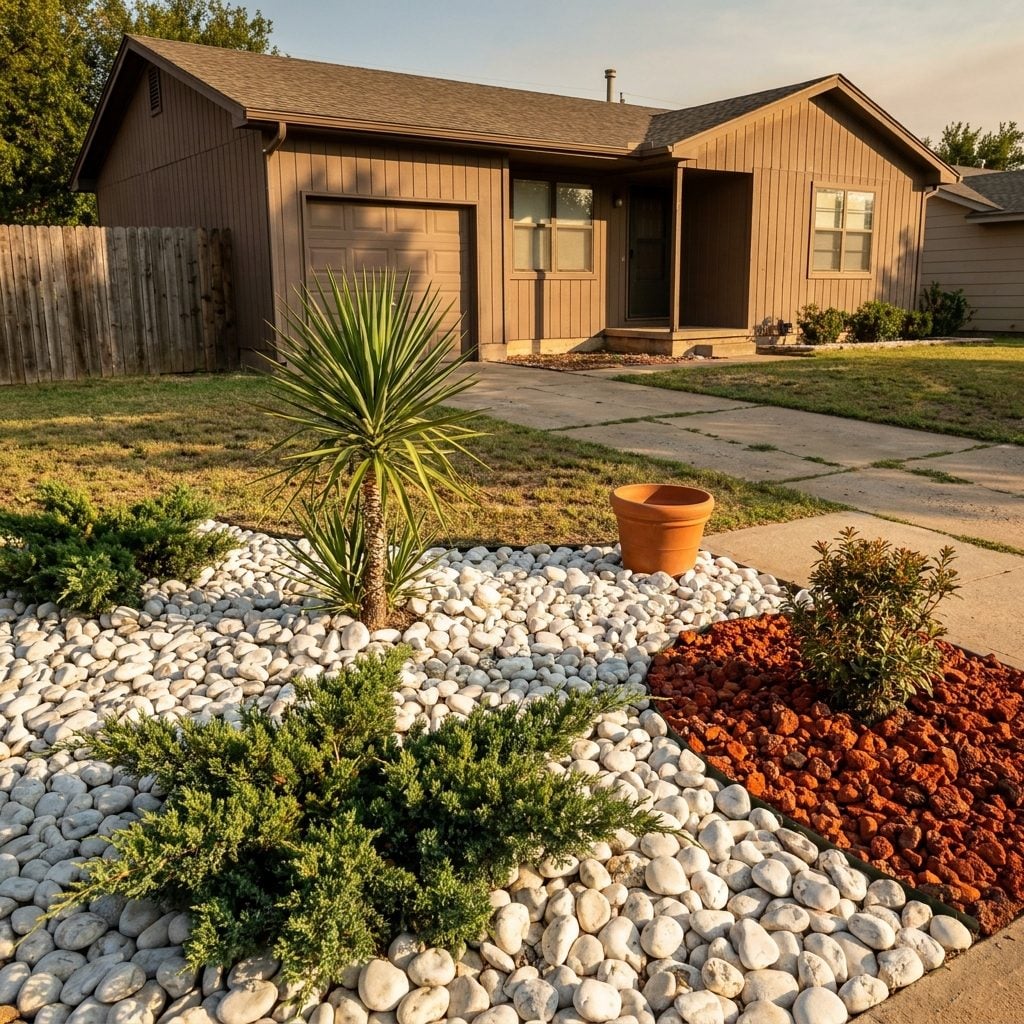
The crunch underfoot was unmistakable, you could hear someone walking through a lava rock bed from inside the house with the windows shut tight. Every subdivision built between the late sixties and the end of the seventies seemed to have at least three homes per block where someone tore out the pachysandra and dumped bags of white river rock or that porous red lava stone around their foundation plantings.
The appeal was obvious: no weeding, no replacing, no watering. Reality disappointed. Leaves collected between the stones and rotted there, lava rock turned chalky and gray after a couple of seasons in the sun, and kids threw the white rocks at each other because of course they did. But for about two solid years after installation, those beds looked sharp, modern, and completely hands-off.
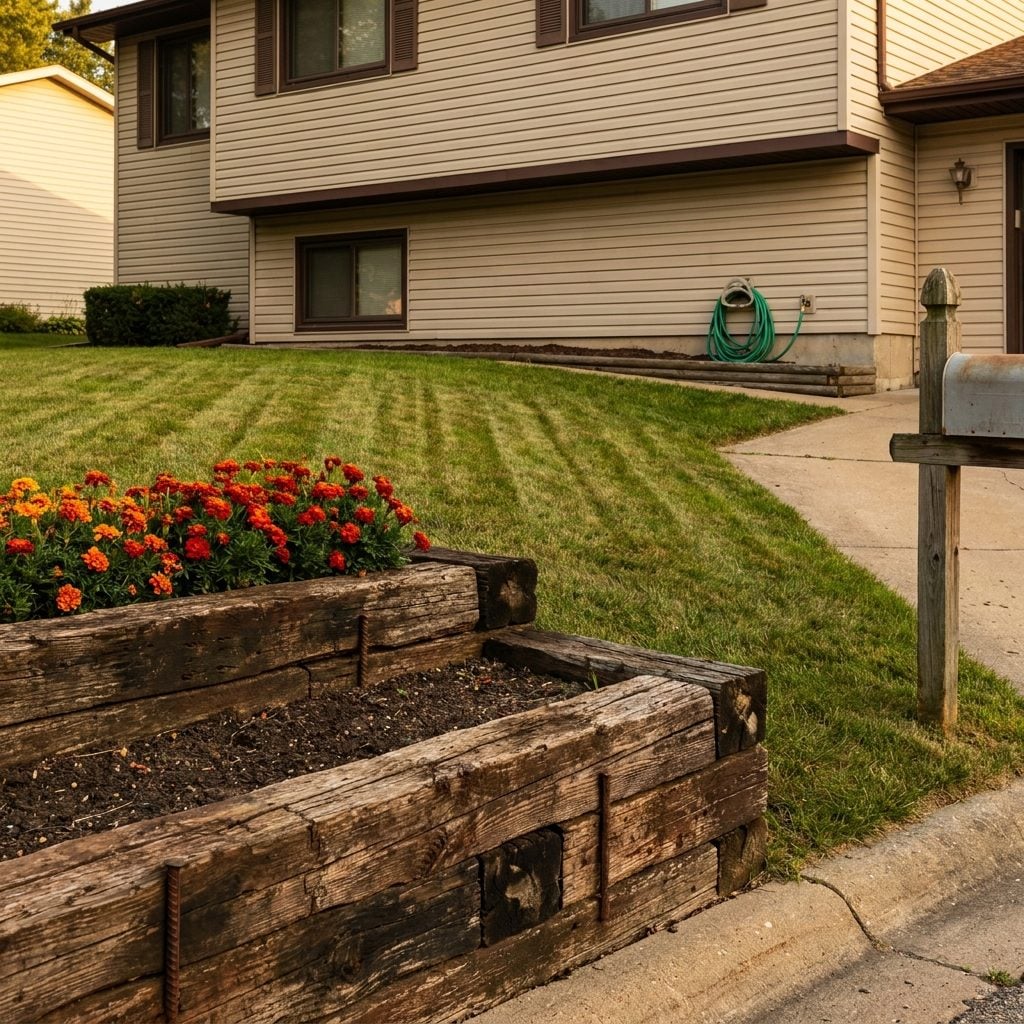
23. Railroad Ties Stacked Like Lincoln Logs for Every Retaining Wall in the Neighborhood
🔥 Would you like to save this?
About 200 pounds each and smelling like a hot parking lot in July. Railroad ties were the default material for anyone with a sloped front yard who wanted terraced beds without hiring a mason. Dads across America spent entire weekends drilling through creosote-soaked timbers with rebar and a sledgehammer, swearing under their breath while kids watched from the driveway.
The result always looked the same: dark, chunky walls with that industrial roughness, softened by whatever got planted behind them. Usually marigolds. The ties lasted decades, though they split and warped and occasionally oozed black tar on hot afternoons. Nobody worried about creosote toxicity back then. We just knew they smelled strong and you didn’t sit on them wearing shorts.
22. That Scalloped Concrete Edging That Made Every Flower Bed Look Like a Birthday Cake
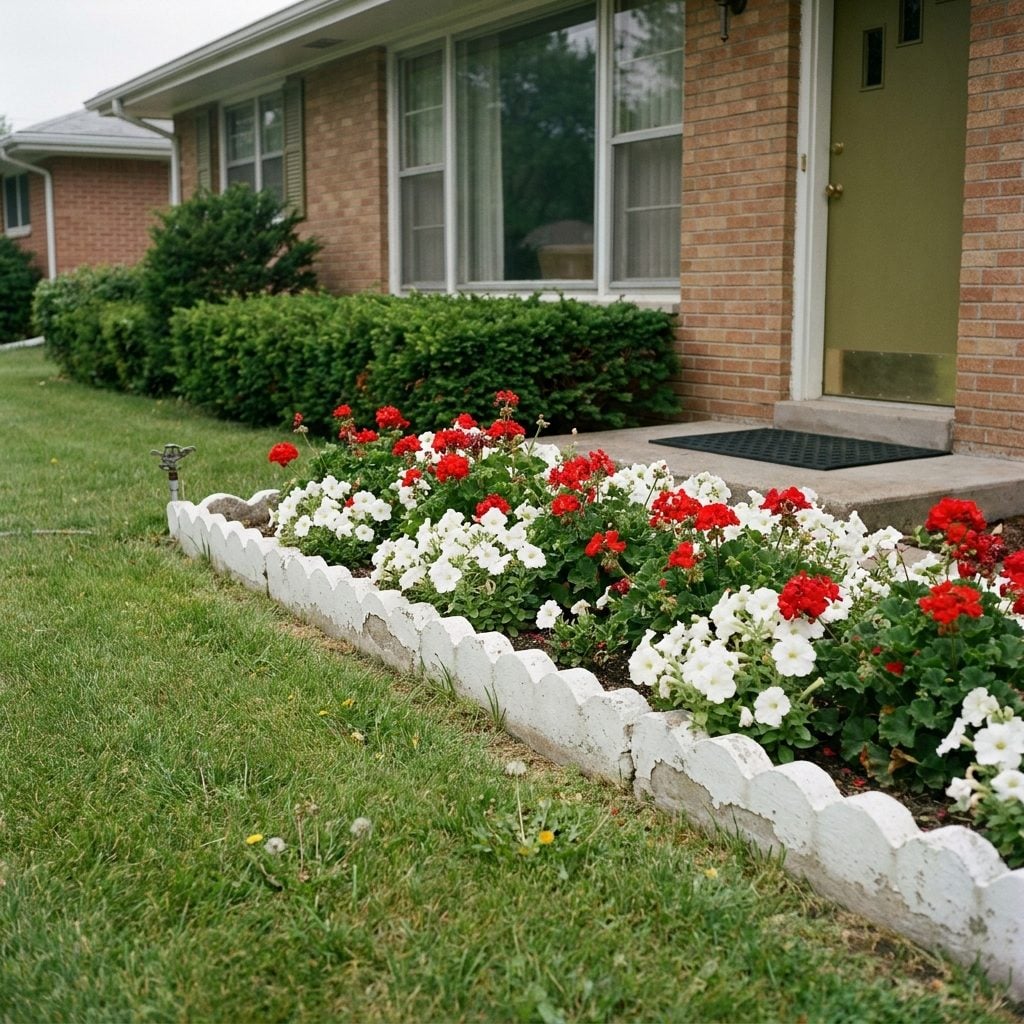
Twelve inches wide, maybe six inches tall, with those little half-moon curves along the top. Scalloped concrete edging was sold by the piece at hardware stores, and people lined their beds with it like they were decorating a cake with a piping bag.
Red brick edging was the slightly classier cousin, set at a 45-degree angle into the soil so the corners poked up in a sawtooth pattern. Both served the same purpose: a hard line between lawn and garden that the mower could ride along without scalping the petunias. The concrete ones always ended up chipped and tilted after a few winters of frost heave. Nobody fixed them. They just leaned there, year after year, doing their best.
21. The Wagon Wheel Leaned Against Something, Doing Absolutely Nothing
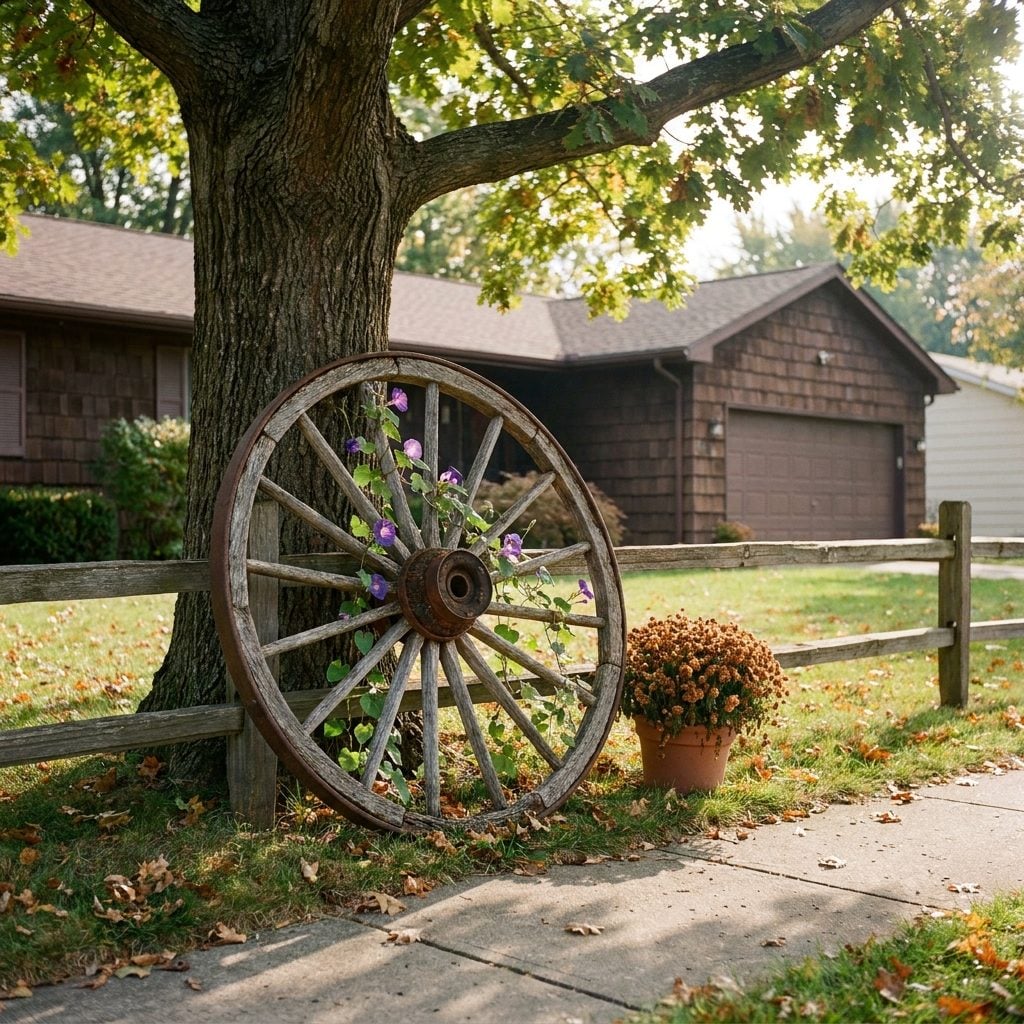
Where did they all come from? Nobody in the suburbs owned a covered wagon. Yet somehow, every third house had a full-sized wooden wagon wheel propped against a tree or fence post like it was waiting for the Bonanza crew to swing by and collect it.
Some people planted morning glories through the spokes. Others just left the wheel there, slowly graying in the weather, a piece of frontier cosplay that communicated “we appreciate the rugged American West” from the safety of a cul-de-sac in Ohio. I’ll admit there was something about them. Leaned at just the right angle against a big oak, they had a kind of accidental charm that nobody could quite explain or defend with a straight face.
20. Whiskey Barrel Planters Standing Guard on Either Side of the Front Door

Half a whiskey barrel, sawed clean across the middle, filled with potting soil and whatever the garden center was pushing that spring. Geraniums. Always geraniums.
These showed up in pairs, one on each side of the front walkway or flanking the door like sentries. The oak whiskey barrel planters aged well for a while, the wood darkening and the metal bands developing that rust patina everyone now pays extra for. Then the bottoms rotted out. Water pooled underneath and stained the concrete. But for those first few seasons, a matched set of barrel planters overflowing with red and white flowers against a brown front door communicated a specific kind of domestic pride that nothing from a catalog could replicate.
19. Painted Tire Planters: Proof That We’d Recycle Anything If We Could Paint It White
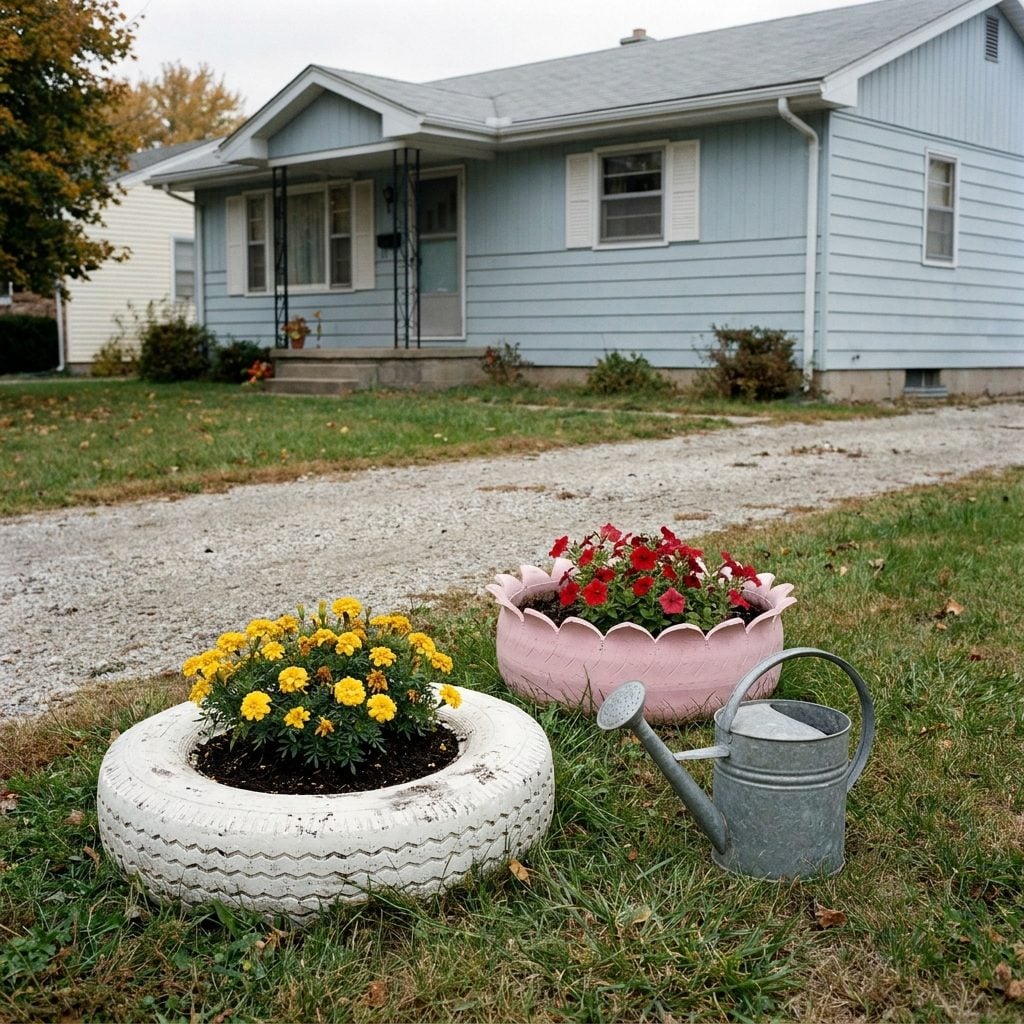
Somebody with a sharp knife and a can of Rust-Oleum started this, and it spread through working-class neighborhoods like dandelion seeds. Old car tires, painted white or some hopeful pastel, filled with soil and planted with whatever was cheap at the five-and-dime.
The ambitious version involved cutting the tire sidewall into a zigzag pattern, then wrestling the rubber inside-out to create a scalloped bowl. This required the grip strength of a longshoreman and a vocabulary your kids weren’t supposed to hear. The result looked like a giant rubber tulip. Nobody thought it was strange, it was just what you did with old tires instead of paying the dump fee.
18. The Concrete Birdbath That No Bird Ever Actually Used
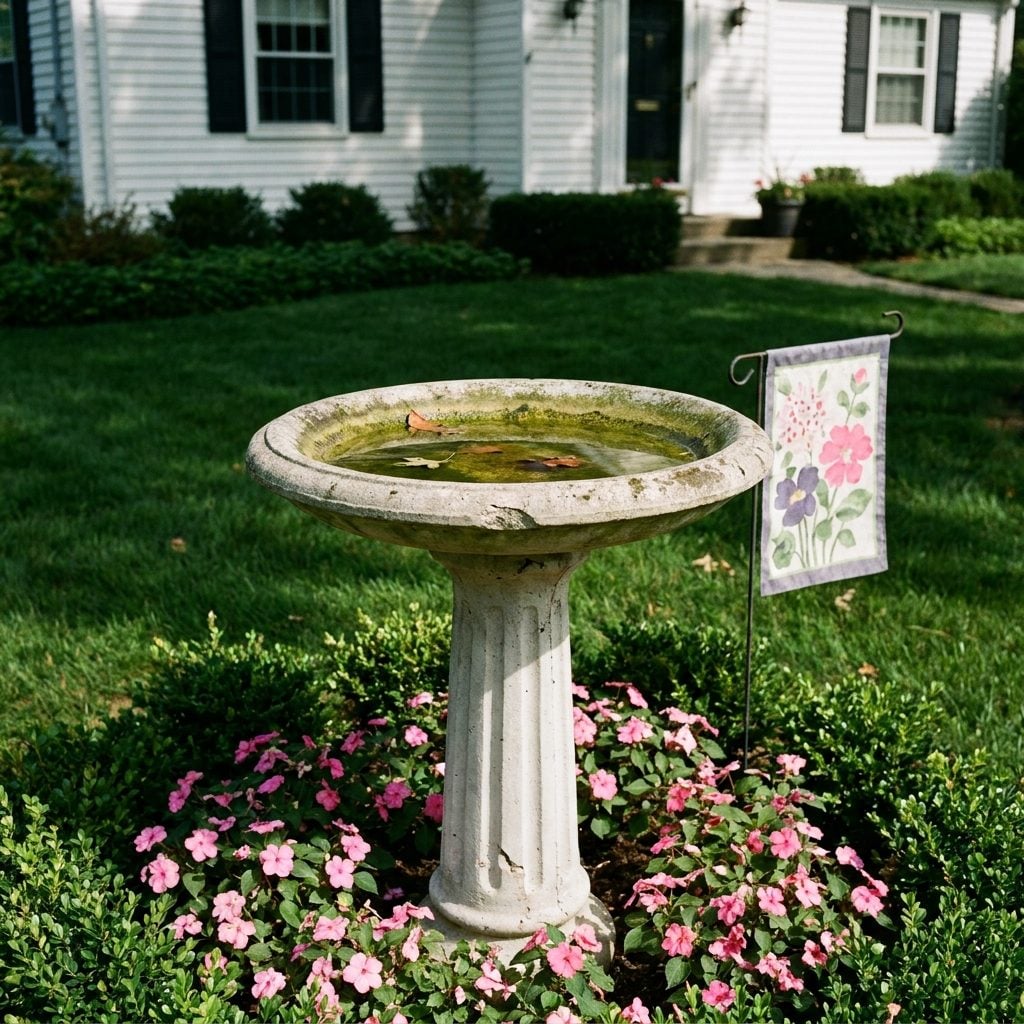
Stagnant water, a film of green algae, two decomposing maple leaves. That was the state of every concrete birdbath from May through October.
They came in one shape: fluted pedestal, shallow bowl, maybe a decorative shell pattern around the rim. Garden centers sold them right next to the bag fertilizer, and they weighed about as much as a small engine block, which meant once you placed one, it lived there forever. Moving it was a two-person job nobody volunteered for. The birds, for their part, preferred the puddle in the driveway. But the birdbath stayed, a lawn sculpture pretending to be wildlife infrastructure, slowly developing a patina that looked vaguely Roman if you squinted.
17. Lawn Statues of Deer, Gnomes, and That Jockey Figure Everyone Pretended Was Just Decorative
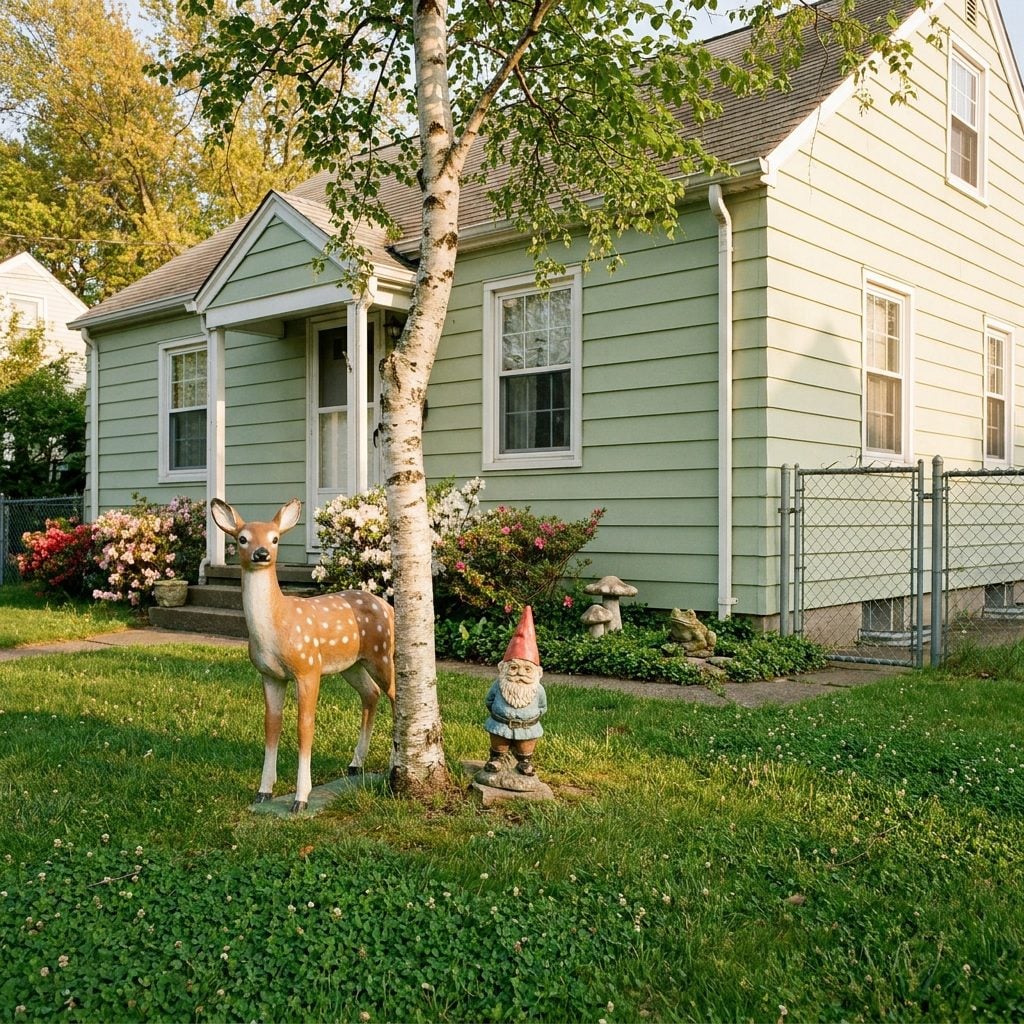
Every neighborhood had a house. You know the one, the yard with the concrete deer family frozen mid-graze under the dogwood, flanked by a gnome village and maybe a gazing ball for good measure.
These weren’t ironic. Nobody was being kitschy on purpose. A concrete fawn cost a few dollars at the garden center, and placing it near the azaleas gave the front yard a sense of life, of story, of personality that a flat lawn alone couldn’t manage. Some folks went subtle with a single rabbit. Others went full woodland diorama. Paint faded. Noses chipped off. But the deer stayed, watching the street with blank eyes through every season, unbothered.
16. Wrought Iron Handrails With Scrollwork That Made Three Front Steps Feel Grand
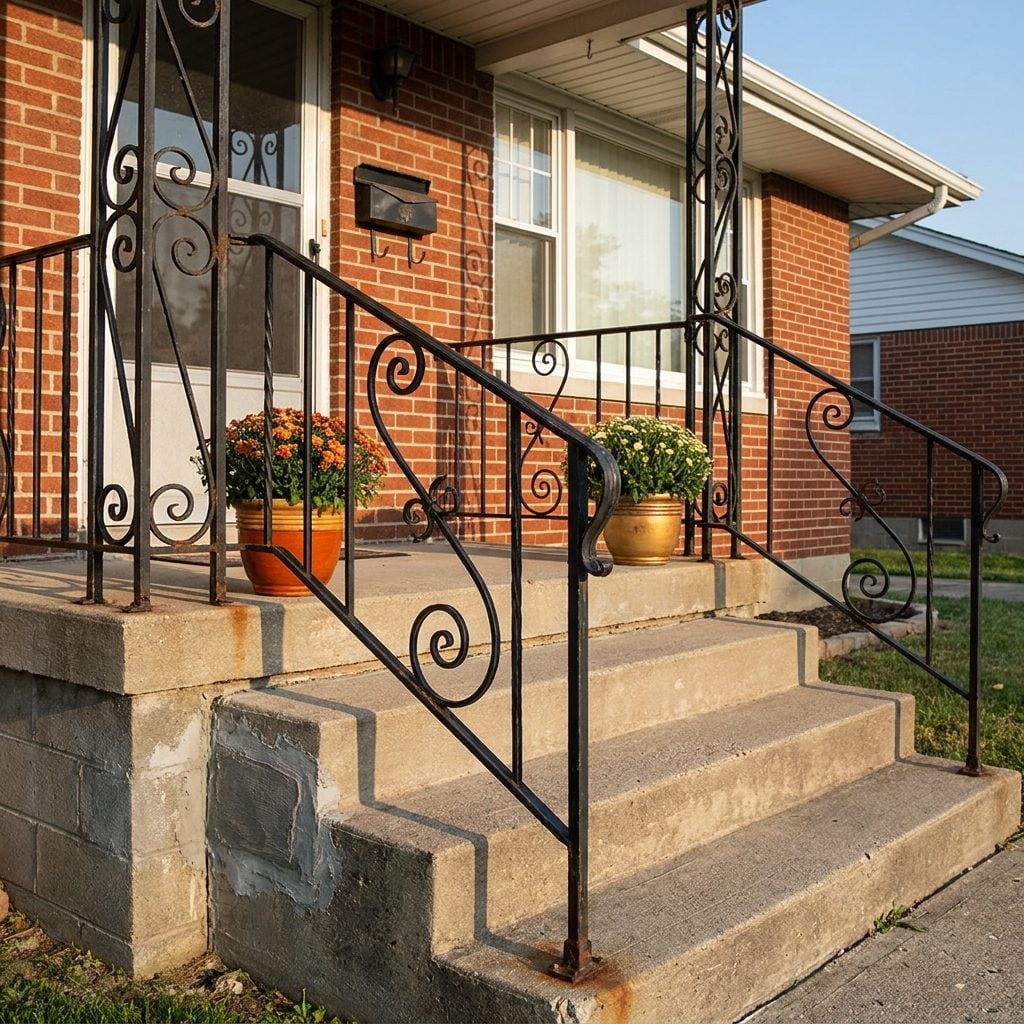
Three steps. That’s all. Three concrete steps from the walkway to the front door. But someone decided those three steps needed a wrought iron handrail with scrollwork like the entrance to a Parisian hotel, and honestly? It worked.
The scrolls were always the same: tight spirals at the top, maybe an S-curve near the bottom, painted black and bolted into the concrete with expanding anchors. You grabbed the rail on icy mornings and it bit your palm with cold. Summer evenings, you leaned against it talking to neighbors. Rust showed up first at the bolt holes, then crept along the bottom rail, and a coat of Rust-Oleum every few years kept it presentable. Those rails gave a modest ranch house a sense of permanence that vinyl siding never could.
15. The Aluminum Screen Door That Announced Every Arrival With a Satisfying Slam
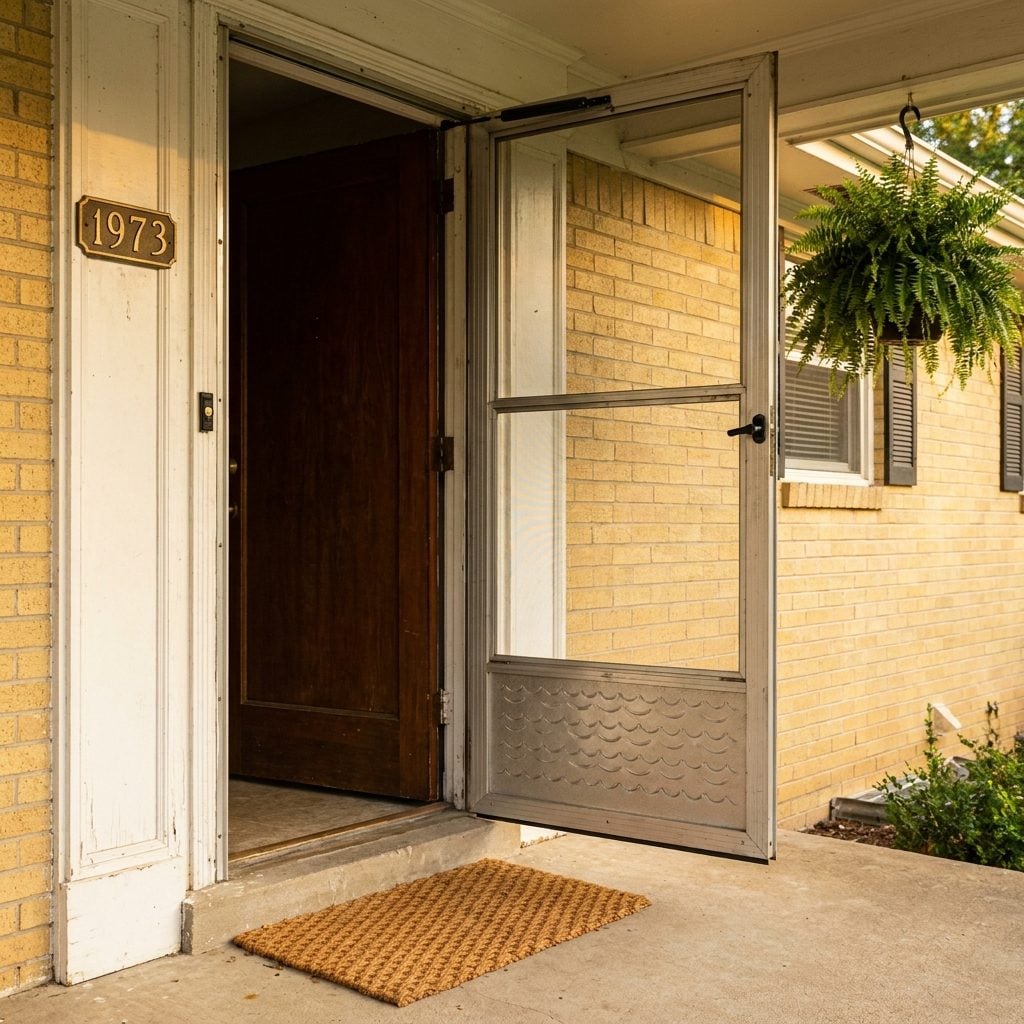
BANG. That’s how you knew someone was home. The pneumatic closer was either broken, too weak, or deliberately ignored, so the door slapped shut with a metallic crack that echoed down the block. Every kid who grew up in the seventies can hear it right now.
The doors themselves were simple, aluminum frames with interchangeable screen and glass panels you swapped out by season. Many had a decorative aluminum kick plate at the bottom, stamped with a starburst or scrollwork pattern to protect the mesh from shoes and dogs. The push-button latch never quite caught on the first try. You’d pull, push, jiggle, then yank. But that slam when it finally closed? That was the sound of arriving somewhere familiar.
14. Decorative Shutters Bolted to the Wall, Incapable of Shutting Anything
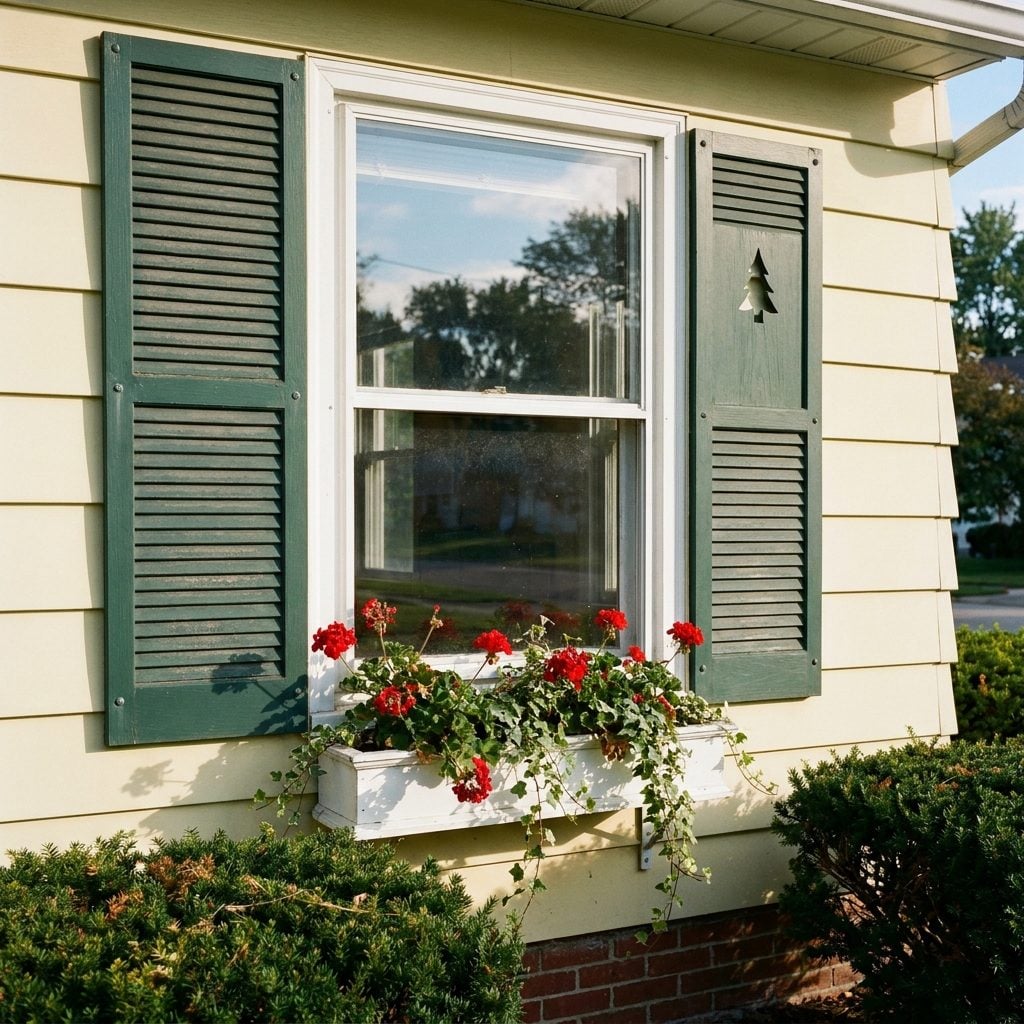
Look at them. Really look. Fourteen inches wide on a window that’s thirty-six inches across. If a hurricane came, these shutters would protect roughly one-third of the glass and nothing else. They were never meant to close, most of them couldn’t, screwed directly into the siding with no hinges at all.
And yet they were on every house, every subdivision, coast to coast. Black, dark green, or barn red, with either louvered slats or a raised panel and maybe a decorative cutout: a pine tree, a crescent moon, an anchor if you lived near water. They broke up the flat expanse of siding and gave each window a frame, a sense of proportion. Pure decoration. Totally fake. But absolutely essential to how a 1970s house read as a house instead of a box with holes punched in it.
13. The Carriage Lamp Post at the End of the Walkway, Glowing Like a Tiny Lighthouse
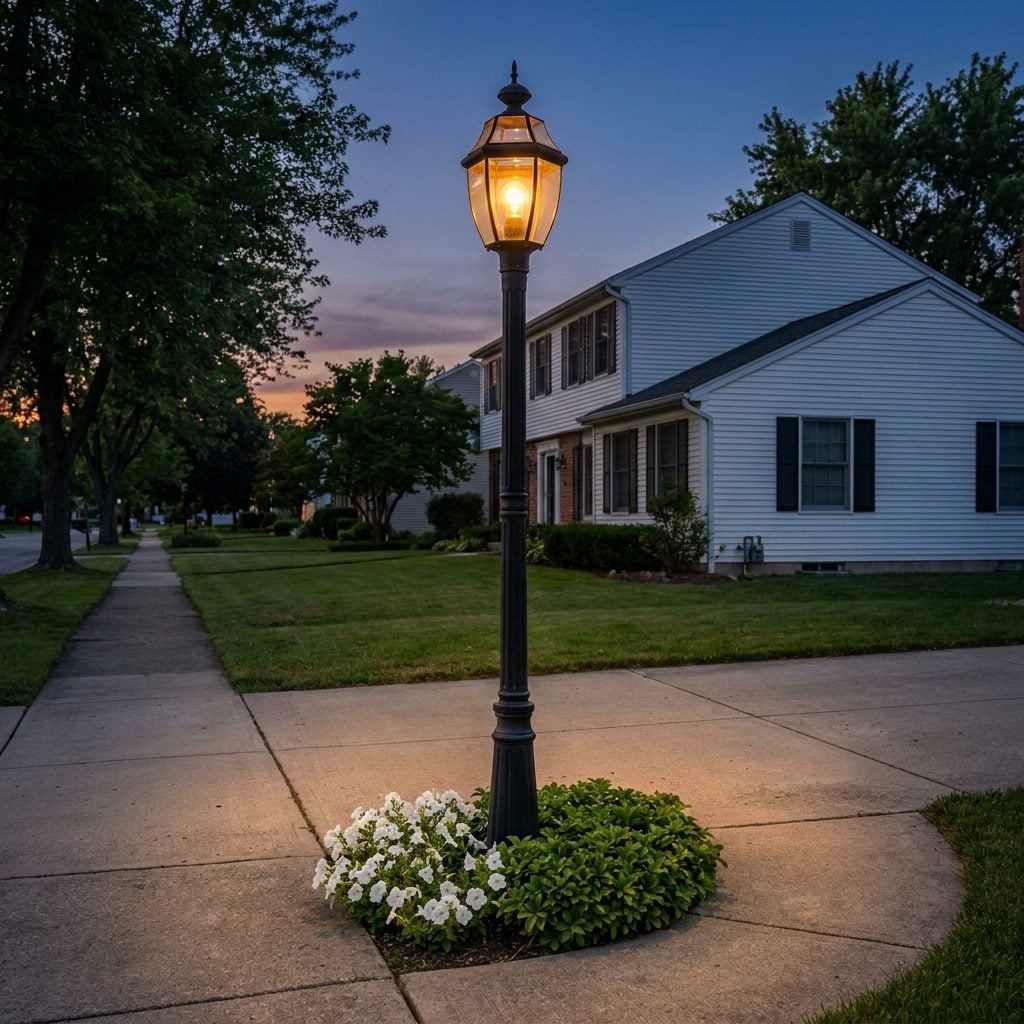
A black carriage lamp post standing at the edge of the front walk, its single bulb casting a warm circle on the concrete at dusk. If any single object communicated “respectable household” in the seventies, this was it.
Colonial ambition in miniature. A fluted black post, six feet tall, topped with a lantern that had beveled glass panels and usually a 60-watt bulb attracting every moth in the zip code. The base got a little ring of flowers, petunias or impatiens, sometimes bordered by those scalloped concrete edgers from two items ago. Running the electrical line from the house was a weekend project that reliably became a two-weekend project, sometimes three if you hit a root.
But at twilight, when everything else on the block went dark and that one warm light came on at the end of your walkway, the whole house looked like it was waiting for you. That’s the part people don’t overthink. They just feel it. Which is probably why these never fully went away.
12. The Angled Flag Bracket by the Front Door That Said Everything Without a Word
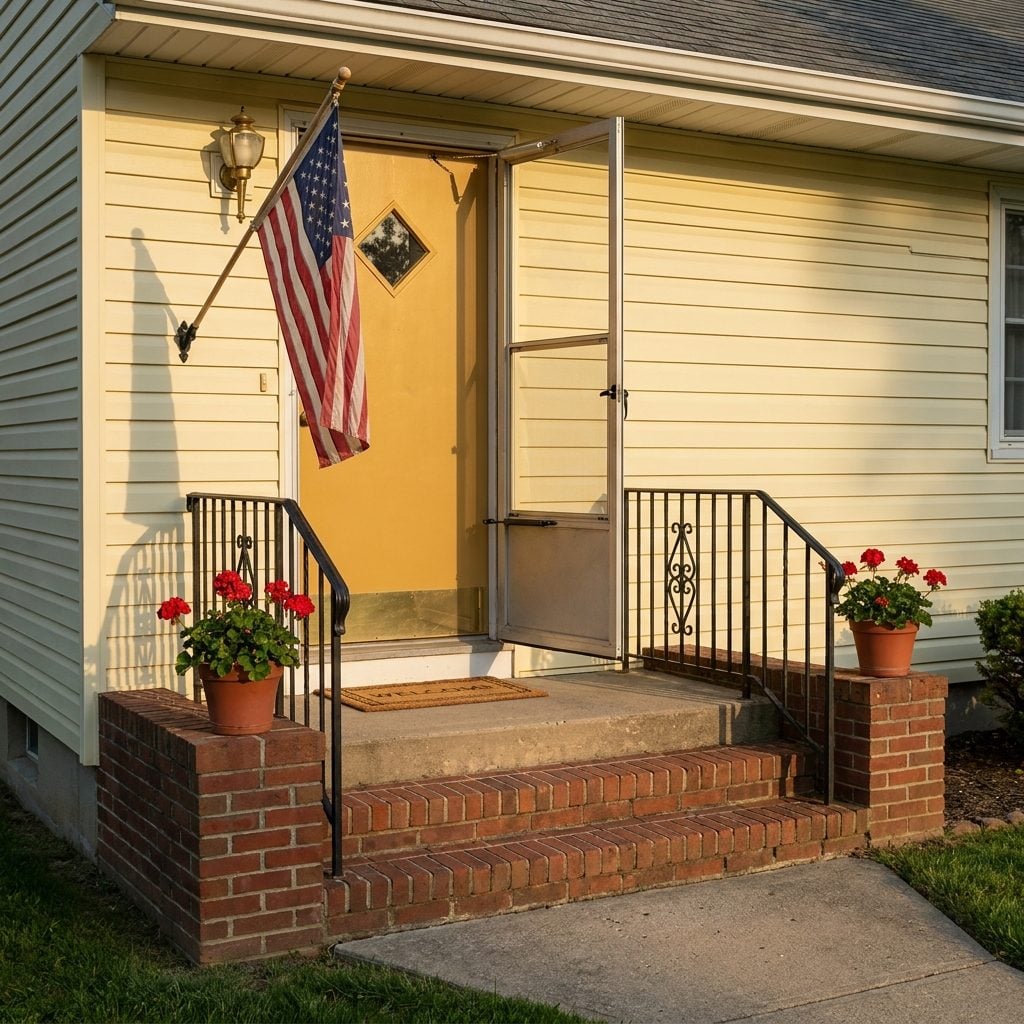
Nothing grand about it. A $3.99 flag kit from the hardware store, small cotton flag, pine dowel, black iron bracket with two screws, mounted at the same 45-degree angle beside every other front door on the block. Nobody coordinated this. Nobody had to.
The flag faded fast. By August the reds looked almost pink, and the blue field had washed out to something closer to denim. Replacement? Not until the thing was basically see-through. A crisp new flag would’ve felt like overcompensating. The proper look was gentle, sun-beaten, a little tired, patriotism that had been outside all summer and showed it.
11. The Curbside Mailbox on a 4×4 Post That Leaned a Little More Each Year
🔥 Would you like to save this?
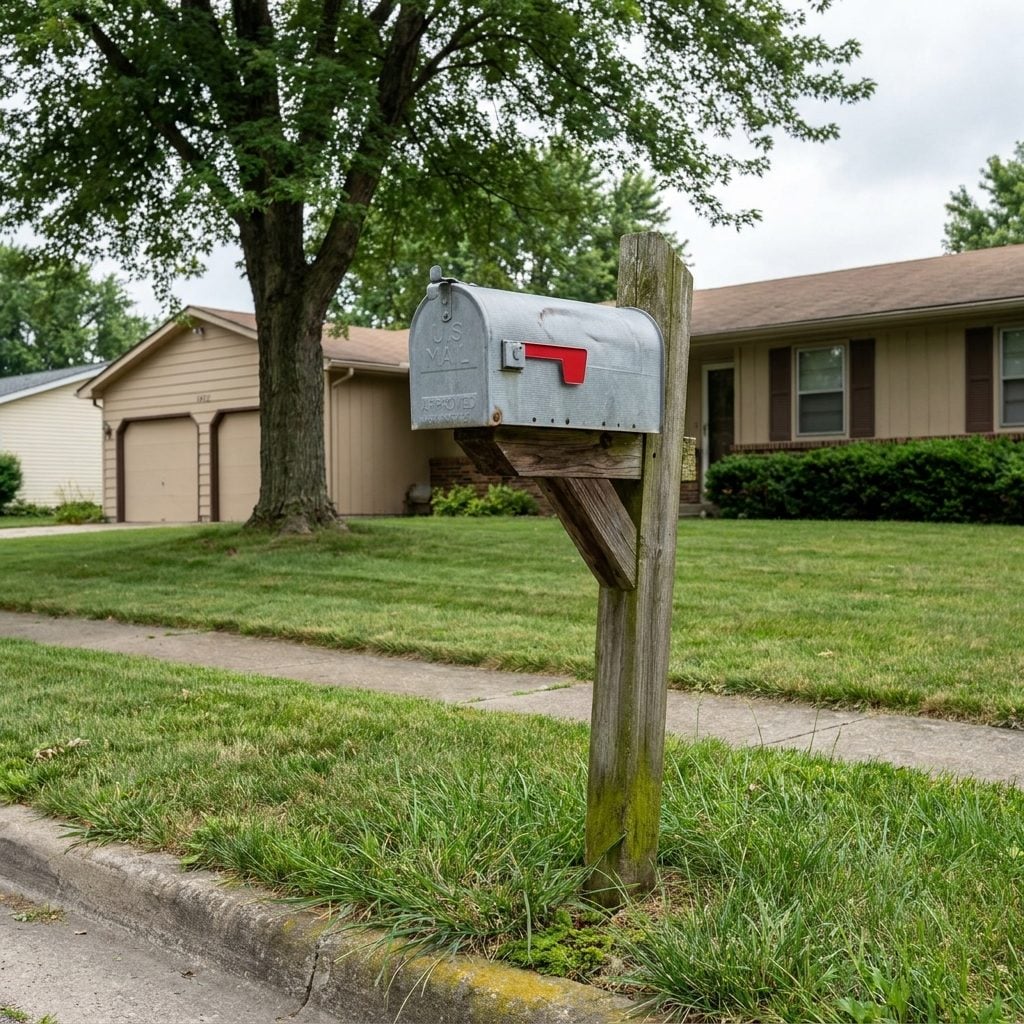
Always leaning. The post started vertical, sure, but after a few winters and one encounter with the snowplow it had tilted about ten degrees streetward, and there it stayed for the remainder of its structural life.
Plain galvanized steel, the mailbox itself. Sometimes painted black, sometimes left to develop a chalky oxidized finish nobody minded. The little red flag was the only moving part, and raising it felt ceremonial, like sending a telegraph. You’d check three times after putting an envelope inside. Convinced the carrier might somehow miss it. Irrational, but universal.
Some dads replaced the post regularly. Most let the lean become a feature, a crooked picture frame you stop seeing after a week, except the picture frame is government infrastructure.
10. Reflective Metal House Numbers That Caught Your Headlights at Exactly the Right Moment
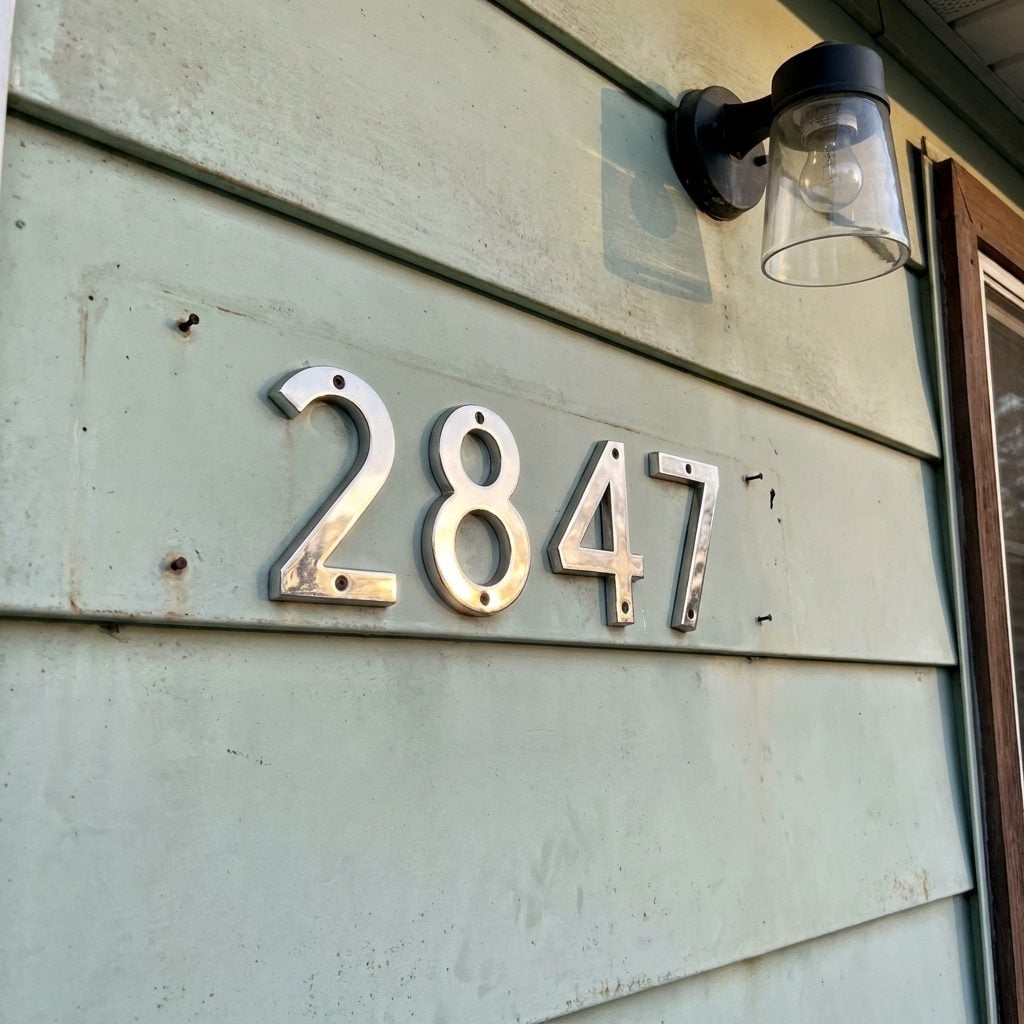
Cost almost nothing. Peel-and-stick reflective digits from the hardware store, pressed onto the siding beside the front door or stuck directly to the mailbox. They caught headlights like tiny mirrors, which was exactly the point, because pizza delivery and ambulances needed to find you in the dark.
One was always crooked. Always. You’d line up all four digits carefully, step back, and discover the 7 had drifted sideways like it had somewhere else to be. It stayed that way permanently. The adhesive bonded to aluminum siding with the tenacity of a grudge, so repositioning was a fantasy. Whole neighborhoods walking around with slightly drunk-looking house numbers, and everybody just accepted it.
9. The Oscillating Sprinkler Doing Its Slow, Hypnotic Sweep Across the Front Lawn
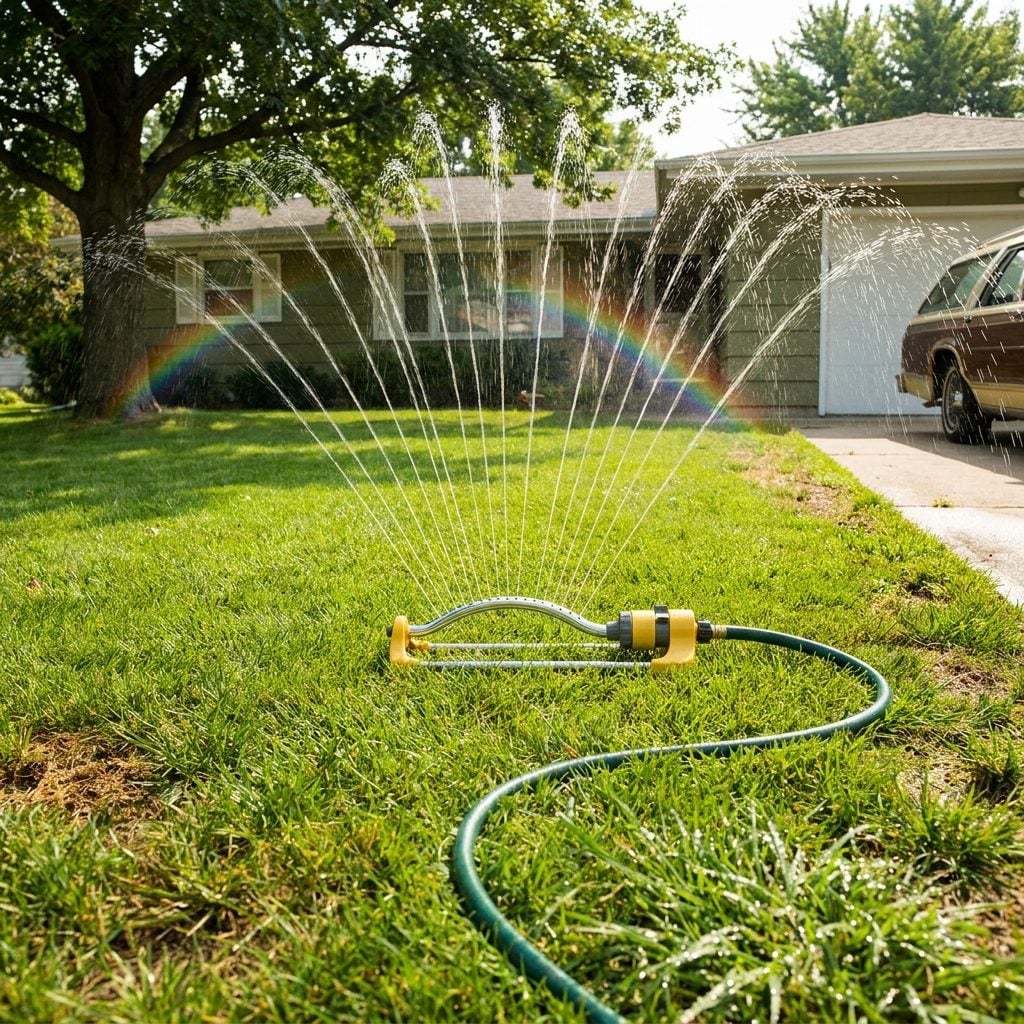
Shhhhh-tick. Shhhhh-tick.
That rhythmic sweep was the actual soundtrack of summer. The yellow Nelson sprinkler sat in the middle of the yard like lawn sculpture, throwing water in slow, deliberate arcs while the whole neighborhood quietly watched their water bills climb. Kids ran through it barefoot. Dads fiddled with the little dial tabs on the ends to control the sweep pattern, which never once worked the way the diagram on the box promised, half the water hit the sidewalk and the driveway, and nobody particularly cared.
The sprinkler ran every evening, and the front porch light would click on just as it was finishing. That sequence, sprinkler stopping, porch light on, was the calendar turning from afternoon to night.
8. That Coiled Green Garden Hose That Was Never, Not Once, Properly Wound
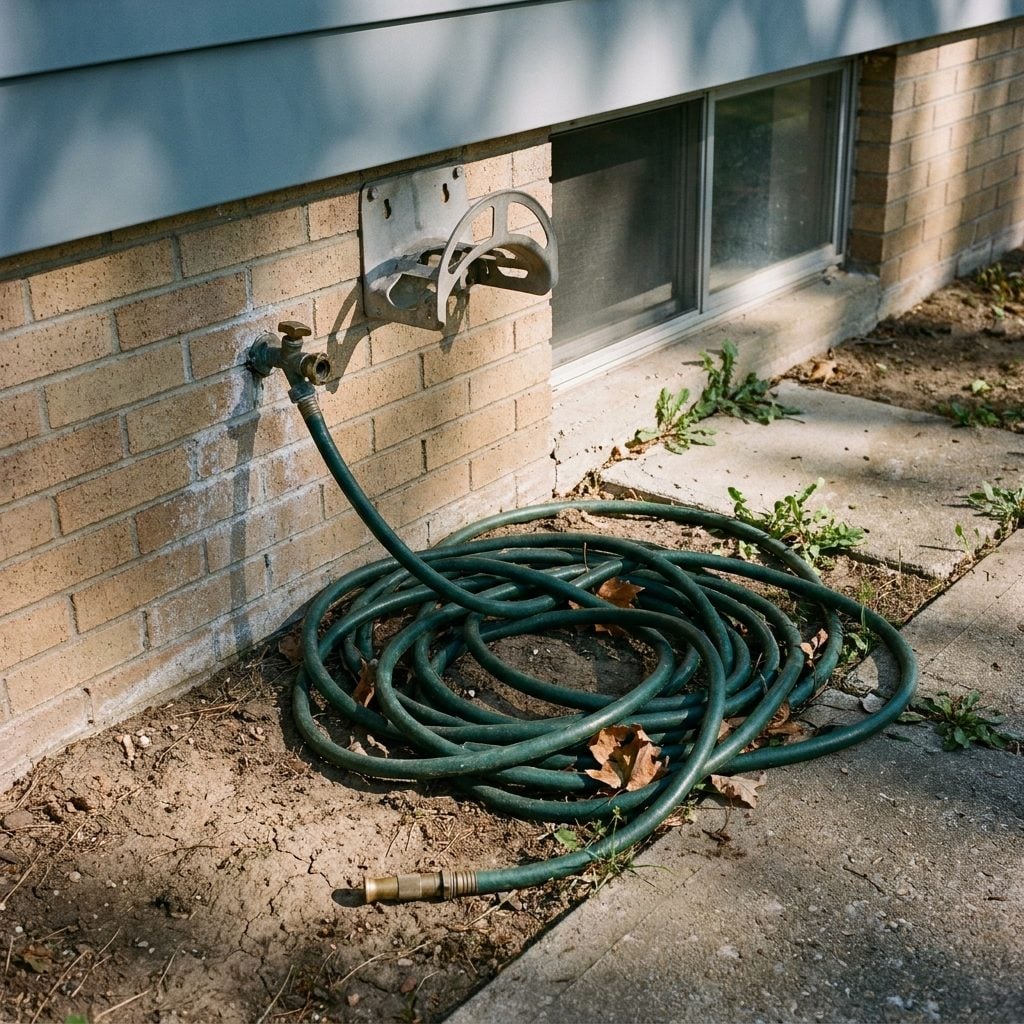
Someone bought a hose reel. Mounted it to the wall beside the spigot with real screws and everything. And the hose never went on it. Not once. It sat in a tangled green heap on the ground, kinked in the same three places year after year until those kinks became permanent anatomical features of the rubber itself.
The brass nozzle was either missing entirely or seized shut from corrosion, always one or the other. You’d twist the spigot and water would just blast from the open end while you wrestled the hose across the yard. For years I thought you could defeat the kinks by hanging the thing properly after each use. You can’t. The kinks aren’t a flaw. They’re the hose’s whole personality. It kinked where it wanted and you learned to work around it.
7. That Wall-to-Wall Kentucky Bluegrass Lawn Where Not a Single Wildflower Dared to Grow
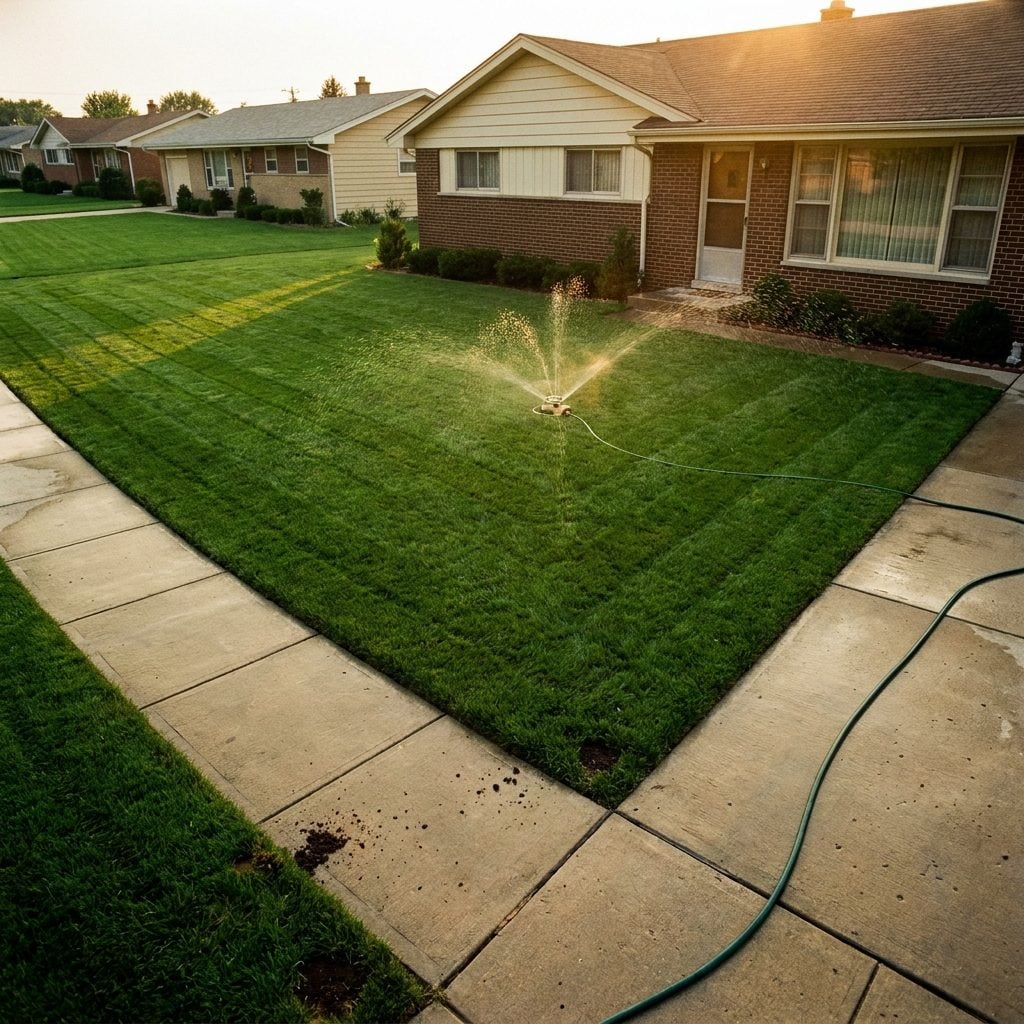
The pride of every dad on the block, that carpet of Kentucky bluegrass was maintained with a devotion bordering on religious. Weekends meant the Scotts Turf Builder came out, the rotary spreader making careful overlapping passes like a man grooming a putting green for the Masters.
Not a clover patch. Not a dandelion. Certainly nothing as radical as a native wildflower. The whole front yard was a monoculture, and nobody lost a minute of sleep over it, biodiversity wasn’t a word anyone threw around at the neighborhood cookout.
The sprinkler ran every evening, oscillating back and forth while kids ran through it. Nobody thought twice about the water bill. And if the neighbor’s lawn looked greener? Personal failing. Worth real anguish.
6. The Push Mower Sitting in an Open Garage Like It Owned the Place
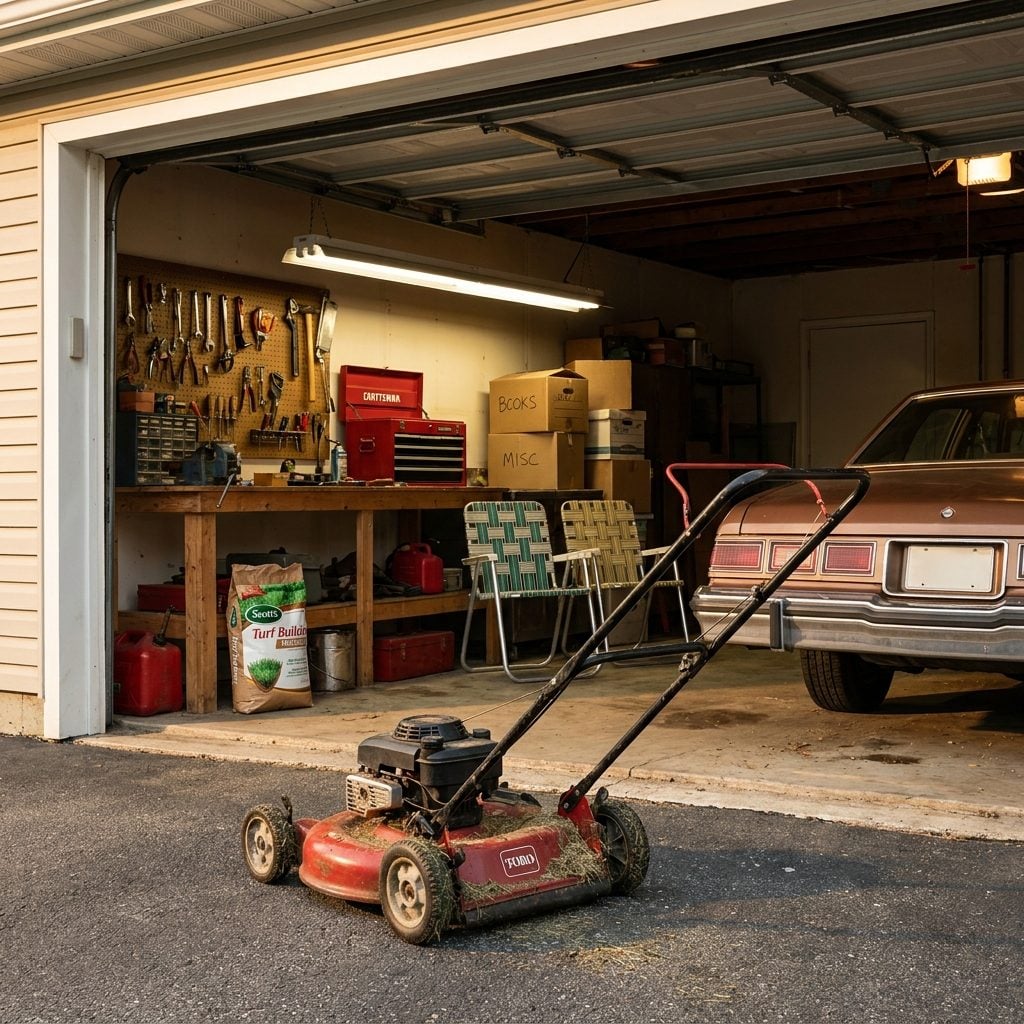
Gasoline and cut grass. That combination still means Saturday to millions of people.
The mower lived in the garage but never had a designated spot, it migrated. Sometimes it blocked the car. Sometimes it sat dead center on the floor with its handle up like a periscope, fresh clippings stuck to the deck. The red Toro and the Lawn-Boy two-stroke with its distinctive blue smoke were the dominant species, though Sears Craftsman held a loyal faction among dads who bought everything from the catalog.
Nobody put the mower away right after mowing. It just sat there cooling, ticking quietly as the engine block contracted, surrounded by the other relics of suburban maintenance: gas can, fertilizer bag, the edger nobody used. Putting it away immediately would have felt like rushing something sacred.
5. No Front Fence at All, and That Was the Whole Point
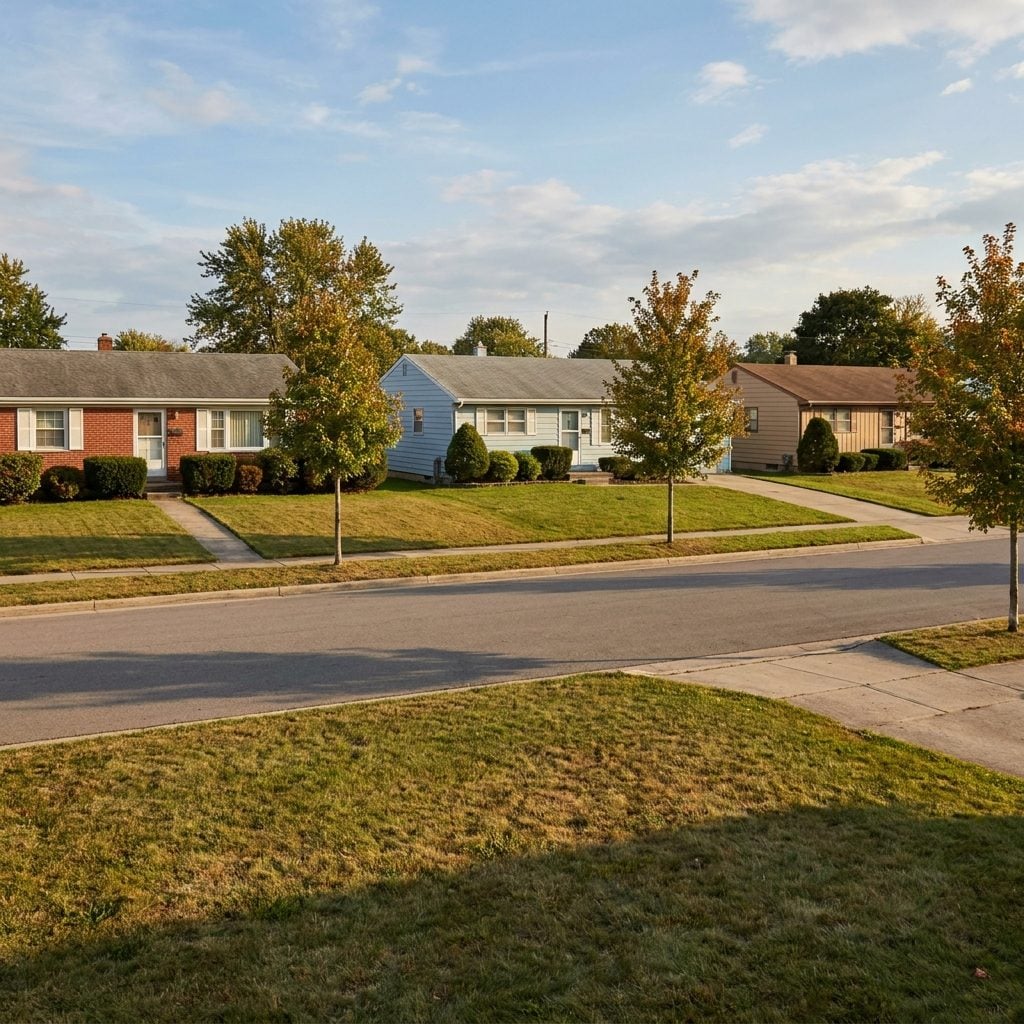
This is the one that looks strangest to modern eyes. Three, four, five houses in a row with absolutely nothing between the front yards, no hedges, no low walls, no decorative iron. Lawn flowing into lawn, property lines existing only in county records and the minds of people who’d had one too many disputes about where the driveway actually ended.
Postwar suburban developments were built around communal openness, a visual democracy where every home presented itself to the street without barriers. Kids cut across any yard they wanted. Your neighbor’s dandelions became your problem. And there was real, unspoken pressure to keep your grass at roughly the same height as everyone else’s, because deviation was visible from the road, and visible deviation invited conversation. The open front yard was a deliberate choice, maybe the most loaded landscaping decision of the era, dressed up as no decision at all.
4. The Big Picture Window Facing the Street, Sheers Drawn, Everyone Half-Watching
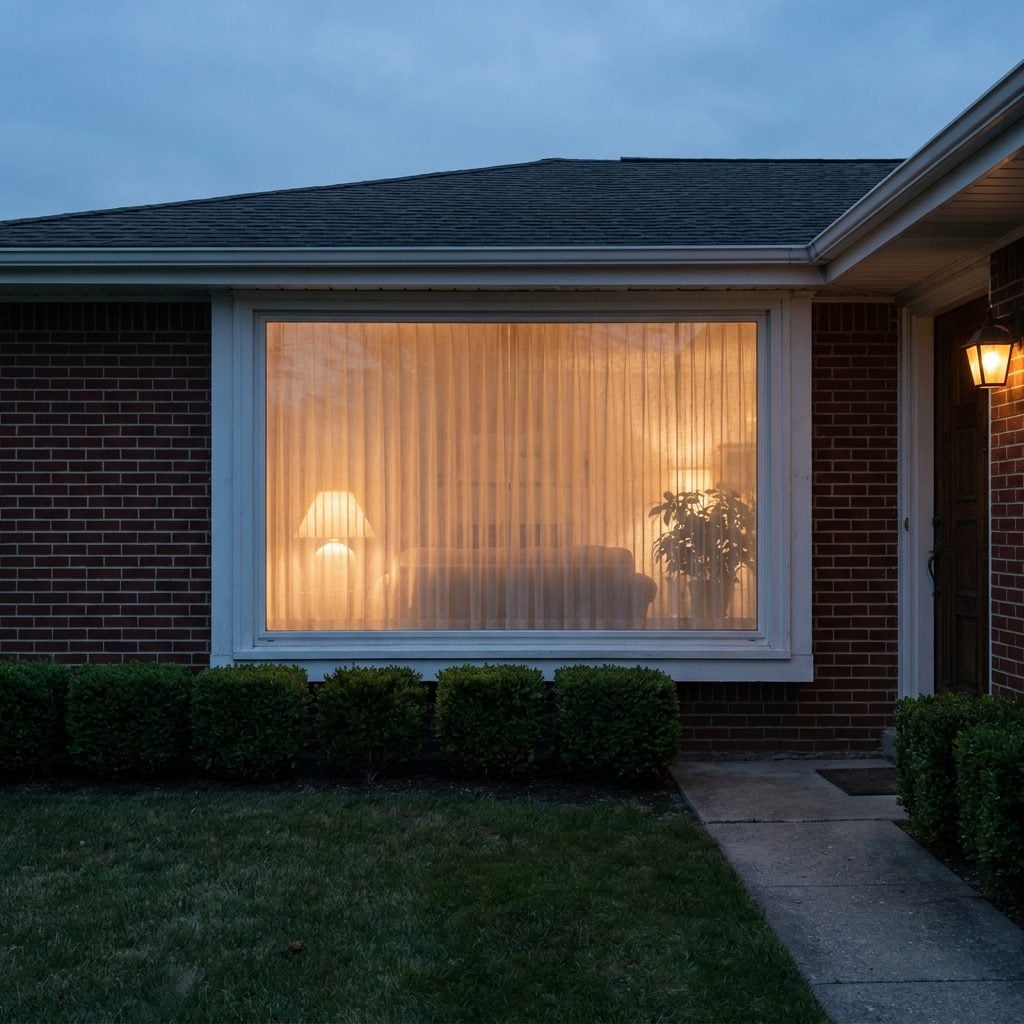
You could see in. Sort of. That was the whole tension of the thing, the picture window gave the living room its best light and its biggest vulnerability, so sheer white curtains split the difference. Light comes in, details stay vague, neighbors get an impressionistic blur of your furniture instead of a full inventory.
At dusk from the street, the picture window turned into a warm glowing diorama. The amber shape of a lamp. The dark outline of a sofa. Maybe the blue flicker of a television nobody would admit they were watching during dinner. From inside, you could track every car that passed and every kid on a bicycle without anyone knowing you were looking, casual surveillance dressed as residential design, standard on every ranch house built between 1955 and 1975.
3. Aluminum Awnings in Stripes That Somehow Made a House Look Like a Gas Station
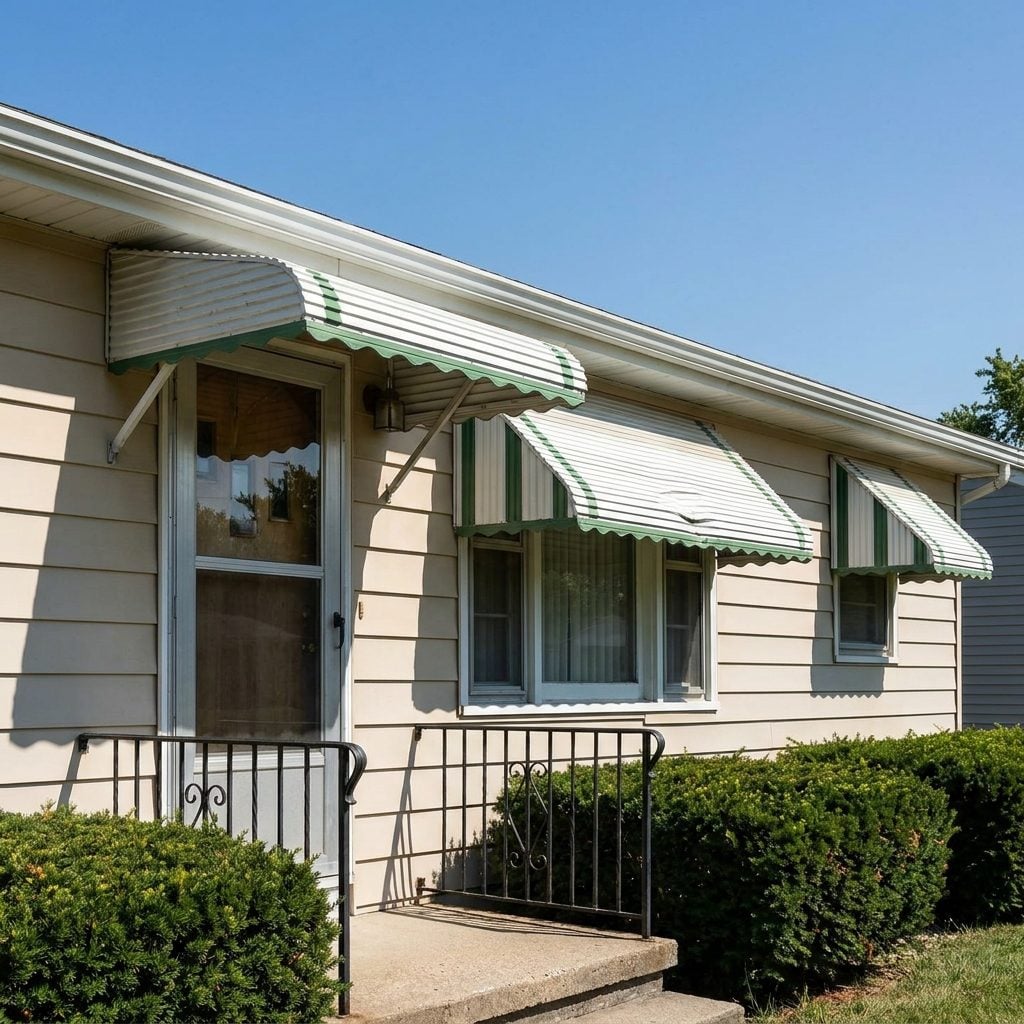
Green and white stripes, usually. Sometimes turquoise and white. Occasionally a brave burnt orange. These corrugated aluminum awnings jutted from the house over every window and the front door, giving a residential home the distinct look of somewhere you might also buy unleaded.
They worked, though, I’ll give them that. Before central air was universal, those awnings knocked real heat off west-facing windows. The corrugated metal pinged in the rain with a rhythm that became background music on summer afternoons, a sound I still associate with reading on the couch while a storm rolled through. And they lasted basically forever, which is why you still see them on houses today: slightly dented, paint chalking to white powder, absolutely refusing to quit. They’ll outlast the houses they’re bolted to.
2. Chain-Link Fence Sections That Announced Exactly Where Your Yard Ended
🔥 Would you like to save this?
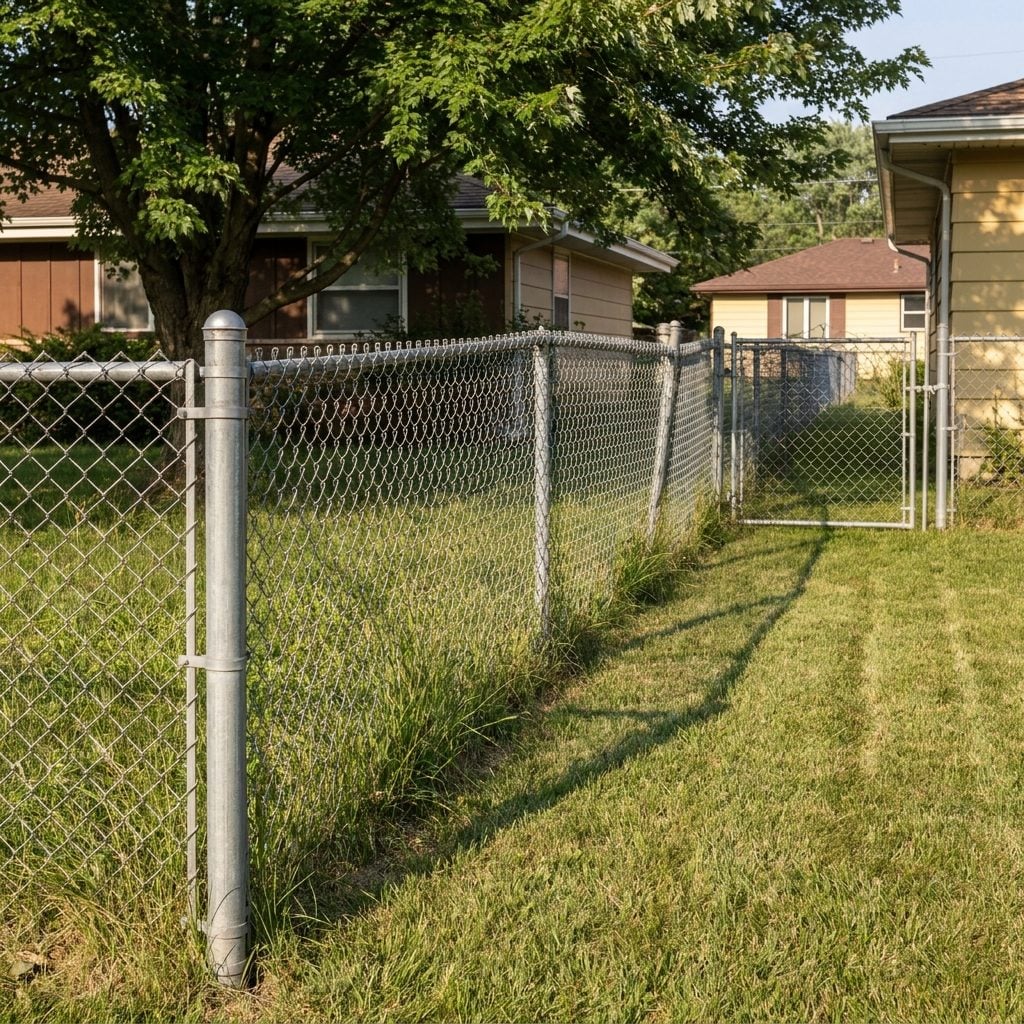
Not every house had one. But when you saw chain-link, you knew something about those neighbors. Maybe a dog situation. Maybe a property-line dispute that got resolved with galvanized steel instead of lawyers, which, honestly, is cheaper and faster.
Silver diamond mesh stretched between round posts with those satisfying little dome caps on top. The fence concealed nothing whatsoever. You could see through it perfectly, which made it less a privacy barrier than a polite territorial annotation rendered in metal. Kids climbed it constantly, the mesh sagged where they climbed, and one section always leaned from where someone had backed into it with a Buick. Pretty? No. Nobody pretended otherwise. Chain-link was honest fencing, it told you where the property ended and that was the full extent of its ambition.
1. The Bug Zapper’s Purple Glow and Occasional SNAP That Scored Every Summer Night
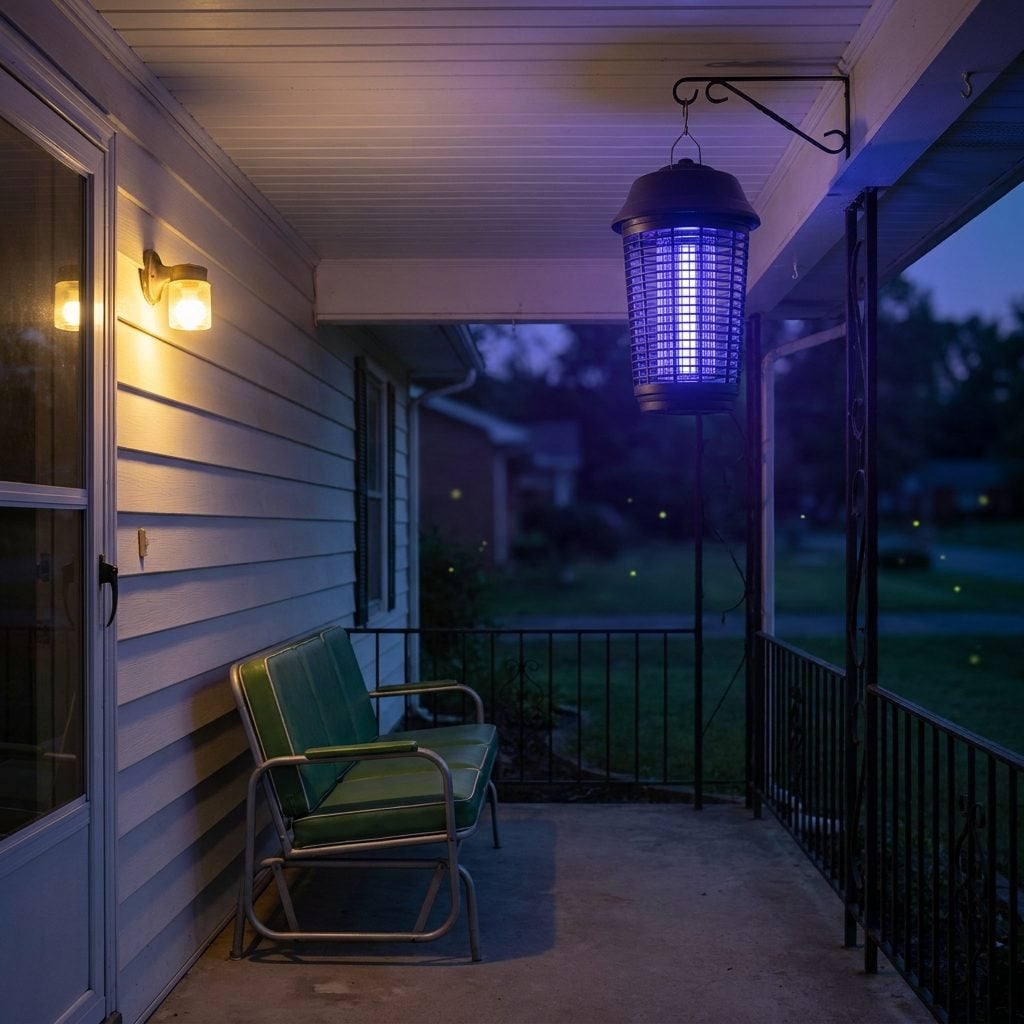
That purple glow. You’d see it from the street, hanging from a porch hook or a shepherd’s crook jammed into the yard, casting its weird ultraviolet light across the evening like a very small, very menacing nightclub. Then: SNAP. A satisfying electric crack. One more mosquito had made a terminal navigational error.
The sound became summer’s metronome. Crickets, a distant mower finishing up, and that intermittent zap. Oddly comforting. The whole device was a purple lantern full of dead bugs, and we hung it right next to where we ate dinner outside, sometimes close enough that you’d flinch at a particularly loud pop. Nobody questioned any of this.
Modern entomologists will tell you bug zappers mostly kill beneficial insects and barely touch mosquitoes. I refuse to let this ruin the memory.