🔥 Would you like to save this?
The bedspread smelled like starch and cedar. The carpet was thick enough to lose a marble in, and that little ticking clock on the nightstand never quite kept the right time but nobody replaced it. Sixties bedrooms operated under a set of unspoken rules that everyone followed without question: matching everything, bolting things to the wall that had no business being bolted anywhere, and choosing colors that would make a modern paint store employee gently suggest therapy.
Some of these details you’ll remember the second you read them. Others you buried deep. Let’s dig them all back up.
In order to come up with the very specific design ideas, we create most designs with the assistance of state-of-the-art AI interior design software. Also, assume links that take you off the site are affiliate links such as links to Amazon. this means we may earn a commission if you buy something.
37. Wall-to-Wall Shag Carpeting in Avocado Green, Because Apparently We Wanted to Walk on a Swamp
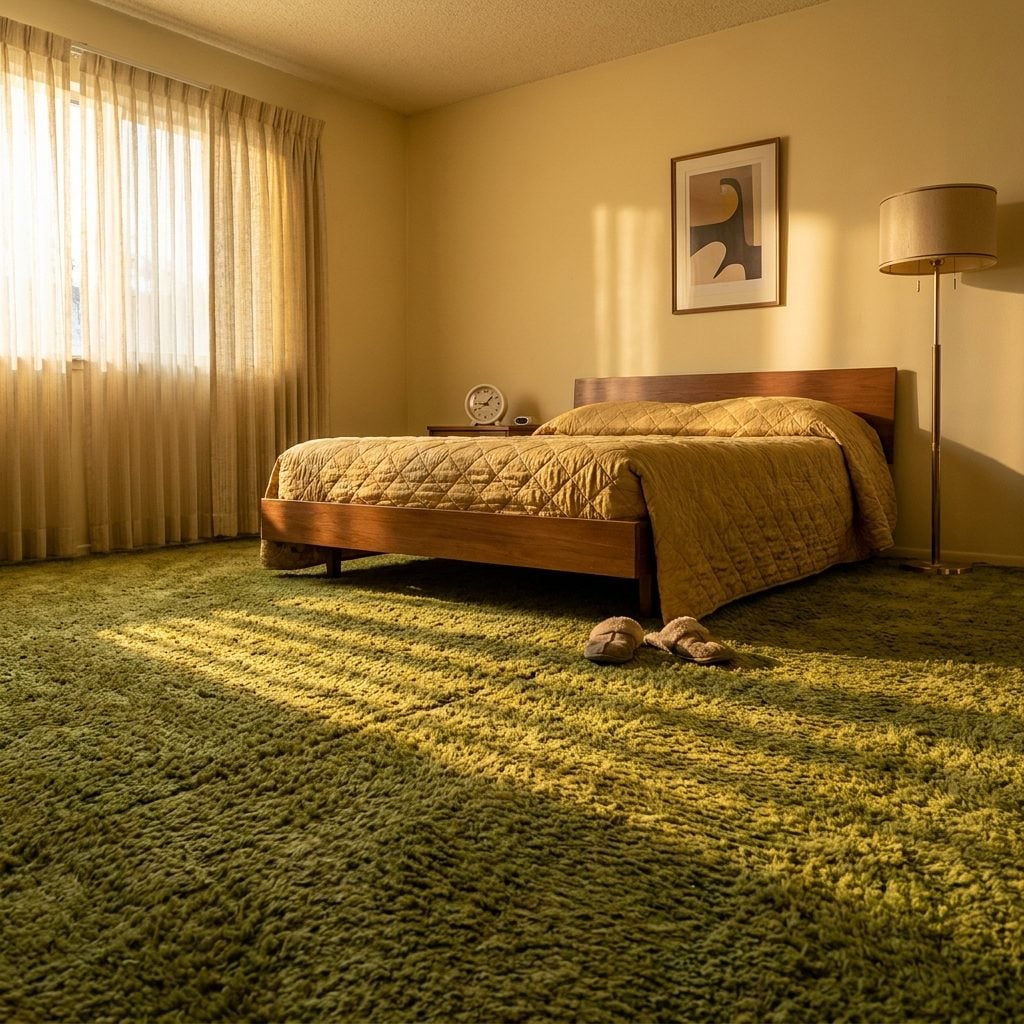
You could lose a quarter in that carpet and never see it again. The avocado green shag that covered every square inch of a 1960s bedroom wasn’t just flooring. It was an ecosystem. Crumbs, bobby pins, loose change, all swallowed whole by those thick synthetic fibers that grabbed your toes like tiny fingers every morning.
The color ranged from “overripe pear” to “pond scum,” and nobody questioned it. Vacuuming was a full-body workout because the shag fought back, wrapping around the beater bar until the Hoover screamed. And yet, sitting cross-legged on that carpet doing homework felt like the most natural thing in the world.
Today, our readers lean the other way: in a Home Stratosphere poll on bedroom floors, 64% picked hardwood over carpet.
36. The Low-Slung Platform Bed That Made You Feel Like You Were Sleeping on the Floor (On Purpose)
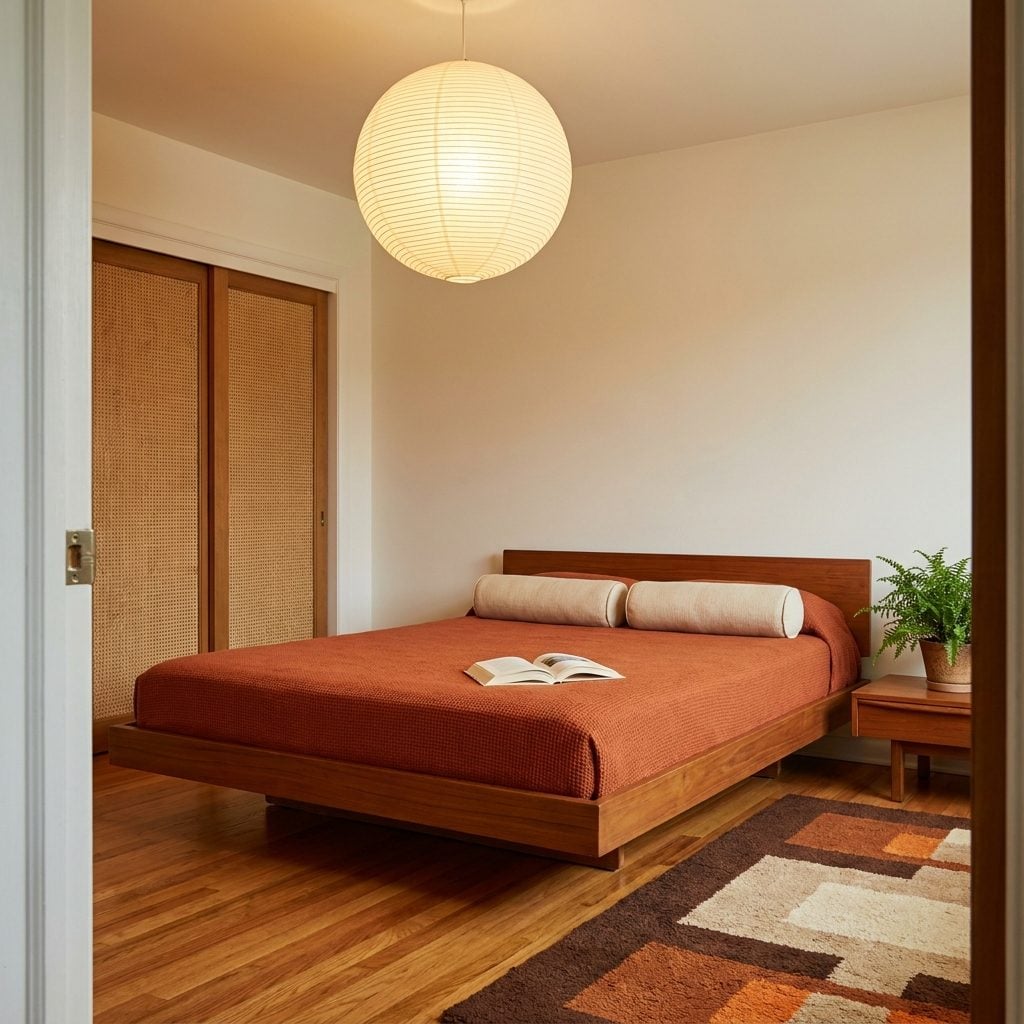
Getting out of this bed required a strategy session. The platform sat so close to the ground that your knees practically touched your chin when you tried to stand up. But it looked impossibly cool, all teak and Danish angles, like something from a magazine spread about a Copenhagen architect’s apartment.
These beds screamed “I am cultured and modern” in a decade obsessed with both. The trade-off was that every dust bunny underneath was visible to anyone who walked in, and finding your slippers meant groping around at ankle level in the dark. I’d argue the aesthetic payoff was worth the orthopedic compromise, but my back might disagree.
35. Tufted Vinyl Headboards in Gold or Harvest Orange, Sticky in Summer and Cold in Winter
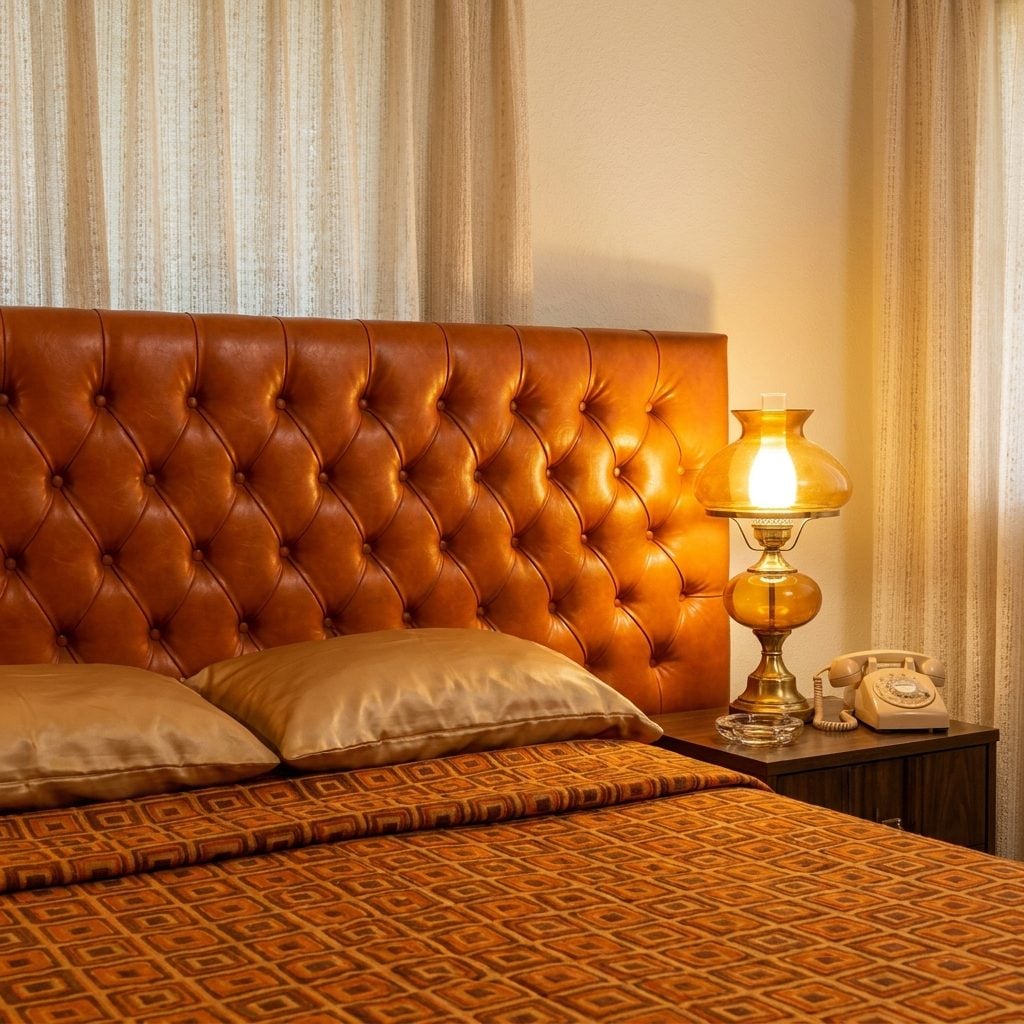
Your bare shoulders stuck to it in July and it felt like leaning against a refrigerator in January. The tufted vinyl headboard was the great equalizer of 1960s bedrooms, offering year-round discomfort in a color that could only be described as “aggressive mustard” or “pumpkin with ambition.”
The button tufting collected dust in every diamond-shaped valley. The vinyl cracked over time, revealing sad beige foam underneath. And the sound it made when you shifted against it at night, that squeaky protest, was unmistakable. Yet people paid real money for these. Harvest orange was the chosen hue, a color that has never once appeared in an actual harvest.
34. That Enormous Spanish Revival Headboard With Wrought Iron Scrollwork That Weighed More Than the Bed
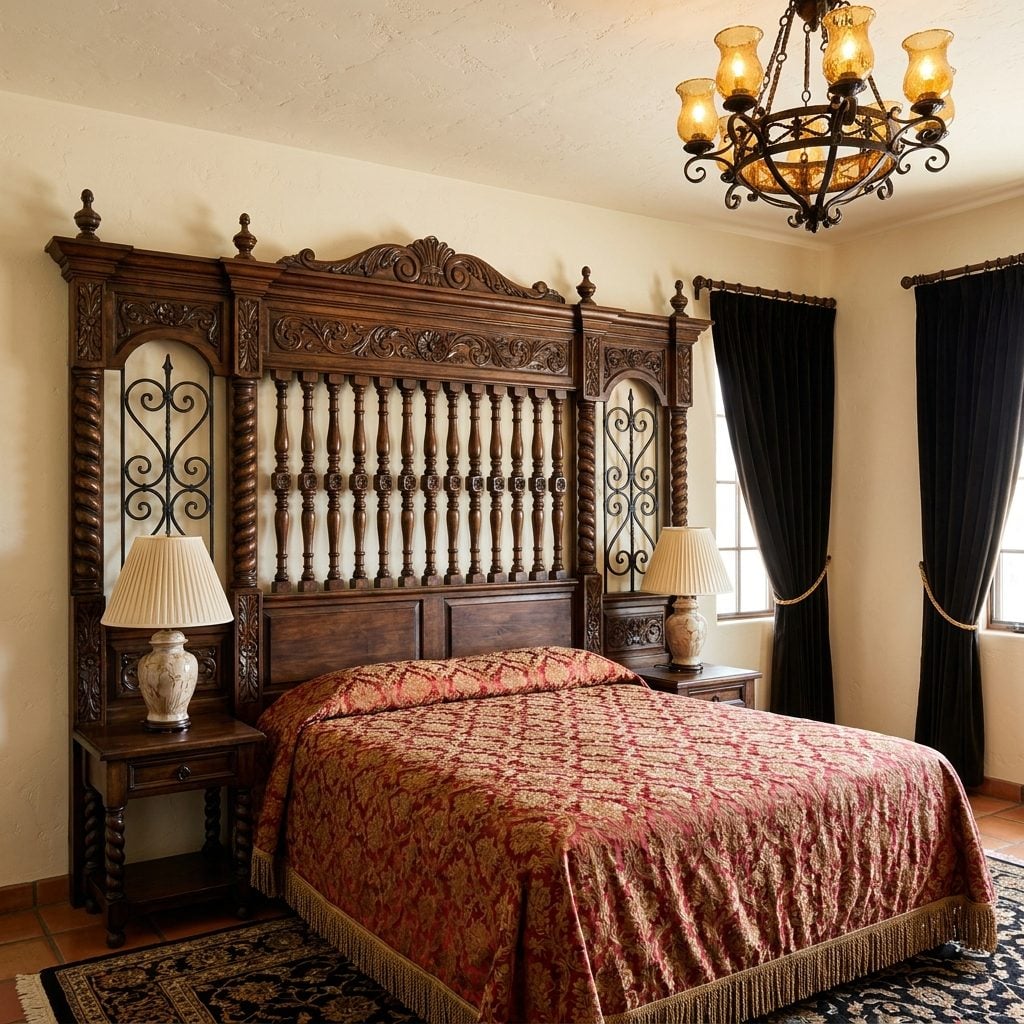
Moving day was a nightmare because of this headboard. It took four grown adults to carry it up the stairs, and it left gouges in every wall it passed. The Spanish revival headboard was a monument to itself: six feet of carved dark wood with iron scrollwork that looked like it belonged in a Seville cathedral, not a suburban ranch house in Pasadena.
These things dominated the room. You didn’t have a bedroom with a headboard. You had a headboard with a bedroom attached to it. The iron accents caught your hair if you sat up too fast. The dark wood absorbed all available light. And if you bumped the wall behind it, the whole thing resonated like a church bell.
Somehow this paired with orange shag carpet and nobody blinked.
33. The Matching Bedroom Suite Where Every Single Piece Came From the Same Set, No Exceptions
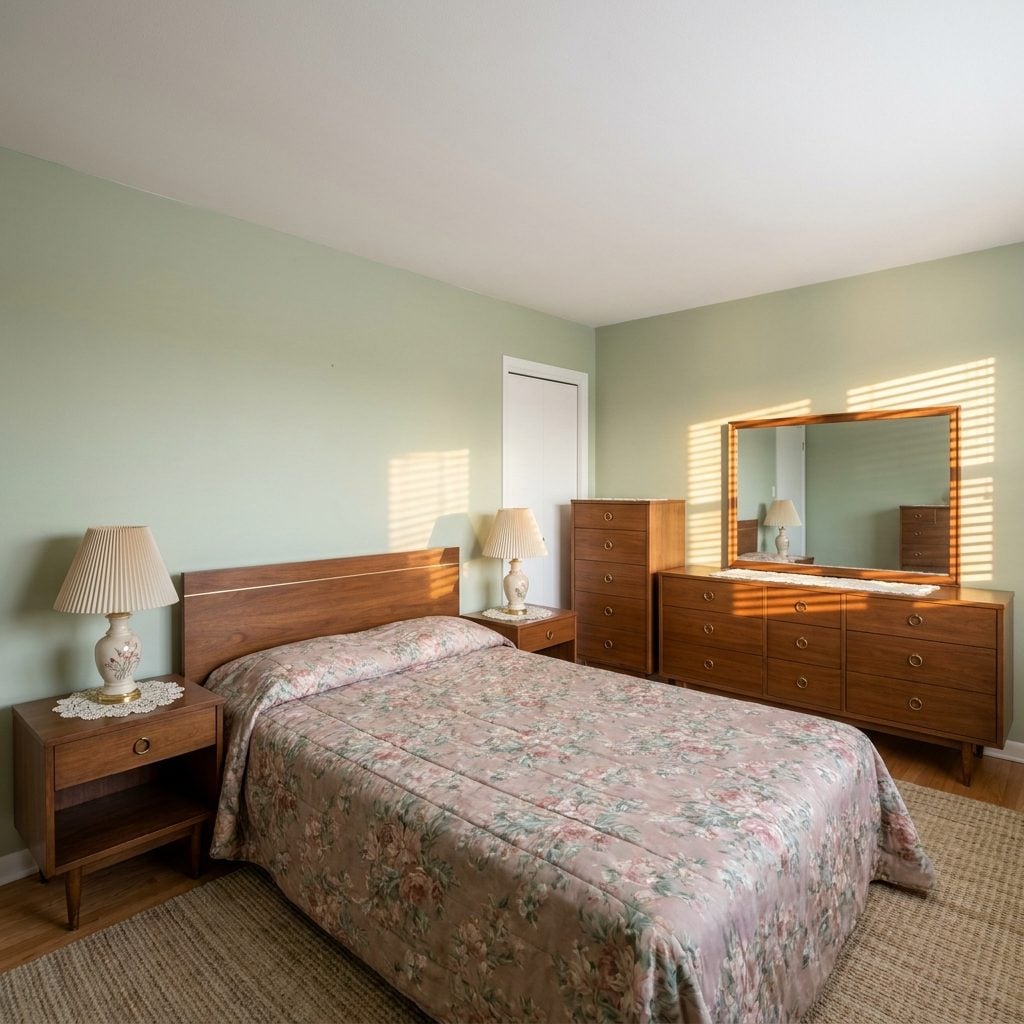
If one piece was walnut with brass ring pulls, every piece was walnut with brass ring pulls. The matched bedroom suite was a non-negotiable institution. Dresser, mirror, two nightstands, headboard, tall chest. All from the same manufacturer, same finish, same hardware, purchased together on the same Saturday from the same furniture showroom.
Mixing wood tones? Combining a modern nightstand with a traditional dresser? That wasn’t eclectic. That was poverty. Or so the thinking went.
The small family room might get mismatched hand-me-downs, but the master bedroom was a coordinated fortress. Sears, Broyhill, Bassett, they all sold these sets as complete packages, and deviating from the package was unthinkable.
What Our Readers Say
- When Home Stratosphere readers disliked a bedroom and tapped a reason, the top answer was “not my style” at 35%, followed by “too cold”, “color” and “dated”.
From Home Stratosphere reader polls and votes.
32. The Sunburst Mirror Mounted Above the Headboard Like a Golden Explosion Frozen in Time
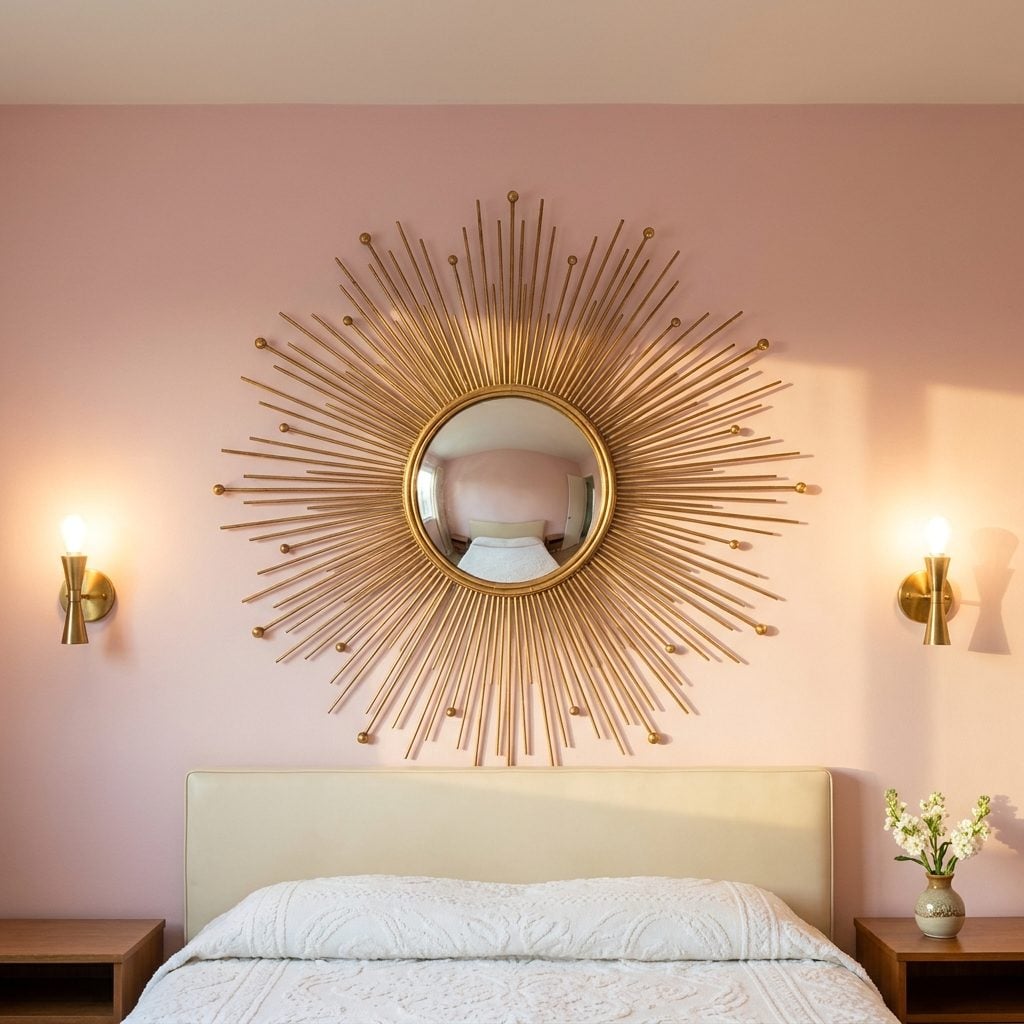
Every bedroom needed a focal point, and in the 1960s that focal point was an oversized metal sun having a moment directly above your pillows. The sunburst mirror wasn’t subtle. It announced itself from the doorway, all those gold-toned rays reaching outward like the room was experiencing its own personal dawn.
The convex center mirror distorted everything it reflected, making the bedroom look bigger or weirder depending on your angle. And those thin metal spokes? Absolute dust magnets. Cleaning one meant individually wiping thirty to forty tiny rays while balancing on the mattress.
31. Dark Walnut Wood Paneling on the Bedroom Wall, Because Apparently We Wanted to Sleep Inside a Log Cabin
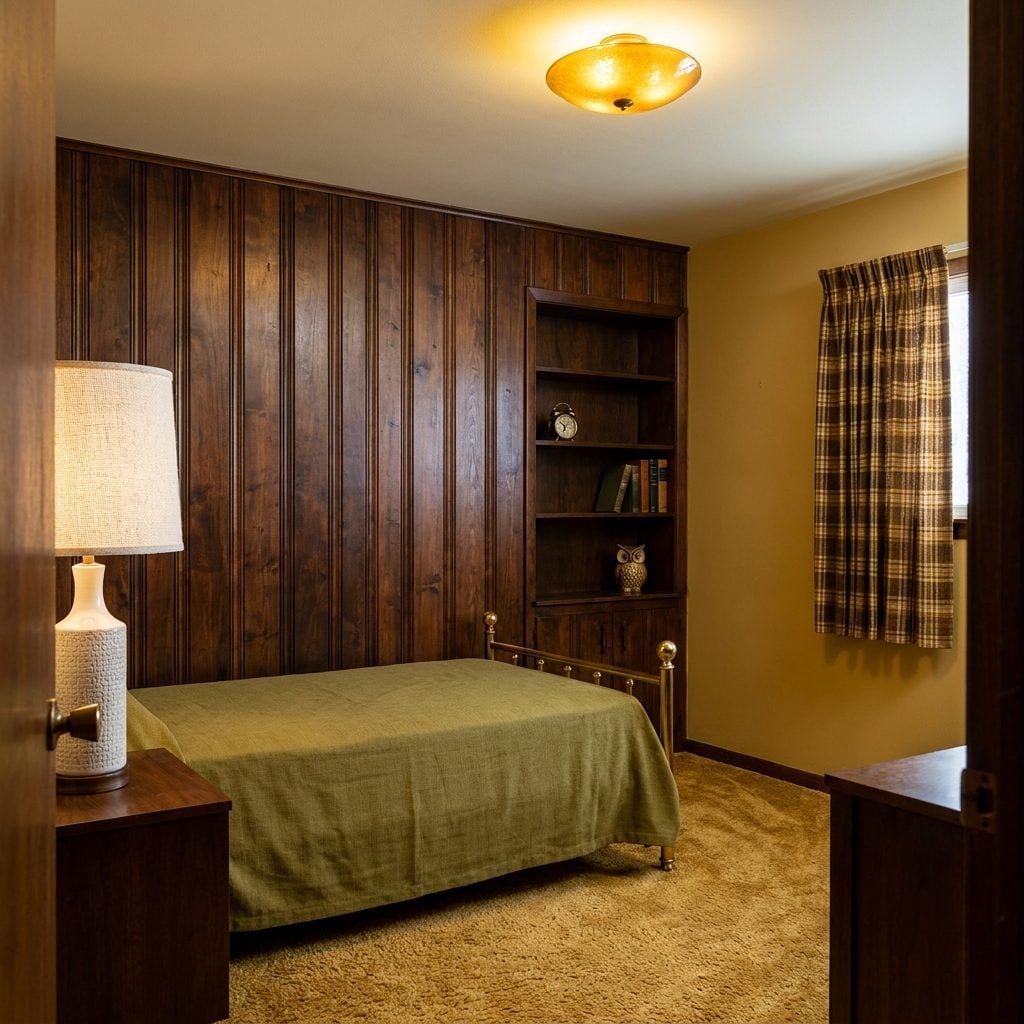
It absorbed every photon of light that entered the room. The dark walnut accent wall turned one side of your bedroom into what can only be described as the interior of a 1970s law office, except with a bed in it. The vertical grooves collected dust in perfect parallel lines, and the surface had a faint chemical smell that lingered for months after installation.
What’s strange is how cozy it actually was. That wall of dark wood behind your bed made the room feel enclosed and warm, like sleeping in a cabin. The psychology probably worked on us more than we realized. Something about all that grain pattern registering as “shelter” in some primal part of the brain. Modern accent walls owe a debt to this trend, even if they’d never admit it.
Not everyone has written off wood on bedroom walls, though: bedroom images with stained wood got more hearts from our readers than the other images in the same articles.
30. The Built-In Vanity Table With a Tri-Fold Mirror Where Mom Became a Completely Different Person for Twenty Minutes Every Morning
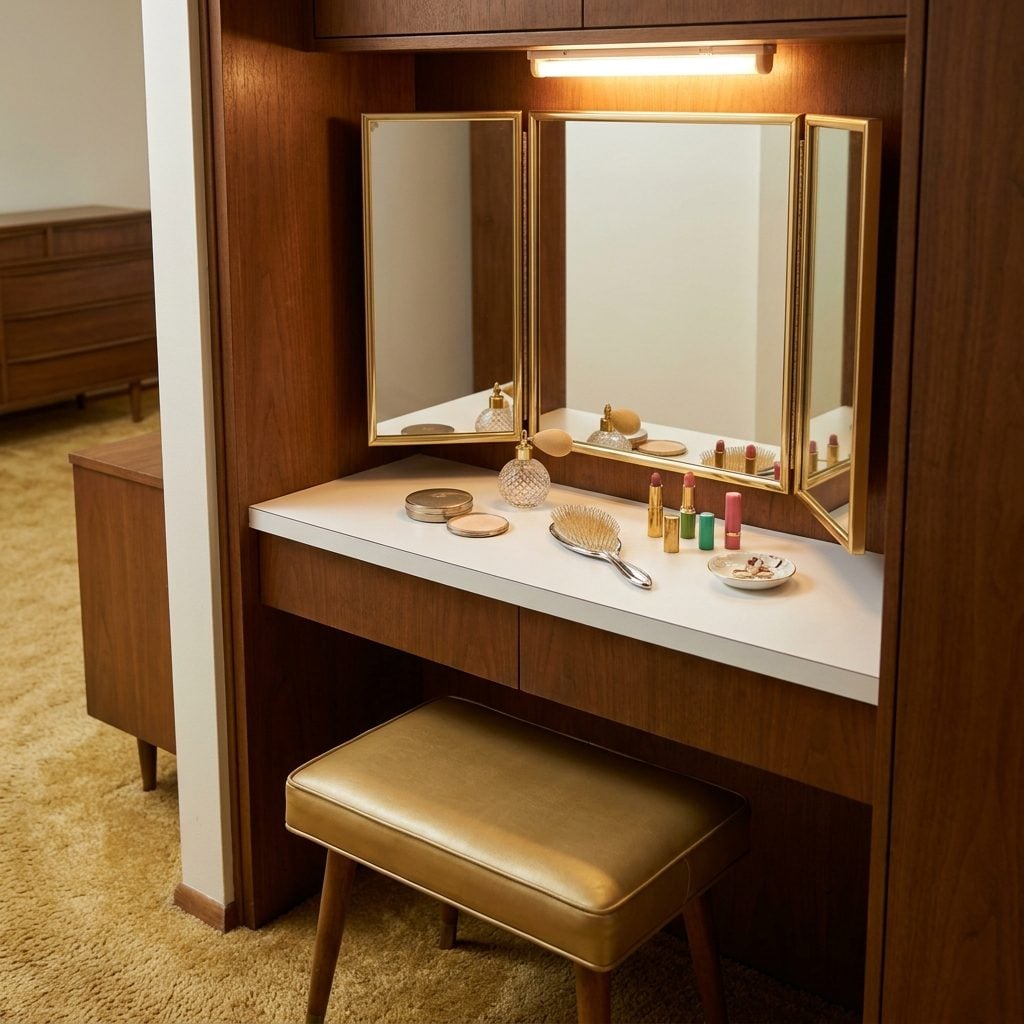
The tri-fold mirror showed you angles of yourself you weren’t prepared to see. Three panels, two of them hinged inward, creating an infinite regression of your own profile that could spiral into either confidence or an existential crisis depending on the morning.
The vanity surface told a woman’s entire story: Avon bottles with gold caps, a tortoiseshell comb with a few strands still caught in the teeth, a dusting of loose powder that never fully wiped away. This was sacred space. Kids didn’t touch it. The cushioned stool, always gold vinyl, held the permanent impression of one person.
Built-in vanities disappeared when master bathrooms got bigger in the 1980s and the morning routine migrated to dual sinks. Something was lost in that move. The bedroom vanity was private in a way a shared bathroom counter could never be.
29. Heavy Brocade Drapes with Pull Cords That Could Anchor a Small Boat
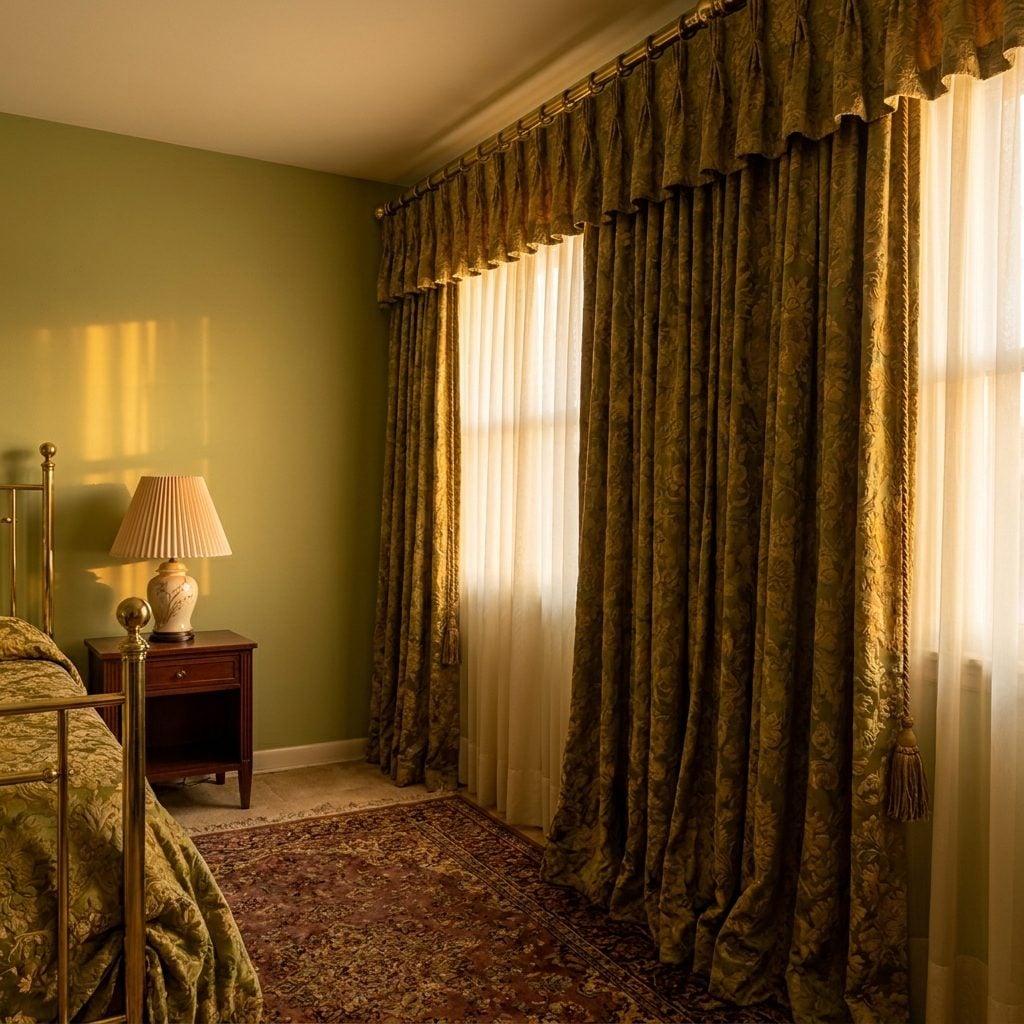
The weight of these things. You could grab a fistful of that brocade and it felt like holding a piece of upholstered furniture. Gold and olive, or burgundy and cream, woven with raised floral patterns that collected dust like it was their job. Every bedroom had them, floor to ceiling, pooling on the carpet in fabric puddles nobody ever trimmed.
And those pull cords with the tassels. You’d yank one and the whole wall of fabric would slowly, dramatically part like a theater curtain. Close them at night and the room went absolutely black. No light leaked in. These drapes didn’t filter sunlight; they murdered it.
28. Floral Chintz Wallpaper with Curtains to Match, Because Why Stop at One Surface
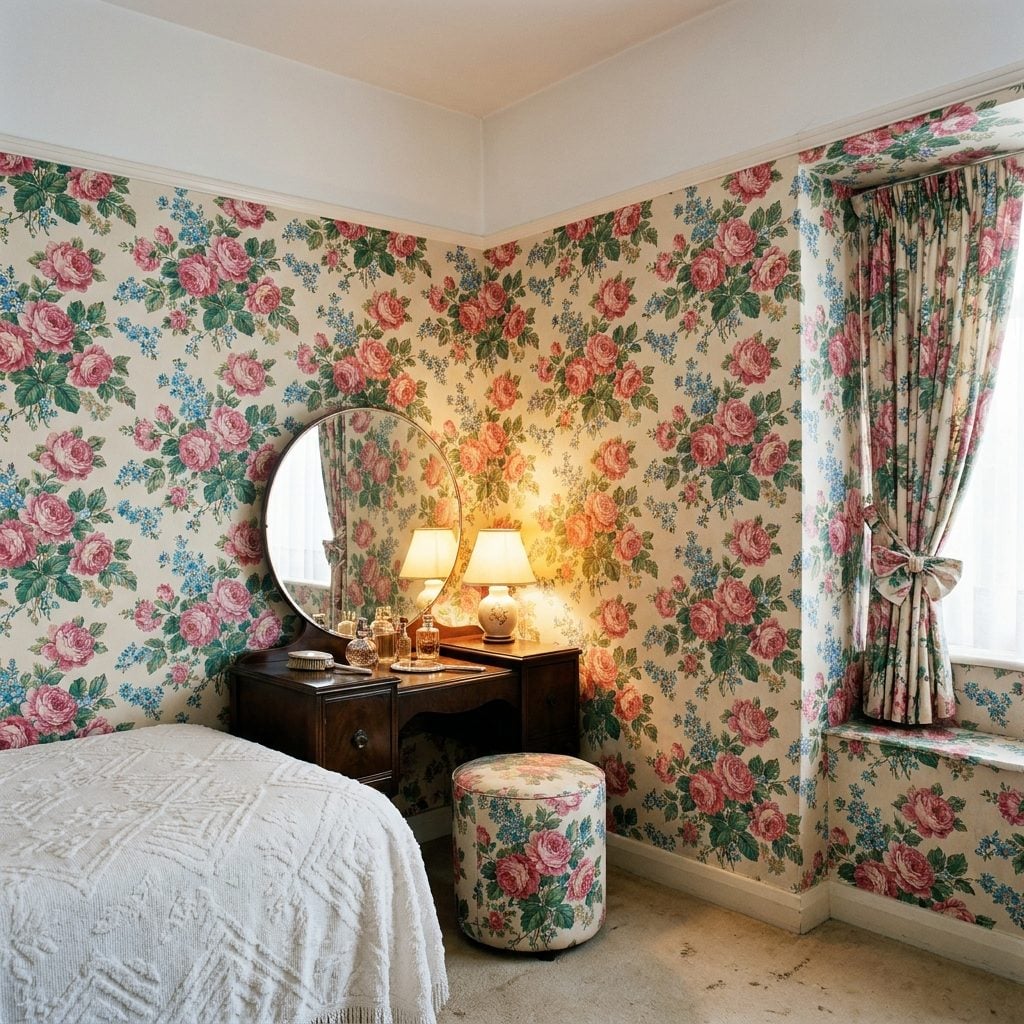
The commitment was staggering. Someone walked into a wallpaper shop, picked a pattern with cabbage roses the size of softballs, and then ordered matching curtain fabric. Same print. Same color. Same enormous flowers on every vertical surface in the room.
Standing inside one of these bedrooms felt like being swallowed by a garden. Your eyes had nowhere to rest. The roses on the wall met the roses on the curtains met the roses on the vanity stool, and somehow your grandmother thought this looked restrained.
The real kicker was the coordination. These weren’t accidental matches. Wallpaper companies sold companion fabrics specifically so you could do this to yourself on purpose. And we all just walked in, sat on the matching chintz stool, and acted like this was a reasonable amount of flowers for one room.
27. Quilted Polyester Bedspreads That Slid Off the Bed If You Breathed Wrong
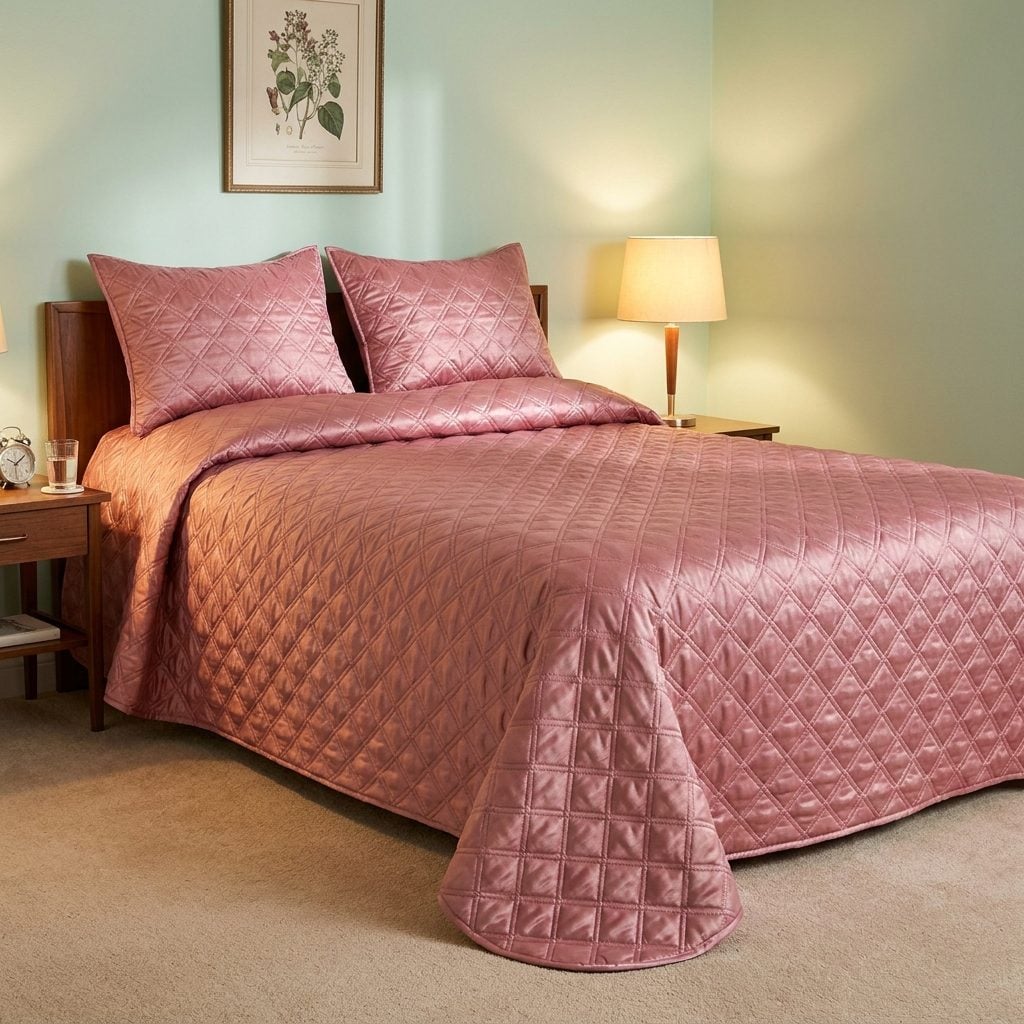
Slippery as a fish. You’d make this bed perfectly in the morning, smooth every wrinkle, prop those matching shams just so, and by the time you sat down to read before sleep the whole spread had migrated six inches toward the floor. Polyester on polyester sheets was basically an ice rink.
But they were indestructible. You could wash them a hundred times and that quilted diamond pattern never lost its puff. The colors never faded. Dusty rose, powder blue, mint green. They just kept going, shiny and static-charged and sliding off the mattress forever.
26. The Chenille Bedspread in Baby Pink That Every Guest Room Owned
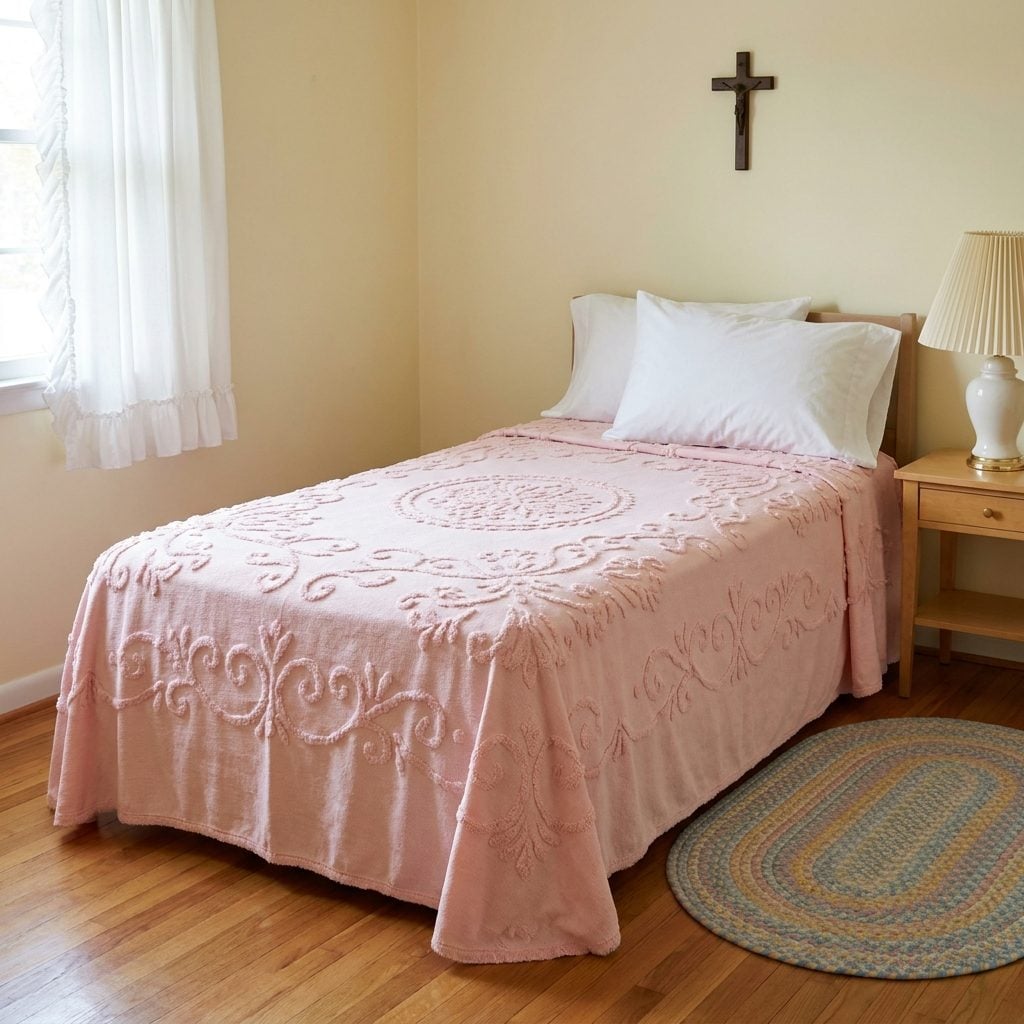
You knew you were sleeping at your grandmother’s house when you pulled back that chenille spread and felt the nubby texture under your fingers. Always pastel. Always with some kind of raised floral or scroll pattern you could trace with your thumbnail while falling asleep.
These things predated the 1960s by decades, but they hung on in guest rooms well into the Carter administration. The texture left grid marks on your cheek if you fell asleep face-down on top of it. And they shed. Little chenille caterpillar bits everywhere, caught in your suitcase zipper, stuck to your socks. But something about that fuzzy weight on a cold night in someone else’s house made the whole room feel safe. I’d take one back in a heartbeat.
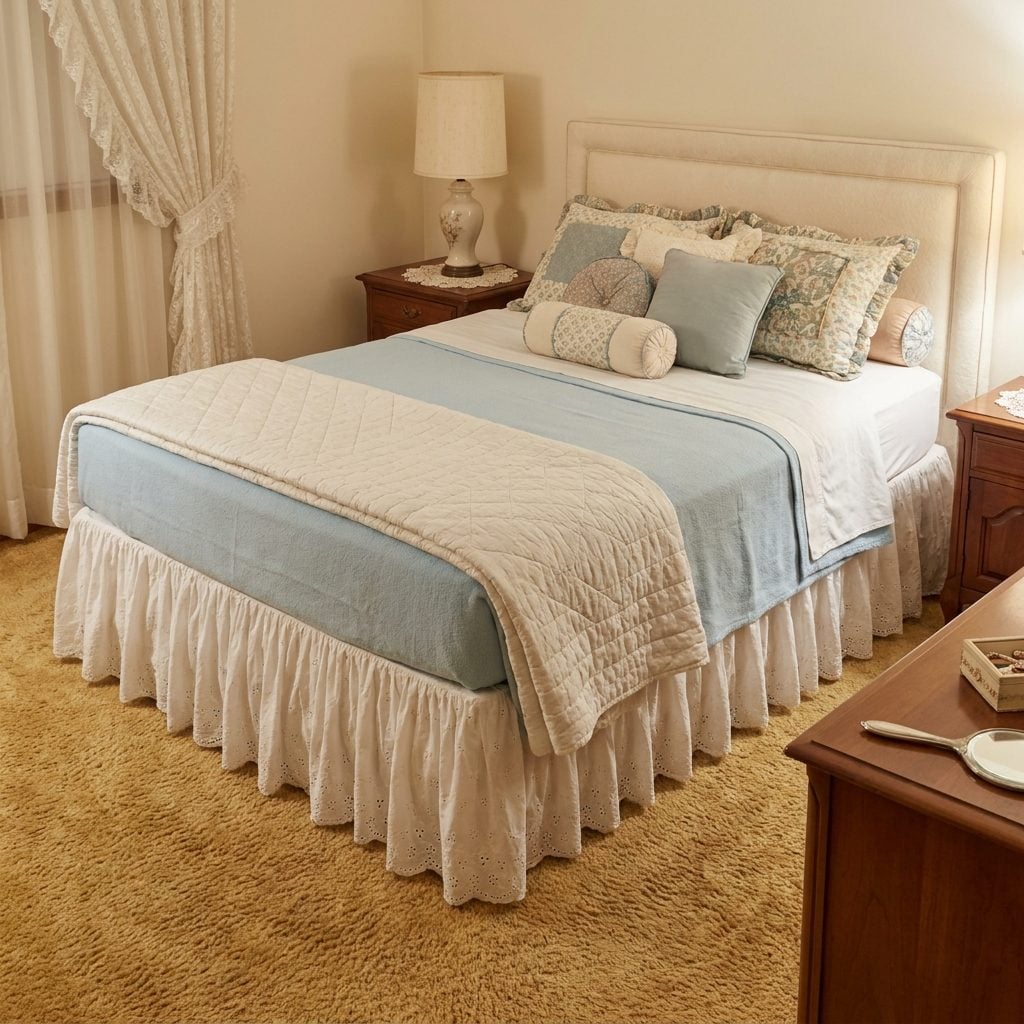
25. Ruffled Bed Skirts and So Many Layers You Needed a Map to Find the Mattress
🔥 Would you like to save this?
Getting into bed required an archaeological excavation. First, remove the decorative pillows (four to six, minimum). Then fold back the bedspread. Then the blanket. Then the top sheet, which was folded back over the blanket in a neat cuff that took real skill to maintain.
And underneath all of that drama, hiding the box spring’s sins, was the ruffled bed skirt. Usually white eyelet, sometimes with lace trim, always slightly crooked on at least one side because you could never get it to stay put once the mattress went back on.
Nobody questioned the labor. Making this bed every morning was a fifteen-minute production. Your mother did it. Her mother did it. The alternative, an exposed box spring, was apparently a moral failing.
24. Popcorn Ceilings with Tiny Metallic Flecks That Sparkled Like Budget Starlight
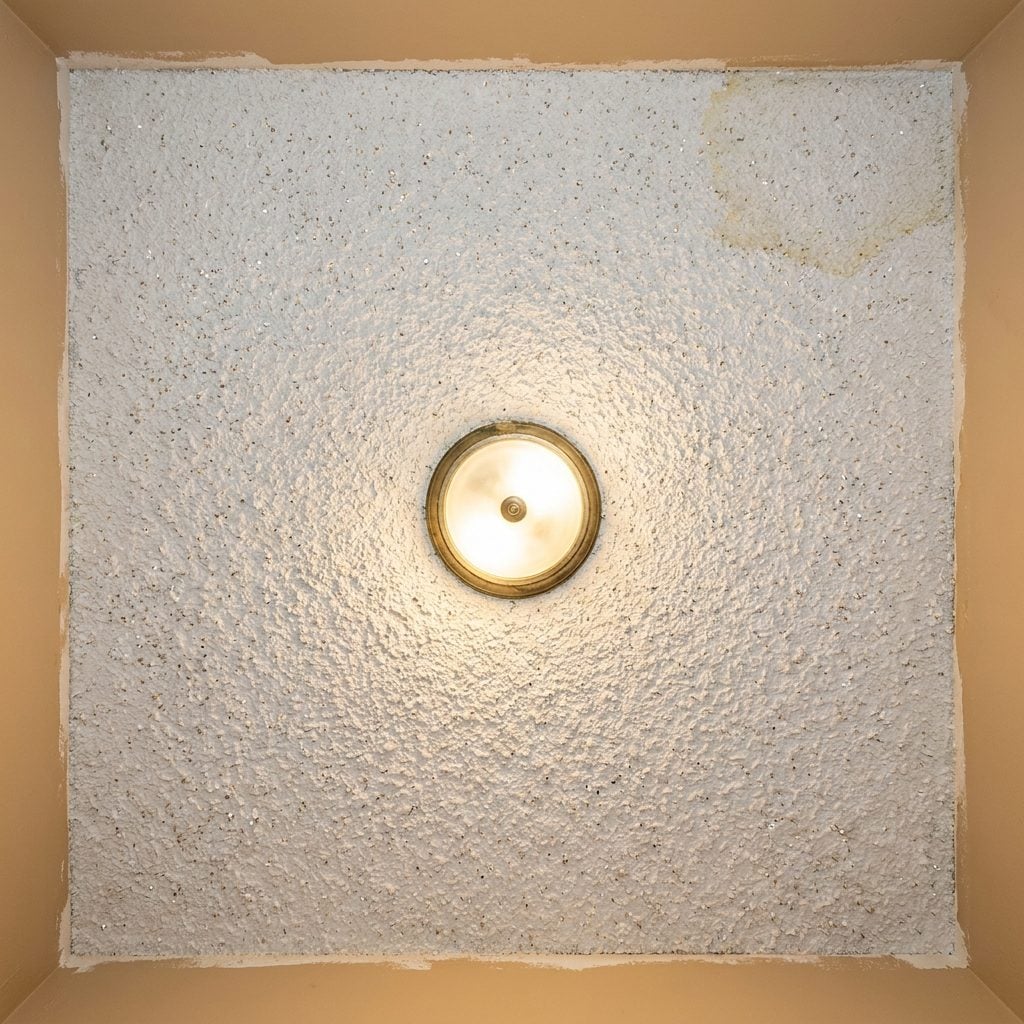
You’d lie in bed staring up at this ceiling and those little metallic flecks would catch the light from the hallway, and for a minute it almost looked intentional. Almost pretty. Then a chunk would fall off and land on your pillow and you’d remember it was just textured plaster with glitter mixed in.
I got this wrong for years, assuming the sparkle was some kind of accident. Nope. Someone at the texture company genuinely believed tiny metallic flecks would make a bumpy ceiling look glamorous. And millions of builders agreed. The real mystery is why we all lay there staring at it every night and never once said, “This is strange.”
23. The Princess Phone in Pink or Mint Green, Sitting on the Nightstand Like a Status Symbol
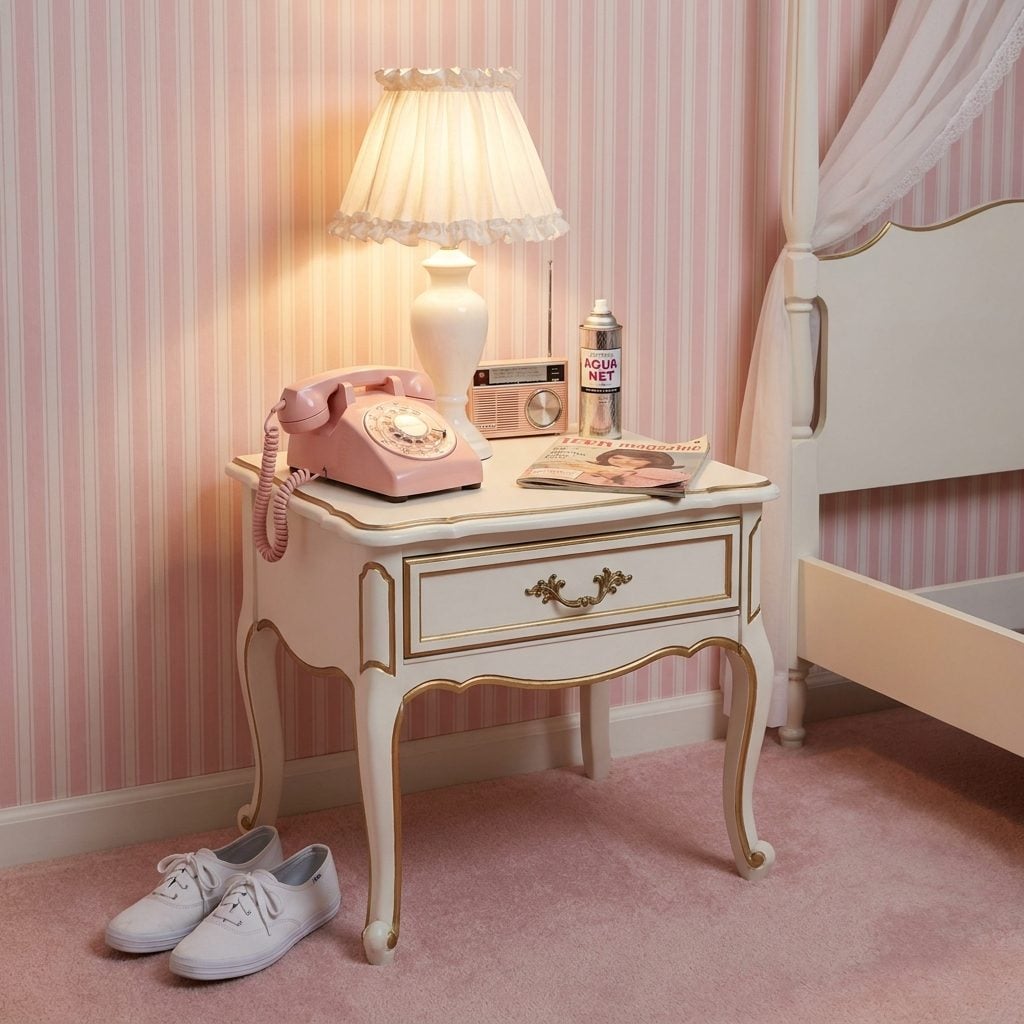
Having your own phone in your bedroom was the 1960s equivalent of getting your first smartphone. And the Princess phone was the only acceptable model. That compact oval shape with the lit-up dial, in pink or mint green or sometimes white, sitting right there on the nightstand where God and your parents could see it.
Bell Telephone marketed it directly to women and teenage girls with the tagline “It’s little. It’s lovely. It lights.” Which, honestly, was accurate on all three counts. The dial glowed in the dark, which meant you could make calls after lights-out if you whispered and kept that coiled cord from knocking the lamp off the table. Every girl wanted one. Most of us had to share the kitchen wall phone instead and stretch the cord around the corner into the hallway for privacy.
22. The Flip-Number Clock Radio That Sounded Like a Tiny Guillotine Every Sixty Seconds
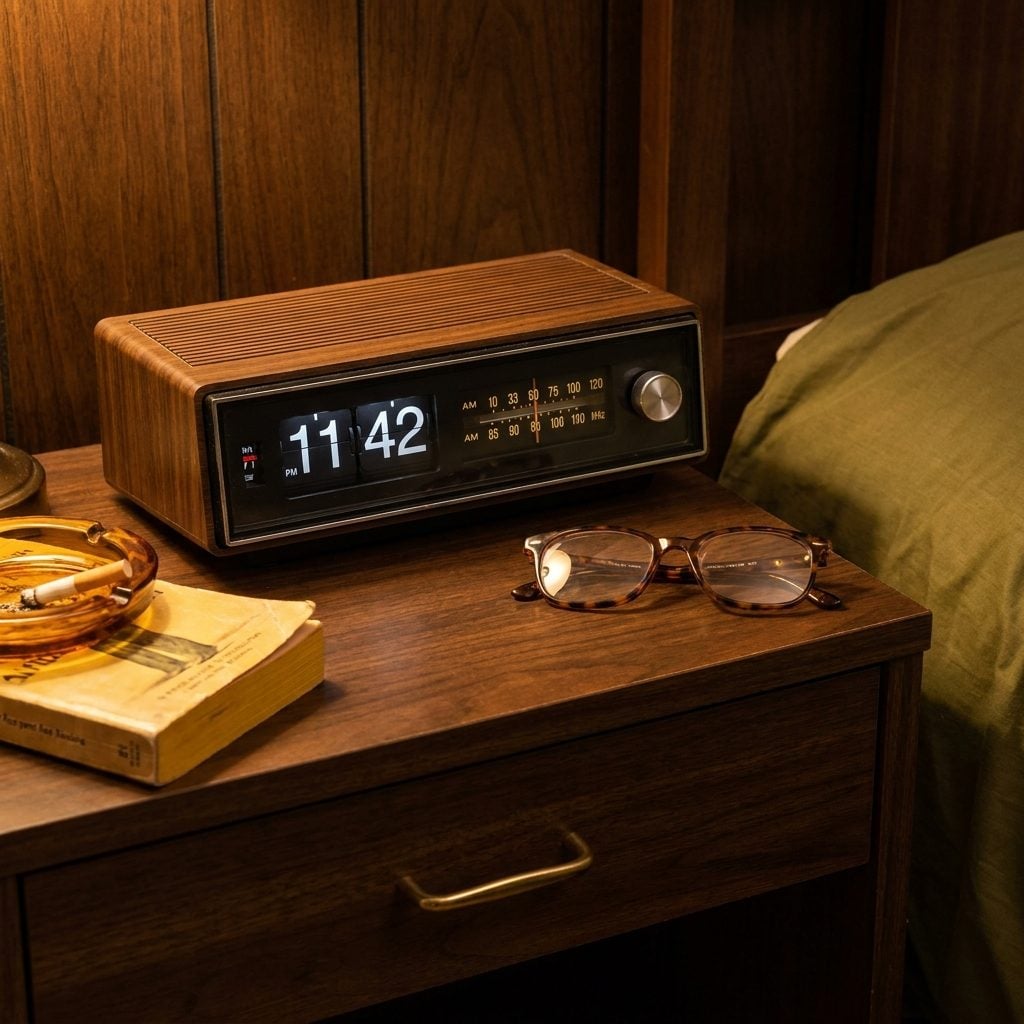
Thwip. That’s the sound. Every single minute, a new number card would flip down inside the mechanism and you could hear it from across the room. At night, in the quiet, it was the metronome of your childhood. Thwip. 11:42. Thwip. 11:43.
The alarm on these things was an AM radio station that came on at full volume, which meant you woke up either to static, a farm report, or someone’s idea of easy listening. There was no snooze button on the early models. You were awake now. Deal with it.
21. The Hi-Fi Console Stereo That Took Up Half the Wall and Nobody Questioned It
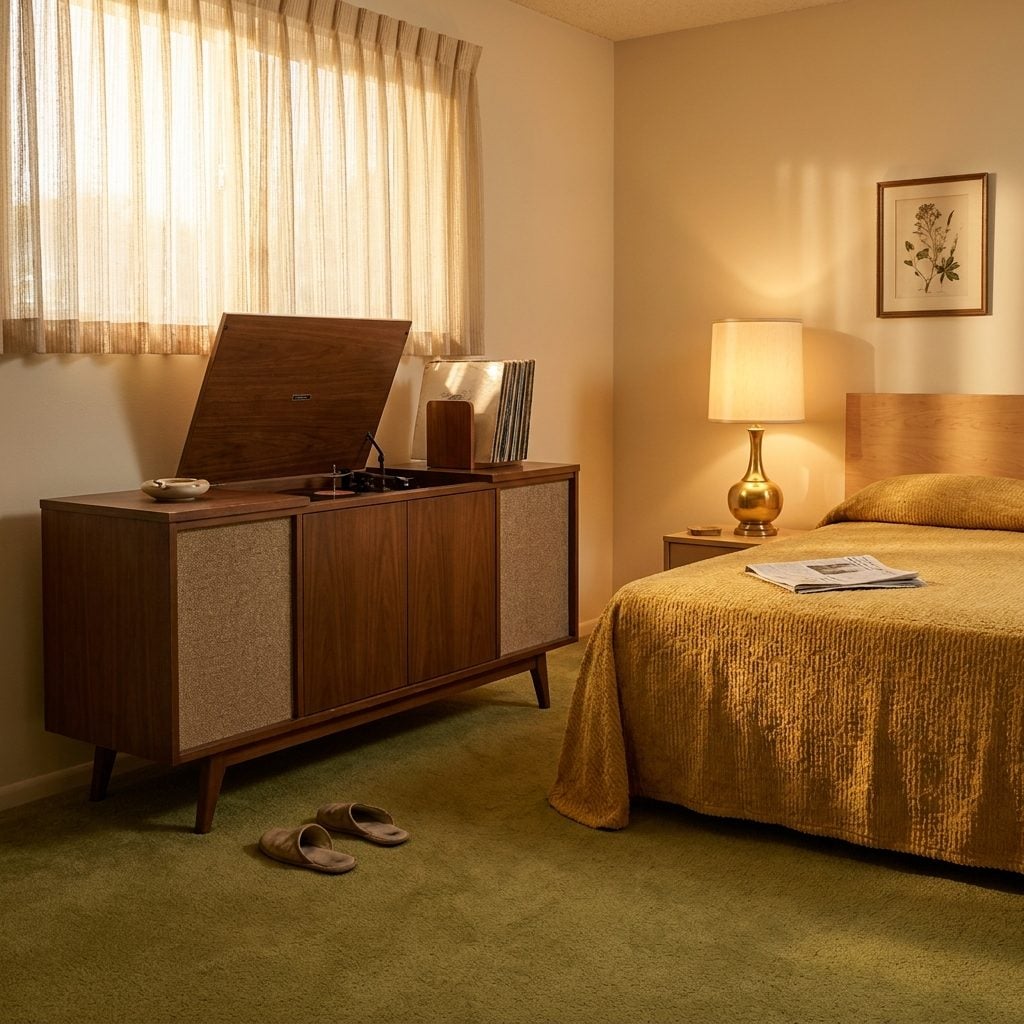
That thing weighed more than most dressers and took two grown men to move, but somehow it lived in the bedroom like it belonged there. A massive walnut cabinet with a turntable, an AM/FM tuner, and speakers the size of dinner plates, all wrapped in a piece of furniture your parents treated like a sideboard.
You’d fall asleep to Sinatra crackling through those fabric grilles. The lid stayed propped open all day because closing it felt like putting music to bed. And nobody ever asked why a piece of equipment the size of a Buick was sharing square footage with the actual bed. It was just how rooms worked.
20. Mirrored Closet Doors with Gold Trim That Made Every Bedroom Feel Like a Dance Studio
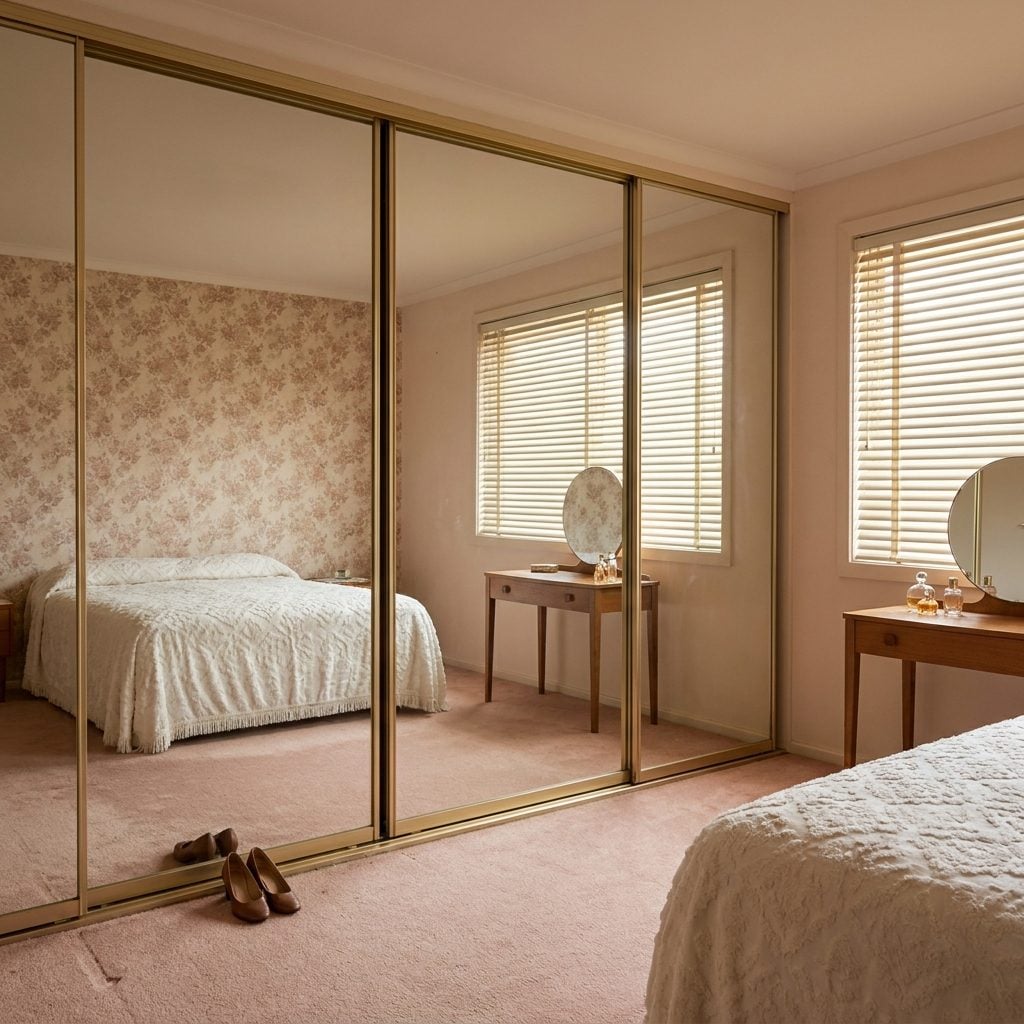
You caught your own reflection roughly forty times a day and never once on purpose. Those floor-to-ceiling mirrored panels with their thin gold aluminum frames turned every bedroom into a hall of mirrors, and the closet track always had one stubborn wheel that made opening it a full-body workout.
The gold trim oxidized to a dull bronze within a few years. Fingerprints were a permanent feature. But those doors did one thing brilliantly: they made a ten-by-twelve small family room of a bedroom feel twice its actual size. Builders loved them because they were cheap. Homeowners loved them because vanity is free.
19. The Brass Bed Frame with Finials You Could Unscrew (and Definitely Did)
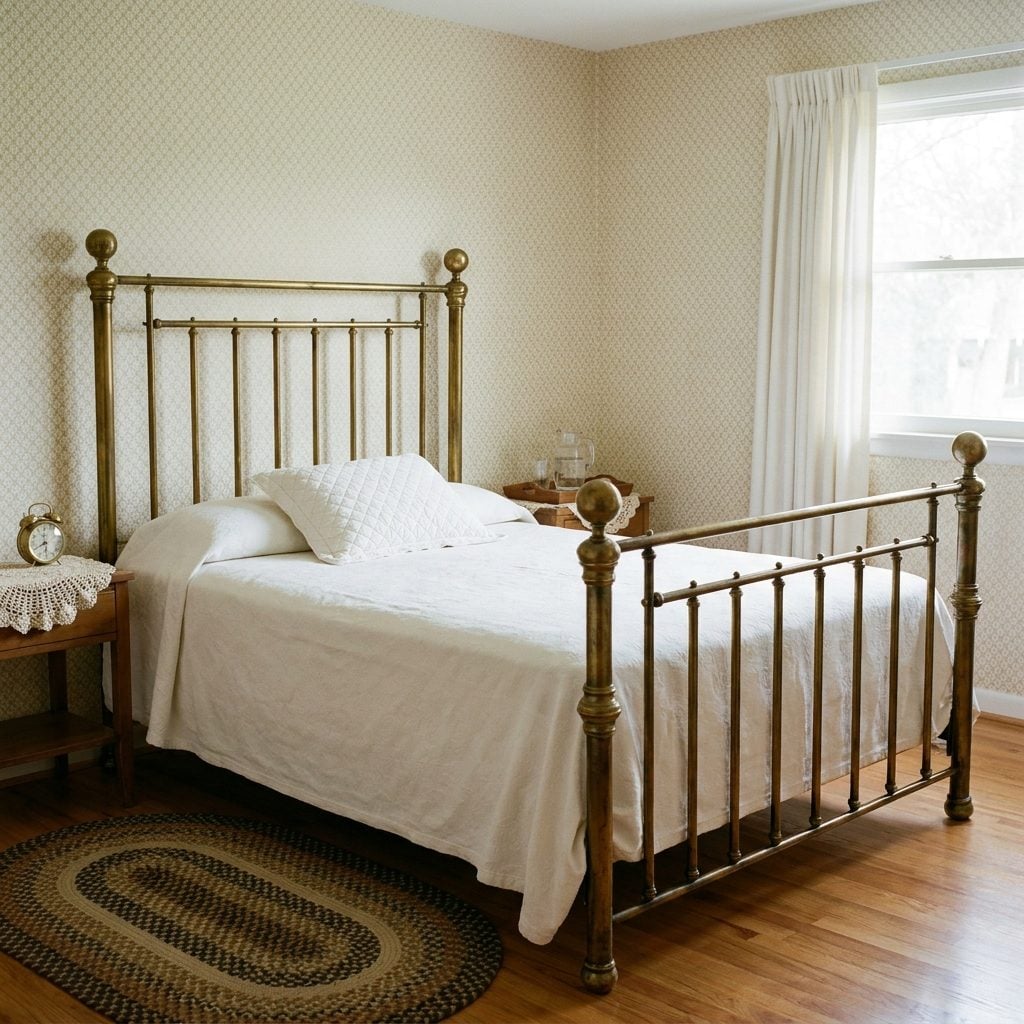
Every kid figured out those finials unscrewed. Within a week of moving in, the brass ball on the top left post was loose, then missing, then found under the bed three months later during spring cleaning.
The frames themselves were gorgeous in a Victorian-holdover kind of way. Vertical bars, sometimes with a swirl detail in the center, and a patina that your mother either polished religiously or let go completely. There was no in-between. The whole thing squeaked when you sat on it, squeaked when you rolled over, squeaked when you breathed too hard. But a brass bed frame meant your bedroom had arrived. It was aspirational furniture that also doubled as a percussion instrument.
18. Waterbeds with Built-In Heaters, Because Sleeping on a Warm Sloshing Bag Was Peak Innovation
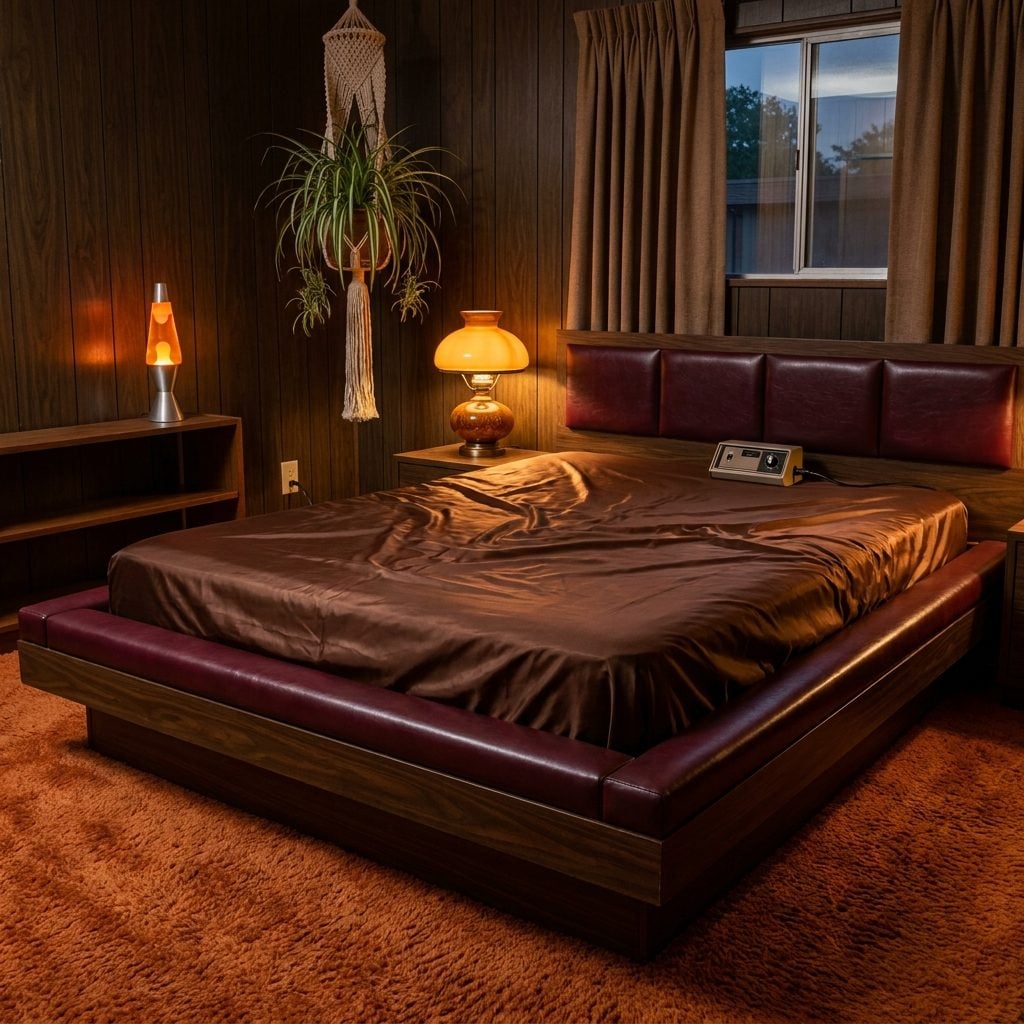
Filling one took a garden hose threaded through the bedroom window and about two hours of your Saturday. Then you spent the next six months wondering if the floor joists could handle it, because nobody checked before buying.
The heater was non-negotiable. Without it you were sleeping on a cold bladder, which is exactly as miserable as it sounds. With it, you were sleeping on a warm bladder that sloshed every time you shifted your weight. Getting out of one required a genuine strategy. Getting romantic in one required actual core strength. And the day it sprung a leak, your shag carpet became a swamp.
I say this as someone whose uncle had one well into the 1980s: the confidence it took to put several hundred pounds of water on a second-story bedroom floor is something we’ll never see again.
17. Beaded Curtains Hanging in the Doorway Like Your Bedroom Was a Fortune Teller’s Tent
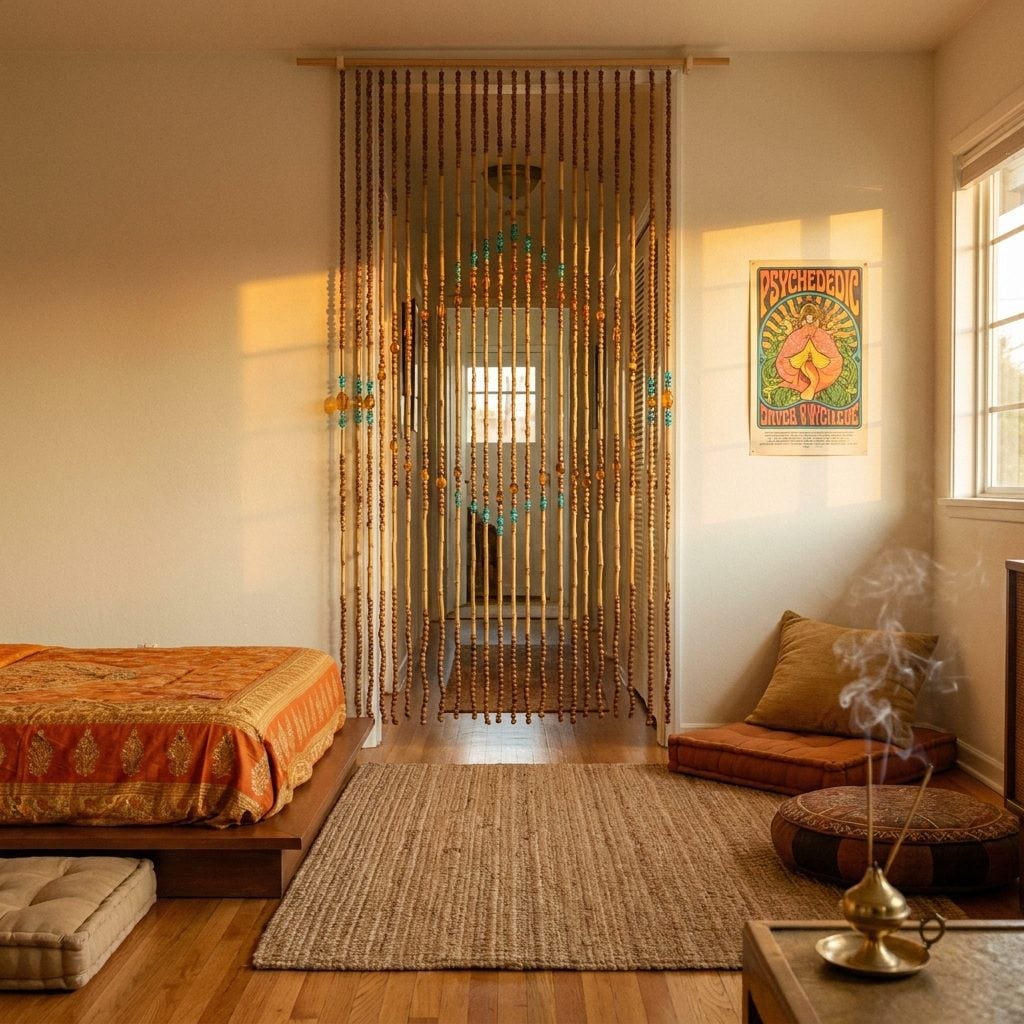
Zero privacy. Maximum atmosphere. The beaded curtain announced every entrance and exit with a clatter that could wake the entire house, yet somehow it was considered a reasonable substitute for an actual door.
Bamboo, wooden, or the fancier glass versions: they all did the same thing, which was absolutely nothing functional. But parting those strands with one hand while carrying a cup of tea in the other felt like entering your own personal sanctuary. That little ritual mattered more than any of us admitted.
16. Macramé Hanging from Every Available Surface Like the Room Was Being Slowly Consumed by Rope
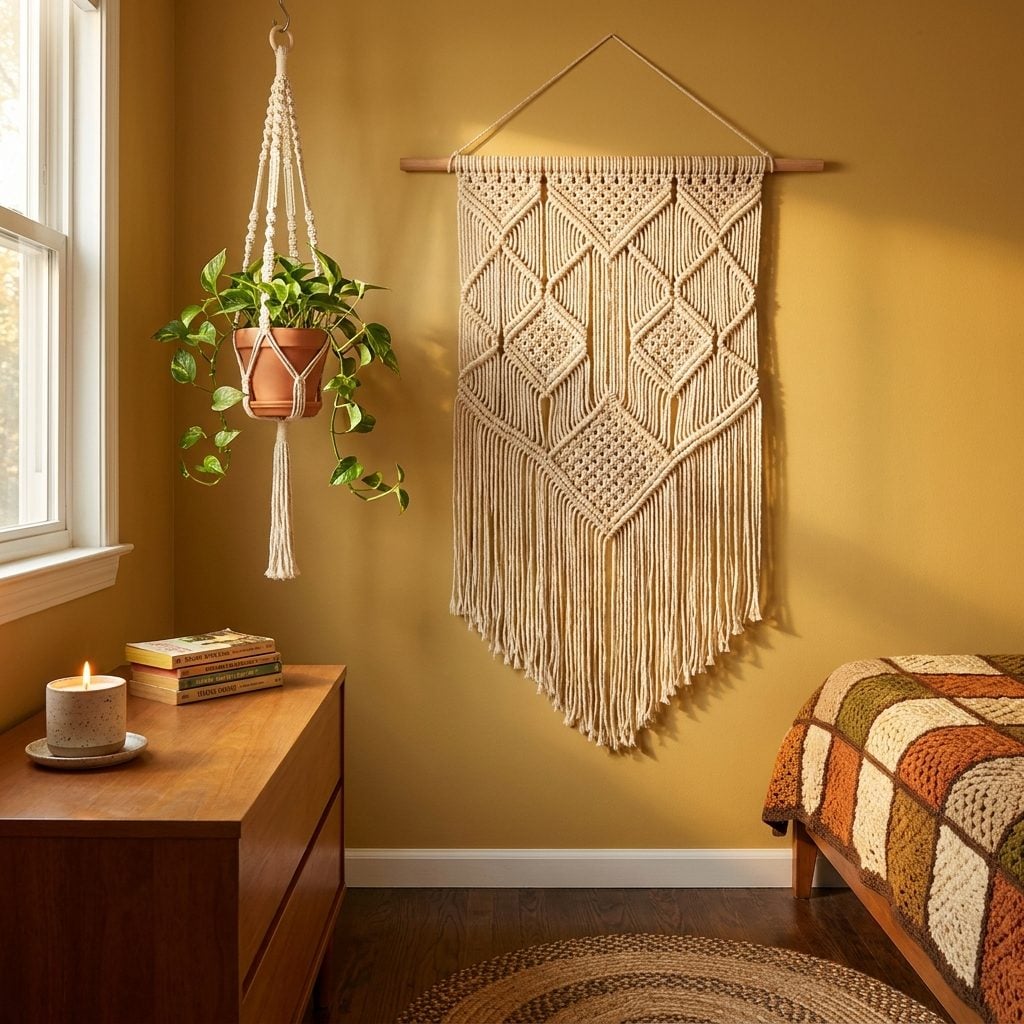
Somebody’s mom made these. Or somebody’s aunt. Or somebody learned at a community center workshop and then never stopped. The macramé wall hanging above the headboard, the plant holder dangling a spider plant over the dresser, the owl with wooden bead eyes staring at you from beside the closet. One was charming. Three was a lifestyle.
The texture was the thing. In a decade full of plastic and chrome, all that knotted cotton cord felt grounding. Real. You could run your fingers through the fringe and feel like your bedroom had a soul, even if it also had avocado carpet and a water-stained ceiling tile.
15. The Lava Lamp on the Dresser That Was Basically a Nightlight for Adults Who Refused to Admit They Wanted a Nightlight
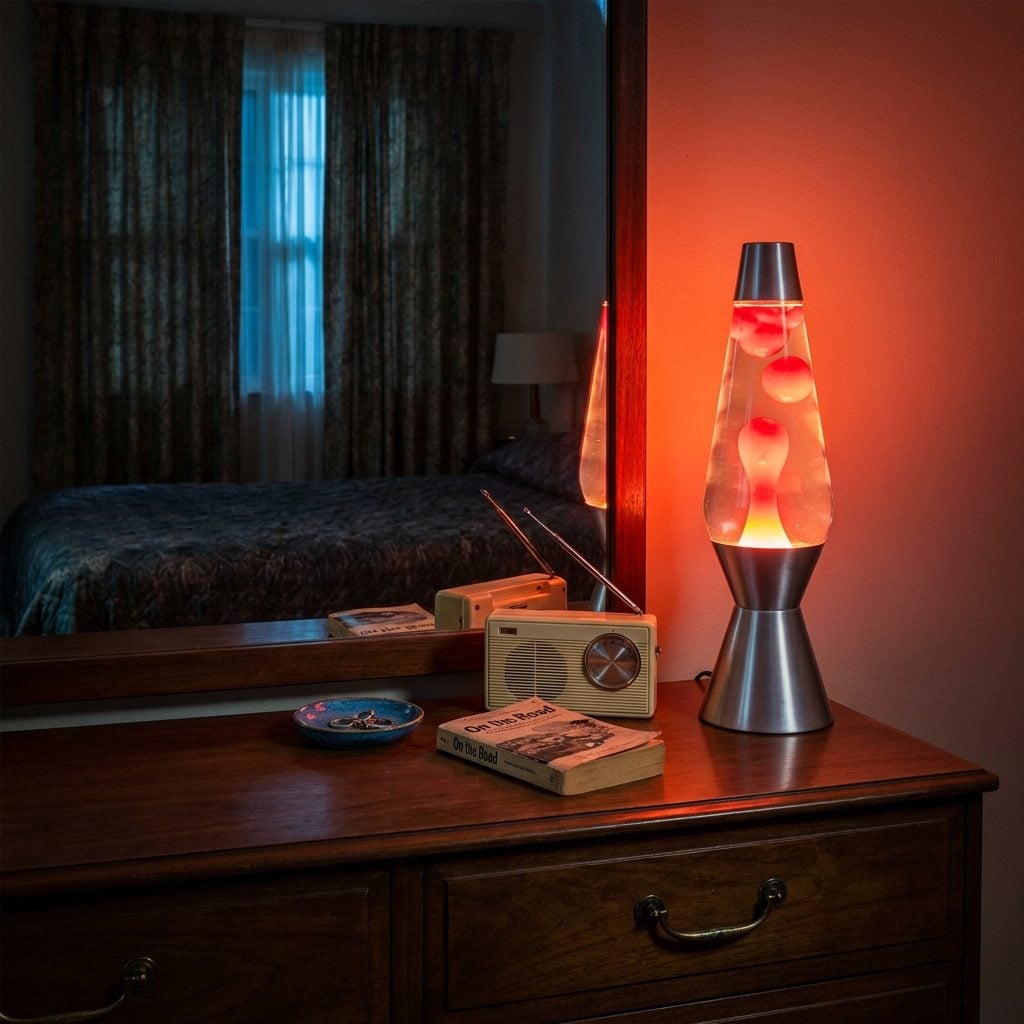
It took twenty minutes to warm up and produced roughly enough light to read a fortune cookie by. But you turned it on every single night.
Those slow-moving wax blobs were hypnotic in a way that no one could fully explain. You’d lie in bed watching red or purple globs rise and split and merge, and suddenly forty-five minutes had passed and you hadn’t thought about a single thing. It was meditation before anyone called it meditation. The vintage lava lamp was the original ambient device, and it asked nothing of you except an outlet and patience.
14. The Velvet Bench at the Foot of the Bed That Existed Solely to Hold Tomorrow’s Clothes
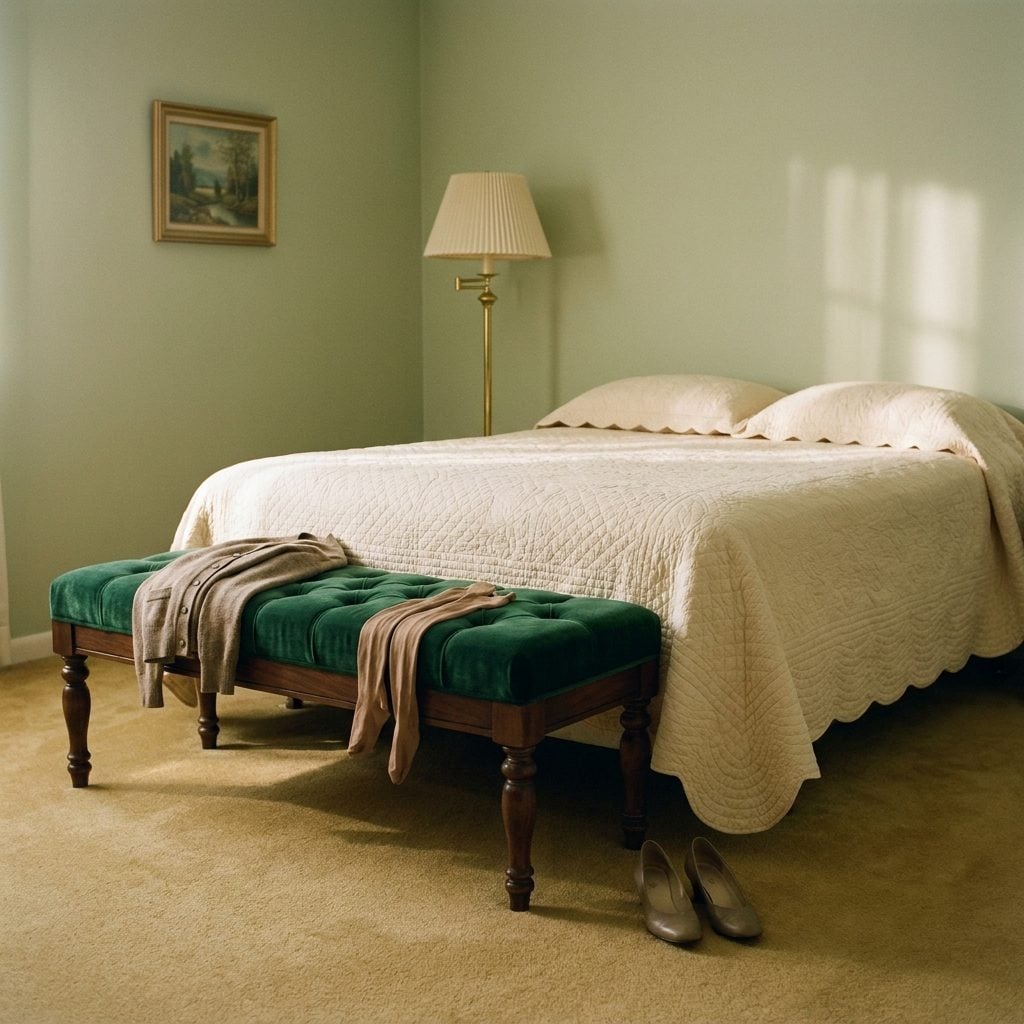
In theory it was for sitting. For perching elegantly while putting on shoes or removing jewelry, like someone in a film. In practice, it held the outfit you’d already picked out for tomorrow, a robe you were too lazy to hang up, and occasionally a cat that didn’t exist yet.
That emerald velvet bench at the foot of the bed was the most aspirational piece of furniture in any 1960s bedroom. It implied a level of daily grace that almost nobody actually possessed. But its real function, the one nobody talks about, was giving the room a finished look. Without it, a bedroom was just a bed and some furniture. With it, you had a sitting room decor moment. Even if the velvet was crushed flat from years of laundry piles, it still did its job.
Velvet still divides people today: images featuring it got fewer hearts from our readers than the other images in the same articles.
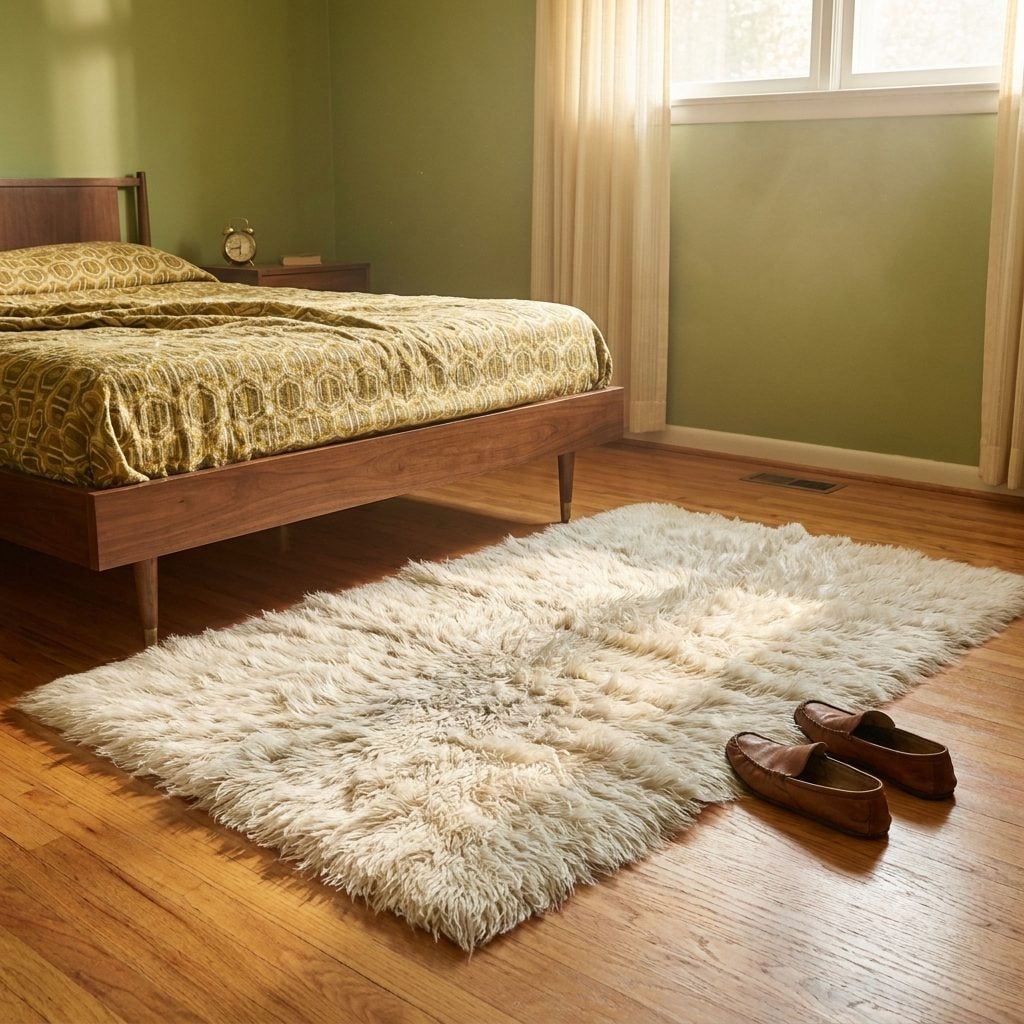
13. The Faux Fur Throw Rug That Made Getting Out of Bed Feel Like Stepping Into a Petting Zoo
🔥 Would you like to save this?
Your feet hit that rug every morning and it was like stepping onto a very flat, very synthetic sheep. Nobody questioned why there was a rectangle of fake animal on the floor. It was just there, collecting dust and static electricity in equal measure.
The white ones turned grey within a year. The pink ones never stopped shedding. And yet we kept buying them, kept positioning them like little landing pads beside the bed, as if hardwood floors were some kind of hazard that required a buffer zone made of polyester.
12. Frilly Canopy Beds with So Much Ruffled Fabric Overhead You Couldn’t See the Ceiling
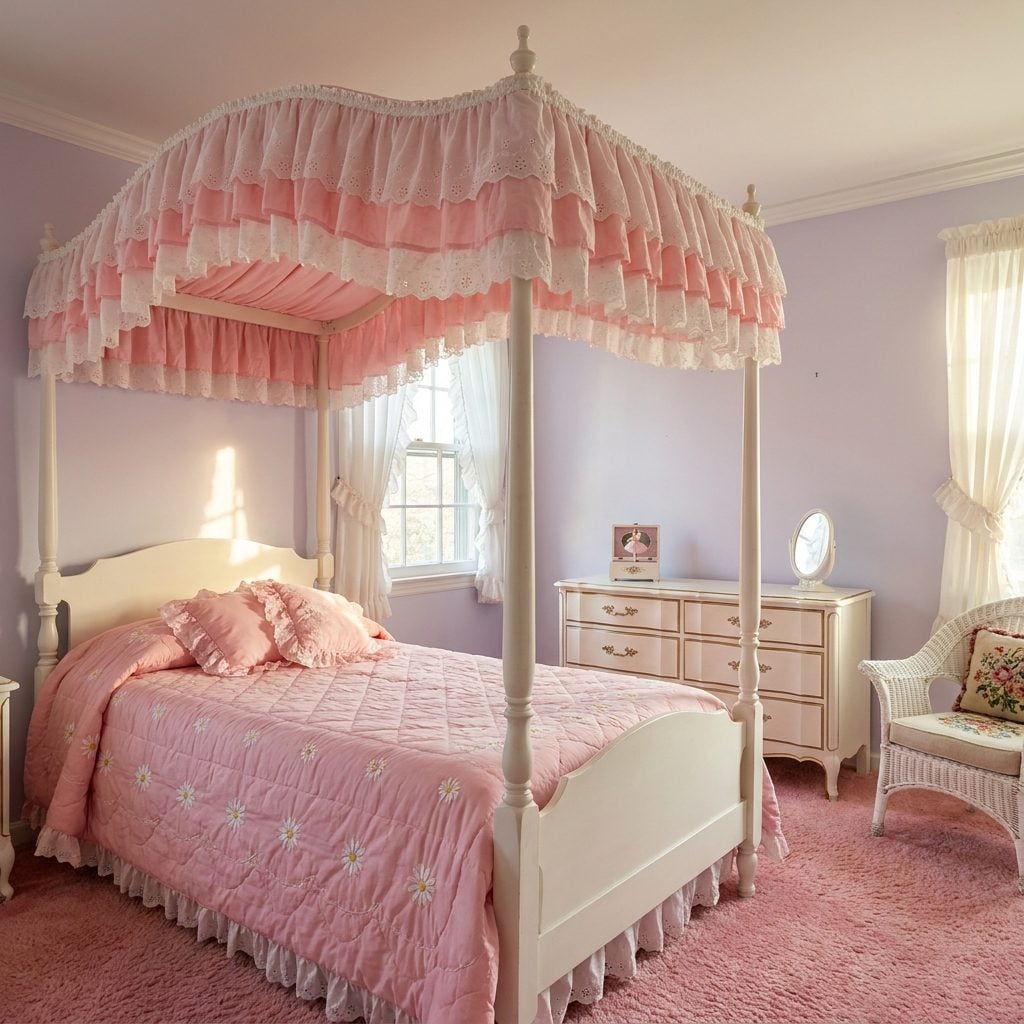
Sleeping under one of these felt like being gift-wrapped. The ruffles went on for days. Layers upon layers of eyelet and cotton, gathered and stitched and draped until the actual bed became secondary to the architecture happening above it.
Dust collected in those folds like it was being stored for winter. And the canopy sagged. Always. Right in the middle, creating a gentle dome that lowered itself toward your face over the months like a very slow, very decorative threat.
But every girl who had one felt like actual royalty, so nobody complained about the occasional spider that took up residence in the ruffles. That was just the cost of living in a castle.
11. Formica-Topped Nightstands with Those Impossibly Thin Tapered Legs
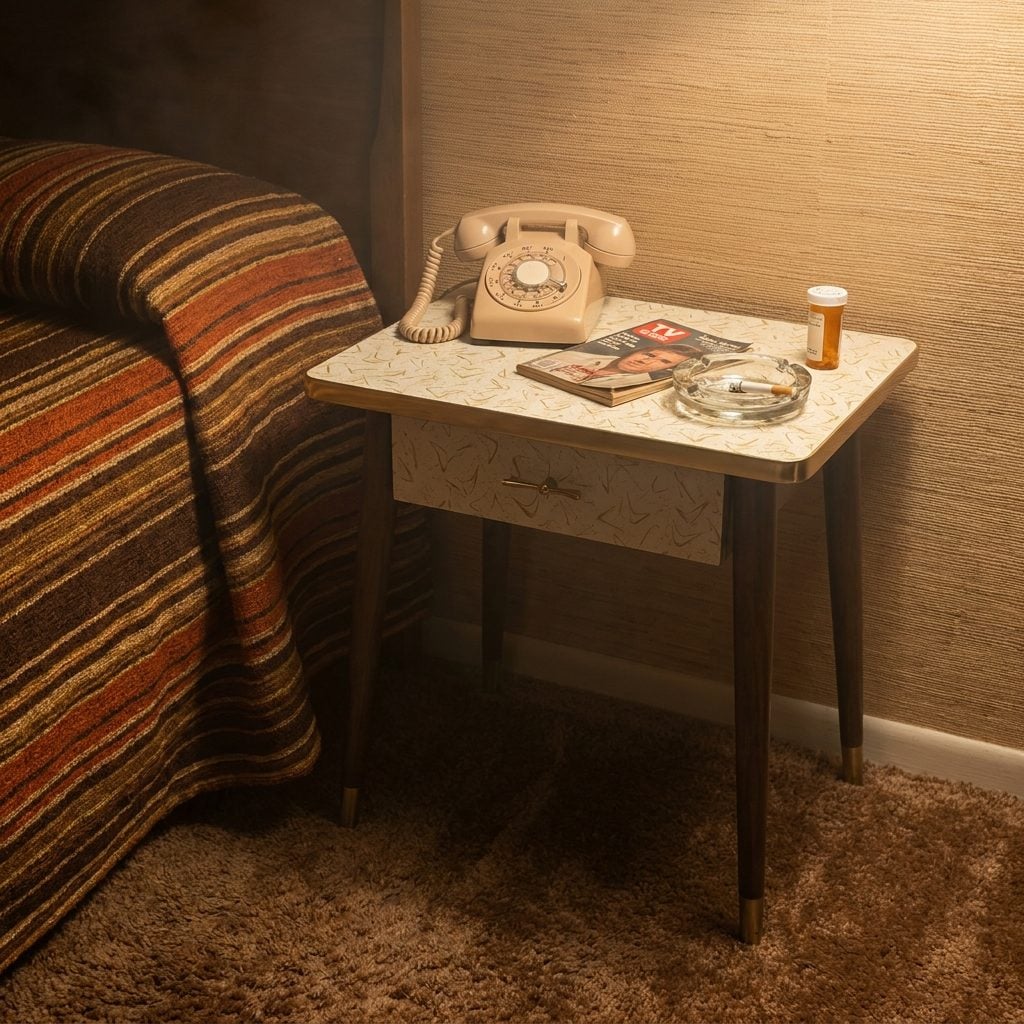
Those legs looked like they’d snap if you set down a hardcover book too aggressively. Four little sticks, tapered to a point, holding up a slab of Formica that was pretending very hard to be marble or wood grain or some boomerang pattern that existed in no natural material on earth.
But they held. They held the rotary phone, the glass of water, the alarm clock, the ashtray, and whatever novel was being read three pages at a time before sleep. Decades of faithful service on legs thinner than a broom handle. I got this wrong for years, assuming they were flimsy. They were actually engineered better than half the furniture sold today.
10. Hobnail Milk Glass Lamps That Made Every Bedroom Look Like a Country Inn
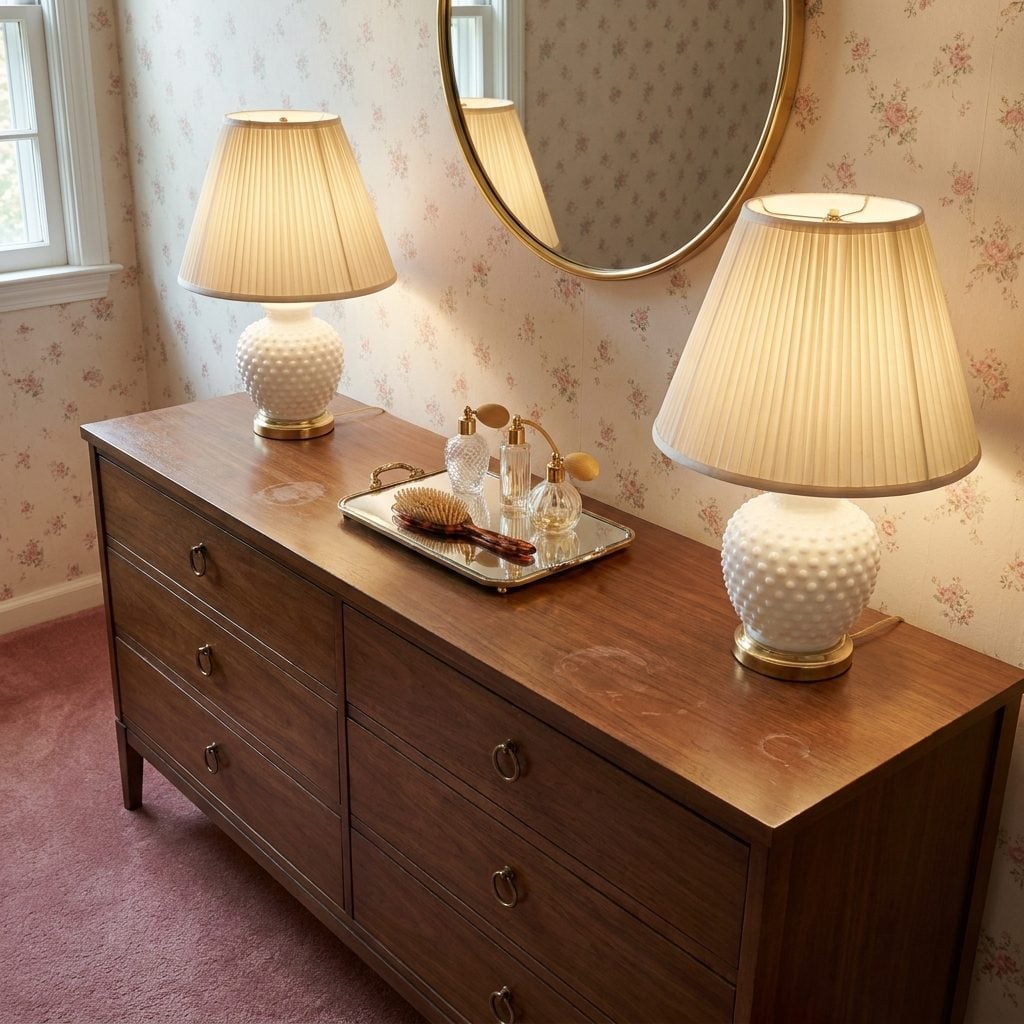
You could feel the bumps. That’s what you remember first. Running your fingers over those raised dots while your mom got ready in the mirror, the glass cool and slightly waxy under your thumb.
Every bedroom had at least one, usually in pairs flanking the dresser mirror like little sentries. The light they gave off was soft and yellowed through those pleated shades, turning the whole room the color of warm butter. Fenton made millions of them. Your grandmother had them. Your aunt had them. The guest room at every house you ever visited had them. There was something about that light living room glow that made even a cramped bedroom feel gentle and safe.
9. Owl Figurines and Macramé Owl Wall Hangings, Because Apparently We Were All Very Into Owls
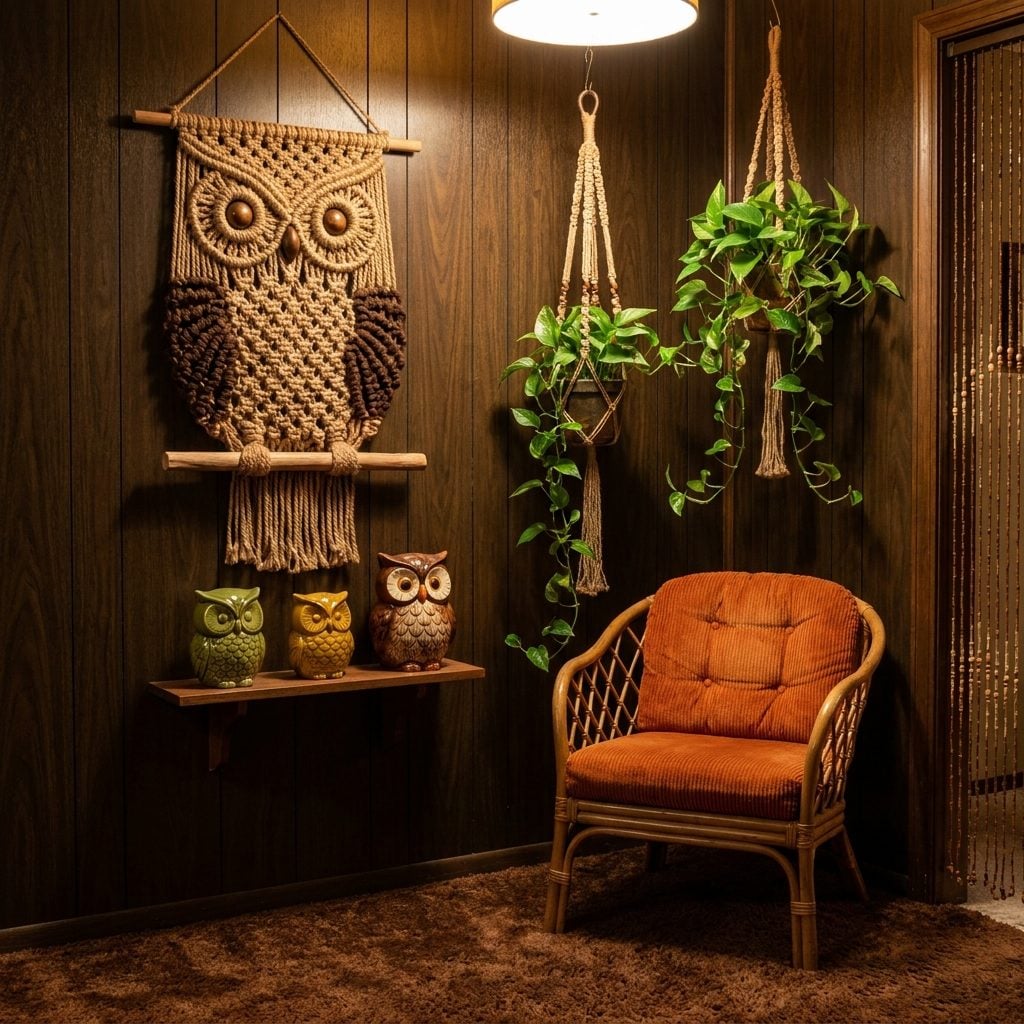
Nobody ever said “I love owls.” Nobody went on an owl-watching trip. Yet somehow every bedroom in America between 1966 and 1974 contained a minimum of three owl-shaped objects.
Ceramic owls on the shelf. A macramé owl with wooden bead eyes hanging from a nail. Owl-shaped trivets in the kitchen that migrated to the bedroom dresser. Owl bookends. They just appeared, like some kind of decorative migration pattern that no one could explain or resist. The ceramic owl figurine in harvest gold was practically mandatory.
8. Paint-by-Numbers Art, Framed and Hung Above the Headboard with Zero Irony
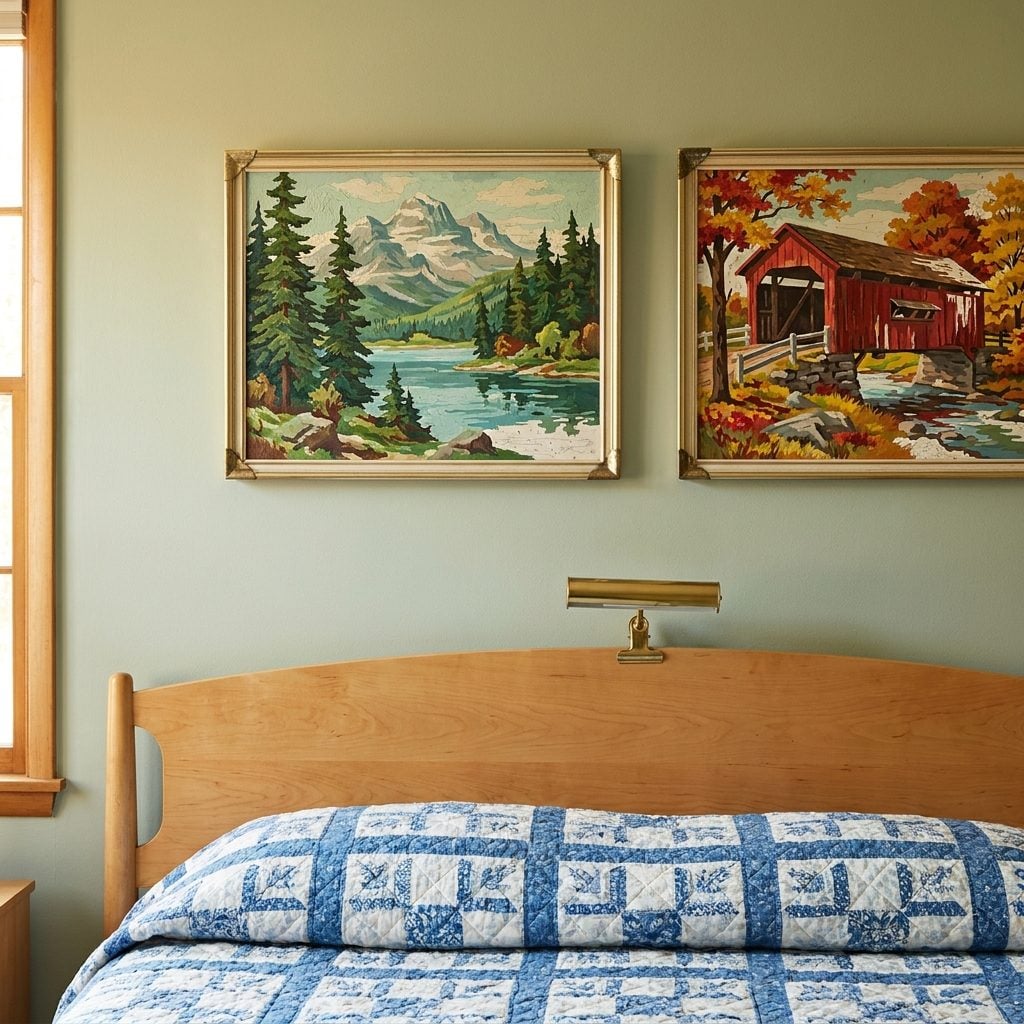
Here’s the thing. These weren’t hidden in a closet or leaned against a wall in the basement. They were framed. In actual frames. And hung in the bedroom like fine art, right above the headboard where you’d put a Monet print today.
And honestly? They had charm. The slightly uneven color fills. The visible outlines where the paint got thin near the edges. That one section of sky where whoever painted it clearly gave up on blending. Every single one featured either a mountain lake, a covered bridge, or a horse standing in a field, because apparently those were the only three acceptable subjects.
7. The Atomic Starburst Clock That Ticked Loud Enough to Time Your Insomnia
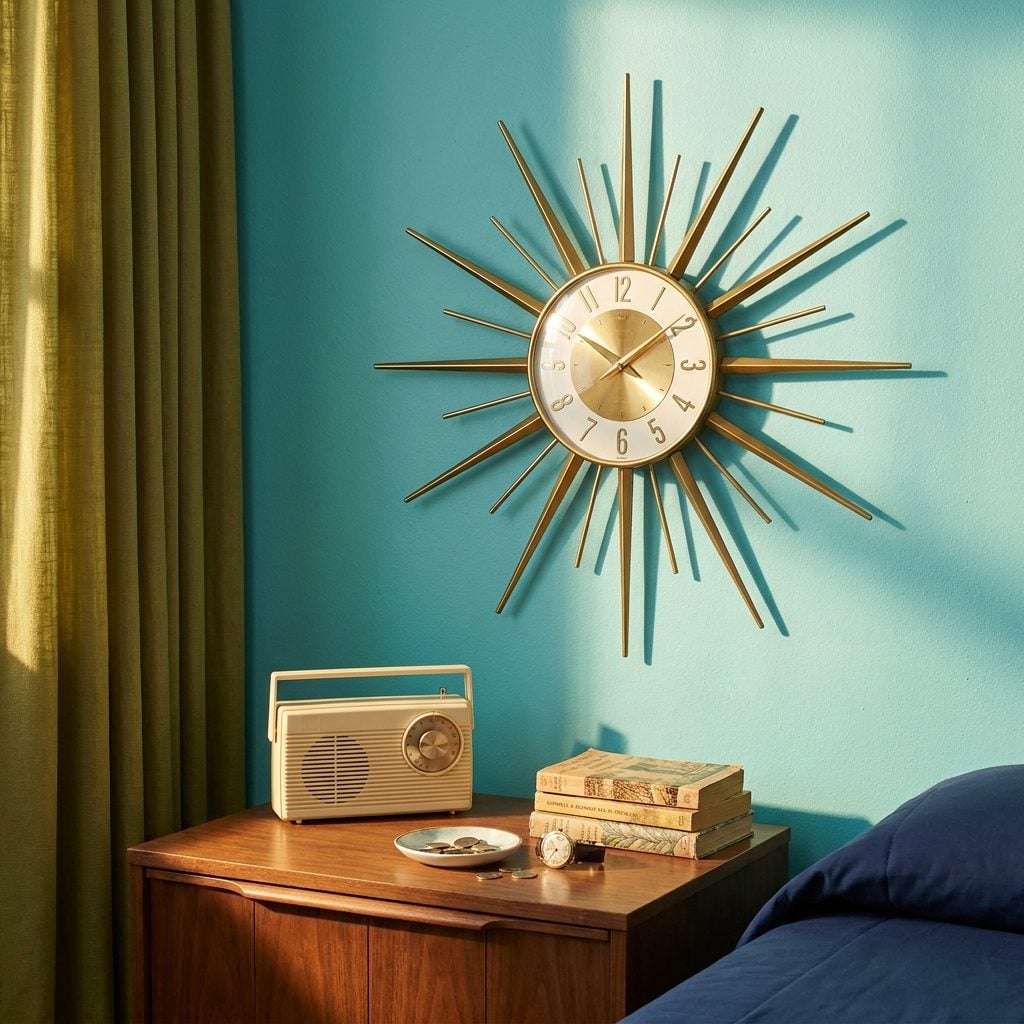
That tick. You could hear it from the hallway. A sharp, mechanical click every single second, all night long, radiating from a clock that looked like a gold sea urchin had exploded on the wall.
The starburst clock was the statement piece of the 1960s bedroom, mounted dead center on the wall where it could command the room with its spindly metal rays. George Nelson gets the design credit, but the knockoffs outnumbered his originals by about a thousand to one. Every department store sold a version. And every version ticked like it had a personal vendetta against your sleep.
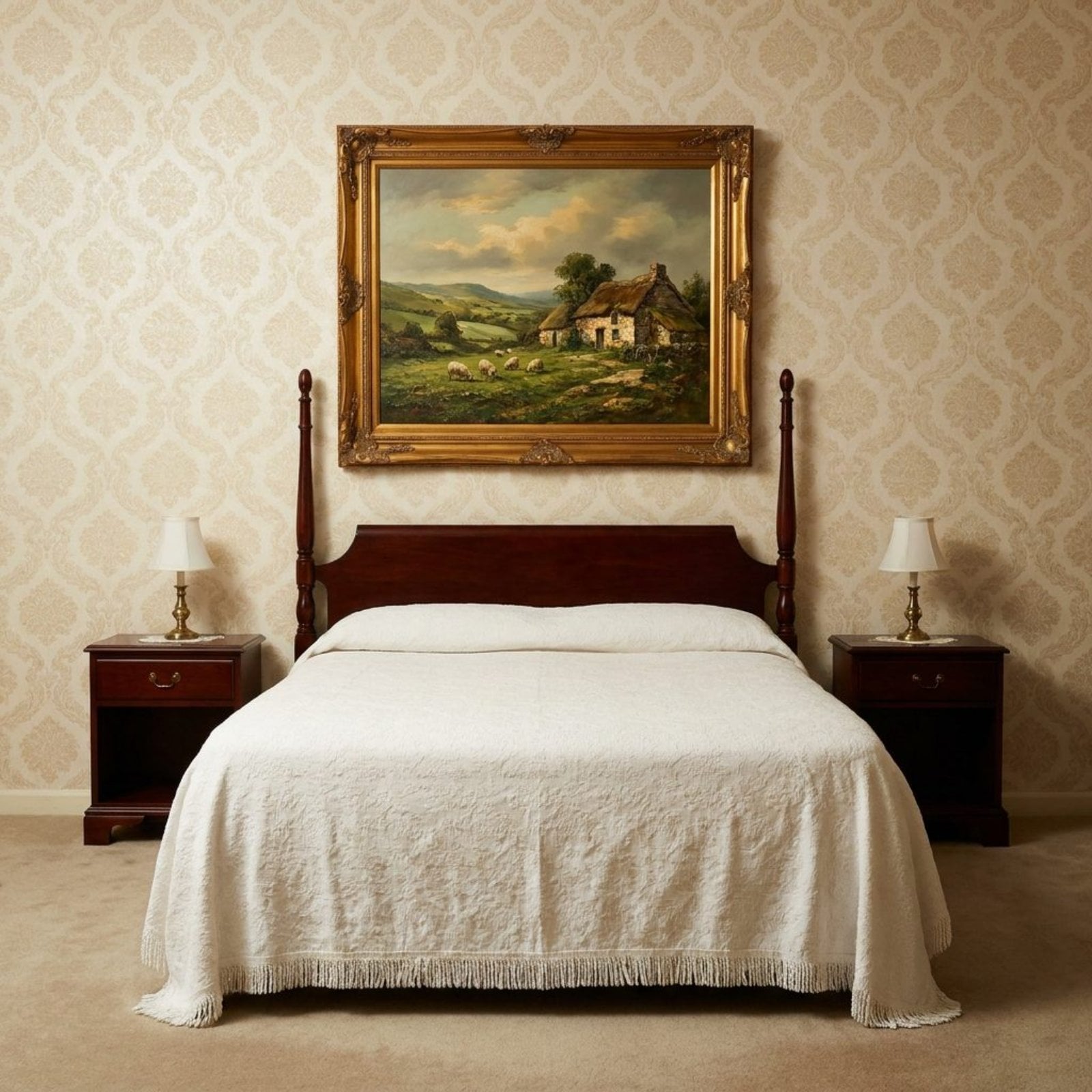
6. Heavy Gold-Framed Oil Paintings of Pastoral Scenes Nobody in the Family Actually Painted
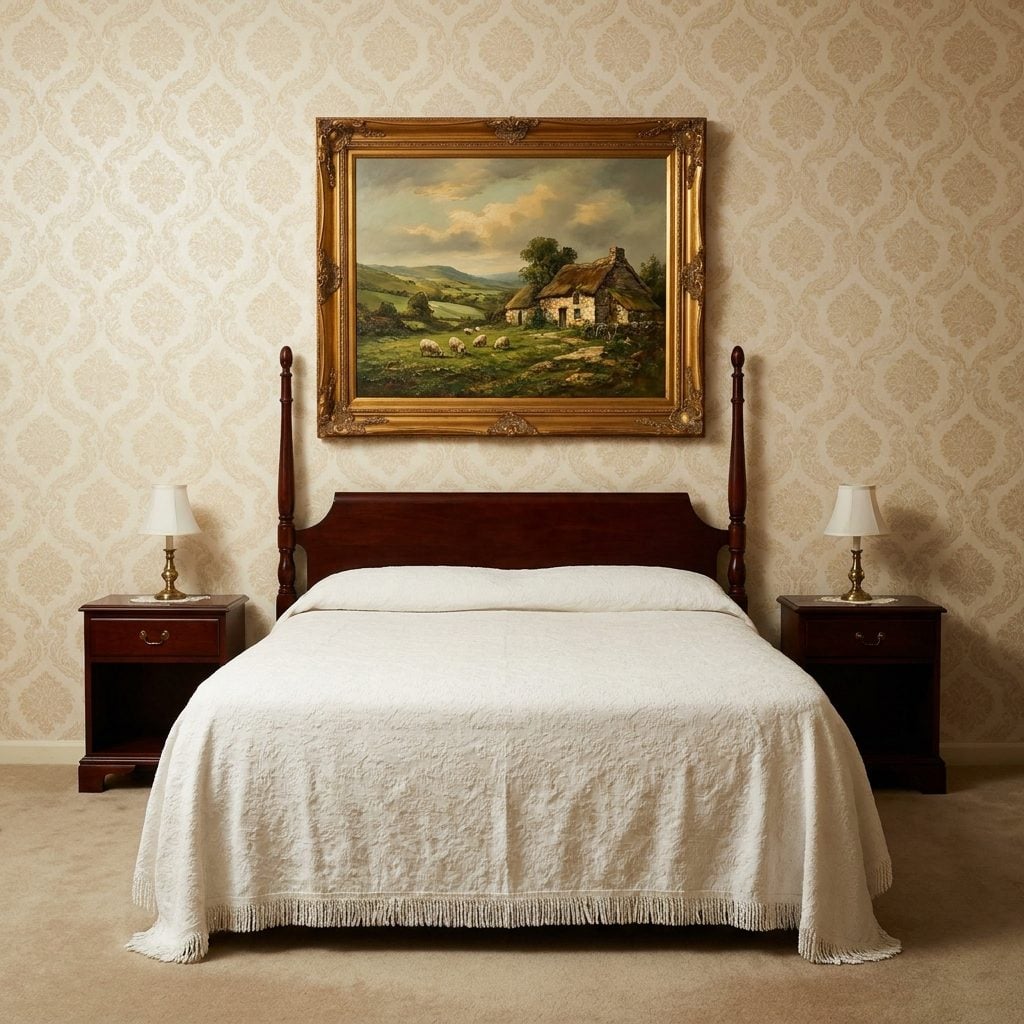
These showed up at Sears. Or maybe a furniture store. Or a garage sale. The origin story was always murky, which was part of the mystique. A heavy oil painting of rolling green hills, a stone cottage, maybe some sheep, all inside a gold frame ornate enough for a Habsburg palace, hanging above the bed in a three-bedroom ranch house in Ohio.
Nobody in the family painted. Nobody had been to the English countryside. But there it hung, lending an air of old-money sophistication to a room that also contained a clock radio and a pile of Reader’s Digest Condensed Books on the nightstand. The frame alone weighed about fifteen pounds, and the nail holding it up was always just a little too small for the job. You’d lie in bed sometimes and think about that.
5. That One Pop Art Print You Never Chose but Somehow Owned
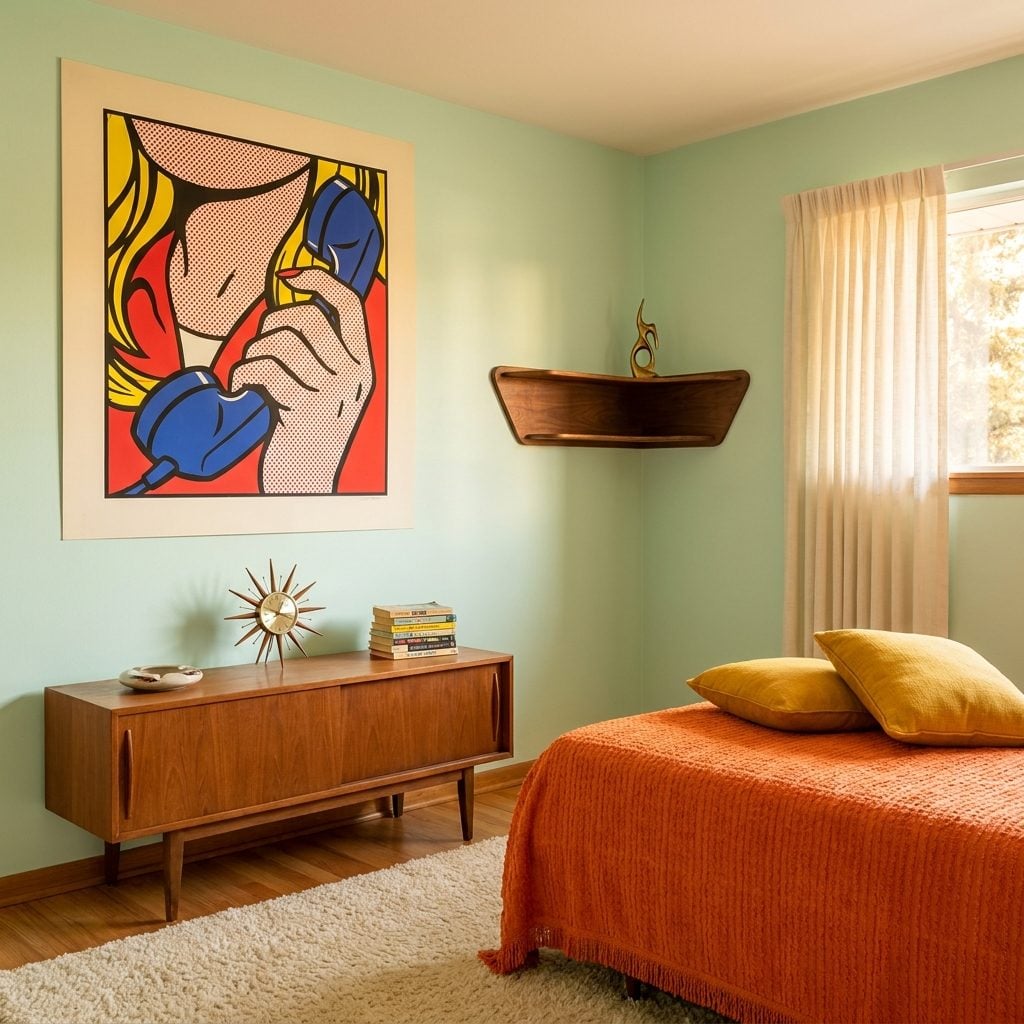
Nobody went to a gallery and carefully selected these. They just appeared. A bold, slightly aggressive print in primary colors, hung above the headboard or next to the closet, featuring shapes that looked like someone had a strong opinion about geometry. Half the time it came with the apartment.
The thing is, these prints did something wallpaper couldn’t. They gave a room a single loud focal point, and everything else in the bedroom got to be quieter because of it. A light living room could get away with subtlety, but bedrooms in the ’60s needed that one piece of visual confidence on the wall. And we never questioned it.
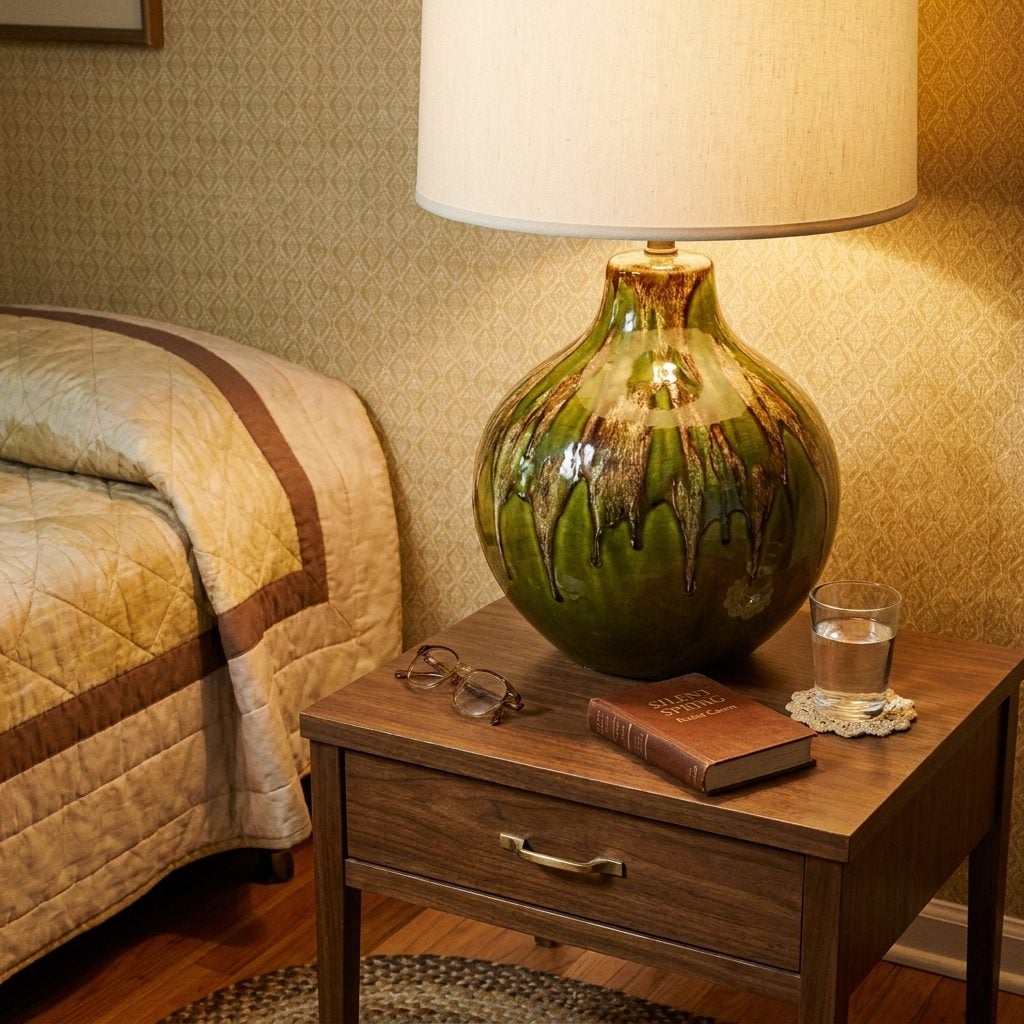
4. The Ceramic Lamp with the Drip Glaze Base That Weighed More Than Your Nightstand
🔥 Would you like to save this?
You could have used it as a doorstop in a hurricane. These lamps were dense, serious objects. The bases came in avocado, burnt sienna, or a murky teal that looked like something pulled from a riverbed. The glaze pooled and dripped in ways that were supposedly decorative but honestly looked like the kiln had a moment.
Every bedroom had at least one, usually on the nightstand closest to whoever read before bed. The ceramic drip glaze lamp threw this specific warm circle of light that made everything outside it disappear. Something about that amber glow and the slight roughness of the base under your fingers when you reached to click it off. It made falling asleep feel like a small, deliberate act.
3. Sliding Closet Doors That Announced Every Outfit Decision to the Entire House
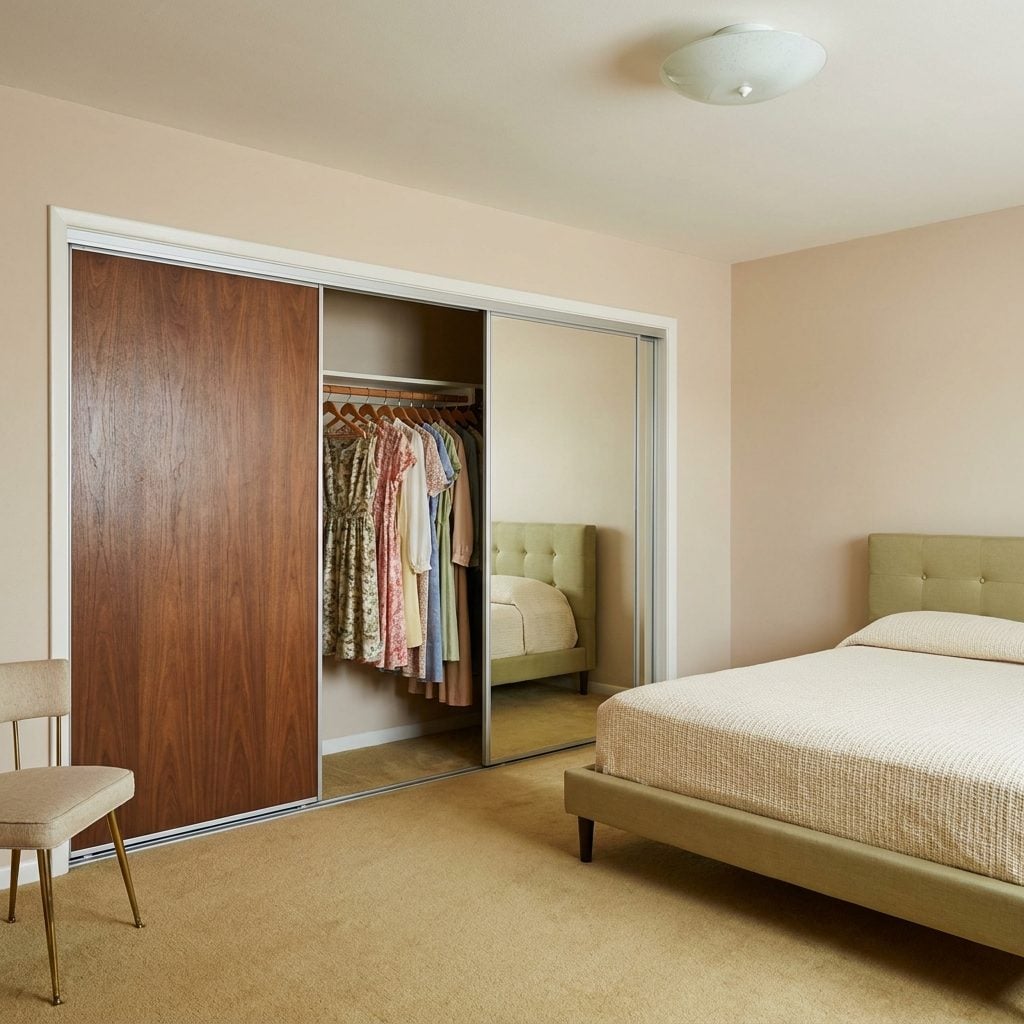
That metallic scraping sound. You know the one. The bottom track collected dust, hair, and the occasional penny, which meant the doors never slid smoothly for more than about two weeks after cleaning. You’d yank one panel sideways, it would catch, you’d lift and shove, and everyone in the hallway knew you were getting dressed.
The mirror version was clever in theory. A full-length mirror built right into your closet door, so the small family room-sized bedrooms of the era could feel a touch bigger. In practice, you saw yourself every single time you walked past, which was either motivating or demoralizing depending on the morning.
I genuinely miss the walnut veneer sliding doors though. They had this warm, honest look that today’s hollow bifolds can’t touch.
2. A Small Army of Decorative Perfume Bottles Standing Guard on the Vanity
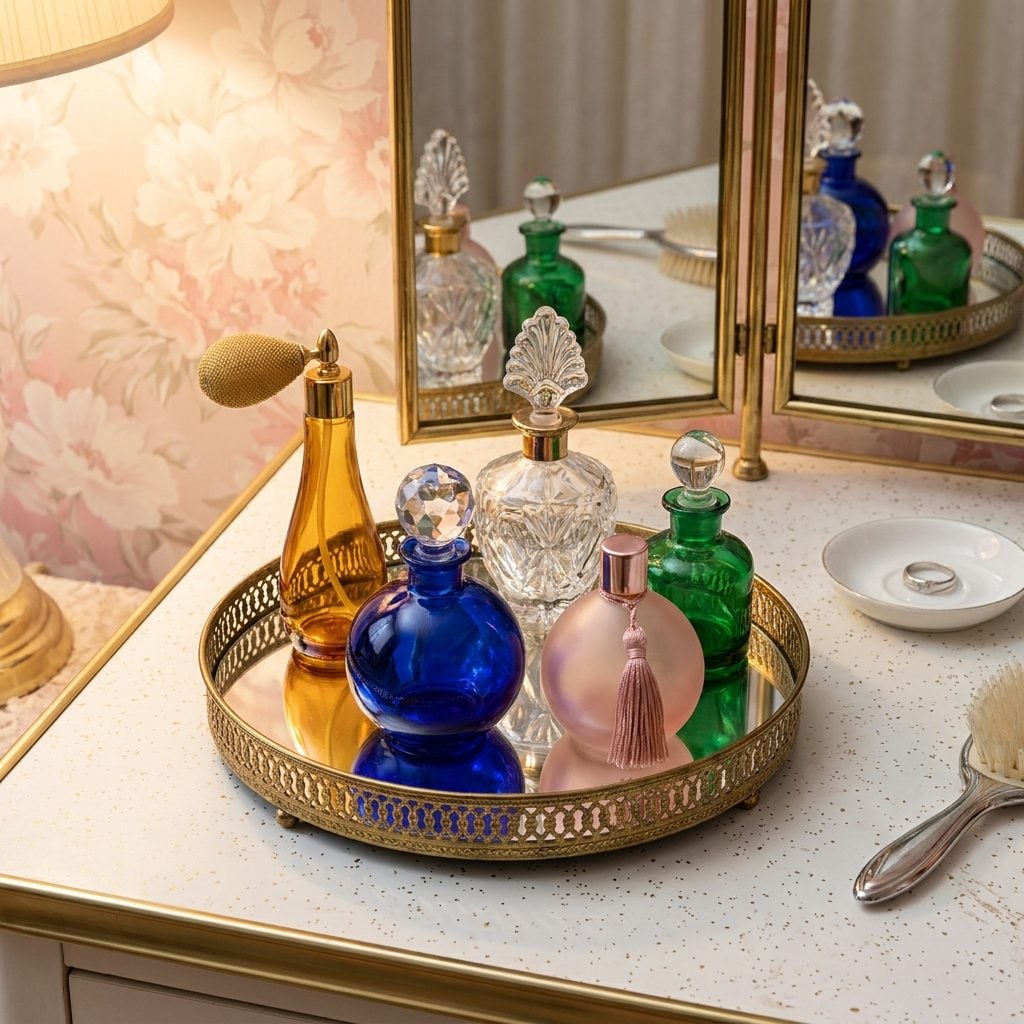
Half of these were empty. Didn’t matter. They stayed on that mirrored vanity tray like tiny glass sentinels, arranged by some logic only the owner understood. The tall amber one with the atomizer squeeze bulb. The squat blue one with the stopper that always stuck. A couple of crystal numbers that caught the light and threw tiny rainbows across the ceiling.
These weren’t really about perfume. They were about having a corner of the bedroom that was purely, unapologetically decorative. A place where function didn’t apply and beauty was the whole point. Your grandmother could tell you exactly where she got each one, and the story was always better than the scent.
1. The Fern in the Ceramic Pot That Nobody Remembers Watering but Never Died
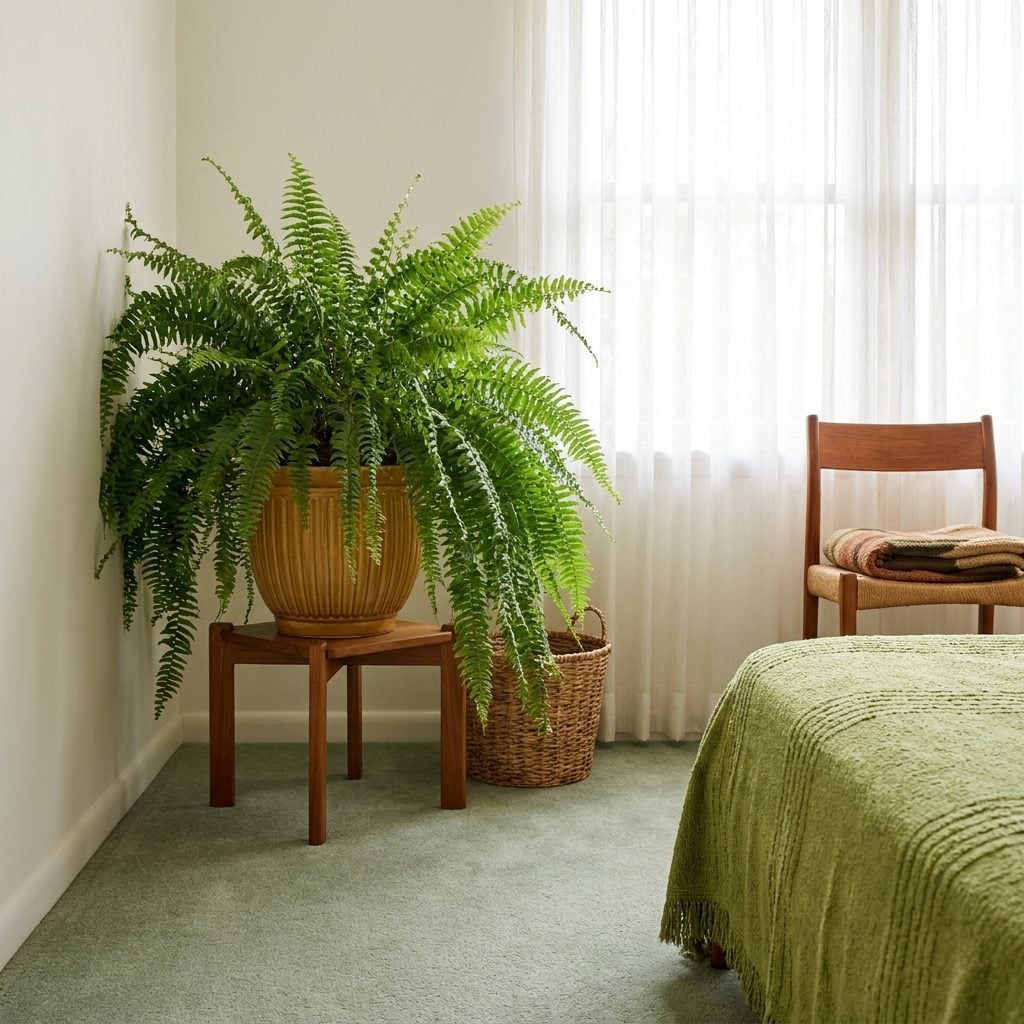
Indestructible. That’s the only explanation. These Boston ferns sat in their ochre ceramic planters on their little teak stands, fronds spilling everywhere, getting sporadic attention and thriving anyway. The bedroom would be perfectly tidy, everything in its place, and then there was this wild green thing in the corner doing whatever it wanted.
A fern in a ’60s bedroom wasn’t a design choice. It was practically a roommate.
What’s interesting is that houseplants in bedrooms weren’t trendy then the way they are now. Nobody was curating a “plant shelf” for social approval. You just had a fern because your mother had one, and her mother before that. The pot was always slightly too small, and a few brown fronds at the bottom were permanent residents you learned to ignore.