🔥 Would you like to save this?
The linoleum was cracked. The faucet dripped. The single bulb over the table threw shadows into every corner, and the flour lived in a sack you could see through the cabinet glass. Nothing matched. Nothing was designed. And yet something about that kitchen, the one you’ve seen in black-and-white photographs or your great-grandmother’s house before they gutted it, pulls at you in a way your quartz countertops never have.
In order to come up with the very specific design ideas, we create most designs with the assistance of state-of-the-art AI interior design software. Also, assume links that take you off the site are affiliate links such as links to Amazon. this means we may earn a commission if you buy something.
You’re not nostalgic for poverty. That’s the easy explanation, and it’s wrong. What’s actually happening is a set of psychological triggers so old and so deep that no amount of subway tile can override them. Your nervous system is responding to spatial cues, material honesty, and visual simplicity that humans relied on for thousands of years before someone decided kitchens needed to look like operating rooms. The Depression-era kitchen got almost everything right by accident. Here’s what your brain has been trying to tell you.
The Psychological Trick That Makes Chipped Enamel Feel More Trustworthy Than Granite
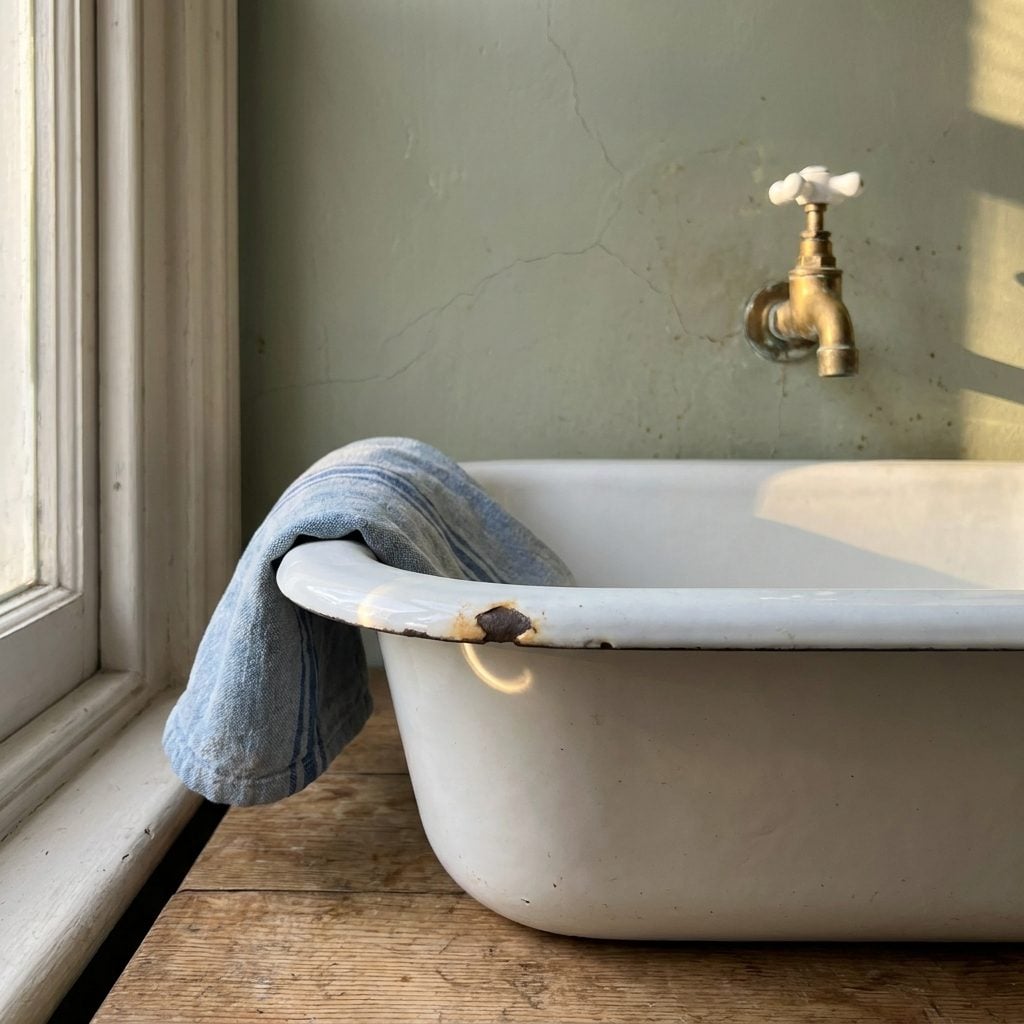
Your brain is running a background check on every surface in the room. And the chipped enamel sink passes it. The granite countertop does not.
Here’s what’s happening. Imperfection signals authenticity. A surface that shows its age, its chips, its wear patterns from decades of hands and pots and scrub brushes, reads as honest to your subconscious. It has nothing to hide because it’s hiding nothing. Granite, polished to a mirror finish and sealed against all evidence of life, triggers a faint unease. It’s too perfect. Your brain knows that nothing real stays that clean.
This aligns with a psychological principle rooted in the Japanese concept of wabi-sabi. According to a clinical review on PositivePsychology.com, showing up as you are, flaws included, conveys authenticity and builds trust, while hiding imperfections behind a mask undermines the honesty required for genuine connection. That principle applies to objects the same way it applies to people. A Depression-era enamel basin with a dark chip near the drain is telling you the truth about its life. Your grandmother’s kitchen didn’t perform for company. It just was.
The modern kitchen tries so hard to look untouched that it ends up looking untouchable. And untouchable isn’t the same as trustworthy. Not even close.
Why Your Brain Reads a Bare Lightbulb as Honest and a Recessed Light as Fake
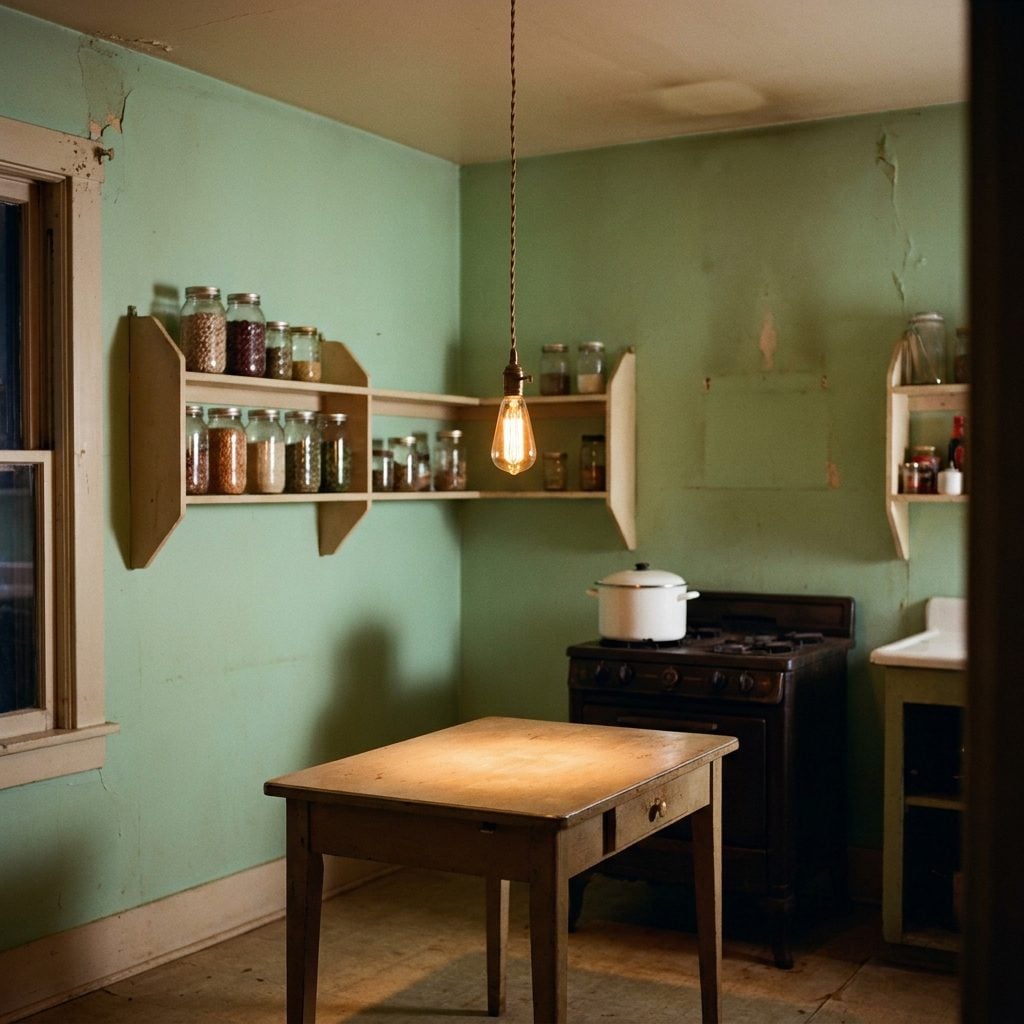
A single bare bulb hanging from a cord. That’s it. No shade, no housing, no diffuser, no attempt to dress it up. And something in you relaxes when you see it.
Recessed lighting does the opposite. It conceals its source. The light appears from nowhere, like a trick, and your brain registers the deception even if you can’t name it. You’re being lit, but you don’t know by what. That small mystery costs you a fraction of trust every time you walk into the room.
Research backs up part of this instinct in an unexpected way. A study by social psychologist Michael Slepian found that subjects exposed to a bare, unshaded incandescent bulb performed better on insight-related tasks than those under overhead fluorescent fixtures. According to a report in Pacific Standard, 44 percent of participants exposed to the bare bulb solved a problem in the allotted time, compared to just 22 percent under fluorescent light. The researchers suggested our brains respond to the bare bulb as a familiar symbol, one loaded with associations of clarity and revelation.
Depression-era kitchens had no choice. One bulb, one cord, one pull chain. But the accident of economy produced something psychologically potent: a room where the light source was visible, traceable, accountable. You could see where the light came from. That’s a kind of honesty most modern kitchens have designed right out of existence.
The Drawer That Held Everything and Why That Chaos Calms You Down
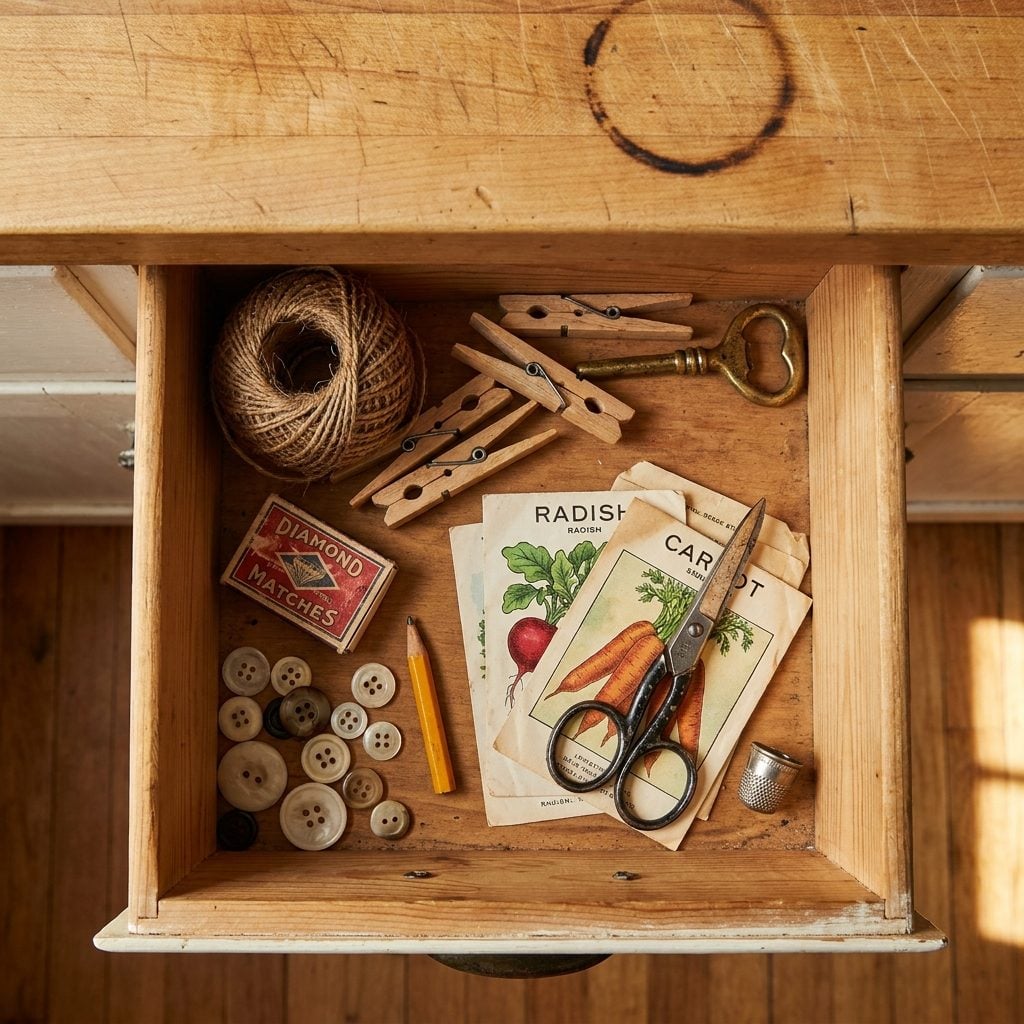
Every kitchen in the 1930s had one. The drawer that held the twine, the matchbook, the church key, the rubber band ball, the pencil stub, the warranty for a thing nobody remembered buying. It wasn’t organized. It wasn’t supposed to be.
Modern decluttering culture would call this a problem. But your nervous system might call it something else: containment.
There’s a difference between chaos that sprawls and chaos that stays put. The junk drawer had boundaries. It was a single rectangle of disorder in an otherwise sparse room. Everything messy about the household lived in that one place, and you could close it. That act, the closing, gave you control over the mess without requiring you to solve it. According to an analysis on Life Uncluttered, psychologist Gossling notes that old, unused items in these drawers make us feel comfortable and more like ourselves, regardless of their practical uselessness.
Princeton neuroscientists found that visually cluttered environments compete for our attention and make it harder to focus, as reported by Natural Awakenings. But the junk drawer sidesteps that finding. The clutter is invisible until you choose to see it. Closed, the drawer is a flat wooden front, indistinguishable from its neighbors. Open, it’s a private museum of a life in progress. That toggle between order and disorder, controlled entirely by you, is the part that calms you down.
Why Freestanding Furniture Makes a Kitchen Feel Safer Than Built-Ins Ever Could
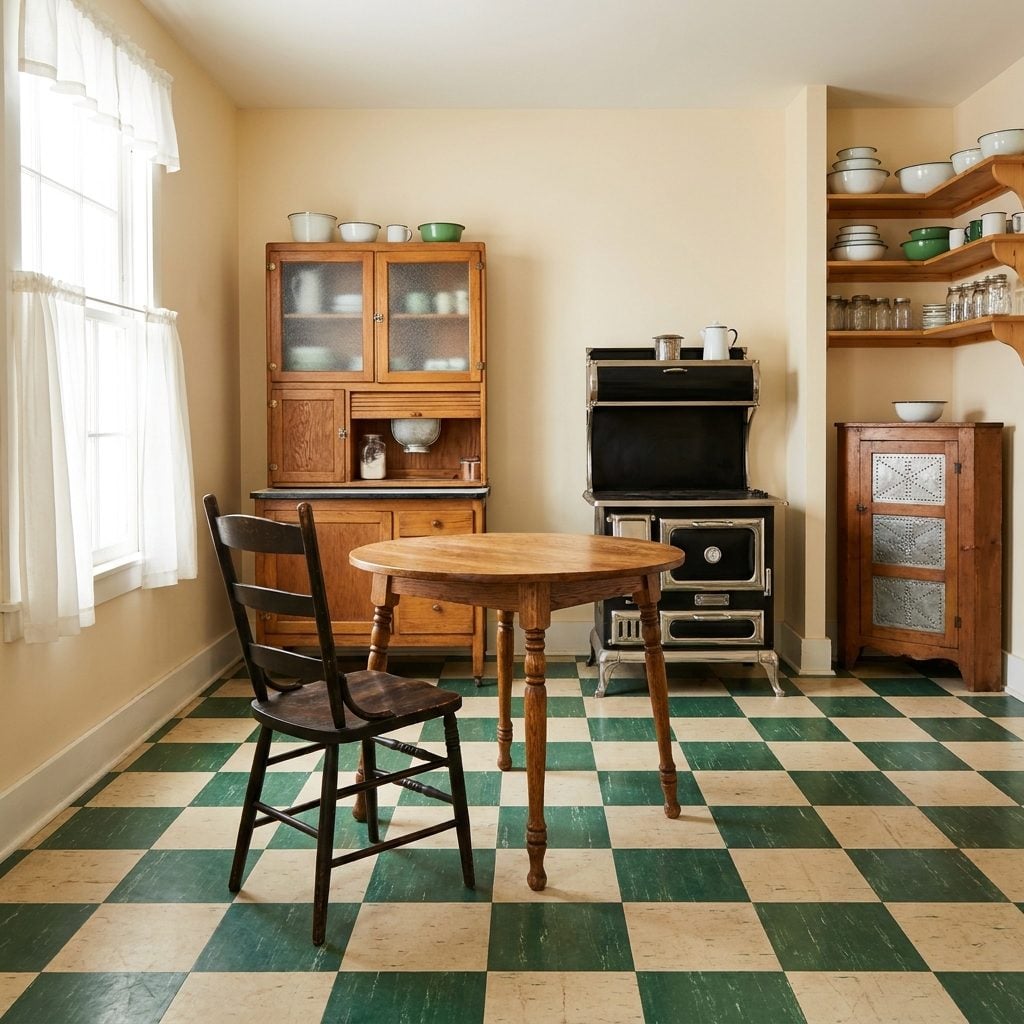
The Hoosier cabinet. The pie safe. The icebox on legs. The table that could be pushed to the wall or dragged to the center of the room depending on what the day needed. None of it was bolted to anything.
That mattered more than you’d think.
Environmental psychologist Jay Appleton proposed what’s known as prospect-refuge theory in 1975: humans are drawn to spaces where they can observe their surroundings while feeling protected. According to an overview on Arch Psych, the theory describes why certain environments feel safer through the concepts of prospect (the ability to observe) and refuge (the ability to remain concealed or sheltered). Built-in cabinetry fixes the room in place. You can’t rearrange it. You can’t adapt. The walls own the space, not you. Freestanding furniture reverses that power. You can reposition the table for a better sightline to the door. You can angle the cupboard. You can move.
Depression-era families didn’t have the money for built-ins. Their kitchens were assembled from what they had, and everything stood on its own legs. The accidental result was a room that could be rearranged on instinct, shifted to feel right without anyone knowing the name of the theory behind it.
The Color Your Grandmother’s Walls Were and Why It Still Slows Your Heart Rate
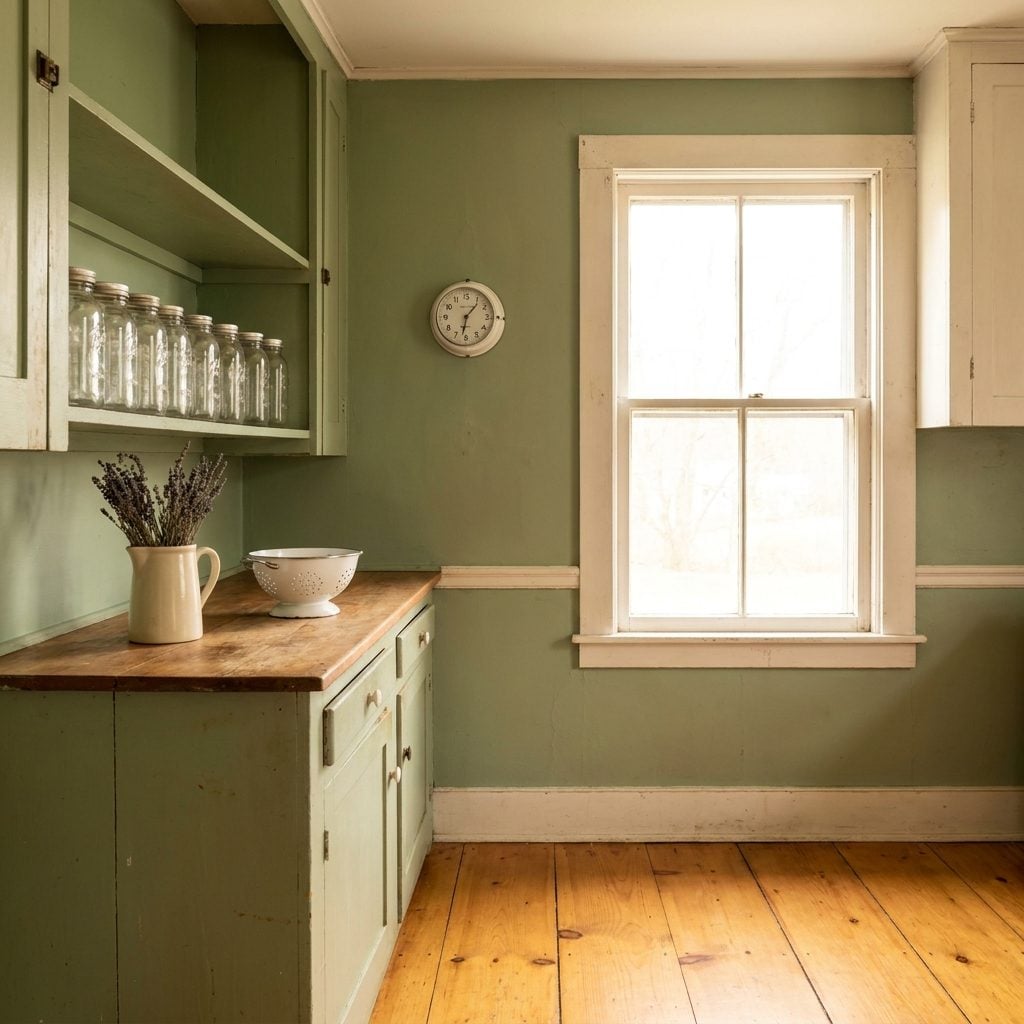
Sage green. Mint green. Celadon if you’re feeling generous about it. Some shade of green that wasn’t trying to be anything other than the color of the room.
It was everywhere in 1930s kitchens. Walls, cabinets, the trim around the window. Not because anyone read a color theory book. Because green paint was cheap, it hid dirt reasonably well, and it looked fine. The fact that it also happens to be the most psychologically calming color in the spectrum was a bonus nobody was counting on.
Color psychology researcher Karen Haller explains the mechanism in primal terms. As noted in a Homes and Gardens article on kitchen colors (Source), green reassures us on a primitive level because where there’s green in nature, there’s usually food and water. Green equals life. A 1998 study by Stone and English in the Journal of Environmental Psychology confirmed that green is associated with calmness and tranquility in interior settings. Mental Health America classifies green as potentially the most balanced color, often the first one patients use when experimenting with color psychology for mood improvement.
Your grandmother didn’t know any of this. She picked green because it was on sale at the hardware store and it matched the curtains she already had. But her kitchen did something that a lot of modern all-white kitchens can’t: it let your nervous system stand down the minute you walked in.
Why a Kitchen Without Upper Cabinets Triggers a Specific Kind of Relief
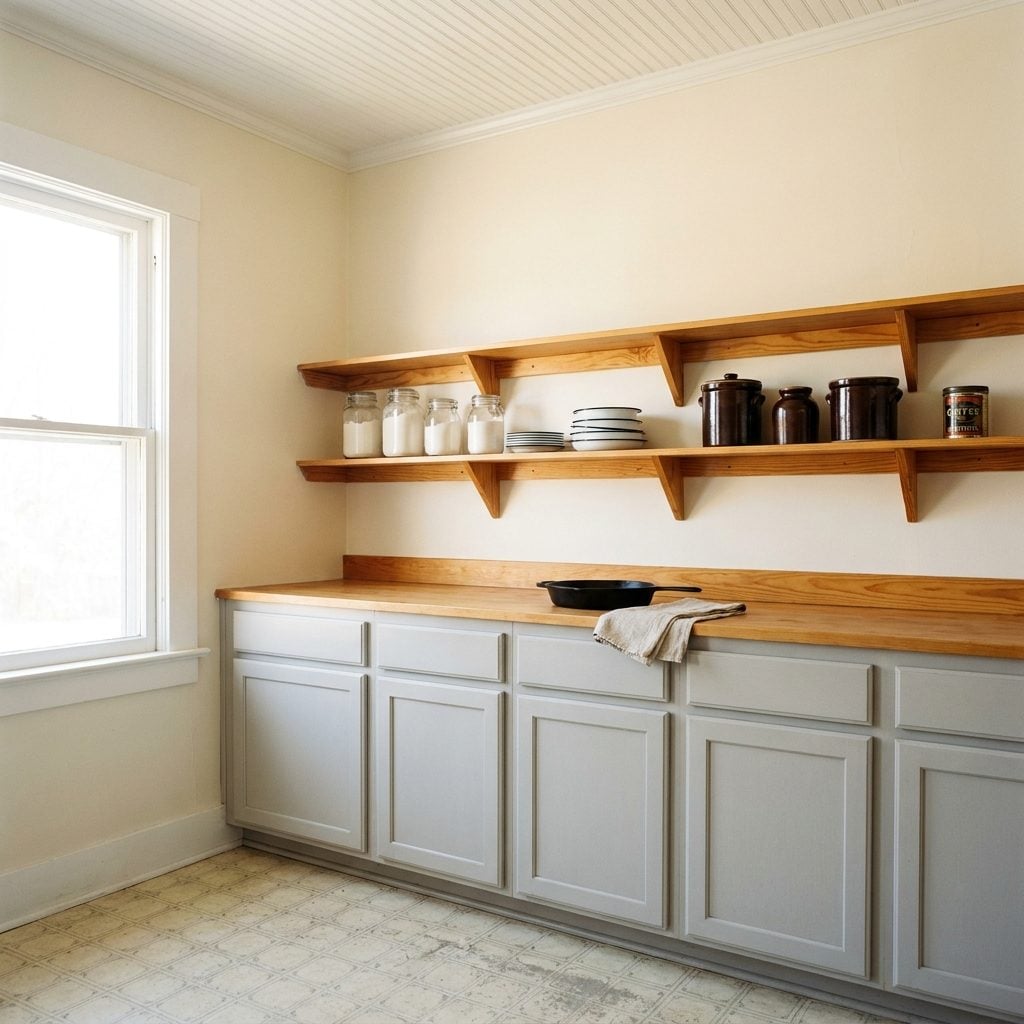
Walk into a kitchen where upper cabinets line every wall and notice what your shoulders do. They tighten. Fractionally. You won’t catch yourself doing it.
Now picture the Depression-era kitchen. Open shelves. Maybe a single high cupboard. Walls that were mostly wall. The upper half of the room was air, and that air did something to you.
This connects to how the brain reads spatial volume above the head. Neuroscience research on ceiling height and spatial perception has shown that taller or more open overhead spaces trigger a sense of freedom and reduce feelings of confinement. Upper cabinets, by their nature, lower the effective ceiling. They push the visual boundary of the room closer to your skull. Open shelving or bare walls preserve the full vertical volume of the space, and your brain rewards you with a small, unconscious exhale.
There’s a practical wrinkle here too. Open shelves require you to keep things reasonably neat, which means fewer hidden messes generating low-grade guilt behind closed doors. Every jar and plate is visible, accounted for, in its place. A small kitchen design benefits from this approach even more, because removing upper cabinets makes a tight room feel dramatically larger without adding a single square foot.
The 1930s kitchen wasn’t trying to feel spacious. It just couldn’t afford doors.
The Reason Flour Sacks Behind Glass Doors Feel Like Wealth to Your Subconscious
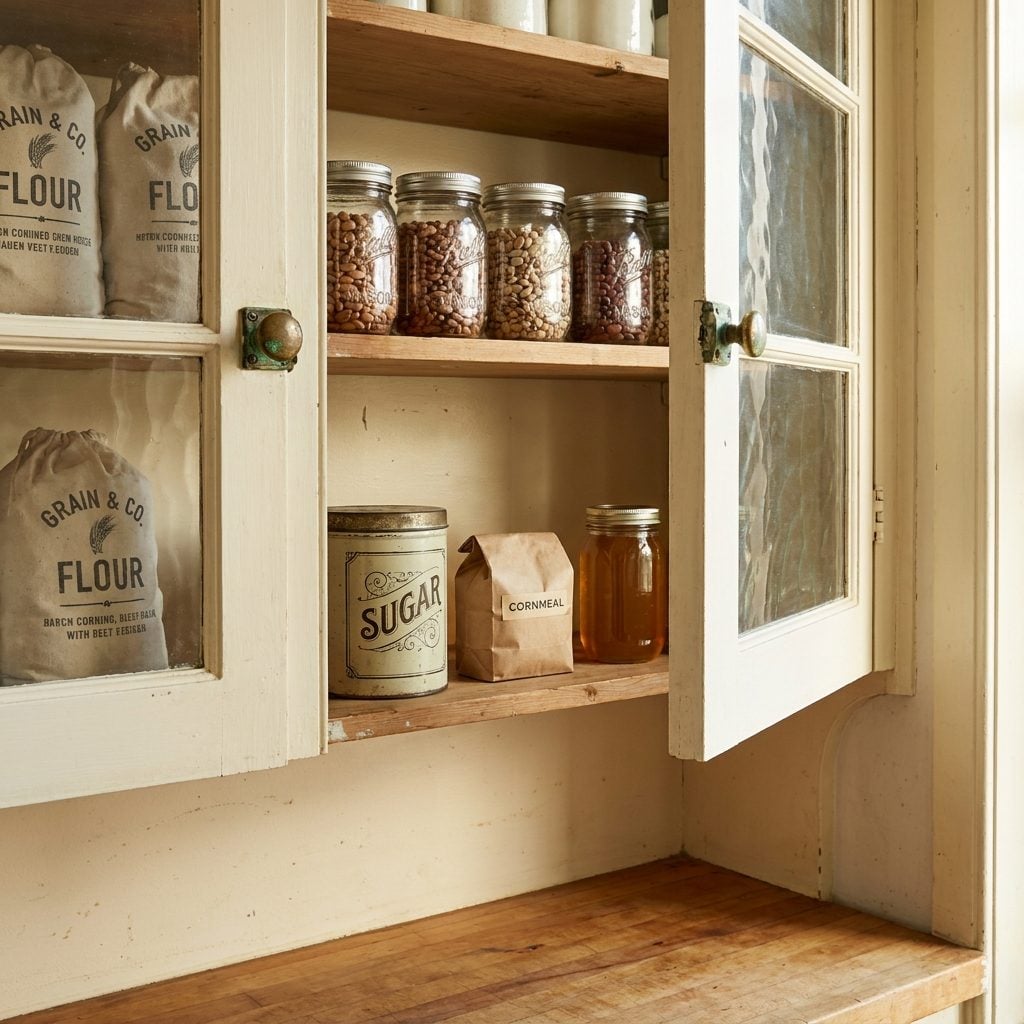
Not gold. Not silver. Flour.
A glass-doored cabinet with bags of flour stacked inside it, maybe some sugar, maybe some dried beans in a jar. That image does something strange to your brain. It reads as abundance. Real abundance, not the display kind.
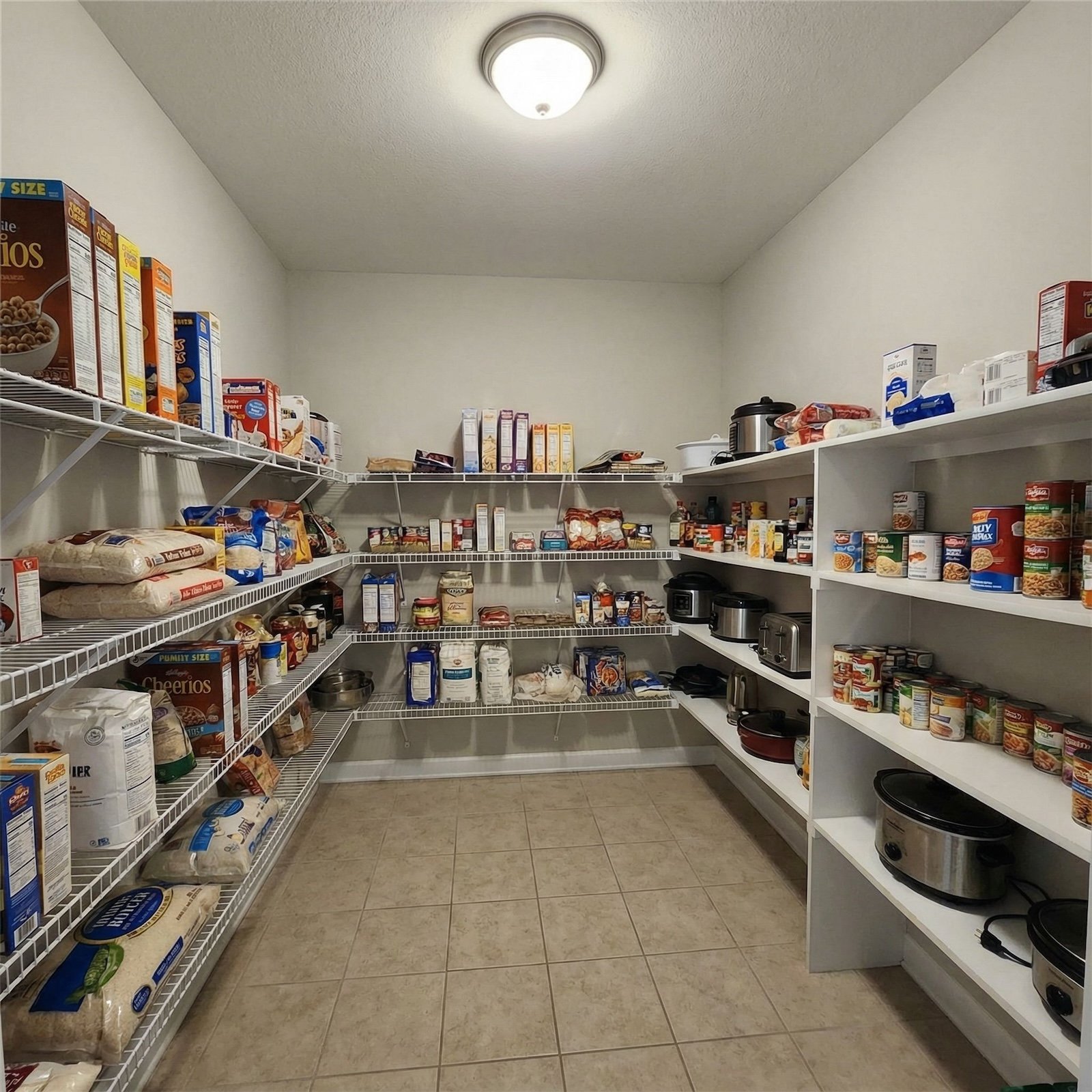
During the Depression, food was the only wealth that counted. A full pantry wasn’t a lifestyle choice. It was survival. Families who could keep their shelves stocked were, in the most literal sense, rich. And that association hasn’t left us. Your subconscious still equates visible stores of staple foods with security, with having enough, with being okay.
The glass door is the critical detail. A solid door hides the supply. You know it’s there in the abstract, the way you know your savings account balance is a number on a screen. But glass makes the wealth visible. You can see the flour. You can count the jars. The visual confirmation bypasses logic and hits something older, something that remembers the winter and the empty cupboard and the relief of knowing there’s enough to last.
Modern kitchens hide everything. The flour goes in a canister that goes in a cabinet that goes behind a flat panel that looks like a wall. Efficient, sure. But it erases the evidence of plenty. A Depression-era glass front cabinet with its staples on display is doing something no minimalist kitchen can replicate. It’s showing you that you have enough.
Why You Trust a Kitchen With Visible Pipes More Than One That Hides Them
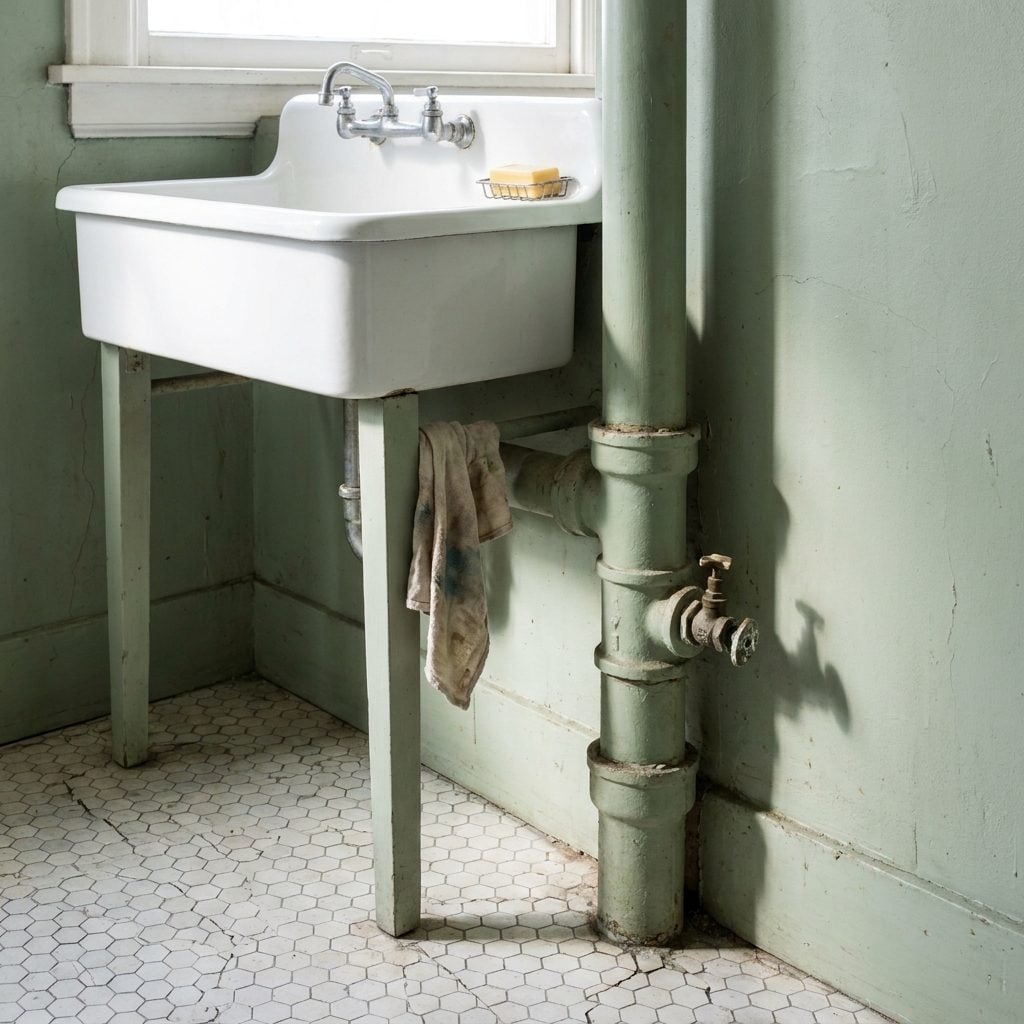
The pipe running along the wall below the sink. The one that makes a right angle near the floor. Exposed, painted the same color as the wall or sometimes not painted at all. You’ve seen this in old kitchens. And you’ve felt something about it, even if you never named it.
Visible infrastructure reads as transparency. When you can see how a room works, the pipes that carry the water, the joints that connect them, the shutoff valve you could grab in an emergency, your brain categorizes the space as legible. You understand it. There are no mysteries behind the drywall. No hidden leak you won’t discover until the ceiling in the room below starts to sag.
This is the same principle that makes industrial loft spaces feel honest and drop ceilings feel suspicious. When structure is concealed, your brain spends a tiny amount of energy wondering what’s back there. It’s not anxiety exactly. More like a low hum of uncertainty that never fully resolves. Exposed systems eliminate that hum.
Depression-era kitchens showed their pipes because finishing work cost money nobody had. Plaster stopped where the budget stopped. But the result was a room that told you exactly what it was made of and how it worked. No performance. No pretense. Just iron pipe, a brass fitting, and a faucet that dripped a little when the washer wore thin.
You trusted that kitchen the way you trust a person who doesn’t try too hard. The effort to conceal is itself a kind of tell. And the old kitchens never bothered with it.
The Worn Threshold Effect and Why Foot-Grooved Linoleum Feels Like Home
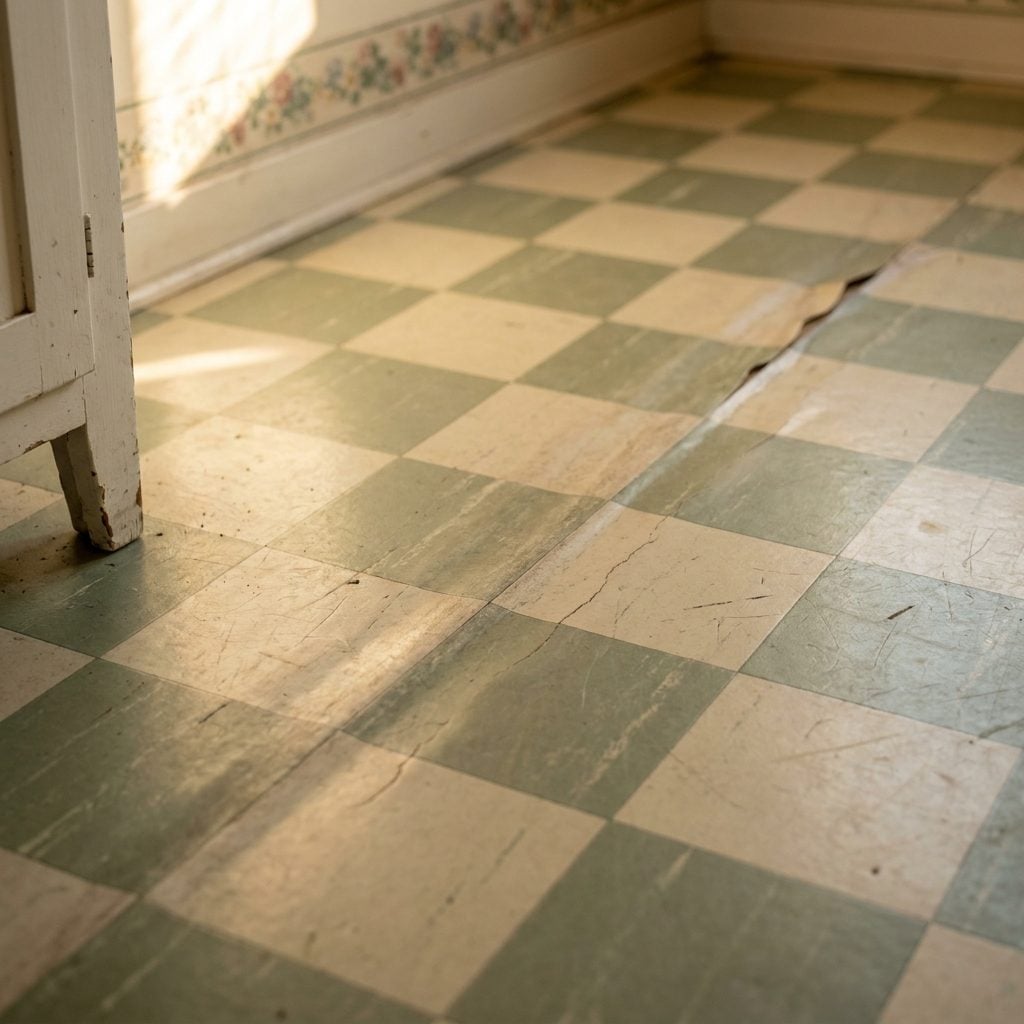
There’s a dip in the linoleum in front of every Depression-era stove. A soft valley where ten thousand mornings stood in the same spot, waiting for coffee to percolate. You’ve seen it in your grandmother’s kitchen, or your great-aunt’s, or a farmhouse you toured once that smelled like wood polish and something baked a long time ago. That groove is physical proof someone was here. Someone stood here enough to wear through the pattern.
Modern floors don’t do this. Engineered hardwood resists it. Porcelain tile laughs at it. Luxury vinyl plank will outlast the mortgage and look exactly the same the day you sell. And that’s the problem. A surface that never changes is a surface that never remembers you. Source
The word “nostalgia” comes from the Greek nostos, meaning homecoming, and algos, meaning pain. A worn threshold is homecoming made visible. The linoleum curls slightly at the doorframe. The color has faded along the path from icebox to sink. Every imperfection is a sentence in a story that nobody had to write down because the floor was writing it for them.
What modern homeowners are really romanticizing isn’t the linoleum itself. It’s the evidence of repetition, of ritual, of a life lived in one place long enough to leave a mark. In an era when the average American moves roughly eleven times, a floor that remembers where you stood is almost radical.
Why a Single Window Over the Sink Does More for Your Mood Than a Wall of Glass
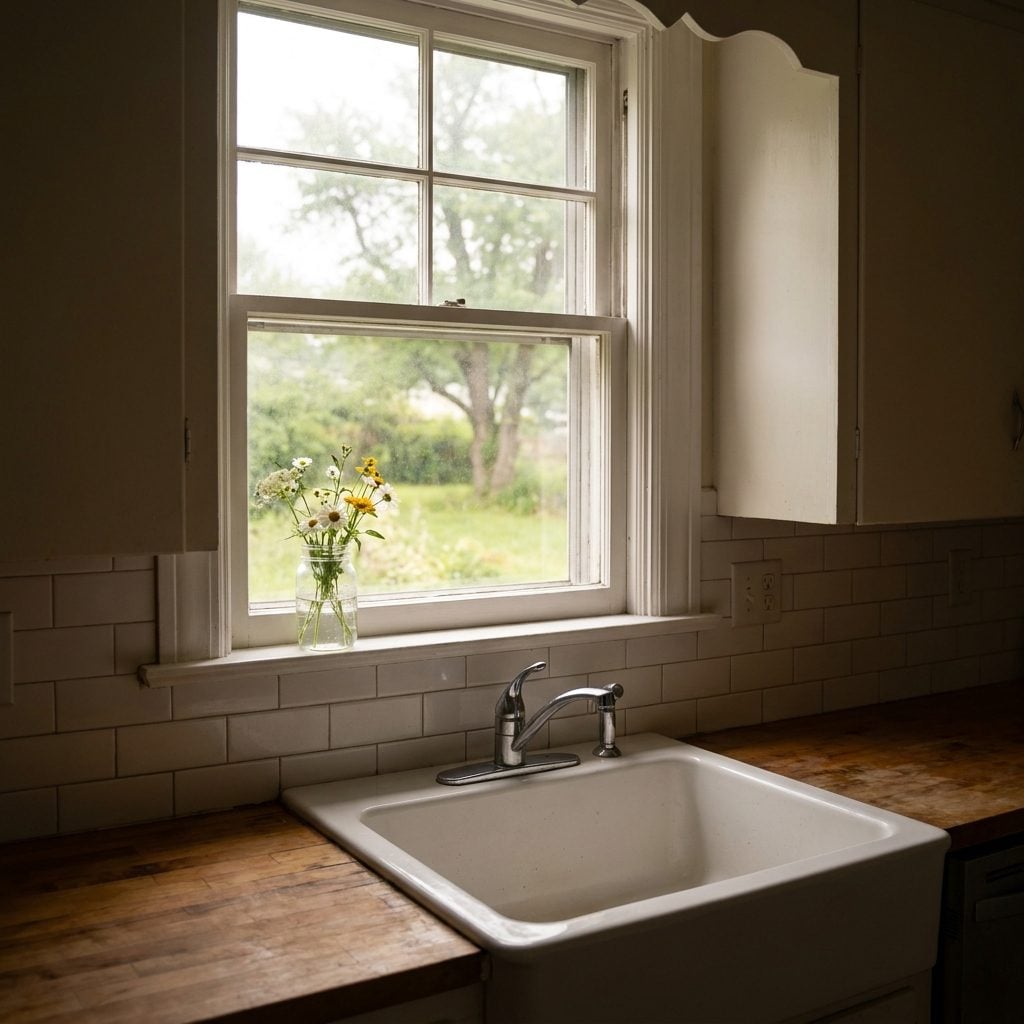
Every open-concept kitchen renovation in the last fifteen years has chased more glass. Bigger windows. Sliding walls. Floor-to-ceiling transparency. The assumption: more light equals more happiness. Simple math. Except it isn’t.
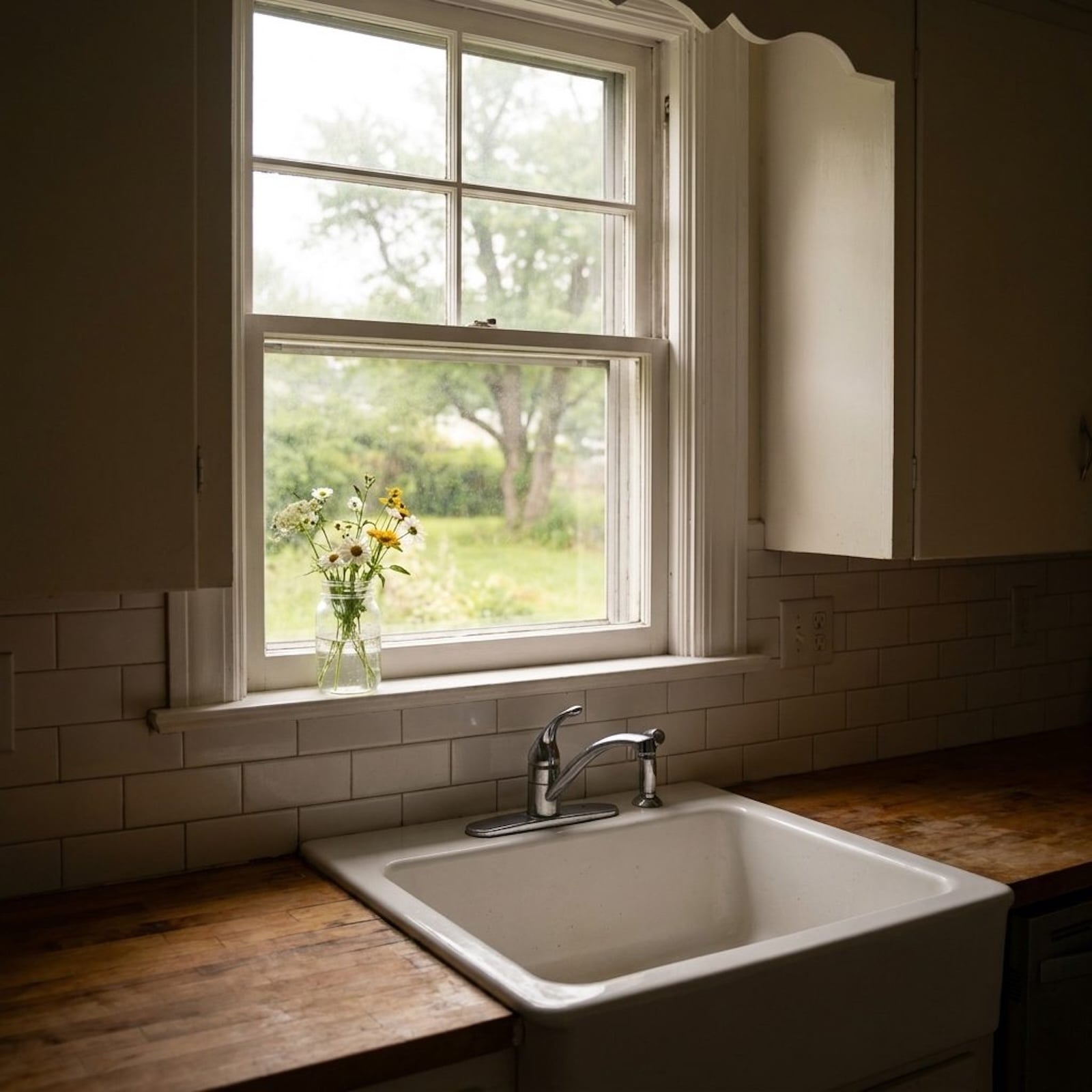
Depression-era kitchens had one window. Sometimes not even a large one. It sat above the sink, usually facing the side yard or the back garden, and it was the only view the person washing dishes got for the twenty or thirty minutes they stood there three times a day. That constraint did something a panoramic glass wall can’t. It gave the eye a single, framed place to rest. Source
The concept is related to what environmental psychologists call prospect and refuge. You want to see outward, yes. But you also want boundaries. A single window over the sink creates a controlled aperture, a painting that changes with the weather and the hour but stays the same size. A wall of glass gives you everything at once, and everything at once is a lot to process while you’re scrubbing a pot.
There’s a reason that small kitchen design keeps circling back to this layout. The single window turns dishwashing into a quiet, almost meditative pause. You watch one tree. One corner of fence. One patch of sky. Your brain doesn’t have to scan a horizon. It rests on a frame somebody else chose for you, and that limitation is the gift.
The Psychological Weight of Cast Iron and Why Your Brain Equates Heaviness With Safety
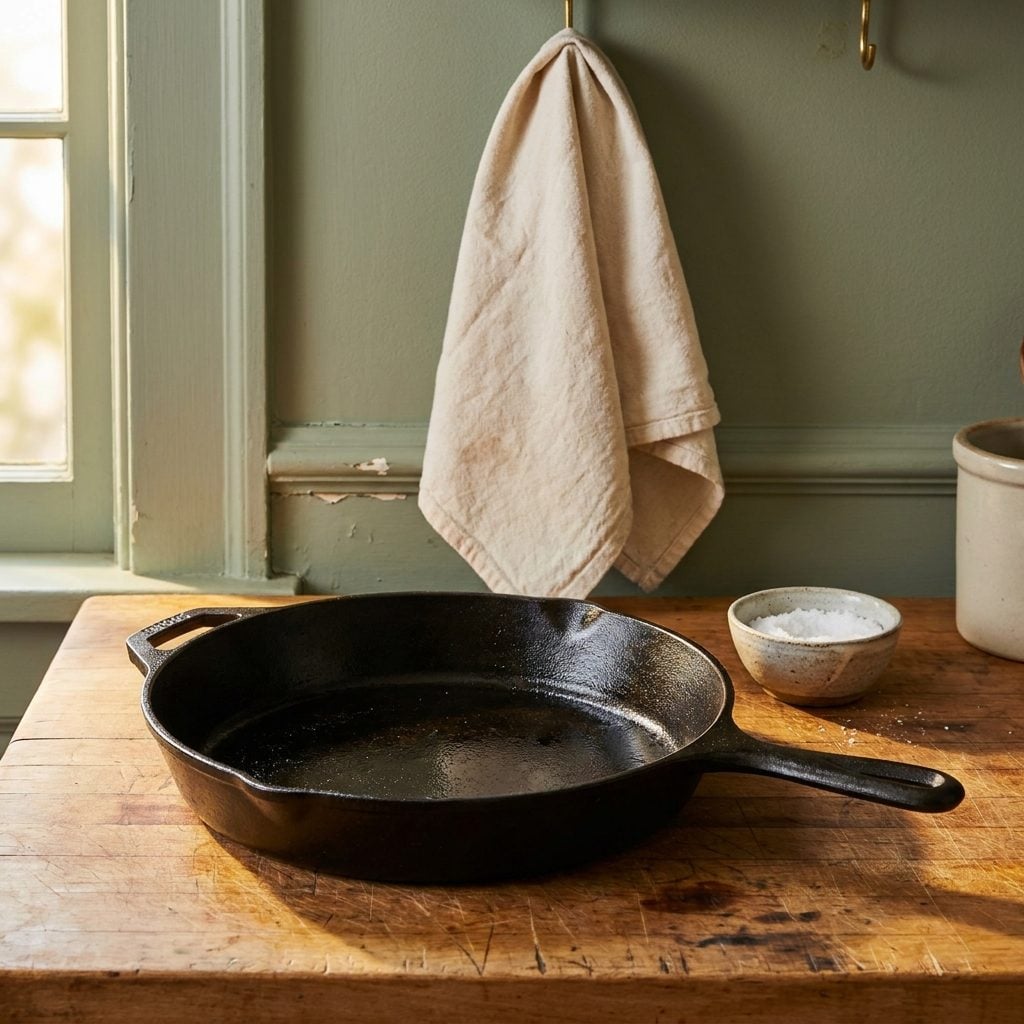
Pick up a Lodge skillet sometime. Really pick it up. Ten pounds of iron that could double as a weapon or a family heirloom. Your wrist notices. Your brain notices more.
Research in embodied cognition has shown that the physical sensation of heaviness changes how we judge the world around us. Source. Holding something heavy literally increases our perception of its importance, seriousness, and potency. The researchers at the University of Cologne found that participants who held heavier clipboards rated tasks as more significant than those who held lighter ones. Same task. Different weight. Different verdict.
Depression-era kitchens didn’t have lightweight anything. The pots were iron. The tables were solid wood on thick legs. The rolling pins were marble. And all of that weight told the nervous system: this is real, this is here, this isn’t going anywhere. In a decade when everything else was disappearing, the kitchen was the room that stayed heavy. That’s not an accident. That’s survival psychology dressed up as cookware.
Modern homeowners who hang a cast iron skillet on the wall aren’t decorating. They’re anchoring.
Why Kitchens That Show Their Age Feel More Alive Than Ones That Don’t
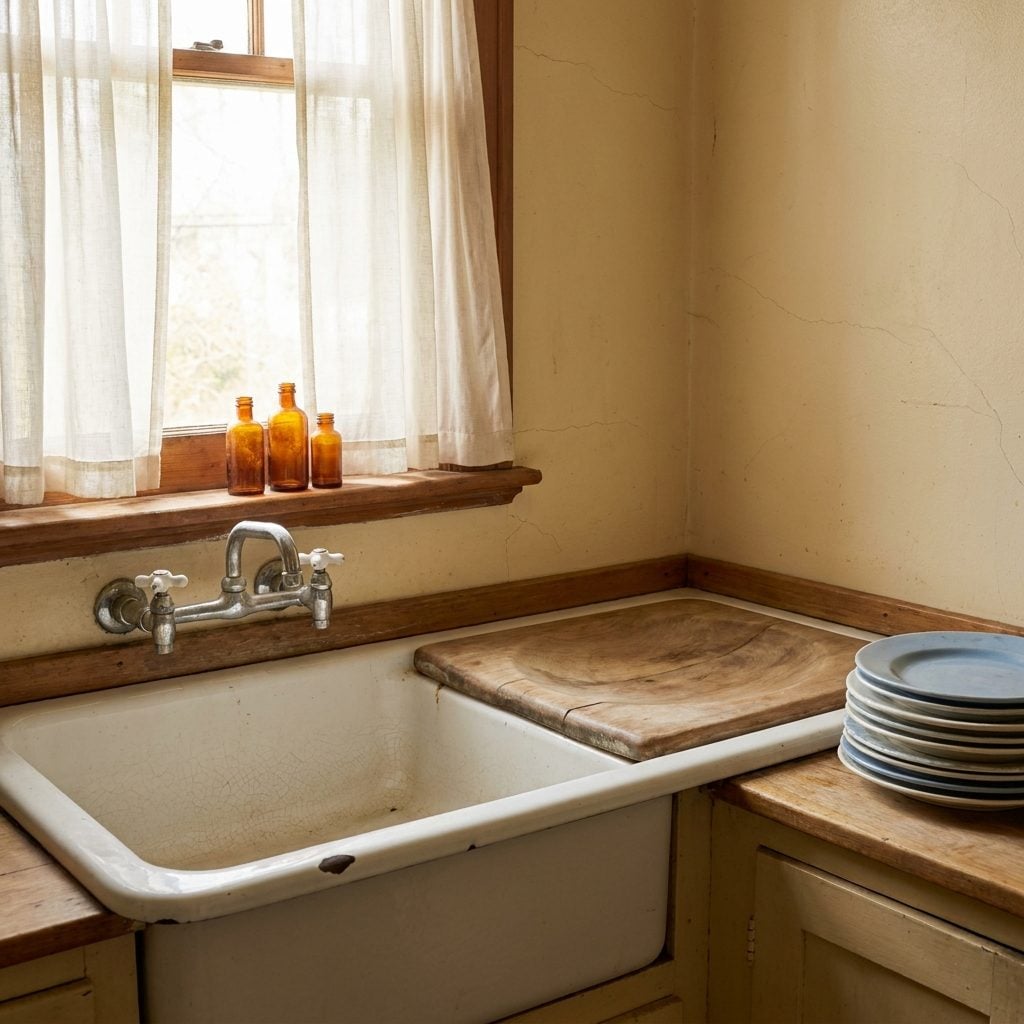
You’ve stood in a brand-new kitchen and felt absolutely nothing. Everything flush, everything sealed, every surface still waiting for its first scratch. The room looks ready. It doesn’t look lived in. There’s a difference, and your brain can feel it in about three seconds.
The Japanese concept of wabi-sabi offers a framework for why wear marks and chipped enamel actually produce a calm response in the people who see them. According to a Psychology Today article on wabi-sabi and the psychology of imperfection (Source), wabi-sabi centers on an appreciation of imperfection, impermanence, and incompleteness. Modern psychology supports the underlying principle: accepting imperfection is linked to psychological flexibility, lower anxiety, and greater emotional resilience. Source.
A 1930s kitchen didn’t hide its history. The linoleum curled at the seam. The cabinet paint wore through at the handles. The stove had a permanent ring on the burner from a thousand mornings of coffee. And none of it looked broken. It looked honest. That honesty is what modern homeowners are chasing when they sand a table down to raw wood or leave the plaster rough on purpose. They’re not romanticizing damage. They’re romanticizing proof of use.
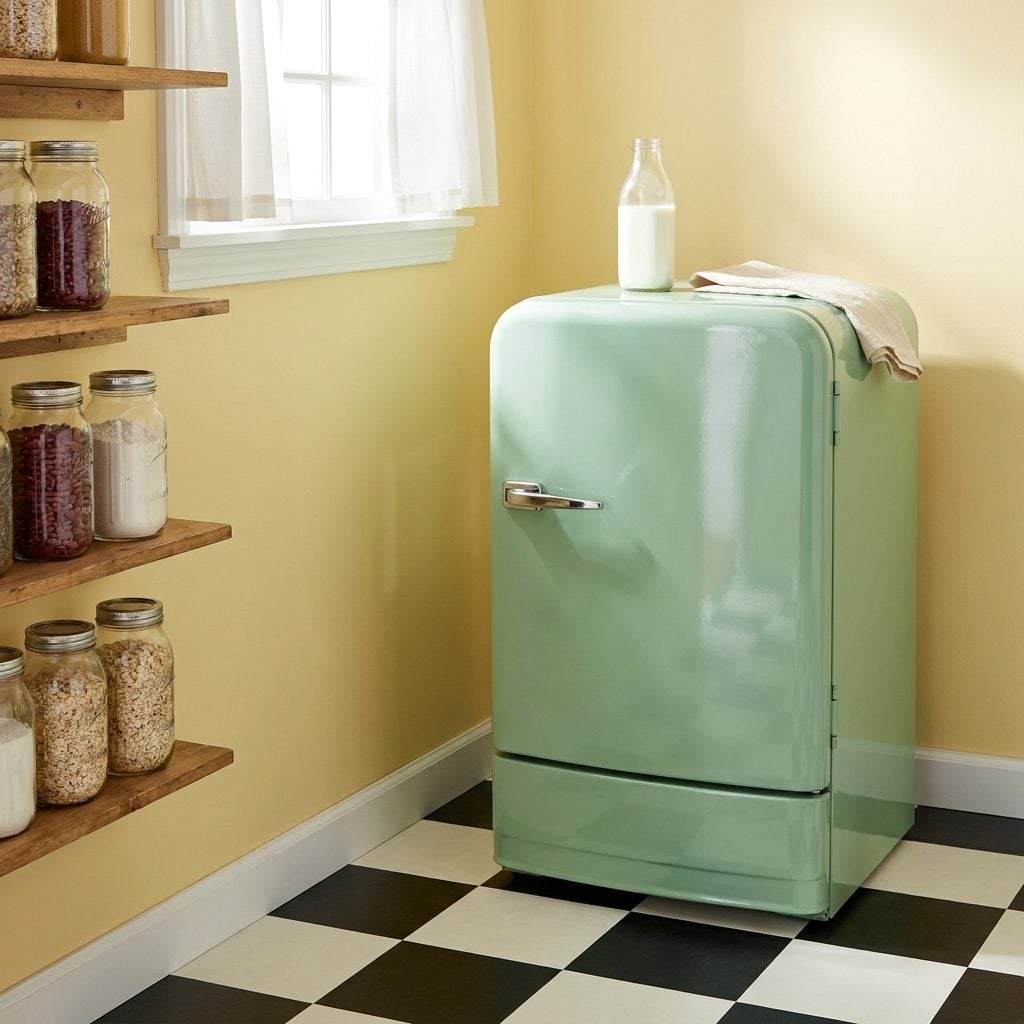
The Reason an Icebox-Sized Refrigerator Feels Luxurious in a Way a French Door Model Never Will
🔥 Would you like to save this?
A 36-inch French door refrigerator holds everything. That’s its problem.
Barry Schwartz’s paradox of choice describes what happens when options multiply past a certain threshold: decision fatigue, dissatisfaction, and a vague sense that you’ve picked wrong no matter what you picked. Cognitive scientists have documented this as “choice overload,” where too many options cause the brain to default to paralysis or safe, habitual decisions. Source. A massive refrigerator stuffed with seventeen condiments and three kinds of milk is a choice-overload machine sitting in the middle of your kitchen.
The Depression-era icebox was tiny. Four cubic feet, maybe five. You bought what you needed for today and maybe tomorrow. The constraint forced clarity. And here’s the twist: research consistently shows creativity and satisfaction increase under moderate limitation. Source. Fewer ingredients meant more resourceful cooking. A smaller box meant less waste, less guilt, less of that low-grade anxiety that comes from watching lettuce rot in the crisper drawer. I say this as someone who has cleaned out a vegetable drawer with genuine shame.
The small-fridge trend in small kitchen design isn’t retro nostalgia. It’s a quiet rebellion against abundance that doesn’t feel abundant.
Why Open Shelving Triggers the Same Brain Response as a Handshake
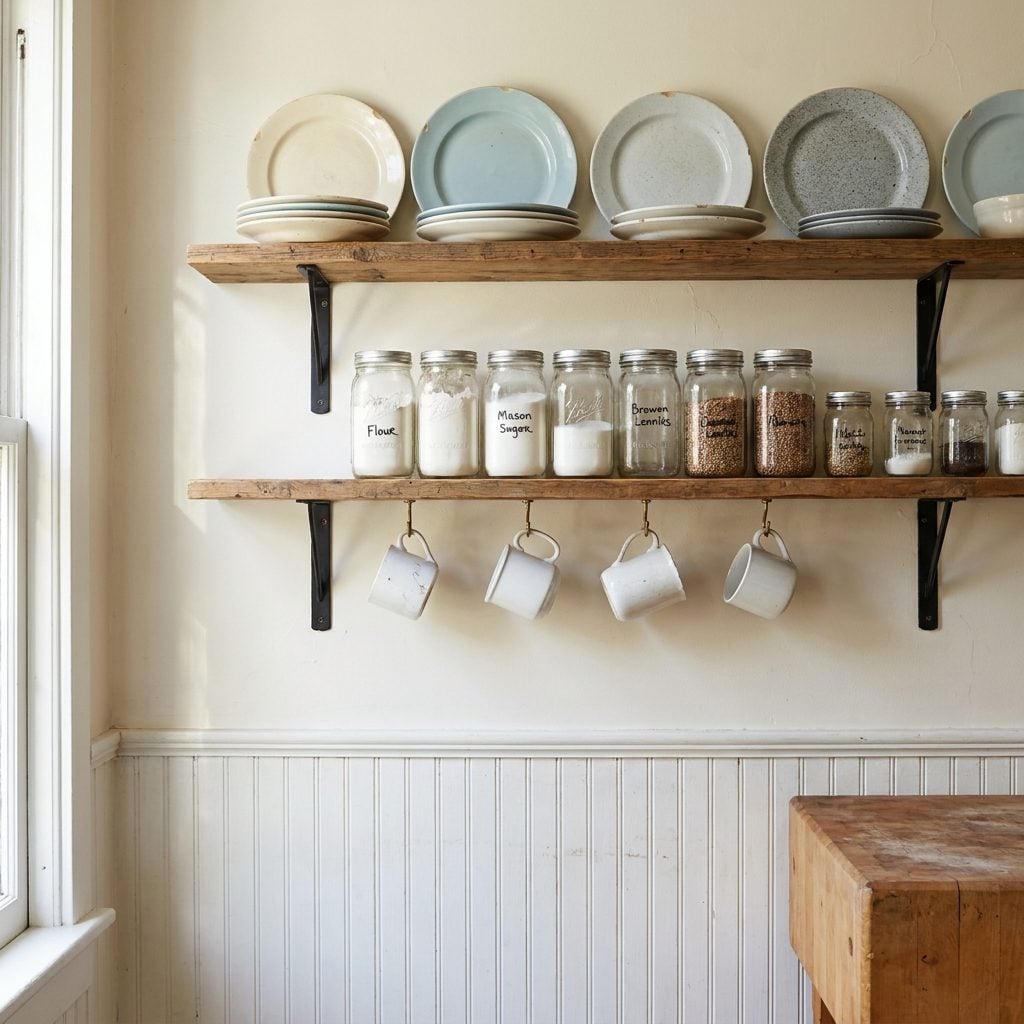
Closed cabinets are polite. Open shelving is personal.
There’s a reason Depression-era kitchens kept their dishes out where everyone could see them. They didn’t have the cabinetry budget for anything else. But the result was an accidental act of social transparency, and the psychology behind it is more interesting than the practicality. When you walk into a kitchen and see the plates, the jars, the stacked bowls in their uneven tower, you’re seeing what psychologists would recognize as a disclosure signal. The brain reads visible inventory the same way it reads an open palm or direct eye contact: nothing hidden here.
Transparency reduces uncertainty, and reduced uncertainty builds trust. Source. That’s the principle behind why open-plan offices were supposed to work (they didn’t, but for different reasons). In a kitchen, though, the equation holds. Open shelves say: this is what we have, this is who we are, we’re not performing for you.
The Specific Shade of Green That Signals Competence Without Anyone Knowing Why
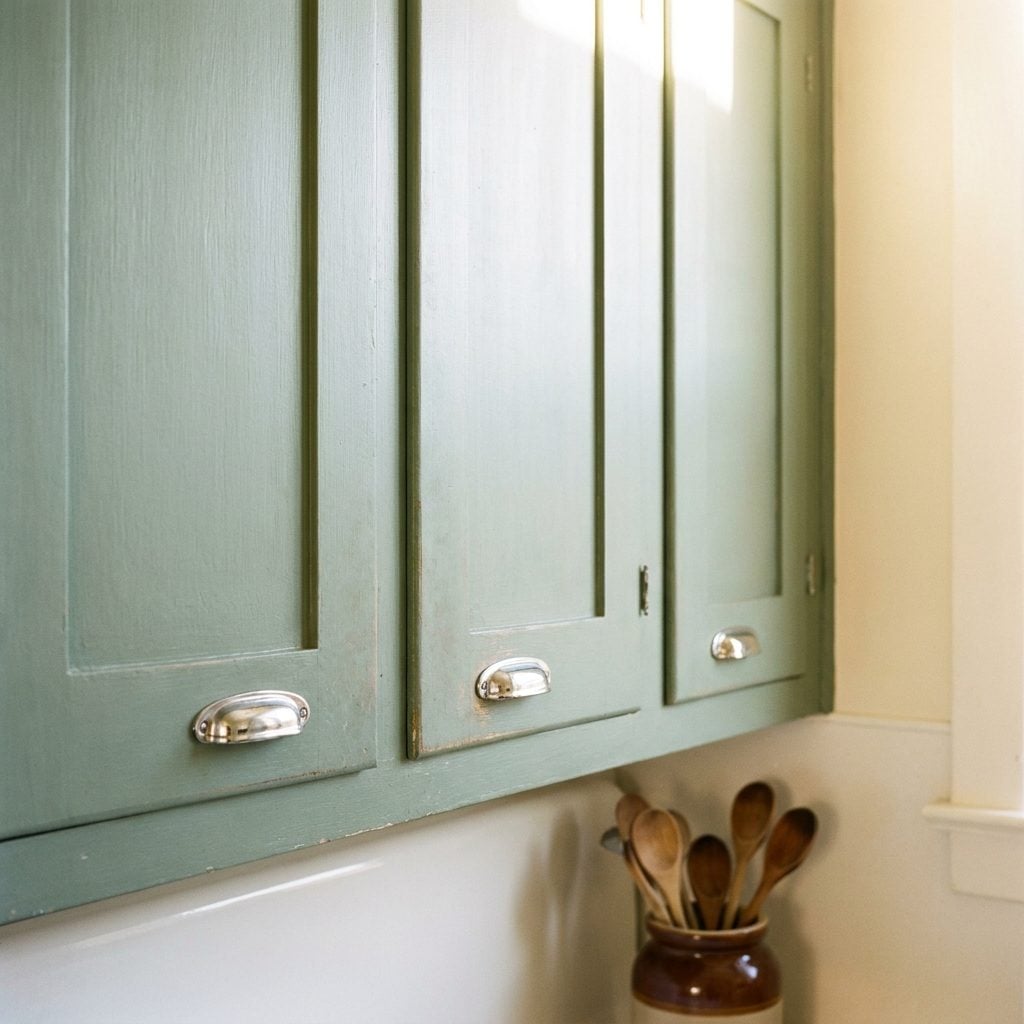
Not lime. Not forest. Not the green of a hospital corridor or a highway sign. The green that lived on 1930s kitchen cabinets was specific: a muted, slightly gray sage. Dusty. Grounded. The color of a plant that’s been alive a long time without anyone fussing over it.
Color-in-Context theory, reviewed in a 2015 paper published in Frontiers in Psychology, proposes that colors have immediate effects on psychological functioning, but those effects shift based on context. Red on a dress signals romance. Red on a test paper signals failure. Green, across nearly every studied context, signals approach rather than avoidance. It reads as safe. It reads as go.
From an evolutionary standpoint, green represents living vegetation, which our ancestors associated with resource-rich environments: water nearby, food available, shelter possible. Source. A kitchen painted sage green doesn’t remind you of a forest. It reminds your limbic system of one. And that’s enough.
The Depression-era fondness for sage green cabinet paint wasn’t random. Green was inexpensive to produce at the time. But the reason it stuck, the reason it’s the single most requested vintage kitchen color nearly a century later, has nothing to do with cost. It has to do with what the color quietly promises your nervous system every time you walk into the room.
Why a Narrow Galley Kitchen Feels Protective Instead of Cramped
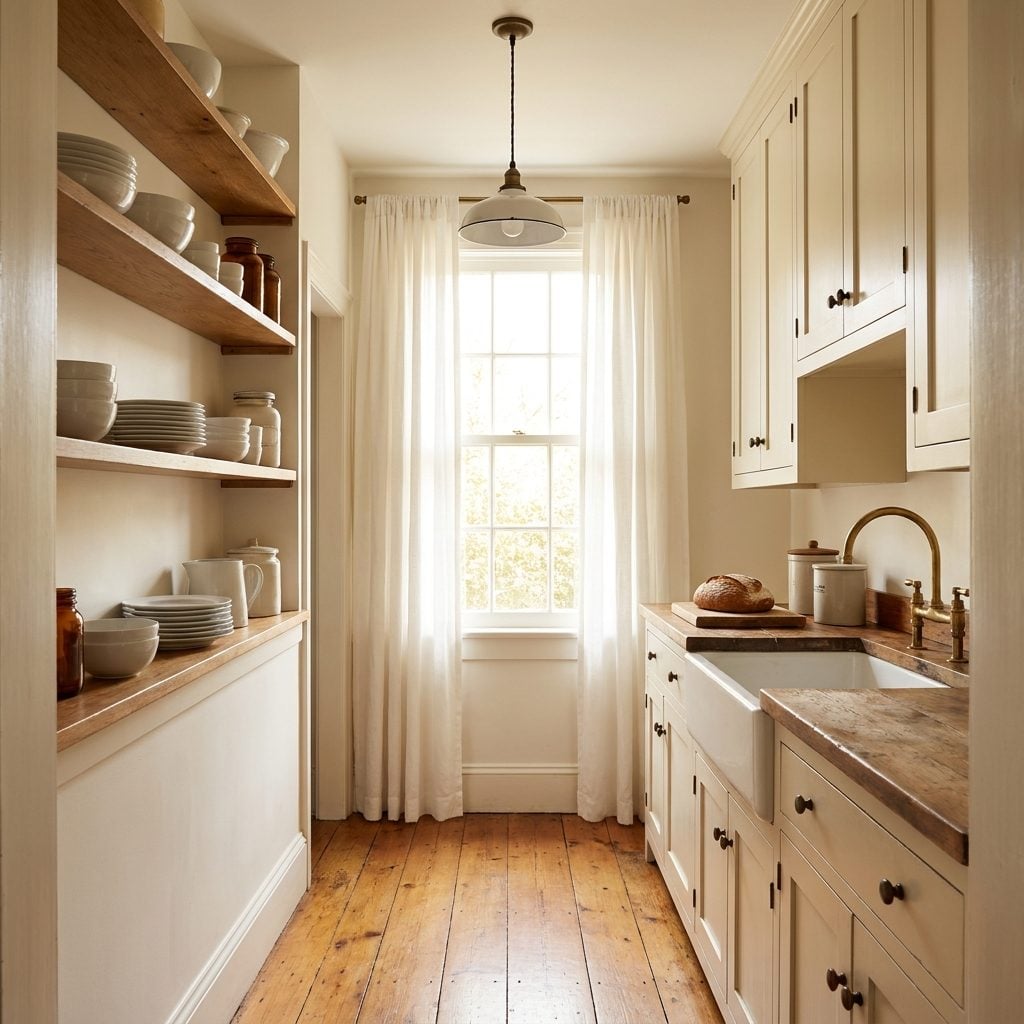
Real estate agents apologize for galley kitchens. They shouldn’t.
Prospect and refuge theory, developed by geographer Jay Appleton in the 1970s, argues that humans are drawn to spaces that offer both a clear view of the surroundings and a sense of enclosure at their back. It’s an evolutionary preference: our ancestors survived by finding spots where they could see threats coming without being exposed themselves. A cave mouth. A covered porch. A galley kitchen.
Think about where you actually stand when you cook. Between two walls, counters on both sides, everything within arm’s reach. The narrow corridor doesn’t limit you. It contains you. Your peripheral vision registers the boundaries, and your nervous system reads them as walls that protect rather than walls that imprison. The distinction is subtle, and it depends on one thing: whether the space has a sight line. A galley kitchen with a window at the end, or a doorway that opens to the rest of the house, gives you the prospect. The narrow walls give you the refuge.
Depression-era kitchens were almost universally small. Square footage was allocated to the rooms where the family gathered. The kitchen was a workroom. But the accidental result of that economy was a space shaped like a cockpit: tight, efficient, everything in its place. And it turns out that shape is exactly what your brain wants when it’s focused on a task.
The Curtain-Under-the-Sink Effect and Why Fabric Disarms a Room
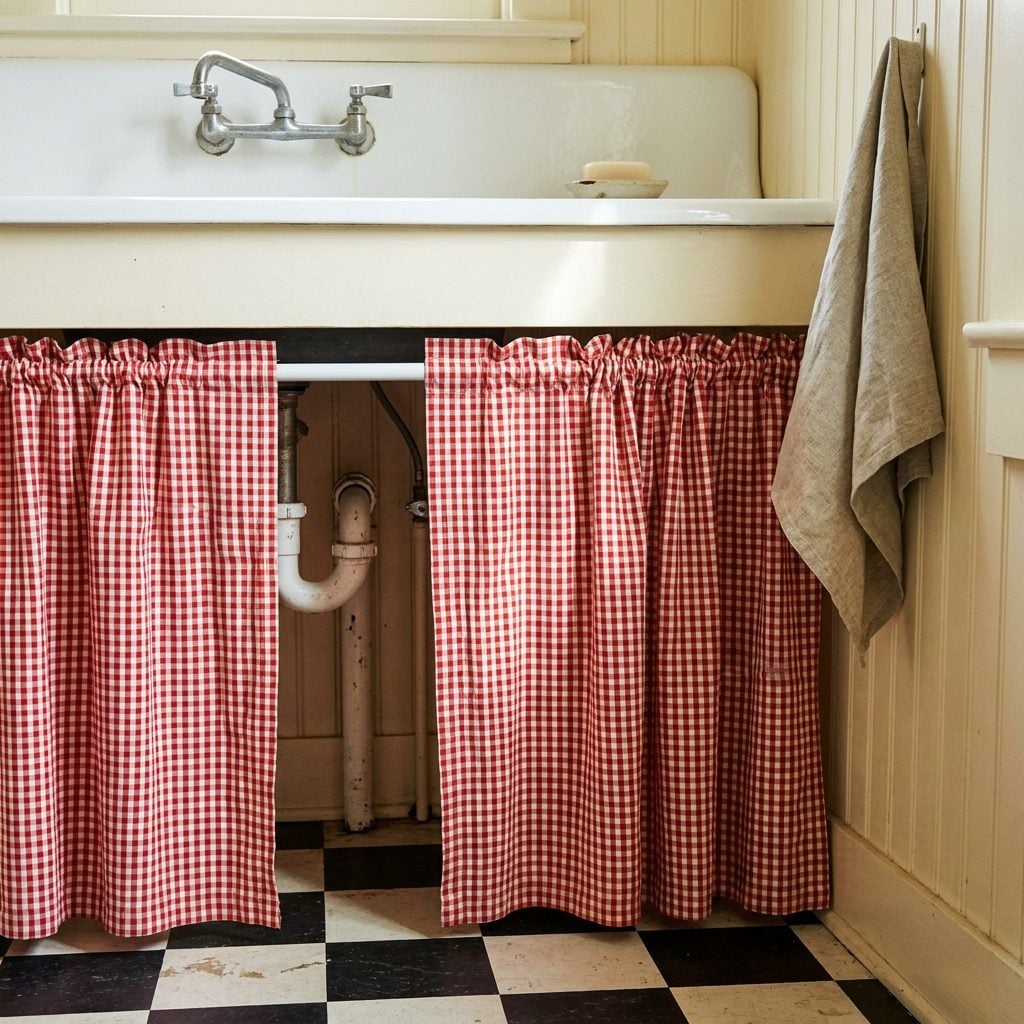
Picture the standard under-sink cabinet. Particle board door, maybe a child lock. You open it, there’s the pipe, there’s the dish soap, there’s the slight smell of damp. Nobody loves this space. It’s a cabinet doing cabinet things.
Now picture a piece of gingham cotton hanging from a tension rod, hiding the same pipes, the same soap. Different feeling entirely. And the difference isn’t cosmetic. It’s textural.
Hard surfaces put the nervous system on low-level alert. Stone, tile, stainless steel, laminate. They’re cleanable and durable, and they’re also cold, reflective, and acoustically hard. A kitchen made entirely of hard materials echoes. It pings. It keeps the room at attention. Fabric breaks the pattern. A cotton curtain absorbs sound, softens light, and introduces the one texture the human hand most readily associates with comfort: cloth. We’re wrapped in it from birth. The association runs deep.
In 1930s kitchens, a gingham sink curtain wasn’t a design choice. It was cheaper than a cabinet door. A flour sack towel draped over a shelf wasn’t styling. It was dust protection. But every piece of fabric softened the room’s acoustic and visual edge, and the people inside felt it without knowing why. Modern kitchens spend thousands to be hard. Then the homeowner hangs one linen towel on a hook and the whole room exhales.
Why Mismatched Chairs Around a Table Feel More Welcoming Than a Matching Set
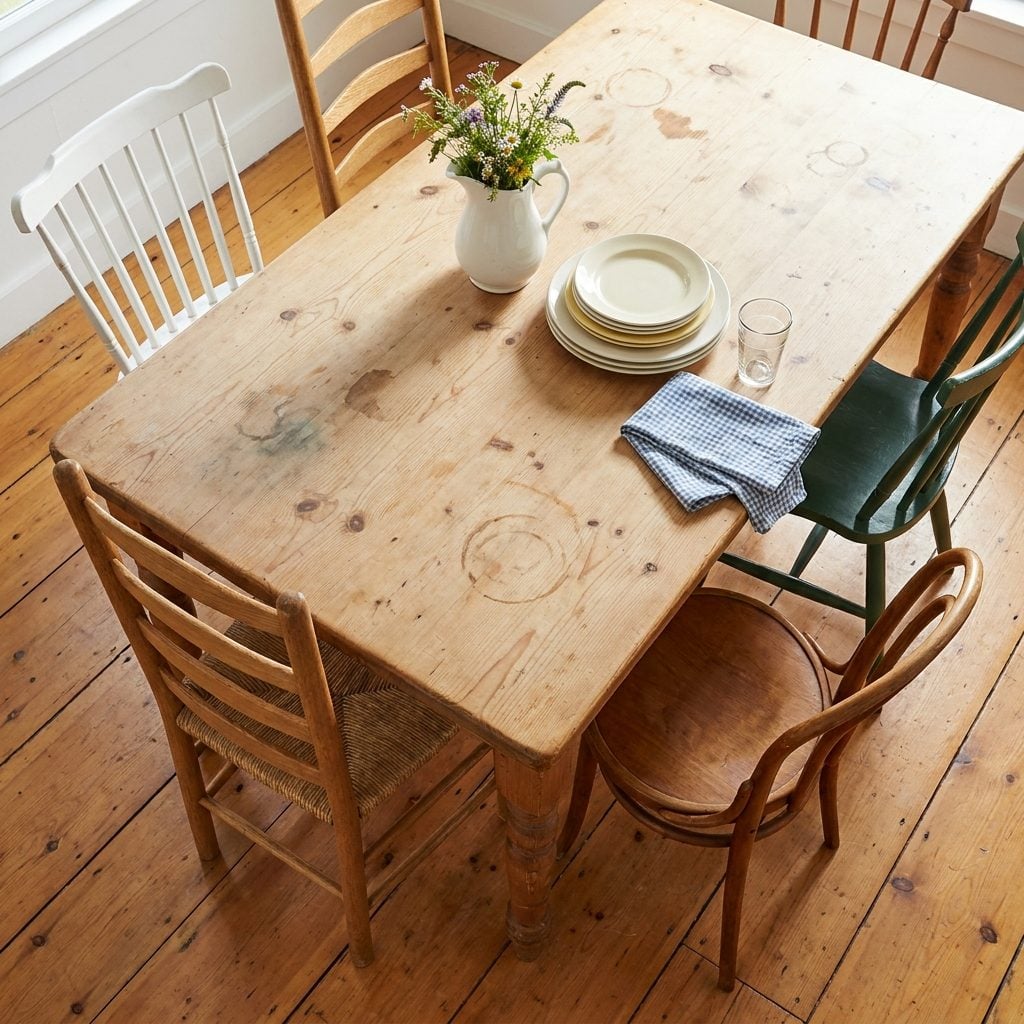
A set of six identical dining chairs says: we bought these together, on purpose, from one place. A collection of six different chairs says: people actually sit here.
The distinction matters more than you’d think. Matching sets signal formality and intention. They look correct. Correct is not the same as comfortable. Mismatched chairs carry what psychologists would call social proof markers: evidence that a space has hosted different people, across different occasions, over real time. The kitchen table with one Windsor chair, one painted ladderback, one with a cushion tied to the seat. You’ve seen that table. You know the family that eats there argues and laughs and passes the bread without asking who wants it.
Depression-era families didn’t mismatch on purpose. Chairs broke. Replacements came from neighbors, church sales, the back of someone’s truck. The set was never a set. And the result was a table that looked like it belonged to a life, not a catalog. The uniformity of a matching set can actually create what researchers in environmental psychology call “institutional affect.” Think waiting rooms. Think lobbies. Think: a place designed for everyone and therefore belonging to no one.
The Reason Oil-Cloth Patterns Activate Nostalgia You Haven’t Personally Lived
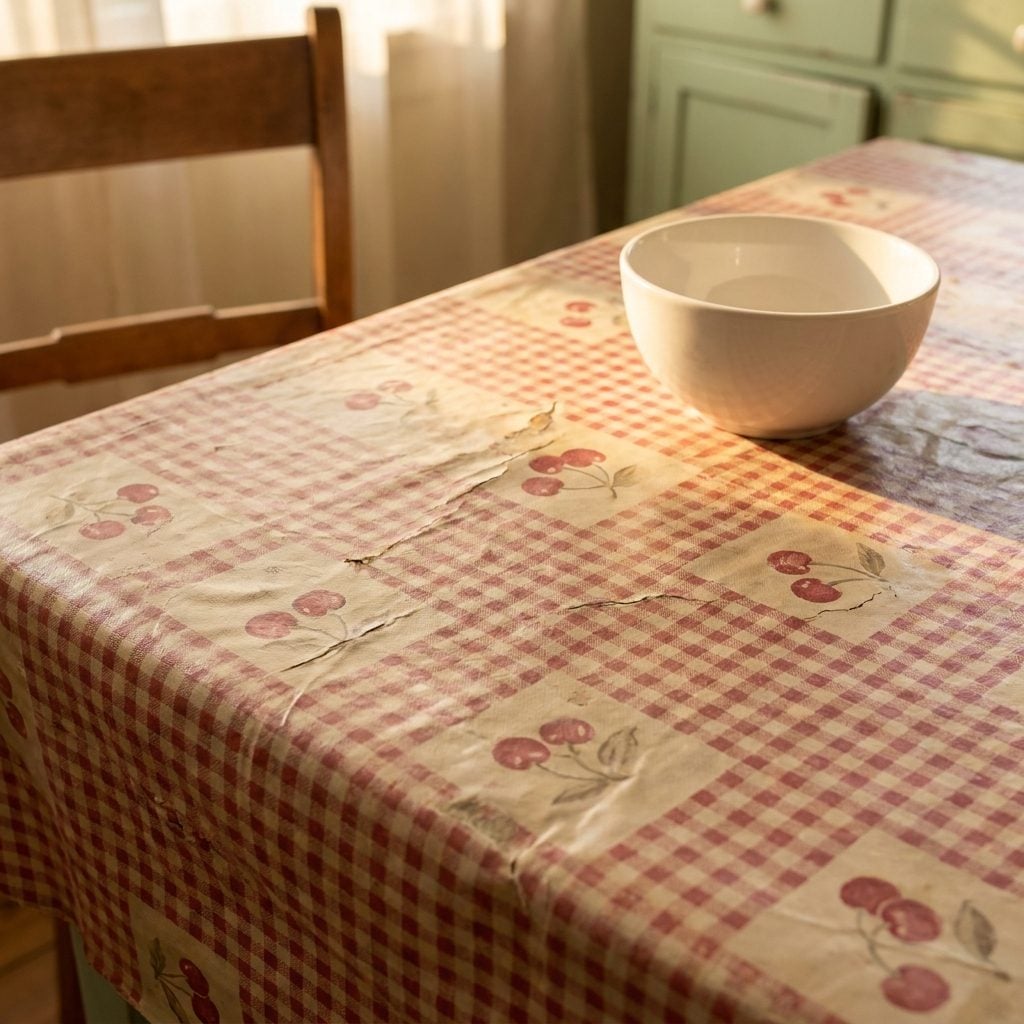
You’ve never sat at a 1930s kitchen table covered in cherry-print oilcloth. Neither has anyone you know. So why does a photograph of one make your chest tighten with something that feels suspiciously like longing?
Psychologists have a word for this. It’s called anemoia: nostalgia for a time you never experienced. Writer John Koenig coined the term, and it’s caught fire because it names something millions of people feel but couldn’t articulate. According to psychologist Eric Solomon writing in Psychology Today (Source), anemoia may reflect a longing for self-authored experience itself. The gingham checks and fruit prints of Depression-era oilcloth work as a delivery system for that ache. They signal a kitchen where someone cooked from scratch because there was no other option. Where nothing was disposable. Where the table was wiped clean and used again tomorrow.
Philosopher Felipe De Brigard at Duke University has proposed that nostalgia doesn’t require real memories at all. Your brain creates simulations of pleasant past experiences, and imagination-based nostalgia piggybacks on the same neural networks. Source. That gingham pattern isn’t triggering a memory. It’s triggering a simulation your brain treats as one.
Why Your Brain Thinks a Kitchen Table Is More Important Than a Kitchen Island
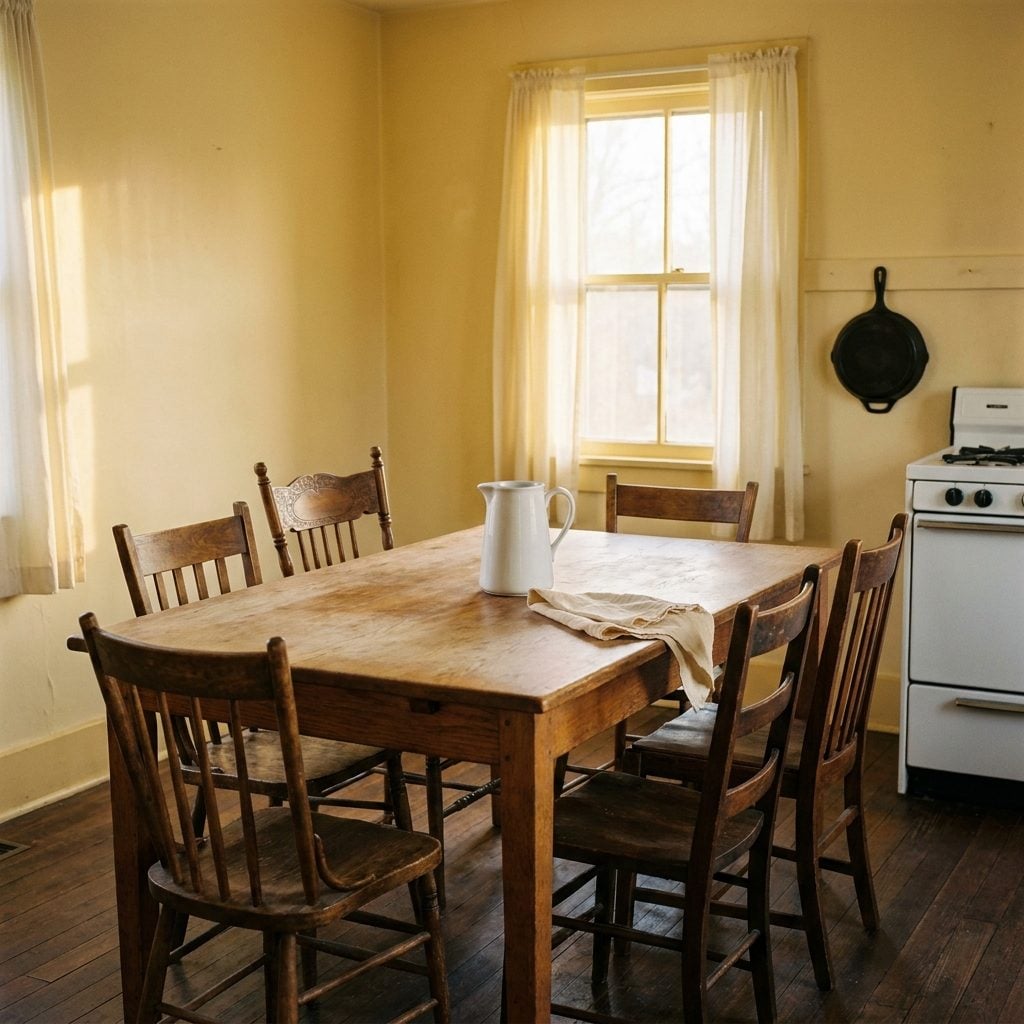
Here’s a strange detail about how homes changed. As American houses got larger over the past thirty years, the kitchen table quietly disappeared. As one family therapist observed, granite countertops sell homes. Humble tables don’t. The island replaced the table in most new construction. And something shifted.
A table is round or rectangular. Everyone faces the center. Eye contact is unavoidable. Nobody is standing over anyone else. The geometry is equality. A small kitchen design from the 1930s had almost no counter space, but it always had a table, because the table wasn’t about cooking. It was about sitting down together. That act of sitting, at the same height, facing each other, with food in the middle, is one of the oldest social rituals humans have. Your brain reads it as safety.
An island changes the geometry. The cook stands on one side. Everyone else perches on stools on the other. It creates a performer-audience dynamic. According to Liraz Margalit’s Psychology Today piece on neuroarchitecture (Source), the island does encourage dialogue because the cook faces the room. That’s a real advantage over the old wall-mounted stove arrangement. But the table did something the island can’t: it made every seat equal.
The Farmhouse Sink Illusion and the Real Reason It Makes You Feel Capable
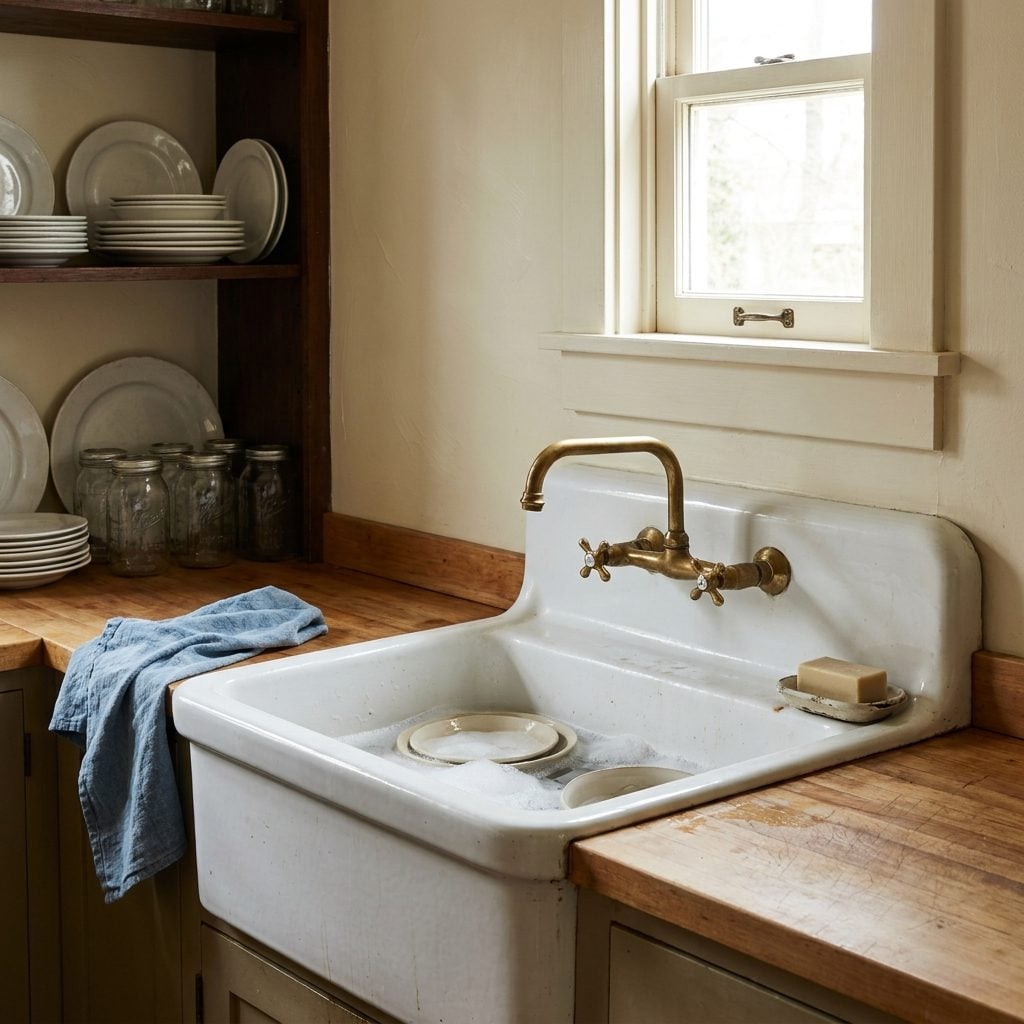
You’ve stood at one. Hands submerged to the wrists in warm water, the white apron front pressing into your hip bones. Something shifts. You don’t just feel like you’re washing dishes. You feel like you’re handling things.
That response isn’t about nostalgia for the 1930s. It’s about your body telling your brain a story. Embodied cognition, a theory now gaining traction across neuroscience and psychology, argues that physical posture and engagement shape how we think and feel. According to a new article in the Journal of Humanistic Psychology (Source), cognition isn’t locked inside your head. It emerges through your body’s ongoing engagement with the world. The researcher calls it achieving an “optimal grip” on your environment.
A white farmhouse sink is deeper, wider, and more physically demanding than a standard basin. Your arms reach further. Your stance widens. Your brain reads that wider stance and deeper reach as competence. As control. The Depression-era kitchen didn’t install these sinks for psychological reasons. They installed them because they needed to wash everything from canning jars to chicken parts. But the body doesn’t know that. It just knows: I am planted here, I am doing something real, and I can handle it.
Why Hand-Cranked Tools Satisfy a Psychological Need That Electric Ones Can’t
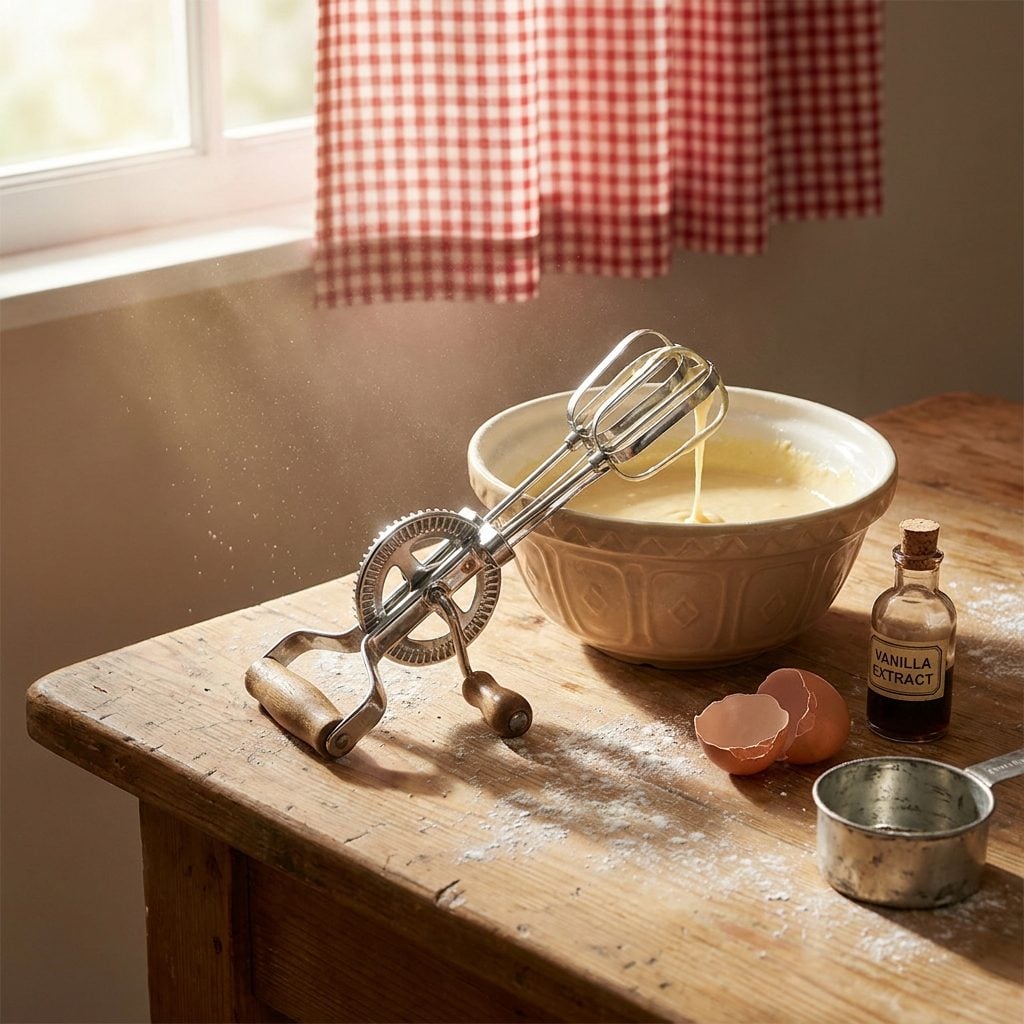
A hand-cranked egg beater does something no KitchenAid can replicate. It lets you feel the resistance change as the mixture thickens. Your wrist knows when the batter is right before your eyes do.
Psychologist Mihaly Csikszentmihalyi called it flow: a state where you’re so absorbed in a task that time bends and the outside world goes quiet. Research on fostering flow experiences at work (Source) found that two conditions predict it better than almost anything else: immediate feedback and a sense that your skill matches the challenge. A hand-cranked tool delivers both. You feel the gears catch. You adjust your speed. The tool pushes back, and you push through. Electric appliances remove that feedback loop entirely. You press a button and wait.
Manual work also triggers dopamine release differently. The reward comes in increments, not all at once. Each rotation of the crank is a tiny completion. Your brain registers it. That’s the same mechanism that makes kneading bread dough for ten minutes feel oddly meditative instead of tedious.
The Scarcity Aesthetic and Why Fewer Things on a Counter Read as Dignity Not Poverty
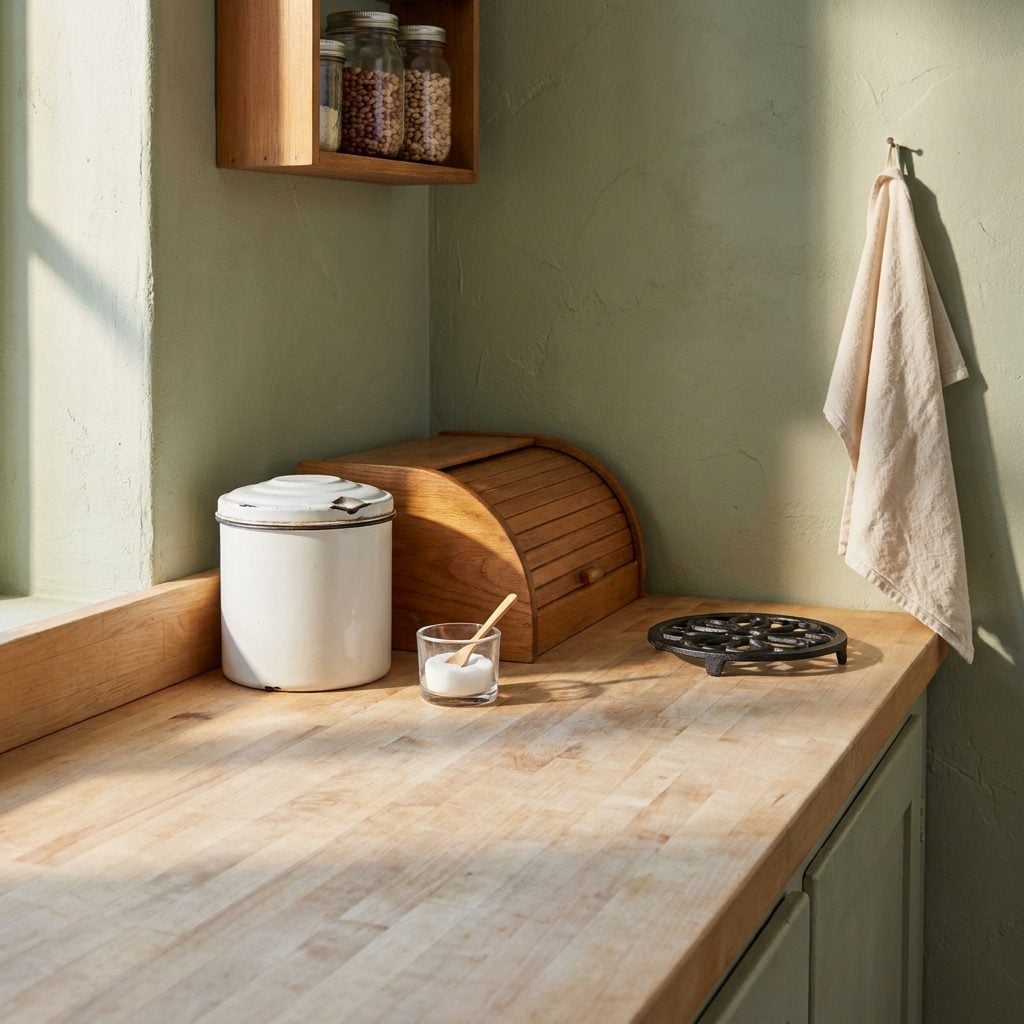
Walk into a Depression-era kitchen and you’d find maybe four things on the counter. A canister. A breadbox. A salt cellar. A cast iron trivet. That’s it. Not because the family was curating an aesthetic. Because they didn’t own more.
Now look at what happens when a modern designer recreates that same counter. People call it clean. Intentional. Expensive-looking. Here’s why: Princeton University researchers found that physical clutter competes for your attention the same way multiple conversations in a crowded room do. Studies in environmental psychology confirm that visual excess increases cognitive load and cortisol, your stress hormone. A clear counter doesn’t just look calm. It makes your brain calmer.
The strange inversion is this: what once signaled that a family couldn’t afford more now signals that a family doesn’t need more. Scarcity and restraint look identical on a countertop. Your brain can’t tell the difference. It just reads open space and thinks: whoever lives here has things under control. That’s dignity. And it costs nothing. I say this as someone who spent years cluttering counters with appliances I used twice a year before finally getting it.
Why Bread Cooling on a Wire Rack Triggers a Calm Your Rational Mind Can’t Explain
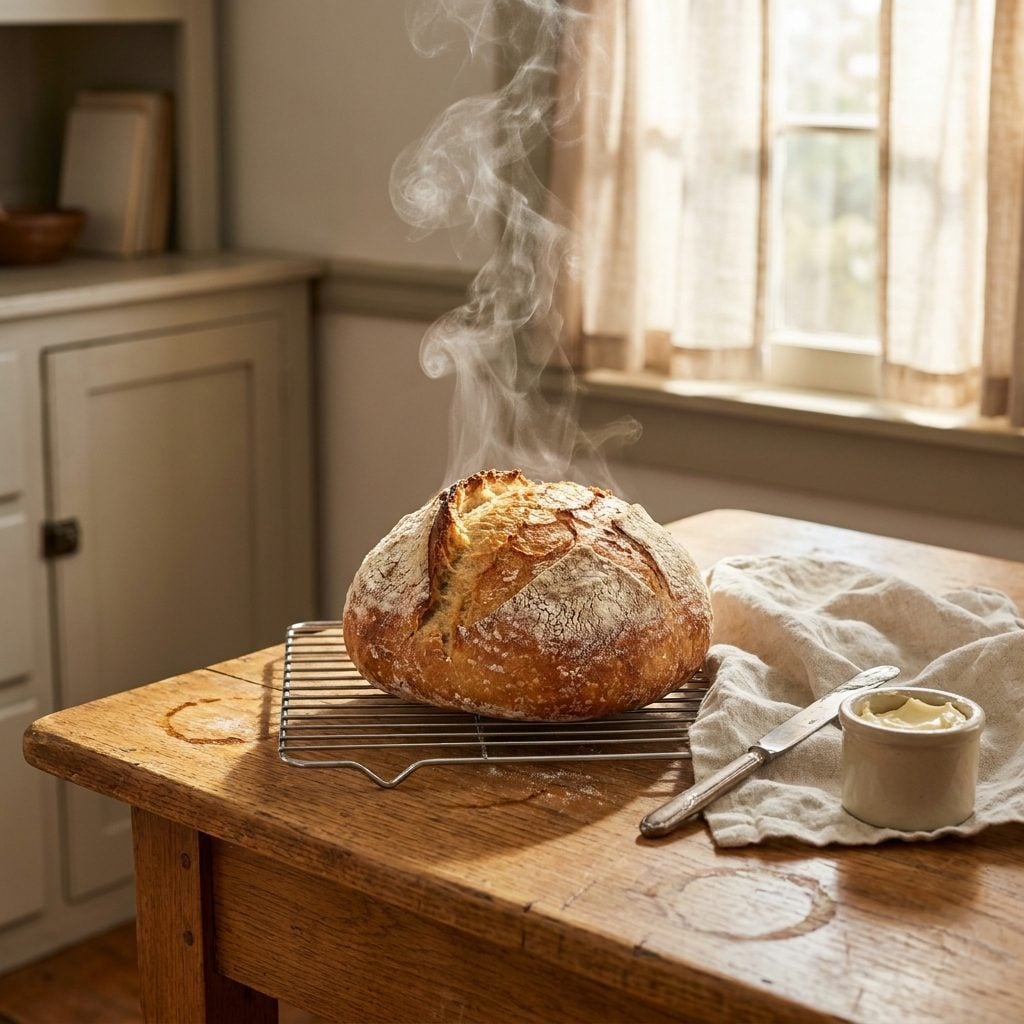
The loaf isn’t doing anything. It’s just sitting there, ticking faintly as the crust contracts, steam curling off the top in threads you can barely see. And something in your chest loosens. Your shoulders drop half an inch. You don’t decide to relax. It just happens.
The olfactory bulb, the part of your brain that processes scent, is directly wired into your limbic system, which controls memory and emotion. Unlike sight or sound, smell bypasses your rational filters entirely. According to neurobiologist José A. Morales García (Source), scent travels through the olfactory nerve to the limbic system, where it connects instantly with stored emotions. Bread is a staple food that features heavily in childhood, which is why its aroma triggers such intense feelings of family, safety, and comfort.
A study published in the Journal of Social Psychology even found that the smell of fresh bread makes people behave more generously toward strangers. Research by UCD scientists confirmed that the olfactory bulb sits just one synapse away from the hippocampus and amygdala, the brain’s memory and emotion centers. That loaf on the wire rack is doing more work than your rational mind will ever know.
The Reason a Wall-Mounted Plate Rack Feels Like an Act of Courage
🔥 Would you like to save this?
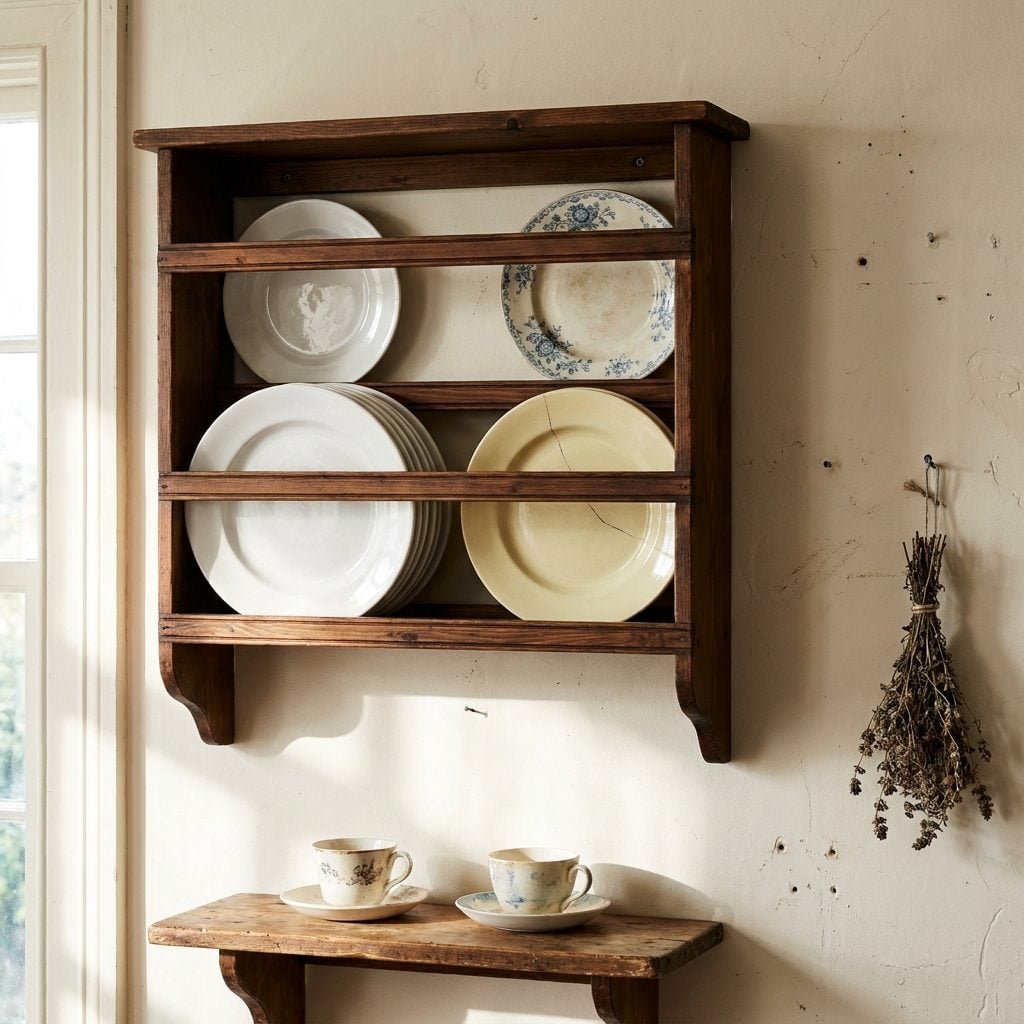
Putting your dishes on the wall is a strange thing to do, if you think about it. You’re taking the most breakable objects in the kitchen and displaying them where everyone can see them. Every chip. Every crack. Every plate that doesn’t match the others.
Depression-era families didn’t have matched sets. They had what survived. A plate from a wedding gift, another from a church sale, a third handed over by a neighbor who was moving. Mounting those plates on a wall-mounted plate rack wasn’t decoration. It was storage, plain and simple. Cabinets were a luxury many kitchens didn’t have.
But here’s what the modern eye reads: someone who isn’t hiding. The home inspiration we chase in open shelving and exposed storage traces back to this same impulse. There’s a psychological term for the anxiety of concealment: impression management, the constant work of controlling what others see. A plate rack dismantles that. Everything is out. The mismatched set. The one with the crack down the middle. That openness reads as confidence. Maybe even defiance. The courage isn’t in displaying fine china. It’s in displaying what you actually have.
Why Radio-Sized Proportions Hit a Comfort Frequency That Bluetooth Speakers Miss
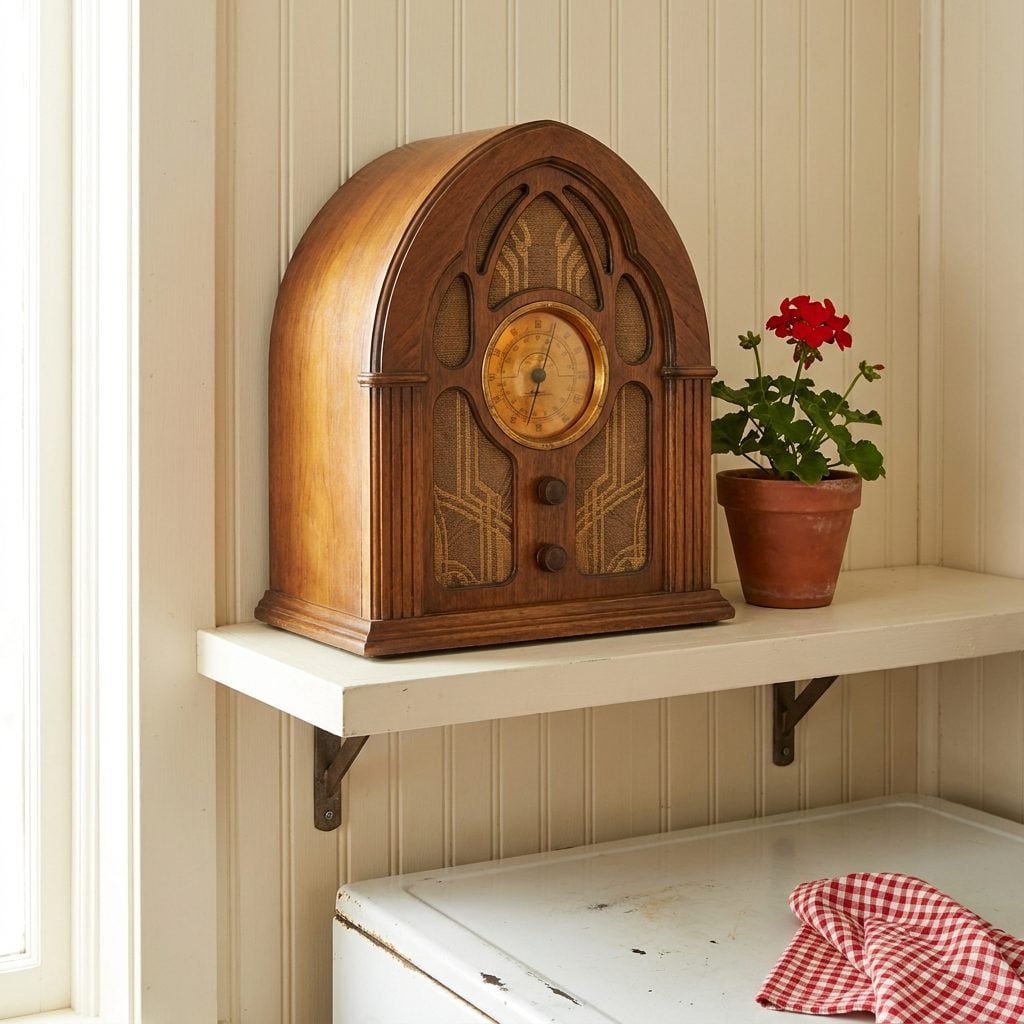
The old Philco cathedral radio was about fourteen inches tall. Rounded top, warm wood cabinet, a cloth-covered speaker grille that looked like it might have something kind to say. It sat on the counter or a shelf and occupied a very specific amount of space. Not too much. Not too little. A presence, not a takeover.
Modern Bluetooth speakers come in two wrong sizes. Either they’re tiny hockey pucks that disappear entirely, or they’re oversized soundbars that declare themselves the most important object in the room. Neither one feels like company.
There’s a concept in design psychology about objects scaled to the human hand and the human gaze. Things that fit the body’s natural proportions feel trustworthy. A 1930s radio was about the size of a human head. You could look at it the way you’d look at another person across the table. That scale registered as companionship. You weren’t listening to a device. You were sitting with something.
The Psychological Reason a Pulled Curtain Doorway Feels More Inviting Than a Closed Door
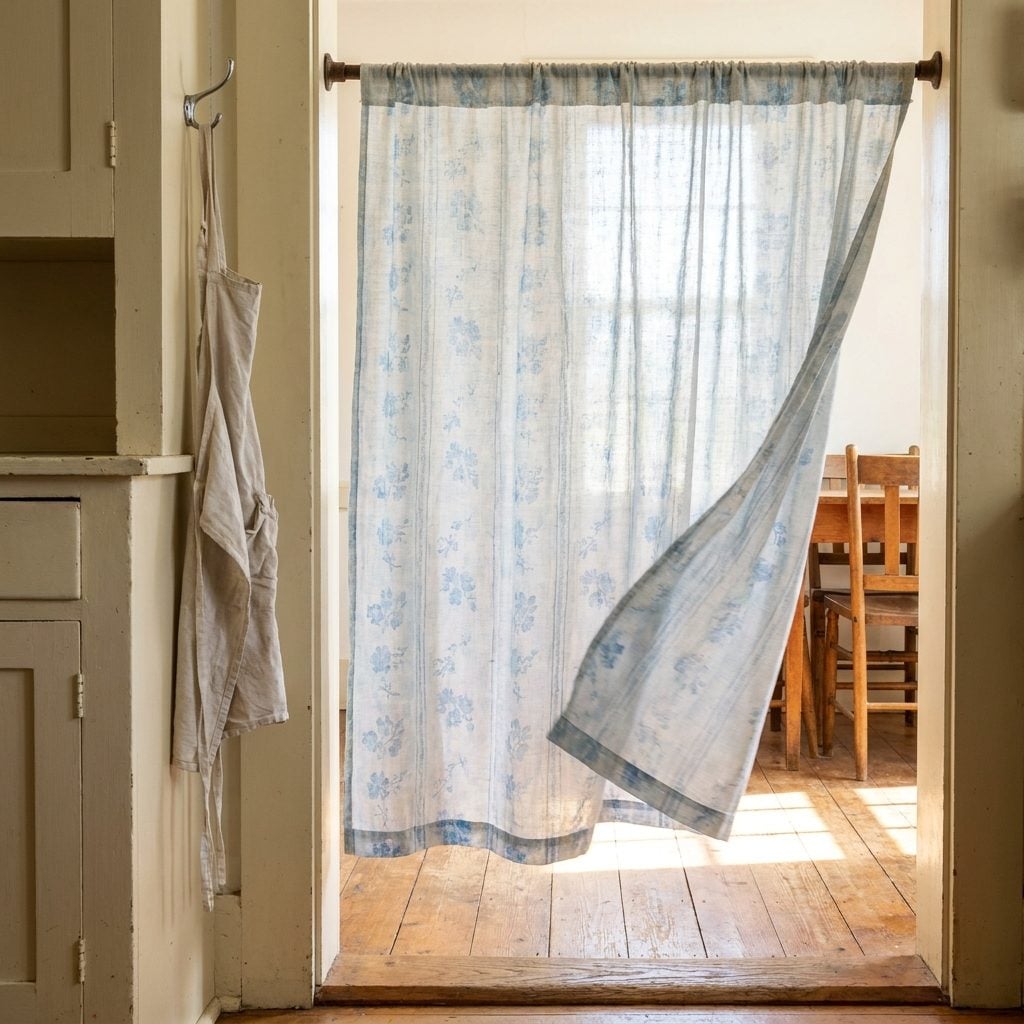
A door says stop. A curtain says maybe.
That difference is everything. In the 1930s, plenty of kitchens used fabric curtains instead of doors in interior doorways and across pantry openings. Cotton feed-sack prints, mostly. Sometimes just a plain muslin panel. The reason was cost. Doors and hardware were expensive. Curtains were free if you had a flour sack and a tension rod.
But the psychological effect of a cotton doorway curtain runs deeper than economics. Geographer Jay Appleton’s prospect-refuge theory, first proposed in the 1970s, describes the human need to feel both sheltered and connected to the larger environment. Research on prospect-refuge window design in residential environments (Source) shows that screening devices like curtains and blinds create a “soft boundary” that satisfies both needs at once. You can see movement through the fabric. Light passes. Sound passes. Air passes. You get the privacy of separation without the anxiety of isolation.
A closed door triggers a different calculation in the brain entirely. What’s behind it? Who’s behind it? Is it locked? A curtain answers all of those questions with gentle motion and transparency. It’s refuge that still lets you see the prospect. And it costs less than a hinge.
Why the Smell of Gas Burners Registers as Safety Instead of Danger
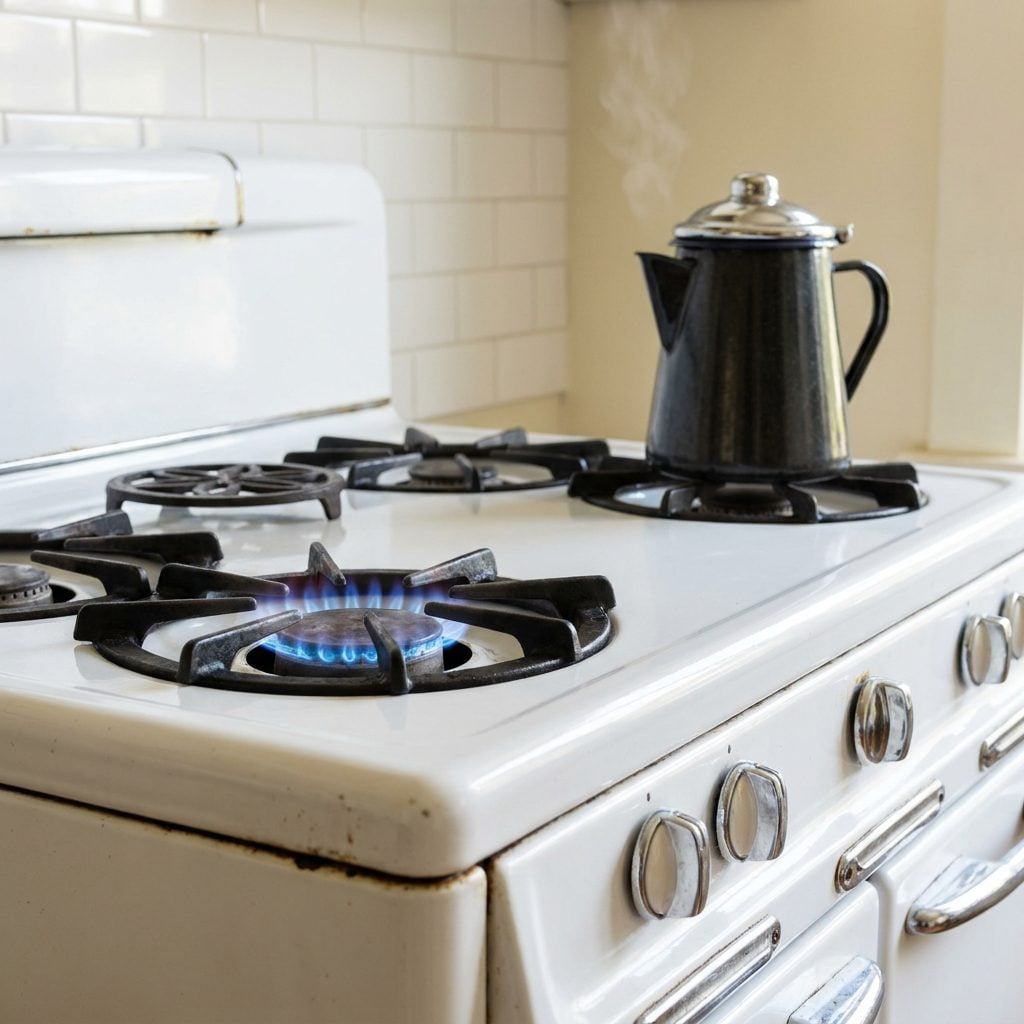
This one should bother you more than it does. Natural gas is flammable. The mercaptan they add to it smells like sulfur and rot on purpose, so you’ll notice a leak. And yet: the click-click-whoosh of a gas burner catching, followed by that faint smell of combustion, makes a kitchen feel occupied. Alive. Safe, somehow.
The rational mind knows better. The limbic system doesn’t care. Scent memories formed in the first decade of life are the most durable and emotionally loaded ones we carry. Scientists call this odor-evoked autobiographical memory (Source), also known as the Proust phenomenon. It’s the reason a smell can pull you back thirty years in under a second. If a gas stove meant a warm kitchen when you were five, that association is essentially permanent. Your adult brain can read every safety warning ever printed and it won’t override the emotional tag your childhood brain attached to that smell.
Depression-era kitchens ran on gas because gas was cheaper than electric. The blue flame on a cast iron grate was the center of gravity in the room. Everything happened around it. Soup simmered. Coffee percolated. Wet gloves dried on the rack above. The smell of that burner didn’t mean danger. It meant someone was home, and they were making something.
The One Detail Depression-Era Kitchens Got Right That Neuroscience Finally Proved a Century Later
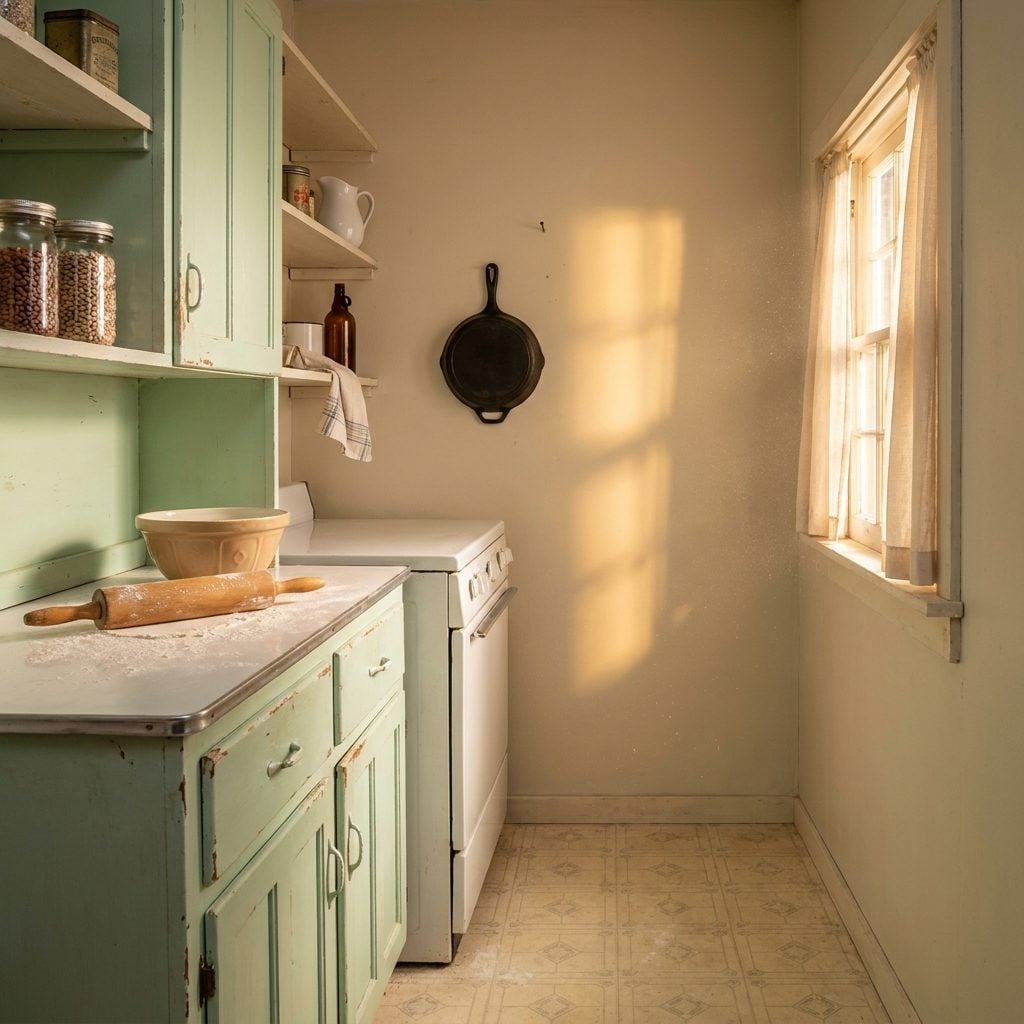
Everything had a place. Not because it looked nice. Because there wasn’t room for it not to.
Depression-era kitchens were small. Ruthlessly small by today’s standards. Counter space was measured in inches, not feet. Cabinets were shallow. Drawers were narrow. And every single item, from the flour sifter to the salt cellar, lived in one spot and returned to that spot after every use. Not out of some Marie Kondo philosophy. Out of pure spatial necessity. You couldn’t leave the rolling pin on the counter because the counter was also where you kneaded, sliced, canned, and served.
Here’s the thing nobody expected: that forced discipline turns out to be exactly what your prefrontal cortex wants. According to research on kitchen layout psychology, visual clutter in sight lines creates cognitive load that exhausts mental resources, and kitchens with random storage organization force constant decision-making that depletes mental energy. Your brain is running a background scan of every surface you can see. The more objects competing for attention, the harder your mind works just to exist in the room. Depression-era cooks didn’t know this. They just didn’t have the square footage to be messy.
And the open shelving that’s become a Pinterest obsession? That was standard in the 1930s. Not as a style choice. As the only option. A study of open shelving in older adults with mild cognitive impairment (Source) found that open shelving improved cognitive load and physical efficiency during meal preparation, because the brain spends less energy locating items it can already see. The Depression-era kitchen handed you visual access to everything you owned, and it turns out that’s not clutter. It’s clarity. The difference is quantity. Eight items on an open shelf is a system. Eighty is chaos.
Modern kitchens got bigger. Counters stretched. Storage multiplied. And somehow cooking got more stressful, not less. The 1930s kitchen didn’t have room for decision fatigue. That constraint, the one born from poverty, is the one your brain has been quietly begging for ever since.
The Bottom Line
The unsettling reason is this: your brain doesn’t crave the Depression-era kitchen because it’s nostalgic, it craves it because scarcity forced those spaces to be radically honest, and your nervous system can still tell the difference between a room that’s hiding nothing and one that’s performing comfort at you. Every design trend that conceals, smooths over, or optimizes your kitchen is asking your subconscious to trust a surface it can’t verify, and your body quietly refuses. Next time a space makes you feel unexplainably at ease, stop and ask what it’s showing you that most rooms won’t, the answer will tell you more about what safety actually means to you than any design magazine ever could.