🔥 Would you like to save this?
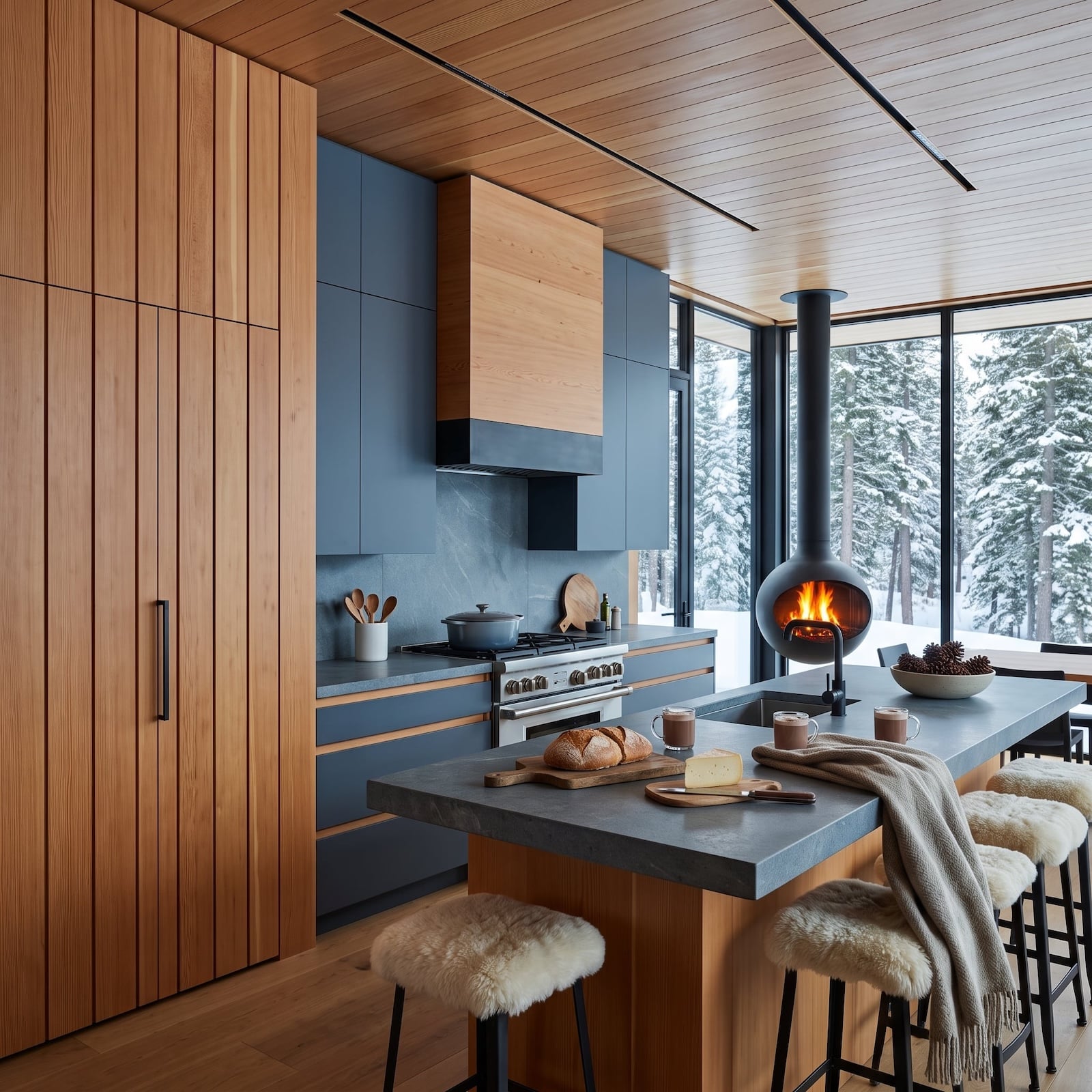
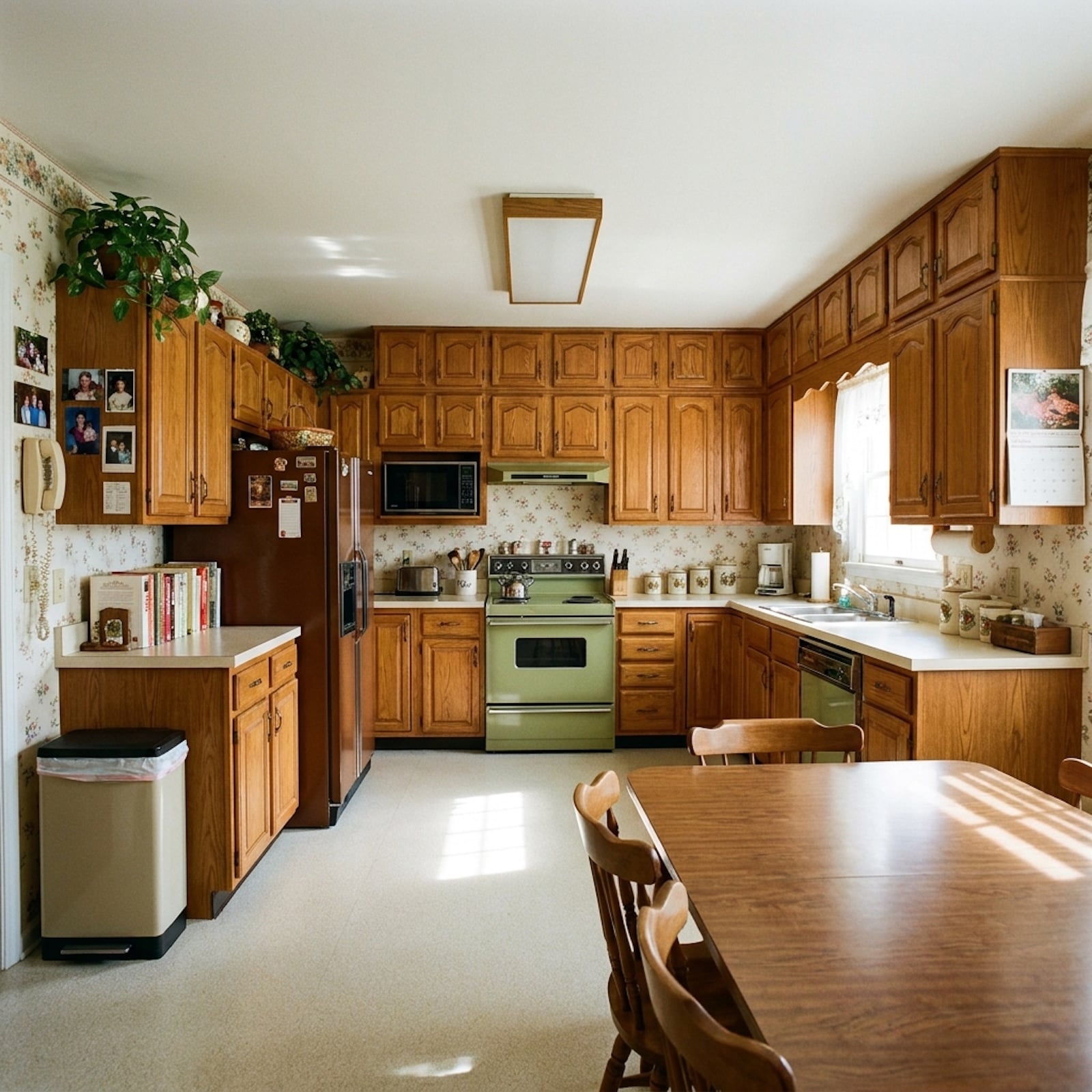
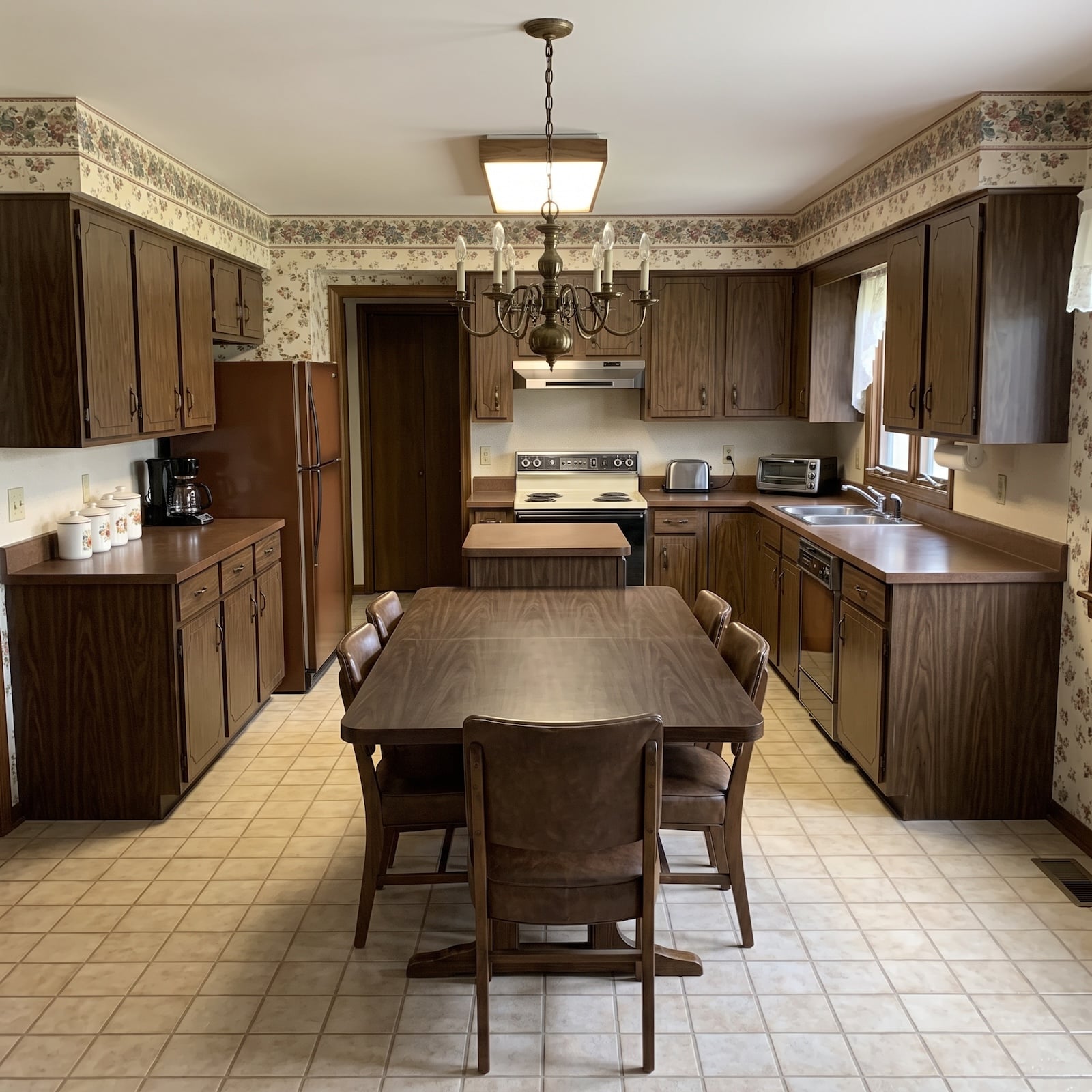
Any designer who has walked through enough kitchens knows the exact moment the 1980s gave up: dark oak cabinets, dusty-mauve laminate countertops, floral wallpaper borders, and overhead fluorescents casting everything in a yellow haze. That combination did not age the way some vintage styles do. It simply got tired. So we brought AI into the planning process and asked what the same kitchen could become under 32 very different design directions.
Most concepts keep the original footprint, windows, doors, and major work zones largely intact while reinventing the finishes, lighting, materials, and furniture. Some go bright and Scandinavian. Others lean into walnut, terracotta, dark lacquer, stone, or unapologetic color. Every one begins with the same dark, dated room—and proves how much can change before the walls have to move.
In order to come up with the very specific design ideas, we create most designs with the assistance of state-of-the-art AI interior design software. Also, assume links that take you off the site are affiliate links such as links to Amazon. this means we may earn a commission if you buy something.
32. Warm Walnut Cabinets and Stone Counters Gave This Kitchen a Whole New Identity
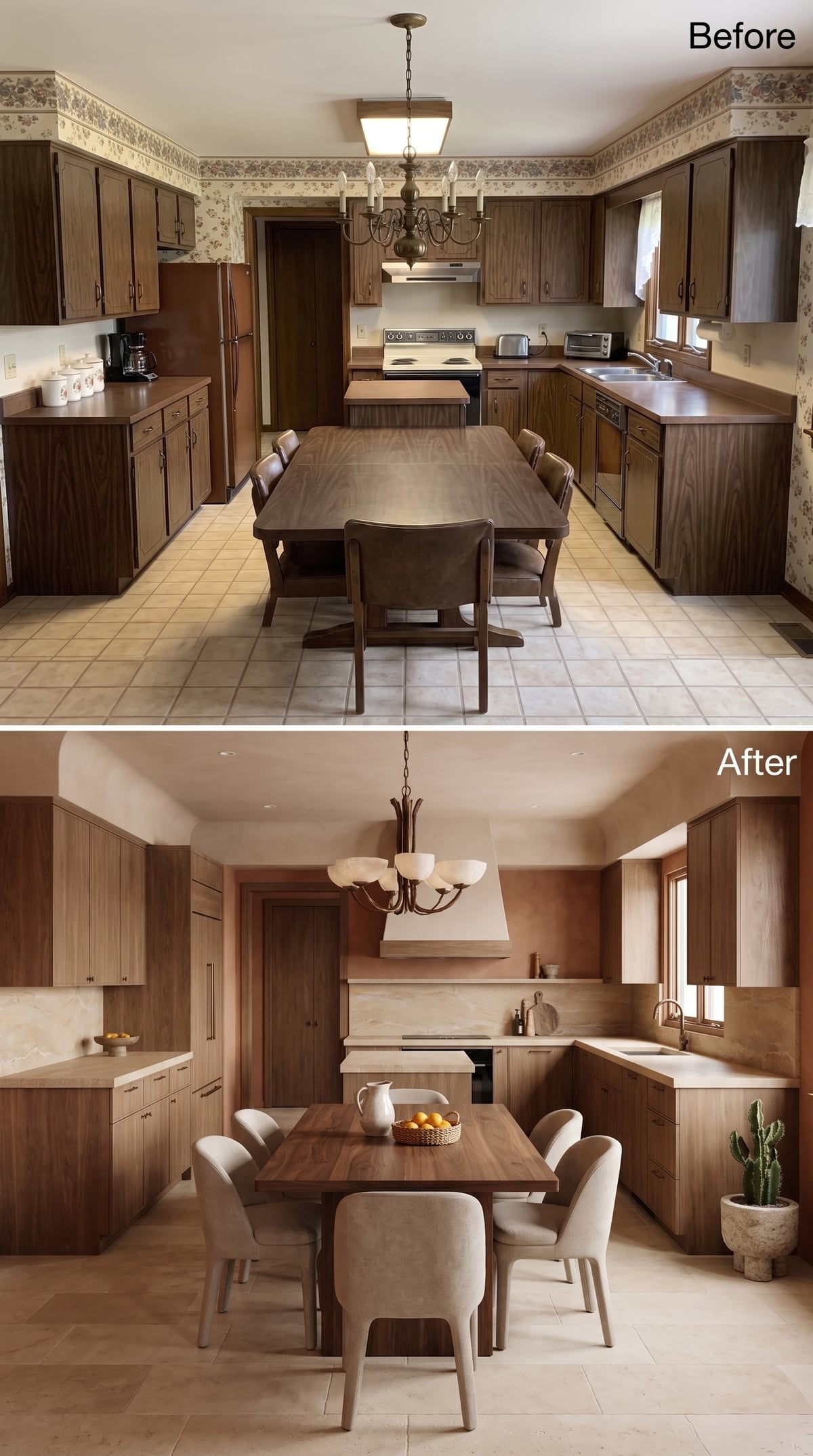
Flat-front walnut cabinets in a warm honey tone run floor to ceiling on both sides, paired with what appears to be a honed limestone or travertine countertop. The hardware is minimal—slim bar pulls in a brushed brass finish—and the wall color reads as a deep terracotta plaster. That sounds risky, but it anchors all that natural wood without competing with it.
A custom range hood clad in the same stone as the counters pulls the room together visually. Upholstered dining chairs in an oatmeal linen fabric replace the original wood seating, and a globe chandelier echoes the scale and position of the original fixture. The potted cactus in the corner is a small, confident finishing touch—the kind that only works when everything else is already settled.
31. Dark Walnut, Teal Stone, and a Candle-Style Chandelier Made This Kitchen Worth Staying Home For
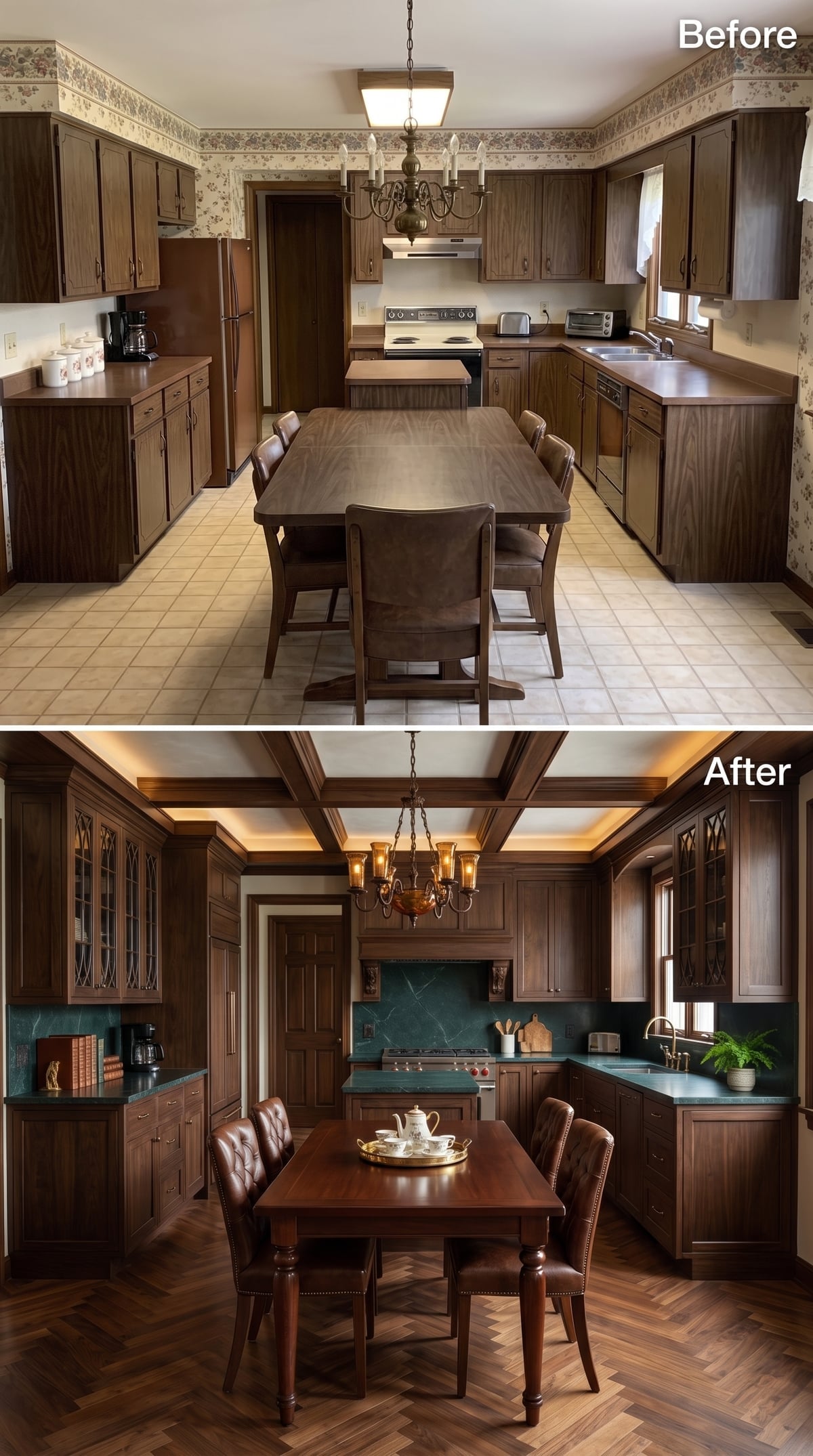
Herringbone wood floors set the tone immediately, and rich dark walnut cabinets with leaded glass inserts do the rest. Teal-veined countertops add unexpected depth against all that wood. The amber candle-style chandelier pulls it together without trying too hard—which is exactly what a room this layered needs.
30. Bleached Oak, Marble, and a Beaded Chandelier Turned This Kitchen Airy
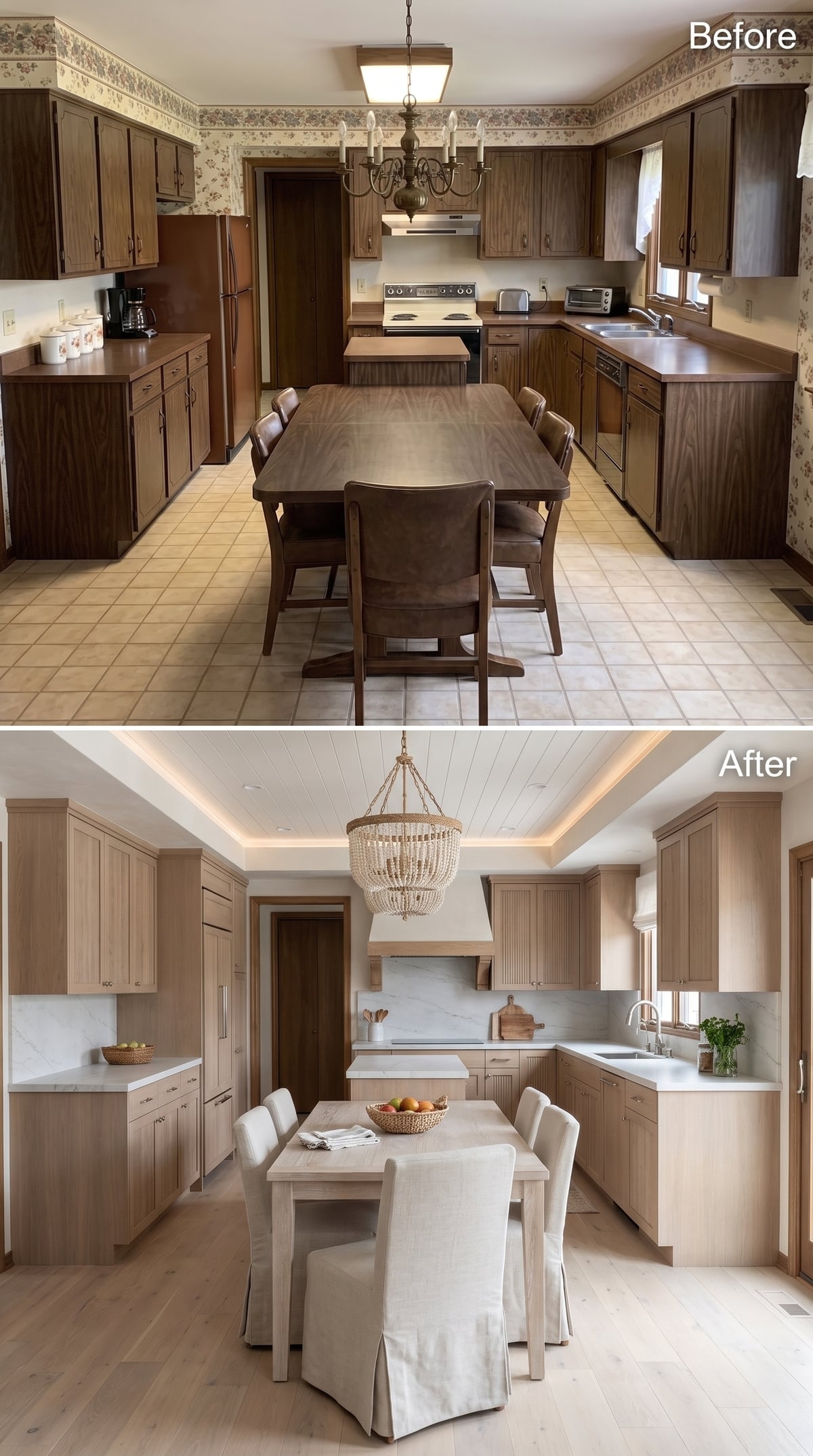
Light-washed oak cabinetry runs floor to ceiling, its grain visible but quiet under a natural finish. White quartz counters extend to a fluted range hood surround framed by a marble slab backsplash, and the beaded chandelier paired with slipcovered dining chairs keeps the whole thing relaxed rather than formal.
29. Black Upper Cabinets Paired With Natural Oak Lowers Changed Everything About This Space
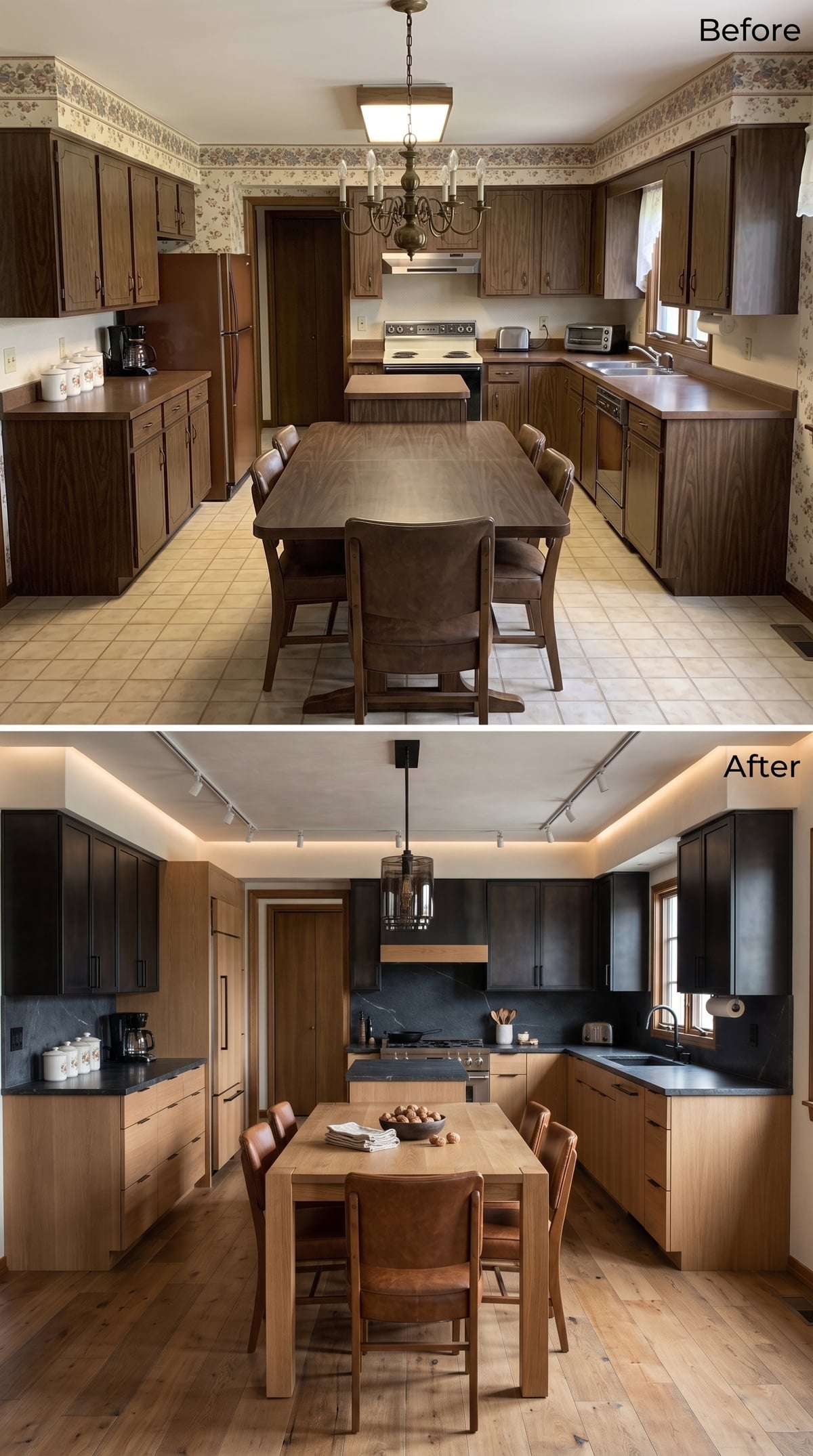
Dark matte uppers anchor the room while the oak lower cabinets keep it from going cold. Warm hardwood floors replace tile, and the pendant reads industrial without overselling it.
Try This: Pairing black upper cabinets with lighter wood lowers creates the strongest contrast at eye level, while the oak base cabinets keep the palette from becoming uniformly dark. Cove lighting along the ceiling perimeter adds warmth that overhead fixtures alone can’t deliver. For counters, soapstone or a dark honed granite gives you that near-black look with natural variation built in.
28. Terracotta Lowers, Warm Walnut Uppers, and Cove Lighting Pulled This Kitchen Into a New Era
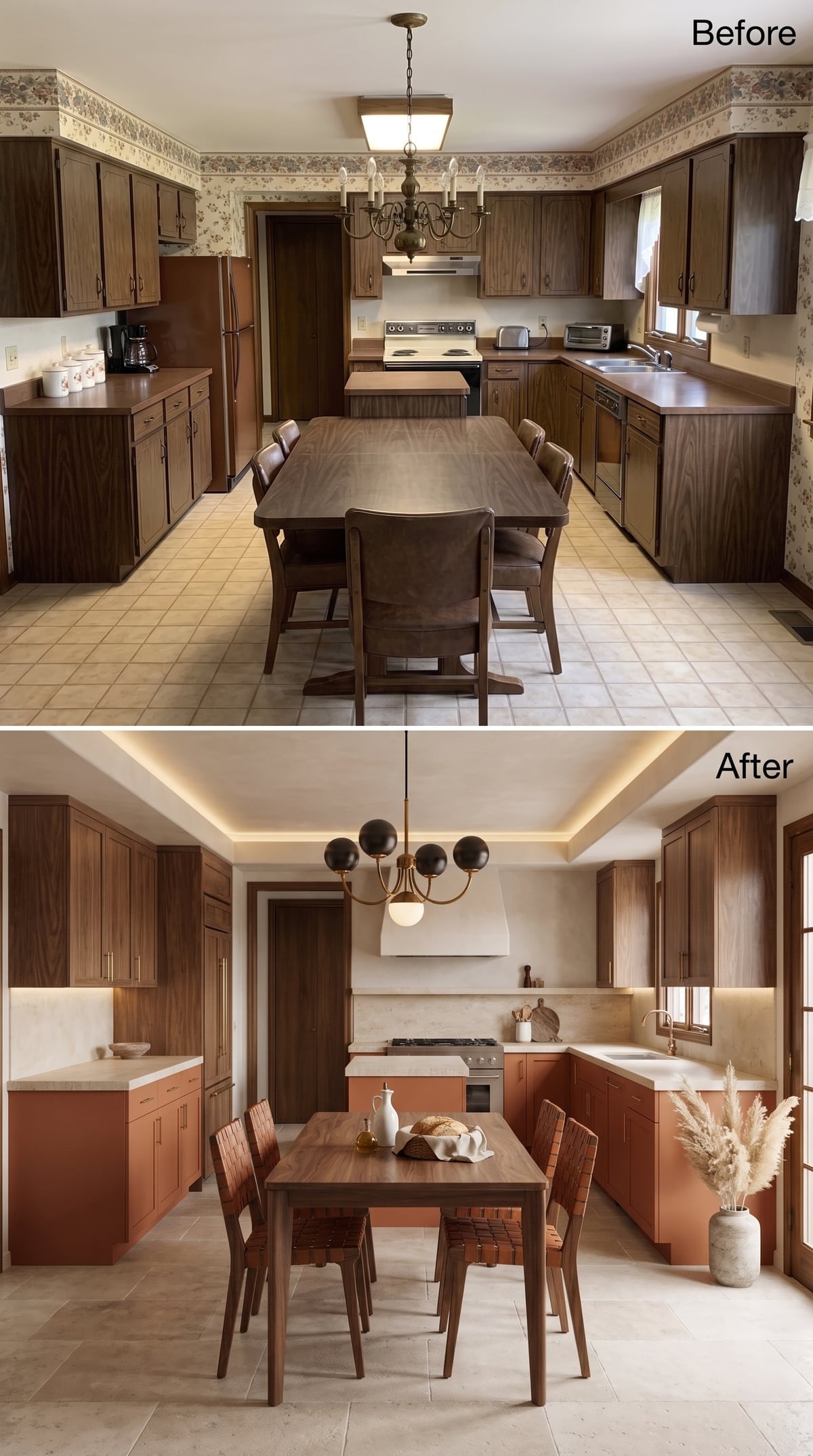
Painted lower cabinets in a deep terracotta sit beneath walnut uppers that stretch to the ceiling, and the combination reads warmer than either finish would manage alone. A custom plaster range hood anchors the back wall where an old over-range unit used to live. After dark, cove lighting along the tray ceiling gives the warm palette more depth.
By the Numbers: Two-tone kitchens with painted lowers and wood uppers have become increasingly common because they combine painted color with natural grain at eye level. Warm terracotta pairs particularly well with stone countertops—both materials share undertones that make a room feel cohesive without matching. Brass hardware, even in small doses, reads as intentional rather than decorative when the surrounding palette already leans warm.
27. Sage Lowers, Bare Oak Uppers, and a Rattan Pendant Rewrote the Whole Room
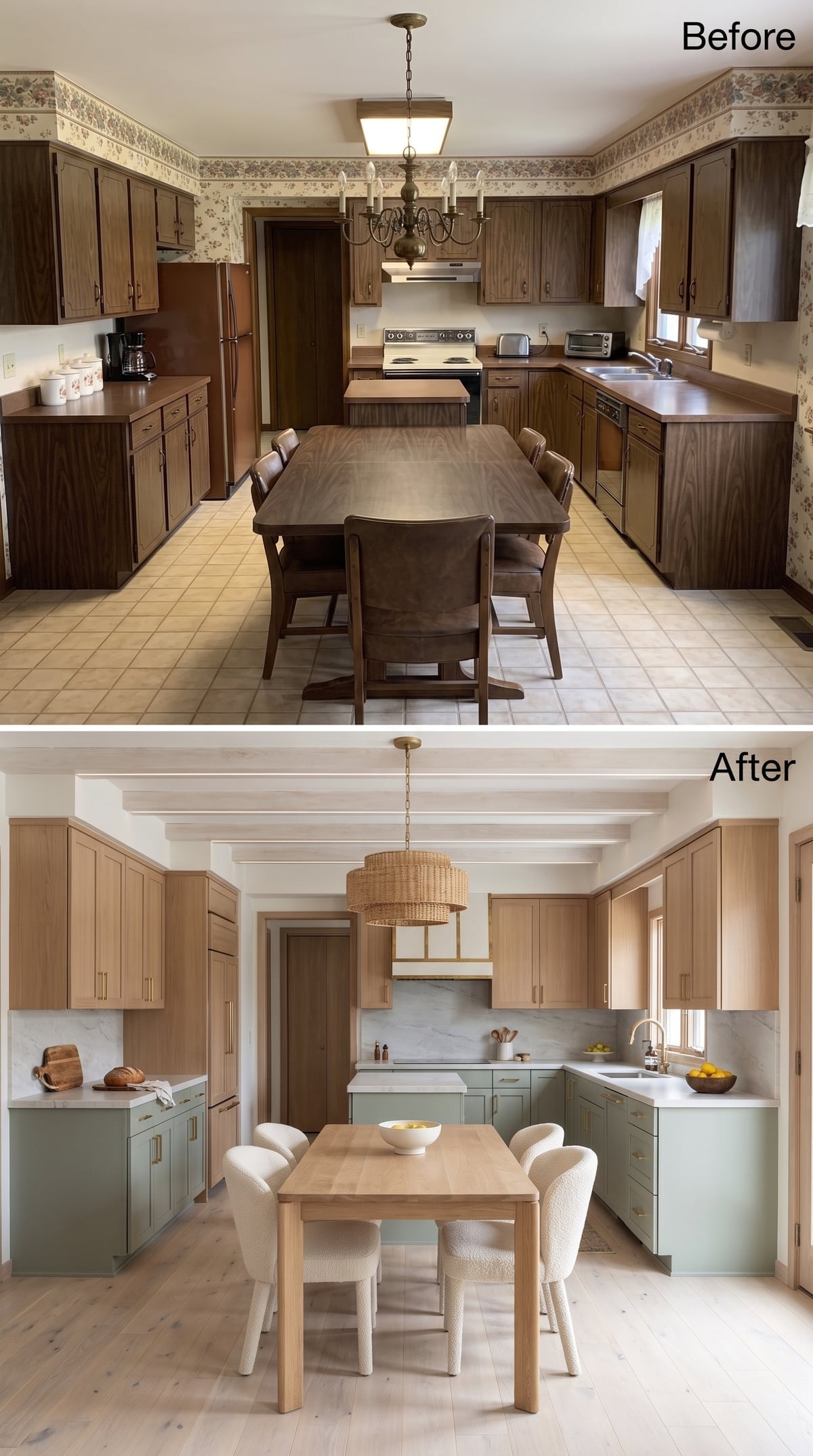
Natural white oak uppers sit above sage-painted lowers, and the split keeps the room from feeling heavy. Brass hardware ties both tones together. The range wall—what appears to be a marble-look slab running from the counter to the hood—gives the composition its center in a way paint alone never could.
Worth Knowing: Sage green has become one of the more enduring cabinet colors in recent years because it reads as neutral in warm light but gains green depth in cooler morning light, so the kitchen looks different depending on the hour. Test the swatch at both times of day before committing.
26. Forest Green Cabinets, Brass Hardware, and Leather Chairs Turned This Kitchen Into Something Else Entirely
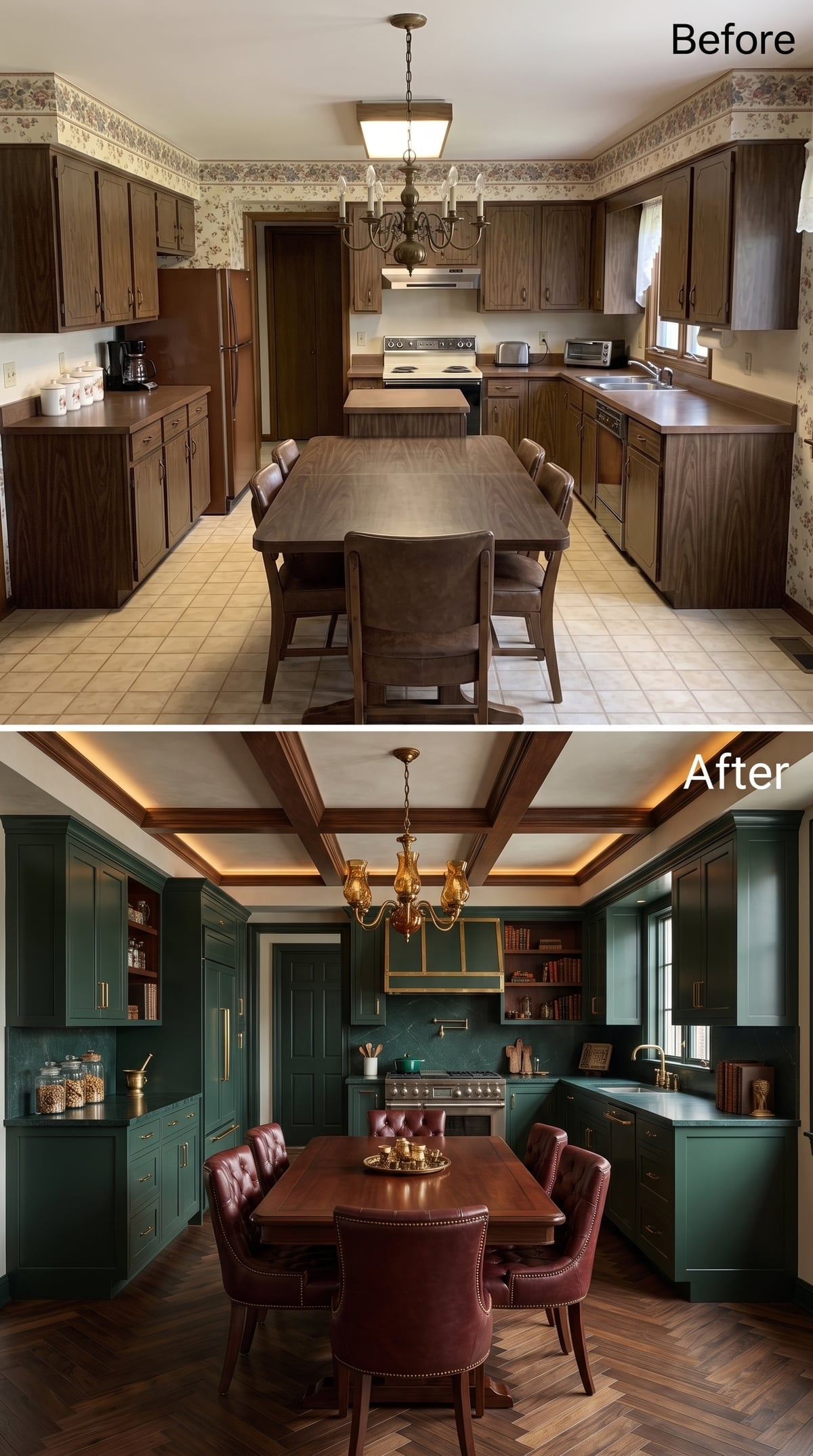
Bottle green Shaker cabinets run floor to ceiling on every wall, and the brass pulls are chunky enough to read from across the room. A herringbone parquet floor grounds the whole thing. Burgundy leather dining chairs with nailhead trim bring the kind of weight that makes the space feel finished rather than staged.
Why the Coffered Ceiling Does More Work Than It Gets Credit For
Recessed cove lighting inside the coffered ceiling frame casts a warm amber glow that keeps the deep green walls from reading as oppressive. Without that uplighting, the same cabinet color could easily flatten the room. It’s a detail that disappears once you stop looking for it—but you’d notice immediately if it were gone.
25. Navy Cabinets, Brass Trim, and Coral Chairs Rewrote This Kitchen From the Floor Up
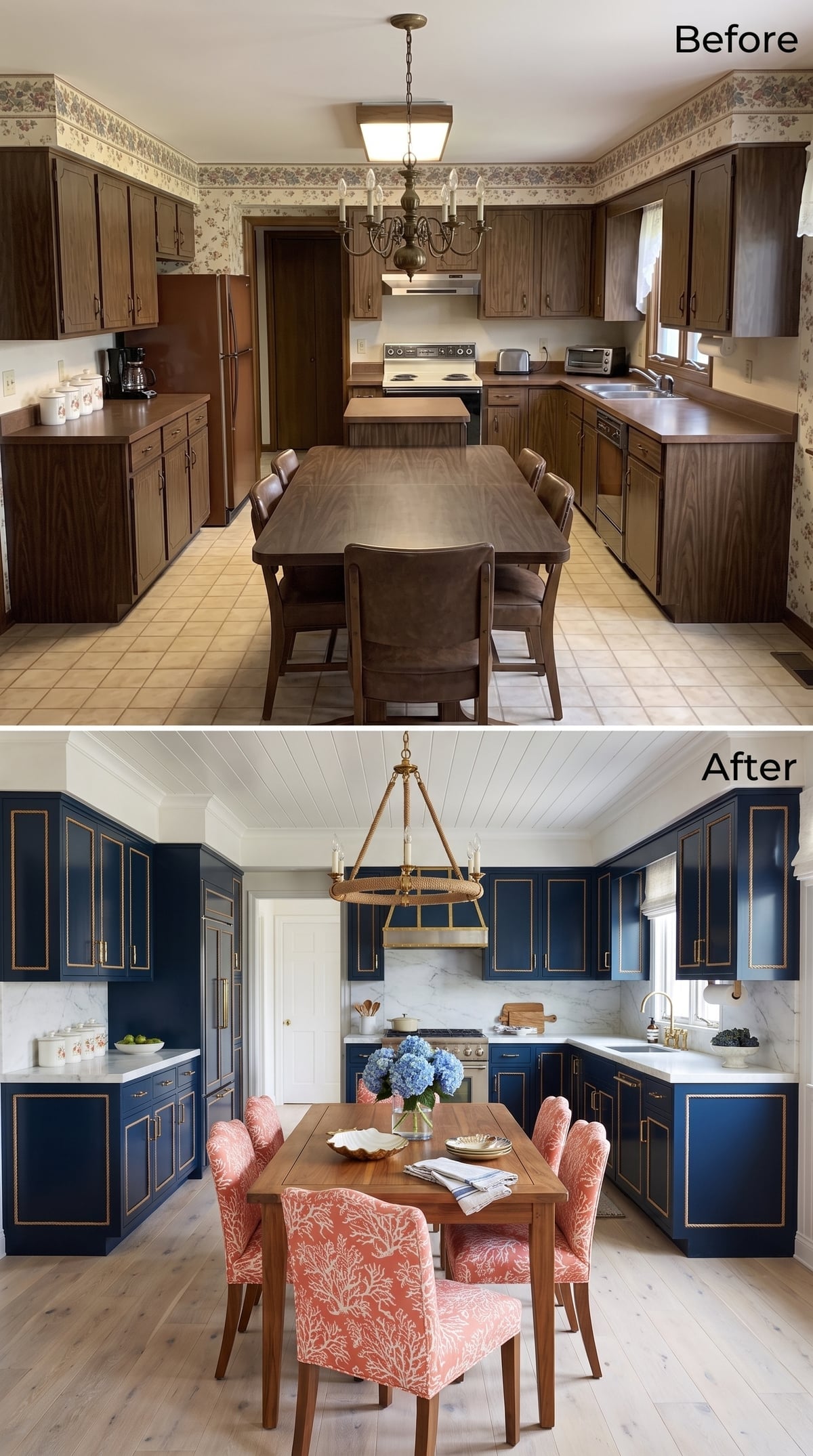
Gold-trimmed navy cabinets run the full perimeter, and the combination reads more formal than most kitchen renovations attempt. A marble slab backsplash keeps the walls from competing, and light oak floors pull the whole scheme back from feeling heavy.
The coral-toned chairs in a white botanical print make the room memorable. Blue hydrangeas on the table reinforce the palette without adding another permanent finish.
Quick Fix: Brass or gold cabinet trim adds hardware-level detail without relying solely on knobs and pulls. It works especially well on dark cabinets because the contrast registers from across the room. If full trim feels like too much, repeating the metal finish in just the lighting fixture ties the look together without committing to every surface.
24. Bare Oak Cabinets, Slate Counters, and a Paper Globe Pendant Quietly Redefined This Space
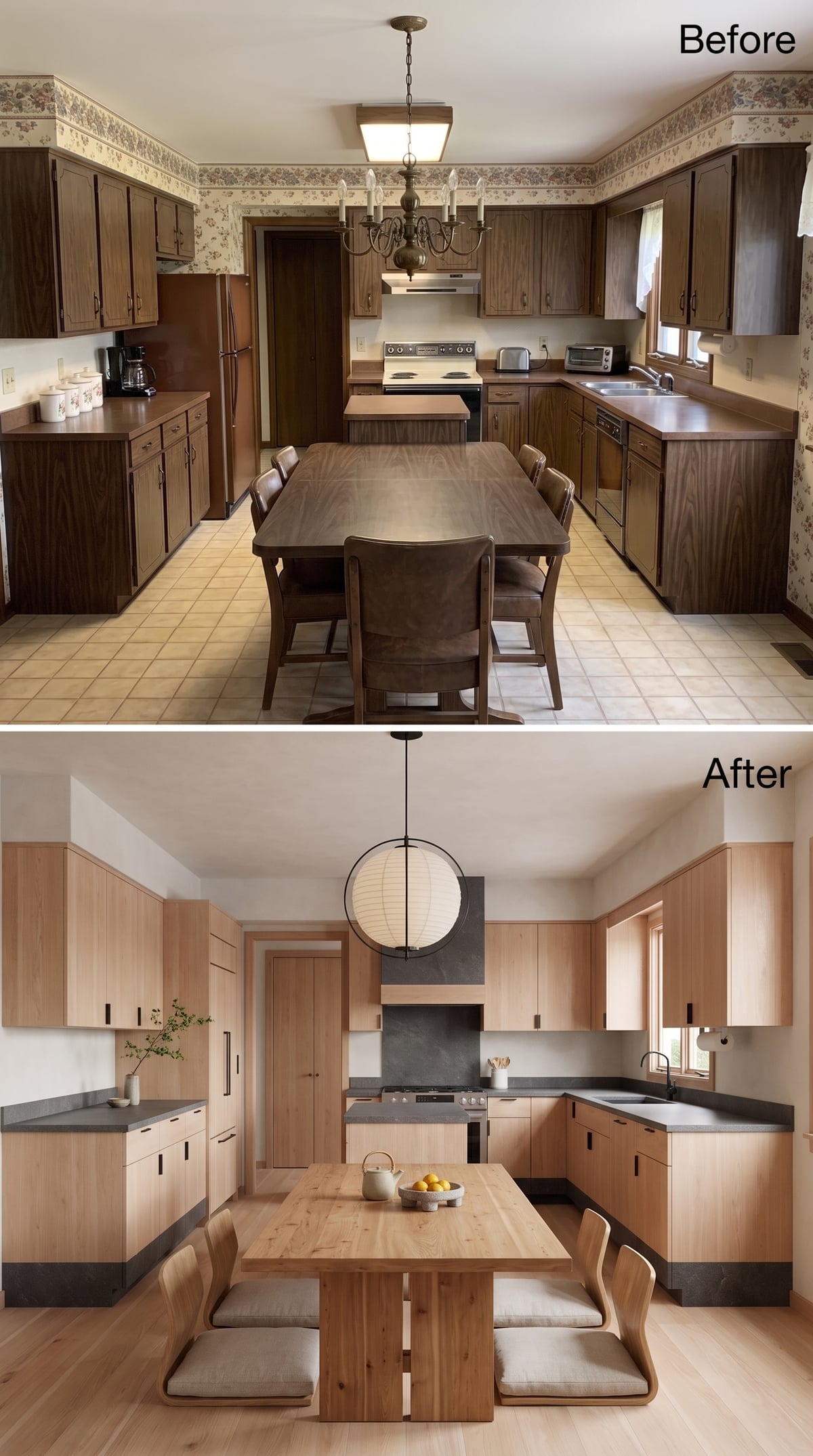
Flat-sawn oak cabinets in a pale, barely-there finish run floor to ceiling on every wall, keeping the room consistent without looking monotonous. Matte slate countertops anchor the whole palette without going cold, and black bar pulls spaced evenly across every door and drawer are the only hardware detail needed.
The dining table is solid wood with a chunky pedestal base. The low-slung chairs have compact proportions, clean lines, and upholstered seats that suit the room well, and a rice paper globe pendant hangs centered over the table. Its soft, even glow suits the restrained cabinetry without adding another visual event overhead.
Style Tip: Rice paper pendants diffuse light softly without casting harsh shadows, which makes them practical over dining tables where you want warmth during meals. They are also a lighting choice that rarely competes with natural wood cabinetry. If the room already has strong material texture, a simple shade keeps the ceiling from feeling busy.
23. Black Cabinets, Gold Trim, and Emerald Velvet Made This Kitchen Hard to Leave
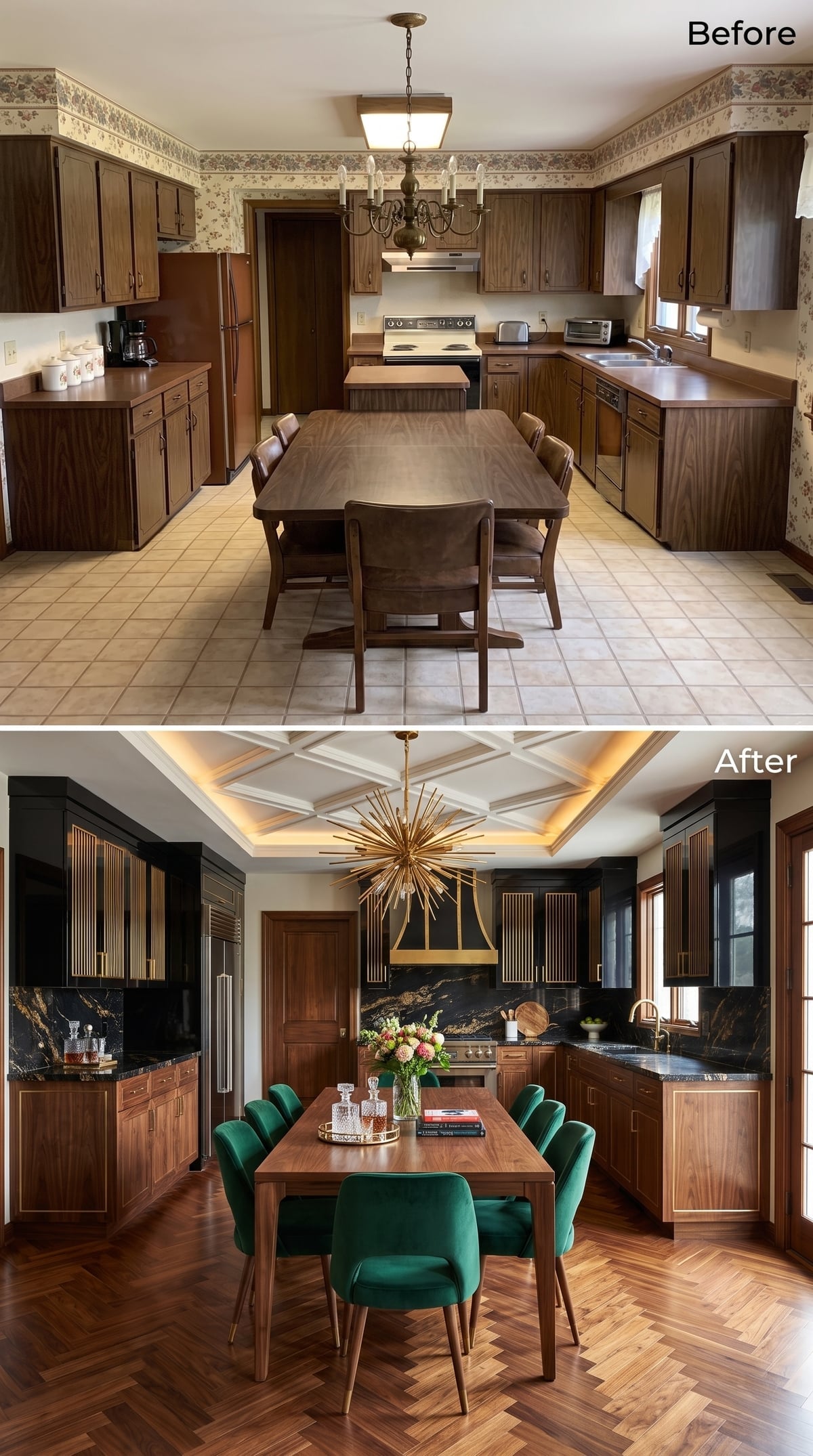
Fluted gold vertical trim runs the full height of the cabinet doors, giving the black cabinetry a detail that reads almost architectural from across the room. A Sputnik chandelier in aged brass hangs from a tray ceiling with warm cove lighting built into the recess—the layered ceiling treatment gives the dark room much of its depth.
Emerald velvet dining chairs anchor the walnut table without competing with it. Beneath everything, herringbone parquet in a warm honey tone pulls the wood tones together, and the black and gold backsplash behind the range ties directly back to the cabinet hardware so nothing feels accidental.
Why the Tray Ceiling Changes the Room’s Proportions
Tray ceilings with integrated cove lighting define a zone without needing walls. In a kitchen-dining combination, that distinction matters because it signals where cooking ends and gathering begins. The warm glow along the recess perimeter also softens the contrast of all that black cabinetry, keeping the room from reading as oppressive even at night.
22. Rust Orange Cabinets, Terrazzo Counters, and Bouclé Chairs Landed This Kitchen in a Different Decade
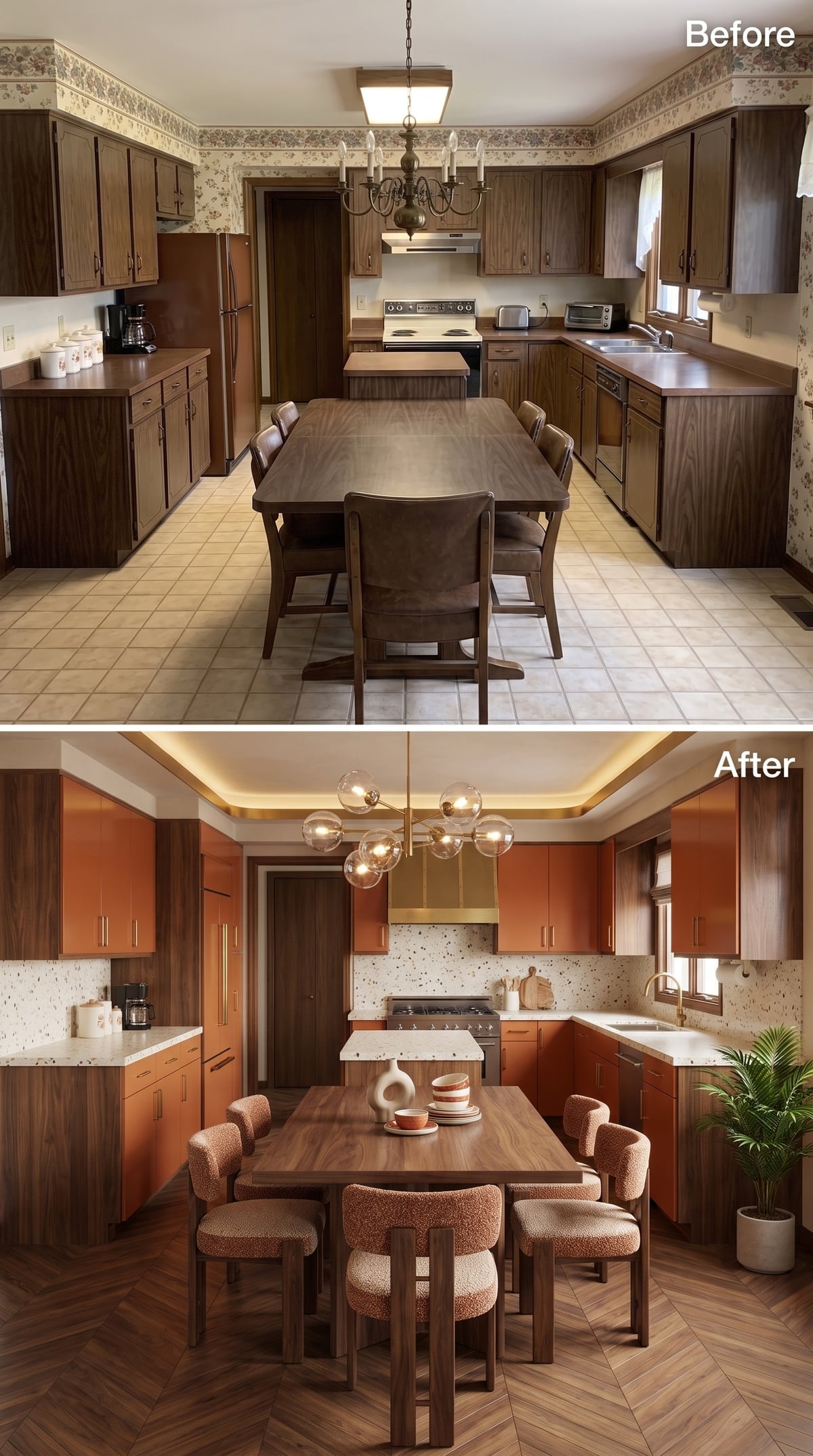
Burnt orange flat-panel lowers sit beneath walnut upper cabinets, with brass bar pulls tying both together. The terrazzo countertops and matching backsplash keep the palette from reading too warm, and bouclé dining chairs in a rust-flecked fabric pull the whole room into focus.
Style Math: Terrazzo has returned to many contemporary kitchens, and its mottled pattern can make minor marks less conspicuous than they would be on a uniform surface. Pair it with warm cabinet colors and it loses the clinical quality that always dogged it in all-white kitchens.
21. Cream Cabinets, an Oak Island, and Crystal-and-Brass Lighting Gave This Kitchen a New Identity
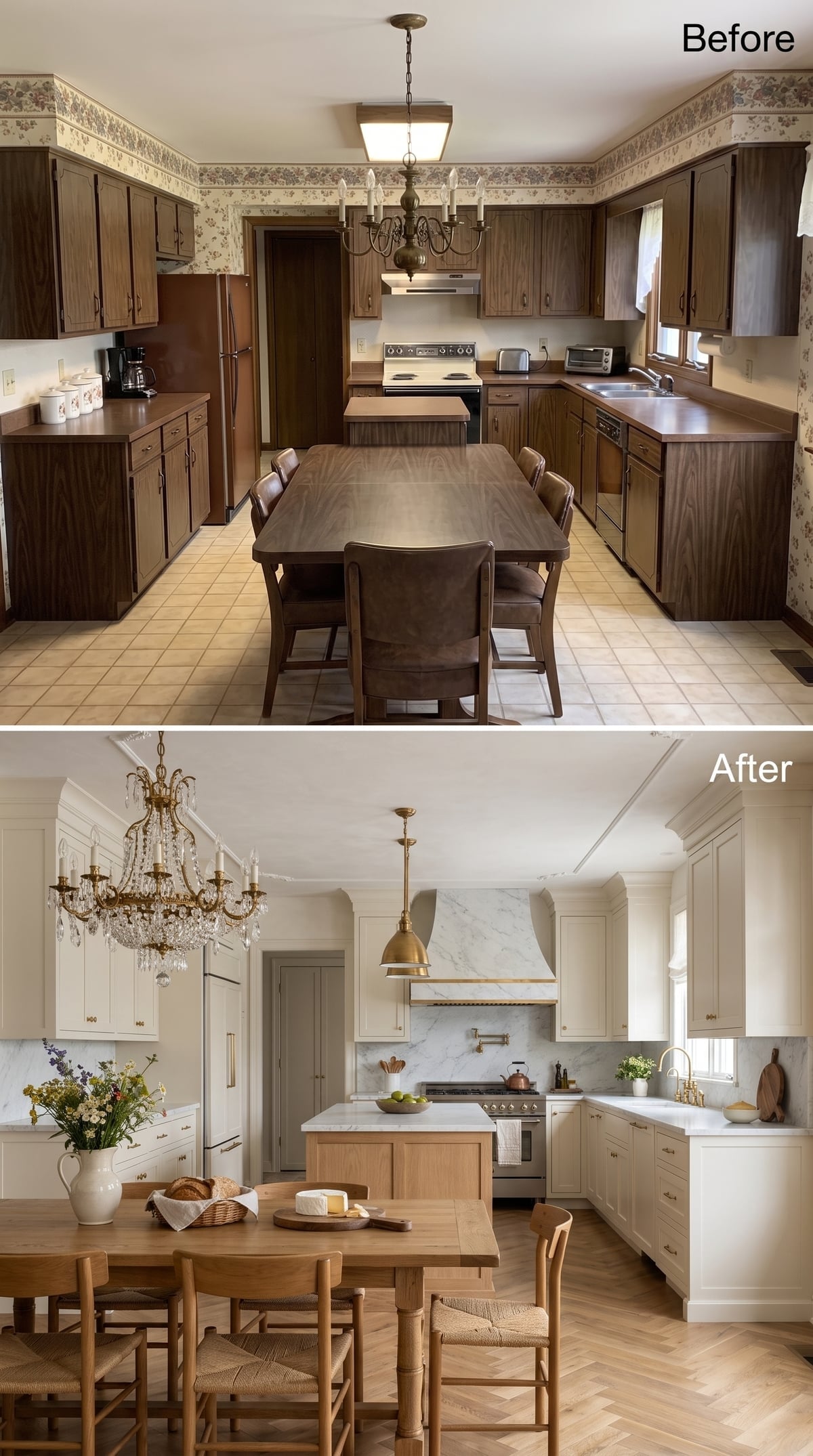
Few kitchen combinations feel as quietly confident as cream cabinetry paired with a natural oak island.
Shaker-style uppers in a warm off-white reach to the ceiling, which immediately makes the room feel taller than it is. The island is paneled in light oak with a white stone top, and that contrast between painted and raw wood is what keeps everything from reading as a showroom. A marble slab backsplash runs across the full range wall behind a plaster hood with brass trim detail, and herringbone parquet flooring in a honey tone runs beneath everything.
The brass pendant over the island and the crystal chandelier above the dining table do not match exactly. Their related warm-metal finishes keep them connected without turning the room into a matched set. Rush-seat ladder-back chairs pull up to a simple oak dining table. Nothing in this kitchen is trying too hard.
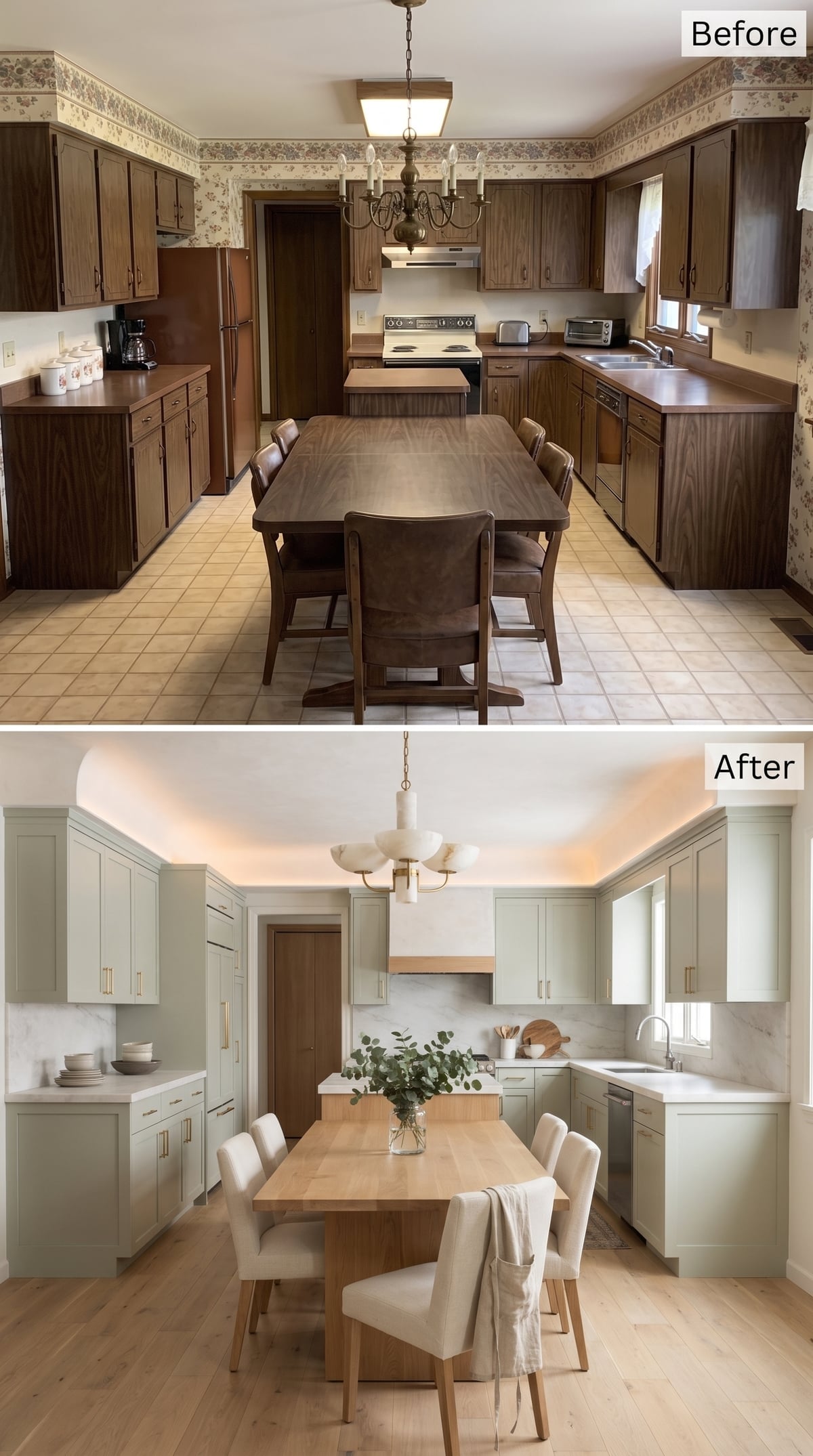
20. Sage Cabinets, Quartzite Counters, and Warm Cove Lighting Gave This Kitchen Somewhere to Breathe
🔥 Would you like to save this?
Sage green shaker cabinets run floor to ceiling on both walls, finished with brushed brass bar pulls that keep the palette grounded rather than precious. The quartzite backsplash behind the range hood adds veining without competing for attention. Light wood floors and an alabaster chandelier do the rest.
Pro Tip: Cove lighting above the upper cabinets is one of the quieter upgrades a kitchen renovation can include. It can often be installed without rebuilding the entire ceiling, and it gives painted cabinets a richer glow after dark than standard overhead fixtures alone.
19. Walnut Parquet, an Antler Chandelier, and Cove Lighting Gave This Kitchen Real Warmth
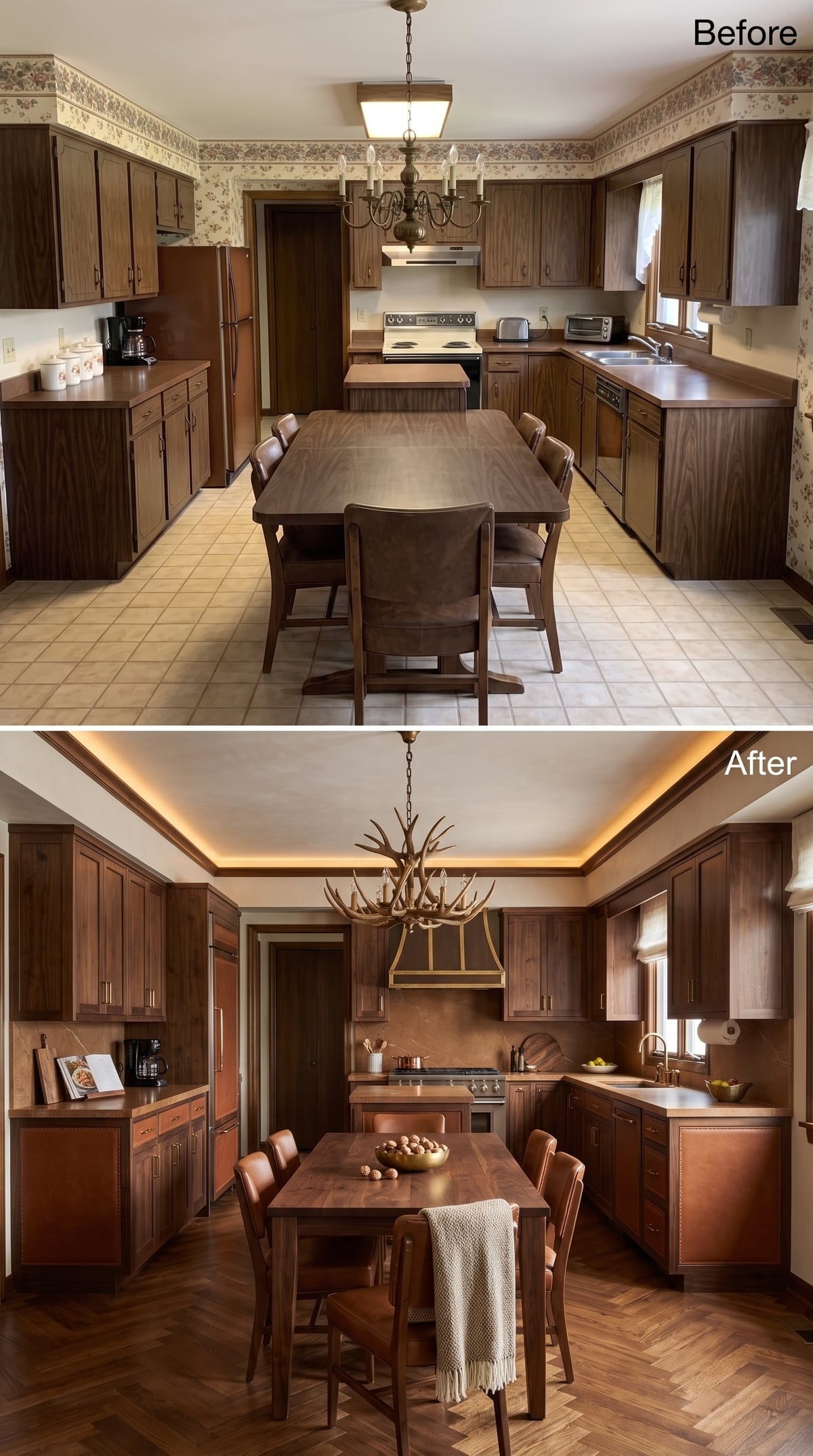
Rich walnut parquet flooring in a herringbone pattern establishes the room’s warmth, pulling the dark cabinetry down to earth rather than letting it tip into oppressive. The antler chandelier is an unexpected centerpiece—the kind of thing that sounds wrong until you see it. Cove lighting runs the perimeter of a tray ceiling, casting a warm amber glow that no overhead fixture could replicate alone, and leather-upholstered dining chairs with visible stitching add texture without competing with the wood-heavy palette.
Budget Tip: Antler chandeliers and similar statement fixtures can often be sourced secondhand or through estate sales for a fraction of retail price. A solid secondhand fixture may still be economical after professional inspection and rewiring, depending on its condition. It’s one of the smarter places to hunt for character in a renovation budget.
18. Light Oak Cabinets, Marble Backsplash, and Cove Lighting Rewrote This Kitchen’s Whole Mood
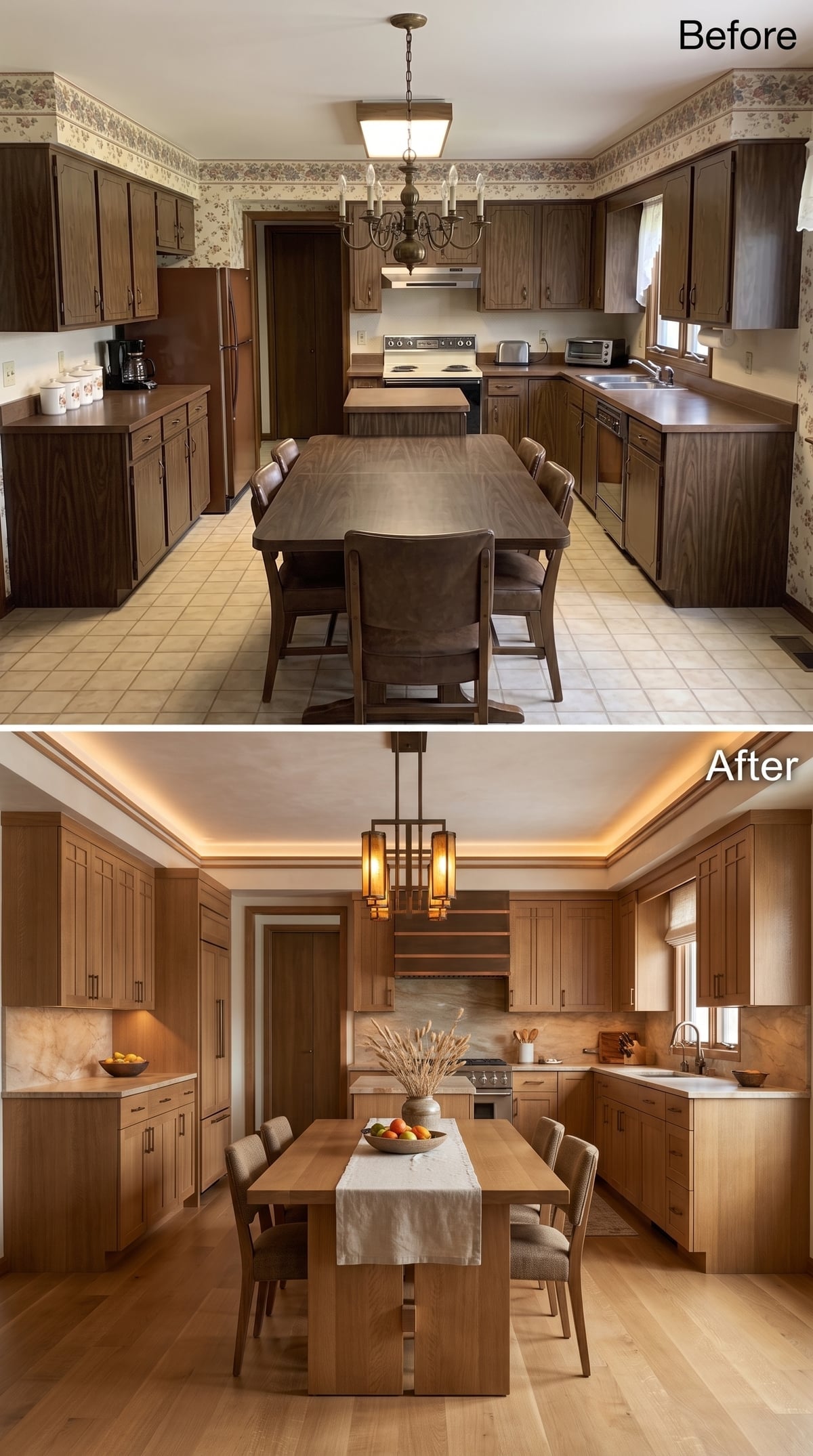
Light oak cabinetry runs floor to ceiling on both walls, with flat-panel doors and minimal bar pulls letting the grain do most of the work. A tray ceiling with warm LED cove lighting wraps the entire room—the kind of detail that reads as architectural rather than decorative. Large-format marble slabs form the backsplash behind the range, and the hood built into that wall panel gives the cooking zone a composed, deliberate quality.
The dining table is solid oak with a linen runner, anchored under a geometric pendant with amber glass panels. White countertops balance the warmth without tipping the room cool.
In the Details: Cove lighting works especially well in kitchens with tray ceilings because the recessed ledge conceals the strip entirely, letting the glow read as part of the architecture rather than something tacked on afterward. Its effect can feel architectural, although the installation cost depends on the ceiling construction, wiring access, and trim work.
17. Emerald Lacquer, Fluted Gold Inserts, and a Crystal Chandelier Pulled This Kitchen Into Another Era
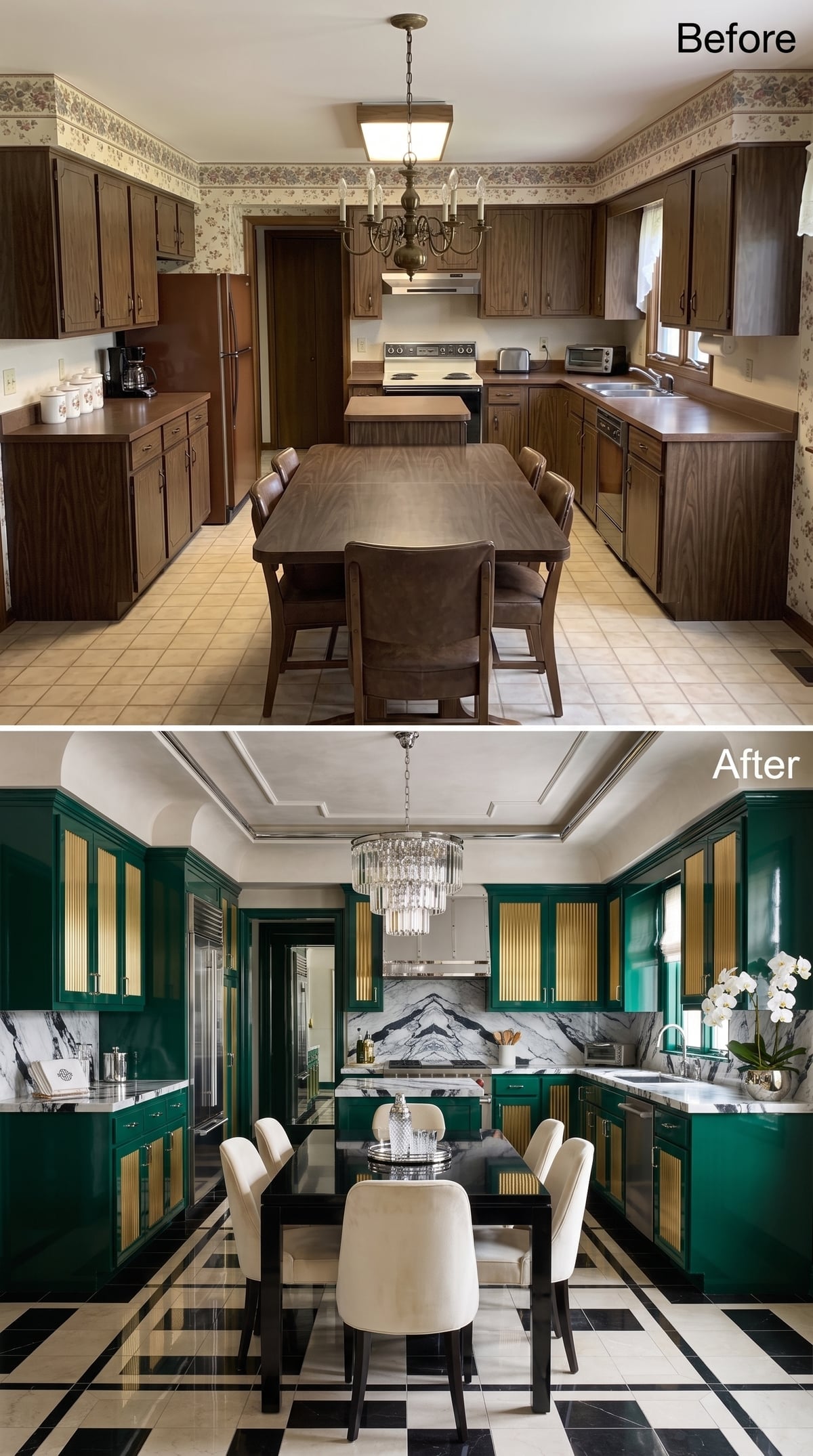
Emerald lacquer cabinets run the full perimeter, the finish high-gloss enough to catch light from across the room. Each door panel is inset with fluted gold, which does more visual work than standard hardware ever could. The marble backsplash behind the range carries a dramatic book-matched pattern that stops the eye cold.
A tray ceiling adds architectural structure overhead, and the crystal chandelier hangs inside it like it belongs there. Black-and-cream checkered marble floors ground the whole room without competing with the cabinetry, and dining chairs upholstered in warm ivory keep the seating from disappearing into the dark palette.
- High-gloss lacquer reflects more ambient light than matte paint, which makes it especially effective in rooms with tray ceilings.
- Book-matched marble creates a mirror-image veining pattern that gives the wall a deliberate focal point.
- High-contrast flooring such as black-and-cream tile can visually anchor an open kitchen-dining layout without requiring a rug.
16. Dark Walnut Cabinets, Crimson Velvet Chairs, and Herringbone Oak Rewrote the Rules Here
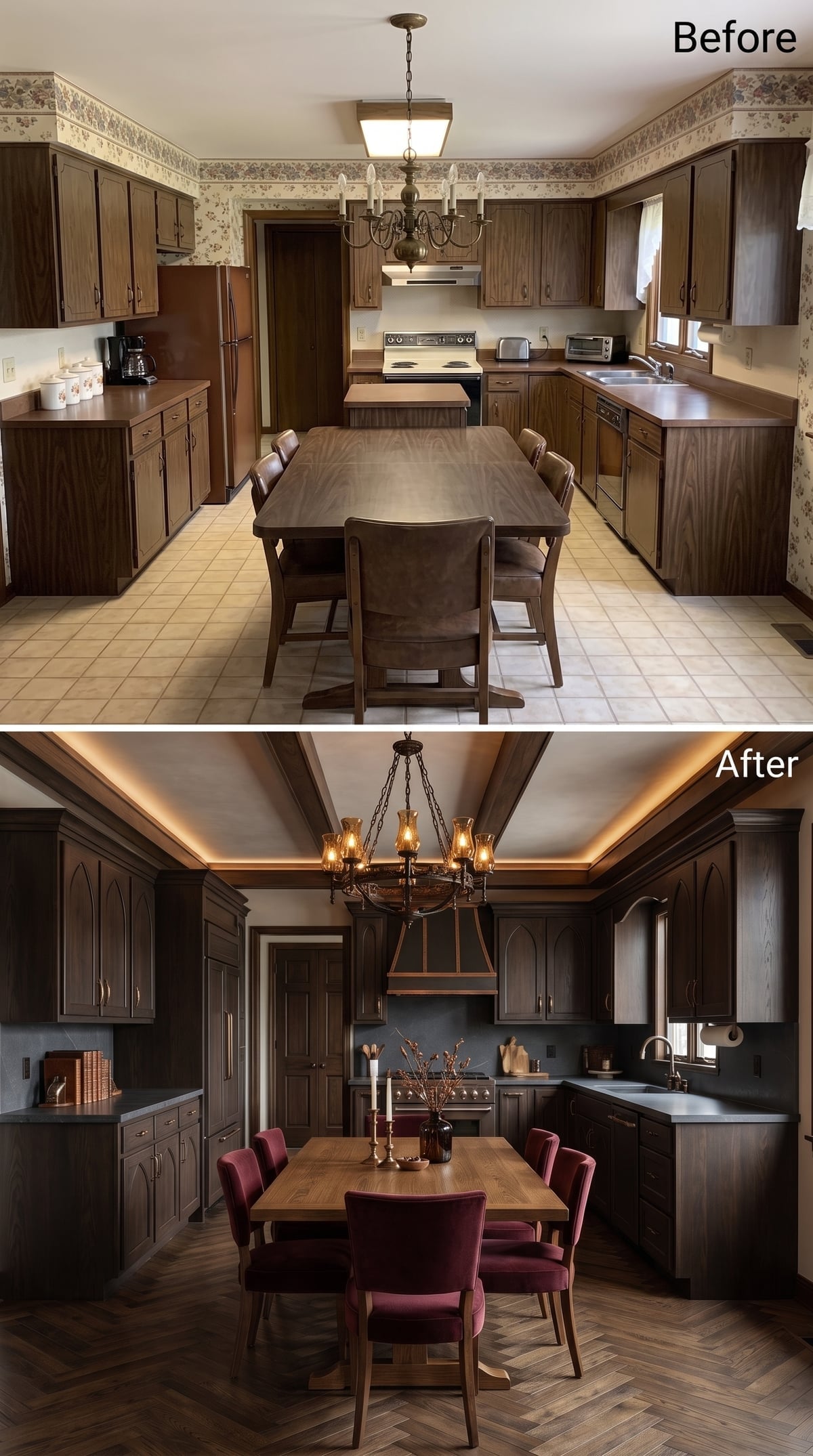
Dark walnut cabinetry with a charcoal stain and arched door insets runs the full perimeter, and the warm cove lighting tucked into the tray ceiling keeps it from reading as heavy. Crimson velvet dining chairs anchor the table. Herringbone parquet does the rest—efficiently, without fuss.
Editor’s Note: Arched cabinet-door insets are appearing more often in current kitchen concepts because they introduce shape without requiring structural changes. When routed into flat-front doors, they can alter the cabinet style without replacing the boxes.
15. Terracotta Cabinets, Patterned Cement Tile, and Cove Lighting Gave This Kitchen a Pulse
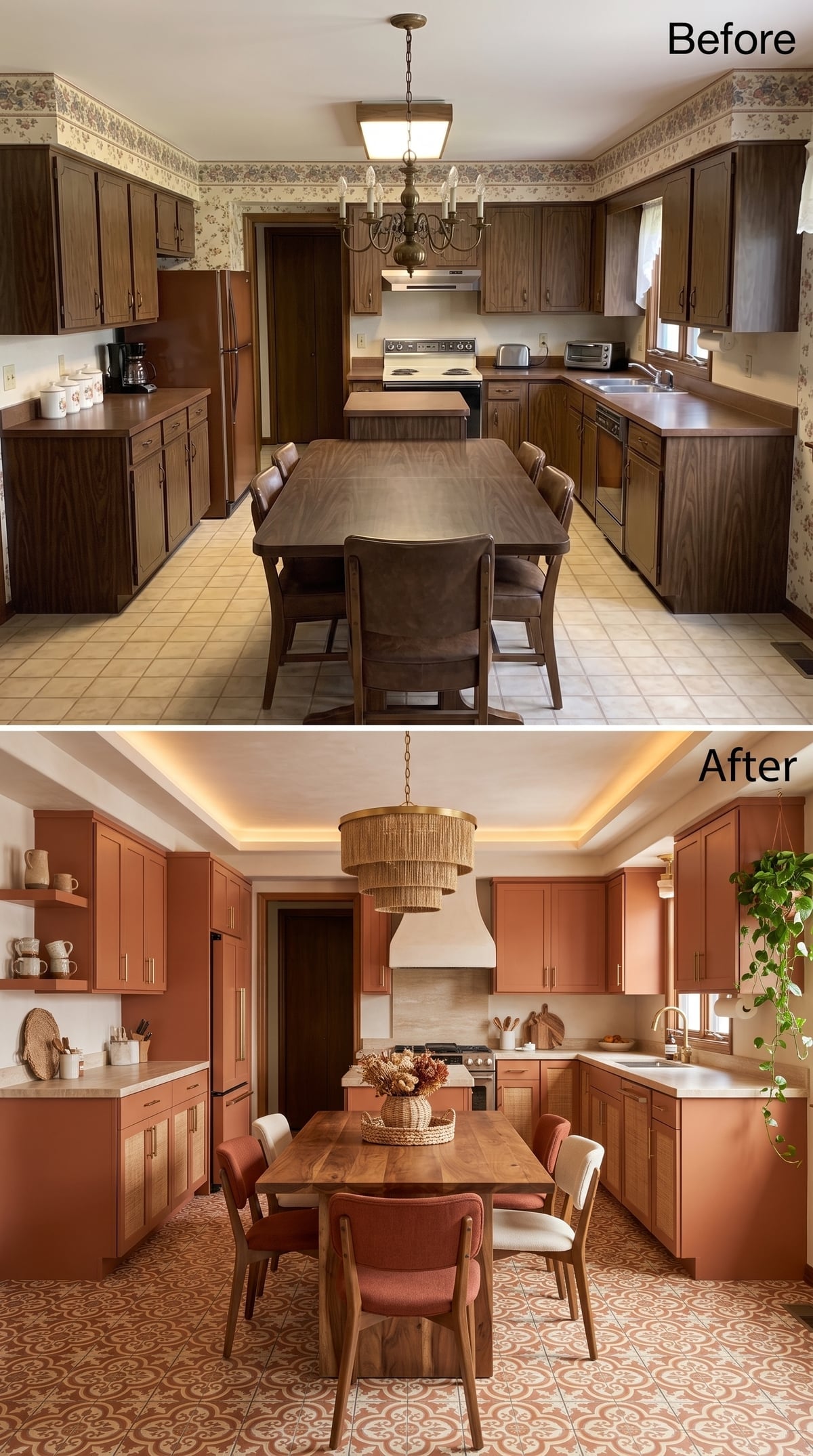
Painted in a warm terracotta, the shaker cabinets run floor to ceiling on three walls, unified by brushed brass bar pulls that read as understated against the clay tone. A tray ceiling with recessed cove lighting wraps the perimeter, and the glow it casts is genuinely warm rather than clinical. The range hood, finished in creamy plaster white, breaks up the color without losing cohesion.
A rust-and-cream cement tile in a repeating medallion pattern covers the floor and becomes the room’s strongest graphic element. The dining chairs mix upholstered rust seats with cream backs, echoing the floor without being too deliberate about it, and a woven rattan drum pendant hangs centered above the table. The result feels grounded and warm without looking overly arranged.
Designer’s Secret: Terracotta can shift noticeably with the time of day—peachier in cool morning light and deeper under warm evening light. That natural variation means it works across seasons without needing accessory updates to feel current.
14. Walnut Herringbone, a Sputnik Fixture, and Terracotta Lowers Pulled This Kitchen Into Focus
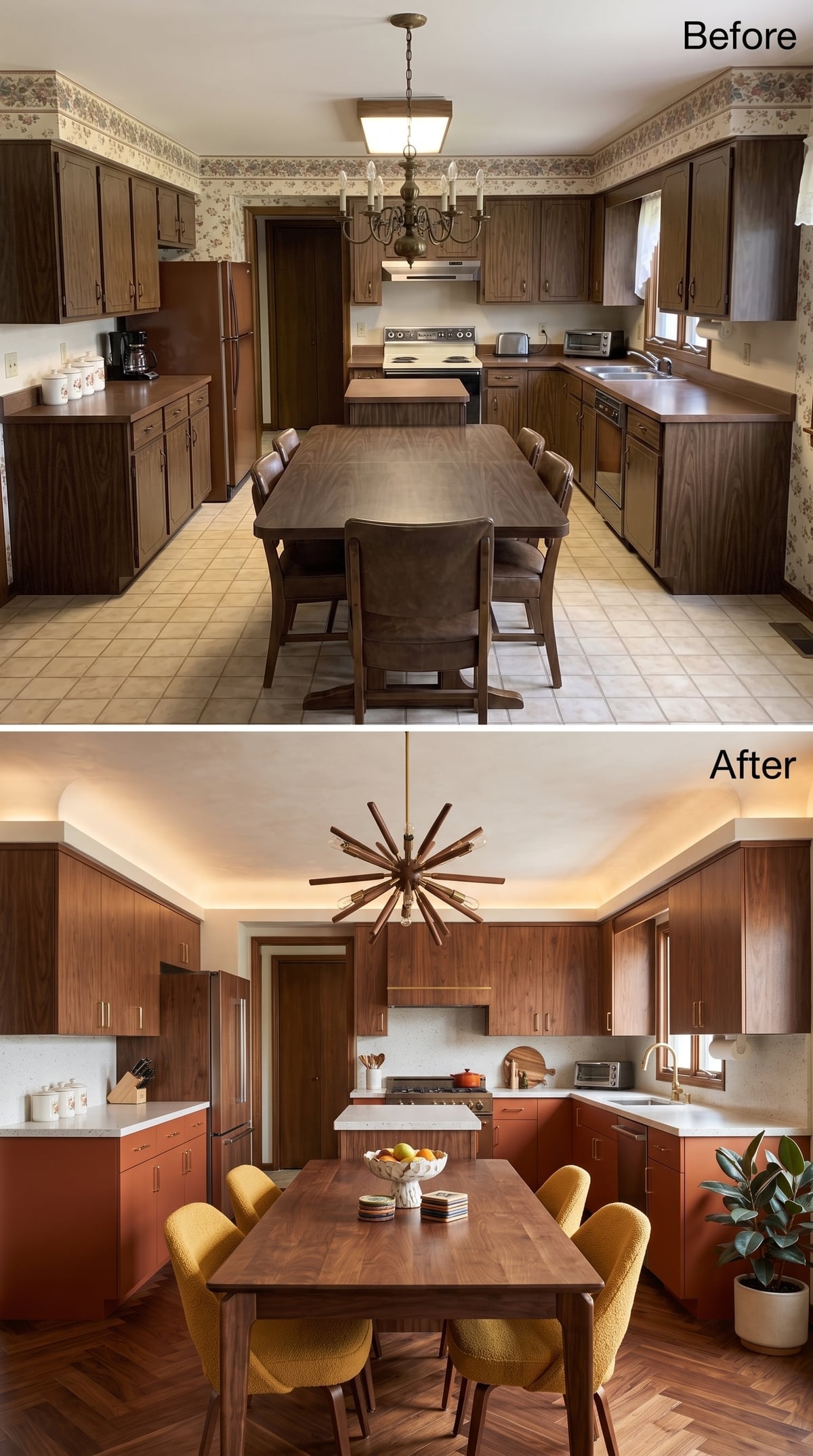
Cove lighting runs the perimeter above the upper cabinets, casting a warm wash across the ceiling that shifts the whole mood of the room. Below it, walnut uppers sit above terracotta-painted lowers, the two-tone split landing right at the countertop line where white stone creates a clean visual break.
Mustard bouclé dining chairs introduce a softer midcentury note against the walnut and terracotta. Herringbone walnut flooring runs beneath the table, and the Sputnik chandelier in brass and wood ties the whole mid-century thread together without overselling it.
Did You Know: Herringbone flooring creates more visible shifts in grain direction than straight-laid planks, giving the floor additional movement throughout the day. It’s a particularly effective choice in kitchens where most other surfaces—countertops, cabinet faces—are flat and uniform. The pattern carries visual interest that no single material finish could manage alone.
13. Reclaimed Wood Cabinets, Cove Lighting, and Linen Chairs Gave This Kitchen Its Quiet Authority
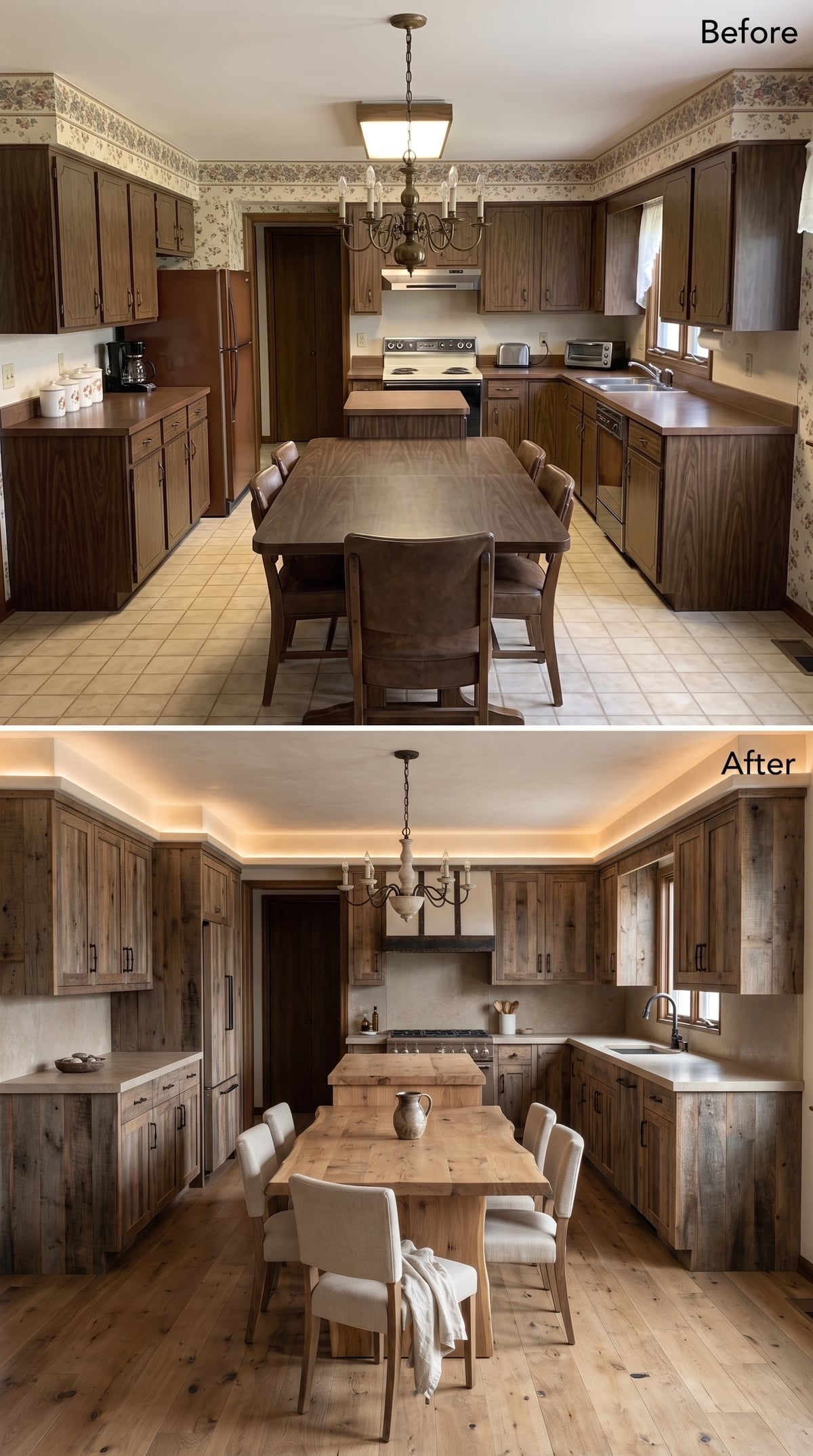
Reclaimed wood cabinets run floor to ceiling on both walls, their knot-filled grain doing most of the decorative work without needing any help. Matte black hardware keeps the look grounded rather than precious. Concrete-look countertops on the lowers contrast with the warm wood without fighting it, and a tray ceiling fitted with strip lighting casts a consistent amber glow across the whole room.
The dining table is solid light oak, and the linen-upholstered chairs around it provide the room’s clearest soft counterpoint. That contrast actually works in the kitchen’s favor—all those hard surfaces need something to land against. A single candle-style chandelier hangs centered above the table. Modest in scale, but right for the room.
12. Fluted Walnut Lowers, a Crystal Chandelier, and Marble Backsplash Rewired This Kitchen’s Entire Register
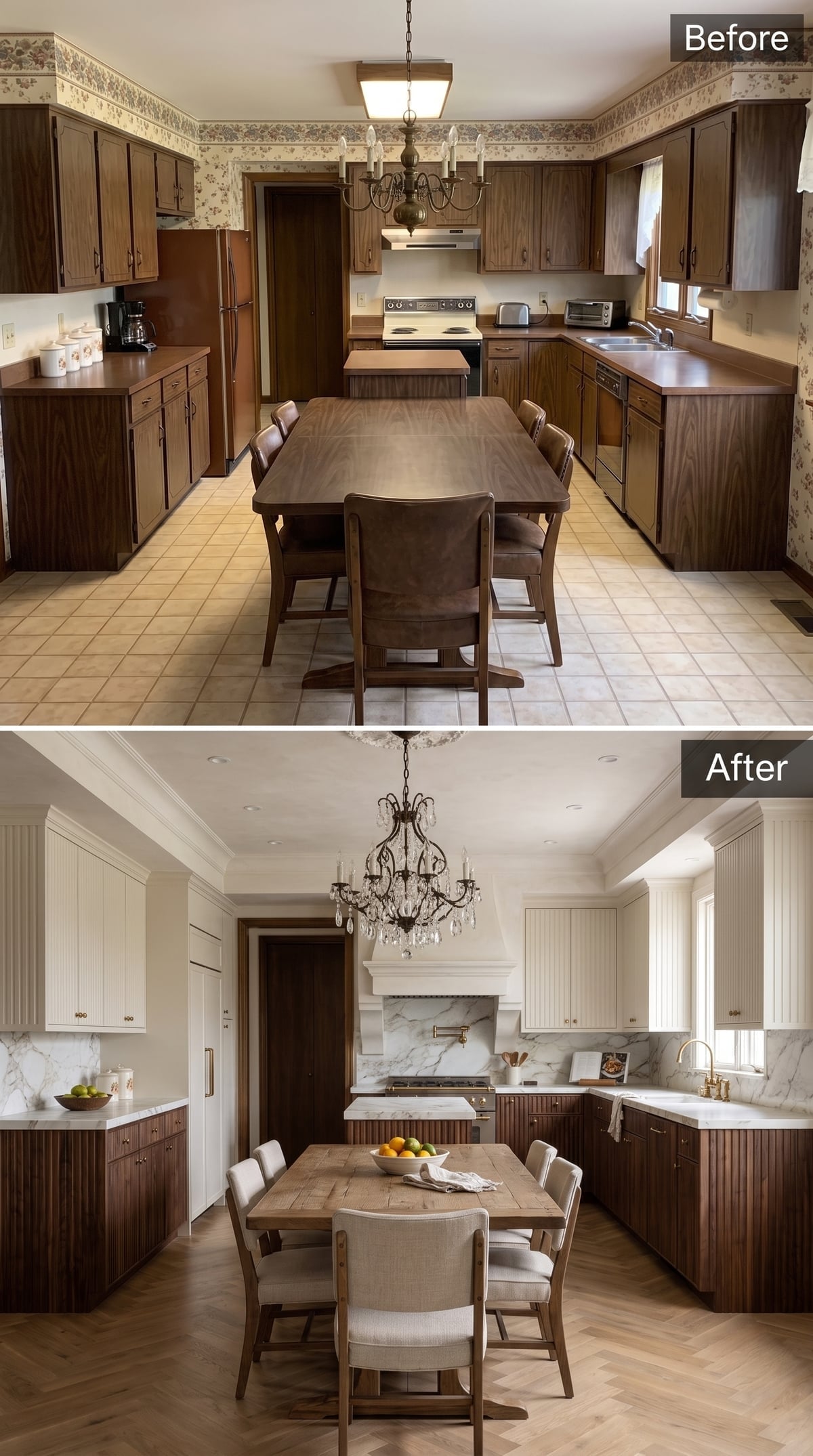
Cream upper cabinets with vertical beadboard detailing sit above walnut lowers finished in a matching fluted profile, and the repetition of that texture across both sides of the kitchen is what holds the whole thing together. The range hood is clad in white-painted millwork with a marble slab inset behind the cooktop. Herringbone oak flooring runs wall to wall. The crystal chandelier overhead is not a decorative afterthought—it gives the restrained millwork a sharper point of contrast.
Trend Alert: Fluted cabinet fronts are appearing beyond accent islands and across full lower cabinet runs, particularly in kitchens that mix wood tones with painted uppers. The texture breaks up flat surfaces without requiring a color change, making it one of the quieter ways to add depth. It also photographs especially well under natural light, since the ridges cast their own shadow lines throughout the day.
11. Plum Cabinets, Herringbone Parquet, and a Crystal Chandelier Made This Kitchen Unapologetic
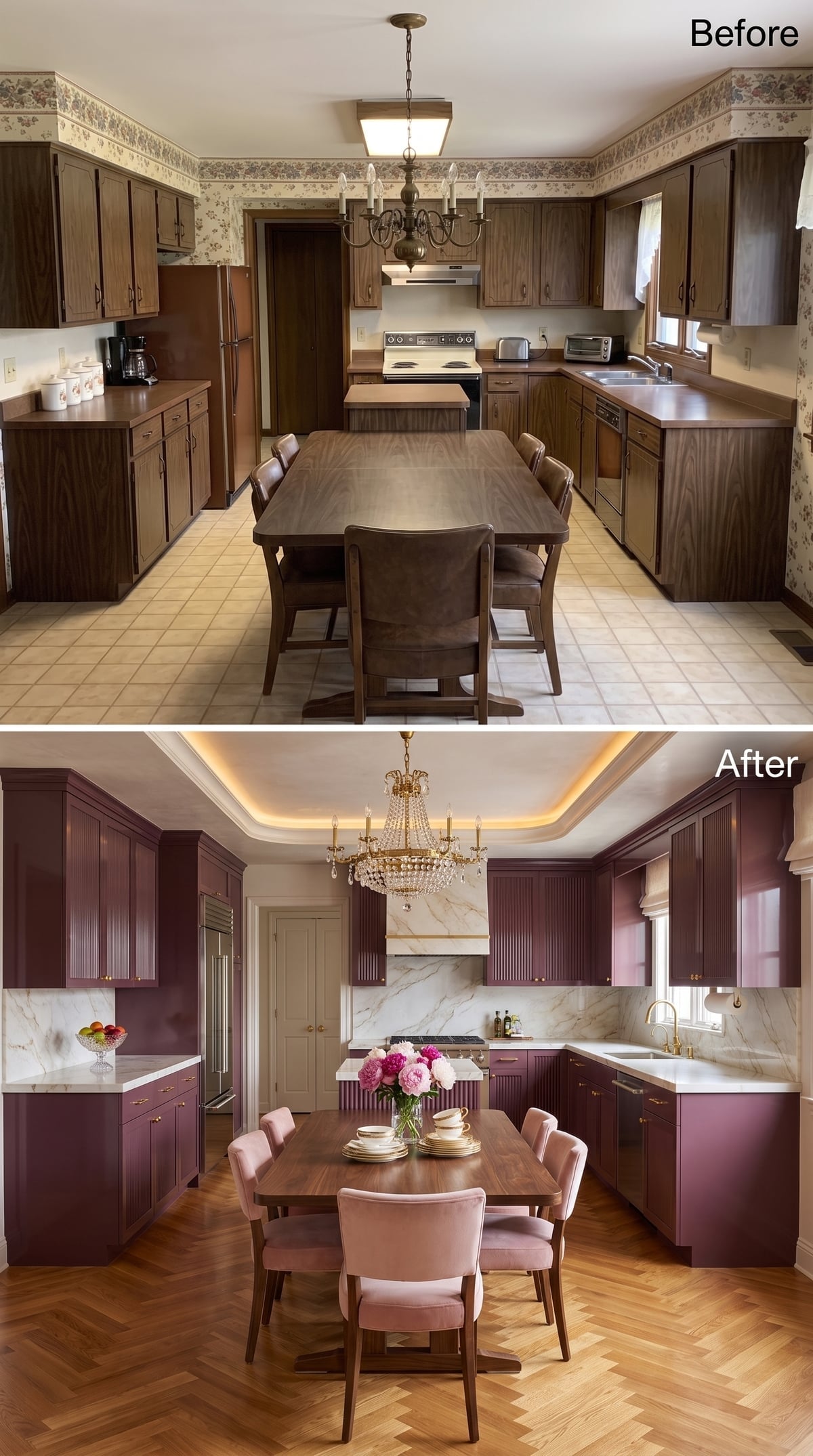
Deep plum fluted cabinets run the full perimeter, making color—not texture—the first thing the room announces. A white marble slab backsplash and slim brass hardware break the saturation, while herringbone parquet adds movement below. The crystal chandelier introduces a lighter, more delicate shape against cabinetry that otherwise feels almost monolithic.
10. Concrete-Look Cabinets, Bouclé Chairs, and Cove Lighting Made This Kitchen Feel Inevitable
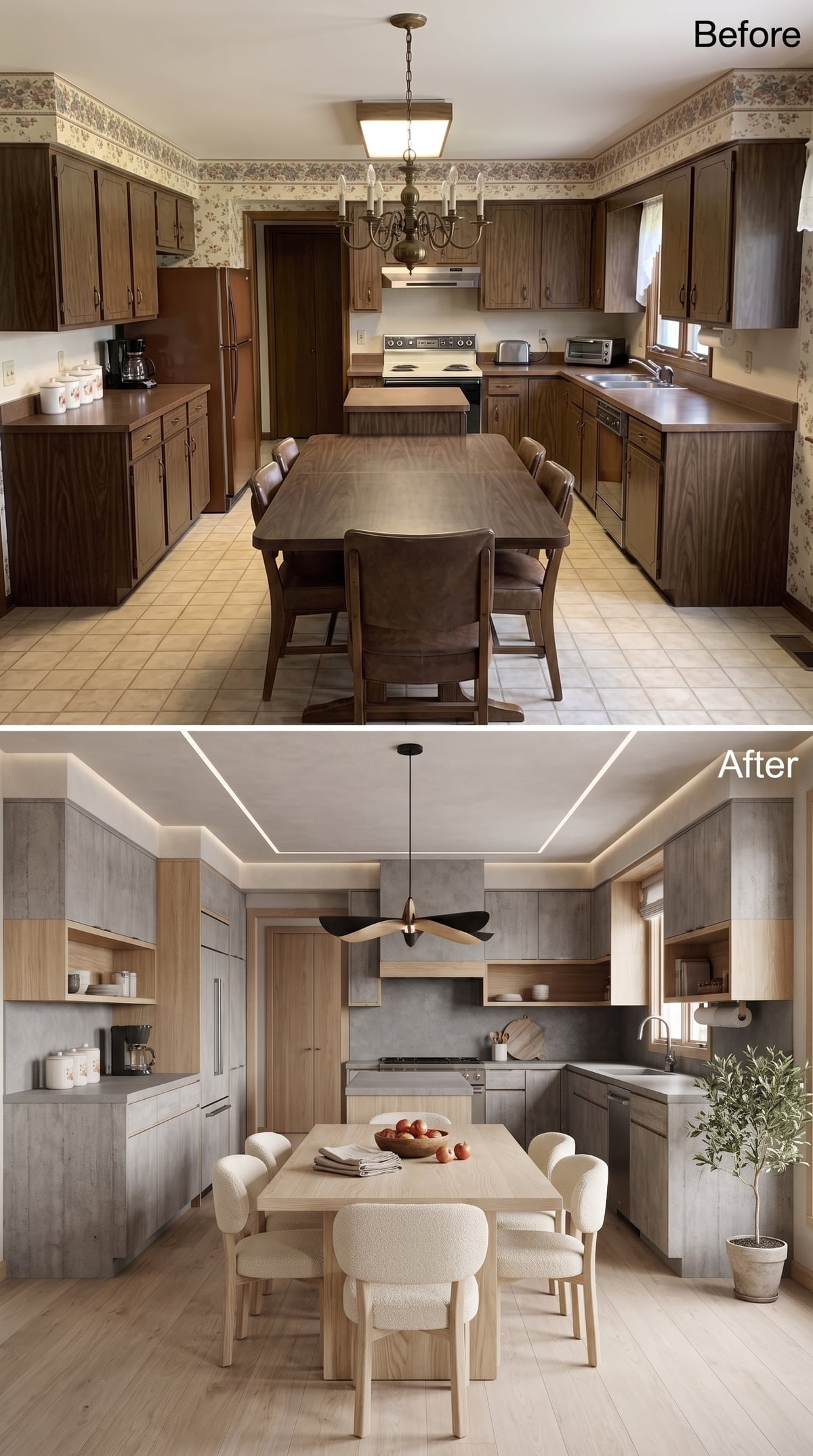
Concrete-textured cabinet fronts paired with warm oak shelving are one of those combinations that shouldn’t work on paper but absolutely does in practice.
The upper cabinets carry a matte gray finish that resembles smooth cast concrete, while open oak shelving breaks up the weight at intervals. Concealed cove lighting traces the ceiling perimeter, casting a soft line of warmth that makes the tray ceiling feel architectural rather than incidental. Below the pendant, a light ash dining table anchors the center of the room.
The bouclé dining chairs keep the palette from tipping cold, which concrete tones will absolutely do without a textural counterweight. A potted olive tree beside the window adds one organic note without overdoing it.
9. Butter-Yellow Cabinets, a Brass Lantern Pendant, and Cane Chairs Rewrote the Whole Register
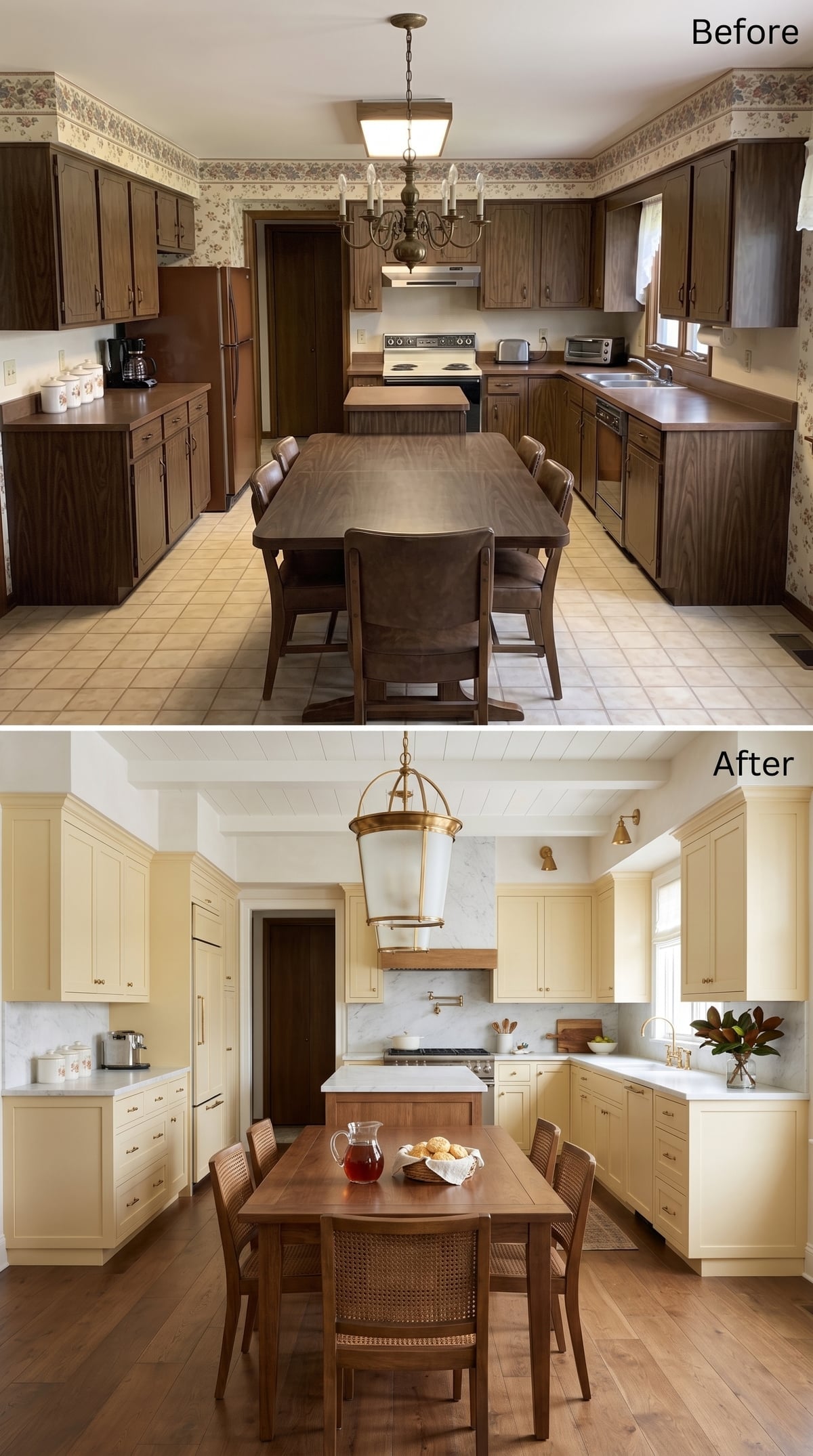
Soft butter-yellow cabinets run floor to ceiling on every wall, and the warmth they carry is almost edible. Shaker-style doors keep the profile clean while brass hardware pulls the gold tone forward. A marble slab backsplash behind the range hood adds veining that breaks up what could have been a flat surface, and a brass lantern pendant anchors the dining area with enough visual weight to matter. The cane-back chairs add texture that the smooth cabinet faces genuinely need.
Common Mistake: Lantern-style pendants work better over kitchen dining tables than most people expect, but sizing is where homeowners frequently go wrong. A fixture that feels large in the showroom can disappear once it’s hanging in an open kitchen. Compare the fixture diameter with the table and the room rather than judging it only in a showroom.
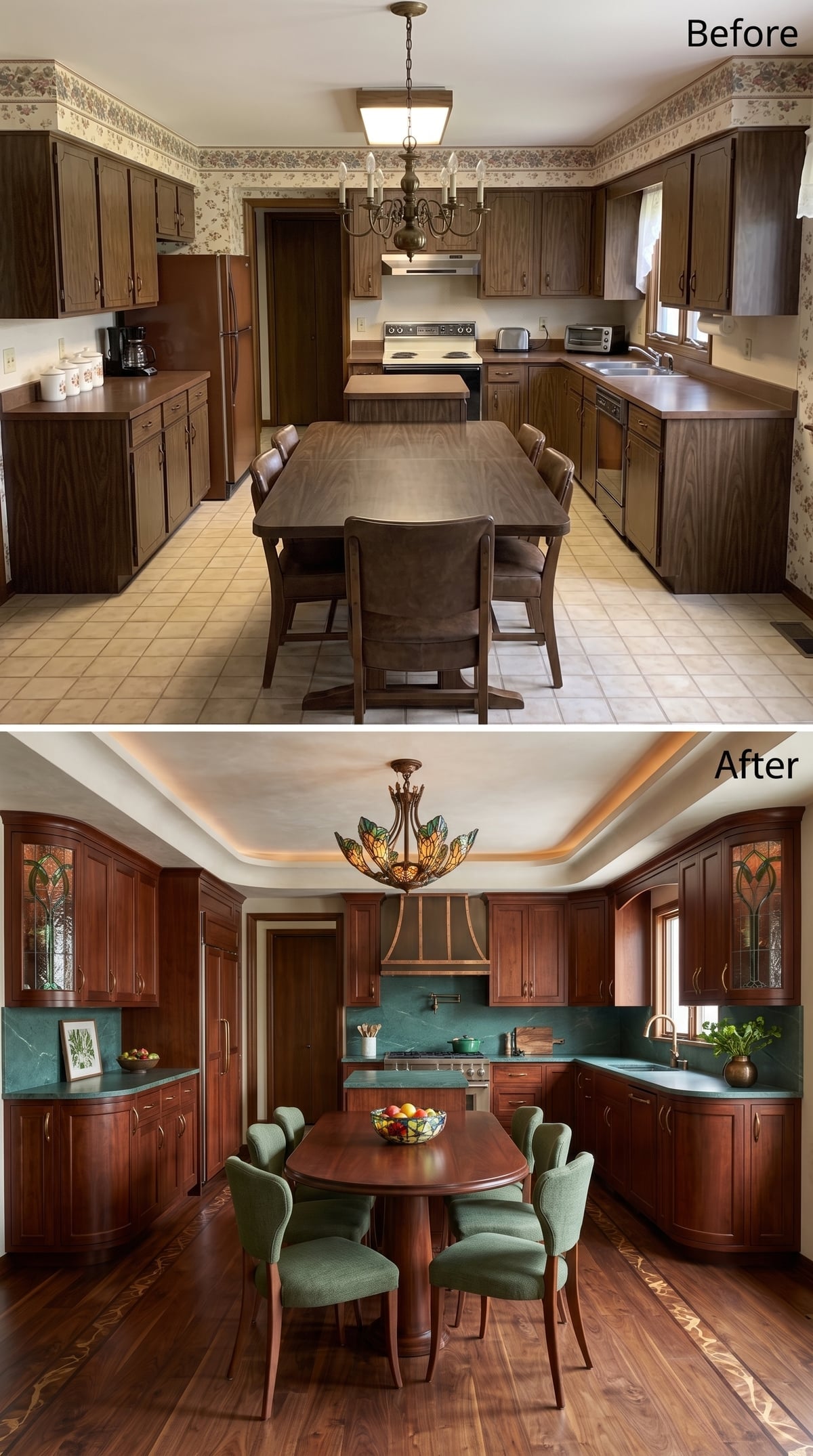
8. Stained Glass Inserts, Teal Stone Counters, and a Tiffany Pendant Earned Every Inch
🔥 Would you like to save this?
Rich cherry cabinets with curved corner detailing run the full perimeter, and the stained glass insets on the upper doors add color without a single extra accessory. Teal stone counters and a matching backsplash hold the palette together, cool against all that warm wood grain.
A Tiffany-style chandelier hangs centered over the round dining table, its amber and green glass panels pulling directly from the countertop color. Green upholstered chairs with a slight Art Nouveau curve echo that same tone at seat level. The tray ceiling with cove lighting keeps the whole room from feeling heavy.
7. White Oak Cabinets, Bouclé Chairs, and Cove Lighting Made Quiet Look Expensive
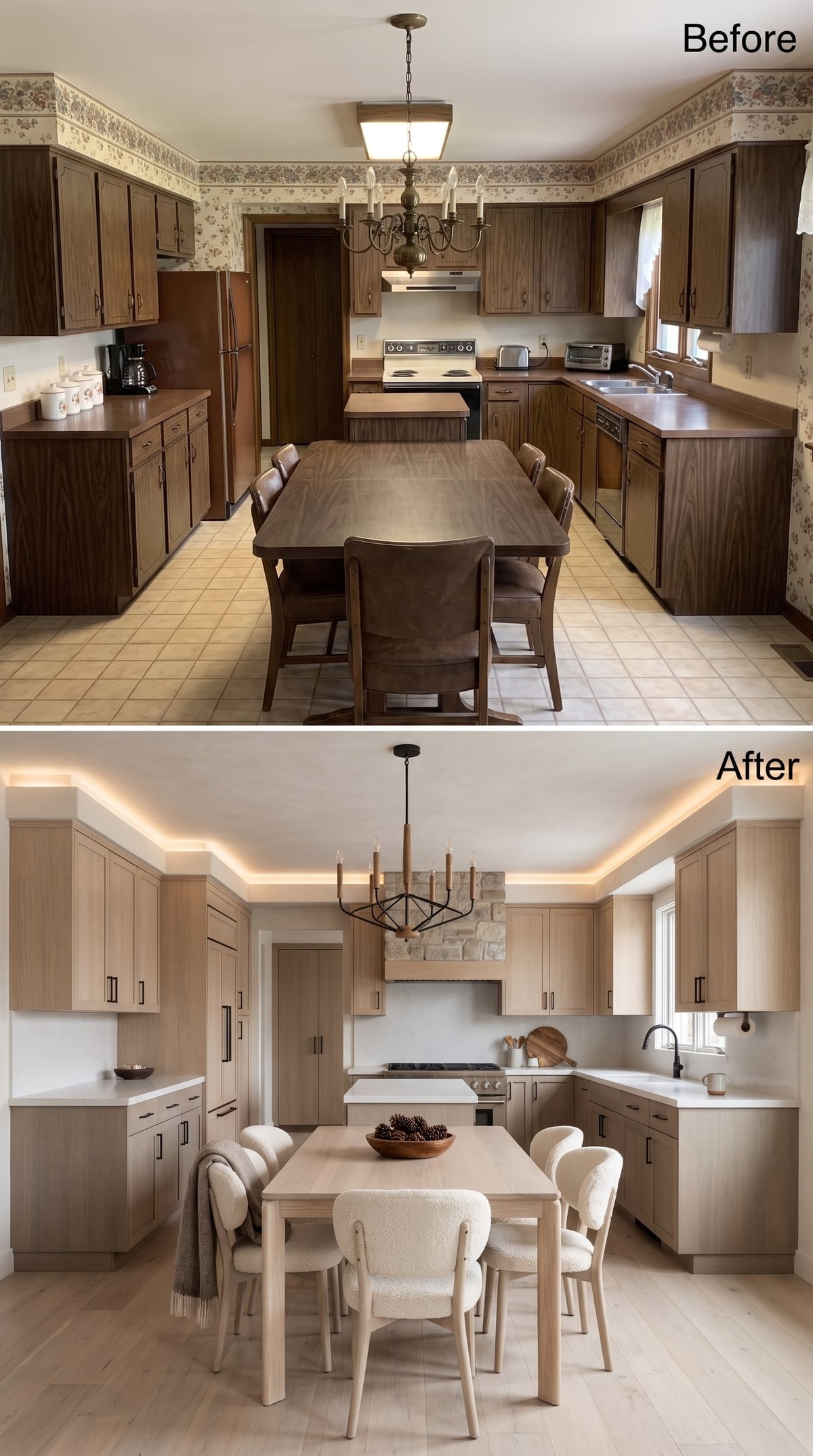
Flat-front white oak cabinets run floor to ceiling on every wall, their grain light enough to read almost blonde under the cove lighting tucked along the ceiling perimeter. Matte black hardware keeps it grounded. Bouclé dining chairs paired with a light oak table hold the center, and the stone range surround adds stronger texture without disturbing the room’s restraint.
6. Shiplap Ceiling, Brass Hardware, and Navy Chairs Gave This Kitchen a New Vocabulary
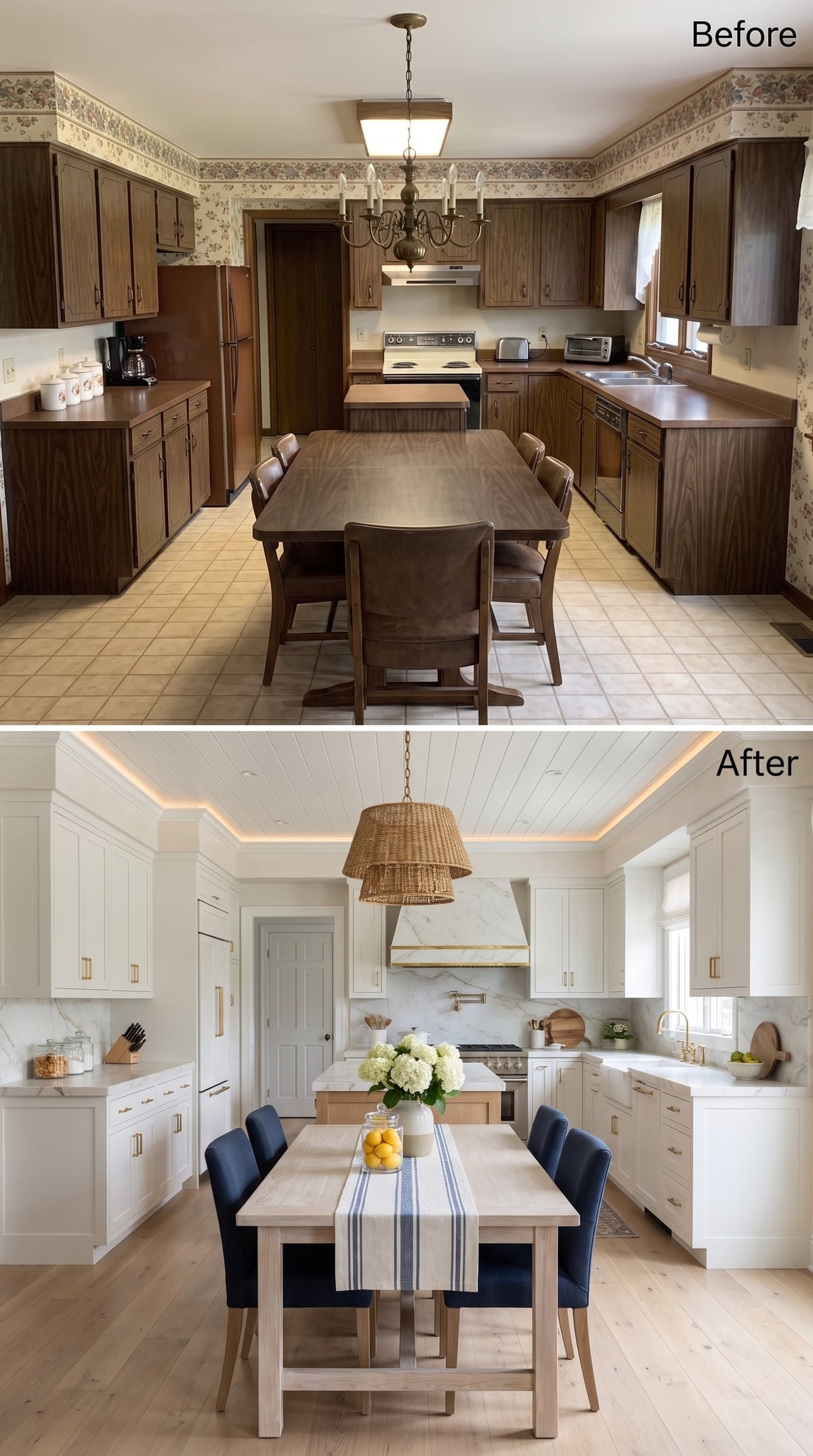
White inset cabinets with brushed brass pulls run the full perimeter, topped with marble counters that carry enough veining to read as substantial without getting busy. Painted shiplap follows the tray ceiling overhead, adding fine linear texture without darkening the room. A woven rattan pendant anchors the dining area without competing with the cove lighting tucked into the recessed perimeter. Navy upholstered chairs handle the contrast and do it well.
5. Matte Black Cabinets, Brass Fixtures, and Bouclé Chairs Made Dark Feel Intentional
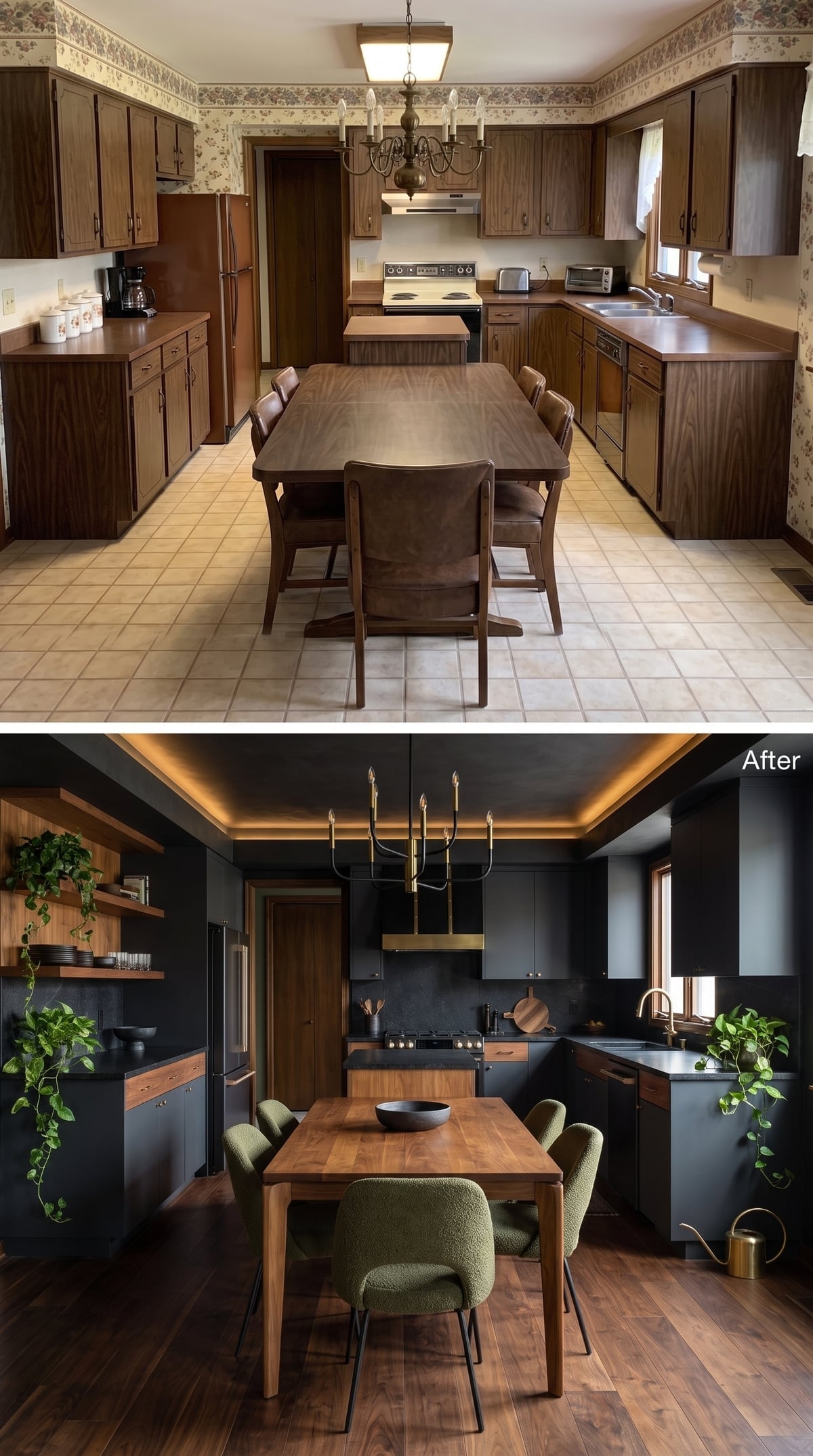
Charcoal matte cabinets run floor to ceiling, but walnut open shelving interrupts the dark perimeter and leaves breathing room around everyday objects. A brass candelabra chandelier is the one warm metal detail that keeps the palette from reading cold. Sage green bouclé chairs pull the room toward something livable, and the wood dining table grounds it all without competing.
4. Gray Inset Cabinets, Herringbone Marble, and Cane Chairs Found the Right Balance
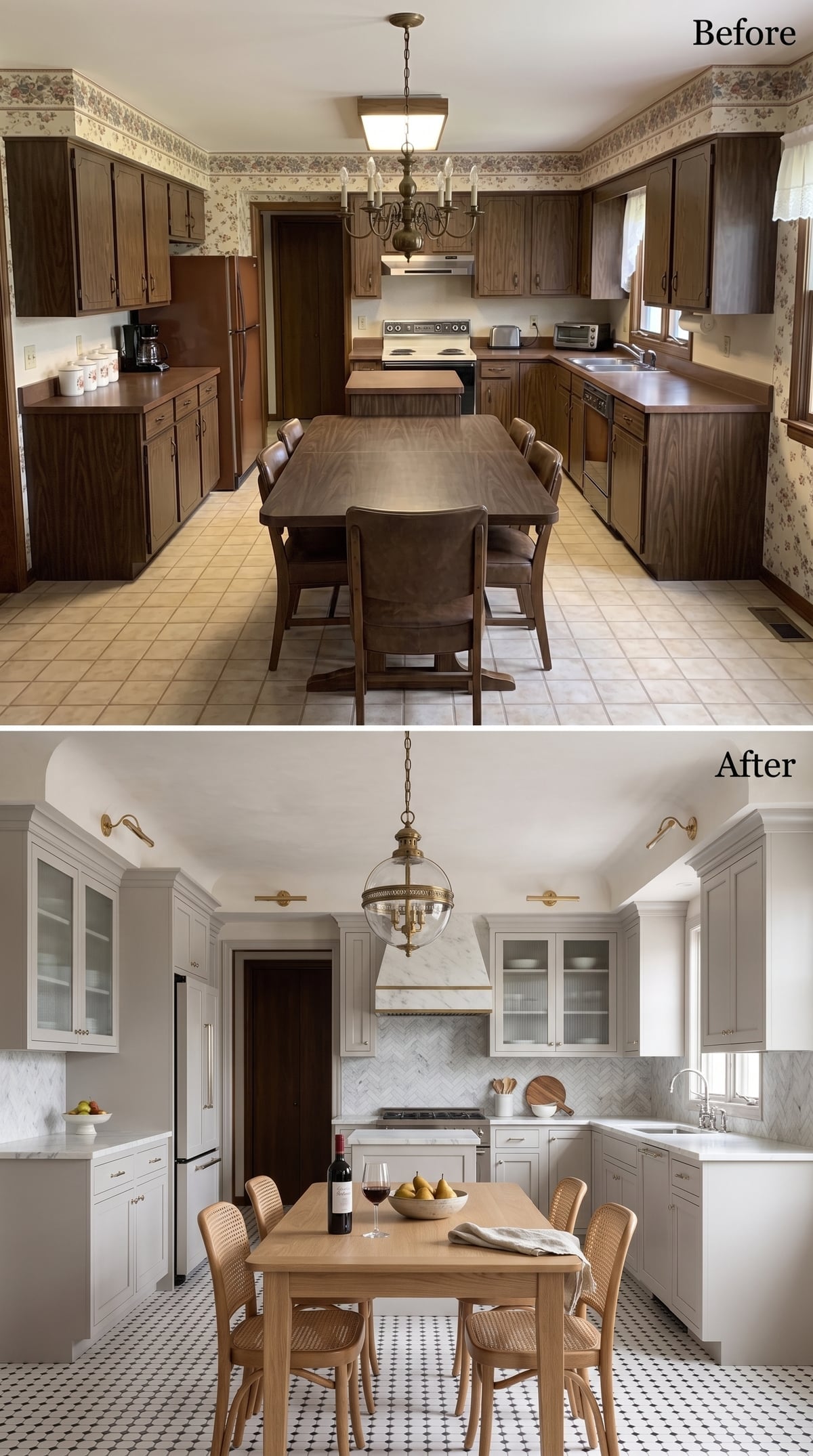
Gray inset cabinets run floor to ceiling, and the molding detail at the top reads architectural rather than decorative. A herringbone marble backsplash leads directly toward the range hood, which is clad in matching stone and turns the cooking wall into the room’s focal point.
Brass sconces flank the upper cabinets on both walls, and a globe pendant with a brass cage drops from center. The floor is black-and-white geometric tile, small-scale enough not to compete. Cane dining chairs keep the table from feeling too serious. It’s a composed room that doesn’t oversell itself.
3. Stacked Stone Backsplash, Cove Lighting, and Woven Chairs Gave This Kitchen Real Texture
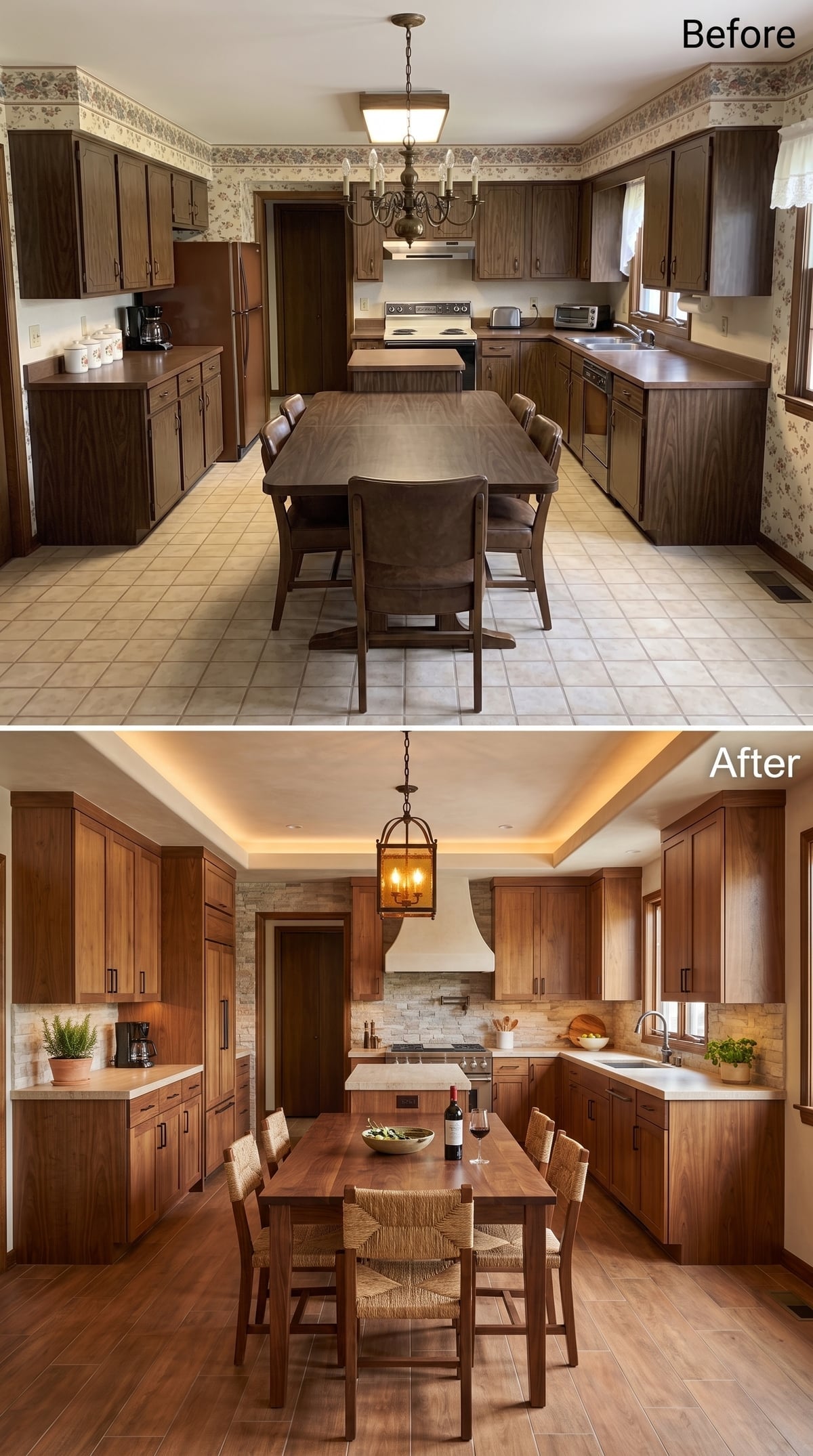
Warm walnut cabinets run floor to ceiling on both sides, while a stacked-stone backsplash gives the cooking wall a rougher, more tactile surface than the polished slabs used elsewhere in the gallery. The tray ceiling and concealed cove lighting lift the eye without adding a single inch of actual height. Woven dining chairs echo the stone’s texture at a softer scale, keeping the room from becoming a wall of hard brown surfaces.
2. Navy Cabinets, Marble Backsplash, and a Brass Lantern Found Their Footing Here
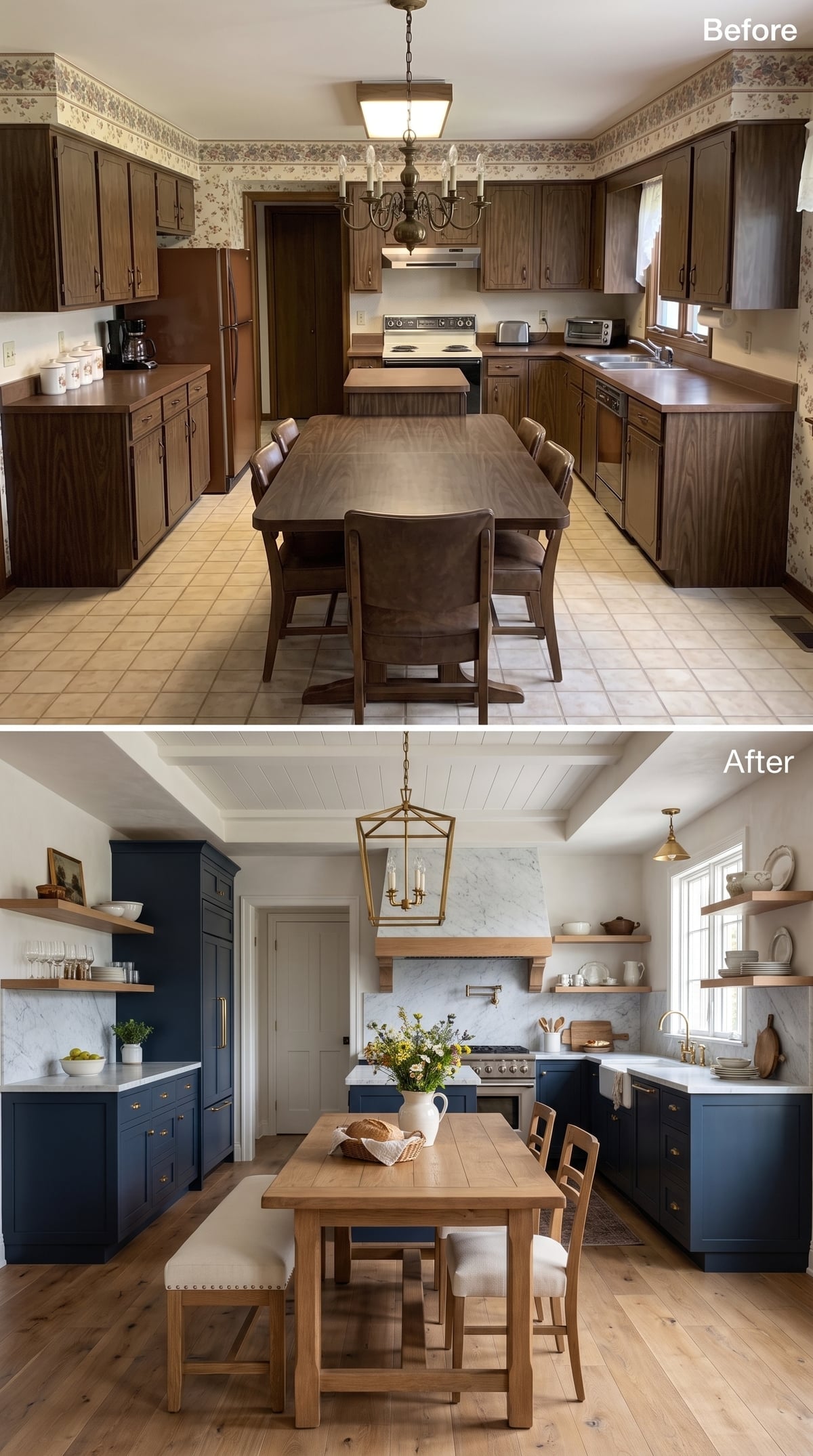
Inky navy lowers paired with open white oak shelving keep the palette from feeling heavy. A pale marble backsplash carries subtle veining across the cooking wall, creating a brighter break between the dark base cabinets and the open shelves. The brass lantern pendant hangs over a plank-top dining table casual enough for everyday use, giving the room one crisp focal point without making it formal.
1. Walnut Cabinets, Marble Slab Hood, and Cove Lighting Found a Quieter Gear
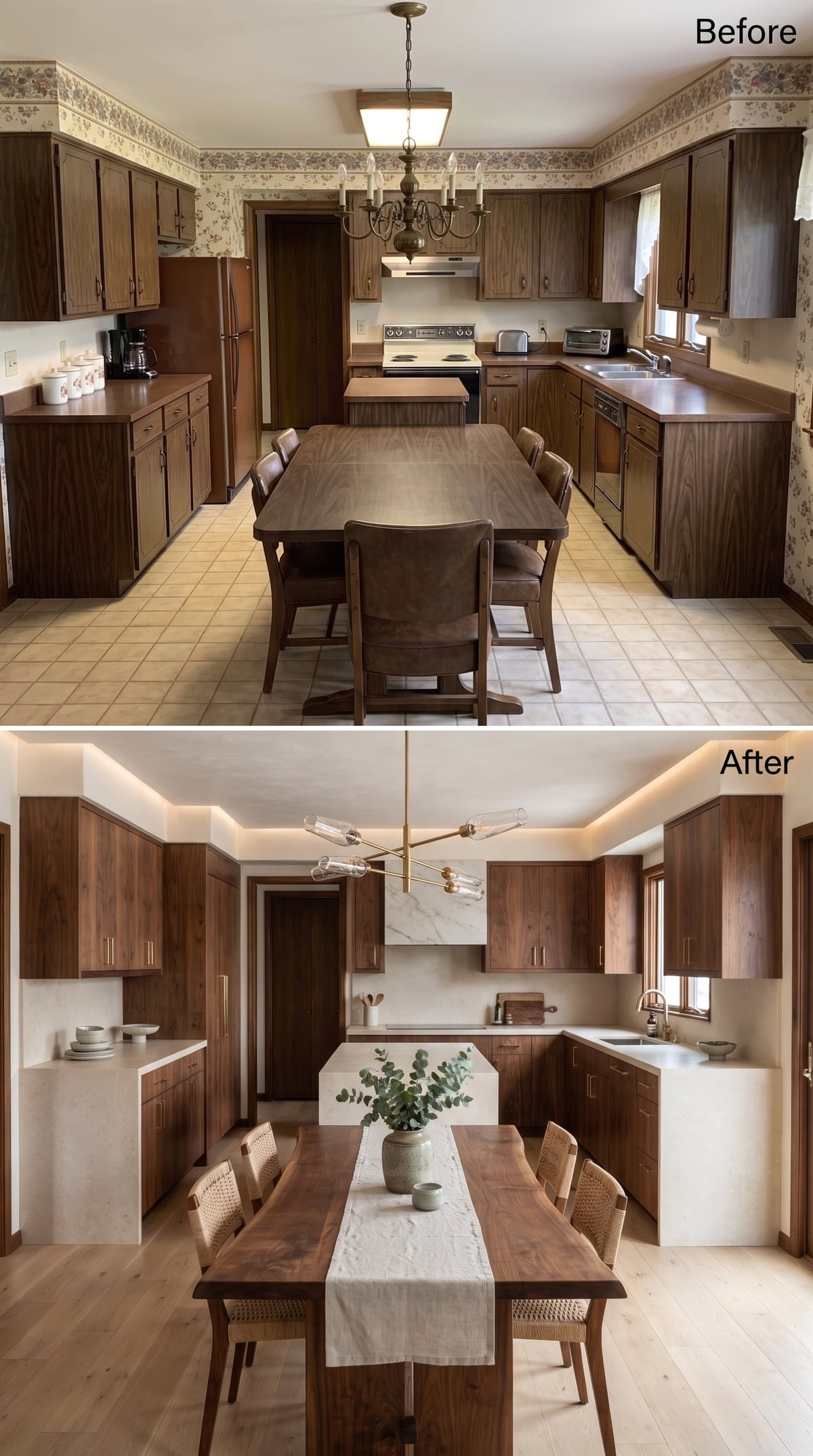
Brass bar pulls run flat against walnut cabinet faces here, and that restraint sets the tone for everything else. The range hood is clad in what appears to be book-matched marble or a high-quality slab porcelain, and it reads almost architectural rather than functional. Cove lighting above the upper cabinets wraps the perimeter with no visible strip or individual light source.
Light oak flooring pulls the room toward warmth, and the rattan dining chairs keep it from feeling too polished. The modern brass chandelier with exposed Edison-style bulbs is the one place the design lets itself go a little—and honestly, the room is better for it.