🔥 Would you like to save this?
Nobody sets out to design a primary suite around late-night pasta, breakfast trays, and a dangerously full wine glass. Then real life happens. A mug lands on the nightstand. A plate follows. Before long, the room starts asking for better lighting, better surfaces, better storage, and a little more grace for the habit nobody quite plans to quit.
In order to come up with the very specific design ideas, we create most designs with the assistance of state-of-the-art AI interior design software. Also, assume links that take you off the site are affiliate links such as links to Amazon. this means we may earn a commission if you buy something.
Some people want a sleep space that stays pristine and decorative. Others want somewhere soft, useful, and forgiving enough to handle coffee at 8 a.m., snacks at 10 p.m., and the occasional crumb without turning the whole thing into a domestic incident. That difference shapes every bedroom in this collection.
Across these 29 transformations, flat walls, weak lighting, generic headboards, and barely functional bedside tables give way to deeper storage, washable fabrics, smarter layouts, and finishes that can survive actual living. The strongest rooms do not fight the habit. They rise to the occasion. The result is a kind of luxury that feels less performative and far more enjoyable.
29. Crimson Velvet Walls and Herringbone Floors Replace Beige Builder Carpet
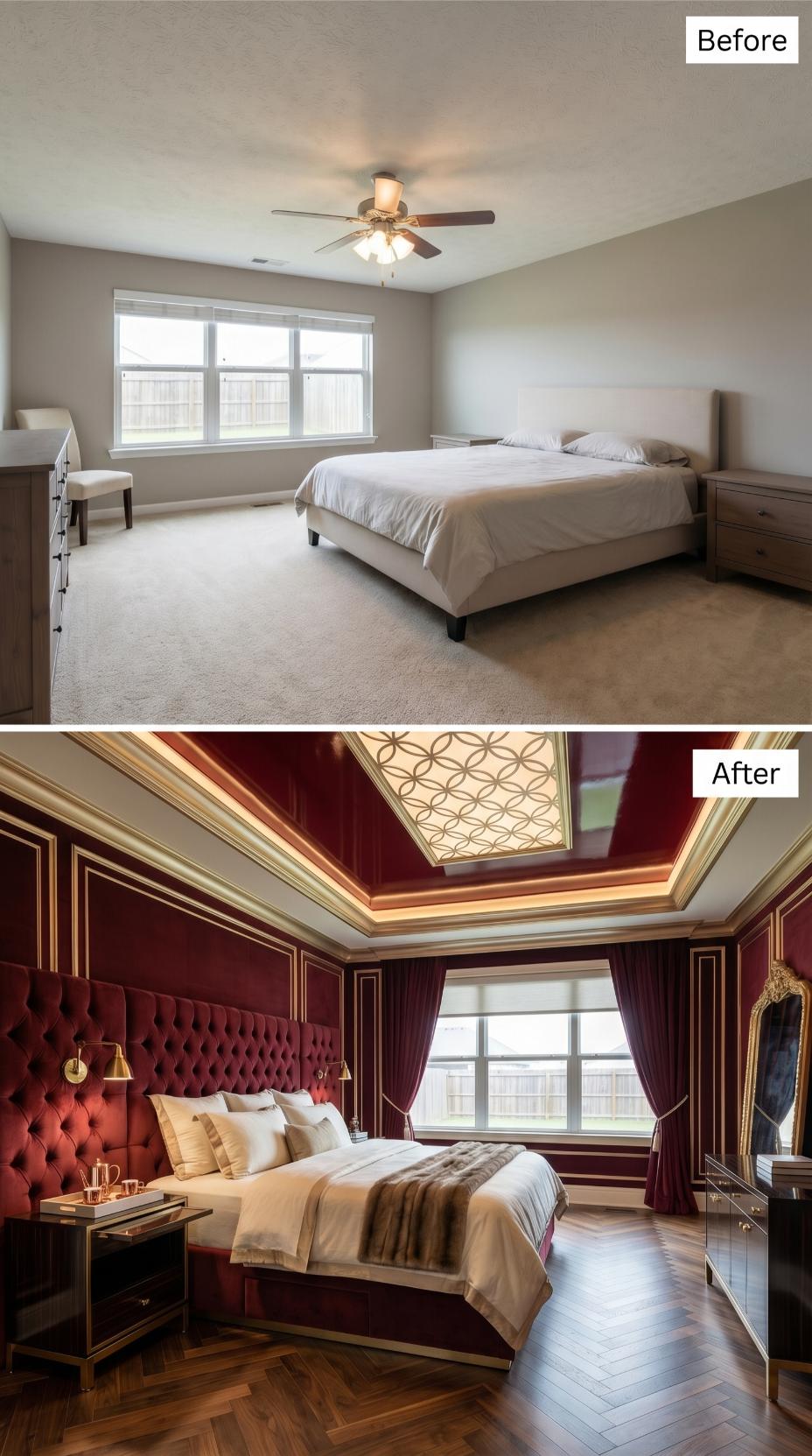
Deep burgundy velvet panels cover every wall, framed by gold trim molding that runs in rectangular outlines from baseboard to crown. The tray ceiling is lacquered in the same crimson, edged with warm LED cove lighting and centered with a geometric circle-pattern skylight insert.
Herringbone dark walnut flooring replaced the builder carpet entirely. The bed platform is upholstered in tufted burgundy velvet with a tall channel-button headboard. Black lacquer nightstands with brass legs flank the bed, and a gold-framed baroque mirror anchors the right corner beside an acrylic-front dresser.
28. Shoji Glass and Wood Slat Ceiling Replace Carpet and Ceiling Fan
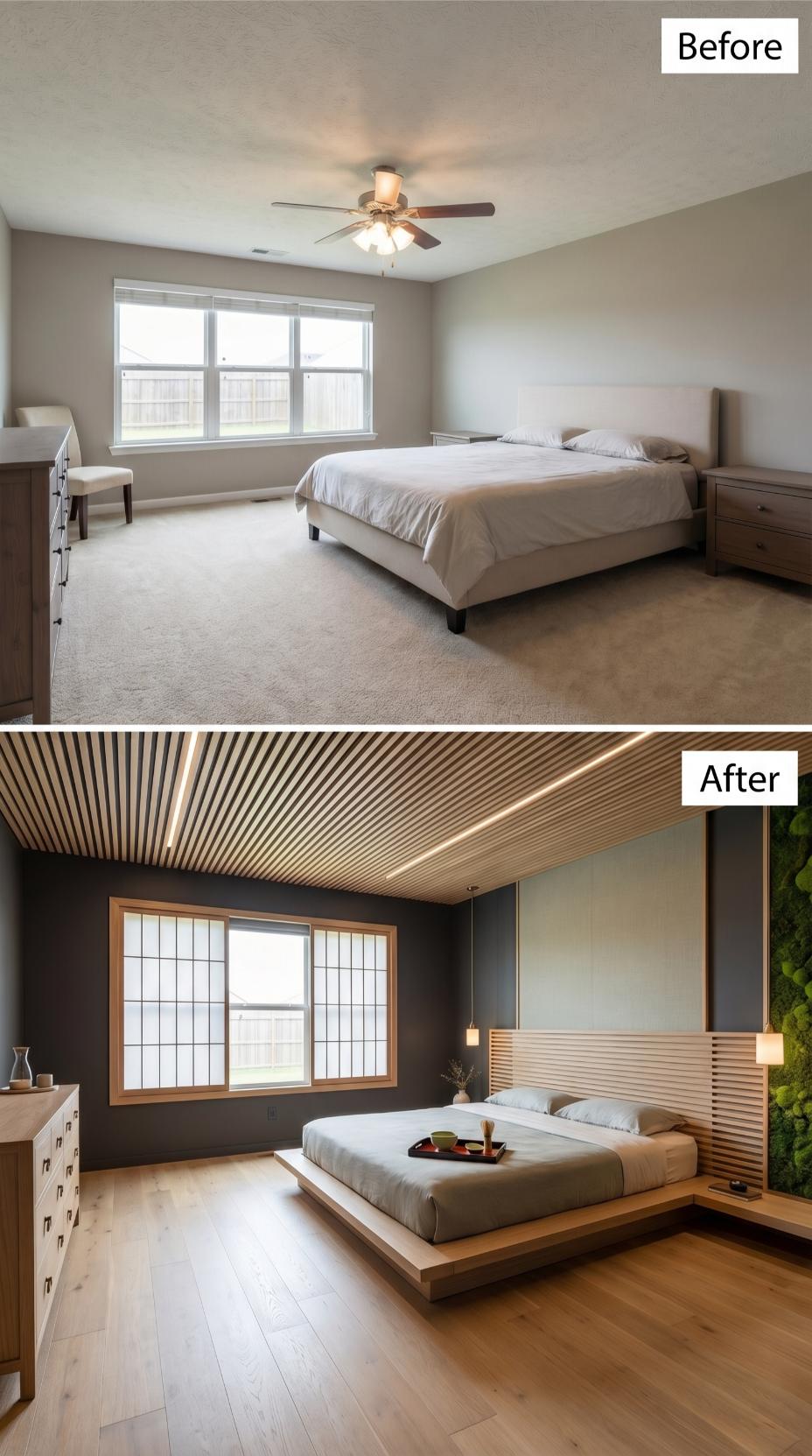
Carpenter-grade carpet gave way to wide-plank light maple flooring, and the popcorn ceiling was replaced with a slatted wood panel ceiling fitted with recessed LED strips running along the ridge. The window now sits inside a natural oak shoji-style frame with translucent rice paper panels, swapping the old vinyl casing for something with actual material presence. Dark charcoal walls push the warm wood tones forward rather than competing with them.
The platform bed sits low on a floating maple base, with a slatted headboard echoing the ceiling detail overhead. A living moss wall anchors the right side of the room, and pendant lights hang on thin cords beside the bed, replacing the builder-grade ceiling fan entirely.
27. Navy Blue Coffered Ceiling with LED Coves Replaces Builder Fan and Beige Carpet
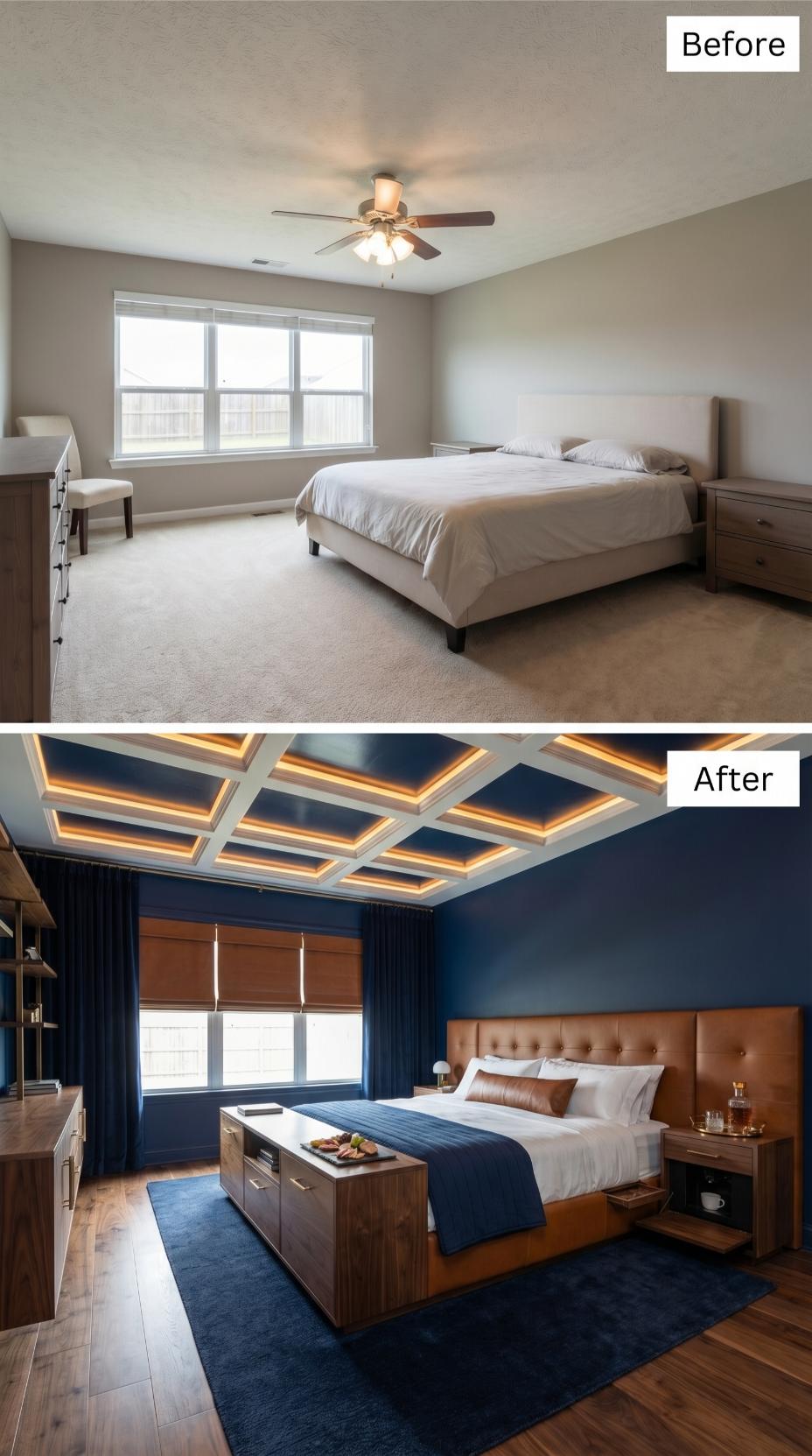
Warm-amber LED strips run inside each coffered panel, casting indirect light across navy-painted walls and wide-plank hardwood floors. A tufted cognac leather headboard anchors the bed, flanked by floating walnut nightstands with open lower shelves sized for a coffee cup or glass.
26. Forest Green Accent Wall and Platform Bed With Storage Drawers Replace Beige Carpet
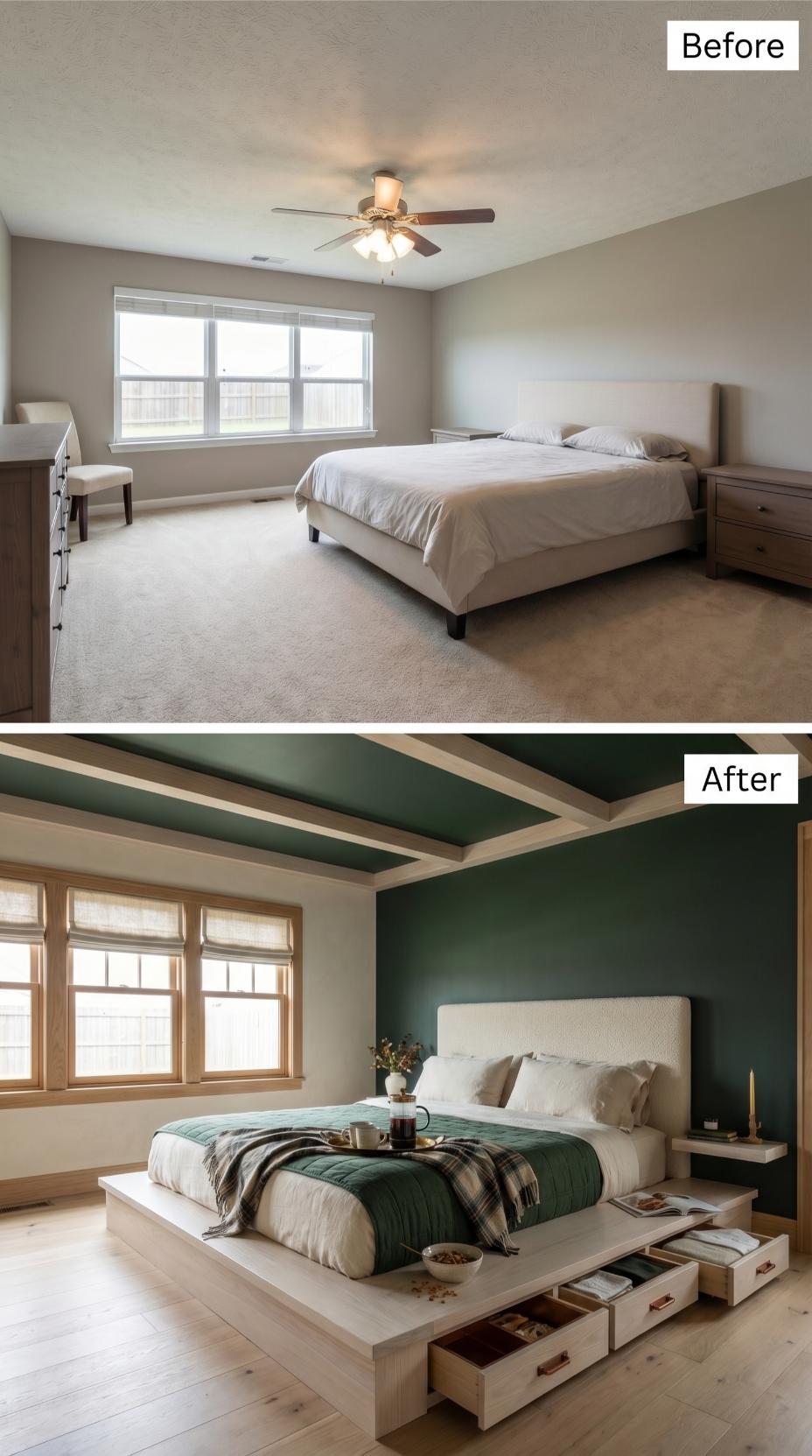
Hunter green paint covers the headboard wall floor to ceiling, anchored by white oak plank flooring that replaced the builder carpet. Exposed ceiling beams painted to match the green walls create a coffered effect with cream trim separating each bay. Roman shades in natural linen replace the vinyl blinds.
The platform bed sits on a wide white oak base with pull-out drawers fitted with leather tab pulls, which matters when breakfast trays, French press coffee, and ceramic bowls become regular morning fixtures. A bouclé upholstered headboard and floating nightstands complete the layout.
25. Emerald Walls and a Gold Relief Ceiling Turn Builder Beige Into a Royal Retreat
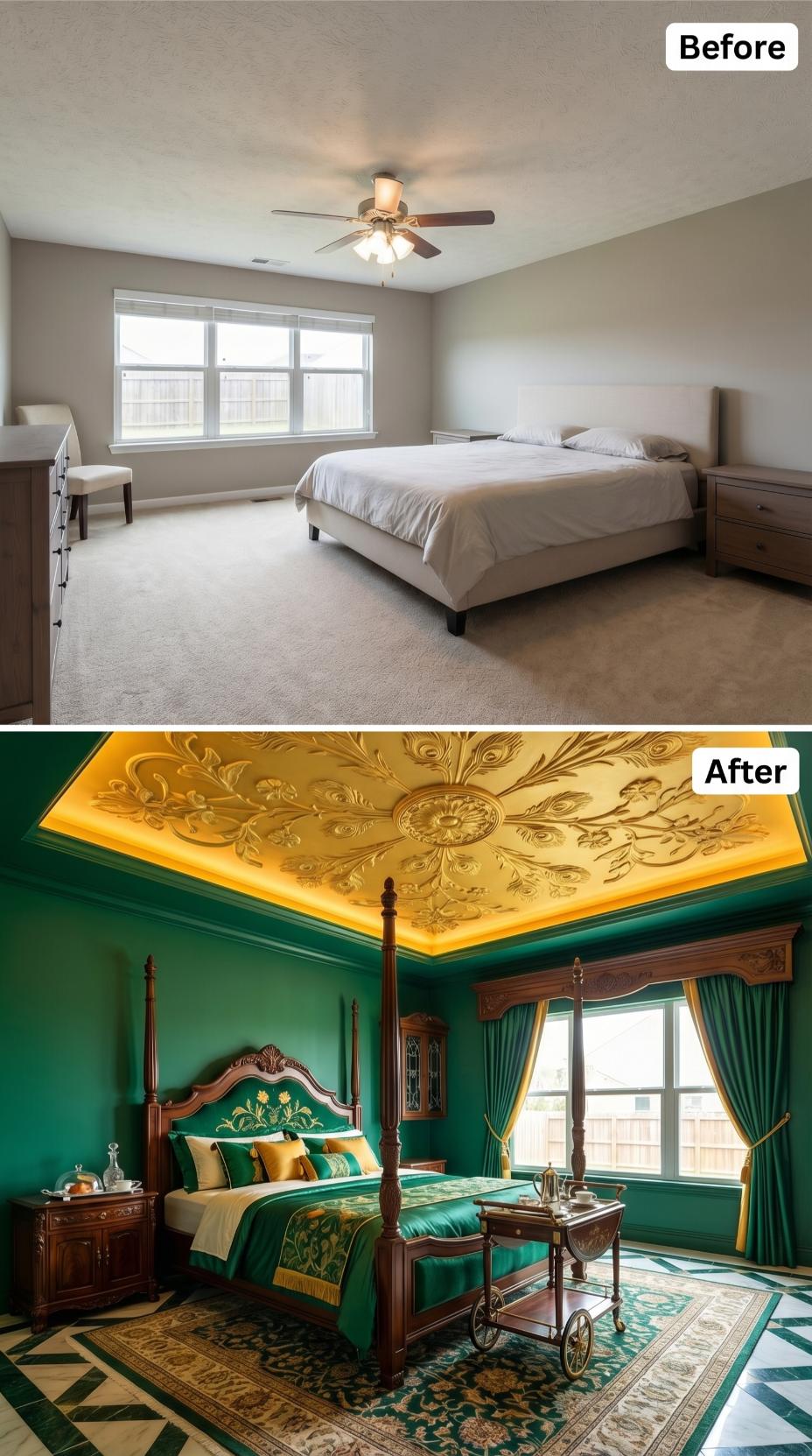
Jewel-toned emerald paint covers every wall, anchoring a four-poster bed in carved mahogany with a fabric headboard embroidered in gold floral motifs. The tray ceiling is finished in gilded plasterwork with scrolling acanthus reliefs, backlit by warm LED strip lighting recessed into the cove. A marble-tile floor in green and cream geometric patterns replaces the original carpet, and teal silk drapes pool at the window sill where a vintage brass tea cart sits ready for breakfast in bed.
Style Math: Emerald wall paint paired with gold ceiling plasterwork follows a Victorian color logic where saturated walls demand a luminous ceiling to prevent the room from reading as a cave. The tea cart is not decorative padding here. It is the functional centerpiece that justifies every other opulent choice in the room.
24. Blush Venetian Plaster and Cove Lighting Replace Carpet and Ceiling Fan
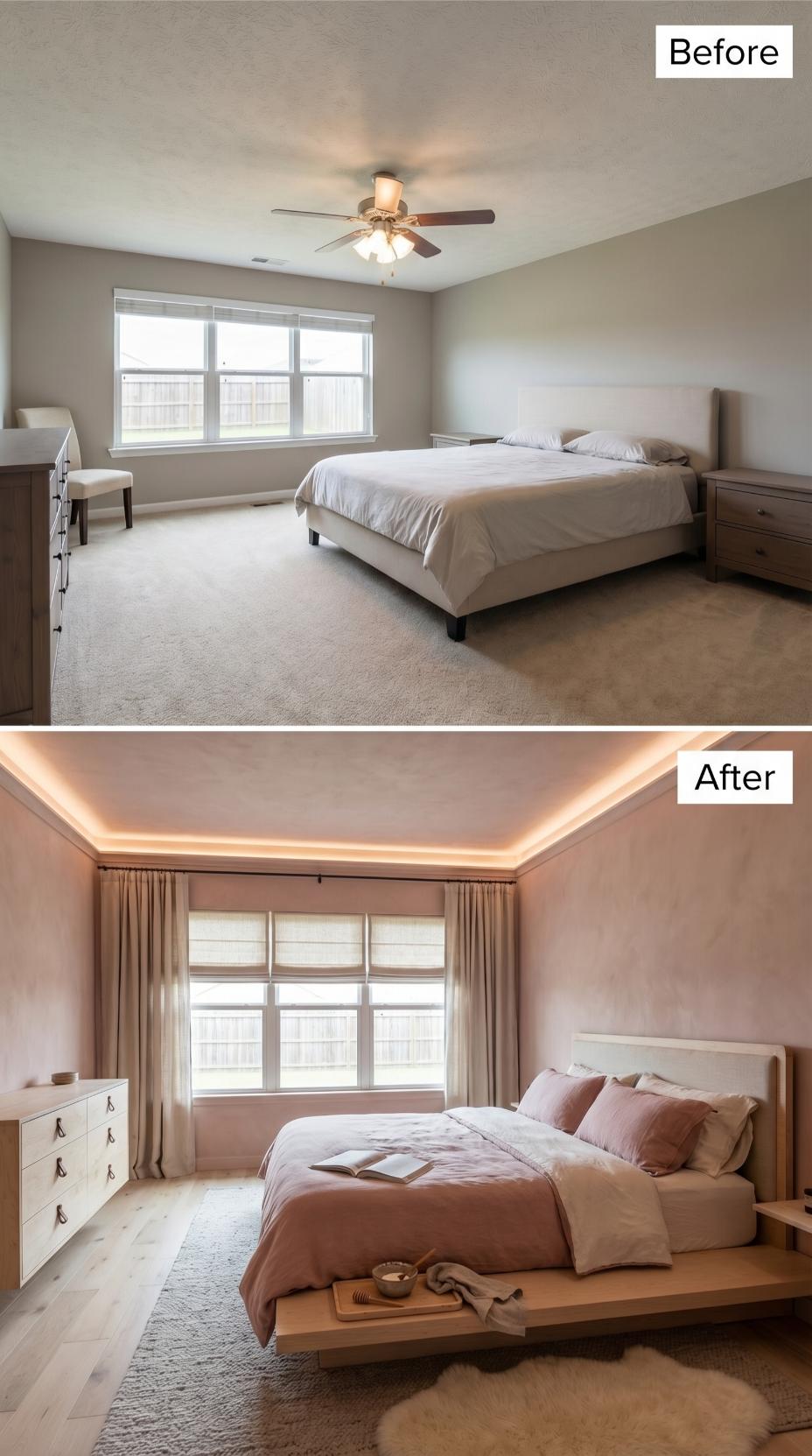
Warm blush venetian plaster coats the walls with a matte, mineral texture that flat paint cannot replicate. A tray ceiling fitted with recessed LED strip lighting replaces the builder fan entirely. The low-profile platform bed sits on a wide wood base, extending into a bench ledge that doubles as a surface for trays and books.
Trend Alert: Cove lighting installed inside tray ceilings is increasingly replacing overhead fixtures in primary bedrooms, as the indirect glow produces zero harsh shadows across bedding or reading surfaces. Lighting designers note this placement is particularly practical for people who read or eat in bed, since the light source never sits directly in the sightline. The effect looks custom but relies on standard LED tape rated at 2700K to 3000K for that warm, residential quality.
23. Gothic Vaulted Plasterwork and Stained Glass Windows Replace Carpet and Ceiling Fan
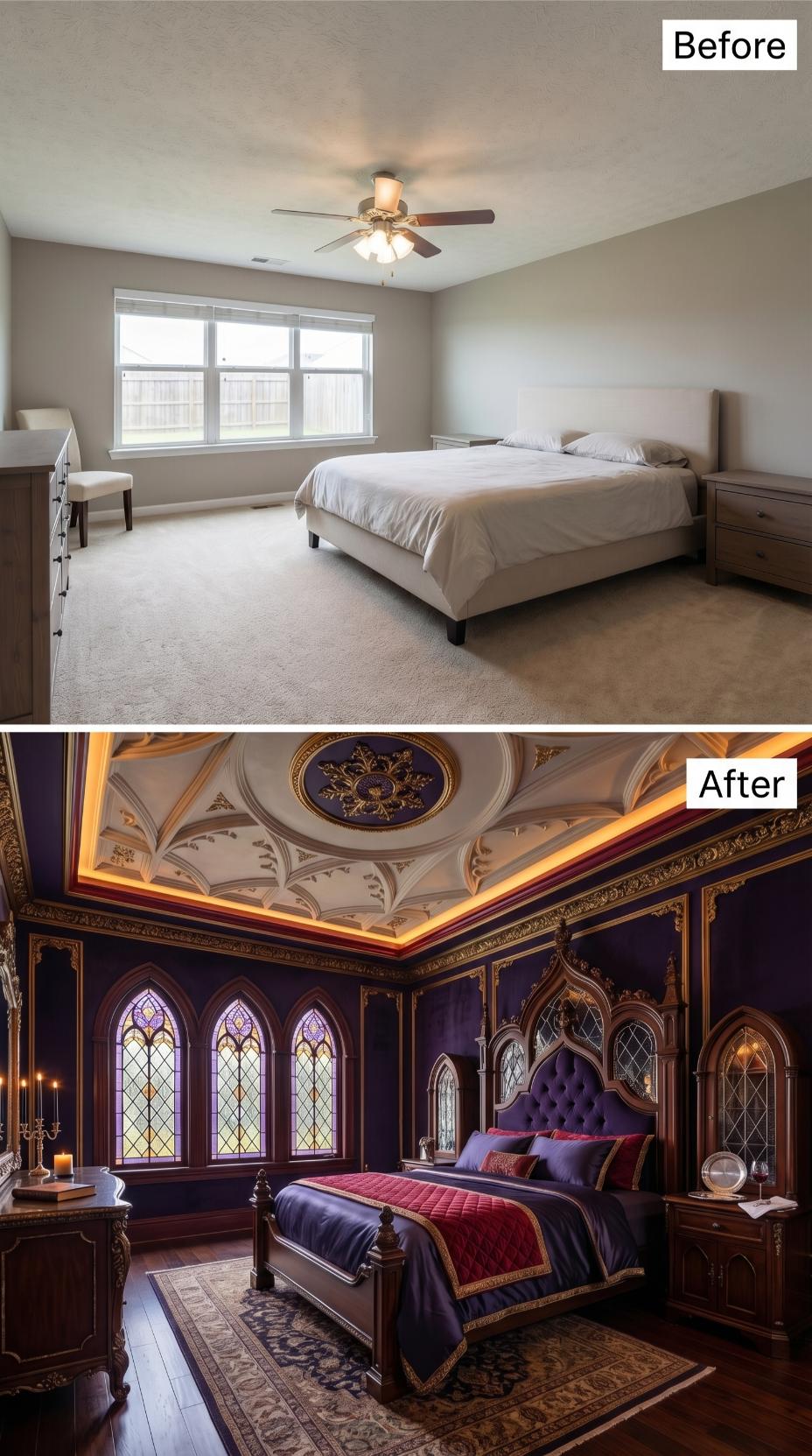
Ribbed groin vaulting with a gilded medallion at the center replaces the flat textured ceiling entirely. Leaded Gothic arch windows with purple and amber stained glass panels line one wall, casting colored light across the dark walnut four-poster bed dressed in navy silk and crimson quilted satin. Purple velvet tufting on the headboard anchors the deep plum wall panels trimmed in carved gilt molding.
Common Mistake: Gothic-style window treatments like leaded stained glass block significant natural light, so pairing them with warm amber cove lighting along the tray ceiling perimeter, as seen here, prevents the room from reading as cave-like during daylight hours. Rooms that skip this compensating light source often feel oppressive rather than dramatic.
22. Bare Concrete Walls and Linear LED Strips Replace Carpet and Ceiling Fan
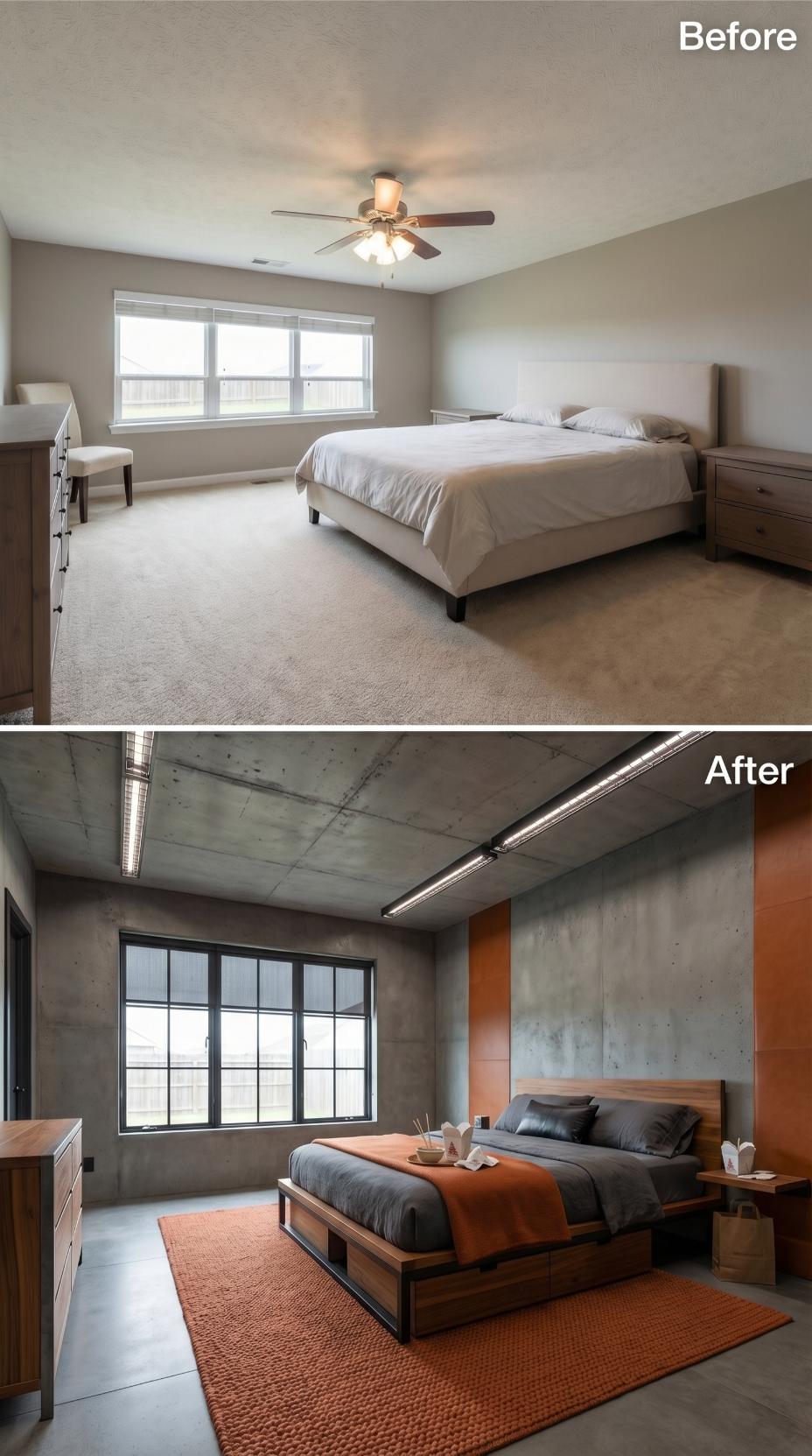
Raw concrete and burnt orange make a bedroom look like it was designed for someone who orders takeout at midnight and has no regrets about it.
The ceiling and walls are finished in exposed board-formed concrete, with the characteristic panel lines and aggregate texture left fully visible. Two linear LED strips run flush along the ceiling plane, replacing the builder fan entirely and casting a flat, directional light that suits late-night eating without flooding the room. The platform bed sits in solid walnut with a slab headboard panel backed by a terracotta-orange leather or suede accent wall section.
The floor moves from beige carpet to large-format concrete tile, and a chunky hand-woven rust-orange area rug anchors the bed. Walnut nightstands hold takeout containers with zero apology. The window keeps its original view but gains black steel grid mullions, tying the industrial concrete palette together without any added ornament.
21. Royal Blue Lacquer Walls and Chevron Marble Floors Replace Builder Carpet and Ceiling Fan
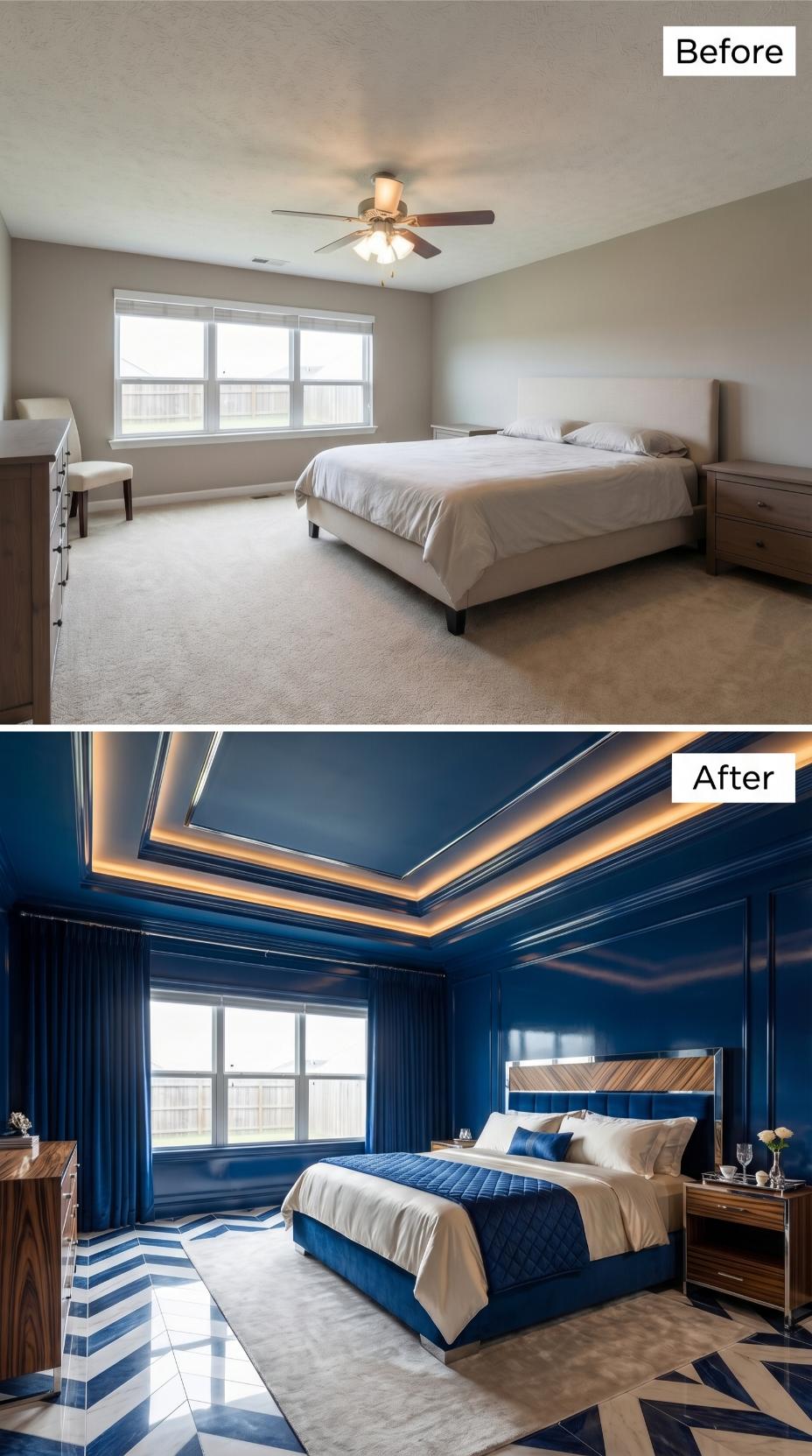
Cobalt blue lacquer covers every wall surface, including the panel molding frames that run floor to ceiling, giving the room its compressed, vault-like quality. A tray ceiling painted to match carries warm LED strip lighting tucked behind a chrome reveal, so the glow bounces off the gloss finish rather than falling on occupants directly.
The bed frame is upholstered in sapphire velvet with a quilted diamond pattern, positioned against a mirror-framed headboard backed in figured walnut veneer. Underfoot, large-format porcelain tiles form a blue-and-white chevron border that transitions into a field of pale stone at the room’s center.
Why Lacquer Paint Changes the Way Cove Lighting Performs
High-gloss lacquer on walls acts as a secondary reflector for cove lighting, bouncing indirect LED light across multiple surfaces before it reaches eye level. This creates a layered ambient effect that matte paint cannot replicate, since matte finishes absorb rather than redistribute light. In rooms with saturated color like this cobalt application, the reflected light picks up a blue cast that shifts the perceived warmth of even a 3000K strip light toward something cooler and more atmospheric.
20. Rococo Plasterwork Ceiling and Velvet Tufted Headboard Replace Carpet and Ceiling Fan
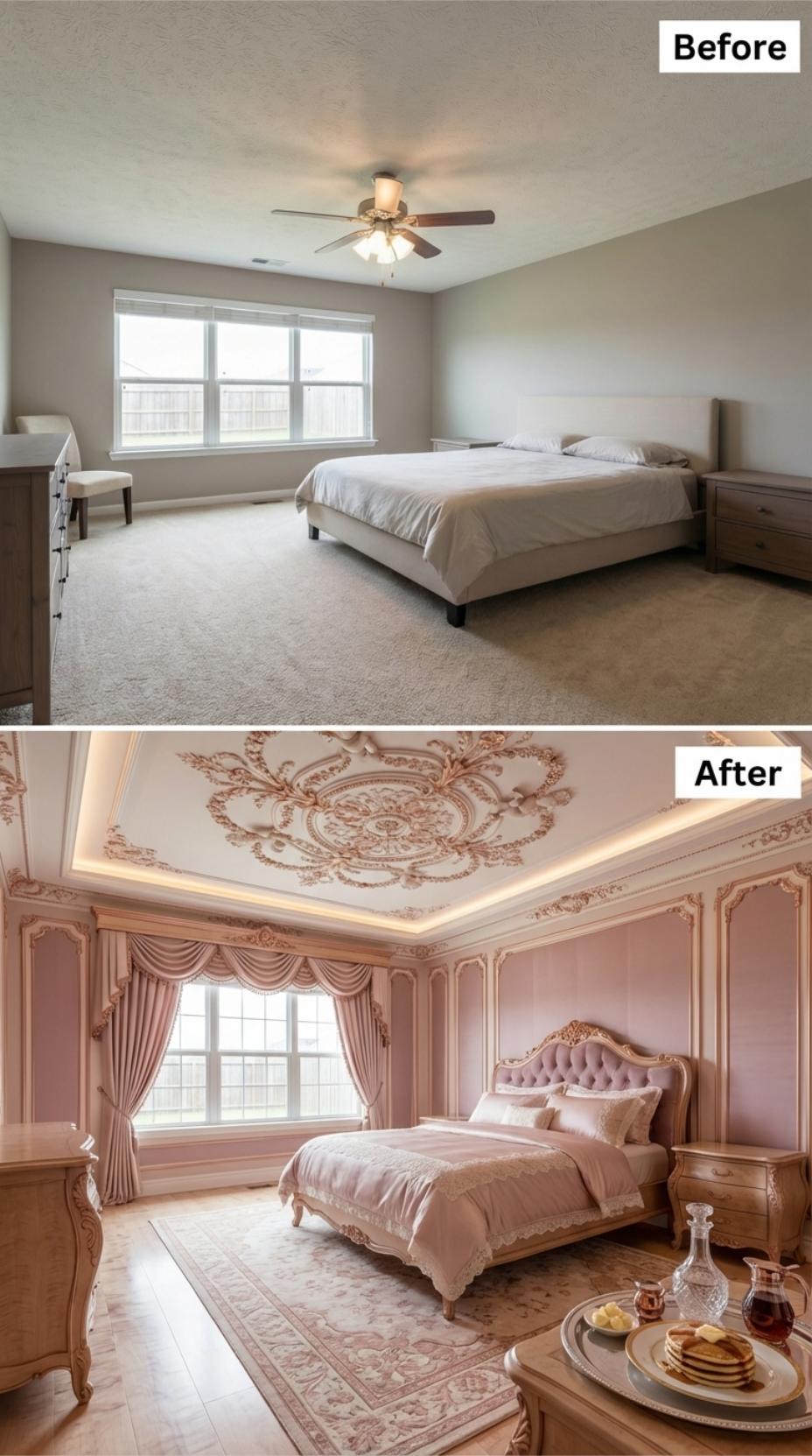
Pancakes on a tray taste better under a hand-painted ceiling medallion with gilded scrollwork.
The ceiling here does the heavy lifting. A tray with recessed LED cove lighting frames a central plaster medallion finished in rose-gold, surrounded by baroque acanthus-leaf scrolls that radiate outward toward each corner. Pink-tinted wainscoting panels with carved wood molding line every wall, creating a rhythm that pulls the eye around the room rather than straight to the window.
The bed features a curved, tufted headboard upholstered in blush velvet, set on legs finished in antique champagne. Swag-and-jabot drapes in dusty rose silk hang from a carved cornice above the original window. Hardwood floors in a light natural oak replaced the builder carpet entirely, and a wool area rug in ivory and blush anchors the bed without competing with the plasterwork above.
19. Terracotta Venetian Plaster and a Coffered Ceiling Replace Flat Paint and Builder Fan
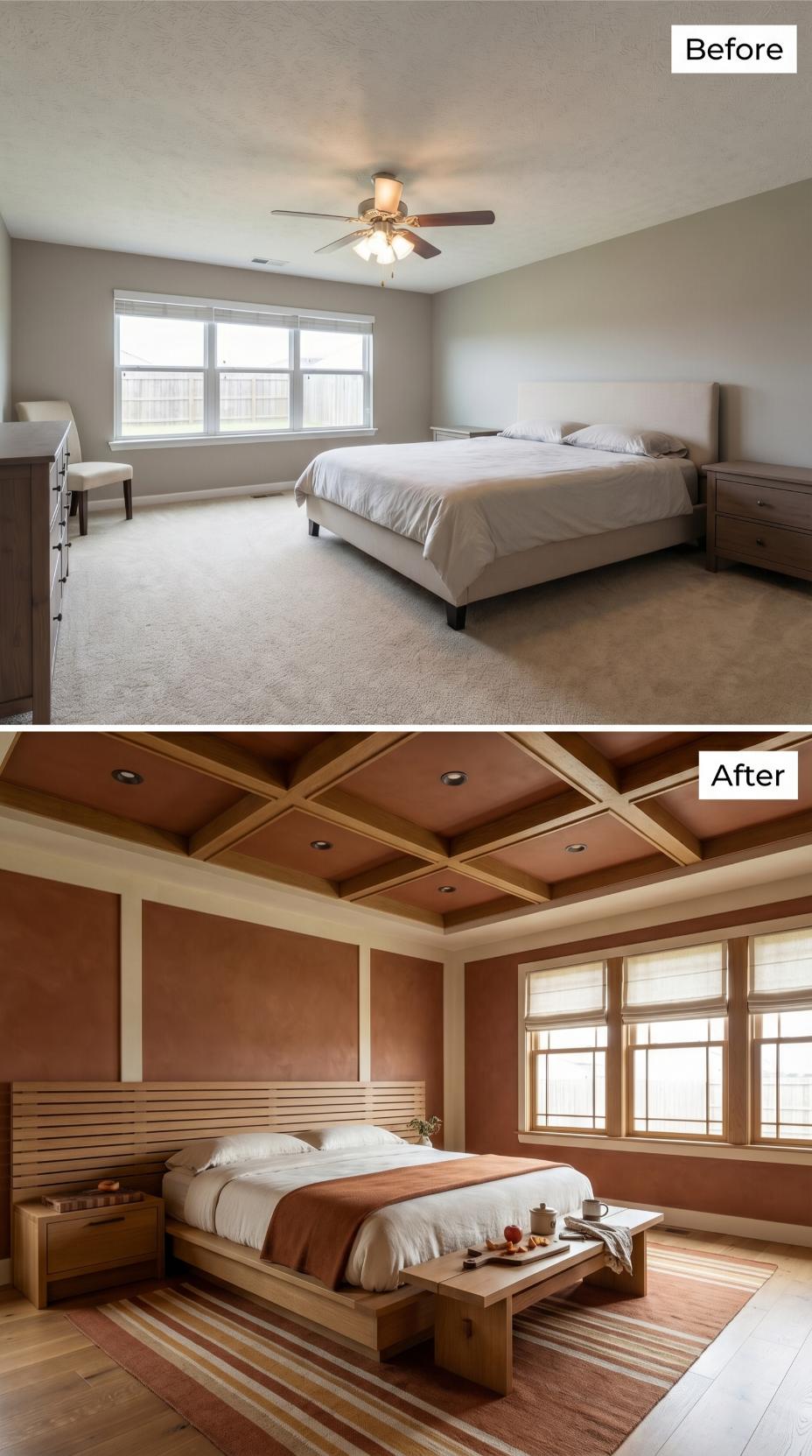
Burnt sienna Venetian plaster covers every wall in this primary bedroom, applied in a layered finish that reads differently depending on the hour of daylight coming through the roman shades. The coffered ceiling is built from pale cream-painted wood beams forming a grid of recessed panels, each cavity painted to match the walls and fitted with a recessed downlight at center. It replaces what was a popcorn-textured ceiling with a wobbling ceiling fan.
The platform bed is solid oak with a wide horizontal slatted headboard and matching side tables with open-shelf compartments. A low bench at the foot of the bed doubles as a breakfast tray surface. Striped wool runner in cream, caramel, and rust sits over light hardwood planks, anchoring the furniture without competing with the plaster.
Each coffered panel cavity is painted to match the walls and fitted with a recessed downlight at center.
18. Fluted Wall Panels and a Tray Ceiling With Cove Lighting Replace Carpet and Ceiling Fan
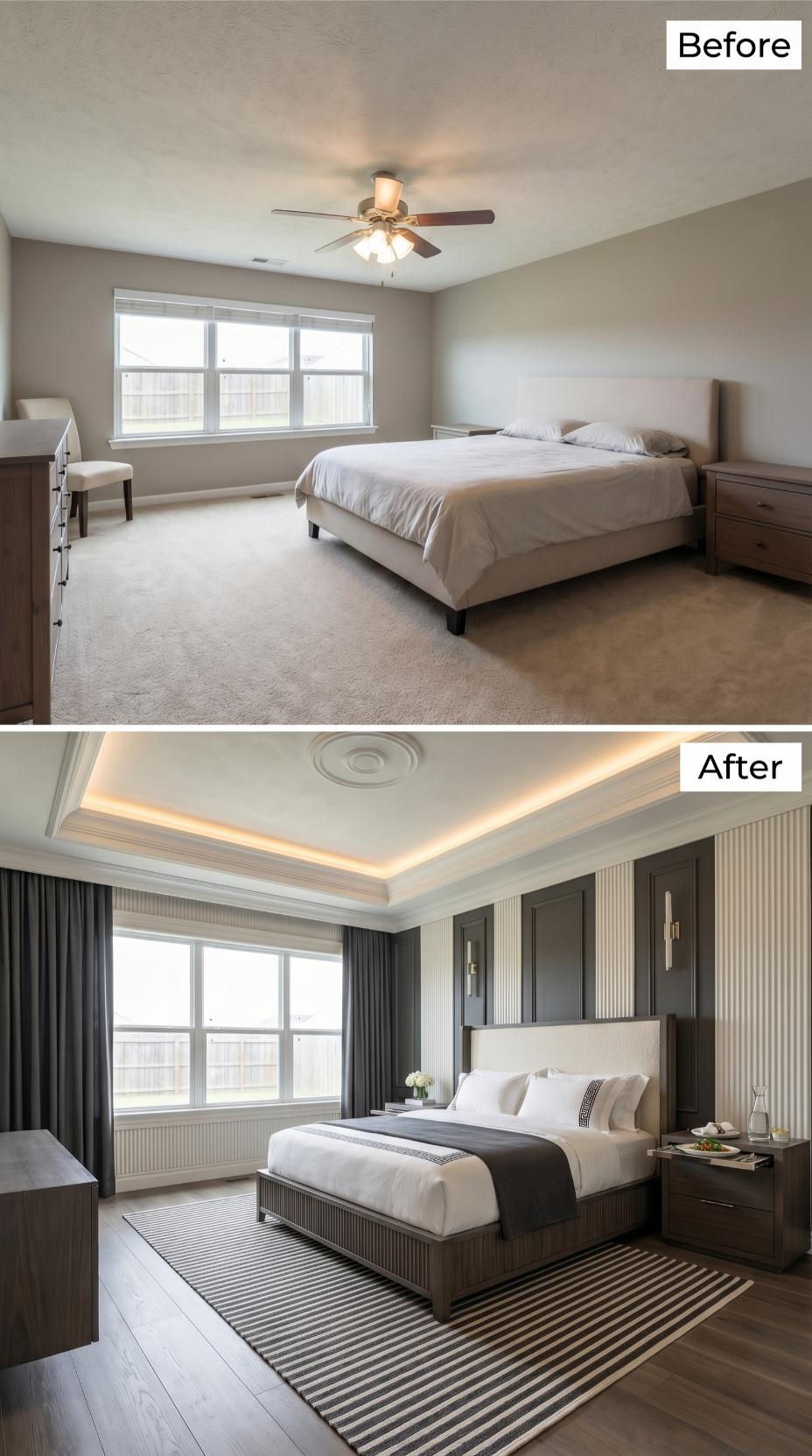
Dark walnut bed frame with reeded detailing anchors the room against a charcoal fluted accent wall. Wide-plank hardwood floors and a black-and-cream striped wool rug replace the original beige carpet entirely. Warm LED strip lighting runs the perimeter of the boxed tray ceiling overhead.
Quick Fix: Reeded or fluted panels applied directly to drywall add architectural depth without requiring structural work, making them one of the more cost-effective wall treatments available for a primary bedroom renovation. Installation typically runs between $8 and $15 per square foot when using MDF fluted sheets rather than custom millwork.
17. Bold Primary Color Blocking on Every Surface Erases Builder Beige Completely
🔥 Would you like to save this?
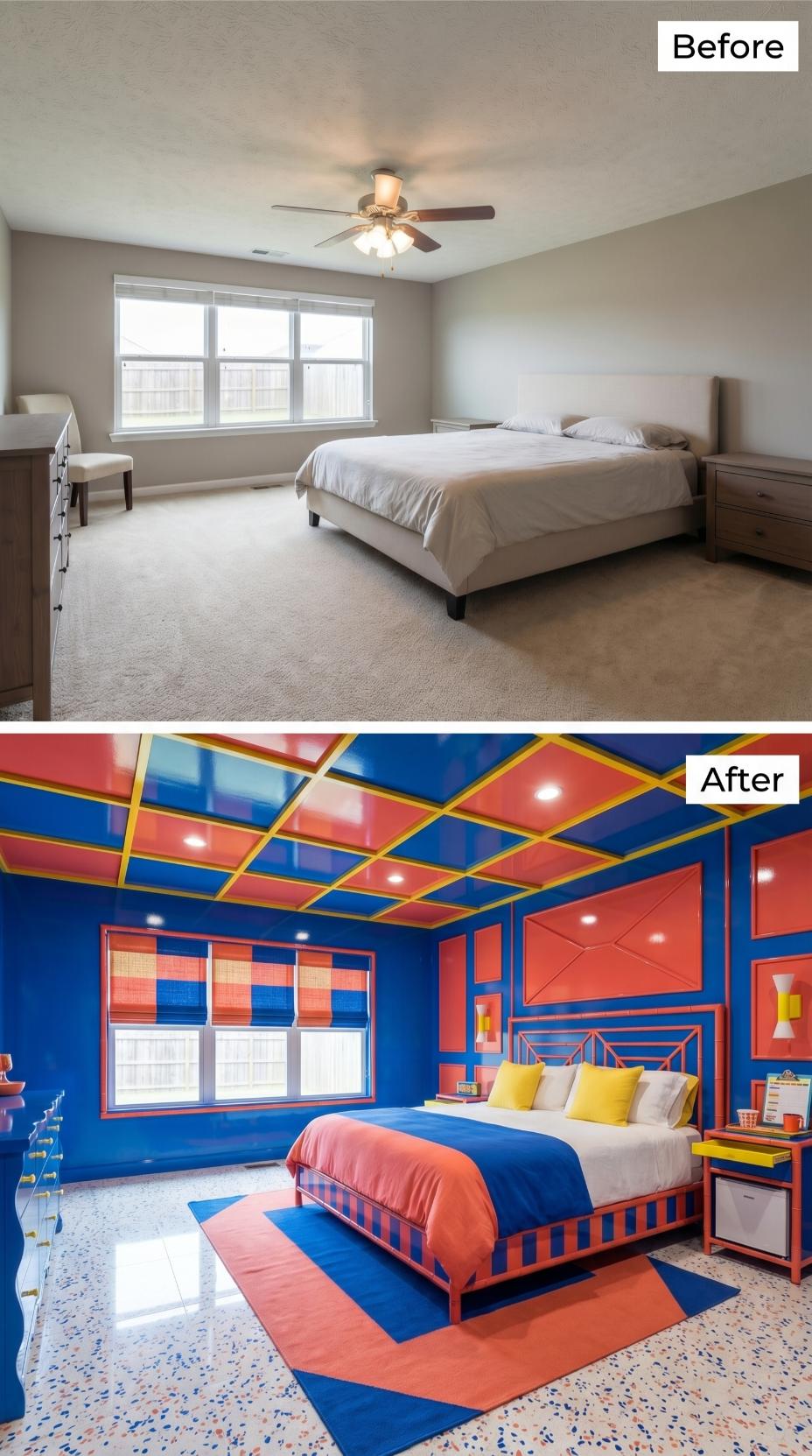
Cobalt blue lacquer covers the walls floor to ceiling, broken up by coral-red recessed panels trimmed in the same blue and outlined with yellow banding. That same tricolor logic runs straight up to the ceiling, where a glossy grid of coral rectangles and yellow stripes creates a coffered effect without traditional millwork. The carpet is gone, replaced by terrazzo flooring in white with scattered coral and blue flecks.
The bed frame is powder-coated in coral with a geometric trellis headboard, sitting on a two-tone rug of coral and navy. Yellow lumbar pillows and a coral coverlet complete the palette. Window shades repeat the color block pattern, making the window treatment feel structural rather than decorative.
Ask Yourself: Bold color commitment at this scale works only when every surface speaks the same language, so ask yourself if you are willing to repaint trim, replace window treatments, and reupholster furniture before committing to a single wall color. Stopping halfway with one saturated wall against builder-white everything else often produces the opposite of the intended effect.
Baroque opulence doesn’t always require a full gut renovation, as this bedroom proves with paint and millwork alone.
16. Crimson Wall Panels and a Medallion Ceiling Trade Beige Carpet for Victorian Grandeur
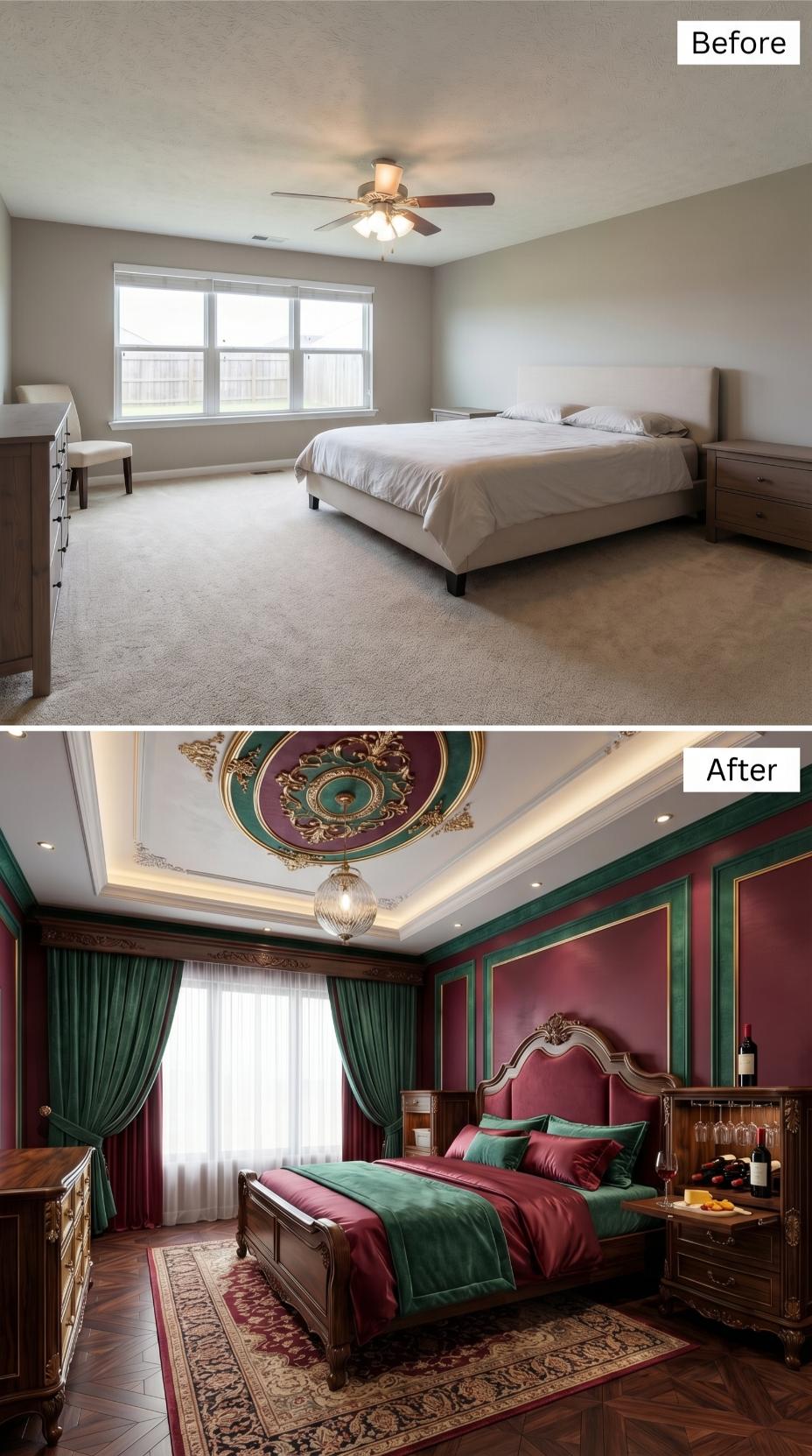
Raspberry-red wall paneling framed in gilded molding covers every wall surface, while a tray ceiling hosts a hand-painted oval medallion in deep burgundy, hunter green, and antique gold. A crystal pendant drops from the medallion’s center as recessed cove lighting traces the tray perimeter. The bed frame is carved dark walnut with a fabric headboard upholstered in matching crimson velvet.
Emerald velvet drapes pool at the floor in front of sheer white underlayers, and a Persian-style wool rug anchors the herringbone hardwood beneath. A wine rack built into the right-side dresser unit signals exactly what kind of evenings this room was designed for, with stemware suspended above and bottles laid horizontal below.
15. Steel Blue Lacquer Walls and an Oval Tray Ceiling Swap Beige Carpet for Art Deco Drama
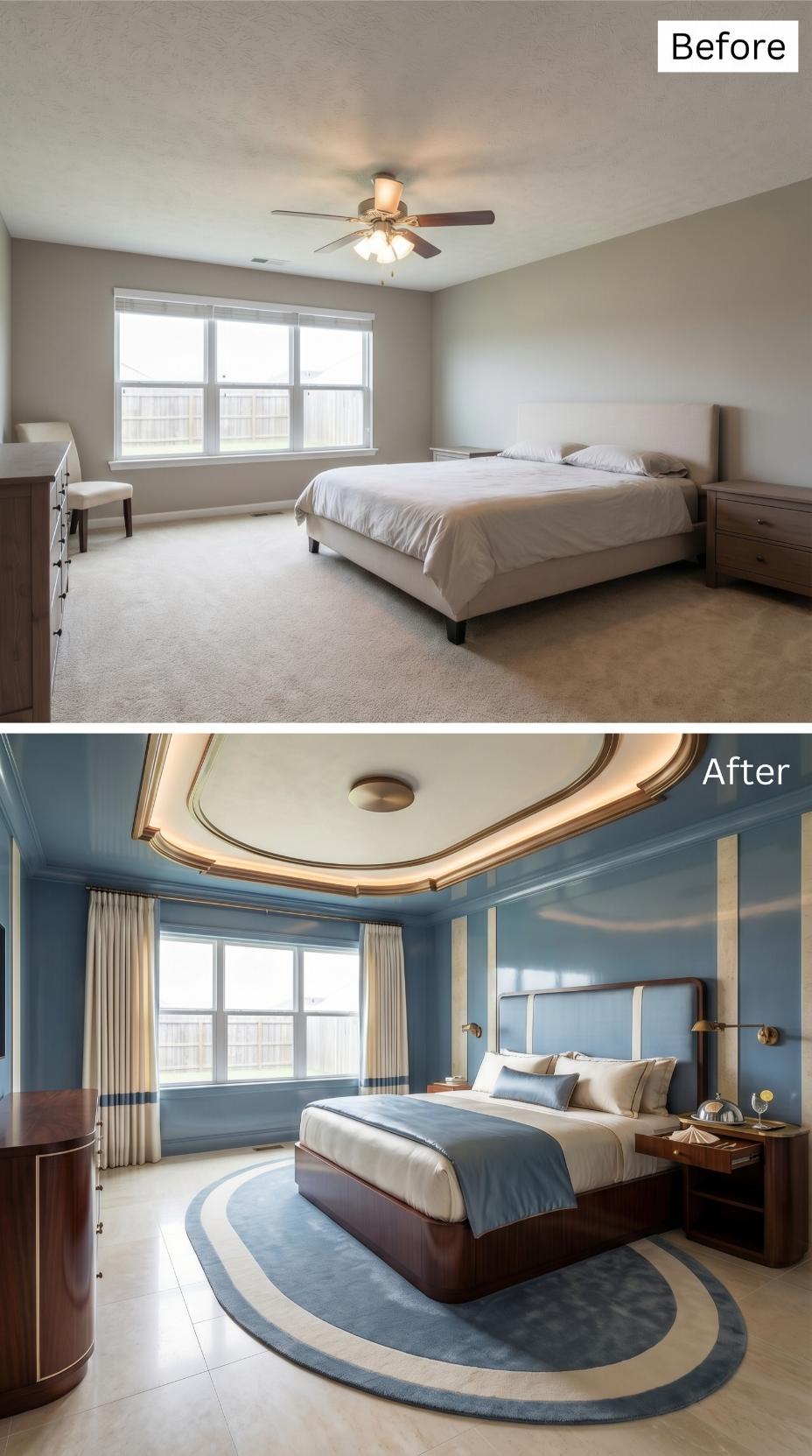
Slate blue lacquer covers every wall surface here, paired with cream vertical panels that create a rhythm the eye follows from floor to ceiling. The coffered oval tray above the bed is trimmed in brass-tone molding and lit with warm cove lighting, replacing what was a flat popcorn ceiling and a builder fan with blades the color of walnut stain.
The bed frame is upholstered in deep mahogany-stained wood with a channel-stitched headboard, sitting on an oval area rug in navy and cream. Ivory linen curtains hang floor-length at the window. Swing-arm brass wall sconces flank the headboard in place of table lamps, freeing up both nightstands for actual use by people who need a surface for a plate.
Fun Fact: Oval and elliptical rugs have seen a sharp rise in residential bedroom use over the past several years, largely because they soften the hard geometry of bed frames and rectangular floor plans without requiring a second rug layered underneath. Placing the long axis of the oval parallel to the bed length is the standard approach, but rotating it 90 degrees can make a narrow room read as wider.
Not every dramatic bedroom relies on color saturation — sometimes raw material and soft light do the heavier work.
14. Live-Edge Platform Bed and Edison Pendants Replace Carpet and Ceiling Fan
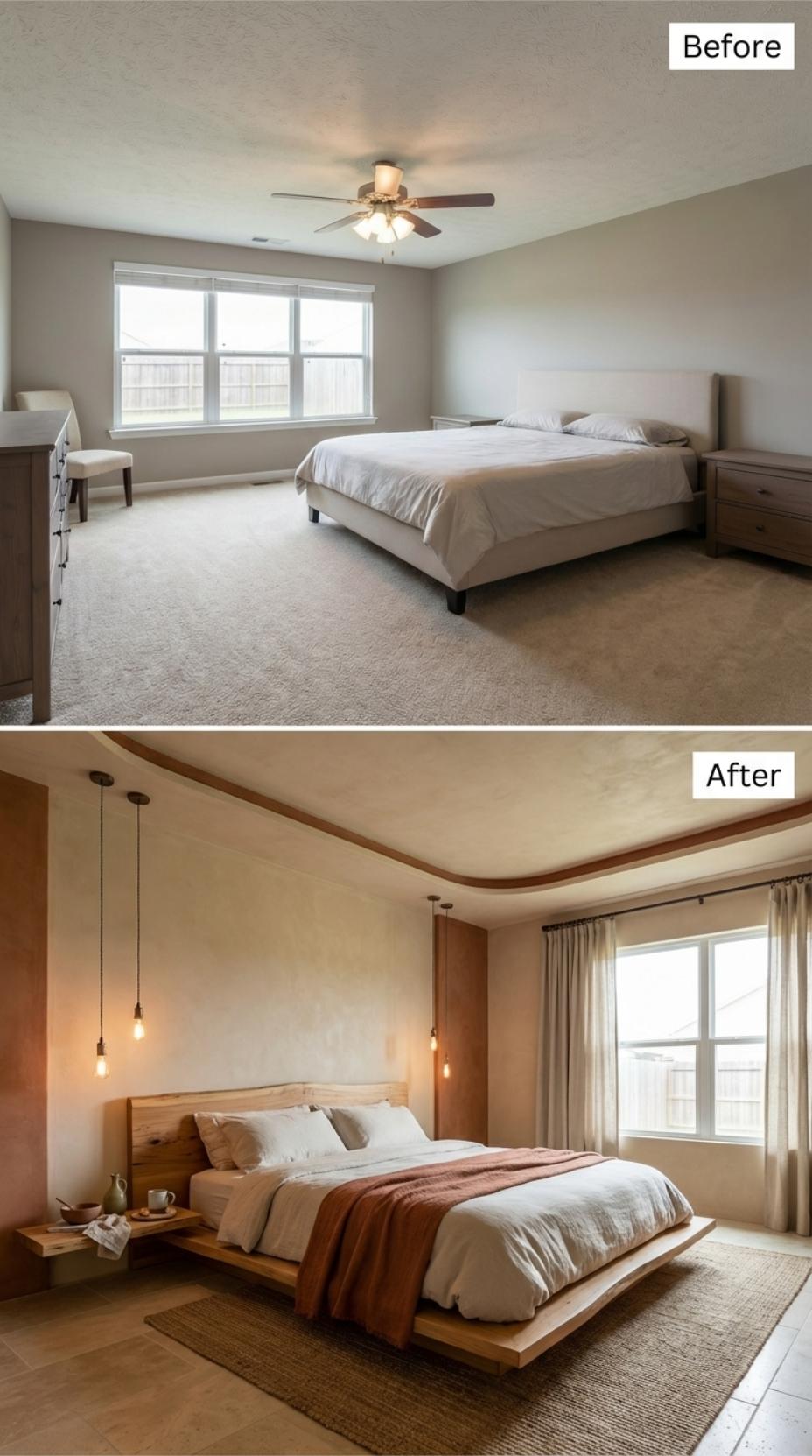
Bare bulb Edison pendants hang from black iron cord grips, replacing the ceiling fan entirely and pulling all ambient light down to bed level. The platform bed is live-edge wood, likely white oak or pine with visible grain variation, built low and wide with floating side shelves integrated directly into the frame. Walls read as limewash or unpigmented Venetian plaster in a pale sand tone. A terracotta wool throw breaks the all-white linen bedding, and a sisal rug grounds the tile floor beneath.
13. Shiplap Ceiling and Floating Walnut Bed Swap Carpet and Ceiling Fan for Hotel Calm
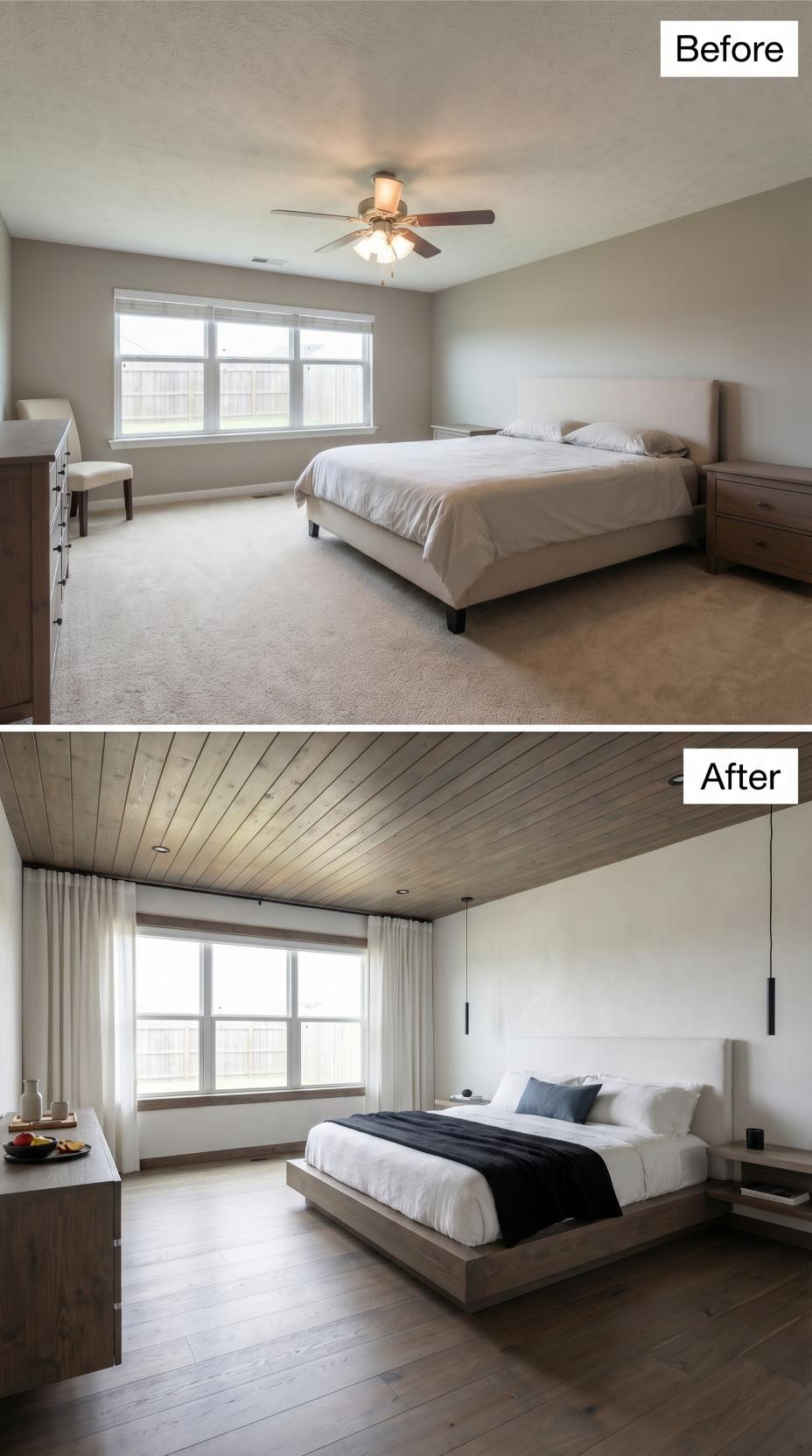
Whitewashed shiplap runs the full ceiling plane, replacing the popcorn texture and builder fan with something that reads more boutique lodge than suburban tract home. Recessed puck lights sit flush between the planks, keeping sightlines clean. The platform bed floats on a thick walnut base with integrated side shelves that eliminate the need for traditional nightstands.
Linen curtains hang floor to ceiling from a black rod mounted just below the shiplap edge, making the window read taller than it is. Wide-plank wood flooring in a wire-brushed finish grounds the room, and a pair of matte black cylinder pendants drops from the ceiling on either side of the upholstered headboard.
Pro Tip: Shiplap installed on a ceiling rather than a wall changes the acoustic quality of a room, absorbing sound slightly differently than flat drywall and reducing echo. If you are eating in bed regularly, that quieter atmosphere makes the habit feel less like a guilty pleasure and more like an intentional ritual. Pair it with recessed lighting rather than a fan to keep the plank lines uninterrupted.
12. Plum Venetian Plaster and a Coffered Tray Ceiling Trade Carpet for Japanese-Inspired Calm
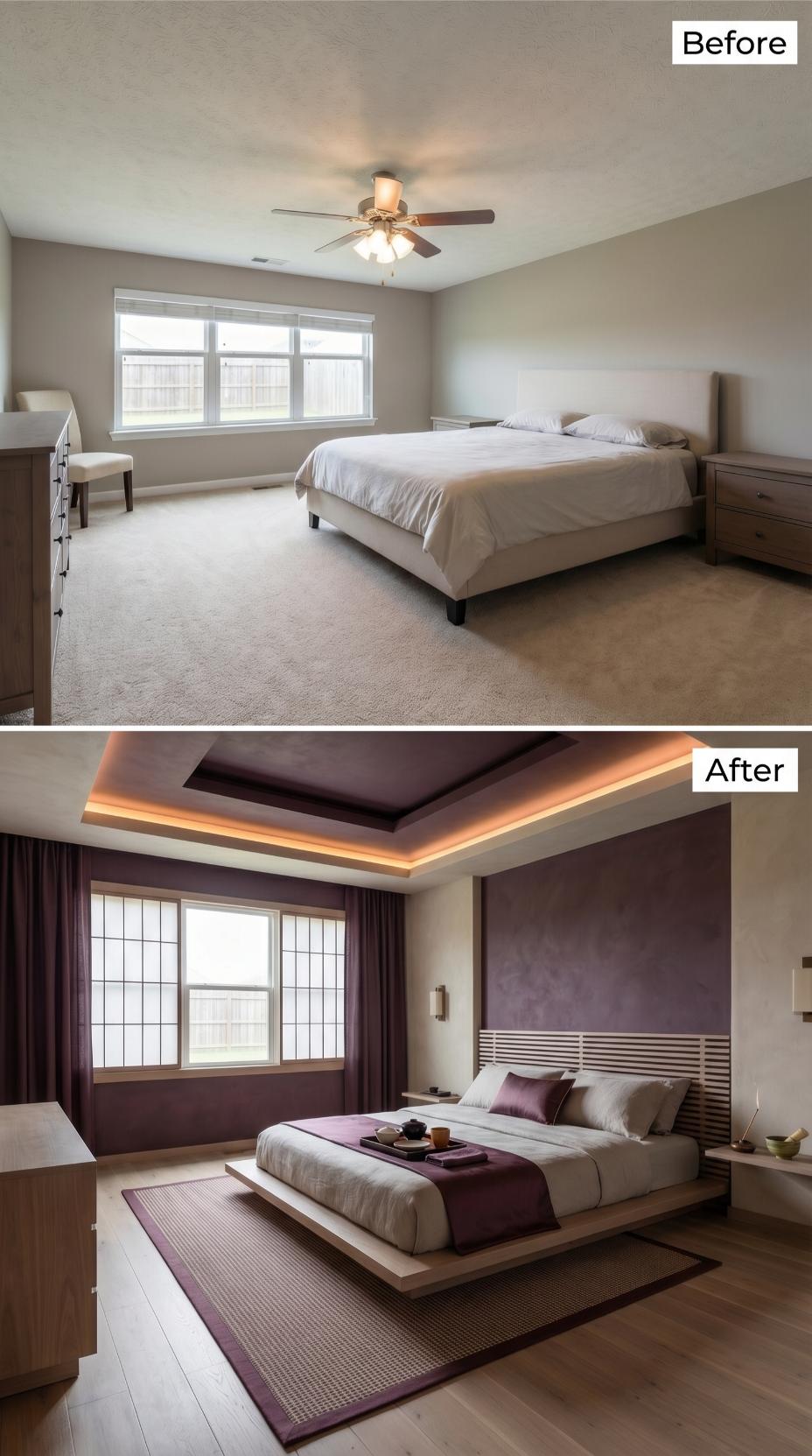
Where builder beige carpet once stretched wall to wall beneath a generic ceiling fan, wide-plank light oak flooring now grounds a low platform bed with a slatted wood headboard. The tray ceiling is finished in deep plum and edged with warm amber cove lighting that replaces every trace of overhead glare.
A natural fiber rug with plum border stripes defines the sleeping zone beneath the platform. Shoji-style window panels filter daylight behind plum velvet curtains, and the accent wall behind the headboard carries the same Venetian plaster finish as the tray ceiling, tying the upper and lower halves of the room together through repeated material rather than matched color.
Color Story: Repeating a single wall finish on both the accent wall and the tray ceiling interior is a technique borrowed from Japanese residential architecture, where material continuity signals spatial intention rather than decoration. Plum-toned Venetian plaster absorbs warm light differently than flat paint, shifting from dusty mauve in daylight to a richer burgundy under amber cove illumination. That shift is exactly what makes it worth the additional application cost over standard latex.
11. Saffron Walls and a Chevron Reclaimed-Wood Ceiling Swap Carpet for Moroccan-Inspired Warmth
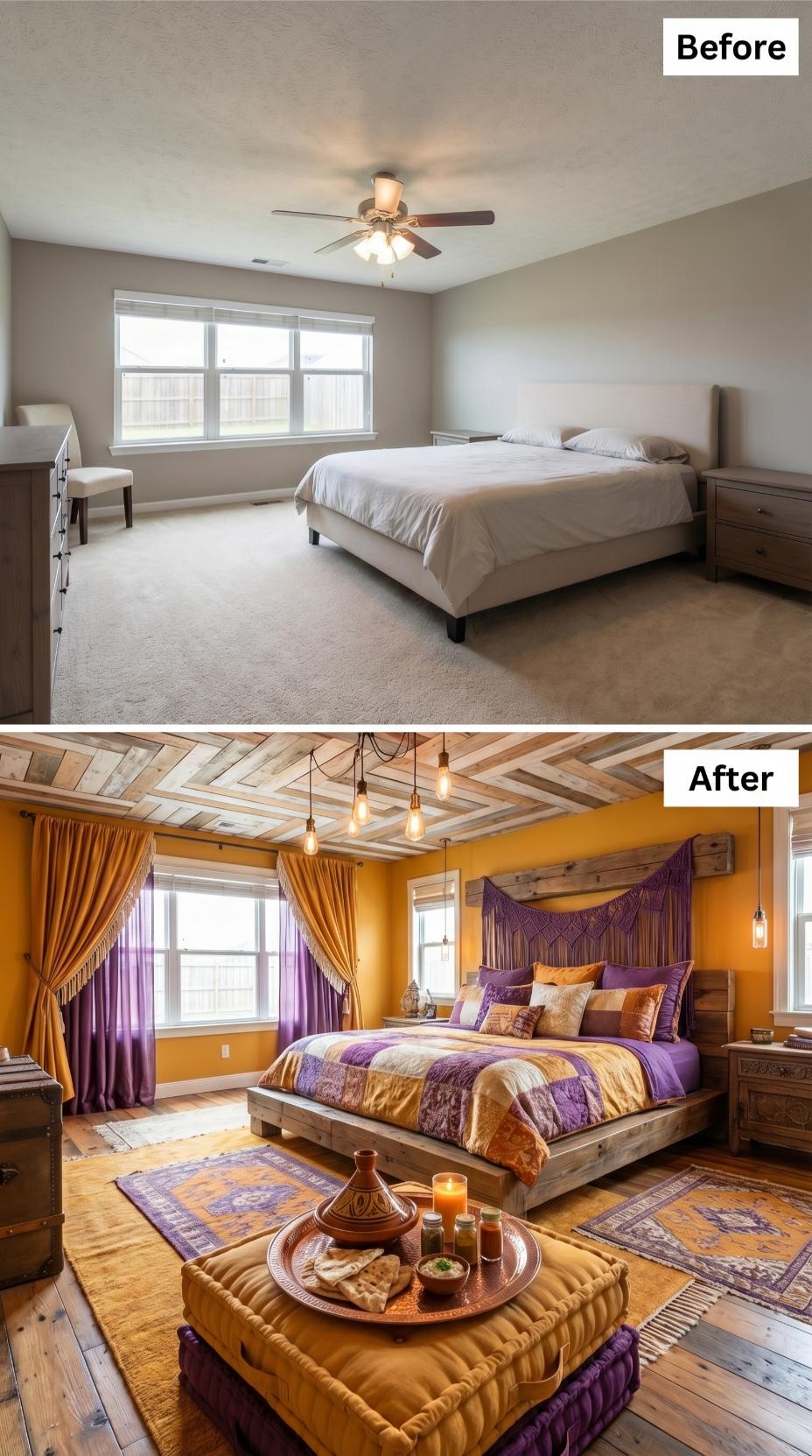
Marigold-orange paint covers every wall while a chevron-patterned reclaimed wood ceiling replaces the original flat drywall and ceiling fan with exposed Edison pendants on cord drops. A pallet-style platform bed with a rough-sawn headboard sits beneath a macramé textile panel, and layered patchwork bedding mixes purple velvet, gold jacquard, and rust linen. Fringe-trimmed curtains in saffron and violet frame the original window, and a floor-level tufted ottoman holds a copper tajine tray with candles.
- Reclaimed wood installed in a herringbone pattern on the ceiling reads as architectural detail without adding structural load
- Layering two curtain panels in contrasting saturated hues is a traditional Moroccan interior technique that frames natural light rather than filtering it
- A platform bed built from rough-sawn lumber placed directly on an area rug visually lowers the ceiling height, making a large primary bedroom feel intentionally intimate
10. Moss Ceiling Installation and Teal Platform Bed Swap Carpet and Fan for Biophilic Calm
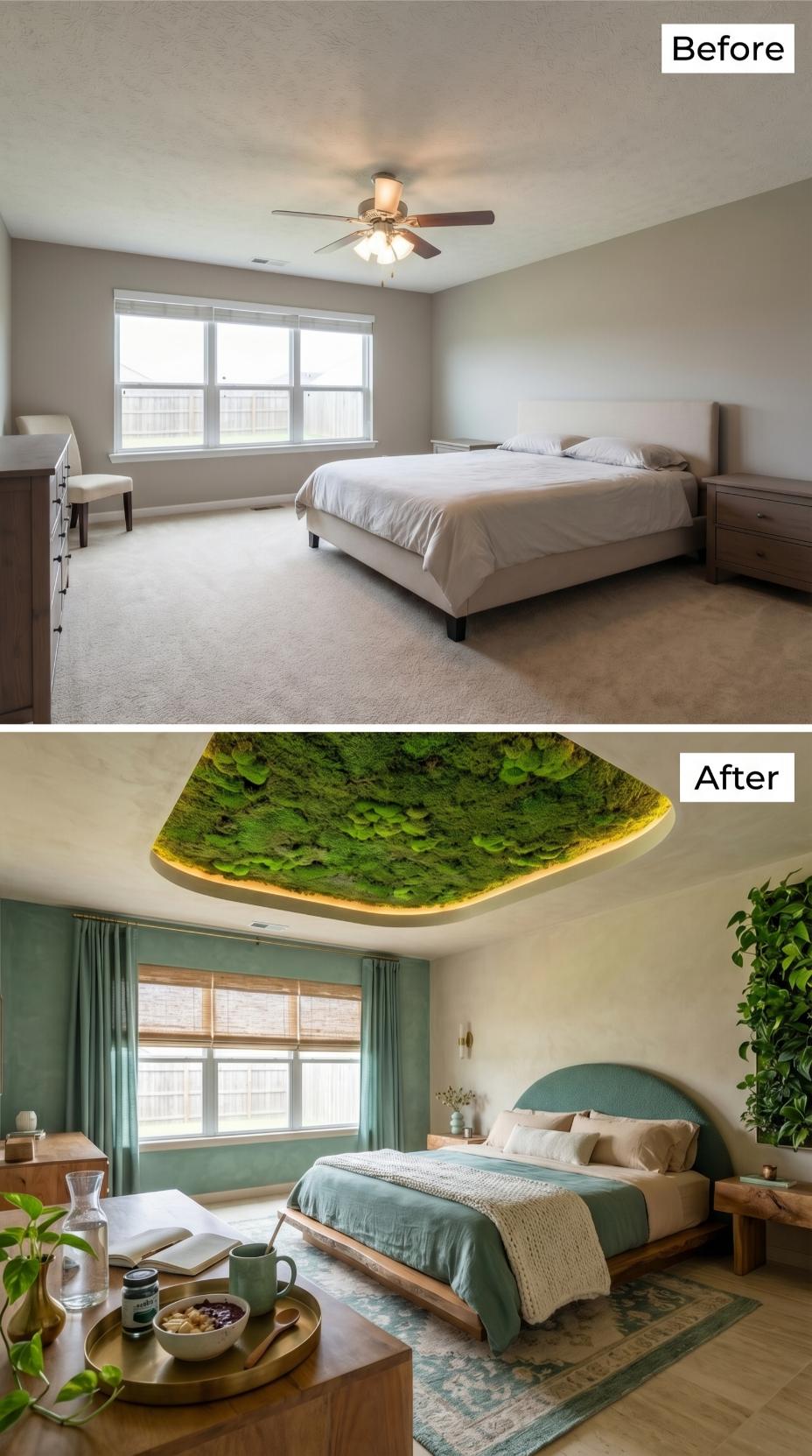
Preserved moss panels cover a recessed ceiling coffer edged with warm LED strip lighting, replacing the builder fan with something closer to a forest canopy. Natural oak forms the platform bed frame and matching bench at the foot.
Sage-teal linen bedding and floor-length curtains in the same family pull the ceiling color down to eye level. Woven bamboo shades, trailing pothos on a wall-mounted shelf, and a live-edge tray on the wood nightstand complete a room designed explicitly for slow mornings.
The Psychology Behind This: Biophilic design research consistently links visual access to natural materials, including preserved moss and living plants, with lower cortisol levels and faster cognitive recovery after stress. Bedrooms built around these elements tend to reduce the psychological friction between waking up and feeling ready to function. For people who linger in bed with coffee and a book, that slower metabolic gear is exactly the point.
9. Coffered Oak Ceiling and Terracotta Plaster Walls Retire the Builder Fan for Good
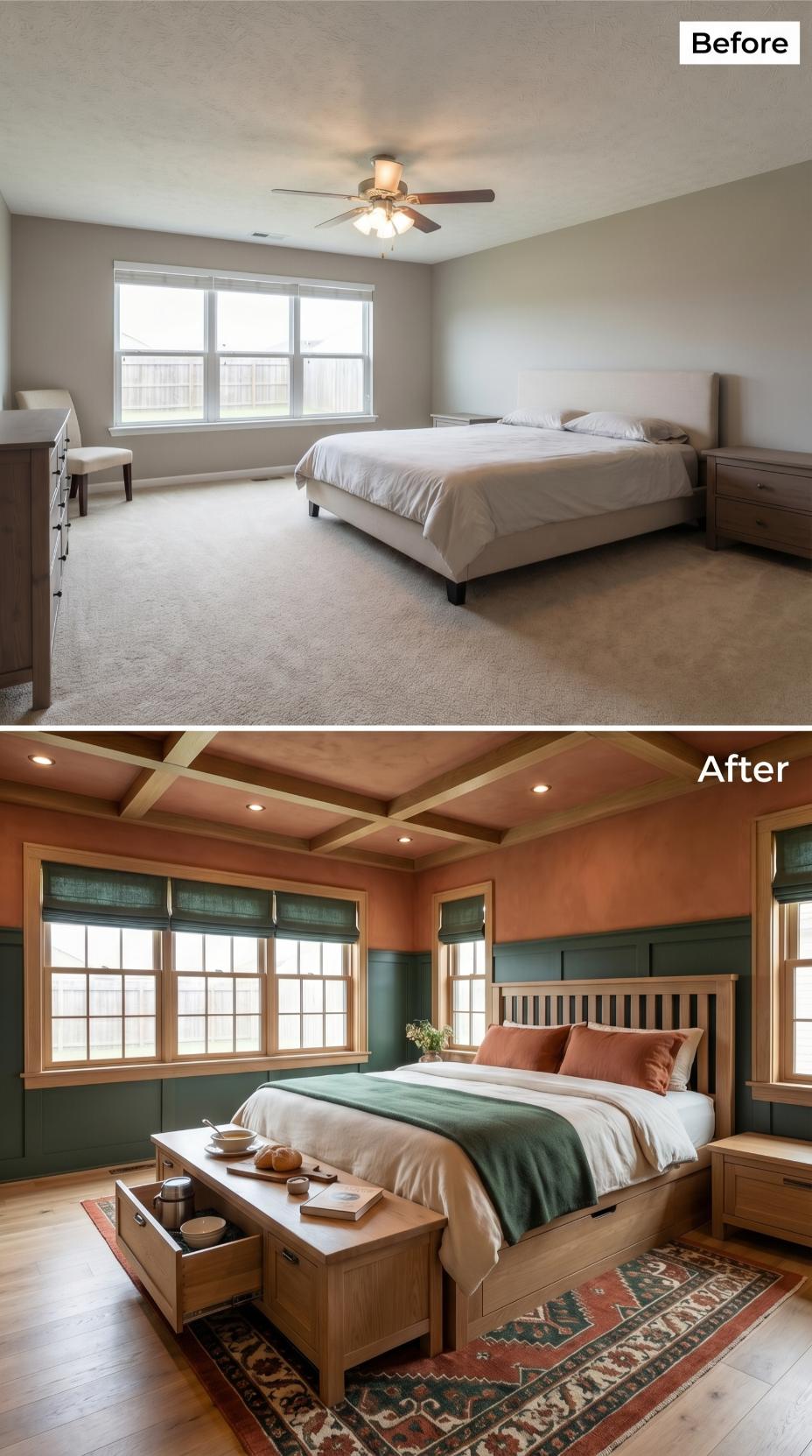
Honey-toned oak beams grid a coffered ceiling fitted with recessed cans, replacing the generic paddle fan entirely. Below, terracotta Venetian plaster meets sage-green wainscoting paneled in a flat-rail profile. A craftsman-style slatted headboard anchors the oak storage bed, which opens at the footboard to hold trays, remotes, and everything else a person needs without leaving the mattress.
Worth Knowing: Storage beds with lift-top or drawer footboards have grown steadily popular among people who regularly eat or work from bed, since the compartment keeps clutter off nightstands without requiring a separate piece of furniture. The kilim-style wool area rug visible here also performs a practical function, giving bare feet a soft landing on hardwood when reaching for a bedside tray.
8. Lime-Washed Plaster Walls and a Coffered Pendant Ceiling Retire the Carpet and Fan
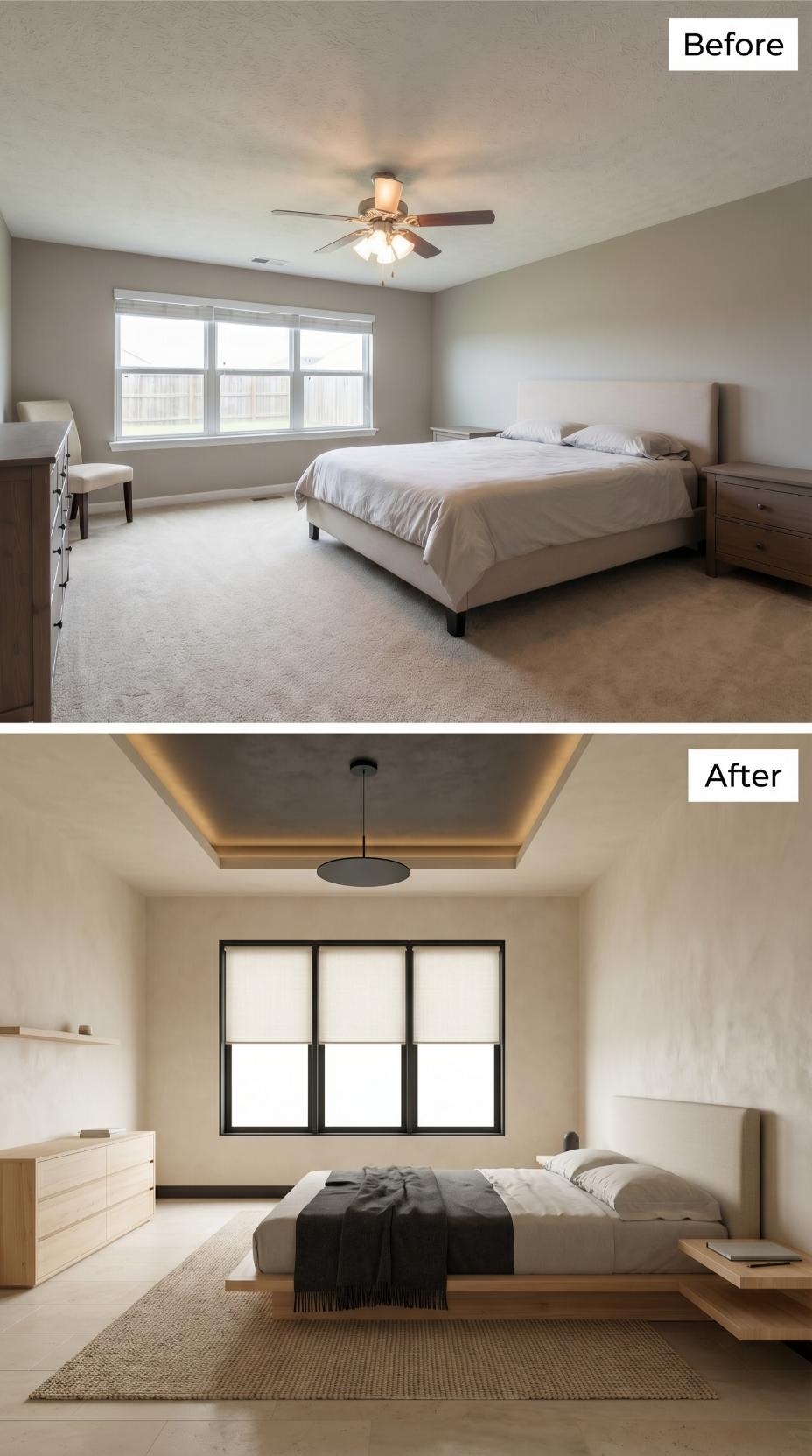
Bleached maple handles the dresser and floating nightstand extensions flanking the platform bed, while lime-washed plaster coats the walls in a texture that reads warm ivory up close and cool greige at a distance. The tray ceiling drops a single matte-black disc pendant at center and runs warm LED strip lighting along the inner cove. Roller shades inside a black steel window frame replace the old vinyl unit entirely.
Designer’s Secret: Floating nightstand extensions built directly into a platform bed frame are a practical detail for people who eat or read in bed, since the surface sits lower than a standard nightstand and keeps plates and glasses within reach without requiring a reach across the body. Specifying them in the same wood as the bed base, here bleached maple, keeps the whole footprint reading as one piece rather than an assemblage of separate furniture.
7. Mauve Velvet Headboard and Cove-Lit Tray Ceiling Swap Carpet and Fan for Hotel Warmth
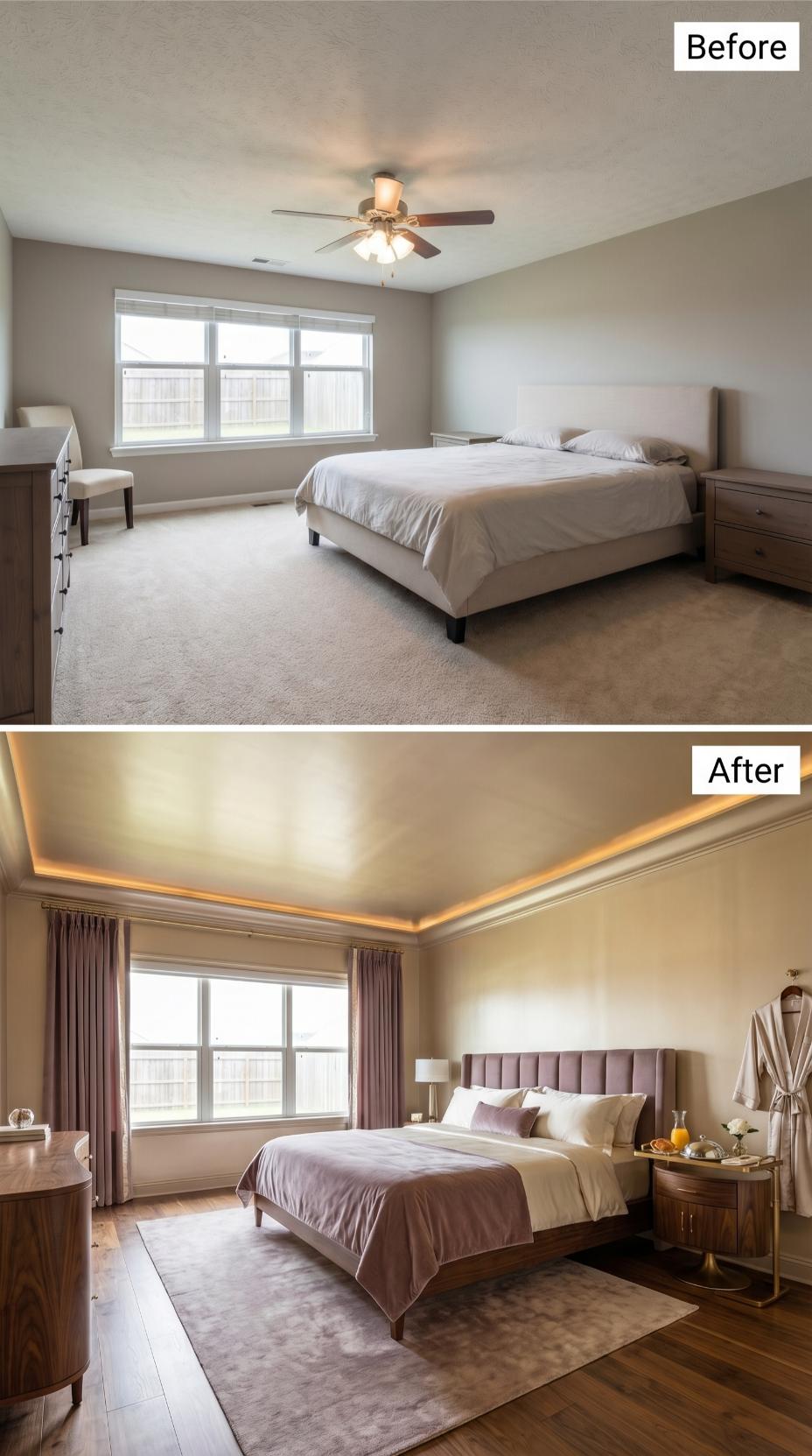
Hardwood planks replace the builder carpet entirely, and the ceiling fan disappears in favor of a recessed tray lined with warm LED strip lighting that washes the cream plaster above in amber. The velvet channel-tufted headboard in dusty mauve anchors the bed, while blush linen bedding and a tone-on-tone area rug keep the palette unified without going flat.
Curtain panels in rose-taupe velvet hang floor-length on either side of the original window, adding height the room previously lacked. A brass-legged service cart beside the nightstand addresses the practical reality of eating in bed, keeping trays and glassware off the mattress entirely.
- Tray ceilings with LED strip lighting draw the eye upward and make standard ceiling heights read taller than they measure
- Channel-tufted velvet headboards provide back support for sitting upright while eating or reading without requiring a separate bolster system
- Brass-legged service carts positioned beside the bed keep food trays stable and at the correct height for in-bed dining
6. Dark Walnut Shiplap Ceiling and Copper Pipe Pendants Swap Carpet for Steampunk Drama
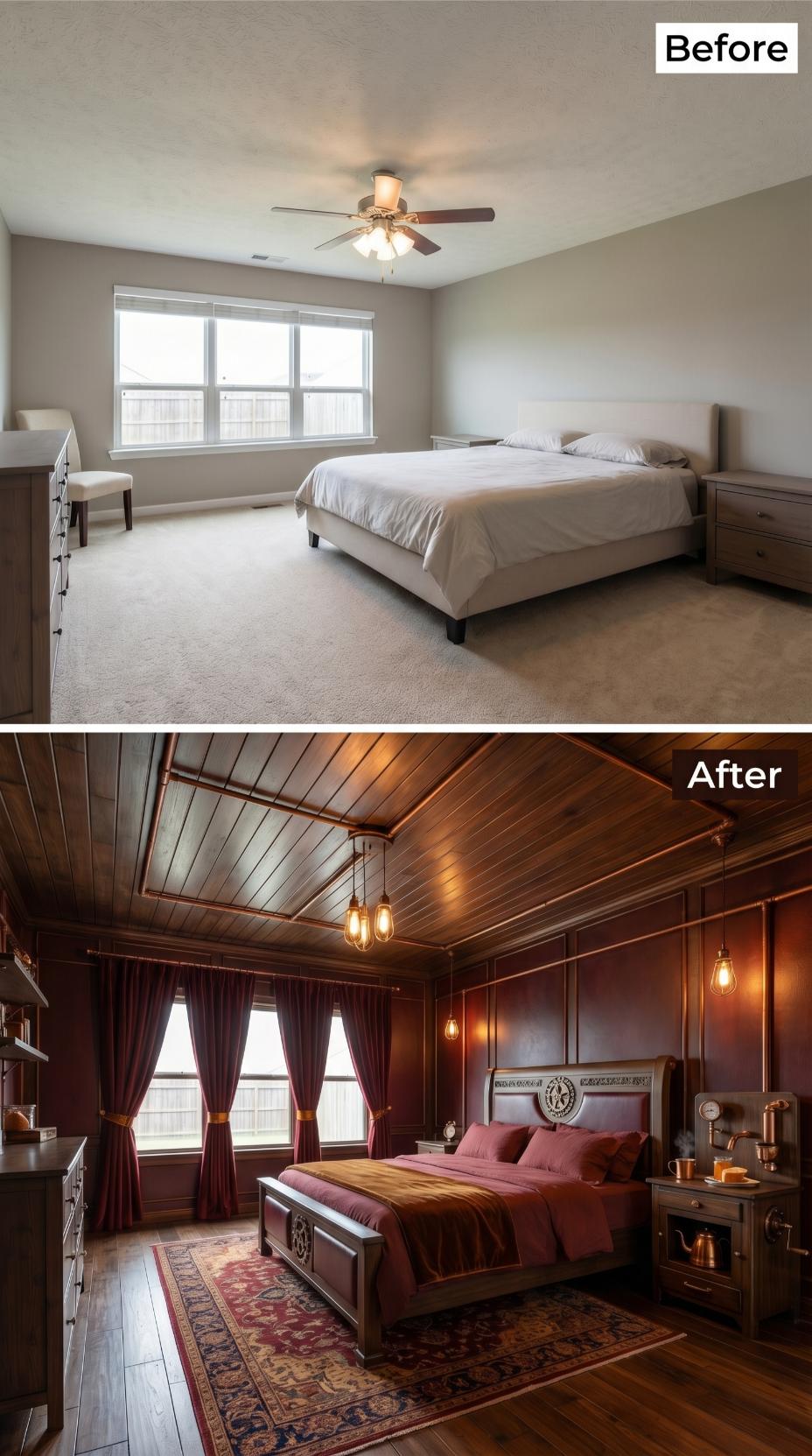
Chocolate-stained shiplap runs the full length of a vaulted ceiling, angled to draw the eye toward two Edison-bulb pendants suspended from exposed copper pipe. Deep burgundy wall panels, divided by vertical wood molding, replace every trace of the original gray paint. The bed itself is a carved sleigh frame in dark mahogany, dressed with crimson bedding and a mustard throw.
A hand-knotted wool rug in red, navy, and ivory anchors the hardwood floor beneath the bed, and burgundy velvet curtains with brass tieback rings frame the original window. Copper-finished wall sconces flank the headboard, and a nightstand beside the bed holds what appears to be a small brass kettle, a detail that quietly signals this room was designed with eating and drinking in bed very much in mind.
Why It Works: Shiplap applied to a vaulted ceiling at an angle rather than horizontally across a flat plane creates a directional pull that standard flat ceilings cannot produce, drawing the eye toward the room’s focal point. Pairing it with exposed copper pipe as a structural lighting element reinforces an industrial logic where raw materials are displayed rather than concealed. The warmth of incandescent Edison bulbs against dark wood prevents the deep palette from reading as heavy rather than rich.
5. Teal Venetian Plaster and a Whale-Bone Chandelier Swap Carpet and Fan for Coastal Drama
🔥 Would you like to save this?
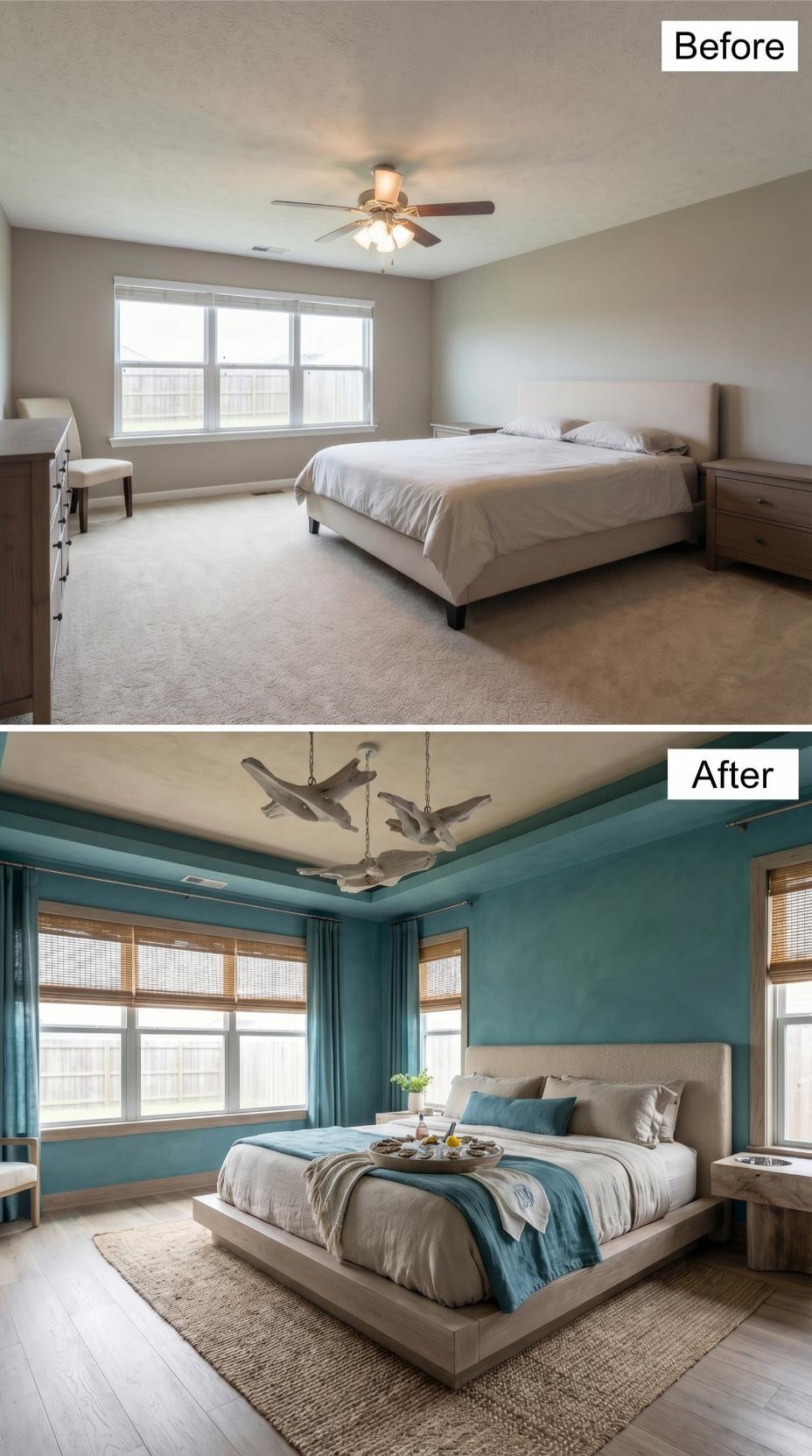
Teal Venetian plaster covers all four walls and the tray ceiling interior, pulling the room into a cohesive underwater palette that the beige carpet era never suggested was possible. Bamboo Roman shades layer against teal linen drape panels, and wide-plank oak flooring replaces the builder carpet entirely.
A platform bed with a linen upholstered headboard sits centered on a jute area rug, dressed in teal throw pillows and a linen coverlet. The organic sculptural chandelier overhead features what appear to be cast resin or driftwood whale forms suspended from chain links.
Why the Tray Ceiling Carries the Same Plaster as the Walls
Painting or plastering a tray ceiling interior in the identical finish as the surrounding walls creates a continuous color envelope that makes the ceiling recess feel deliberate rather than incidental. In this room, the teal wraps the tray boxing with no color break, which visually lowers the ceiling plane just enough to create enclosure around the bed. Rooms with generous square footage, like this one, often feel cavernous without that kind of vertical compression.
4. Ornate Crown Molding and a Cove-Lit Tray Ceiling Replace Carpet and Ceiling Fan with Blush Glamour
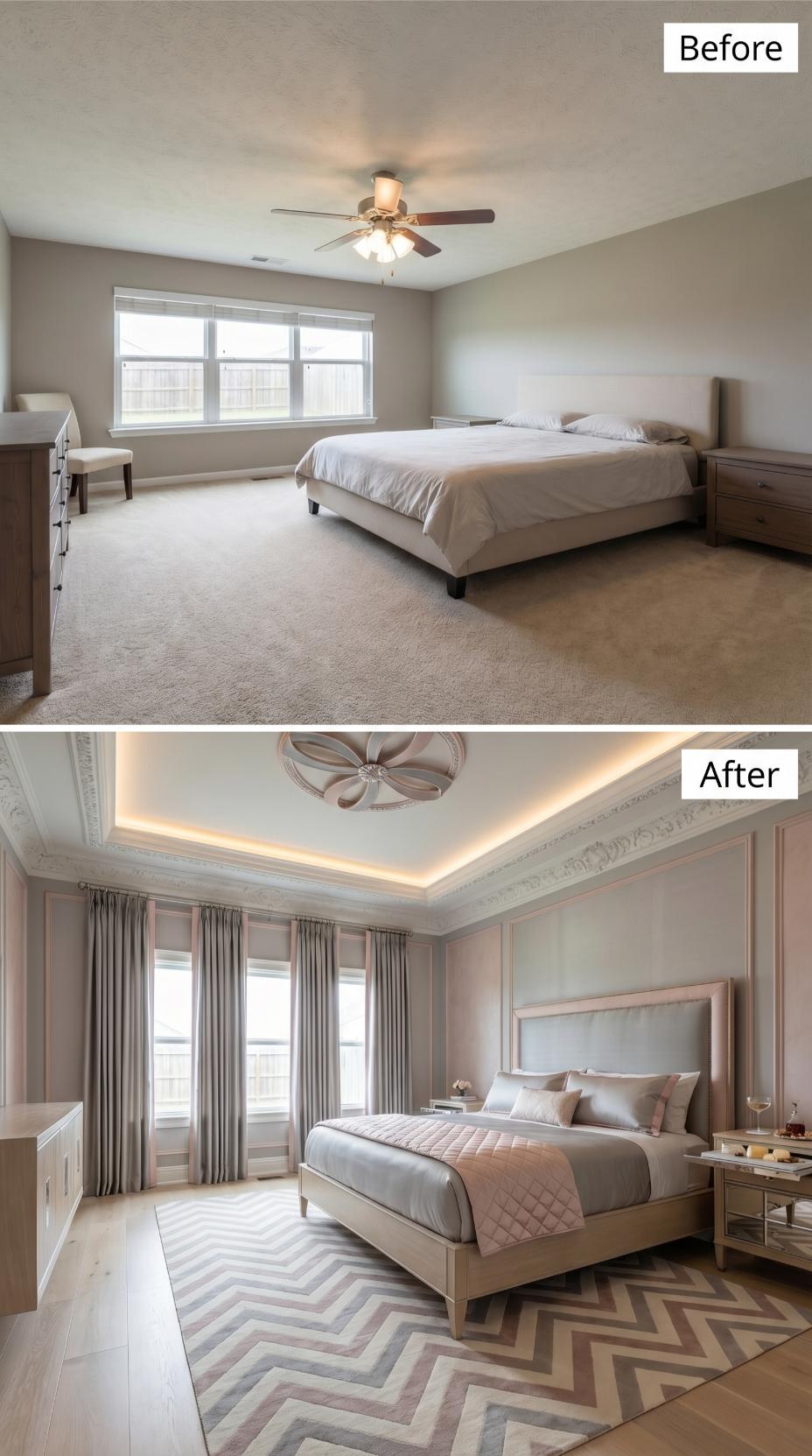
Carpet and a five-blade ceiling fan gave way to wide-plank light oak flooring, a chevron-patterned area rug in taupe and blush, and a tray ceiling ringed with LED cove lighting and detailed plaster crown molding. The bed frame is upholstered in pale greige fabric with a tall paneled headboard trimmed in dusty rose, and the bedding layers silver-grey quilting against a blush pink throw. Mirrored nightstands with brushed champagne hardware flank the bed on both sides.
Floor-to-ceiling grey linen curtains hang from ceiling-mounted rods, visually stretching the room height. A low white built-in dresser anchors the left wall. Overhead, a sculptural flush-mount light with petal-shaped blades in rose gold serves as the ceiling’s focal point within the tray.
Editor’s Note: Chevron rugs laid beneath a bed require precise centering to avoid a disorienting visual pull toward one side of the room. The standard practice is to align the chevron’s center point with the bed’s vertical axis, which keeps the pattern from appearing to slide. Getting this wrong is one of the more common mistakes in rooms where large-format geometric rugs meet symmetrically placed furniture.
3. Exposed Beam Tray Ceiling and Carved Oak Bed Trade Carpet and Fan for Farmhouse Warmth
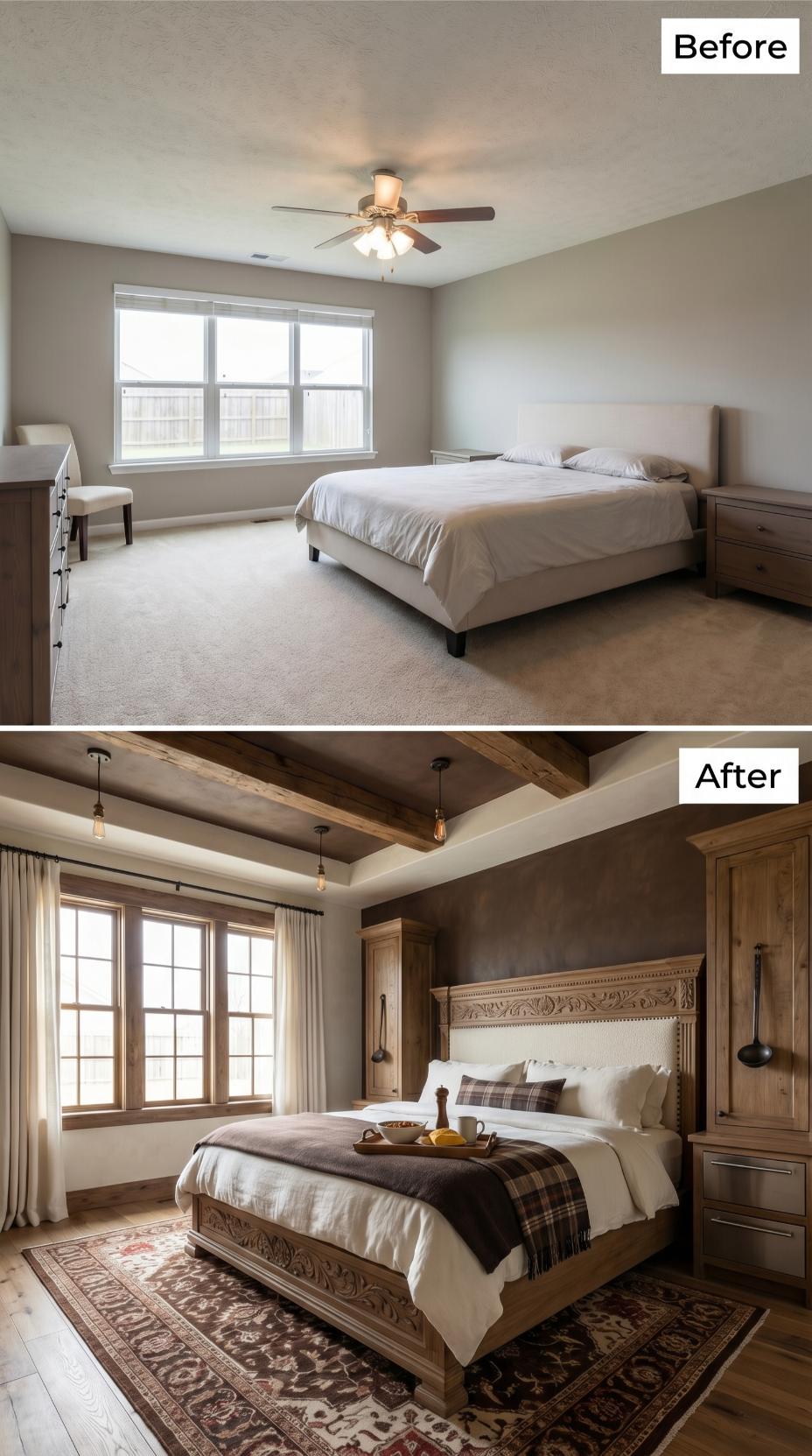
Reclaimed wood beams cross a tray ceiling painted in deep tobacco brown, anchoring pendant lights with Edison bulbs above a hand-carved oak bed frame with acanthus-leaf detailing along the headboard rail. Wide-plank hardwood flooring replaces carpet, and a wool Persian rug in burgundy and ivory grounds the bed. Linen drapes hang from iron rods beside gridded wood-framed windows.
Reclaimed wood beams cross a tray ceiling painted in deep tobacco brown, anchoring pendant lights with Edison bulbs above a hand-carved oak bed frame.
2. Charcoal Tray Ceiling with LED Cove Strip Replaces Fan and Carpet for Dark-Palette Drama
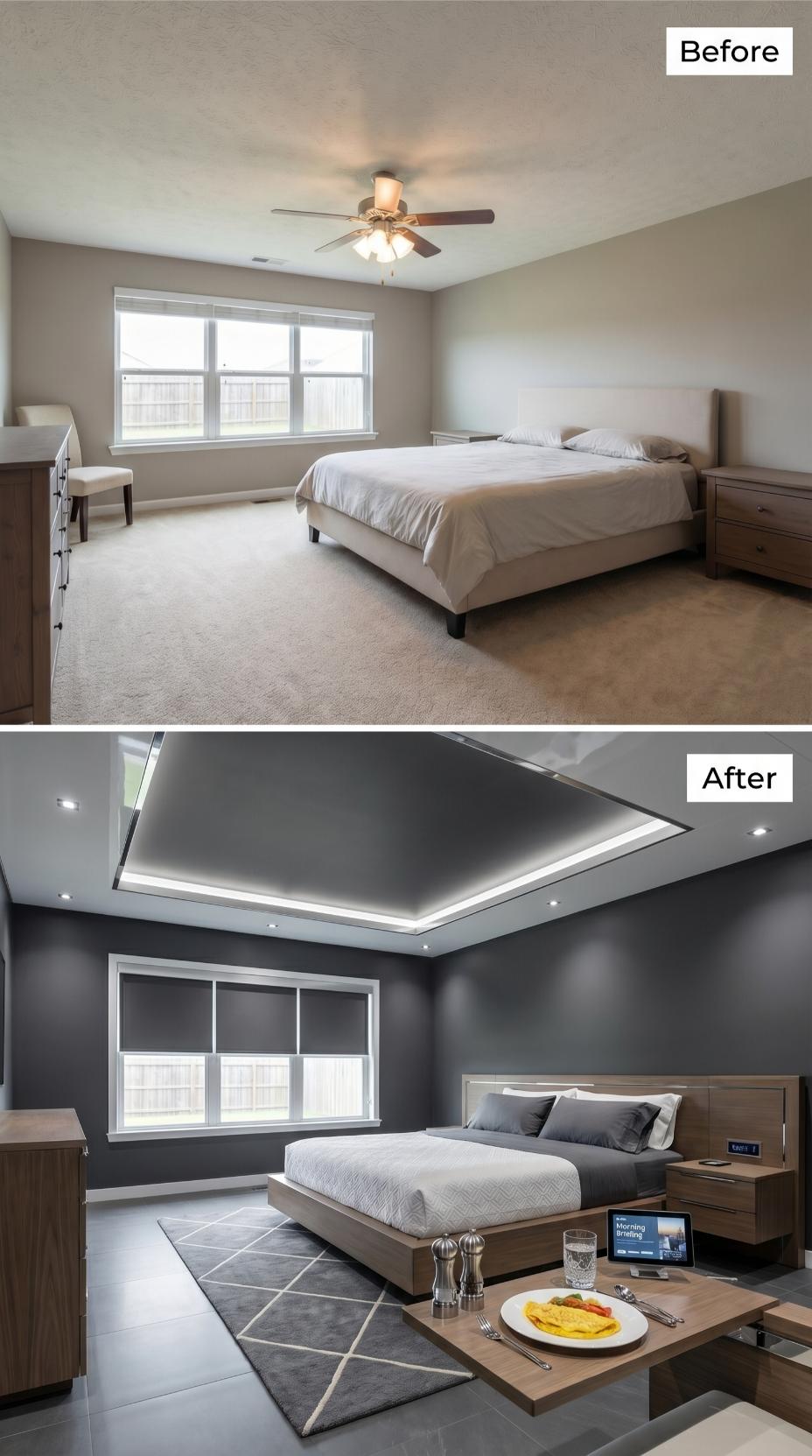
Dark slate walls and large-format porcelain floor tile in a grid pattern anchor a room that once relied on beige carpet and a builder ceiling fan.
Material Matters: Recessed LED strip lighting installed along the inner perimeter of a tray ceiling produces a layered glow that reads differently at various times of day, making blackout roller shades a practical pairing rather than an afterthought. Porcelain tile in a large format reduces grout line frequency, which matters in a bedroom where crumbs from in-bed meals need a wipeable surface rather than textile fibers. The low-profile wood platform bed with integrated side tables keeps condiment bottles, a water glass, and a tablet within reach without requiring a separate piece of furniture.
1. Tuscan Tray Ceiling and Cobalt Tile Wainscoting Swap Fan and Carpet for Mediterranean Warmth
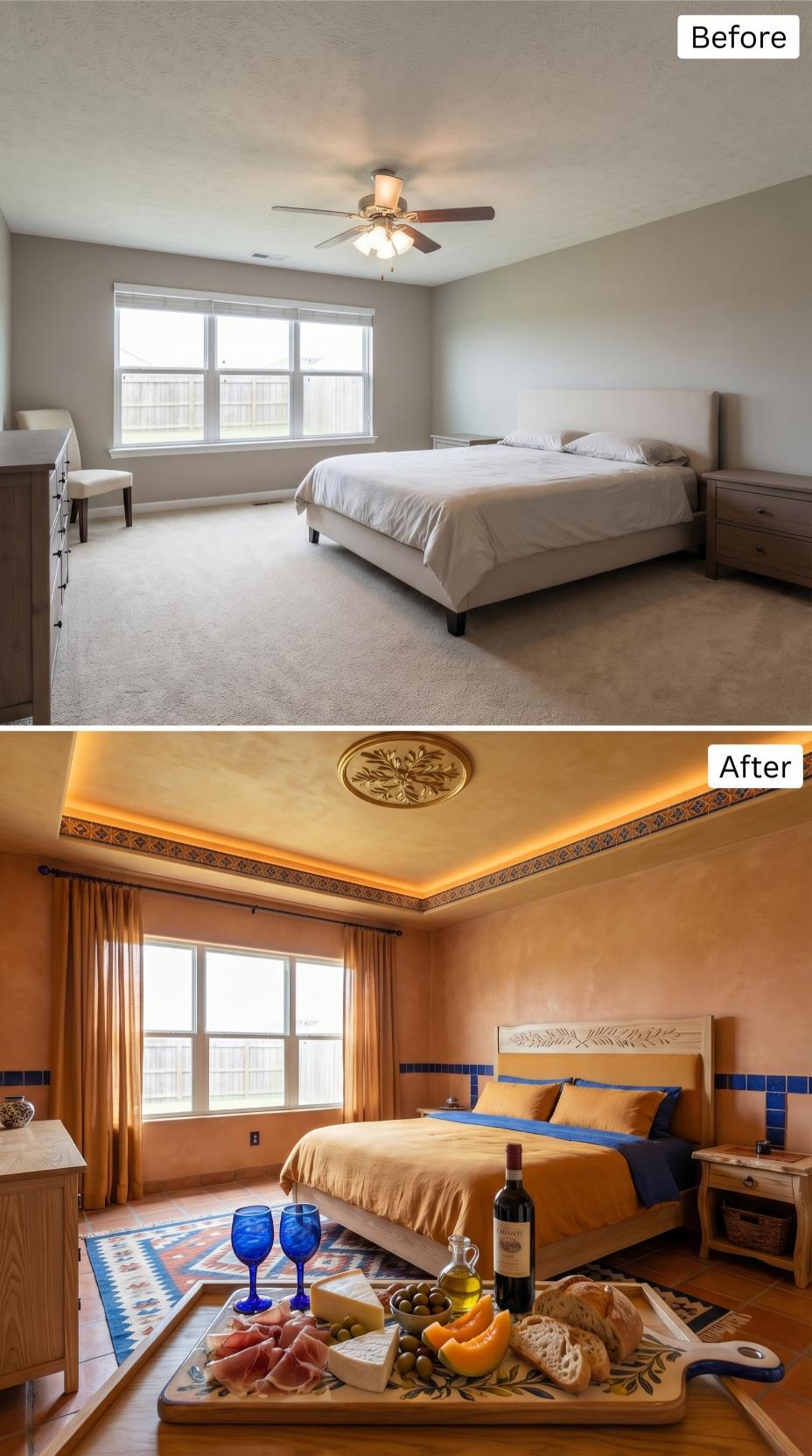
Warm terracotta plaster covers every wall from floor to the tray ceiling break, where a band of hand-painted blue-and-rust geometric tile runs the full perimeter like a frieze. LED cove strips tucked behind the tray edge replace the builder fan entirely, casting amber light across a gold medallion at the ceiling center. The bed frame is whitewashed pine with carved wheat detailing on the headboard, dressed in saffron linen and cobalt cotton shams that pull directly from the tile palette.
On the floor, terracotta pavers replace the original carpet, grounded by a flat-weave Southwestern-patterned rug in rust, ivory, and indigo. A low wooden tray on the rug holds a full spread: prosciutto, olives, cantaloupe, crusty bread, and a bottle of red wine in two cobalt glass goblets, making the case that eating in bed does not require a headboard at all.
Budget Tip: Skipping the tile installer for wainscoting is possible if you source peel-and-stick encaustic cement tiles, which have improved significantly in adhesion quality and now hold reliably on properly primed drywall. A single accent row at chair-rail height runs roughly 30 to 45 linear feet in most primary bedrooms, keeping material costs under $200 for most tile styles in that format.