🔥 Would you like to save this?
On the fifth morning, she woke up before the alarm and realized something she hadn’t expected. It wasn’t the vacation she wished she could take home—it was the bedroom. The quiet. The uncluttered nightstands. The layered bedding that made climbing back in feel irresistible. The lighting that softened the room instead of exposing every flaw. Somewhere along the way, home had become the place she slept instead of the place she rested. These primary bedroom makeovers capture the same feeling that makes checking out of a beautiful hotel so disappointing—and finally bring it home for good.
In order to come up with the very specific design ideas, we create most designs with the assistance of state-of-the-art AI interior design software. Also, assume links that take you off the site are affiliate links such as links to Amazon. this means we may earn a commission if you buy something.
34. Dark Ceiling, Warm Wood, and a Lighting Trick That Changes Everything
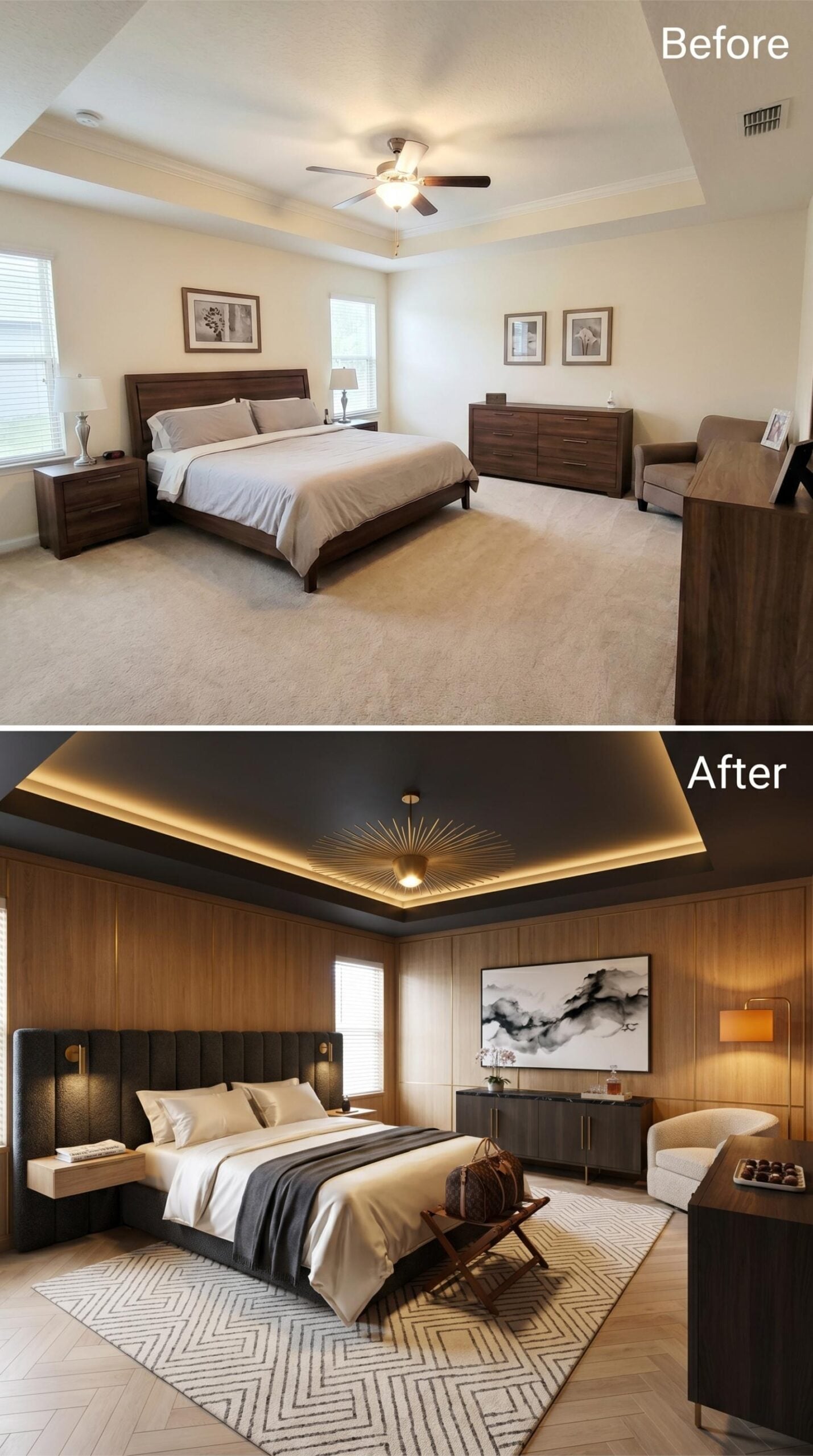
Warm-toned wood paneling runs floor to ceiling on every wall, giving the room the density of a five-star suite rather than a suburban master. The tray ceiling is painted near-black, and LED strip lighting tucked into the recess casts a soft amber glow that makes the whole room feel like it’s lit from within. A sunburst pendant anchors the center, its gold finish pulling the eye upward.
The bed has a tall channeled headboard in charcoal upholstery, flanked by floating nightstands with brass sconces built directly into the panel. A geometric area rug in cream and gold grounds the layout, and a folding campaign bench at the foot of the bed adds just the right amount of utility without fussiness.
33. Navy Walls, Coffered Wood Ceiling, and the Rug That Anchors It All
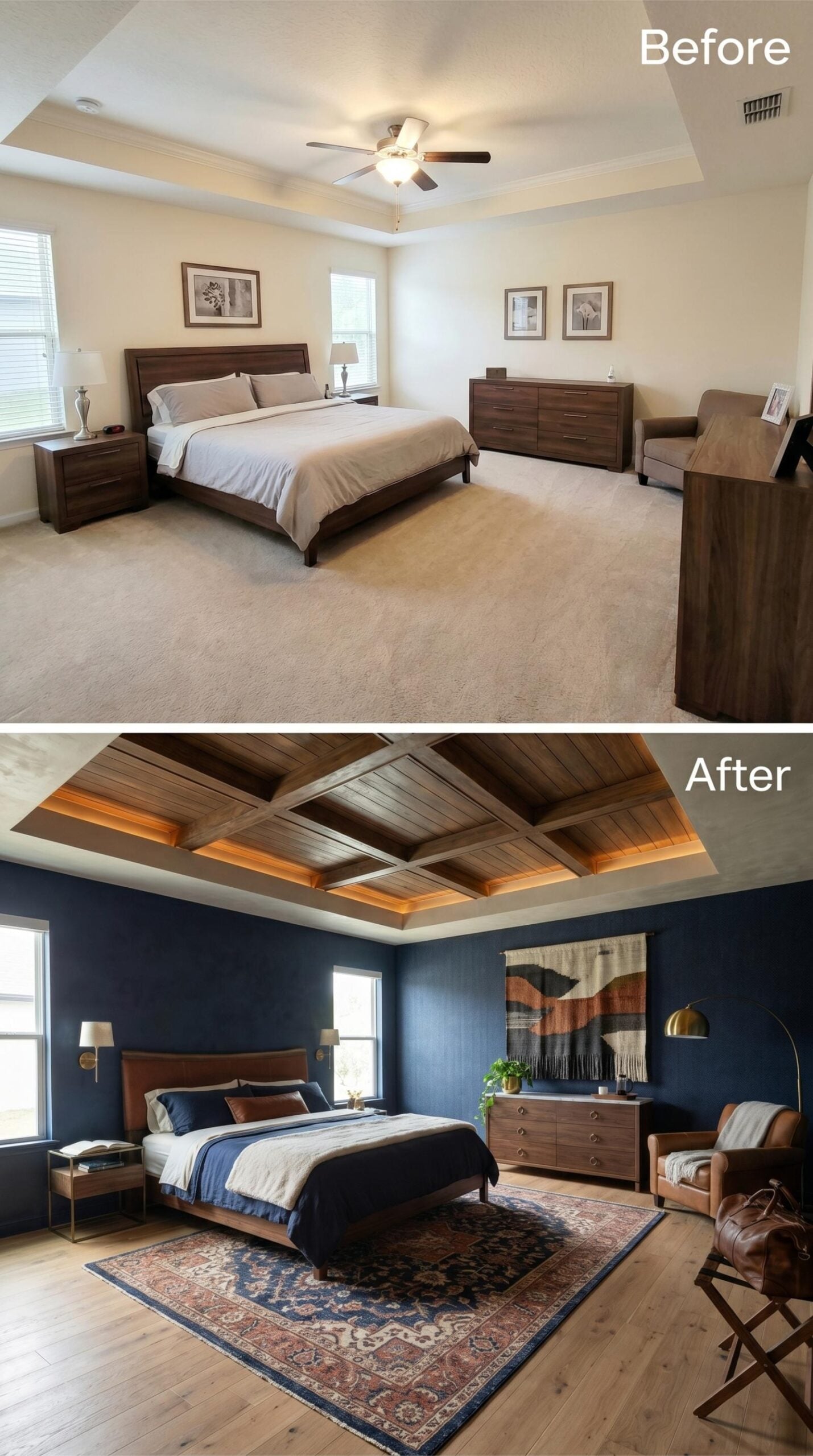
The coffered ceiling is doing real work here. Wood planks laid inside a grid of beams, with LED strips tucked along the tray perimeter casting amber light upward, it gives the room a club-like intimacy that no pendant fixture could replicate.
Navy walls pull the drama down to eye level, and the Persian-style rug in navy and rust ties the whole palette together without trying too hard. The leather headboard and walnut dresser keep things grounded. It reads like a boutique hotel room that someone actually lives in.
32. Concrete Walls, a Sculptural Bed, and Globe Pendants That Steal the Ceiling
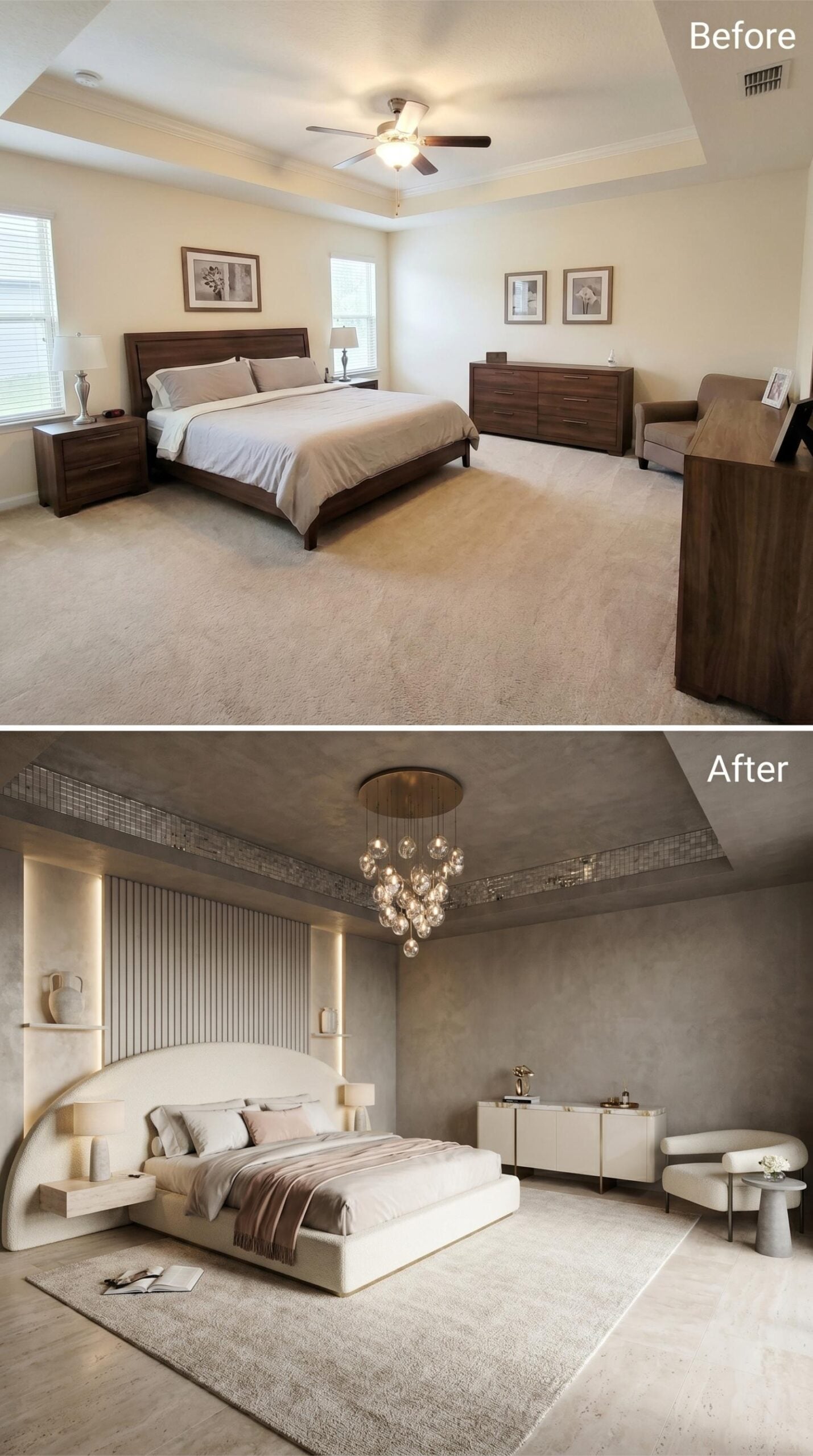
Plaster-finish walls in warm greige set the tone, but it’s the arched upholstered headboard that commands attention. Quietly confident furniture choices surround it.
Why That Chandelier Works So Well Here
The cluster of glass globe pendants doesn’t hang from a decorative medallion but instead drops from a flat circular canopy flush against the tray ceiling. That restraint keeps the fixture from feeling ornate. It reads as sculptural, not decorative, which is exactly what a room this serious needs.
31. Wood Slat Ceiling, Sputnik Chandelier, and Rust Bedding That Feels Like a Resort Suite
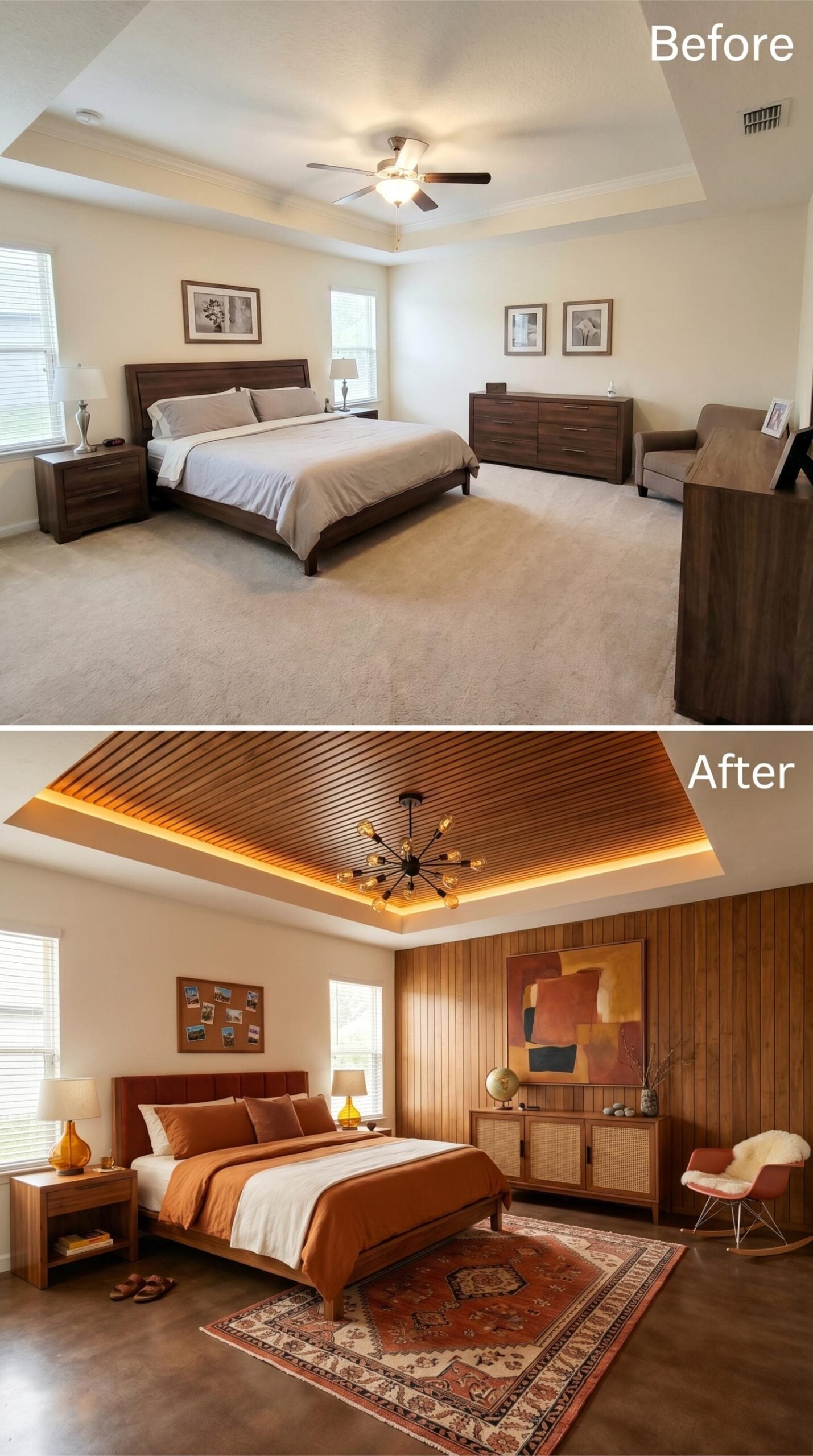
Horizontal wood slats cover the tray ceiling’s recessed panel, with LED strip lighting tucked along the perimeter casting that amber glow hotels spend thousands to replicate. Below it, a black Sputnik chandelier pulls the eye down without competing. Burnt-orange velvet on the headboard and matching bedding anchor the room’s palette, grounded further by a Persian rug in rust and cream.
Fun Fact: Wood slat ceilings, sometimes called slatted or batten ceilings, have roots in mid-century Scandinavian design and were widely used in high-end hotels throughout the 1960s. Pairing them with hidden LED strips is a contemporary trick that adds warmth without adding visible hardware. The result reads as both retro and current, which is why the combination keeps showing up in luxury hotel redesigns.
30. Forest Green Ceiling Mural, a Lantern Pendant, and Built-In Shelving That Earns Its Place
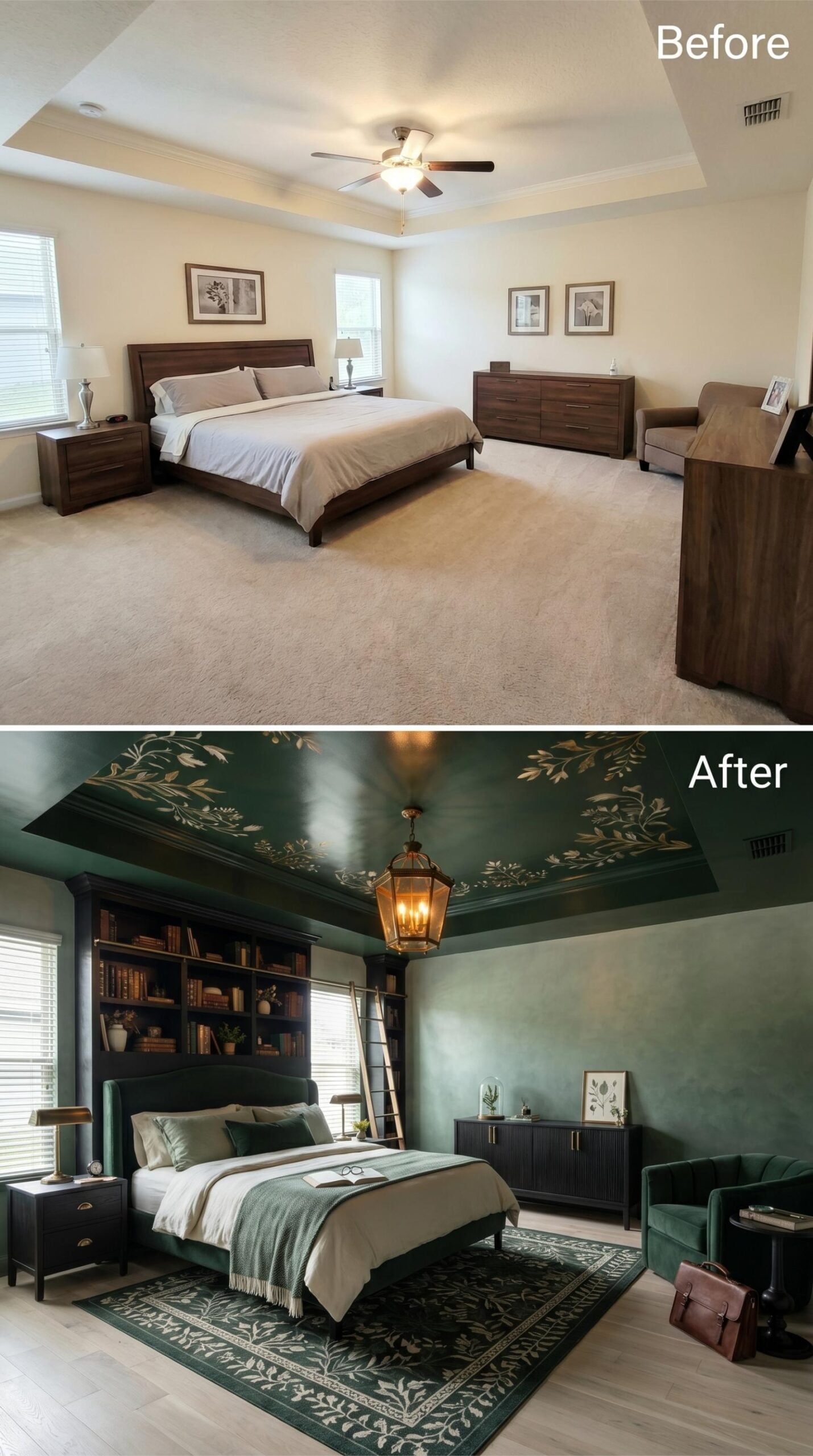
Deep forest green covers every surface of the tray ceiling, and someone painted gold botanical motifs directly onto it. That detail does more work than any light fixture could. A wrought-iron lantern pendant hangs at the center, its warm candlelight glow pulling the eye upward and holding it there.
Floor-to-ceiling built-in shelving flanks the headboard wall, painted the same near-black green as the bed frame’s velvet upholstery. A rolling library ladder leans against it. The area rug repeats the botanical pattern from above, which ties the room together without feeling like a designer showing off.
29. Botanical Ceiling Art, a Pendant Swap, and Hardwood That Finally Lets the Room Breathe
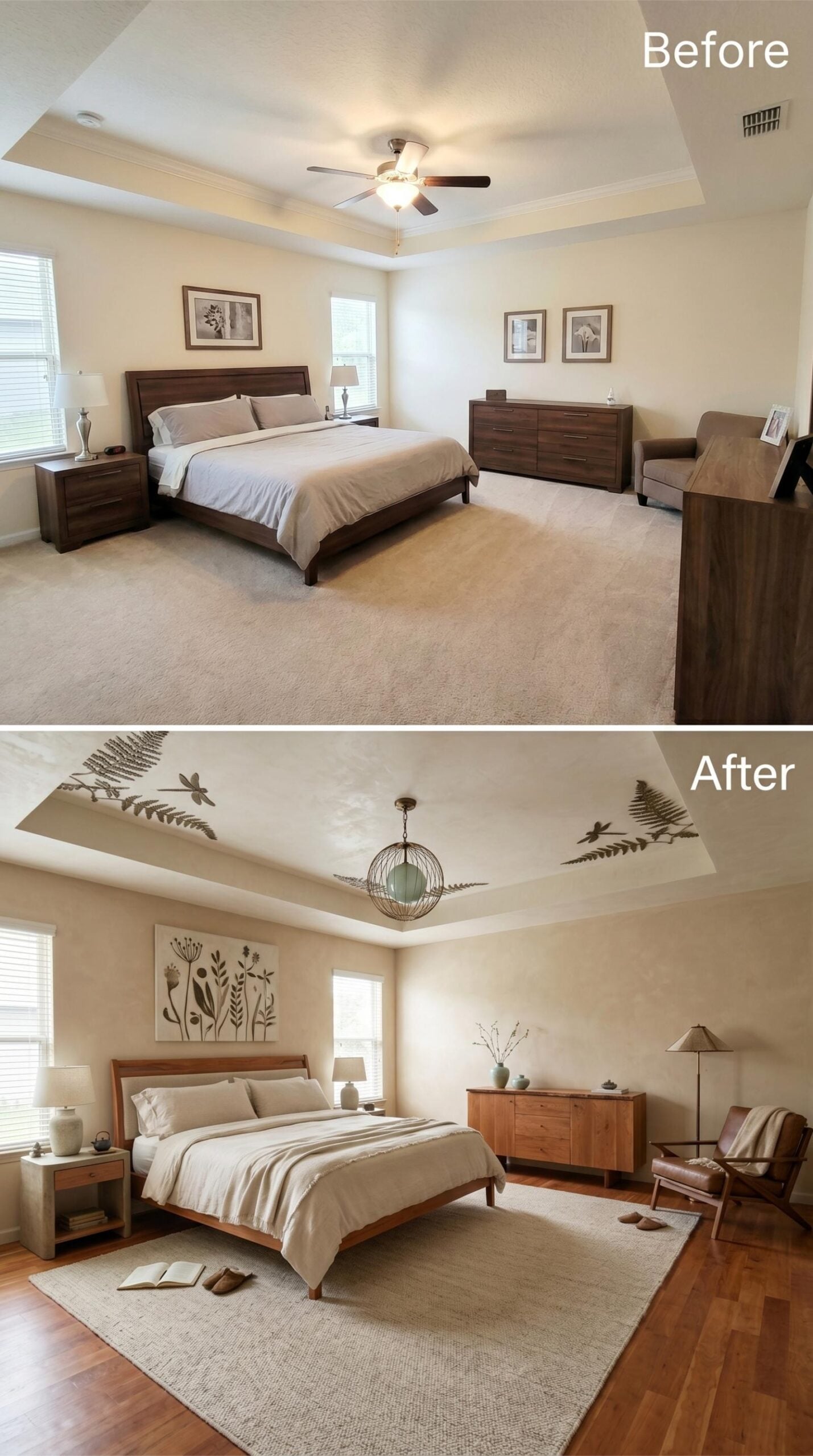
Painted fern and dragonfly silhouettes on the tray ceiling do what most art can’t: they make you look up. It’s an unexpected choice, and it works because the rest of the room stays quiet enough to let the ceiling carry the moment.
Light oak furniture keeps things from feeling heavy, and a woven area rug grounds the bed without competing. The wire globe pendant replacing the ceiling fan is the edit that matters most here. Smaller than it looks in photos, but decisive.
Quick Fix: Swapping a builder-grade ceiling fan for a pendant light is one of the most affordable ways to change a bedroom’s character. Fans can move to a less visible room, or a flush-mount fan can be added nearby if airflow is a real concern. The visual trade-off is almost always worth it in a primary bedroom.
28. Cove Lighting, Venetian Plaster Walls, and a Platform Bed That Owns the Room
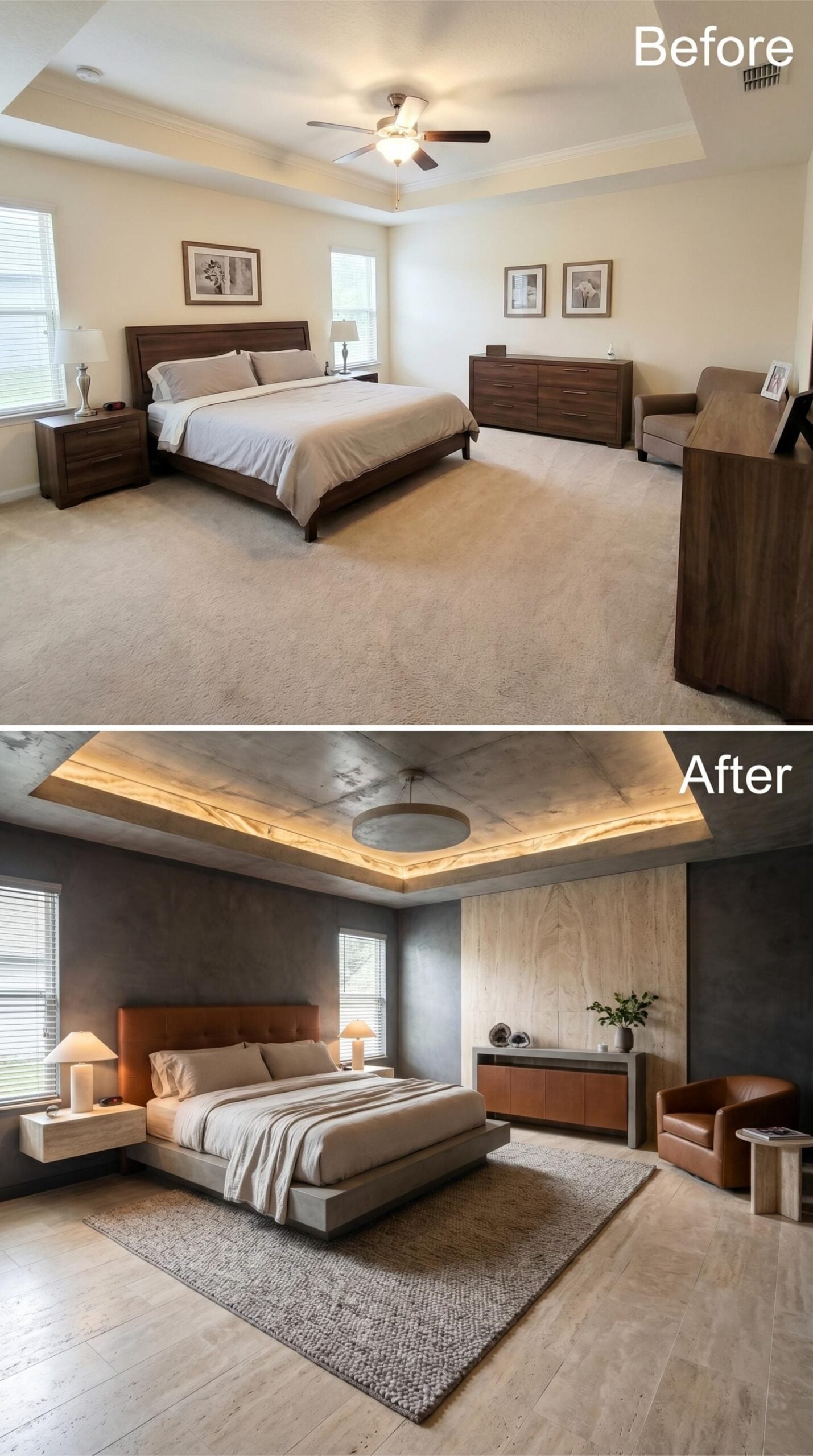
Indirect cove lighting runs the full perimeter of the tray ceiling, casting amber light upward onto a marbled plaster finish that looks like something out of a Roman spa. It replaced the ceiling fan entirely. That single move changed the room’s entire mood.
Below, a low-profile platform bed in concrete-toned upholstery anchors a chunky woven rug, while an accent wall in bleached wood veneer gives the charcoal plaster somewhere to breathe. The leather club chair in cognac pulls just enough warmth into what could’ve read as cold.
27. Coffered Ceiling, Sage Walls, and Mission Oak That Reads Like a Craftsman Lodge
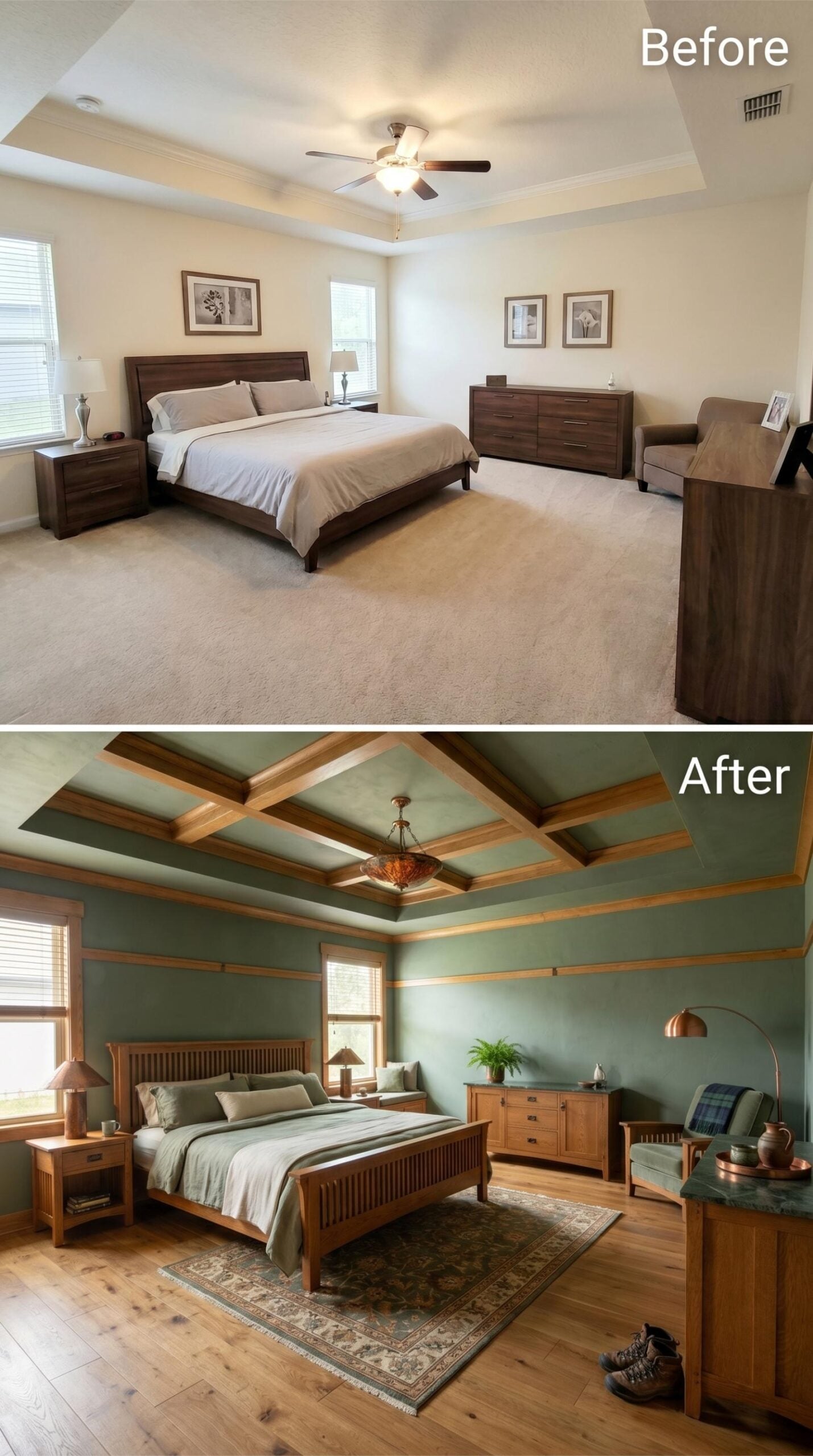
Sage green walls and a coffered ceiling with oak trim give this room an architectural weight that most bedrooms never achieve. The ceiling’s grid pattern pulls the eye up before it even registers the furniture below. And that pendant fixture, a copper-toned lantern style, sits exactly where a bland fan used to be.
Mission-style oak furniture does a lot of work here. The slatted headboard, the matching nightstands with open shelves, the sideboard against the far wall. It’s cohesive without being a showroom set. Hardwood floors replace what was almost certainly carpet, and a traditional area rug grounds the bed without competing with the ceiling’s geometry.
In The Details: Coffered ceilings, once reserved for formal living rooms and studies, are showing up in primary bedrooms as homeowners push for architecture that reads as intentional rather than builder-standard. Adding wood trim to an existing tray ceiling is one route that avoids a full structural build-out. The oak detailing here does exactly that, borrowing from the Craftsman tradition of letting joinery be the decoration.
26. Navy Lacquer Ceiling, Greek Key Rug, and a Chandelier That Commands the Room
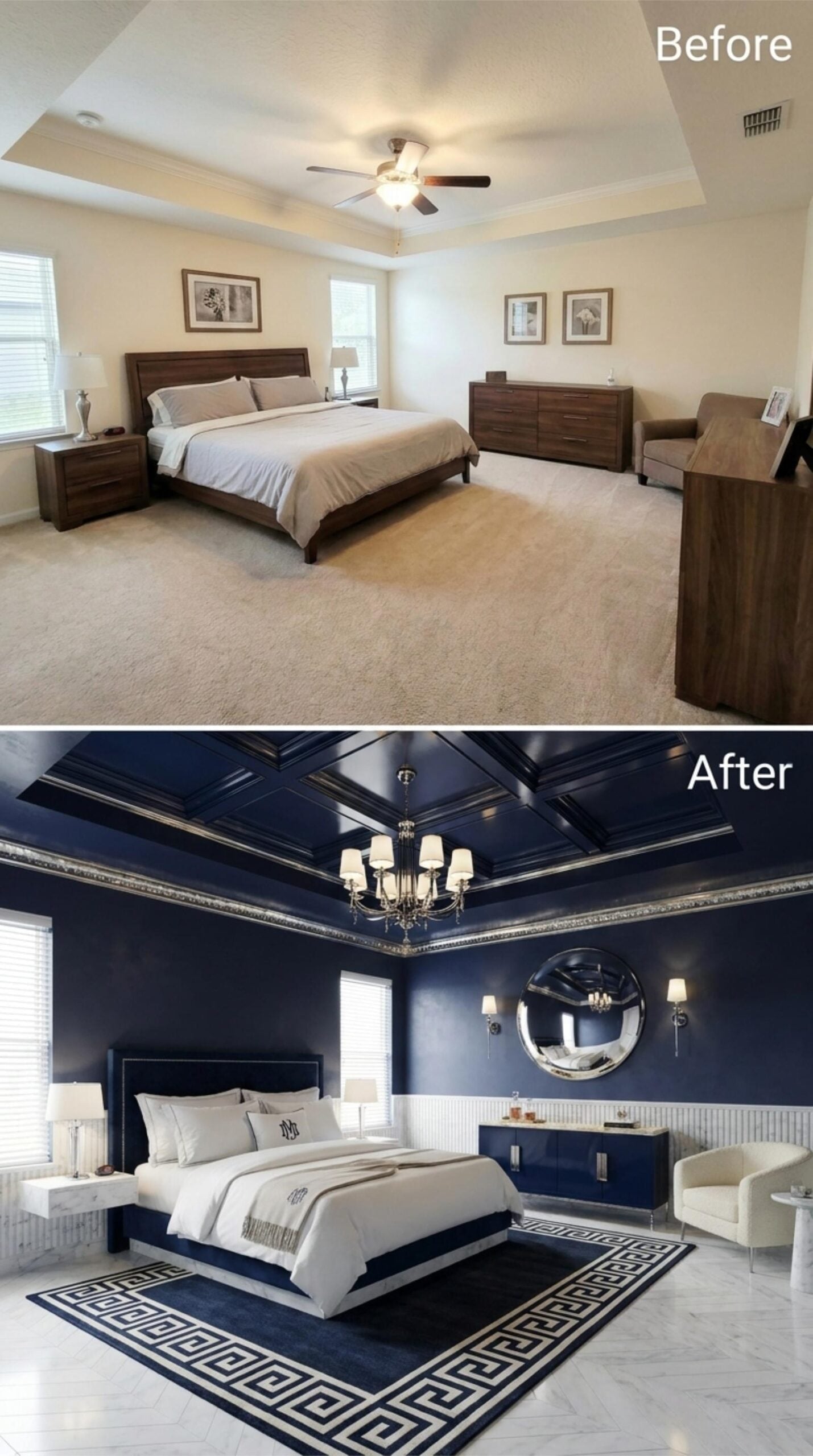
Bold navy covers every surface from the wainscoting up, including the coffered tray ceiling finished in a high-gloss lacquer that reflects the chandelier’s candlelight arms. Marble tile replaces carpet below. The Greek key rug grounds the upholstered navy bed without competing with it.
25. Tray Ceiling, Wood Slat Detail, and a Paper Pendant That Resets the Whole Mood
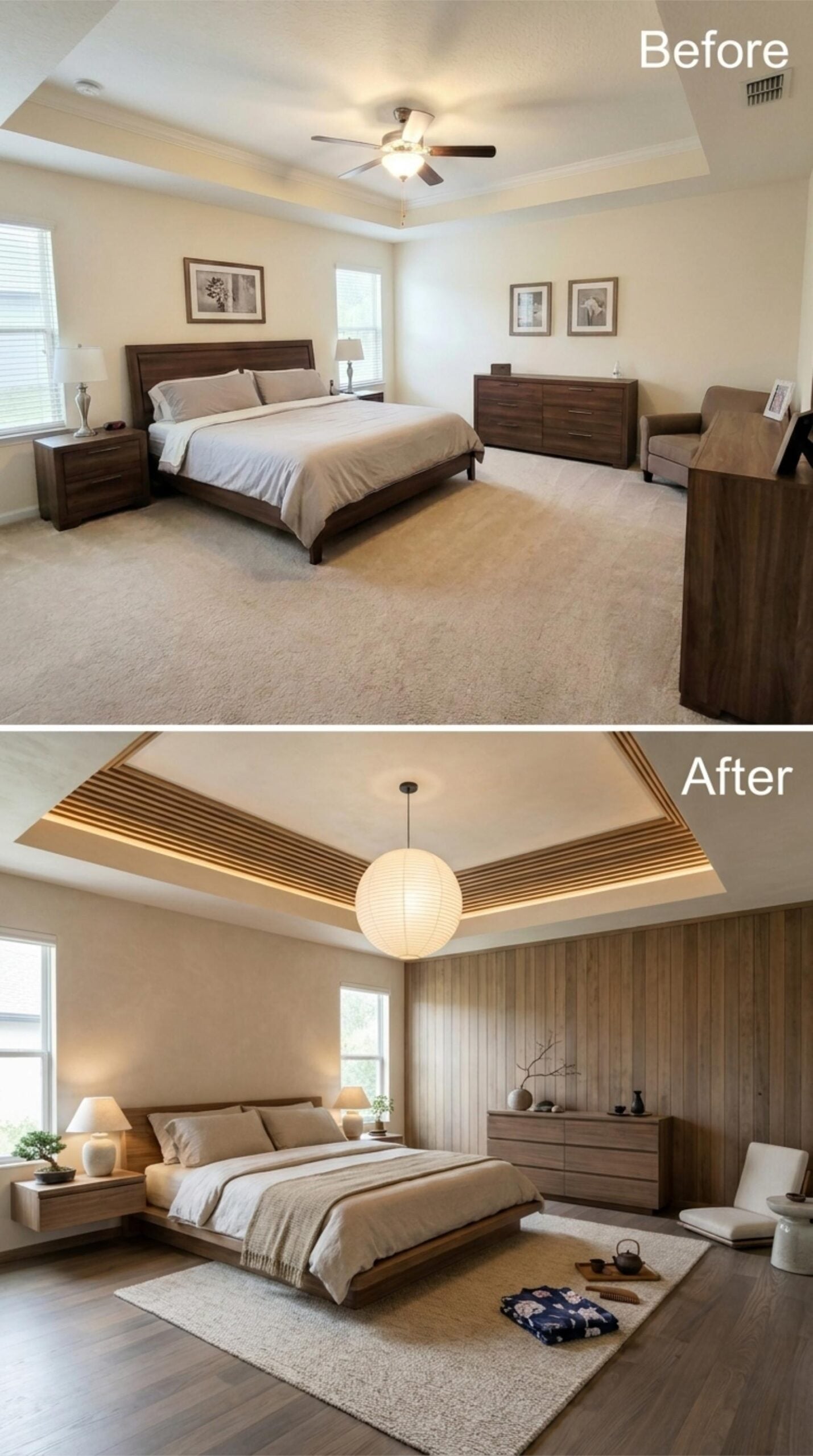
Wood slat trim lines the inner edge of the tray ceiling, with LED strip lighting tucked behind it casting a glow that’s warm without being dramatic. Removing the ceiling fan opened up the center for a rice paper globe pendant, and it’s the kind of swap that makes the entire ceiling feel intentional rather than inherited.
The back wall is clad floor-to-ceiling in vertical wood planks, which grounds the low-profile platform bed without crowding it. A bonsai on the nightstand, a floor-level tea arrangement on the rug, and a zaisu chair in the corner keep the styling grounded in Japandi principles without leaning into cliché.
Material Matters: Rice paper pendants diffuse light softly and are among the more affordable statement fixtures available, making them a practical choice when a room’s ceiling needs a focal point without added visual weight. The Noguchi Akari lamp series popularized the form in the mid-20th century, and the silhouette has remained a fixture in minimalist interiors ever since.
24. Emerald Walls, an Art Deco Ceiling Medallion, and Green Velvet That Means Business
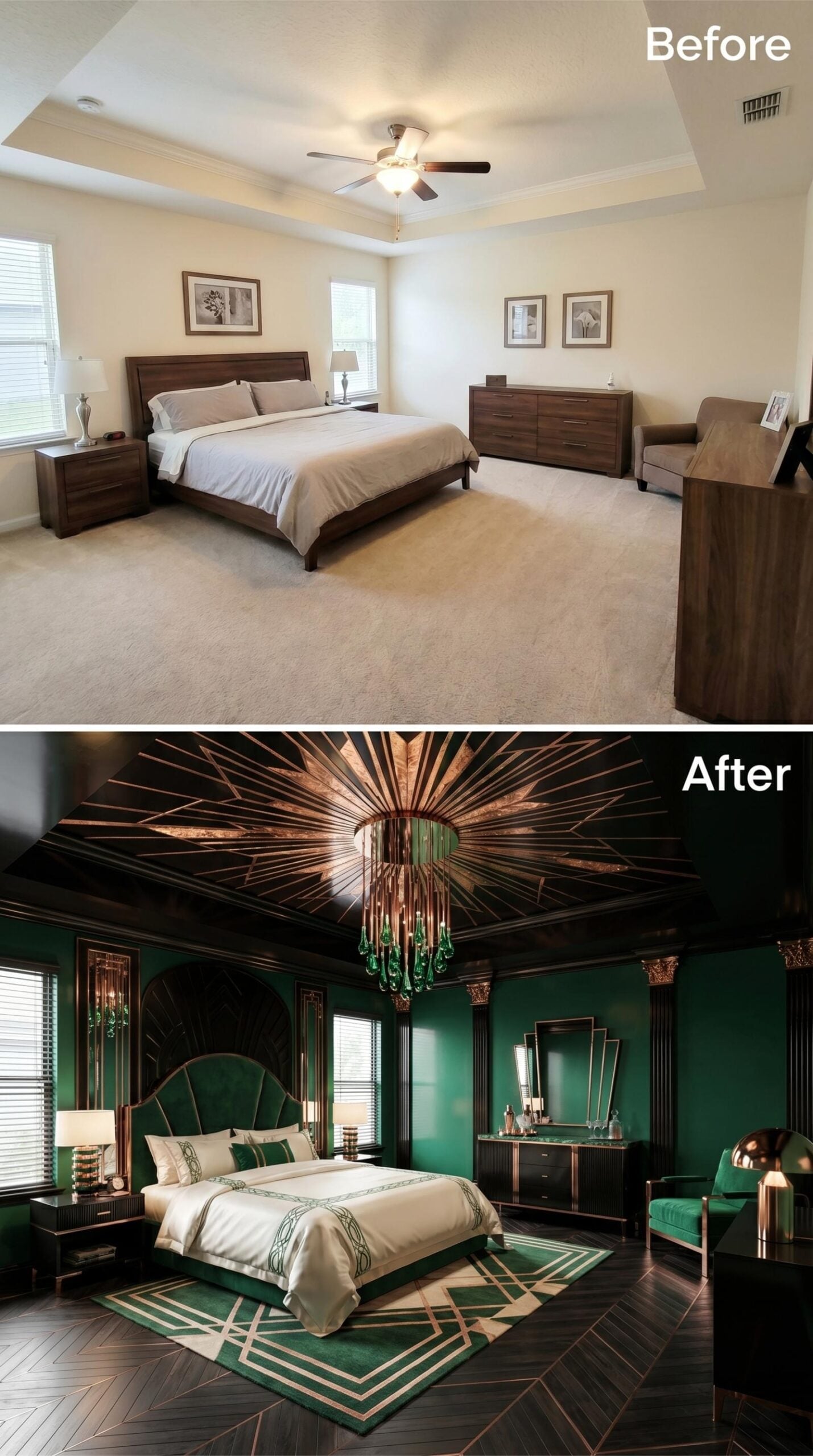
Saturated emerald lacquer covers every wall, and the ceiling goes even darker with a painted black ground and radiating gold sunburst pattern that pulls every eye upward. A chandelier with green glass drops hangs at the center of that medallion like it was always supposed to be there. The bed’s fan-shaped velvet headboard echoes the sunburst geometry overhead, and the geometric rug underneath locks the whole composition together.
Fluted pilasters flank the windows and frame a dresser that sits low and dark against the wall. It’s a room built around repetition: the arch, the ray, the gold trim line appearing again and again until the space feels designed rather than decorated.
23. Reclaimed Wood Beams, Cove Lighting, and a Blush Palette That Actually Works
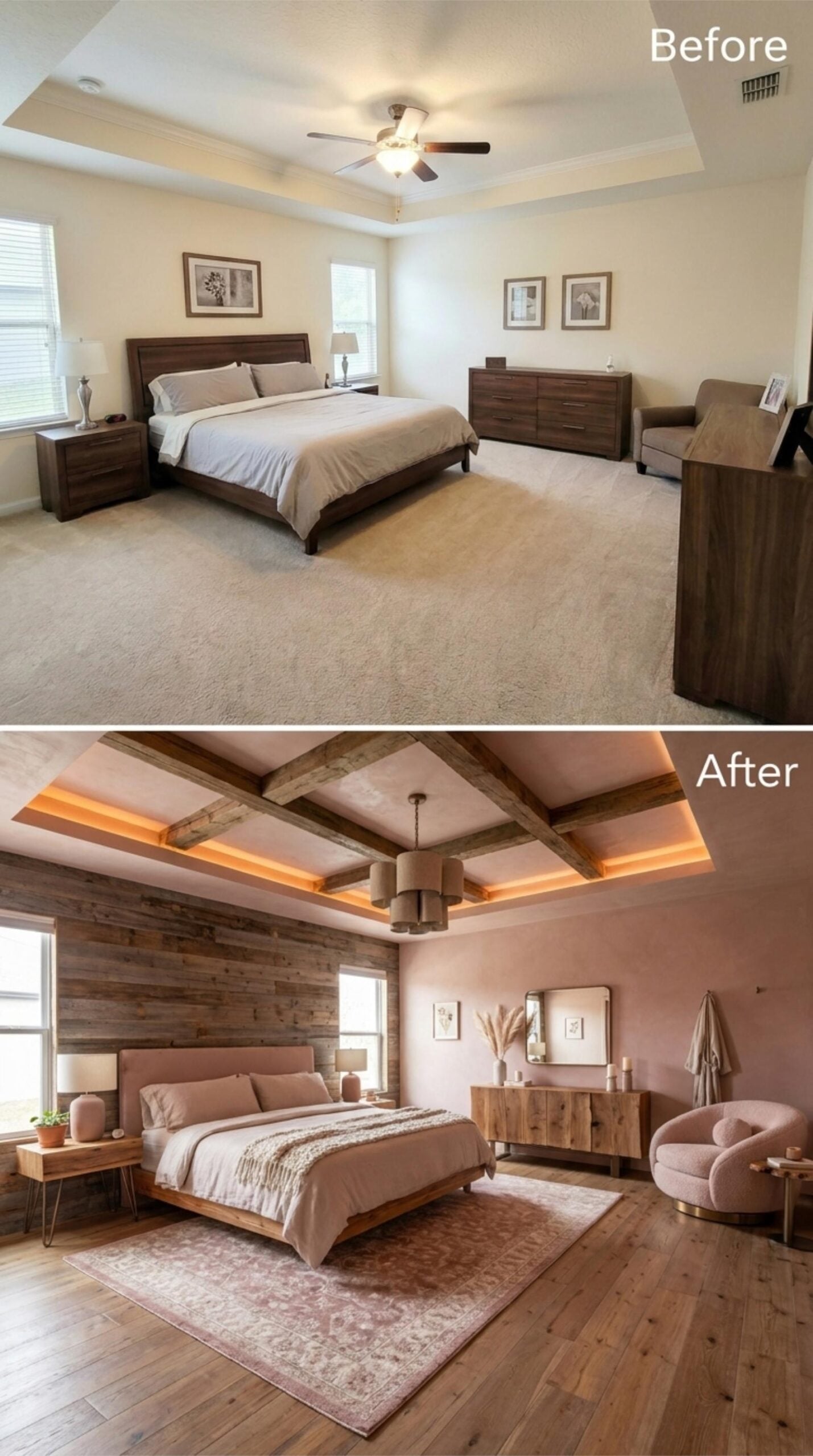
Reclaimed barn wood beams cross the tray ceiling in a grid pattern, with warm amber cove lighting tucked behind each section. That ceiling does a lot of heavy lifting. Below it, blush-painted walls and wide-plank oak floors create a palette that stays warm without reading overly feminine. The bed frame is raw wood with a low platform profile, paired with a tufted blush headboard. A bouclé accent chair in the corner rounds out the softness without overdoing it.
Budget Tip: Cove lighting in a tray ceiling is typically one of the more budget-friendly ways to add dramatic warmth since LED strip lights are inexpensive and installation doesn’t require an electrician in most cases. Doing the beam work with reclaimed wood rather than milled lumber can also cut material costs considerably, since salvaged barn wood is often cheaper per linear foot than new hardwood.
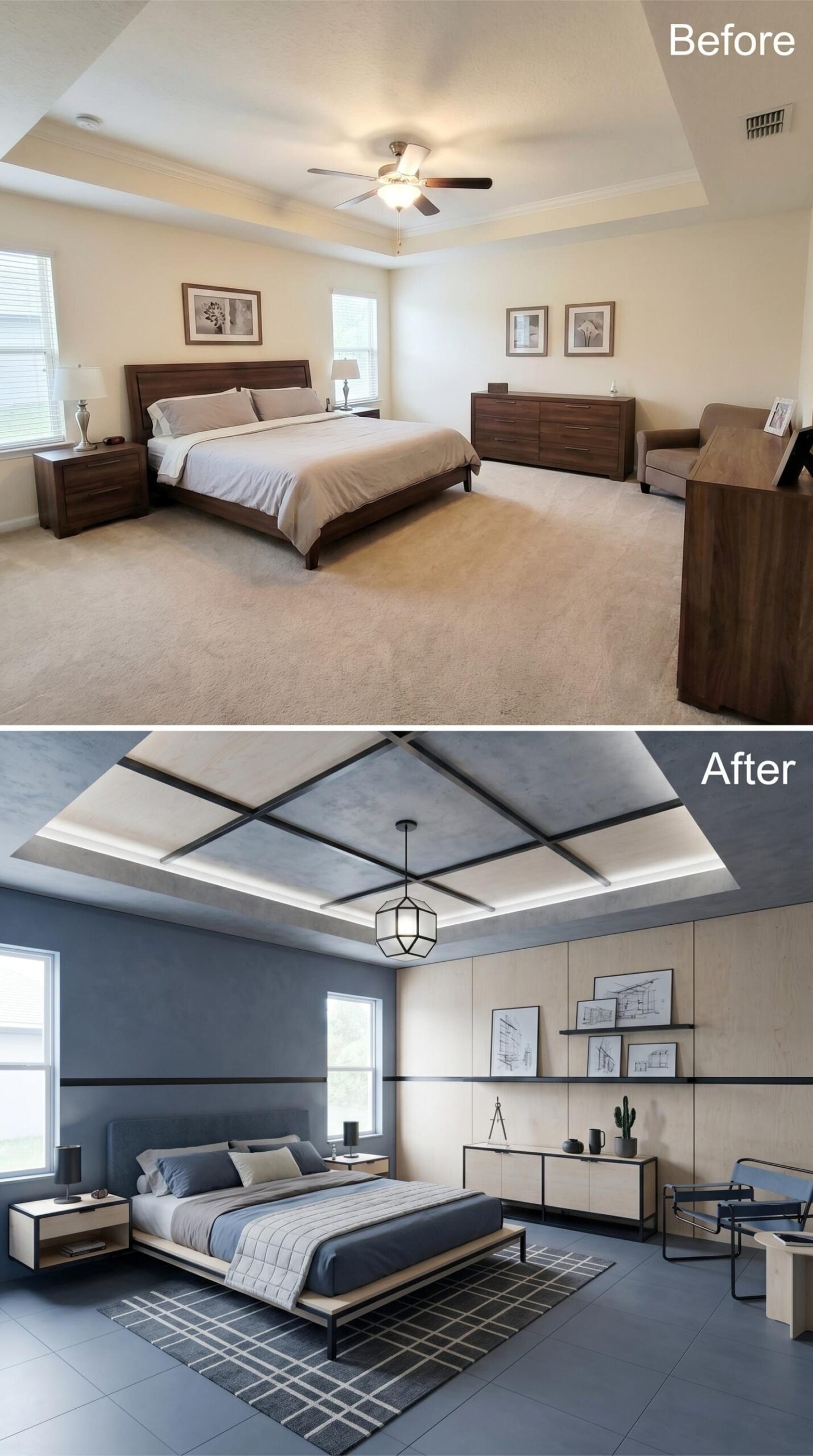
22. Grid Ceiling, Slate Tile, and Black Steel Furniture That Means Business
🔥 Would you like to save this?
That ceiling does most of the work. A coffered grid with dark steel inlays and recessed LED cove lighting sits above a room where everything else earns its place through restraint. The walls split between slate blue paint and light birch-toned panels, and the platform bed dressed in blue-grey bedding sits low and grounded on large-format charcoal tile. Matching black steel frames the nightstands, dresser, and side chair, keeping the palette disciplined without going cold.
Pro Tip: Geometric ceiling treatments like this grid pattern work best when the room’s furniture keeps its silhouette clean and low. Heavy ornate pieces compete with the overhead architecture rather than letting it read. When the ceiling is the statement, the furniture’s job is to stay out of the way.
21. Moroccan Star Ceiling, Capiz Chandelier, and Navy Walls That Hit Like a Riad
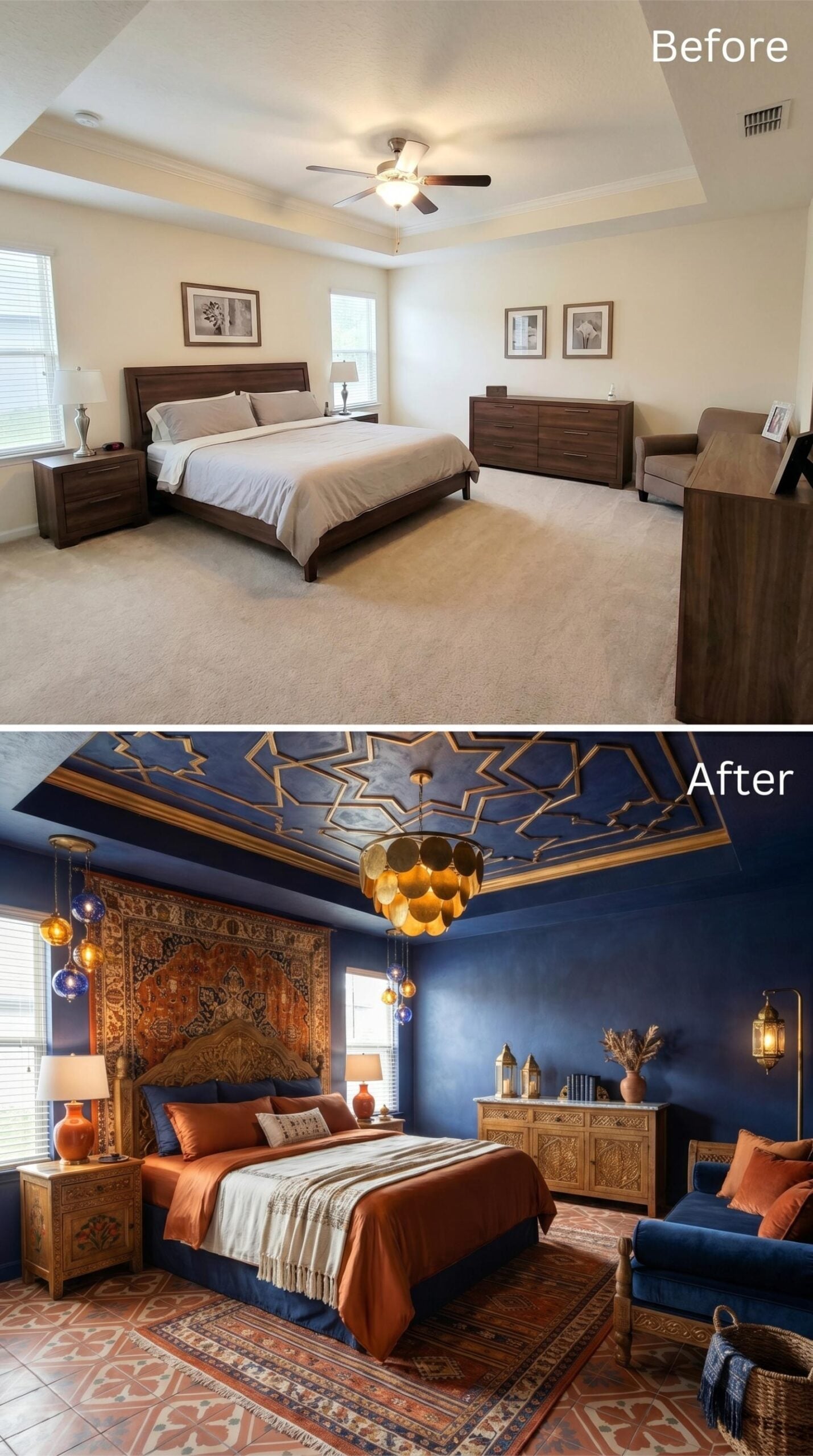
Navy walls taken all the way up to a geometric star-patterned tray ceiling is a commitment, and it absolutely pays off.
The tray ceiling gets painted in the same deep navy as the walls, then overlaid with a raised geometric star pattern finished in gold, which collapses the visual boundary between ceiling and room so the whole space reads as one envelope. A capiz shell chandelier hangs at center, its overlapping gold discs catching and scattering warm light. Rust-orange bedding and an ornate textile headboard pull from Central Asian carpet traditions, and the carved wood nightstands and dresser reinforce that register without feeling costumey. Moroccan-style pendant lanterns cluster near one side of the bed, and a wall sconce in hammered brass adds layered ambient light that no single overhead fixture could pull off alone.
20. Seafoam Tray Ceiling, Silver Molding, and a Coastal Palette Done Without the Kitsch
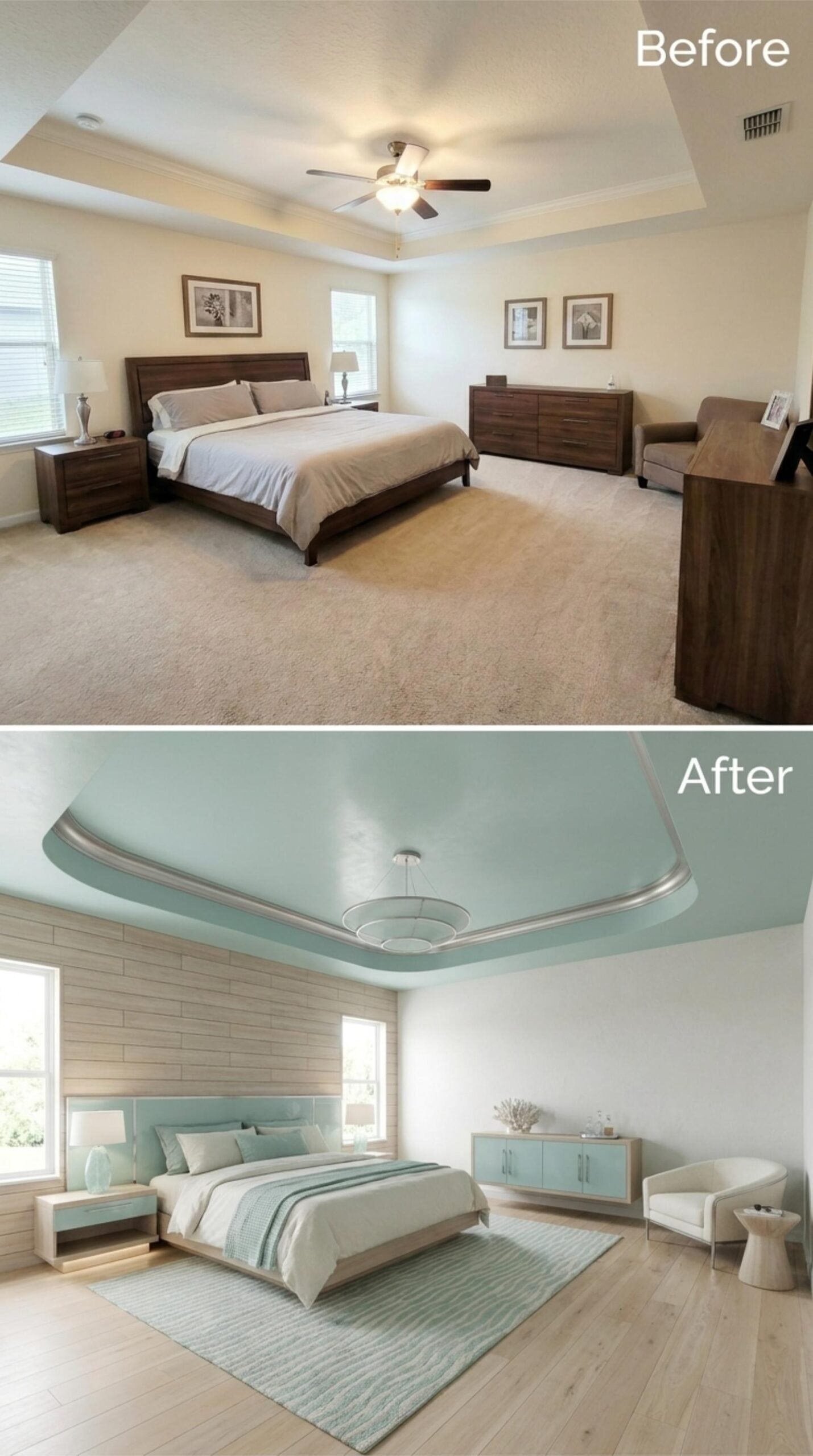
Pale seafoam on the tray ceiling does something a white ceiling never could: it pulls color down into the room without competing with the walls. Silver-finished crown molding traces the tray’s edge, giving it a quiet formality. Below, a floating credenza in the same muted aqua keeps the palette cohesive without feeling coordinated to death.
Light hardwood flooring replaced carpet, and the difference in perceived square footage is immediate. A drum pendant with a clean white diffuser handles ambient light without the visual noise of a fan. The bed’s headboard echoes the ceiling color, and the white boucle chair tucked near the credenza earns its keep.
19. Memphis Design Gets the Glossy Black Ceiling Treatment It Always Deserved
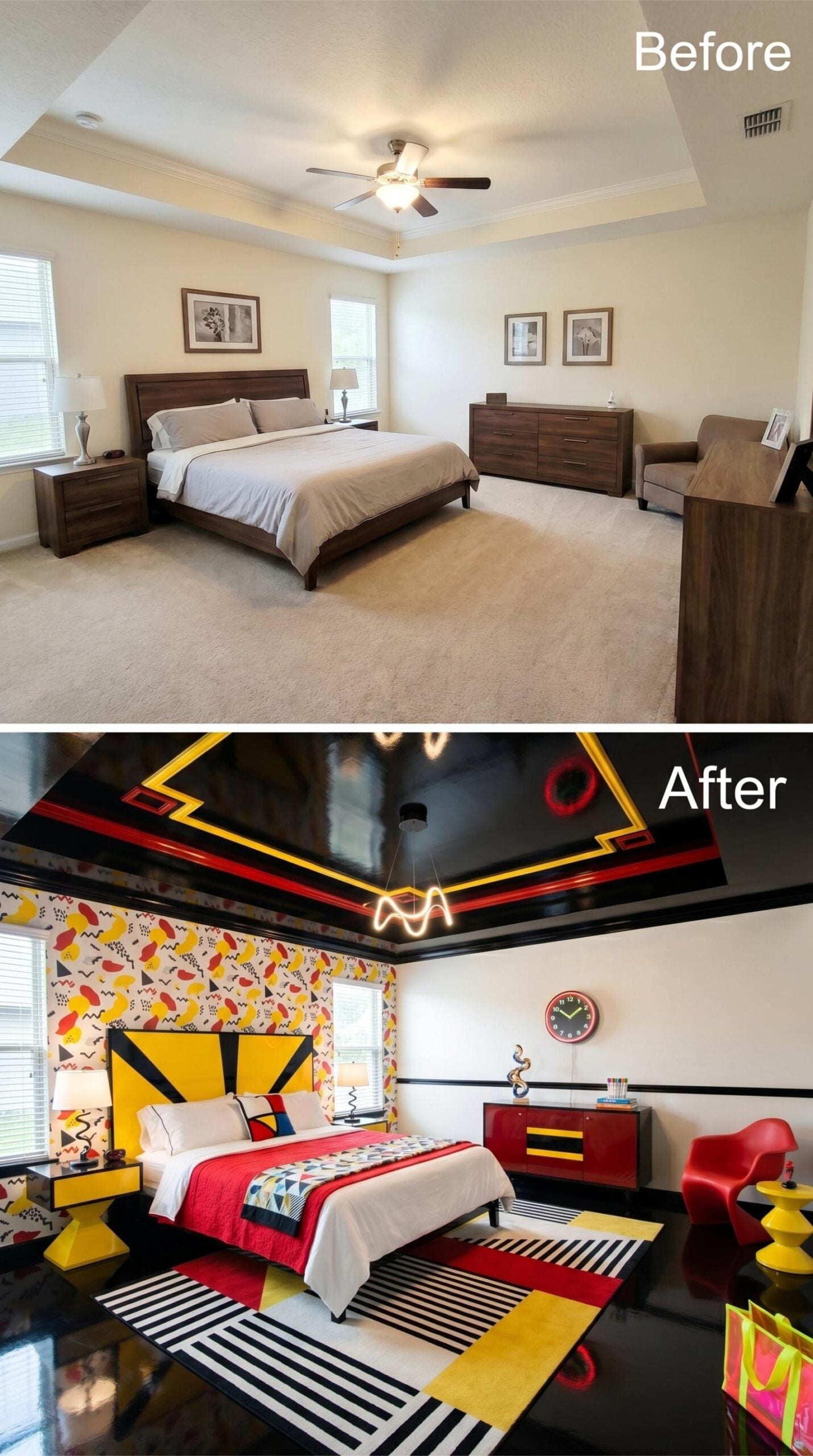
Red, yellow, and black collide across every surface here, from the geometric sunburst headboard to the bold-stripe area rug anchoring the floor. The tray ceiling is painted lacquer black and outlined in yellow and red geometric trim that reads like a design manifesto overhead. It’s loud on purpose.
Editor’s Note: Memphis design, the Italian movement launched by Ettore Sottsass in 1981, drew heavily from Pop Art and postmodernism and was considered too provocative for mainstream interiors for decades. Its return in residential bedrooms signals a real shift away from safe neutral palettes toward rooms that have a clear point of view.
18. Warm Plaster Tones, Cove Lighting, and a Platform Bed Built for Slow Mornings
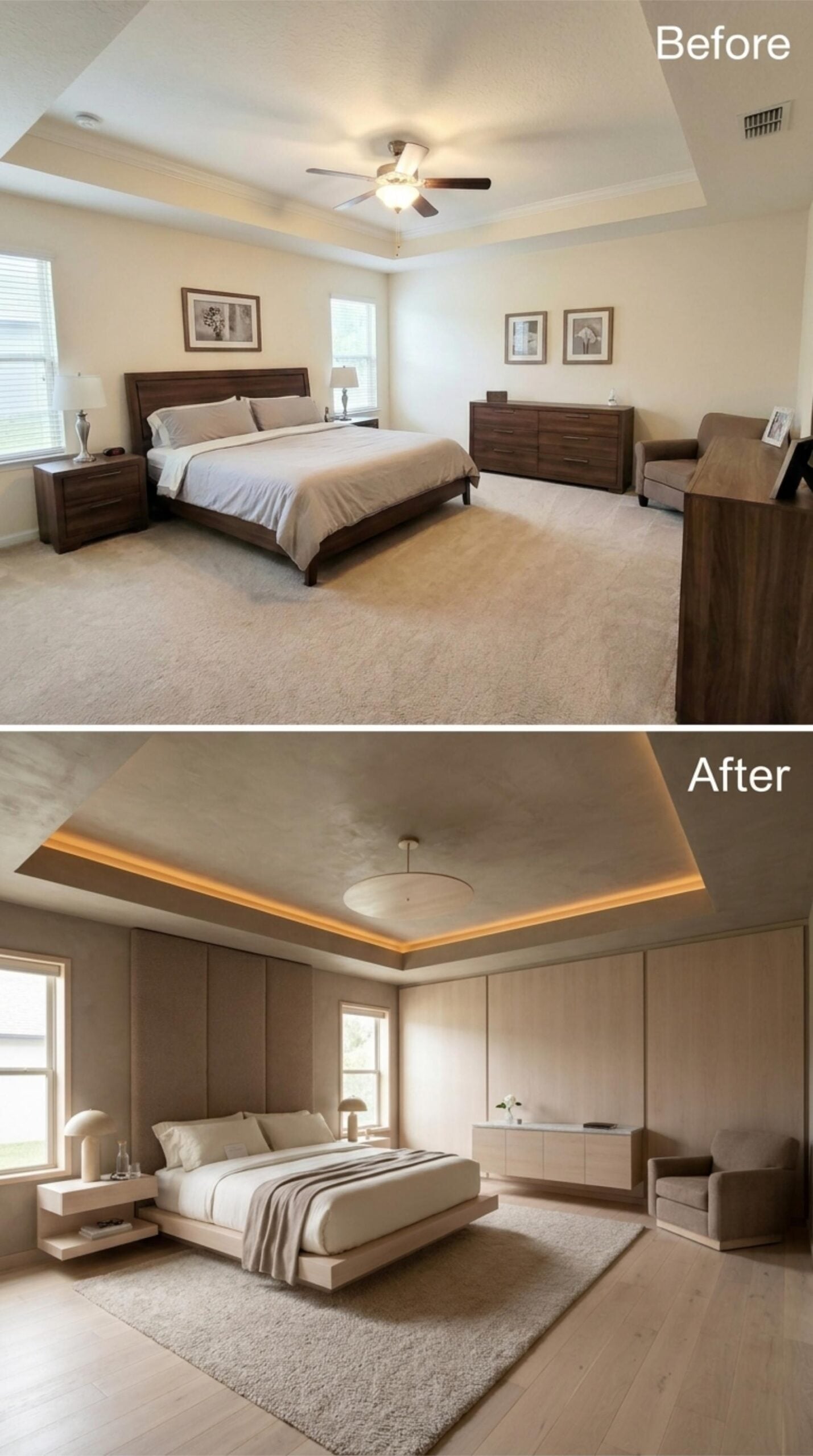
Every surface here reads in the same warm greige family, from the textured plaster walls to the low-pile area rug, which sounds like it could get monotonous but somehow doesn’t. Strip lighting tucked into the tray ceiling throws amber uplight that makes the whole room feel like it’s exhaling. The ceiling fan is gone. A flush drum pendant takes its place, and that single swap changes the room’s entire register.
Floating nightstands sit at bed height with no visible hardware, and the dresser runs long and low against a wall of vertical panel molding. It’s a layout that keeps the floor clear and makes the space read larger than the square footage suggests.
17. Teal Plaster Walls, Slatted Teak Ceiling, and a Living Wall That Earns Its Place
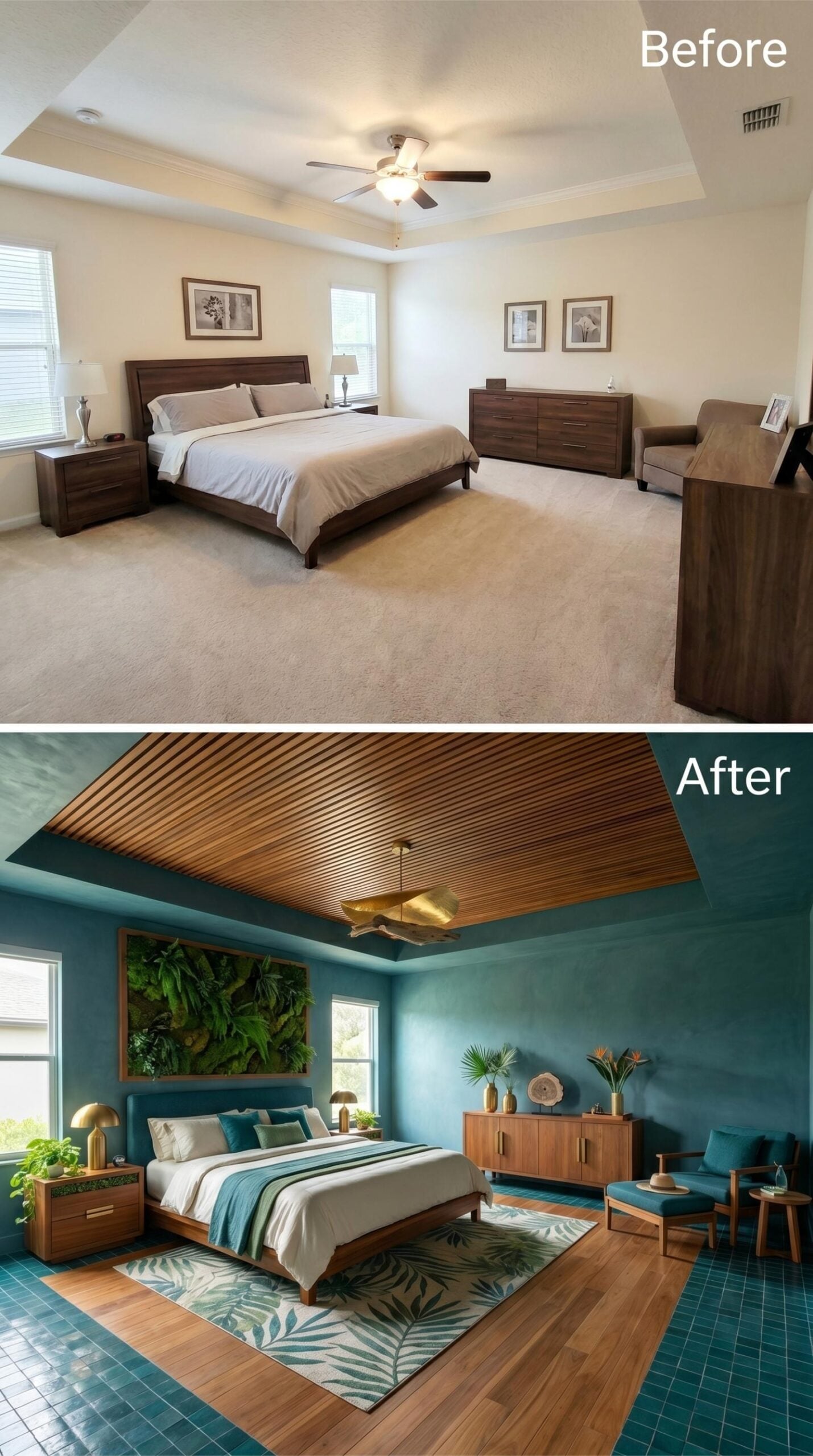
Deep teal plaster covers every wall, and the tray ceiling gets filled with horizontal teak slats instead of drywall. That swap alone changes how the room sounds, feels, and reads. A gold leaf-shaped pendant hangs where a standard fan once was.
The floor transitions from hardwood planks at the bed to teal square tile at the perimeter, which is unusual and somehow works. A living wall of tropical foliage anchors the headboard side, and the walnut dresser carries mid-century legs and brass hardware. It’s a lot of ideas, but the teal holds them together.
The floor transitions from hardwood planks at the bed to teal square tile at the perimeter, which is unusual and somehow works.
16. Gothic Grandeur: Charcoal Tray Ceiling, Plum Velvet, and Candelabras Done Right
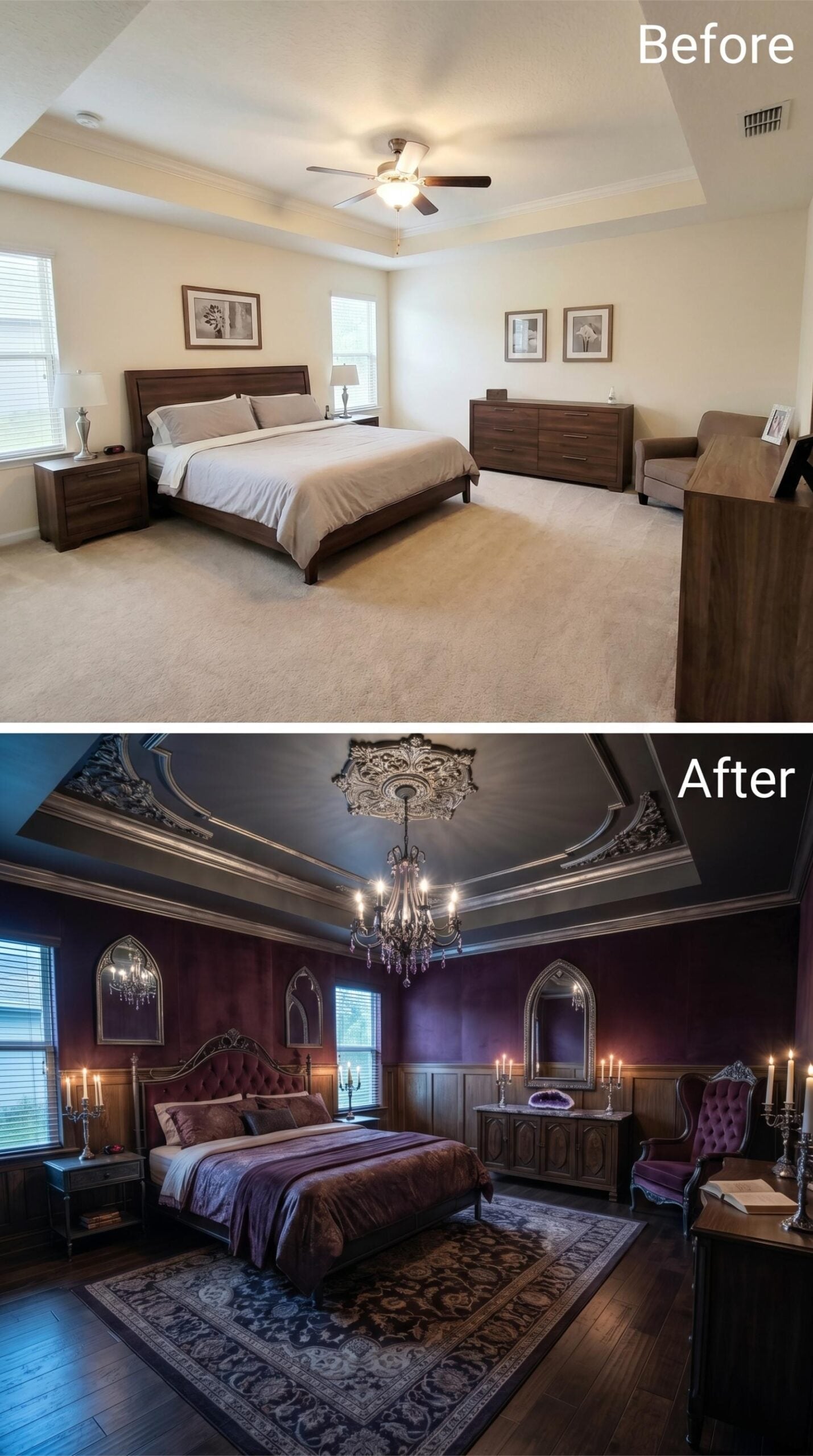
Dracula called. He wants his bedroom back, and honestly, who could blame him.
Plum velvet walls set the tone, but it’s the charcoal tray ceiling with ornate plasterwork medallion and silver molding that seals the commitment. An iron chandelier with exposed candle-style bulbs replaces the builder fan entirely. The carved mahogany bed frame pairs with a deep burgundy tufted headboard and silk-finish bedding. Gothic arch mirrors flank the dresser, and candelabras on each nightstand do the work that lamps would’ve ruined. Dark hardwood floors ground the room, with a Persian rug anchoring the furniture arrangement.
15. Fluted Ceiling, LED Cove, and a Pendant That Makes the Tray Worth Having
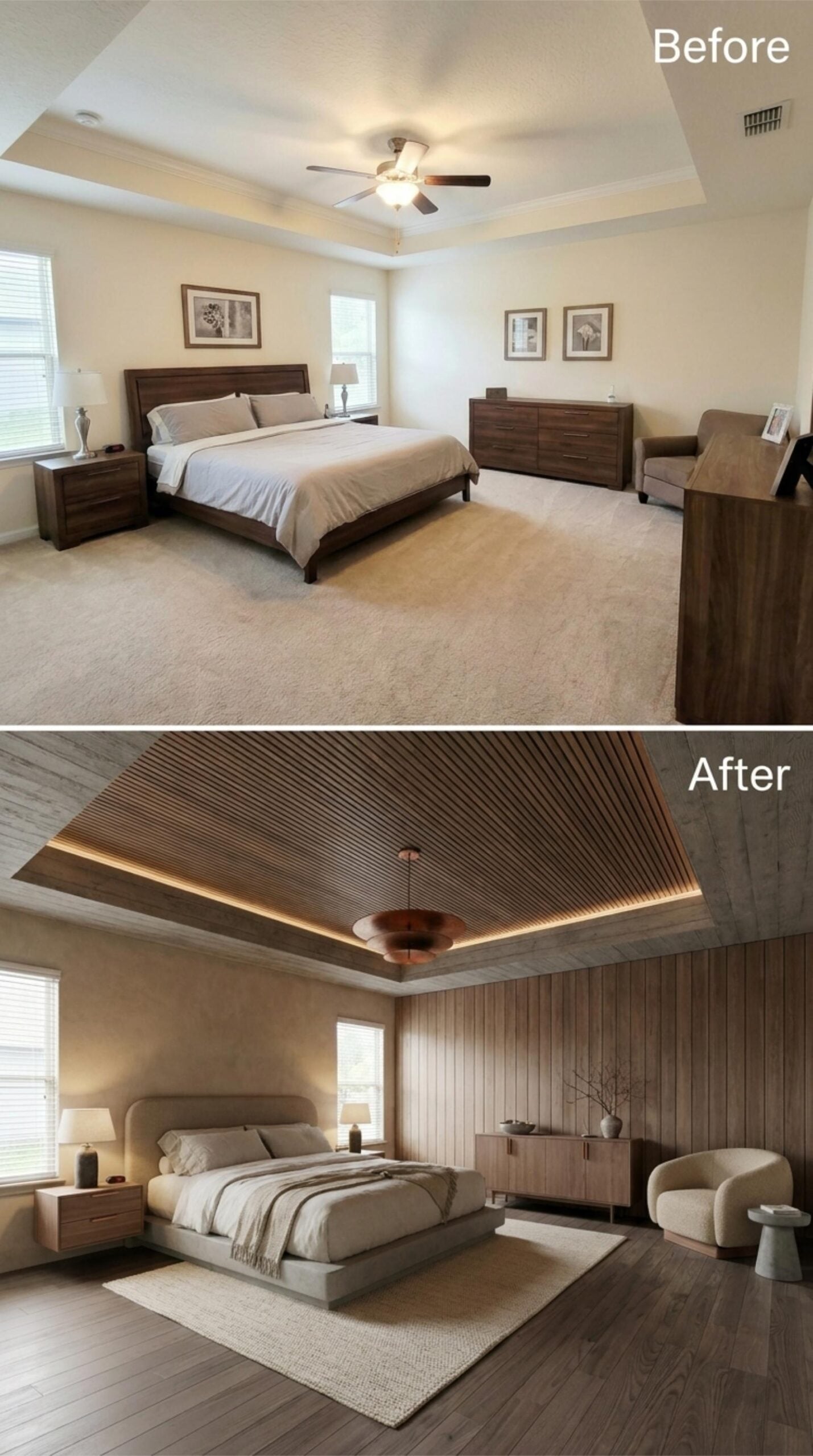
Warm oak slats line the tray insert while LED strip lighting runs the perimeter, casting a glow that makes the pendant almost unnecessary. Almost. A low-profile upholstered bed in greige linen anchors a woven area rug, and vertical shiplap on the accent wall keeps the wood language consistent without feeling excessive.
14. Gold Chinoiserie Ceiling, Crystal Chandelier, and a Color Story That Commits Completely
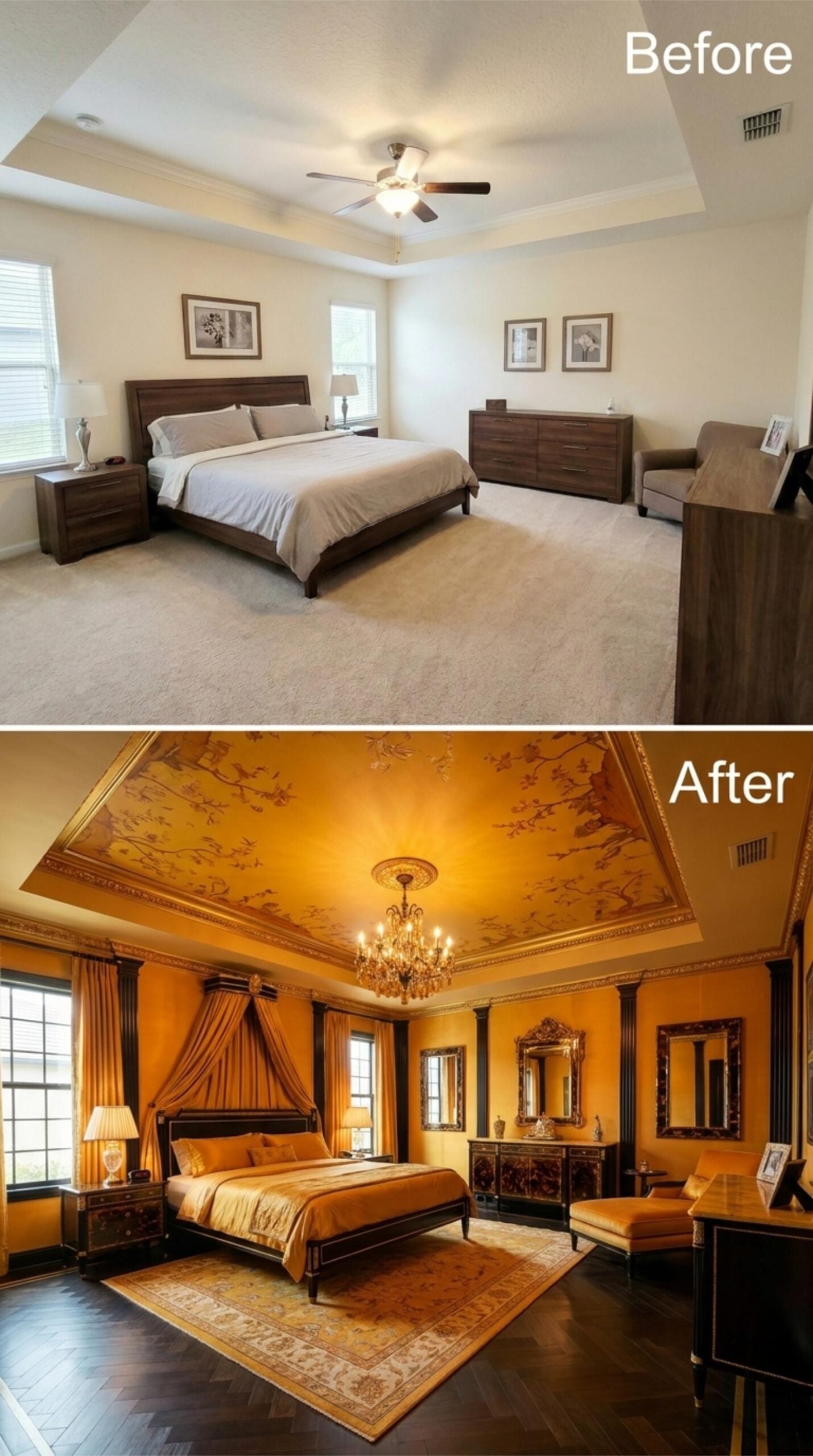
Saffron and amber take over every surface here, and it works because nothing hedges. Hand-painted chinoiserie murals cover the tray ceiling in burnt gold tones, framed by ornate gilded molding where a basic ceiling fan used to hang. A crystal chandelier with candelabra arms drops into the center medallion and reads unmistakably European.
Dark fluted columns anchor each corner, grounding a room that could’ve gone overwrought. The canopy bed, dressed in amber silk-like bedding, sits over a Persian-style rug with a faded ivory field. Lacquered nightstands and a tortoiseshell dresser keep the furniture in the same key. Dark herringbone hardwood underneath ties it together without competing.
Style Math: Chinoiserie as a decorative style dates to 17th-century Europe, when imported Chinese goods sparked a craze for hand-painted motifs featuring birds, florals, and landscapes. Applying it to a ceiling rather than wallpaper is a less common move, but it concentrates the effect in the one place the eye travels first in a room this tall. The gilded molding framing the tray acts as a picture frame, which is exactly what makes the painted surface read as intentional rather than excessive.
From gothic drama to something altogether sunnier, this next room takes the tray ceiling somewhere tropical.
13. Wood Slat Tray Ceiling, Olive Green Walls, and a Palm Wallpaper That Commits
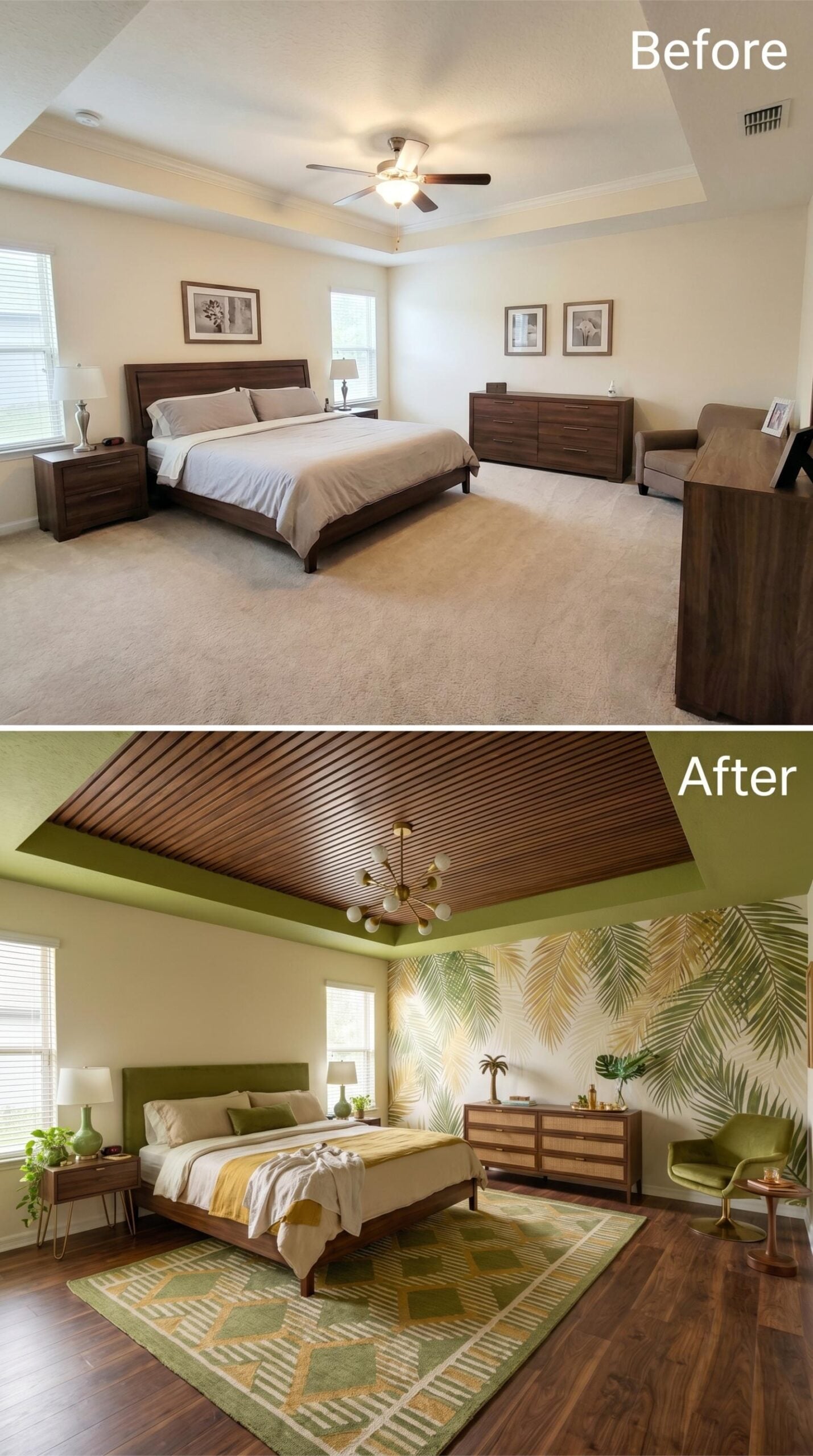
Walnut-toned wood slats cover the tray insert while olive paint wraps the surrounding border, grounding a room that could’ve read too playful. Bold tropical palm wallpaper anchors the wall behind the dresser. The geometric area rug in sage and gold pulls the whole palette down to the floor.
12. Exposed Beam Tray Ceiling with LED Coves and a Concrete Wall Panel That Commands Attention
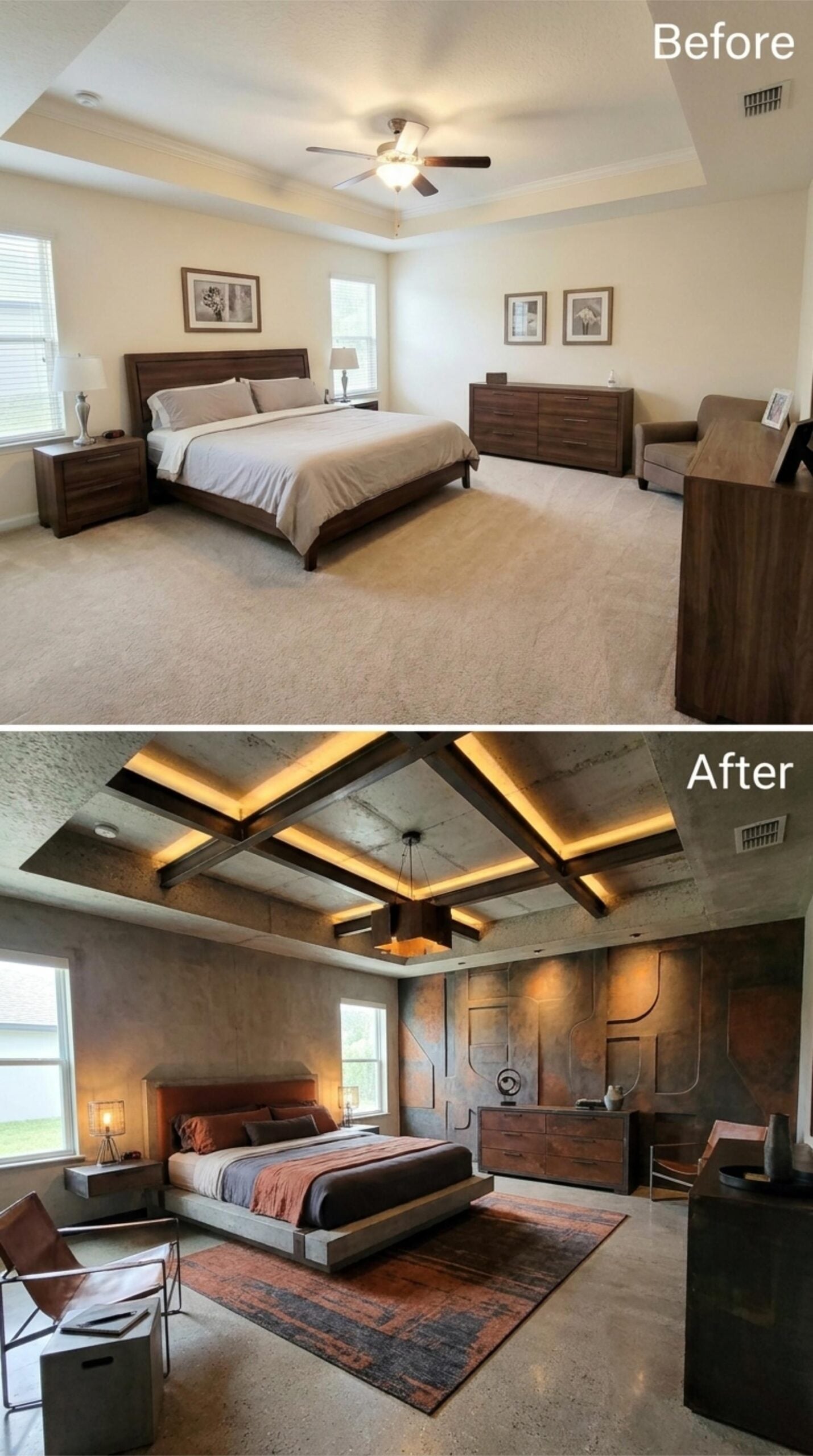
Dark stained wood beams cross the tray ceiling in a grid pattern, each channel backlit with warm amber LED strips that cast the textured concrete-finish ceiling in something close to firelight. Below it, a platform bed sits low and wide on a raised concrete plinth, dressed in charcoal bedding with rust-orange throws that pull color from the abstract relief panel dominating the headboard wall. Polished concrete floors replace carpet entirely, and the room earns its mood from material contrast rather than decoration.
- Concrete wall panels with sculpted relief work don’t require stone. Lightweight gypsum or resin composites achieve the same effect at a fraction of the weight.
- LED strip lighting in beam channels is one area where color temperature really matters. Stick to 2700K or below to keep the glow amber rather than clinical white.
- A platform bed on a raised plinth reads as a design feature rather than furniture. It anchors the room’s focal point without requiring a headboard wall treatment.
11. Gold Lily Pad Ceiling Medallions, Deep Violet Walls, and Baroque Furniture That Earns Every Inch
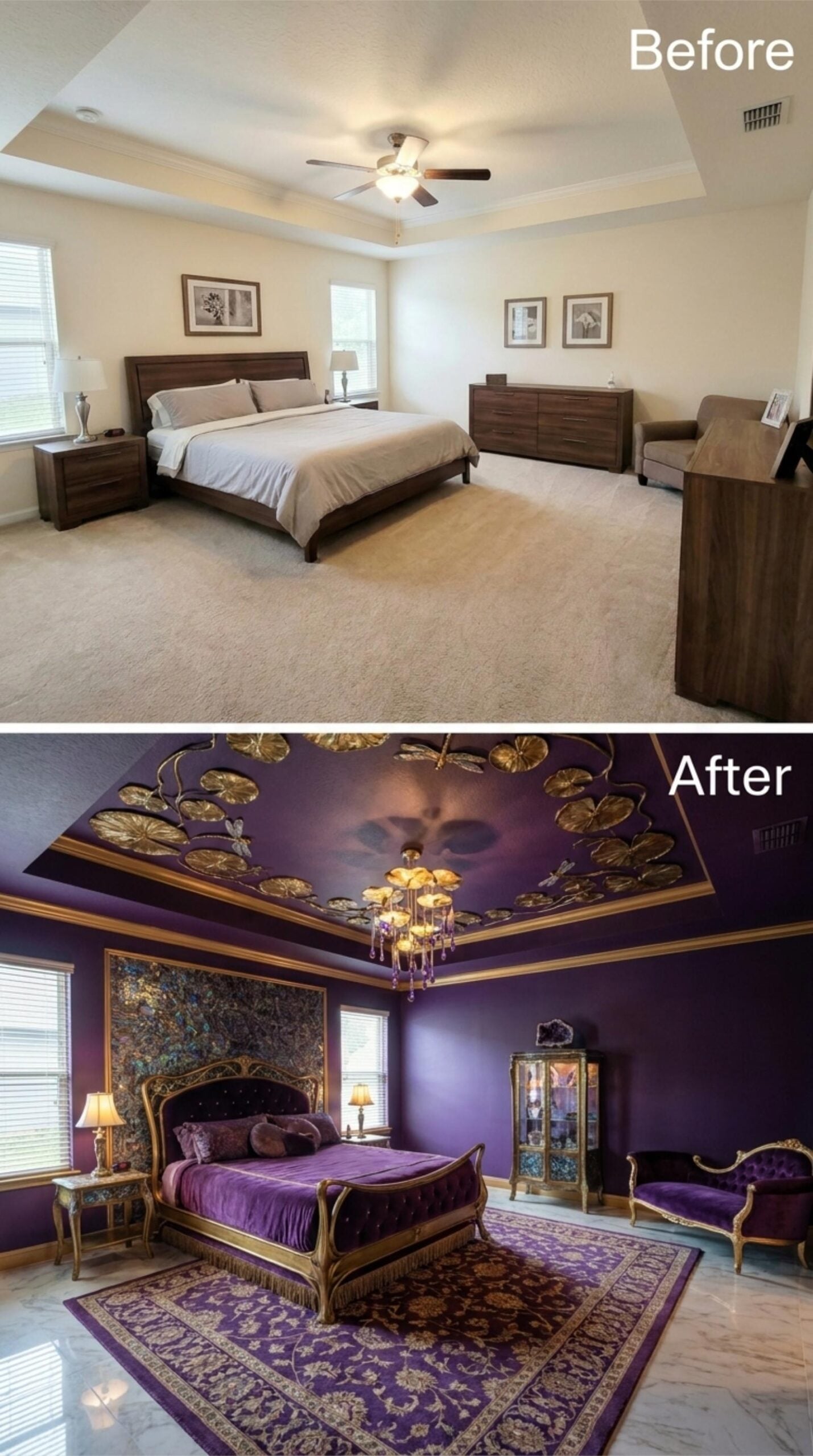
Gold sculptural lily pads ring the tray ceiling above a gilded sleigh bed dressed in violet velvet, and the whole room commits so hard to purple that it stops feeling risky and starts feeling inevitable.
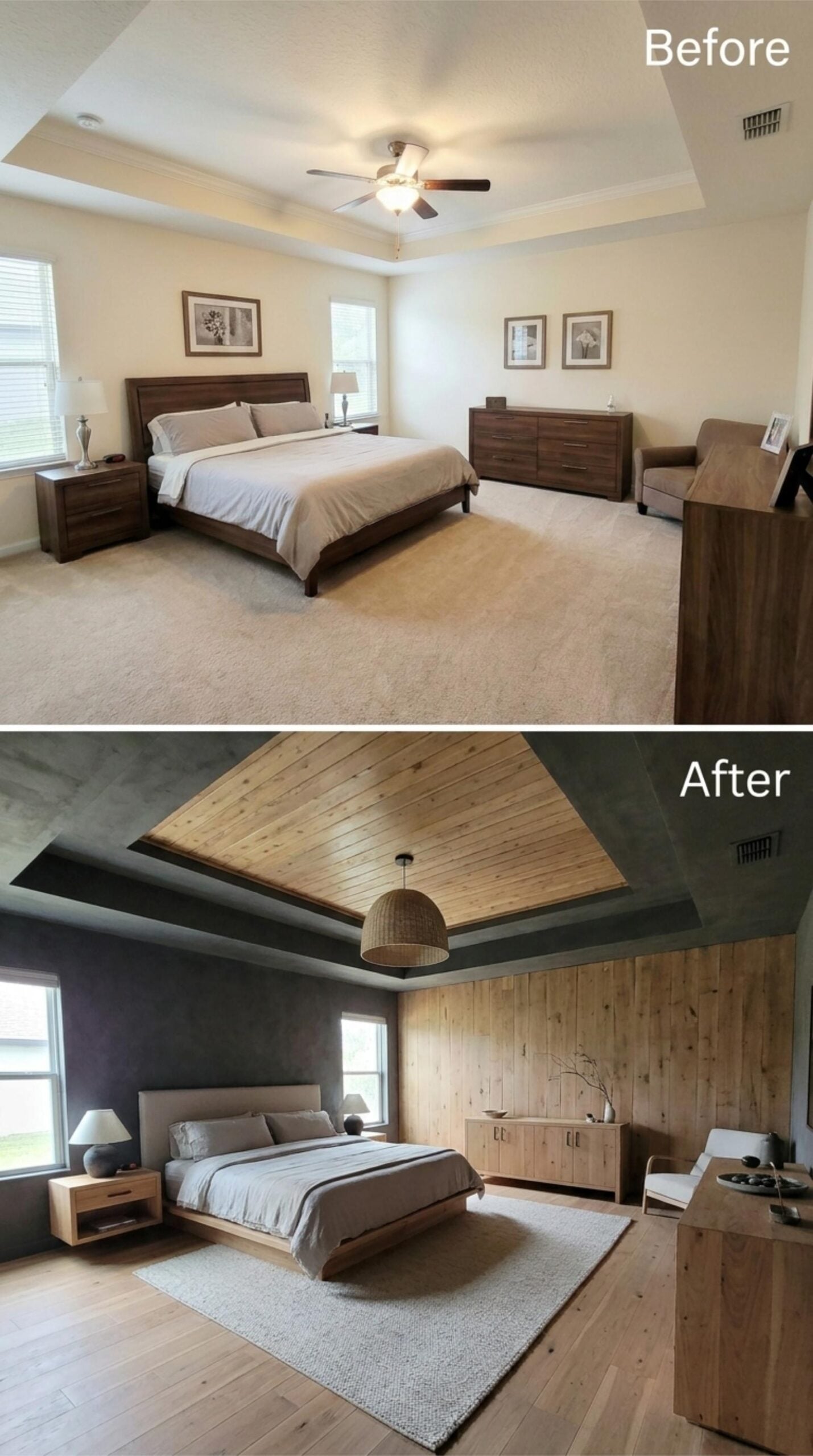
10. Shiplap Tray Ceiling, Charcoal Plaster Walls, and Light Wood That Actually Earns the Drama
🔥 Would you like to save this?
Knotty pine shiplap lines the tray ceiling, and the contrast against the charcoal plaster walls is sharp enough to feel intentional without feeling forced. The fan is gone. A woven rattan pendant takes its place, and it’s the right call.
Natural oak runs through the flooring, the nightstands, and the credenza along the accent wall, which is also clad in vertical pine planks. A low platform bed anchored on a cream area rug keeps the sightlines clean.
Ask Yourself: If your tray ceiling feels like a builder afterthought, consider whether the finish inside it matches every other surface in the room. Treating the tray as its own distinct zone, with a different material or color, is what makes it read as intentional architecture rather than an accidental bump in the drywall. That distinction is usually where the whole room starts to click.
9. Black Lacquer Ceiling Mural, Coral Plaster Walls, and a Chinoiserie Dresser That Anchors Everything
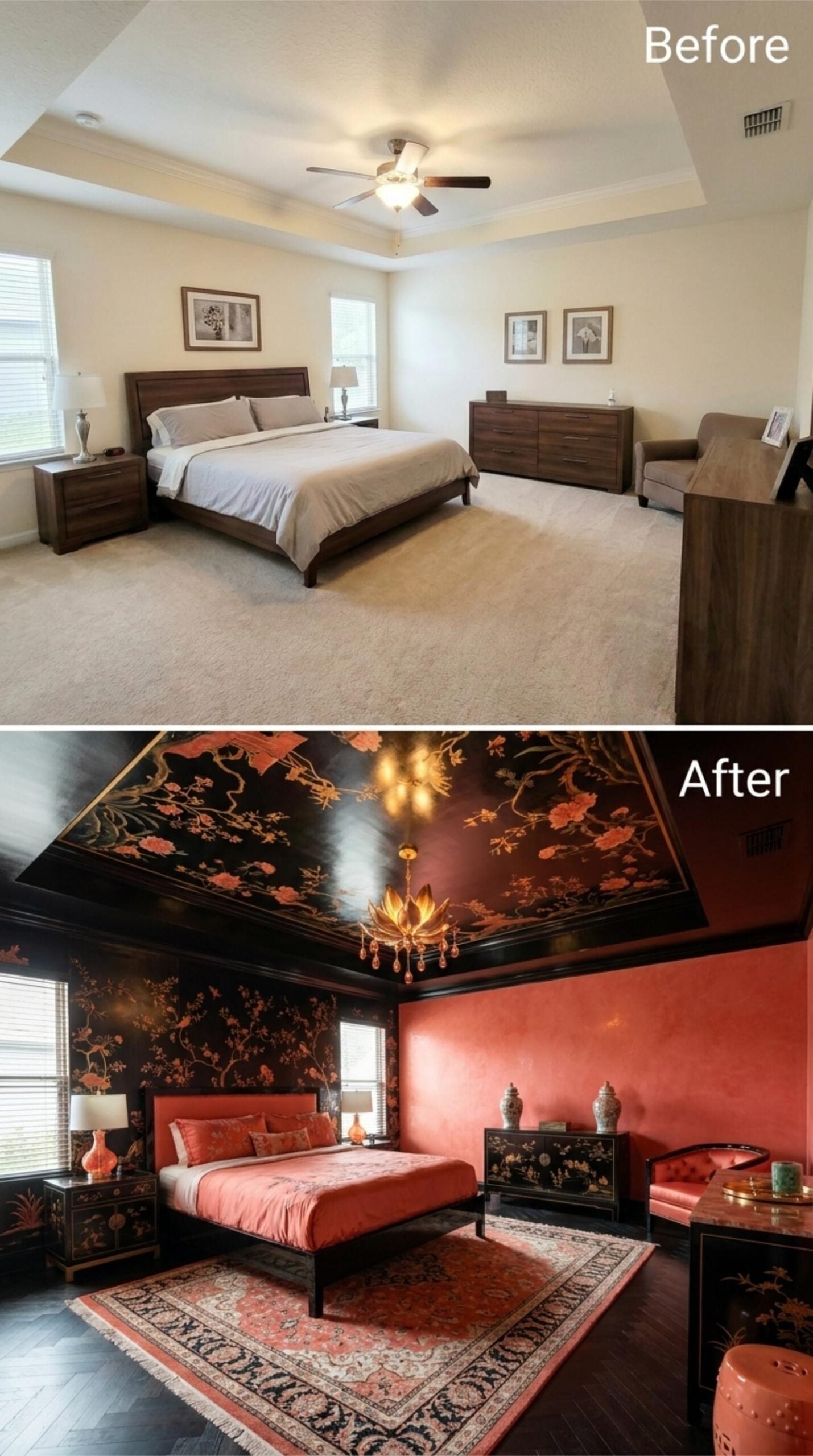
Lacquered black panels cover the tray ceiling in hand-painted coral and gold botanicals, and a lotus chandelier hangs low enough to feel deliberate. The accent wall opposite the bed is done in raw coral plaster. Black chinoiserie furniture grounds the room without competing with it.
8. Forest Green Coffered Ceiling, Gothic Arches, and Oak Wainscoting Built for a Different Era
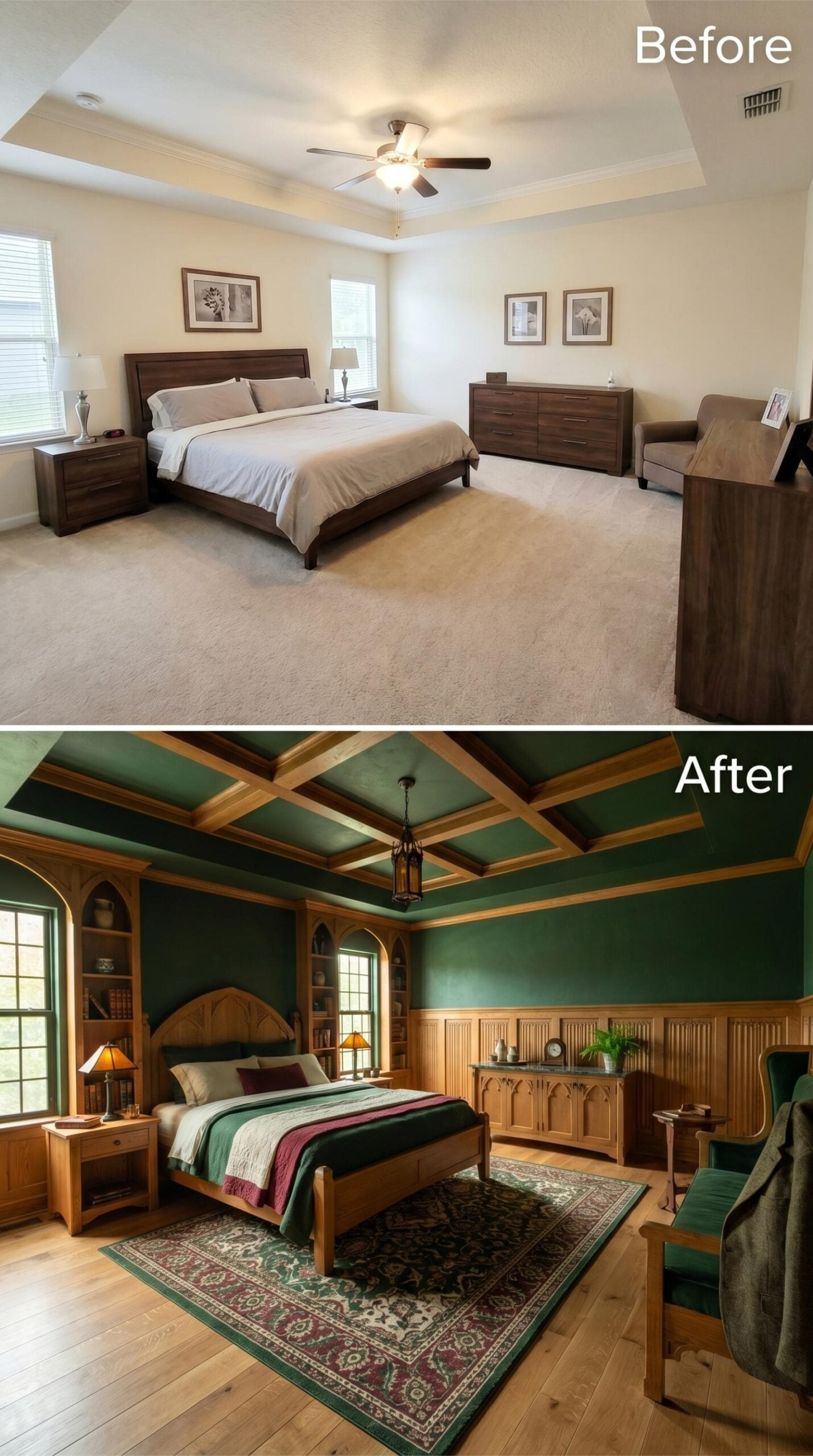
Oak timber coffering painted deep forest green gives this ceiling genuine architectural weight, and the pendant lantern hanging at center adds just enough gothic reference without tipping into costume. Built-in arched shelving flanks the window on both sides, pulling books and objects into the architecture itself rather than staging them as afterthoughts. The wide-plank hardwood floor and honey-toned wainscoting keep the room from reading too dark despite walls saturated almost to hunter.
The bed frame’s arched headboard echoes the window shapes above it, which is the kind of repetition that makes a room feel designed rather than assembled. A Persian-style rug in burgundy and black anchors the furniture without competing with the ceiling. Green velvet on the reading chair in the corner earns its place by matching the ceiling, not the walls. That distinction matters more than it sounds.
7. Exposed Beam Tray Ceiling, Terracotta Tile, and Adobe Arches Straight from the Southwest
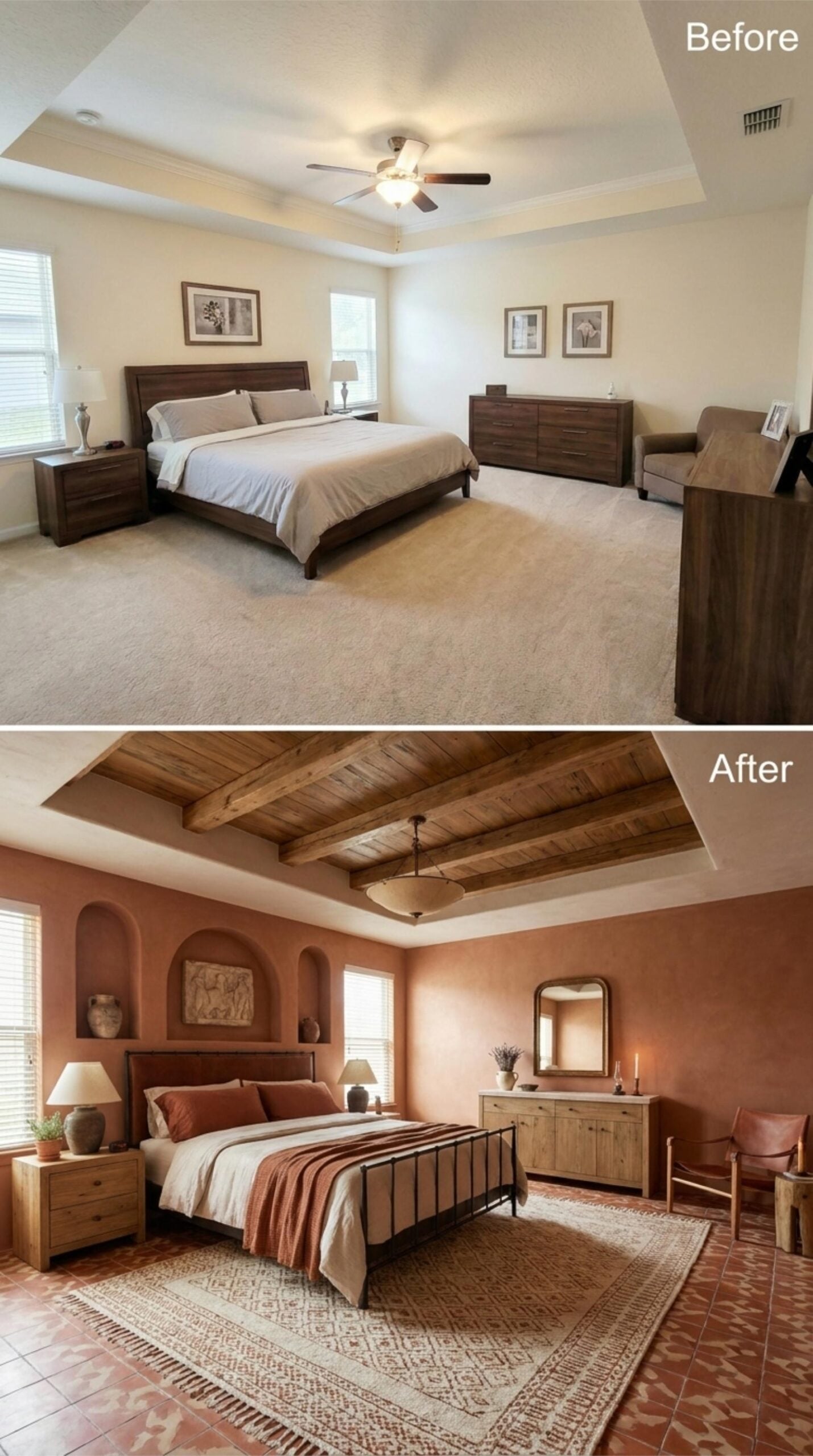
Rough-hewn wood beams cross the tray ceiling in place of anything builder-grade, and the terracotta wall color reads almost like applied plaster rather than paint. Arched niches flanking the headboard wall are the kind of detail that makes everything else feel intentional. The wrought iron bed frame keeps its silhouette spare enough that the room doesn’t compete with itself.
A patterned area rug in cream and rust grounds the space without fighting the tile underfoot. Light wood nightstands and a sideboard dresser stay pale enough to let the walls carry the color. It works because nothing is trying too hard.
6. Blush Walls, a Floral Mural Panel, and a Crystal Chandelier That Replaced the Fan
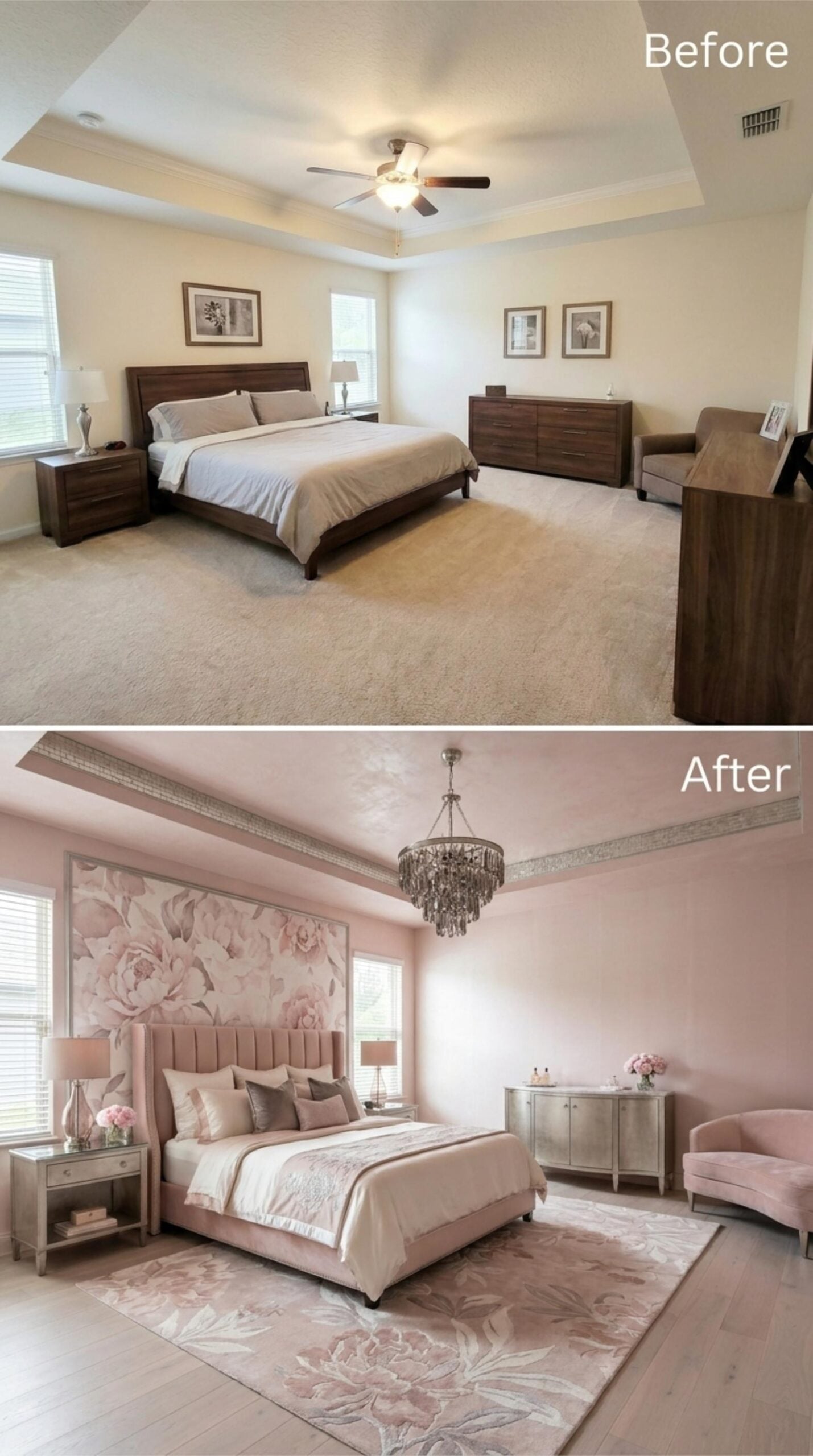
Soft blush plaster covers every wall and the tray ceiling, with a mirrored trim detail running the perimeter where crown molding would typically sit. The fan is gone. A tiered crystal chandelier hangs in its place, and the difference in mood is immediate. Behind the bed, an oversized peony wallpaper panel acts as a built-in headboard backdrop, framed cleanly against the painted wall. Mirrored nightstands and a silver-finish dresser keep the palette cohesive without leaning too precious.
5. Mondrian Grid Ceiling, De Stijl Pendant, and a Rug That Brings the Whole Theory Down to Earth
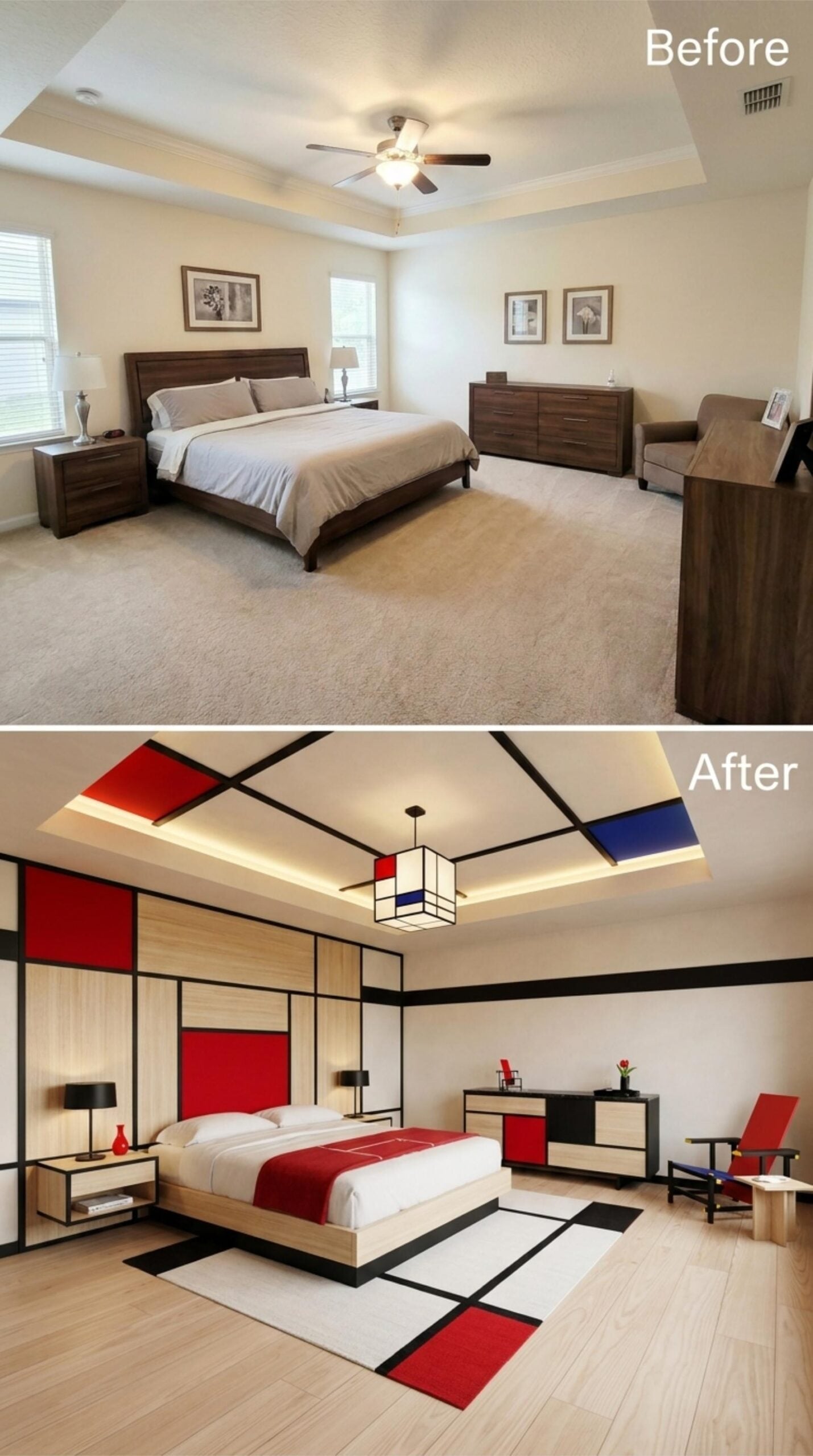
Red, black, and cobalt panels divide the tray ceiling into a composition lifted directly from Piet Mondrian, and the cube pendant below it commits fully to the same palette. Every surface follows: the rug, the headboard panel, even the dresser fronts.
4. Coffered Ceiling with Amber Cove Light and Built-In Shelving That Actually Earns Its Square Footage
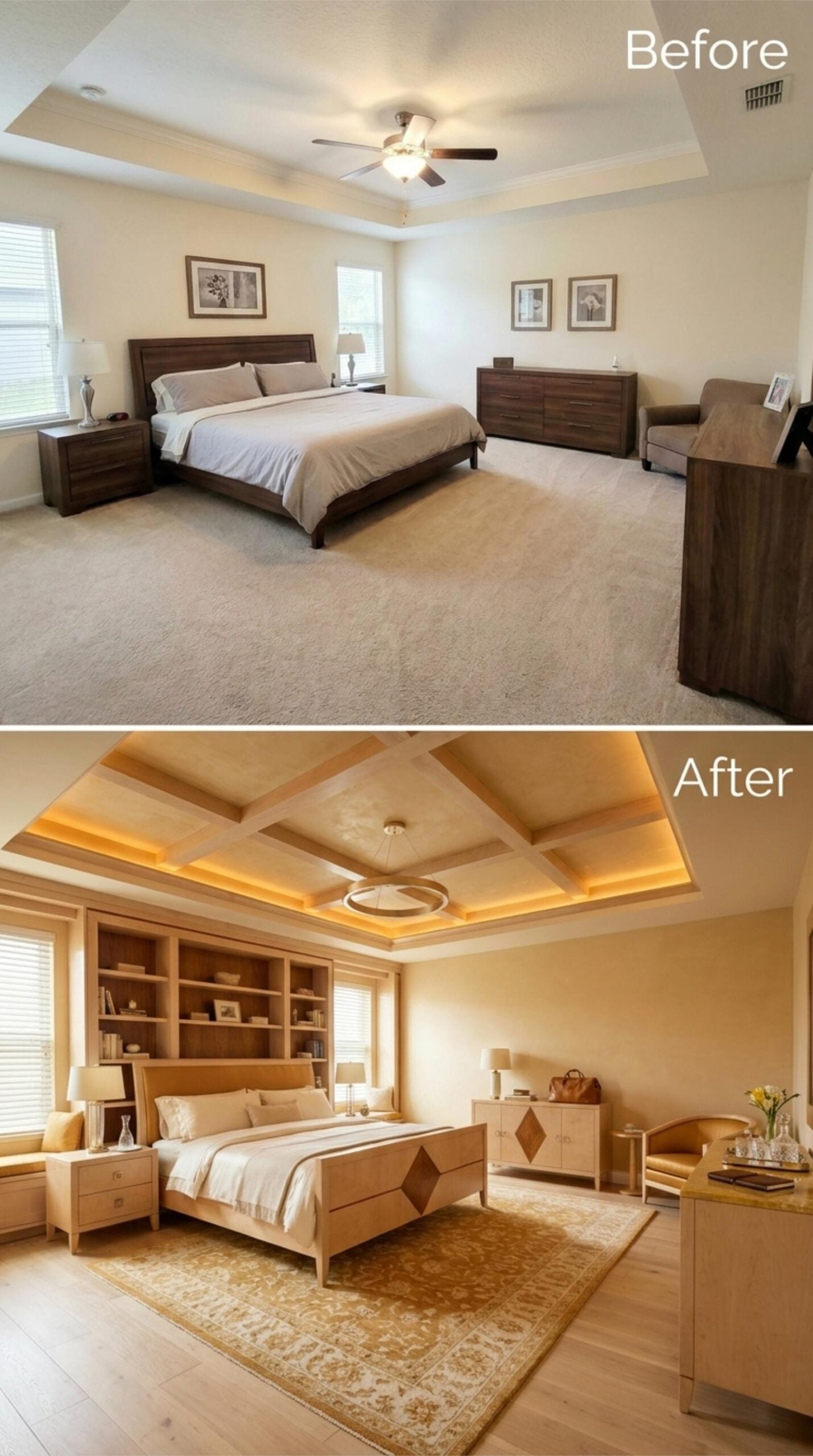
Warm maple millwork lines both the coffered ceiling and the wall-to-wall built-ins flanking the bed, pulling the whole room into one continuous material story. The amber LED coves do the heavy lifting here. Hardwood floors and a cream floral rug replace carpet entirely.
3. Moss Ceiling Inset, LED Cove Lighting, and a Living Wall That Pulls the Outside In
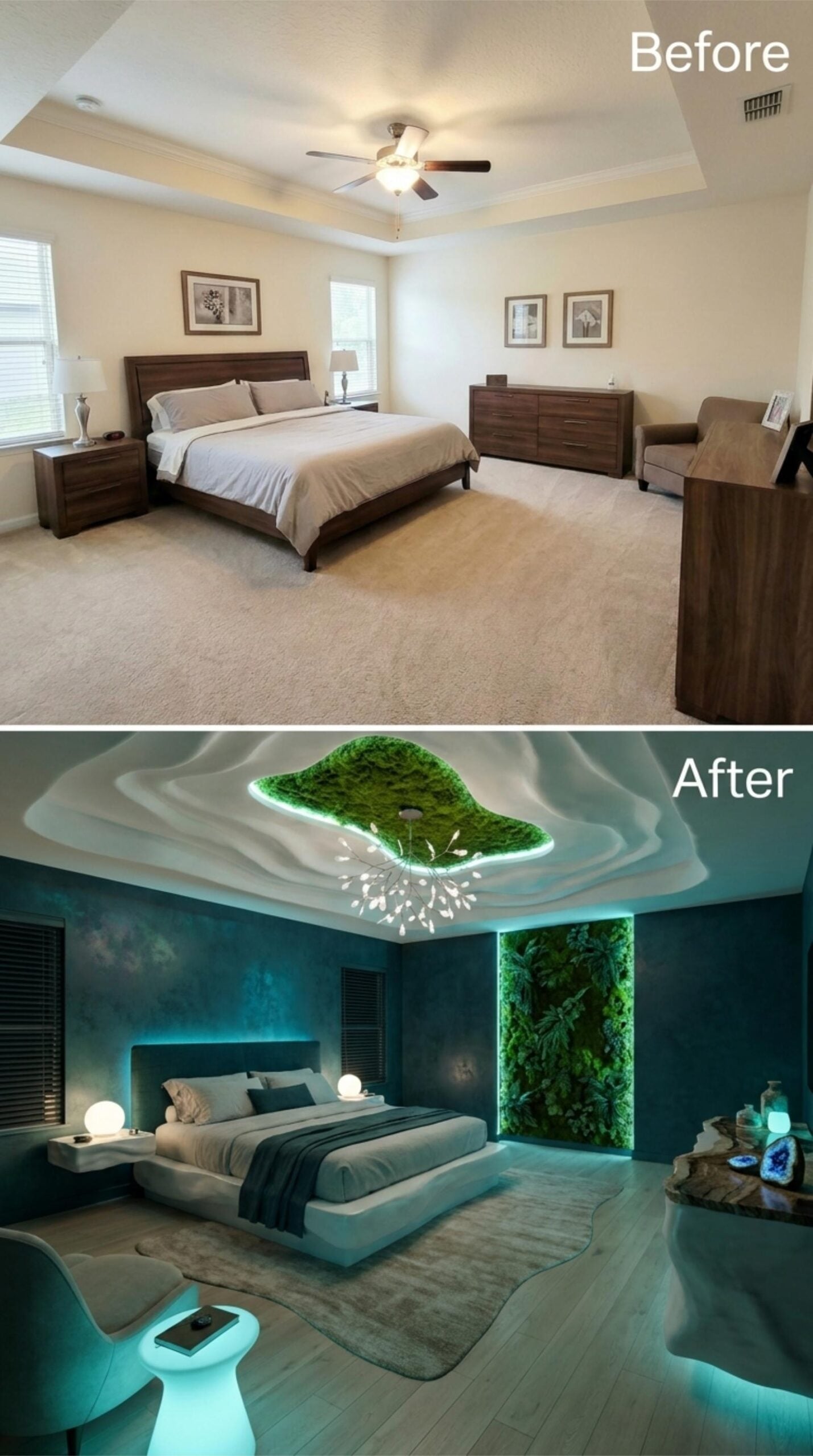
Teal venetian plaster wraps every wall, giving the room an immersive quality that paint alone can’t replicate. The real conversation piece is overhead: a sculptural wave ceiling cradles a moss inset edged in LED strip lighting, with a branch-style chandelier hanging below it. A backlit vertical plant panel anchors one wall like a second window.
2. Painted Coffered Ceiling with Peacock Motifs and Velvet Bedding That Sets the Tone Immediately
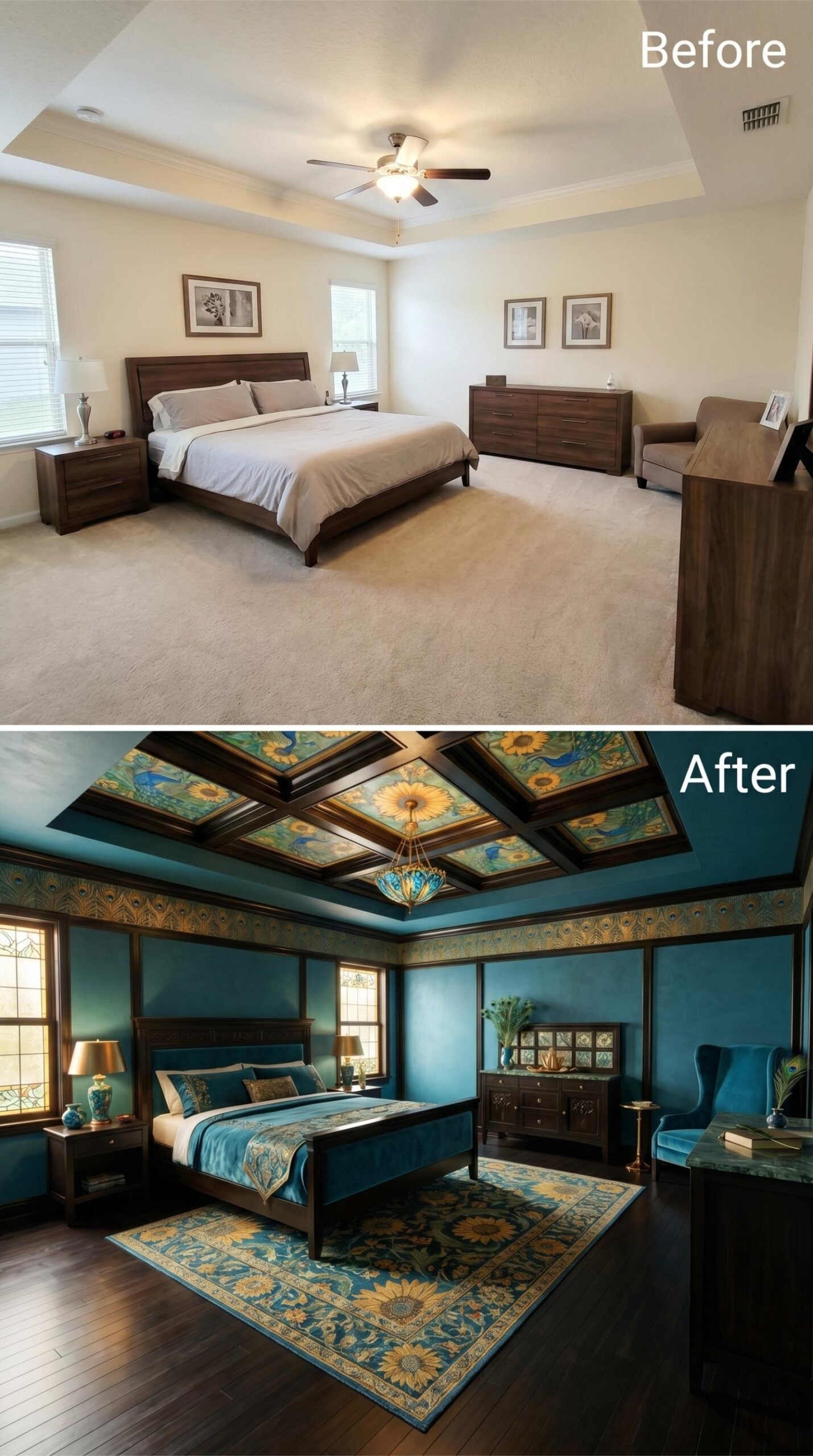
Coffered ceilings with painted insets aren’t common in residential bedrooms, and there’s a reason this one reads more like a palatial suite than a remodel. Each recessed panel holds a hand-painted scene of sunflowers and peacocks on a blue-green ground, framed by dark wood beams that run the full grid. A Tiffany-style pendant hangs at center where a basic fan once lived. The walls pick up that same deep teal, anchored below by a patterned border that ties the ceiling palette down to eye level.
Hardwood floors replace what was carpet, and an Oriental rug with sunflower and vine motifs grounds the bed. The upholstered headboard is velvet in the same teal. A wing chair in the corner matches it. Peacock feathers as decor could easily tip into costume, but repeating the color through structural elements keeps it from feeling like a theme park room.
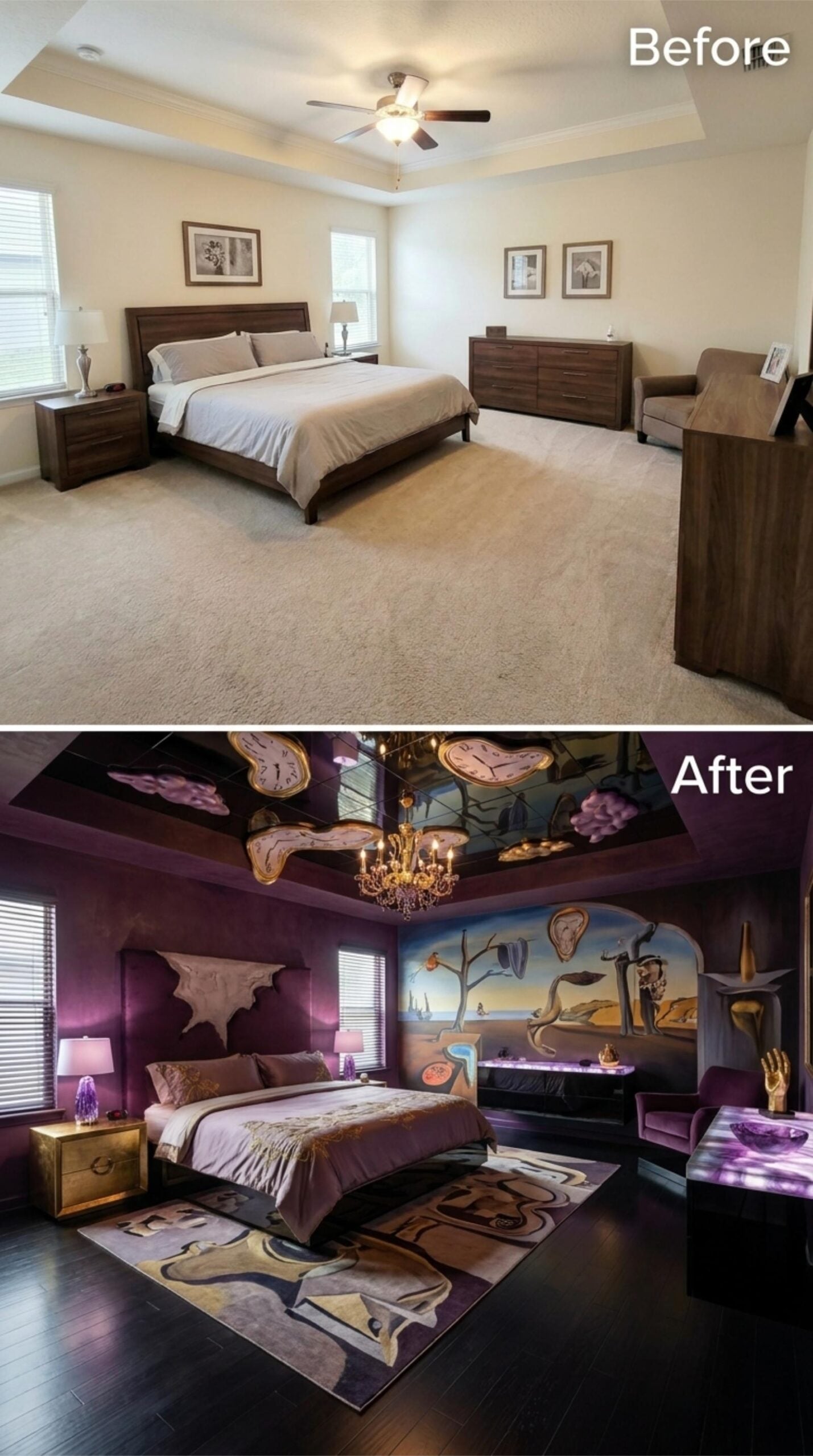
1. Surrealist Mural, Mirrored Tray Ceiling, and a Room That Commits Completely to Salvador Dalí
🔥 Would you like to save this?
Few bedrooms commit this hard to a single artistic vision. Every surface here references Dalí’s “The Persistence of Memory”: melting clocks crawl across a hand-painted mural that spans the entire wall behind the bed, and the tray ceiling above is finished in dark lacquer with a mirrored inset that reflects the same surrealist imagery downward. Deep plum walls frame the composition without competing with it.
The flooring shifted from carpet to dark hardwood, which was the right call. A brass chandelier with candle-style arms hangs from the ceiling’s center, and gilded nightstands with sculptural drawer pulls sit on either side of the bed. A rug featuring abstracted facial profiles grounds the seating area, and a gold hand sculpture on the side table is the kind of detail that rewards a second look.