🔥 Would you like to save this?
Black countertops have a reputation problem. Half the internet insists they’re impractical; the other half won’t stop installing them. Someone has to sort this out. The skeptics aren’t wrong about the maintenance. Fingerprints show up almost immediately on polished surfaces, and light-colored kitchens with black counters can feel like a design dare rather than a deliberate choice. But designers keep reaching for them anyway, and the better examples reveal why: the right countertop material and finish can anchor a kitchen that nothing else quite manages to. Honed granite reads differently than leathered soapstone, and both read differently than matte quartz. The 32 designs ahead cover the full range, from moody all-dark kitchens that actually pull it off to bright white spaces where the counters do all the heavy lifting.
In order to come up with the very specific design ideas, we create most designs with the assistance of state-of-the-art AI interior design software. Also, assume links that take you off the site are affiliate links such as links to Amazon. this means we may earn a commission if you buy something.
32. Black and Gold Marble on a Kitchen Island That Refuses to Apologize
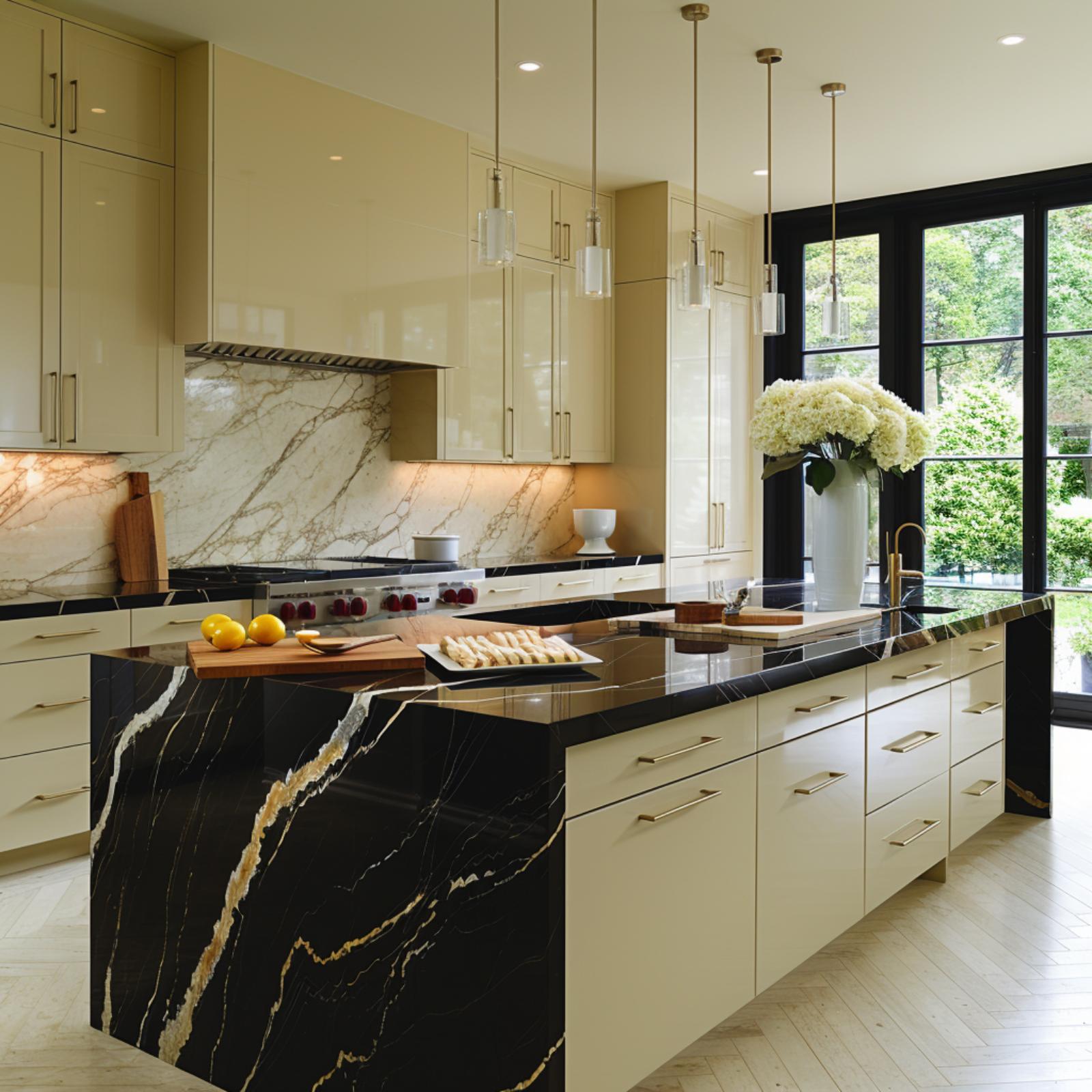
Black countertops work here because they’re balanced, not dominant. The island’s surface is what appears to be black marble with bold white and gold veining, and that same drama carries into the waterfall edge, where the pattern runs uninterrupted to the floor. Cream cabinetry in a high-gloss finish keeps the palette from reading too heavy, and the brushed brass hardware ties directly back to the gold in the stone.
Pendant lighting runs in a trio down the island’s length, each one a slim glass cylinder with brass fittings. It’s a quiet choice that doesn’t compete. White hydrangeas in a tall ceramic vase, lemons on a cutting board, a herringbone tile floor: nothing in this kitchen is working against anything else.
31. Nero Marquina Marble Takes Over Every Surface, and It Works
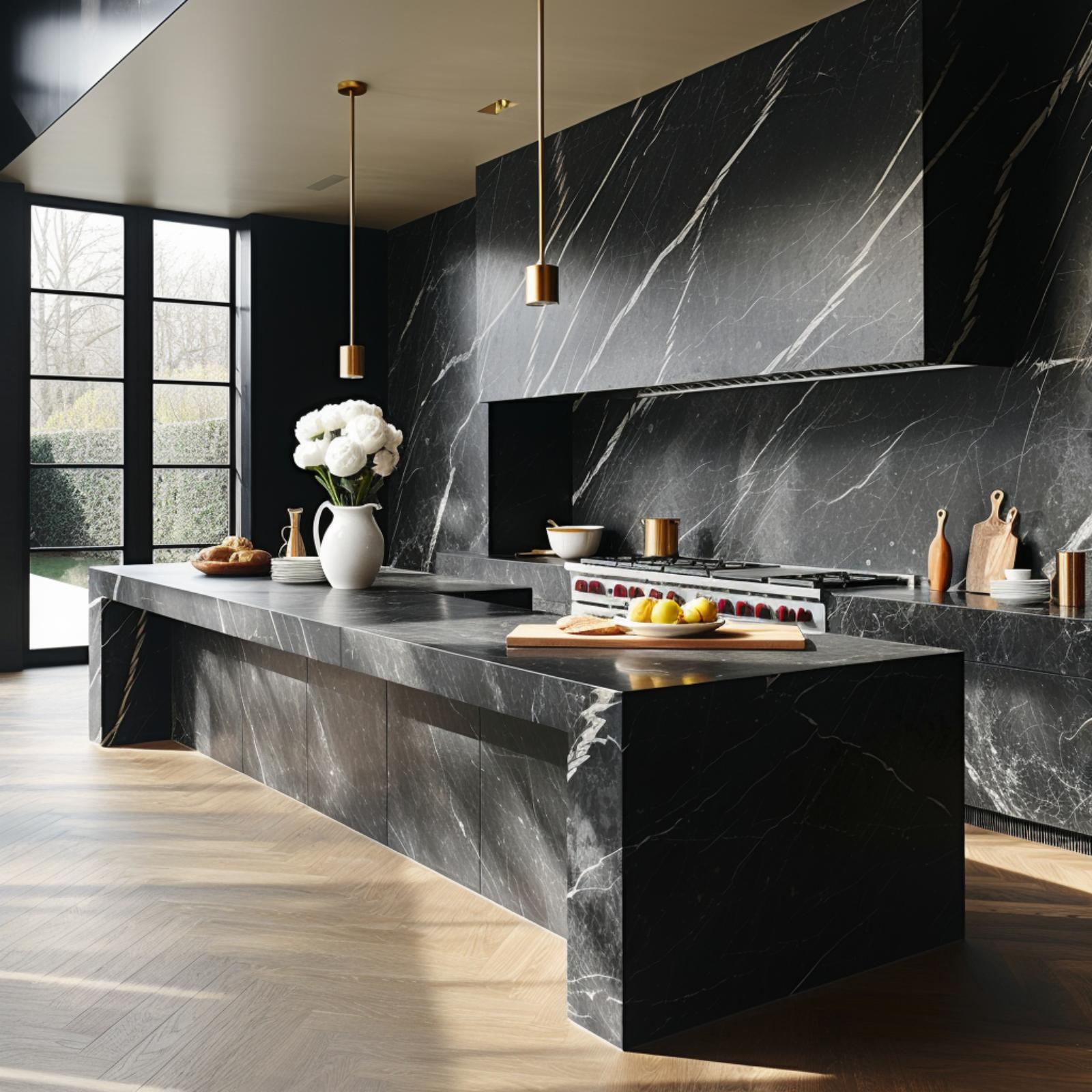
Slabs of what appears to be Nero Marquina marble wrap the island, backsplash, and range hood in a continuous run of dark stone veined with white and faint gold. The effect isn’t just dramatic; it’s disciplined. Every surface speaks the same material language, which keeps the space from feeling chaotic despite how much is going on.
Brass pendant lights with cylindrical copper-toned shades hang low over the island, and the herringbone wood floor below does a lot of quiet work. It’s warm enough to stop the room from feeling cold. A white ceramic pitcher of peonies on the island is either a lucky accident or a very good eye for contrast. Either way, it lands.
30. Nero Marquina Wraps Every Wall, Then the Island Answers Back
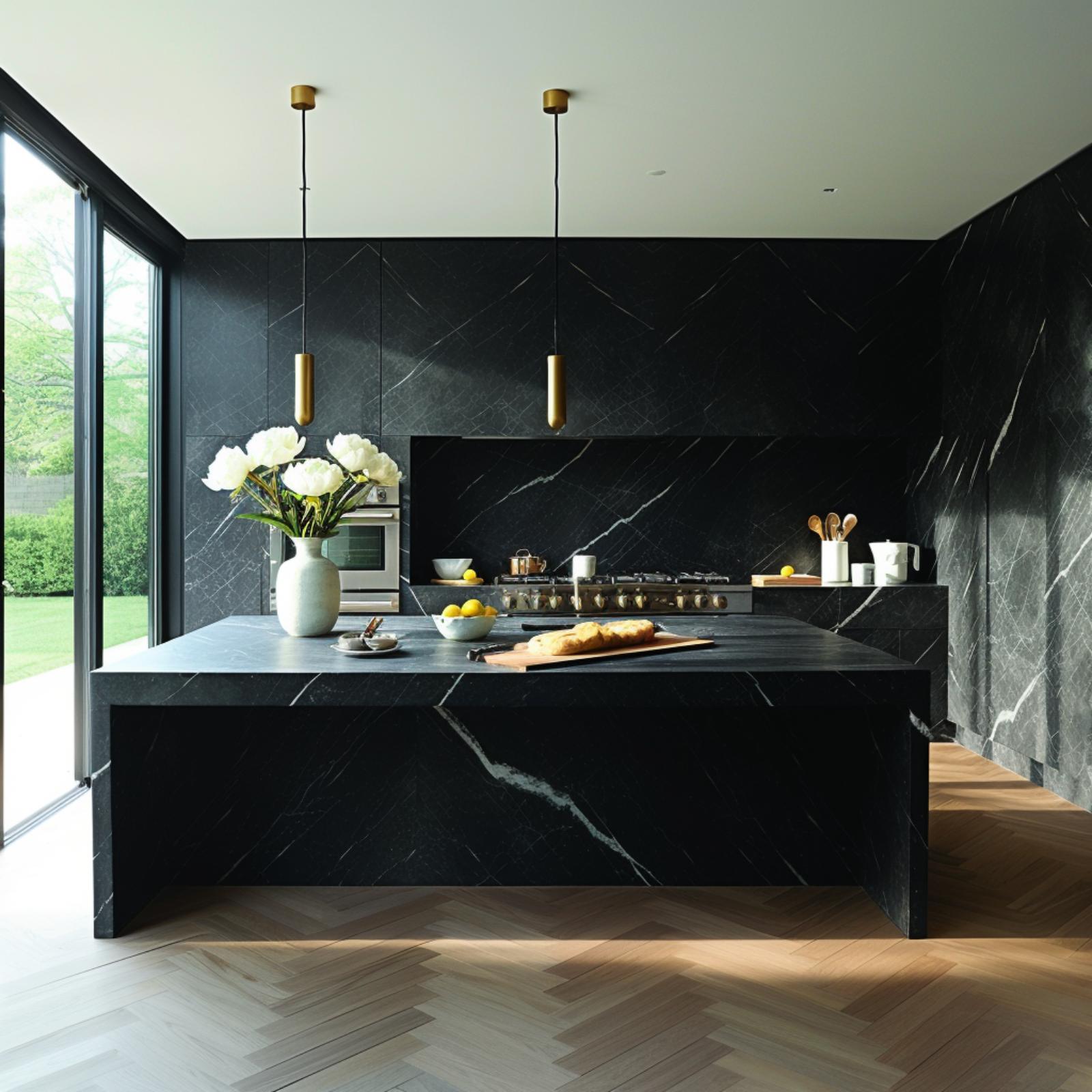
Herringbone oak flooring grounds what could’ve been an oppressive all-dark room. Two brass cylinder pendants pull just enough warmth from the stone’s white veining to make it feel considered rather than cold.
29. Soapstone Island, Brass Pendants, and Zero Desire to Play It Safe
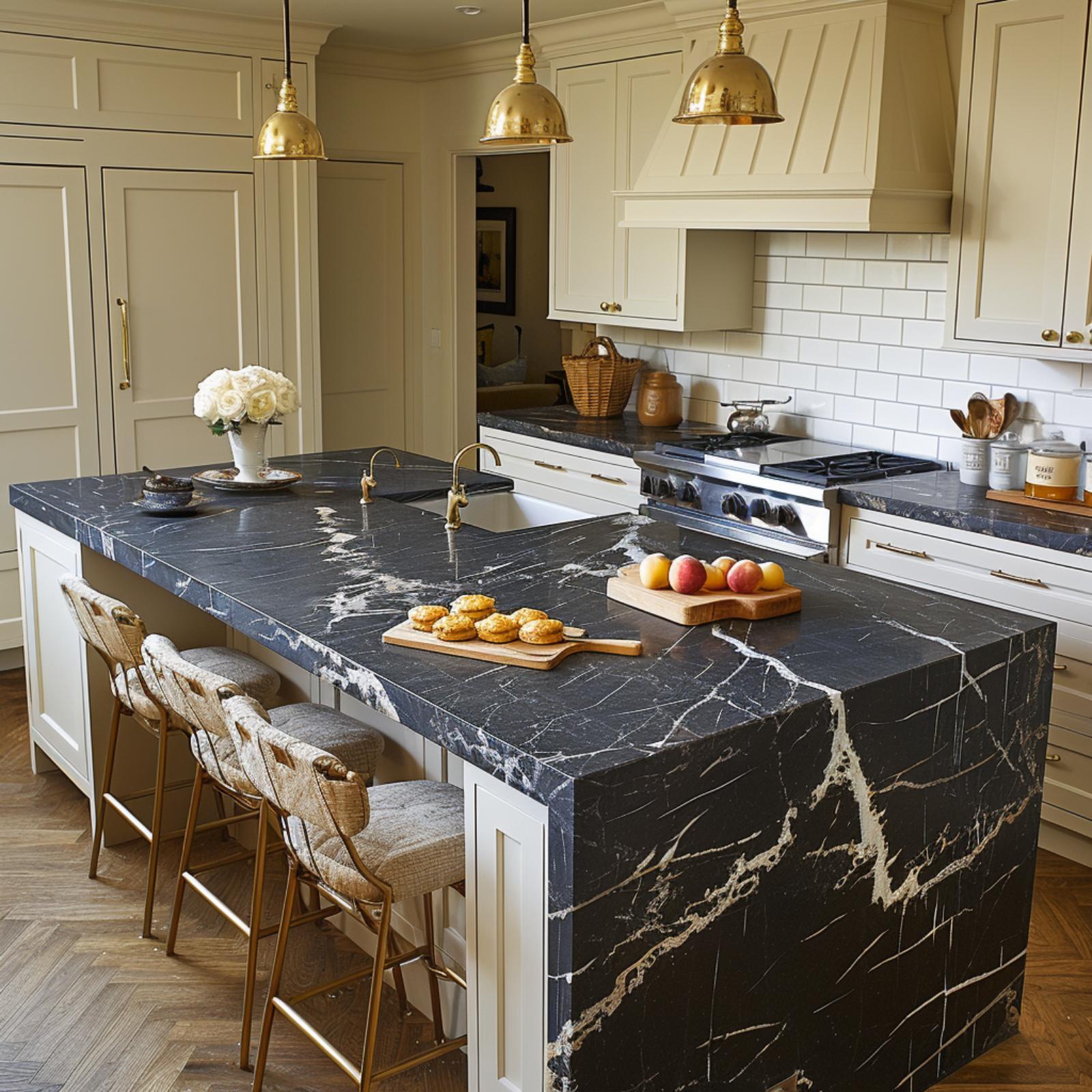
Dark soapstone wraps the island on all four sides, its white veining cutting through the surface in sharp, unpredictable lines. Brass dome pendants hang directly above, and the hardware on cream Shaker cabinets echoes that same finish. It’s a lot of contrast. It works.
28. Walnut Cabinets, Veined Stone, and Three Pendant Lights That Mean Business
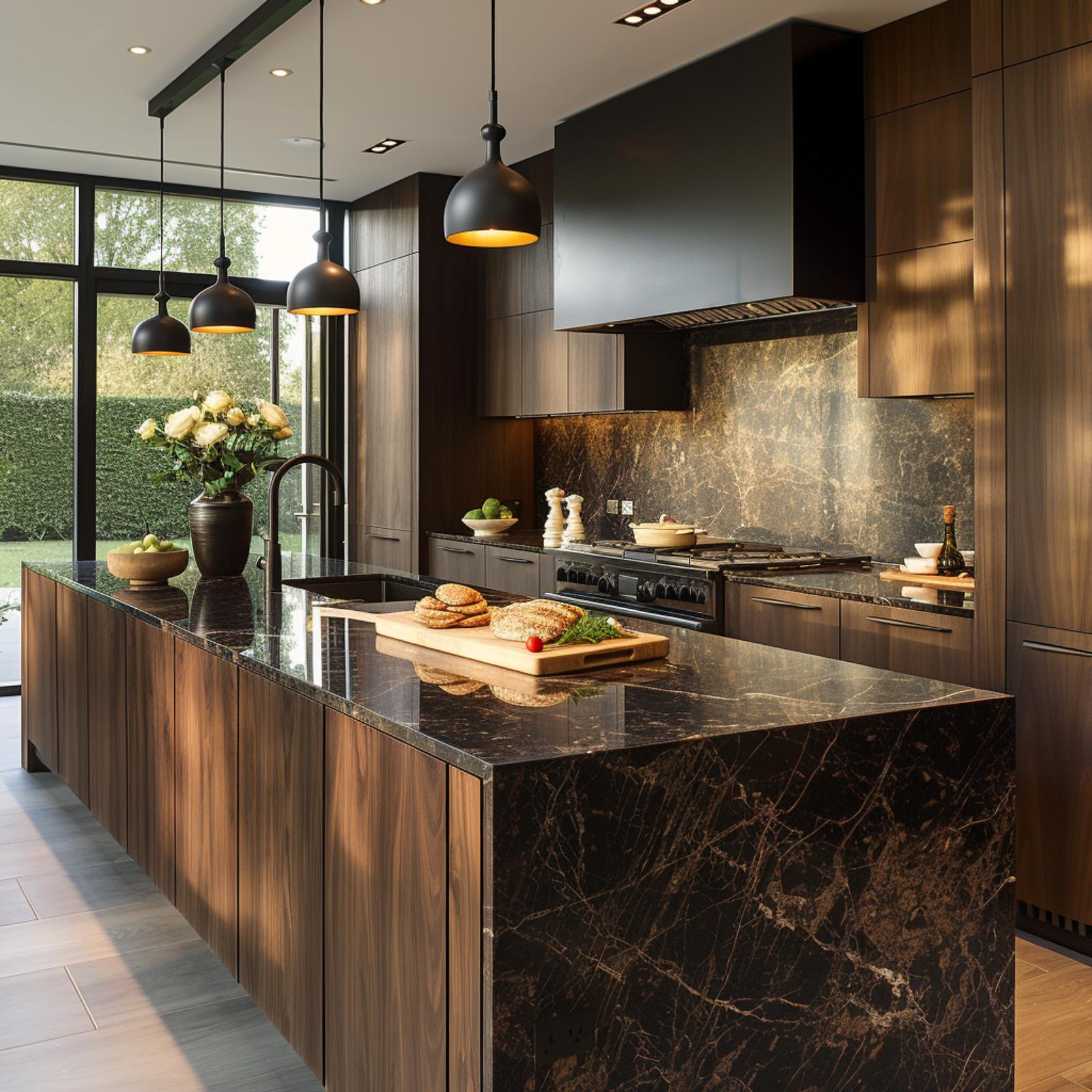
Warm walnut cabinetry paired with countertops in dark emperador marble creates a kitchen that feels anchored rather than cold. The island carries the stone all the way down its waterfall edge, which pulls the eye straight to the floor. Three matte black pendants with gold interiors hang above it, and that gold lining does a lot of quiet work.
The range wall is clad in matching marble from counter to hood, giving the cooking zone a presence most kitchens don’t attempt. A black undermount sink sits slightly off-center on the island, faucet arching low. It’s a practical choice dressed up as a design one.
Try This: Pair dark veined stone with warm wood tones rather than white or gray cabinetry. The wood pulls out the brown and amber in the marble’s veining, keeping the overall palette from reading as cold. Walnut and emperador are a particularly natural match.
27. Walnut Grain, Veined Stone, and a Kitchen Island That Does the Heavy Lifting
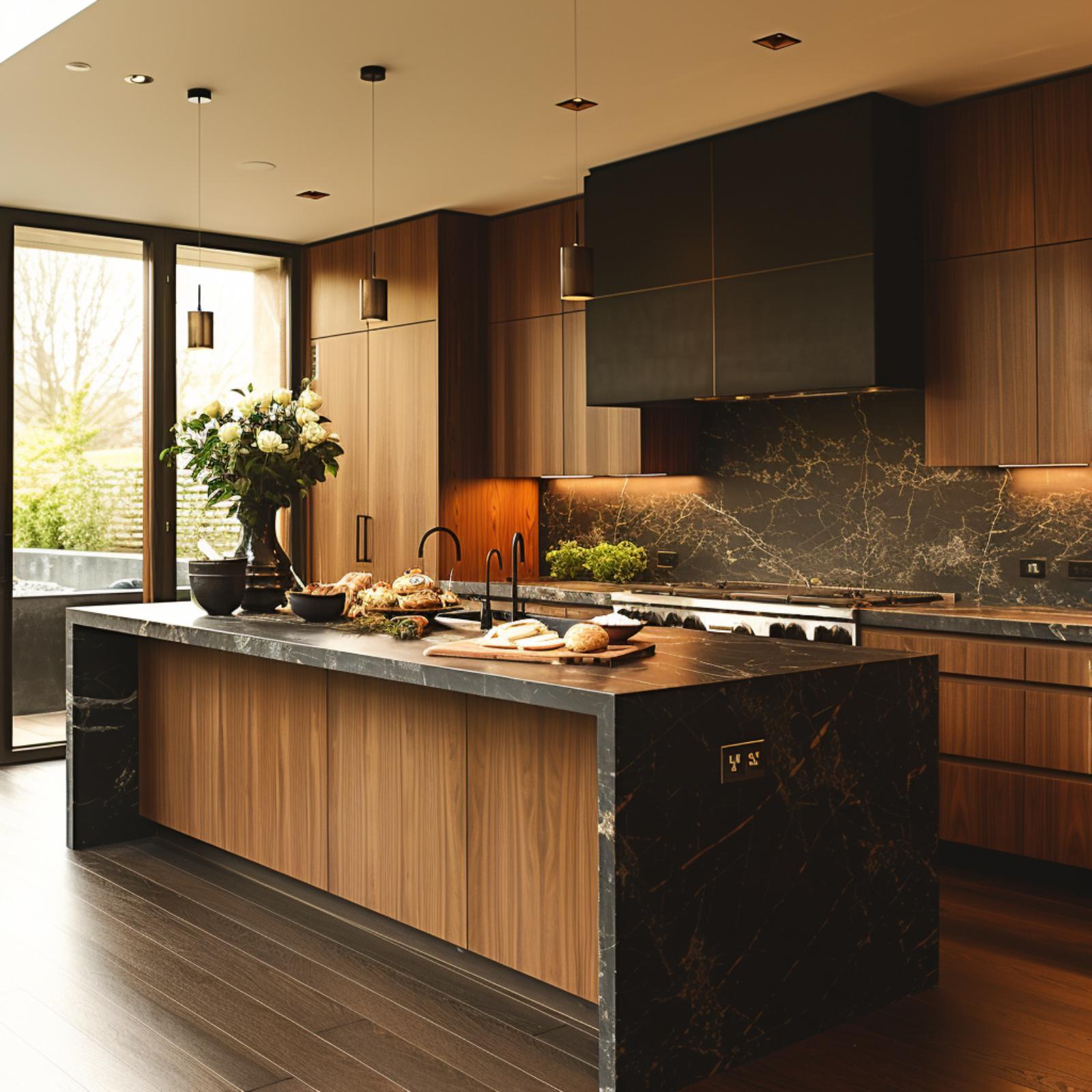
Gold-veined black stone wraps the island’s waterfall edge and reappears on the backsplash, tying the two zones together without feeling repetitive. The wood grain on the cabinet faces runs vertically, which draws the eye up toward the matte black range hood overhead.
Pendant lights here earn their keep. Three cylindrical fixtures hang at staggered heights, casting focused pools of light rather than flooding the whole room. It’s a subtle choice that keeps the counter surfaces reading rich rather than flat.
- Vertical cabinet grain makes ceilings feel taller than they are
- Matte black hardware and fixtures unify without matching exactly
- Waterfall edges on an island justify the stone investment by maximizing visual impact
26. Forest Green Cabinets and Nero Marquina Make a Case for Confidence
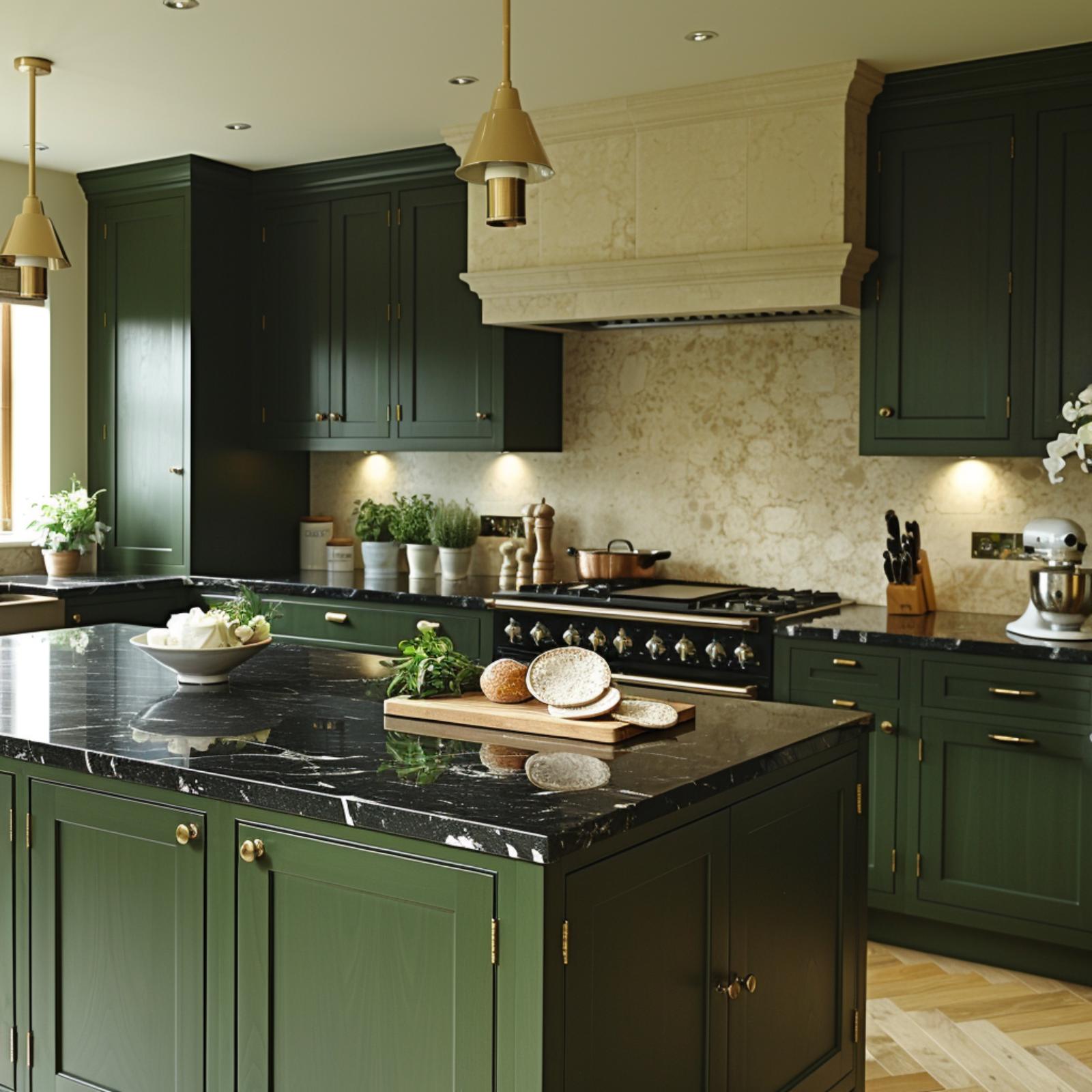
Olive-toned cabinetry in a shaker style anchors the room, but the black marble island countertop with white veining is what earns the second look. Brass hardware throughout ties it together.
Style Tip: Green cabinetry tends to read cooler or warmer depending on what it’s paired with. Against black marble with white veining, this deep forest green skews sophisticated rather than rustic. If you’re committing to a bold cabinet color, let the countertop match the energy rather than soften it.
25. Skylights, Soapstone, and a Wine Fridge Built Right Into the Island
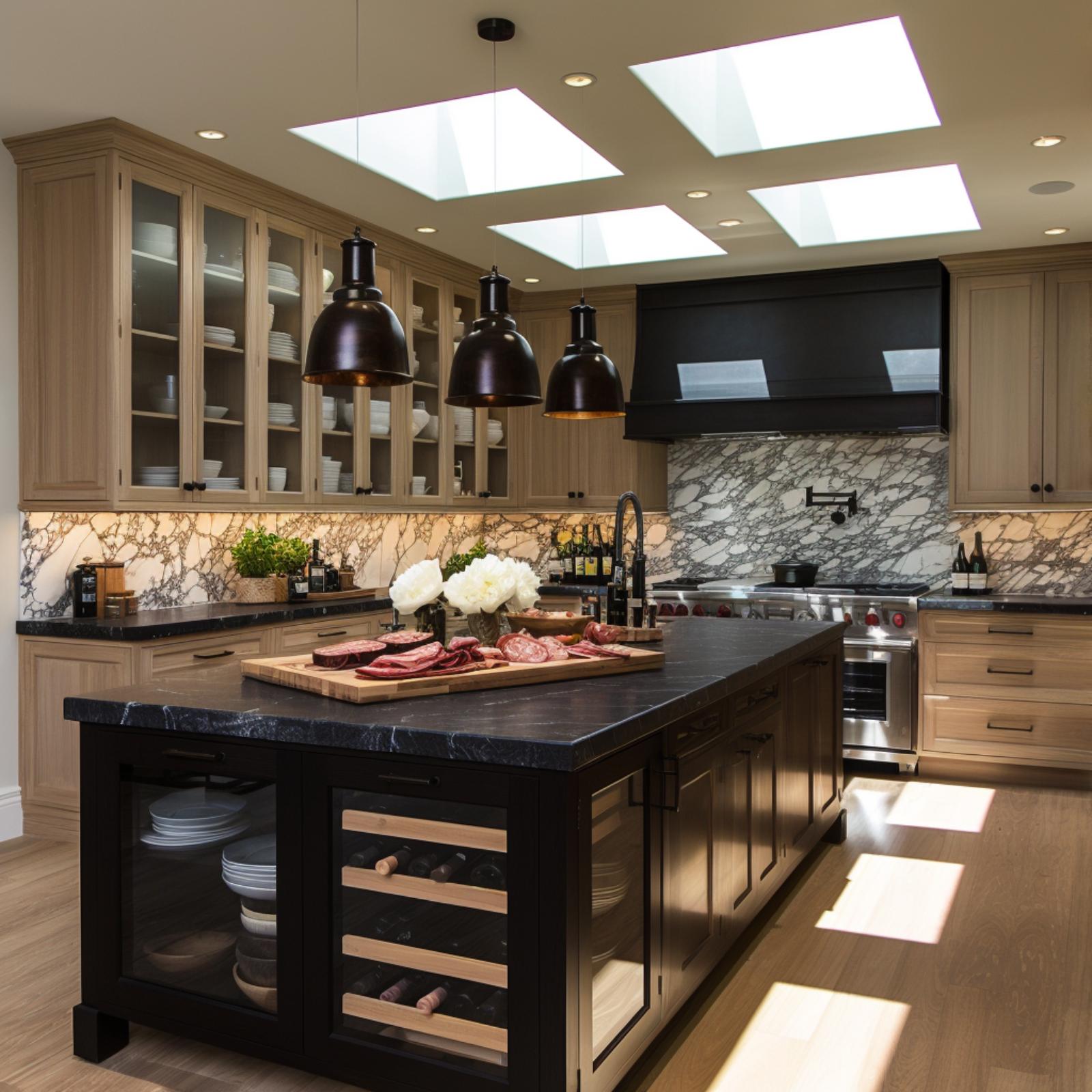
That island isn’t just a prep surface, it’s practically a piece of furniture.
The soapstone countertop on the island reads nearly matte against the light pouring in from four flush skylights overhead. Three bronze pendant lights hang low over it, and the warmth of their finish ties directly back to the light oak cabinetry flanking the walls.
The island’s base cabinet houses a built-in wine fridge with wood-slat shelving, which grounds the whole piece visually. It doesn’t feel like a kitchen accessory. It feels permanent.
24. Matte Black Countertops, Linen-Textured Cabinets, and a Range Hood That Commands the Room
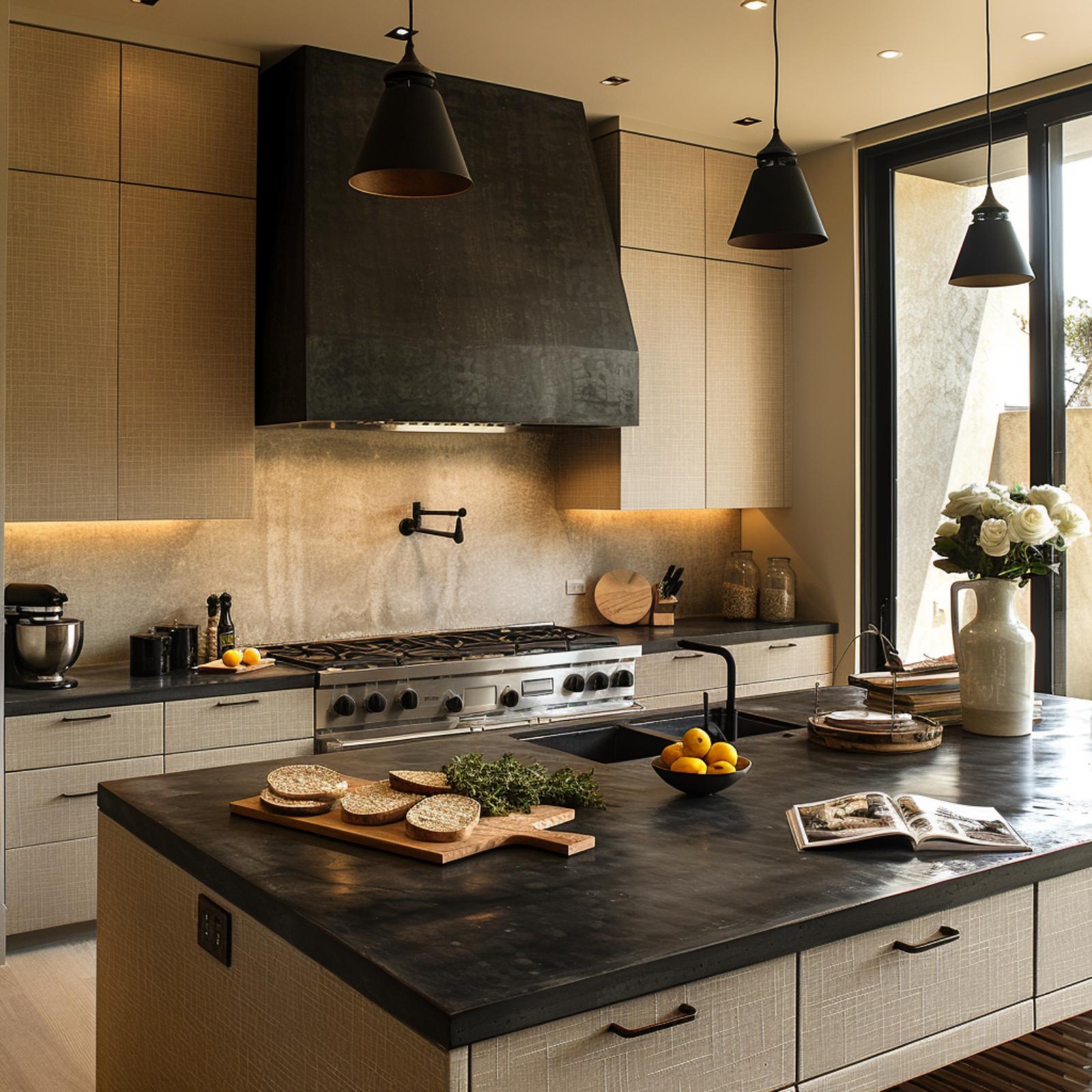
Leathered or honed black stone runs across both the island and perimeter counters, keeping the finish consistent rather than letting one surface upstage the other. Cabinet fronts carry a linen-like texture in warm putty, which softens what could easily read as an industrial space. It doesn’t.
Cabinet fronts carry a linen-like texture in warm putty, which softens what could easily read as an industrial space.
23. Marble Hood, Black Island, Skylights Doing All the Right Things
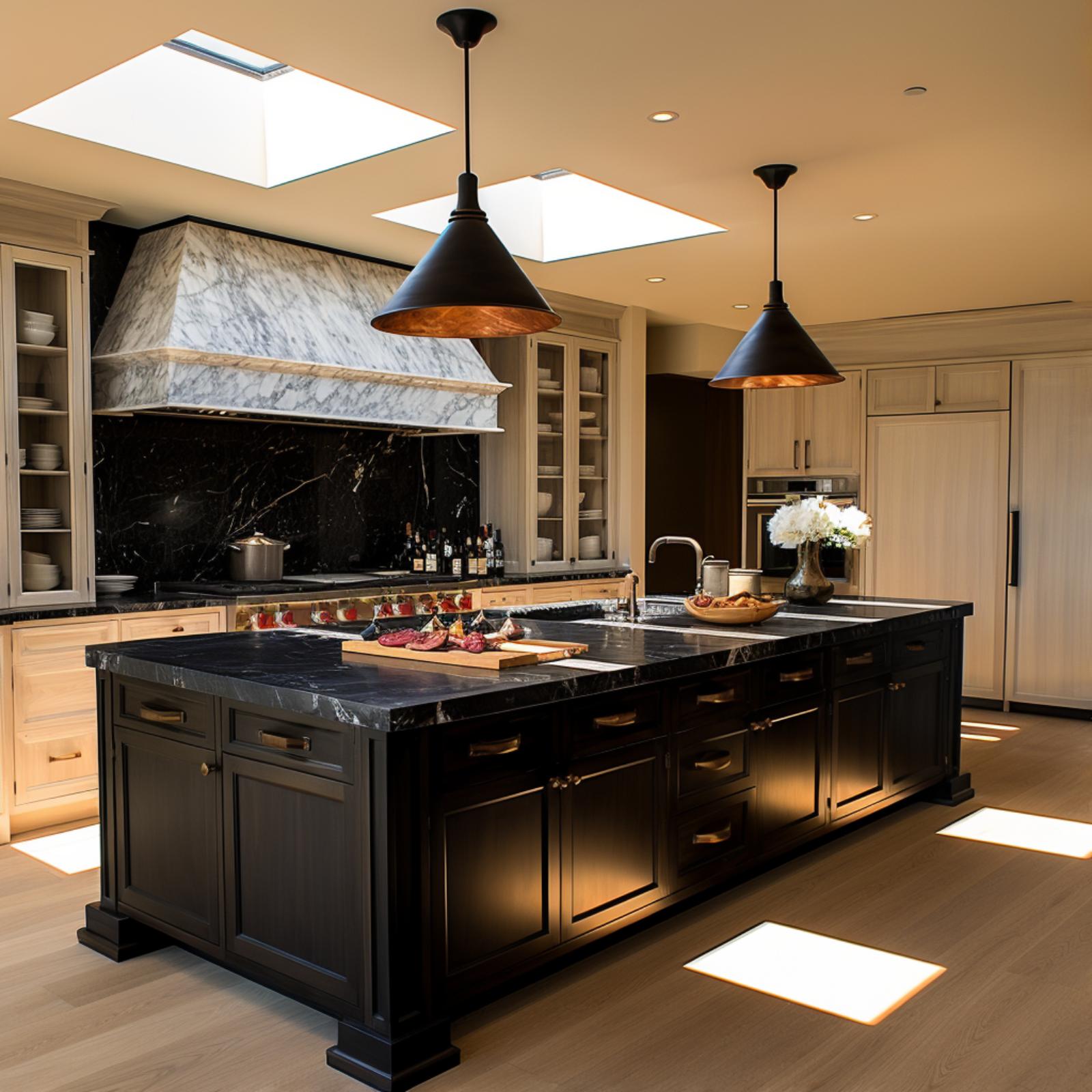
Two skylights cut into the ceiling mean this kitchen doesn’t have to fight for light, even with a black marble island anchoring the center of the room. The island’s veining is white and gray, not gold, which keeps it from reading as precious. Brass hardware on the drawers adds just enough warmth to connect it to the lighter cabinetry surrounding the perimeter.
The range hood is the room’s real statement. It’s clad in what appears to be Calacatta marble, framed in black, with a silhouette that reads traditional but scaled up. Paired with matte black cone pendants with copper interiors, the lighting choices do something clever: the copper bounce softens what could otherwise feel cold.
Ask Yourself: Natural light changes how black countertops read at different times of day. Before committing to a dark stone, visit the showroom slab at multiple times of day, or ask for a sample you can live with in your actual kitchen light for a week.
22. Walnut Cabinetry, Black Marble, and Brass Pendants That Earn Their Place
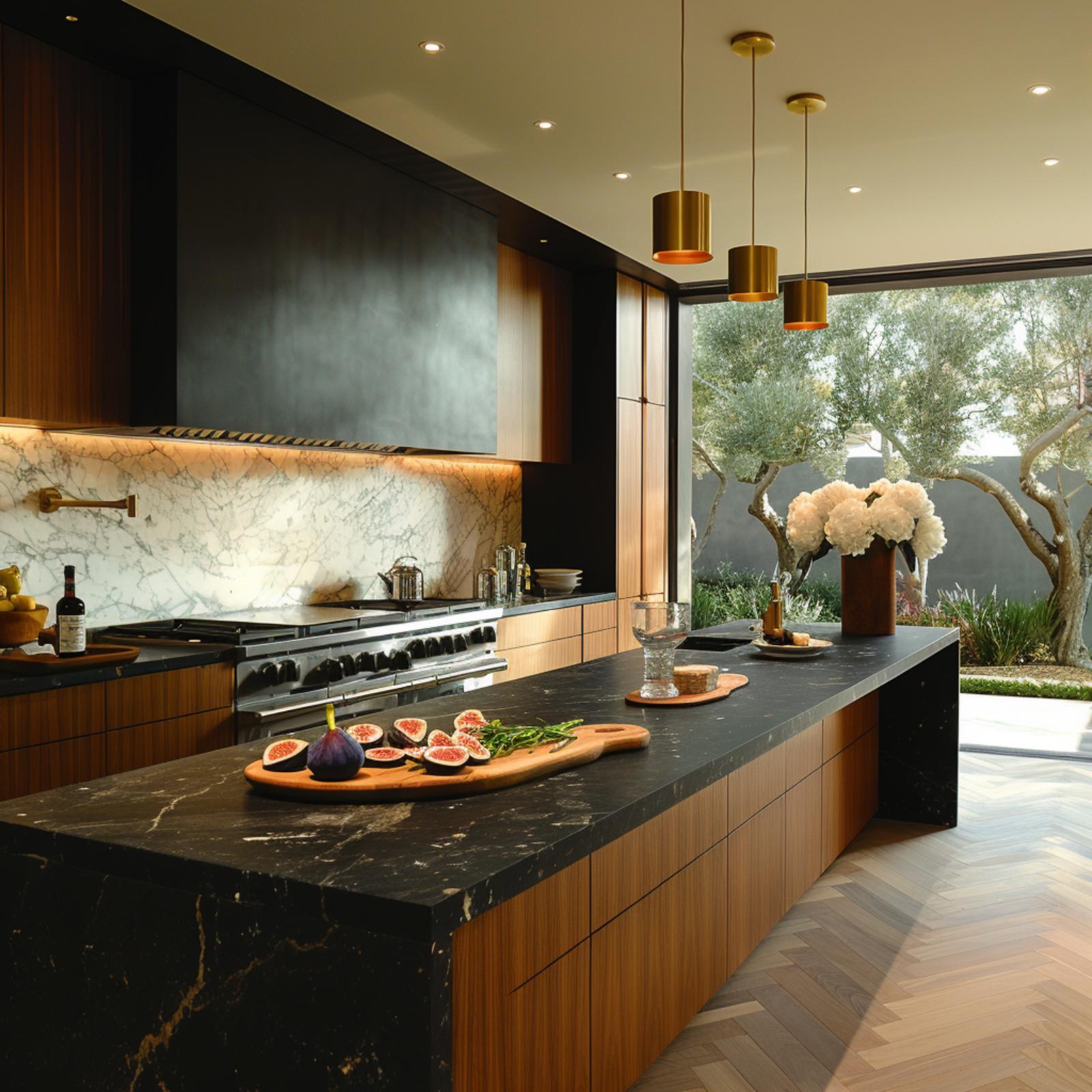
Sliced figs on a cutting board aren’t a typical design choice, but they tell you something about how this kitchen is meant to feel: lived in, not preserved. Rich walnut cabinetry runs floor to ceiling, and the island countertop is black marble with gold veining that catches the brass pendant lights hanging overhead. Those cylindrical pendants aren’t decorative afterthoughts. A floor-to-ceiling glass wall opens to an olive tree courtyard, and that exterior green reads through the glass as a fourth material in the palette.
Designer’s Secret: Brass and black marble can easily tip into overdone, but pendant scale keeps things calibrated here. Smaller cylinder shades draw the eye without competing with the island’s surface. When mixing warm metals with dark stone, keep the metal fixture compact and let the stone carry the visual weight.
21. Rough-Cut Stone Island, Brass Pendants, and a Kitchen That Refuses to Be Polished
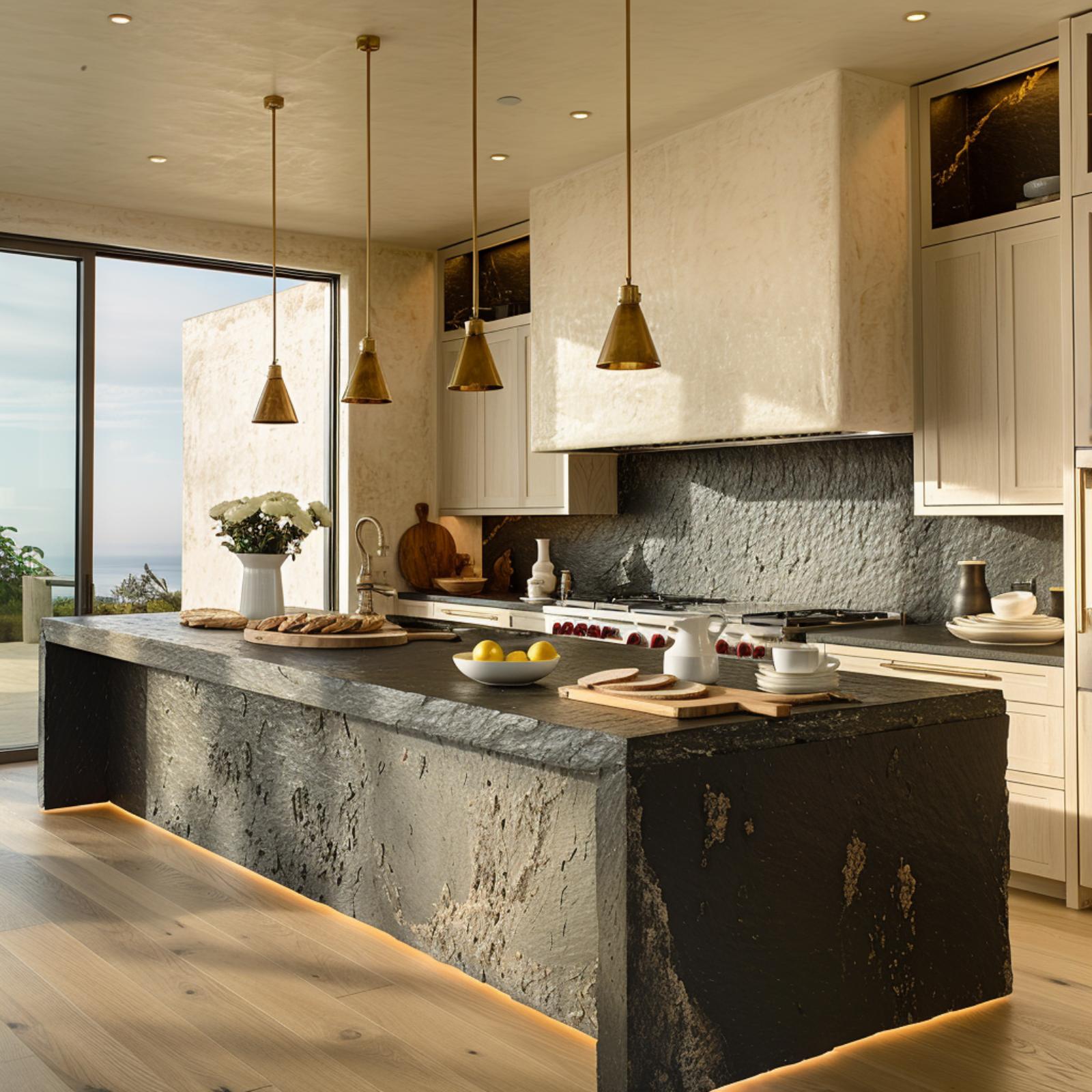
Cleft-face granite wraps the island’s sides with an almost geological rawness, left intentionally unfinished while the top sits smooth and flat. Brass cone pendants hang at a consistent height, which matters more than most people realize. Too high and they disappear; too low and they compete with the stone.
Why the Toe-Kick Lighting Changes Everything Here
Recessed LED strip lighting runs along the base of the island, casting a warm glow across the wide-plank oak floor beneath it. On an island this heavy visually, that underlit gap creates the illusion of the stone floating, which keeps the room from feeling anchored to the floor. It’s a small detail that does a disproportionate amount of work against such a dominant material.
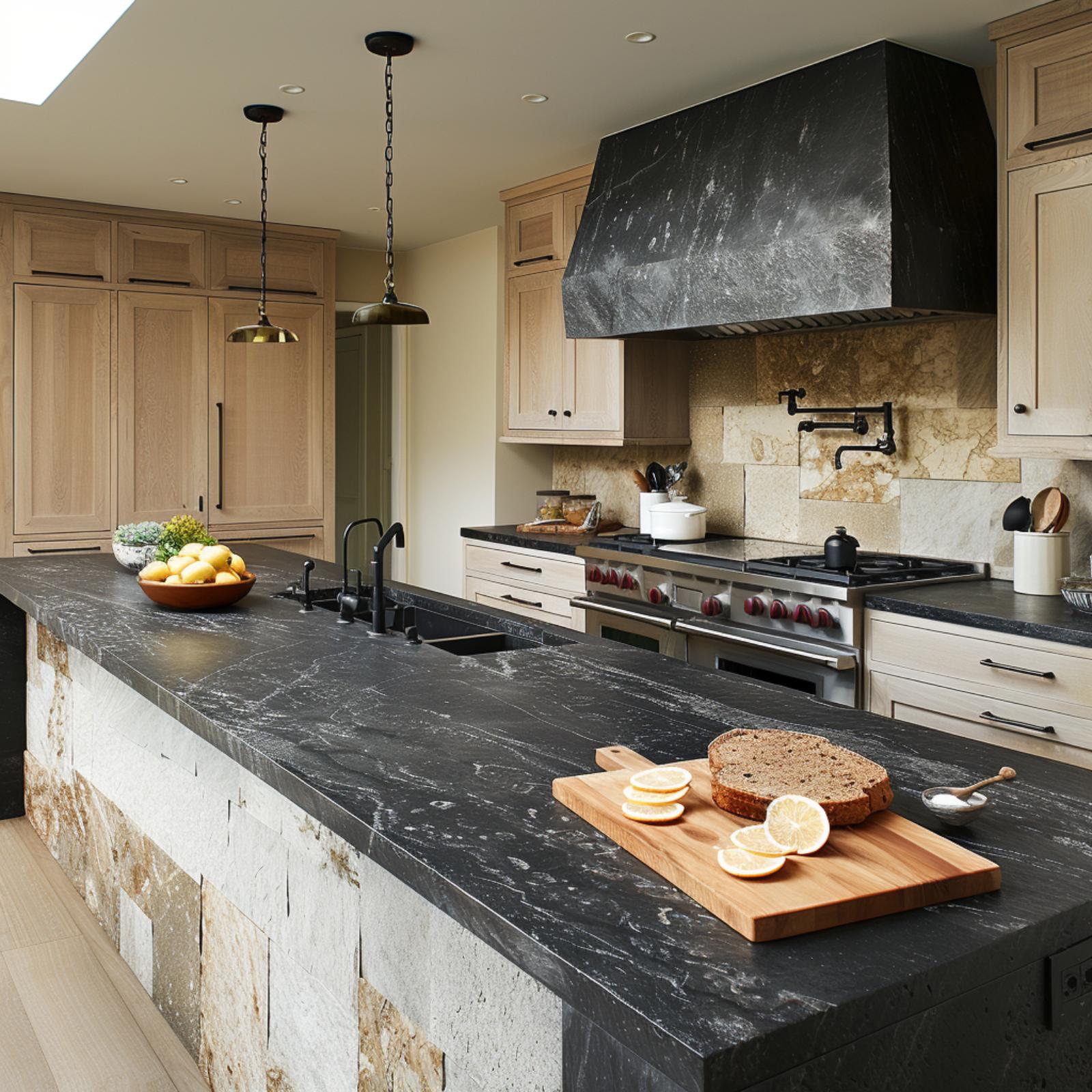
20. Leathered Soapstone, Stone-Clad Island Sides, and Brass Pendants That Know Their Moment
🔥 Would you like to save this?
Soapstone countertops in near-black with white mineral streaking run across both the perimeter and the island, and the consistency reads as intentional rather than monotonous. The island’s base is clad in rough stacked stone in cream and amber, which picks up the backsplash tile behind the range without over-coordinating. Natural oak cabinetry keeps things from going heavy.
A pot-filler in matte black anchors the cooking wall, and the range hood is clad in the same soapstone as the counters. That’s the move that holds it together. Brass chain pendants add warmth without competing, and a simple cutting board with sliced citrus on the island reminds you this kitchen actually gets used.
Style Math: Matching the range hood cladding to the countertop material is one of the more disciplined decisions a kitchen designer can make. It creates visual continuity without requiring the rest of the room to do more work. When the hood and counters share a material, contrast elsewhere, like the stacked stone island base, reads as intentional rather than accidental.
Not every kitchen earns its drama through color alone; sometimes material does the work instead.
19. Black Marble Waterfall Island, Cream Cabinets, and Brass That Knows When to Stop
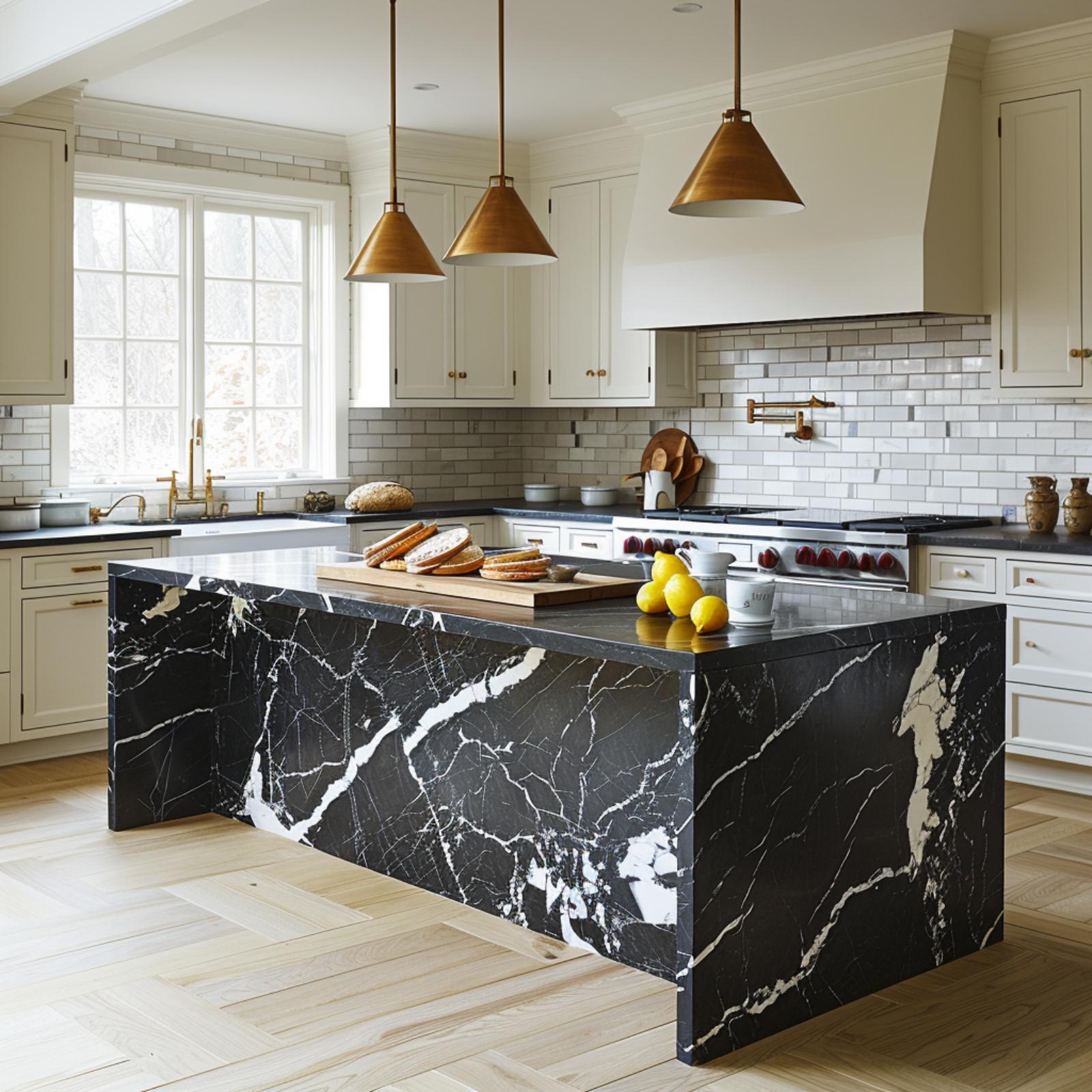
Nero Marquina with bold white veining wraps this island on all sides, running the stone straight down to the floor in a waterfall edge that makes the countertop feel structural rather than decorative. Cream inset cabinets keep things from tipping too moody. Three brass cone pendants hang low enough to feel intentional without crowding the workspace, and lemons on the counter do more compositional work than you’d expect.
18. Burgundy Lacquer, Black Marble Waterfall, and Brass Pendants That Don’t Apologize
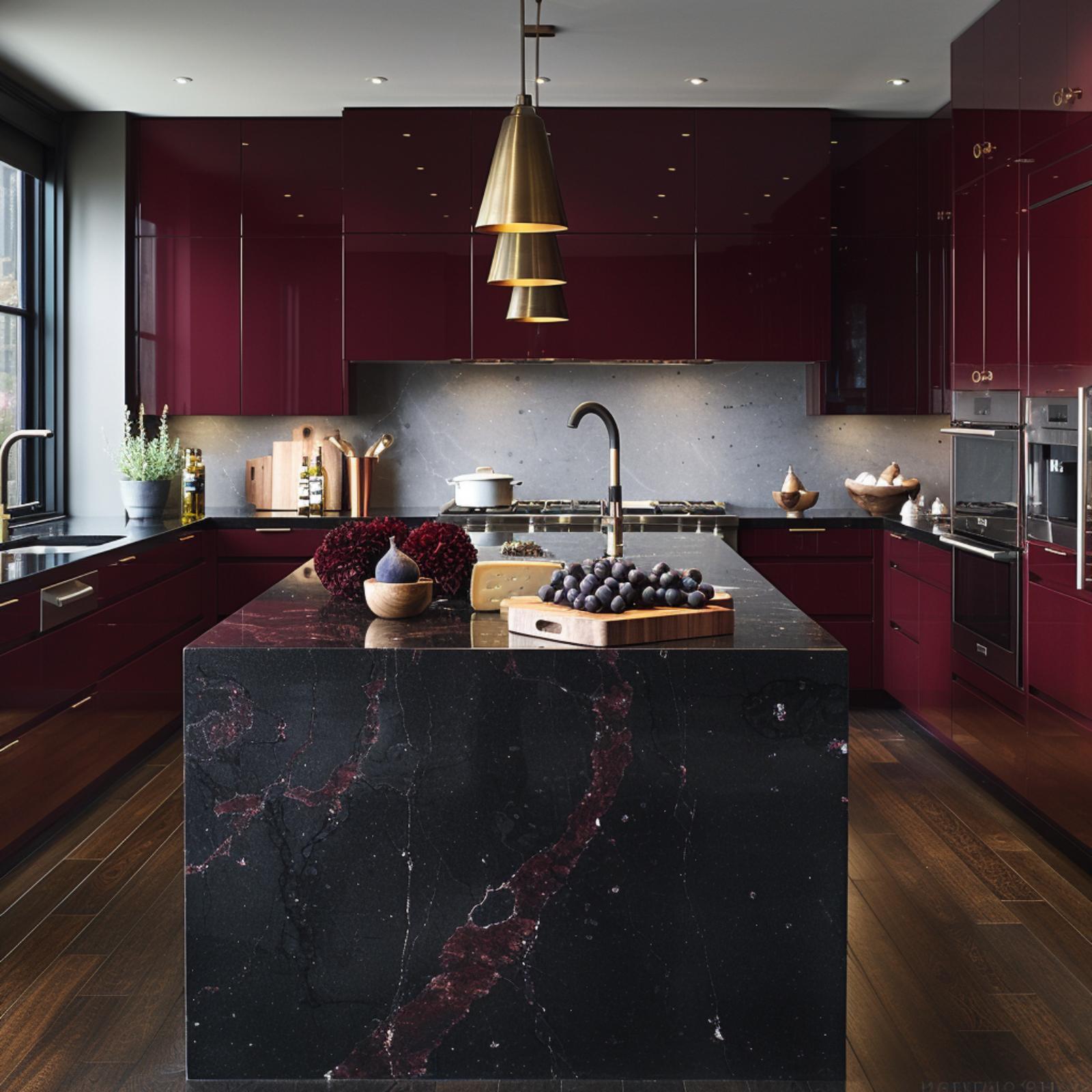
Glossy burgundy cabinets running floor to ceiling set a deliberate mood here. Against that depth of color, a black marble island with crimson veining reads less like a contrast and more like a continuation. The stone’s pattern echoes the cabinet color without mimicking it exactly, which is harder to pull off than it looks.
Stacked brass pendants hang directly above the island in a tiered cluster, and the matte-to-glossy relationship between the fixtures and cabinetry keeps the palette from collapsing into one reflective mass. Dark hardwood flooring grounds everything without competing for attention.
In The Details: High-gloss cabinet finishes reflect light differently than matte, which matters more in a dark kitchen than a light one. In deep jewel-tone spaces, a lacquer finish can actually brighten a room by bouncing ambient light around the walls. If the gloss feels like too much, satin falls between the two and still reads rich.
17. Concrete Hood, Oxidized Backsplash, and Light-Wood Cabinets That Hold Their Own
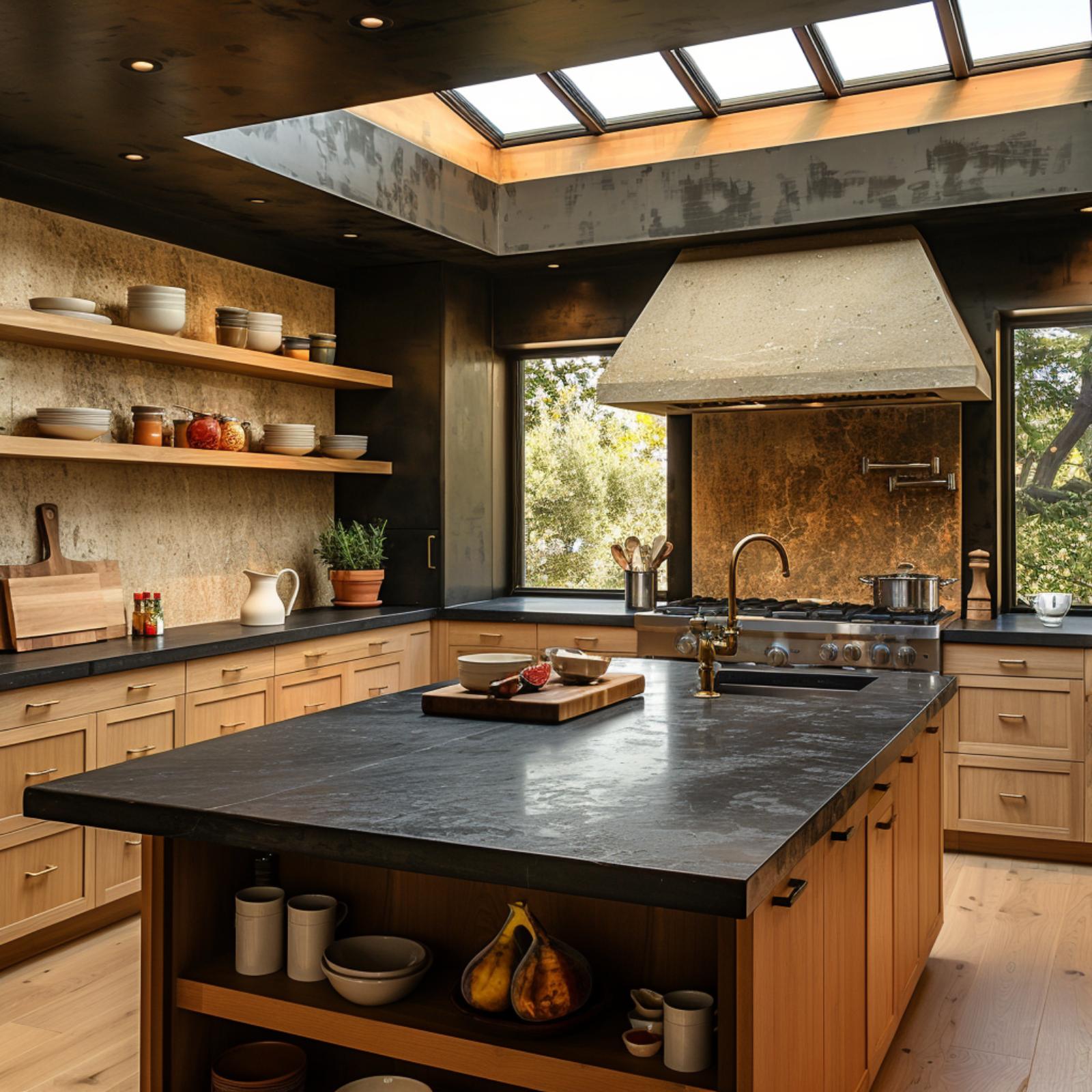
Flat-front maple cabinets with brass pulls run the perimeter, keeping things warm without going rustic. The countertops are honed black soapstone, and they reappear on the island, which also carries an undermount sink and a brass gooseneck faucet positioned closer to the cooktop side than you’d expect. That off-center placement is a quiet signal that this kitchen was planned around actual cooking.
The range hood is clad in what reads as cast concrete, slightly rough in texture, which plays against the oxidized copper backsplash behind the range. Open shelves in the same maple as the cabinets keep the left wall from feeling too heavy. Skylights above the island flood the stone with midday light, which is when dark countertops tend to look their best.
Worth Knowing: Open shelving looks clean in photos but demands consistency in real kitchens. Mixing vessel heights and keeping a rough count of how many items actually belong on the shelf before committing to the design saves a lot of post-install editing. Ceramics in neutral tones tend to hold up better across seasons than colorful pieces that can clash with produce or table linens nearby.
16. Dark Green Cabinets, a Black Hood, and Gold Pendants That Actually Earn the Drama
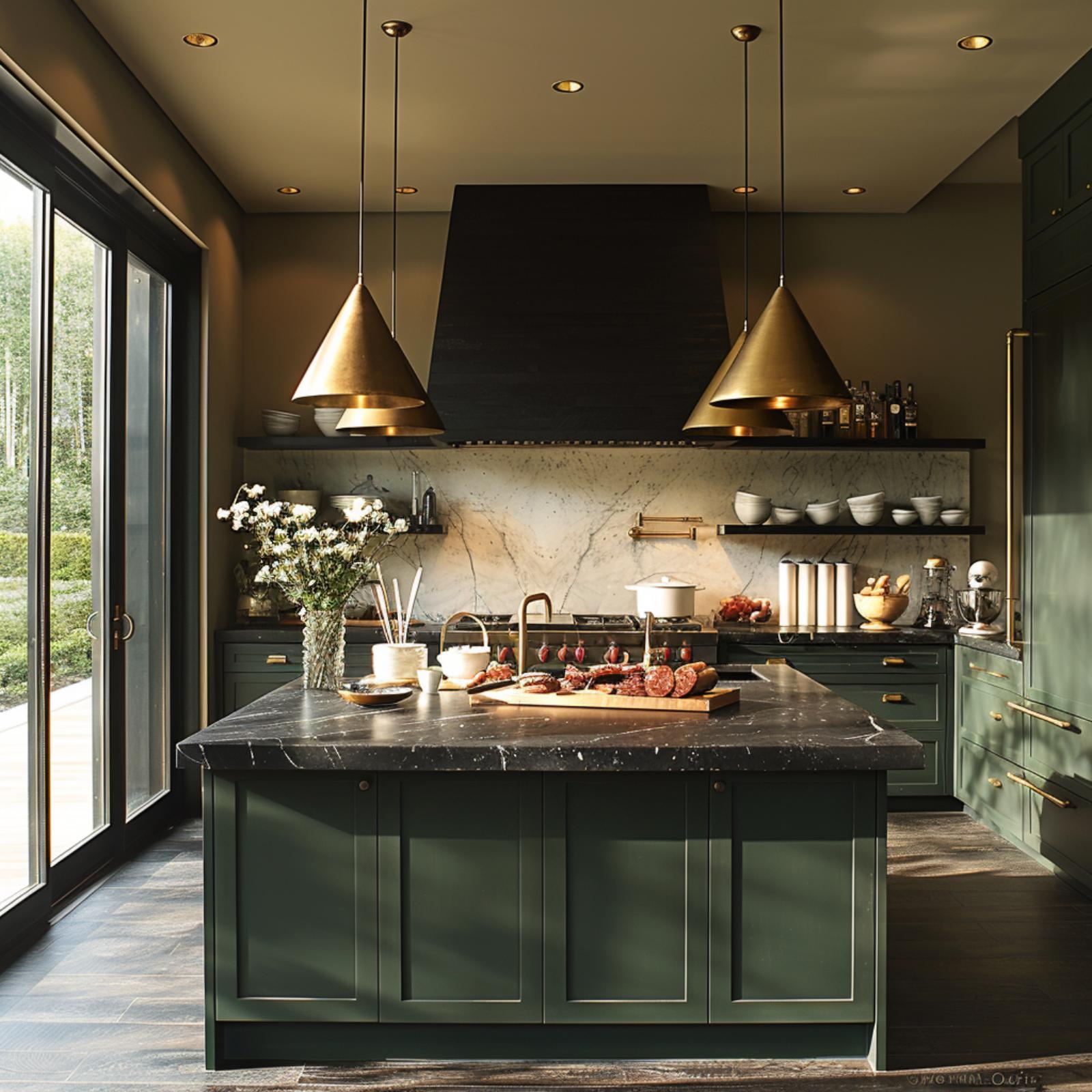
Brass cone pendants hung at staggered heights keep the eye moving without competing with the matte black range hood anchoring the back wall. Cabinet color sits somewhere between hunter and sage, and paired with black-veined marble on the island, it reads warmer than expected. Charcuterie on a wood board helps, too.
By The Numbers: Dark range hoods require more ventilation capacity than lighter models because surface heat absorption is higher. Specifying a hood rated for the actual BTU output of the range beneath it matters more than its visual presence. Underpowered ventilation is one of the most common mistakes in otherwise well-designed kitchens.
15. Black Quartzite, Cognac Leather Barstools, and Pendant Lights That Pull It Together
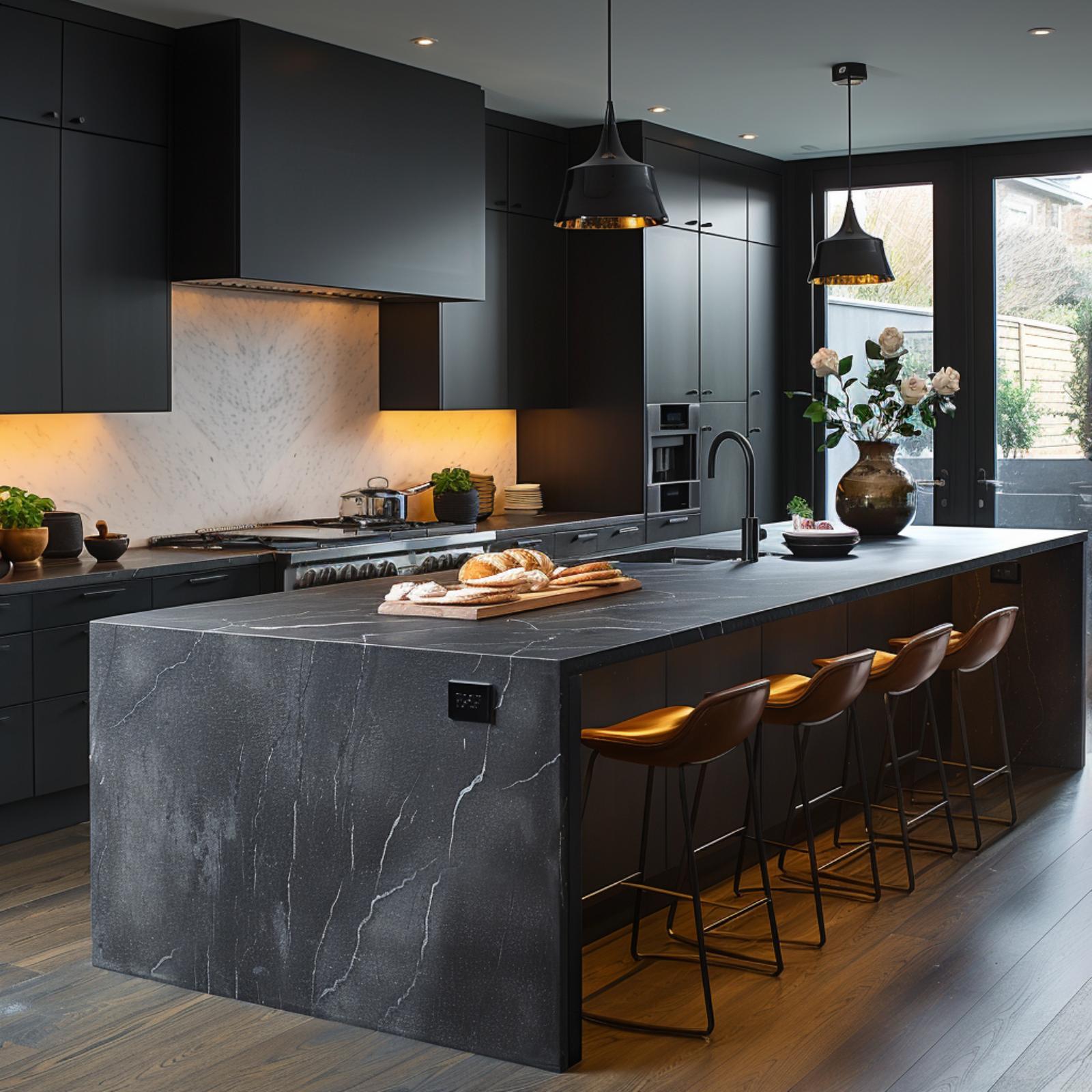
Black quartzite does something most dark stones won’t: it holds white veining that reads almost like brushstrokes rather than the bold slabs you see in marble. Here, the full-height waterfall island shows that veining on all four faces, which matters because the island is essentially furniture at this scale.
The cognac leather barstools are doing real work. That warm amber against matte black cabinetry prevents the room from collapsing into a single dark register. Two pendant lights with copper-lined shades pick up the same tone, and the payoff is a kitchen that feels resolved rather than decorated.
Did You Know: Quartzite is frequently misidentified as marble at the showroom stage, but the two materials perform very differently under kitchen conditions. Quartzite is significantly harder and less porous, making it more resistant to etching from acidic foods. Asking for a scratch test on a sample corner before purchasing is a simple way to confirm what you’re actually buying.
14. Honed Concrete Island, Plaster Walls, and Walnut Cabinets That Don’t Need to Try
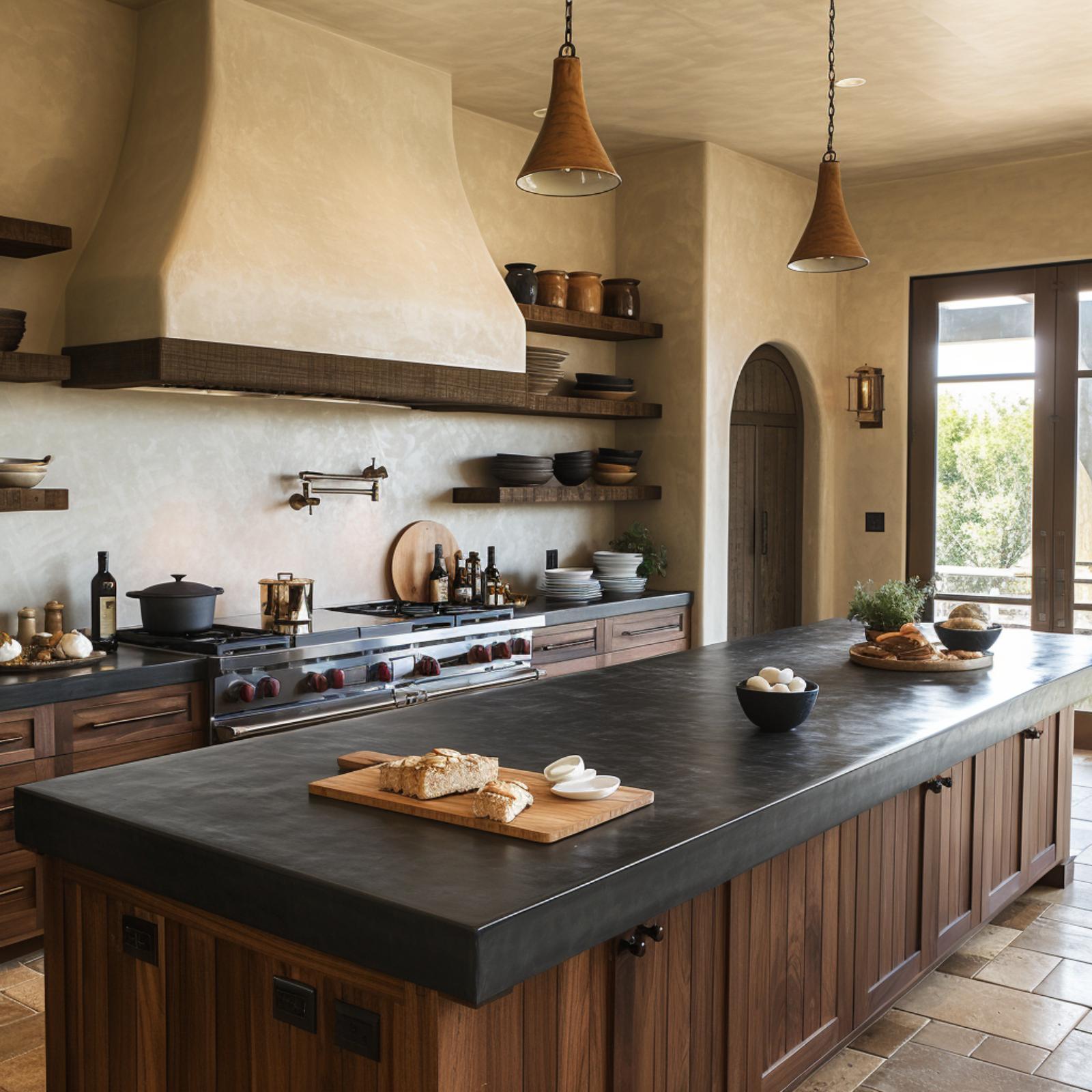
Honed charcoal concrete on both the island and perimeter counters keeps the palette consistent without feeling forced. The walnut cabinetry, with its visible grain and dark hardware, does the work of warming what could easily read as cold. Pendant lights with wood-wrapped cone shades feel like a considered detail rather than an afterthought.
Pro Tip: Concrete countertops require sealing on installation and periodic resealing depending on use, because unsealed concrete will absorb oils and stain permanently. If a honed finish appeals more than polished, know that honed concrete shows water spots more readily and needs more frequent maintenance attention.
13. Dark Marble, Warm Wood, and a Skylight That Changes Everything
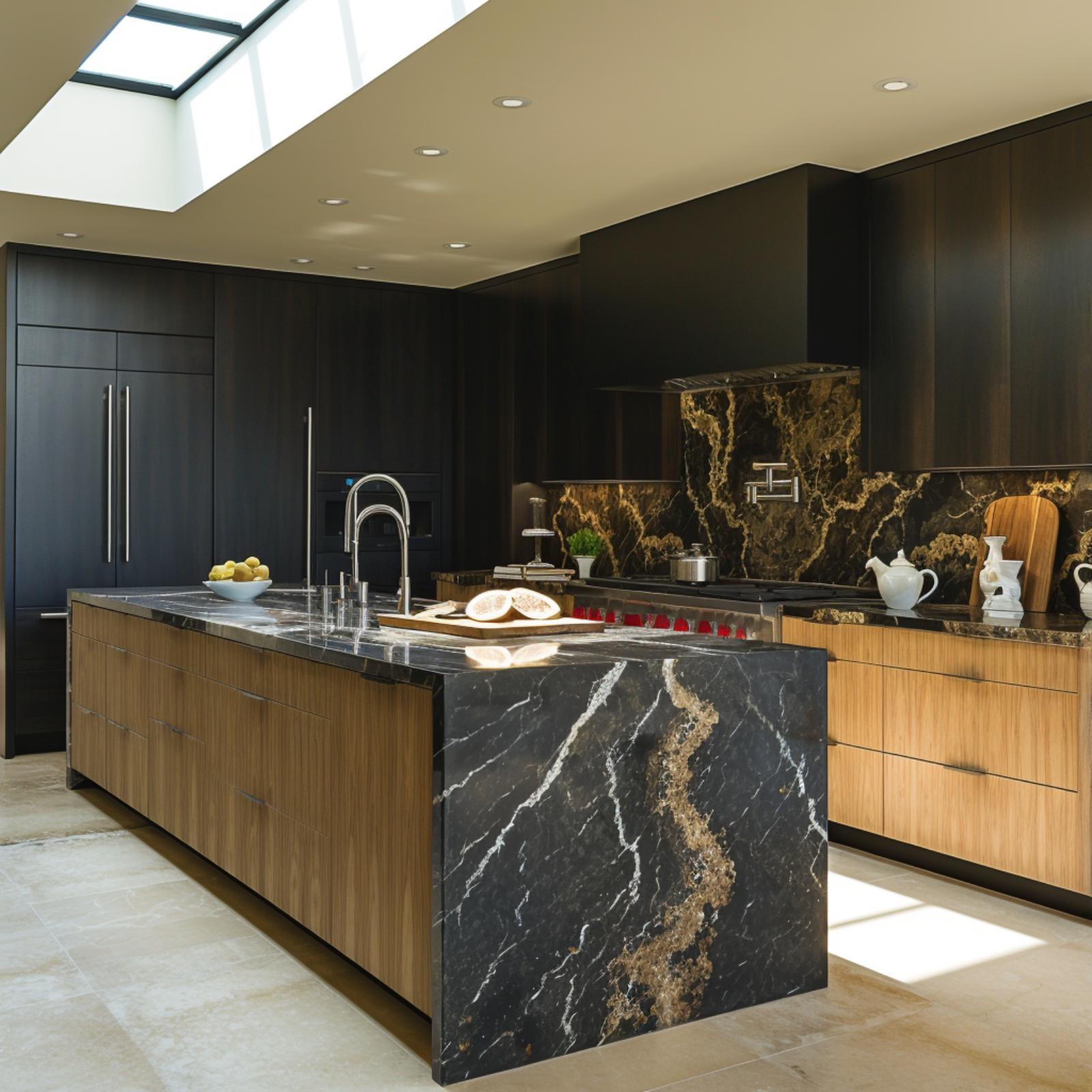
That waterfall edge isn’t just a countertop choice — it’s a structural statement that commits the entire room to one material.
The black and gold marble wraps the island on all four sides, with veining that picks up the warm grain of the flat-front wood drawer faces beneath it. That pairing keeps the stone from reading cold. A skylight overhead floods the surface at angles that shift throughout the day, pulling out bronze tones in the morning and near-black depth by afternoon. The same stone reappears on the backsplash behind the range, which ties the two zones together without adding a third material to the mix. Stainless hardware on the faucet and pulls is deliberately quiet against all that drama.
12. Knotty Oak Cabinets, a Slab Waterfall Island, and Pendants That Don’t Overexplain
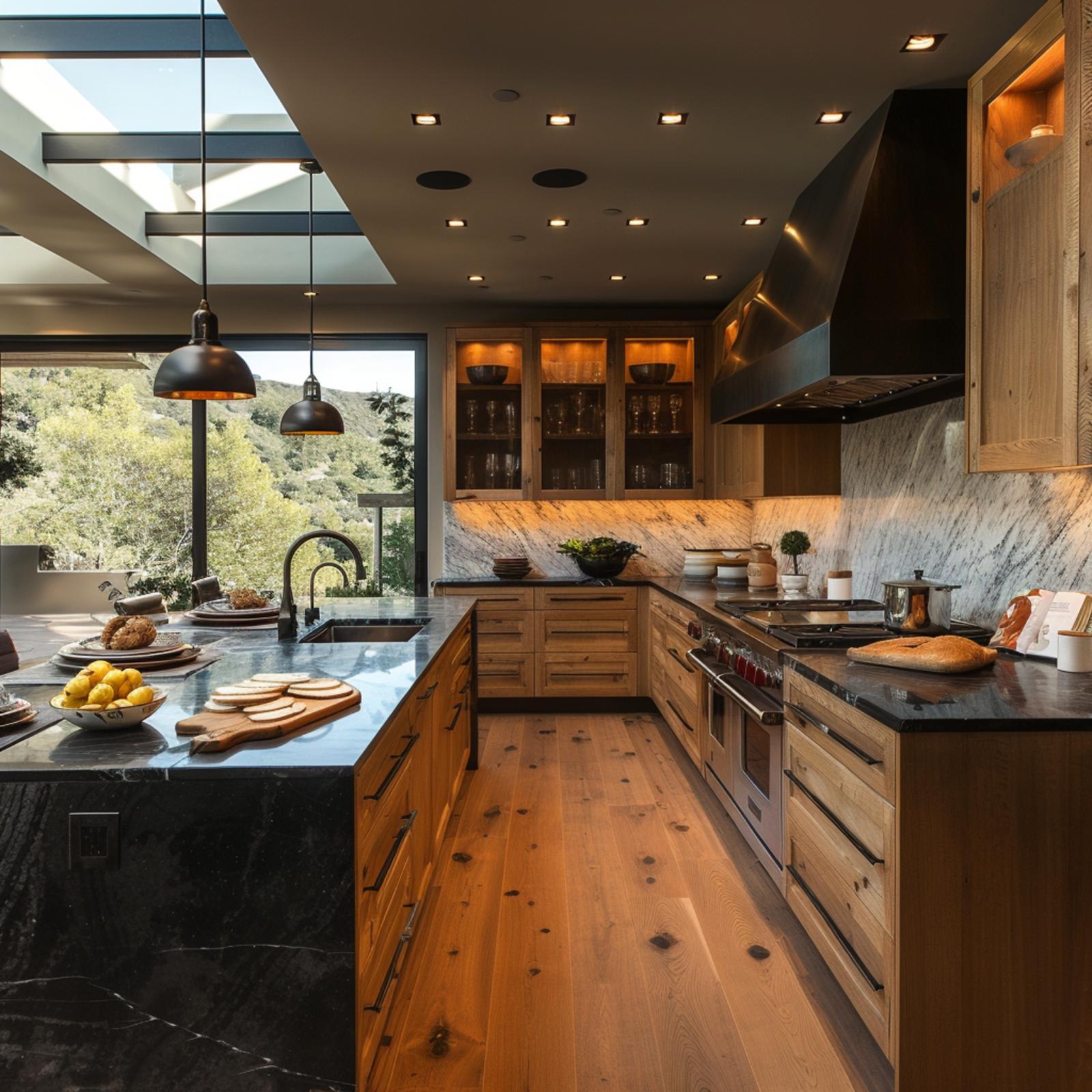
Leathered black granite wraps the island in a full waterfall drop, and the knotty oak cabinetry alongside it keeps the combination from reading cold. Two matte black dome pendants hang low over the island without competing for attention. What actually holds the room together is the wide-plank pine floor, which runs warm enough to offset the dark stone at every angle.
11. Galaxy Granite, Maple Cabinetry, and Pendant Lights That Don’t Compete
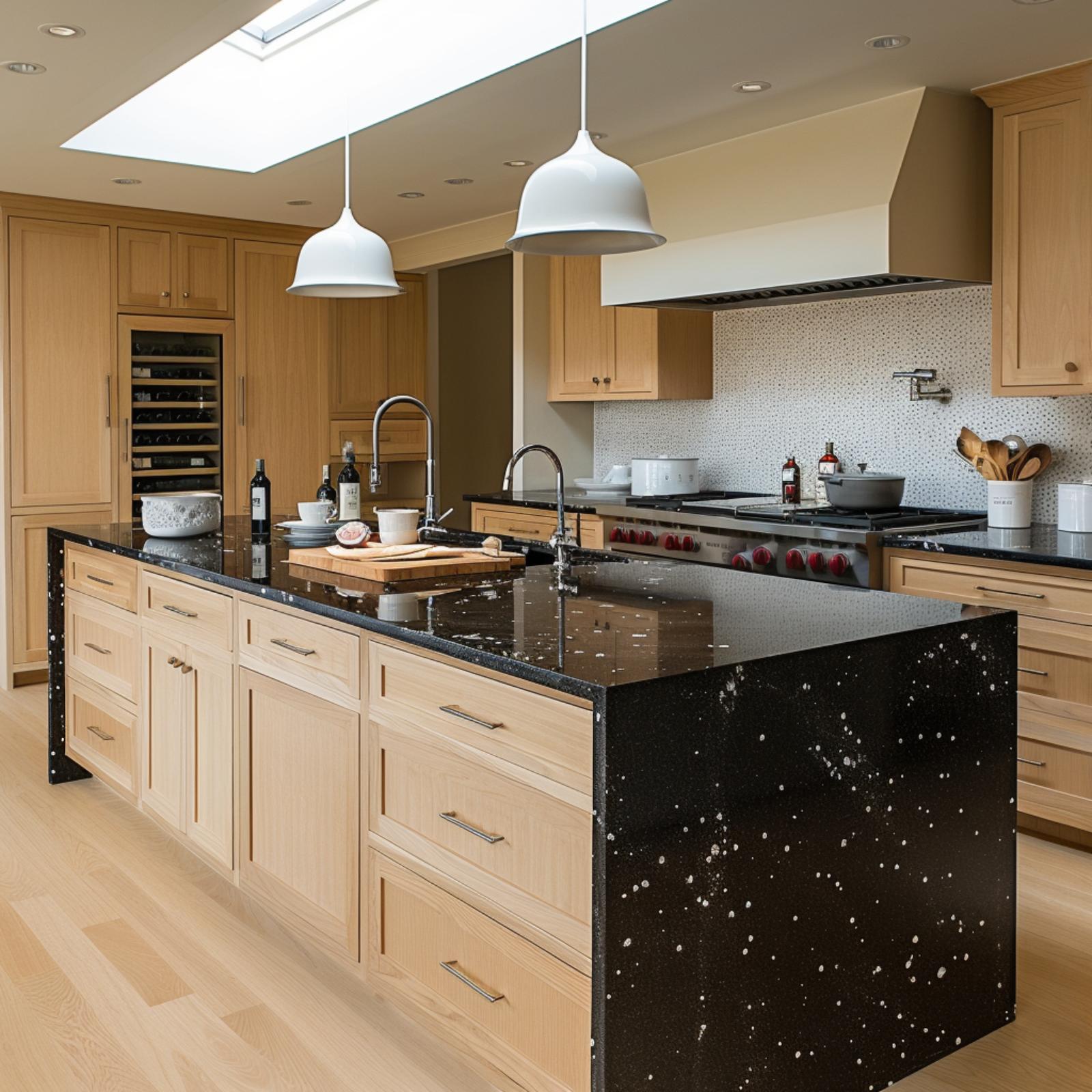
Galaxy Black granite does a lot of work here, and the maple cabinetry knows not to fight it. The white mineral flecks scattered across the stone’s surface read almost luminous under the skylight, which shifts the countertop from heavy to dynamic. Shaker-style drawers in natural maple keep things grounded, and the bar-pull hardware in brushed nickel stays quiet on purpose.
10. Burl Wood Backsplash, Marble Hood Cladding, and a Soapstone Island That Anchors It All
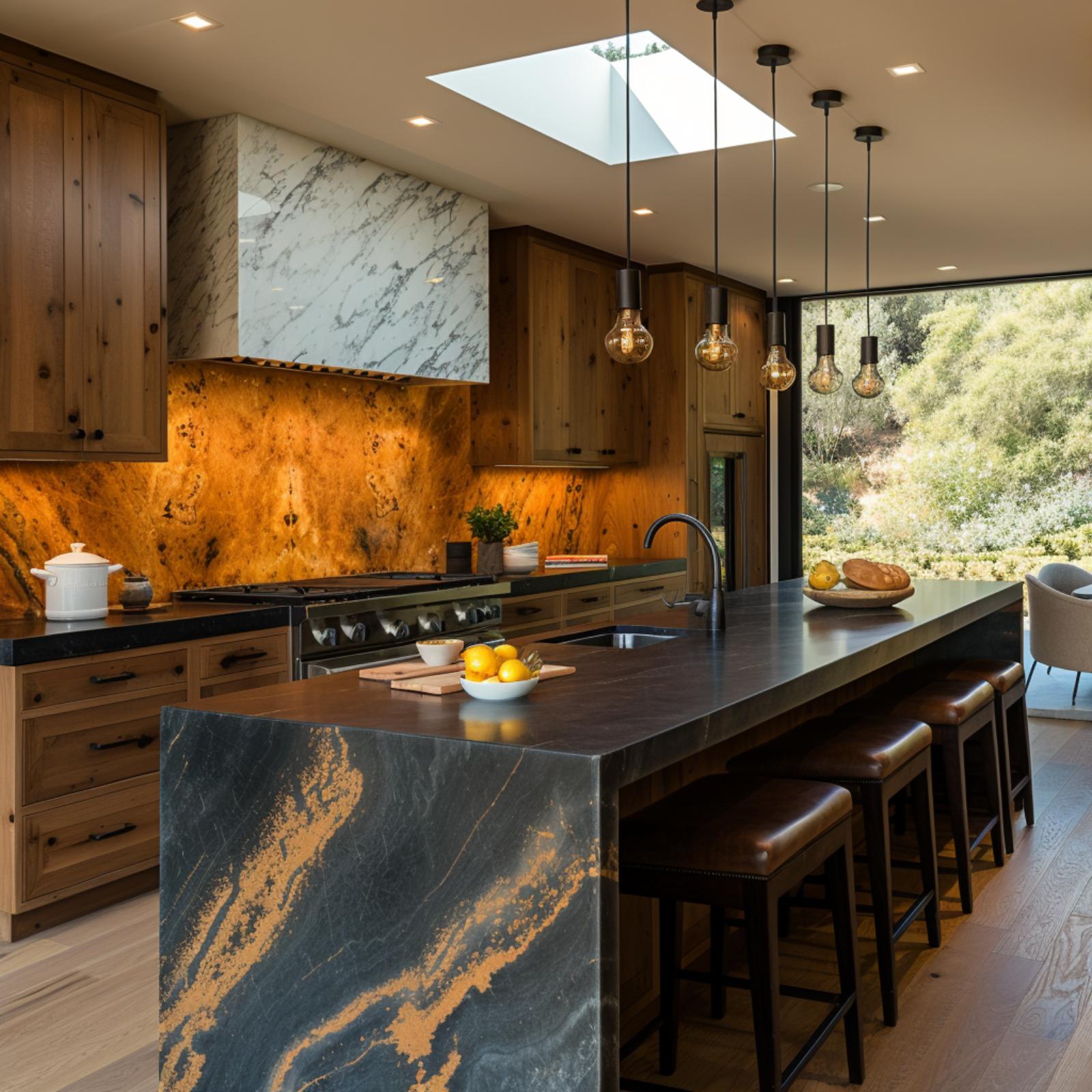
Knotty alder cabinets with their natural knots intact set the tone before anything else registers. The real surprise is the backsplash: backlit burl wood veneer glowing amber behind the range, a material choice that reads almost geological. Against it, the marble-clad hood holds its own without competing. The island’s soapstone waterfall panel, dark with copper-gold veining, ties back to every warm tone in the room. Pendant bulbs are bare Edison-style globes, which is the right call here. More shade would’ve cluttered a space already doing serious material work.
9. Cosmic Granite, Cream Cabinetry, and a Skylight That Does the Heavy Lifting
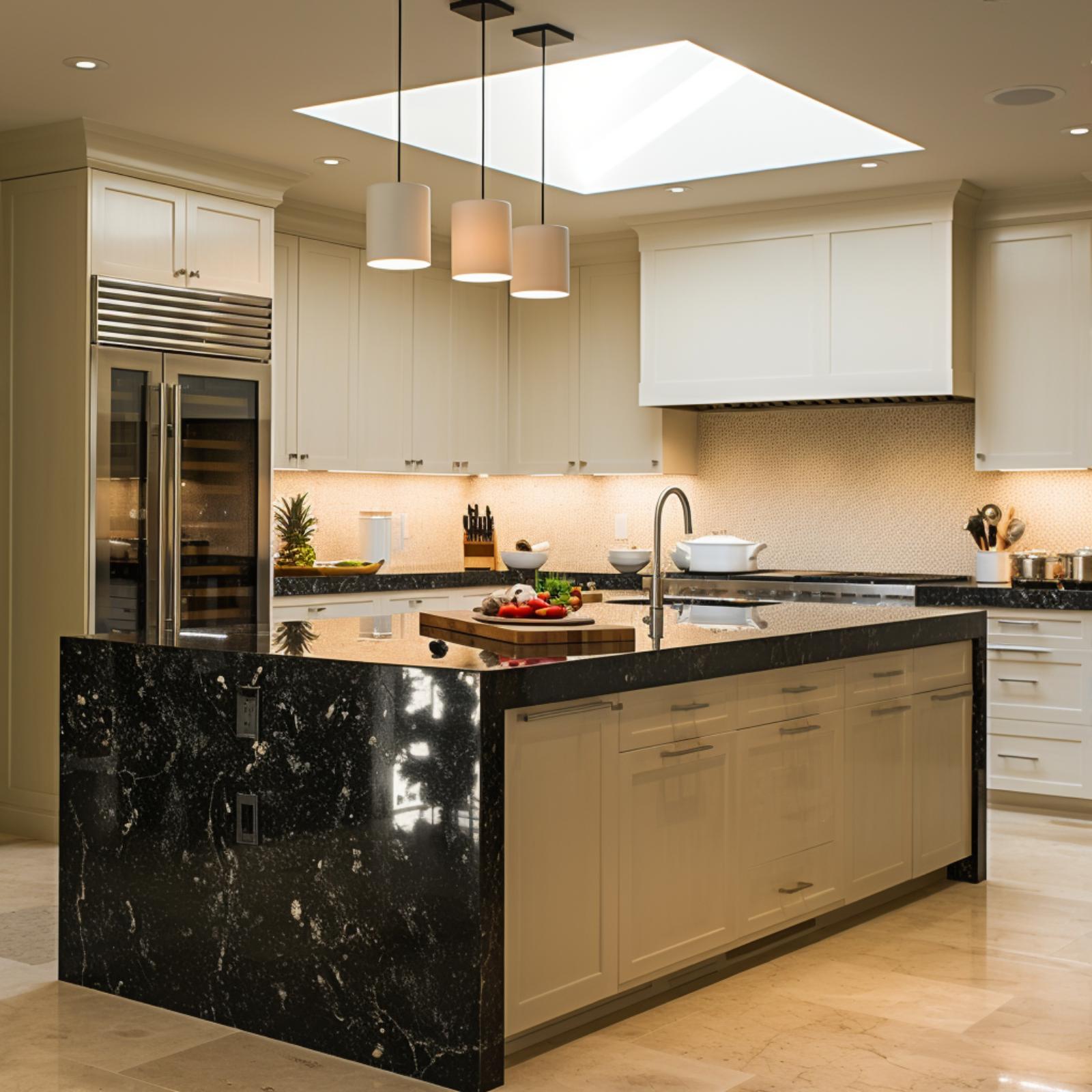
Leathered black granite with white mineral veining wraps the near end of the island as a full waterfall panel, then shifts to a lighter, beige-toned surface on top. That split reads intentional rather than mismatched because the cream cabinetry underneath bridges both. Pendant shades in cylindrical linen keep the light source soft rather than sharp, which matters when a skylight overhead is already doing the main work. Stainless appliances and brushed nickel pulls hold the space together without competing.
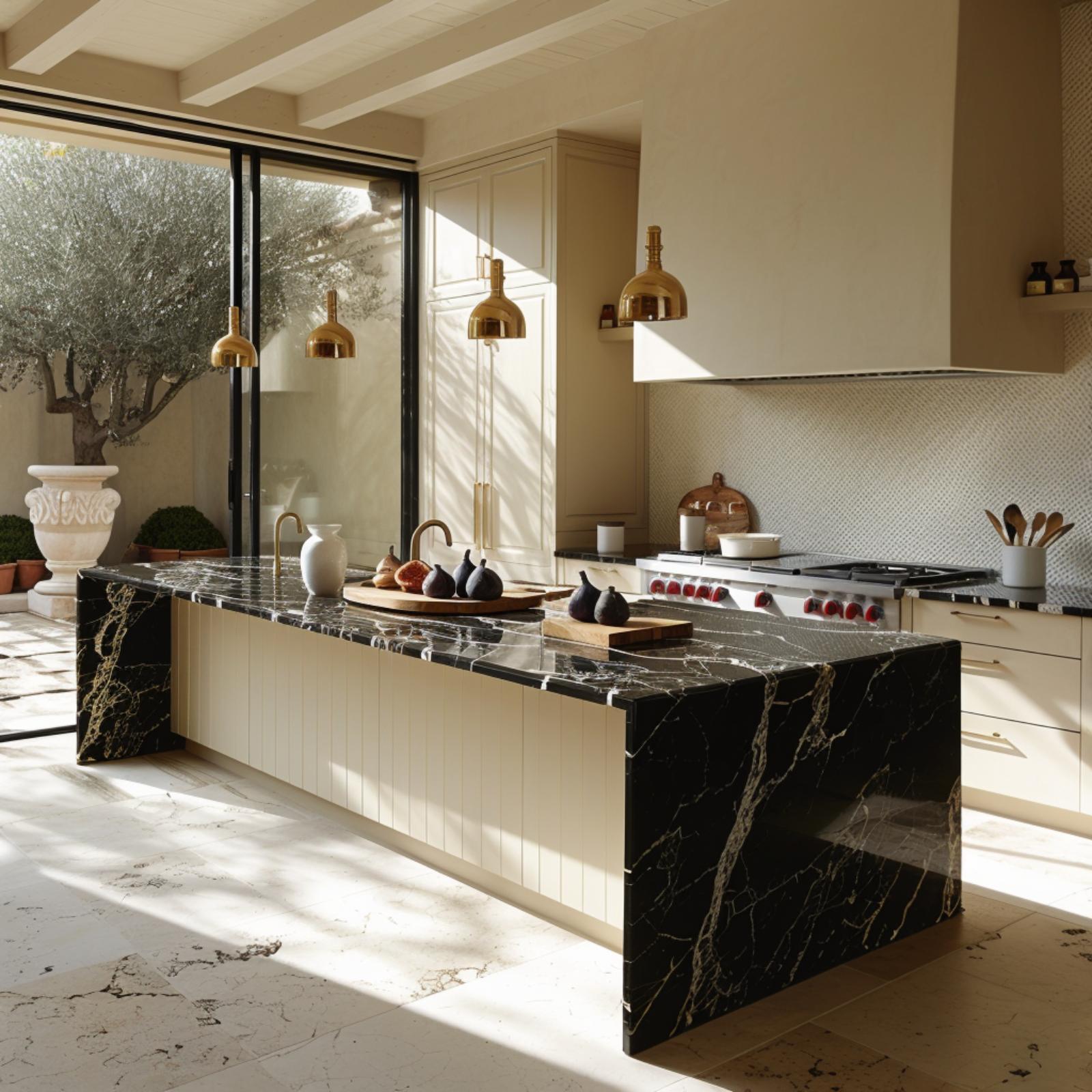
8. Nero Marquina Island, Cream Cabinetry, and Gold Pendants That Know When to Stop
🔥 Would you like to save this?
Nero Marquina’s gold veining does the connecting work here, tying directly to the brass pendant shades overhead without any forced coordination.
7. Sage Green Cabinets, a Plaster Hood, and Chiseled Stone That Holds the Room Together
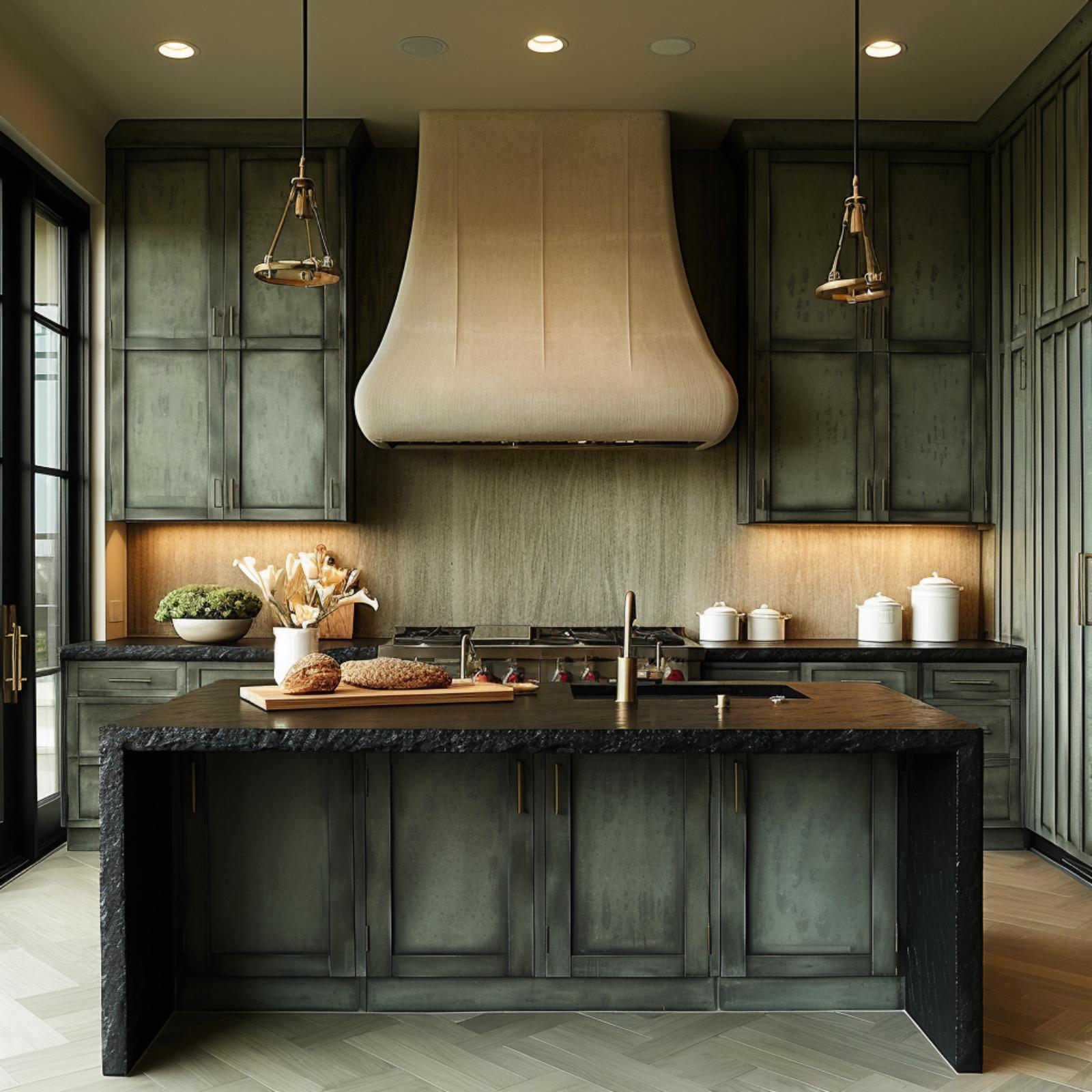
Chiseled-edge blackstone wraps the island base with a rawness that reads almost geological, and it’s that rough perimeter against the sage green cabinetry that keeps this kitchen from feeling too composed. Under-cabinet lighting does real work here, warming the veined stone backsplash behind the range in a way recessed cans alone can’t achieve. The plaster hood is an interesting counterpoint: soft, matte, and shaped like something from a French farmhouse, sitting above what’s otherwise a fairly moody palette. Brass faucet hardware and pendant fittings thread through without overcrowding.
6. Soapstone Island, White Shaker Cabinets, and Glass Pendants That Let the Stone Speak
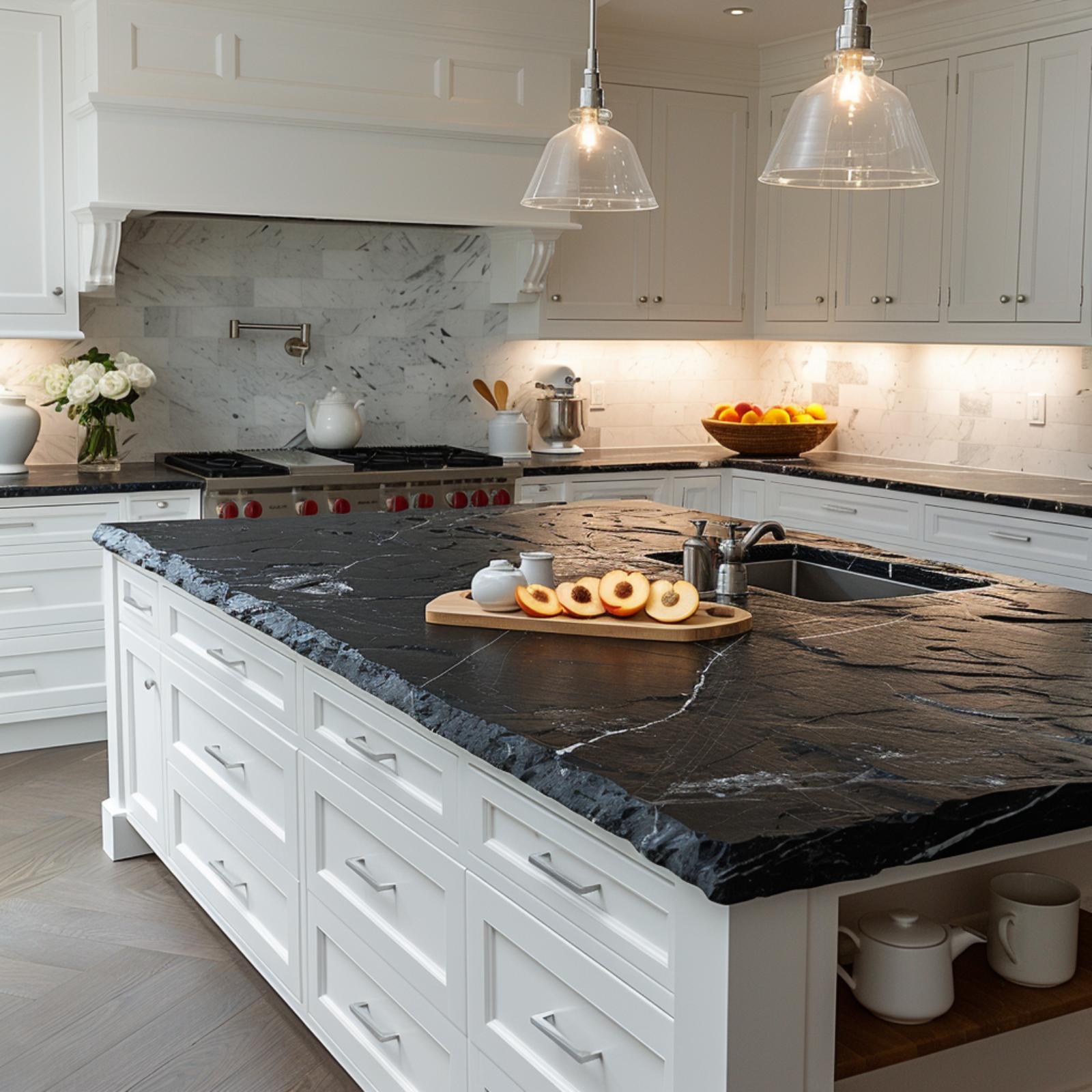
Soapstone’s chiseled live edge does the heavy lifting here, and the white shaker cabinetry doesn’t fight it. Clear glass bell pendants keep the overhead plane honest.
5. Bleached Oak Cabinets, a Wine Fridge Built Into the Island, and Black Marble That Earns Its Place
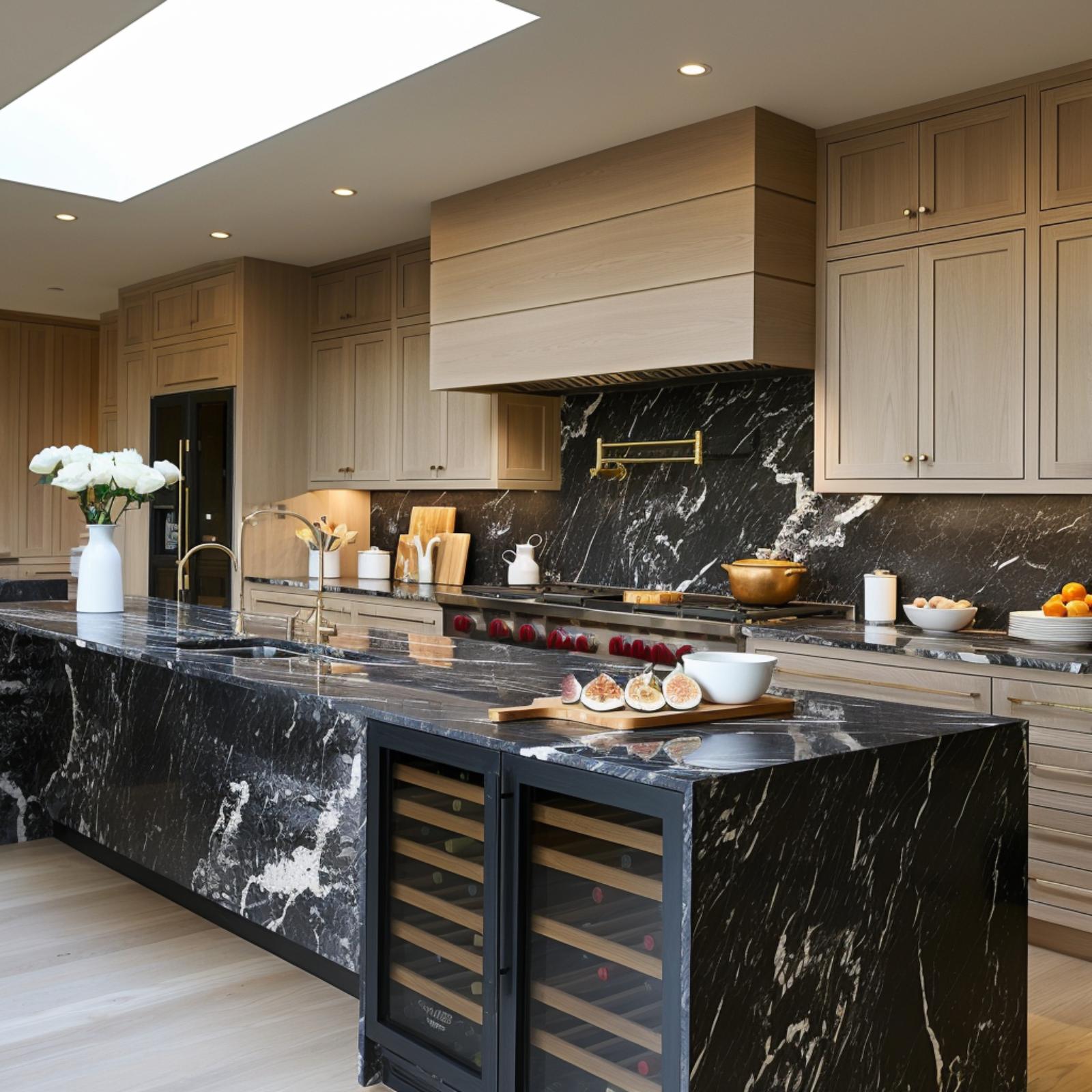
Bleached oak cabinetry keeps the room from reading heavy, which matters when the island is this dominant. The black marble waterfall island with white veining runs countertop-to-floor on both sides, and the matching backsplash behind the range locks the two zones together visually. Brass hardware and a pot-filler in the same finish give the room its warmth without overcrowding it. The built-in wine fridge tucked into the island base is a practical call that doesn’t disrupt the slab’s continuity from the front.
4. Leathered Black Stone, Backlit Onyx Panels, and Brass Pendants That Pull It Together
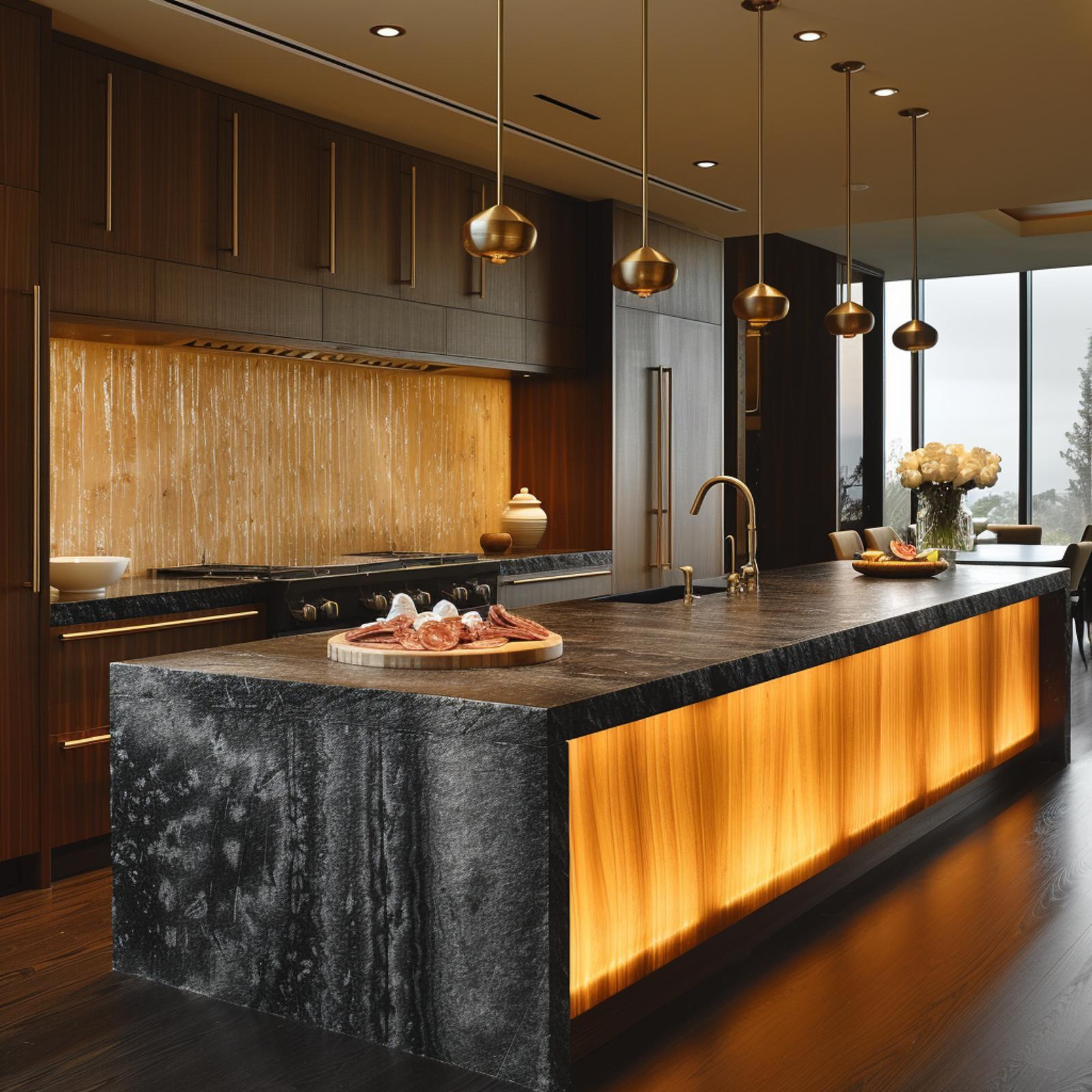
Backlit onyx running along the island’s base does something unexpected: it makes the leathered black stone countertop look warmer rather than colder. Under-island lighting is often an afterthought, but here it’s load-bearing. The brass pendant cluster overhead picks up the same amber frequency without competing for attention.
3. Black Nero Marquina, Backlit Onyx, and Pendant Lights That Know Their Role
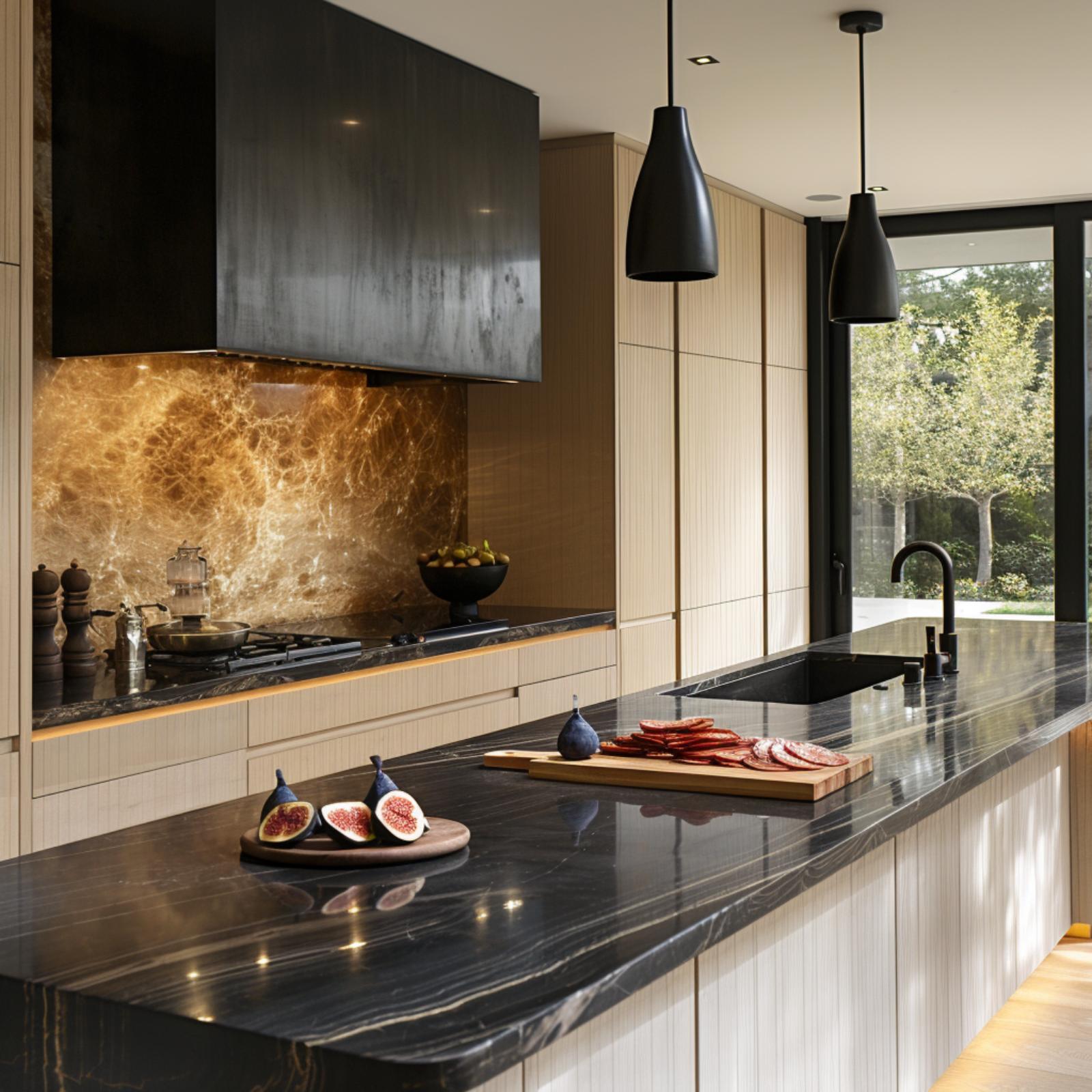
Fluted oak cabinetry runs floor to ceiling on two walls, and its vertical grain keeps the palette from feeling flat against the dark marble island. Cut figs and sliced charcuterie on a wood board make the space feel genuinely lived in. Two matte black cone pendants hang without fuss, and the backlit amber onyx backsplash does the real visual work.
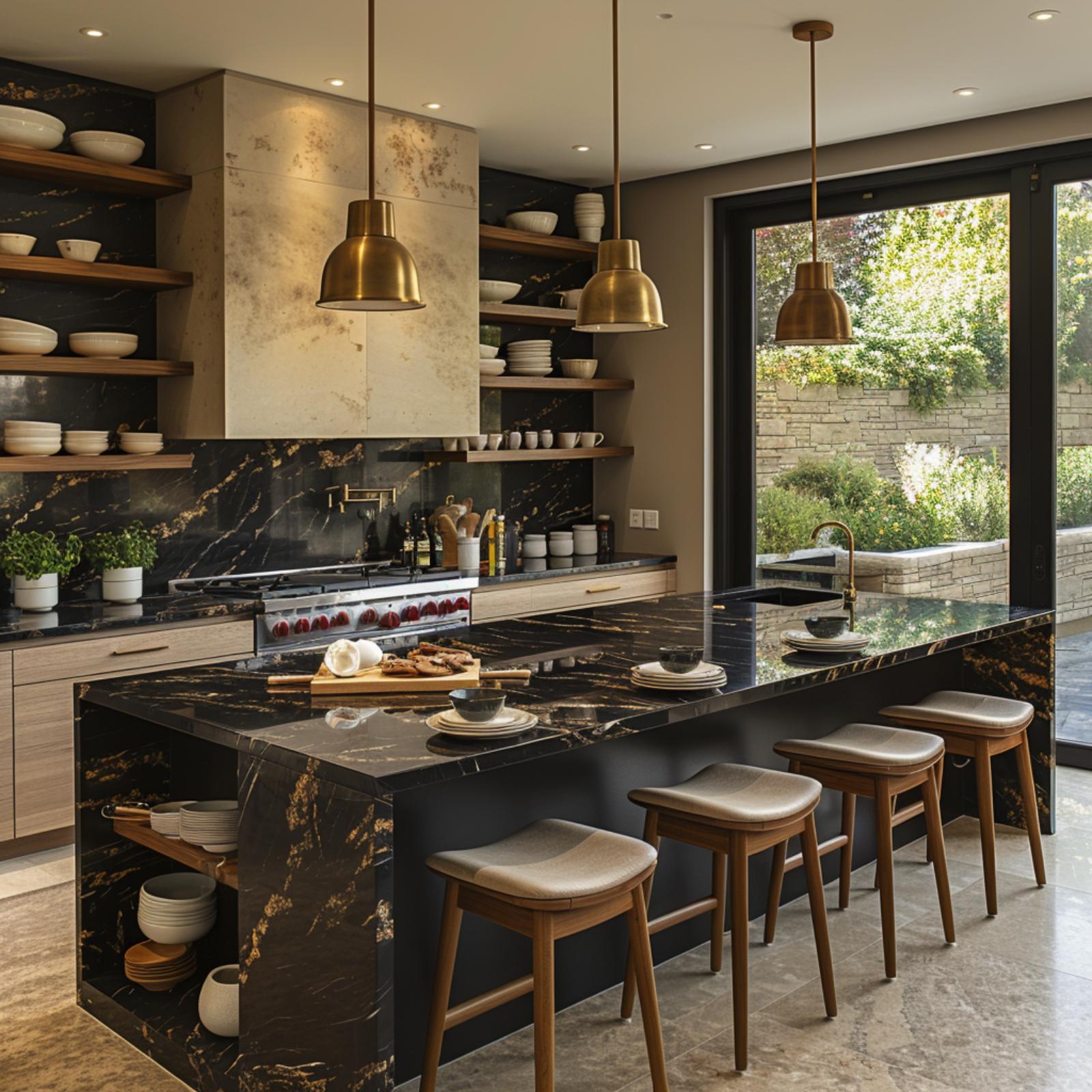
2. Black Portoro Marble, Brass Pendants, and Open Shelving That Actually Earns the Commitment
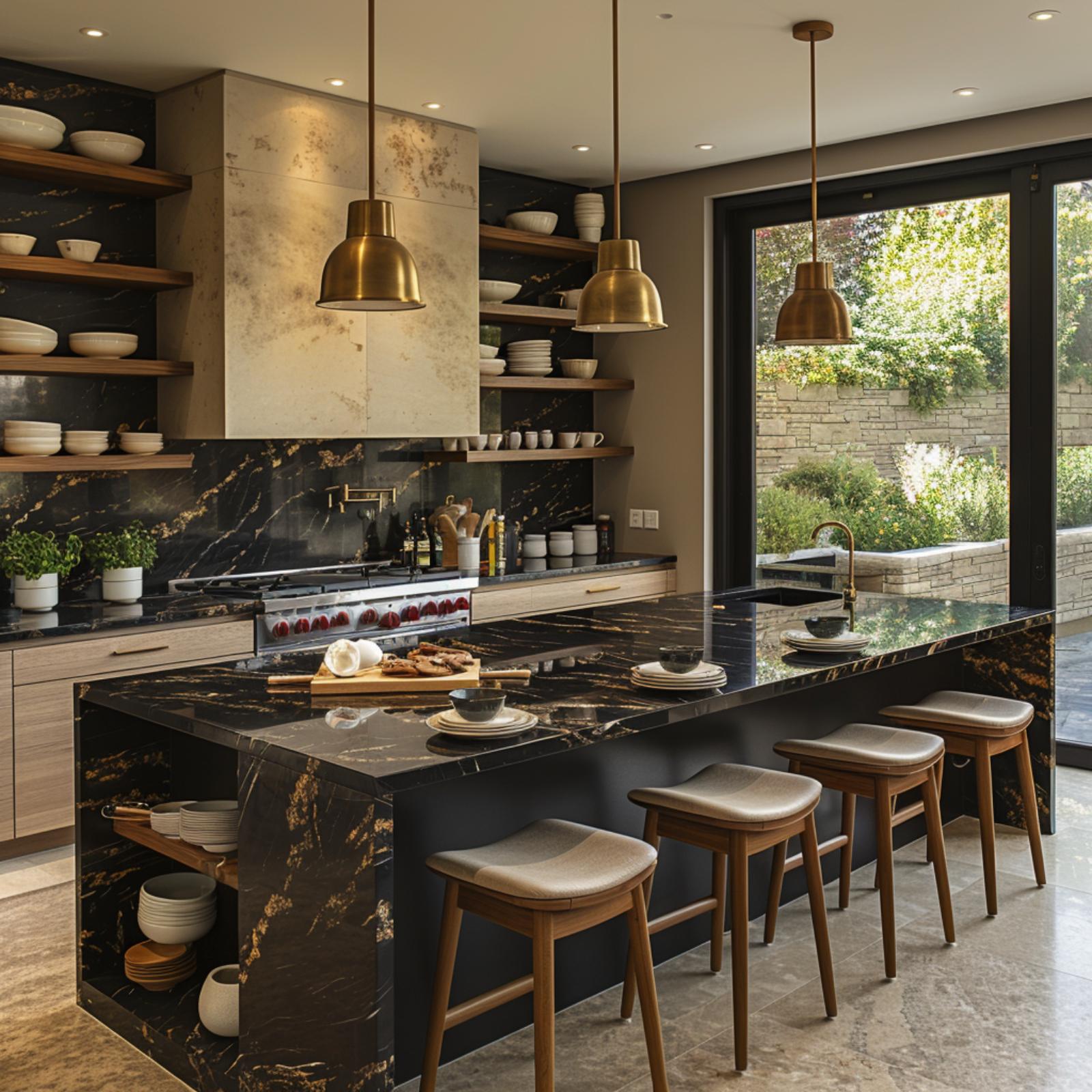
Portoro marble runs the full island waterfall and backsplash here, its gold veining picking up the brushed brass pendant shades overhead. Three pendants hang at consistent heights, which sounds obvious until you see kitchens where they don’t. The wood shelving floating against the dark backsplash keeps the palette from going cold.
What’s worth watching in a setup like this is the open shelving discipline. Every shelf holds white ceramic. No mixed finishes, no stray colored pieces. That kind of restraint doesn’t happen by accident, and it’s the reason the room holds together rather than fragmenting into a showroom display.
1. Marquina Island, Herringbone Oak, and Pendant Lights That Earned Their Spot
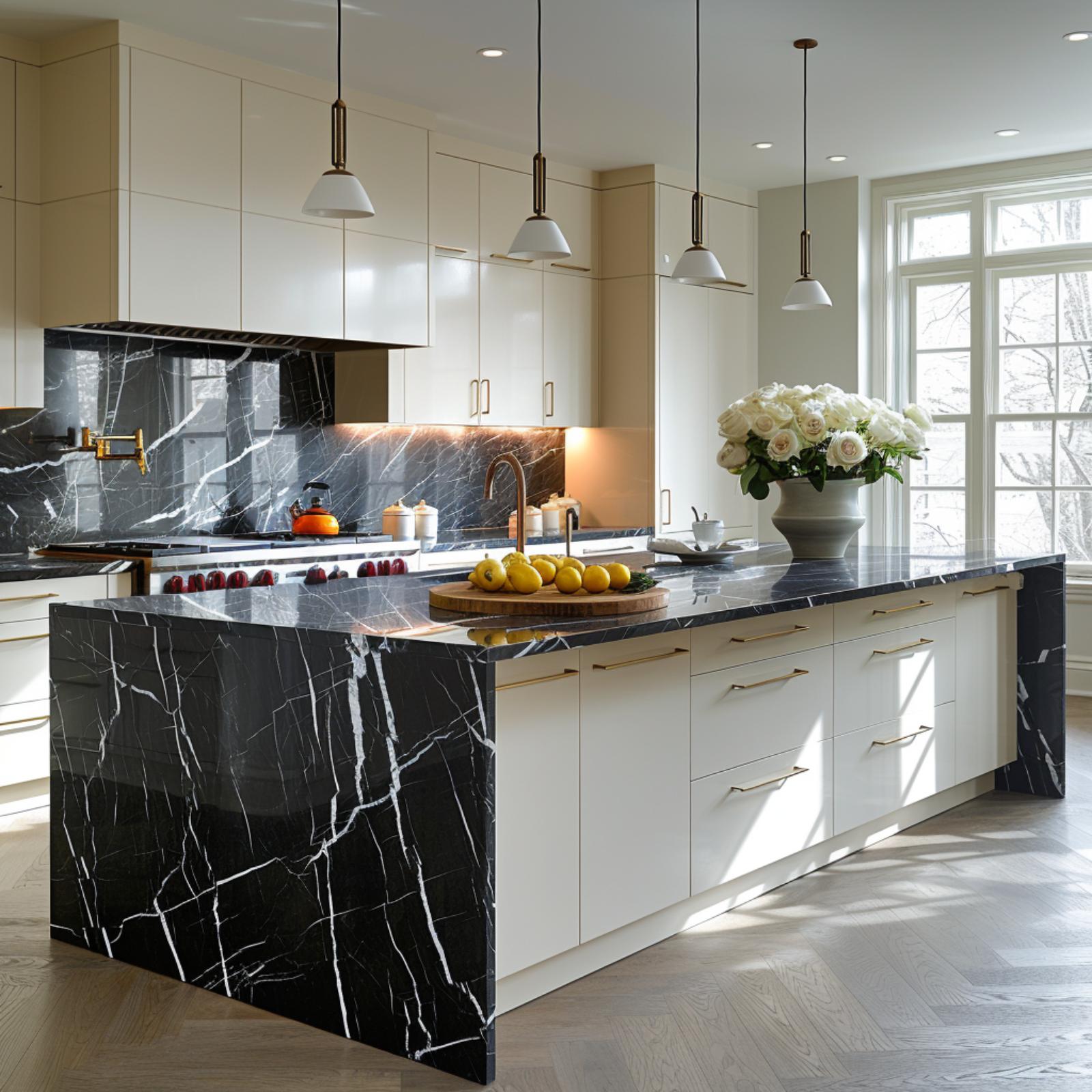
Black marble with white veining wraps the island on all four sides, including a thick waterfall edge that makes the slab feel structural rather than decorative. The herringbone white oak floor keeps the room from reading cold. Four pendant lights with cone shades hang at consistent intervals, and their scale is right: present, but not competing with the stone.