🔥 Would you like to save this?
A boring kitchen does not stay boring by accident. It stays that way because homeowners keep treating the backsplash as an afterthought and the layout as a fixed fact. The kitchens in this collection prove that a dated, lifeless space can become the most talked-about room in a house, not by spending a fortune, but by making deliberate choices about tile, color, hardware, and light.
In order to come up with the very specific design ideas, we create most designs with the assistance of state-of-the-art AI interior design software. Also, assume links that take you off the site are affiliate links such as links to Amazon. this means we may earn a commission if you buy something.
The before-and-after comparisons here cover a range of budgets and styles, from tight galley kitchens with zero personality to open layouts drowning in builder-grade beige. Each redesign tackles a specific problem: the wrong tile, the wrong cabinet color, the wrong everything. Seeing the original space alongside the finished result makes the decisions behind each change far easier to understand and apply.
35. Dark Walnut Cabinets and Seigaiha Tile Turn a Blank Kitchen Into Something Worth Remembering
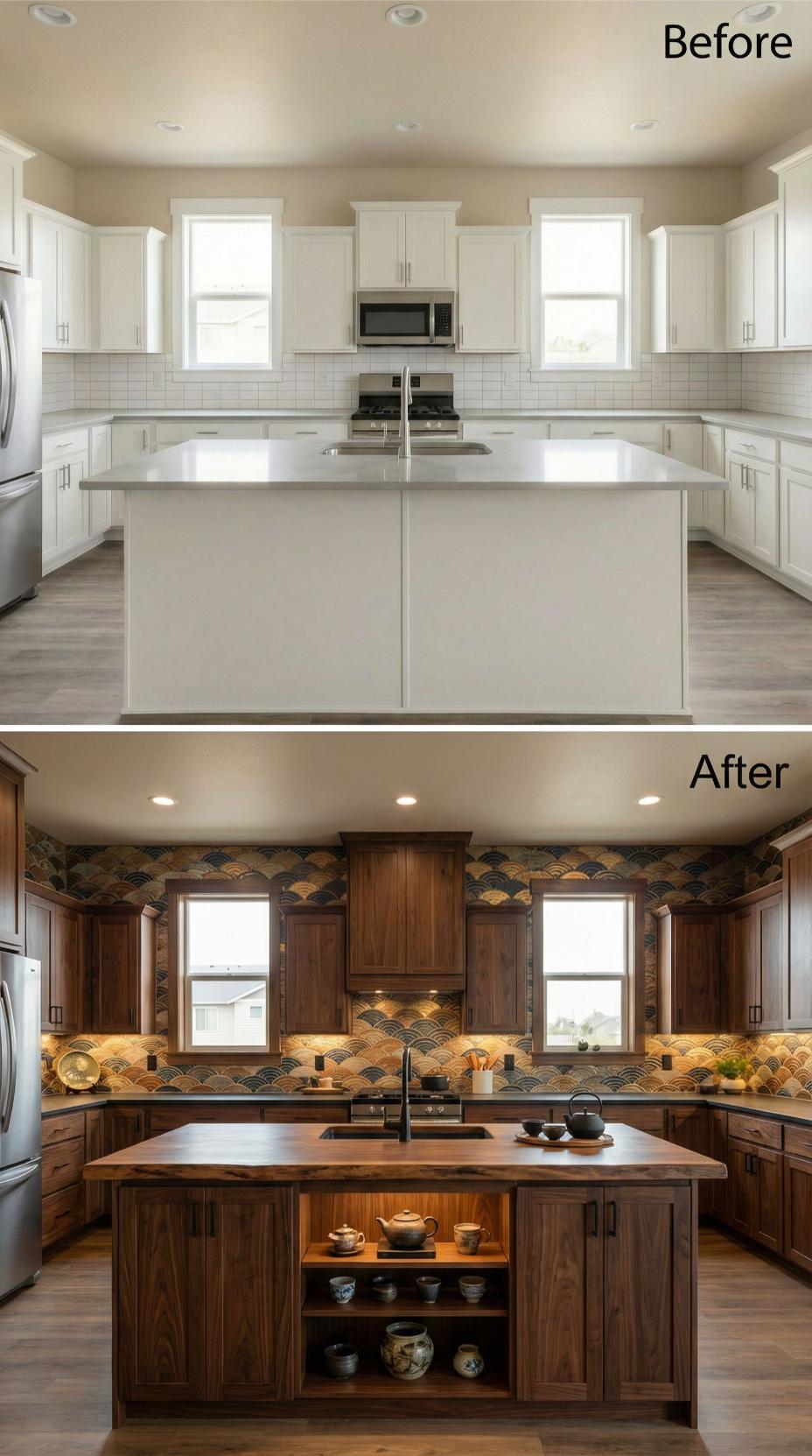
Flat-front white shaker cabinets and a featureless quartz island gave the original kitchen nothing to hold onto visually. The backsplash, a standard subway tile grid, did exactly what was expected and nothing more.
The renovation swapped every cabinet for rich dark walnut with raised-panel doors, and the backsplash became a floor-to-ceiling seigaiha pattern in navy, gold, and warm brown. The island now features a live-edge walnut slab countertop with open lower shelving lit by recessed underlighting. Matte black fixtures replace the original brushed nickel, and the ceramics displayed on the shelves echo the scale pattern directly above.
34. Stacked Stone Backsplash and Exposed Beams Pull a Plain Kitchen Into a New Era
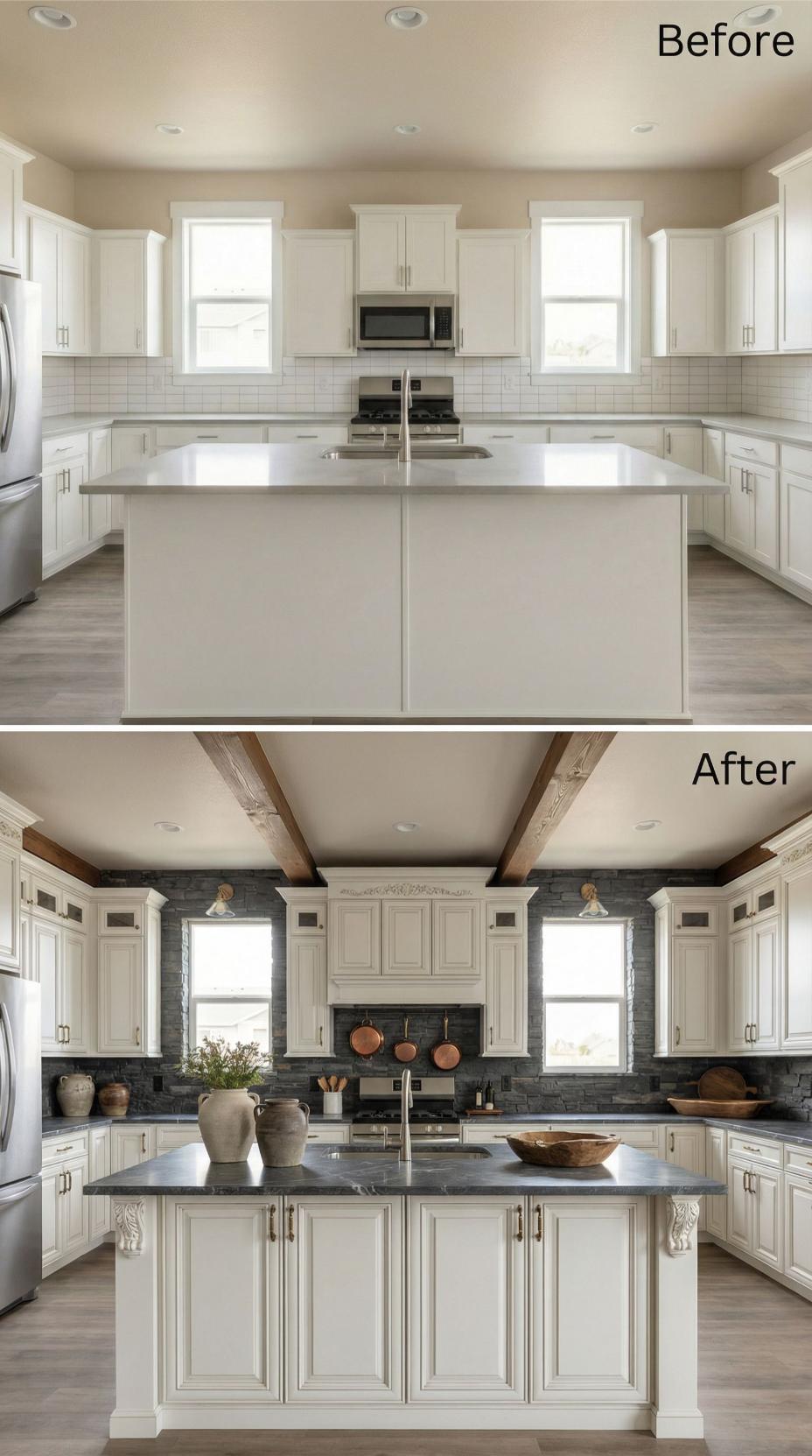
Gray stacked-stone tile covers the entire backsplash wall from counter to ceiling, replacing the original subway tile with something that reads more like a lodge than a spec house. Raised-panel cabinet doors swap out the flat shaker fronts, and decorative corbels anchor the island corners. Brushed brass hardware runs throughout. Dark soapstone-look countertops ground the island, while copper pots hang from a wall-mounted rail near the range.
Rough-hewn wood beams cross the ceiling and add weight the original room entirely lacked. Wall sconces flank the windows where recessed lighting once did all the work alone. Ceramic vessels and a hand-carved wooden bowl on the island give the space a lived-in texture that the before photo never approached.
Stacked stone continues to prove its staying power, and this kitchen pushes that idea even further.
33. Moroccan Tile and a Crystal Chandelier Rescue a Kitchen Buried in Beige
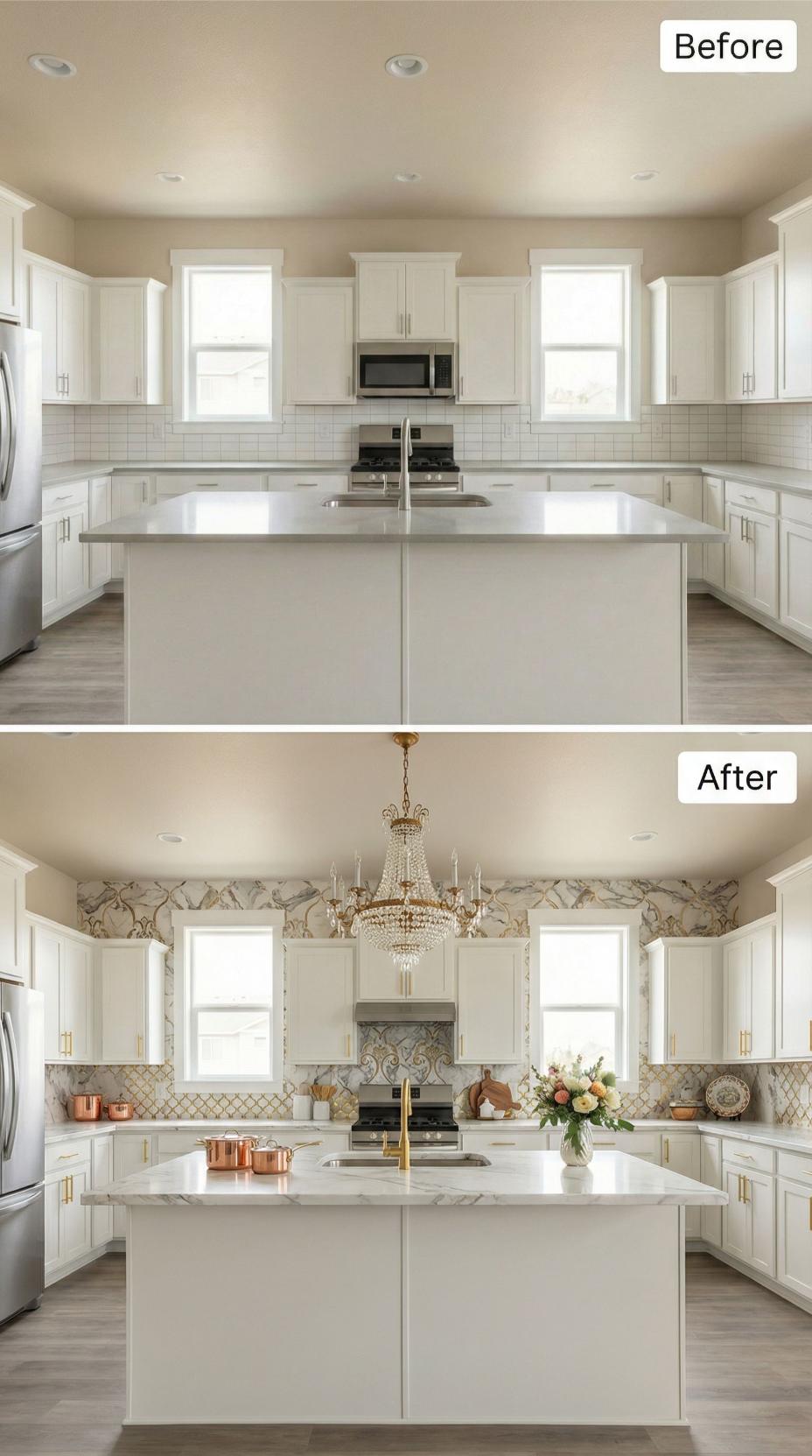
Before, flat white cabinets and a gray quartz island sat under recessed lighting with nothing to hold the eye. The backsplash was subway tile. The hardware was silver. The room functioned, but it did not speak.
The after pulls in an arabesque gold-and-ivory backsplash that runs the full wall, flanked by open shelving dressed with copper cookware and a fresh flower arrangement. Brushed brass pulls replace the original silver throughout. Above the island, a crystal-and-brass empire chandelier with candelabra arms does the work three pendant lights could never do. The island top shifts to veined white marble. Every upgrade points in one direction.
32. Carved Walnut Cabinetry and Moroccan Zellige Tile Bury the Boring Original
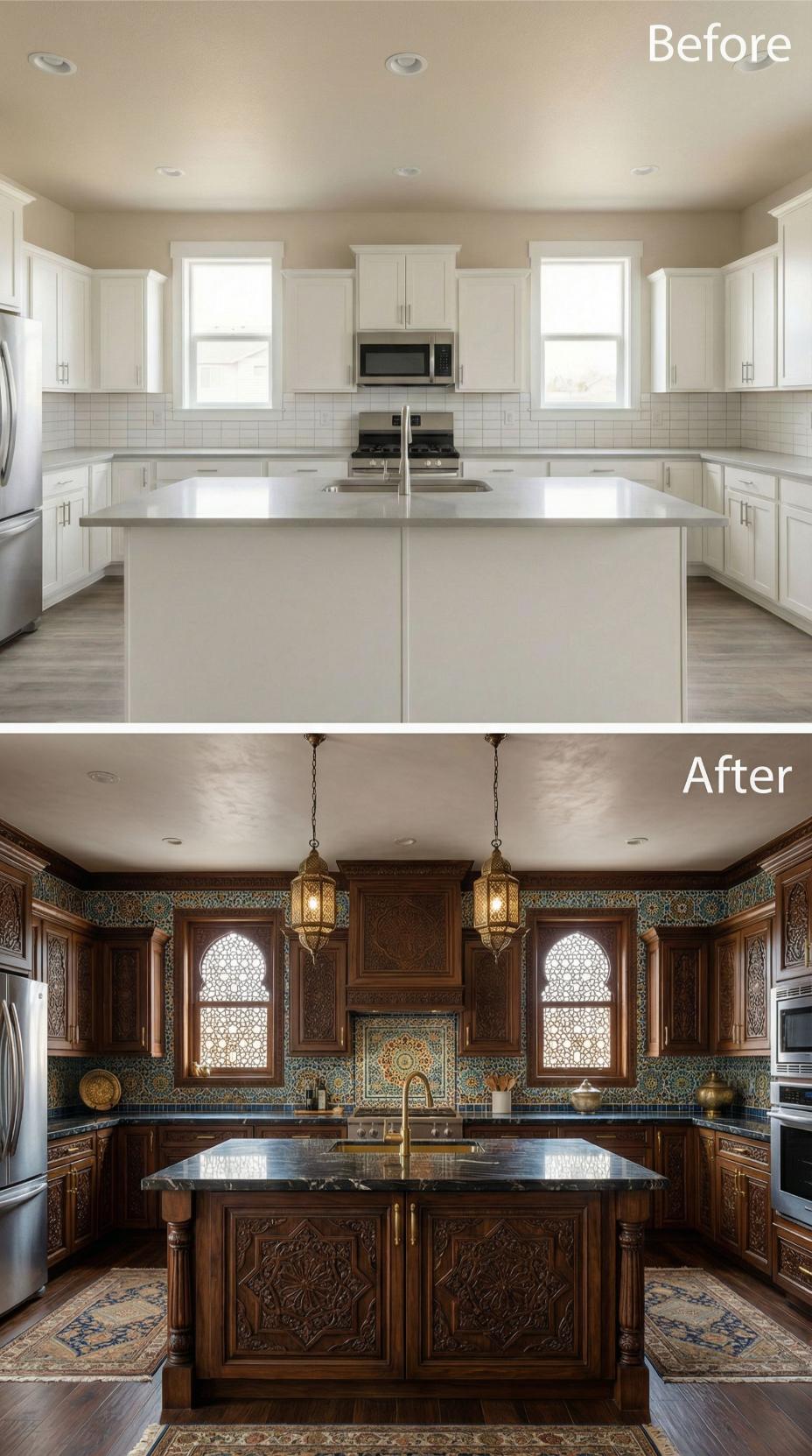
Hand-carved geometric panels on the dark walnut island replace the plain white cabinetry, while brass pendant lanterns and arched mashrabiya window inserts pull the Moroccan theme through every surface.
31. Greige Cabinets, Open Shelving, and Rattan Stools Finish Off a Flat White Kitchen
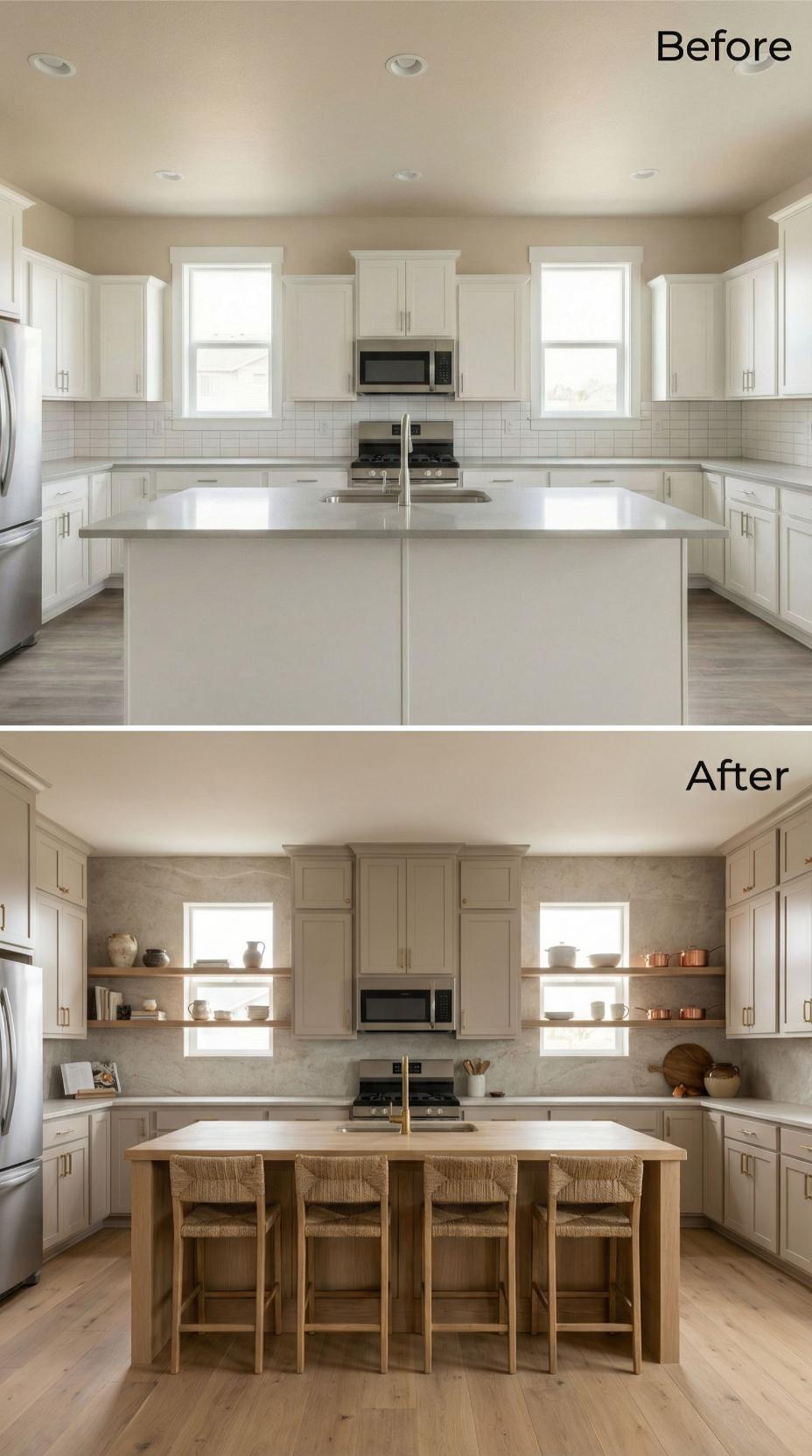
Painted a warm greige, the shaker cabinets swap out the original stark white for a tone that reads warmer against the light hardwood floors. Floating wood shelves replace upper cabinets on both sides, holding ceramic vessels and copper mugs. Woven rattan counter stools anchor the island, and a brass faucet replaces the chrome original.
30. Marble Waterfall Island and Navy Lower Cabinets Bury a Kitchen Full of Nothing
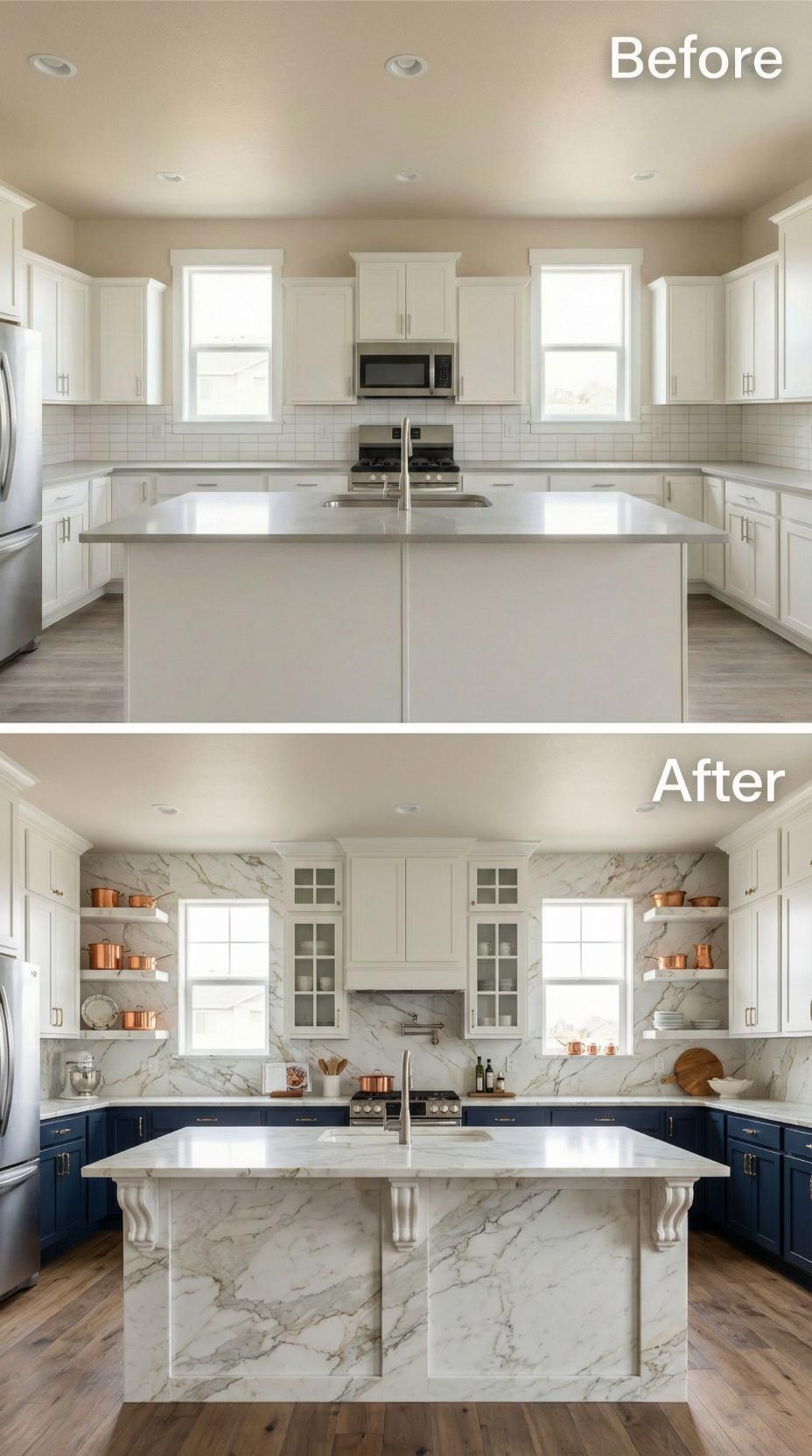
Calacatta marble runs floor-to-ceiling on the backsplash and wraps the island in a full waterfall panel, anchored by carved corbels at the base. Upper cabinets stay white, now fitted with glass-front doors and brass hardware. Navy lower cabinets introduce contrast without competing with the marble.
Open shelving flanks both windows, styled with copper cookware and stacked ceramic dishware. The combination of warm metal finishes against cool stone gives the space visual weight the original kitchen never had.
Budget Tip: Sourcing marble-look porcelain slab instead of natural stone for a waterfall island can cut material costs by 40 to 60 percent. Large-format porcelain also requires less sealing and maintenance over time. Many tile suppliers sell matching field tiles for the backsplash, so the full-height look stays cohesive without the natural stone price tag.
29. Natural Maple Cabinets and Large-Format Backsplash Tile Erase a Kitchen Built on Nothing
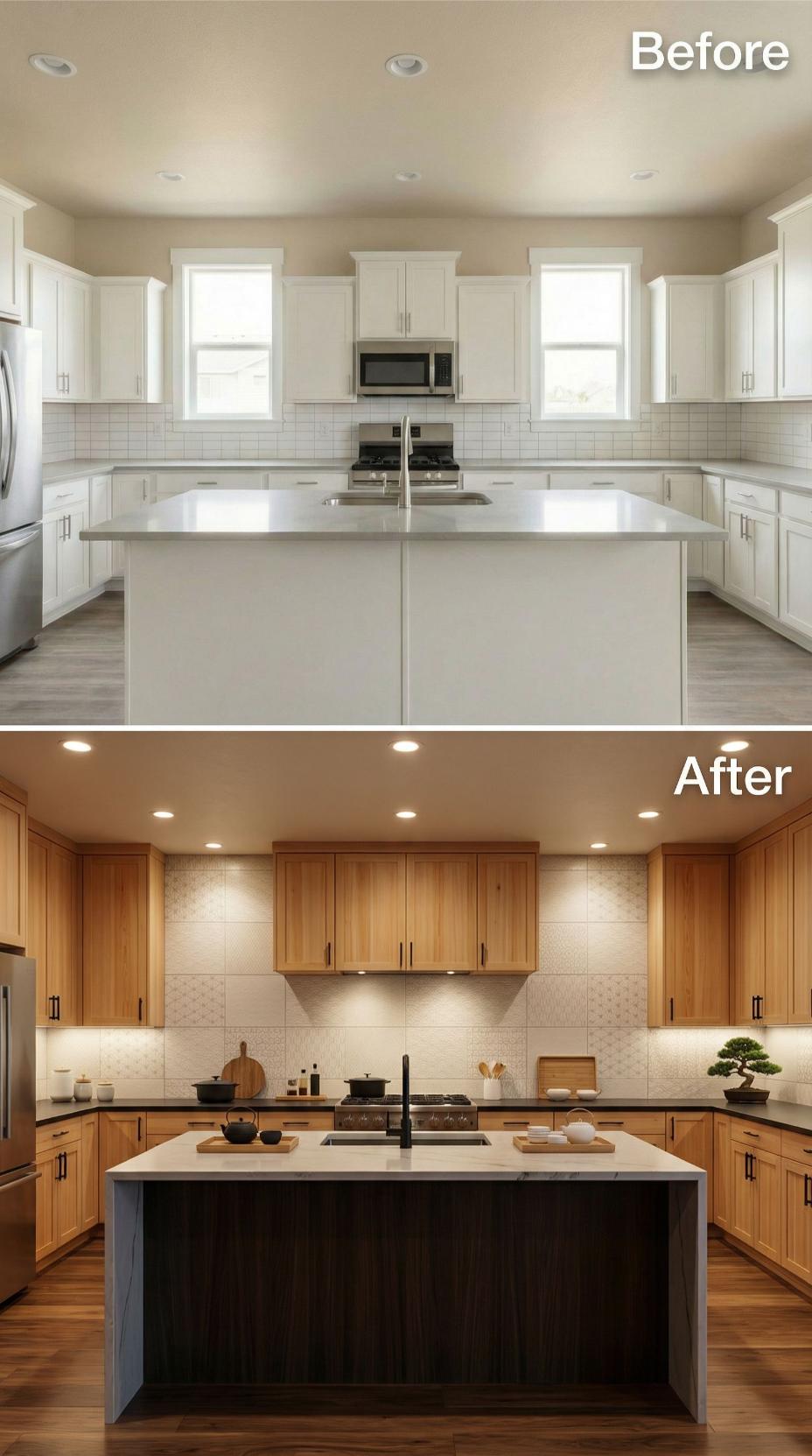
Maple cabinets in a warm honey tone replace the original flat white shaker boxes, paired with matte black bar pulls and dark charcoal countertops that ground the island’s marble-veined white surface. Large neutral field tiles run floor-to-ceiling behind the range, and recessed warm-white lighting pulls the wood grain forward after dark.
28. Rustic Alder Cabinets and Talavera-Style Tile Give a White Box Kitchen a Reason to Exist
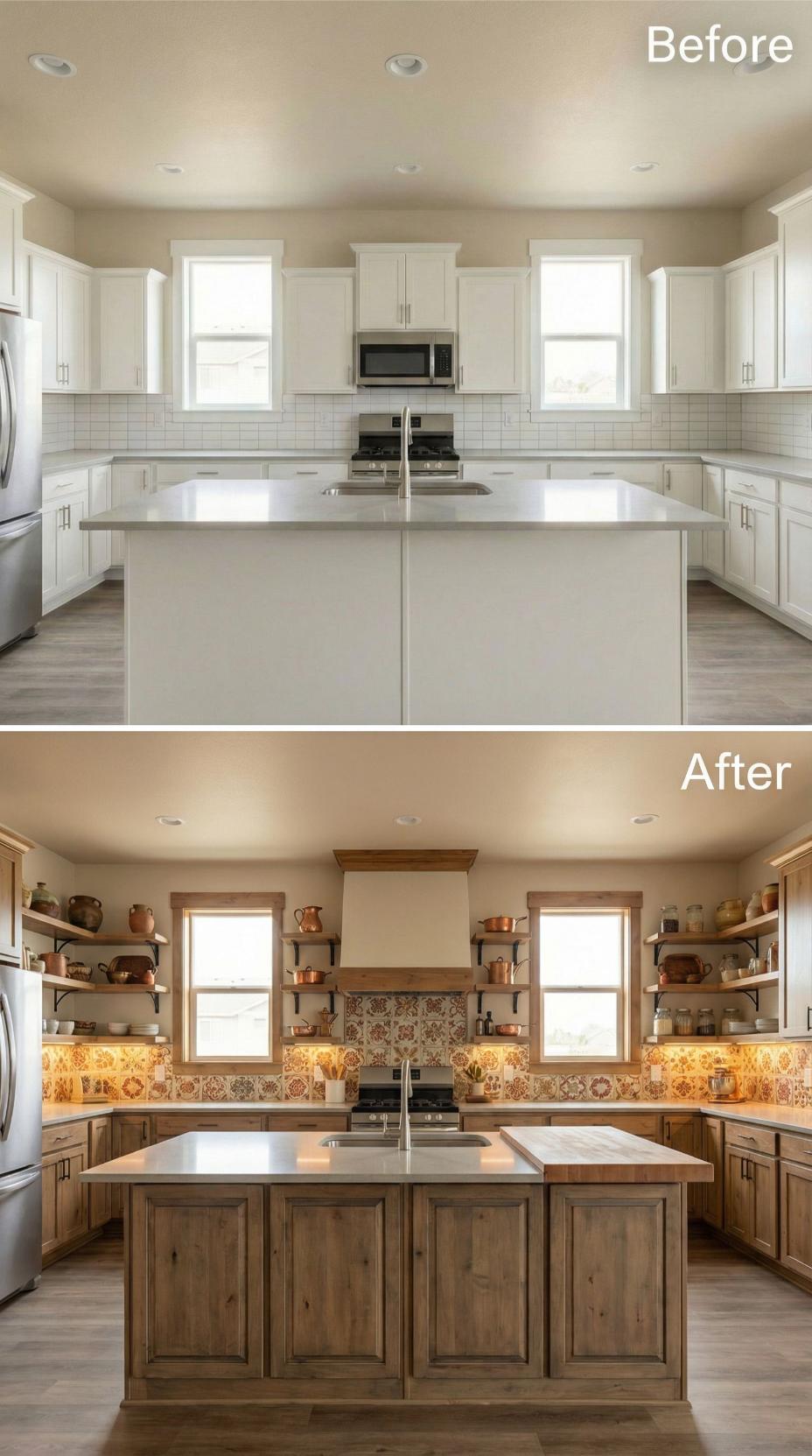
White shaker cabinets and a blank quartz island gave this kitchen nothing to hold onto. The remodel swapped them for knotty alder cabinetry with a natural stain, a wood-trimmed range hood, and open walnut shelving loaded with copper cookware and ceramic vessels.
The backsplash does the heaviest work: hand-painted Talavera-style tile in terracotta, ochre, and ivory runs the full length behind the range. Under-cabinet lighting warms the lower shelves, and the island picks up a butcher block section on one end, breaking the flat quartz surface without replacing it entirely.
27. Moroccan Lanterns and Zellige Backsplash Tile Dismantle a Kitchen Built on White
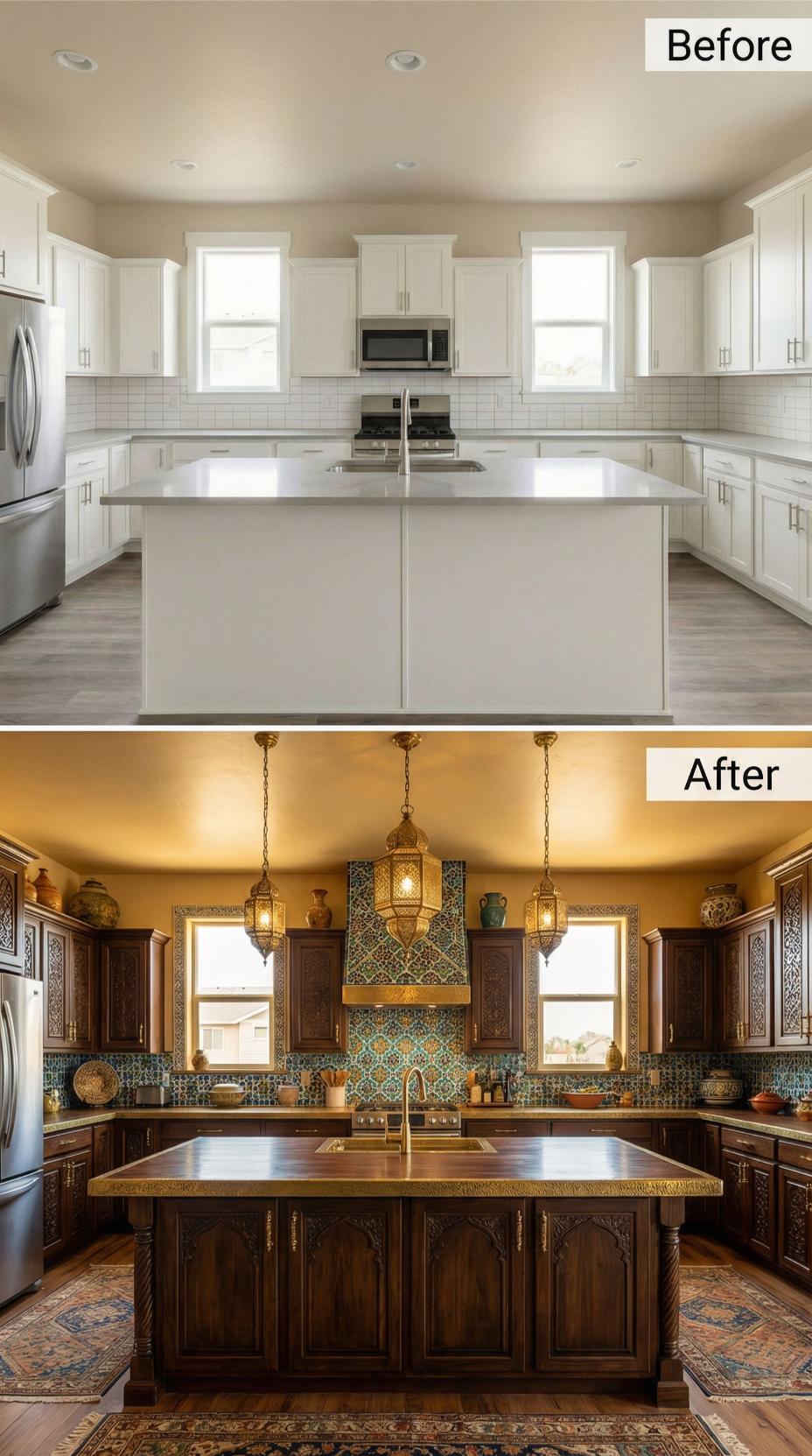
Dark walnut cabinetry with carved arch detailing replaces every white surface, while a geometric zellige backsplash in teal and rust anchors the range wall. Brass pendant lanterns with filigree metalwork hang above a wood-topped island with turned legs.
History Corner: Zellige tile, the handmade Moroccan clay tile with its characteristic uneven glaze, has been produced in the Fez region since the 10th century. Each tile is individually hand-cut by craftsmen called maâlems, meaning imperfections in color and surface are intentional, not defects. Western kitchen designers began incorporating it widely in the early 2010s, though its roots in Islamic geometric art stretch back over a millennium.
26. Antiqued Cream Cabinets and a Stained Wood Island Replace a Kitchen That Refused to Commit
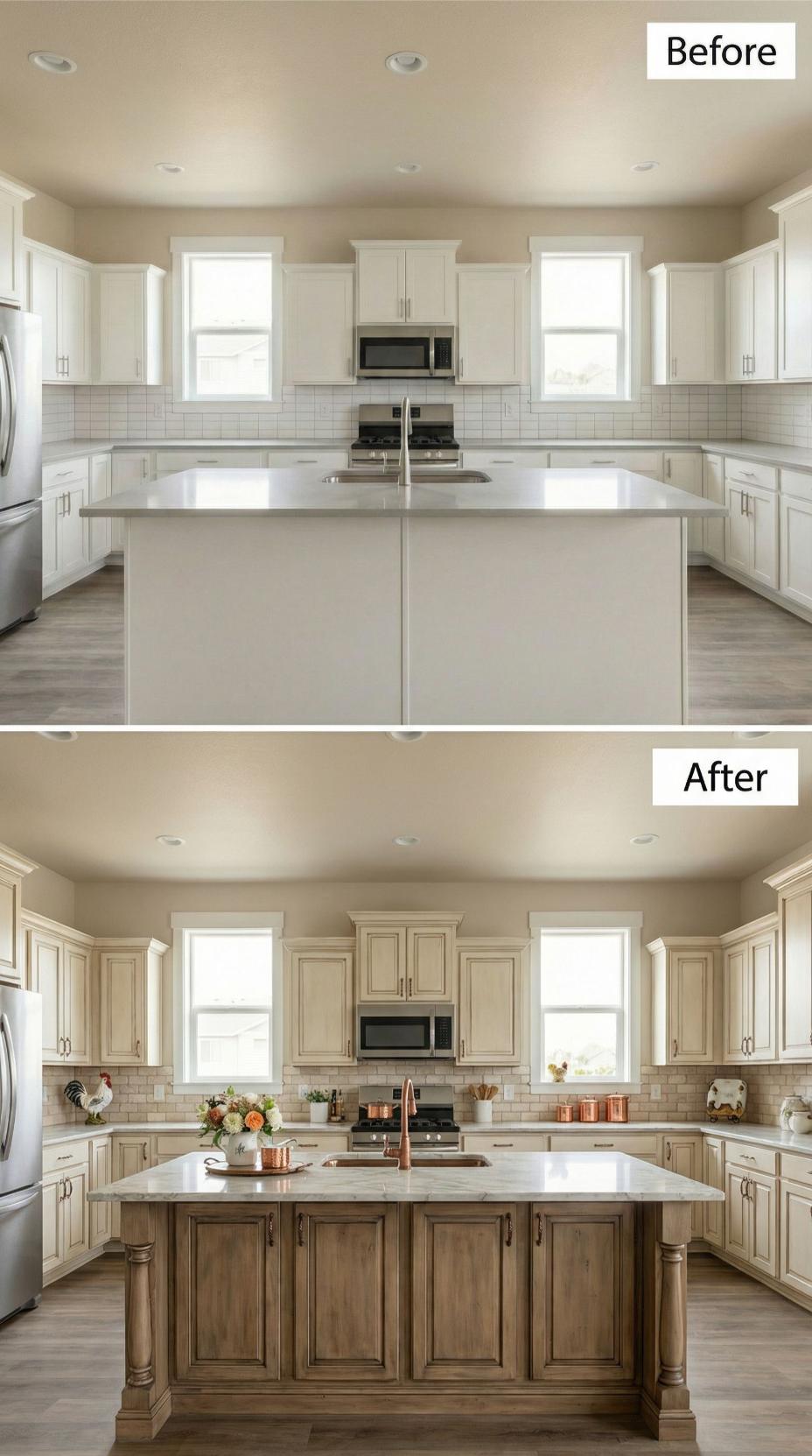
Glazed antique-cream upper cabinets with raised-panel doors replace flat white shaker boxes, and the shift in finish alone reads warmer by several degrees. The island base switches to stained natural wood with turned legs and carved panel doors, topped with veined marble-look quartz. Copper fixtures, including the sink faucet and a trio of canisters, pull the warm undertones forward. A rooster ceramic and fresh florals on a tray complete the farmhouse lean.
25. Rattan Pendants, a Wood-Paneled Island, and Slab Backsplash Rescue a Kitchen Drowning in White
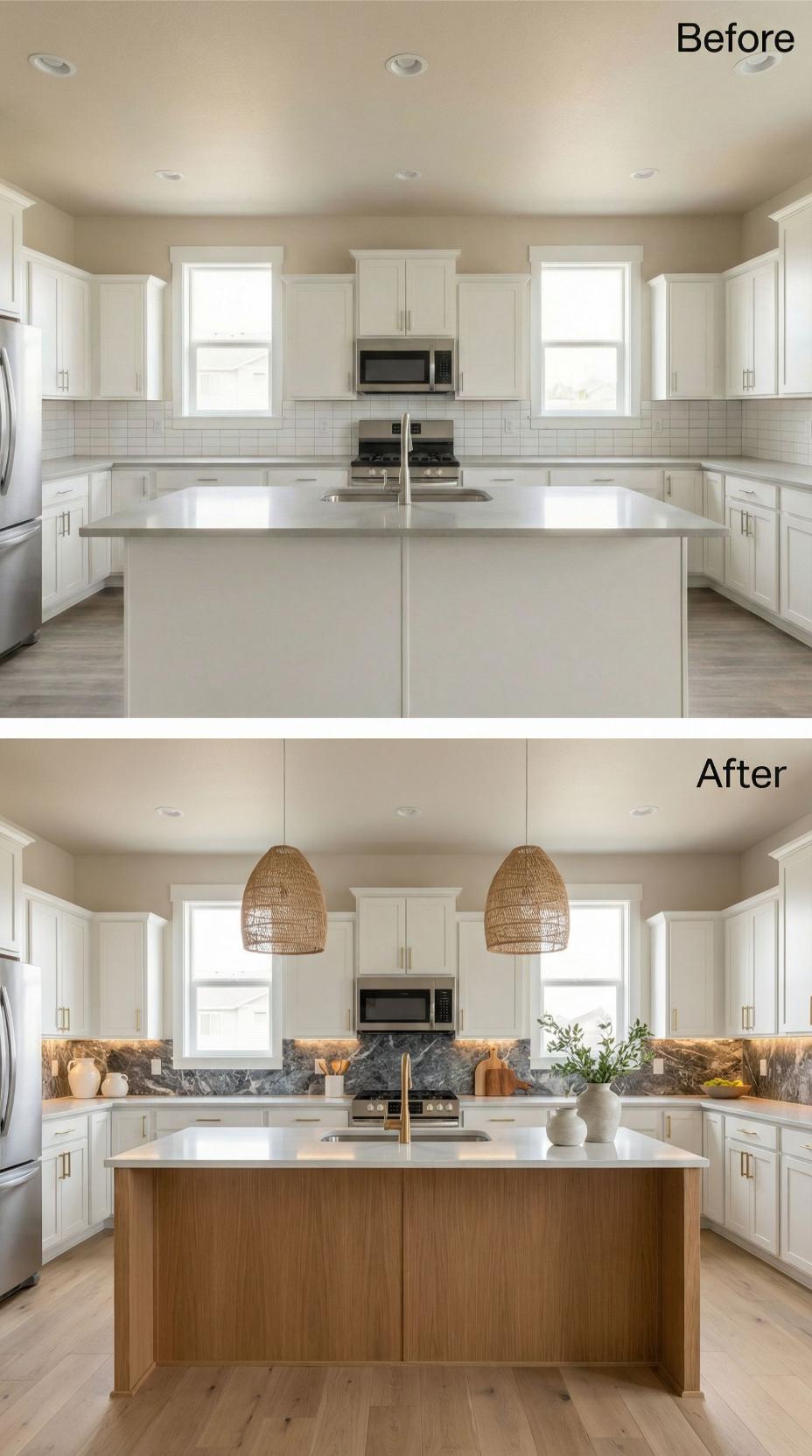
Before, every surface read the same flat white, with no material contrast and recessed lighting doing nothing to create warmth. The remodel introduced an island wrapped in rift-cut oak panels, two woven rattan dome pendants hung over the counter, and a slab backsplash in dark veined gray marble that runs the full length of the cooking wall. Brushed brass hardware replaced chrome, and decorative vessels in matte white ceramic were placed on the island to anchor the composition.
24. Slate Gray Cabinets and Veined Granite Slab Bury a Kitchen That Had Nothing to Say
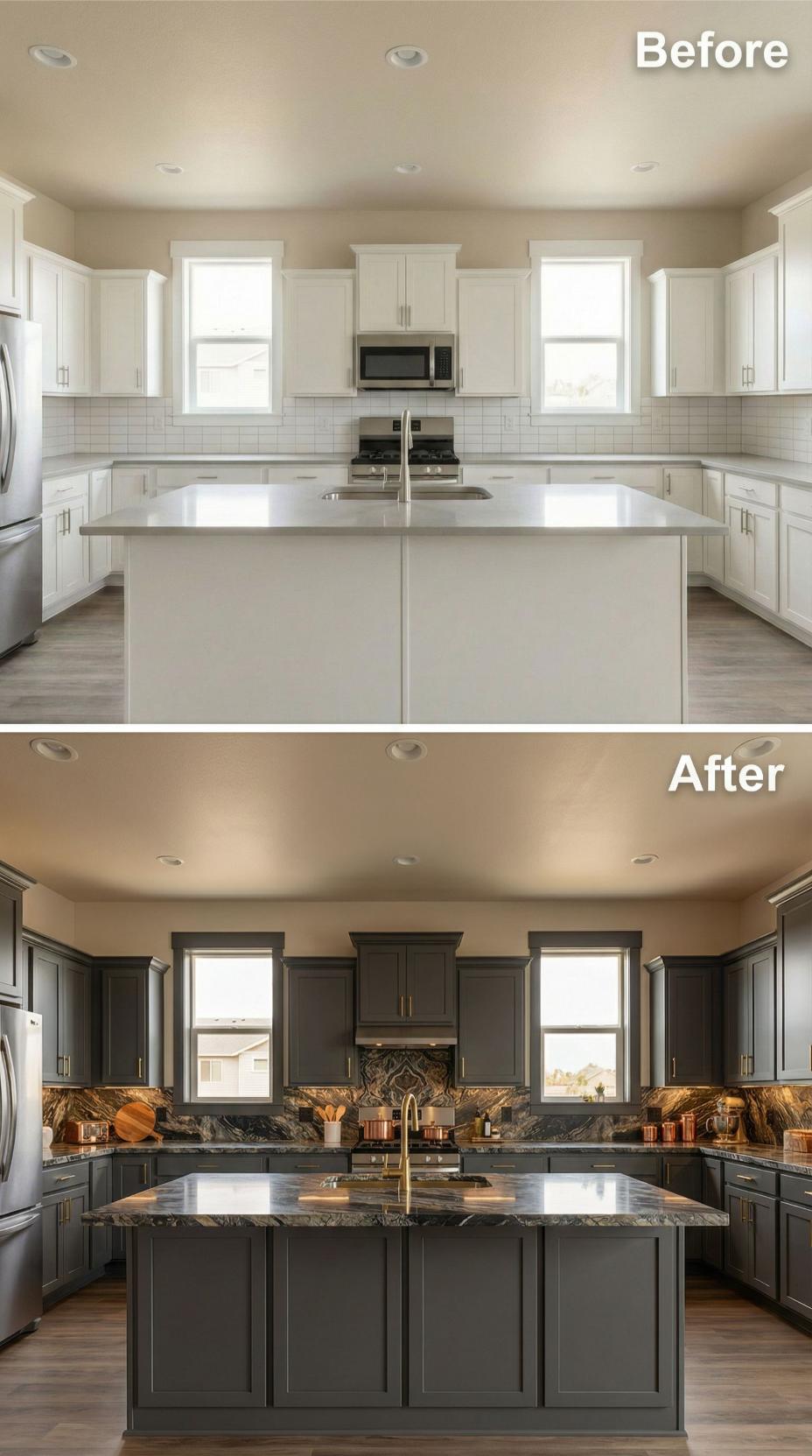
Gray-painted shaker cabinets run floor to ceiling on every wall, replacing the all-white originals with a color that reads closer to slate than charcoal. Brass bar pulls add a warm metallic note without competing with the stone. The backsplash is the room’s defining move: a dramatic veined slab in black, gold, and rust that mirrors the island countertop material, creating visual continuity across the whole space.
Under-cabinet lighting draws attention to the slab’s movement, while copper accessories on the countertop pull the warm tones forward. The island now features a sink with a brass faucet that anchors the fixture-level details to the hardware above. The wood-look plank flooring stayed, and it works harder now against the darker cabinetry than it ever did against white.
Fun Fact: Granite slabs with dramatic veining, like the gold-and-black variety visible here, are typically cut from a single block, meaning no two kitchens will ever share an identical backsplash pattern. That uniqueness is a core reason stone fabricators charge a premium for book-matched slab installations, where two mirrored cuts are aligned to create a symmetrical pattern across a wall surface.
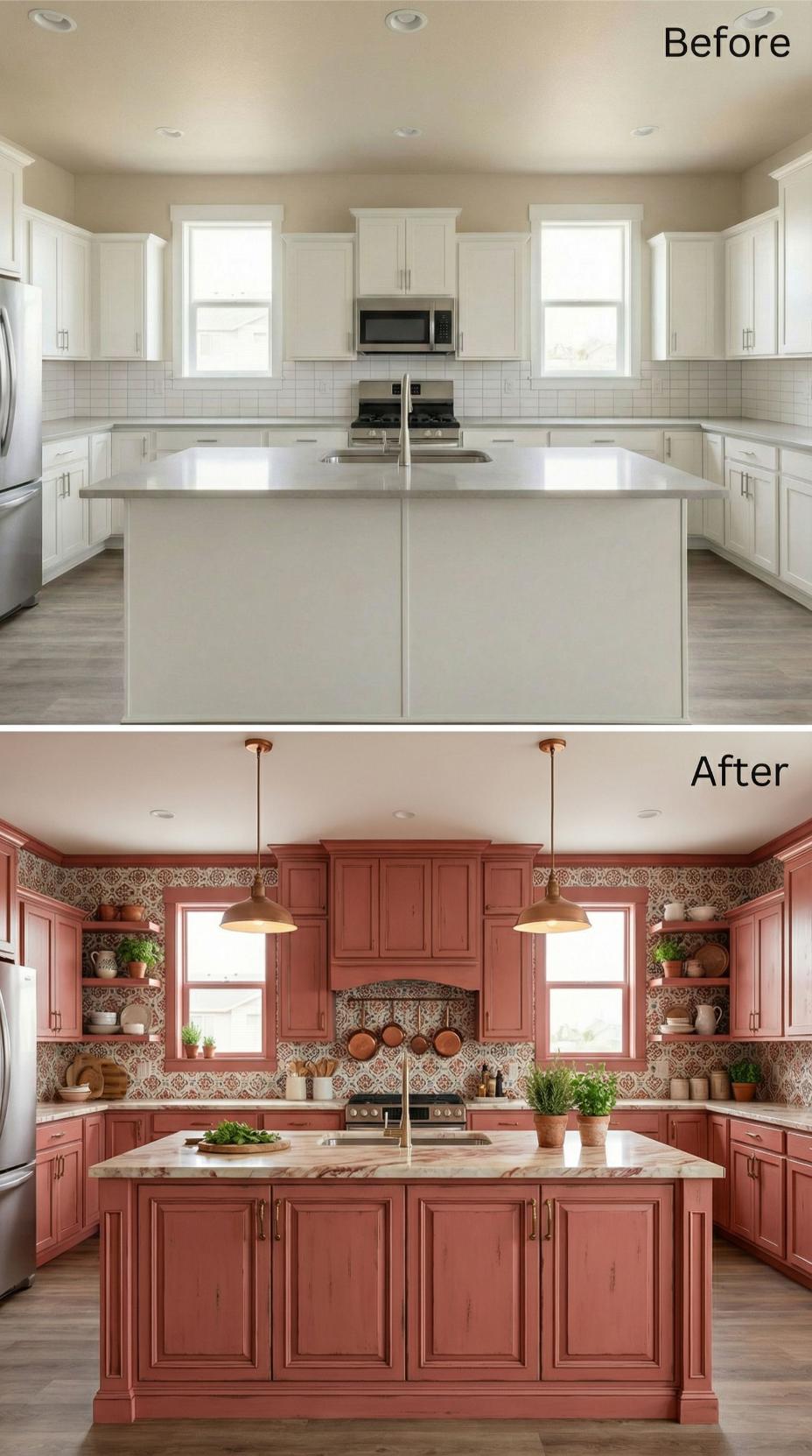
23. Distressed Coral Cabinets and Patterned Tile Pull a Builder-Grade Kitchen Out of Obscurity
🔥 Would you like to save this?
The before kitchen checked every forgettable box: flat white shaker cabinets, gray laminate countertops, subway tile backsplash, zero personality. The after version dismantles that neutrality with distressed coral-red painted cabinets finished in a raised-panel style that reads closer to furniture than flat stock cabinetry. Brass cup pulls and pendant lights with copper-toned shades reinforce the warmth throughout.
The backsplash is the turning point. A repeating medallion-style tile in terracotta, cream, and burgundy runs wall to wall, pulling the coral cabinet color into a deliberate palette rather than an accident. Veined marble countertops on both the island and perimeter replace the original gray slab. Open shelving brackets styled with ceramic vessels and potted herbs break up the upper cabinet run without adding visual noise.
22. Light Oak Cabinets and a Marble Mosaic Backsplash Dismantle a Kitchen Built on White Paint
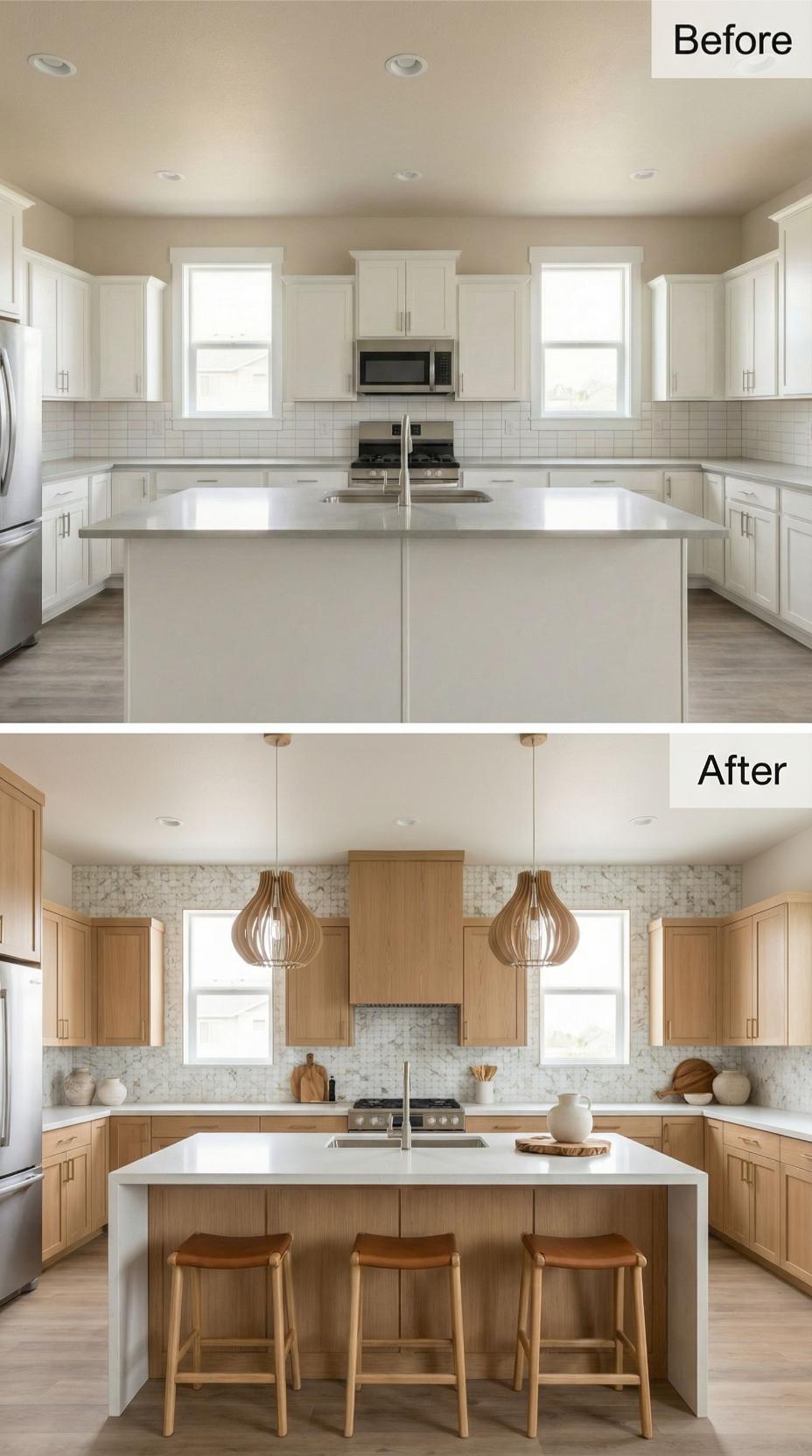
Flat-front light oak cabinets replace the original painted white shaker boxes, and a marble mosaic backsplash in broken irregular pieces runs wall-to-wall behind the range, pulling the whole room toward warmth. Two slatted wood pendant lights with a cage-like silhouette hang over the white quartz island, where leather-seated bar stools in cognac add the only upholstered element in the room.
21. Crystal Chandelier and Marble Slab Backsplash Finish Off a Kitchen That Played It Safe
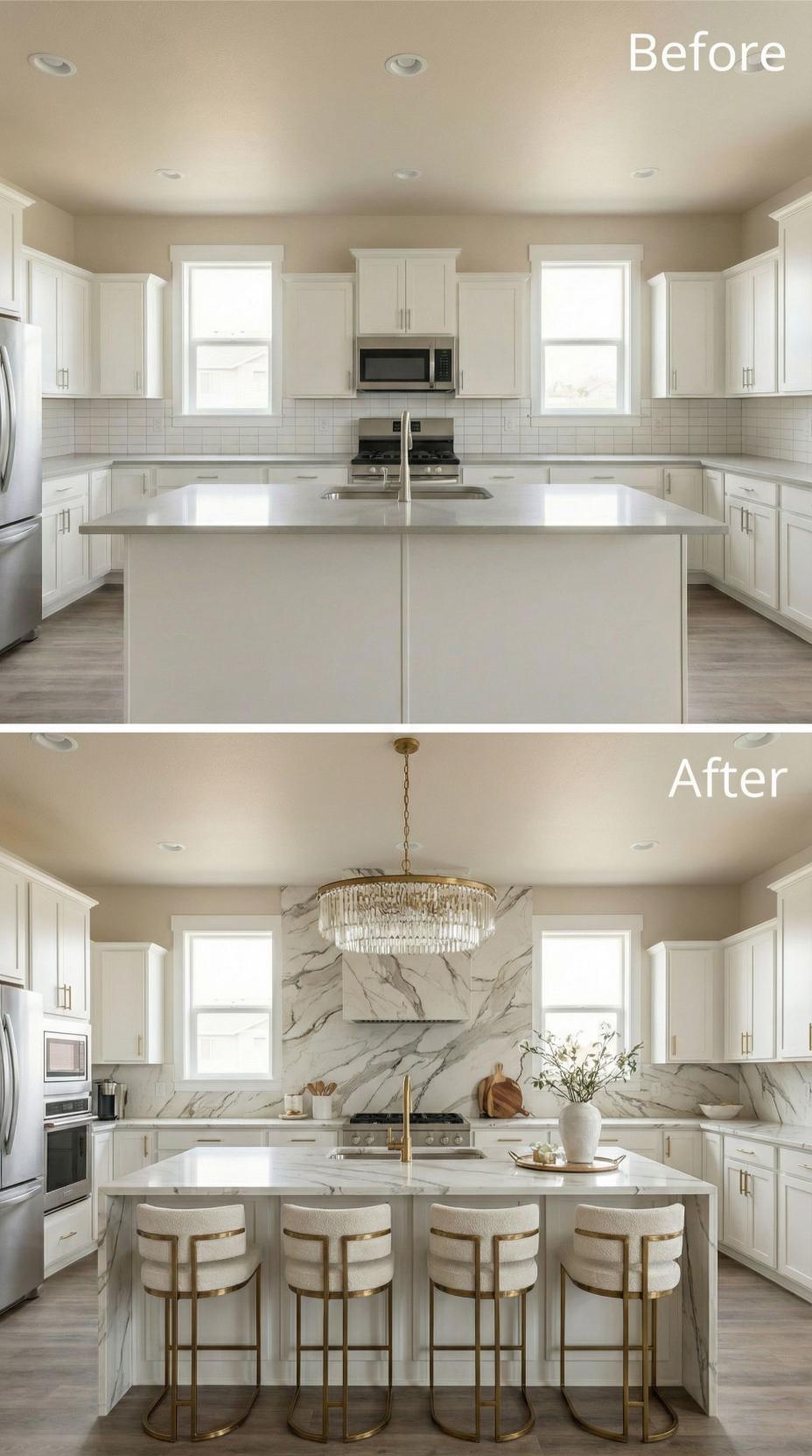
Four boucle-upholstered bar stools with brass frames line the island, which now wears a white-and-gray veined marble countertop extending up the wall as a full slab backsplash. A tiered crystal chandelier with a brushed brass chain anchors the ceiling above the island, replacing what had been bare recessed lighting. Brass faucet and cabinet hardware carry the gold finish throughout without overcrowding it.
20. Walnut Cabinets and a Blue Persian-Motif Backsplash Erase Every Trace of Builder White
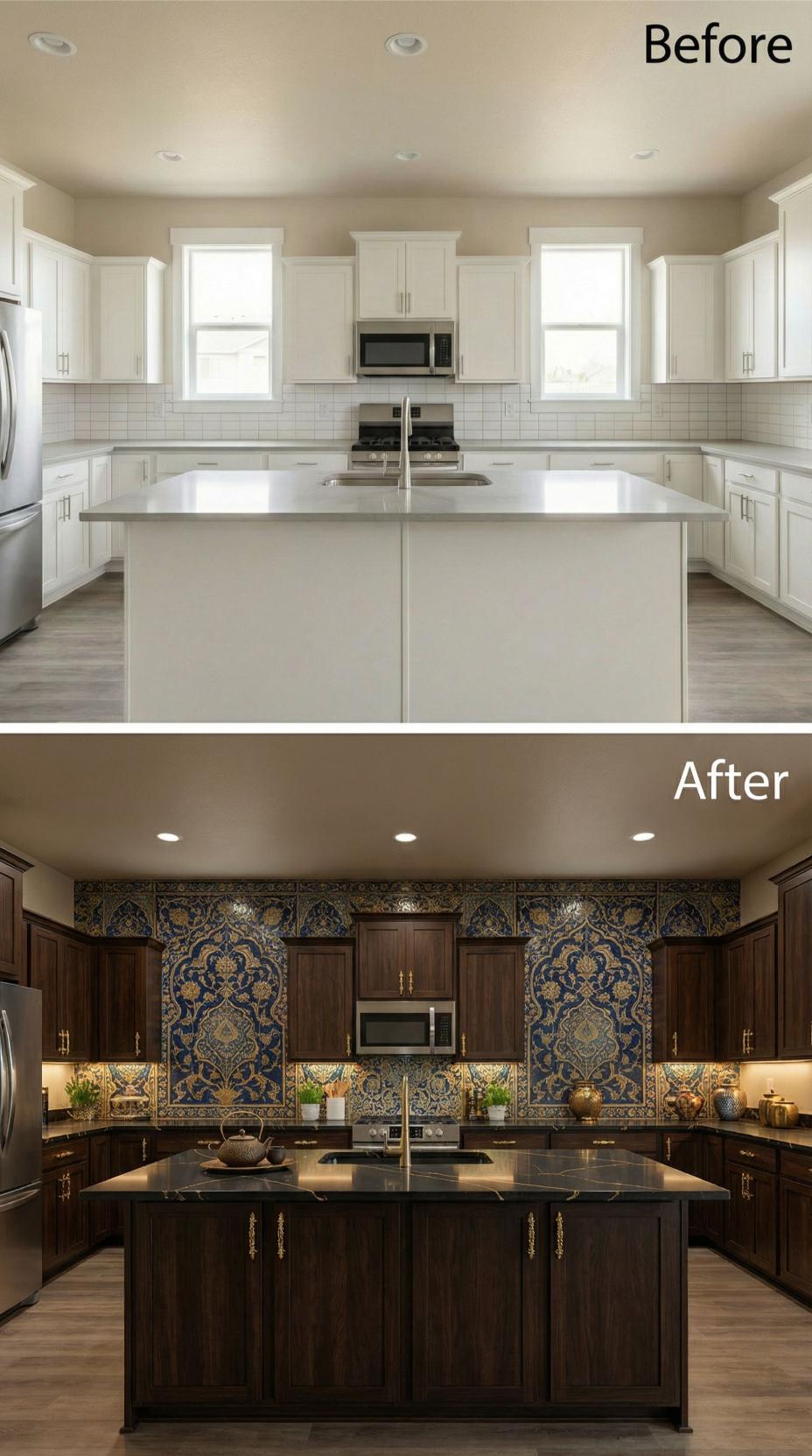
White shaker cabinets and a blank quartz island gave this kitchen nothing to hold onto. The renovation replaced every surface with intention: dark walnut cabinetry runs floor to ceiling, paired with brass cup pulls and bar hardware that read warm against the wood grain. Black marquina-style countertops with gold veining cover both the perimeter and the island, which now anchors the room with visible weight.
The backsplash does the most work here. Large-format tiles printed with a deep navy and gold Persian floral pattern stretch across the entire wall between upper and lower cabinets, wrapping around the range and microwave alcove without interruption. Under-cabinet lighting catches the metallic gold in the tile. A cast iron teapot and brass vessels on the island reinforce the palette without competing with it.
19. Walnut Cabinets and Teal Geometric Tile Replace a Kitchen That Had No Opinion
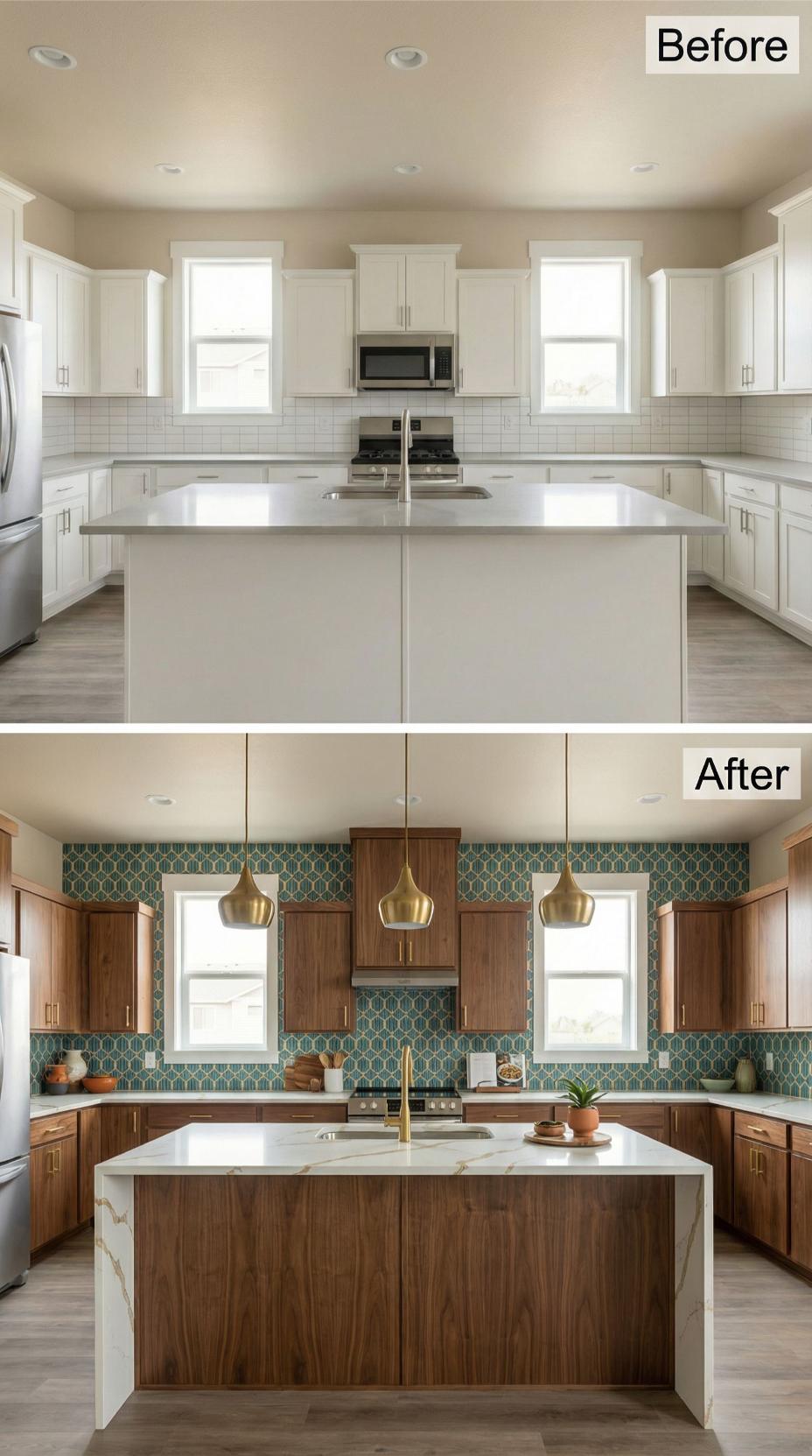
Flat white cabinets, a blank quartz island, and subway tile that blended into the walls gave this kitchen nothing to hold onto. Replacing all of it with walnut cabinetry, brass hardware, and a bold teal honeycomb-pattern backsplash running wall to wall changed the room’s entire argument.
Brass teardrop pendants hang from ceiling-height cables over a waterfall island topped in white stone with gold veining. The walnut grain on cabinet doors reads warm against the cool teal, and satin brass pulls tie the two finishes together without overworking the palette. Decorative objects on the counters, including a small potted plant and a wooden cutting board, keep the surface from feeling staged.
18. Dark Walnut Cabinets and Aztec Tile Demolish a Kitchen That Refused to Commit
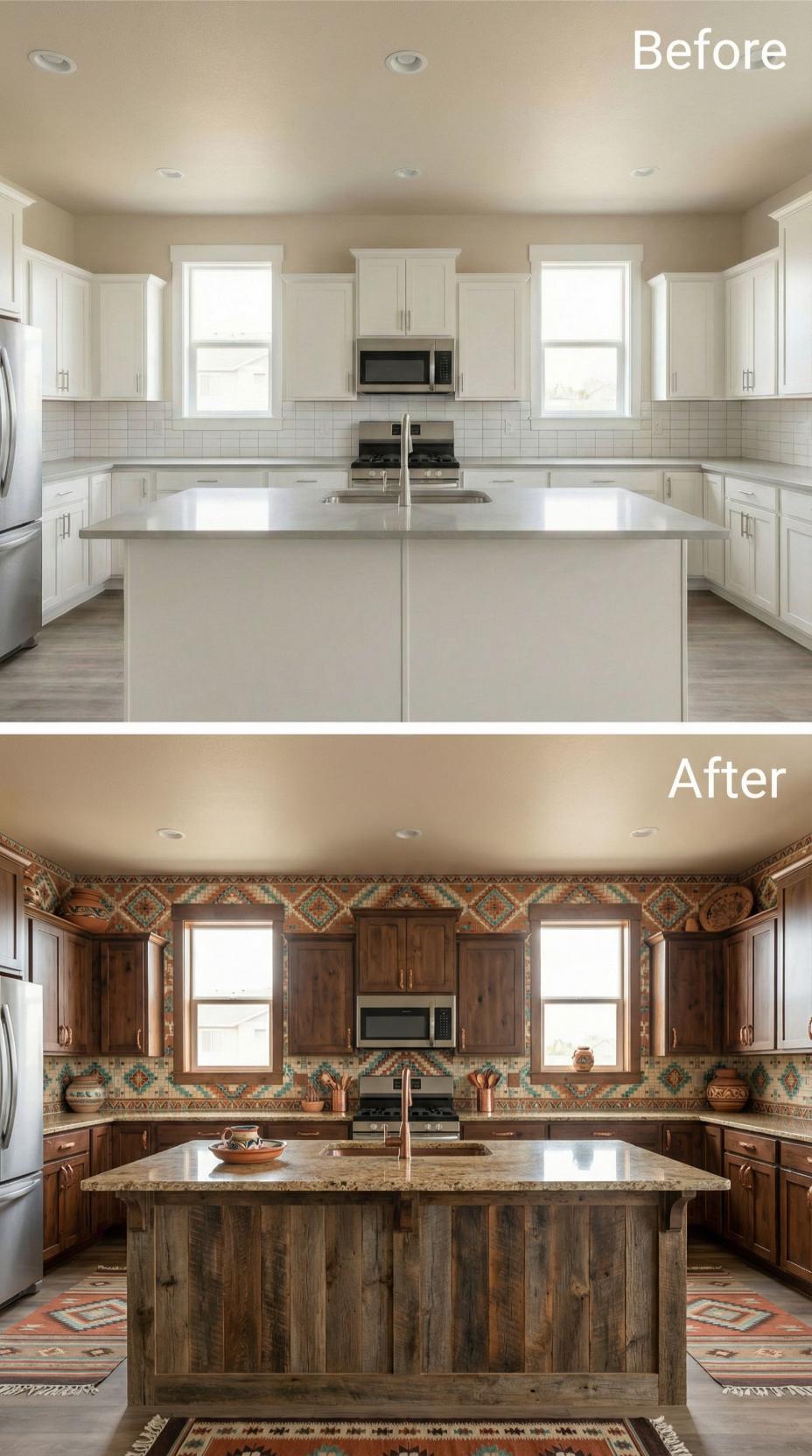
Reclaimed wood planks clad the island base in place of painted drywall, and the shift from white quartz to a veined granite top reads immediately as a decision, not a default. Copper-finish hardware replaces flat bar pulls, and the upper cabinets are now dark walnut stain over what appears to be knotty alder, a species chosen specifically because its grain irregularities add visual texture without added materials.
Above the cabinets, a band of Southwestern geometric tile runs the full perimeter, with diamond motifs in terracotta, teal, and sand. That same pattern anchors the backsplash behind the range. Kilim-style runners reinforce the palette at floor level. Nothing in this kitchen is accidental.
17. Blue Cabinets and Medallion Tile Give a Builder-Grade Kitchen a Point of View
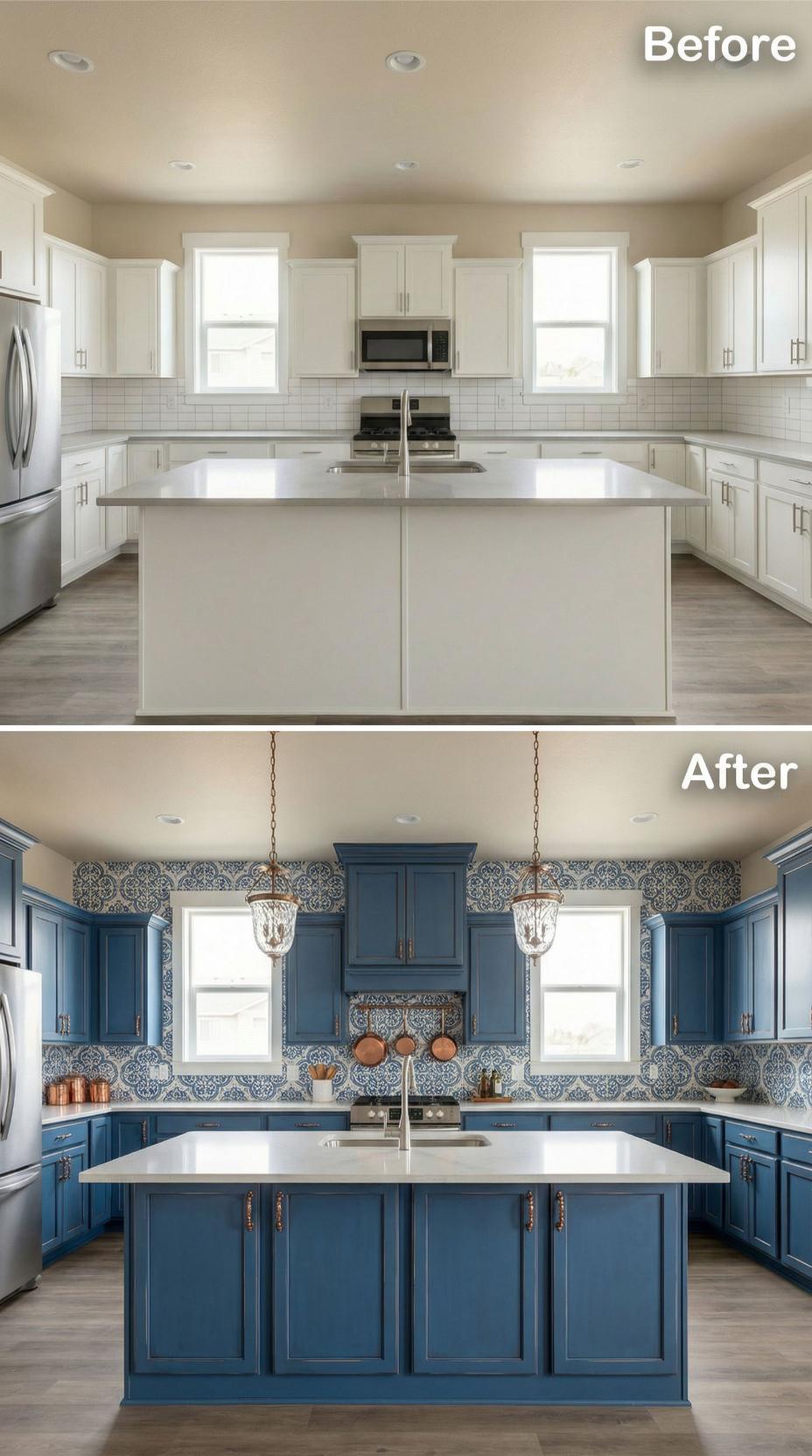
Slate-blue cabinetry runs the full perimeter and wraps the island, replacing a kitchen that communicated nothing. Brass bin pulls and bronze chain pendant lanterns pull warm metal tones across the room, keeping the cooler cabinet color from reading flat. Raised-panel doors on the island add dimension that the original shaker-style boxes never had.
Every inch of wall between the upper cabinets and ceiling is covered in a blue-and-white medallion-pattern tile, a detail that does more visual work than any single piece of furniture could. White quartz countertops stay consistent from the perimeter to the island top, grounding the contrast without competing. Copper canisters on the open shelf tie back to the lantern hardware above.
16. Ornate Corbels and a Medallion Backsplash Rescue a Kitchen Drowning in Builder Beige
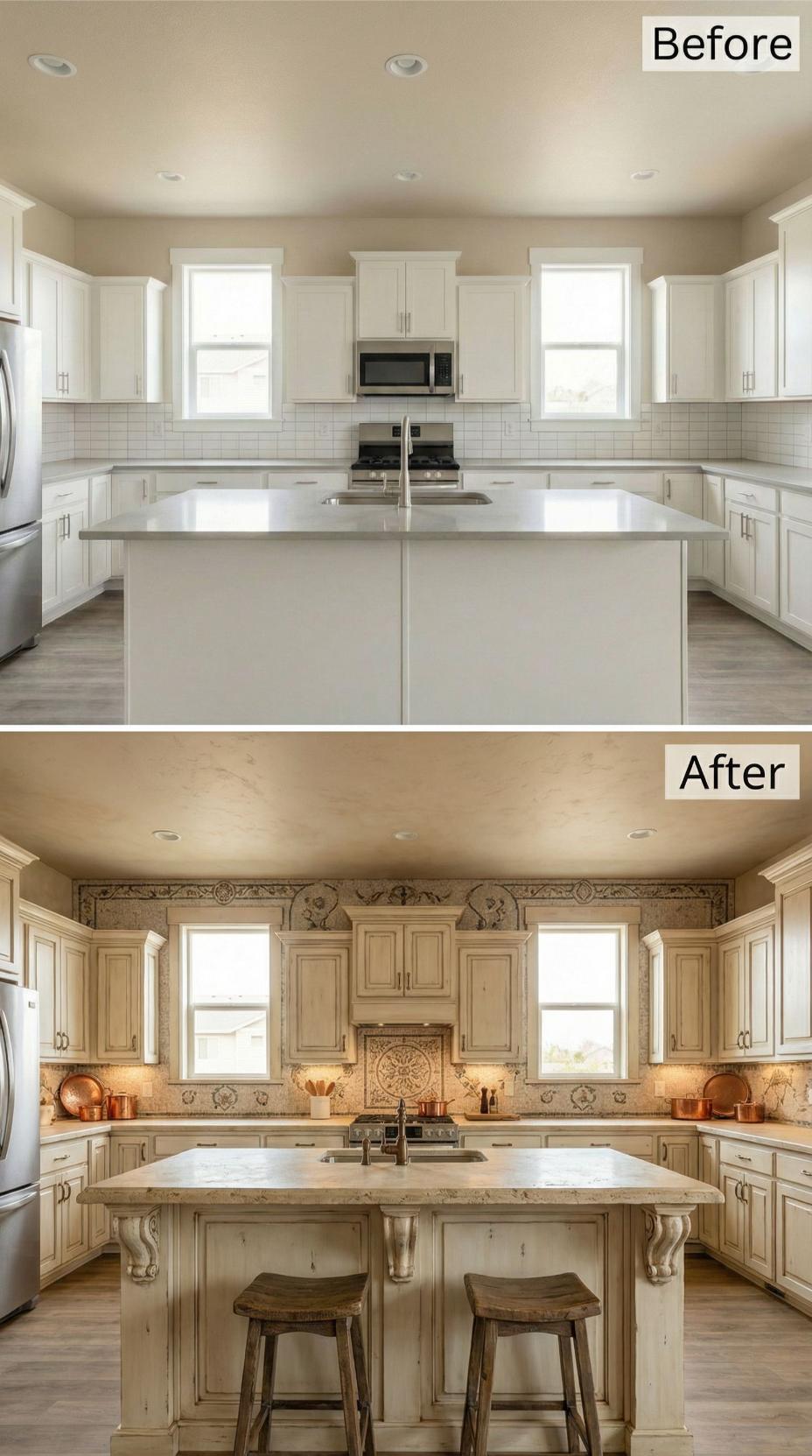
Antique-glazed cream cabinetry with carved corbel legs replaces the flat white originals, while a hand-detailed medallion tile backsplash flanked by copper cookware pulls warmth from every corner. Distressed wood bar stools anchor the island, which now reads as furniture rather than a slab of filler.
15. Glazed Ivory Cabinets and Gold Corbels Buried a Kitchen That Couldn’t Commit
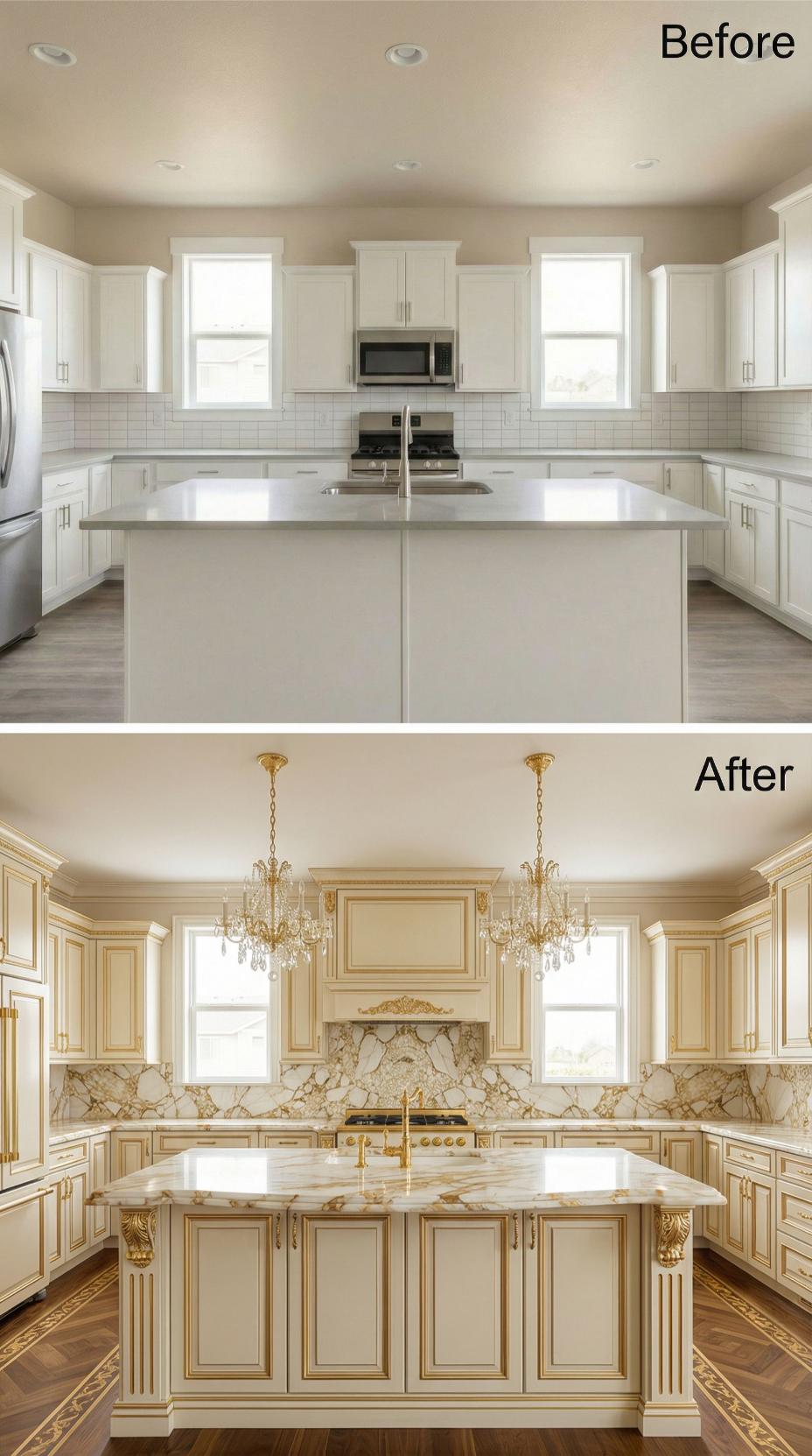
Calacatta gold marble covers both the island surface and the full-height backsplash, tying the brass faucet and gold-trimmed range hood into one coherent material story. Ornate acanthus-leaf corbels anchor the island corners while crystal chandeliers on gold chains replace recessed lighting that added nothing.
14. Charcoal Cabinets and Black Marble Slab Backsplash Bury a Kitchen That Peaked at White Paint
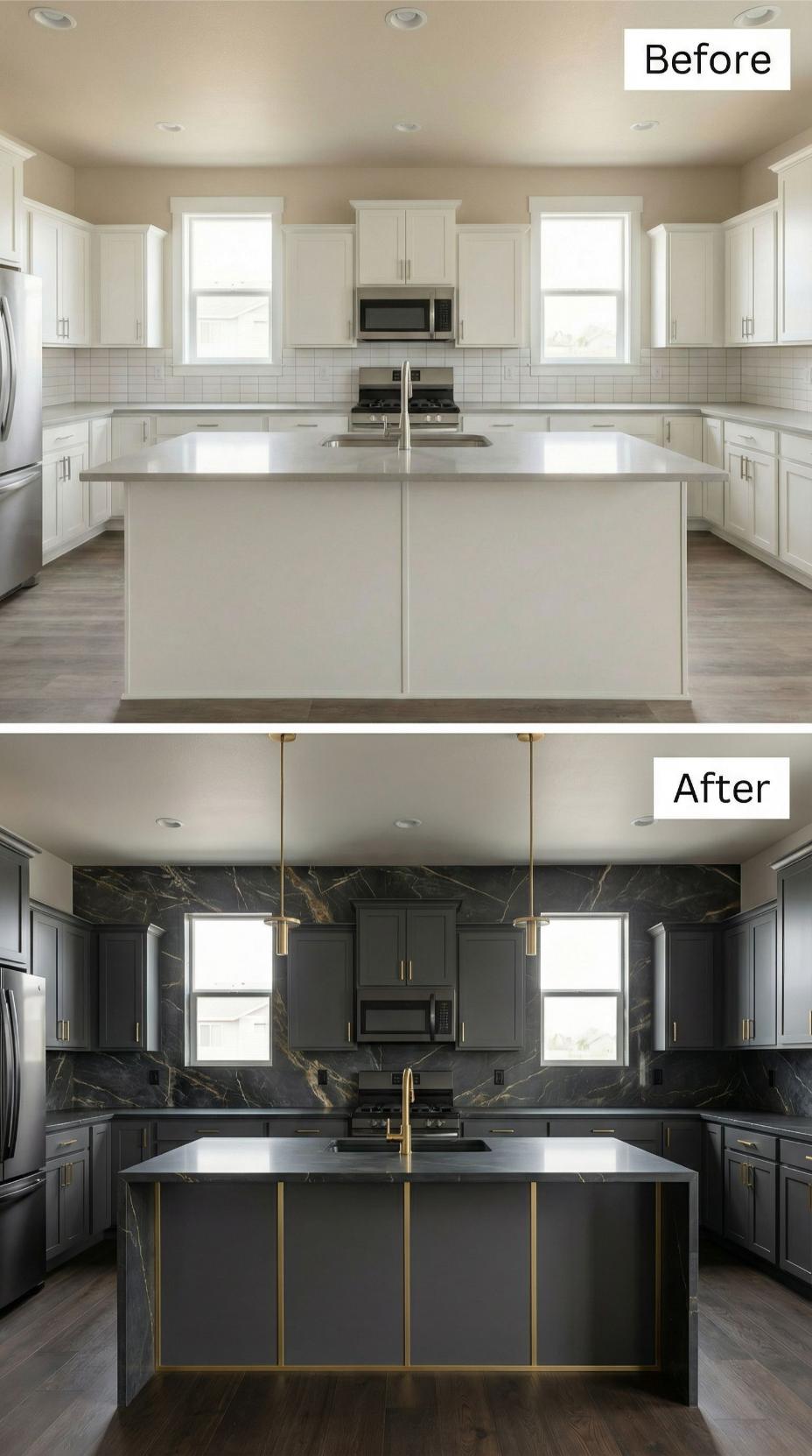
Painted charcoal cabinet boxes replace the original white shaker doors, and gold bar pulls run the full height of the island panels, grounding the brass hardware theme across every surface. Black-and-gold marble slab tiles cover the entire backsplash wall from counter to upper cabinet, with veining dense enough to read as wallpaper from across the room. Pendant lights in a slim brass cylinder hang in a tight row above the island, replacing what was previously bare recessed lighting with zero warmth.
13. Knotty Alder Cabinets and a Floral Tile Mural Finish Off a Kitchen Built on Zero Personality
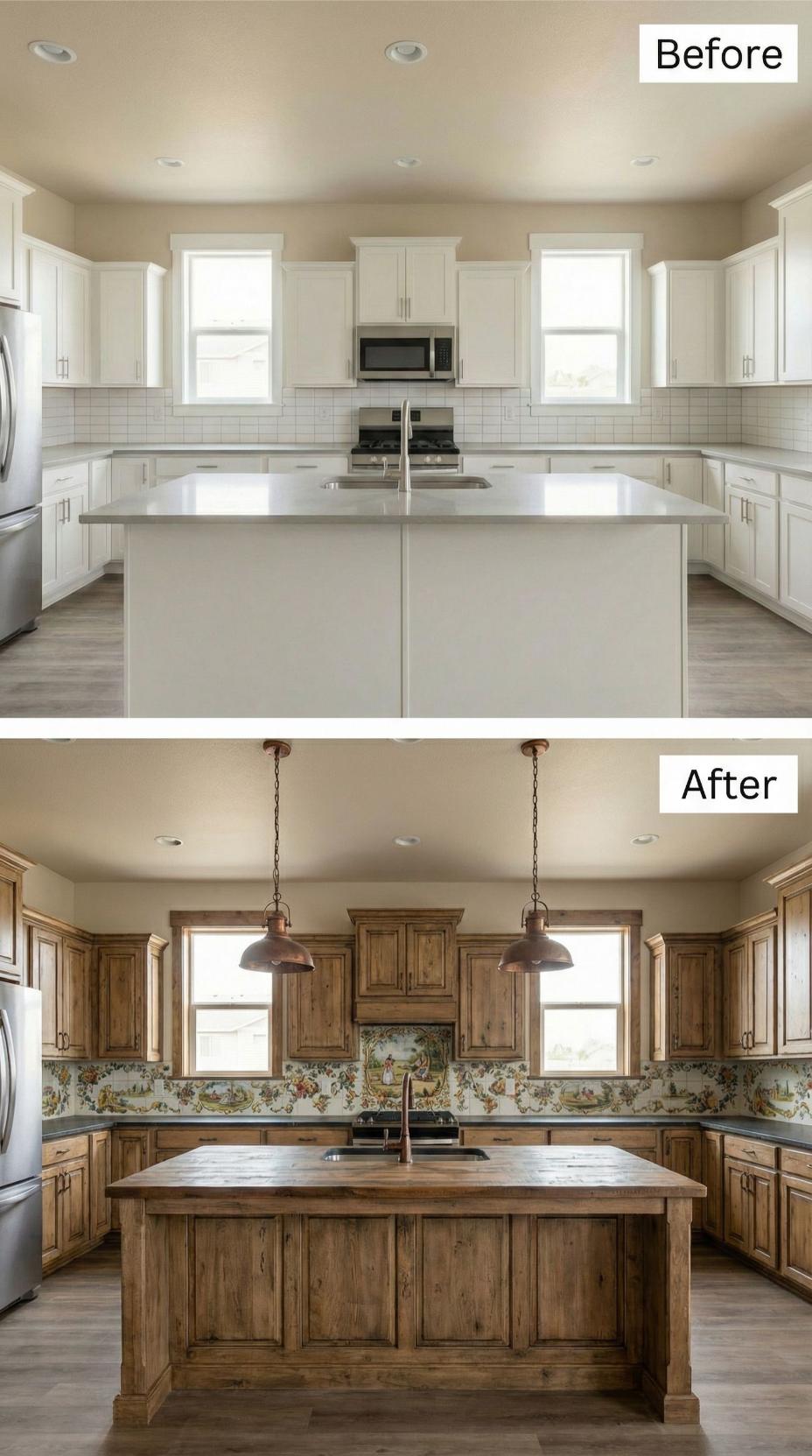
White shaker cabinets, white quartz countertops, and a white subway backsplash made the before kitchen look less like a design choice and more like a placeholder. Nothing was wrong with it. Nothing was right with it either.
The after replaces every surface with intention. Knotty alder cabinets in a medium walnut stain bring visible grain and knot pockets that no paint color could fake. The island gets a butcher-block top with a raw, wide-plank look, while the perimeter counters shift to a charcoal gray slab. Between the upper and lower cabinets, a hand-painted floral tile mural runs the full width of the wall, its scene depicting figures, botanicals, and landscape motifs in soft cream, sage, and rust. Two copper pendant lights with deep dome shades hang low over the island, anchoring the whole composition in warm metal.
12. Sage Green Cabinets and a Butcher Block Island Erase Every Trace of Builder White
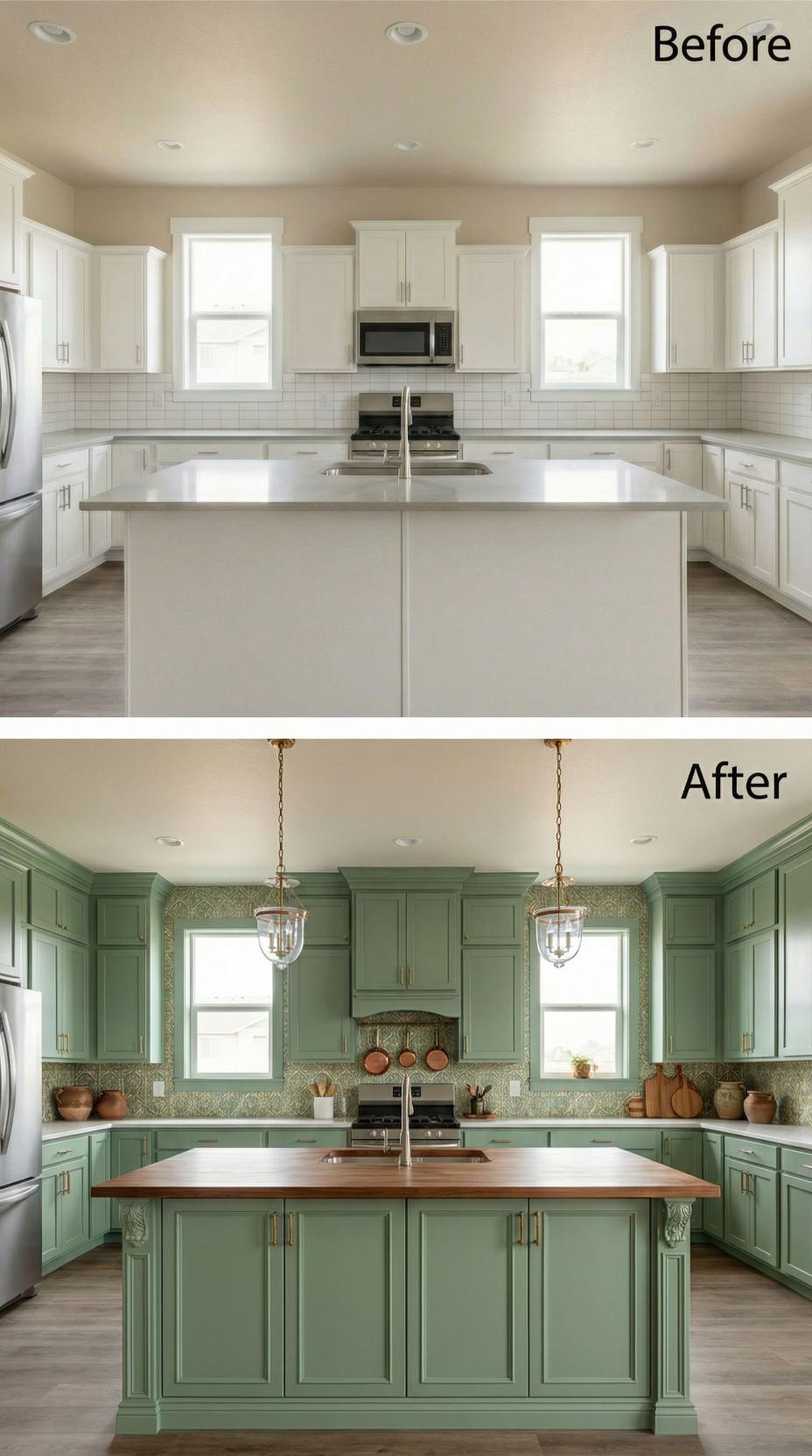
Soft sage green cabinet paint covers every surface from base to upper, including the island, creating a visual weight that the original all-white layout completely lacked. Brass hardware on shaker-profile doors reads warm against the matte green finish. A walnut butcher block island top replaces the plain white quartz, and the grain pattern runs long across the full surface. Two glass lantern pendants with brass chain drops hang centered over the island.
The patterned backsplash behind the range swaps out the plain subway tile for a green-and-gold damask motif that fills the entire back wall between upper cabinets. Terracotta pottery and wooden cutting boards sit on open counter runs, adding texture where bare white countertop once sat.
11. Walnut Cabinets and Green Geometric Tile Dismantle a Kitchen Built on Safe Choices
🔥 Would you like to save this?
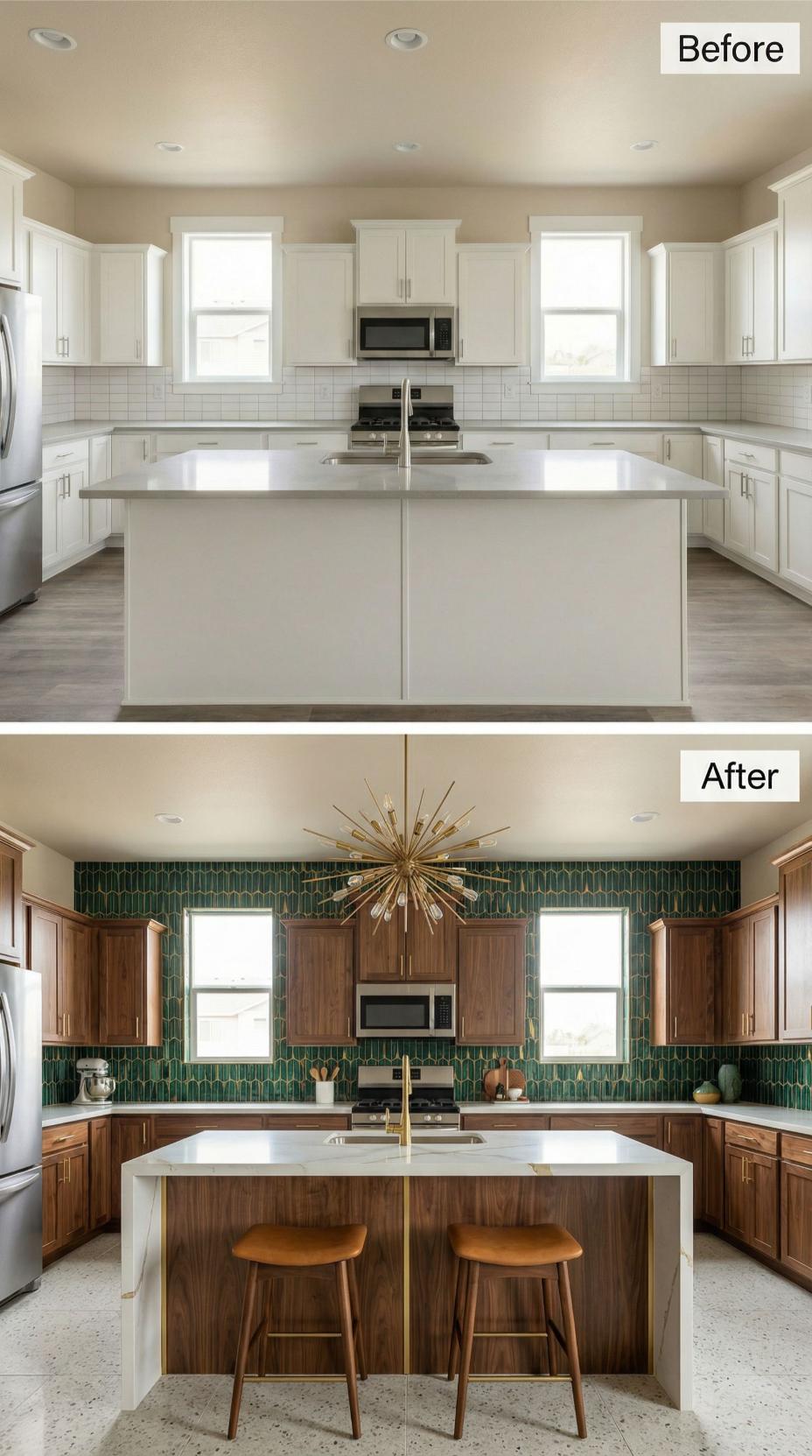
Flat-front walnut cabinets replace the original white shaker boxes, and the shift in warmth alone resets the entire room. Above the range, elongated green tiles with a gold geometric outline cover the full backsplash wall, running edge to edge behind both windows. A Sputnik chandelier in brushed brass drops over the island, which now wears a waterfall marble countertop with gold-veined detailing. Cognac leather barstools on tapered wood legs anchor the seating side of the island.
10. Rift-Cut Oak Cabinets and Dark Slate Tile Finish Off What Builder White Started
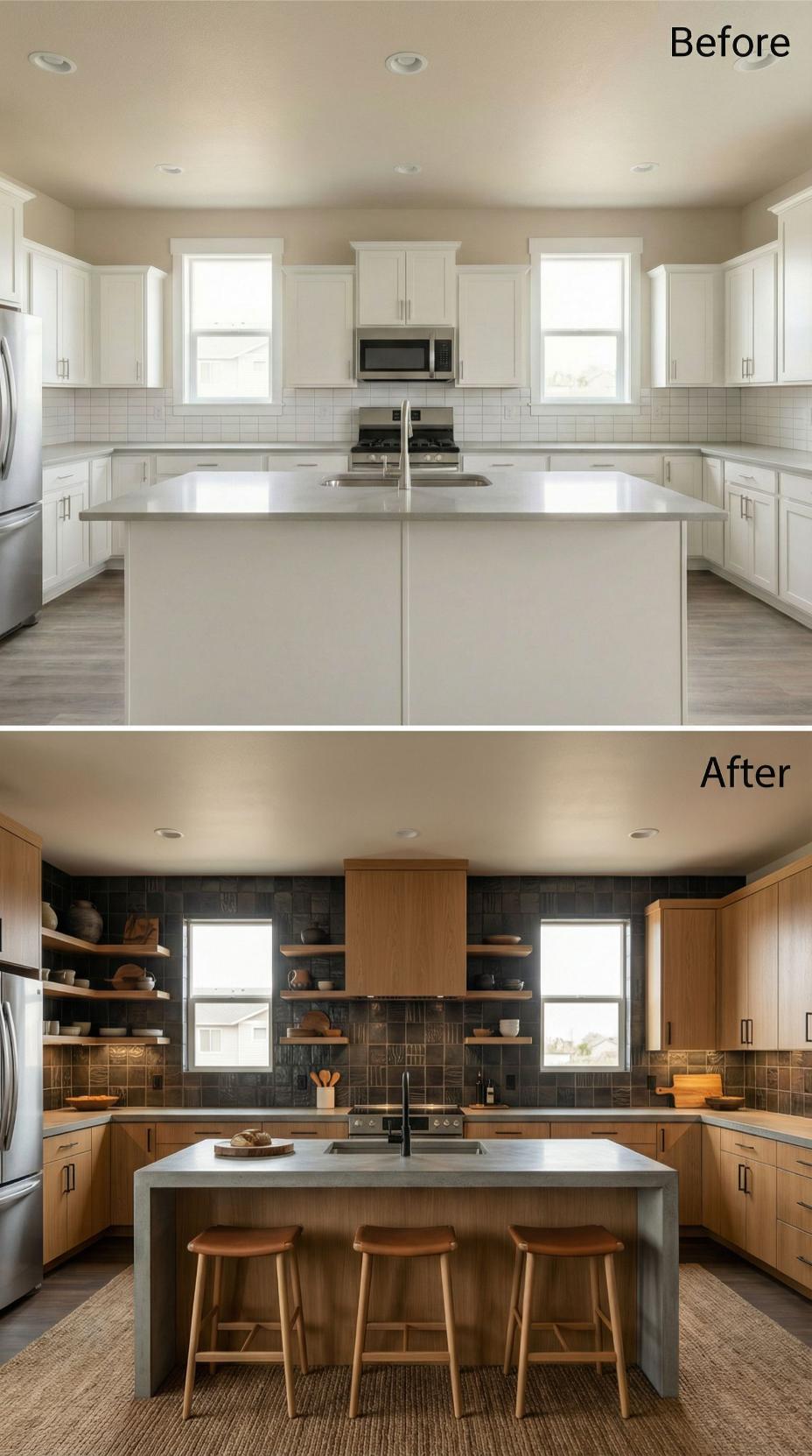
Open shelving in warm oak replaces upper cabinets, a concrete island countertop swaps out the plain white slab, and dark handmade-look slate tile runs floor to ceiling behind the range hood.
9. Rift-Sawn Oak Cabinets and a Marble Slab Backsplash Retire the Builder-White Era for Good
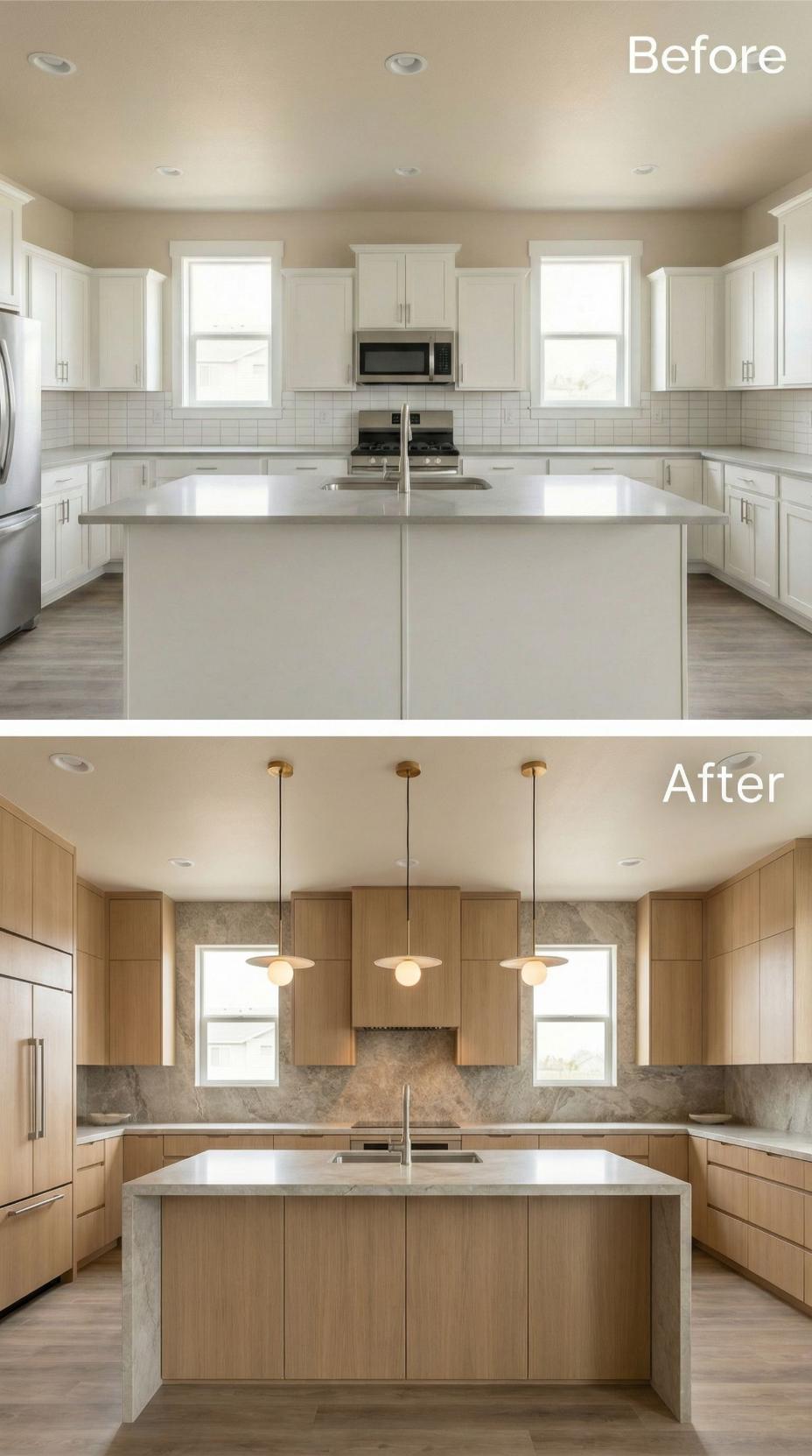
Flat-front rift-sawn white oak cabinets run floor to ceiling on every wall, their tight, straight grain giving the kitchen a material warmth that painted wood simply cannot replicate. The backsplash shifts from subway tile to large-format marble slab panels with grey and taupe veining that carry the eye up through the range hood surround. Brushed brass pendant lights with globe bulbs hang at staggered heights over the island.
The island itself stays white quartz, which keeps the composition from tipping too heavy. Cabinet hardware disappears entirely, replaced by integrated pulls routed directly into the oak. That single decision removes visual clutter across roughly thirty cabinet faces and lets the wood grain do the work the white shaker doors never could.
8. Navy Cabinets and a Mosaic Backsplash Dismantle a Kitchen Built on All-White Everything
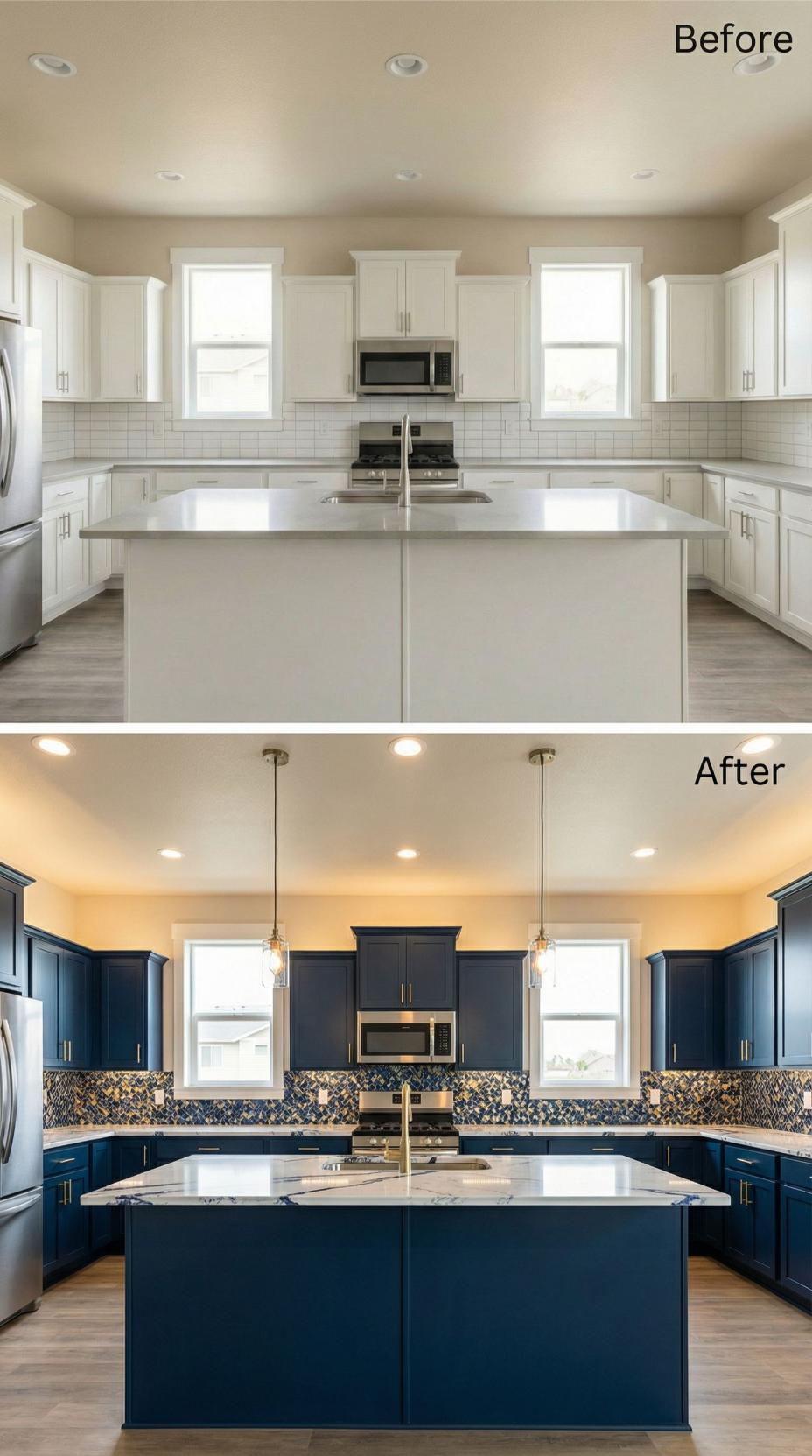
Solid navy cabinetry in a shaker profile replaces every inch of the original white, running floor to ceiling across both walls and the island base. Brushed brass hardware ties directly into the pendant lights overhead, a detail that keeps the color shift from reading as cold. The island countertop is a marble-look surface with visible blue veining that echoes the cabinet color without repeating it exactly.
The backsplash does the heaviest lifting. A mosaic tile in navy, gold, and charcoal runs the full width behind the range, breaking up the solid cabinetry with pattern and movement. That combination of flat color below and fractured tile above is what separates this kitchen from ones that simply swap a paint color and call it a renovation.
7. Warm Cherry Cabinets and Patterned Encaustic Tile Bury a Builder Kitchen Completely
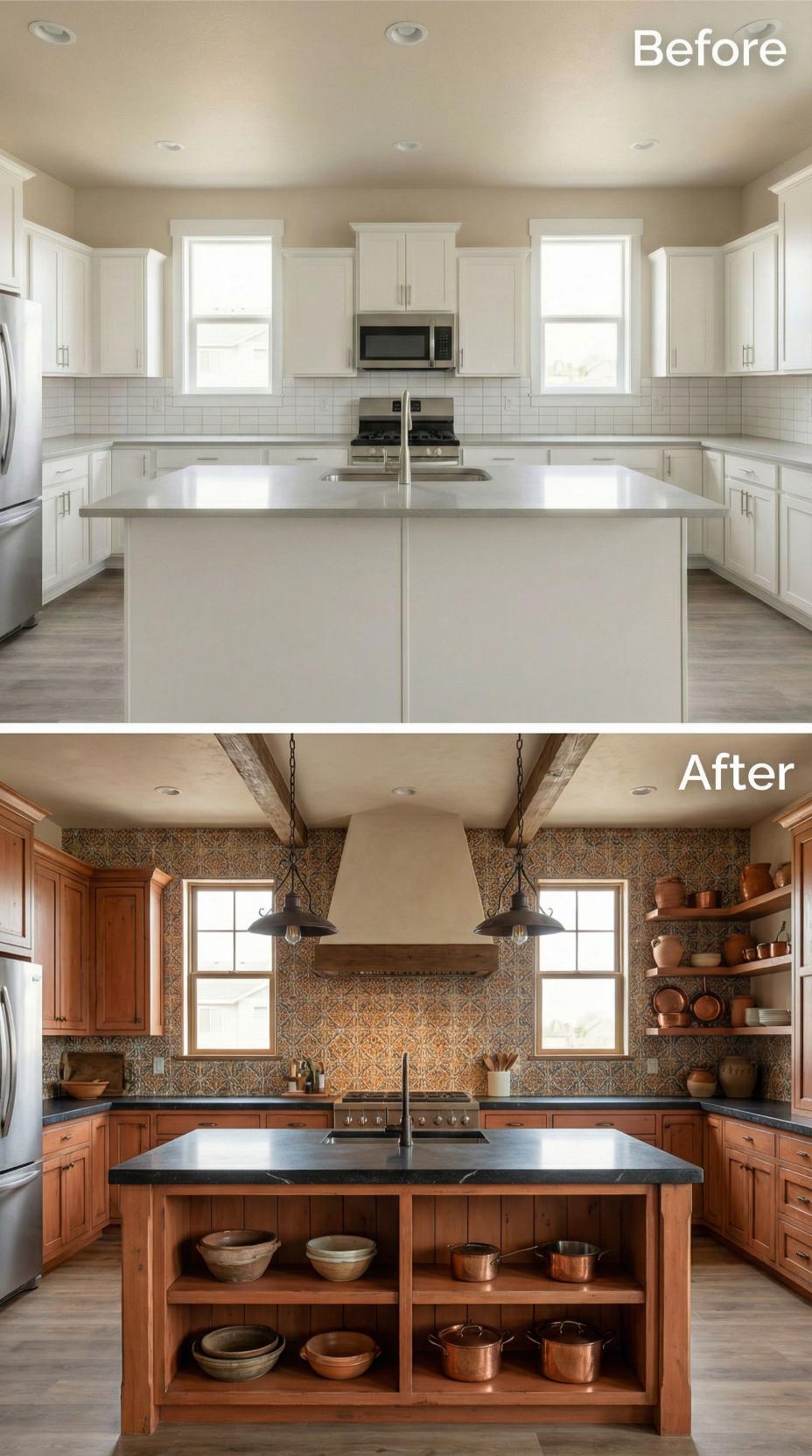
Cherry wood cabinets, soapstone counters, and a plaster range hood replace every inch of builder white with material that actually has something to say.
6. Slate Blue Cabinets and Geometric Backsplash Tile Put a White Kitchen Out of Its Misery
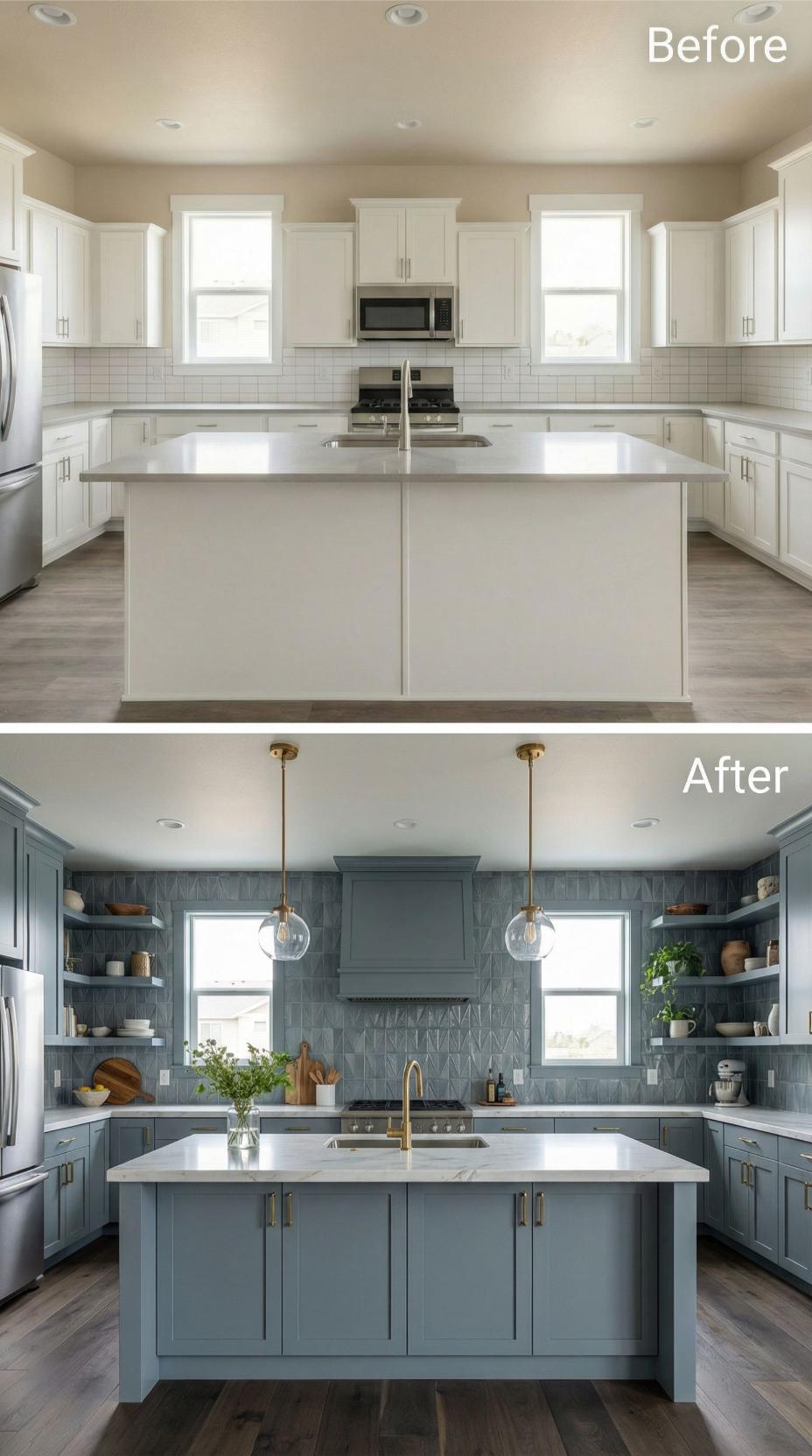
The before kitchen was a study in deliberate avoidance: white shaker cabinets, a plain subway tile backsplash, and a builder-grade island that contributed nothing. The after version replaces all of it with slate blue cabinetry fitted with brass bar pulls, open floating shelves styled with stoneware and greenery, and a textured geometric backsplash tile in a relief pattern that catches light differently depending on where you stand.
Two globe pendant lights with brass fittings hang over the island, which now carries a white quartz countertop with faint veining. The range hood, painted to match the cabinetry, anchors the back wall with actual visual weight. Darker hardwood flooring grounds the whole composition in a way the original pale planks never could.
5. Espresso Cabinets and a Marble Slab Backsplash Make the White Era Look Like a Rough Draft
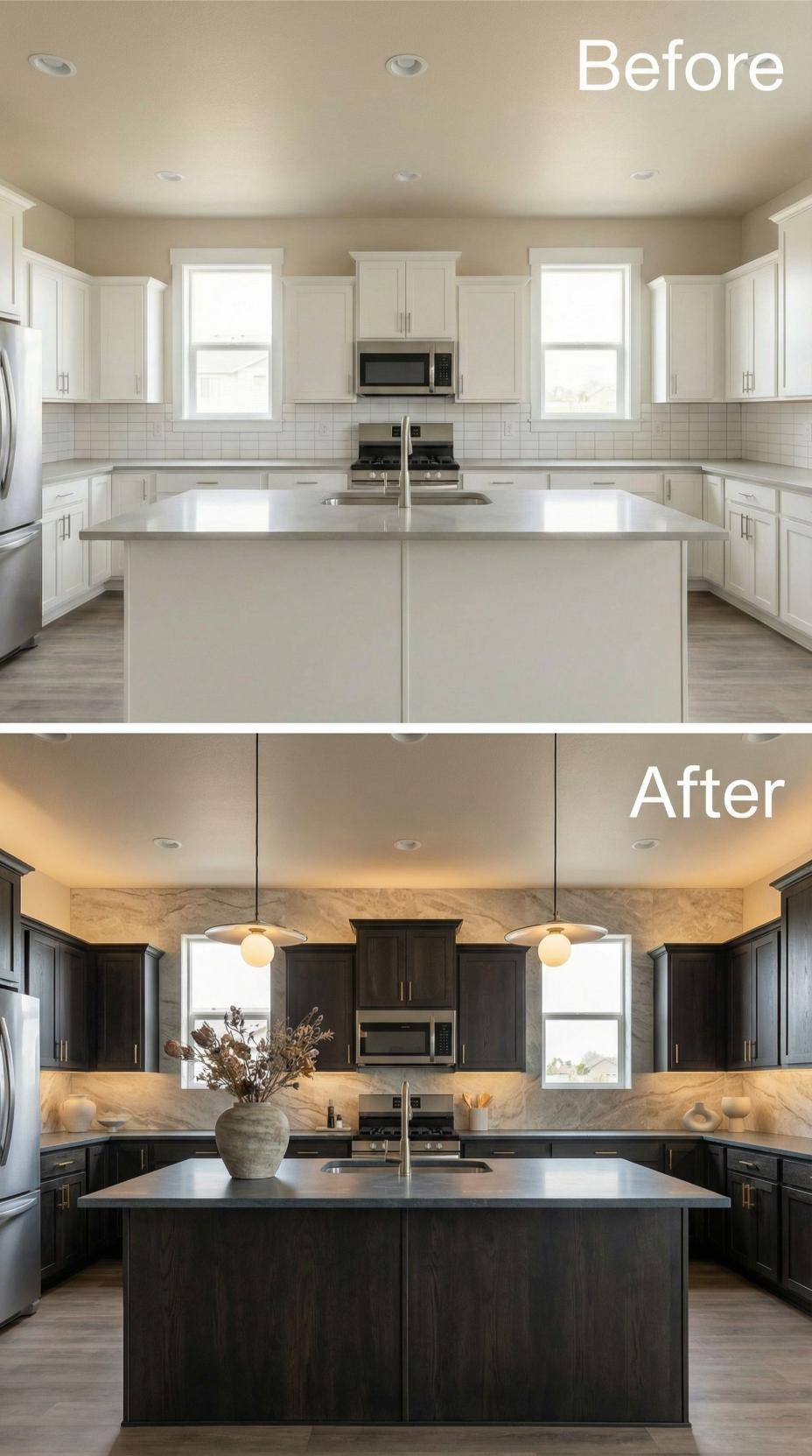
Espresso-stained cabinets replace every white shaker panel, and the shift in visual weight is immediate. Full-height marble slab backsplash with cream and gold veining runs wall to wall, including behind the upper cabinets. Brass hardware on the lowers contrasts the dark stain directly. Two globe pendants hang over the island, which now carries a charcoal countertop instead of the original white surface.
4. Crystal Pendant Lights and Gold Hardware Finish Off What Plain White Started
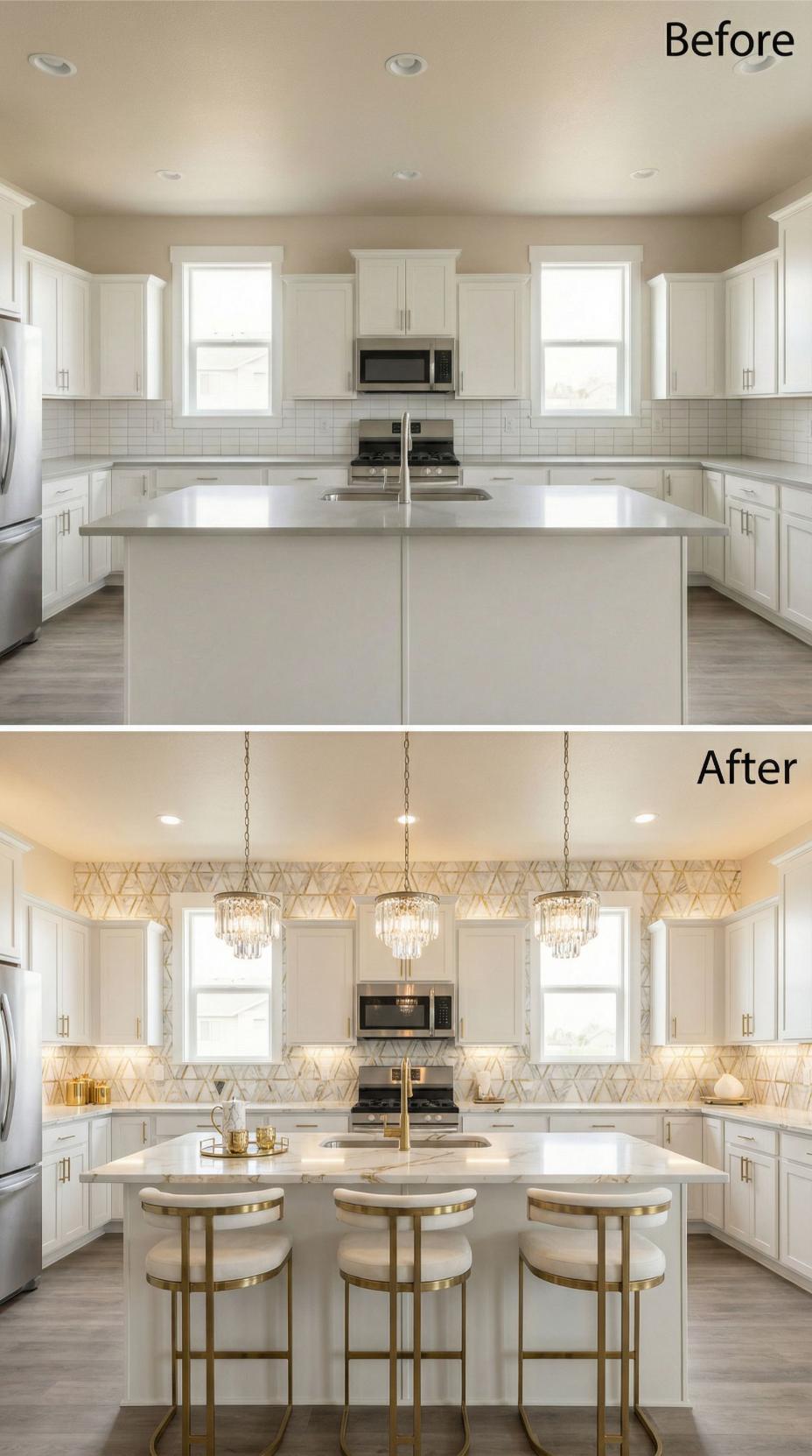
White quartz with gold veining replaced the flat gray island countertop, and a geometric backsplash in cream and brass tones now runs wall to wall where plain subway tile once sat. Three crystal chandelier pendants hang on brass chains above the island, and cream upholstered barstools with brushed gold frames complete the shift.
3. Black and Gold Marble Backsplash Puts the All-White Kitchen on Notice
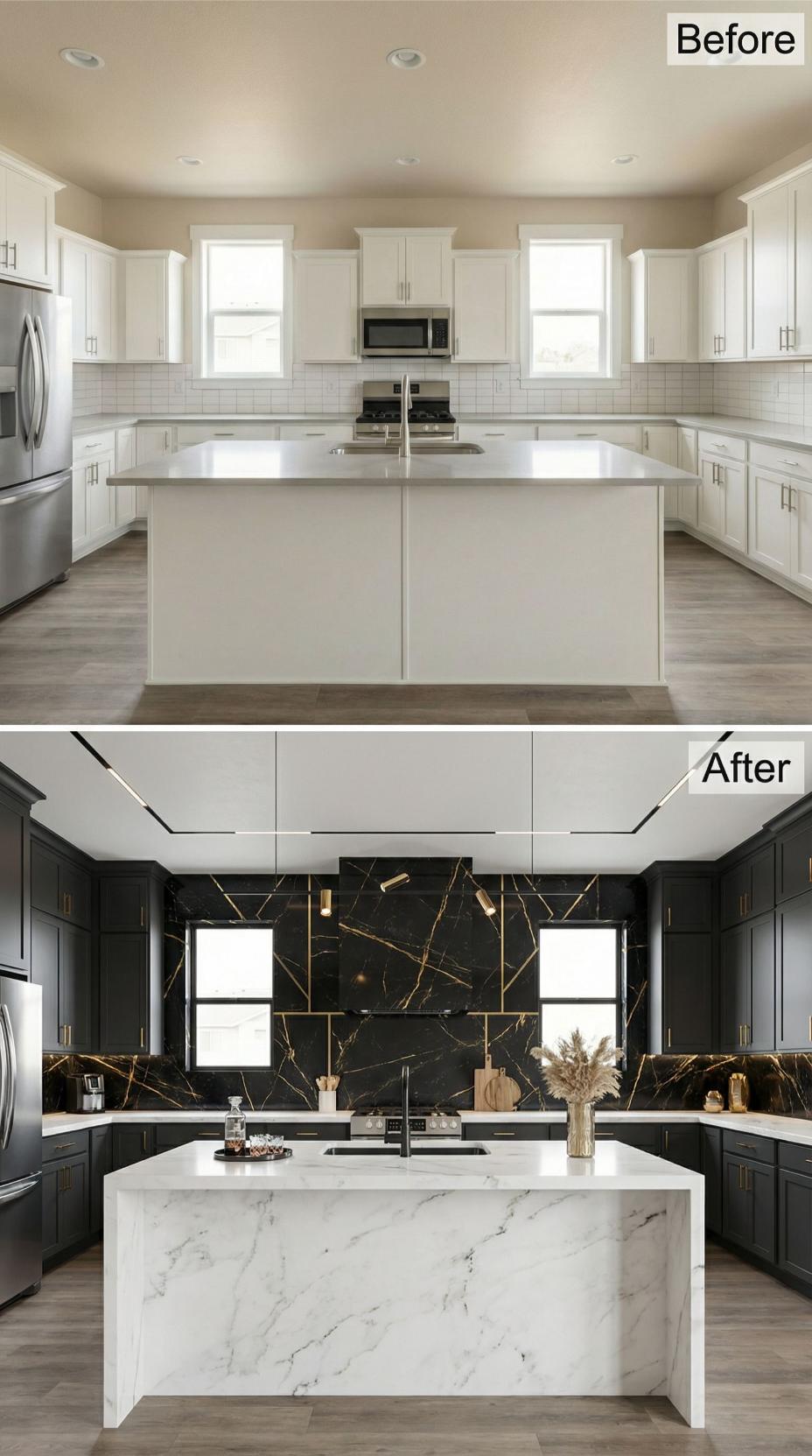
Dark charcoal shaker cabinets replace the original white ones on every wall, and brass bar pulls run consistently across uppers and lowers. Behind the range, full-height black marble slabs with gold veining cover the entire backsplash wall, framing two windows that once sat against plain subway tile. Geometric brass inlay lines divide the slabs into angled panels, adding structure without additional texture.
Below, a waterfall island clad in white Calacatta-style quartz anchors the room. Linear LED strip lighting traces the ceiling perimeter where recessed cans once did the heavy lifting. Dried pampas grass in a brass vase and a round black tray on the island surface are the only styling additions needed.
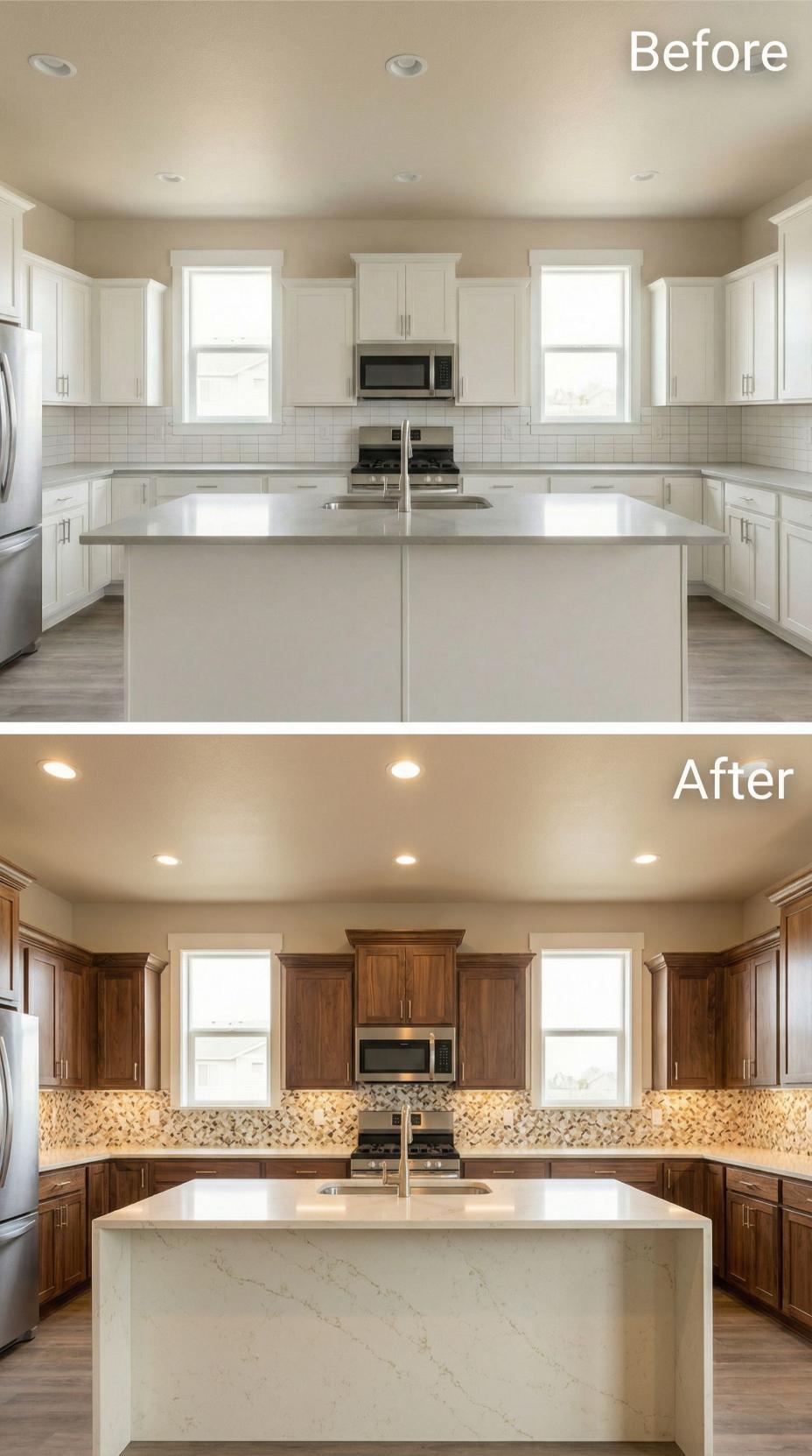
2. Walnut Cabinets and a Mosaic Backsplash Shut Down the All-White Default
🔥 Would you like to save this?
Warm walnut cabinetry replaces the original flat white boxes, and a multicolor mosaic backsplash in amber, cream, and brown adds texture the plain subway tile never attempted. Veined quartz on the island waterfall panel closes the contrast.
1. Gold Inlay on Black Oak Island Panels Renders the Plain White Version Unrecognizable
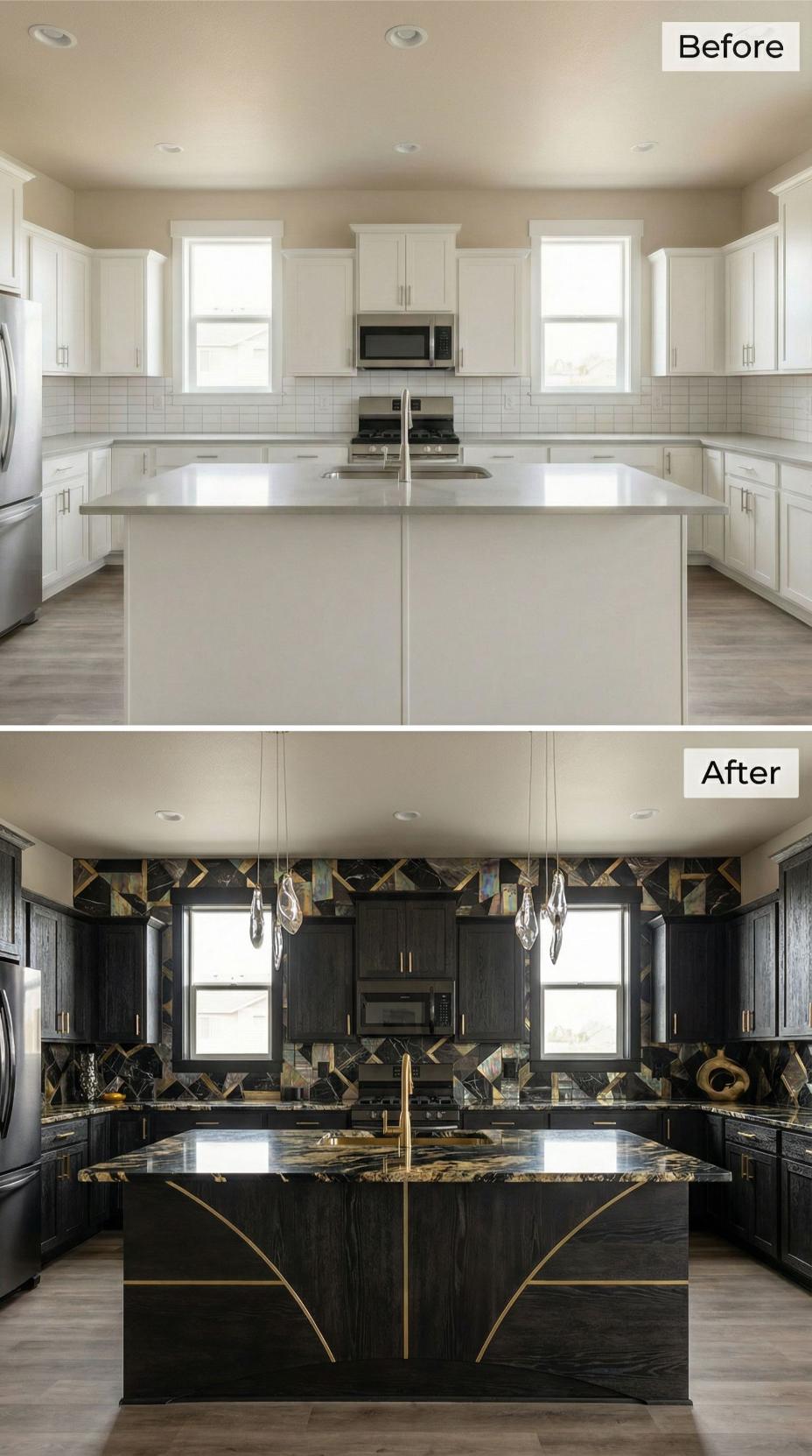
Charcoal-stained oak cabinets with brushed brass pulls replace what were once stock white shakers, and the island follows suit with routed gold brass inlay lines fanning out across its face panels. Black-and-gold marble countertops extend across the perimeter and island, their veining echoing the geometric mosaic backsplash tiles cut from matching stone in triangular and trapezoidal shapes. Blown-glass teardrop pendants hang from the ceiling on individual cords above the island, casting warm light across the brass undermount sink and gold faucet below.