🔥 Would you like to save this?
The door unlocked, the backpack hit the floor, and the kitchen became yours.
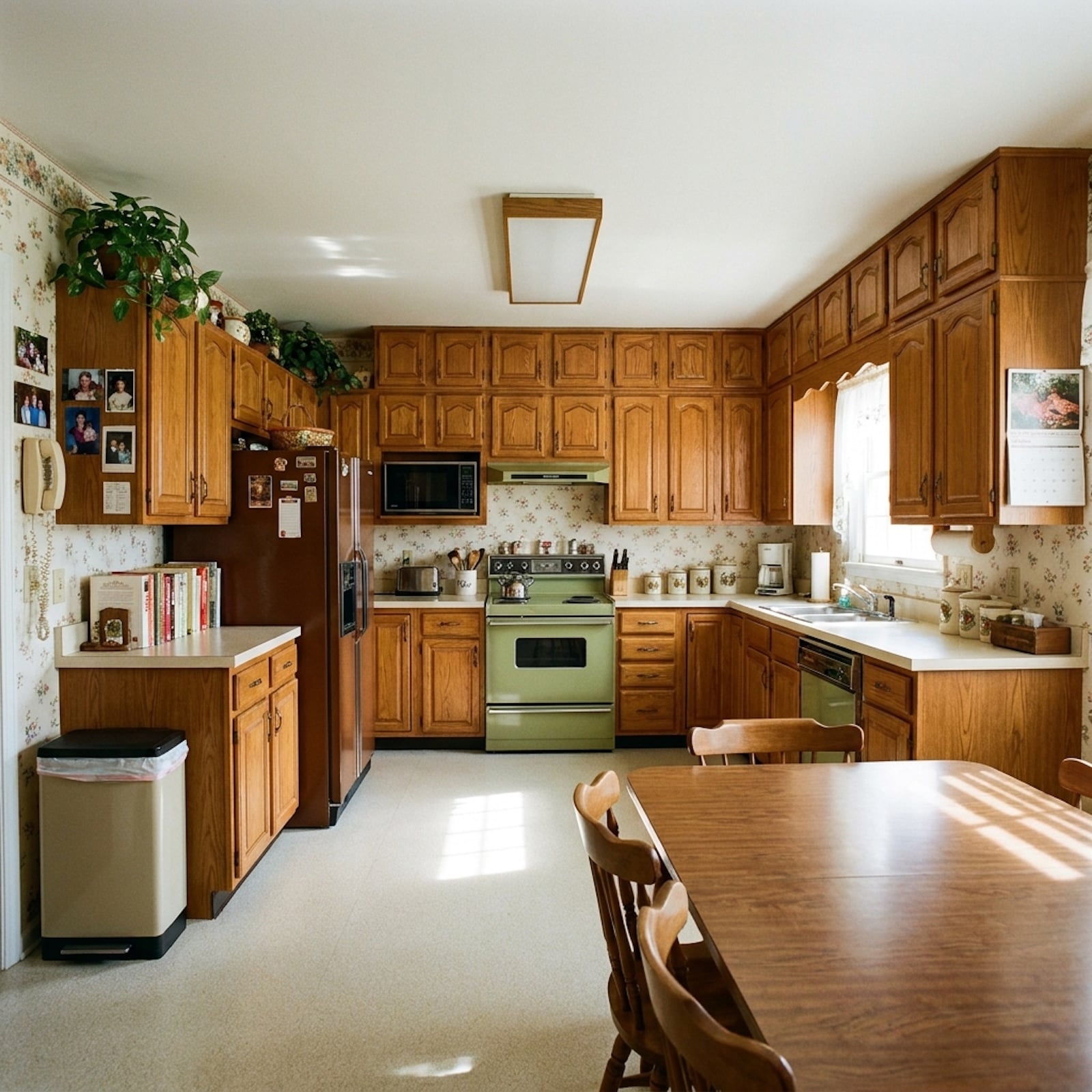
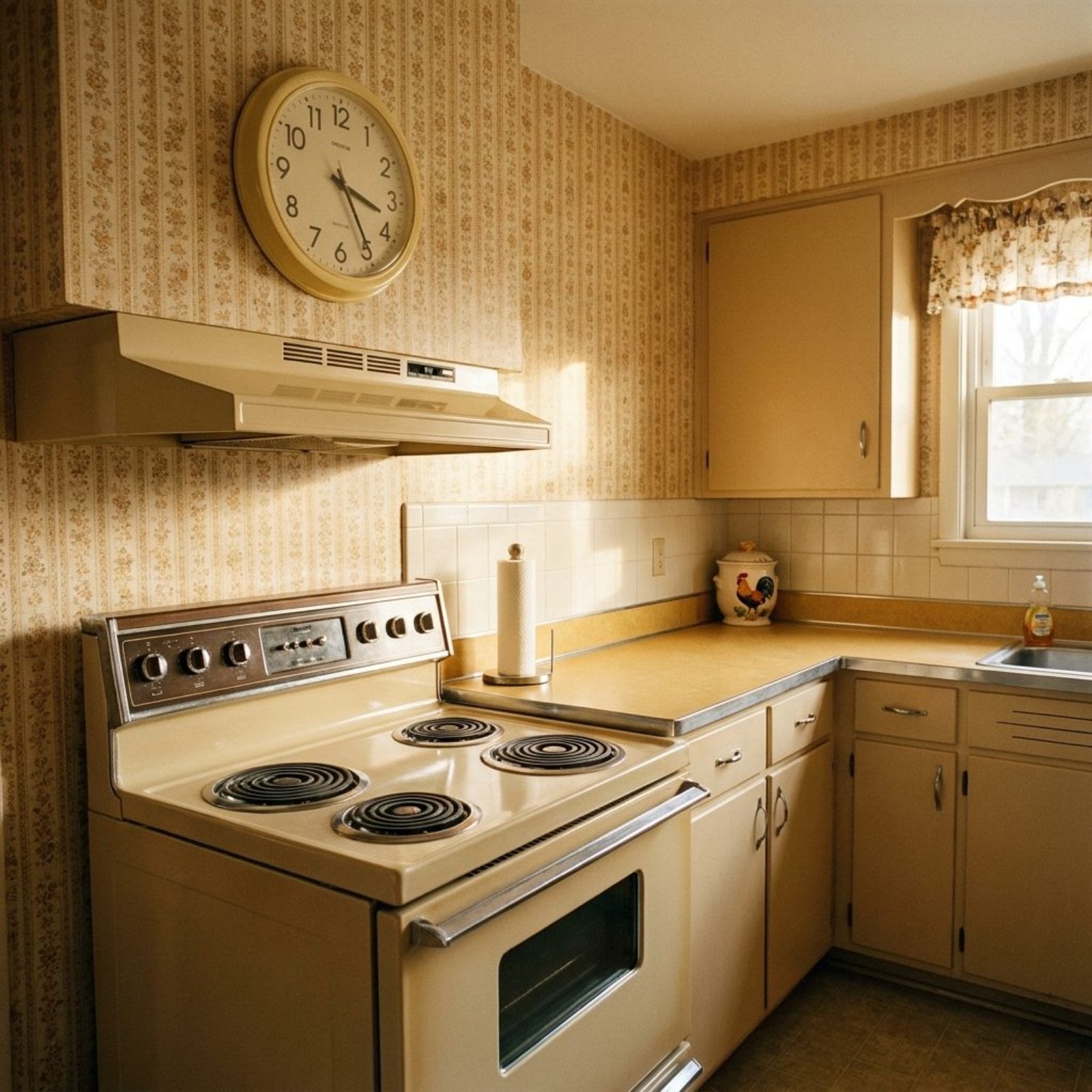
No parents. No instructions. Just the refrigerator humming in the corner, the wall clock dragging through the afternoon, and maybe forty-five minutes before headlights showed up in the driveway. You knew that room better than anyone gave you credit for: which cabinet complained, which drawer stuck, which linoleum square had gone bald, which snack required a chair dragged across the floor.
In order to come up with the very specific design ideas, we create most designs with the assistance of state-of-the-art AI interior design software. Also, assume links that take you off the site are affiliate links such as links to Amazon. this means we may earn a commission if you buy something.
The 1980s kitchen had its own after-school logic. Notes waited on the counter. Juice came from a can. The microwave felt slightly futuristic and slightly dangerous. The good cookies were never hidden as well as adults believed. Every latchkey kid learned the system fast, from the fridge hum to the snack drawer, because the whole afternoon depended on knowing where everything lived.
27. The Snack Drawer That Had Its Own Geography
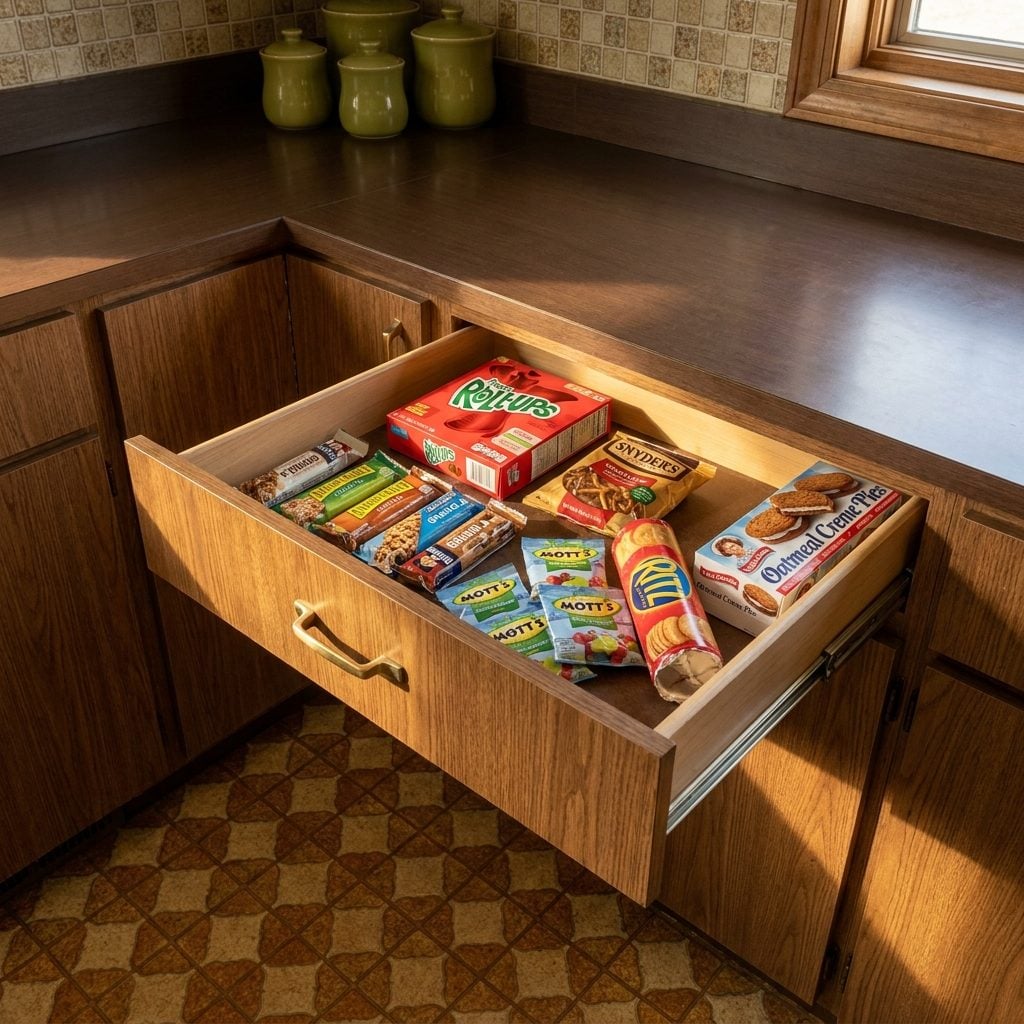
Every kid knew which drawer it was without being told. Third one down on the left, or maybe the one at the end near the dishwasher, it didn’t matter, you found it by instinct within the first week. The snack drawer had its own internal logic: front row was current inventory, back row was the stuff nobody wanted (the stale pretzels, the flavor of fruit snack that was always last picked).
It was also the drawer that taught you about household economics without anyone intending it to. When it was full, everything was fine. When it was down to one granola bar and a packet of soy sauce from a takeout order, you started rationing without being asked. A whole philosophy of scarcity and abundance, communicated entirely through a laminate-front drawer that stuck slightly in humid weather.
26. The Handwritten Note Left on the Counter Under the Salt Shaker
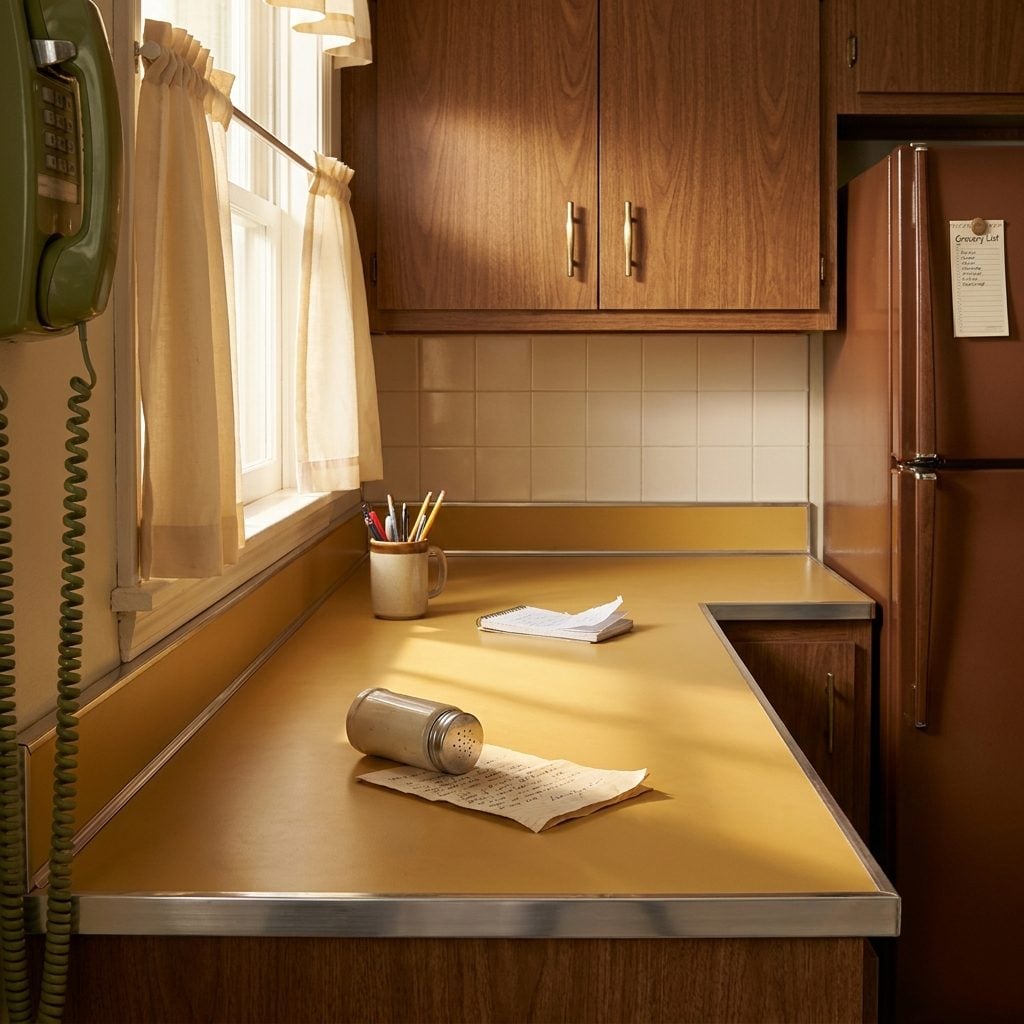
The salt shaker was the paperweight of the 1980s kitchen. Under it, in your mom’s handwriting, looping or slanted depending on the day, always in whatever pen was nearest, the instructions for the afternoon. Snack is in the fridge. Don’t open the door more than twice. Casserole at 350 for 45 min. Call Grandma back.
These notes were the original asynchronous communication. She wrote them in the morning before anyone woke up, or in a rush before leaving, and you read them at 3:30 in a quiet house. A whole relationship maintained in two-inch margins and abbreviated instructions. Some kids kept them. Most didn’t. All of them remember them.
25. The Corelle Plate with the Green Stripe That Survived Everything Including You
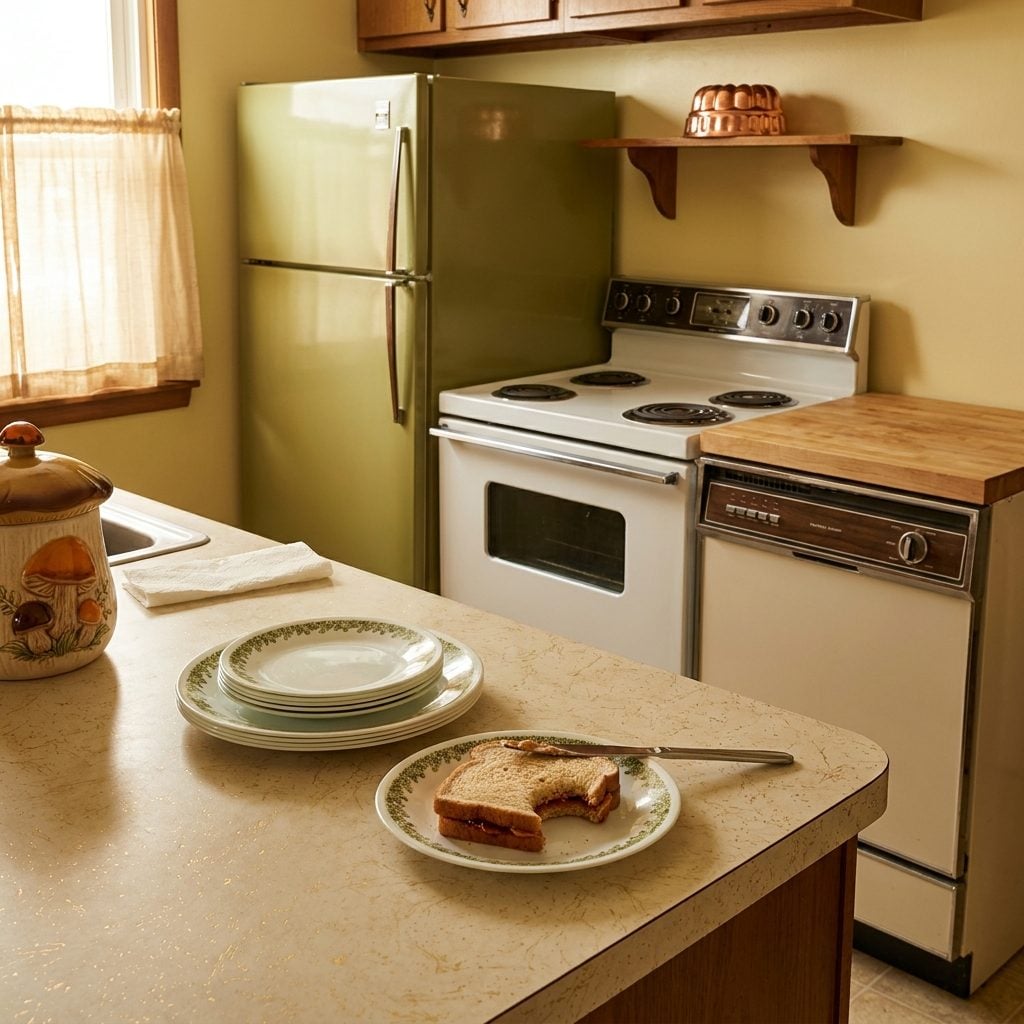
You could drop them on linoleum from shoulder height and they’d bounce. Literally bounce. The green floral ones showed up in every kitchen I ever walked into, but the real giveaway was the weight—almost nothing. Pick one up and it felt like a quiet guarantee that dinner wouldn’t be complicated tonight.
They stacked in the cabinet like someone had calculated the tolerances, which Corning absolutely had. And no matter how many years passed, the stack never seemed to shrink. Corelle didn’t break. It outlasted the family’s taste, got boxed up, and materialized at the next garage sale like it was on a circuit.
24. The Magnetic Knife Strip on the Wall That Made the Kitchen Feel Slightly Dangerous
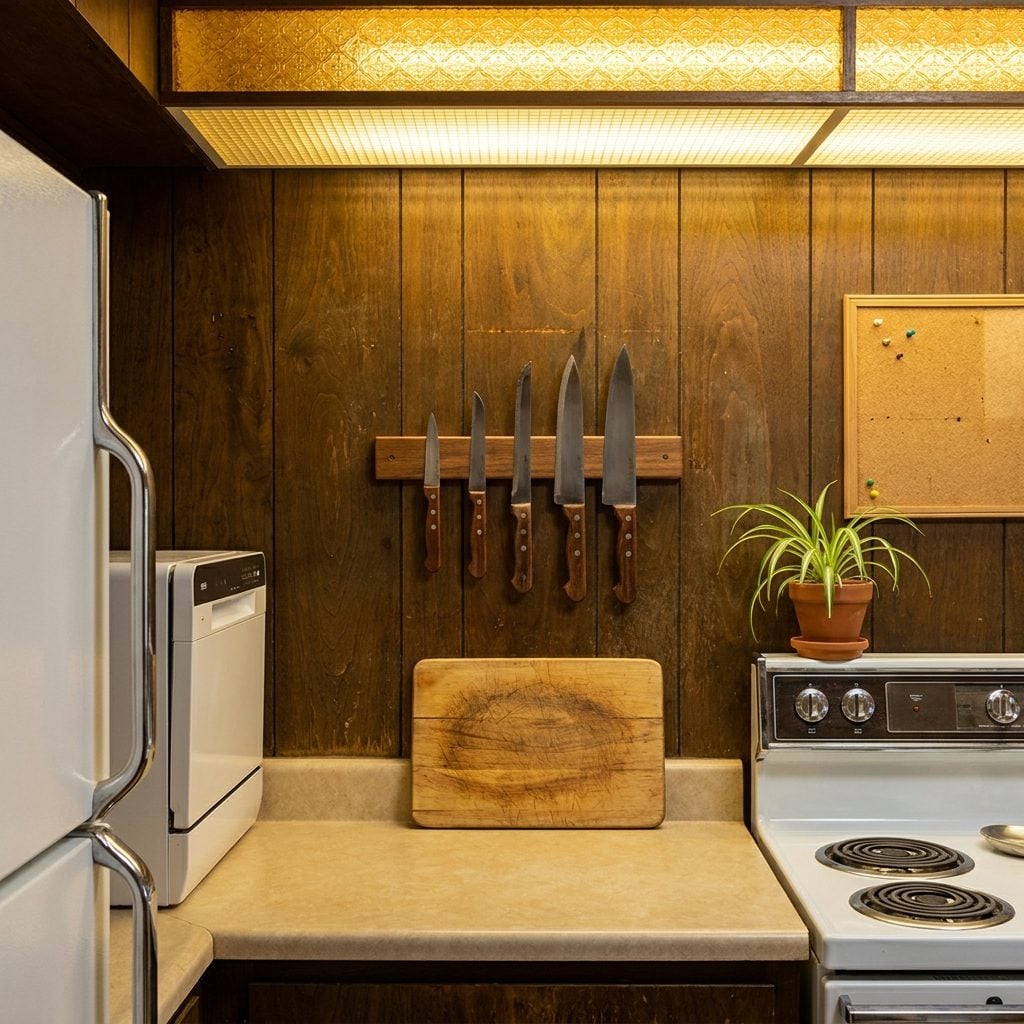
Every knife just hanging there, blades out, at roughly kid-eye-level. No blade guard. No lock. Magnetism and faith.
The strip was usually wood—sometimes a light oak finish, sometimes a raw plank someone had drilled magnets into on a Saturday. The knives were the heavy kind with three rivets in the handle, the ones that actually held an edge because somebody sharpened them on a whetstone kept under the sink in a margarine tub. Walking past that strip every afternoon on the way to the fridge felt like a rite of passage nobody had formally agreed to. You just learned to give it a wide berth and never mentioned it to other kids’ parents.
23. The Yellow Rotary Wall Phone with the Cord Long Enough to Reach the Bathroom
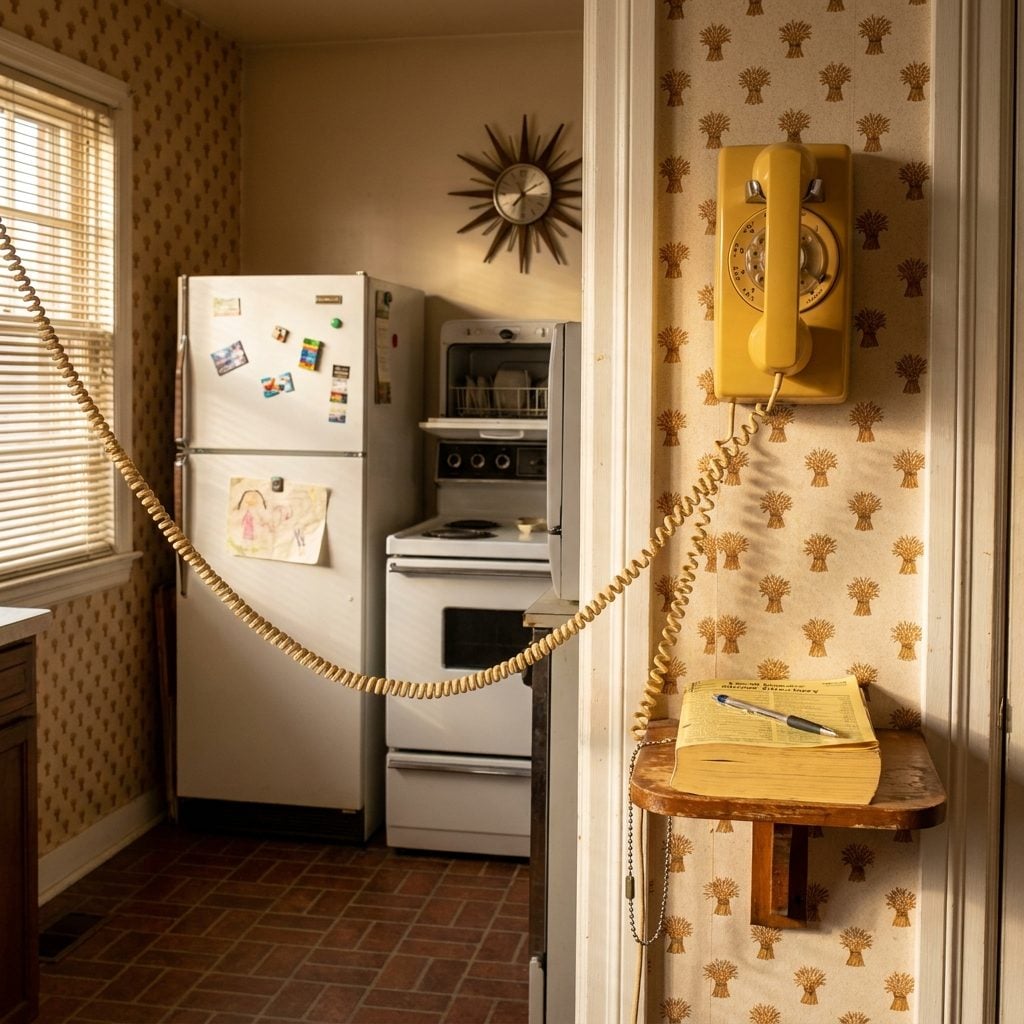
That cord. Coiled tight as a Slinky when new, stretched to a sad, kinked rope within six months—enough curled telephone line to let you wander from the kitchen wall mount down the hallway, maybe around the corner if you leaned into it. The handset smelled like everyone who’d ever used it.
Dialing took commitment. Seven digits meant real mechanical effort, and if you messed up on the last number, you started over. No redial button. No mercy. Just the slow, satisfying click-click-click of the dial returning to zero, and the growing certainty that push-button phones existed for a reason your parents refused to acknowledge.
22. The Tupperware Cabinet That Required an Engineering Degree to Open
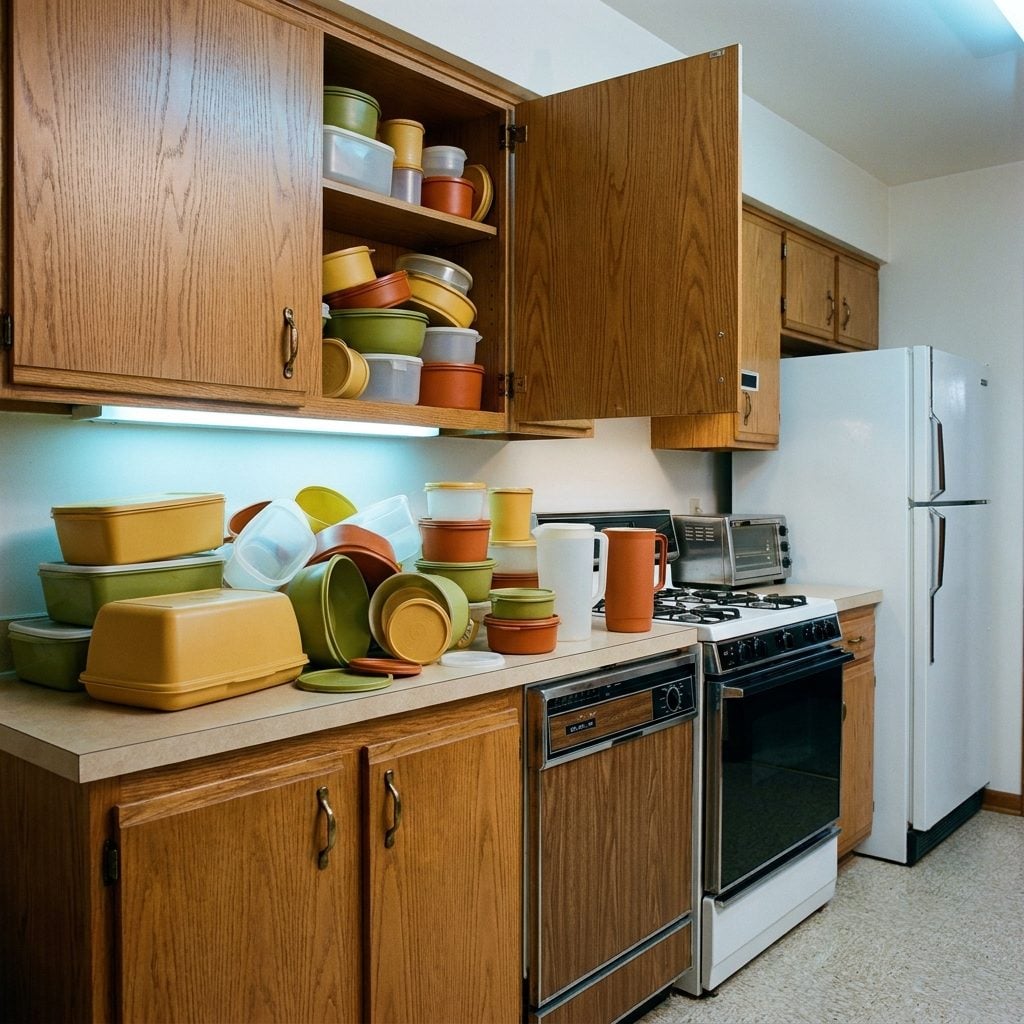
Open the door fast and catch everything. Open it slow and it all shifts forward anyway. No winning.
The lids lived separately from the containers, which was the original sin. One shelf for bases, one shelf for lids, and every single combination produced a mismatch. The harvest gold ones nested fine, and the round ones stacked, but introduce a single rectangle into the equation and the whole arrangement collapsed like a petroleum-product Jenga tower somebody breathed on wrong. You’d spend four minutes digging for a matching lid, give up, and cover the bowl with foil instead.
Mom swore she had a system. She did not have a system.
21. The Spoon Rest Shaped Like Something No Spoon Should Ever Rest On
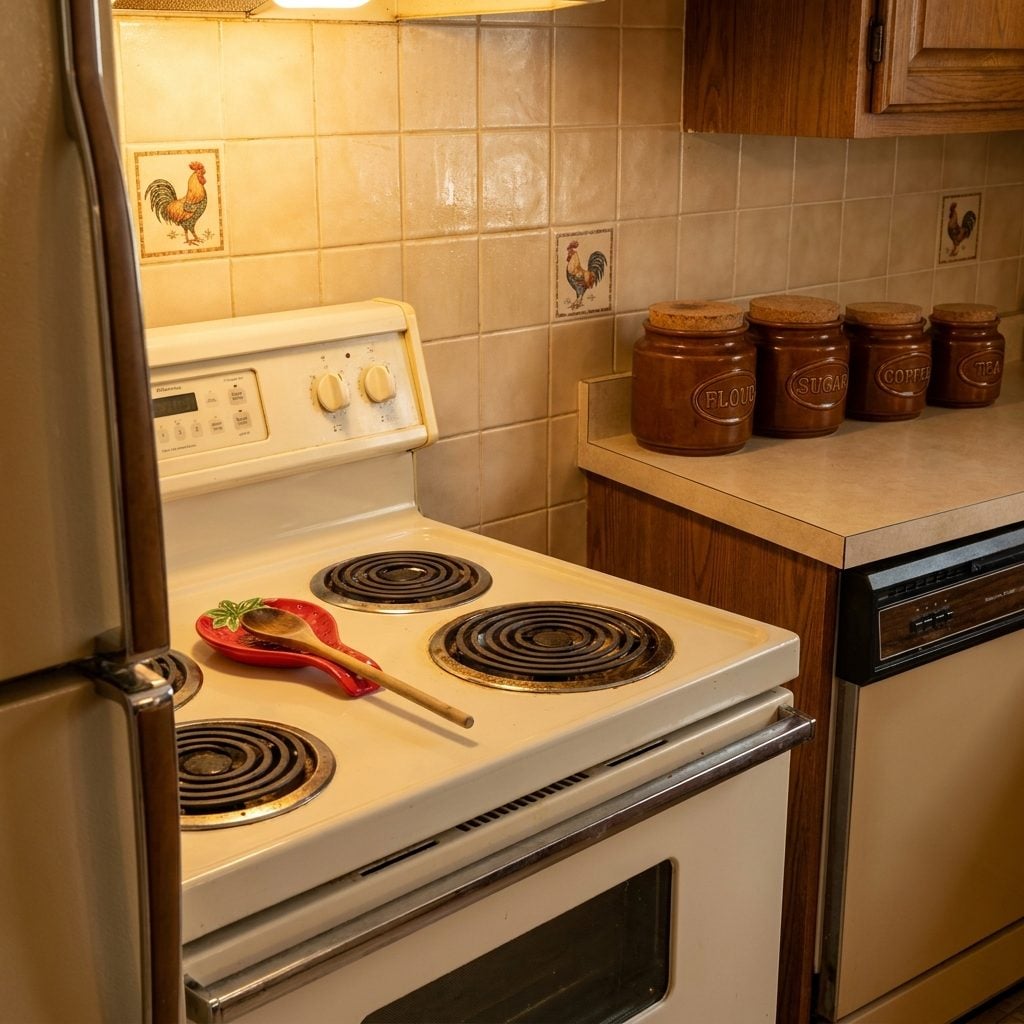
A strawberry. A mushroom. A duck. A little ceramic shoe. The spoon rest had zero obligation to resemble the thing it actually was, and it reveled in that freedom.
It lived next to the back burner, perpetually sticky, perpetually coated in whatever had been stirred last Tuesday. Nobody washed it between uses—it just accumulated layers of tomato sauce and chicken broth like a geological record of weeknight dinners. And every single one was a gift from somebody. An aunt, probably. Possibly a neighbor who’d been to a craft fair and thought of you, which is both touching and slightly insulting depending on the shape they chose.
20. The Contact Paper Lining Every Shelf and Drawer Like It Was Load-Bearing
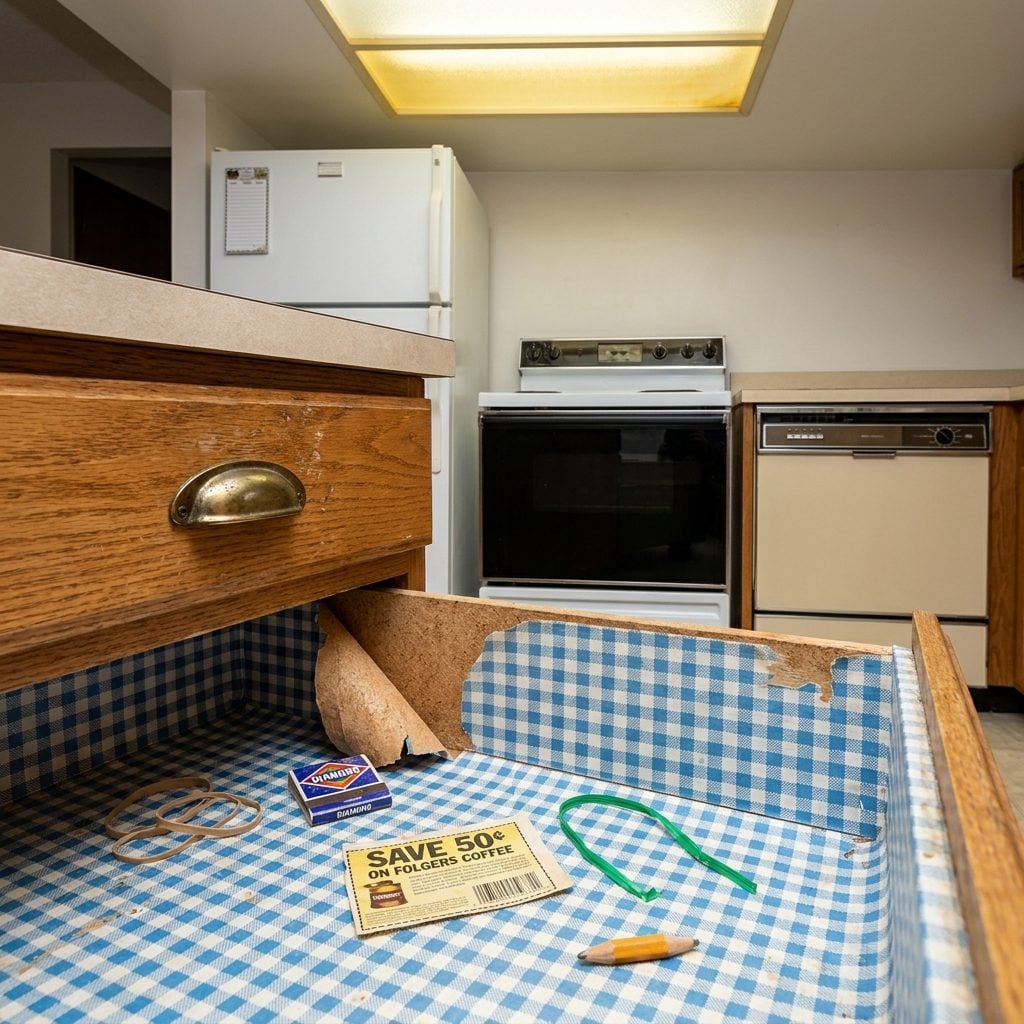
Gingham. Sunflowers. A pattern that looked like wood grain but fooled absolutely nobody. Contact paper lined every surface that wasn’t already a surface—cabinet shelves, the insides of drawers, sometimes the countertop itself if the laminate had surrendered.
Applying it was a two-person job that tested marriages. Air bubbles were inevitable. The trick was a credit card dragged slowly from center to edge, and it never fully worked. By year three the corners curled and the adhesive turned into a substance capable of removing paint. Nobody replaced it. They layered new paper on top. Peel one layer and you’d find the kitchen’s entire decorating history beneath it—a stratigraphic record of changing taste, each era more confident in its floral choices than the last.
19. The Wooden Paper Towel Holder That Matched Absolutely Nothing
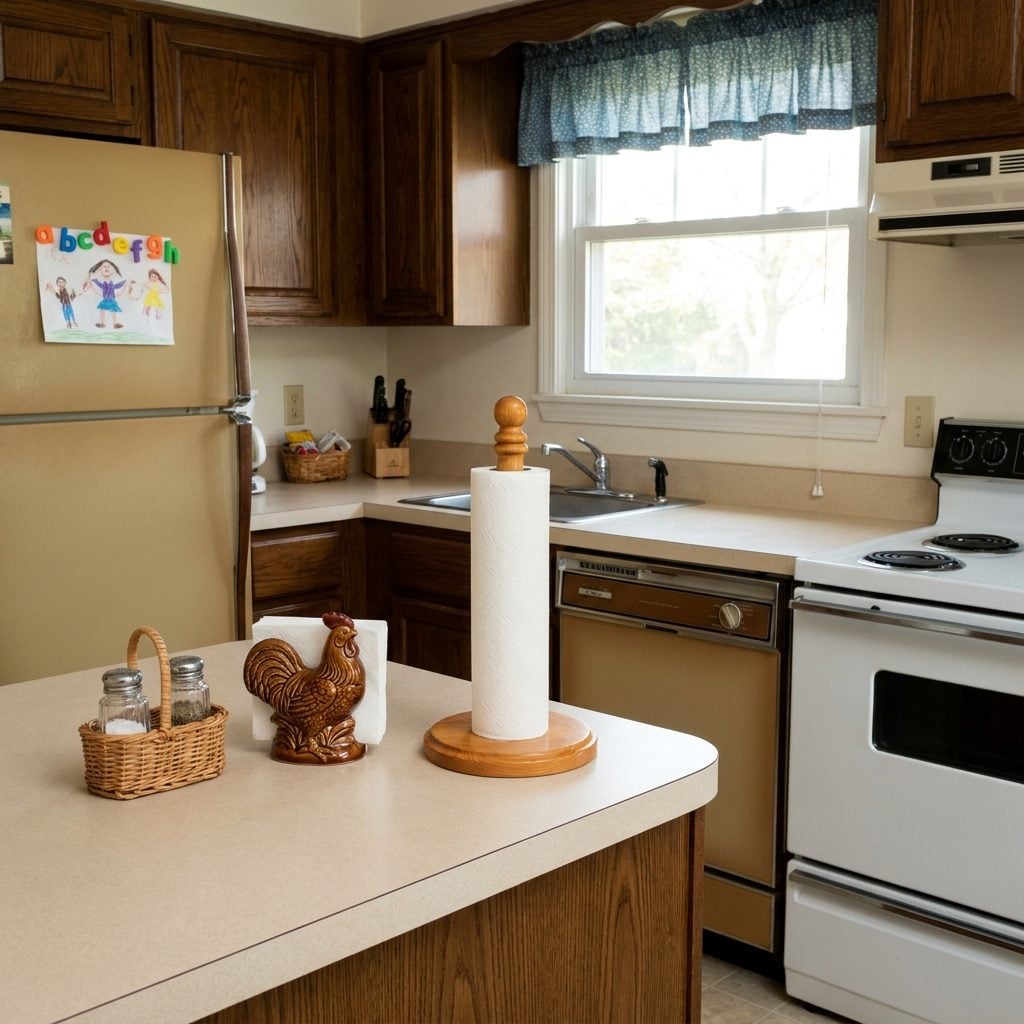
Honey pine in an oak kitchen. Every single time.
The holder was freestanding, permanently wobbly, and the dowel that held the roll was either too tight or too loose—no middle ground existed. Tear a sheet off fast and the whole thing spun like a top, walking itself toward the counter’s edge with alarming purpose. Tear slowly and the perforation ripped wrong, giving you a ragged half-sheet and a small, irrational grudge. These were gifts too, come to think of it. Craft fair, probably. Someone’s uncle who’d recently acquired a lathe and needed to justify the expense.
18. The Ticking Wall Clock Above the Stove That Was Never Quite Right
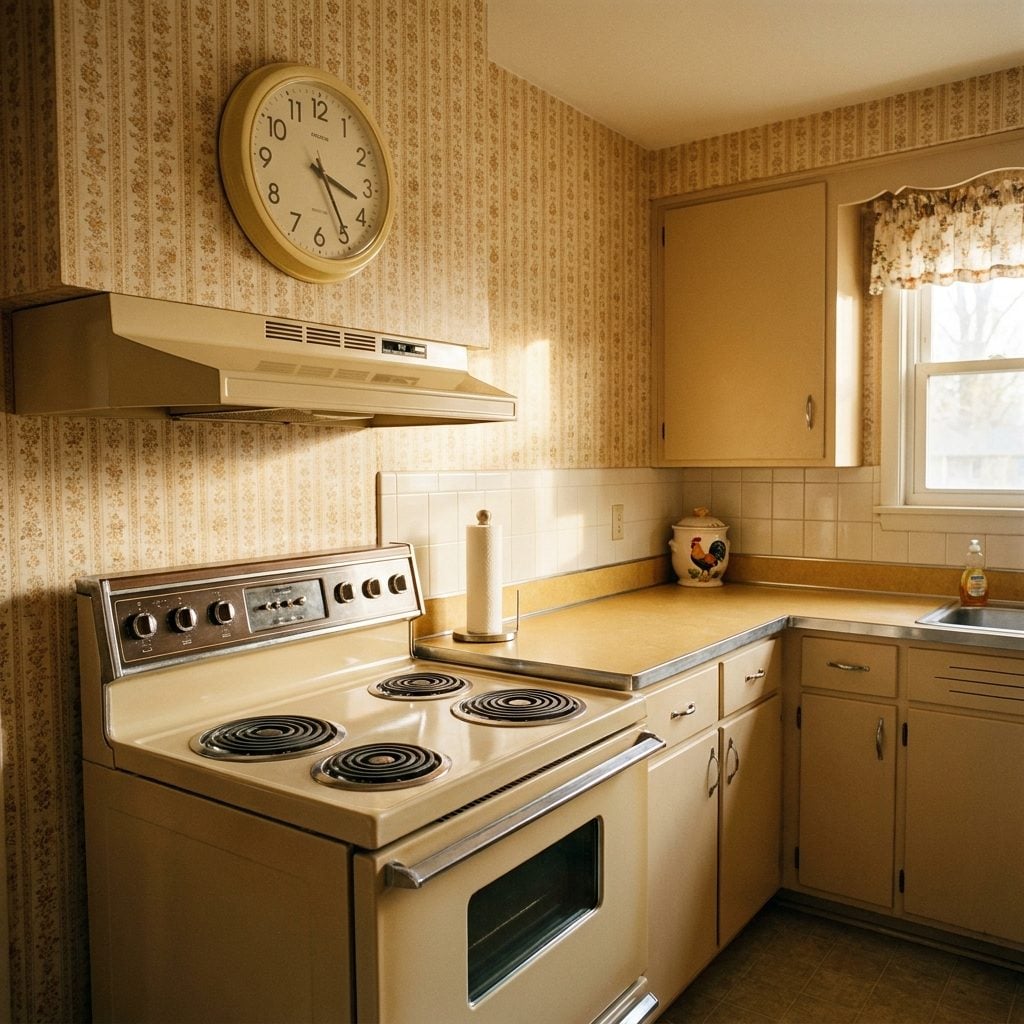
It ticked loud enough to hear from the living room. Not in an annoying way, in an anchoring way, the kind of sound that told you the house was awake even when nobody else was home. The clock above the stove was usually round, usually plastic, usually some shade of wood-grain or almond that matched absolutely nothing else in the kitchen but somehow fit anyway.
Nobody ever fully trusted it. There was always a five-minute discrepancy that the whole family had quietly agreed to live with. You learned to do the mental math automatically: clock says 3:47, so it’s probably 3:43, which means the bus is late or I’m early. It was the first lesson in calibrated skepticism most of us ever got.
17. The Lazy Susan in the Corner Cabinet That Ate Canned Goods Alive
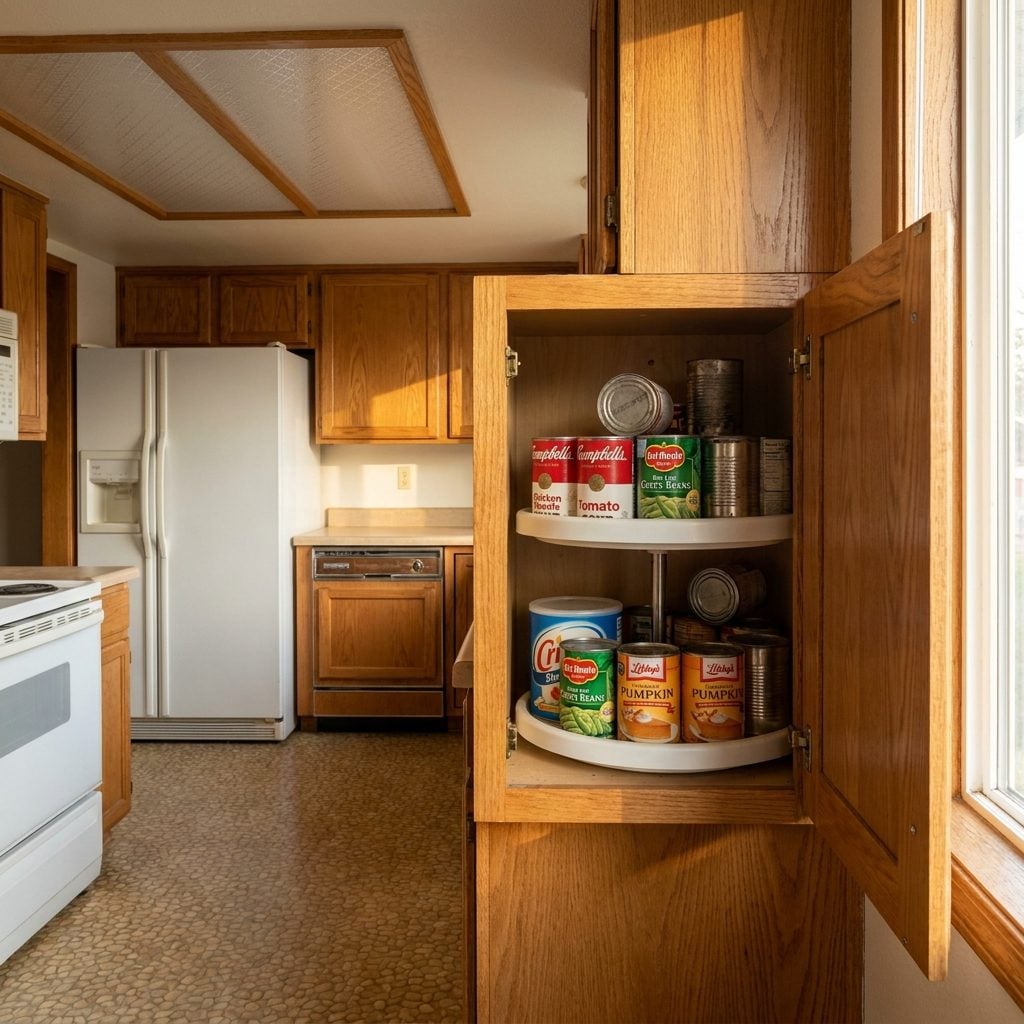
Spin it one direction and three cans of cream of mushroom soup appeared. Spin it the other way and they vanished into the dead zone behind the axle, not to be seen again until someone moved out of state.
The corner cabinet was where canned goods went to be forgotten. The lazy Susan was supposed to fix this. It did not. It just mechanized the forgetting. Things rolled. Things fell behind the turntable into the unreachable triangle of space where the cabinet met the wall. Always a can of water chestnuts back there from a recipe someone attempted once in 1983 and never revisited. You could hear them rolling when you shut the door—a slow, guilty rattle from the dark.
16. The AM/FM Radio Built Into the Range Hood That Only Picked Up Two Stations
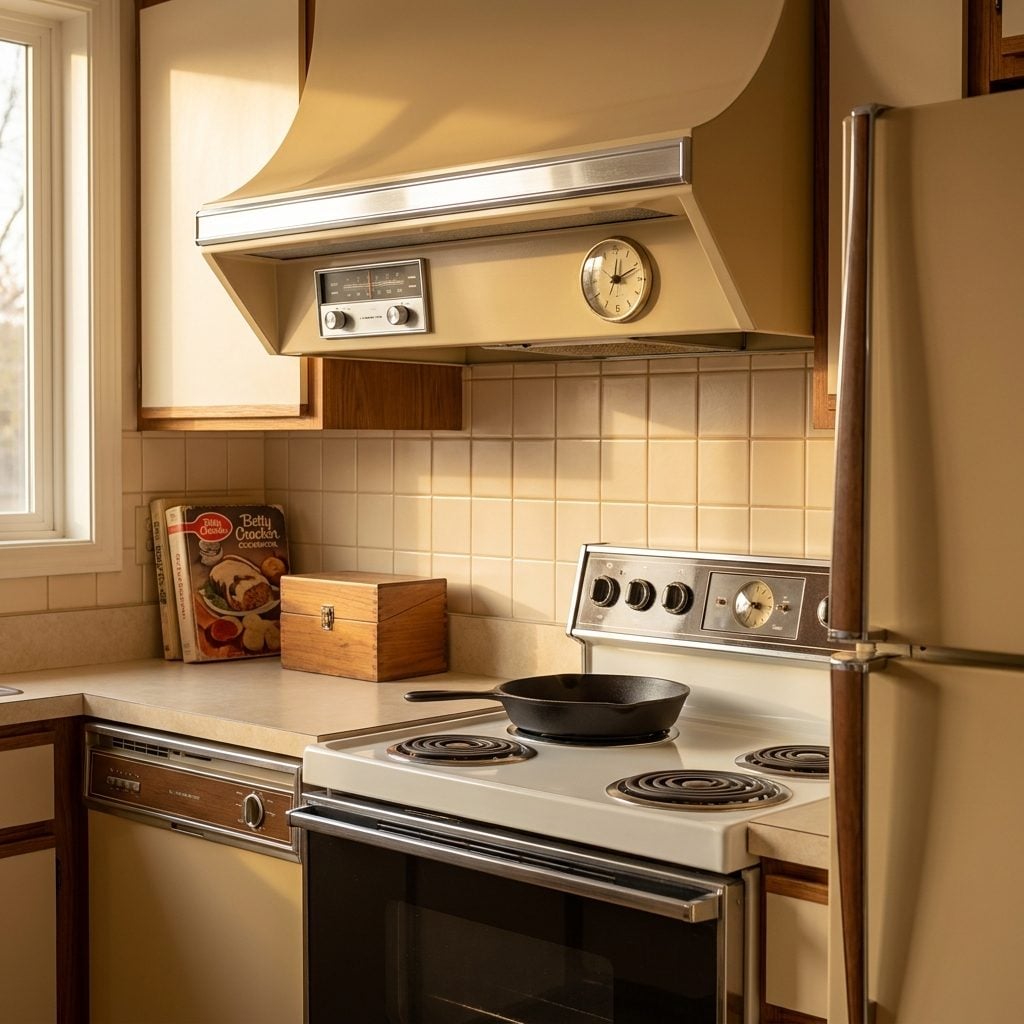
The clock was always twelve minutes fast. The radio pulled in the oldies station and something in Spanish, and that covered the entire musical landscape of 1987.
GE and Broan both made these, tucked right into the underside of the range hood alongside the grease filter and the anemic exhaust fan. Tuning knob the size of a shirt button. Reception depended on which burner was on and whether it was raining—both factors, somehow, equally important. But when it worked? The kitchen had a soundtrack. And something about hearing the Supremes through a tinny two-inch speaker while heating up Chef Boyardee made the whole empty afternoon house feel inhabited. That’s a specific kind of comfort no Bluetooth speaker has ever replicated, and I doubt one will.
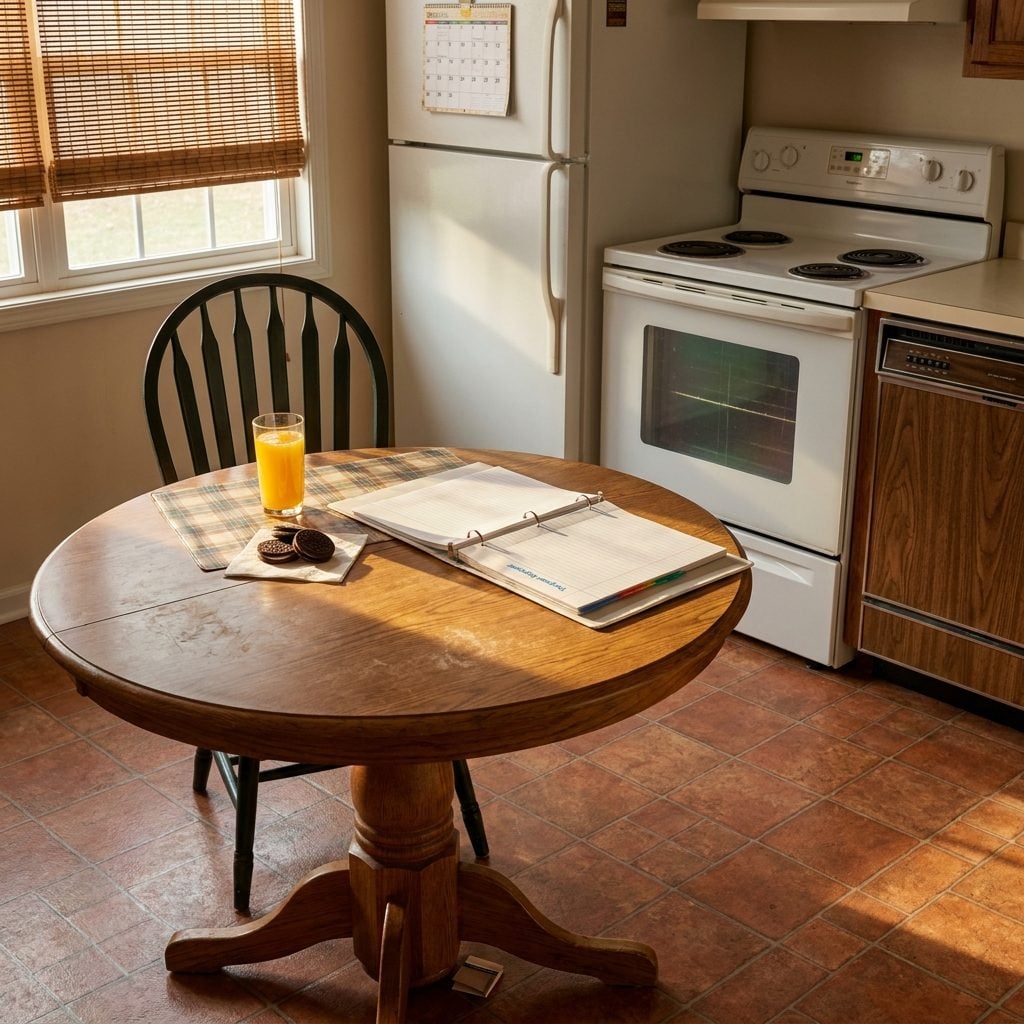
15. The Kitchen Table with One Wobbly Leg and a Folded Matchbook Under It
🔥 Would you like to save this?
Homework happened here. Snacks happened here. The afternoon phone call to confirm you were alive happened here, cord stretched taut from the wall mount to within reach of the chair.
The table rocked. Always rocked. Someone had diagnosed the problem years ago, prescribed a folded matchbook under the short leg, and that matchbook became a permanent structural member. Nobody fixed it for real because the matchbook was the fix. It had been the fix so long it had compressed into a wafer of compressed cardboard and absorbed enough floor wax to qualify as a fossil.
Read the surface and you’d get the whole household’s autobiography. Pen marks scored through homework paper, a ring from a coffee mug nobody owned up to, a gouge from scissors used without a cutting board. Most used piece of furniture in the house. Least respected. Somehow that combination is exactly what made it the center of everything.
14. The Harvest Gold Dishwasher That Hummed Like a Distant Argument
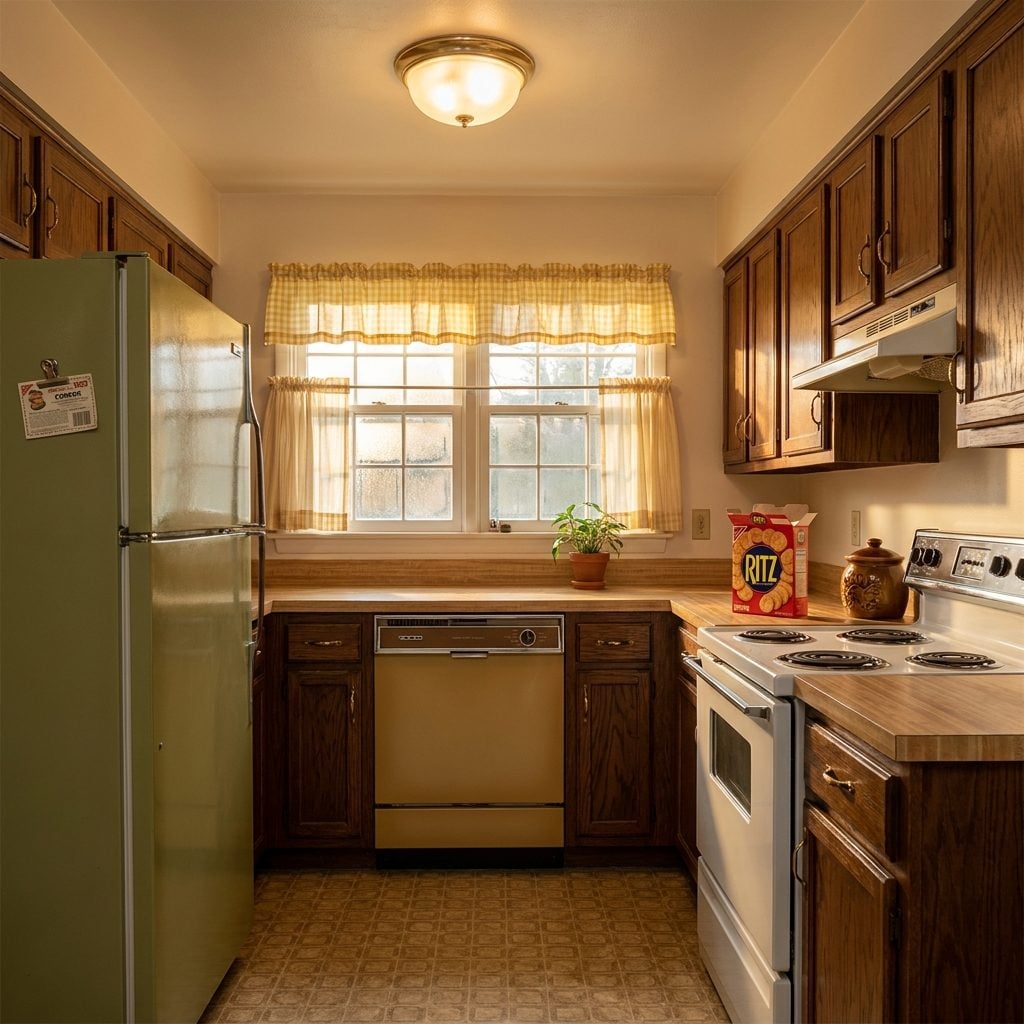
You heard it before you saw it. That low, rhythmic drone from behind the harvest gold panel — like the house itself was digesting something. Nobody remembered starting it, nobody remembered it finishing, and it just hummed through the afternoon like background static the walls had learned to carry.
The color was the thing. Not quite yellow, not quite beige. A shade that existed only in kitchens between 1975 and 1986, then vanished from the earth like it had somewhere better to be. You didn’t choose harvest gold. Harvest gold chose the decade.
13. The Magnetic Clip on the Fridge Holding a School Picture from Two Years Ago
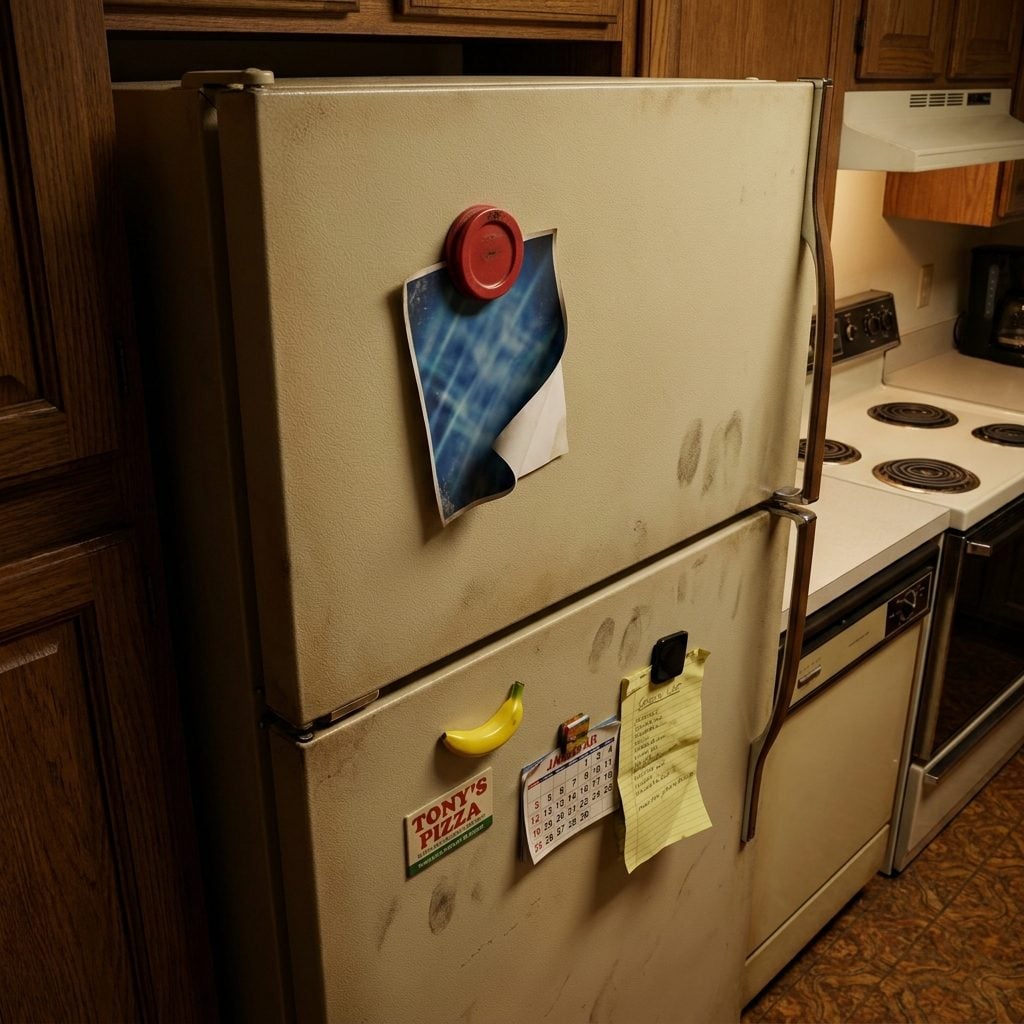
That photo was two grades old and nobody was taking it down. The magnetic clip — usually red or blue plastic — had a grip stronger than any opinion in the house, pinning the school portrait with the laser background, the one where you tilted your head the way the photographer told you to and regretted it immediately.
Around it: a pizza place magnet, a dentist appointment card three months expired, and a grocery list in handwriting that got progressively angrier toward the bottom. The fridge door was the family bulletin board before bulletin boards had feeds and algorithms.
12. The Fake Tiffany Lamp Hanging Over the Kitchen Table
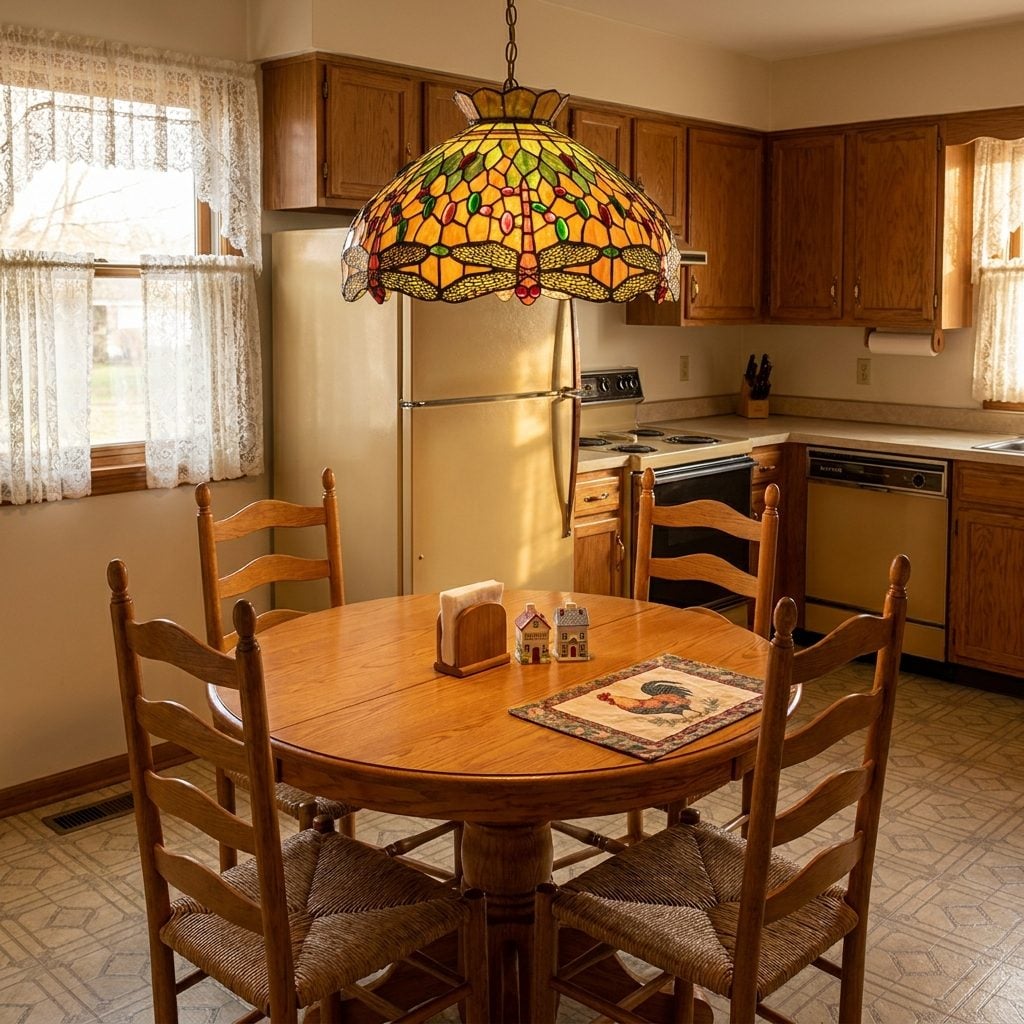
Not Tiffany. Never Tiffany. But it threw colored light across the table like a church window in a room that served casserole. The amber and green panels turned homework paper gold, and every kitchen had a version hung low enough that tall relatives bumped it at Thanksgiving and set it swinging.
During the after-school hour it was the only light on. The overhead fluorescent stayed off — just this lamp, pooling warm color onto the oak table, making a bowl of cereal feel like a small ceremony. Quiet enough to hear the clock on the wall tick.
11. The Sliding Glass Door to the Backyard That Was Never Actually Locked
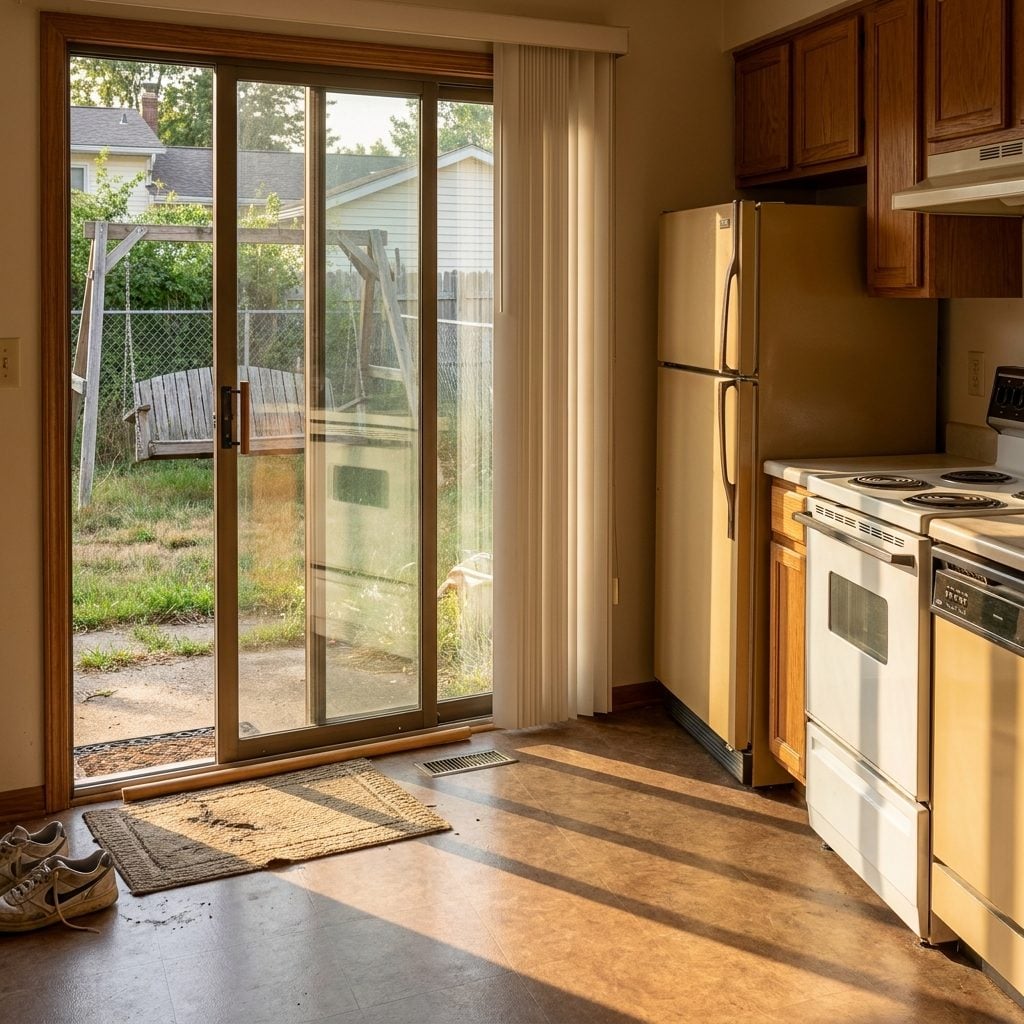
The dowel rod in the track was supposed to be the lock. A broomstick cut to length — or sometimes just an actual broomstick that hadn’t been cut at all, wedged in at an optimistic angle. Home security, 1985.
But that door was your door. You came through it at 3:15, dropped your backpack on the floor, kicked your sneakers toward the wall, and the house belonged to you for the next two and a half hours before anyone else got home. The vertical blinds clattered when you slid it shut. That clatter meant freedom.
10. The Avocado Green Canister Set Labeled FLOUR, SUGAR, COFFEE, TEA
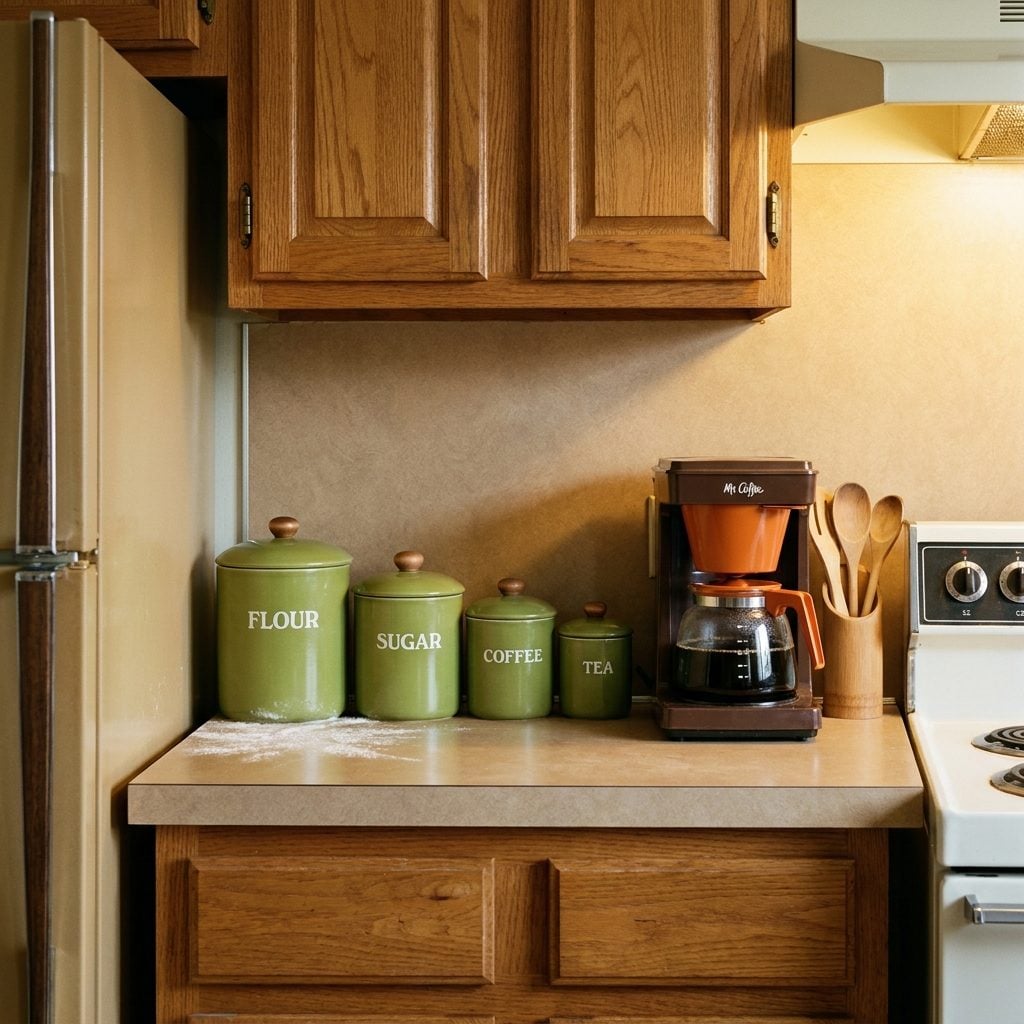
FLOUR had flour in it. SUGAR had sugar in it. COFFEE had coffee in it. TEA had tea bags from 1981 that nobody was ever going to drink.
The set sat against the backsplash like sentries — always in order, always largest to smallest, a chain of command for dry goods. The lids had tiny wooden knobs your fingers knew by feel. After school you didn’t open FLOUR. You opened SUGAR, because that’s where the good stuff actually was: sometimes cookies your mom stashed in there thinking nobody would check. She thought wrong every single time.
9. The Brown Mr. Coffee Machine That Was Always Half Full and Slightly Burnt
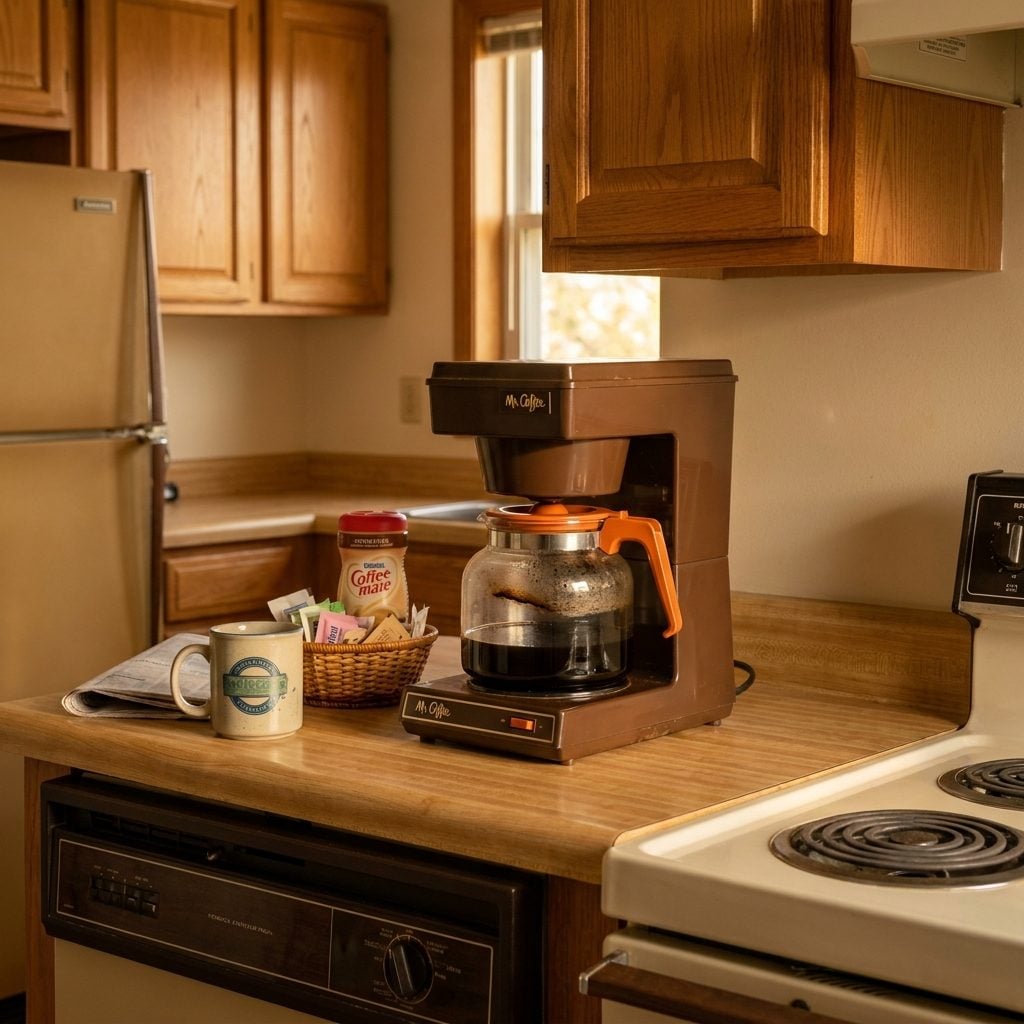
Never off. The warming plate stayed on from 6 AM until someone remembered it existed around dinner. By mid-afternoon the remaining coffee had reduced to something closer to roofing tar than a beverage, and the smell had settled into the kitchen walls like a tenant who’d signed a very long lease.
Nobody drank that afternoon coffee. It just sat there evaporating with quiet determination, the carafe developing a brown tide line that no amount of scrubbing would fully remove. The Mr. Coffee wasn’t an appliance — it was weather. An ambient condition. Part of the room’s atmosphere the way humidity is part of August.
8. The Wallpaper Border at Chair-Rail Height with Geese or Country Hearts
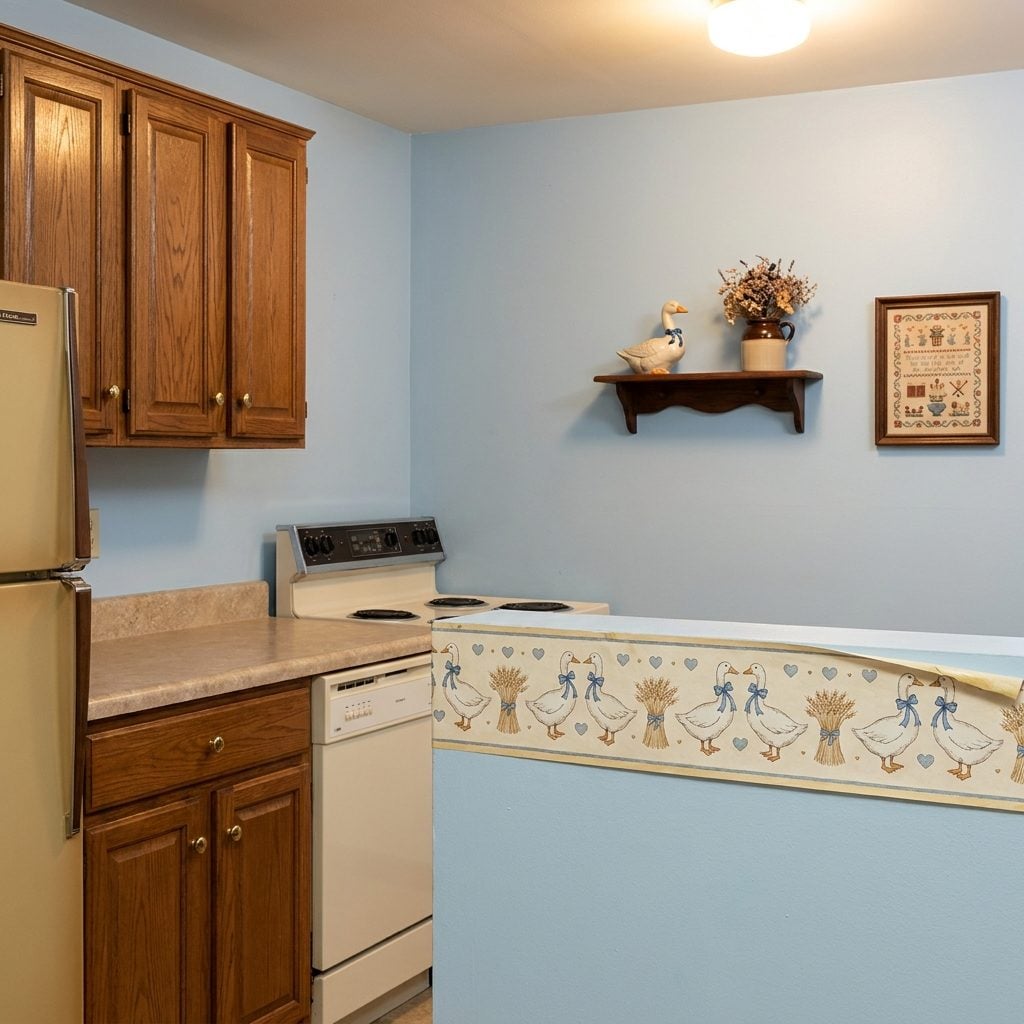
Geese. Blue-ribbon geese marching in single file around the entire kitchen, at exactly the height where a chair back would bump the wall. Sometimes it was hearts. Sometimes ivy. But the geese were the frontrunners — little white birds in bonnets or bows, committed to their endless lap of the room like they’d been sentenced to it.
The border was the small kitchen design move of its era: it broke up the wall, added “personality,” and could be applied in an afternoon. Removing it? That took the better part of a decade. The adhesive had plans to outlive the house, the mortgage, and possibly the sun.
7. The Corningware Casserole Dish with the Blue Cornflower That Lived on the Stove
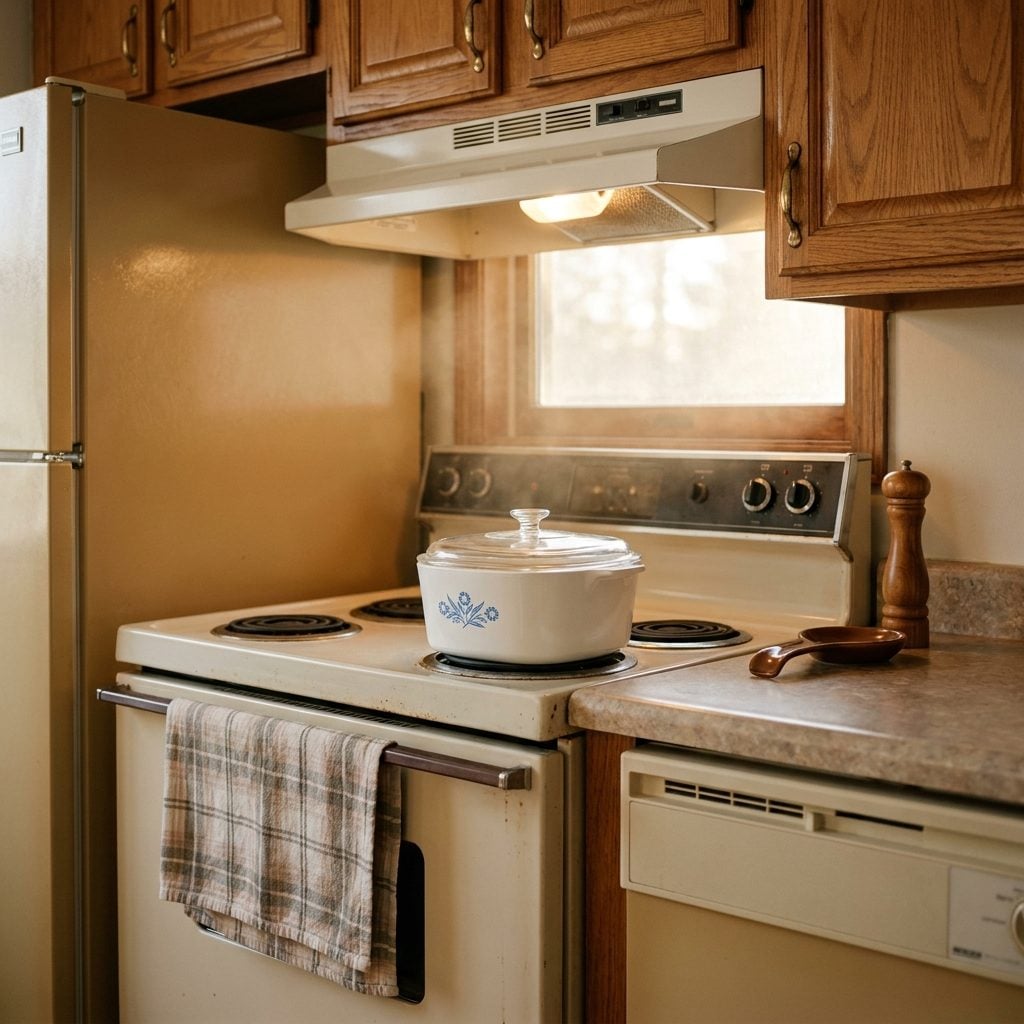
Freezer to oven to table to fridge and back again without complaint. The blue cornflower Corningware was the most indestructible object in the house, and it carried itself accordingly.
There was always one on the stove. Leftovers from last night, or something thawing for tonight, or both — the dish existed in a state of perpetual meal transition. The glass lid had a small chip in the knob that everyone worked around. You lifted it to check what was for dinner the way you’d peek under a rock to see what lived there. Didn’t matter much. Whatever it was, it came in that dish.
6. The Kitchen Junk Drawer with Batteries That Might Be Dead and a Screwdriver That Didn’t Match Anything
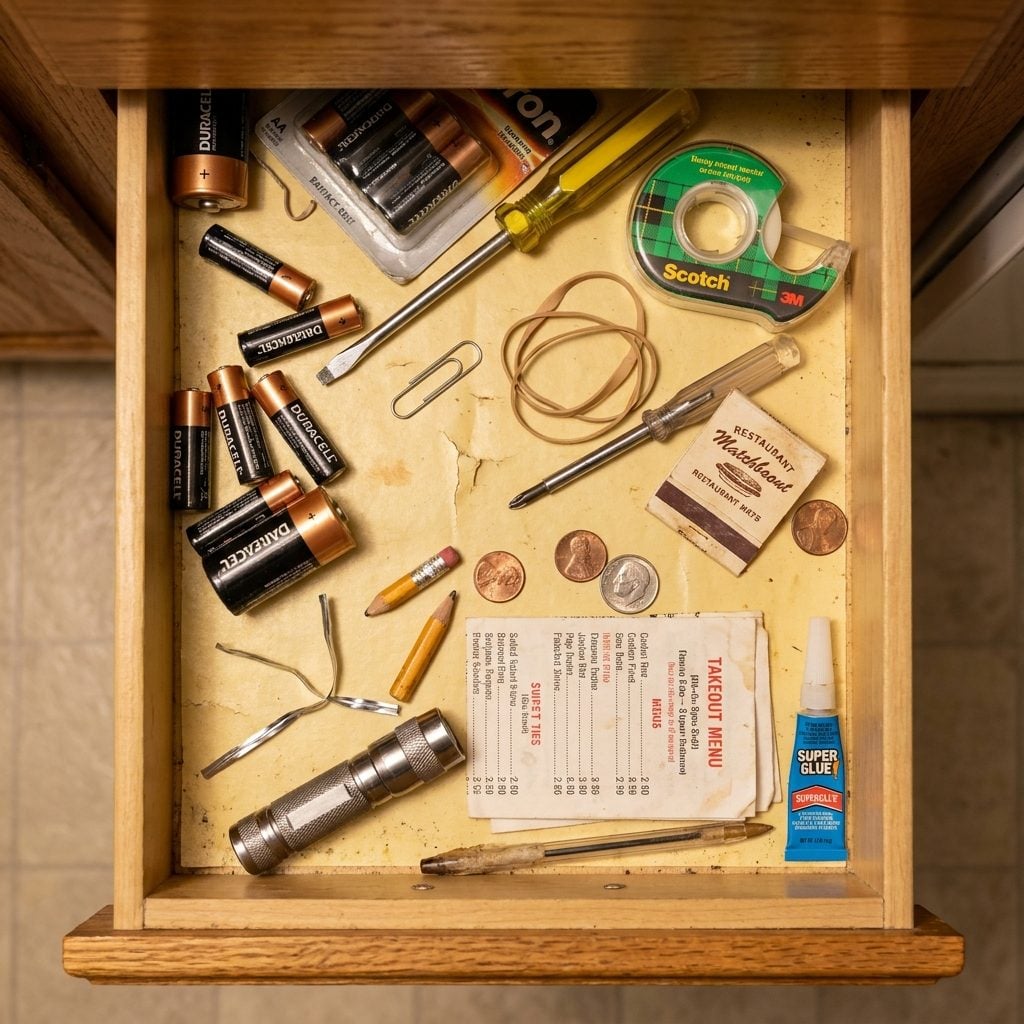
Every battery in this drawer was Schrödinger’s battery — dead and alive at the same time until you stuck it in the remote and found out the hard way. The screwdriver fit nothing in the house but lived there anyway, next to a roll of tape with no findable end and a flashlight that worked only if you smacked it twice against your palm.
This drawer was where the house put things it didn’t know what to do with. Rubber bands from the newspaper. A matchbook from a restaurant nobody remembered visiting. Pennies. Always pennies, like the drawer was generating them. You opened it six times a week looking for scissors.
The scissors were never in there.
5. The Linoleum Floor Pattern That Tried to Look Like Brick and Fooled Nobody
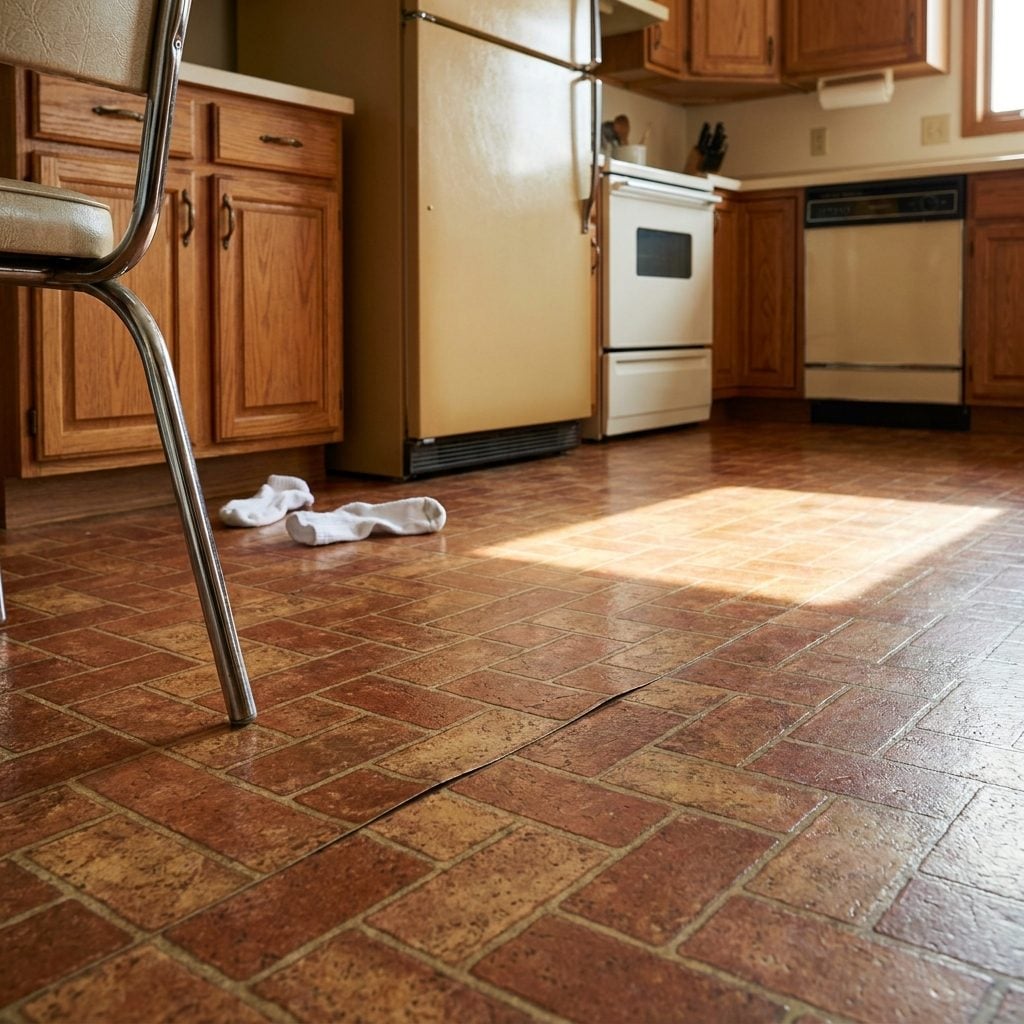
It said brick. It meant vinyl. The printed grout lines repeated every eighteen inches if you looked closely — and you did, because you were sitting on that floor eating a popsicle at 4 PM with nowhere else to be and nothing better to study.
Cool against bare legs in summer, freezing in winter, and it had a specific smell when it got wet from mopping. Sort of chemical, sort of clean, entirely 1984. You knew which squares had the seam because the edge curled up just enough to catch a sock. Nobody tripped on it hard, but everybody noticed it with their feet.
4. The Corkboard by the Back Door Layered Three Months Deep with Permission Slips and Pizza Coupons
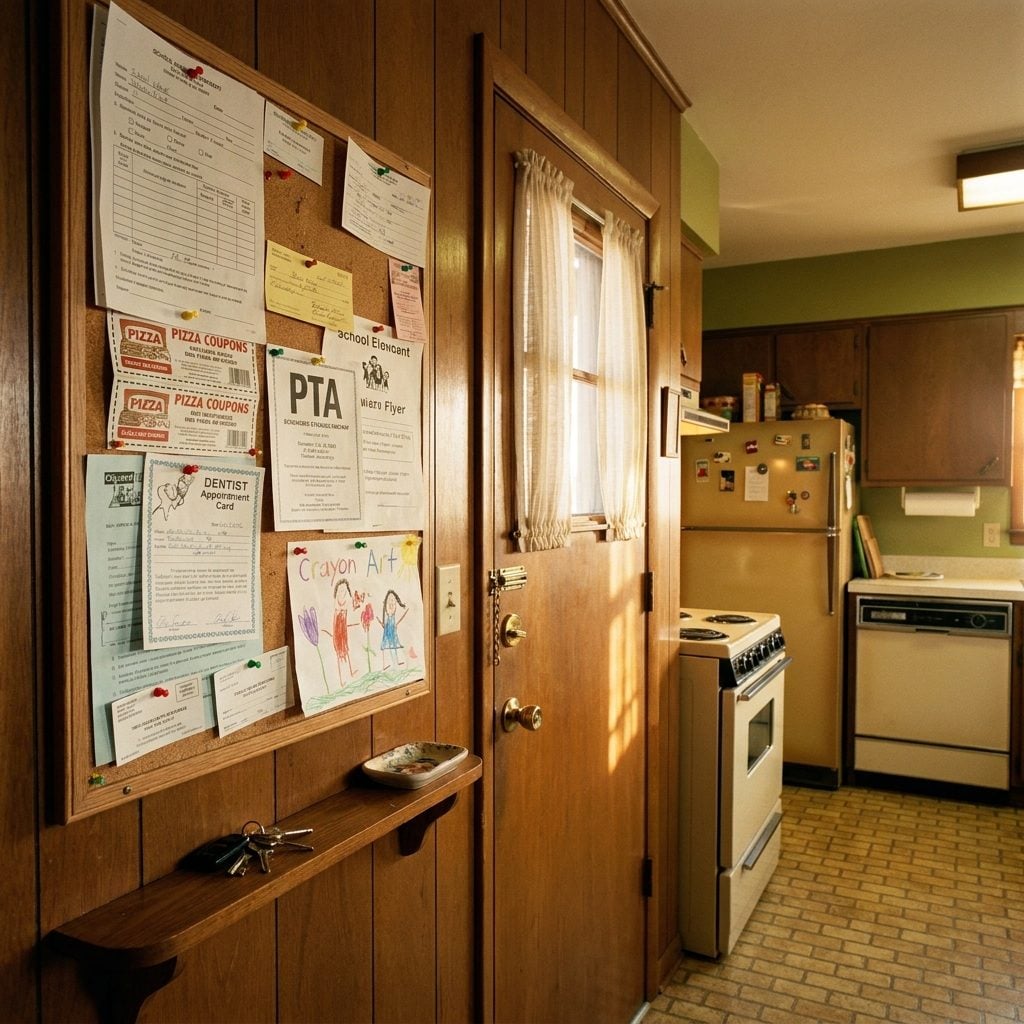
Nobody ever cleaned it. The corkboard by the back door wasn’t organized — it was geological, September’s field trip form buried under October’s orthodontist reminder, buried under a Domino’s coupon that expired in March. A crayon drawing from second grade pinned underneath a phone number scrawled on the back of a receipt. Layers and layers, all of it slowly fossilizing together under mismatched pushpins.
You came home, dropped your key on the counter, and glanced at the corkboard the way you’d glance at a clock. Not to read it. Just to confirm the house was still running.
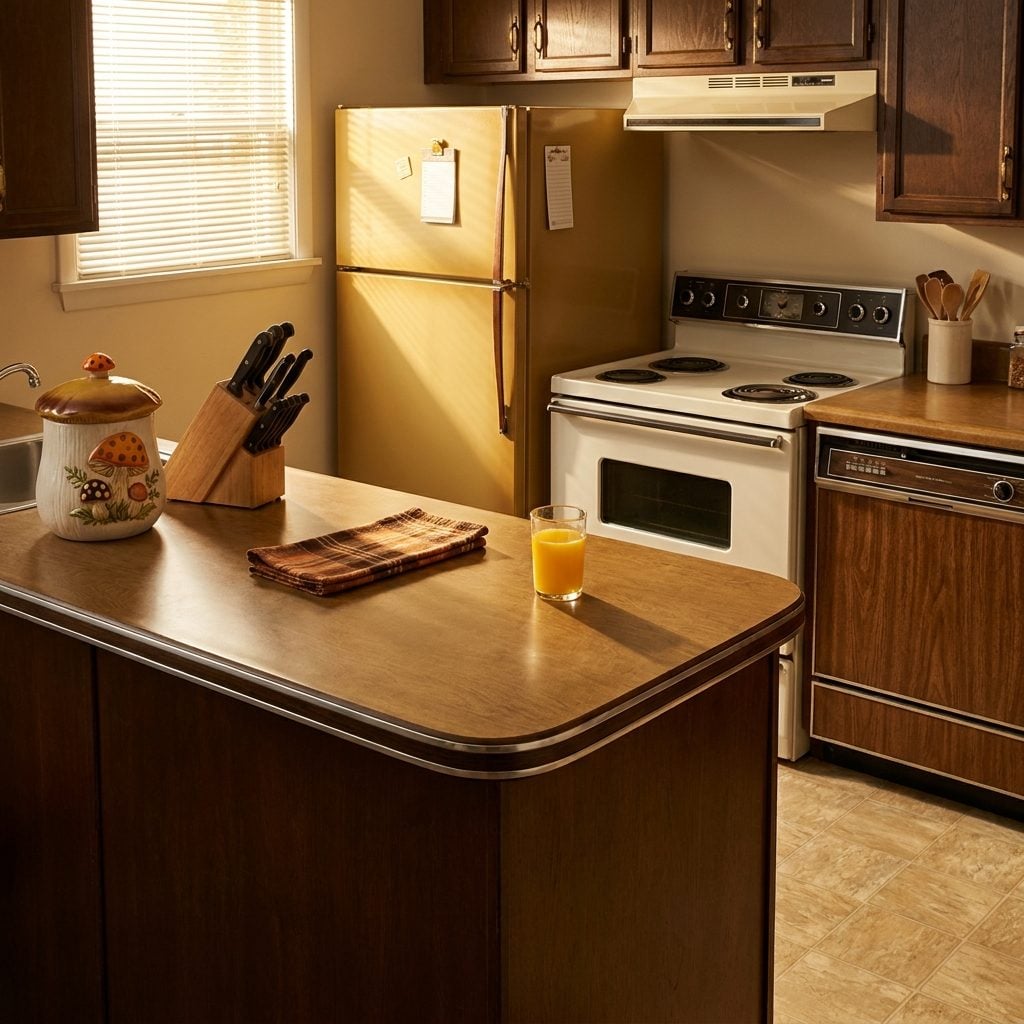
3. The Formica Countertop in a Color That Had No Name but Existed in Every Kitchen on the Block
🔥 Would you like to save this?
Not brown, not gold, not tan — somewhere in a no-man’s-land between all three, with a faux woodgrain pattern that didn’t resemble any species of tree found in nature. Every small kitchen design on the street had it in some variation. Warm to the touch in summer, cold in winter, and always slightly sticky near the stove no matter how many times it got wiped down.
You set your backpack on it every afternoon. Ate your snack on it. Did your homework there while the oven preheated behind you, the kitchen ticking and popping as it warmed up. There was a burn mark near the toaster from something nobody would take credit for — a little scar in the laminate, permanently amber-edged. That countertop held the whole after-school routine together, and honestly it looked like it.
2. The Overhead Fluorescent Light That Took Three Full Seconds to Flicker On
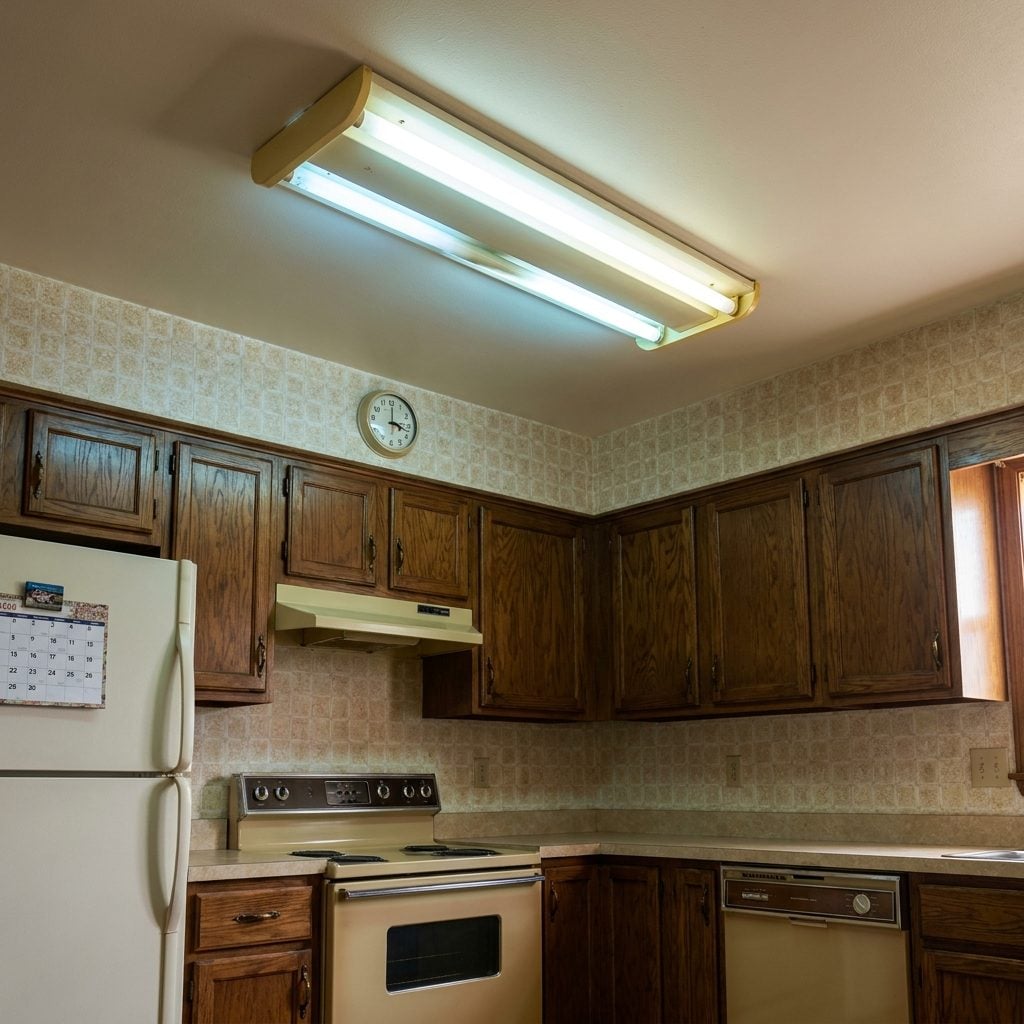
You flipped the switch. Nothing. Then a faint buzzing, a pale flicker at one end of the tube, the other end catching up a beat later, and then the whole kitchen suddenly washed in that flat bluish-white glow that made everything look like a waiting room. Three seconds, every time, without fail.
And every time you stood there in the half-dark with your hand still on the switch, waiting for the room to decide whether it felt like cooperating. There’s something weirdly intimate about that — a kitchen that didn’t just turn on for you, that had to warm up to the idea first. The fluorescent tube was the first thing that greeted you after school, and it did so grudgingly.
1. The Ceramic Rooster on Top of the Fridge That Nobody Bought and Nobody Would Throw Away
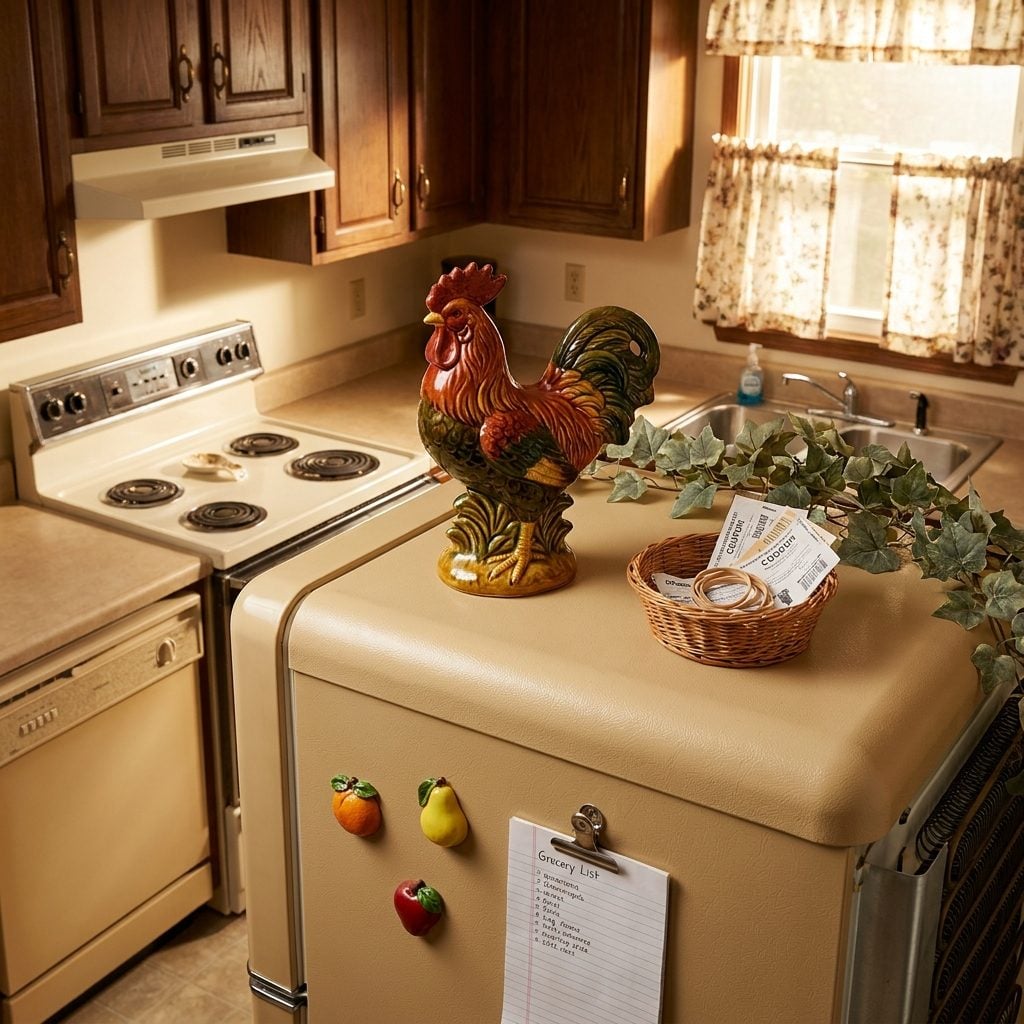
Always there. On top of the fridge, slightly dusty, tilted at an angle like it had opinions about the kitchen. The ceramic rooster — rust and green and gold. Nobody remembered buying it. Nobody remembered receiving it. The thing predated memory itself, and everyone knew it would outlast the kitchen remodel, the next owners, probably the house.
You never looked at it directly; it just lived in your peripheral vision, a fixed landmark in the geography of after-school life. Sometimes you’d reach up there for the bag of chips your mom hid behind it, and your hand would brush its cold glazed tail, and for half a second you’d wonder where it came from. Then you’d grab the chips and forget again. That rooster counted on it.