🔥 Would you like to save this?
Not every wreck beside the water deserves a second life. Some places are just damp, stubborn, and expensive in ways no sofa can fix.
In order to come up with the very specific design ideas, we create most designs with the assistance of state-of-the-art AI interior design software. Also, assume links that take you off the site are affiliate links such as links to Amazon. this means we may earn a commission if you buy something.
These rooms are the rare exceptions. They began as cramped coastal interiors built for watchfulness, not leisure: peeling plaster, cracked paint, exposed stone, scarred boards, old radiators, and windows placed for weather before comfort. The bones were awkward. The light was harsh. The sea was less backdrop than co-conspirator, pressing against every decision.
That pressure is exactly what gives the finished spaces their force. The strongest designs do not sand away the history or pretend the setting is polite. They keep the roughness in the room, then answer it with deep seating, warmer materials, better lighting, and just enough polish to make the whole rescue feel slightly unreasonable.
Across all 32 projects, the real thrill is the tension. Nothing looks generic. Nothing feels dropped into a showroom. Each transformation keeps one foot in the old working structure and one foot in a far more comfortable life.
32. Barrel Vault Ceiling, Brick, and Cognac Leather Over a Clifftop View
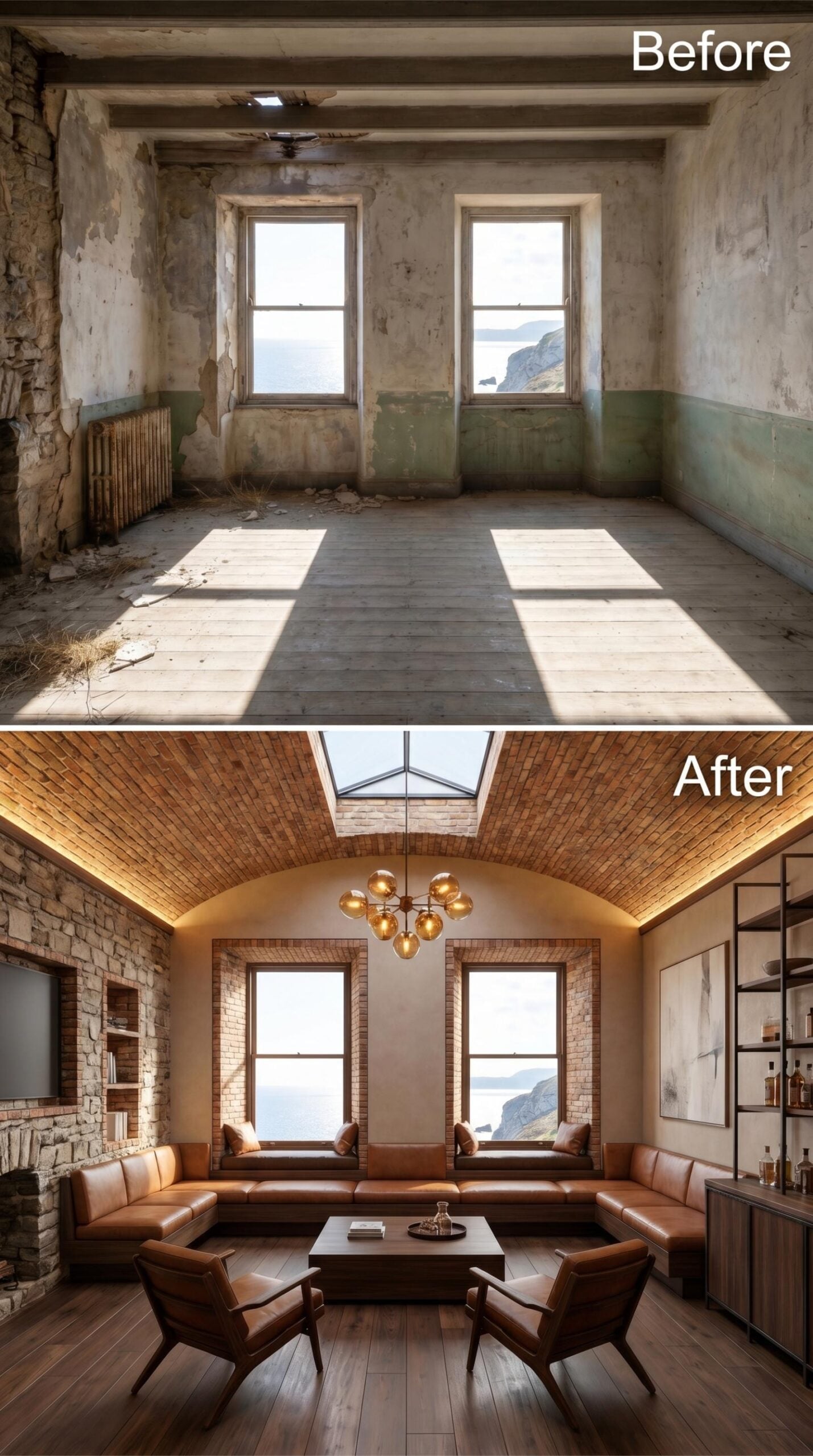
Exposed brick wraps the barrel vault and gets warm from cove lighting tucked at the cornice. The cognac leather sectionals hug the window wall, pulling the sea view into the seating arrangement itself rather than leaving it as something you glance at from across the room.
31. Gold Sunburst Ceiling, Deep Emerald, and a Clifftop View Framed in Glass
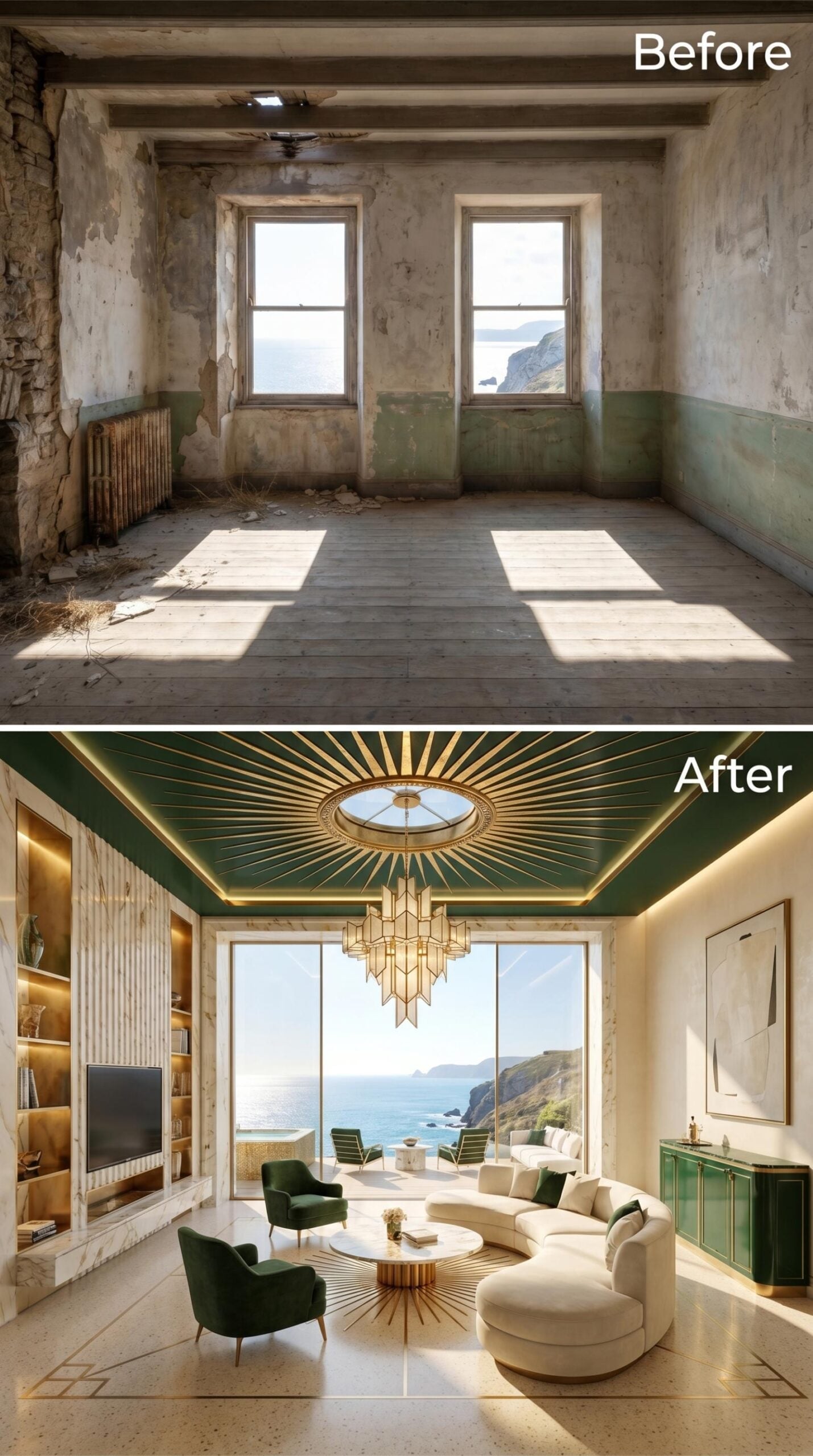
Few ceilings earn this much attention. Deep forest green coffers radiate outward in gold rays from a central skylight medallion, pulling every eye upward before the ocean view even registers.
Cream travertine floors and an ivory curved sectional keep the palette grounded, while two velvet armchairs in hunter green anchor the seating area without competing with the ceiling’s geometry. The Art Deco chandelier drops in tiered geometric brass, scaled to match the room’s ambition. Along the right wall, a green lacquered sideboard adds a horizontal counterweight to all that vertical drama overhead.
30. Skylights, Stone, and Open Glass Where the Ocean Fills the Room
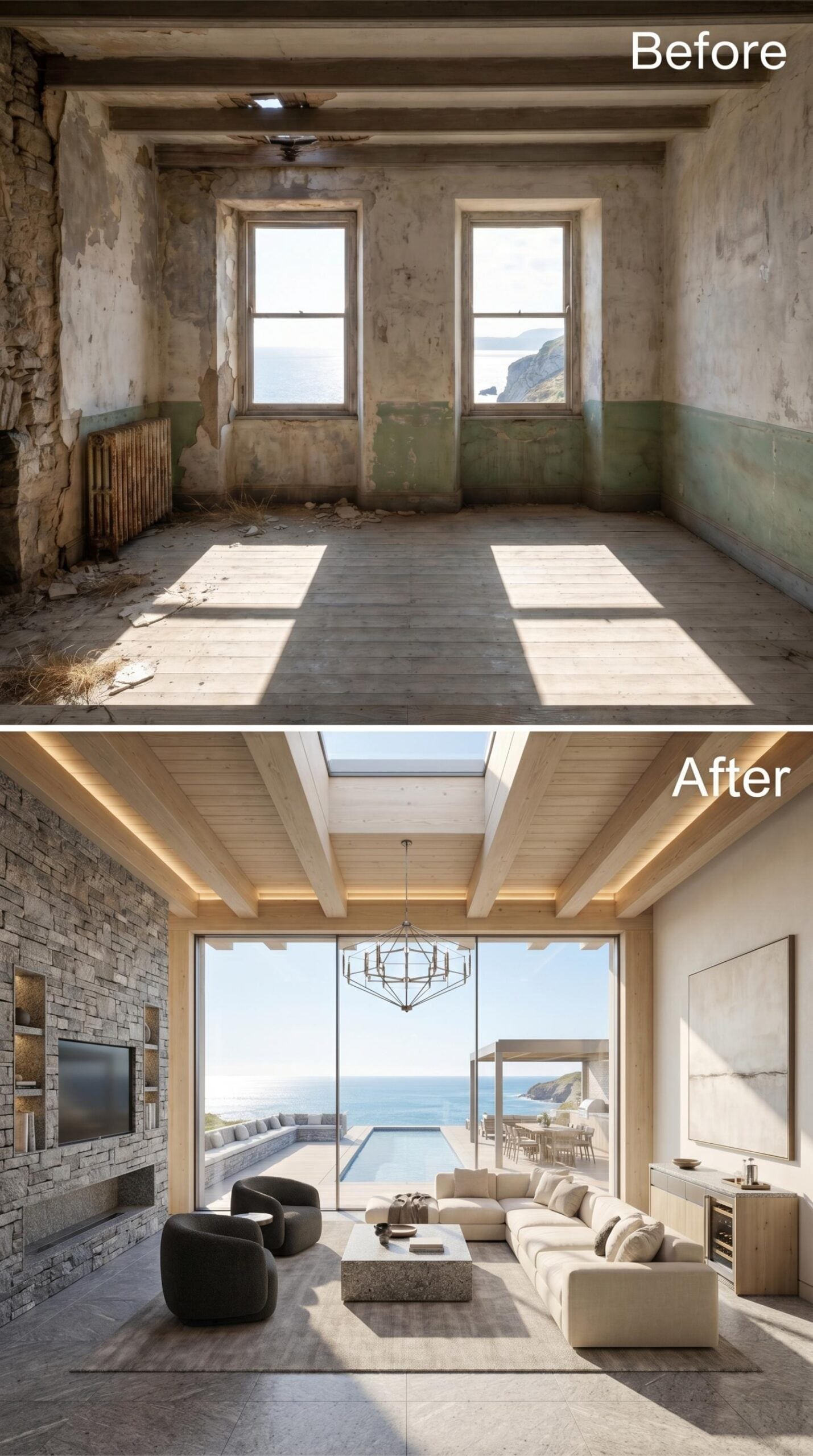
Pale ash ceiling beams run the full length of the room, lit from below by warm cove lighting tucked into the perimeter. A large skylight sits centered between them, pulling natural light straight down without competing with the view. And that view does a lot of work: floor-to-ceiling sliding glass panels replace what were once two modest windows, opening the entire back wall to a pool terrace and the sea beyond.
The stone wall anchoring the left side reads as stacked slate in cool grey, doing double duty as fireplace surround and media wall. Seating is a low-profile sectional in cream bouclé paired with two round-backed chairs in charcoal, and the coffee table appears to be concrete or honed stone. A room that doesn’t compete with the Atlantic is probably the right call when the Atlantic is your backdrop.
29. Onyx Ceiling Panels, Cognac Leather, and Glass Where a Wall Used to Be
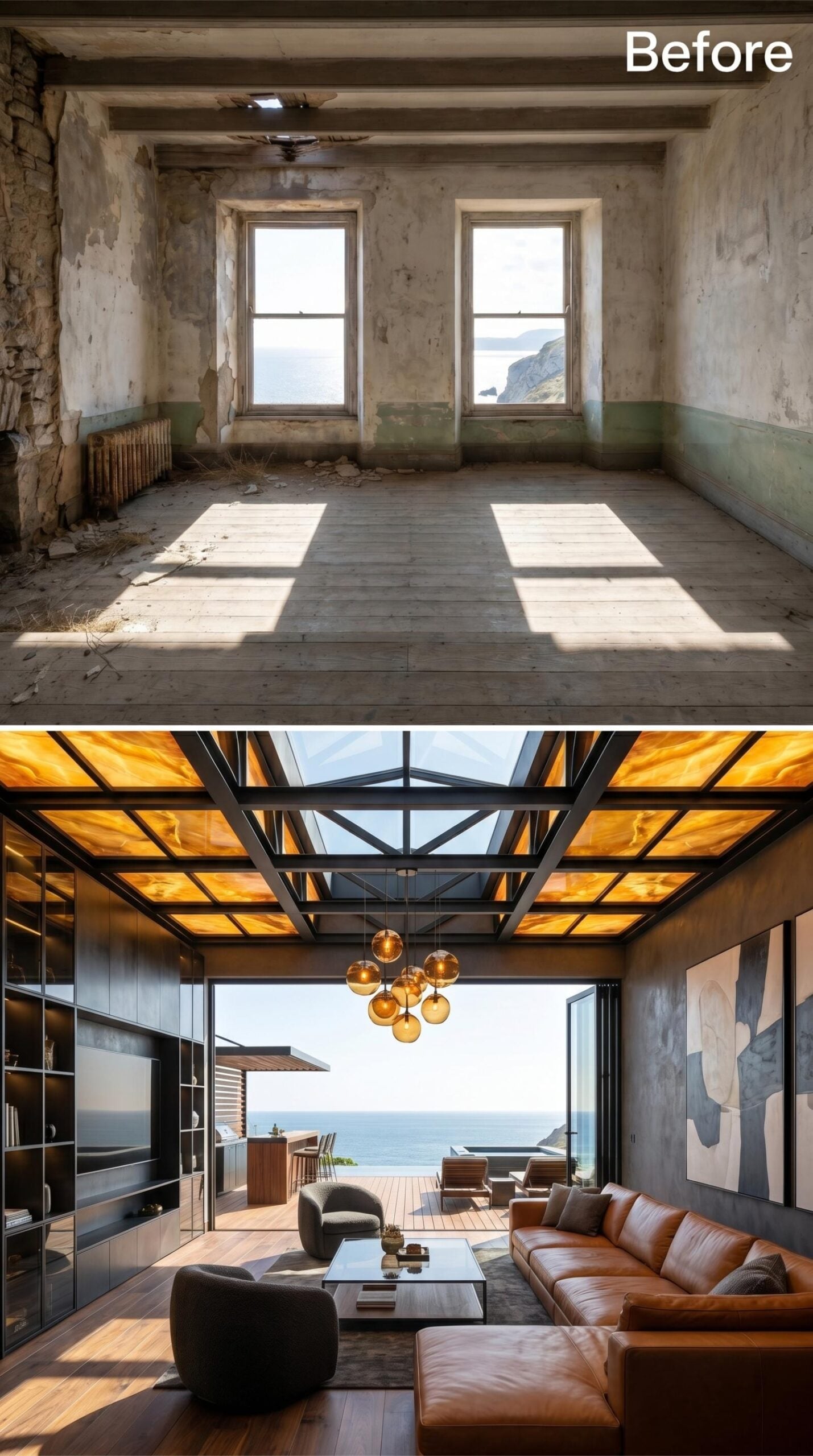
Steel roof trusses frame backlit onyx panels overhead, casting the entire room in amber — the kind of ceiling that pulls your eye up before you’ve registered anything below it. A cognac leather sectional anchors the seating area, paired with a rounded charcoal armchair that softens the harder industrial edges without apologizing for them.
Floor-to-ceiling glass opens toward a deck and the ocean beyond, dissolving the boundary between interior and exterior. The pendant cluster above the coffee table mirrors the ceiling’s warm gold tones, tying the two planes together. Dark shelving lines one wall: grounded, undecorated, and correct.
28. Vaulted Timber, Stacked Stone, and a Glass Wall That Erases the Horizon
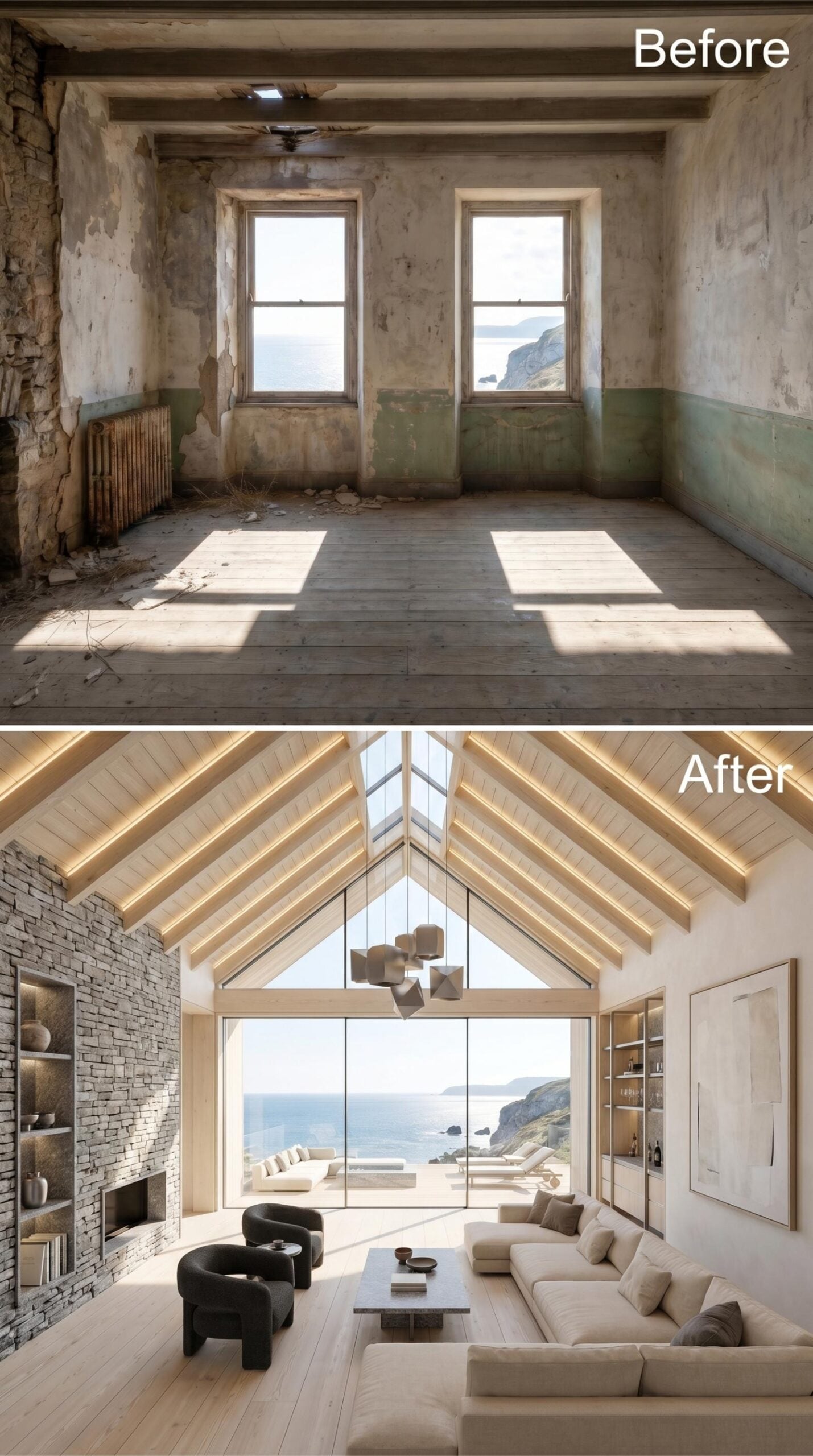
Pale ash rafters run the full length of a cathedral ceiling, their undersides lit by recessed strip lighting that warms the room from above. It’s the kind of ceiling that makes you stop talking mid-sentence. Below it, a stacked stone fireplace wall anchors the left side, rough-textured and grey, with built-in niches holding ceramics in muted earth tones.
The seating arrangement centers on a large linen sectional, flanked by two barrel chairs in near-black bouclé. A low stone-top coffee table sits between them. At the far end, a full-height glass gable opens entirely to the sea cliffs outside, pulling the Atlantic into the room whether you want it there or not.
How the Ceiling Lighting Changes the Room’s Mood
Strip lighting tucked beneath each rafter runs the full ceiling span, casting warm amber rather than overhead white. The room’s brightness comes from above but reads as ambient instead of functional. At dusk, with the glass wall framing fading sea light, those lit rafters do the heavy work of keeping the space from feeling cold or cavernous.
27. Coffered Gold Ceiling, Jewel-Tone Walls, and Velvet That Owns the Ocean View
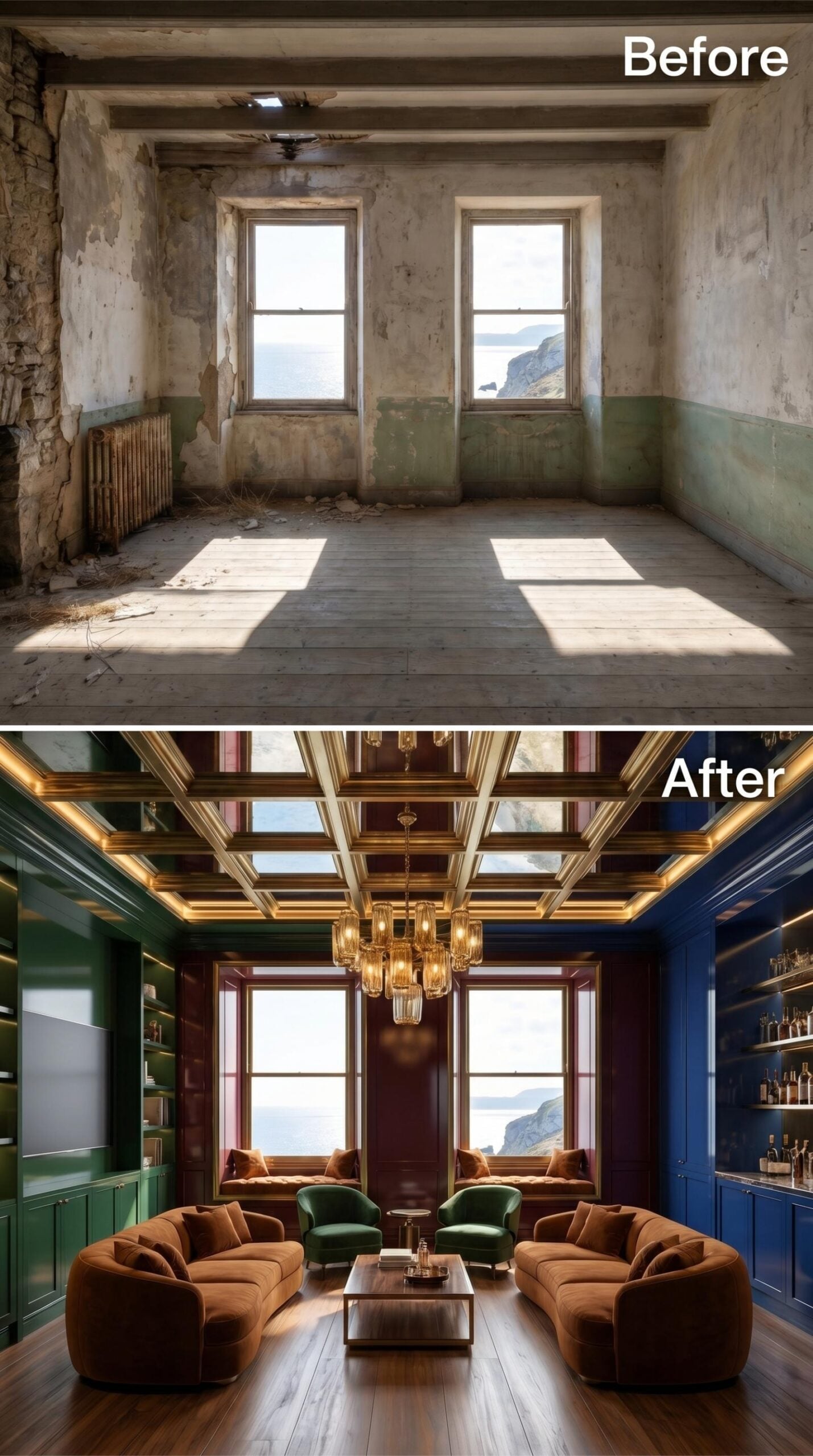
Bourbon-colored velvet sofas anchor the room in pairs, facing each other across a walnut coffee table low enough to keep sightlines clear to the windows. The coffered ceiling gets a gold trim treatment that catches the warm glow of amber pendant clusters at center. One wall runs deep navy with built-in shelving; the opposite goes forest green with cabinetry to the floor. A bold color split that shouldn’t work at this scale — but does.
Editor’s Note: Splitting the room between navy and forest green rather than committing to one dominant wall color is unconventional, and it pays off because the warm cognac upholstery bridges both sides. Built-in bar shelving on the navy wall keeps the space functional without sacrificing the drama the architecture demands.
26. Walnut Ceiling Ribs, Cobalt Velvet, and Glass Where the Cliff Drops Away
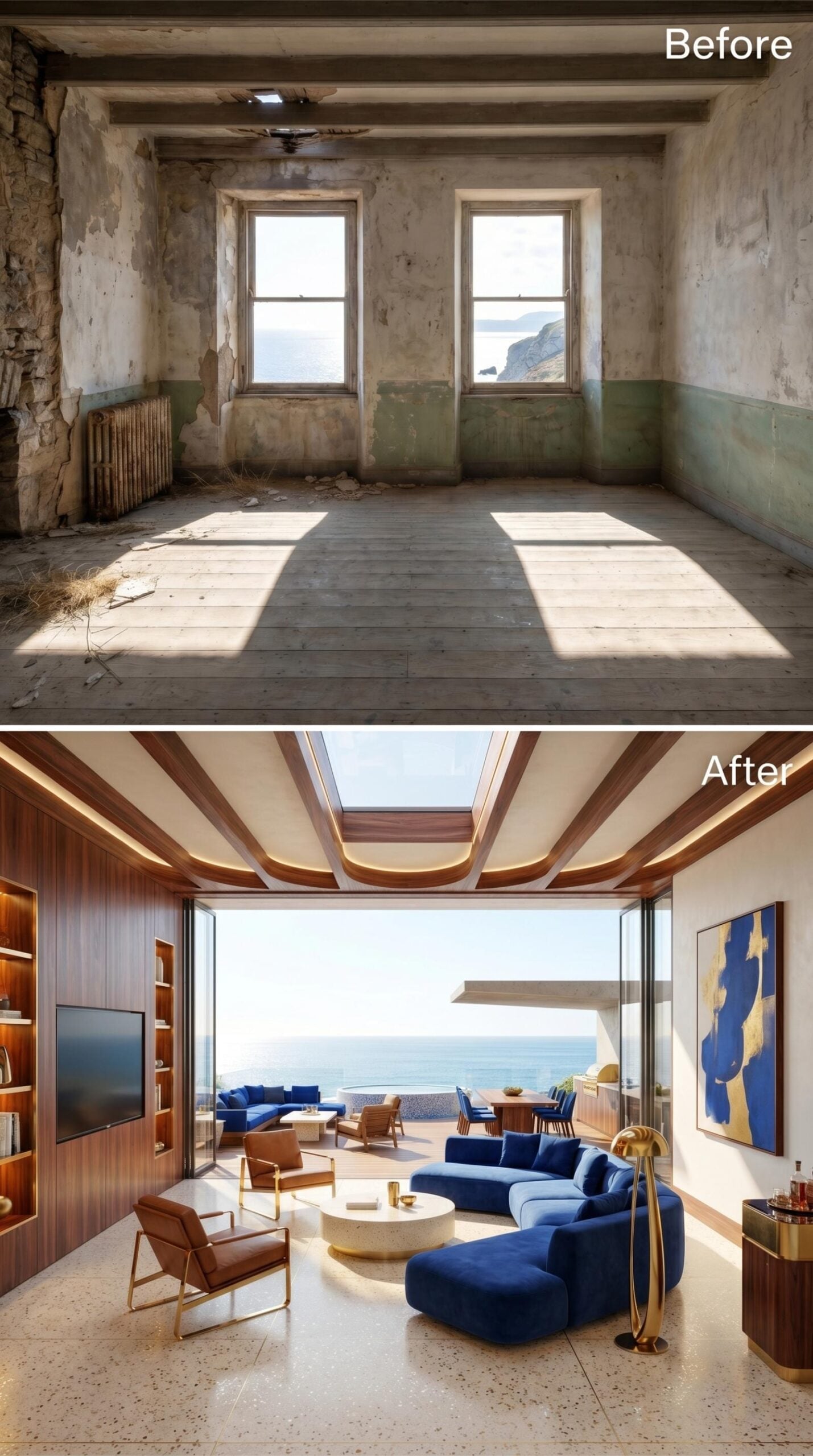
Warm walnut beams curve across the ceiling in a ribbed pattern that draws the eye straight toward the glass wall and the ocean beyond. The navy sectional carries most of the color, but it’s the cognac leather chairs with gold frames that keep the palette from going cold. Terrazzo flooring runs underfoot without competing for attention.
- Warm wood tones paired with cool velvet prevent the ocean view from overwhelming the interior palette
- Terrazzo is one of the hardest-wearing floors you can put in a coastal property
- Gold hardware and lamp finishes work as connective tissue between the wood ceiling and the leather seating
25. Navy Ceiling, Gold Geometry, and Curved Velvet Facing the Open Sea
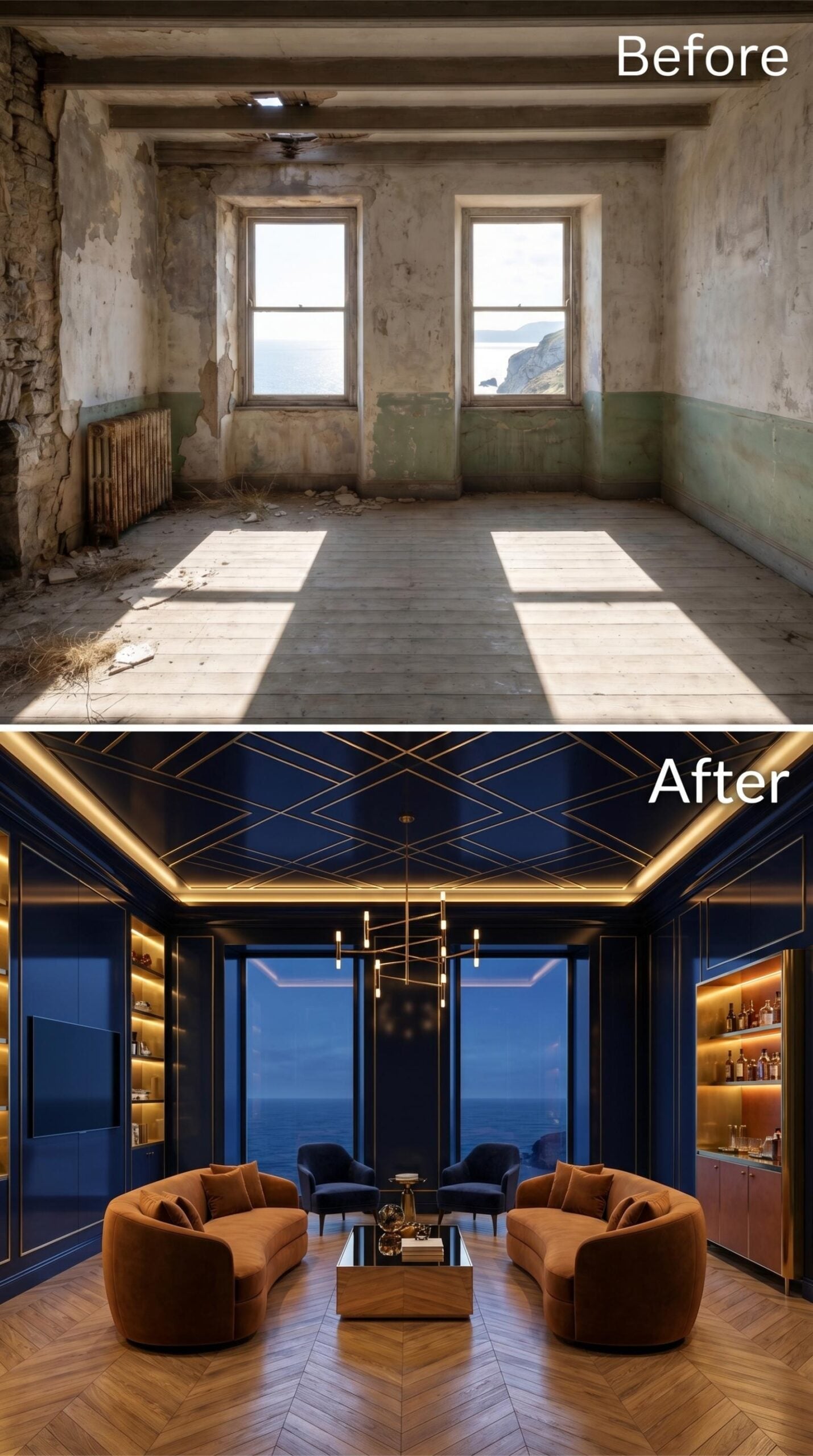
Midnight navy covers every surface from walls to ceiling, and the gold geometric trim running across it isn’t decorative filler. It reads like a blueprint for confidence. A herringbone wood floor anchors the room without competing, and the two curved cognac velvet sofas pull the seating into a shape that feels social rather than formal.
Floor-to-ceiling glass replaces what were once two modest windows, and the ocean view at dusk does the work that art usually handles. A sculptural brass chandelier with exposed filament drops hangs at center. The built-in bar on the right, lit with amber shelf lighting, gives the room a reason to stay past midnight.
Trend Alert: Painting a ceiling the same deep color as the walls used to signal a room that felt smaller than it was. Designers are using it deliberately now to create enclosure that reads as luxury rather than confinement. The effect works best when there’s a strong natural anchor — a glass wall, say — that prevents the room from feeling sealed off entirely. It’s a technique borrowed from high-end hospitality design that’s been moving steadily into residential work.
24. Coffered Wood Ceiling, Teal Velvet, and Glass Walls That Open to the Cliff’s Edge
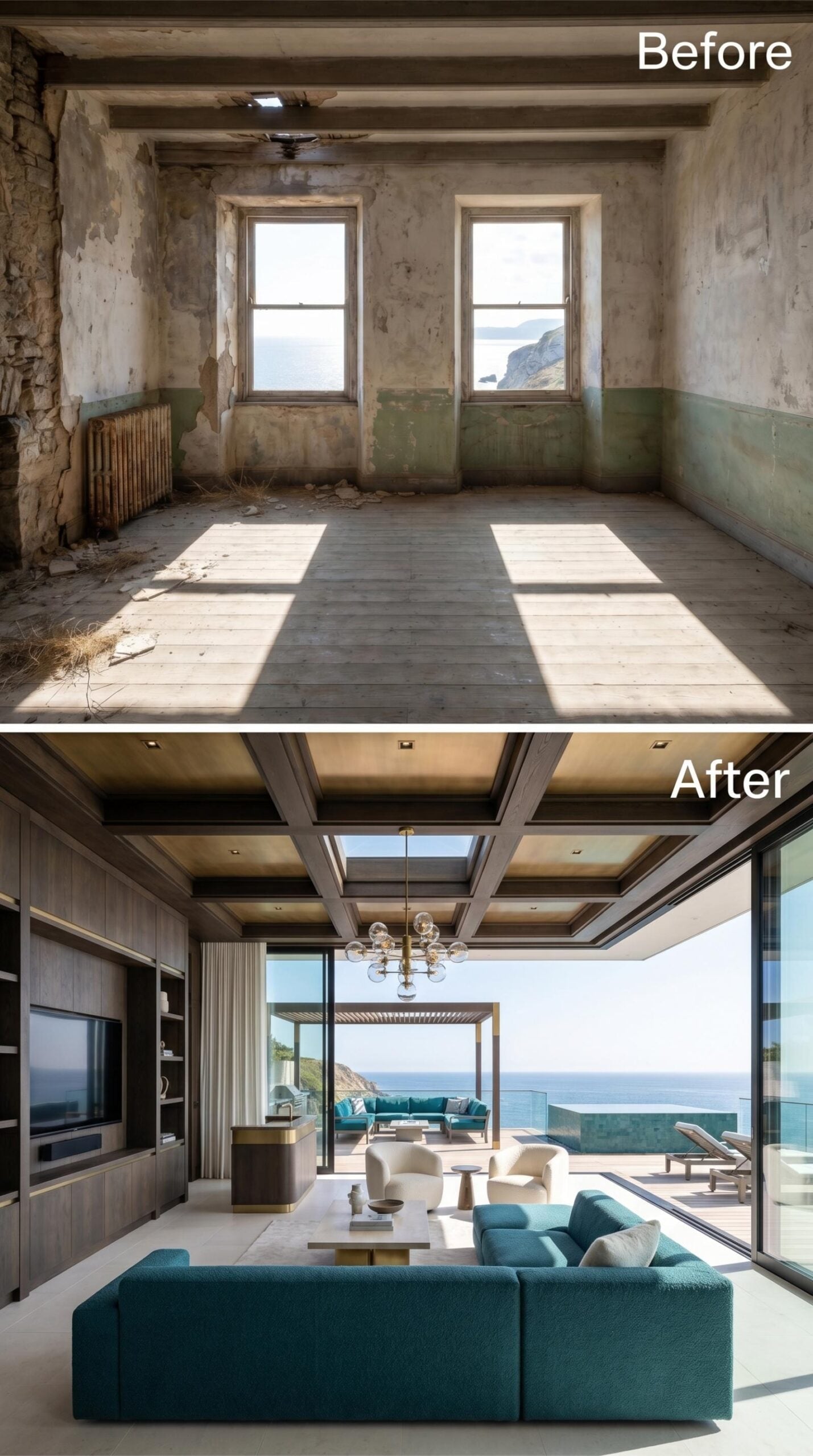
Coffered ceiling panels in weathered oak give the room architectural weight without closing it in. The teal sectional up front is a confident anchor, and the cream bouclé chairs across from it keep the palette from tipping too dark.
Glass panels replace what were solid walls, pulling the terrace and the sea directly into the room’s sightline. A brass globe chandelier drops from the center coffer, which is exactly where it needs to be.
Style Math: Teal and cream works because the contrast is tonal rather than sharp. Neither color fights the natural light coming off the water, so the room reads as calm even with a lot going on. Let the view set the palette’s ceiling, and the rest tends to sort itself out.
23. Crystal Chandelier, Steel Blue Walls, and a Skylight Cut Right Into the Cliff View
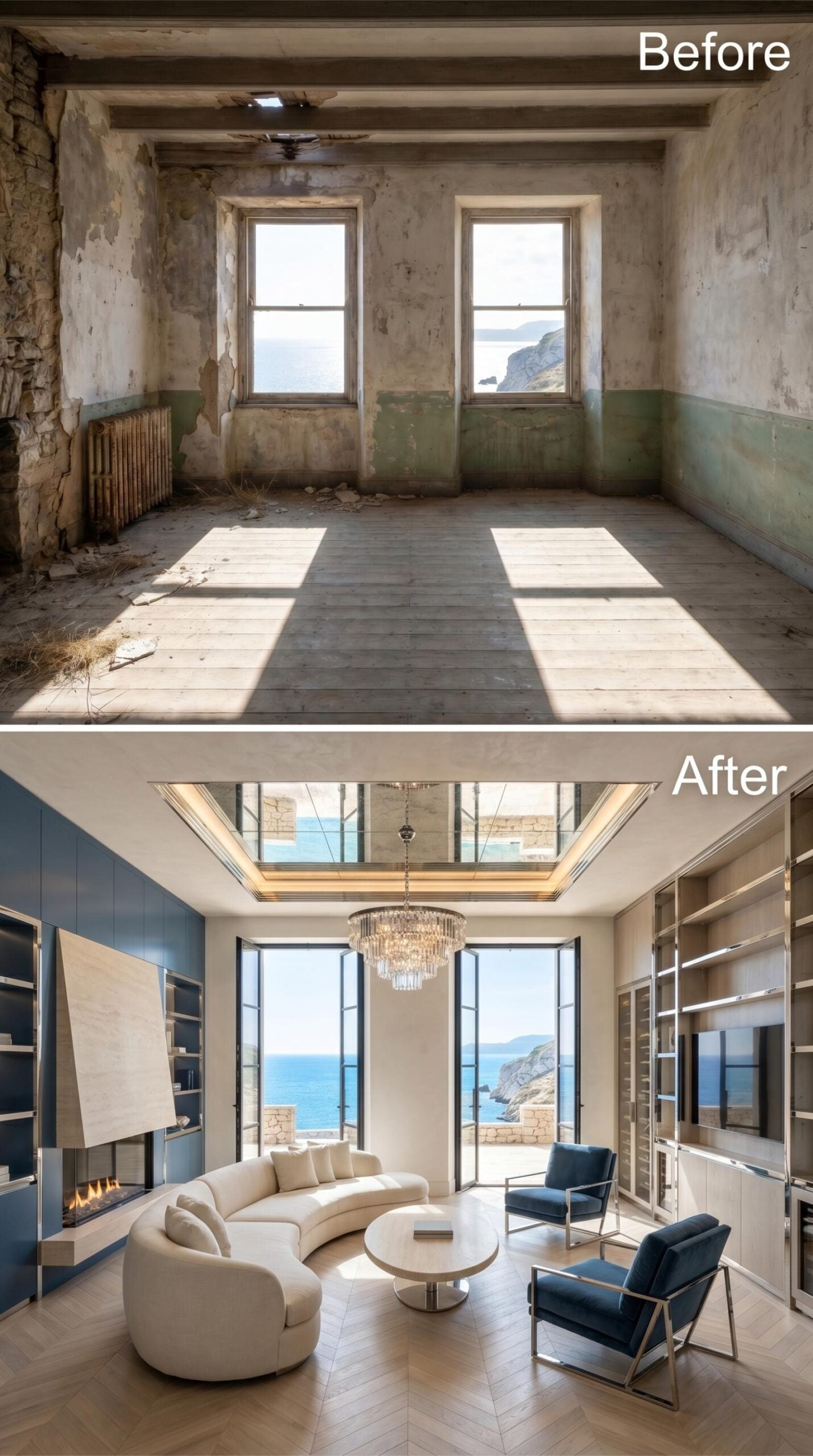
Slate blue paneling covers the left wall from floor to ceiling, doing something useful: it pulls the eye away from the ocean long enough to register the room as a designed space rather than just a frame for the view. The chandelier overhead is tiered crystal, the kind that catches afternoon light off the water and scatters it across the herringbone floor below.
A curved cream sofa anchors the center without fuss. Two blue velvet chairs with chrome frames face it, proportions feeling deliberate rather than arrived at. Above it all, a recessed skylight with integrated cove lighting adds a second light source that has nothing to do with the sea.
The curved cream sofa anchors the center without competing with anything.
22. Skylight, Arched Stone, and Curved Linen Where the Cliff Meets the Sea
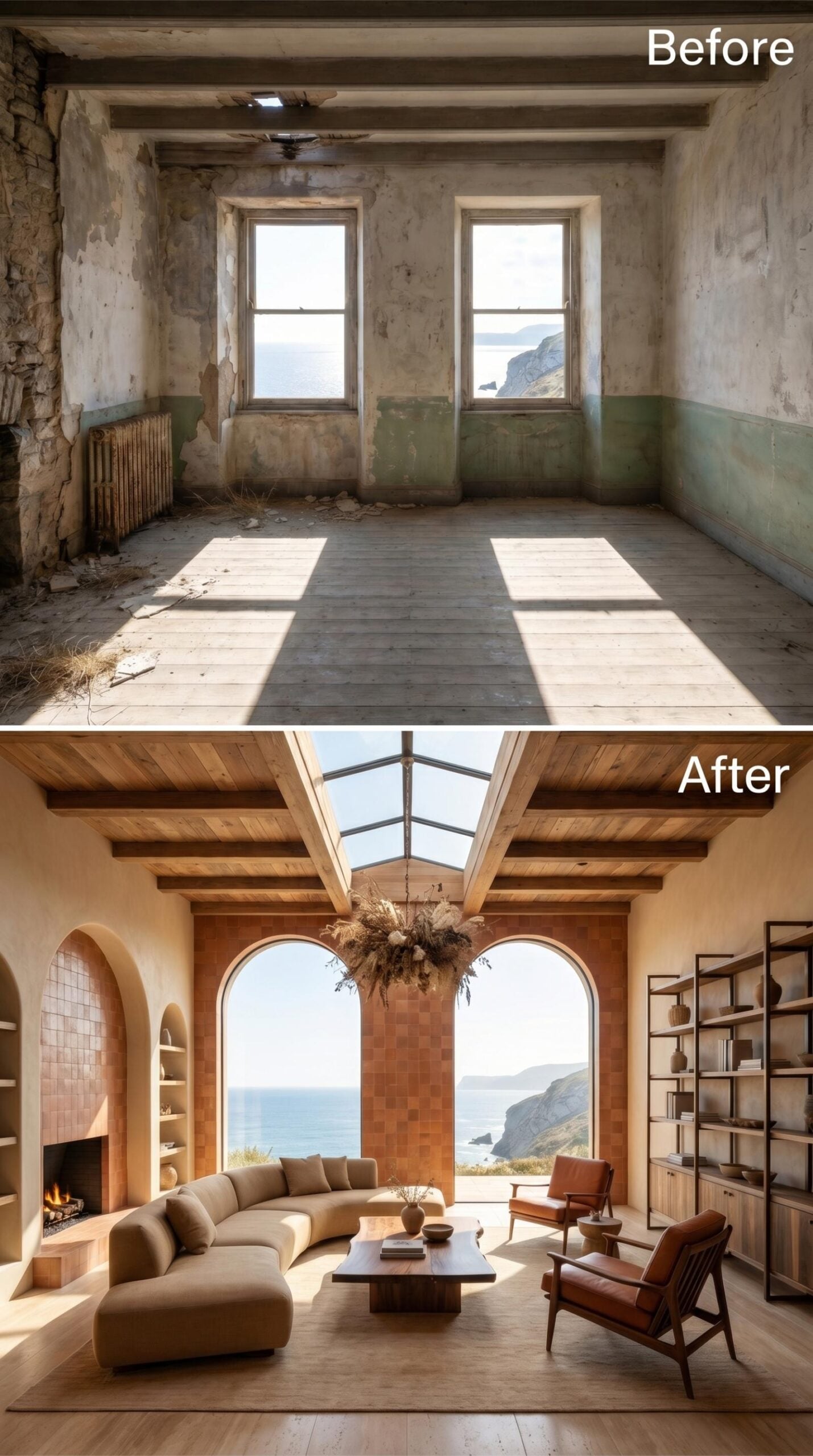
Limewash walls in warm sand anchor a space where a skylight pulls the ceiling open above exposed timber beams.
Color Story: Sand, terracotta brick, and cognac leather sit close enough on the color wheel that the room reads as one warm wash rather than competing zones. That tonal closeness is why the dried botanicals overhead don’t feel tacked on — they’re just dark enough to register without breaking the warmth.
Where previous sections leaned on color for drama, this one puts its faith in geometry.
21. Porthole Windows, Blue Neon Ribs, and Leather Floating Above White Tile
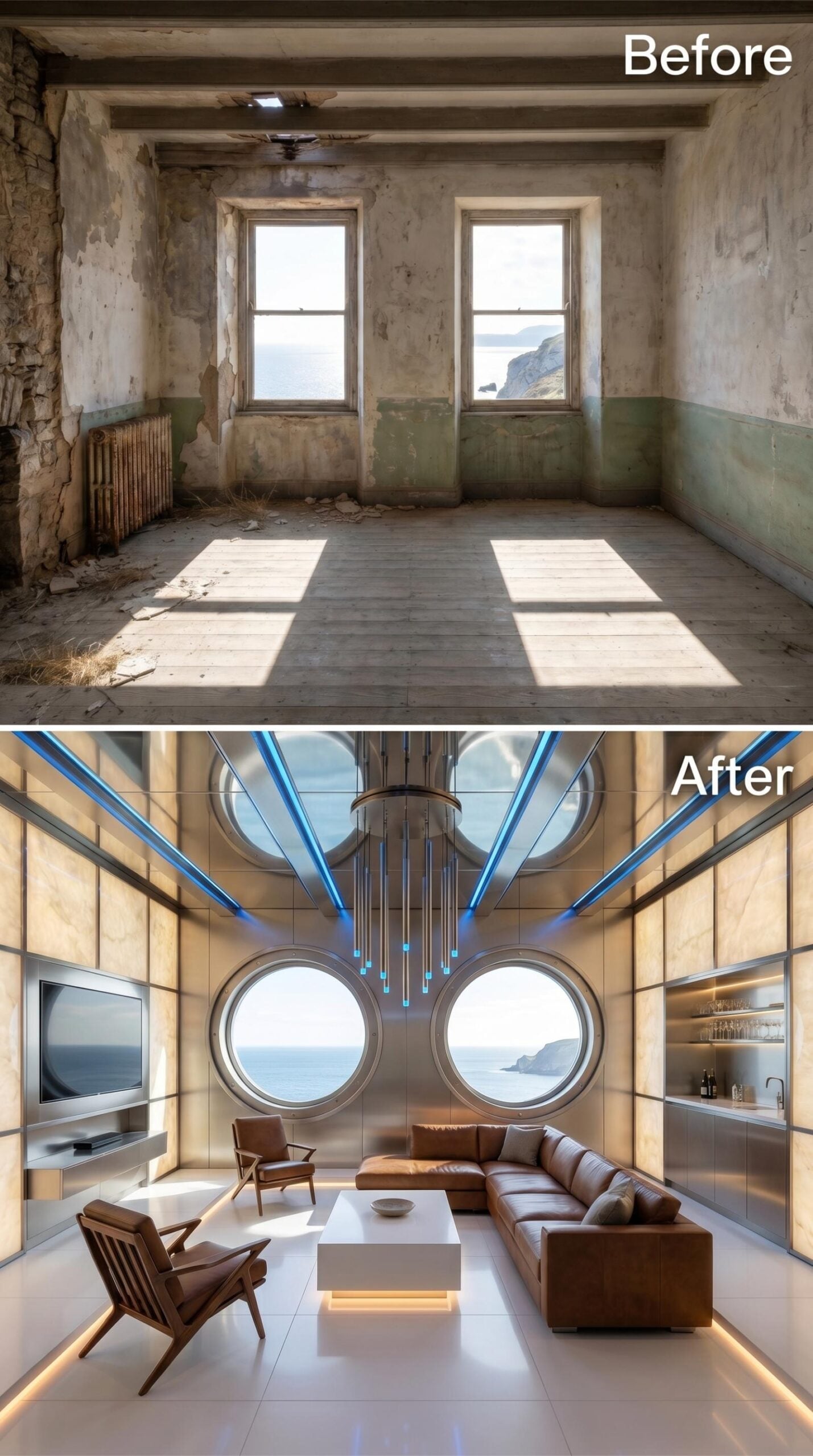
Two circular porthole windows frame the ocean view while blue LED strips run along angled ceiling ribs overhead, giving the room the feel of a vessel more than a residence. Warm leather seating and a low white table keep things from going full submarine.
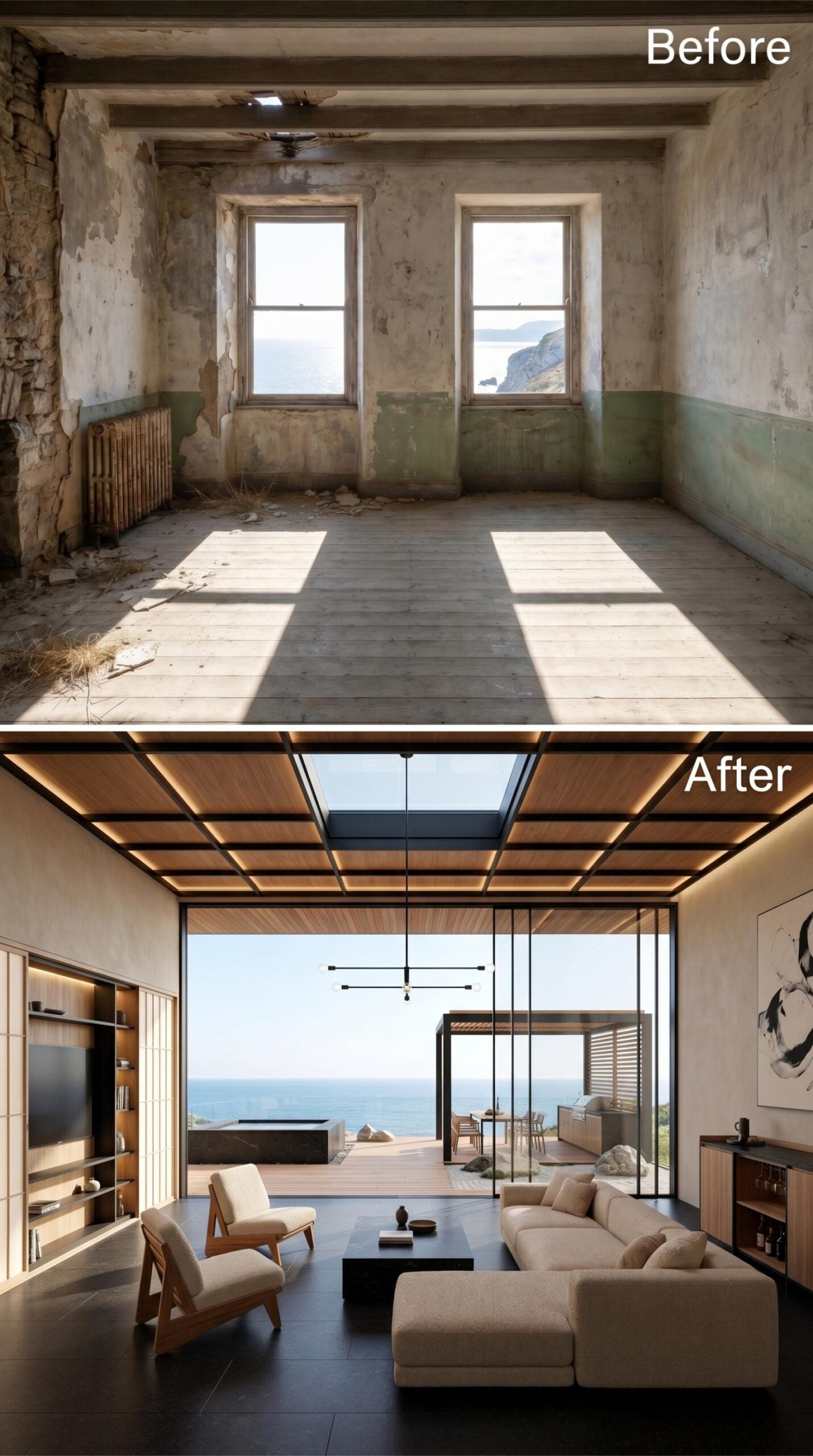
20. Wood Ceiling Ribs, LED Warmth, and Glass That Dissolves the Wall Between Living Room and Sea
🔥 Would you like to save this?
Slim wood ceiling ribs run the full width of the room, backlit with amber strip lighting that keeps the space feeling grounded rather than cold.
Budget Tip: Recessed LED strip lighting tucked into ceiling joists costs far less to install than pendant or recessed can systems, and it pulls double duty by adding warmth without competing with a view. If you’re working with a tight renovation budget, this is where the return shows up most clearly in finished photos.
19. Backlit Onyx Trusses, Cognac Curves, and Floor-to-Ceiling Glass Facing the Sea at Dusk
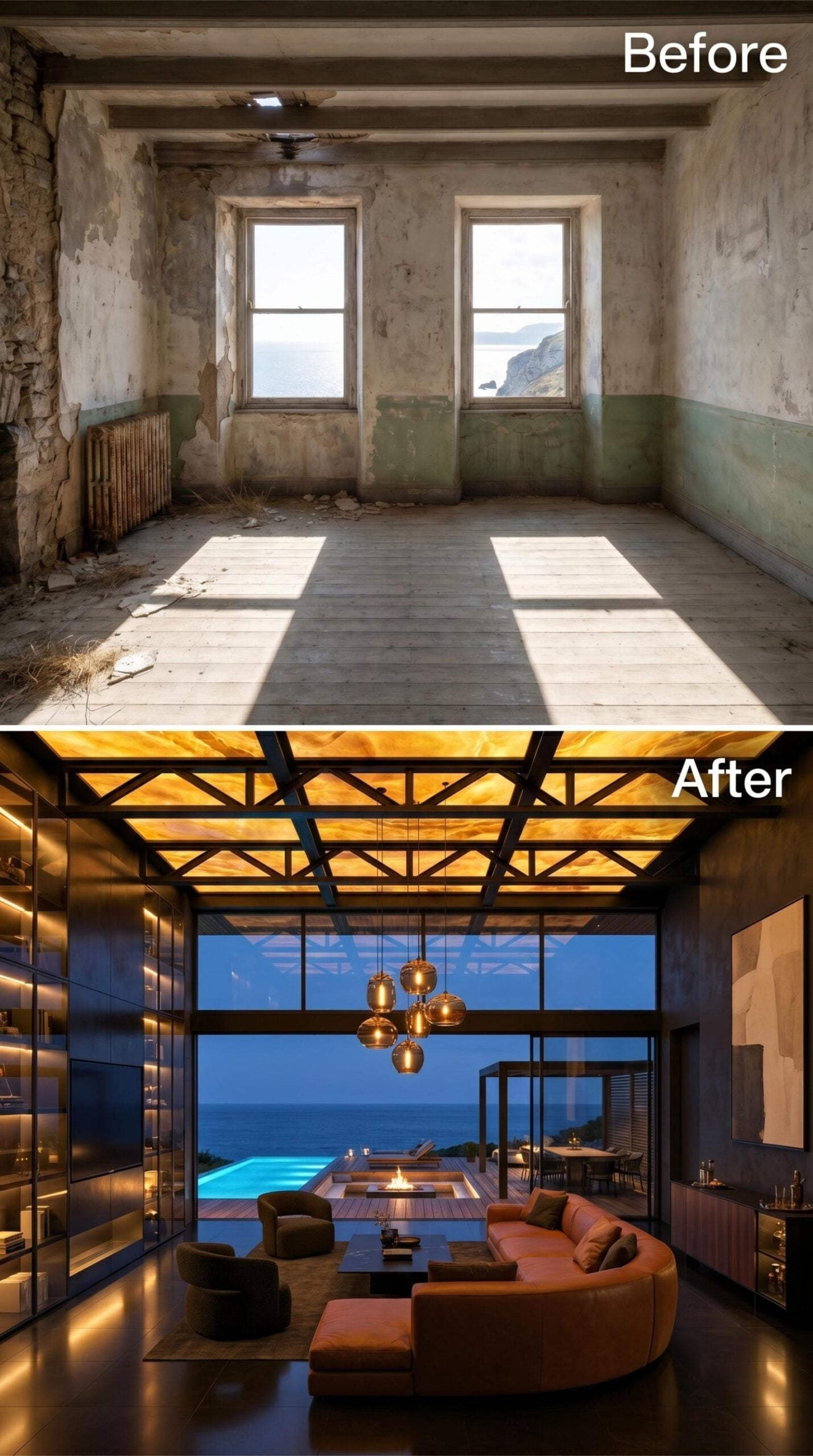
That ceiling isn’t lit — it’s on fire.
Translucent onyx panels set between exposed steel trusses overhead glow amber from behind, casting the kind of warm diffused light that no pendant fixture replicates on its own. Below it, a curved cognac leather sectional anchors the room with enough visual weight to hold its own against the floor-to-ceiling glass wall, which opens directly onto a pool deck and ocean view. Pendant lights cluster above the fire table, their brass spheres catching the onyx glow from overhead. Built-in shelving lines the left wall entirely in dark steel and glass, lit from within. A room that treats artificial light as architecture rather than afterthought.
bold_hook: Backlit stone panels have become more accessible as thin-cut onyx and alabaster veneers have replaced full-slab installations. Translucency depends on thickness — the thinner the cut, the more light passes through. Pairing that glow with matte steel framing keeps the effect from reading as decorative excess. The contrast between a warm overhead material and a cool steel grid is what gives this ceiling its tension.
18. Exposed Ceiling Beams, Limewashed Plaster, and Boucle That Earns the Coastal View
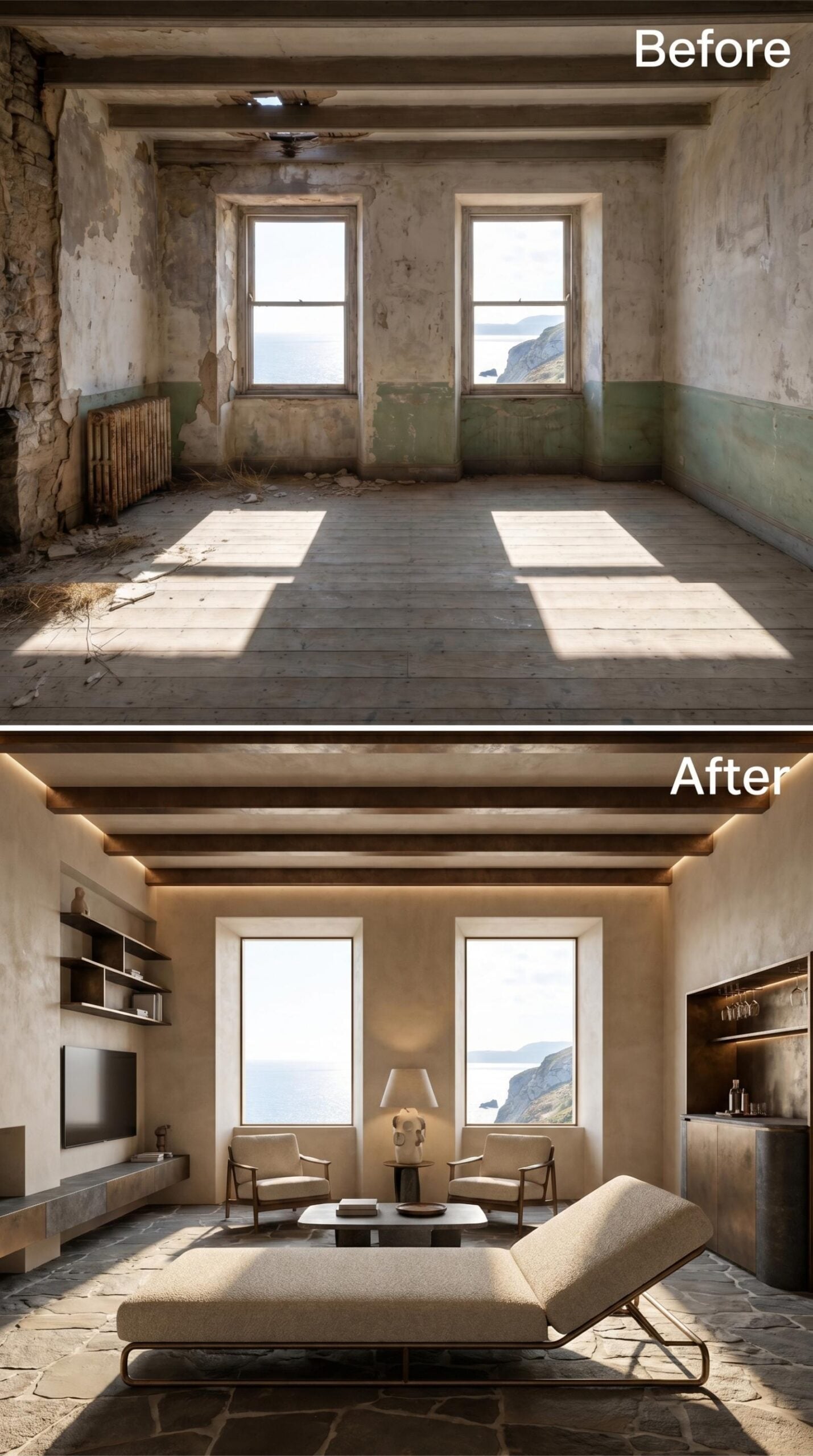
Warm LED strips tucked behind each ceiling beam cast amber across the plaster without any visible fixture. Subtle in the best way. The seating pulls the room together: a bouclé chaise in the foreground faces two mid-century armchairs across a low round table, all in the same cream register.
Stone tile grounds the floor while the walls stay rough and unfinished. That texture contrast does real work here, keeping the space from reading as precious.
Fun Fact: Bouclé fabric, woven from looped yarn, has a naturally irregular surface that diffuses light rather than reflecting it — a smart choice in rooms where sunlight shifts throughout the day. It also wears well in high-use seating because the loops mask minor pilling and compression over time.
17. Backlit Amber Ceiling Panels, Cognac Leather, and Green Velvet Chairs That Face the Sea
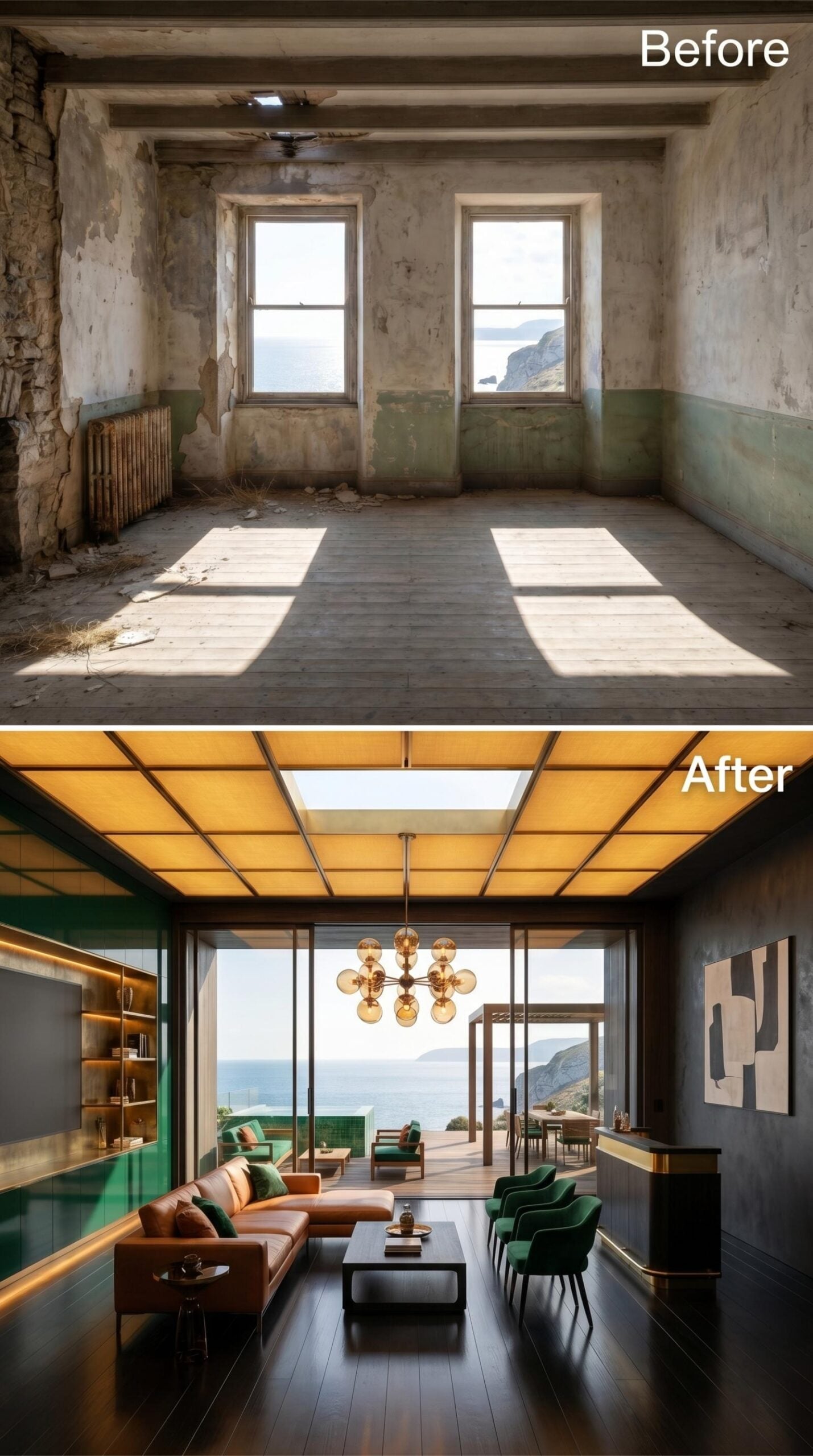
Gold-toned translucent ceiling panels stretched across a steel grid dominate the room before anything else does. That ceiling pulls the cognac sectional and dark hardwood floors into the same warm register without a single pendant doing any work.
Below it, the room splits into two social zones: the sectional anchors one side while forest green velvet dining chairs claim the other, flanking a bar counter with brass detailing. Full-width glazing at the far wall erases the boundary between interior and cliff terrace. The ocean’s right there, and it earns every design decision made around it.
Designer’s Secret: Backlit ceiling panels distribute light more evenly than point-source fixtures, which means fewer shadows and a warmer overall atmosphere at night. Use a warm amber diffuser rather than a neutral white one and the whole room shifts toward golden-hour tones regardless of the clock. Pair that overhead warmth with deep jewel-tone upholstery and the space stays rich rather than washed out.
16. Skylight Cut Steel, Cognac Leather, and Navy Shelving Where the Sea Takes Over
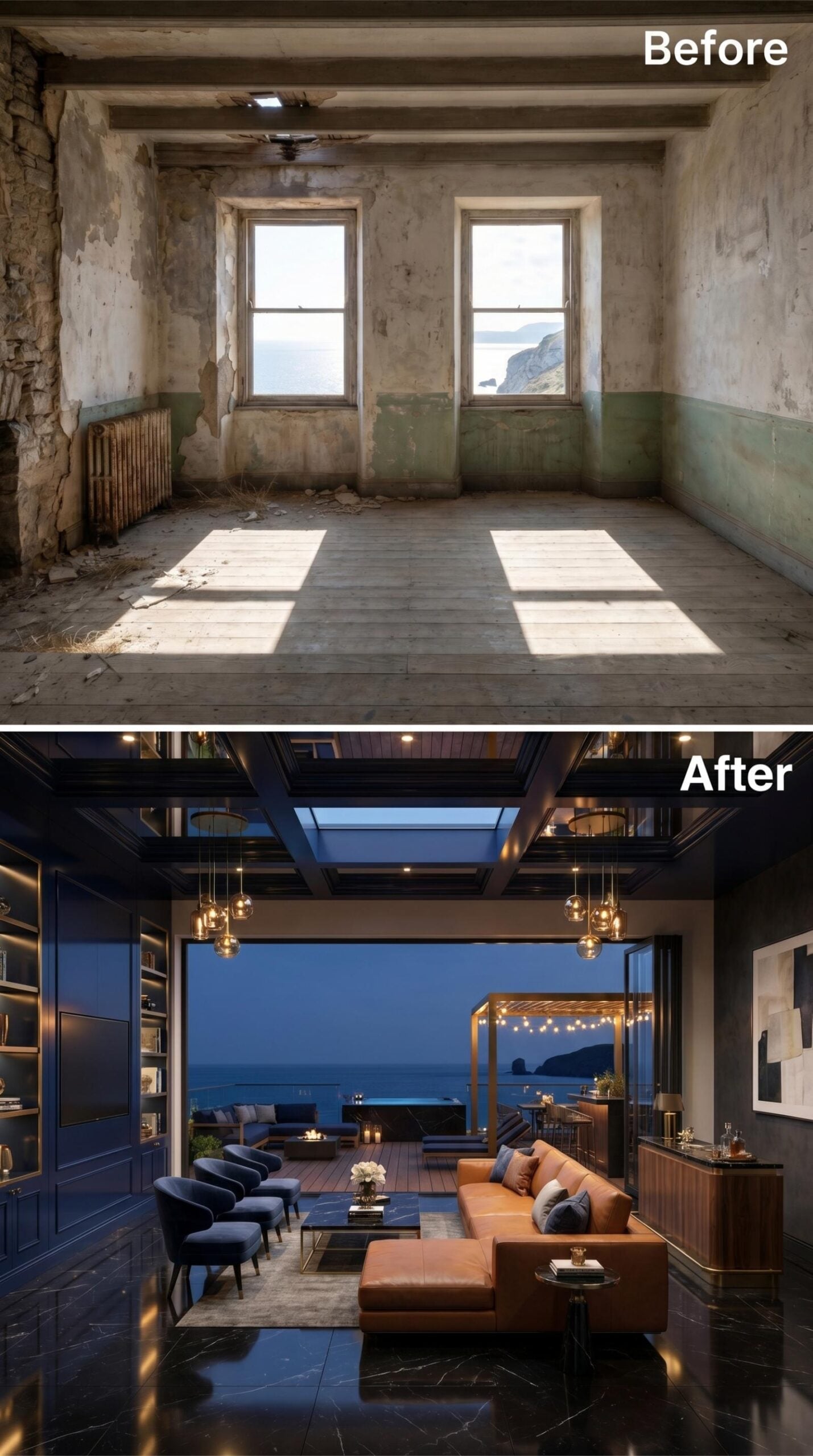
Black steel ceiling beams frame a skylight that pulls the dusk sky directly into the room. The cognac sectional anchors the space, while navy velvet chairs across from it stop the palette from running too warm.
Try This: Pendant clusters hung at staggered heights from structural beams distribute ambient light without requiring a dedicated electrical chase through finished drywall. If your ceiling already has exposed structural members, that’s your easiest path to overhead lighting that doesn’t compromise the architecture.
15. Skylights, Travertine Walls, and Cognac Leather Facing the Sea’s Edge
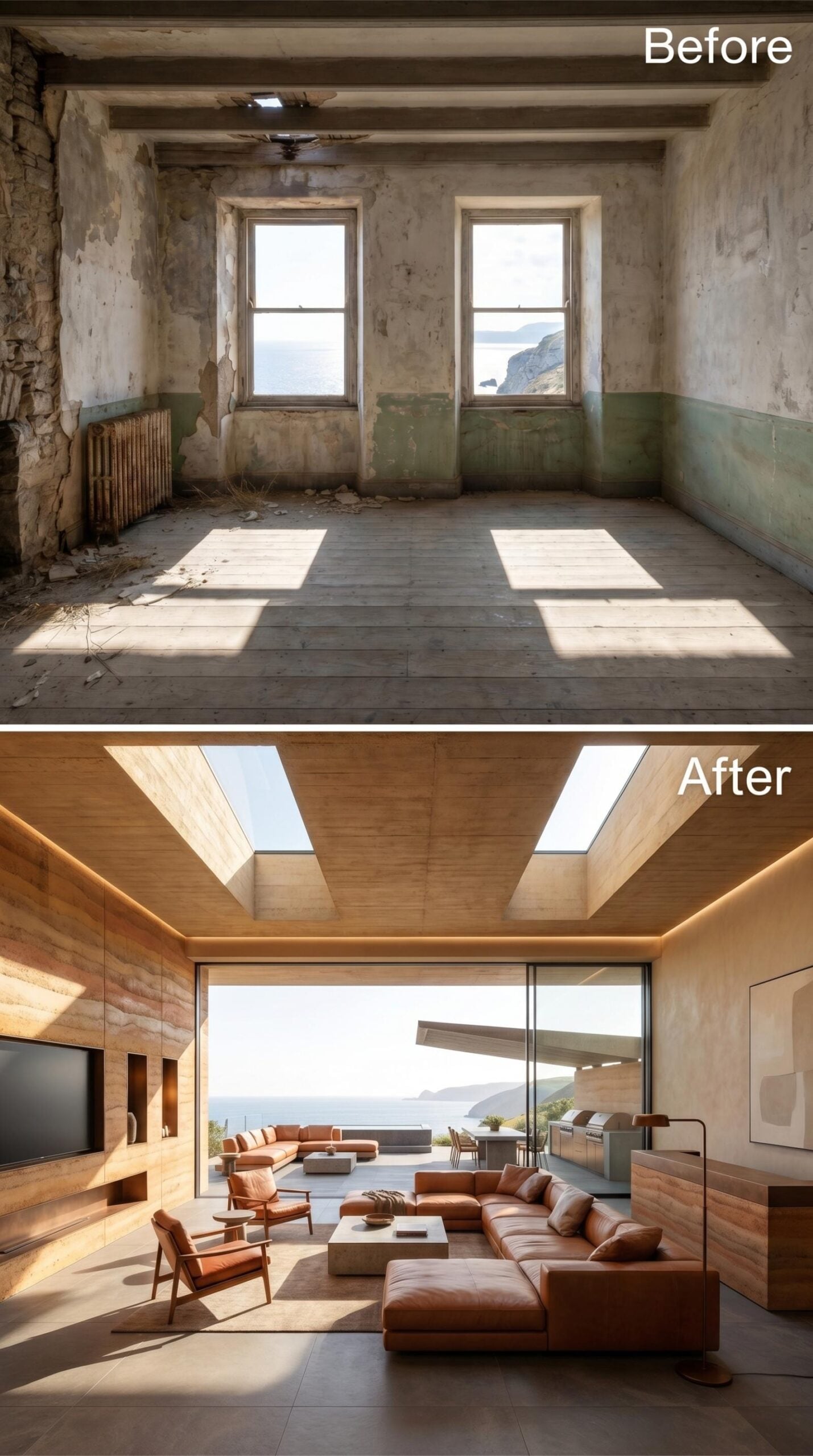
Dual skylights cut into the ceiling pull daylight down across travertine-clad walls, keeping the room bright without competing with the floor-to-ceiling glass that frames the coastal view. Warm stone runs from wall to ceiling continuously, which is what makes the room feel cohesive rather than busy. It’s a simpler move than it looks.
A cognac leather sectional and matching armchairs handle comfort, while a low concrete coffee table keeps the sightline clear. Strip lighting tucked into the ceiling perimeter adds warmth after dark.
Common Mistake: Defaulting to white or off-white walls whenever you want a room to feel open is understandable, but this space shows that warm stone tones can do the same job. The material needs a consistent value across surfaces so the eye doesn’t catch abrupt shifts — when walls and ceiling share the same travertine cladding, the room reads as one envelope rather than a box.
14. Barrel Vault Concrete, Sage Sectional, and a Glass Wall That Hands the Room to the Sea
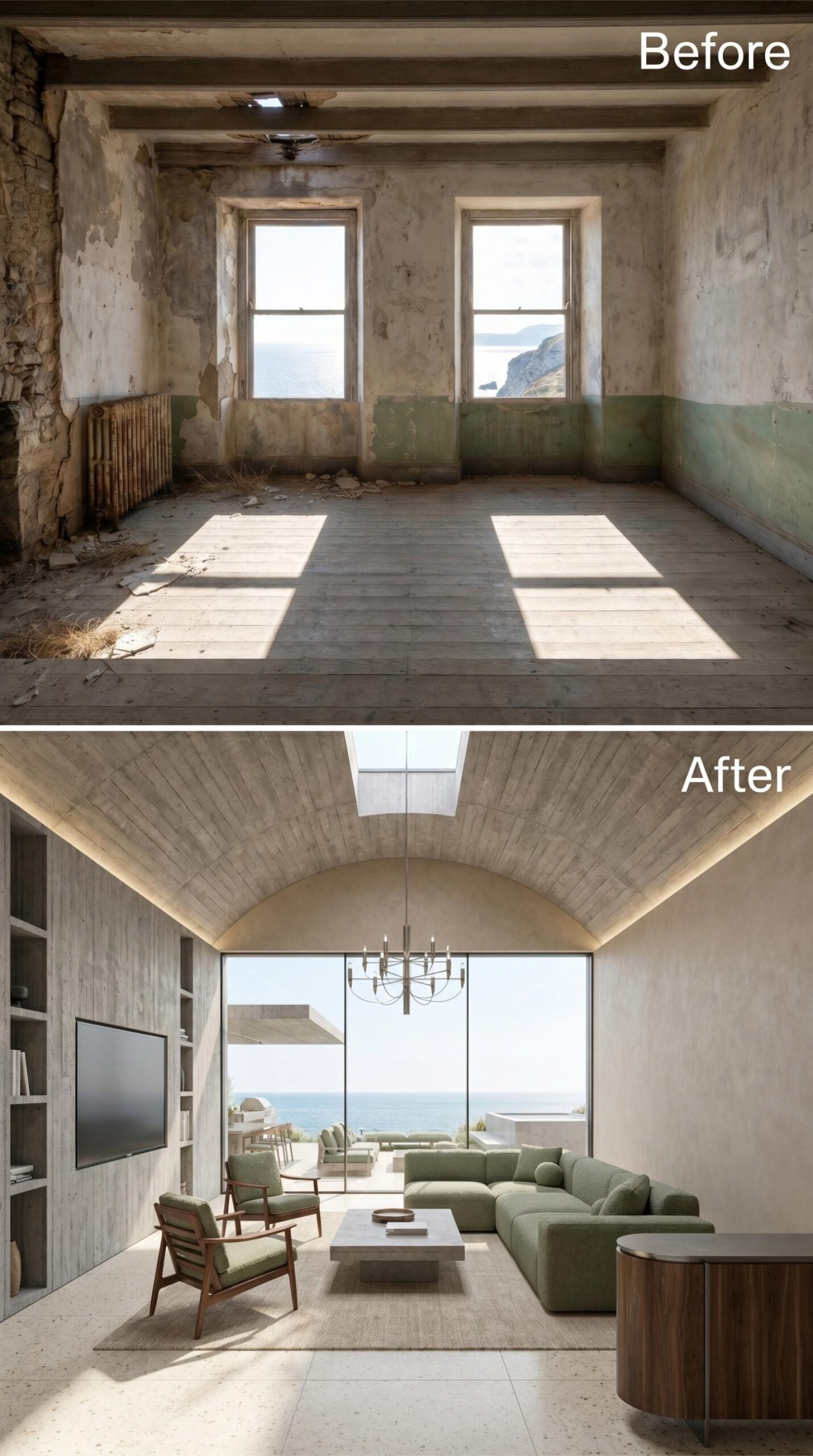
Bare concrete follows the curve of a barrel vault ceiling, lit from below by a recessed strip running the full perimeter and giving the arch its depth. The chandelier hanging at center pulls mid-century without being precious about it. Green carries through from the modular sectional to the wood-framed accent chairs, and that repetition keeps the room from reading as accidental.
- Barrel vault ceilings distribute weight outward, which made them practical in coastal stone structures built to handle wind load
- Terrazzo flooring reflects ambient light more efficiently than wood plank, which matters in rooms where the primary light source is a single glass wall
- Sage green holds its tone under natural light better than most greens because it reads warm or cool depending on sky conditions, making it reliable near water-facing glazing
13. Scalloped Ceiling Vaults, Cobalt Glass Pendants, and Arched Windows Framing Open Sea
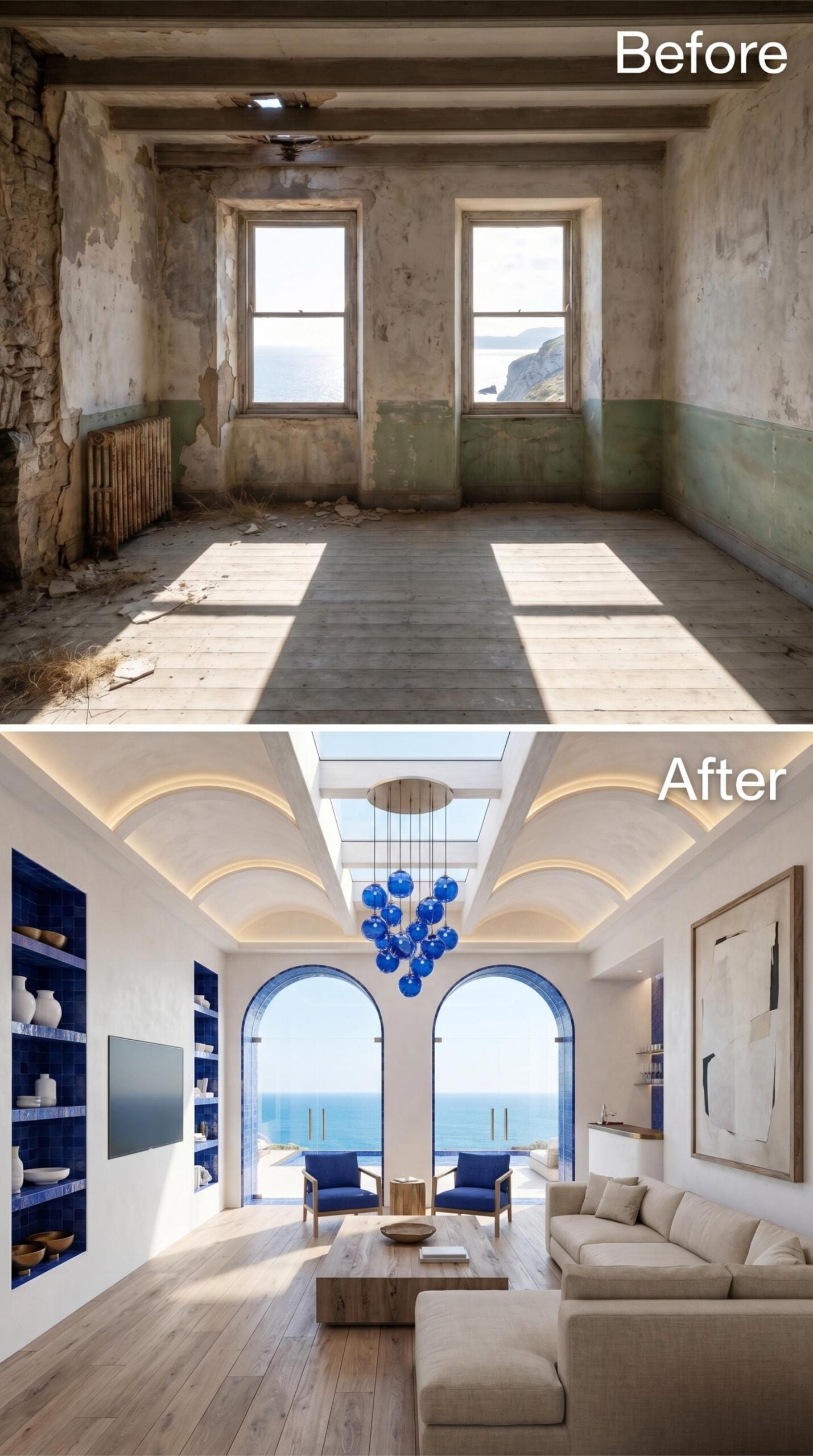
Arched openings replace what were once flat windows, and the cobalt pendant cluster hanging from a skylight spine pulls that same blue down from the ceiling into the room’s center.
The Psychology Behind This: Blue used as an accent rather than a wall treatment tends to feel more intentional because the eye has to find it. Here, cobalt appears in three places at once — the pendant, the shelving niches, and the chairs — which creates a rhythm the brain reads as deliberate rather than decorative.
12. Concrete Walls, Globe Pendants, and Cognac Leather Anchored Against the Cliff
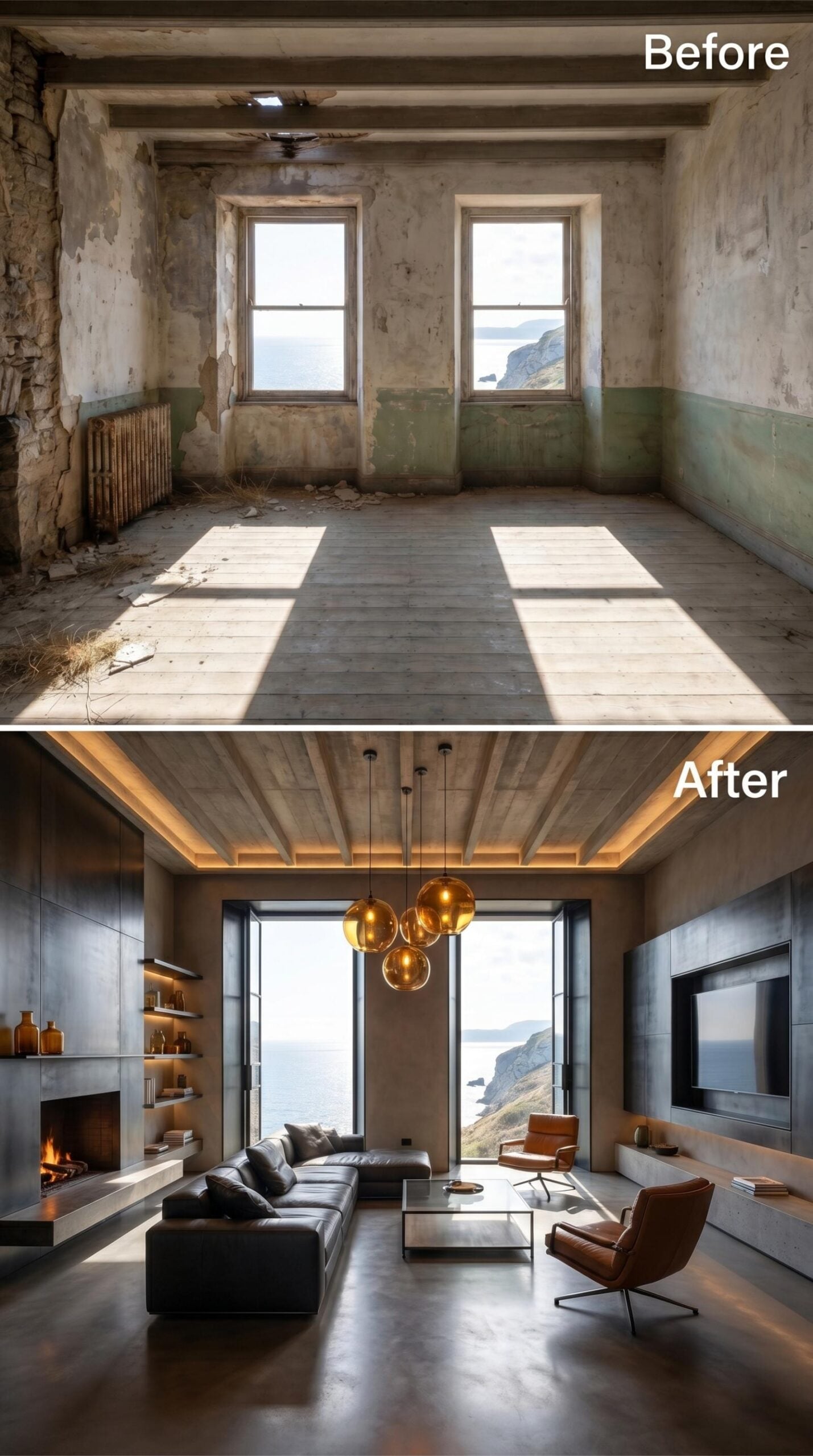
Polished concrete runs wall to wall, giving the room a density that keeps it from floating away in all that natural light. Three amber globe pendants hang at matching heights from a ribbed concrete ceiling, their warm glow reading almost orange against the cooler grey. A low sectional in charcoal leather sits opposite a built-in fireplace flanked by open shelving, while two cognac leather chairs face the floor-to-ceiling window and the sea cliffs beyond.
Worth Knowing: Concrete floors in residential spaces are often sealed with a matte or satin polyurethane finish rather than a high-gloss one, because high gloss reads as industrial rather than livable. A matte seal absorbs just enough light to make the floor feel warmer and less reflective than polished stone would in the same room.
11. Undulating Plaster Ceiling, Warm Sand Tones, and Glass That Erases the Interior Wall
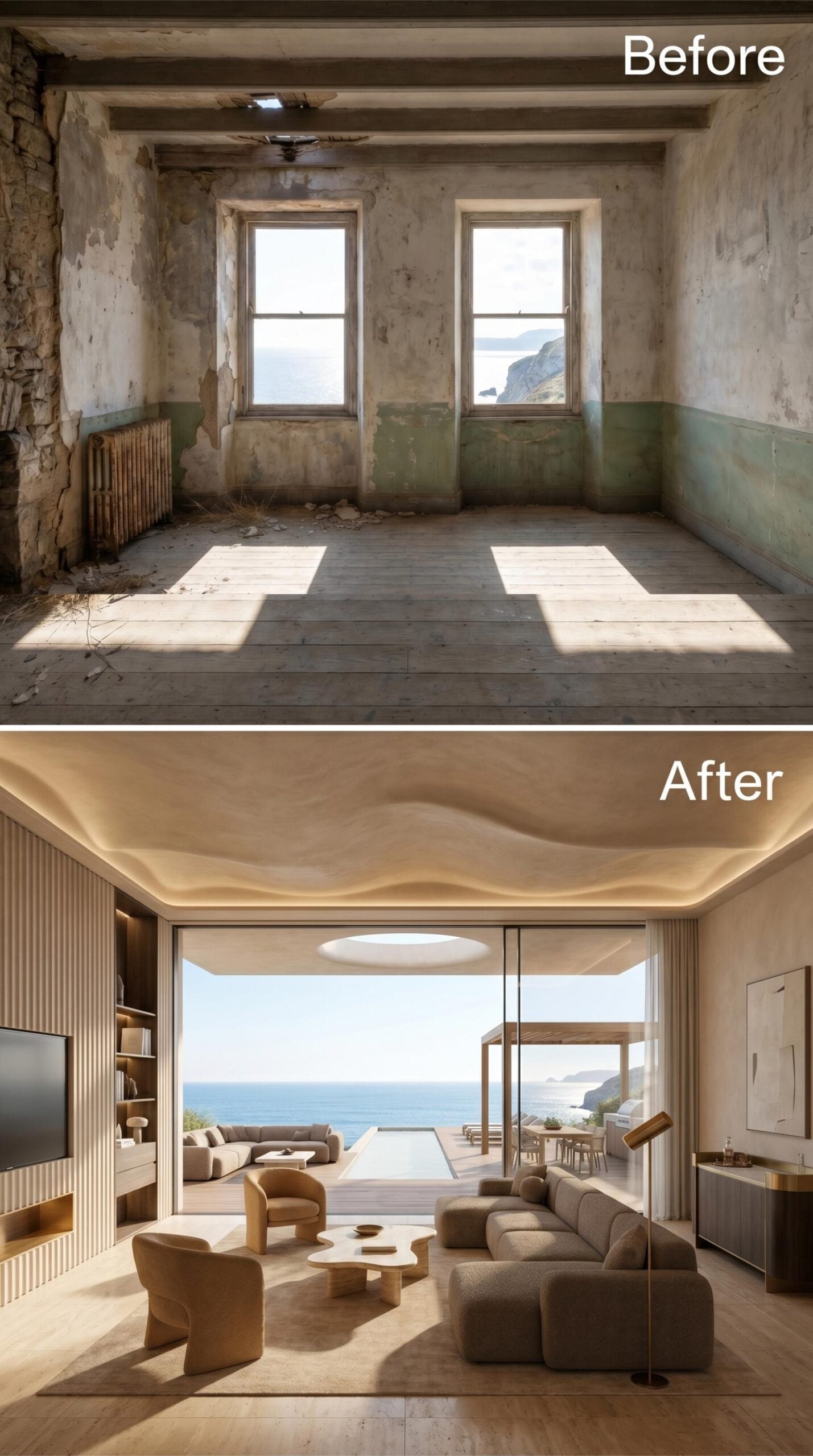
A sculpted ceiling draws the eye up before the view pulls it straight out to sea. The waves pressed into the plaster overhead aren’t decorative in the usual sense — they respond to how light moves across the surface, creating depth without any fixture doing the work. Cove lighting traces the perimeter and lets the ceiling read as its own feature rather than a backdrop.
Below, the palette holds tight. Sand-toned upholstery, a low travertine coffee table, and rounded armchairs in camel bouclé all sit within the same warm register. Floor-to-ceiling sliding glass removes the boundary between interior and terrace entirely, and that continuity is what makes the room feel larger than its footprint likely is.
10. Limestone Walls, Floor-to-Ceiling Glass, and a Sloped Ceiling That Pulls Light Toward the Sea
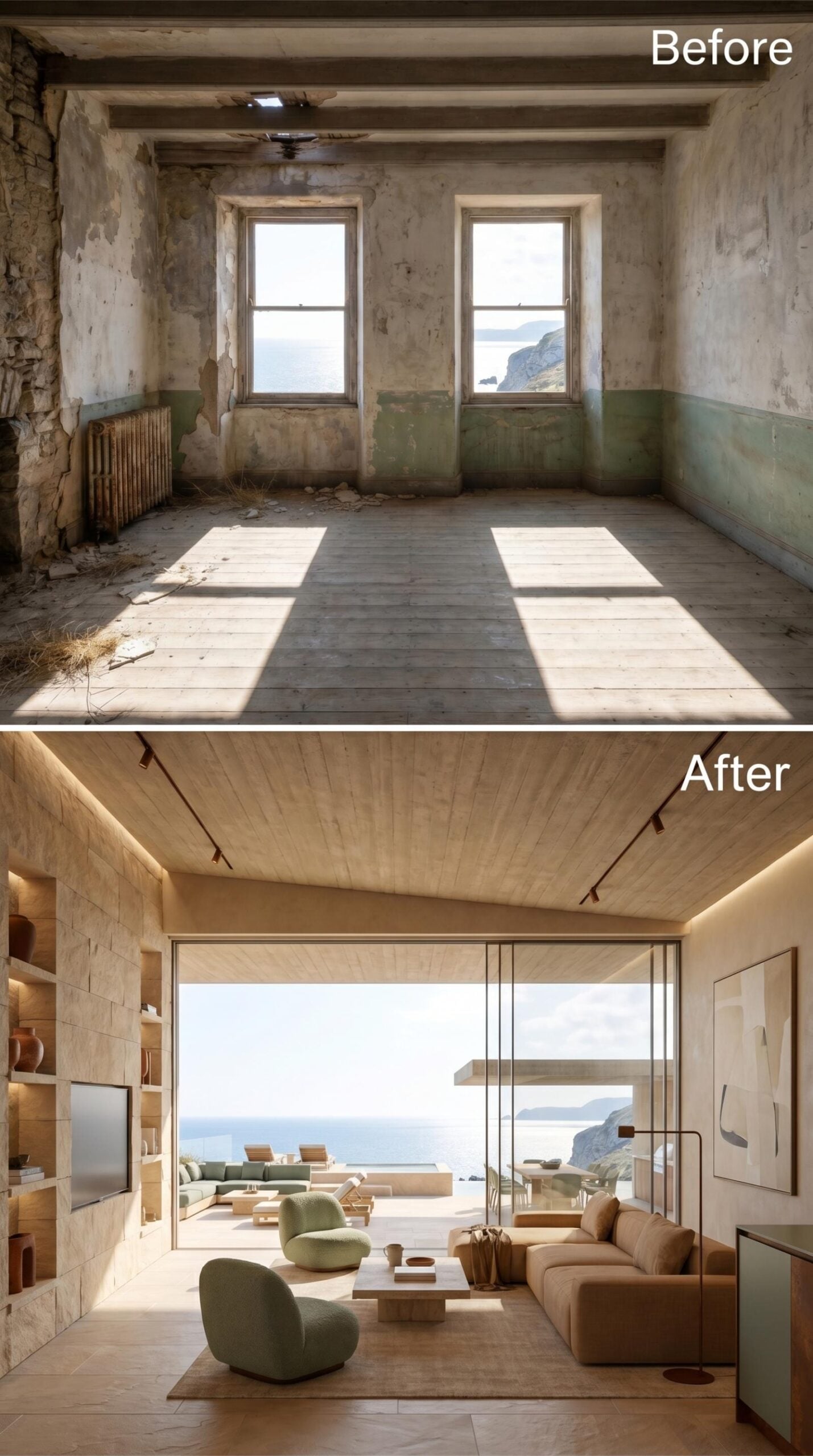
Travertine cladding runs the full height of the left wall, anchoring open shelving that holds ceramic vessels without competing with the view. The ceiling slopes gently downward toward the glass — which isn’t a window so much as a wall that’s been replaced entirely. Sage green chairs and a camel sectional sit close in value, so the room feels cohesive rather than busy.
9. Skylight, Sculptural Plaster Ceiling, and a Curved Sectional Opened Toward the Cliff
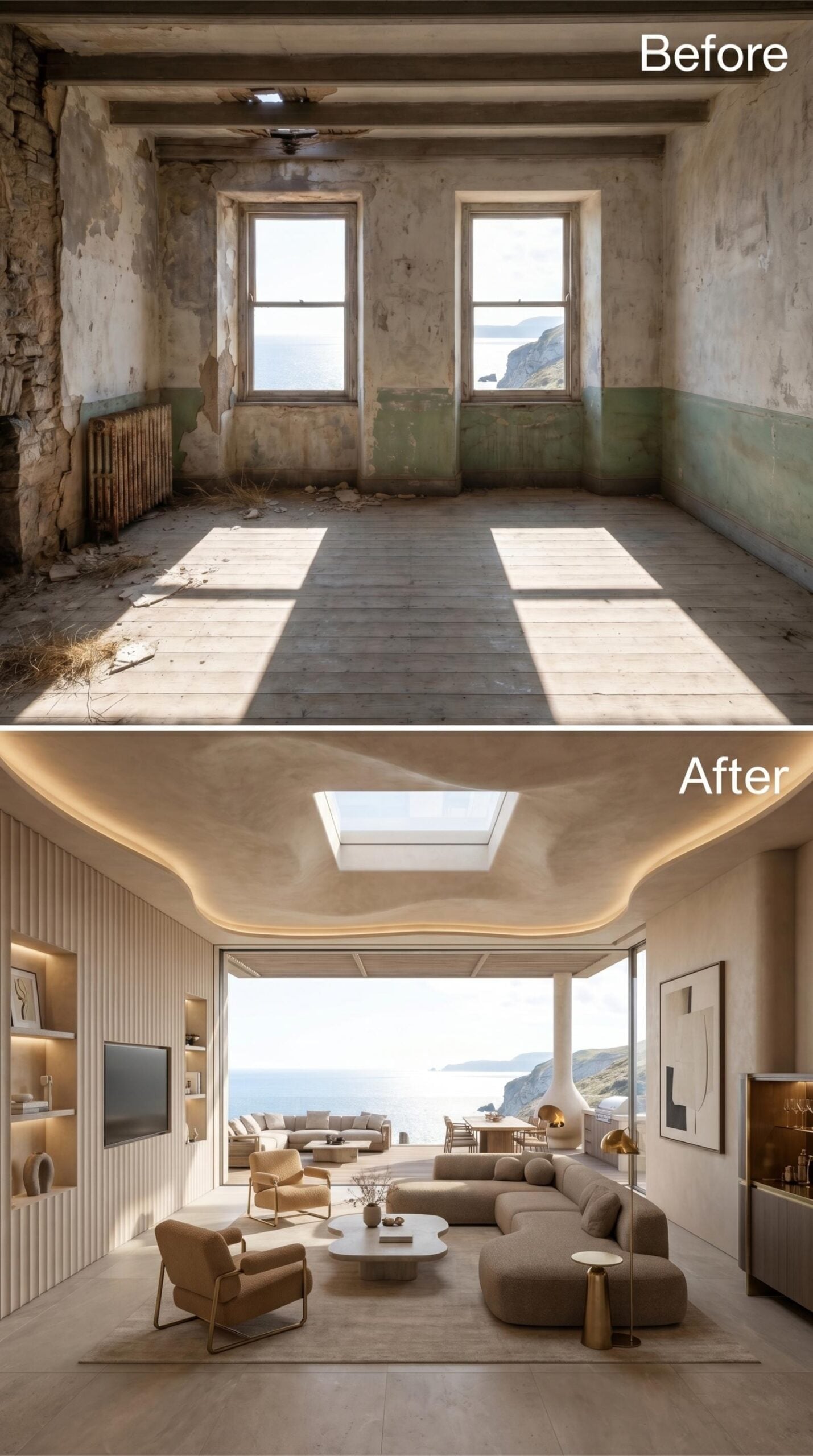
Plaster covers the ceiling in soft, cloud-like relief, lit from behind by a continuous LED cove running the perimeter. It earns the skylight above it rather than competing with it.
Every surface reads in the same warm sand register, which lets the curved sectional and the rounded coffee table feel like one composition instead of separate purchases. Then the floor-to-ceiling glass does the rest. The cliff just sits there and finishes the room.
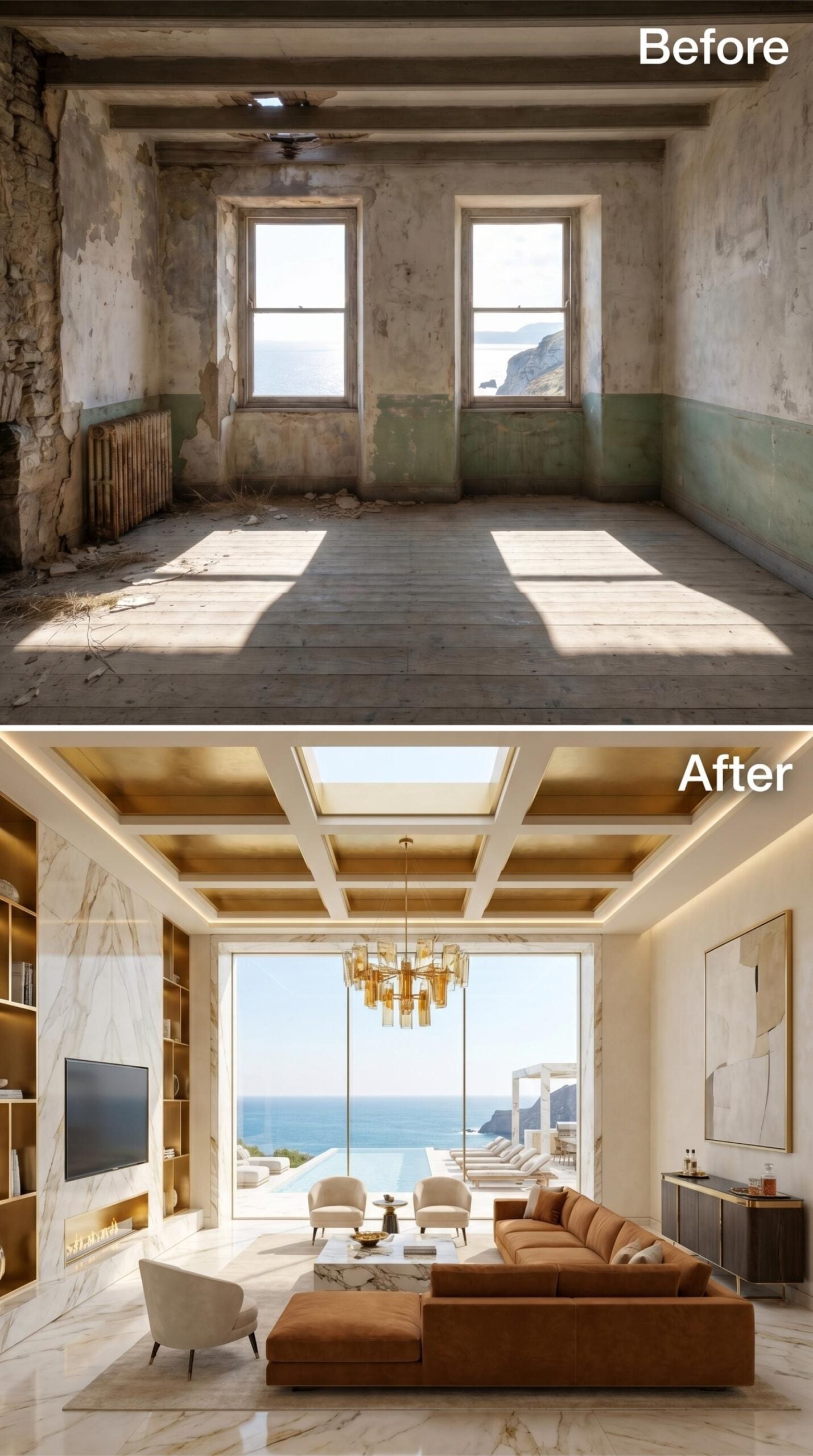
8. Coffered Ceiling in Gold and Cream, Marble Floors, and One Wall of Sea
🔥 Would you like to save this?
Gilt-edged coffered panels overhead pull the eye upward before the floor-to-ceiling glass pulls it straight out to the water. The sectional is cognac-toned velvet, deep and low. Marble tile runs wall to wall without interruption, keeping the sightline clean from the fireplace to the cliff.
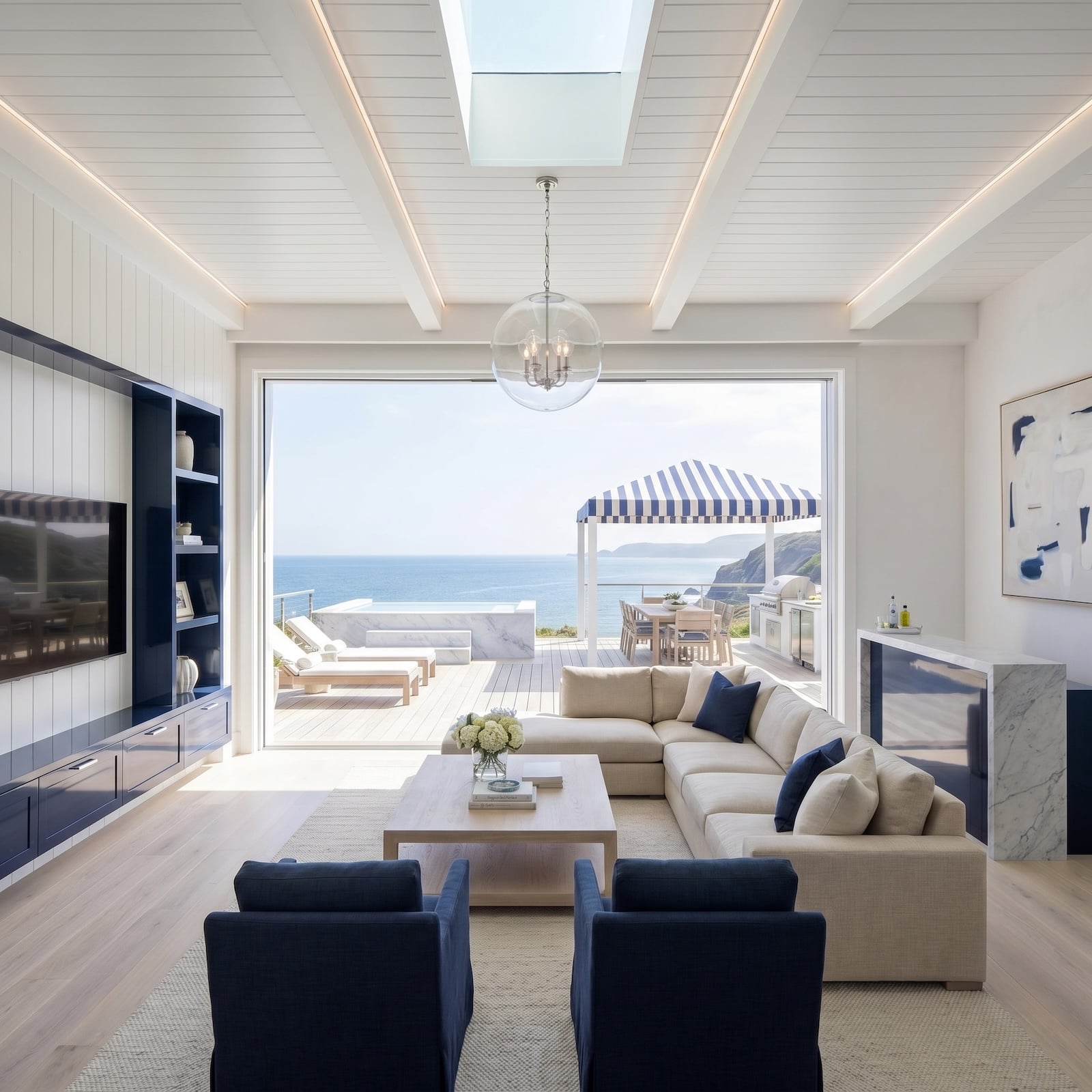
7. Shiplap Ceiling, Skylight, and a Wall Opened Entirely to the Sea
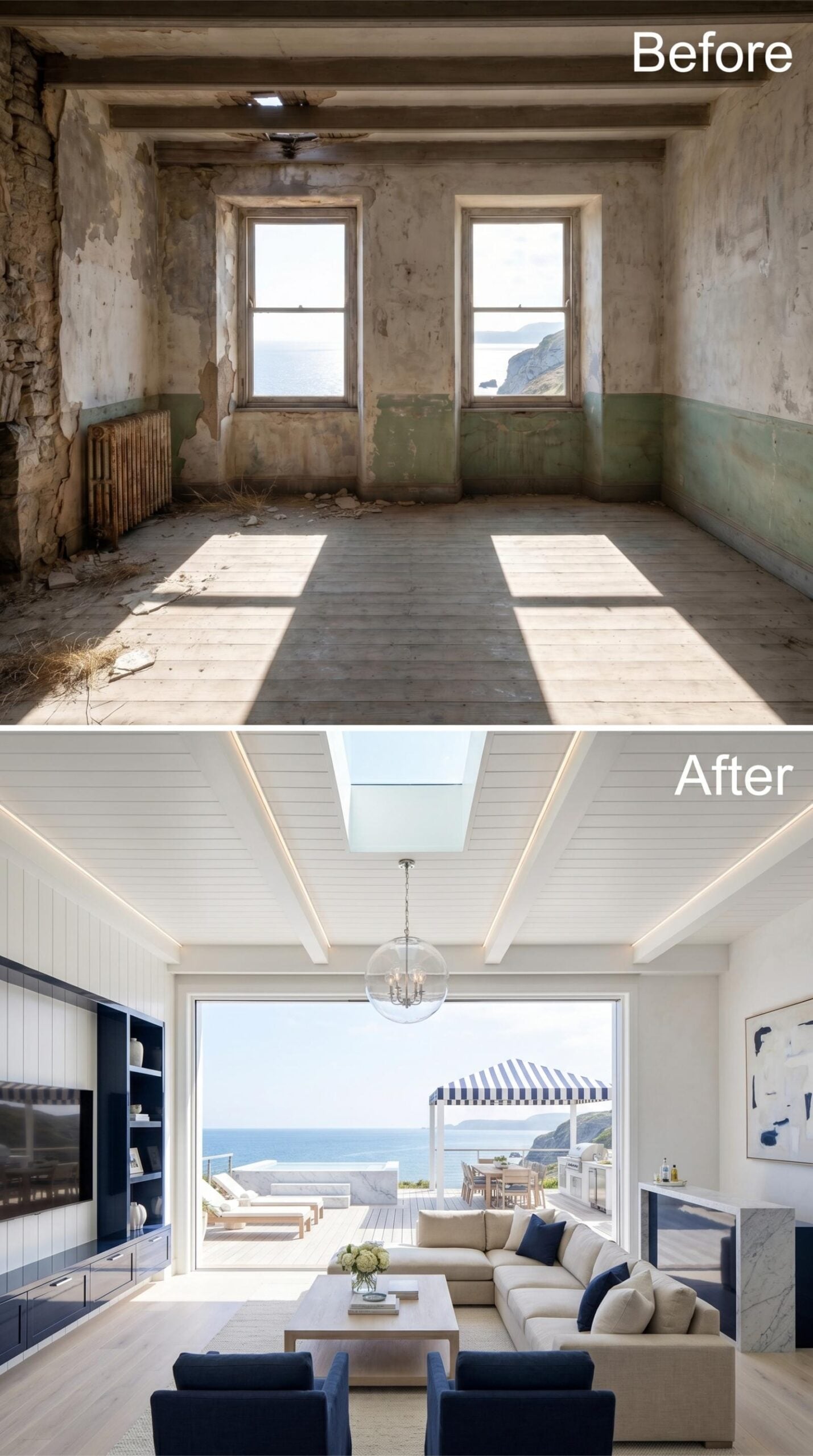
White shiplap runs the full ceiling length, with a skylight cut directly into it and LED cove lighting tracing the beam edges. The two-panel opening to the terrace does most of the work. Navy shelving anchors the left wall so the room doesn’t float away.
6. Rounded Arches, Terracotta Velvet, and a Skylight Pulled Over the Sea View
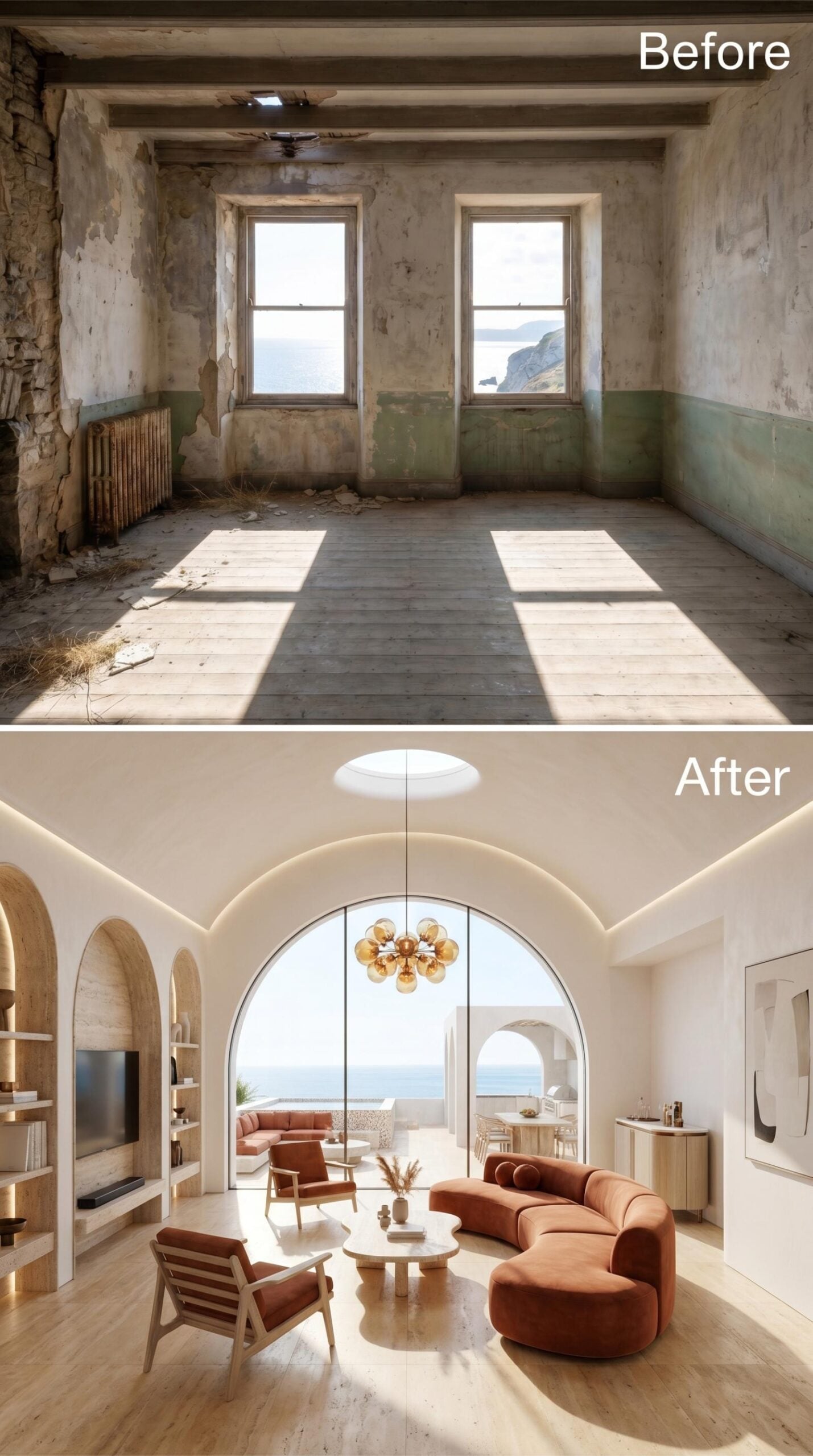
Smooth plaster arches frame every sightline, and the curved sectional in burnt terracotta velvet anchors the room without crowding it. A round skylight feeds natural light down to the pale oak floor. That globe chandelier in amber glass earns its place.
5. Copper Ceiling, Pendant Cluster, and Teal Velvet Pulled Toward the Cliff View
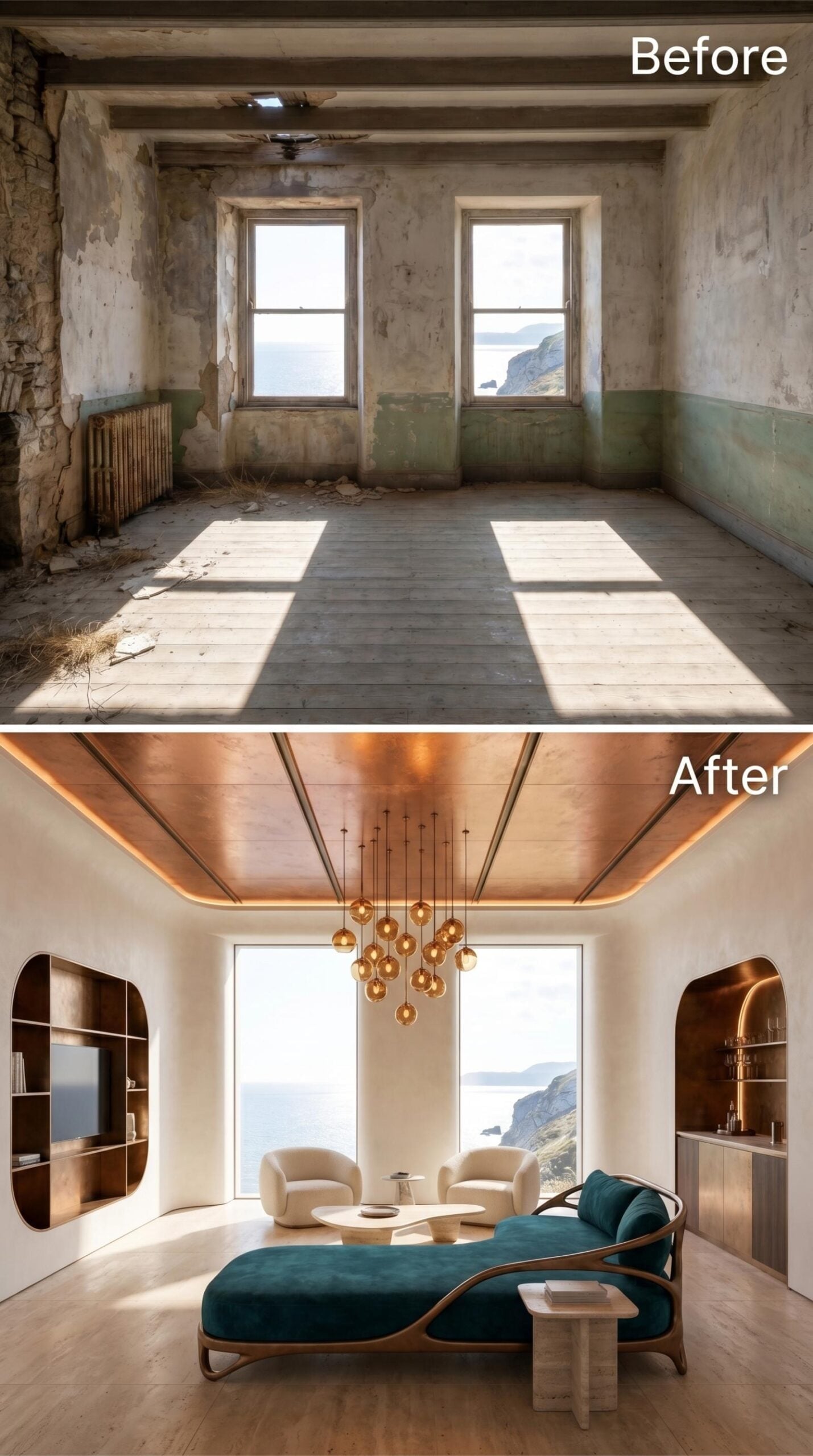
Warm copper wood cladding wraps the entire ceiling, angled down at the perimeter with recessed strip lighting tucked where the slope meets the wall. From below, it reads almost like a lantern. A cluster of amber glass pendants drops from the center at staggered lengths, throwing gold light across the cream plaster beneath.
What were once two separate windows became a single floor-to-ceiling opening that frames the sea cliff head-on. Built-in shelving with rounded arch detailing anchors both side walls in walnut. The curved teal velvet chaise at the front of the room doesn’t compete with the view — it gives you a reason to face it.
4. Crystal Chandelier, Barrel Vault Skylight, and Blue Velvet Anchored Against the Sea
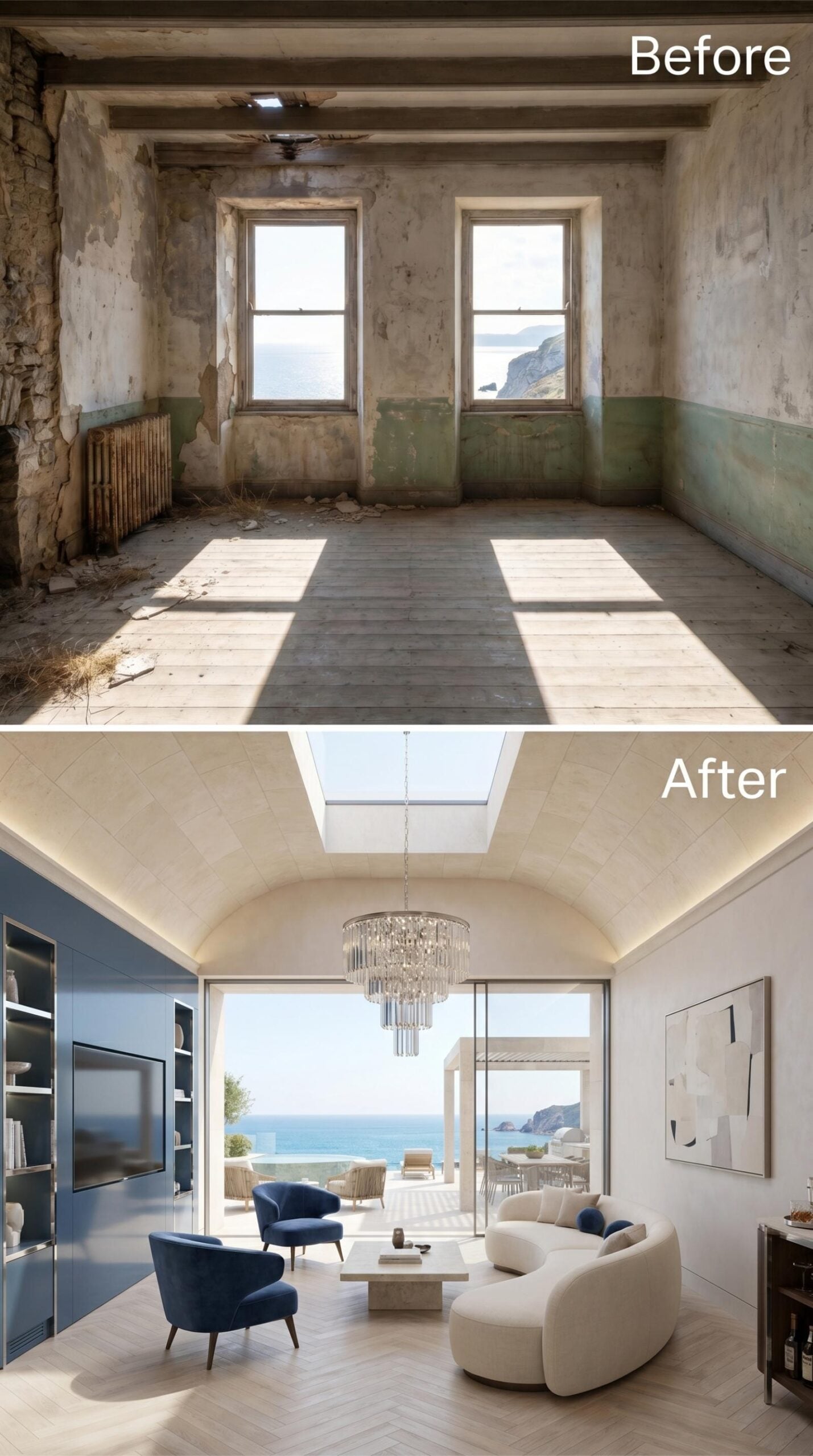
Ivory plaster curves up into a barrel vault punctuated by a skylight, and the room reads lighter for it. A crystal chandelier hangs at center, its tiered drops catching coastal light without competing with the view through the full-width sliding glass wall beyond.
Navy velvet chairs pull the color story toward the built-in shelving wall, which runs the same blue across the entire left side. The curved cream sectional faces outward. It’s a deliberate tension, and it holds.
3. Exposed Beams, Globe Chandelier, and Dark Stone Anchoring a Cream Sectional Toward the Cliff
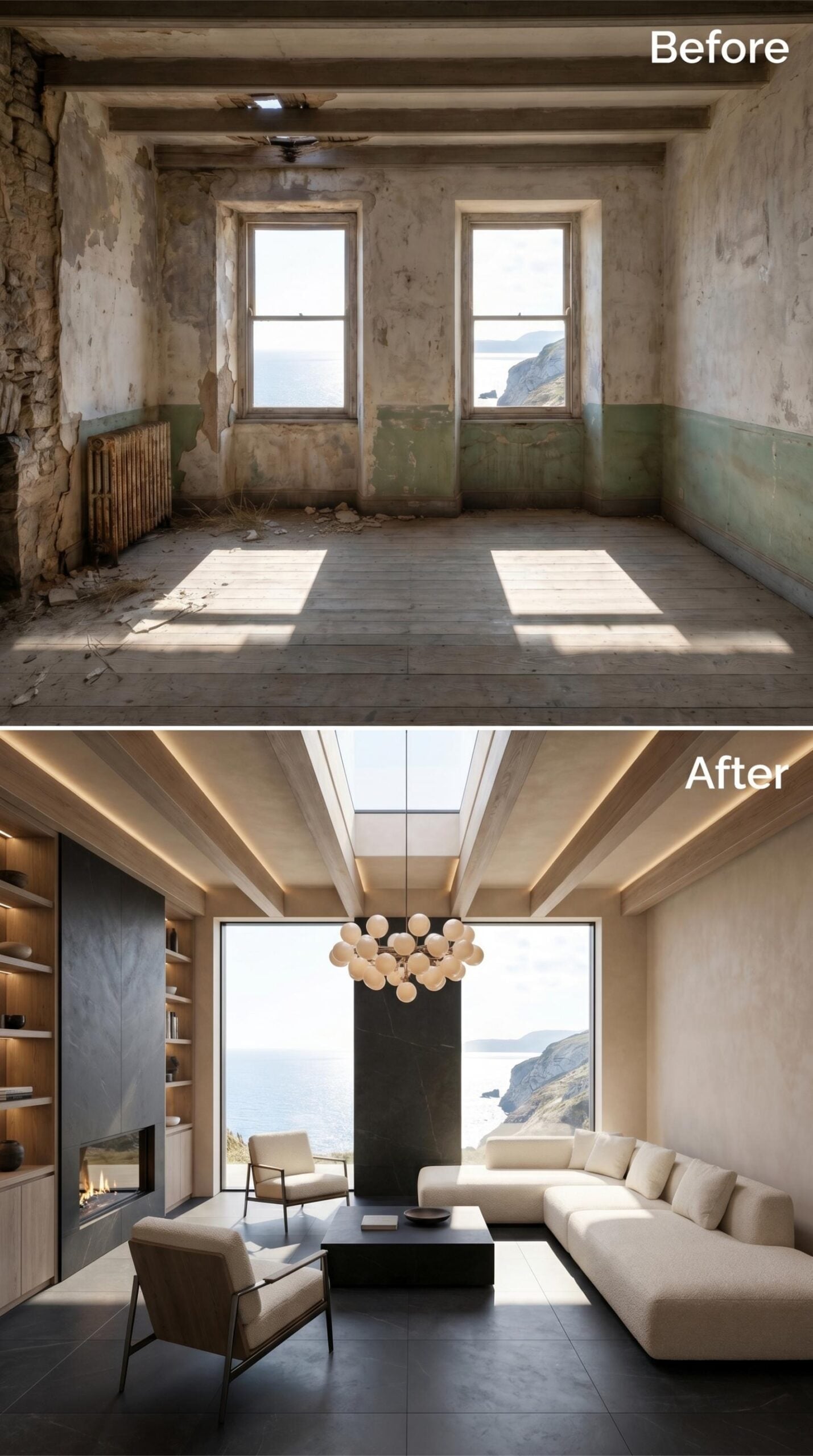
Cove lighting tucked into the ceiling beams does the quiet work here, leaving the globe chandelier to read as sculpture rather than light source. The sectional is cream bouclé, and it’s big enough that the room doesn’t need anything else to feel finished.
2. Skylit Beams, Marble Floors, and a Sectional Angled Toward the Open Sea
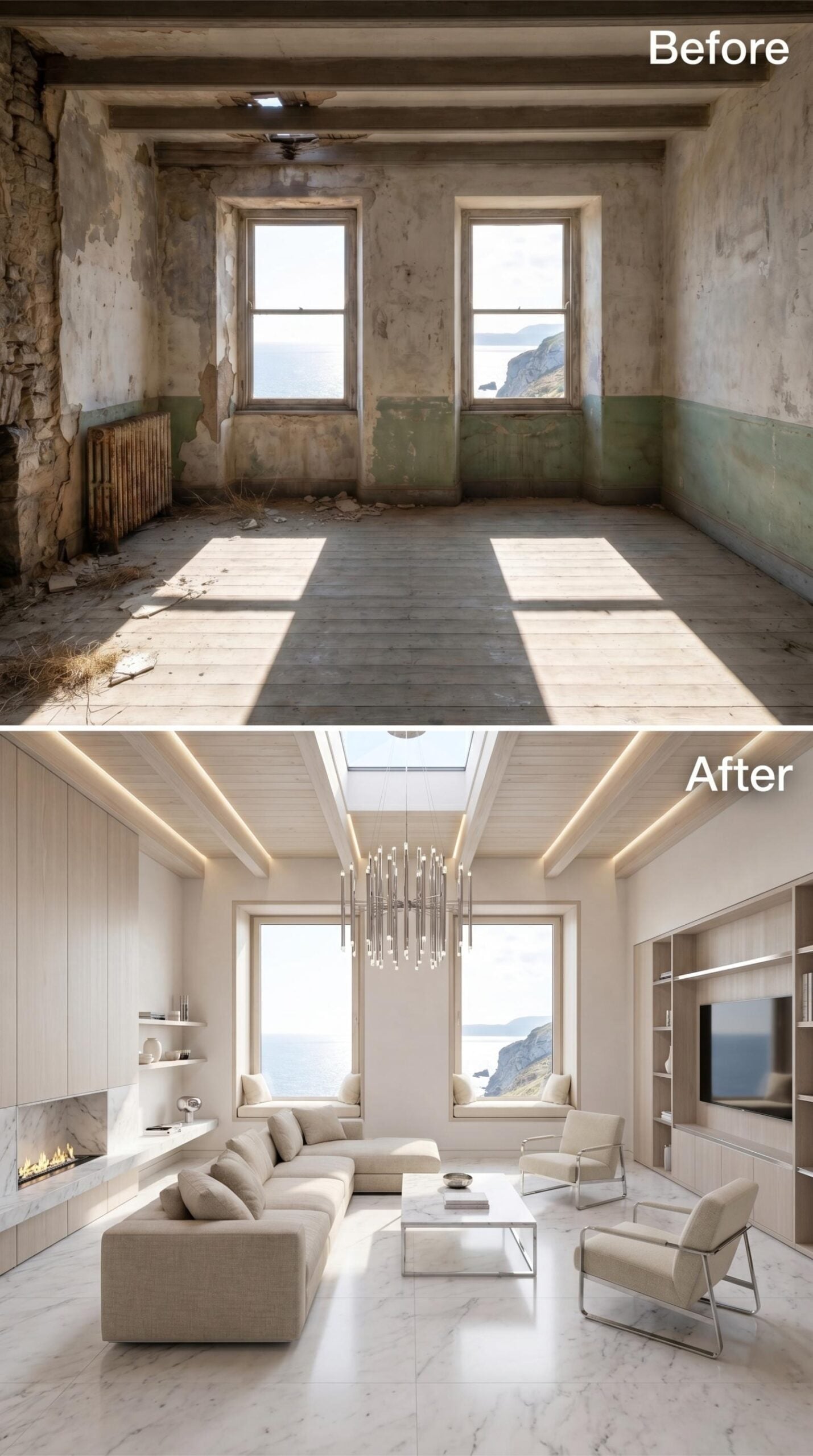
Reclaimed wood beams run the length of the ceiling, framing a central skylight that pulls midday light straight down onto marble floors veined in pale grey. LED strip lighting tucked behind each beam softens the room after dark without competing with the chandelier overhead — a multi-arm chrome fixture hung low enough to anchor the seating arrangement rather than float above it.
The sectional sits in a warm greige fabric, loose and deep-cushioned, arranged around a marble-topped coffee table with two chrome-framed armchairs facing it across the surface. What holds the room together isn’t any single material. Every surface reflects light rather than absorbing it, so the cliff view through those tall windows reads as part of the room, not a backdrop to it.
Every surface reflects light rather than absorbing it, so the cliff view reads as part of the room, not a backdrop to it.
1. Cobalt Built-Ins, Circular Skylight, and an Open Wall Facing the Cliff
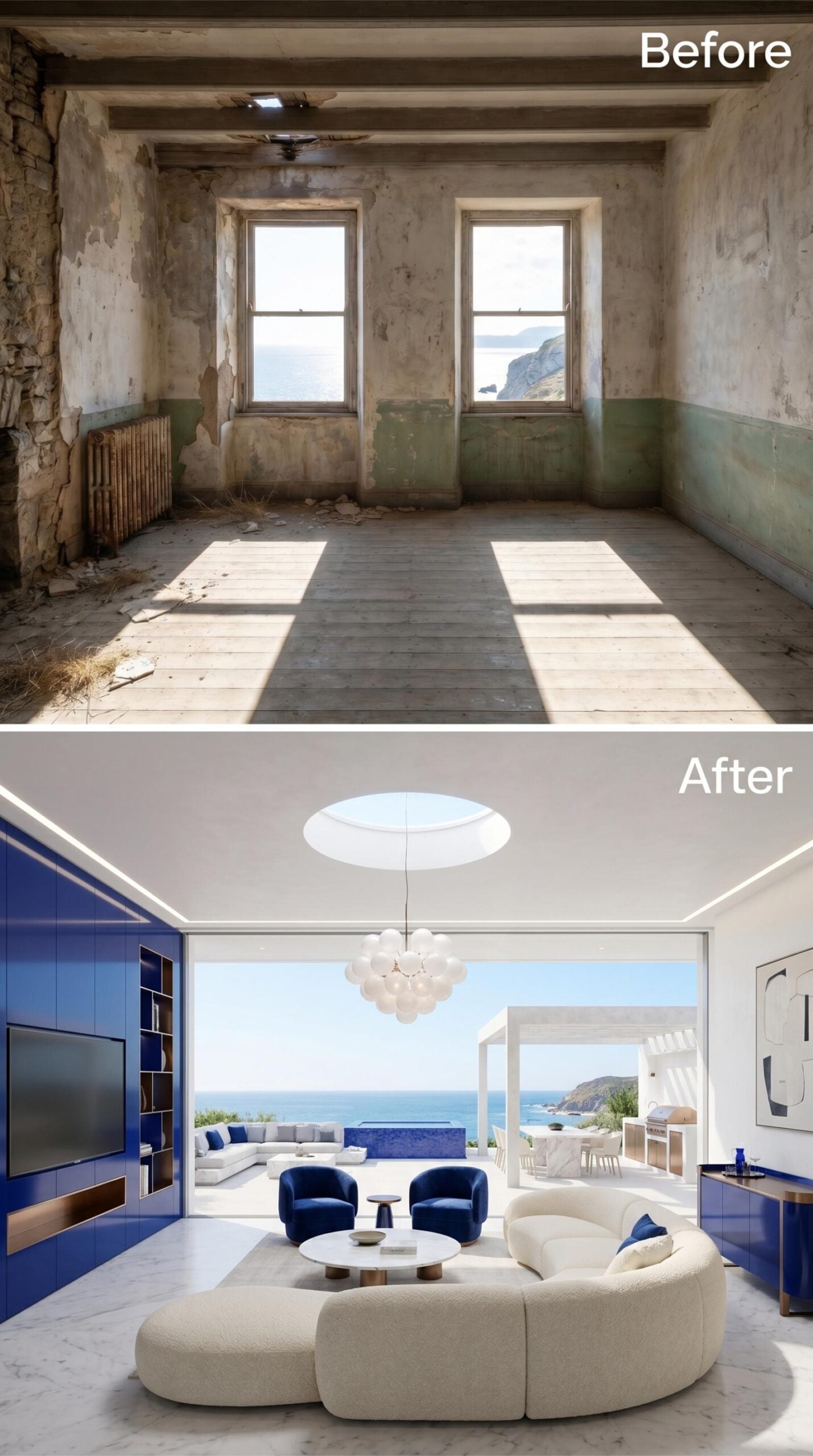
Glossy royal blue cabinetry runs the full left wall, and the lacquer finish keeps it from reading as heavy against all that marble and white. The circular skylight overhead is small but precise — it drops a column of light directly onto the round coffee table below, which feels intentional rather than lucky.