🔥 Would you like to save this?
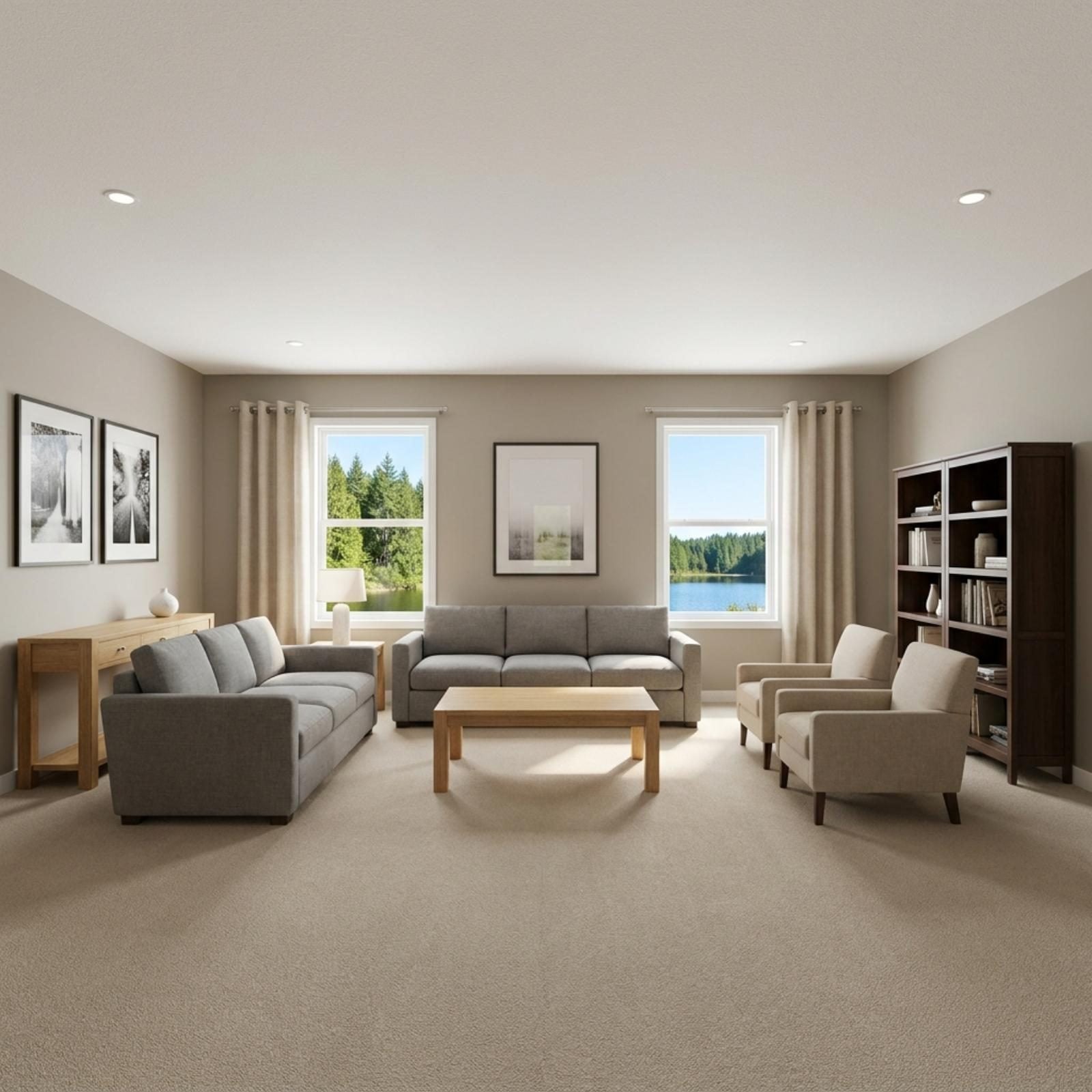
There is no scientifically certified living room for happy people, which is probably a relief. Happiness would be a fairly grim decorating brief if it came with an approved paint chip. But rooms can make everyday life easier or harder: places to sit that encourage conversation, lighting that works after sunset, corners with an actual purpose, enough visual interest to make staying home feel like a choice rather than a default.
So we gave one thoroughly forgettable living room to AI and asked for 31 radically different ways to make it more enjoyable to inhabit. The answers don’t agree on color, furniture, symmetry, or even whether a television belongs in the room. What they share is more useful: each gives people something to do, somewhere to settle, and a reason to stay awhile.
In order to come up with the very specific design ideas, we create most designs with the assistance of state-of-the-art AI interior design software. Also, assume links that take you off the site are affiliate links such as links to Amazon. this means we may earn a commission if you buy something.
31. The Aquarium Wall Gives the Room Something Alive to Look At
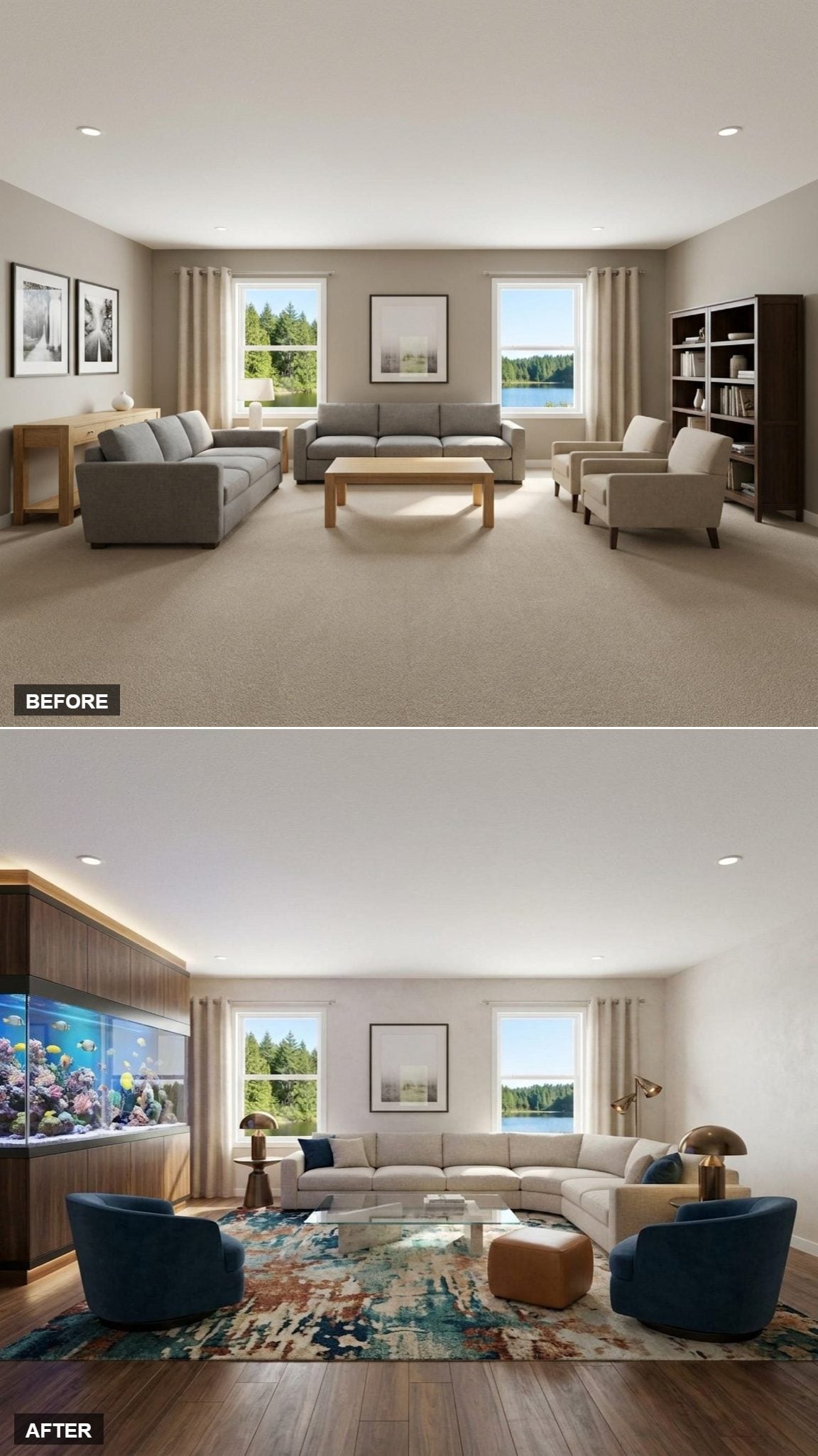
A full built-in aquarium composition framed in dark walnut cabinetry and blackened-bronze trim takes over one wall, replacing the usual television-or-fireplace default with something constantly changing. A sweeping oatmeal-colored sofa arcs toward it, while two deep ocean-blue swivel chairs can turn toward the tank or back toward the people in the room.
A transparent glass-and-stone coffee table keeps the sightlines open. Walnut flooring, a teal-rust-navy rug, and softly textured walls give the aquarium enough visual weight to dominate without making everything else disappear. The room commits to one spectacle and knows when to stop.
30. The Backgammon Table Changes What Everyone Came Here to Do
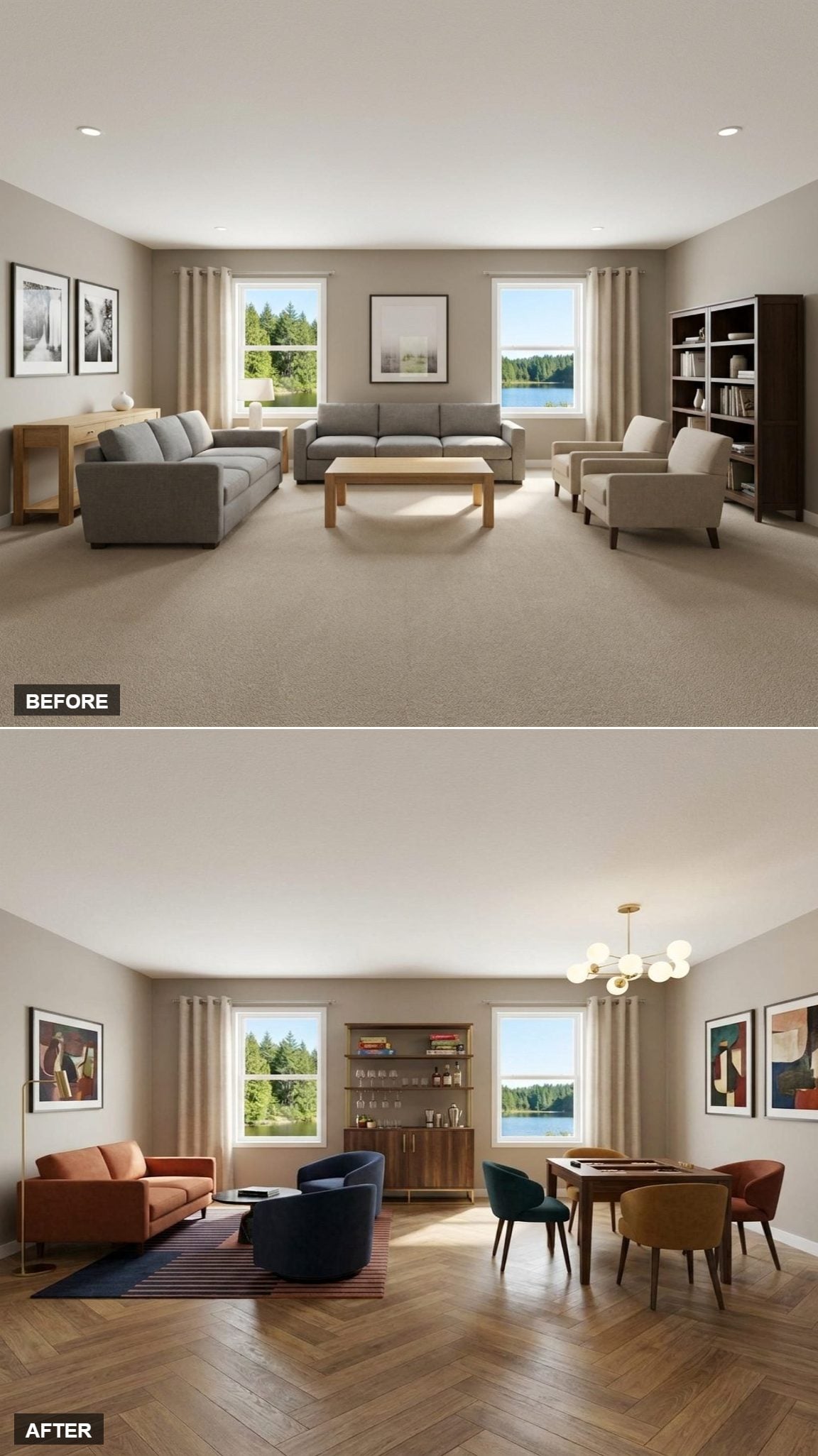
The television isn’t the point here, and that single choice changes the hierarchy of the room. A square walnut game table surrounded by teal, cognac, mustard, and rust chairs puts four people face-to-face. A burnt-orange loveseat and low ink-blue swivel chairs create a looser second place to sit when the game ends but nobody is ready to leave.
Herringbone oak flooring and a navy-and-terracotta rug give the center definition without enclosing it. The walnut-and-brass bar cart handles drinks without demanding a built-in bar. This is a Friday-night room designed around participation rather than observation.
29. What Happens When the Books Get the Best Wall
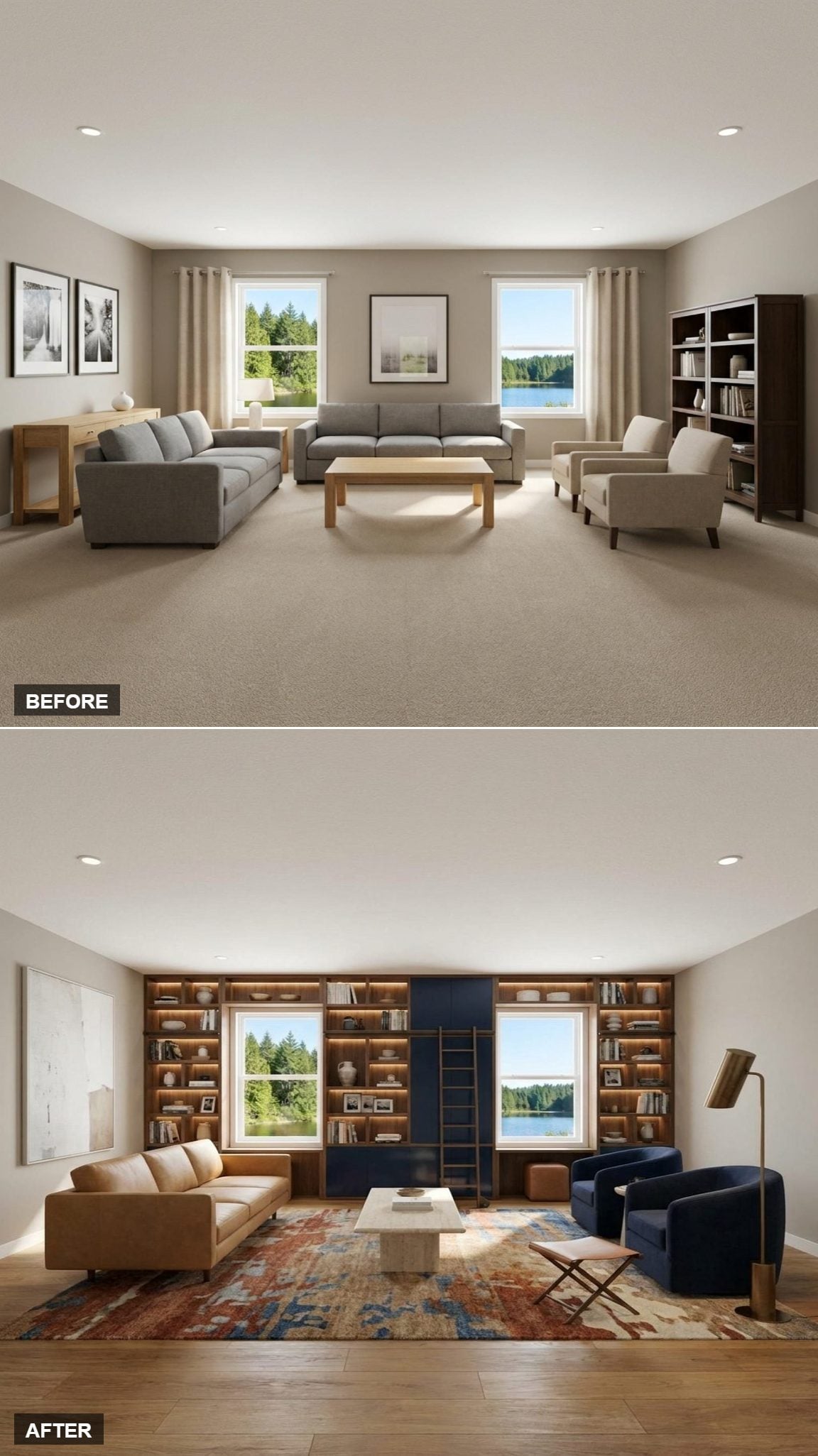
Staggered walnut shelving with integrated warm lighting and sections of deep navy lacquer turns the book collection into the visual event. A slim rolling ladder, where ceiling height and clearances allow it, adds a little theater to what is fundamentally a storage wall.
The camel leather sofa floats away from the shelves, two navy barrel chairs angle toward it, and a long cream travertine table connects the grouping. For anyone serious about family room design, the interesting move is not the ladder. It’s giving books the wall most rooms automatically surrender to a television.
28. A Double-Sided Fireplace Gives One Room Two Addresses
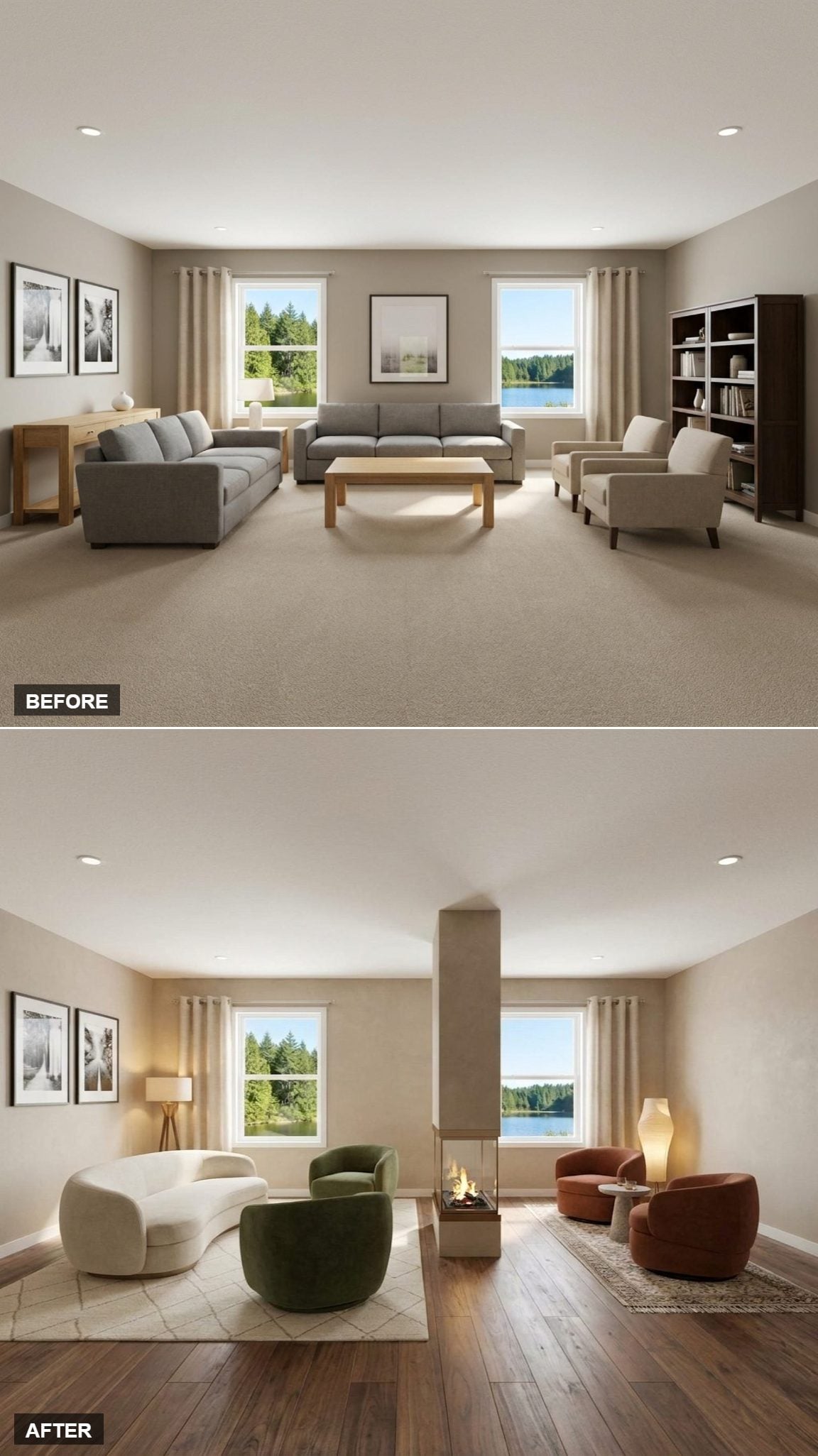
A slender freestanding double-sided glass fireplace occupies the middle of the plan instead of retreating to a perimeter wall. On one side, a curved ivory sofa and moss-green lounge chair form the main conversation area. On the other, rust-colored swivel chairs create a quieter perch near the windows. The fire belongs to both.
Wide-plank walnut flooring ties the zones together while different rugs make their boundaries legible. Nobody has been banished to a separate room, yet not everybody has to participate in the same activity. That distinction is what makes the layout more interesting than simply adding more chairs.
The fireplace doesn’t have to divide the room. It can give the same room two different places to be.
27. Lavender, Cobalt, and Paprika Without the Memphis Theme Party
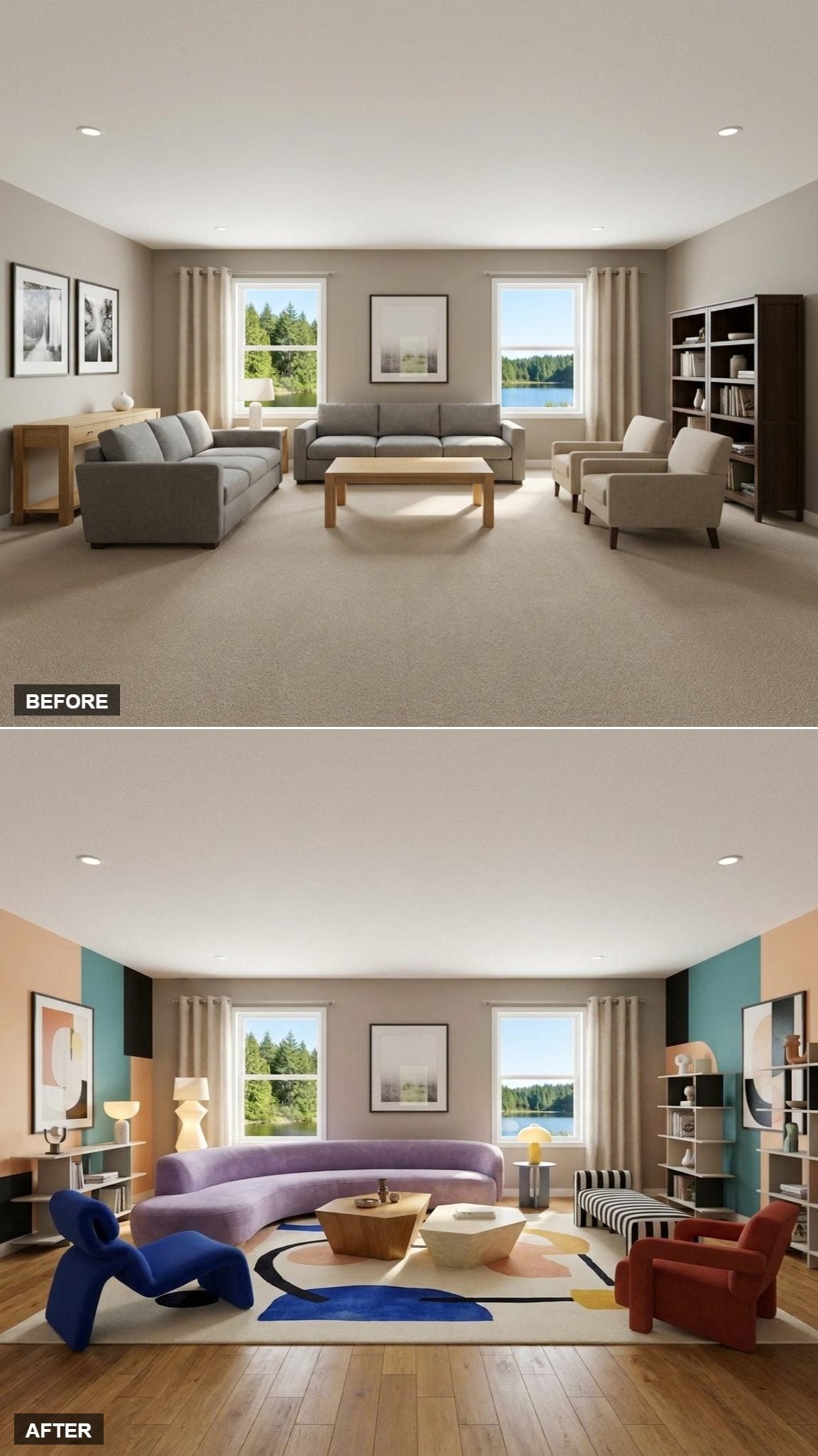
Memphis-inspired color can go from exhilarating to costume department with astonishing speed. Here, the lavender curved sofa sits on a deliberate diagonal while a cobalt lounge chair and paprika chair punctuate the ends. The furniture is exuberant; the amount of furniture isn’t.
Geometric wall color blocking replaces a gallery wall, and the black-and-white striped bench adds one controlled hit of pattern. Warm oak flooring and a large cream rug leave enough quiet surface around the saturated pieces that each color remains distinguishable instead of turning into visual static.
26. The Room That Trades the Television for an Olive Tree
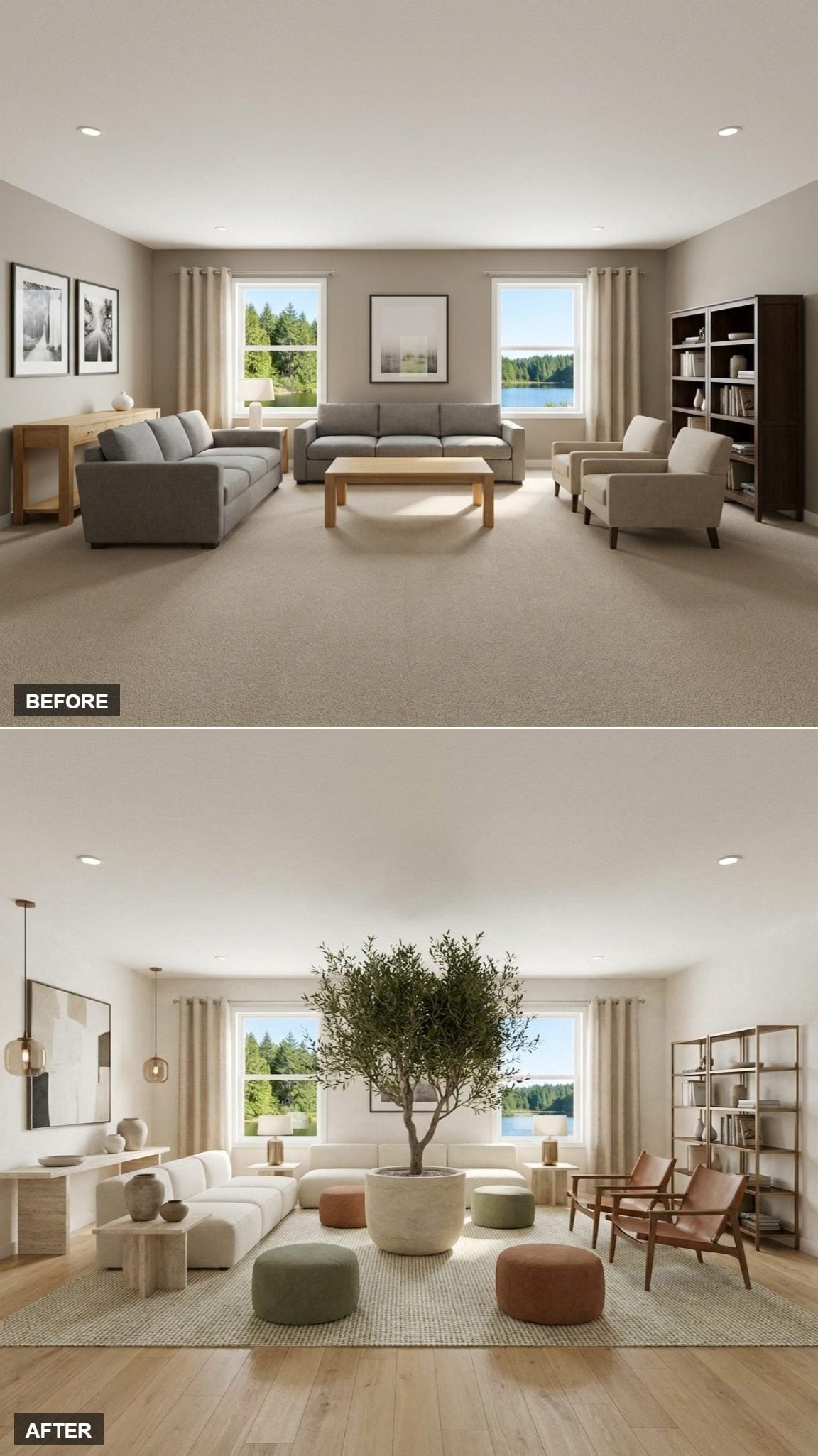
A mature olive tree in a pale limestone planter takes the position usually reserved for a screen. The low ivory modular sofa, saddle-leather sling chairs, and movable sage and terracotta poufs all turn toward the greenery instead. It sounds like a boutique-hotel maneuver until you notice how little else the room needs.
Limestone-look flooring, limewashed walls, a cream-and-sage rug, travertine side tables, and bronze-and-glass lighting keep the materials close to the tree’s dusty green and silver tones. In a genuinely bright narrow living room, a substantial plant can become an anchor without consuming the whole floor plan.
25. The Media Wall Finally Gives the Television Some Manners
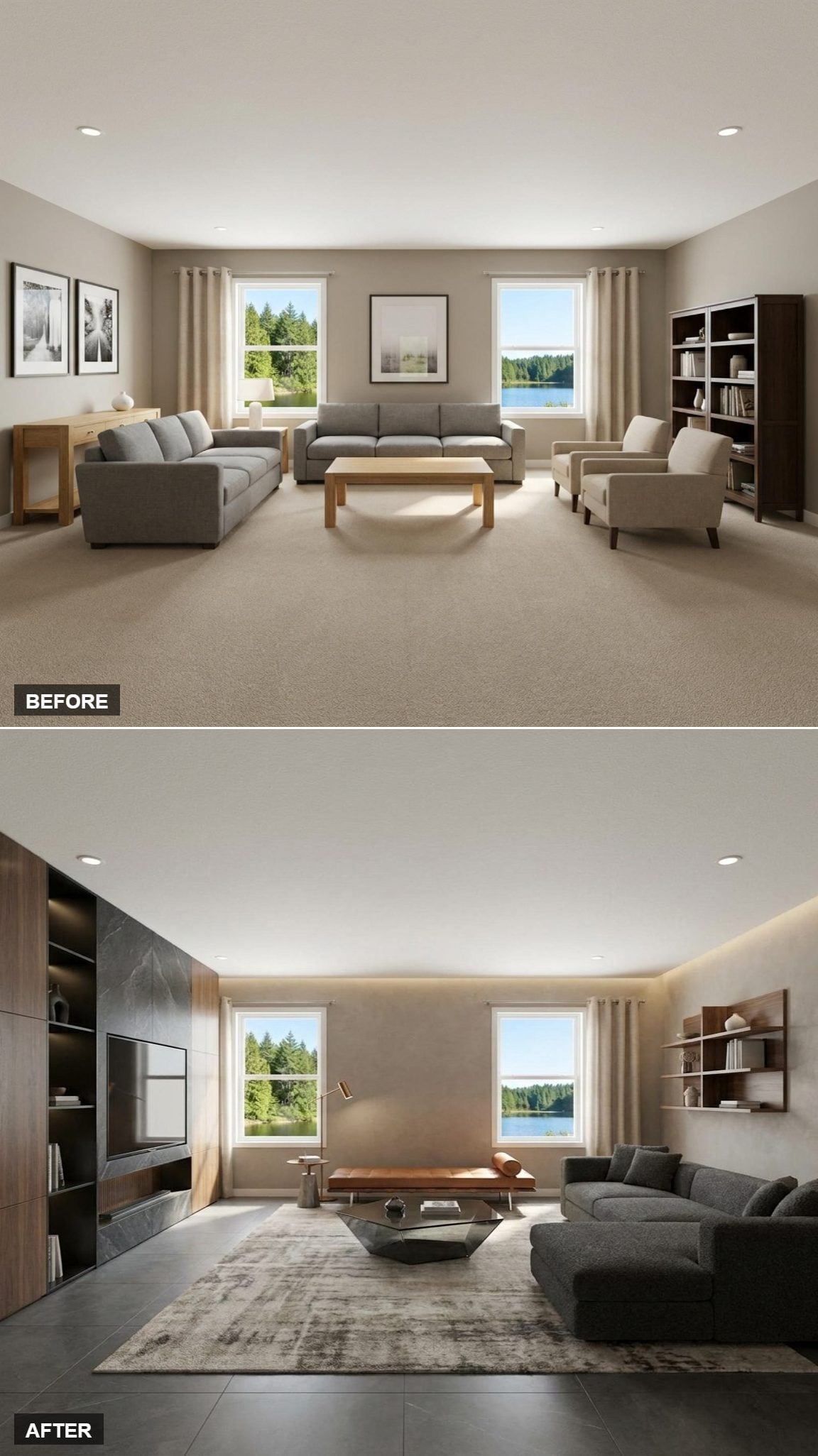
Instead of hanging alone like an electronic afterthought, the television disappears into a floor-to-ceiling composition of smoked walnut, matte black steel, and bookmatched charcoal stone. The graphite bouclé L-shaped sectional rotates 90 degrees from the original plan, changing circulation almost as much as the new wall changes the view.
The cognac leather daybed near the windows is the smarter move. It has a bronze reading lamp, pedestal table, and absolutely no obligation to the television. One person can watch something while another reads ten feet away without either activity owning the entire room.
24. The Gallery Wall Gets the Attention the Sofa Usually Steals
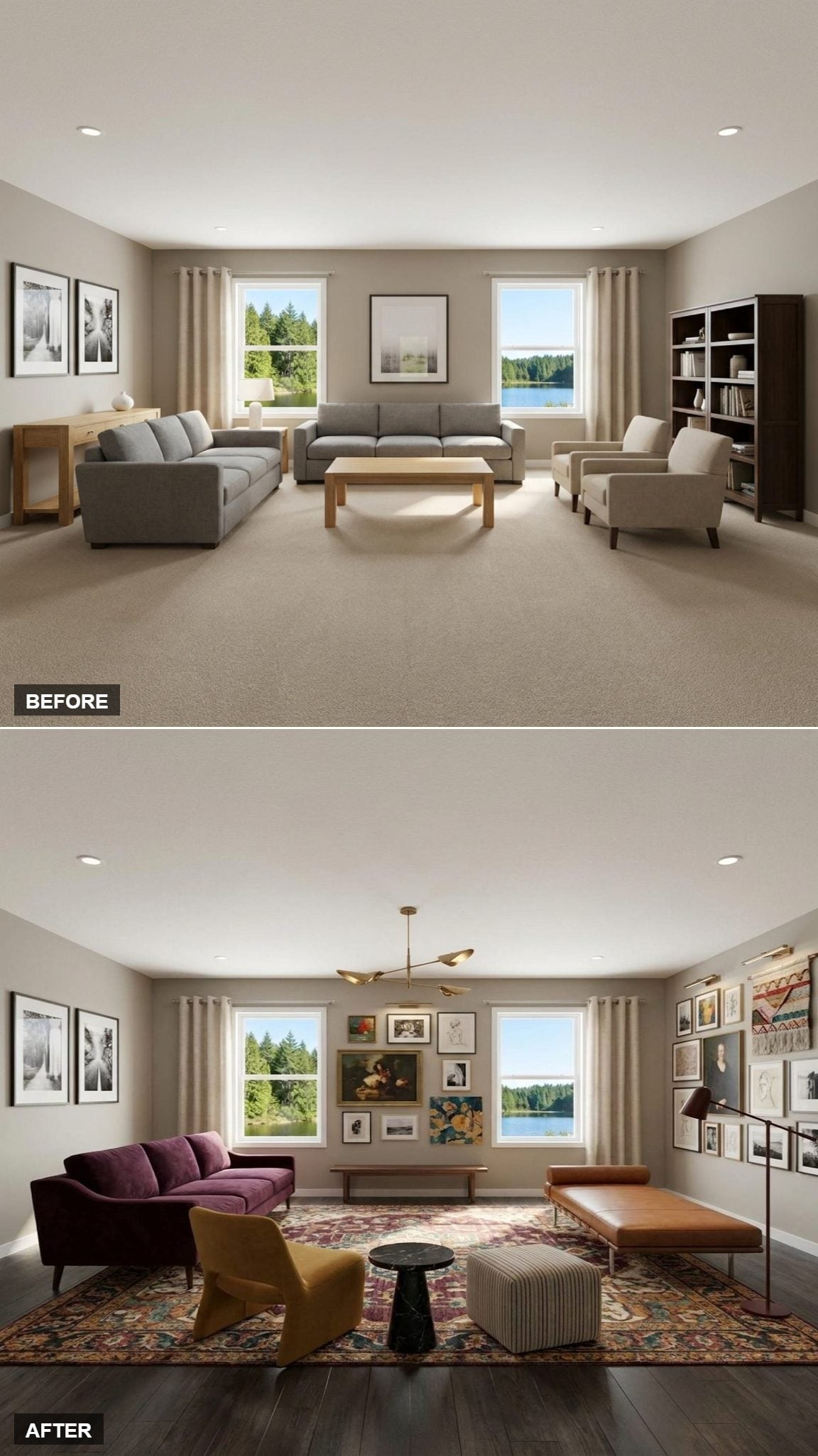
Dark smoked-oak flooring sets up a deep plum velvet sofa, but the furniture deliberately refuses to become the loudest thing in the room. That job goes to a floor-to-ceiling salon wall of paintings, photography, drawings, and framed textile pieces under picture lights.
An ochre lounge chair and cognac leather chaise face inward from opposite ends, while a striped ottoman moves wherever an extra seat or footrest is needed. The charcoal family room instinct for depth survives here; the difference is that art, not electronics, supplies it.
23. A Hanging Chair Makes One Corner Worth Crossing the Room For
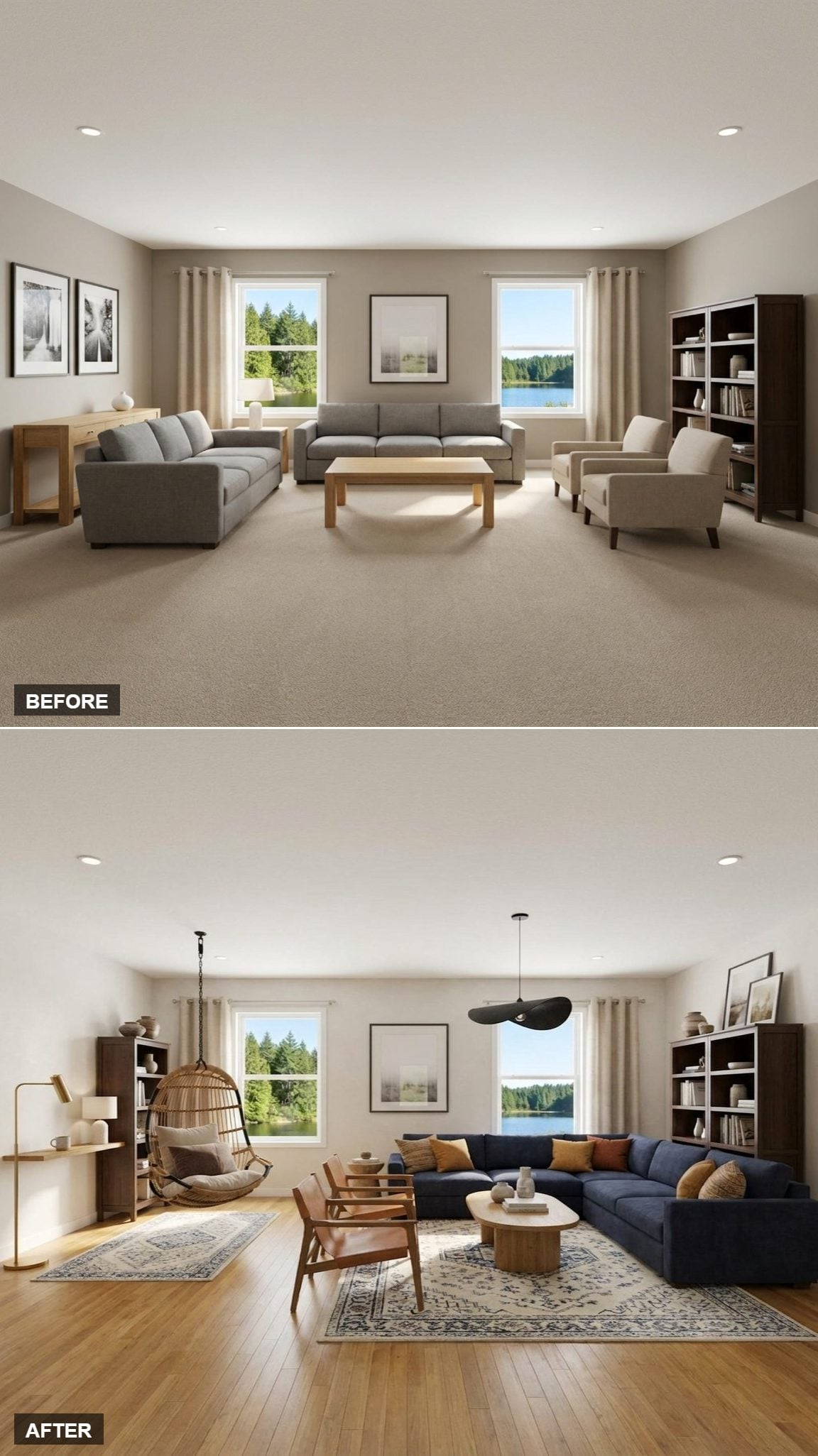
A woven-rattan-and-black-steel hanging chair turns an otherwise leftover corner into a destination. Add a tall bookcase, drink ledge, and dedicated floor lamp, and the corner begins operating independently from the main seating rather than merely decorating its edge.
Across the room, a deep indigo sofa, two caramel leather sling chairs, and a chunky oval oak coffee table create the social half. The same dual-use logic works in game room ideas: give different activities real territory instead of asking one furniture arrangement to accommodate everything.
22. Emerald on Emerald, With Just Enough Friction Between the Greens
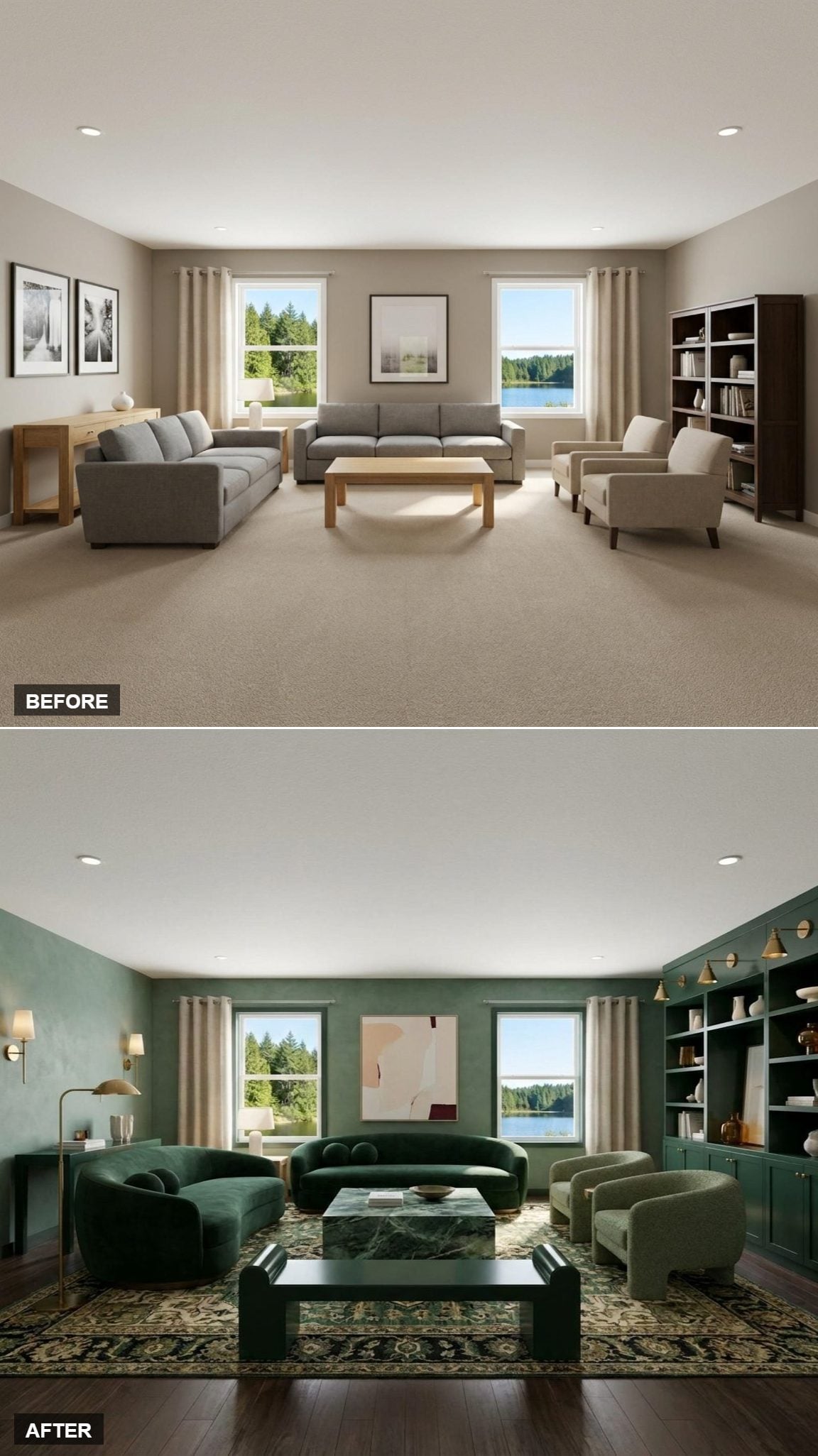
The bottle-green curved velvet sofa, moss bouclé lounge chairs, muted emerald limewash walls, and dark-green lacquered storage all belong to the same color family without pretending to be the same color. That distinction keeps the room from turning into a paint swatch enlarged to architectural scale.
A green-veined marble coffee table adds another green through stone rather than upholstery, while dark walnut flooring and aged-brass lighting warm the edges. The room isn’t restrained. It is controlled.
21. A Fireplace and Wet Bar Share the Same Wall Without Fighting for Attention
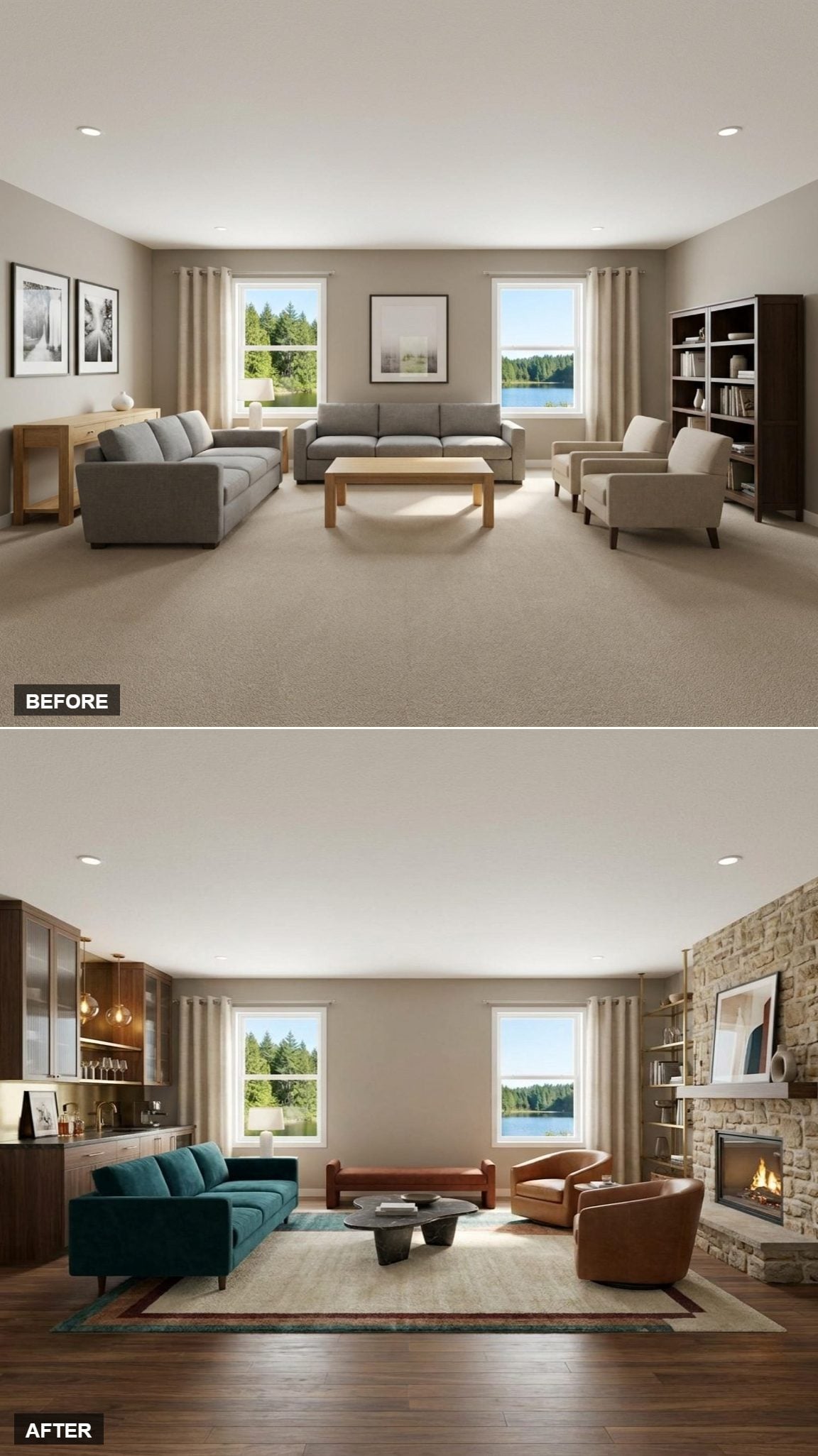
A warm textured-stone fireplace surround and adjacent walnut-and-bronze wet-bar cabinetry turn one wall into a hospitality zone rather than scattering several focal points around the room. The deep teal sofa faces it directly, while two cognac leather swivel chairs can turn toward fire, drinks, or conversation.
A backless burnt-rust bench near the window creates another place to land without blocking the view. The cream, teal, rust, and burgundy rug keeps the separate functions visually connected. Good family room design often comes down to letting several activities coexist without making the room look like a furniture showroom with competing departments.
20. The All-White Room Lets Shape Replace Color
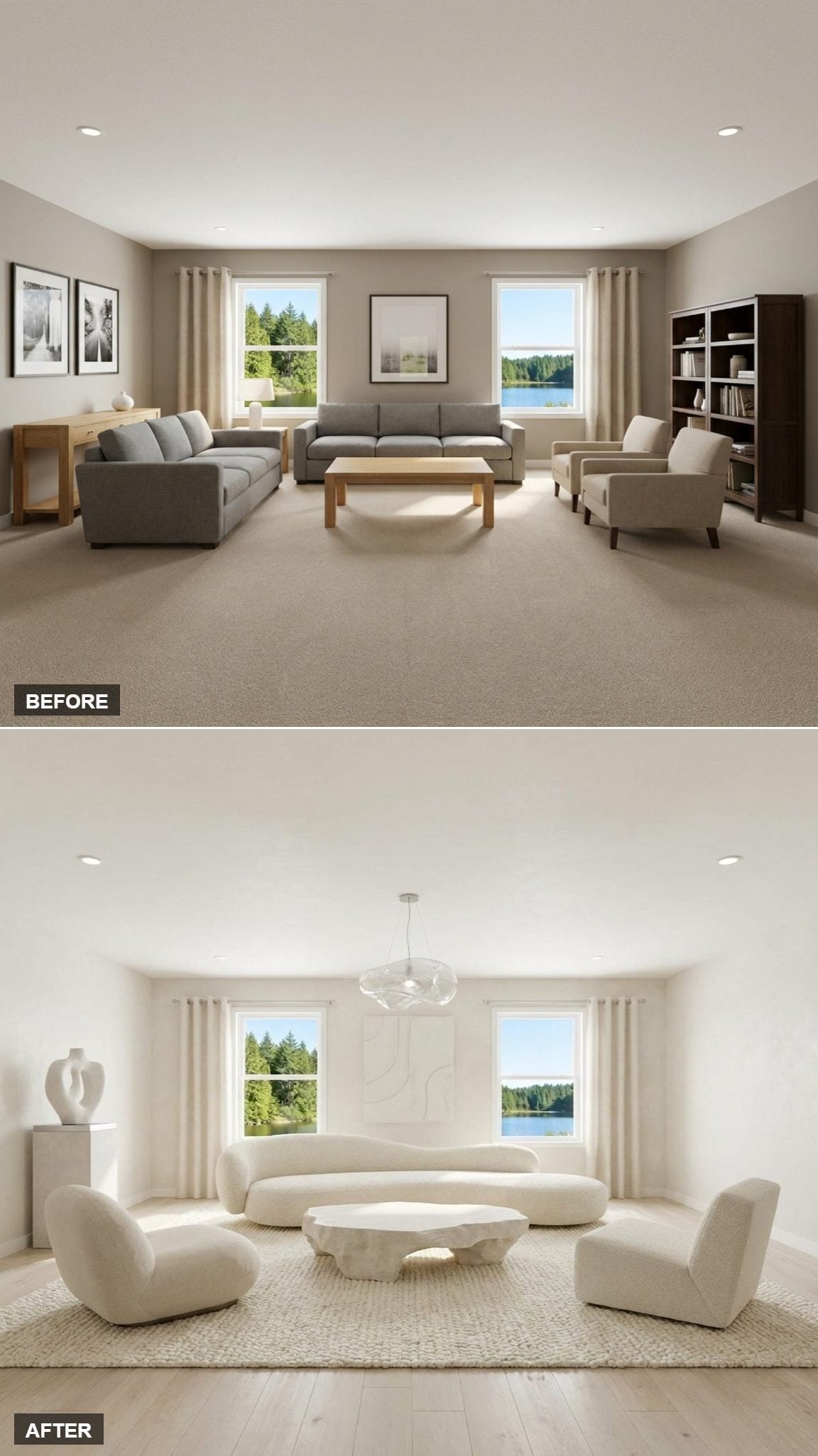
Color steps aside so form has nowhere to hide. The cloud-shaped ivory bouclé sofa floats asymmetrically in the room with two sculptural chairs that share almost nothing except confidence in their outlines. A chalky limestone coffee table keeps the center pale but unmistakably solid.
Warm-white limewash walls and pale oak flooring provide the blankest possible stage for silhouette, shadow, and texture. One oversized relief work, a plaster plinth, and a translucent pendant are enough. In a room this quiet chromatically, every curve gets louder.
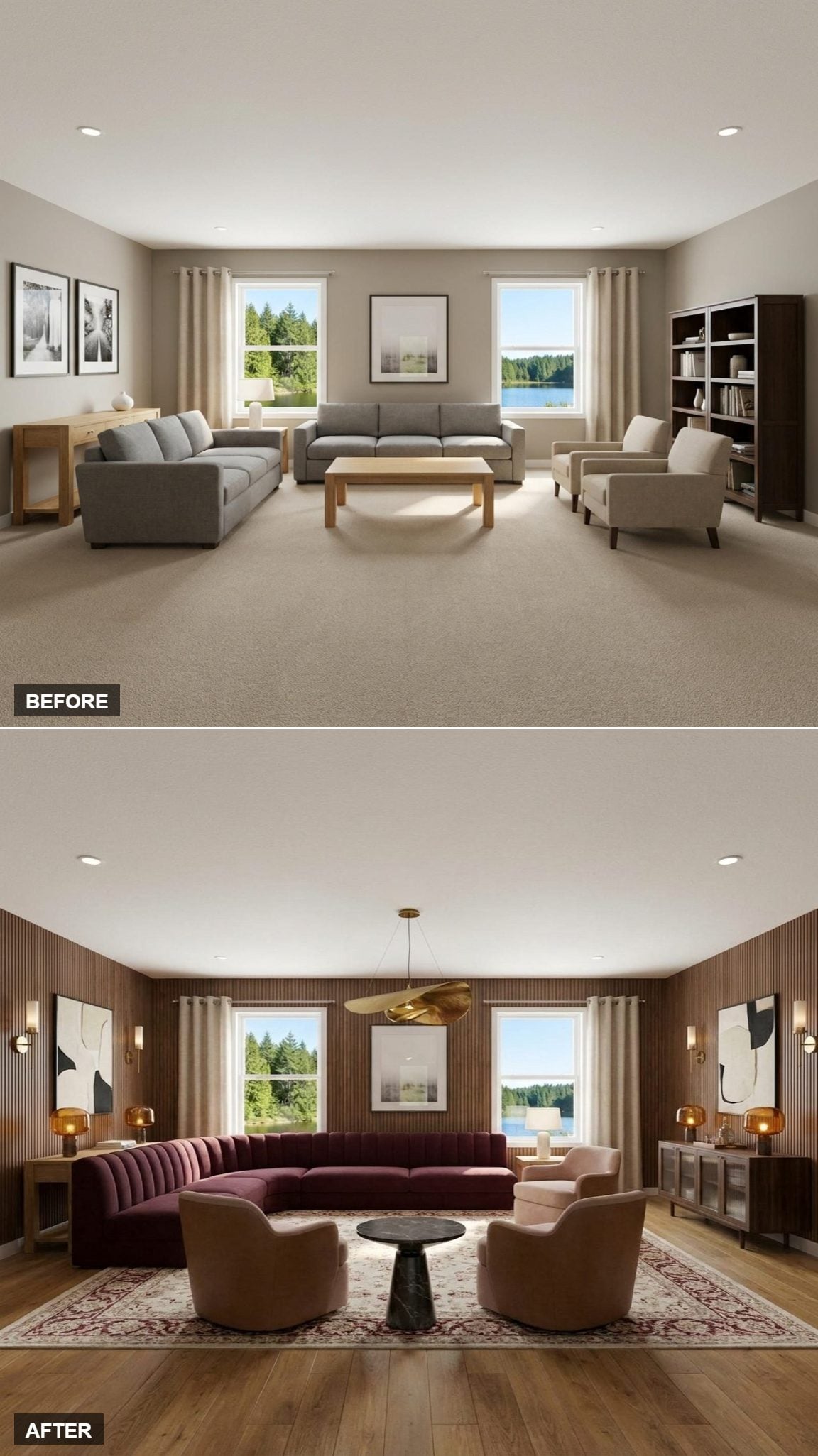
19. The Supper-Club Version of a Living Room
🔥 Would you like to save this?
Replacing the conventional sofa with a deep burgundy channel-tufted banquette makes the room feel less like a place to watch television and more like somewhere people might stay through a second round. Blush-and-caramel lounge chairs and a small dark-marble pedestal table keep the seating intimate without turning it into a restaurant booth.
A walnut drinks cabinet with ribbed-glass doors and brass sconces picks up the hospitality reference. Oak flooring and restrained cream-and-black details keep burgundy, walnut, and brass from becoming too theatrical.
18. The Chevron Floor Refuses to Be Background
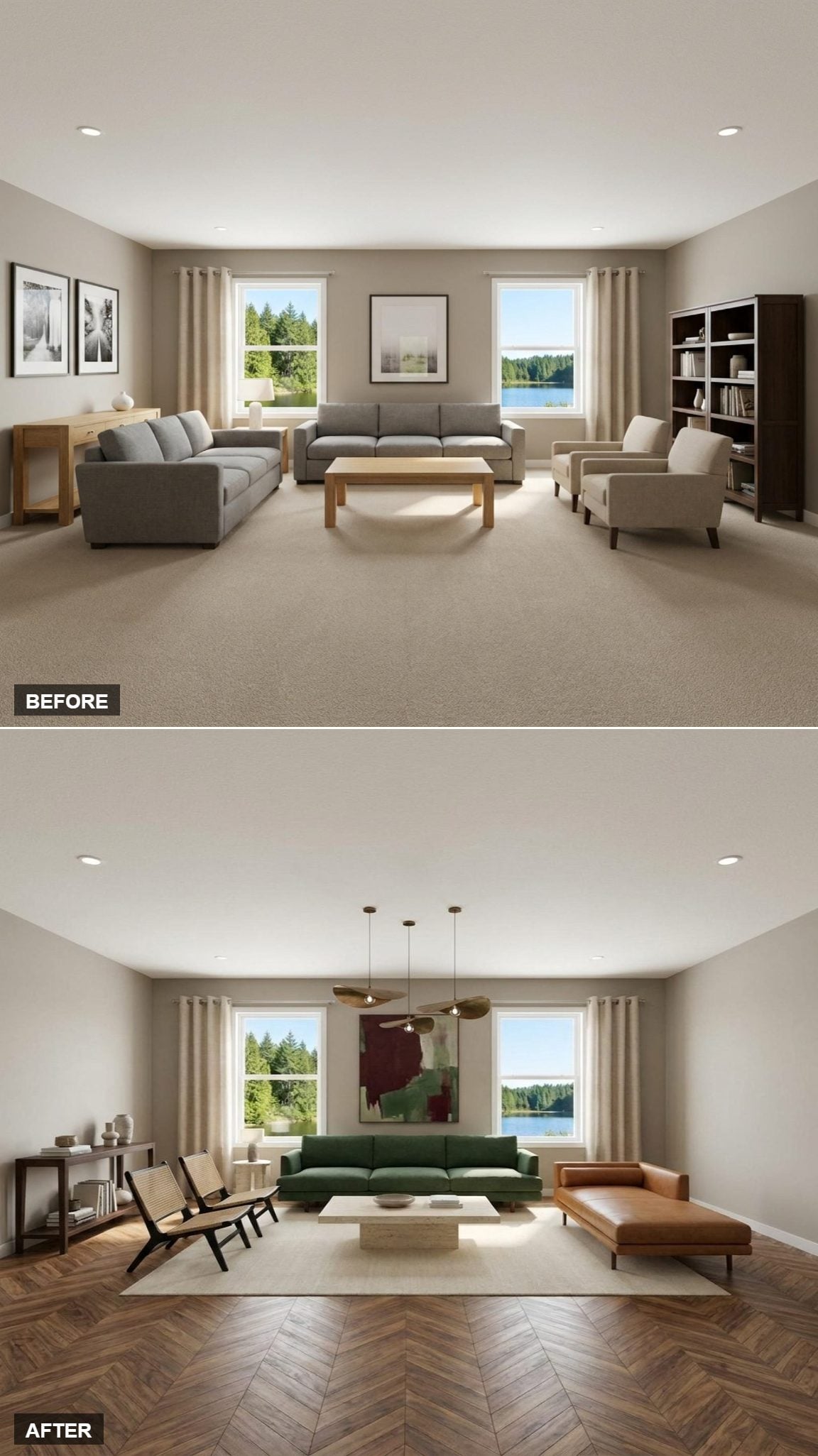
Medium-walnut chevron parquet runs the length of the room and is deliberately left visible instead of disappearing under an oversized rug. A long forest-green sofa floats across the room, a caramel leather chaise closes one end, and woven-cane chairs opposite keep enough visual air around the floor pattern to see what it is doing.
The cream travertine table and restrained ivory rug occupy only the center. A burgundy-and-green abstract painting brings the darker colors upward. The result is warmer than the typical charcoal family room, but it gets its depth from the same principle: one substantial material carried through without apology.
17. Low Oak, Floor Cushions, and a Room That Sits Closer to the Ground
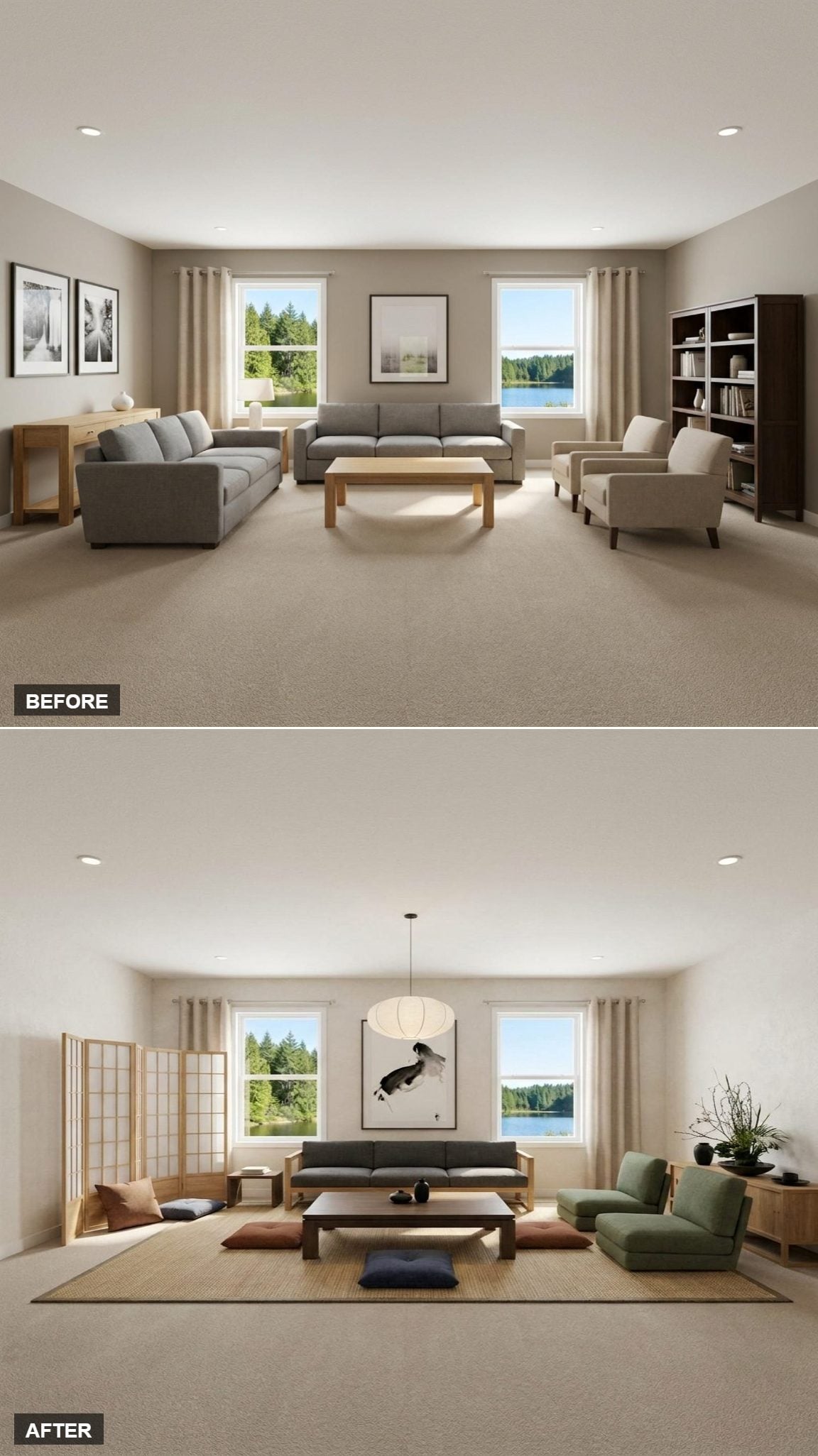
A long low oak-framed linen sofa, two armless moss chairs, and rust-and-indigo floor cushions gather around a substantial dark-oak table. The furniture sits noticeably lower than in most Western living rooms, giving the broad horizontal surfaces and empty space above them unusual importance.
A freestanding shoji-inspired oak-and-translucent-panel screen defines a reading corner without turning it into another enclosed room. Pale oak flooring, a tatami-inspired woven rug, and a single ikebana arrangement keep the Japanese reference focused on proportion, screens, restraint, and material rather than loading the room with decorative shorthand.
16. Botanical Wallpaper Takes One Wall and Leaves the Other Three Alone
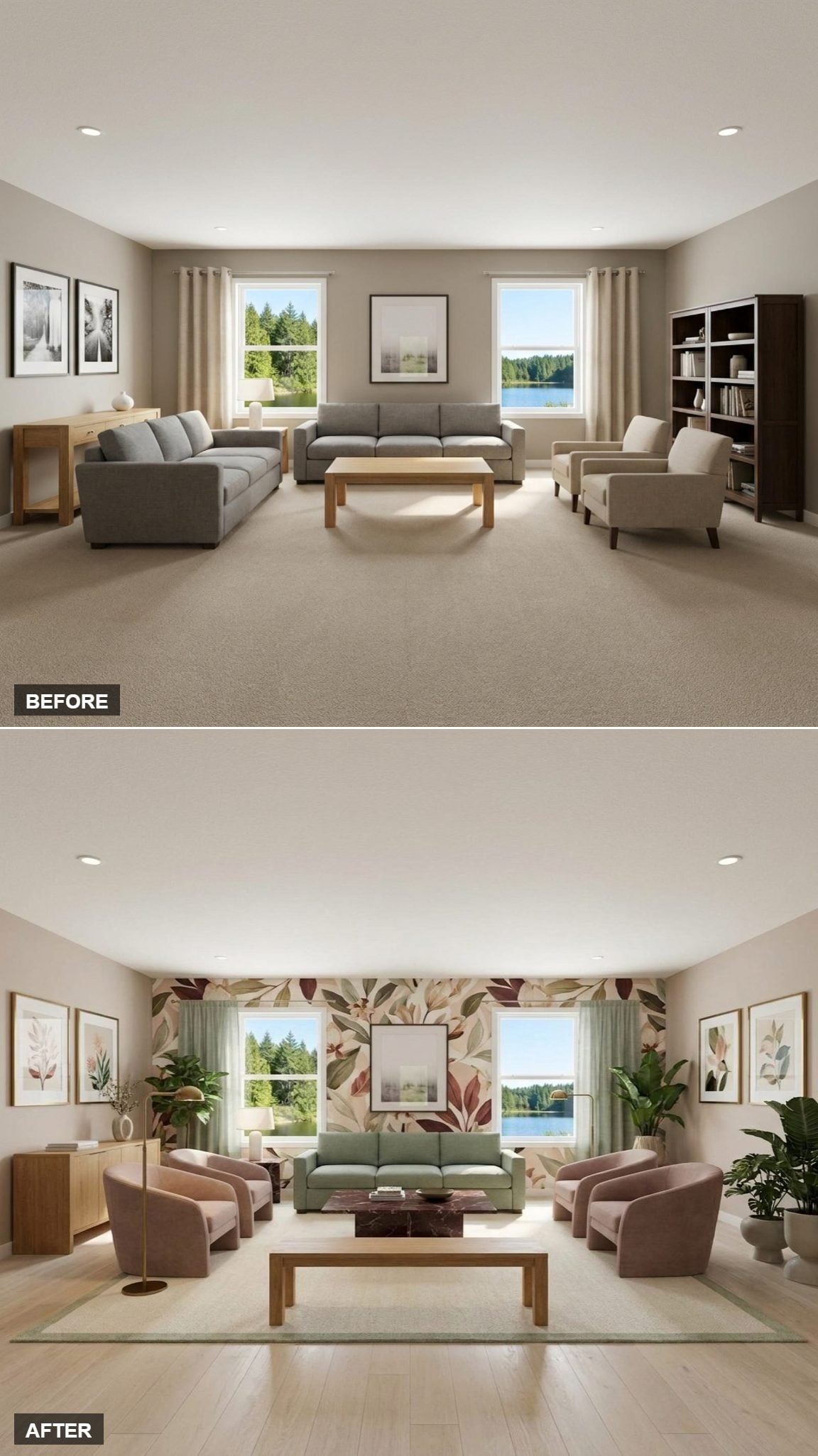
Large-scale botanical wallpaper in blush, sage, muted olive, burgundy, and cream takes over the main wall while the remaining surfaces stay warm white. A tailored sage sofa floats in front of the pattern rather than being pressed against it, with dusty-blush sculptural chairs and a warm-oak bench arranged around a dark-red marble coffee table.
Pale white oak, a cream wool rug with a sage border, and antique-brass lighting keep the pattern from spreading into every surface. It’s the same appetite for concentrated color behind a colorful powder room, scaled up and given considerably more breathing room.
15. The Cylindrical Hearth Moves the Fireplace Off the Wall
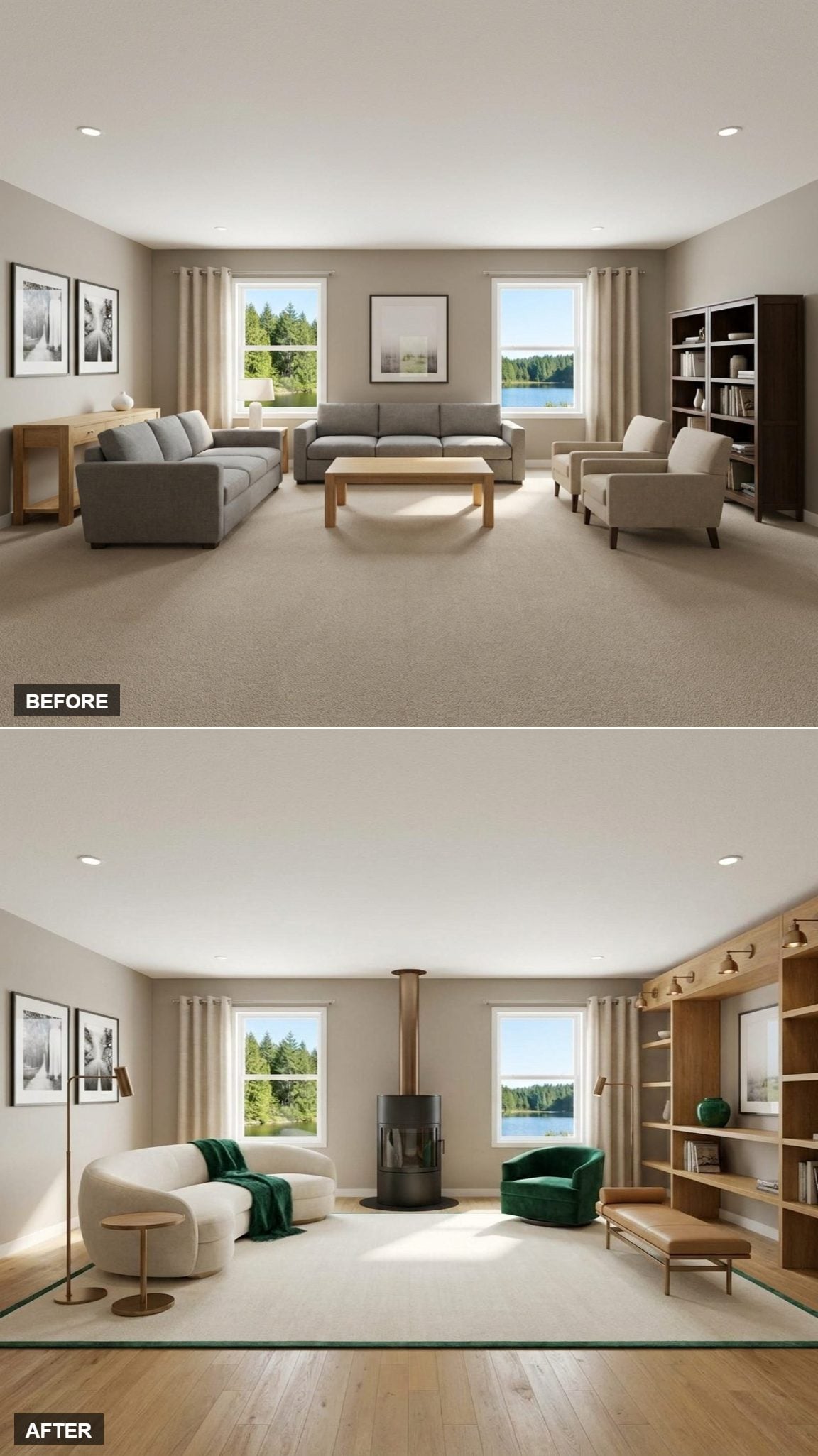
Instead of building the room around a fireplace embedded in one wall, this matte blackened-bronze cylindrical hearth stands closer to the center and becomes something furniture can orbit. An ivory curved sofa takes one side, an emerald velvet swivel chair another, and a low bronze-framed camel bench the third. One side deliberately stays open for circulation.
White-oak flooring and a large ivory rug keep the footprint readable, while a small bronze-and-oak side table replaces the expected giant coffee table. The fireplace isn’t merely something to face. It becomes the hinge that determines where everything else can comfortably go.
Put the focal point somewhere unexpected and the furniture has to stop behaving automatically.
14. The Vinyl Collection Becomes Furniture
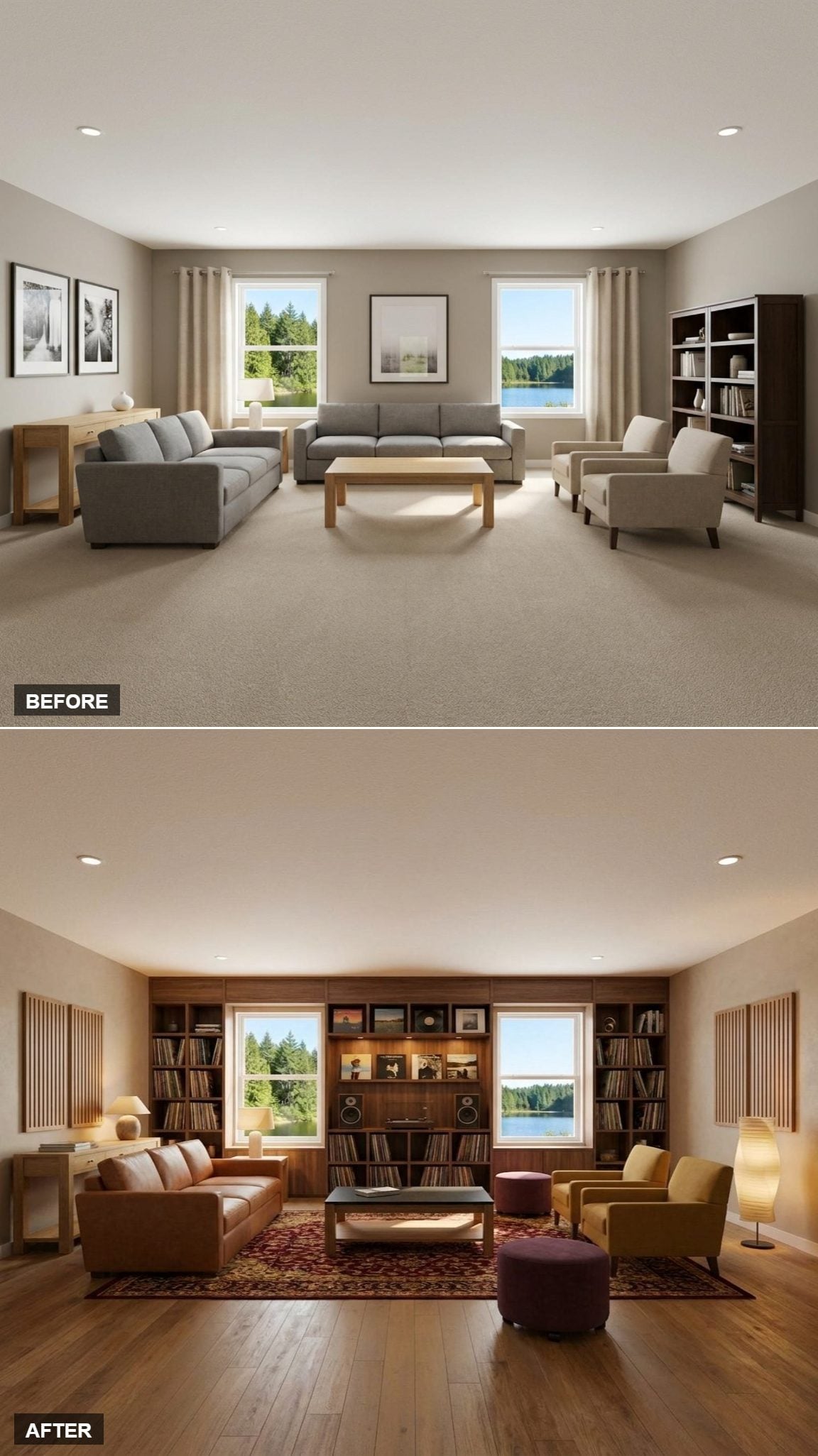
A floor-to-ceiling walnut shelving unit treats the record collection the way another room might treat a fireplace. The cognac leather sofa floats toward the center so the wall remains visible and accessible instead of becoming background storage.
Plum poufs and mustard lounge chairs keep the arrangement loose enough to shift during a listening session. A burgundy-and-gold rug connects walnut, leather, and upholstery without turning the collection itself into décor wallpaper. The room has an activity at its center, not just a furniture arrangement.
13. Pistachio Is Quiet Until You Put It Everywhere
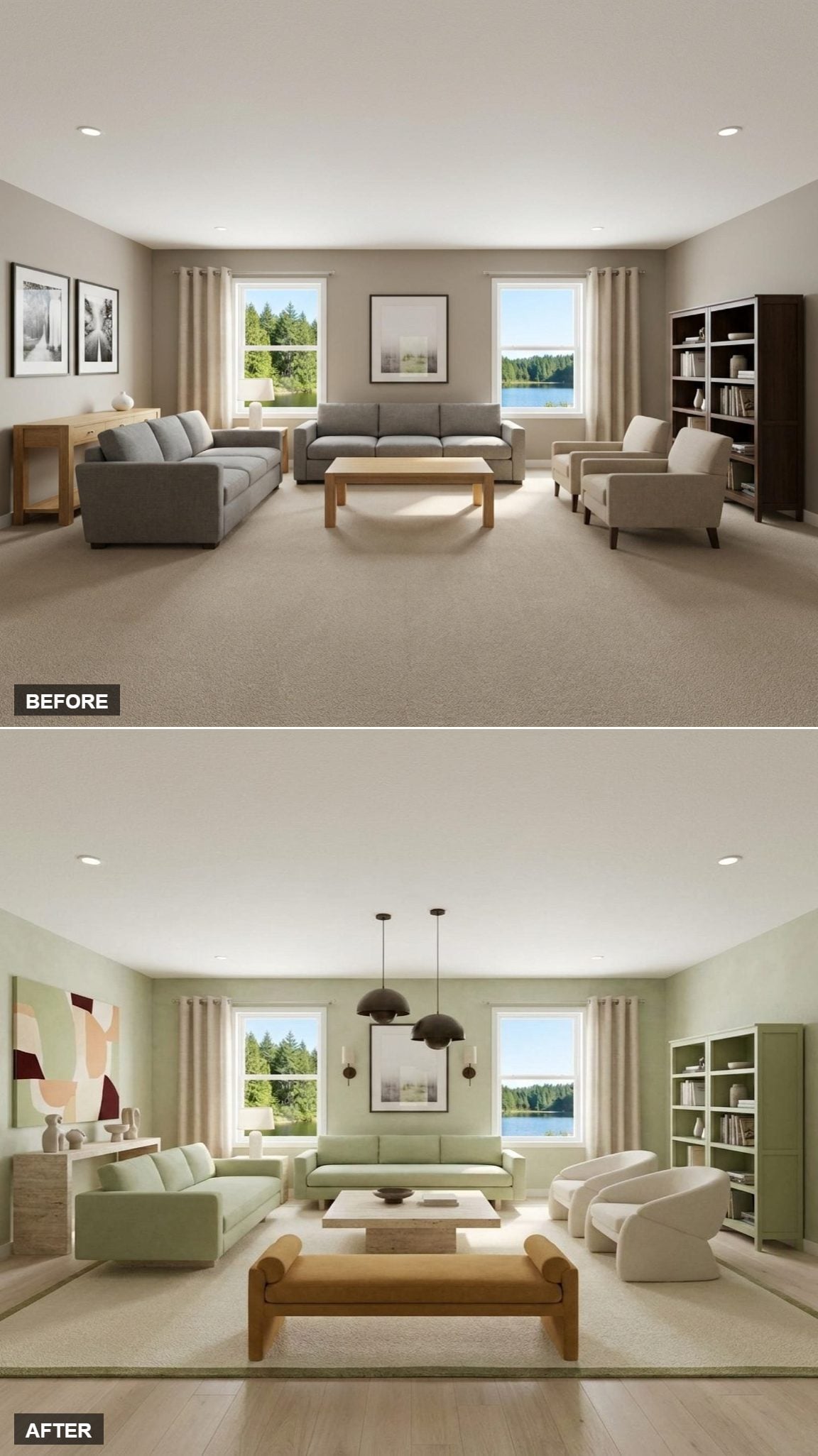
Pale pistachio behaves almost like a neutral from across the room and reveals itself as unmistakably green up close. Using it on both walls and the long low sofa creates a soft field of color without depending on beige or gray to make the room calm.
A monolithic travertine coffee table gives the floating arrangement a substantial center. Two sculptural ivory lounge chairs and an ochre bench complete the open U, while oxblood and peach in the oversized artwork keep the pistachio from drifting into spa territory.
12. The Café Banquette Makes the Table More Important Than the Sofa
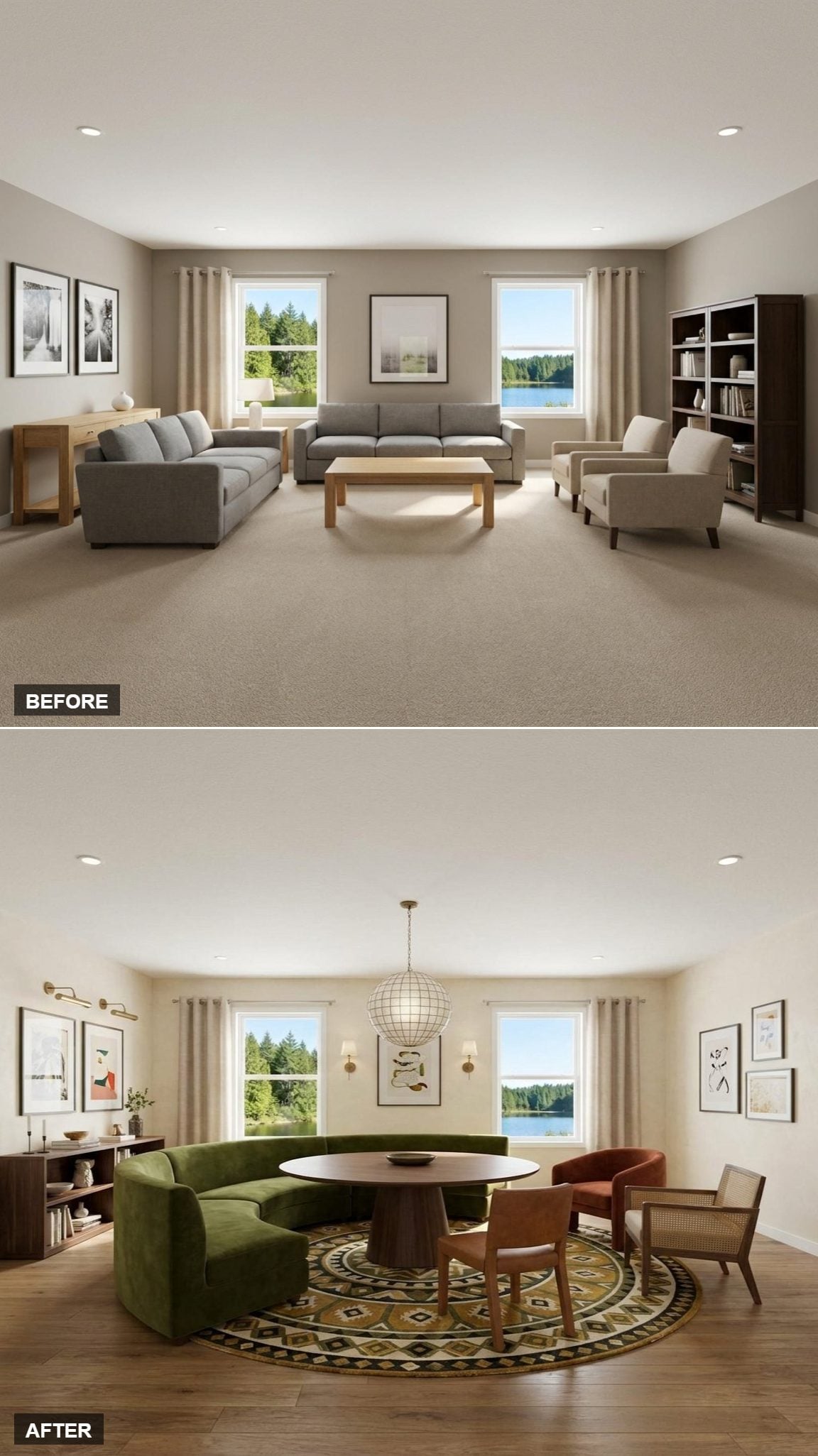
Eliminating the conventional sofa changes what the room expects from its occupants. A sweeping olive green velvet banquette wraps around a large walnut pedestal table, making food, games, laptops, drinks, and conversation all equally plausible reasons to sit down.
Saddle leather, rust velvet, and woven-cane chairs sit opposite, light enough to rearrange when another person arrives. Aged-brass wall lights and a sculptural globe pendant create smaller pools of light instead of one indiscriminate ceiling wash. The instinct is similar to a colorful powder room: use a smaller number of strong materials and let them carry the personality.
11. The Plaster Cocoon Wins by Making Everything Feel Tactile
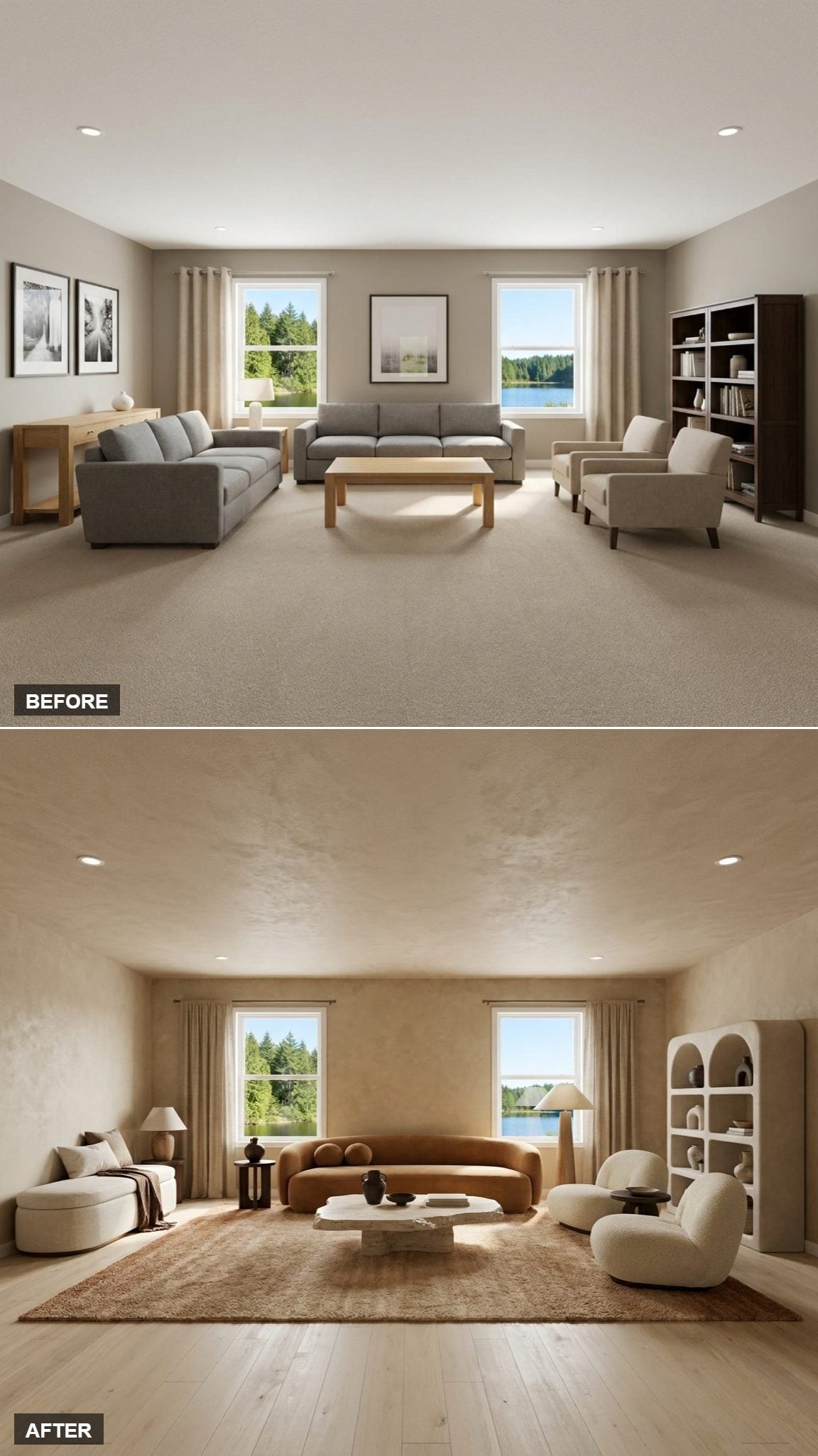
Sand-colored limewash plaster, a caramel crescent sofa, asymmetrical cream bouclé lounge chairs, and an irregular travertine coffee table make surface texture the primary source of variation. The palette barely moves; the materials never stop changing.
Freestanding plaster shelving with shallow arches continues that tactile approach without altering the structural walls. Pale oak, a sand-and-rust rug, linen curtains, hand-thrown ceramics, and a clay pendant keep adding small differences in grain and finish. The charcoal family room alternative would create depth through darkness. This one gets there through texture.
10. A Ribbed Divider Creates Privacy Without Closing the Door
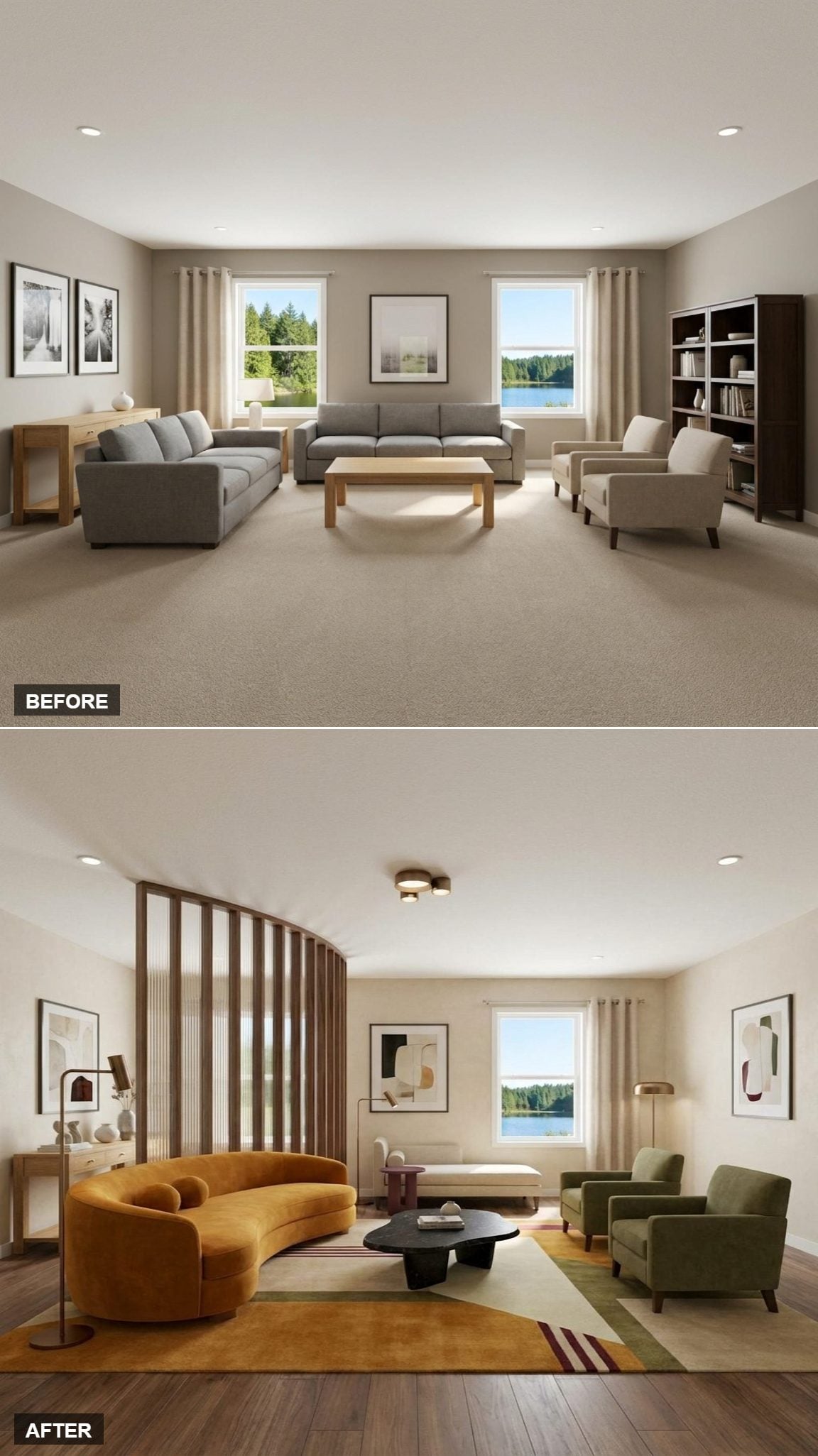
A freestanding screen of walnut ribs and ribbed glass separates a reading corner from the primary lounge without blocking light or building a permanent wall. On one side, a curved saffron sofa follows the divider’s arc while olive-green chairs face it across a black-stone table.
On the other side sit a cream chaise, plum table, and reading lamp. Warm ivory plaster walls and a saffron-and-burgundy rug prevent the divider from feeling like office partitioning. It’s a useful family room design move when two activities need boundaries without surrendering the openness of the room.
9. Checkerboard Floors Give the Deco Room Its Swagger
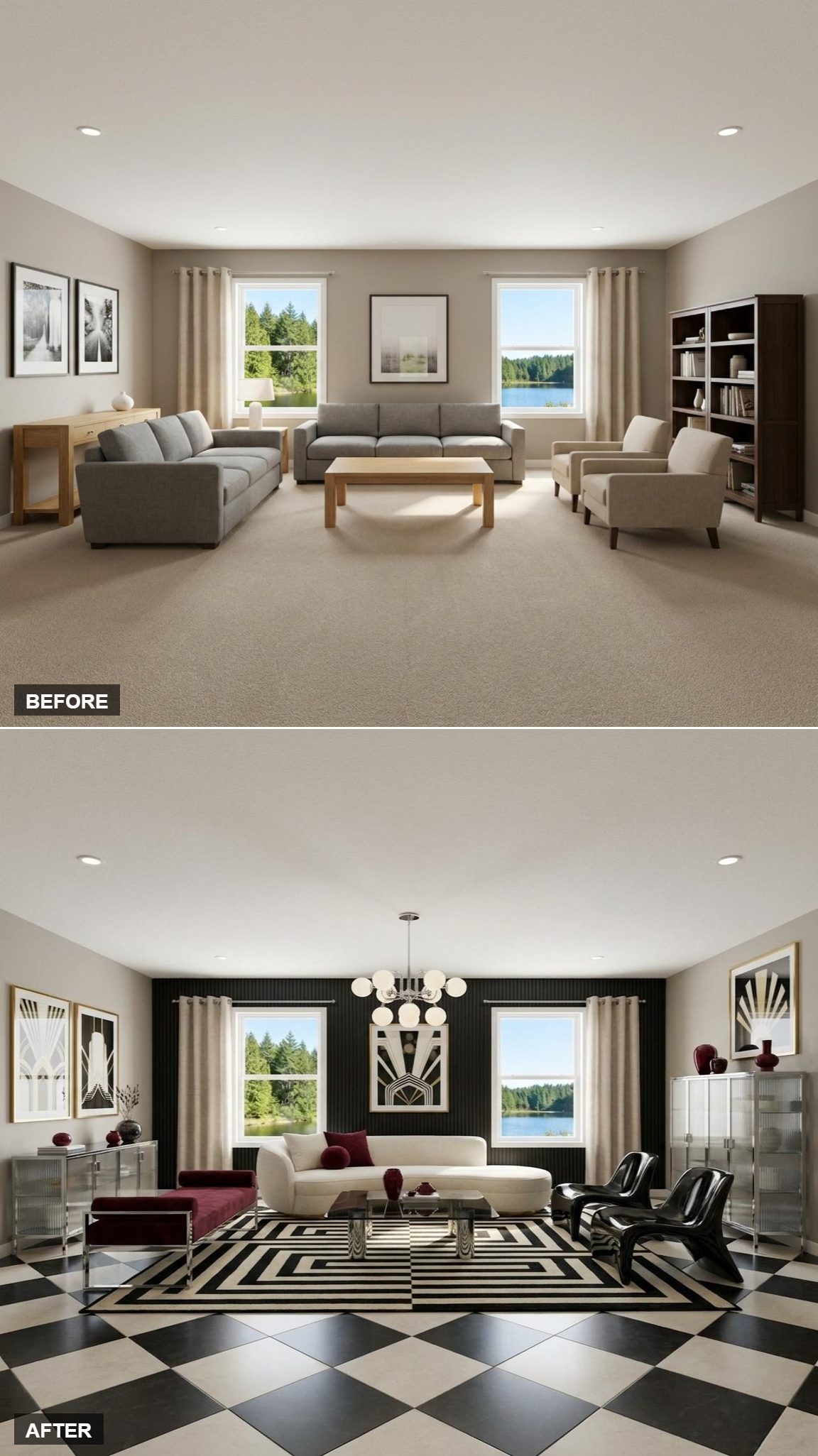
Large-scale black-and-warm-white tile establishes the graphic identity before a single chair arrives. An ivory curved sofa floats off the wall, glossy black sculptural chairs face it, and a chrome-framed burgundy velvet bench adds the only deep color to the seating group.
Ribbed-glass cabinetry, a smoked-glass table on polished chrome, and a chrome-and-opal-glass chandelier keep the Deco reference tied to materials and geometry instead of slipping into themed decoration. This room knows exactly how much black-and-white it can carry.
8. The Terracotta Sectional Breaks the Rectangle on Purpose
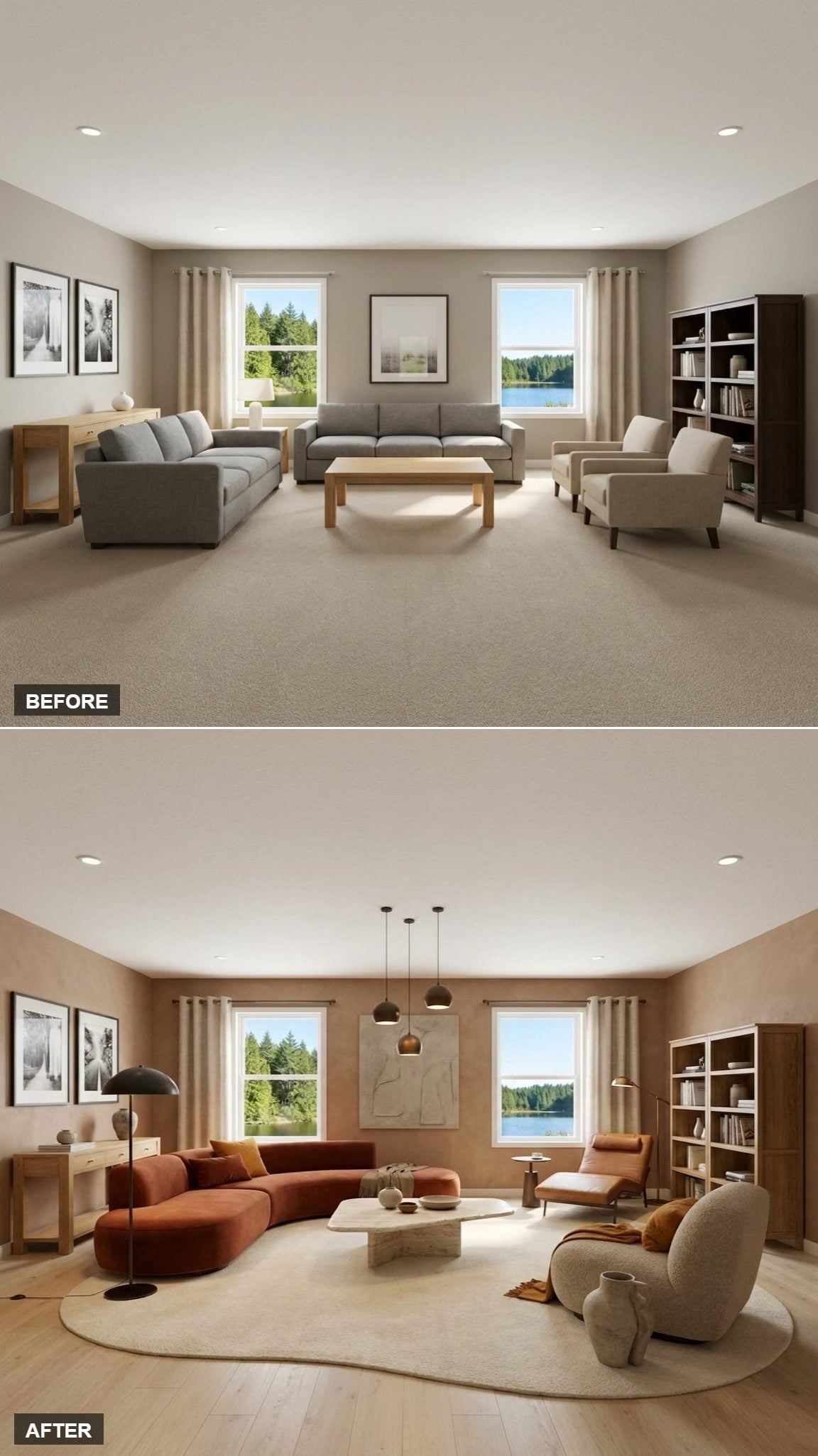
The low terracotta sectional cuts diagonally through the floor plan rather than dutifully lining up with the walls. That produces circulation on several sides of the furniture and makes the rectangular room feel less like a container waiting to be filled.
Near the windows, a caramel leather chaise, bronze reading lamp, pedestal table, and compact bookcase form a quieter satellite zone. Pale natural oak and clay-toned limewash walls let the terracotta remain strong without demanding another equally strong color nearby.
7. The Walnut Tower Gives the Room a Vertical Problem to Solve
🔥 Would you like to save this?
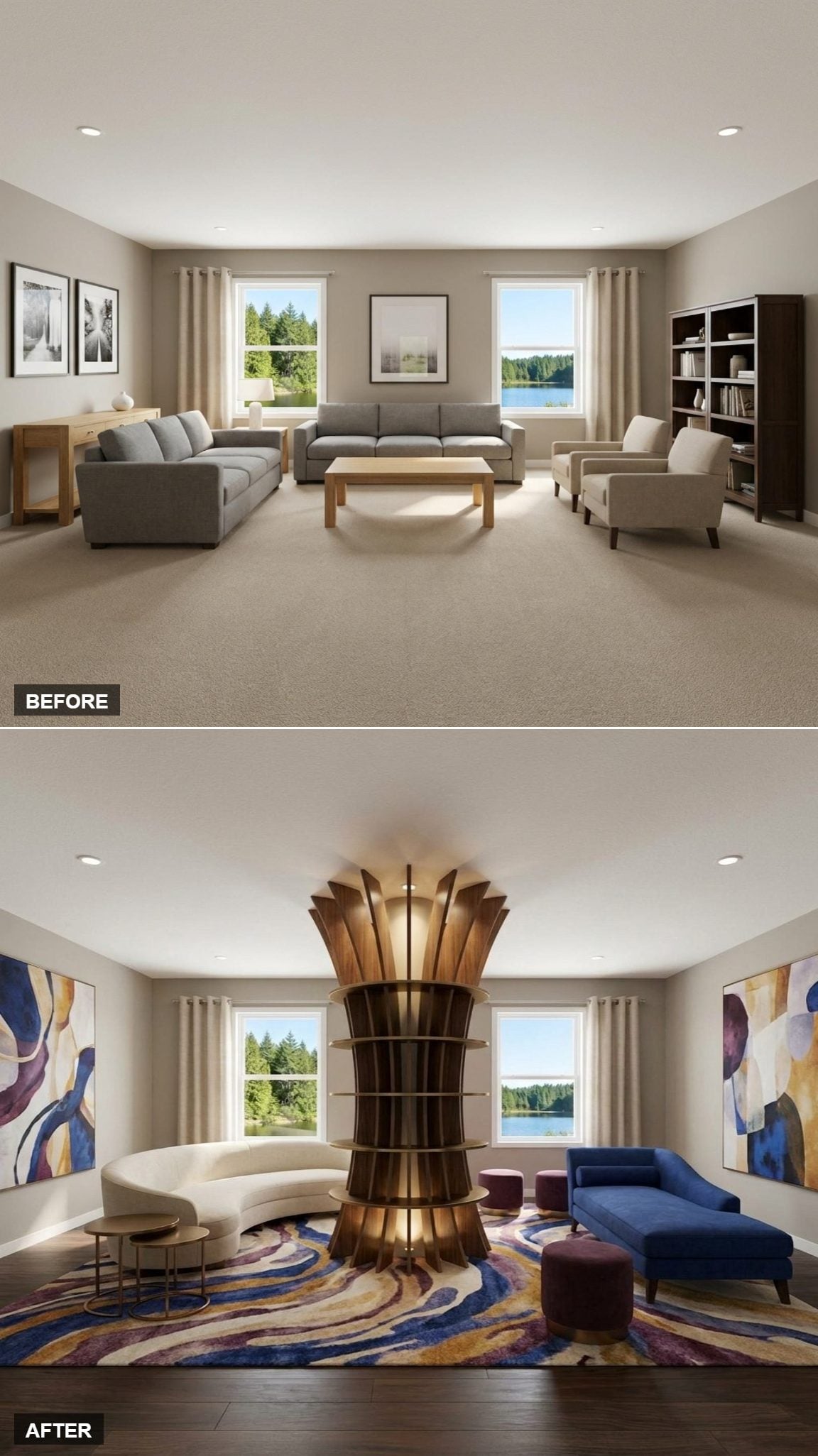
A floor-to-ceiling sculptural shelving tower built from curved walnut ribs and bronze shelves gives the room height and visual drama without spreading cabinetry across an entire wall. Upward-facing accent lighting lets the structure become even more pronounced after dark.
A cream crescent sofa wraps one side while a cobalt chaise pulls away in another direction. Plum ottomans can migrate between them. The charcoal family room instinct for strong materials is still here, but the tower makes the eye travel upward before it settles onto the seating.
6. The Chandelier Gets First Billing for Once
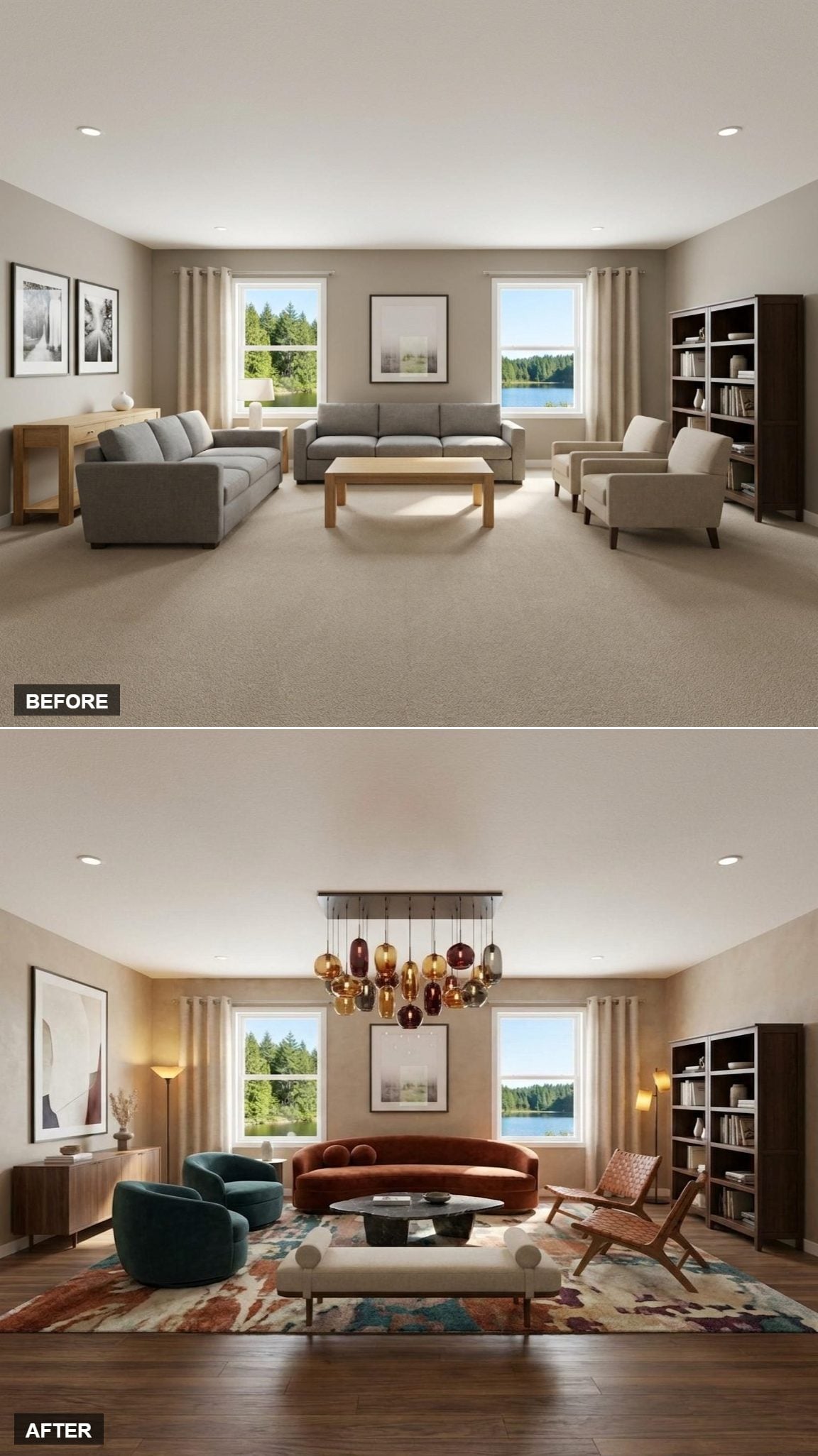
A broad sculptural chandelier made from individually hanging amber, burgundy, and smoked-glass forms dominates the room from above. Instead of treating lighting as something selected after the sofa, the rest of the palette appears to have been pulled downward from the fixture.
A rust velvet crescent sofa, deep-teal swivel chair, woven cognac lounge chair, and cream bench gather loosely around an irregular dark-stone table. Warm plaster walls and walnut flooring quiet the lower half so the ceiling fixture can remain theatrical without turning the entire room into a stage set.
5. Two Seat Heights Give the Same Room Two Different Tempos
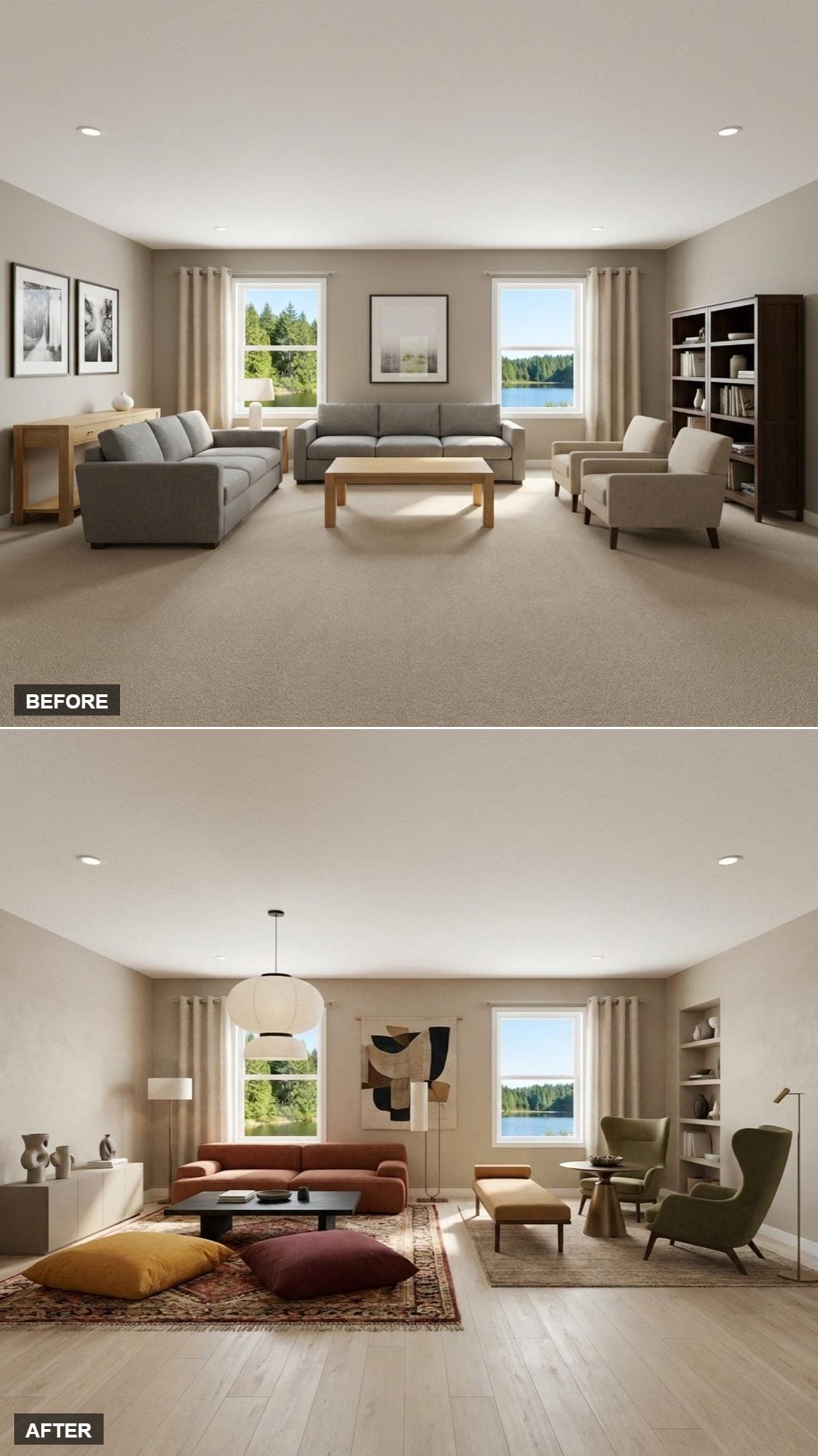
A broad rust-colored low modular sofa with saffron and burgundy floor cushions gathers around a low blackened-oak table near the windows. Closer to the entrance, two tall-backed olive lounge chairs and a narrow camel bench sit around a bronze pedestal table. One area invites sprawling; the other asks you to sit upright.
Pale oak flooring lets contrasting rugs define the zones without a wall between them. Warm plaster, ceramics, textile art, and slender floor lamps prevent either side from feeling temporary. In a narrow living room, changing seat height can distinguish functions without adding bulky dividers.
4. A Conversation Pit Without the Remodeling Regret
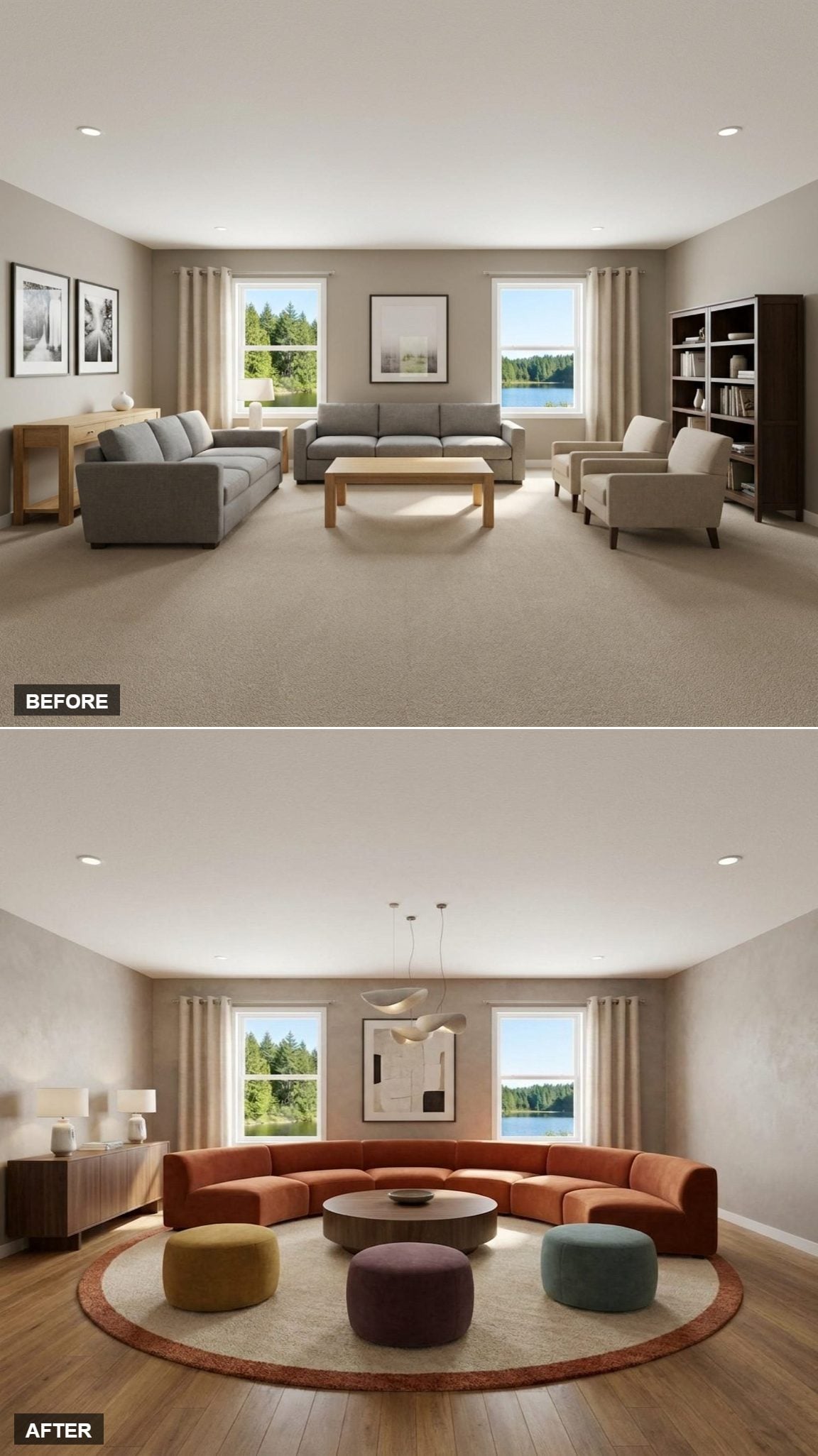
The sunken conversation pit remains one of those architectural ideas people love in photographs and reconsider when someone mentions stairs, spills, or resale. This room borrows the social arrangement without excavating the floor. A semicircular sofa in paprika velvet wraps around a low walnut table while mustard, plum, and muted-teal poufs wait nearby for whoever arrives next.
Mushroom plaster walls and an oversized cream-and-rust rug soften the saturation without neutralizing it. The perimeter stays comparatively open while the center becomes dense with usable seating. For related circular arrangements, the game room ideas category offers plenty of reasons to steal from spaces designed around groups rather than screens.
3. The Cobalt Sectional Makes Eye Contact Easier Than Channel Surfing
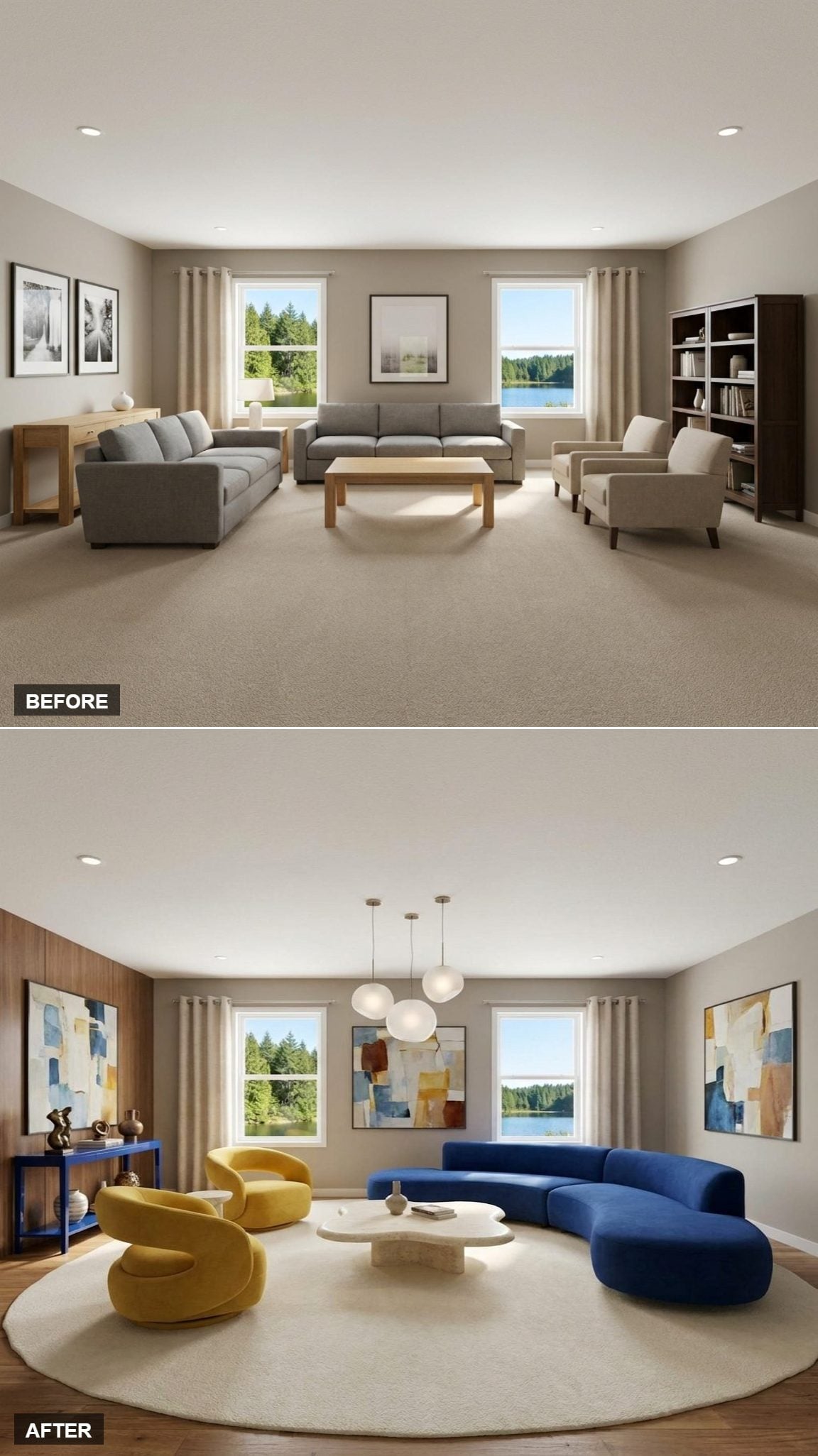
A sweeping cobalt blue curved sectional sits diagonally through the room instead of aiming itself at a screen. Two sculptural citrine yellow swivel chairs complete the open crescent, while a freeform cream travertine table occupies the middle without becoming a visual barricade.
Warm walnut paneling keeps the cobalt from feeling icy, and the artwork repeats yellow, rust, and blue without exact matching. This version of family room design makes conversation the obvious use of the seating arrangement without claiming furniture can force anyone to become sociable.
2. The Paprika Booth Turns the Living Room Into a Place to Stay Too Long
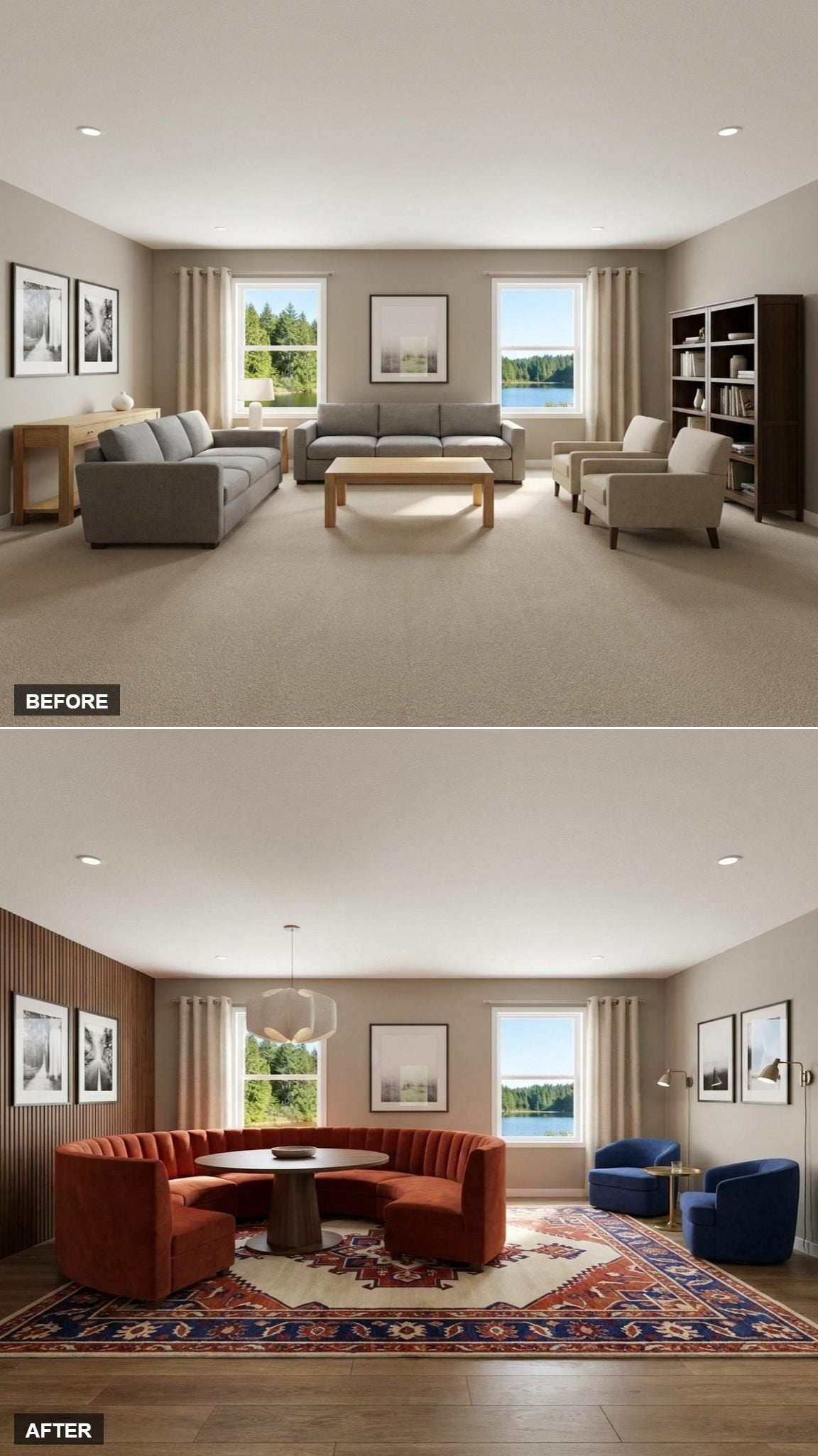
A three-quarter-circle banquette in paprika velvet wraps around a walnut pedestal table and gives this concept a more enclosed, booth-like character than the open café arrangement earlier. The table isn’t incidental; it turns the nook into a place for cards, drinks, food, laptops, and conversations that have clearly exceeded their scheduled runtime.
Fluted walnut paneling sits behind the booth while two cobalt lounge chairs occupy the window side with a brass drinks table between them. Cream, paprika, cobalt, and burgundy in the rug keep the two seating areas related without making them twins.
1. Color-Blocked Walls Finish the Experiment With No Furniture Trick at All
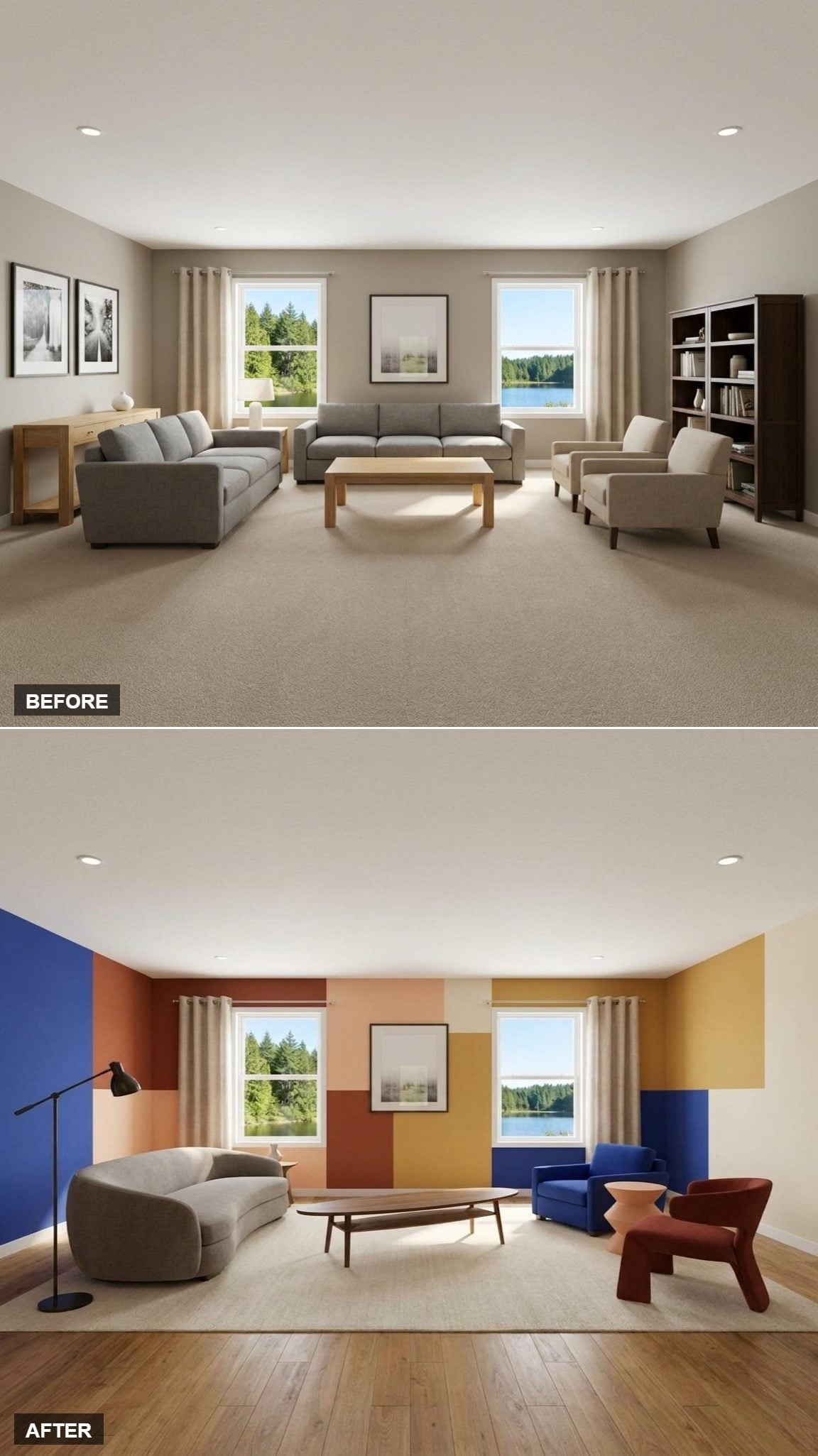
The final concept lets the walls become the artwork. Large geometric areas of ultramarine blue, burnt sienna, soft peach, and ochre are painted directly across the existing surfaces, turning ordinary drywall into a composition before the furniture arrives.
A warm-gray curved sofa sits off-axis, with a cobalt lounge chair in one direction and a rust-red sculptural chair in the other. An elongated walnut coffee table follows the diagonal while a restrained cream rug gives the floor a quieter role. Hanging another gallery wall here would only interrupt the bigger idea.
After 31 versions, AI never arrived at one color, one sofa shape, or one approved formula for happiness—which is probably the most useful answer it could have produced. Some rooms are green and hushed. Others have aquariums, game tables, record walls, paprika velvet, checkerboard floors, or enough ultramarine paint to make a beige loyalist nervous. The better thread is choice: somewhere to talk, somewhere to read, something worth looking at, and enough personality that leaving the room is not automatically the most interesting option.