🔥 Would you like to save this?
Nobody buys a house because the foyer has potential, which is exactly why these before and after designs are so satisfying. The entryway usually gets treated like a landing strip for shoes, keys, backpacks, and whatever came in from the car. Then AI got hold of 27 overlooked front halls and treated them like the first scene of the whole house.
In order to come up with the very specific design ideas, we create most designs with the assistance of state-of-the-art AI interior design software. Also, assume links that take you off the site are affiliate links such as links to Amazon. this means we may earn a commission if you buy something.
The best ones do more than clean up the clutter. They change the temperature of the place the second the door opens. Narrow pass-throughs become dramatic arrivals, blank walls turn into architectural moments, and forgotten corners suddenly make the rest of the home feel more intentional.
27. Dark, Dramatic, and Unapologetically Moody: One Foyer’s Total Reinvention
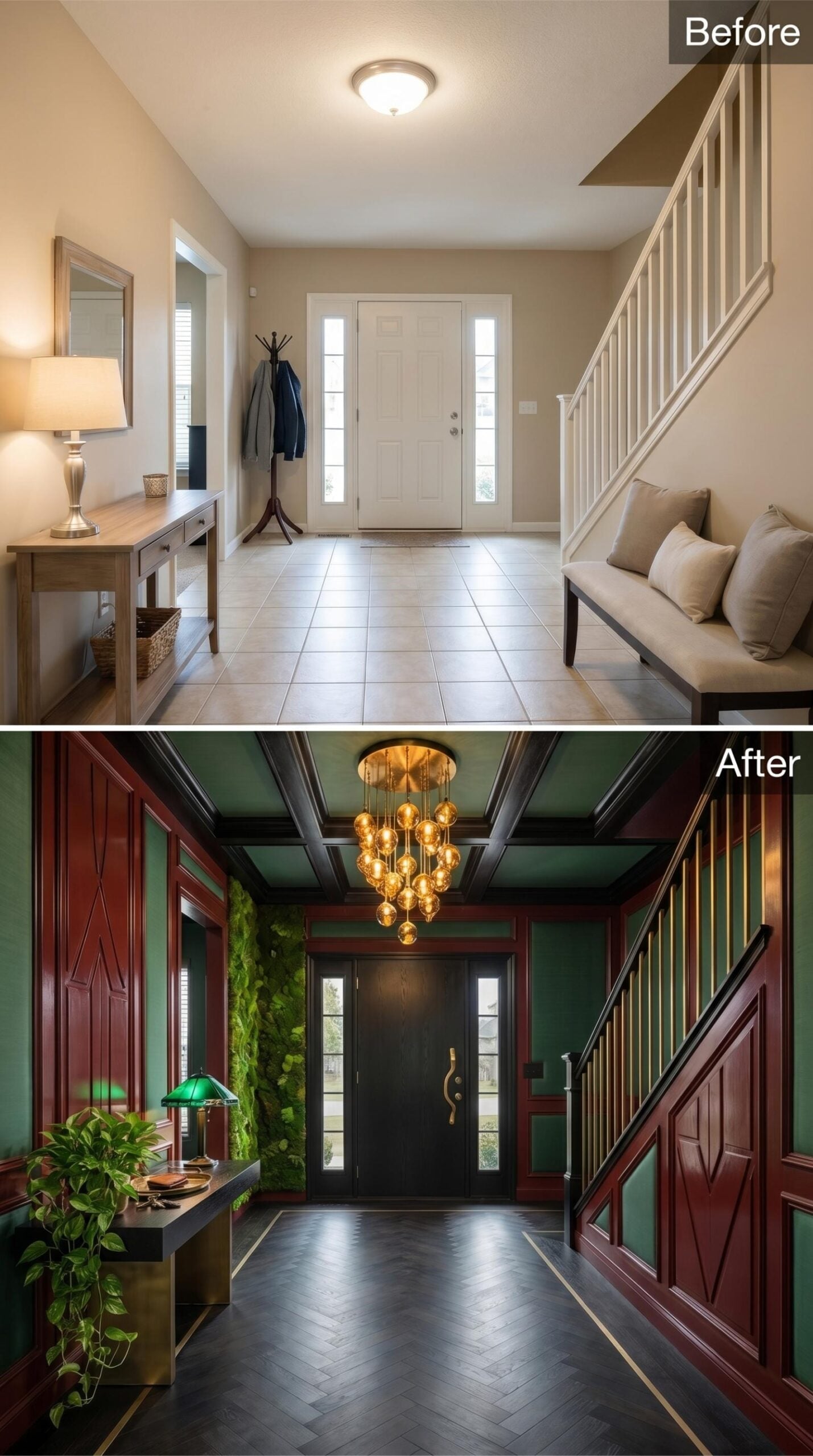
Deep forest green walls meet rich crimson woodwork, with black coffered ceiling beams adding architectural weight the original space never had. A cluster pendant of amber globe lights anchors the ceiling like a chandelier that actually earns its drama. Underfoot, slate herringbone tile with brass inlay strips handles the pattern work.
26. Tray Ceiling, Sputnik Chandelier, and a Front Door That Finally Means Business
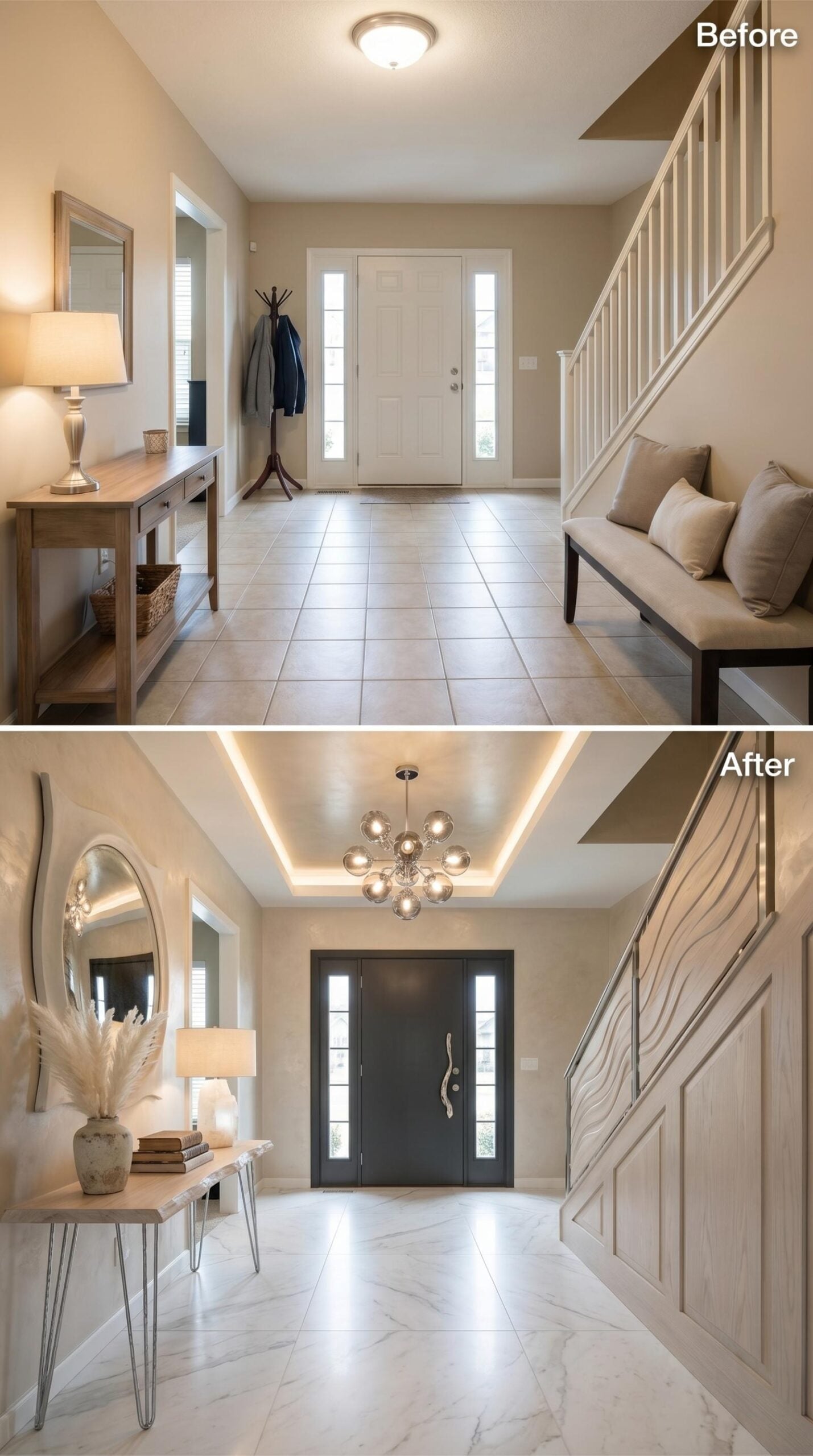
Warm plaster-toned walls get a new ceiling treatment: a tray detail with recessed LED strip lighting that casts a soft amber wash around the perimeter. Centered below it, a chrome sputnik chandelier with globe bulbs pulls the eye up without overpowering the space. The two fixtures together do more than either would alone.
The front door swap is the move that changes everything. Charcoal with a sculptural wave-form handle, it reads as architectural rather than decorative. Large-format marble-look porcelain tiles in a herringbone layout replace what was likely standard square tile, and a live-edge console on hairpin legs sits against the left wall beside an oval mirror, keeping the entry grounded while the ceiling does the talking.
25. Concrete Walls, Floating Stairs, and a Front Door That Commands Attention
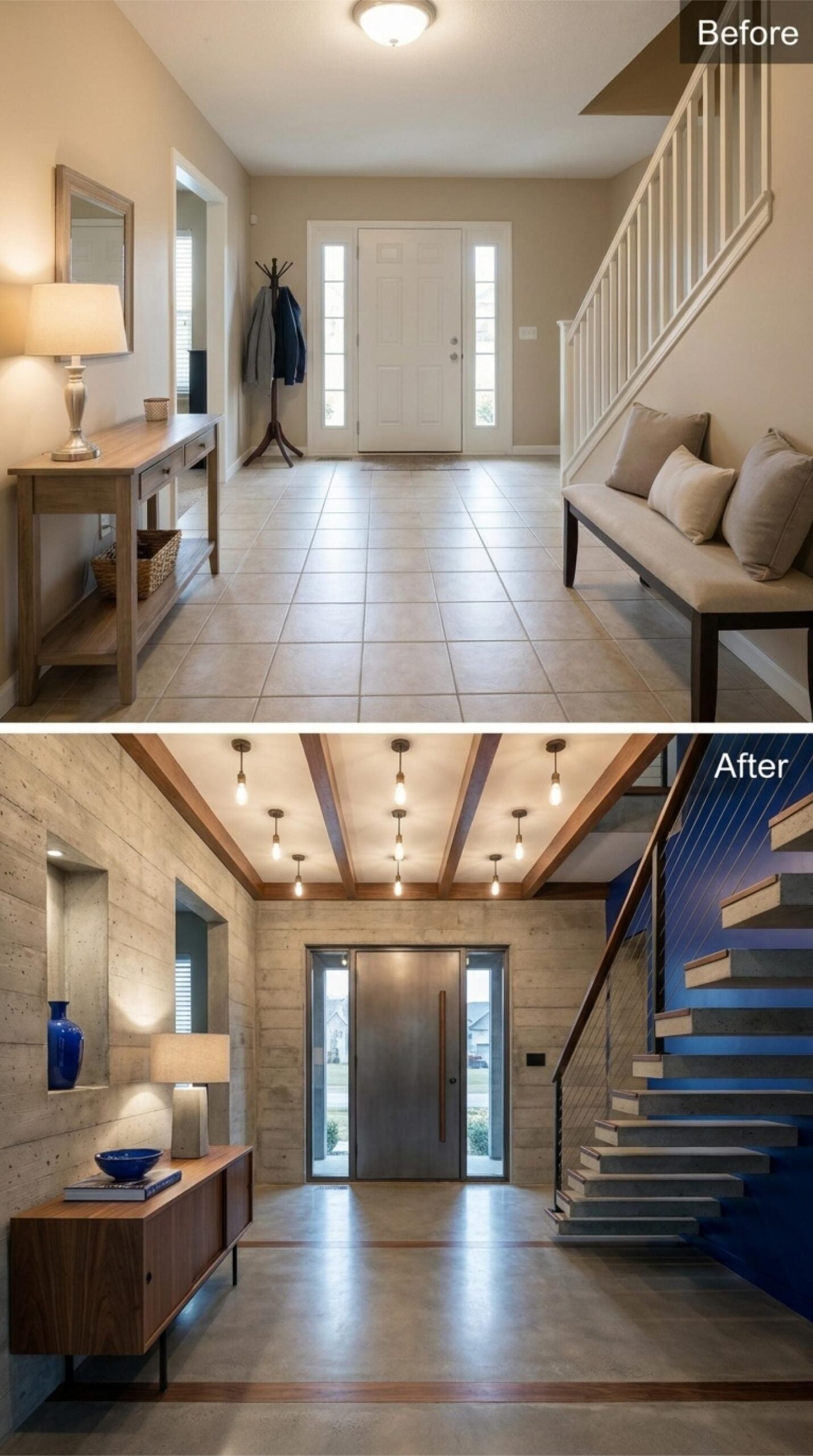
Exposed board-formed concrete stretches across every wall, confident without trying too hard. Pendant bulbs hang from wood ceiling beams in staggered clusters, casting the kind of light that actually flatters a space. The floating staircase with cable railing pulls the eye right, anchored by a bold cobalt accent wall underneath.
Budget Tip: Replicating exposed concrete walls doesn’t require a structural overhaul. Concrete board panels or textured plaster finishes get you most of the way there for considerably less money. Put the budget toward one statement element like pendant lighting and let the wall treatment carry the room.
24. Gothic Arches, Black Marble Walls, and Gold Trim That Refuses to Be Subtle
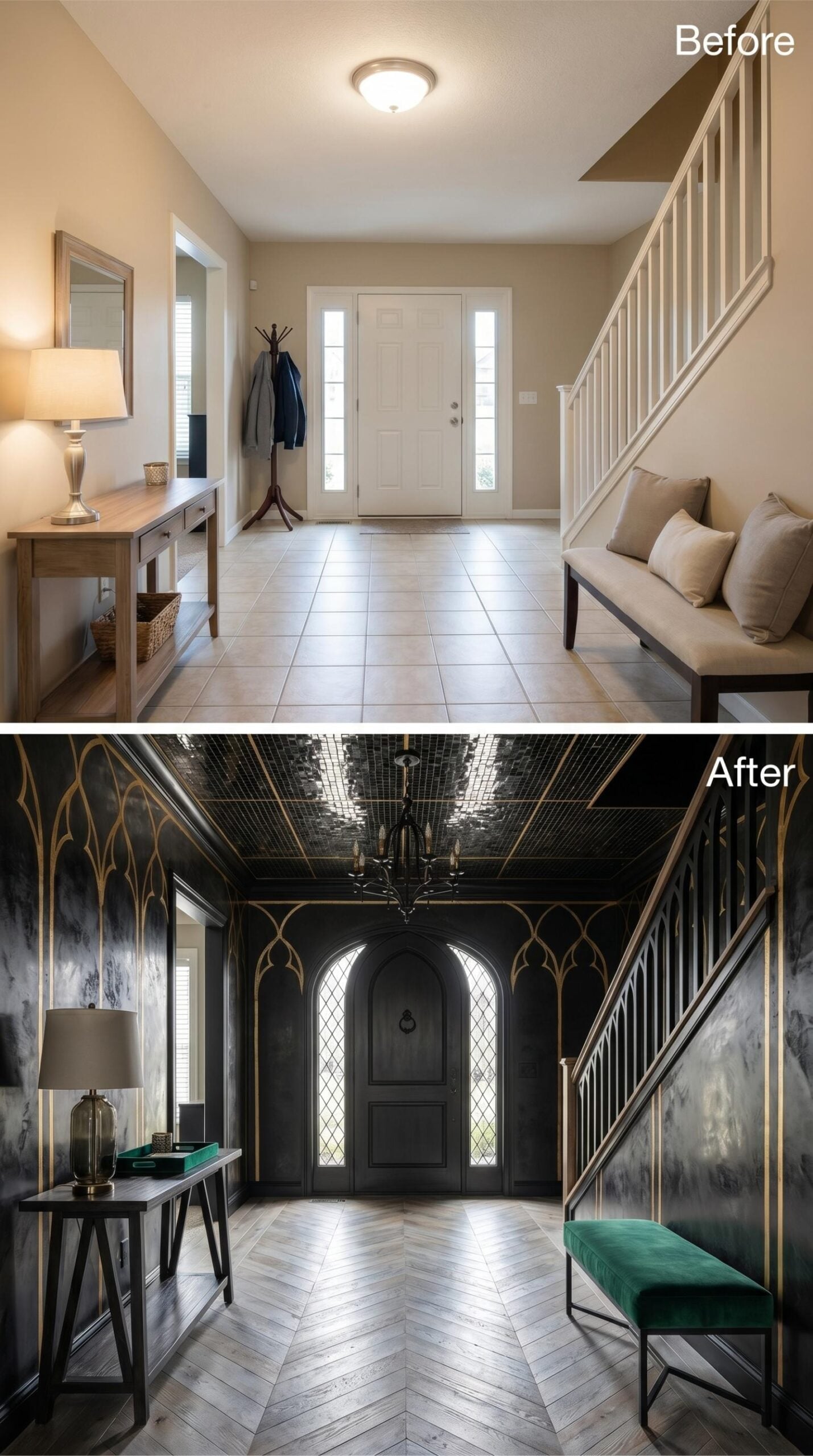
Black faux-marble wallcovering climbs floor to ceiling, its gray veining catching light from a wrought iron candelabra chandelier overhead. Gold Gothic arch trim frames every vertical surface, pulling the eye upward toward a dark pressed-tin ceiling that adds texture without competing.
The herringbone floor is the quiet surprise. Laid in pale gray wood, it grounds the drama above and keeps the space from collapsing into pure theater. A green velvet bench beside the staircase introduces the only saturated color in the room — and it’s exactly the right amount.
By The Numbers: Herringbone flooring runs at a 45-degree angle and can make a narrow foyer read wider than its actual footprint. Gothic arch molding, like the gold trim shown here, is available as peel-and-stick or paintable foam profiles, making it one of the more achievable high-drama DIY upgrades for a foyer wall.
23. Craftsman Wainscoting, Leaded Glass, and a Ceiling That Finally Has Something to Say
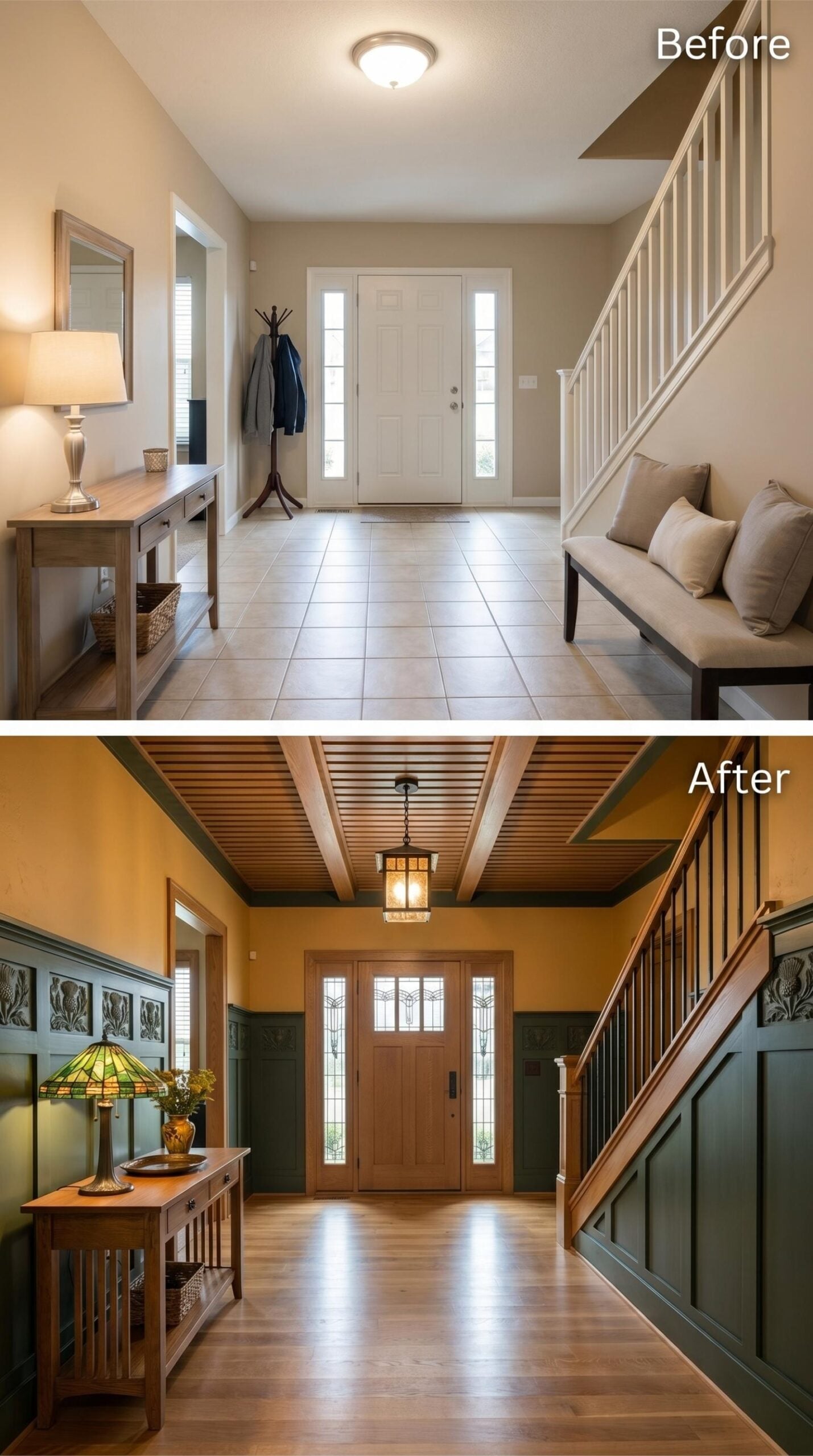
Slatted wood panels run across the ceiling between painted beams, giving the foyer a warmth that plain drywall simply can’t replicate. Deep forest green wainscoting lines the walls and anchors the golden ochre paint above it, while the front door’s leaded sidelights and geometric glass inserts earn their place rather than just filling space. A Mission-style console and Tiffany-style lamp pull the Arts and Crafts thread all the way through.
Did You Know: Craftsman-style architecture peaked between roughly 1905 and 1930, but it has seen a major design revival because its emphasis on natural materials and handcraft detail pairs well with modern preferences for warmth over minimalism. Slatted wood ceilings were a hallmark of that era and add acoustic softness alongside visual texture. Tiffany-style stained glass lamps are among the most reproduced antique lighting designs in North America, making them a surprisingly accessible entry point into period-accurate décor.
22. Burgundy Panel Molding, a Textured Ceiling, and One Very Confident Color Commitment
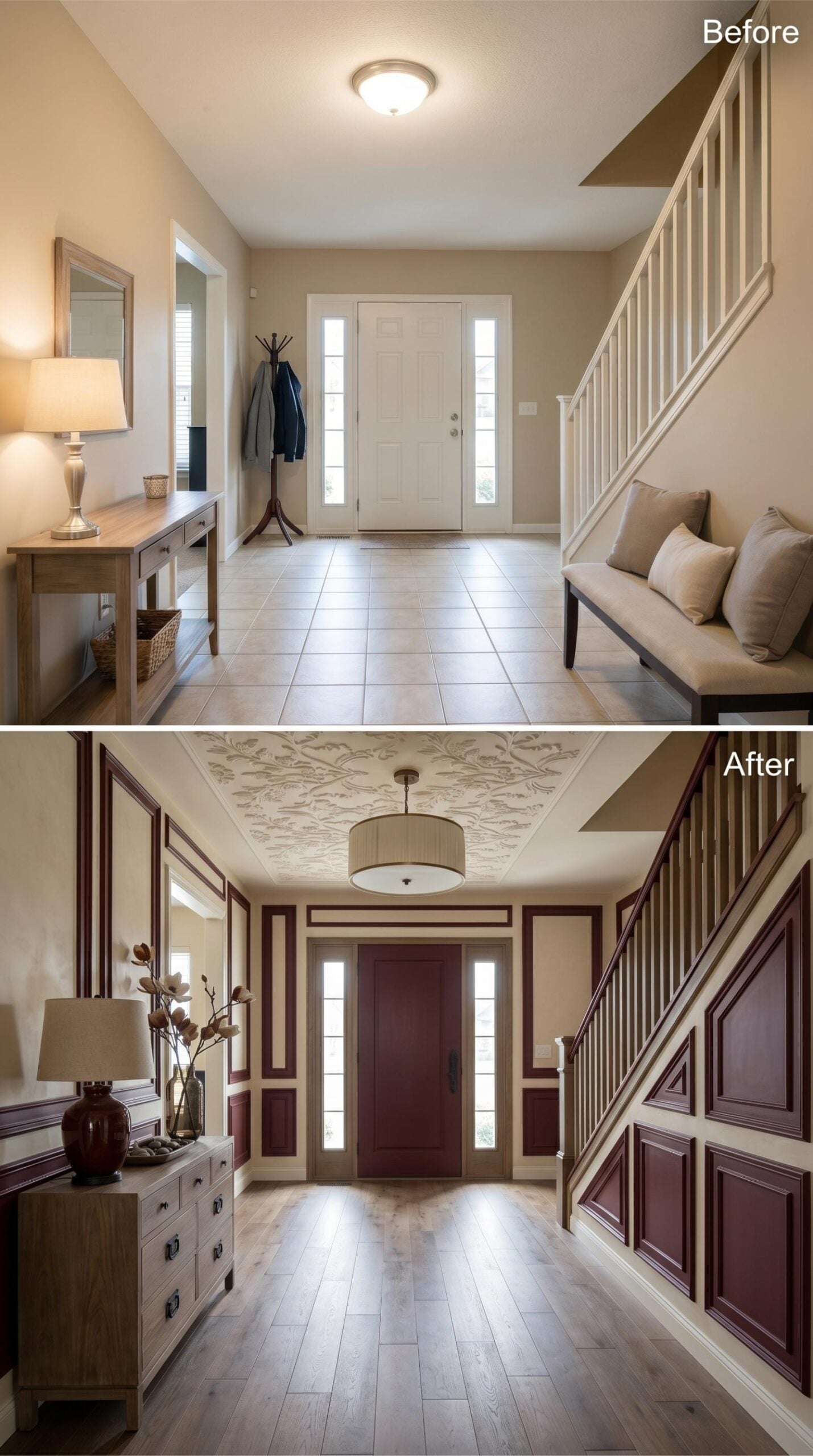
Few foyers commit to a color the way this one does. Burgundy panel molding runs the full length of the walls, wrapping around the staircase and framing the front door in the same rich tone. It’s not an accent. It’s a system.
The ceiling gets equal attention: a raised plaster medallion pattern covers the entire surface, textured with botanical relief work that reads almost like wallpaper overhead. Hardwood floors in a pale gray wash ground the space without competing. A drum pendant replaces what was likely a flush mount, and the console on the left sits low enough to keep sightlines open toward that burgundy door.
Designer’s Secret: Panel molding doesn’t have to match the wall color to work, but painting both the same shade creates a tonal depth that flat paint alone can’t produce. The trick is finish: walls in matte, molding in satin, so the architecture catches light differently and reads as dimensional rather than flat.
21. Blush Walls, Gold Crown Molding, and a Tray Ceiling That Earns Its Keep
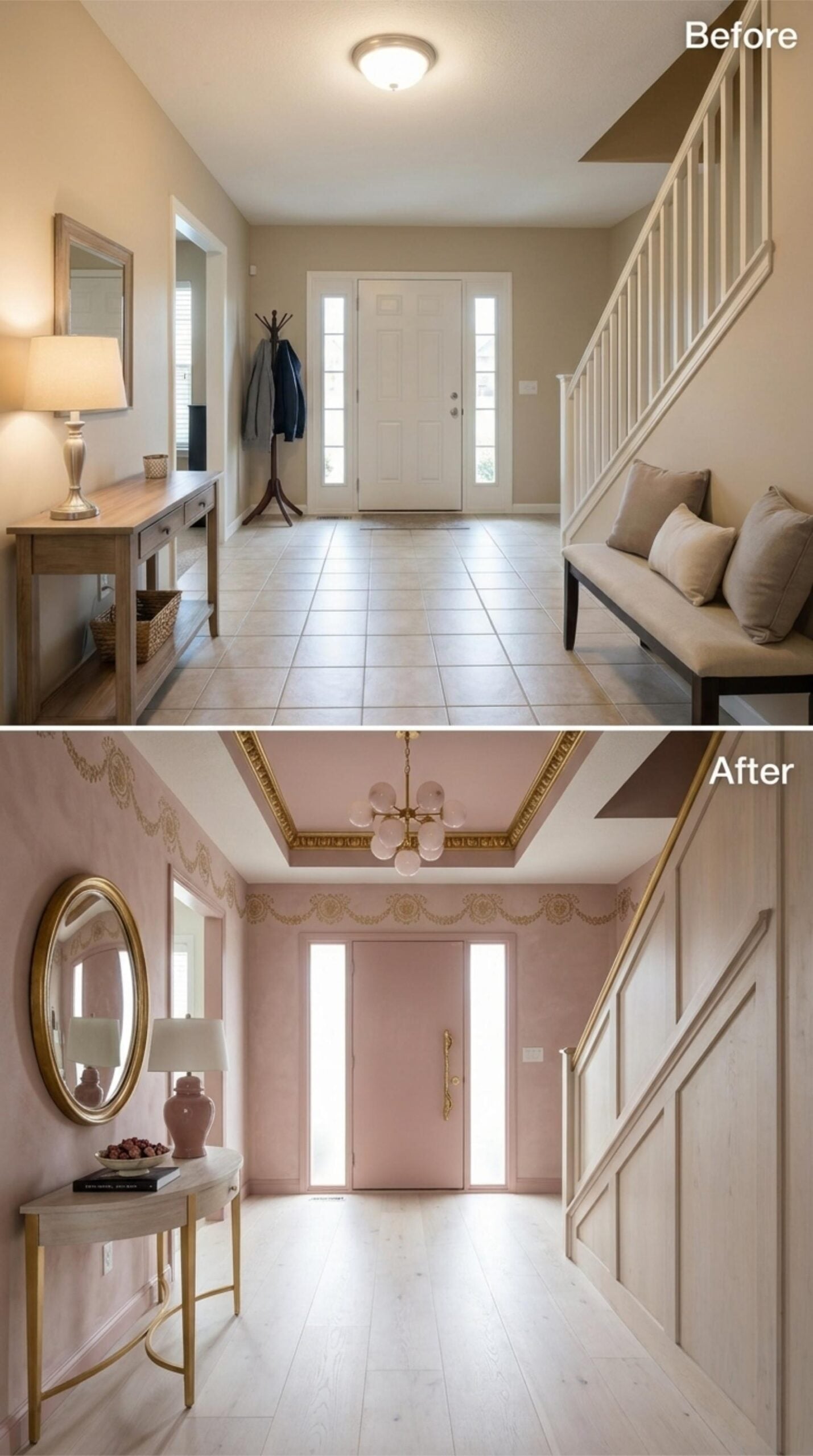
Dusty rose covers every wall surface, and it doesn’t apologize for it. The color reads soft in photographs but would feel fully immersive in person, especially with a tray ceiling trimmed in gold crown molding pulling the eye upward.
White wide-plank flooring keeps the palette from feeling heavy. A marble-topped console table on gold legs sits beneath an oval mirror with a gilded frame, a ceramic lamp in the same blush tone tying the whole left wall together. The front door, painted to match the walls, is one of those details that looks obvious in hindsight but rarely gets done.
Style Tip: Gold crown molding reads richest when installed at a transition point like the edge of a tray ceiling rather than running continuously around a room’s perimeter. Limiting it to one architectural feature gives the eye a clear focal point and keeps the finish from competing with itself. Blush paint paired with warm gold hardware tends to shift toward a soft Art Deco register rather than a strictly feminine one.
20. Copper Tile Ceiling, Crystal Chandelier, and Walls That Mean What They Say
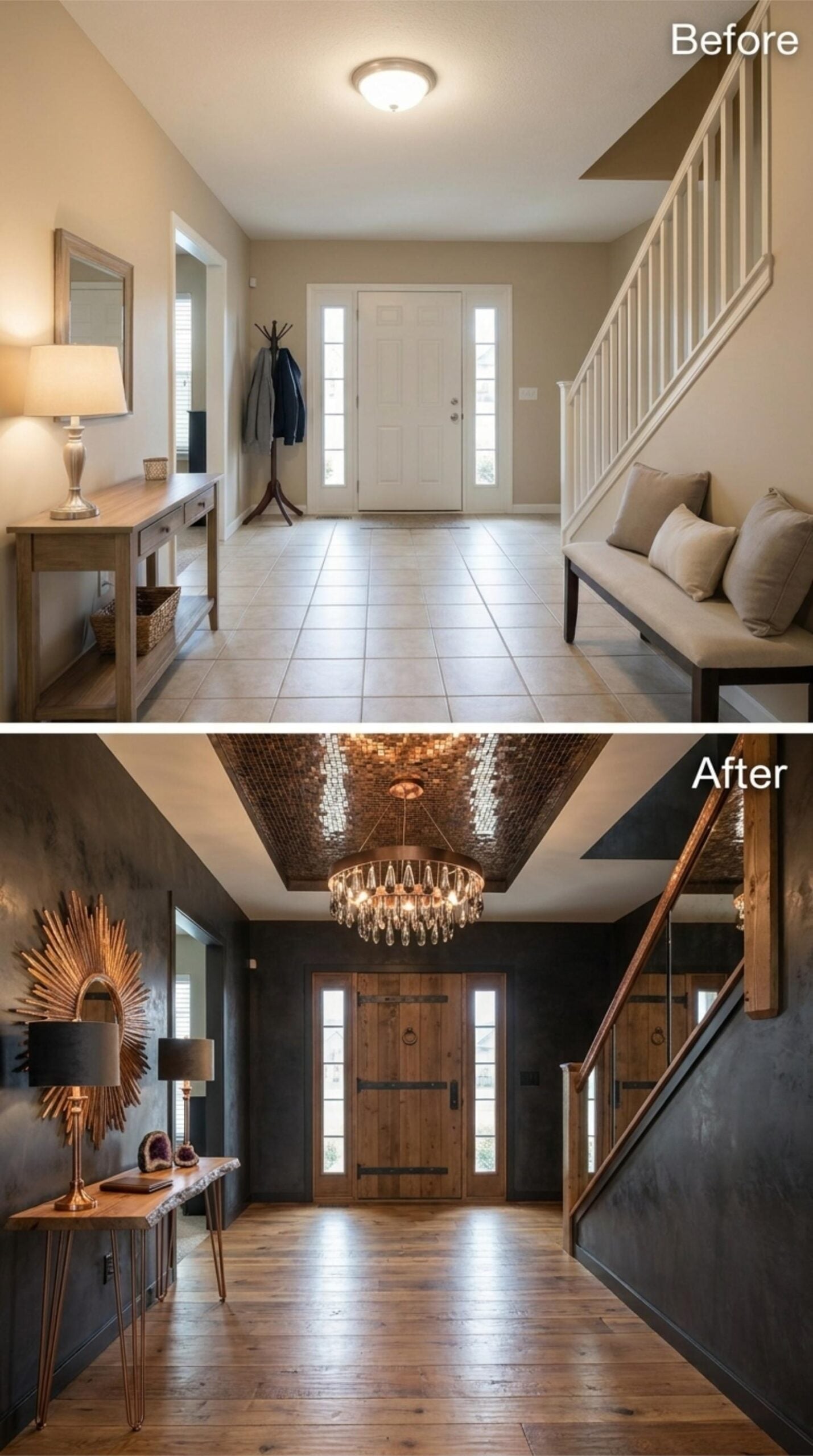
Matte charcoal plaster walls set the tone before anyone reaches the door. The real payoff is overhead: a tray ceiling lined with small-format copper mosaic tile catches the light from a crystal drop chandelier, and the combination reads genuinely rich rather than overwrought.
Wide-plank wood floors run straight to a knotty alder entry door with black iron hardware. On the left, a live-edge console sits on hairpin legs beneath a sunburst mirror in aged gold. It’s a confident room. Not loud, just certain.
- Copper mosaic tile reflects light differently depending on time of day, making a fixed fixture feel dynamic without any adjustment
- Knotty alder doors tend to read warmer than painted doors because the grain variation adds natural contrast the eye keeps returning to
- A sunburst mirror placed low on a tall wall draws the eye sideways first, which can make a narrow entry feel proportionally wider
19. Pink Walls, Gold Garland Molding, and a Chandelier That Sets the Entire Tone
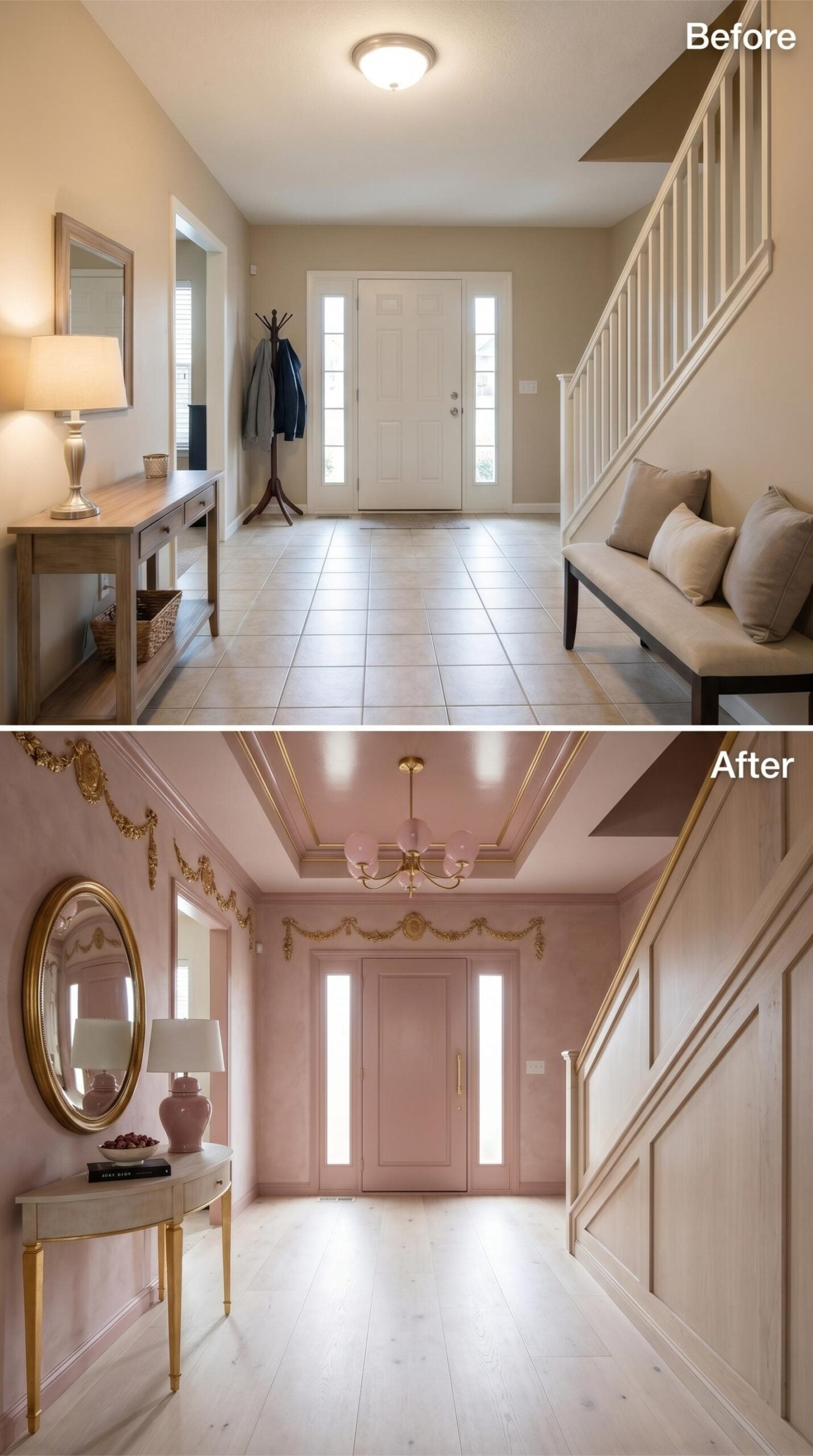
Soft blush covers every surface here — walls, ceiling, and door — pulling the eye around the room rather than stopping it anywhere. Gold garland molding swags across the upper walls like something lifted from a French palace antechamber. The oval mirror in its gilded frame and the demilune console with gold legs keep the furniture scaled right without crowding the entry.
Common Mistake: Painting the front door to match the walls is a bold choice that pays off only if the surrounding trim reads as a distinct contrast. When door and trim blend together, the entry loses its focal point entirely. A crisp white or soft cream on the molding is what keeps a monochromatic foyer from looking unfinished.
18. Ceiling Murals, Navy Trim, and a Herringbone Floor That Changes the Whole Conversation
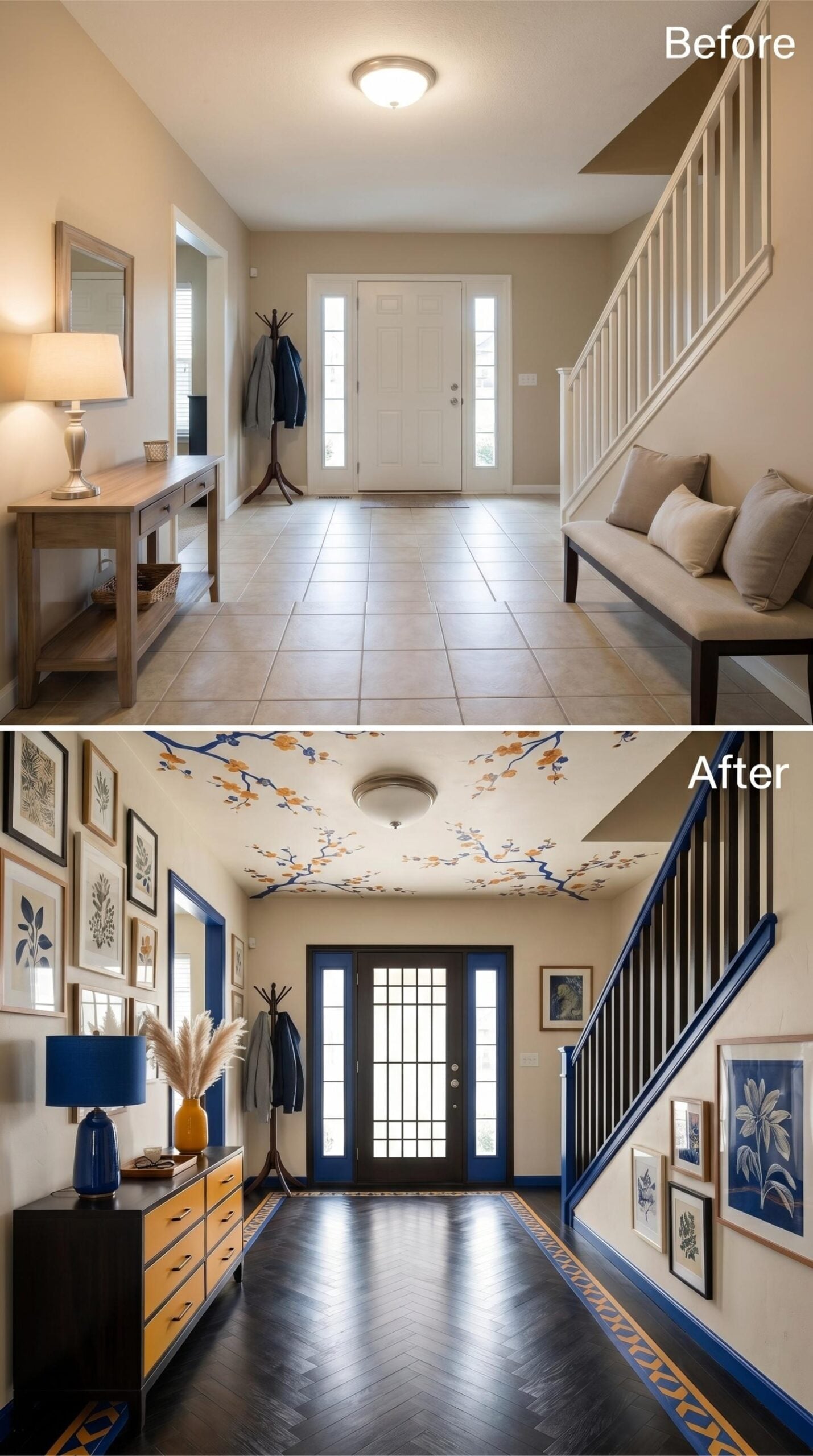
Cherry blossom branches painted across the ceiling do more design work than most entire rooms.
The hand-painted floral mural sprawls across a cream ceiling in navy and amber, pulling both accent colors upward and making the eye travel in a way a flat ceiling never could. Dark herringbone floors run the full length of the foyer, bordered by a painted geometric runner in blue and gold that mimics the function of an area rug without the bulk. The staircase railing is painted navy to match the door trim, locking the color story together rather than scattering it. A black dresser with amber-painted drawer fronts anchors the left wall, topped with a cobalt lamp and dried pampas grass. Gallery frames line both walls with botanical prints, some moody and dark, some pale and spare. It’s a lot happening, but the shared blue-and-gold palette keeps it from feeling chaotic.
bold_hook: Painted ceiling murals don’t require a professional muralist. Stencil kits sized for ceilings are widely available and can replicate branching or floral patterns with standard wall paint. The deciding variable isn’t skill so much as patience with tape lines and a steady roller for background prep.
17. Blue Venetian Plaster, Decorative Columns, and a Ceiling Medallion That Earns the Chandelier
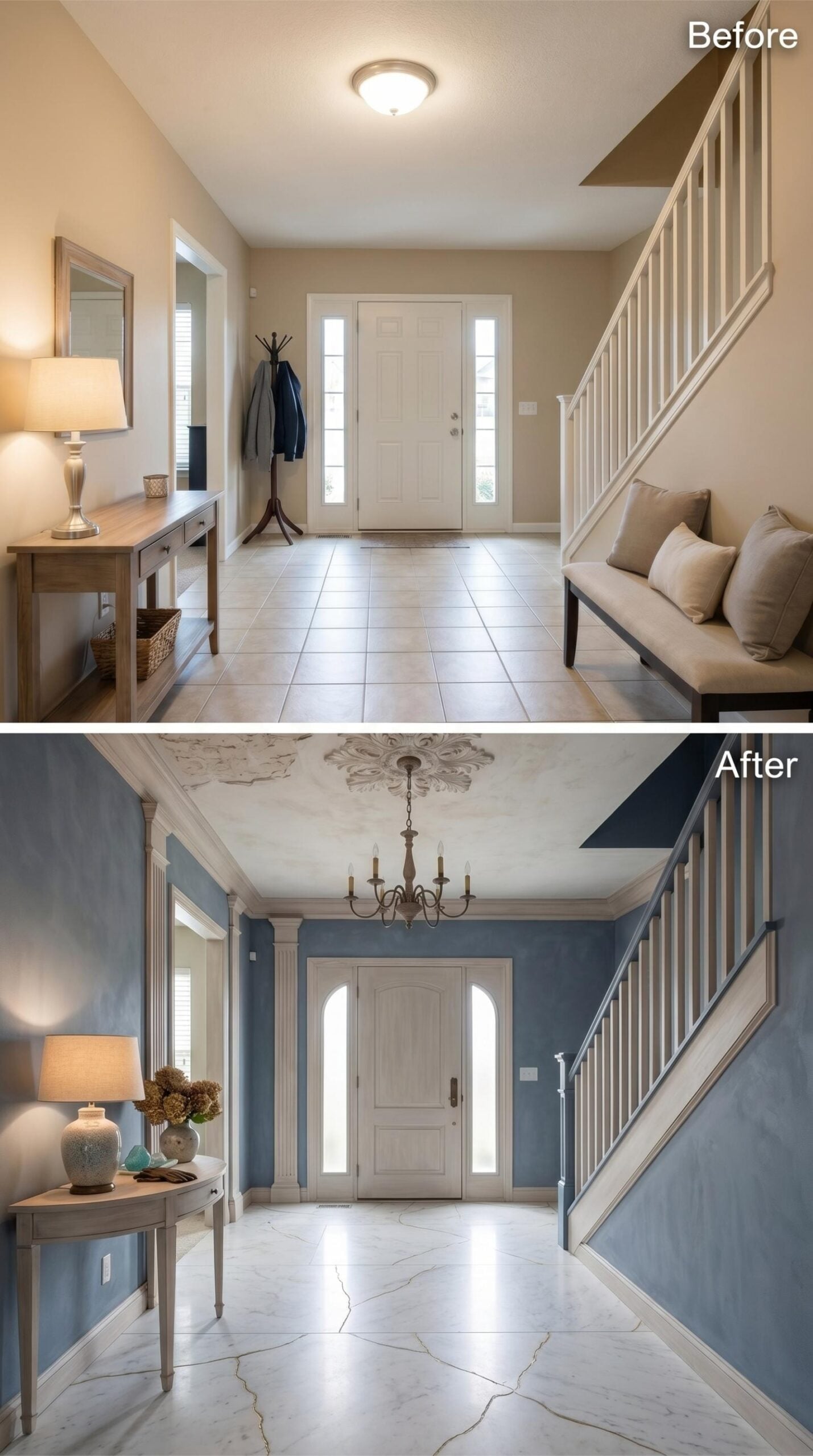
Slate-blue venetian plaster walls give this foyer a texture that flat paint can’t replicate, and flanking the door with classical columns makes the entry feel genuinely architectural rather than merely dressed up. The candelabra chandelier, suspended from an ornate plaster medallion, does exactly what statement lighting should do.
Trend Alert: Venetian plaster has resurged as a wall finish because it reflects light differently at every hour of the day, creating subtle depth without pattern or wallpaper. Applied in thin layers and burnished to create variation, no two finished walls look identical. It’s one of the few finishes that actually improves the longer you look at it.
Navy keeps showing up in these foyers, but this one commits to it harder than most.
16. Art Deco Wallpaper, a Coffered Ceiling, and Navy That Goes All the Way Up
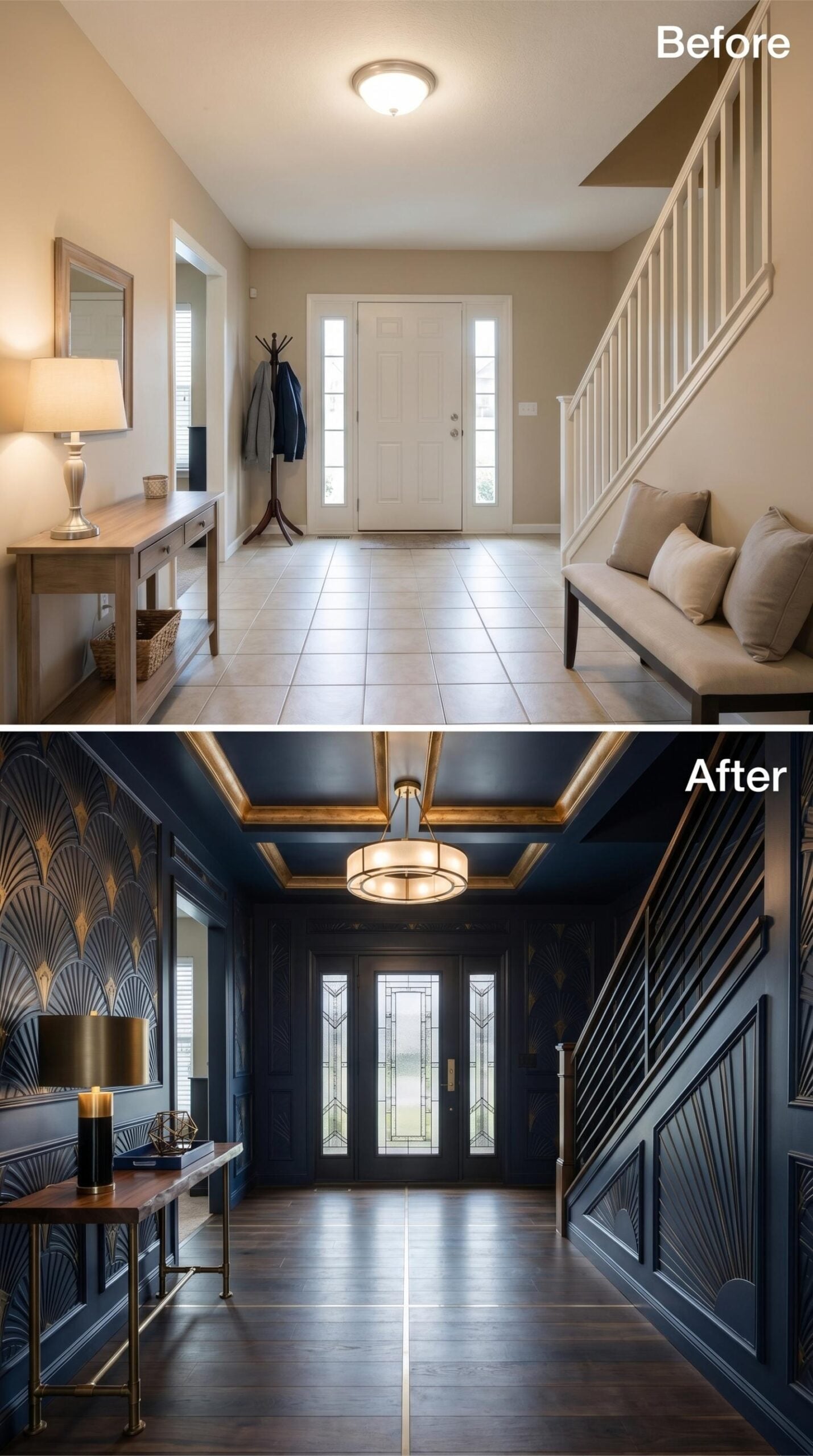
Navy covers every surface here — walls, ceiling, and trim — and it works because the gold detailing gives the eye somewhere to land. Art Deco fan wallpaper runs floor to ceiling on both sides, its gilded pattern catching light from a drum pendant with a warm-toned diffuser. The coffered ceiling gets a gold border at its inset edge, which is exactly where that kind of accent does its best work.
Dark hardwood flooring replaced what was almost certainly tile, and the visual shift is significant. Leaded glass panels flank a navy entry door, their geometric lines echoing the Art Deco wallpaper without being too coordinated about it. A brass console lamp and metal geometric accent piece keep the left side grounded. The staircase railing, now angular steel rather than turned wood balusters, reads as furniture rather than architecture.
15. Beamed Ceilings, Arched Entry, and Terracotta Tile That Signals Spanish Colonial
🔥 Would you like to save this?
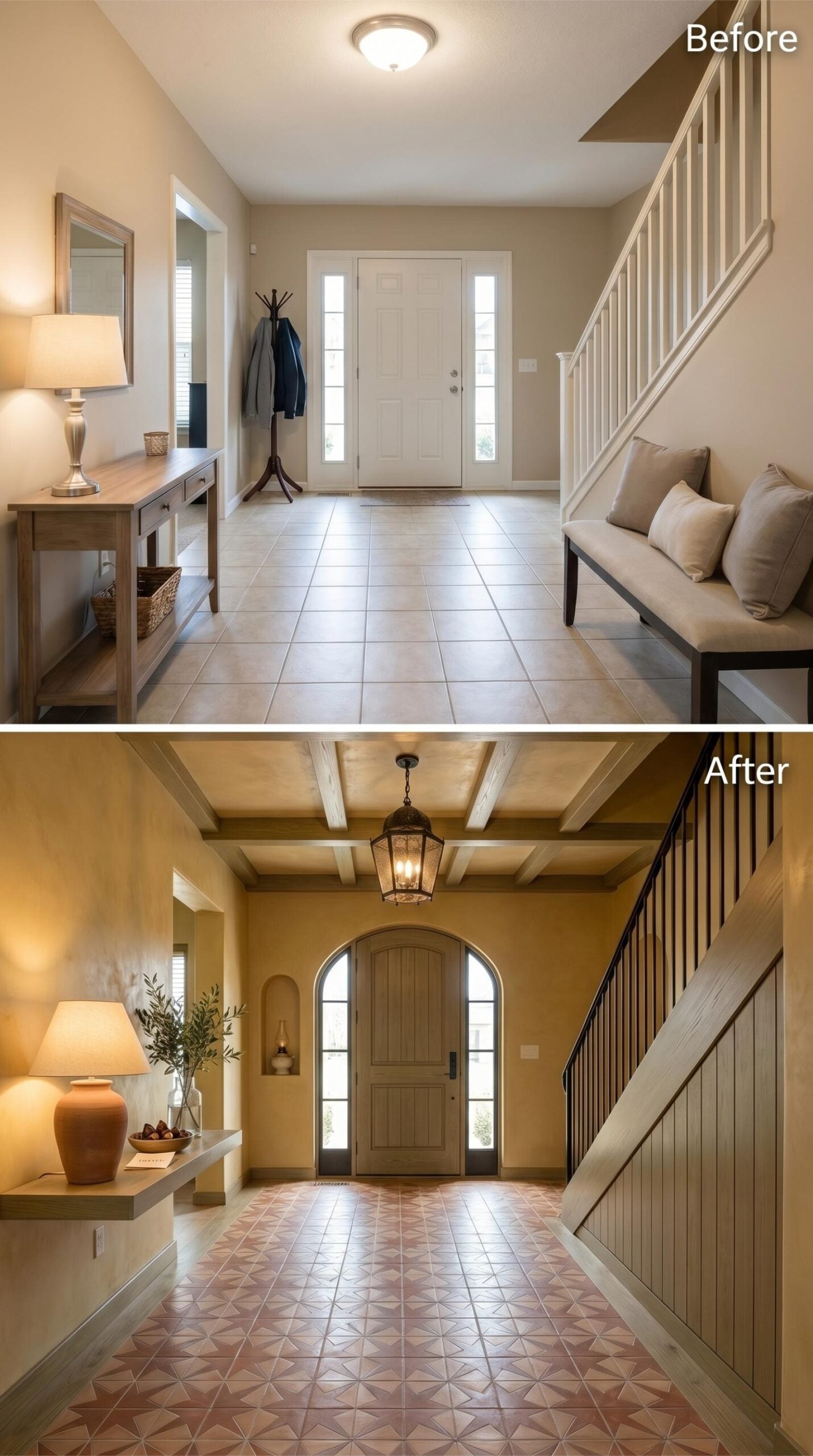
Warm ochre plaster walls set the tone before anything else registers. A coffered ceiling with exposed wood beams anchors the space overhead, and a wrought-iron pendant lantern hangs at center, casting amber light across patterned terracotta floor tile. The arched front door, finished in a weathered wood stain, is flanked by a tall transom window that pulls in daylight without softening the room’s warmth.
In The Details: Coffered ceilings with wood beams look labor-intensive, but the beams themselves are often hollow box constructions applied over drywall rather than structural lumber. A floating plaster console and a terracotta lamp base on the left wall reinforce the Spanish Colonial palette without competing with the architectural work happening above.
14. Burgundy Grid Molding, Chartreuse Accents, and a Herringbone Floor That Rewrites the Entry
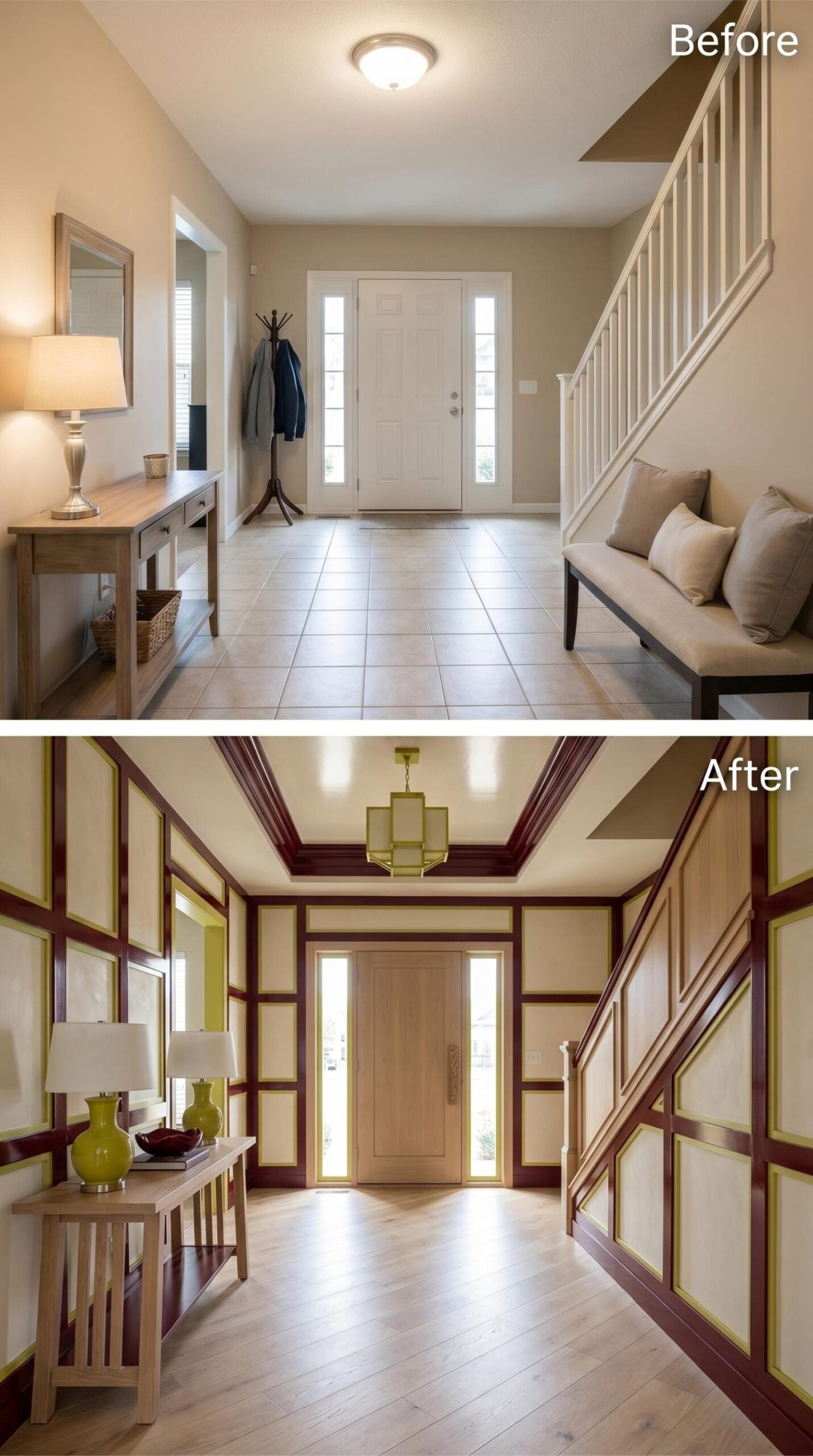
Cream wall panels framed in deep burgundy trim run floor to ceiling, with chartreuse inlay detail adding a jolt of color that stops the palette from reading as traditional. A light wood herringbone floor pulls the eye toward a natural wood front door flanked by sidelights. Overhead, a geometric brass pendant anchors it all.
Chartreuse inlay detail adds a charge of color that stops the palette from reading as traditional.
13. Coffered Ceiling, Cable Railing, and Venetian Plaster That Does the Heavy Lifting
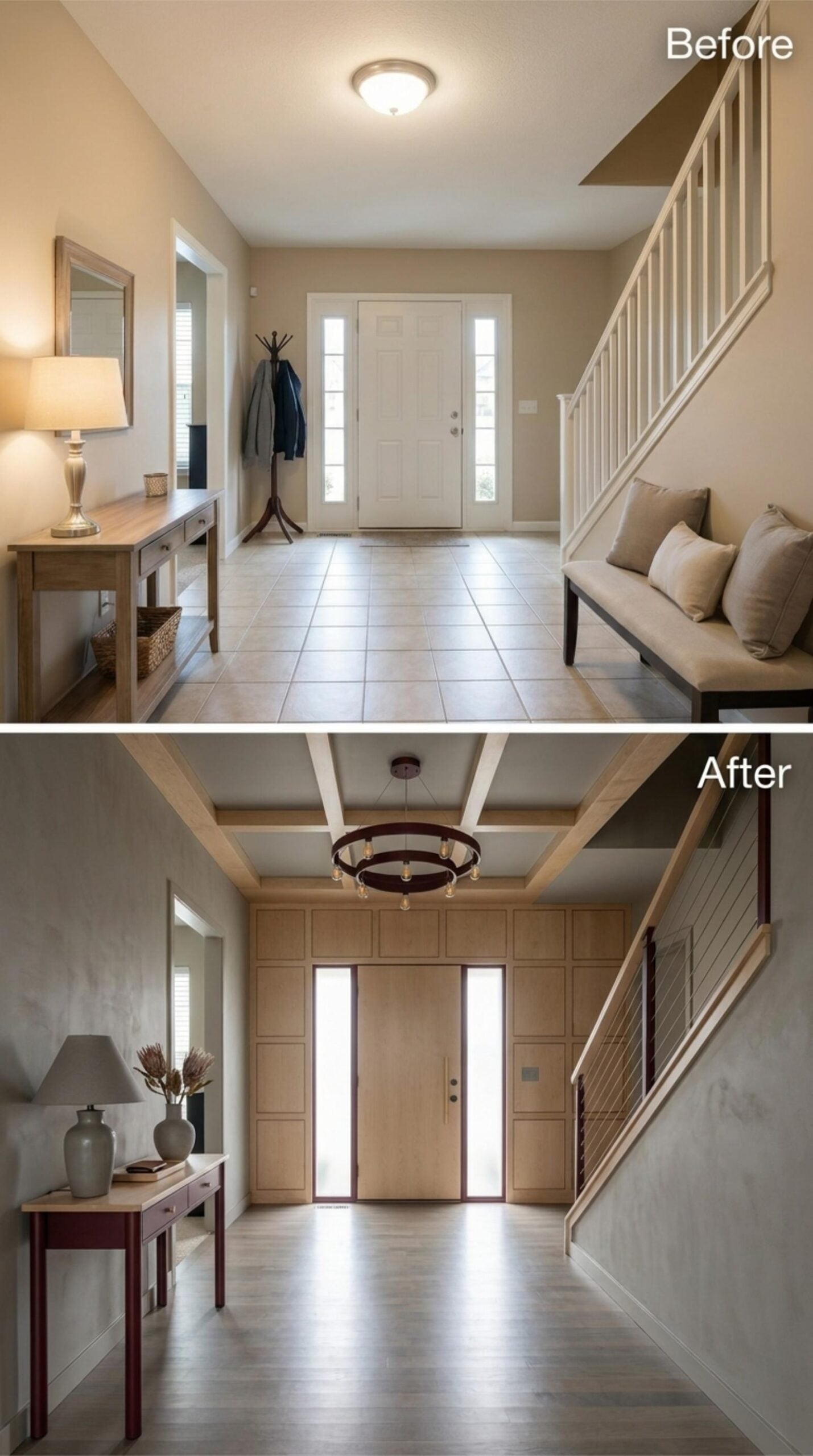
Limewash-style plaster covers every wall in a cool gray that shifts between concrete and silver depending on the light. Paired with a coffered ceiling trimmed in pale wood, the foyer reads taller than it likely measures. The drum chandelier with exposed Edison bulbs anchors the center without competing with the architecture around it.
Plank flooring in a light ash tone replaced tile, and the difference in scale is immediately obvious. A burgundy console with tapered legs keeps the left wall from going empty, and cable railing on the staircase lets the eye travel upward without the visual weight of traditional balusters cutting across it.
12. Wood-Paneled Ceiling, Cable Railing, and Venetian Plaster That Pulls Everything Together
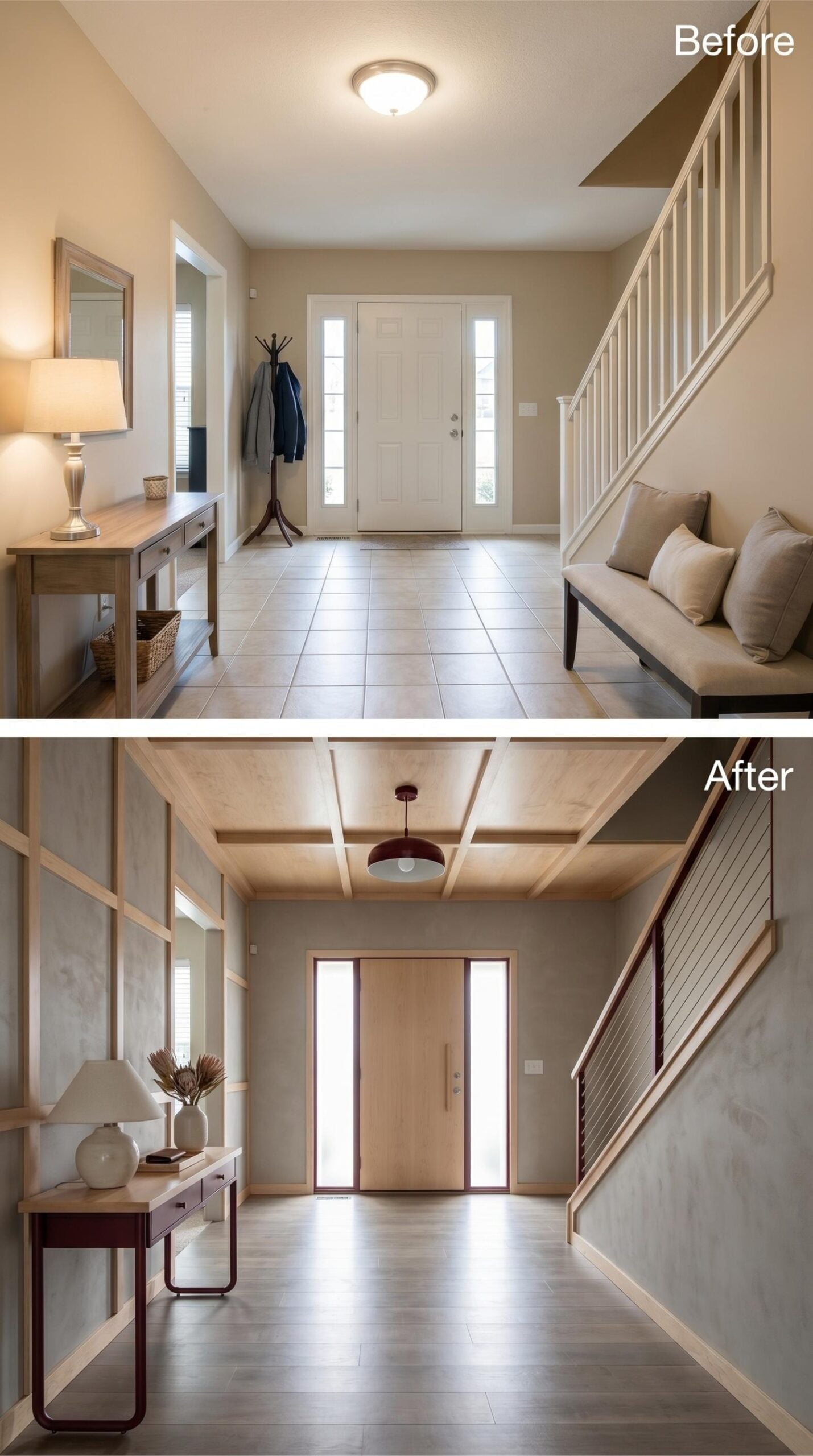
Light maple panels on a coffered ceiling set the warmth here, paired with walls finished in a cool gray venetian plaster that reads almost concrete from a distance. The pendant — a matte burgundy dome — is small enough to feel deliberate rather than decorative.
The staircase railing swaps traditional balusters for horizontal cable wire with wood posts, which keeps sightlines open across the space. A slim console with dark legs anchors the left wall without competing with the ceiling’s texture.
11. Royal Blue Velvet Walls, Gold Baroque Ceiling, and a Crystal Chandelier That Owns the Room
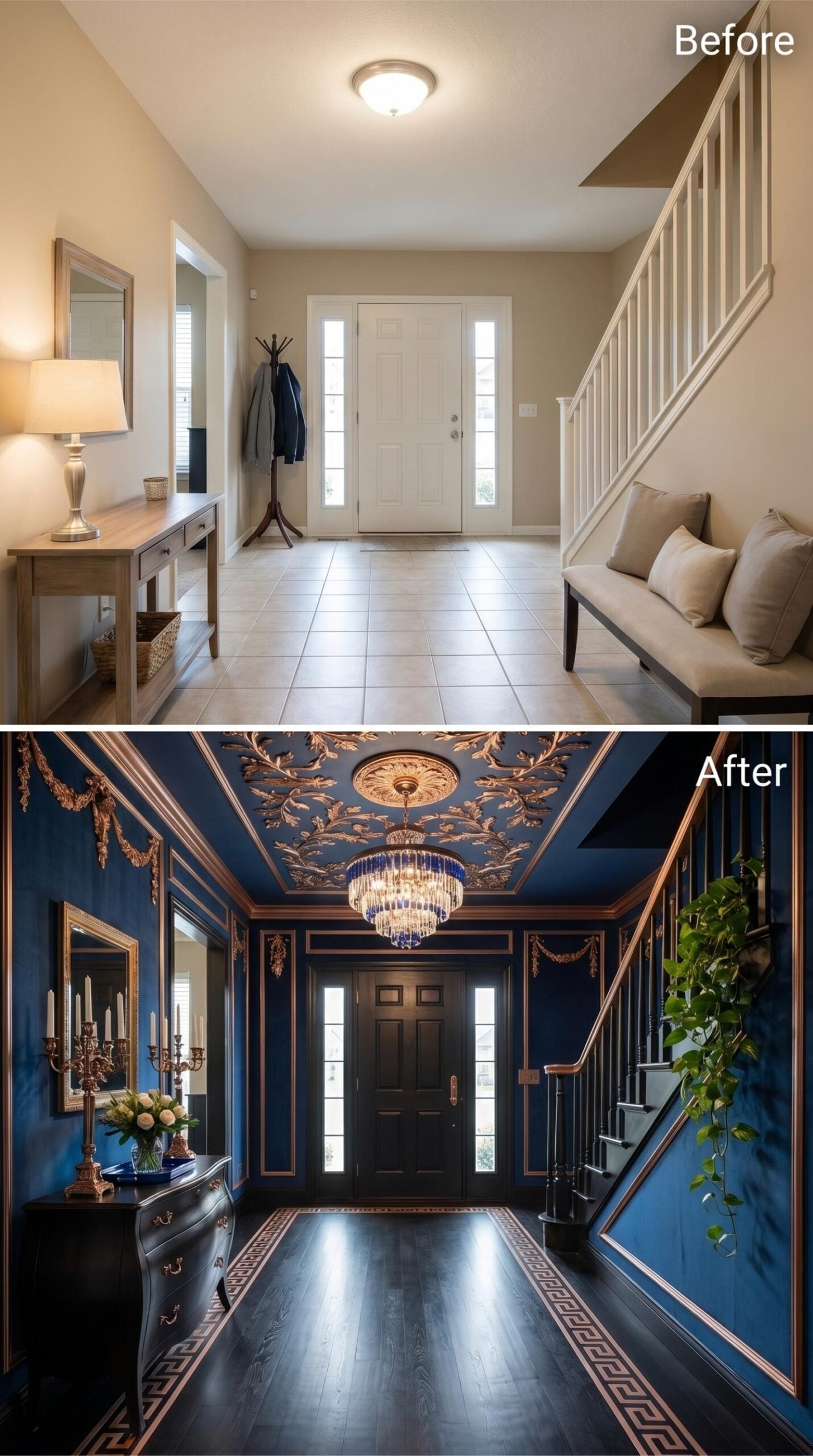
Gold acanthus-leaf plasterwork spreads across a navy ceiling like something borrowed from a Parisian opera house, and it earns every bit of the tiered crystal chandelier hanging beneath it. Dark hardwood floors run the length of the entry, anchored by a Greek key border inlay that frames the path to the door. The console is baroque-footed with gilt hardware. It works, full stop.
10. Geometric Mural Wall, Salmon Pendant, and Hardwood That Finally Belongs Here
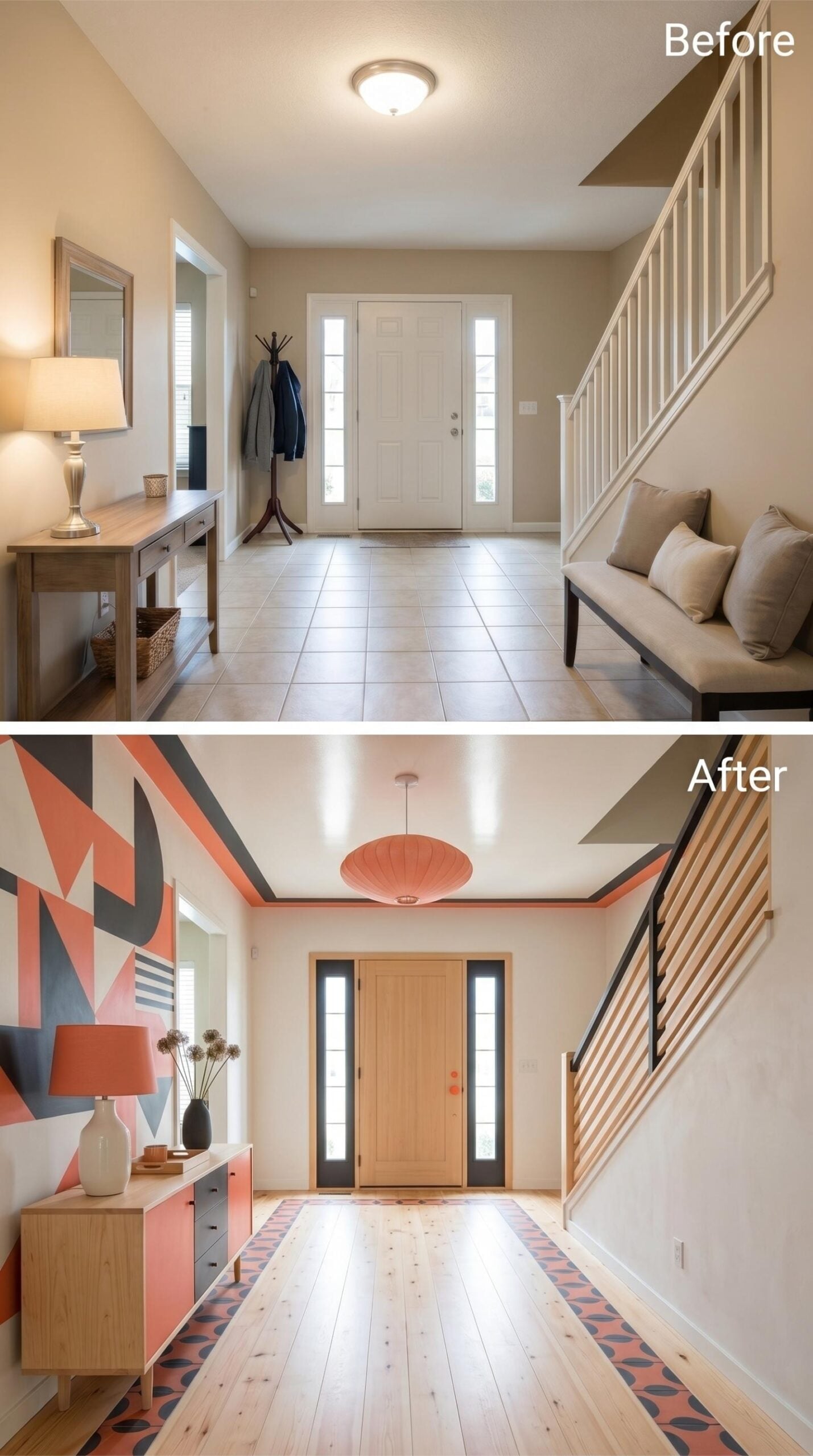
Bold coral and charcoal triangles sweep from the accent wall straight onto the ceiling plane — the kind of commitment most foyers never make. A paper lantern pendant in the same salmon registers as intentional rather than accidental. Light birch hardwood runs the length of the entry, bordered by a geometric tile inlay that echoes the mural without copying it.
9. Coffered Concrete Ceiling, Baroque Medallions, and Burgundy That Means Business
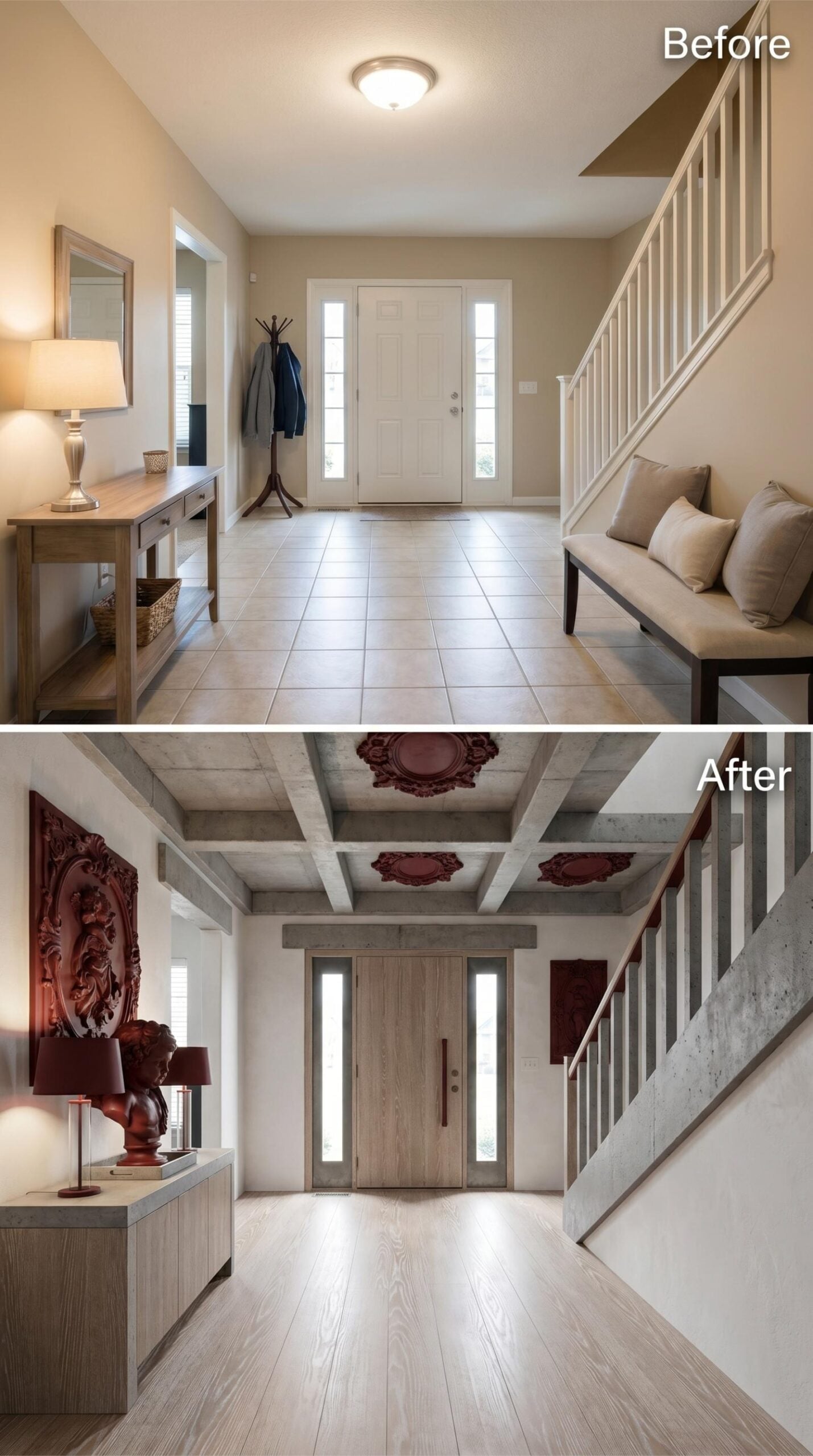
Concrete-finish coffered beams grid the ceiling overhead, and someone made the smart call to mount deep burgundy carved medallions inside each coffer rather than leaving them bare. It sounds like a lot. It isn’t. The medallions anchor the geometry instead of competing with it.
The front door swap alone does considerable work here: a wide-plank wood door with a vertical pull handle replaces what was almost certainly painted white. Whitewashed hardwood runs the full length of the floor, keeping the palette from tipping too dark. On the left wall, an oversized carved relief panel in the same burgundy carries the color vertical, and a low gray console keeps the furniture line from interfering with any of it.
8. Mondrian-Inspired Ceiling Beams, Red Panel Accents, and a Door That Finally Has a Point of View
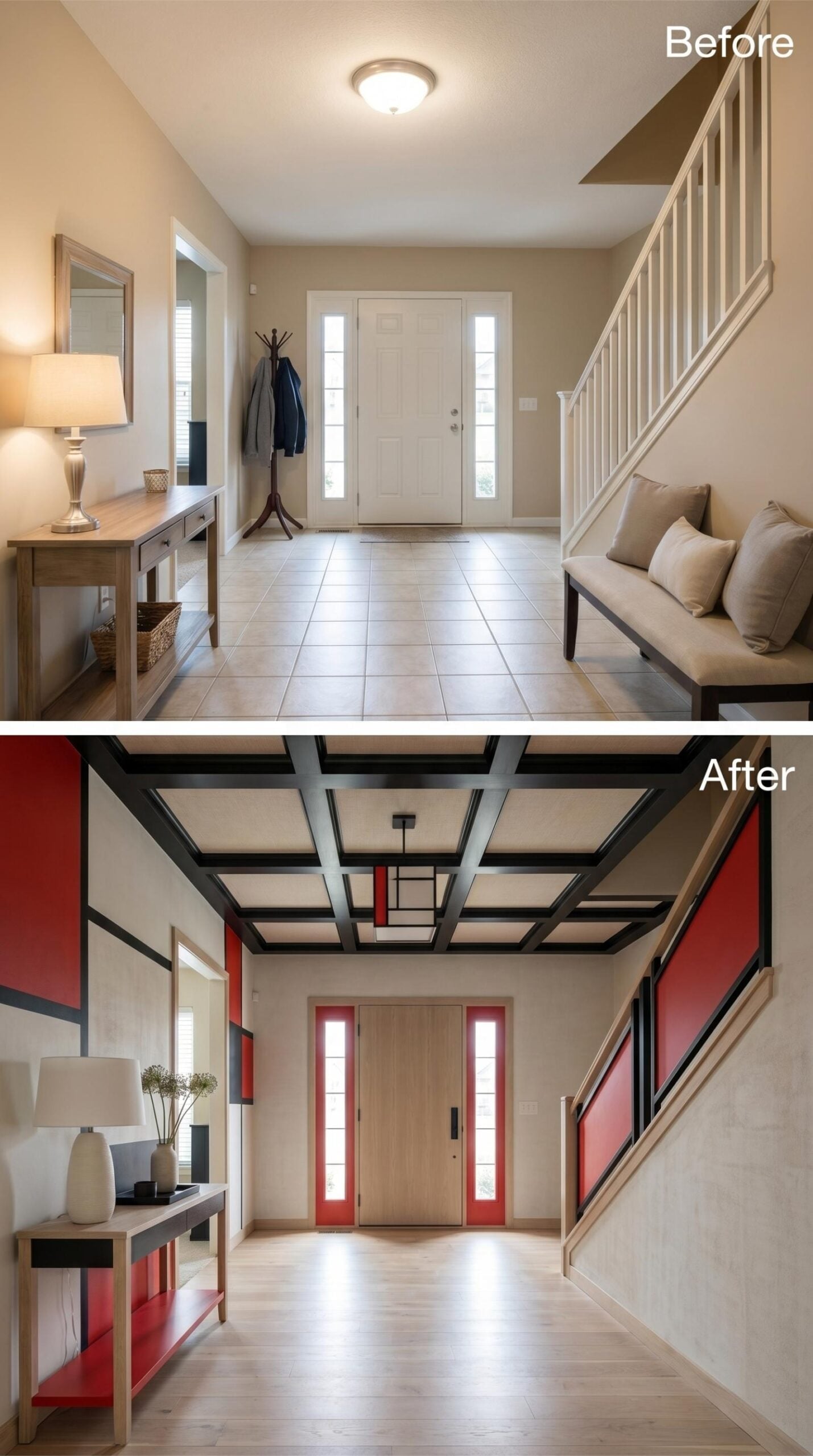
Black grid beams laid across the ceiling in a Mondrian-like pattern do the kind of work most foyers never ask of their overhead plane. Paired with red rectangular panels on the walls and stair railing, the geometry reads intentional rather than aggressive. The natural wood door is a quieter choice than expected, but it keeps the palette from tipping into graphic overload.
A console table with red lower shelving echoes the wall accents without duplicating them exactly. The light-wash floor tile keeps the base neutral, which is probably the only reason all that ceiling drama holds together.
7. Plum Wainscoting, Floral Ceiling Wallpaper, and a Front Door That Finally Commits
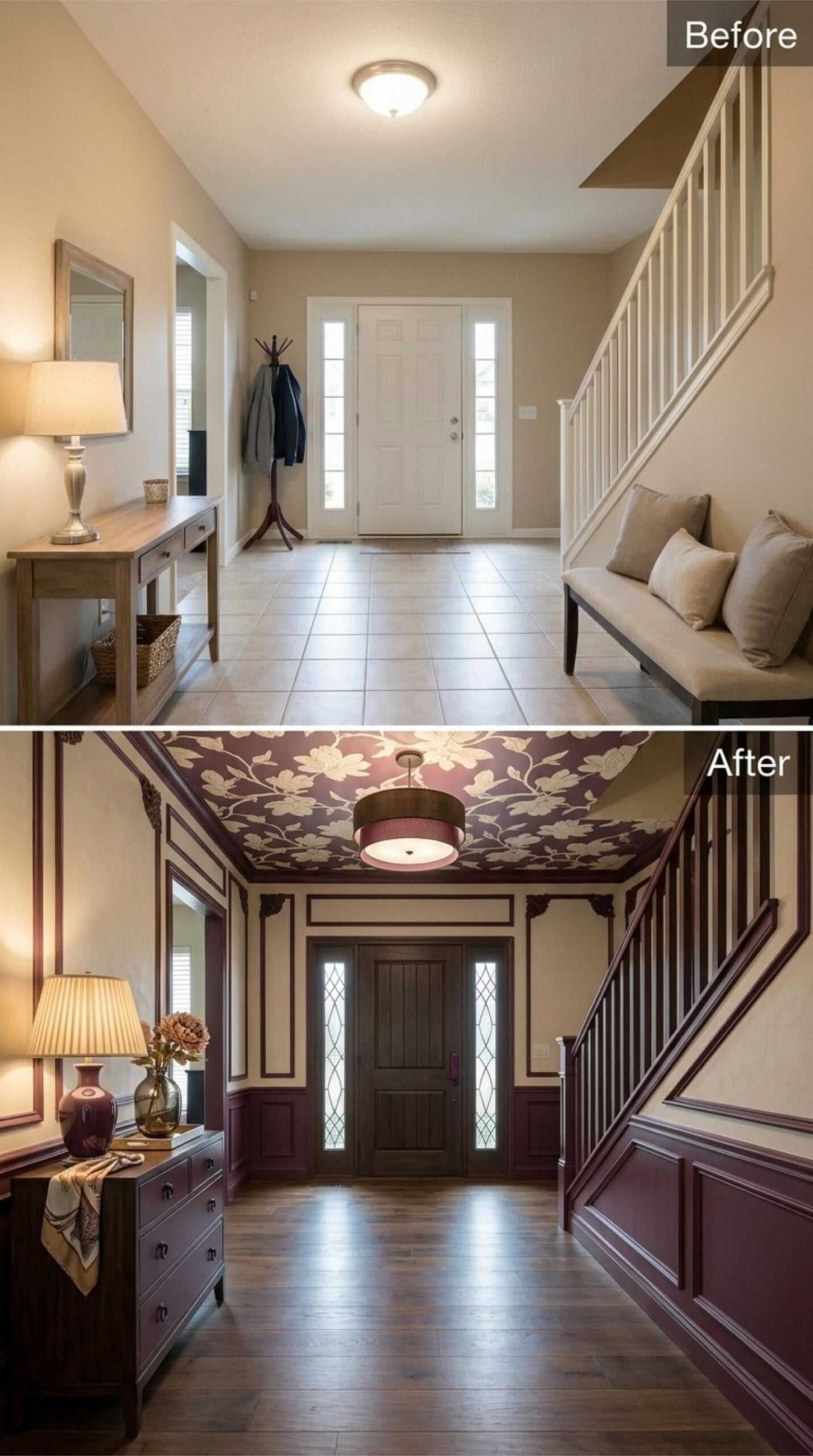
Deep plum wainscoting runs the full perimeter of the foyer, and the staircase railing picks up the same color so nothing reads as an afterthought. Panel molding above the wainscot creates framed rectangles on the walls, adding architectural weight without touching the structure itself. The front door shifts to dark-stained wood, which reads warmer against the diamond-patterned sidelights than a painted finish would.
Up on the ceiling, floral wallpaper in cream and burgundy does something most ceilings don’t bother attempting. A drum pendant with a plum shade anchors the center. The console switches to a painted dresser, low and dark, with a pleated lamp shade that keeps the mood consistent rather than punchy. Hardwood flooring replaces tile, and the grain runs straight toward the door, pulling the eye forward.
6. Plum Wainscoting, Floral Ceiling Wallpaper, and Molding That Finally Has Something to Say
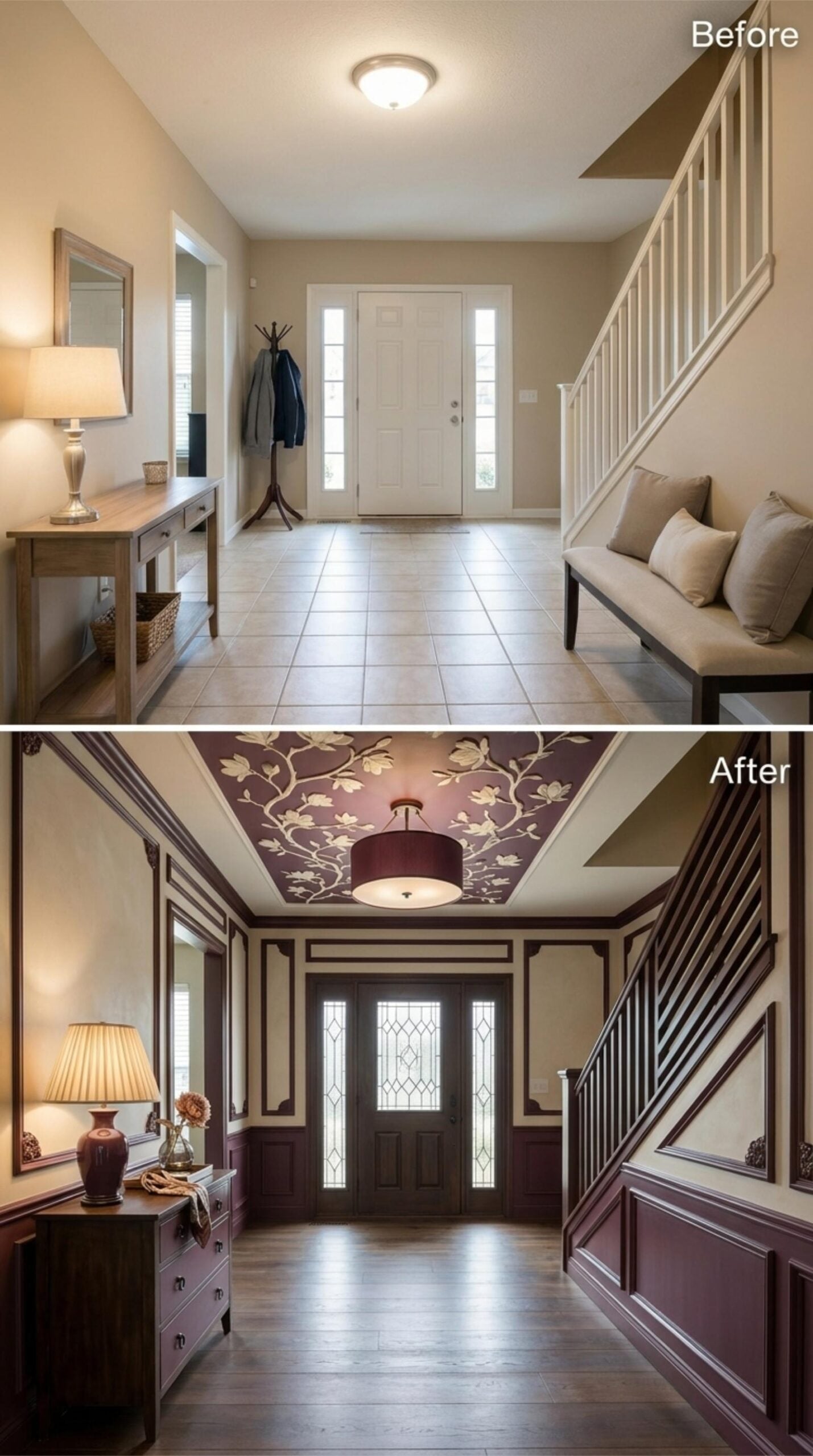
Wainscoting in a deep plum runs the full height of the lower wall, capped with a painted wood rail that separates it cleanly from the cream upper wall. Rectangular panel molding continues above that rail in the same plum tone, framing each wall section like a picture. The ceiling gets the most attention: floral wallpaper in burgundy and ivory spreads across a recessed plane, magnolia branches reaching toward a drum pendant in a matching wine-red fabric shade.
The front door went from hollow-core white to a dark stained wood double entry with leaded glass inserts. Hardwood flooring replaced tile, and the stair railing picked up the same dark finish as the wainscoting. Every surface is coordinated without being matchy. That’s a harder edit than it looks.
5. Ornate Gold Crown Molding, Sage Walls, and a Tray Ceiling That Changes the Whole Conversation
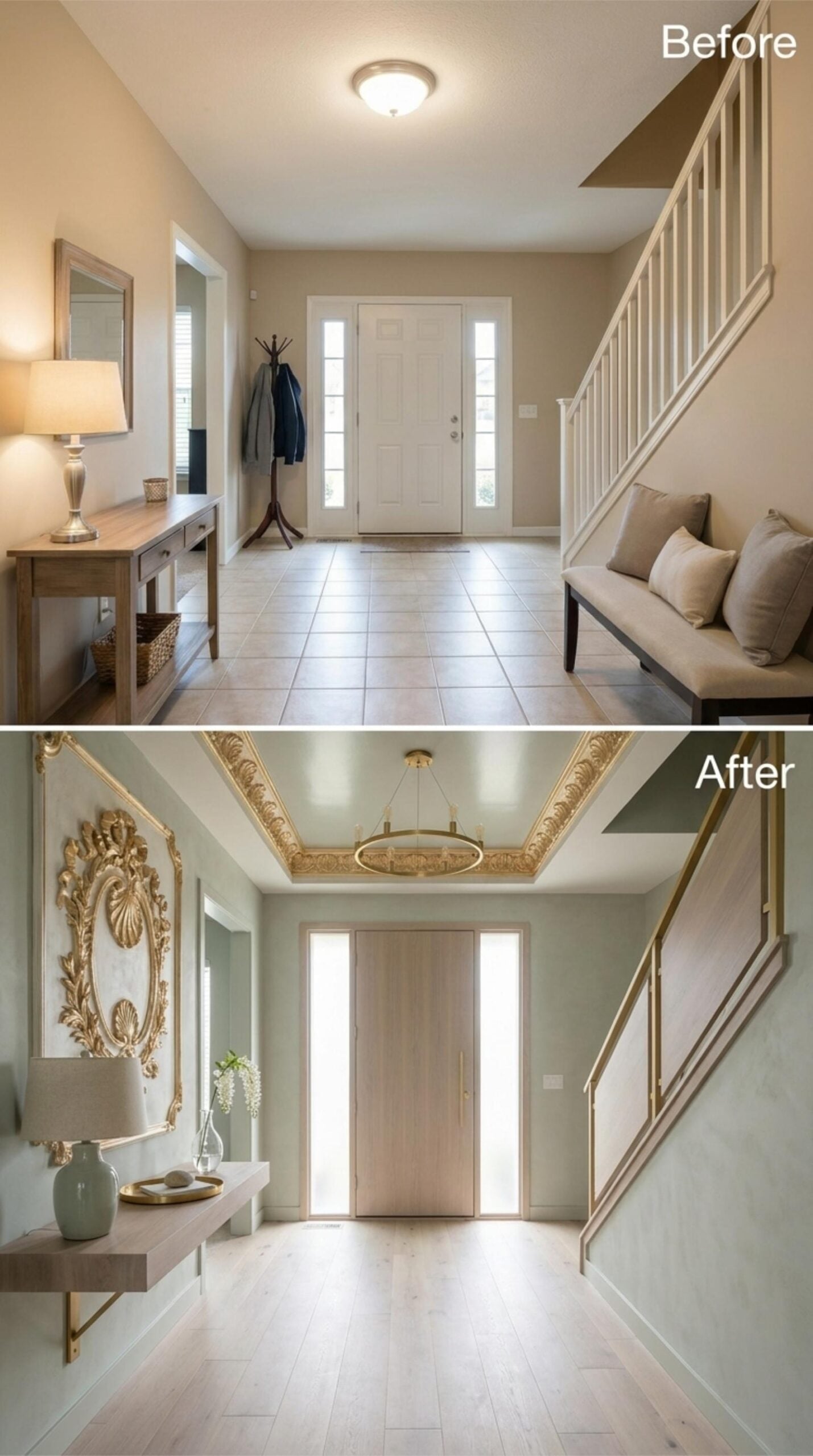
Sage green walls and wide-plank floors in a pale ash tone do most of the heavy lifting here, but it’s the tray ceiling that makes the space feel intentional. Gilded acanthus-leaf crown molding runs along its inner edge, and a circular brass chandelier drops from the center. The staircase railing got replaced with brass bar-style hardware that mirrors the ceiling’s finish. The whole room coheres.
4. Sage Beadboard, a Coffered Tray Ceiling, and Wood That Finally Sets the Tone
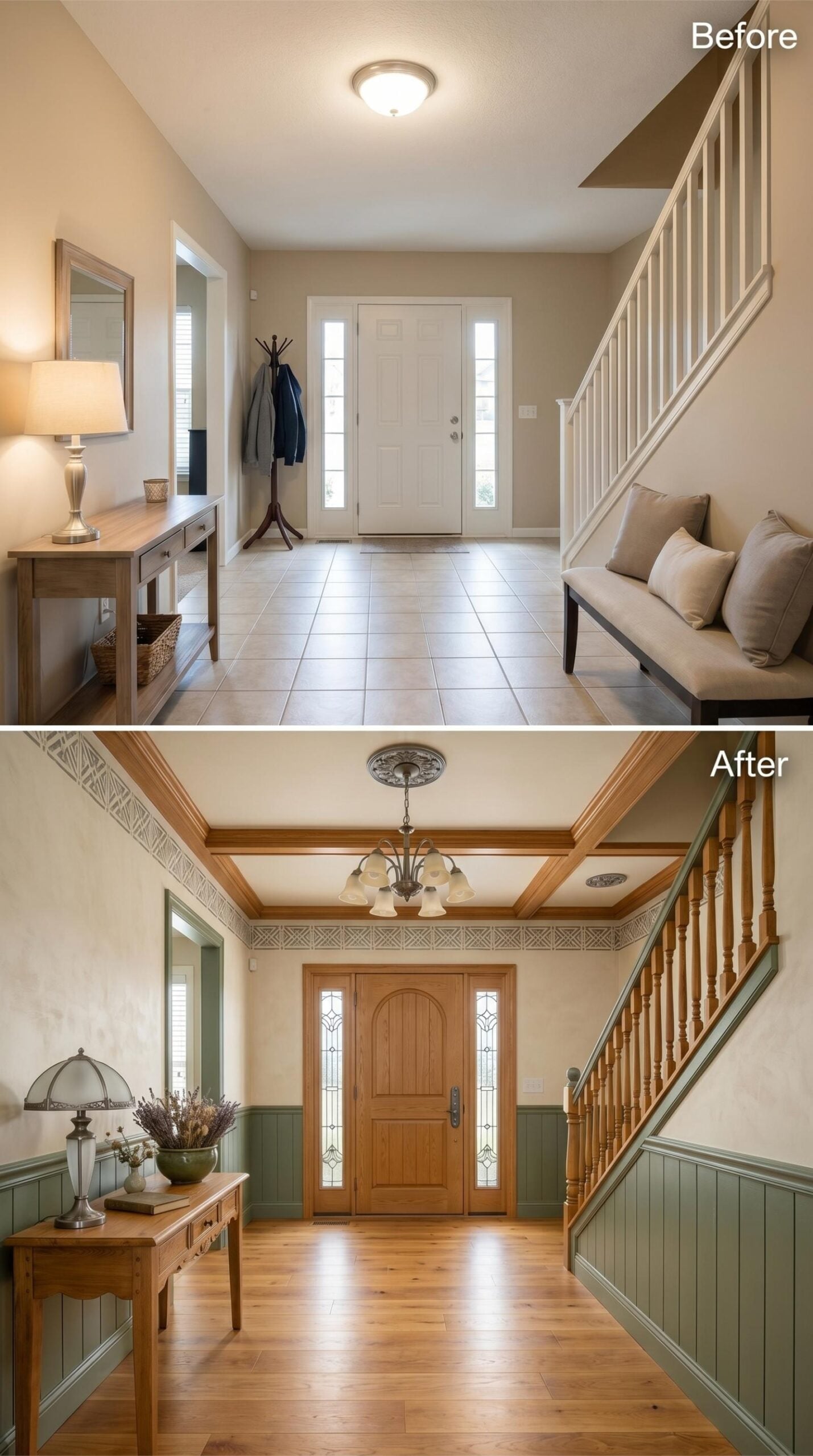
Sage-painted beadboard runs the lower half of every wall, topped with a stenciled border pattern that bridges the wainscoting and the cream plaster above. The coffered tray ceiling pulls the eye upward, and the chandelier centered inside it has that warm, multi-arm silhouette that reads more craftsman lodge than builder-grade foyer. Hardwood floors in a natural honey finish run straight rather than patterned, letting the woodwork do the talking.
The front door is the clearest decision in the room: solid wood with an arched panel and leaded-glass sidelights that frame it without competing. The oak console table against the left wall keeps the furnishings honest. Nothing here is straining to impress, and that restraint is exactly what makes it land.
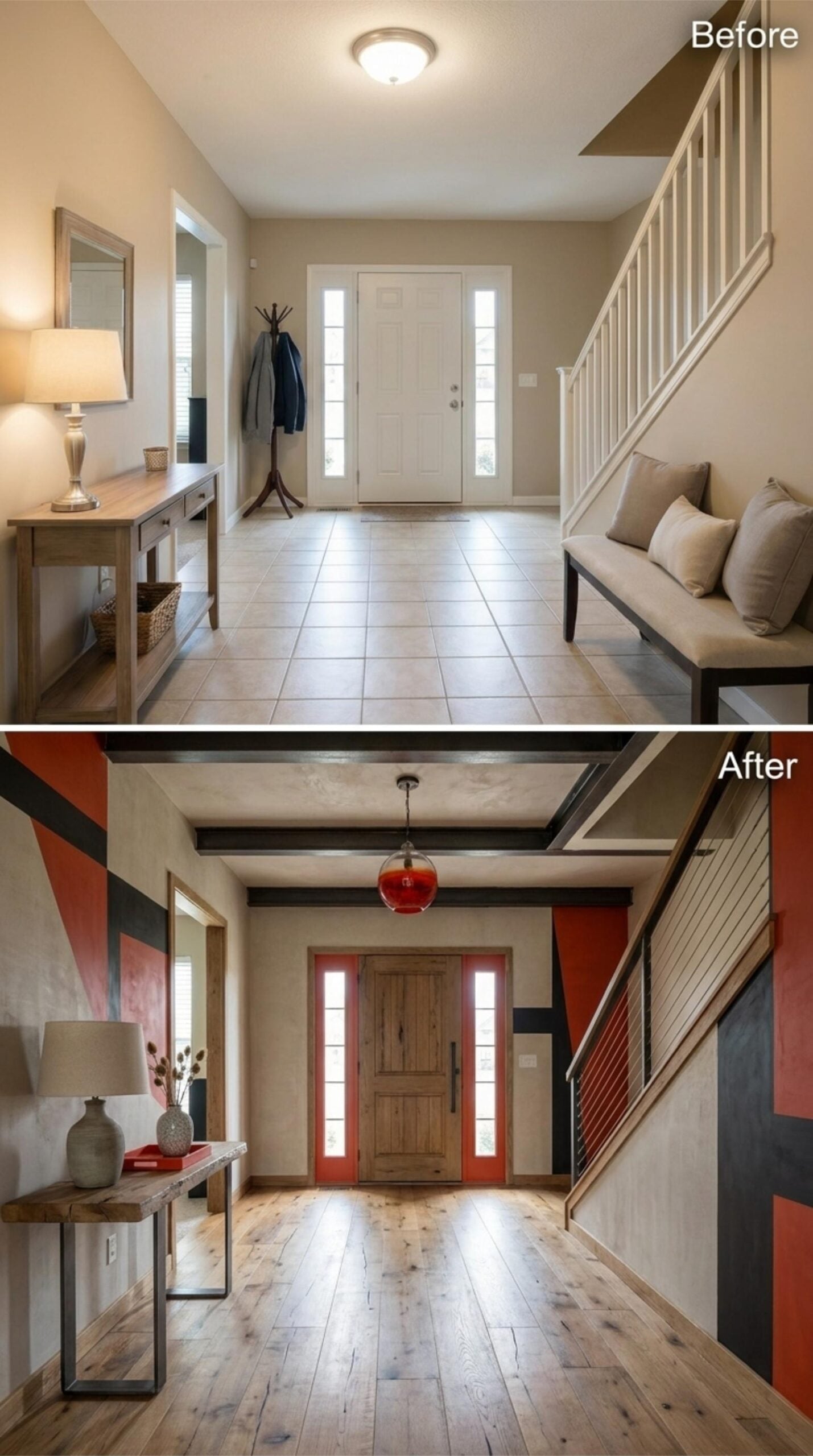
3. Geometric Wall Mural, Red Pendant, and a Wood Door That Finally Earns Its Place
🔥 Would you like to save this?
Broad strokes of red and charcoal cut across the walls in angular blocks, turning the foyer into something closer to a gallery than a passageway. Exposed dark ceiling beams divide the space overhead, and a red globe pendant drops right into the center of it all. It’s a committed choice, and it pays off.
Wide-plank hardwood runs the full length of the entry, its knotty grain keeping the palette grounded. A raw-edge console table sits low on metal legs, holding just enough without cluttering. The door swap from white to natural alder is the detail that quietly ties every other decision together.
2. Constructivist Mural Walls, Exposed Steel Beams, and a Door That Finally Has Color
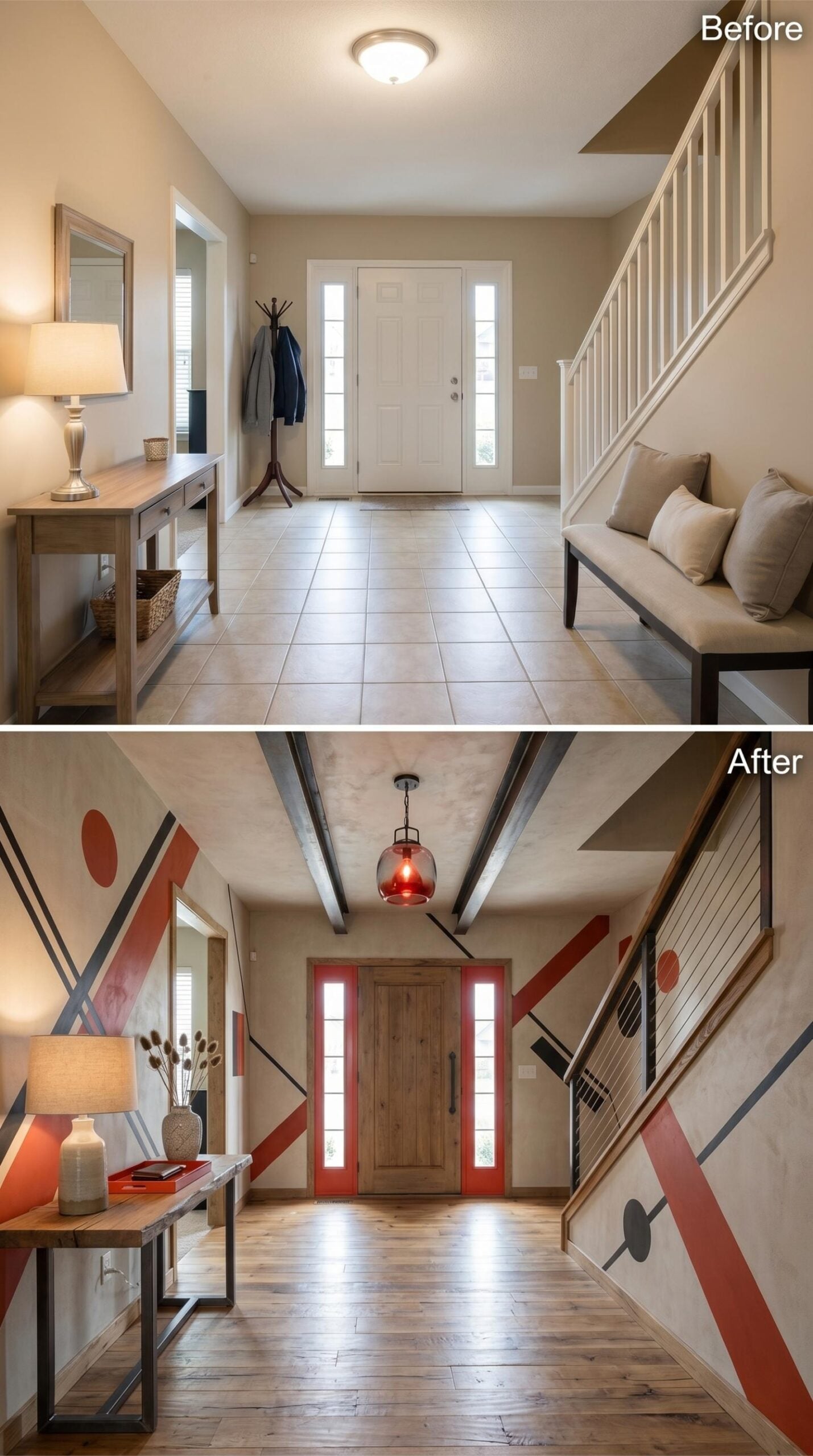
Someone made a real commitment here. The walls carry a Constructivist-style geometric mural in red, charcoal, and cream, with shapes borrowed straight from early Soviet avant-garde design. It shouldn’t work in a foyer. It does.
Exposed steel beams run diagonally across the plastered ceiling, echoing the mural’s angularity rather than fighting it. The front door swaps white for natural knotty alder with a red frame that ties back to the walls. Wide-plank hardwood replaces the tile underfoot, and a globe pendant in amber glass hangs low enough to actually matter.
1. Teal Plaster Walls, a Wood-Slat Ceiling, and Stained Glass That Finally Has Company
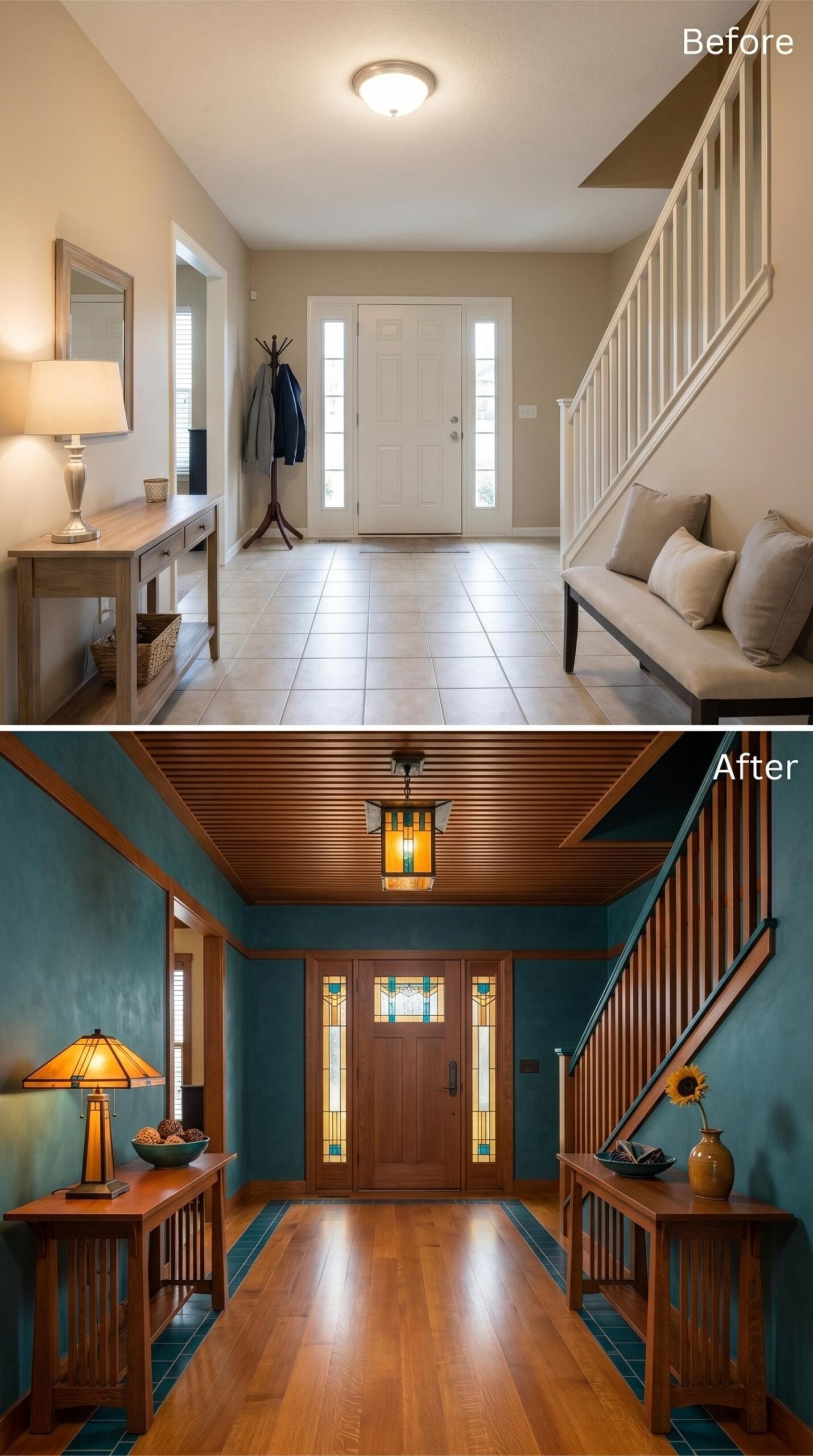
Teal plaster covers every wall from baseboard to crown, and it’s the kind of color that doesn’t ask permission. Warm-toned hardwood flooring runs straight down the center of the foyer, bordered by teal tile at the edges, which grounds the whole composition without overcomplicating it. A wood-slat ceiling in rich walnut-adjacent tones pulls heat downward, and the Arts and Crafts pendant centered beneath it casts amber light that suits the room exactly.
The front door is solid wood with stained glass sidelights in teal and amber, which means the palette is actually built into the architecture. Mission-style console tables flank the entry, each holding objects rather than clutter. The stair railing has been rebuilt in open vertical spindles that match the wood tones throughout, so the whole room reads as one decision rather than several.