🔥 Would you like to save this?
Floor-to-ceiling glass walls can go wrong fast. In the wrong living room, they feel exposed, overbuilt, and vaguely like someone forgot where the wall was supposed to go. But when the proportions, view, and materials line up, glass does more than brighten the space. It changes the whole assignment.
In order to come up with the very specific design ideas, we create most designs with the assistance of state-of-the-art AI interior design software. Also, assume links that take you off the site are affiliate links such as links to Amazon. this means we may earn a commission if you buy something.
The living rooms in this collection use glass as a commitment, not a decorative flex. Some turn mountains, water, gardens, or city lights into the fourth wall. Others use massive panes to make stone, wood, and custom seating feel even more deliberate. The best ones do not just show off the view. They make the room depend on it.
That is why floor-to-ceiling glass keeps showing up in ultra-luxe living room design. Better glazing has made the idea more practical, but the real appeal is emotional: bigger views, cleaner edges, more daylight, and a room that feels connected to something beyond itself. These 33 designs show how far the idea can go, from slim framed panels to sweeping glass facades that make an ordinary window look like a compromise.
33. Curved Boucle, Raw Stone, and an Ocean That Does All the Work
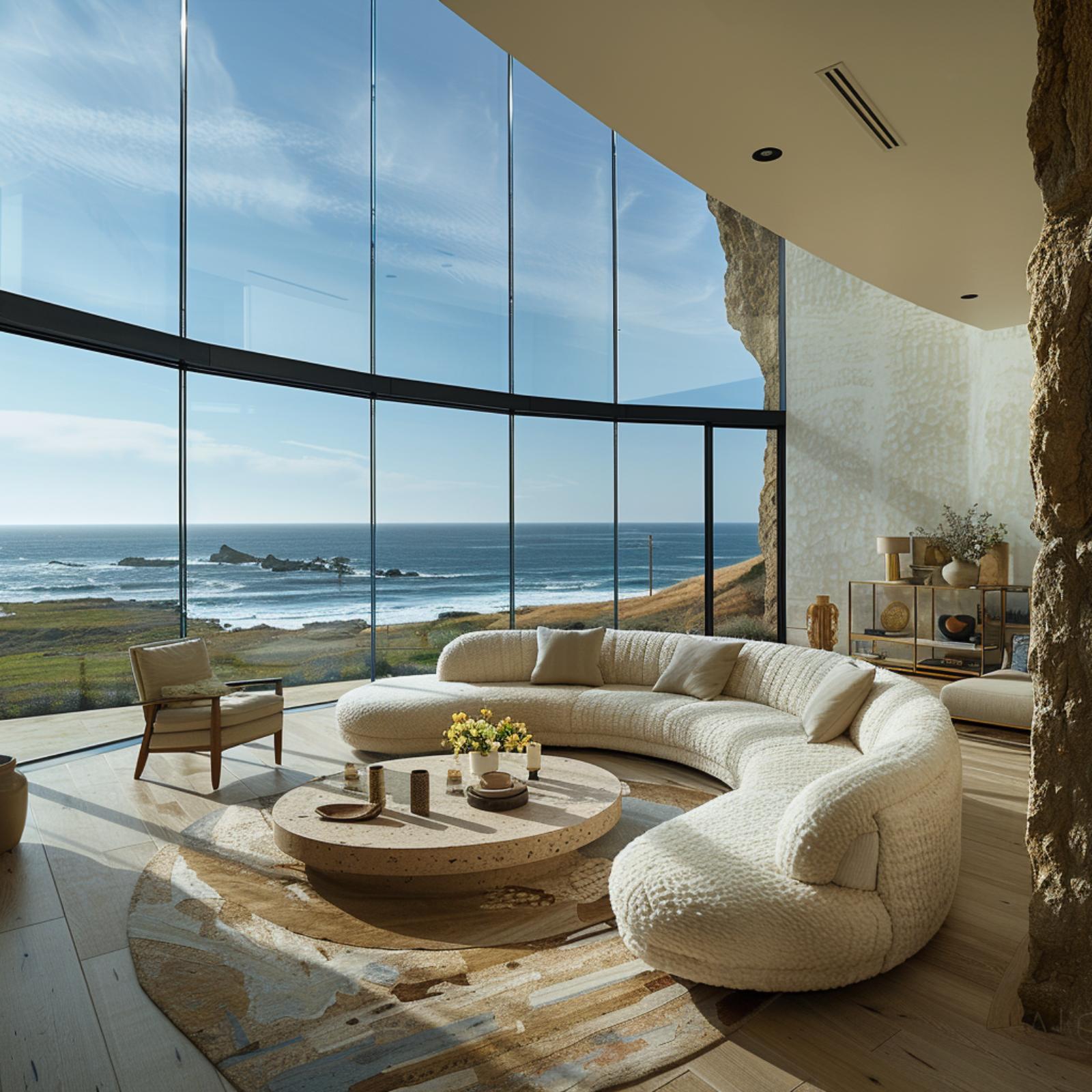
Perched above a coastal bluff, this living room earns its drama through subtraction. The floor-to-ceiling glass curves gently at the corner, pulling in unbroken Pacific views without a single mullion interrupting the horizon.
Inside, a semicircular boucle sectional anchors the space with soft tension against all that openness. A travertine drum coffee table sits at its center, and beneath both sits a rug with loose abstract patterning in sand and faded blue. The raw limestone column on the right isn’t decorative. It’s structural, and it stays rough on purpose.
32. Dark Steel, Concrete Ceiling, and a Skyline That Earns Its Place
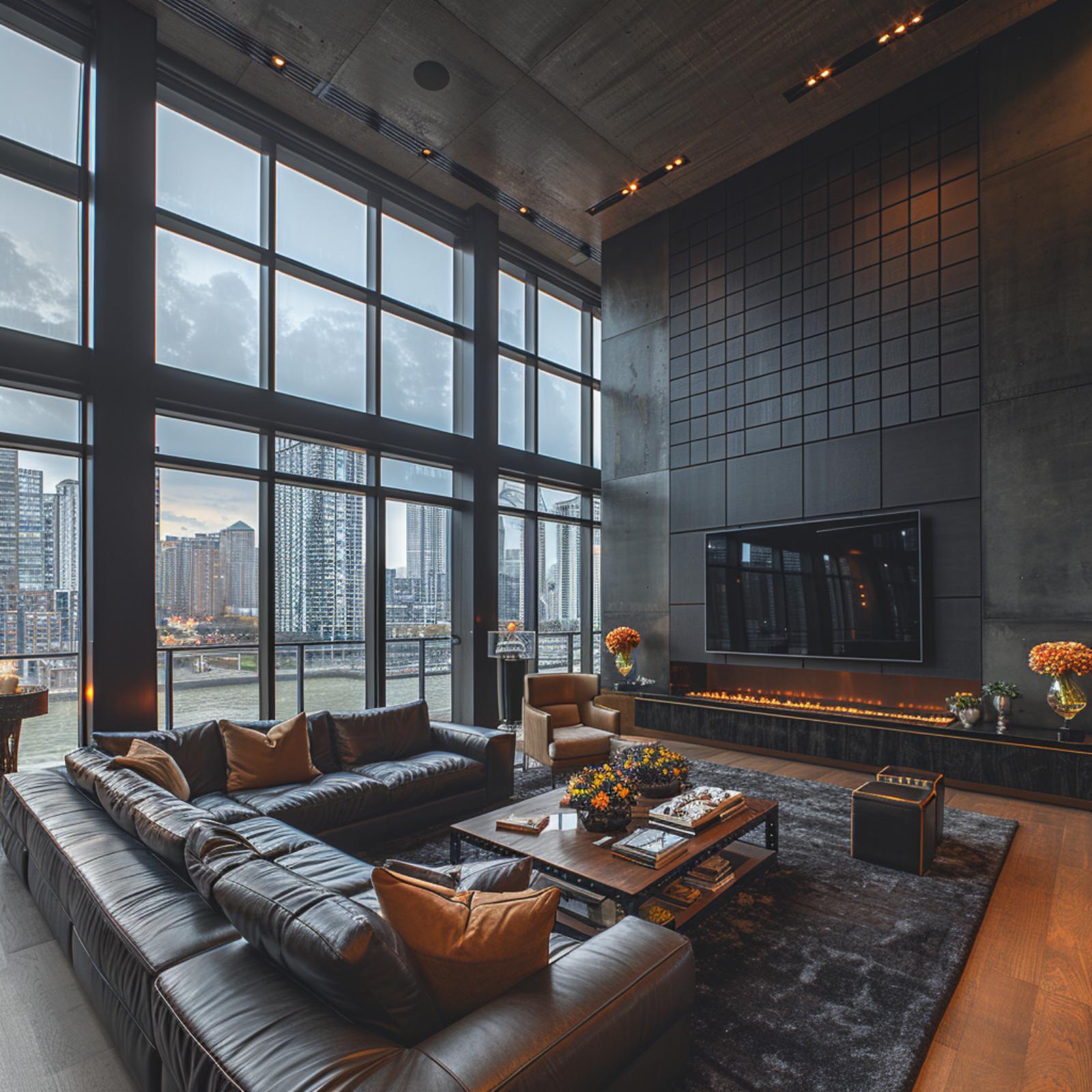
Floor-to-ceiling steel-framed windows pull a full cityscape and waterway into the room without a single curtain softening it. The concrete ceiling keeps things grounded, and the dark grid-tiled fireplace wall holds a linear gas insert glowing amber at its base. Leather sectionals in near-black anchor the space.
31. Skylight, Infinity Edge, and a Dining Room That Knows Exactly What It’s Doing
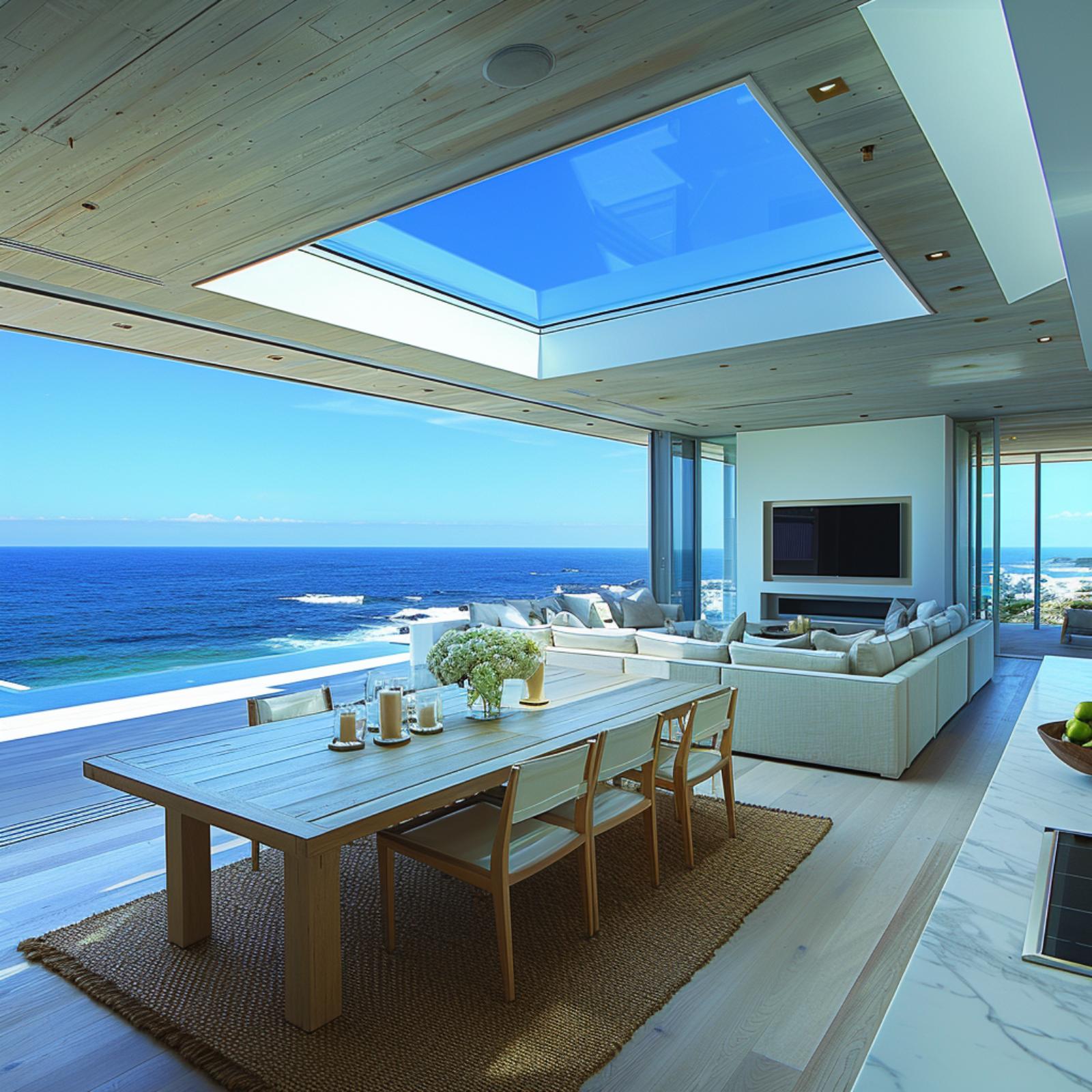
Bleached oak planks run underfoot, and a wood-slat ceiling keeps the palette grounded while a large flush skylight pulls the sky directly into the room. The dining table is solid teak or a close relative, left raw and unsanded-looking, paired with wishbone-style chairs in natural wood with canvas seats. A jute rug anchors the arrangement without fighting anything.
What really earns attention is the structural decision to open two full walls simultaneously, one toward the infinity pool and ocean, one to a covered terrace. The living area beyond uses an L-shaped sectional in off-white upholstery, and the wall-mounted TV sits inside a recessed panel flanked by a linear fireplace. A marble-topped kitchen counter edges into the right side of the frame. It’s a lot of real estate doing very quiet work.
30. Gold Columns, Black Marble, and a City That Refuses to Stay Outside
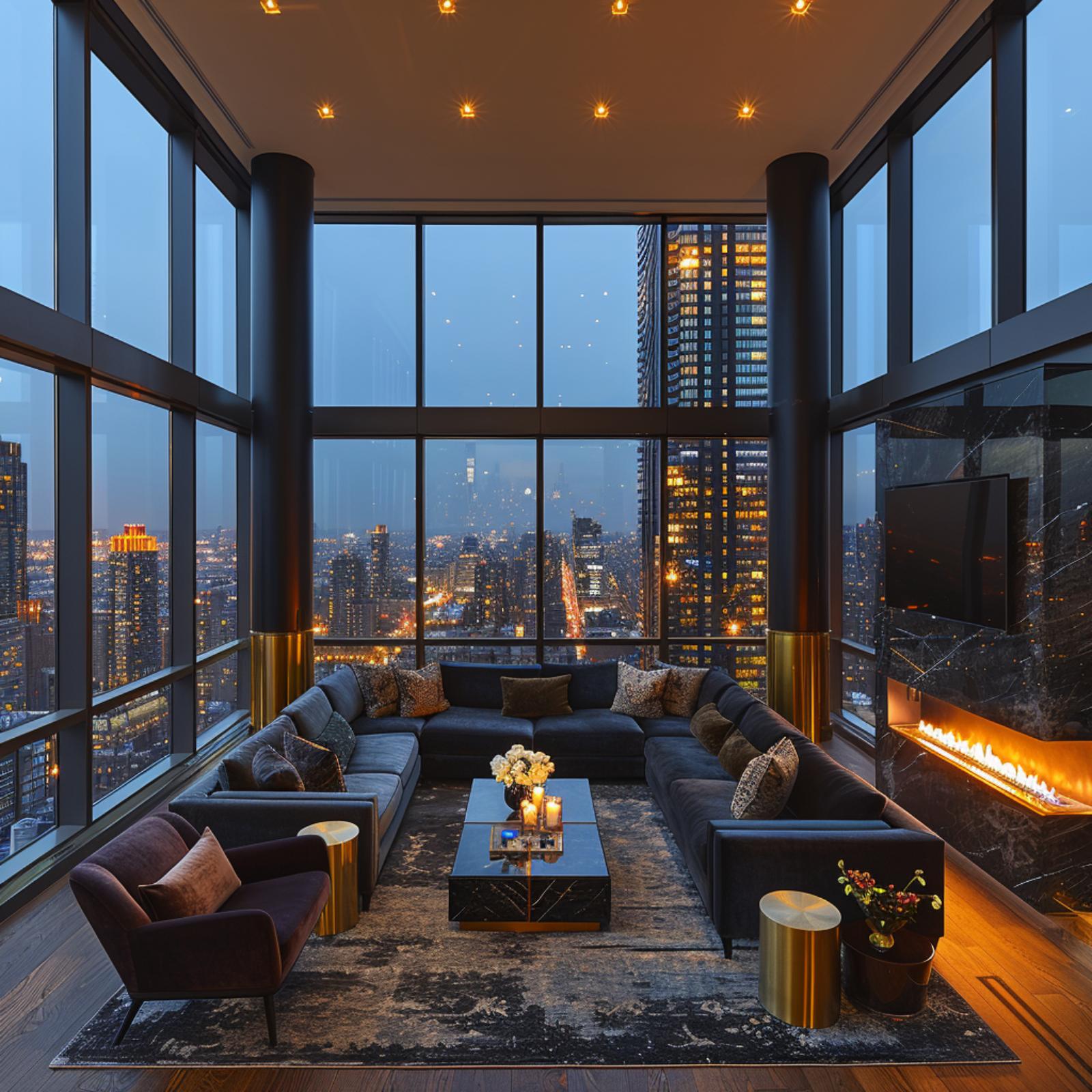
Double-height glazing wraps two full walls here, and the city doesn’t feel like a backdrop so much as a third design element. Columns clad in brushed brass anchor the corners where glass meets floor, grounding what could’ve been an untethered space. The sectional is deep charcoal velvet, and the black marble coffee table echoes the veined fireplace surround on the right wall. That linear gas fireplace is doing real work, its amber flame cutting against the cool blue of dusk beyond the glass.
In The Details: The brass column cladding is the detail that holds the room together, repeating in the cylindrical side tables and pulling warmth into a palette that’s otherwise entirely dark. Without it, the space would read as cold. It’s a small material decision with outsized visual consequence.
29. Warm Travertine, Pool Reflections, and a Living Room That Opens Like a Stage
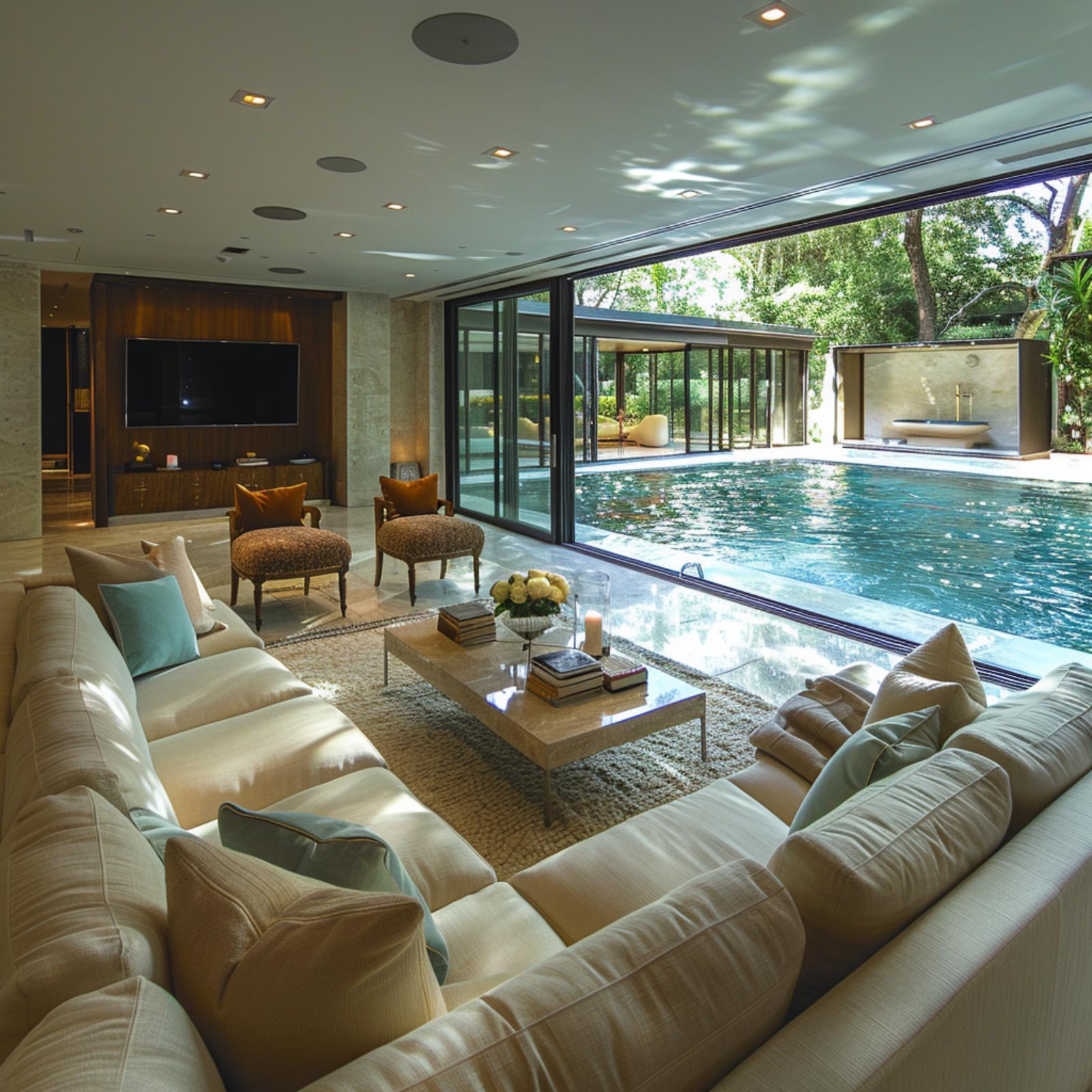
Sliding glass panels retract the entire rear wall, letting pool light ripple across a travertine-tiled floor and up onto the ceiling in shifting patterns.
Why It Works: Ceiling-mounted recessed speakers and round in-ceiling fixtures keep the overhead plane clean, which matters when water reflections are already doing something interesting up there. Pairing cream upholstery with rust-orange accent chairs works because the warm tones don’t compete with the blue water outside. The outdoor bathing alcove visible beyond the pool signals that indoor-outdoor living here isn’t a feature, it’s the whole premise.
28. Sunlight, Travertine, and a View That Makes Furniture Feel Secondary
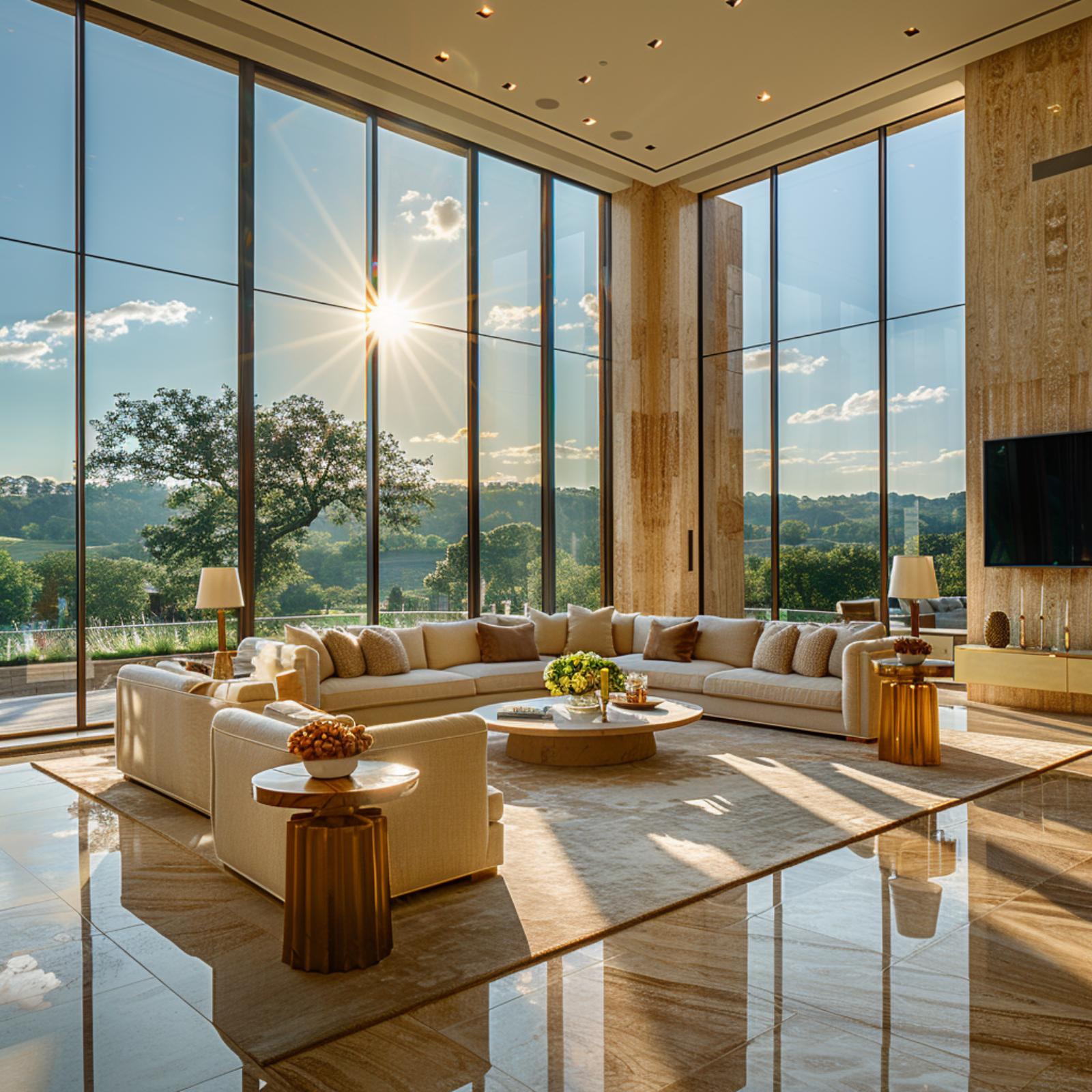
Warm travertine cladding wraps a central column and anchors the right wall, giving the room its backbone before the view even registers. The floor tiles carry a similar veining in a polished finish that bounces afternoon light across the entire seating area. It’s a material choice that does a lot of quiet work.
Cream upholstery on the curved sectional keeps things neutral enough that the rolling greenery outside reads as the main event. Gold-toned side tables with a ribbed pedestal base repeat just enough to feel intentional without shouting. The round coffee table sits low, which keeps sightlines open across the full width of the glass.
Budget Tip: Travertine-look porcelain tile costs a fraction of natural stone and holds up far better in high-traffic rooms without sealing requirements. If the full wall cladding is out of budget, applying it to a single feature column or fireplace surround still anchors the palette. Even a partial application reads as a design decision rather than a compromise.
27. Cognac Leather, a Linear Fireplace, and Snow That Makes the Warmth Feel Earned
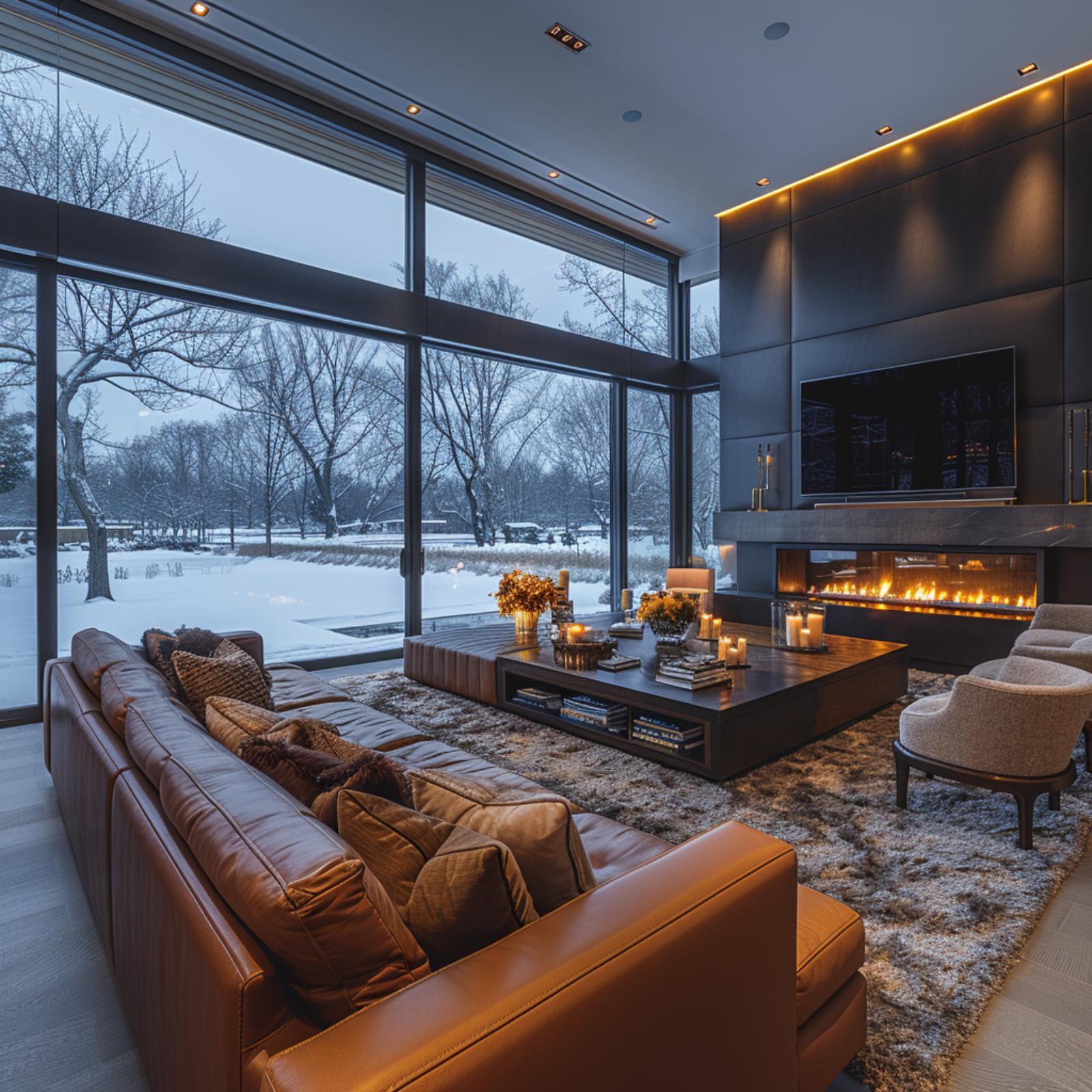
Outside, the trees are bare and the ground is buried. Inside, a cognac leather sectional does exactly what it should: pull every eye toward the fire before the fire even asks for attention. The linear fireplace runs long and low beneath a wall-mounted TV, framed in what reads as dark marble or slate-look stone, and the horizontal format keeps the whole right wall grounded rather than vertical and imposing.
Amber candlelight on the coffee table echoes the leather’s tone closely enough that it looks intentional rather than lucky. The shag rug softens a room that could easily read as cold given all that dark cladding overhead. And those floor-spanning windows don’t compete with the interior so much as give it something to push against. The contrast does the heavy lifting.
Color Story: Cognac, amber, and deep chocolate read as a single warm family here because they share the same undertone. Mixing warm browns with cool grays works precisely because the leather anchors the palette before the gray walls can tip the room toward chilly. It’s a restraint most rooms with this much glass genuinely need.
26. Skylight, Tufted Leather, and a Garden That Commands the Room
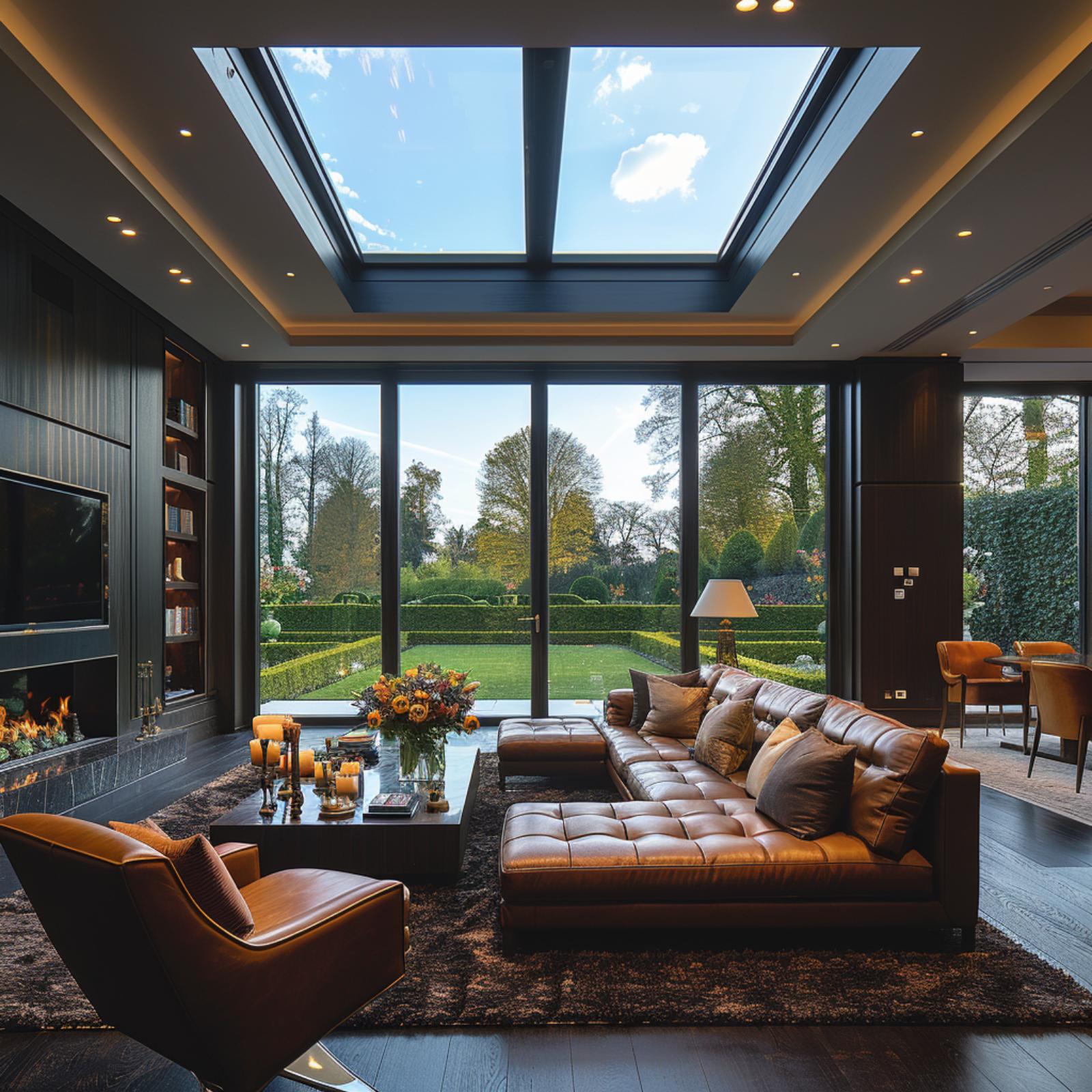
Recessed lighting rings the coffered ceiling on three sides, but the large skylight above the seating area is what actually controls the mood. Natural light drops straight onto the tufted cognac sectional below, and the effect shifts hour by hour without any intervention required.
Floor-to-ceiling glass on the rear wall opens onto a formal garden with clipped hedgerows and a lawn that reads almost theatrical from inside. The dark-framed steel glazing keeps the transition crisp rather than blurry. A linear gas fireplace anchors the left wall beneath built-in shelving, giving the room a second focal point so the garden view doesn’t have to carry everything alone. Candleholders on the coffee table add something the overhead fixtures can’t: a low, flickering layer that makes evenings feel distinct from afternoons.
Style Tip: Rooflight placement matters more than size. Positioning a skylight directly above the main seating area means natural light lands where people actually spend time, rather than illuminating an empty floor. If you’re specifying a new skylight, center it on the furniture arrangement, not the architectural midpoint of the room.
25. Glass Walls, a Reflecting Pool, and a Living Room That Blurs Every Boundary
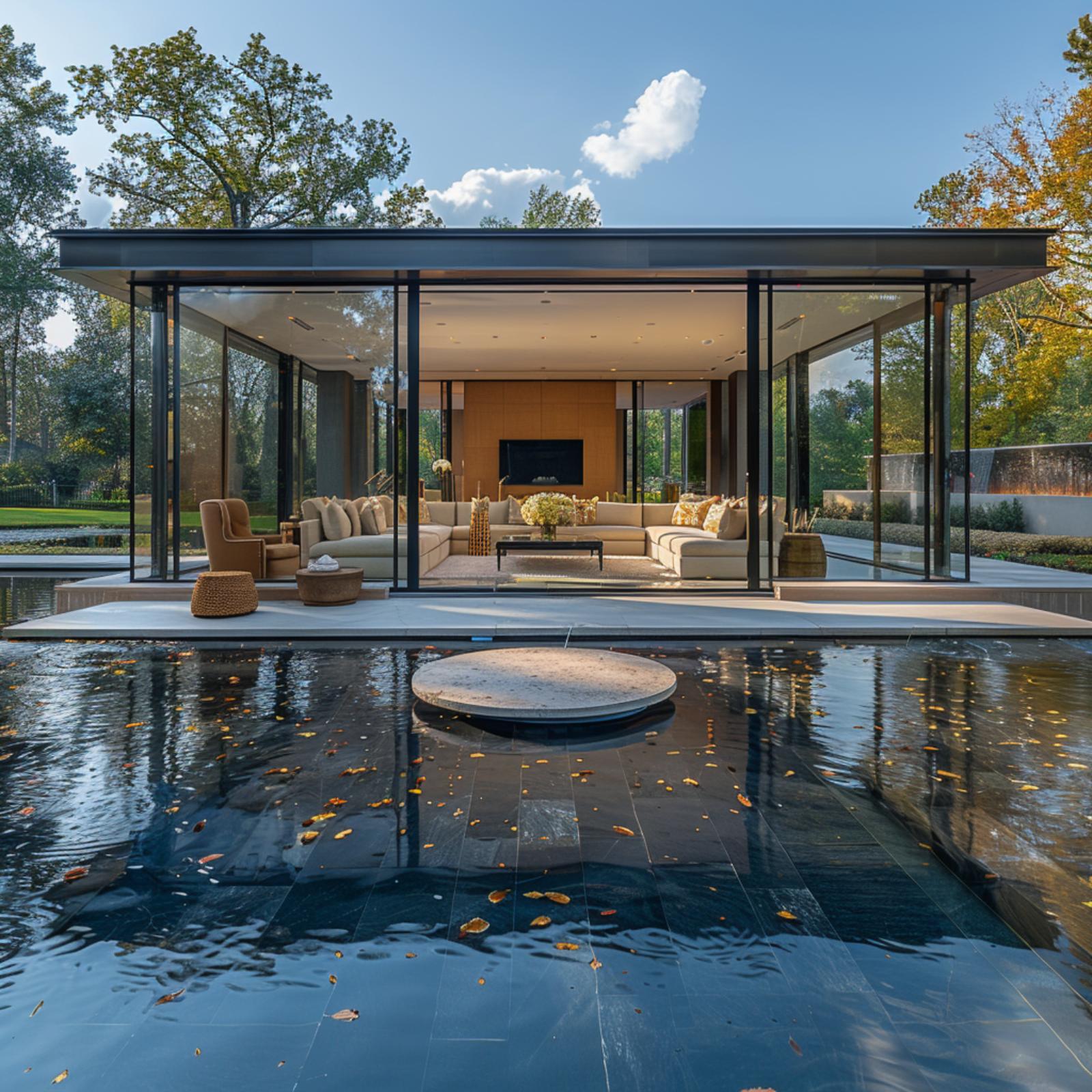
Dark-tiled water sits just below terrace level, close enough that the room’s cream sectional and warm wood wall panel appear twice. That circular stone disc floating in the pool is the detail that stops the eye. Inside, the seating arrangement faces outward as if the glass walls don’t exist.
Worth Knowing: Reflective pools positioned flush against a structure amplify available light far more effectively than additional artificial fixtures can. Dark pool tiles deepen the mirror effect by eliminating visual noise beneath the surface. If the goal is to double a room’s perceived brightness without touching the ceiling, still water does the work.
24. Black Granite, a Gas Fireplace, and a Skyline That Paid for the Whole Room
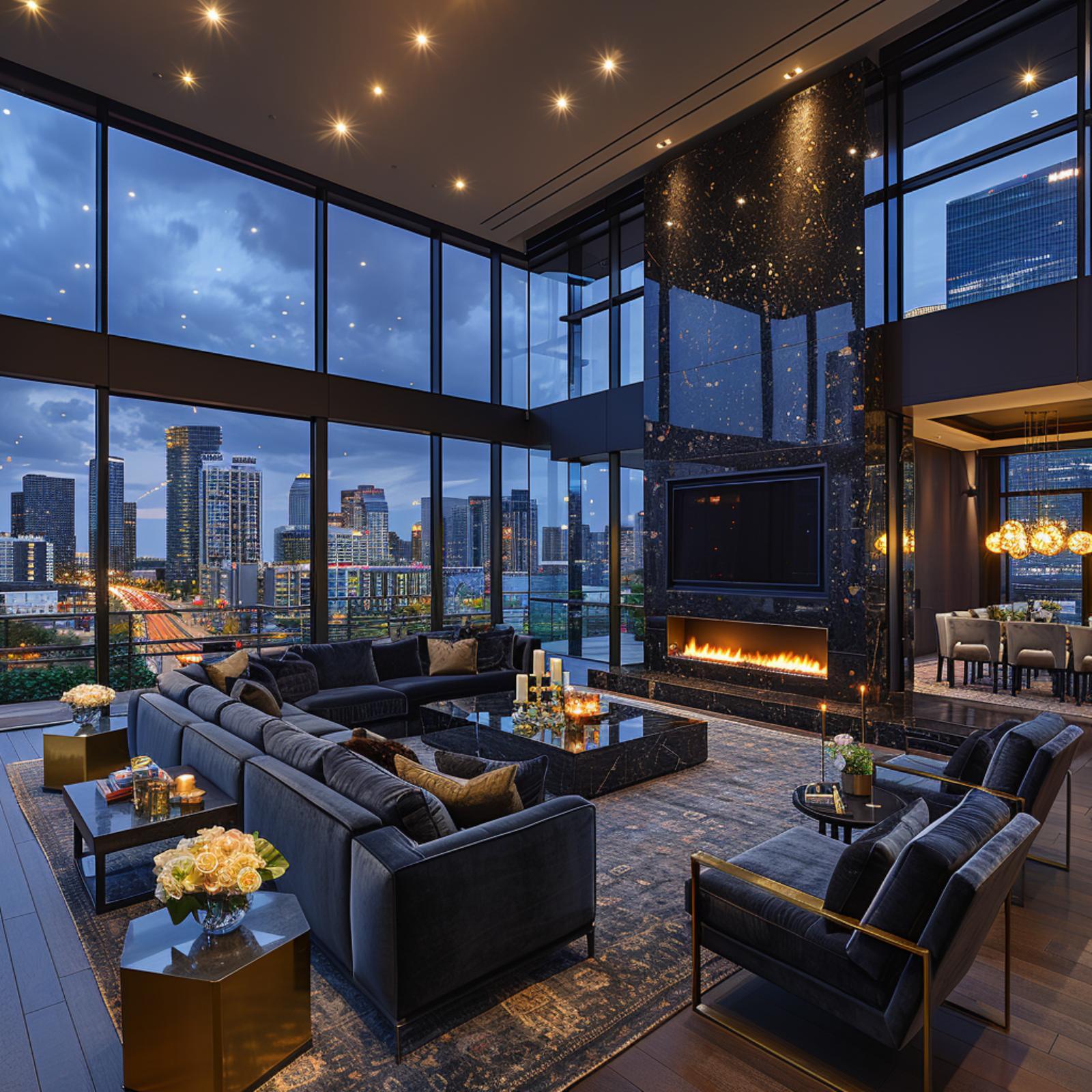
The fireplace surround does something unusual here. It runs floor to ceiling in black granite with gold flecking, and the scale of it anchors the entire room without competing with the glass behind it. The sectional sits low and deep in charcoal velvet, which keeps sightlines open across the full wall of city views.
Armchairs with brass-framed legs pull the metallic note from the stone into the seating zone. It’s a small connection, but it does real work. The linear gas fireplace itself stays narrow, letting the surround carry visual weight rather than the flame.
Quick Fix: Black granite with natural gold veining costs significantly more than manufactured alternatives, but porcelain slabs printed to mimic the same pattern have become nearly indistinguishable in photos and hold up better against heat cycling near a fireplace. If the surround is the room’s focal point, the material has to survive daily proximity to a flame source, and natural stone can micro-crack over time without proper heat shielding behind the firebox.
23. Reclaimed Beams, an Infinity Pool, and a View That Refuses to Be Framed
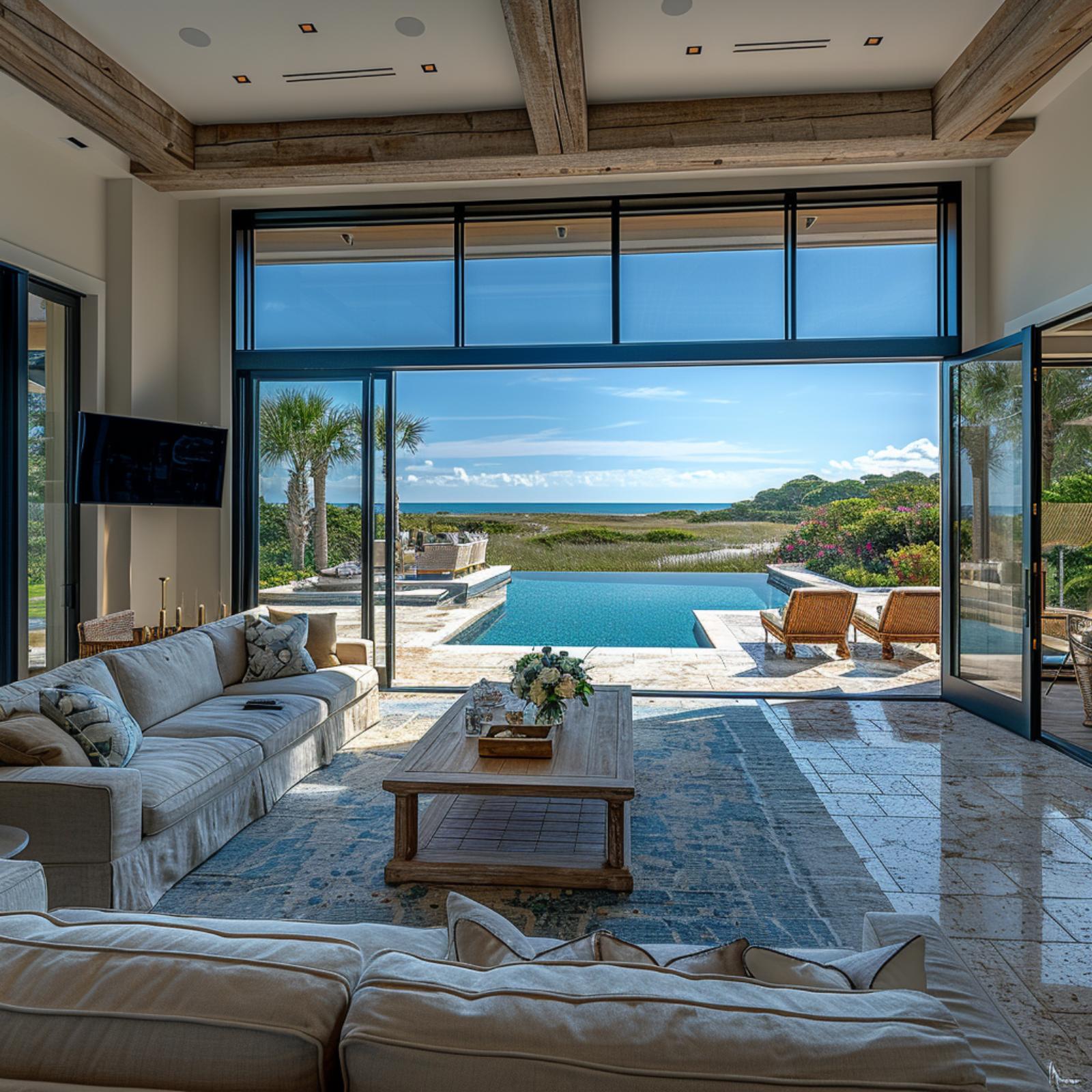
Weathered wood beams cross the ceiling in a grid that reads rustic against an otherwise clean, modern envelope. Below them, a sectional in loose linen slipcovers anchors the room without competing with what’s happening outside. Those bifold steel-framed doors fold completely away, and suddenly the travertine floor and the pool deck become one continuous surface. The ocean sits just beyond the dune grass. It doesn’t need help.
The Psychology Behind This: Open-plan spaces that connect interior and exterior zones create what psychologists call “prospect and refuge,” a condition where humans feel simultaneously sheltered and able to survey a wide horizon. That combination registers as deeply calming, which is why rooms like this one tend to feel more restful than their size alone would explain. Bringing the ceiling material outside the glass line reinforces the sense that the boundary between inside and out is a suggestion rather than a wall.
22. Tall Pines, Warm Stone, and a Living Room That Earns Two Stories
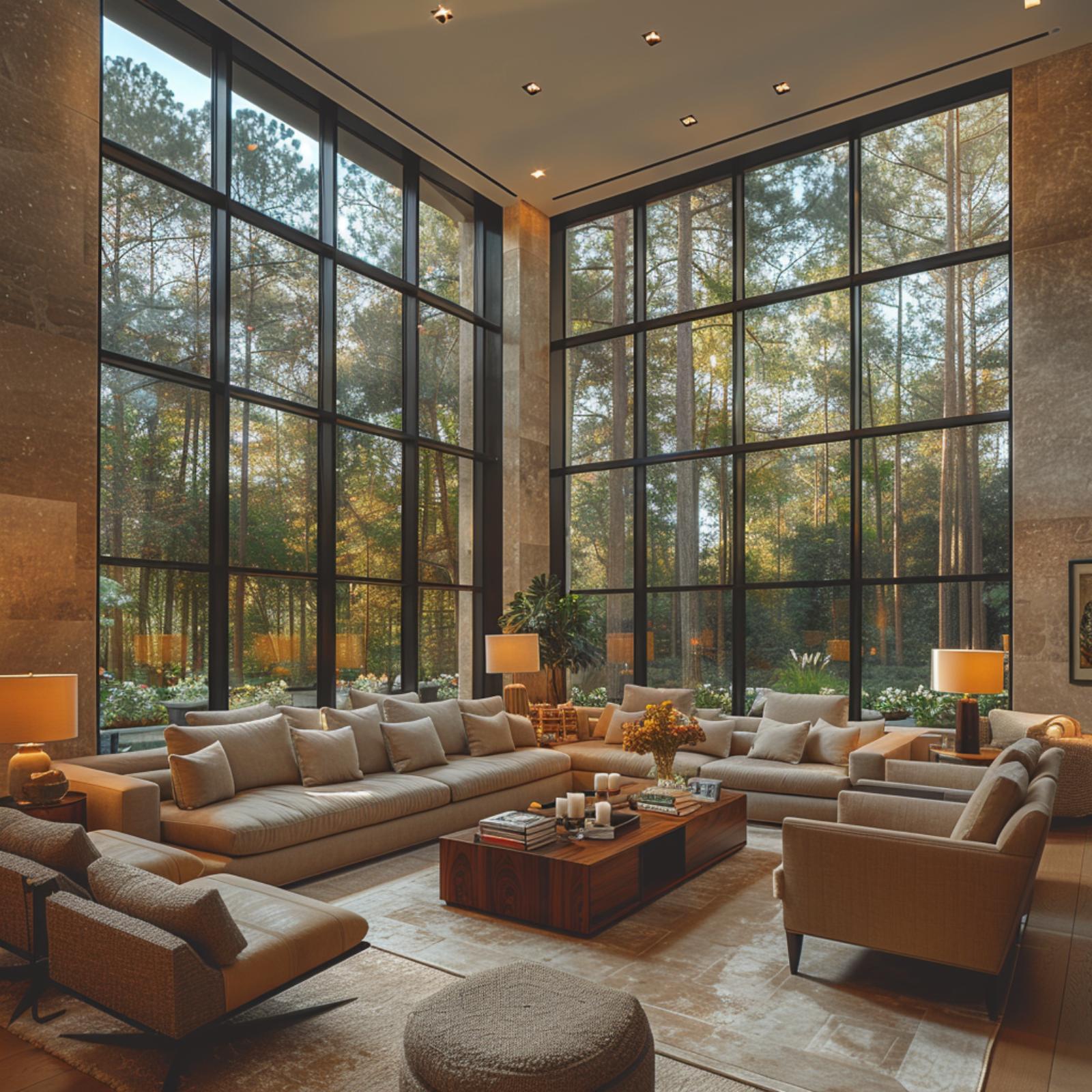
Steel-framed curtain walls rise two full stories here, and the forest outside doesn’t feel decorative. It feels structural. Tall pines press close enough to the glass that the room reads as a clearing, not an interior.
The seating is oversized and low-slung, upholstered in greige fabric that holds its own against the travertine wall cladding flanking the glass. A walnut coffee table grounds the center. Table lamps with cream shades warm the perimeter where the forest light can’t reach, and they do the job quietly.
The forest outside doesn’t feel decorative. It feels structural.
21. Floor-to-Ceiling Glass, Ocean Light, and Seating That Knows When to Step Back
🔥 Would you like to save this?
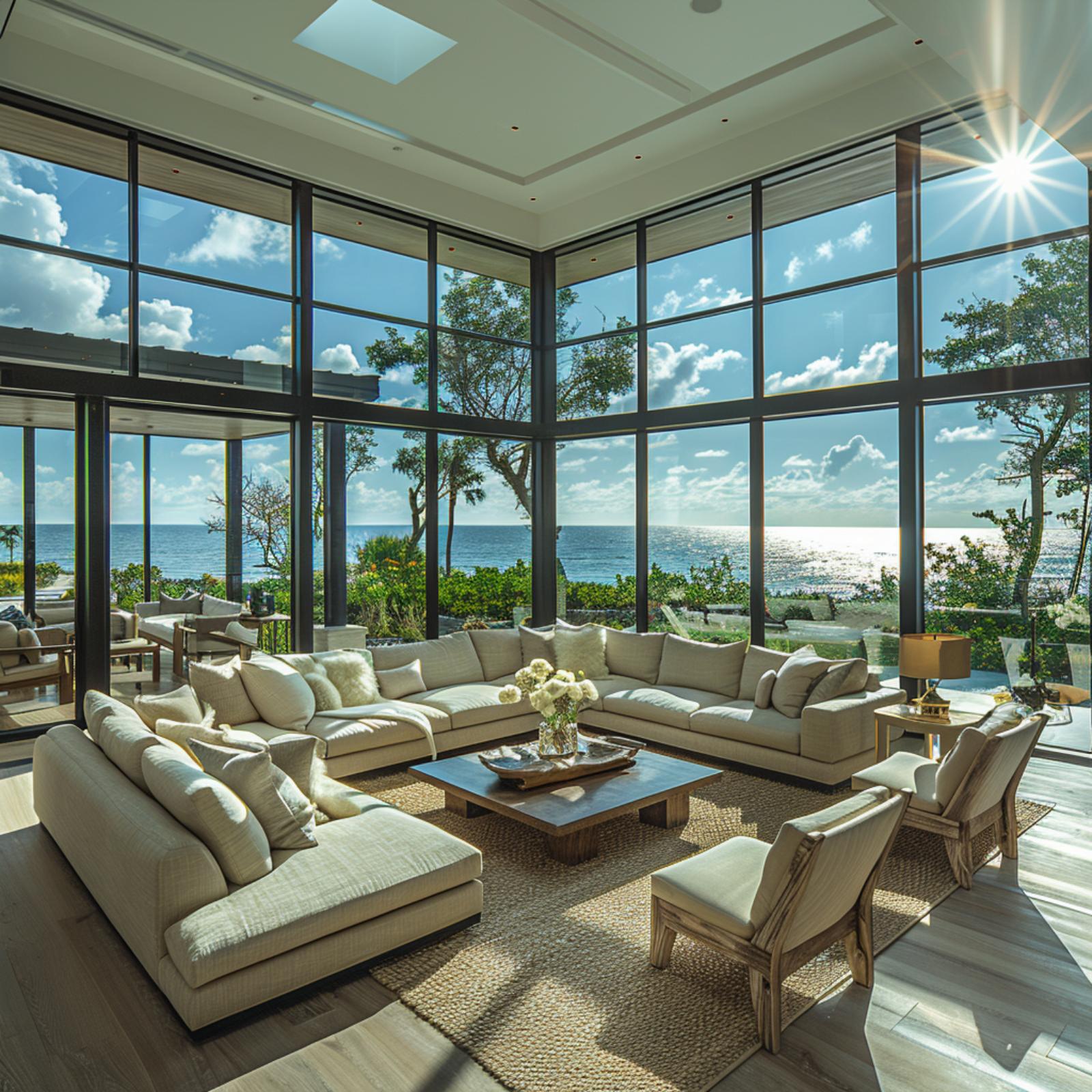
Corner glass walls run two stories tall here, and the ocean doesn’t just sit in the background. It dominates. Sunlight hits the water outside and bounces through the glazing, making the cream sectional fabric shift in tone depending on the hour.
The woven jute rug and wood-base coffee table keep things grounded without competing with the view. Two armchairs in natural linen sit at a slight angle, which pulls the seating arrangement open rather than closing it inward.
Common Mistake: Oversized sectionals placed too close to floor-to-ceiling glass walls often block the lower portion of the view entirely, which defeats the point of installing them. Pulling seating a few feet back from the glazing preserves sightlines from both seated and standing positions. It also reduces glare on upholstery, which fades faster than most people expect under direct coastal sun exposure.
Where the last room borrowed drama from a pool, this one borrows it from the woods.
20. Stone, Fire, and a Forest That Fills Every Panel of Glass
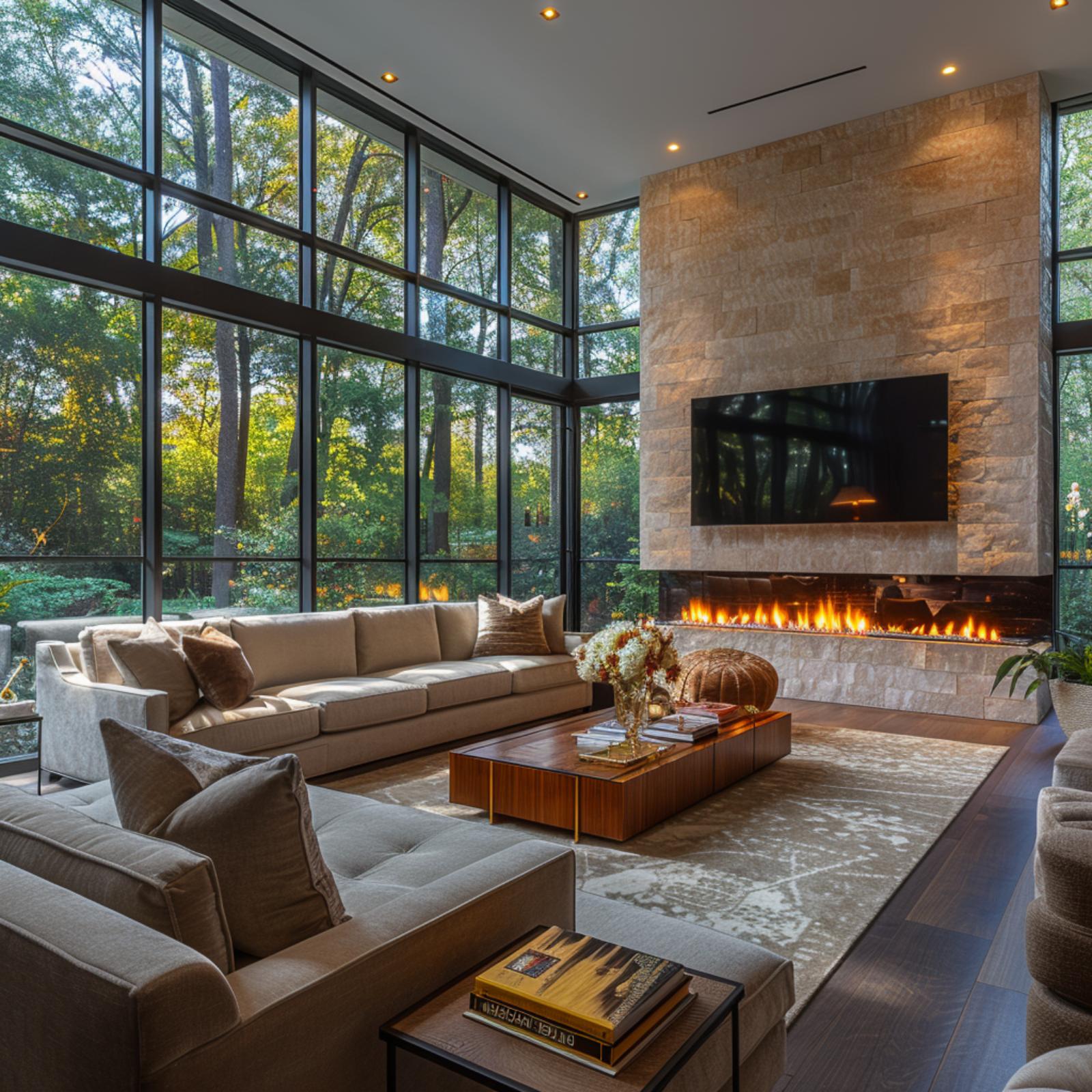
Floor-to-ceiling curtain wall glazing wraps two full sides of the room, and the trees outside aren’t background. They’re present. The limestone-clad fireplace wall runs from floor to ceiling and grounds the space against all that transparency, with a linear gas insert sitting low and wide rather than centered and symmetrical.
Seating is kept well forward of the glass, which means sightlines stay open from every angle. The walnut coffee table sits at a height that doesn’t compete. What holds everything together is the contrast between the rough-cut stone surround and the linen-toned sectionals, materials that share warmth without sharing texture.
19. Double-Height Glass, Dark Leather, and a Courtyard That Earns Its Place
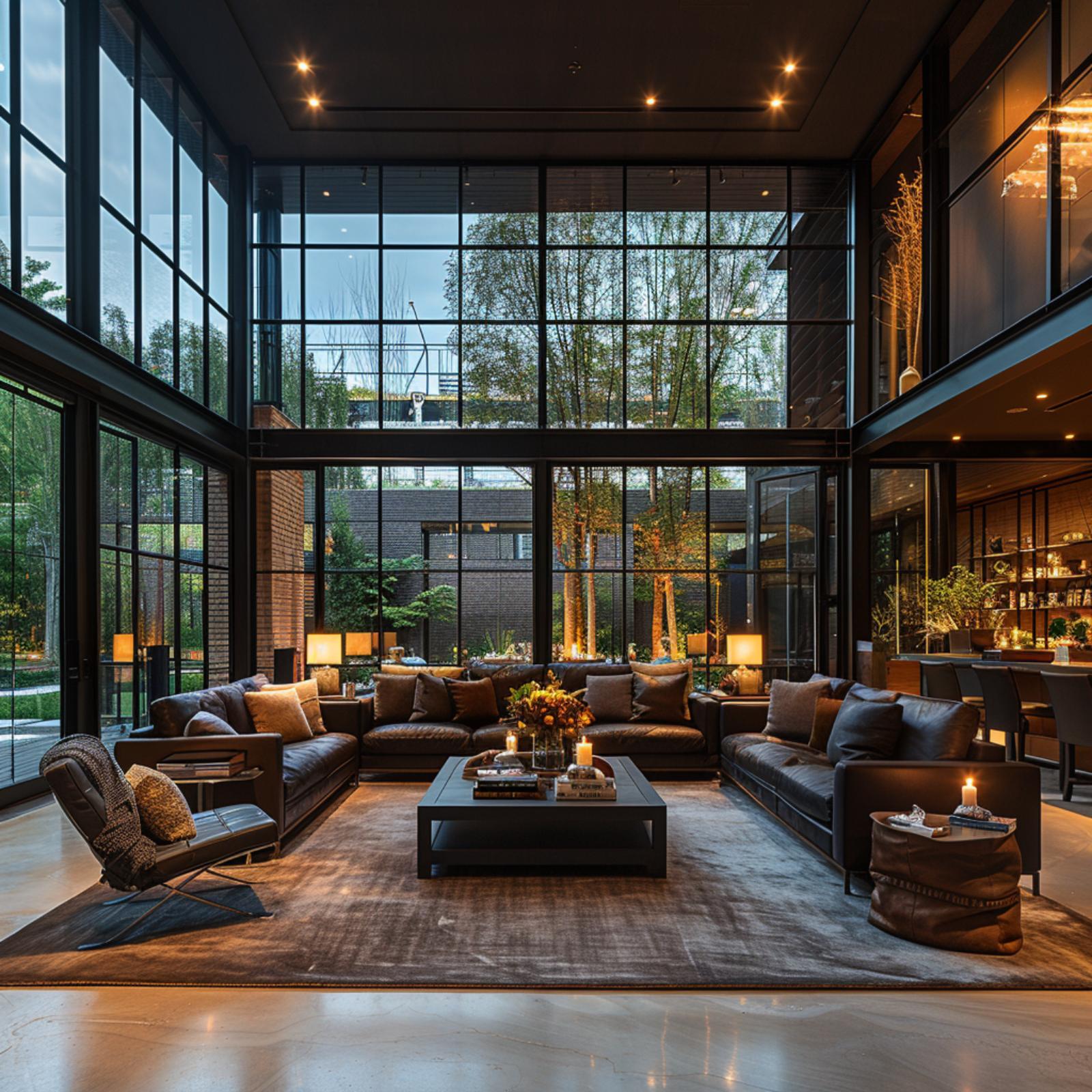
Black steel grid windows climb two full stories here, framing what appears to be a private courtyard with mature trees lit from below. It’s the kind of architectural move that makes the interior feel borrowed from the outside, not just adjacent to it. Dark chocolate leather sectionals anchor the seating zone without competing with the view. Smart restraint.
The matte black coffee table sits low and wide, holding books, candles, and a floral arrangement without crowding. Recessed downlights punch through the dark ceiling plane at tight, even intervals. On the right, a backlit shelving unit with glassware and objects adds warmth without pulling focus from the glass wall doing all the real work.
Editor’s Note: In double-height rooms, furniture scale becomes critical. Pieces that read as appropriately sized in a standard room can look undersized against a two-story glass wall, so going larger with seating than instinct suggests is usually the right call. The sectionals here are doing exactly that.
18. Forest Views, Linear Fire, and a Stone Wall That Holds Its Own
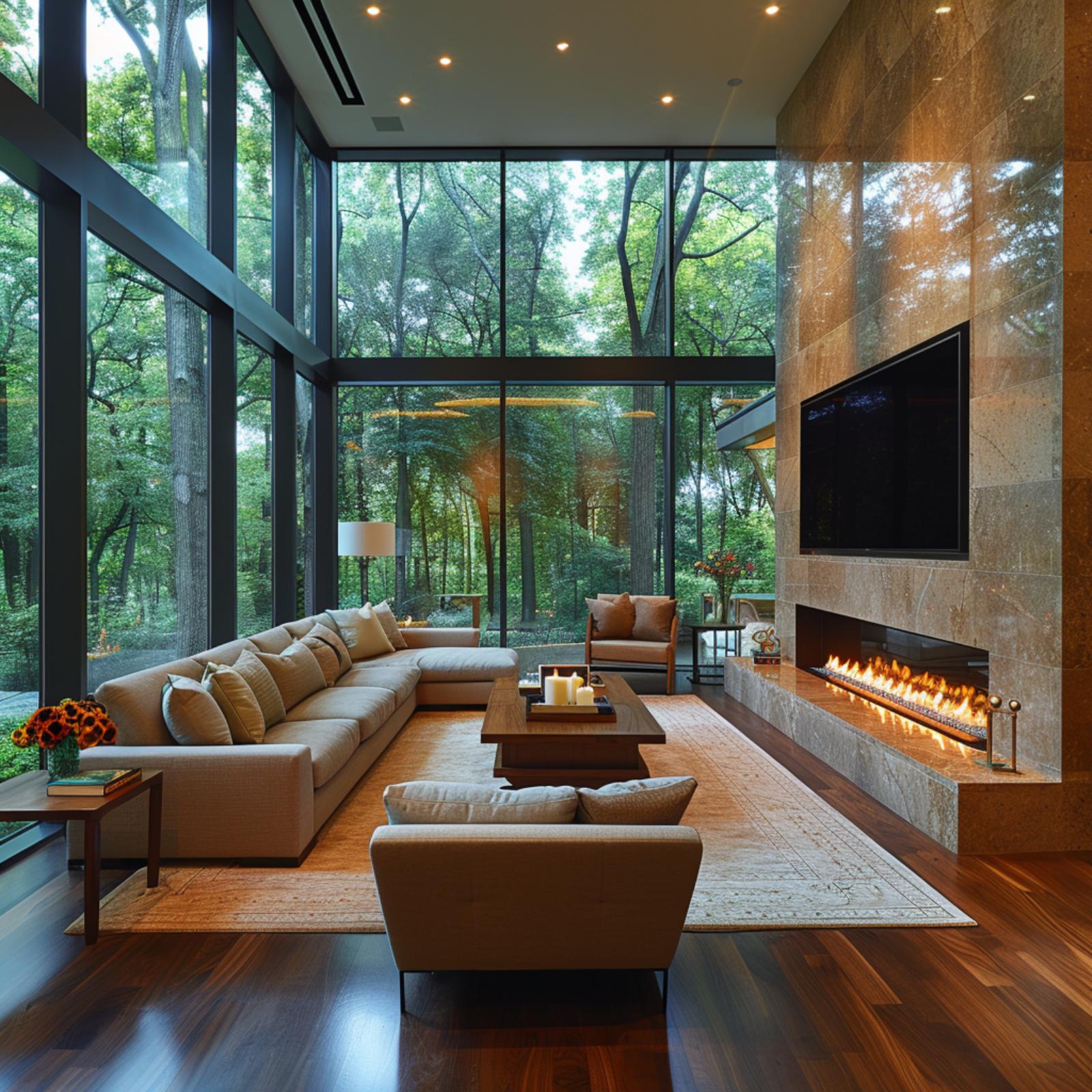
Walnut floors with a deep reddish-brown finish anchor a room that’s genuinely competing with its own view. Floor-to-ceiling glass wraps two full walls, pulling in a canopy of mature deciduous trees that reads almost like wallpaper, except it moves. Against that, a travertine-clad fireplace wall runs the full height of the room and doesn’t apologize for the scale.
The linear gas fireplace sits low and wide, which keeps sightlines open across the seating arrangement. A sectional in warm greige linen faces the fire without crowding it, and a rectangular walnut coffee table grounds the area rug beneath. What’s easy to miss: the TV is mounted flush into the stone rather than bracketed above the firebox, which keeps the wall reading as architecture rather than electronics shelf.
Why the Fireplace Sits Below Eye Level
Linear fireplaces positioned low on the wall, rather than at traditional hearth height, do something specific for the proportions of a tall room. They prevent the eye from stopping midway up the wall and instead let it travel the full height of the travertine cladding before reaching the TV. It’s a subtle move that most people won’t consciously notice, but it’s why the stone wall feels like a single architectural gesture rather than two separate features stacked on top of each other.
17. Dark Stone, Amber Chairs, and a Forest That Earns Every Square Foot of Glass
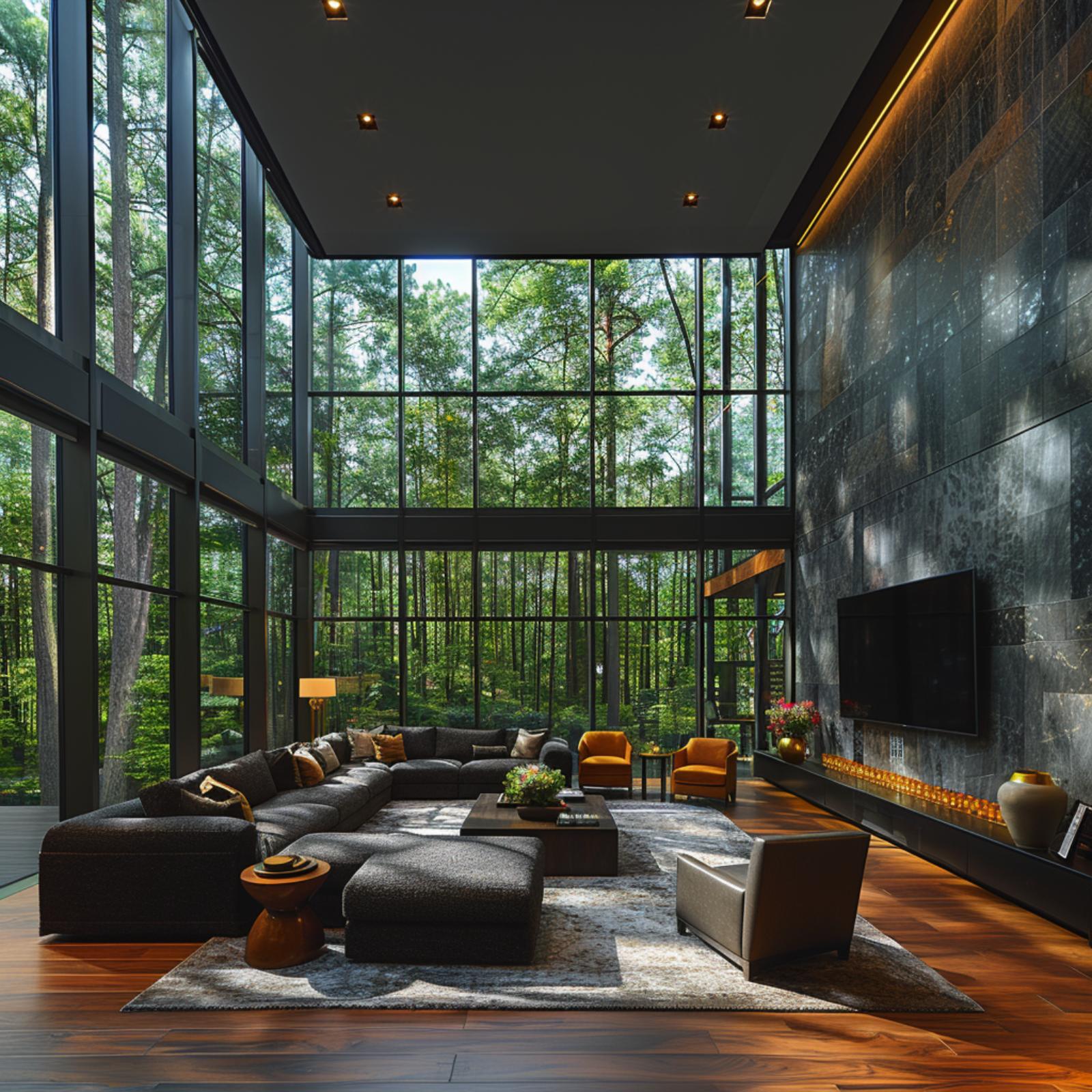
Slate-toned wall cladding runs the full height of the right side, and it holds its ground against two stories of forest-facing glass without competing. The amber velvet accent chairs are doing real work here, pulling warmth into a palette that would otherwise read entirely cool. Dark sectional, concrete-toned rug, rich walnut flooring, and then those two chairs land like punctuation.
- Accent chairs in a warm tone prevent an all-dark room from feeling like a cave rather than a sanctuary
- A linear fireplace set low in the wall draws the eye horizontally, which reinforces the wide-open feel of the glass wall opposite
- Hardwood floors in a warm reddish-brown species connect the interior to the tree tones visible through the glass, making the transition feel natural rather than abrupt
16. Charcoal Stone, Forest Glass, and a Fireplace Wall That Earns Two Stories
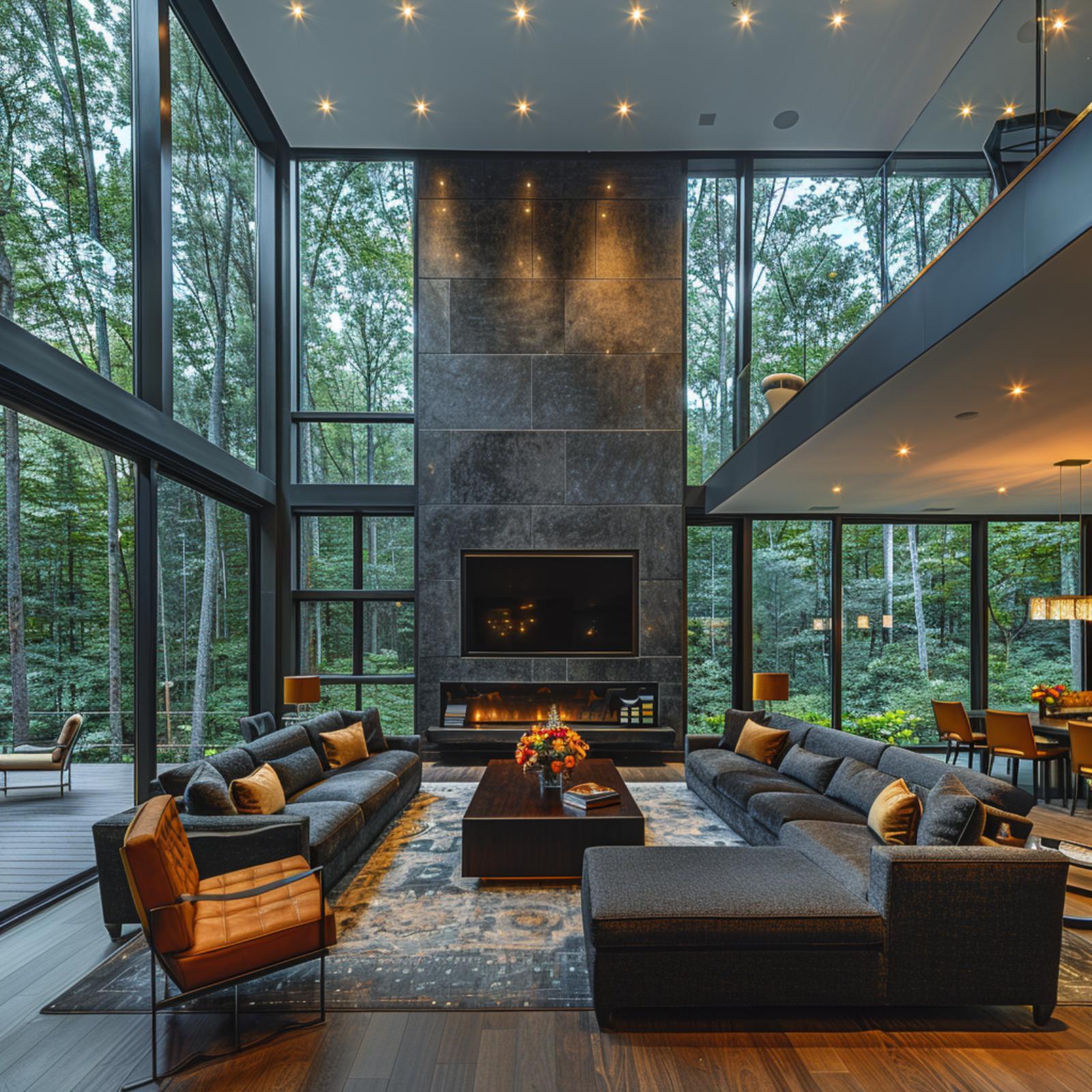
Few rooms commit this hard to a single material. Floor-to-ceiling charcoal stone cladding runs the full height of a double-story fireplace wall, anchoring a room that could easily feel unmoored by all that glass. The linear gas insert sits low, which keeps sightlines open to the trees beyond.
Gray sectional seating wraps the conversation area without crowding the rug, a muted pattern that holds its own against the stone. Cognac leather chairs punctuate the arrangement without competing. Outside, dense deciduous forest fills every panel from ground to ceiling. The trees do a lot of work here.
Trend Alert: In rooms with double-height glass walls, the fireplace surround is often the only vertical surface with enough mass to visually anchor the space. Stone cladding that runs continuously from floor to ceiling reads as structural rather than decorative, which is exactly why it works in tall rooms. Natural or porcelain alternatives in charcoal tones tend to photograph darker than they appear in person, so request large samples before committing.
15. Bamboo, Warm Cedar Ceilings, and a Living Room That Earns Every Inch of Glass
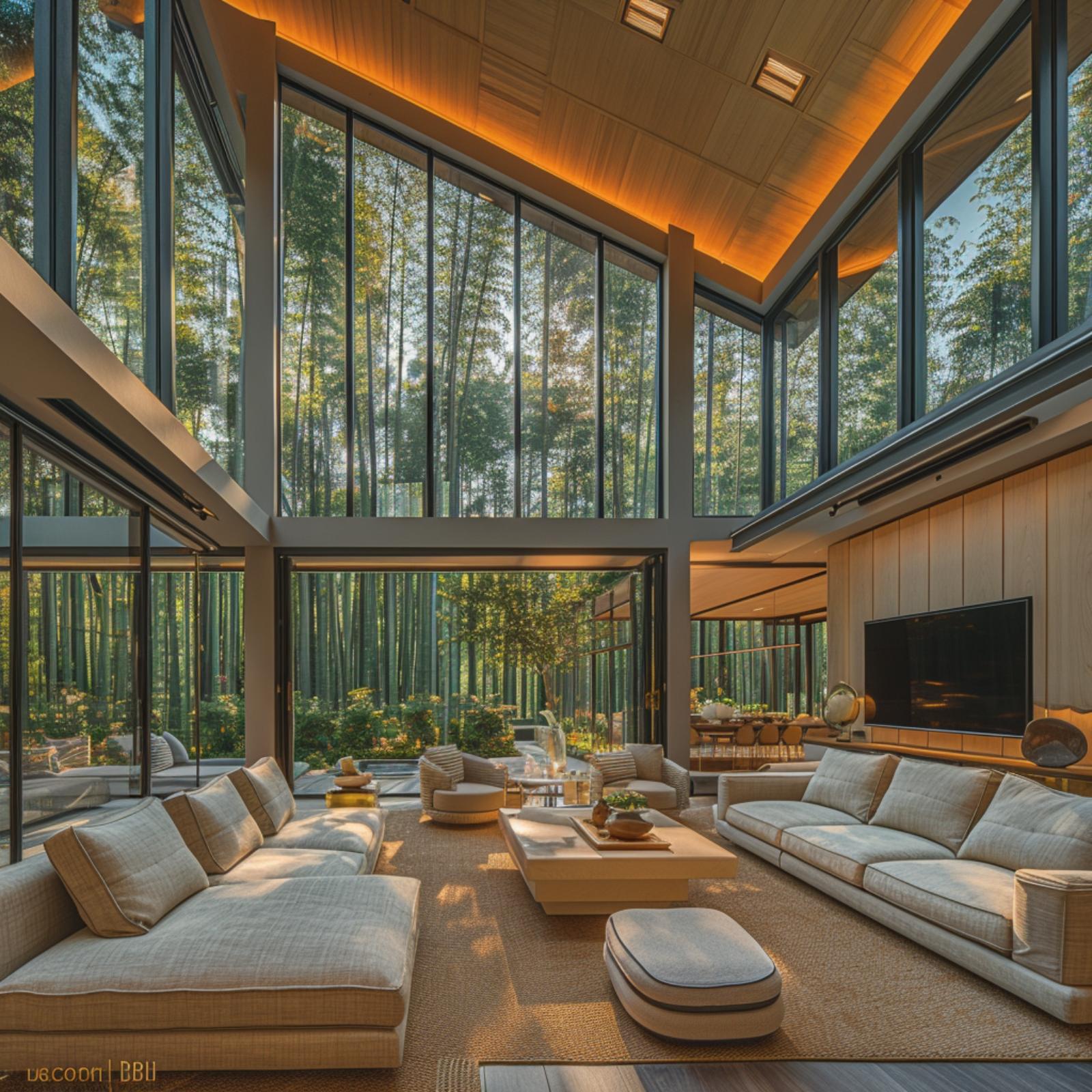
Warm cedar planks line the ceiling and catch the amber glow from recessed cove lighting, pulling the eye upward in a room that’s already working hard with double-height glass. The sofas sit low and wide in oatmeal-toned linen, which keeps sightlines clear through the full wall of black-framed panels to the bamboo grove outside. It’s the bamboo that does the unexpected work here, replacing the typical forest or skyline with something vertical and rhythmic that mirrors the window mullions almost exactly.
It’s the bamboo that does the unexpected work here, replacing the typical forest or skyline with something vertical and rhythmic that mirrors the window mullions almost exactly.
14. Parterre Garden, Dark Paneling, and a Skylight That Changes Everything
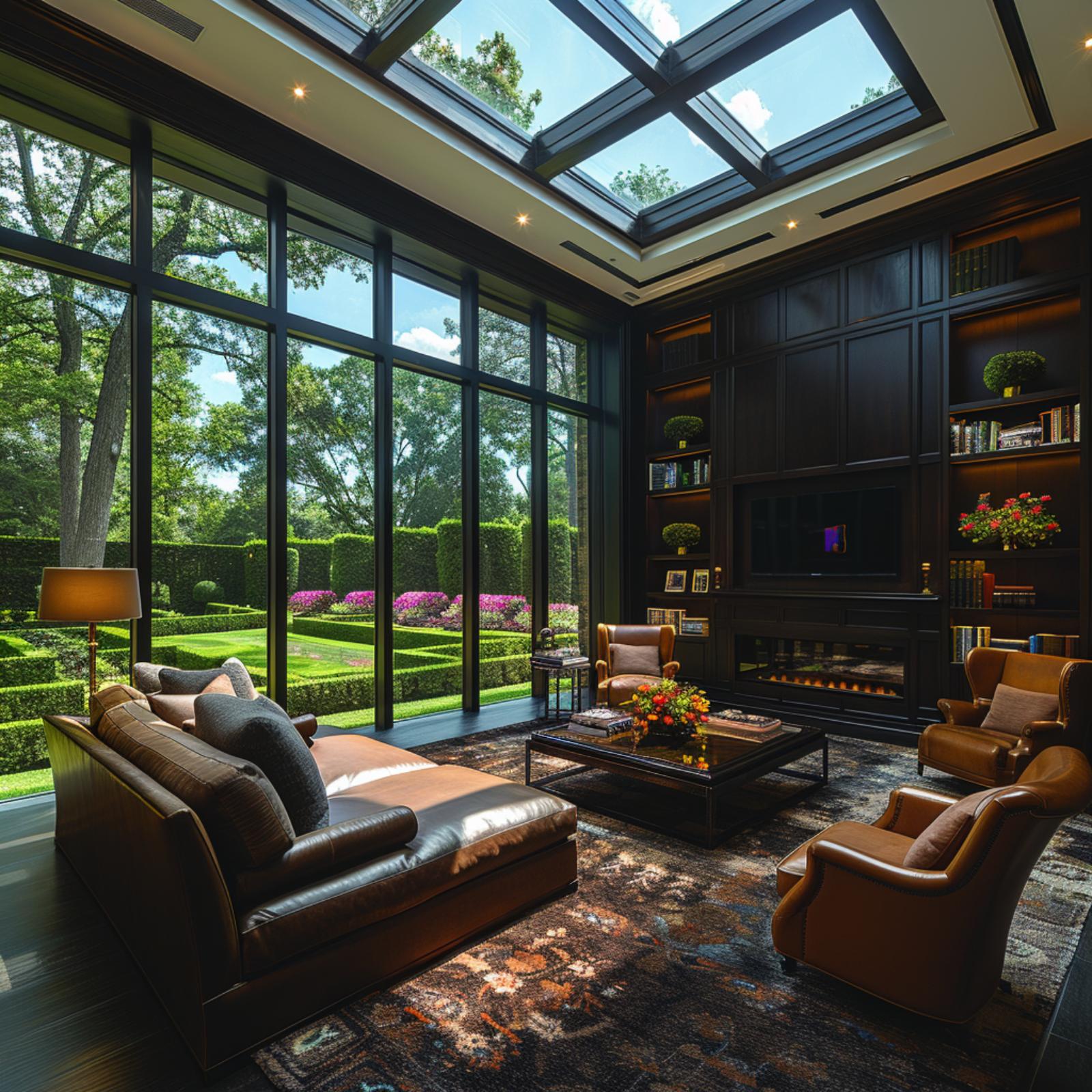
When the ceiling opens up and the garden lines up perfectly outside, a room stops being a room and starts being an argument for a different life entirely.
Dark espresso-stained paneling runs floor to ceiling on the back wall, flanked by built-in shelving that holds books, topiaries, and a flat-panel TV without any of it feeling crowded. A gas fireplace sits recessed into that wall at eye level, low and linear. The cognac leather armchairs pulled around a lacquered coffee table are doing real work here, keeping the palette grounded while the glass wall opposite pulls everything toward the formal parterre outside.
That garden isn’t incidental. Clipped boxwood hedges, geometric beds, and a flush of magenta flowering shrubs give the view a structure that mirrors the interior’s own discipline. The gridded skylight overhead pours midday light onto the patterned area rug, which has enough depth in its florals to hold up against the busyness outside without competing with it.
13. Sunset Through Steel Grid, Cognac Leather, and a Garden That Does the Heavy Lifting
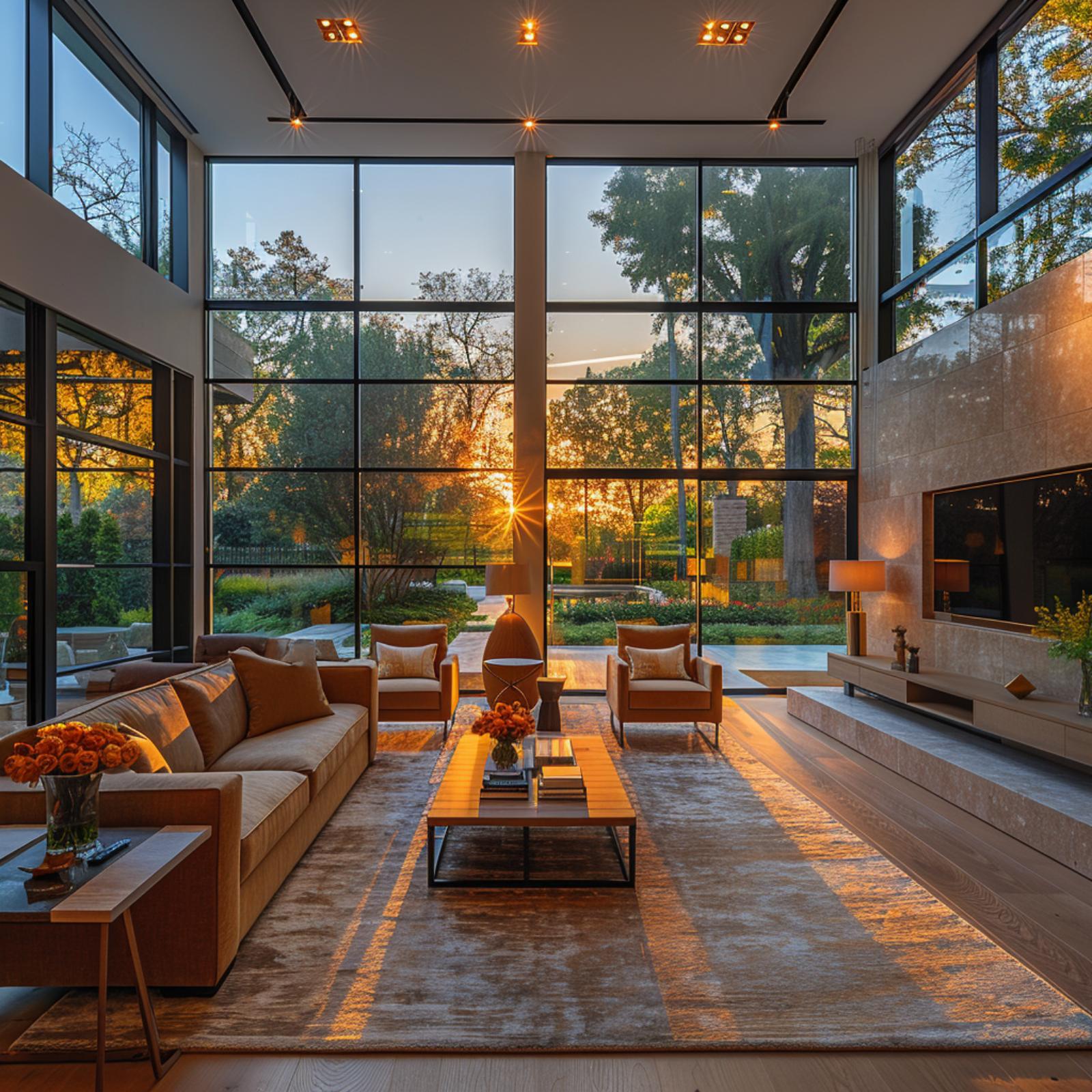
At golden hour, the floor-to-ceiling steel-grid facade stops being a window and becomes something closer to a painting. The light doesn’t just enter the room; it pools across the coffee table, the rug, and the camel-toned sofa in a way that no recessed fixture could replicate. Two cognac armchairs face the glass directly, which is the right call. Positioning seating toward the view rather than anchoring it to the fireplace wall shifts the room’s entire sense of priority.
The travertine-clad TV wall holds its own against that much glass because its vertical scale matches the double-height facade. Without that mass on the right side, the room would feel unresolved. And the orange florals on the side console aren’t incidental; they echo the sunset and tie the exterior palette back inside without forcing the connection.
12. Vineyard Views, Terracotta Floors, and a Sectional That Knows Its Role
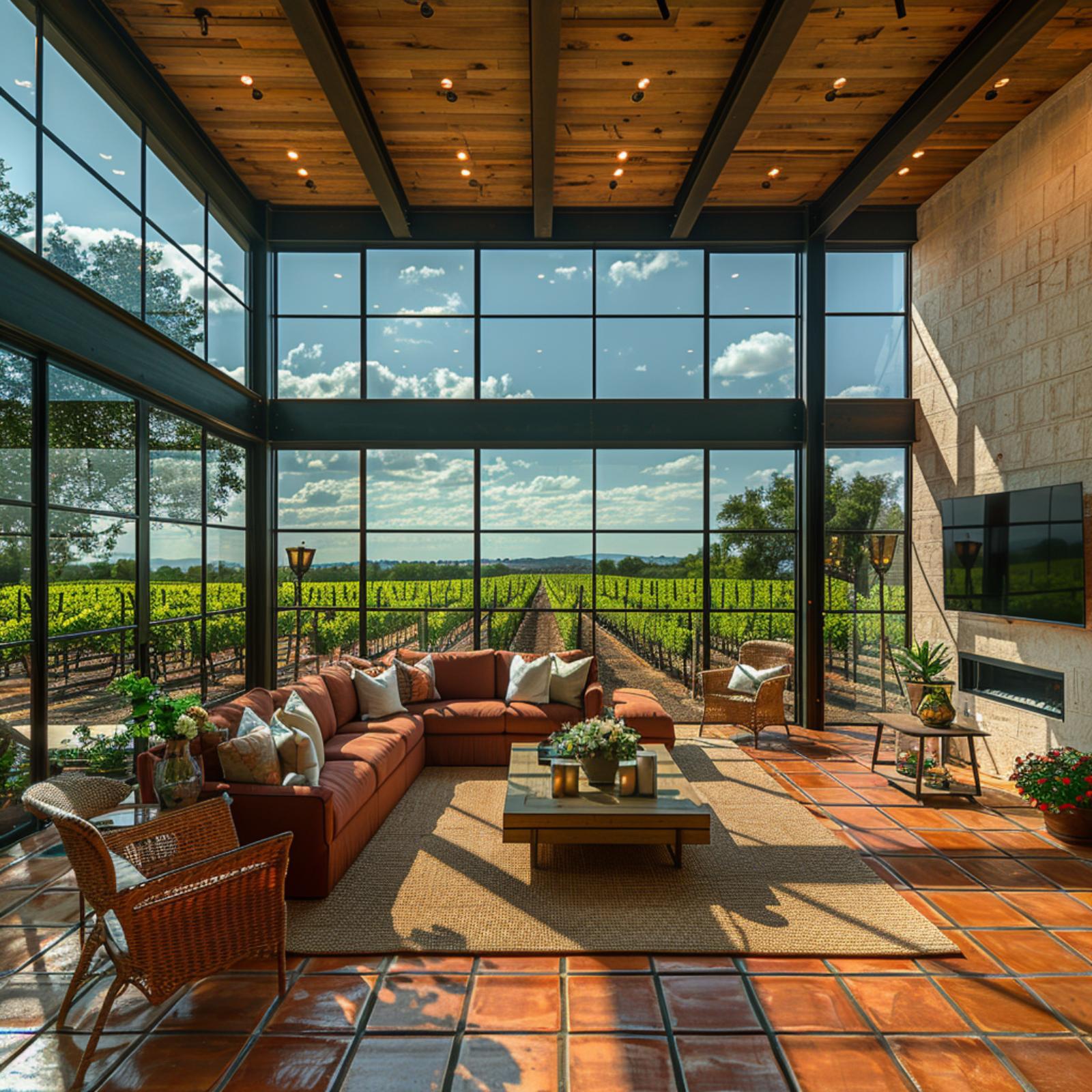
Saltillo-style terracotta tile runs the full floor plane, warm enough to hold its own against the rust linen sectional without competing. The wood-beam ceiling pulls the eye up, but it’s the vineyard rows converging at that central vanishing point that do the real work here.
11. Sunset Light Does Half the Decorating Here. The Rest Is Stone and Leather.
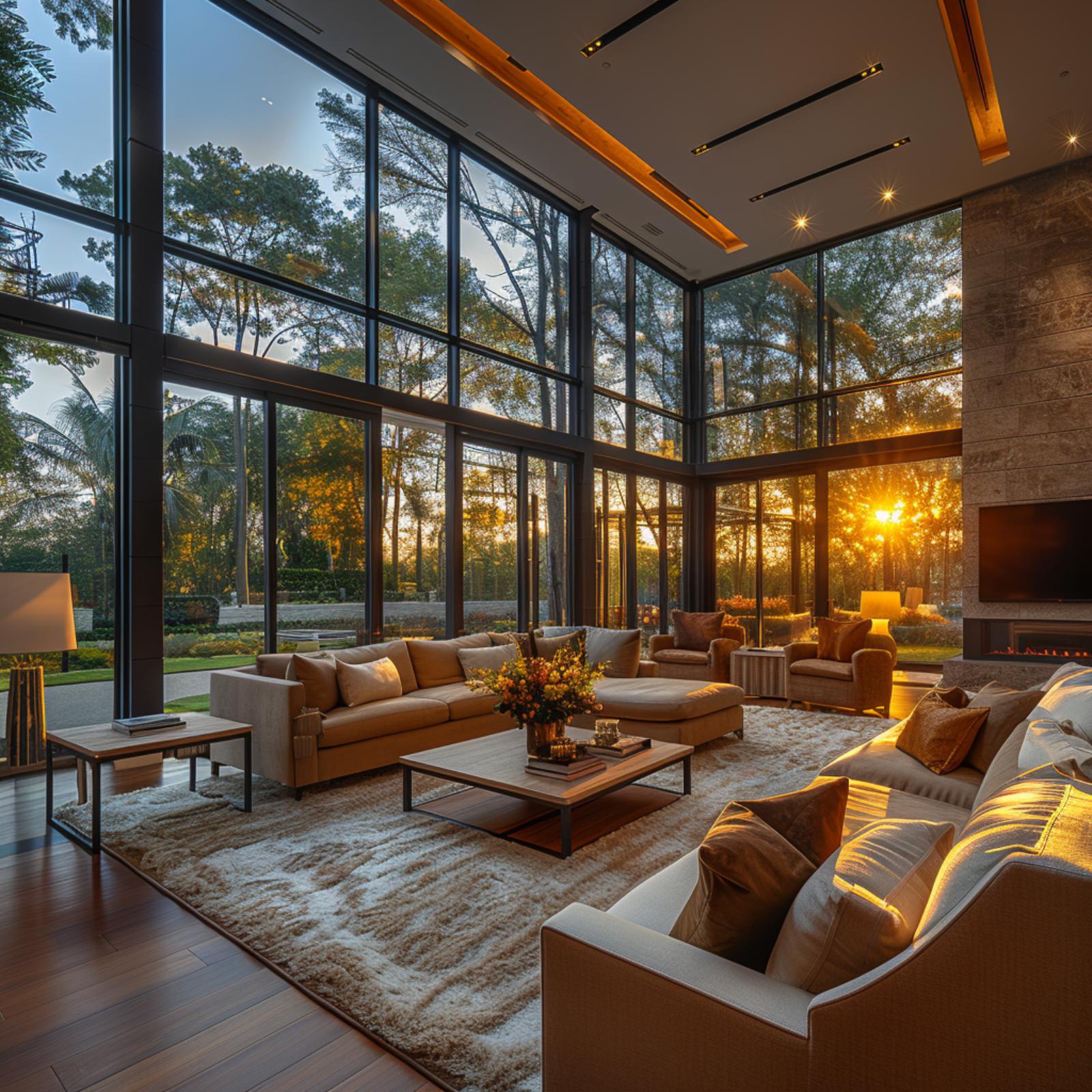
Steel-framed glass runs two full stories, and when the sun drops behind the tree line outside, it bypasses every lamp in the room entirely. The warm light catches the honey-toned sectional fabric and bounces off the shag rug below it, which reads almost ivory in the daytime and goes gold at dusk.
What keeps the room from feeling like it’s all window is the stone fireplace wall anchoring the right side. It’s rough-textured, matte, and heavy enough to hold the space together. The recessed linear fireplace at its base stays low and horizontal, which lets the stone above it do the work. Cognac throw pillows scattered across both sofas tie that side of the room back to the seating without any effort required.
10. Cream Linen, Double-Height Glass, and a Forest That Refuses to Stay Outside
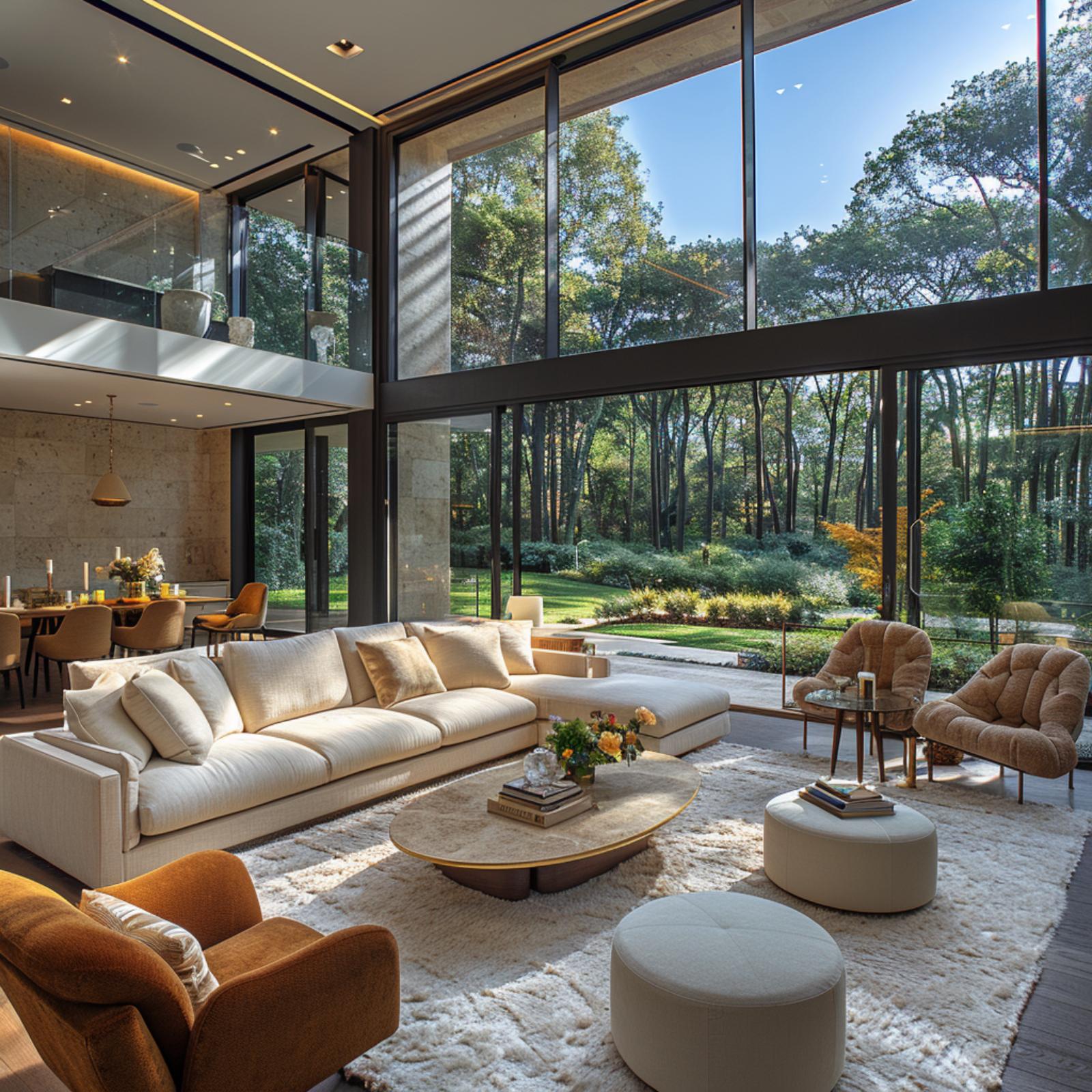
Travertine-clad columns anchor a double-height glass wall that runs the full width of the room, pulling a dense canopy of trees into the interior until the boundary between inside and out genuinely blurs. The cream linen sectional is oversized but sits low enough that it doesn’t eat the view. Two caramel bouclé armchairs provide the warmth the neutral palette needs without competing with the green outside.
9. Indoor Tree, Circular Sofa, and a Living Room That Grows Around Them
🔥 Would you like to save this?
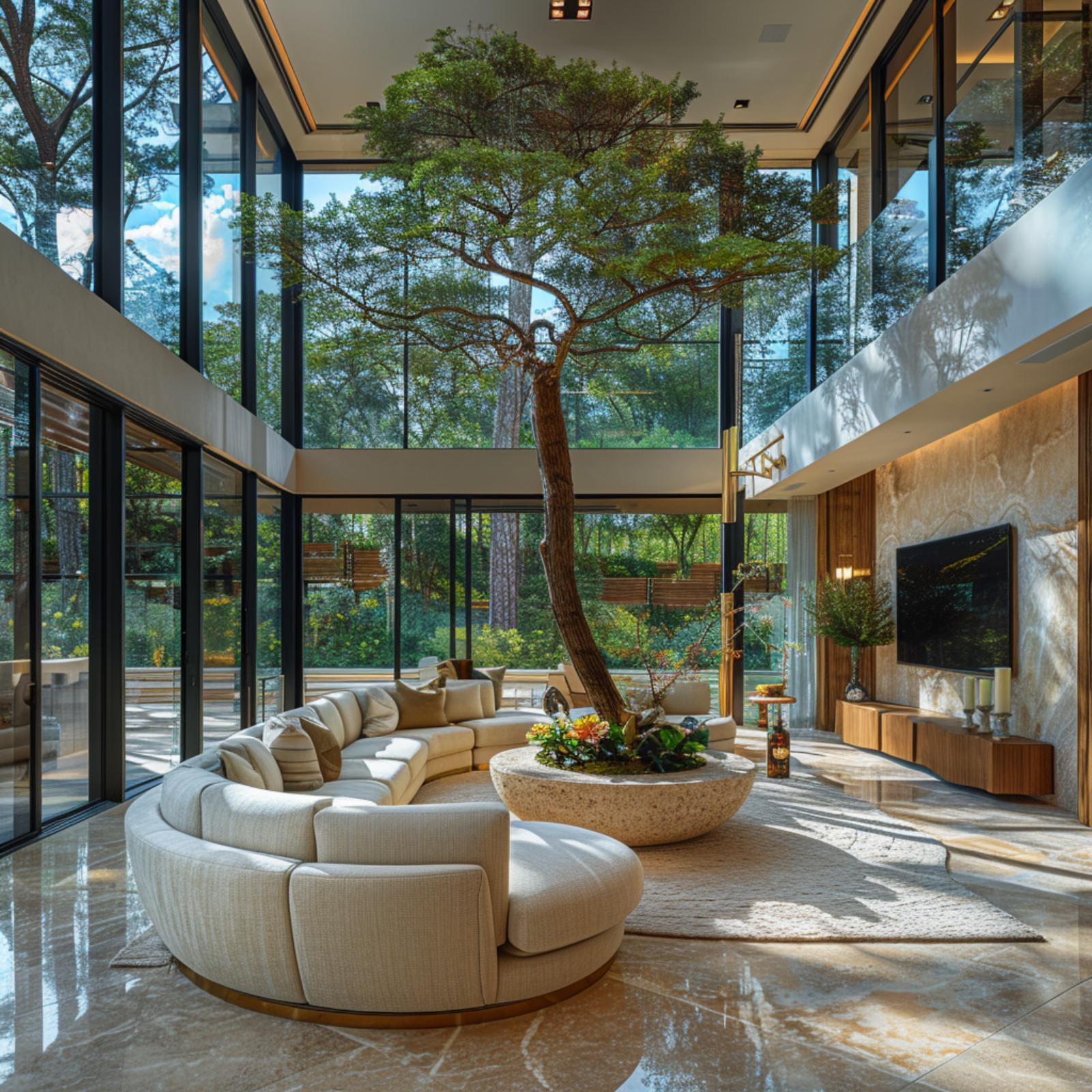
Curved cream sectional sofa, a living tree growing through a stone planter at its center, double-height glass walls on three sides. That combination sounds like it shouldn’t work. It does.
The tree isn’t decorative in the usual sense. It’s structural to how the room feels, pulling the eye upward through both floors of glazing and connecting the polished marble floor to the forest canopy outside. Circular furniture logic follows from there: the sofa wraps the planter, the planter wraps the trunk, and nothing competes with what’s already the obvious focal point. The marble-clad accent wall on the right, with its wall-mounted television and low credenza, gives the room enough grounding that all that glass doesn’t read as weightless.
8. Pool Deck, Rattan Chairs, and Glass That Refuses to Draw a Line
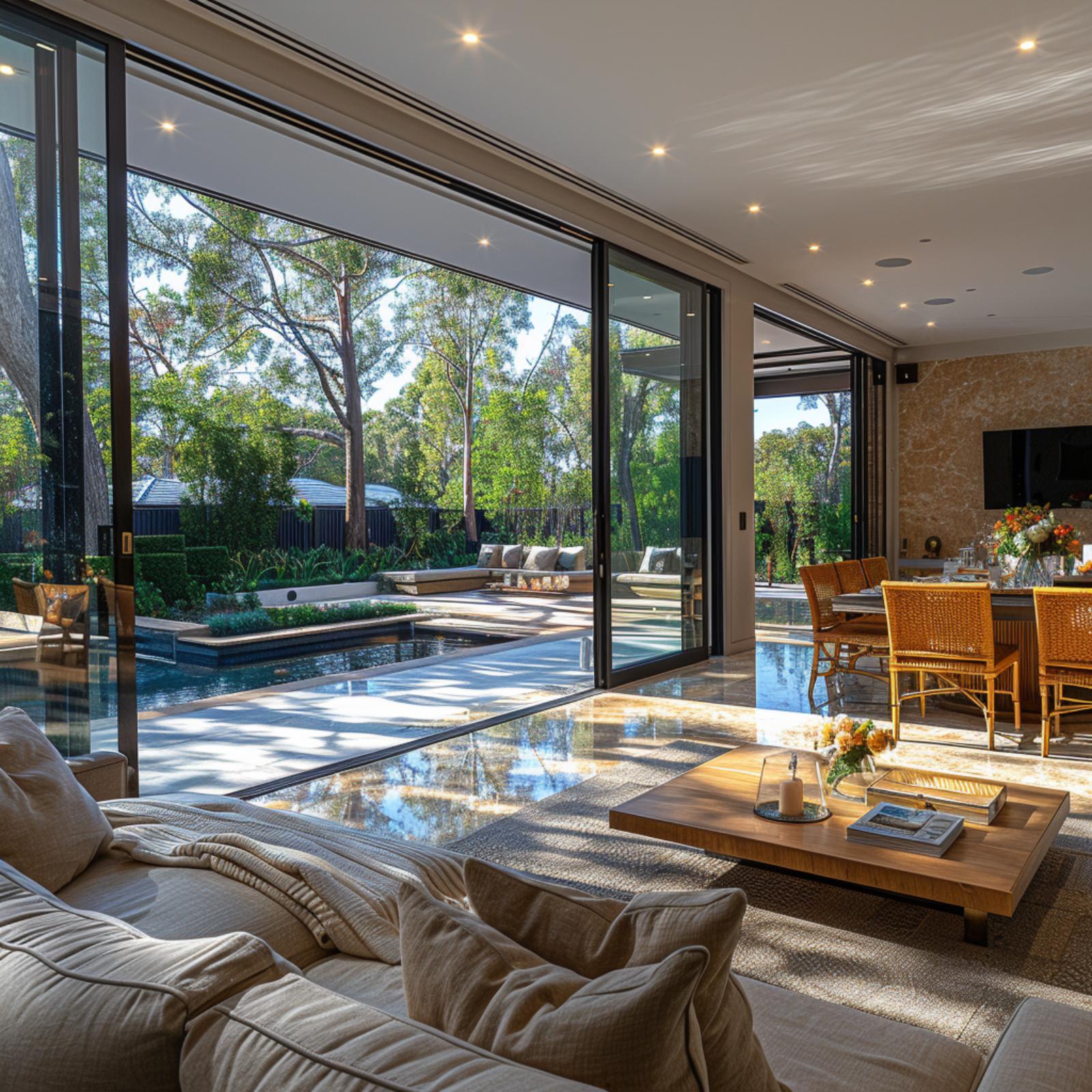
Sliding glass panels retract far enough that the pool deck and the interior marble floor read as one continuous surface. Low-slung linen sofas keep sightlines open to the water. Rattan dining chairs pull warmth into a room that could easily run cold.
7. Pool Deck, Bleached Linen, and a Travertine Table That Holds the Room Together
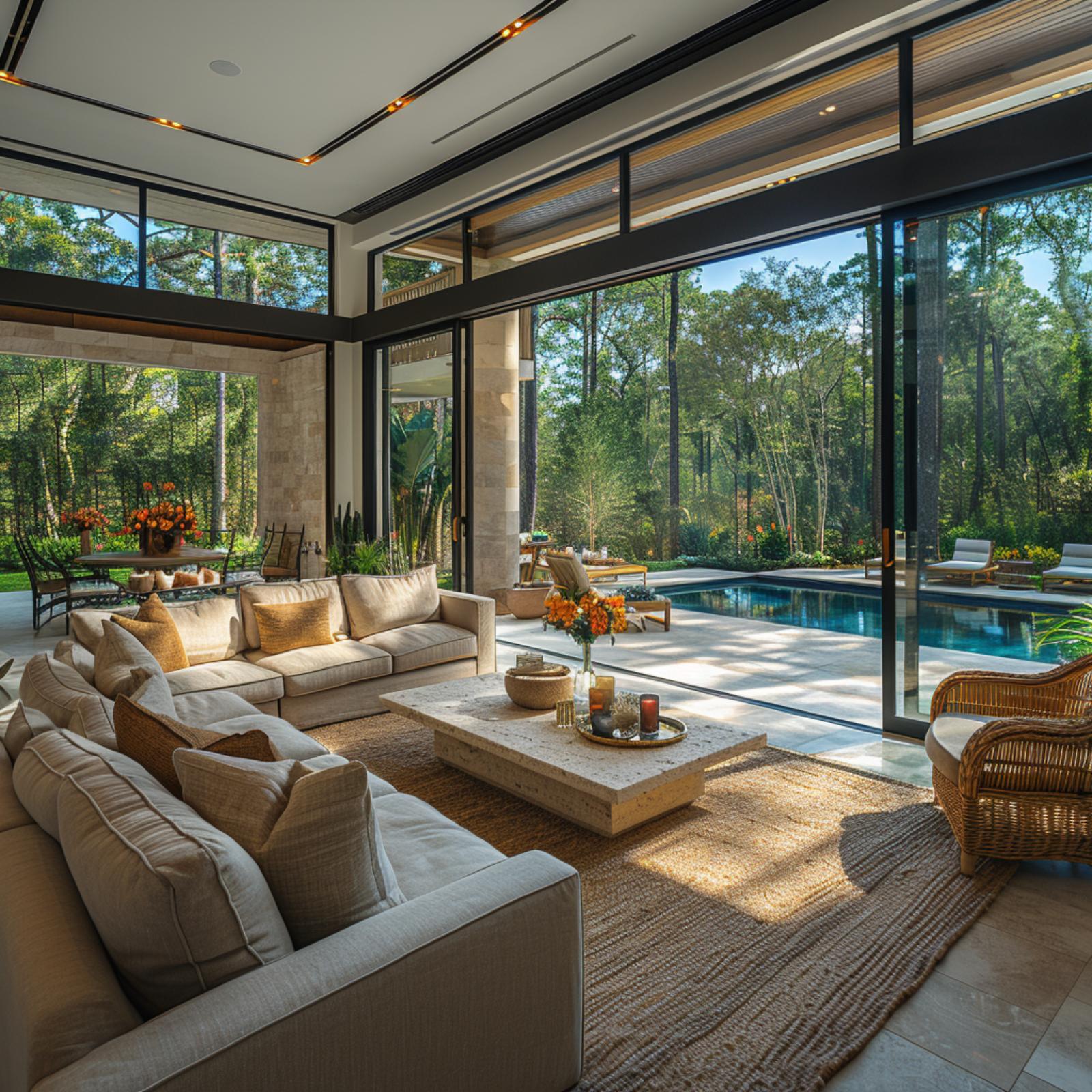
Bleached linen sectionals arranged around a travertine coffee table keep the palette neutral enough that the pool and tree line outside do all the visual work. The black steel framing on those floor-to-ceiling sliders isn’t decorative — it’s structural punctuation that defines where the room ends without blocking the view. A woven rattan chair anchors the right edge. It’s a small choice that stops the seating arrangement from reading as a single beige mass.
6. Cedar Ceiling, Floor-to-Ceiling Pine Forest, and a Curved Sofa That Earns Its Footprint
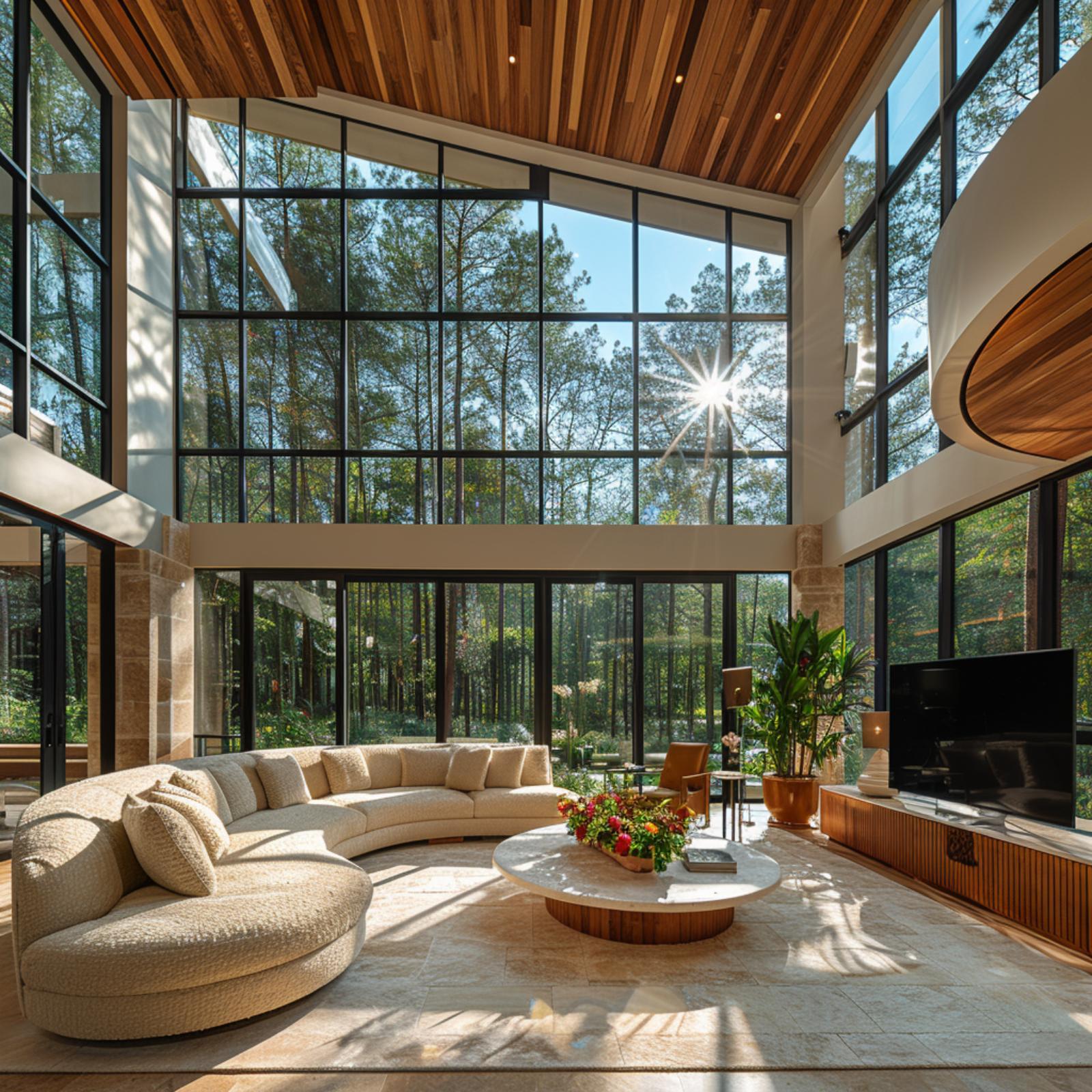
Tongue-and-groove cedar planks run the full length of the ceiling, and they’re doing more work than they look like they’re doing. Against two stories of black-framed glass, that warmth overhead keeps the room from reading as a greenhouse. The semicircular bouclé sectional is positioned far enough from the glass to let the lower tree line breathe behind it.
Round shapes dominate here without feeling coordinated. The drum-base coffee table in walnut veneer, the circular rug, the curved sofa arm: none of them match exactly, which is probably why it works. A potted tropical plant near the media console adds something the pine forest outside can’t, which is color at eye level.
5. Low Sofas, a Zen Garden, and Glass That Makes the Outside Feel Earned
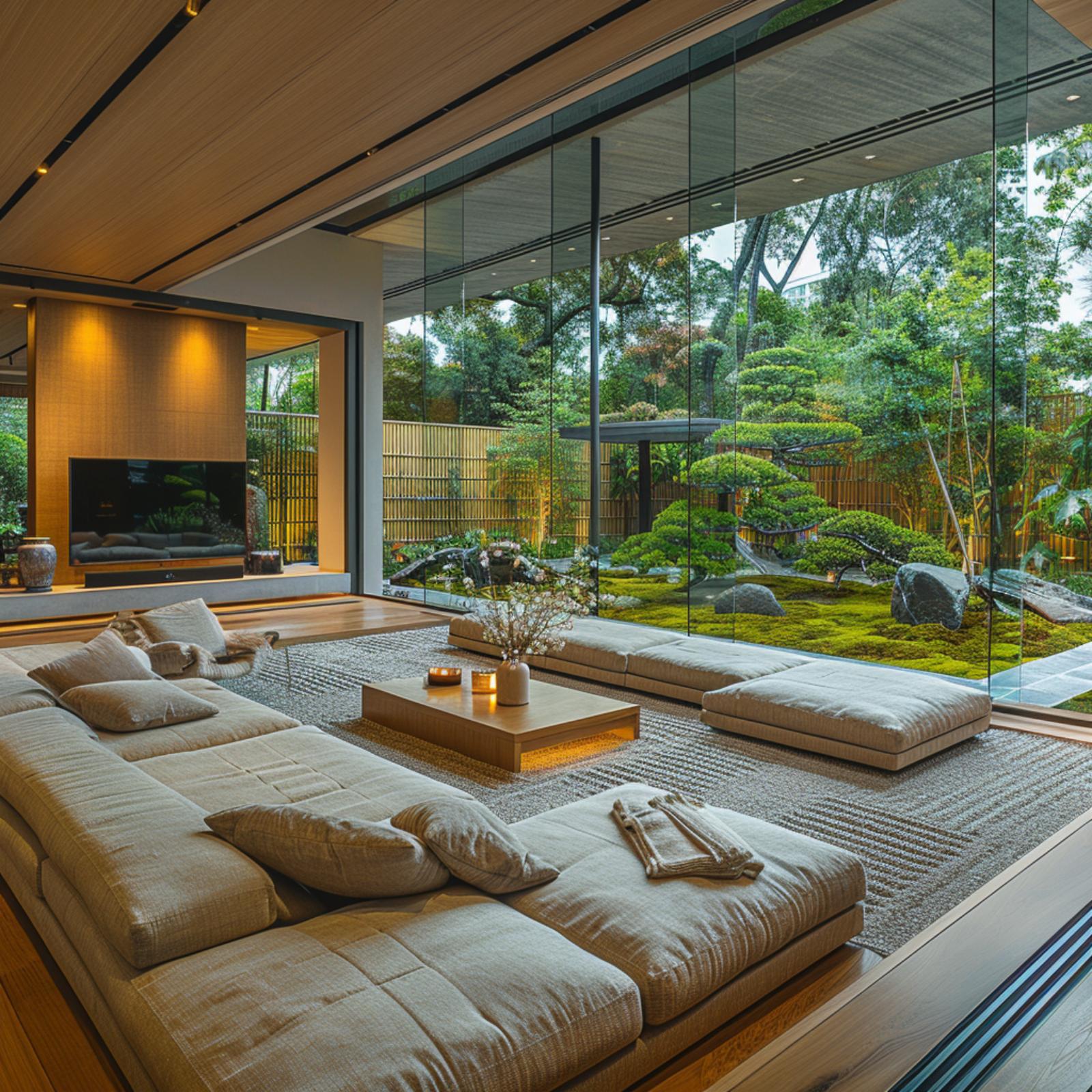
Floor cushion-style sectionals in oatmeal linen sit low enough that the full glass wall reads unobstructed from every seat. That’s not an accident. The moss, sculpted pines, and raked gravel outside would lose half their impact if a conventional sofa blocked the sightline at the two-foot mark.
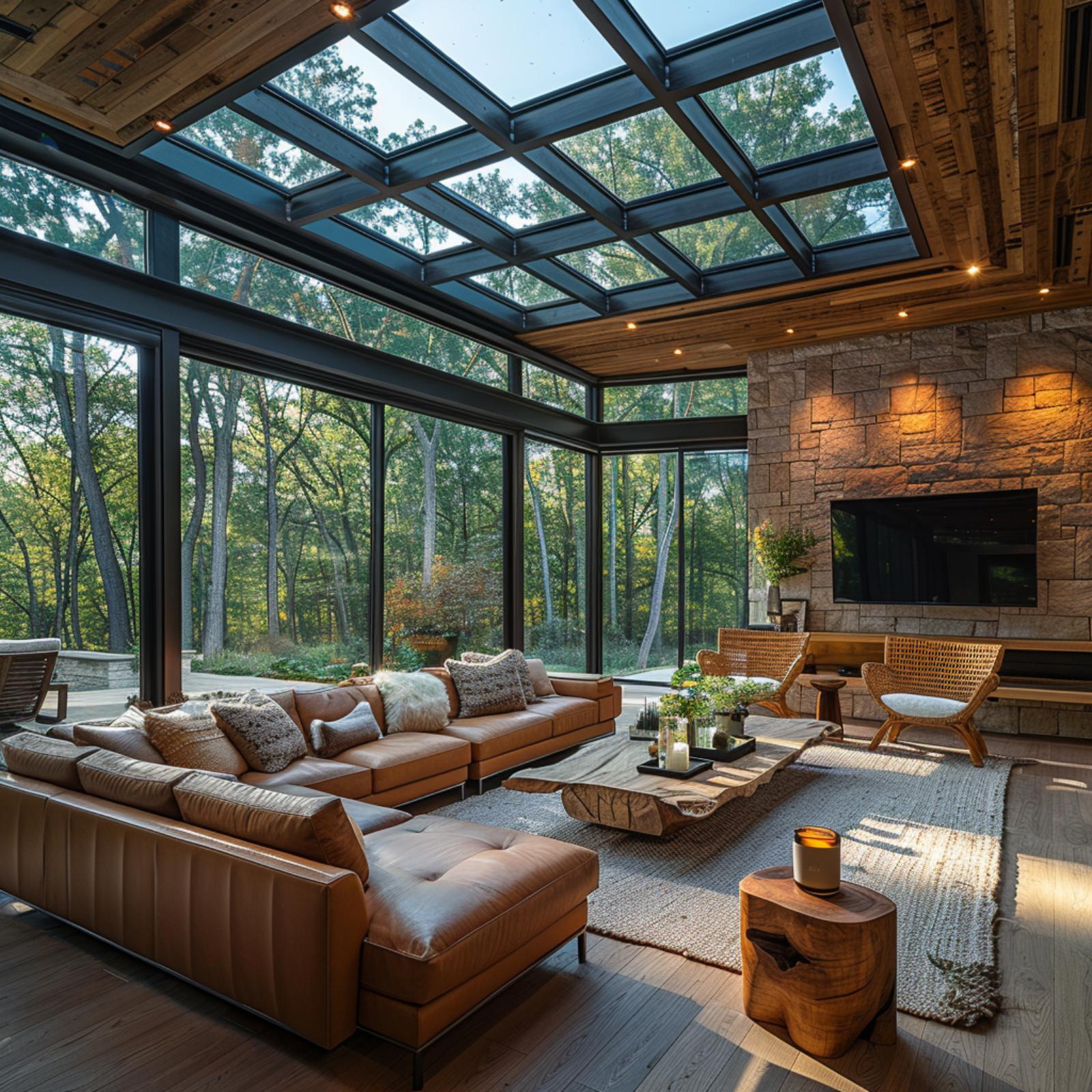
4. Glass Ceiling, Stone Wall, Cognac Leather — Forest Living Done Right
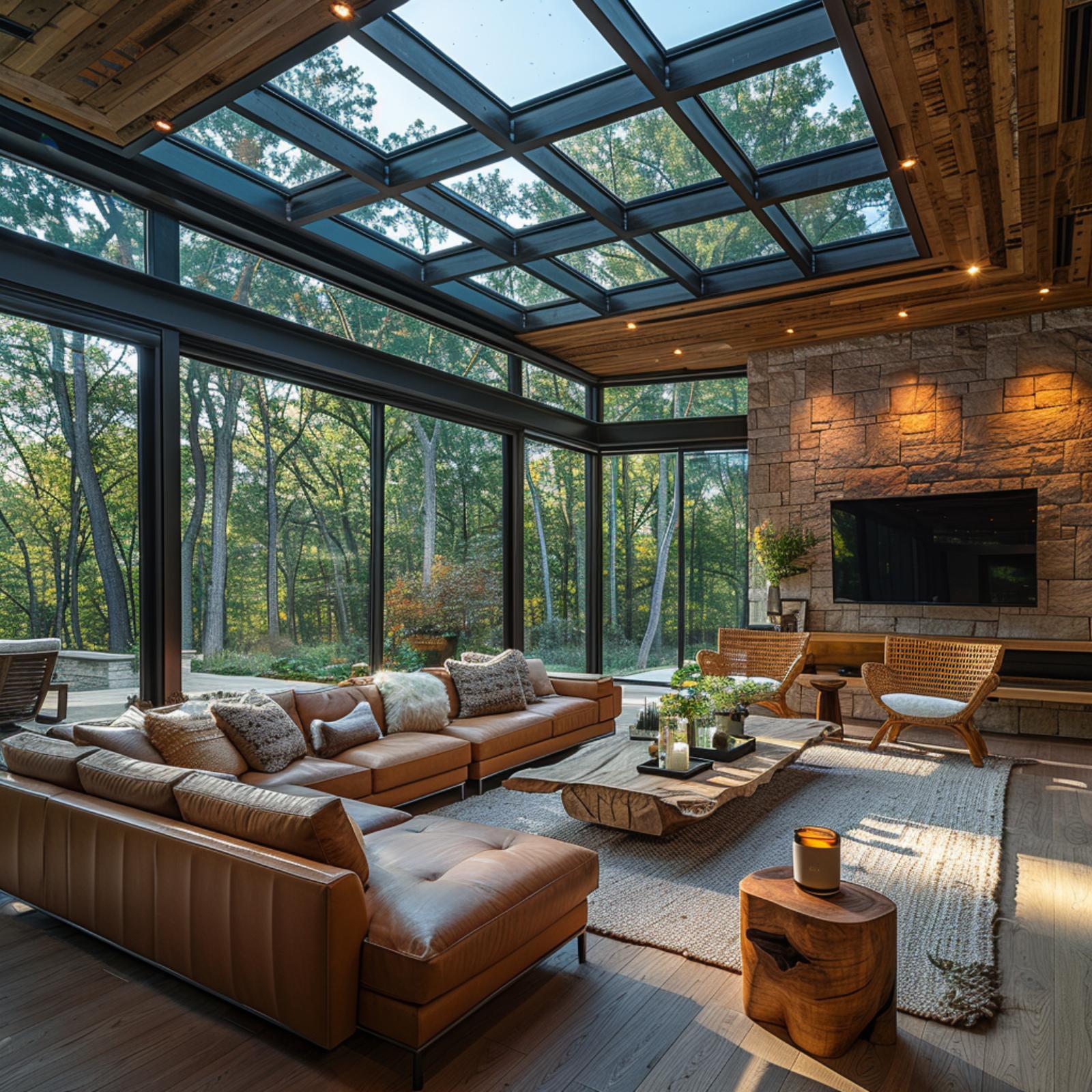
What makes this room work is the tension between the glass skylight grid overhead and the rough-cut stone fireplace wall opposite it. One material is industrial and precise; the other is ancient and irregular. Neither apologizes for the other.
The cognac leather sectional is low-profile enough that the tree line reads uninterrupted through the full-height glazing. Live-edge side tables and woven rattan chairs keep the natural material story going without matching too literally. Recessed puck lights warm the wood ceiling planks at dusk, which matters because the glass roof shifts the mood dramatically as daylight fades. By evening, that stone wall glowing under accent lighting does most of the visual work.
3. Bamboo Ceiling, Forest Glass, and a Sectional Big Enough to Mean It
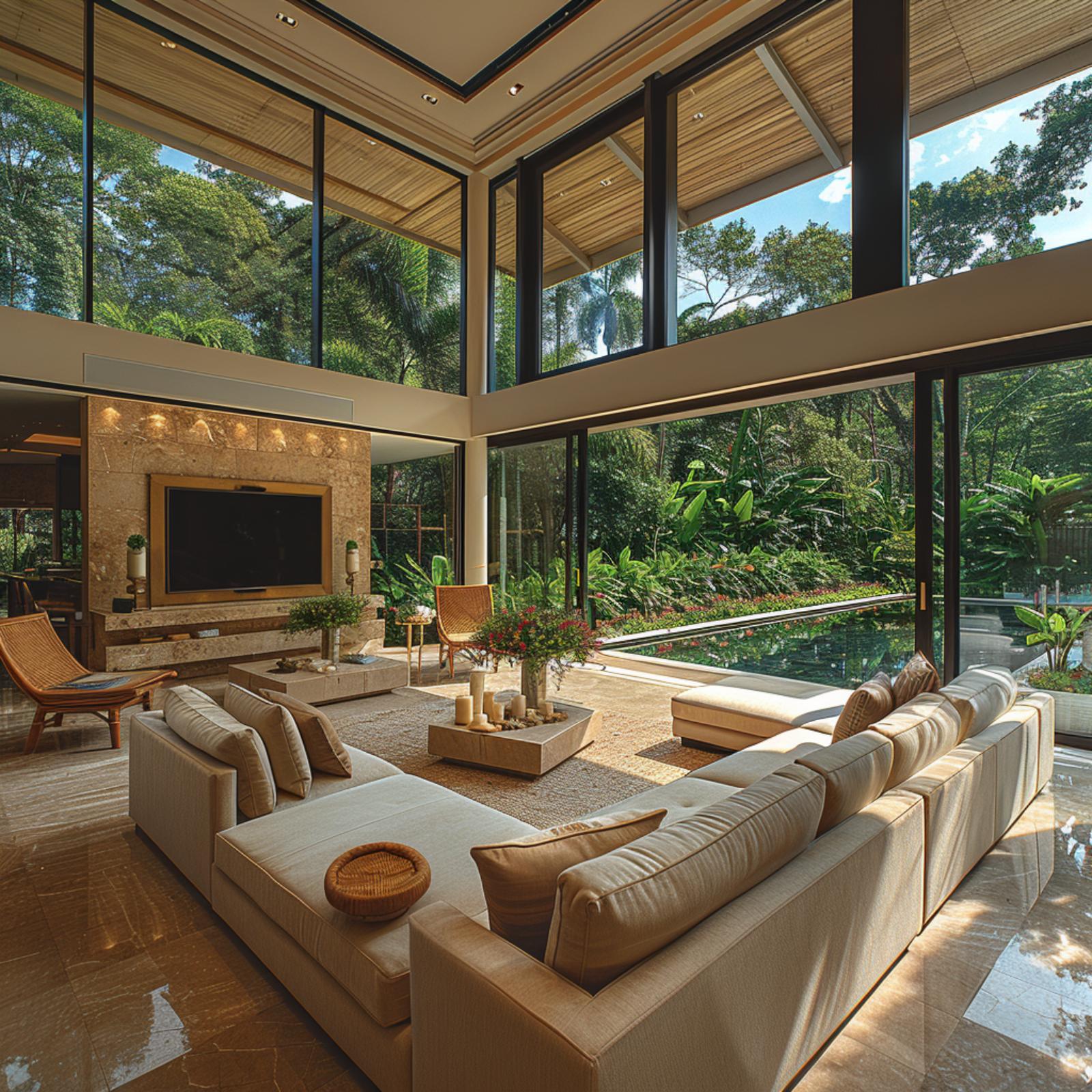
Slatted bamboo panels run the full length of the ceiling and do something unexpected: they make a double-height room feel warm rather than cavernous. Below them, floor-to-ceiling black steel frames hold the garden and pool in place like a living mural. The cream sectional is scaled correctly for once, filling the seating zone without crowding the glass.
A travertine-clad TV wall anchors the left side, preventing the room from floating off entirely into greenery. Rattan chairs, a woven tray, and candles on the low stone table keep the natural material language consistent. Nothing here is trying too hard. That restraint is exactly why it works.
2. Glass Roof, Live-Edge Table, and a Forest That Practically Moves In
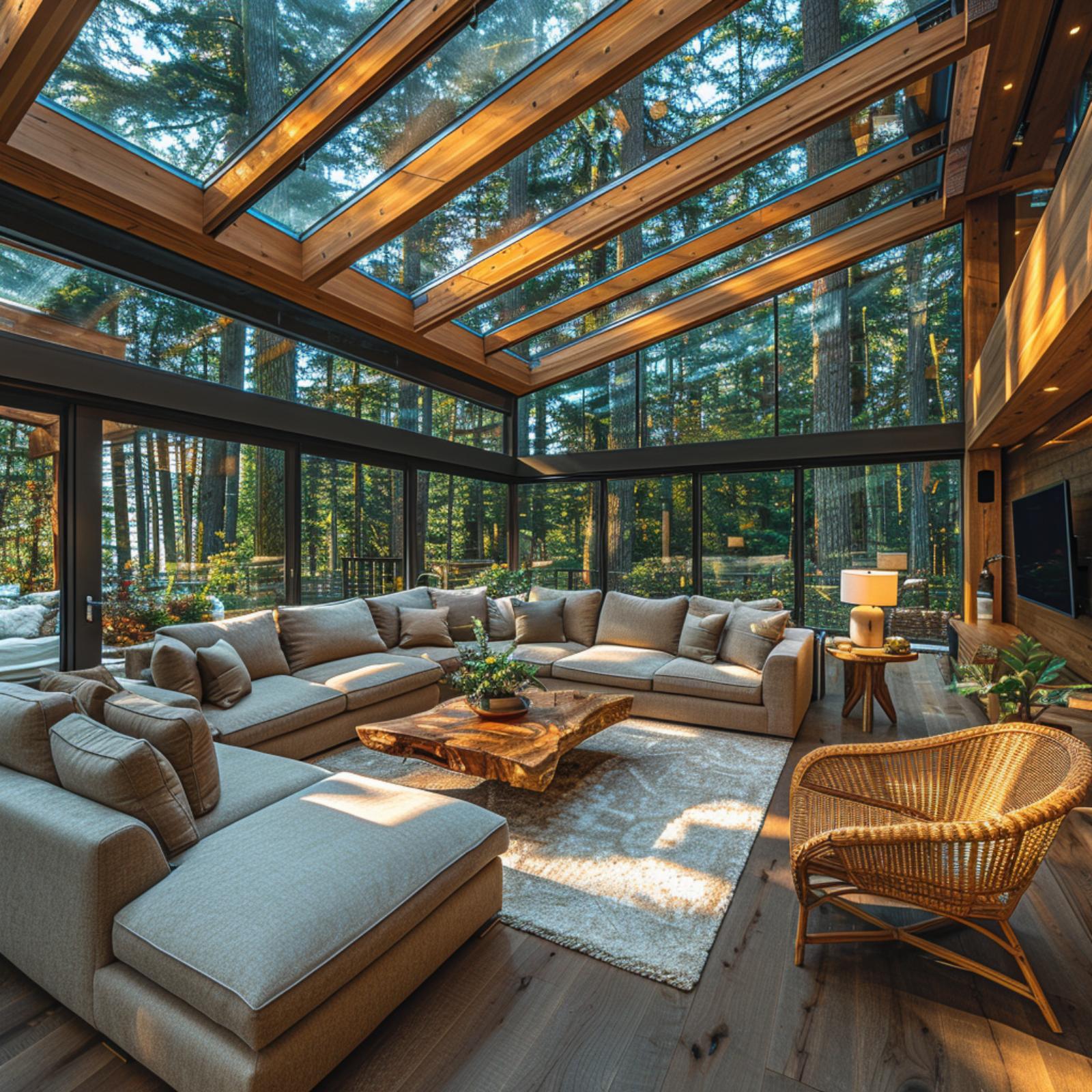
Exposed wood beams run the length of a fully glazed roof, and the effect isn’t subtle. Natural light pours straight down onto the sectional below, which is upholstered in warm greige fabric and arranged in a generous U-shape that keeps conversation central rather than screen-focused. A live-edge coffee table sits at the heart of it, its raw slab form doing more visual work than a conventional table ever could.
Tall conifer trunks press against every wall of glass on three sides, and a wicker accent chair in the foreground adds texture without competing. Wood-plank flooring in a pale honey tone ties the interior palette back to the ceiling beams above. When a room’s architecture does this much, restraint in the furnishings isn’t a compromise. It’s the only move that makes sense.
1. Glass Roof, Stone Wall, Cognac Leather — Forest Living Done Right
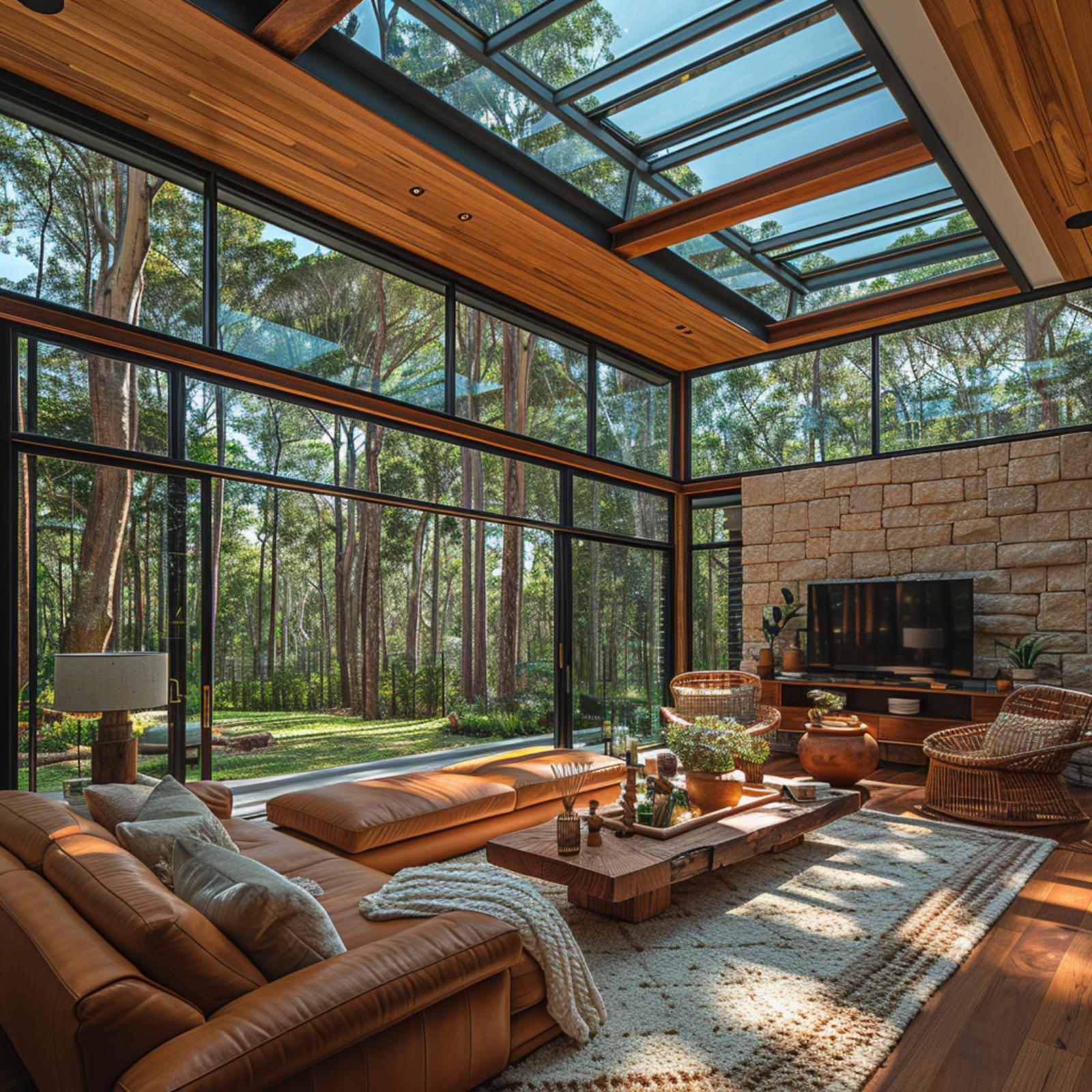
Warm-toned hardwood flooring runs straight to the base of full-height steel-framed glass, and the forest outside doesn’t feel like a view so much as a fourth wall. A sandstone block fireplace surround does the anchoring work that drywall never could. The cognac leather sectional sits low, which keeps sightlines clear to the tree canopy above.