🔥 Would you like to save this?
The courtyard entry was never really gone. For a few decades, the two-car garage and the straight-shot front door simply shoved it aside, which, honestly, did most homes no favors. The best reason to look now is the range. No parade of Mediterranean villas or Southwestern adobes leaning on easy nostalgia. Designers are pulling the idea into contemporary houses with cleaner geometry, heavier materials, tighter planting, and a better sense of suspense.
In order to come up with the very specific design ideas, we create most designs with the assistance of state-of-the-art AI interior design software. Also, assume links that take you off the site are affiliate links such as links to Amazon. this means we may earn a commission if you buy something.
A good entry court changes the mood before anyone reaches the handle. The street falls back. The house gets a little privacy. The walk to the door becomes part of the architecture instead of leftover paving between driveway and porch. These 36 designs make that case from different angles: quiet, severe, lush, expensive, restrained, resort-like. The strongest ones prove arrival still matters, and most modern homes have been wasting that moment.
36. Warm Wood and Black Steel Frame a Courtyard Entry Worth Slowing Down For
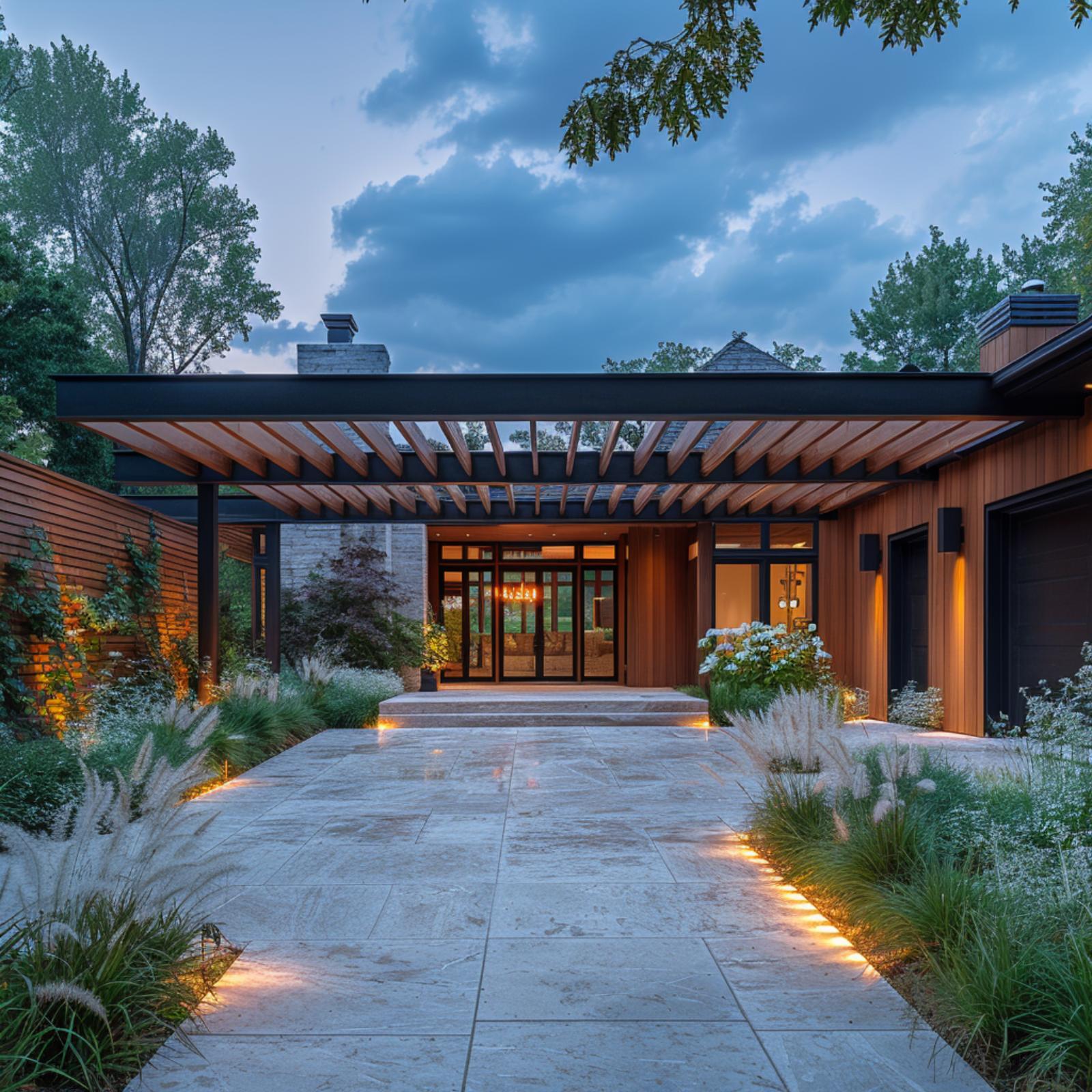
Cedar-toned cladding runs the length of the facade, and the black steel pergola overhead pulls the whole composition into sharp focus. Warm-toned light bleeds through the slatted roof at dusk, casting soft lines across large-format stone pavers that lead the eye straight to the entry doors. Those doors are worth a look: floor-to-ceiling glass panels in a dark bronze frame, with what appears to be a chandelier glowing amber just inside.
Ground-level uplighting runs along both edges of the approach, a detail that sounds simple until you see how much it adds at twilight. Ornamental grasses and white-flowering perennials flank the path without feeling manicured. The result reads less like a driveway and more like an arrival sequence.
35. Blooming Focal Point, Dark Granite Path — Courtyard Entry Gets a Dramatic Rethink
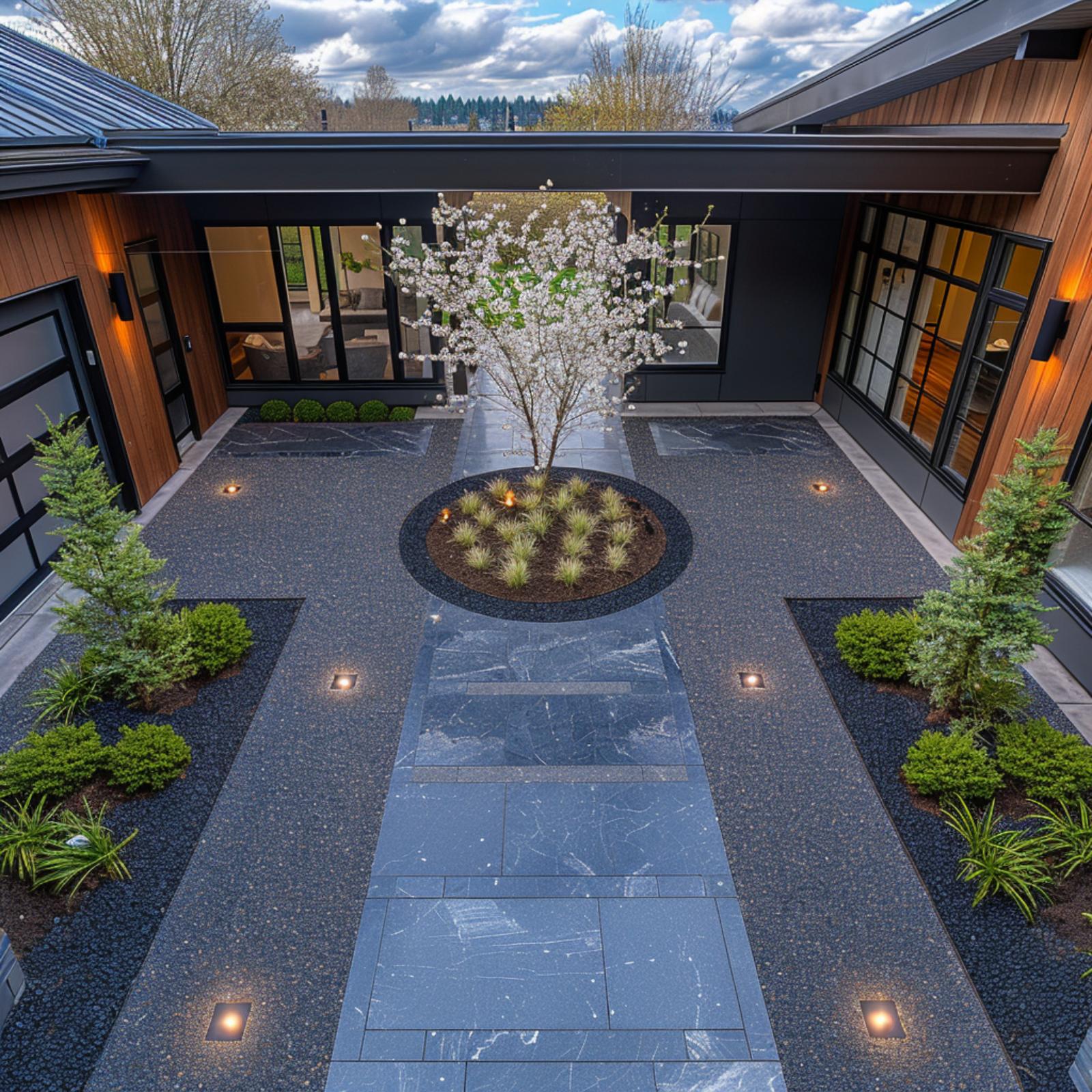
Ground-level uplights embedded in crushed black gravel draw the eye straight toward a circular planting bed where a white-flowering cherry tree anchors the whole composition. Veined slate-gray granite pavers form the central path. The surrounding gravel beds, clipped globe boxwoods, and dwarf conifers keep it structured without feeling stiff.
34. Stone, White Blooms, and Brass Trim Pull Off a Courtyard Entry That Earns Its Drama
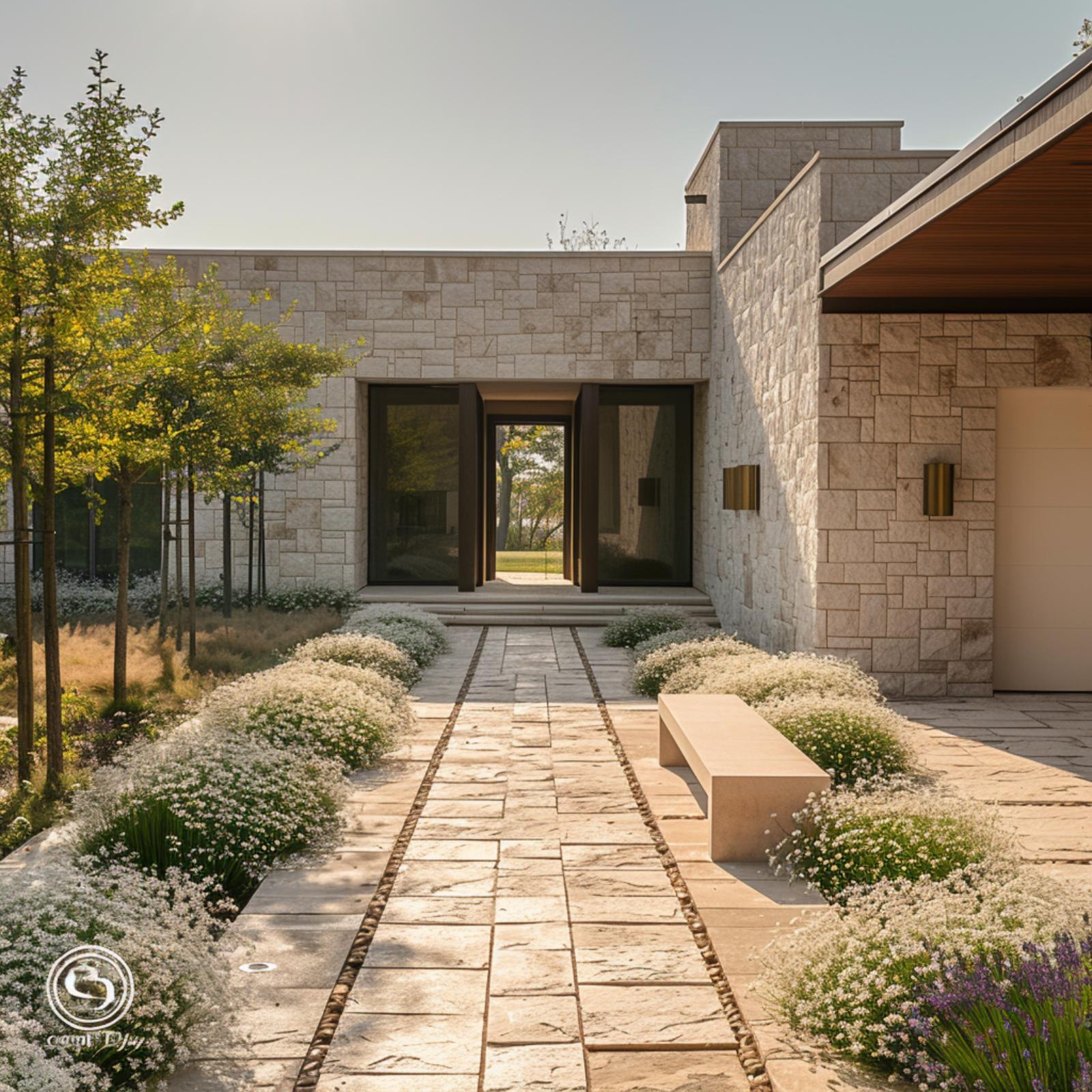
Limestone doesn’t usually feel soft, but here it does.
Clipped mounds of white flowering groundcover line both sides of the flagstone path, and that repetition keeps your eye moving toward the pivot door entry rather than wandering. A minimal concrete bench sits off to the right, unpolished and intentional. Brass wall sconces against the ashlar stonework are the only warm note, and they’re enough.
33. Olive Tree, Slate Path, Stone Wall — Courtyard Entry That Knows Exactly What It’s Doing
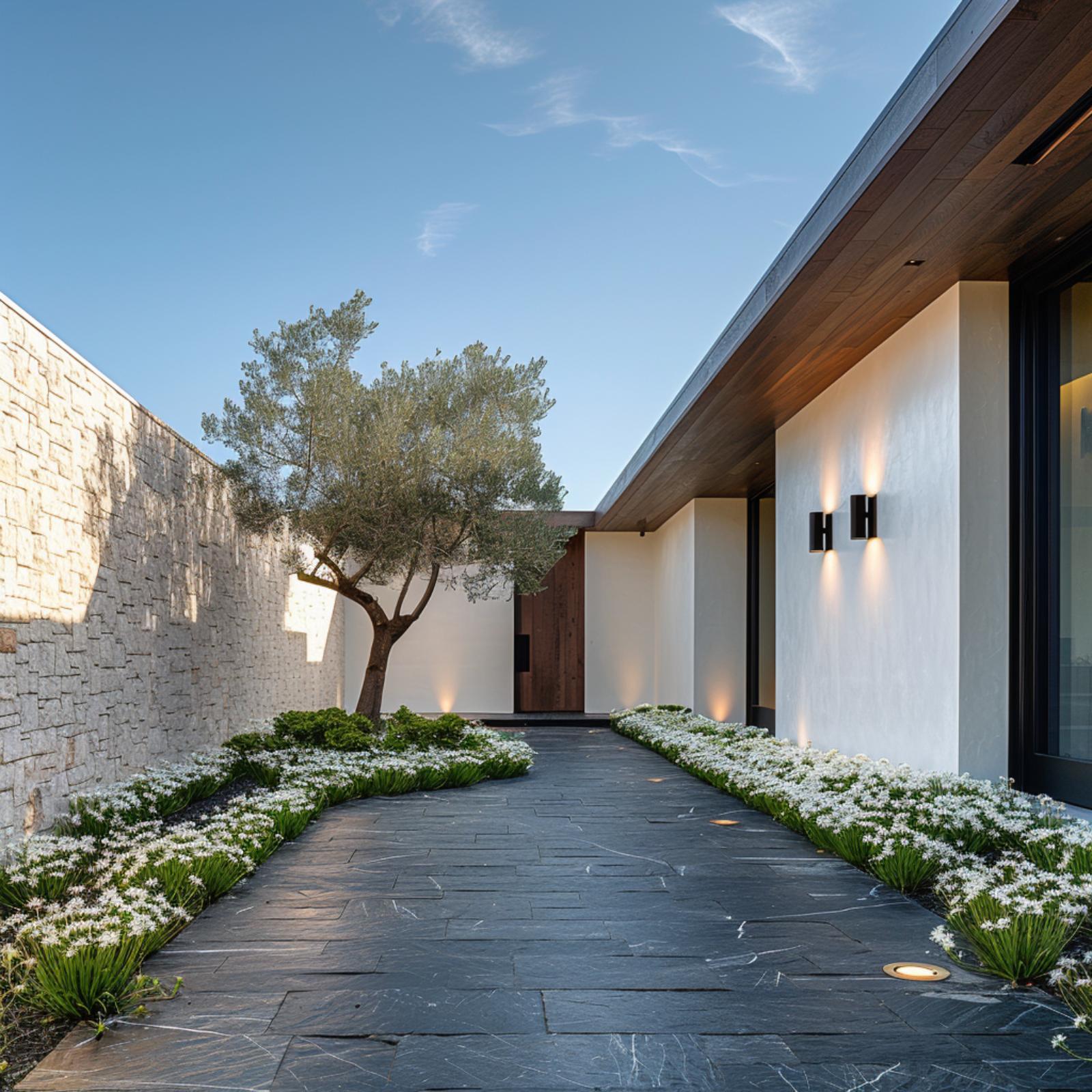
Flanked by low drifts of white star-shaped blooms and dark slate pavers with natural veining, this entry corridor earns its calm through restraint. An olive tree anchors the left side, its gnarled trunk silhouetted against a rough limestone wall that runs the full length of the approach. The contrast between that raw stacked stone and the smooth white plaster of the house facade does a lot of quiet work.
Two matte black cylindrical sconces cast upward and downward light against the plaster, and recessed ground lights glow at the path’s edge near the entrance. The wood-planked soffit overhead adds warmth without competing. It’s a narrow passage, but it doesn’t feel tight. It feels deliberate.
Style Math: Dark slate paving plus white flowering groundcover plus a single specimen tree is a combination landscape designers have used for decades, but pairing it with a rough limestone boundary wall and a wood soffit gives it a residential warmth that pure modernism tends to skip. The sconce placement, two fixtures side by side rather than spaced apart, reads as intentional punctuation rather than an afterthought. Getting that detail right makes the whole entry feel resolved.
32. Black Slate, Gravel, and Warm Light Rewire What a Front Entry Can Feel Like
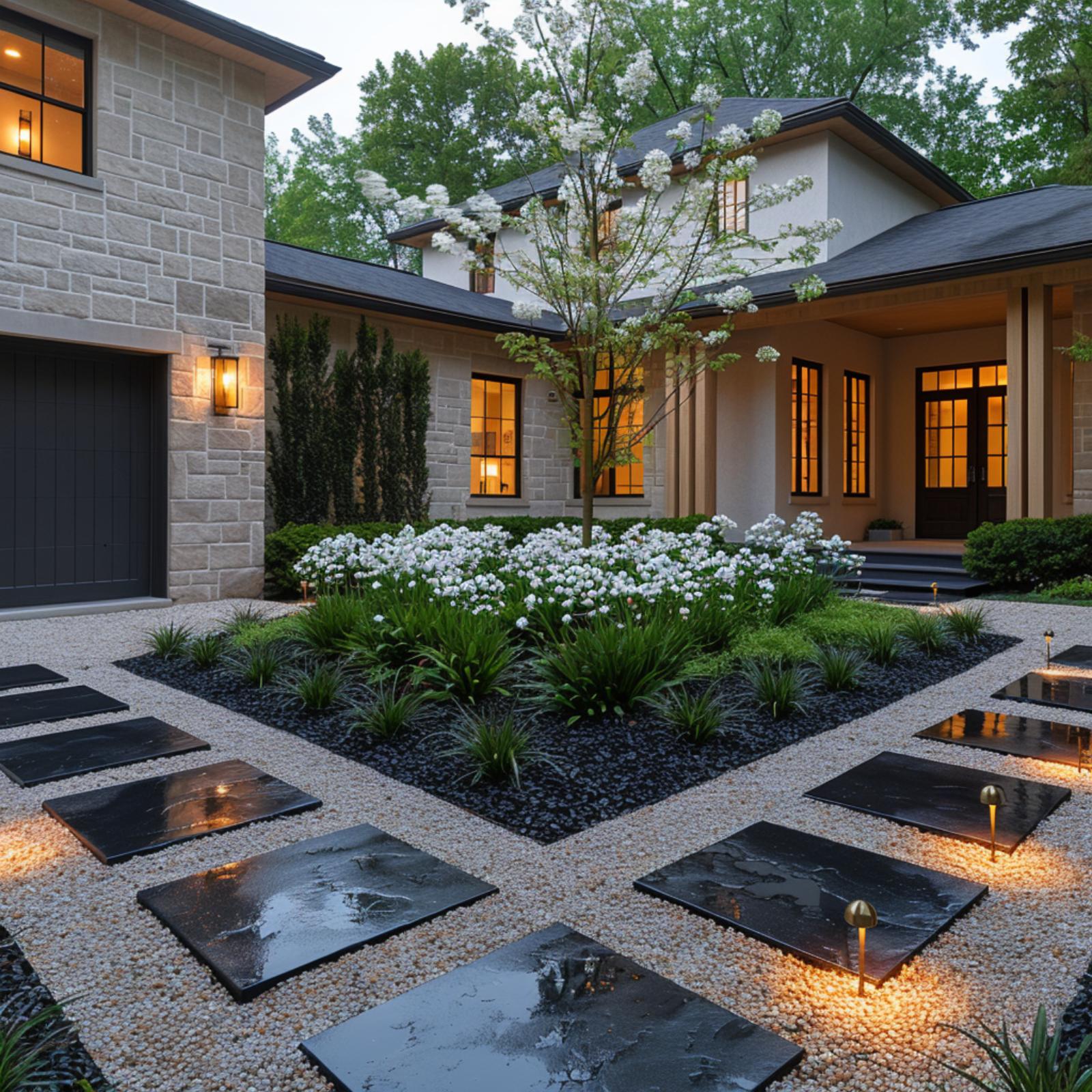
Large-format black slate pavers set into pale gravel create a grid that reads almost like a checkerboard from above, but ground-level the effect is quieter and more deliberate. Low brass path lights tucked between the stones cast pools of amber that make the wet slate look almost lacquered. It’s a material pairing that earns its drama without asking for attention.
The planting bed at the center anchors everything. White agapanthus and ornamental grasses rise from a black gravel mulch base, which keeps the palette tight and prevents the flowering mass from going soft. A single flowering tree overhead holds the vertical line.
- Pale gravel between pavers visually softens hard geometry without sacrificing structure
- Black mulch in planting beds ties back to the slate tone and unifies the ground plane
- Low-voltage brass path lights add warmth after dark without competing with architectural lighting above
31. Saguaro, Travertine, and White Blooms Pull a Courtyard Entry Into the Desert Southwest
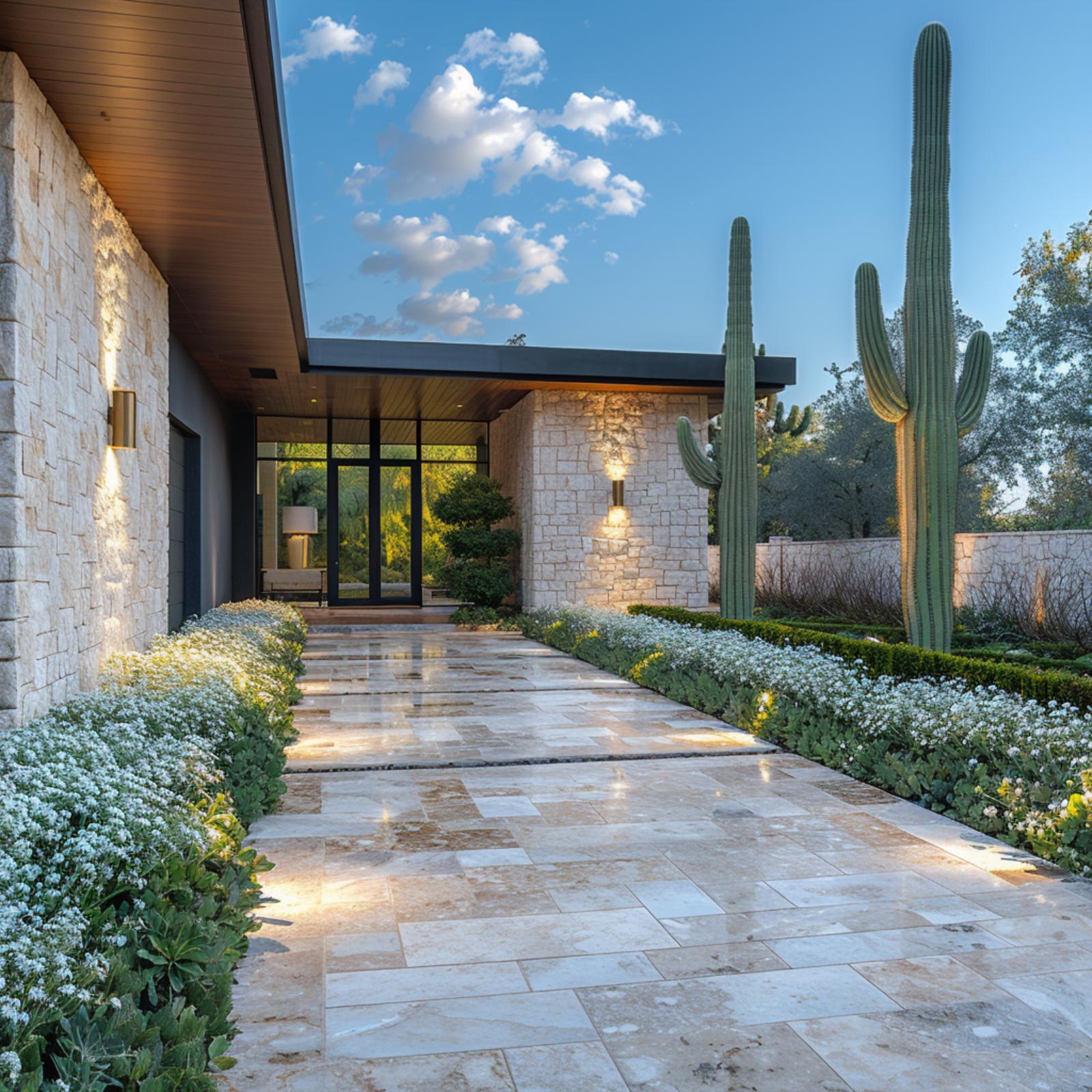
Two saguaro cacti do a lot of the work here. They’re tall enough to read against the sky before the eye even settles on the travertine paving below, which runs in a mix of warm ivory and tan tones laid in a staggered rectangular pattern. Wall-mounted sconces on the limestone block columns glow at dusk, and the reflection off the stone surface suggests it’s been honed rather than tumbled.
The planting on either side is low and dense, white-flowering groundcover edging the path with no gap, no gravel buffer. It’s an unexpected pairing with desert-scale plants, and it works. Inside, through the steel-framed glass entry doors, interior lighting and greenery hint at a covered atrium beyond.
Trend Alert: Travertine has been a go-to paving material for luxury entries for decades, but designers are increasingly specifying honed finishes over tumbled ones because the smoother surface reflects light and reads as more architectural than rustic. Pairing it with desert-scale specimen plants like saguaro cacti is a distinctly regional move that’s gaining traction outside the Southwest as homeowners look for entries that feel rooted in a specific place rather than generically upscale.
30. Spanish Moss, Cobblestone, and White Azaleas Pull Off a Southern Entry Done Right
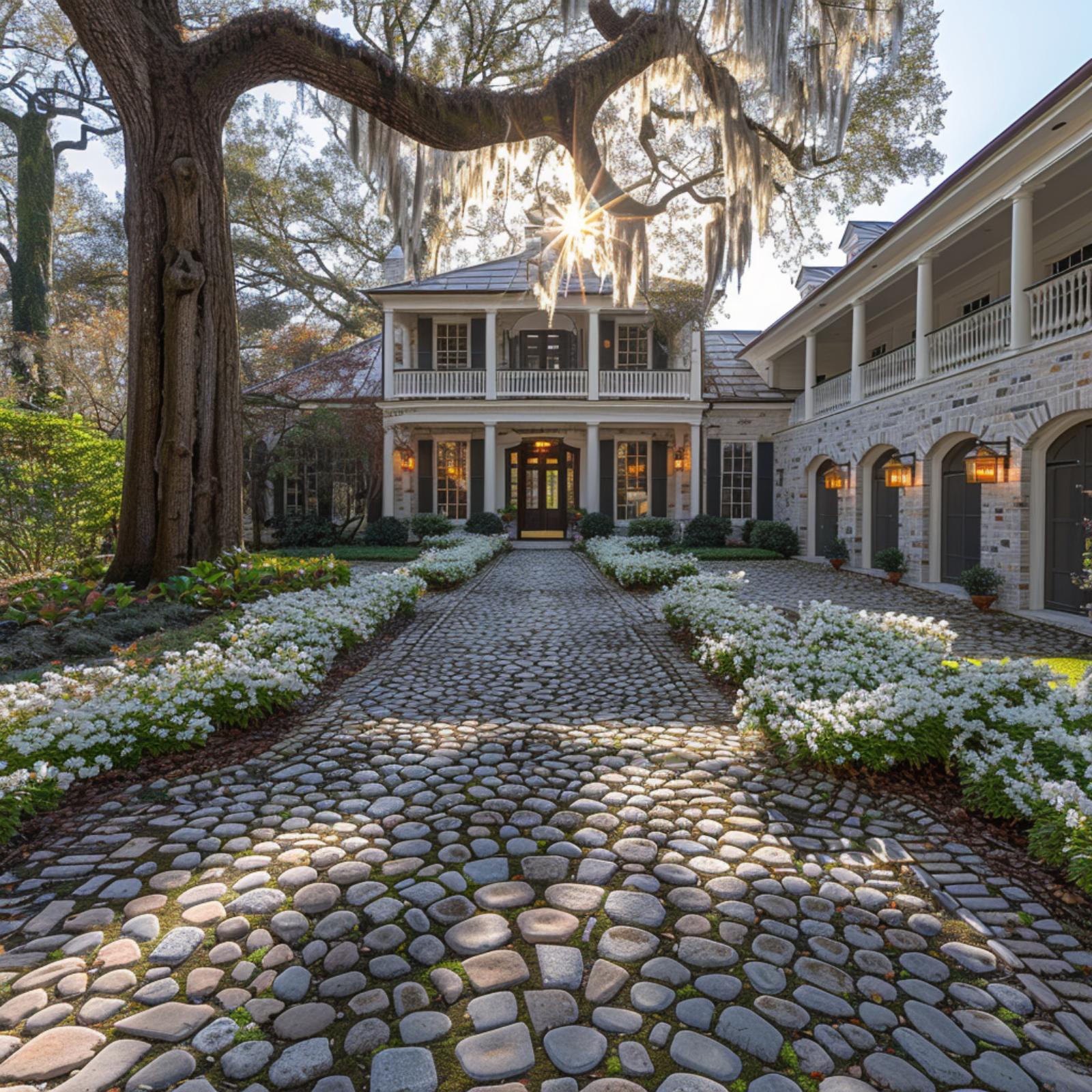
River-stone cobblestones laid in an organic, irregular pattern make up the driveway here, and that choice alone sets the tone. No precision-cut pavers, no geometric grid. Just smooth, rounded stones fitted together with moss creeping into the joints, giving the whole approach a texture that feels like it’s been there for generations.
The house itself is a two-story Southern Colonial with dark shutters, white balustrade railings on both levels, and a deep-set entry with columns and warm lantern light visible even in daylight. What holds it together is the white azalea mass planting running the full length of both sides of the drive. A live oak draped in Spanish moss frames the composition overhead. It’s genuinely hard to improve on that.
Designer’s Secret: Rounded river stone cobblestones, while visually soft, shed water more efficiently than flat-cut pavers because the gaps between stones allow runoff to drain straight into the ground below. Designers who specify this material in wet climates often skip the drainage infrastructure required for impermeable surfaces, which can reduce both installation cost and long-term maintenance. The moss that grows into the joints isn’t a maintenance failure — many designers encourage it as a finish detail.
29. Herringbone Brick, Spiral Topiaries, and Stone Columns Make a Case for the Courtyard Comeback
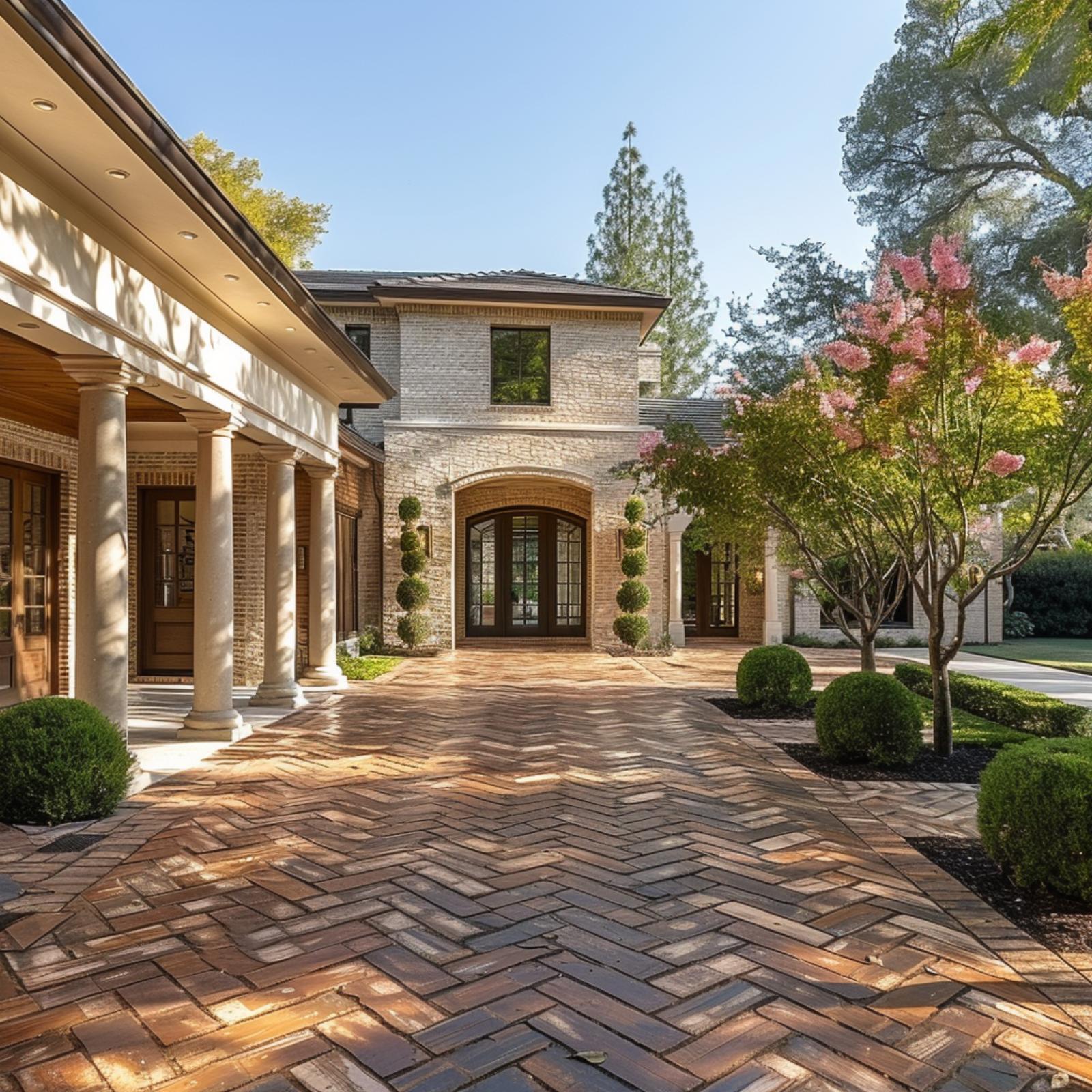
Antique-finish brick pavers laid in a herringbone pattern cover the entire motor court, and the diagonal geometry pulls the eye straight toward a arched wood-and-glass entry door. Spiral topiaries bracket that arch on both sides. Stone columns anchor the covered porte-cochere wing, and a crepe myrtle in full pink bloom softens what could have felt overly formal.
Budget Tip: Reclaimed or antique-finish brick pavers typically cost more per unit than standard clay brick, but they can be sourced in smaller lots from salvage yards at a fraction of retail price. If the full motor court is out of budget, consider using them only for the entry apron closest to the front door, where they’ll get the most visual attention.
28. Herringbone Brick and Dark Board-and-Batten Pull a Courtyard Entry Into Focus
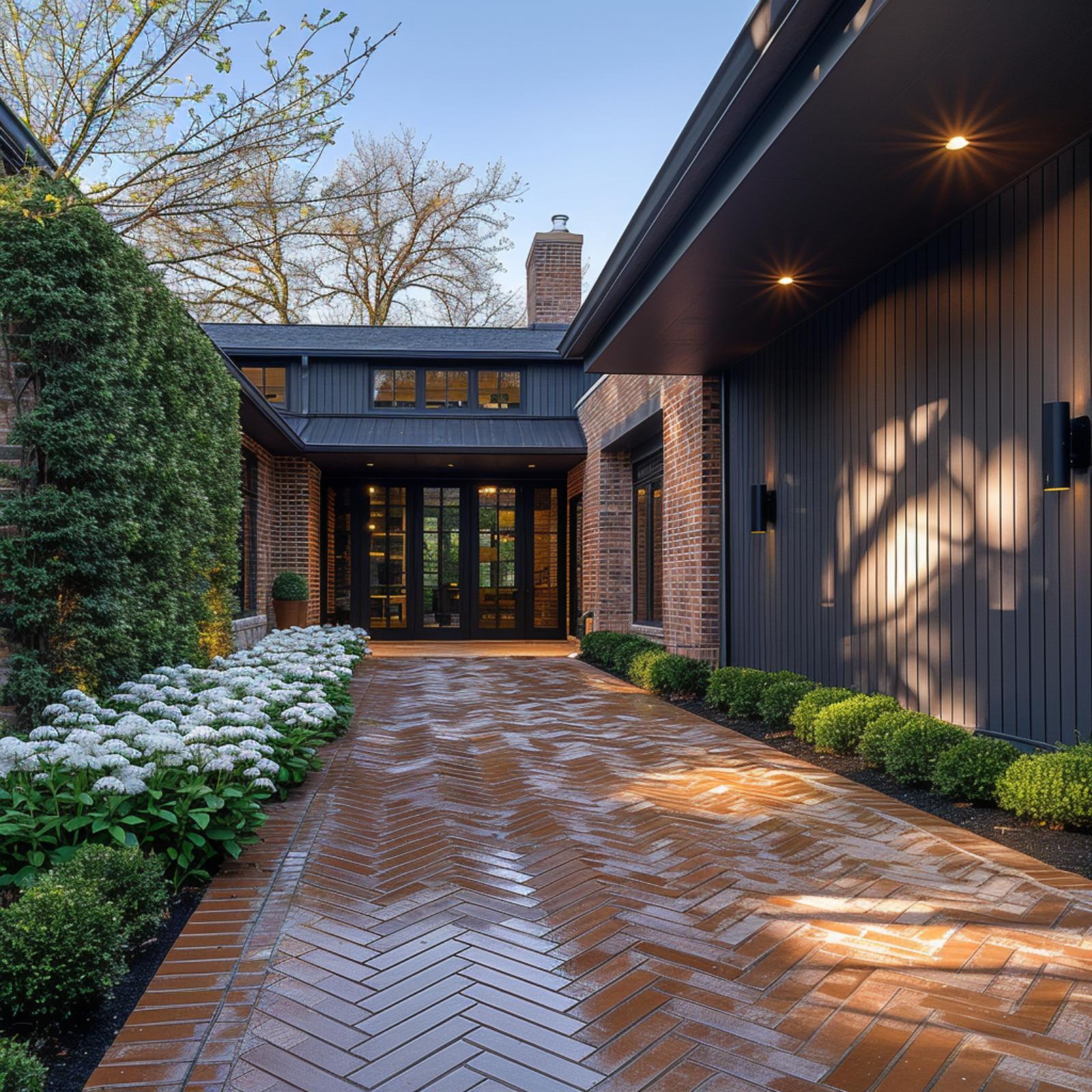
Wet herringbone brick in a warm clay tone runs the full length of this courtyard approach, and the pattern alone does most of the work. It draws the eye straight toward the black French doors without needing anything flashy to compete.
What keeps the composition grounded is the contrast between materials. Red brick piers anchor the entry structure while dark vertical board-and-batten cladding wraps the wing to the right. White hydrangea clusters line the left border. Boxwood rounds hold the opposite edge tighter. Recessed soffit lighting and a wall-mounted sconce with a brass accent bring the whole thing to life at dusk.
- Herringbone orientation along a pathway’s length pulls the eye forward more effectively than a perpendicular layout
- Pairing warm brick tones with dark cladding reduces visual competition between the architecture and the hardscape
- White flowering borders work well against red brick because the value contrast reads clearly from a distance without relying on color complexity
27. Corten Steel and Black Gravel Rewrite the Courtyard Entry Playbook
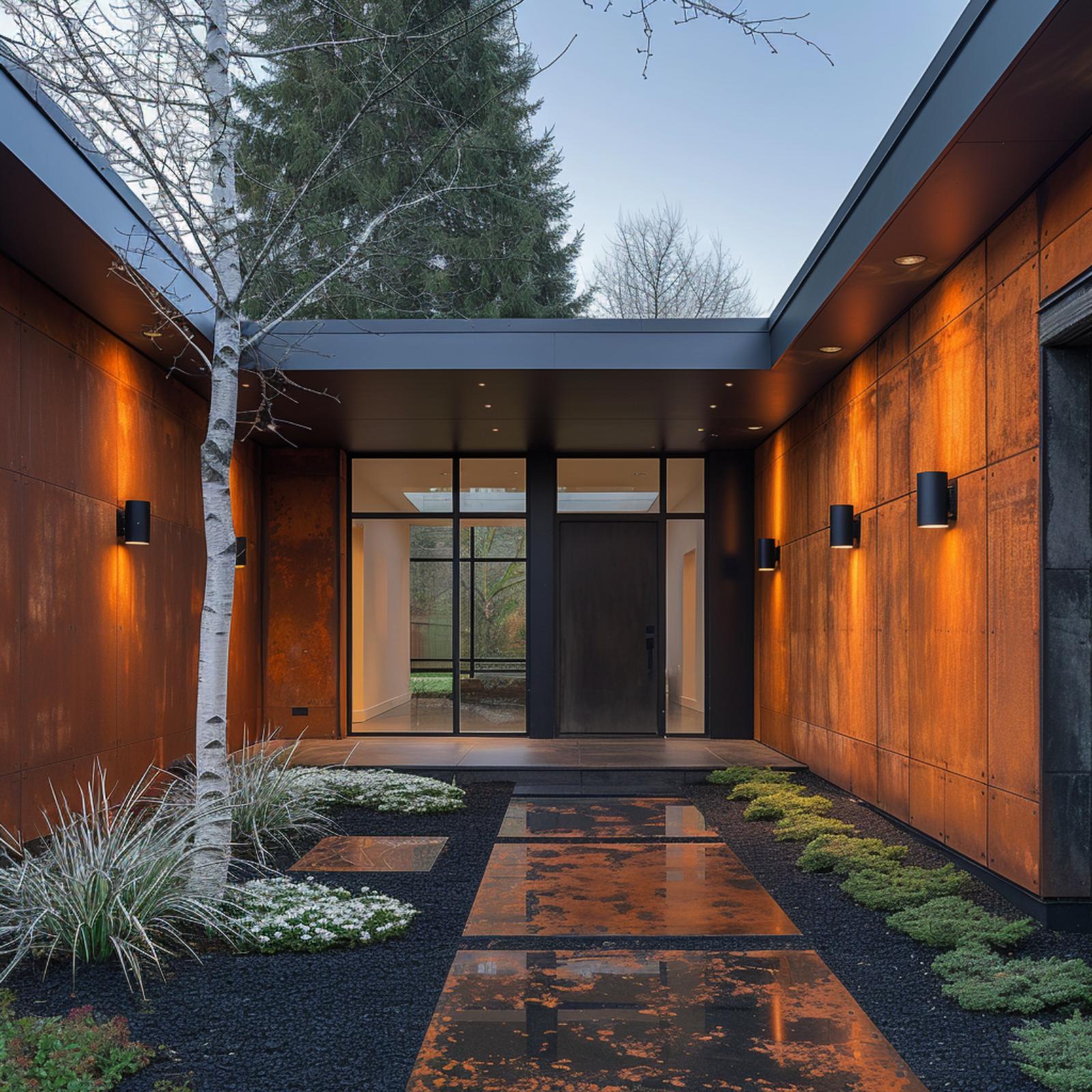
Rust-patinated corten steel does the heavy lifting here, cladding both flanking walls in panels that shift from amber to deep copper depending on the light. Matching corten stepping slabs cut through a bed of crushed black basalt, and the reflection pooling on their surface after rain makes the path read almost like a water feature. Wall sconces in matte black sit flush against the panels, throwing light both up and down to dramatize the texture of the weathered steel.
The entry corridor opens to a pivot door framed in floor-to-ceiling steel-and-glass panels, giving a clear sightline straight through to a rear garden. Low plantings of silver grass and white groundcover keep the foreground soft against all that metal. A white-barked birch on the left doesn’t feel like an accident. It earns its place by offering the one element the rest of this entry refuses to provide: something that moves.
By The Numbers: Corten steel develops its protective oxide layer over roughly one to three years of natural weathering, after which the surface stabilizes and requires no paint or sealant to maintain. Architects specify it for entry walls and site features partly because its maintenance demands drop sharply once that patina fully forms. The material’s warm rust tones also shift noticeably across seasons, which means the entry reads differently in January than it does in July.
26. Herringbone Brick, Columnar Evergreens, and Autumn Patina Make This Entry Hard to Walk Past Quickly
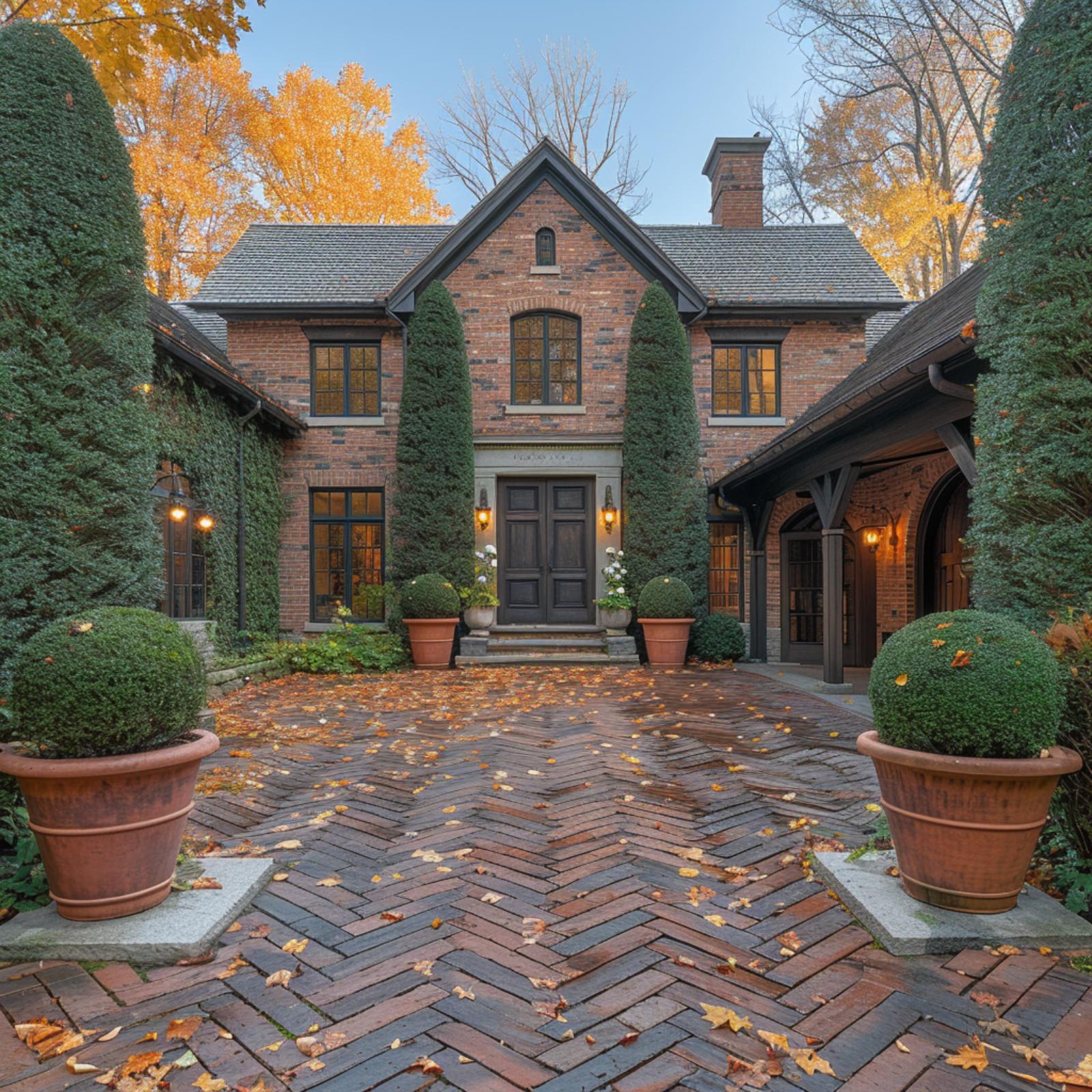
Aged brick laid in a herringbone pattern covers the forecourt, and fallen autumn leaves scattered across it look less like yard work waiting to happen and more like something a set designer placed there. Two columnar arborvitae frame the dark wood double doors with enough height to command the facade without competing with it. Terra cotta urns anchor the foreground, each holding a clipped boxwood sphere that echoes the rounded topiaries flanking the entry steps. The brick exterior, slate roof, and leaded-glass windows all pull from the same English manor vocabulary, and they don’t apologize for it.
The Psychology Behind This: Symmetry in entry design isn’t just an aesthetic preference, it triggers a measurable sense of calm in approaching visitors because the brain processes balanced compositions with less cognitive effort. That reduced tension is why courtyard entries built around a strong central axis tend to feel welcoming before anyone even reaches the door.
Where the last entry leaned hard into structure, this one lets the plants do the talking.
25. Cobblestone, Climbing Roses, and a Pergola That Earns Every Square Foot
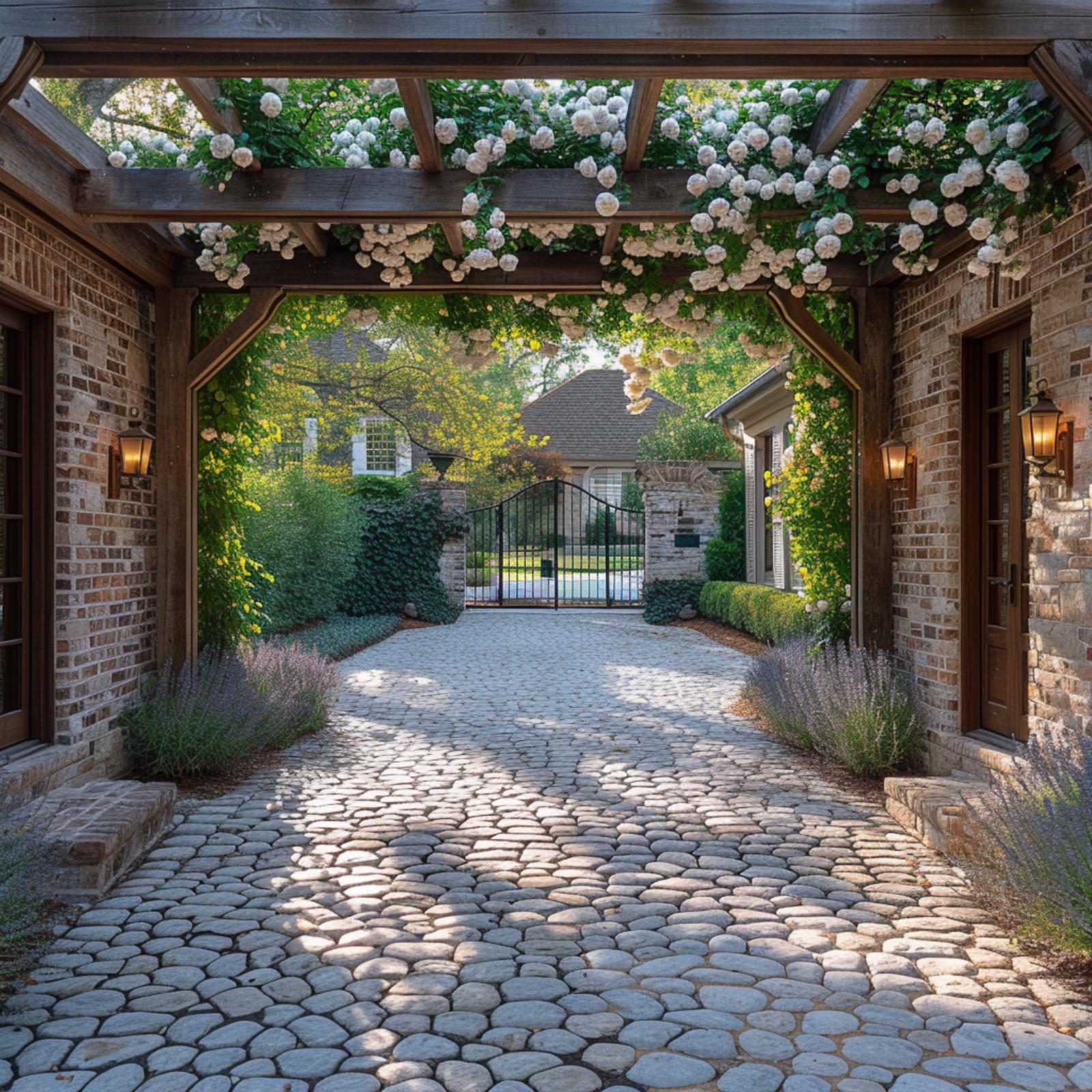
Round cobblestones laid in an organic pattern lead through a wood pergola draped in white climbing roses, and the effect is less formal garden, more countryside estate. Lavender borders soften both sides. The wrought iron gate at the far end keeps it grounded.
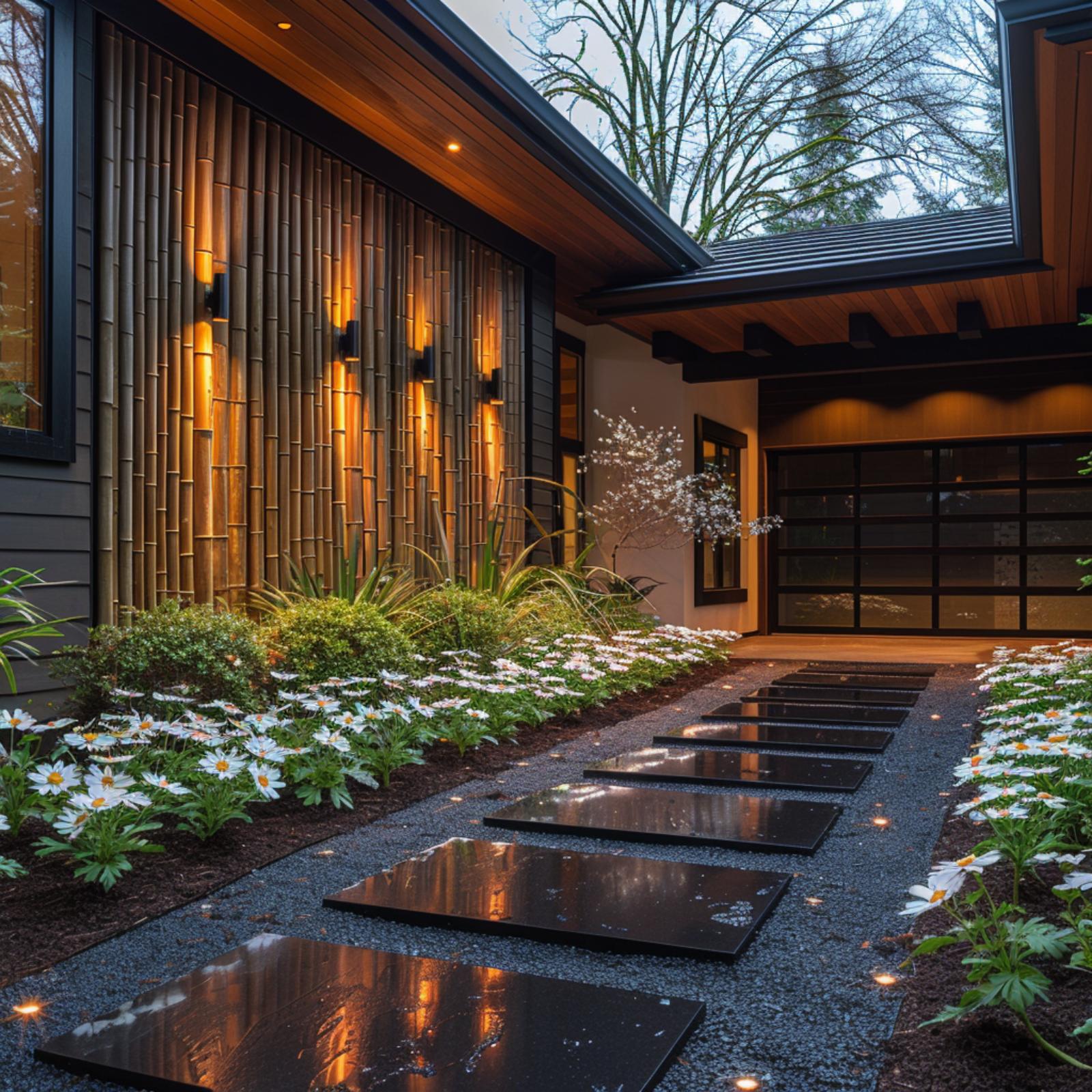
24. Bamboo Cladding, Black Granite Steppers, and Ground-Level Lighting Earn This Entry Its Edge
🔥 Would you like to save this?
Polished black granite steppers set into fine dark gravel lead toward a glass-panel garage door framed by exposed timber beams. White daisy-form blooms spill along both sides of the path. The bamboo-clad accent wall does the heavy lifting visually, lit from below by warm amber sconces.
Why Bamboo Cladding Works Harder Than It Looks
Bamboo installed vertically as exterior cladding isn’t just a texture play. Because each culm has a slightly different diameter and natural patina, the wall reads as layered rather than flat, and the sconce lighting exploits that variation by throwing shadows between each stalk. Designers specify bamboo cladding in cooler, wetter climates more often than expected because properly sealed culms resist moisture surprisingly well and won’t warp the way thin wood veneers tend to.
23. Lavender, Travertine, and an Olive Tree Walk Into a Courtyard Entry — It Works
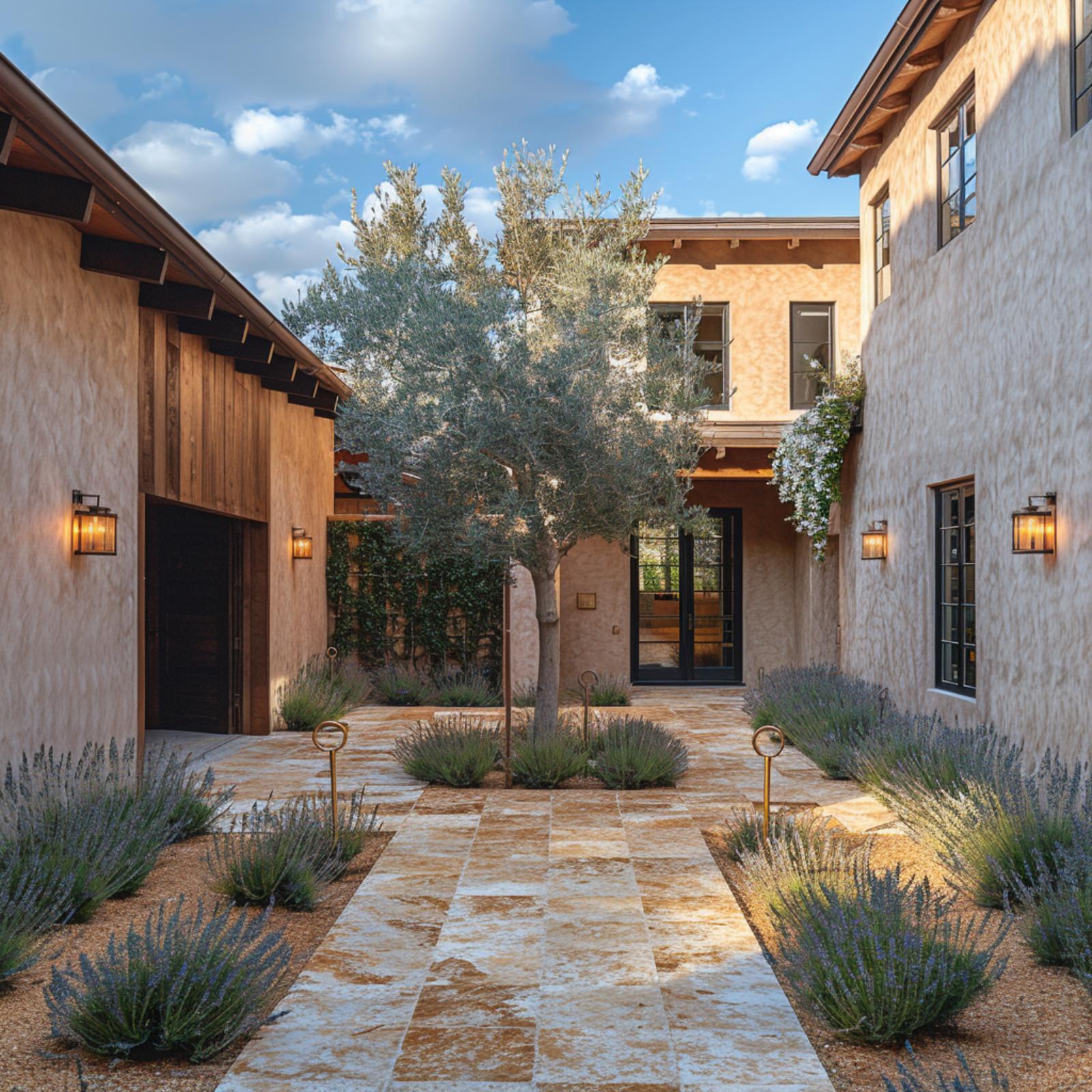
Mature olive trees don’t read as decorative. They read as permanent, and that’s exactly the weight this entry needs. Planted at center, its silver-green canopy anchors the entire composition without demanding symmetry from the surrounding plantings. Lavender runs the length of both sides in loose drifts, and the informality of it keeps the space from feeling too composed.
The paving is travertine laid in a running bond pattern, mixing warm honey tones with cooler limestone whites. Brass path lights push upward at low angles, which is a choice that rewards the approach after dark. Wall-mounted lanterns on both flanking walls match the brass finish and hold the light at eye level. Stucco walls in a raw, sand-colored finish tie every element back to the same warm palette without repeating any single material twice.
Mature olive trees don’t read as decorative. They read as permanent, and that’s exactly the weight this entry needs.
22. Cherry Blossoms, Herringbone Brick, and Boxwood Globes Give This Entry Serious Staying Power
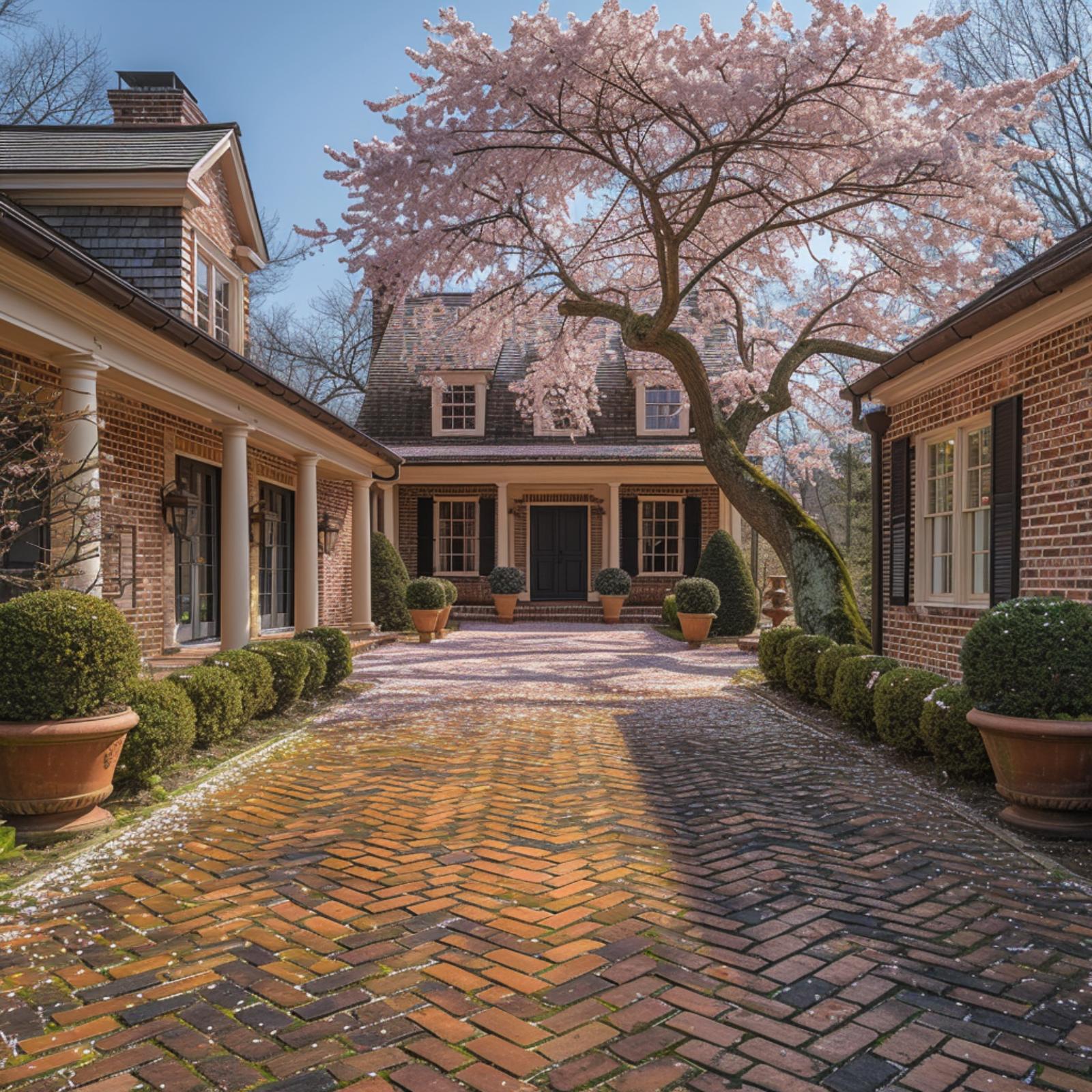
Pink cherry blossom petals have drifted across the herringbone-laid brick courtyard here, and the effect is genuinely hard to shake. The warm orange-red pavers run in a classic diagonal pattern straight to a black front door flanked by clipped boxwood spheres in terracotta pots.
Wings of red brick extend on both sides, framing the approach without closing it off. Columnar white pilasters anchor the left wing. It’s formal without feeling stiff.
Why It Works: Cherry trees drop petals seasonally, but designers who specify them for entry courtyards often do so precisely because that brief, dramatic bloom resets how visitors perceive a space each spring. The herringbone brick pattern here isn’t decorative for its own sake either — diagonal runs shed water faster toward the edges than grid-laid pavers do, which matters in a confined courtyard with limited drainage slope. Brick wings that extend from a central facade also naturally compress the approach, making the front door feel more deliberate and arrived-at than an open front yard ever could.
21. Dark Plaster, an Olive Tree, and Decomposed Granite Pull This Entry Together
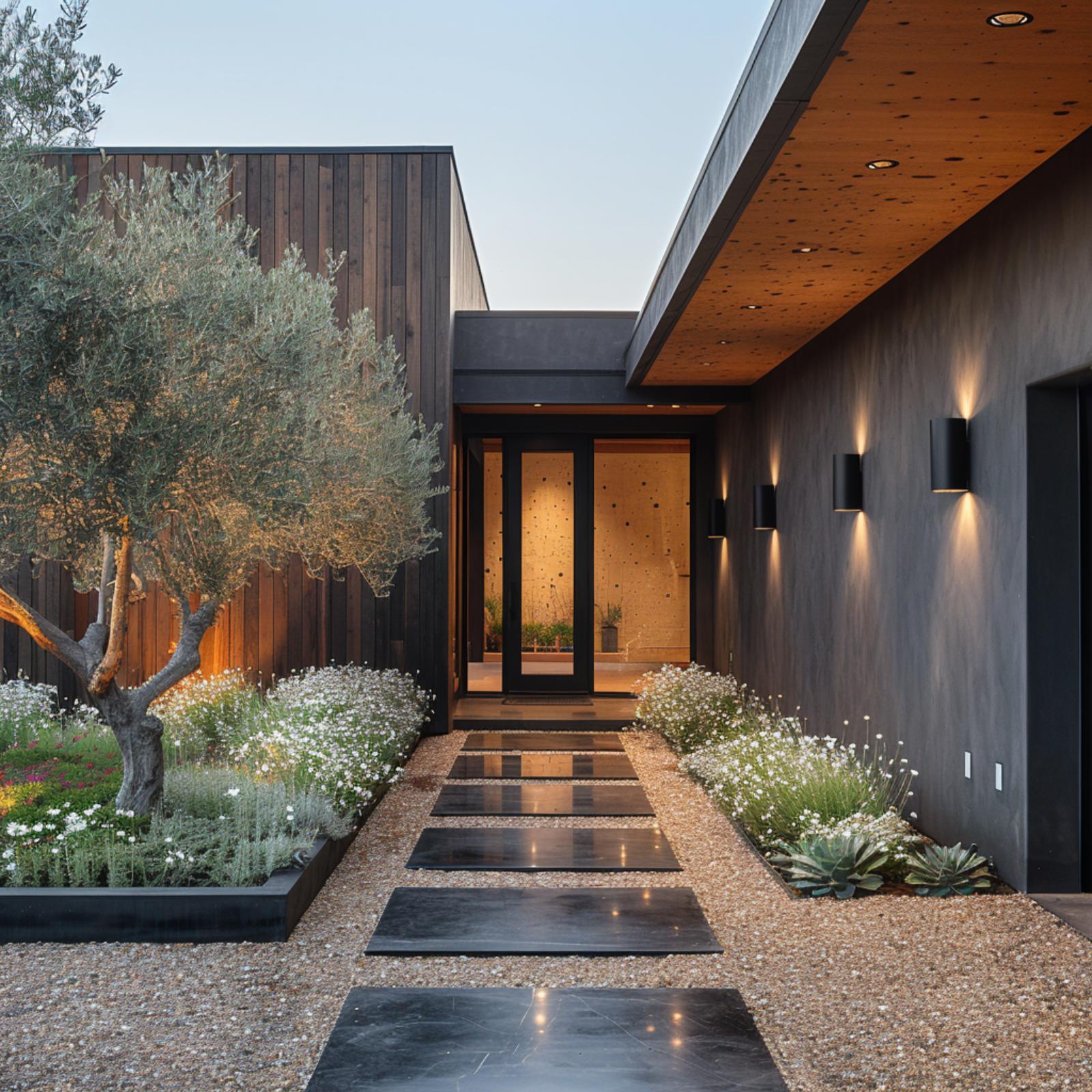
Charcoal-tinted plaster walls and a wood-slat fence in dark-stained cedar set a muted, controlled tone before anyone reaches the front door. The pathway earns its keep: large-format black slate steppers float through a decomposed granite field, flanked by silvery-leafed groundcover and agave rosettes that don’t ask for much water or attention.
The mature olive tree to the left does the heavy lifting for organic warmth. Its gnarled trunk reads as something that wasn’t planted for this house, but found here. Recessed ceiling lights inside the covered entry spill just enough amber through the glass doors to pull the eye forward without overselling the arrival.
Pro Tip: Decomposed granite is one of the more practical choices for courtyard entries because it compacts well underfoot, drains quickly after rain, and costs significantly less than cut stone. It does require occasional regrading in high-traffic areas, so factor in a light annual refresh. Pairing it with dark stepping stones, as shown here, helps define the walking path without needing edging materials to do that work.
20. Slate Steppers, Black Gravel, and an Olive Tree That Earns Its Placement
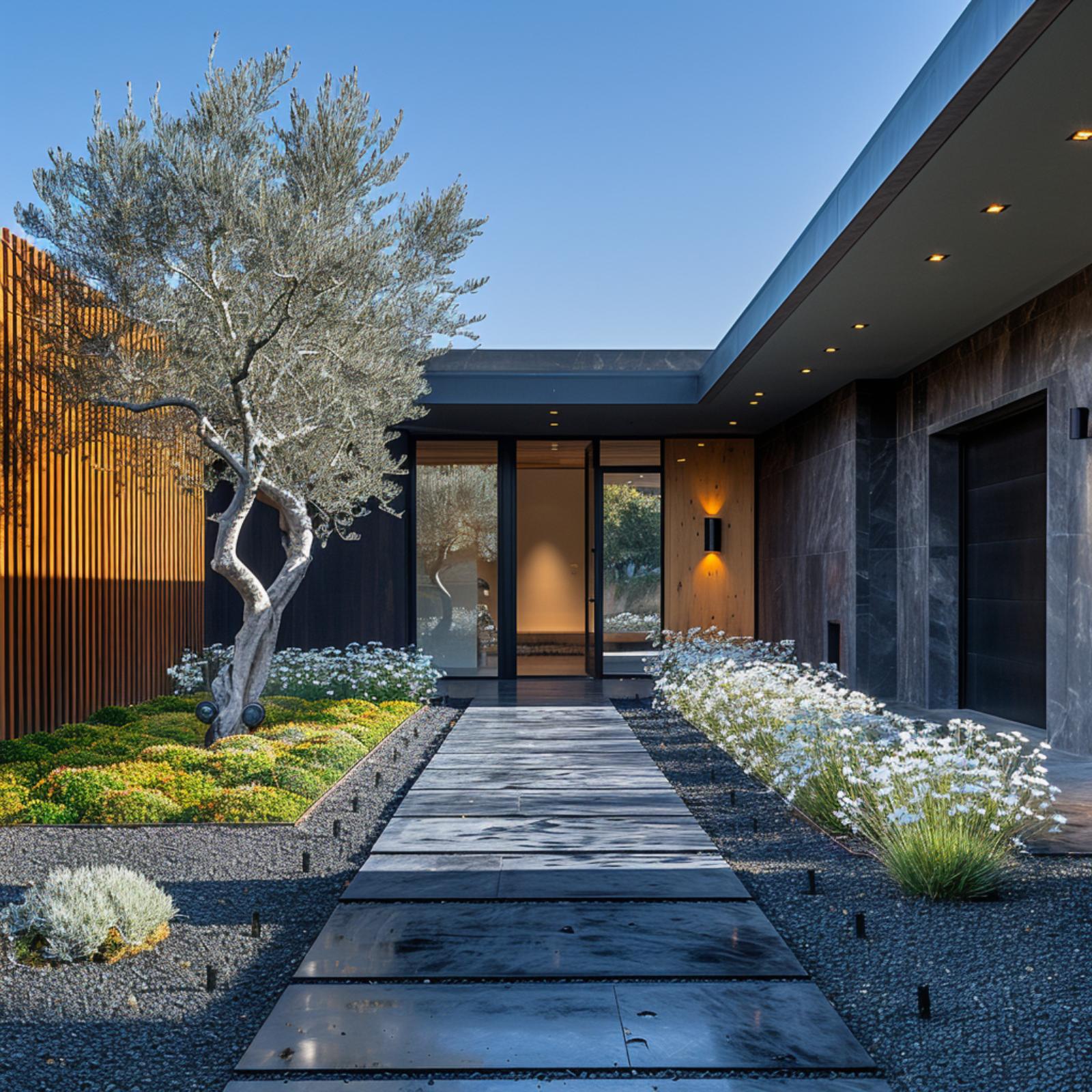
Large-format slate pavers set flush into black decomposed gravel create a path that’s direct without feeling cold. Flanking plantings mix low groundcover in yellow-green and white flowering perennials, keeping the palette natural rather than decorative. That gnarled olive tree does real work here, softening the flat roofline without competing with it.
Style Tip: Specifying large-format pavers for an entry path rather than smaller units reduces the number of visible joints, which makes a narrow approach feel wider than it actually is. Fewer seams also means less opportunity for weeds to establish between stones over time. It’s a practical choice that happens to read as refined.
19. Limestone, Flagstone, and Ground-Level Lighting Give This Entry Real Presence
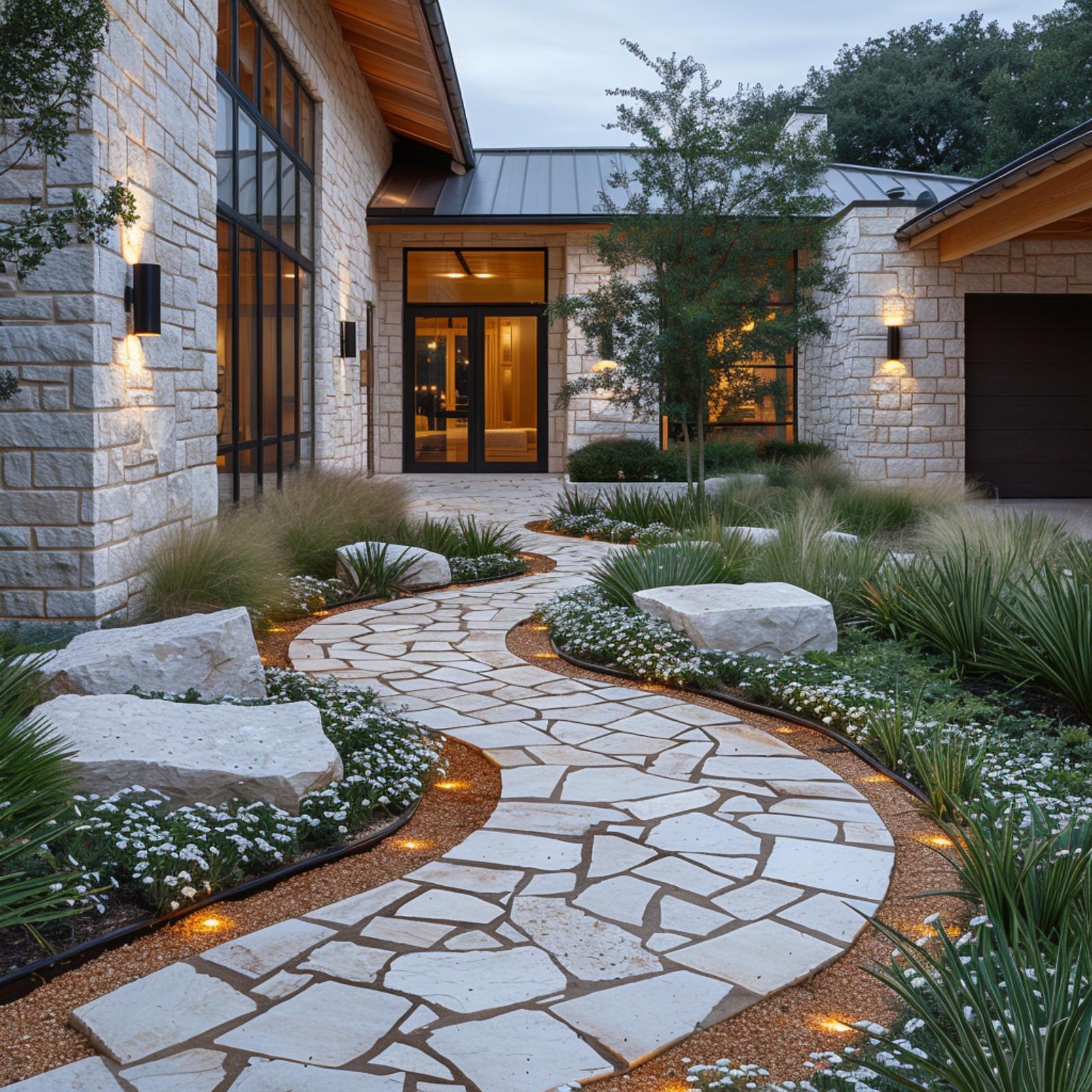
Cream-toned flagstone pieces, cut irregularly and laid in a mosaic pattern, wind toward a wood-and-steel entry door framed by full-height glazing. The path doesn’t go straight. That curve matters more than it might seem.
Worth Knowing: Curved pathways slow a visitor’s approach slightly compared to straight ones, which gives the eye more time to take in surrounding plantings and architectural details. Designers sometimes specify a gentle curve deliberately to make a modest front garden feel larger than its actual square footage. The effect here is reinforced by placing low ground-level lights along the path edge, drawing the eye forward rather than upward.
18. Limestone Walls, a Reflecting Channel, and Brass Sconces That Actually Belong Here
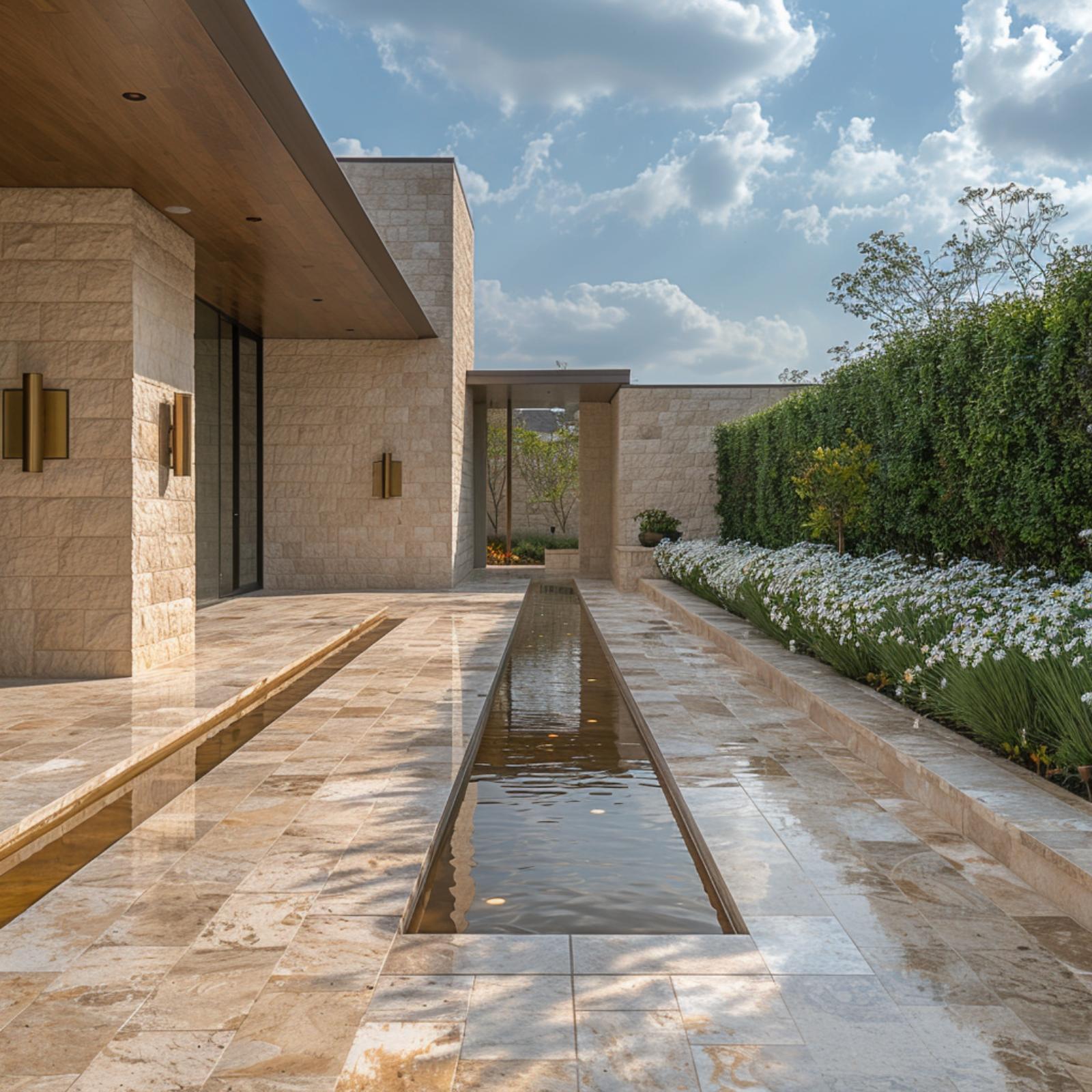
Dressed in rough-cut limestone blocks and travertine tile underfoot, this entry courtyard earns its quiet authority without trying too hard. A narrow reflecting channel runs the full length of the approach, flush with the paving surface, and the still water doubles the sky above it. Brass wall sconces anchor the left wall at two points, and they’re warm enough to hold their own against all that stone.
The right side stays deliberately soft: a clipped hedge wall backs a row of white flowering plants at grade, with a small tree tucked behind. The green mass keeps the stone from reading as cold.
Editor’s Note: Linear water features in entry courtyards don’t require a large pump system to maintain. Designers often specify narrow, shallow channels precisely because lower water volume means less evaporation, easier winterization, and quieter operation than a traditional fountain. For homeowners in drier climates, that difference in maintenance load matters more than it might initially seem.
17. Olive Trees, Concrete Planters, and Terra-Cotta Tile Pull This Entry in Two Directions at Once
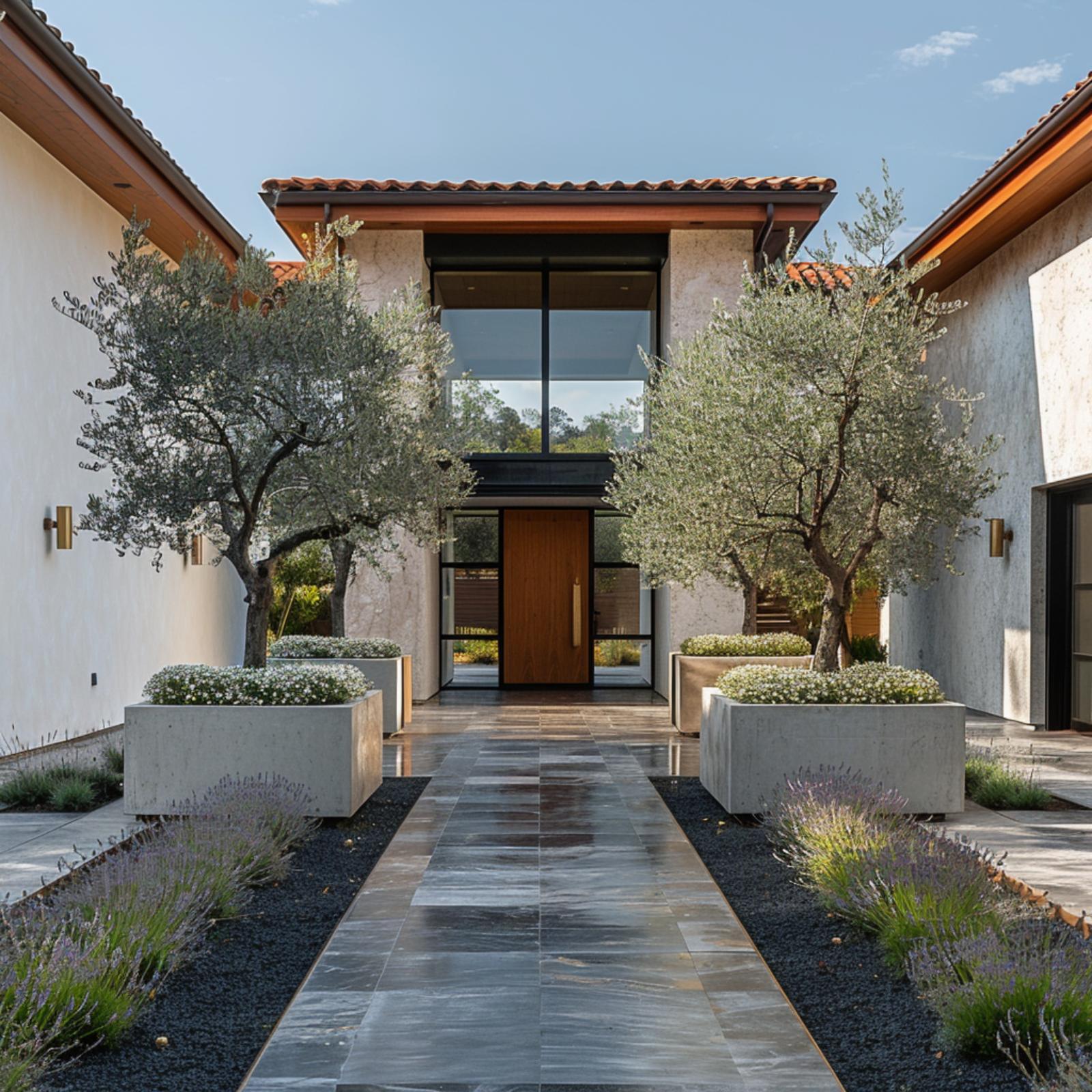
Two mature olive trees anchored in oversized concrete planters flank a slate-tile path, with lavender tucked into the black gravel borders doing most of the sensory work. The wood pivot door and floor-to-ceiling steel-framed glazing read as thoroughly contemporary, but the terra-cotta barrel tile roof overhead keeps pulling it back toward Mediterranean.
16. Wet Stone, a Japanese Maple, and Black Steel Framing That Knows Exactly What It’s Doing
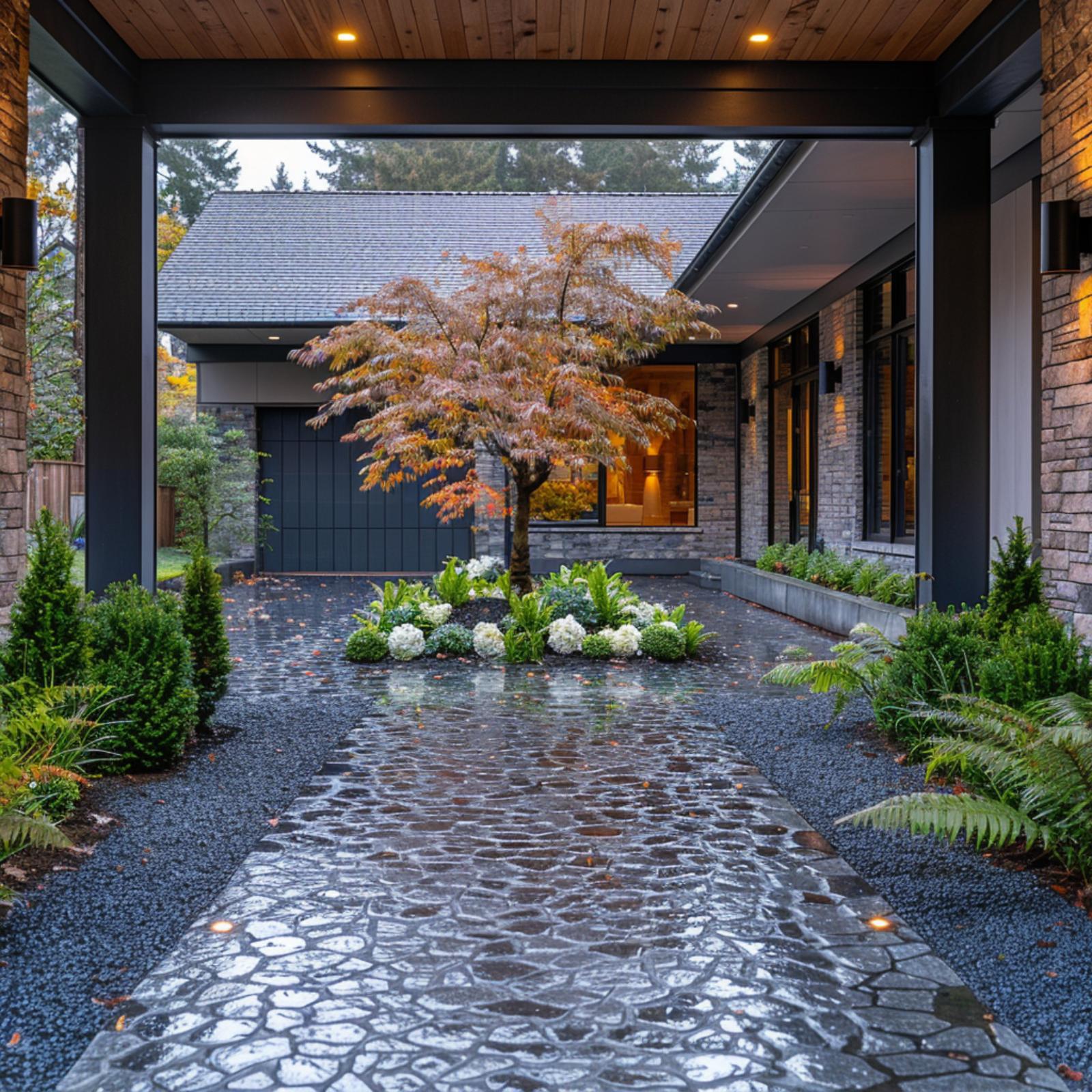
Cobblestone set in an irregular mosaic pattern runs the length of the approach, flanked by crushed black gravel and low plantings of sword fern and dwarf evergreen conifers. The pavers read almost silver when wet, which happens to be exactly when this entry looks its best. A Japanese maple anchors the central island, its copper-orange canopy catching the light from recessed ceiling fixtures overhead.
The overhead structure is worth a closer look. Black steel beams frame a clear span that bridges both sides of the entry, with a cedar-planked soffit and recessed downlights providing warmth without competing with the natural materials below. Stone cladding on both flanking walls ties back to the main structure visible beyond, and wall-mounted cylindrical sconces sit flush to the stone without fuss. It’s a composed entry that doesn’t need to announce itself.
15. Dark Brick, River Stone, and a Japanese Maple That Stops You Cold
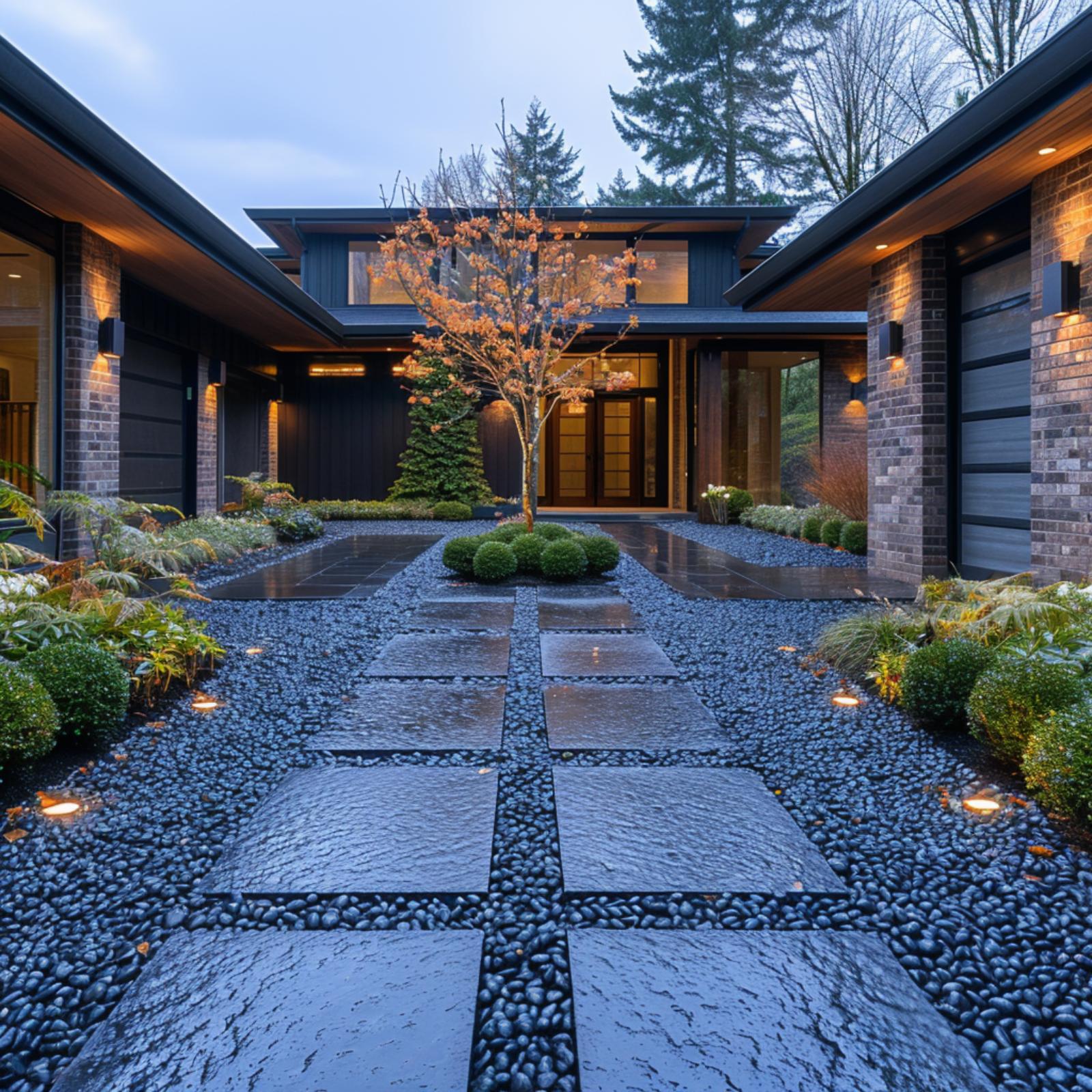
Wet-dark granite pavers, gridded in a broad checkerboard pattern and separated by channels of black river stone, lead straight to a wood-and-glass entry door flanked by warm recessed light. The brick cladding reads almost charcoal in the dusk light, and the maple centered near the entry door pulls the whole composition into focus with its copper-orange foliage.
Ground-level uplights placed along both planting beds do something worth noticing: they push light upward through the grasses and clipped boxwood spheres rather than washing the path itself. It keeps the approach from feeling like a runway. The restraint is intentional, and it works better than a more dramatic scheme would.
14. Limestone Walls, Olive Trees, and a Reflecting Channel That Commands the Courtyard
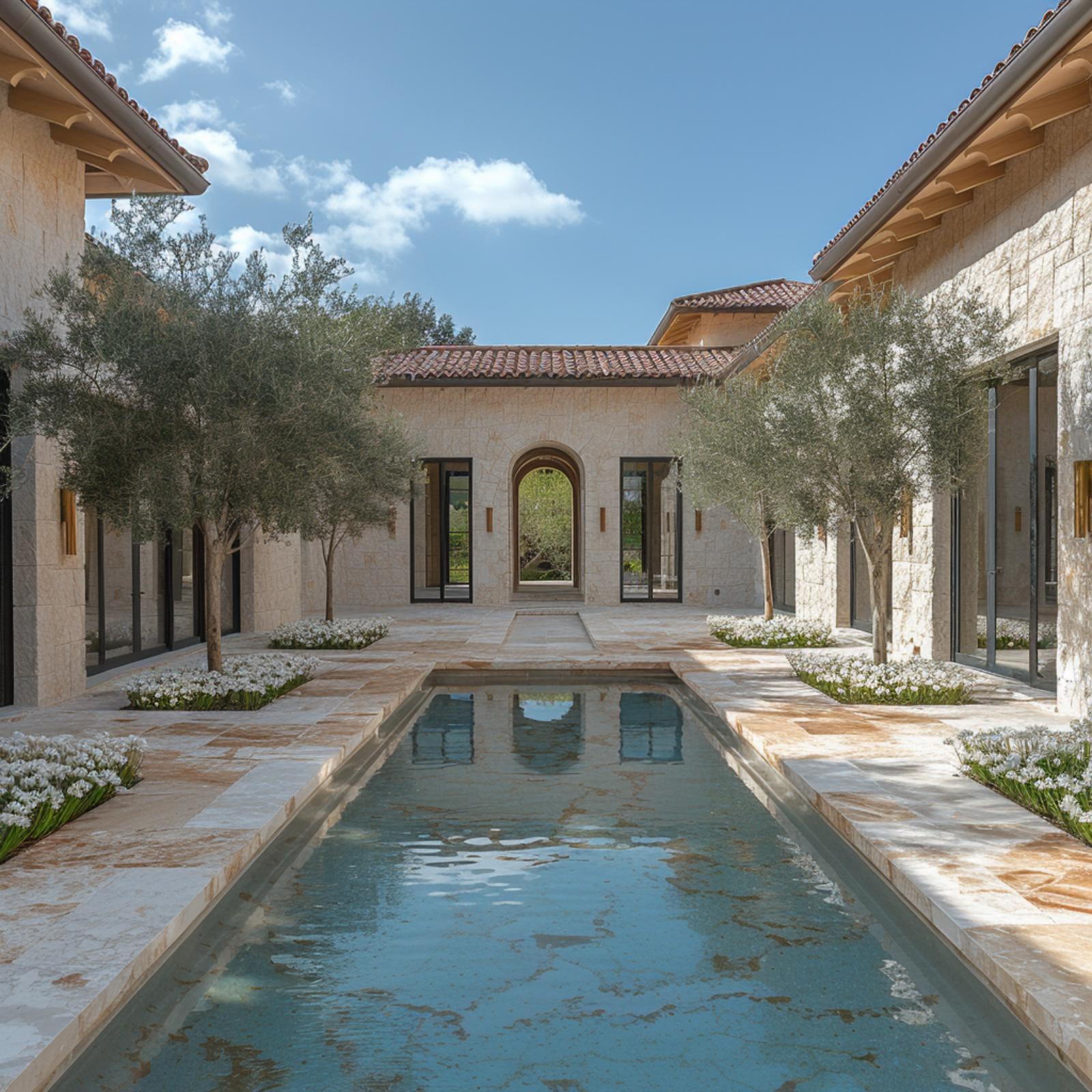
Rough-cut limestone cladding wraps the entire enclosure, and the stone’s warm buff tone keeps the space from reading cold despite its formality. Four olive trees anchor the corners, their silver-green canopies loose enough to let light through. White flowering groundcover fills the planting beds low and tight. It’s the narrow reflecting channel running the full length of the courtyard that does the real work, pulling the eye straight toward the arched pass-through at the far wall.
13. Lava Rock, Corten Steel Planters, and Plumeria That Actually Earn the Drama
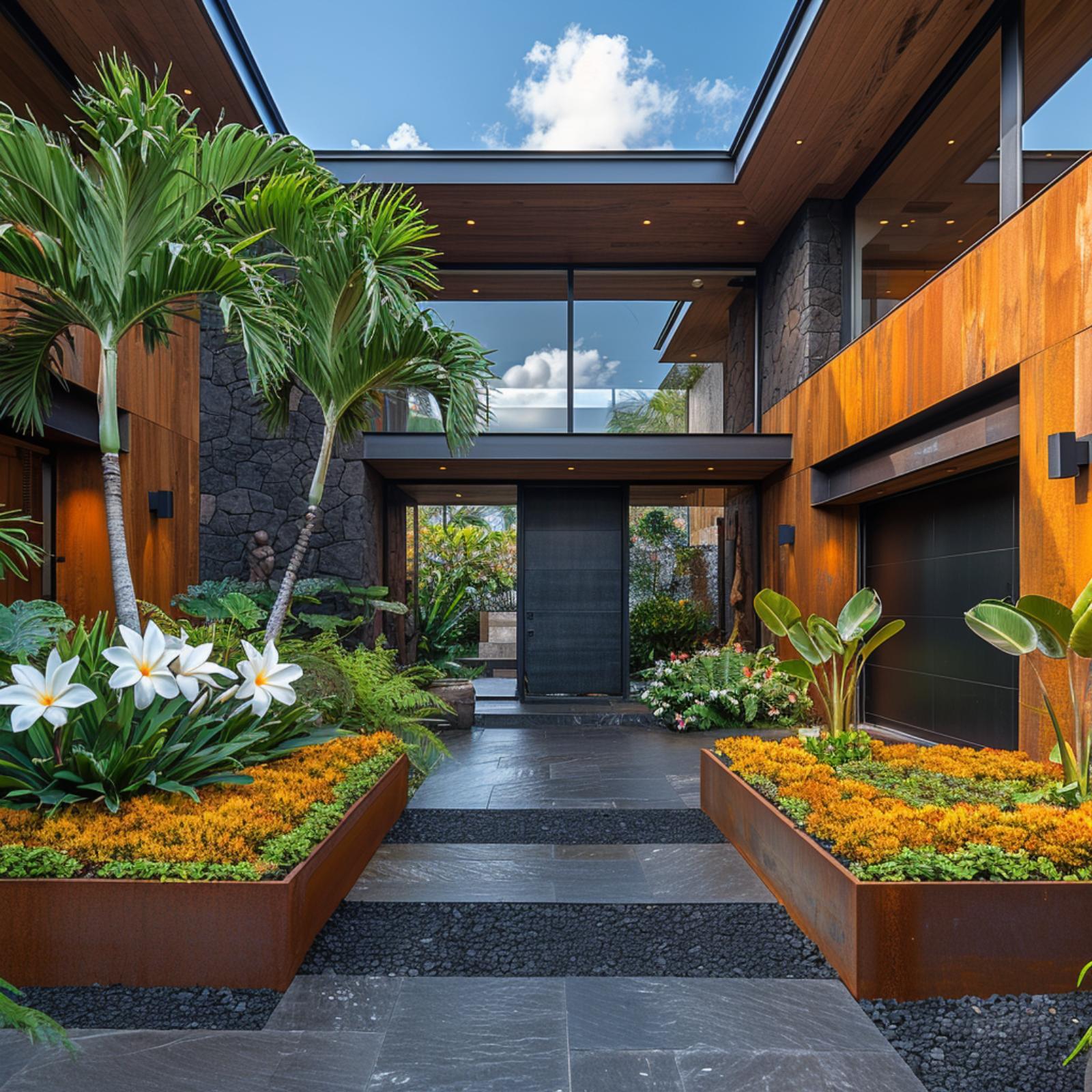
Volcanic lava rock cladding on the walls sets the tone before anyone reaches the front door. It’s raw, almost aggressive, and somehow the rest of the entry keeps up. Corten steel raised planters flank a slate tile path, their oxidized rust finish pulling the warmth out of the wood-clad soffits overhead. Inside those planters, dense golden groundcover anchors white plumeria blooms and banana leaf fronds without competing for attention.
What makes this entry work is the open-sky atrium framing above the approach. Natural light floods straight down onto the path, which means the recessed soffit lighting visible in the covered sections doesn’t fight the sun. It supplements it. The dark front door reads quietly against all that texture, and that restraint is probably the smartest decision in the whole design.
12. Travertine Grid, Grass Joints, and an Arched Door That Justifies Every Design Choice Around It
🔥 Would you like to save this?
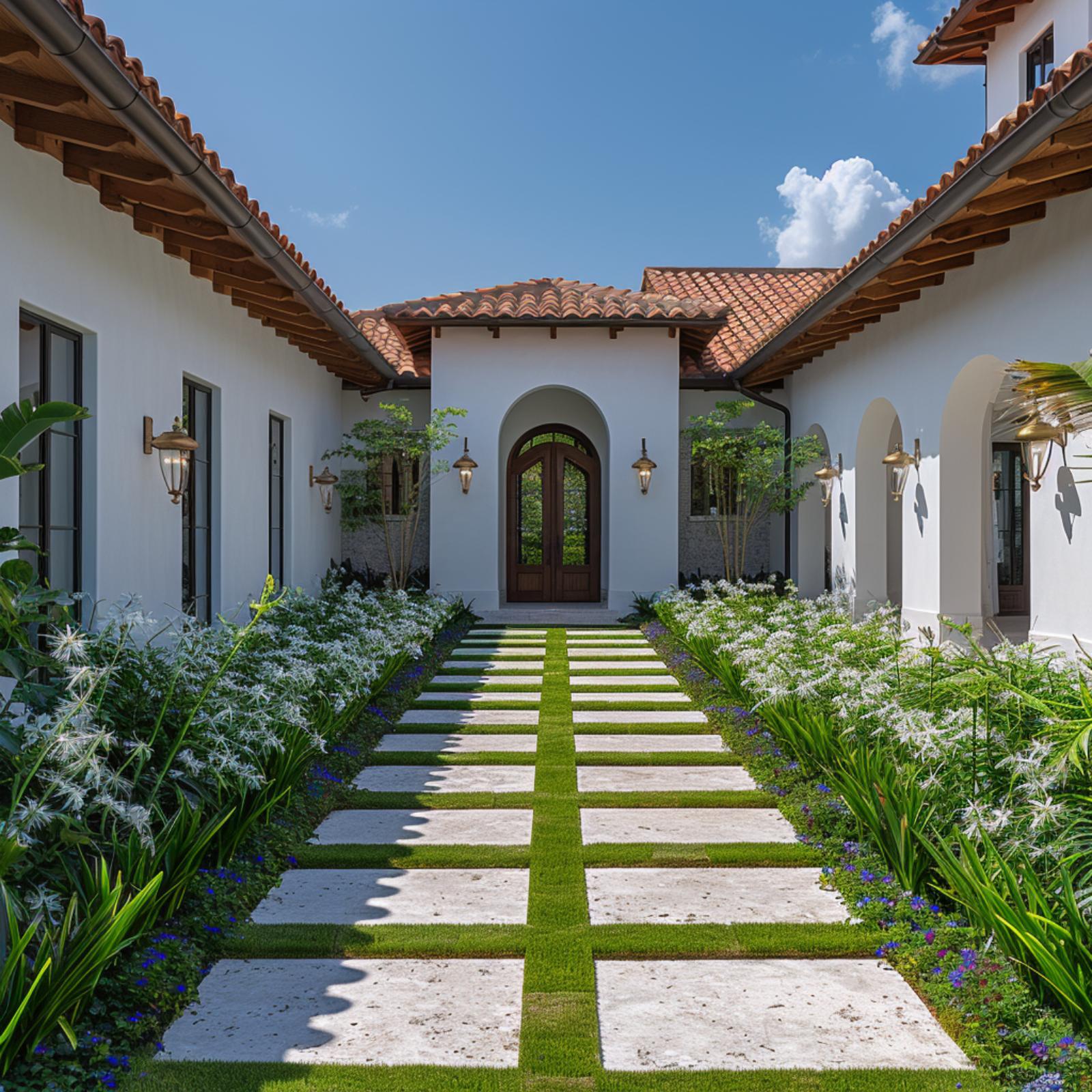
Large travertine pavers set in a tight grid with turf joints running between them give this approach a precision that most entries don’t attempt. The grass lines aren’t decorative filler. They’re doing structural work, breaking what could read as a cold slab field into something with rhythm and scale. White flowering plants along both edges soften the geometry without competing with it.
The arched mahogany door at the center is the organizing principle everything else defers to. Terra-cotta barrel tile on the roof, white stucco walls, exposed wood rafter tails, and brass lanterns flanking the entry all reinforce a Spanish Colonial vocabulary that’s consistent without being heavy-handed. Designers sometimes warn that symmetrical entries can feel stiff. Here, the lush plantings and slightly irregular stonework keep it from tipping that direction.
11. Bluestone Walls, Flowering Groundcover, and a Specimen Oak That Anchors Everything
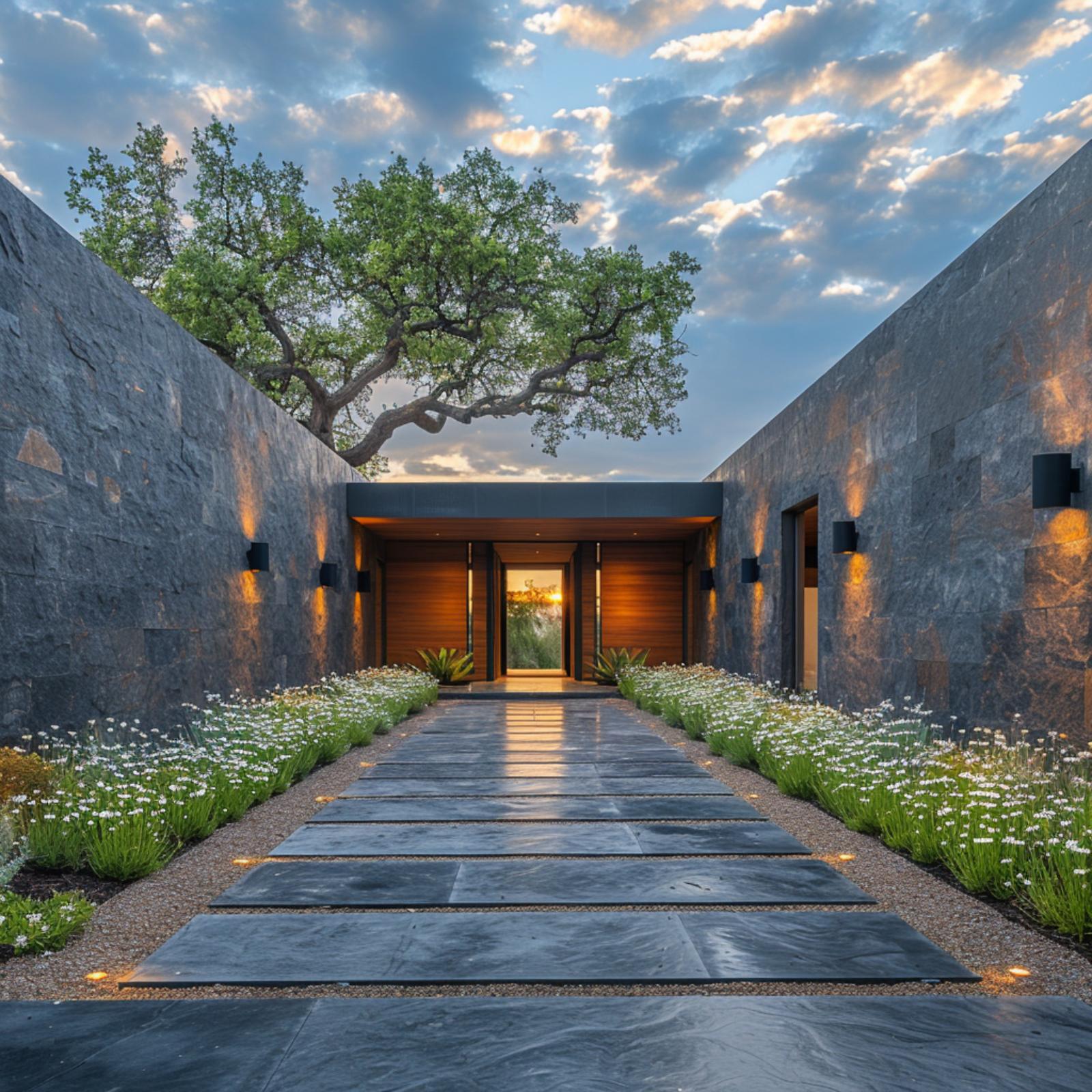
Rough bluestone cladding runs the full height of both flanking walls, and the dark, slightly textured surface does something interesting: it makes the warm cedar cladding at the entry pavilion read almost amber by comparison. Black sconce fixtures are mounted flush against the stone on both sides, casting upward wash patterns that highlight the wall’s irregular face. The path itself is laid in wide bluestone slabs with gravel set between them, flanked by drifts of white flowering groundcover that soften what would otherwise be a severe approach.
What holds it together is the oak overhead. Its canopy breaks above the roofline just enough to remind you that the whole composition exists within a larger site, not as an isolated exercise in materials. Designers sometimes call this “borrowed landscape,” using an existing tree as a visual anchor the architecture never could have manufactured. It earns its place here without trying.
10. Birch Trees, White Tulips, and a Polished Stone Driveway That Curves With Purpose
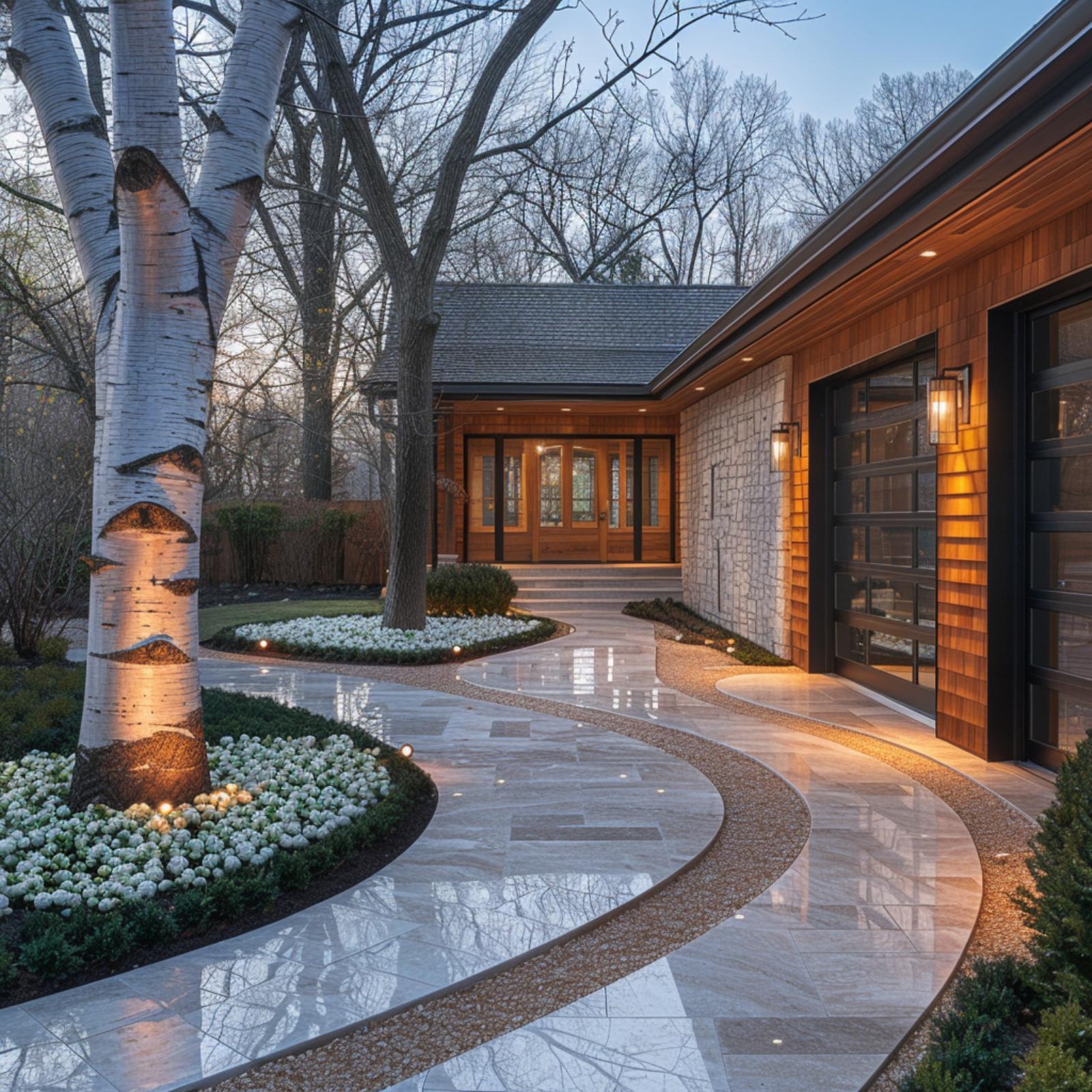
Polished travertine pavers sweep in a broad arc toward a cedar-clad entry, and the reflective surface picks up the dusk sky in a way that makes the approach feel longer than it probably is. White-barked birch trees anchor the island plantings on the left, lit from below with ground-level uplights that warm the bark without washing it out. The flowering groundcover beneath them reads white against dark mulch borders, clean and deliberate.
On the right, cedar shingles and a glass-panel garage door sit against coursed limestone, and wall sconces cast that familiar amber glow designers keep returning to for good reason. The gravel border edging the travertine arc is doing quiet work here, keeping the hard geometry from feeling clinical. It’s a front entry that earns its polish without announcing it.
9. Kintsugi-Inspired Slate Pavers With Gold Resin Joints Reframe What a Driveway Can Do
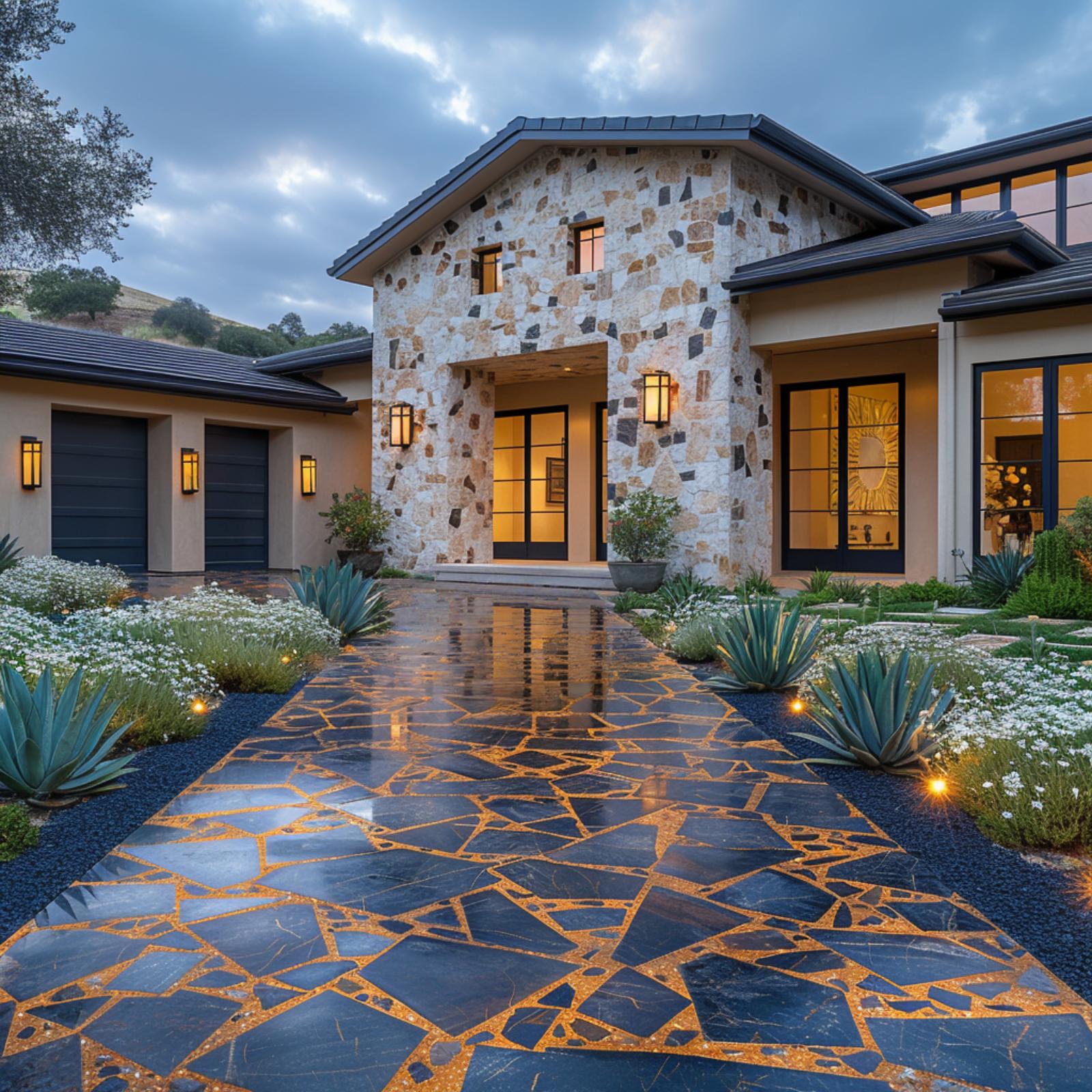
Irregular slate pieces set in gold-filled resin joints reference the Japanese art of kintsugi, where breaks become the focal point rather than something to hide. It’s a bold material choice for a driveway, and it earns its drama against the agave plantings flanking both sides.
8. Iron Gates, Cone Topiaries, and a Brick Facade That Earns Every Formal Detail
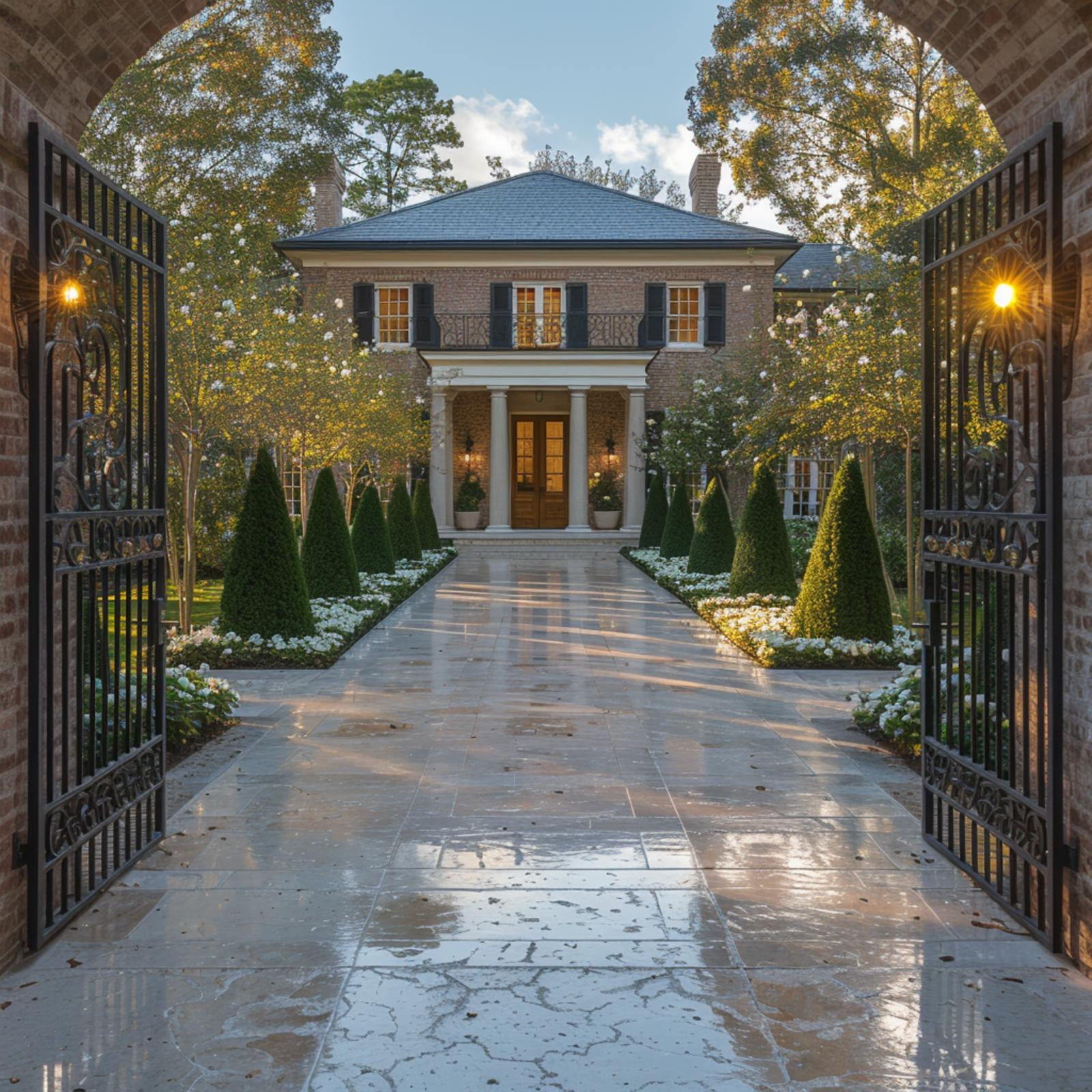
Ornamental wrought iron gates open onto a stone-tile motor court where six cone-shaped boxwoods line each side in perfect pairs, anchoring beds of white flowering groundcover that run the full length of the approach. The symmetry doesn’t feel rigid here. It feels earned, because the brick facade behind it is warm enough to keep everything from reading as cold.
What’s worth paying attention to is how the pale stone pavers reflect ambient light after rain, which effectively doubles the visual depth of the approach without adding a single additional element. The columned portico with its wood door pulls the eye forward. The iron gates frame it. Nothing competes.
7. Raked Gravel, Moss Islands, and a Weeping Cherry That Makes the Whole Courtyard Stop Breathing
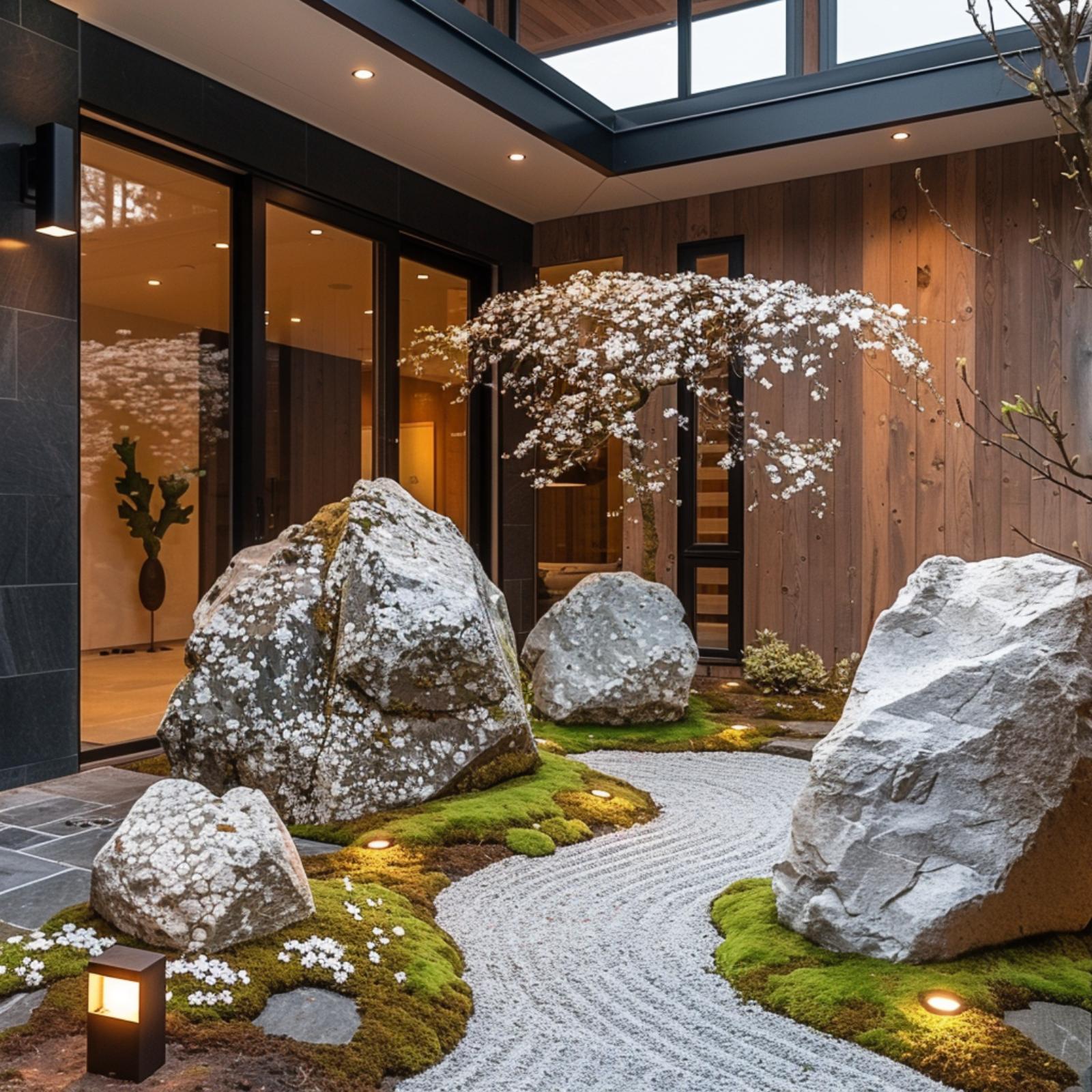
Raked white gravel curves through this enclosed courtyard like a dry stream, flanked by mounded moss and boulders that range from lichen-covered granite to a cleaner, pale white stone on the right. The weeping cherry overhead is doing most of the heavy lifting, its branches draped low enough that petals have already begun collecting in the gravel below.
What makes this work is the enclosure itself. Cedar-clad walls, a skylight overhead, and warm interior light visible through floor-to-ceiling glazing turn what could read as a garden into something closer to a room. Recessed ground lights tucked into the moss add just enough after-dark presence without competing with the naturalistic arrangement around them.
6. Travertine Pavers, an Olive Tree, and Warm Wood Ceilings That Pull It All Together
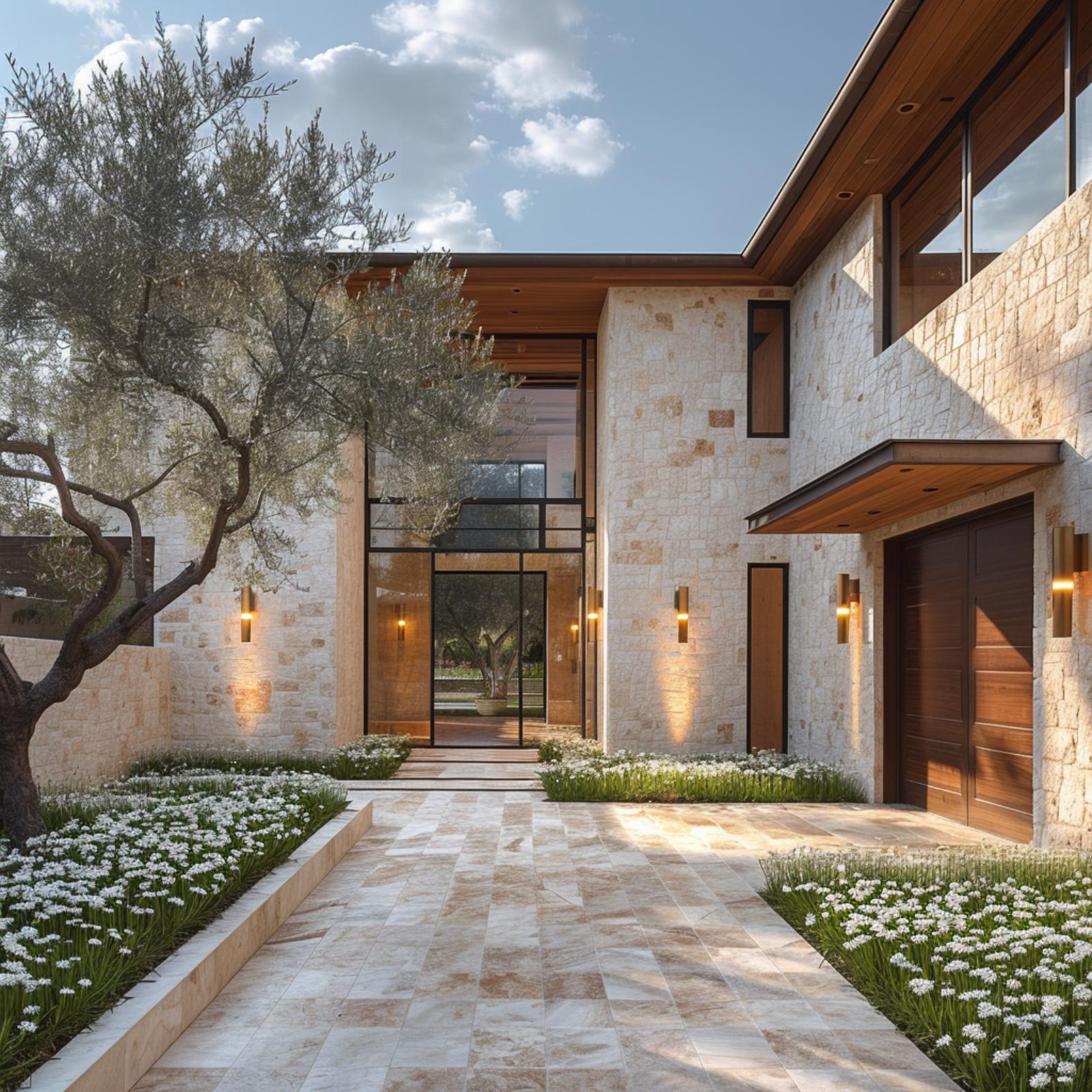
Cream-toned travertine pavers laid in a grid pattern cover the entry court here, with joints wide enough to soften the geometry without losing its precision. Flanking beds of white flowering groundcover run the full length of both sides, low and dense, which keeps the eye moving toward the glass-and-steel entry portal rather than stopping anywhere along the path.
The facade is split-face limestone in a warm ivory, and the wood-clad soffits overhead bring enough warmth to keep the stone from reading as cold. Wall sconces mounted vertically on either side of the entry throw upward light against the stone face. The mature olive tree to the left does what no designer can actually specify: it makes the whole composition feel like it’s been there for years.
5. Climbing Roses, Cedar Beams, and a Travertine Forecourt That Makes Arrival Feel Intentional
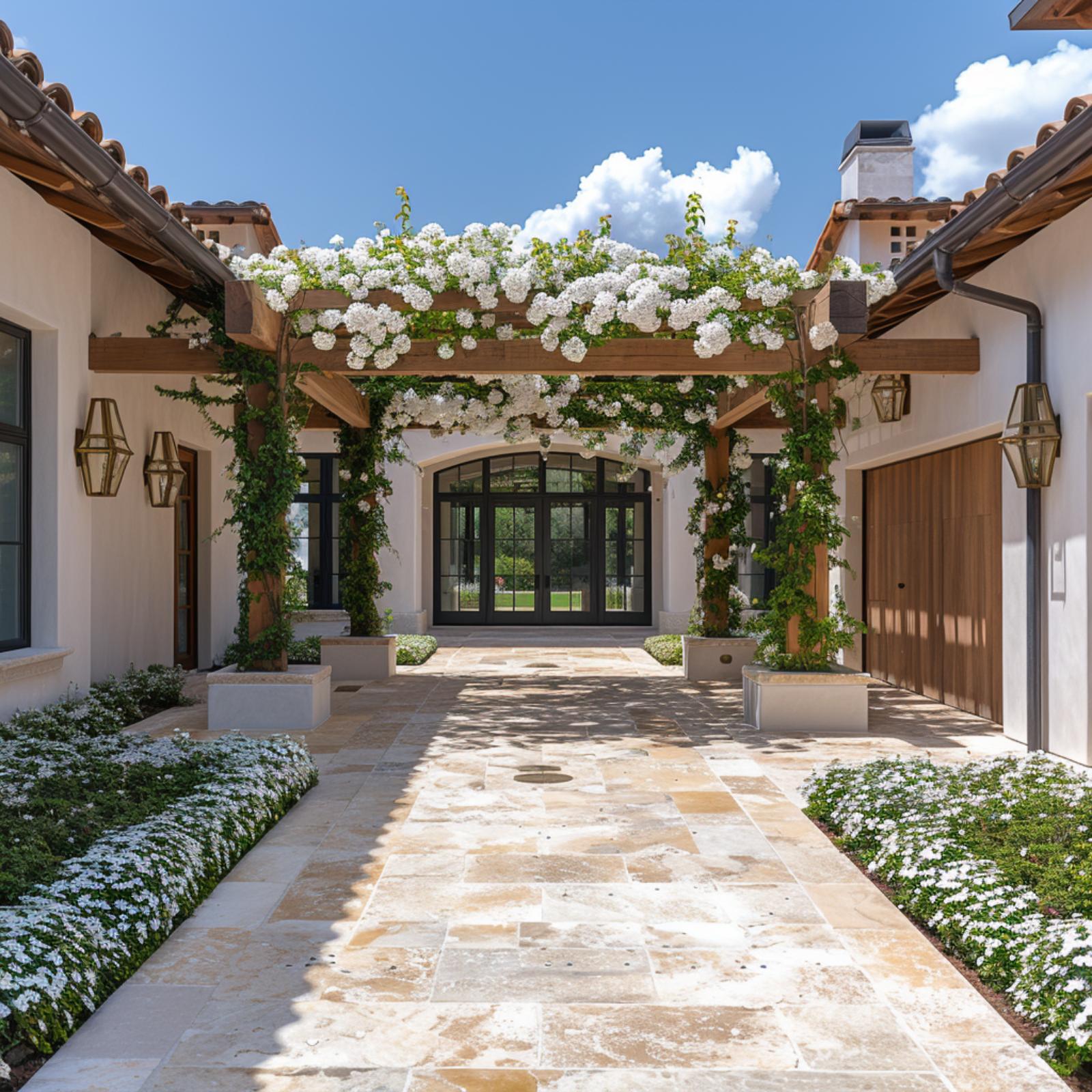
White climbing roses trained across cedar pergola beams do most of the work here, softening what could’ve been a stark stucco forecourt into something genuinely welcoming.
4. Warm-Lit Reflecting Pool, Live Oaks, and a Courtyard That Wraps Around You
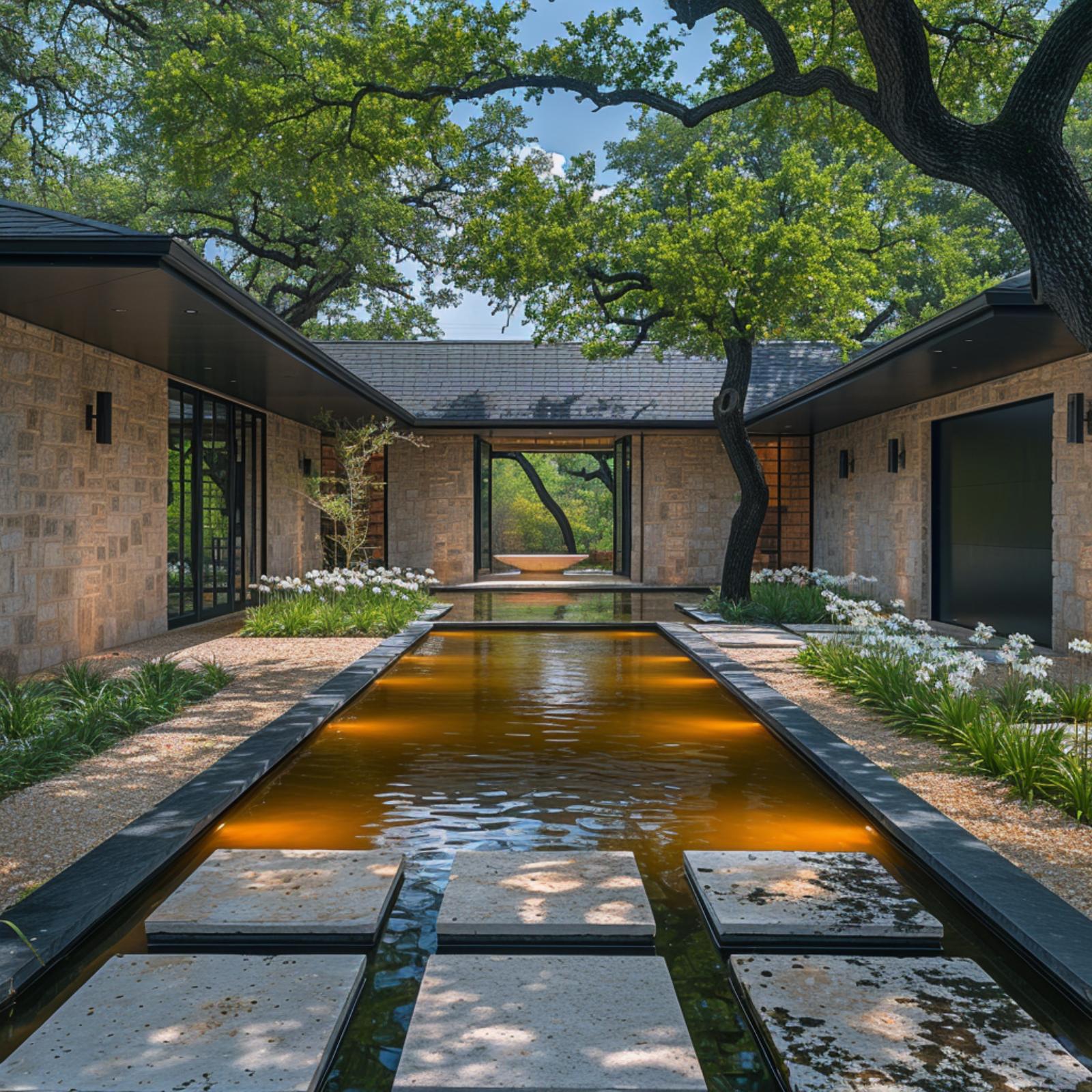
Decomposed granite fills the ground plane here, but it’s the amber-lit reflecting pool running down the center axis that does the real work. Underwater lighting turns the water a deep gold, which reads almost warm against the dark slate coping on either side. Stepping stones cross the channel at intervals, keeping the path functional without breaking the symmetry.
The structure itself is limestone block with black-framed windows and a low-pitched roof, and mature live oaks spread across the whole courtyard without being asked to perform. White agapanthus clusters along both edges, and they’re the right call. Nothing fussier would survive under those trees anyway.
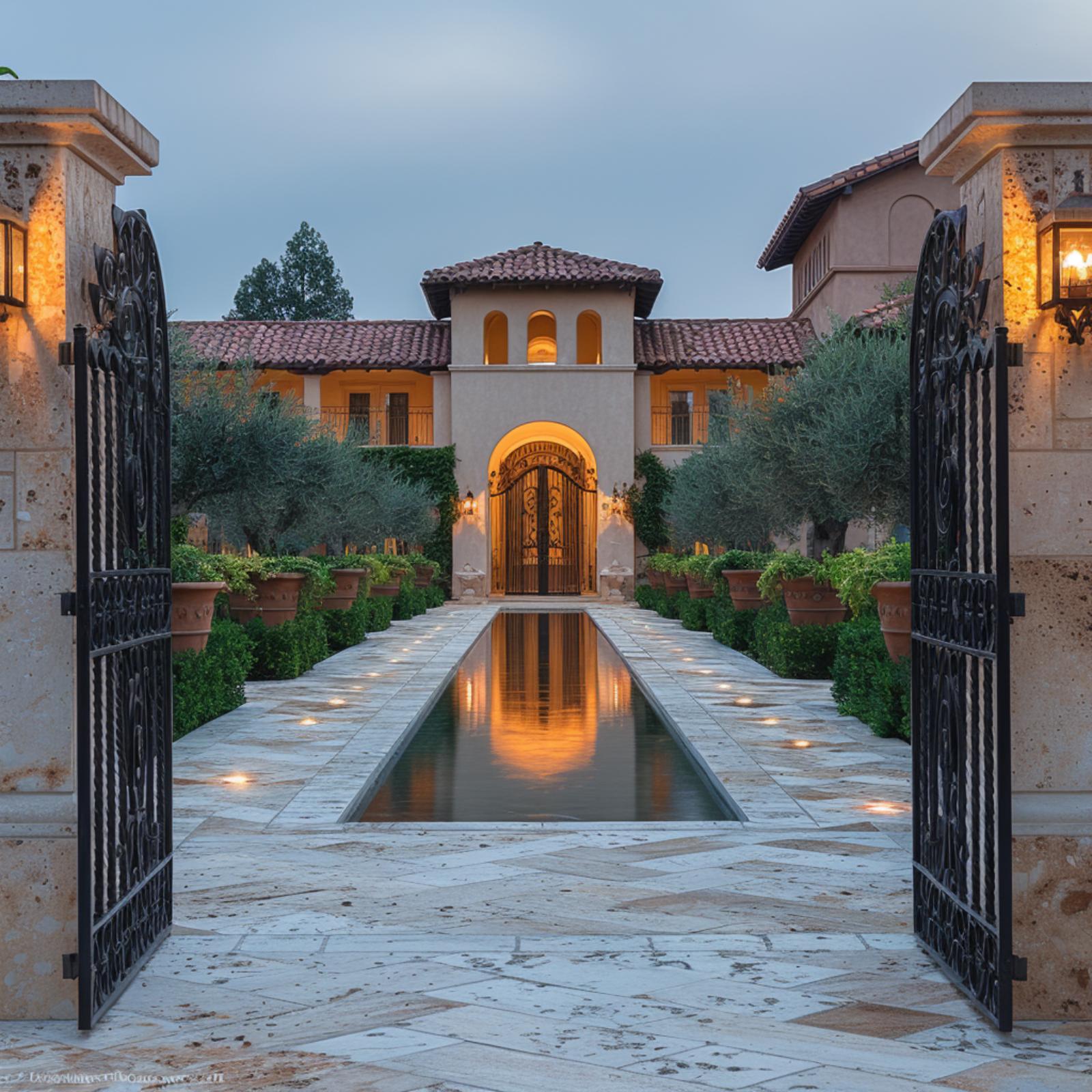
3. Wrought Iron Gates, a Reflecting Channel, and Tuscan Architecture That Doesn’t Need to Try Hard
🔥 Would you like to save this?
Scrolled wrought iron gates swing open onto a travertine forecourt laid in a herringbone-adjacent diagonal pattern, and the eye goes immediately to the shallow reflecting channel running dead center toward the entry. That channel is narrow enough to step over but long enough to mirror the arched front door and its warm amber glow back toward the street. It’s a simple move with a lot of payoff.
Mature olive trees flank the approach on both sides, underplanted with clipped boxwood and terracotta pots. The house itself is classic Mediterranean Revival: terracotta barrel tile roof, stucco in a warm sand tone, and an arched entry surround with ornate ironwork that echoes the gates. Ground-level uplights along the channel edge keep the whole composition readable at dusk without overselling it.
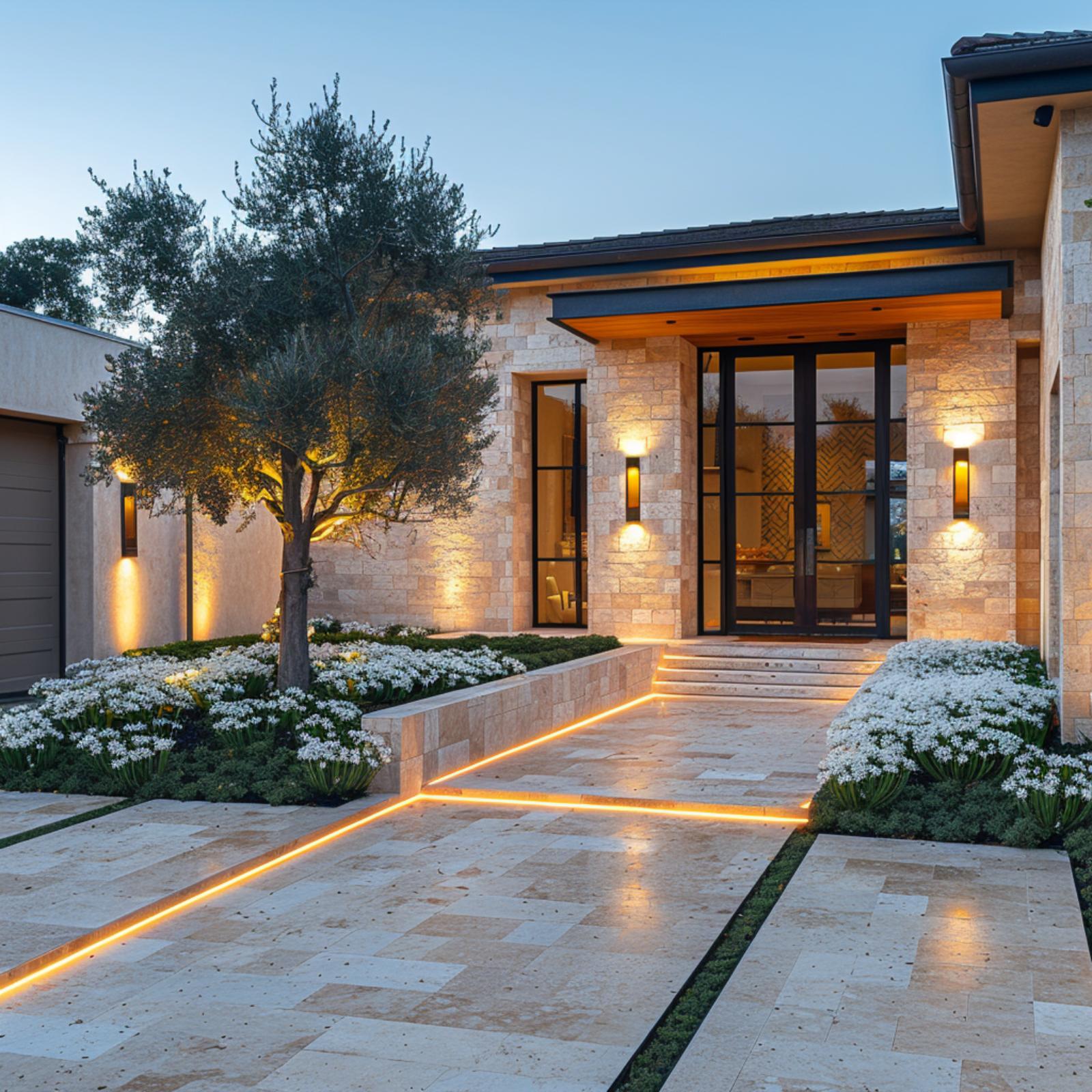
2. LED Strip Joints, an Olive Tree, and Stone That Glows Before You Even Reach the Door
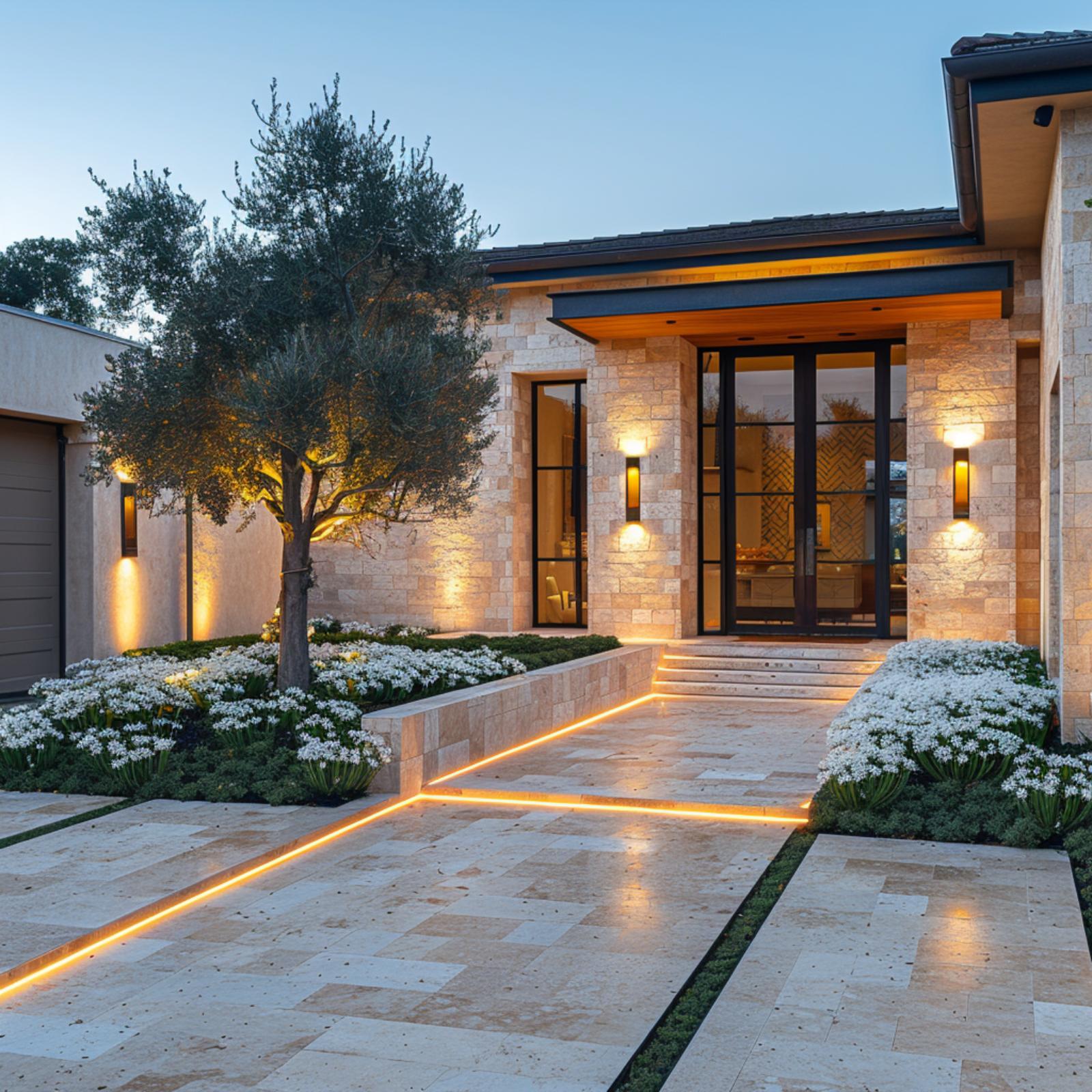
Embedded LED strips run along the base of the raised planter bed and trace the driveway’s edge, casting a warm amber line across honed travertine pavers at dusk. It’s a detail that reads almost architectural rather than decorative. The olive tree, uplighted from below, pulls your eye left before the double black-framed entry doors pull it back center.
Wall sconces flank the door in pairs, top and bottom, which isn’t typical. Most entries use one fixture per side. Here, the doubling creates a vertical rhythm that works with the stone’s horizontal coursing rather than fighting it. White flowering groundcover fills both planting beds low and dense, keeping the palette from going too warm.
1. Concrete Pavers, Agave Clusters, and a Desert Courtyard That Knows Exactly What It’s Doing
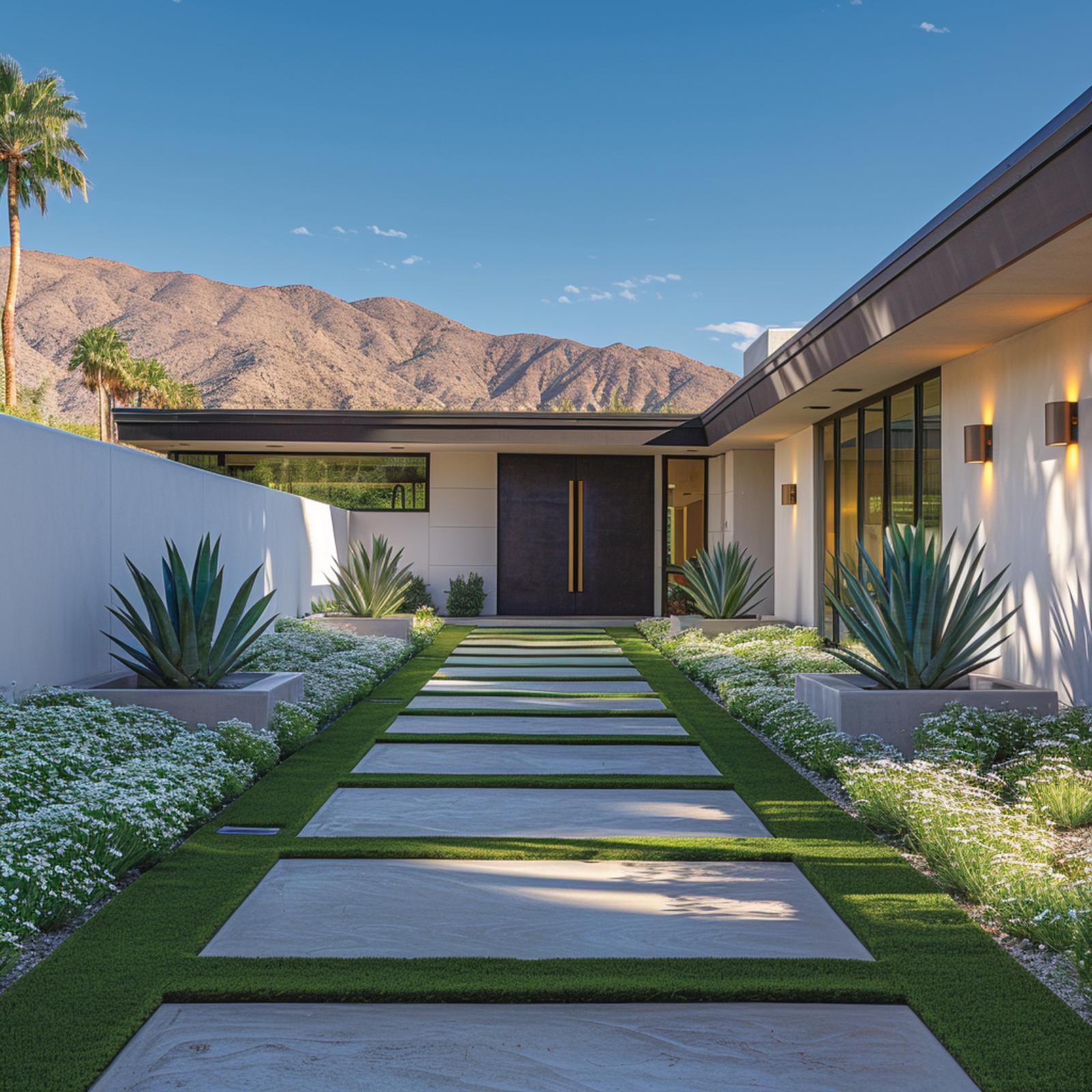
Large-format limestone pavers set into synthetic turf create a path that reads more like a runway than a walkway. The spacing between each slab is tight enough to feel intentional but loose enough that the green borders register as a pattern, not filler.
Flanking the approach, blue agave planted in raised concrete planters does the heavy lifting that ornamental shrubs usually can’t. Behind them, a low mat of white flowering groundcover softens what would otherwise be a very hard-edged composition. The dark pivot door with its vertical brass inlay pulls the eye forward, and the San Jacinto range does the rest.