🔥 Would you like to save this?
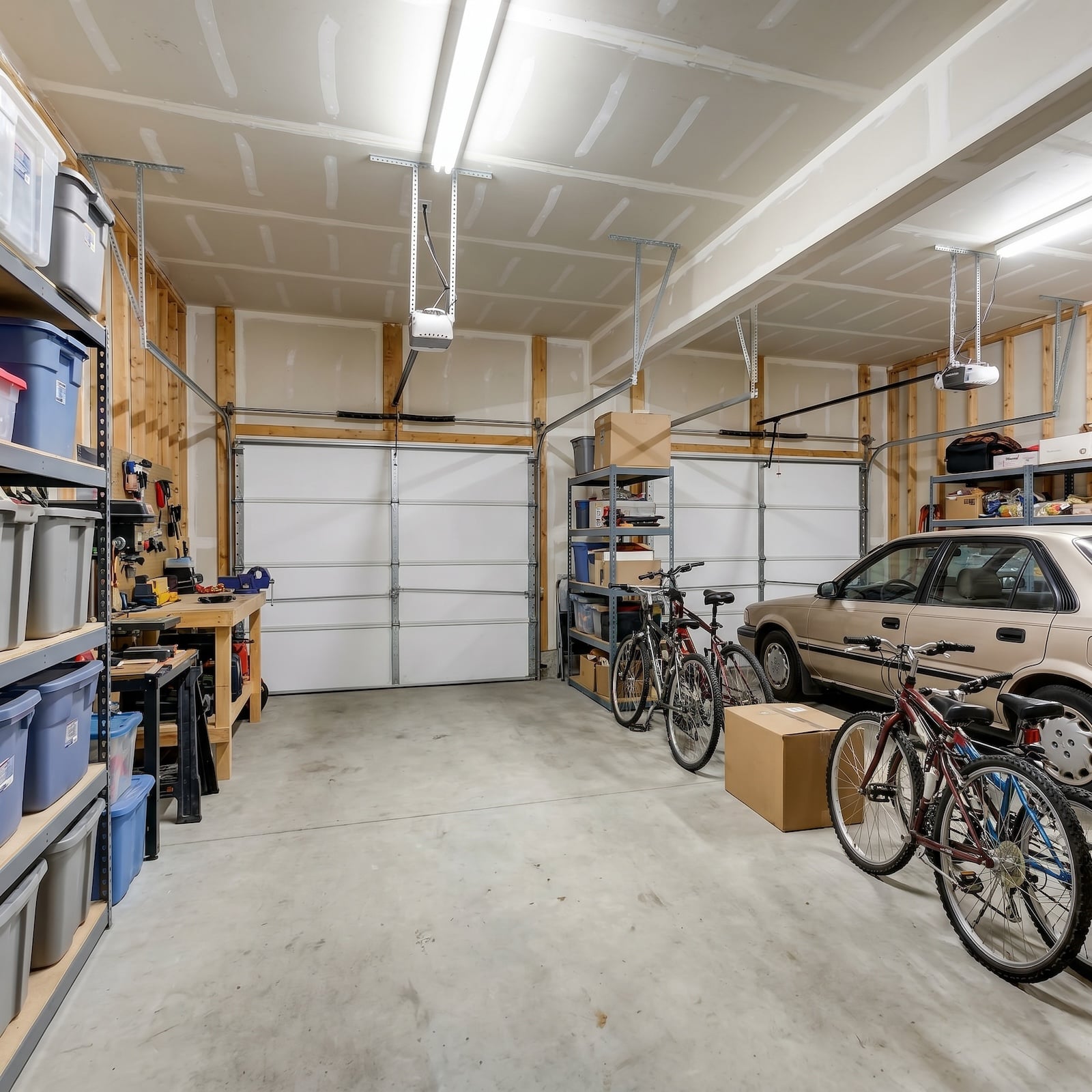
You haul home a water-damaged secretary desk at 7 a.m., strip it by noon, and spend the evening arguing with a stuck drawer on bare concrete under a fluorescent tube that flickers like a bad omen. The piece has carved legs, decent bones, and one drawer pull worth saving. The room around it has extension cords, old paint cans, and a folding table that gave up emotionally sometime last winter.
In order to come up with the very specific design ideas, we create most designs with the assistance of state-of-the-art AI interior design software. Also, assume links that take you off the site are affiliate links such as links to Amazon. this means we may earn a commission if you buy something.
That mismatch is the whole point. People who can see beauty inside a battered dresser often tolerate the ugliest possible place to work on it. Sawdust gathers in corners. Hardware disappears into coffee cans. Good brushes dry beside snow shovels. The lighting lies. The floor punishes every dropped screw.
These 26 makeovers take the room behind the restoration seriously. Better light, smarter storage, tougher surfaces, proper work zones, and a little visual pride turn the whole setup from grim survival mode into somewhere worth spending an afternoon. The furniture was never the only thing waiting to be rescued.
26. Dusty Rose and Coffered Ceilings Turn a Two-Car Bay Into a Dressing Room
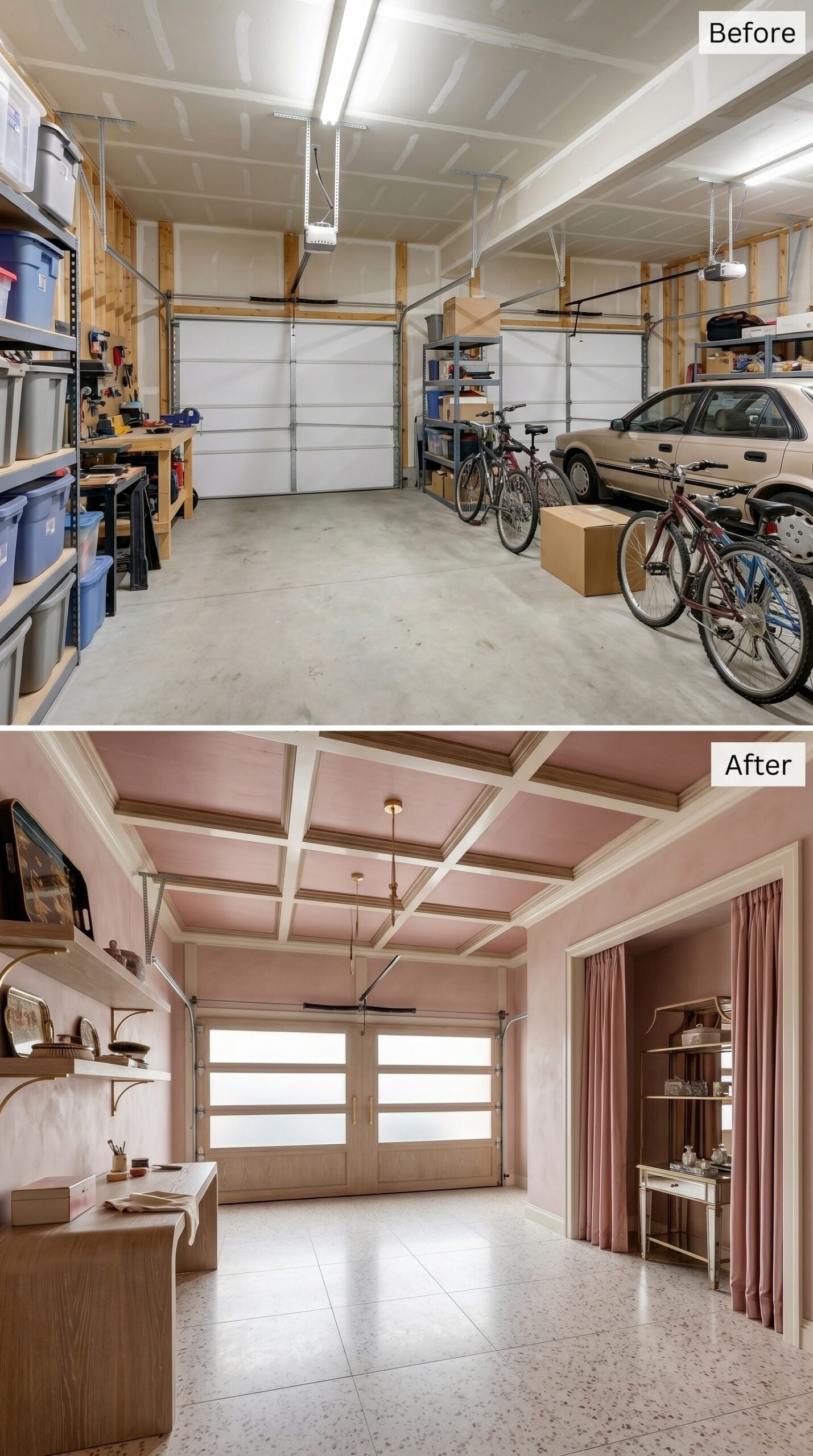
Blush pink plaster walls meet a coffered ceiling trimmed in cream molding, and the combination reads more Parisian dressing room than converted garage. The garage door stayed, but it’s been replaced with a frosted-panel version framed in light wood that floods the space with diffused light without sacrificing privacy.
On the left wall, a curved oak vanity table anchors the room alongside open shelving with brass brackets holding small decorative objects. The right side disappears behind floor-length dusty rose curtains, likely concealing storage. Terrazzo tile finishes the floor in speckled white. It’s a lot of pink, and somehow it earns every square foot of it.
25. Gothic Garage Workshop Where Crimson Walls Meet Cathedral-Panel Doors
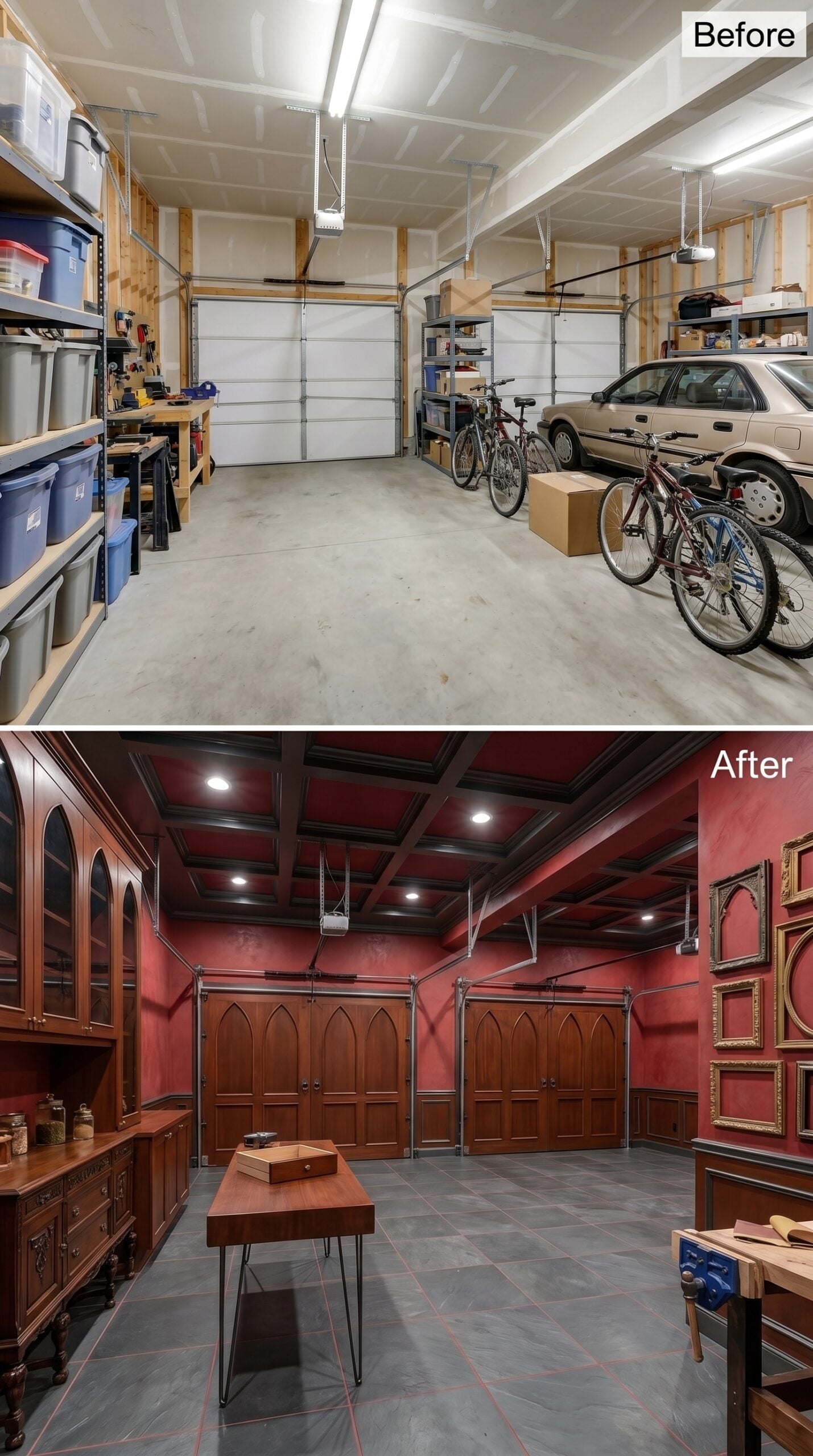
Deep crimson plaster walls and a coffered ceiling with dark-stained beams set a mood that reads more private library than parking bay. The garage doors got clad in arched Gothic panels, likely mahogany or stained poplar, and they work surprisingly well against the industrial rail hardware still running overhead. Slate-format floor tile and a hairpin-leg workbench keep it grounded.
24. Concrete Walls and Coffered Ceilings Give a Two-Bay Workshop Real Studio Credentials
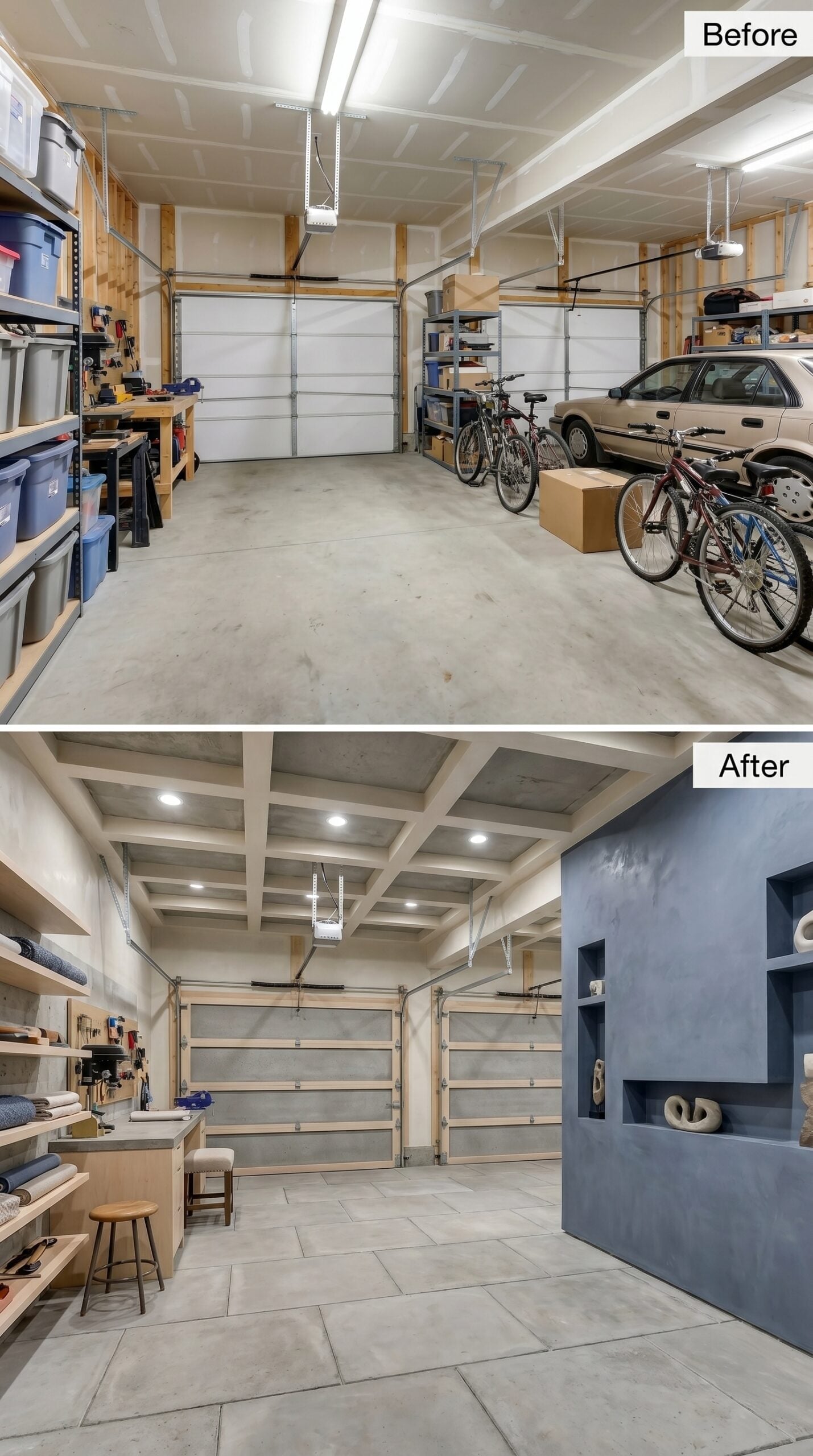
Polished large-format concrete tile replaces the bare slab floor, and the ceiling gets a proper coffered treatment with recessed can lighting tucked into each bay. It reads less like a garage and more like a craftsman’s loft. The garage doors stayed, wrapped in horizontal wood slat panels that pull the whole room warmer.
On the right wall, a built-in unit finished in slate blue microcement holds display niches sized for art objects and ceramic pieces. That’s where the furniture flipper mindset shows up clearly: there’s actual display thinking happening here, not just storage.
23. Coffered Ceilings and Walnut Cabinetry Give This Garage a Craftsman Studio Feel
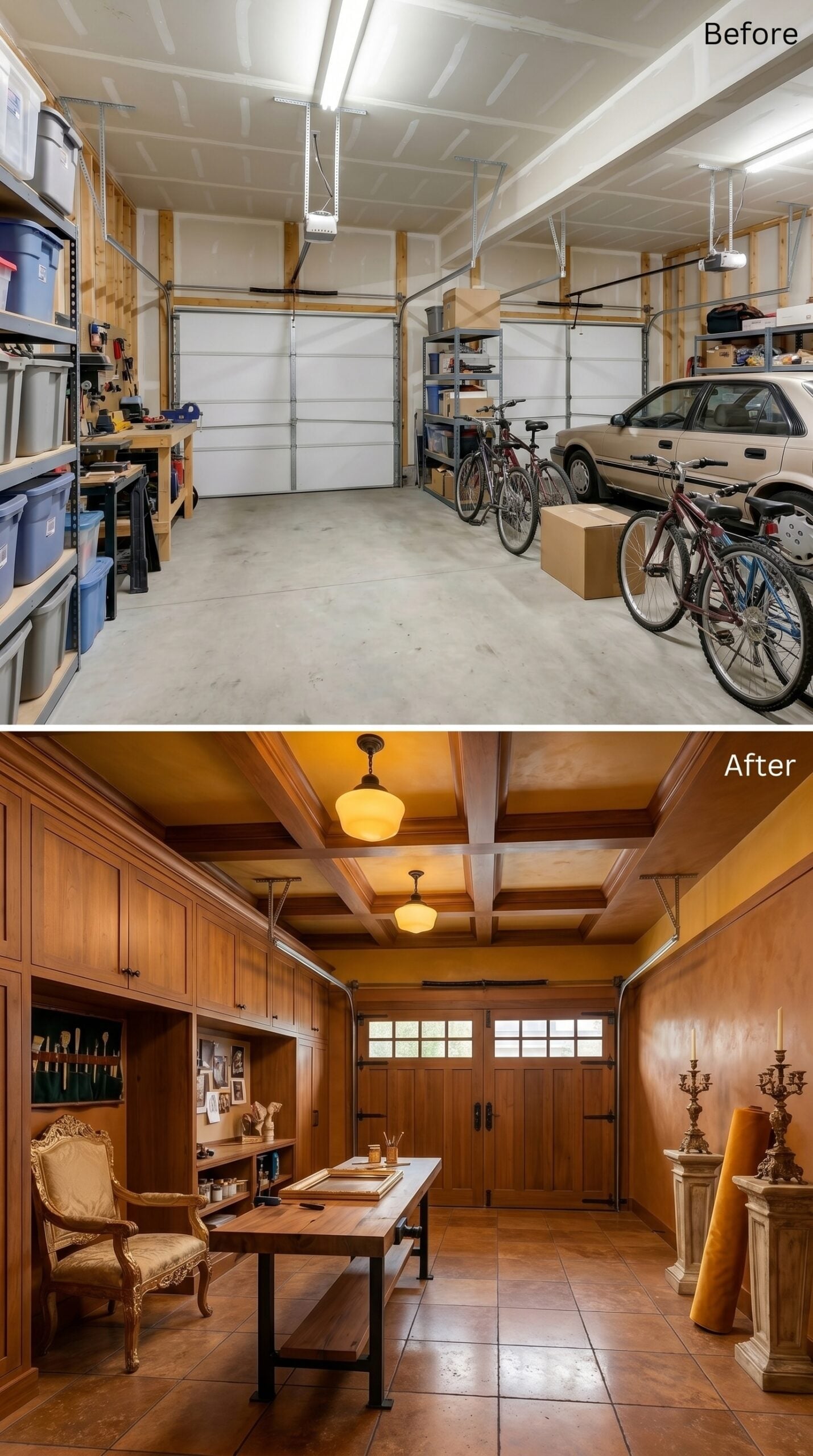
Warm amber walls meet a coffered ceiling trimmed in stained wood, anchored by schoolhouse pendant lights with frosted glass shades. The built-in cabinetry runs floor to ceiling, and the original garage door stayed put.
What Our Readers Say
- When we asked readers which living room ceiling they want, the vote was a near coin toss: flat 31%, vaulted 29%, coffered 21% and beams 19%.
- Asked which ceiling they would put up, nearly half of Home Stratosphere readers chose white, while 30% would go with wood and 17% with colour.
From Home Stratosphere reader polls and votes.
22. Teal Plaster Walls and a Slatted Cedar Ceiling Give This Garage a Boutique Spa Identity
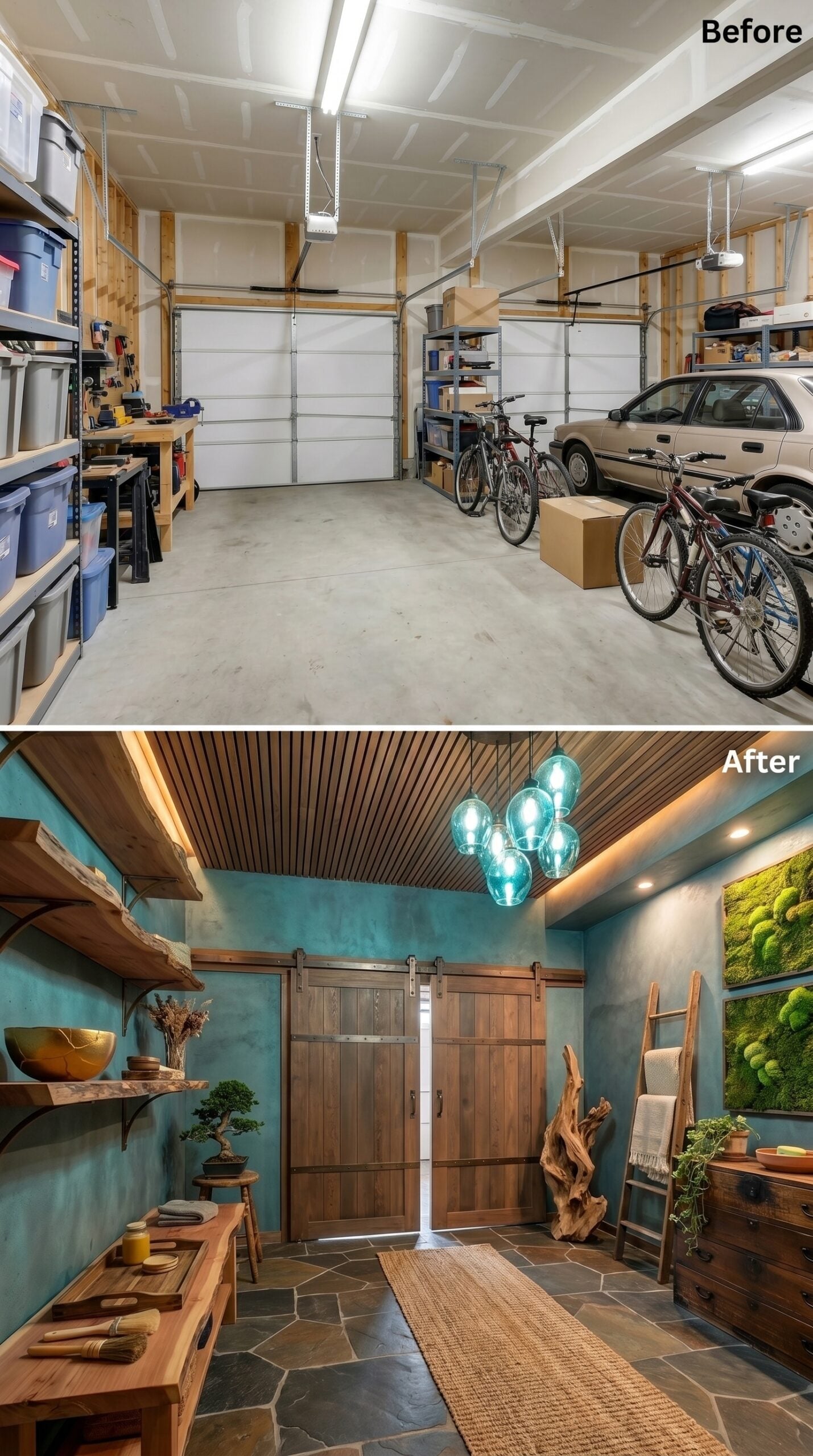
Aqua-toned venetian plaster wraps every wall, anchoring floating live-edge shelves that display a bonsai and hand-thrown ceramics. Reclaimed wood barn doors slide across the center, and cluster pendants with teal blown-glass globes handle the overhead light. Flagstone flooring ties it all to the earth.
Pro Tip: Venetian plaster over drywall is a surprisingly affordable DIY finish that adds real depth to a flat wall. Apply at least two thin coats in opposing directions and burnish while the second coat is still slightly tacky — that’s what produces the characteristic sheen, not the plaster itself.
21. Emerald Walls and a Sunburst Ceiling Turn One Bay Into a Whiskey-Bar Lounge
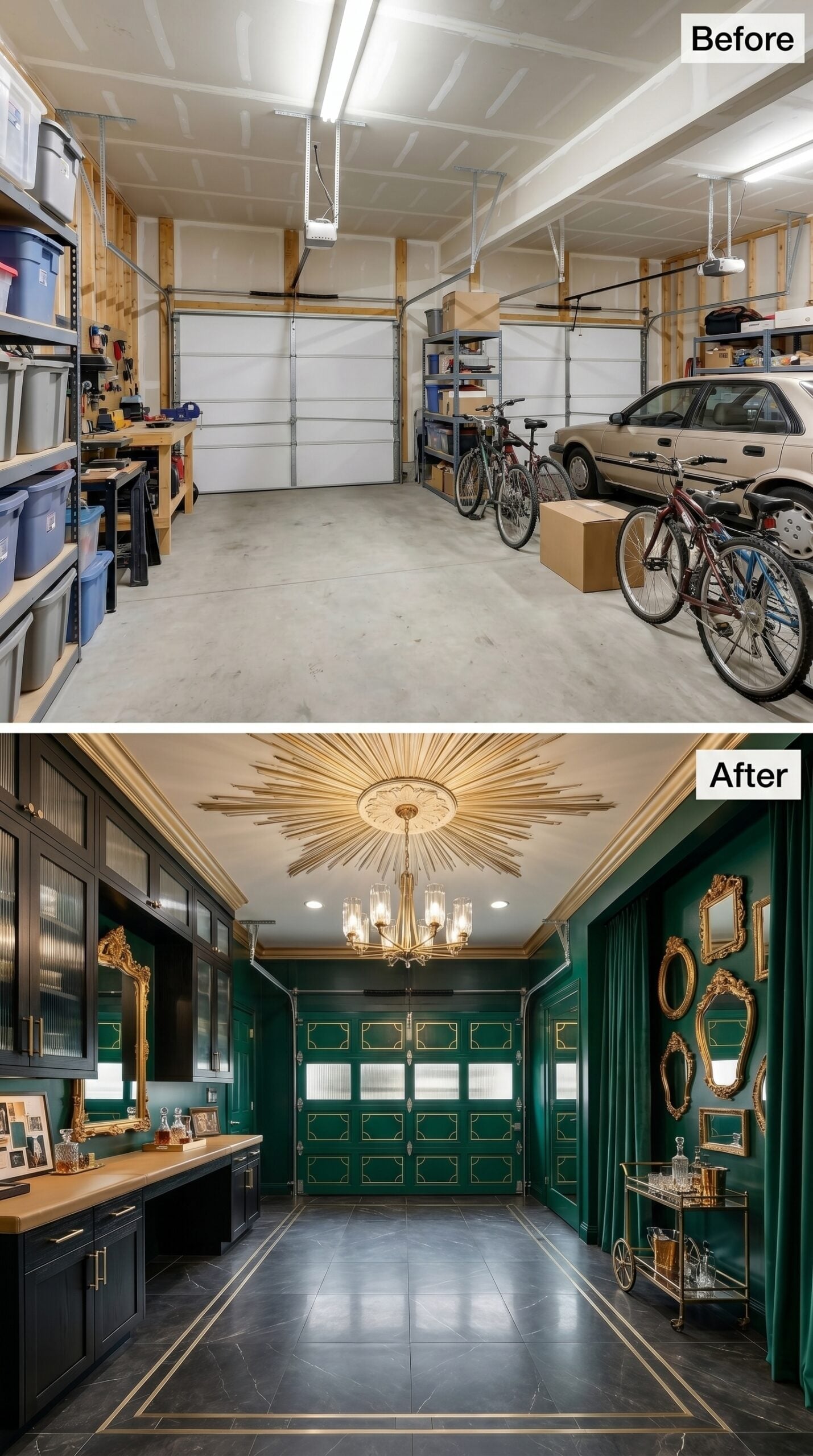
Forest green lacquered walls set the tone, and the gold-trimmed garage door left in place does something unexpected: it reads like a decorative panel rather than an exit. The sunburst plasterwork radiating from a central medallion on the ceiling is the kind of detail that stops people mid-sentence. A brass chandelier with glass cylinder shades hangs dead center beneath it.
The left wall runs a full-length counter, likely butcher block, backed by dark cabinetry with ribbed glass uppers and brass pulls. Gilt baroque mirrors cluster on the right wall beside emerald velvet curtains, with a bar cart tucked into the corner. The dark marble tile floor has a hairline gold border inset that ties every element back to the ceiling without repeating it.
20. Exposed Fir Beams and Barn Doors Give One Bay a Farmhouse Studio Identity
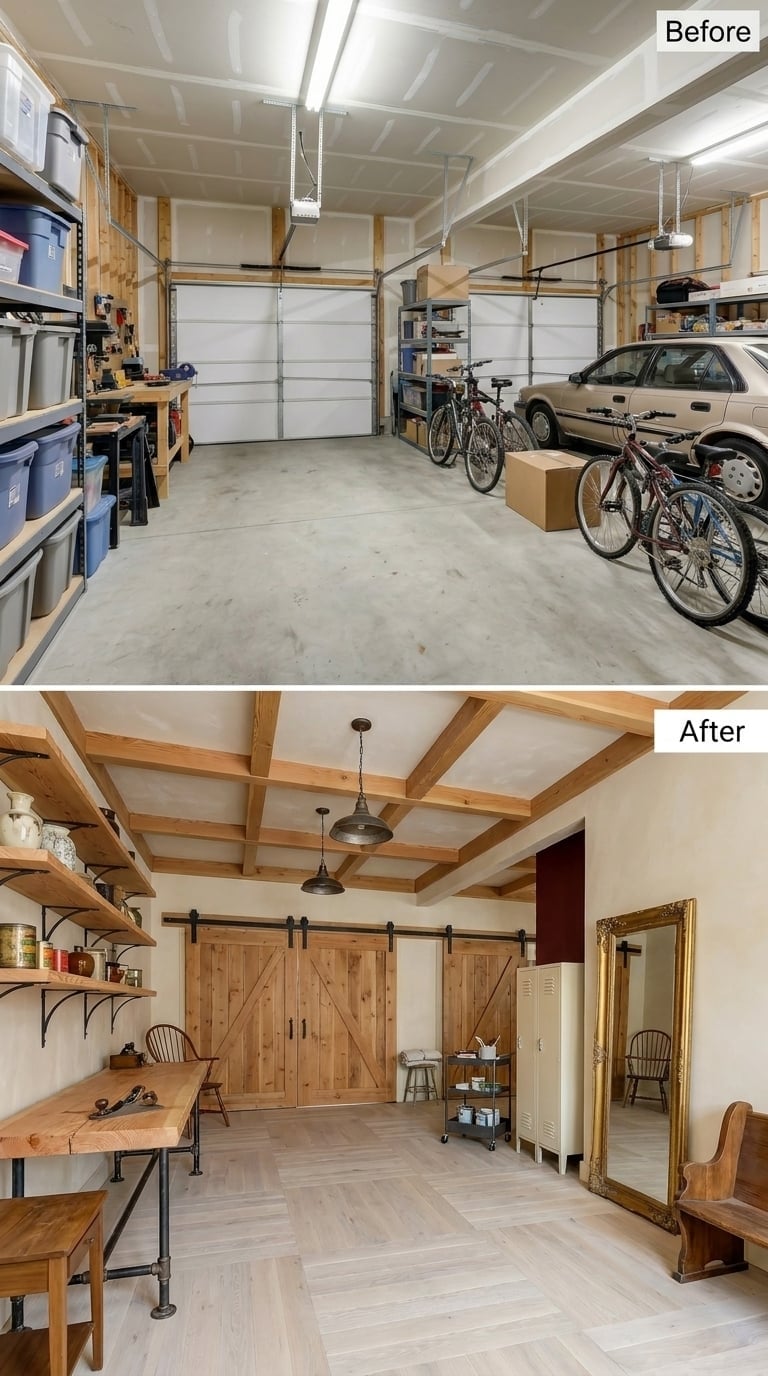
Rough-sawn fir ceiling beams laid in a grid pattern pull the eye up and make the space feel taller than the footprint suggests. Industrial pipe-leg workbenches line the left wall beneath open pine shelving, and sliding barn doors on a black steel track replace the original overhead door entirely.
Whitewashed plank flooring keeps things light underfoot. A gold-framed floor mirror propped near the corner is a practical touch for furniture flippers staging pieces before photography — the vintage metal lockers beside the doors add storage without pretending to be something fancier than they are.
19. Teal Plaster and a Blue Chandelier Give One Bay the Soul of a Baroque Foyer
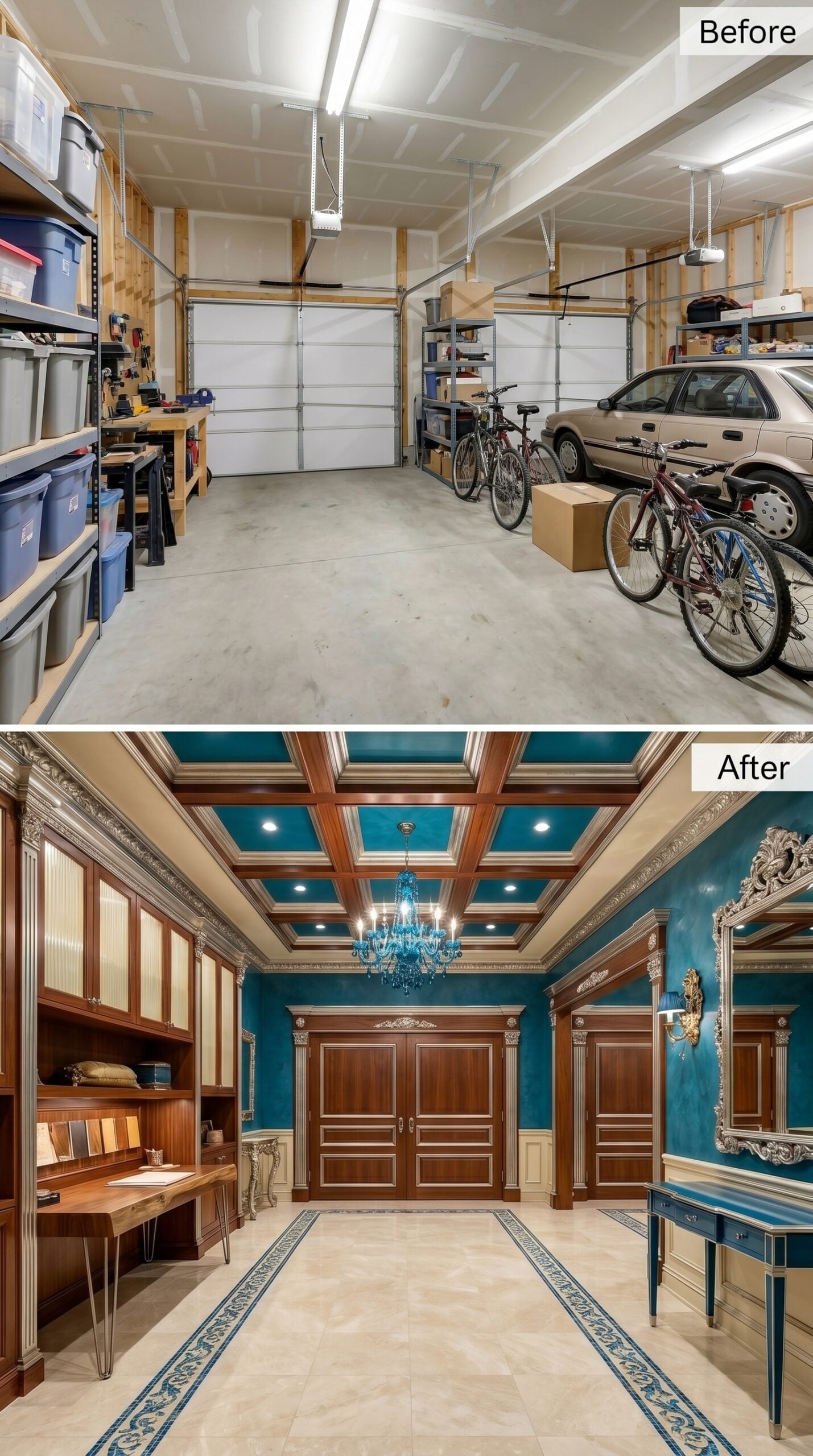
Rich teal covers every wall in a finish that reads like aged silk, and the coffered ceiling doubles down with matching inset panels framed by dark mahogany beams and silver-leaf molding. A blue Murano-style chandelier drops dead center. It’s the kind of fixture that makes you reconsider whether chandeliers belong in formal rooms at all.
Marble tile runs the length of the floor with a border inlay that echoes the wall color, pulling the whole palette together without forcing it. Flanking the double-panel doors are pilasters with carved capitals, and a live-edge desk on hairpin legs sits to the left as a deliberate counterpoint to all that ornament.
18. Burgundy Plaster and Art Deco Double Doors Give One Bay a Speakeasy Identity
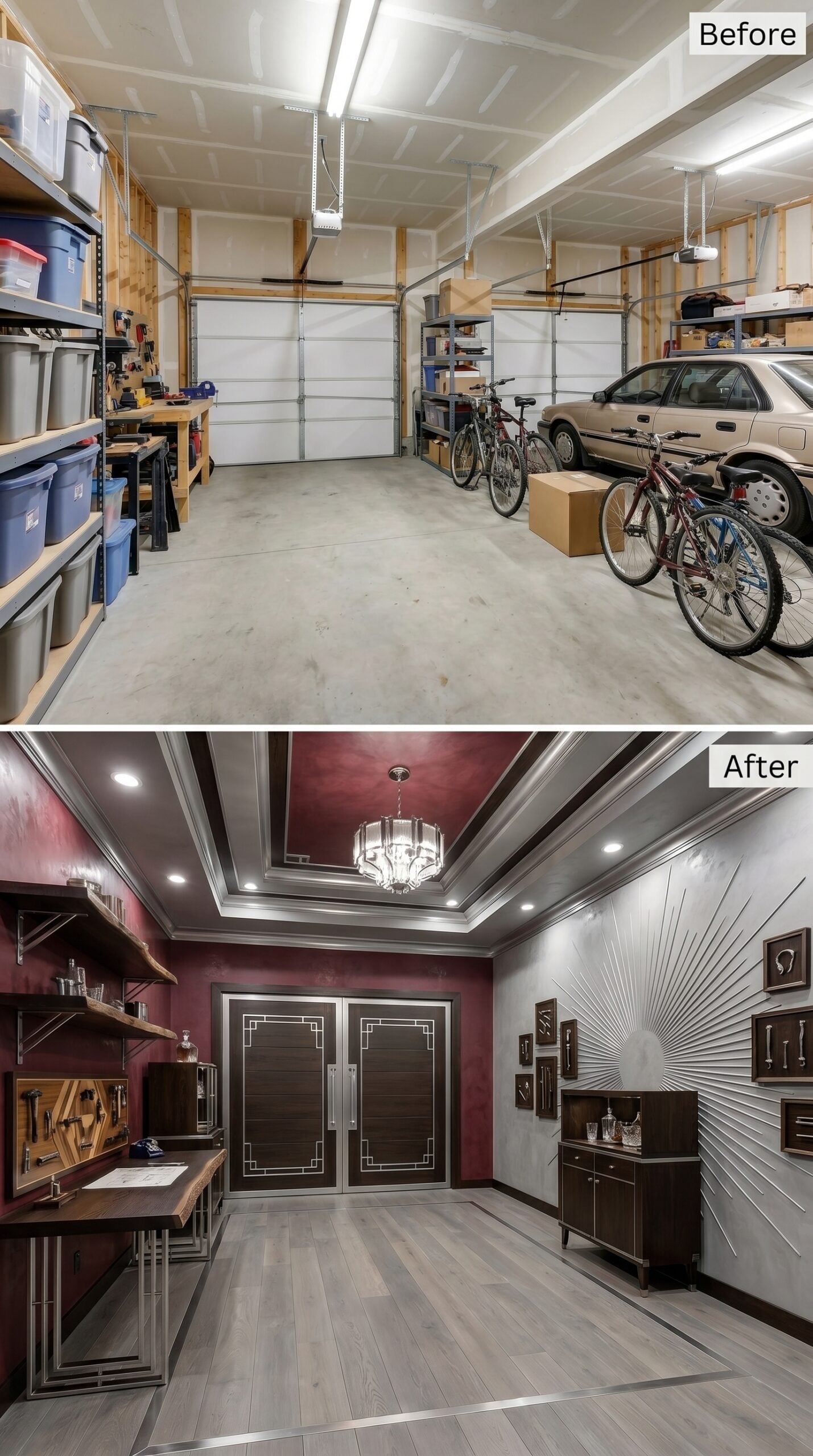
Oxblood plaster walls push against a tray ceiling trimmed in silver crown molding, and the combination reads more private club than residential conversion. A drum chandelier with geometric metalwork anchors the ceiling’s center. The garage door opening got replaced with double doors paneled in dark walnut and inlaid with chrome Greek-key detailing.
Ask Yourself: If you’re storing pieces for resale, consider whether your staging space is doing selling work for you. A room with real atmosphere photographs differently than bare walls, and buyers notice. Your inventory deserves a backdrop that makes it look like it belongs somewhere specific.
Not everyone is sold on deep reds: in our readers’ votes, burgundy-dominant images got hearts 42% of the time, versus 47% for the other images in the same articles.
17. Coffered Ceilings and Craftsman Cabinetry Give a Two-Bay Garage the Feel of a Private Study
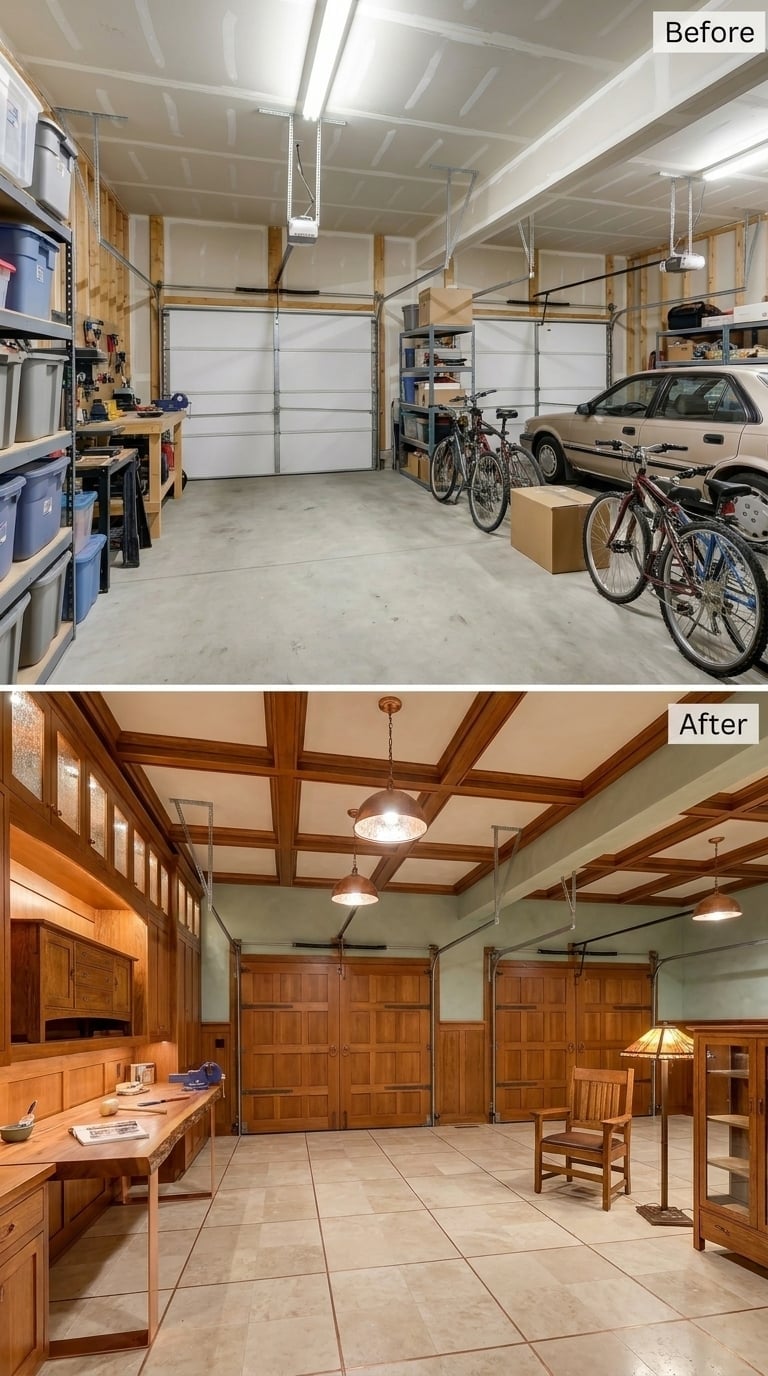
Sage plaster walls sit behind a run of honey-toned cabinetry stretching the full left wall, with upper glass-panel doors and a live-edge work surface that reads more library than garage. The coffered ceiling is the real commitment: wood beams grid the entire span, painted out in cream to keep the volume light.
Pendant lights on chains hang at different heights over the tile floor, and a Mission-style chair in the far corner makes a case for the space as somewhere you might actually want to sit. Vintage furniture flippers will also notice that the garage doors themselves got upgraded to raised-panel wood, which photographs considerably better than white steel when you’re shooting pieces for resale.
16. Charcoal Plaster and Gothic Arch Doors Give One Bay the Soul of a Medieval Scriptorium
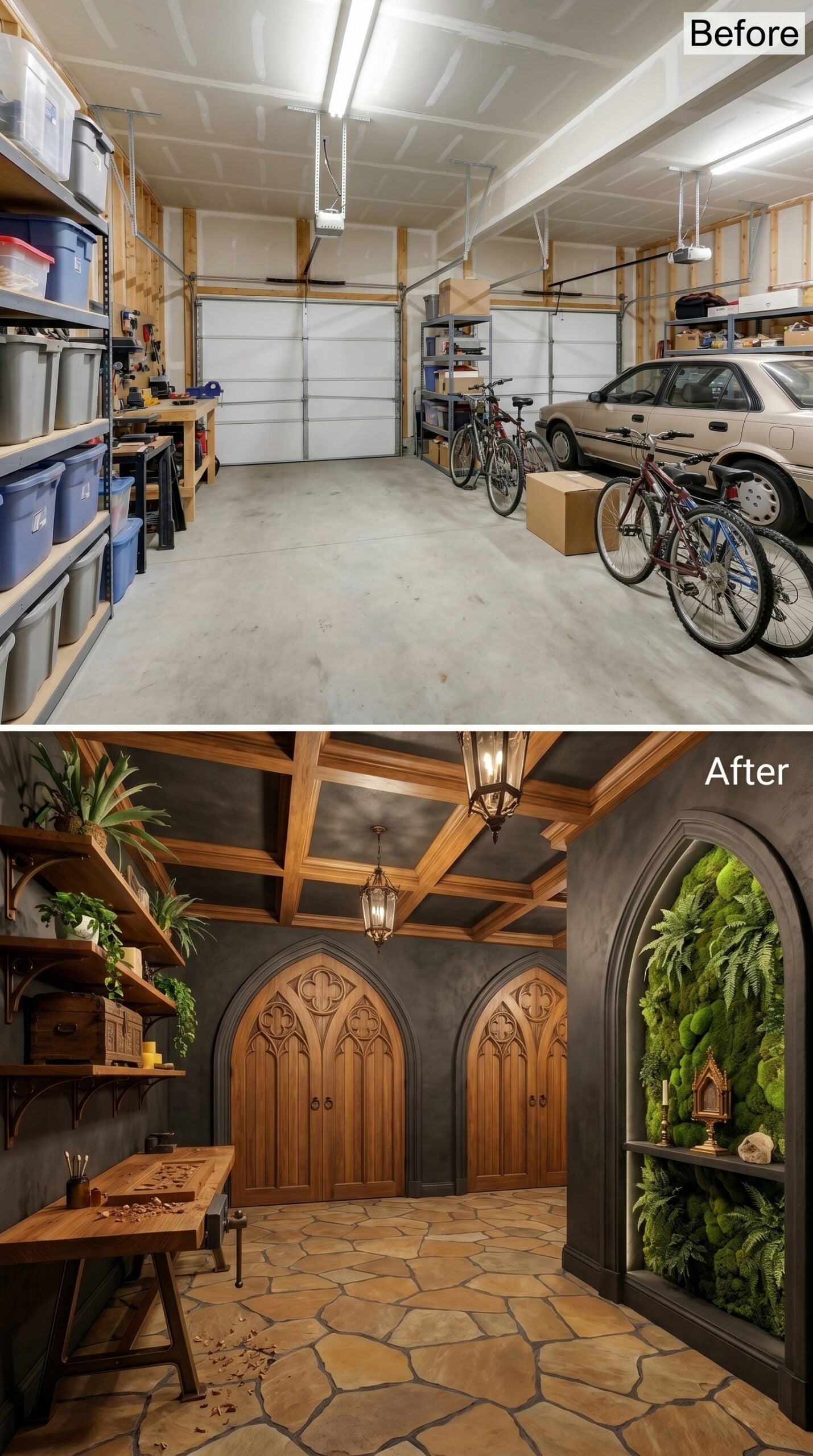
Flagstone flooring in irregular cut pieces sets the tone immediately. Dark charcoal plaster walls push the wood-beam coffered ceiling forward, making the whole room feel compressed in the best way — like a room that knows exactly what it is.
The garage doors are gone entirely, replaced by a pair of carved Gothic arch panels with quatrefoil tracery and ring pulls. A living wall of ferns fills a recessed arched niche on the right, and pendant lanterns with aged brass frames handle the overhead light. On the left, a solid workbench holds hand tools mid-use, which keeps the space honest about its purpose.
15. Black Lacquer Walls and Globe Pendants Give Two Bays a Nightclub Identity
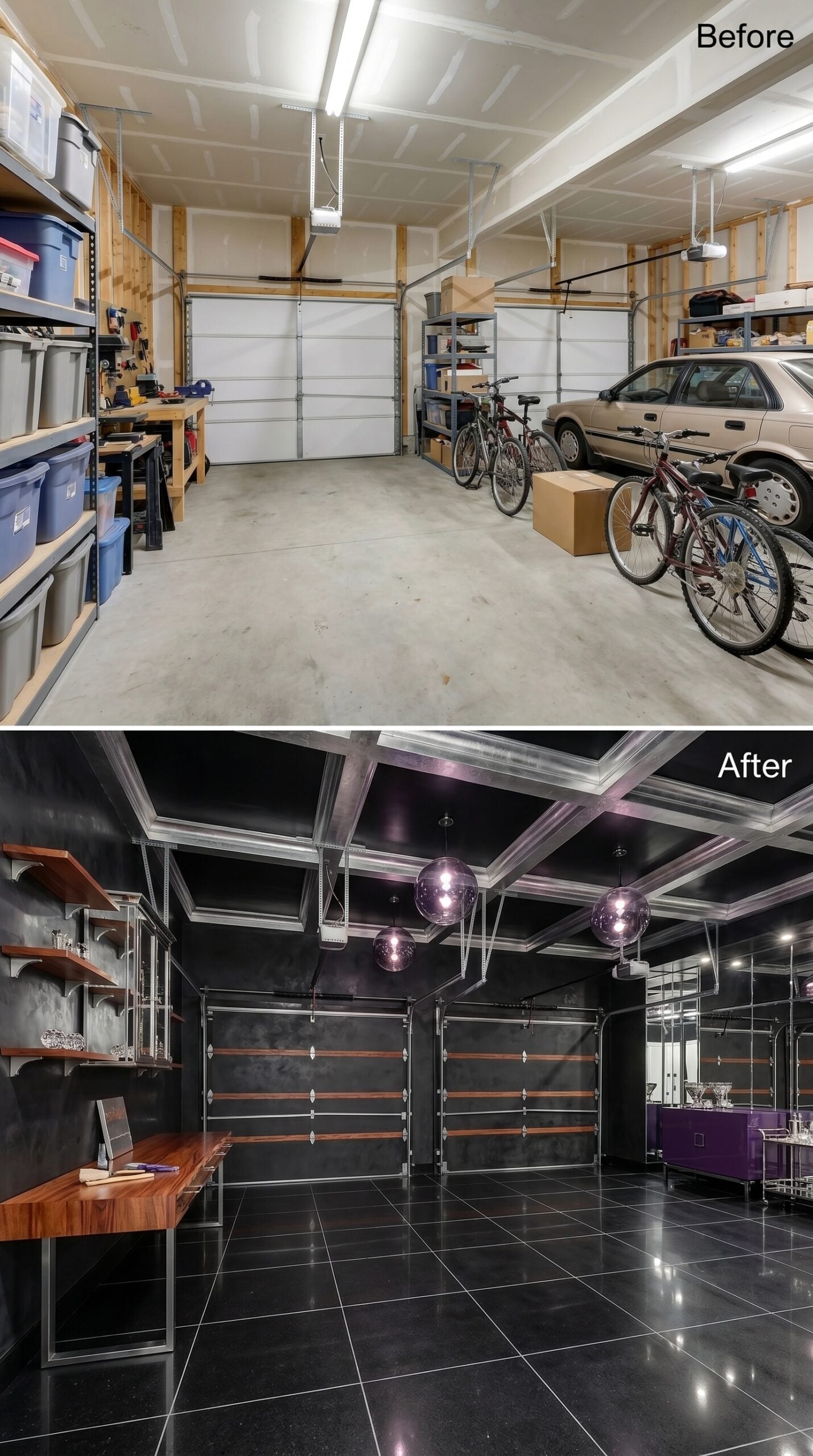
Matte black walls meet a coffered ceiling trimmed in silver, and the combination reads closer to a Manhattan cocktail lounge than a garage. Three mirrored globe pendants drop at staggered heights above a live-edge wood counter on steel legs. It works because it commits fully.
Where gothic arches leaned into drama, this space takes a softer but no less committed approach to atmosphere.
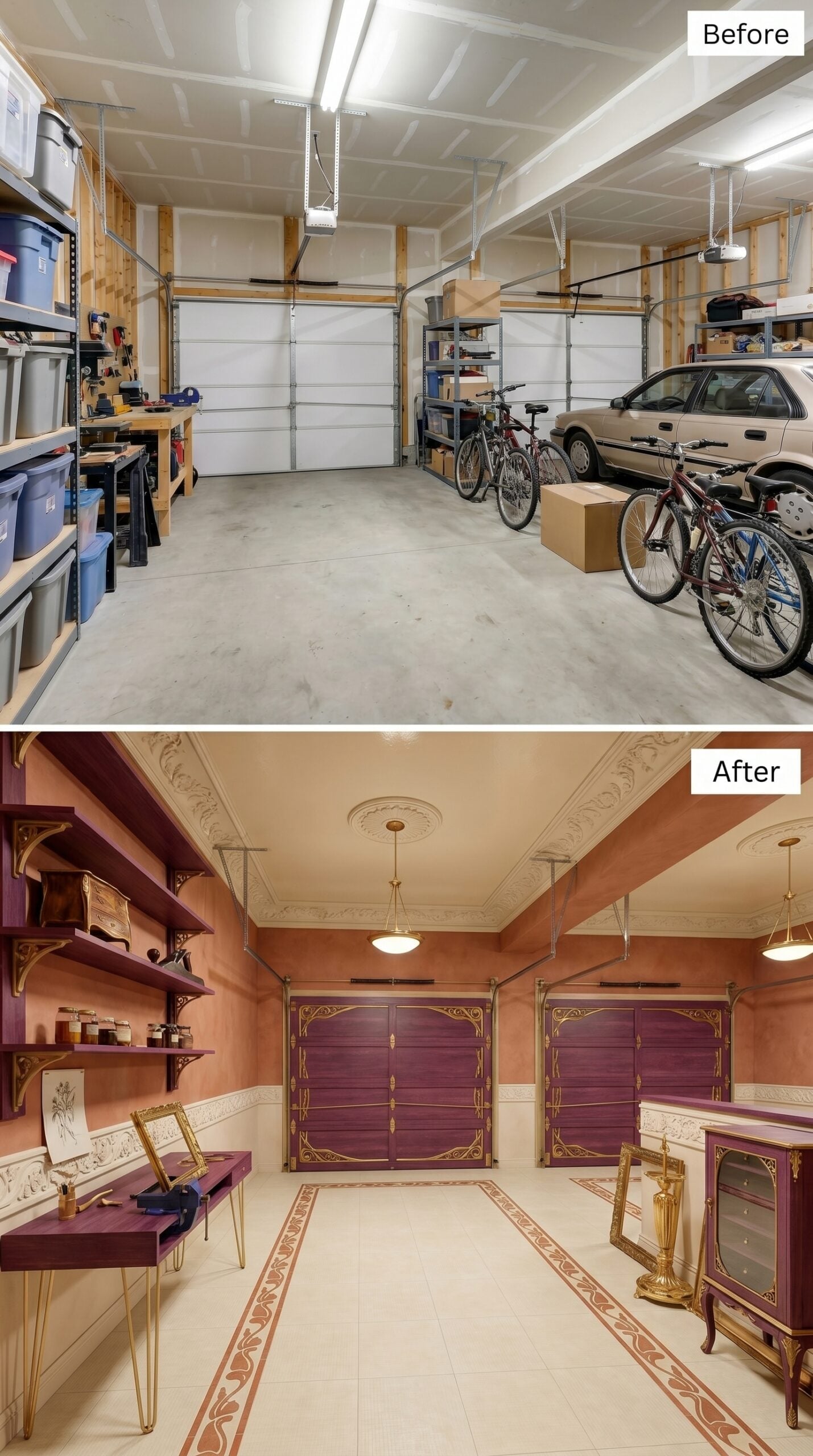
14. Dusty Rose Plaster and Gold Bracket Shelving Give Two Bays a Parisian Atelier Identity
🔥 Would you like to save this?
Venetian-finish walls in a faded terracotta rose set the tone, paired with ornate plaster crown molding and a ceiling medallion that look original to a 19th-century interior. The garage doors got painted in deep plum with hand-applied gold cartouche detailing, and they read less like doors and more like gilded cabinet panels.
A cream tile runner with a repeating botanical border draws the eye straight through the space. Purple hairpin-leg worktables sit left and right, and open shelves with cast-iron scroll brackets display jars and vintage frames mid-sale. It’s a proper staging environment, not an afterthought.
transition: Painted garage doors are one of the most underused moves in a flipper’s playbook. A coat of furniture-grade enamel plus simple stenciled detailing can take a standard door from invisible to a feature buyers actually photograph. The plum and gold treatment here would cost a weekend and a few brushes, and it changes what the whole room feels like to walk into.
13. Steel-Blue Walls and a Cedar Plank Ceiling Give Two Bays a Mid-Century Showroom Identity
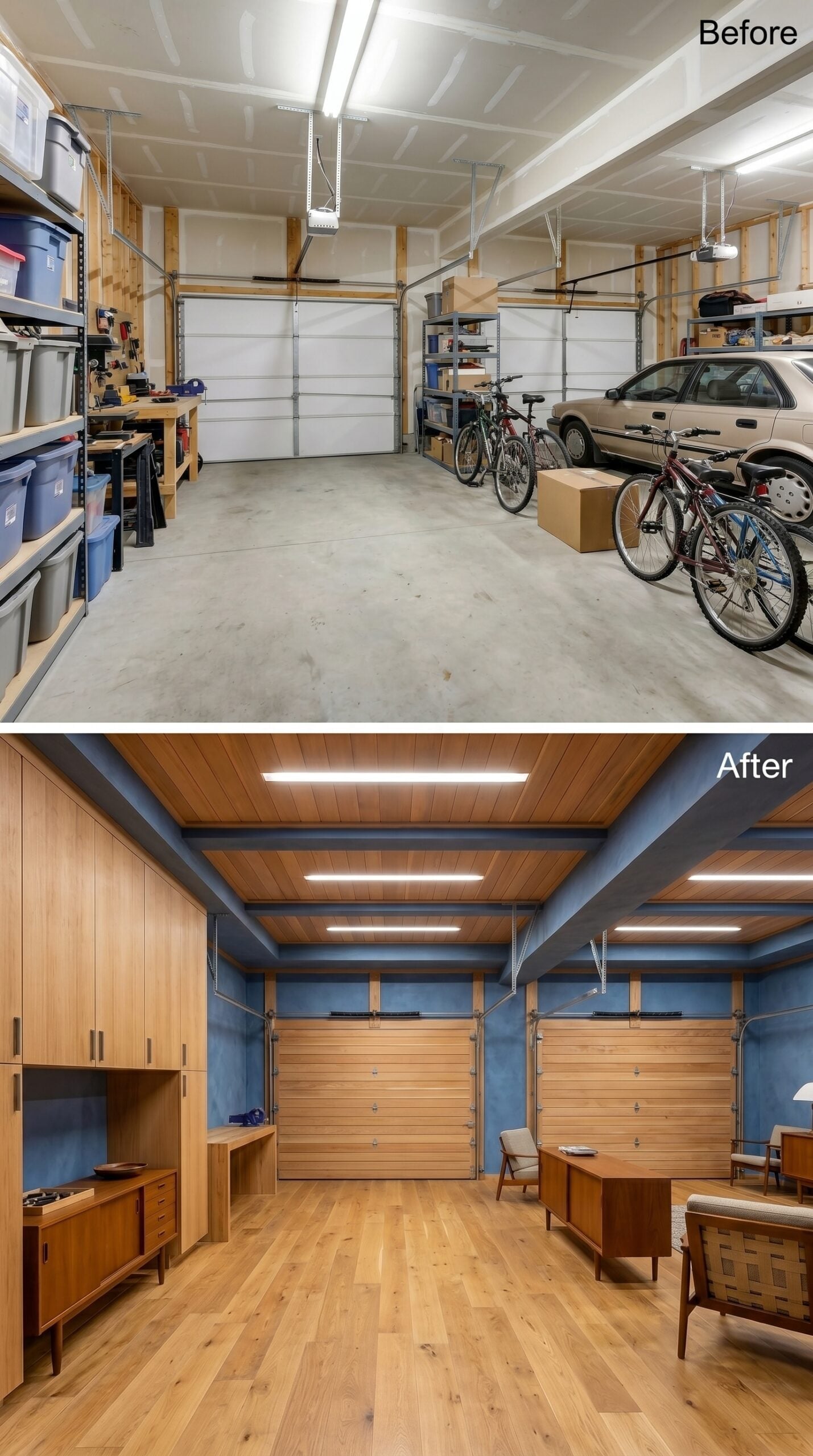
Muted steel-blue plaster covers every wall, and tongue-and-groove cedar runs the full length of the ceiling between painted navy beams. The wood floor reads as white oak, doing a lot of work here — keeping the space from feeling cave-like despite the deep wall color.
Built-in cabinets in warm-toned plywood flank the left wall with simple bar pulls, while a long open shelf sits at counter height below them. The garage doors got a matching cedar slat treatment, which is an easy move most flippers overlook. Mid-century Danish pieces fill the floor loosely, giving the space exactly the kind of context a vintage buyer needs to picture the furniture at home.
12. Navy Walls and a Coffered Ceiling Turn Two Bays Into a Furniture Flipper’s Dark-Studio Workshop
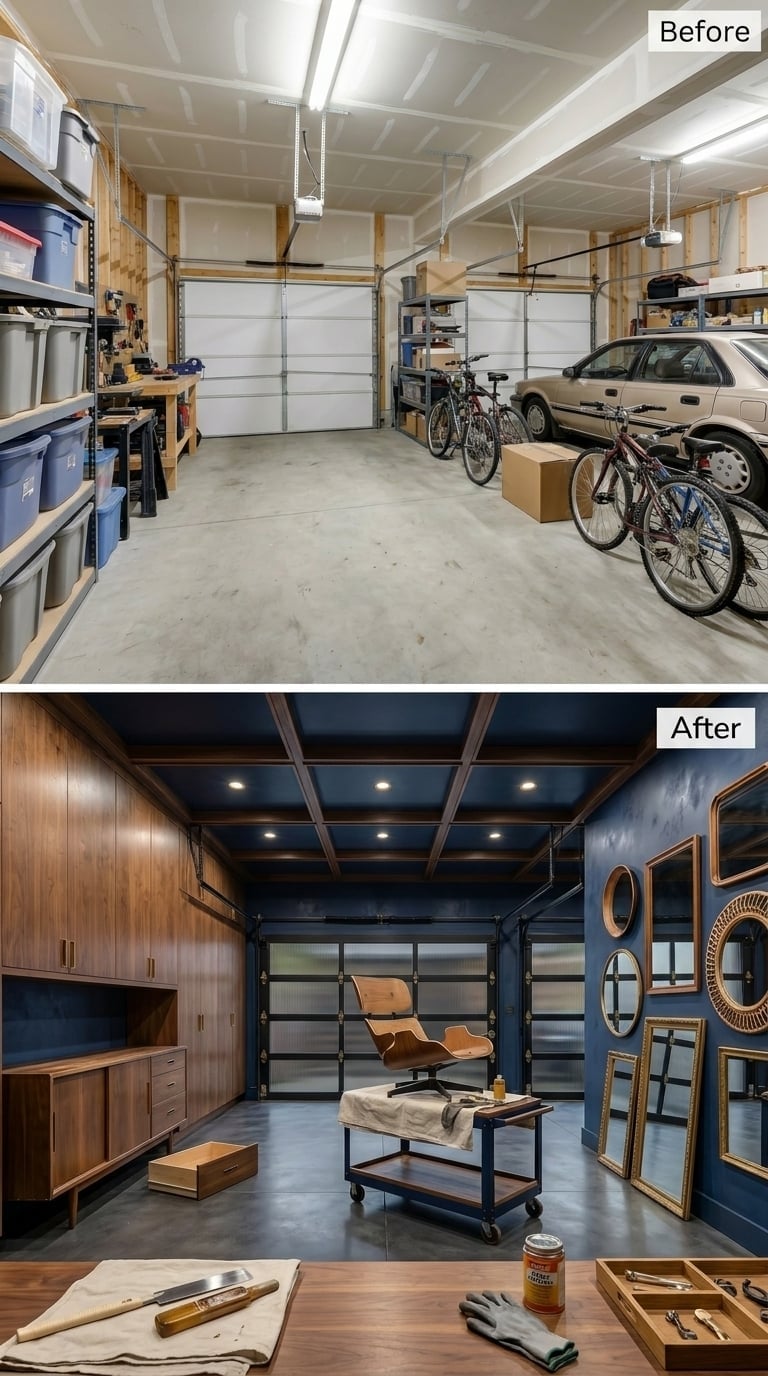
Painting a garage ceiling navy and framing it with dark wood beams is the single fastest way to make a two-car space feel intentional.
Walnut cabinetry runs the full left wall, and the drawer pulls are kept so minimal they almost disappear into the grain. The garage door itself got replaced with a glass-panel industrial unit that floods the space with diffused light without killing the moody atmosphere. On the right wall, a gallery of mirrors in mismatched gilt and rattan frames does double duty: functional staging for pieces mid-flip, and it photographs like a finished showroom. A leather lounge chair on a rolling cart sits front and center, ready to be repositioned or shot at a moment’s notice. Polished concrete ties the floor together without competing with anything above it.
bold_hook: Mirrors are one of the most undervalued tools a furniture flipper can keep on hand. A single good mirror can anchor a vignette, make a narrow piece read as a focal point in photos, and sell a buyer on scale before they ever measure a wall. Keeping a rotating collection in the workshop means you’re always ready to stage, not scrambling.
11. Plum Plaster Walls and a Crystal Chandelier Give Two Bays a Baroque Showroom Identity
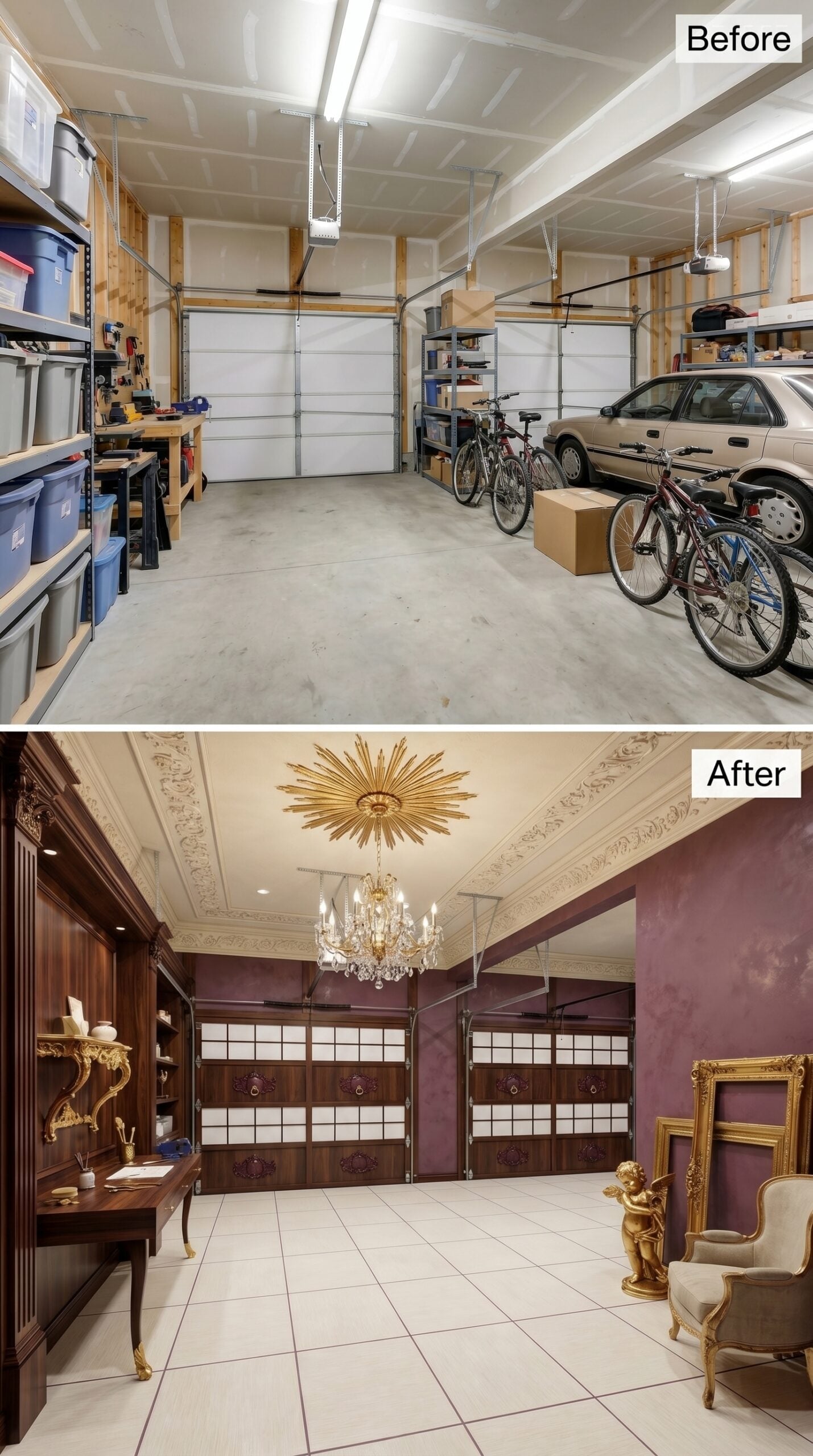
Dark mauve plaster coats the walls while white porcelain floor tile keeps the space from feeling heavy. The garage doors got a full makeover in dark wood paneling with inset frosted glass squares, so they read more like interior architecture than utility hardware. A sunburst medallion anchors the ceiling above a crystal candelabra chandelier, and an ornate gilt frame leaning against the wall signals exactly what kind of inventory gets sold here.
10. Concrete Plaster and Live-Edge Shelving Give One Bay the Identity of a Japanese Craft Studio
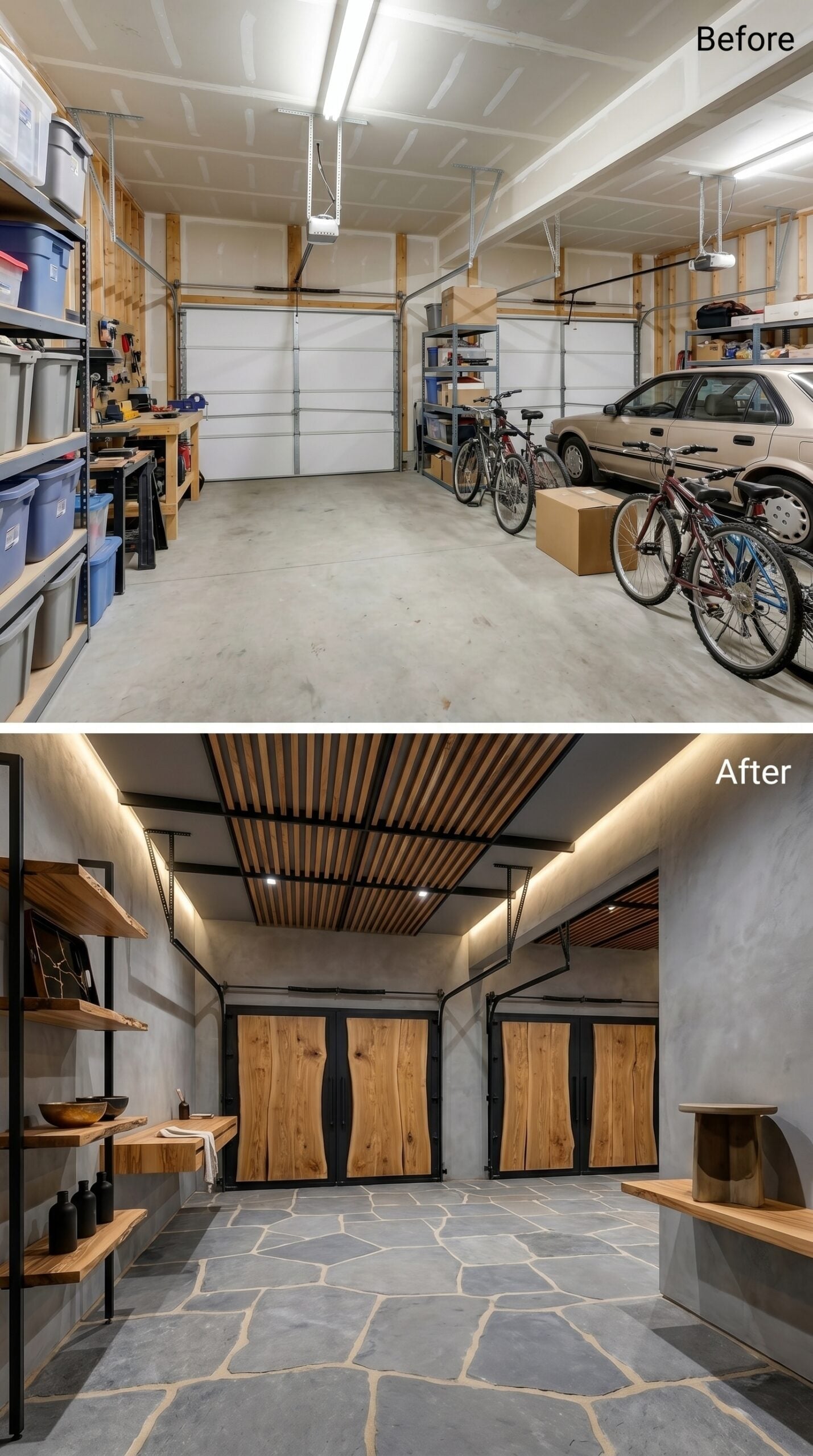
Troweled concrete plaster covers every wall surface, the color reading as cool ash in the ambient glow of cove lighting tucked along the ceiling perimeter. That ceiling detail alone earns its keep: wood slats run parallel between black steel beams, and recessed spots drop focused light onto the flagstone floor below.
The garage door got clad in raw oak panels framed by black steel, making it the visual anchor of the whole room. Live-edge shelving on iron brackets lines one wall, styled simply with a wood bowl and a few dark ceramic vessels. It photographs well. For a flipper, that’s the whole point.
Material Matters: Steel-framed live-edge shelving costs a fraction of built-in cabinetry, and it moves. When a space sells or a collection rotates, the brackets unbolt and the whole unit relocates to the next project without patching a single wall. That portability is what makes it one of the smarter investments a flipper can make in a staging setup.
A fair counterpoint for concrete fans: in spaces beyond the main rooms, images featuring concrete got fewer hearts from our readers than the other images in the same articles, 58% versus 68%.
9. Sunburst Mahogany Ceiling and Navy Tile Give Two Bays the Soul of a Private Members’ Club
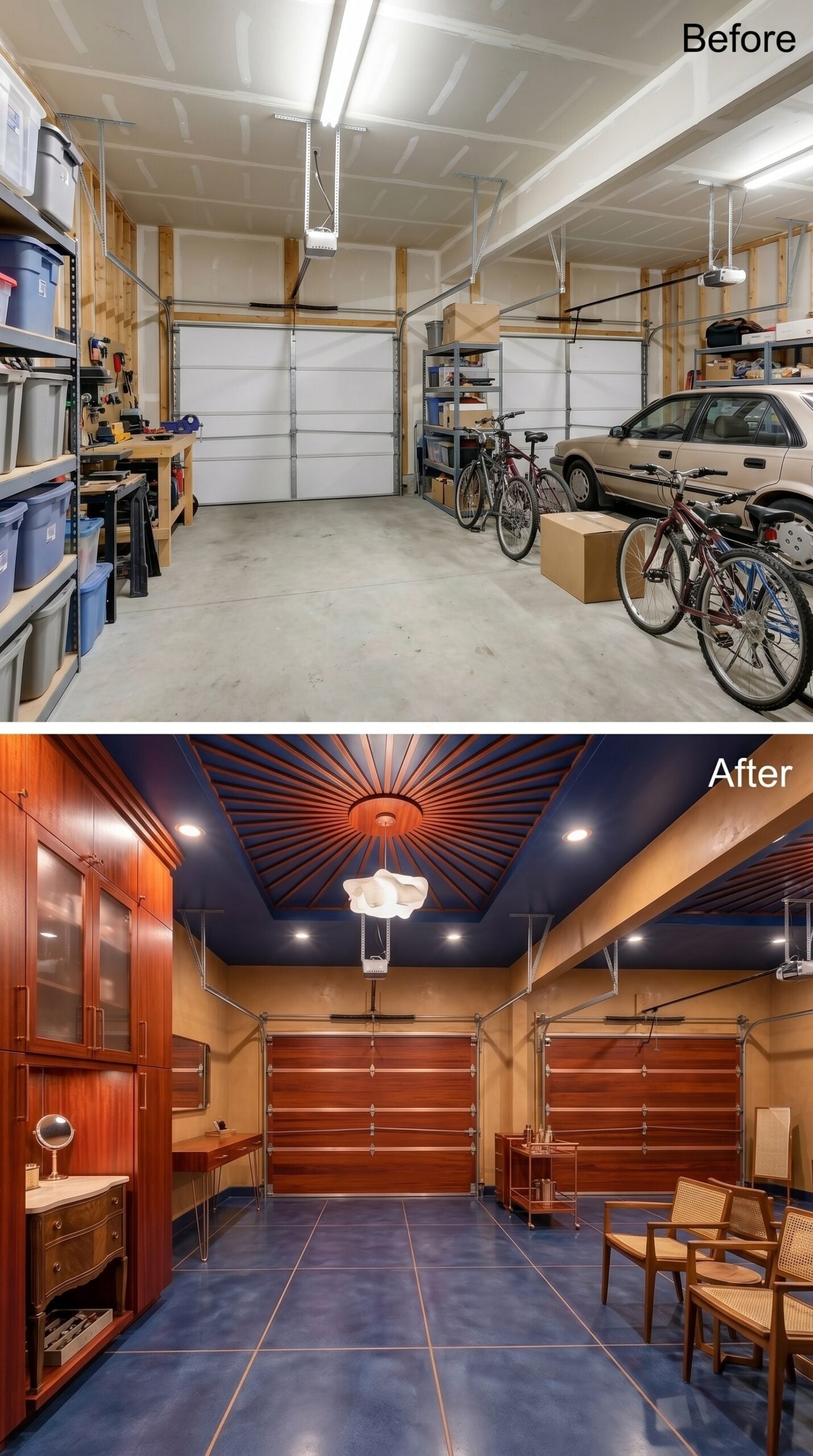
Radiating from a central medallion, the mahogany slat ceiling fans outward like a compass rose against a deep navy field. It’s the kind of architectural move that makes people stop before they even notice the furniture below. Glass-front cabinetry in the same warm mahogany lines the left wall, paired with a vanity dresser on hairpin legs.
The garage doors got clad in horizontal mahogany panels to match, so the whole room reads as one continuous material story. Navy porcelain tile floors, laid in a grid with copper-toned grout lines, anchor the space without competing. Cane-back chairs stage a natural corner on the right. Practical and genuinely atmospheric.
Cladding the garage doors in the same wood as the ceiling is the move that makes everything else click.
8. Stone Floors and Gothic Garage Doors Turn One Bay Into a Flipper’s Medieval Workshop
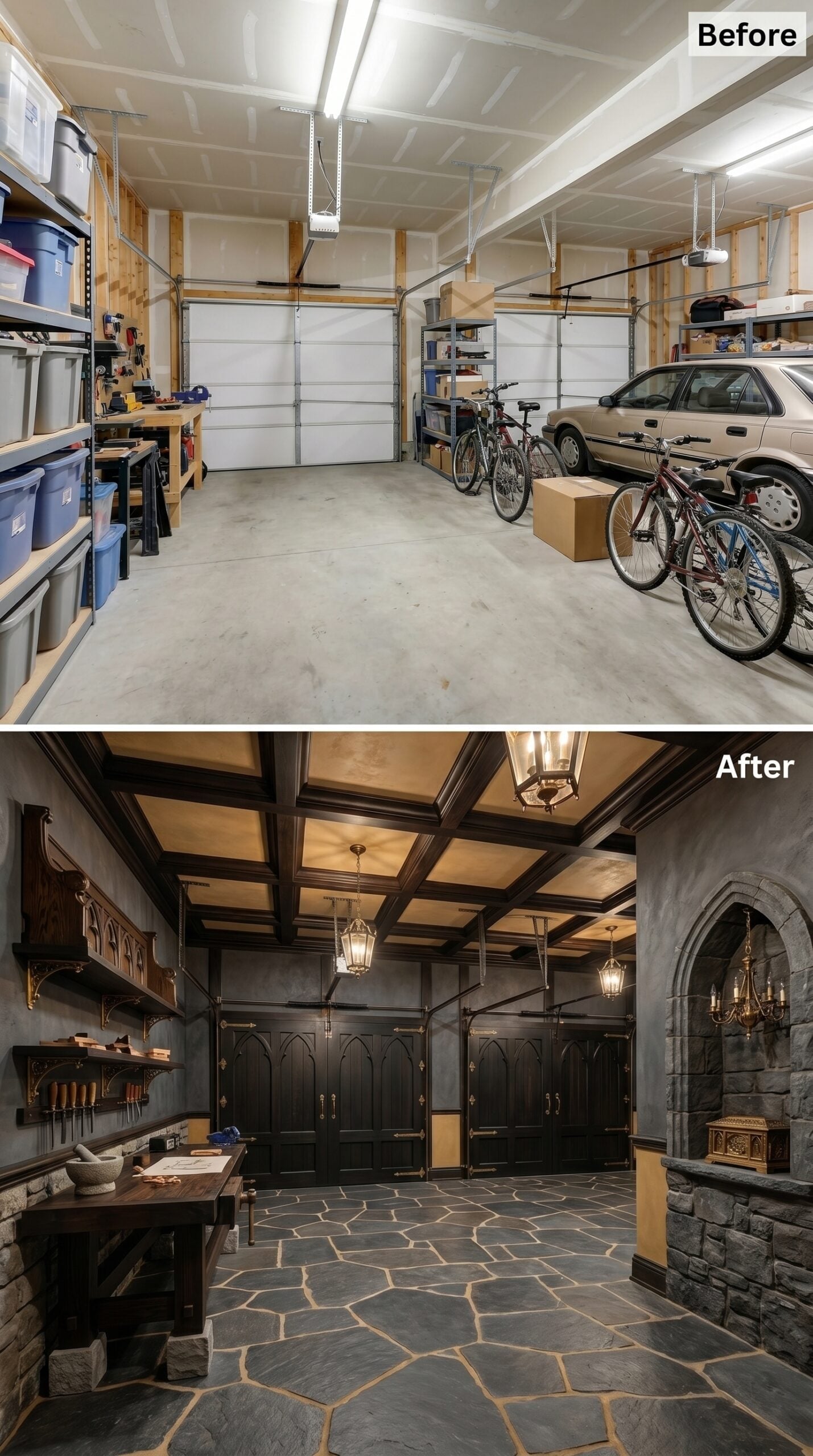
Irregular slate flagging covers the floor, and the garage doors have been clad in dark-stained wood with pointed arch panels and brass hardware. Pendant lanterns hang from a coffered ceiling. It’s a serious workspace dressed like a castle.
7. Blush Plaster Walls and a Crystal Chandelier Give Two Bays the Soul of a Grand Hotel Foyer
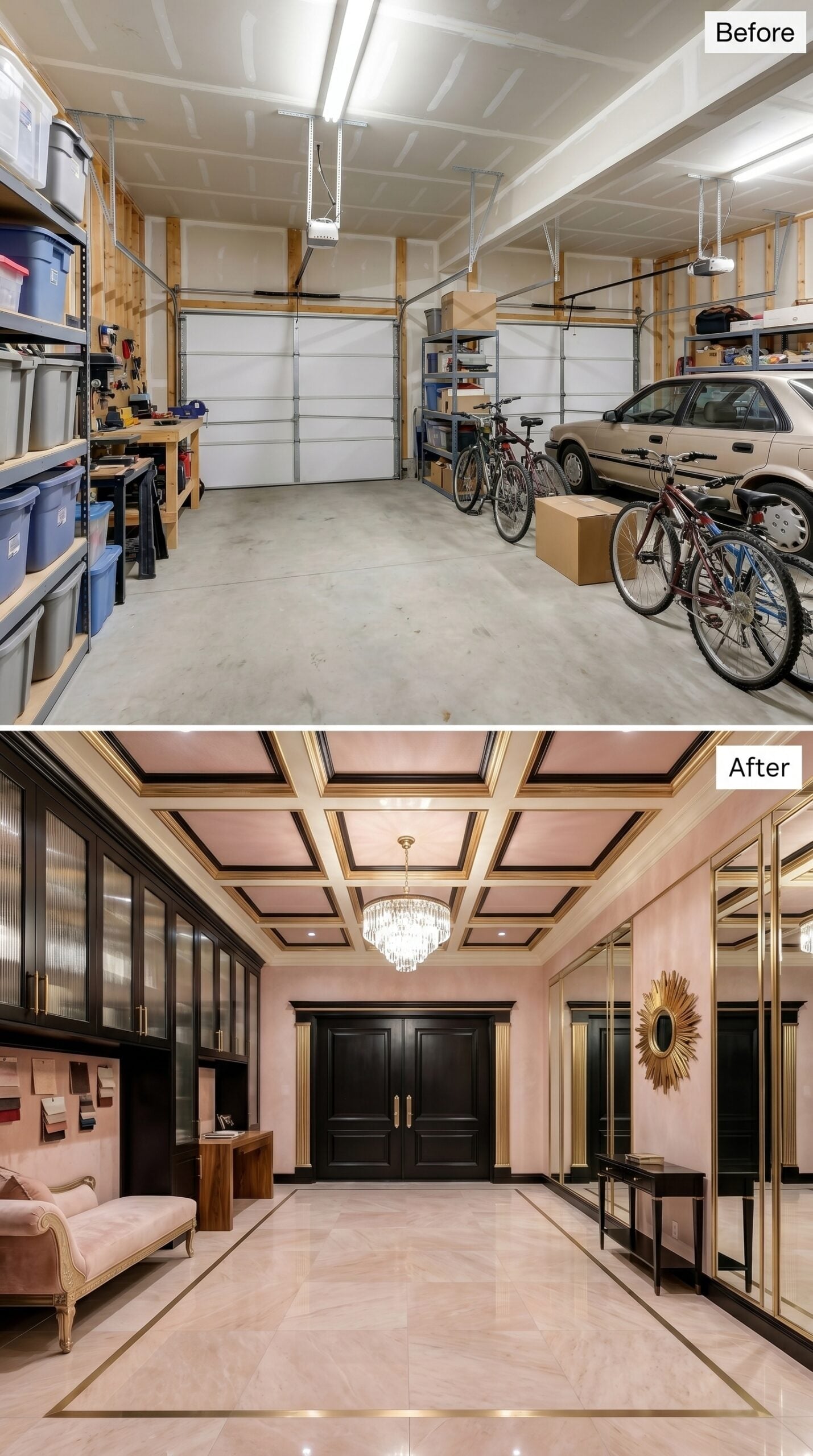
Coffered ceilings finished in blush pink with dark walnut trim and gold inlay set the register immediately. The crystal chandelier anchors the room’s center, and the cream marble tile floor with brass border detailing pulls the eye straight toward the double doors.
6. Polished Concrete and Zebrawood Slat Doors Give Two Bays a Serious Craftsman’s Identity
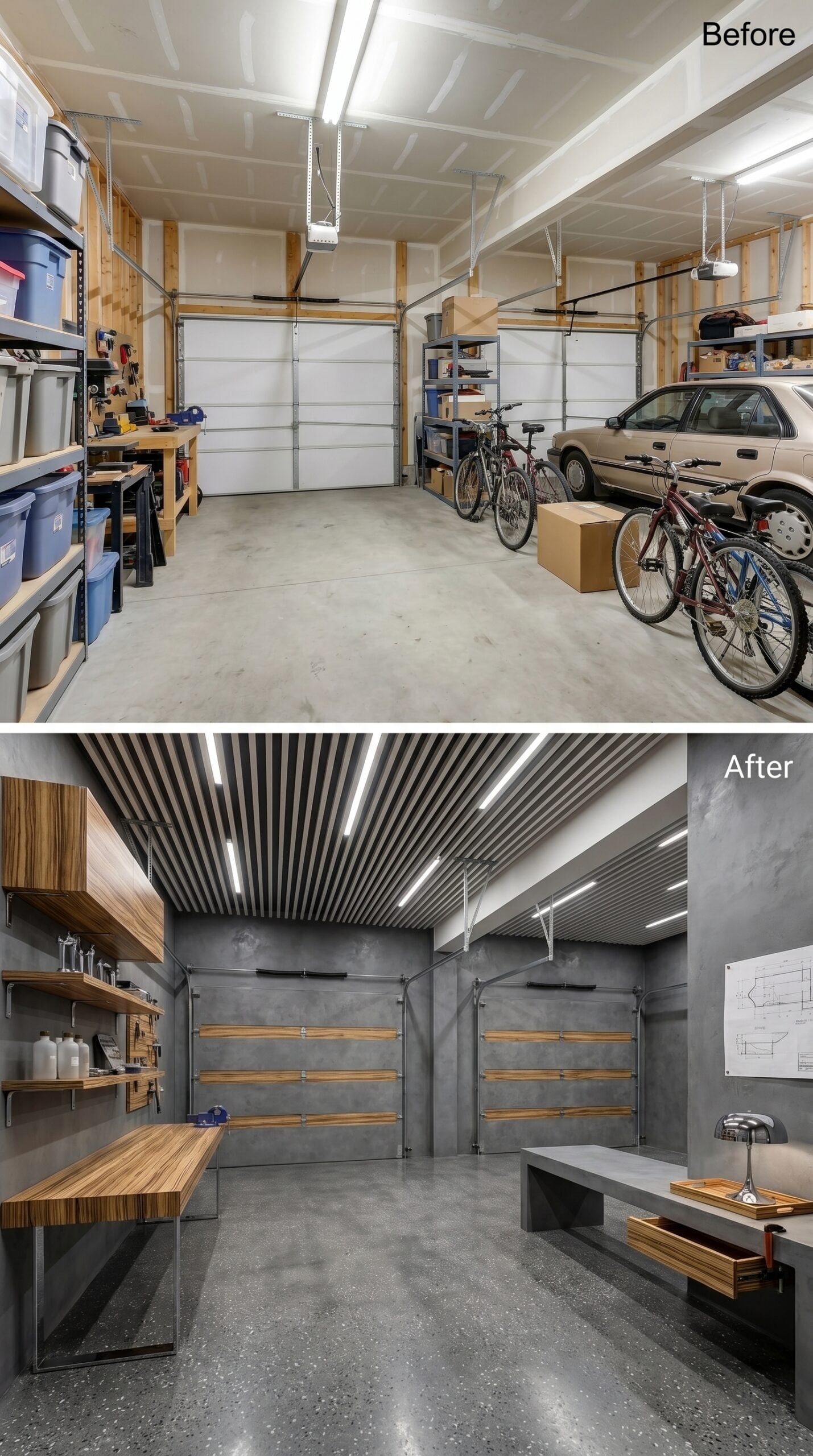
Recessed linear LEDs run the length of a ribbed metal ceiling, casting even light across grey polished concrete floors that make every wood grain pop. The garage doors got clad in zebrawood slats, and that one decision does more visual work than anything else in the room.
5. Herringbone Brick and Barn-Style Doors Give One Bay the Soul of a Tuscan Carriage House
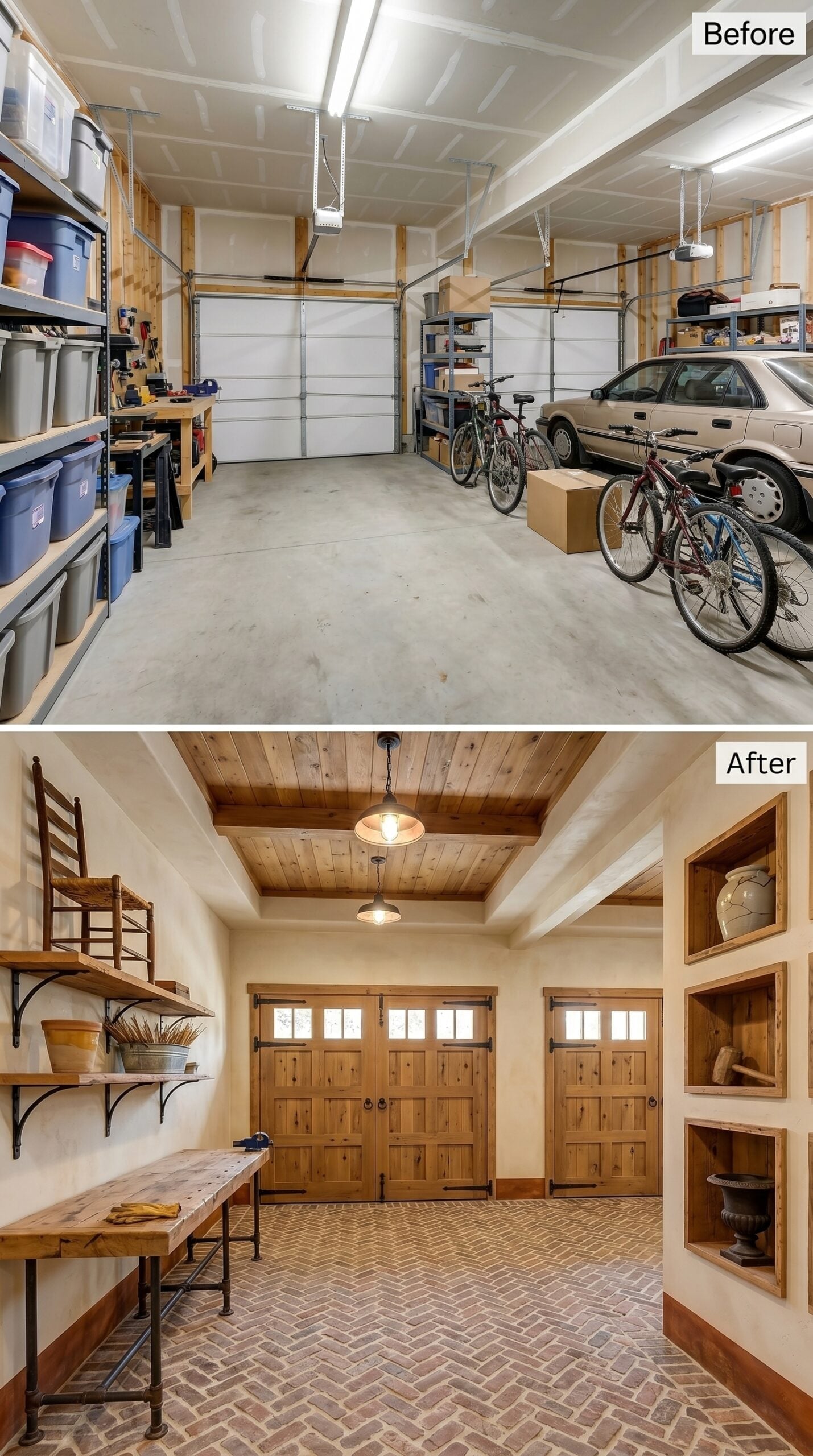
Handlaid brick pavers in a herringbone pattern cover the entire floor, and that single material choice sets the tone for everything above it. Plastered walls in warm cream pull light from a bare-bulb pendant hung on a black rod, and the wood-planked ceiling ties back to the pair of knotty alder barn doors below it. Those doors are the room’s anchor.
Built-in shadow boxes recessed into the right wall give a flipper somewhere to stage smaller pieces without pulling floor space. The butcher-block worktable on iron pipe legs does double duty: functional enough for stripping and finishing, but it photographs like furniture. Brick floors age into whatever the space needs them to become, and they handle heavy loads without complaint.
4. Warm Plaster Walls and a Coffered Wood Ceiling Give One Bay the Soul of a Tuscan Carriage House
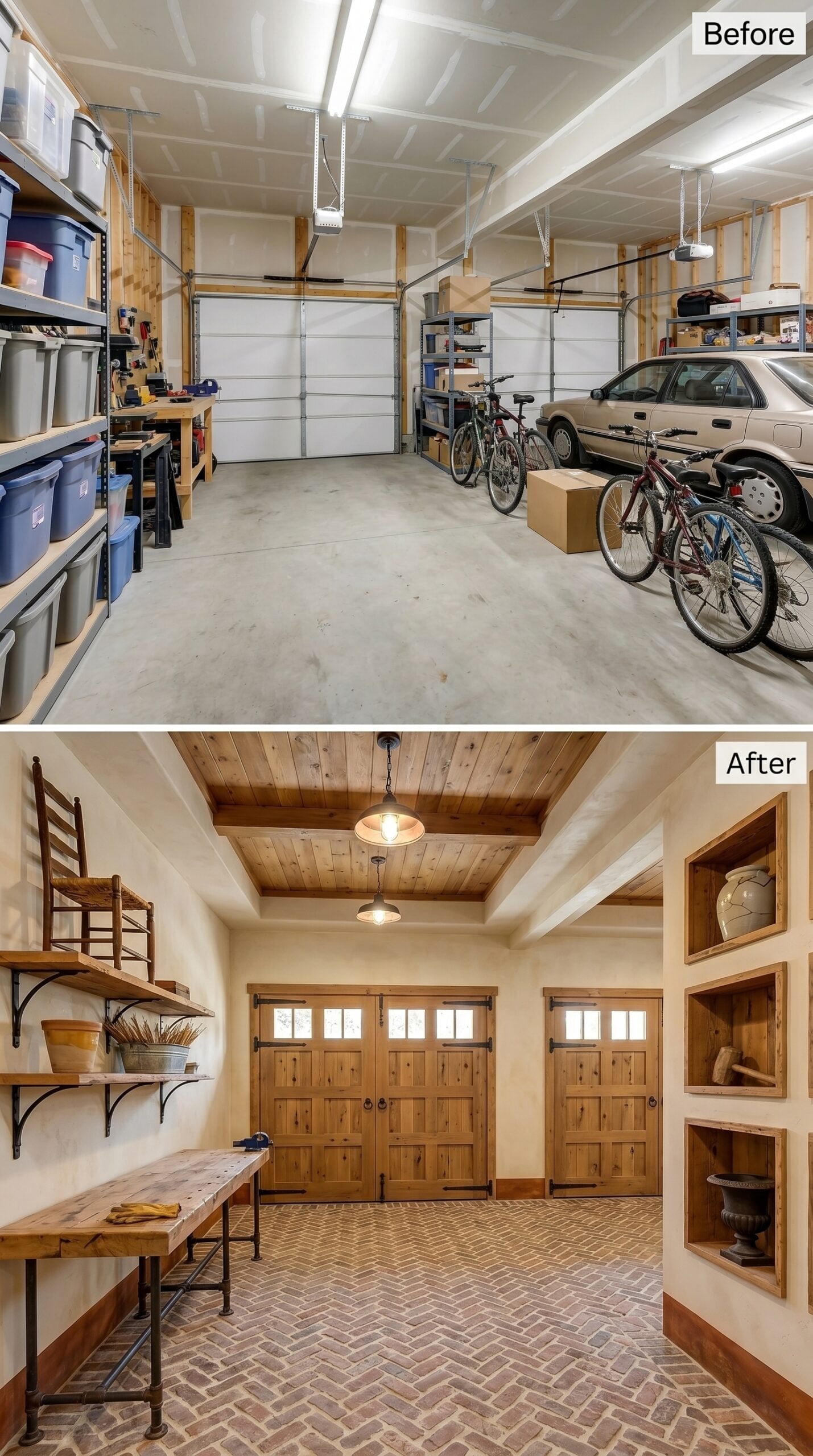
Tongue-and-groove planking lines both the ceiling and the beam coffers overhead, the warm honey tone of the wood pulling the eye upward in a space that could easily feel low. Below it, the walls are finished in a smooth cream plaster that reads almost like limewash. Herringbone brick covers the floor, and it’s the kind of material choice that actually ages better with furniture traffic than polished concrete ever would.
Built-in display niches are cut directly into the right wall at three heights, framing a ceramic vessel and a cast urn without any shelving hardware visible. A butcher-block worktable on iron pipe legs runs the full length of the left wall. The barn-style doors are solid knotty alder, hung on black strap hardware, with small divided-light windows at the top. For a flipper, those doors are the whole pitch.
For a flipper, those doors are the whole pitch.
3. Cobalt Epoxy Floors and a Living Moss Wall Give Two Bays a Collector’s Gallery Identity
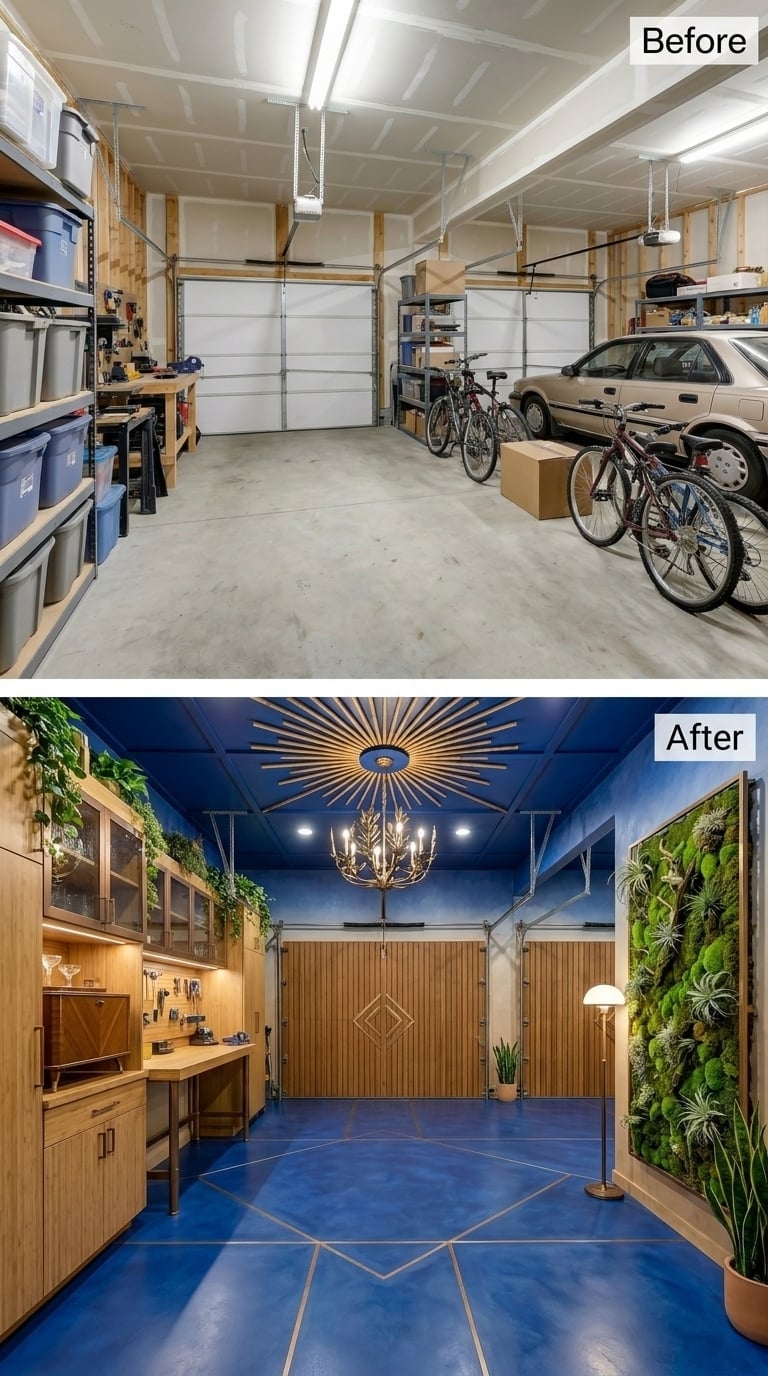
Royal blue epoxy covers every inch of the floor, scored with brass inlay lines that form a diamond grid across the full footprint. The garage doors are still functional, clad in vertical wood slat panels with a diamond-inlay detail at center — hiding hardware in plain sight behind something that reads as furniture.
Warm oak cabinetry lines the left wall, lit from beneath with strip lighting. On the right, a floor-to-ceiling moss and air plant installation anchors the room the way a large painting would. The chandelier is botanical bronze, loosely branched, hanging under a sunburst ceiling medallion. A moss wall that size functions as a ready-made backdrop for resale photography — no styling required, just good light.
For flippers photographing pieces for resale, the moss wall alone functions as a ready-made backdrop that doesn’t need to be styled.
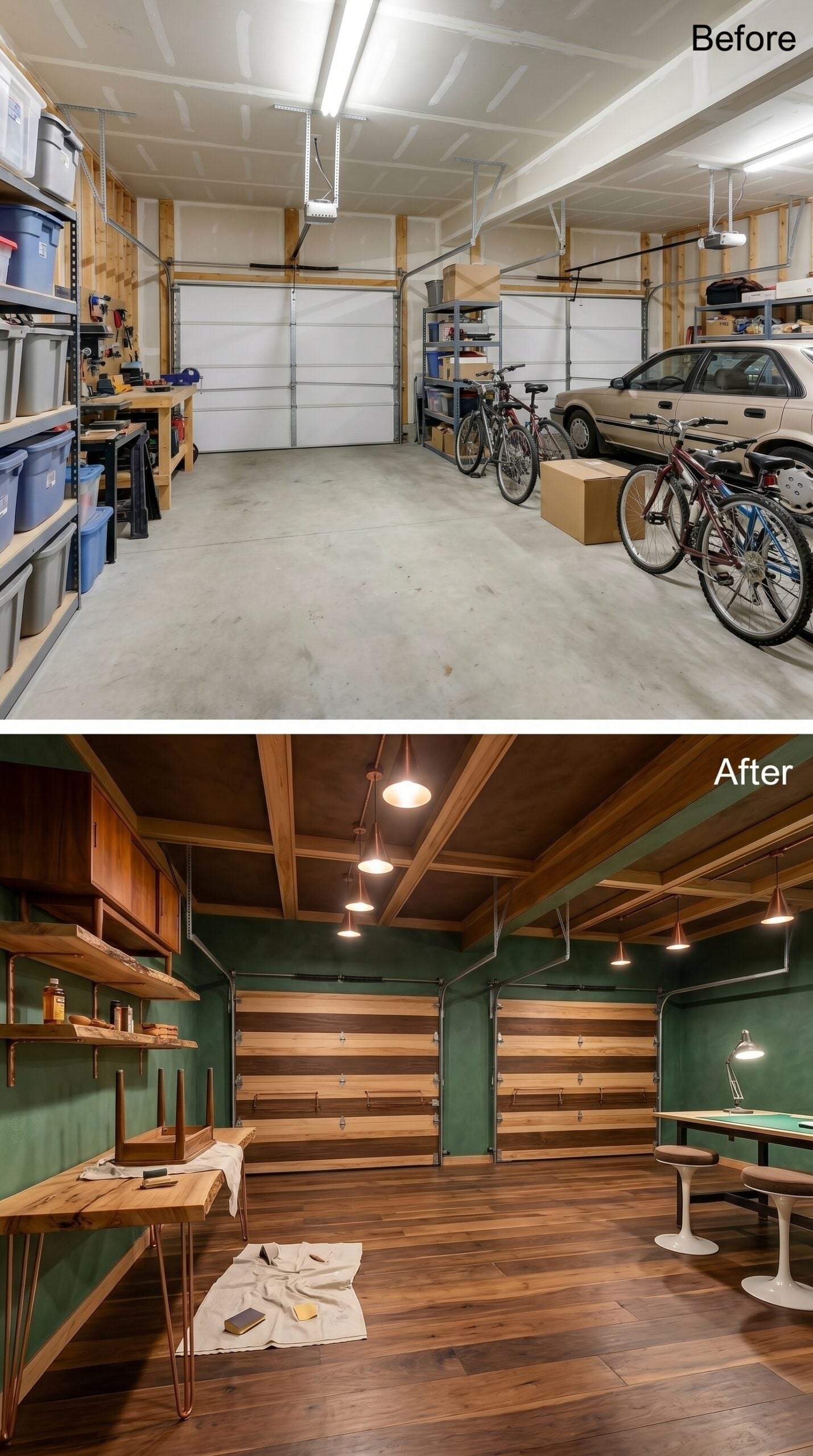
2. Forest Green Walls and Hardwood-Clad Doors Give Two Bays a Craftsman Studio’s Quiet Authority
🔥 Would you like to save this?
Deep forest green plaster wraps all four walls, and the warmth it creates against natural wood is hard to argue with. Exposed ceiling beams in stained cedar run the full length of the space, and pendant lights on copper-tone cords hang low enough to actually illuminate work surfaces. The garage doors are clad in horizontal hardwood strips, grain-matched closely enough that they read as paneling rather than doors.
Hairpin-leg workbenches in raw pine anchor the left side, paired with open steel-bracket shelving holding finishing supplies. A long drafting-style table on the right sits beside a pair of tulip stools. Wide-plank hardwood flooring ties it together. Flippers staging pieces here should know that pendant placement matters: a light hung directly over a chair or table tells a camera where to look, which is half the battle in resale photography.
1. Charcoal Plaster Walls and Slatted Oak Doors Give One Bay the Identity of a Master’s Atelier
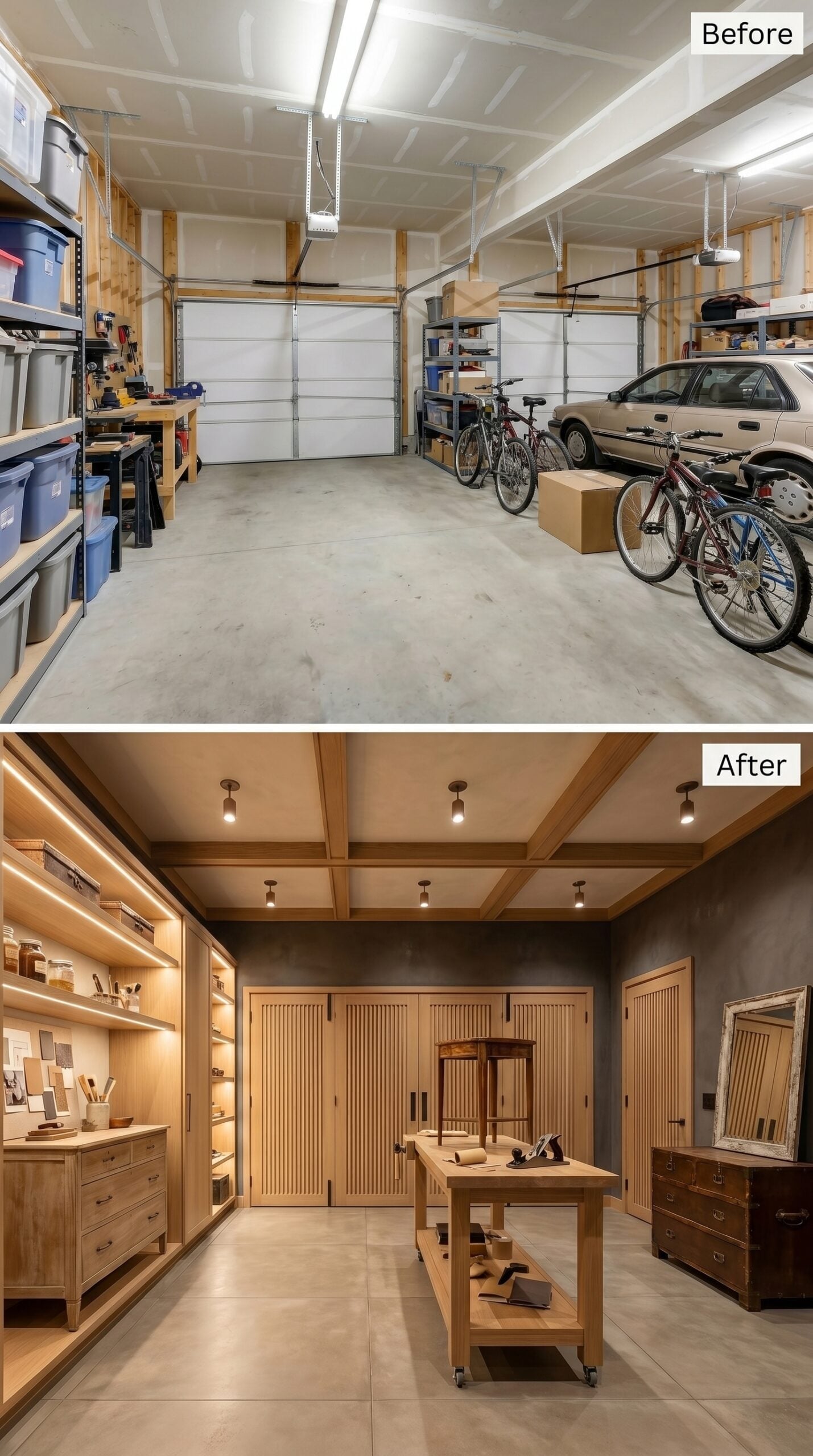
Warm oak runs through every surface: the coffered beam ceiling, the built-in shelving with integrated LED strips, the tall slatted panel doors, and the long workbench centered on the floor. That material consistency is what makes the space feel intentional rather than assembled. Charcoal plaster walls push all that wood forward, and the result is something closer to a Japanese joinery studio than a garage conversion.
A flipper working here has real infrastructure. The lit shelving keeps restoration supplies visible and organized without a plastic bin in sight. Tile flooring replaces bare concrete. And the ornate mirror on the right wall is doing active work, giving clients somewhere to imagine a finished dresser living.