🔥 Would you like to save this?
If you have ever sat in a perfectly staged minimalist living room and felt, somehow, colder for being in it, you already understand the problem. So we took one modern room—all black steel, concrete, glass and charcoal upholstery—and gave it 29 entirely different French Country futures.
In order to come up with the very specific design ideas, we create most designs with the assistance of state-of-the-art AI interior design software. Also, assume links that take you off the site are affiliate links such as links to Amazon. this means we may earn a commission if you buy something.
The experiment isn’t simply gray versus cream or steel versus wood. Each redesign asks a different question. What happens when toile replaces blank walls? When velvet replaces the sectional? When timber, terracotta, Delft tile, painted trim or a roaring fireplace gets to set the mood instead?
Same cold modern starting point. Twenty-nine warmer endings, ranging from faded farmhouse restraint to purple velvet, gilded boiserie and chandeliers that have absolutely no interest in behaving themselves.
29. Cold Steel and Concrete Gave Way to Herringbone Oak and Crystal Candlelight
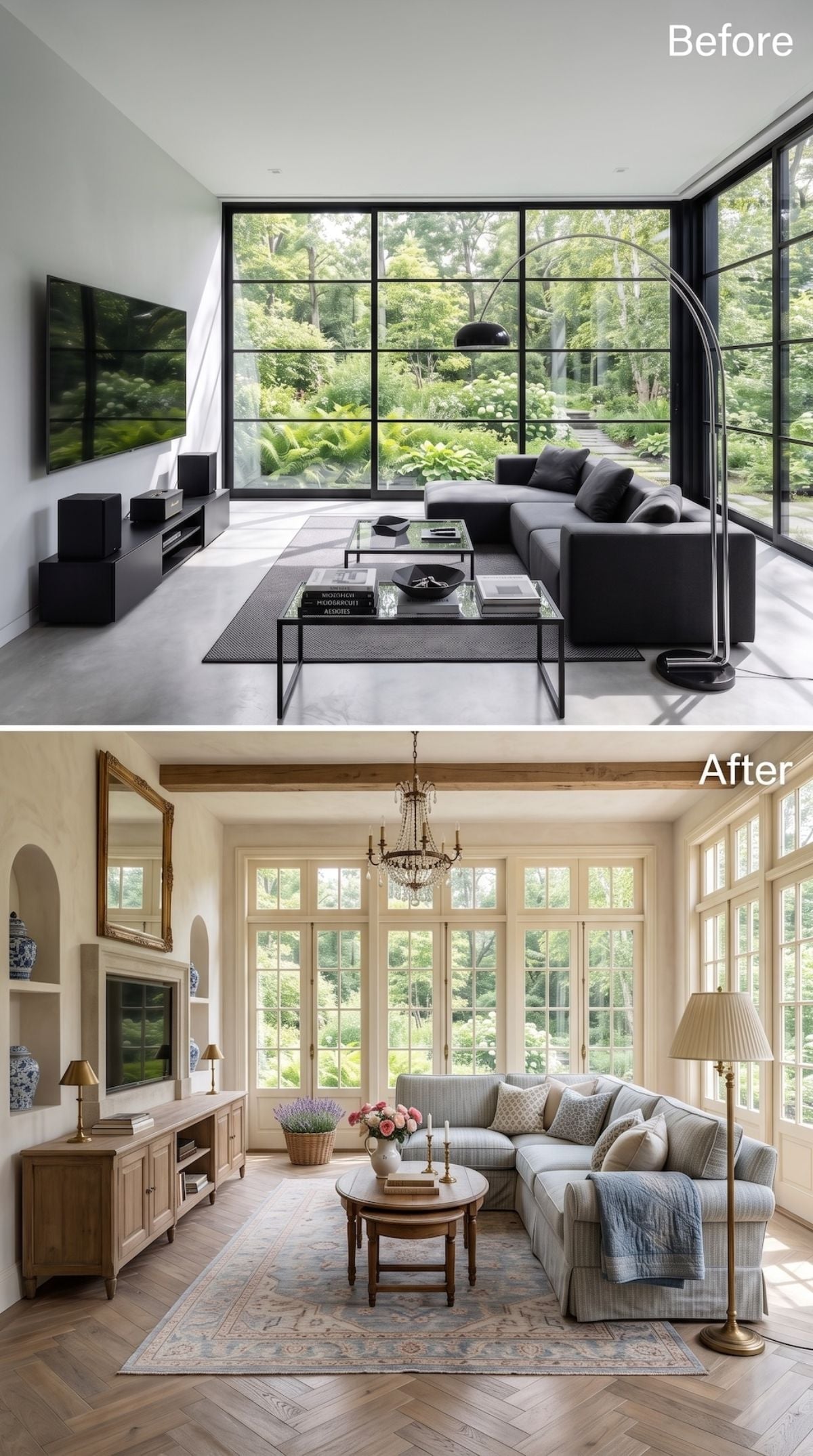
The starting room had all the warmth of an exceptionally expensive waiting area. Its black-framed glass, charcoal sectional and broad concrete floor were beautifully disciplined and almost aggressively unwilling to relax.
Whitewashed plaster, exposed ceiling beams and warm oak underfoot immediately soften the architecture. A crystal-beaded chandelier replaces the looming arc lamp, while striped linen and an antique-style rug bring pattern down to human height. The room hasn’t merely become more decorative. Its whole emotional register has shifted.
28. Delft Tile and Olive Velvet Found the Warmth Hiding in Those Modern Bones
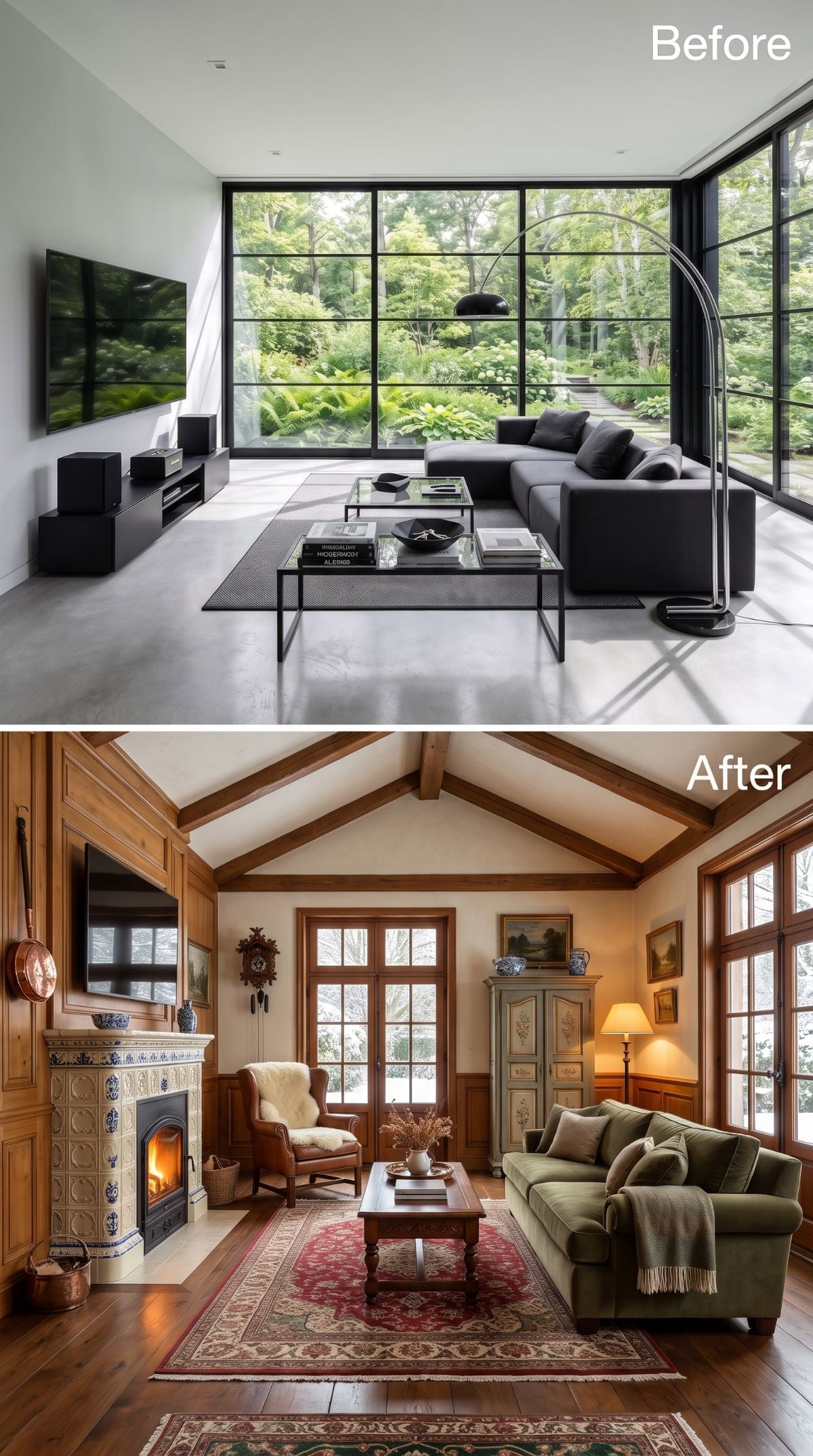
Sometimes the coldest rooms have the best bones hiding underneath.
This version makes its case with color before anything else. Olive velvet replaces charcoal upholstery, a crimson-and-cream rug cuts across the pale floor and a weathered sage armoire brings in the sort of imperfect painted finish modernism tends to leave at the door.
Then comes the blue-and-white Delft-style fireplace. Against exposed timber rafters, it feels collected rather than themed. Nothing is matching for the sake of matching, which is precisely why the room looks as though it has been evolving for years.
27. Crystal Chandeliers and Purple Velvet Took Over Where Black Steel Left Off
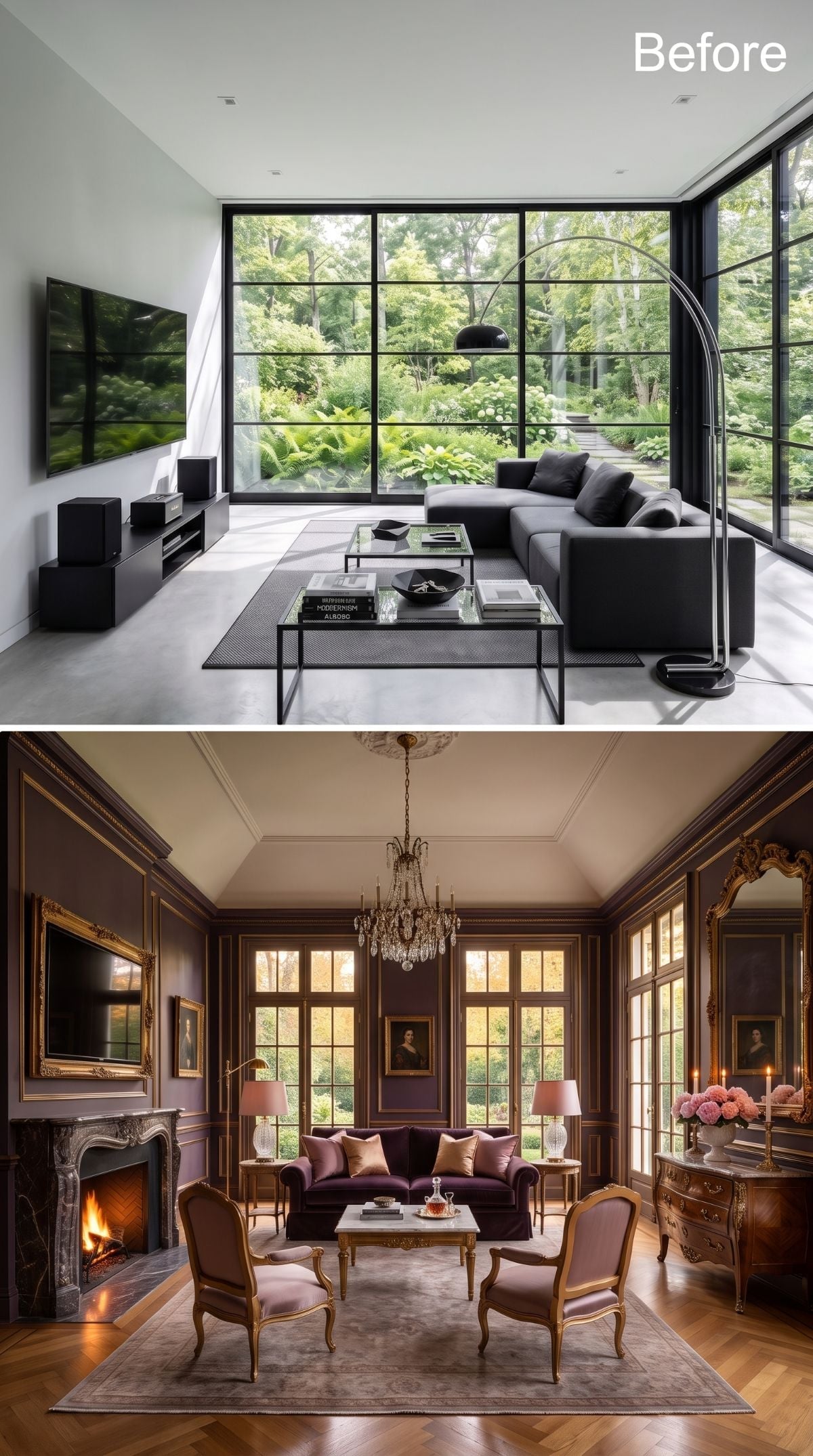
Minimalism exits rather decisively here. Dark wood paneling wraps the walls, a carved marble hearth takes over the focal point and a purple velvet sofa lands in the middle like someone finally admitted beige was optional.
Blush upholstery, gilt portrait frames and a low crystal chandelier turn the seating area inward. That’s an important shift: the original room was organized around its architecture and garden view; this one is organized around the people sitting inside it.
- Low-hung decorative lighting makes a tall room feel more intimate
- Velvet introduces depth through sheen rather than added pattern
- Dark paneling can feel warmer than pale drywall when paired with layered textiles and focused light
26. Concrete and Black Steel Surrendered to Terracotta, Leather, and Exposed Stone
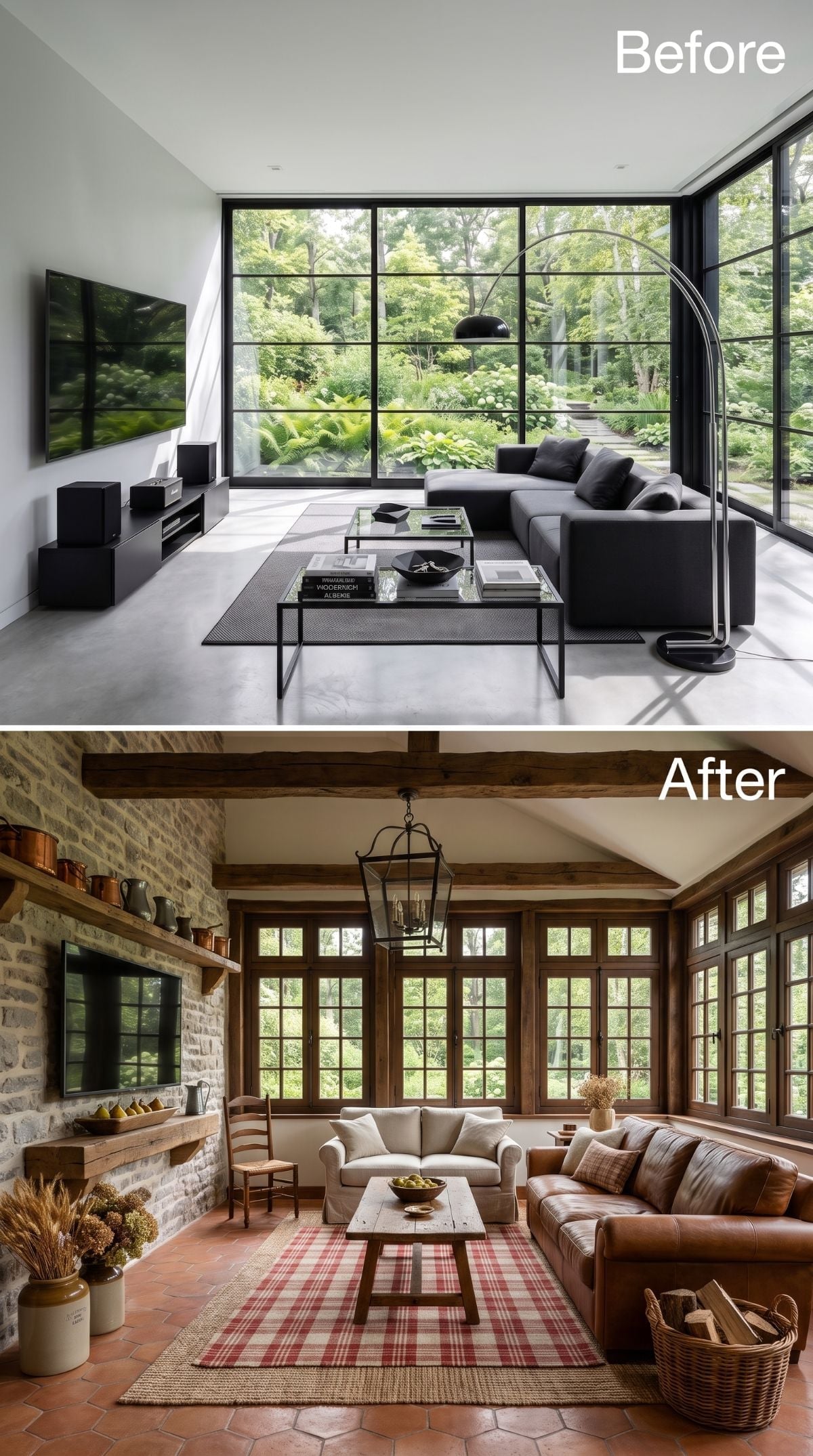
Terracotta hexagon tile changes the temperature of this version before the cognac leather sectional even gets involved. Add a plaid wool rug, full-height limestone and oak beams crossing the vaulted ceiling, and suddenly the garden view feels attached to a house rather than displayed behind glass.
The cognac matters. Chocolate brown could have pulled the room straight back toward heaviness; this warmer leather stays in conversation with the floor and stone. Even the wrought-iron lantern understands its assignment: structure without sterility.
25. Toile Wallpaper Turned an Empty Shell Into a Room With Stories
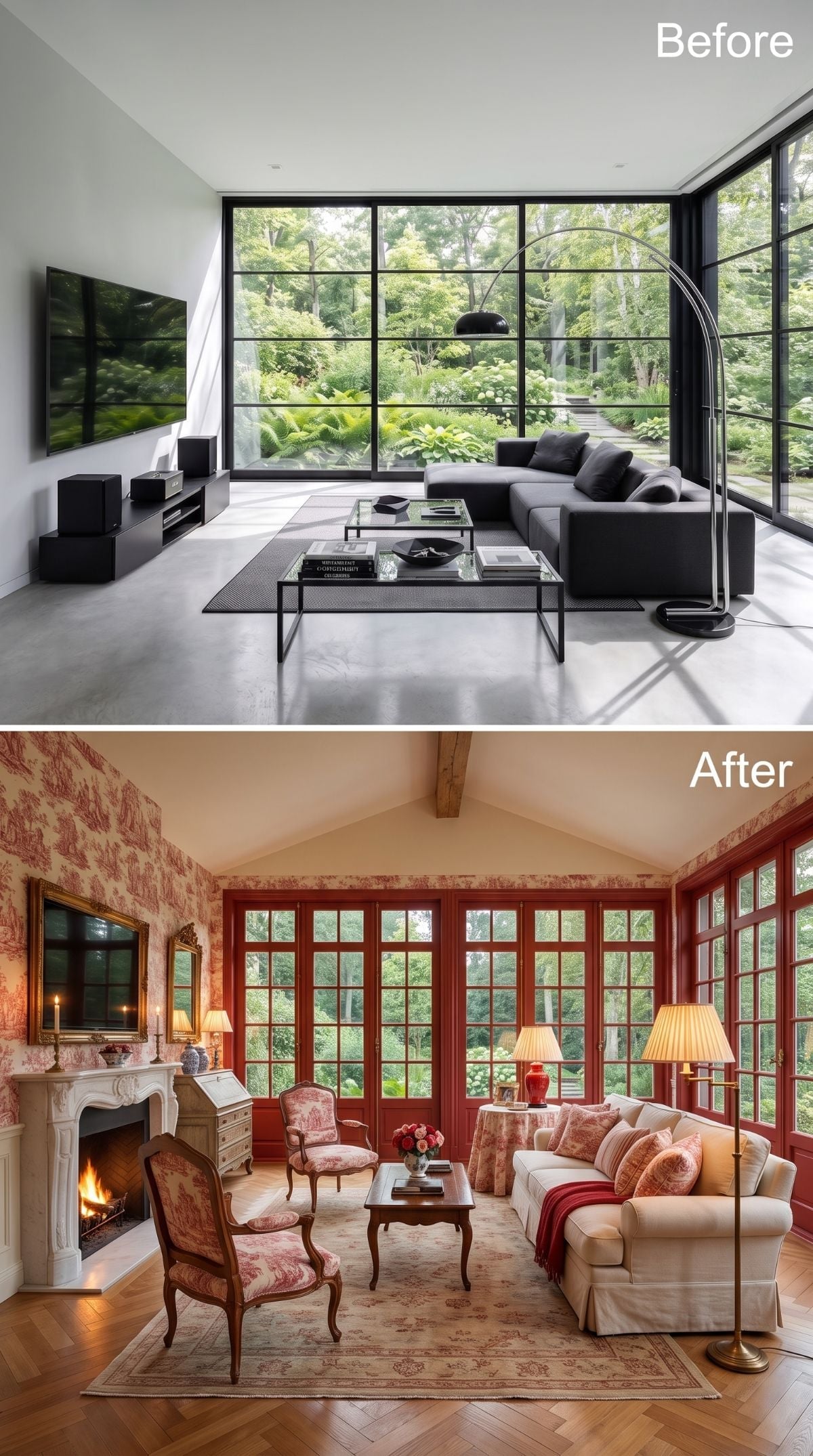
Red-and-cream toile climbs from baseboard to roofline and immediately makes the room feel busier, older and far more alive. That sounds like a lot until the rest of the palette shows remarkable discipline.
Off-white linen quiets the window wall. Louis XV-style chairs repeat the toile without turning it into a matching-set exercise. Red-painted French doors frame the garden, while warm table lamps replace the original arc fixture. Instead of admiring huge uninterrupted planes, the eye now has a hundred smaller places to stop.
Why It Works: Small-scale pattern can make a large room feel more intimate because it introduces detail at eye level. Toile is especially effective when its palette is repeated selectively rather than copied across every surface.
24. Black Steel and Dark Sectionals Traded for Shiplap, Chinoiserie, and Warm Oak
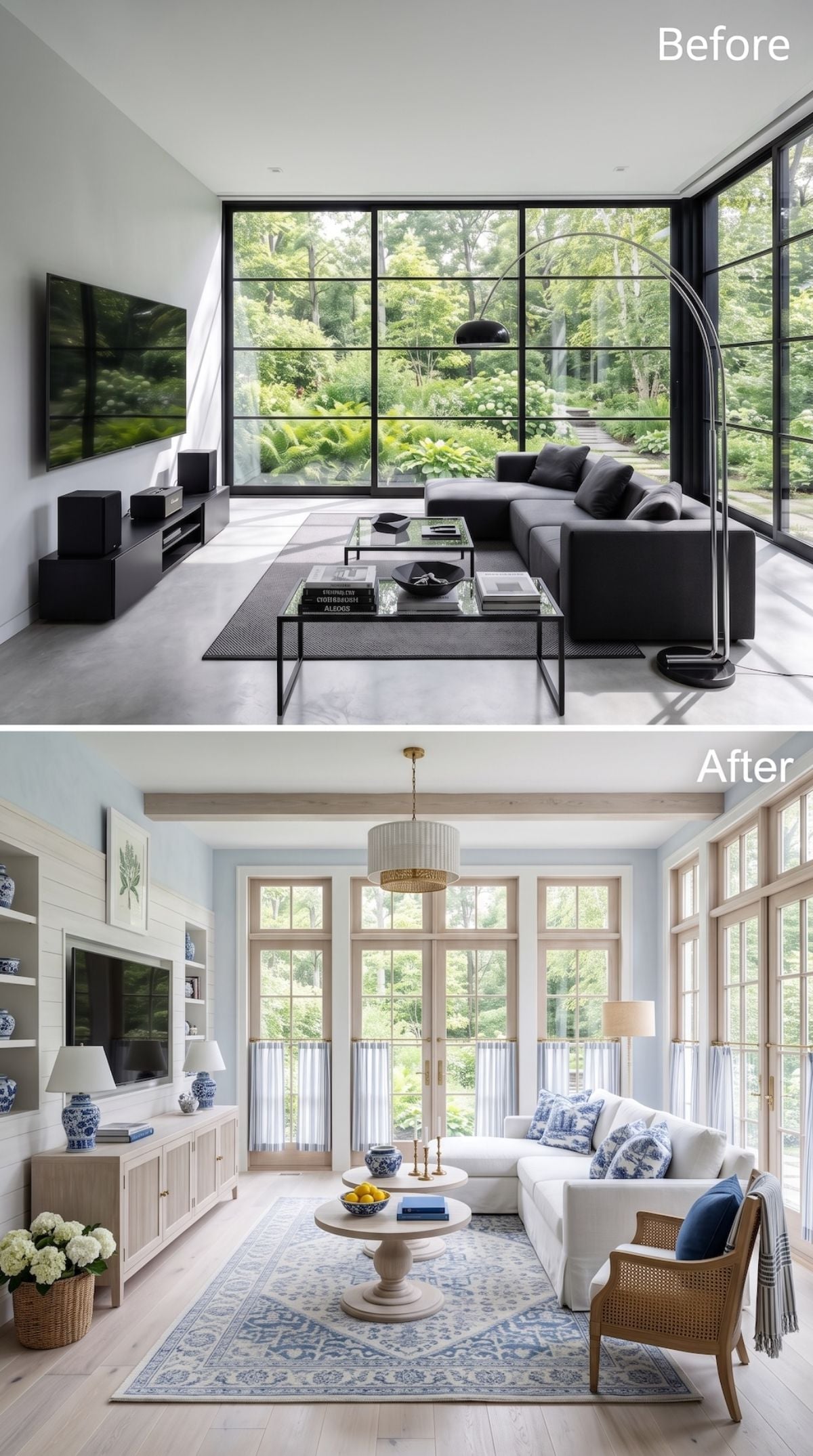
Blue-and-white ginger jars give the shelving a reason to exist beyond storage, while sheer curtains soften the hard perimeter of the glazing. Pale stone at the center table keeps the room grounded without introducing another dark block of furniture.
This is a quieter French Country answer than some of the others. No theatrical hearth, no scarlet upholstery, no ceiling full of beams. Instead, warmth arrives through objects, texture and the simple decision to let the windows wear fabric again.
23. Powder Blue Paneling Made Restraint Feel Far More Interesting
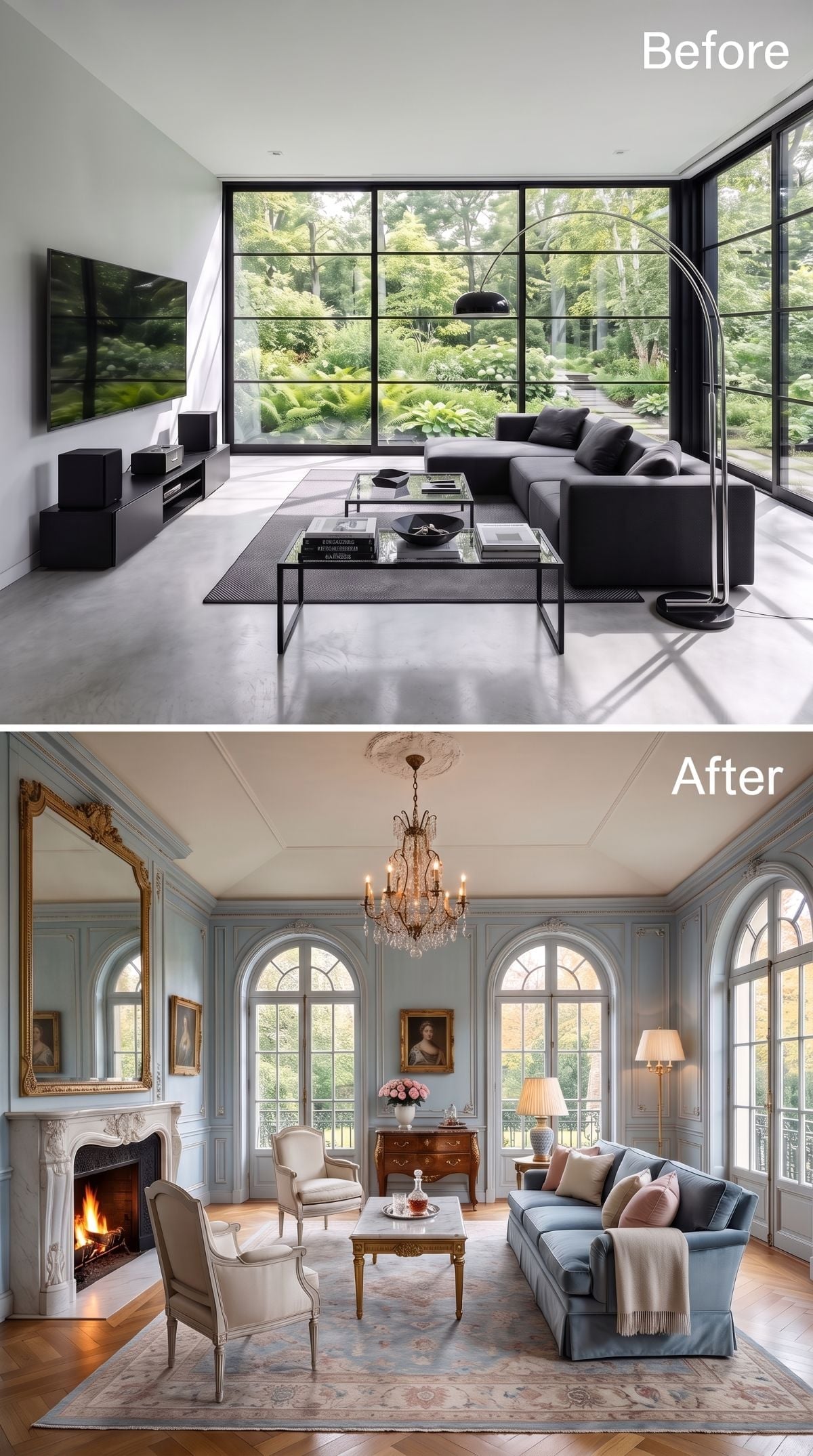
Pale blue-gray paneling covers the walls in deep profiles that create actual shadow, giving a formerly flat room architecture without making it darker. A carved marble fireplace sits beside an oversized gilt mirror, and suddenly the eye has somewhere to go besides the windows.
Dusty blue velvet and cream linen keep the furniture within the same cool family, but candlelight, wood and brass stop the palette from slipping back toward the chill of the starting room. Even the roses on the side table seem to understand that the space needed punctuation, not another major statement.
22. Rough Stone, Timber Beams, and Firelight Gave the Room Some Gravity
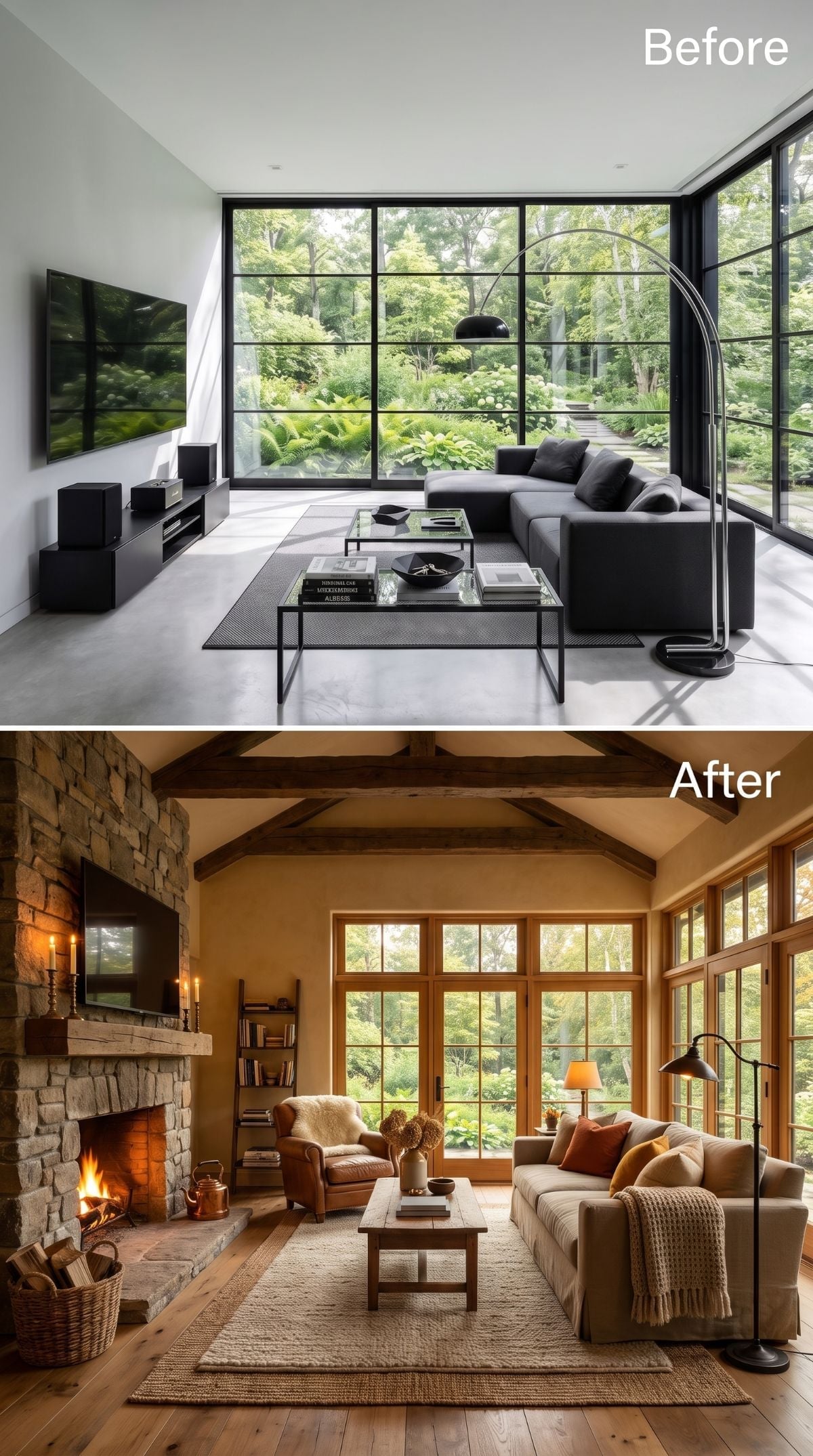
Wide-plank oak takes over below, fieldstone climbs the fireplace wall and timber trusses pull visual weight upward. This after doesn’t merely look warmer; it feels more substantial, as though the room has finally acquired a center.
Why the Fireplace Surround Changes Everything
Rough stone reads as part of the building rather than an accessory applied to it. That gives the television above the firebox far less authority than it had against the original bare wall. The screen remains, but now it’s one rectangle inside a much larger composition of masonry, timber and flame.
21. Sage Trellis Walls and a Pagoda Lantern Refused to Play It Safe
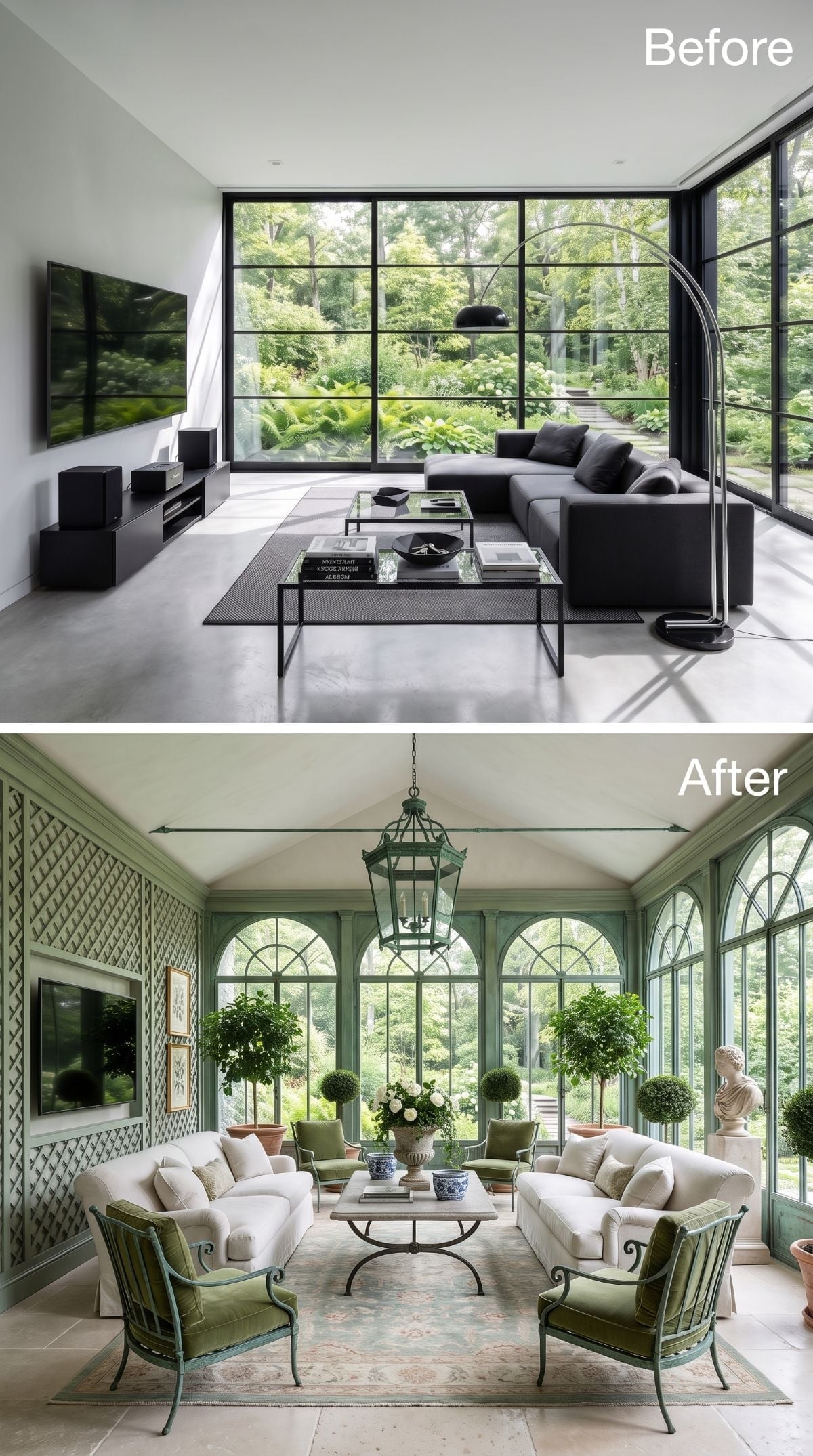
Painted sage trellis covers the walls floor to ceiling, turning the enclosure itself into decoration. A wrought-iron pagoda lantern carries the eye upward while arched windows loosen the rigid geometry of the original room.
White linen sofas prevent all that pattern from becoming theatrical, and scrolled green chairs repeat the wall color without mimicking the trellis. French Country has always been happiest when it borrows freely, and the Chinoiserie influence here keeps the look from becoming predictable.
20. Pale Yellow Walls Made This Room Look Like It Had Finally Seen the Sun
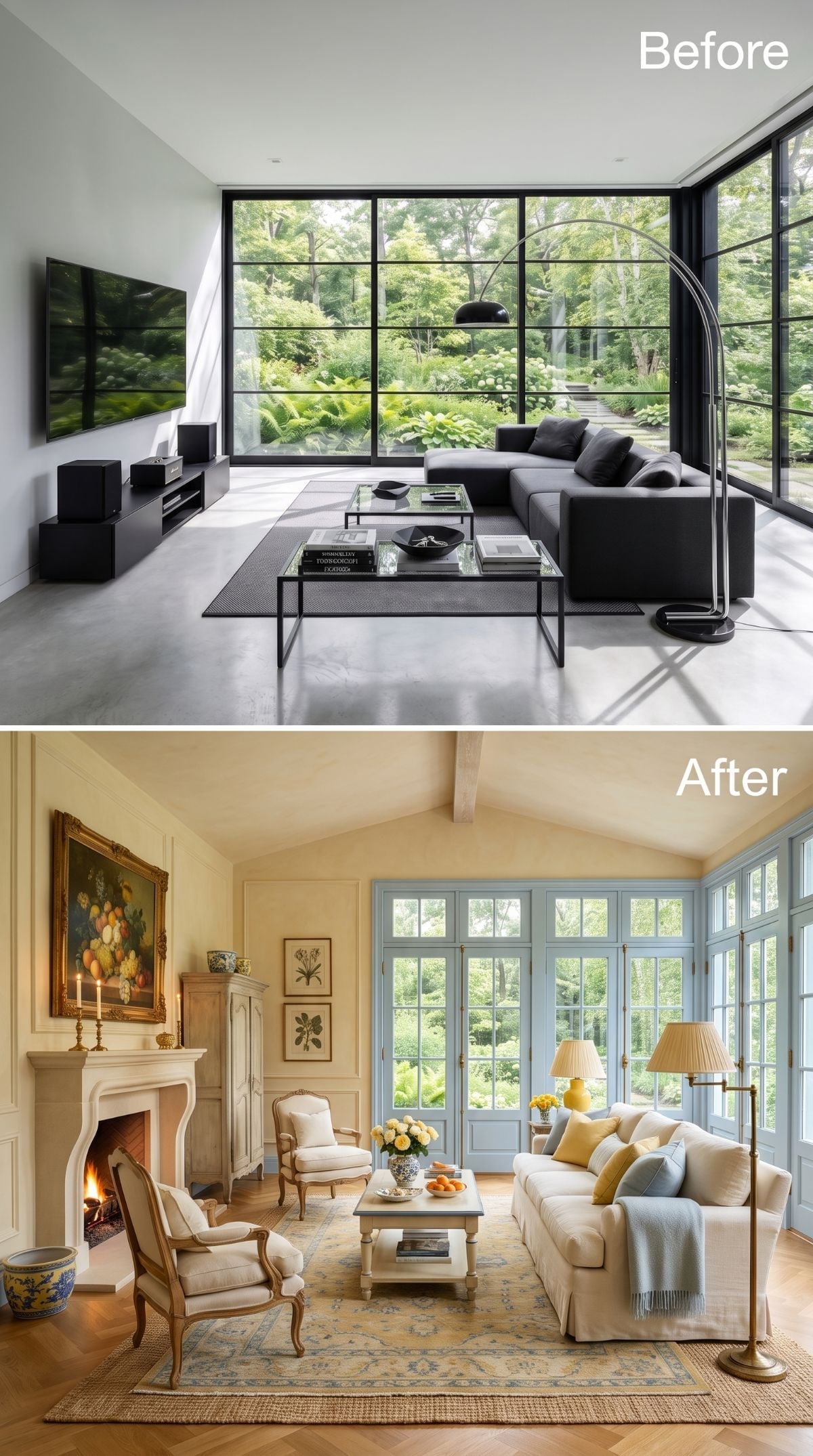
The transformation starts with one of the least expensive surfaces in the room: paint. A soft aged yellow changes how every white, cream and blue element around it is perceived.
Light blue French doors, cream linen, a carved limestone fireplace and a dark old-master-style painting create enough contrast that the wall color never turns sugary. The floral rug stays dusty rather than bright, letting the room feel sun-warmed instead of color-coordinated.
Pro Tip: Warm cream or muted yellow can make a room feel less cool, particularly when surrounding finishes are gray or blue. Test large samples in the actual room before committing; orientation, glazing and time of day can change the effect dramatically.
19. Terracotta and Salmon Red Put Some Heat Back Into the House
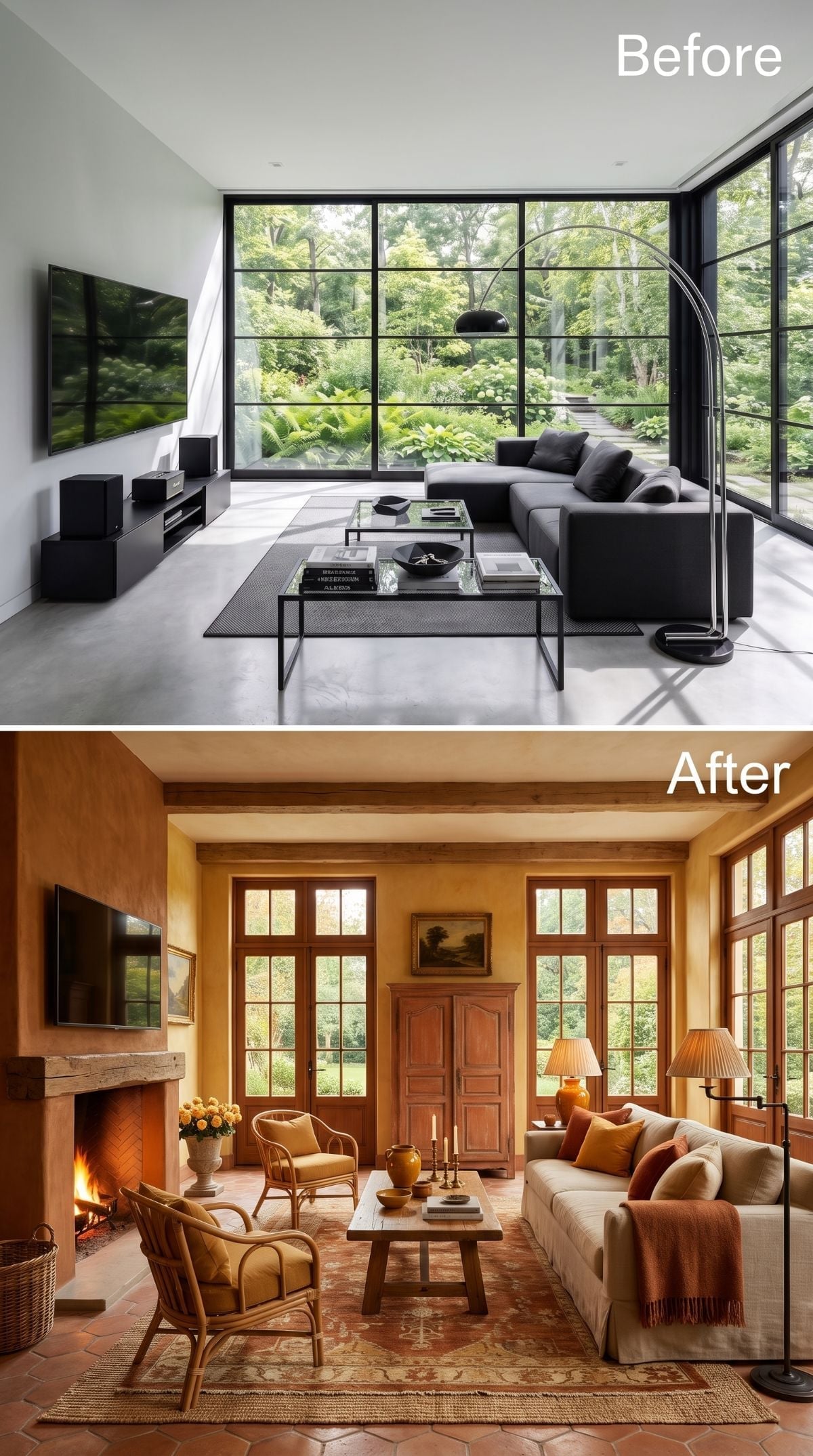
Burnt-orange terracotta establishes the mood at floor level, then a weathered salmon-red armoire picks it up at the opposite end of the room. Between them, rattan chairs, rust-colored throws and pale linen make the palette feel collected rather than coordinated.
Why the Fireplace Surround Makes Such a Difference Here
The rough limestone surround has enough irregularity to hold its own beside the terracotta. A highly polished fireplace would have introduced the wrong kind of refinement; this one looks as though it belongs to the same imperfect material world as the floor, armoire and old wood table.
18. Velvet, Books, and Burgundy Turned the Media Wall Into a Library
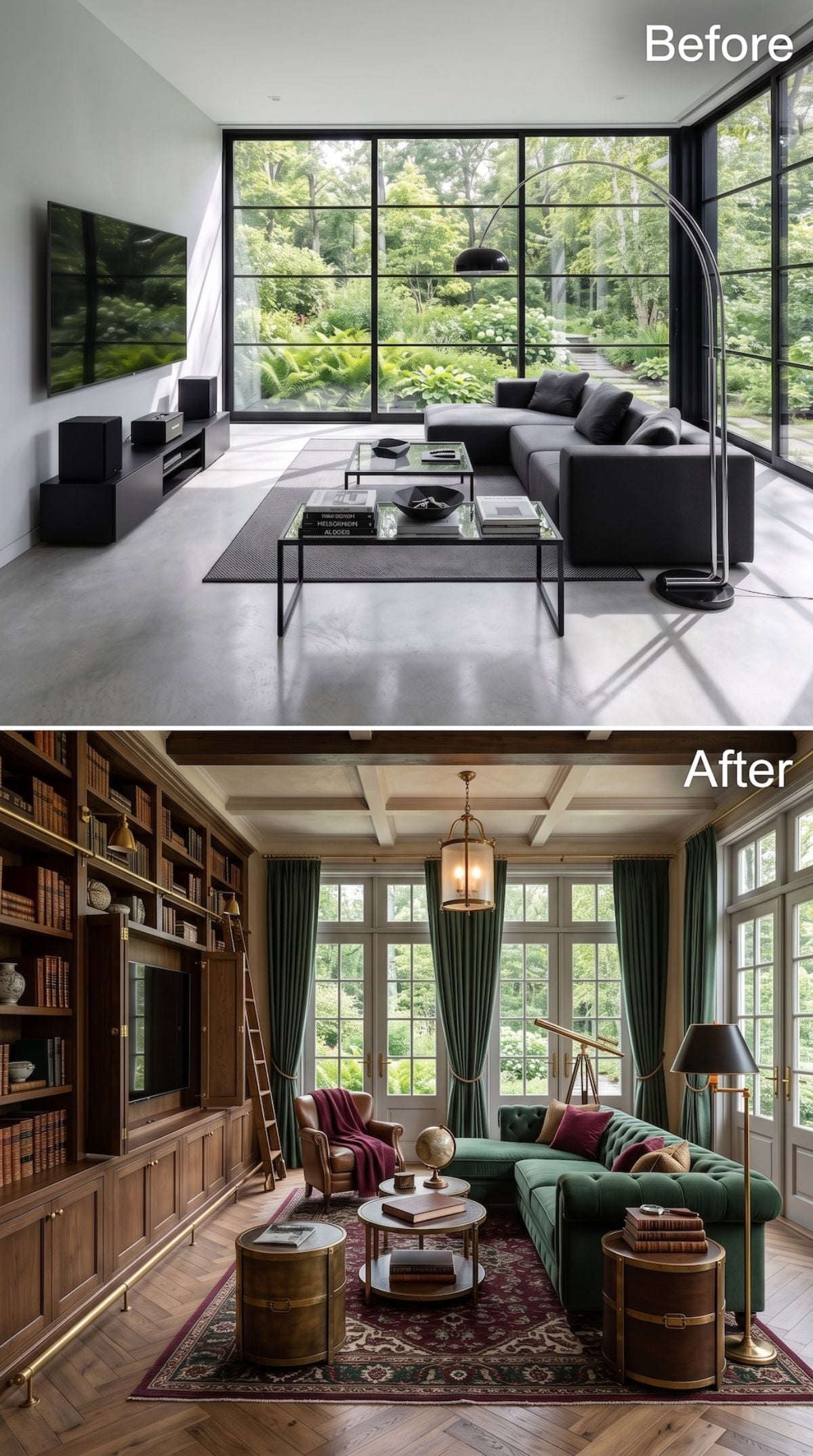
The smartest move here may be deciding that a wall can do more than hold a screen. Walnut built-ins fill the former media zone with books and darker wood, making the room feel accumulated rather than installed.
A deep green Chesterfield-style sectional lands on a burgundy Persian rug, while coffered detailing overhead gives the ceiling a stronger presence. Brass appears in smaller flashes rather than becoming a theme. The result feels less like a redesign and more like the room discovered hobbies.
17. Painted Brick and Whitewashed Beams Made the Fireplace Feel Less Formal
🔥 Would you like to save this?
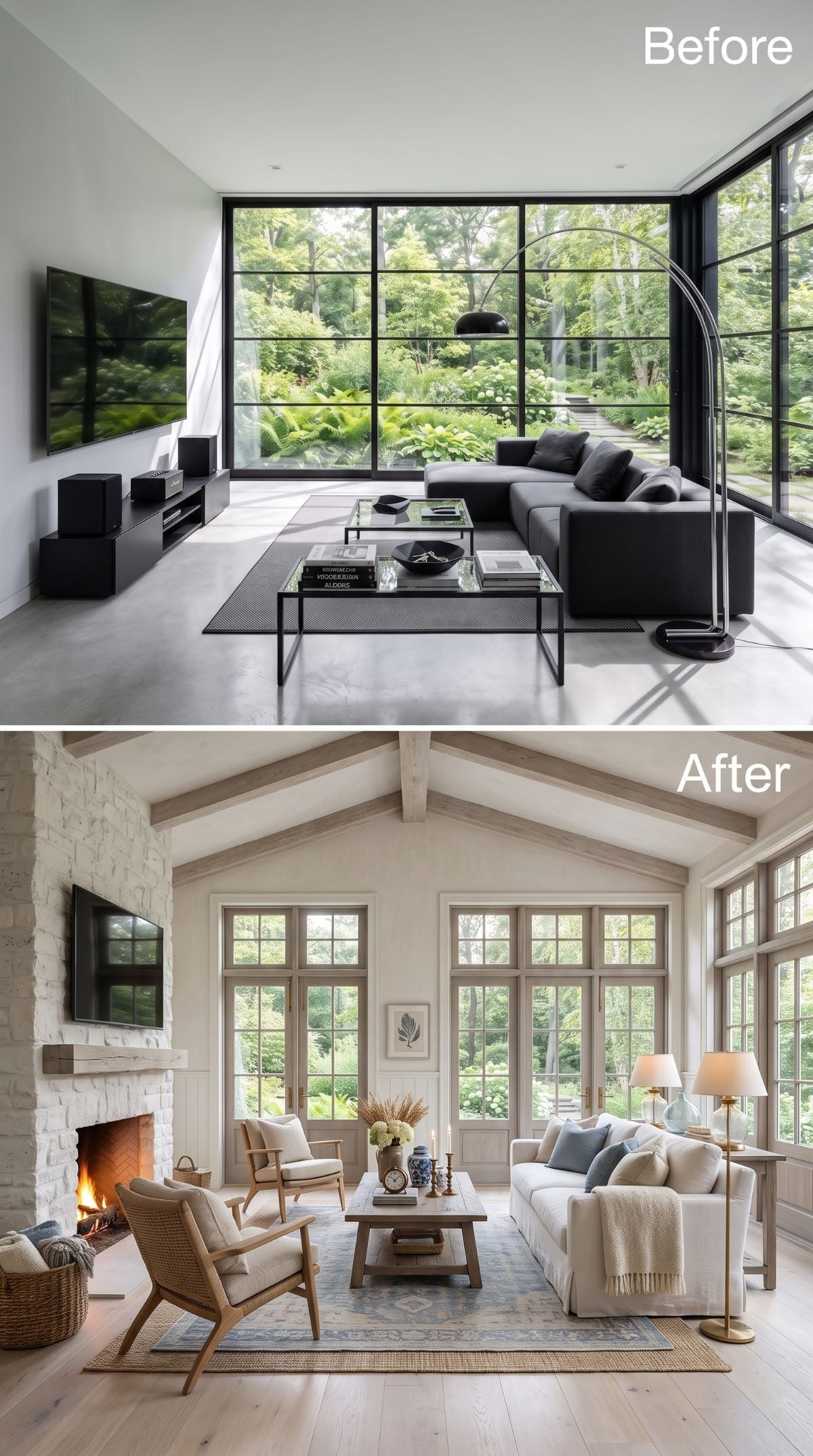
White-painted brick stretches from floor to ceiling, keeping the texture of masonry while removing most of its visual weight. Whitewashed timber beams do something similar overhead: structure remains visible, but the palette gets considerably lighter.
Linen sofas, wood-frame armchairs and a blue-patterned rug give the seating group enough softness to keep all that pale architecture from feeling austere.
Material Note: Painting masonry is a commitment rather than a truly reversible move. Brick is porous, and removing paint later can require aggressive cleaning or restoration. If preserving original brick matters, limewash or another breathable finish may be worth investigating first.
16. Blue Ginger Jars and a Gilded Mirror Made Repetition Look Intentional
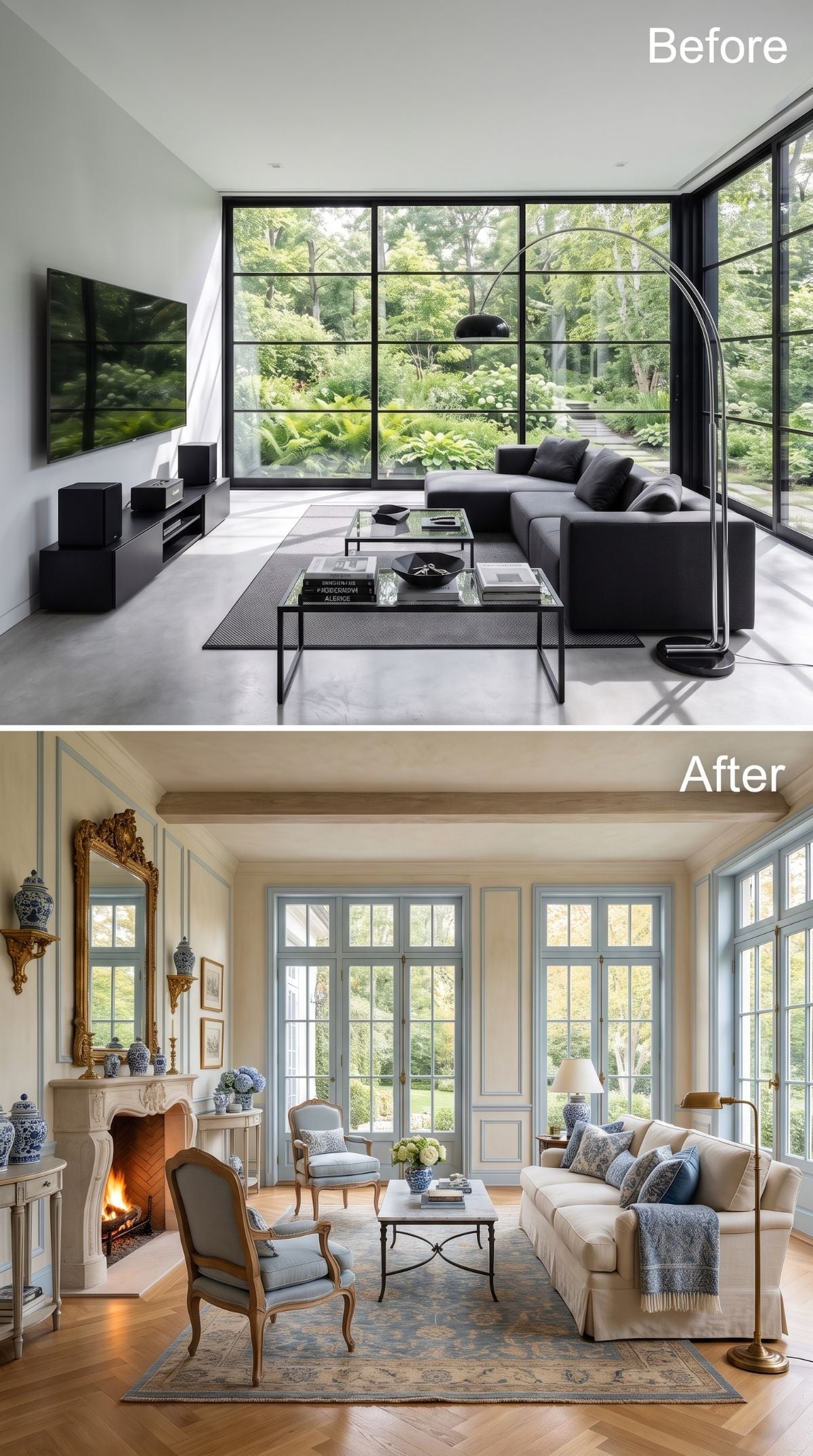
Powder blue appears at the trim, then again in the upholstery, rug and ceramics. The color never occupies one enormous surface, which is exactly why it feels woven through the room rather than imposed on it.
A gilt mirror above the mantel reflects light back into the room, while blue-and-white ginger jars break up the shelf with smaller hits of pattern. Cream seating and a faded rug do the rest quietly.
Style Math: Repeating a color at several scales—a ceramic jar, cushion, trim line and rug motif—usually feels more layered than concentrating the same color in one oversized piece. The eye keeps rediscovering it rather than receiving the whole message at once.
15. Lavender Trim Pulled an Entire Room Together With Barely Any Paint
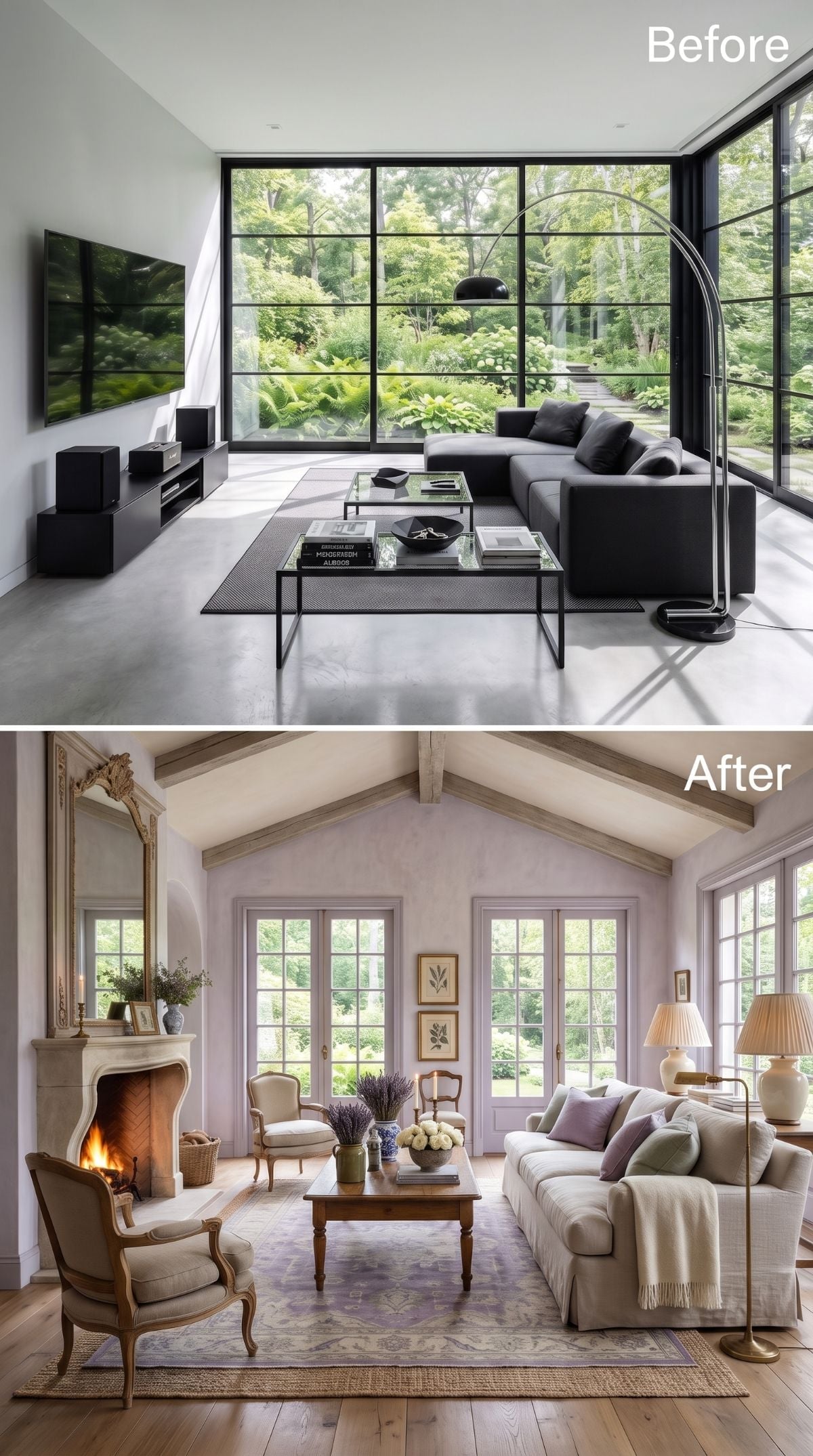
The headline move isn’t the fireplace or even the raw ceiling beams. It’s the lavender painted onto the French doors.
That thin perimeter of color picks up the faded violet in the floral rug, gives unbleached linen something to play against and makes the wood overhead feel less dominant. It’s a reminder that transformation doesn’t always require attacking the largest surface first.
Style Tip: Muted trim colors such as lavender, dusty blue or sage can change the perceived temperature of a room without requiring new furniture. Test them beside the existing floor and upholstery rather than choosing from a paint chip in isolation.
14. Stone, Antler Horn, and Firelight Took the Room Somewhere Rougher
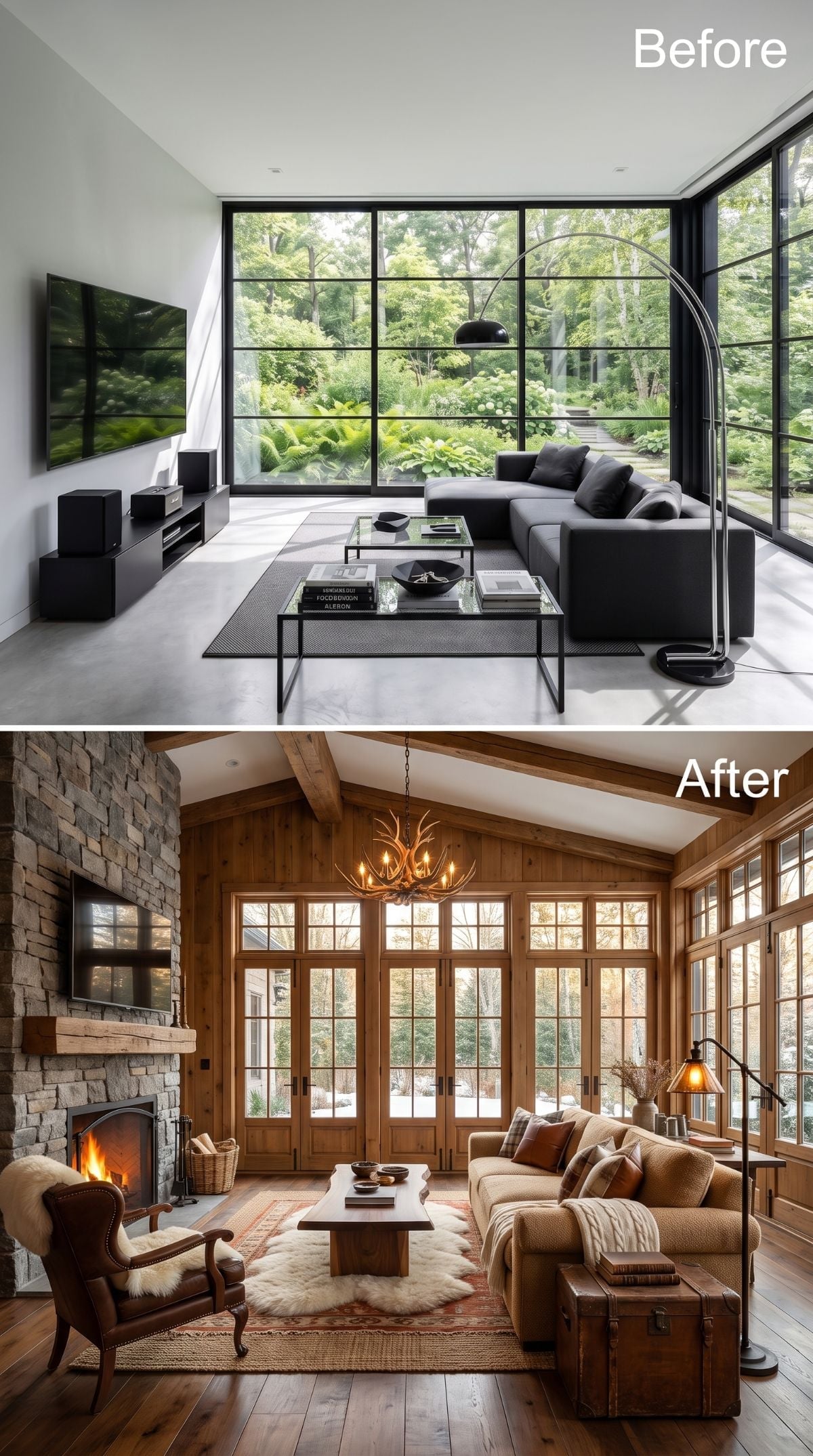
The garden view was never the problem. The question was what kind of room should sit behind it.
This answer goes rougher: stacked stone, wood-framed French doors, heavy timber and an antler chandelier that would look absurd in a delicate room. Here, surrounded by materials with enough visual weight to support it, the fixture suddenly makes sense. Cream upholstery and sheepskin stop the space from turning into a lodge parody.
In The Details: Vaulted rooms need lighting scaled to both ceiling height and the furniture below. A large fixture can disappear if hung too high, but suspension height still has to respect sightlines, circulation and the manufacturer’s clearance requirements.
13. Burgundy Paneling and Oxblood Leather Made Darkness Feel Completely Different
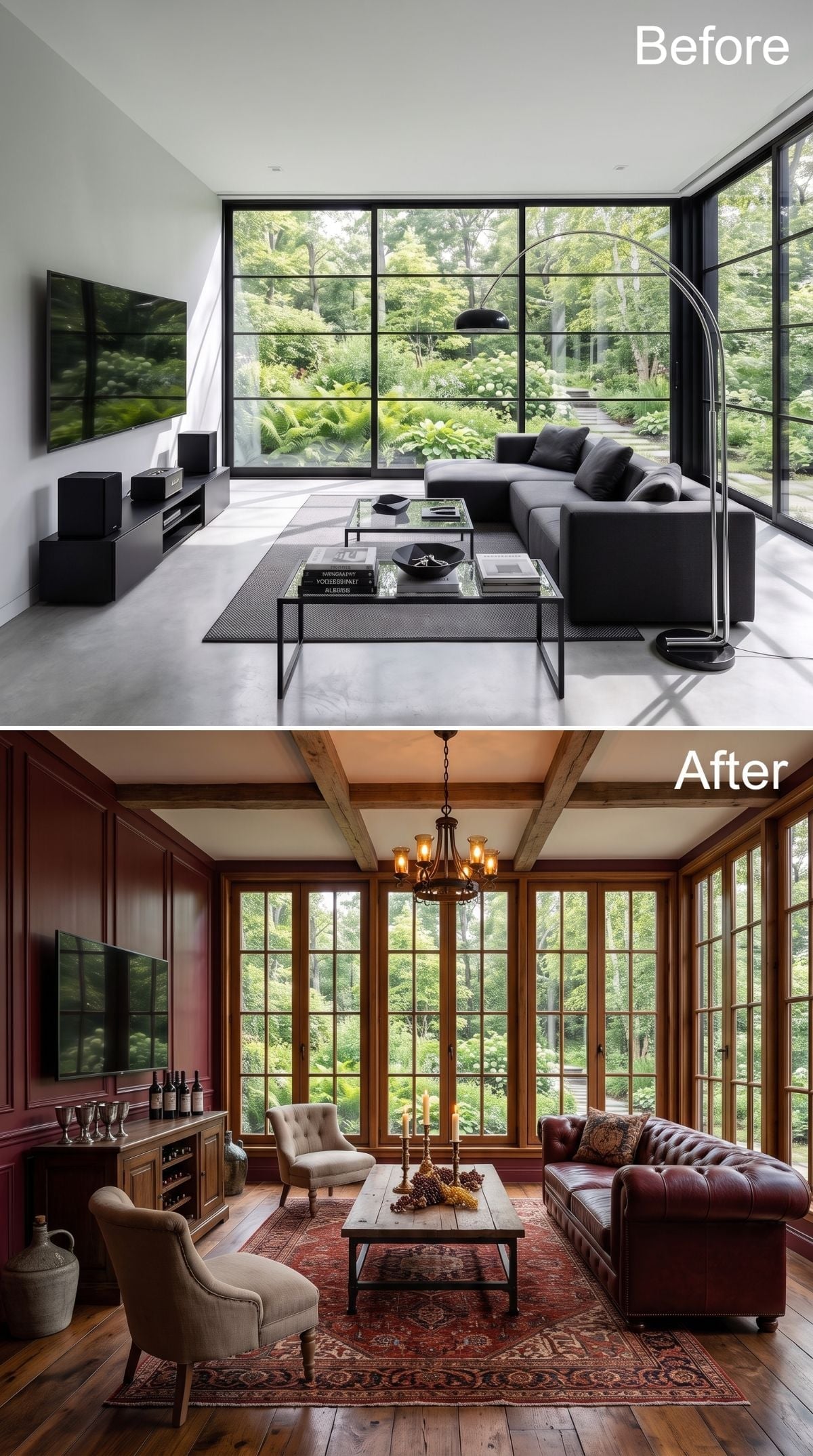
This version proves that the cure for a cold dark interior isn’t necessarily making everything pale. Burgundy wainscoting, oxblood leather and a Persian rug are all deep in value, yet the result feels warmer than the gray starting point.
Why? Color replaces absence. Wood-framed casement windows soften the perimeter, pattern breaks up the floor and the tufted sofa invites actual contact instead of behaving like one long charcoal slab.
The answer to a dark room isn’t always more white. Sometimes it’s better darkness.
12. Blush Linen Made the Cathedral Ceiling Feel Less Severe
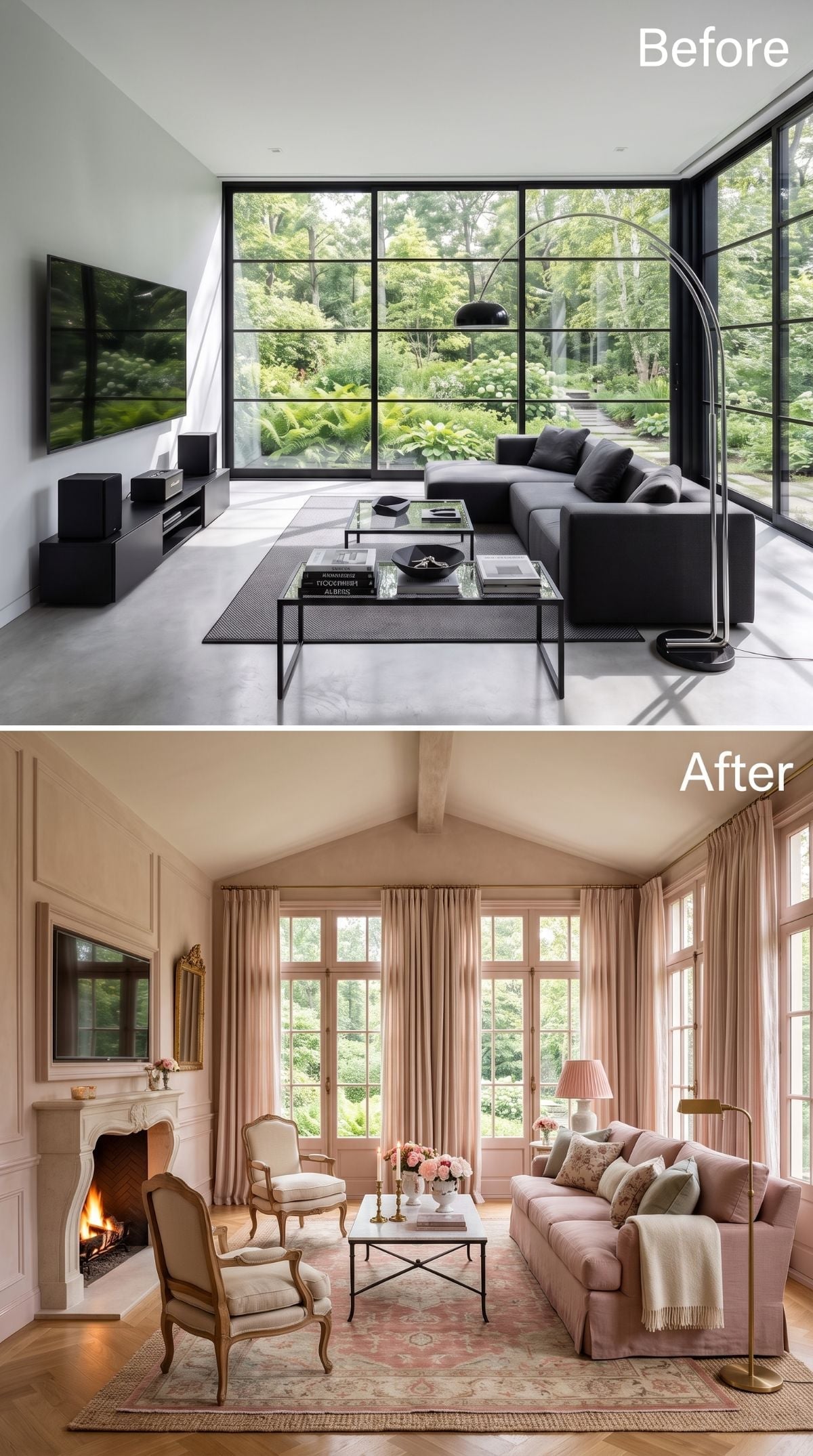
Dusty rose upholstery immediately changes how the tall room reads. Instead of another charcoal sectional reinforcing the architecture’s coolness, the sofa introduces warmth across one of the largest surfaces at eye level.
Blush drapery continues the color vertically, while gilt-framed chairs and a floral rug add enough age and pattern to keep the palette from becoming sugary. Low lamplight is the finishing move: warmth brought down where people actually sit.
Editor’s Note: Upholstery on a large sofa can dramatically change the perceived color temperature of a room because it occupies so much of the visual field. The daylight hasn’t changed; what surrounds it has.
11. Vaulted Beams and Limestone Gave the Garden View a Proper Room Behind It
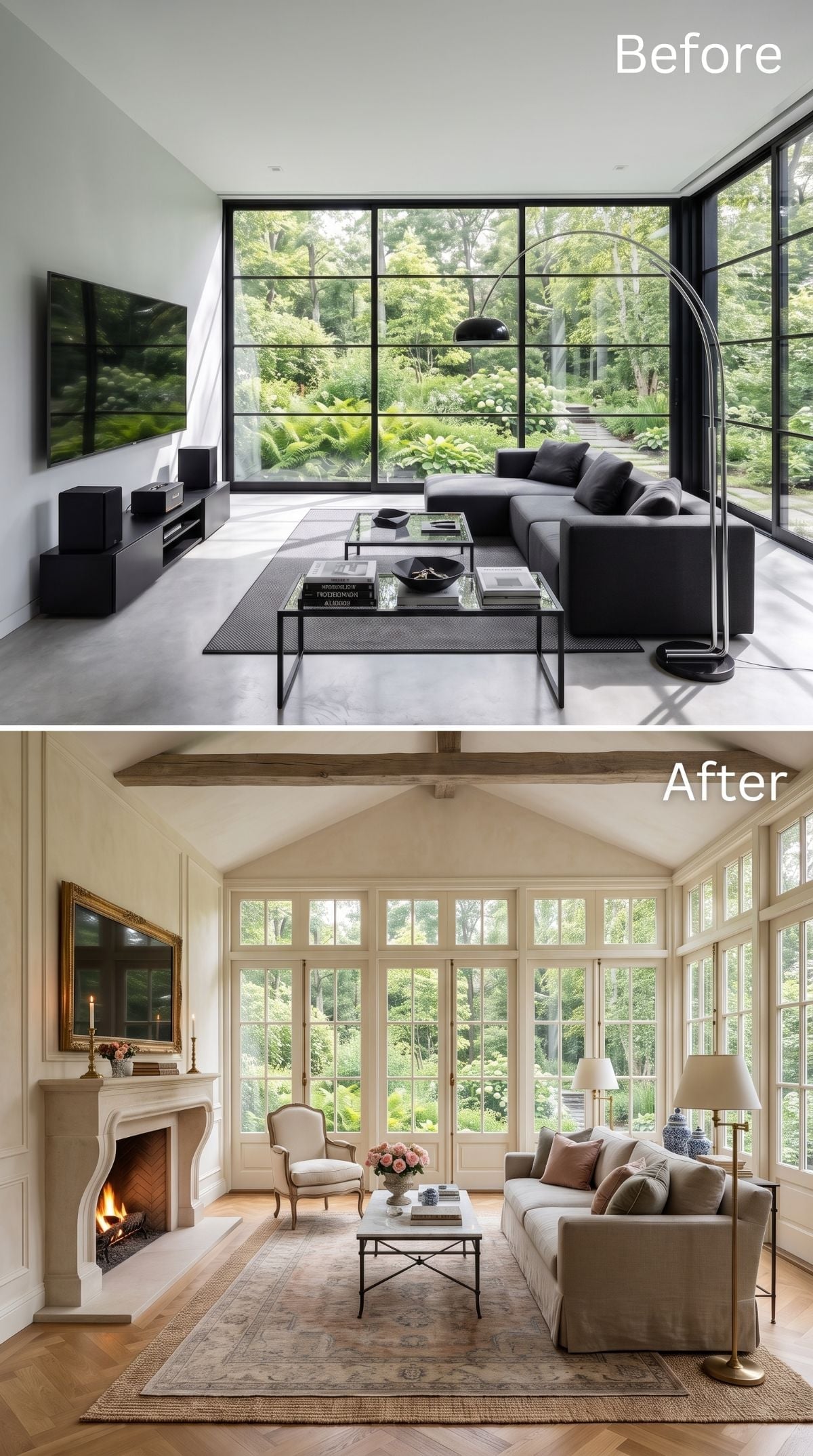
French doors preserve the generous garden connection while stripping the original glazing of its industrial dominance. Inside, warm wood, faded pattern and linen create enough texture that the windows become one element rather than the room’s entire identity.
The carved limestone mantel is restrained compared with some of the rougher stone treatments elsewhere in the gallery. That’s what distinguishes this one: elegance rather than rustic mass.
10. Emerald Paneling Turned a Neutral Room Into Somewhere You Remember
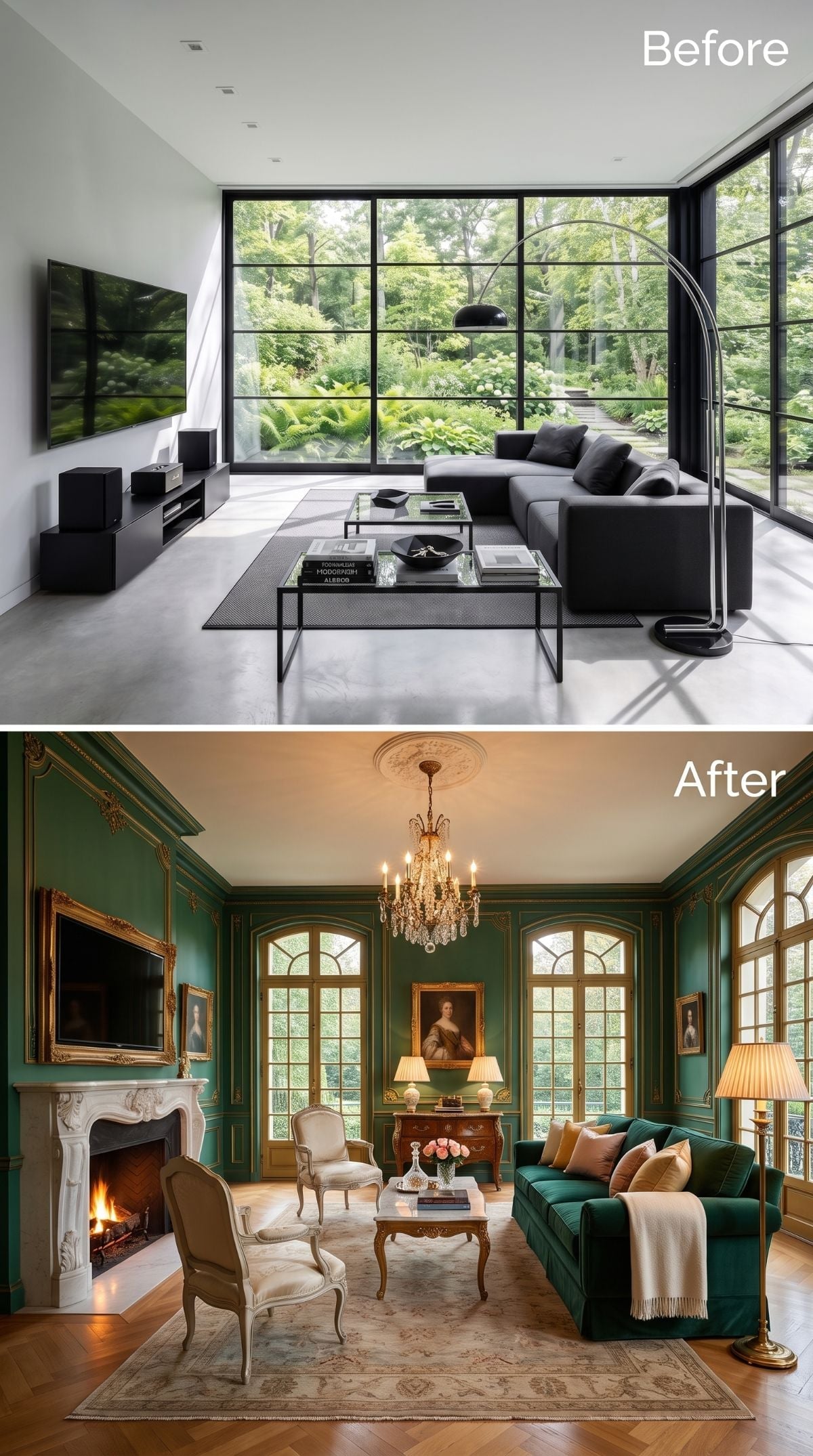
Teal-green wainscoting trimmed in gold runs around the room like a ribbon, giving pale walls a lower register and the furniture something stronger to respond to.
A forest-green velvet sofa keeps the color from stopping at the architecture, while cream French chairs and a white marble mantel provide relief. The palette is richer than most of the gallery without becoming heavy. That’s the advantage of concentrating color where the eye naturally lands.
9. Linen, Limestone, and Candlelight Made Softness the Main Event
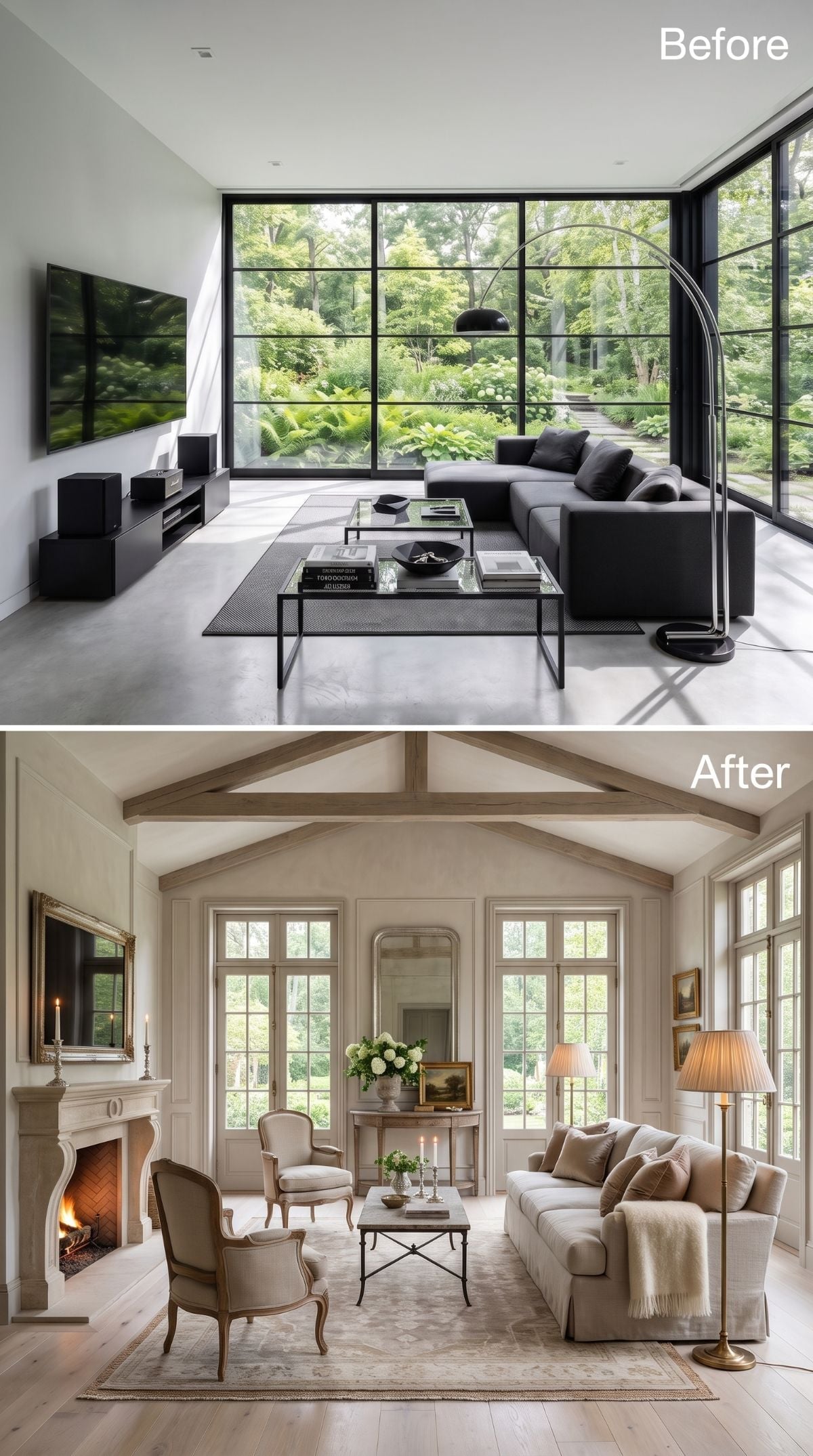
Exposed timber trusses carry the eye up, but the strongest change happens lower down. Linen slipcovers, aged-oak bergère chairs and gilded floor lamps create one soft surface after another around the seating zone.
A carved limestone fireplace gives all that fabric something solid to lean against. The iron-and-wood coffee table is the bridge between the two worlds: sturdy enough for the architecture, imperfect enough for French Country.
Budget Tip: Decorative beams can provide some of the visual effect of exposed structure without requiring a vaulted rebuild. Salvaged timber isn’t automatically cheaper than new material, however; transport, cleaning, preparation and installation can make reclaimed pieces a premium choice.
8. Stone Walls and Terracotta Let the Materials Do the Decorating
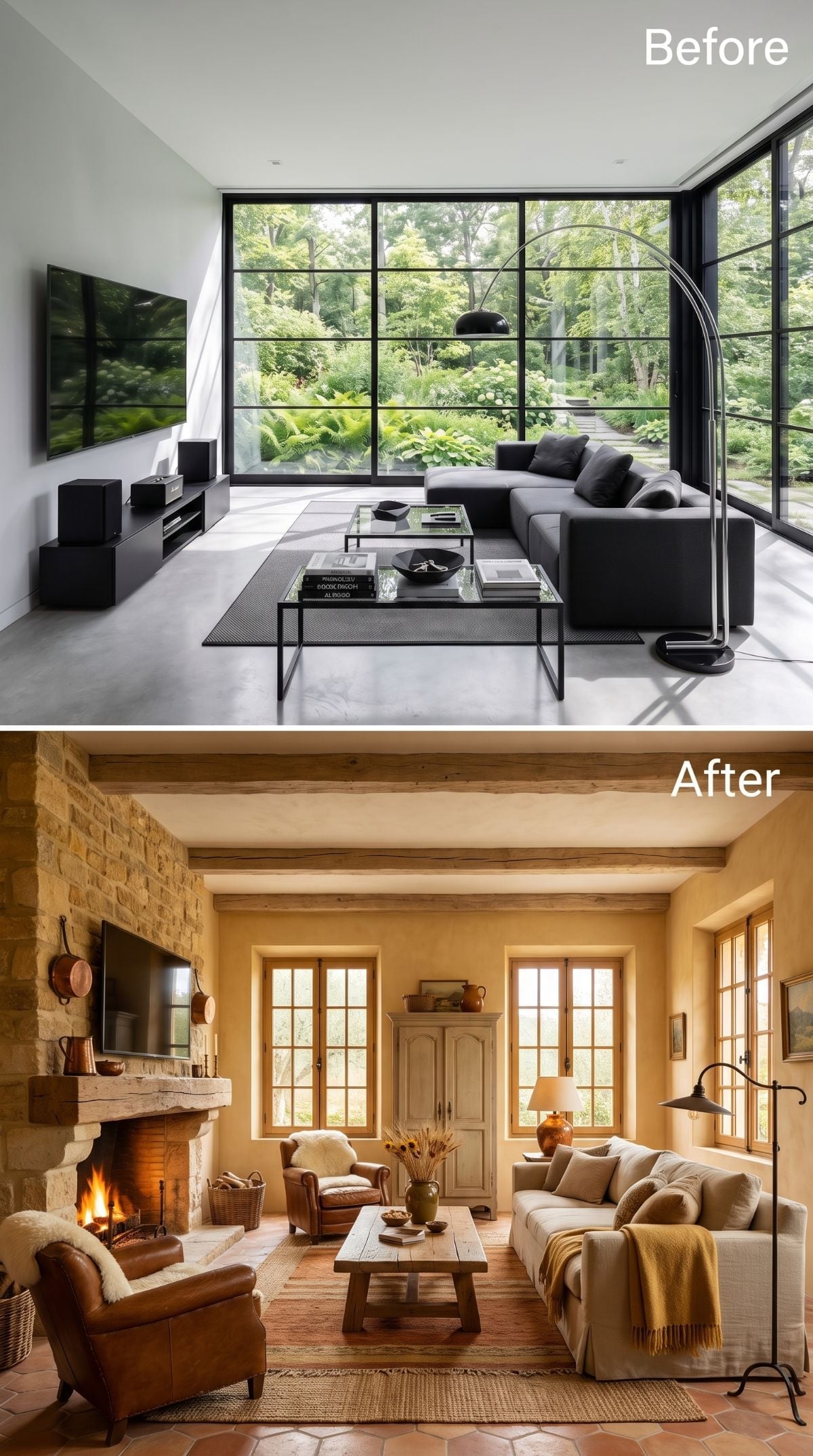
Limestone blocks and rough ceiling beams establish nearly the entire room before the furniture gets a vote. That’s the beauty of this version: decoration isn’t carrying the historical mood. The envelope is.
Cream linen and cognac leather are almost neutral beside those surfaces, while terracotta underfoot keeps the composition earthy rather than monochromatic.
History Corner: Limestone and terracotta are characteristic materials in many traditional buildings across Provence and other parts of southern France. Their irregular tones came naturally from local stone, clay and small-scale production rather than from a single standardized “French Country” formula.
7. Dark Paneling Proved Cozy Doesn’t Have to Mean Pale
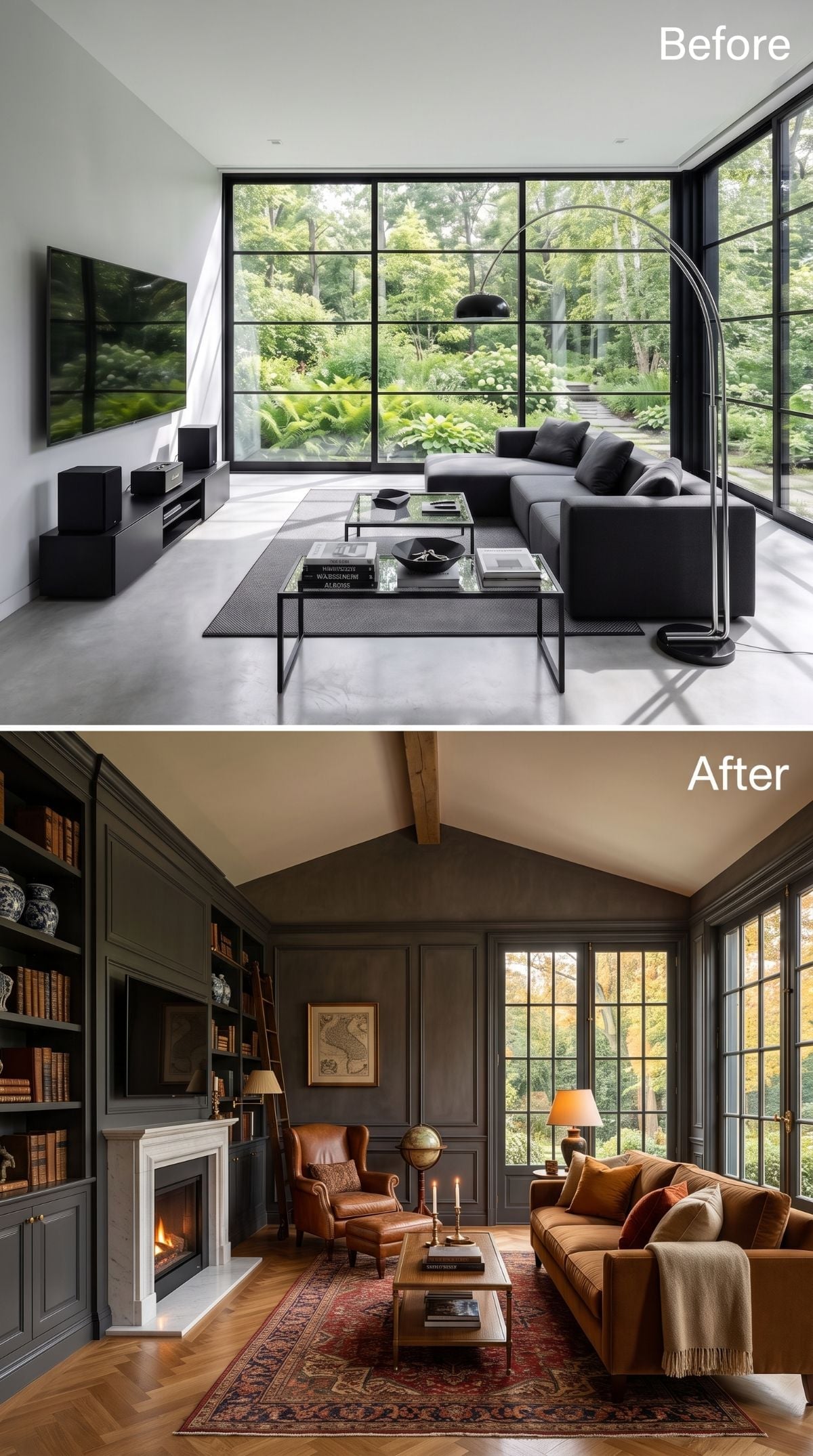
Floor-to-ceiling gray-green paneling creates one of the moodiest alternatives in the collection, yet the room feels more hospitable than the original pale-gray shell.
The difference is contrast. White marble flashes against the paneling, cognac chairs catch warm light and a red Persian rug refuses to disappear into the floor. One exposed ceiling beam stops the walls from swallowing the upper half.
Quick Fix: Built-ins can make a fireplace wall feel architectural, but the difficulty of adding them depends on vents, wiring, baseboards, fireplace clearances and wall construction. When the room allows it, shallow cabinetry can create the effect without rebuilding the wall itself.
6. Shiplap, Lantern Light, and Slate Blue Doors Quieted Every Hard Edge
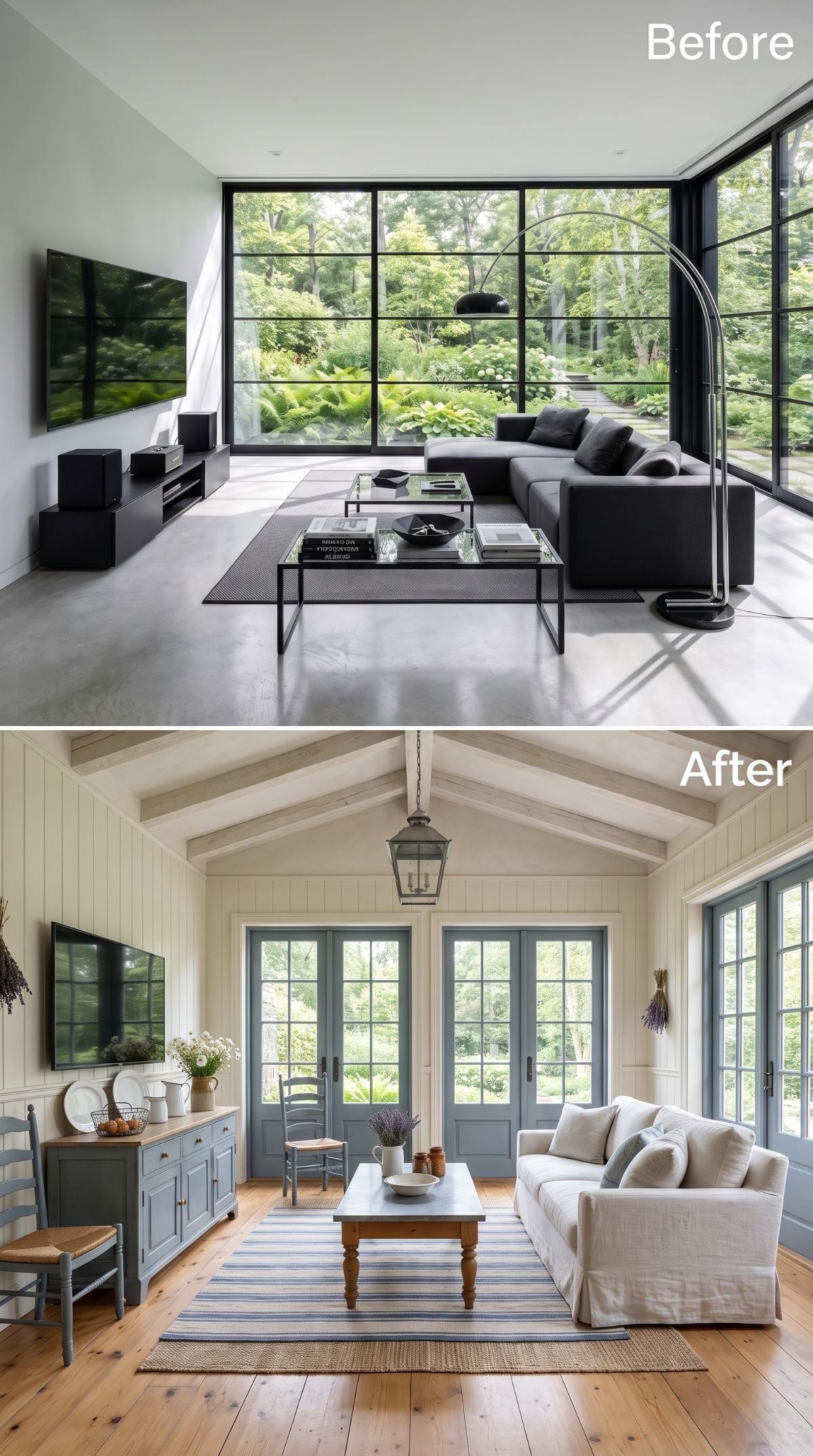
Vertical shiplap gives the walls rhythm without pattern, and slate-blue French doors bring color to what had been a severe black perimeter. A lantern hanging from the exposed truss adds another old-world shape without asking the furniture to become ornate.
This is a useful reminder that industrial glazing isn’t automatically cold. Here, the redesign simply chooses a softer architectural vocabulary around the view: painted wood, fabric, visible joinery and warmer light.
Ask Yourself: Before replacing furniture, decide whether the room’s larger surfaces are reinforcing the mood you dislike. Walls, trim, flooring and window treatments occupy far more visual territory than a side table ever will.
5. Blue Window Frames Turned the Garden Into Part of the Palette
🔥 Would you like to save this?
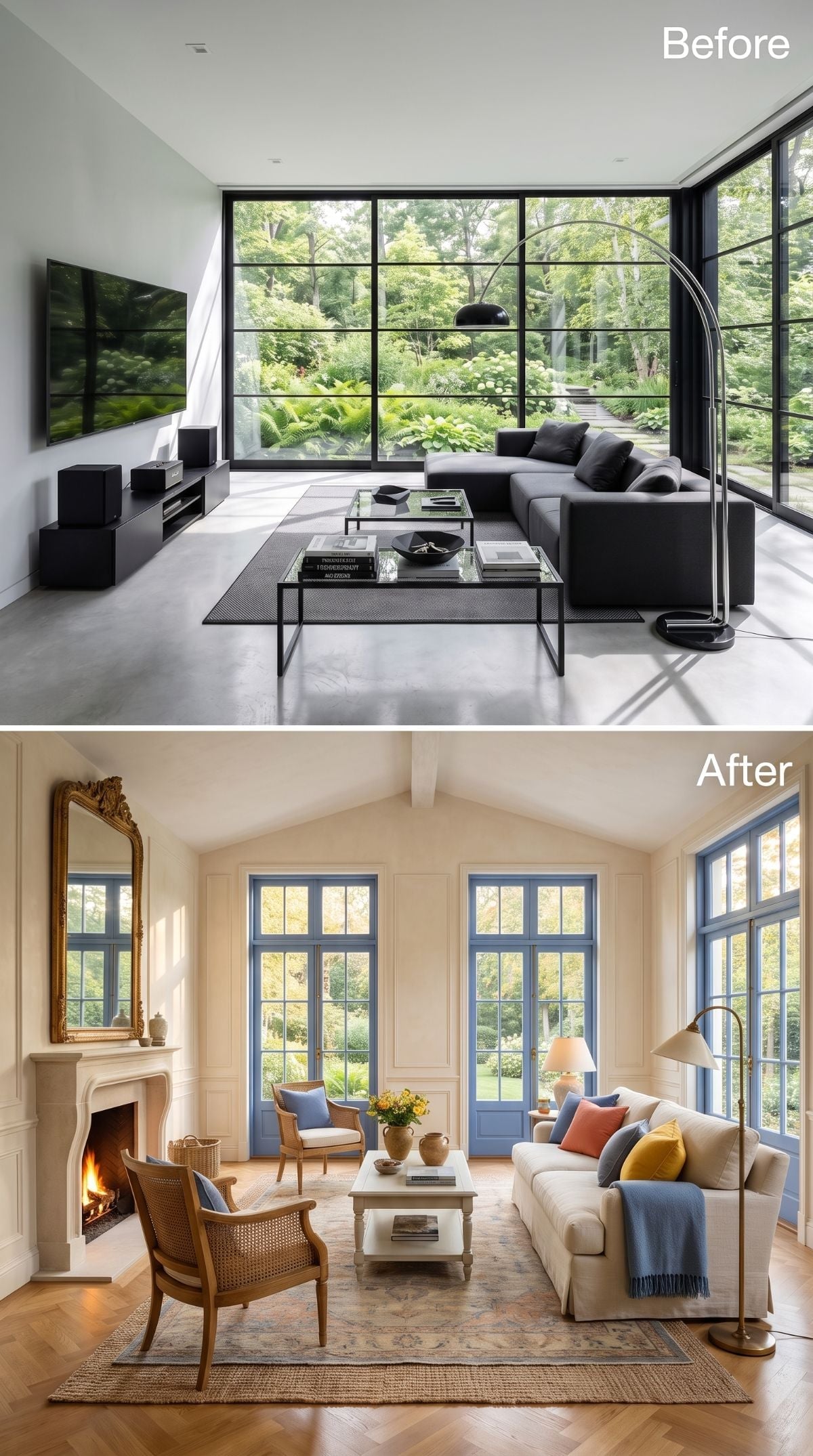
Dusty slate-blue frames give the windows a completely different relationship with the garden. Instead of a black grid cutting across the view, the cooler color sits more gently beside foliage and sky.
Inside, cream upholstery gets coral, mustard and blue cushions rather than one coordinated accent color. Herringbone oak and a rattan chair bring in just enough texture to keep the room from looking newly furnished all at once.
Designer’s Secret: Colored trim can visually connect an interior to the landscape when its undertones echo what is outside. The effect is perceptual rather than architectural—you haven’t gained square footage, but the boundary can feel less abrupt.
4. Walnut Paneling Turned One Wall Into a Proper Library
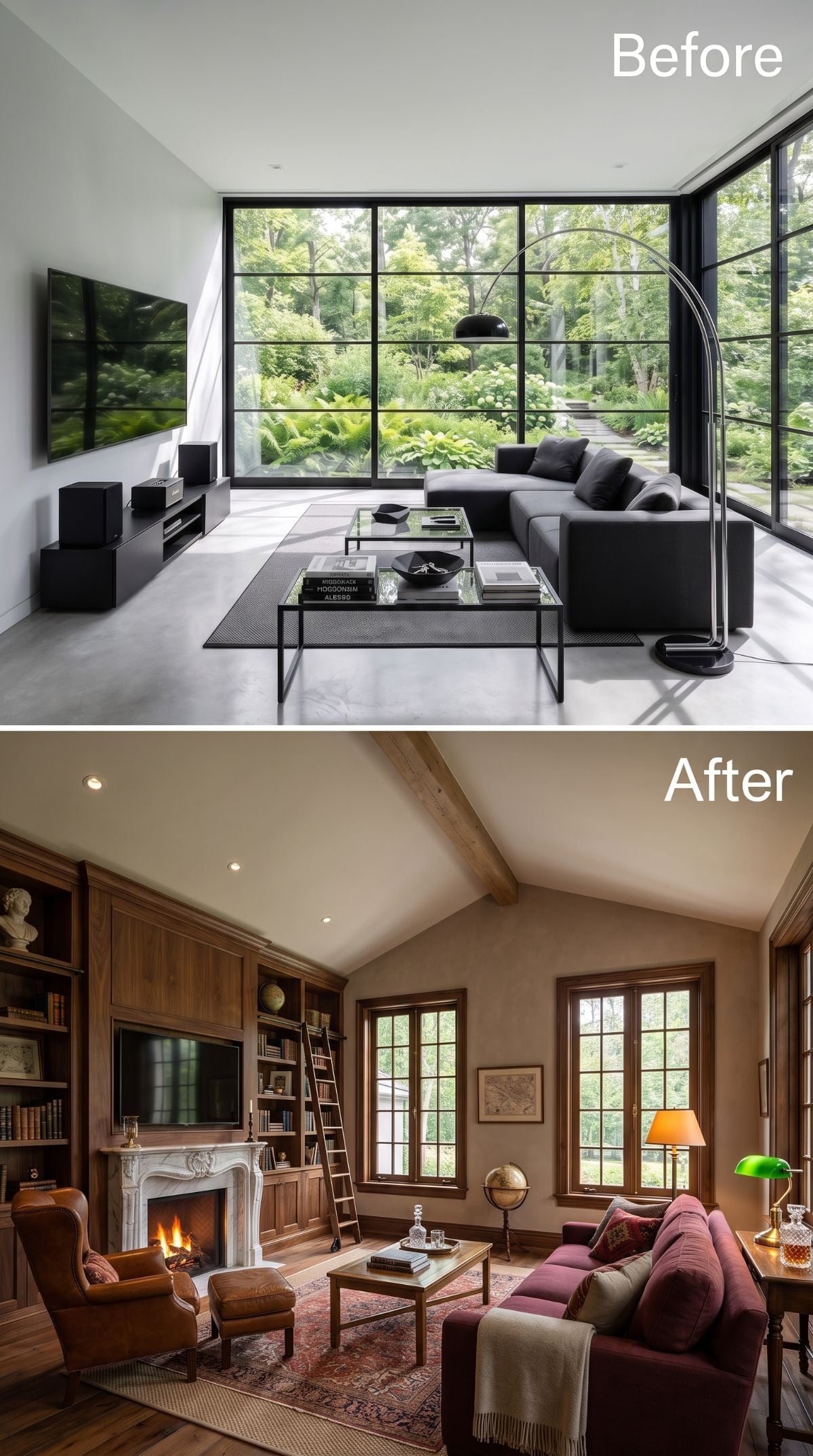
Nearly every surface takes on walnut here, yet the room doesn’t collapse under the weight. Books break up the paneling, a rolling ladder makes the cabinetry feel purposeful and a pale marble mantel creates a bright interruption in the middle.
Burgundy velvet and cognac leather add still more depth rather than trying to lighten things artificially. This version succeeds because it embraces darkness with materials that show grain, wear and color instead of returning to flat charcoal.
In The Details: Wood paneling changes acoustics as well as appearance, but smooth wood is largely reflective rather than a true sound absorber. Books, rugs, upholstery and curtains are doing much of the softening here.
3. Exposed Oak Beams Let the Ceiling Carry More of the Story
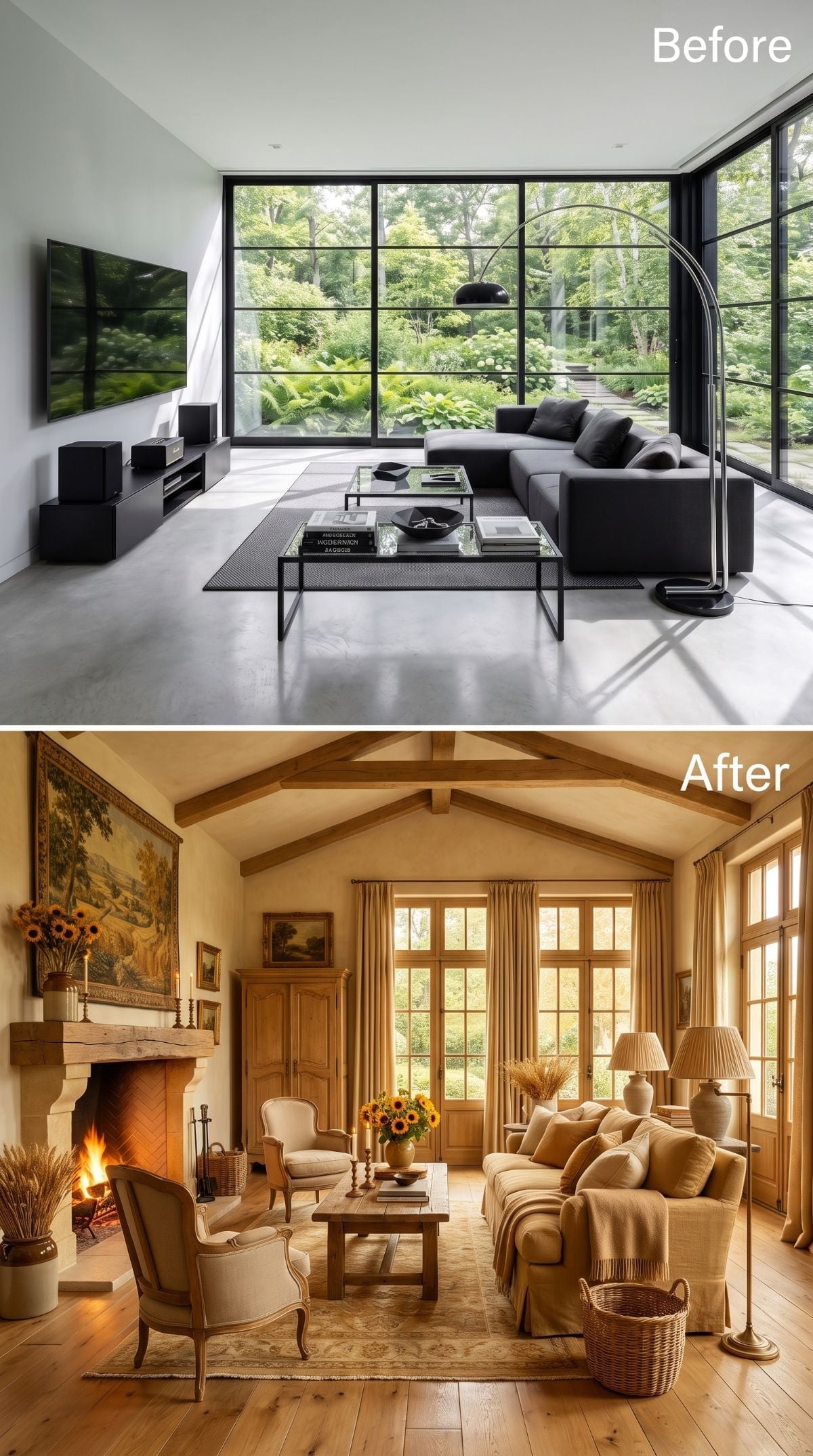
Honey-toned hardwood below and raw oak beams above create a top-to-bottom material change that sets this transformation apart from one based mostly on furnishings.
A rough limestone hearth carries the same irregularity at eye level. By the time the chairs and sofa arrive, the room has already stopped feeling new in the best possible way.
2. Dusty Blue Paneling Made the Walls Do More Than Hold the Furniture
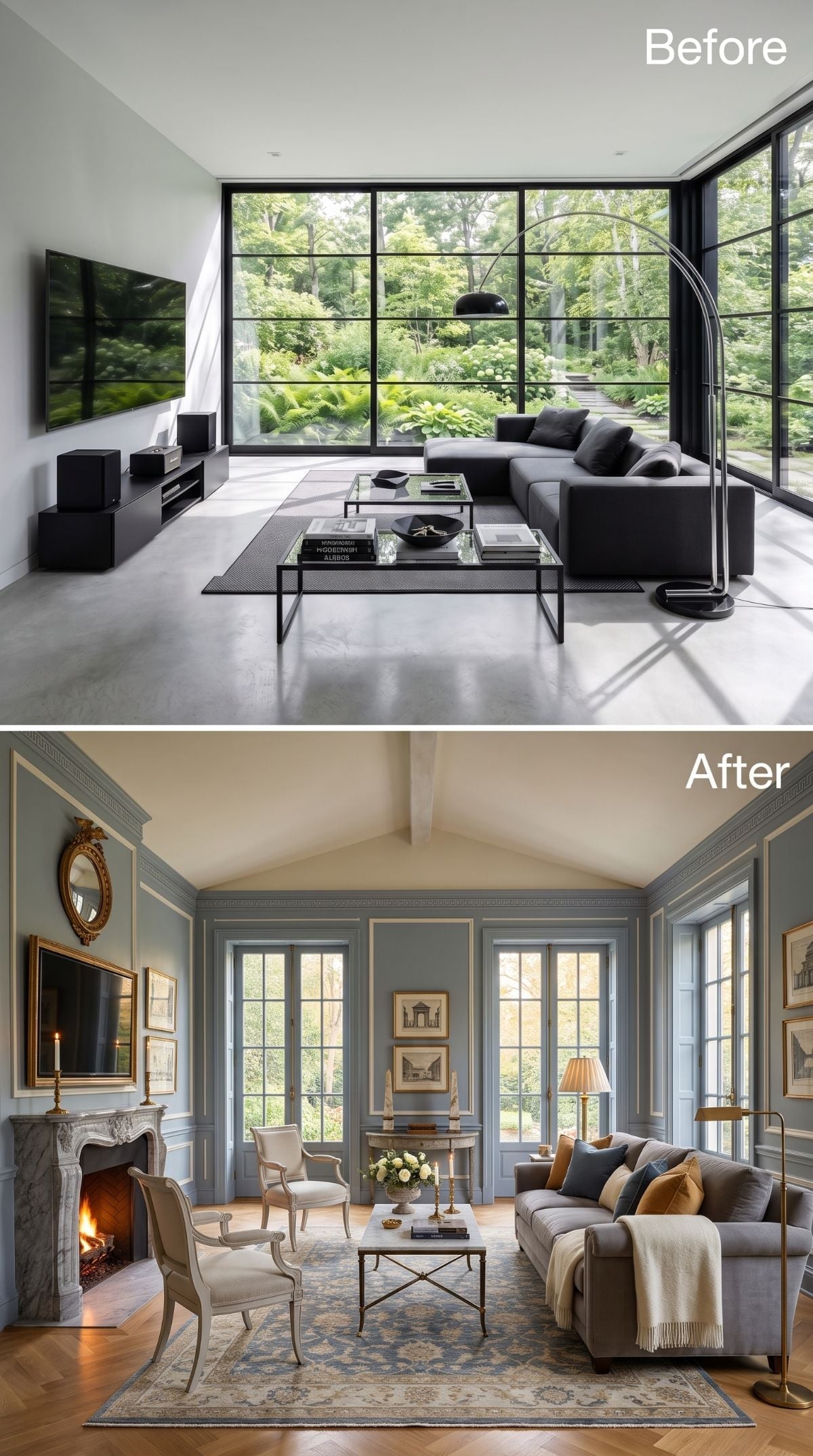
Dusty blue molding climbs from floor to ceiling, giving the walls enough structure that a few French armchairs, one Persian-style rug and a brass lamp can afford to remain comparatively restrained.
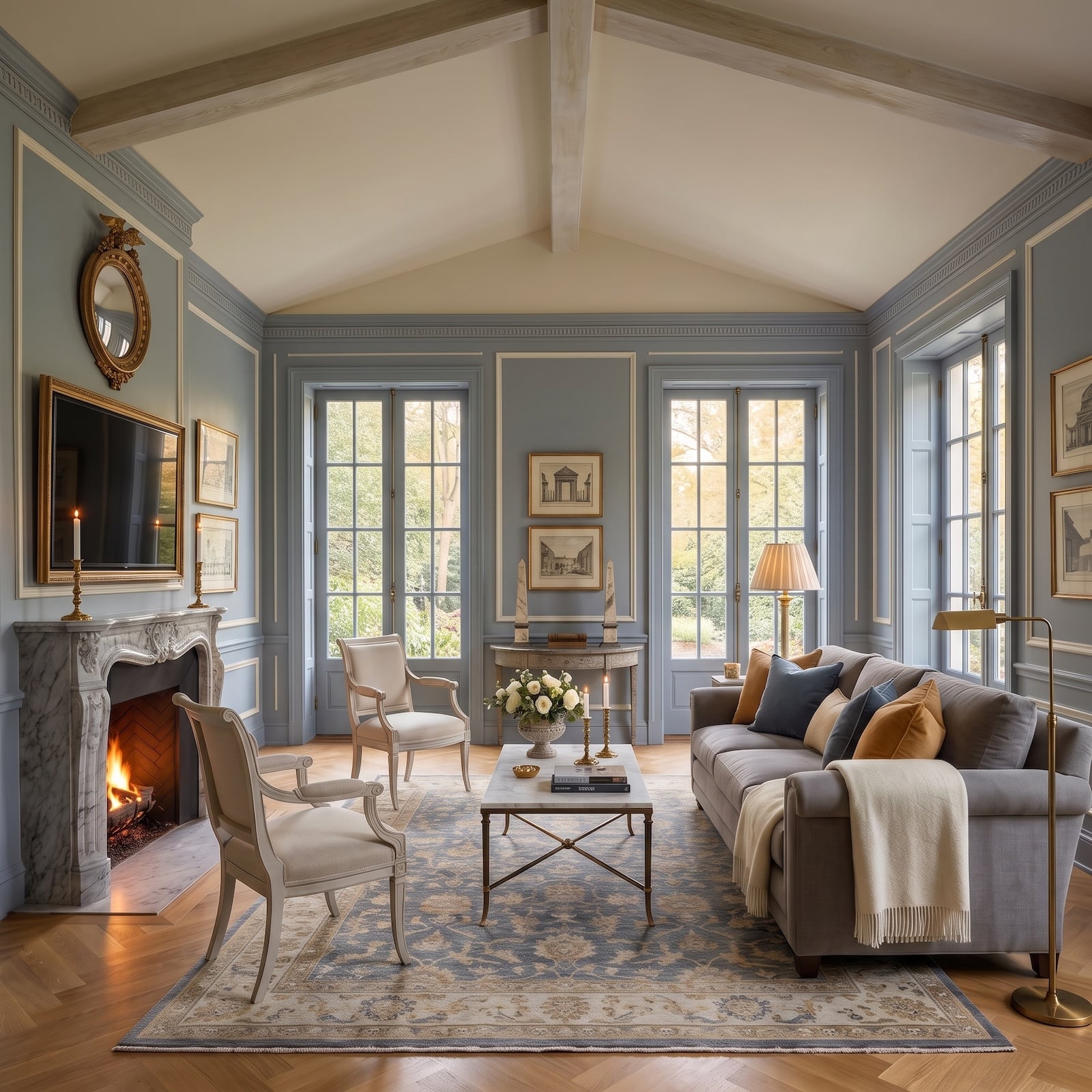
The marble fireplace brings contrast rather than sheer mass. Unlike the rough fieldstone treatments elsewhere in the gallery, this one keeps the room formal, giving the French Country vocabulary a more polished turn before the final flourish.
1. Gold-Framed Mirrors and Crystal Candlelight Finished the Transformation With No Restraint Left
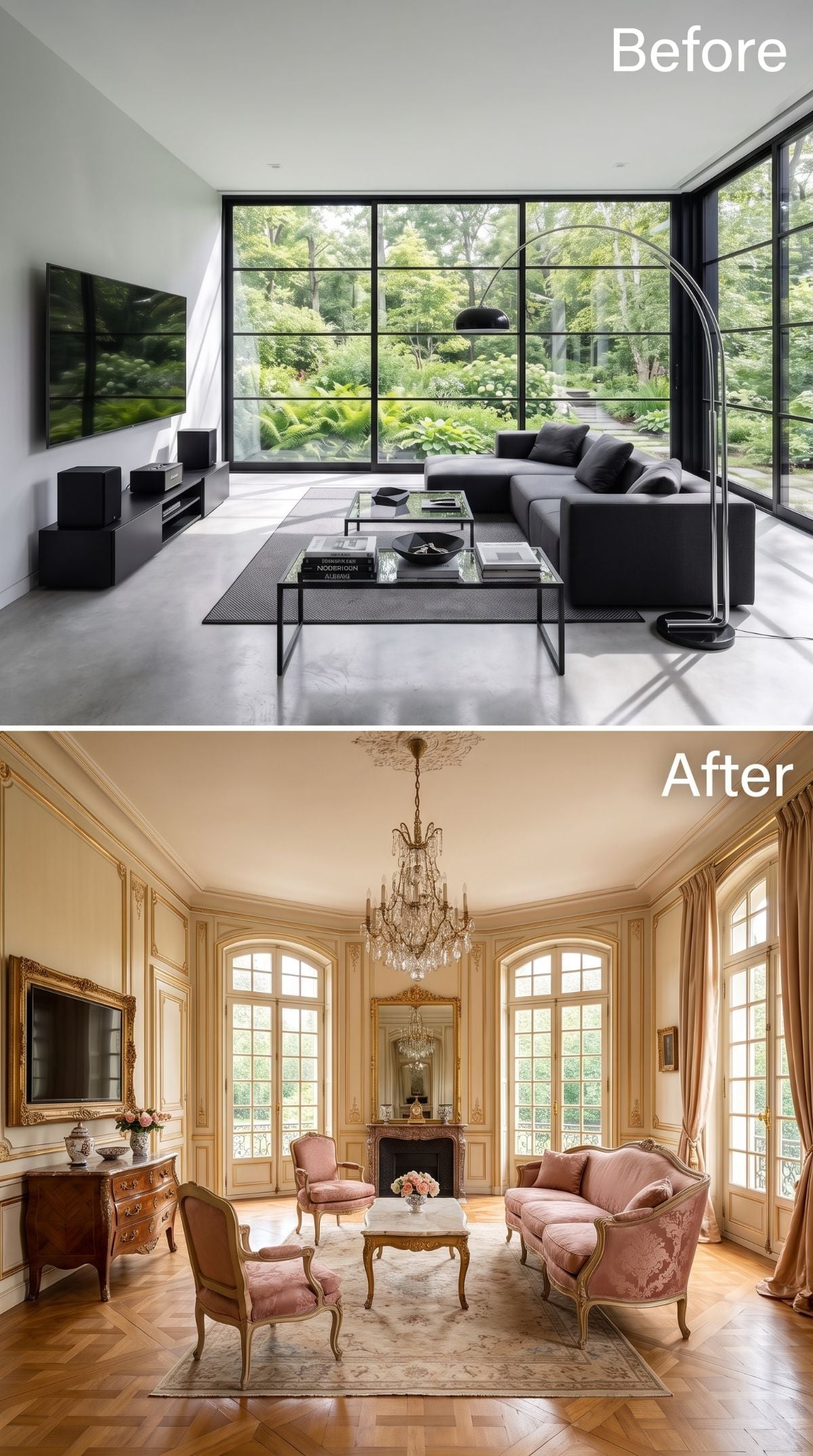
The finale doesn’t whisper. Herringbone parquet replaces concrete, blush damask climbs onto carved Louis XV-style frames and a crystal chandelier scatters light across aged-cream boiserie edged in gilt.
Arched French doors remove the old black grid from the garden view, while a black marble fireplace gives all that cream and gold one decisive dark note. Easy to overlook amid the ornament is the floor: honey-toned oak runs beneath everything and quietly keeps the room from becoming a confection.
Twenty-nine versions later, the lesson isn’t that French Country requires a fireplace, a beam or a floral rug. Warmth comes from accumulation: grain beside linen, old-looking paint beside polished stone, pattern against something plain, color appearing in three small places instead of one enormous statement. The strongest redesigns don’t look as though every object arrived on the same truck. They look as though one cold modern room was finally given 29 chances to learn how people actually live.