🔥 Would you like to save this?
You finally have the space — and the silence — to display every flea-market fossil, gilt frame, strange little bronze, and “just one more piece” acquisition without a teenager asking what’s for dinner. The living room can finally become part gallery, part reading room, part evidence locker for an antiquing habit that got out of hand years ago.
In order to come up with the very specific design ideas, we create most designs with the assistance of state-of-the-art AI interior design software. Also, assume links that take you off the site are affiliate links such as links to Amazon. this means we may earn a commission if you buy something.
The challenge isn’t owning too much interesting stuff. It’s giving all of it enough architecture, contrast, and breathing room to look collected rather than stranded. That’s where these AI-generated redesigns get ambitious. Some give a single sideboard or cabinet room to breathe. Others go completely the other direction, piling on carved wood, stained glass, frescoes, velvet, stone, and enough gilding to make restraint file a formal complaint.
Thirty-one concepts came out of the experiment. Some are genuinely livable. A few are glorious acts of architectural excess. All of them answer the same question differently: what happens when a plain living room finally catches up with the antiques?
31. Coffered Ceilings, Crystal Chandelier, and a Case for Going Full Classical
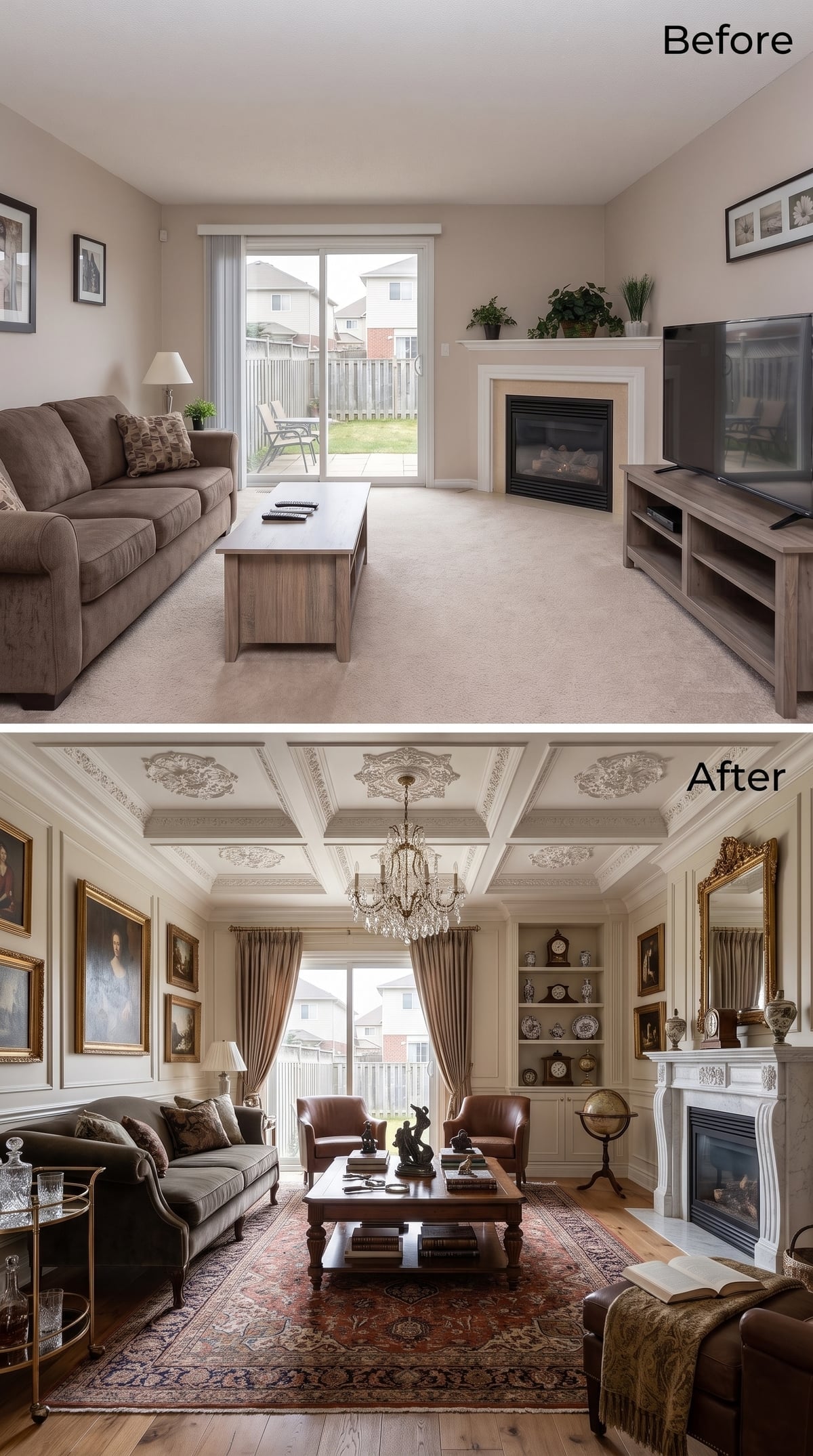
The ceiling gets first billing. Ornate coffers filled with floral medallions span the room, while a crystal chandelier drops through the center and turns the upper half into architecture rather than empty overhead space.
Below, a carved white marble fireplace sits between built-ins filled with clocks and blue-and-white porcelain. A Persian rug in crimson and navy spreads beneath leather club chairs and a charcoal velvet camelback sofa, while gilt-framed portraits occupy the paneled walls.
The room isn’t interested in understatement. Its success comes from making every major element — ceiling, fireplace, furniture, art — equally willing to participate.
30. Stained Glass Overhead Turns the Room Into a Darker Kind of Jewel Box
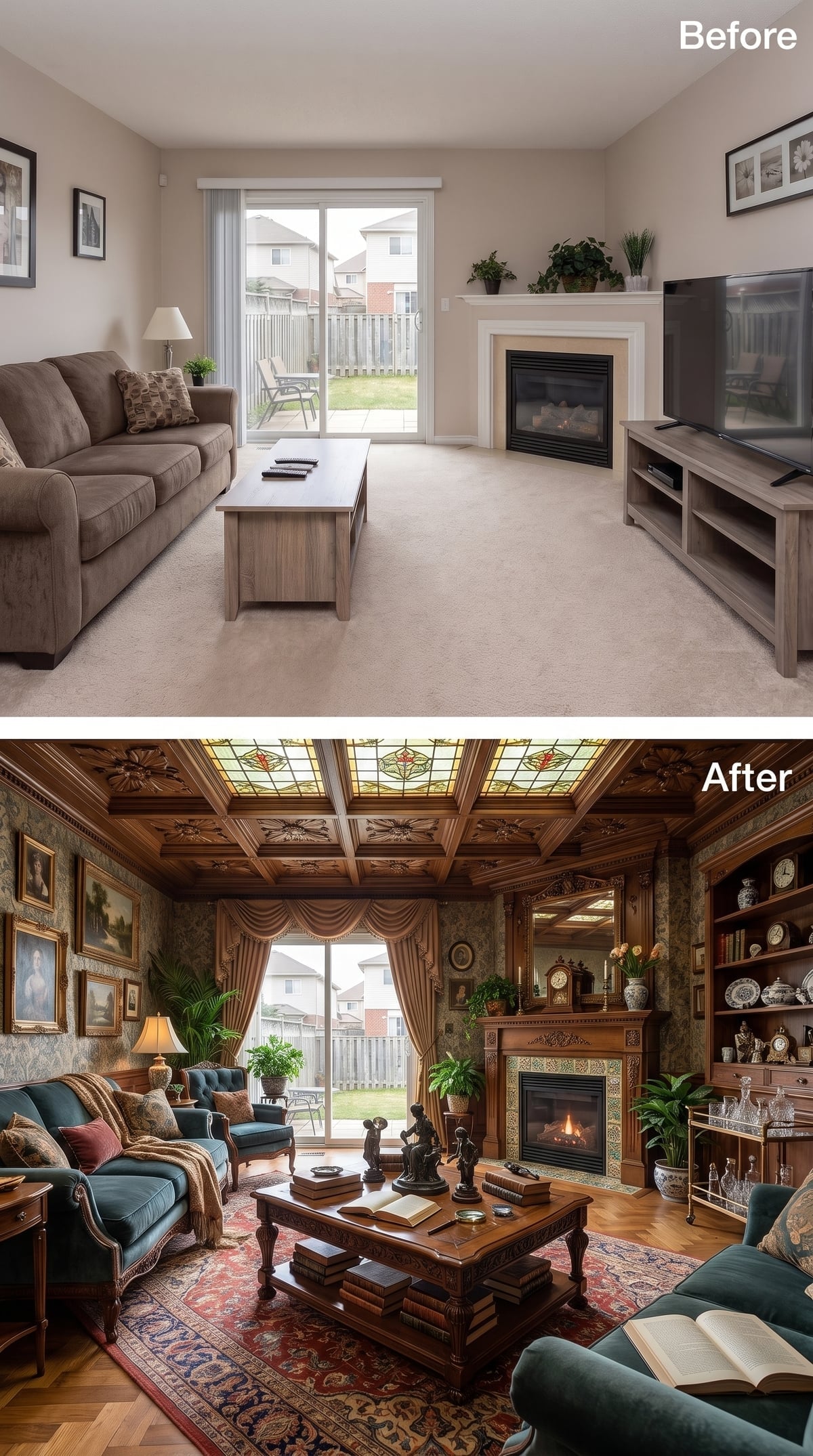
Deep reds and greens appear in stained-glass panels set between dark wood ceiling coffers, bringing color overhead before the furniture gets a chance.
Walnut millwork continues through the room, while teal velvet sofas sit over a nearly wall-to-wall Persian rug. The fireplace takes a more decorative turn with carved wood and patterned tile, and the built-ins are loaded with porcelain, clocks, decanters, books, and small objects.
This one doesn’t rely on empty wall space to calm things down. Instead, it keeps the palette tightly controlled and lets repetition do the organizing.
29. Peacock Wallpaper and Parquet Turn Every Surface Into Part of the Collection
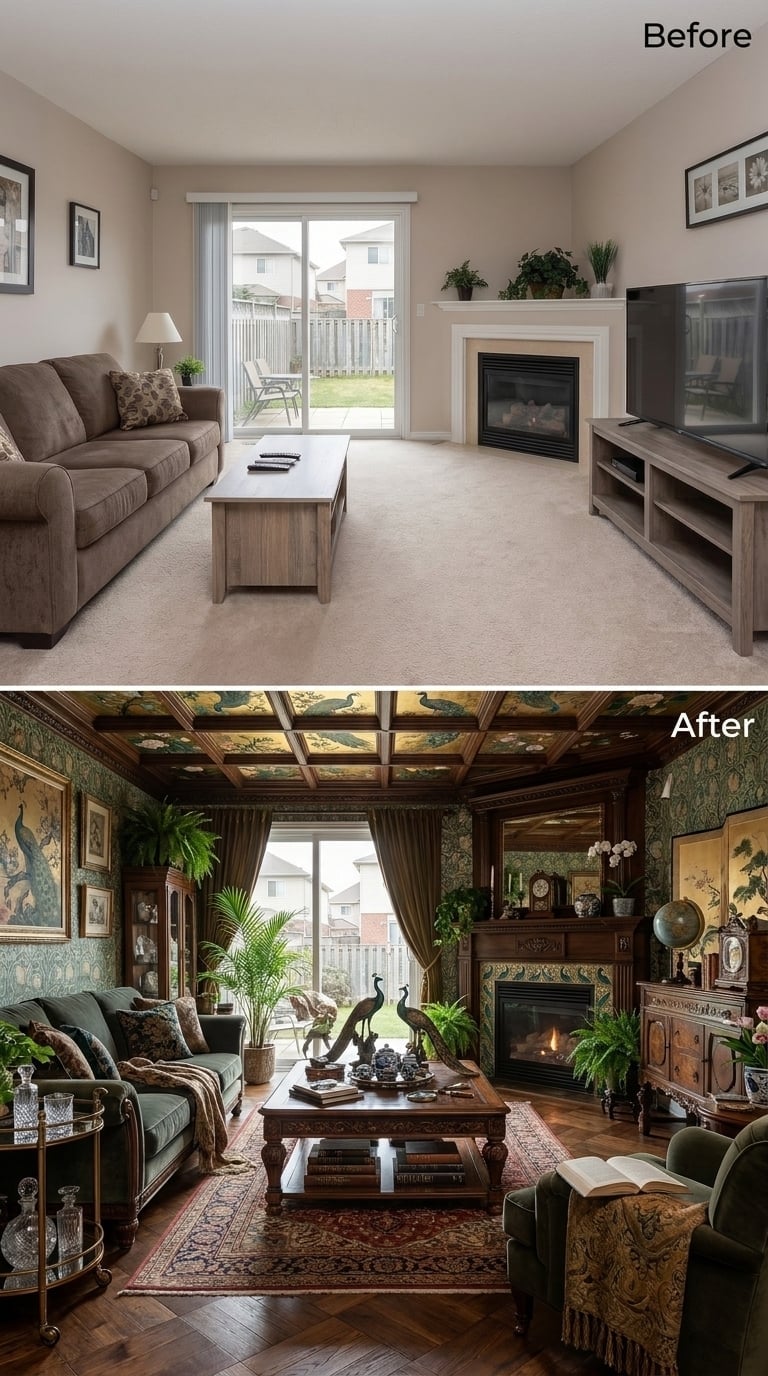
Every surface has volunteered for duty.
Dark walnut frames a ceiling painted with peacocks and botanical motifs. Green Morris-style wallpaper covers the walls, while herringbone parquet introduces another layer of pattern underfoot.
Forest-green velvet sofas sit around a carved coffee table on a red-and-navy Persian rug. Bronze peacock figures and stacked books occupy the center, while tall palms soften the heavier millwork.
The room is dense, but not random. Repeating greens, reds, carved wood, and botanical imagery keeps the visual noise moving in the same direction.
28. A Baroque Fresco Meets Raw Concrete and Refuses to Pick a Side
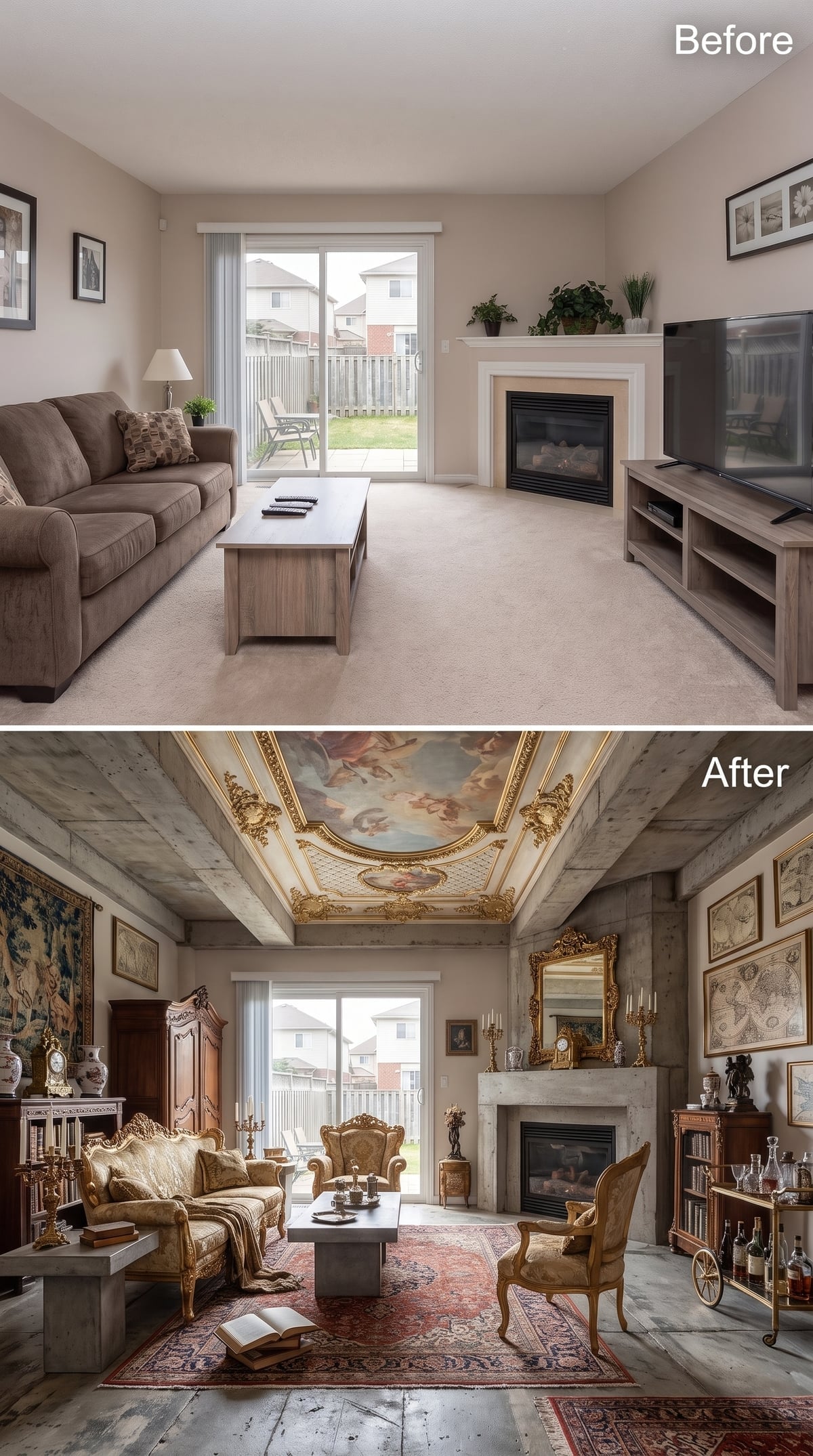
Gold-leafed furniture surrounds a crimson-and-dusty-rose Persian rug, while carved Baroque-style chairs sit beside a concrete coffee table that belongs to an entirely different design vocabulary.
That contrast continues at the fireplace, where rough concrete replaces a more traditional surround. Old maps gather on one wall, a tapestry covers another, and candlesticks, decanters, books, and an antique drinks cart crowd the edges.
The Fresco Pulls the Entire Room Upward
Classical figures painted in soft blue and rose fill the ceiling within ornate gilded molding. Against the rough gray walls below, the fresco feels even more extravagant.
That tension between polished and raw becomes the room’s central idea. It looks less like a period interior than a collector who kept buying across centuries and somehow found a way to make everybody sit at the same table.
27. Burlwood, Velvet, and Limestone Give the Fireplace Some Serious Company
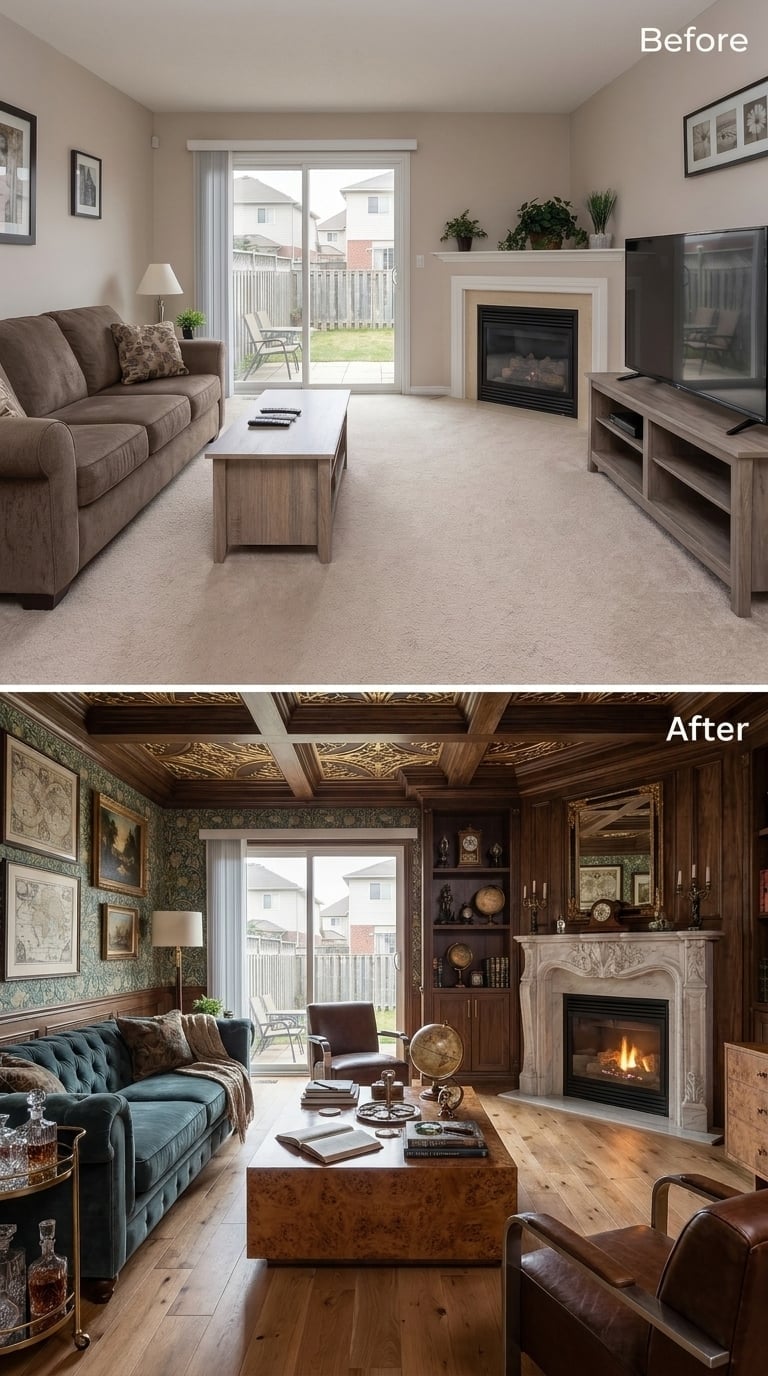
Dark walnut built-ins flank a carved limestone fireplace, while the ceiling introduces a botanical inset inside its coffering.
A teal velvet Chesterfield faces leather club chairs across a burlwood coffee table. Warm hardwood runs beneath the seating and gives the dark millwork a related material to echo at floor level.
Floor Note: In this concept, the warm wood floor gives the walnut cabinetry and leather furniture a more continuous base than pale carpet would. A large rug can create some of the same effect without requiring the floor itself to become the centerpiece.
26. Flemish-Style Tapestries, Oak Beams, and a Telescope Nobody Needed to Explain
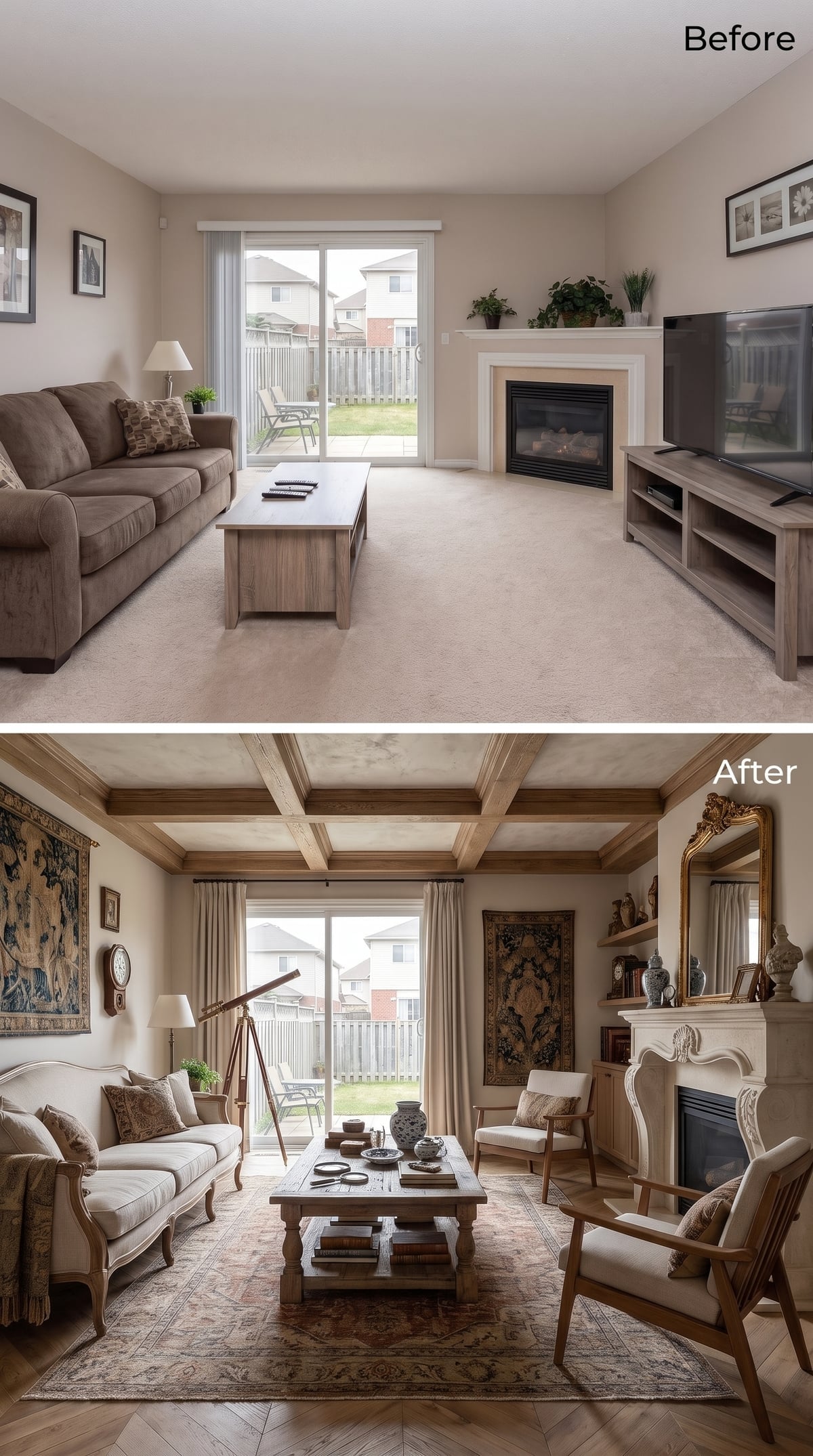
Bare plaster ceiling panels sit between substantial oak box beams, giving the upper half a much heavier presence than the original shell.
Two pale linen sofas face one another across a whitewashed farm table piled with books and ceramic vessels. A gilded mirror rises above the carved fireplace, and a brass telescope stands near the window with the confidence of an object that was never going to ask permission.
- Herringbone flooring introduces movement without adding another wall treatment.
- A carved fireplace can carry enough detail that the wall above it doesn’t need to be crowded.
- Large tapestries bring pattern and softness while occupying substantial wall space in a single gesture.
25. Teal Walls and Honey-Toned Wood Make the Clock Collection Feel at Home
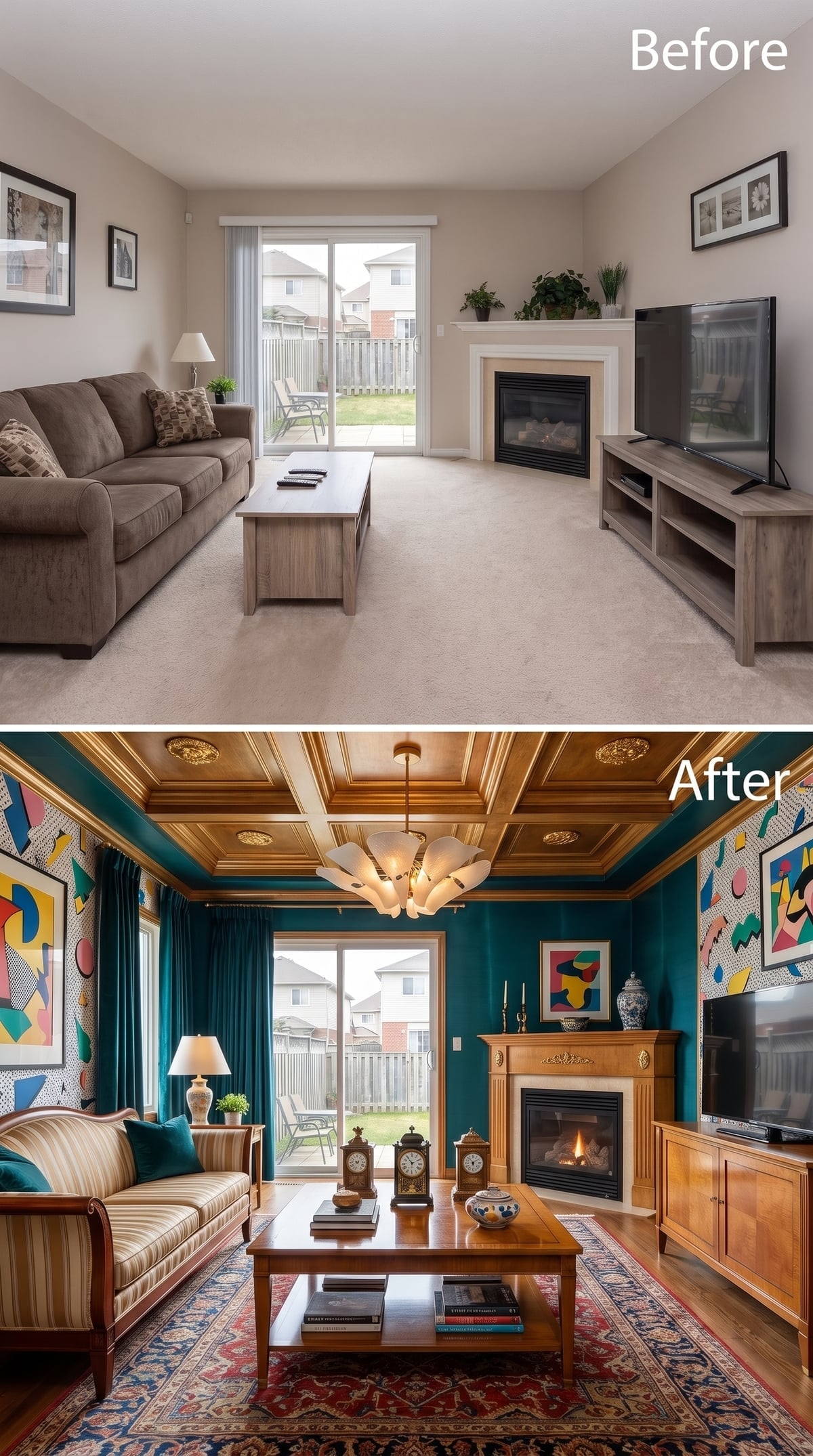
Honey-toned wood fills the coffered ceiling while saturated teal covers the walls below. The combination gives the room warmth and depth before any of the collected objects enter the picture.
A Persian rug under the coffee table picks up reds and creams that reappear in the upholstery and carved fireplace. Clocks, framed art, and small decorative pieces get their own shelves instead of competing for every flat surface.
- Decorative medallions add another layer of ornament inside the ceiling grid.
- The fireplace provides a natural stopping point for a room already full of objects.
- The large rug gives the seating arrangement a clear boundary within the larger collection.
24. Floral Ceiling Murals and Fieldstone Give Maximalism Somewhere to Settle
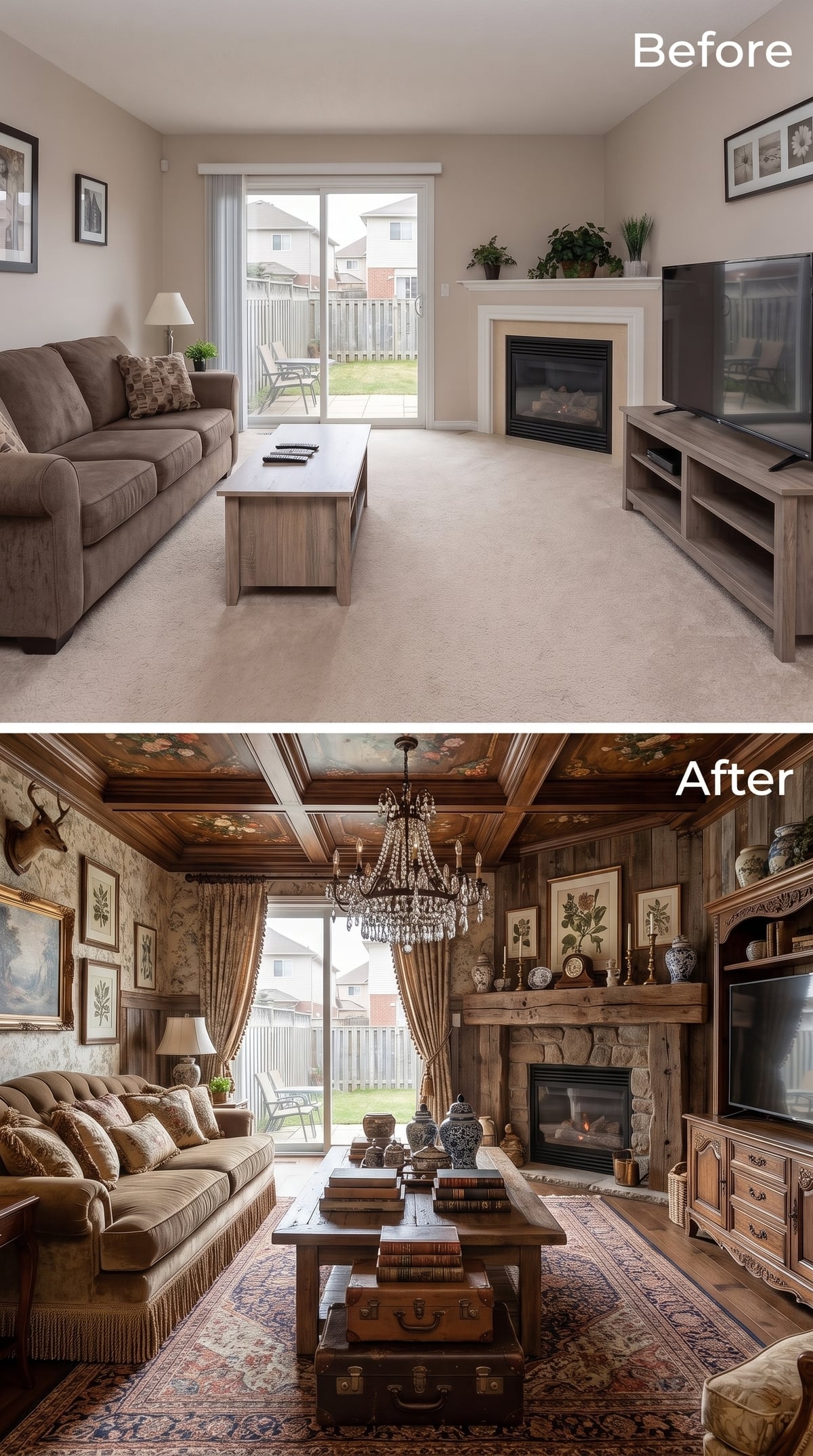
Painted floral panels fill the ceiling while framed botanical prints march across wallpapered walls below. A crystal chandelier drops into the middle without pretending to be the room’s only decorative event.
The fireplace gets rougher with stacked fieldstone and a reclaimed-wood mantel, creating a useful break from all the gilt frames and patterned textiles. A long tufted sofa, Persian rug, layered pillows, and a vintage trunk complete a room that rewards inspection rather than a quick glance.
Art Note: Varying the scale of framed pieces keeps a dense wall from becoming one uniform grid. Large paintings, smaller botanicals, gilt frames, and darker wood frames create enough difference that the collection can be read piece by piece.
23. Green Velvet and Rough Stone Give the Brass Something to Push Against
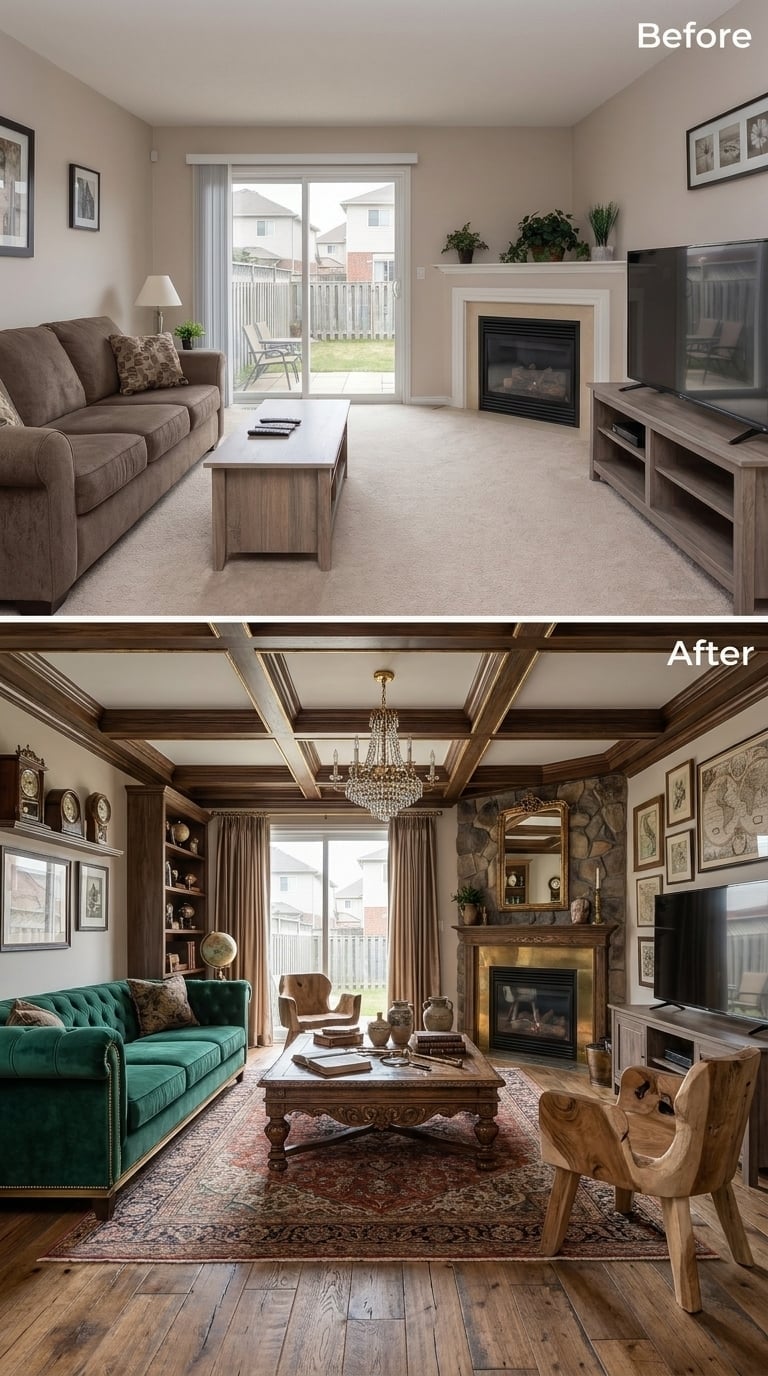
Walnut ceiling beams divide the room into strong geometric panels, while an emerald Chesterfield creates the deepest block of color below.
The fireplace surround is rough stone, which makes the polished brass chandelier and mirror feel sharper by contrast. A live-edge chair adds another irregular natural texture beside all the carved and tufted pieces.
Color Story: Emerald, walnut, aged red, stone, and brass all have enough depth to coexist without collapsing into one brown-green mass. The Persian rug introduces red beneath the seating, while the metallic accents brighten the darker surfaces above it.
22. Gilded Plaster and Silver-Gray Upholstery Push the Room Toward Full Salon Drama
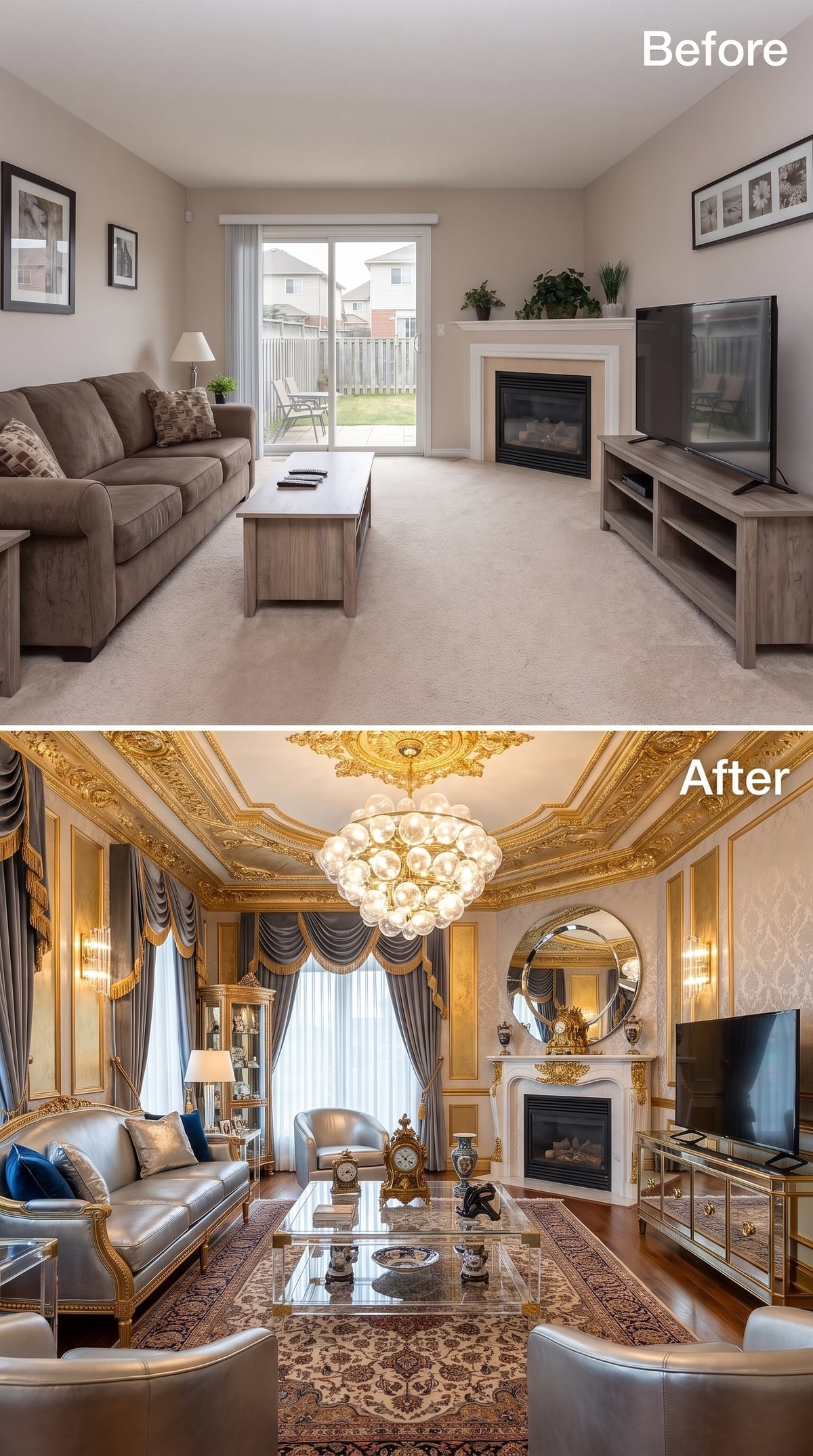
This room has no interest in leaving a surface unfinished.
Gold-leaf plasterwork wraps the tray ceiling, catching light from a clustered globe chandelier. Silver-gray sofas with carved gilt frames gather around a glass-topped coffee table, with burgundy and ivory appearing in the Persian rug below.
The fireplace is faced in white marble with gold detailing, and a convex mirror above it adds another reflective surface. Swagged gray drapes with fringe pool at the hardwood floor. The warm honey tone below keeps the metallic palette from becoming icy.
21. Black, Cream, and Gold Turn the Ceiling Into a Giant Graphic Pattern
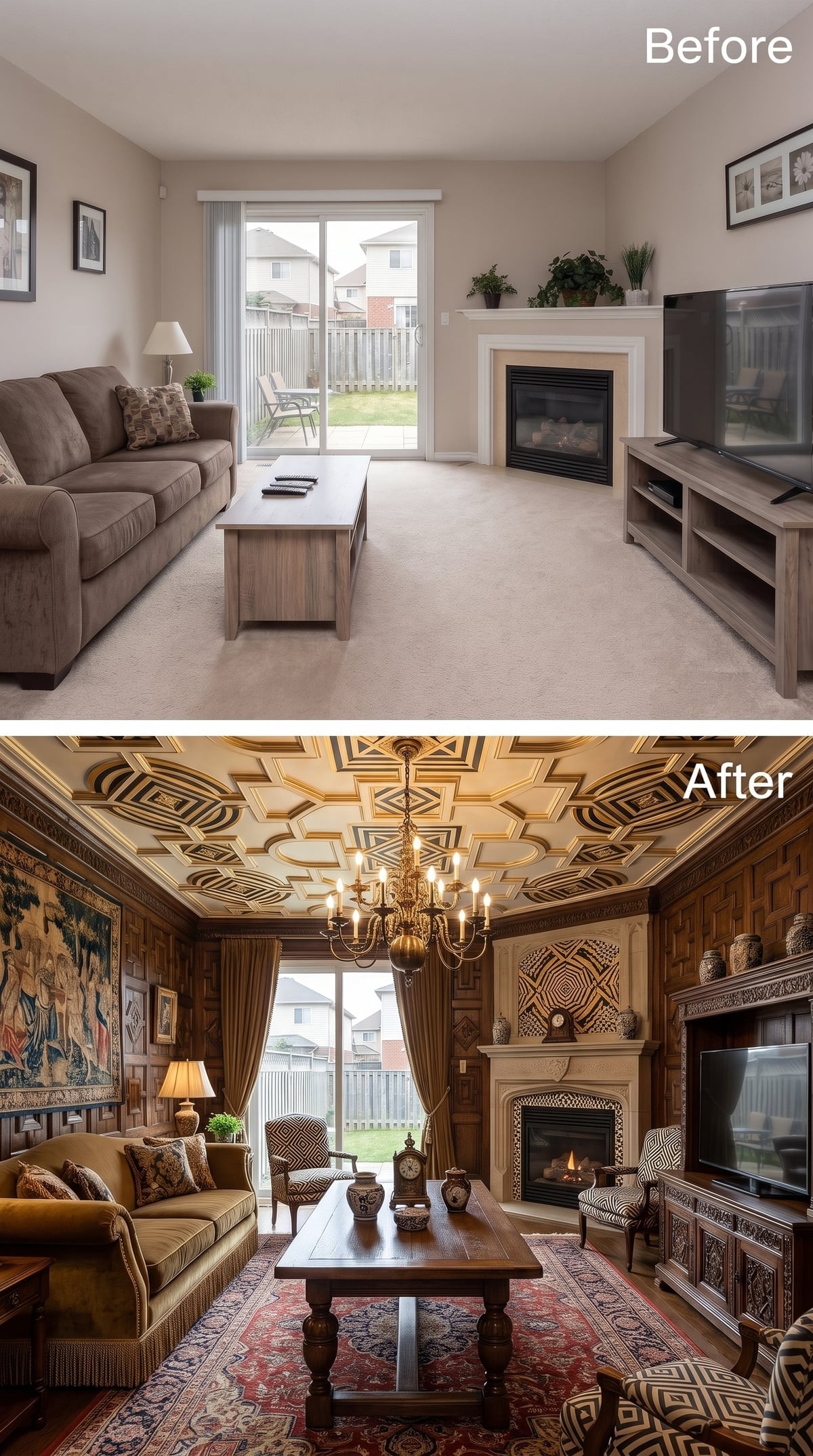
The ceiling carries cream-and-black geometric panels with small gold details at the intersections, centered on a wrought-iron candle-style chandelier.
A red-and-navy Persian rug spreads beneath a dark farmhouse table, while a carved stone fireplace adds another substantial material at the edge of the room. Zebra-print chairs beside it provide the unexpected pattern — because apparently the ceiling hadn’t already made enough decisions.
Ceiling Idea: Painted geometric panels can give an otherwise flat ceiling some of the rhythm of architectural coffering. Even when the treatment is decorative rather than structural, repetition overhead can change how the entire room is read.
20. An Art Nouveau-Inspired Fireplace Makes the Rest of the Room Follow Its Curves
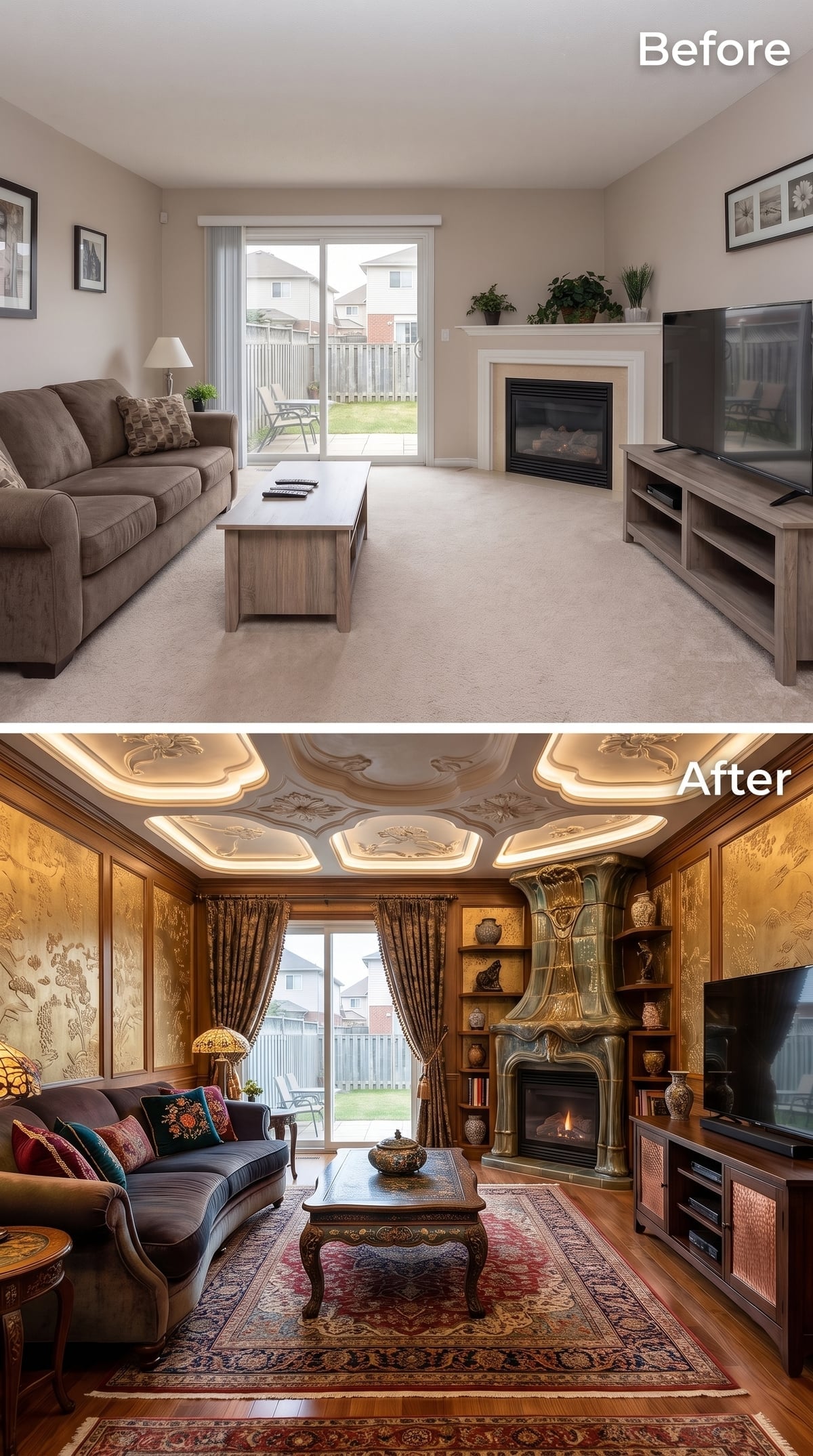
The fireplace is the first thing to study: an organic, sinuous surround with a greened-metal look and curves that feel closer to sculptural furniture than conventional masonry.
Dark built-ins flank it with ceramics and small sculpture, while gold-toned wall panels sit inside dark wood trim. Above, an ornamental ceiling glows from within its recessed sections.
The Persian rug, carved coffee table, and velvet seating are all richly detailed, but the fireplace has enough individuality to keep the room from becoming a generic exercise in “more.”
Ask Yourself: If a fireplace wall feels weak, the mantel may not be the only issue. Material, scale, surrounding shelving, and the amount of open wall around it can all change whether the fireplace reads as a focal point or simply another rectangle.
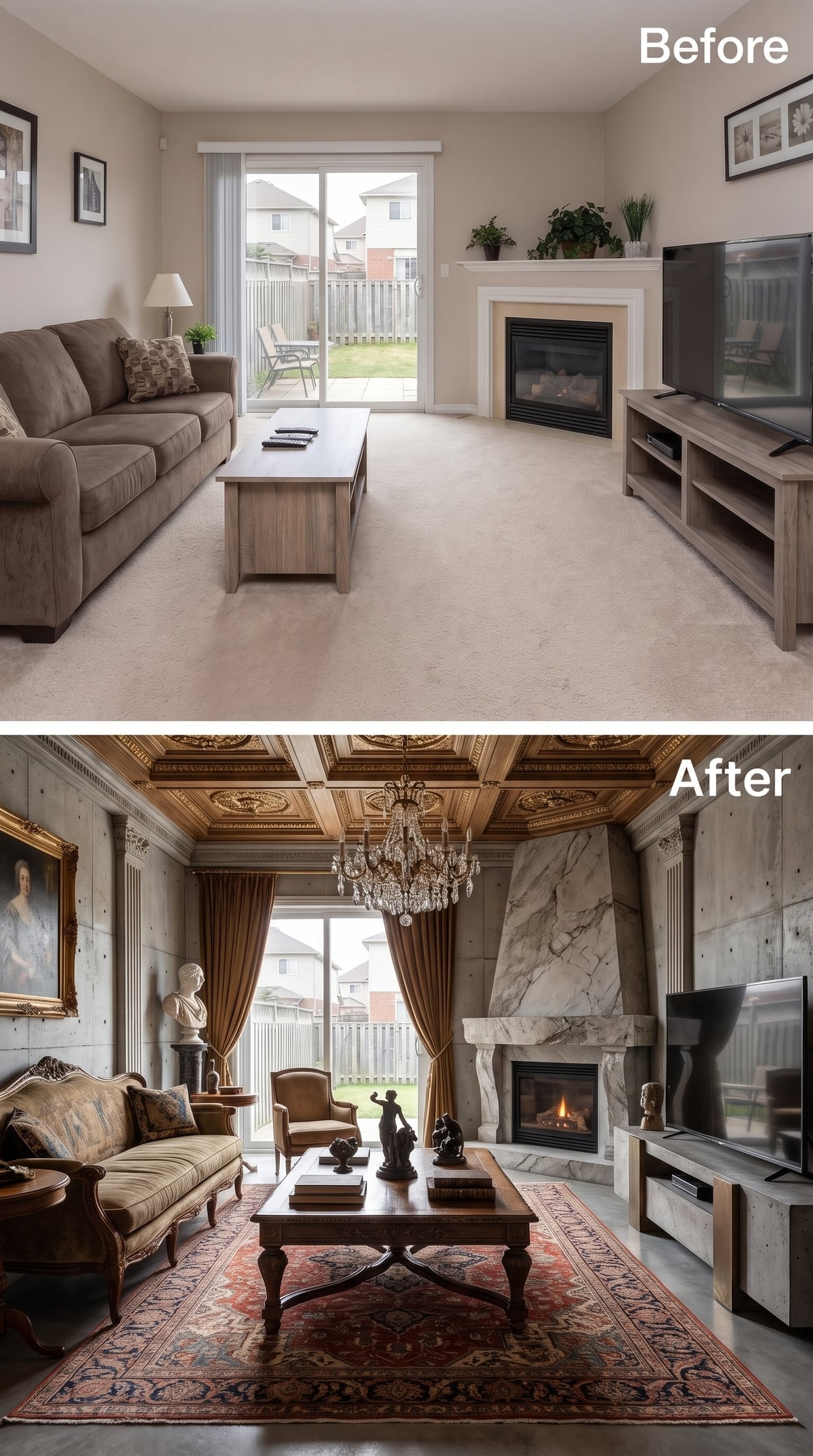
19. Concrete, Marble, Crystal, and Gold Meet in One Completely Unreasonable Room
🔥 Would you like to save this?
Concrete walls sit beneath gilded ceiling coffers, immediately setting up a fight between raw and elaborate materials.
A marble fireplace occupies the corner, a crystal chandelier hangs at center, and a carved walnut coffee table sits on a red Persian rug. An aged-cream Baroque-style settee completes the collision.
Material Contrast: Rough concrete makes crystal, gilt molding, and polished marble look even more refined, while those ornate materials keep the concrete from feeling austere. The tension is the point; smoothing everything into one stylistic lane would make this room considerably less interesting.
18. Teal Walls and Painted Coffers Refuse to Let the Chandelier Have All the Fun
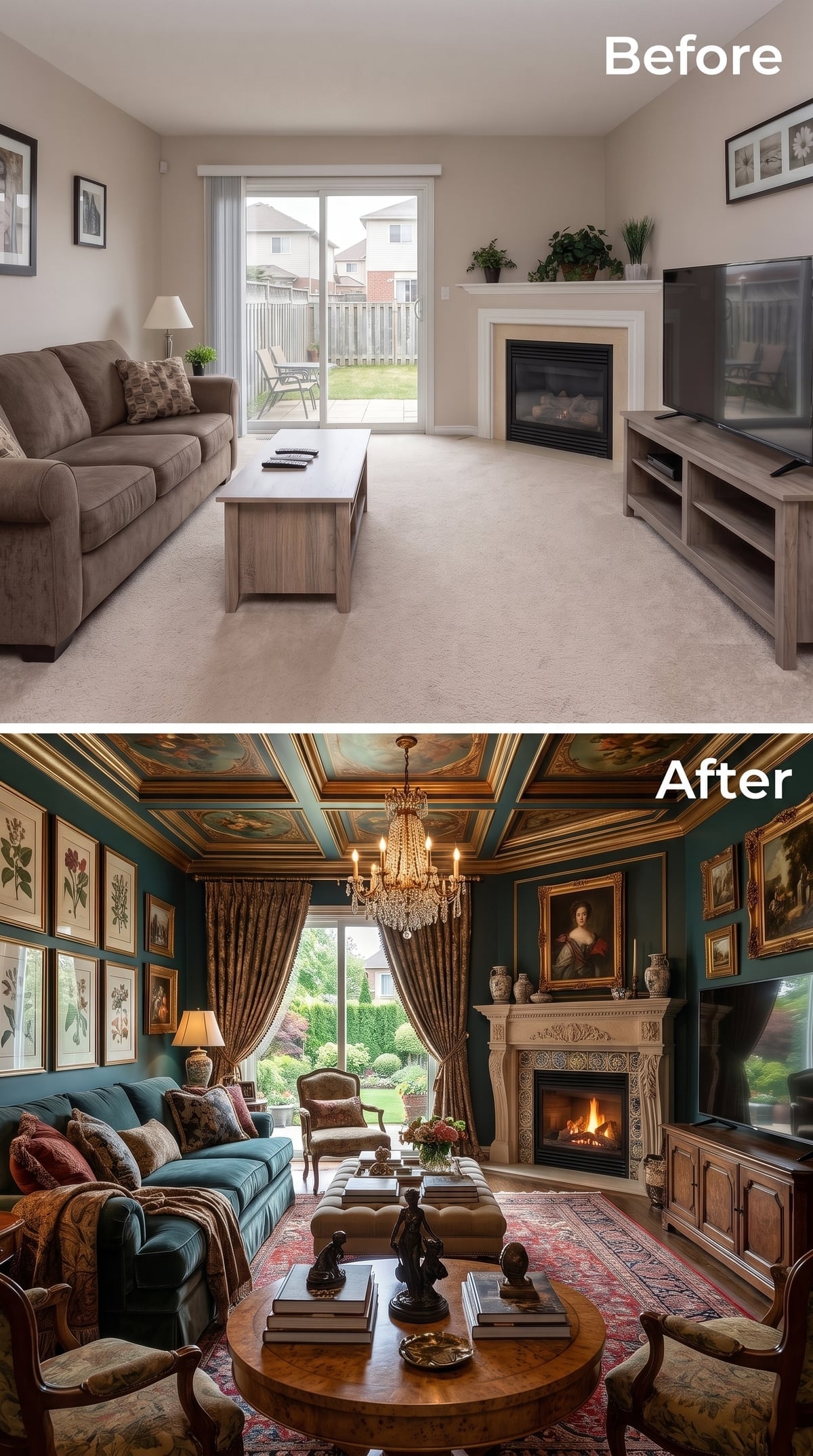
Saturated teal covers all four walls while painted ceiling panels sit inside gilded coffers overhead. A crystal chandelier occupies the center, but it has serious competition.
A burlwood coffee table brings a warmer grain into the middle of a deep red Persian rug, while a teal velvet sofa repeats the wall color in a different texture.
Color Note: Using teal across entire walls gives it very different authority than using it only on pillows or accessories. Here, the gilded trim, red rug, and dark wood keep that large field of blue-green from feeling isolated.
17. Gold Mosaic Coffers and Arched Niches Push the Room Into Byzantine Territory
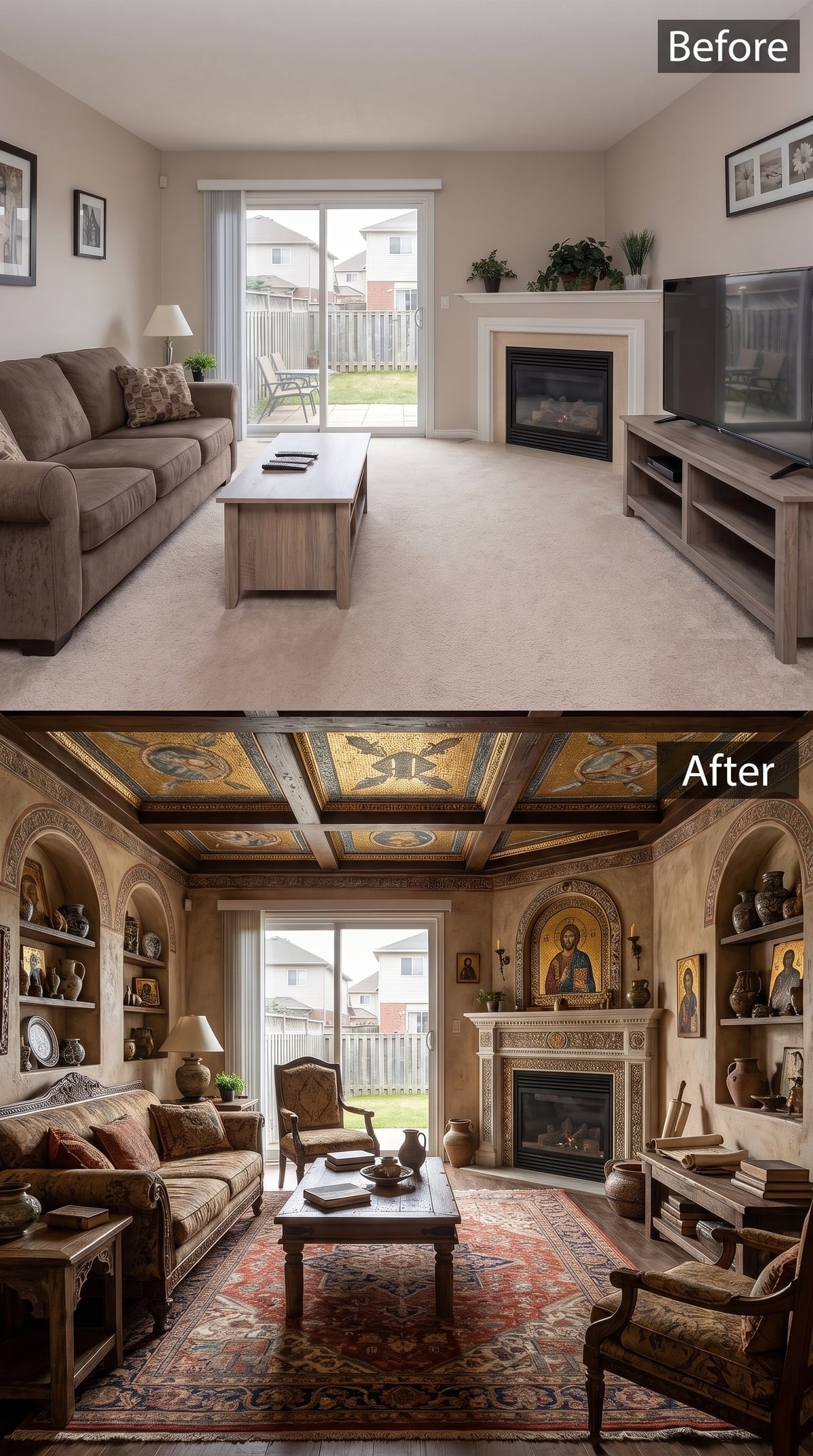
Gold mosaic-like panels sit within heavy ceiling beams, giving the upper half a churchlike richness. Below, an elaborately carved fireplace is topped by a Byzantine-style icon in an arched niche.
More arches appear in built-in shelving along both sides, filled with ceramics and antiquities. A red-ground Persian rug covers much of the floor beneath carved wood furniture and tapestry upholstery.
Architectural Note: Arched niches give collected objects a built-in frame and interrupt the long horizontal lines of ordinary shelving. In a room this ornate, the arches also repeat the curves already appearing around the fireplace.
16. Egyptian Revival Goes All In With Scarabs, Sphinxes, and Gold
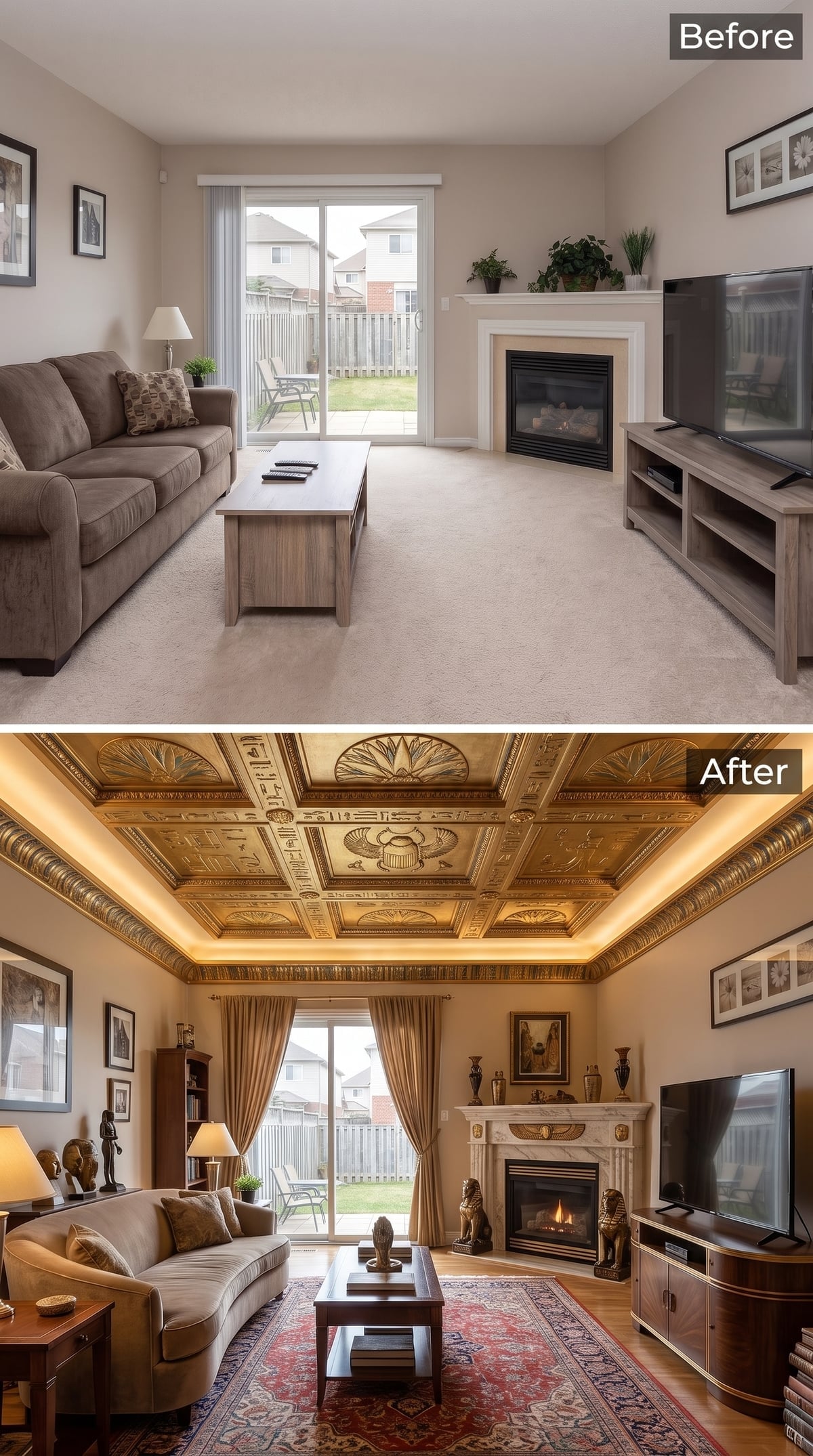
Aged-gold ceiling panels are filled with hieroglyphic and scarab motifs, while concealed perimeter lighting casts the entire canopy in amber.
Sphinx figures flank the marble fireplace at floor level, immediately making the historical reference unmistakable. Bronze vessels, hardwood flooring, and a deep red Persian rug keep the room in a dark, earthy register rather than turning the Egyptian motifs into novelty decor.
Historical Note: Egyptian Revival was a significant decorative movement in the 19th century, using motifs such as sphinxes, scarabs, lotus forms, hieroglyphs, and monumental geometry across furniture, architecture, and interiors. This concept borrows that vocabulary at room scale rather than treating it as a small decorative accent.
The next concept trades the archaeological drama for dark wood, plaster ornament, and the atmosphere of an old private library.
15. Dark Paneling and an Octagonal Ceiling Make the Room Feel Generations Older
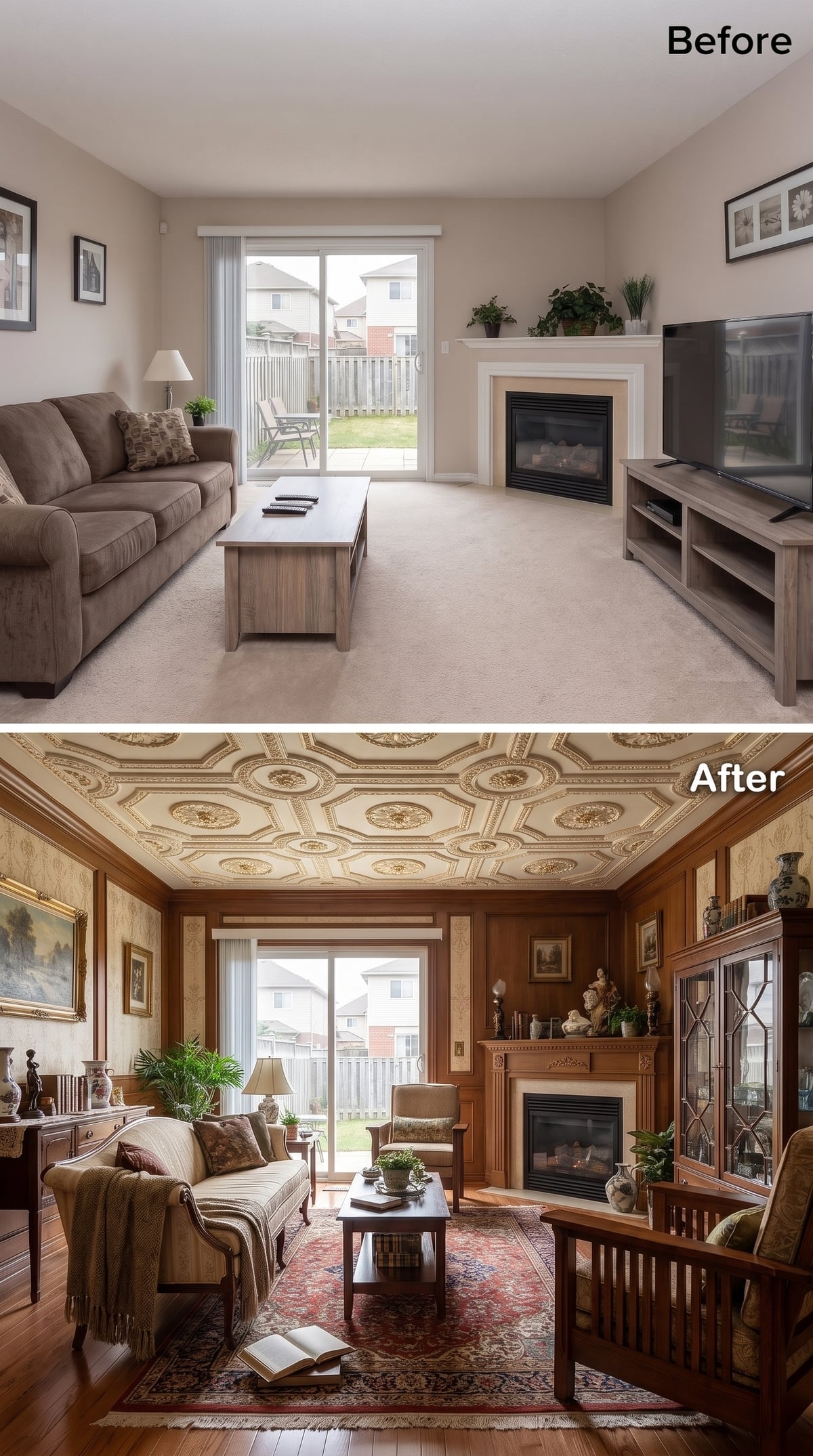
Octagonal ceiling coffers filled with cream plaster and gilded rosettes give the room a strong pattern overhead without relying on painted scenes.
Below, dark-stained paneling runs from floor to ceiling, surrounding a carved fireplace and a glass-front cabinet filled with collected objects. Cream upholstery and a substantial timber coffee table give the eye lighter surfaces among all that wood.
Ceiling Shortcut: A single decorative medallion around a central light can introduce some of the ornament of a fully treated ceiling without reproducing the entire coffered grid. Here, the repeated rosettes show how strongly even small plaster details register against dark wood.
14. Mondrian Color Blocking Meets Moroccan Detail in the Wildest Room of the Set
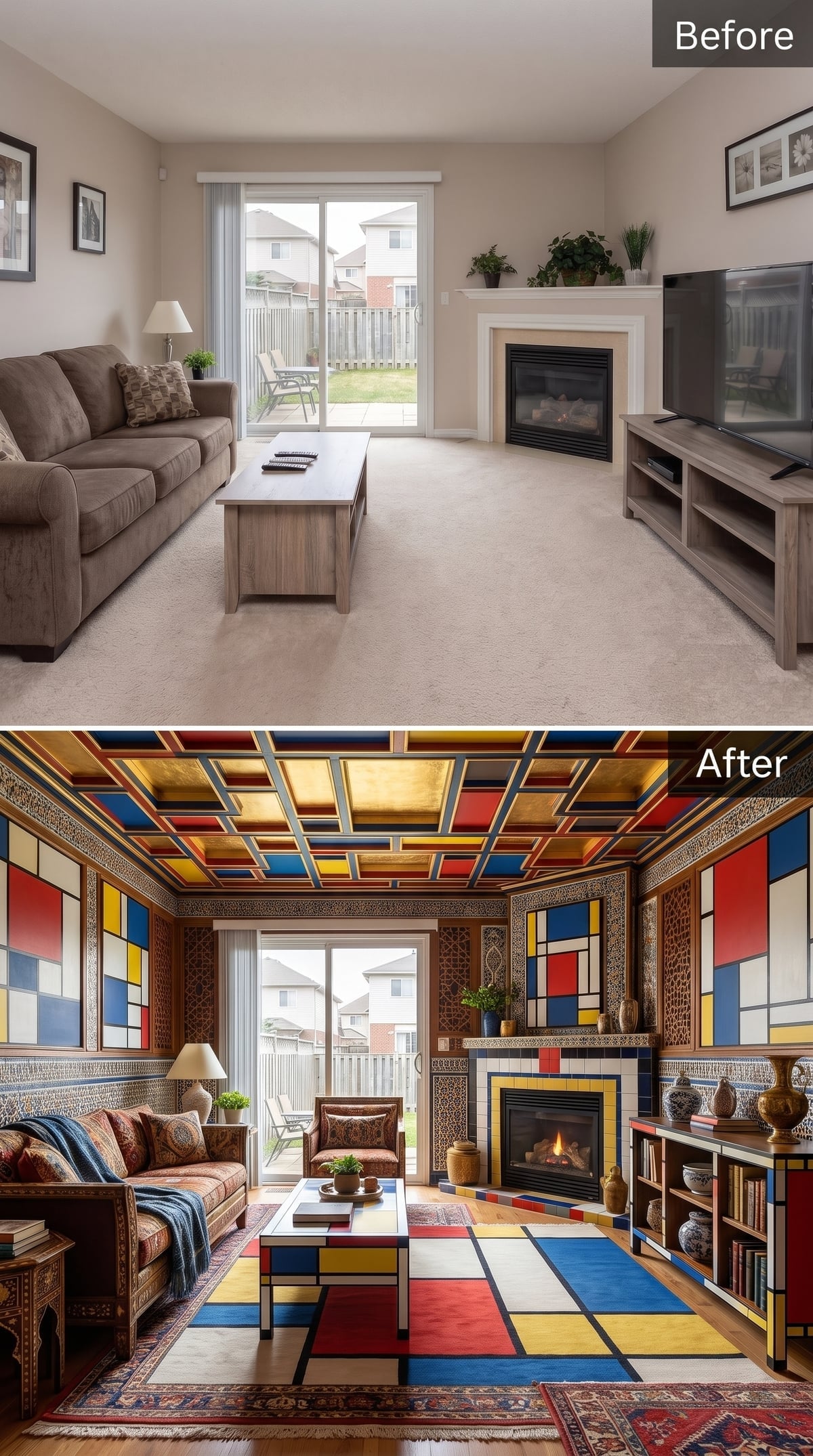
Red, cobalt, and yellow cover the walls in flat planes divided by thick black lines, making the De Stijl reference impossible to miss.
The ceiling carries related blocks of color inside gilded panels, but carved Moroccan-style borders complicate the geometry rather than simply repeating the walls. Even the rug mirrors the grid below.
Pattern Note: What keeps all this geometry legible is repetition. The same primary colors and black divisions appear on multiple surfaces, so the room reads as one deliberate system instead of several unrelated patterns fighting for territory.
13. Steel Ceiling Ribs and Propaganda-Style Posters Build a Collector’s Cabinet at Room Scale
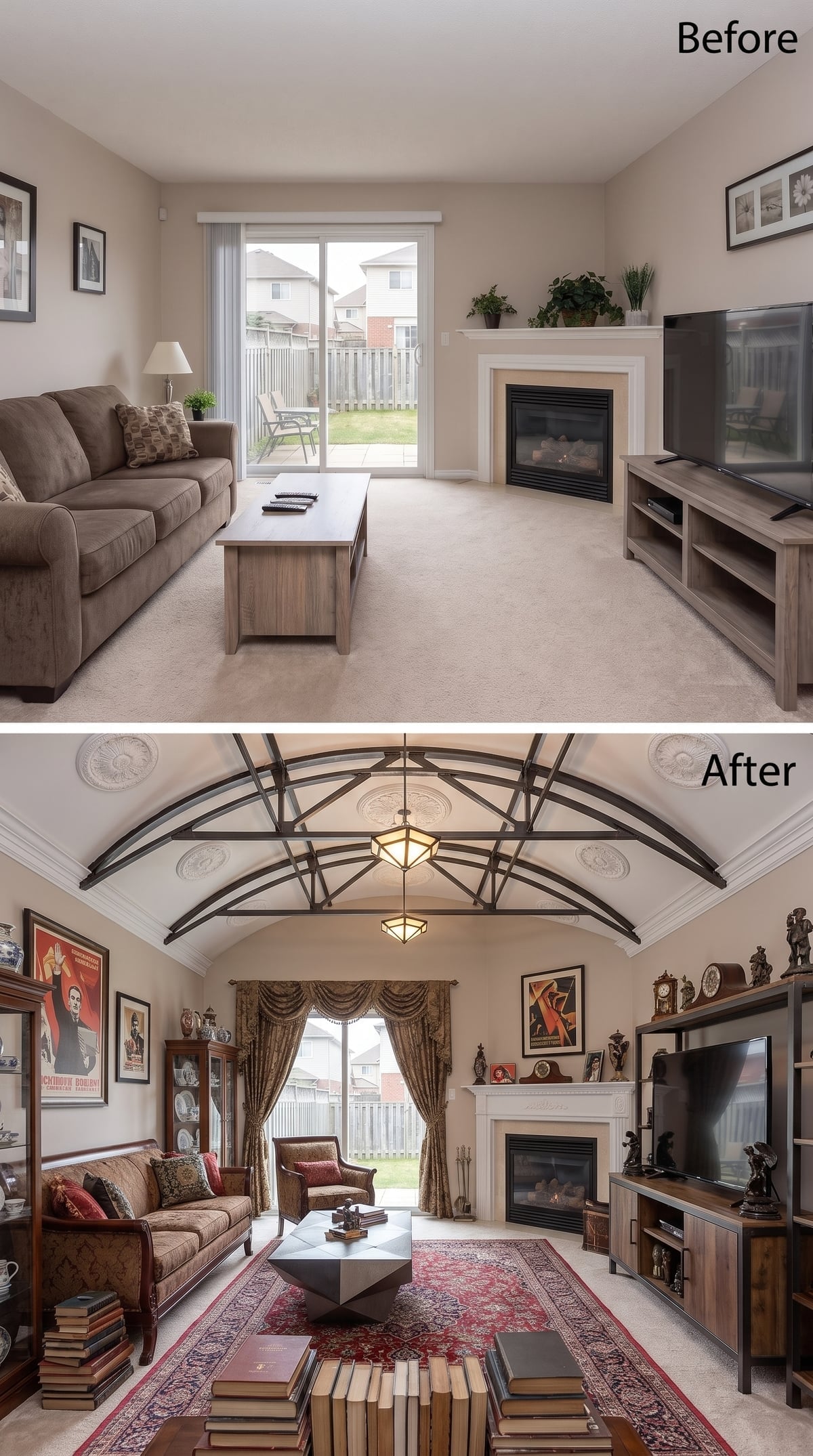
Dark steel ribs curve across the vaulted ceiling like the skeleton of an old conservatory. Plaster medallions punctuate the arches, while brass-and-glass pendants hang below.
The walls are packed with propaganda-style posters, framed prints, clocks, figurines, and glass-front display cabinets. A deep red Persian rug stretches beneath patterned seating, while the simple white mantel becomes one of the few visually quiet surfaces left in the room.
Try This: In a room loaded with pattern and objects, one quieter surface can make the surrounding collection easier to read. Here, the white mantel provides a pause between the poster wall, patterned upholstery, heavy drapery, and exposed ceiling structure.
12. Forest Green and a Gothic Fireplace Give the Antiques a Darker Home
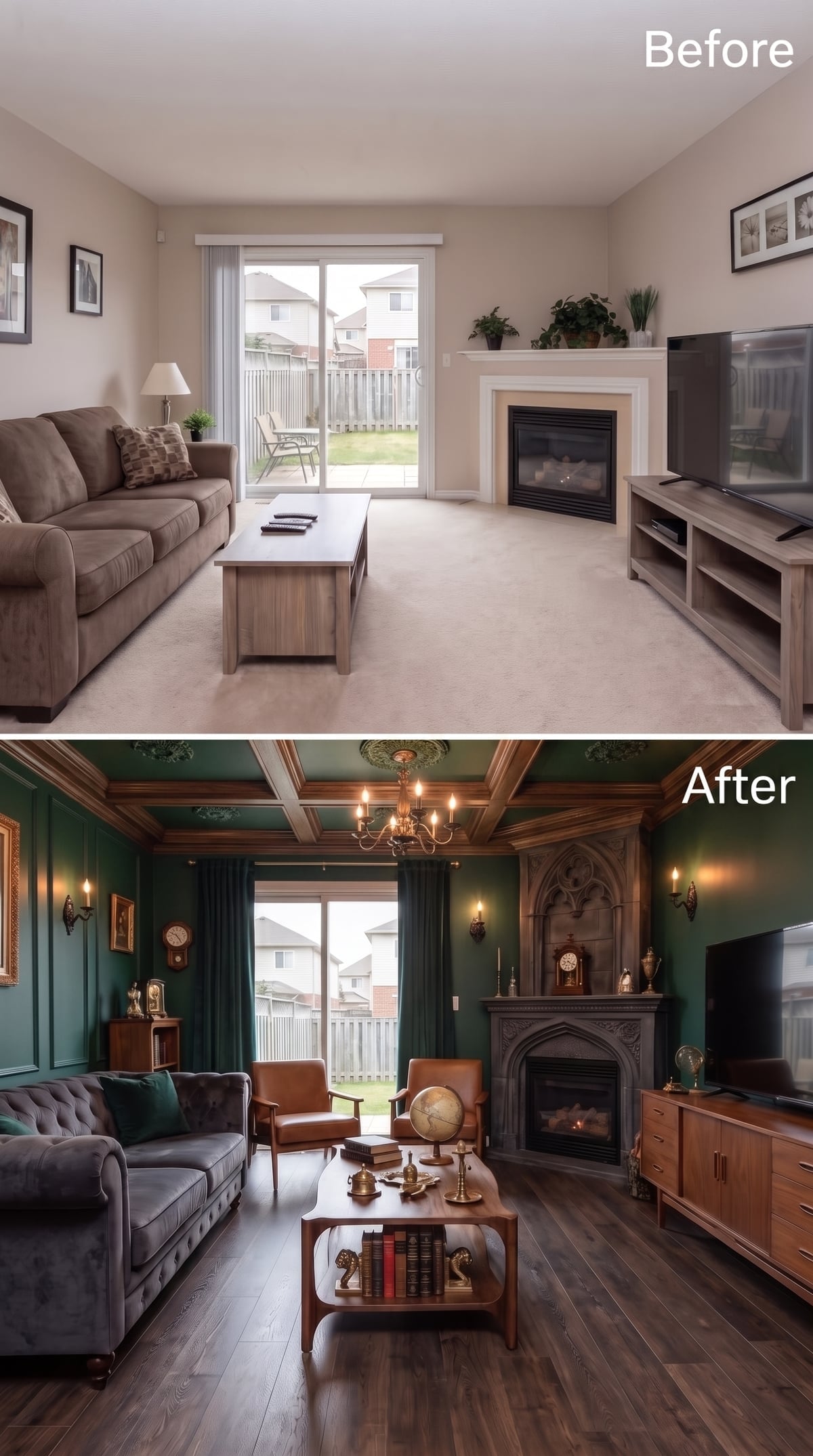
Deep forest-green walls sit beneath dark wood ceiling coffers, making the entire envelope of the room feel denser before the furniture arrives.
The pointed Gothic-style fireplace opening becomes the clearest architectural feature. A tufted gray sofa, leather chairs, brass objects, and an antique globe gather around it without trying to imitate the fireplace’s ornament.
Material Note: The dark floor, woodwork, and ceiling create a continuous backdrop for furniture with visible legs and carved bases. In this particular room, that continuity helps the antiques feel related even though their shapes and materials vary.
11. A Stained-Glass Oculus Turns the Ceiling Into the Main Light Show
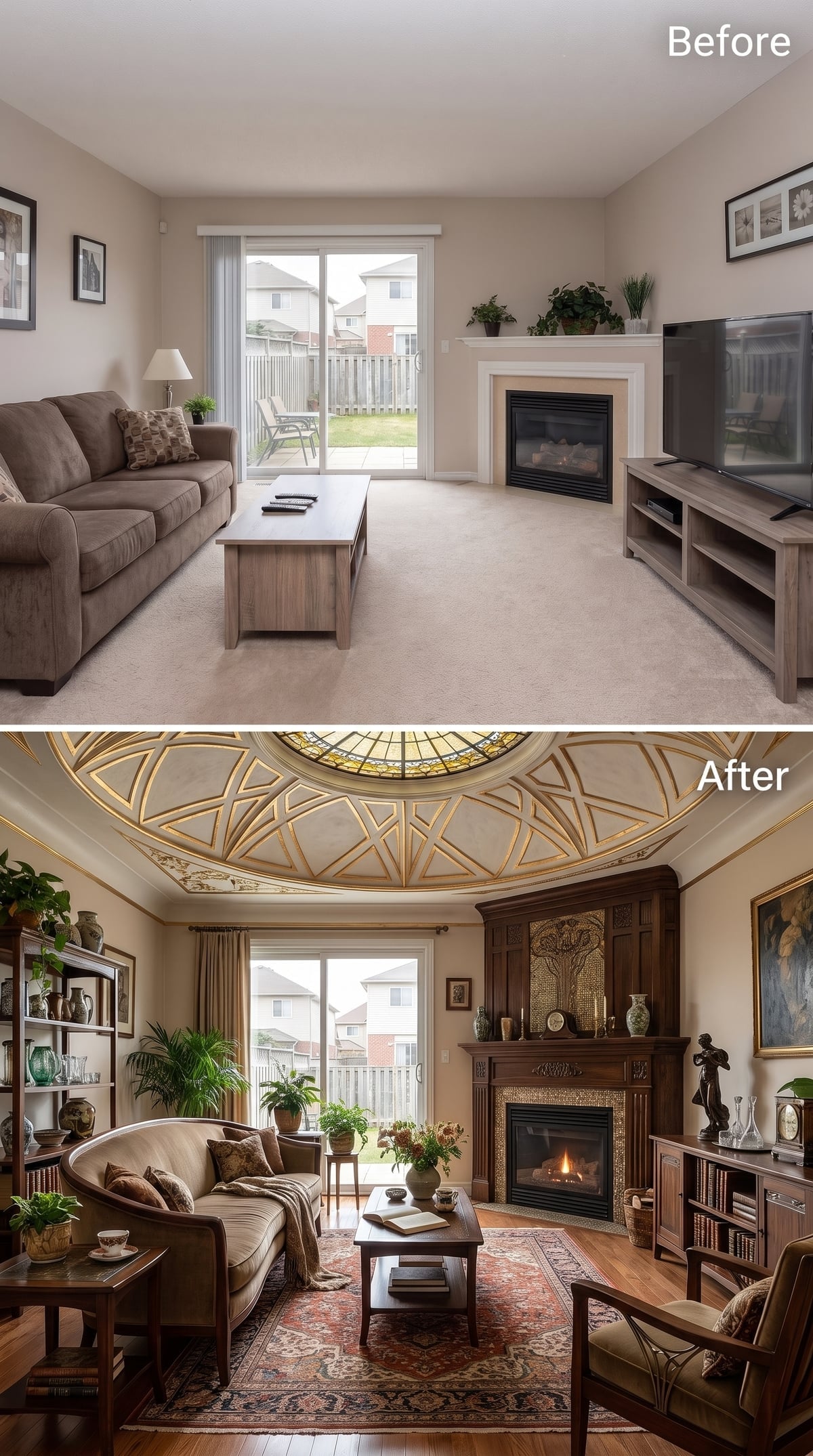
Plaster ribs fan across the ceiling toward a stained-glass oculus, with gold inlay emphasizing every curve. The result borrows from several historicist traditions without settling neatly into only one.
Below, a dark walnut fireplace incorporates carved details and mosaic tile, while open shelves on either side hold ceramics and books. A rust-and-cream Persian rug gives the seating area a warmer, softer center.
Worth Noticing: Stained glass doesn’t have to appear only in a vertical window. Set into an overhead feature, it turns changing daylight into part of the ceiling treatment and gives the room color without adding another object at eye level.
10. A Painted Dome Gives This Room the Vertical Space Its Furniture Demands
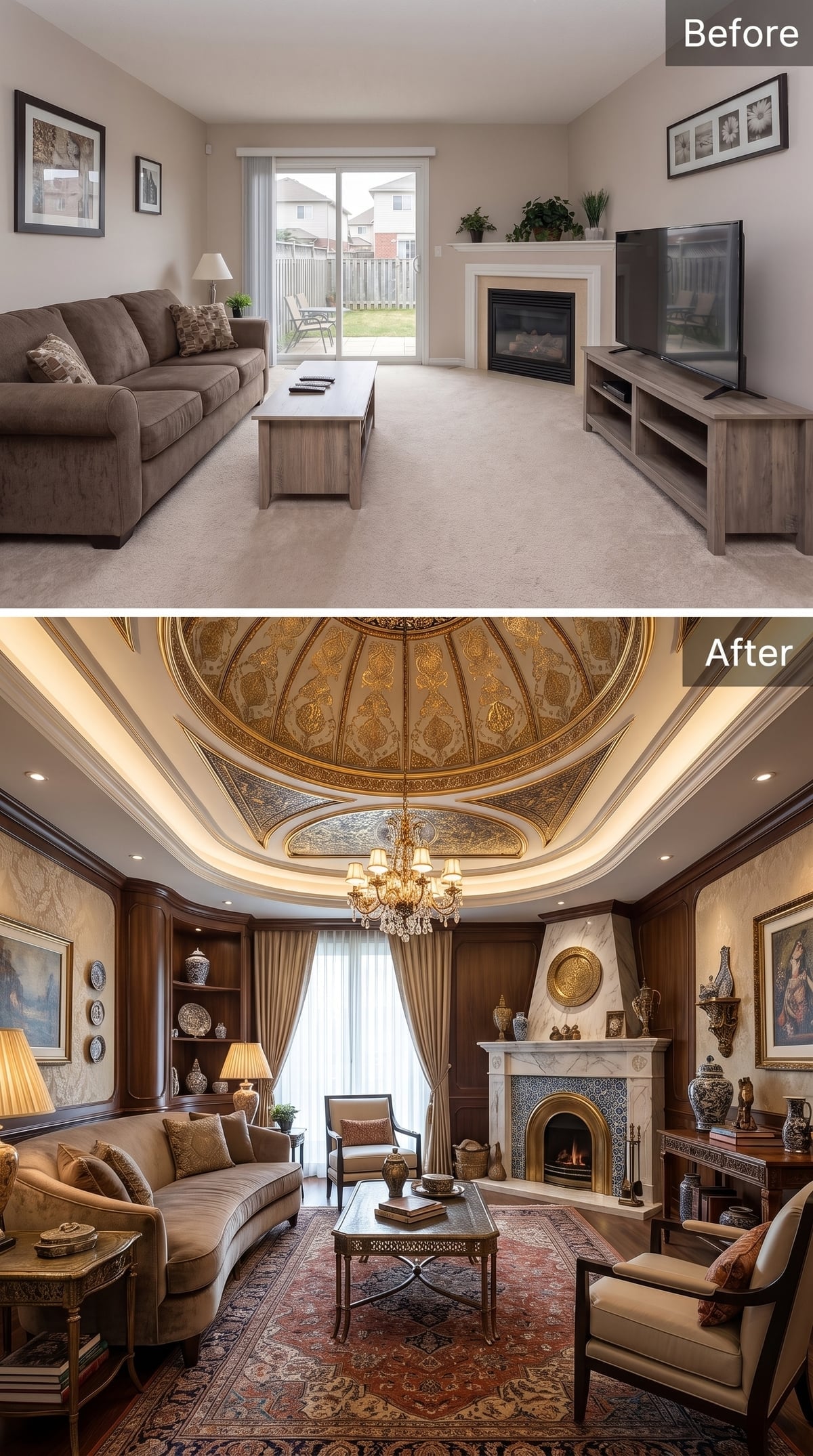
Warm gold and ochre cover the coffered dome overhead, establishing the room’s palette before the chandelier or furniture enters the picture.
A crystal chandelier with fabric shades hangs over curved seating, while heavily veined marble frames the fireplace. Blue tile inside the firebox provides one unexpectedly cool detail amid the gold, cream, and red.
The Dome Gives All That Furniture Somewhere to Breathe
With so much pattern and upholstery below, the recessed ceiling opens another visual zone above the seating rather than pressing down over it. The eye moves from painted dome to chandelier to furniture and finally the intricate Persian rug.
The drama here comes less from color contrast than from the sheer amount of architecture packed into one room.
9. Botanical Prints and Gilded Coffers Turn the Room Into a Collector’s Study
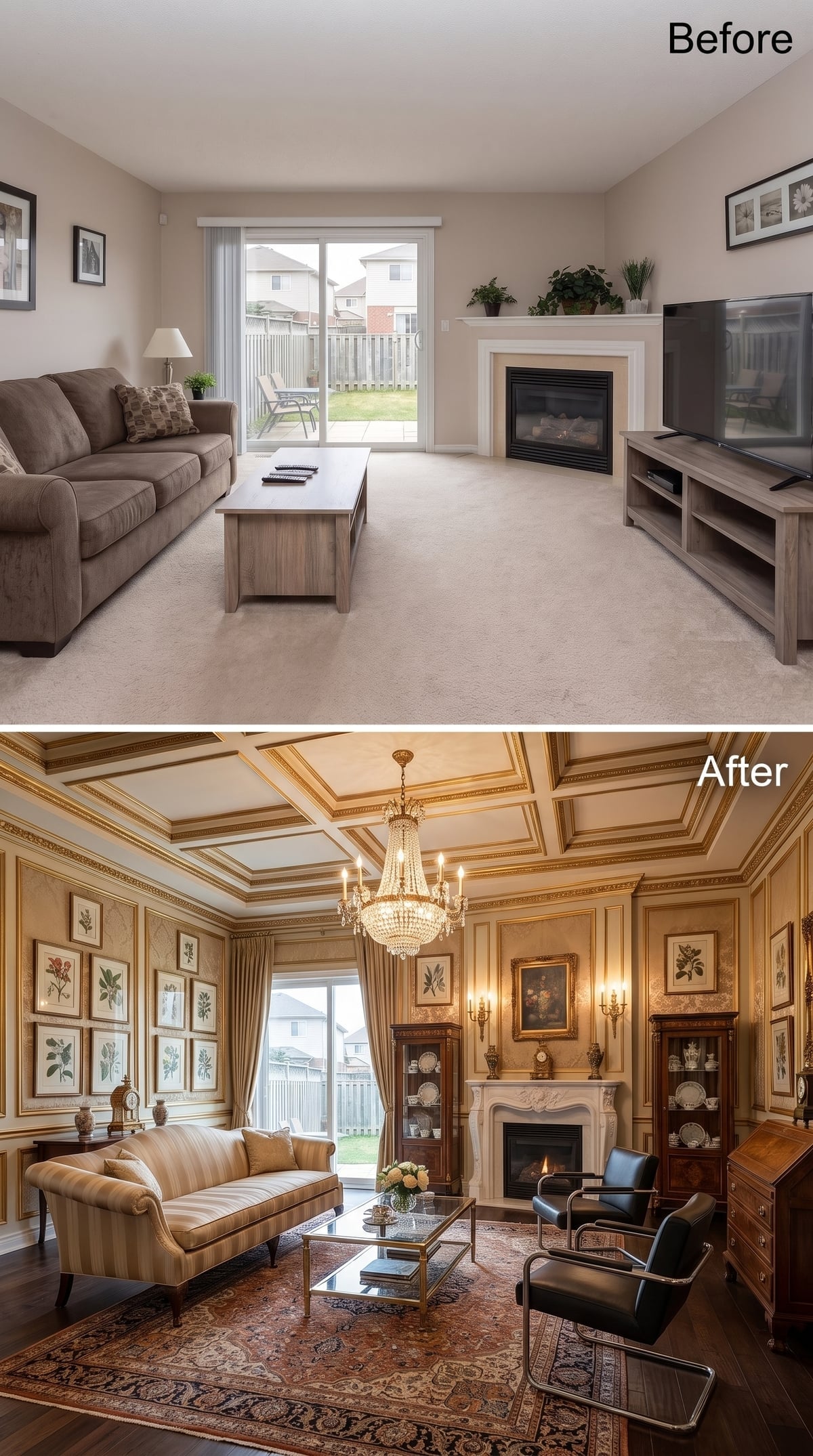
Cream-striped upholstery stays relatively quiet beneath a ceiling lined with gilded coffers. A crystal chandelier hangs low enough to feel connected to the seating rather than stranded high above it.
Botanical prints bring smaller repeated imagery to the walls, while a Persian rug, warm plaster, and carved marble fireplace keep the lower half traditional.
Collection Note: Botanical illustration has a long history as both scientific record and decorative art. Grouped closely here, the prints read less like isolated pictures and more like a single collection with its own rhythm.
8. Blue-and-White Toile Makes a Surprisingly Strong Partner for Dark Walnut
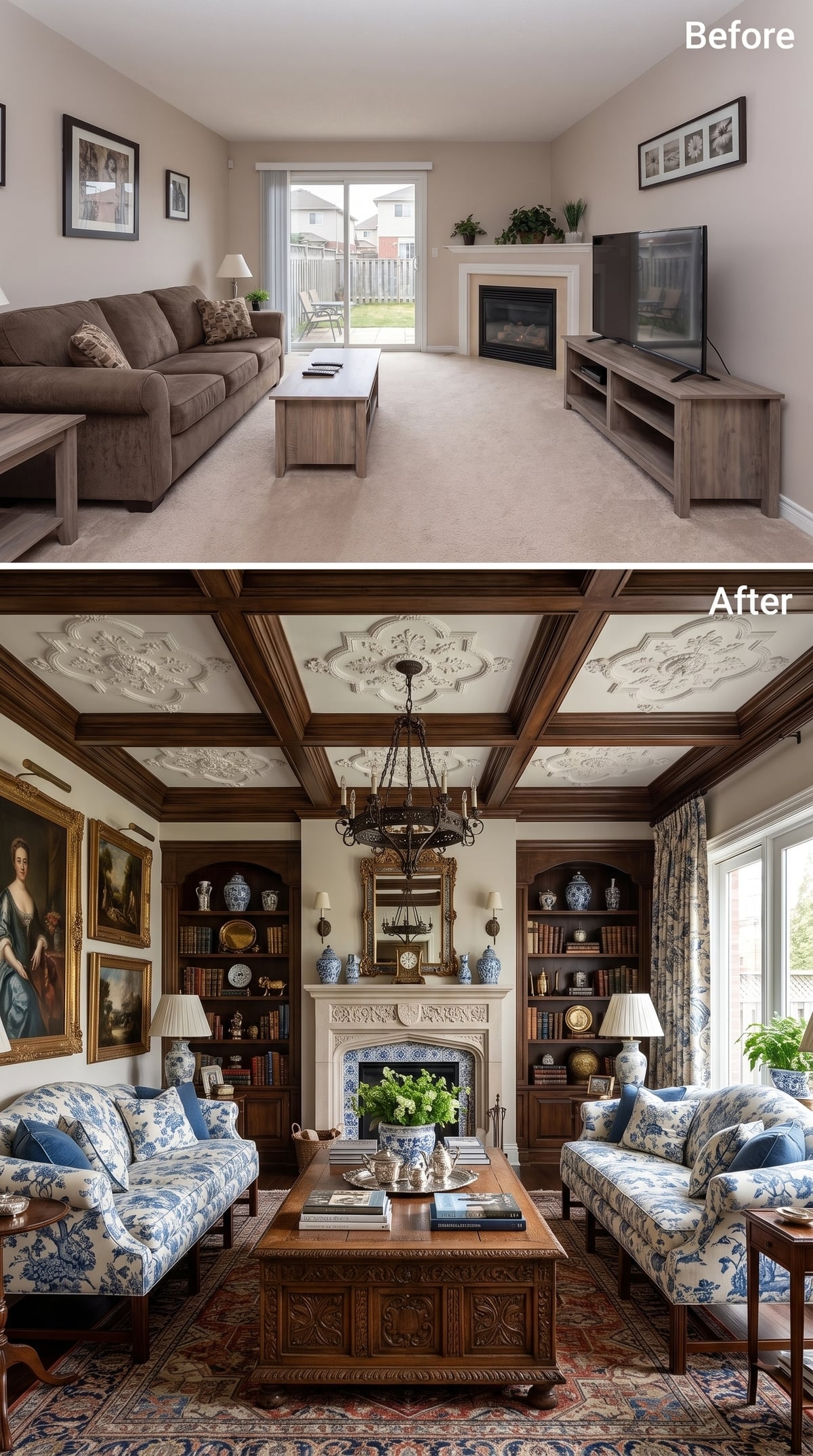
Matching blue-and-white toile covers two facing sofas, setting the color direction before the shelves or fireplace get involved.
Blue ceramic ginger jars, books, and brass objects fill built-ins around a fireplace faced in Delft-style tile. Above, dark walnut ceiling beams create a strong grid around ornate plaster relief panels.
An elaborately carved coffee table sits over a red-and-blue Persian rug, adding a warmer counterpoint to all that blue and white.
Built-In Look: Freestanding bookcases can sometimes be visually integrated with a fireplace wall using applied trim, matching paint or stain, and careful alignment. The goal is less about disguising the furniture completely than making the entire wall read as one composition.
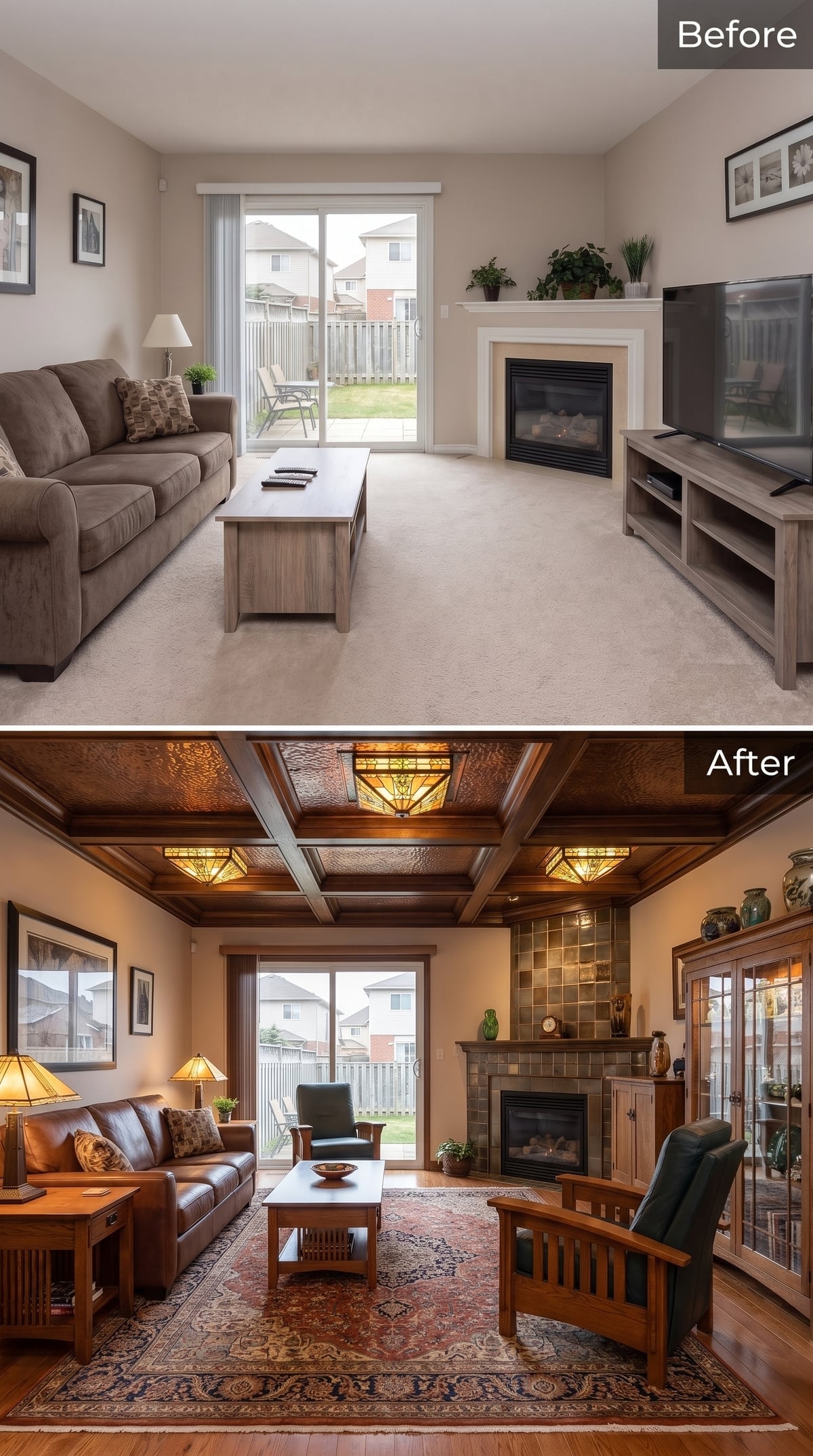
7. Arts and Crafts Stained Glass Gives the Woodwork Its Own Light Source
🔥 Would you like to save this?
Dark oak beams divide the ceiling into recessed sections filled with amber-toned stained glass, bringing patterned light into a room already dominated by wood.
The fireplace uses square earth-tone tile beneath a substantial mantel, while Mission-style furniture in cognac leather and quartersawn oak gives the room a strong Arts and Crafts vocabulary.
Editor’s Note: Arts and Crafts and Mission interiors often celebrated visible grain, substantial joinery, useful furniture, and hand-worked materials. In this concept, amber glass works especially well because its warmth reinforces the oak and leather rather than introducing a competing cool color.
6. Renaissance Frescoes and Modern Geometry Refuse to Behave Like the Same Century
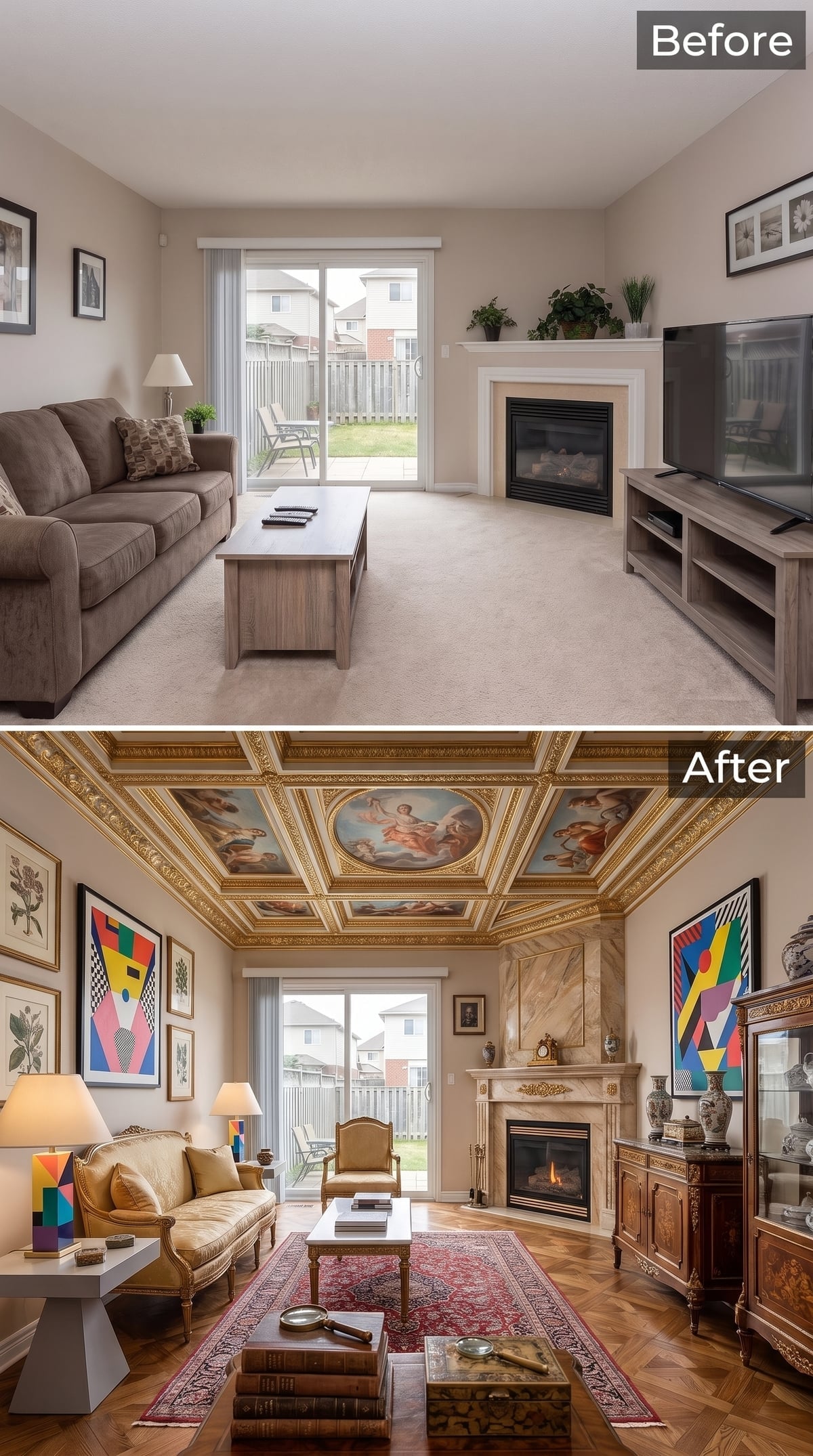
Gold-trimmed ceiling coffers contain Renaissance-style painted scenes, while a carved marble fireplace brings similar formality down to eye level.
Parquet flooring in a herringbone arrangement runs beneath a red Persian rug, French-style settee, and carved armchair. Then the walls interrupt the historical mood with bold geometric prints.
That’s what saves the room from becoming a period set. The modern art doesn’t politely blend in; it breaks the spell.
5. Desert Frescoes and Potted Cacti Sneak Into a Gilded Classical Room
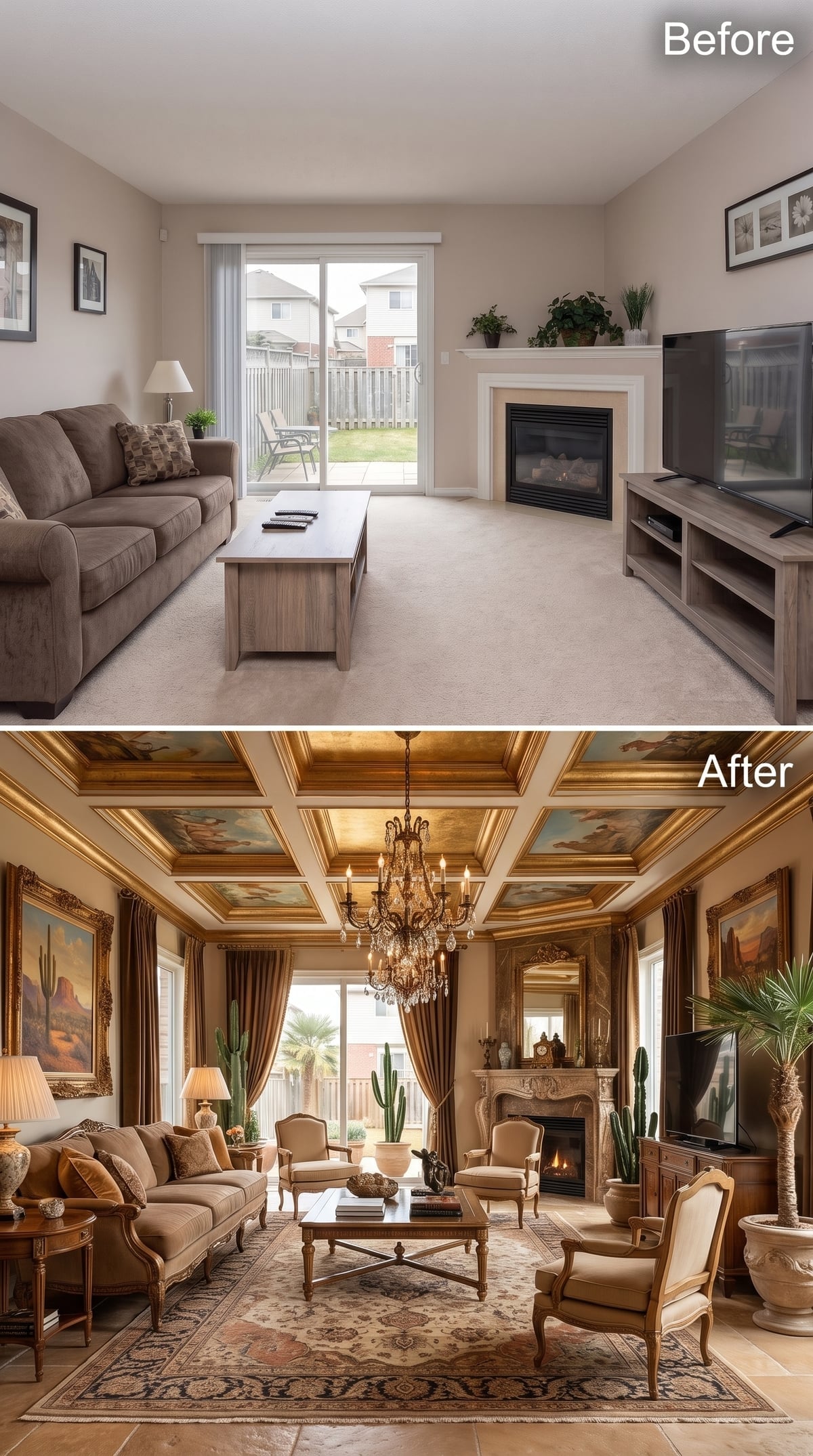
Gilded ceiling coffers are filled with painted desert landscapes in ochre and pale blue, introducing a subject nobody expects above classically appointed seating.
A wrought-iron chandelier with candle-style bulbs occupies the center, while champagne-colored French-style seating sits on a burgundy-and-ivory Persian rug.
Tall cacti provide the joke the room needed. Their shapes echo the desert imagery overhead without turning the space into a themed set.
4. A Malachite Table Gives This European Salon One Perfectly Excessive Centerpiece
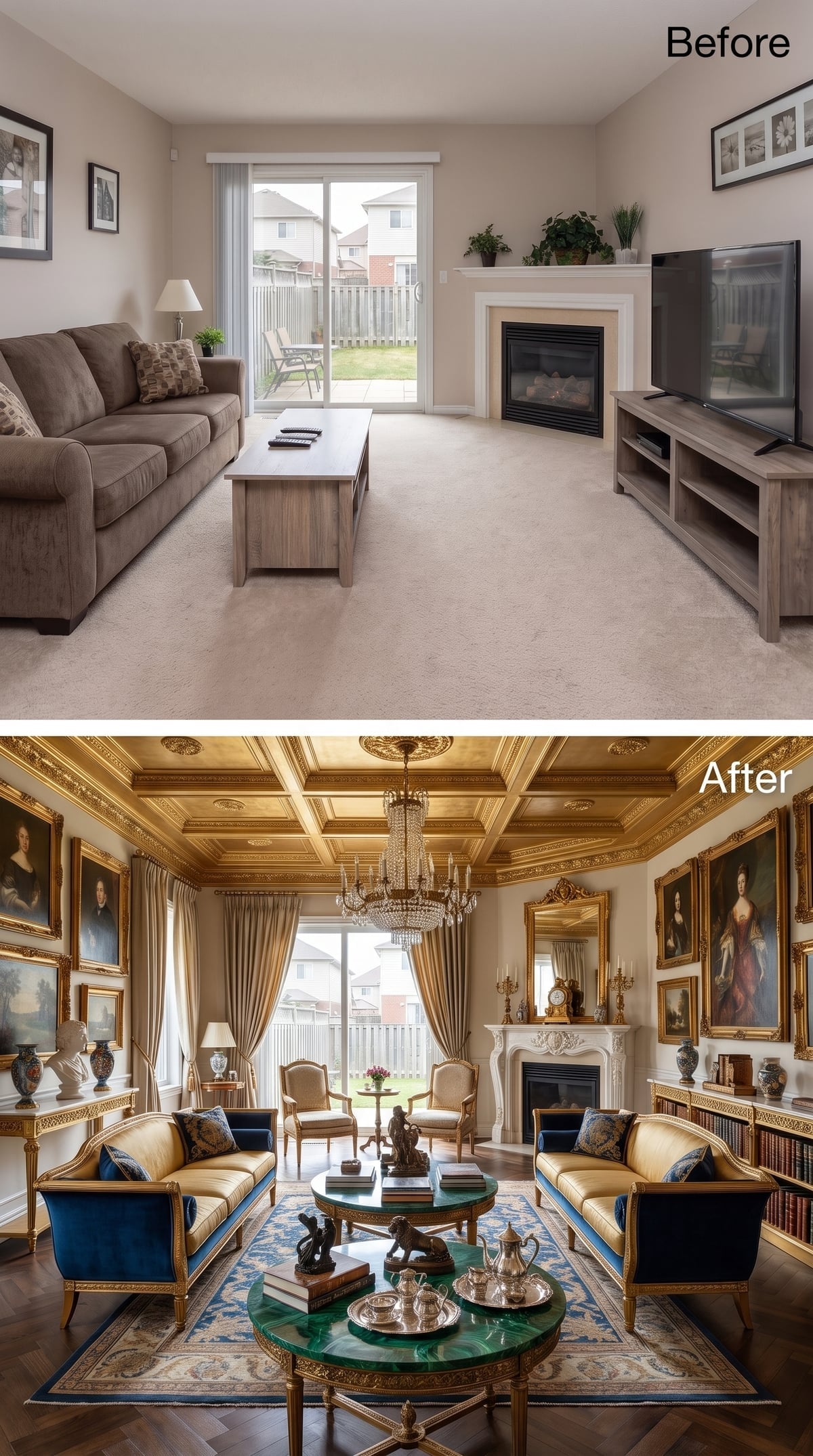
Lacquered gold ceiling panels and a crystal chandelier establish the European-salon mood immediately, but the round malachite table is the object that keeps pulling attention back to the middle.
Bronze figures and a silver tea service sit on its green surface, while carved white marble frames the fireplace. Gilt-framed portraits occupy the walls at a scale large enough to stand up to the ceiling.
Navy cushions on gold-leafed settees provide one strong dark note. The room looks less like a coordinated furniture package and more like a collection accumulated by somebody with expensive weaknesses.
3. Arts and Crafts Stained Glass Returns With Cherry Wood and Hand-Painted Tile
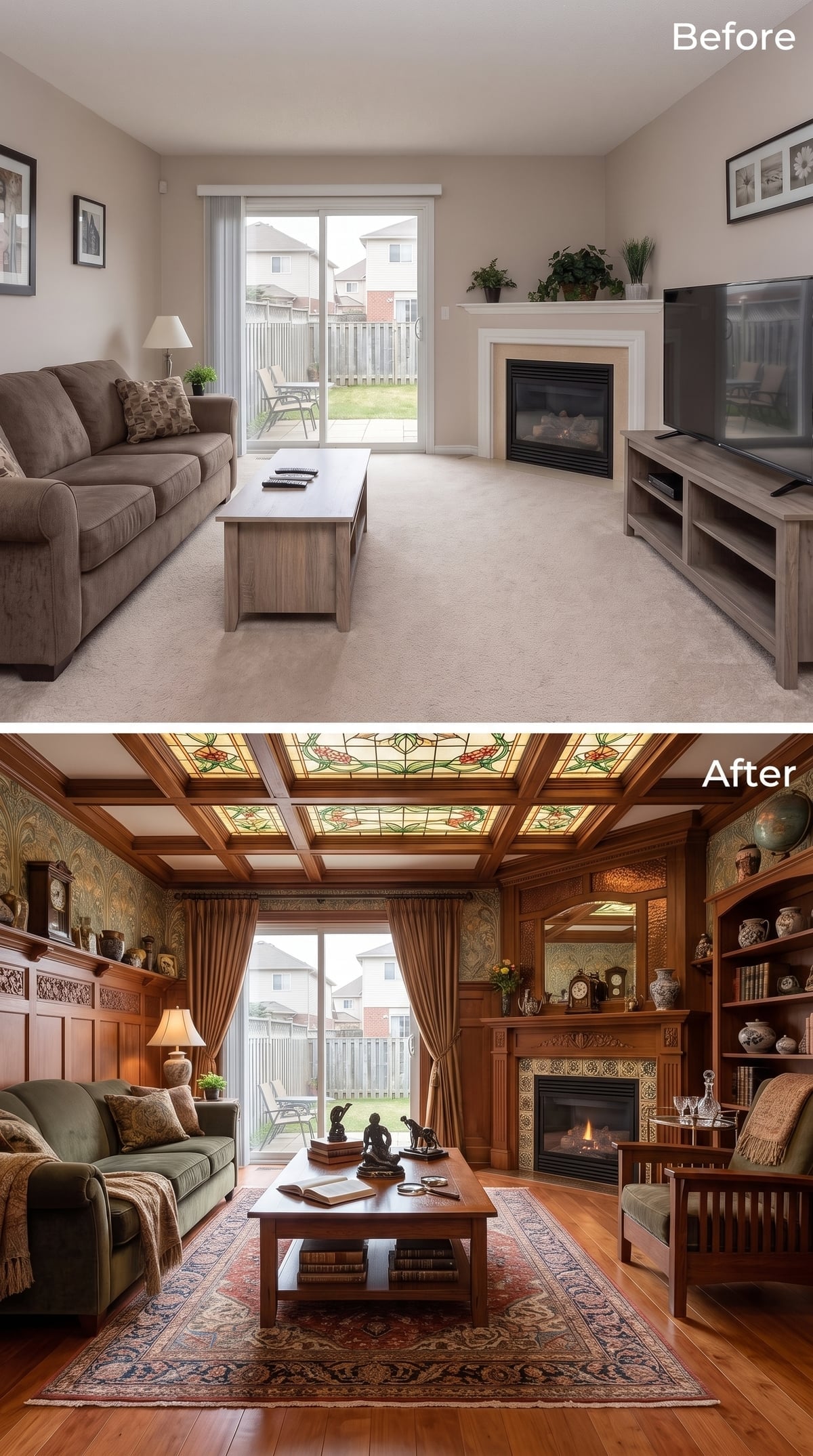
Warm cherry wood runs through the ceiling, wainscoting, and fireplace, making this one of the most unified material palettes in the gallery.
Leaded stained-glass panels bring floral Arts and Crafts pattern overhead, while hand-painted tile gives the fireplace its own smaller field of color. A green velvet sofa and Mission-style side chair sit on a Persian rug below.
The ceiling may be elaborate, but the room doesn’t need every wall filled with art. The woodwork and glass are already occupying that decorative territory.
2. Walnut Paneling Gives the Antique Collection a Proper Library Wall
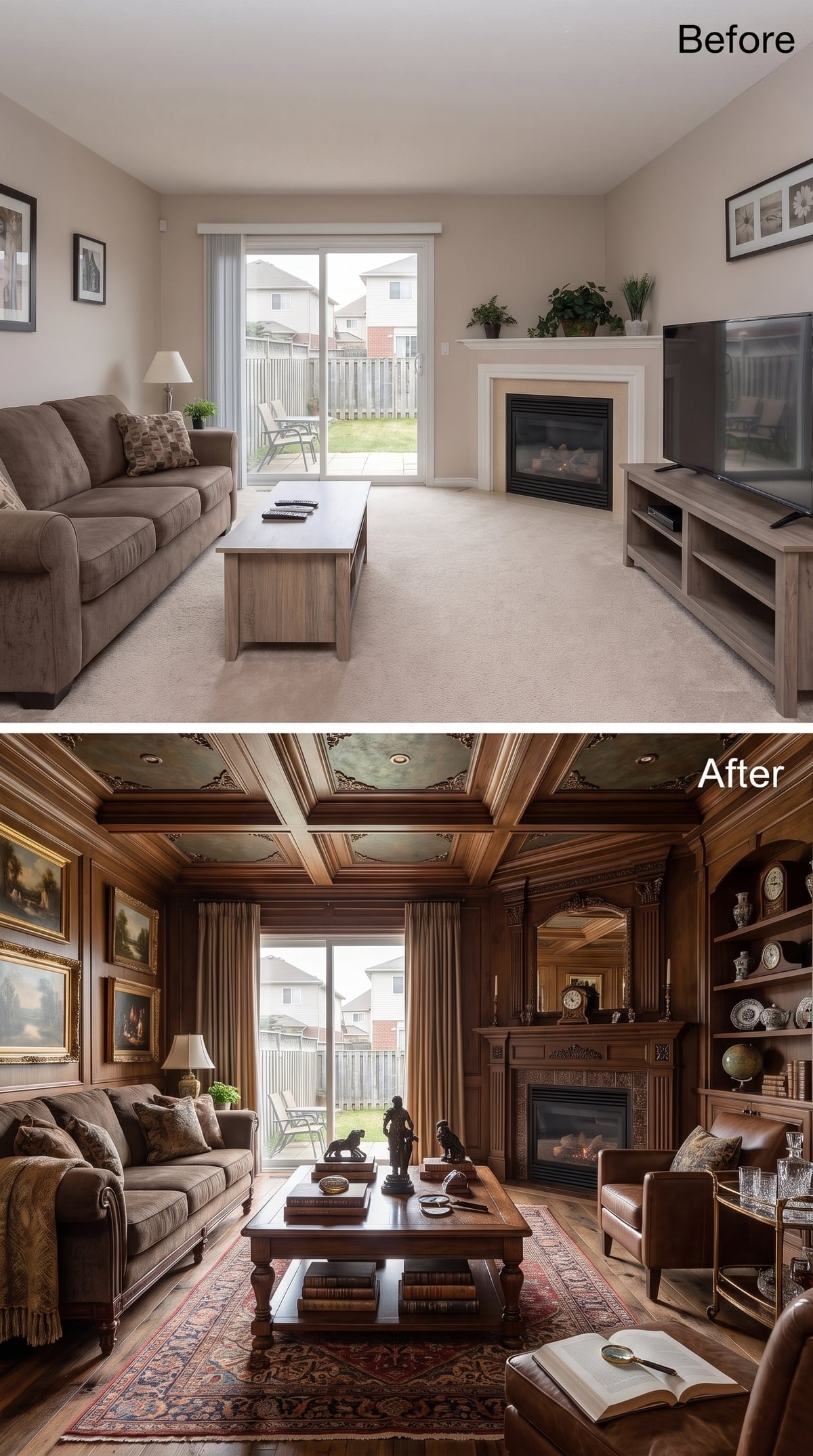
Rich walnut covers the walls from floor to ceiling while painted green frescoes sit inside dark carved ceiling coffers above.
The fireplace is substantial but not isolated, with a mirror and clock continuing the vertical arrangement above it. Gilt-framed oil paintings take one wall, while built-in shelving on the other finally gives the smaller antiques somewhere to gather.
This one understands a basic collector problem: sometimes the room doesn’t need fewer objects. It needs better shelves.
1. An Oval Fresco and Wide-Plank Oak Give the Final Room a Sense of Discovery
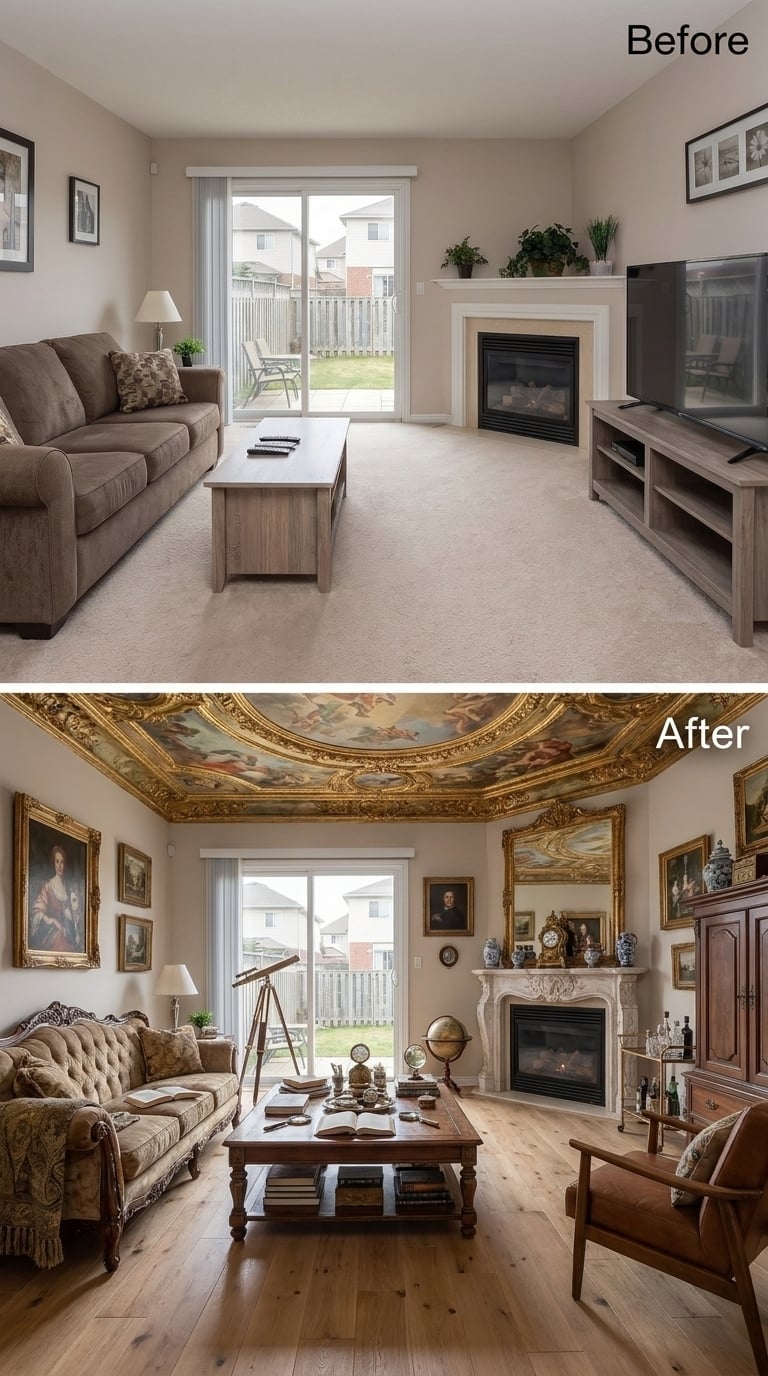
Wide-plank oak runs the length of the room beneath an oval fresco ringed in carved gilt molding. Portraits and landscapes gather around the walls, while the ceiling gives all of that framed art a larger painted counterpart overhead.
A carved marble fireplace brings pale stone into the darker collection, and antique globes and a brass telescope occupy the coffee table without looking like props arranged five minutes before the photograph.
They feel found.
After 30 rooms full of coffers, stone, velvet, stained glass, plaster, Persian rugs, and enough gold leaf to worry a conservator, this last one gets closest to the real appeal of collecting. The objects don’t need to match. They need a room with enough character to make their differences look intentional.