🔥 Would you like to save this?
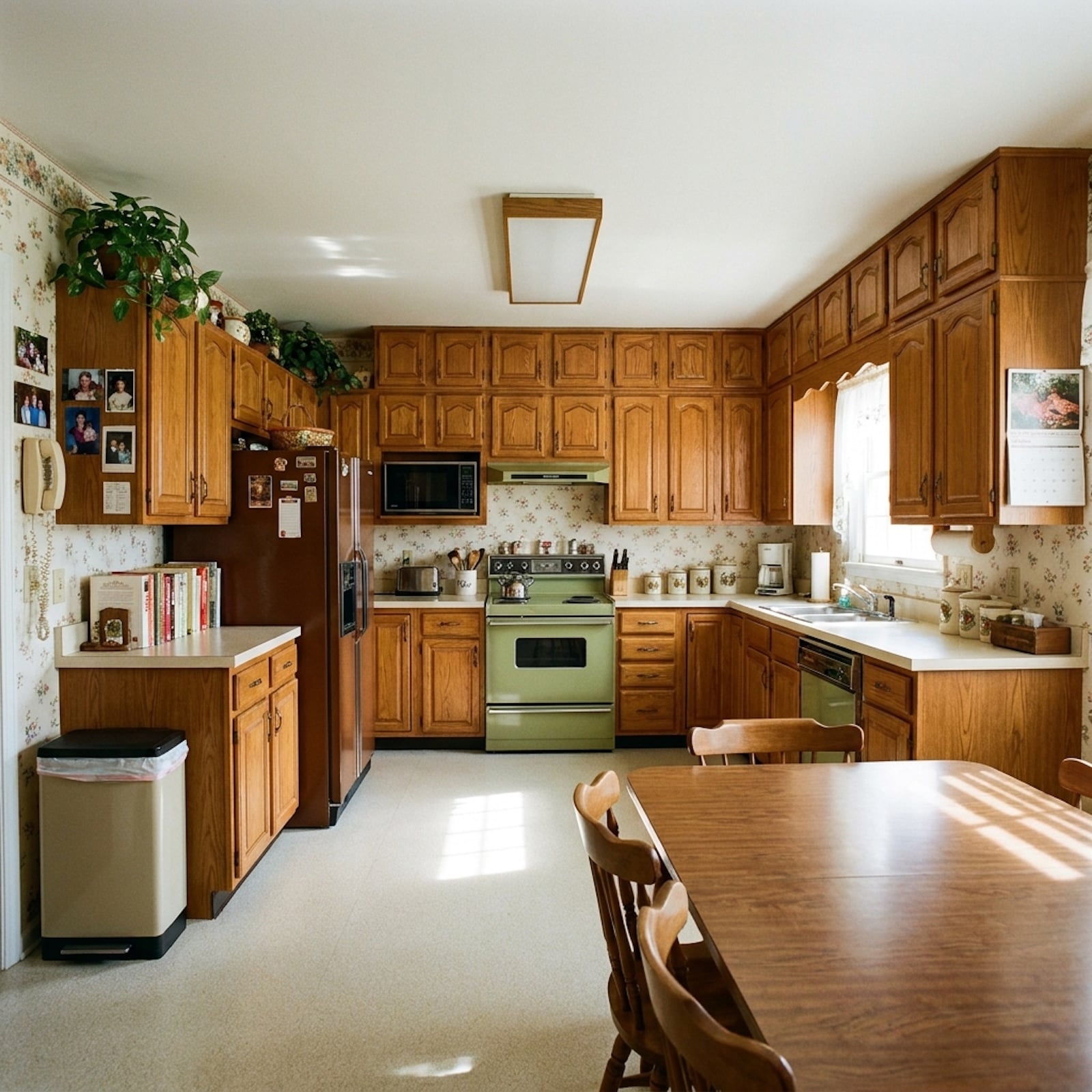
Builder-grade beige doesn’t fail because beige is inherently boring. It fails when every decision around it becomes equally cautious — safe sofa, safe rug, safe walls, nothing willing to interrupt the silence.
In order to come up with the very specific design ideas, we create most designs with the assistance of state-of-the-art AI interior design software. Also, assume links that take you off the site are affiliate links such as links to Amazon. this means we may earn a commission if you buy something.
One homeowner had seen enough of her washed-out living room and used AI-generated concepts to test a much riskier proposition: white and burgundy. White can turn clinical fast. Burgundy can wander straight into dated hotel lobby territory. These 29 before-and-after redesigns show how wildly different the pairing becomes once wood, marble, bouclé, toile, brass, shiplap, terrazzo, sculptural lighting, and a few very opinionated ceilings enter the room.
The walls and windows may have started in roughly the same place. Almost nothing else does.
29. Burgundy Takes the Wall, the Floor, and Every Seat in the Room
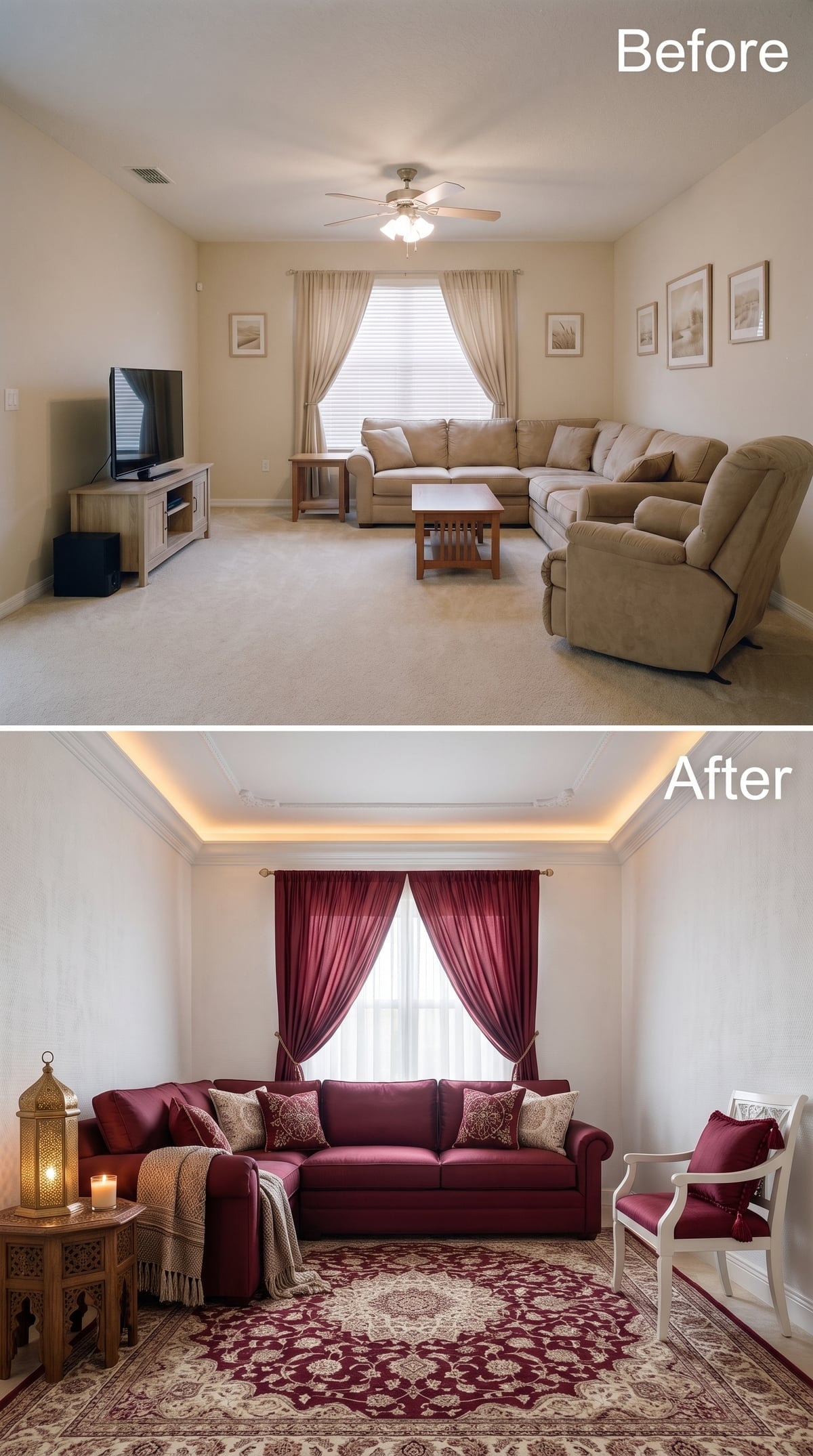
This first version doesn’t introduce burgundy politely. It sends it in everywhere. A deep velvet sectional dominates the seating, floor-length wine-colored drapes frame the window, and a traditional medallion rug keeps the color running right underfoot.
Warm cove lighting around the crown molding is what prevents all that red from closing in. White walls pick up an amber cast after dark, while patterned pillows, carved wood, ivory, and a Moroccan-style brass lantern add enough interruption to keep the palette from becoming one enormous glass of Cabernet.
Trend Alert: Cove lighting can change a white room without changing the paint. A concealed warm source grazes the ceiling and upper walls rather than blasting the room from one central fixture, which gives pale surfaces more depth after dark.
28. Sculptural Niches and Cove Light Turn White Walls Into the Star
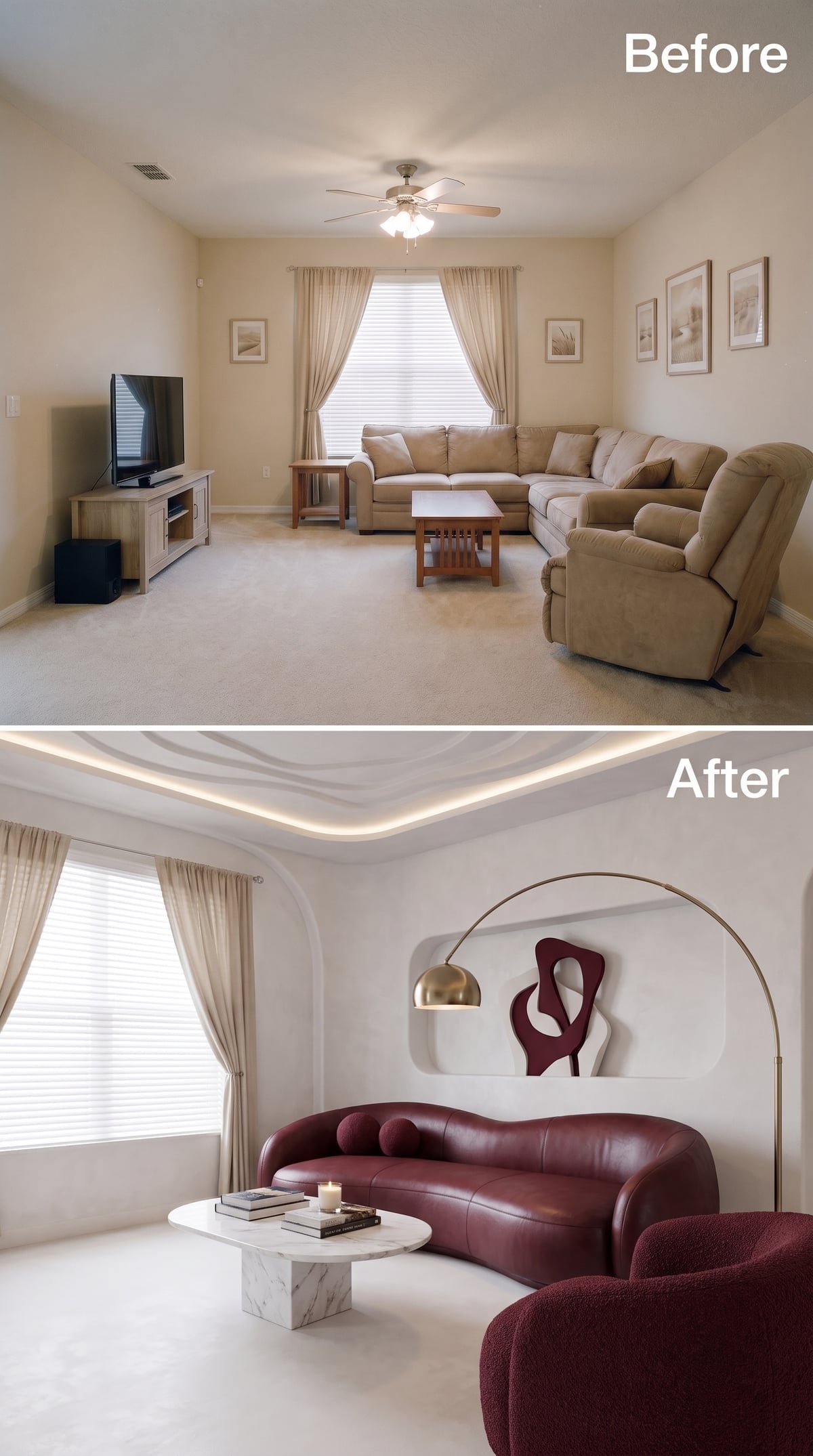
Now the burgundy retreats and the architecture steps forward. An arched niche interrupts the white plaster wall, holding a single burgundy sculpture like the room decided one object was enough. Continuous cove lighting traces the ceiling and gives all that white something beige never managed: shadow.
The rounded leather sofa, arc lamp, and curved opening keep repeating the same soft geometry without turning the room into a theme. Burgundy has become punctuation rather than paragraph.
Ask Yourself: If a blank wall still feels dead after you’ve tried three different pieces of art, the problem may be depth rather than decoration. A niche, shallow molding, or carefully placed grazing light can change the surface before anything gets hung on it.
27. Shiplap, Bouclé, and Burgundy Walk Into a Room and Actually Agree
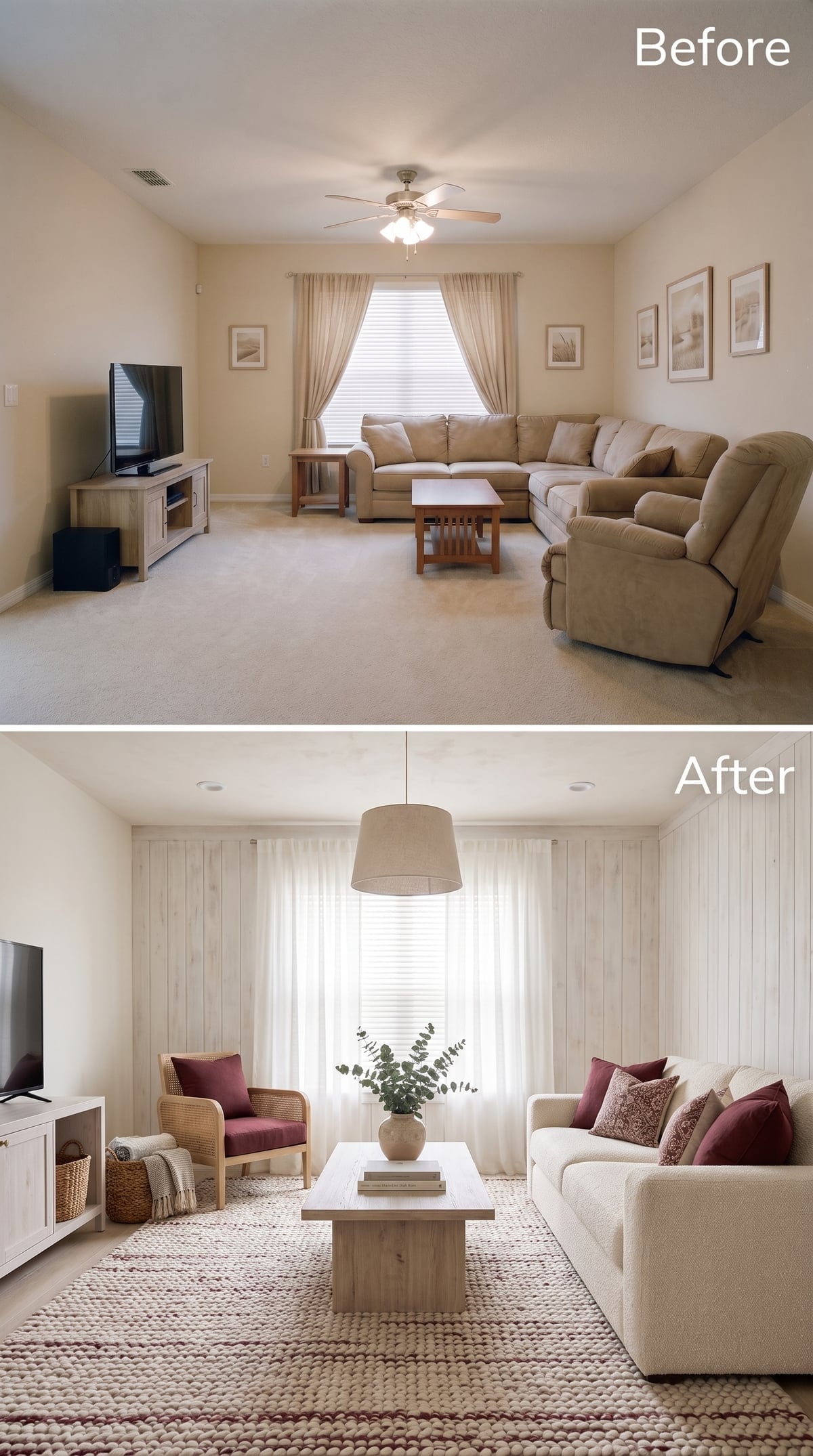
Vertical white shiplap gives the back wall just enough rhythm to make plain paint feel lazy by comparison. Against it, a cream bouclé sofa stays soft and casual while burgundy pillows and a wood-framed wine-colored chair move the palette across the room instead of piling it onto one piece.
The jute rug is deliberately rougher than the upholstery, and the linen drum pendant is almost aggressively simple. That’s why the combination works: farmhouse texture is here, but nobody brought the novelty signs.
History Corner: Shiplap began as practical overlapping board construction long before it became a decorative wall finish. Painted versions later became closely associated with modern farmhouse interiors, but the basic appeal is older and simpler: narrow shadow lines give a flat wall texture without requiring pattern.
26. Marble, Velvet, and a Chandelier That Can Handle the Attention
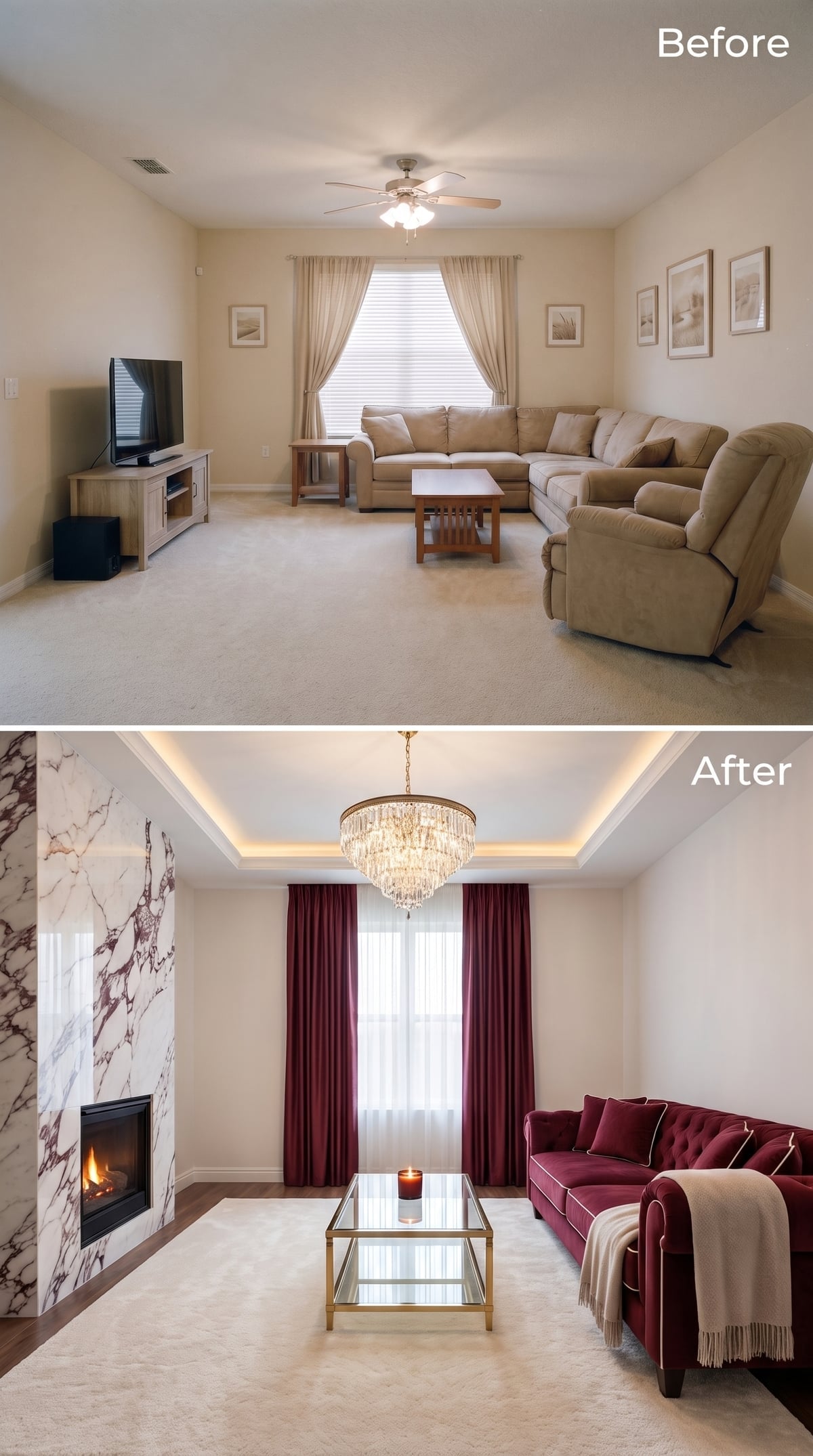
This one goes unapologetically glamorous. A burgundy velvet sofa sits beneath a crystal chandelier while a gold-framed glass coffee table keeps the center visually open. Beside the fireplace, white marble with wine-colored veining folds the palette straight into the architecture.
Hardwood underfoot and a cream rug pull the room back from ballroom territory. Sheer panels soften the window behind burgundy drapes, and the chandelier works because everything below it has enough visual weight to answer back.
When the furniture, stone, and ceiling all have presence, the chandelier stops looking like an accessory and starts looking inevitable.
25. Bamboo Ceiling, Paper Lantern, and Burgundy With a Much Quieter Voice
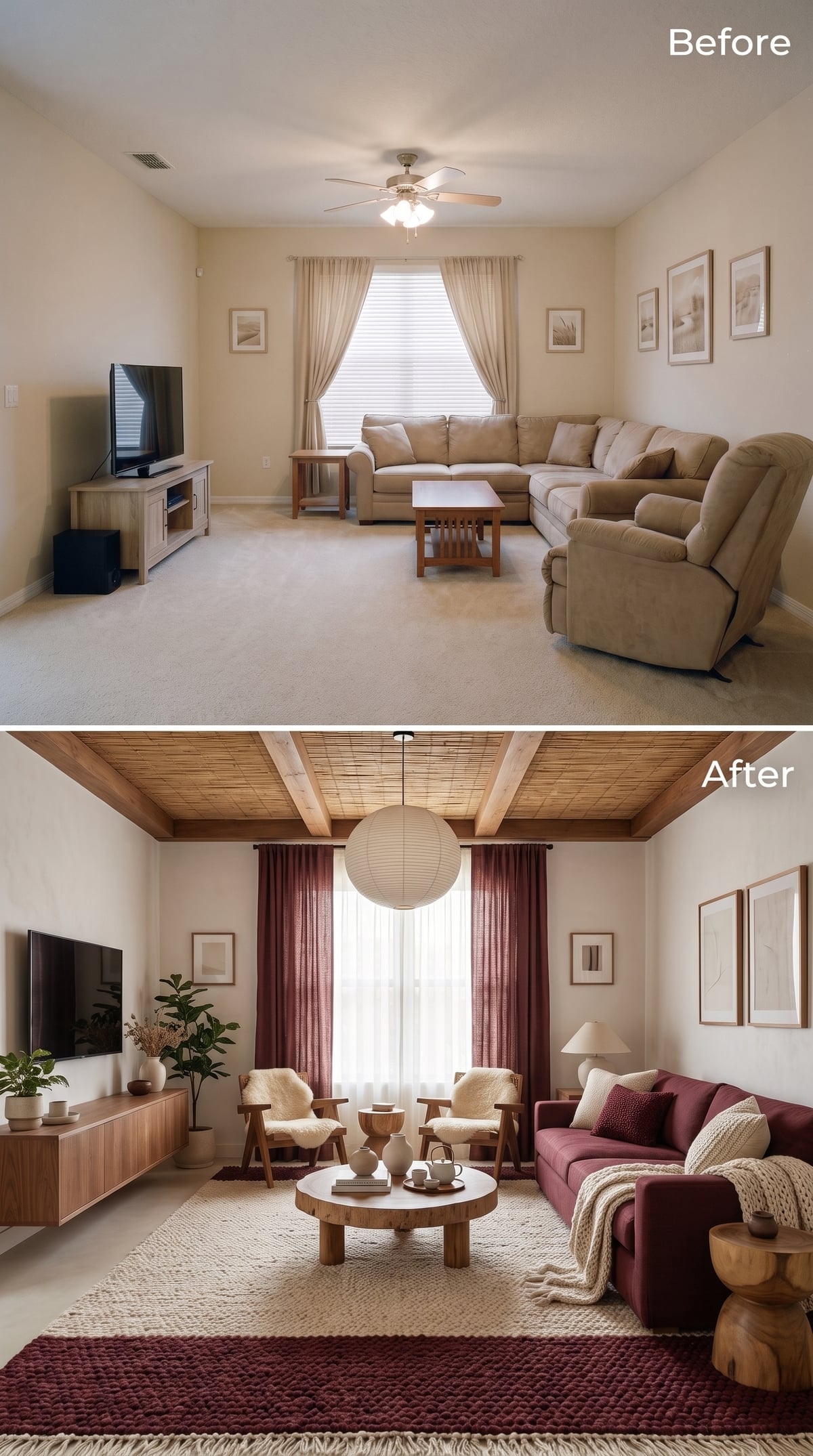
After crystal and marble, this feels like somebody opened a window. Exposed beams frame a bamboo-paneled ceiling while a paper lantern hangs with almost no visual weight at all. The materials carry the room instead of ornament.
A burgundy sofa faces cream shearling chairs across a chunky round wood table. Beneath them, layered rugs — neutral jute and a smaller burgundy textile — make the palette feel collected rather than coordinated by spreadsheet.
Try This: Layering rugs works best when they aren’t fighting for the same job. Let the larger neutral rug establish the seating area, then use the smaller one for color or texture. The room gets depth without gaining another piece of furniture.
24. Coffered Wood Ceiling, Burgundy Velvet, and White Bouclé Share the Same Air
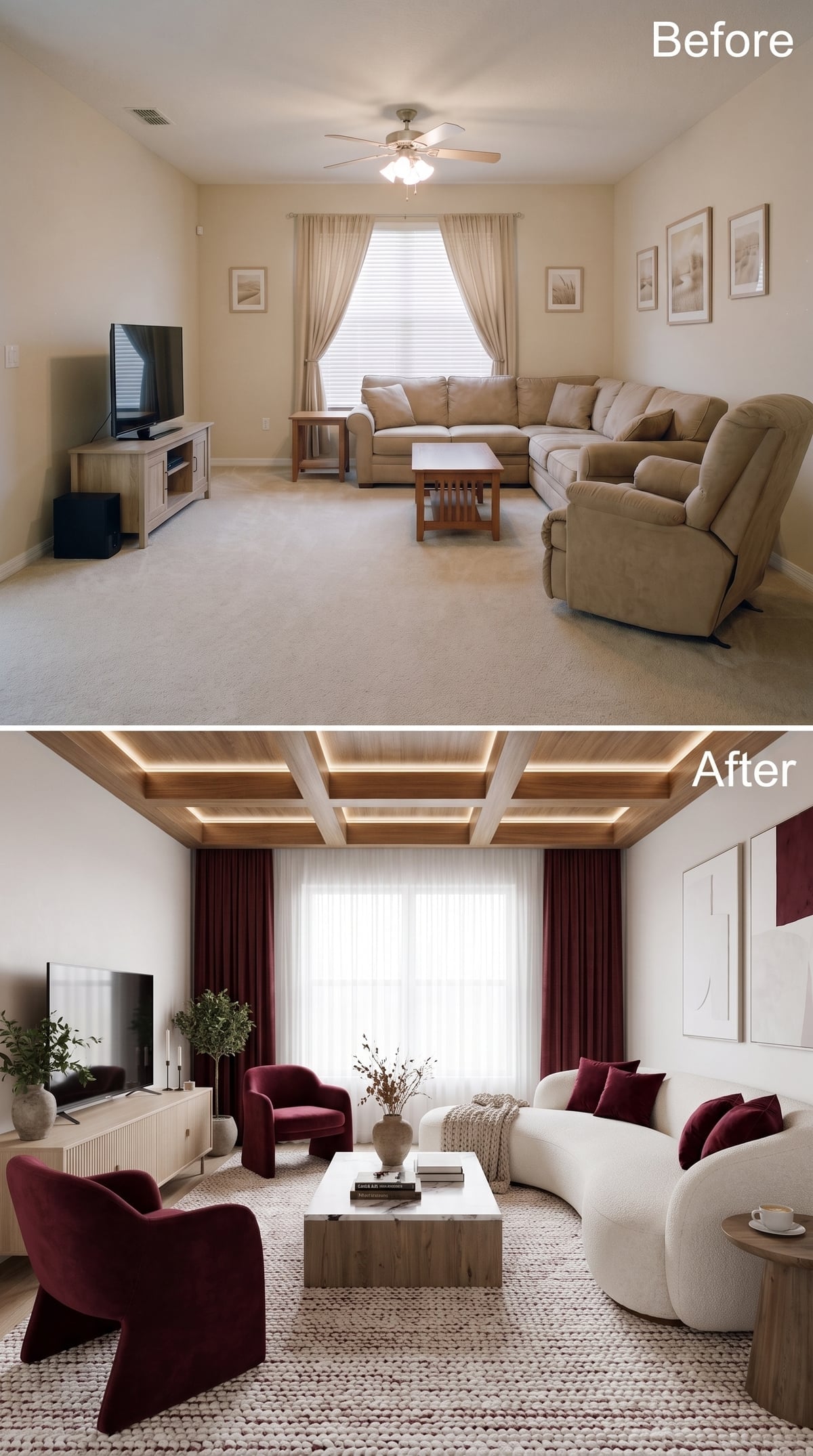
Look up first. Warm wood coffers crossed with slim integrated lighting turn the ceiling into an actual surface rather than the blank lid most living rooms receive.
Below, a curved white bouclé sofa faces deep burgundy barrel chairs across a chunky woven rug. The color contrast is straightforward; the texture contrast is what makes it interesting. Smooth velvet, nubby bouclé, warm grain, soft daylight — four finishes doing more than another dozen decorative objects ever could.
23. Track Lighting and Terrazzo Drag Burgundy Into a Completely Different Era
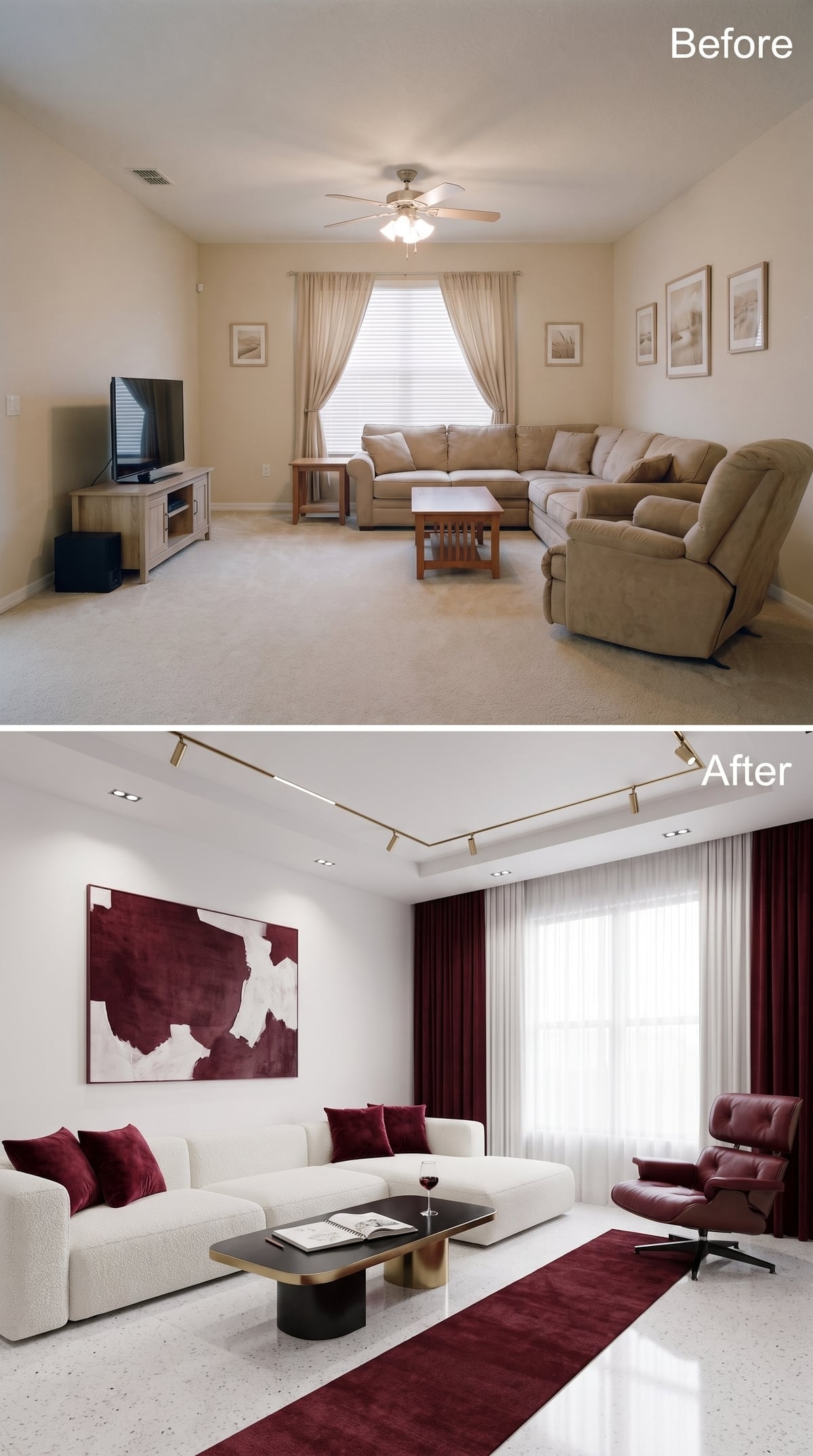
Gold track lighting runs along the tray ceiling while recessed downlights cover the darker edges. Below, white-and-gray terrazzo reflects daylight and immediately shifts the burgundy away from traditional and toward something sharper.
The wine tone shows up in curtains, pillows, and a tufted lounge chair rather than one giant sofa. An abstract canvas carries it onto the wall. Burgundy suddenly looks less like heritage upholstery and more like graphic color blocking.
22. Ornate Ceiling Medallion and Burgundy Walls Push the Room Toward Full Drama
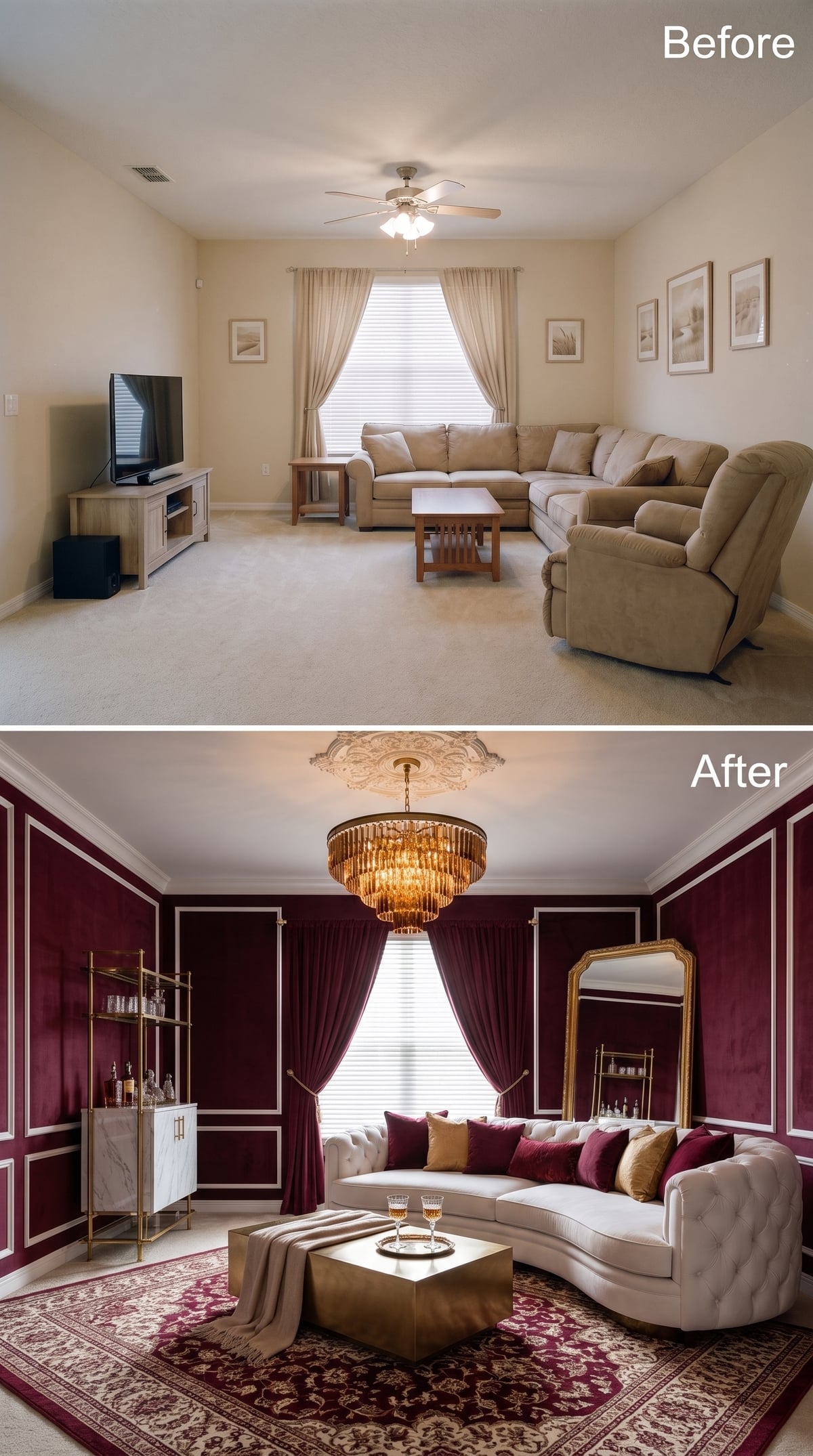
Decorative plasterwork surrounds a tiered brass-and-glass chandelier, while burgundy velvet wall panels sit inside white picture-frame molding. There is almost no undecorated surface left, yet the cream curved sectional keeps the center from joining the competition.
A lacquered gold coffee table and marble-topped bar cart push the metallic notes further, while the Persian-style rug gives the room enough pattern to connect all that architecture to the floor.
Material Matters: Decorative ceiling medallions were common in elaborate 19th- and early-20th-century interiors. Modern lightweight reproductions can deliver the same visual focus without the weight and labor of traditional plasterwork.
21. Bouclé, Burgundy, and a Round Table Slow the Whole Room Down
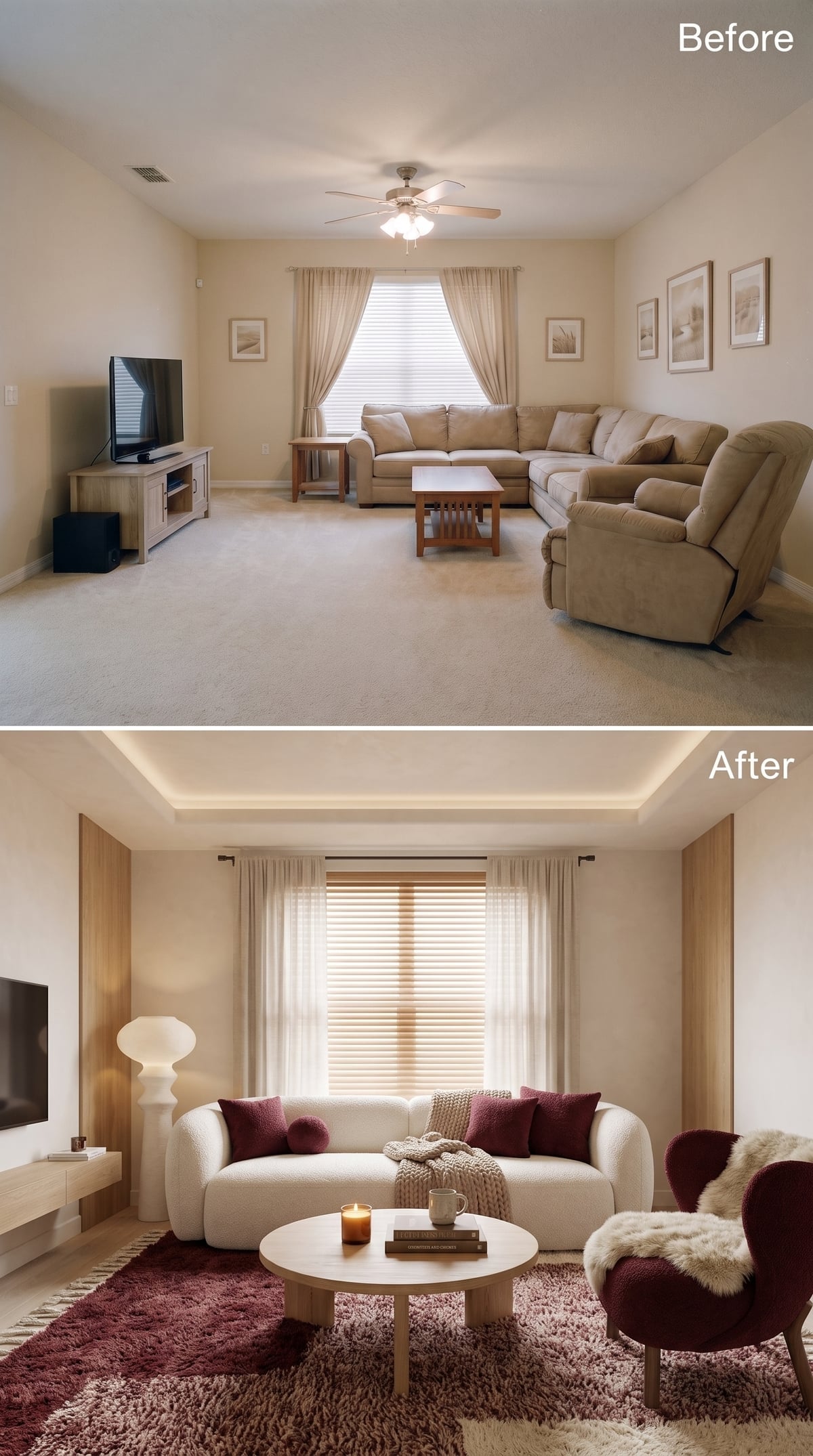
A low white bouclé sofa and round oak coffee table immediately soften the geometry. Burgundy arrives through a shag rug, accent chair, and pillows — enough repetition to establish a palette without turning every object red.
The round table matters because so much else in the room is rectangular: television, window, walls, rug. One circle in the middle gives all those edges somewhere to stop.
Color Note: Burgundy carries enough depth to feel substantial even in small doses. Pairing it with ivory and natural wood keeps the room warm without letting the darker color dominate every surface.
20. Wainscoting, Crystal, and Crimson Take the Traditional Route Without Looking Timid
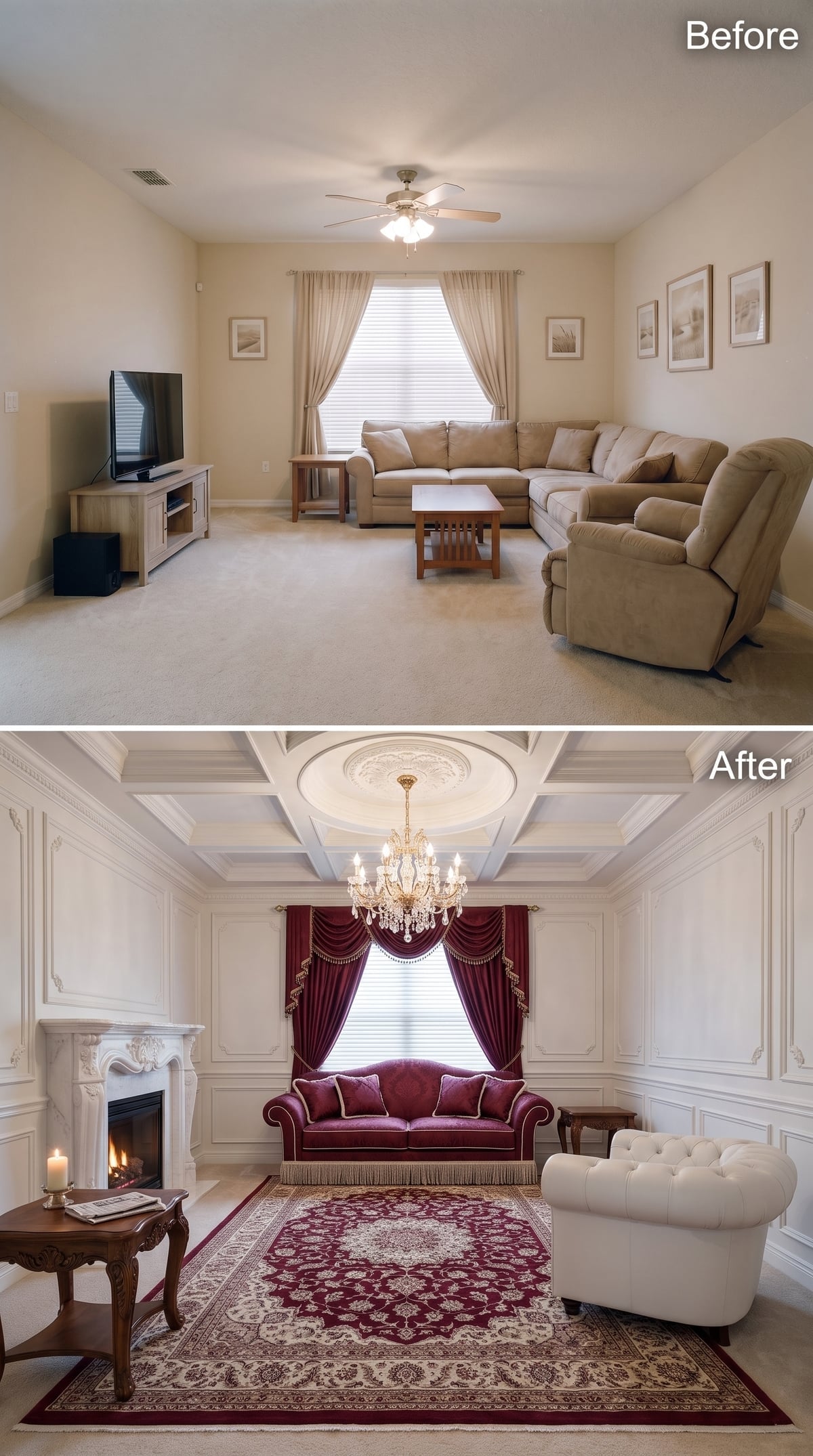
Raised-panel detailing climbs the walls while a coffered ceiling and plaster medallion make sure the architecture doesn’t stop at eye level. A brass-and-crystal chandelier hangs dead center over a burgundy rolled-arm sofa.
Crimson silk curtains with gold trim could have tipped this straight into period-piece territory, but the white tufted chair and marble fireplace surround give the darker elements breathing room. Traditional, yes. Bashful, absolutely not.
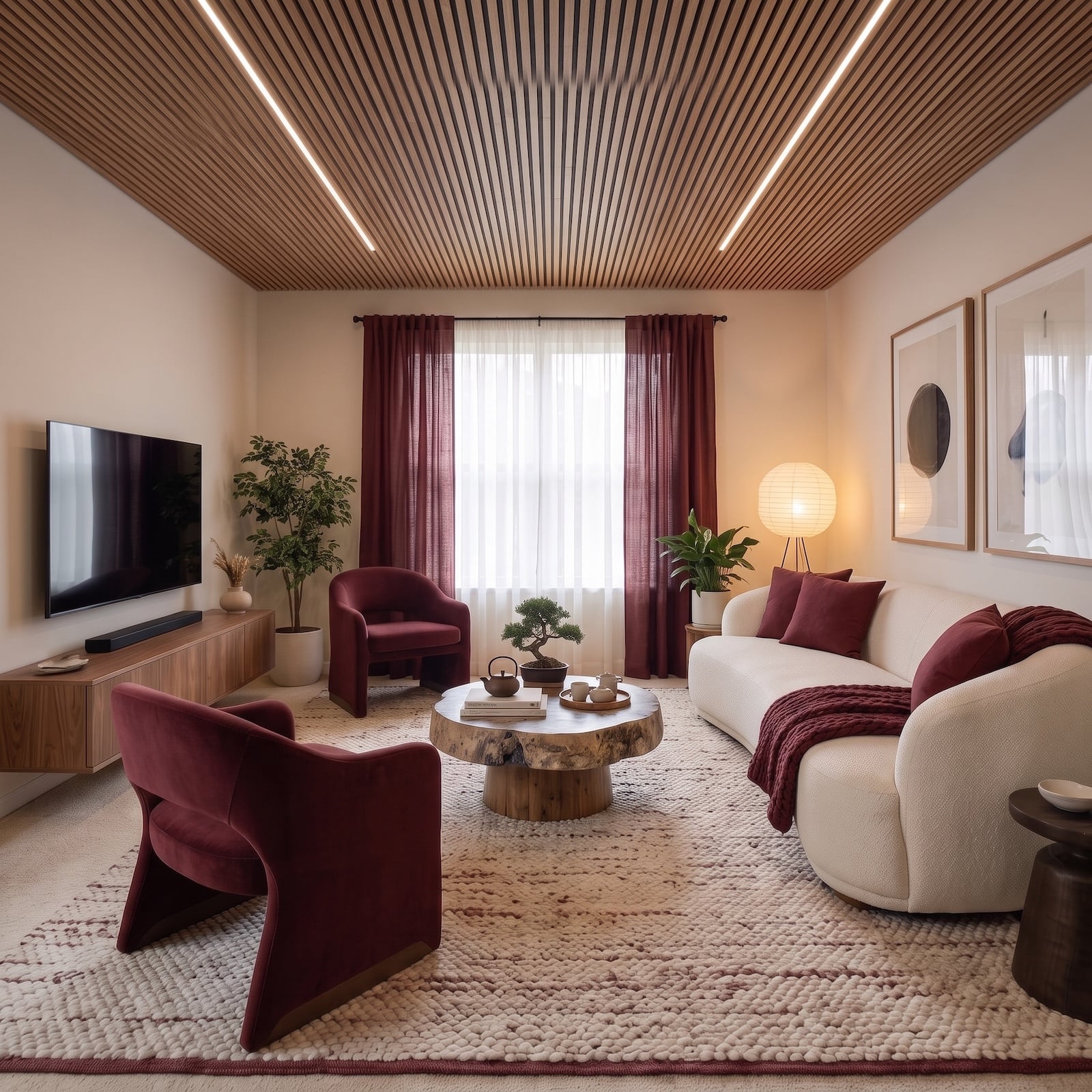
19. Slatted Wood Overhead Gives Burgundy Velvet a Warmer Place to Land
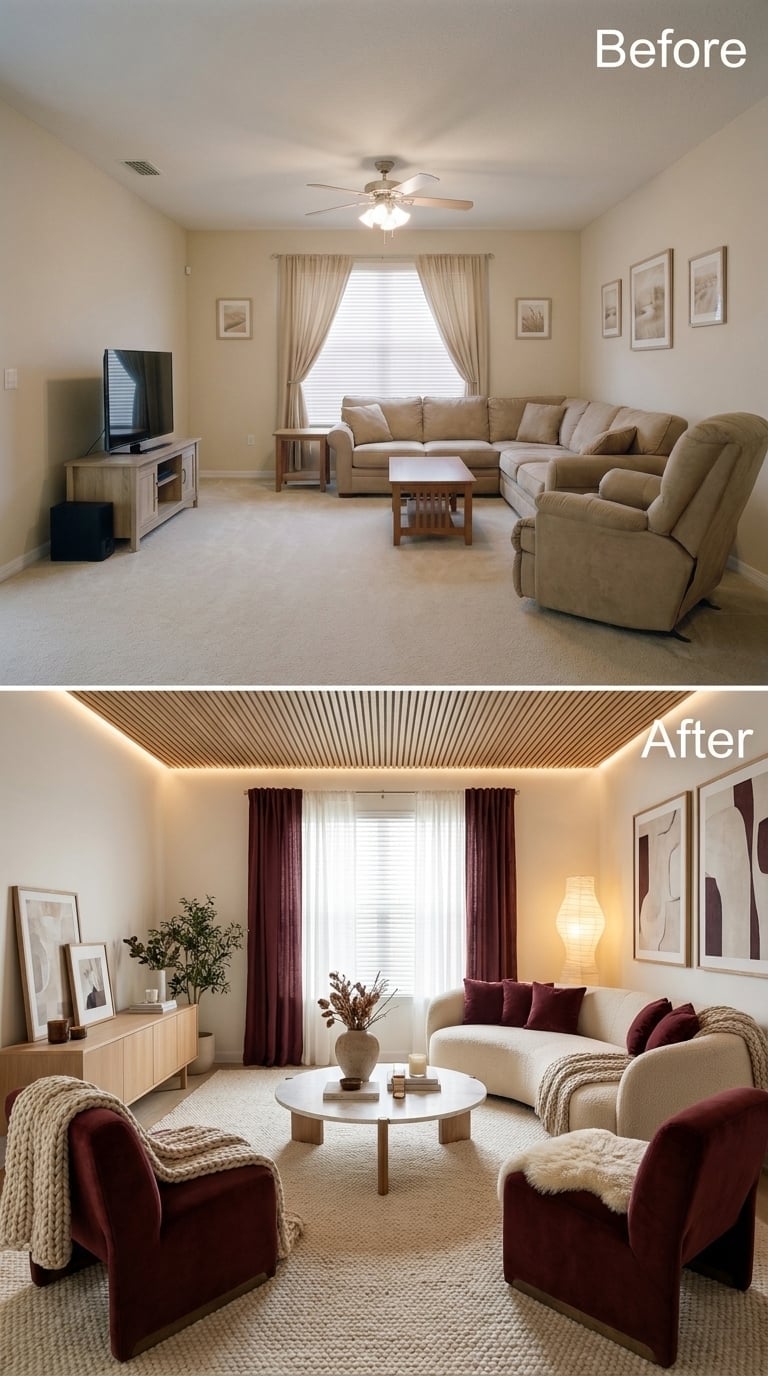
A slatted wood ceiling changes the temperature of the room before the furniture gets a vote. Warm perimeter lighting grazes the grain, while a curved bouclé sofa and two low burgundy chairs repeat the rounded shapes below.
A low white coffee table keeps sightlines open. Burgundy curtains frame sheer panels at the window, and a restrained abstract work picks up the same colors without turning into a matching exercise.
Style Tip: Concealed lighting and wood slats are a useful pairing because the uneven surface creates changing bands of light and shadow. Keep the source hidden and let the grain catch the glow rather than exposing the LED strip itself.
18. Burgundy Toile and a Crystal Chandelier Go Straight for the Old-School Romance
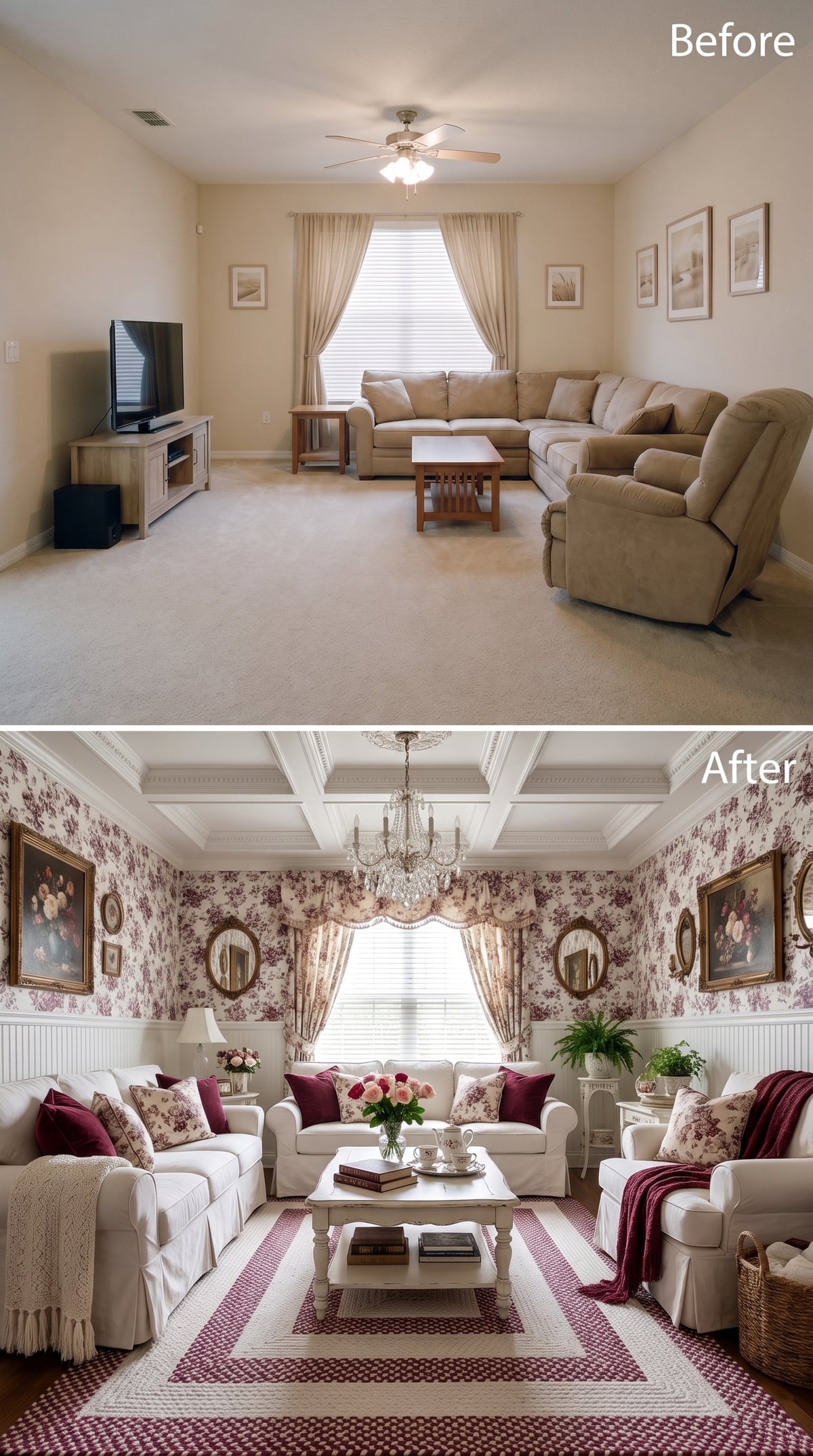
Floral toile covers the walls above the wainscoting while a crystal chandelier drops from a coffered ceiling. There’s nothing neutral about the intention, even if most of the room is technically white.
Fresh roses on the coffee table are almost absurdly on message, which is precisely why they belong. When a room commits this hard to romance, pretending the flowers wandered in accidentally would be worse.
Color Story: Toile has long been printed in single-color motifs on pale grounds, including red and wine tones. Repeating that burgundy in smaller textiles lets the wallpaper establish the pattern while white upholstery gives it somewhere to breathe.
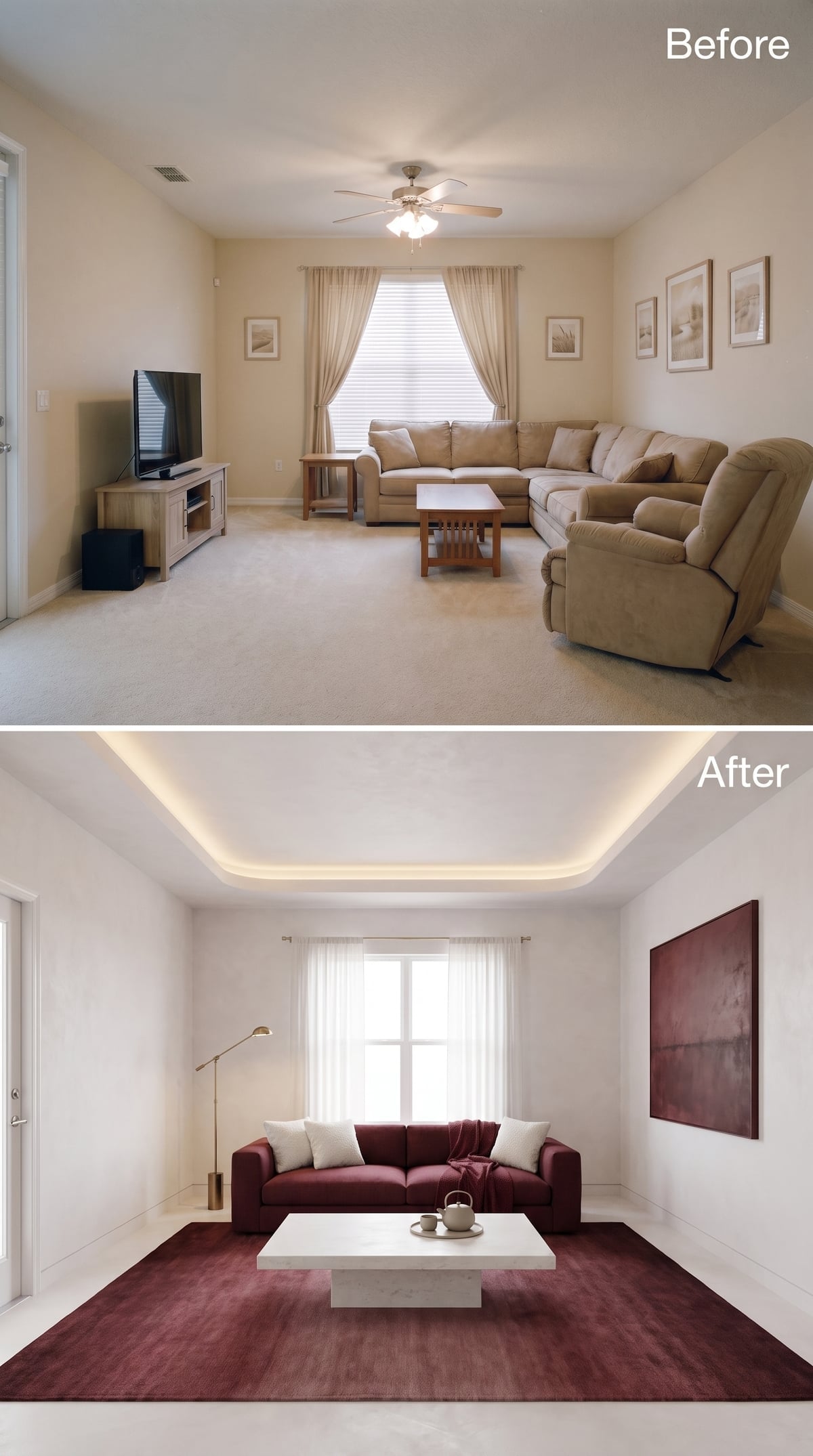
17. Cove Light and One Oversized Painting Strip the Palette Back to Its Essentials
🔥 Would you like to save this?
Take almost everything away and the remaining pieces have nowhere to hide.
A low burgundy velvet sofa sits on a wine-colored rug beneath continuous ceiling light. White concrete at the coffee table cools the center, while sheer curtains keep daylight soft rather than stark.
Then there’s the painting: one large canvas in dusty rose and burgundy, no gallery wall, no cluster, no tiny frames begging to be noticed. The restraint makes the color look more expensive.
16. Wood Slat Ceiling and a Medallion Rug Split the Design Job Top to Bottom
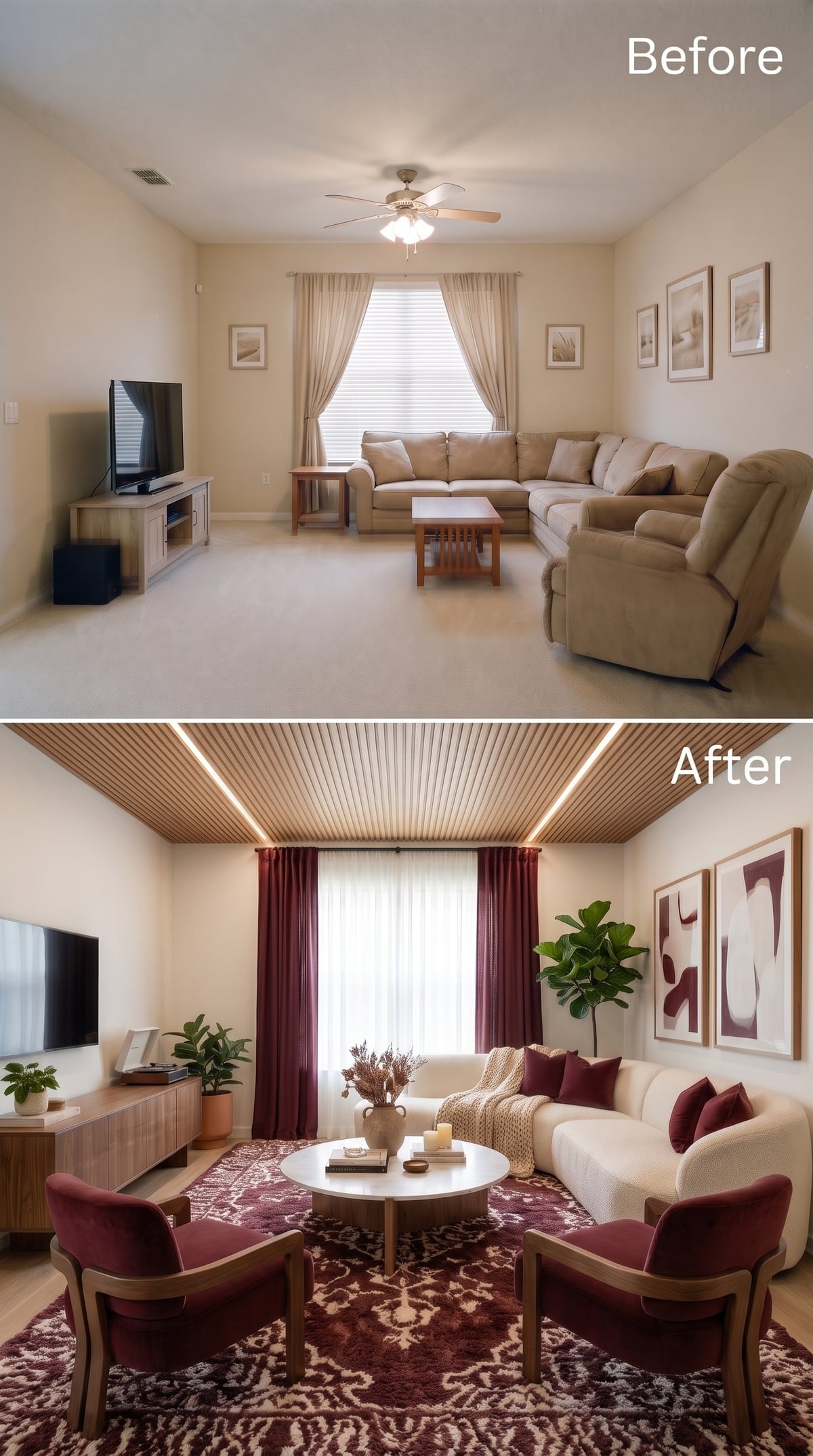
Slatted wood runs the full ceiling length, with recessed lighting tucked against the edges. Cream bouclé below keeps the center pale while burgundy accent chairs bring in the darker tone through smaller pieces.
The medallion rug does the connective work, mixing burgundy and ivory before either color reaches the furniture. Start with a rug this decisive and half the palette decisions are already made for you.
Quick Fix: If a patterned rug already contains your main accent color, resist the urge to introduce three more. Repeat one or two tones from the rug elsewhere and let the floor establish the limits of the palette.
15. Sputnik Gold, Botanical Prints, and Floral Drapes Pull Burgundy Toward Cottage Modern
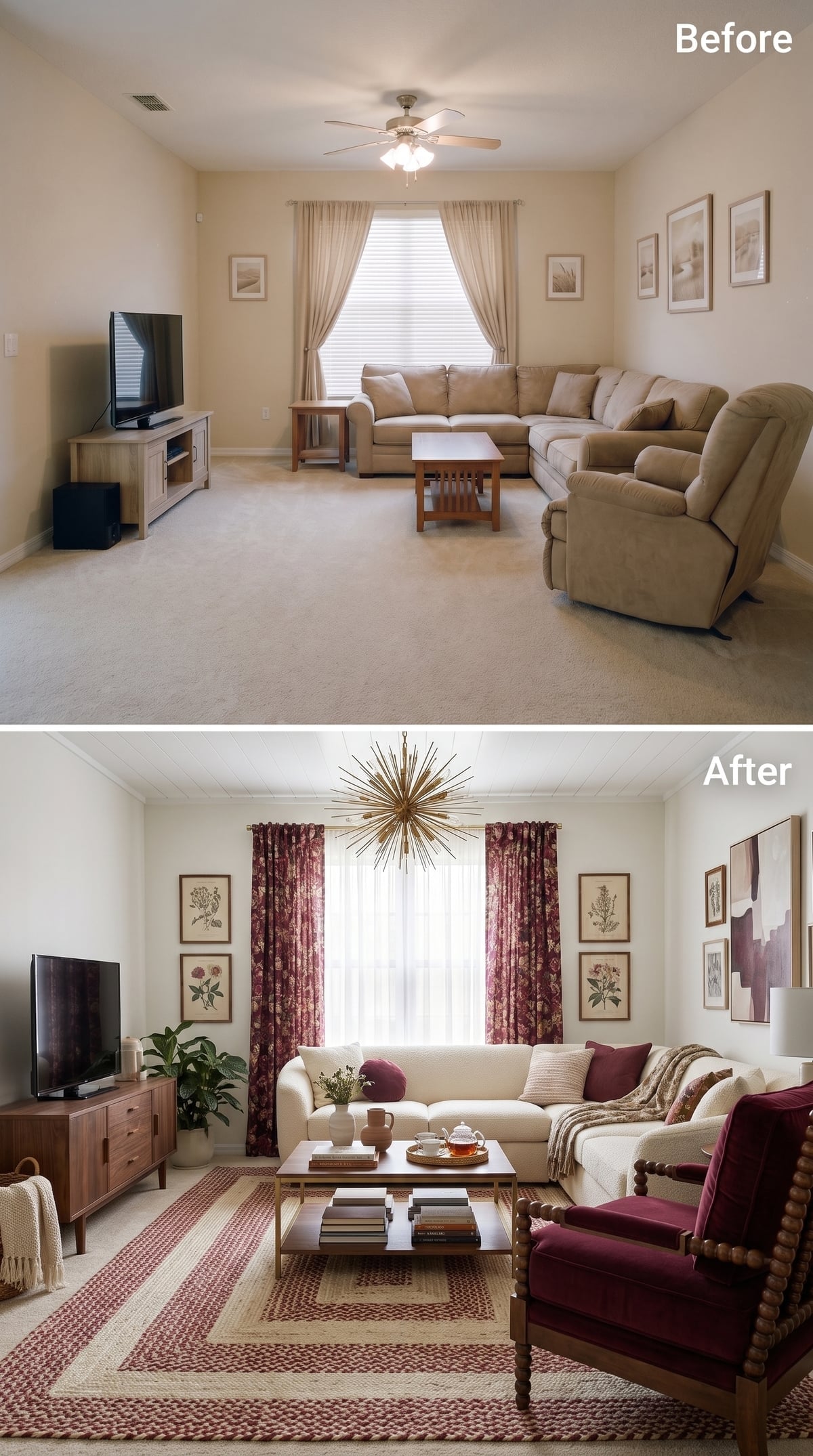
A gold Sputnik chandelier replaces the ceiling fan, but the rest of the room refuses to follow it into full Midcentury mode. Cream upholstery, botanical prints, burgundy floral curtains, and a spindle chair bring in a softer, almost cottage-like layer.
That’s what gives this one personality. The chandelier supplies tension rather than dictating the entire style. Burgundy travels through fabric and pattern instead of becoming one enormous block of velvet.
14. Calligraphy, Bouclé, and Cedar Slats Put Burgundy Into a Japandi Mood
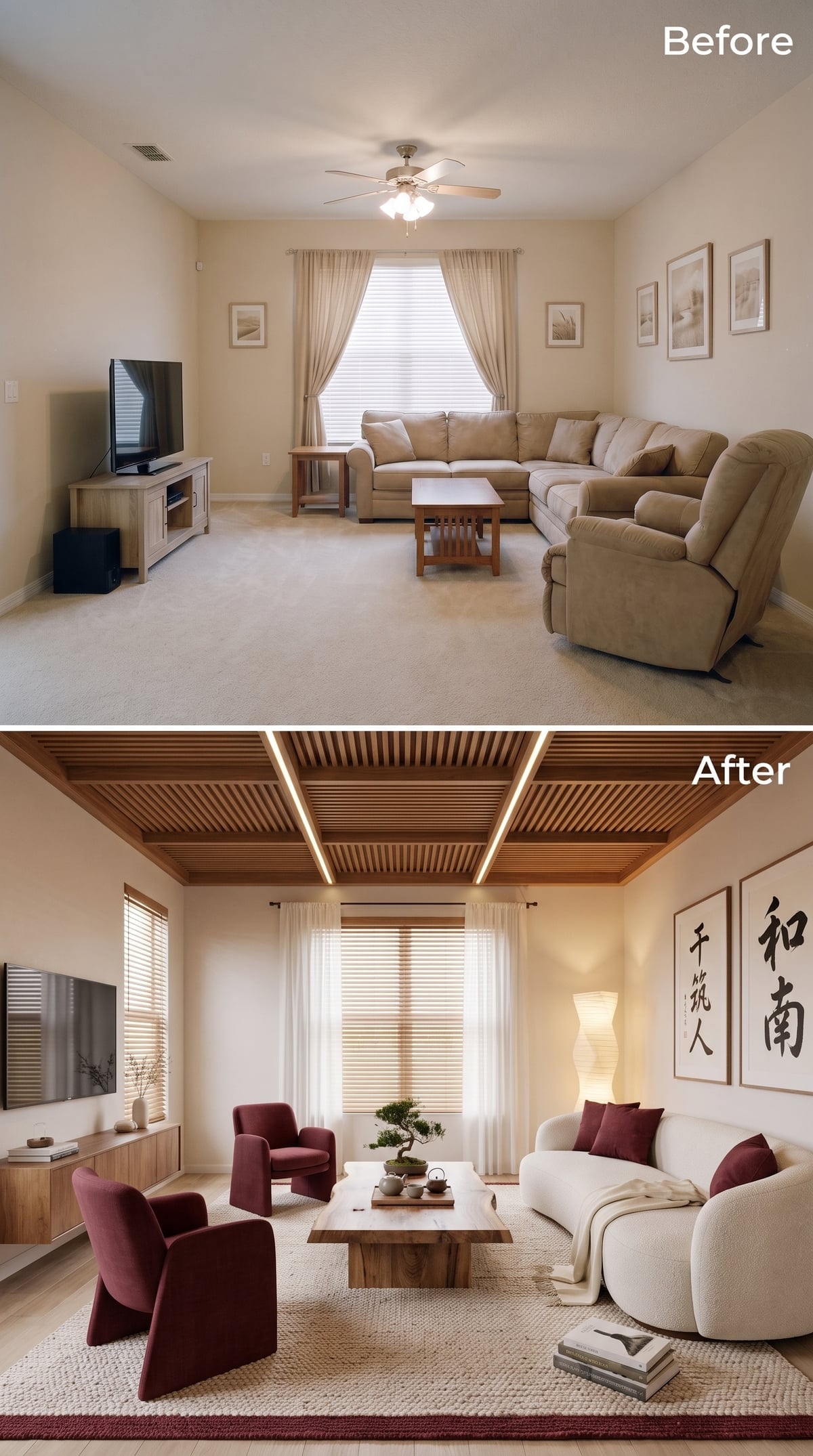
Cedar-toned slats cross the ceiling while concealed lighting grazes the grain. Below, an ivory bouclé sofa curves around a solid wood pedestal table holding a bonsai and clay tea set. Calligraphy panels add the only graphic element on the wall.
Burgundy appears in cushions and two low chairs, but this time it stays disciplined. The darker color has been reduced to exactly enough weight to stop all the pale wood and ivory from floating away.
- Low furniture preserves long sightlines through the room
- Keeping ceramics and bonsai together creates one deliberate vignette instead of several small distractions
- Burgundy supplies depth without introducing another competing hue
13. Gilded Plasterwork and a Swirl Rug Take Burgundy All the Way to the Edge
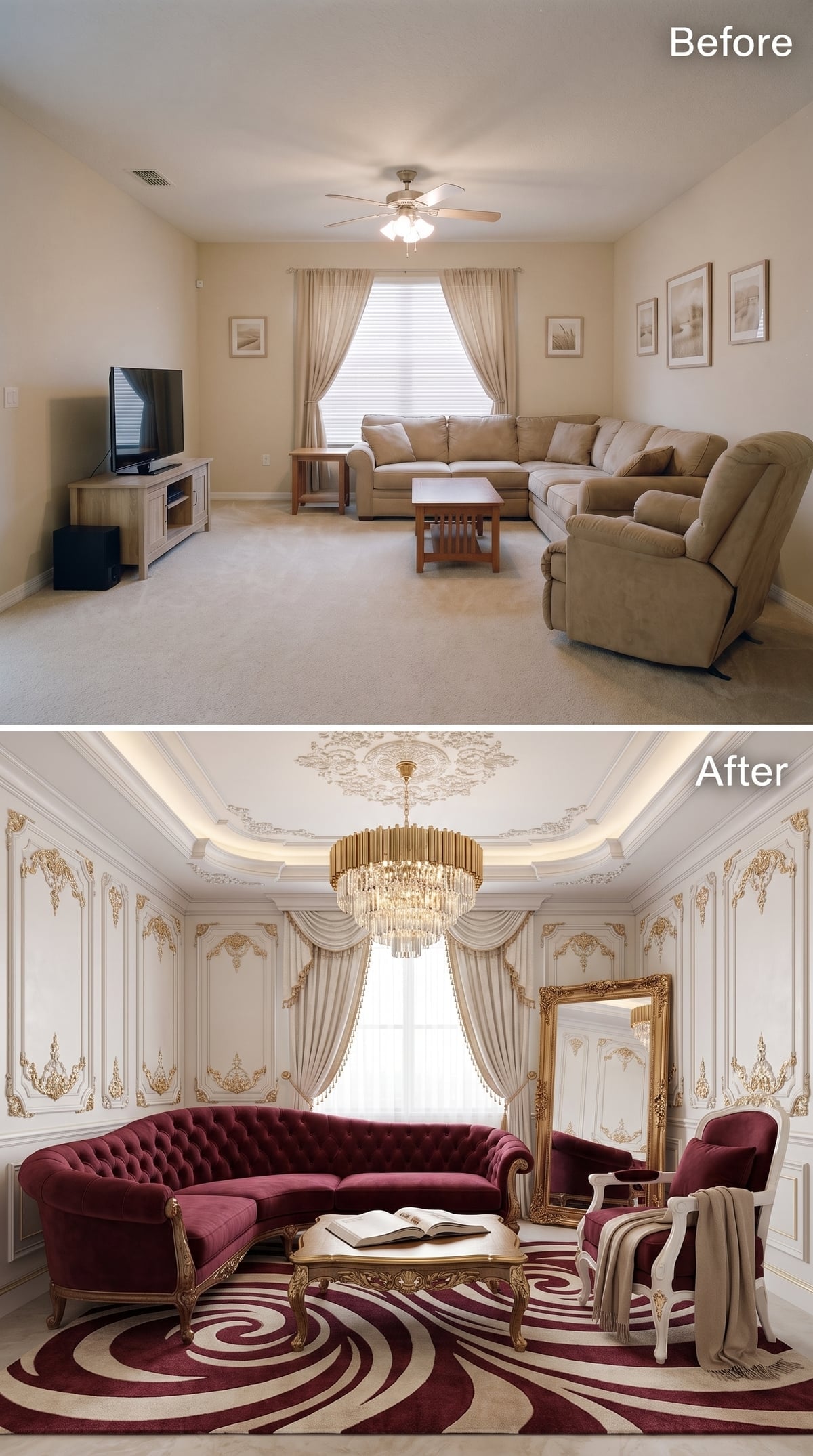
Gilded moldings frame almost every white wall panel. A brass-and-crystal chandelier hangs beneath an equally elaborate ceiling medallion. Then a semicircular burgundy tufted sofa arrives on a cream rug patterned with enormous wine-colored swirls.
Restraint has left the building. Good. A carved gilt coffee table makes sure there is no possibility of misunderstanding the assignment.
Editor’s Note: Deep button tufting became closely associated with Victorian upholstery and remains one of the quickest ways to give a sofa visual weight. Putting it against ornate molding doubles down on the effect rather than pretending the piece is casual.
12. Coffered Ceiling and Bookmatched Marble Give Burgundy a Cooler Counterweight
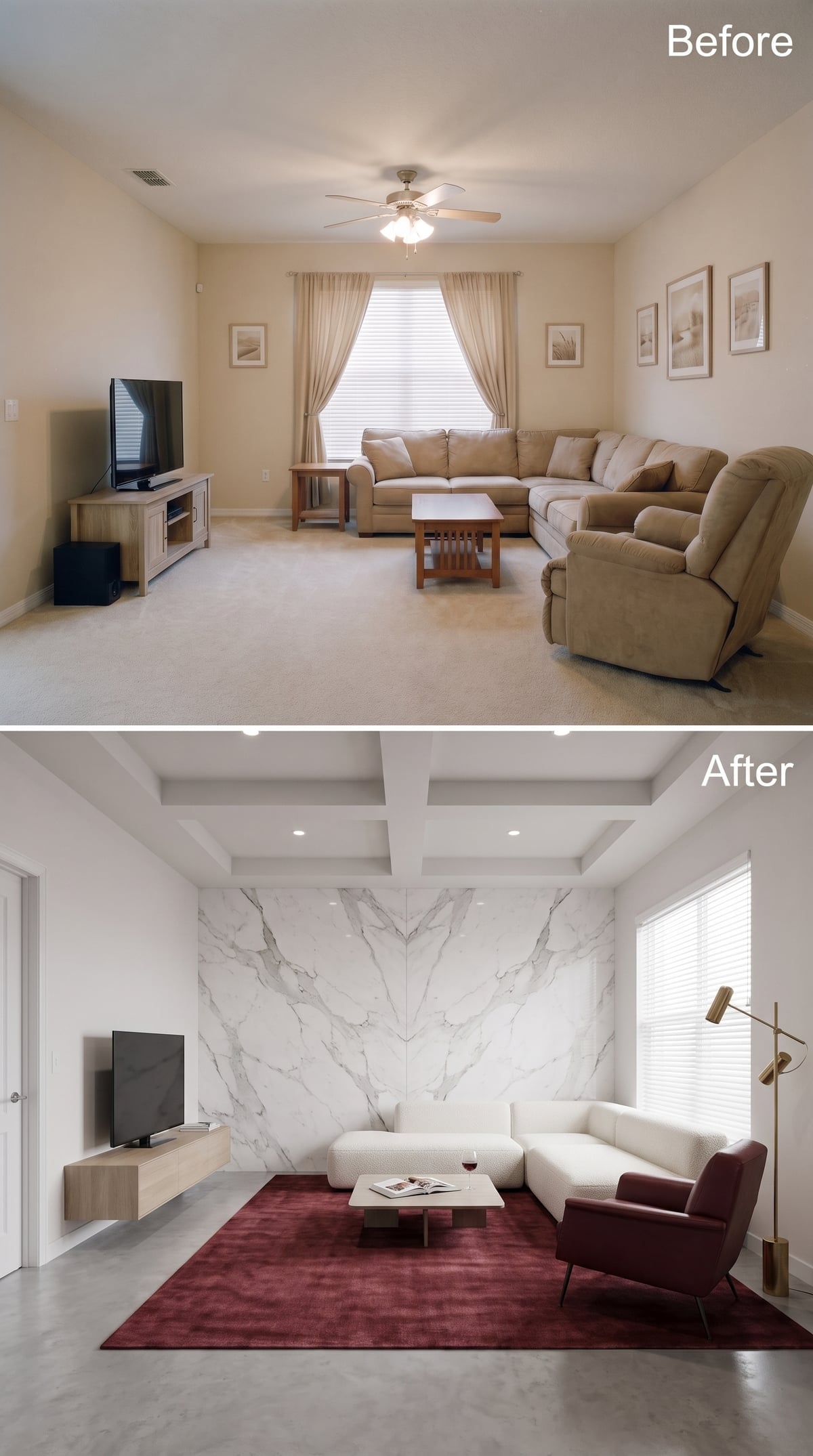
Floor-to-ceiling marble turns the back wall into the dominant surface, with mirrored veining adding symmetry without another piece of furniture. Above it, crisp coffers and recessed lights keep the ceiling equally disciplined.
A cream bouclé sectional and single burgundy armchair keep the center simple, while polished concrete reflects enough light to stop the darker rug from feeling dense. One brass arc lamp is all the warmth this version needs.
- Mirrored stone veining creates a strong focal composition without wall decor
- A floating console leaves more floor visible and lightens the television wall
- One warm metal can soften a cool material palette without taking it over
11. Crystal Chandelier Meets Shiplap and Somehow Nobody Has to Leave
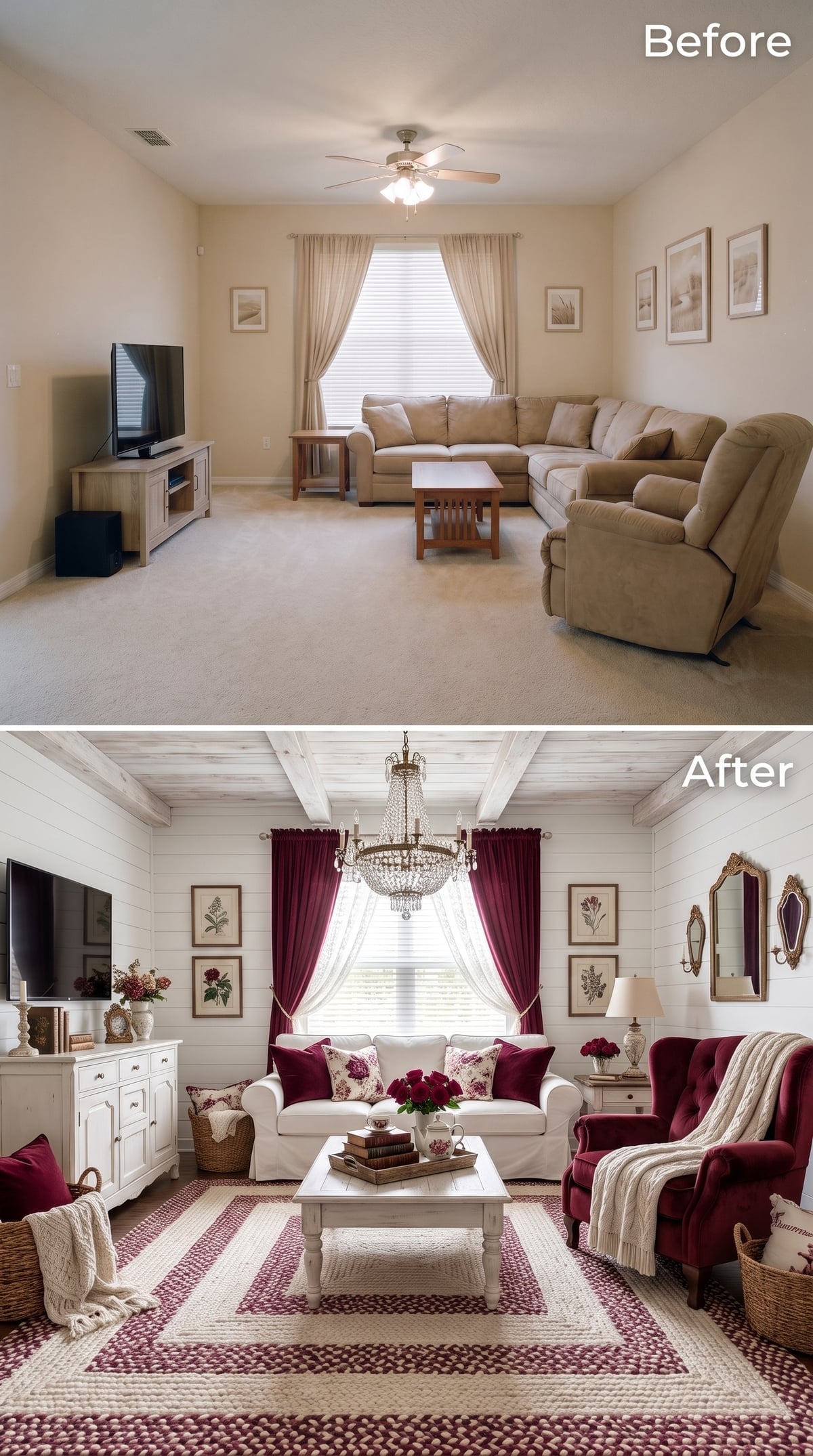
White shiplap and botanical prints establish an easygoing background. Then a substantial crystal chandelier drops into the middle and refuses to behave casually.
That tension is the point. White slipcovered seating and a painted console stay relaxed while burgundy drapes, crimson wing chairs, and a braided burgundy-and-ivory rug give the room enough richness to support the chandelier.
Why the Braided Rug Matters
Braided rugs have deep roots in American domestic craft and were often made from reused strips of fabric. Here, the braid isn’t nostalgia for its own sake. It establishes burgundy and ivory at floor level, giving the chairs, curtains, and pillows a palette to answer.
10. Pale Wood Slats and a Wine-Edged Jute Rug Make Burgundy Feel Almost Minimal
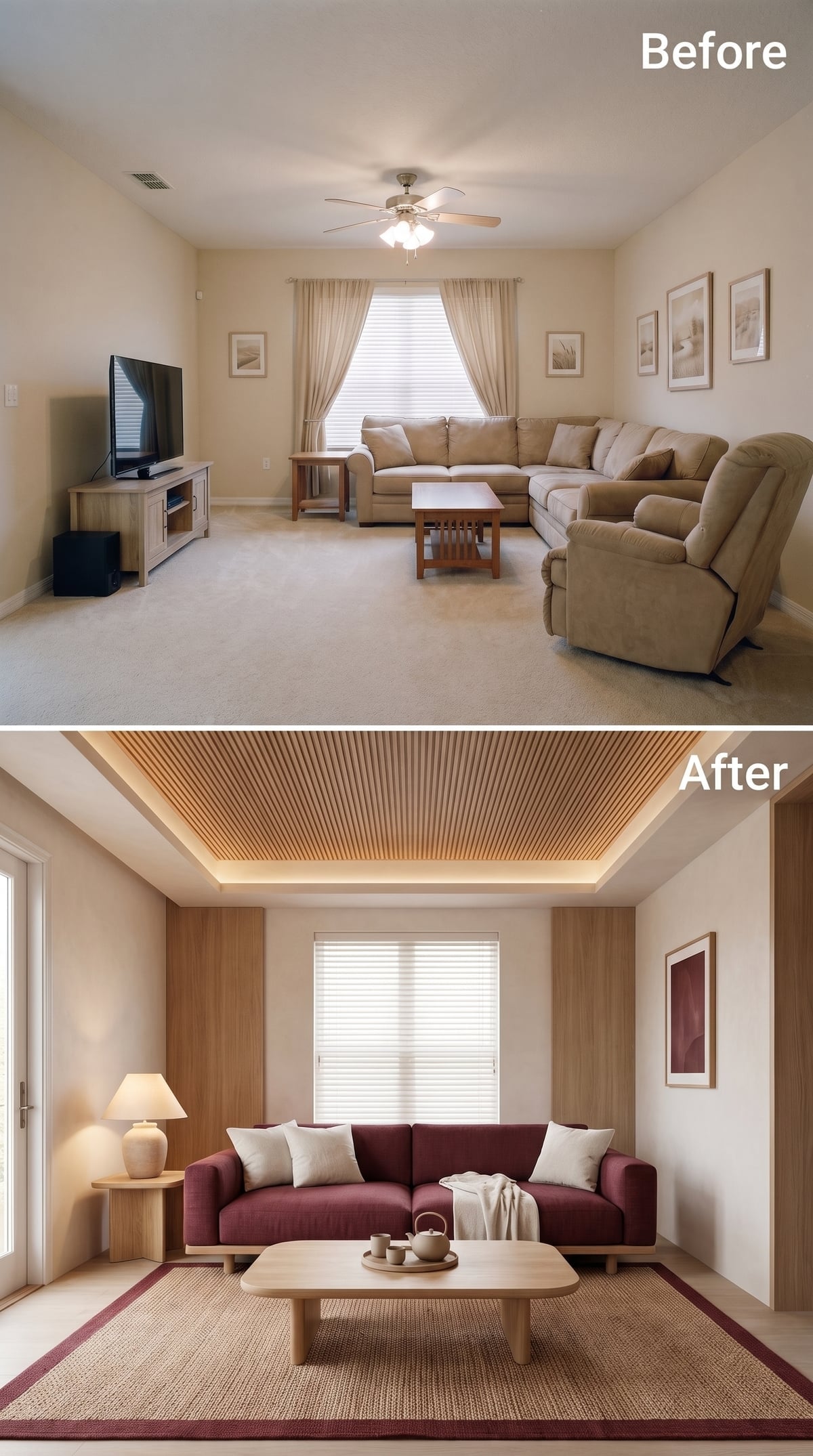
Pale wood slats stretch across the tray ceiling and catch concealed light along their edges. Underneath, a burgundy sofa sits on a jute rug trimmed in wine, repeating the color without pretending the two materials are meant to match.
A raw wood coffee table, one ceramic lamp, white blinds, and a restrained print do the rest. This is what happens when burgundy stops being dramatic and simply becomes the darkest note in a quiet room.
9. Mirror Panels Turn a Tray Ceiling Into a Light Machine
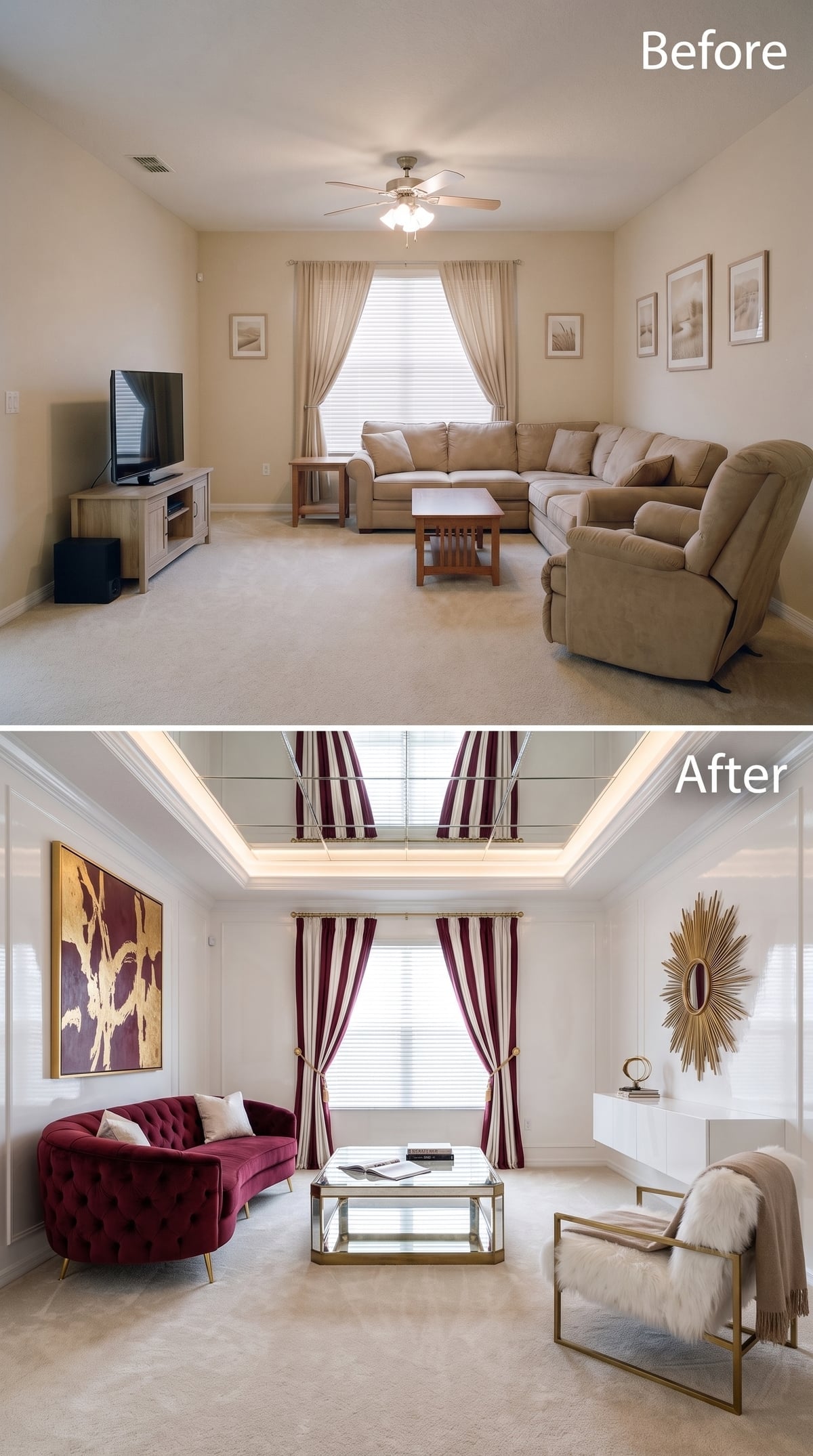
White walls let the tray ceiling become the event. Cove lighting runs around the perimeter while mirrored inserts catch portions of the glow and throw extra reflection back into the room.
Below, a curved burgundy velvet sofa with gold legs connects to a sunburst mirror across the room. Striped burgundy-and-white drapes pull the color upward, while the glass-and-brass coffee table keeps the center from turning visually solid.
In the Details: Reflective ceiling panels can amplify available light and create an illusion of greater depth overhead. The effect is strongest when the mirrors are used selectively; cover the entire ceiling and subtlety leaves through the front door.
8. Wood Slats, Brass Sputnik, and Burgundy Chairs Meet in the Middle
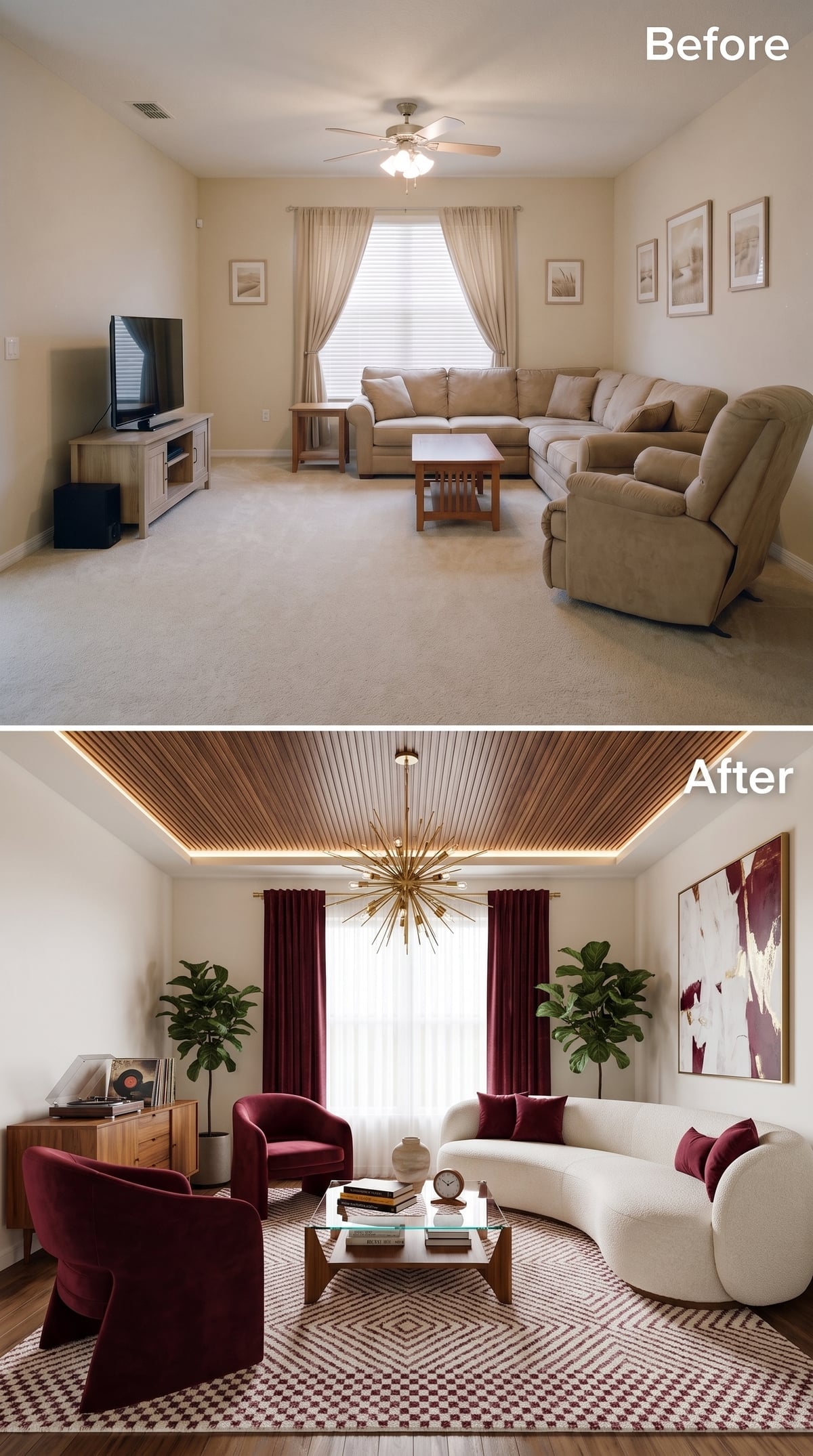
Warm slat paneling lines the tray ceiling while a brass Sputnik drops into the center. Two burgundy velvet armchairs face a curved bouclé sofa across a glass-and-wood coffee table.
The diamond-patterned rug is deliberately quieter than the ceiling and chairs. That’s why the composition survives having both wood overhead and a statement chandelier in the same frame.
7. Live-Edge Wood Gives White Bouclé and Burgundy Something Rougher to Work Against
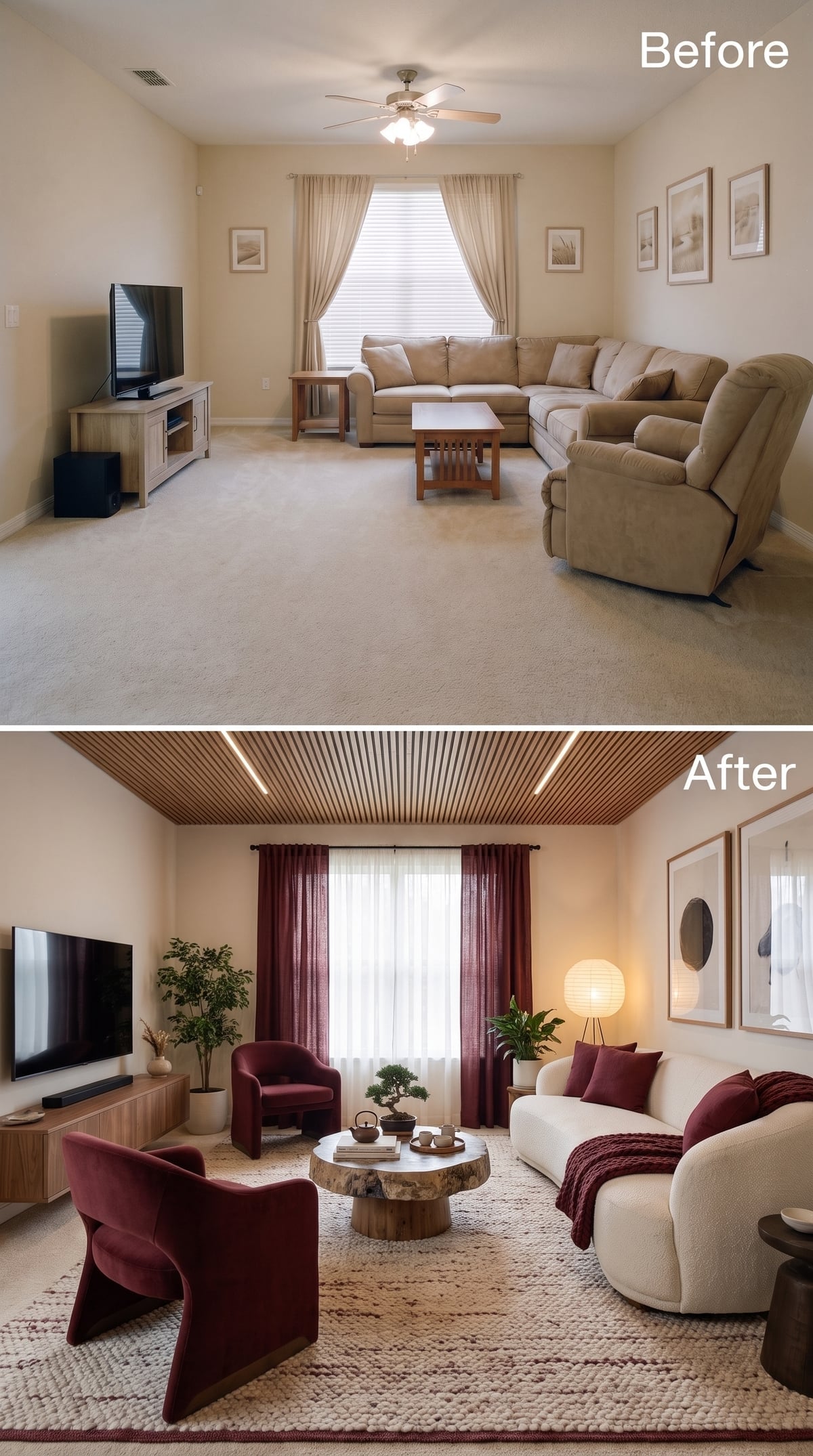
Ribbed wood panels cross the ceiling with narrow strips of concealed light between them. Below, an off-white bouclé sofa gets a burgundy knit throw while two velvet chairs repeat the darker color at the opposite end.
Then the live-edge table breaks all the polish. Its irregular wood slab sits on a white stone base beneath a bonsai and cast-iron teapot. That one rough edge gives the room more personality than another perfectly circular designer table would have managed.
Style Math: Bouclé and velvet make useful opposites. Bouclé scatters light across an irregular looped surface; velvet changes noticeably as its pile catches light from different directions. You get contrast before adding another color.
6. Burgundy Toile Returns, This Time With More White and Better Restraint
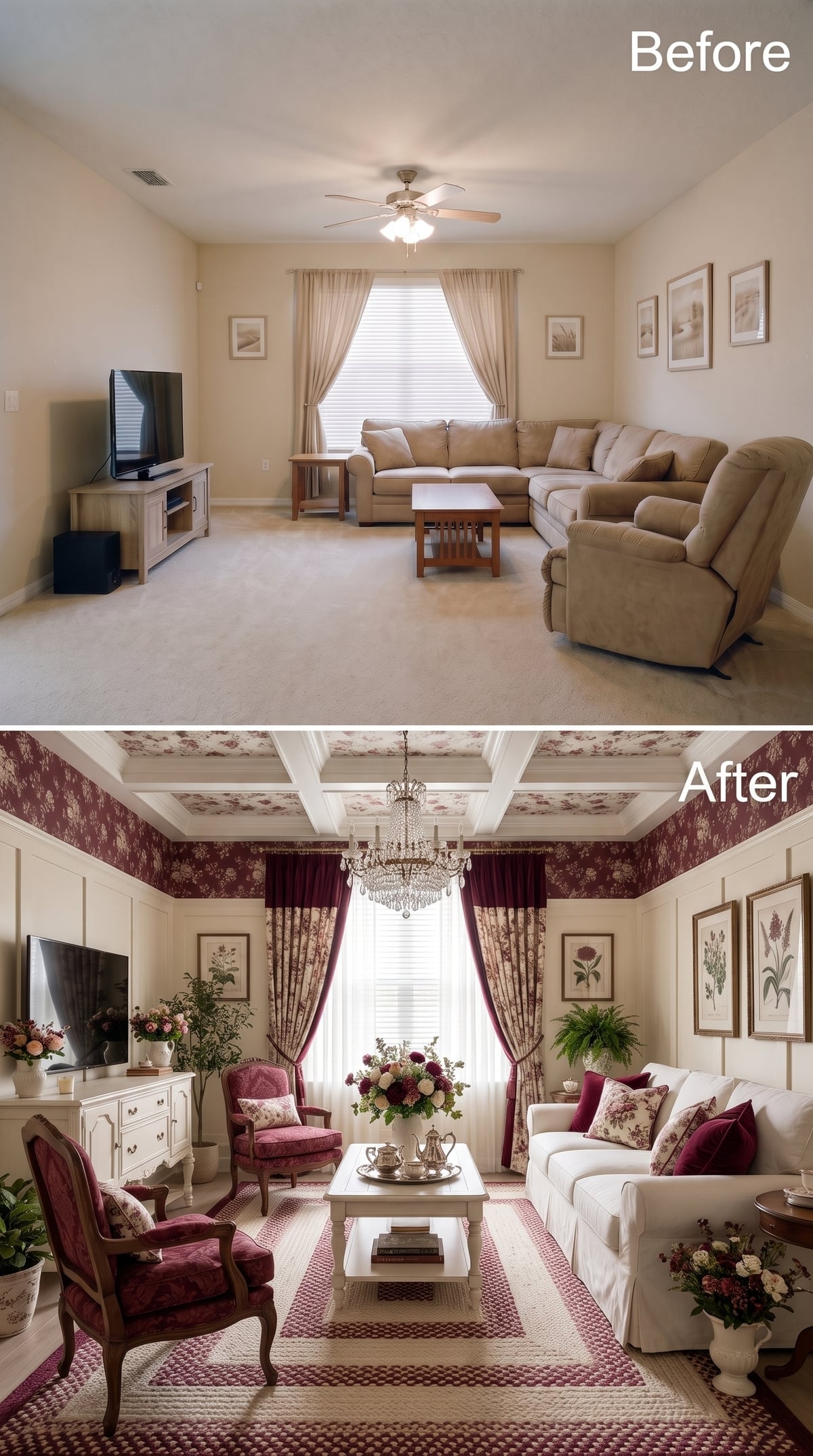
Crisp white coffers give the ceiling order while burgundy toile runs above the wainscoting. Ivory slipcovered sofas stay deliberately quiet beneath all that pattern, and a crystal chandelier claims the center without adding another color.
The braided burgundy-and-cream rug is what keeps the lower half connected to the walls. Pattern above, pattern below, calm seating in between — a much smarter balance than asking every surface to perform simultaneously.
Designer Detail: A patterned wall and patterned rug can coexist when their scales are different and the furniture between them stays relatively quiet. The white upholstery here functions almost like visual breathing room.
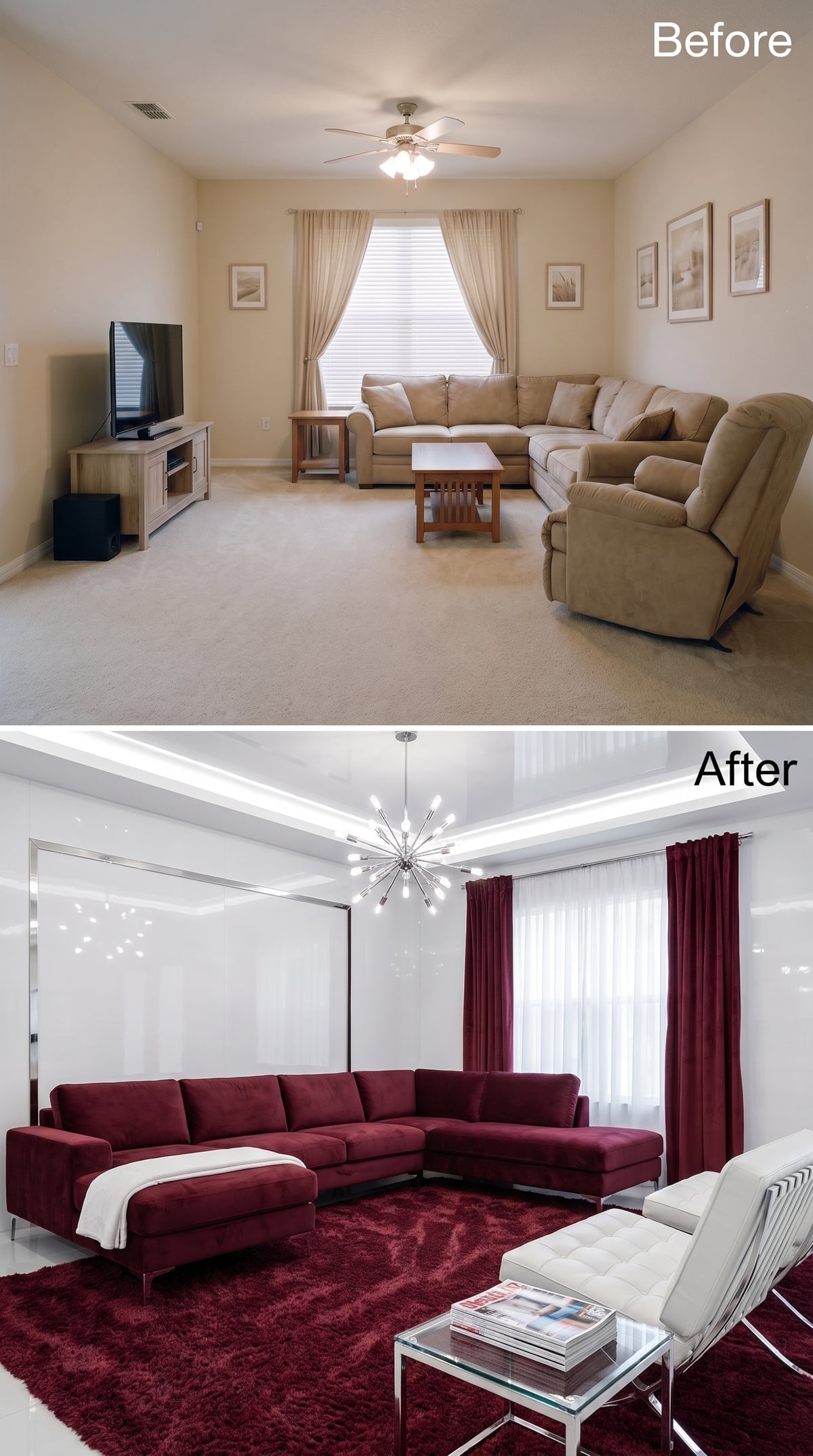
5. Sputnik Chandelier and Red-Wine Velvet Push the Room Straight Into Midcentury Glam
🔥 Would you like to save this?
Chrome legs on the sectional answer the metallic arms of the Sputnik chandelier above. Cove lighting washes the white ceiling perimeter while a deep burgundy shag rug drops the visual weight back to the floor.
The important move is repetition without duplication: chrome below, chrome above; burgundy upholstery, burgundy rug; white architecture surrounding both. Nothing needs another decorative layer.
Why the Sputnik Still Works
Sputnik fixtures emerged from the atomic-age design vocabulary of the late 1950s and 1960s, when radiating forms became visual shorthand for futurism. In this room, the branching silhouette gives the ceiling energy while its metallic finish connects directly to the furniture below.
4. Shiplap, a Braided Rug, and One Burgundy Wing Chair Keep Things Familiar
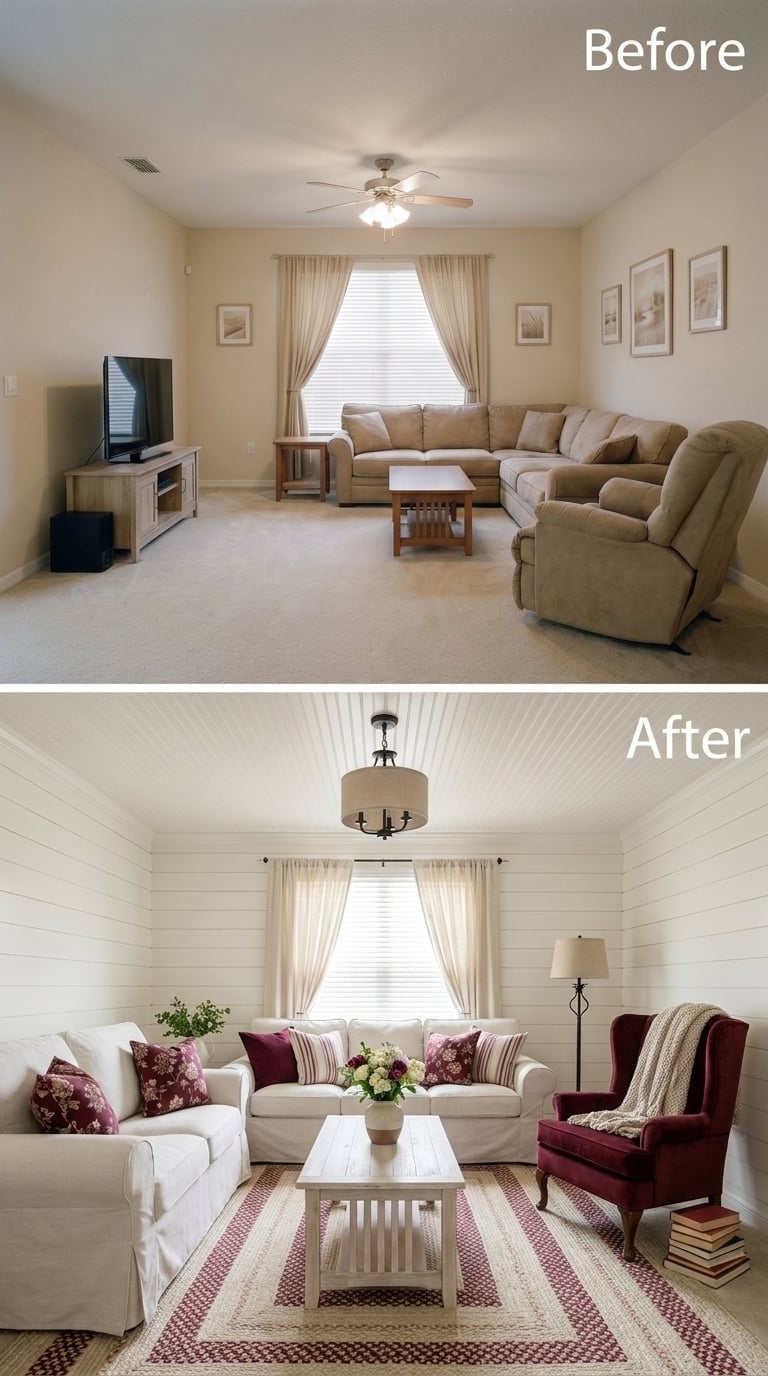
Crisp white slipcovered sofas give this version the easiest, most lived-in base in the gallery. White shiplap stays quiet behind them while one burgundy wing chair supplies the strongest note in the room.
A braided cotton rug threads burgundy through ivory at floor level, so the chair doesn’t look like a random accent brought home on sale. Sometimes one decisive dark piece is enough.
3. The Sputnik Returns With Fluted Wood and a Much Calmer Supporting Cast
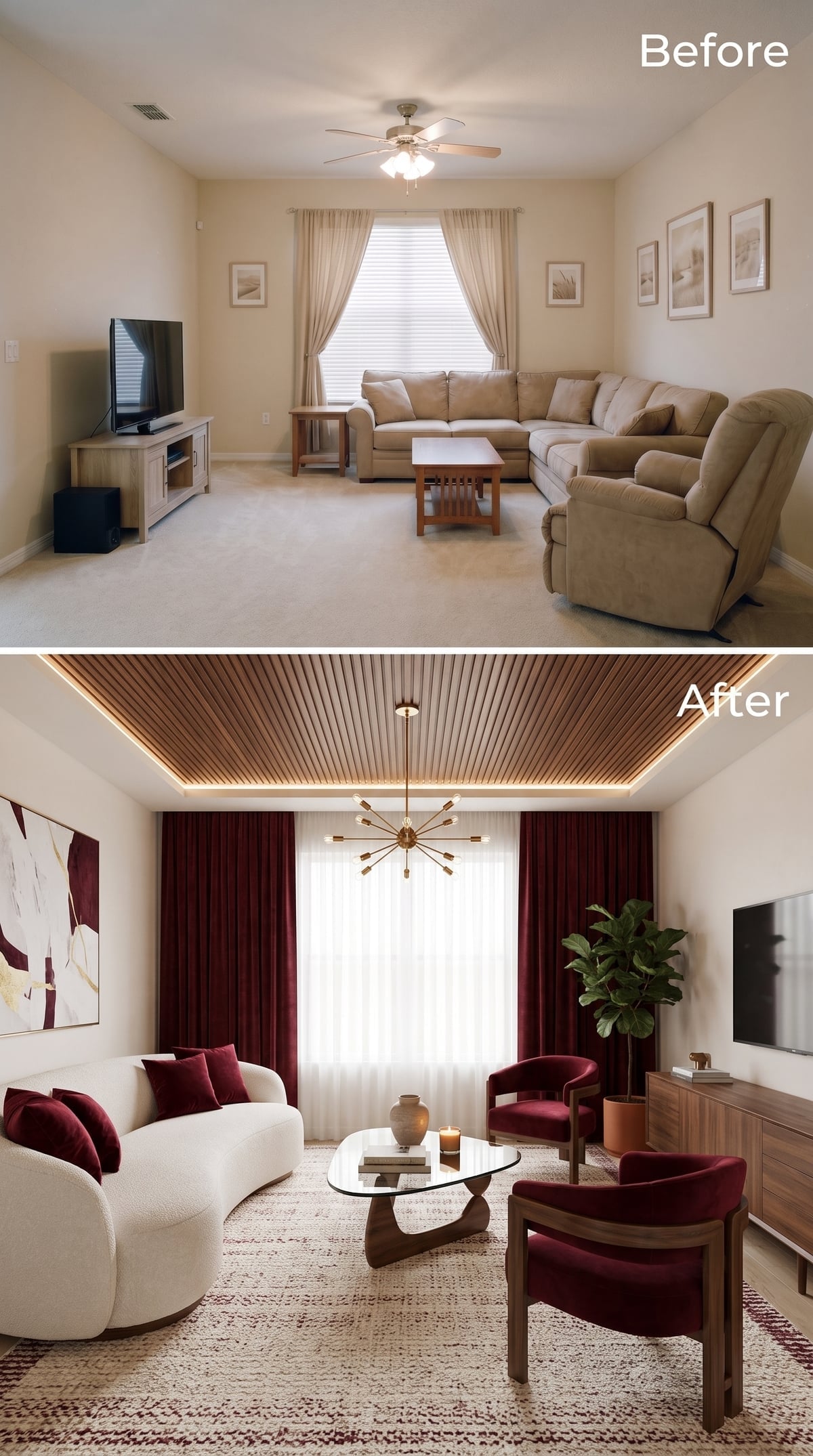
Fluted wood lines the recessed ceiling while concealed lighting warms the perimeter. A curved bouclé sofa faces two burgundy barrel chairs, and a Noguchi-style glass table barely interrupts the sightline between them.
A fiddle-leaf fig supplies the organic shape the furniture doesn’t. Burgundy drapes sit over sheer white panels, giving the window enough drama to balance the ceiling without adding more furniture.
Worth Knowing: Slatted or fluted surfaces can help scatter reflections compared with a perfectly flat hard surface. For meaningful acoustic absorption, though, the construction behind the slats matters just as much as the visible wood.
2. Slatted Ceiling, Burgundy Sectional, and Stone Pull the Palette Back to Earth
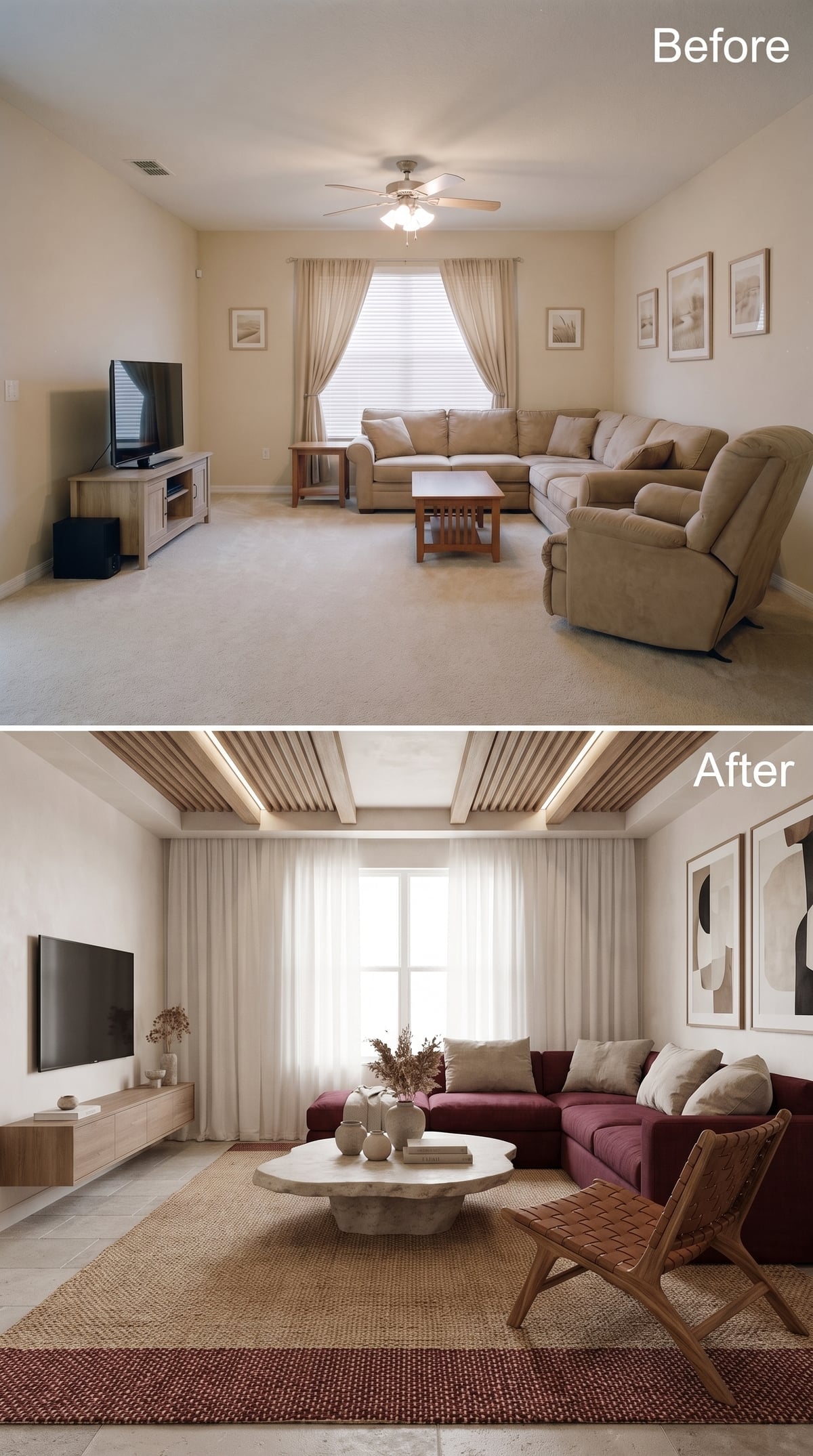
Wooden ceiling slats and concealed perimeter lighting establish the warmth overhead. A burgundy sectional carries most of the color below, but the woven leather sling chair, stone coffee table, jute, and white linen keep it firmly in the material world rather than letting it become a velvet showcase.
The layered rug combination is especially useful here: natural texture underneath, darker burgundy above. It gives the sofa a landing zone without simply matching it.
Common Mistake: A living-room rug that floats completely inside the seating arrangement can make even good furniture feel disconnected. Letting at least the front legs of the major seats meet the rug is a reliable way to make the grouping read as one zone.
1. Sputnik, Fluted Walls, and a Burgundy Chesterfield Finish on a Harder Edge
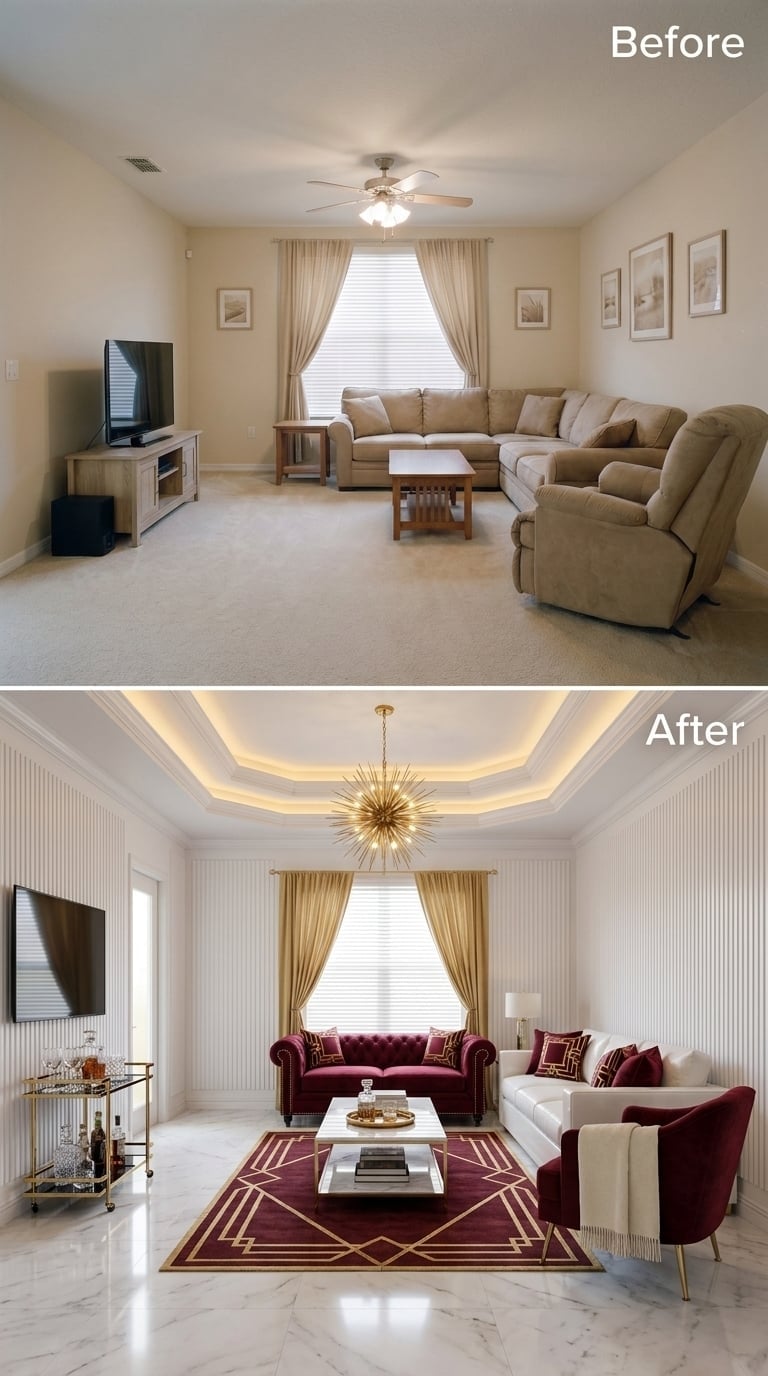
The final version gives the palette its sharpest ending. Fluted wall panels add vertical texture while cove light lifts the tray ceiling without turning the ceiling itself into another ornament.
A brass Sputnik marks the center, but the burgundy Chesterfield sofa is the piece with authority. Deep buttoning, rolled arms, and saturated velvet give all that white architecture something solid to push against, while the geometric rug keeps the room from drifting into club-library nostalgia.
After 29 versions, that’s the real lesson. White and burgundy were never the whole design. The interesting part was deciding whether they belonged with bamboo, marble, terrazzo, shiplap, bouclé, gilding, slatted wood, crystal, or one very stubborn Chesterfield — and discovering that the same two colors could survive all of them.