🔥 Would you like to save this?
The room was finished, spotless, and practically under museum rules. Nobody put their feet on the coffee table. Nobody flopped across the sofa. Children learned early that the French doors were less an invitation than a warning. Inside waited the full 1980s formal-living-room arsenal: mauve upholstery, brass candlesticks, glass-topped tables, elaborate drapery, collector cabinets, and at least one ficus standing guard in a gleaming planter.
In order to come up with the very specific design ideas, we create most designs with the assistance of state-of-the-art AI interior design software. Also, assume links that take you off the site are affiliate links such as links to Amazon. this means we may earn a commission if you buy something.
What makes these rooms so fascinating now is how completely they believed in themselves. Nothing was casual, accidental, or merely useful. Lamps matched. Curtains performed. Family photos got gold frames. Even the television had to dress like furniture. These 24 details capture that wonderfully serious world, from grandfather clocks and TV Guides to doilies, collector plates, globe bars, and all that brass. Some of it looks outrageous now. Some of it has already started sneaking back. Either way, the good room deserves another look.
24. Grandfather Clocks Weren’t Optional — They Were the Whole Personality
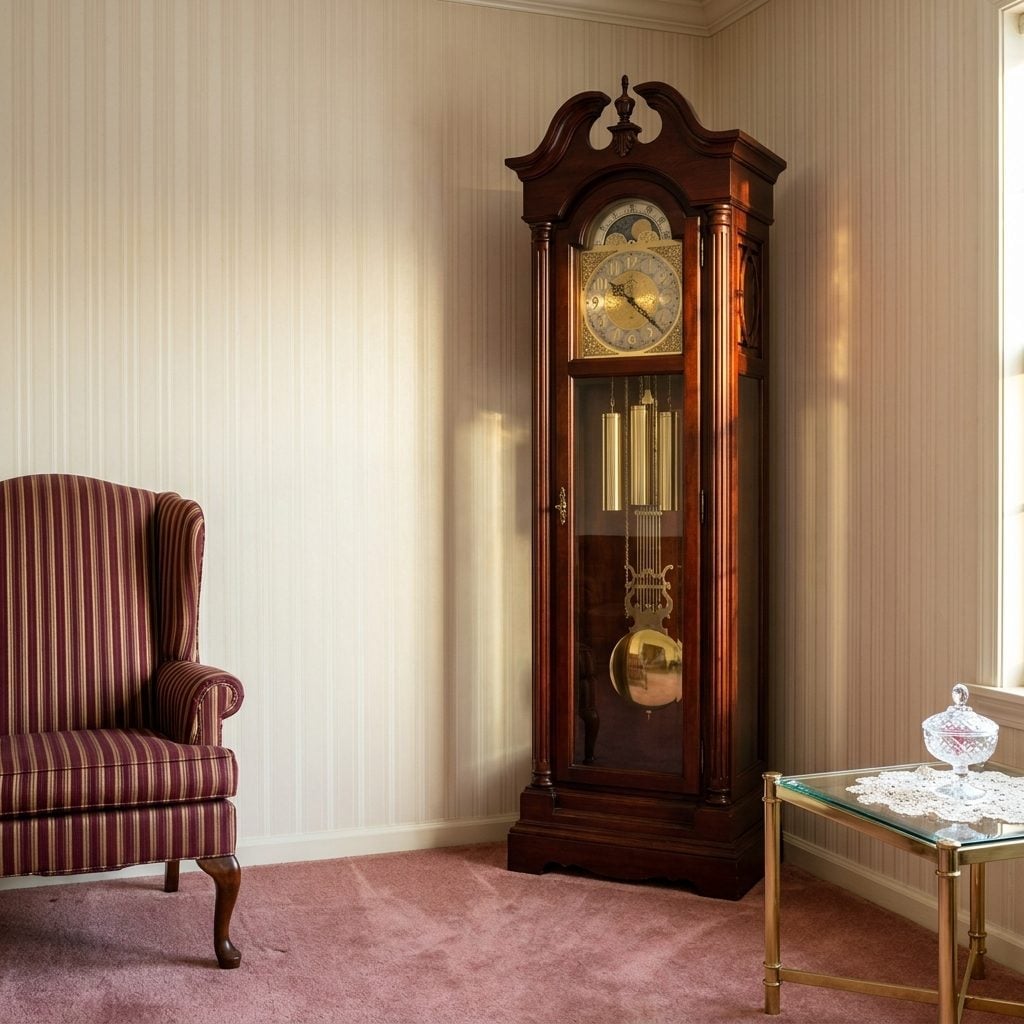
That cherry-toned grandfather clock, with its brass pendulum and moon-phase-style dial, wasn’t decoration. It was a statement of arrival. In plenty of formal living rooms, one stood tucked into a corner, ticking loudly over striped wingback chairs and glass-topped brass side tables. You didn’t choose the grandfather clock. The grandfather clock chose the room.
23. Emerald Velvet Chesterfields Were the Formal Living Room’s Crown Jewel
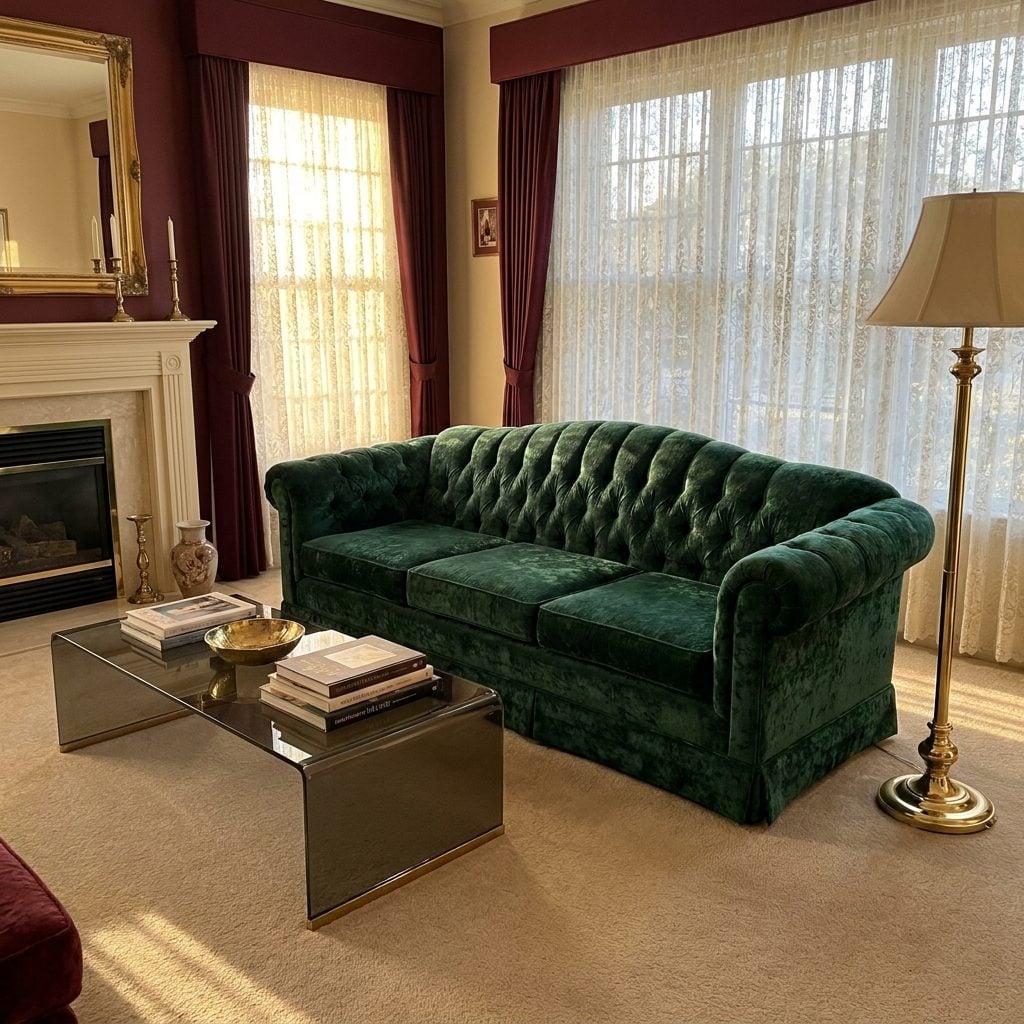
Few pieces commanded a room like a tufted Chesterfield upholstered in deep emerald velvet, and this one earns every square foot it occupies. Rolled arms, button-tufted back, skirted base. Nothing improvised, nothing casual.
Flanking it with a brass torchiere floor lamp and a smoked-look waterfall coffee table tells you everything about how the 1980s handled formal spaces: rich fabric anchored the room, and every other piece deferred to it. The burgundy valances and sheer lace panels behind the sofa add layers without competing. That gold-framed mirror above the fireplace mantel pulls the warm metal tones from the lamp base across the whole room. It all held together because someone understood the assignment.
22. Floral Furniture Sets So Matchy-Matchy They Circled Back Around to Intentional
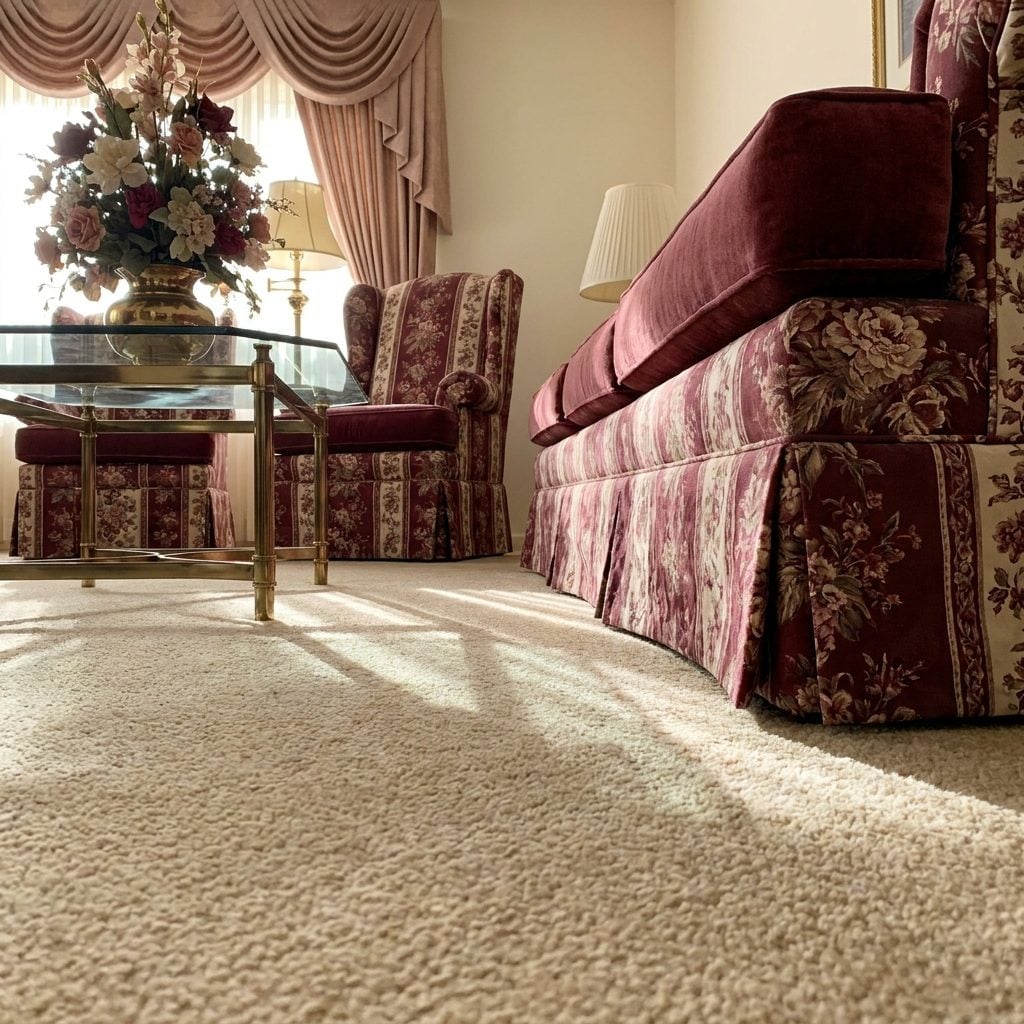
Burgundy velvet on the sofa’s back cushions, floral chintz wrapping the skirt, that same print echoed across the wingback chair nearby. A full suite, committed all the way through. The cream carpet keeps everything from tipping into chaos, and the brass-and-glass coffee table provides just enough visual breathing room between the pieces. Today’s designers would call this maximalism. In 1985, it was just the living room.
21. Swag Valances and Tassel Tiebacks Were the Curtain Equivalent of Black Tie
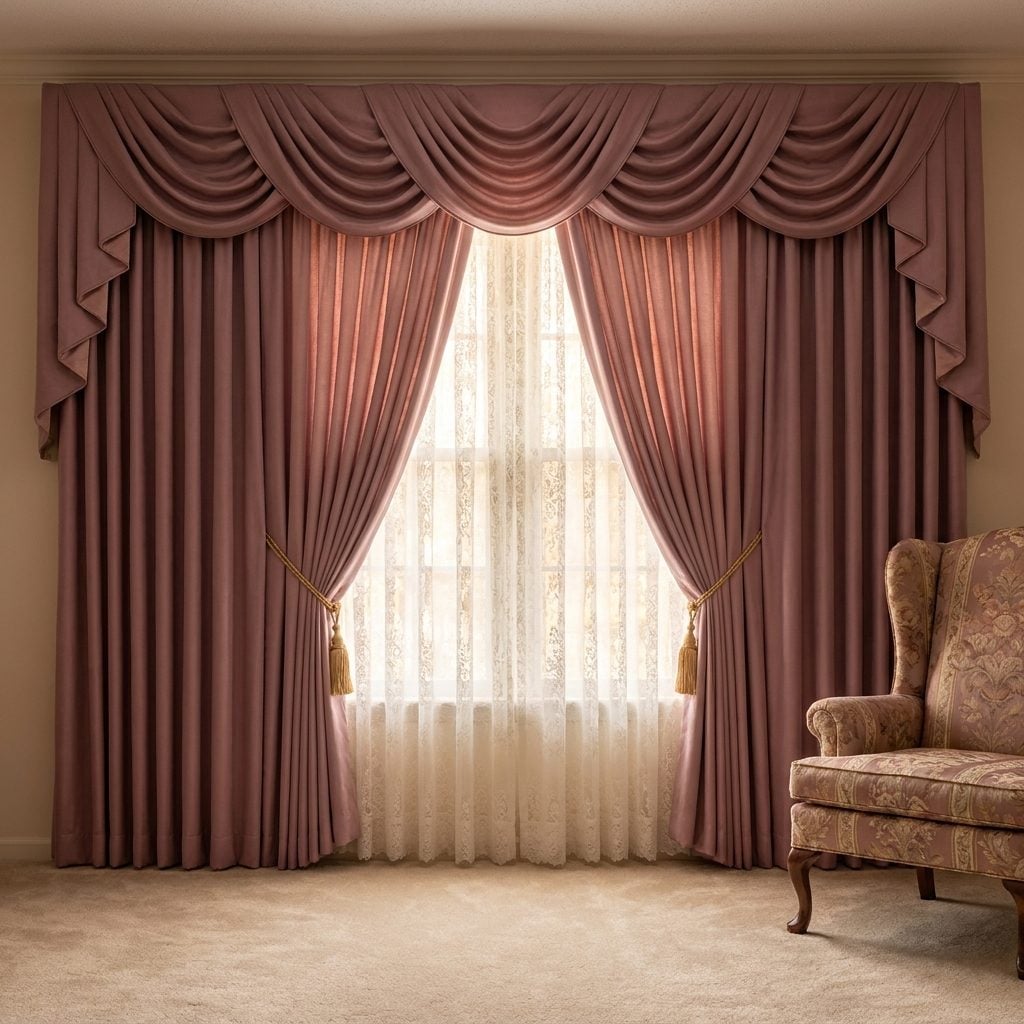
Mauve velvet drapes swept floor-to-ceiling across an entire wall, held open by gold rope tiebacks with oversized tassels dangling at hip height. Behind them, sheer lace panels filtered the light without killing it. The layering wasn’t subtle — that was the whole point. Window treatments in a room like this carried as much weight as the furniture itself, and the swag valance draped across the top in cascading folds, anchored at each corner with tailored jabots. If the drapes didn’t echo the wingback chair upholstery in some meaningful way, the room simply wasn’t finished.
Coordination wasn’t optional. It was doctrine.
Why the Swag Valance Was Its Own Art Form
Getting a swag valance right required actual pattern math. Each draped loop had to fall at the same depth, and the fabric needed enough body to hold its shape without going stiff. Elaborate installations were often handled by a professional workroom or experienced seamstress — the kind of detail nobody notices when it’s done correctly, and everyone notices when it isn’t.
20. Pinch-Pleat Drapes and Damask Wallpaper Were a Coordinated Commitment, Full Stop
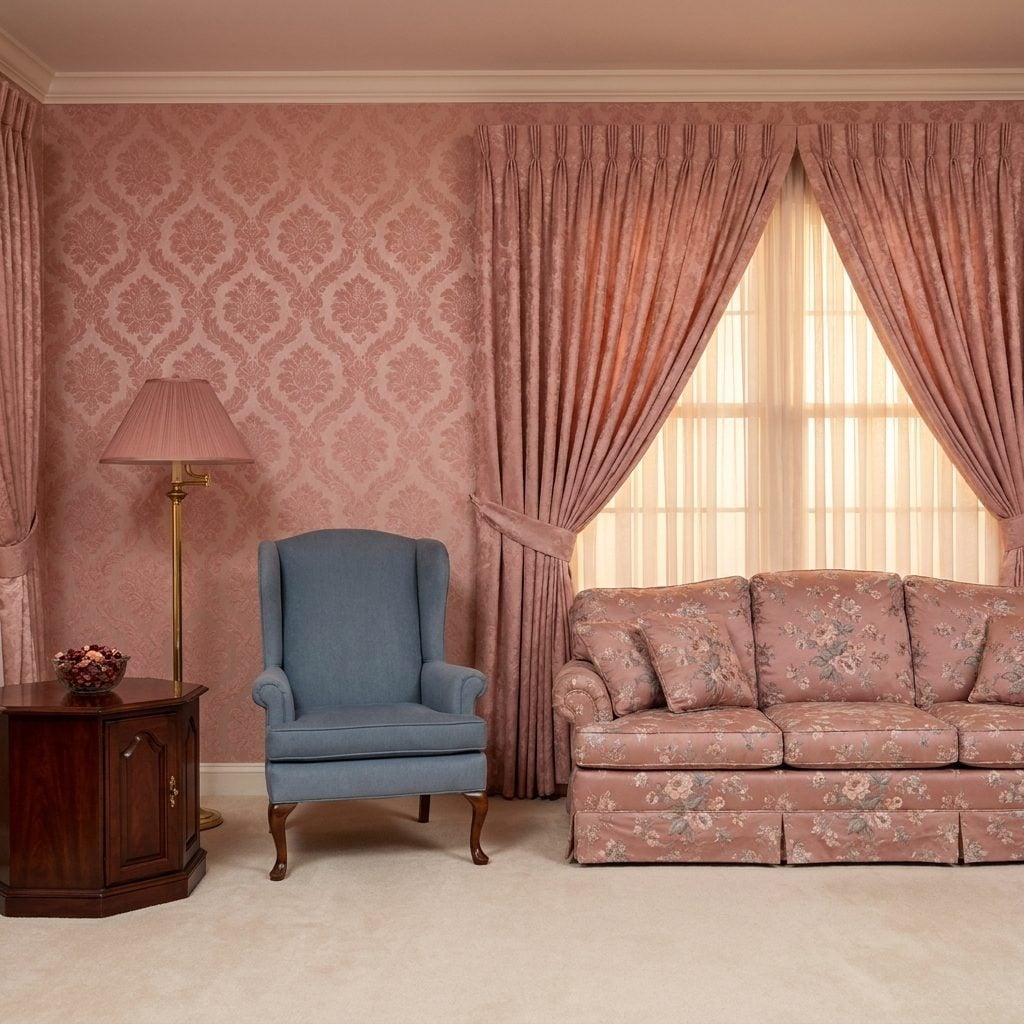
That rose-pink damask wallpaper wasn’t an accent wall. It covered every inch, and the pinch-pleat drapes were cut from fabric close enough in color to read as intentional. Sheer panels underneath softened the window light without letting anyone see outside. The whole room operated on a principle of total commitment — half-measures weren’t a concept these rooms understood.
What’s easy to miss is how the blue wingback chair earned its place here. One piece in a contrasting color was the era’s version of a curated break, and it kept the room from tipping into a rose-tinted fever dream.
Design Note: Full-room wallpaper and coordinated drapery created continuity by repeating color and pattern across large surfaces. A contrasting chair, lamp, or artwork could then stand out dramatically without breaking the overall scheme.
19. Matching Lamp Pairs Were Non-Negotiable, and Everyone Knew It
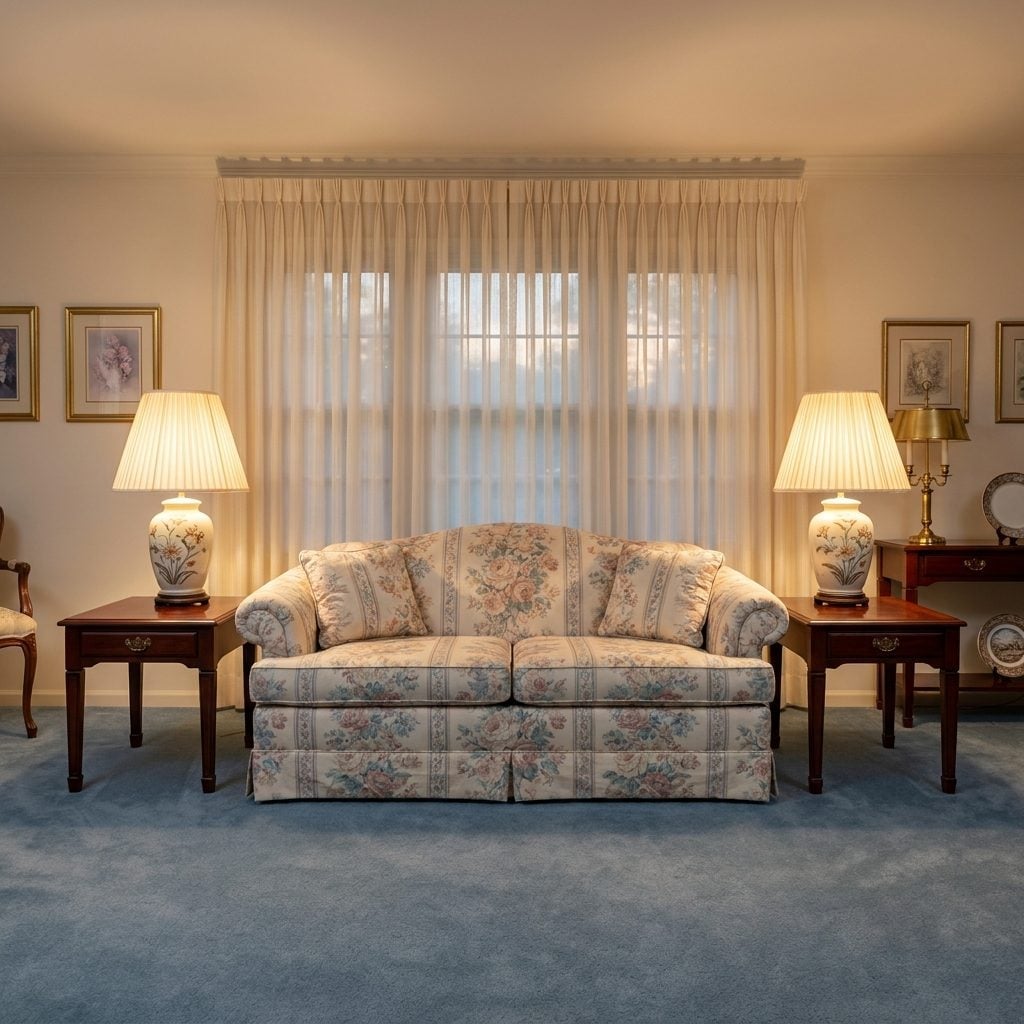
Flanking a floral sofa with identical ceramic lamps wasn’t just decorating — it was a declaration of order. Both fixtures here feature floral decoration on cream ceramic bases with pleated fabric shades, set on dark-wood end tables with brass hardware. In a room built around symmetry, one unmatched lamp could make the whole arrangement feel unfinished.
Style Math: Floral sofa fabric plus matching lamp bases plus pleated shades: a formula so precise it might as well have been published in a rulebook. Every element mirrors its counterpart across the room, right down to the end table placement. Coordinated often meant more than similar. Matching pairs and mirrored placement were part of the look, and anything visibly off-balance could read as unfinished.
18. Brass Sconces Flanking a Fruit Still Life Were Their Own Kind of Formal Religion
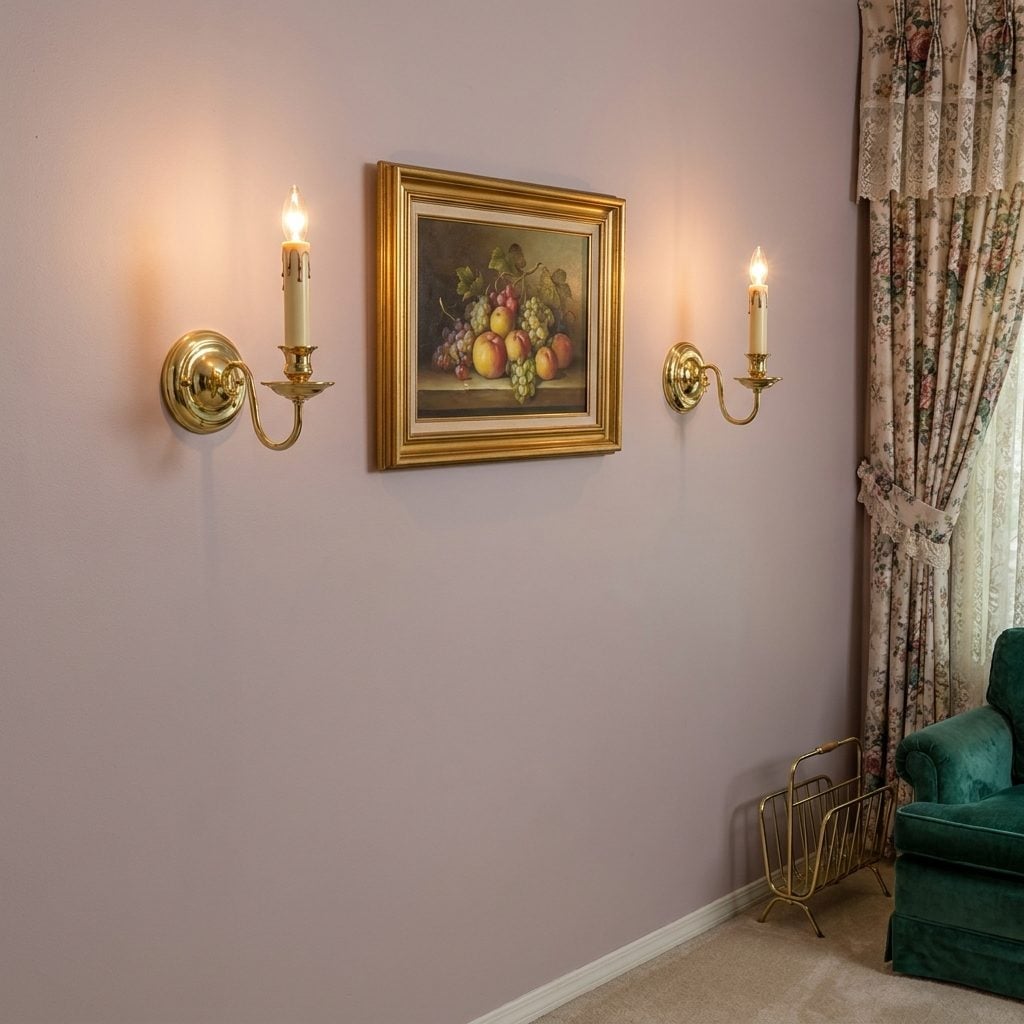
Polished brass single-arm sconces with candle-style bulbs, mounted symmetrically on a dusty mauve wall and flanking a gold-framed oil painting of peaches and grapes. That placement wasn’t accidental. Flanking art with matching sconces was the formal living room’s version of punctuation, and skipping it would have felt as wrong as leaving a sentence unfinished.
17. Gold Frames and Gallery Walls Were the Family Portrait Hall of Fame
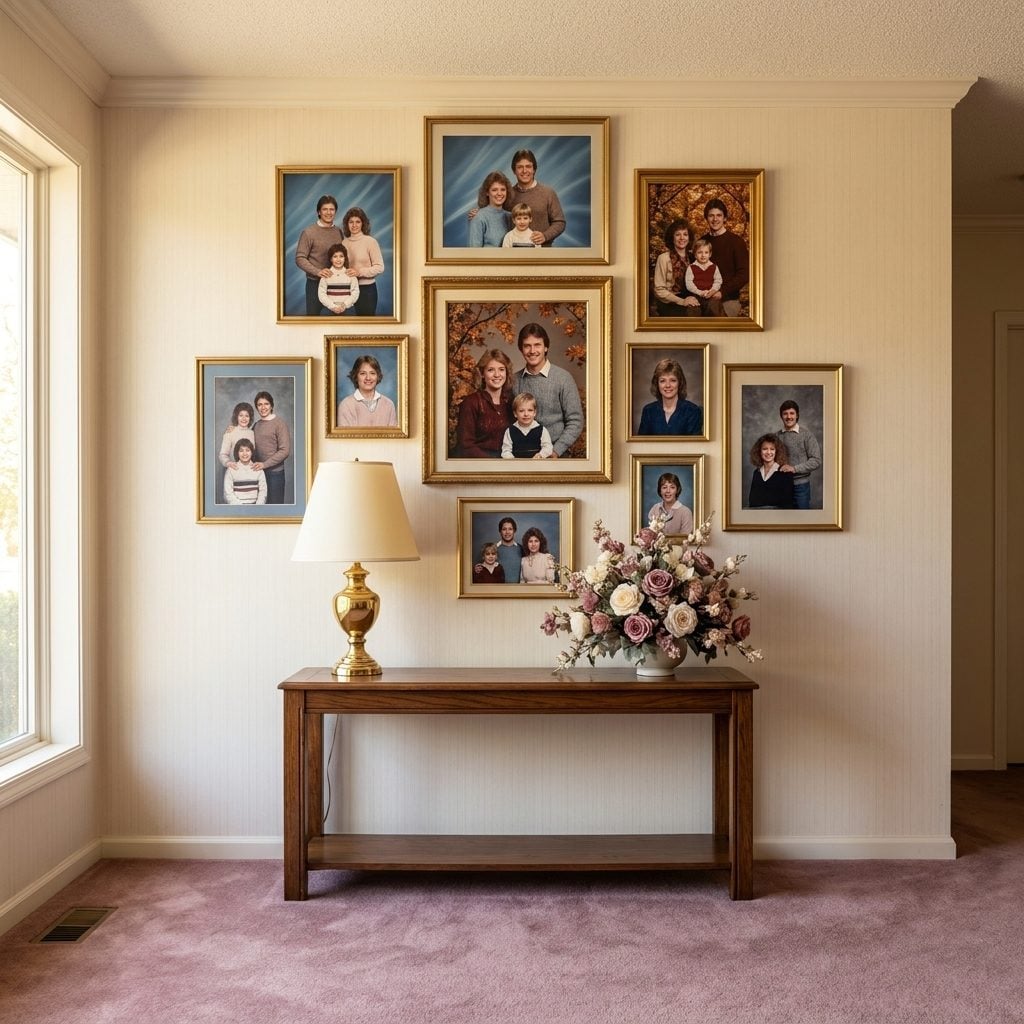
Nine gold-framed portraits climbing a wall in a cluster so deliberate it functioned less like décor and more like a family résumé. Studio photography with blue gradient backdrops, autumn leaf settings, and matching sweaters. Plenty of households had a version of this wall, and gold frames were a favorite.
Below it, a walnut console table holds a brass urn lamp and a loose arrangement of dusty roses and cream blooms. The pink carpet ties the whole room together in a way only the ’80s could pull off without apology.
16. Porcelain Figurine Cabinets Were the Trophy Cases of Formal Living Rooms
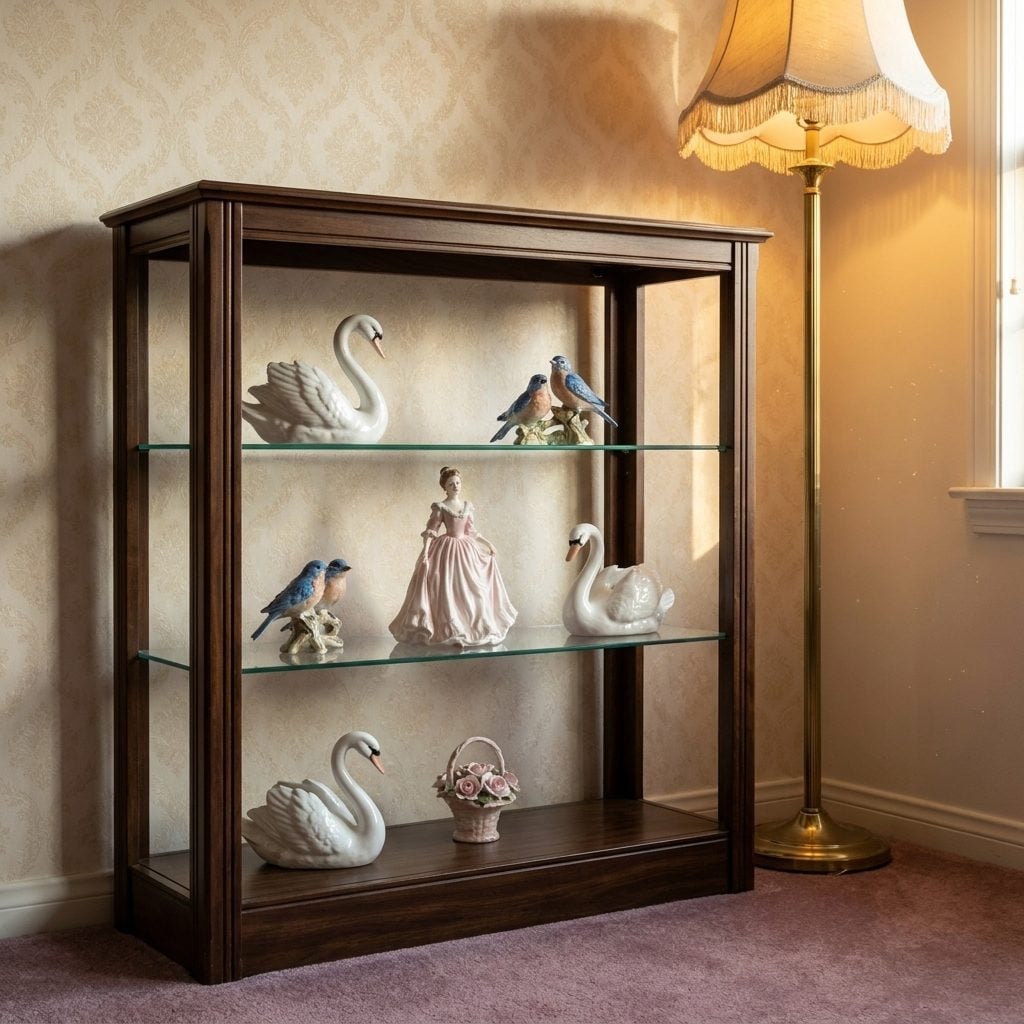
Dark-wood display shelves held swans, bluebird groupings, and a pink-gowned porcelain lady behind glass panels. Every shelf told you something about who lived there — their travels, their tastes, which aunt gave the most extravagant Christmas gifts.
15. Crystal Decanters and Champagne Flutes Had Their Own Real Estate
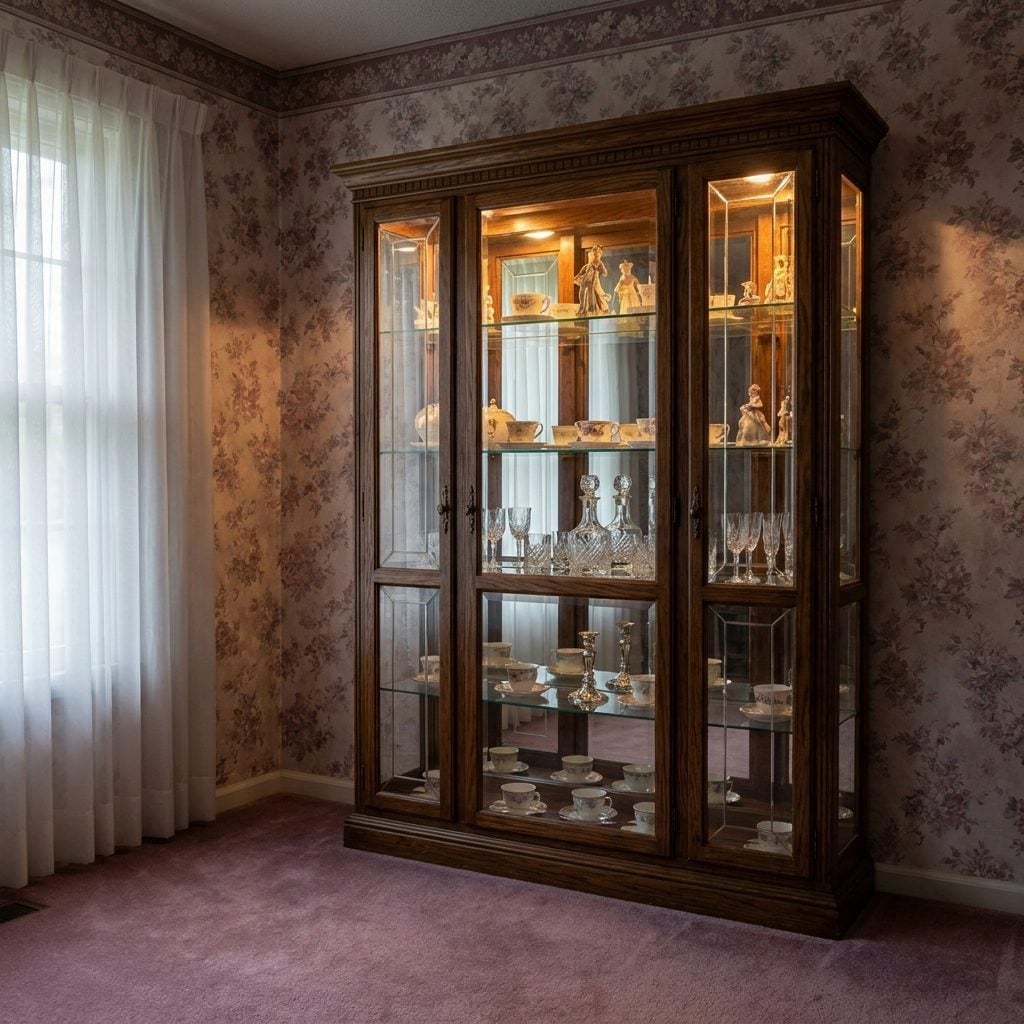
Illuminated from within by warm cabinet lighting, the dark-wood china cabinet in a room like this devoted an entire glass shelf to cut crystal: decanters with faceted stoppers, highball glasses, a row of champagne flutes standing at attention. Nothing in it was casual. Every piece earned its place under that glow, and none of it was ever actually used on a Tuesday.
14. China Cabinets Turned a Lifetime of Souvenirs Into a Display
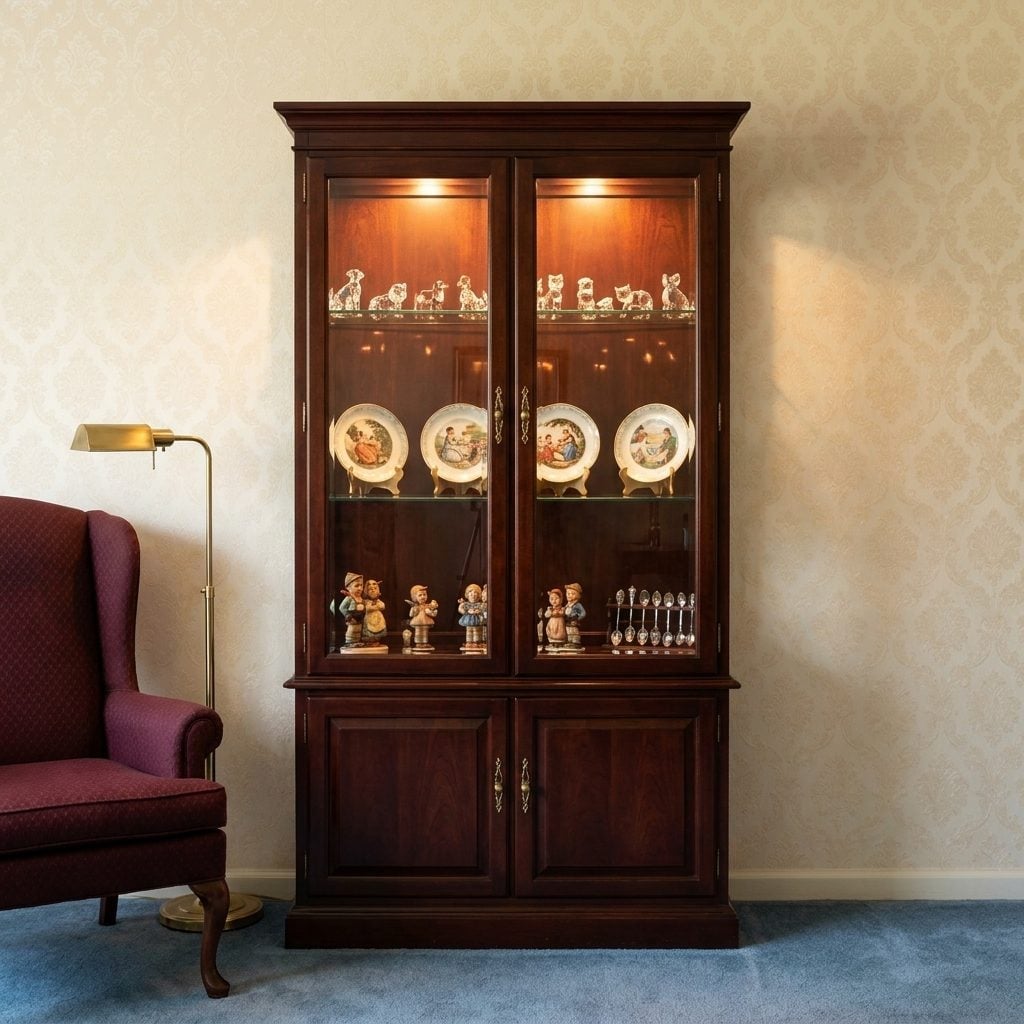
Dark cherry-toned wood, interior lighting, glass doors on top with solid panel doors below: this cabinet format was a familiar sight in 1980s formal living rooms, and homeowners filled every inch with intention.
Hummel-style figurines on the lower shelf, decorative collector plates on stands in the middle, and ceramic animal figurines across the top. Each piece had a story — usually a gift or a souvenir, and usually from someone who’d been paying attention to what you already owned.
The spoon collection displayed on the right side of the bottom shelf is easy to miss, but it’s a very specific kind of nostalgia. Collector spoons from national parks, states, and foreign countries were a genuine category of display-worthy keepsake. The brass floor lamp and wingback chair beside the cabinet weren’t accidental either. That corner was designed to be sat in, looked at, and appreciated.
13. Collector’s Plates Hung on the Wall Were Never Just Decoration
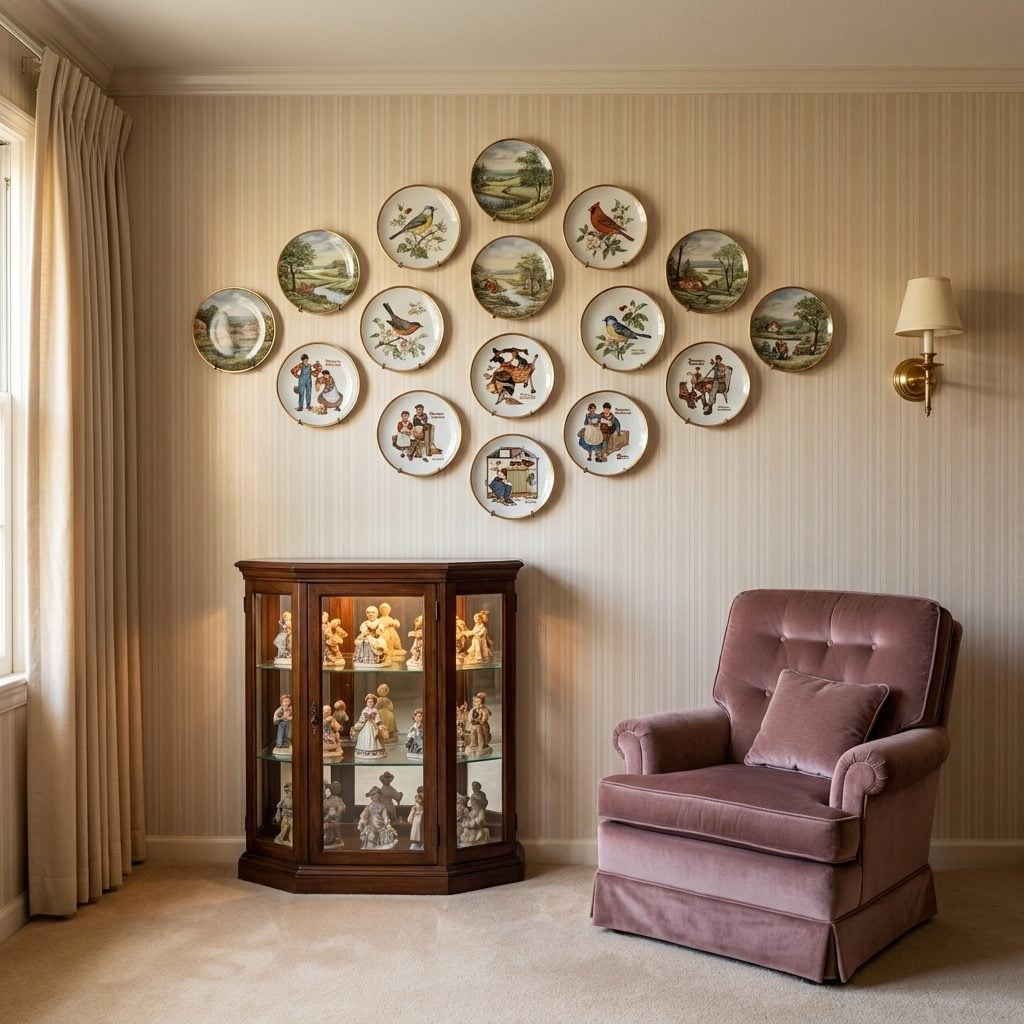
Arranged in a deliberate arc above a walnut curio cabinet, fifteen decorative plates featuring sentimental scenes and painted songbirds made the wall itself a display case. Hanging plates meant the collection was too important to hide inside a cabinet. It needed an audience.
12. Flower-Painted Ceramic Vases Were Doing Double Duty Long Before Anyone Called It Décor
🔥 Would you like to save this?
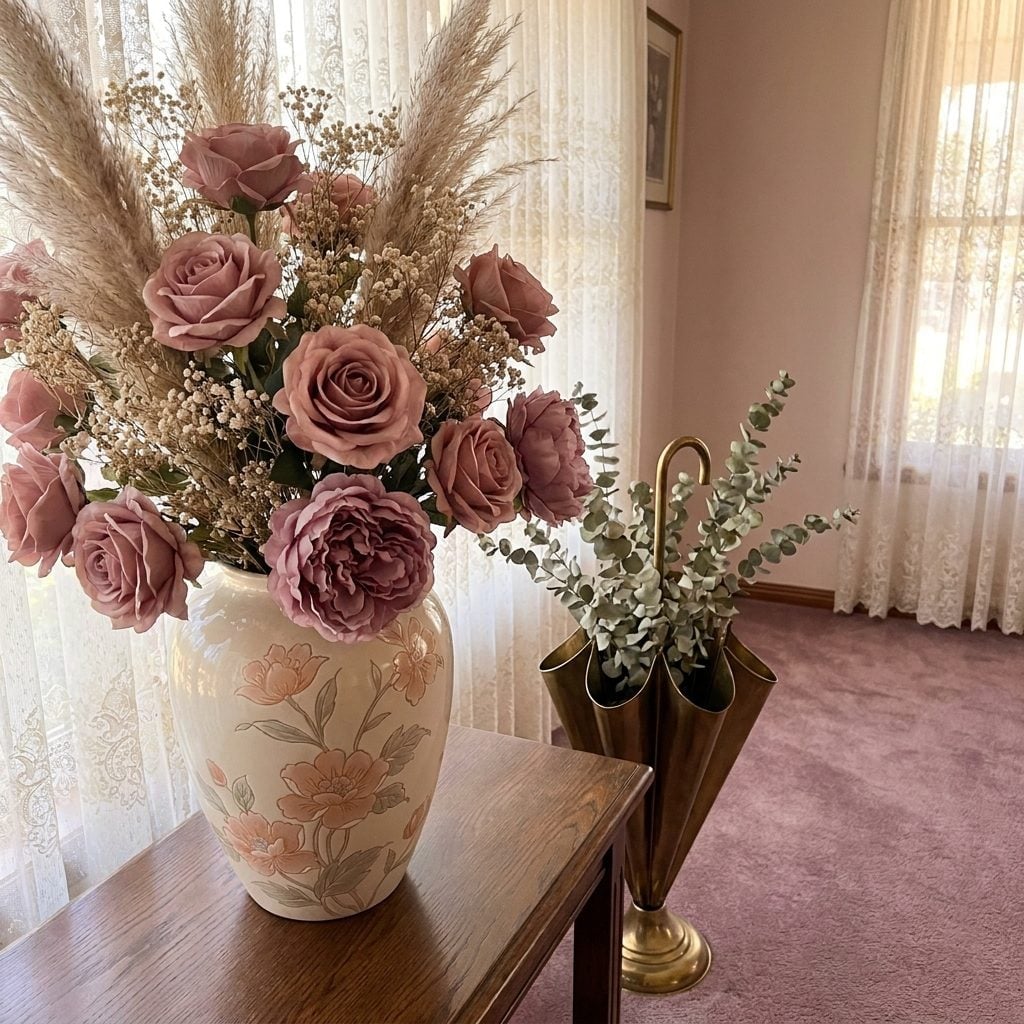
That arrangement of dusty rose blooms, pampas grass, and baby’s breath in a cream ceramic vase with floral decoration wasn’t accidental. It echoed the pink carpet, the lace sheers, the brass umbrella stand holding eucalyptus nearby. Everything in the room was in quiet conversation with everything else, and the vase was just another line in that dialogue.
11. Brass Fireplace Tools Were the Finishing Touch Nobody Skipped
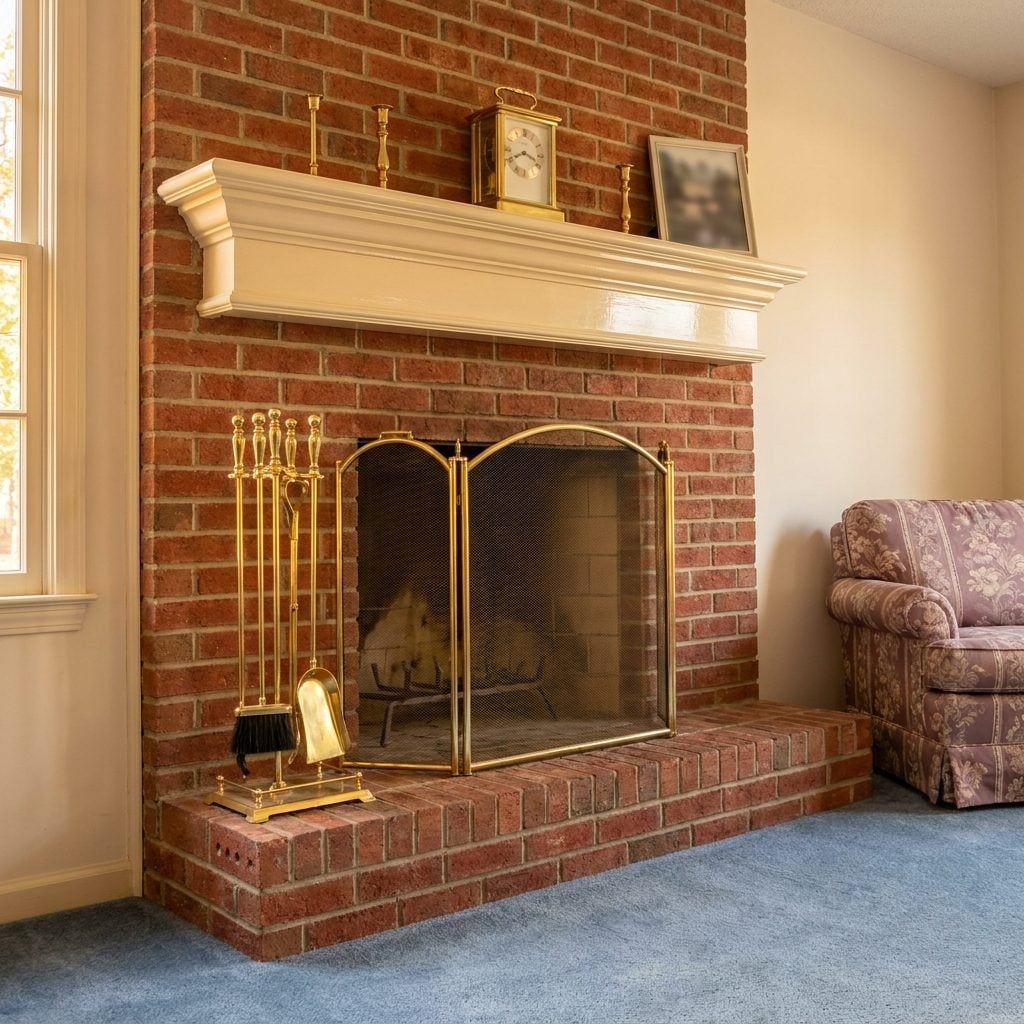
Red brick stretches floor to ceiling here, and the white painted mantel with its corbeled molding keeps the whole thing from feeling like a wall of masonry. On the hearth, a set of brass fireplace tools stands next to a three-panel arched screen in matching brass finish.
That set wasn’t decorative backup. It was proof the room worked hard and looked good doing it.
10. Brass Candlesticks on the Mantel Weren’t Decorative. They Were Required.
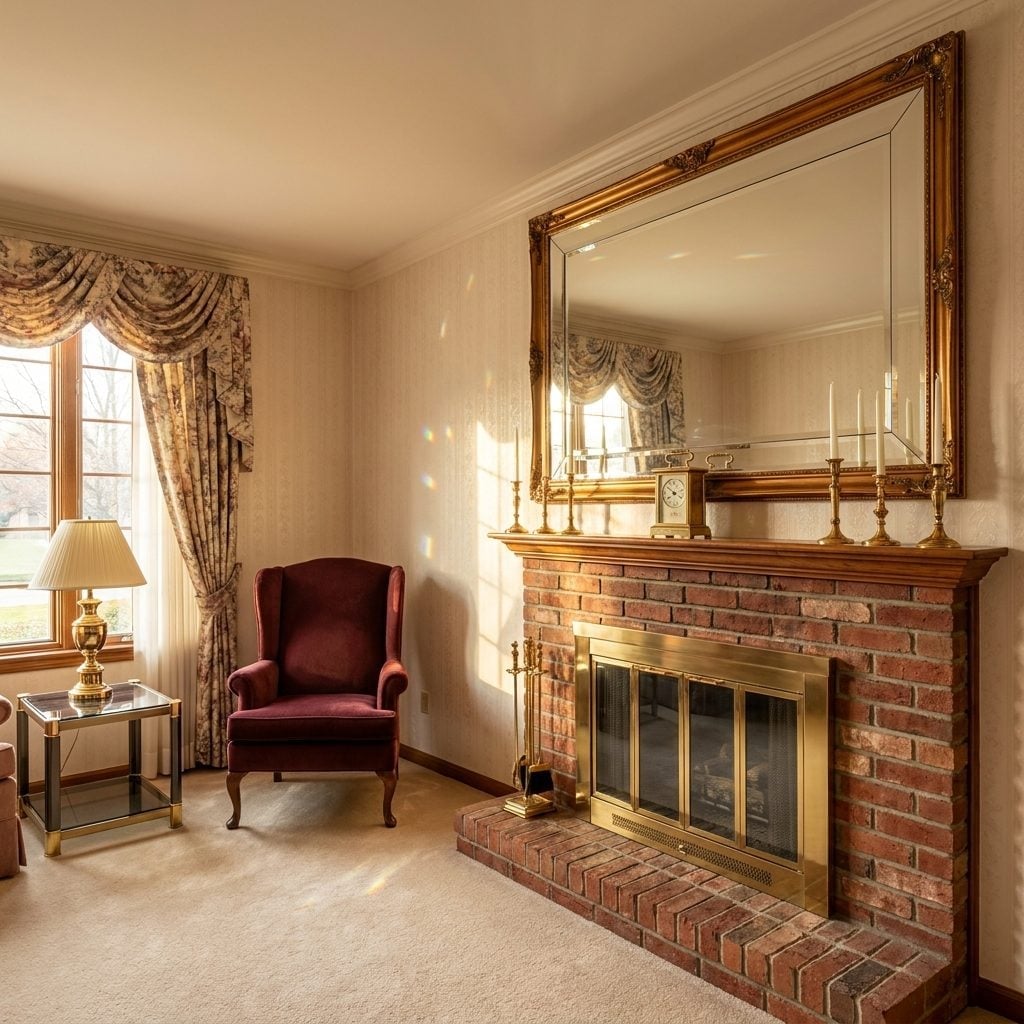
Tall brass candlesticks with tapered holders became a familiar formal-mantel look. A wood surround, brick firebox, and gold-framed mirror overhead. The setup was so consistent across households it might as well have come with the house.
9. Crocheted Doilies Were Everywhere, and That Was Entirely the Point
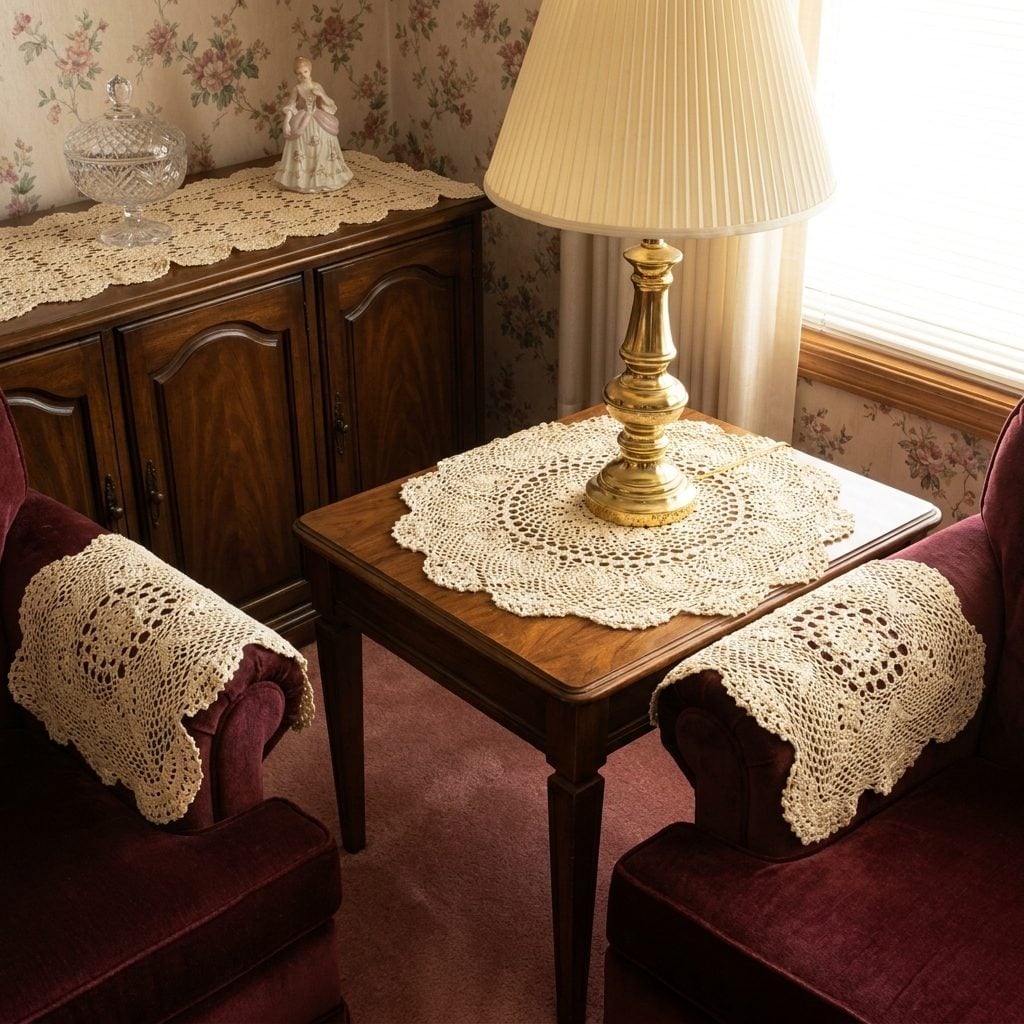
Arm covers on both velvet chairs, a large oval on the side table under the brass lamp, and smaller ones layered across the buffet top. Doilies weren’t accidents or afterthoughts. They protected furniture nobody sat on regularly and announced, clearly, that the room’s occupants cared about keeping things nice. Functional and fussy at the same time. Very ’80s.
8. Brass Magazine Racks Held the Whole Week’s Reading, Right There on the Floor
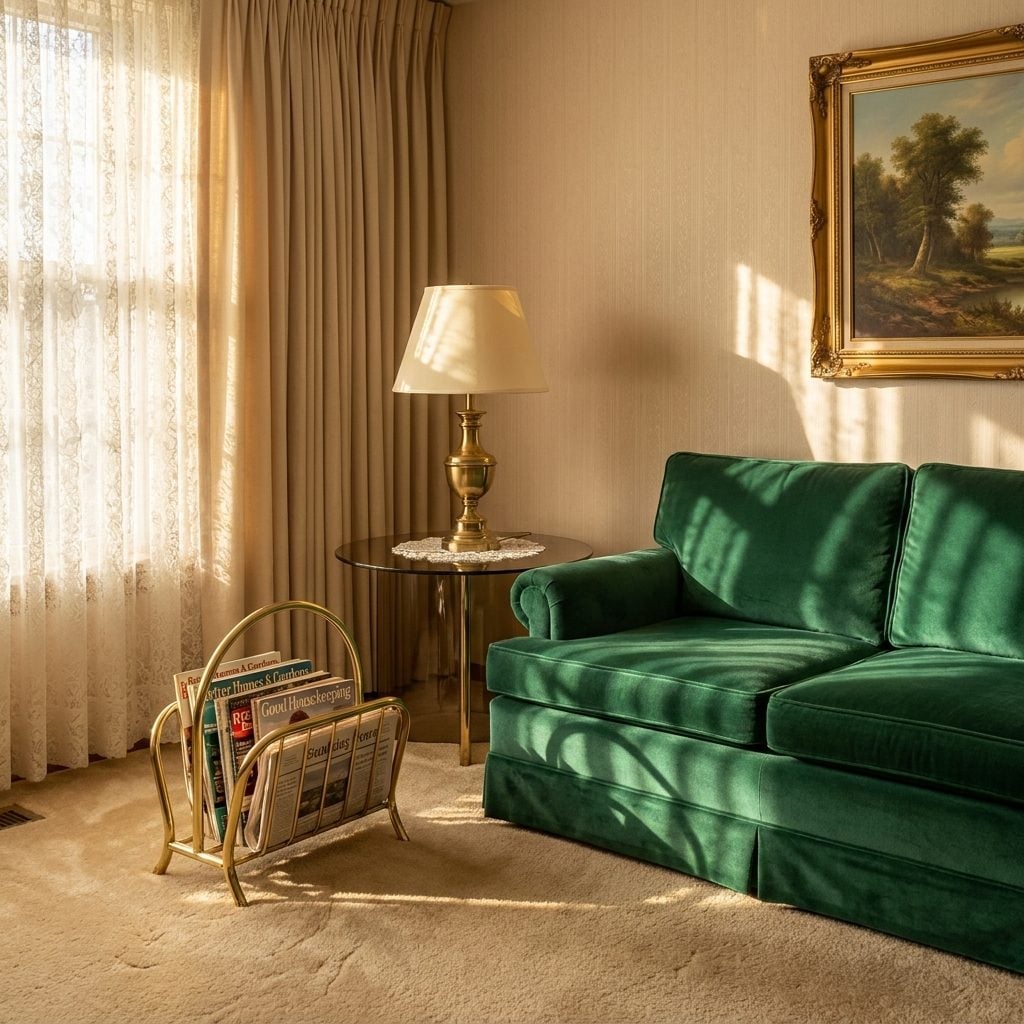
A gold-finished magazine rack sits directly on the carpet beside the sofa, stuffed with issues of Good Housekeeping, Better Homes & Gardens, and what looks like a newspaper folded twice over. Nobody filed these away. They lived on the floor, within arm’s reach, and that was the system. The brass finish ties back to the side table and lamp base nearby, and formal living rooms in this era treated reading material as part of the decor — visible, organized, and completely intentional.
7. Record Consoles Made Music Look Like Furniture
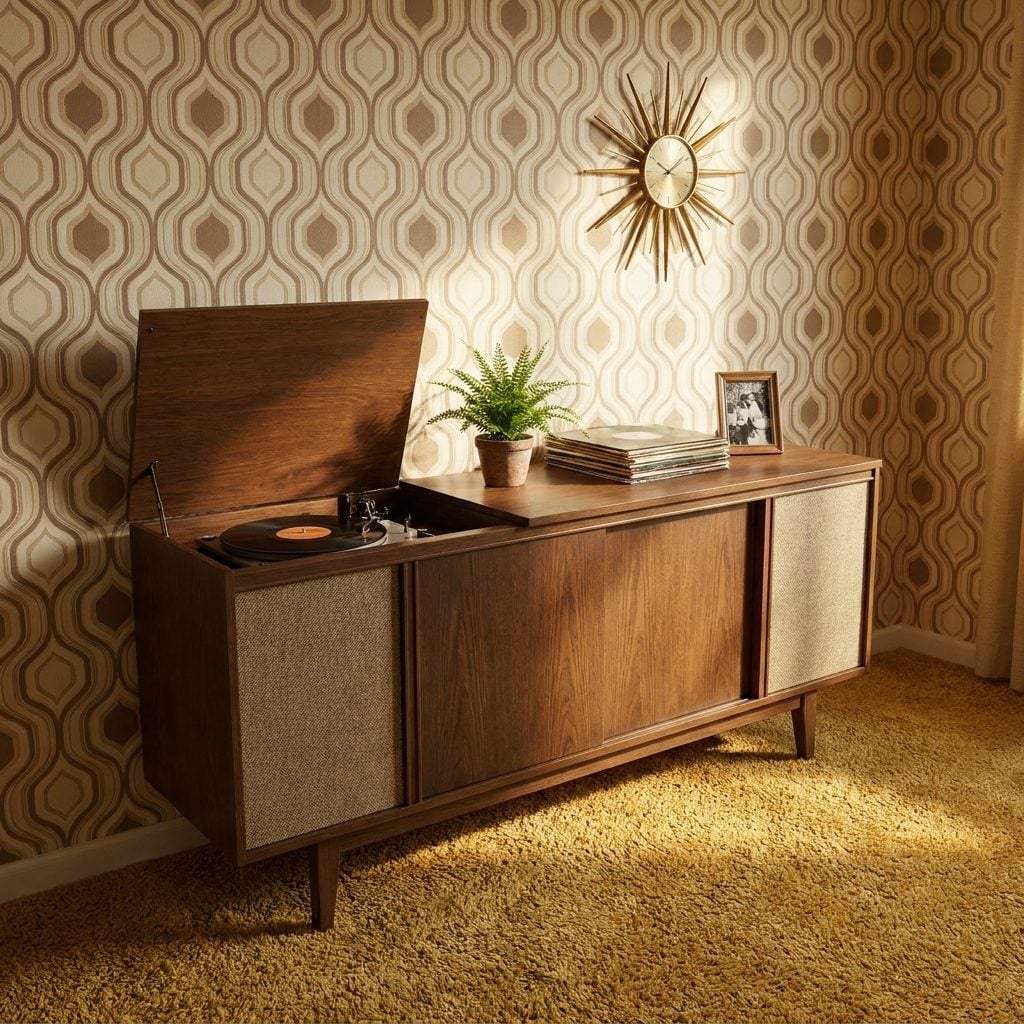
Walnut veneer, tapered legs, fabric-grille speakers built right into the cabinet doors. The console stereo dominated one wall and didn’t apologize for it. Vinyl records stacked on top next to a framed black-and-white photo, because of course they did.
Design Note: Console stereos blurred the line between electronics and case furniture. The cabinet concealed speakers and components while allowing the entire system to sit comfortably among sofas, tables, lamps, and other substantial pieces.
6. TV Guide on Top of the Console Was the Only Programming Schedule Anyone Needed
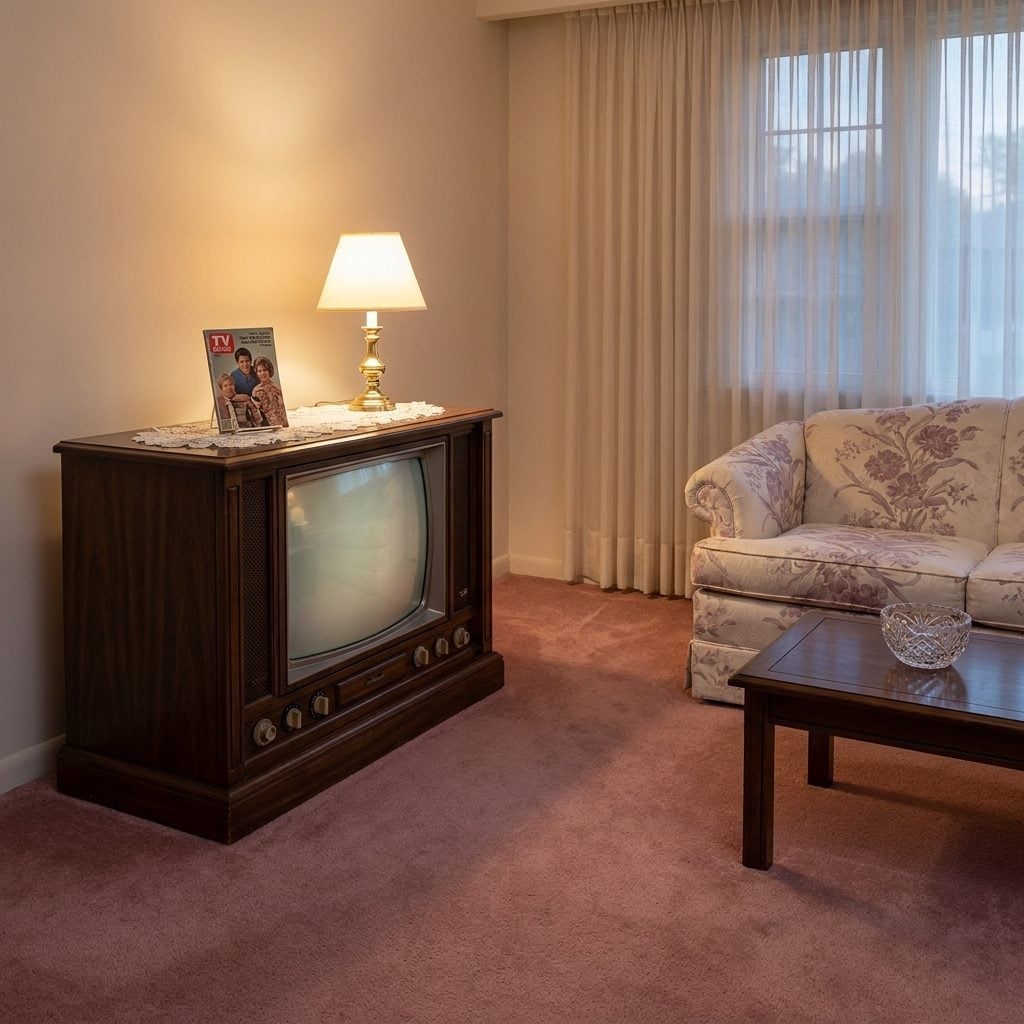
On a wood console with speaker grilles flanking the screen, a vintage television sits exactly where it might have lived in 1983: against the wall, off to the side, treated as another substantial piece of furniture rather than the room’s only focal point. On top, a lace doily, a small brass lamp, and a TV Guide standing upright like a framed photo.
That last detail is the one younger generations won’t fully grasp. Owning a TV Guide wasn’t optional. It was infrastructure. Without it, you genuinely didn’t know what was on — and no, you couldn’t just check your phone.
History Corner: TV Guide launched nationally in 1953 and became one of America’s most familiar magazines. Older television sets commonly used separate VHF and UHF tuners, while remote controls became increasingly common over time. Console televisions were often designed to resemble living-room furniture, using wood veneers and furniture-style cabinetry to make the screen less visually intrusive.
5. Telephone Tables Had a Seat, a Drawer, and an Entire Social Purpose
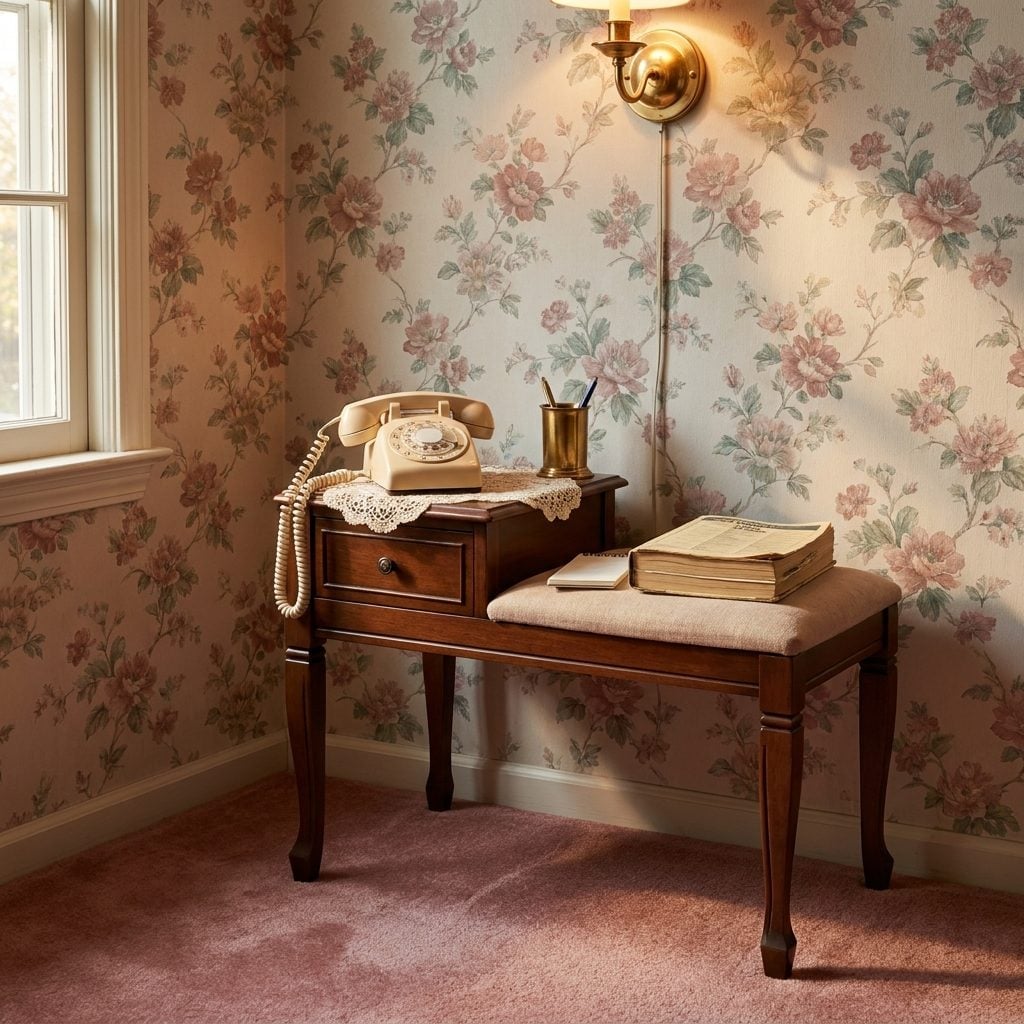
Gossip requires infrastructure. The telephone table visible here combines a dark-stained wood surface with a padded bench seat upholstered in blush fabric, all on cabriole legs that signal traditional styling without apology. A rotary phone sits on a lace doily, a brass pencil cup beside it ready for message-taking.
Many formal living rooms had a dedicated phone spot like this. The phone book resting on the bench seat wasn’t decorative — it was the search engine, and nobody memorized numbers they could look up.
4. Blue and White Chinoiserie Umbrella Stands Were a Foyer Staple for a Reason
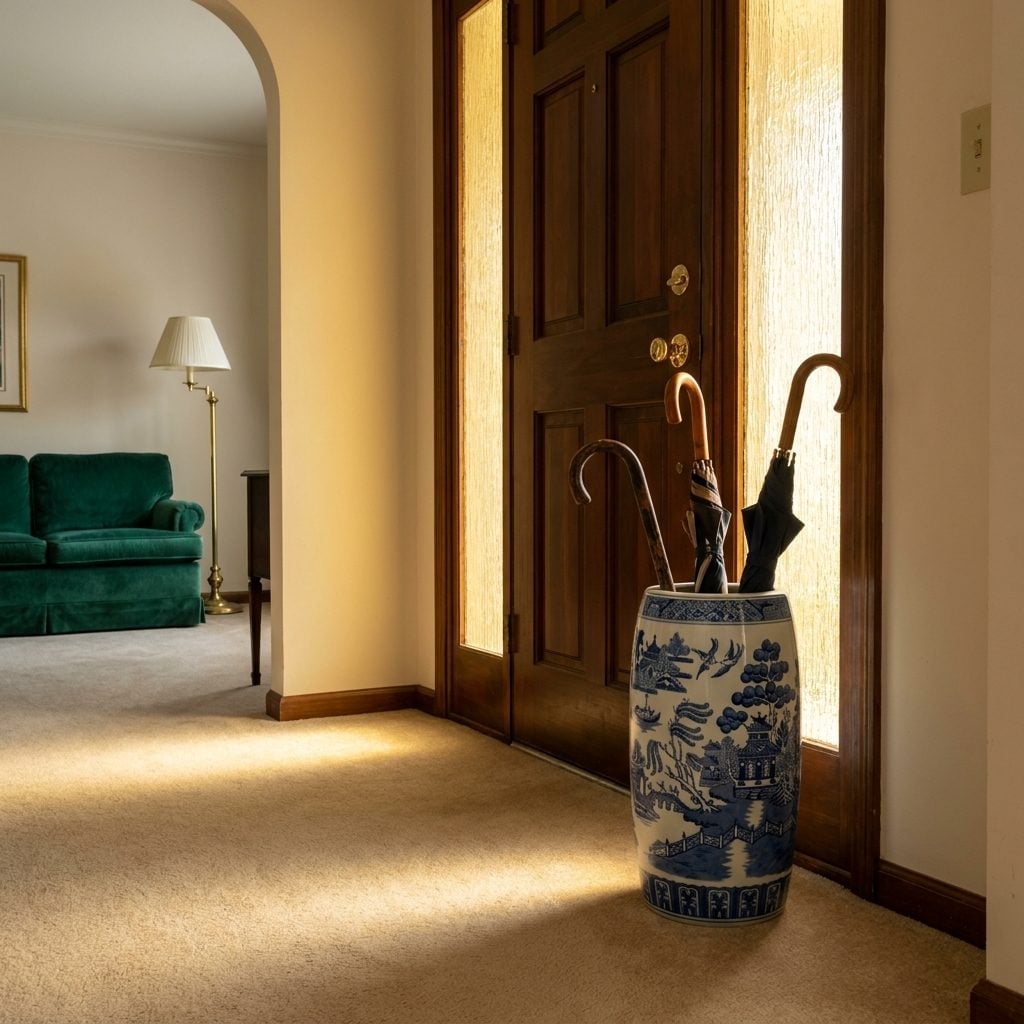
Positioned beside a paneled wood front door, this barrel-form chinoiserie stand in classic blue and white porcelain held canes and folded umbrellas within arm’s reach of the exit. Purely functional, totally decorative, and somehow both at once. The ’80s formal room had a gift for that.
3. Globe Bar Cabinets Held the Good Stuff, and Everyone Knew It
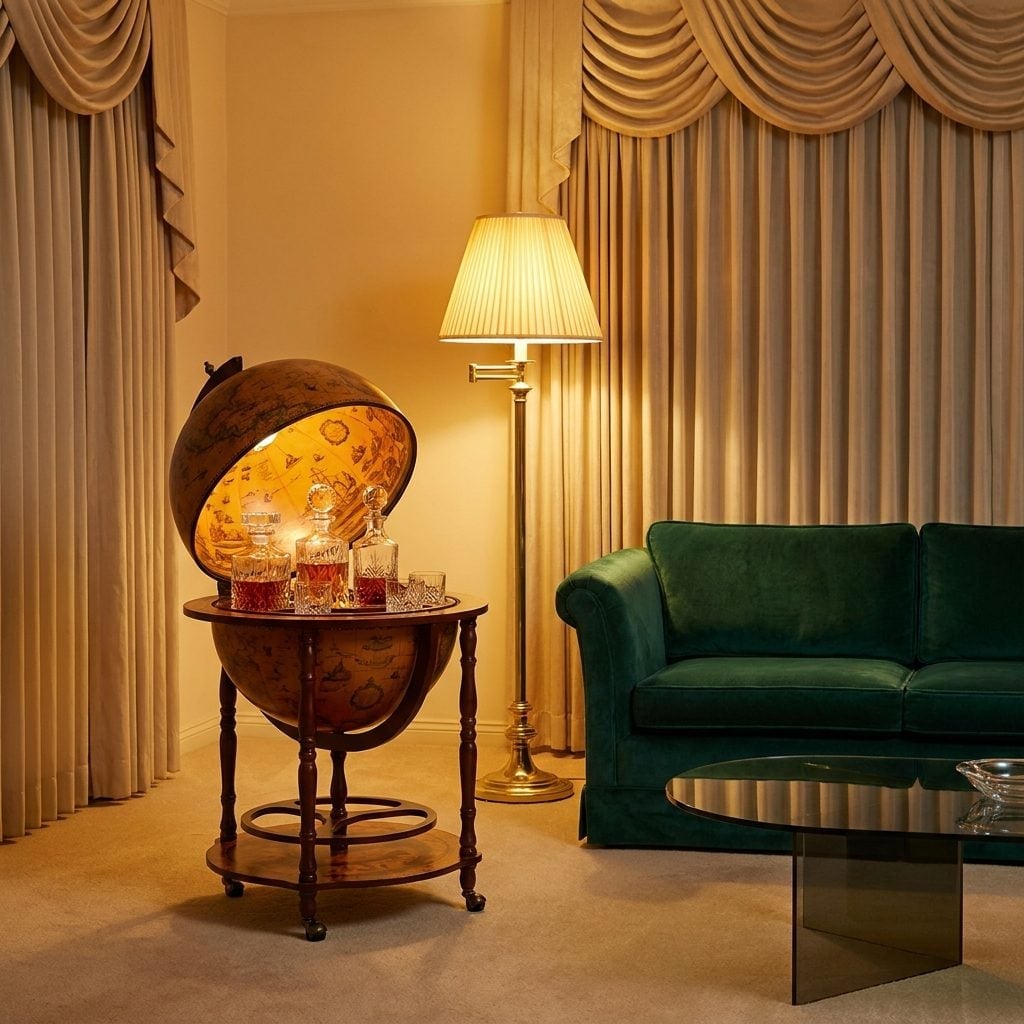
Opening the top half of a vintage globe bar was practically a theatrical gesture. Inside this one, crystal decanters catch the warm glow of a small interior light, filled with amber-colored liquor and flanked by lowball glasses on a fitted tray.
The wood-turned legs and lower bottle ring are dark walnut-toned wood, and the globe’s exterior carries an antique cartographic finish that made the whole piece look like it belonged in a study rather than a living room.
Globe bars were a power move disguised as décor. Owning one signaled sophistication in a very specific 1980s way, turning the simple act of storing bottles into a small piece of theater.
2. Persian-Style Rugs Over Carpet Were a Whole Philosophy, Not a Decorating Mistake
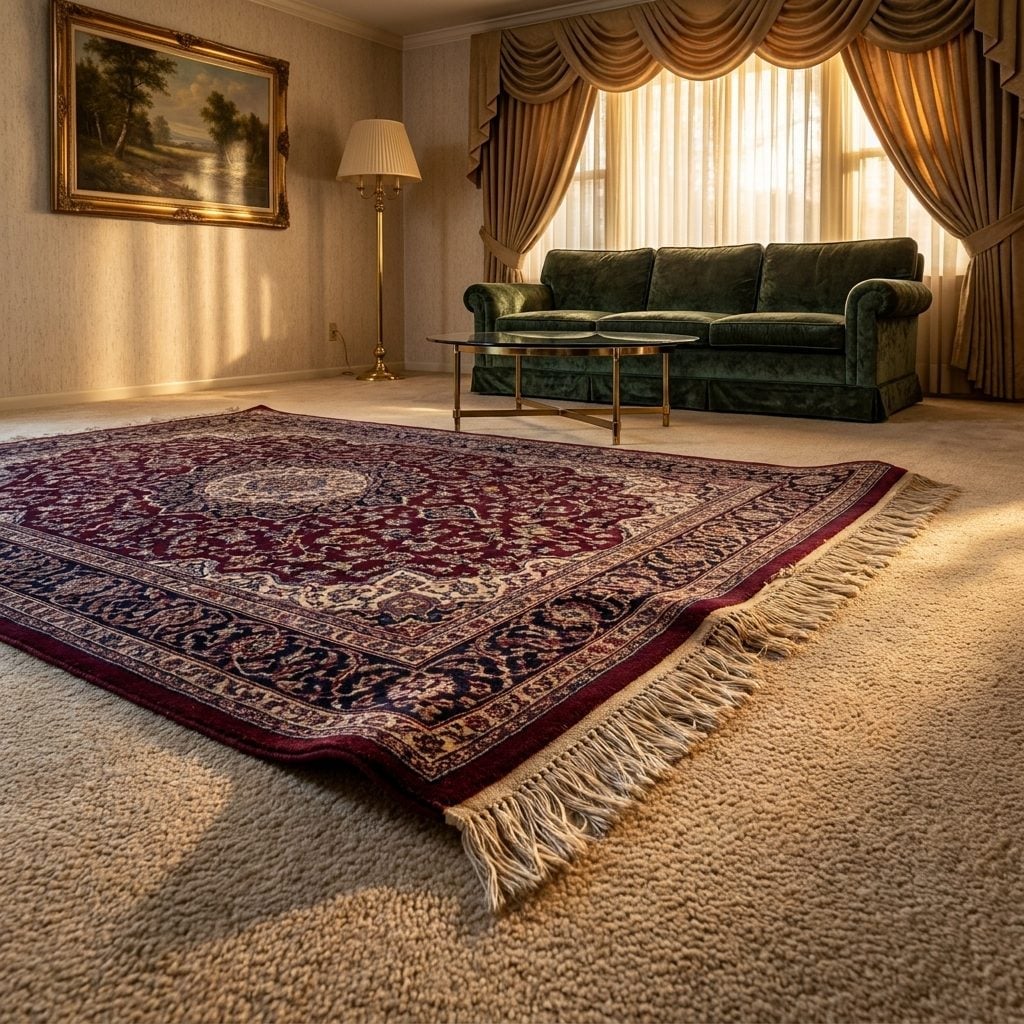
Laying a Persian-style rug over existing carpet was common enough to become part of the period look. The medallion rug here, with its deep crimson field and navy detailing, sits directly on beige wall-to-wall pile like it owns the room. And honestly, it did.
1. Brass Planters and Ficus Trees Earned Their Place in Every Formal Living Room
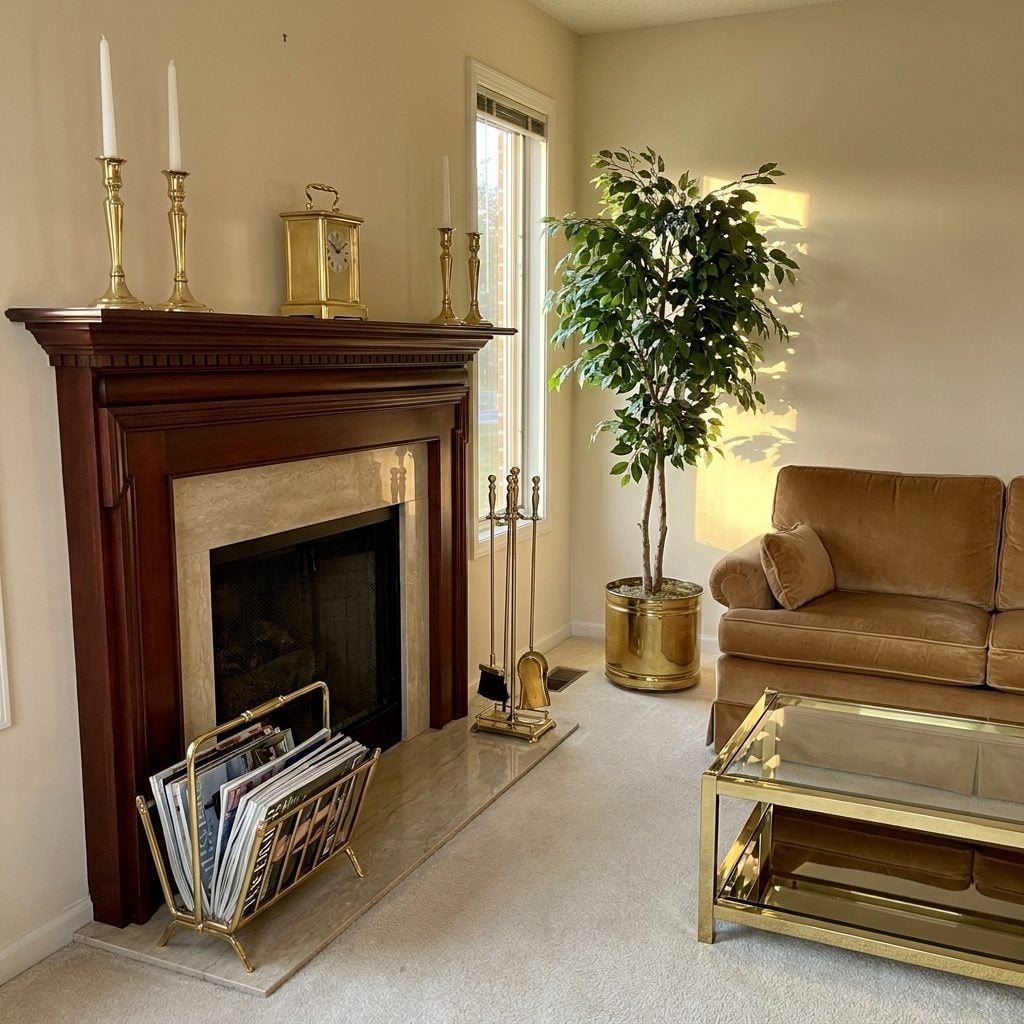
Somewhere between furniture and architecture, a full-size ficus in a brass cylindrical planter became the standard-issue floor plant of the formal living room. Not decorative in the way a vase is decorative. It took up serious square footage, cast real shadows on the wall, and nobody questioned whether it belonged.
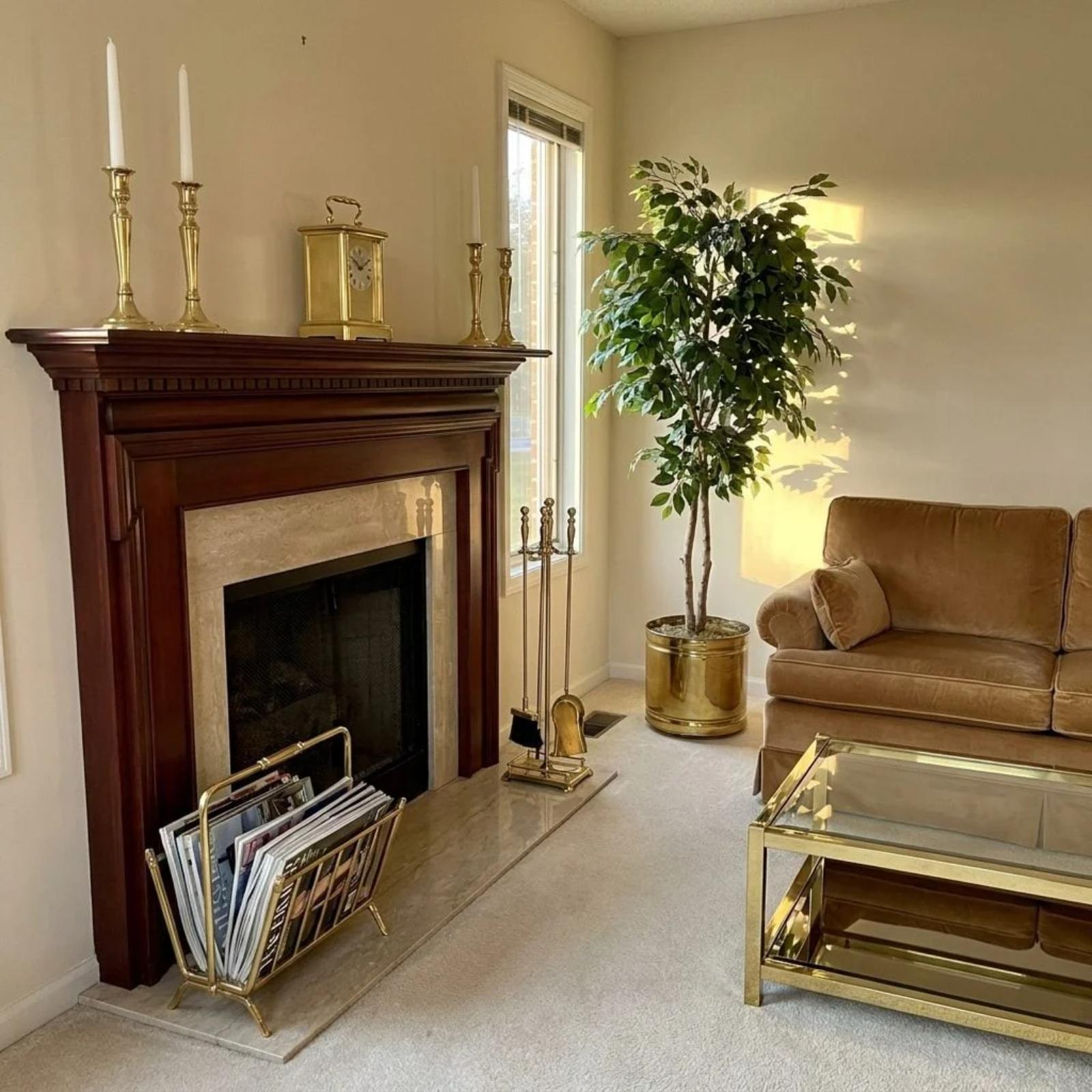
The rest of the room follows the same logic: glass-top coffee table with brass frame, camel velvet sofa, candlesticks on a dark cherry-toned mantel above a stone-look fireplace surround. Every finish is warm-toned, and every material has weight to it. Gold doesn’t accent this room. It organizes it.