🔥 Would you like to save this?
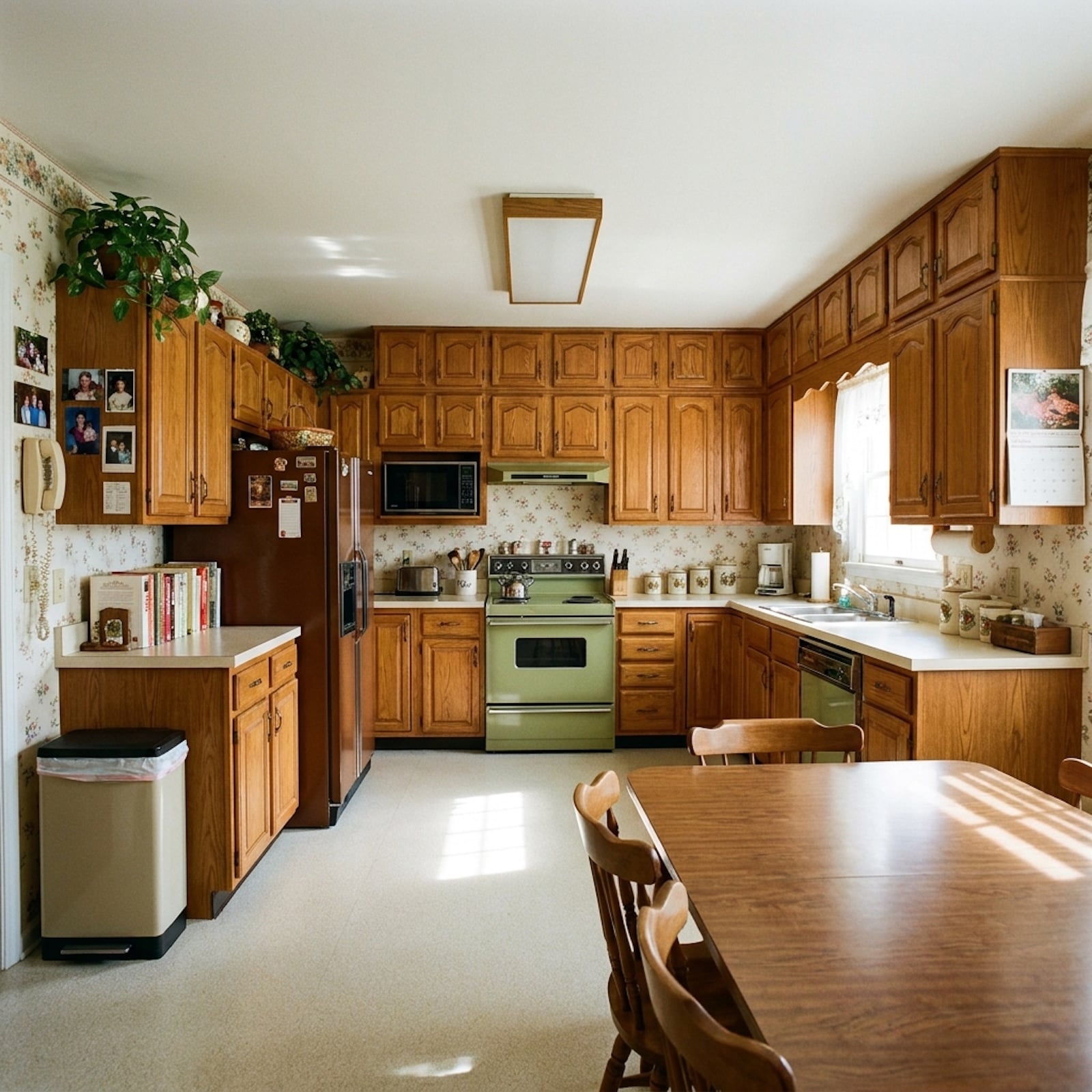
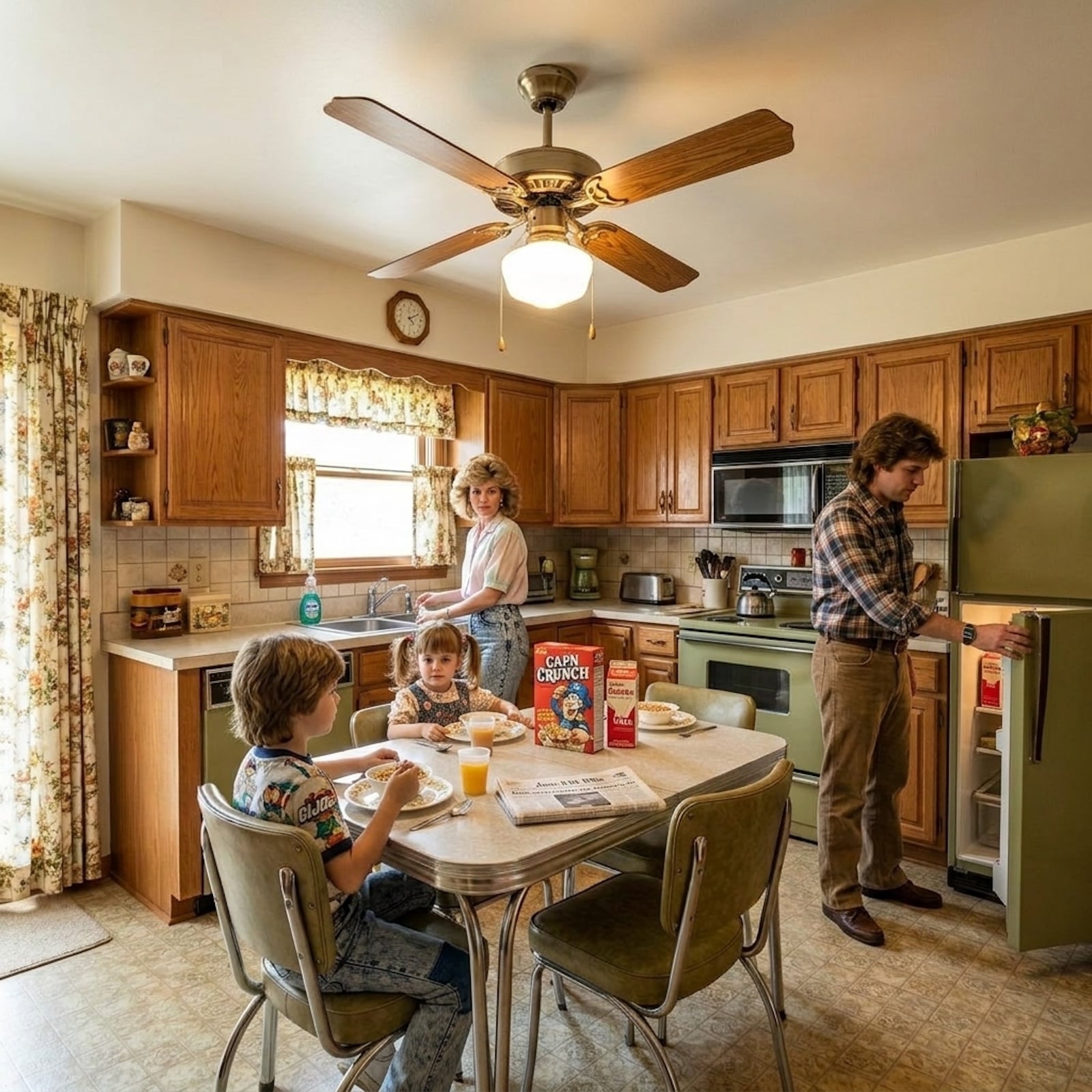
The 1980s kitchen never entered a room quietly. Honey oak covered half the walls. Floral curtains negotiated with patterned flooring. An avocado-green refrigerator stood in the corner like nobody had informed it the 1970s were over, while a countertop microwave nearby looked expensive, enormous, and faintly capable of launching something.
Then there was everything that made the room more than a decorating trend: cereal boxes left on the table, orange juice in little glasses, school papers creeping across the refrigerator, somebody washing dishes while somebody else stood with the fridge door open far too long. The kitchen was breakfast room, homework station, message center, telephone booth, and family headquarters, all under one ceiling fan.
In order to come up with the very specific design ideas, we create most designs with the assistance of state-of-the-art AI interior design software. Also, assume links that take you off the site are affiliate links such as links to Amazon. this means we may earn a commission if you buy something.
35. Honey-Oak Cabinets Made the Whole Kitchen Glow Amber
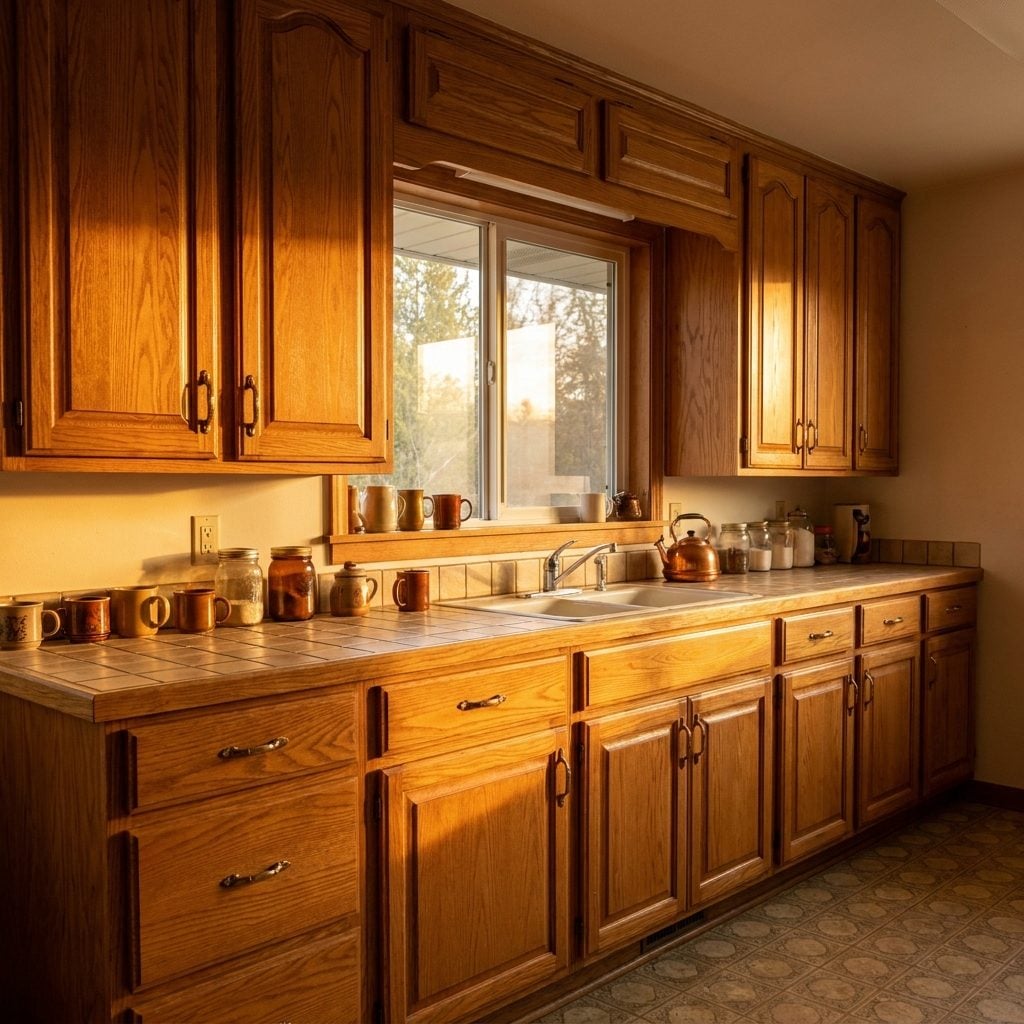
The cabinets were oak. The trim was oak. The valance over the sink was oak. If somebody could have milled the toaster out of oak, the decade might have tried.
That honey-colored finish cast an amber glow across the room, especially once polyurethane got involved. It was supposed to look warm and substantial, and it did. Plenty of those cabinets are still hanging in kitchens now, sometimes painted white and refusing to discuss their past.
34. The Microwave Arrived and Took Over Half the Counter
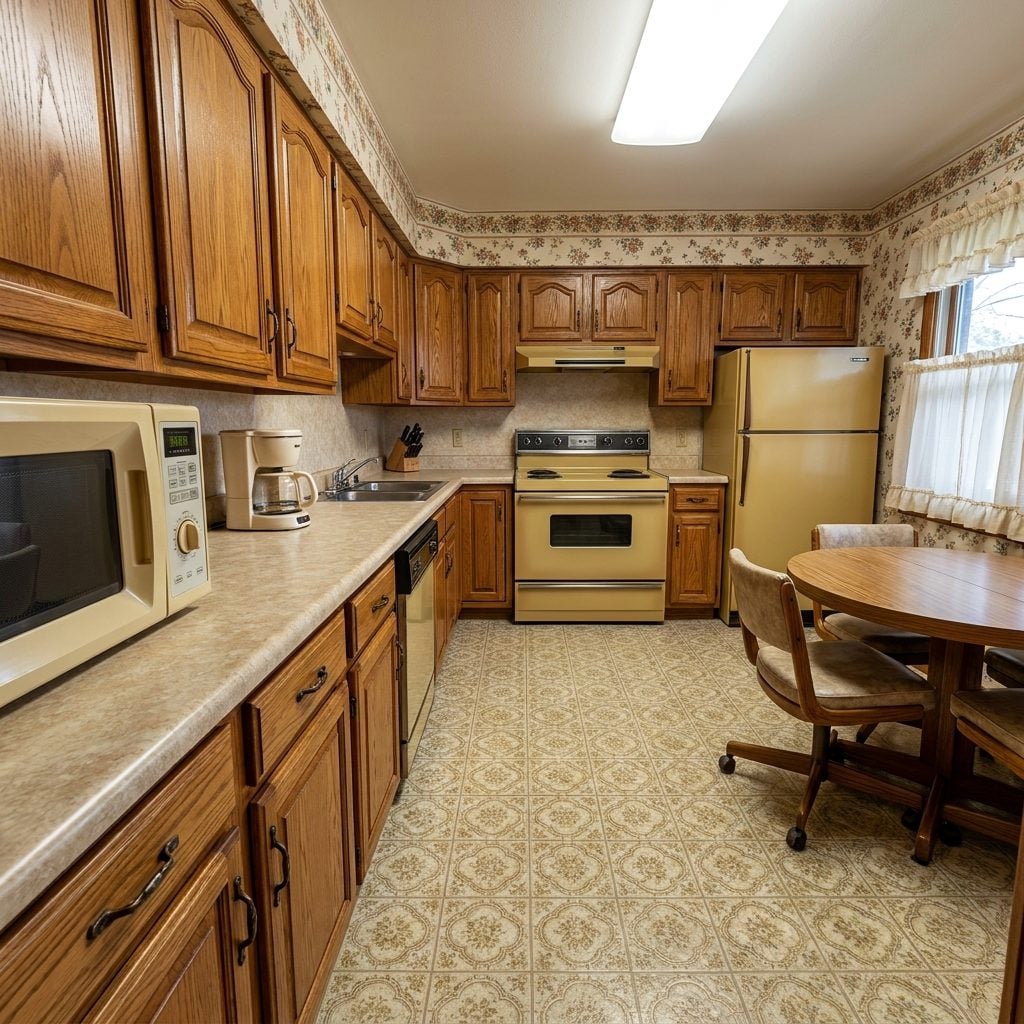
It was enormous. Wood-look side panels, smoked glass, chunky controls, and a footprint capable of evicting both the toaster and the bread box without notice.
You watched popcorn spin because watching food rotate inside a machine still counted as entertainment. It reheated pizza, made instant cocoa, and taught an entire generation that eggs should not be microwaved casually.
For a brand-new convenience, it demanded an astonishing amount of real estate. Nobody seemed to mind. The future had arrived, and apparently the future needed twenty-eight inches of counter.
33. Floral Wallpaper Wrapped the Room From Baseboard to Ceiling
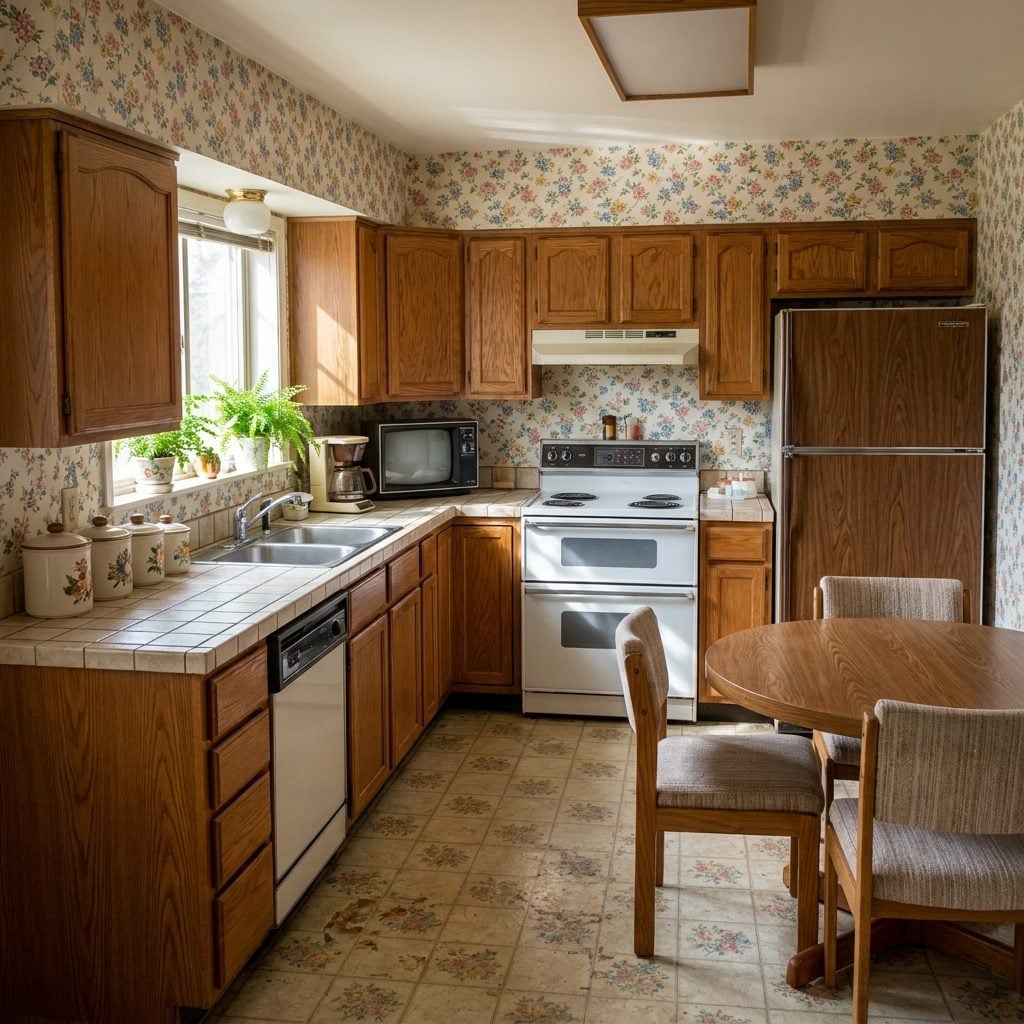
Tiny roses. Dusty mauve sprays. Strawberries. Ivy. Occasionally several of these at once, because restraint had other appointments.
Washable wallpaper made sense in a kitchen: grease and fingerprints could be wiped away, at least in theory. Steam eventually found a seam near the ceiling and curled one edge loose. That flap might remain there for another five years while the household collectively agreed it was not happening.
32. Harvest Gold Refused to Leave Just Because the Calendar Said 1985
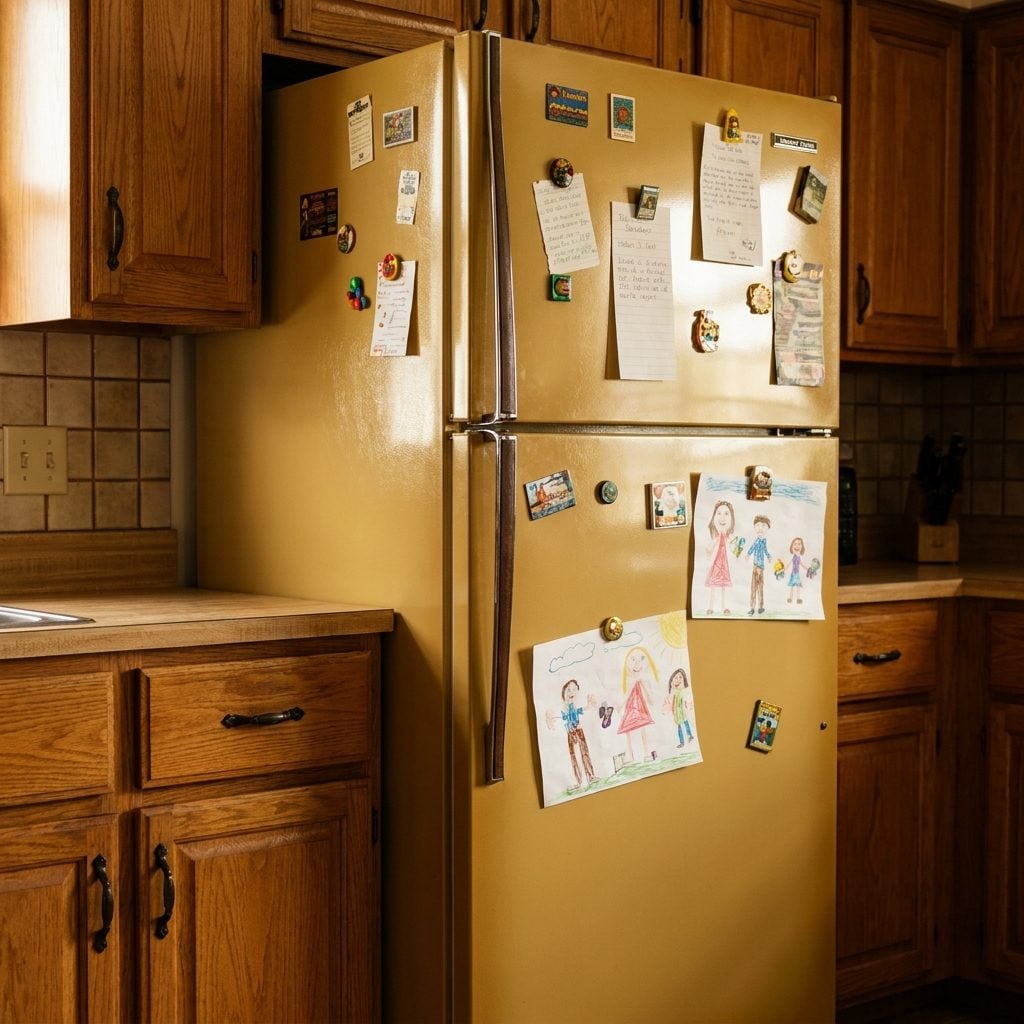
The mustard-yellow refrigerator had already survived one decorating cycle and saw no compelling reason to stop now.
It ran loudly, held a decade’s worth of magnets, and outlasted several coats of wall paint. Nobody replaced a functioning refrigerator merely because interior design had moved on. You waited until the compressor gave up, and some of those compressors possessed the survival instincts of farm equipment.
31. Formica Speckles Hid More Than Anyone Wanted to Admit
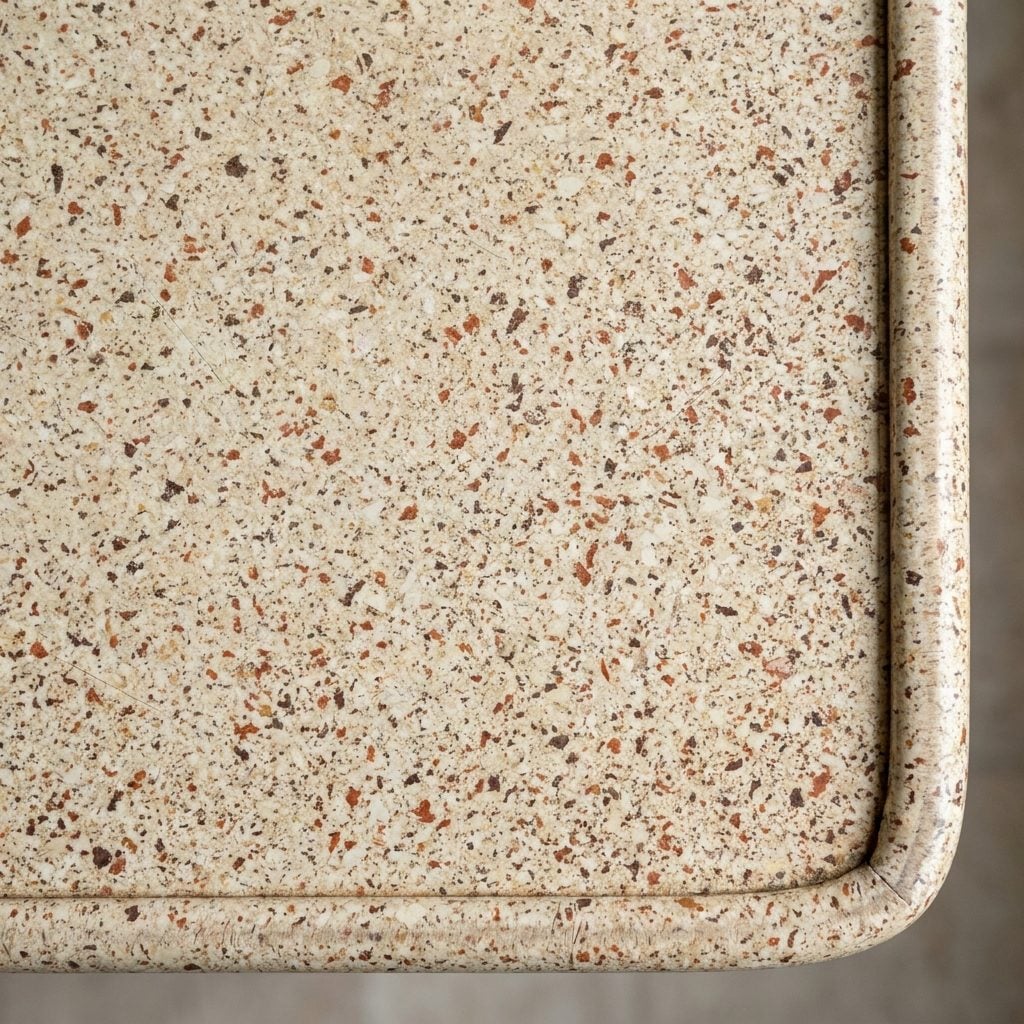
Cream with rust flecks. Beige with brown confetti. Pinkish speckle arranged in a pattern so busy one stray crumb could disappear into witness protection.
Laminate was the workhorse. Cookie dough got rolled on it. Algebra got done on it. A hot pan got placed directly on it once, and that lesson became permanent.
Some older counters still had metal edge strips, usually lifting at one corner just enough to catch a sleeve. Nobody repaired that corner. It had tenure.
30. The Kitchen Desk Ran the Household on Paper
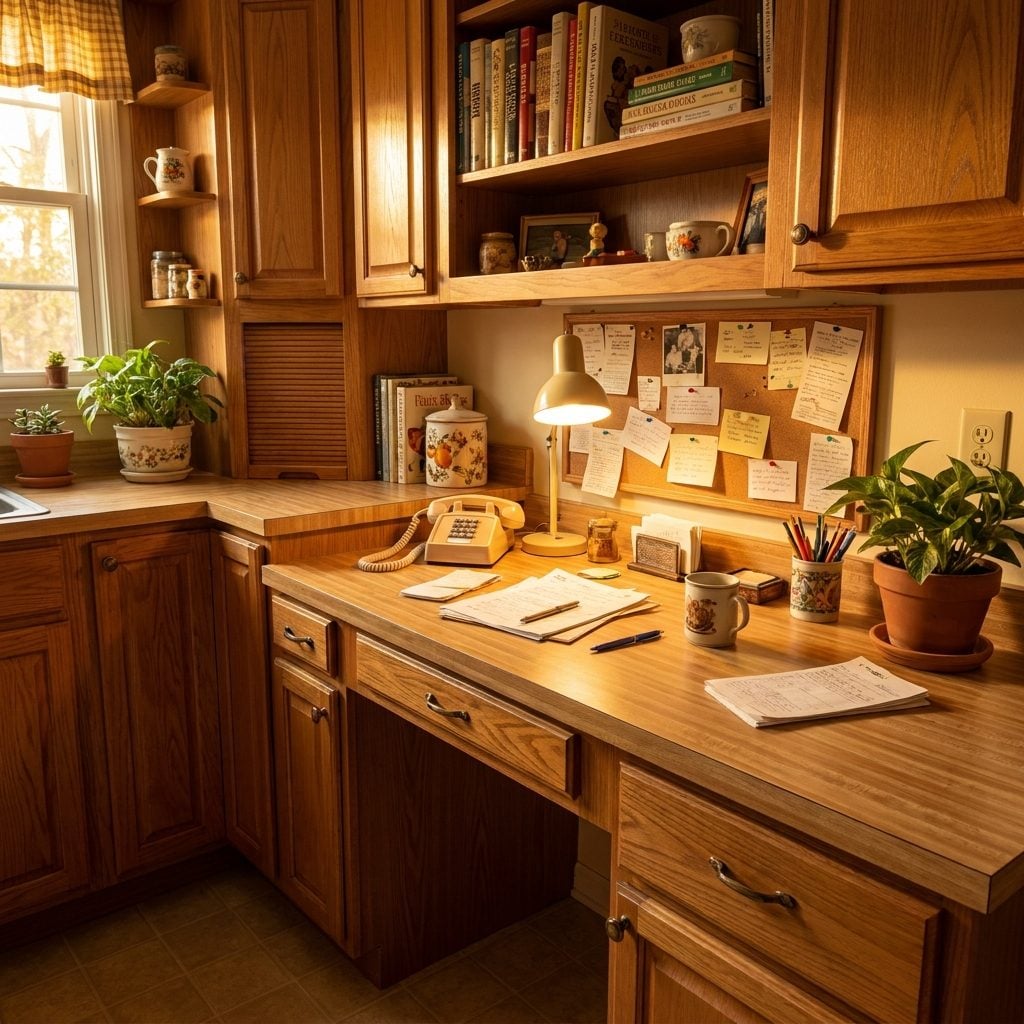
A little built-in desk sat between cabinets like suburban mission control.
Bills landed here. Grocery lists multiplied. Report cards waited for signatures. The phone book occupied enough shelf space to qualify as furniture, and a mug full of dead pens somehow remained essential infrastructure.
The chair usually held a coat instead of a person, but the desk kept working. Long before household administration migrated to laptops, phones, and apps, this was where family paperwork went to reproduce. A cleaner contemporary version of the same idea turns up in a scandinavian kitchen, where the work zone survives with considerably fewer phone books.
29. The Wall Phone Made Every Call a Public Performance
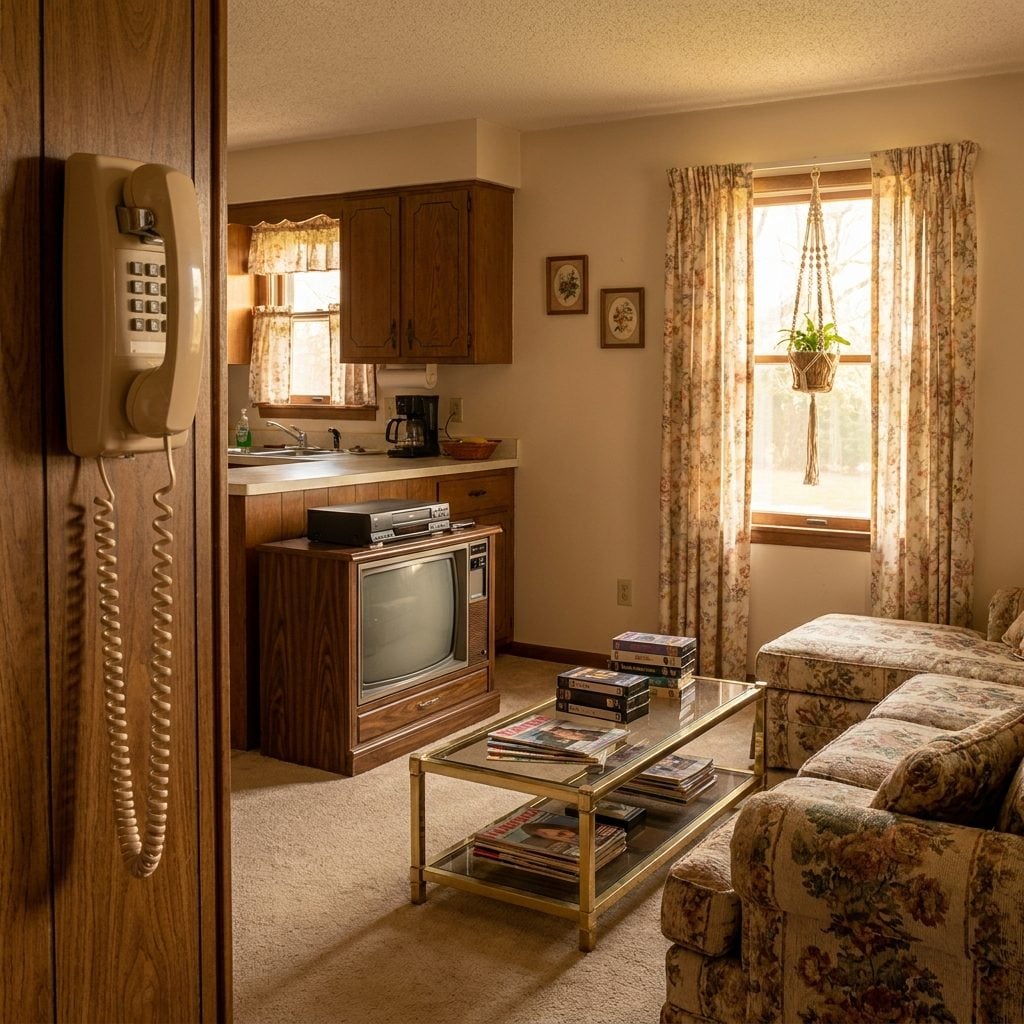
Usually beige. Usually near a doorway. Always loud enough to turn every person within range into an unpaid receptionist.
The phone rang, somebody answered, and then came the household broadcast: “IT’S FOR YOU.”
You leaned against the wall while you talked because there was nowhere else to go. No screen. No mute button. No graceful exit. If it rang after 9 p.m., however, the entire house suddenly became interested.
28. The Corkboard Beside the Phone Was the Family Internet
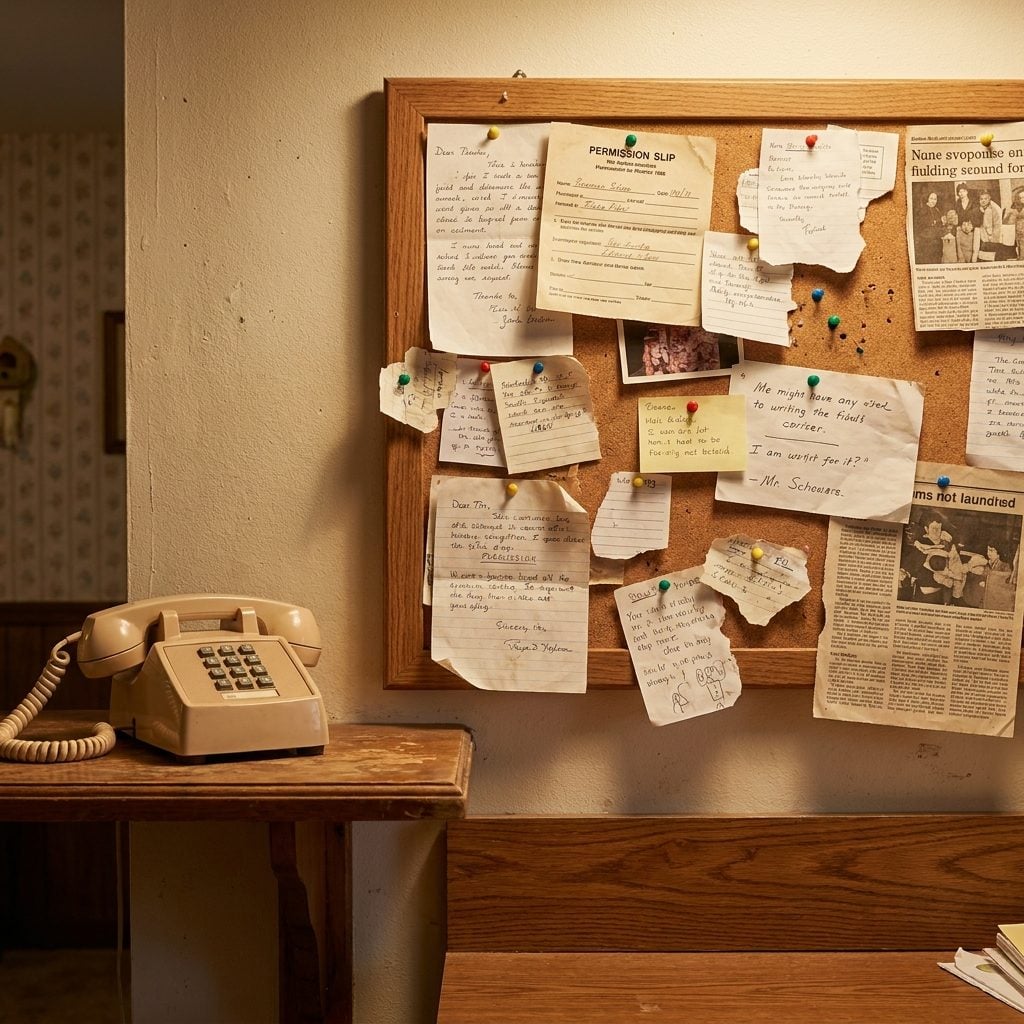
Permission slips. Dentist cards. Pizza coupons. School schedules. A note in somebody’s handwriting that simply said CALL YOUR GRANDMOTHER.
The corkboard accumulated information in geological layers. You could practically date a household by excavating it one thumbtack at a time.
This was the shared inbox before anyone called it an inbox. That practical, slightly unruly display still has descendants in boho kitchen inspiration, where pinboards and open displays are once again allowed to look lived in.
27. Raised-Panel Doors Made Cabinets Feel Properly Important
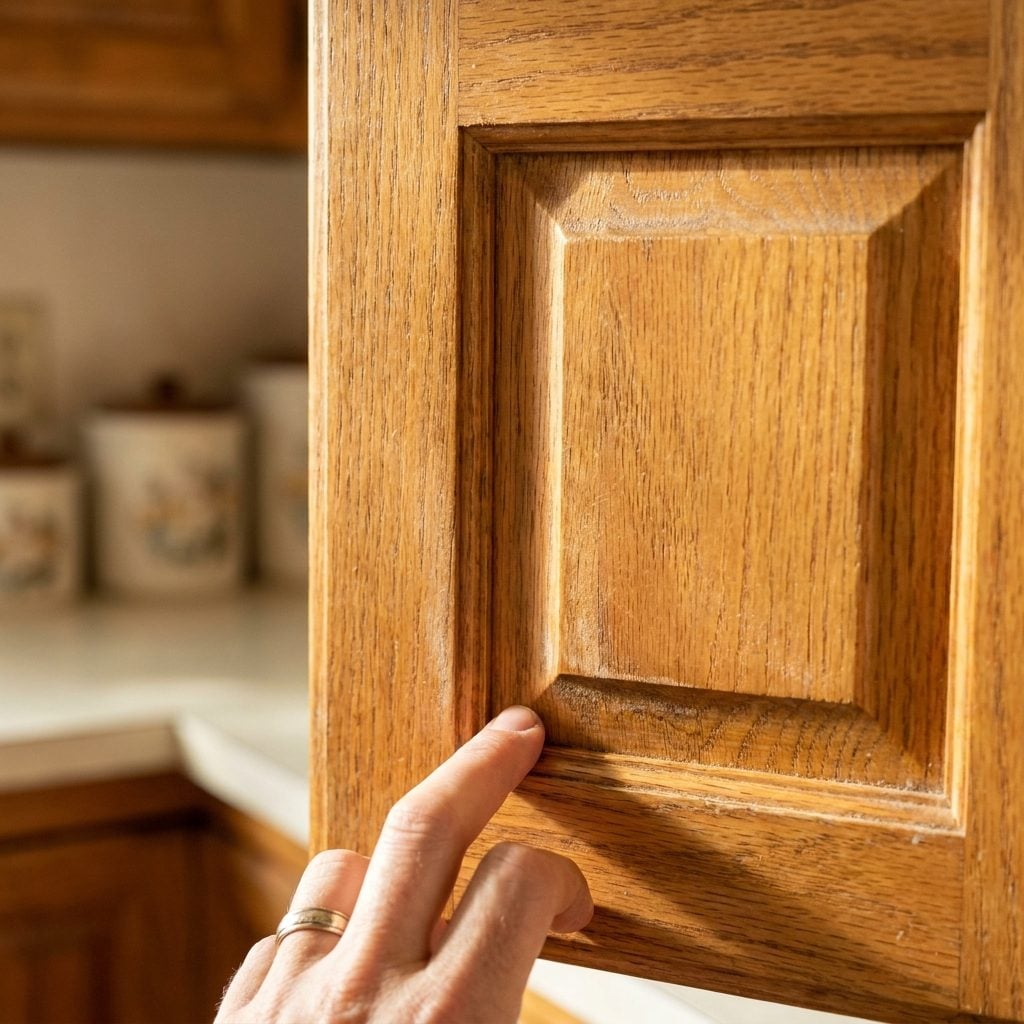
Every cabinet door had that raised rectangle in the middle, giving an ordinary slab of wood the architectural ambitions of a courthouse.
The profile added shadow, depth, and approximately seven extra places for cooking grease to settle. During company cleanup, the dishcloth traveled around every groove.
Still, raised-panel doors looked substantial. Flat fronts were plain. These had molding. In kitchen language, they wore a tie.
26. The Fluorescent Ceiling Box Lit Everything With Equal Enthusiasm
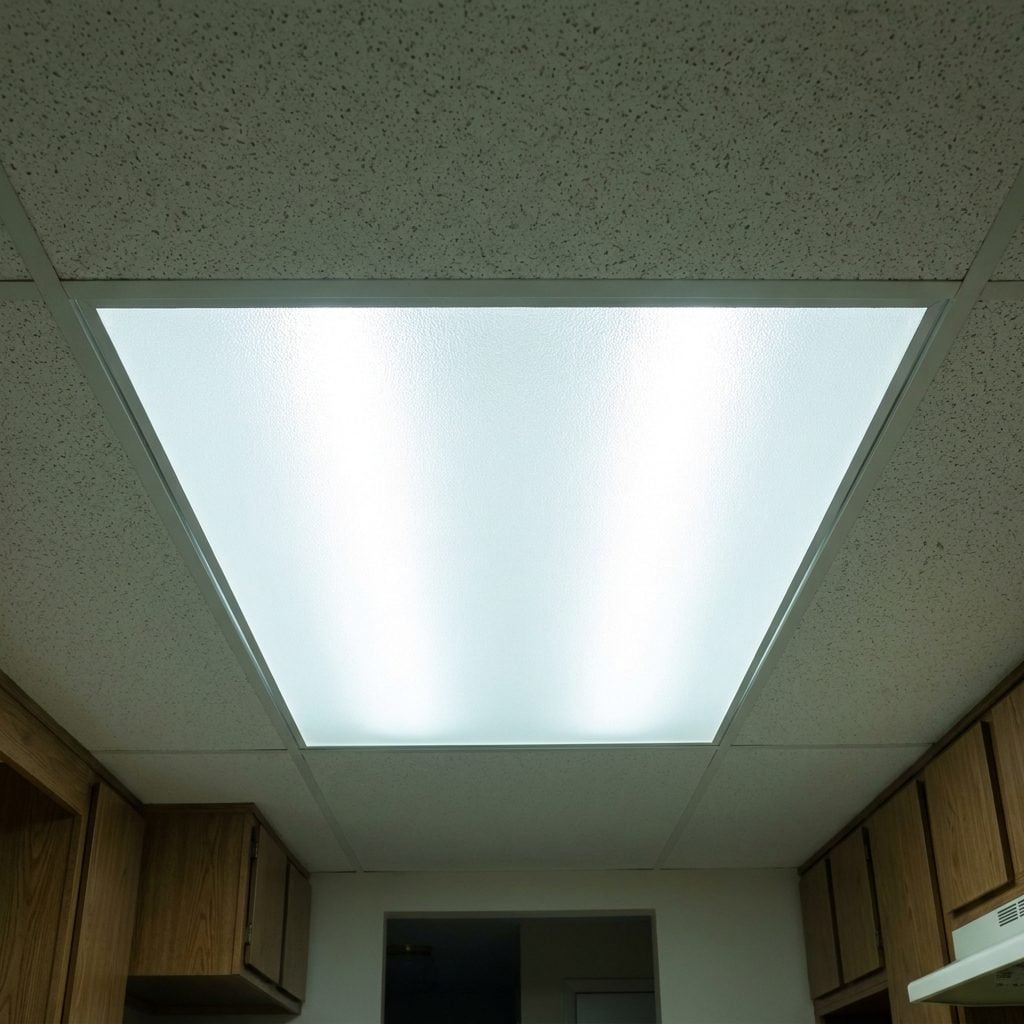
Flip the switch and the ceiling considered the request for half a second before humming to life.
A giant frosted diffuser spread light everywhere, eliminating dramatic shadows and most opportunities for mystery. Occasionally one tube flickered itself toward death while dinner proceeded underneath a low-grade strobe effect.
Behind the plastic panel lived the moths. Nobody remembered how they got in there. Nobody wanted responsibility for getting them out. Warmer recessed lighting has replaced the box in many a contemporary kitchen, but modern fixtures rarely provide their own insect archive.
25. The Microwave Cart Became Permanent Furniture About Five Minutes After Arriving
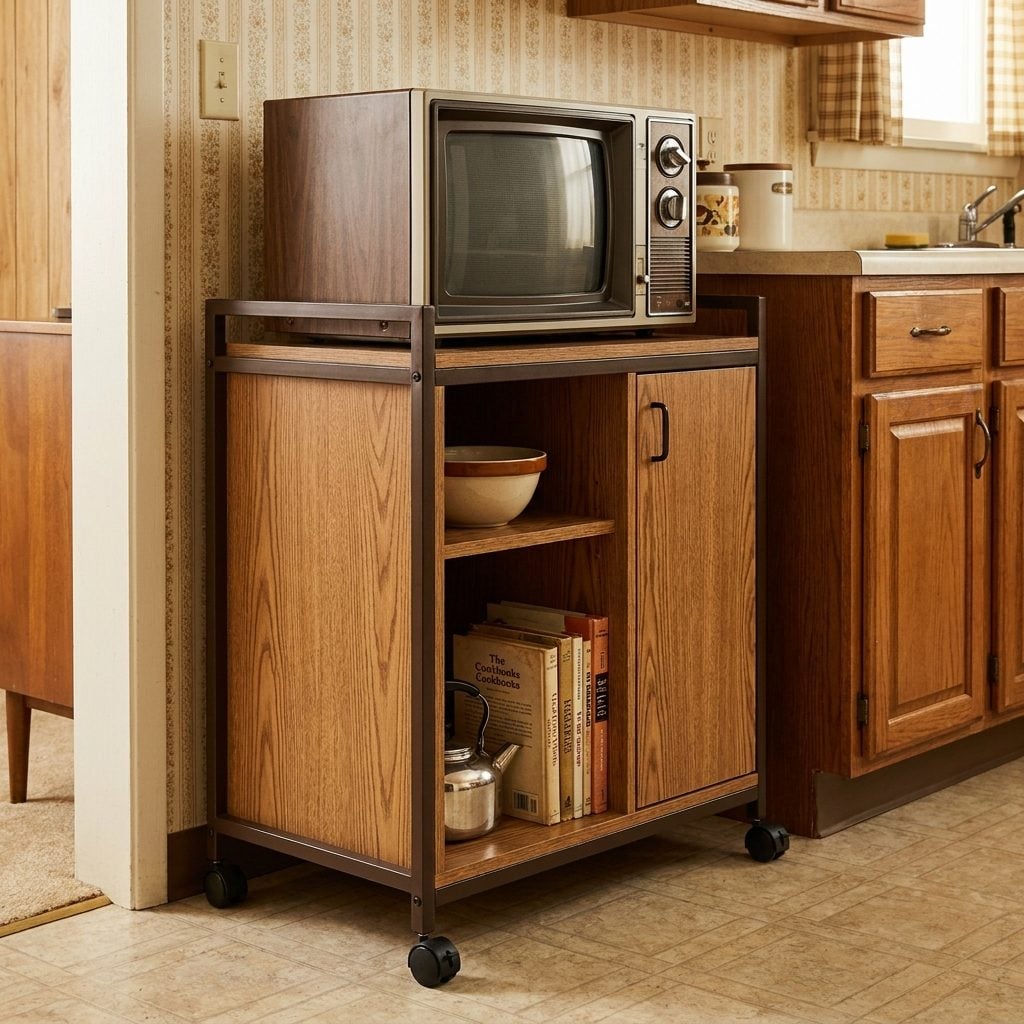
The kitchen had nowhere to put its newest appliance, so furniture manufacturers supplied an answer on four tiny casters.
Usually oak-look laminate and rarely matching anything perfectly, the cart held the microwave above and neglected cookbooks below. Technically mobile, it rolled into one corner and remained there until somebody remodeled.
Those wheels were optimism.
24. Sheet Vinyl Pretended to Be Tile, Brick, and Occasionally Wood
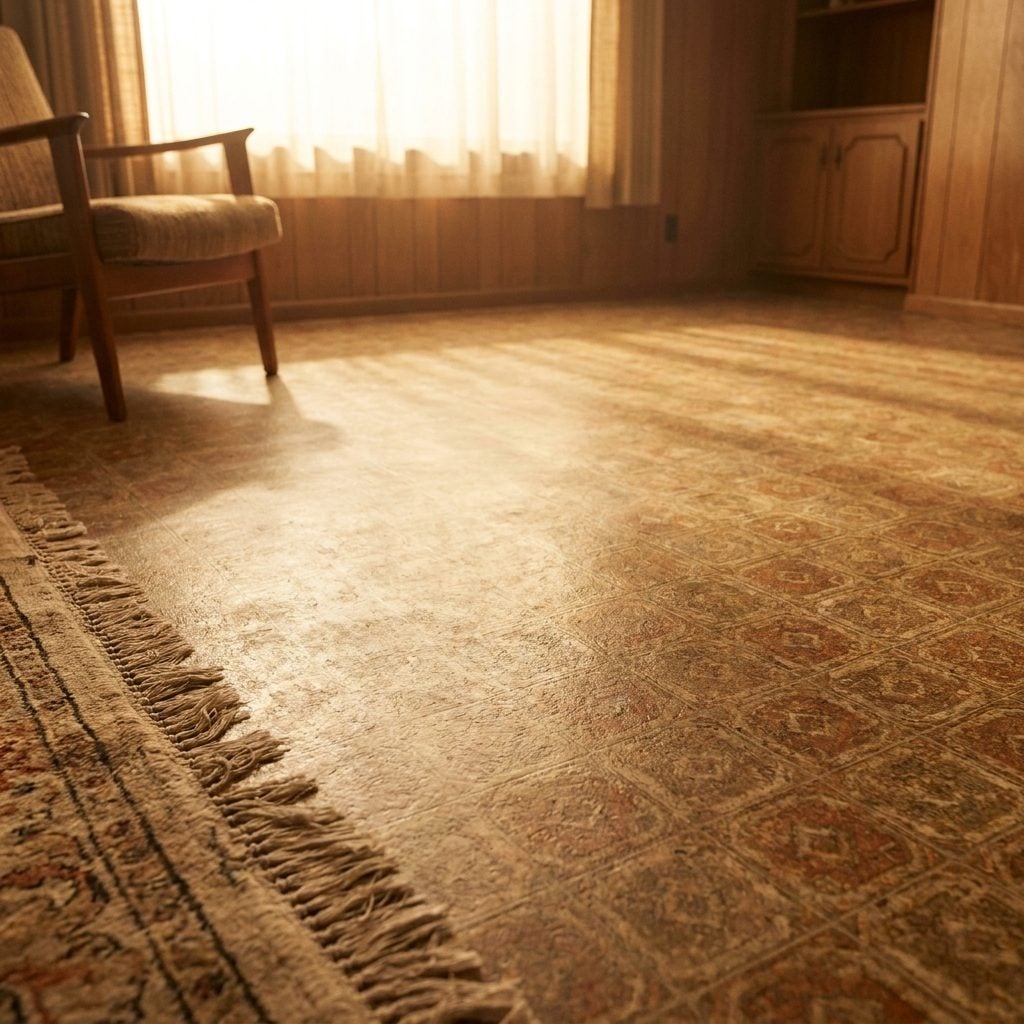
One enormous sheet covered the floor, printed to resemble materials it had absolutely no intention of becoming.
Terracotta tile. Brick. Wood planks. Fake grout lines and painted shadows performed all the architectural labor while the surface remained soft enough that a dropped glass occasionally got a second chance.
Near the busiest chair or the sink, the print eventually wore dull. That traffic path mapped family life better than blueprints ever could.
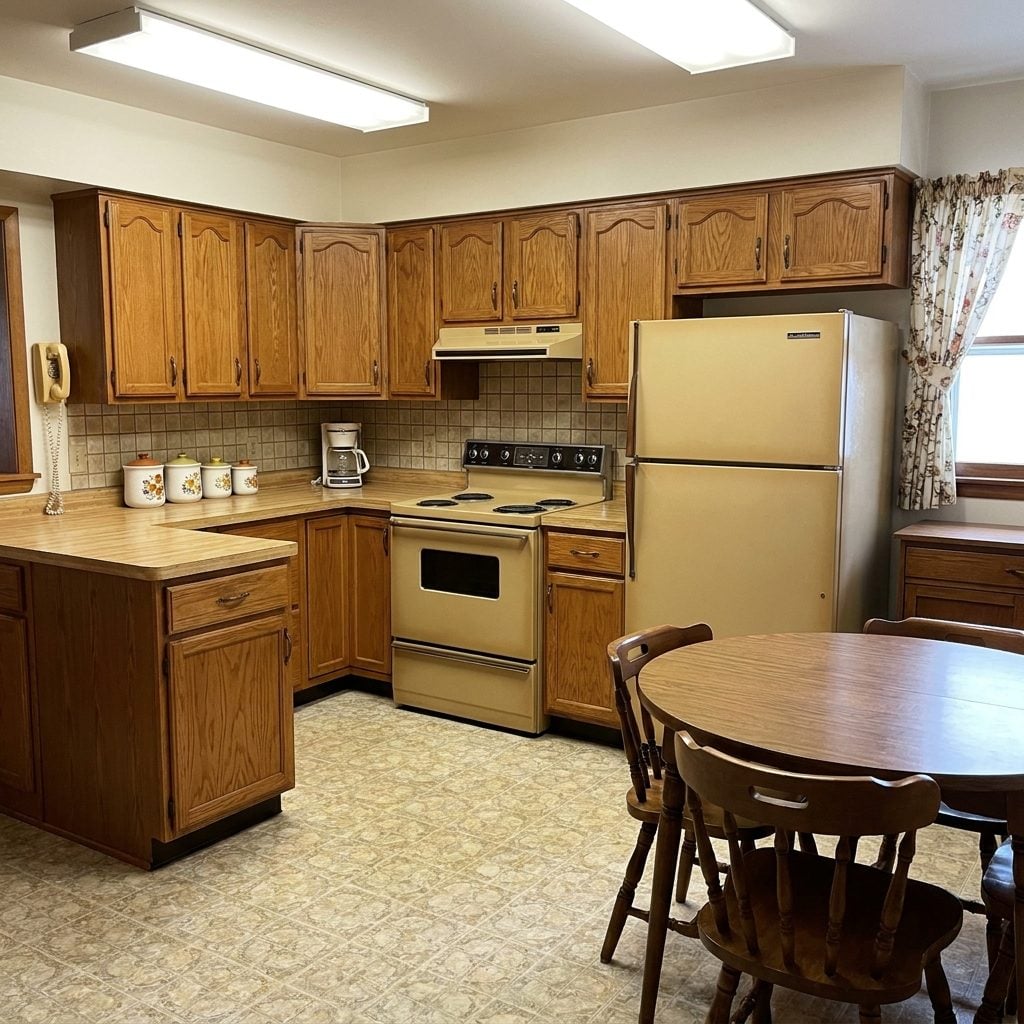
23. Almond Appliances Arrived to Restore Diplomatic Relations
🔥 Would you like to save this?
After harvest gold and avocado, almond arrived looking like the adult in the room.
Not white. Not beige exactly. More like an eggshell that had seen some things.
It matched oak reasonably well, avoided looking clinical, and asked very little from the wallpaper. If the refrigerator was almond, there was an excellent chance the wall phone had received the same memo.
22. The Appliance Garage Hid Clutter Behind One Very Satisfying Door
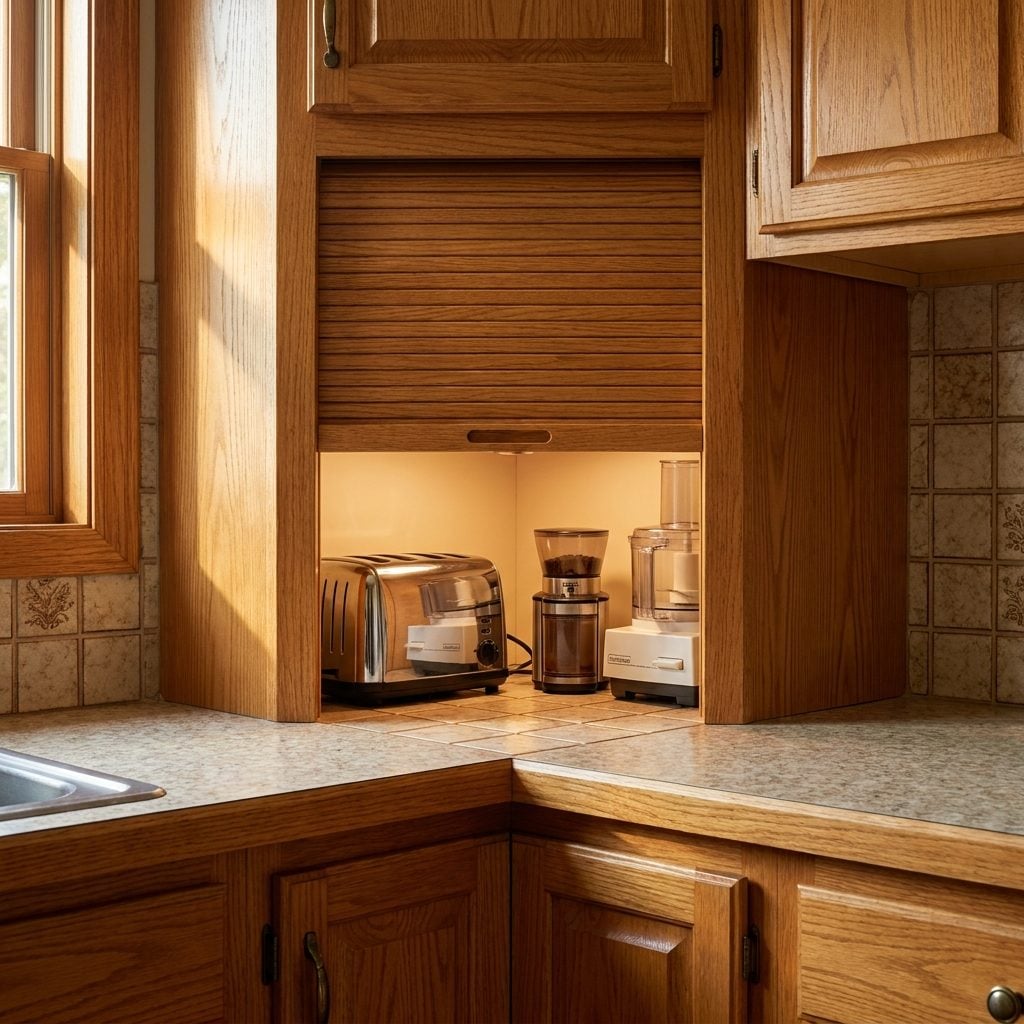
Slide up the little tambour door and there they were: toaster, can opener, coffee maker, all parked in a tiny wooden cave.
Slide it down and the counter looked miraculously organized without anyone having actually put anything away.
The tracks collected crumbs and the door eventually developed opinions about opening smoothly, but the basic idea was sound. Hiding countertop equipment still turns up in Japandi kitchen ideas in far more expensive clothing.
21. Country Geese Marched Across the Kitchen in Bonneted Formation
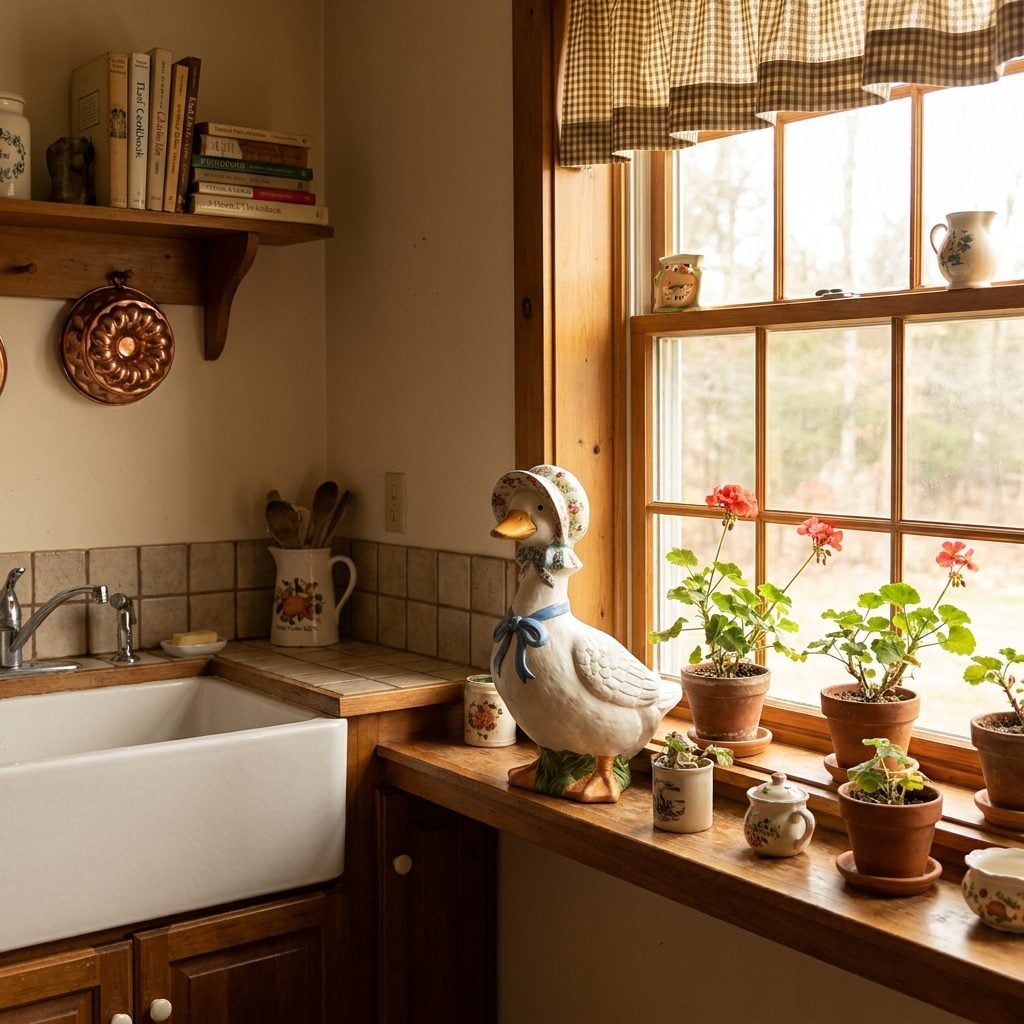
At some point, a goose in a bonnet got into the kitchen and brought relatives.
There were wooden geese, ceramic geese, painted geese, geese on towels, geese on wallpaper borders, and geese wearing tiny calico bows despite having no obvious social engagement requiring formal neckwear.
The appeal was pure country-kitchen coziness: soft shapes, handmade-looking details, and nothing remotely urban. A modern boho kitchen inspiration scheme can chase a similar warmth without asking waterfowl to supervise breakfast.
20. The Coil-Burner Range Announced Dinner With an Orange Glow
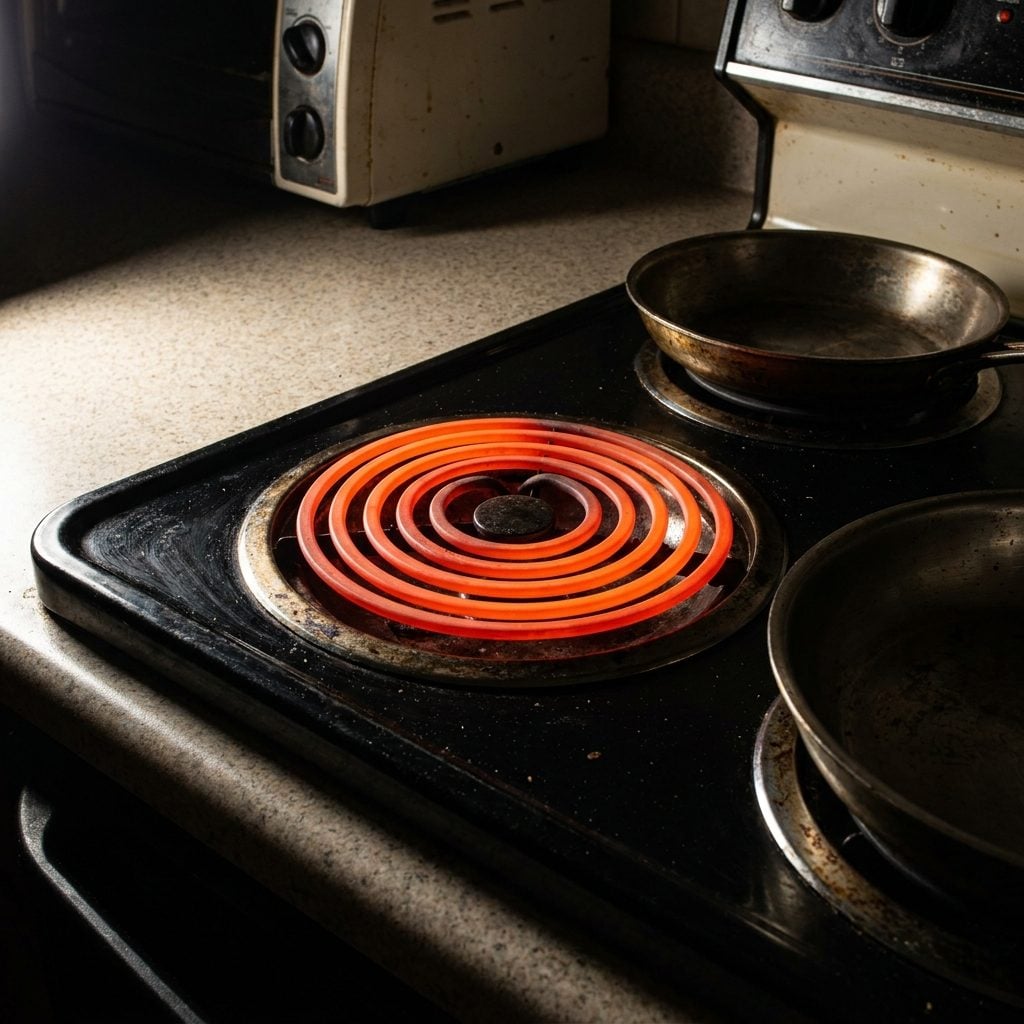
Dinner began when the burner slowly turned orange.
Then came the smell of whatever had spilled into the drip pan the night before, now returning briefly to the atmosphere. Pots rocked slightly because at least one coil never sat perfectly level, and every household knew which burner ran hotter than its dial suggested.
Cleaning meant pulling the coils, removing the chrome pans, scrubbing them, and watching the stains begin rebuilding almost immediately. Sleeker induction and black kitchen renovation setups offer tighter control and easier cleanup now, but an old electric coil knew how to make an entrance.
19. Butcher-Block-Look Laminate Was Wood From Several Feet Away
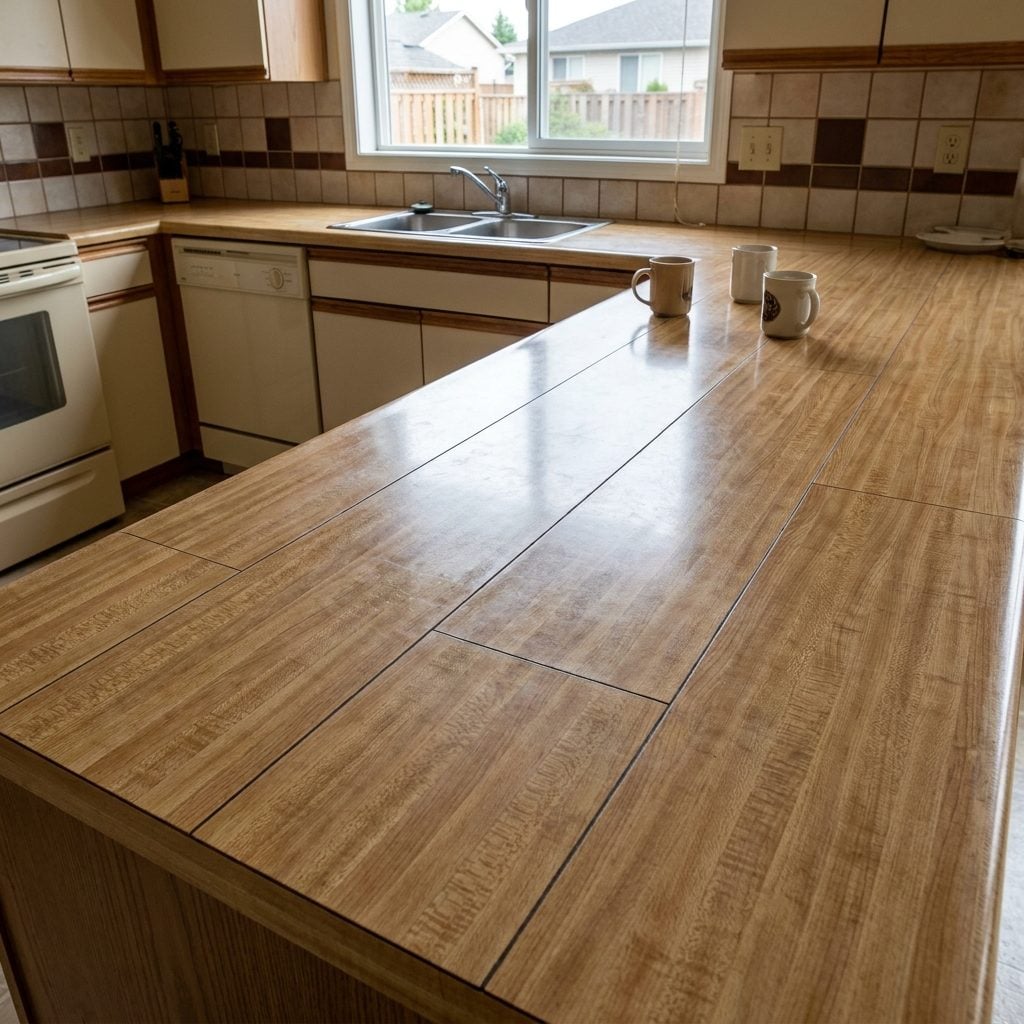
Across the room: wood.
Up close: a highly committed photograph of wood.
The plank lines repeated just a little too perfectly, and sooner or later the same printed knot reappeared farther down the counter like an actor playing two roles.
People chopped directly on it anyway. Scratches accumulated. The finish clouded. Real butcher block can be sanded and renewed. This was a picture of butcher block, and pictures do not heal.
18. The Double Wall Oven Made Thanksgiving Look Like a Tactical Operation
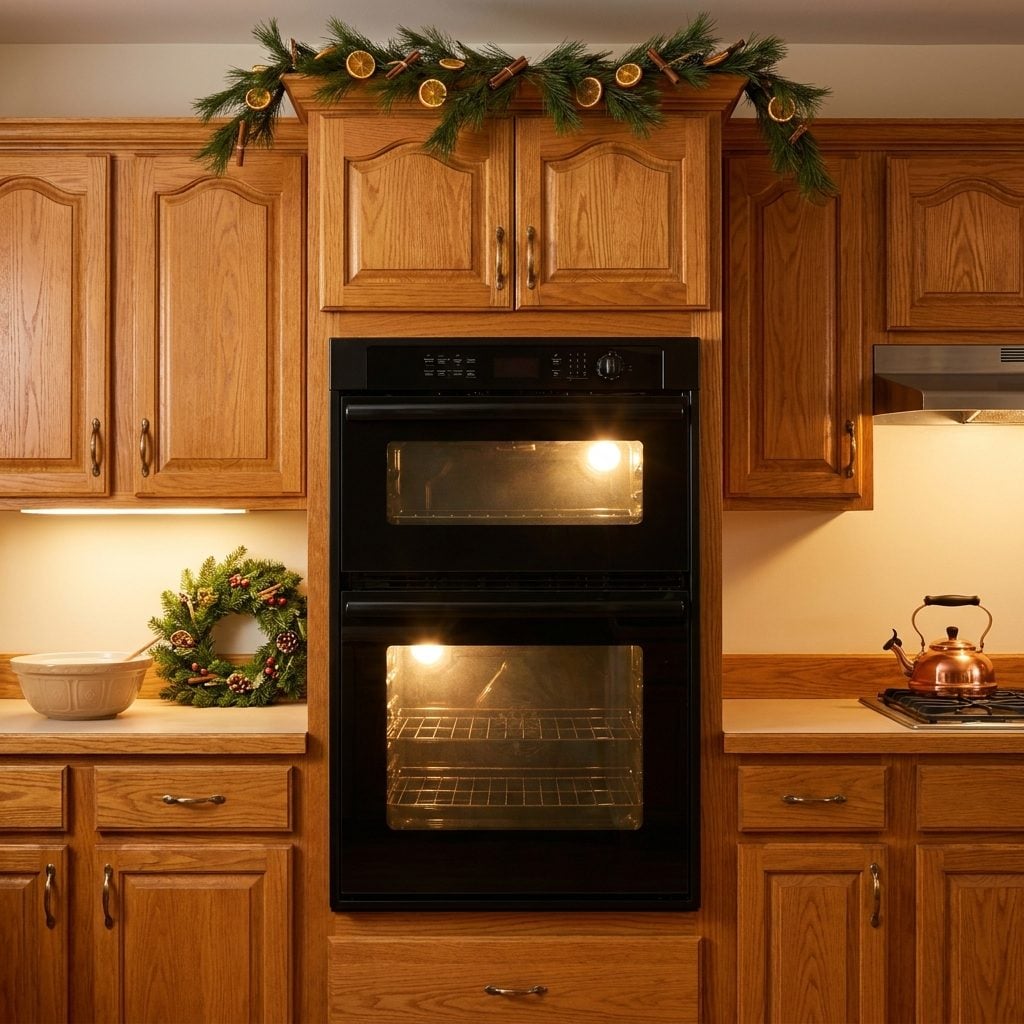
Two ovens stacked into the cabinetry gave a kitchen instant authority.
Turkey could occupy one while pies took the other. Cookie trays could rotate through without requiring a spreadsheet. Even when both cavities were not regularly needed, the mere possibility said this kitchen had been planned for serious events.
And yes, plenty of upper ovens probably spent quieter stretches holding baking sheets. A second oven was useful. Empty storage space was also useful. Families are adaptable.
17. Ruffled Café Curtains Gave the Window Over the Sink a Full Outfit
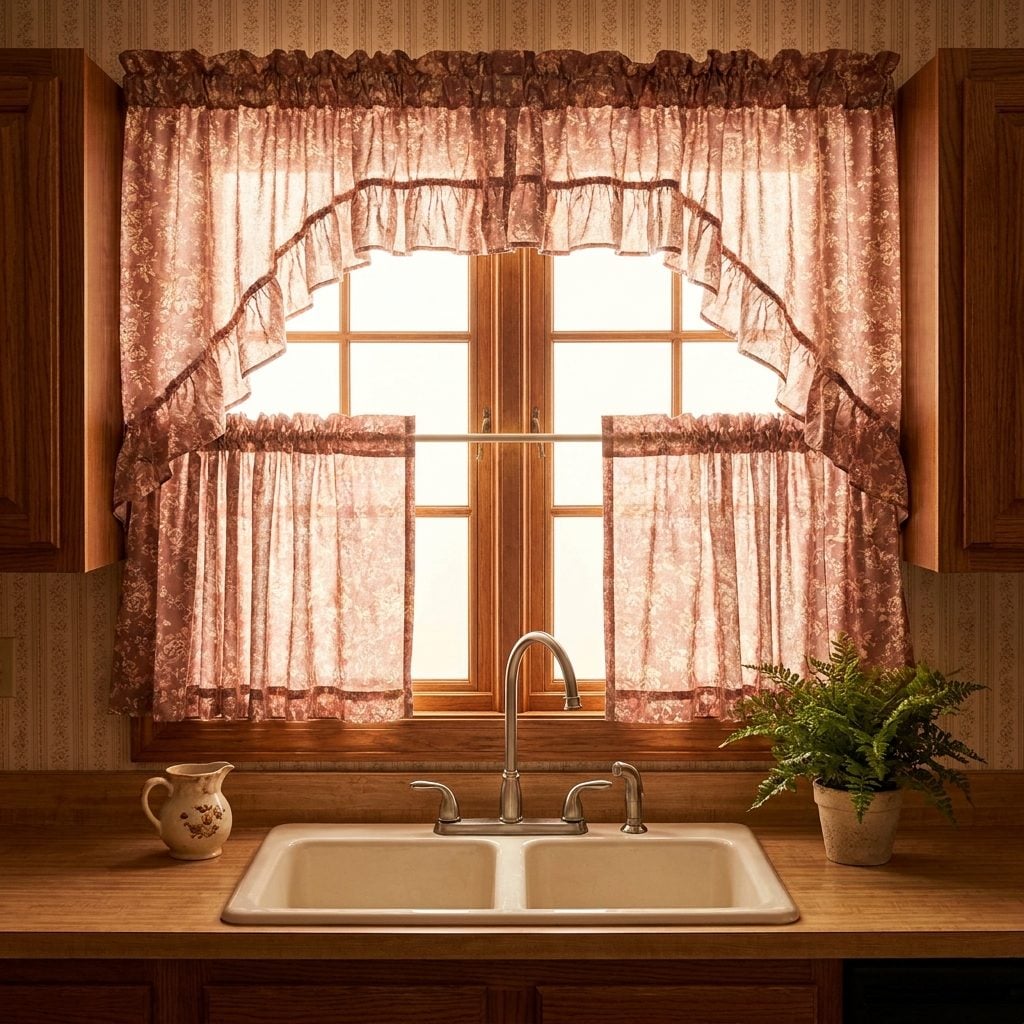
The window did not merely have curtains. It had coordinates.
A ruffled valance ran across the top. Café curtains covered the lower half. Both were probably gingham, tiny floral, or something that had already appeared elsewhere on the potholders.
The open strip through the middle let daylight in while preserving just enough privacy for doing dishes in a robe. Grease gradually joined the fabric fibers and made washing them an event. The same half-window idea can still work in a softer cream kitchen decor palette without requiring quite so many ruffles.
16. Woodgrain Appliance Panels Tried to Convince the Refrigerator It Was Furniture
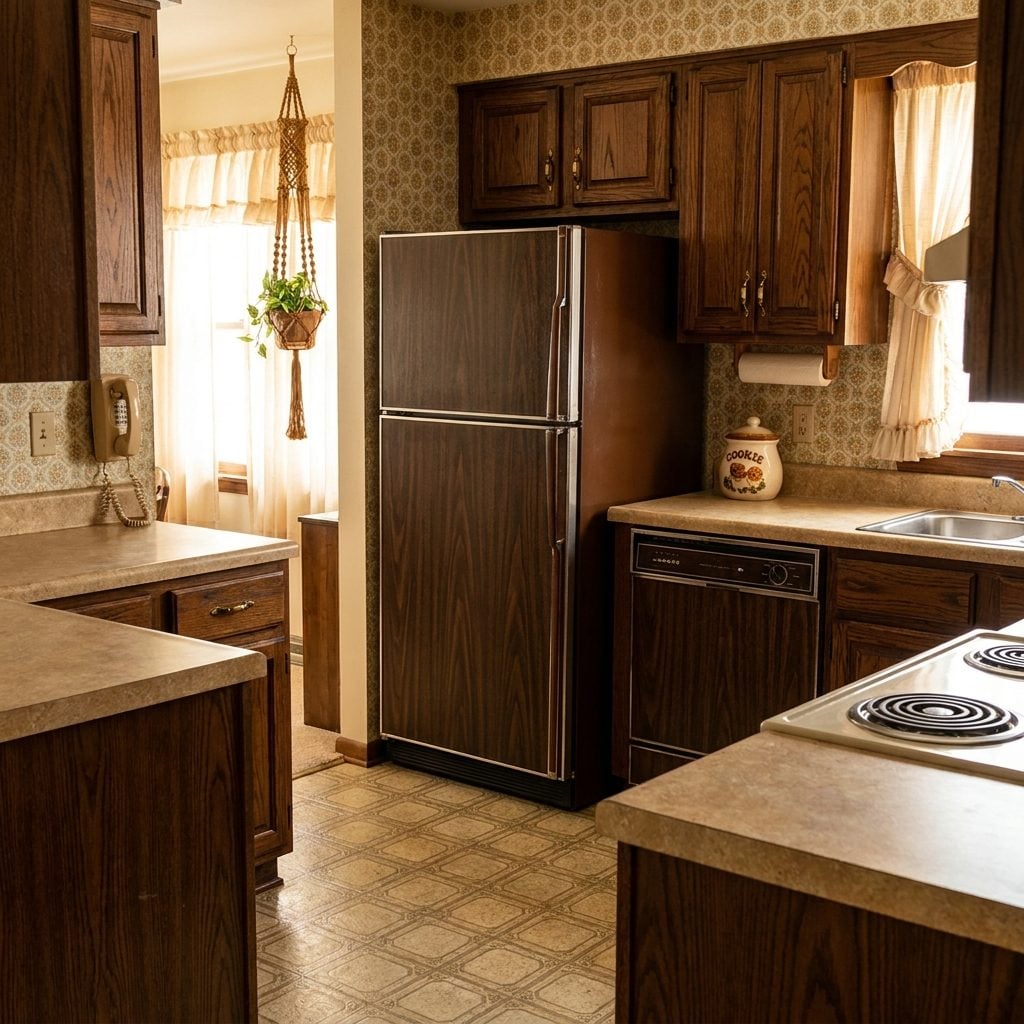
The strategy was simple: print woodgrain on the appliance and perhaps nobody would notice the refrigerator.
Everybody noticed the refrigerator.
From ten feet away it flirted with cabinetry. Up close, the shiny printed grain surrendered the illusion. Still, the instinct was surprisingly forward-looking. Today’s panel-ready refrigerators accomplish the same disappearing act with considerably more conviction and an invoice to match.
15. The Geometric No-Wax Floor Could Out-Pattern the Wallpaper
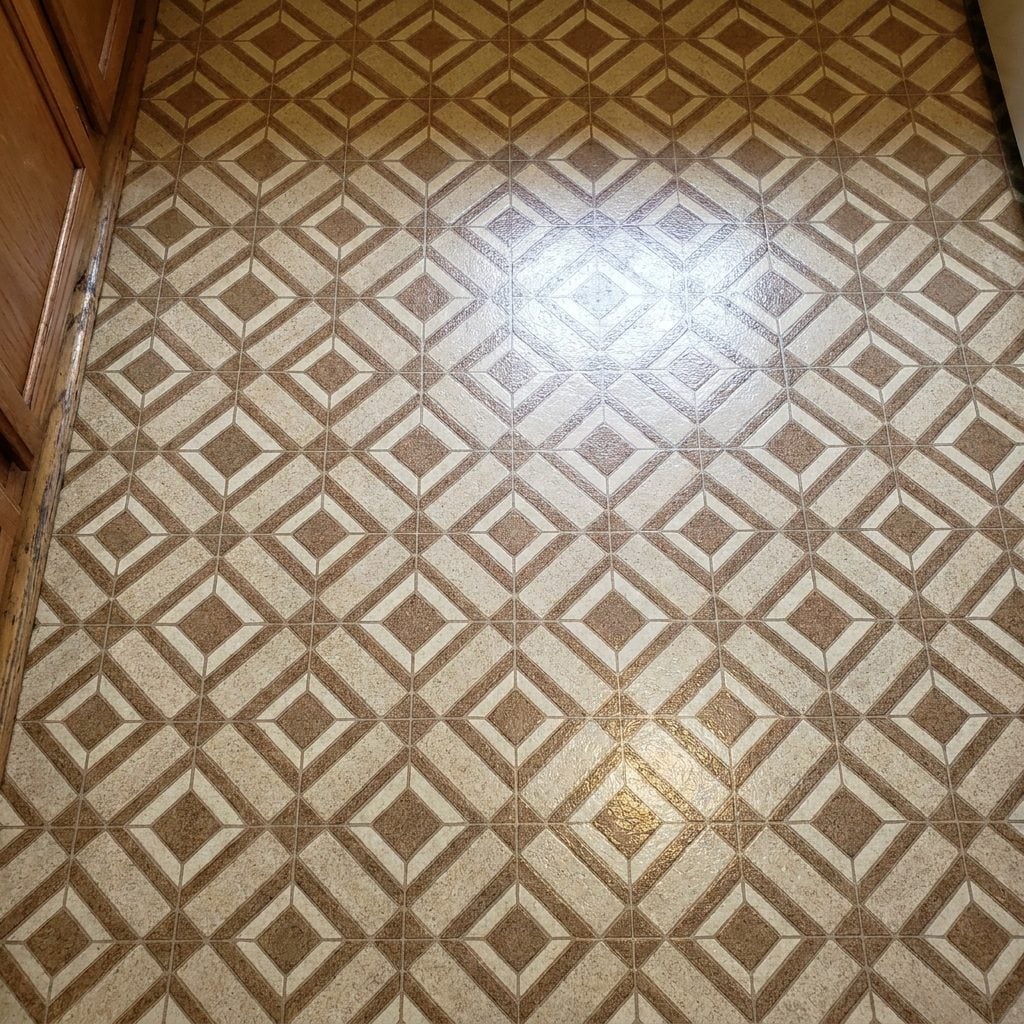
Diamonds, squares, grids, beige, brown, cream — all arranged with the quiet confidence of graph paper after two cocktails.
“No-wax” sounded nearly futuristic. The floor arrived glossy, and the busiest route between refrigerator and sink slowly polished itself dull anyway.
Bold graphic flooring has returned in cleaner forms, including plenty of examples in the scandinavian kitchen world. The difference is that today’s geometry usually knows when to stop.
14. The Dishwasher Buttons Needed a Thumb, Not a Touch
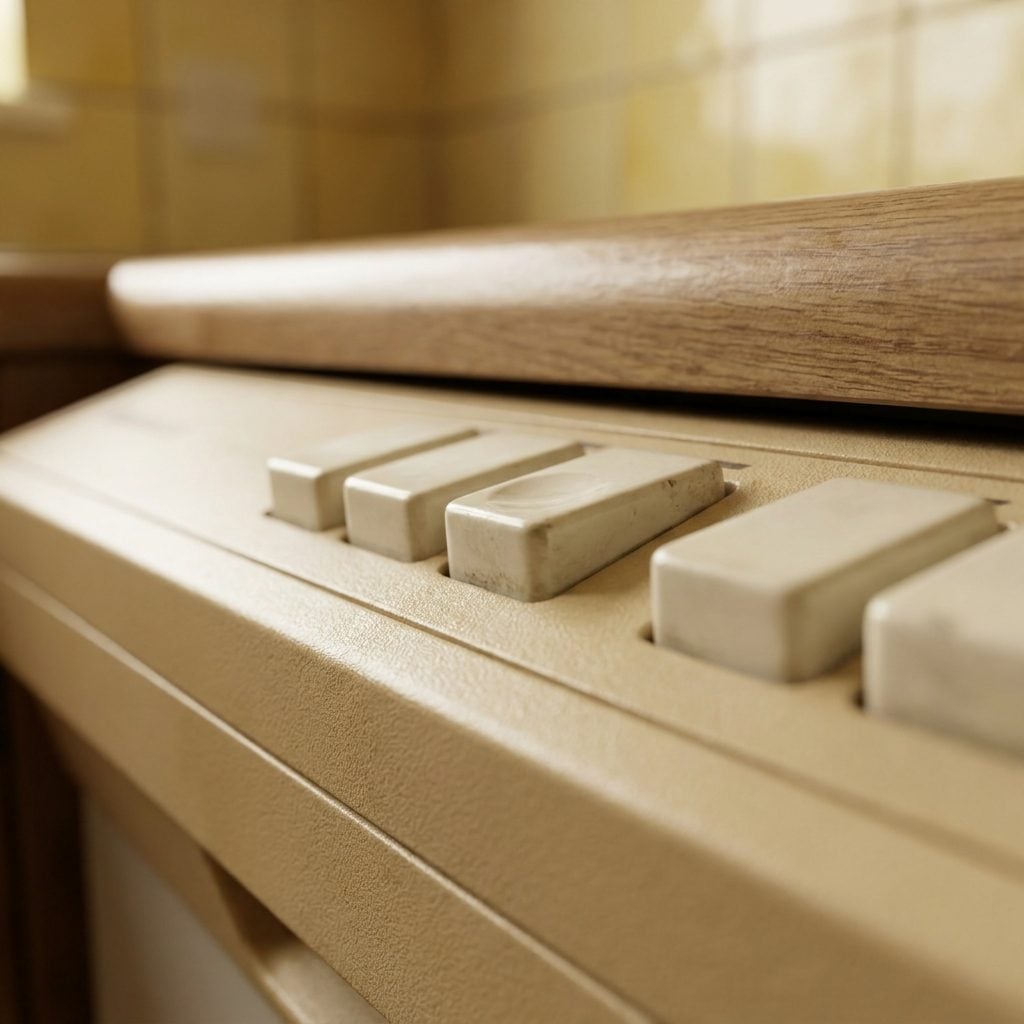
They didn’t click. They committed.
Big rectangular buttons labeled NORMAL WASH and HEATED DRY went in with a mechanical thunk. Then the machine shuddered into action and announced its progress audibly from the next room.
There was no need to consult an app to know whether the dishwasher was running. The walls had already been informed.
13. Roosters Took the Country Kitchen Brief Personally
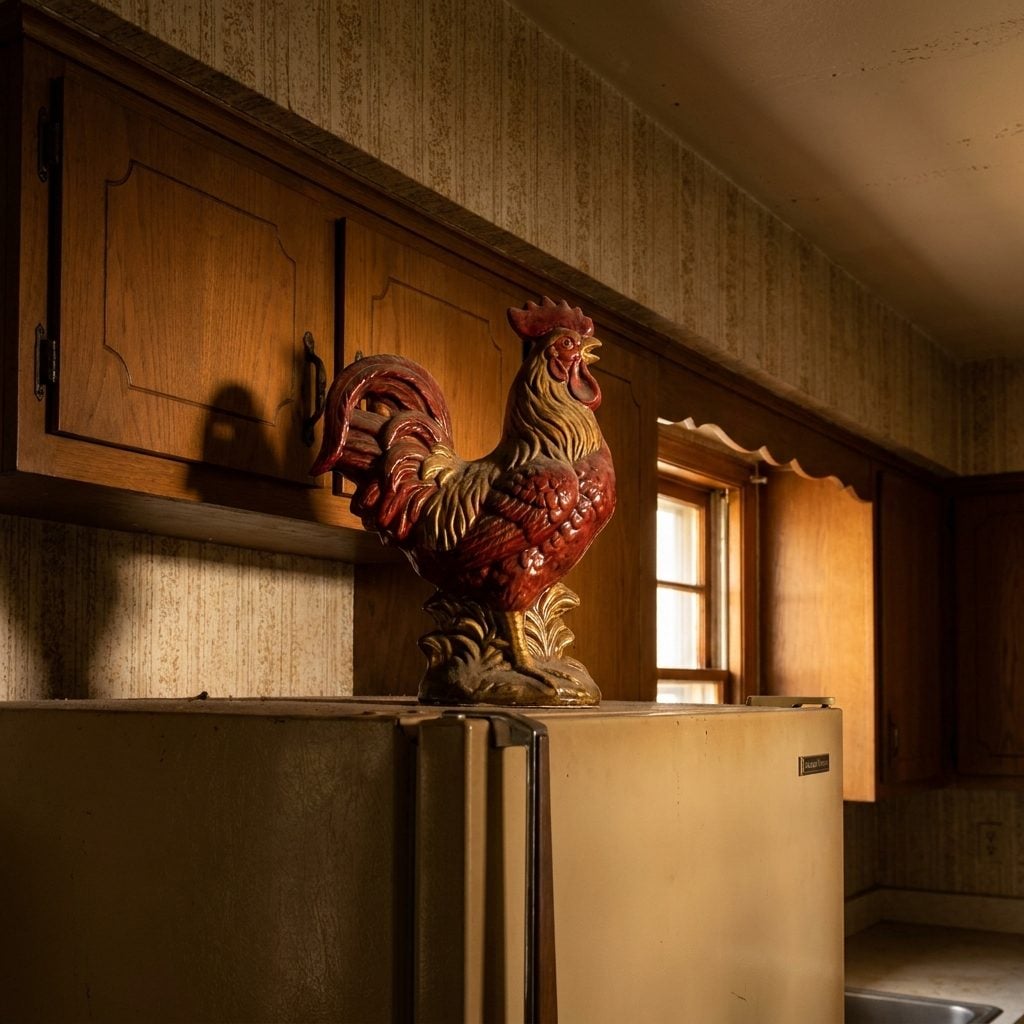
One ceramic rooster on top of the fridge could have been an accent.
Then came the rooster potholders. The rooster clock. The hen-shaped napkin holder. At some point poultry stopped accessorizing the kitchen and began governing it.
The country look never vanished completely; it simply became more selective. A mediterranean kitchen can still deliver rustic warmth through terracotta, iron, wood, and earthy color without requiring a ceramic bird to monitor the refrigerator.
12. Ceramic Tile Counters Made Every Drinking Glass Take a Tiny Risk
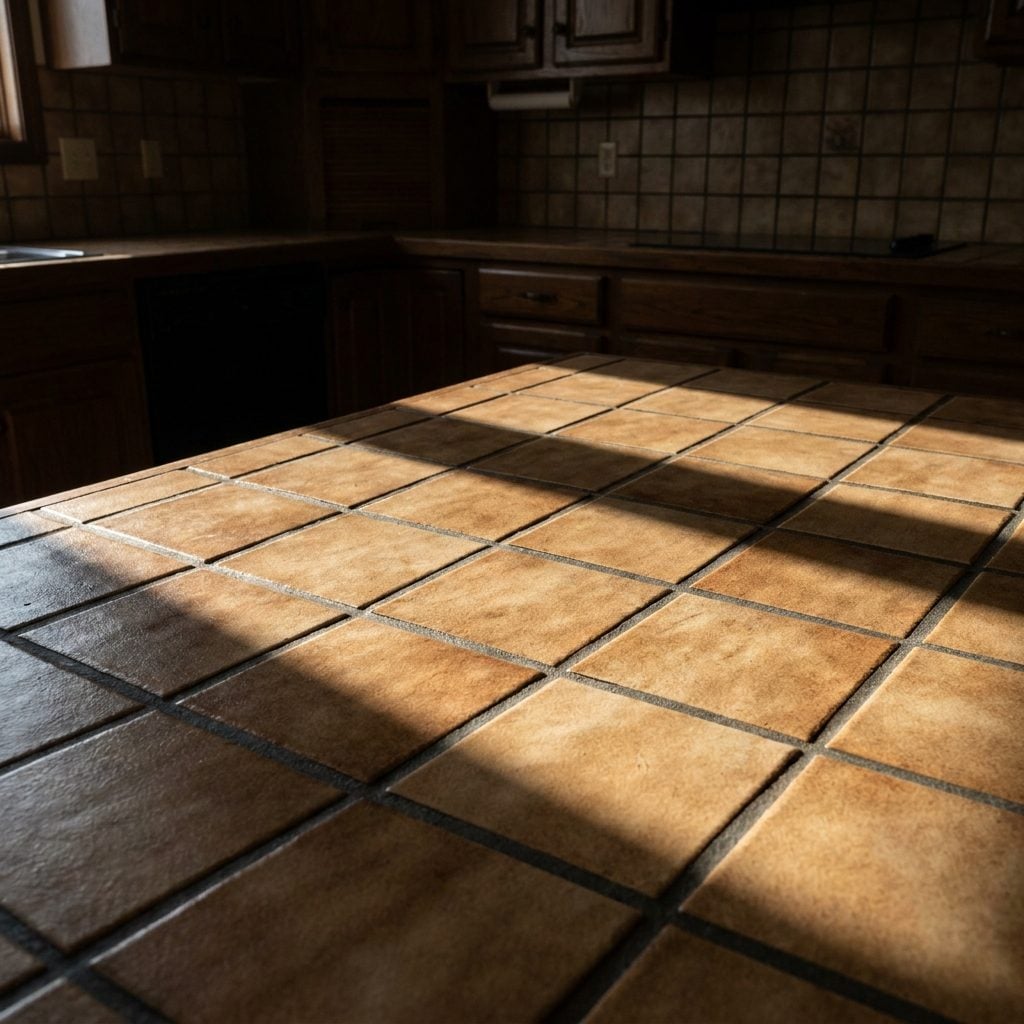
The counters looked terrific while the grout was new.
Then white slowly migrated toward beige, gray, or an unnamed color somewhere between spaghetti sauce and resignation.
Every glass perched across tile and grout instead of one smooth plane. Roll a marble over the surface and the kitchen provided percussion. Still, the tile stayed hard, cool, and durable, which helped explain why families tolerated the toothbrush-and-grout relationship for as long as they did.
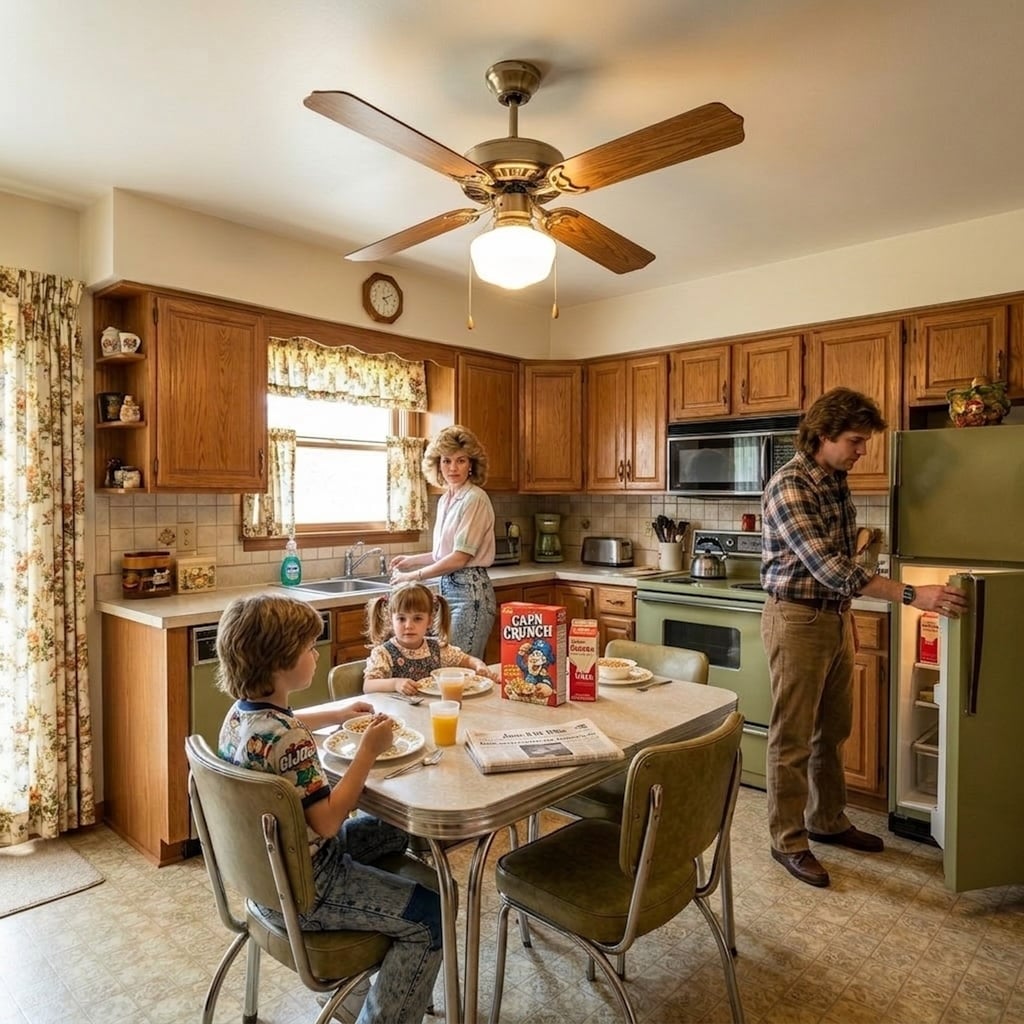
11. The Ceiling Fan Over the Table Had Two Pull Chains and One Correct Guess
🔥 Would you like to save this?
Brass housing. Oak-tone blades. Frosted globe. Two beaded chains dangling underneath with no visible commitment to identifying themselves.
You wanted the light and got the fan. You wanted the fan and plunged dinner into darkness.
At low speed it moved warm air gently above the table. At high speed napkins began receiving travel opportunities. Dust accumulated invisibly on top of every blade until somebody finally looked up.
10. Avocado Green Was the Houseguest That Never Got the Hint
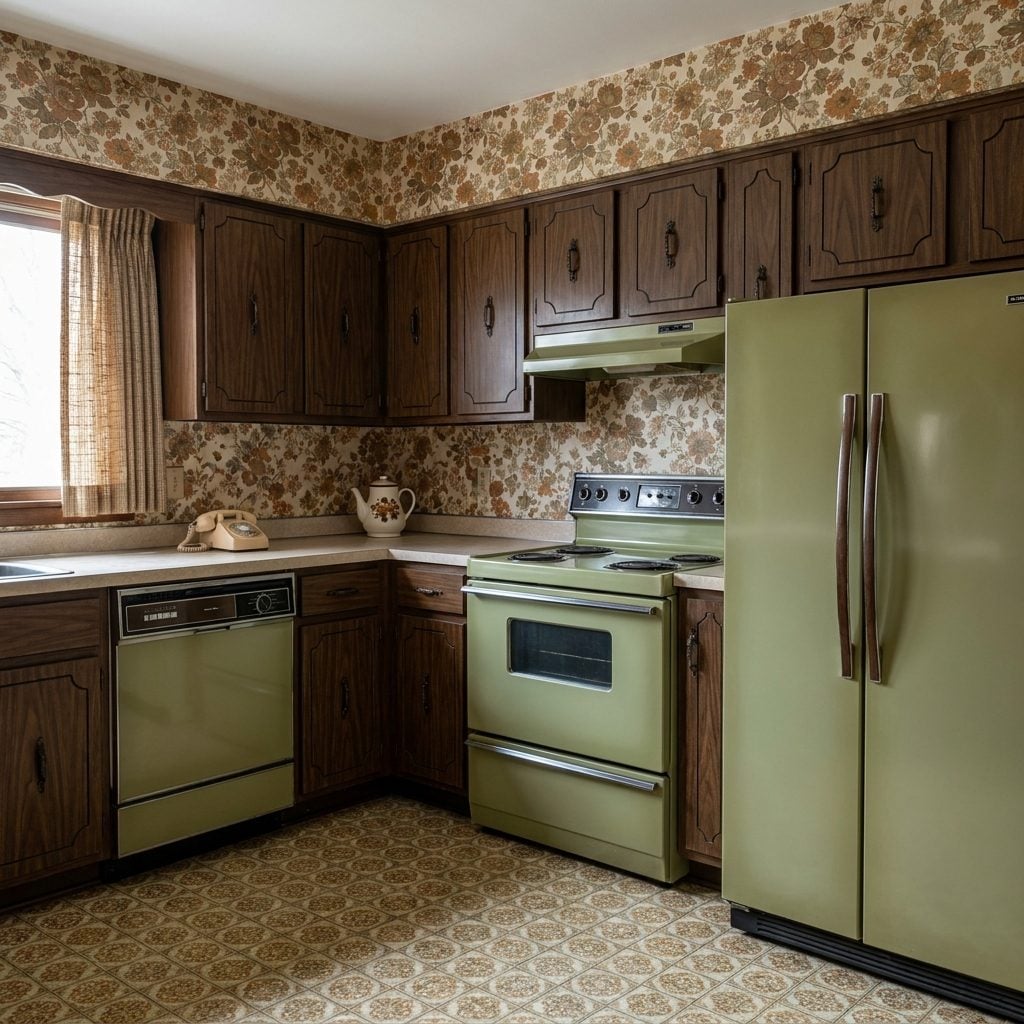
By the middle of the 1980s, avocado green could already look like evidence from an earlier civilization.
It was deeper and murkier than actual avocado flesh, somewhere closer to olive with institutional confidence.
Your parents might refer to it simply as “that green.” Then they kept it for six more years because the refrigerator still worked, and working appliances outranked color theory.
9. The Canister Set Lined Up Like Kitchen Royalty
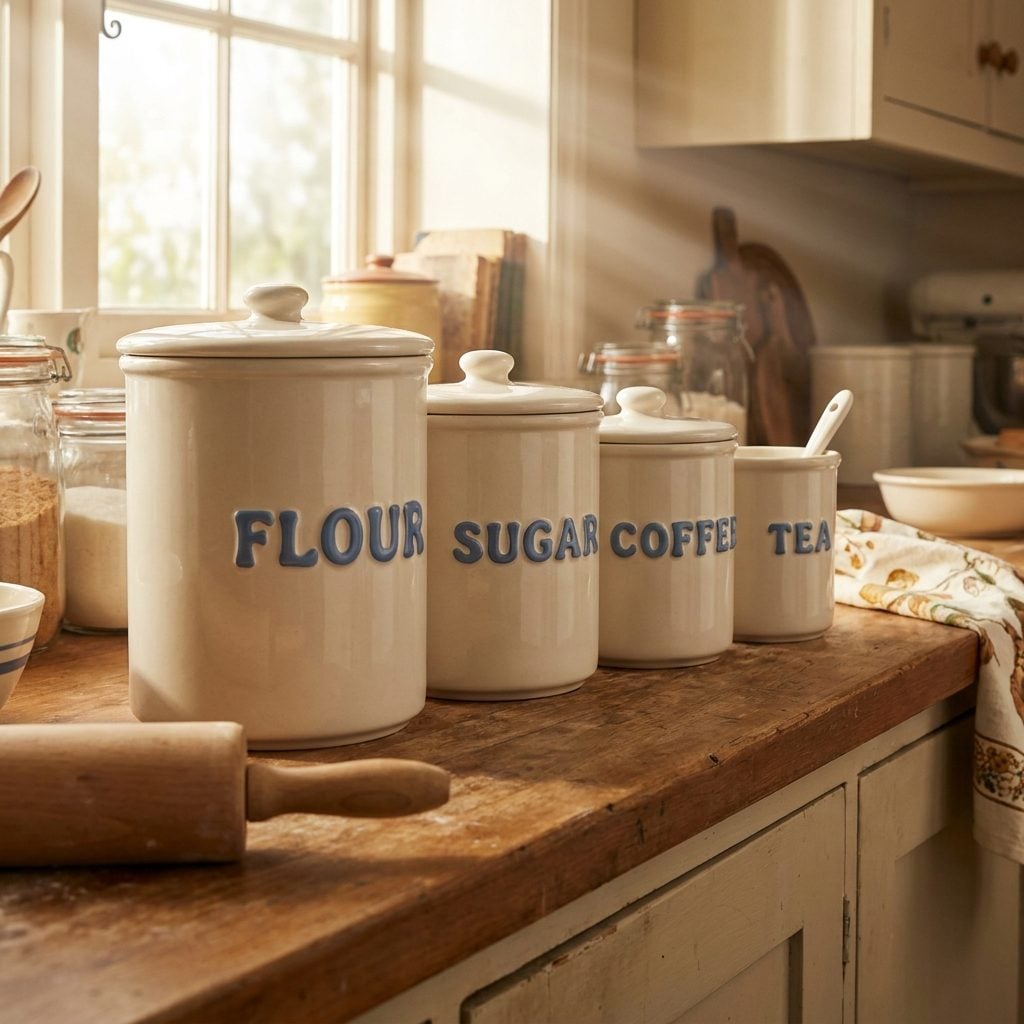
Four ceramic jars descended across the counter from large to small: FLOUR, SUGAR, COFFEE, TEA.
Whether the contents respected those labels was another matter entirely. The coffee jar might contain twist ties. Tea could be hiding spare change. The system was primarily visual.
They often matched the cookie jar, spoon rest, and other countertop pieces because coordination was not an accident. It was policy.
8. The Trash Compactor Made Garbage Feel Weirdly High-Tech
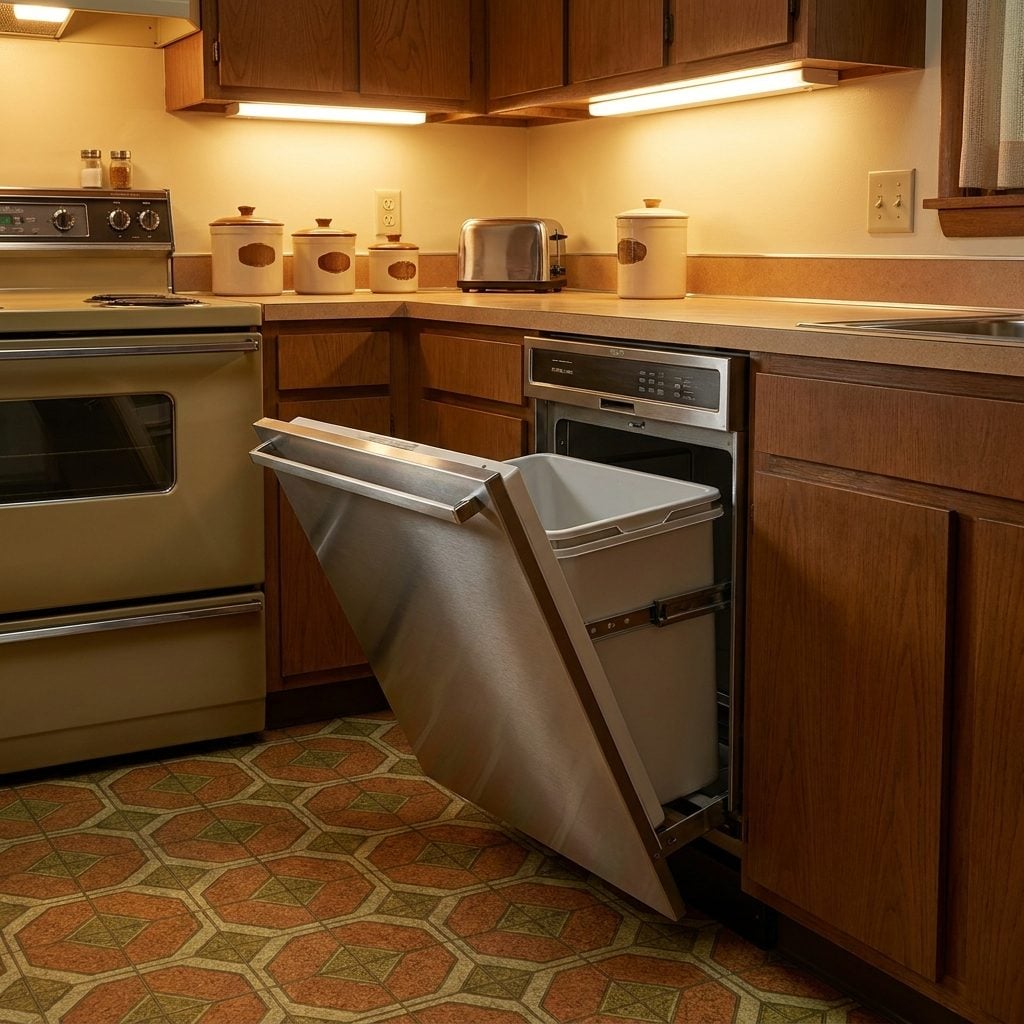
Few kitchen appliances have ever made throwing things away feel so technologically advanced.
Load the bin, start the machine, and an electric drive mechanism forced the ram downward, compressing cartons and household trash into a denser load with an ominous mechanical growl.
The smell could become its own argument against the concept, and compactors gradually fell out of favor in many kitchens as habits and waste systems changed. They never disappeared entirely. Neither did the parental warning not to put your hand anywhere near one.
7. The Wallpaper Border Was Decorative Punctuation at Ceiling Height
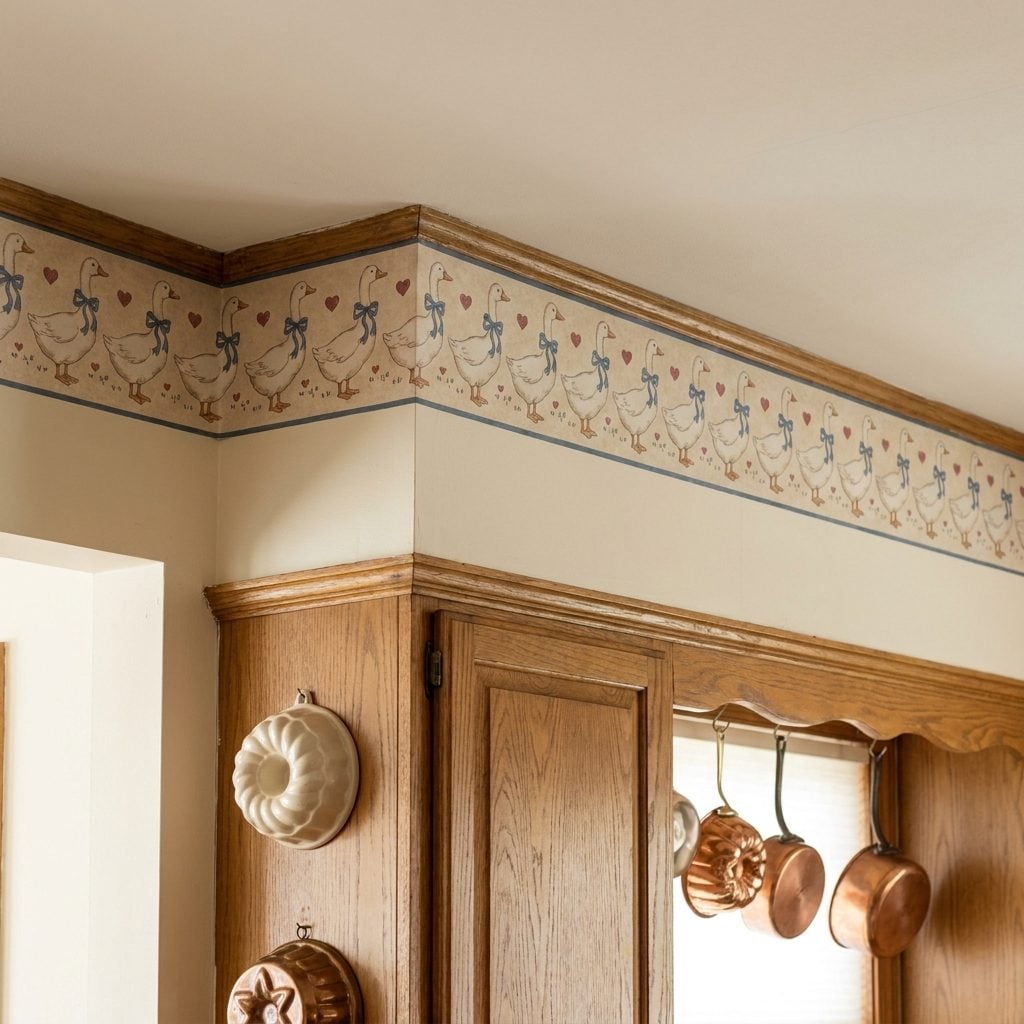
Geese. Ivy. Fruit baskets. Tiny florals. Whatever motif the room had chosen, the border repeated it one final time around the perimeter in case anyone had missed the theme.
Installation required a step stool, wet paste, concentration, and at least one accusation that the other person was holding it crooked.
The corners almost matched. That was considered sufficient.
6. The Wooden Spice Rack Put Oregano on Display Whether It Had Any or Not
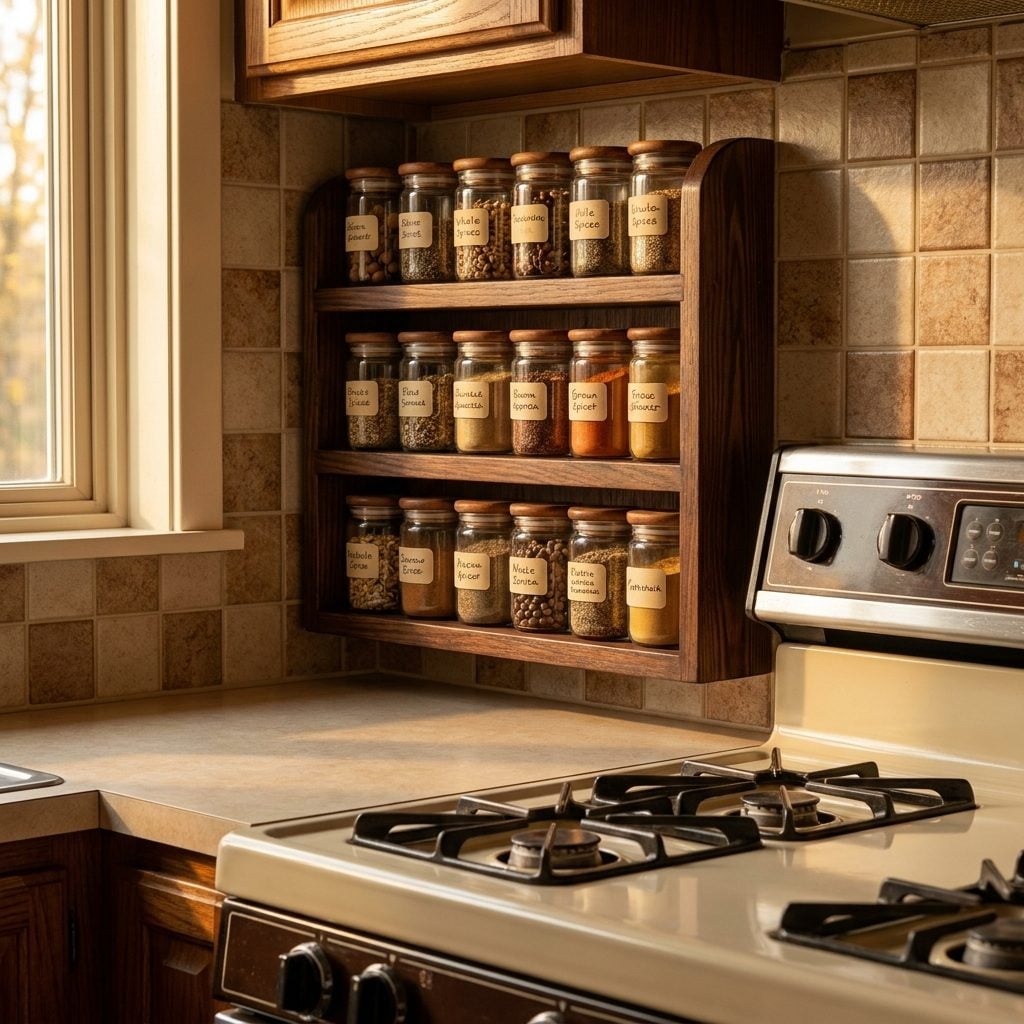
A little stained-wood rack sat beside the stove holding a row of matching jars whose labels faced outward with military discipline.
Half the spices were running low. One had been empty since the early Reagan years. None of that affected the arrangement.
The rack was storage and decoration at the same time, which is why its basic logic keeps resurfacing in open shelving and wall rails. A good scandinavian kitchen may dress the idea differently, but getting useful objects off the counter remains useful.
5. The Oak Pedestal Table Was Where the Kitchen Became the Family Room
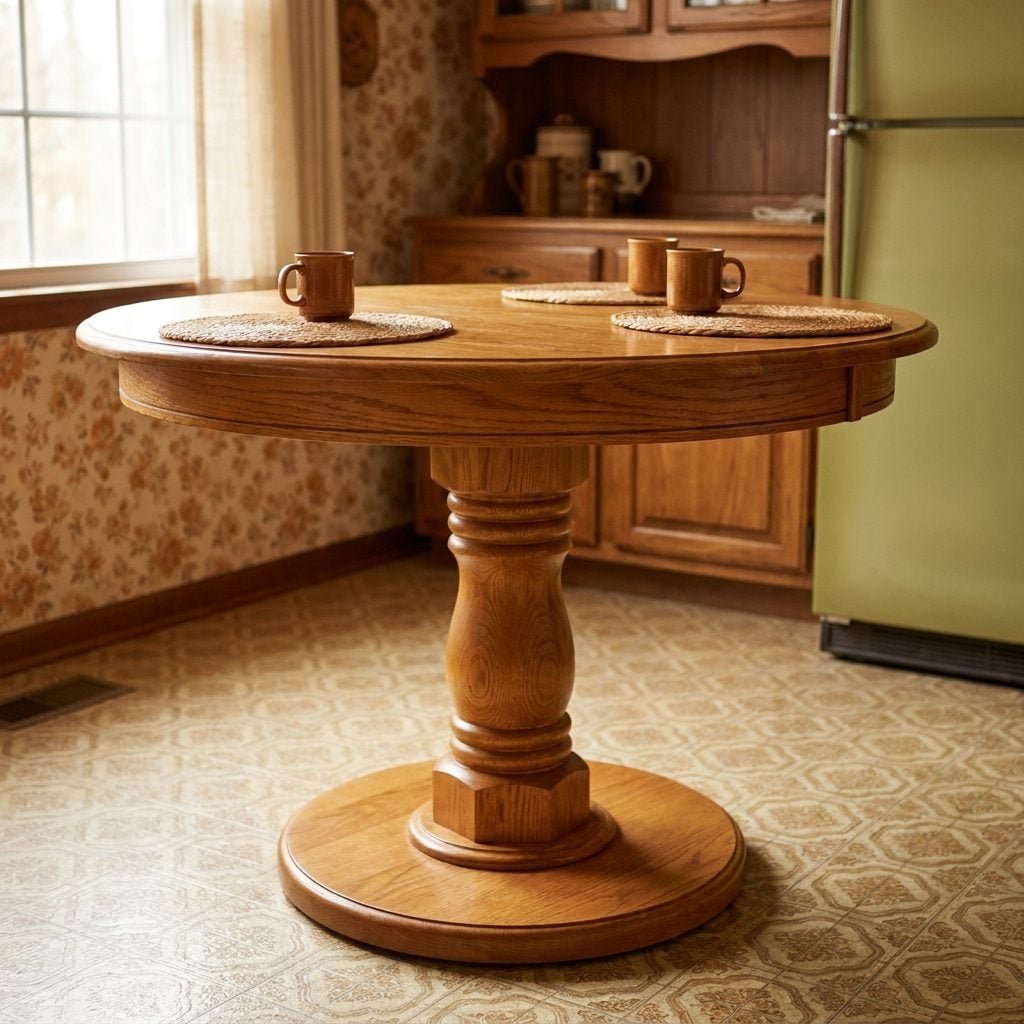
Round, honey-colored, and balanced on one substantial central column, the pedestal table eliminated corner legs and made squeezing in one extra chair considerably easier.
The finish carried the same orange-gold cast as the cabinets and enough polyurethane to survive Kool-Aid, homework, hot plates, elbows, and several years of somebody carving faint pencil marks into the underside.
Kids ran their feet through the turned grooves in the pedestal while adults talked. This happened everywhere. There should probably be a plaque.
4. Vinyl-Padded Chairs Turned Summer Shorts Into a Contact Sport
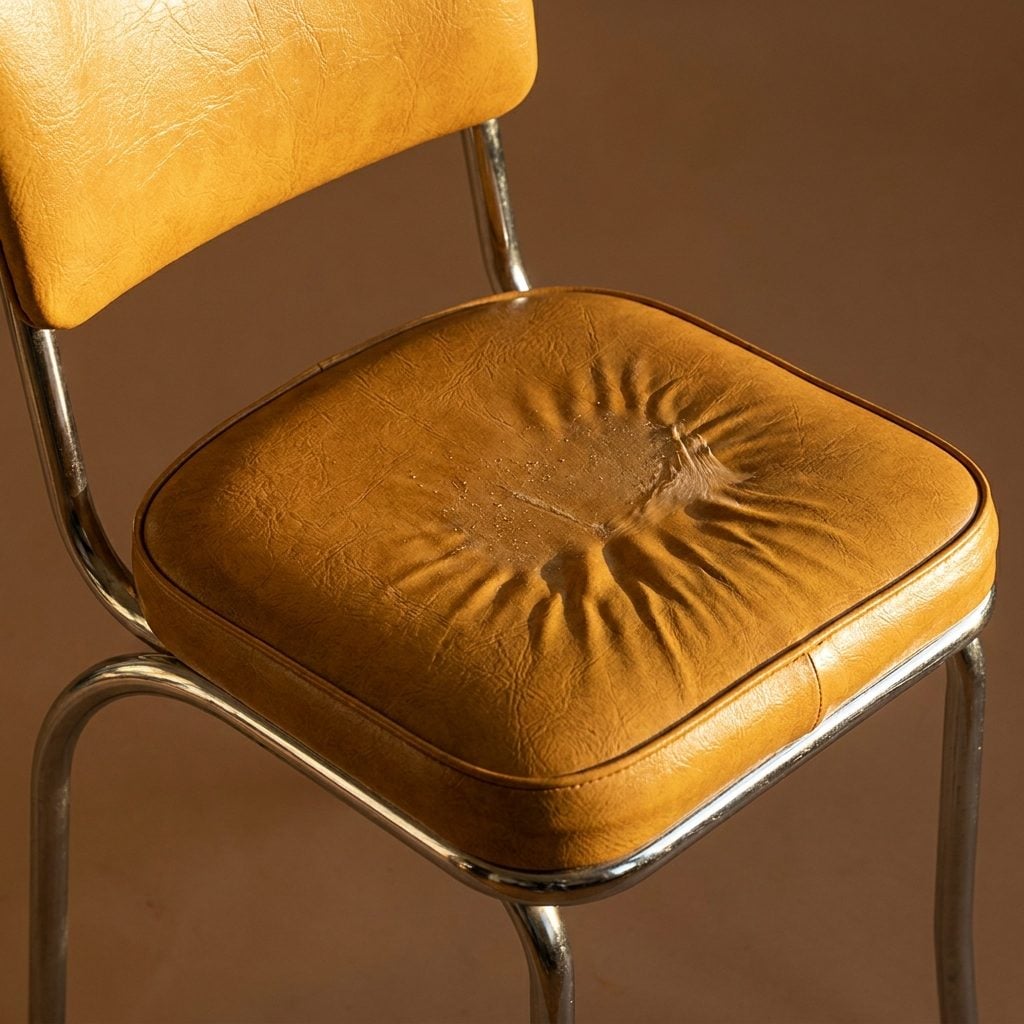
You remember the sound before you remember the chair.
That slow peel as bare skin separated from warm vinyl after twenty minutes at the table.
The seats were padded, piped at the edges, and easy to wipe clean, which made them ideal for family kitchens. Mushroom, almond, and determined shades of tan did most of the decorating.
Eventually the seams split and foam appeared. Nobody panicked. The chair still held a person, which meant the chair remained employed.
3. The Breakfast Nook Trapped Whoever Sat on the Inside
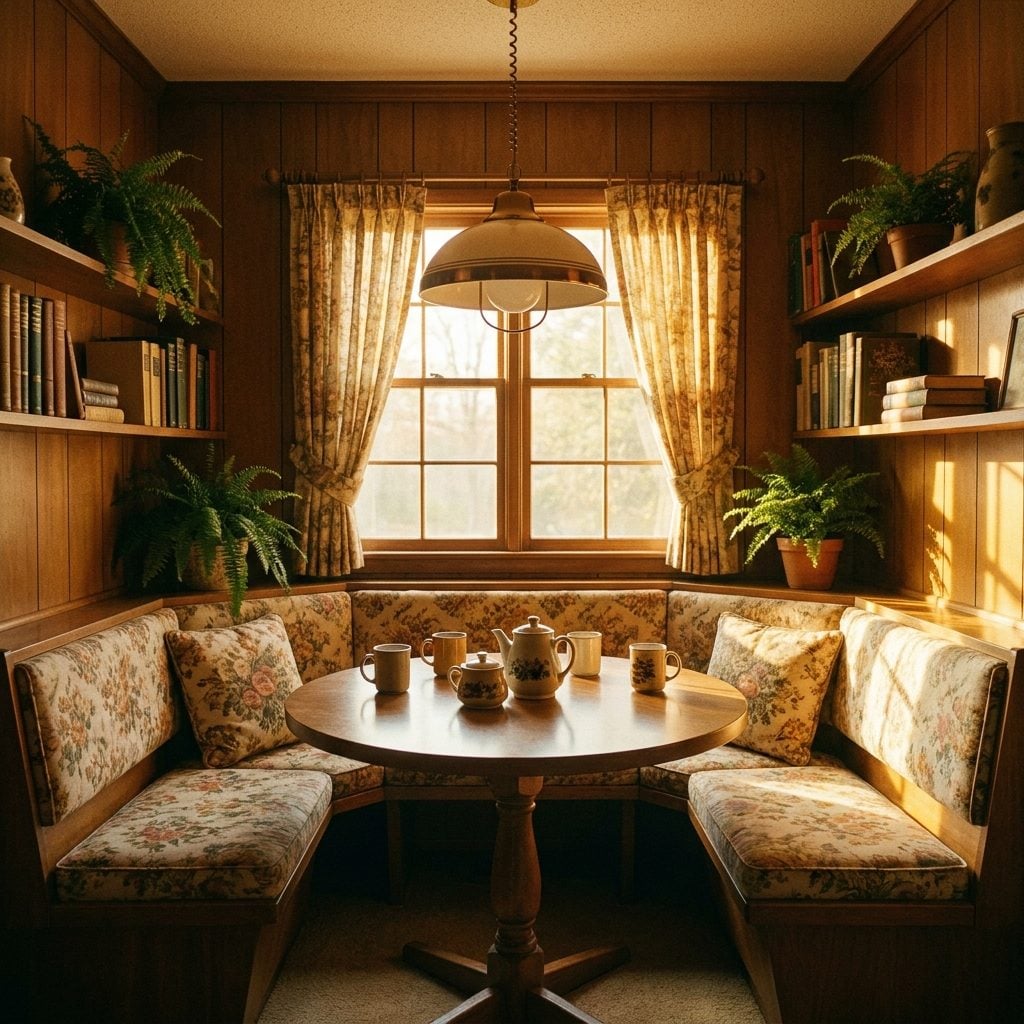
Two benches met in a corner around a table that required the inner passenger to slide in first and surrender all exit privileges until everyone else was finished.
The best versions hid storage beneath hinged seats: tablecloths, board games, serving dishes, and the good scissors that vanished for eleven months at a time.
Plaid cushions completed the arrangement, preferably under a sunny window.
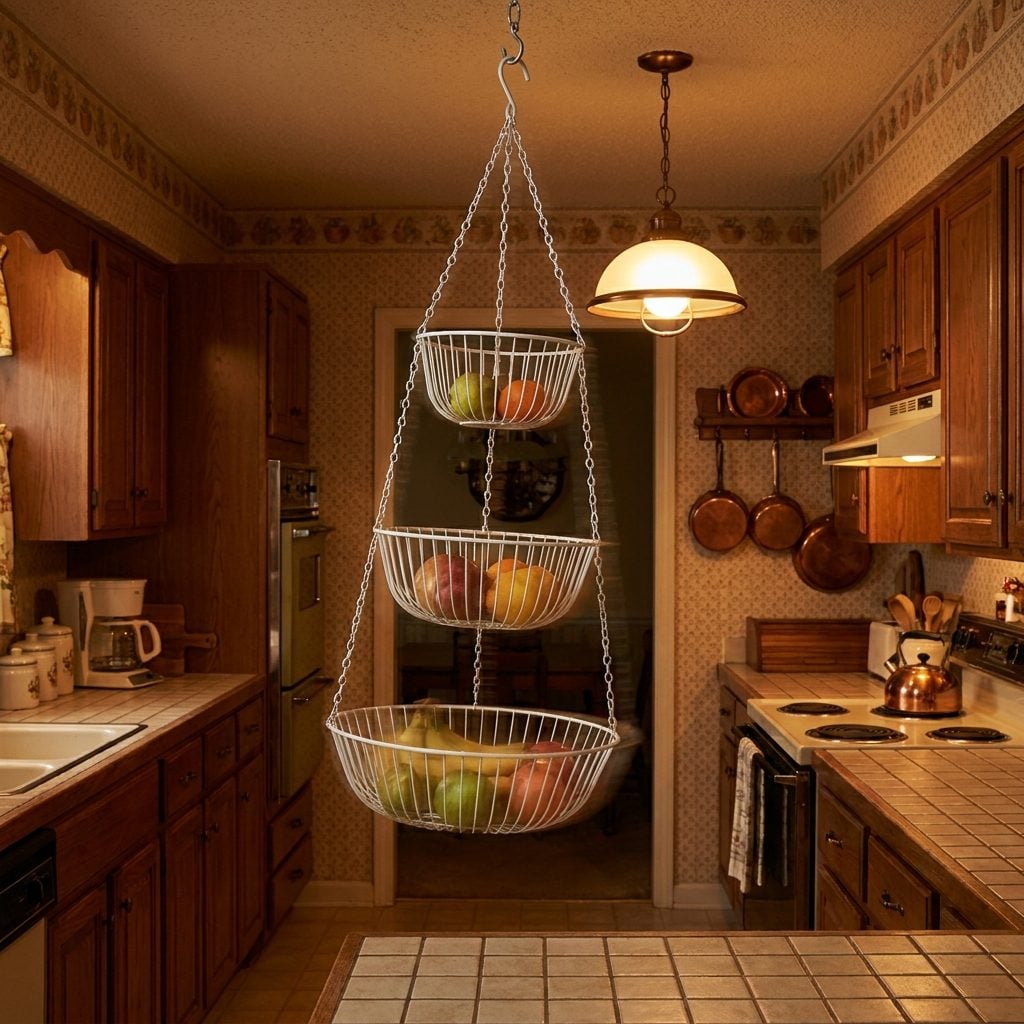
2. The Hanging Fruit Basket Freed the Counter and Threatened Everyone’s Shoulder
🔥 Would you like to save this?
Three wire baskets hung from one chain, each tier assigned a different category of produce until somebody ignored the system completely.
Bananas above. Apples and oranges in the middle. Onions and garlic below, continuously shedding papery evidence onto whatever sat underneath.
Brush past it and the whole arrangement swung for ten seconds. Beautiful? Debatable. Useful in a crowded kitchen? Absolutely.
1. The Refrigerator Door Became the Family Archive
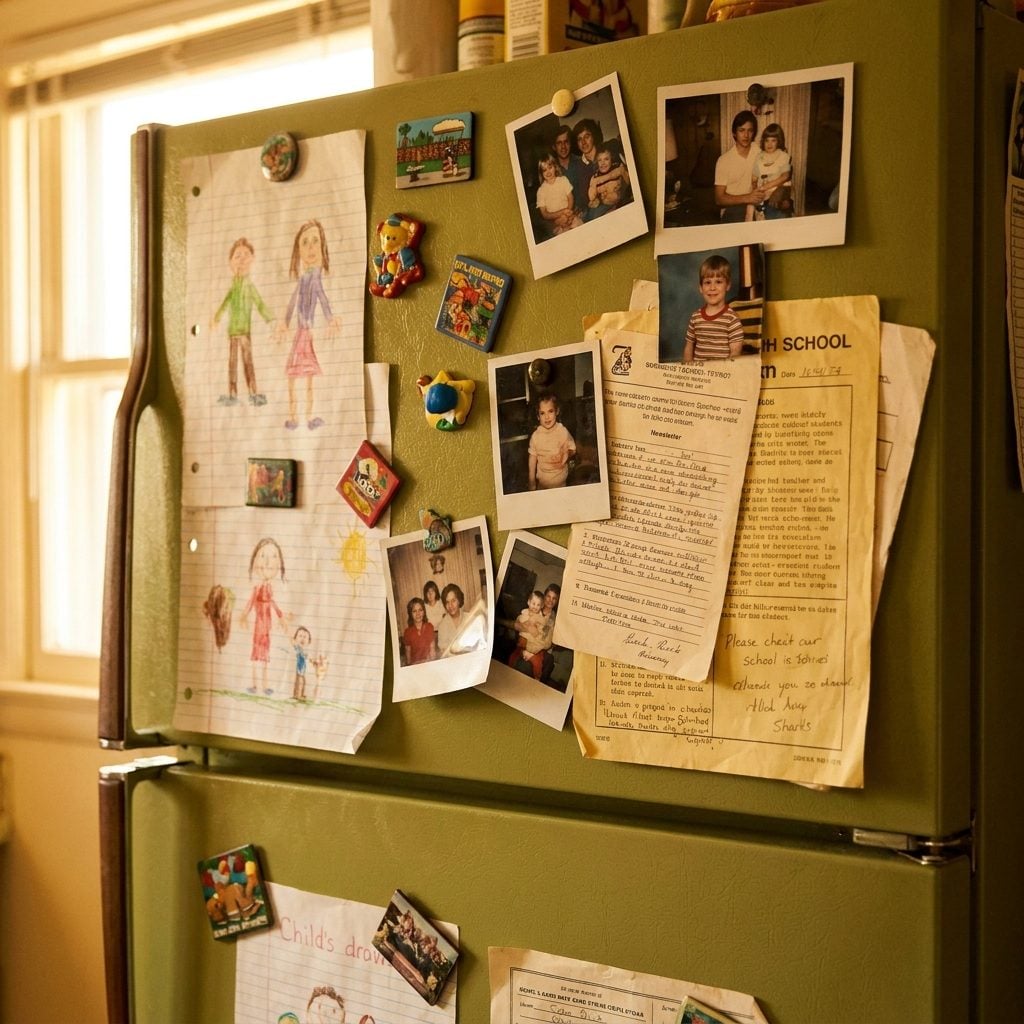
The refrigerator had three jobs: keep food cold, hold magnets, and explain what the family had been doing for the previous six months.
Spelling tests with gold stars disappeared beneath crayon drawings. Cousins smiled from wallet-size school photos. The lunch menu curled at one corner. A grocery list hung from a magnetic pad beside a souvenir pineapple working far beyond its original job description.
You could read the whole story of a household off the front of its refrigerator, if you stood there long enough.
Nobody designed the arrangement. It accumulated.
That may be why it feels more specific to childhood than any cabinet finish or appliance color. The fridge door was messy, temporary, sentimental, useful, and constantly changing — the one surface in the room nobody was trying to make match anything else.