🔥 Would you like to save this?
The Shaker cabinet has enjoyed a remarkably long reign. Four straight edges, one recessed panel, and apparently a lifetime appointment in the American kitchen. Paint it white, sage, navy, or whatever shade happens to be fashionable this year, and the same familiar rectangle reports for duty. Admirable staying power. Rather less admirable imagination.
In order to come up with the very specific design ideas, we create most designs with the assistance of state-of-the-art AI interior design software. Also, assume links that take you off the site are affiliate links such as links to Amazon. this means we may earn a commission if you buy something.
Meanwhile, cabinetry can do considerably more interesting things. Walnut bends around corners. Bronze appears to fold like fabric. Leather is woven into intricate geometric patterns. Marble migrates from the countertop onto the cabinetry itself. One kitchen turns its cabinet fronts into an enormous botanical painting; another gives them the swelling contours of sculpture. Some doors disappear into the wall. Others are impossible to ignore.
The possibilities extend well beyond expensive finishes. A change in grain direction can alter the proportions of an entire room. A curved front softens the hard geometry of conventional cabinetry. Translucent materials manipulate light, while concealed openings make a working kitchen vanish behind an apparently uninterrupted wall. Across these 38 designs, cabinetry becomes architecture, furniture, sculpture, and occasionally something approaching fine art. The Shaker door has had the floor long enough.
38. Glossy Black Cabinets Turn Reflection Into an Architectural Material
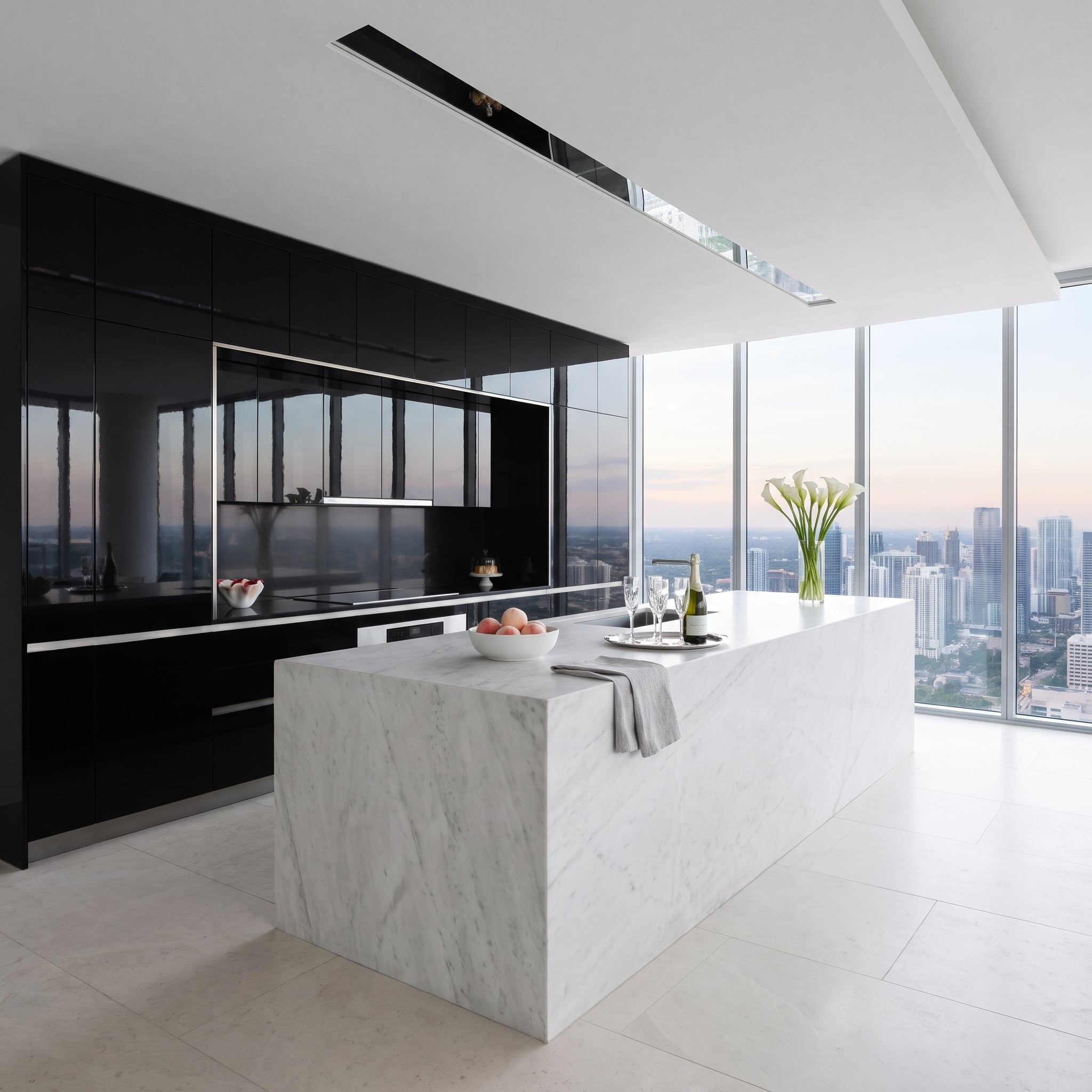
High-gloss black cabinetry creates a reflective wall that changes character with the light around it. Unlike matte black, which absorbs visual detail, the polished finish captures highlights and gives the dark surfaces an almost glasslike depth.
A pale Carrara-style marble island with waterfall ends provides a striking contrast in both color and finish. Irregular gray veining cuts across the cabinetry’s sleek reflections. Black lacquer and white marble: a familiar pairing pushed toward a more theatrical result through scale and sheen.
37. Box-Joint-Style Detailing Gives a Maple Island a Woodworker’s Signature
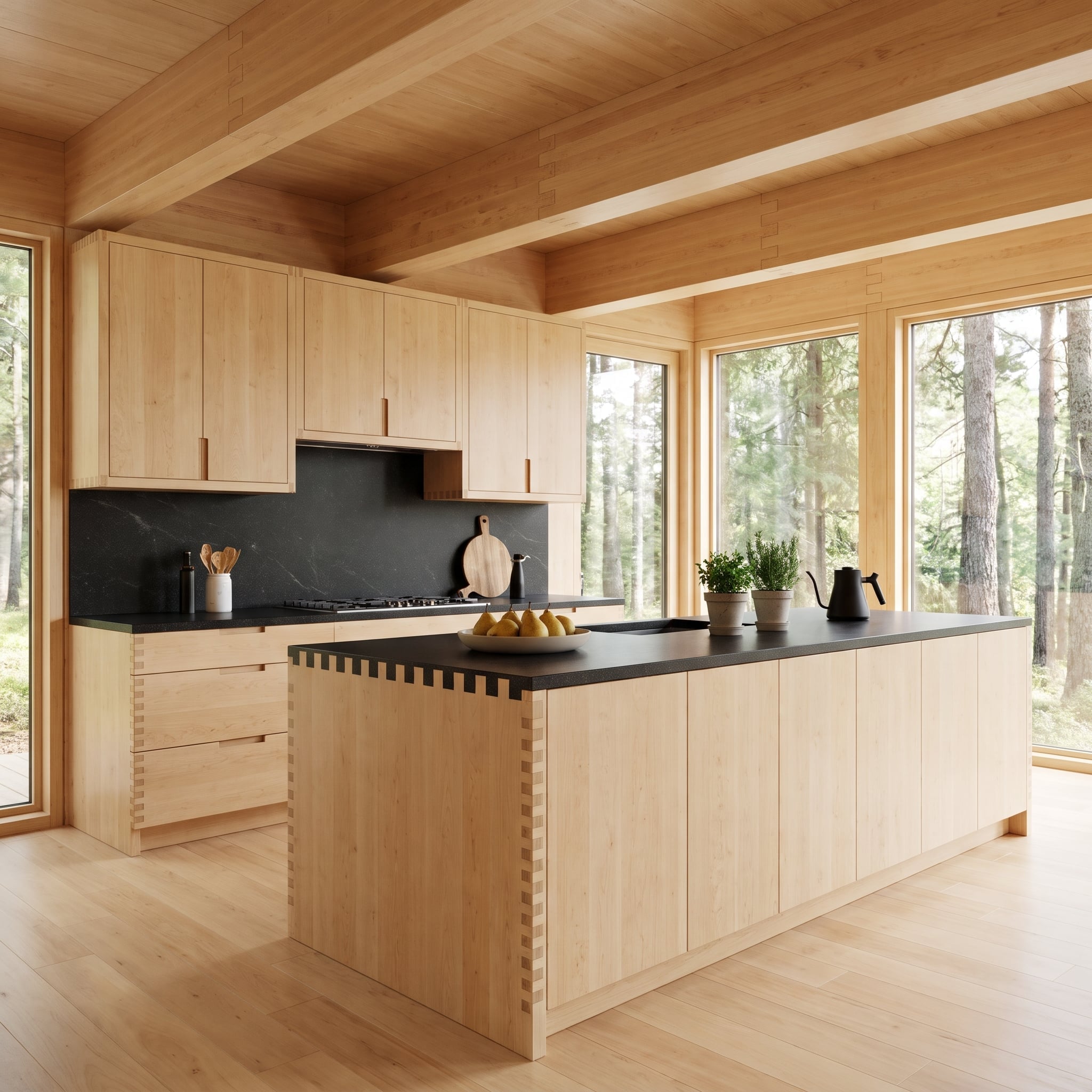
Light maple covers the cabinets, ceiling planks, and exposed beams, but the island corners deliver the real surprise. Alternating maple and black segments create a tightly patterned, box-joint-style treatment that gives the edges the character of finely made furniture.
Black stone countertops and backsplash establish a clean horizontal line against all that pale timber. Small leather-tab pulls barely interrupt the cabinet fronts. The design celebrates the visual precision of traditional woodworking without turning every surface into a decorative exercise.
36. Sculpted Ivory Cabinet Doors Make Flat Panels Look Positively Ancient
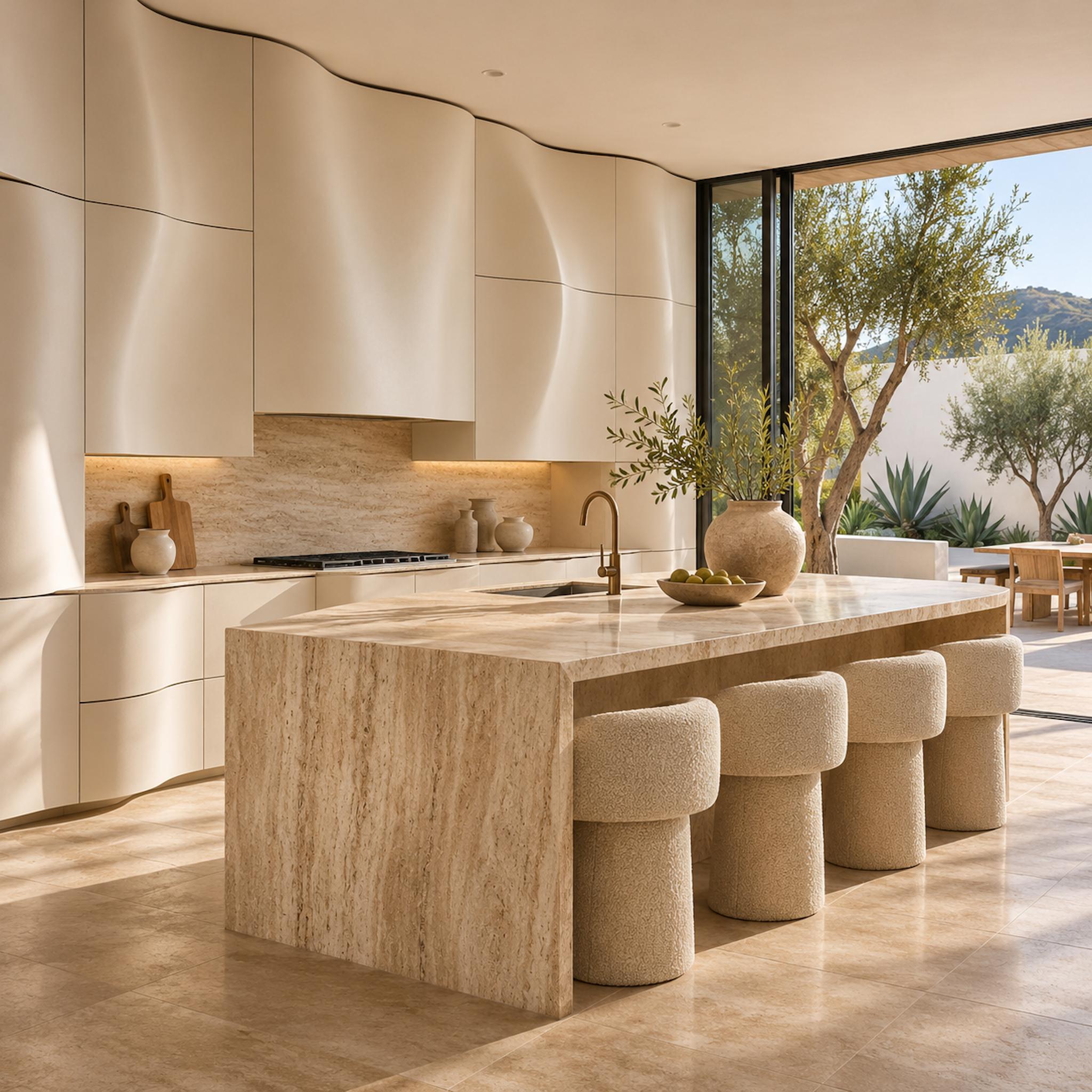
Warm ivory cabinet fronts swell outward and recede inward in broad, flowing curves, turning an entire storage wall into a sculptural composition. Fine door joints interrupt the undulating surfaces without sacrificing their architectural continuity. Strong daylight travels across the curves, drawing bright highlights along the raised sections and softer shadows into the recesses.
A substantial travertine island introduces a disciplined block of stone, while rounded upholstered stools echo the cabinetry’s softer geometry. Pale limestone flooring and expansive glazing maintain the restrained palette. The innovation is in the shape of the doors themselves: no applied decoration, no elaborate hardware, and scarcely a straight line in sight.
35. Checkerboard Walnut and Oak Turn Cabinet Doors Into a Graphic Pattern
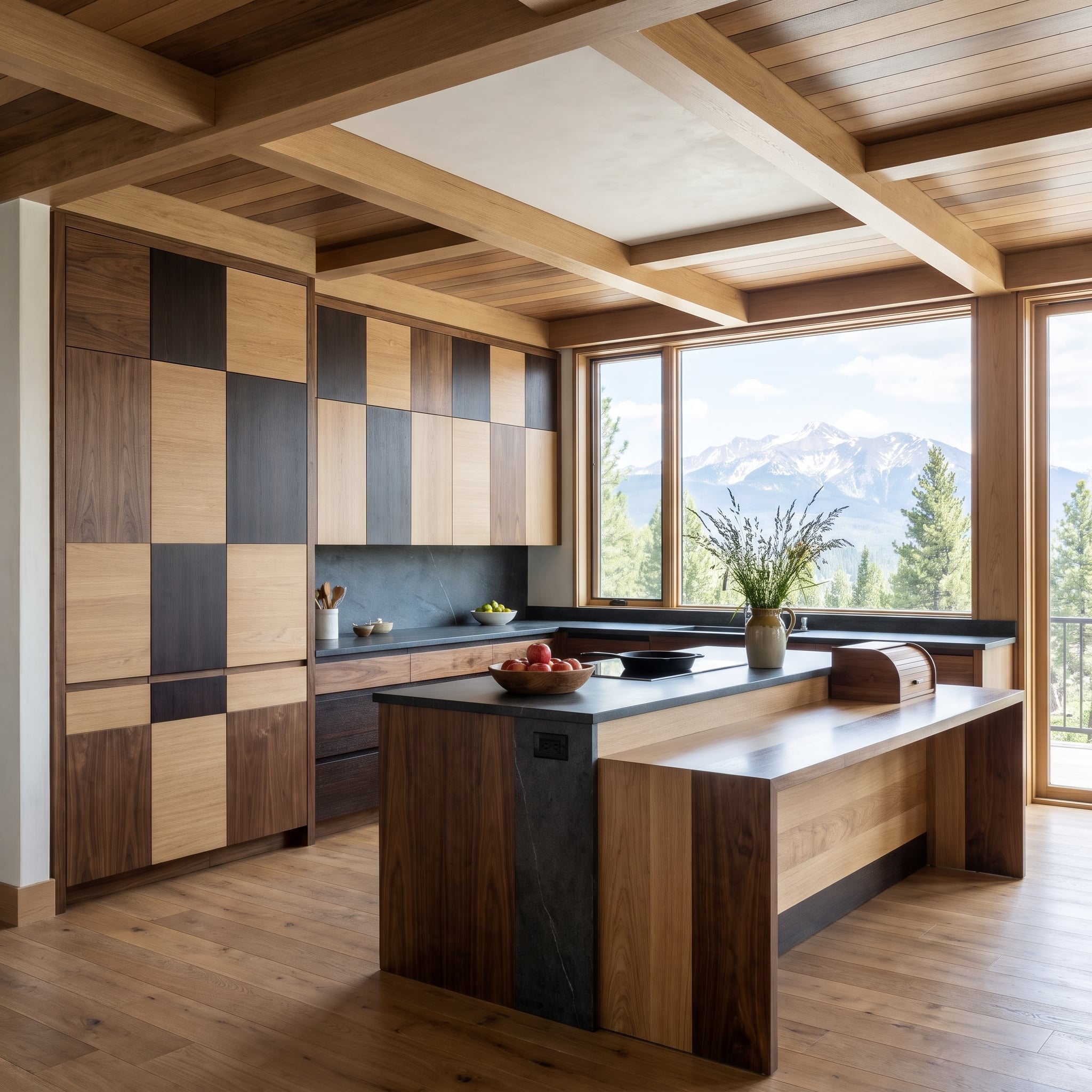
Alternating dark walnut and pale oak squares cover the cabinet wall in a large-scale checkerboard. No projecting hardware interrupts the pattern, allowing the difference in wood tones to carry the entire composition.
The island repeats the darker timber beneath a black countertop, with a lower seating extension at one end. Beyond the windows, a snow-covered mountain introduces an entirely different geometry. The cabinetry’s disciplined grid makes an effective foil for the irregular landscape.
34. Burgundy Lacquer Turns the Cabinets Into a Wall of Reflections
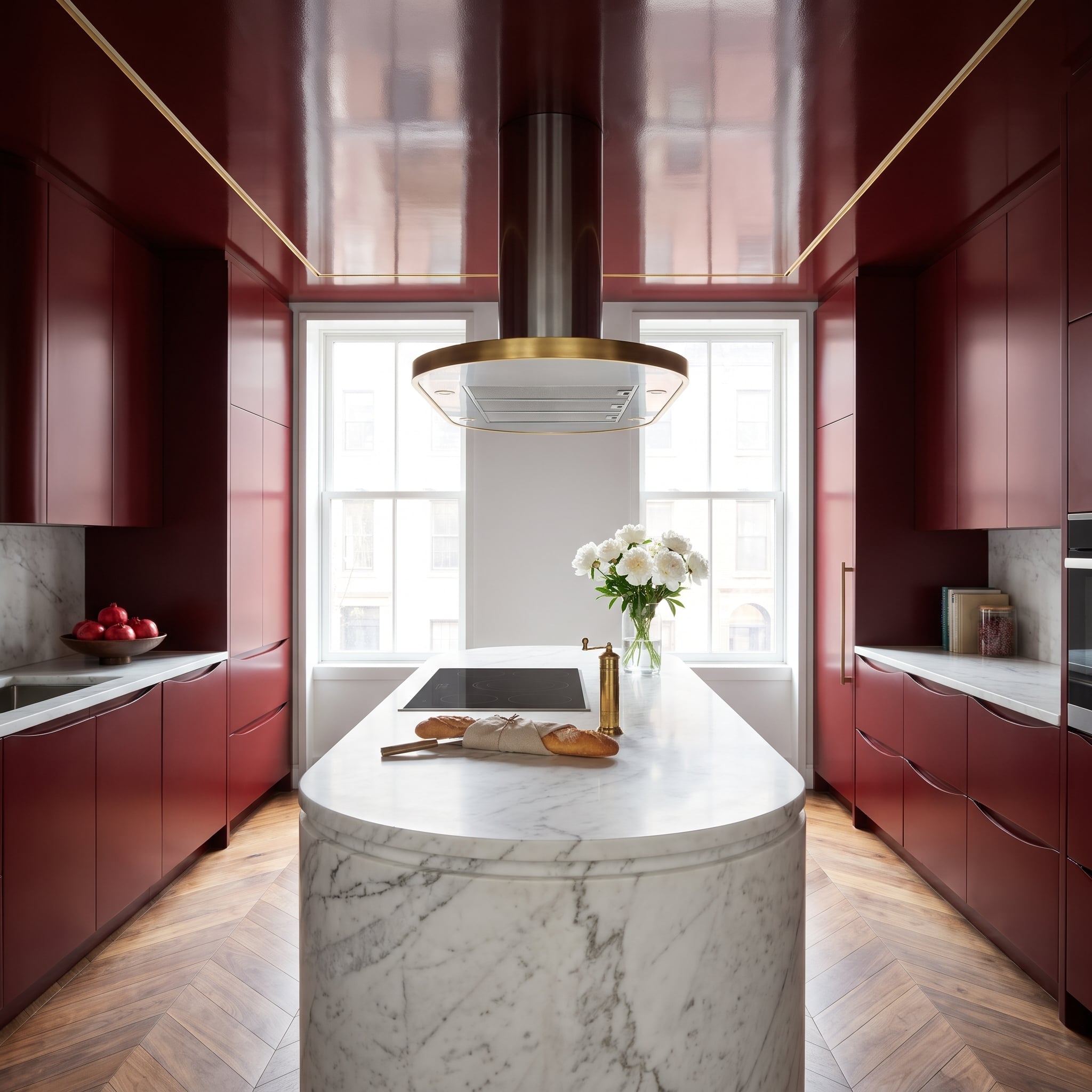
Burgundy lacquer covers the cabinet fronts in a saturated, reflective finish that gives every vertical surface an almost liquid depth. The matching ceiling extends the color overhead, while narrow brass trim lines prevent the enveloping red from becoming visually shapeless.
At the center, a cylindrical marble island supplies an emphatic change of geometry. Its pale veining and circular mass interrupt the glossy cabinetry, while chevron hardwood flooring introduces another pattern below. The combination is unapologetically theatrical, and the disciplined repetition of burgundy holds it together.
33. Sculpted Plaster Cabinetry Hides a Pantry Inside a Curved Wall
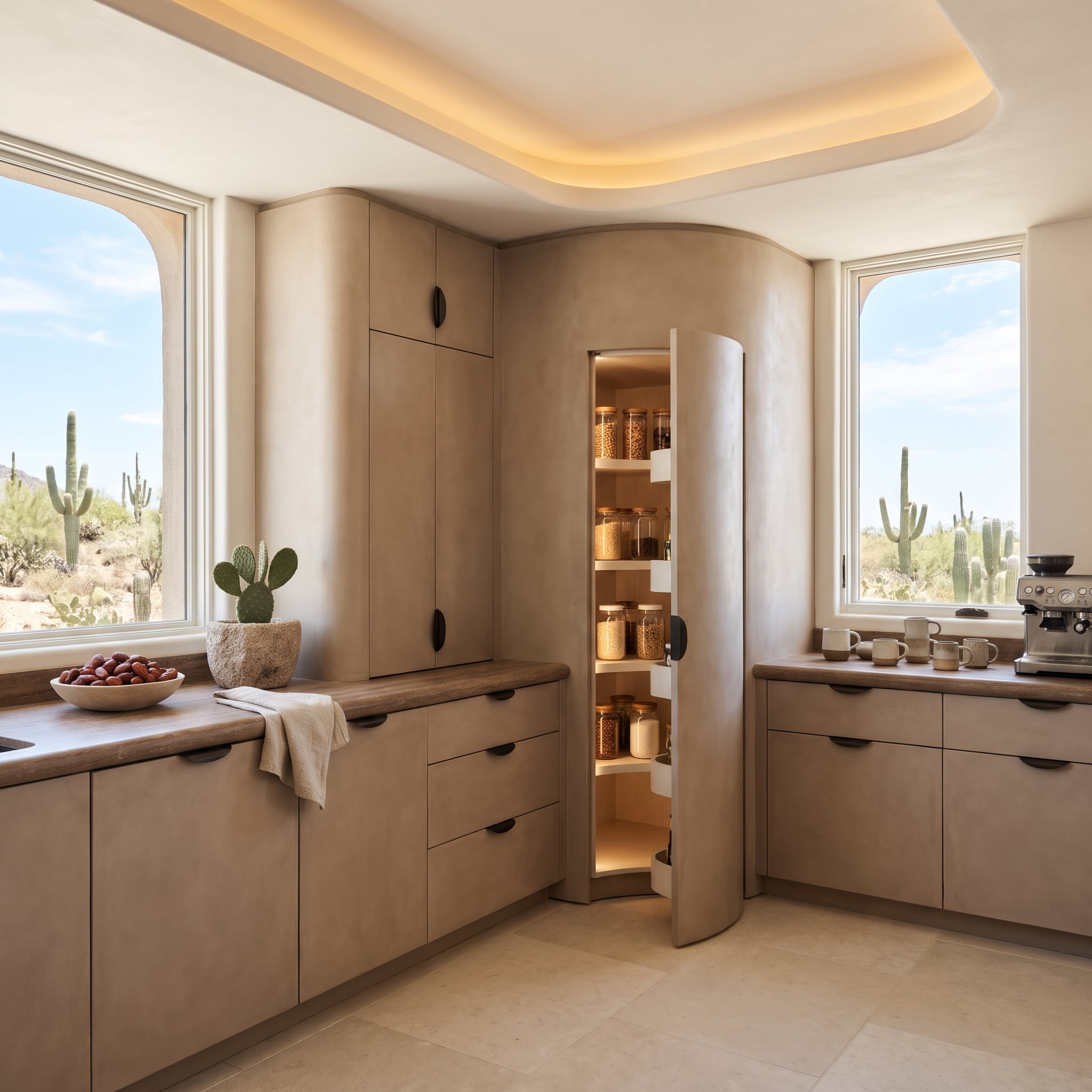
Warm plaster-finish cabinetry flows around the corner in broad, rounded forms, giving the storage wall the appearance of sculpted architecture. The absence of conspicuous handles reinforces the impression of a single uninterrupted surface.
Open the tall corner section and the quiet exterior gives way to illuminated pantry shelving filled with jars and kitchen supplies. A walnut countertop draws a warm horizontal line beneath the pale plaster. The most interesting part of this cabinetry may be the space it manages to conceal.
32. Oxidized Steel Cabinets Give Industrial Design a More Cultivated Edge
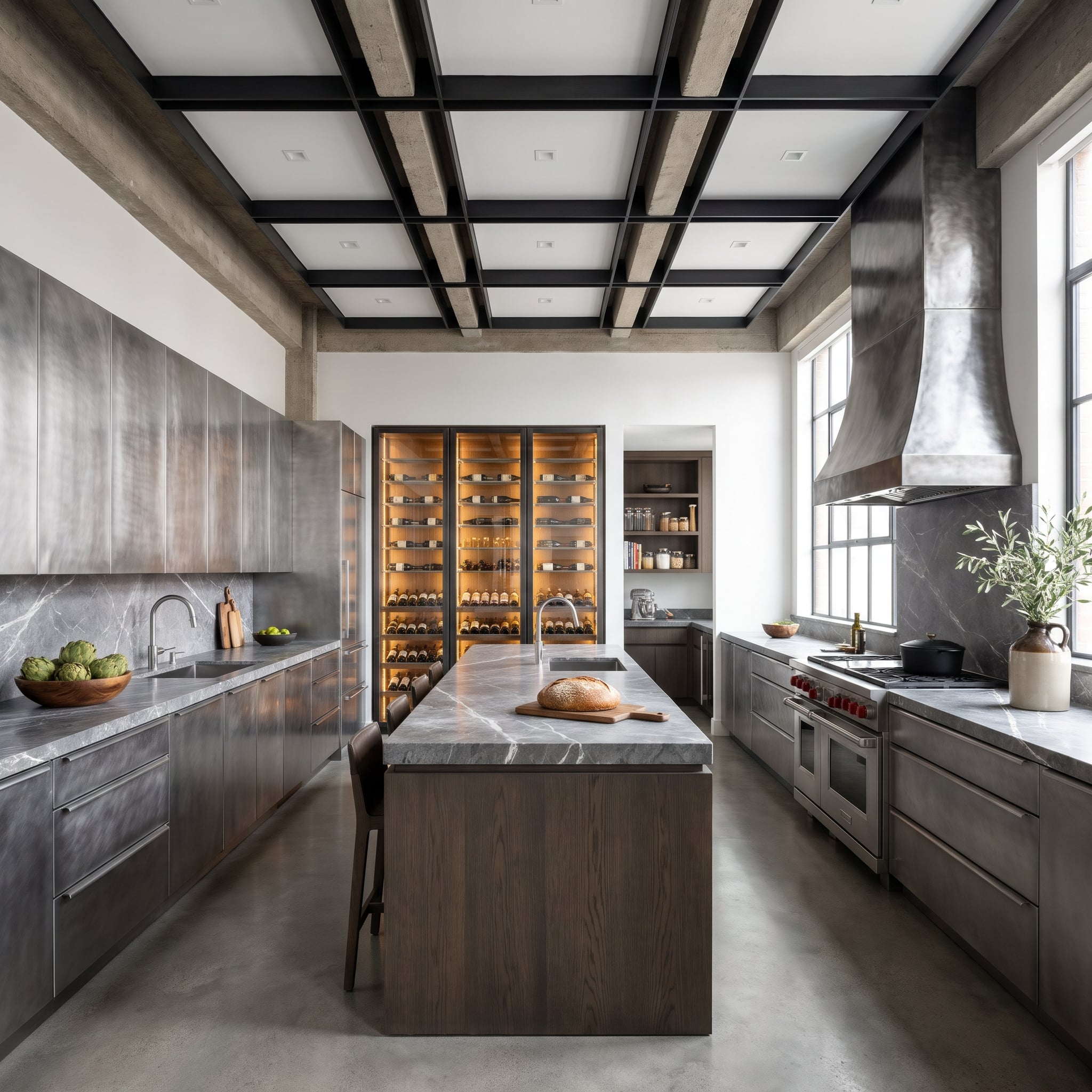
These steel cabinet fronts have the brown-gray variation of weathered metal, with subtle changes in tone that make the broad surfaces appear almost bronze. Their understated profiles leave the finish to supply the visual complexity.
A hammered metal hood brings a rougher, more tactile character above the range. Below, a dark-stained oak island and thick gray-veined marble top counter the metallic surfaces with wood and stone. Industrial materials rarely look this comfortable in one another’s company.
31. Reeded Oak and Blue-Gray Marble Give Handleless Cabinets Some Texture
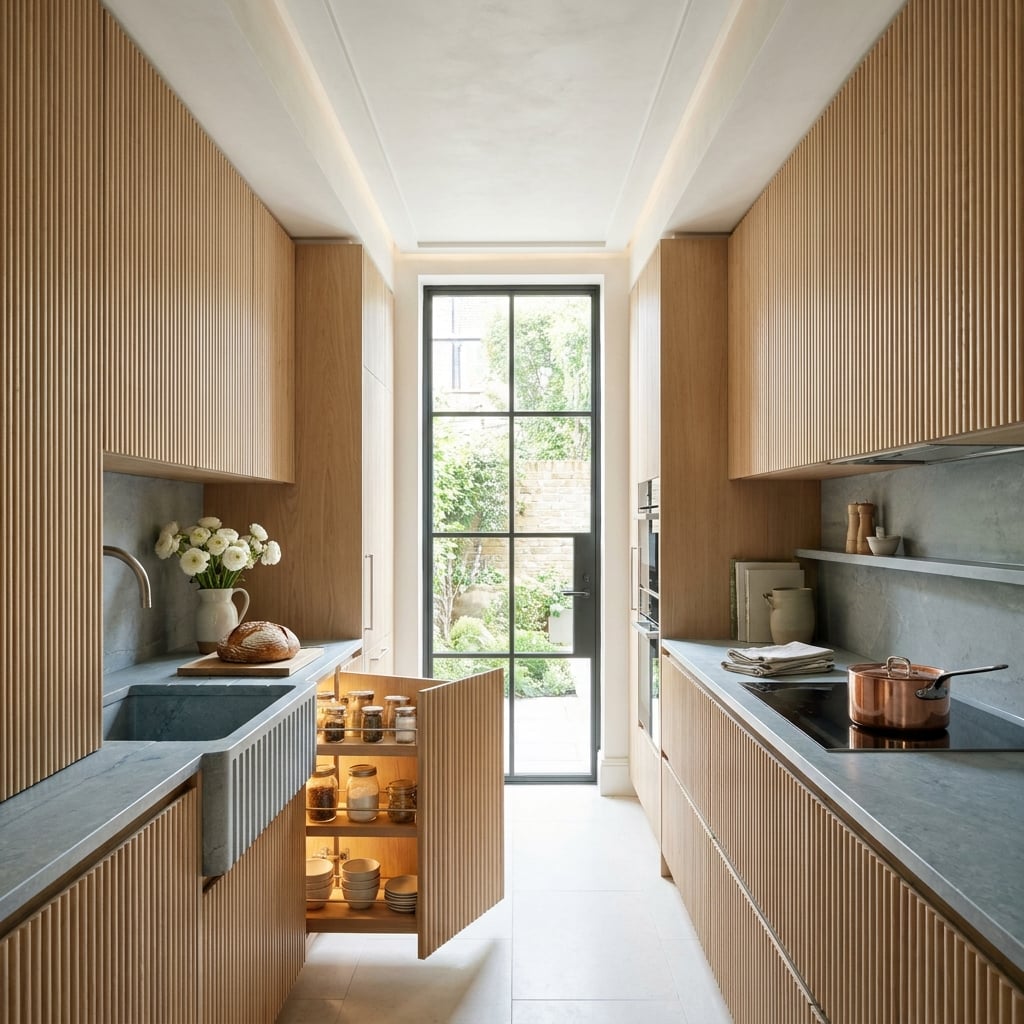
Reeded oak fronts extend along the cabinetry, replacing flat panels with a closely spaced series of rounded ridges. The texture breaks up the timber without requiring prominent handles or contrasting trim.
Honed blue-gray marble countertops sit cool and smooth beside the warm wood. One surface catches light along dozens of tiny curves; the other lets it spread across a broad plane. The cabinetry has plenty to say without a single ornamental flourish.
30. A Bronze Cabinet Wall Appears to Fold Under the Evening Lights
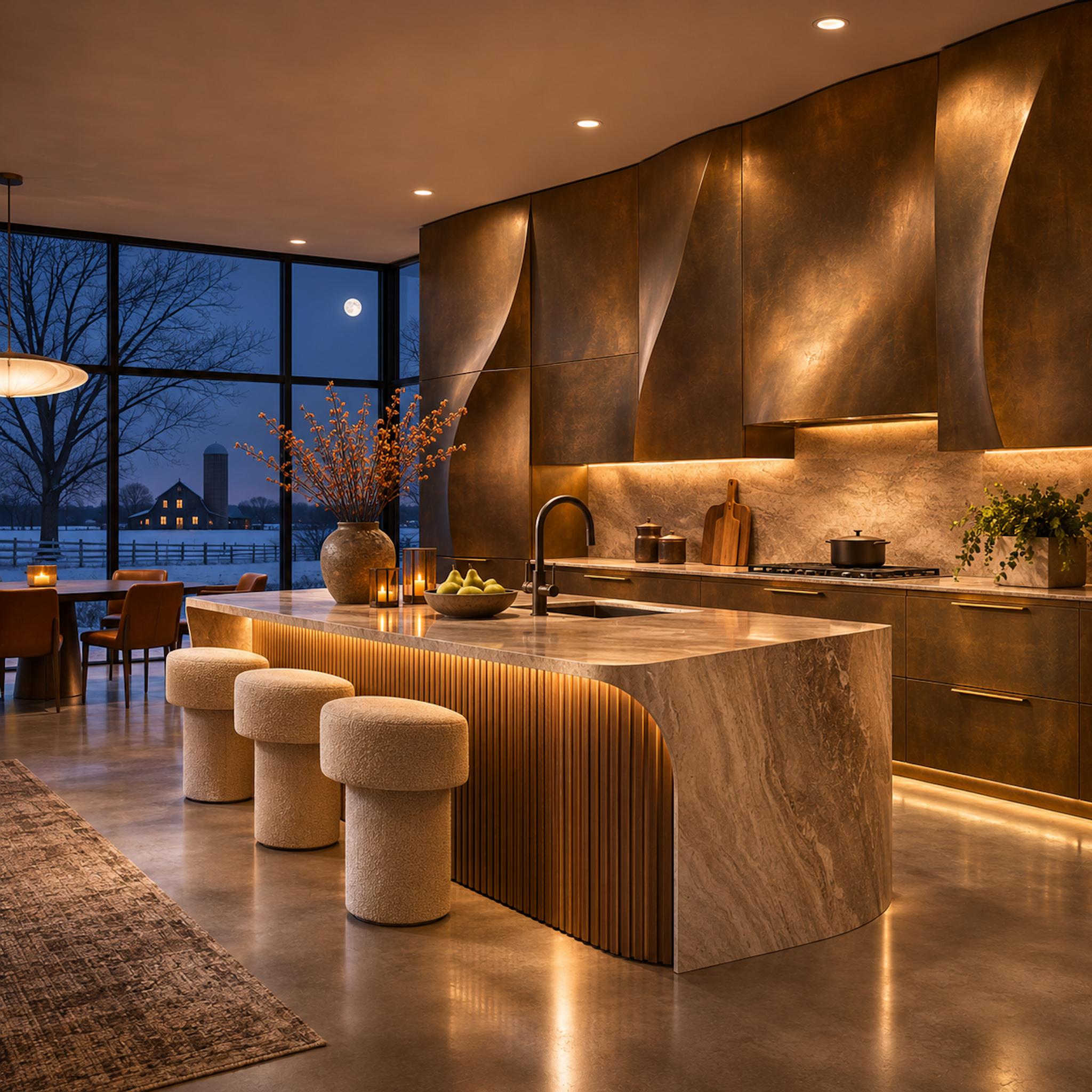
Bronze-toned cabinet fronts rise across the wall in broad sculptural planes, their surfaces bending into deep, tapered folds. Concealed lighting catches the ridges and sends narrow highlights across the patinated metal finish. The effect is closer to pleated architectural cladding than conventional kitchen joinery, although horizontal and vertical seams still identify the individual doors.
A pale stone island with a curved, vertically ribbed base changes the visual tempo. Beyond the glazing, a snowy rural landscape sits beneath a deep-blue evening sky. The cabinet wall supplies the drama; the surrounding materials give it room to breathe.
29. Calacatta Viola and Macassar Ebony Refuse to Play Supporting Roles
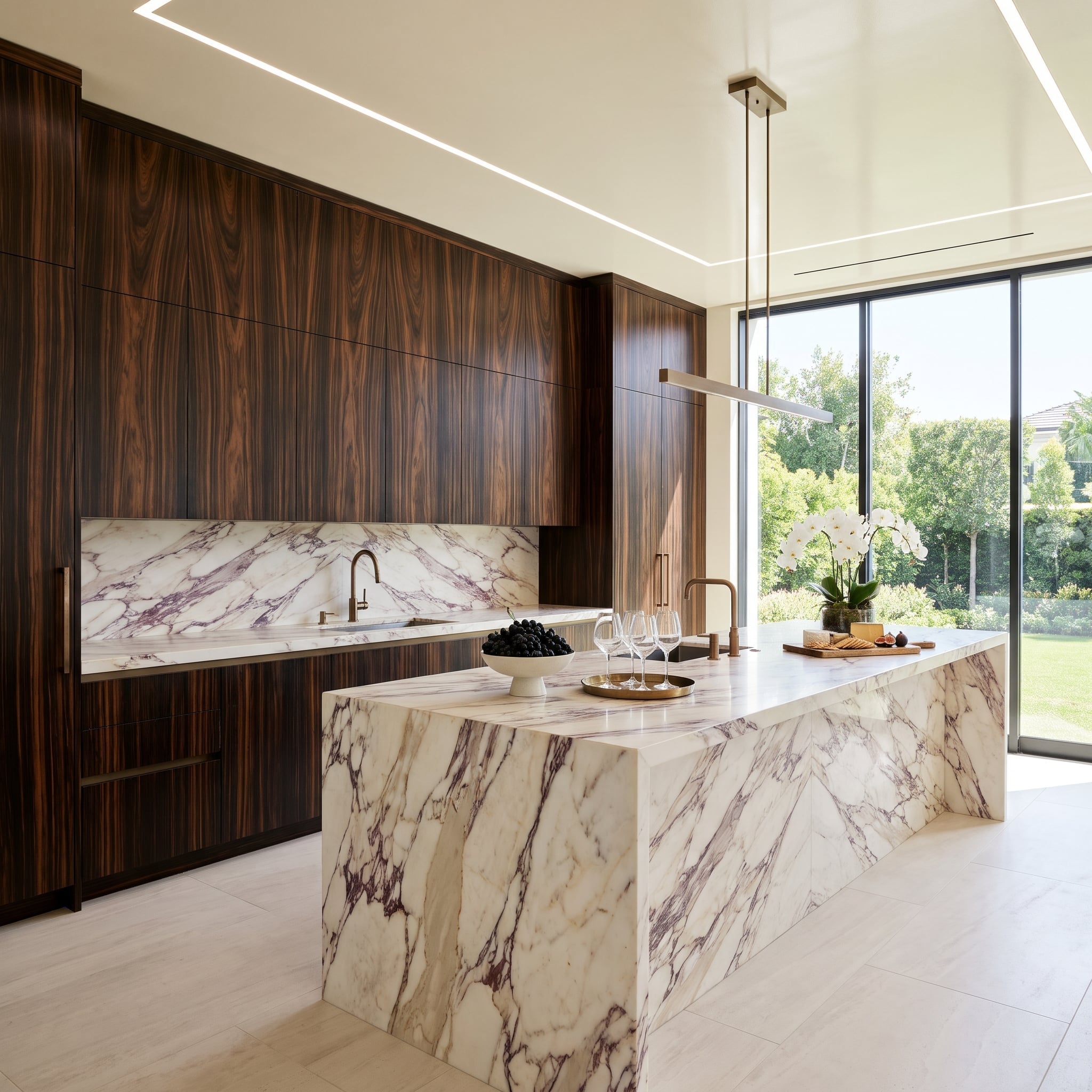
Macassar ebony veneer brings dramatic dark-and-light striping to the full-height cabinet fronts. The grain is so pronounced that the wood becomes a pattern in its own right, with long vertical lines emphasizing the height of the cabinetry.
Calacatta Viola marble answers with broad purple veining across the waterfall island and backsplash. Where the ebony is linear and tightly grained, the stone is irregular and expansive. Brass hardware introduces a third, quieter material, leaving wood and marble to conduct the argument.
28. Sage Cabinets and Reeded Glass Trade Solid Doors for a Little Mystery
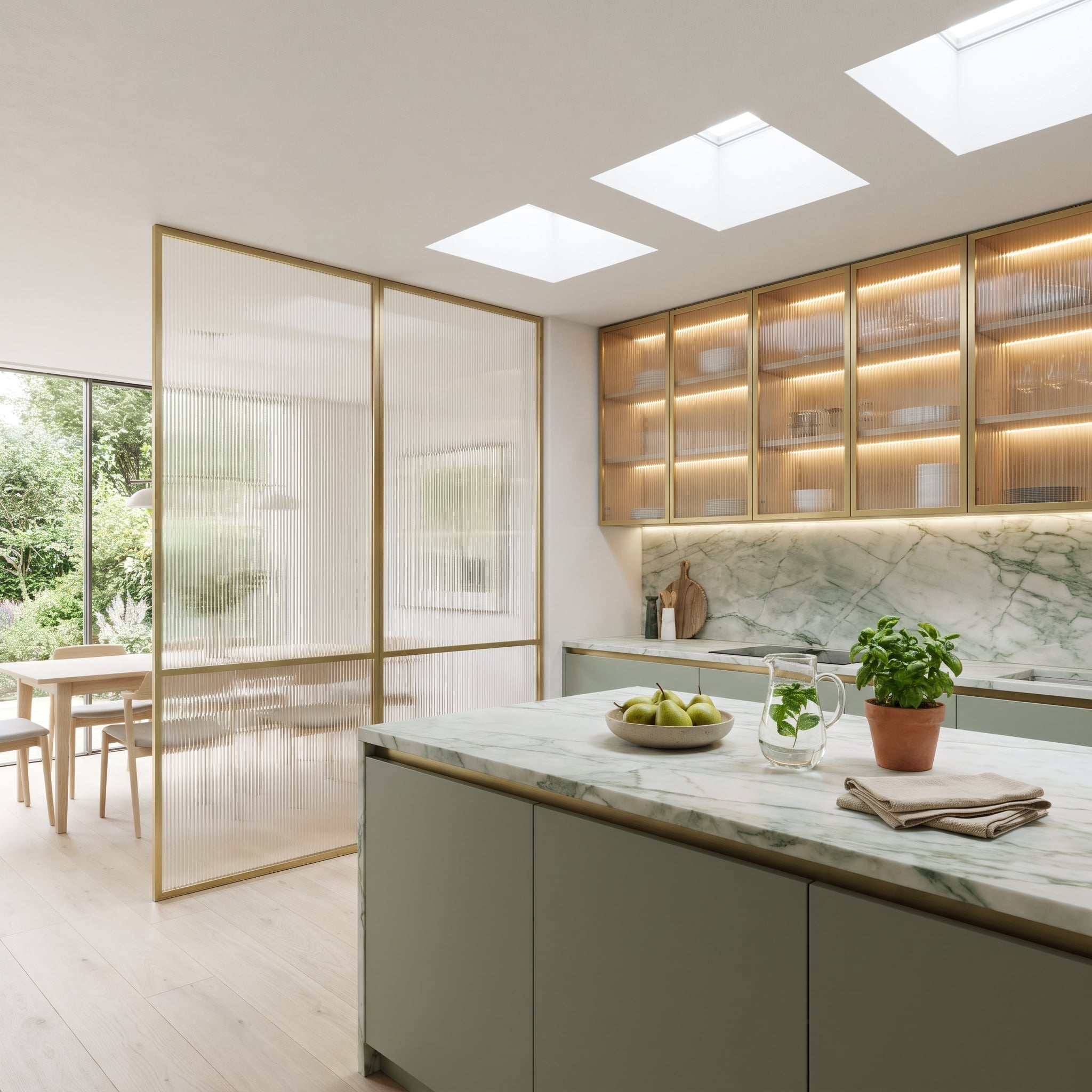
Sage-to-celadon cabinetry establishes a soft green base, while brass edging outlines the countertops with fine metallic accents. Above, reeded-glass cabinet doors obscure the contents just enough to turn illuminated dishware into shapes and silhouettes.
Green-veined marble connects the island and backsplash, and a brass-framed fluted-glass partition carries the ribbed texture into the adjoining dining area. Solid painted fronts, translucent glass, and reflective metal each handle light differently. That variety gives the restrained color scheme its depth.
27. Parquetry Cabinet Fronts Make the Wood Grain Do Something Unexpected
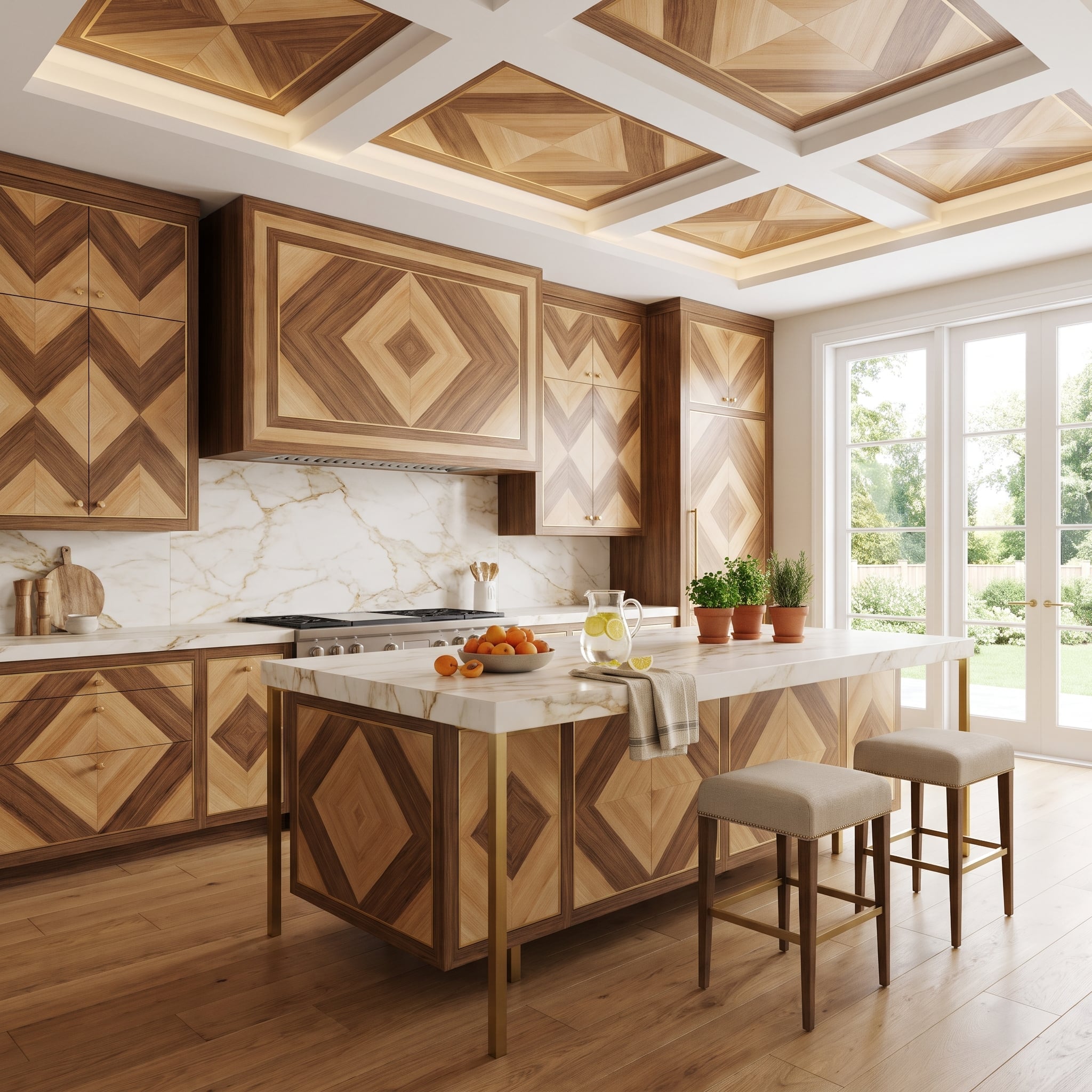
Walnut and pale maple veneers form repeating diamond motifs across the cabinet fronts, turning the storage walls into a composition of contrasting wood grain. The pattern has the intricate character of parquet flooring, except here it climbs vertically across the kitchen.
The coffered ceiling echoes the diamond geometry within a lighter structural grid. A marble island offers a welcome expanse of relatively unpatterned stone between the busy woodwork above and around it. Slender brass supports lighten its appearance. Elaborate coordination, certainly, but the room knows which pattern it wants to follow.
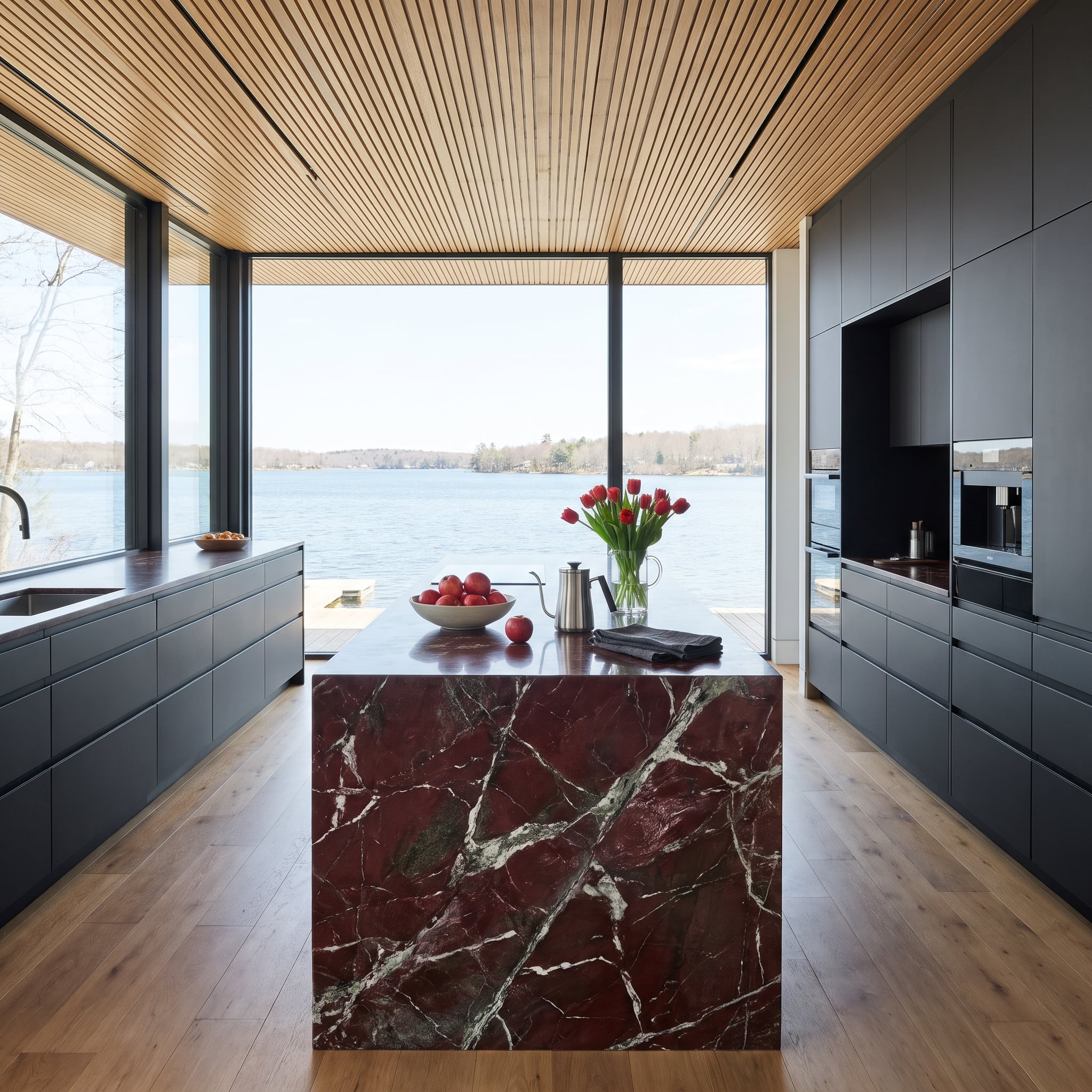
26. Rosso Levanto Marble Gives Charcoal Cabinets a Formidable Neighbor
🔥 Would you like to save this?
Matte charcoal cabinets stretch across the walls in broad, hardware-free planes. Their uniform darkness creates an unusually quiet backdrop for an island faced in Rosso Levanto marble, where white veins cut sharply through deep crimson stone.
A gently curved wood-slat ceiling adds warmth above the severe cabinet fronts, and tall glazing opens the room toward a lake. The charcoal cabinetry succeeds by refusing to compete. Against such an emphatic piece of red stone, silence is a perfectly respectable design decision.
25. Fluted Oak Rounds the Corner and Leaves the Right Angle Behind
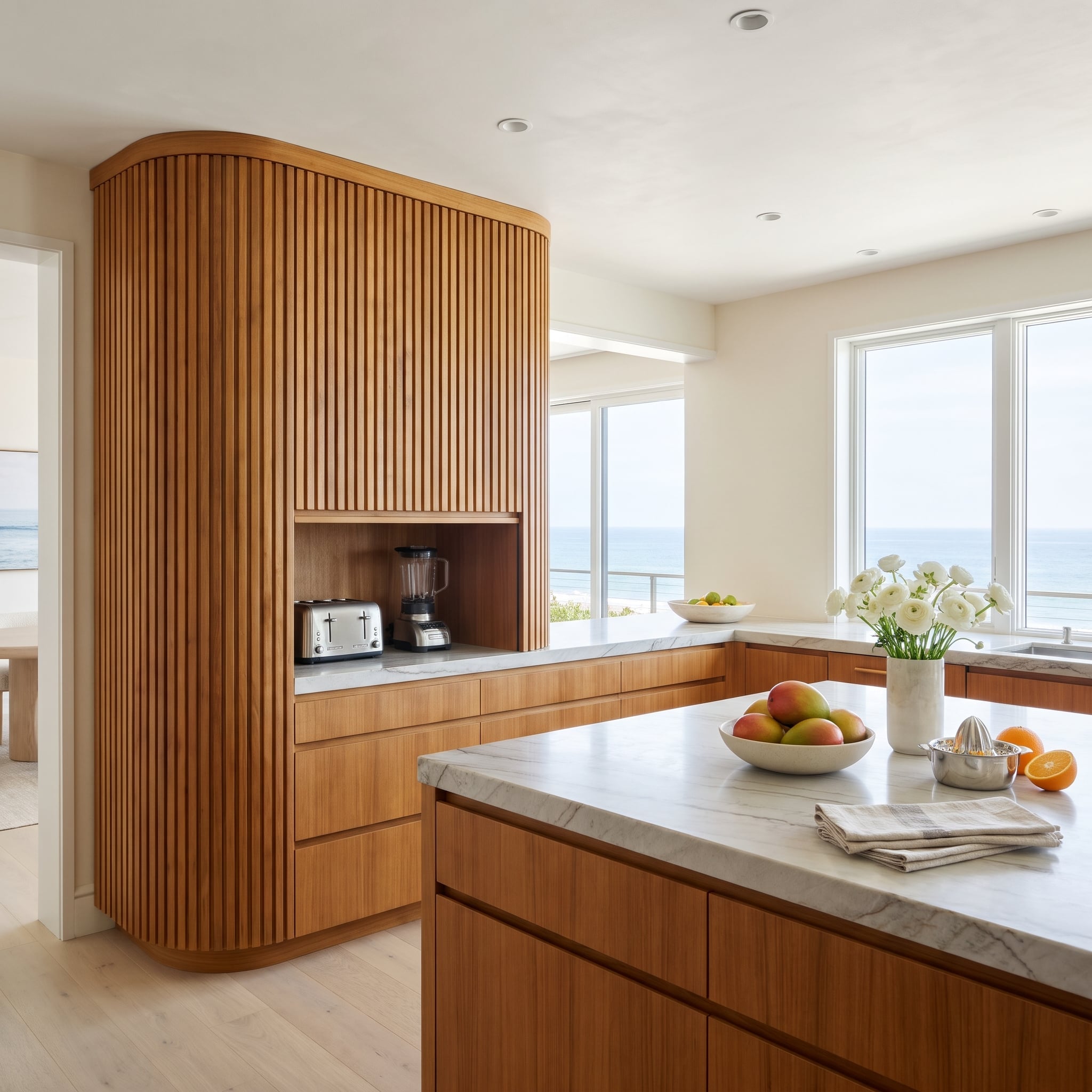
A full-height oak cabinet tower rounds the corner in one continuous sweep of narrow vertical fluting. Instead of ending abruptly at a perpendicular wall, the wood appears to bend around the architecture. The closely spaced grooves make the curve particularly expressive, creating alternating bands of light and shadow.
A recessed appliance niche accommodates a toaster and blender without abandoning the surrounding timber treatment. White marble countertops cut a crisp horizontal line beneath the warm oak, while expansive windows keep the composition bright. The cabinet corner has become the room’s principal architectural gesture.
24. Glowing Stone Cabinet Doors Turn a Desert Kitchen Into a Lantern
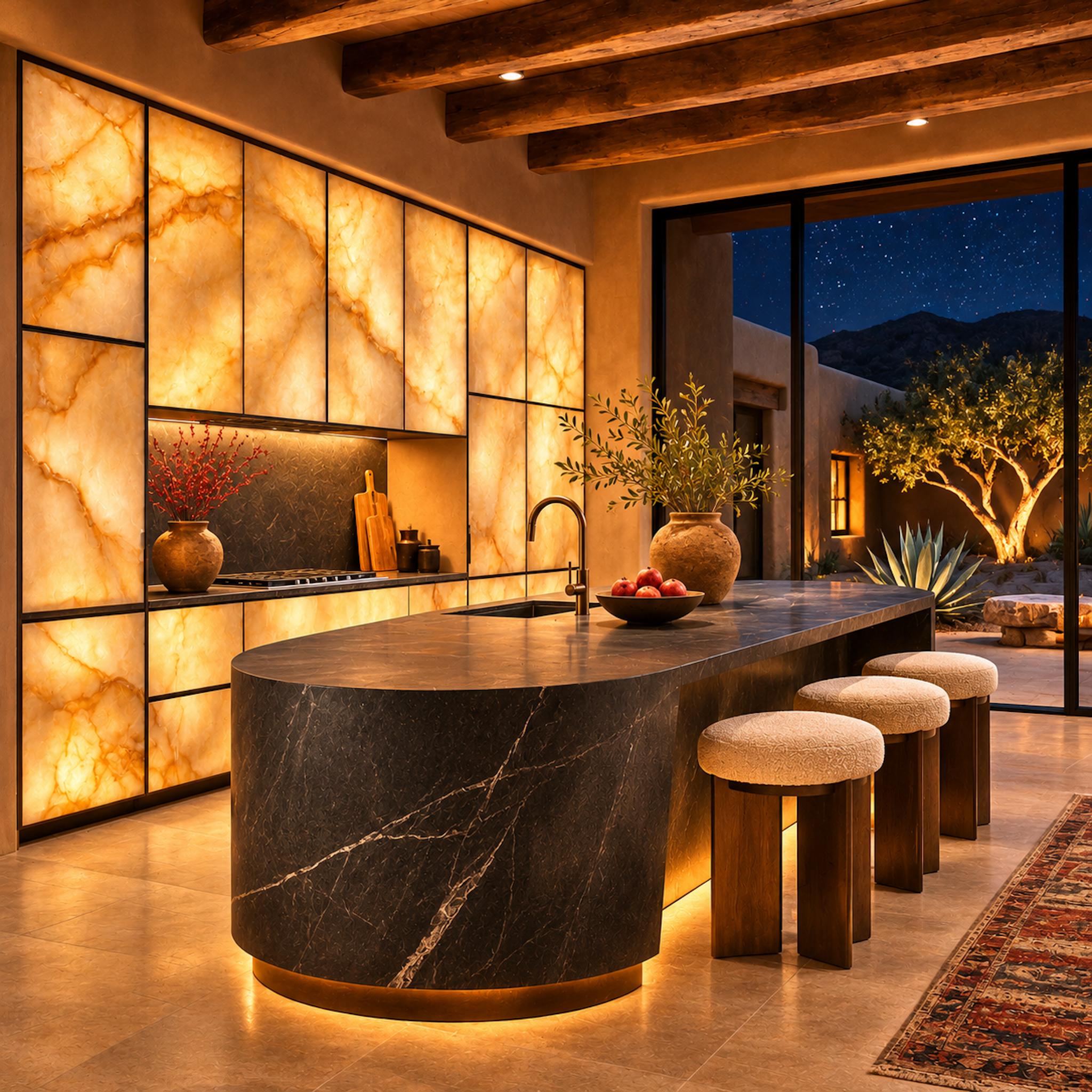
Translucent amber-and-cream stone-like panels fill a wall of tall cabinets, their intricate veining made spectacularly visible by concealed backlighting. Slim dark frames establish the door divisions, while the illuminated surfaces transform the cabinetry into a continuous composition of mineral color and pattern. This is storage designed to be admired even when every door is closed.
Dark timber beams and warm plaster anchor the luminous display. A charcoal stone island with a rounded end cuts across the golden glow, while the desert courtyard beyond the glass remains comparatively dark. The cabinet wall has become the room’s principal light source as well as its defining design feature.
23. Navy Fluting Meets a Walnut Coffered Ceiling
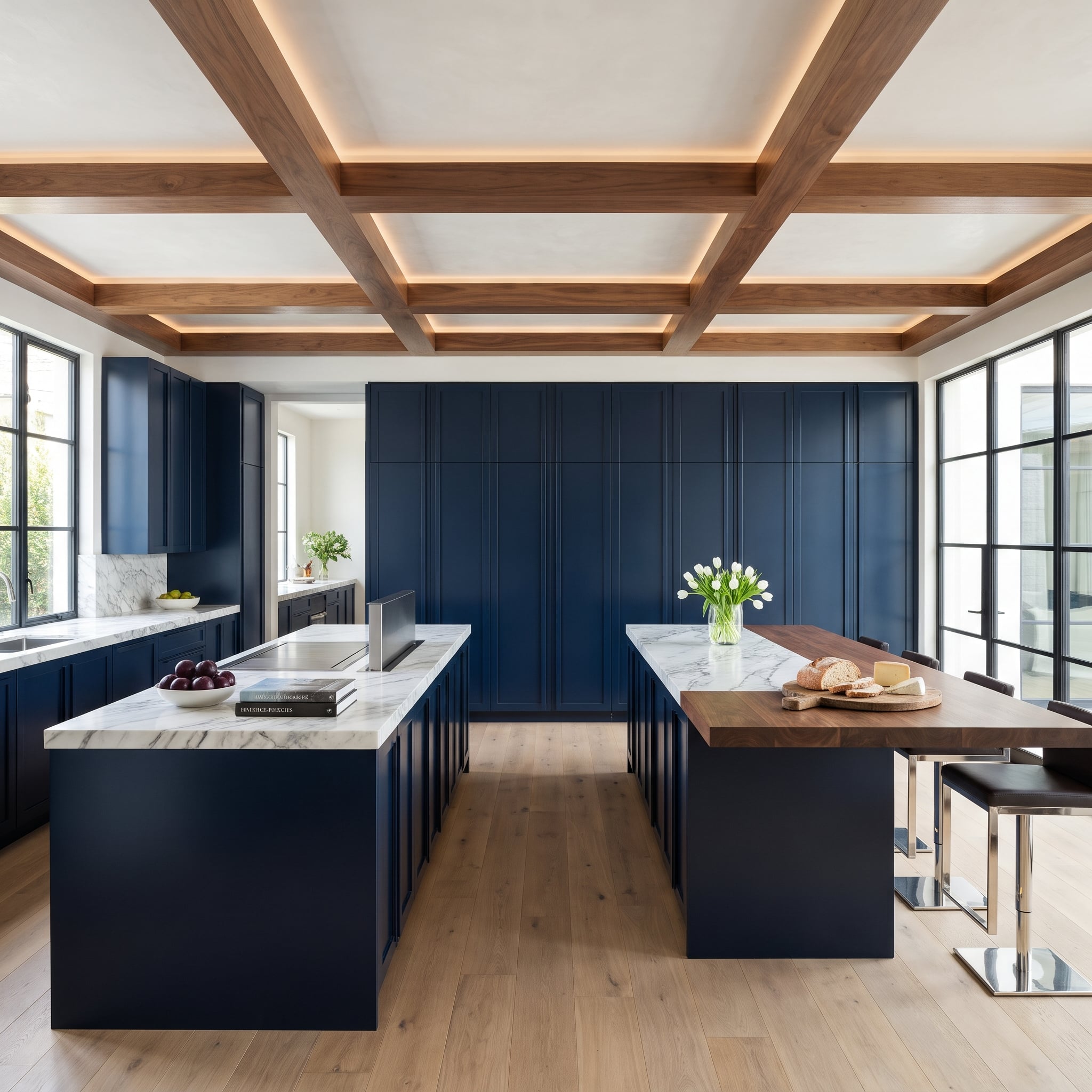
Deep navy cabinet fronts carry narrow vertical fluting across the back wall and both islands. The repeated grooves give the dark blue surfaces a measured rhythm, while white marble countertops stretch across them in broad, uninterrupted planes.
Overhead, walnut coffers with integrated lighting establish a second architectural grid. One island extends into a lower walnut dining surface, linking the ceiling’s warm timber with the working level of the kitchen. Vertical grooves below, rectangular coffers above, and enough marble between them to keep the two from arguing.
22. White Oak Cabinetry Gets the Gold Treatment With Brass Inlay
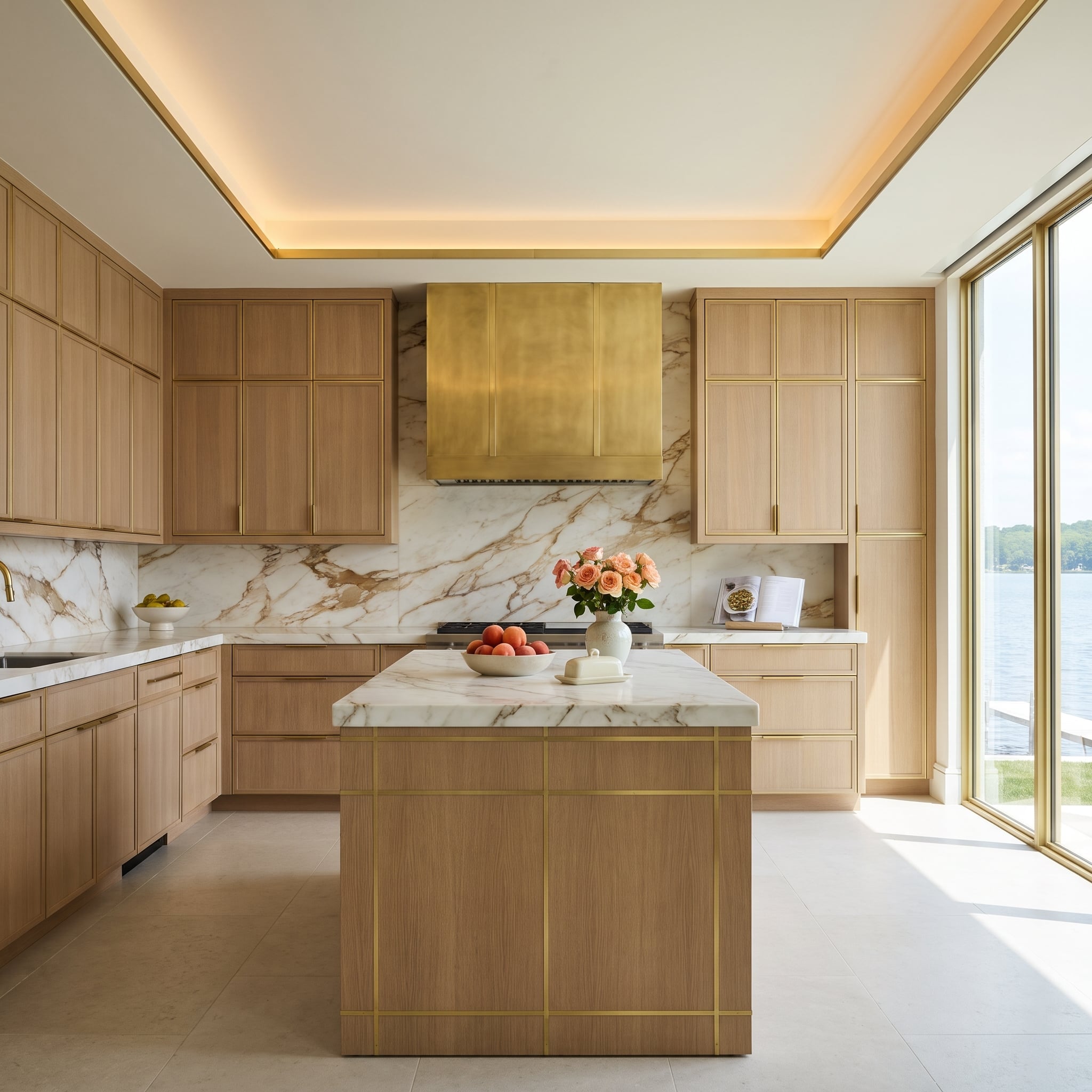
Rift-cut white oak supplies a straight, closely spaced grain that makes an excellent backdrop for fine brass inlay. Thin metallic lines trace the cabinet fronts and continue across the island base, introducing a precise graphic pattern without obscuring the timber.
A smooth brass hood gives those delicate lines a larger counterpart, while Calacatta-style marble with warm veining bridges the wood and metal. Cove lighting adds a soft glow overhead. The effect depends on meticulous detailing rather than oversized decorative gestures.
21. Dark Olive Cabinets Conceal an Entire Prep Kitchen
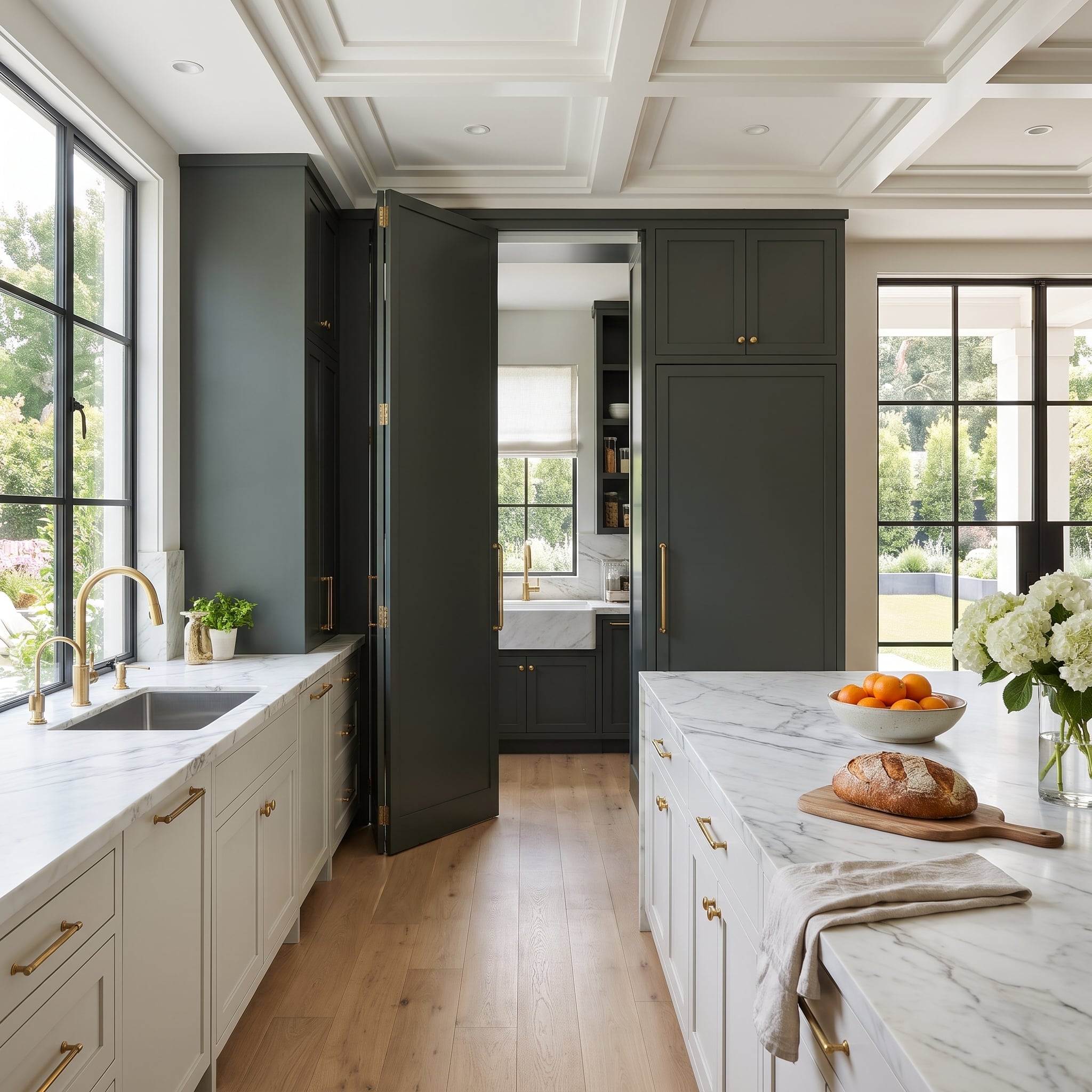
Dark olive cabinetry rises above white lower cabinets, its finish shifting between charcoal-green and muted sage as light moves across the panels. The color contrast gives the main kitchen a layered appearance without resorting to ornate door profiles.
Full-height olive doors open to reveal a separate preparation space behind the cabinet wall. Closed, they preserve the continuity of the dark cabinetry; open, they transform the working arrangement of the kitchen. Marble counters and a coffered ceiling add interest, but the concealed opening is the feature that changes how the room functions.
20. Horizontal Fluting Gives Gray Cabinets a Different Kind of Rhythm
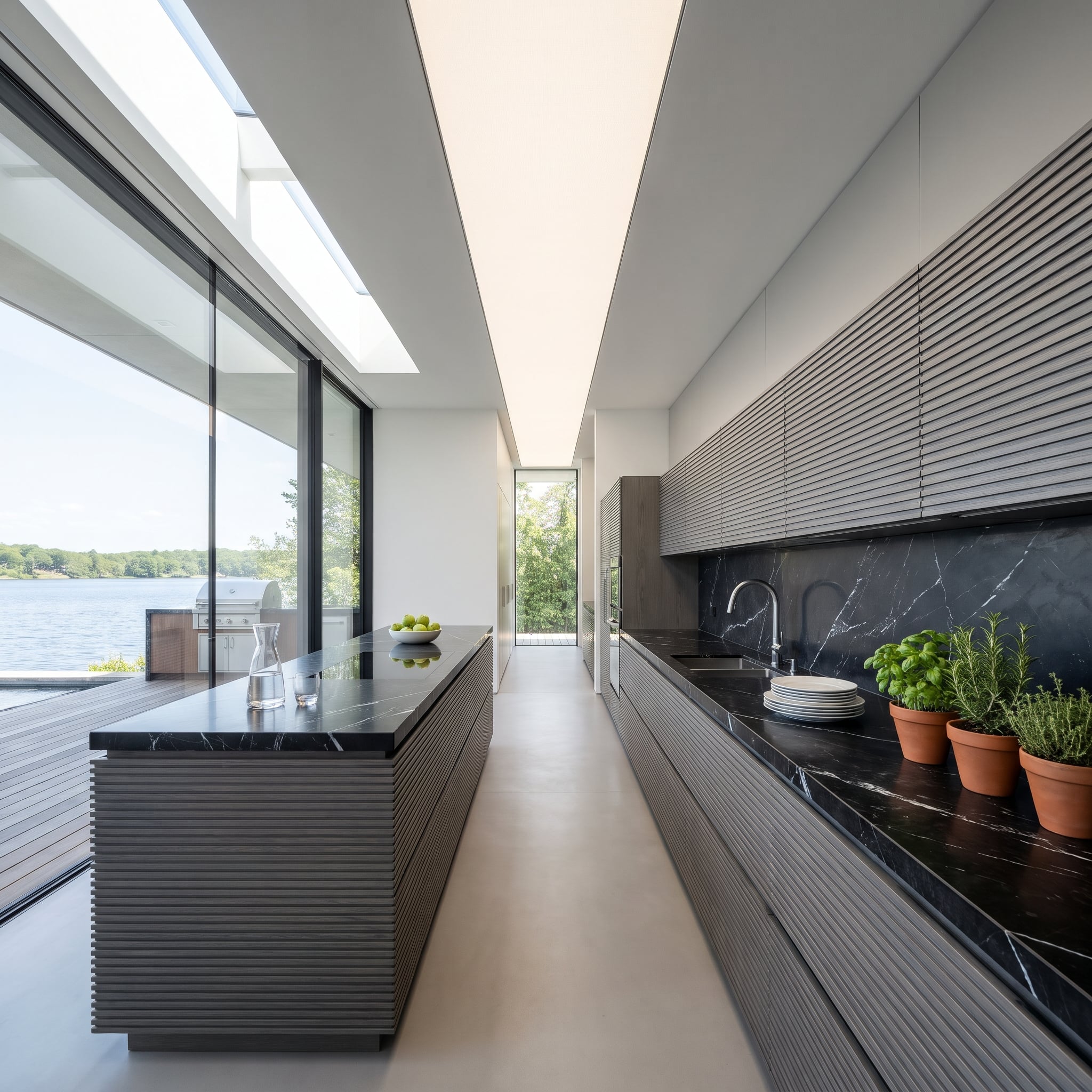
Horizontal grooves stretch across the gray cabinet fronts, emphasizing the length of the kitchen rather than the height of its walls. The closely spaced channels create fine shadow lines that distinguish the surfaces from ordinary flat-panel cabinetry.
Black marble with white veining covers the island and perimeter countertops, introducing a more irregular pattern against the disciplined grooves. Terracotta pots of herbs provide small, earthy accents near the sink. Running the fluting sideways changes the apparent proportions of the cabinetry, a deceptively simple departure from the usual vertical treatment.
19. Wave-Carved Travertine Makes the Island Look Almost Geological
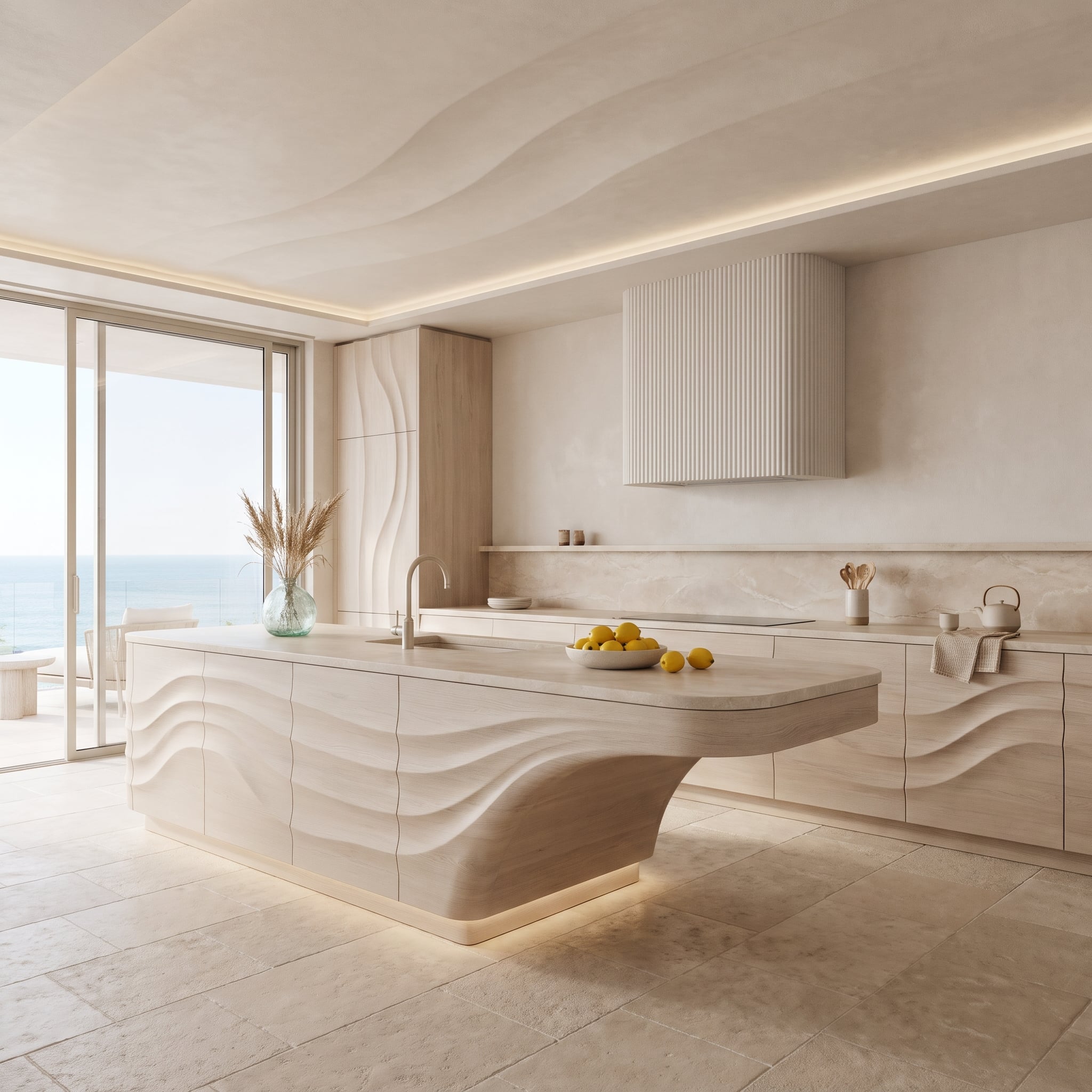
Layered waves run across the travertine-clad island base, creating deep relief that resembles stone shaped by moving water. The treatment transforms the cabinetry beneath the countertop into a substantial carved form, with horizontal ridges replacing the usual arrangement of flat cabinet fronts.
A fluted hood answers with a different kind of relief at the cooking wall, while the ocean beyond the glass offers a natural counterpart to the carved curves. The pale stone palette prevents the elaborate surfaces from becoming visually crowded. An island can carry storage and still look as though it belongs in a sculpture garden.
18. Woven Cognac Leather Gives Cabinet Doors the Texture of Luxury Furniture
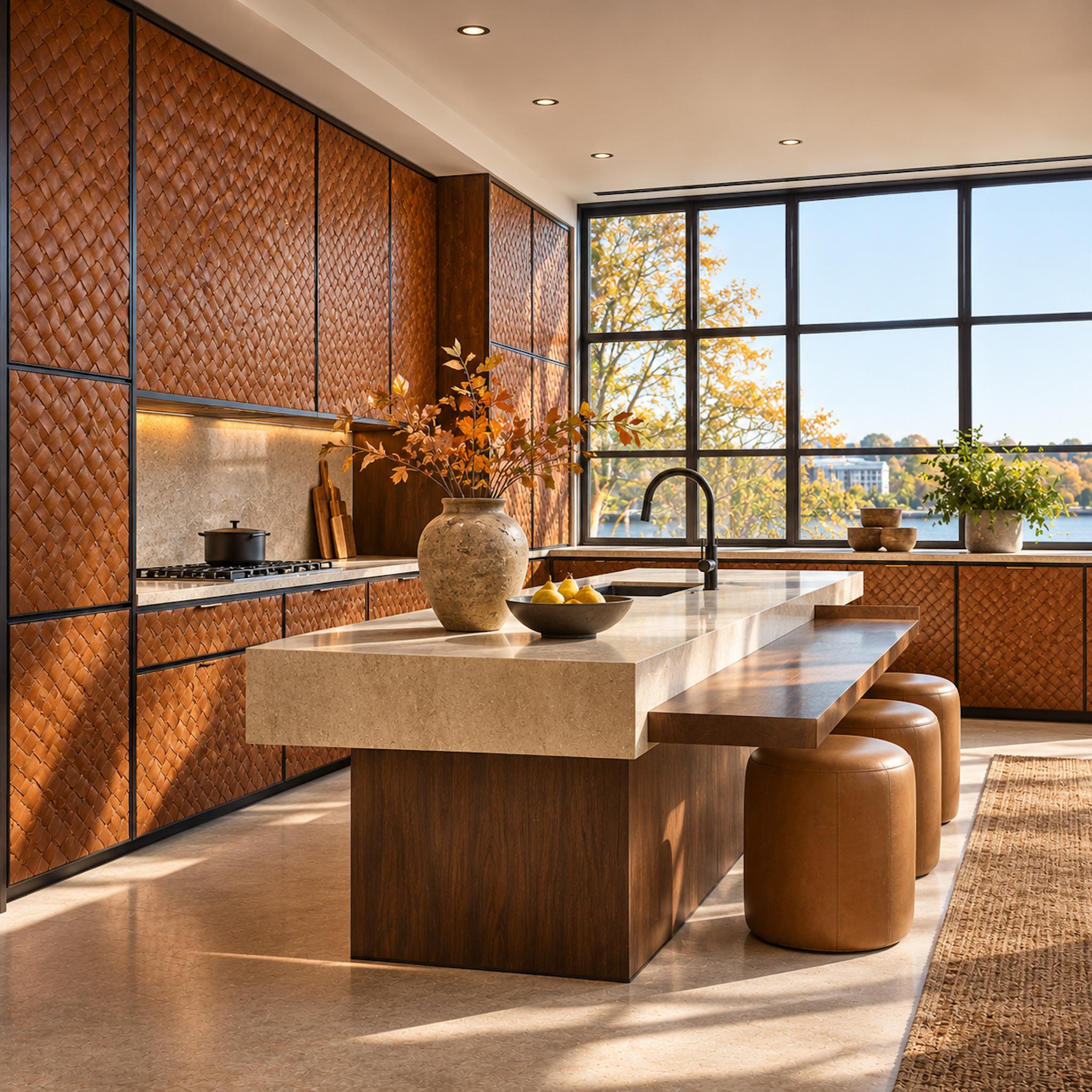
Cognac-colored woven-leather-style panels form a tightly interlaced diagonal basketweave across the cabinet fronts, with slender dark frames defining each door. The repeated pattern gives the storage wall a richness that neither wood grain nor lacquer could reproduce. Light catches the raised strips individually, revealing the depth of the weave and its subtle variations in color.
A pale stone island and dark walnut base introduce simpler, more substantial forms beneath the elaborate cabinetry. A projecting wood breakfast ledge and rounded leather stools extend the furniture-inspired palette without repeating the woven pattern. Upholstery craftsmanship meets contemporary kitchen design, and the cabinet doors unmistakably take charge.
17. Verde Guatemala Marble Moves From the Countertops Onto the Cabinet Doors
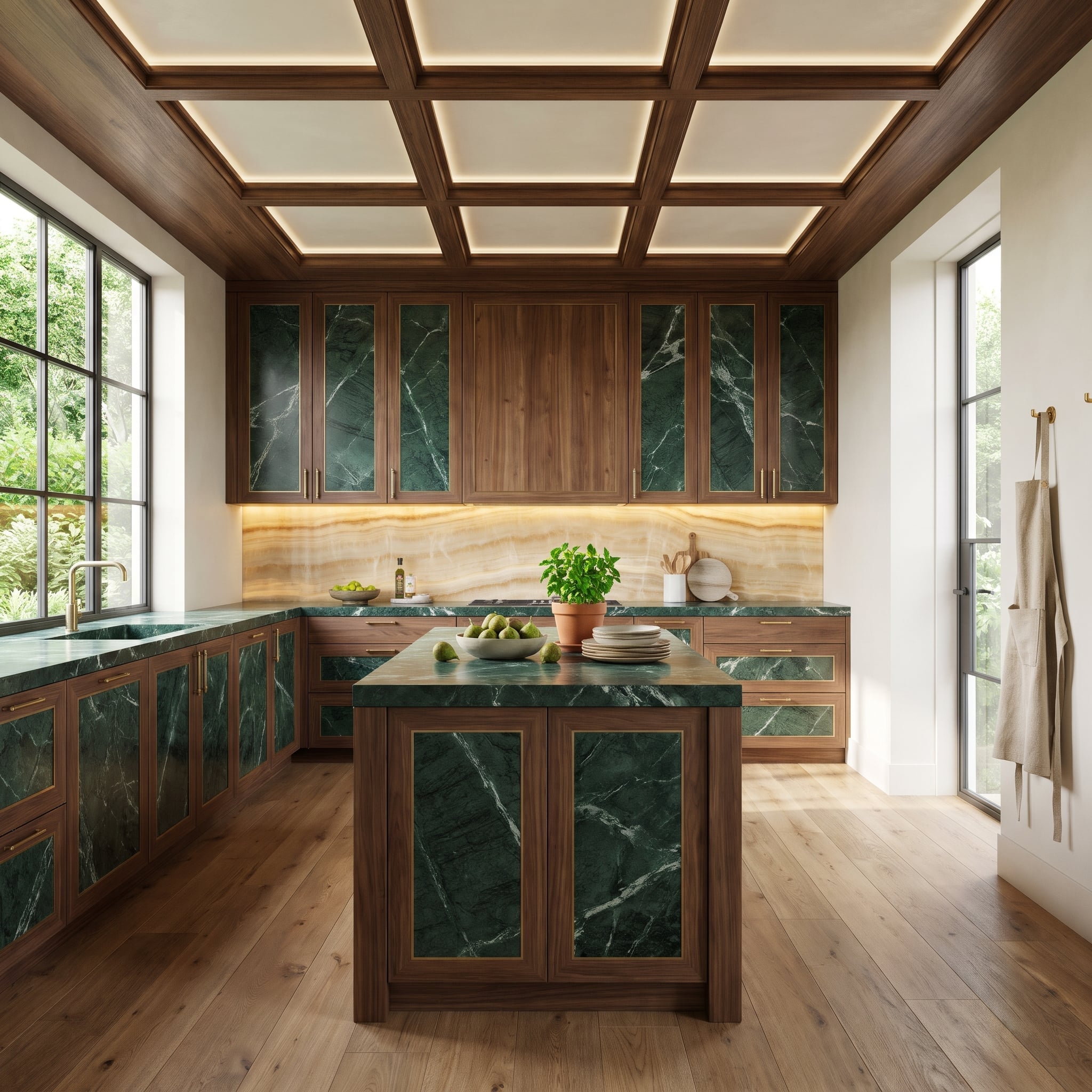
Deep green Verde Guatemala marble appears across the countertops and island, then takes an unexpected turn into the cabinet fronts themselves. Stone inserts interrupt the walnut doors with richly veined panels, bringing a material normally reserved for work surfaces onto the vertical cabinetry.
Dark wood coffers continue the geometric discipline overhead, while restrained brass hardware keeps the doors from acquiring another competing pattern. An illuminated stone backsplash introduces a warmer glow. The surprising move isn’t the choice of marble, but where it turns up.
16. An Oval Walnut Island Replaces Corners With Continuous Curves
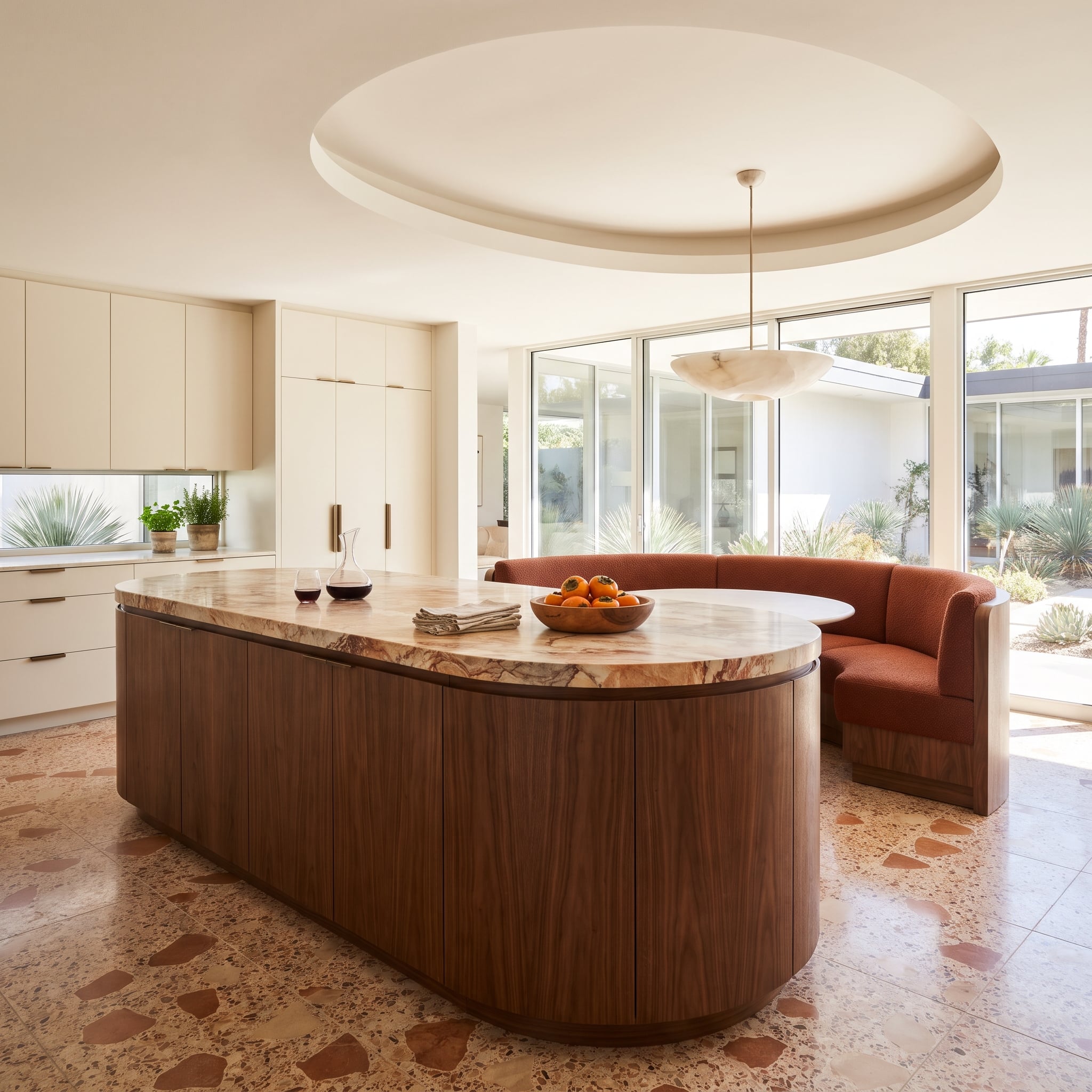
Curved walnut fronts wrap an oval island beneath rose-and-cream marble, giving the central cabinetry the character of a substantial piece of custom furniture. The wood grain follows the island’s rounded silhouette, making the uninterrupted curve its principal attraction.
Terracotta-and-blush terrazzo flooring extends the warm palette, while a semicircular rust bouclé banquette answers the island’s shape. Above, a saucer-shaped pendant hangs beneath a circular ceiling recess. Almost everything conspires to eliminate the right angle, yet the room never loses its sense of order.
15. Ebonized Oak and Backlit Onyx Put Texture Against Light
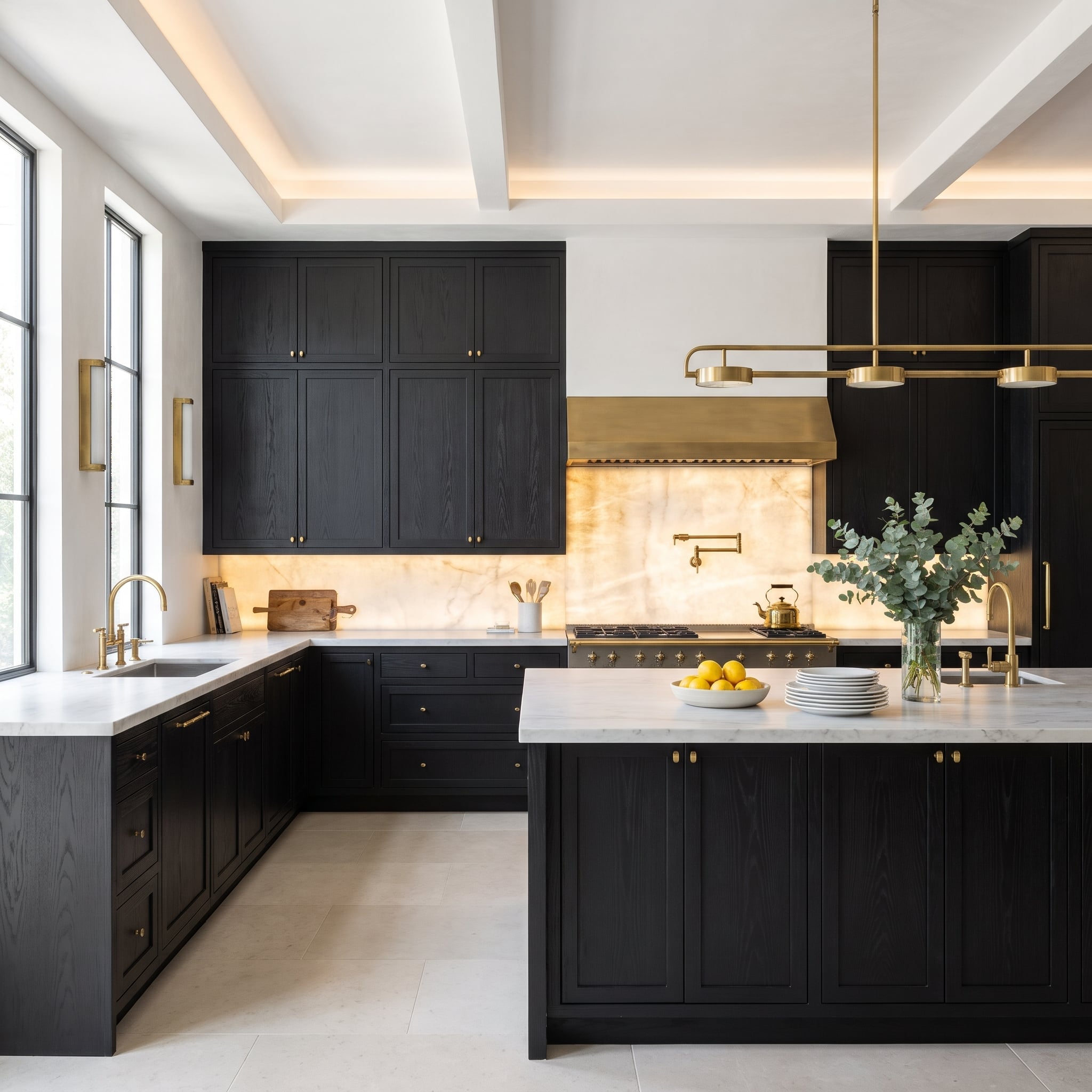
Ebonized oak cabinetry brings the grain of real wood through an almost black finish. Subtle variation prevents the dark doors from becoming featureless, while brass pulls mark the cabinet wall with precise points of warmth.
Behind the range, illuminated onyx glows with irregular mineral patterning, a dramatic departure from the controlled lines of the oak. Brass continues through the hood and pot filler, and white marble countertops brighten the working surfaces. The cabinetry absorbs light; the stone appears to release it.
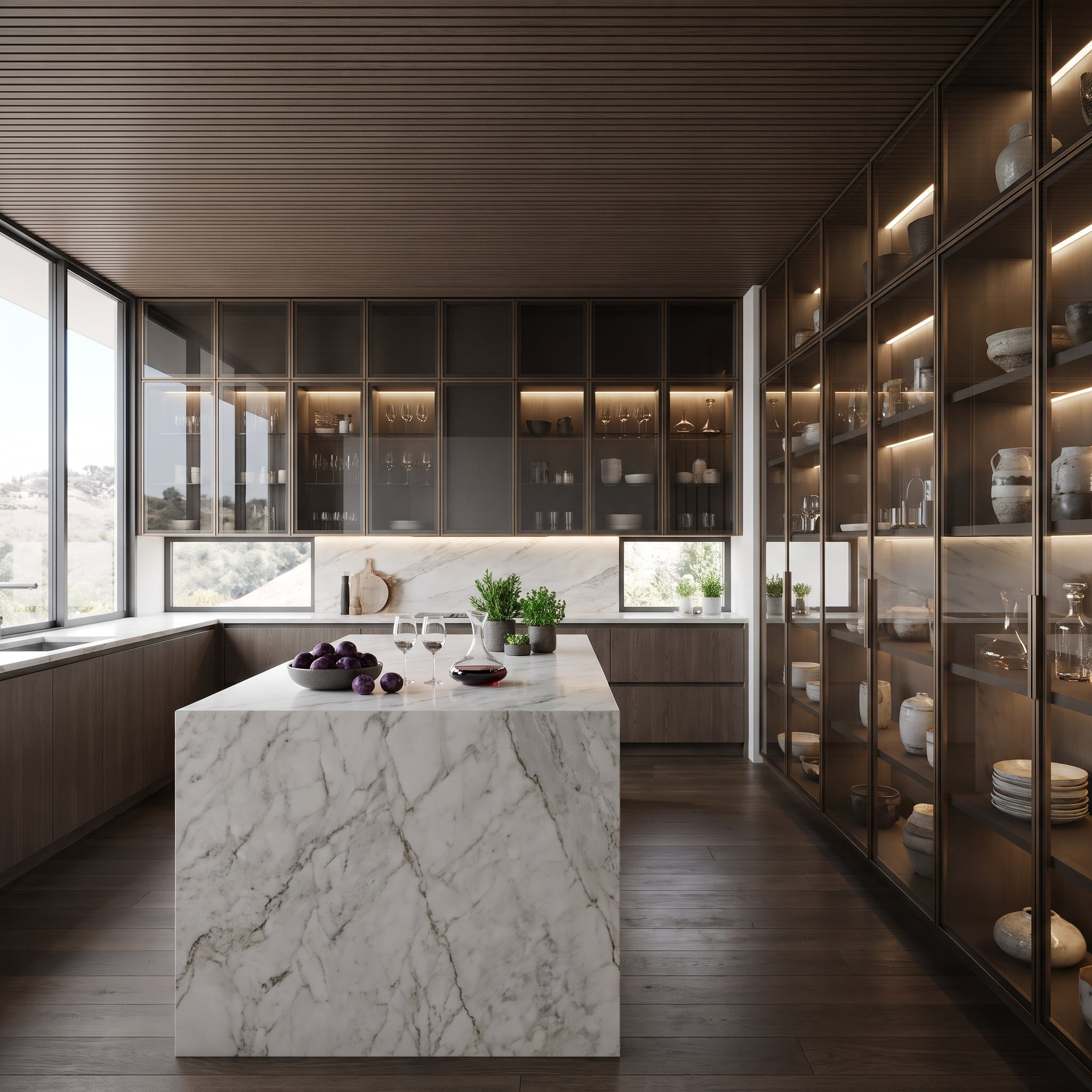
14. Bronze-Framed Glass Cabinets Turn Storage Into Display
🔥 Would you like to save this?
Dark walnut cabinets form the kitchen’s substantial timber backdrop, but the bronze-framed glass towers introduce a completely different treatment. Narrow metal profiles divide the glazed doors into elegant vertical sections, while warm internal lighting makes the shelves and dishware part of the composition.
A Calacatta-style marble waterfall island stands pale against the dark cabinetry. Low windows along the backsplash bring the hillside into view at counter height, and a wood-slat ceiling reinforces the walnut’s warmth. What might have been an ordinary storage wall now has the presence of a carefully arranged display case.
13. Olive Cabinets and a Rolling Library Ladder Take Storage Seriously
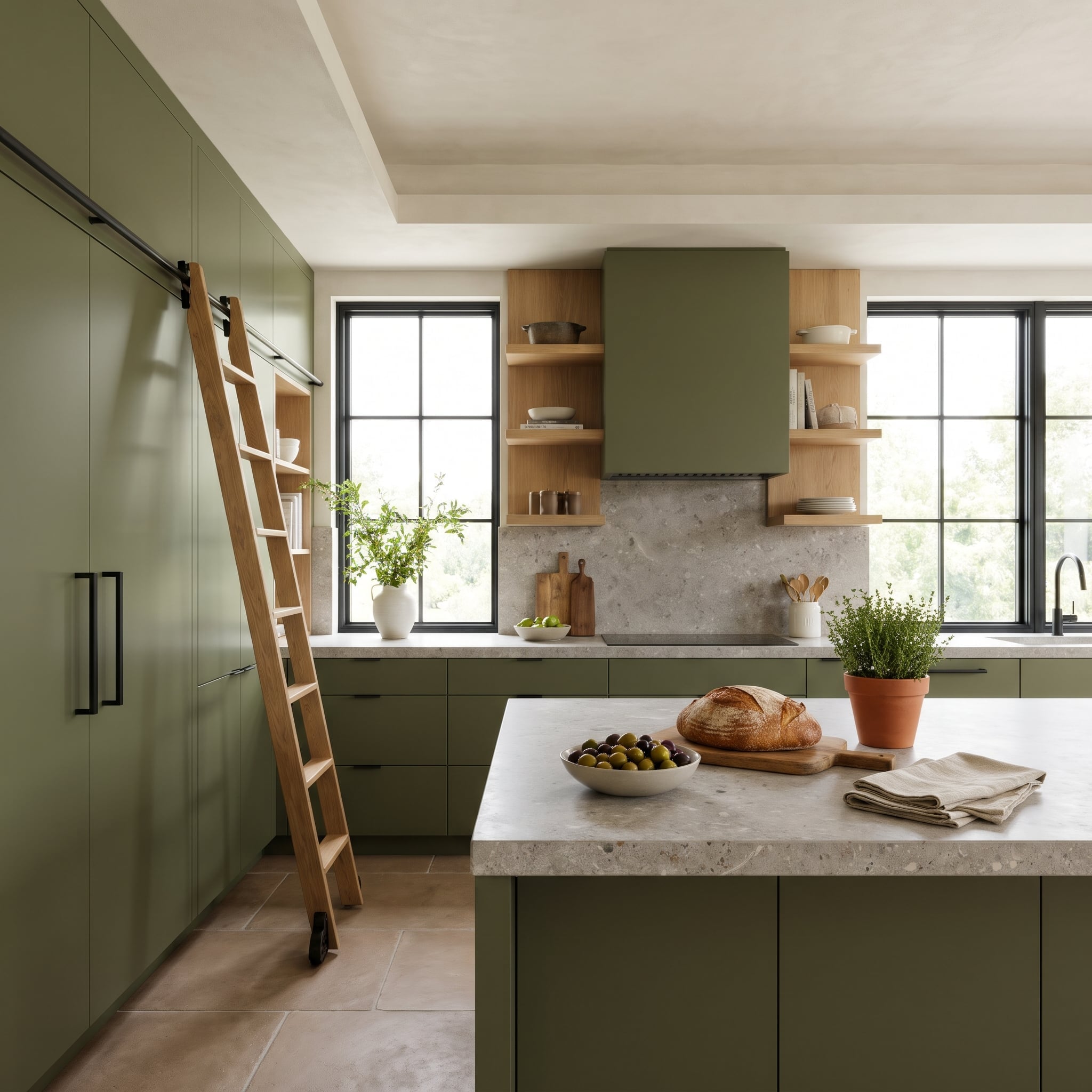
Olive-green flat-front cabinets rise to the ceiling, turning the upper reaches of the kitchen into useful storage rather than an awkward gap above the cupboards. A rolling oak library ladder on a dark rail makes those high cabinets accessible and brings an unmistakable furniture-making reference into the room.
Open oak shelves interrupt the painted cabinetry beside the range hood, introducing lighter wood and a more informal display surface. Warm gray stone countertops and backsplash keep the palette measured. The cabinet fronts are simple; their unusual height and arrangement do the architectural work.
12. Navy Lacquer and a Marble Waterfall Edge Reflect the Ocean Light
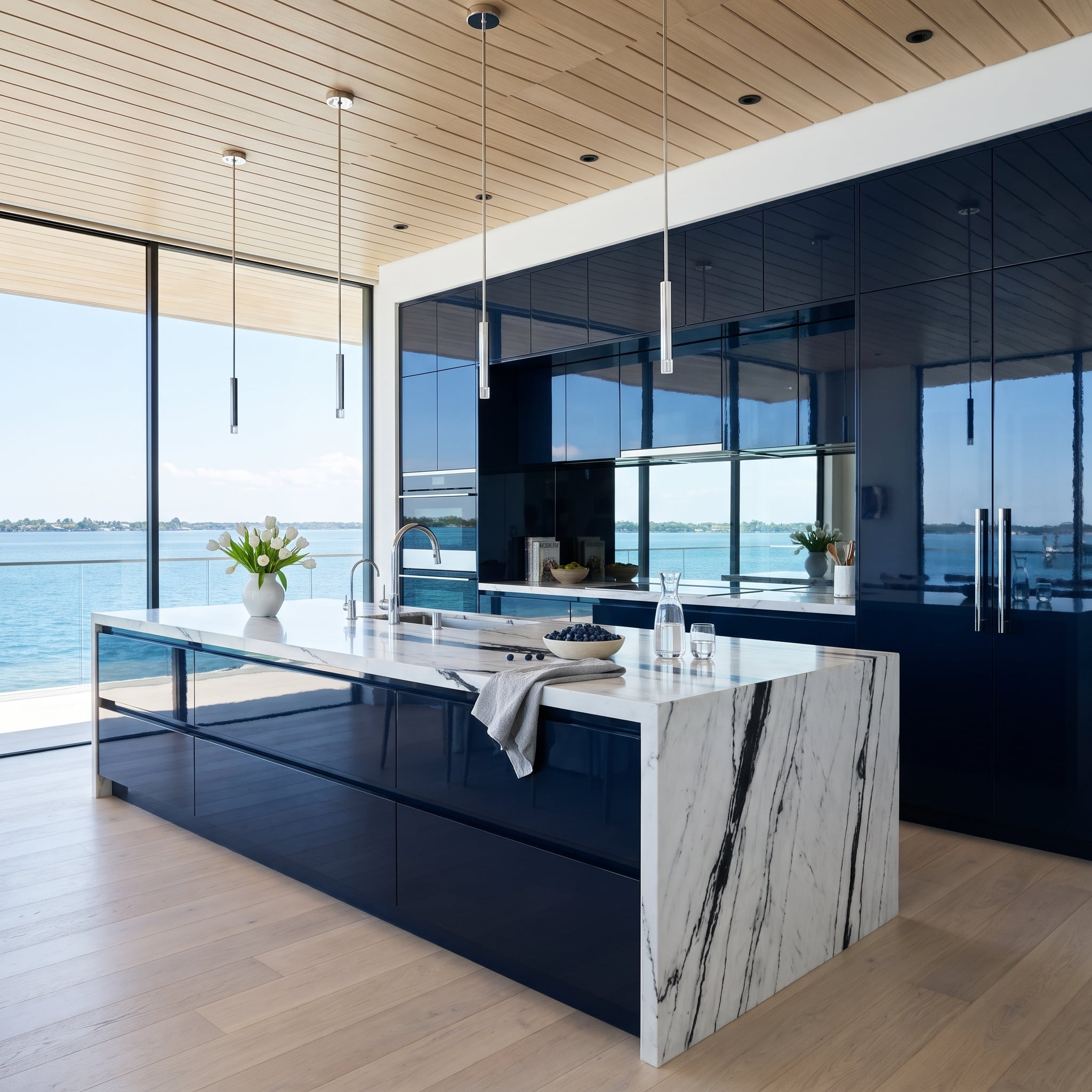
Glossy navy lacquer covers the tall cabinet wall, its reflective finish picking up highlights from the expansive glazing. The color remains unmistakably blue, but the polished surface gives it a changing depth that matte cabinetry would lack.
A white marble waterfall end cuts across the smooth navy island base with sharp black veining. Chrome cylinder pendants hang above, while a slatted wood ceiling adds warmth overhead. The cabinetry’s sheen connects the kitchen to the bright coastal setting without relying on a pale color scheme.
11. A Curved Oak Surround Gives the Cabinet Wall a Softer Silhouette
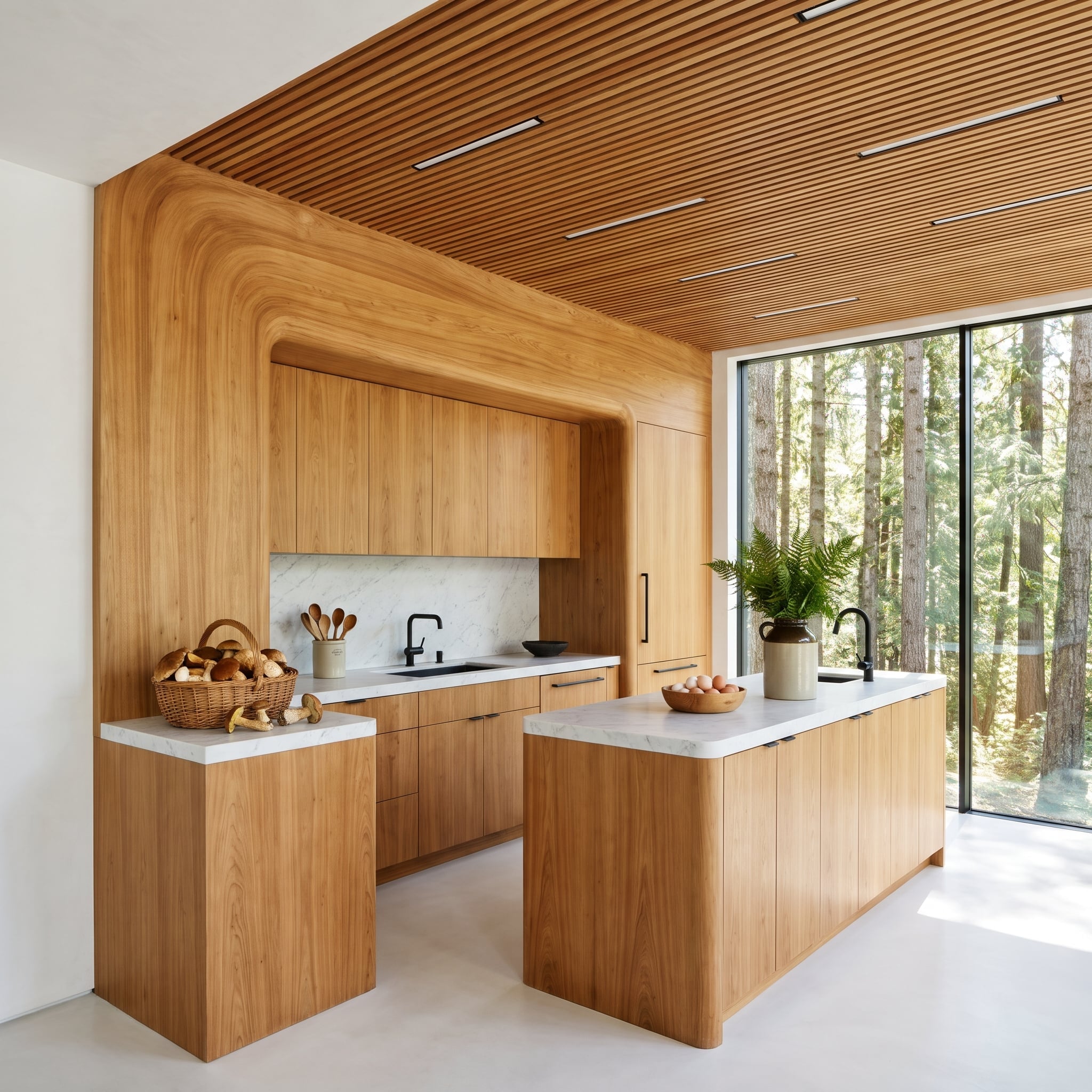
Warm oak wraps the cabinetry in a broad surround whose corners curve instead of meeting at rigid right angles. The rounded edges soften the full-height installation, allowing the cabinet wall to read as integrated architecture rather than a collection of separate boxes.
White marble countertops draw a pale horizontal band through the timber, while slatted wood overhead repeats the grain’s linear character. Floor-to-ceiling glass frames a stand of conifers beyond the kitchen. The cabinet surround forms a gentle transition between the room’s strong geometry and the irregular landscape outside.
10. Terracotta Zellige Turns a Concealed Coffee Station Into a Jewel Box
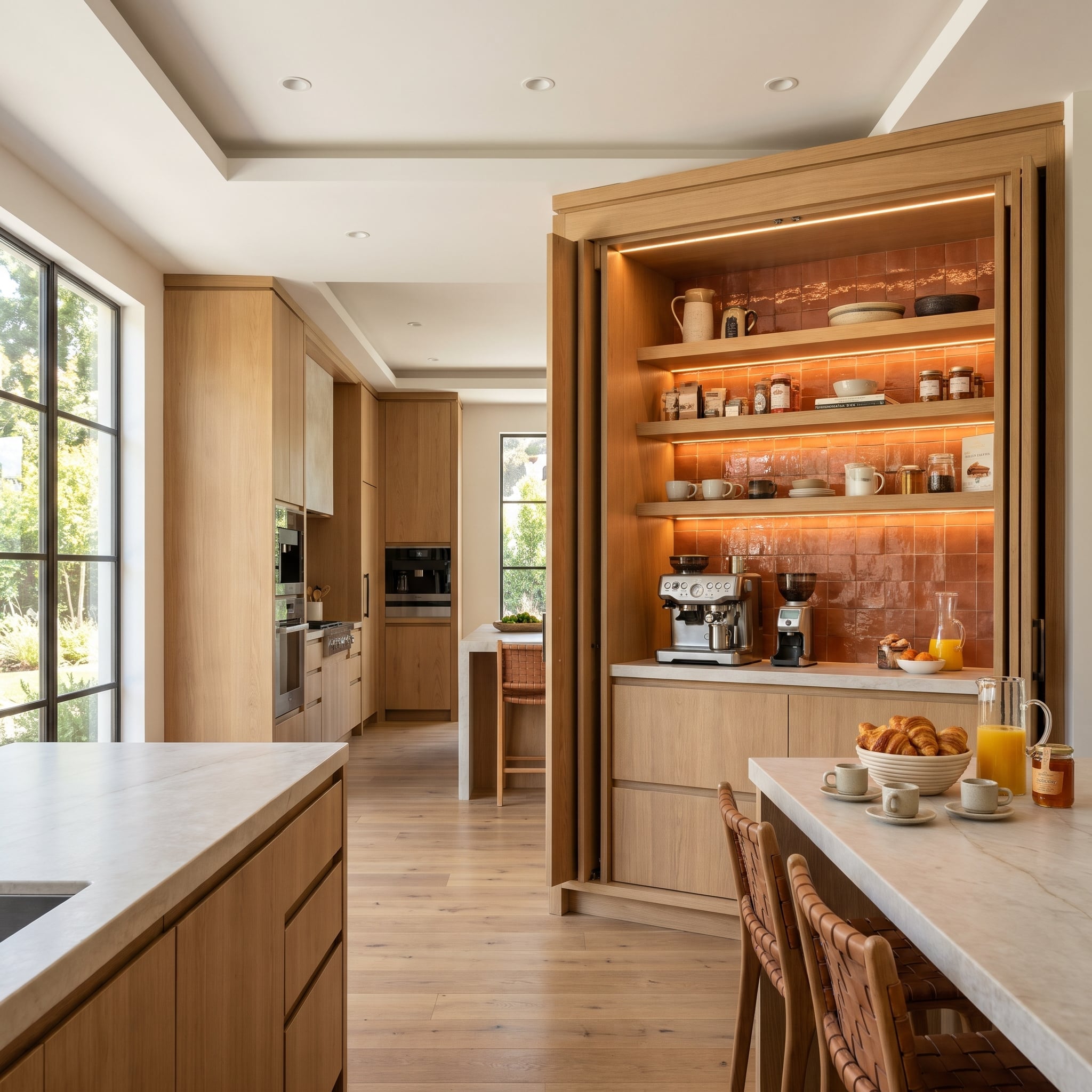
A sliding oak panel reveals a full-height coffee station lined with terracotta zellige tile. The tile’s handmade-looking variation introduces an irregular, glossy texture beside the orderly grain of the surrounding wood cabinetry.
Warm LED strips illuminate shelves of ceramics above the espresso machine and grinder. Honey-colored oak continues across the cabinet fronts and shelving, giving the station a unified frame. The real pleasure is the change of character when the panel slides aside: calm woodwork outside, warm terracotta and gleaming equipment within.
9. Walnut Tambour-Style Cabinetry Turns an Entire Wall Into Woodwork
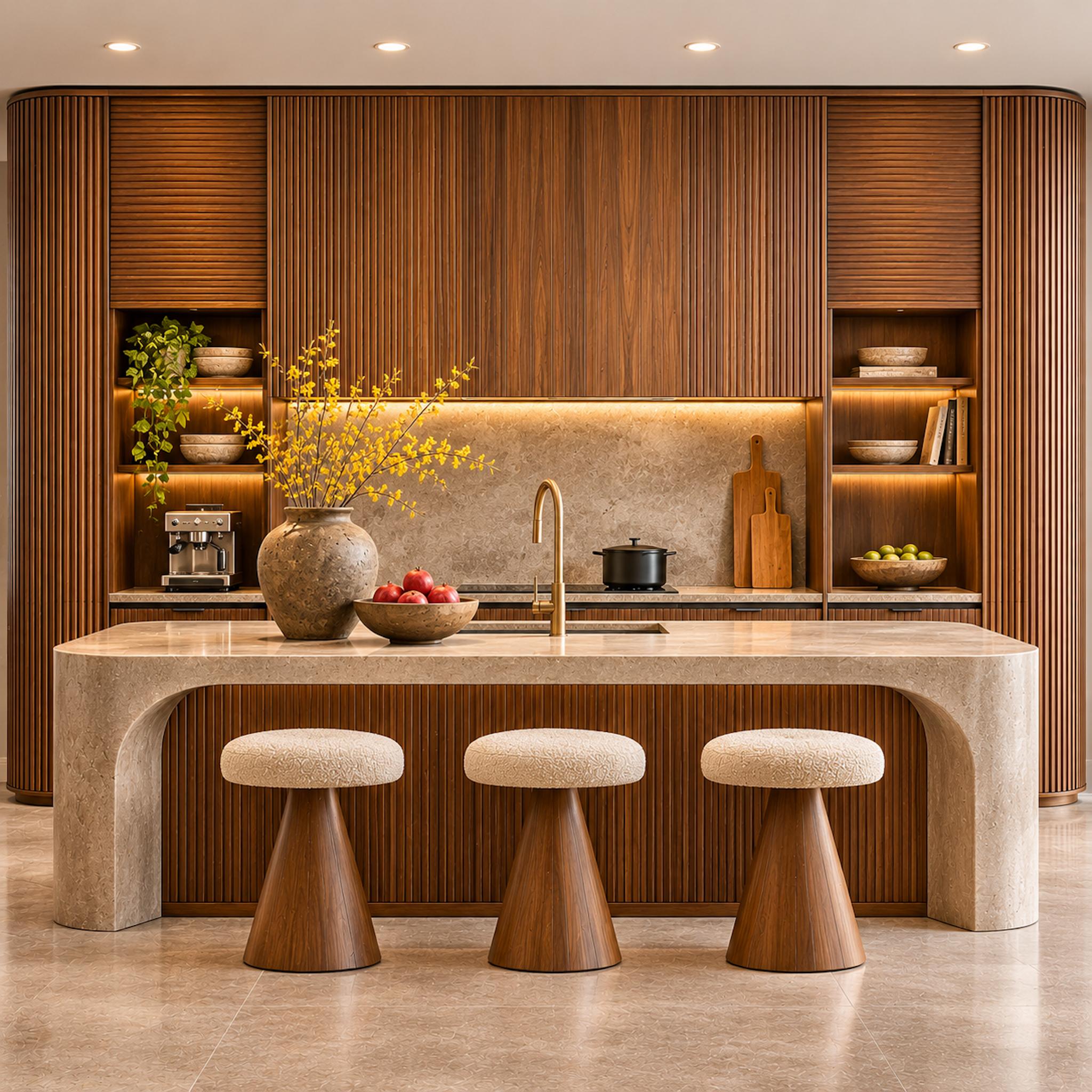
Walnut cabinetry fills the wall with closely spaced vertical slats, interrupted by tambour-style sections whose narrow horizontal strips suggest retractable doors. Rounded end columns carry the ribbed treatment around the corners, replacing the usual hard cabinet termination with a continuous sweep of timber. Several distinct approaches to slatted woodwork occupy one carefully organized elevation.
A pale stone island stands directly in front, its thick top supported by broad arched ends. Three upholstered stools with tapered wooden bases bring a playful furniture silhouette to the composition. Warm shelf lighting reveals the coffee station and open display niches. Viewed straight on, the cabinet wall becomes a complete architectural elevation rather than a backdrop.
8. Gray Oak Cabinets Meet a Marble Wall and a Floating Line of Light
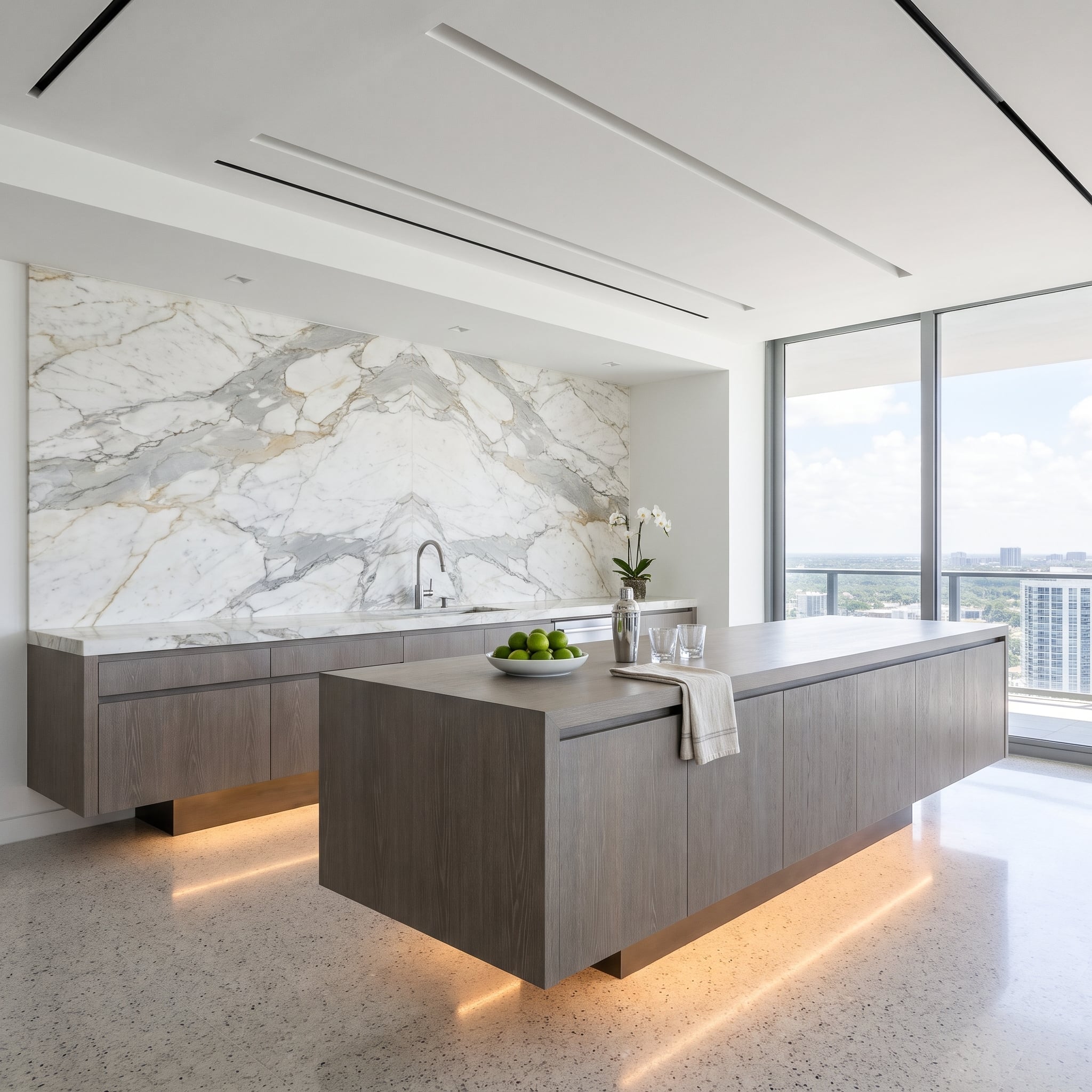
Gray-toned oak cabinetry carries a textured, wire-brushed appearance that allows the wood grain to remain visible through its muted finish. The handleless fronts maintain long, clean runs of cabinetry, leaving the dramatic marble wall behind the sink to supply the larger pattern.
Gray and gold veining spreads across the stone in broad, irregular lines. Warm lighting beneath the island and perimeter cabinets creates a narrow band of brightness above the terrazzo floor, making the lower units appear to hover. A quiet cabinet profile acquires a distinctly architectural character through surface treatment and light.
7. A Hidden Coffee Bar Breaks Open a Wall of Dark Oak
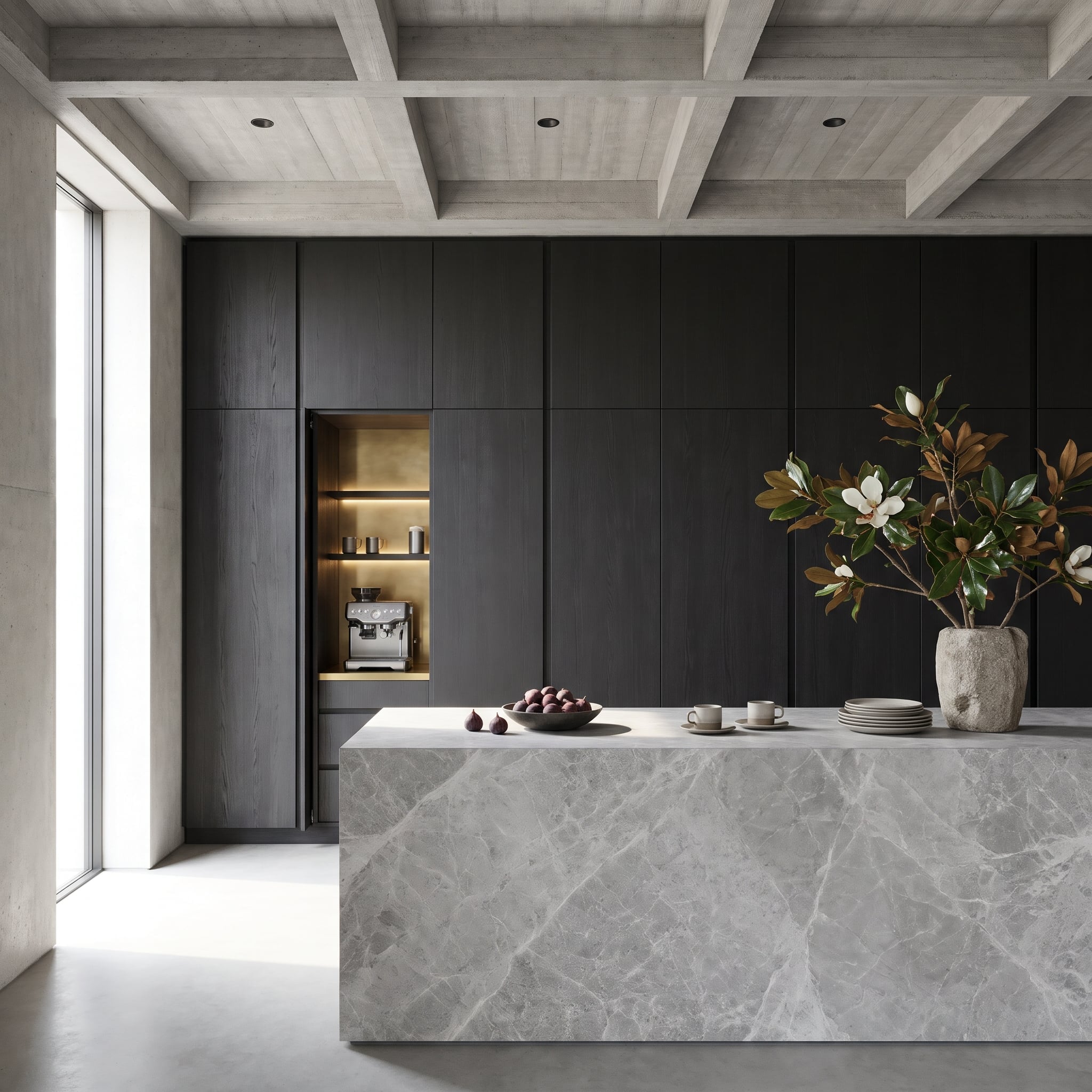
Charcoal-stained oak panels form an almost uninterrupted wall of cabinetry. Their continuous grain and concealed hardware make the storage appear closer to architectural cladding than a conventional run of cupboards.
One panel opens to expose a brass-lined coffee station, its illuminated shelves and espresso equipment flashing gold against the dark exterior. A gray marble waterfall island maintains the cool, understated palette elsewhere. Polished brass emerging from an otherwise somber wall gives the concealed station its theatrical reveal.
6. Flat White Cabinets and a Grain-Forward Oak Island Make the Case for Restraint
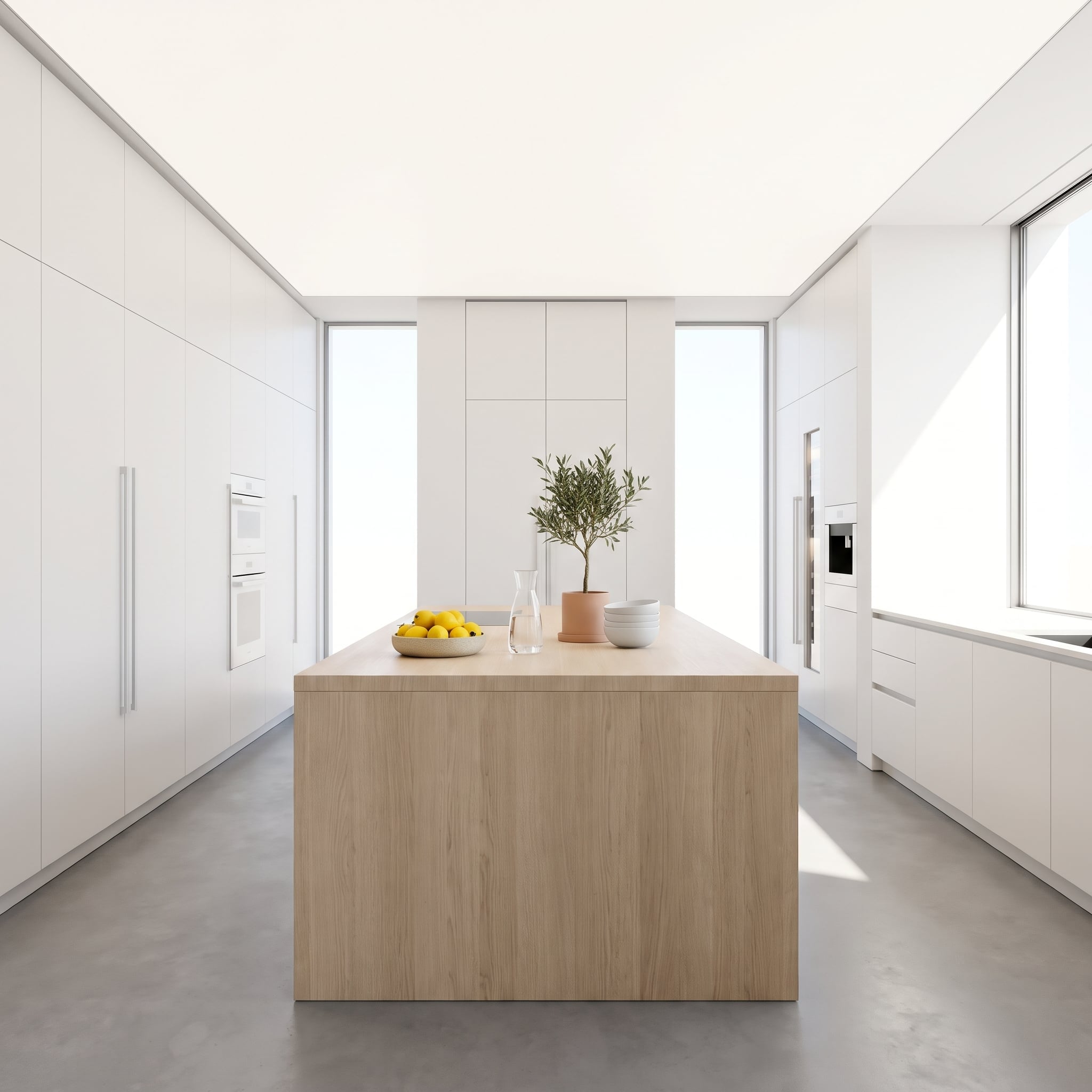
Matte-white cabinet fronts form clean, uninterrupted planes along the kitchen walls. The island takes the opposite approach, displaying warm oak grain across its sides and upper surfaces. The change in material gives the central cabinetry the character of a freestanding piece of furniture.
Concrete flooring introduces a cool mineral surface beneath the wood, while narrow windows admit daylight beside the tall white cabinets. No carved ornament, no metallic inlay, no complicated door profile. Sometimes the most decisive design choice is knowing exactly where to stop.
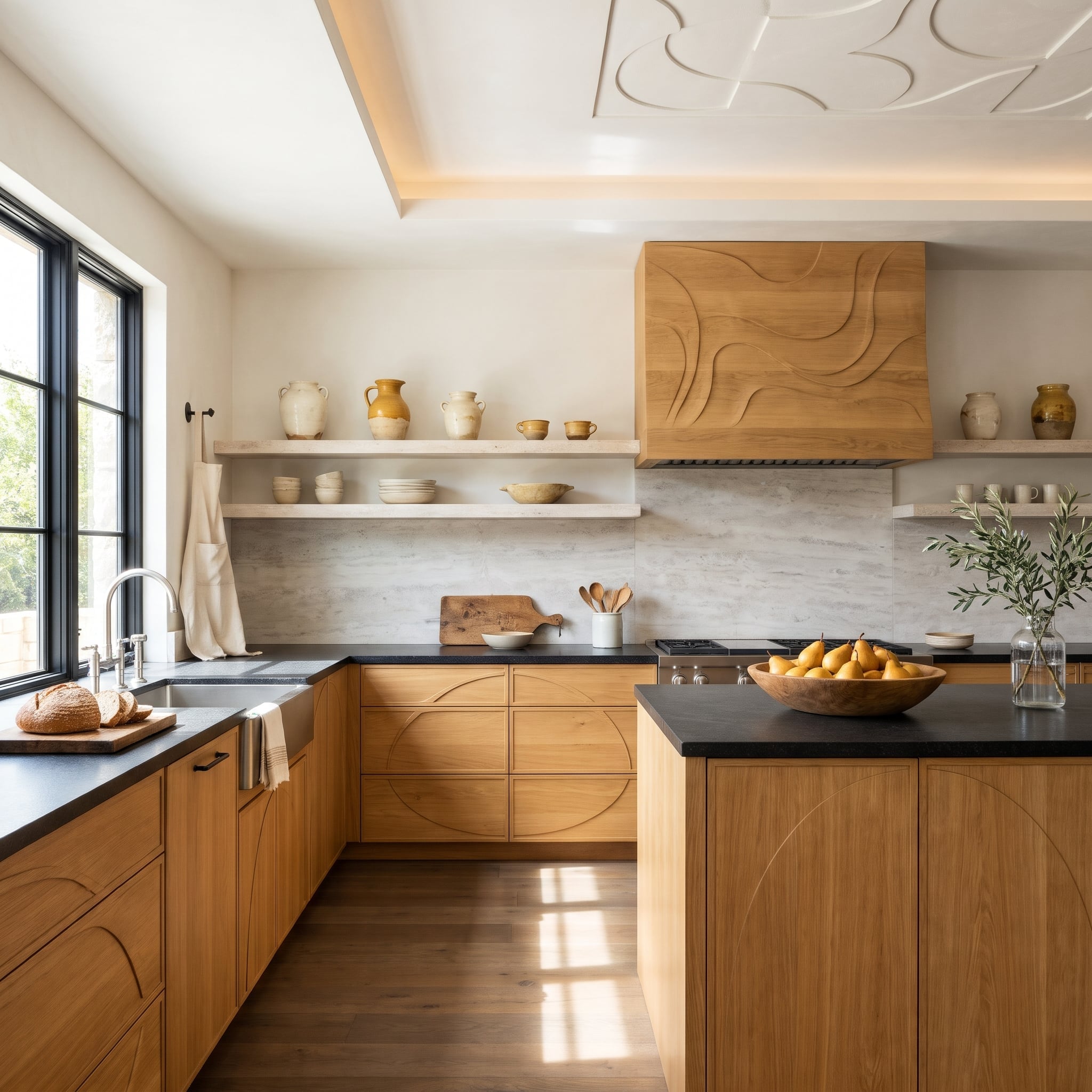
5. White Oak and Carved Plasterwork Turn the Kitchen Into a Relief Sculpture
🔥 Would you like to save this?
White oak cabinet fronts carry routed arc motifs that introduce curves into an otherwise rectilinear kitchen. The pattern is subtle enough to preserve the warmth of the timber while giving the doors a recognizable decorative identity.
Above the range, a wood-finished hood with sculptural wave relief expands that curved language into a larger feature. Organic plasterwork across the coffered ceiling offers a third variation, while black countertops establish a firm visual baseline. The cabinetry, hood, and ceiling speak related architectural languages without repeating the same motif at every scale.
4. Hammered Bronze and Walnut Bring Old-World Metalwork Into a Modern Kitchen
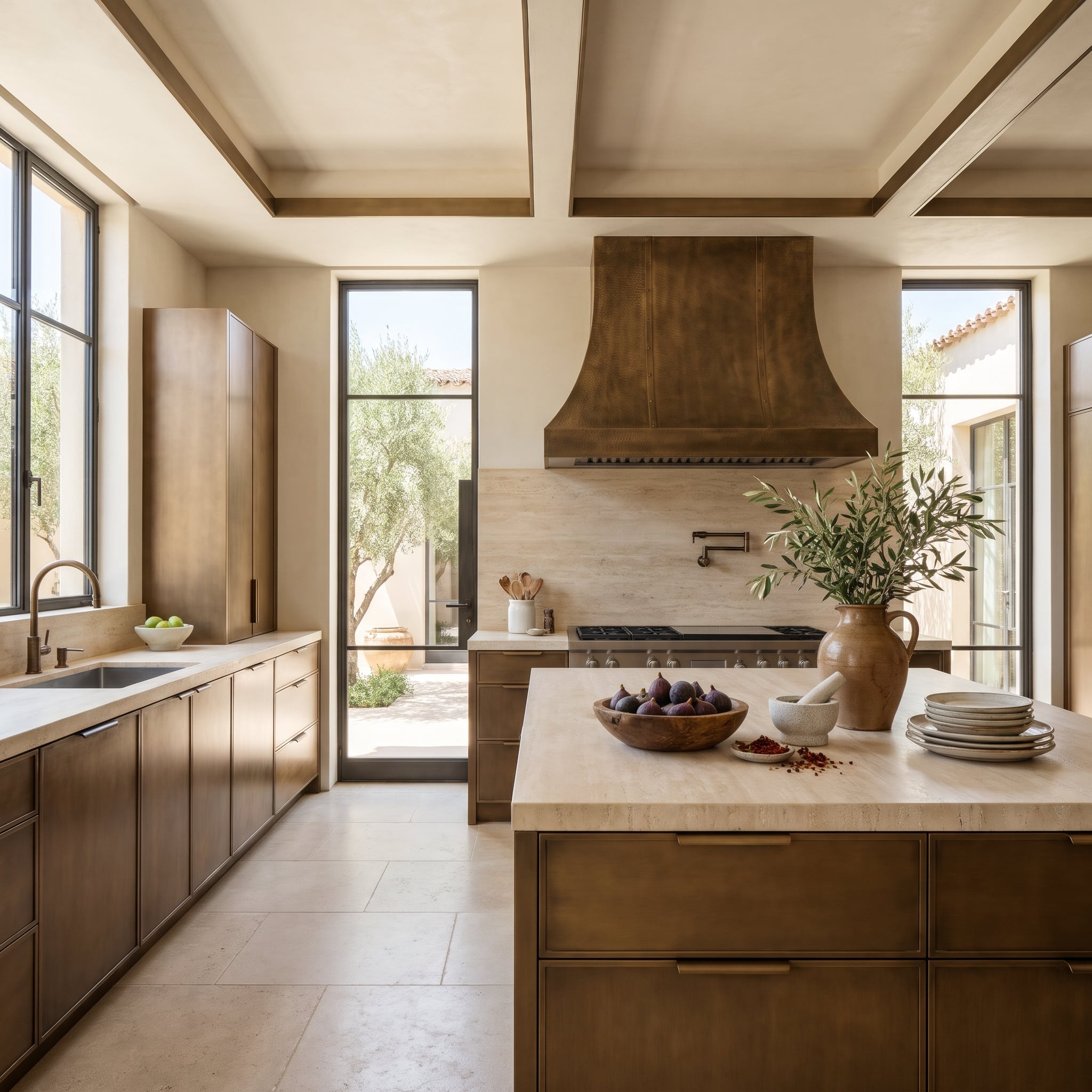
Flat-front walnut cabinetry establishes a warm, finely grained backdrop for a hammered bronze range hood. The metal’s irregular surface catches light in small highlights, contrasting with the comparatively smooth wood doors.
Sand-toned travertine covers the backsplash, countertops, and island, extending the natural palette without repeating the walnut’s grain. Bronze-trimmed ceiling coffers carry the metallic accent overhead. The cabinet fronts remain deliberately understated, allowing the room’s material craftsmanship to register without a proliferation of decorative profiles.
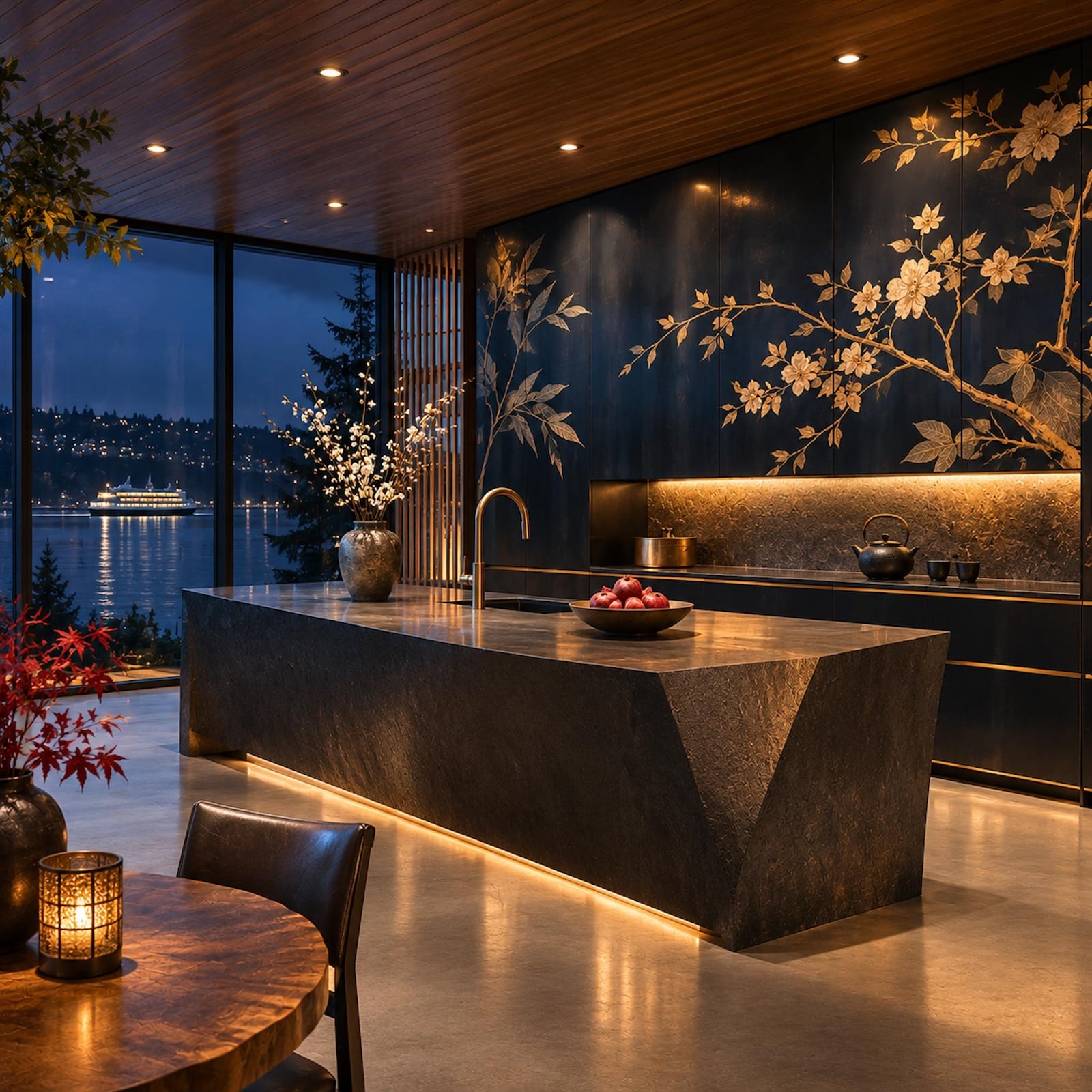
3. Midnight-Blue Lacquer Becomes a Botanical Painting Across the Cabinet Doors
Midnight-blue lacquer covers an entire wall of handleless cabinetry, providing a dark canvas for an elaborate botanical composition in muted gold and cream. Flowering branches extend across multiple doors, their fine stems and leaves crossing the narrow joints between panels. Rather than decorating each cabinet separately, the artwork treats the complete elevation as one continuous painting.
A dark, angular stone island introduces a severe geometric counterpoint to the delicate branches. Warm lighting beneath the cabinets brings out the mural’s metallic tones, while a timber ceiling adds depth overhead. The nighttime waterfront remains secondary to the extraordinary cabinet treatment. Few kitchen doors could claim such an ambitious second career as a work of art.
2. Walnut Fluting Runs From the Cabinet Doors to the Ceiling
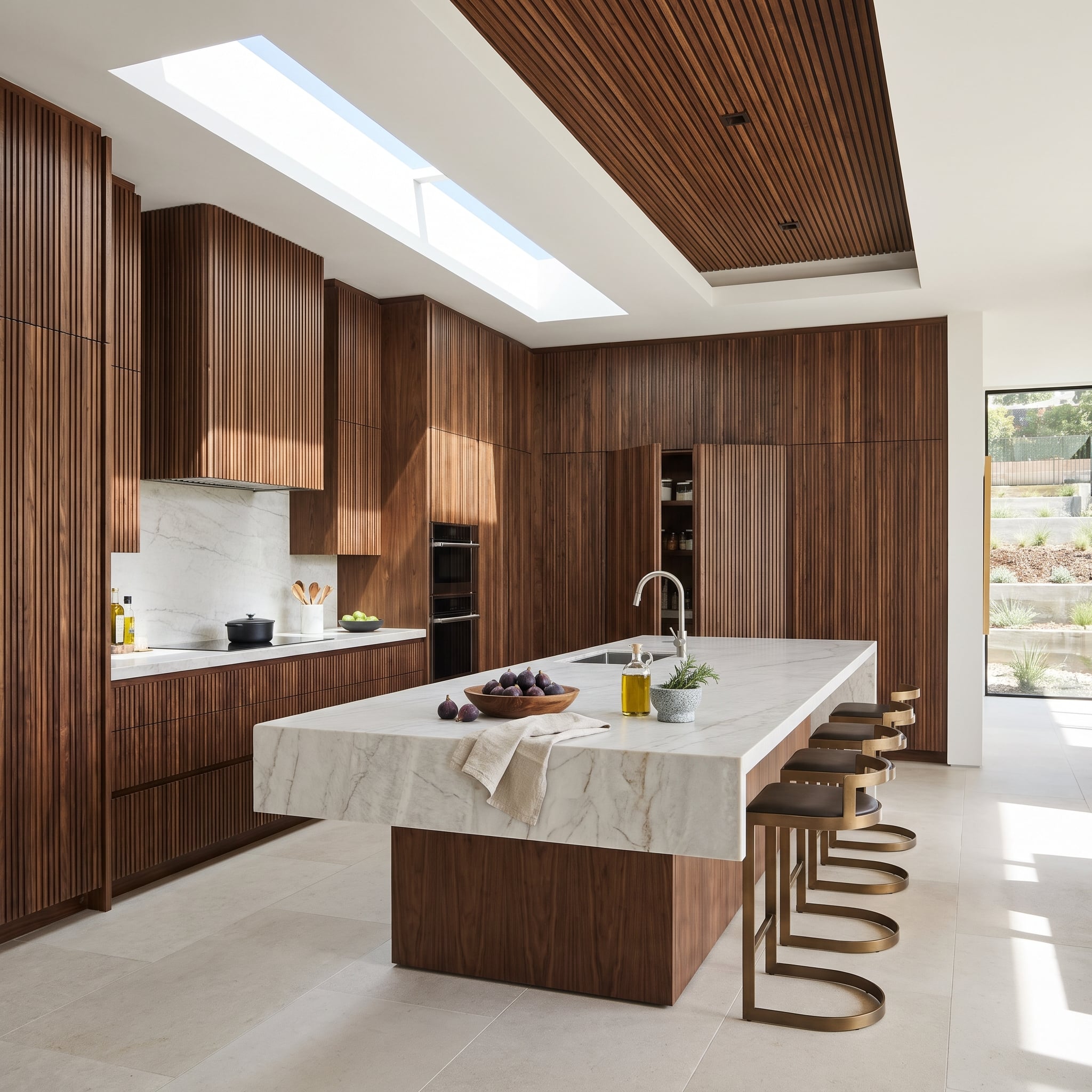
Vertical fluting covers the walnut cabinet faces, continues across the hood, and climbs the wall, making the kitchen appear carved from one continuous timber composition. The grooves accentuate the height of the room while giving the dark wood a changing pattern of highlights.
White marble on the backsplash and waterfall island cuts through the walnut with crisp, pale planes. Bronze stools with curved bases introduce another warm material without imitating the cabinetry. The strongest effect comes from taking one wood treatment well beyond the cabinet doors.
1. Faceted Green Cabinets Meet a Marble Hood With Serious Ambitions
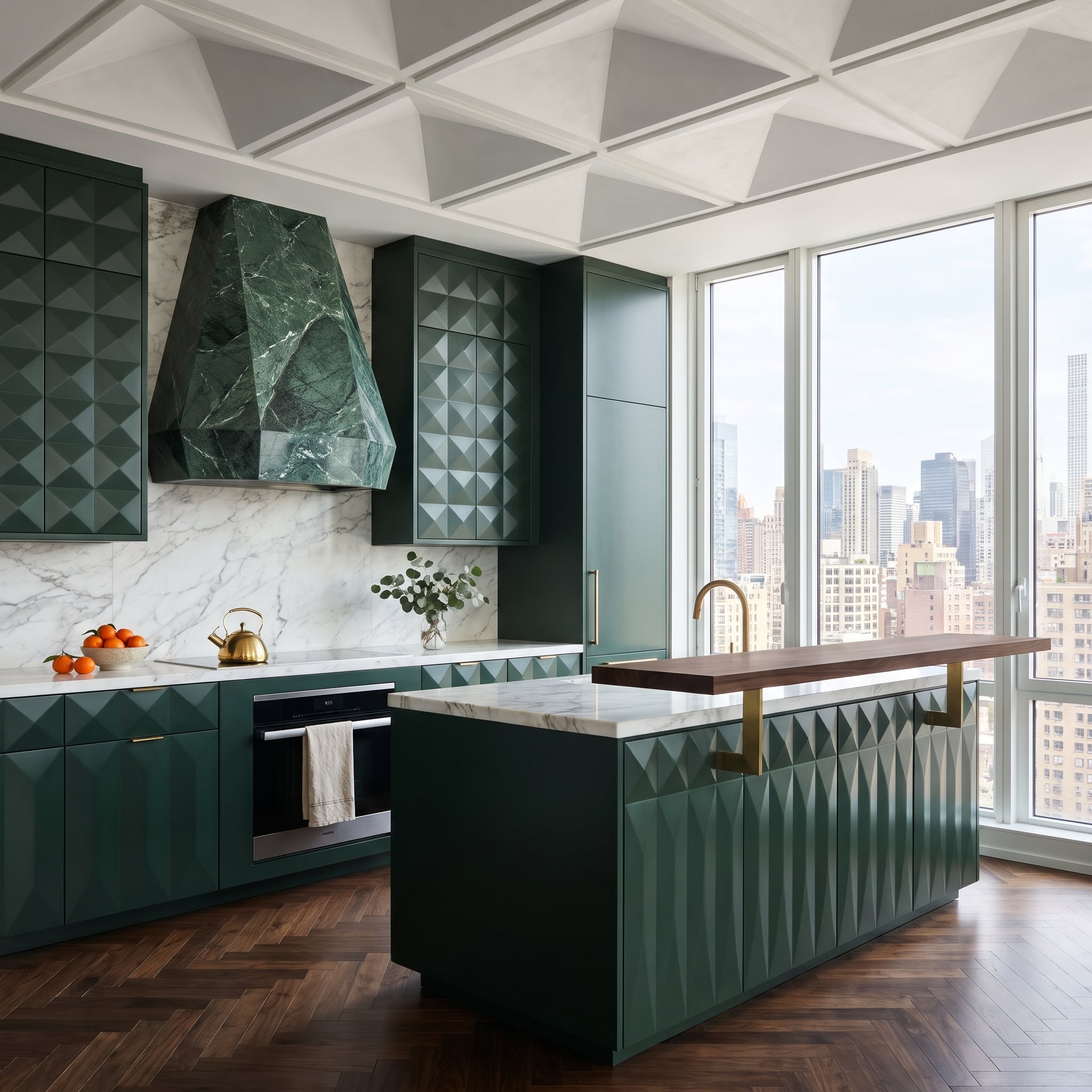
Forest-green cabinet fronts erupt into a field of faceted pyramids, each raised diamond catching light along its edges and dropping into shadow at its center. The repetition gives the cabinetry the depth of carved architectural paneling rather than conventional kitchen storage.
An angular green marble hood pushes the geometry further, its veining cutting across the sharp planes. Brass hardware and a walnut bar shelf introduce warmer, quieter surfaces. The cabinetry is unmistakably the main event: a wall of three-dimensional green facets that makes the familiar recessed Shaker panel look positively timid.