🔥 Would you like to save this?
The key was on a string around your neck. The basement door swung open, and the smell hit first: carpet glue, old popcorn, and something faintly electric from the TV that had been running since noon. Down those stairs was the whole world, the one that belonged entirely to you between 3 p.m. and whenever headlights swept across the window. This is what after-school freedom looked like before anyone called to check in.
27. The Finished-Ceiling Drop Tiles With the One Brown Water Stain Nobody Ever Explained
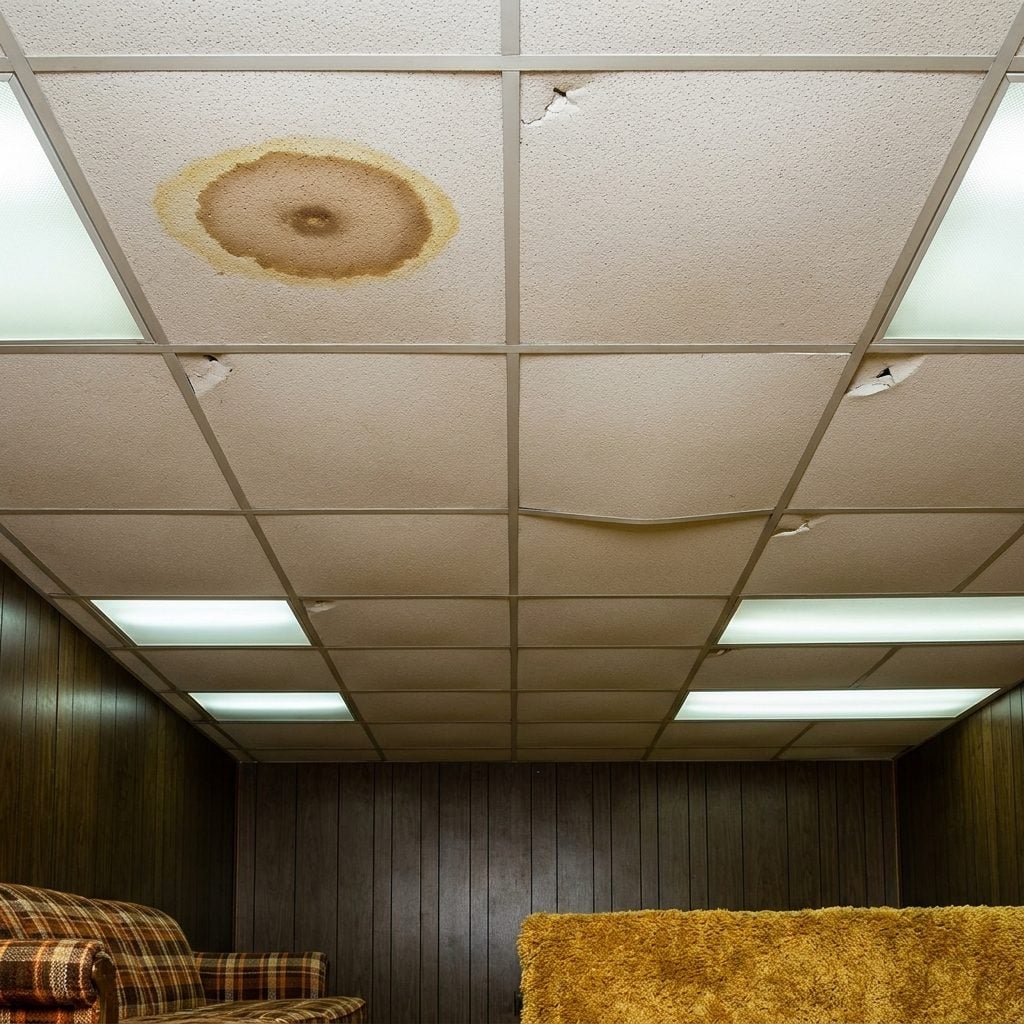
Every finished basement had one. A single ceiling tile, usually off to one side, with a brown water stain shaped like a continent nobody could name. It had been there when your family moved in. It would be there when you moved out. Nobody ever replaced it, and nobody ever found the leak that caused it, because the leak had apparently healed itself years ago and the stain was all that remained.
In order to come up with the very specific design ideas, we create most designs with the assistance of state-of-the-art AI interior design software. Also, assume links that take you off the site are affiliate links such as links to Amazon. this means we may earn a commission if you buy something.
You stared at it during sleepovers, making out shapes in it the way you made out shapes in clouds. A dog. Florida. A catcher’s mitt. The stain was its own kind of basement landmark, as permanent and unremarkable as the support column in the middle of the room that everyone walked into at least once in the dark.
26. The Bar Cart Stocked With Bottles Nobody Touched All Year Except at Christmas
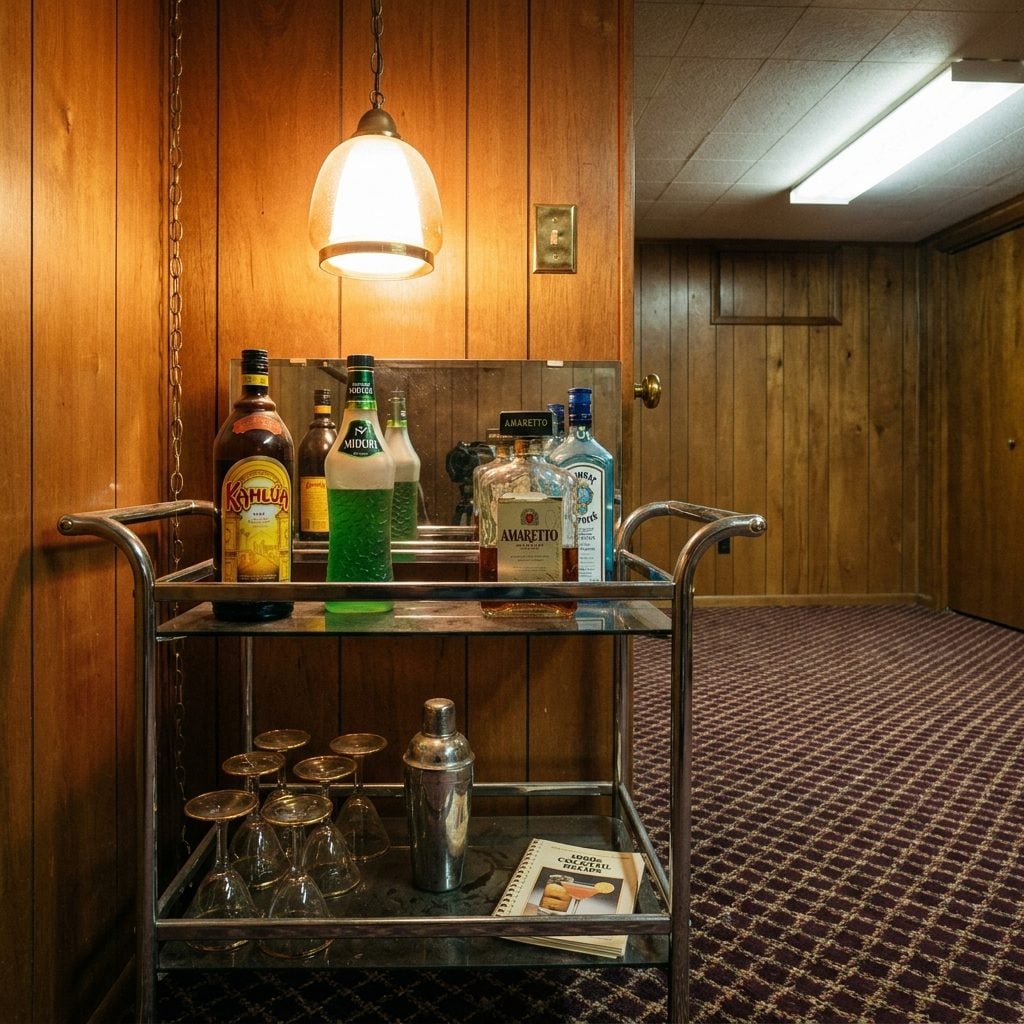
The bar cart was fully stocked and completely untouchable. Kahlua, amaretto, something called Midori that was the color of antifreeze, and at least one bottle of unclear origin that had been a hostess gift circa 1981 and had never been opened. Your parents’ parties would thin these bottles down occasionally, but they always somehow replenished themselves by the following holiday season.
As a kid, you understood the bar cart was decorative in the same way the good china was decorative. It existed to signal that adults lived here and that this basement, however much it belonged to you on school nights, was still their house. The cocktail glasses were stored upside down on the lower shelf, gold-rimmed, and they came out exactly once a year. You knew the smell of that cart the way you knew the smell of the whole room: part carpet, part old wood paneling, part something sweet and faintly chemical that you couldn’t name yet.
25. The Emergency Flashlight That Lived in the Utility Room and Never Had Working Batteries
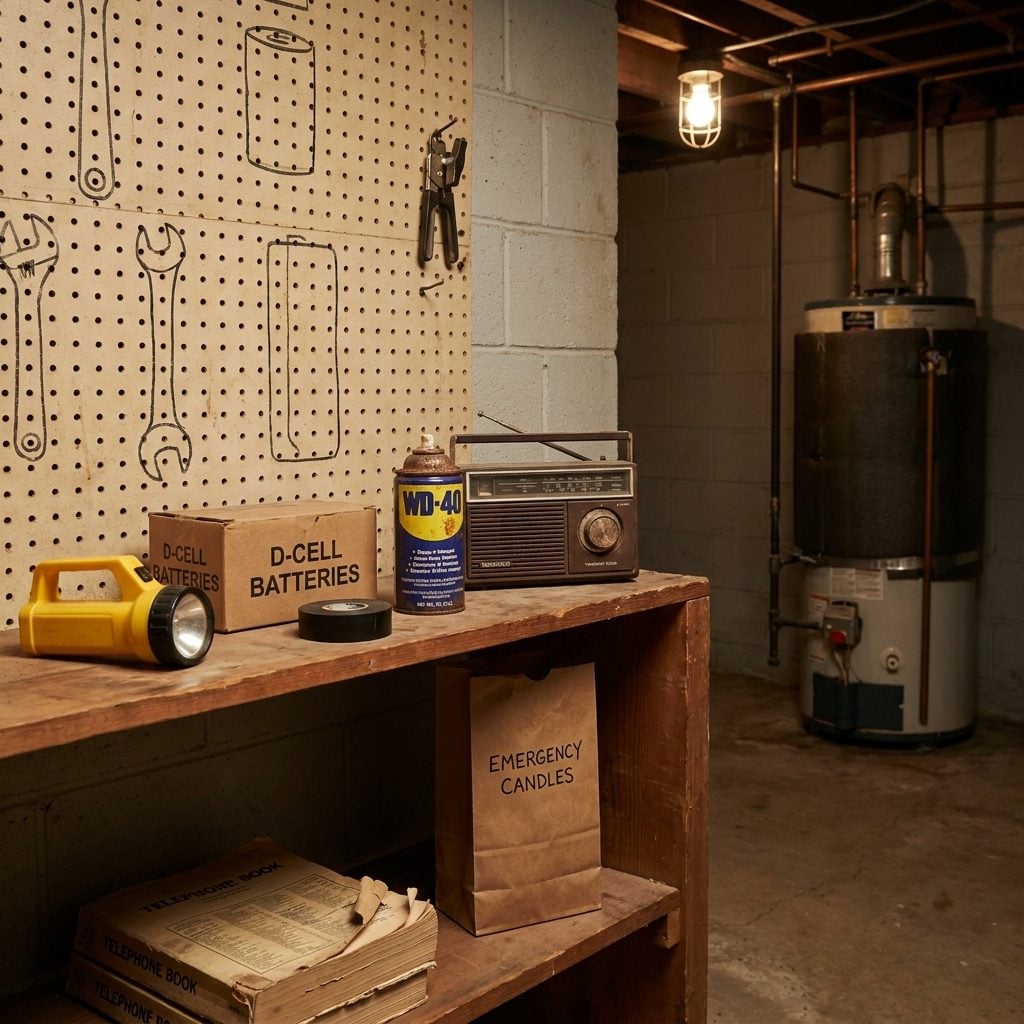
It was always on the second shelf of the utility room, usually between a can of turpentine and some mystery nails in a baby food jar. The flashlight was orange or yellow, chunky, with a silver reflector that had gone slightly grey from age. You grabbed it every time the power flickered during a thunderstorm.
It never worked. Not once. The batteries inside had been sitting there since before you were born, and shaking the thing or slapping it against your palm accomplished nothing except making a hollow rattling sound. But nobody threw it out, because it was the emergency flashlight, and throwing out the emergency flashlight felt like tempting fate.
24. The Wood-Grain Contact Paper on Every Horizontal Surface That Wasn’t Already Wood
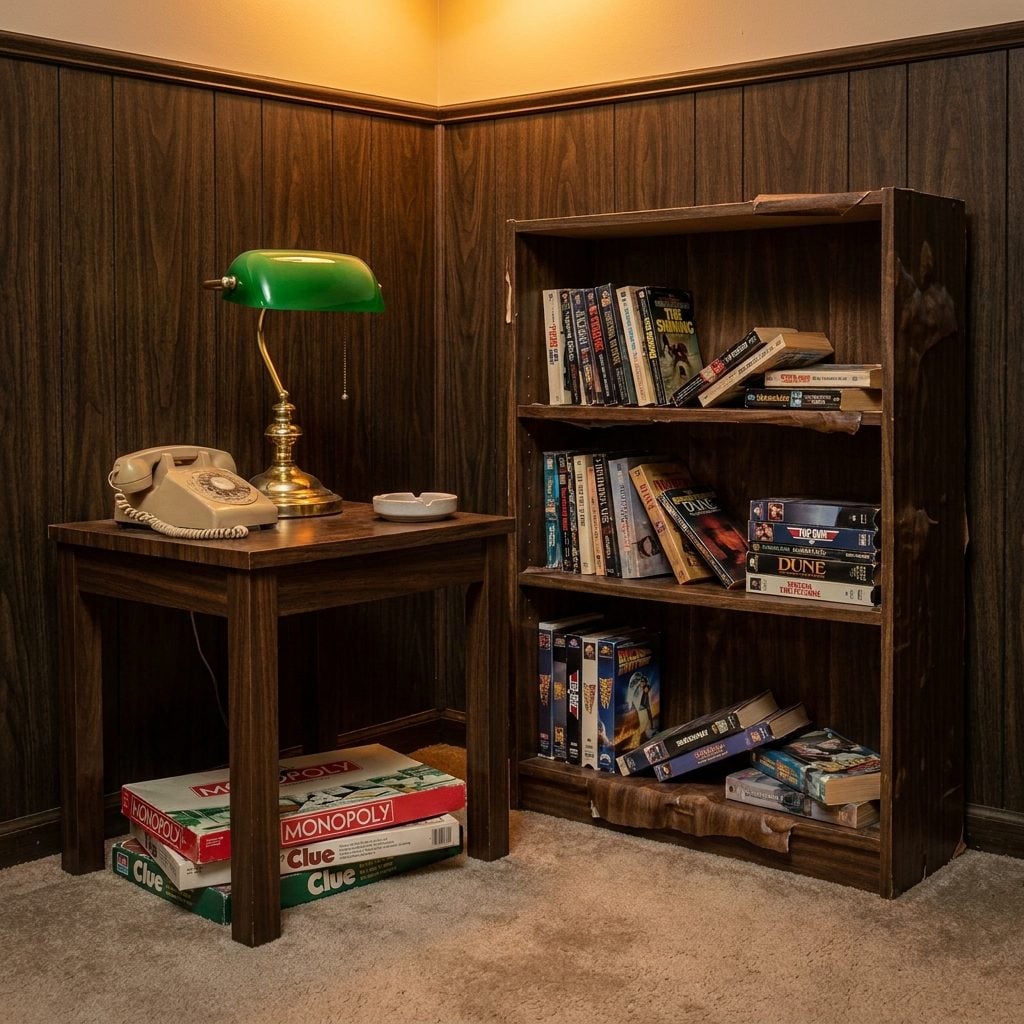
The edges always gave it away — real wood doesn’t peel up at the corners when you run your thumbnail along it. But that adhesive-backed vinyl with the printed grain pattern covered everything down there: the particle board shelving, the folding card table, the top of the mini fridge. Somebody bought a roll at the hardware store and went on a mission.
Bubbles were the other tell. No matter how carefully it went on, air pockets formed within a week. You’d press them flat with a credit card and they’d come back, passive-aggressive little blisters that refused to stay down. The paper yellowed at different rates depending on sun exposure, which in a basement meant it yellowed almost never — just stayed there, sticky and permanent, outliving the furniture underneath it.
23. The Couch That Folded Out Into a Bed Nobody Wanted to Sleep On
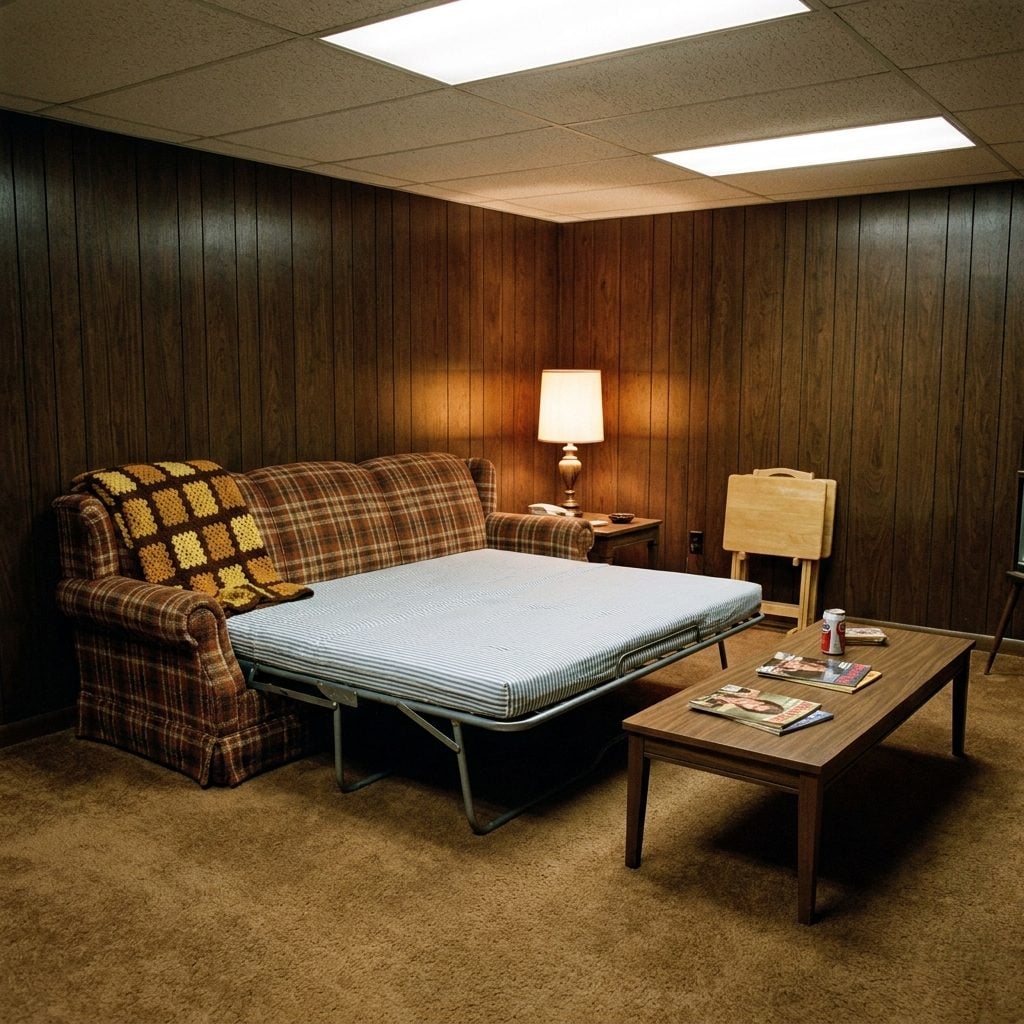
That metal bar across the middle. You felt it within thirty seconds of lying down — a rod of cold steel pressing into your lower back no matter how you repositioned. The mattress was maybe two inches thick and smelled like the inside of a suitcase that hadn’t been opened since a family vacation three presidents ago.
Every family had one. It lived in the basement or the spare room, deployed when cousins visited or when someone’s parents were having a fight nobody talked about. The unfolding mechanism required two people and made a sound like a drawbridge lowering. Folding it back up was worse — you had to tuck the sheets in while simultaneously wrestling the frame, and something always got pinched. A knuckle. A thumb. The corner of a fitted sheet you’d never see again.
22. The Fake-Brick Adhesive Panels on the Wall Behind the TV
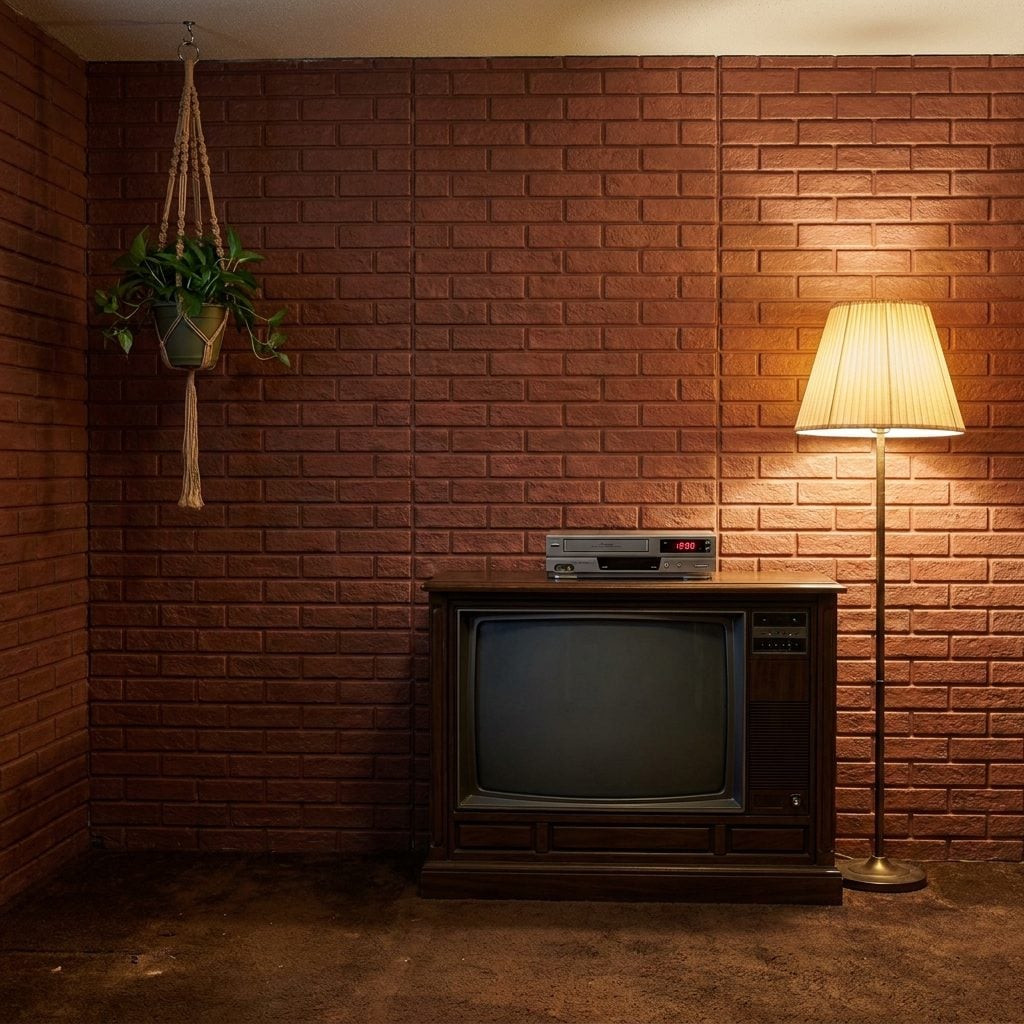
They came in four-by-eight sheets from the lumber yard — lightweight, hollow, and about as convincing as a brick facade in a school play. But somebody decided the basement needed an accent wall, and actual masonry was out of the question both financially and structurally.
The seams between panels never quite disappeared. Run your finger along the join and you’d feel the slight ridge where one sheet met the next. And the “mortar” lines were molded in, perfectly uniform in a way real mortar never is. Still, in dim basement light with the TV on? The effect was almost there. Almost. That word did a lot of heavy lifting in 1980s home improvement.
21. The Dehumidifier Running in the Corner Like a Small Appliance With a Grudge
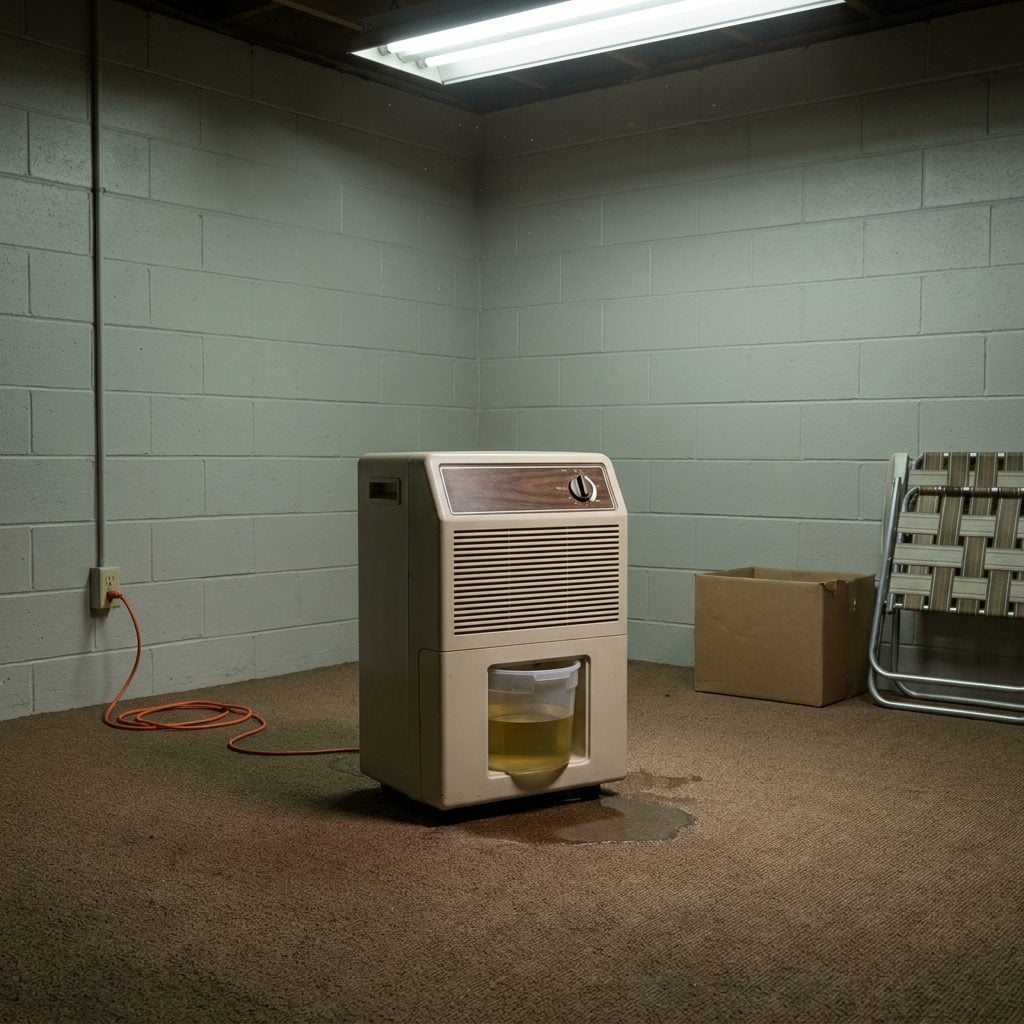
It never stopped. Day, night, Tuesday, Saturday — that low mechanical drone followed you through the basement like tinnitus with a power cord. You only noticed it when it cycled off for thirty seconds before kicking back on even louder.
Someone had to empty the bucket. Nobody volunteered. The water inside was warm, faintly grey, and sloshed in a way that made you walk very carefully up the stairs. Spill it on the carpet and you’d just created the exact problem the machine was hired to solve. The whole arrangement felt like an armistice between the house and the water table, renegotiated every eight hours when the bucket hit the fill line.
20. The Ping-Pong Table That Spent More Time as a Laundry-Folding Station Than a Game Surface
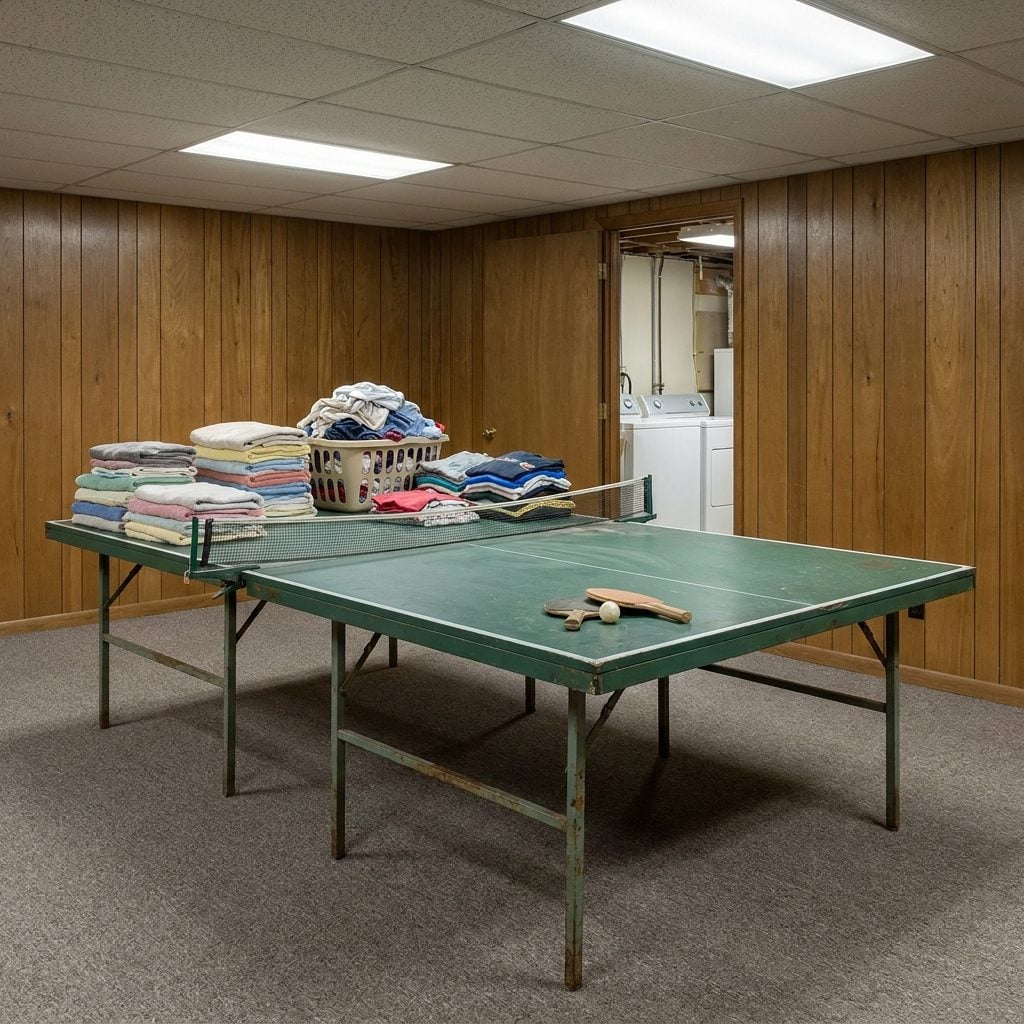
The net stayed up year-round, even when the table hadn’t seen a game since someone’s birthday party in March. By June it was a permanent flat surface for sorting darks and lights, the green playing field buried under bath towels and tube socks.
You’d clear it off maybe twice a year. The ball always had a dent. One paddle had lost its rubber facing and someone had wrapped it in electrical tape — a fix that changed the spin characteristics in ways no one could predict. The serve had to account for the slight slope where one leg was shorter than the others, and arguments about whether the ball clipped the edge were constant and unsolvable. None of this stopped anyone from playing like it was a championship match.
19. The Paneled Ceiling with One Tile You Could Push Up to Hide Things
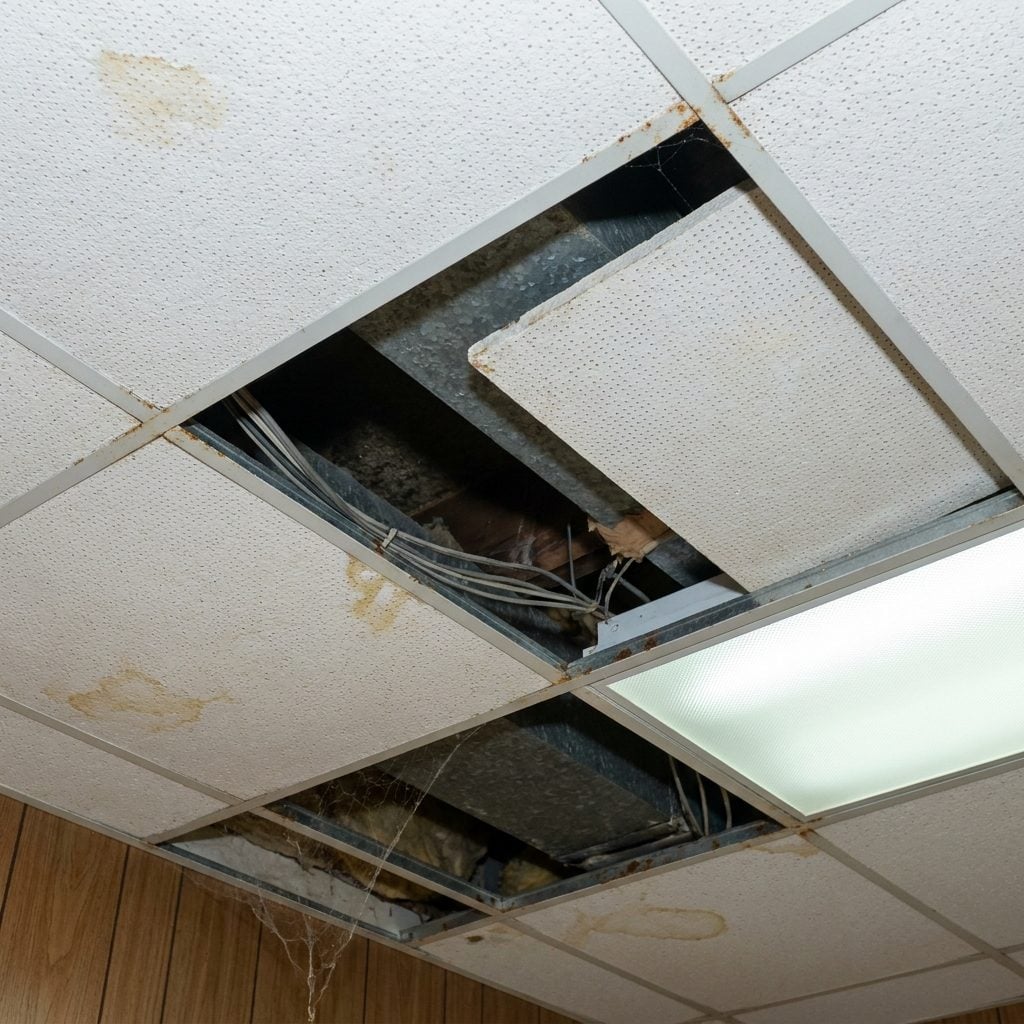
Every kid in the neighborhood knew which tile it was. You stood on the arm of the couch, pressed up with both palms, slid it sideways — and there it was. The gap between the drop ceiling and the floor joists above. Dark, dusty, full of cobwebs and pink fiberglass insulation you knew not to touch because someone’s older cousin got a rash that one time.
That space held contraband. A magazine somebody’s brother had. A pack of cigarettes. A walkie-talkie with dying batteries. Twenty identical white tiles, and only you knew which one moved. Perfect security system, honestly. Adults never looked up.
18. The Indoor-Outdoor Carpet That Felt Like Walking on a Giant Brillo Pad
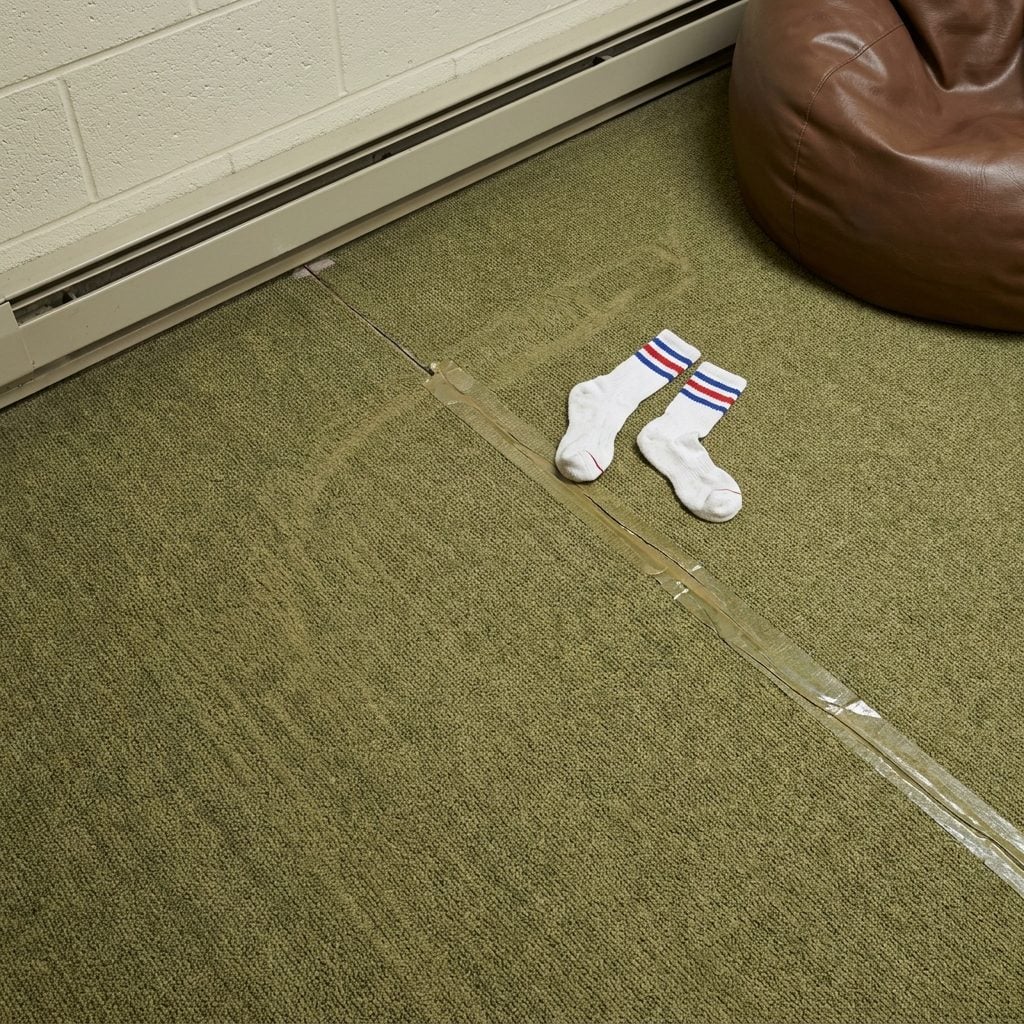
Forget sliding across it in socks. That carpet grabbed cotton like Velcro. Sitting cross-legged left waffle-pattern indentations on your knees that lasted an hour, and it was thin enough to feel every crack in the concrete slab underneath.
But it did its job. Spill grape juice on it and the stain barely showed against the olive-brown-green color somebody had chosen precisely because it hid everything. Water from a minor flood? Dried. Dog tracked in mud? Couldn’t tell. The carpet outlasted everything else in that basement, including the family’s patience for the basement itself. You could still find remnants of it bonded to the concrete twenty years after someone finally ripped it up — the adhesive had fused with the slab at a molecular level, apparently, because nothing short of a floor scraper could budge it.
17. The Console Stereo System With the Turntable Under a Hinged Lid
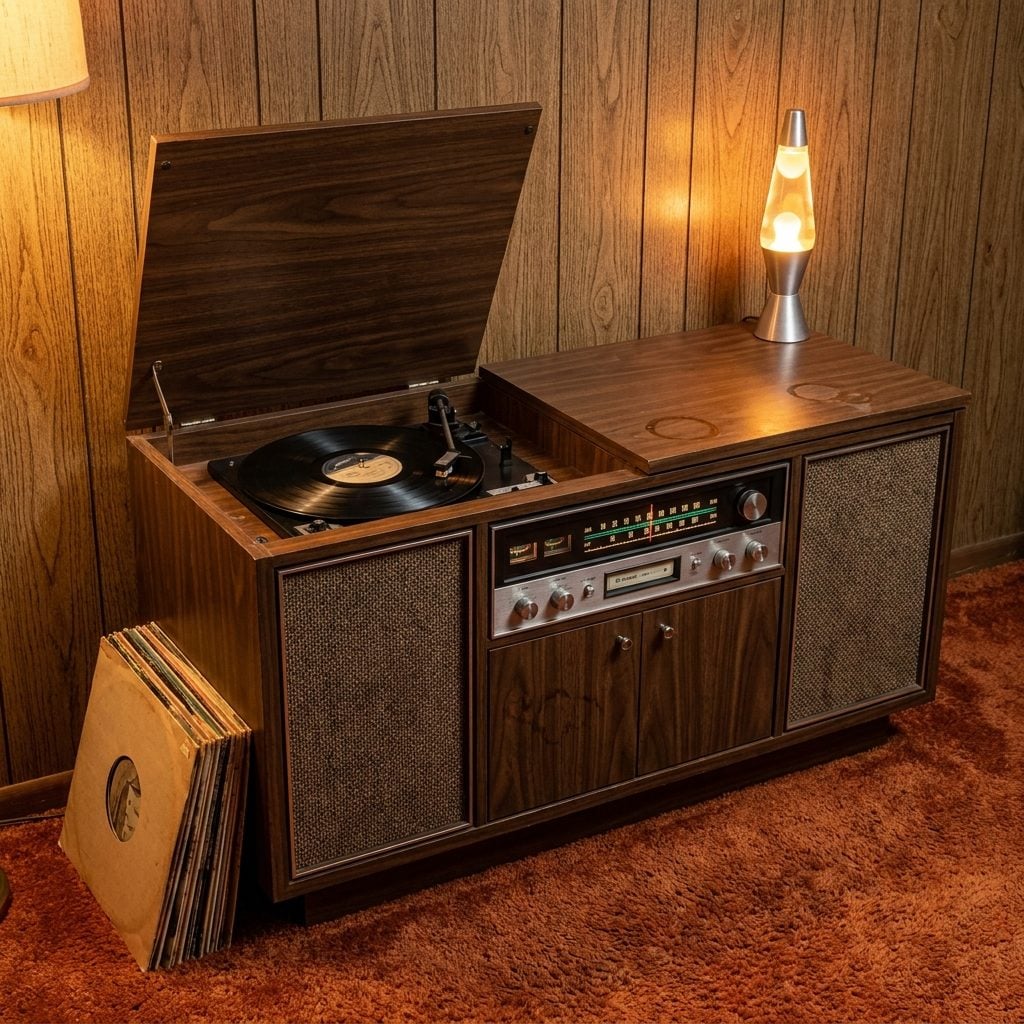
It weighed about as much as a refrigerator. Moving it required two adults and a frank discussion about whether it was worth keeping, a conversation that somehow never reached a conclusion. It stayed where it was put. For decades.
The lid opened with a soft click and a waft of warm dust. Inside, the turntable sat on a bed of green felt, the tonearm balanced with a tiny counterweight you were never supposed to touch — though everyone did, at least once, and then lied about it when the needle started skipping. The radio dial glowed orange when you turned it on, and the tuning knob moved a thin red line across city names printed in a font that belonged to another century. Below, speakers hid behind fabric stretched over a wooden frame. The sound was warm and a little muddy, like the music was reaching you through a wall. Even standing right in front of it, there was this pleasant distance to everything. I kind of loved that about it.
16. The Wall-Mounted Rotary Phone at the Bottom of the Stairs
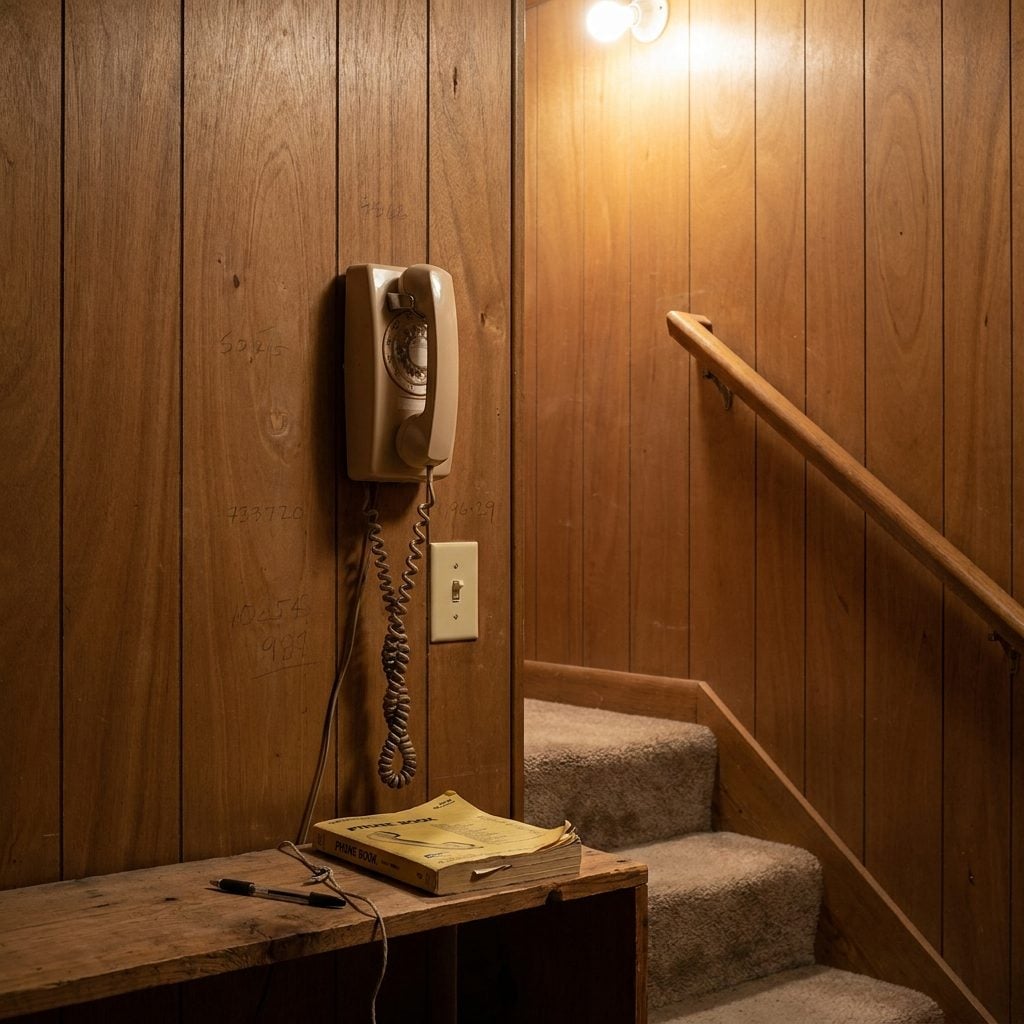
Phone numbers written directly on the wall paneling in pencil. No one ever erased them. They accumulated over years like a geological record of the family’s social life — the pizza place, the pediatrician, someone named Diane whose number had been crossed out and rewritten twice.
The coiled cord stretched just far enough to let you sit on the bottom step with some illusion of privacy, though anyone on the stairs could hear every word. And the dial took forever. Seven digits meant fourteen seconds of spinning and waiting, spinning and waiting. Plenty of time to lose your nerve before the last number clicked home.
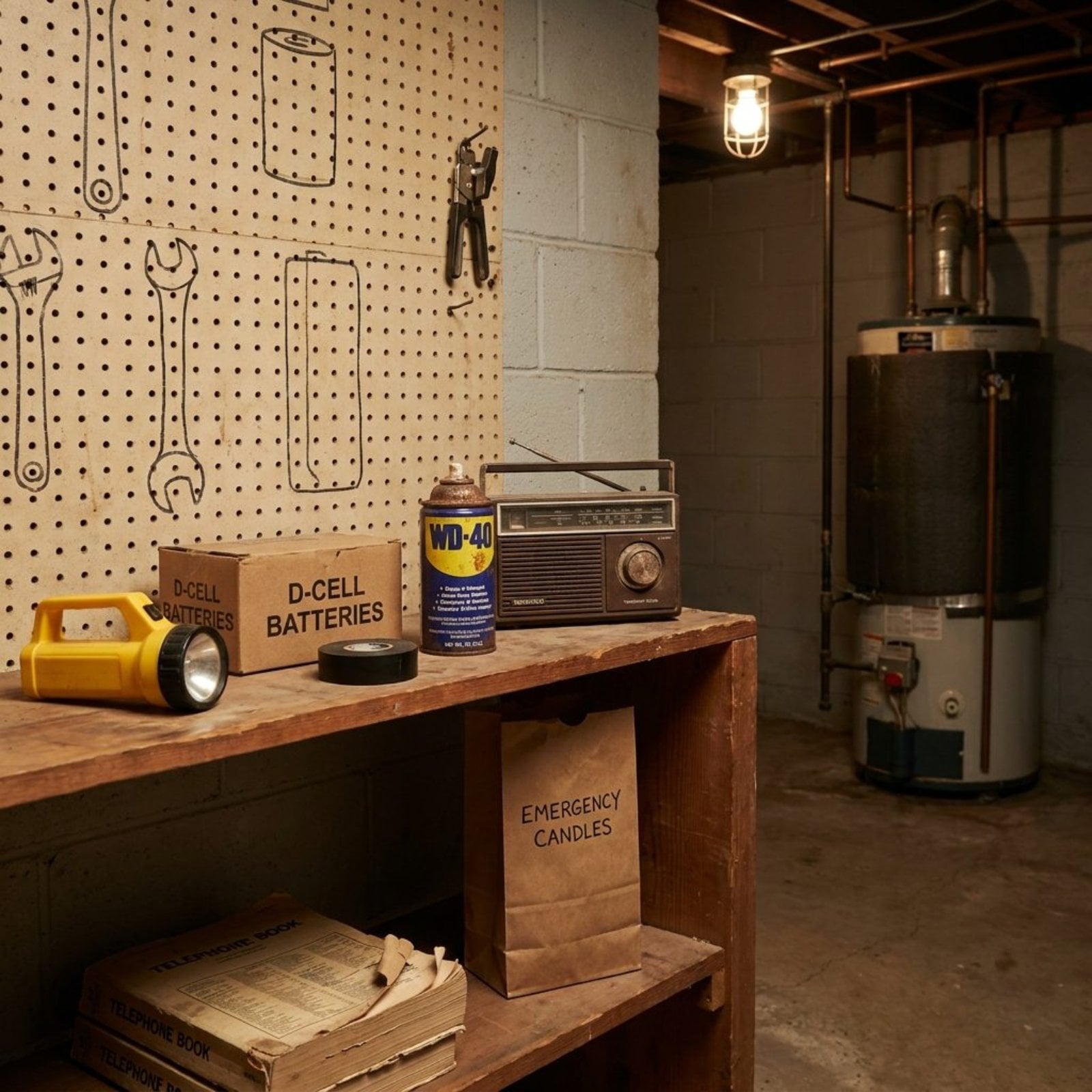
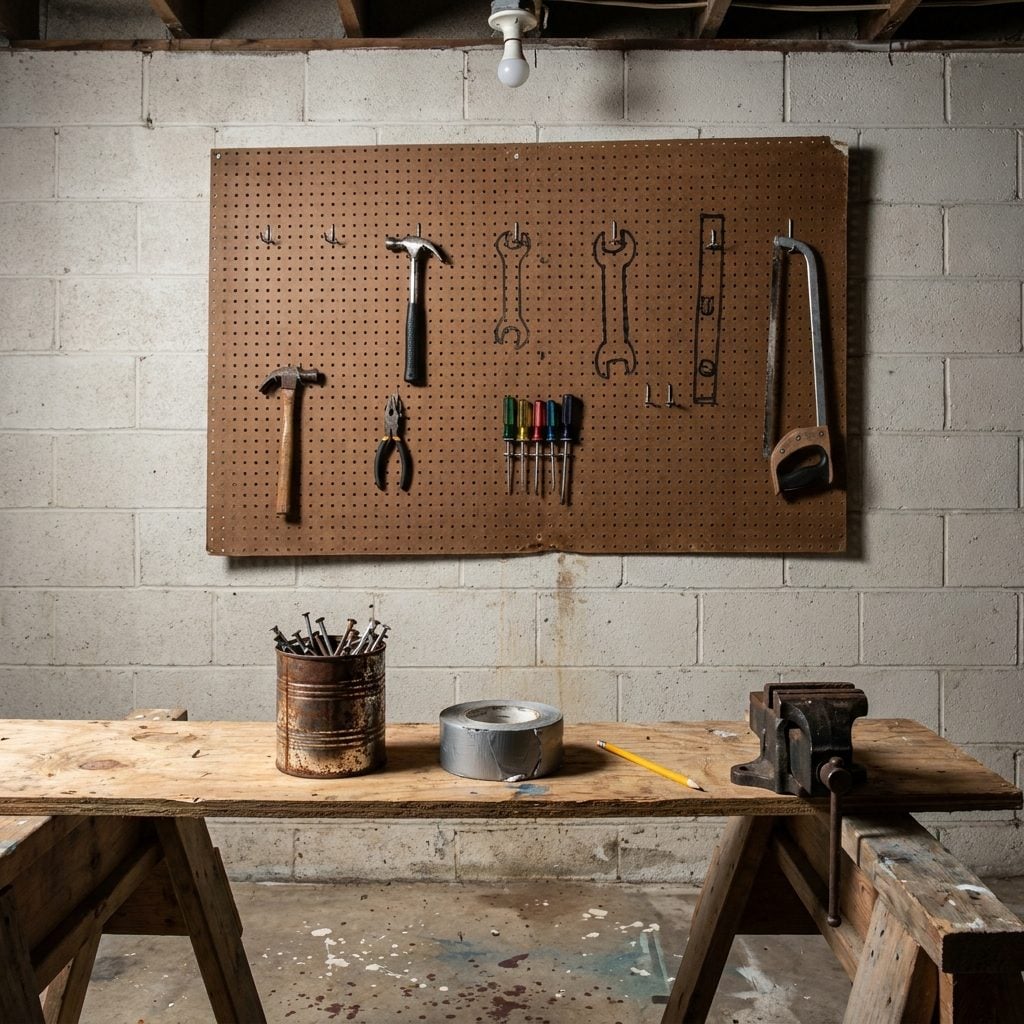
15. The Pegboard Wall in the Utility Area With Outlines Where Tools Were Supposed to Go
🔥 Would you like to save this?
Traced in black marker — the outline of every hammer, wrench, and pair of pliers, drawn right on the pegboard so you’d know exactly where each one belonged. The system assumed people would put things back.
They did not.
Half the hooks were empty at any given time because the tools were in the garage, in the junk drawer, in the trunk of someone’s car, or wedged behind the dryer where they’d fallen six months ago. The outlines remained, a ghost inventory of organizational ambition that peaked sometime around 1983 and never recovered. Any warm basement layout from the era had one of these walls, usually next to the water heater, always slightly crooked where the pegboard had warped away from the cinder block behind it.
14. The Carpet Squares in Two Different Colors Someone Laid in a Checkerboard Pattern
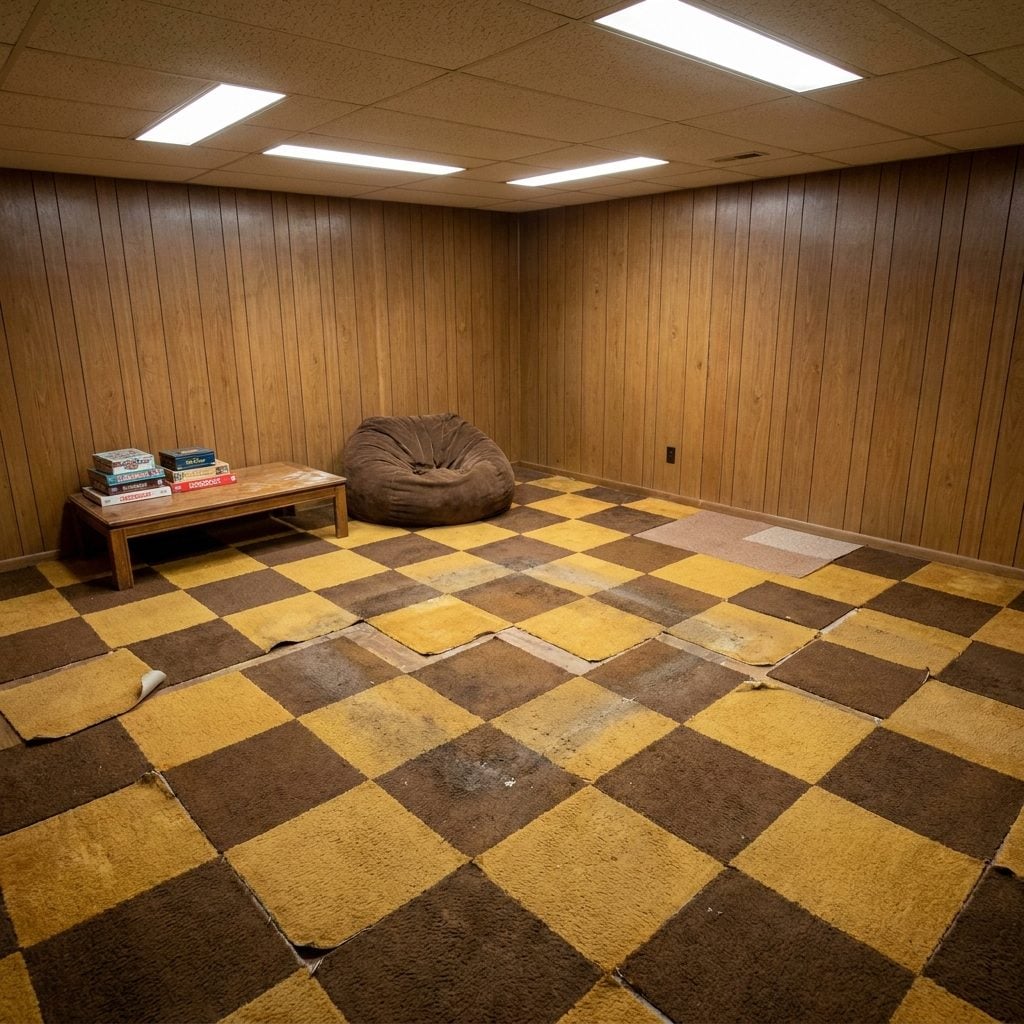
The checkerboard floor was always somebody’s dad’s idea, and it was a genuinely good one. Peel-and-stick carpet squares came in enough colors that you could do something interesting with them, and a Saturday afternoon later you had a basement floor that looked intentional. The misaligned seams and the one replacement square in a slightly different shade were just part of it.
What the floor actually recorded was where everyone spent their time. The path from the stairs to the TV went thin first. Then the spot in front of the couch. The checkerboard near the walls stayed almost pristine for years, undisturbed proof that nobody ever sat over there.
13. The Swag Lamp Hanging Over the Card Table in the Corner
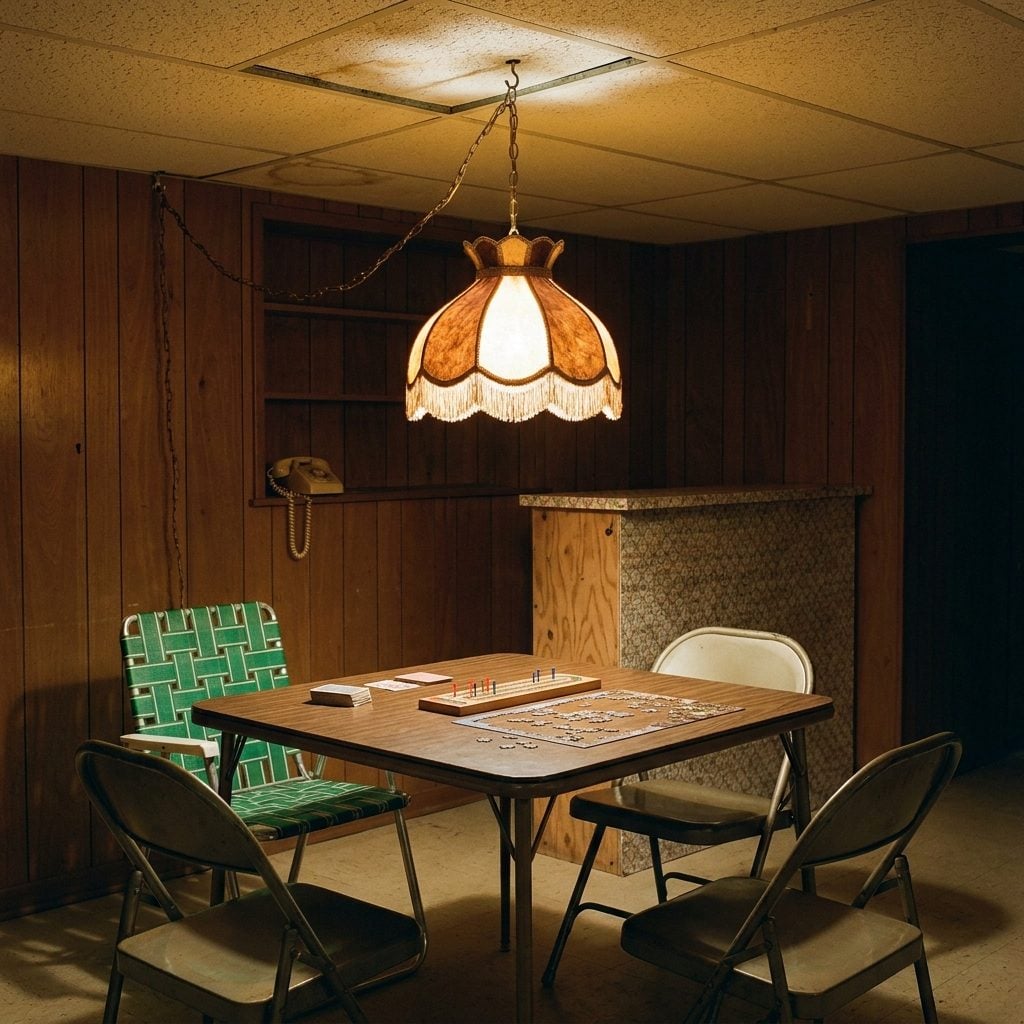
That swag lamp did more for basement atmosphere than anything else in the room. Someone drove a hook into a ceiling tile, draped the cord, and suddenly the card table corner had a vibe. The tasseled shade threw amber light down onto whatever game was happening, and the rest of the basement fell into soft shadow.
The hook was always slightly too close to the edge of the tile, so the whole lamp listed about ten degrees. Nobody fixed it. It became part of the thing.
12. The Dartboard on a Square of Cork Tile Screwed Directly Into the Paneling
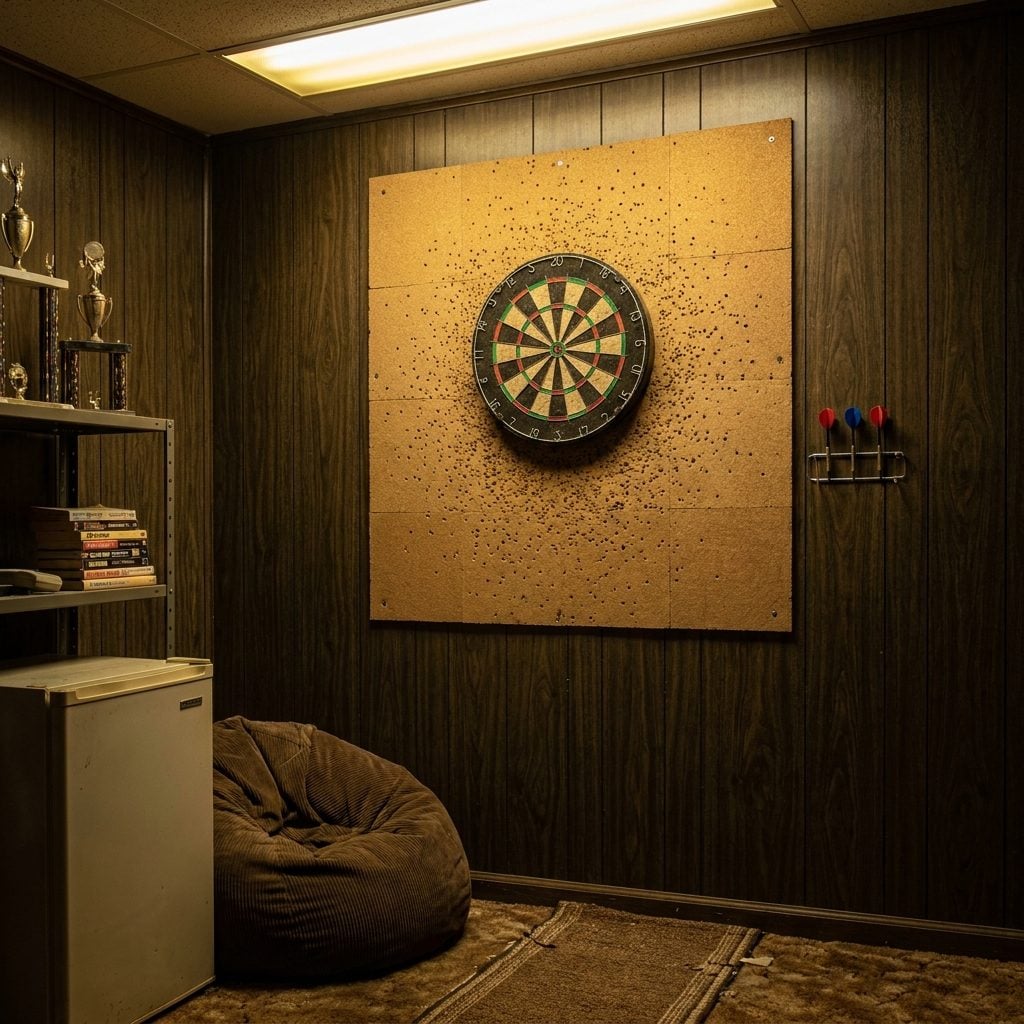
The cork tile was supposed to catch the misses. The paneling beyond the cork tile tells the real story of how often that worked. Every basement dartboard installation had its ring of shame holes outside the official catch zone, and the family just collectively agreed not to acknowledge them.
Steel tips. Always steel tips. The soft-tip electronic boards came later and felt like a betrayal to everyone who had already memorized the weight of the brass-barreled darts that lived in the wire rack beside the board.
11. The Shelf of Sports Trophies That Belonged to a Sibling Who Had Since Left for College
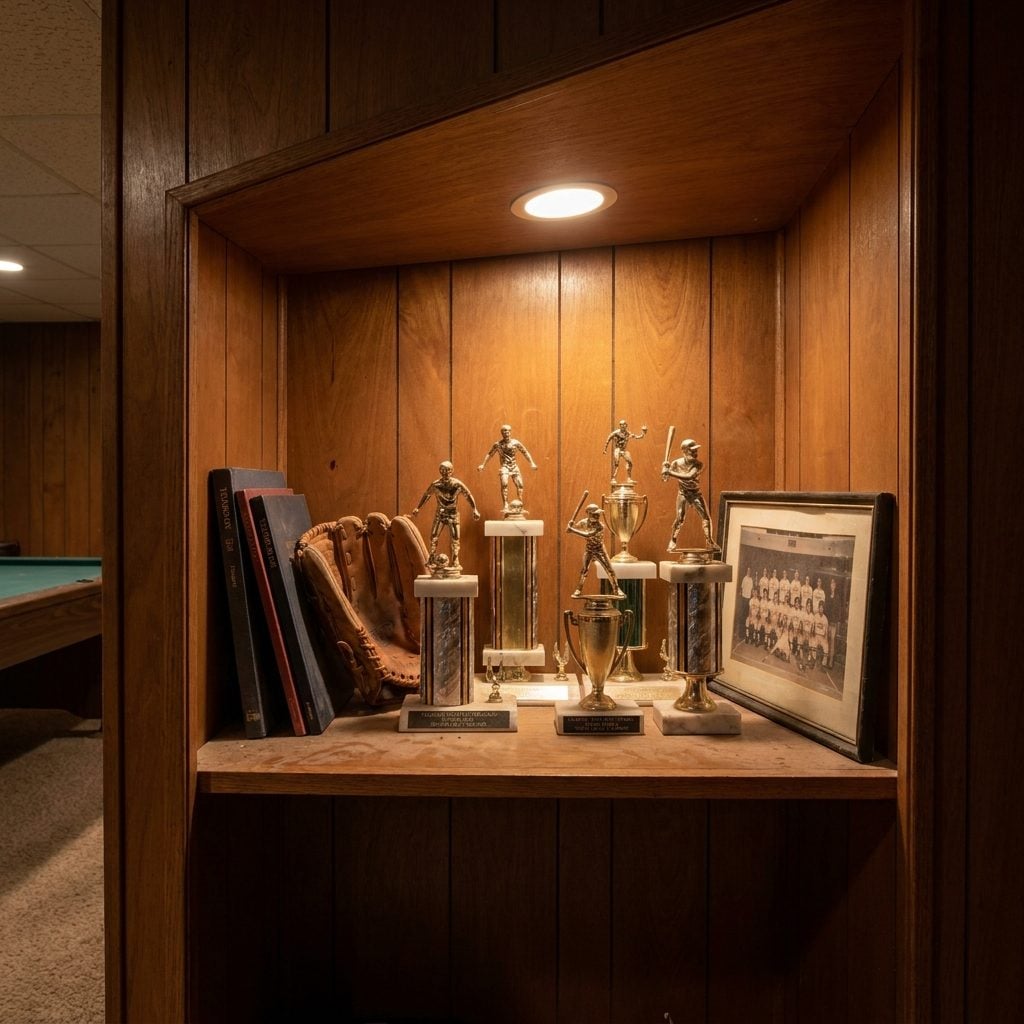
These trophies belonged to someone who was no longer home. The sibling was at college, or working, or just gone, and the trophies stayed because nobody moved them and nobody had the heart to put them in a box. The dust settled in the lettering of the engraved plates.
Every latchkey kid spent time alone down there reading those names and dates. Third place, 1979. Most Improved, 1981. The trophies made the absent sibling feel both very real and very far away, which is a strange thing for a plastic soccer player on a column to accomplish.
The dust settled in the engraved lettering. Third place, 1979. Most Improved, 1981. The absent sibling was both real and very far away.
10. The Built-In Bar With the Mirrored Backsplash and the Stained Wood Trim
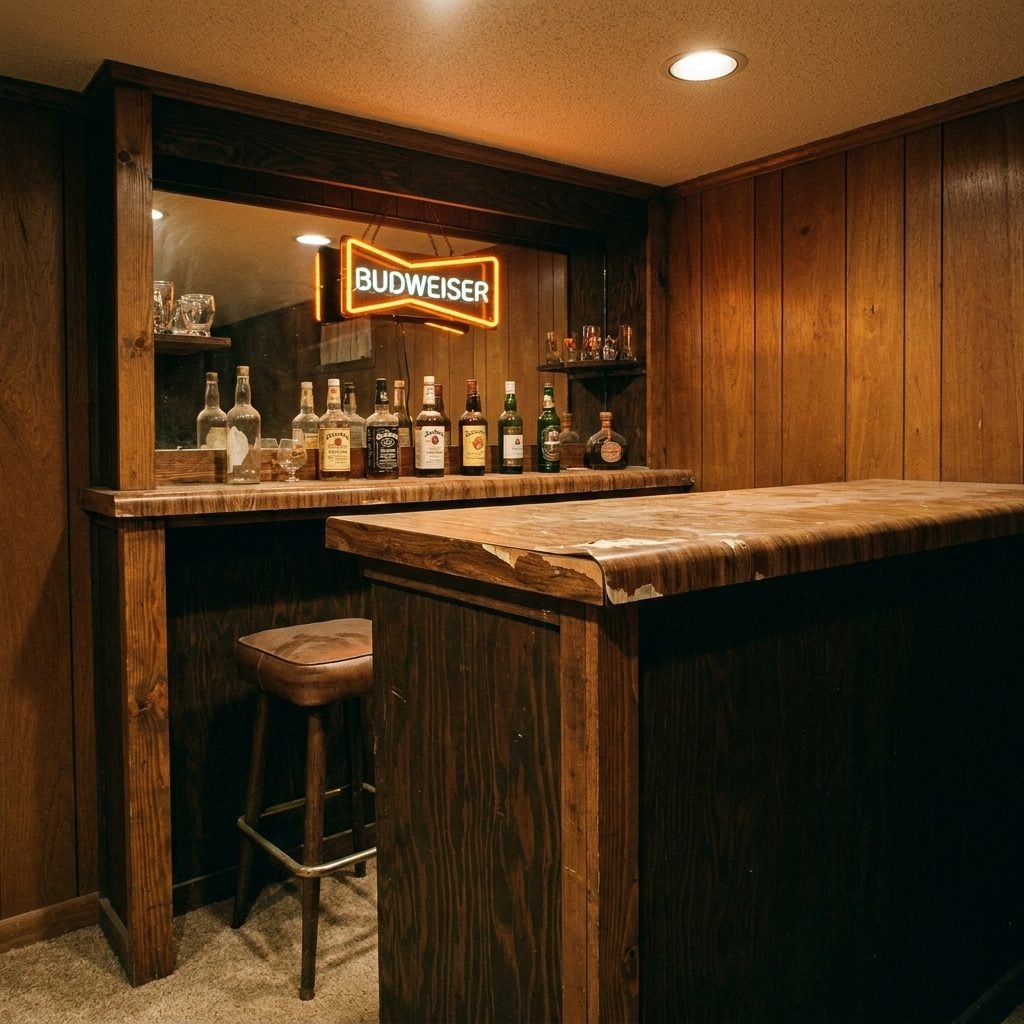
Someone’s dad built this bar with a genuine sense of ceremony. The mirrored backsplash was the detail that made it feel real. You could see the bottles reflected, see yourself behind the bar, see the whole basement laid out in miniature. For a warm basement design, nothing worked harder than this bar in the corner.
The neon sign stayed on all the time. Nobody ever turned it off. It hummed at a frequency you stopped hearing after five minutes, and the amber light it threw made the whole corner feel like a place people chose to be, rather than a room underneath a house.
9. The Small Color TV on a Rolling Stand That Got Three Channels If You Aimed the Antenna Right
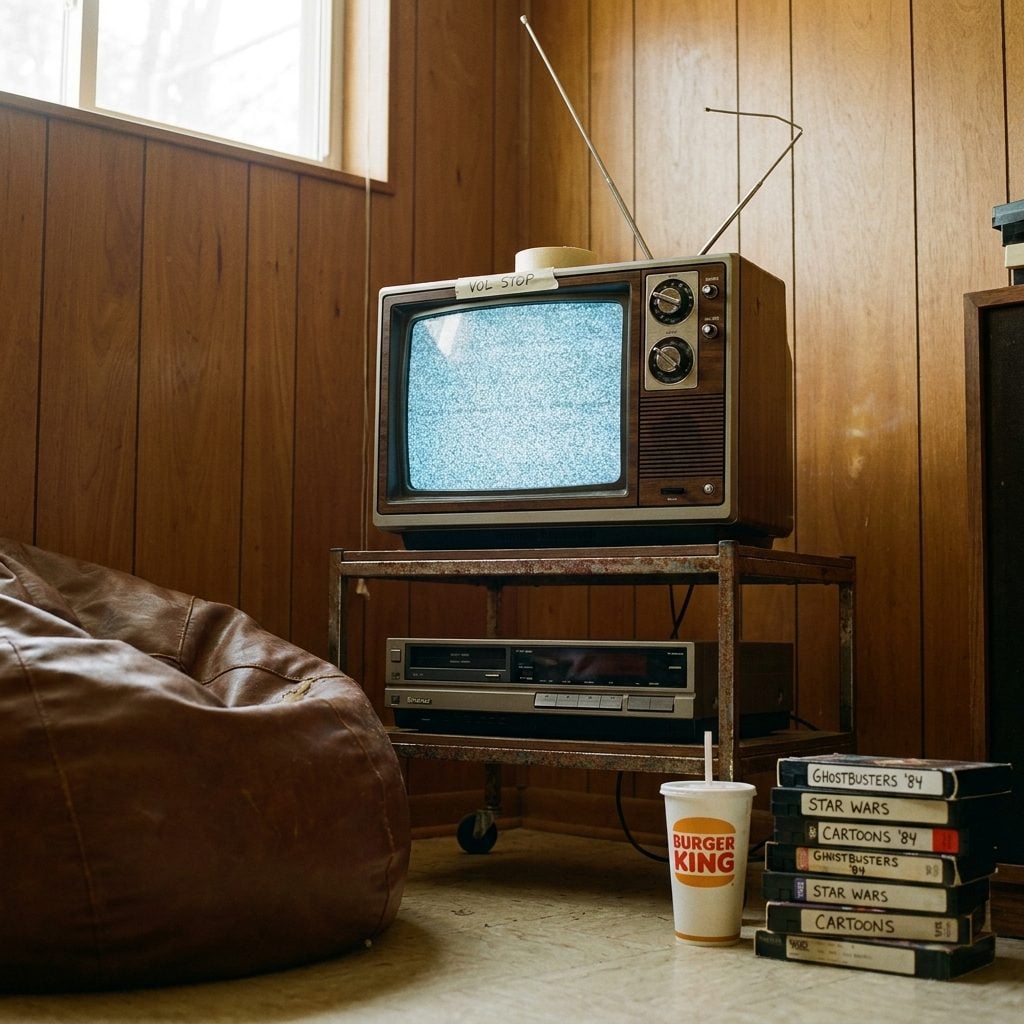
The antenna position was sacred knowledge. You found it by accident one afternoon and marked it with a piece of masking tape, then defended it against anyone who touched the set. Move the rabbit ears two inches and you lost Channel 11 entirely. The exact bent-elbow angle that got you three clean channels and two snowy ones was not written down anywhere. It lived in your hands.
The rolling stand gave it dignity. The TV was down here because it was old, replaced upstairs by something bigger, but the stand made it feel like a deliberate installation. The lower shelf held the VCR, and the VCR made the whole corner into something approaching a personal theater. You were ten. That was enough.
8. The Beanbag Chair That Slowly Lost Its Filling and Became a Flat Vinyl Puddle
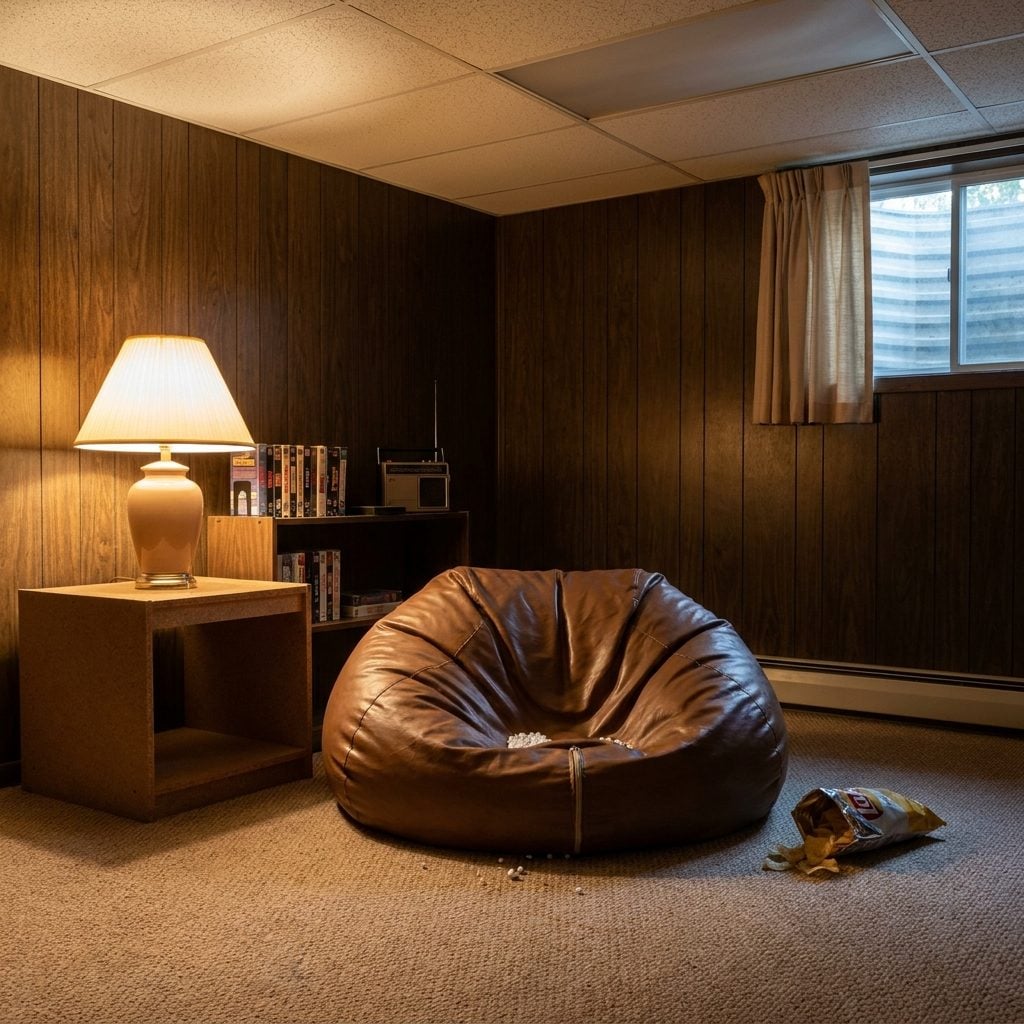
Fresh out of the box, it stood knee-high and felt like sitting on a cloud made of static electricity. Give it six months and you had a vinyl pancake. You’d sink all the way to the floor, knees jammed up around your ears, and still choose it over the couch every single time. Every time.
The tiny polystyrene beads escaped through the zipper seam like they were staging a slow jailbreak — in your socks, behind the TV, stuck to the cat. Nobody ever refilled the thing. You just kept sitting lower and lower until one day you were basically on the floor with a vinyl blanket draped over you, and honestly? That was fine.
7. The Faux-Wood Veneer Entertainment Center That Held Everything the Family Owned
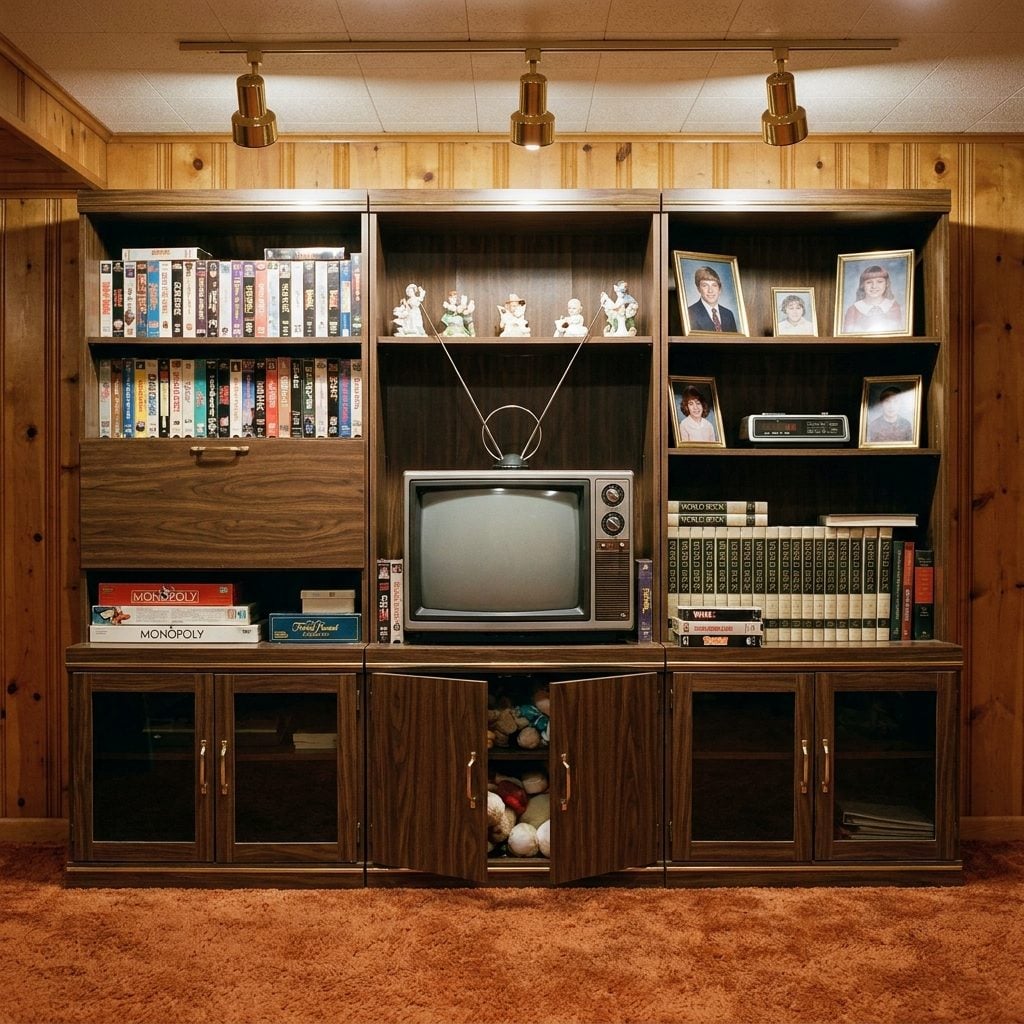
The family’s external hard drive before external hard drives existed. Board games on the left, encyclopedias nobody opened on the right, and the TV centered in its alcove like a household altar — flanked by VHS tapes organized in a system only the person who built the collection could decode, and even they were guessing.
Behind the smoked glass cabinet doors lived the real chaos: tangled cables, orphan remote controls, instruction manuals for appliances sold at a yard sale three years ago. Every shelf bowed slightly in the middle from bearing weight it was never built to handle. And yet this hulking laminate rectangle anchored the entire room. Without it, the basement was carpet and paneling. With it? Headquarters.
6. The Concrete Block Walls Somebody Painted a Single Coat of White Over and Called It Done
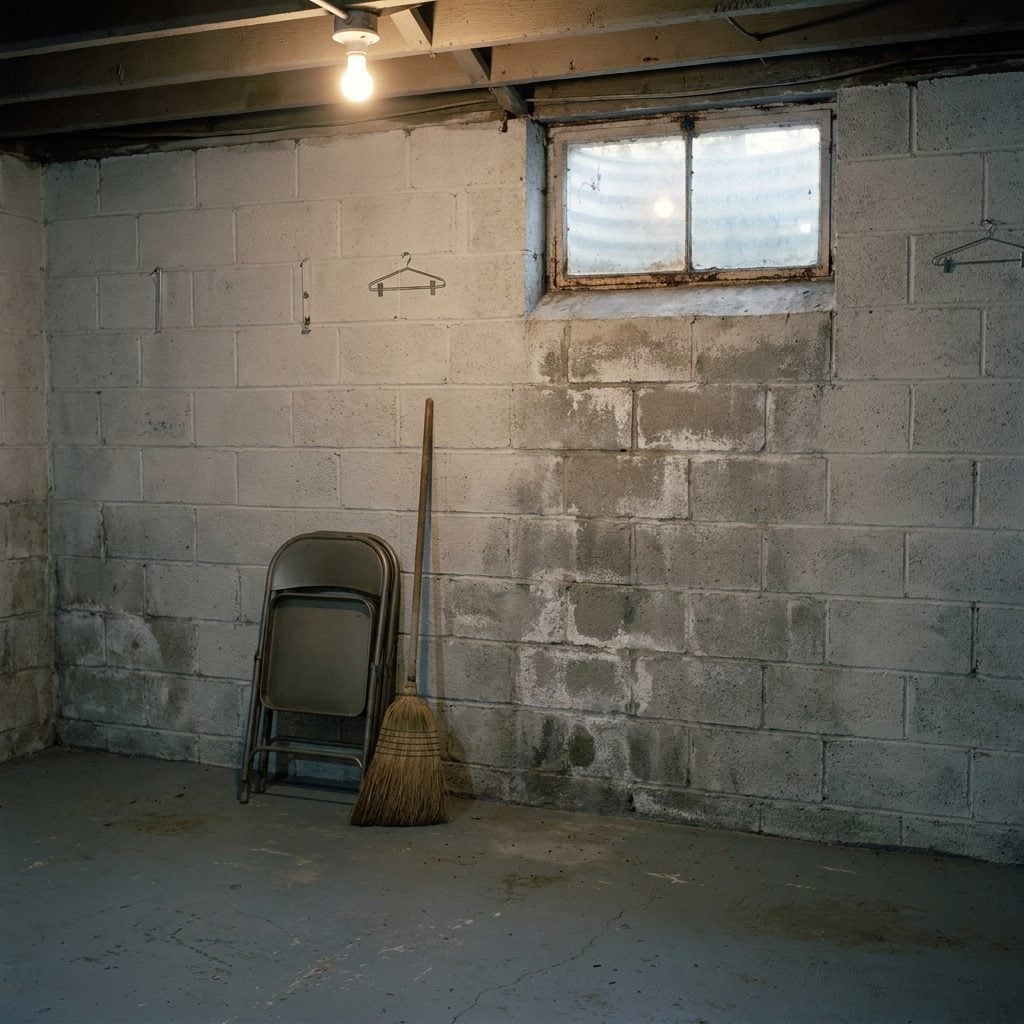
One coat. Always one coat. The gray of the block bled through everywhere, and you could run your hand along it and feel every ridge, every mortar joint, every spot where the roller skipped because whoever was painting had decided this was close enough. It always was.
Some families got ambitious — pale yellow, sky blue. Same single coat. Same block texture showing through underneath like the concrete wanted to make sure you remembered what you were dealing with. Didn’t matter what color you picked. A painted cinder block wall is going to look like a painted cinder block wall, and everybody involved, including the wall, understood that.
5. The Giant Floor Pillow Nobody Washed, Not Once, Not Ever
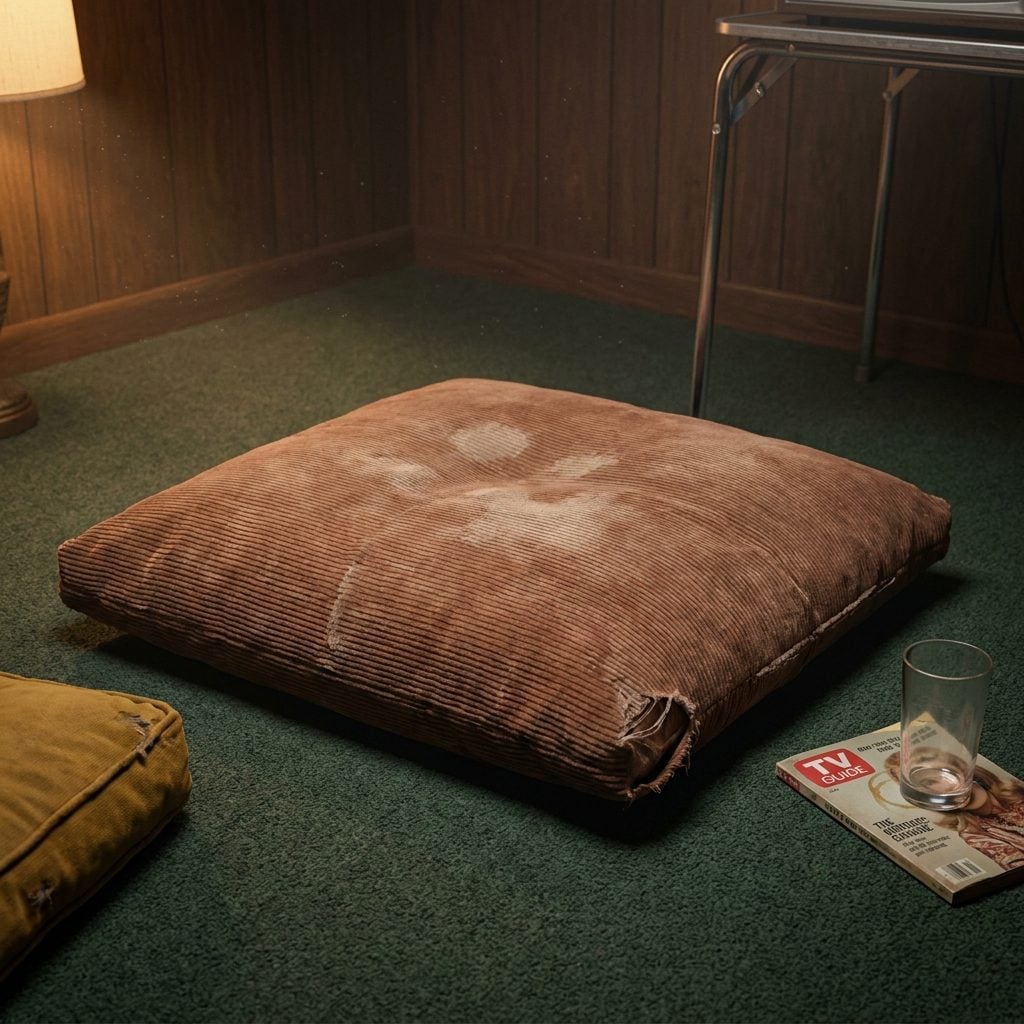
Corduroy, usually. Brown or rust or a gold that had surrendered to being brown. It lived on the basement floor like it had materialized there through sheer force of inevitability — nobody remembered buying it, nobody remembered it arriving. It just was.
Kids sat on it. Dogs claimed it. Popcorn spilled into its folds and was never fully recovered. The thing absorbed years of basement life and held every molecule of it, a geological record in fabric form. Washing it? The thought never crossed anyone’s mind. Probably for the best. Some artifacts demand you leave them alone.
4. The Sliding Glass Door to the Backyard That Made the Basement Feel Like Its Own Apartment
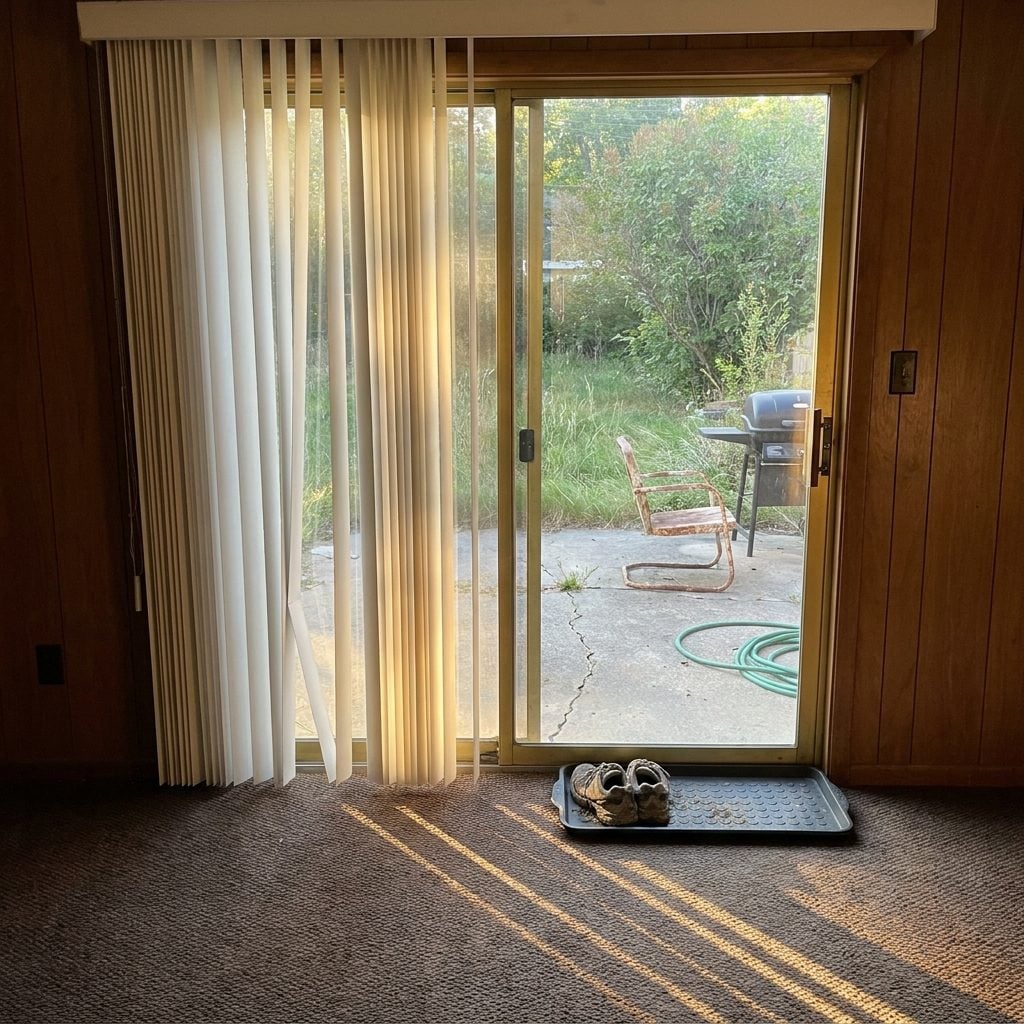
If your basement had one of these, you lived differently. You had a back entrance — your own door. The basement stopped being underground storage with carpet and became a separate wing with its own relationship to the yard, and that changed everything about how the space felt.
The vertical blinds were perpetually half-open, tangled, missing two or three slats near the middle. A security bar — cut broomstick or purpose-made aluminum rod — sat in the track at night. Summer meant the door stayed open all afternoon and the whole basement smelled like cut grass and warm concrete. Winter meant cold radiating off the glass so hard you could feel it from across the room. Both versions felt like freedom, which is a strange thing to say about a sliding door with oxidized aluminum trim, but there it is.
3. The Stack of National Geographics in the Corner That Grew Taller Every Month and Never Got Shorter
🔥 Would you like to save this?
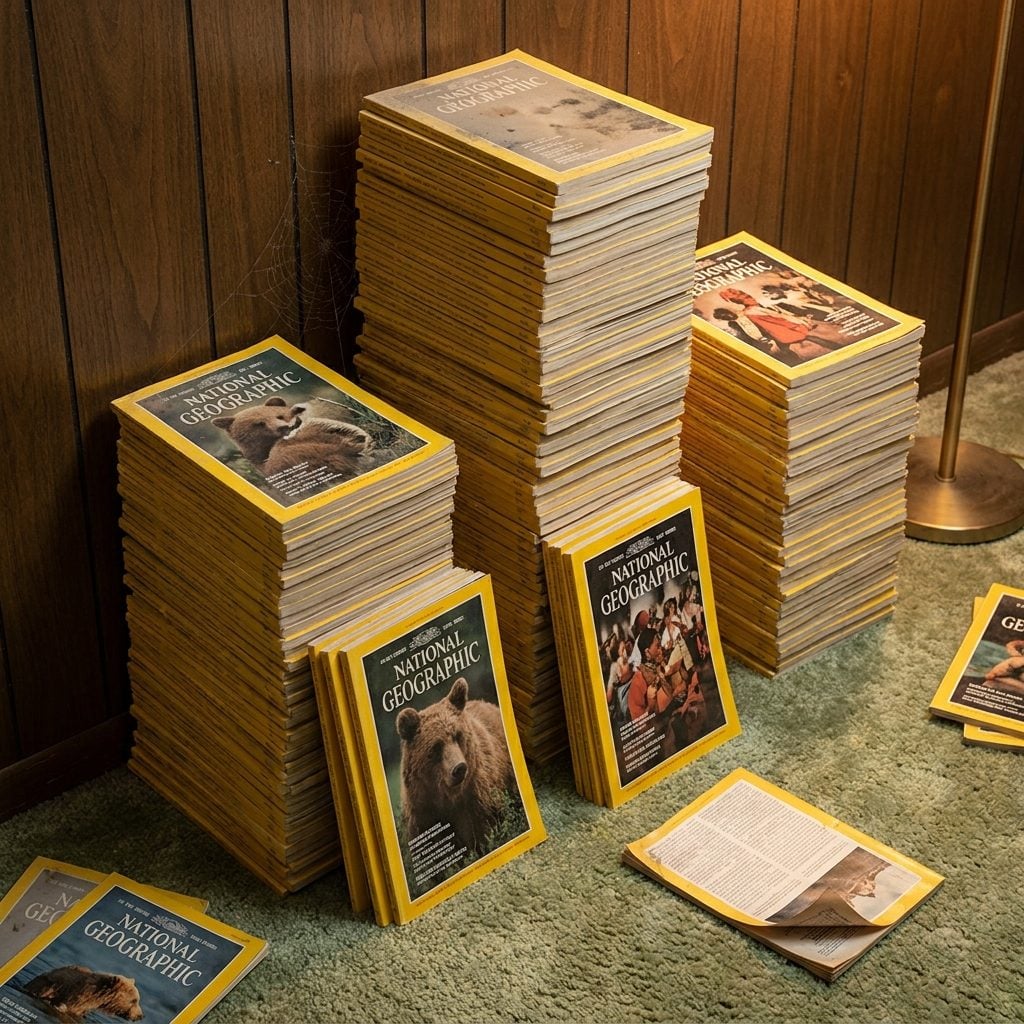
Nobody threw away a National Geographic. Unwritten house rule, right up there with not touching the thermostat. Every month a new one arrived, and every month it went on the stack. One stack became two, then three, and the yellow spines lined up against the paneling like a second wall — decades deep, dust-covered, undisturbed.
The strange part is that people genuinely believed they’d go back and read them. Somewhere a rainy Saturday would materialize, and someone would pull the June 1983 issue from the middle of the pile and finally learn about monarch butterfly migration. That Saturday never came. It was never going to come. The stack kept growing anyway, because throwing one away would’ve felt like a crime nobody could name.
2. The Ceiling-Mounted Smoke Detector That Chirped for Weeks Before Anybody Changed the Battery
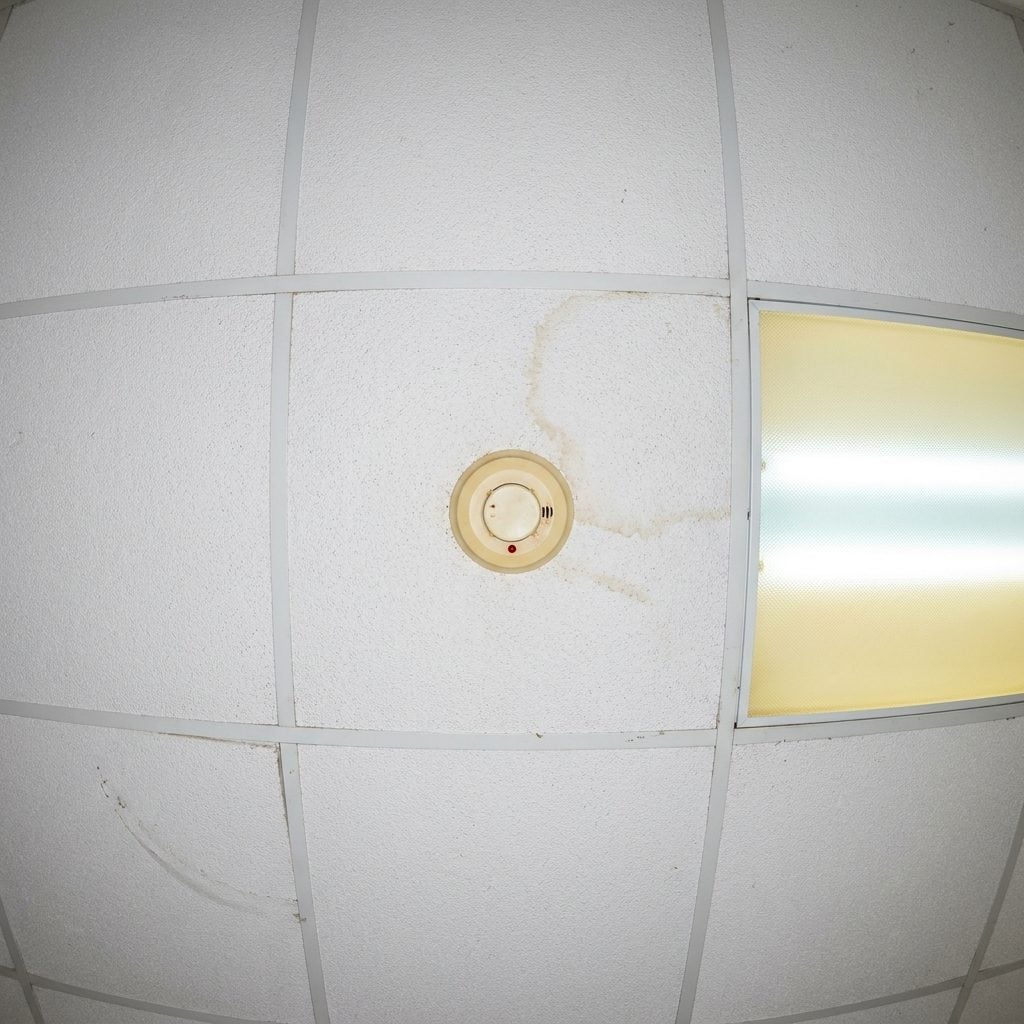
Every forty-five seconds. That faint, apologetic chirp — just loud enough to hear from anywhere in the basement, just quiet enough to convince yourself you imagined it. Day one, you’d look up at it. Day three, you’d stopped noticing. By week two it had woven itself into the ambient soundtrack of the house alongside the refrigerator hum and the furnace clicking on.
Changing the battery required a stepladder and a nine-volt. Somehow neither was ever available at the same time. So the chirp continued. Everyone adapted. I’m half convinced there are basements where it’s still going.
1. The Mismatched Set of TV Trays That Lived Behind the Couch Until Company Came
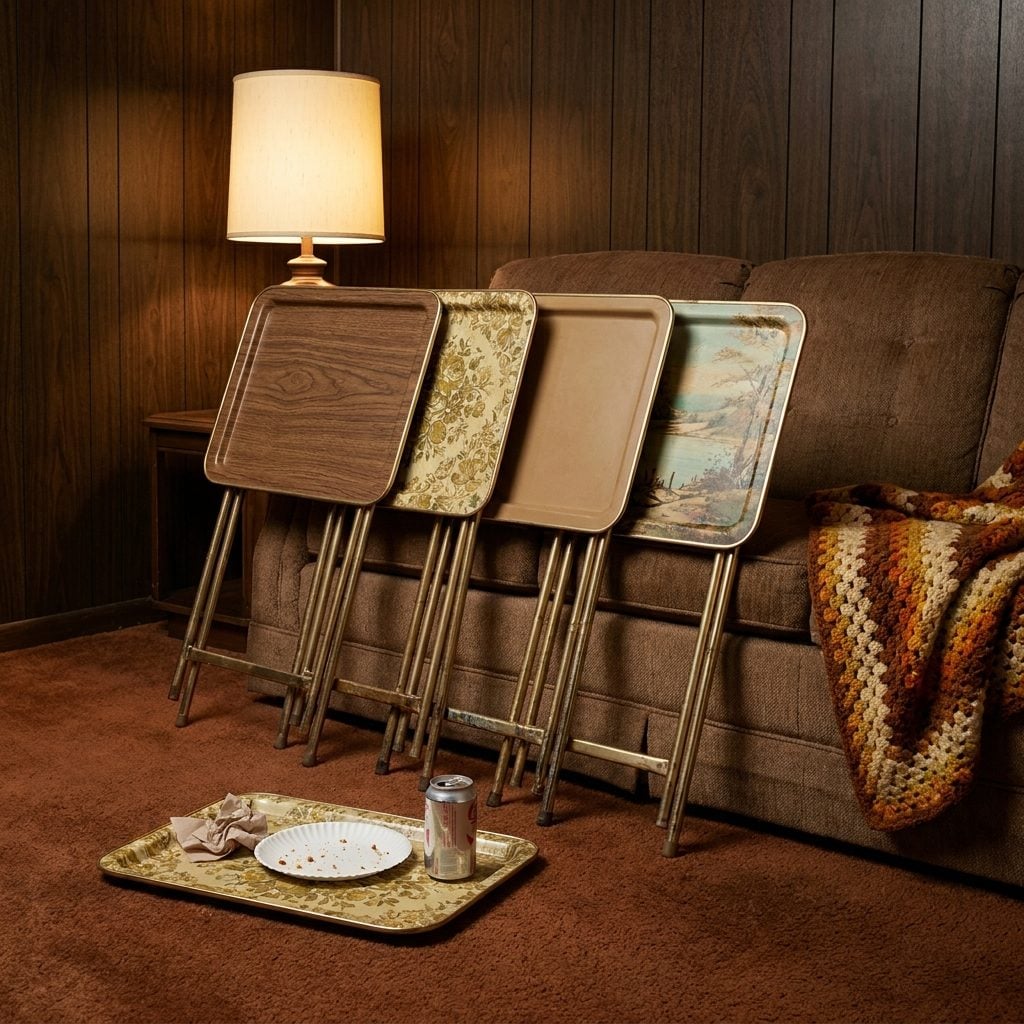
Four came in the set. Maybe three survived. The patterns never matched anything in the room — faux wood grain, a faded floral, something with pheasants on it — and they weren’t trying to. They folded flat and lived in the narrow gap between the couch and the wall, stowaways waiting for shore leave.
When guests showed up, out they came. Everyone balanced a paper plate on one while watching the game or dealing cards, and you learned fast to set your drink dead center because the legs were never fully stable on carpet. Spill radius was a real consideration. After the party they folded back up and vanished behind the couch for another few months, carrying fresh ring stains like passport stamps.