
🔥 Would you like to save this?
The smell hits first. Warm lint, powder detergent, that faint metallic tang of a washer that ran too hot too many summers in a row. Concrete floor, or something pretending to be concrete. The dryer thumped like it was trying to escape out the back door. Laundry rooms in 1975 weren’t rooms so much as corners the house forgot about, and honestly nobody in the house was trying too hard to remember them either. Half a century later they have their own Pinterest boards, their own lighting plans, their own custom cabinetry budgets. Here’s exactly what changed, side by side.
27. The Utility Room Versus the Magazine-Worthy Laundry Suite
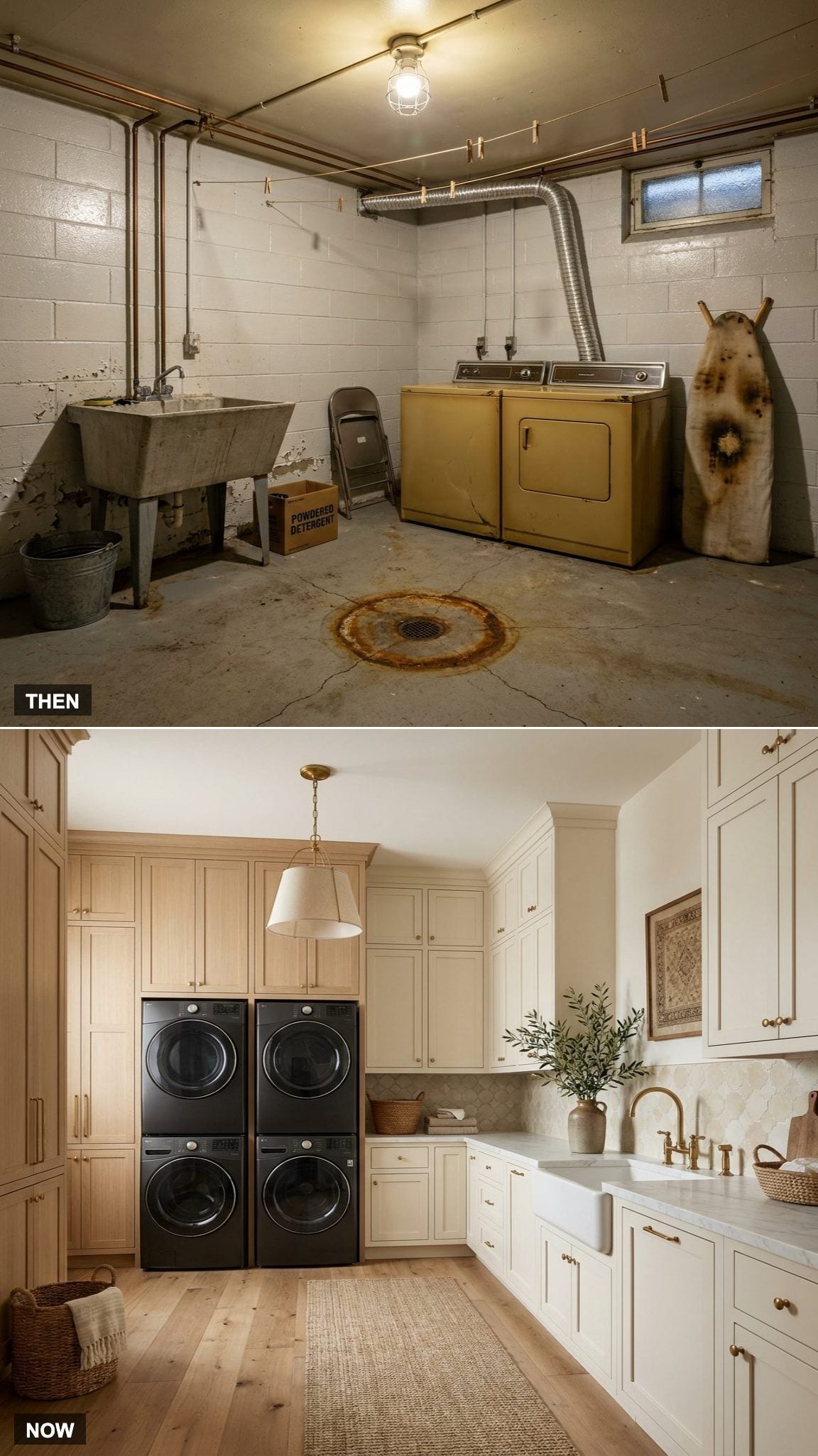
Look at the 1975 room. Just look. Cinder block, dripping utility sink, scorched ironing board propped against a wall like a tired soldier. This was the room. This was a laundry in most American homes when Ford was president.
In order to come up with the very specific design ideas, we create most designs with the assistance of state-of-the-art AI interior design software. Also, assume links that take you off the site are affiliate links such as links to Amazon. this means we may earn a commission if you buy something.
Now look at what it became — custom cabinetry in white oak and cream, an unlacquered brass bridge faucet that will patina beautifully over the next decade, a zellige tile backsplash with all its handmade wobble, olive branches in a stoneware vase because someone decided the laundry room deserved olive branches. The room got a promotion. It stopped being where you did a chore and became somewhere you actually wanted to walk into.
Somewhere between 1975 and now, we decided the room where we wash our clothes deserved the same care as the room where we entertain guests. That’s the whole shift.
The machines still do what the harvest gold Kenmore did. Water in, soap in, agitate, spin, dry. Fifty years of design evolution didn’t change the job — it changed the room around it.
26. The Folding Surface: Nothing at All vs. Expansive Quartz Counter
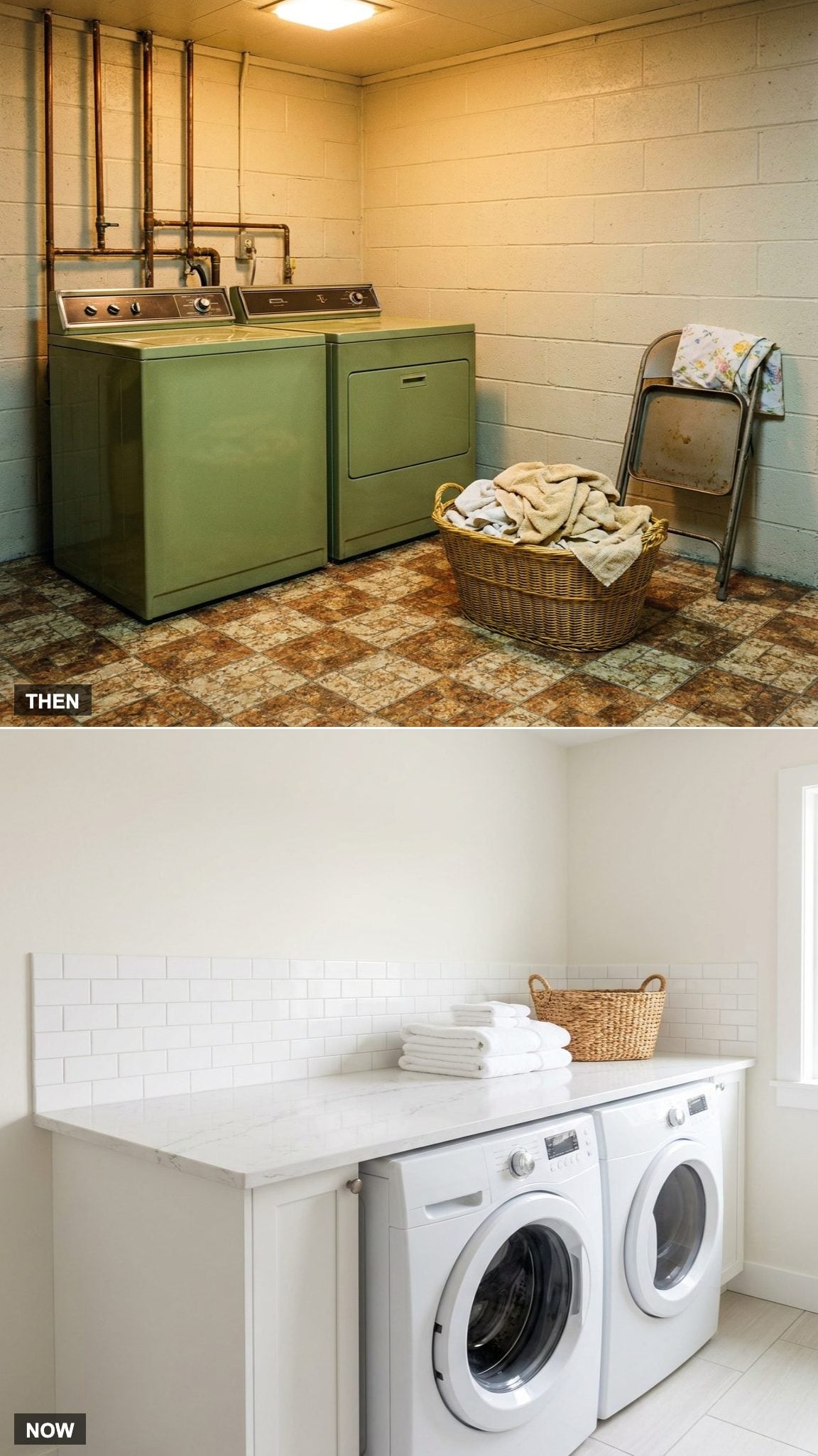
Where did anyone fold laundry in 1975? On the bed upstairs, on the kitchen table, on top of the dryer if the dryer wasn’t running, on a card table dragged out from the closet. The room offered no surface, so the work of laundry always spread into other rooms and stayed there for days.
Front-load machines made the counter possible. Once the machines got shorter and their tops sat level, a slab of quartz across both created a folding zone, a sorting zone, and somewhere to set the basket down. Small change. Enormous quality-of-life shift.
25. The Backsplash: Bare Painted Block vs. Full-Height Decorative Tile
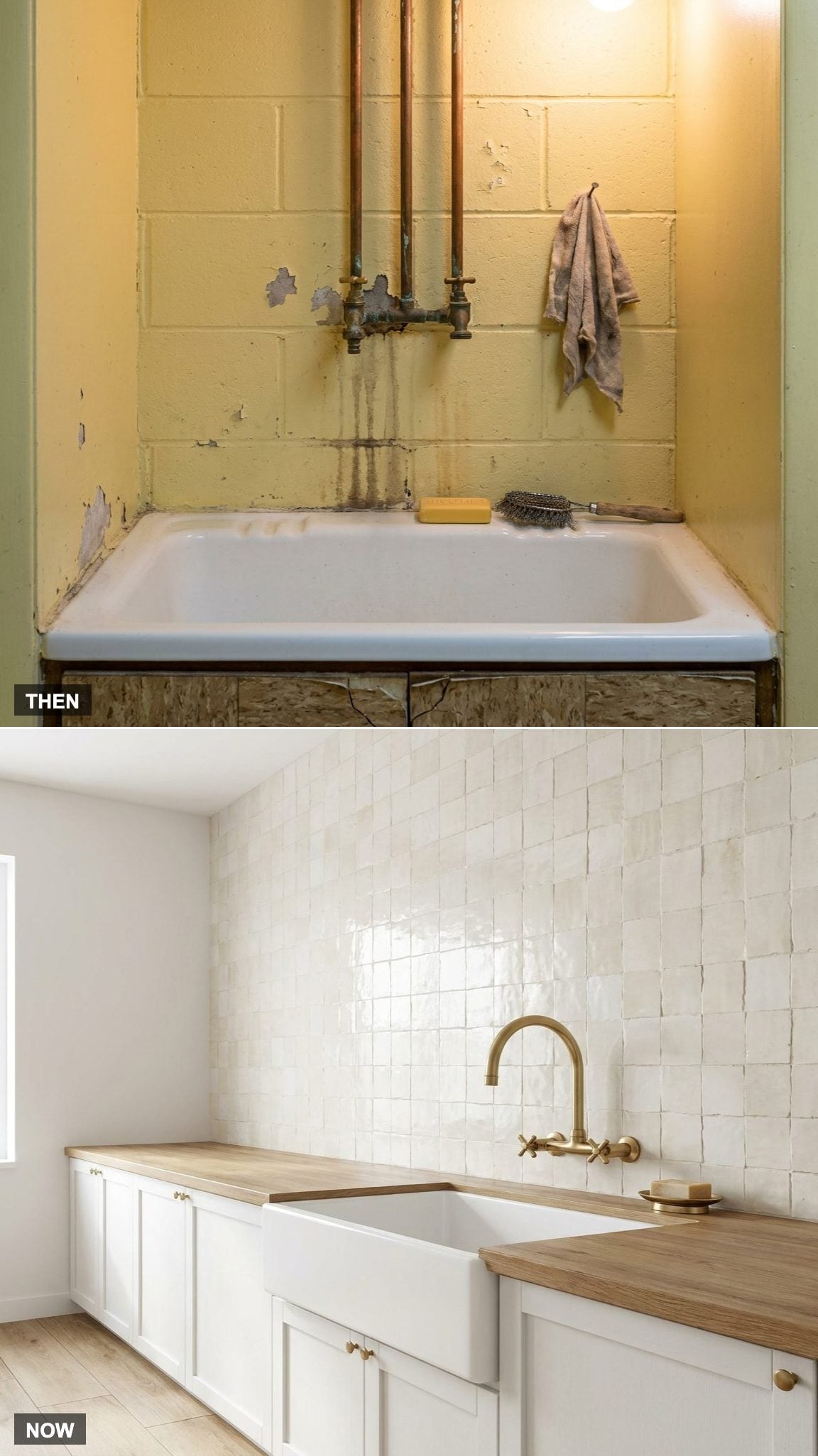
Nobody tiled a laundry room in 1975. The wall behind the sink got the same paint as the rest of the basement, and when it splashed, it splashed. Water stains formed, paint chipped, somebody put down a rag on the floor and called it maintenance.
Zellige. Cement tile. Marble subway. Handmade terracotta. The laundry backsplash has become one of the small stages where people express taste — a five-square-foot canvas that’s forgiving of water and makes the entire room feel like it was decided on rather than assembled.
24. The Ironing Setup: Wobbly Freestanding Board vs. Built-In Fold-Down Station
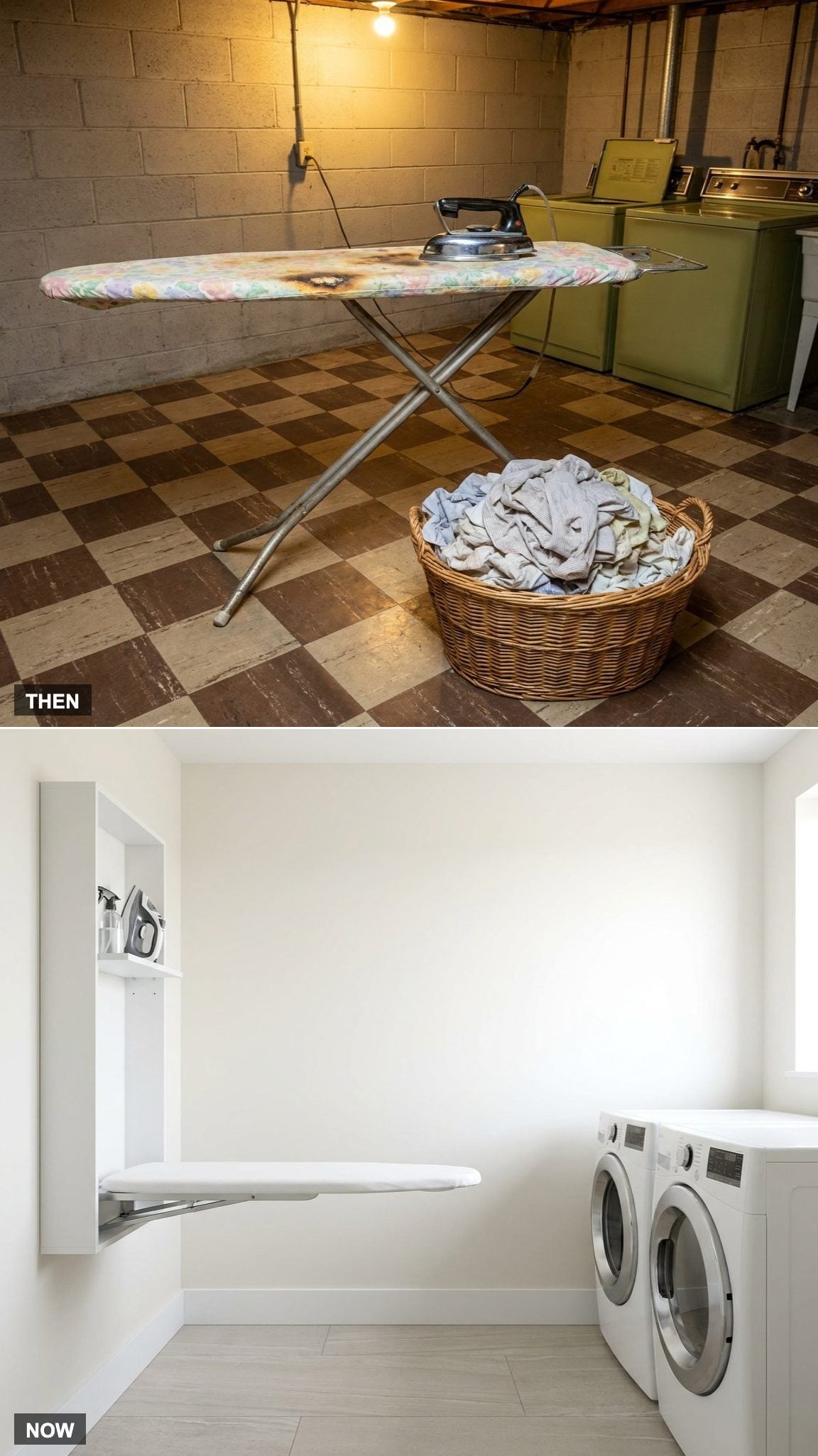
The ironing board lived a nomadic life — folded behind a door, dragged out weekly, wobbling on its scissor legs, covered in a scorched floral pad that had seen a thousand steam bursts. You always caught your hip on the corner. The cord never reached where you needed it to reach.
The fold-down cabinet solved a problem nobody thought was a problem until they didn’t have it anymore. Open the door, pull it down, iron the shirt, fold it back up. Always ready, never in the way.
23. The Controls: Mechanical Dials to Glass Touchscreens
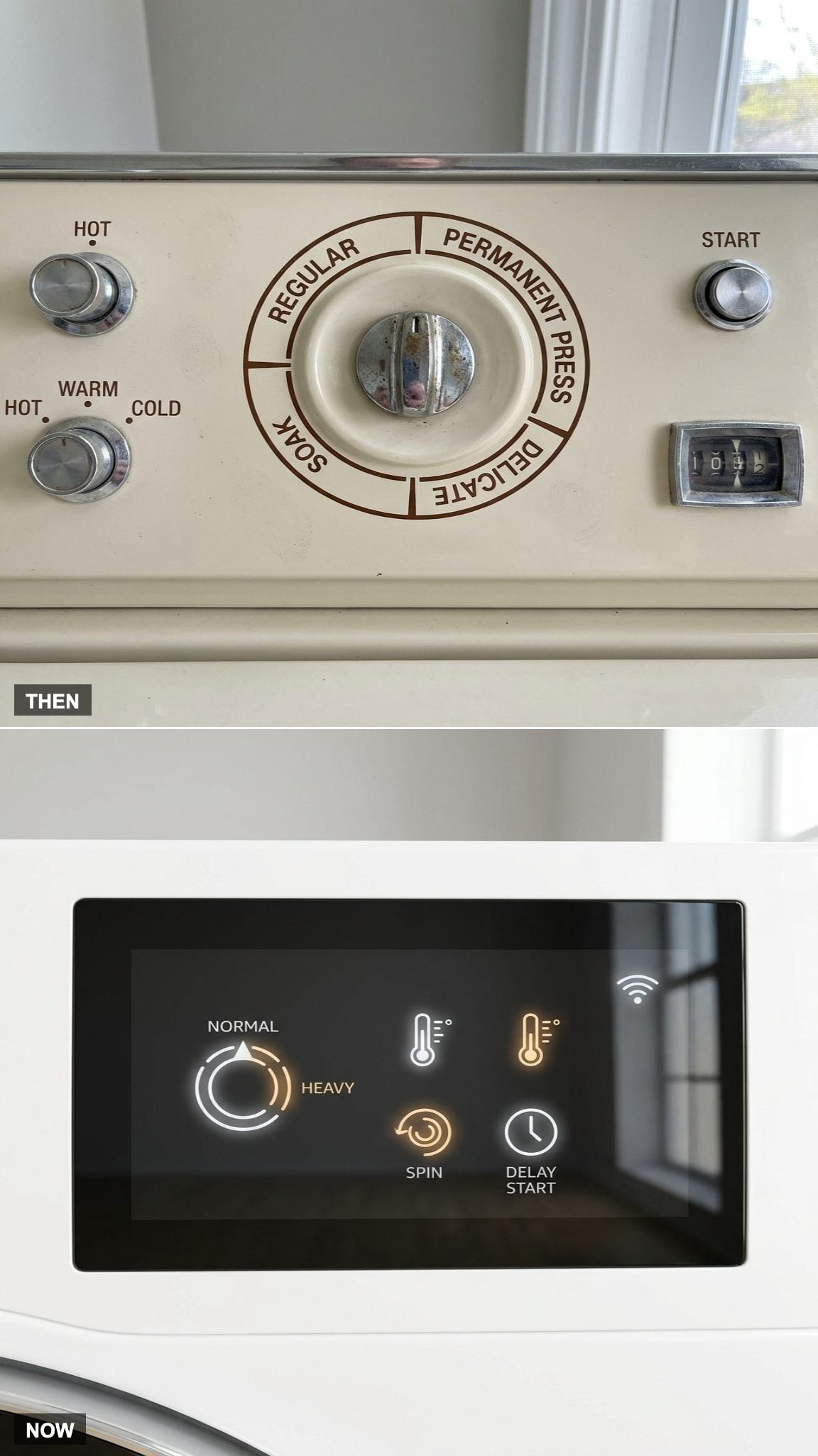
The 1975 dial had four cycles and did not care what you thought of any of them. Turn it, pull it, click, water. Cams and springs and a small motor doing exactly what they were told, which is why some of those machines are still running in someone’s basement right now.
The touchscreen offers fourteen cycles, a delay start, custom presets, and a phone app you’ll download once and open never.
22. The Sink: Battered Utility Tub to Deep Farmhouse Basin
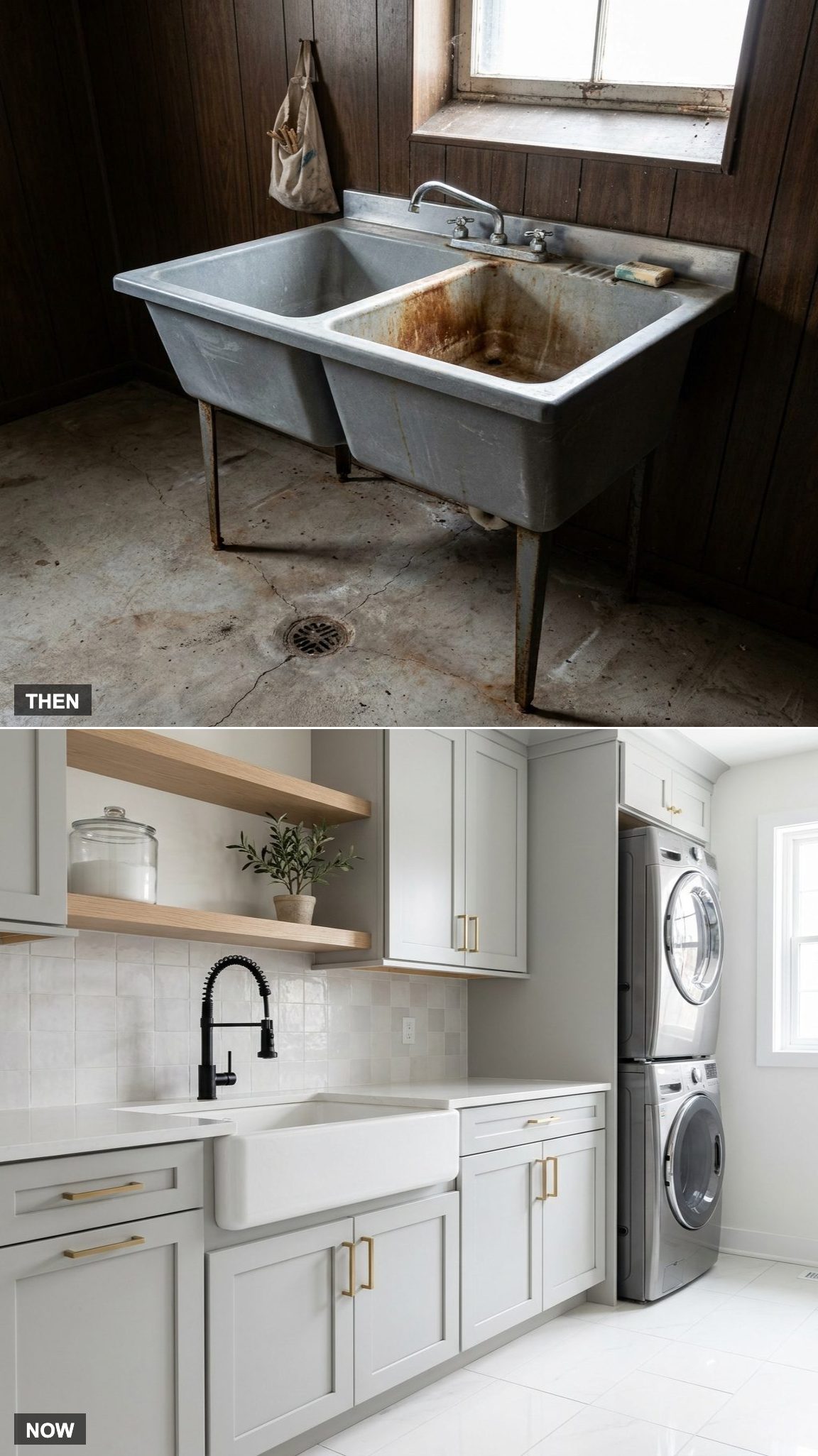
The 1975 utility sink was where boots got hosed off, paint brushes rinsed, and the occasional bloody knee cleaned up before dinner. Ugly on purpose. You didn’t have to be careful with it because it had already given up long before you moved in.
The modern farmhouse laundry sink has entered its main character era — deep enough to hand-wash a wool sweater or bathe something you probably shouldn’t be bathing in the kitchen. Costs more than the entire 1975 laundry room did, adjusted for inflation and pride.
21. The Washer Itself: Center Agitator to Cavernous Front-Loader
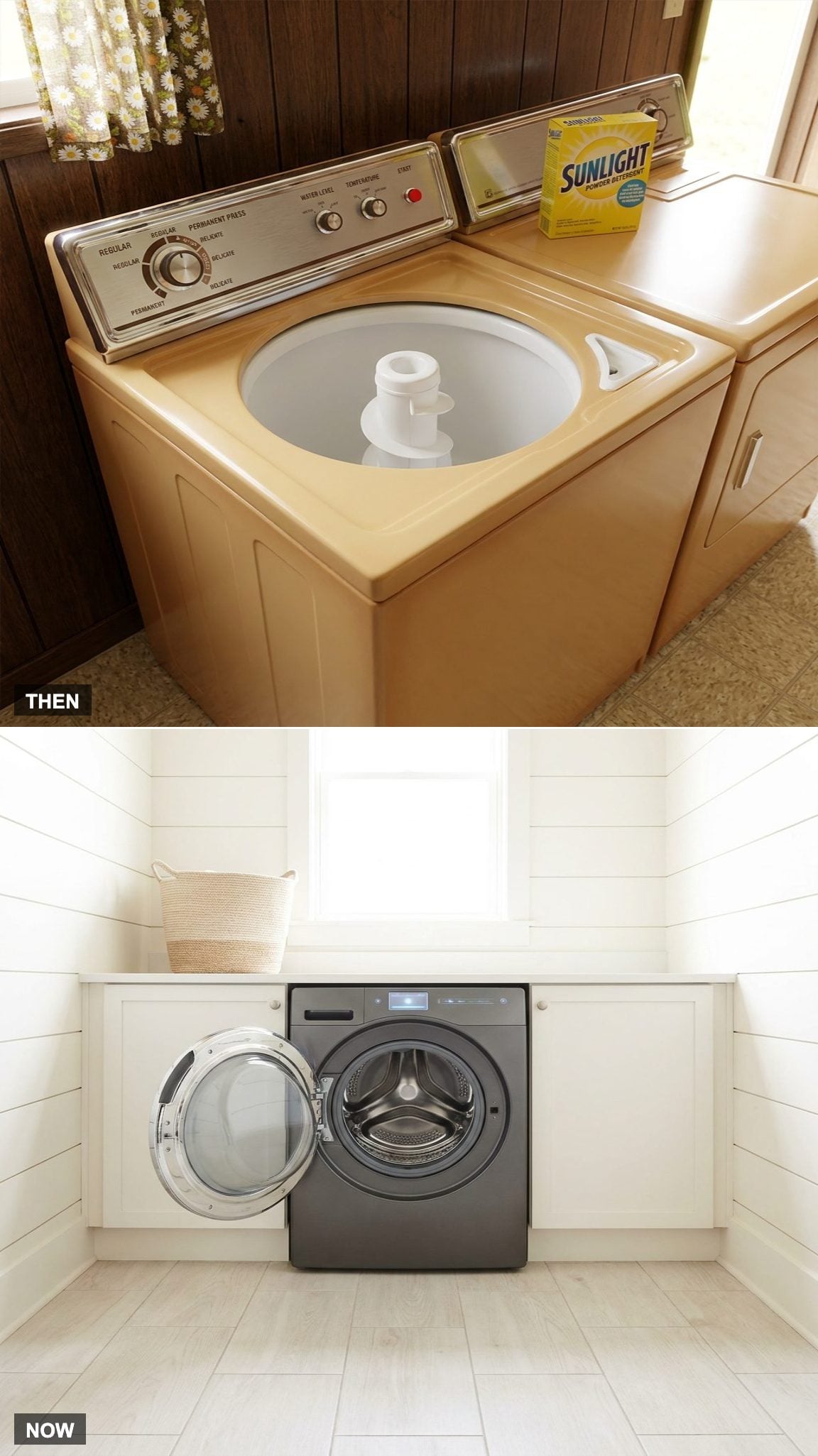
The center agitator was a tall plastic post that beat clothes into submission for forty-five minutes, and along the way it ate socks, tangled sheets into rope, and stretched the neck of every T-shirt you owned. Nobody knew. That’s just what washing was.
Modern front-loaders tumble instead of thrash. A comforter and its duvet cover fit in one load, and the whole cycle uses roughly a third of the water. The porthole window is theater — you could sit and watch your laundry now, if you had that kind of time, which nobody does.
20. The Color: Harvest Gold Versus Matte Black
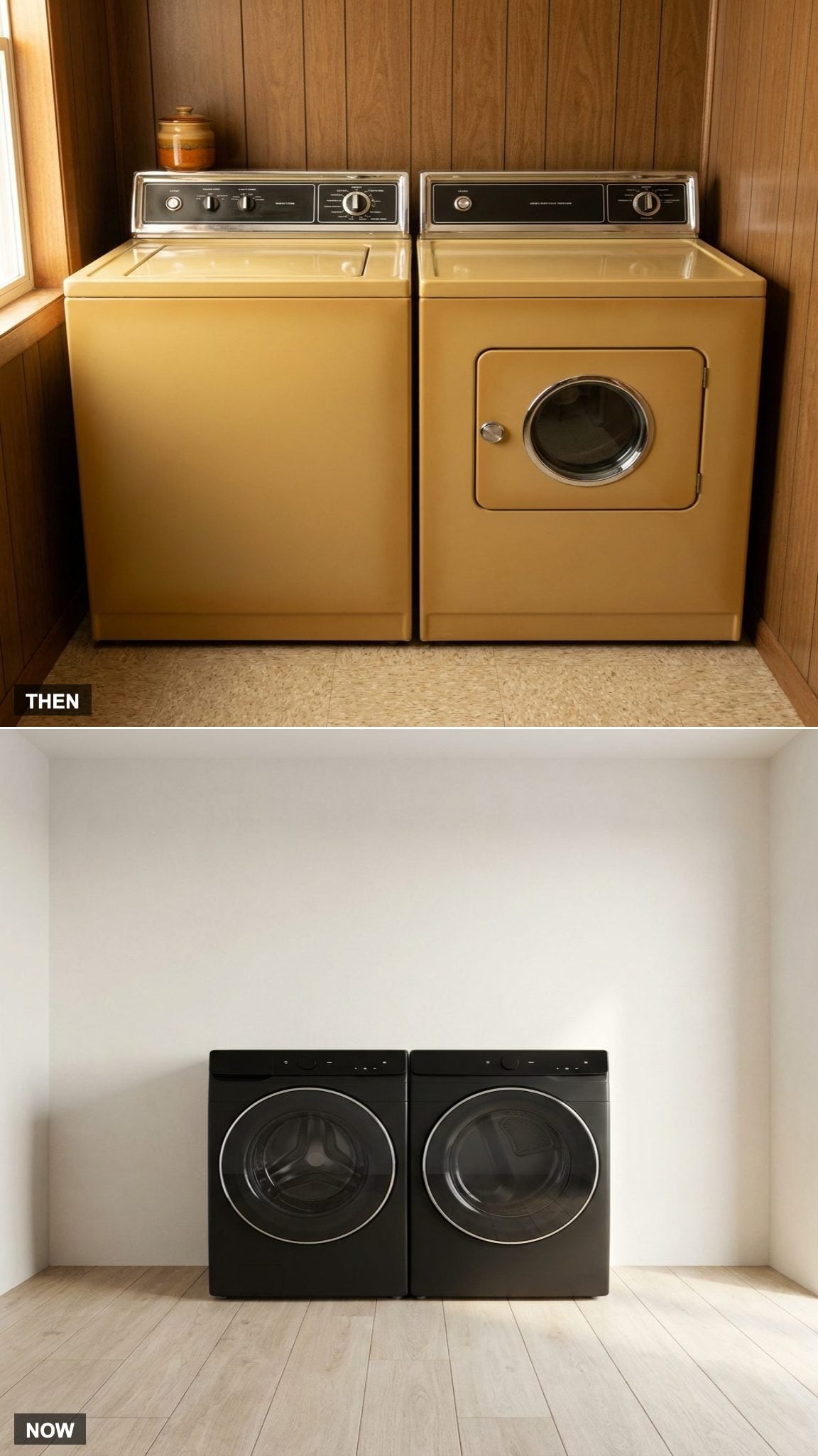
Harvest gold wasn’t chosen. It was assigned. Somewhere around 1971 a color forecaster decided every appliance in America would look like a slice of butter left too long on the counter, and for the better part of a decade every home obeyed without complaint.
Matte black is the opposite argument entirely — an appliance that wants to disappear into the wall instead of announcing itself from across the basement. Whether dressing your washer like furniture counts as progress depends on how you feel about dusting it.
19. The Finish: Avocado Green to Brushed Stainless
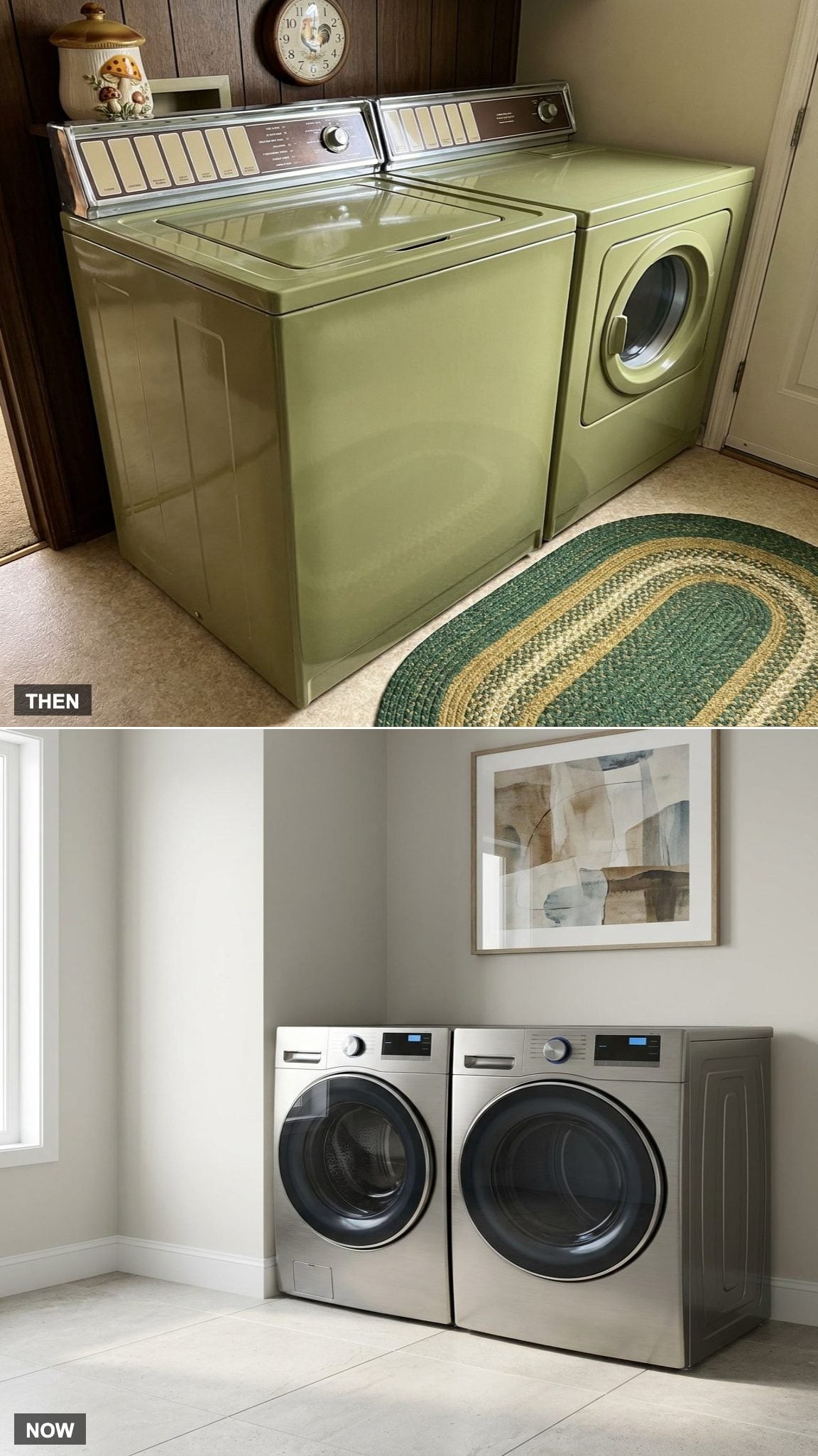
Avocado green committed harder than any appliance color before or since. Refrigerators, ovens, washers, dryers, even the phone bolted to the wall — same disagreeing shade of vegetable in every direction, no escape, no coordinating with it.
Brushed stainless refuses to date itself. Fingerprints show, which annoys people, but nobody has ever had to apologize for buying a stainless appliance ten years after the fact. Couldn’t say the same for avocado by 1983.
18. The Capacity: Two Bath Towels to a Whole Comforter
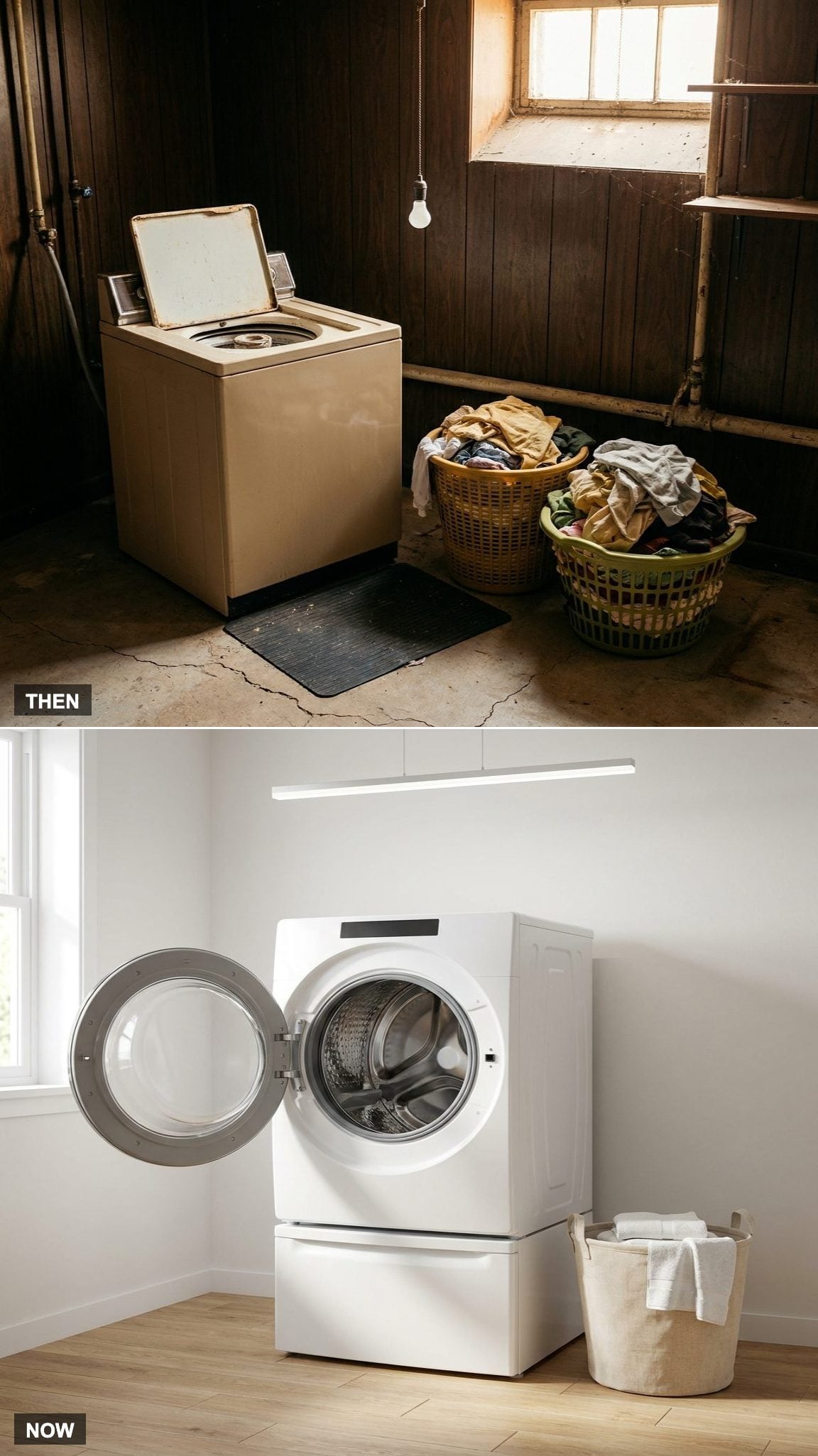
A 1975 washer held about a load of shirts and maybe a pair of jeans if you crammed. Your comforter did not fit. It never fit. You dragged it to the laundromat and paid a stranger to spin it in a machine roughly the size of a Volkswagen.
Today’s family-size front-loader takes a heaping load without complaining, king comforter and all, with room to spare. Saturday laundry stopped being an all-day event and became something you finish before lunch, which is either liberation or one more reason nobody sits still anymore.
17. The Plumbing: Exposed Hoses to Hidden Everything
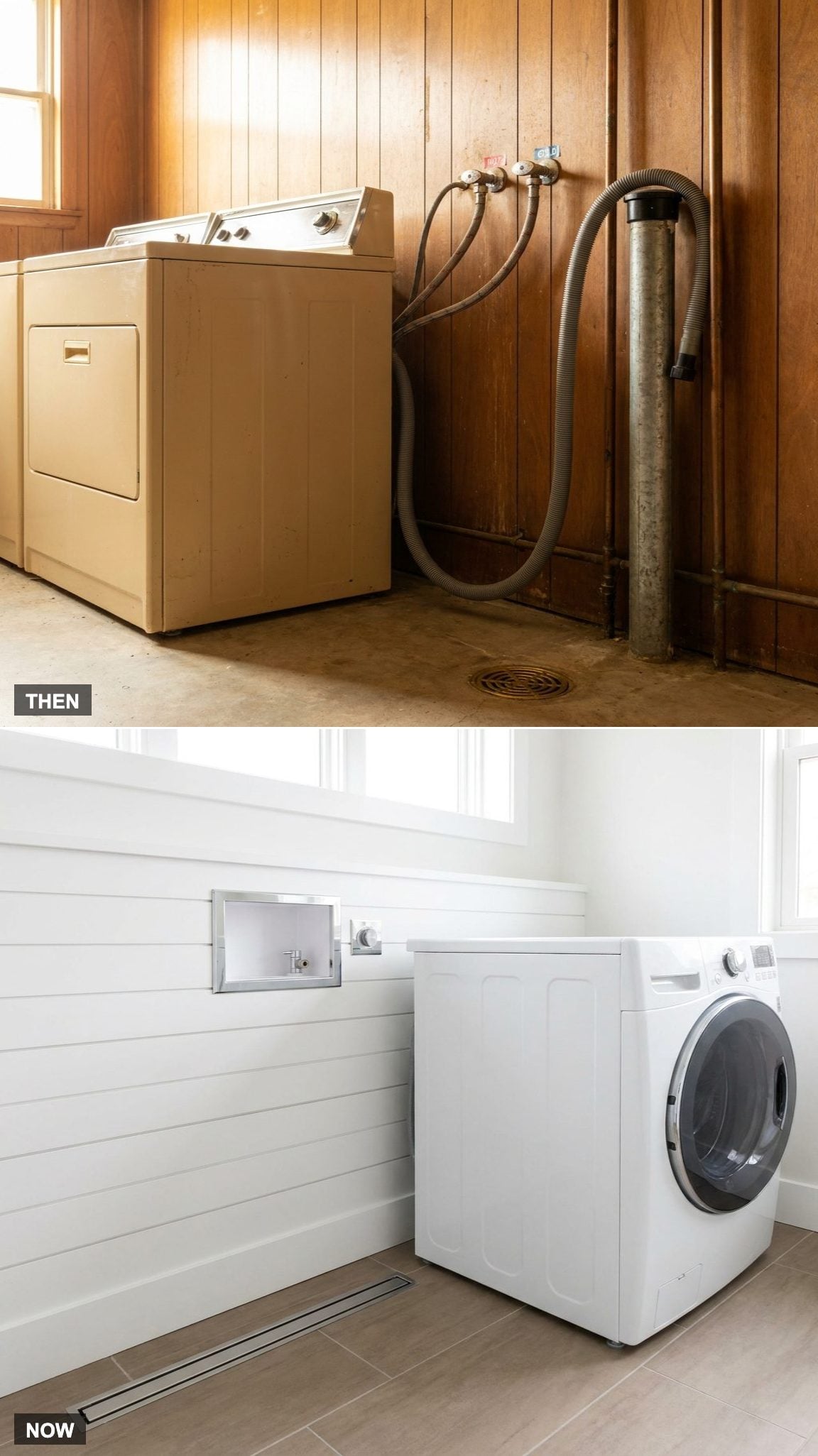
Nobody hid anything in 1975. Pipes were where the pipes were, same with the wiring, same with the ductwork, same with the water heater across the room quietly rusting. Service area. Everyone agreed to look past it and move on.
Now plumbing gets a recessed box, flush with the wall, painted the same color as everything around it. Laundry rooms dress up because they’re on Instagram now, and Instagram doesn’t want to see your standpipe.
16. The Floor Underfoot: Cold Concrete to Warm Porcelain
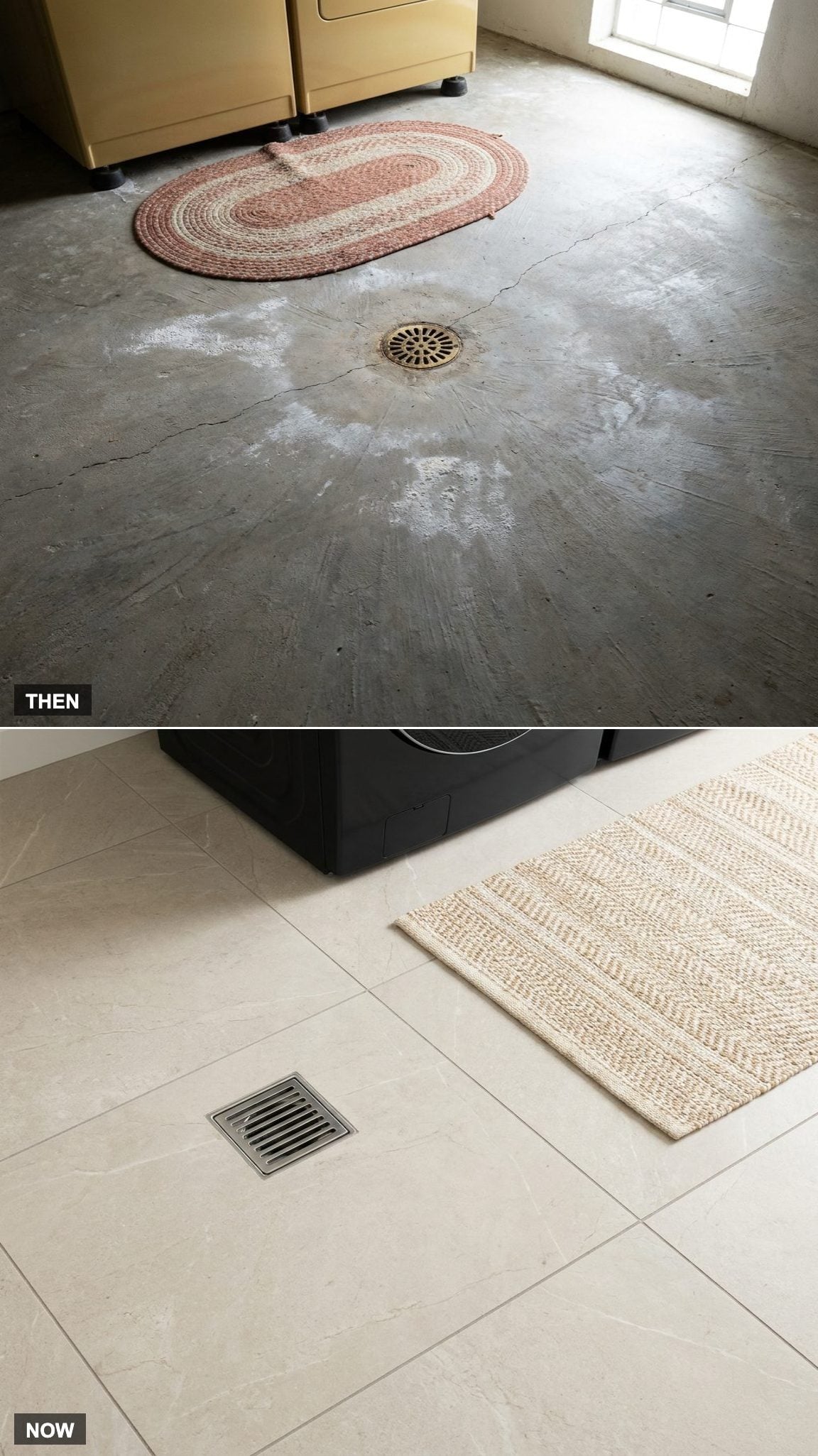
Concrete in a 1975 basement did one job well: it didn’t care. Spill bleach, drop a wrench, drag a bicycle across it, drip motor oil from the mower you shouldn’t have brought inside — the floor absorbed all of it without comment. But it was cold nine months a year, and if the water heater ever gave up you found out fast, usually in socks.
Radiant-heated porcelain in the better installations. Warm under bare feet at six in the morning. Waterproof, seamless, quiet.
15. The Vinyl: Sheet Linoleum to Stone-Look Luxury Tile
🔥 Would you like to save this?
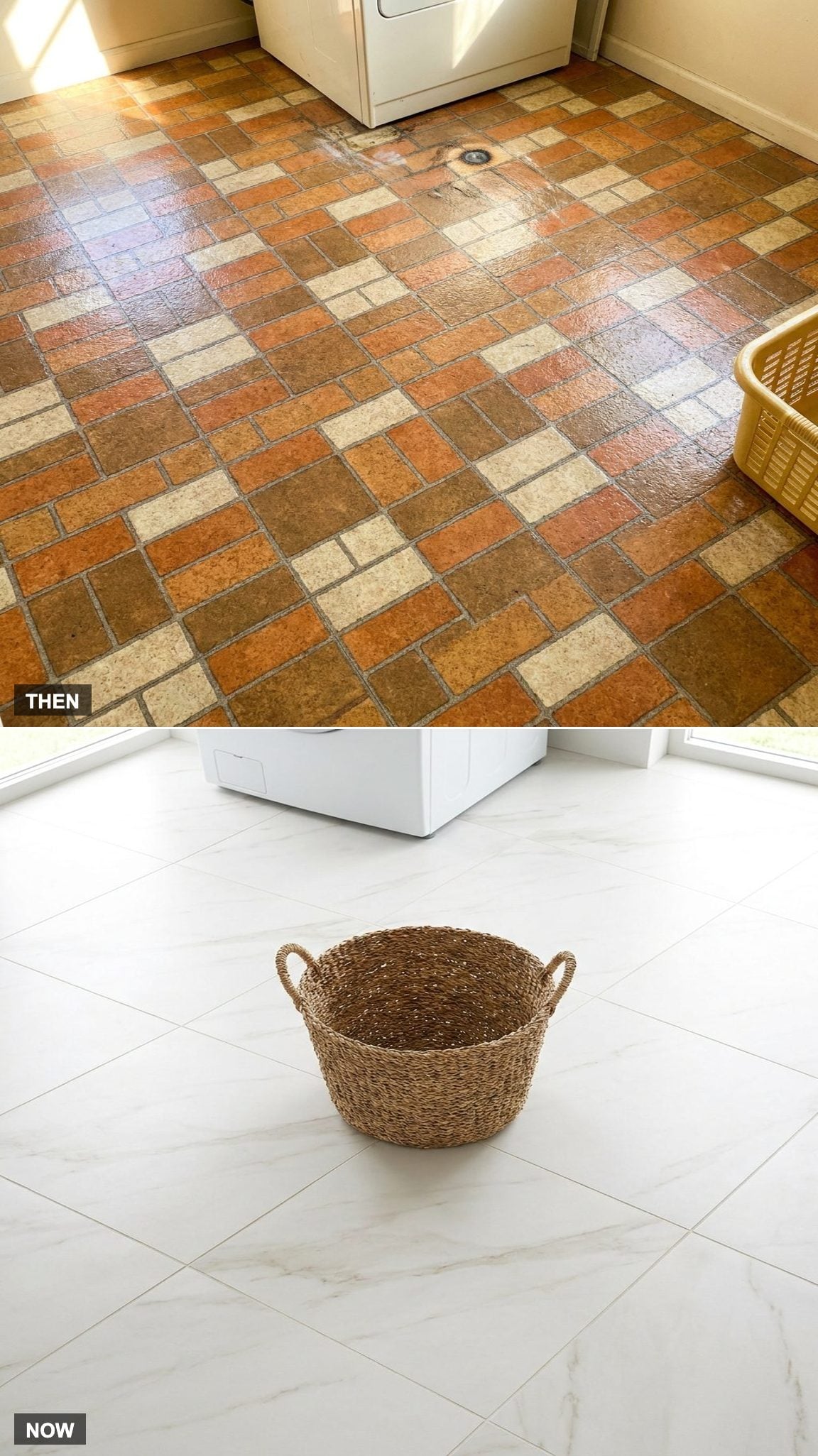
Sheet vinyl printed with fake bricks. Or fake stone. Or fake parquet, which was the strangest one because who wants photographs of a floor as their floor? Somebody in 1975 decided if you couldn’t afford the real thing, an image of the real thing was close enough, glued down in one giant piece and already curling at the edges by 1981.
Stone-look porcelain today reads convincingly enough that guests ask. It runs continuous with the kitchen or the hall in the better layouts, chips almost never, and shrugs off a dropped detergent jug — none of which the fake brick vinyl could ever have promised.
14. The Walls: Wood Paneling to Painted Everything
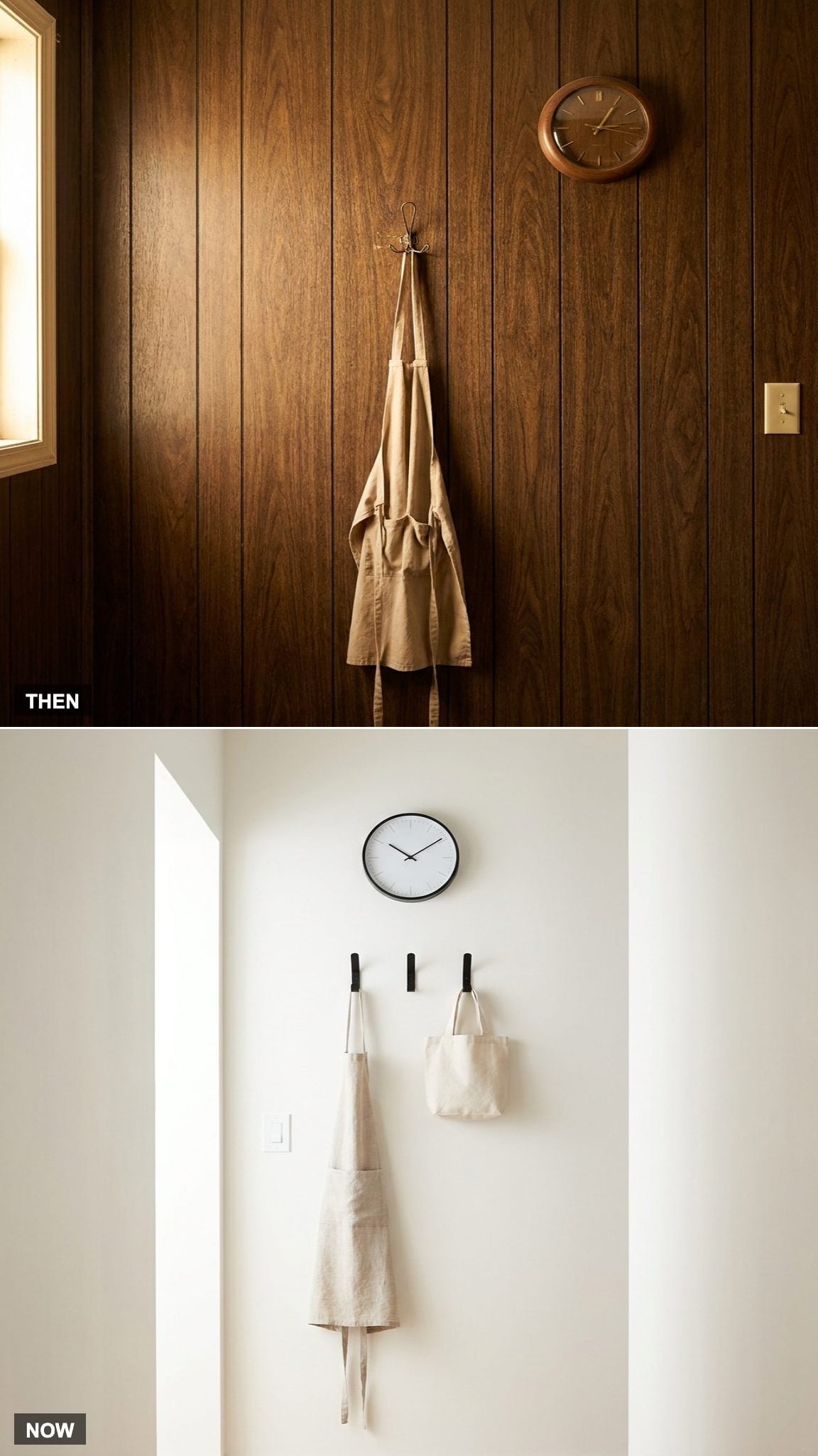
Wood paneling answered every wall question in 1975. Ugly drywall? Paneling. Damp basement wall? Paneling. Room needs warming up on a Sunday afternoon? More paneling. It got glued straight over whatever was underneath, seams and all, and stayed there for the next forty years whether anyone loved it or not.
Paint came back around 2010 and hasn’t left. Laundry rooms get real colors now — soft sage, moody navy, chalky terracotta, sometimes a deep oxblood if the homeowner is feeling brave. Rooms that used to hide in the basement got invited upstairs and handed a paint chip. And they showed up.
13. The Walls: Raw Concrete Block vs. Finished Drywall With Trim
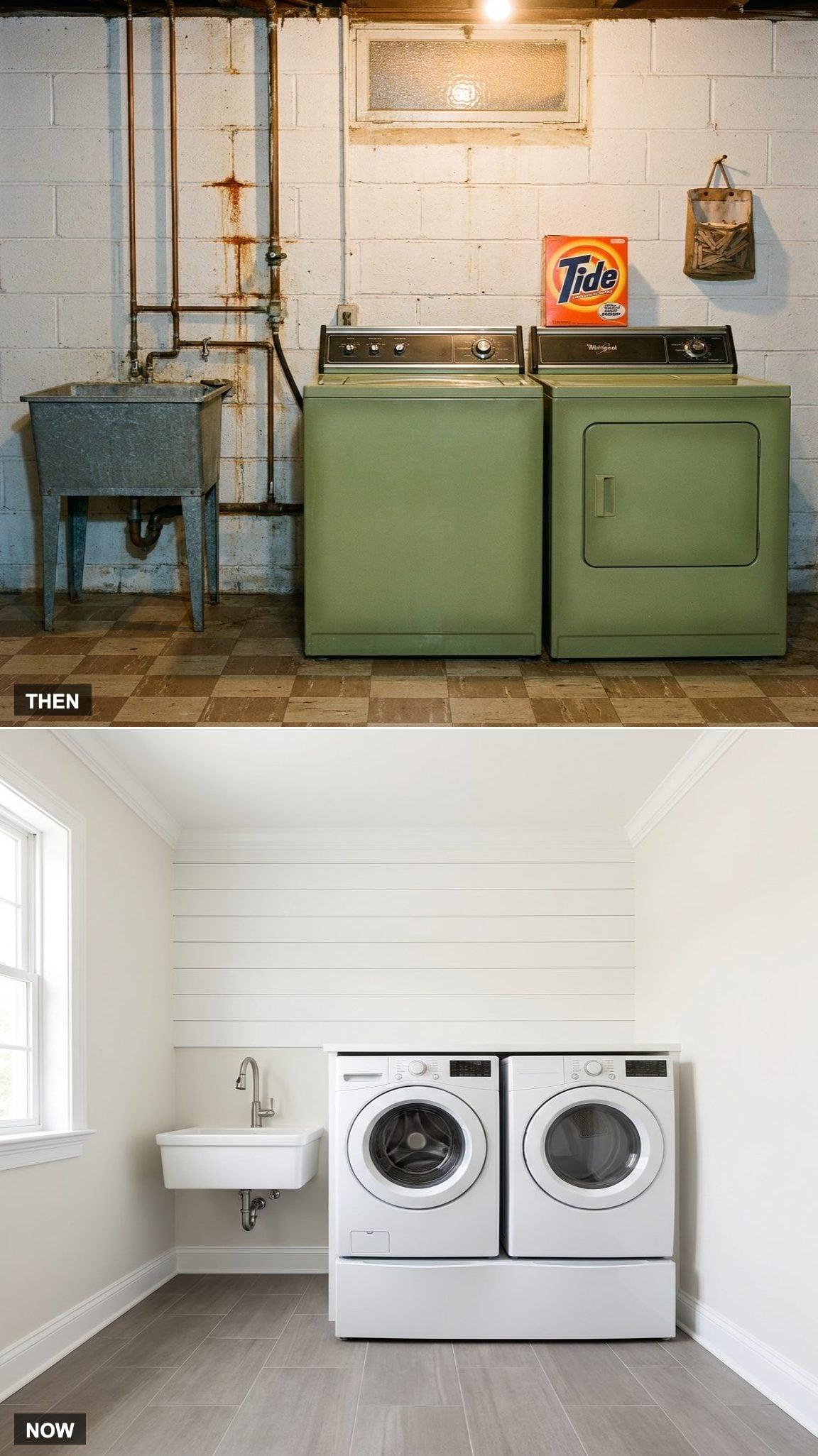
The walls did the talking, and what they said was we ran out of budget upstairs. Painted cinder block in a 1975 basement had that chalky, cold-to-the-touch quality, mortar joints catching lint the way a comb catches hair. Nobody pretended it was pretty. Structural was enough.
The current version treats the laundry room like a room — real drywall, real trim, sometimes shiplap or beadboard on the wall behind the machines. Once someone decided the message should shift from this is where the pipes live to this is a space you spend time in, everything else followed.
12. The Lighting Overhead: Buzzing Fluorescent Tube vs. Layered Recessed LEDs
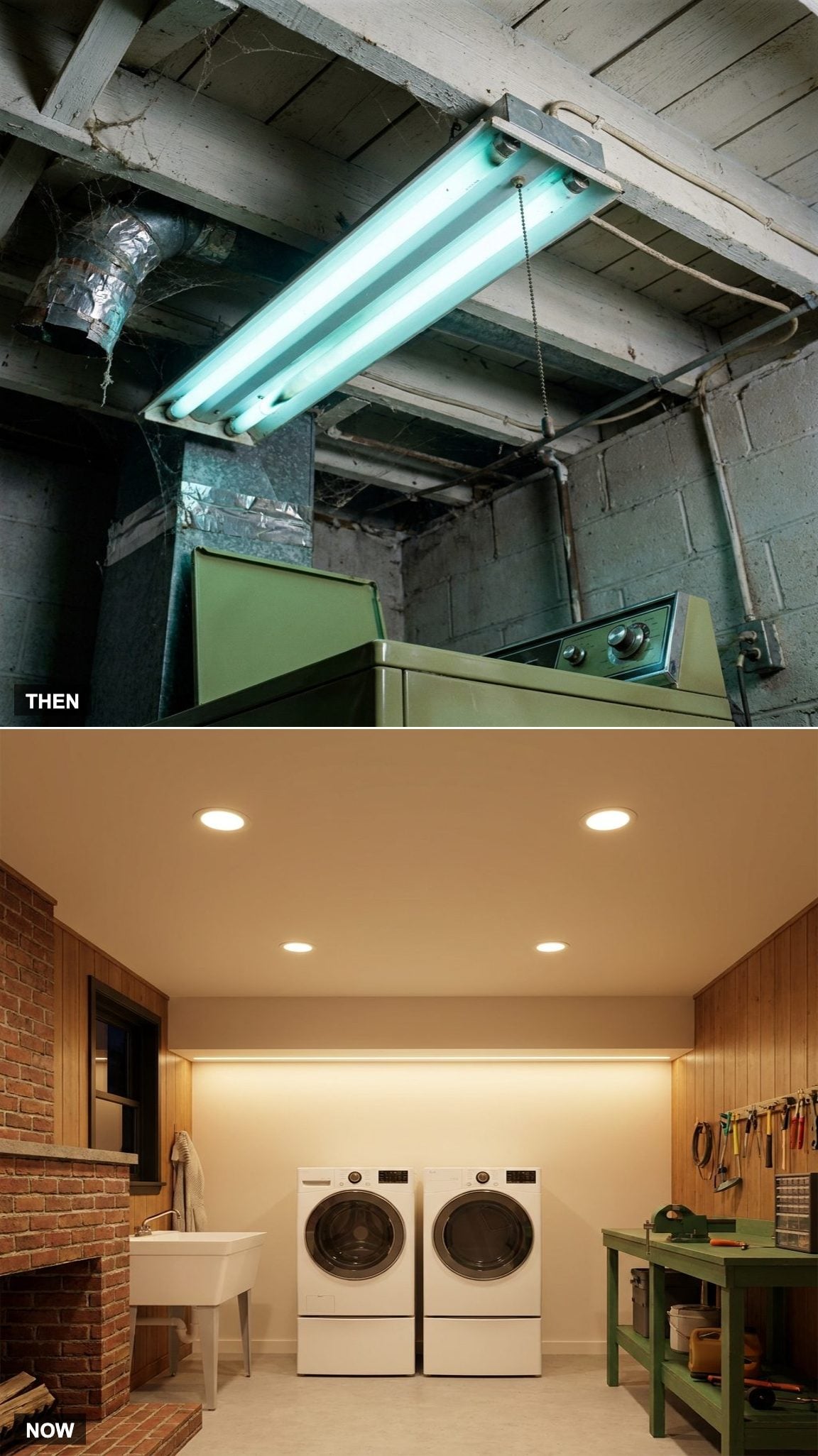
You know the sound. That low electric hum from a fluorescent tube that took ninety seconds to warm up and never quite stopped blinking on one end, flattening every color it touched and turning skin a slight green until you felt like you were standing in a dental office at 11pm.
Now it’s layers — general light from recessed cans, task light over the folding zone, sometimes an accent strip under the upper cabinets. Warmer bulbs. Dimmer switches. Nobody buzzes anymore.
11. The Statement Light: Bare Pull-Chain Bulb vs. Decorative Pendant
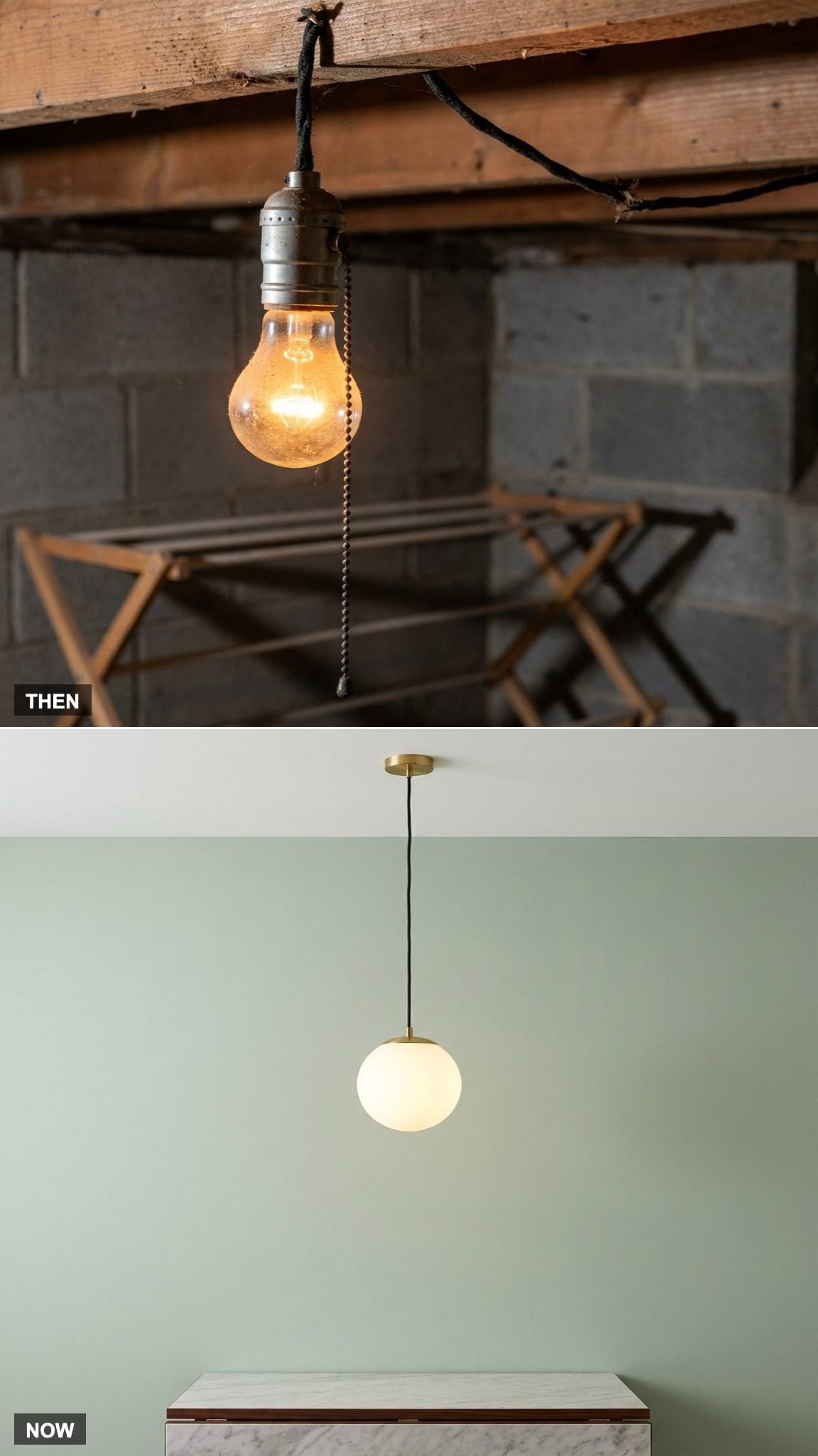
The pull chain. Everybody remembers the pull chain — that bare bulb over the utility sink, cord slightly frayed at the socket, beaded metal chain you yanked with damp hands after loading the machine. Tall people hit their heads on it. Short people jumped for it.
The replacement is a small piece of jewelry: a schoolhouse pendant, a rattan drum, a milk-glass globe in brass pendant light form. Nothing gets yanked. There’s a wall switch, probably a dimmer, and it looks like it belongs.
10. Storage Above the Machines: One Wire Shelf vs. Floor-to-Ceiling Cabinetry
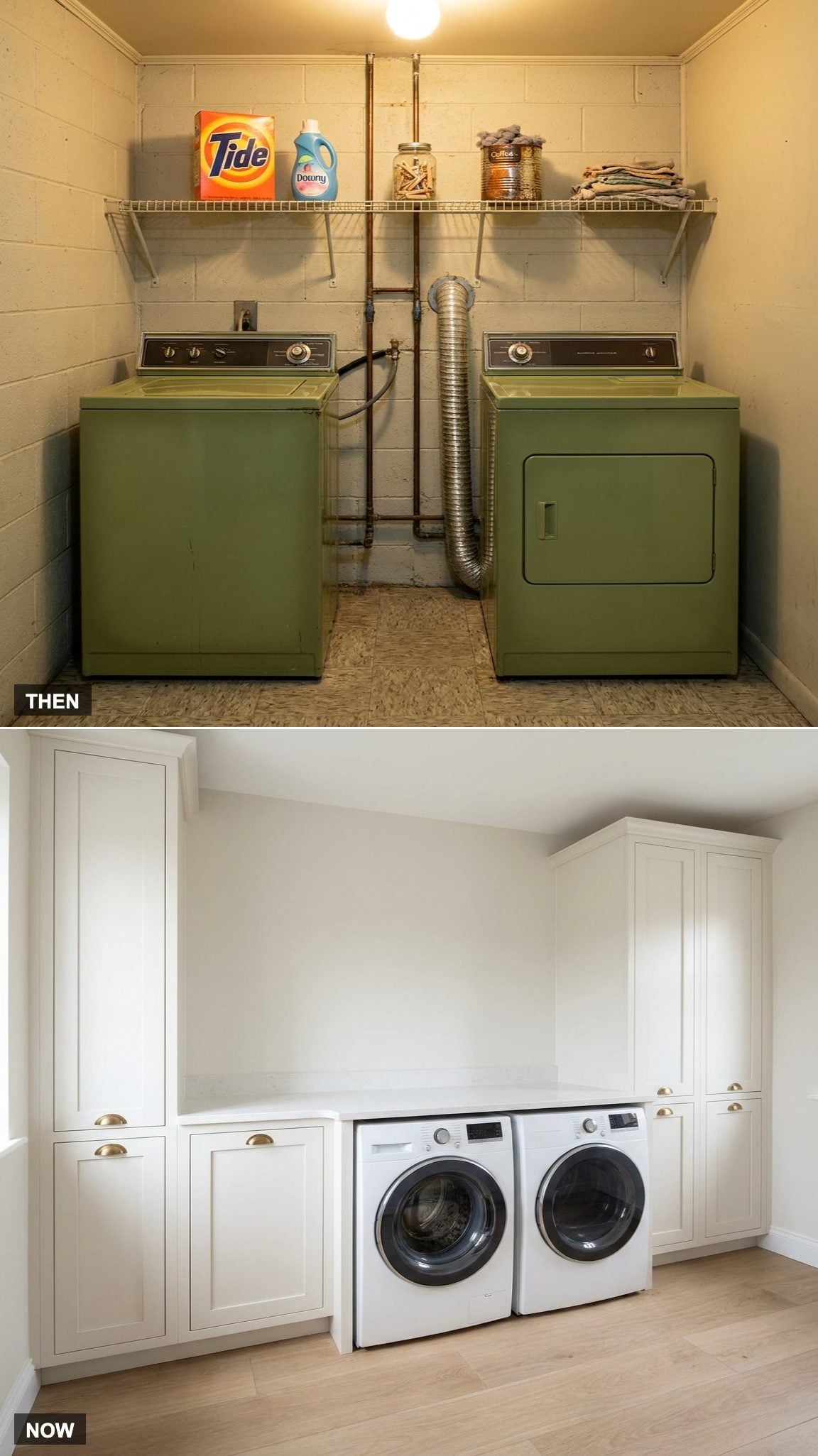
One shelf. That was the entire storage plan — a single length of vinyl-coated wire suspended on two brackets, holding whatever fit and forgetting whatever fell behind the dryer. Anything else went on top of the washer. Anything beyond that went on the floor.
The current answer builds up and out. Cabinets to the ceiling, a run of counter bridging the two machines, sometimes a broom closet at one end. Once the room gets treated like a small kitchen, the storage problem solves itself.
9. The Shelving: Rusting Metal Racks vs. Custom Wood Built-Ins
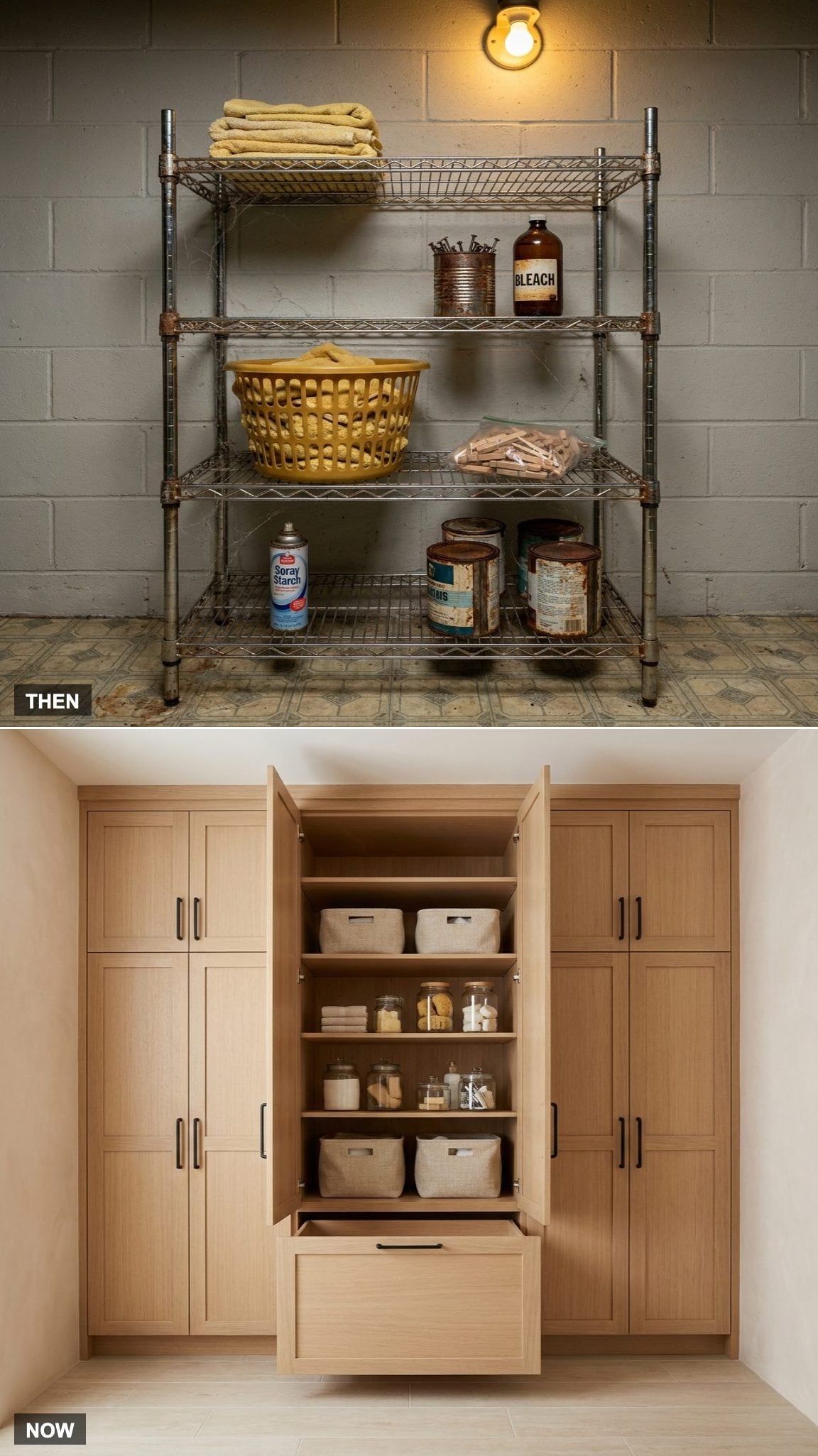
Wire shelving from the hardware store went up in fifteen minutes and held whatever the basement needed to hide. It rusted at the joints where damp air hit the coating, sagged in the middle of the long shelf, and collected a fine layer of dryer lint on top of everything.
Built-ins changed the equation. Real wood, real hinges, doors that close on whatever mess is behind them. The eye stops sorting through eleven bottles of different-colored liquid, and the room reads calm. Discipline through millwork.
8. The Detergent Situation: Battered Boxes vs. Matching Labeled Containers
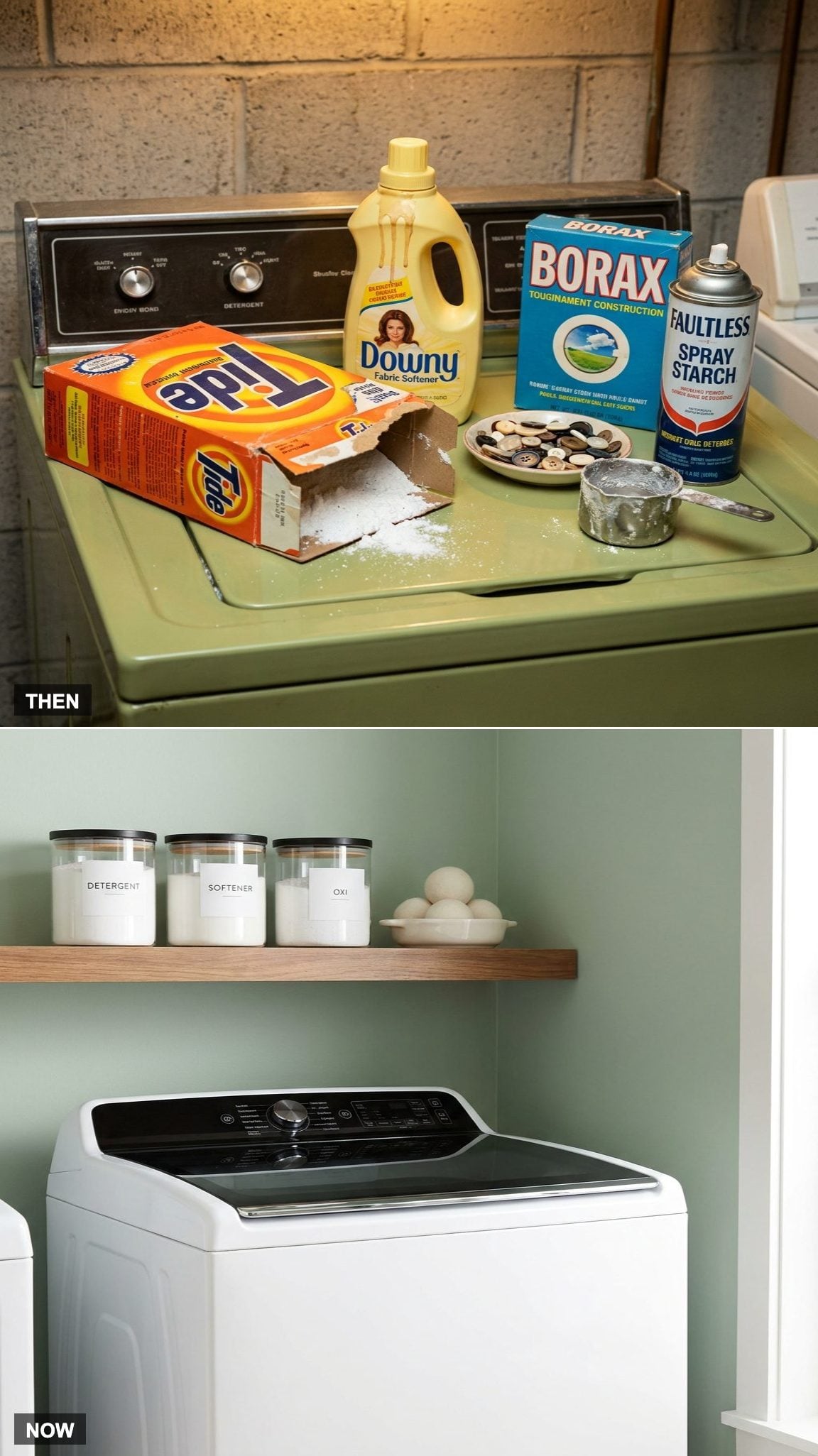
The top of the washer was the staging area for chaos: a torn box of Tide, a leaking bottle of Downy with a crust of blue around the cap, a can of spray starch that hissed when you shook it, and always at least one thing that had tipped over and been ignored. The graphics on those boxes were loud — orange, red, yellow, competing for attention on a shelf that wasn’t yours.
Decanting everything into matching containers is partly Instagram, partly sanity. Same detergent, different feeling.
7. The Drying System: Single Rod Over the Sink vs. Custom Drying Cabinet
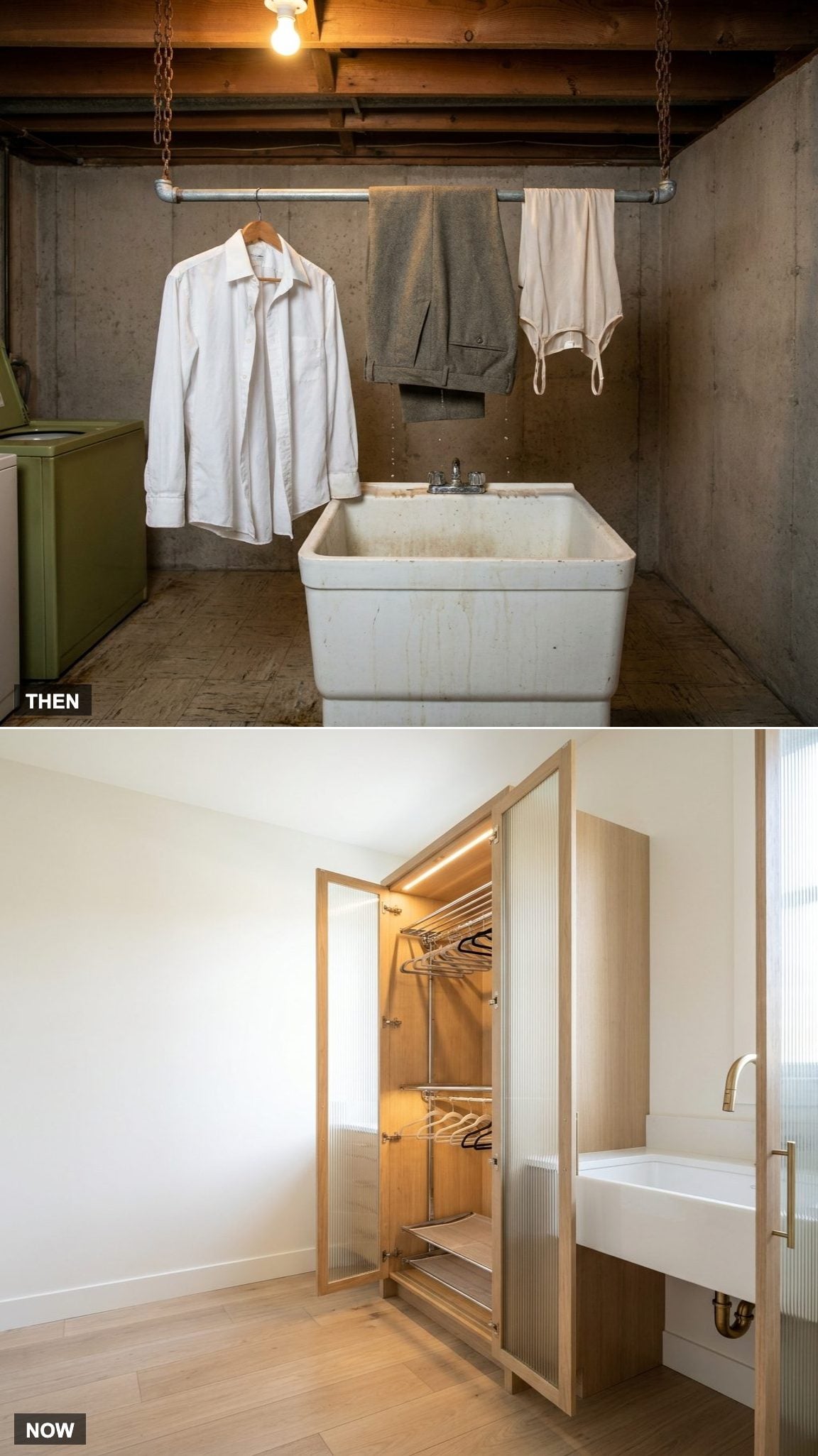
The drip zone. Every 1975 laundry room had one — a metal rod on chains above the utility sink, hung with delicates that couldn’t go in the dryer, water dripping onto the porcelain for hours. The wool sweater dried flat on top of the machine on a towel, and took three days to do it.
The purpose-built drying cabinet is the piece of millwork that separates a room from a real room. Pull-out rods, ventilation, sometimes gentle warm airflow — sweaters flat, shirts hanging, delicates on the mesh shelf, everything dry by morning. Nobody knows this upgrade exists until they see one, and then they want it in a way that’s slightly unreasonable.
6. The Exposed Furnace That Growled at You from the Corner
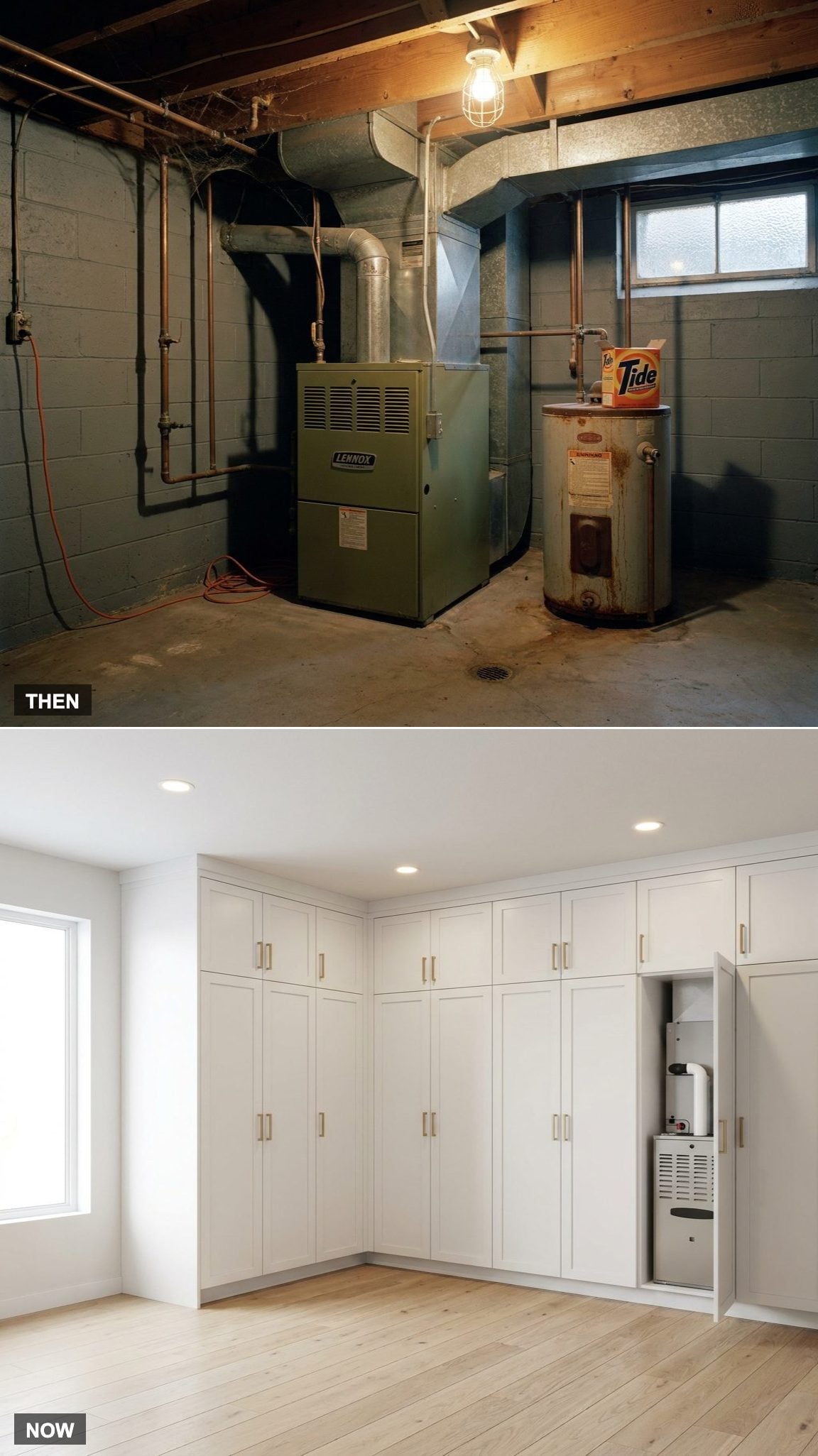
In 1975, the furnace was a piece of furniture whether you wanted it to be or not. Olive green, humming away next to a water heater that looked one bad winter from failure, it just sat there. You did laundry six feet from an open gas flame and nobody thought twice.
Now the mechanicals hide behind cabinetry that matches the rest of the room — same square footage, same equipment, same job, just tucked behind a shaker door with a brass pull. The furnace still runs. You just don’t fold towels while staring at it anymore.
5. The Closet-Sized Basement Laundry Versus the Designer Suite
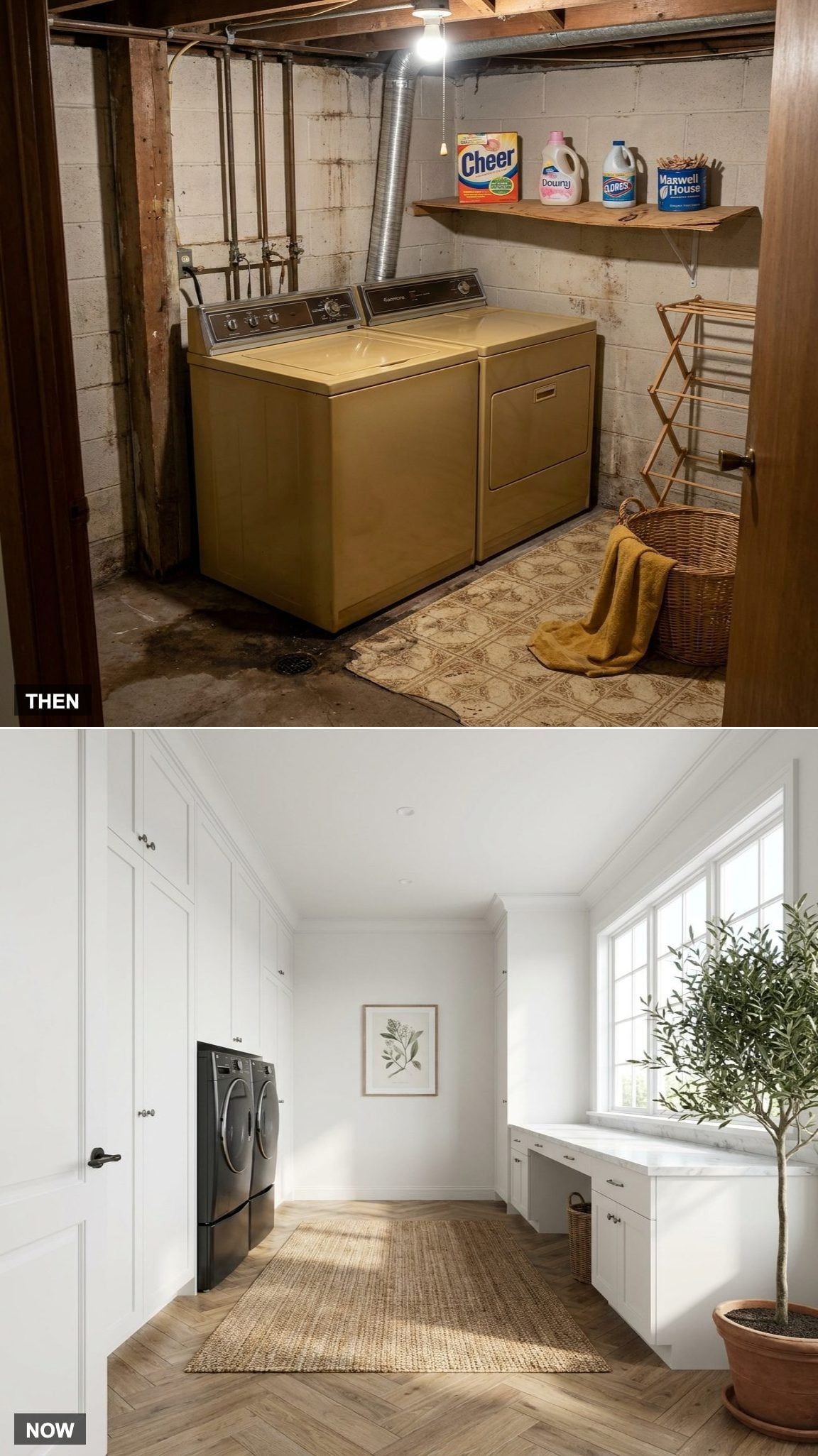
Six feet by seven, if you were lucky. The washer and dryer touched each other, the clothespin can was a repurposed Maxwell House tin, and reaching the detergent meant turning sideways past the drying rack.
The modern equivalent is a room, not a corner — twelve by fourteen, natural light pouring in, a folding counter big enough for an actual fitted sheet. Same task. Roughly ten times the footprint. Somewhere along the way we decided laundry deserved real estate.
4. The Exposed Joist Ceiling That Rained Dust When Someone Walked Upstairs
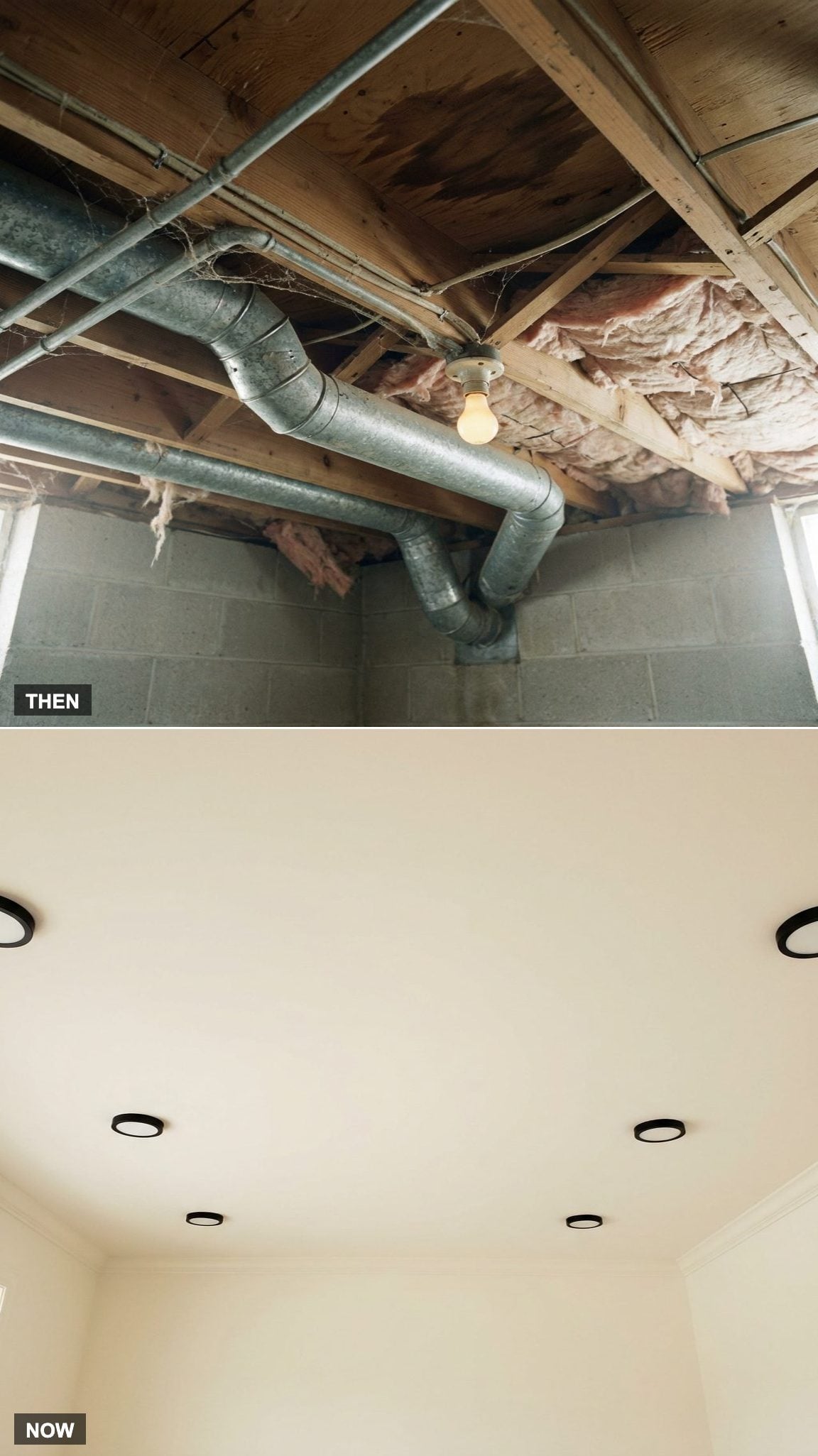
Look up in a 1975 basement laundry and you got a full anatomy lesson — joists, pipes, BX cable stapled sideways, sagging pink insulation held up with random bits of wire, and a bulb in a porcelain socket that had probably been there since Eisenhower. Every footstep from the kitchen upstairs sent fine dust drifting down onto whatever you were folding.
Today, drywall. Flush LEDs. Quiet. The mechanicals are still up there doing their thing — you just don’t have to think about them.
3. The Hollow-Core Door Versus the Sliding Barn Door
🔥 Would you like to save this?
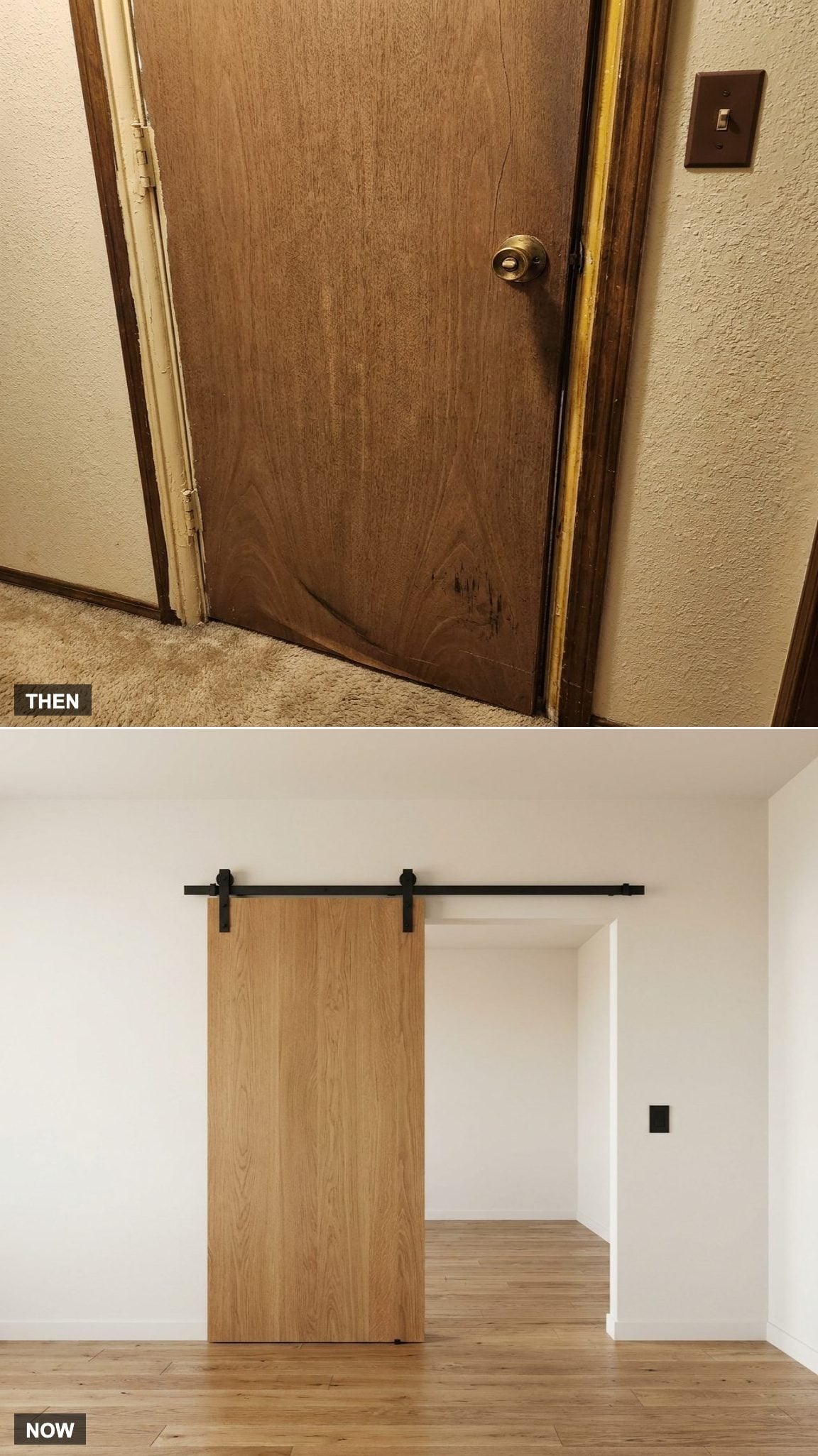
Hollow-core luan, warped at the bottom, push-button lock nobody ever engaged. Punch it and your fist went straight through. Some people found this out the hard way.
The oak sliding barn door that replaced it costs more than the entire 1975 laundry room did in period dollars. Rides on matte black flat-track hardware, weighs around eighty pounds, and makes a satisfying low rumble when it closes. Nobody’s putting a fist through this one.
2. The Washing Cell Versus the Mudroom-Laundry Command Center
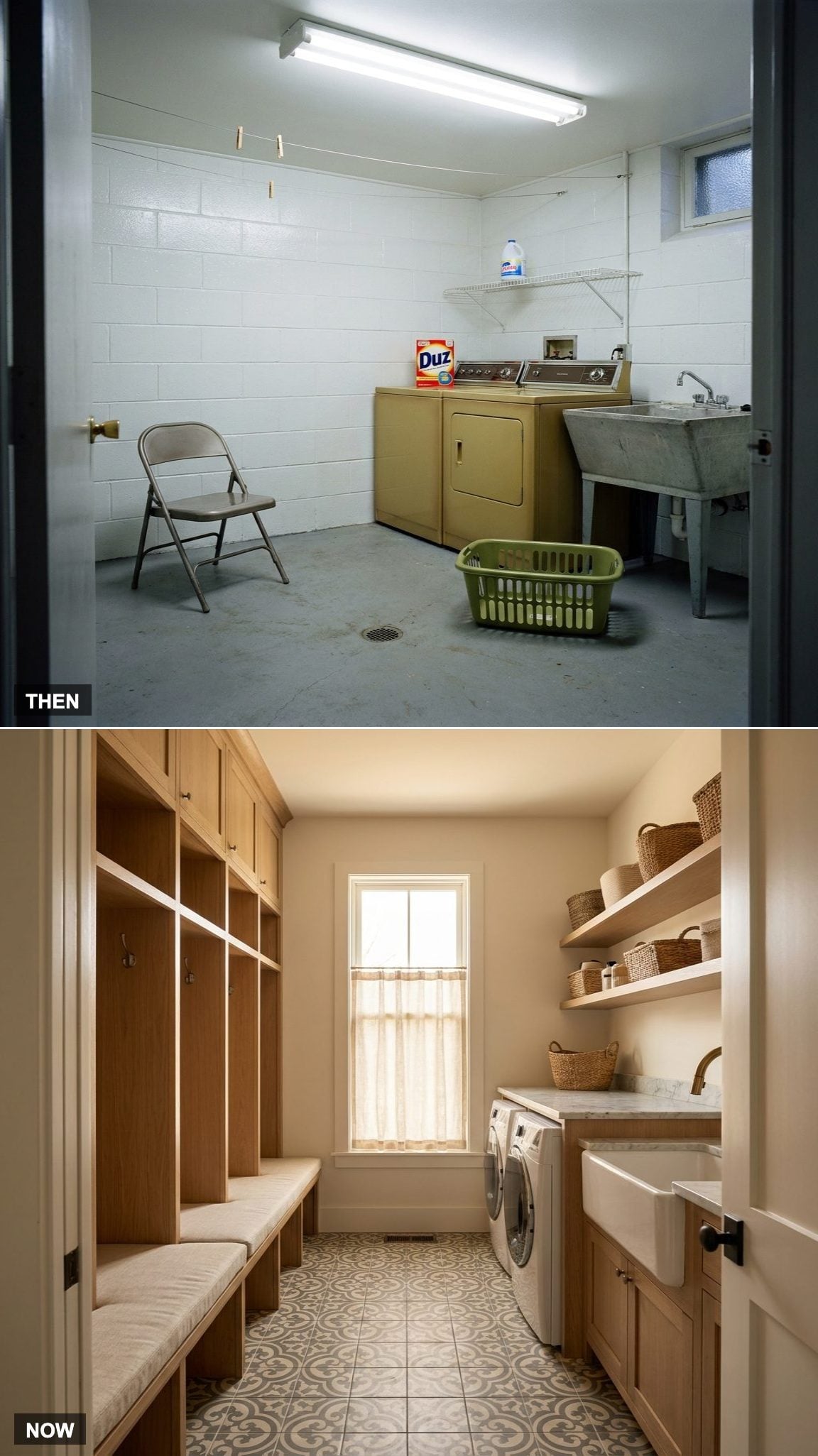
In 1975, the laundry room did one thing. Wash clothes. That was the entire brief — a washer, a dryer, a utility sink, a clothesline, done. Wet boots and a soggy coat? Deal with them somewhere else.
The current version is a bonus room pretending to be a laundry. Lockers for each family member, a bench for pulling off boots, hooks for backpacks, a farmhouse sink deep enough to wash a golden retriever, a folding counter for the sheets, storage for the vacuum and the good linens and the wrapping paper you’ll never use. Mudroom, pantry, coat closet, laundry — all four jobs, one room.
1. The Zero-Personality Utility Box Versus the Room That Got Decorated
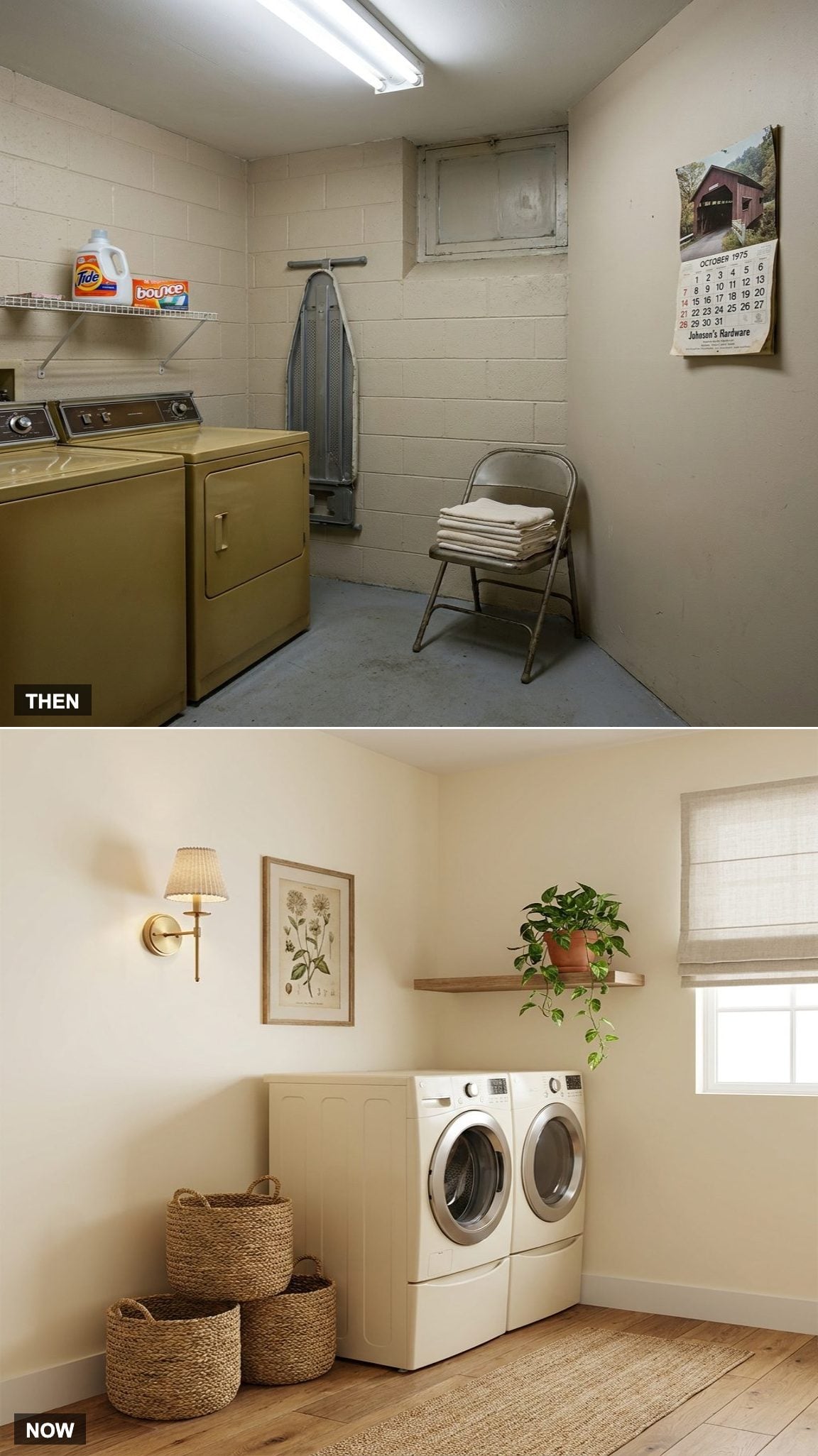
One decorative object. A hardware-store calendar with a covered bridge on it, tacked crooked. That was the styling. That was the mood board.
The same room now gets a brass wall sconce, a trailing pothos on a floating shelf, framed botanical prints, and three seagrass baskets that would’ve cost more than the 1975 washer did in 1975 dollars. Somewhere in the last fifty years we decided the room where we clean our socks deserved art on the wall. Honestly? It does.