🔥 Would you like to save this?
The carpet stopped at the threshold. Past that line, the air changed — lemon Pledge, furniture wax, something faintly floral from a centerpiece nobody replaced often enough. The chairs had seats that squeaked against bare legs in summer, and the table had a pad underneath the tablecloth that made every glass land with a soft thud instead of a clink.
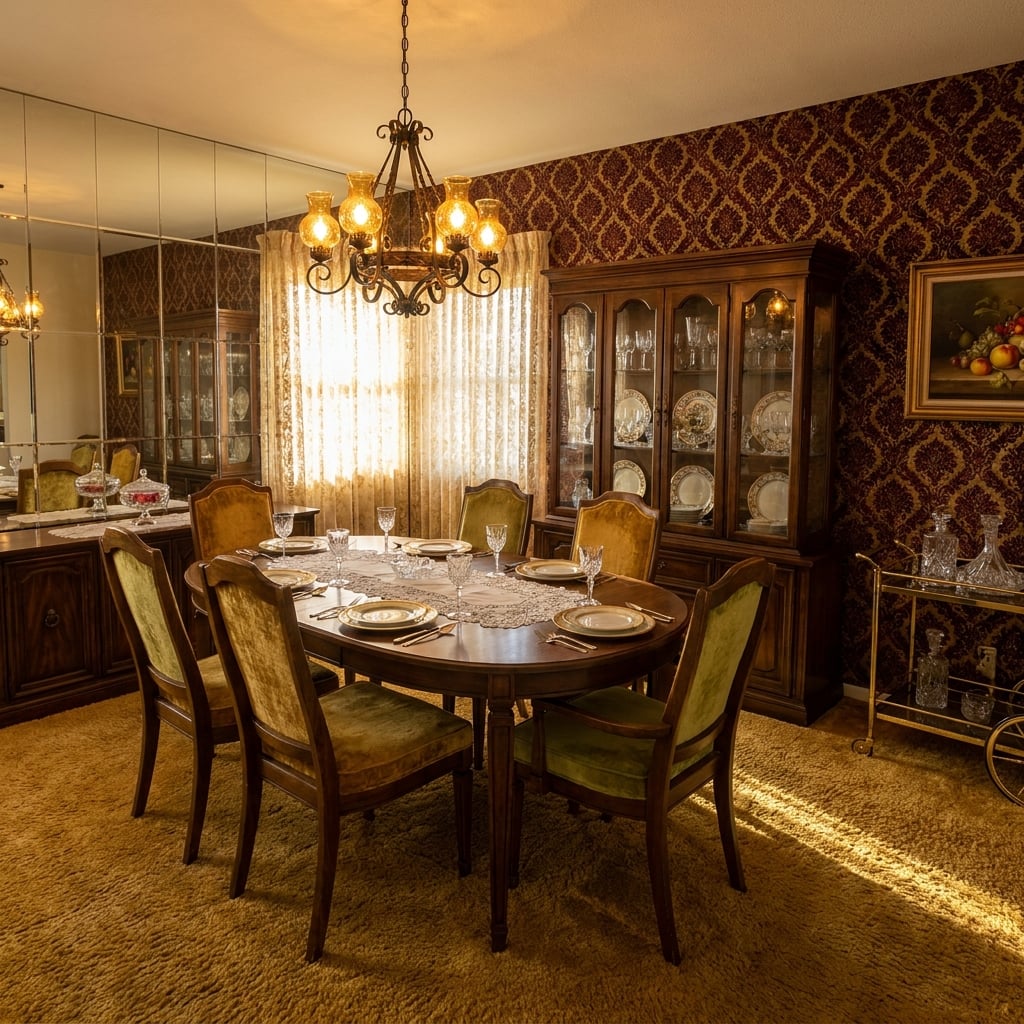
The formal dining room of a 1970s middle-class home existed in a state of permanent readiness. Always set. Rarely used. Understood by every child in the house to be off-limits until Thanksgiving, at which point it briefly and grudgingly admitted the family before sealing itself back up. The things inside it told a very specific story.
In order to come up with the very specific design ideas, we create most designs with the assistance of state-of-the-art AI interior design software. Also, assume links that take you off the site are affiliate links such as links to Amazon. this means we may earn a commission if you buy something.
32. The Wrought-Iron ‘Mediterranean’ Chandelier That Skipped Crystal Entirely
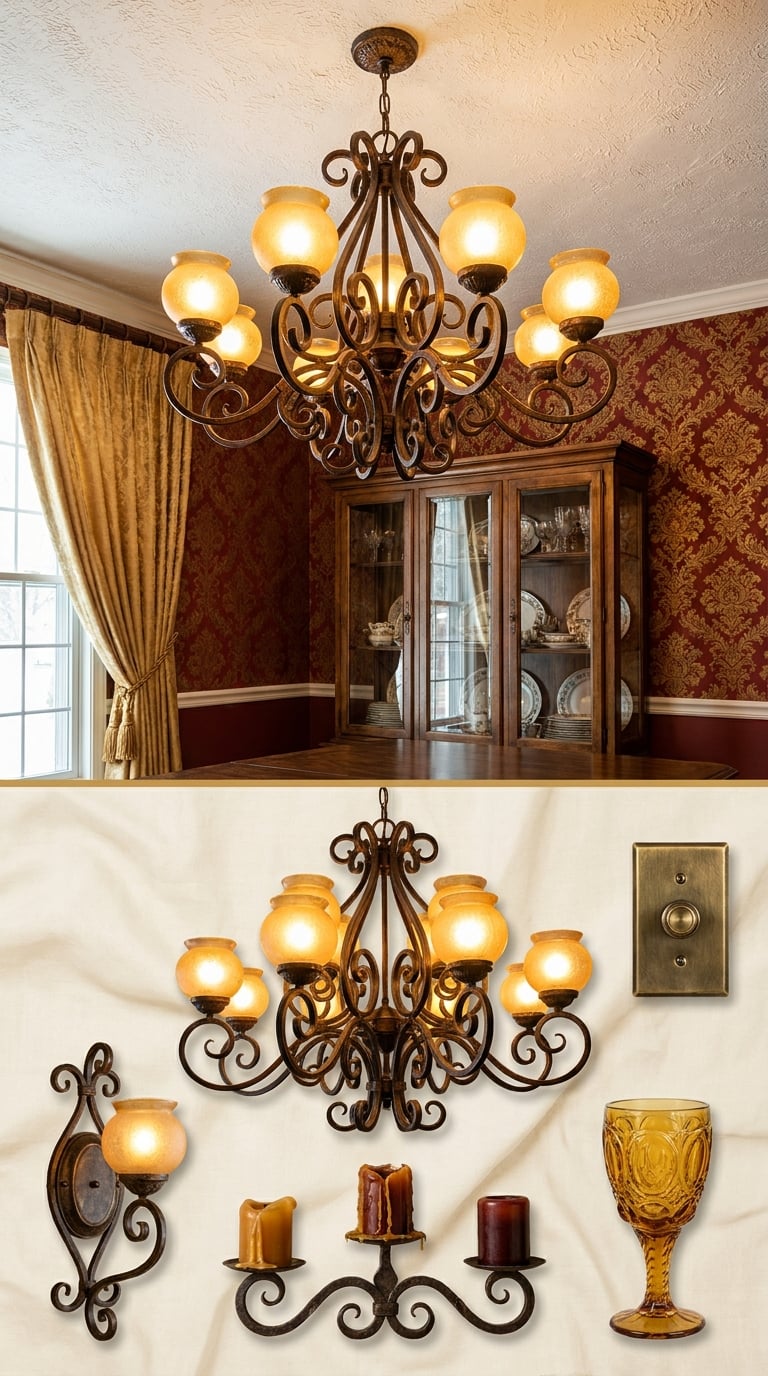
Not every household went crystal. Plenty of 1970s dining rooms made a different statement overhead — heavy wrought iron twisted into scrolls and curlicues, holding amber or frosted glass shades that turned the light the color of weak tea. People called it Mediterranean. Sometimes Spanish Revival. It had the heft of a small anchor and the confidence to match.
These chandeliers hung low. Low enough that tall guests learned to duck, low enough that replacing the bulbs required a stepladder and a prayer. The iron came in dark bronze or flat black, sometimes with gold accents brushed into the scrollwork, and against a textured stucco ceiling or flocked wallpaper the whole arrangement looked like it belonged in a villa somewhere considerably warmer than Ohio. Nobody dimmed it. Either it was on and the room became an event, or it stayed off and the iron scrollwork loomed overhead like a sleeping gargoyle.
31. The Rolling Bar Cart or Tea Trolley That Never Actually Rolled Anywhere
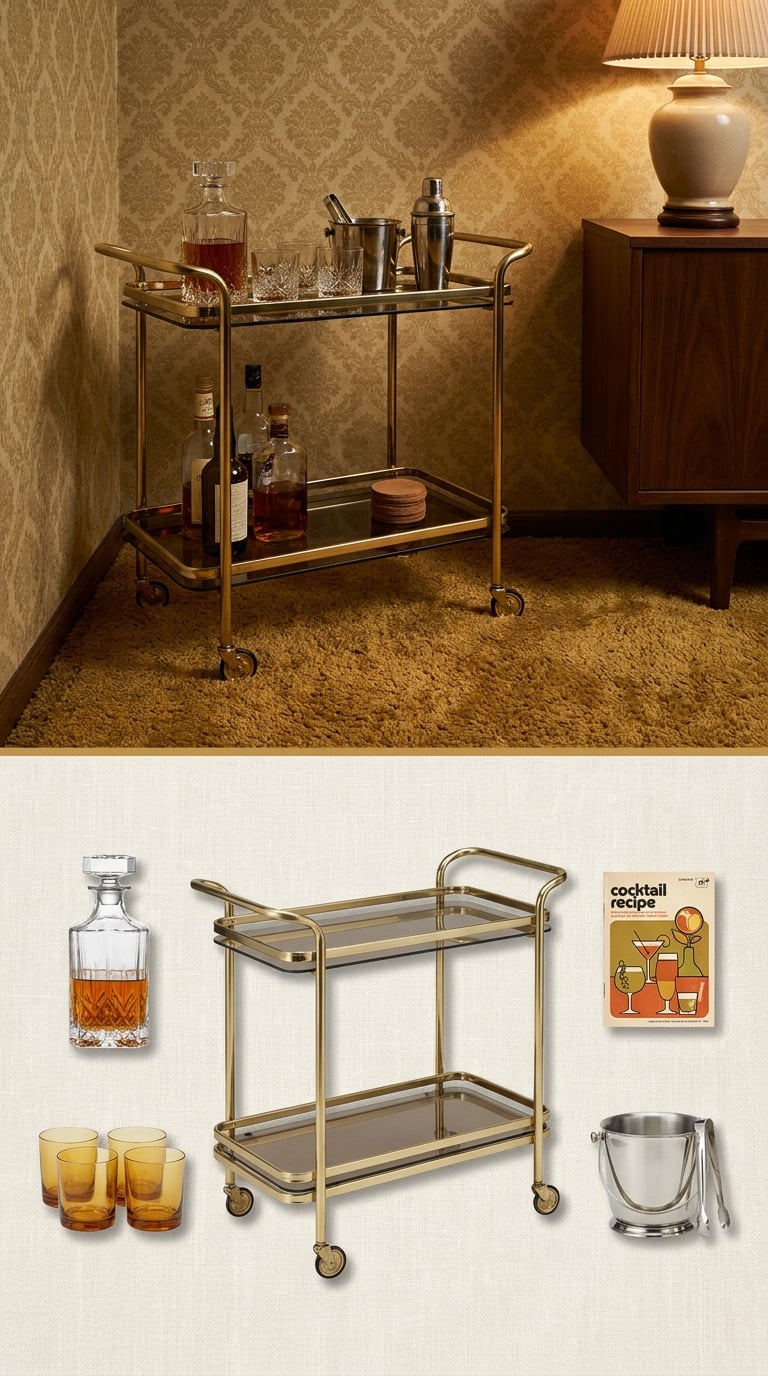
Wheels locked by the carpet pile, going absolutely nowhere. The brass bar cart stood in the corner like a shrine to cocktail hour, holding a crystal decanter that might have contained Scotch or might have contained nothing at all. Matching lowball glasses flanked it, catching chandelier light. An ice bucket with tongs sat ready for a party that happened twice a year, if that.
Usually brass and smoked glass, two tiers, with tiny wheels that left dents in the shag. Some families used a wooden tea trolley instead — the kind with a removable tray top. Either way, the thing functioned as furniture, not transportation. It arrived in the dining room sometime in the early seventies and stayed put for a decade and a half, collecting dust on the lower shelf and compliments from guests who never once asked for a drink from it.
30. The Fondue Pot That Only Appeared on Special Occasions
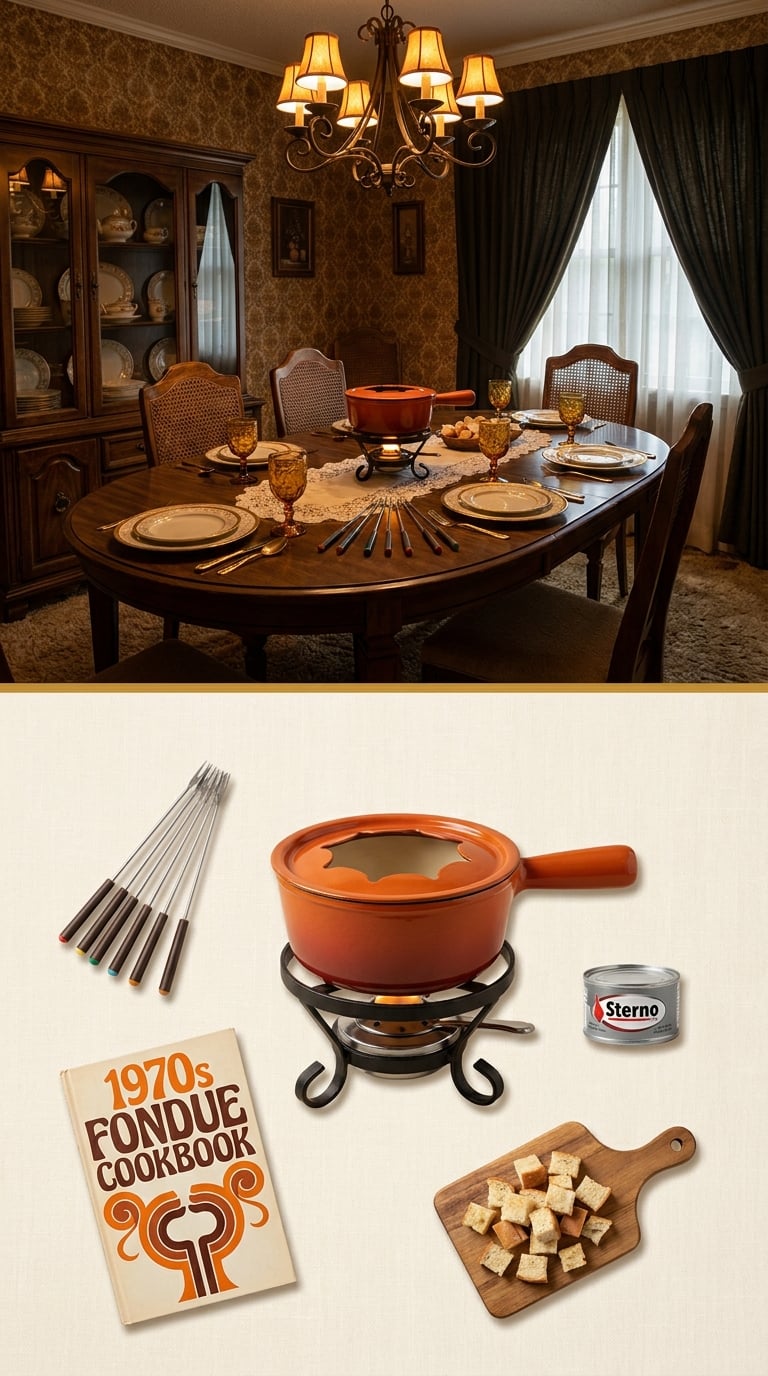
Burnt orange enamel. Or avocado green. The fondue pot lived in a cabinet eleven months out of the year, buried behind the gravy boat, still wrapped in tissue paper. Then New Year’s Eve arrived, or someone’s birthday landed on a Saturday, or a dinner party got ambitious enough to warrant the Sterno — and out it came.
The forks had colored plastic tips so nobody lost track of whose was whose. The stand wobbled on the tablecloth. Cheese never melted evenly, chocolate seized, someone’s bread cube fell in and sank like a stone. None of that mattered. Having the fondue pot on the table meant the evening was an occasion, and the mess was part of the deal.
29. The Electric Hostess Warming Tray Keeping Dinner Hot While Nobody Sat Down Yet
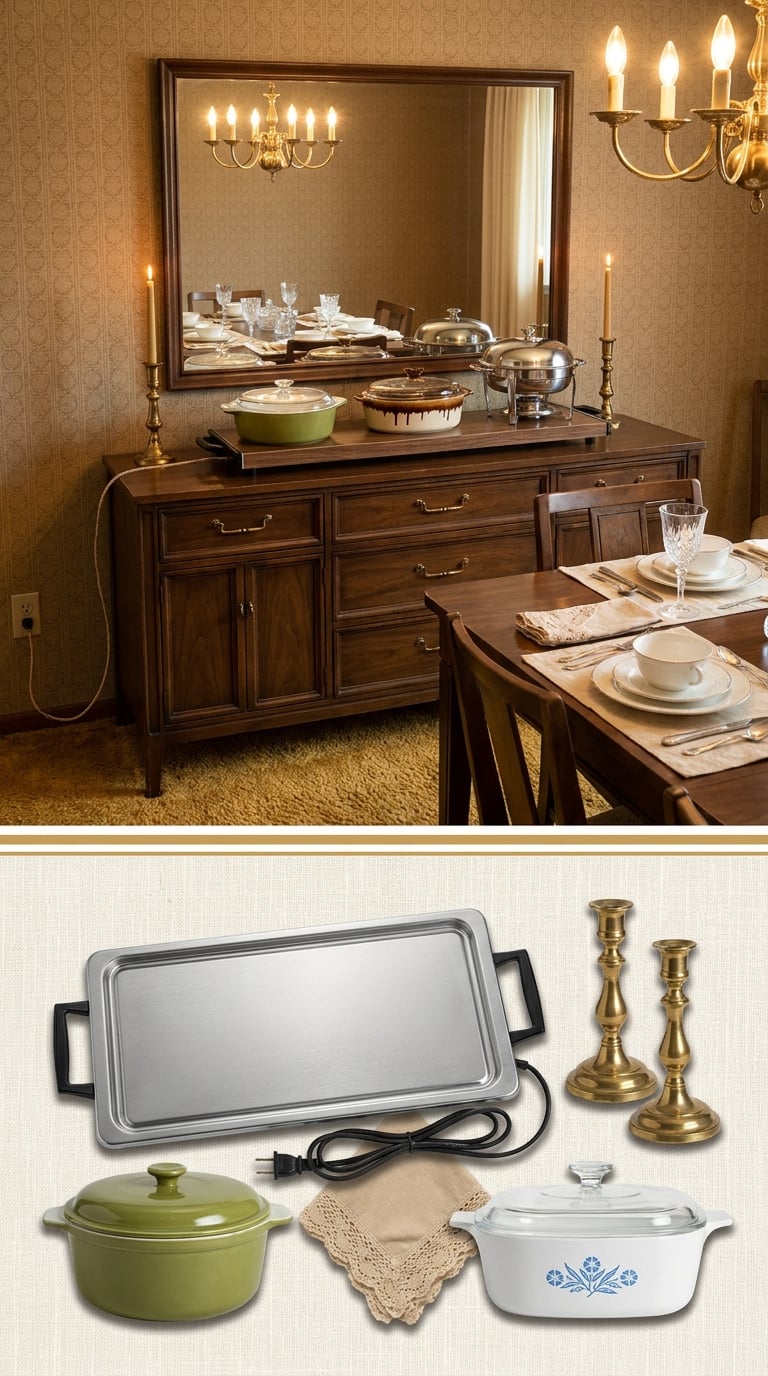
The cord stretched from the sideboard to the nearest outlet, and everyone stepped over it like it was part of the floor plan. Three casseroles and a bread basket sat on the humming tray, holding at serving temperature while the family waited for Uncle Jerry. Who was always twenty minutes late. Always.
Brushed chrome or faux woodgrain, rectangular, flat as a cookie sheet with a heating element underneath — the brand was usually Cornwall or Salton. Hot enough to keep food warm, not hot enough to cook anything further, which was precisely the point. The tray turned the sideboard into a buffet station, bridging the maddening gap between “it’s ready” and the moment everyone actually sat down. A small appliance doing thankless, invisible work. Honestly? Underrated piece of engineering for its era.
28. A Whole Wall of Mirror Tiles, or One Giant Gold-Framed Mirror
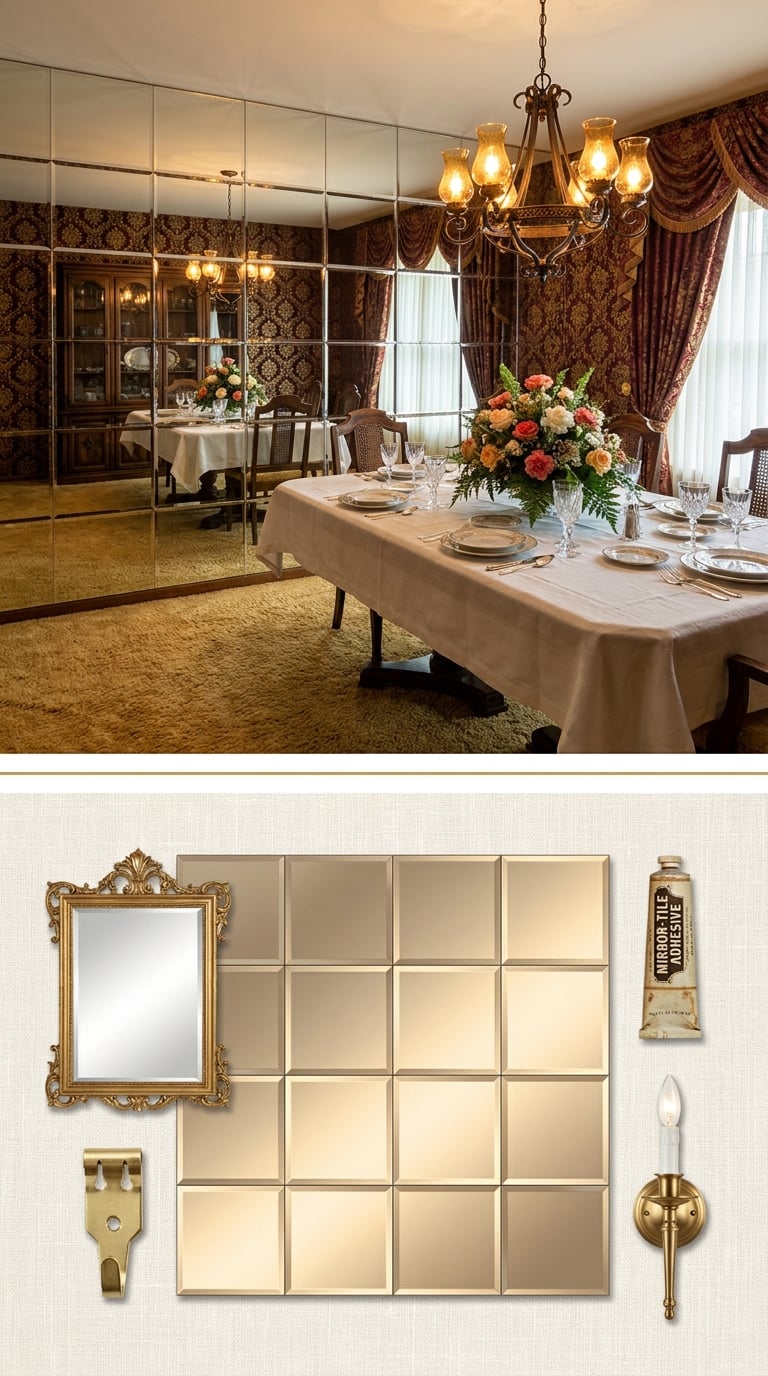
The room looked twice its size. That was the entire gambit. Mirror tiles went up in a grid on the biggest wall — each one about a foot square, beveled at the edges, glued straight to the drywall with an adhesive that would haunt the next homeowner for decades. Seams between tiles caught chandelier light in thin bright lines, and the effect was somewhere between glamorous and funhouse.
Some families chose one large mirror instead, framed in ornate gold or antiqued brass, hung horizontally over the sideboard like a painting that reflected the painting on the opposite wall. Either approach did the same work: a small family room elbowing its way toward grandeur. And honestly? It worked. Guests walked in and the space opened up, felt bright, felt like more than its square footage had any right to suggest.
27. Decorative Collector Plates Lined Up on a Plate Rail Like a Tiny Museum
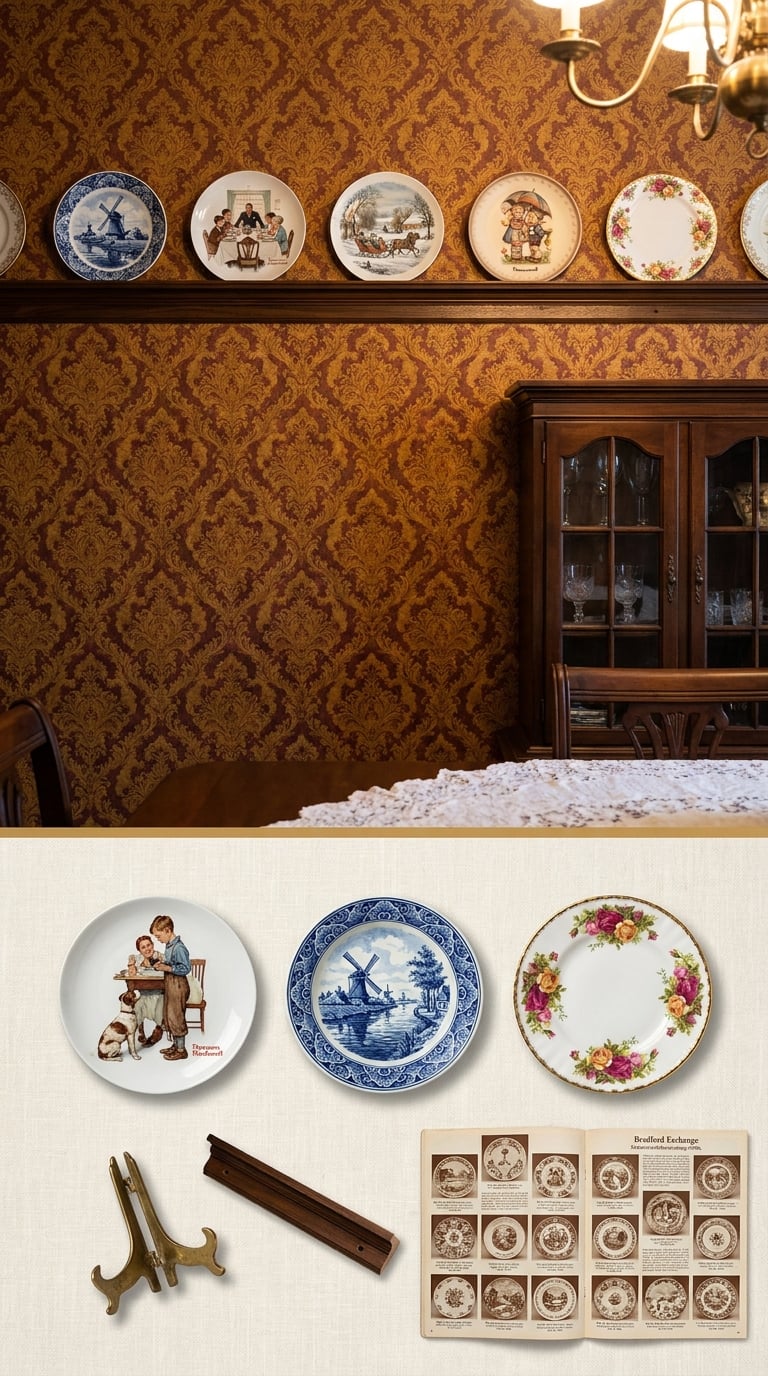
Norman Rockwell. Currier and Ives. A windmill in blue Delft. A Hummel child carrying an umbrella. They stood in a row on a narrow wooden rail, propped upright at eye level. Nobody ever ate off any of them.
Collector plates arrived monthly in padded boxes from the Bradford Exchange or the Franklin Mint, each one numbered on the back, each one supposedly appreciating in value — a claim that aged about as well as the wallpaper. The plate rail ran along the wall at picture height, sometimes wrapping around two or three walls, turning the dining room into a gallery that told no particular story but looked completely deliberate. Dust settled on the rims. Removing one left a visible gap that felt somehow wrong, like pulling a book from the middle of a shelf, so none of them ever moved. They stayed, and the collection only grew.
26. The Cut-Glass Candy Dish Nobody Actually Ate From
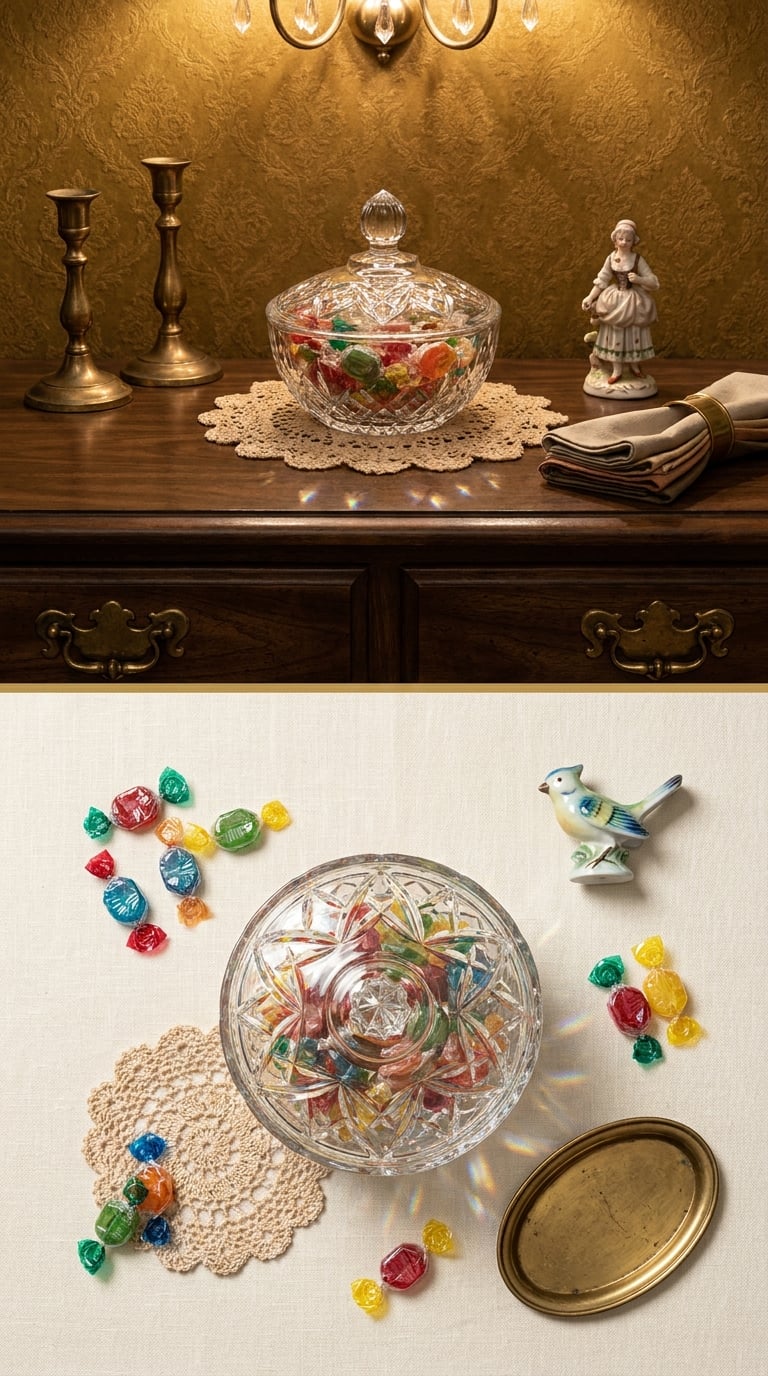
Heavy enough to double as a doorstop. The cut-glass candy dish sat on a crocheted doily on the sideboard, lid firmly on, full of hard candies that predated the current administration. Butterscotch discs. Strawberry bon-bons in twisted wrappers. A few ribbon candies fused together into a single geological formation at the bottom.
Children understood — without being told, through some inherited domestic instinct — that the candy dish was decorative. The lid was on for a reason. Those candies were set dressing, not food. And the dish itself was the real attraction anyway. Cut glass caught the overhead light and scattered tiny rainbows across the walnut surface every evening when the chandelier clicked on. A quiet little show that nobody acknowledged but everyone noticed.
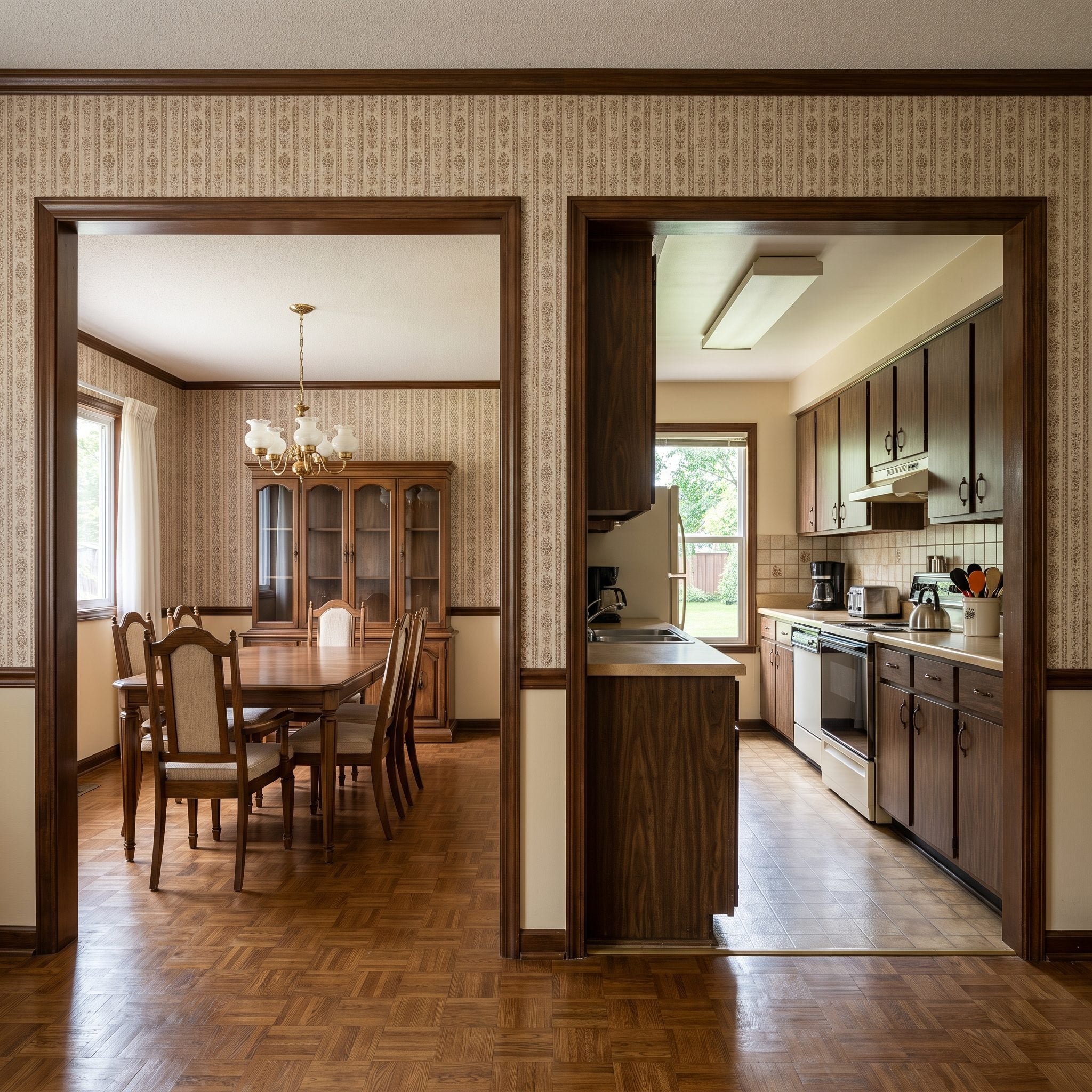
25. The Pass-Through Window to the Kitchen That Framed Mom Like a Portrait
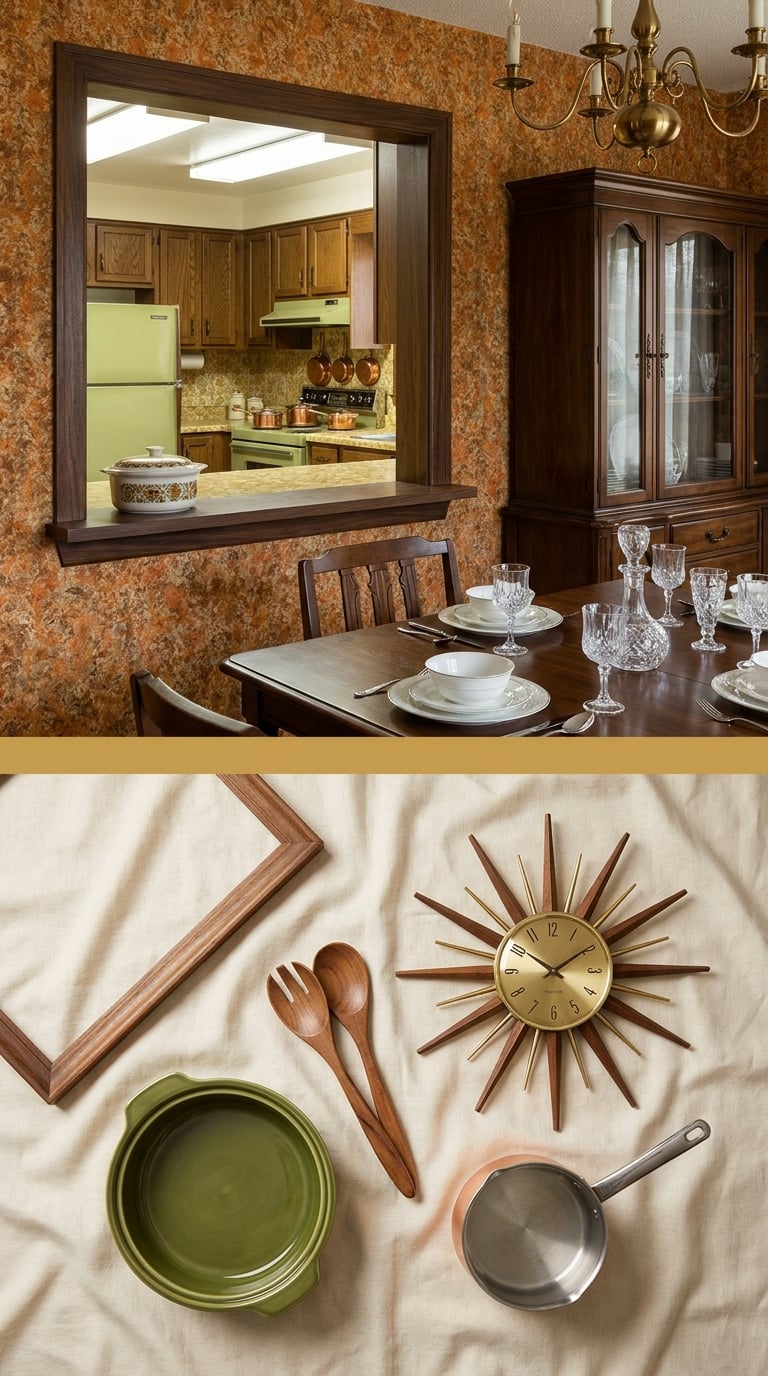
A rectangle cut into the wall, usually about three feet wide, trimmed in the same dark wood as everything else. The pass-through connected the dining room to the kitchen without actually connecting them — dishes came through, conversation drifted through, and the smell of whatever was in the oven arrived a full ten minutes before the food did.
The ledge on the dining room side accumulated things: a serving spoon, a trivet, a bottle of wine waiting to be opened. From the kitchen side, it offered a framed view of the set table and whoever was already seated. From the dining room side came a glimpse of the production happening behind the wall — the steam, the clatter, the real work. It was a practical feature with an accidental poetry to it.
24. A Framed ‘Last Supper’ or Fruit Still-Life Hanging Like It Came With the House
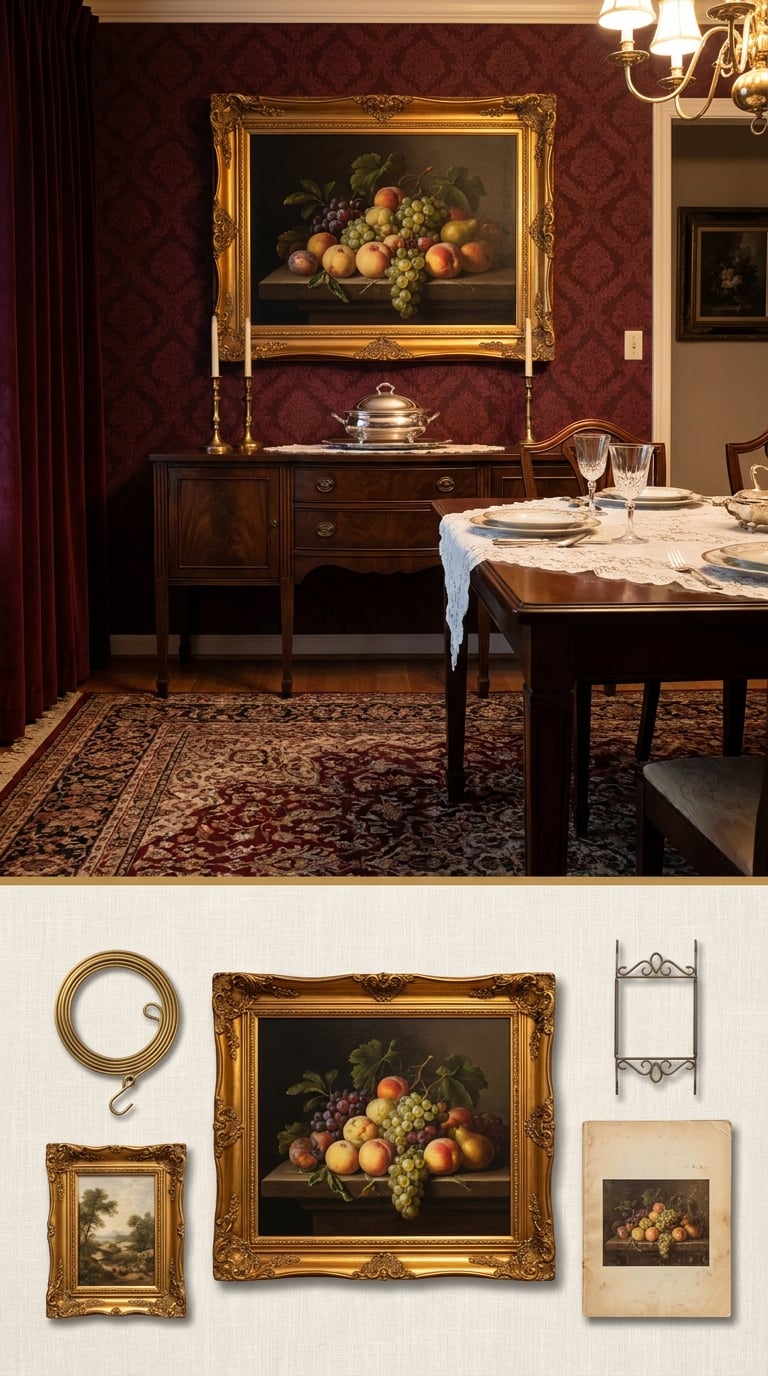
The frame weighed more than the art. A heavy gold rectangle, sometimes with scrollwork at the corners, hanging from a single nail bearing the full burden of the dining room’s cultural aspirations.
Inside: a print of da Vinci’s Last Supper, or a Dutch Masters fruit arrangement so dark and rich it looked edible, or a pastoral landscape with a river nobody could name. The art wasn’t chosen so much as acquired — inherited, or picked up from a department store framing counter, or received as a wedding gift from someone who understood that a formal dining room needed something above the sideboard. The subject barely mattered. What mattered was the weight of the frame and the seriousness implied by its presence. A bare wall above the sideboard was an unfinished sentence, and the painting — whatever it depicted — completed it.
23. The Felt-Lined Wooden Chest Holding the ‘Good’ Silverware Nobody Used on Tuesdays
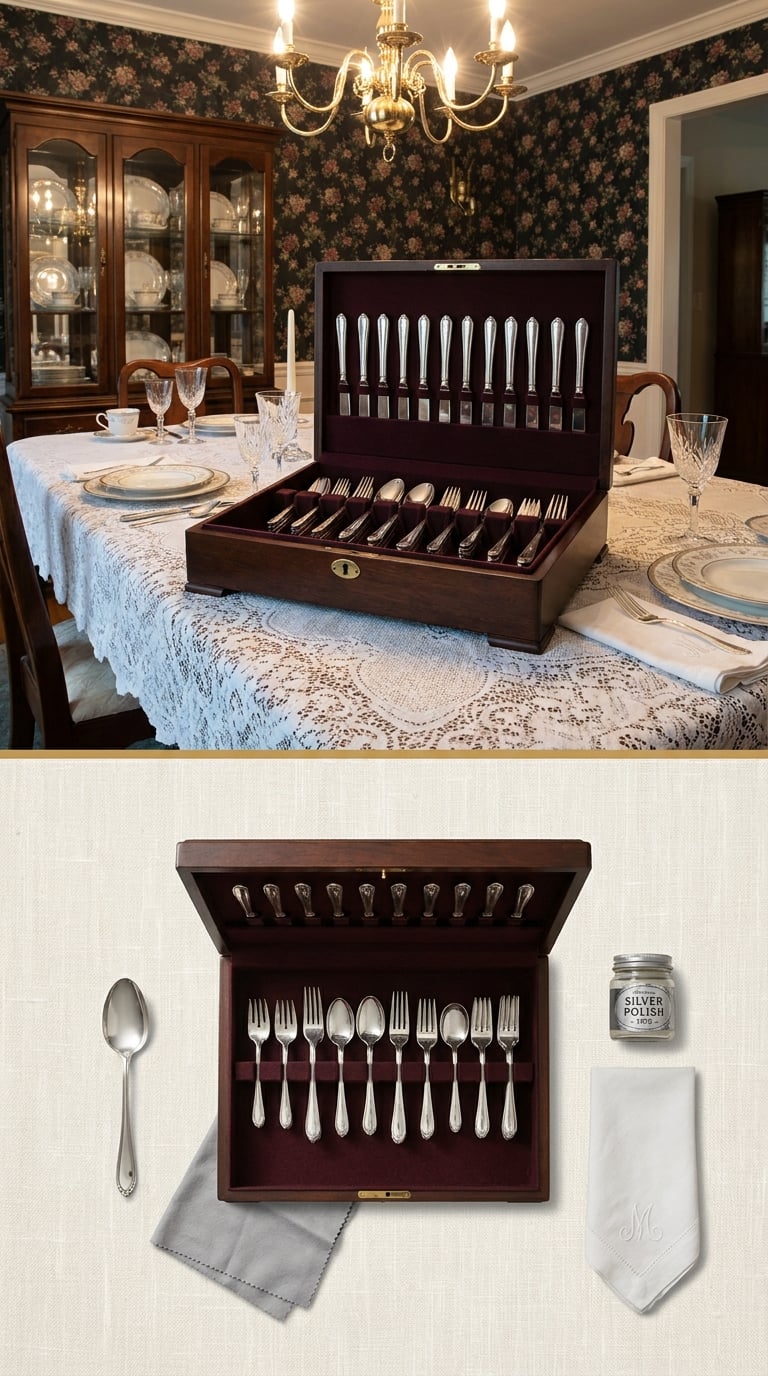
The chest lived in the sideboard’s bottom drawer, or on the top shelf of the hall closet, or sometimes right on the dining table itself — unopened, like a jewelry box for the whole household. Dark walnut or mahogany, brass hinges, a clasp that clicked with the sound of a holiday beginning. Inside, burgundy felt. Rows of silver nestled in shaped slots, tarnishing slowly in the dark.
Thanksgiving, Christmas, Easter, and the rare dinner party that warranted real forks. That was the silverware’s entire calendar. The rest of the year, the family ate with stainless steel from the kitchen drawer while the good set waited in its padded box, always implying that this household owned something worth guarding.
Polishing day was its own ritual. A jar of Wright’s Silver Cream, a soft cloth, slow circular rubbing that turned black tarnish back to bright metal. The smell — specific, chemical, instantly recognizable — meant company was coming. It meant the dining room was about to justify its existence, briefly, before everything got locked away again.
22. The Swag Lamp on a Chain, Glowing Amber in the Corner
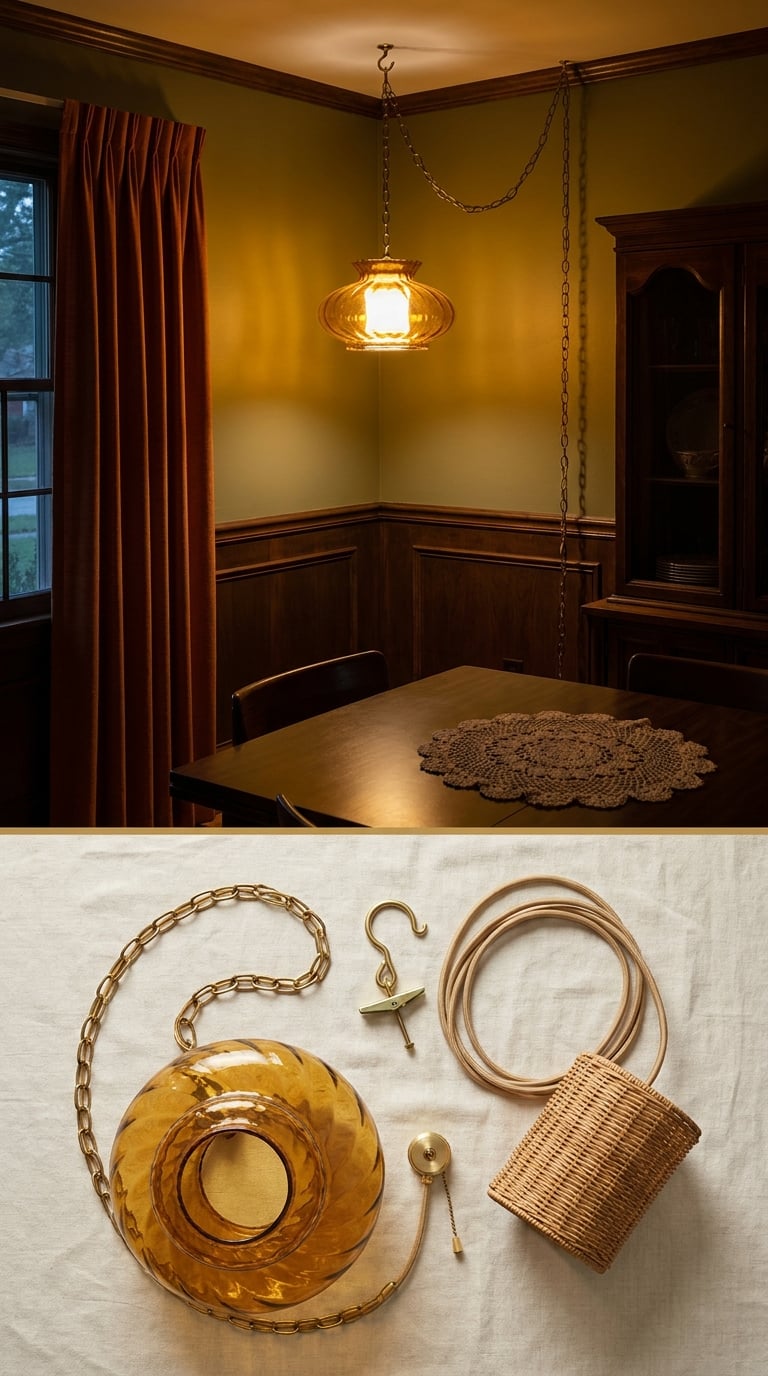
That warm puddle of light in the corner had nothing to do with seeing and everything to do with mood. The swag lamp hung from a ceiling hook on a long chain, its cord draped in a graceful arc across the ceiling to the nearest outlet. Nobody called an electrician for it. The whole thing was held up by a single hook screwed into a joist, and the excess chain just looped over itself like a brass necklace.
The shades came in amber glass, wicker drum, or some variation of stained-glass-inspired acrylic. The light they threw was golden and insufficient for reading, which was the point. This lamp existed for atmosphere. It said: the overhead fluorescent is off, dinner is over, and the evening has officially started.
21. The Lazy Susan Parked Dead Center on the Table
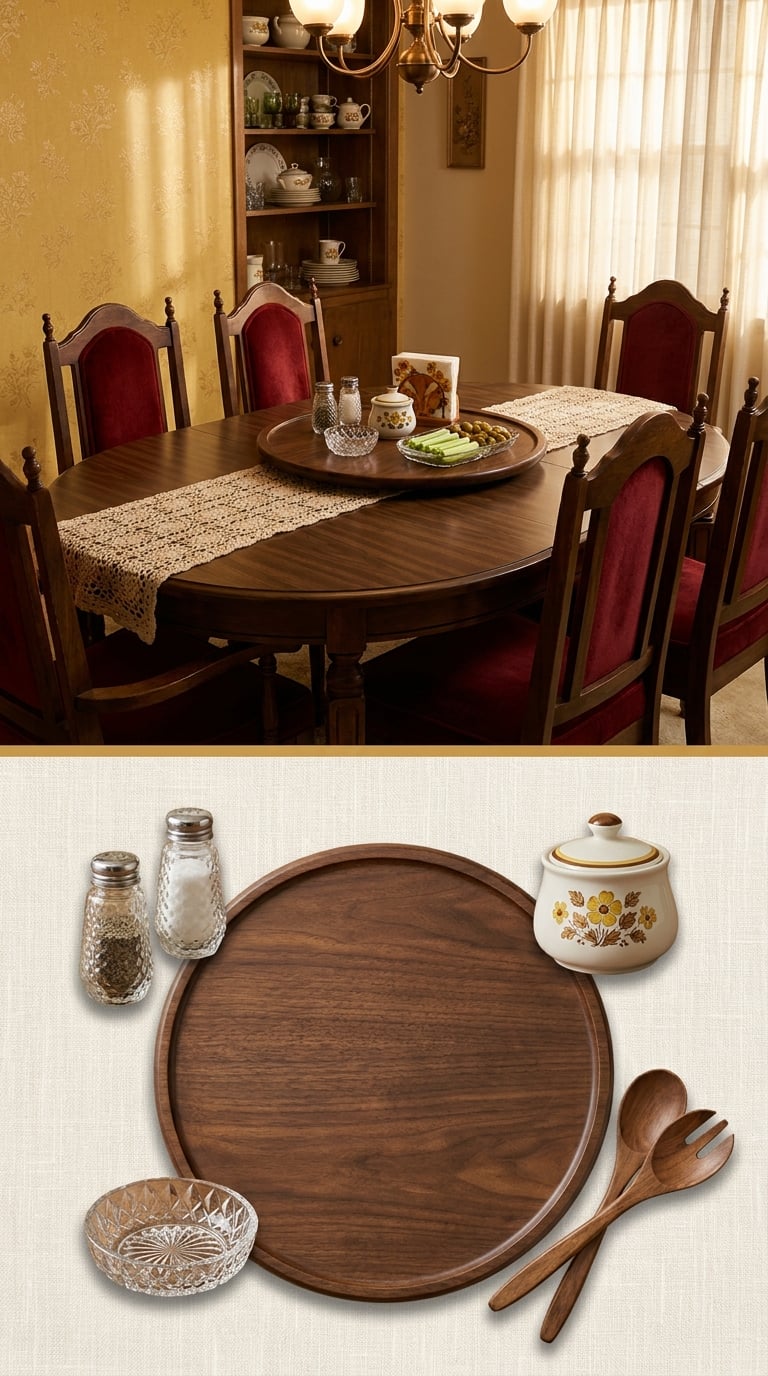
It never moved during the week. Just sat there, the permanent centerpiece, loaded with salt, pepper, a sugar bowl, maybe a napkin holder. A wooden turntable the color of walnut stain, spinning on a bearing that had developed a slight wobble by 1974.
Come Sunday dinner, the lazy Susan earned its keep. Rolls, butter, relish tray, all within reach of everyone without asking someone to pass a thing. The spin was communal. One person turned it, the whole table adjusted. There was an unspoken etiquette to its rotation: clockwise, never grab while it’s moving, and don’t spin it fast just because the kids thought it was funny. They did anyway.
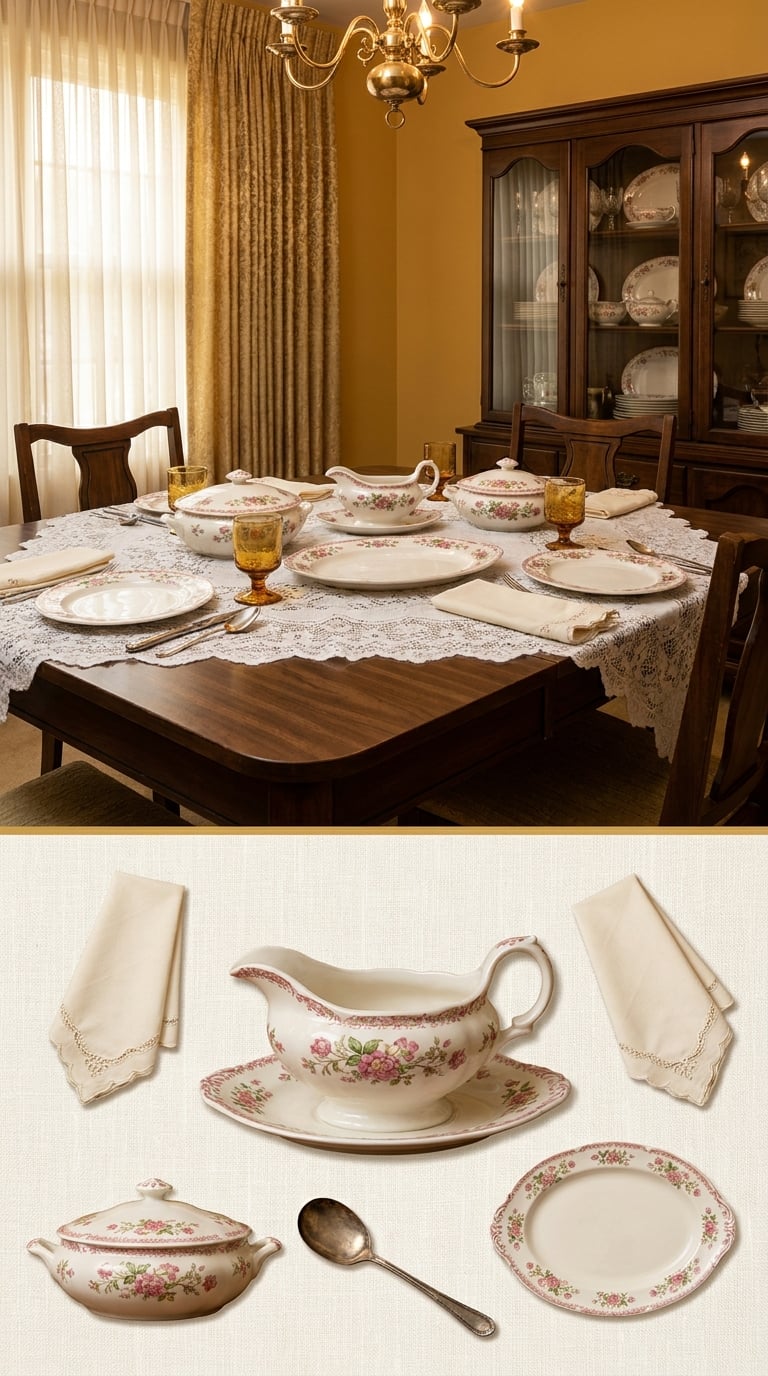
20. The “Company” Gravy Boat and Serving Dishes That Appeared Twice a Year
🔥 Would you like to save this?
Thanksgiving. Christmas. Maybe Easter if the family was ambitious. Those were the only days the matching serving set came out of the hutch. A gravy boat with an attached saucer, a covered vegetable dish, a platter long enough for a turkey. All in the same floral pattern, all part of a set someone received as a wedding gift in 1962 and treated like heirloom silver ever since.
The rest of the year, gravy came to the table in a saucepan with a ladle stuck in it. Nobody thought twice. But on company days, the gravy boat appeared, and it meant something. It meant cloth napkins instead of paper. It meant the leaf was in the table. The gravy boat was never really about gravy. It was a signal that the house was performing its best version of itself.
19. The Beaded Curtain or Macramé Room Divider Between Dining and Living Room
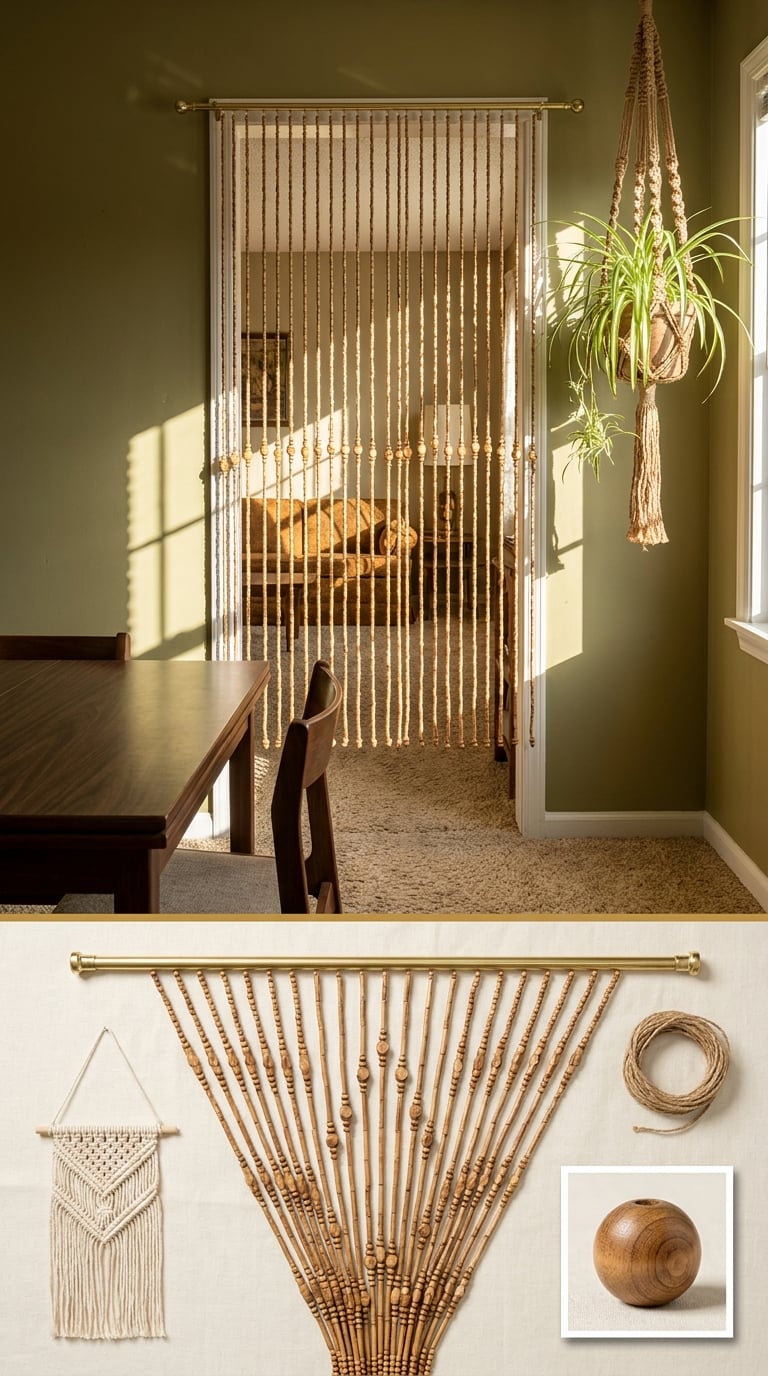
Not a wall. Not an open floor plan. Something in between: a curtain of wooden beads or a macramé panel hanging from a tension rod in the doorway. It divided the dining room from the light living room the way a suggestion divides a conversation. The beads clattered when someone walked through. The macramé swayed and settled. Neither one blocked a sound or a sight, and that was fine.
The beaded versions came in bamboo, wood, or plastic. Some had patterns worked into them, geometric shapes that only materialized when the strands hung perfectly still, which was almost never. The macramé dividers were heavier, jute or cotton cord knotted into elaborate patterns by someone’s aunt or purchased at a craft fair. Both served the same purpose: the dining room had a boundary, and the boundary was decorative, not structural.
18. Crewel Embroidery Wall Art (or That Macramé Owl Everyone’s Mother Made)
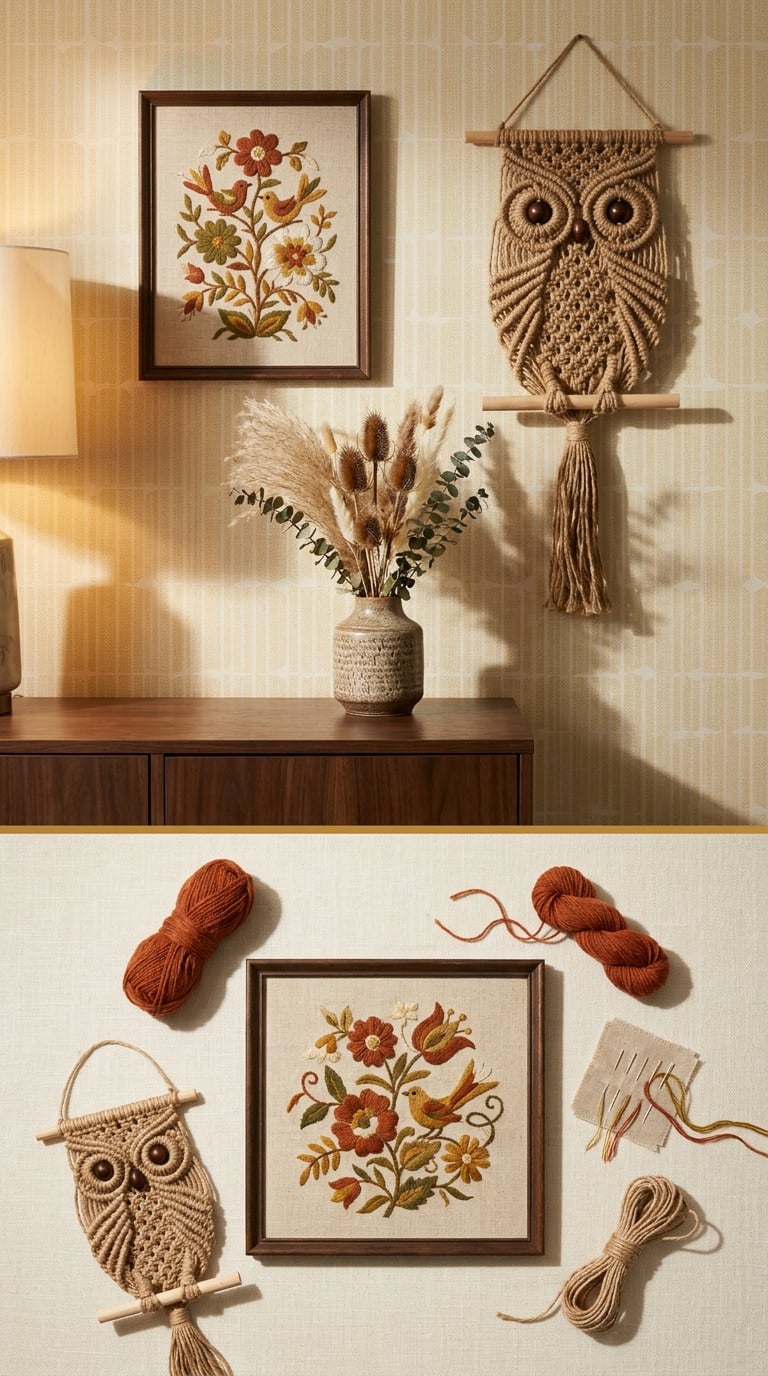
One or the other hung in nearly every dining room. Sometimes both.
The crewel embroidery was the quieter presence. A framed rectangle of linen stitched with flowers, birds, or a pastoral scene in wool yarn, the colors always the same earth-tone family: rust, olive, mustard, cream. The stitching had texture. From across the room it looked like a painting. Up close, every petal was a ridge of thread someone had worked through with a needle, hour after patient hour. Many came from kits, but the labor was real.
The macramé owl was louder. It hung from a dowel rod, knotted in jute or cotton cord, with wooden bead eyes that stared at nothing. The owl was the unofficial mascot of 1970s wall decor. It showed up in dining rooms, hallways, bathrooms, above the couch. Nobody questioned its presence. It belonged there, the way a clock belongs on a wall. It was just part of the grammar of a room.
17. Hobnail Milk Glass Goblets and the Cut-Glass Pitcher Nobody Drank From
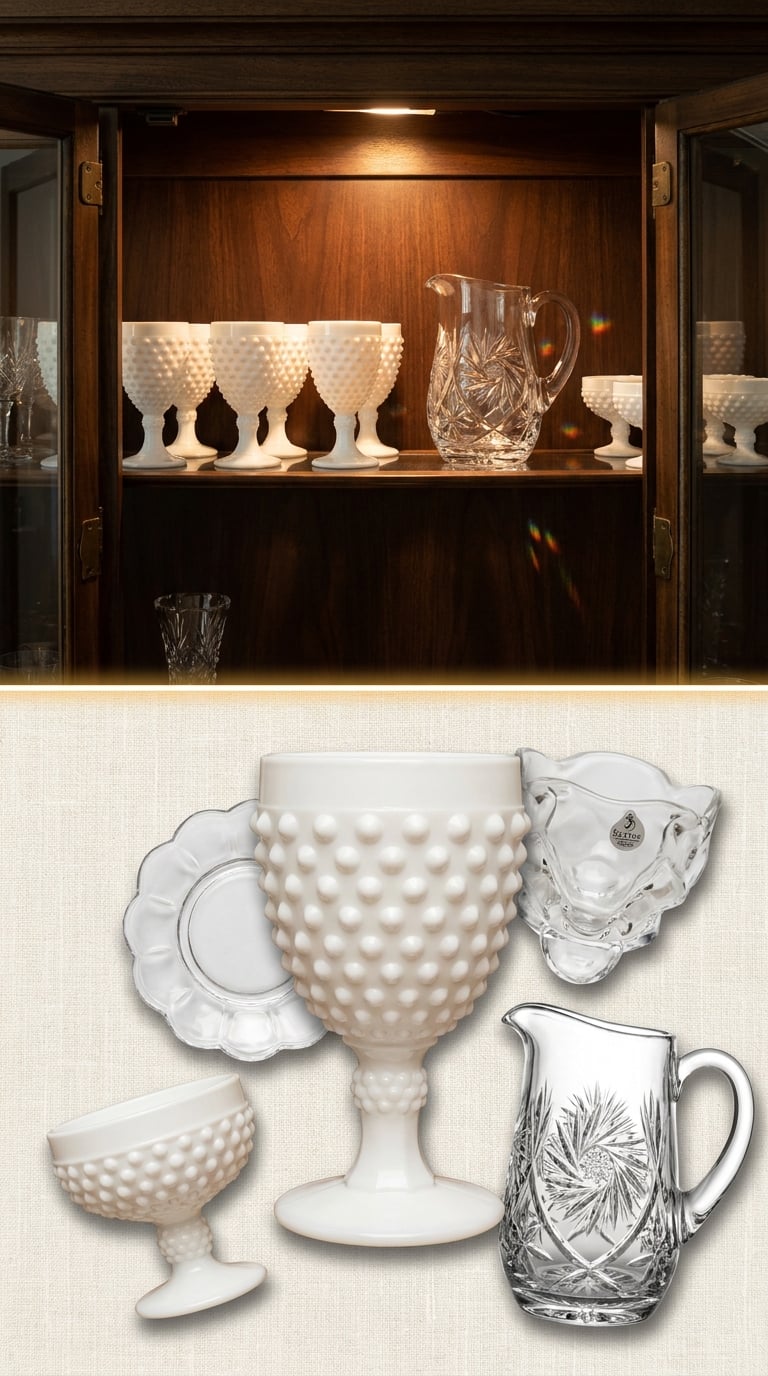
The milk glass was white, bumpy, and everywhere. Hobnail milk glass goblets lined the hutch shelves, turned the dining table into something that looked like a photograph from a magazine, and felt heavier than expected. Fenton made most of them. The hobnail texture, those raised dots covering every surface, caught the light in a way that made opaque white glass look almost luminous.
Next to the goblets, usually, sat a cut-glass pitcher. Crystal or pressed glass, heavy enough to double as a doorstop, with a starburst pattern cut deep into every surface. Water went into it on formal occasions. The rest of the time it sat empty in the hutch, refracting whatever light hit it into tiny rainbows on the shelf behind it. Nobody used it for Tuesday night iced tea. It was too good for that. Everything in the dining room was too good for something.
16. The China Hutch With the “Good” China Locked Behind Glass
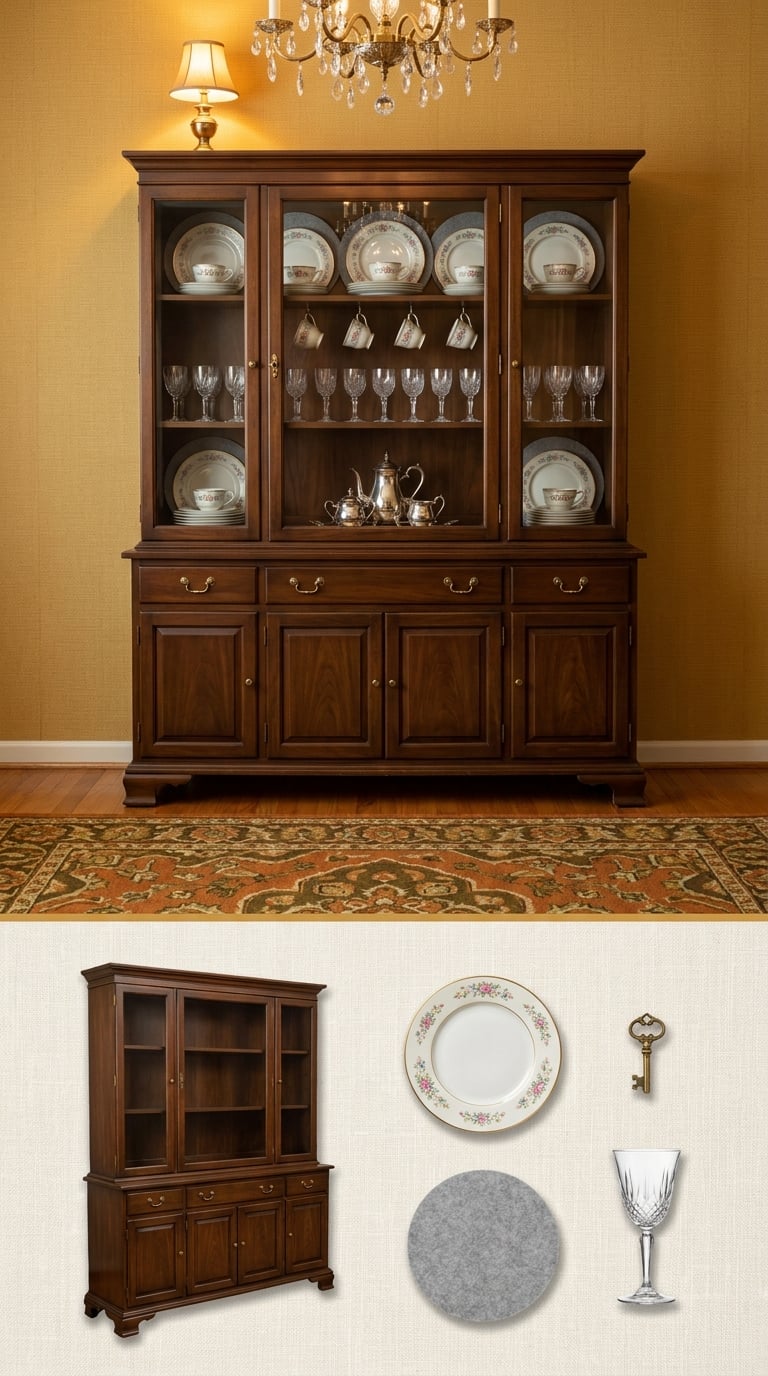
The Furniture That Held the Family’s Best Self
This was the single most important piece of furniture in the dining room, and possibly the house. A two-piece hutch: solid base with drawers and cabinets below, glass-fronted display case above. Dark walnut or fruitwood finish. Brass hardware. A lock on the glass doors, and someone in the house knew where the key was.
Behind that glass sat the good china. A full service for eight or twelve, stacked with felt separators between each plate. Cups hung from small brass hooks. Saucers lined up like soldiers. The pattern was chosen once, decades earlier, and the commitment was permanent. Replacing a chipped piece meant writing to the manufacturer or hunting through department stores for the matching pattern number.
The hutch also held crystal stemware, the silver-plated serving set, and sometimes a few pieces of decorative porcelain. Every shelf was arranged with intention. Nothing was casual. The hutch was a museum of a family’s aspirations, visible daily, touched almost never.
15. The Crystal Chandelier on a Dimmer Switch, Dead Center Over the Table
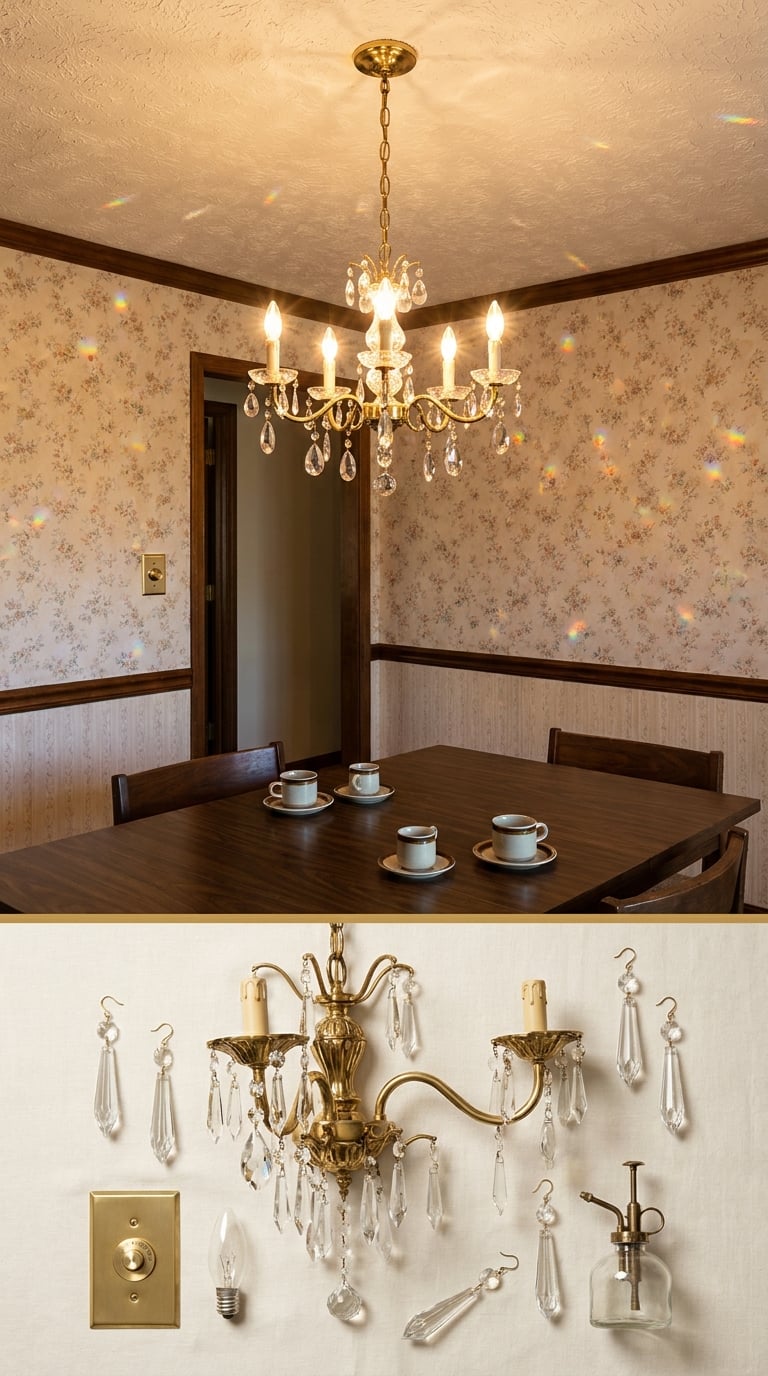
Every formal 1970s dining room had one overhead light source, and it was centered over the table with the precision of a surgical lamp. A crystal chandelier, usually five or six arms, dripping with prisms that threw tiny rainbows across the ceiling when the sun hit them at the right angle in the afternoon.
But the real technology was the dimmer switch by the door. A rotary dial, usually brass or ivory plastic, that controlled the chandelier’s intensity the way a volume knob controls music. Full bright for setting the table. Medium for the meal itself. Low for after dinner, when the conversation slowed and the coffee came out. The dimmer turned a single fixture into three different moods.
The prisms collected dust. Cleaning them was an annual event involving a stepladder, a towel spread on the table below, and a spray bottle of vinegar water. Each crystal got wiped individually, rehung on its tiny hook, and adjusted until it hung straight. The chandelier demanded maintenance the way a garden demands weeding. The families who had one accepted the bargain.
14. The Dark Mediterranean or Spanish-Style Dining Set With Towering High-Back Chairs
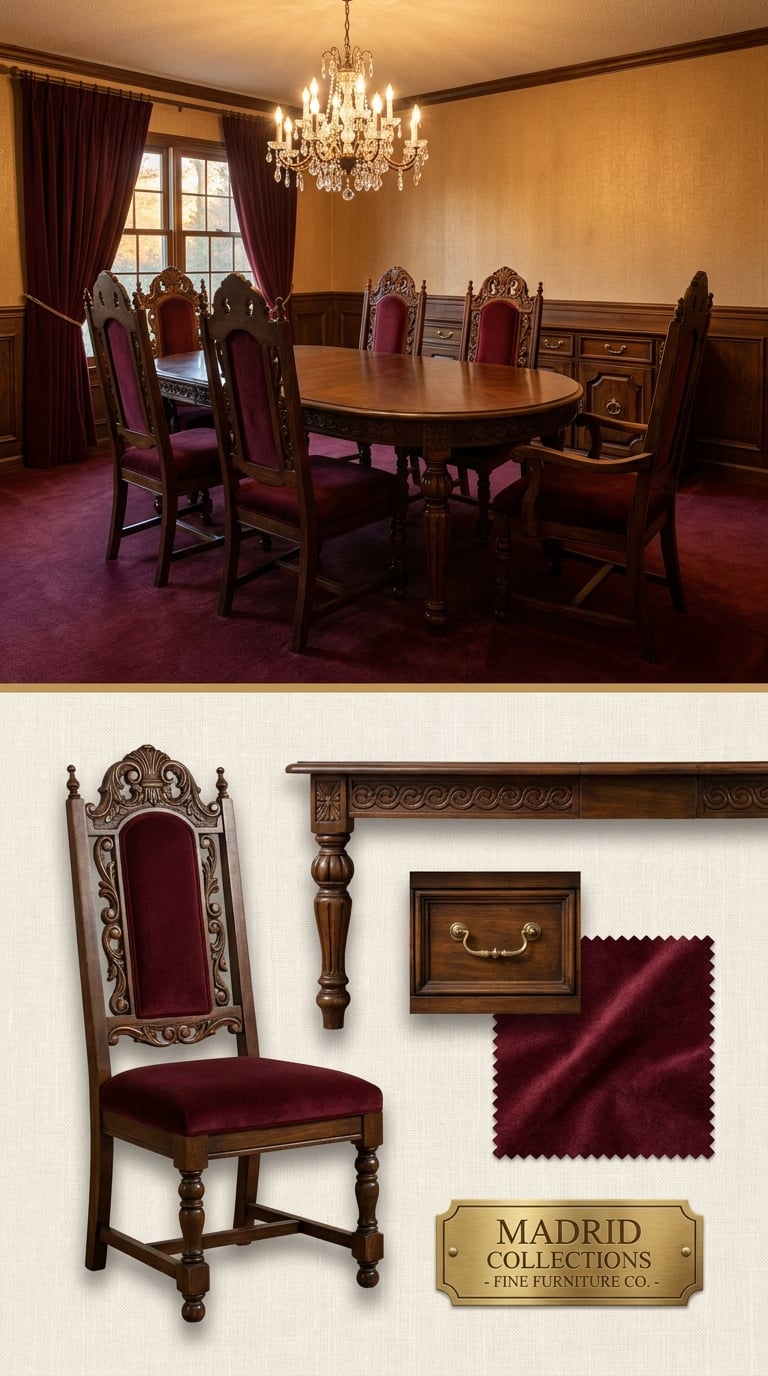
The chairs came up to shoulder height when someone was sitting in them. Dark oak or walnut, carved with scrollwork and turned legs, upholstered in velvet or vinyl in deep red, olive green, or burnt orange. The backs were so tall and rigid they discouraged slouching through pure architecture. Sitting in one felt like sitting in a throne designed by someone who didn’t believe in comfort.
The table matched. Heavy, dark, usually oval or rectangular with a carved apron and thick turned legs. It had a leaf stored in the hall closet. The whole set weighed as much as a small car. Moving day was a negotiation. Mediterranean and Spanish Revival dining sets dominated the decade, sold by Drexel, Thomasville, Henredon, and a dozen other manufacturers who understood that the 1970s dining room wanted to feel like a castle in Castile, not a kitchen in Kansas.
The darkness of the wood set the tone for the entire room. Everything else adjusted to it. The wallpaper went warm. The carpet went deep. The chandelier went crystal. The sitting room decor next door might have been lighter, but the dining room belonged to the furniture, and the furniture was serious.
13. The Dark Mediterranean or Spanish-Style Dining Set with High-Back Chairs
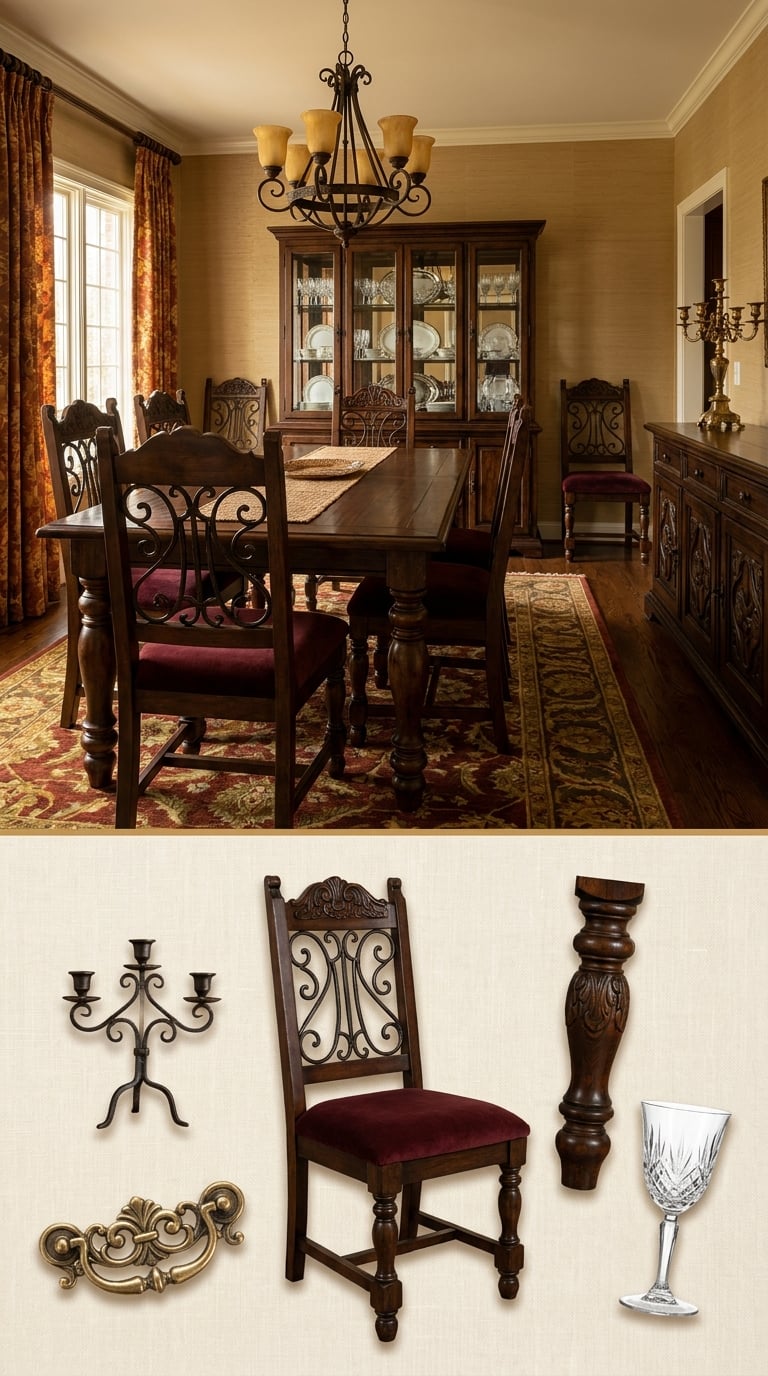
The chairs came up to shoulder height. Sometimes higher. Carved wood, dark as coffee left on the burner too long, with velvet seat cushions in burgundy or forest green. The table matched. Heavy enough that sliding it across the floor required a second adult and a prayer for the hardwood underneath.
These sets pulled from Spanish Colonial and Mediterranean revival styles that had cycled through American furniture catalogs since the 1920s, but the 1970s version leaned harder into the drama. Wrought iron accents on the chair backs. Turned legs thick as fence posts. A dark wood china cabinet and matching sideboard flanking the table like sentries. The whole room felt like a castle’s great hall compressed into 140 square feet of suburban ranch house.
Sitting in one of those high-back chairs did something to posture. Shoulders went back. Elbows came off the table. The furniture enforced a formality that no amount of parenting ever could. Kids who slouched in every other chair in the house sat up straight in the dining room without being told. The set demanded it.
12. The Protective Table Pads Hiding Under the Lace Tablecloth
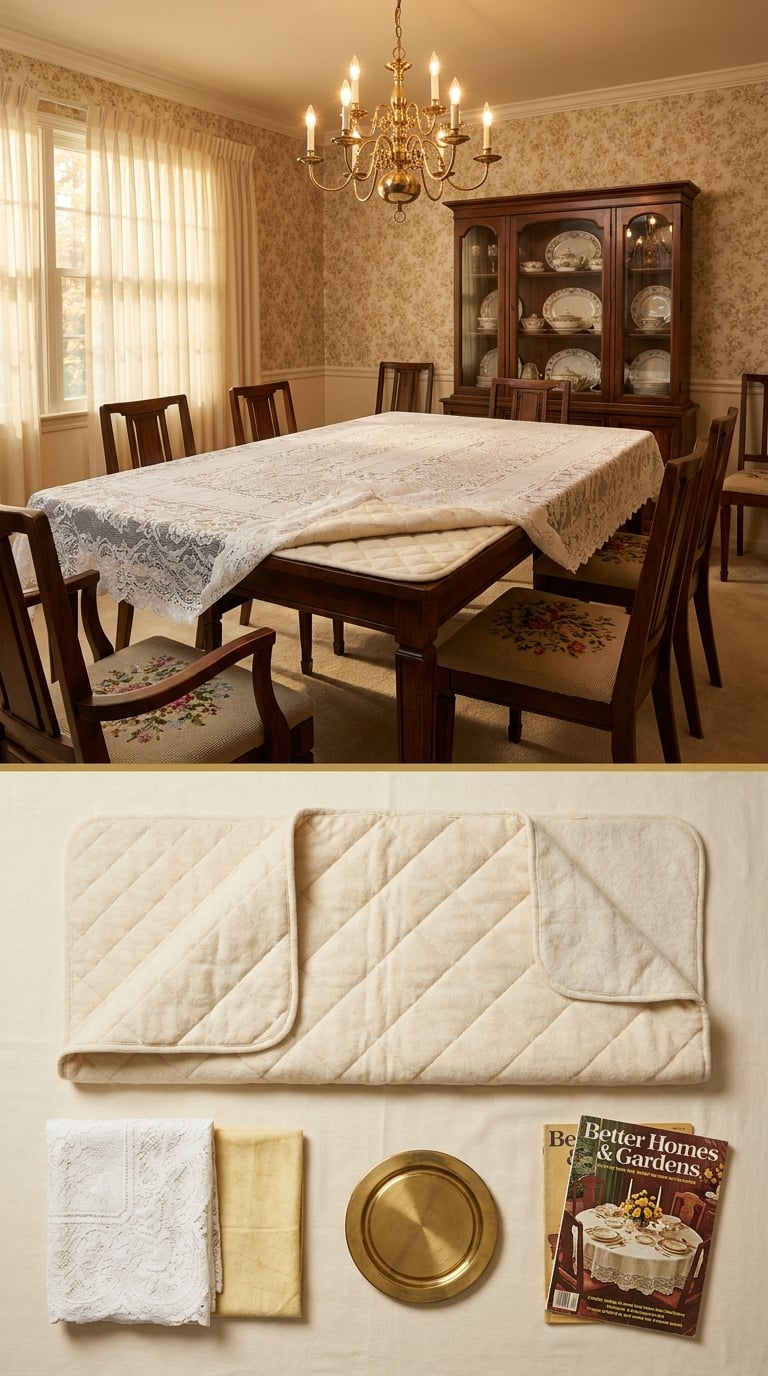
Nobody saw them. Thick, quilted, heat-resistant pads sat between the table’s finish and the world, absorbing every casserole dish and hot coffee pot so the wood beneath stayed pristine. The lace tablecloth draped over everything like a second layer of insurance, and the two together formed a defense system so thorough that the actual table surface might as well have been theoretical.
Some families owned custom-cut pads that fit the table’s exact dimensions, ordered from a catalog and stored folded in a hall closet when company wasn’t expected. Others made do with a flannel-backed vinyl pad from the department store. Either way: a dining table that could survive decades without a single ring mark, scratch, or water stain. The table underneath often looked factory-new the day the house was sold.
11. Flocked Red-and-Gold Damask Wallpaper That Made the Room Feel Like a Victorian Parlor
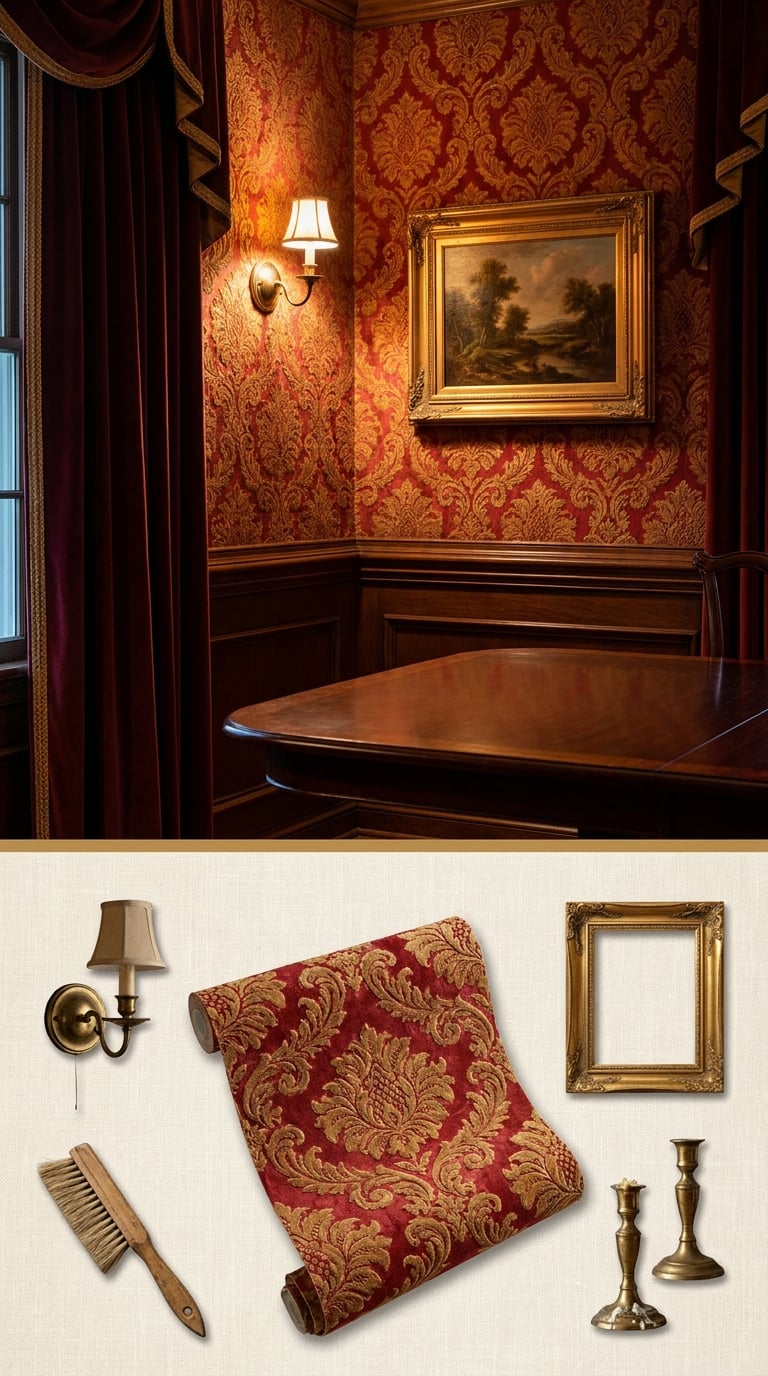
Run a finger across it. The raised velvet pattern had actual texture — soft ridges of flocking that made the walls feel alive. Red and gold was the classic combination, though burgundy-and-cream ran a close second. An ordinary suburban dining room suddenly wanted to be mistaken for a room in a much older, much grander house.
That wallpaper did almost all the work. It set the mood before a single piece of furniture went in, and against that backdrop, even a modest table and four chairs looked intentional, formal, worth sitting up straighter for. The pattern repeated in tight, intricate motifs that caught candlelight in a way flat paint never could.
Installing it? A nightmare. Flocked wallpaper required careful handling and specific adhesive, and a misaligned seam showed immediately because the texture made every join glaringly visible. Professional hanging was common — which says something about how seriously people took these rooms.
10. Plush Shag Carpet Under the Dining Table, Crumbs and All
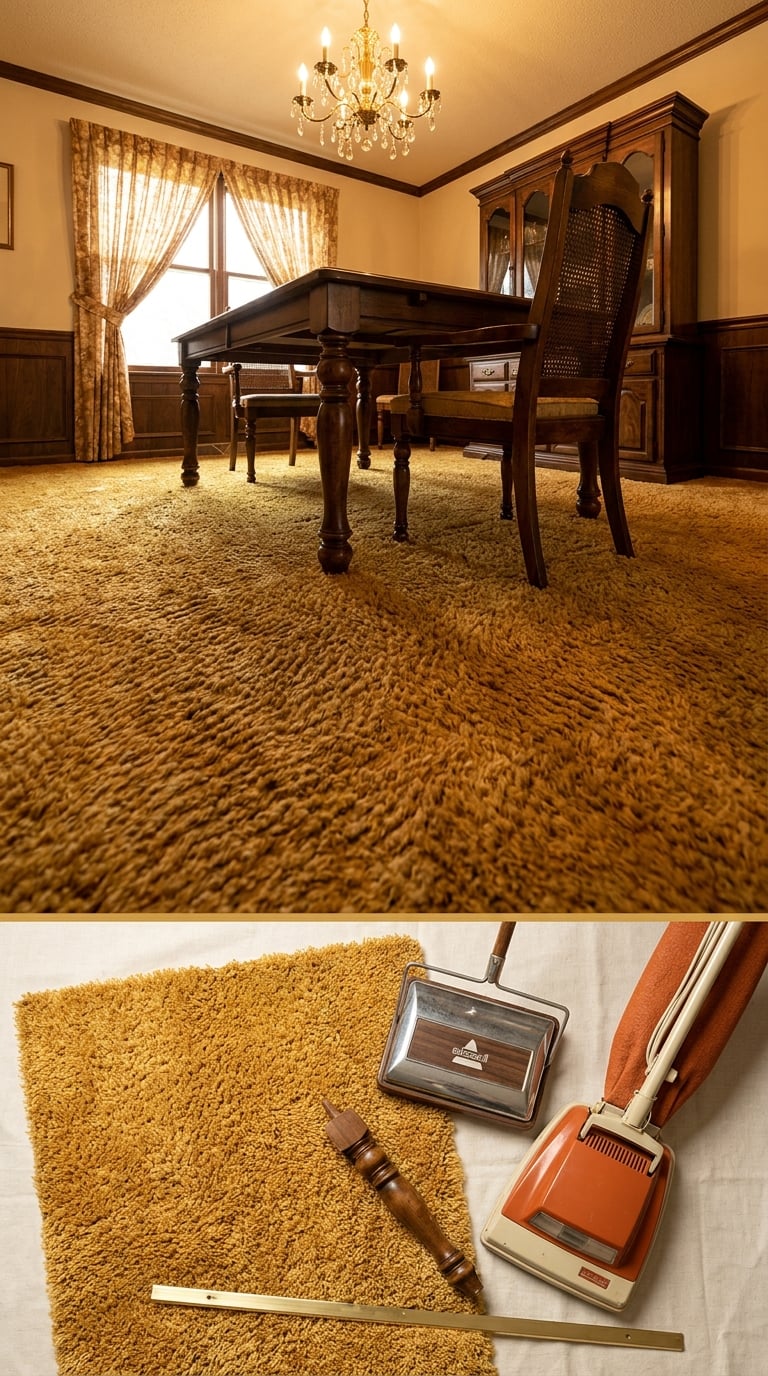
Wall-to-wall shag in the dining room — deep pile, usually in harvest gold or a rusty brown, running right under the table and chairs. Every dinner meant chair legs catching in the fibers. Every dropped pea vanished into the carpet’s depths like it had been swallowed whole.
The vacuum cleaner fought this carpet weekly and rarely won completely. A dedicated hostess kept a carpet sweeper in the closet for quick passes between meals. Shag held onto everything: crumbs, dust, the occasional dropped napkin ring that wouldn’t surface until the furniture got moved for spring cleaning. Honestly, it was the worst possible flooring choice for a room where people ate. That was irrelevant. It looked luxurious, and that settled the argument.
9. The Silver Tea-and-Coffee Service Displayed on the Buffet Like a Museum Exhibit
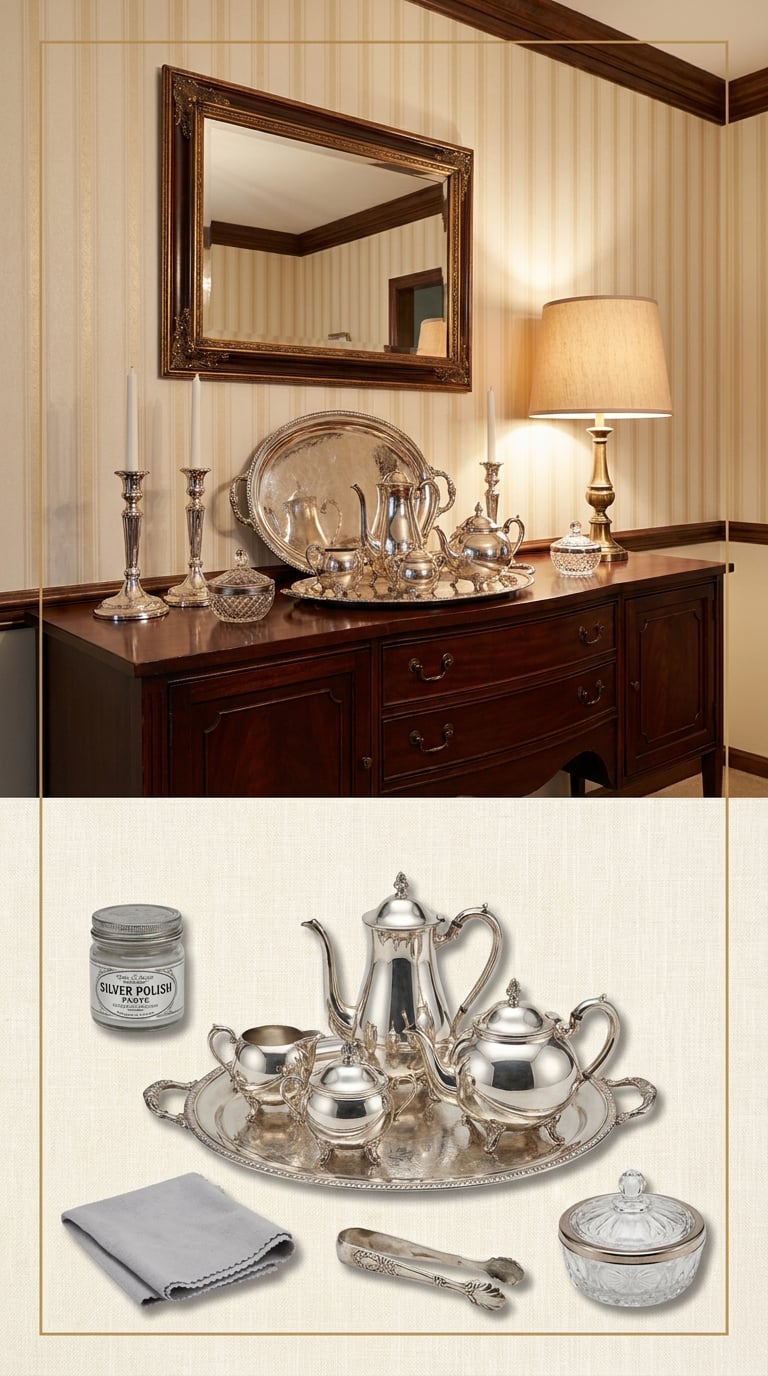
Polished to a mirror finish and arranged just so: the coffee pot, the teapot, the creamer, the sugar bowl, and the tray holding them all together. The set lived on the buffet permanently, positioned where anyone walking past the dining room could admire it. Most of these sets came out for actual use maybe twice a year — Thanksgiving, Christmas, possibly Easter if the right relatives were coming.
The rest of the time, the silver service sat there communicating something about the household. Permanence. Care. A certain kind of domestic ambition that didn’t need to announce itself loudly. A wedding gift, usually, or inherited from a mother or grandmother. Tarnish crept in between polishings, and the ritual of sitting down with a jar of silver polish and a soft cloth became its own seasonal marker — as predictable as turning the clocks back.
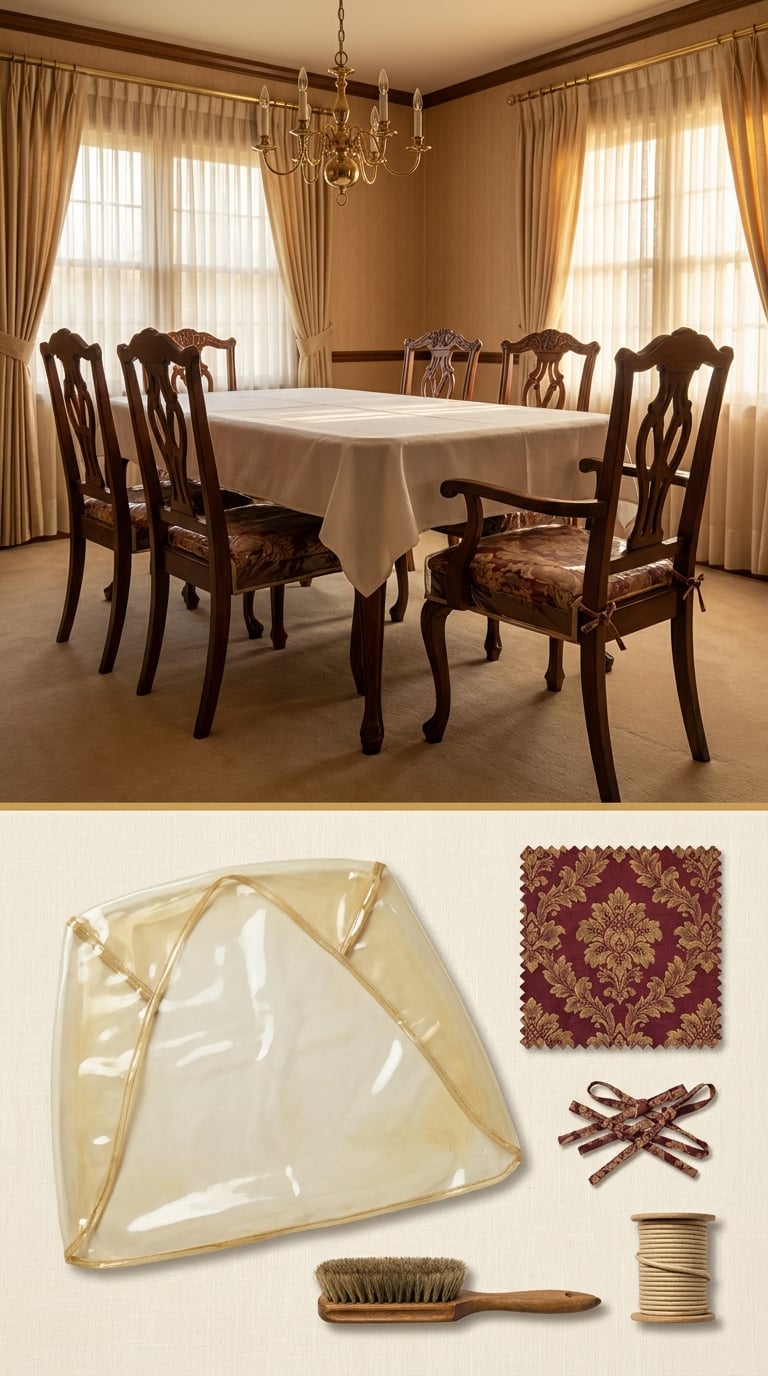
8. Clear Vinyl Covers Protecting the Upholstered Chair Seats
🔥 Would you like to save this?
The chairs had beautiful fabric underneath — brocade, velvet, needlepoint, sometimes a floral chintz that matched the curtains. Nobody got to sit on it. Clear vinyl covers snapped or tied over each seat cushion, creating a slight crinkle every time someone shifted during dinner. That sound was unmistakable: the quiet sticky rustle of skin or clothing separating from plastic in a warm room.
Summer meant bare arms stuck to the vinyl backs. Winter meant a cold shock for the first thirty seconds before body heat fought through. Over the years the covers yellowed, taking on a faint amber cast that gave the chairs an unintentional sepia tone. But beneath that plastic, the original upholstery stayed immaculate — waiting for a day of uncovered glory that, in most households, simply never arrived.
7. Harvest Gold, Avocado Green, and Burnt Orange on Every Surface
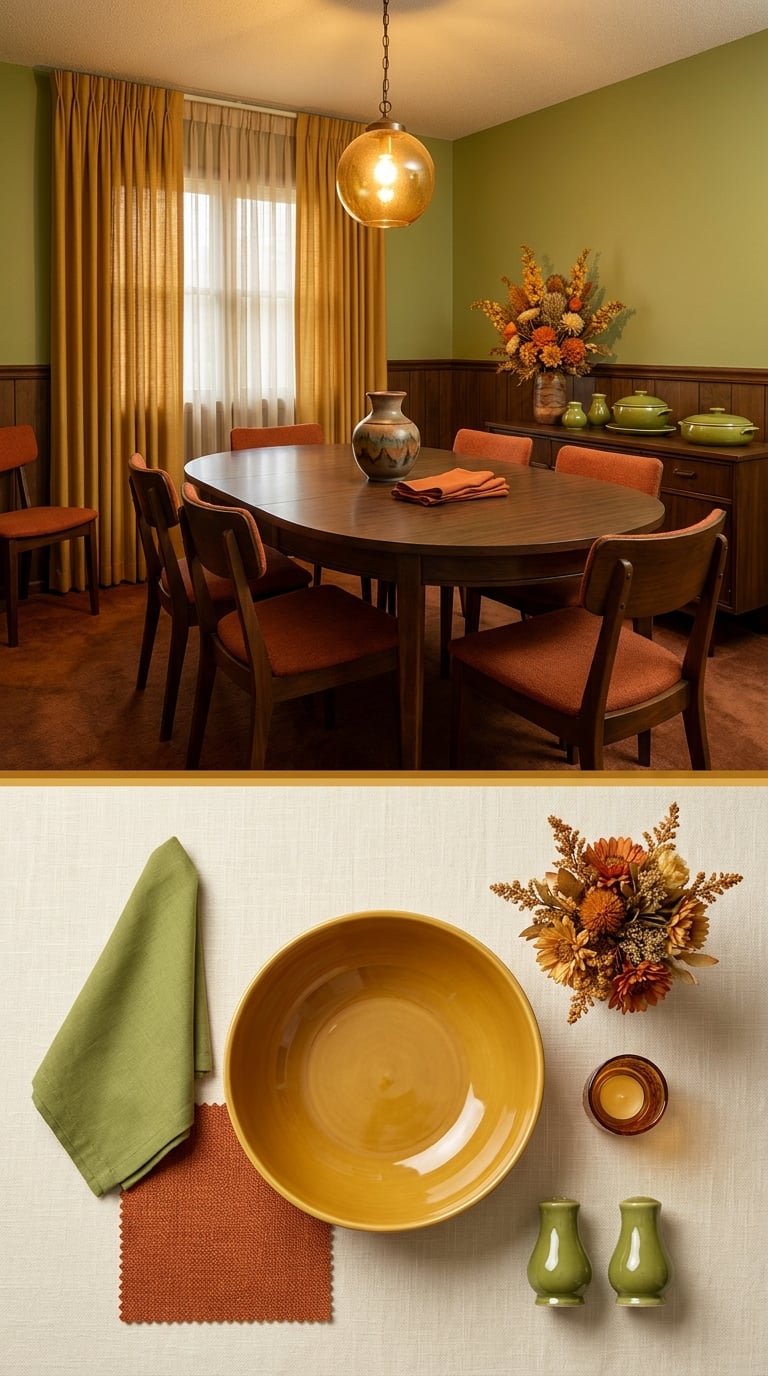
The decade’s color palette owned the dining room just as aggressively as it owned the kitchen. Harvest gold curtains against avocado green wallpaper. Burnt orange seat cushions on dark wood chairs. A centerpiece arrangement pulling all three together in dried flowers and ceramic. On paper, the combination sounds like a collision — but under incandescent bulbs, filtered through sheer curtains, the tones settled into something warm and enveloping. Almost cocoon-like.
Where did it come from? Everywhere at once. Appliance manufacturers pushed it, fabric companies followed, and paint stores stocked entire display walls in earth tones. The palette became the visual language of the American small family room and dining room alike, so pervasive that an entire generation associated “home” with those three specific shades.
Then the shift happened fast. By the early 1980s, mauve and dusty blue had arrived, and harvest gold suddenly looked like yesterday. But for a solid decade, those earth tones were the undisputed default for domestic interiors.
6. The Buffet with a Drawer Full of ‘Good’ Linens That Only Came Out for Company
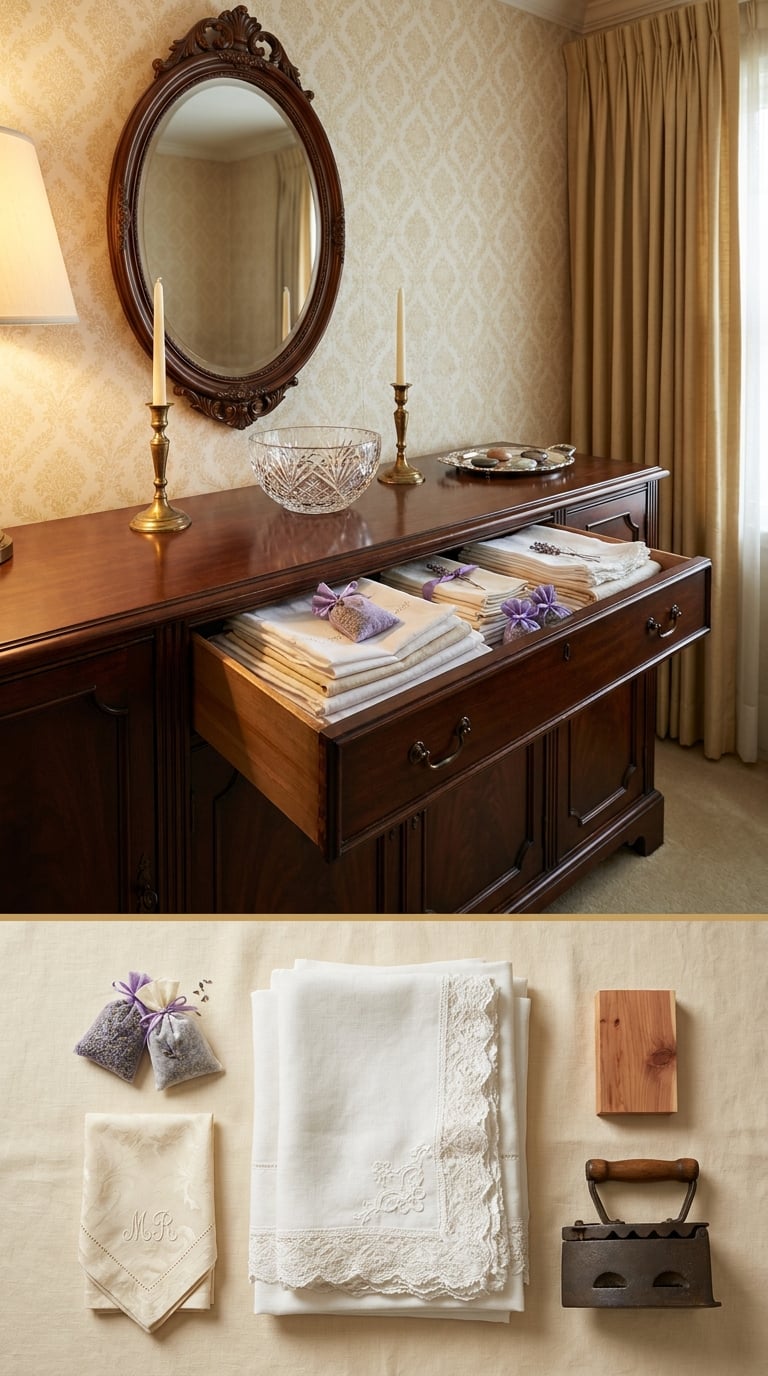
Every buffet had the drawer. Not the top one with the silverware dividers, not the cabinets below where the serving platters lived. The middle drawer — the one lined with tissue paper, holding tablecloths and napkin sets so carefully pressed and folded they looked archived rather than stored.
Irish linen, usually white or ecru. Lace-edged napkins in sets of eight or twelve. Maybe a damask cloth with a monogram. These pieces emerged for holidays, for dinner parties, for the rare occasion when the dining room served its intended purpose. The rest of the year they stayed in the drawer, smelling faintly of cedar or the lavender sachets tucked between folds.
As furniture, the buffet itself anchored one wall — substantial enough to hold candlesticks and a crystal bowl on its surface while hiding all that careful preservation inside. The real value was never on display. It was folded and waiting in the dark.
5. A Bowl of Plastic Fruit as the Permanent Centerpiece
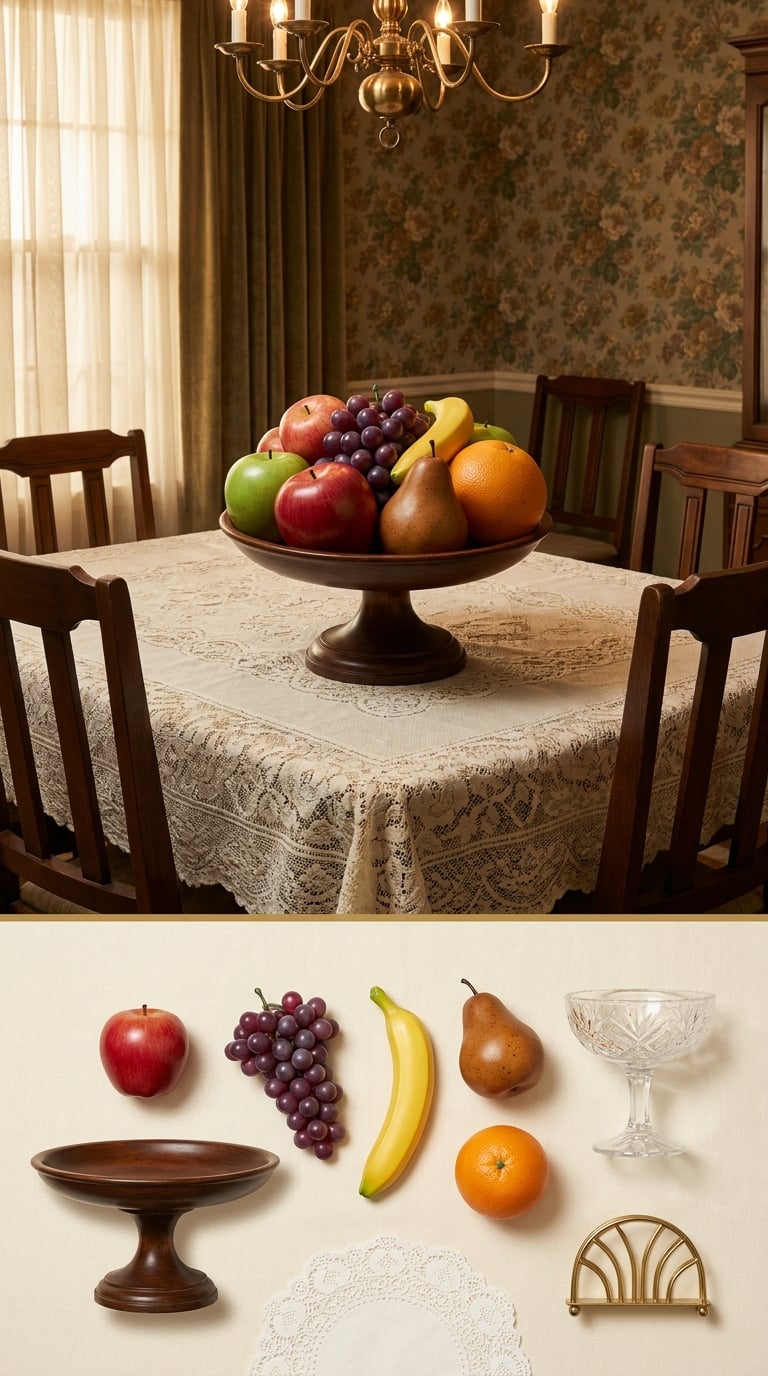
Waxy apples. A bunch of grapes in a shade of purple that existed nowhere in nature. A single banana, perpetually frozen at the exact same stage of ripeness. The plastic fruit bowl sat dead center on the dining table between meals — a decorative gesture requiring zero maintenance that would outlast the table itself.
It lived in a wooden bowl, a ceramic compote, or occasionally a cut-glass piece that caught light from the chandelier. Some arrangements included a lemon so convincingly yellow it fooled guests for a half-second before the weight gave it away. The best sets had a slight matte finish that came close to mimicking real fruit; the worst ones had a hard shine that fooled nobody. And it didn’t matter in the slightest. Fooling people was never really the point — filling the table’s visual center was. An empty table looked abandoned. A table with a bowl of fake fruit looked like someone lived there and cared.
4. Macramé Plant Hangers Framing the Dining Room Window
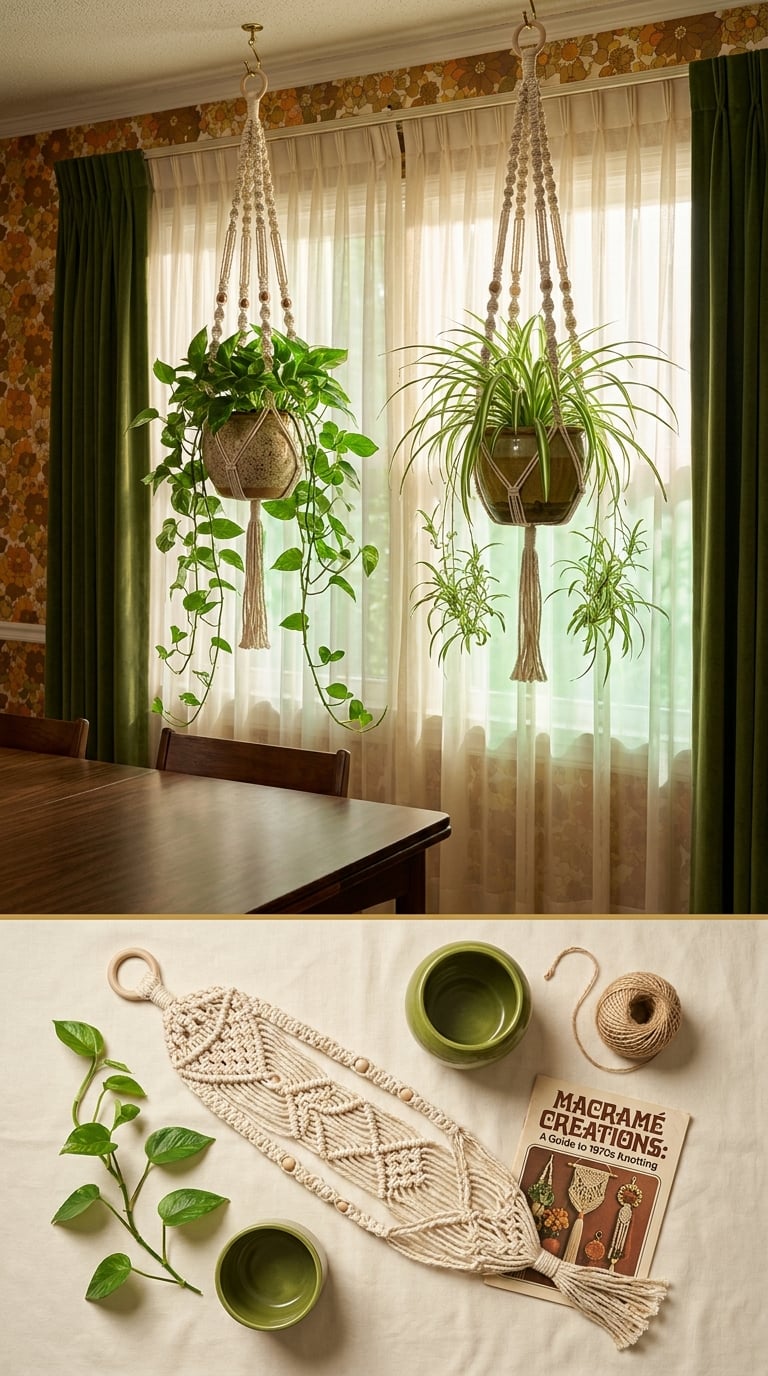
Knotted jute or cotton cord — usually natural off-white or warm brown — holding a ceramic pot with a trailing pothos or spider plant. The macramé hanger turned a dining room window into something between a greenhouse corner and a craft gallery, vines reaching toward the sill while the knotted pattern drew the eye upward.
Handmade versions were everywhere. Craft fairs, community center classes, kits from the hobby store. The knots had names: square knot, half hitch, spiral stitch. A skilled maker could finish a hanger in an afternoon, and the result added a softness to dining rooms that otherwise ran heavy on dark wood and stiff formality. Strange thing about it — that single hanging plant, catching light through the sheers, was often the only living element in a room designed primarily around rigid presentation. It broke the spell just enough to make the space feel habitable.
3. The China Cabinet Full of Dishes Nobody Was Allowed to Touch
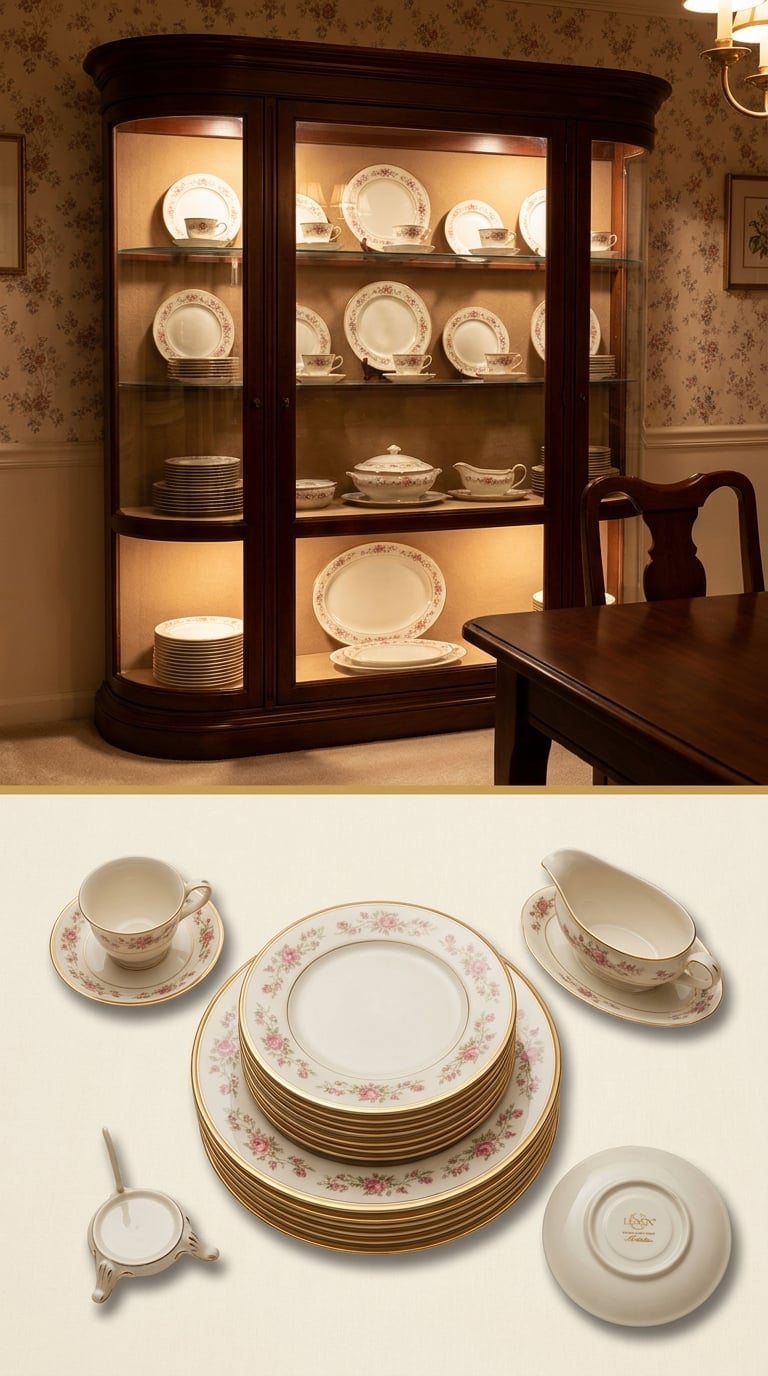
Behind glass doors, on shelves lined with felt, lived the good china. A full service for eight or twelve — dinner plates, salad plates, bread plates, cups and saucers, a gravy boat, a covered vegetable dish, a platter large enough for a Thanksgiving turkey. The pattern was specific and deliberate. Roses, usually. Or a thin gold band on white porcelain. Brand mattered: Lenox, Noritake, Royal Doulton, Franciscan.
The china cabinet stood in the dining room like a reliquary, its contents visible but untouchable for almost the entire year. Children learned early not to open those doors. Glass panes were kept spotless. If the cabinet had an interior light, it illuminated the dishes like gallery pieces — curved glass fronts on the fancier models, leaded panes on others, all of them communicating the same message: look, admire, but handle with extreme care.
These sets represented real investment, purchased piece by piece over years or received as wedding gifts with the understanding they’d last a lifetime. Replacements could be ordered by pattern name from department stores. Buying an entirely new set? Almost unthinkable. The china was permanent — more permanent, probably, than most of the marriages that produced them. (That’s a little dark. But not wrong.)
2. The Velvet or Brocade Upholstered Chair Seats That Nobody Was Allowed to Spill On
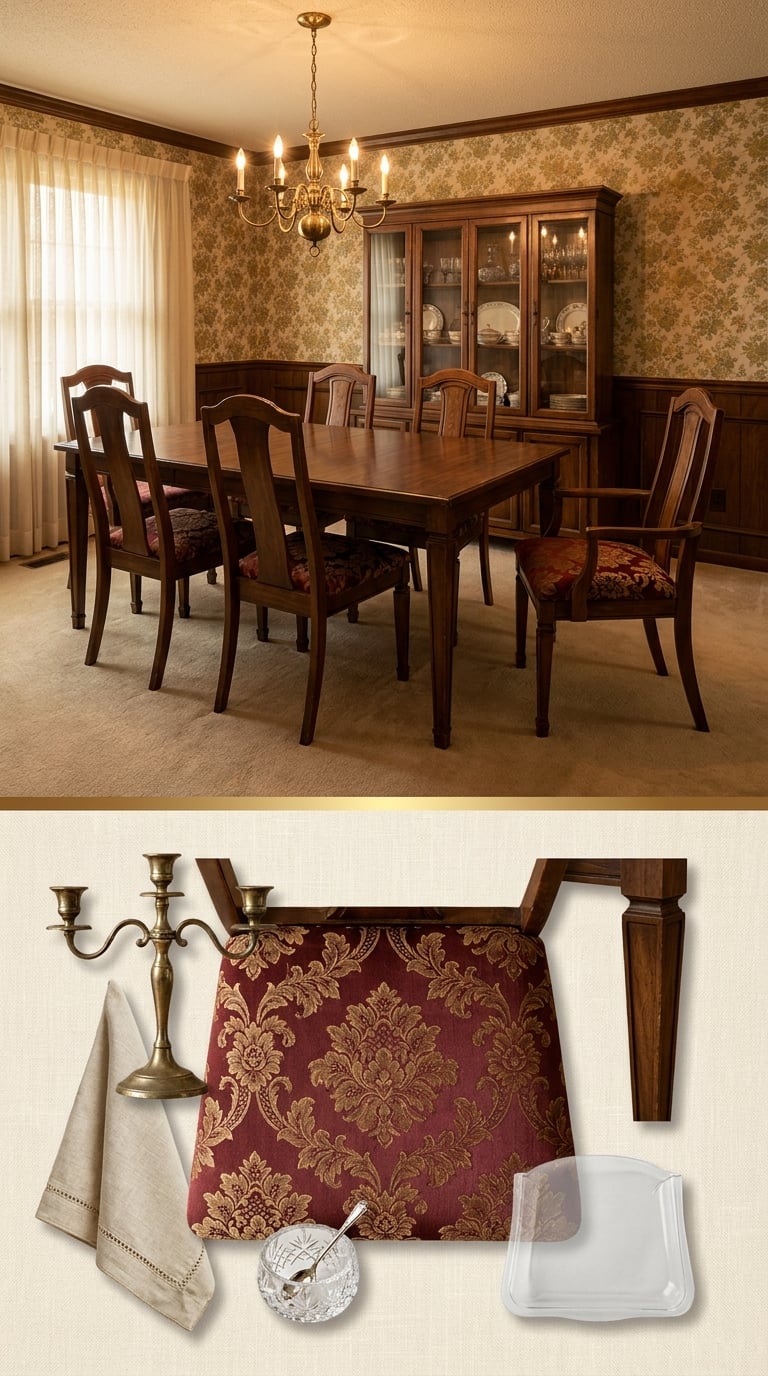
Those chair seats announced themselves the second bare legs hit brocade in July. Brocade dining chairs in deep burgundy or forest green — sometimes gold with a raised floral pattern that grabbed chandelier light and wouldn’t let go. The fabric carried a faint formality. Like the chairs themselves understood the stakes of Thanksgiving dinner and would judge anyone who reached across someone’s plate.
Most families kept the seats sheathed in plastic during ordinary weeks. Real fabric only breathed free when company arrived, and even then, children sat on towels or got exiled to the kitchen table. One grape juice incident could permanently retire a chair seat. Everyone in the household knew exactly which incident that had been, and nobody was allowed to forget it.
The upholstery was almost never replaced. It wore thin at the edges, picked up a shine where elbows rested, developed a subtle depression in the center from years of the same person claiming the same spot. That wear pattern mapped a family as clearly as any photograph — just one nobody thought to hang on the wall.
1. The Popcorn Ceiling That Watched Over Every Formal Dinner
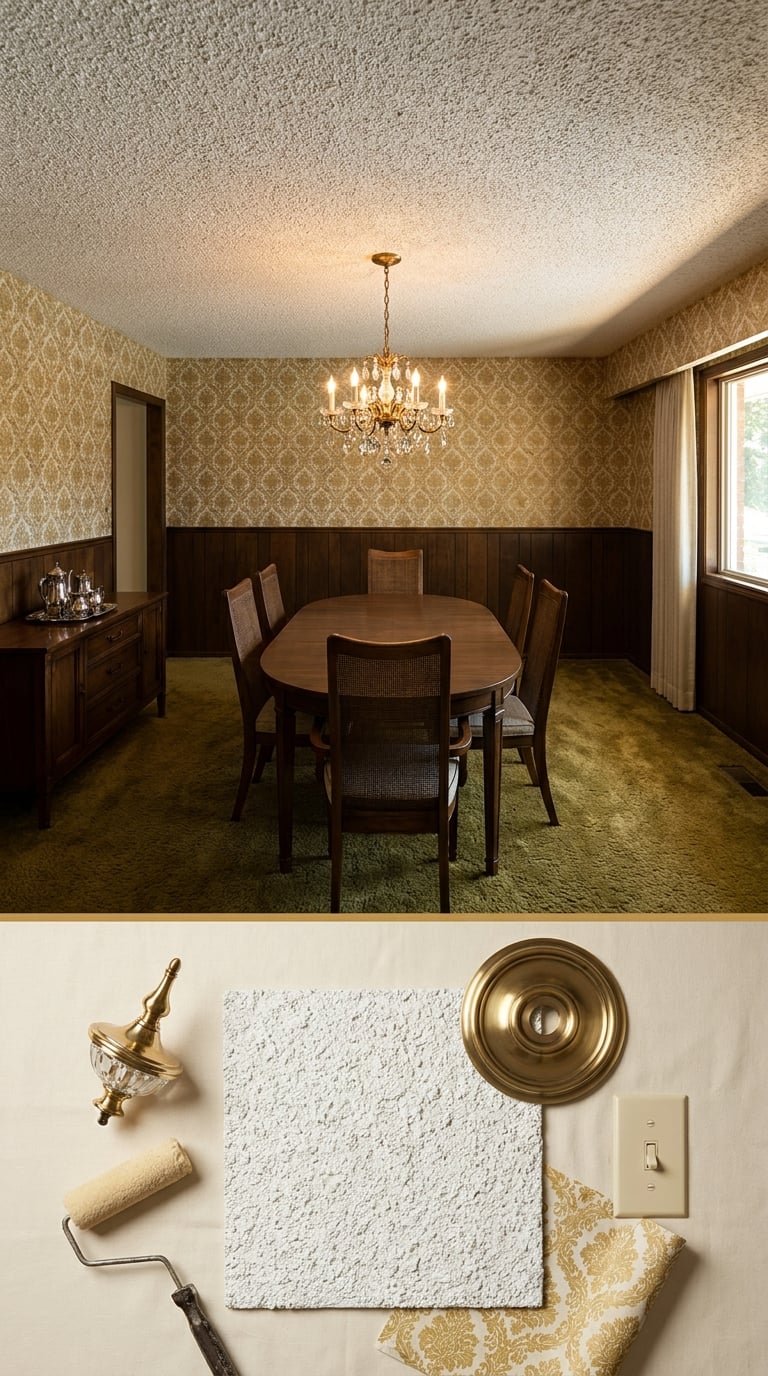
Look up. That bumpy, stippled textured ceiling was the 1970s dining room’s most universal signature — acoustic spray applied with a hopper gun and left to dry into tiny stalactite formations that made the whole surface look like the moon, if the moon were painted flat contractor white. Chandelier light caught the bumps and scattered soft little shadow constellations across the plaster. Nobody planned that effect. It just happened.
Children stared at it during long adult conversations, finding faces in the bumps, tracing imaginary roads between raised points, counting peaks above their assigned seat. The ceiling was simultaneously the most boring and most studied surface in the house.
It served a real purpose, though. All that texture dampened sound in rooms with hard floors and oversized furniture, absorbing the echo formal spaces loved to produce. Contractors liked it because it hid drywall imperfections underneath — an afternoon’s work that papered over a week’s worth of sloppy taping. Removing it, as millions of homeowners eventually discovered, required a full weekend of scraping, misting, and quiet regret. The application was forgiving. The divorce was not.