🔥 Would you like to save this?
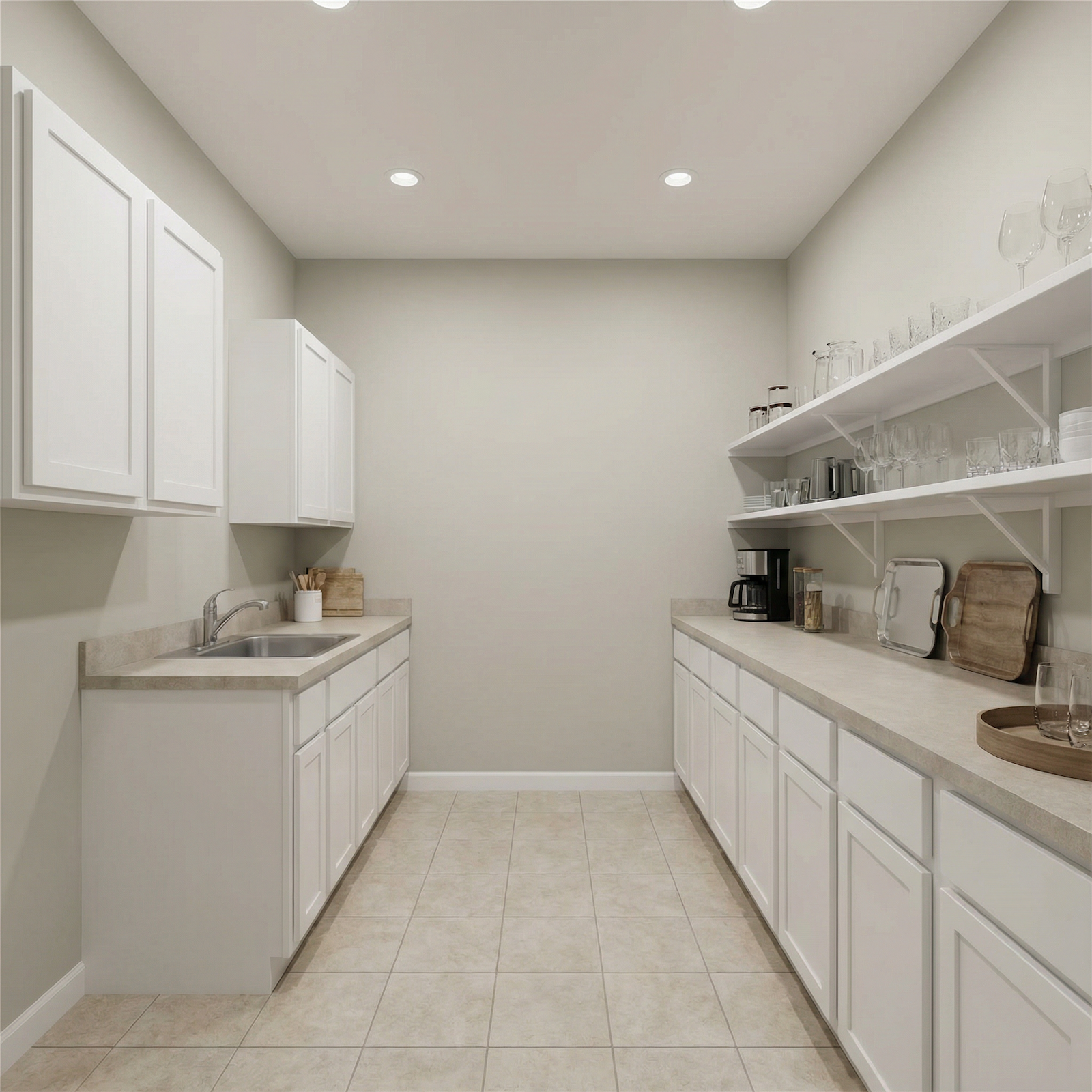
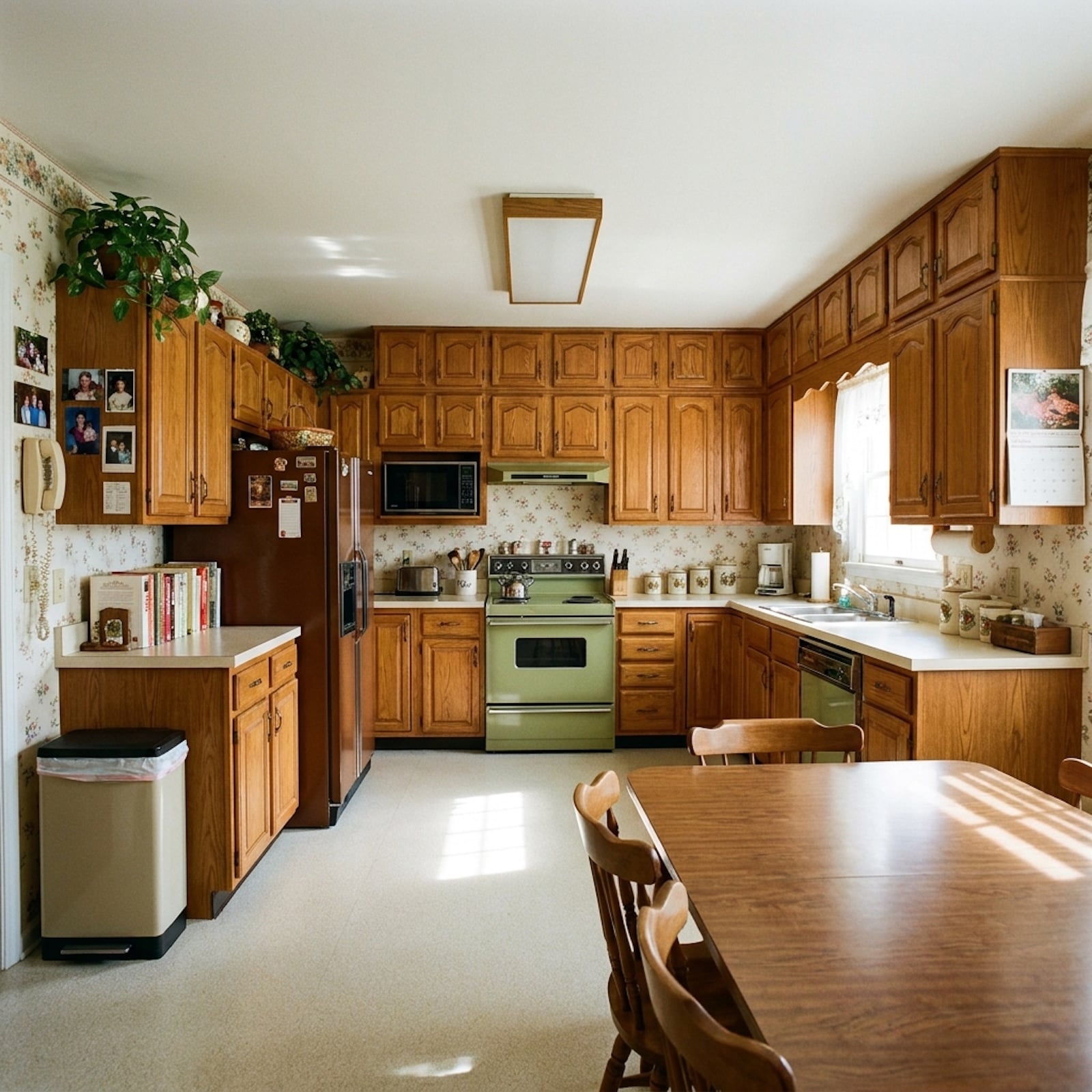
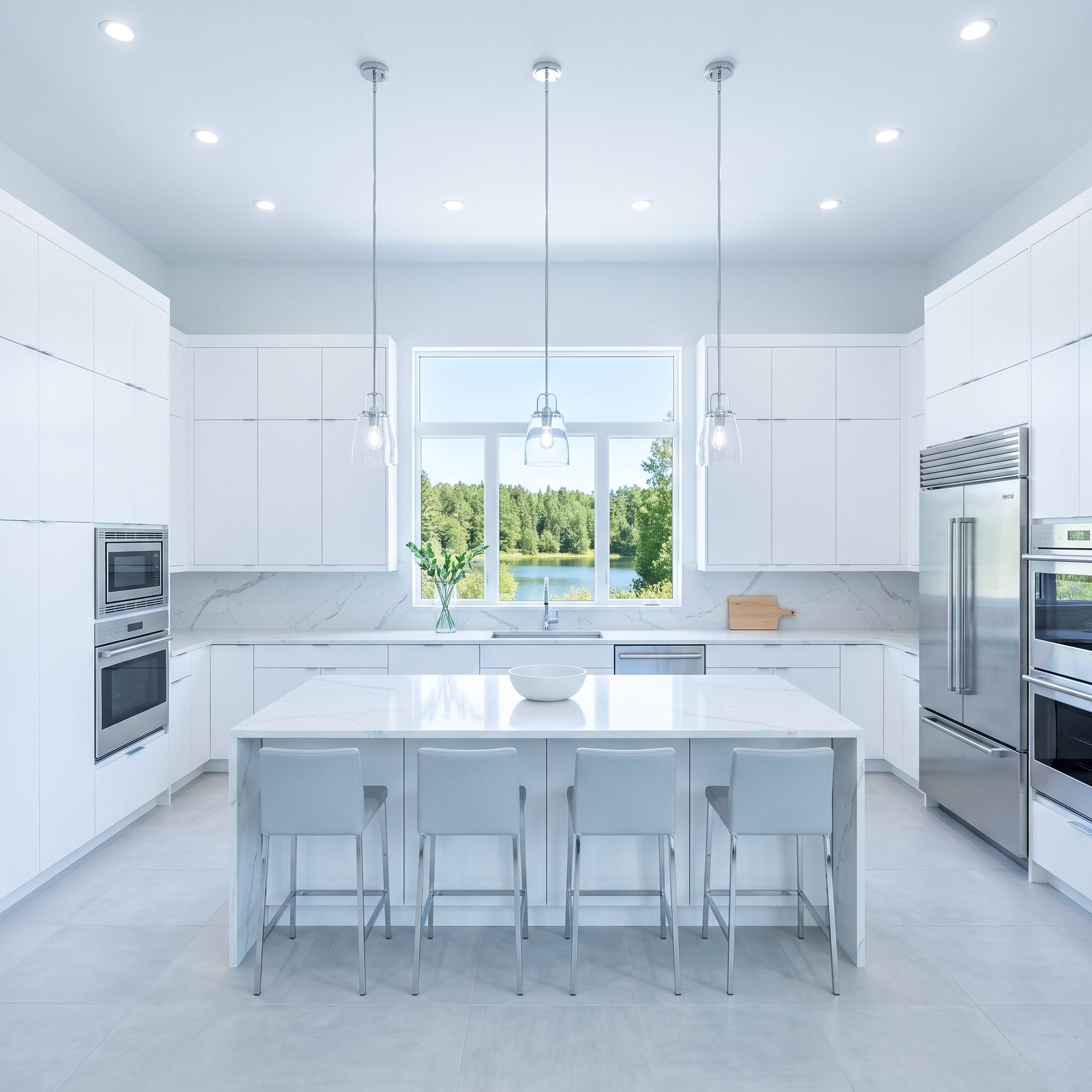
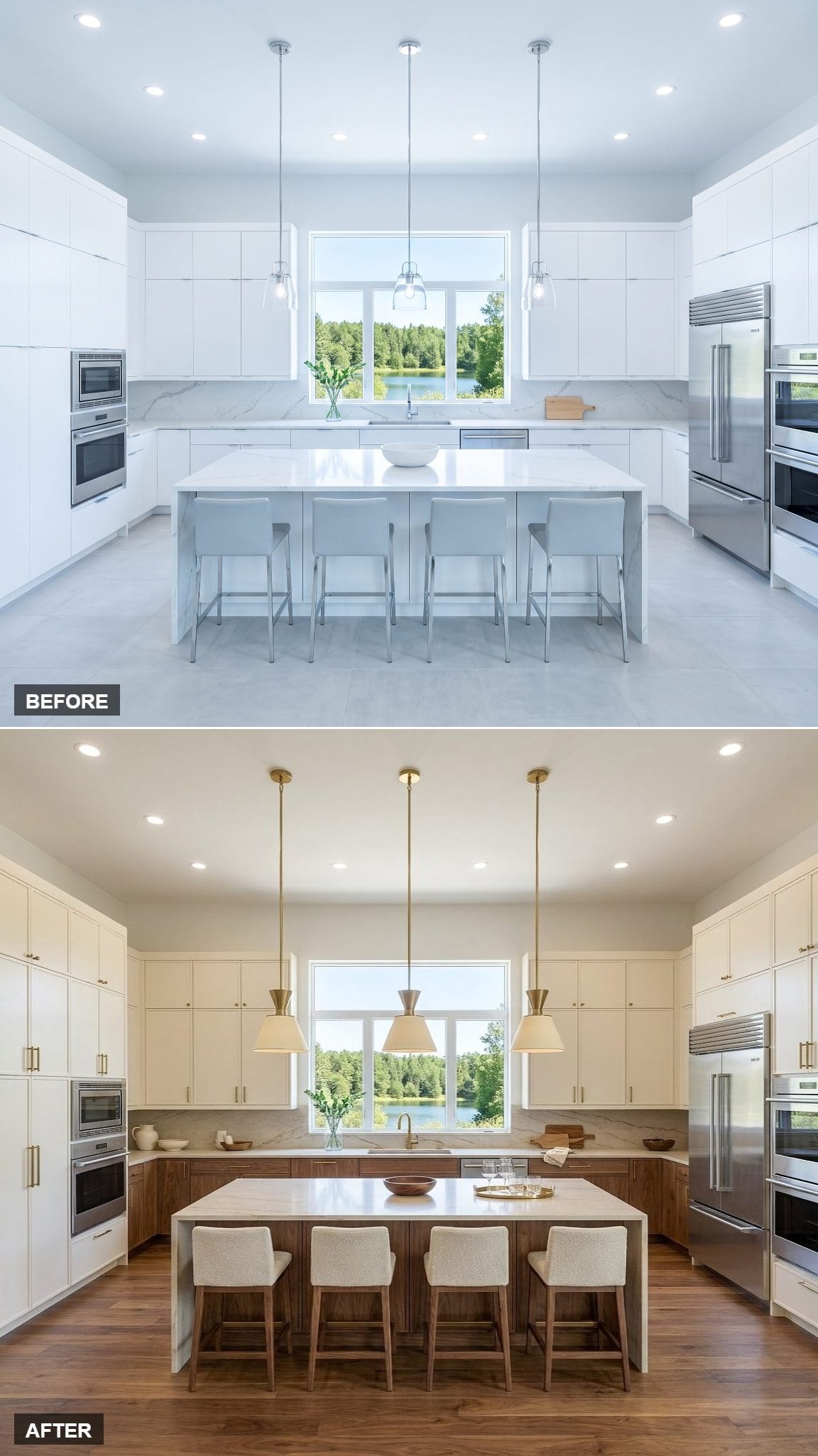
White kitchens made sense on paper. Clean, bright, timeless—that was the pitch. What nobody mentioned was how quickly flat white laminate, cool lighting and chrome everywhere could turn “timeless” into something closer to a waiting room.
These 34 kitchens show another way forward. Warm cream replaces stark white. Walnut brings grain, depth and actual shadows. Brass cabinet hardware catches light instead of reflecting the room back at itself. Some transformations rely on one strategic material shift. Others go all the way into custom millwork, stone and furniture-grade cabinetry.
In order to come up with the very specific design ideas, we create most designs with the assistance of state-of-the-art AI interior design software. Also, assume links that take you off the site are affiliate links such as links to Amazon. this means we may earn a commission if you buy something.
The palette stays remarkably tight. The ideas don’t. Here are 34 ways cream, walnut and brass can rescue a kitchen from flatness without making every room look like the same mood board.
34. Reeded Glass Cabinet Doors Let the Kitchen Glow Without Adding Another Color
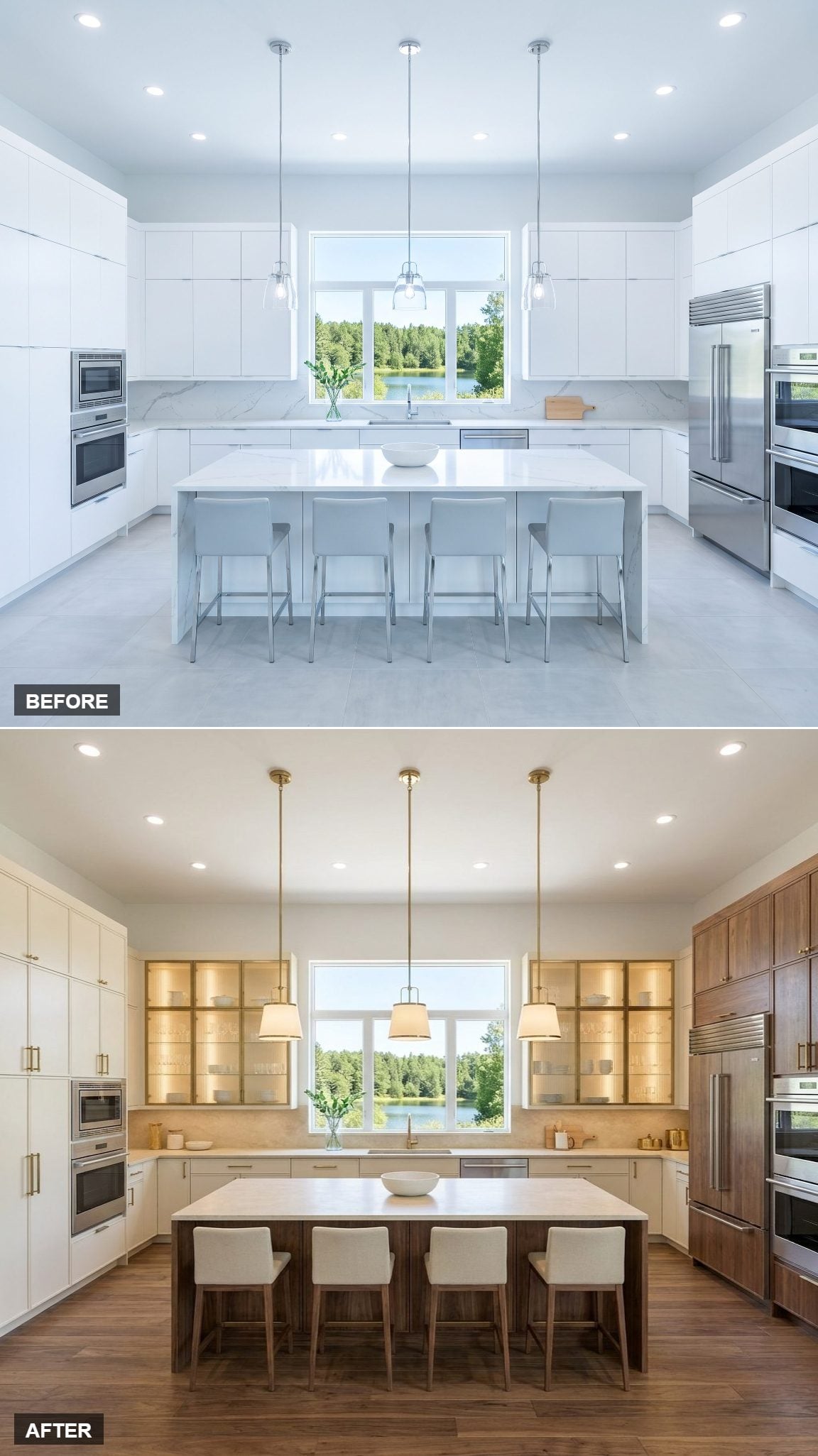
Reeded glass is doing more than hiding the outlines of whatever lives behind it. Used on just a few upper doors, the vertical texture catches light and turns ordinary glassware into a soft background rather than a display case demanding perfect shelves.
Walnut storage gives the room its darker weight, while cream-upholstered stools, honed stone and aged-brass hardware keep the materials close enough in tone to feel deliberate. The warm cabinet ideas here work because nothing is trying to introduce a fourth major color.
33. The Window Became the Best Wall in the Kitchen
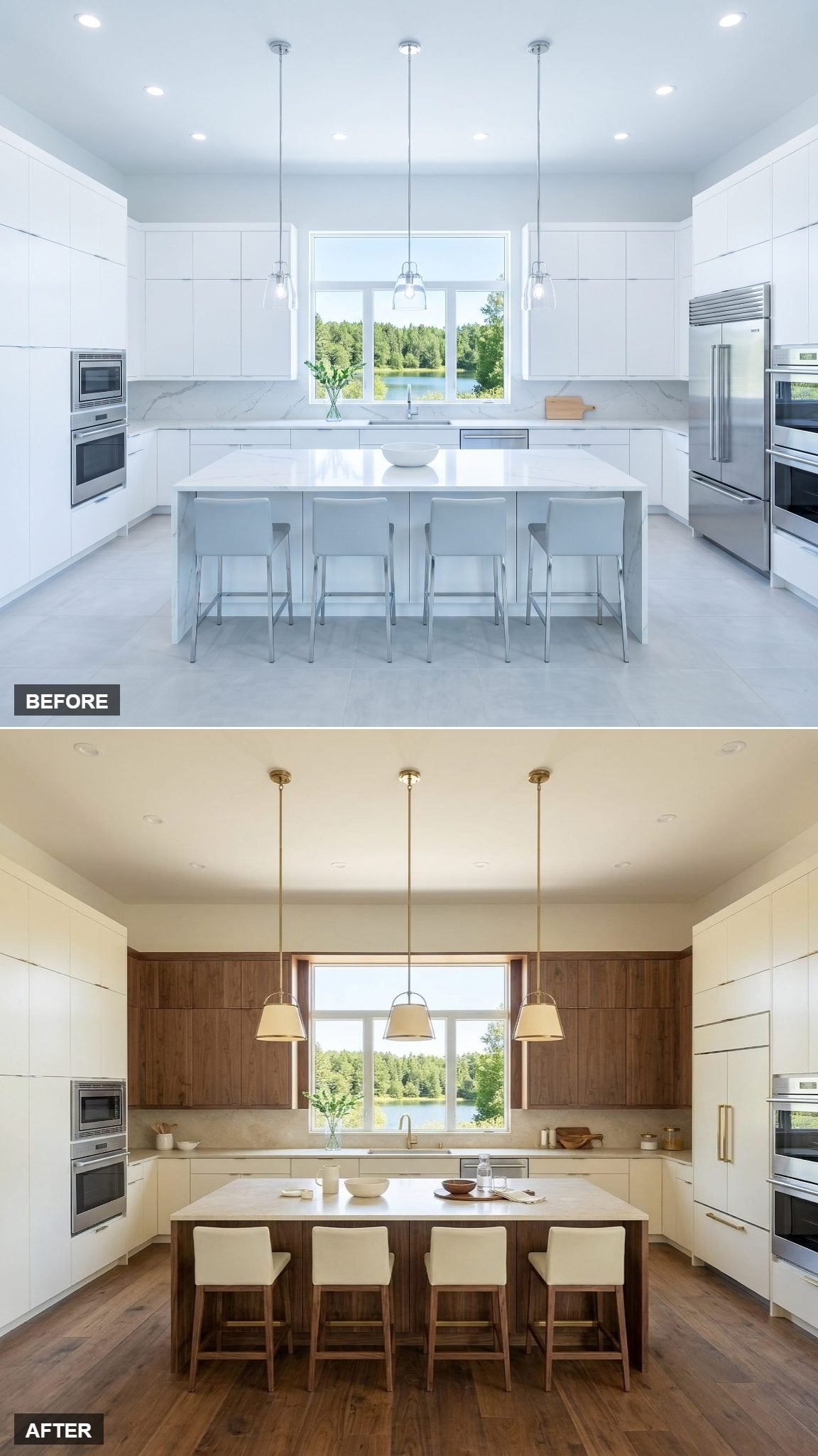
Most kitchens treat the window as the place where cabinetry reluctantly stops. This one turns it into an architectural event.
A precise walnut-lined reveal wraps the opening and connects it to substantial walnut cabinetry nearby, so the glass feels integrated rather than punched through the wall. Luminous cream cabinetry everywhere else keeps that darker frame from closing in the room.
At the sink, a cream stone countertop and unlacquered brass faucet bridge the materials exactly where you’ll notice them most.
32. Brass Mesh Turned Cabinet Doors Into Something Between Storage and Jewelry
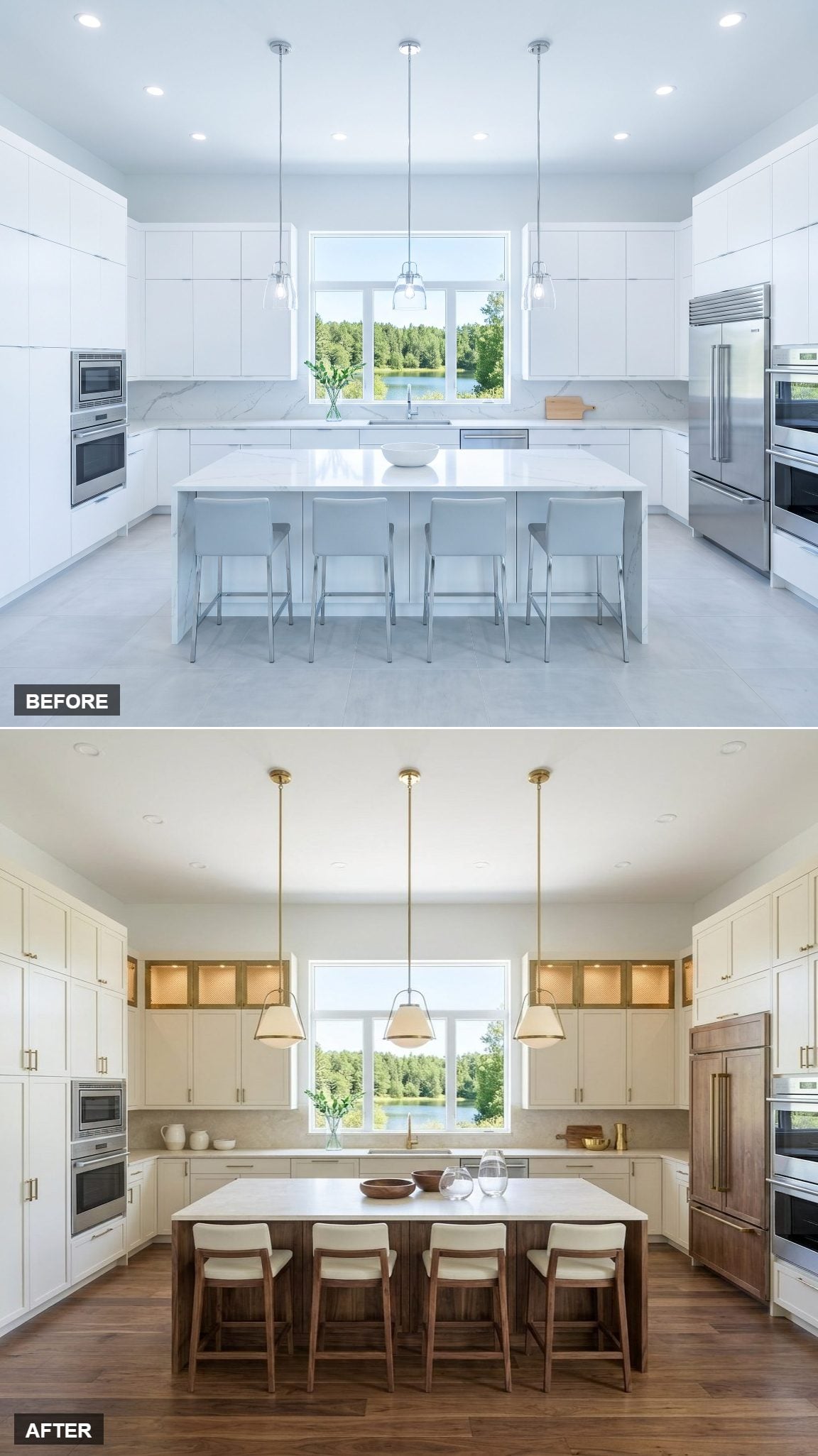
Brass mesh sounds like the kind of idea that could become too decorative very quickly. The restraint saves it. Only selected upper doors receive the treatment, with warm cream behind them and soft integrated lighting instead of dark fabric or crowded shelves.
Full-height walnut storage provides the solid counterweight. Aged-brass pulls, an unlacquered brass faucet and brass pendants repeat the metal elsewhere, so the mesh doesn’t look like one eccentric cabinet got dressed for dinner.
31. Deep Walnut Took Over the Architecture Without Making the Kitchen Dark
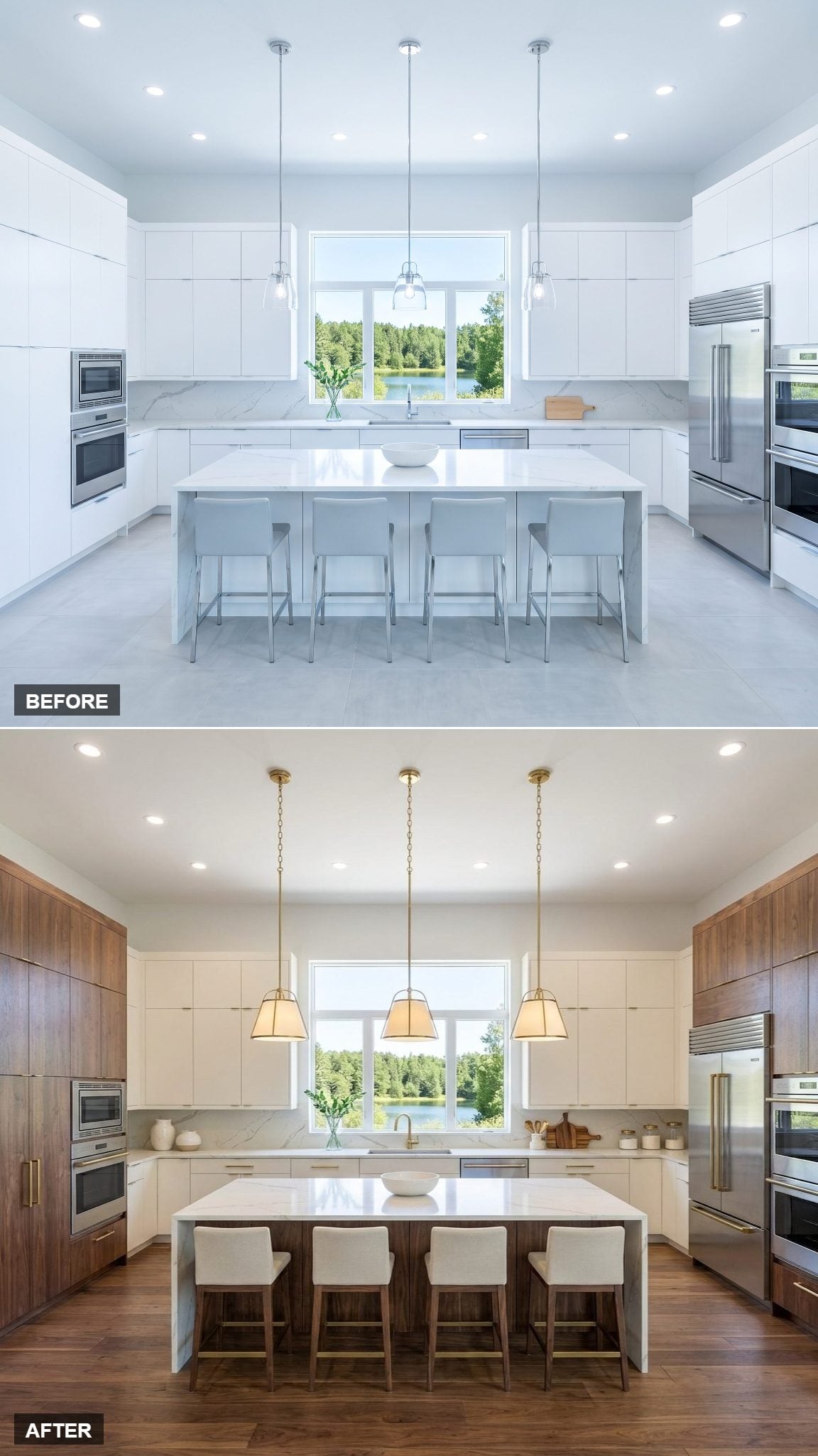
Most kitchens in this collection use walnut as punctuation. This one gives it paragraphs.
Medium-dark walnut covers the island and tall-storage sections with enough continuity that the wood becomes part of the architecture rather than an accent finish. The generous cream cabinetry and honed cream stone push light back into the room, keeping the contrast dramatic rather than gloomy.
Cream-upholstered stools finish the transition at seating height.
30. Walnut-Brown Veining Made the Stone Part of the Cabinetry Story
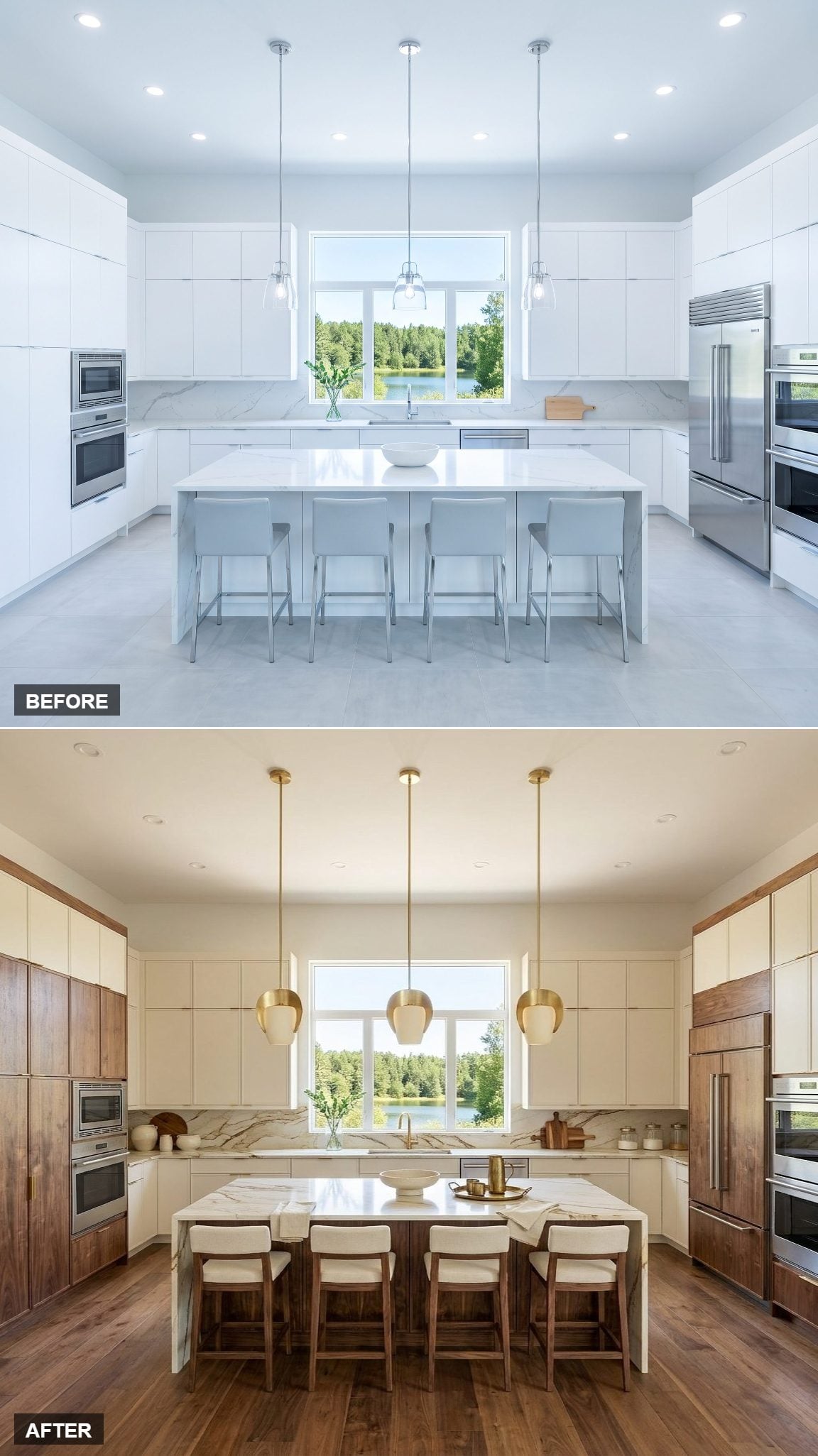
Stone is often chosen as a neutral backdrop. Here it participates.
Walnut-brown mineral movement runs through the cream surface, echoing the island below so the counters and cabinetry feel related before a single piece of hardware is installed. Sculptural brass pendant lights with cream diffusers hang above walnut-framed stools, while unlacquered brass repeats the same warmth at the faucet and pulls.
The stone gets to be the feature because everything around it understands when to stop talking.
29. Slim Shaker Doors Took the Farmhouse Out of the Shaker Kitchen
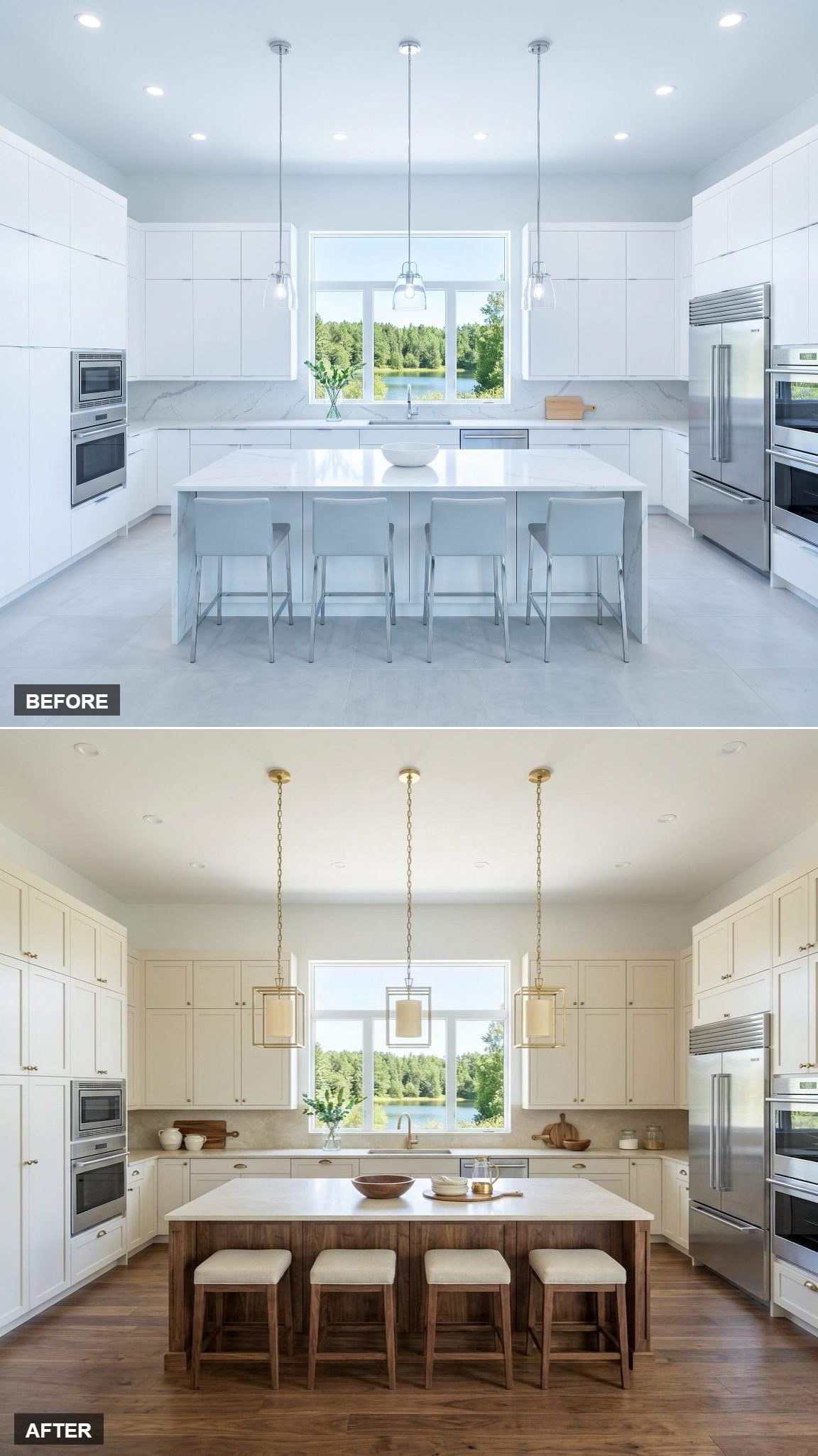
These Shaker doors keep the familiar recessed-panel geometry but pare the frames down until the result feels tailored rather than rustic. Warm cream in a satin finish pushes them even farther from the usual farmhouse kitchen shorthand.
The walnut island supplies the craftsmanship moment: grain-matched doors, inset detailing and carefully finished end panels. Aged-brass cup pulls, brass lantern pendants and an unlacquered brass faucet bring warmth without turning the room nostalgic.
28. The Cooking Zone Finally Got a Frame
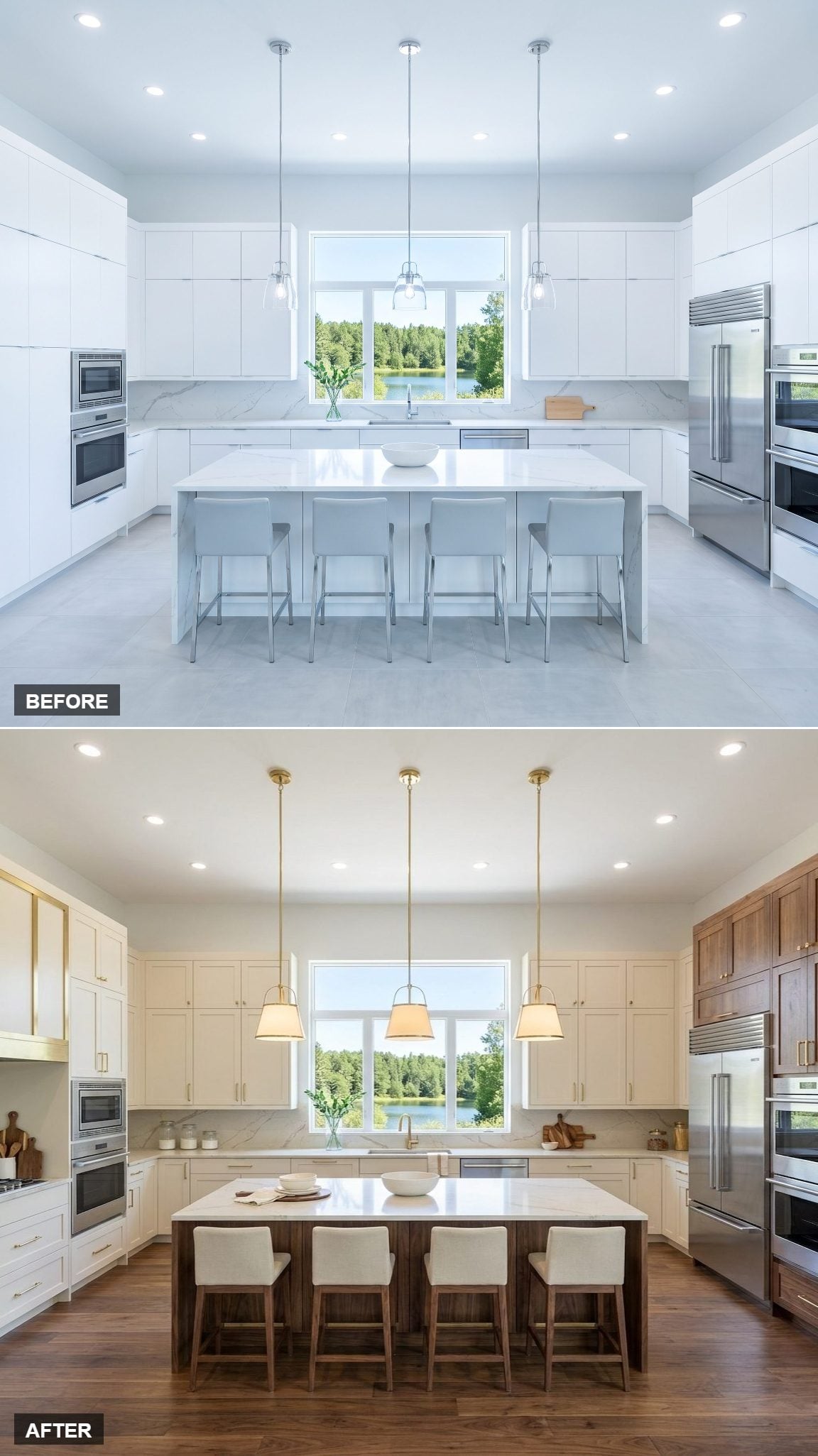
Builder-grade kitchens often treat the cooking wall as pure equipment territory: range, hood, cabinets, done. Here, a restrained brass outline around the hood and cabinetry turns that working zone into a focal point without requiring an enormous decorative hood.
Broad cream cabinetry and a rich walnut island carry the major color contrast. Honed cream stone runs across counters and backsplash, while the unlacquered brass faucet and brass pendants repeat the metal without outlining everything in sight.
Cream linen, clear glass and walnut kitchenware finish the room with materials rather than clutter.
27. One Walnut Pantry Wall Was Enough
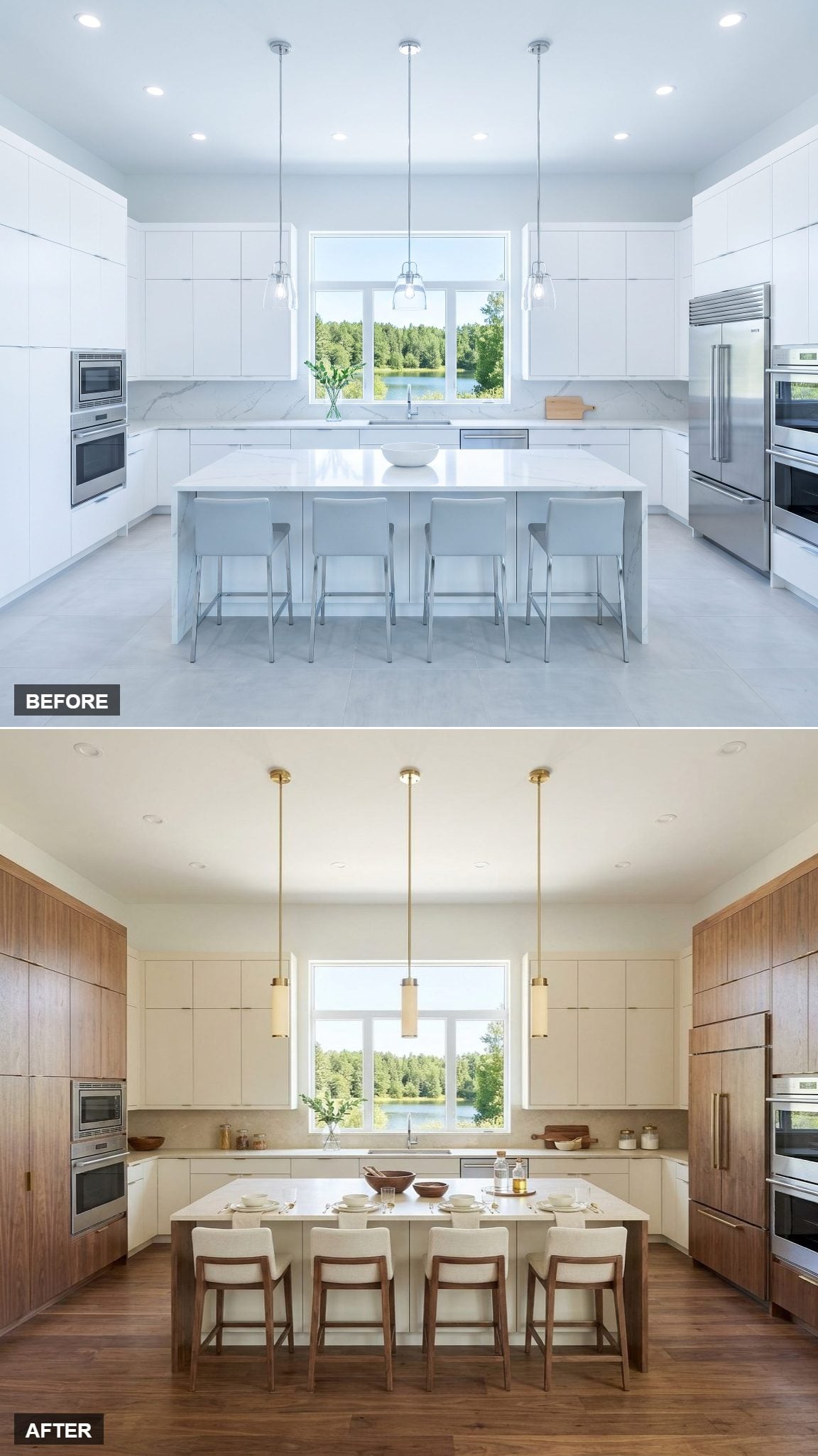
One wall of vertical-grain walnut with concealed storage and integrated appliances—that’s the move. Everything around it stays warm cream and pale stone, allowing the pantry wall to carry the dark material without spreading it through every elevation.
Three slender brass architectural pendants hover over walnut bar stools upholstered in textured cream. An unlacquered brass faucet and aged-brass finger pulls add smaller warm notes.
26. A Handmade Cream Backsplash Proved Neutral Doesn’t Have to Mean Flat
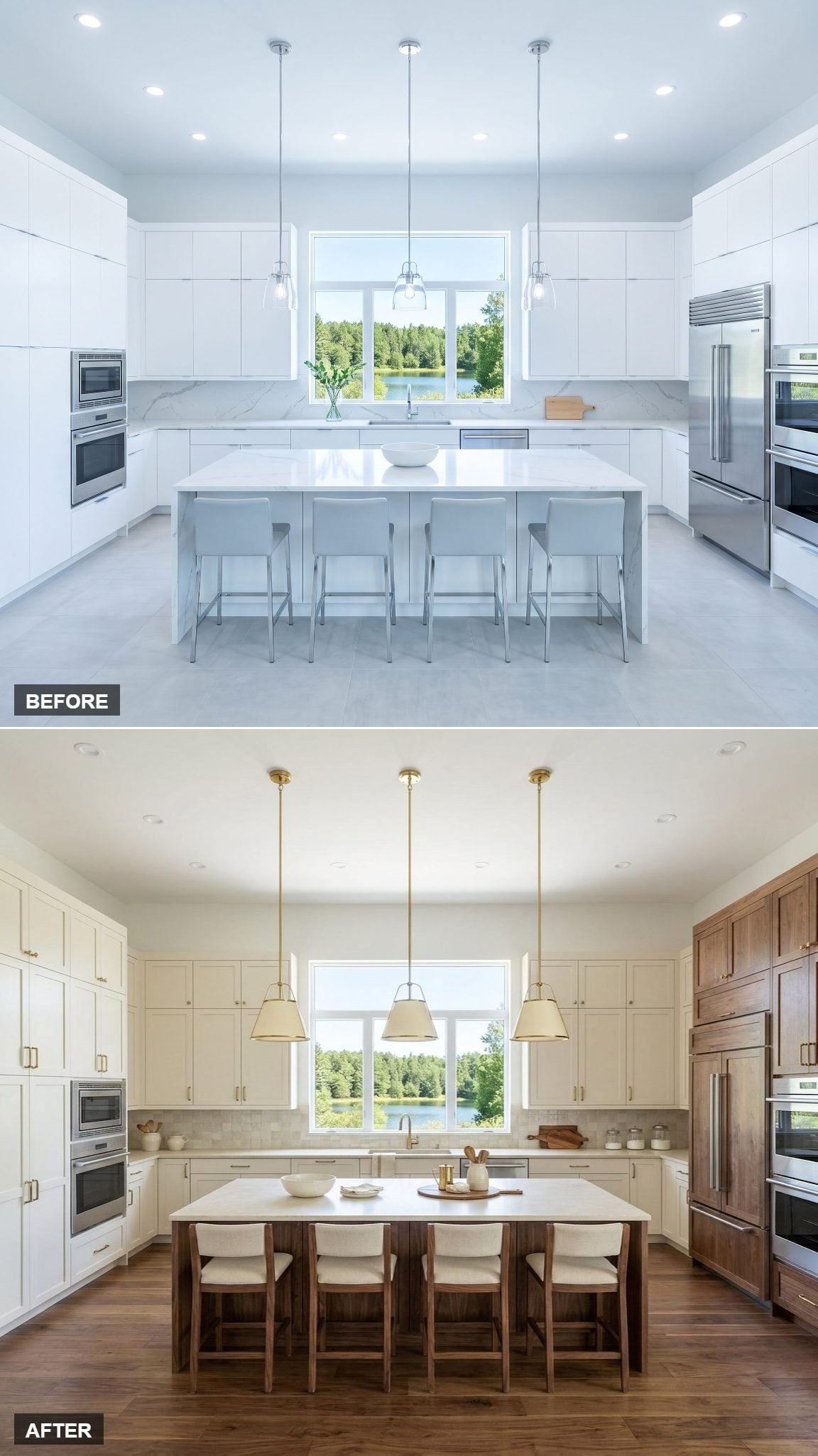
Staying entirely within the cream family sounds easy until every smooth surface begins merging into the next. Handmade tile solves that problem through texture instead of contrast.
Slight variations in glaze and surface catch the light differently across the backsplash, giving the wall movement beside honed counters and a substantial walnut island. Cream pottery, walnut boards and clear glass keep the shelves within the same narrow palette.
Aged-brass hardware and brass pendants provide the warm metallic edge.
25. This Island Changed Shape, Not Just Finish
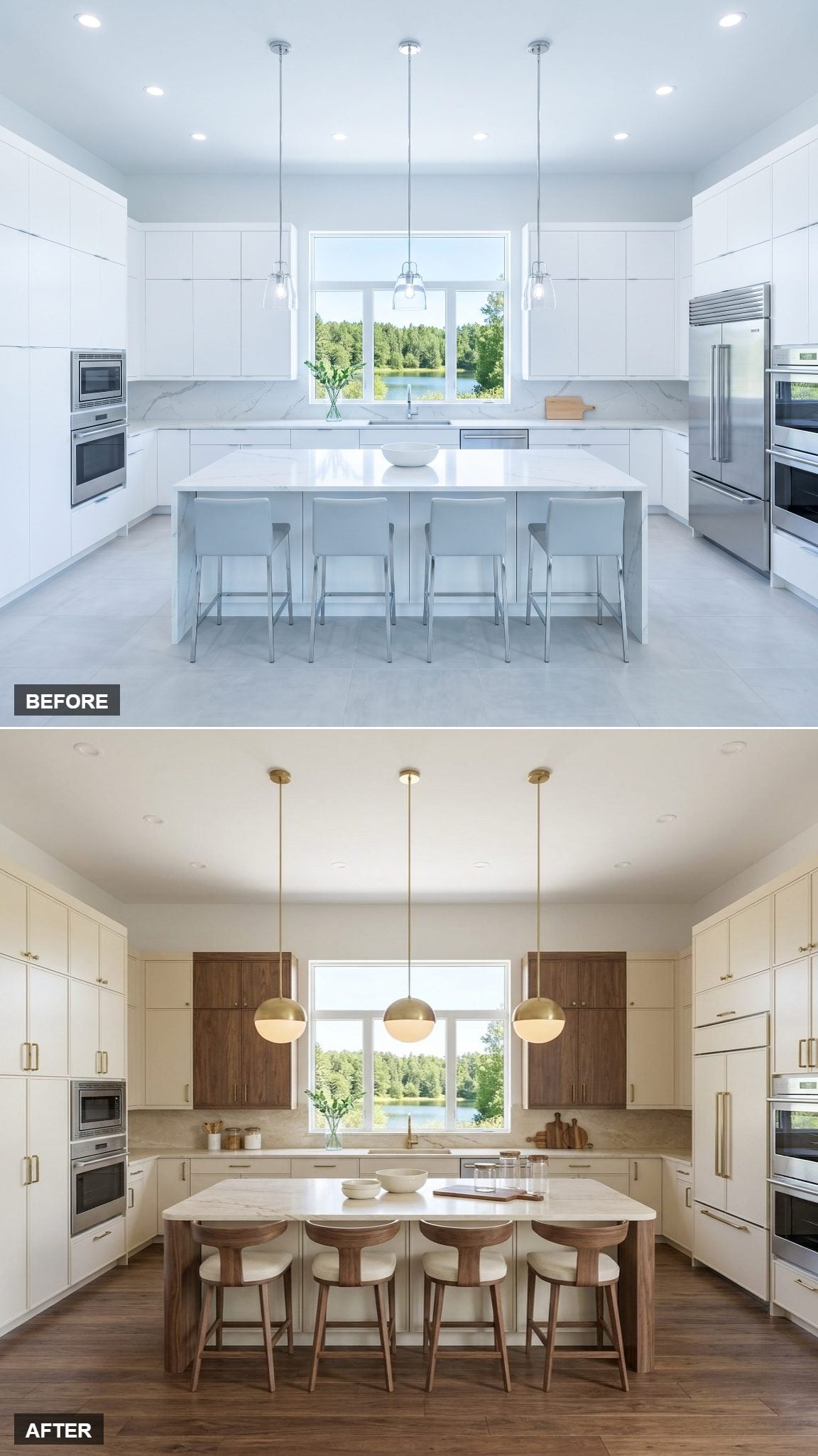
Soft-radius corners are easy to dismiss as a tiny detail until you see what they do to a kitchen dominated by rectangles. The curved walnut ends change how light moves across the grain and make the island feel less like a block dropped in the center of the floor.
Curved stools upholstered in cream repeat the gesture without cloning it. Rounded brass pendants with cream diffusers echo the softer geometry overhead, while warm-cream cabinetry and aged-brass hardware stay restrained around them.
24. Walnut Frames Added Depth Without Turning Every Door Brown
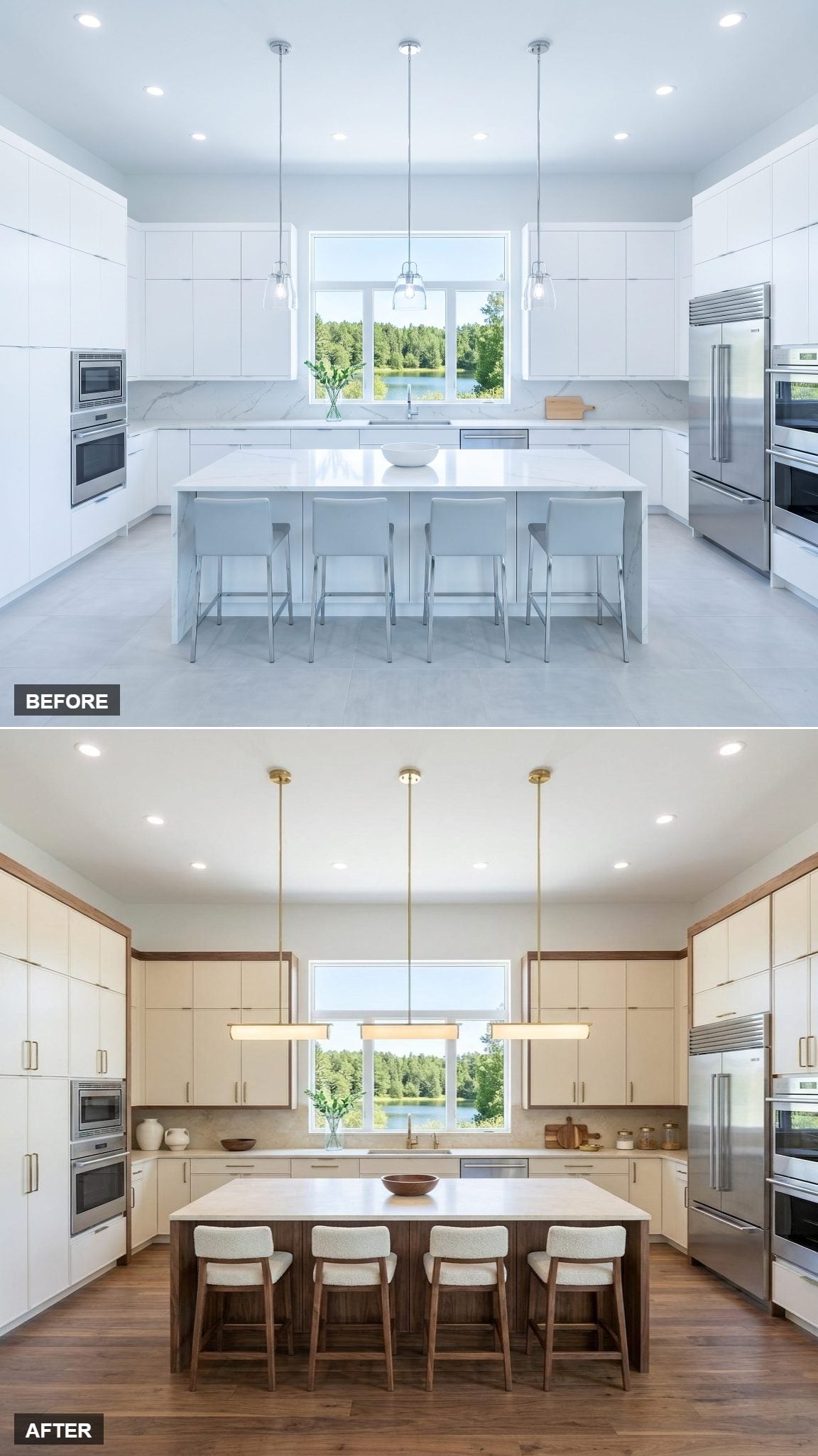
Nobody needed to flood the room with wood. The walnut surrounds were enough.
Tall storage, appliance zones and key cabinet groups are wrapped in substantial walnut frames, creating depth and rhythm against broad cream door fronts. The island repeats the idea with walnut seating panels and ends rather than switching entirely to wood.
Seamless honed cream stone climbs from counter to backsplash. Linear brass pendants and aged-brass elongated pulls add the final narrow lines.
23. Full Walnut Cabinets Flipped the Usual Cream-and-Wood Formula
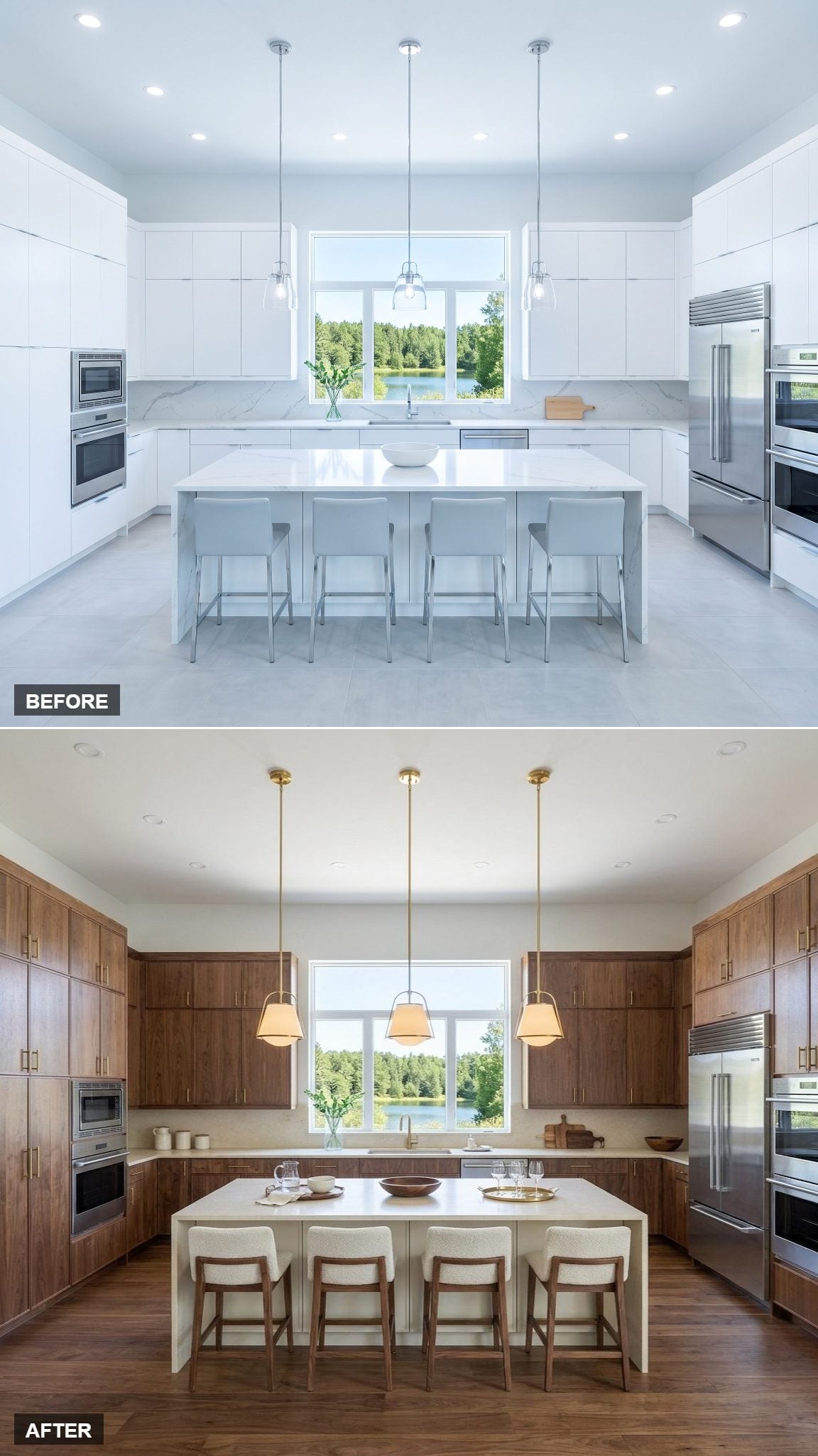
Instead of giving walnut the island and cream the walls, this room reverses the hierarchy. Full walnut perimeter cabinets create a deep continuous envelope, while the warm-cream island becomes the light source in the middle.
Honed cream stone countertops and a matching backsplash bounce that pale tone back through the walnut. Three brass pendant lights hang above walnut-framed stools in textured cream upholstery.
The result is rich without becoming cave-like, largely because the light material occupies such a large horizontal plane.
22. Inset Cream Cabinetry Made the Walnut Island Feel Like Actual Furniture
🔥 Would you like to save this?
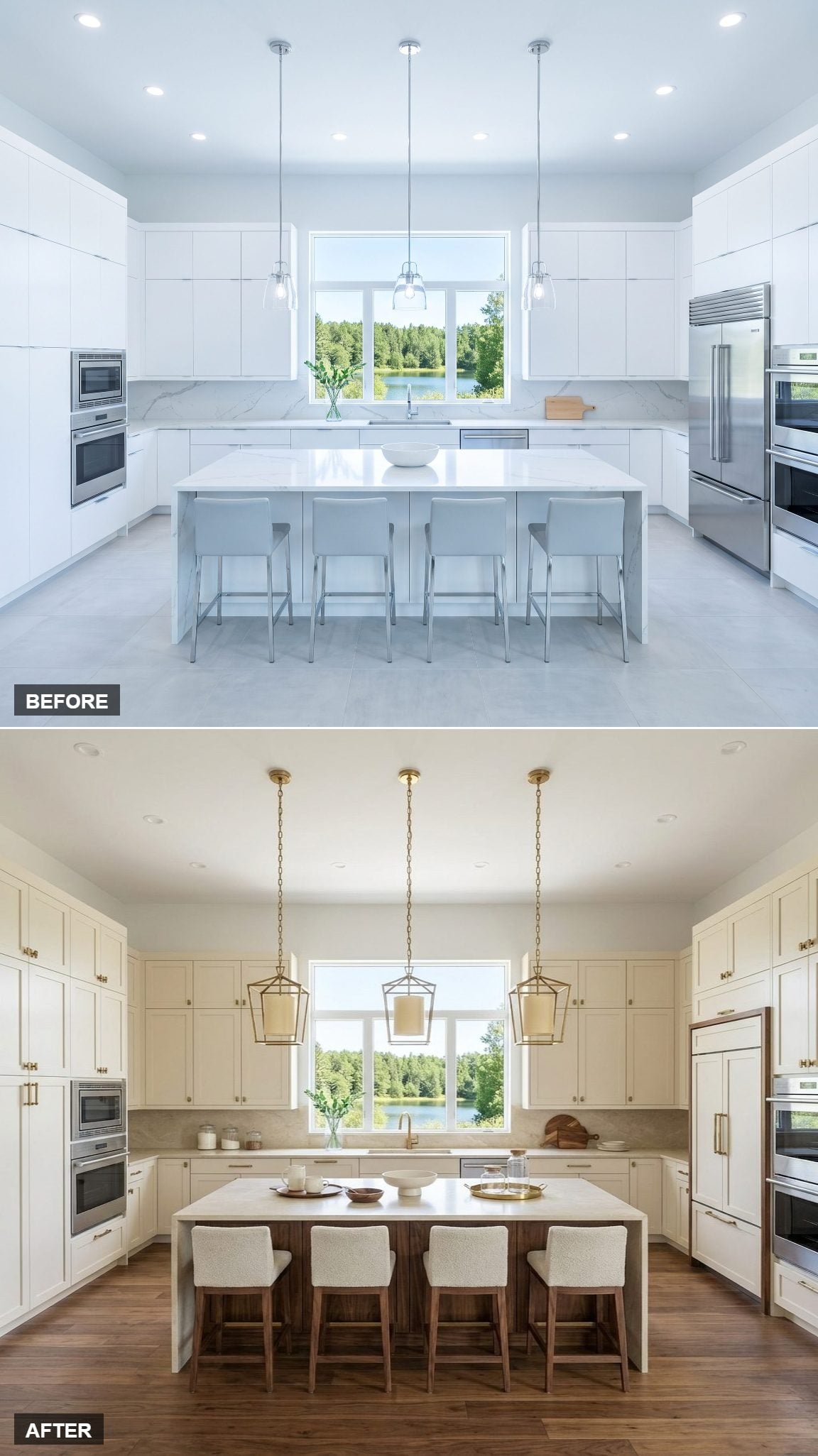
Inset doors sit within the face frame rather than over it, giving the cream cabinetry a precise, flush appearance. That extra definition matters in a room where the palette itself is intentionally quiet.
The walnut island takes the furniture idea farther, with carefully finished panels and enough wood grain to feel substantial without becoming rustic. Contemporary brass lantern pendants add structure overhead.
Aged-brass latches mixed with pulls bring in detail without sending the kitchen toward farmhouse nostalgia.
21. One Horizontal Walnut Band Stretched the Kitchen Sideways
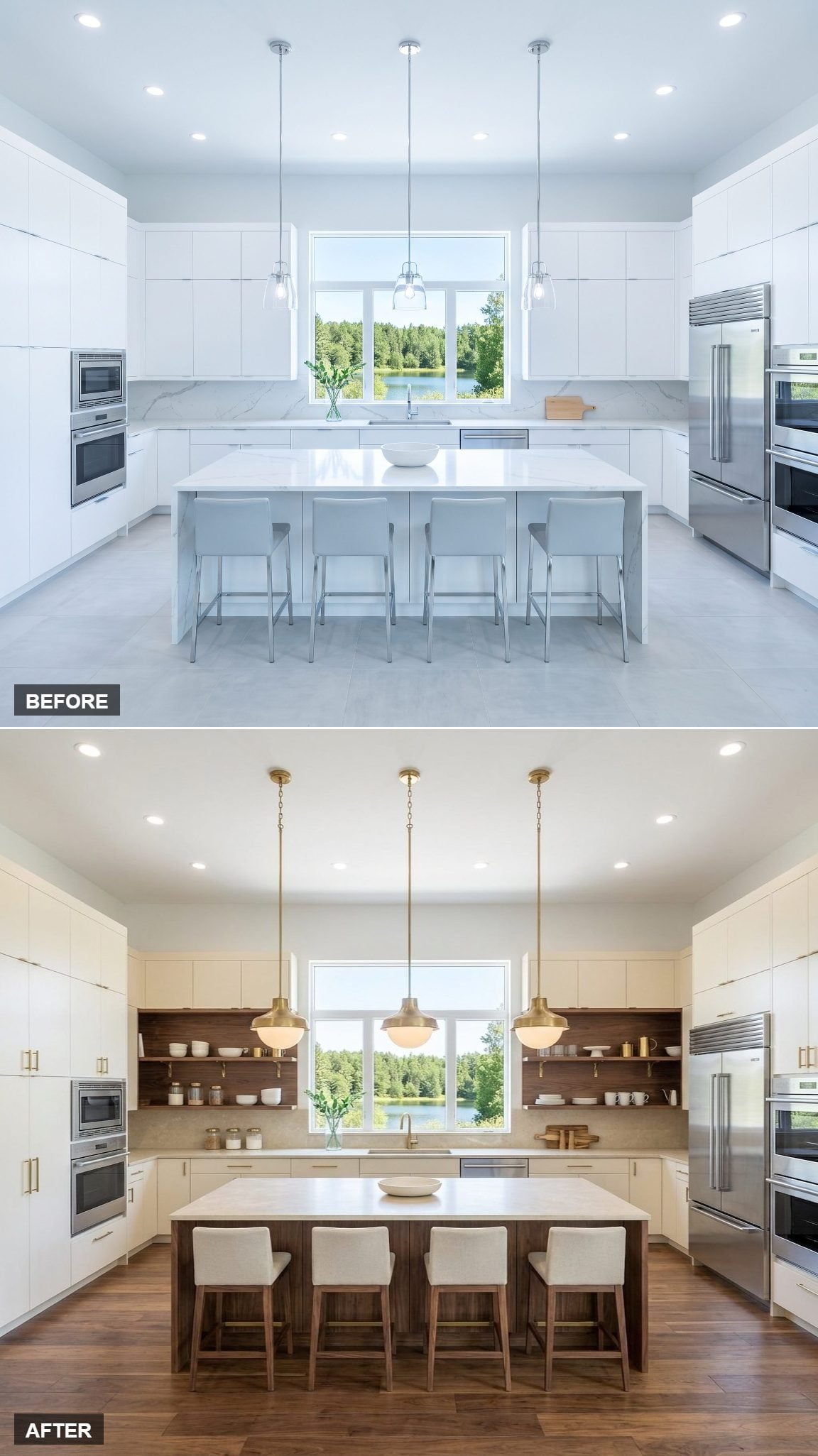
A broad strip of walnut shelving cuts across the cream upper cabinetry and immediately creates a horizontal focal line. It offers some of the openness of exposed shelving without turning every plate in the kitchen into part of the decor.
Slender brass shelf brackets keep the band crisp rather than rustic. A walnut island below repeats the material at another height, while cream-upholstered walnut counter stools bring it all the way to the floor.
The shelves stay sparsely furnished because the walnut itself is already doing enough.
20. Warm Cream Above and Walnut Below Gave the Cabinetry a Clear Horizon
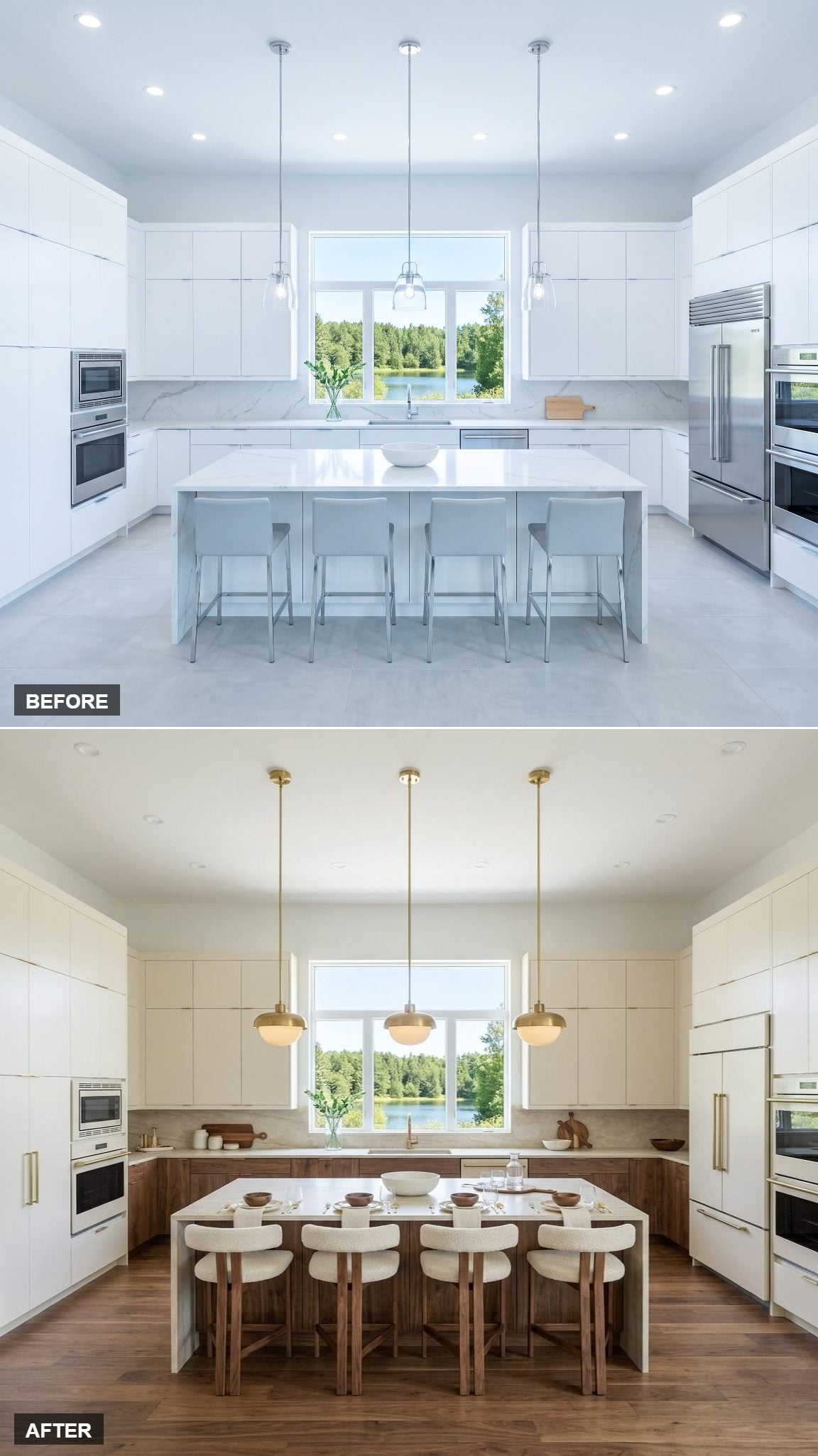
Two-tone cabinets can feel indecisive when the switch happens randomly. Here the division is emphatic: grain-matched walnut below, warm cream above.
The darker base gives the cabinetry a strong horizontal foundation while the lighter uppers reduce the amount of wood at eye level. The cream island picks up walnut again through the seating face and ends rather than changing materials completely.
Honed stone, brushed-brass hardware and an unlacquered brass faucet provide the connective tissue. The warm cabinet ideas work because the material break has a clear boundary.
19. Slab Doors and Shadow Gaps Stripped the Kitchen Down to Grain and Light
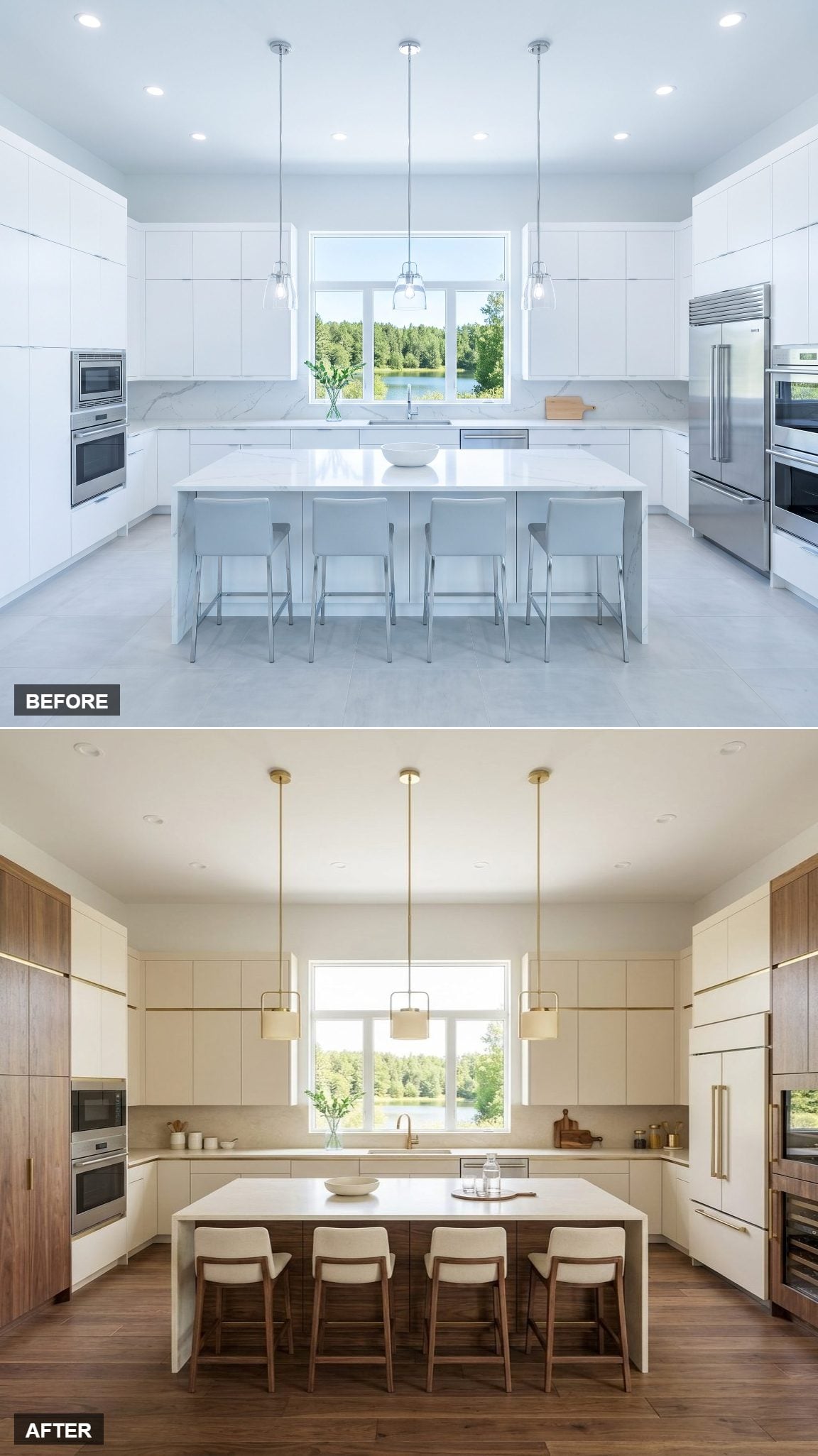
No visible pulls. No frame lines. Shadow gaps define the slab doors, and the walnut panels around the tall-storage zone interrupt the cream with large fields of uninterrupted grain.
Thin-profile honed stone runs from counter to full-height backsplash. A sculptural unlacquered brass faucet and three brass architectural pendants are almost the only ornamental moves.
Slim walnut stools in cream fabric finish a kitchen that feels pared back and highly resolved rather than merely empty.
18. A Walnut Seating Recess Turned the Island Into a Built-In Table
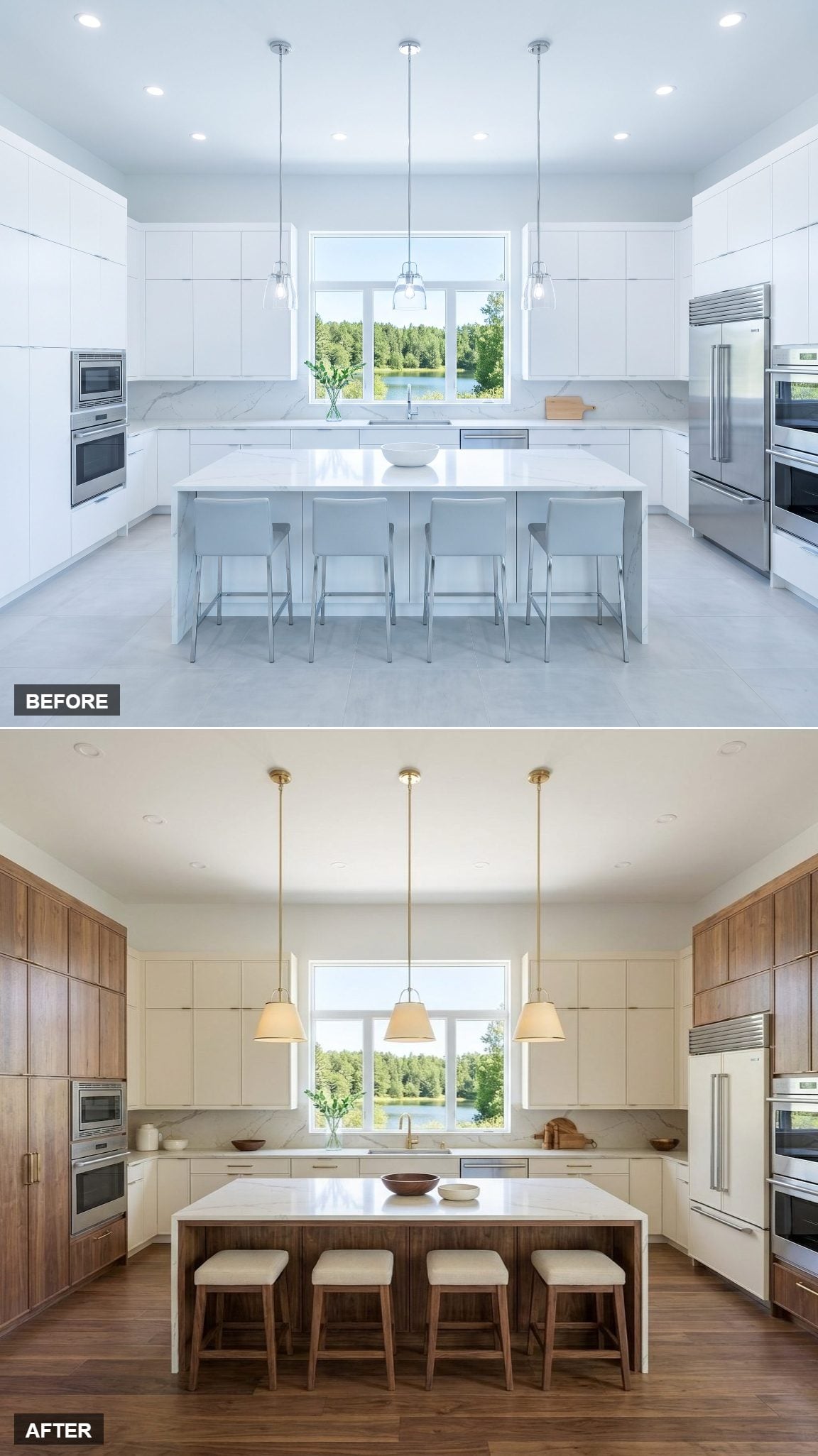
The island stays cream from the working side, then opens into a broad walnut-lined recess where the stools sit. That shift gives the seating zone its own identity without adding another freestanding table.
Honed cream stone continues across the counters and backsplash. Brushed-brass hardware stays restrained, and cream-upholstered walnut stools tuck into the recess rather than floating in front of the island.
These warm cabinet ideas work because the contrast happens exactly where the function changes.
17. A Gallery Wall Gave the Kitchen Something to Look at Besides the Island
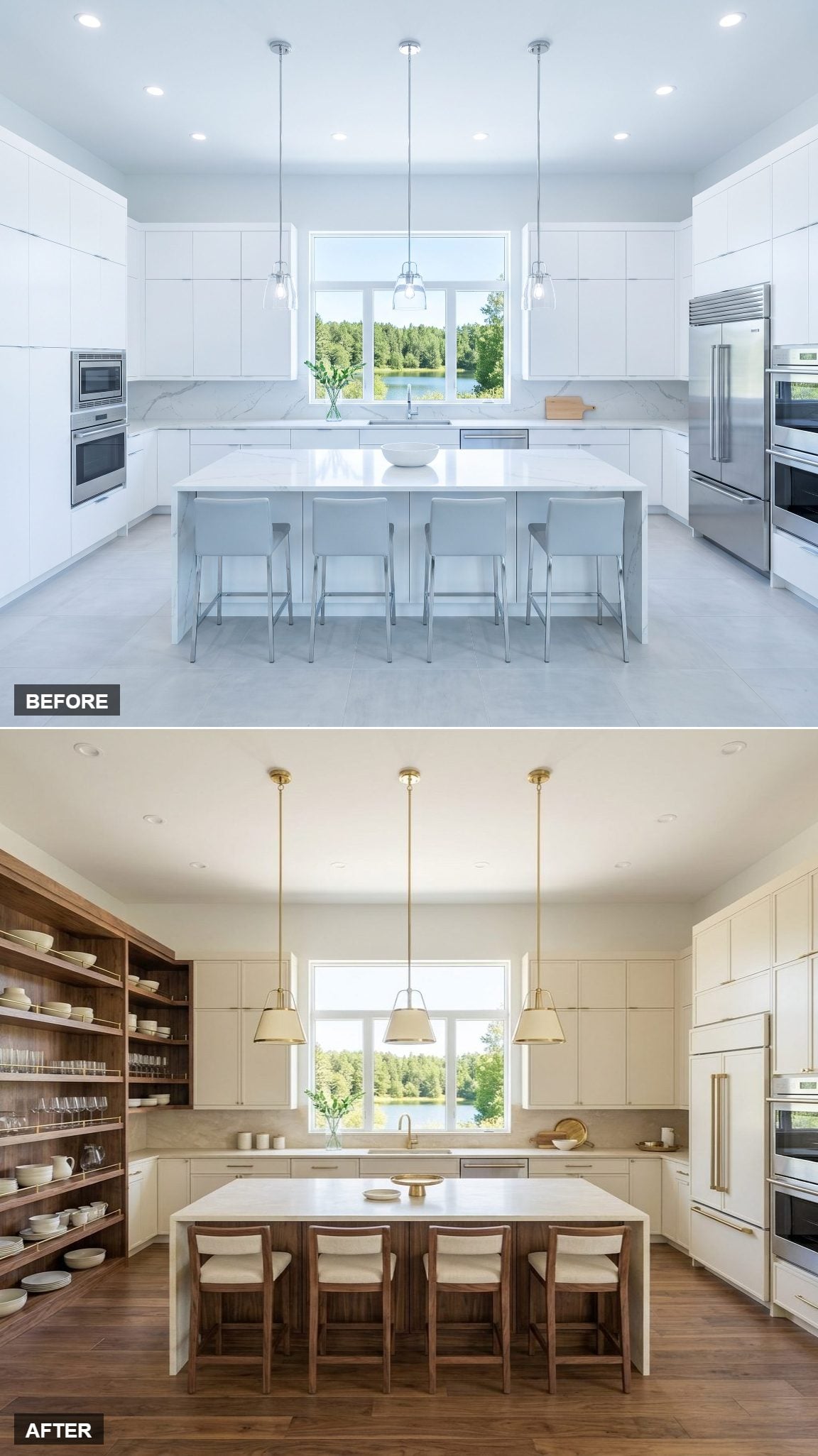
A walnut-backed display wall with grain-matched shelves and brass rails gives the room a vertical feature that has nothing to do with appliances or seating.
Cream ceramics, clear glassware and a few brass serving pieces sit far enough apart to let the walnut remain visible. The island repeats the same wood but doesn’t copy the display wall exactly, and honed cream stone pulls the working surfaces back toward the lighter cabinetry.
Aged-brass cabinet hardware appears throughout the kitchen as a small repeating note.
16. The Island Went Fluted and Everything Else Stayed Smooth
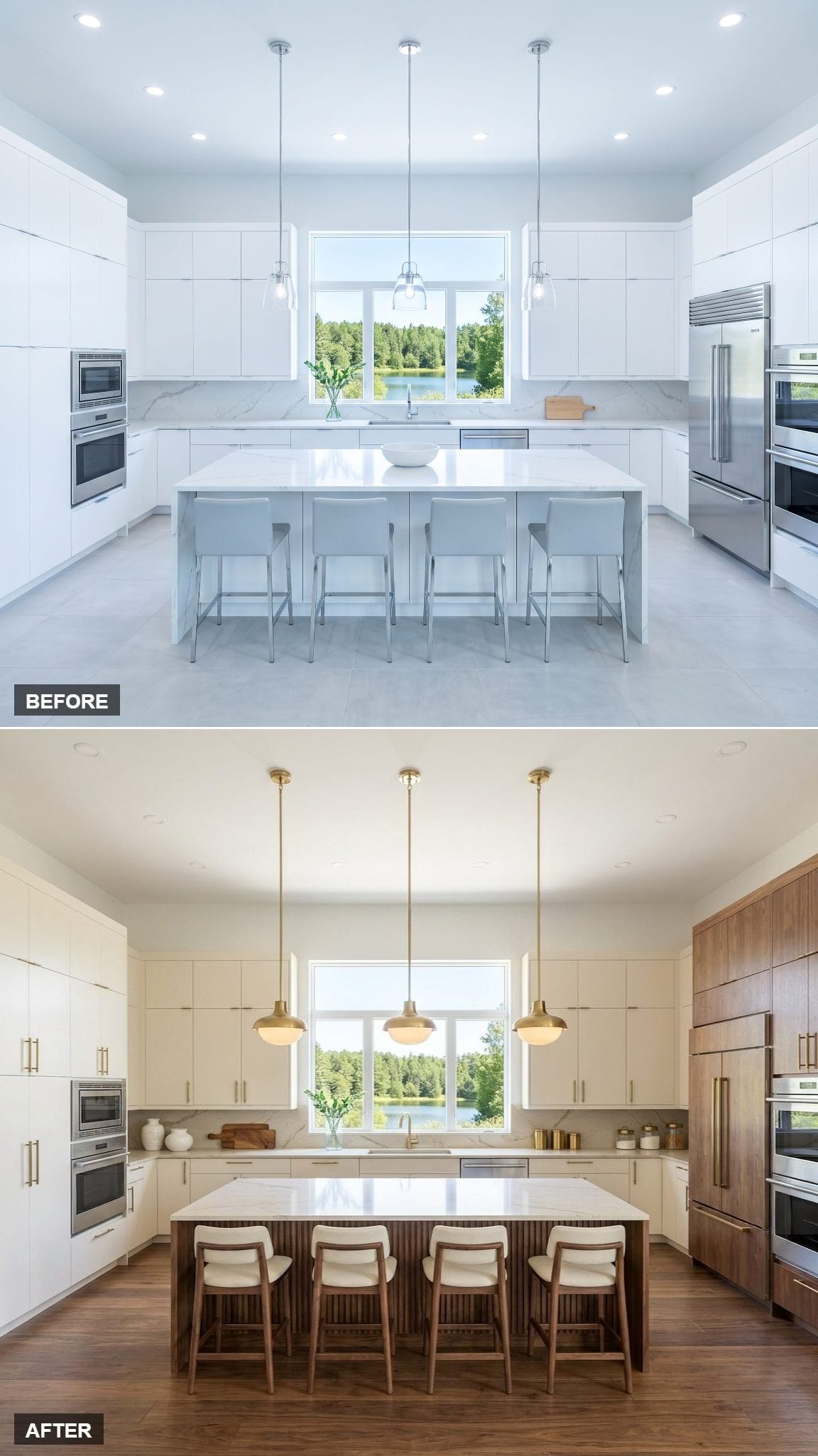
Vertical fluting turns the seating face into a field of narrow shadow lines. Because the surrounding cream cabinetry stays completely smooth, the texture has somewhere to register.
Continuous walnut grain through the flutes keeps the pattern tied to the material rather than making it look applied afterward. A second walnut cabinetry zone elsewhere in the room prevents the island from becoming the only place wood appears.
Aged-brass elongated pulls, brass pendants and walnut bar stools complete the material loop.
15. Mid-Century Warmth Arrived Without a Single Costume Prop
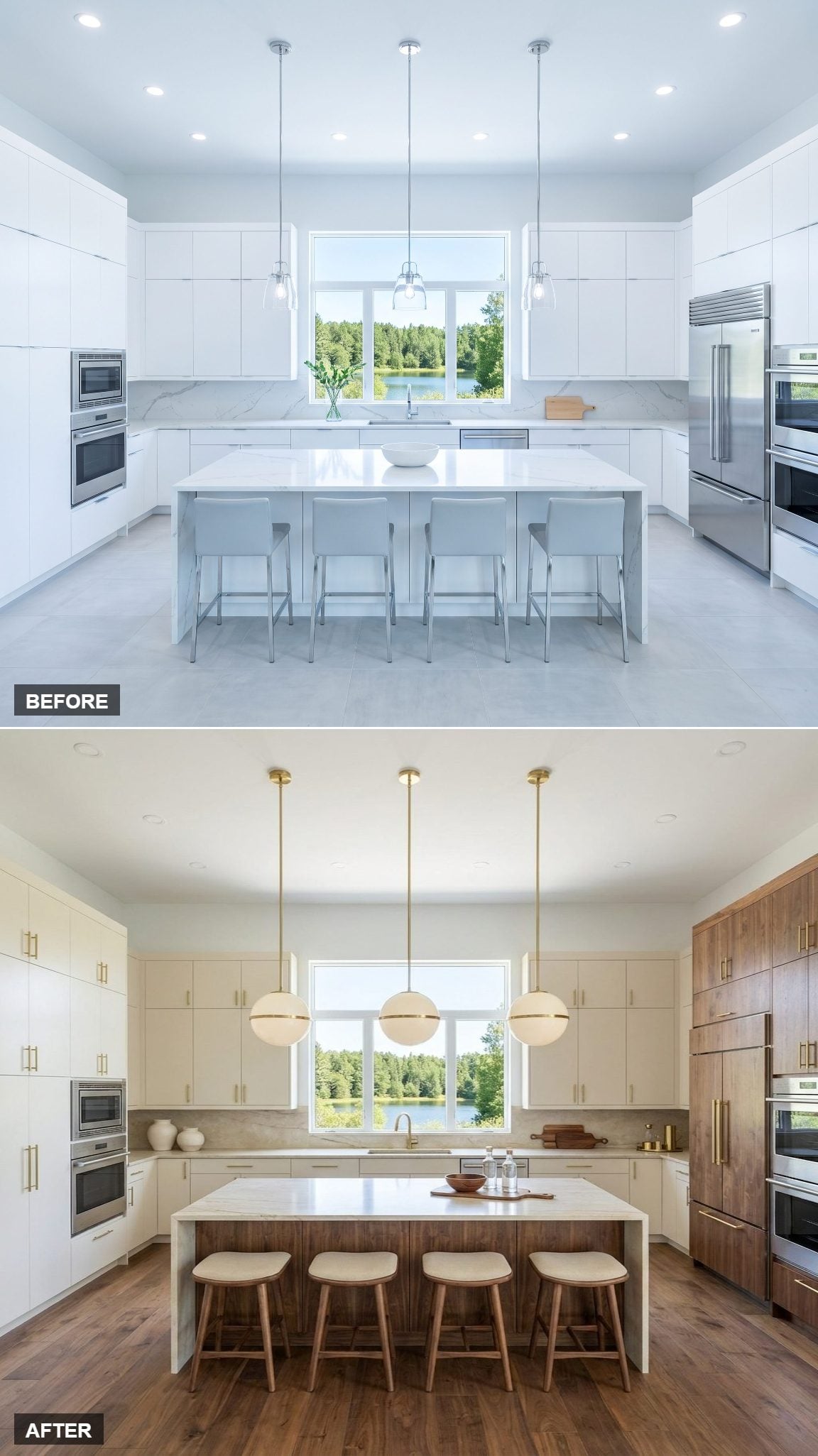
Mid-century kitchens have a reputation problem. Too many “inspired by” versions become costume parties: teak everything, avocado green, novelty hardware, breakfast served somewhere between design and Halloween.
This room borrows the proportions rather than the props. Gently curved walnut stool backs, beautifully figured wood on the island and brass globe-inspired pendants carry the reference.
The cabinetry remains warm cream. The stone stays honed. Nothing turns orange. That last part matters more than people admit.
14. Tambour Ribs Brought Textile Texture to the Walnut
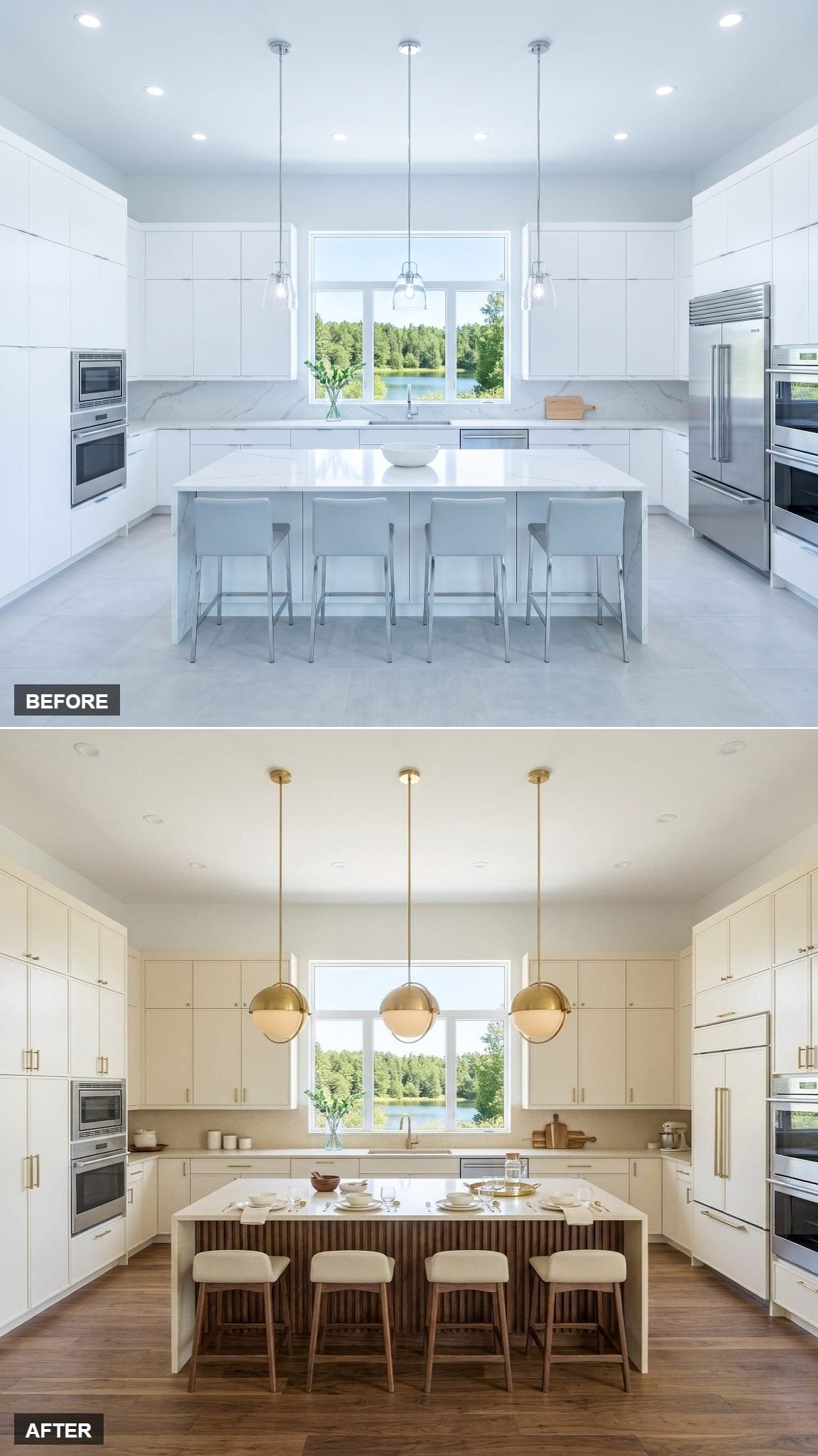
Tambour detailing takes a flat wood surface and breaks it into a rhythm of rounded ribs, giving the walnut something closer to fabric-like shadow and movement.
Here the treatment appears on the island seating face and selected niches rather than spreading to every door. The rest of the island stays warm cream beneath a substantial stone top.
Sculptural brass pendants, cream-upholstered walnut stools, brushed-brass hardware and an unlacquered brass faucet provide the familiar palette without duplicating the fluted-island look.
13. A Furniture-Style Walnut Hutch Broke the Run of Built-In Cabinetry
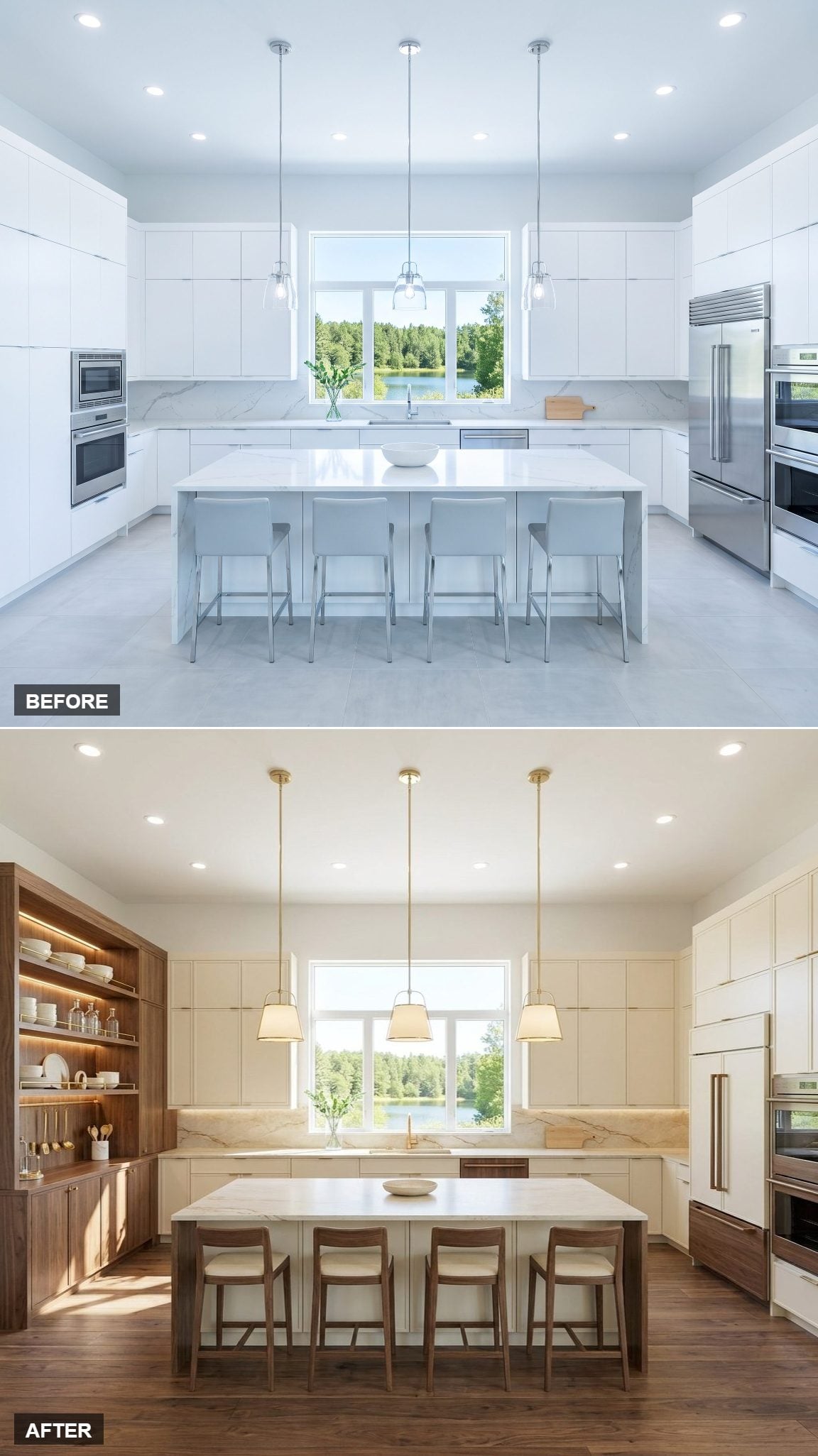
One cabinetry section shifts into something closer to a freestanding hutch: full-height walnut, open display shelves, brass gallery rails and integrated light. The distinction matters because the room stops feeling like one continuous cabinet order.
Cream ceramics, clear glass and brass pieces furnish the shelves without covering the wood. The island returns to warm cream with walnut end panels and a walnut seating face, while honed cream stone countertops continue through the room.
If you’re comparing this treatment with more conventional white kitchen ideas, the hutch is the moment that changes the architecture rather than simply changing the cabinet color.
12. Cream Stone Waterfalls Put a Hard Frame Around the Walnut Island
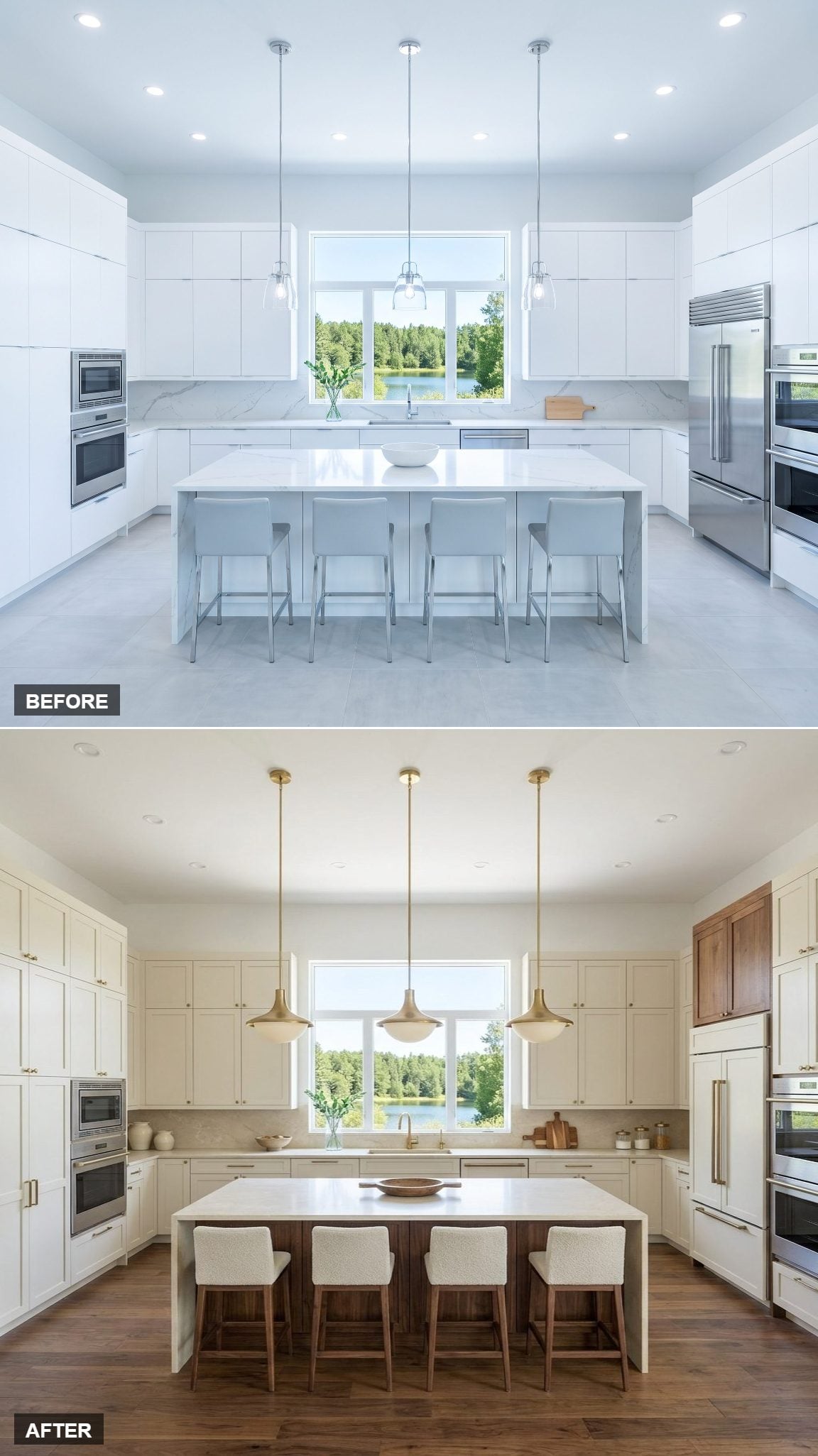
Instead of letting walnut run uninterrupted to the floor, warm-cream stone wraps both visible island ends in waterfall panels. The pale frame sharpens the outline of the wood and gives the centerpiece a much more graphic edge.
Matching cream stone on perimeter counters and backsplash keeps the waterfalls connected to the rest of the kitchen rather than turning them into one expensive trick.
Walnut stools upholstered in cream, brass pendants and an unlacquered brass faucet keep the supporting cast simple.
11. Nothing Extra: Cream, Walnut and Brass Without the Styling Safety Net
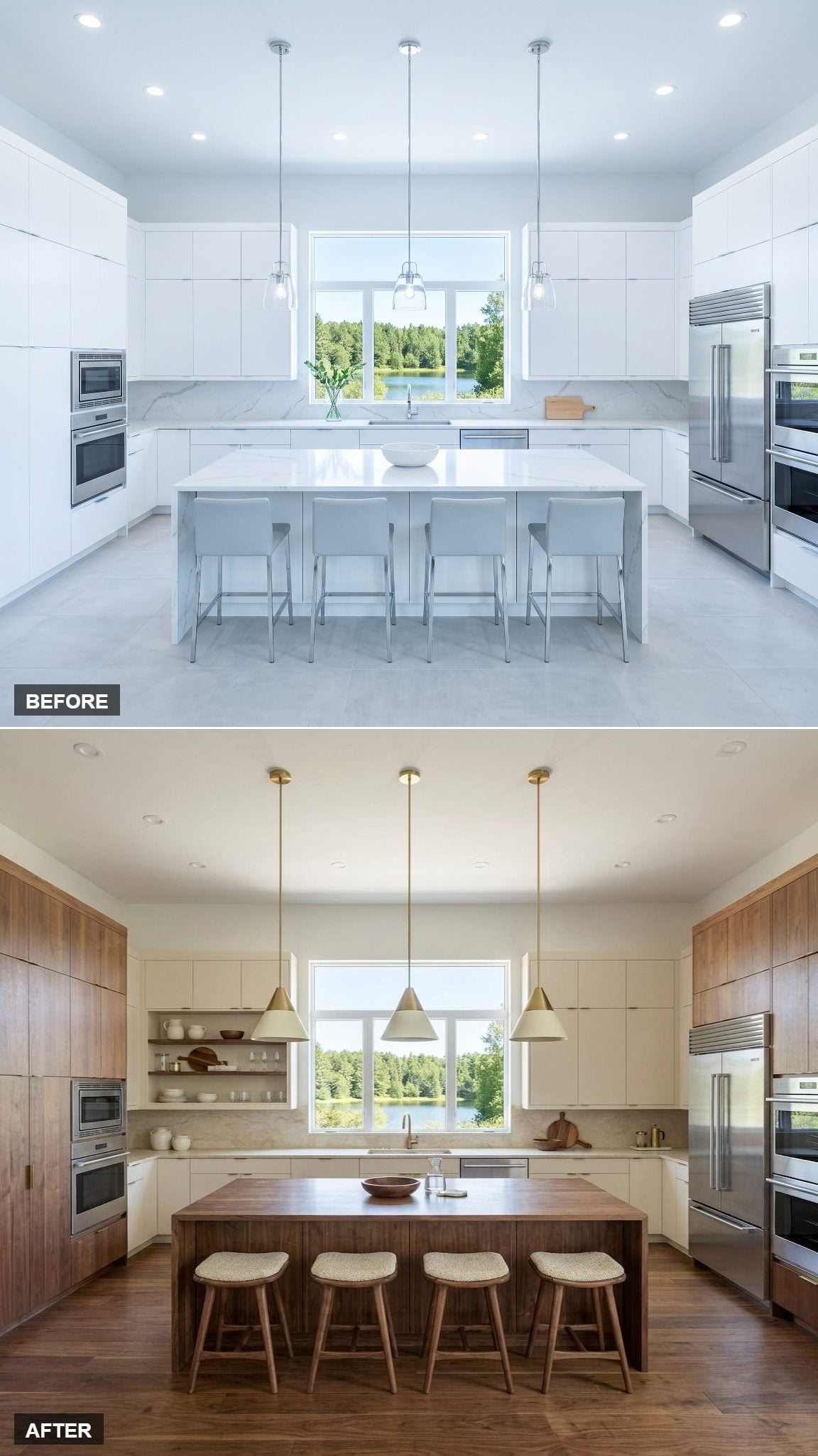
No greenery. No colored ceramics. No herb pots arranged for the photograph. This room asks the materials themselves to create the warmth.
Matte cream cabinetry absorbs light rather than flashing it back. The walnut slab island provides grain and tonal variation, while sculptural walnut stools with woven cream seats add one more tactile surface.
Minimalist brass cone pendants, cream pottery and patinated brass hardware keep the room warm without supplying a separate decorating scheme.
10. Full-Height Walnut Towers Gave the Storage Wall a Rhythm
🔥 Would you like to save this?
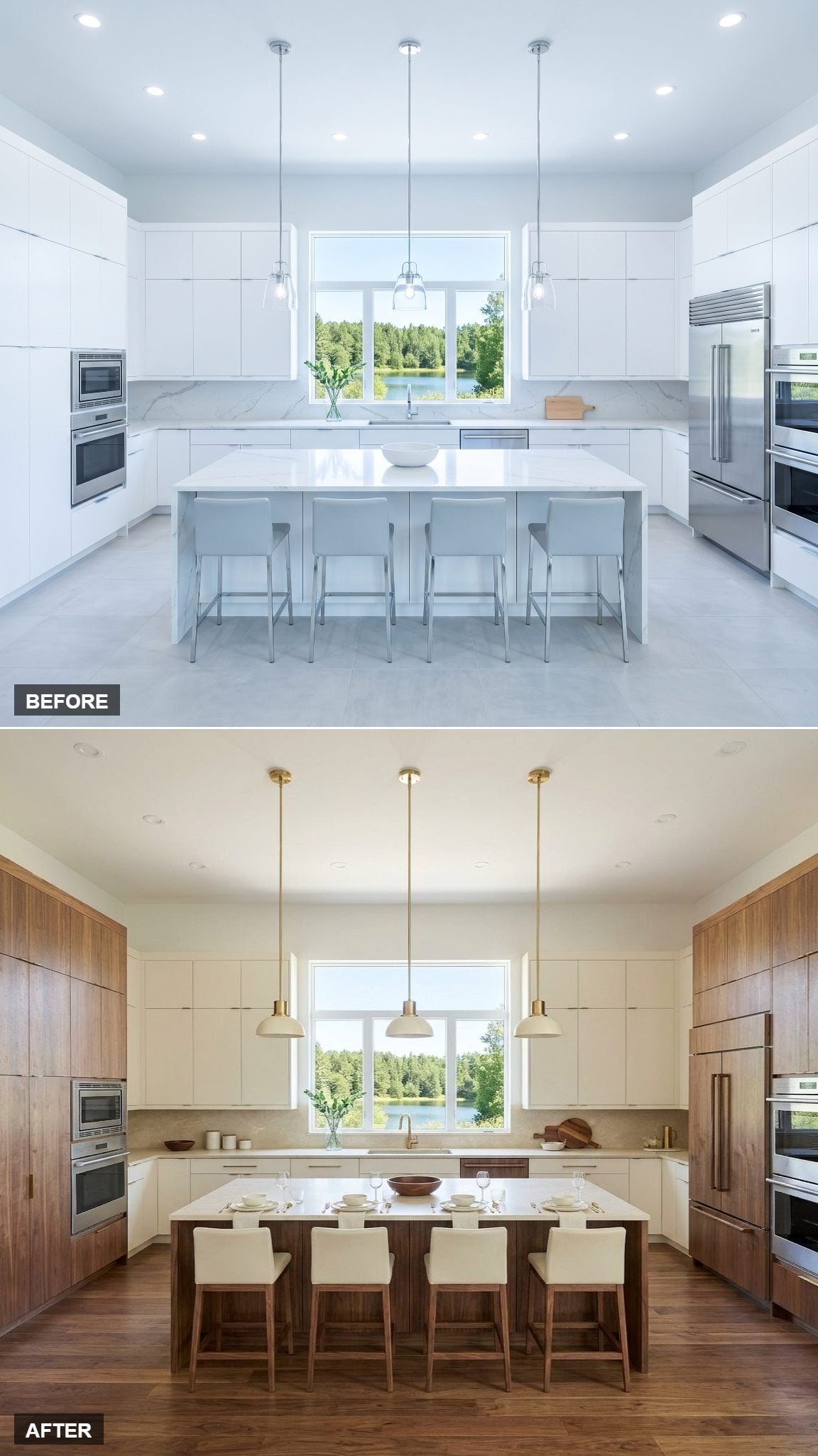
This isn’t one monolithic pantry wall. Separate full-height walnut towers create repeated vertical bands, giving the storage elevation a rhythm instead of one continuous field of dark wood.
The working cabinetry between and around them stays cream. Three brass-and-cream pendants mark the island, walnut bar stools repeat the timber below and slender aged-brass hardware runs quietly across the doors.
The walnut island end panels connect back to those towers without copying them. As a farmhouse kitchen alternative, the same warm materials land somewhere much more tailored.
9. Scandinavian Restraint Put the Burden on Proportion, Not Accessories
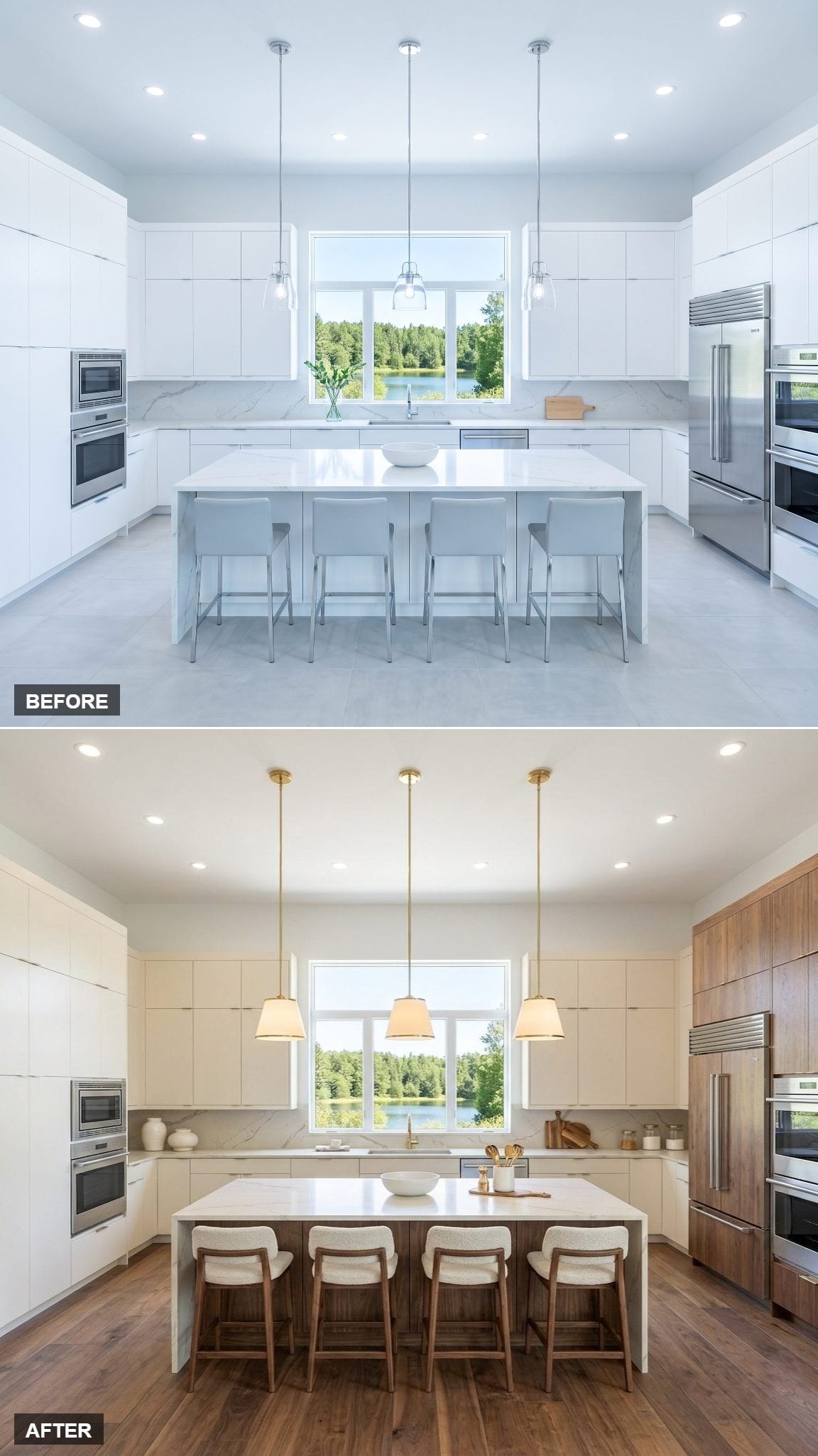
No colored pottery. No greenery. No runner placed down the island because an empty surface made someone nervous.
Warm-cream cabinetry, natural walnut on the island and tall storage, honed cream stone and brushed-brass hardware make up almost the entire palette. The restraint shifts attention toward proportion, joinery and grain instead of styling.
The warm cabinet ideas here are useful precisely because they demonstrate that a quiet room doesn’t require an empty one. It requires knowing which material already has enough to say.
8. Grain Matching Became the Luxury Detail You Notice Before You Can Name It
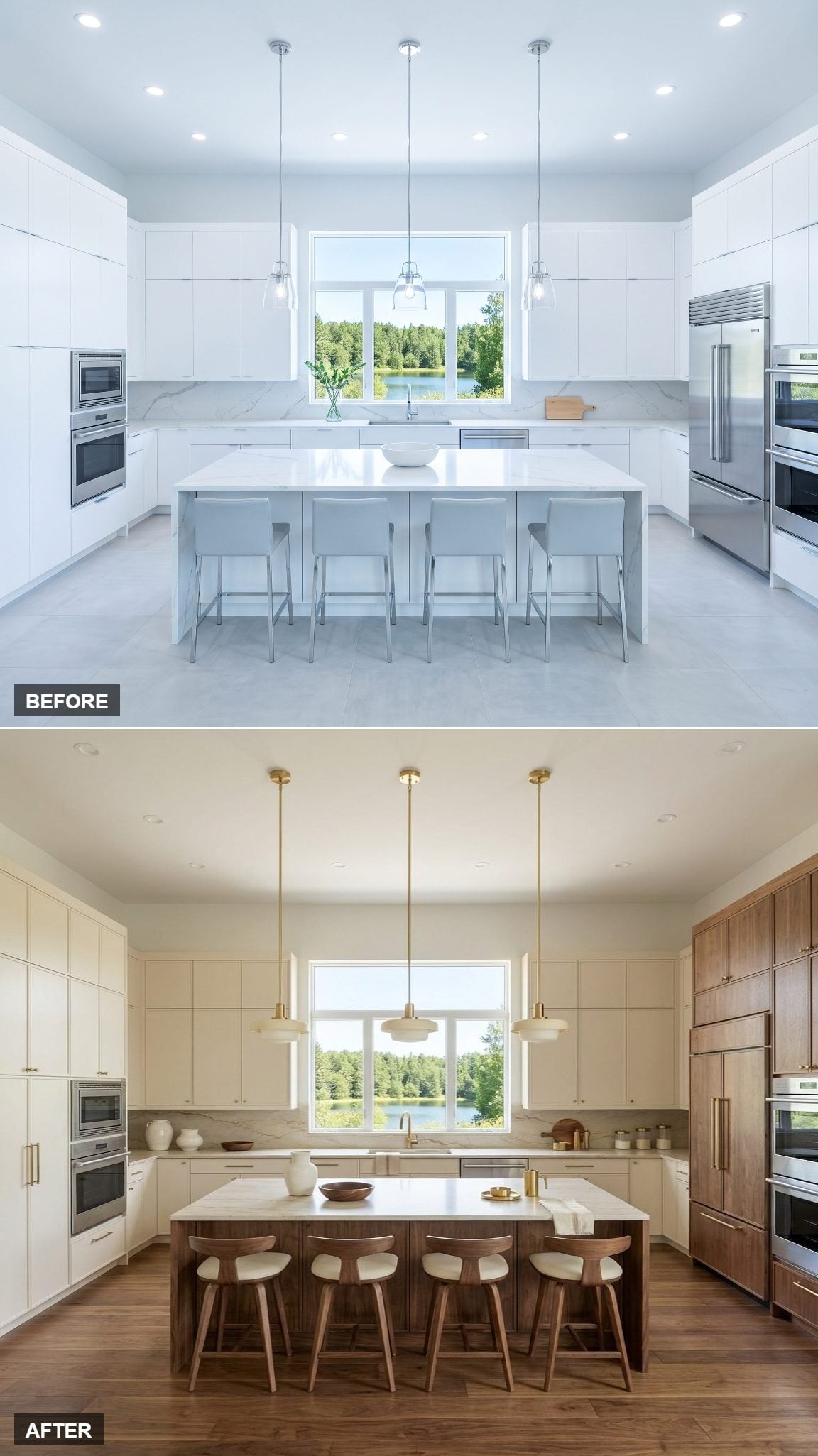
Grain-matched walnut panels can make a run of doors look less like separate cabinet fronts and more like one continuous surface. Most people won’t identify the technique. They’ll simply notice that the wood seems unusually calm.
That precision is the point of this kitchen. Minimalist brass pendants hang above sculptural walnut stools upholstered in cream. Honed stone, an unlacquered brass faucet and a few cream ceramics leave the wood almost completely unobstructed.
Quiet luxury is just another phrase for not needing to explain yourself.
7. A Walnut Display Wall Turned Open Shelving Into Architecture
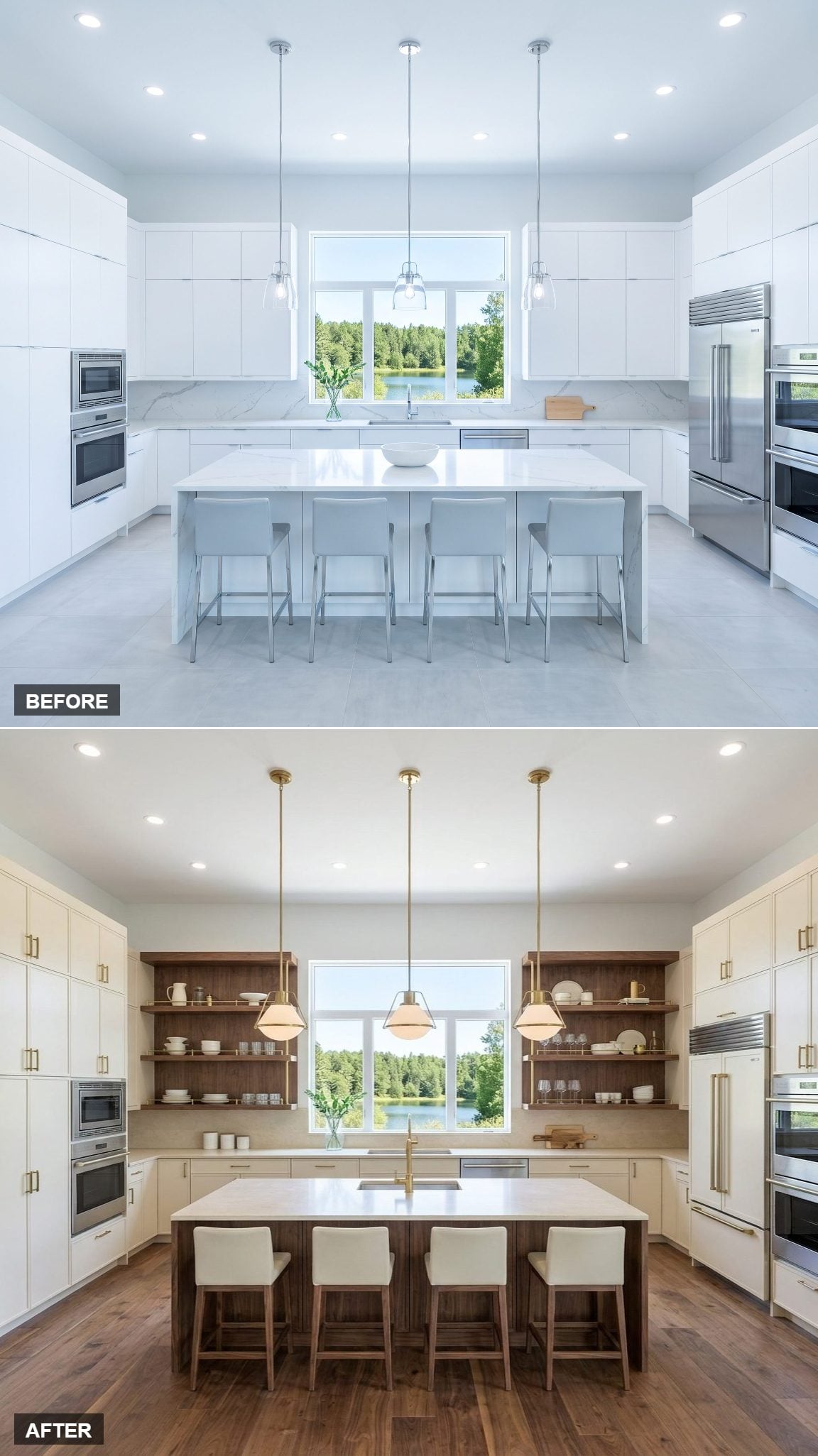
A substantial walnut backing, thick shelves and slender brass gallery rails give this open display enough structure that it feels designed into the room rather than added after the cabinets were installed.
Cream ceramics, clear glass and brass objects stay sparse enough that the shelves remain visible. The cream island below uses broad walnut seating panels and end details to answer the wall without duplicating it.
The restraint follows the same principle that makes strong black-and-white foyer decor work: once the architecture is doing something bold, editing the objects becomes more important, not less.
6. Floor, Cabinets and Island Shared One Walnut Base
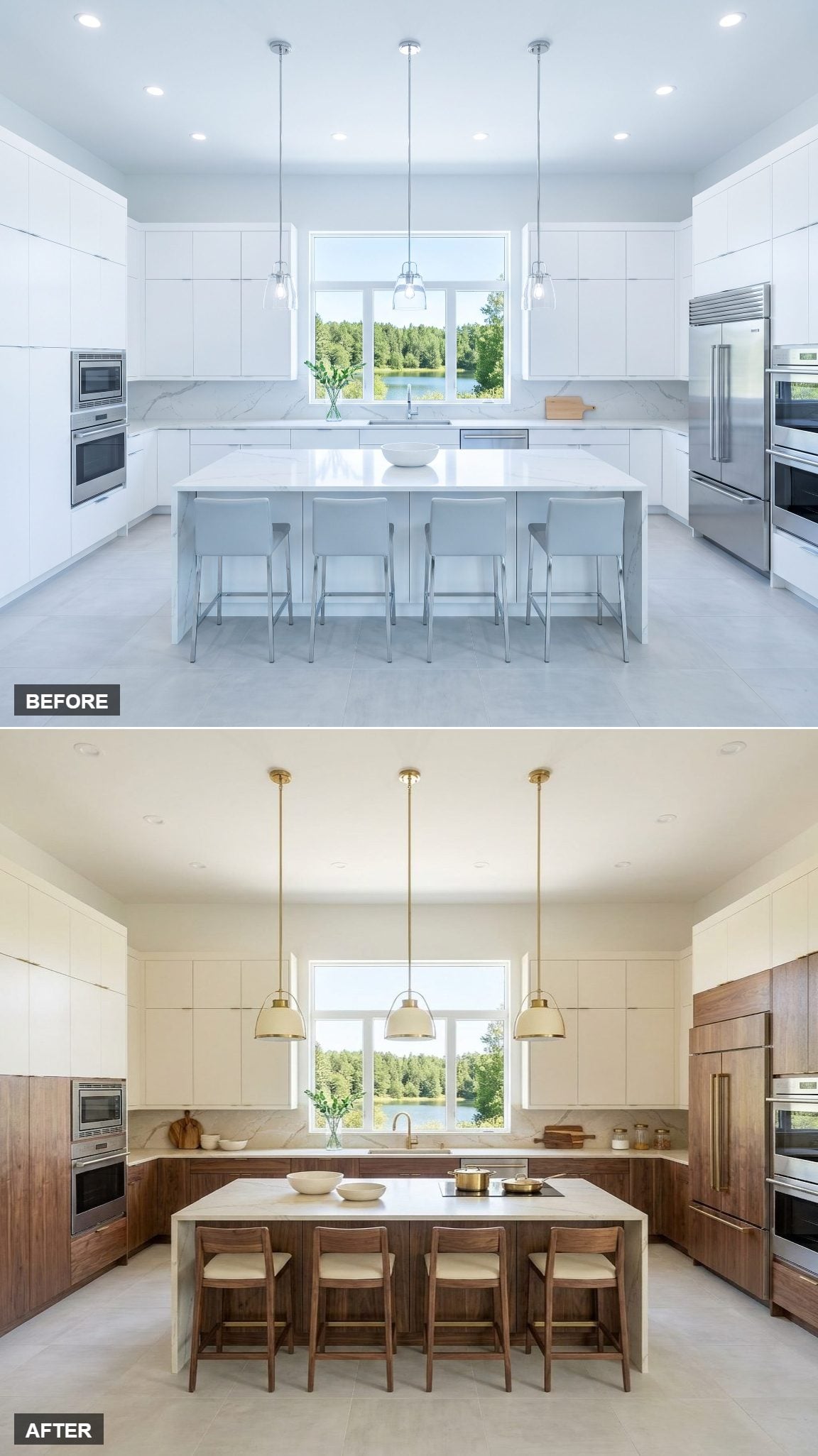
Here the walnut doesn’t appear as isolated cabinetry. It rises from the flooring into the lower cabinets, island and selected tall panels, creating a broad dark foundation across the bottom of the room.
The honed warm-cream counter forms a clean visual break before the cream upper cabinets begin. That light middle band prevents the wood below and pale cabinetry above from simply stacking into two heavy blocks.
Walnut stools, an unlacquered brass faucet and aged-brass hardware finish the room without introducing another major material. The result has little in common visually with the usual farmhouse kitchen, despite sharing some of the same natural-material instincts.
5. Walnut-Lined Niches Put the Display Inside the Cabinetry
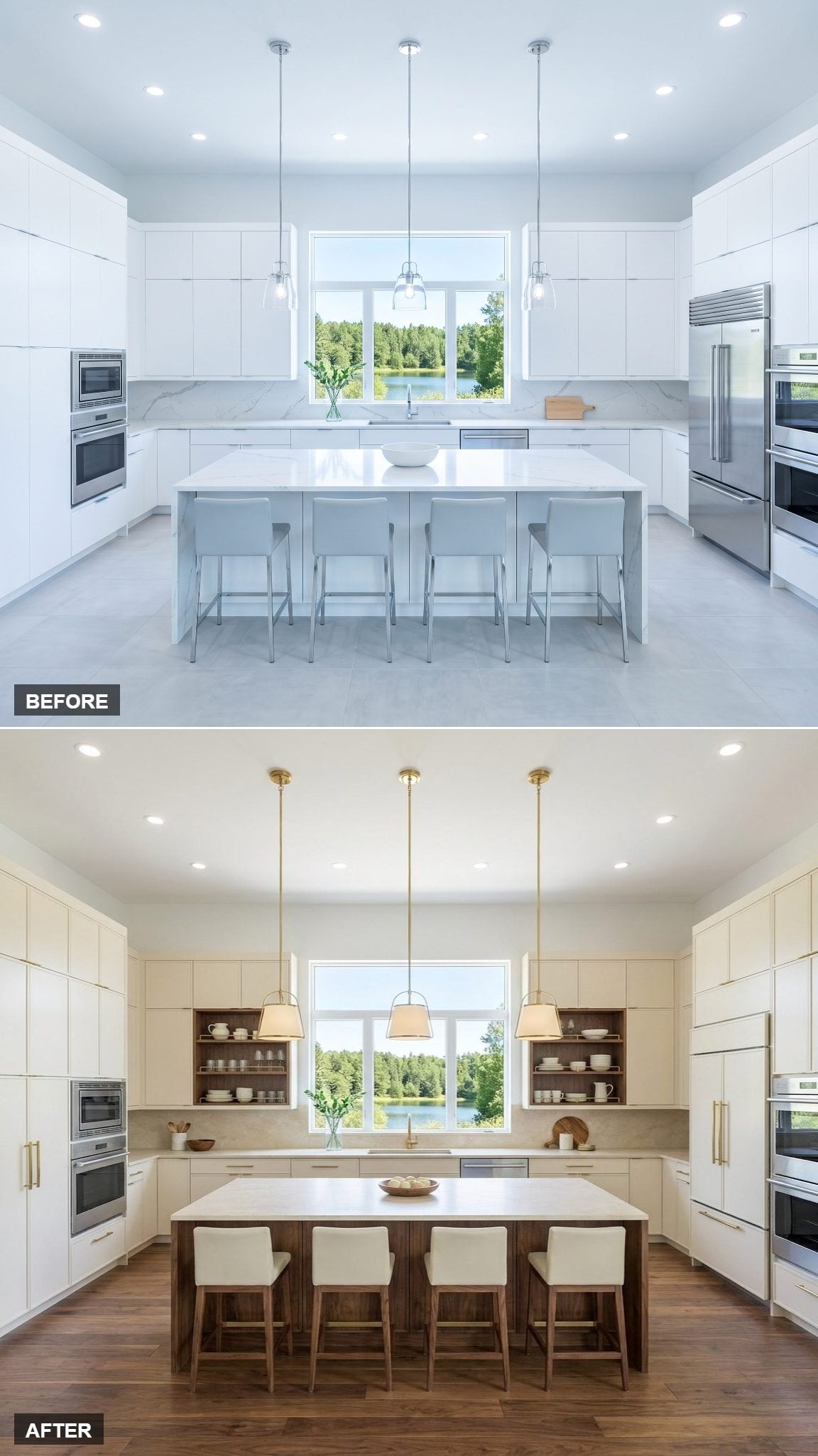
Unlike an open shelving wall or freestanding hutch, these display areas are recessed directly into the cream millwork. Walnut lines the interiors, turning each niche into a small dark aperture inside a much lighter cabinet composition.
Brass shelf rails keep clear glass and cream ceramics in place without obscuring the walnut. The island repeats the wood at a larger scale, while honed cream stone across counters and backsplash keeps the working surfaces visually simple.
Cream-upholstered stools and an unlacquered brass faucet connect the display details back to the center of the room.
4. The Airiest Version Used the Walnut Island as Its Only Real Weight
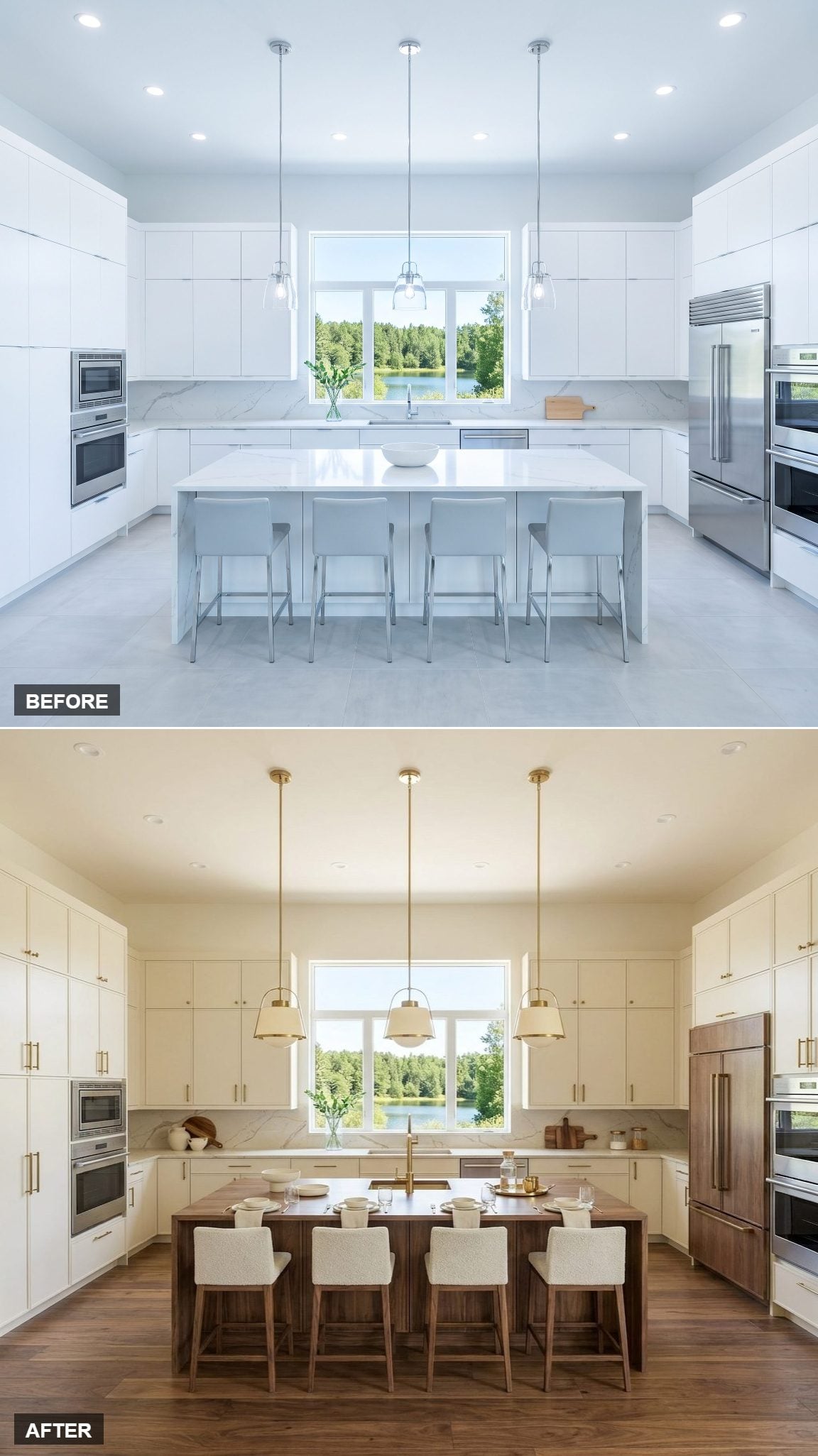
The before kitchen’s flat white surfaces had all the warmth of a parking structure. This version keeps the brightness and changes the temperature.
Warm-cream cabinetry wraps the perimeter while a natural walnut island provides the one broad dark mass in the center. Textured cream stools barely interrupt it.
Brass pendant lights with cream diffusers cast warm light onto the stone, while the forest and lake outside the window provide all the green this kitchen needs. No vase of eucalyptus required.
3. Continuous Walnut Grain Turned the Island Into One Long Object
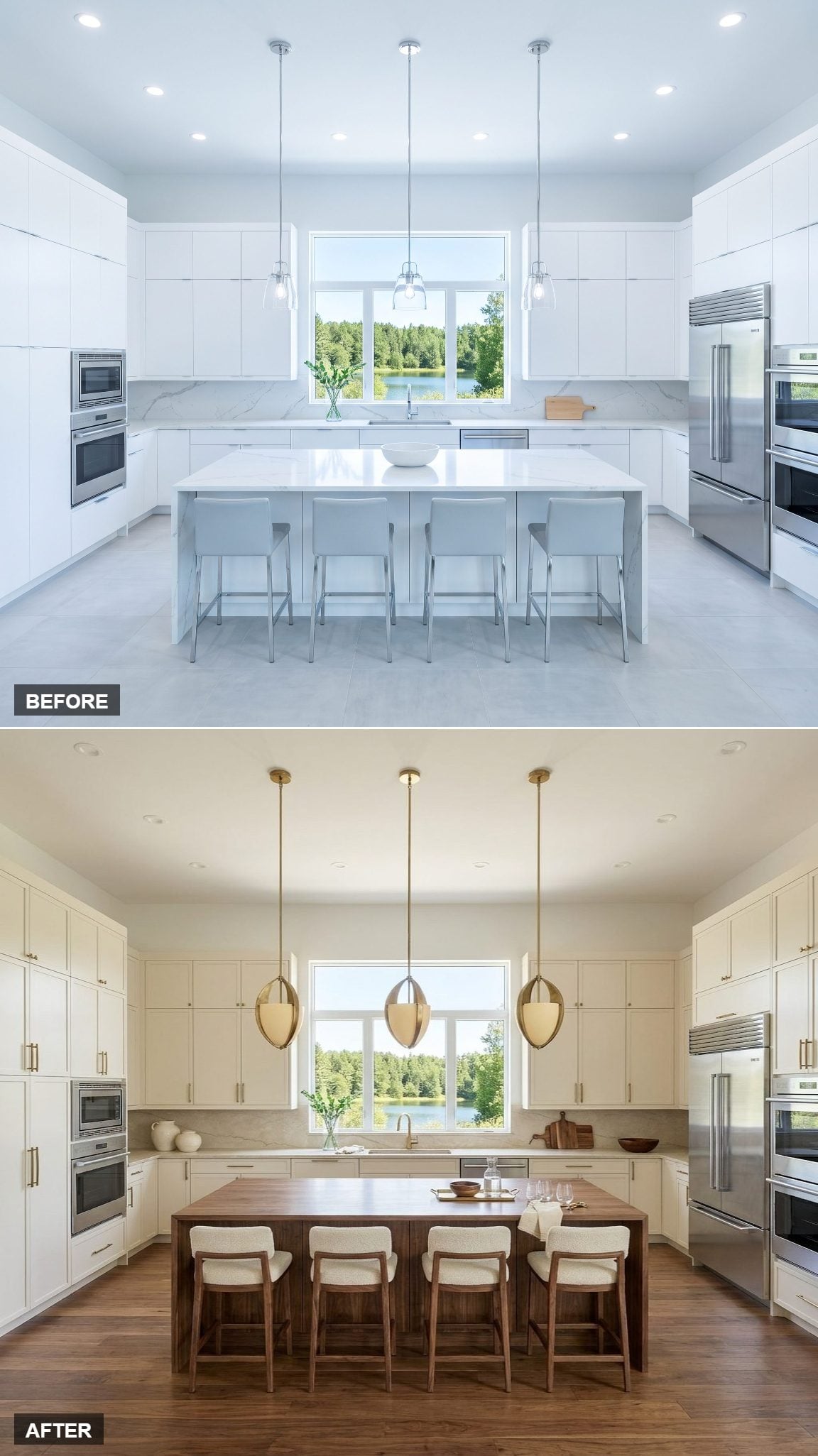
This kitchen uses the familiar cream-perimeter/walnut-island formula, but the execution hangs on the wood itself. Grain runs continuously across doors, drawers and end panels, reducing the number of visual breaks across the island.
Honed warm-cream stone keeps the surrounding surfaces pale enough that the walnut remains unmistakably central. Aged-brass elongated pulls and an unlacquered brass faucet add narrower points of warmth.
Brass pendant lights hover over walnut-framed upholstered stools, reinforcing the island instead of distracting from it.
2. Art Deco Slipped In Through the Lines, Not the Costume
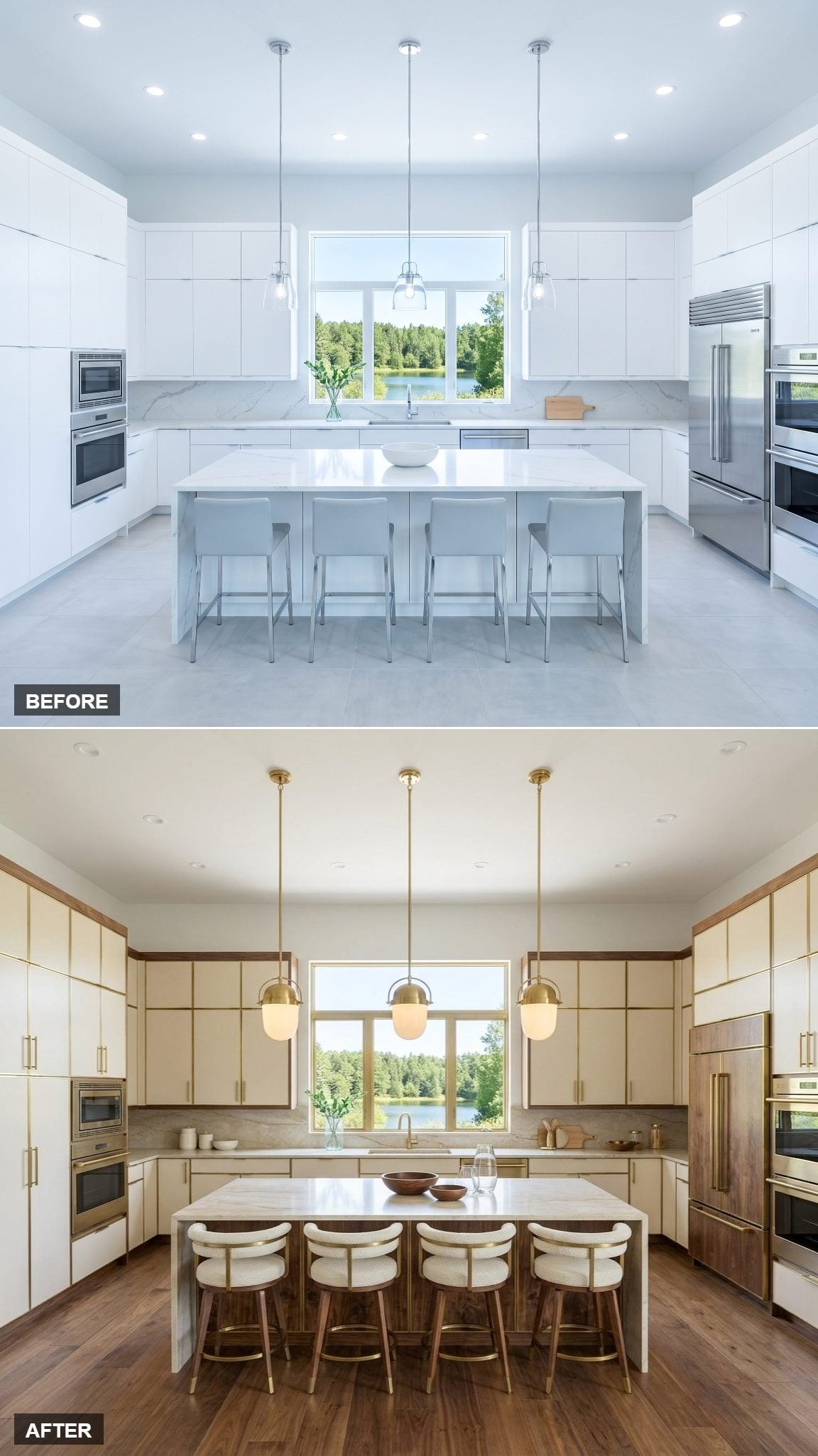
Art Deco in a kitchen can go wrong fast—too much black, too much gold, fan motifs multiplying across every surface, and suddenly breakfast is being served in a hotel lobby.
This room borrows the geometry instead. Fine linear brass inlays sharpen the cream cabinetry, elongated handles create another repeated vertical and a richly figured walnut island supplies the darker material.
The real find is the sculptural opaline brass pendants. They carry much of the period flavor by themselves. Warm-cream stone, curved walnut stools and an unlacquered brass faucet keep the room from turning theatrical.
1. The Definitive Cream, Walnut and Aged-Brass Kitchen Saved Everything for the Finale
🔥 Would you like to save this?
Every gallery needs the room that gathers the whole argument into one place. This is it.
Warm-cream cabinetry handles the working zones. Grain-matched walnut covers the island and full-height storage. Honed cream stone brings barely-there mineral movement across the counters, and aged brass appears in such narrow, deliberate doses that it behaves more like a line in the architecture than surface decoration.
The unlacquered brass faucet will change as it develops patina over time. The walnut supplies depth. The cream keeps the light moving.
The three materials share the room without fighting for first place. That’s what separates a collection of warm cabinet ideas from a kitchen that feels completely resolved.