You could smell it before you even stepped inside. Concrete dust, 10W-40, and the faint sweetness of old gasoline mixing with sawdust. The 1960s garage was never just a place to park the car. It was a workshop, a storage unit, a second living room on summer evenings, and the one space in the house where nobody wiped their feet or worried about the furniture.
If you grew up around one of these garages, or inherited the remnants of one, these 36 details will hit you right in the memory.
In order to come up with the very specific design ideas, we create most designs with the assistance of state-of-the-art AI interior design software. Also, assume links that take you off the site are affiliate links such as links to Amazon. this means we may earn a commission if you buy something.
Wooden Overhead Doors with That Row of Little Windows You’d Press Your Face Against
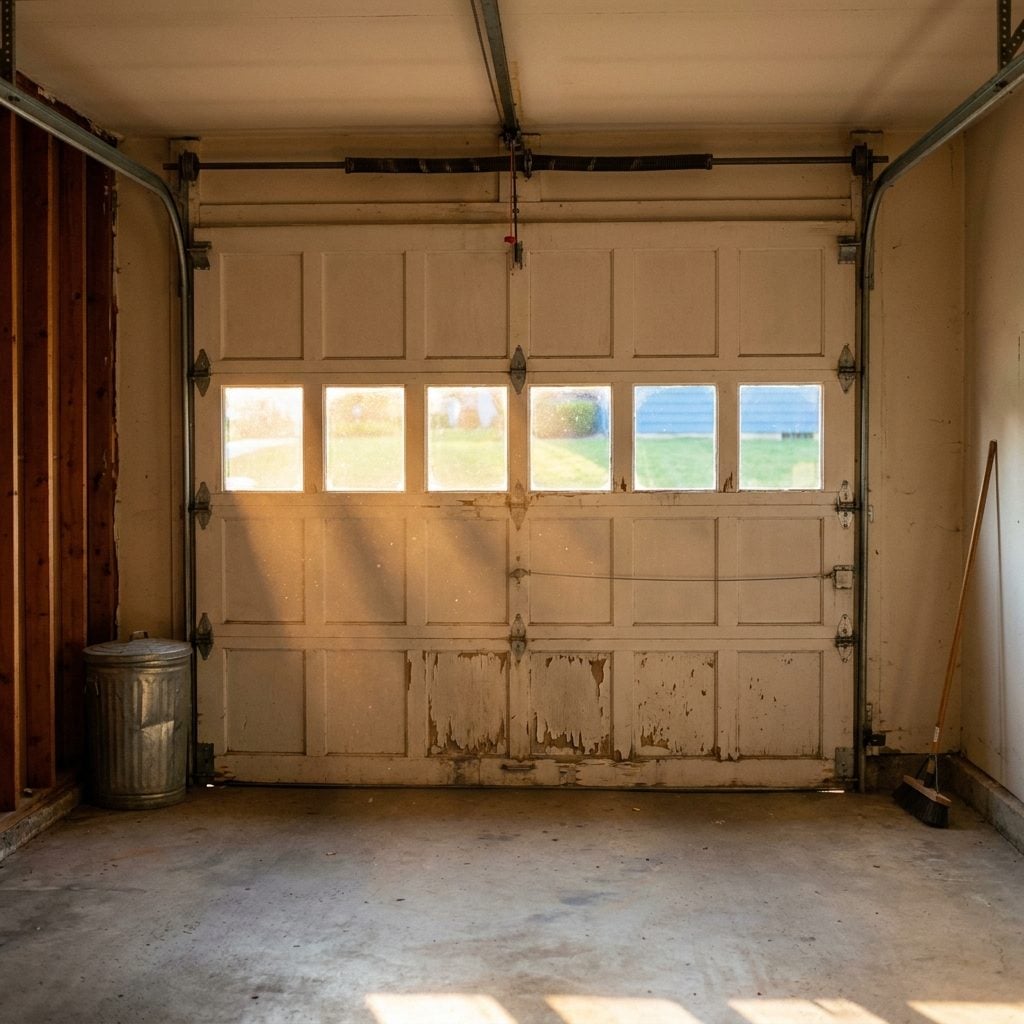
Those four or six small rectangular panes near the top of the door were a design signature no one ever questioned. They let just enough daylight into the garage to find the rake without flipping the overhead bulb, and from outside they gave the door a face. Kids pressed their noses to the glass trying to see if the car was home, which meant someone else was home, which meant you could go inside and raid the fridge.
The doors themselves were heavy. Solid wood sections, usually fir or cedar, connected by steel hinges and riding on a track system that groaned on cold mornings. Paint peeled on the bottom panels first because that’s where the splash-back from rain hit hardest. You could always tell how long a family had lived in a house by the condition of those lower panels.
Cross-Buck and Carriage-Style Door Panels That Made Your Garage Look Like a Colonial Stable
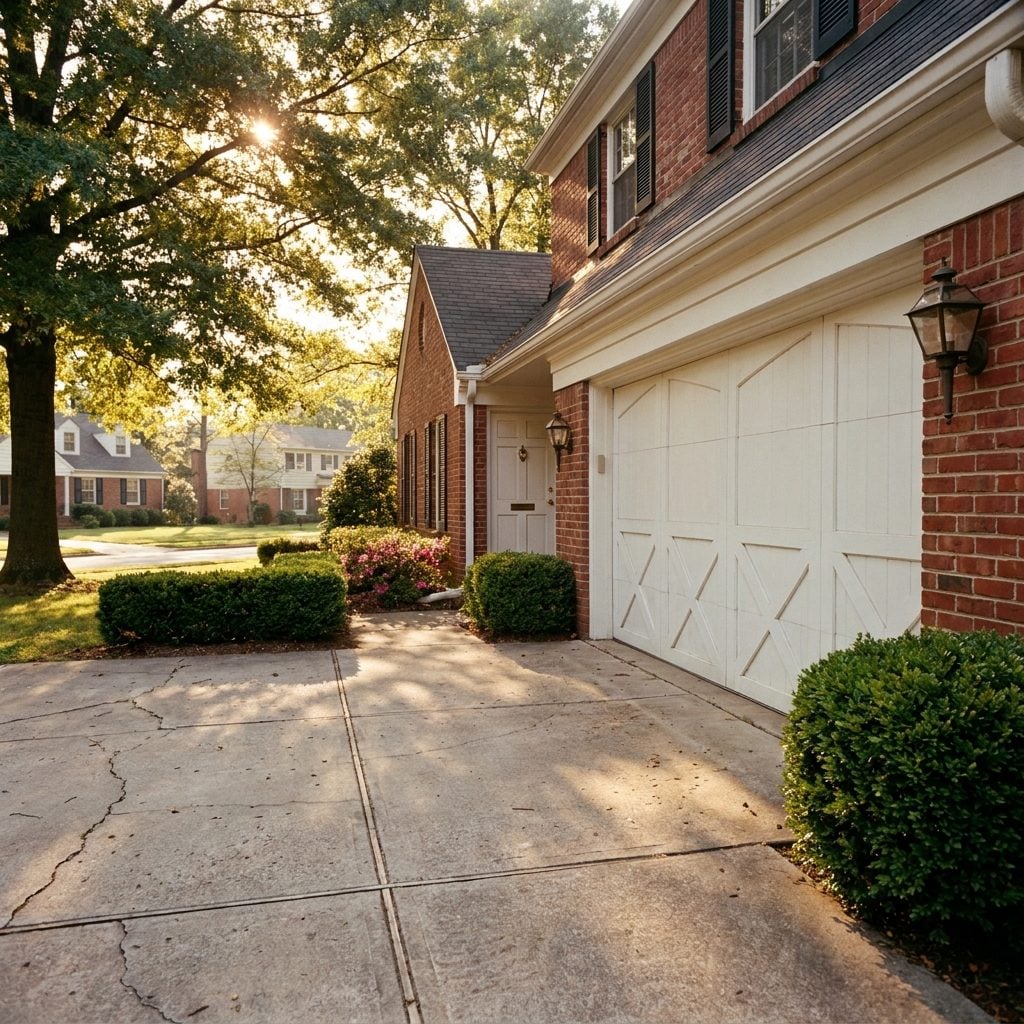
Nothing said “we chose the Colonial model” quite like a garage door with decorative X-pattern cross-bucks stamped into each panel. The logic was straightforward: if the front door had brass hardware and the shutters were painted black, the garage door needed to play along. So manufacturers obliged with panels that mimicked carriage house doors, complete with scalloped edges, raised panels, and sometimes arched top sections on the fancier models.
Ranch homes got the simpler horizontal plank look. Colonial Revivals got the cross-bucks. The occasional Cape Cod got scalloped panels that matched the decorative shutters. It was all theater, of course. These were standard overhead doors dressed up with applied trim. But the commitment to the bit was genuine. Homeowners in the ’60s wanted their country garage decor to tell a coherent story from the mailbox to the last garage panel.
Those Wrought-Iron Strap Hinges and Fake Handles That Fooled Absolutely Nobody
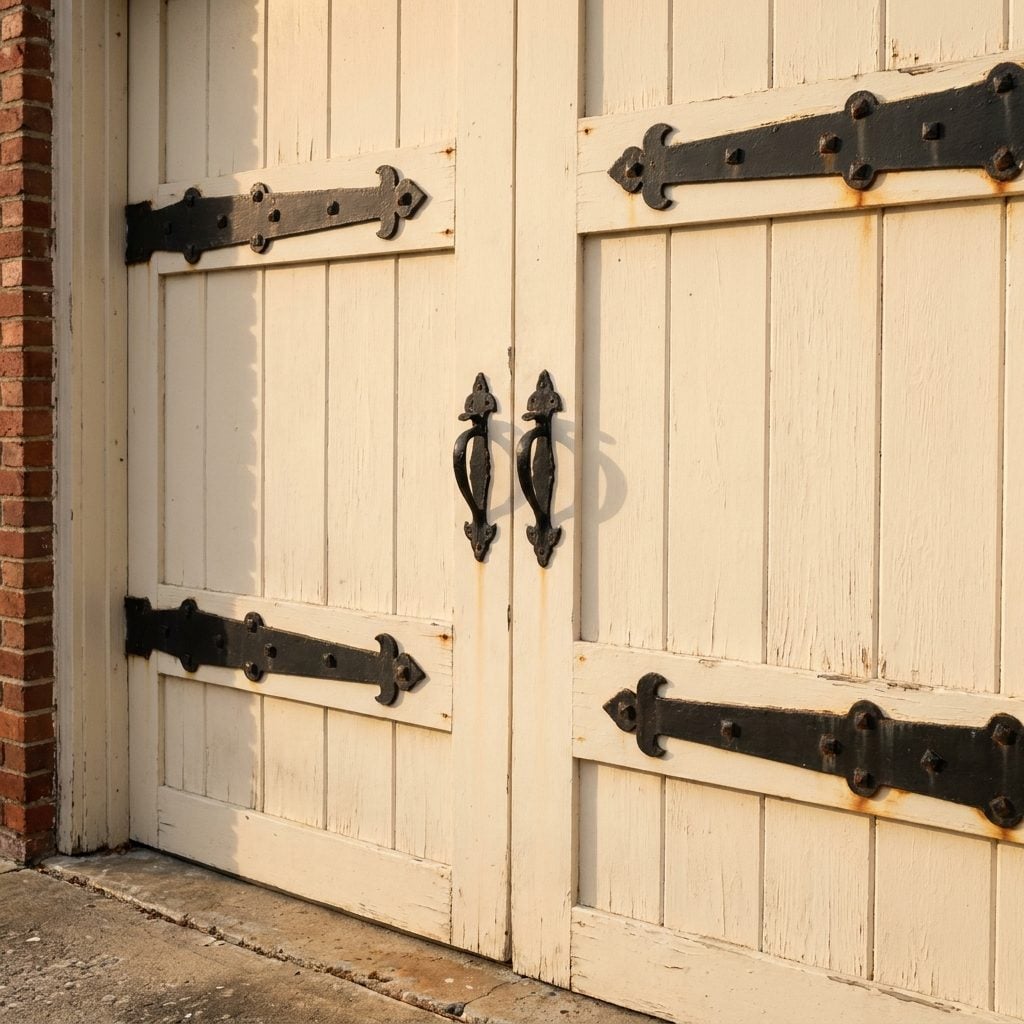
They were bolted right onto the face of a standard overhead door. Two long decorative strap hinges on each panel and a pair of handles in the center that didn’t actually open anything. Pure ornament. Everyone knew the door rolled up on tracks, but the hardware insisted it swung open like a barn.
The funny thing is they worked anyway. A plain flush garage door looked naked without them. The iron was usually cast aluminum painted flat black, lightweight enough that it didn’t affect the door’s balance on its springs. Hardware stores sold them in blister packs for a few dollars. Installation took twenty minutes and a drill. The result was instant “character,” or at least the suburban consensus version of it.
Manual Garage Doors with Chrome Handles You Had to Muscle Open Every Single Morning
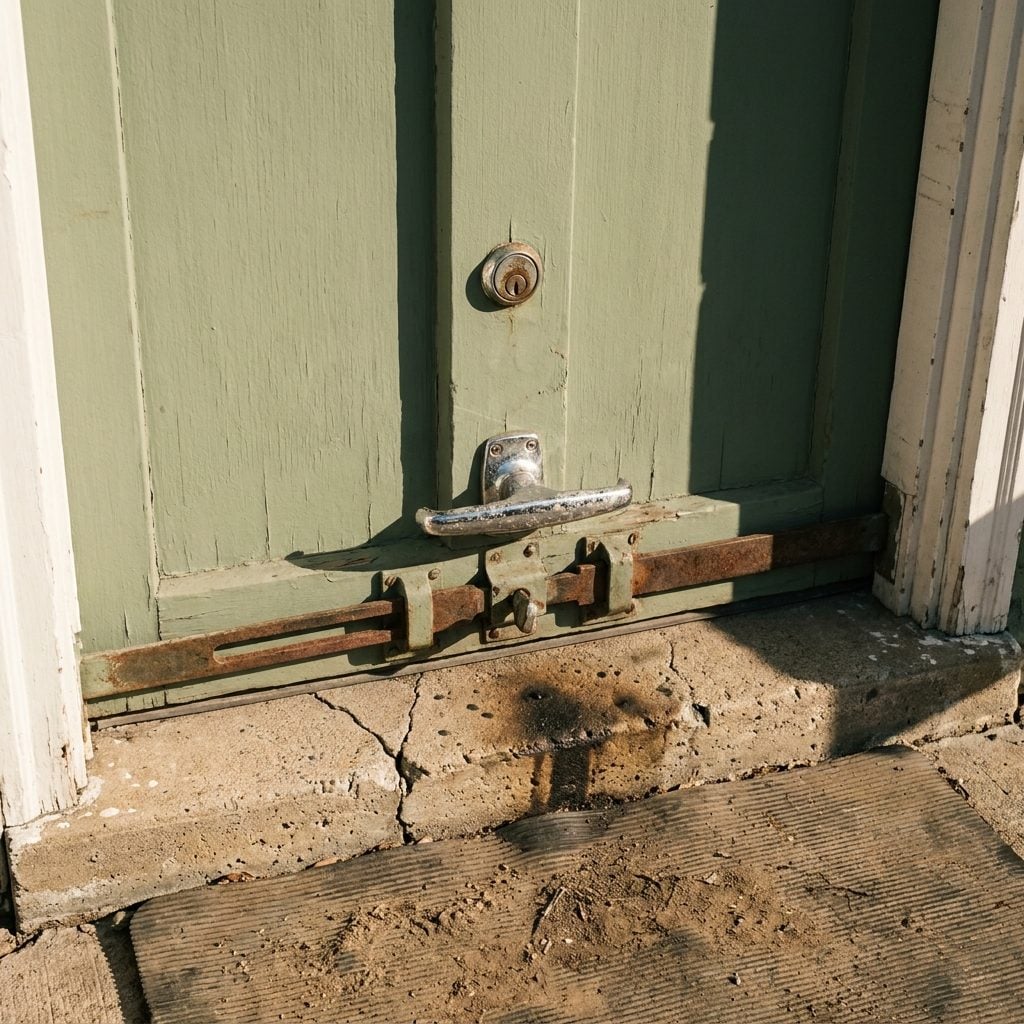
Before the button on the visor, there was the handle. A T-shaped chrome grip at the bottom center of the door that you grabbed, twisted to release the latch, and heaved upward with your whole body. The door fought you on cold mornings when the springs were stiff and the tracks were dry. It rattled going up. It rattled coming down. The whole neighborhood could hear you leaving for work.
A visible lock mechanism sat just above the handle, usually a keyed cylinder that slid a pair of horizontal bars into tracks on either side. Losing that key was a genuine household crisis. The lock was your only security, and the doors were flimsy enough that a determined teenager could bow the panels inward with a pry bar. But nobody thought about that much. It was the ’60s, and half the garages on the block were left open all day anyway.
The First Aluminum and Steel Garage Doors That Promised You’d Never Paint Again
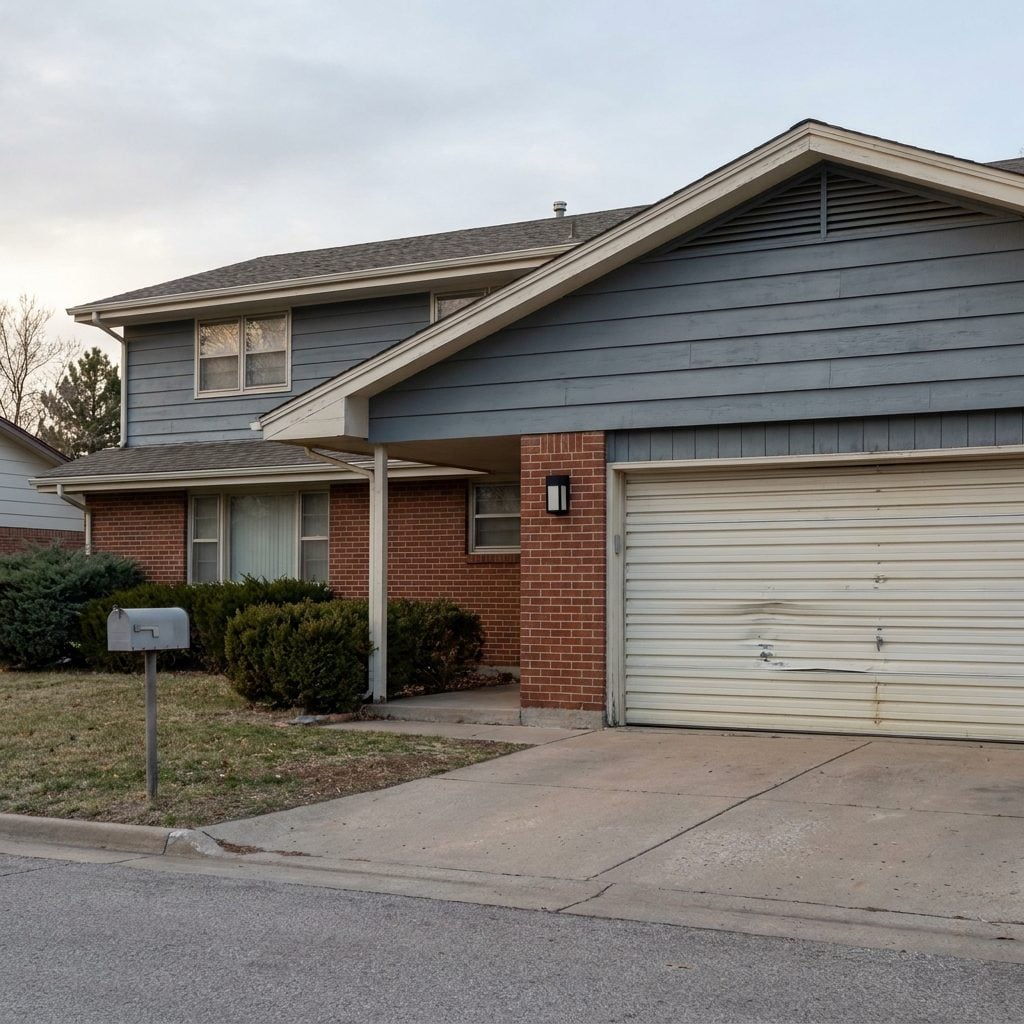
They showed up mid-decade in builder catalogs with a pitch that was almost too good: no more scraping, no more priming, no more weekend paint jobs. Early aluminum doors were lightweight, sometimes comically so. A strong gust could make them flex and boom like a timpani drum. Steel versions had more heft but brought their own problems. Scratches turned to rust spots within a season if you didn’t catch them.
The finish options were limited. White. Off-white. Occasionally a factory-applied bronze or green that faded fast. But people bought them anyway because the alternative was repainting wood doors every three to four years in whatever color was slowly chalking off. The aesthetic was utilitarian at best. No one called these doors attractive. They were a concession to practicality, a sign that the traditional garage was starting to value convenience over character.
First-Generation Automatic Openers: The Genie on the Ceiling That Changed Everything
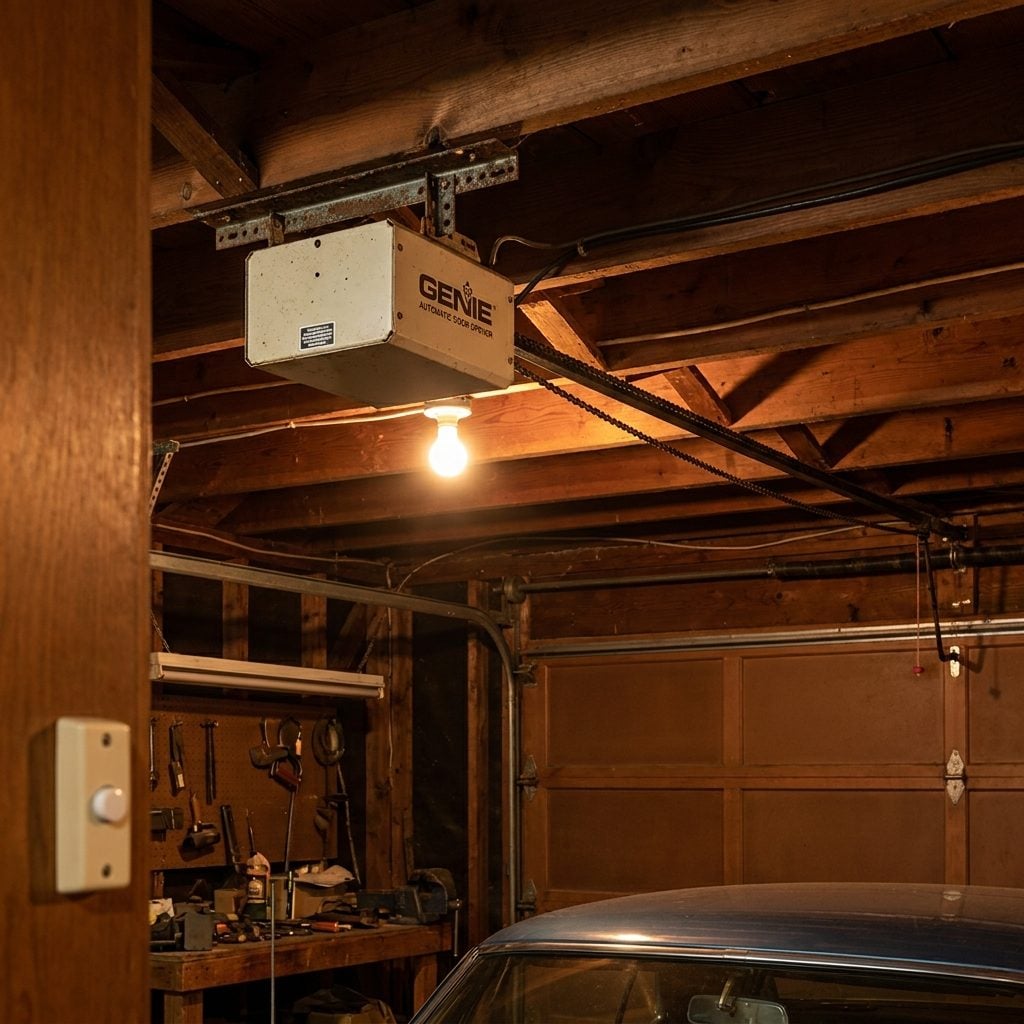
If your neighbor had one, you knew about it. The motor unit hung from the ceiling like a small torpedo, connected to the door by a chain drive that sounded like a bicycle being dragged over gravel. The Genie was the brand name that stuck, though Alliance and Overhead Door made competing units. A bulky transmitter clipped to the sun visor, and you pressed the button from the driveway while the whole contraption lurched to life above you.
These were upscale accessories in the early ’60s, costing the equivalent of $500-700 in today’s money. The radio frequencies were laughably unsecured. Your opener might trigger your neighbor’s door, or vice versa. The safety features were nonexistent by modern standards: if something was in the door’s path, the door won that argument.
But the magic of pulling into your driveway and watching the door rise without leaving the car? That was genuinely futuristic. It changed the entire ritual of coming home.
The Single-Car Garage Where Your Dad’s Impala Barely Fit with Both Mirrors Intact
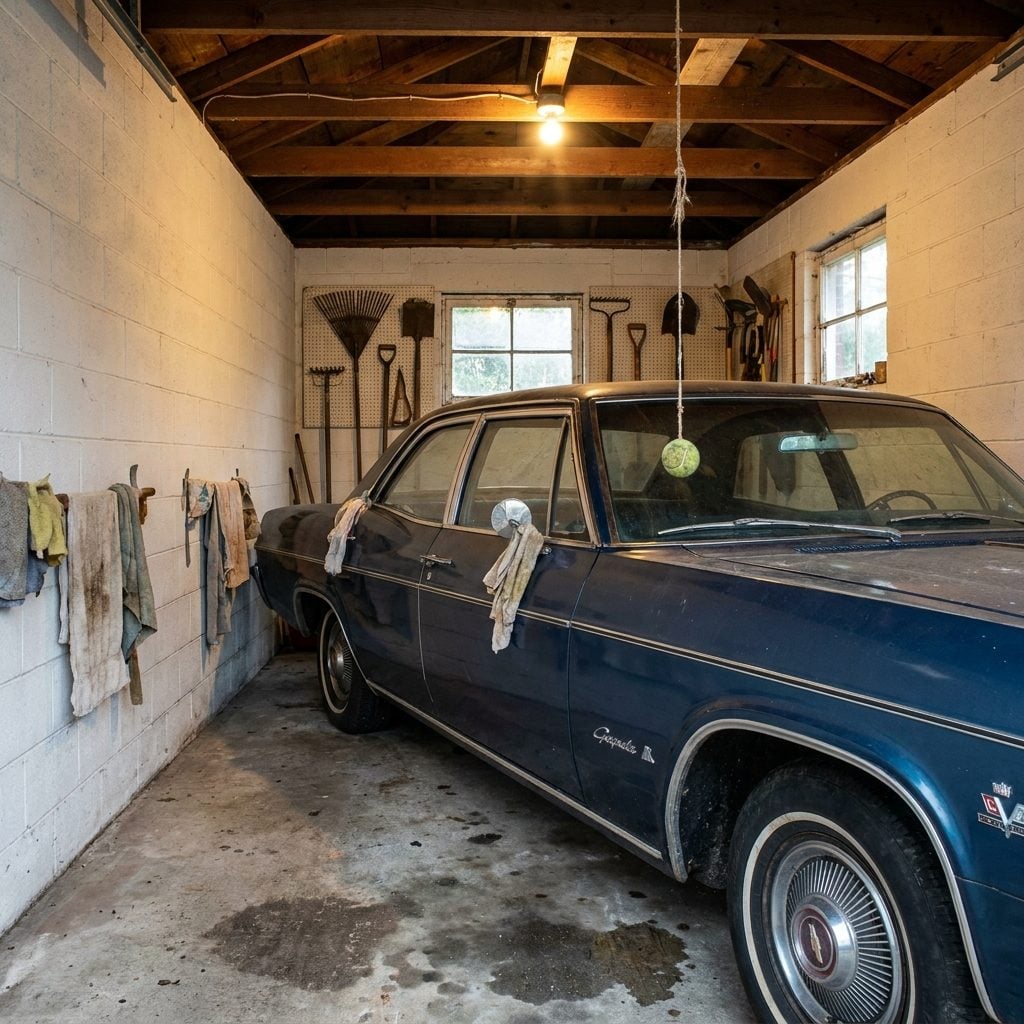
Eight feet wide. That was the standard interior width. A 1965 Impala was six and a half feet across the mirrors. Do the math: nine inches of clearance on each side, assuming you drove a perfectly straight line and didn’t breathe. Tennis balls hung from the ceiling on strings to tell you when to stop pulling forward. Felt pads or old towels were taped to the walls at door-handle height to cushion the inevitable.
The older neighborhoods kept these garages well into the ’70s and beyond. Nobody was tearing them down. You just learned to fold in the side mirror before pulling in, to open the car door six inches and squeeze out sideways, and to never, ever let your kids open the passenger side while parked inside.
Country Squires, Impalas, and Galaxies: When the Car Was the Garage’s Real Furniture
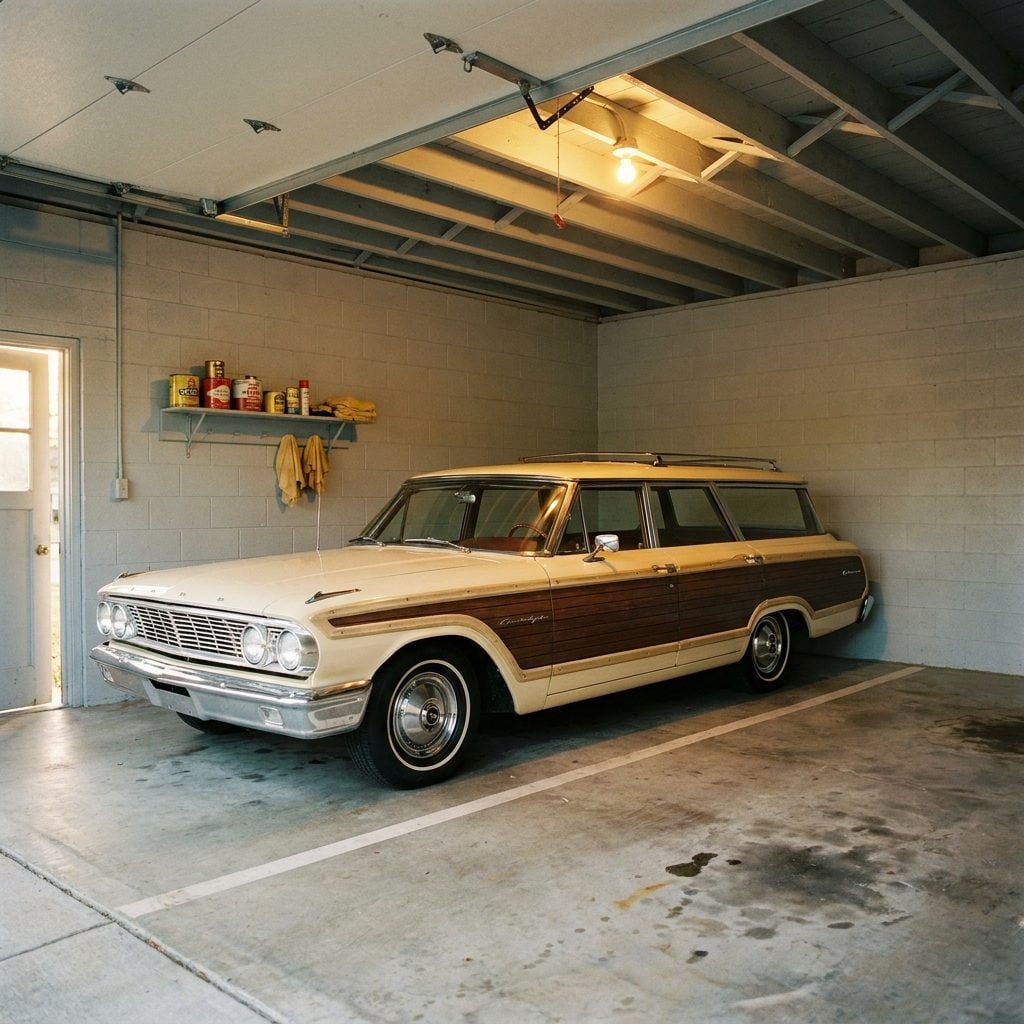
Forget the workbench. The real centerpiece of a 1960s garage was seventeen feet of chrome, steel, and two-tone paint. A Ford Country Squire wagon with fake wood paneling took up more visual real estate than the house’s living room furniture combined. A Chevy Impala in Ermine White sat there gleaming under the bare bulb like a showroom piece nobody roped off.
These cars defined the scale of everything around them. Garages were built for them. Driveways were poured for them. The width of the street, the turning radius of the cul-de-sac, the distance between the curb and the front door: all calibrated to the dimensions of a full-size American sedan.
The 1960s garage wasn’t a room that happened to hold a car. It was a car that happened to have a room built around it.
The Unpainted Concrete Floor Wearing Every Oil Drip Like a Permanent Diary
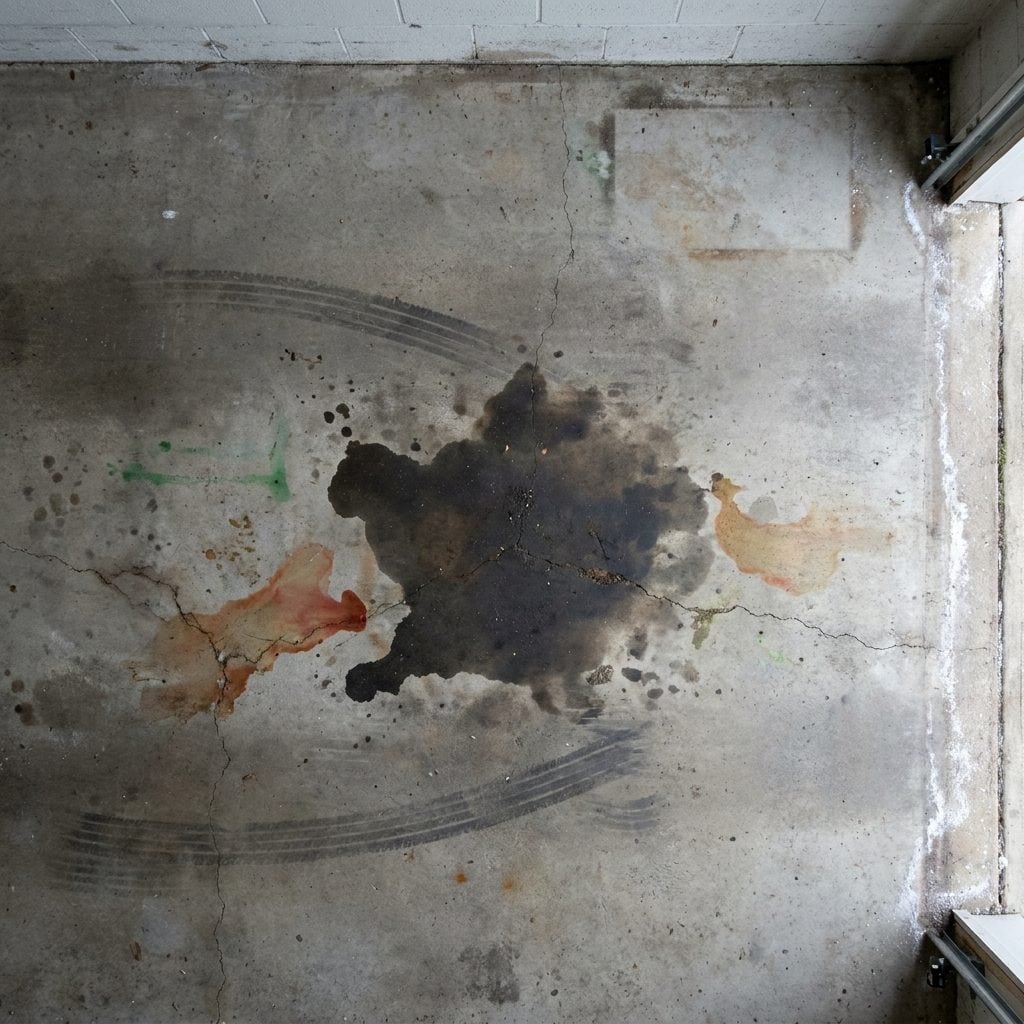
Nobody sealed it. Nobody coated it with epoxy. The concrete was poured, troweled flat (mostly), and left raw for the next thirty years to absorb whatever landed on it. Within a year, the floor had a dark bloom right where the engine block sat. By five years, you could read the parking habits of every car the family ever owned in overlapping stains of motor oil, transmission fluid, and antifreeze.
The stains had a geography. The darkest spot was always slightly left of center, under the oil pan. Lighter halos radiated outward. Tire marks traced the same arc from the driveway to the final resting position. In winter, road salt left white crystalline residue in twin tracks. That concrete was a record of domestic life as honest as anything inside the house.
The Attached Two-Car Garage That Quietly Replaced Every Detached Garage on the Block
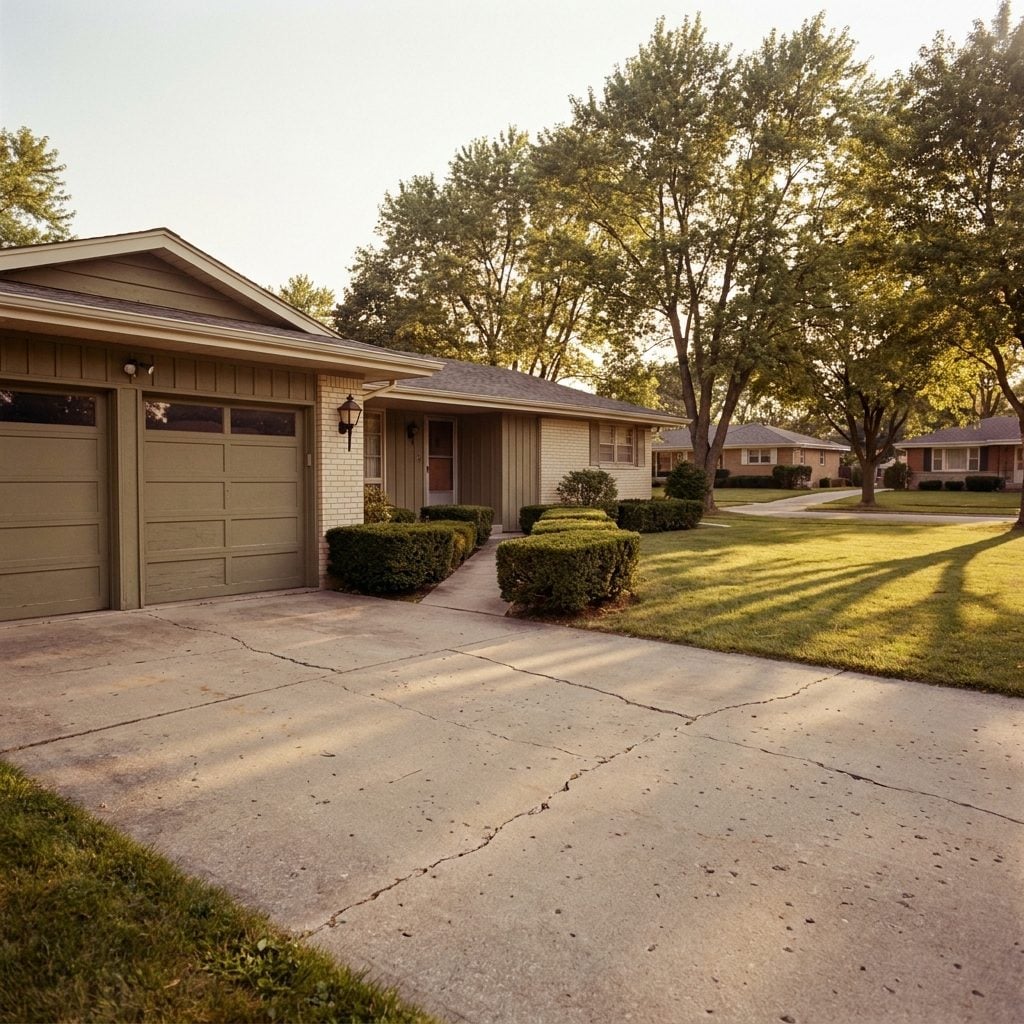
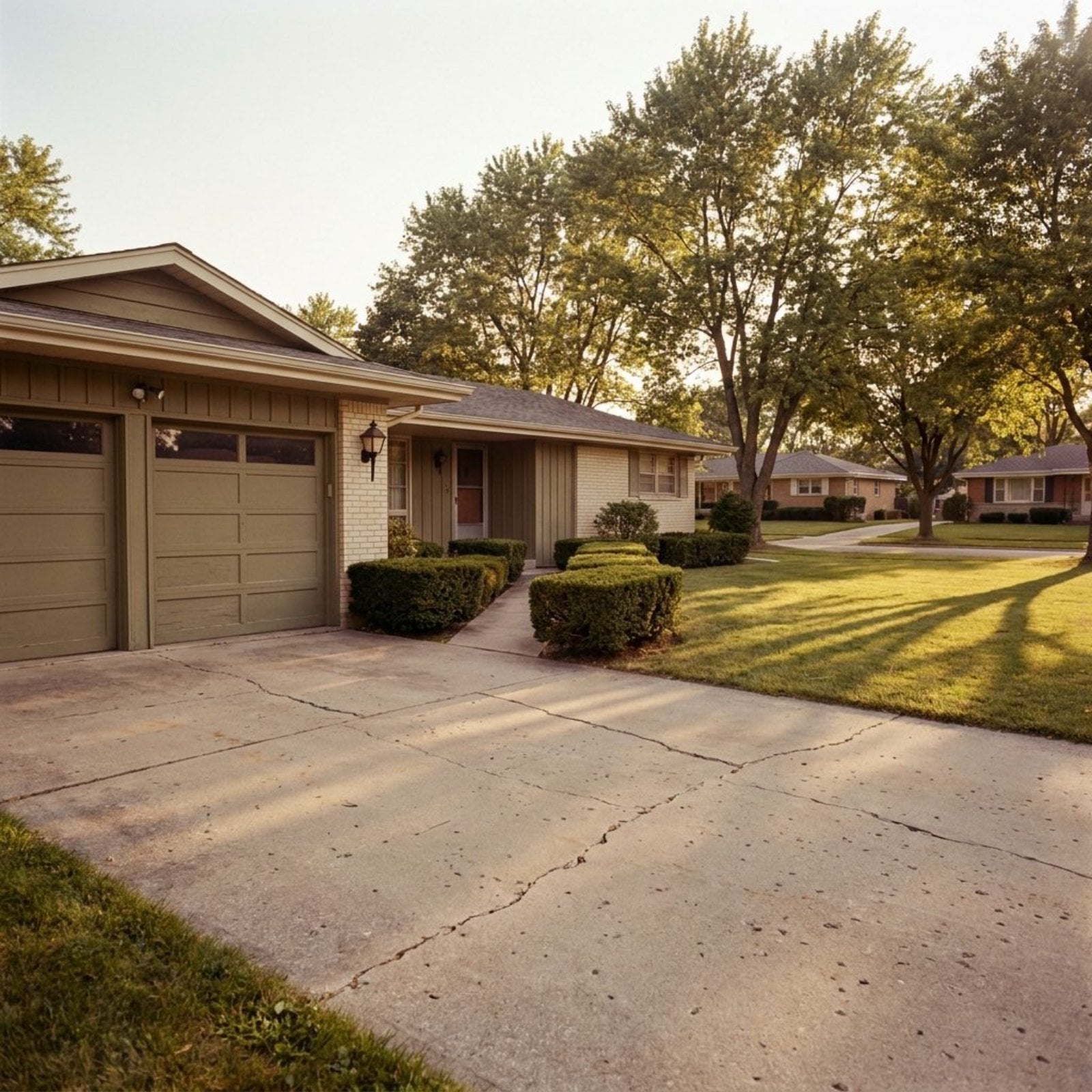
This was the decade the garage stopped being a separate building at the back of the lot and fused itself to the house like a Siamese twin. Developers figured out that an attached two-car garage made the house look bigger from the curb, cut construction costs, and gave Dad a way to get from the car to the kitchen without getting rained on. By 1965, the attached garage was eating up a third of the home’s front elevation in new subdivisions from Levittown to Lakewood.
The shift changed how entire neighborhoods looked. Suddenly the garage door was the most prominent architectural feature on the street, not the front porch. Driveways widened. Front yards shrank. The house became, in a very real sense, a building designed around the automobile. Ranch homes and split-levels made it work by stretching the roofline across the garage, integrating it into one long, low silhouette that read as pure postwar confidence. You can trace a straight line from this home trends shift to the garage-forward McMansions of the ’90s.
The Oil Drip Pan (or the Sheet of Cardboard, or the Pile of Kitty Litter) Under the Engine
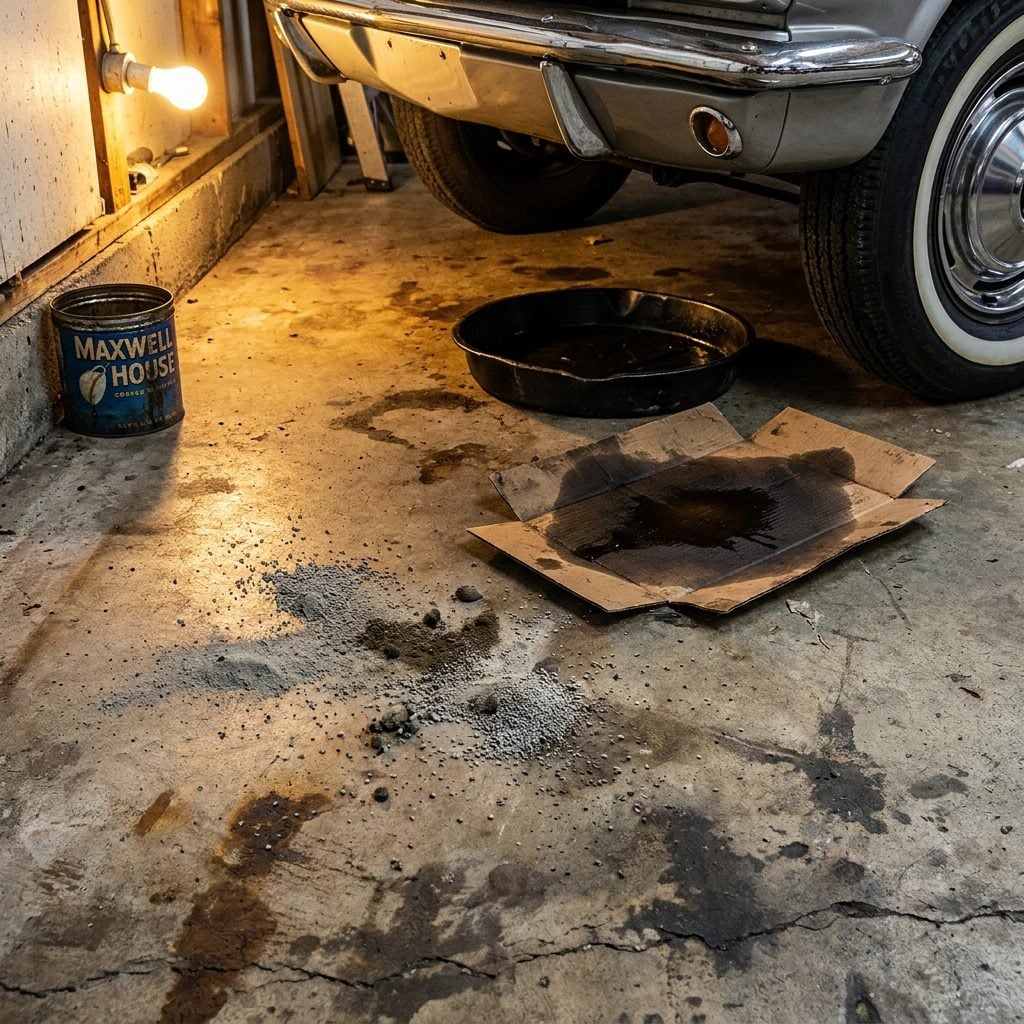
Every family had their method. The fastidious types used a proper metal oil drip pan, a shallow black rectangle slid beneath the engine like a surgical instrument. Everyone else used a flattened cardboard box. The appliance box from the new Frigidaire got a second life on the garage floor, darkening slowly from the center outward until it was saturated and replaced.
Then there was the kitty litter contingent. Clay granules dumped in a rough pile under the leak, left to absorb whatever dripped overnight. You’d sweep it up when the pile turned dark and dump a fresh mound. The garage always smelled faintly of petroleum and mineral dust. It was a perfectly acceptable system. Nobody felt bad about it. Cars leaked. You managed the leak. That was the deal.
Exposed Ceiling Rafters and Open Joists: The Garage That Never Got Finished (and Never Needed To)
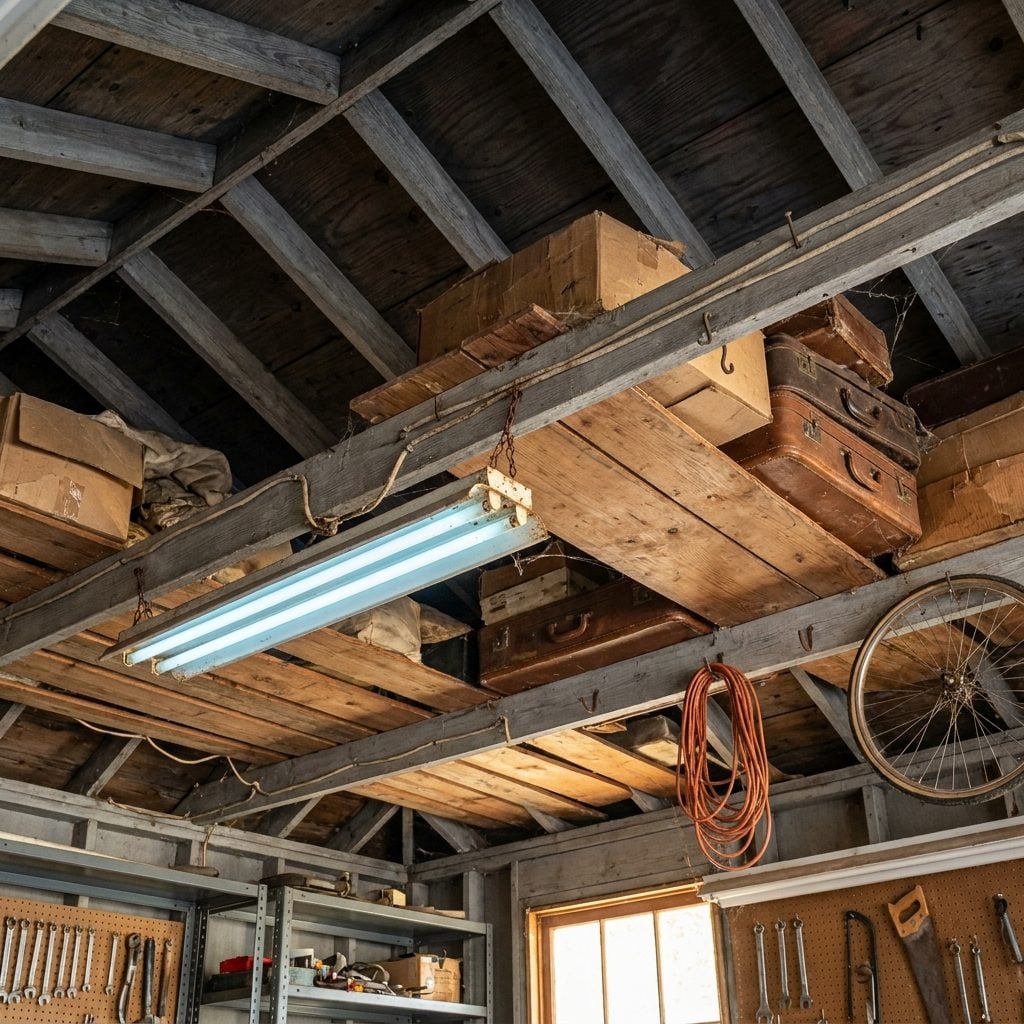
Look up in any 1960s garage and you saw the bones of the house. Raw 2×6 or 2×8 joists spanning the width, maybe a sheet of plywood laid across a few for overhead storage, cobwebs connecting everything like load-bearing lace. No drywall. No insulation. The nails poking through the roof sheathing above were visible and sometimes rusty.
This wasn’t a renovation waiting to happen. It was just how garages were. Finishing the ceiling meant spending money on a space where you parked the car and kept the lawn mower. The exposed framing actually served homeowners well: nails driven into joists held extension cords, hung bicycle wheels, and supported crude lumber racks. People suspended fluorescent shop lights from chains hooked over the joists. Everything had a place because every beam was a potential mounting point.
The look has come full circle, of course. Exposed joists and open ceilings are now a deliberate design choice in loft conversions and art deco garage renovations. What was once just “unfinished” is now “industrial chic.” The 1960s garage got there first by accident.
The Built-In Workbench with a Bench Vise That Could Crush a Walnut (or Your Finger)
🔥 Would you like to save this?
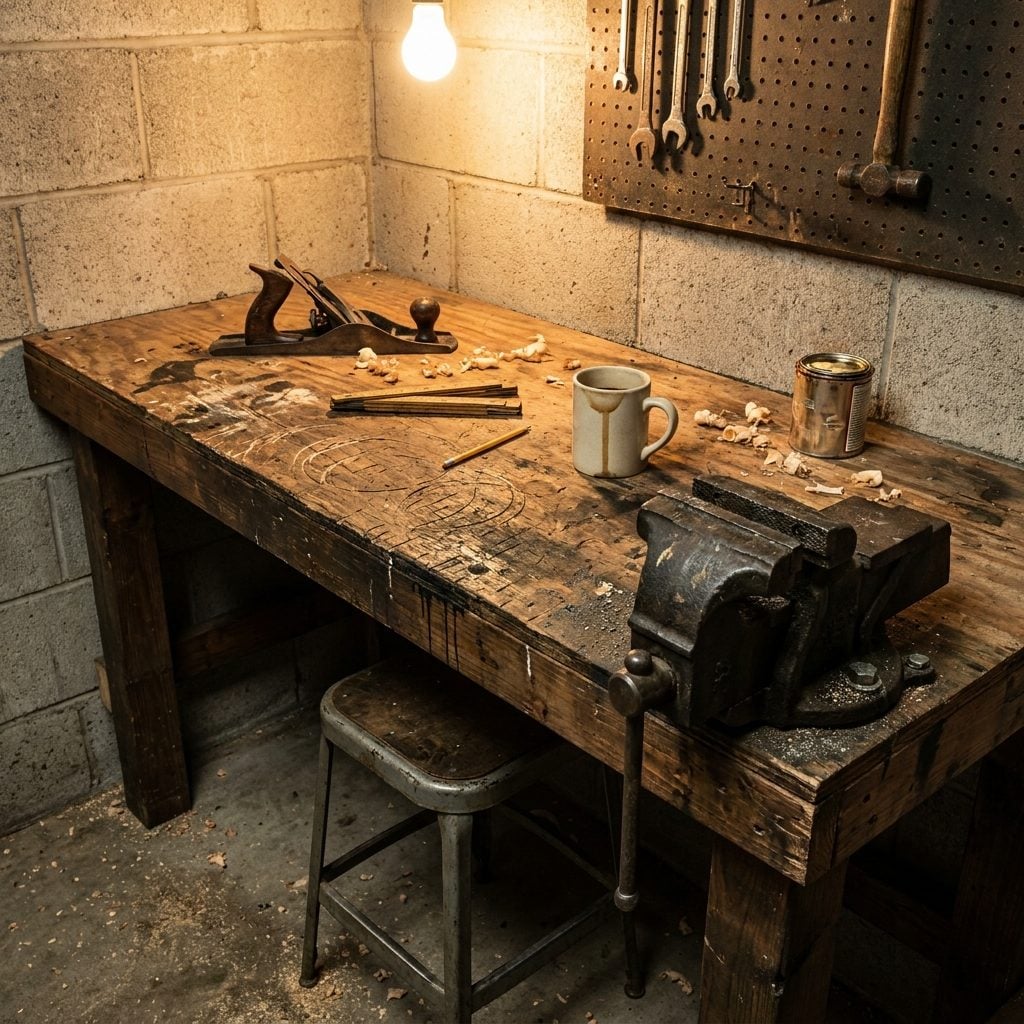
This was the altar of the American garage. Built from two-by-four framing and a slab of plywood or solid-core door blank, the 1960s workbench was permanent. Bolted to wall studs, sometimes with a sheet of Masonite on top for a smoother surface. It wasn’t going anywhere, and neither was that cast-iron bench vise mounted on the corner.
The vise was always a Record or a Columbian, its jaws scarred with file marks and stained with paint. Kids were warned about it like it was a wild animal. Dads used it for everything: holding pipe while cutting threads, clamping wood for gluing, bending sheet metal. The workbench surface itself told the story of every project, covered in circular saw marks, drill holes, dried glue, and at least one coffee ring from a ceramic coffee mug that had no business being out there.
Pegboard Walls Where Every Tool Had an Outlined Parking Spot
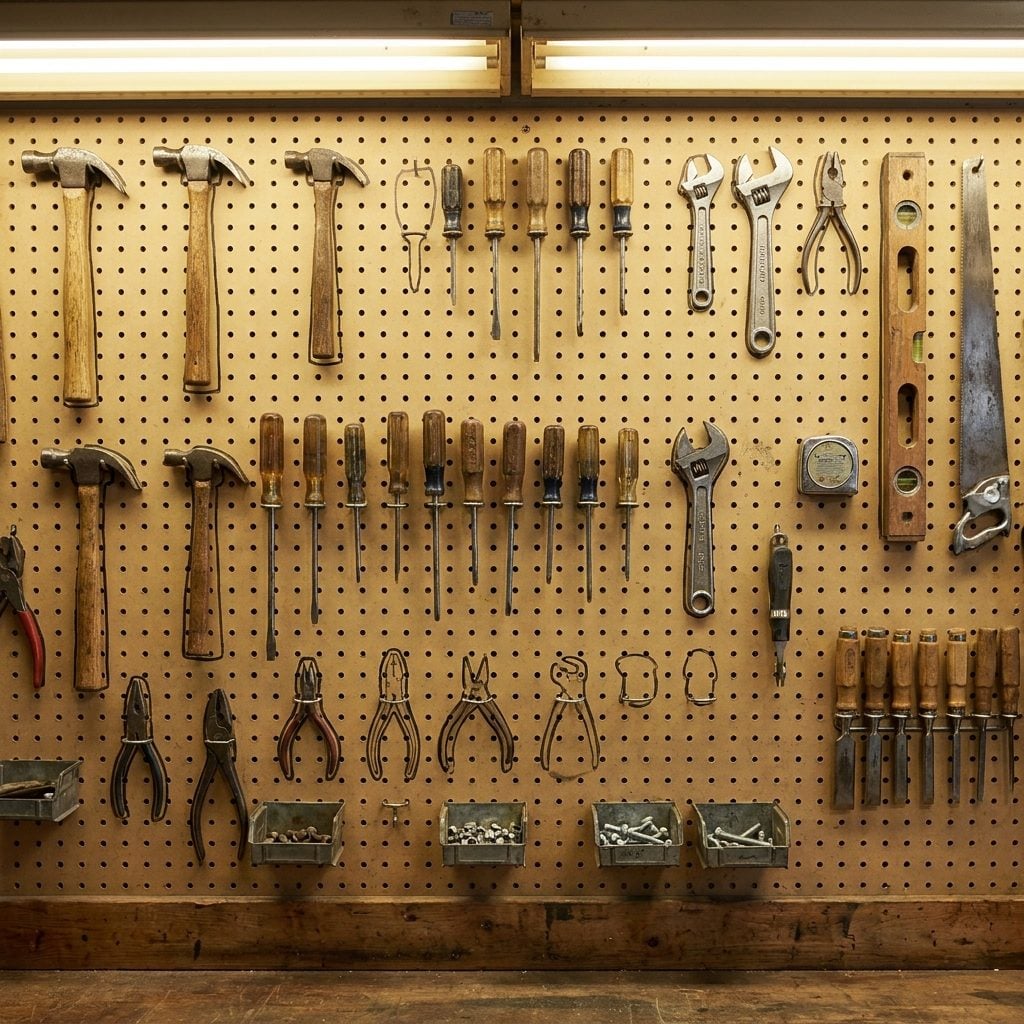
Someone in your neighborhood was this organized. Maybe it was your dad. Maybe it was the guy three houses down who also edged his lawn with scissors. Either way, the pegboard tool wall was a 1960s masterpiece of domestic order: every hammer, wrench, screwdriver, and pair of pliers hanging on its own hook, with a hand-traced outline in black marker or paint behind it so you’d know exactly where it belonged.
It was part workshop, part personality test. The outlines meant you could see at a glance what was missing, which also meant you could see who borrowed the needle-nose pliers and didn’t return them. This was household accountability, pre-digital. The boards themselves were that familiar tan or light brown Masonite with the evenly spaced holes, and they always covered at least one full wall above the workbench.
The Red Craftsman Rolling Tool Chest That Was Basically a Family Heirloom
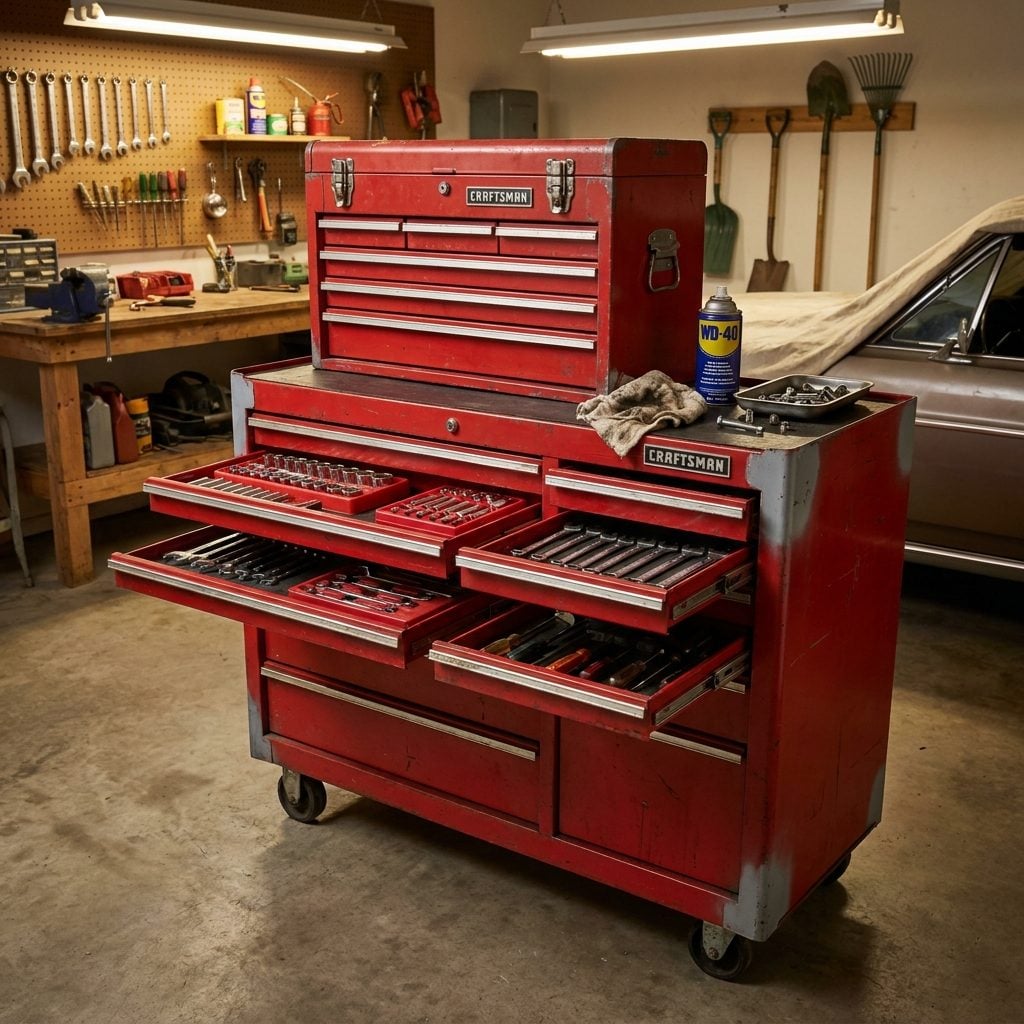
You didn’t just buy a Craftsman tool chest from Sears. You invested in it. Those red steel cabinets, with their ball-bearing drawer slides and chrome-plated handles, were the kind of purchase a man made once and expected to last forty years. Most of them did.
The top chest sat on a rolling cabinet base, and every drawer had a different purpose: the shallow top drawer for socket sets in their molded plastic trays, deeper drawers for power tool accessories, and that one bottom drawer that became a graveyard for miscellaneous parts nobody could identify but refused to throw away. The red enamel finish chipped at the corners over the years, revealing grey primer underneath. Opening those drawers had a specific sound: a smooth metallic glide followed by a satisfying click at full extension.
Sears offered a lifetime warranty on Craftsman hand tools, which meant the brand loyalty was absolute. Entire tool collections lived and grew in these chests for decades.
Coffee Cans and Mason Jars Full of Sorted Nails, Screws, and Mystery Hardware
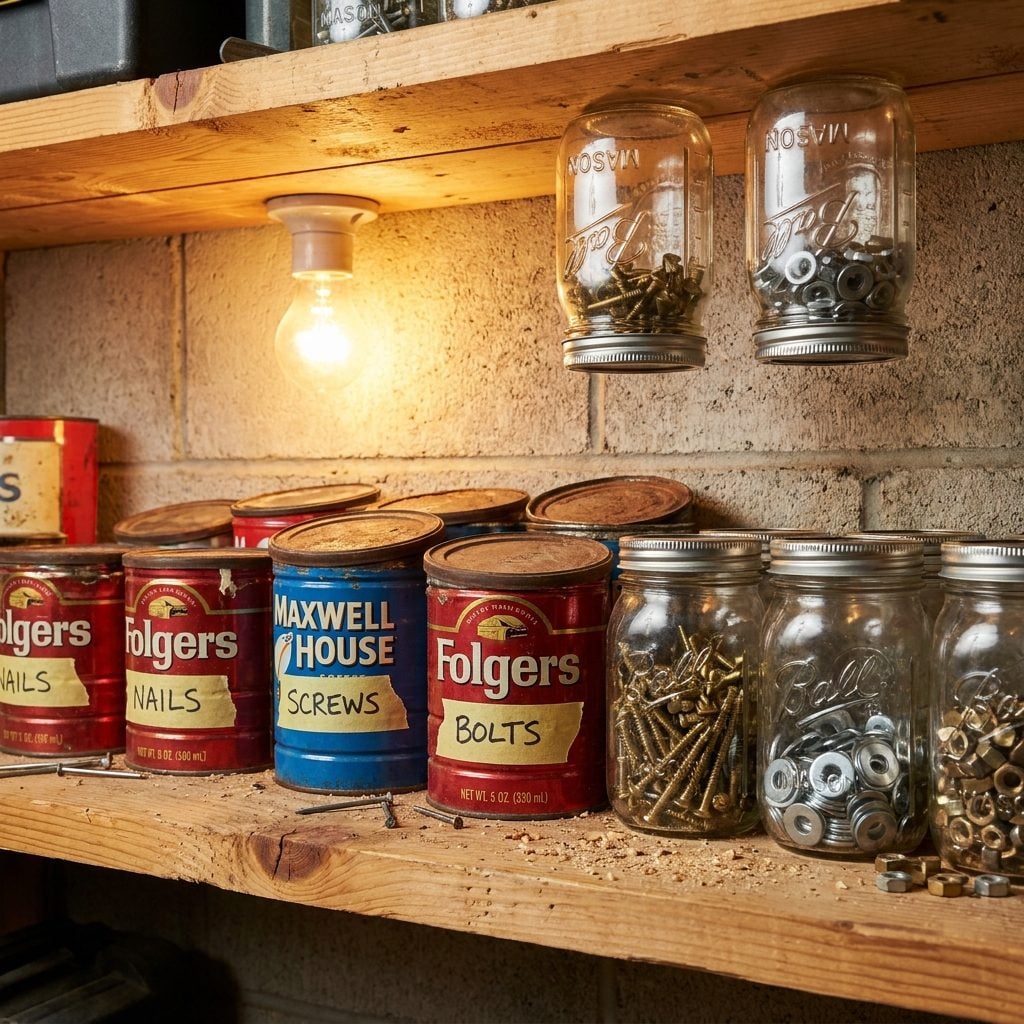
Folgers. Maxwell House. Hills Bros. The brand didn’t matter. What mattered was that every empty coffee can in a 1960s household had a second career as a hardware organizer in the garage. Nails sorted by size. Wood screws in one can, machine screws in another. Wing nuts, washers, cotter pins, and that handful of brass fittings from a plumbing job three years ago: all in their own labeled tin.
Mason jars did the same duty, sometimes nailed by their lids to the underside of a shelf so they hung upside down and you could see exactly what was inside. That was a trick everyone’s dad seemed to know independently, as if it had been passed down through some invisible network of suburban ingenuity.
Wall-Mounted Shelves Holding Every Can of Paint, Motor Oil, and Turpentine You’d Ever Need
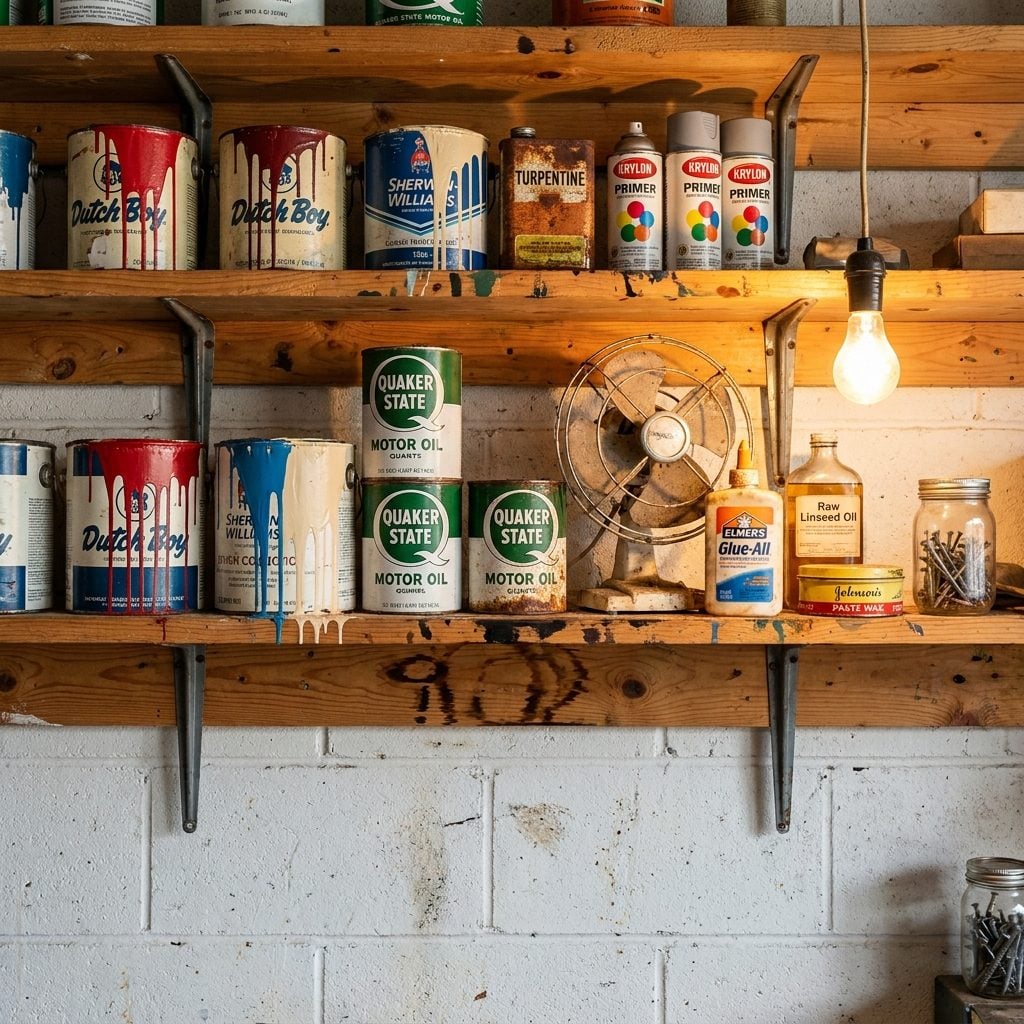
The garage shelving unit was a chemical library. Gallon cans of Dutch Boy and Sherwin-Williams latex in colors that matched rooms nobody had repainted since 1963. Quarts of Quaker State motor oil. A dented can of turpentine with a rag stuffed in the spout. Spray cans of Rust-Oleum. A half-empty bottle of Elmer’s wood glue with a permanently crusted cap.
These shelves were usually pine boards on metal brackets, screwed directly into the studs. Nothing fancy. The wood had absorbed decades of drips: white paint splatters, amber rings from oil cans, and the faint chemical smell that hit you the second you opened the garage door. It was a smell that meant Saturday projects were happening. The shelves also held things that had no business in a traditional garage: old canning jars, a broken toaster, maybe a transistor radio with a dead battery.
Fluorescent Shop Lights Humming Overhead Like a Mechanical Heartbeat
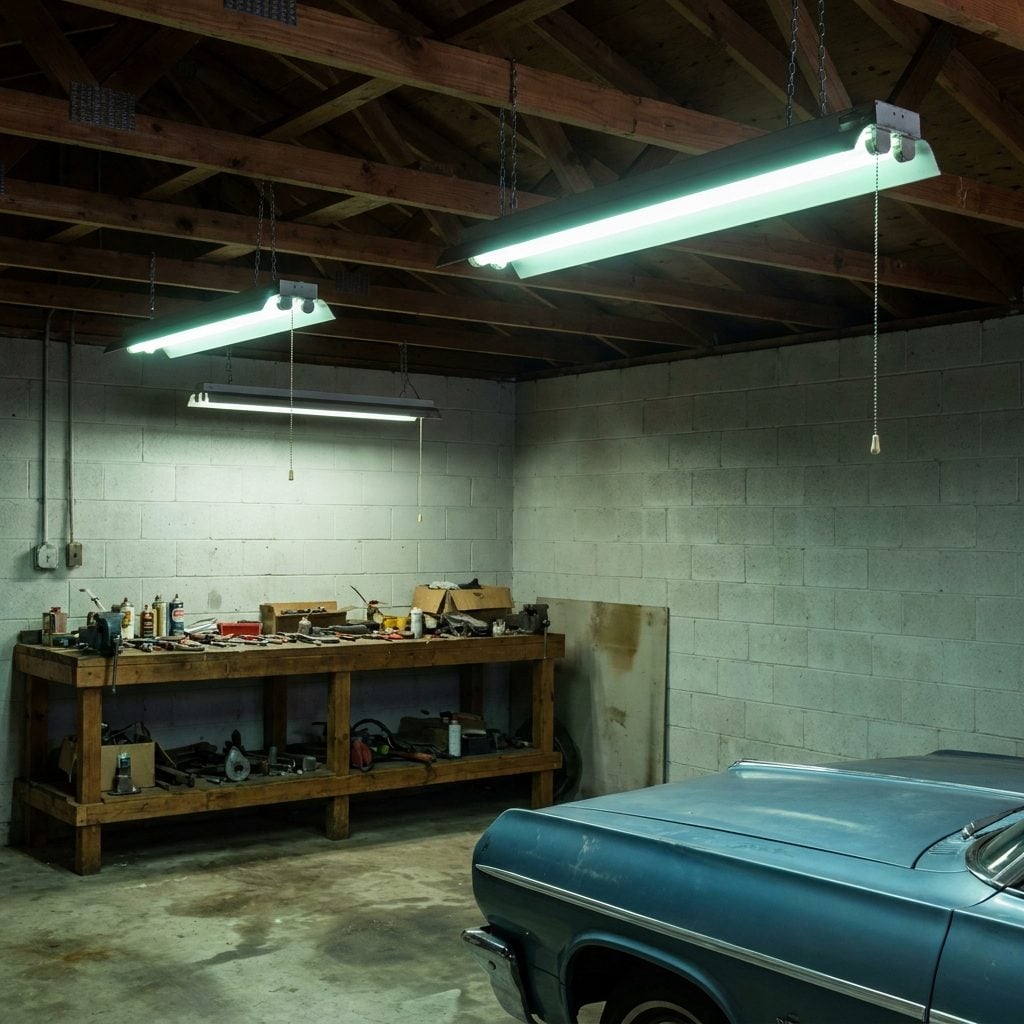
You always heard them before you saw what you were doing. That low electrical hum, the slight flicker before the tubes fully warmed up, the bluish-white wash of light that made everything look slightly clinical. Fluorescent shop lights were the upgrade that turned a dark garage into a real workspace, and by the mid-1960s, they were hanging from chains in garages all over the country.
Usually four-foot fixtures, bare tubes with no diffuser, suspended from the ceiling by short lengths of chain or wire. The light they threw was honest and unflattering. Every scratch on the car, every crack in the concrete, every cobweb in the corner was suddenly visible. That was the point. You couldn’t do detail work under a single incandescent bulb, and dads who were serious about their projects knew it.
That Single Bare Bulb with a Pull Chain, and the Shadows It Couldn’t Reach
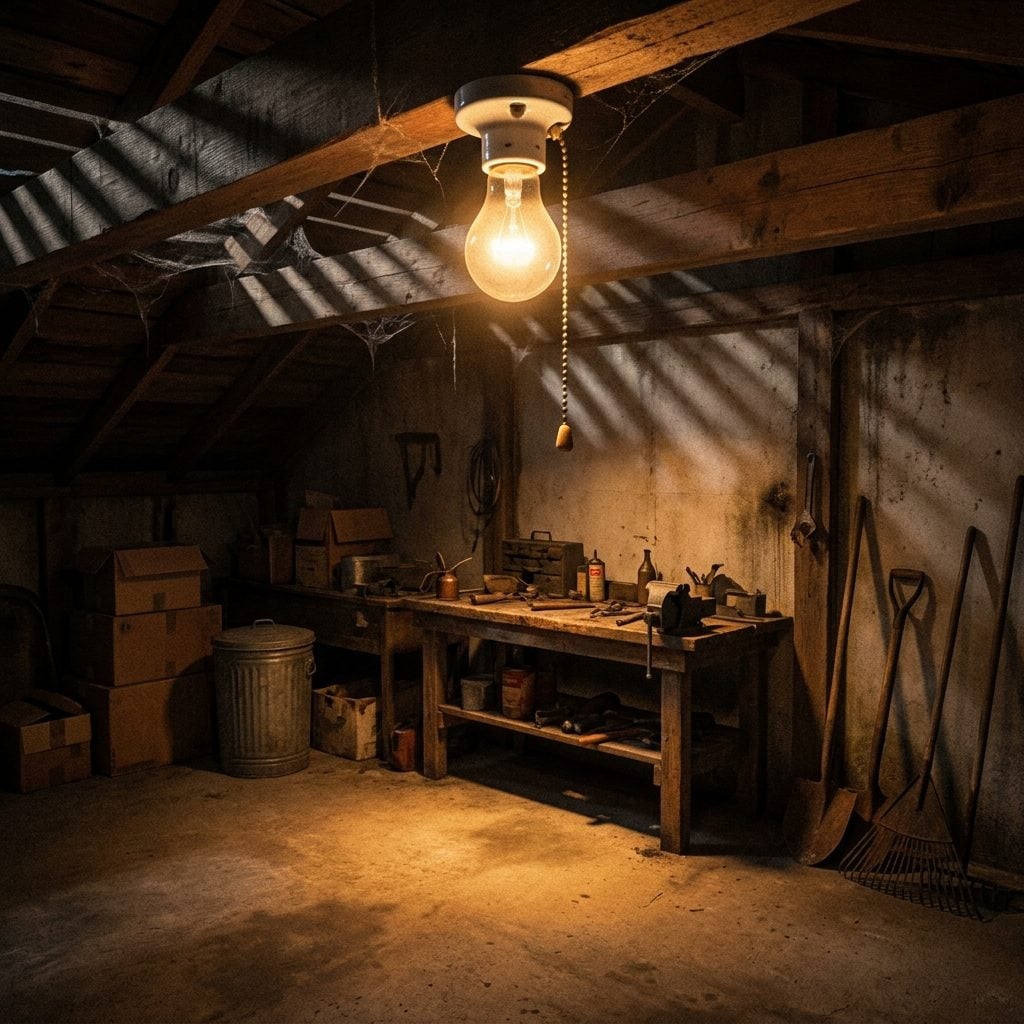
Not every garage got the fluorescent upgrade. Plenty stayed with the original builder-grade solution: one porcelain socket screwed to a ceiling joist, one bare incandescent bulb, one beaded pull chain. That was it. Your entire workspace, lit by sixty watts of warm amber light and about forty percent shadow.
Reaching for that chain in the dark was its own small ritual. You’d walk in, sweep your hand through the air until you caught the little brass bead at the end, and give it a tug. The click was satisfying. The light was not.
Extension Cords Coiled on Nails Like Bright Orange Snakes Waiting for Saturday
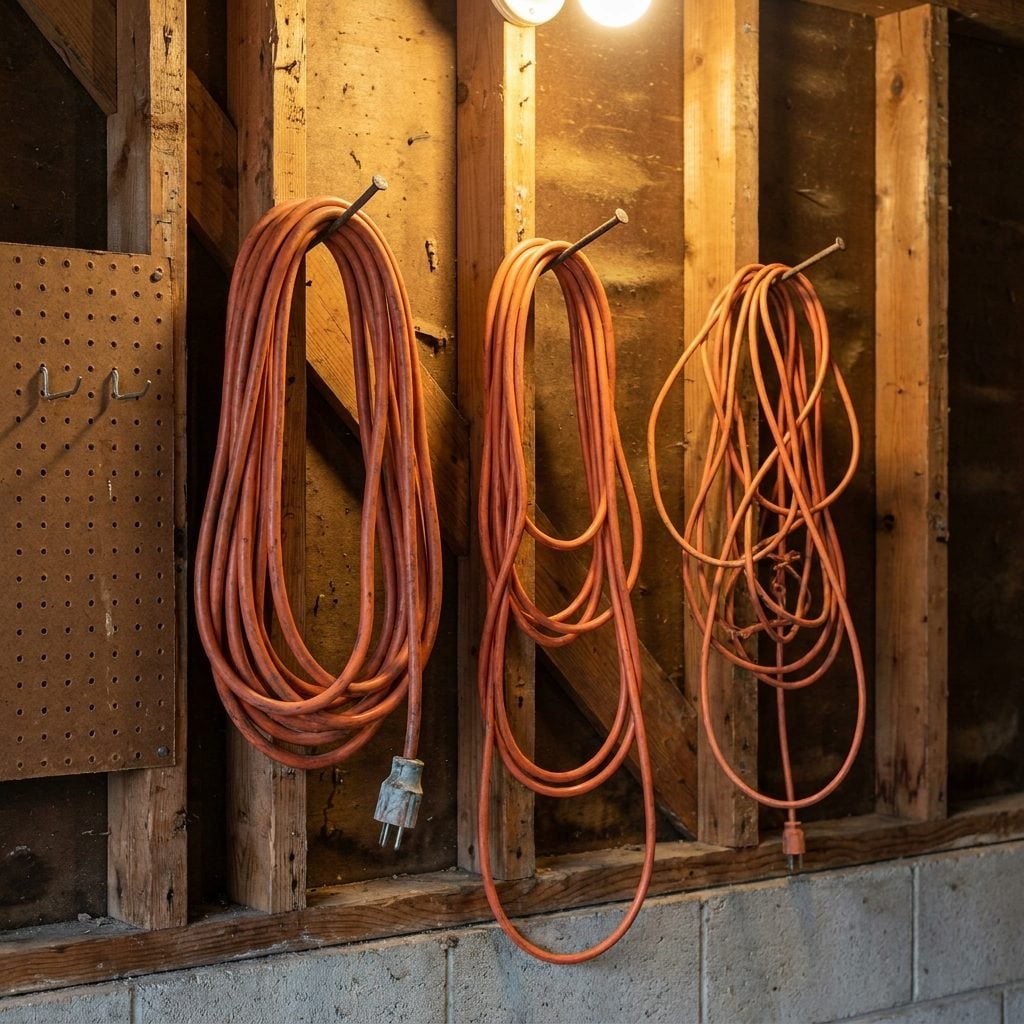
Every garage had at least three, and they were never long enough. Orange vinyl extension cords, coiled in rough loops and hung on a sixteen-penny nail driven into a wall stud. The heavier gauge ones for power tools were stiff and uncooperative, holding the shape of whatever coil they’d been forced into. The lighter ones tangled the moment you looked at them.
A Black & Decker Drill in Its Metal Case, Stored Like It Was Made of Gold
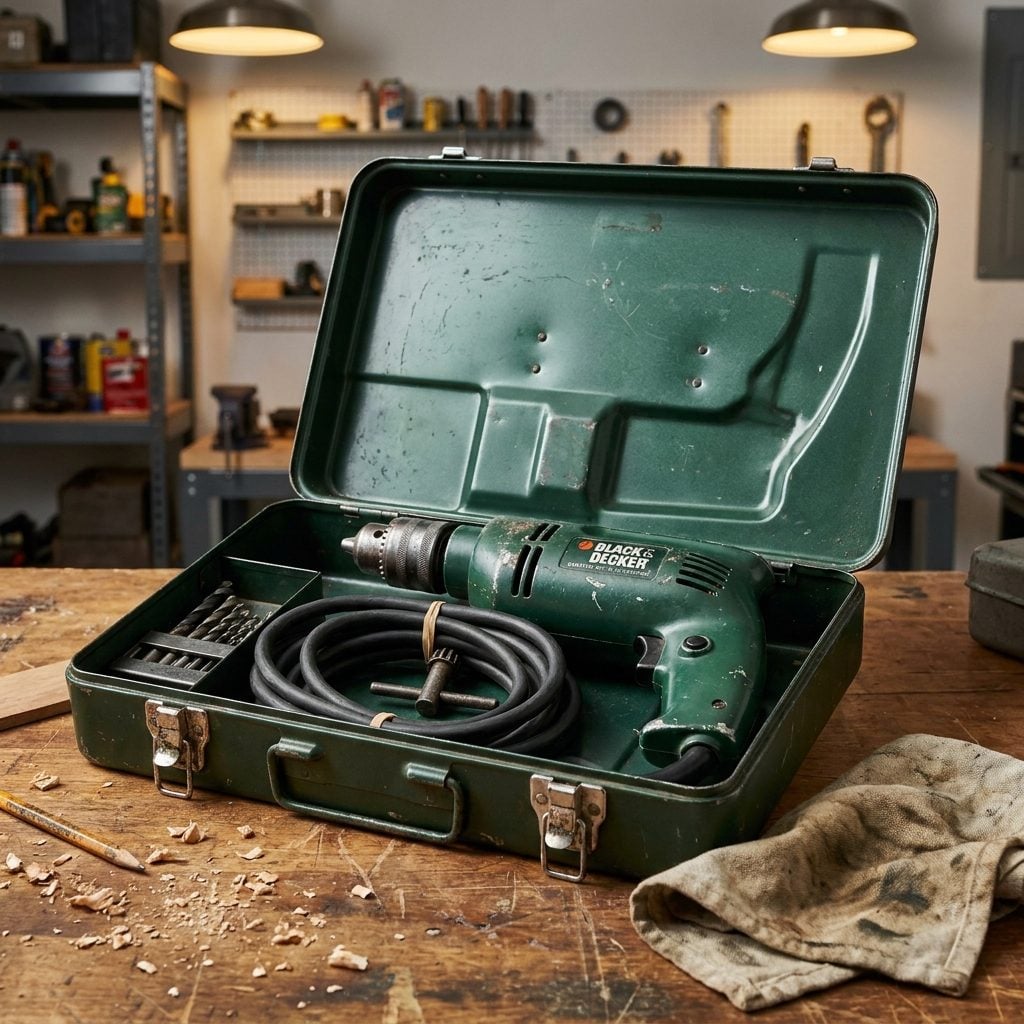
The first power tool most families owned was the electric drill, and in the 1960s, Black & Decker owned that market. Their quarter-inch models came in fitted metal carrying cases, dark green or grey, with a latching lid and a molded interior that held the drill and a small set of bits. Owning one felt significant.
These weren’t cordless. A thick rubber power cord wound around the body, and you plugged it into one of those orange extension cords from the nail on the wall. The trigger had a satisfying mechanical resistance. The chuck required a key, which was either attached to the cord with a rubber band or permanently lost. There was no variable speed on the early models. You got one speed: fast.
Dads kept these cases on the workbench shelf or in a specific spot that everyone in the house knew. Borrowing it without asking was a genuine domestic offense.
The Transistor Radio on the Workbench, Tuned to the Ball Game or AM Talk
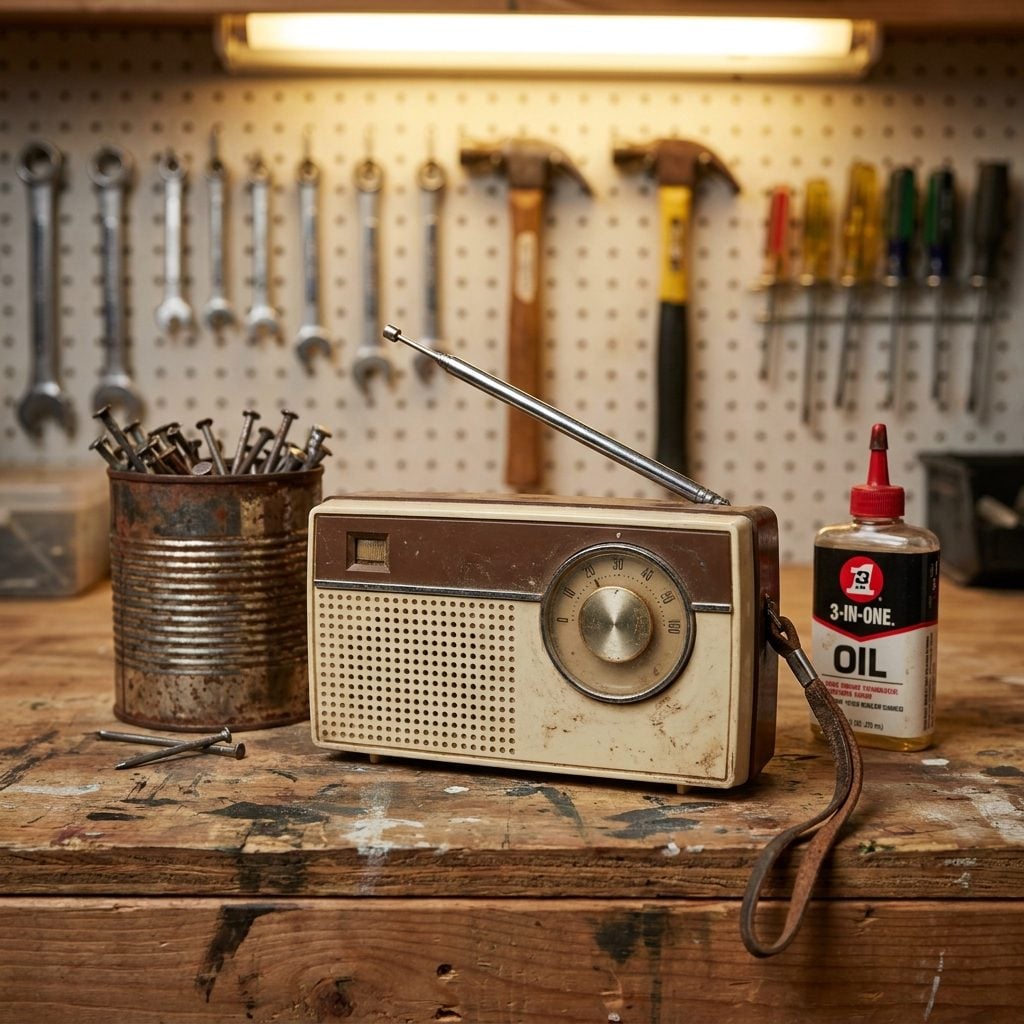
Nobody worked in silence. Somewhere on that workbench, wedged between a coffee can of nails and a bottle of 3-IN-ONE oil, sat a small transistor radio. Maybe a Zenith Royal, maybe a GE, maybe a no-name import with a cracked plastic case. It didn’t matter. It pulled in AM stations well enough, and that was the soundtrack of every weekend project.
Baseball on summer afternoons. News radio while changing the oil. The tinny speaker gave everything a distant, slightly compressed quality that somehow made the garage feel more alive. The dial was always set to the same station because nobody wanted to lose it. If the signal faded, you’d pick the radio up and rotate it slowly until it came back, holding it at exactly the right angle like some kind of analog ritual.
The Side Door That Led to the Backyard, the Breezeway, or a Whole Other World
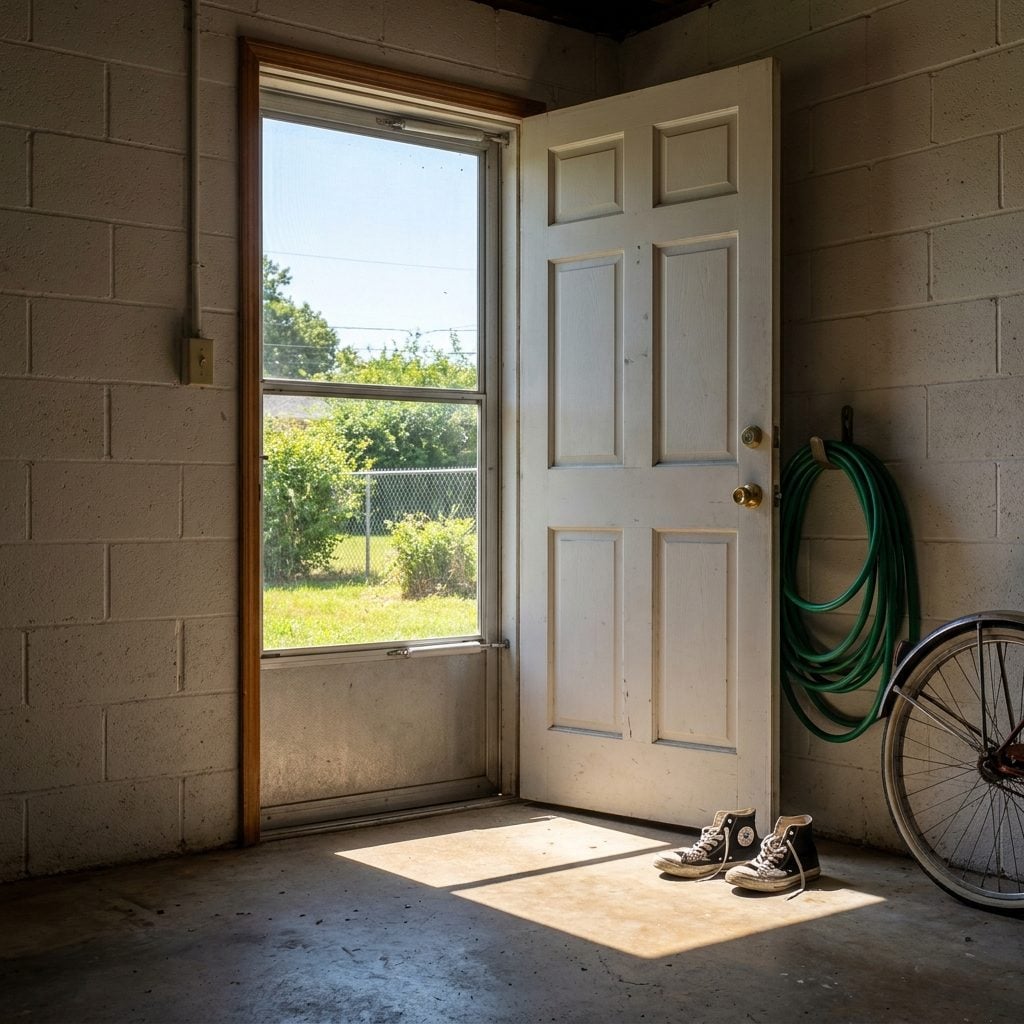
Not every garage had one, but the ones that did felt different. That small pedestrian door on the side wall, usually a plain six-panel or a simple slab with a thumb-turn deadbolt, opened onto the backyard, the side yard, or a covered breezeway connecting to the kitchen. It was the shortcut. The back channel. The way you came and went without using the big overhead door.
Kids used it constantly. You’d bang through it on a summer evening, screen door slapping behind you, to grab a bike or a baseball glove. In homes with a breezeway, this door was practically the main entrance, the one everyone actually used while the formal front door collected cobwebs. The breezeway itself was often a mid-century addition, a roofed but open-sided passage between the garage and the house that made the whole property feel connected.
These side doors let natural light into the garage, too. A rectangle of daylight on the concrete floor, shifting through the day.
The Breezeway That Made Every Trip From the Car to the Kitchen Feel Like a Covered Bridge
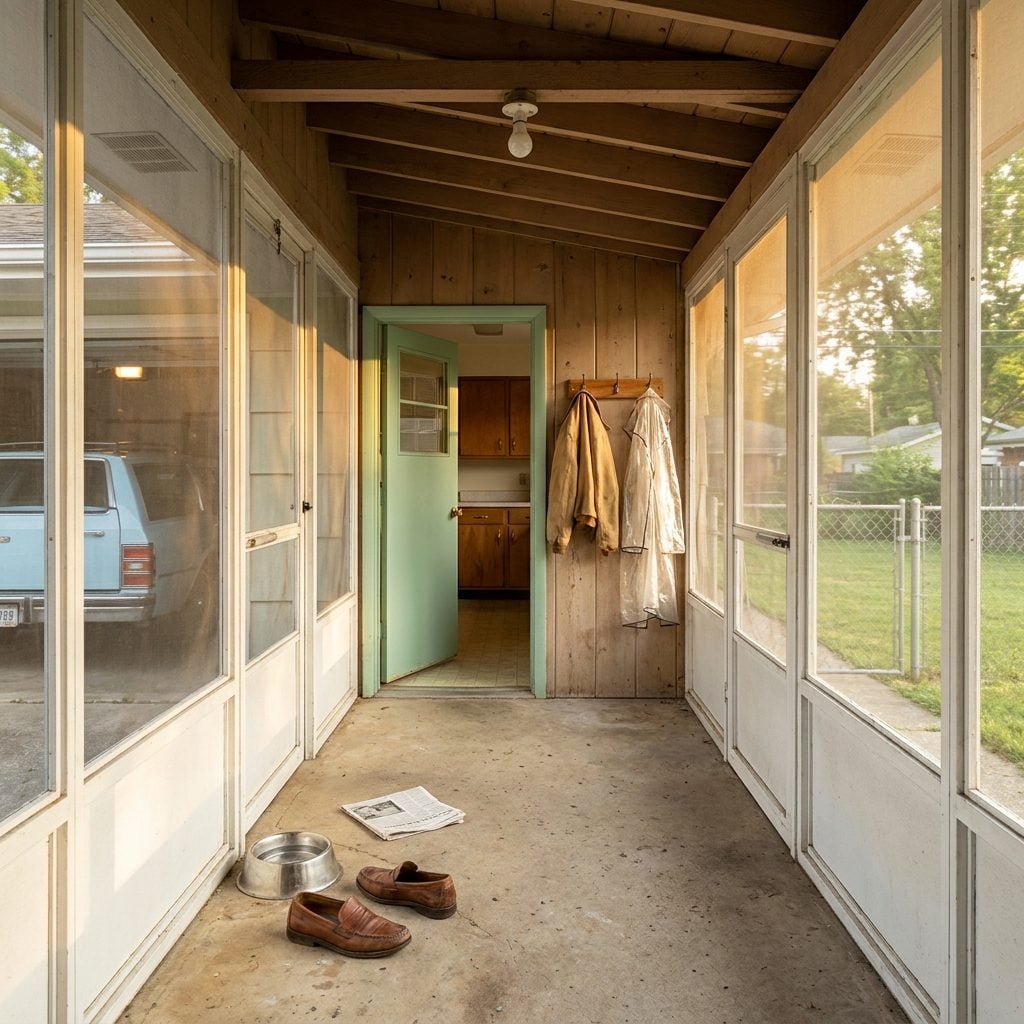
That narrow, roofed passageway between the garage and the kitchen side door was one of the most distinctive features of the 1960s ranch home. Not quite indoors, not quite outdoors. The concrete floor was always gritty underfoot, and the aluminum screen panels let in every mosquito from June through September.
You carried grocery bags through it, kicked off muddy shoes on the threshold, and stored the dog’s water bowl just inside. The breezeway wasn’t really a room. It was a transition zone, a decompression chamber between the outside world and the linoleum warmth of the kitchen. Most had a single bare bulb overhead and hooks for raincoats nobody actually hung up.
Ranch-style home trends of the era practically demanded one. It kept the weather out of your groceries and the garage fumes out of your pot roast.
The Carport That Couldn’t Decide If It Wanted to Be a Garage
🔥 Would you like to save this?
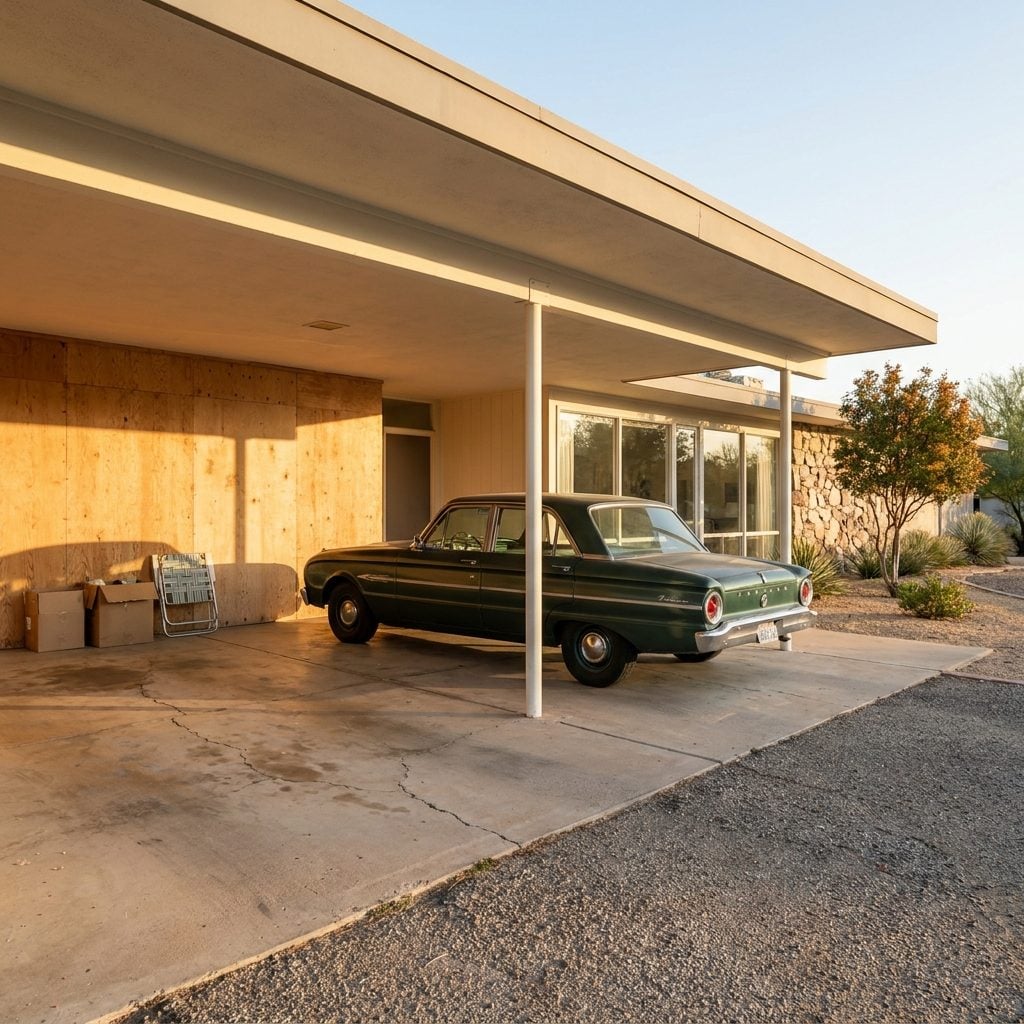
Half the mid-century modern homes on any block still had one in 1963. A flat or angled roof supported by slim steel posts, open on two or three sides, with a concrete slab underneath that got scorching hot in July. The carport was an architectural statement in the 1950s. By the mid-sixties, it was becoming a problem to solve.
Families enclosed them with plywood walls and a roll-up door, creating garages that always felt slightly off: the ceiling too low, the proportions a little narrow, the floor never quite level. You could always tell a converted carport because the posts were still visible inside, now awkwardly splitting the space.
Zero Insulation and a Draft You Could Feel From Ten Feet Away
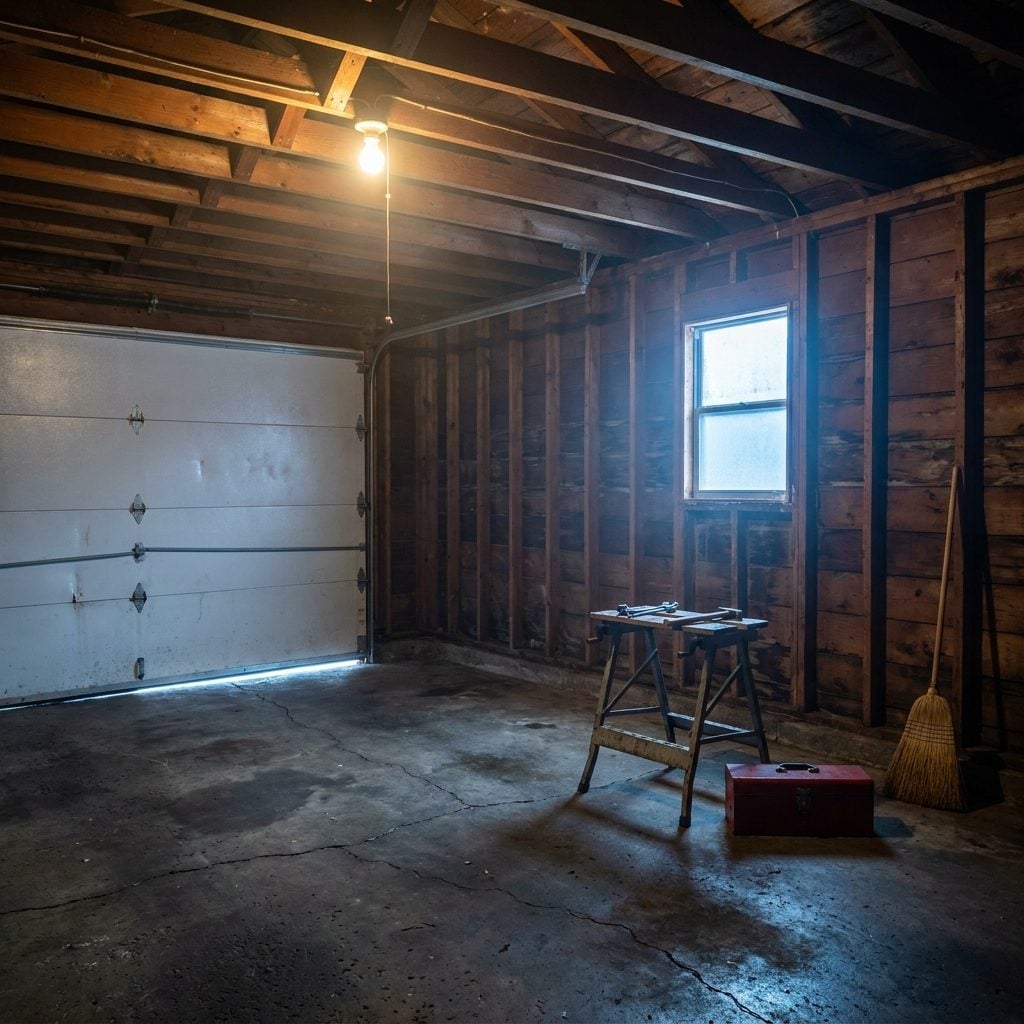
Nobody insulated a garage in 1965. That wasn’t a shortcut. That was the plan.
The walls were bare studs with maybe a layer of sheathing behind the exterior siding. The ceiling was open joists. In winter, you could see your breath in there by November, and the concrete slab radiated cold straight through your sneakers. In summer, the whole space turned into an oven by two in the afternoon, the metal garage door absorbing heat like a skillet on a burner.
The garage existed to hold the car and whatever else couldn’t earn a spot inside the house. Comfort was never part of the equation. If you wanted to work out there on a January Saturday, you wore a coat and kept moving.
The Lawn-Boy or Toro Push Mower Parked Right by the Door, Trailing the Smell of Cut Grass and Gasoline
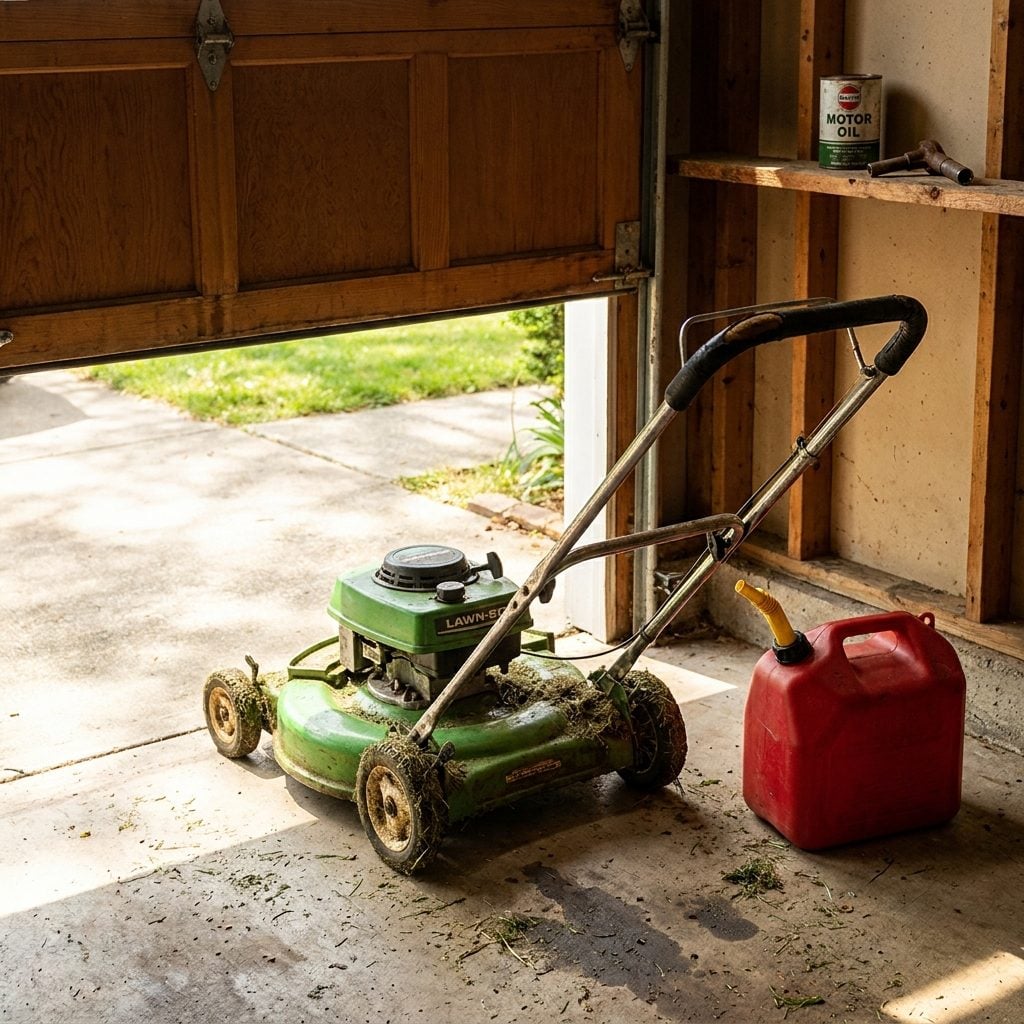
You could identify a 1960s garage blindfolded. That mixture of old gasoline, warm engine oil, and dried grass clippings caked to the underside of a mower deck is one of the most specific smells of American suburbia. The Lawn-Boy two-stroke or the Toro Whirlwind lived right inside the garage door, usually with a film of green clippings still stuck to the wheels from last Saturday.
Dad never cleaned it after mowing. He just rolled it back in, let the engine tick as it cooled, and went inside for iced tea. The grass dried into a crust by Wednesday and got mowed right back into the next lawn.
The Metal Hose Reel Bolted to the Wall That Nobody Ever Wound Properly
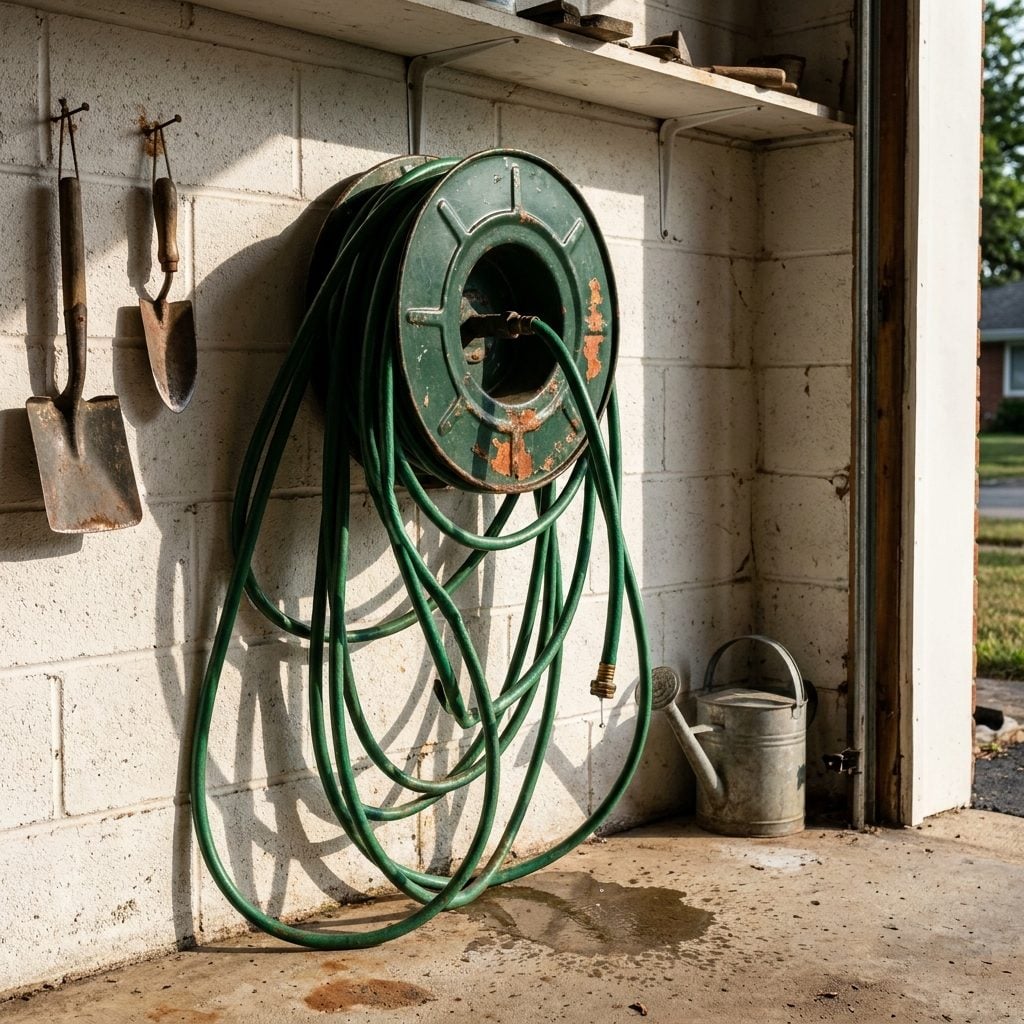
It was a simple device: a circular metal reel, usually painted dark green or rust-orange, bolted directly to the exterior garage wall or just inside the door. The idea was that you’d neatly coil your garden hose after every use. The reality was a tangled, kinked mess draped over the reel like spaghetti on a fork.
Those green garden hose reels always had one section of hose that refused to cooperate, permanently bent at a right angle from being driven over in the driveway. The brass fitting leaked no matter how tight you cranked it.
Galvanized Metal Trash Cans Lined Up Against the Wall Like Soldiers
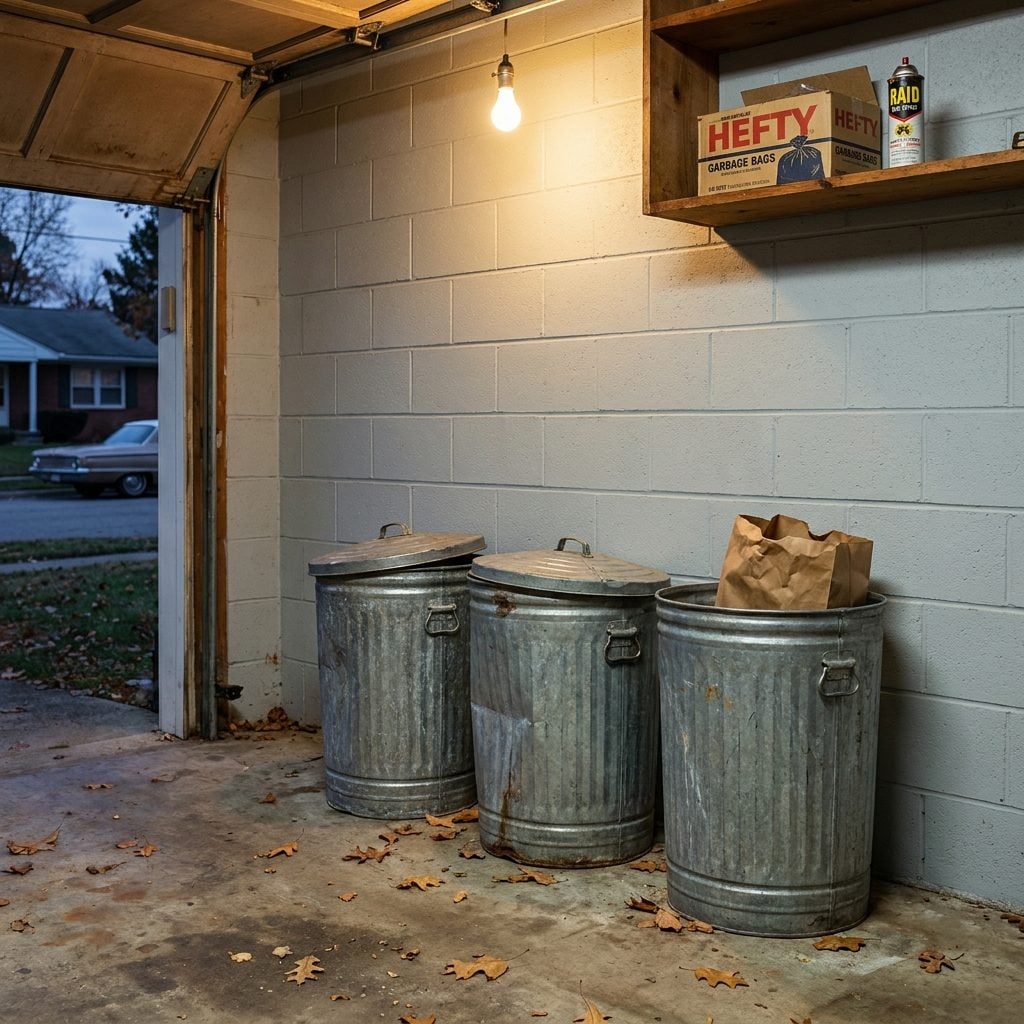
Two or three of them, always. Silver galvanized steel with those loose-fitting lids that clanged like cymbals when you dropped them on the concrete floor. They dented after the first month and stayed dented for the next decade.
The cans sat against the back wall or just inside the garage door. One for regular trash, one for yard waste, and sometimes a third that served as a mystery bin for whatever didn’t fit in the other two. The lids never sealed properly, which is why the garage always had that faint sour smell in August. Raccoons knew exactly how to pop those lids off at 2 a.m., and every neighborhood had the same soundtrack of clattering metal on garbage night.
Jerrycans and Quart Cans of Pennzoil on a Shelf That Definitely Wouldn’t Pass Modern Code
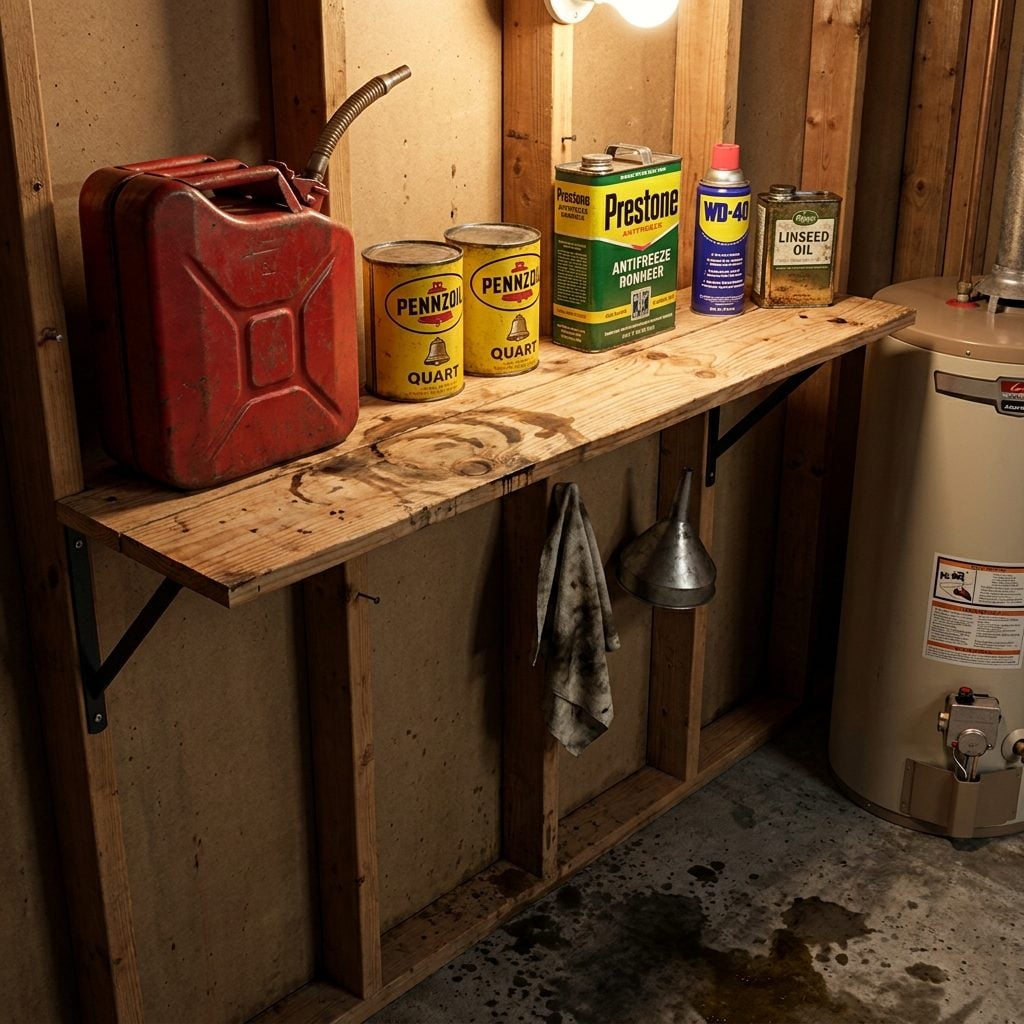
There was always a shelf. Usually a single plank of raw wood balanced on metal brackets, about five feet up the garage wall. On it: a red metal jerrycan of gasoline, a couple of quart cans of Pennzoil with the yellow bell logo, a container of Prestone antifreeze, and maybe a spray can of WD-40. All of it within arm’s reach of the water heater pilot light.
Nobody thought twice about it. This was just where you kept the car supplies, right next to the turpentine and the linseed oil from last year’s deck project. The shelf was a miniature fire hazard museum, and it stayed that way for twenty years without incident in most homes, which is either a miracle or a testament to how overblown our fears can be.
A Schwinn Sting-Ray Hung From the Ceiling or Leaned Against Everything
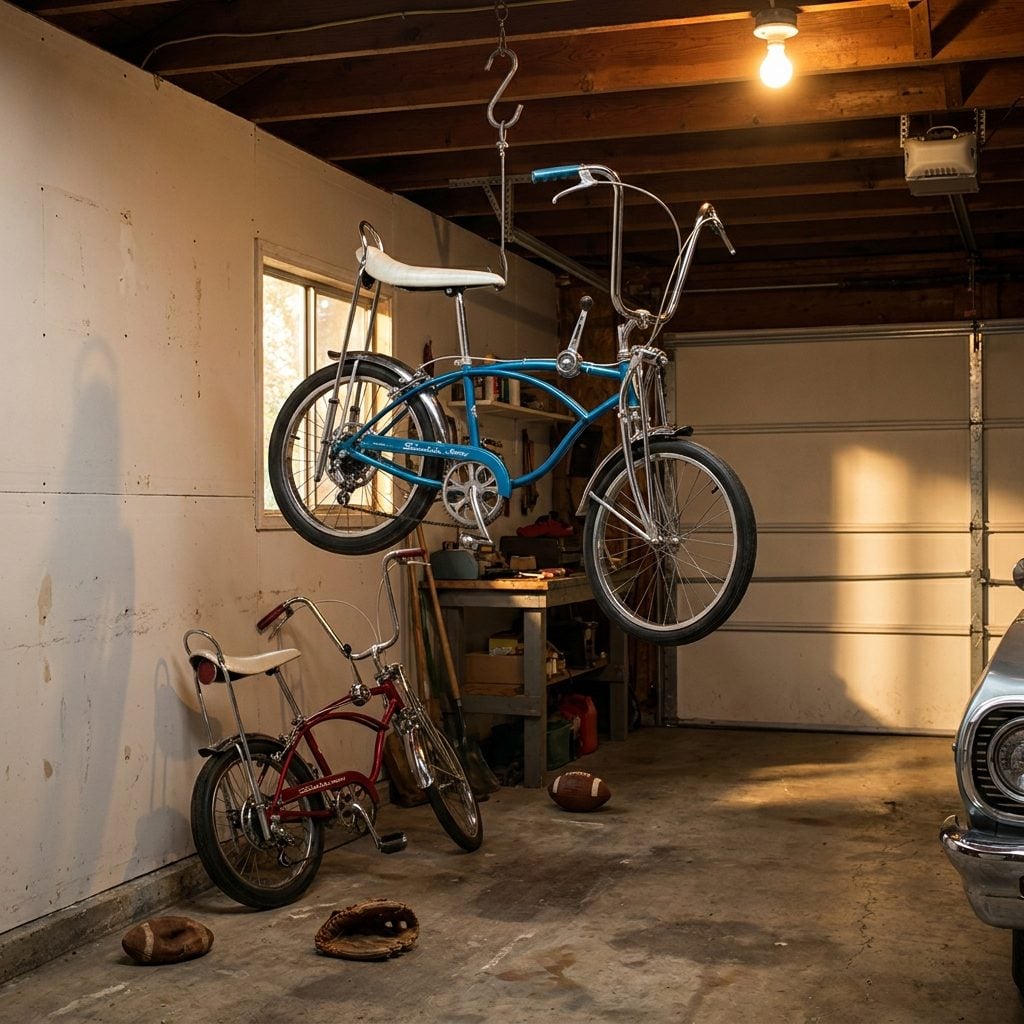
Banana seat. Ape-hanger handlebars. A coaster brake that screamed when you locked it up on hot asphalt. The Schwinn Sting-Ray was the bike of the 1960s, and every garage on the block had at least one. It either hung from a ceiling hook by its front wheel, spinning slowly like a mobile, or it leaned against the garage wall at an angle that guaranteed it would fall over and scratch the car door at least once a summer.
The metallic blue and the cherry red were everywhere. Kids dropped them in the driveway, pedals down, and came back to find the handlebar grips melted soft from the sun. The garage was less “storage” and more “crash landing zone” for these bikes. They accumulated like stray cats.
The Second Fridge in the Garage: Avocado Green, Humming Loudly, Full of Dr Pepper
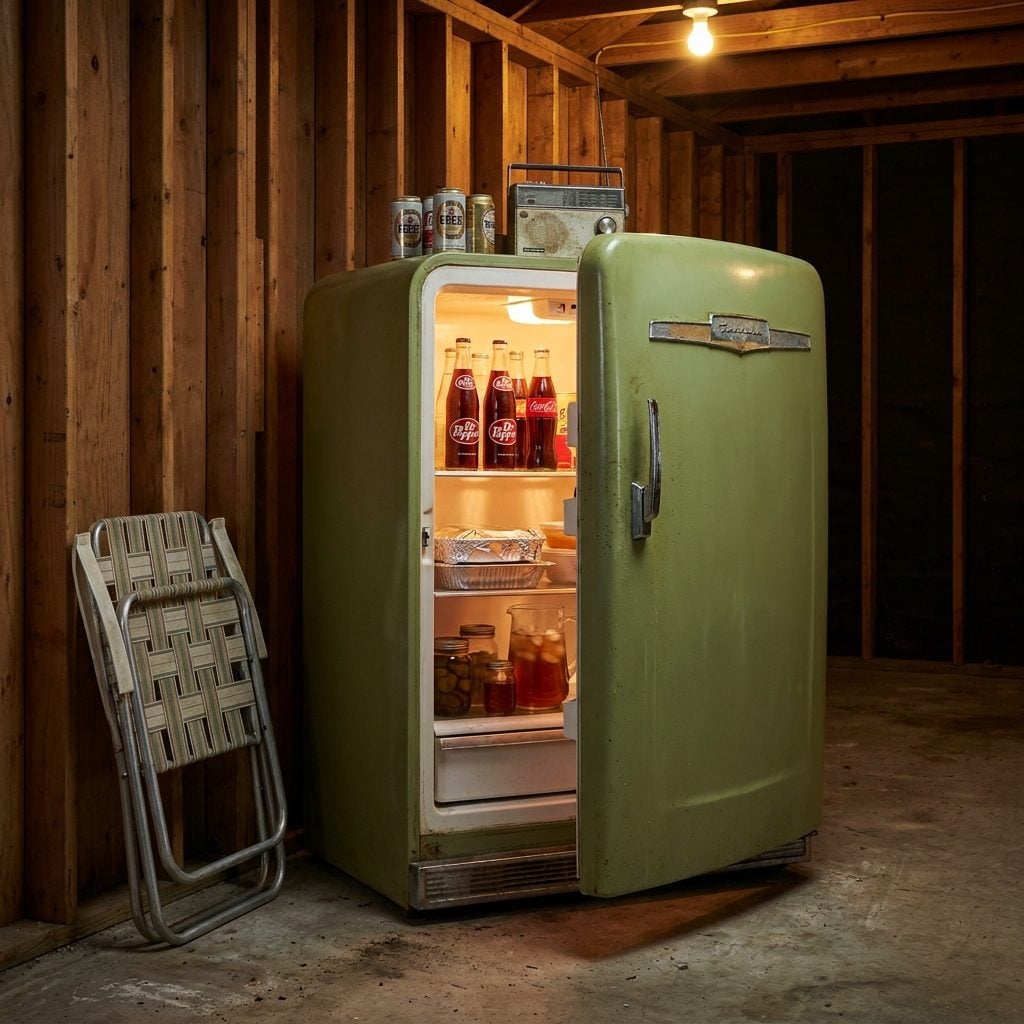
Every family had the good fridge in the kitchen. Then there was the garage fridge: the old one that got demoted when the new model arrived but was too functional to throw away. It hummed at a frequency you could feel in your molars. The door seal was loose on one side. The interior light flickered.
But it held two cases of soda, a shelf of condiment bottles that migrated from the kitchen, and during the holidays, whatever overflow casseroles and Jell-O molds couldn’t fit inside. That avocado green retro refrigerator was always either avocado green, harvest gold, or that specific shade of turquoise that only existed between 1958 and 1972.
The electricity bill from running it year-round in an uninsulated garage must have been impressive. Nobody ever calculated it. Nobody ever would.
The Weber Kettle Grill and a Half-Empty Bag of Kingsford Briquettes
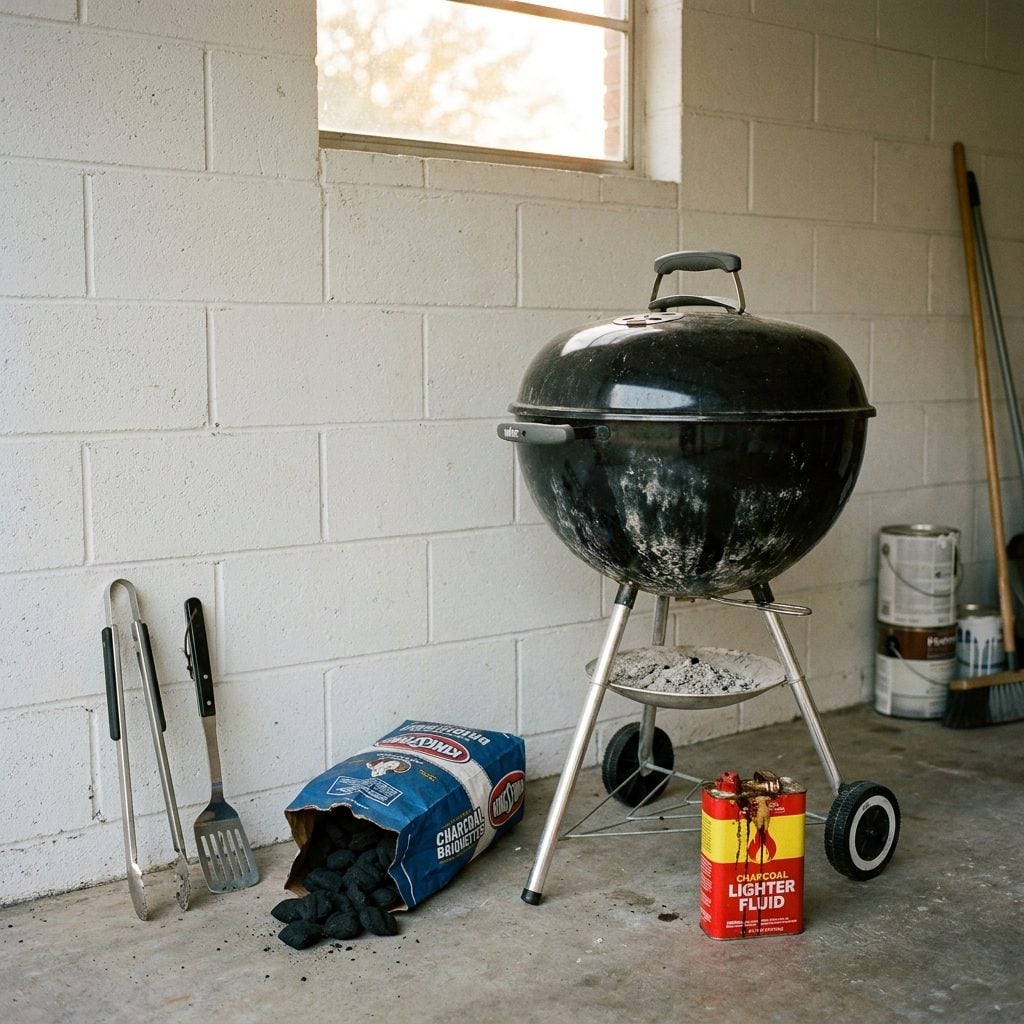
Black, round, three-legged, and stored in the garage corner from October through April. The Weber kettle grill was the undisputed king of the 1960s backyard, and during off-season, it lived right next to a torn-open bag of Kingsford charcoal briquettes that slowly absorbed moisture from the garage’s damp air.
The grill’s exterior had a chalky residue from heat and weather. Its ash catcher underneath was never fully emptied. Somewhere nearby: a can of lighter fluid with a dried crust around the spout and a pair of long-handled tongs that also served as the designated spider-removal tool.
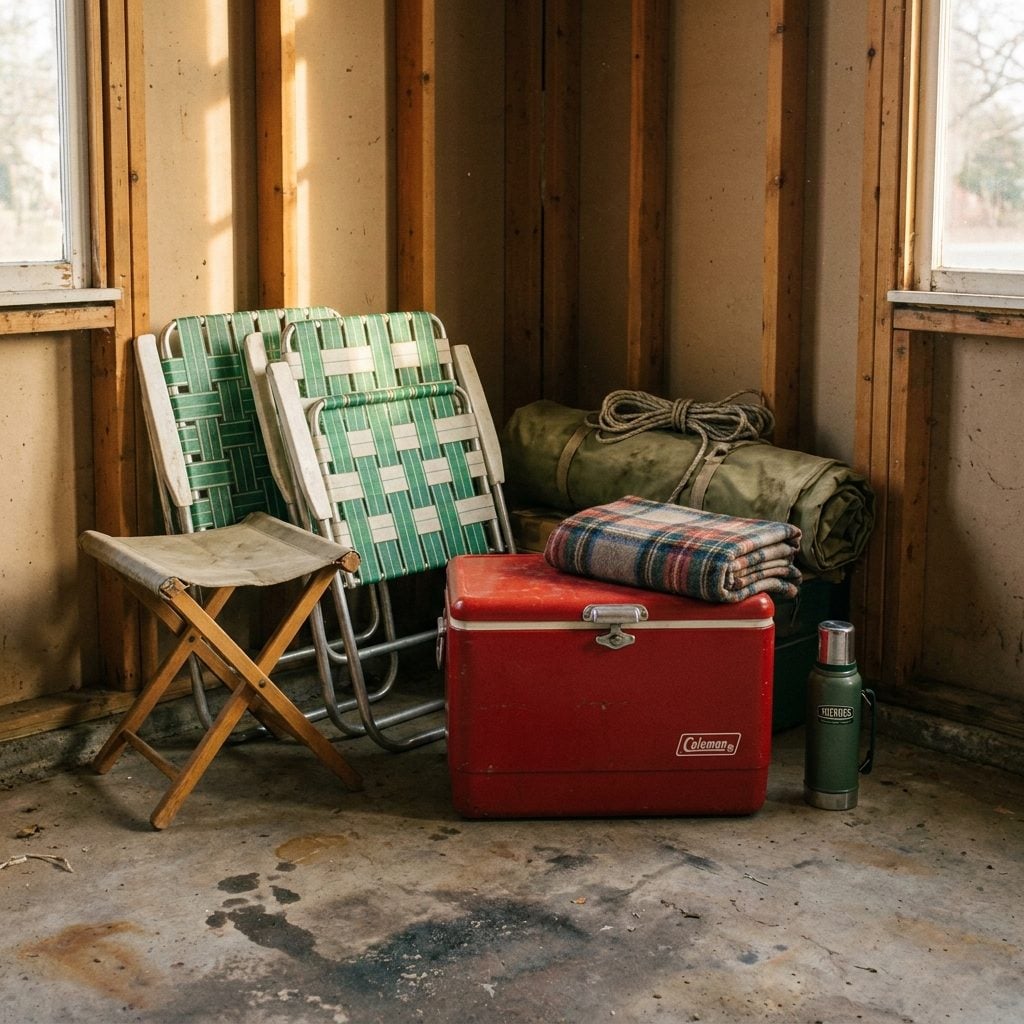
Folding Chairs, Canvas Camp Stools, and a Coleman Cooler Ready for Saturday at All Times
🔥 Would you like to save this?
One corner of the garage was permanently dedicated to the weekend. Aluminum folding lawn chairs with woven nylon webbing in green and white. A canvas camping stool with wooden legs. The red Coleman steel cooler that weighed fifteen pounds empty and kept ice solid for two days. A rolled-up canvas pup tent that smelled like mildew no matter how thoroughly you dried it.
This wasn’t organized storage. It was a pile. Everything leaned against everything else in a precarious stack that collapsed every time you pulled out the bottom chair. But the point was readiness: on any given Friday afternoon, you could load the station wagon in twenty minutes and be at the lake before dinner.
The Ping-Pong Table That Turned the Garage Into a Rec Room Every Weekend
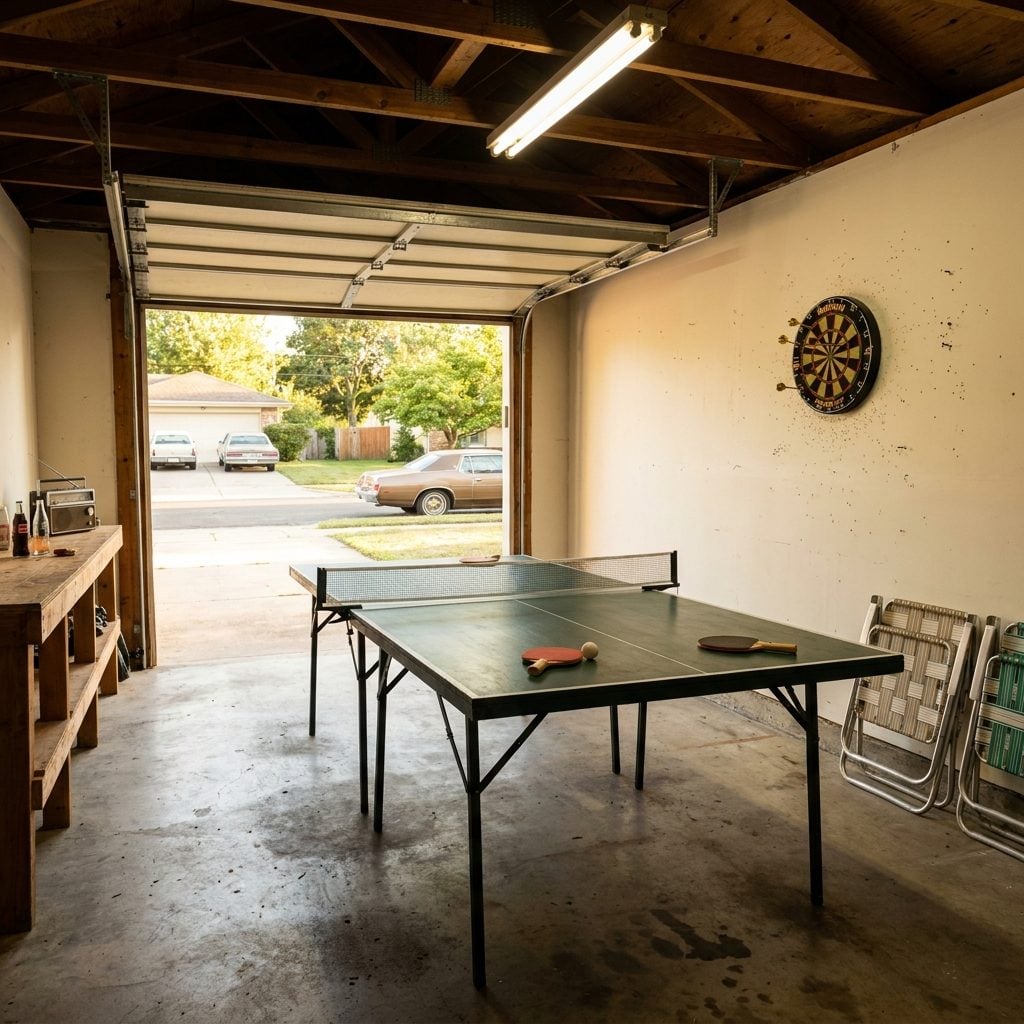
The car backed out. The table went up. Suddenly the garage was a tournament venue, a hangout, a place where neighborhood kids gathered on rainy Saturdays and argued about rules nobody actually knew. The green plywood top sat on folding metal legs that were never quite level, so the ball always favored one side. You played with paddles that had pimpled rubber on one face and sandpaper-smooth cork on the other, and the ball was always slightly dented from someone stepping on it.
A dartboard hung on the opposite wall, its surrounding drywall peppered with tiny holes from years of bad throws. There might have been a transistor radio on the workbench tuned to the ball game, tinny and staticky.
This was the original man cave, though nobody called it that. It was just the garage with the door up, the car in the driveway, and the faint smell of motor oil mixing with whatever was on the classic charcoal grill out front. The informality was the whole point. No carpet to protect, no good furniture to worry about. Just concrete, a net, and the perpetual argument over whether the serve grazed the edge.