🔥 Would you like to save this?
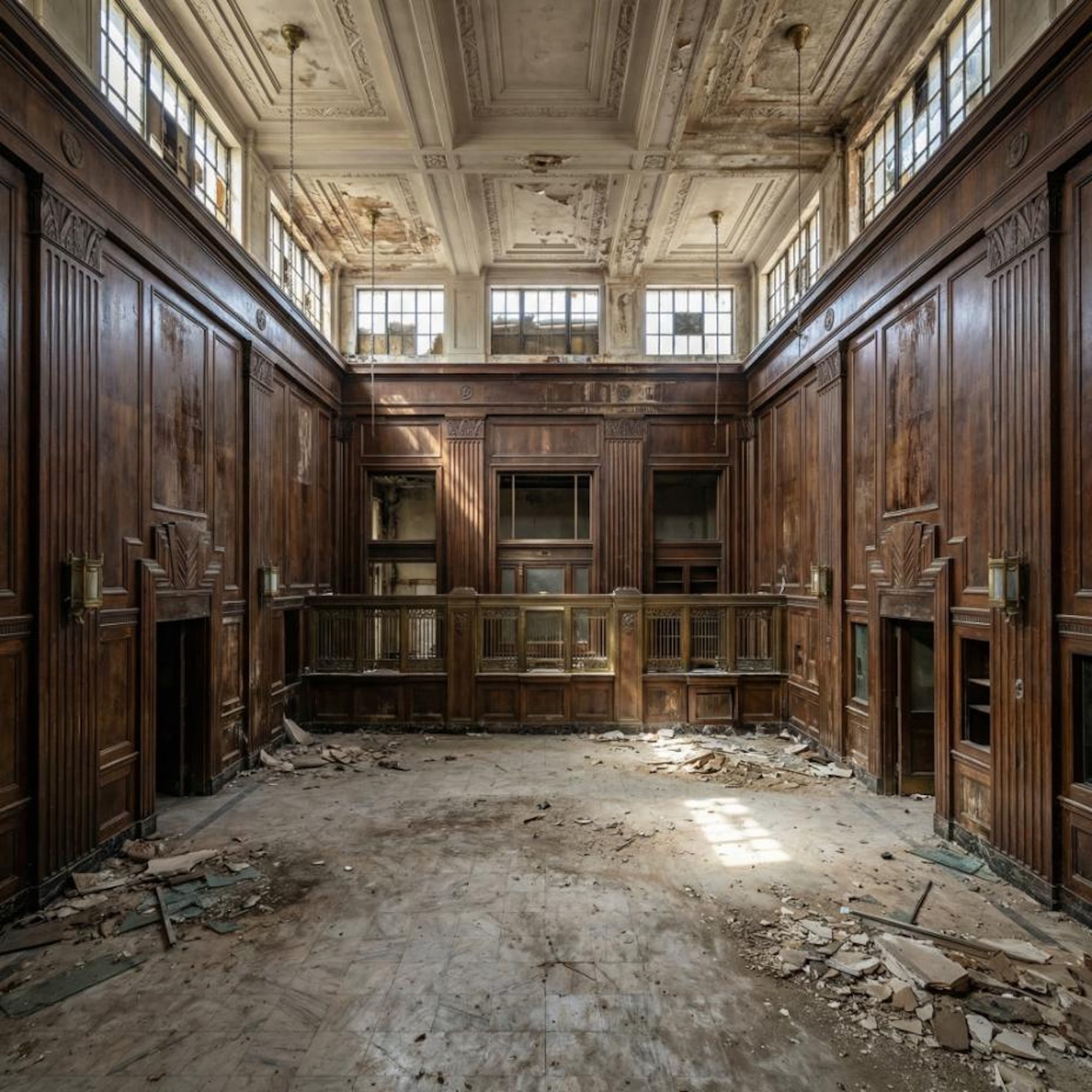
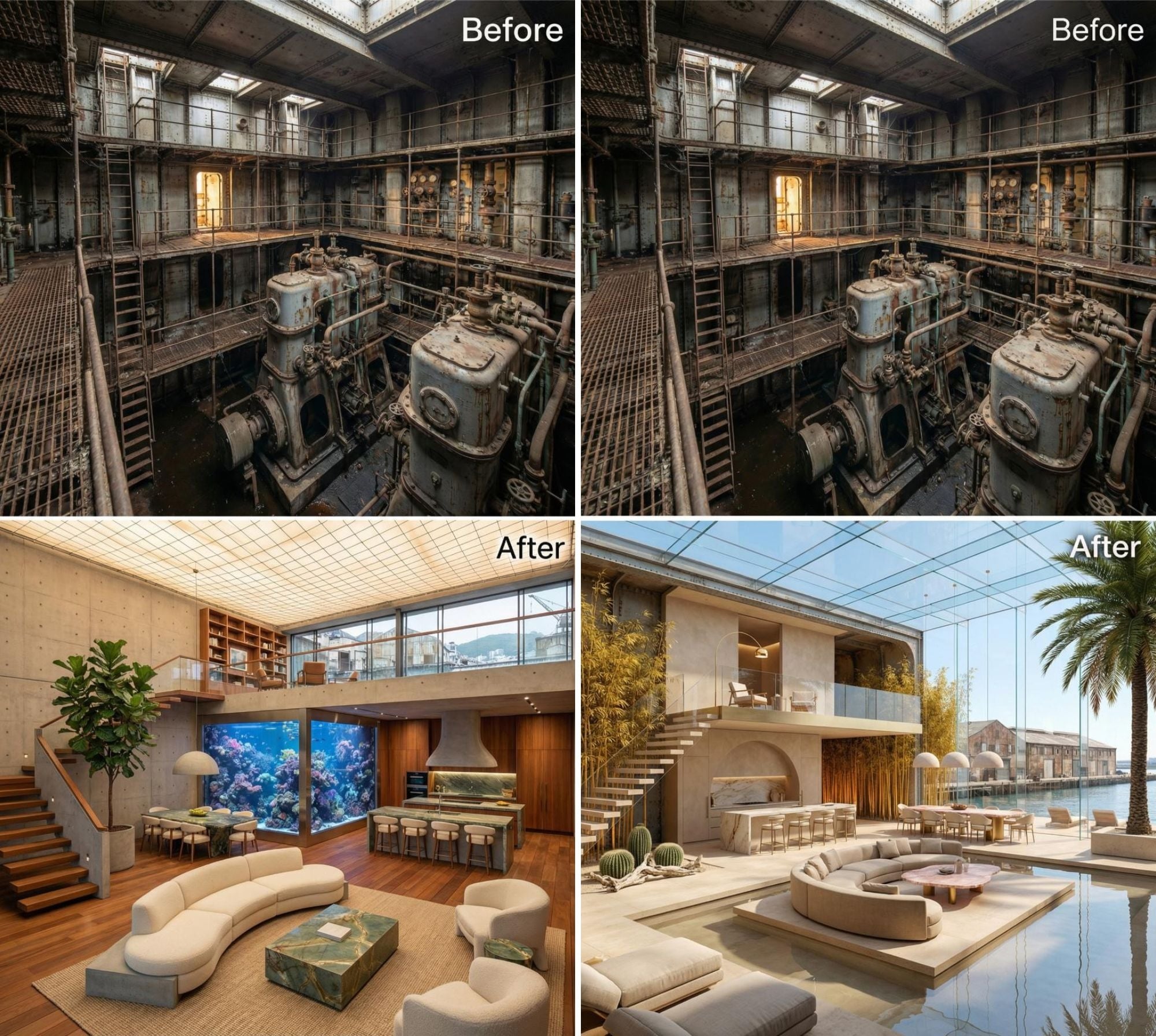
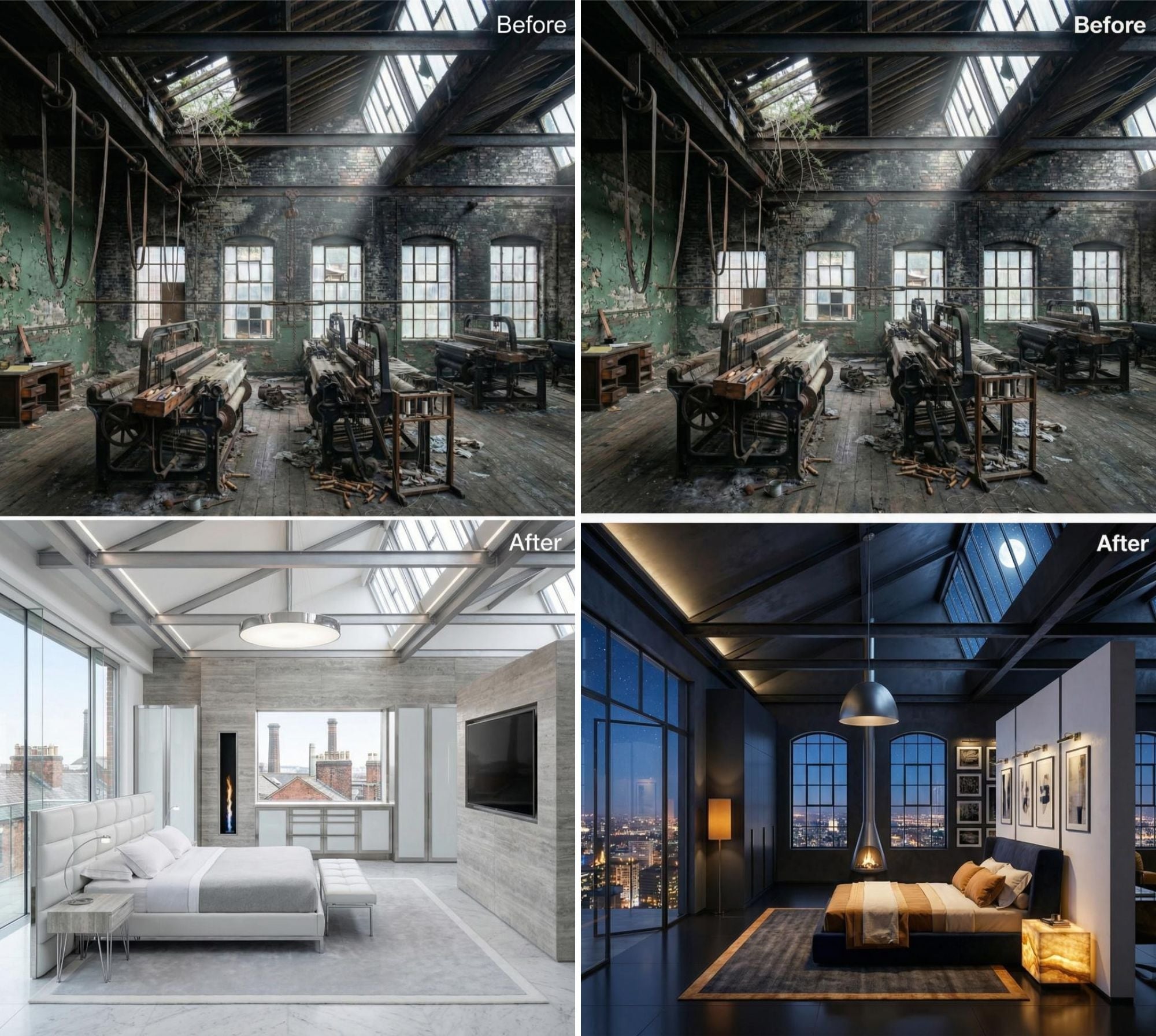
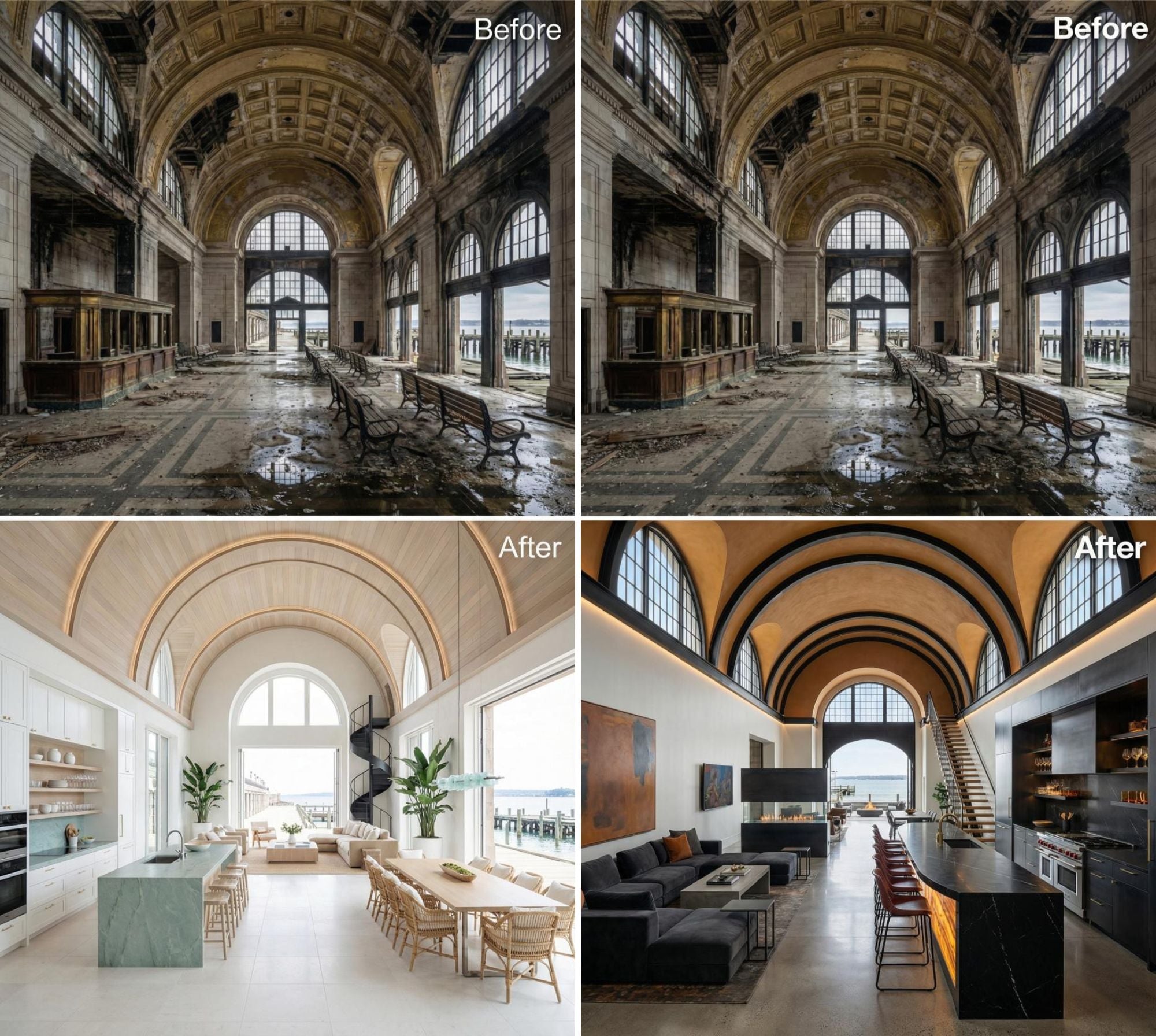
Few spaces carry more design potential than a Gothic church left to decay. The crumbling pointed arches, the fractured rose windows, the nave stripped bare over centuries of neglect — these are not liabilities. They are the bones of something extraordinary. Designers who choose to work inside these ruins rather than against them consistently produce living spaces that no new construction can replicate. The argument here is simple: preserved ruin, paired with considered luxury, produces rooms that feel genuinely irreplaceable. The 30 before and after examples collected here each began in the same condition — deteriorating stone, collapsed sections, centuries of architectural wear. What replaced that decay is a series of high-end living rooms that kept the Gothic structure intact while introducing materials like aged brass, hand-plastered walls, and custom upholstered furniture scaled to cathedral proportions. The contrast between the original state and the finished rooms makes the design logic visible in a way that polished new builds rarely allow.
In order to come up with the very specific design ideas, we create most designs with the assistance of state-of-the-art AI interior design software. Also, assume links that take you off the site are affiliate links such as links to Amazon. this means we may earn a commission if you buy something.
Gothic Nave Converted Into a Vaulted Living Room With Ribbed Stone Ceilings
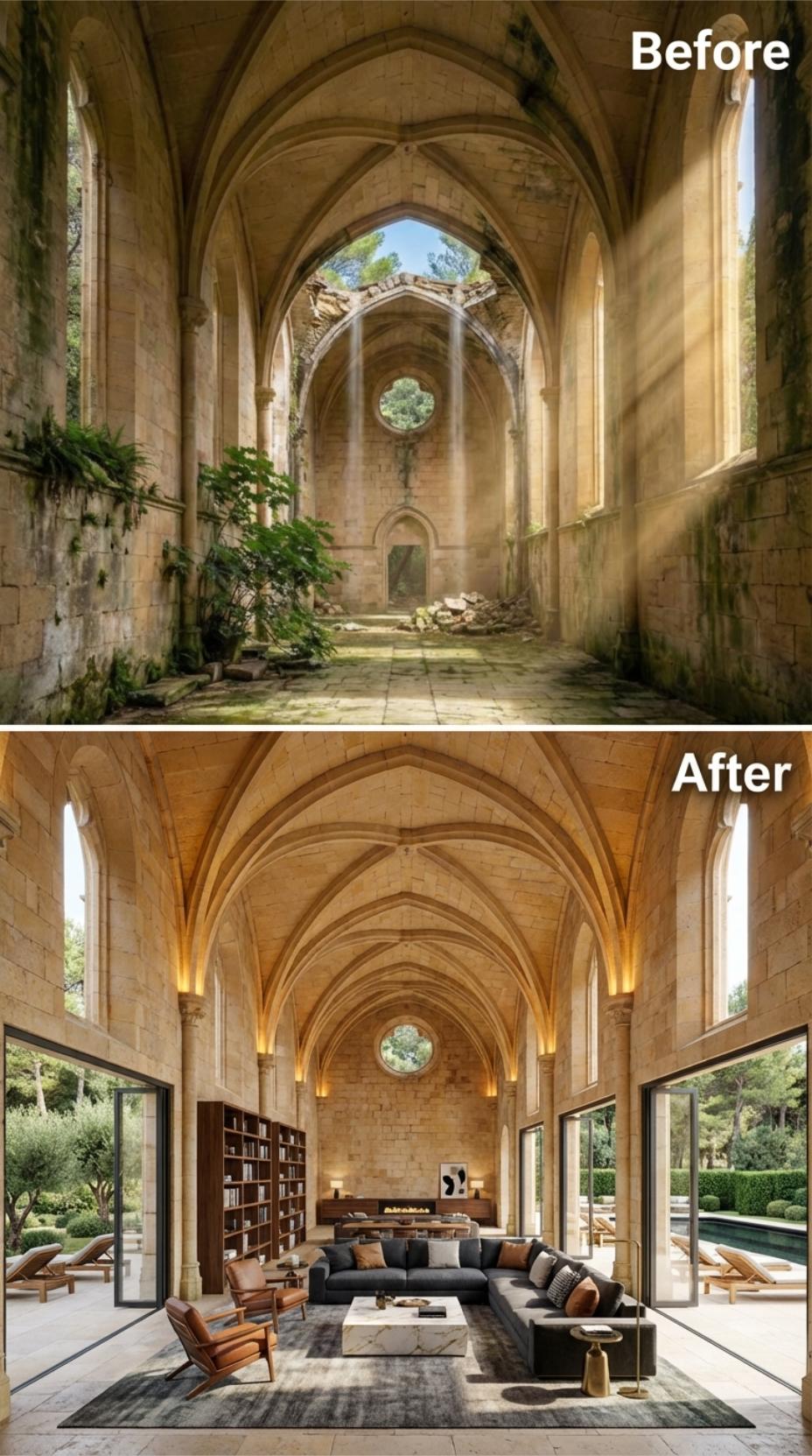
What was once an open-air ruin, its end wall collapsed and vegetation pushing through the stone floor joints, is now a fully enclosed living room anchored by original Gothic ribbed vaulting in warm honey limestone. The restoration preserved every rib and keystone, adding recessed amber uplighting along the vault springers to pull out the carved detail after dark. Floor-to-ceiling pivot-glass doors replace the collapsed side walls, framing views of clipped boxwood hedging and a lap pool.
Seating centers on a deep charcoal sectional in a matte fabric, flanked by cognac leather armchairs with square brass feet. A white marble slab coffee table grounds the arrangement on a charcoal wool rug. Built-in dark walnut shelving lines the left wall, running full height to the clerestory windows, with a linear gas fireplace recessed into the far stone wall below the original oculus window.
Crumbling Nave, Glass Ceiling: Gothic Ruins Reborn as a Cream-Stone Living Room
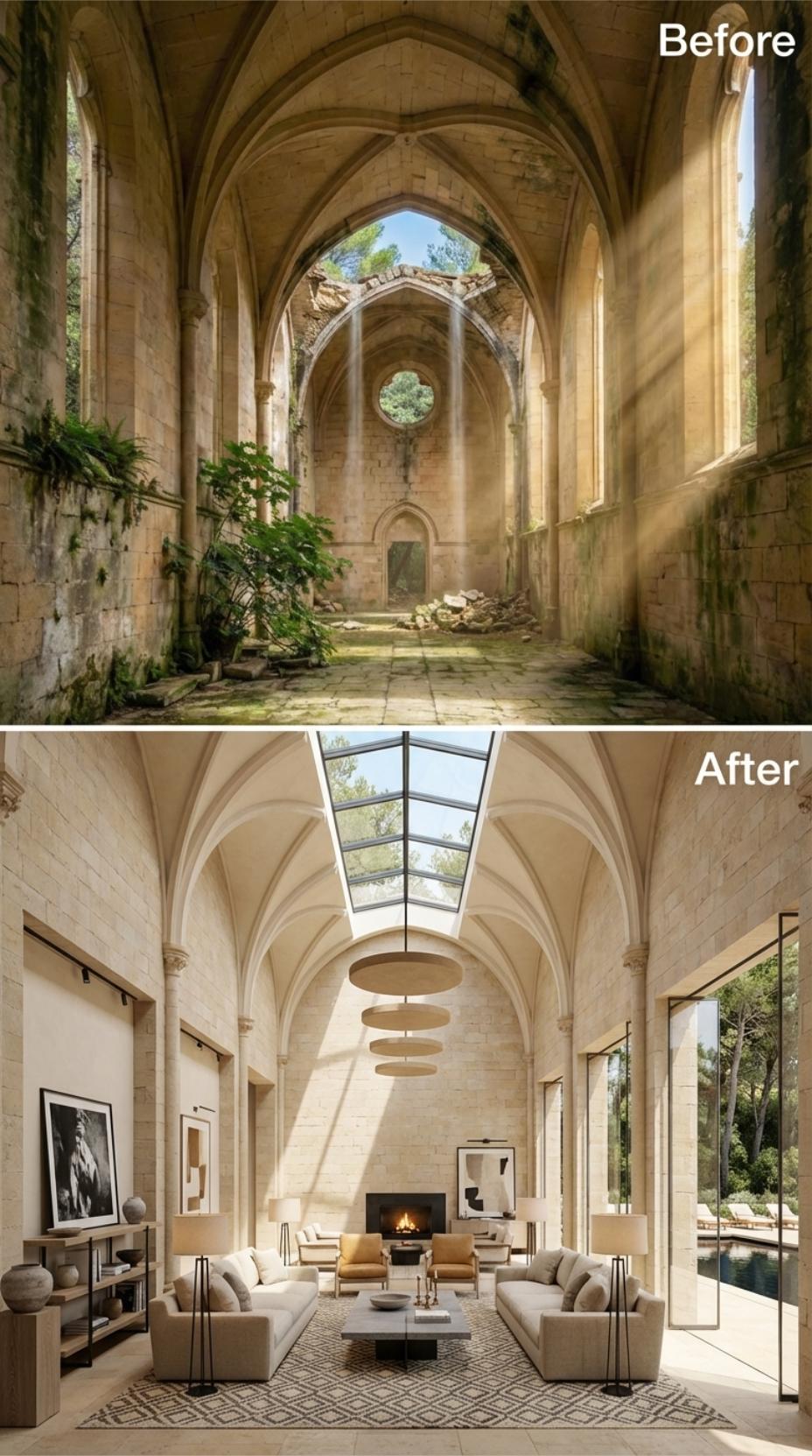
Pointed ribbed vaults and original limestone block walls survive intact from the ruin, now cleaned and repointed to a warm bisque tone. A linear skylight replaces what was open sky, running the full length of the nave in steel-framed glass, flooding the stone with natural light without obscuring the Gothic geometry above.
The seating arrangement anchors around a low concrete-topped coffee table, flanked by cream linen sofas and tan leather armchairs on a geometric diamond-pattern wool rug. Stacked disc pendants in pale wood hang from the vault’s crown, and a recessed fireplace with a flat stone surround closes the far wall where rubble once sat.
Ribbed Stone Vaulting Overhead, Green Velvet Below: Gothic Ruins as a Living Room
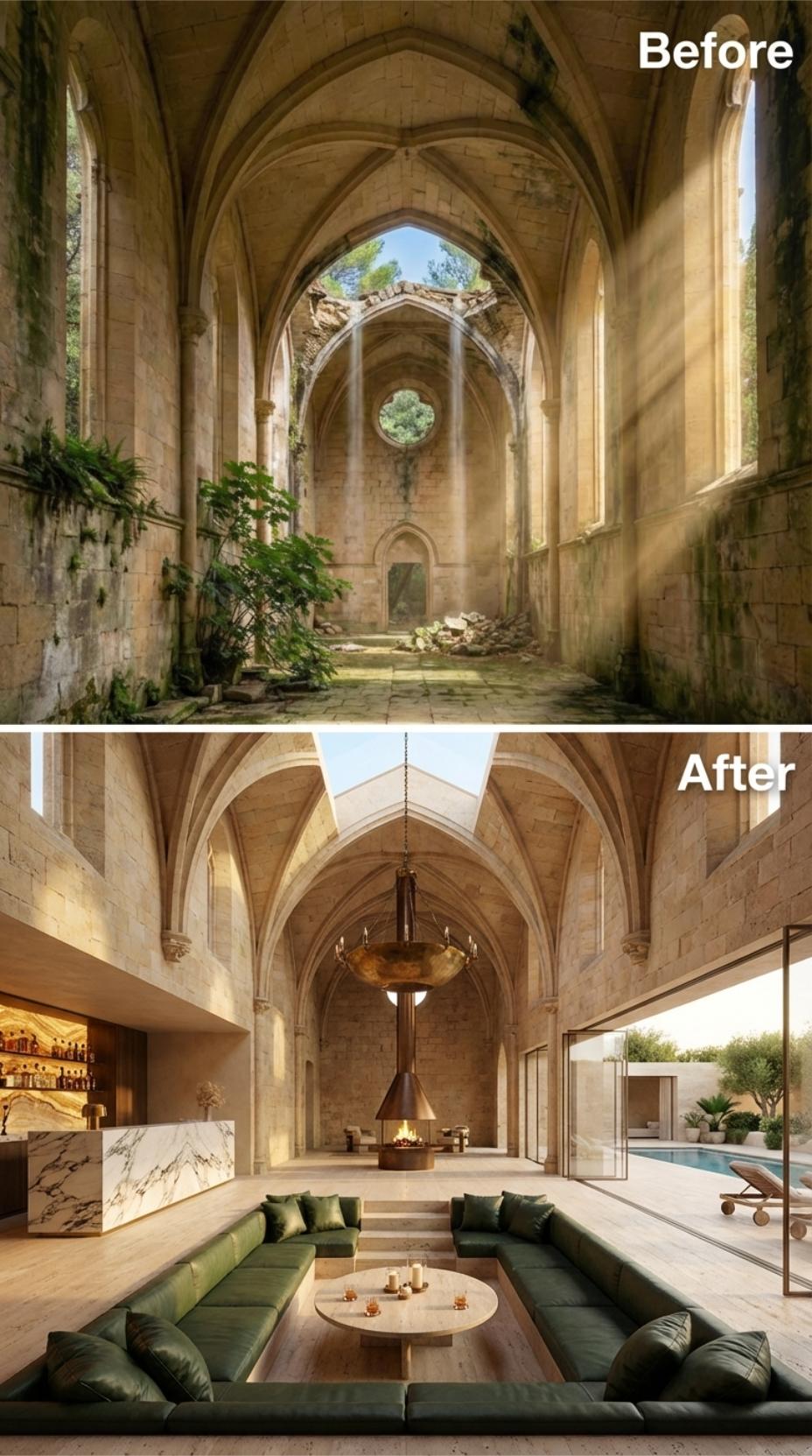
Olive green velvet sectionals line a sunken conversation pit, flanked by a marble-topped bar with backlit onyx shelving on the left. A bronze pendant chandelier hangs from the restored ribbed vault, centering on a freestanding fireplace with a conical copper hood.
Ruined Gothic Nave Reborn With Plaster Vaulting and Blown-Glass Pendants
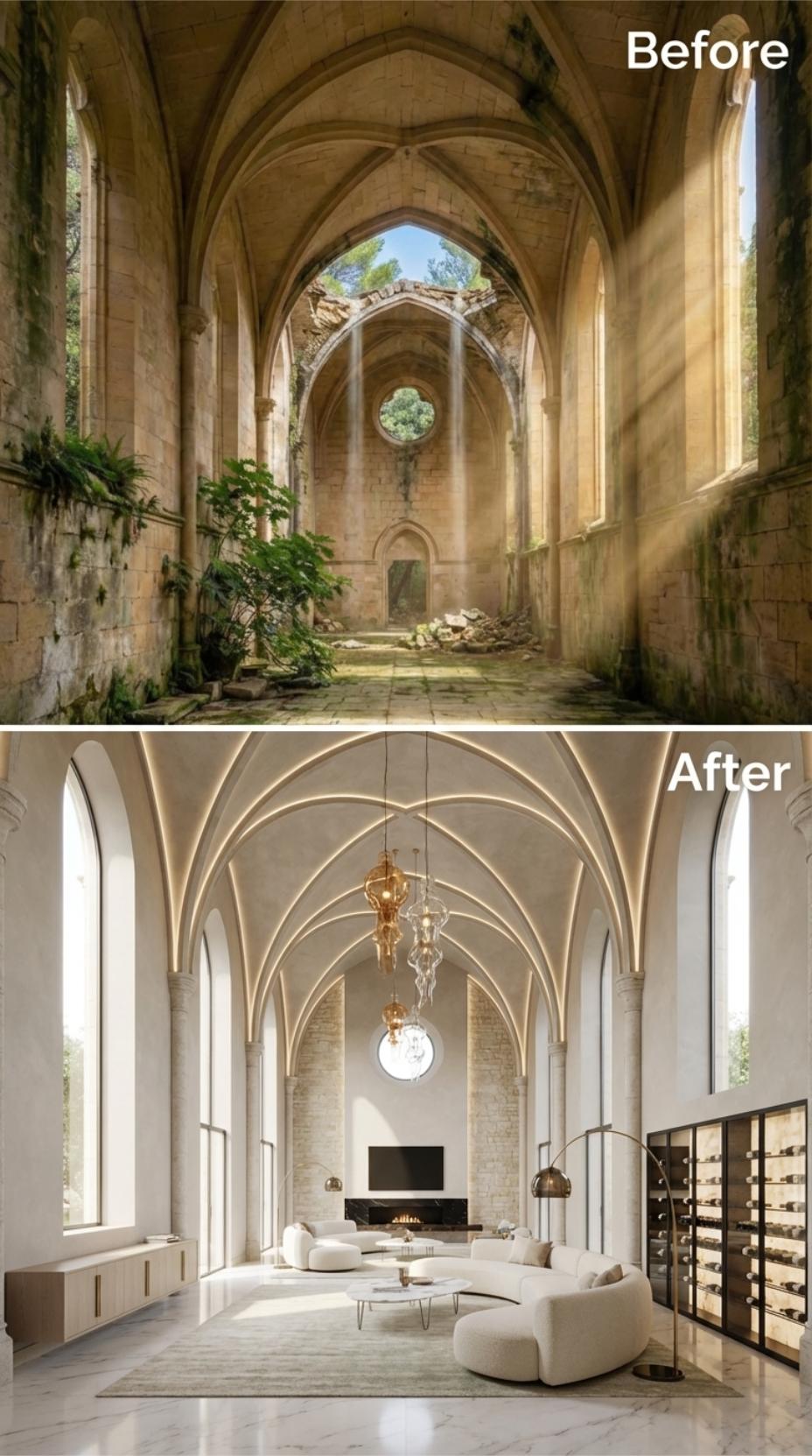
Plaster now coats the ribbed Gothic vaulting, with LED strips tracing each rib. Two blown-glass pendants hang at different heights above cream bouclé sofas arranged around a marble-topped coffee table.
Glass Vaulting and Orb Pendants Fill a Gothic Nave Stripped Down to Bone White
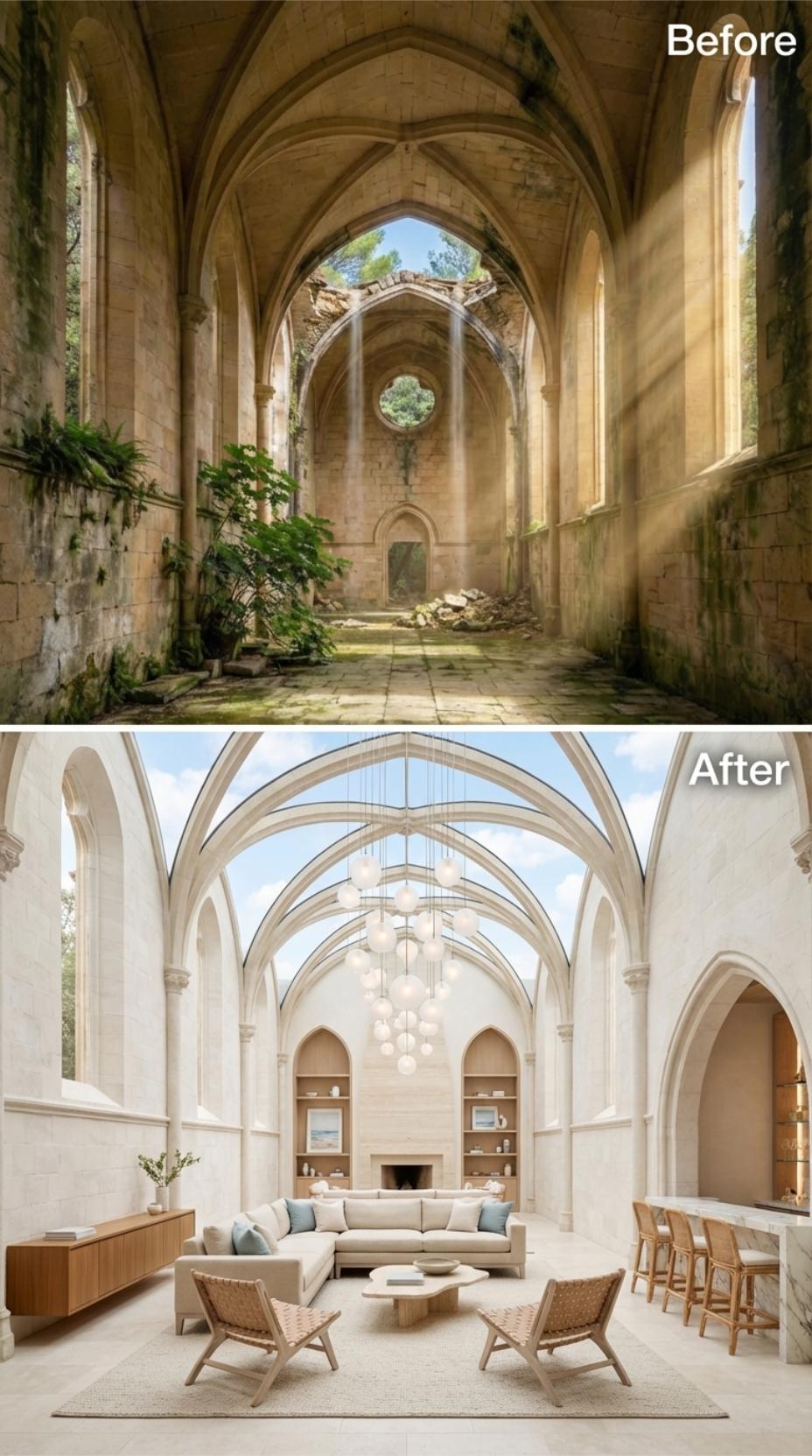
Restoration here preserved every ribbed stone arch while replacing the collapsed roof with a grid of structural glass, letting open sky read as a fifth wall. The Gothic lancet arches remain fully intact, now rendered in smooth lime plaster rather than exposed rubble, their proportions doing most of the visual work.
Furniture sits low and loose against all that verticality: a cream linen sectional, a round travertine coffee table, and two woven-leather sling chairs in the Wegner tradition. A bar counter in white marble anchors the right side, fitted with rattan barstools. Pendant lighting drops in a loose cluster of frosted blown-glass globes, scaled to counter the height without competing with the arches.
Pendant lighting drops in a loose cluster of frosted blown-glass globes, scaled to counter the height without competing with the arches.
Leather Sofas and Pendant Clusters Inside a Gothic Shell Stripped to White Stone
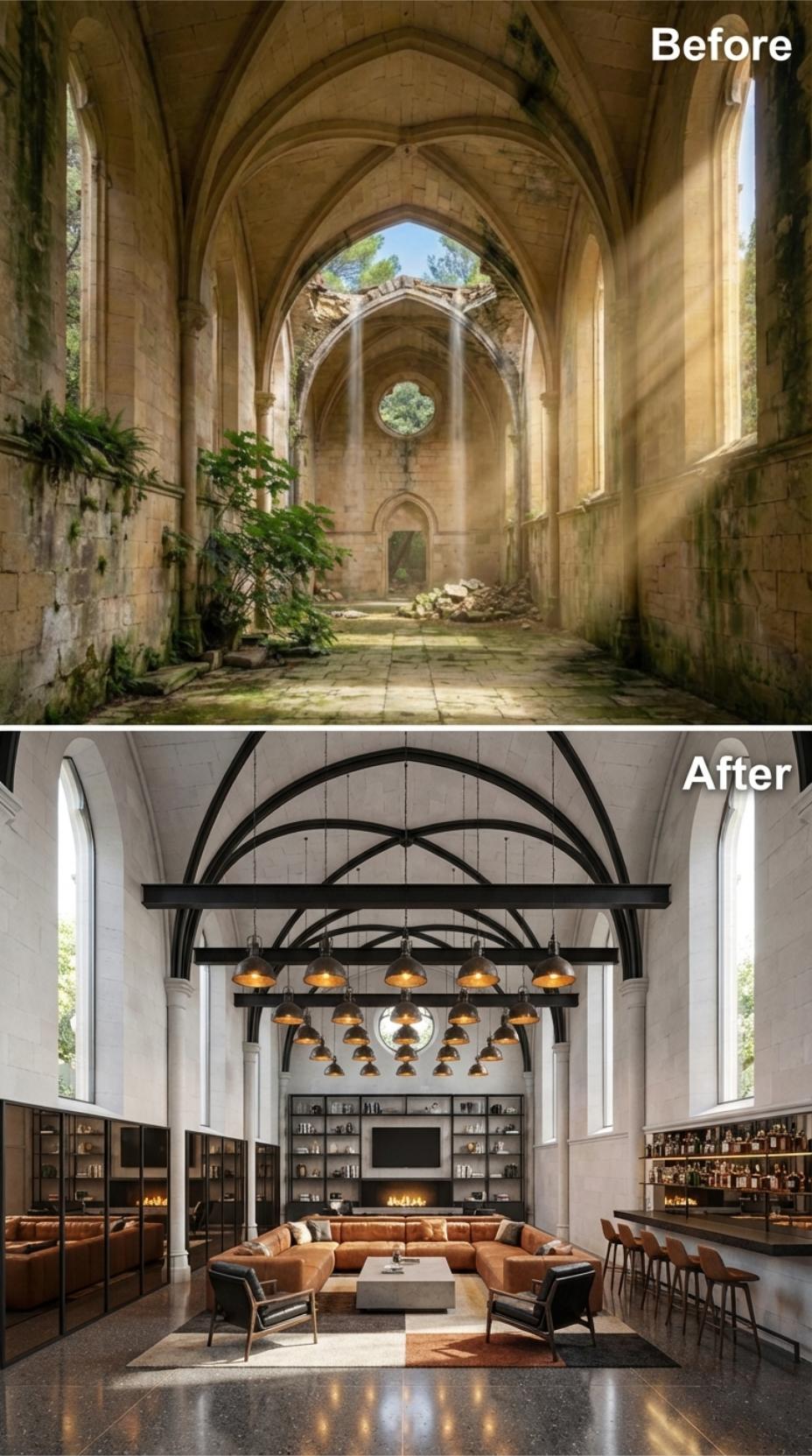
Decades of neglect left the nave’s ribbed vaulting cracked and open to the sky, with rubble piled against moss-covered limestone. Designers kept the bones intact and whitewashed the entire stone shell, then bolted black steel ribs along the vaulting to echo the original Gothic arches without pretending to restore them.
At floor level, a U-shaped sectional in cognac leather anchors the room around a concrete coffee table. Roughly twenty black-and-gold dome pendants hang in a clustered formation above the seating zone, suspended at varying heights from a steel ceiling grid. A full-width shelving unit in matte black steel frames a central fireplace with open flame burners, and a bar lined with amber spirits bottles runs the full length of the right wall. The round oculus window from the original facade remains untouched behind the shelving.
Terracotta Floors and Wagon-Wheel Chandeliers Inside Gothic Ribbed Vaulting
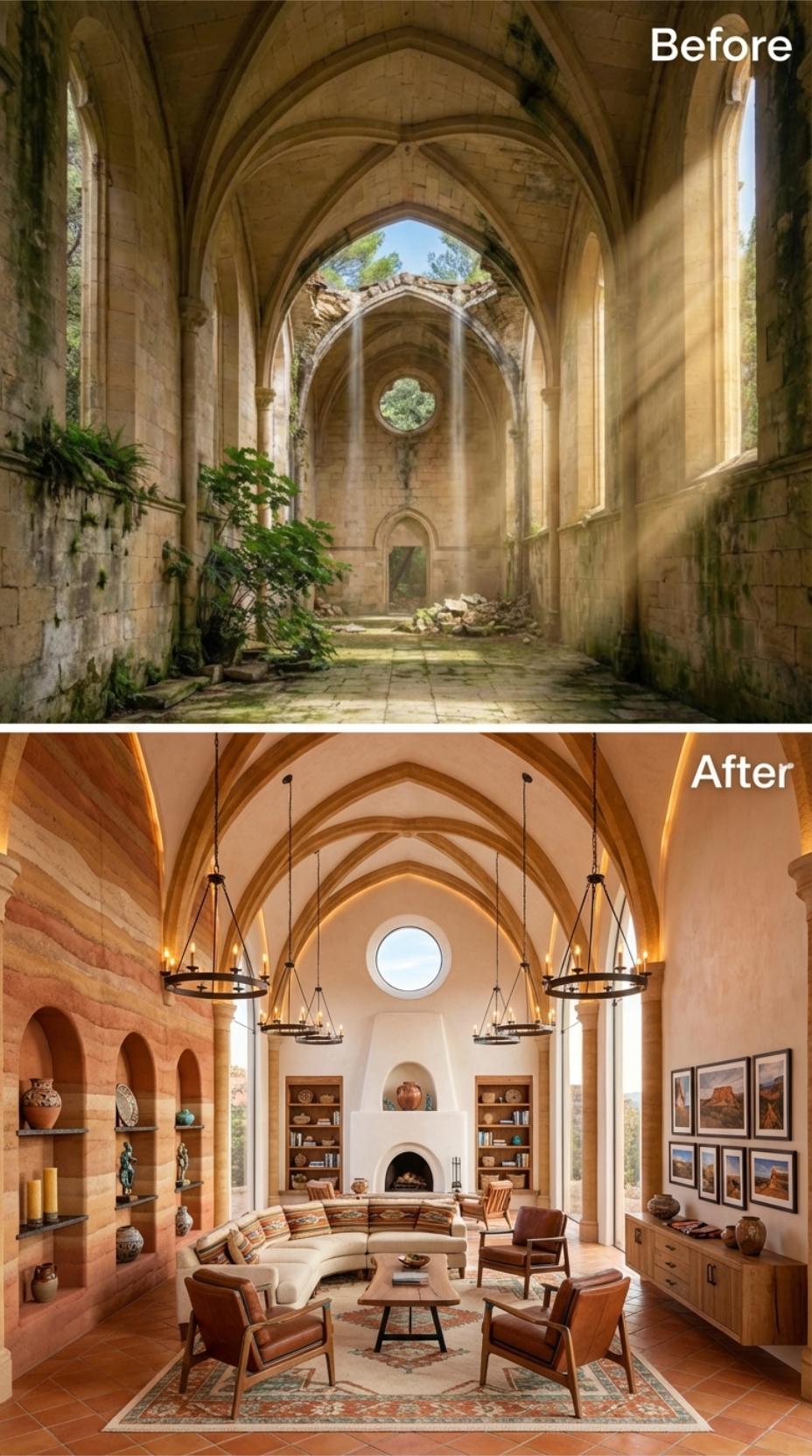
The nave’s original ribbed vaulting survives intact, now trimmed in warm honey-toned wood that pulls the eye upward toward a preserved oculus window. Two wrought-iron chandelier rings hung with taper candles anchor the room’s center axis.
Below, a curved cream sectional sits on a Southwestern-pattern wool rug, flanked by cognac leather armchairs on terracotta tile flooring. Built-in arched niches display ceramic vessels and figurative sculpture. A kiva-style plaster fireplace closes the far wall, framed by open bookshelves on either side.
Style Math: Gothic structure plus Southwest desert vernacular produces an unexpected design equation that actually holds. The vaulted ceiling reads as formal architecture while the terracotta tile, kiva fireplace, and woven textiles pull the palette straight into the American Southwest. Neither half cancels the other out.
Groin Vaulting in Bone White, Crystal Chandeliers, Louis XV Seating
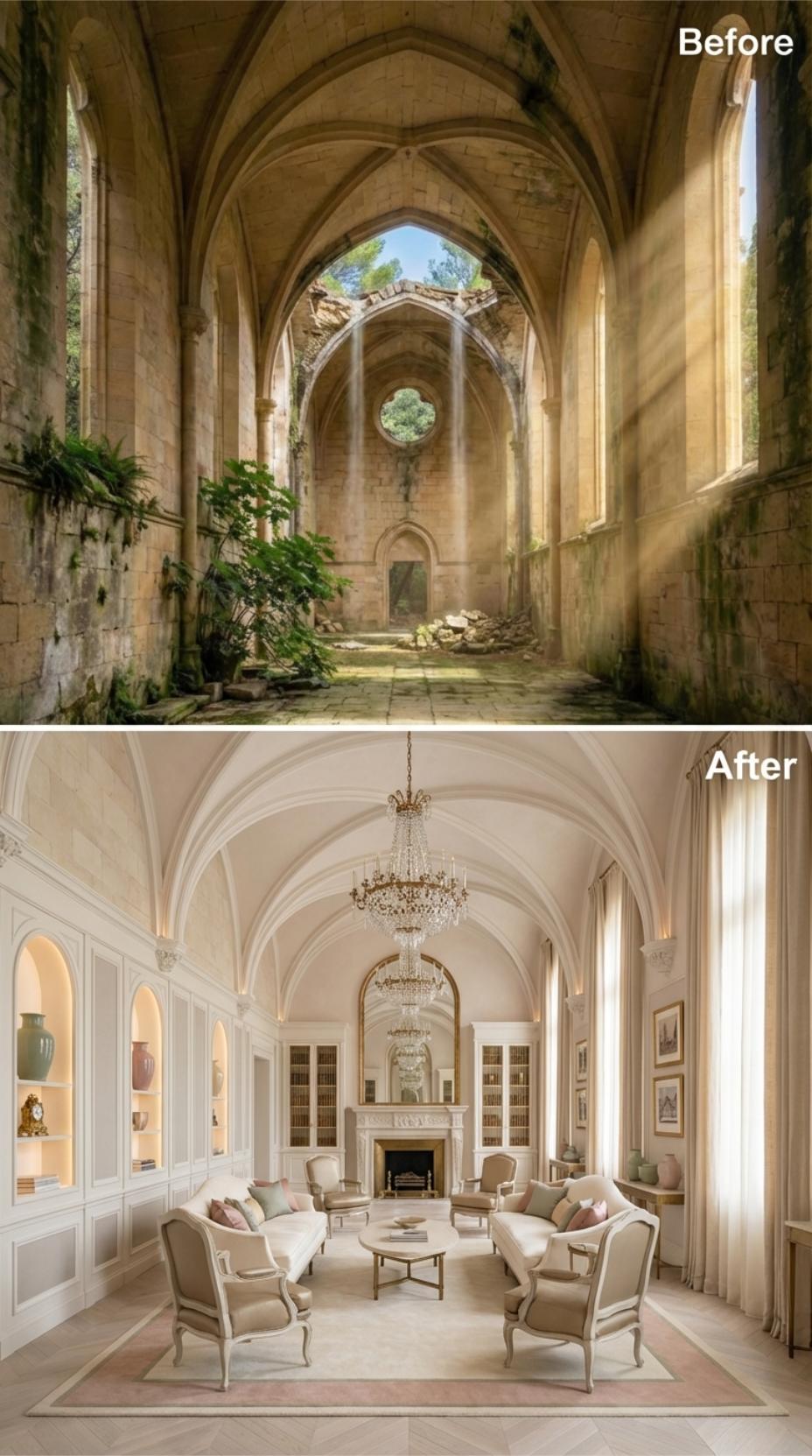
Centuries of Gothic structure survive here in the groin-vaulted ceiling, its ribbed intersections now smoothed and painted the same bone white as the plaster walls below. A crystal chandelier with gilt bronze crown hardware hangs from the vault’s crown, its drops catching light from floor-length silk drape panels on the right wall. Arched niches along the left side hold glazed ceramic vessels and a gilt carriage clock, each alcove lit from within by recessed warm-tone fixtures.
French Louis XV armchairs in oatmeal linen surround a circular coffee table at center, with two curved sofas anchoring the arrangement. A carved limestone fireplace anchors the far wall beneath a gilt-framed mirror arch. Every surface reads pale and controlled, which forces the chandelier’s brass hardware to carry the room’s only warmth.
Bone-White Groin Vaults and Globe Pendants Reclaim a Roofless Gothic Nave
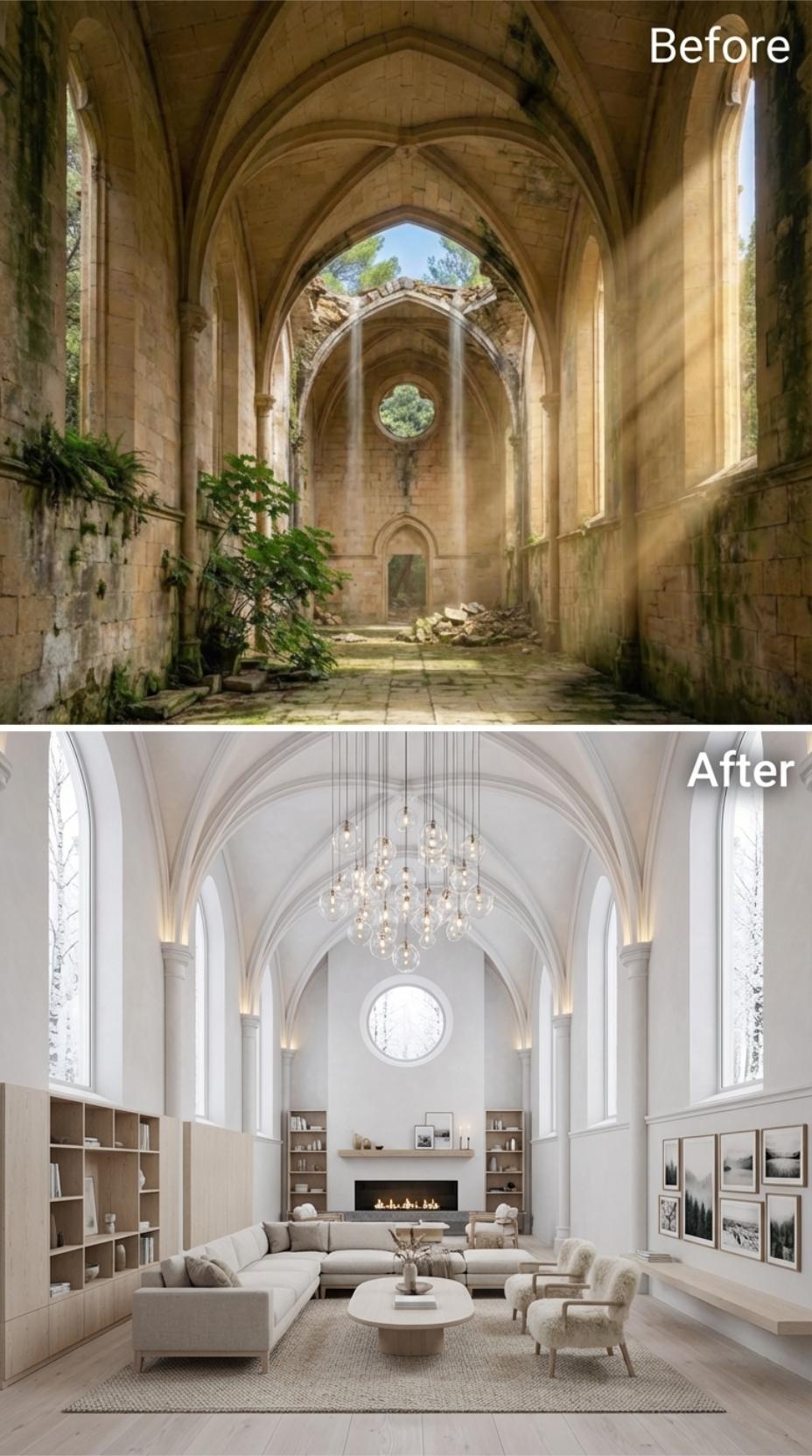
Ribbed groin vaulting, now plastered and painted a flat warm white, arches the full length of what was once an open-sky ruin. A cluster of hand-blown glass globe pendants drops on thin cables from the crown of the vault, replacing the sunbeams that once served as the only light source. The round oculus window at the far wall was kept intact and left unglazed with clear glass, framing bare winter branches like a hung print.
Bleached oak shelving units line both side walls, flanking a linear gas fireplace set into a white plaster surround. Seating runs to a low-profile sectional in oatmeal-tone fabric, paired with loose-cushion armchairs upholstered in a shearling-style textile. A travertine drum table anchors the center. The floor is laid in large-format stone tile, pale enough to read as continuous with the walls.
By The Numbers: Adaptive reuse of religious structures into private residences has grown roughly 40 percent over the past decade in Western Europe, driven by declining congregation sizes and heritage preservation incentives. Converting a roofless ruin carries additional structural cost, since full roof and vault reconstruction can account for up to 60 percent of total project budget. Buyers are increasingly drawn to the acoustic depth these spaces offer, a byproduct of curved masonry that no new-build can replicate.
Where previous conversions leaned European in spirit, this one pivots decisively toward East Asia.
Wabi-Sabi Living Inside Gothic Stone Vaulting, Tatami Mats on the Floor
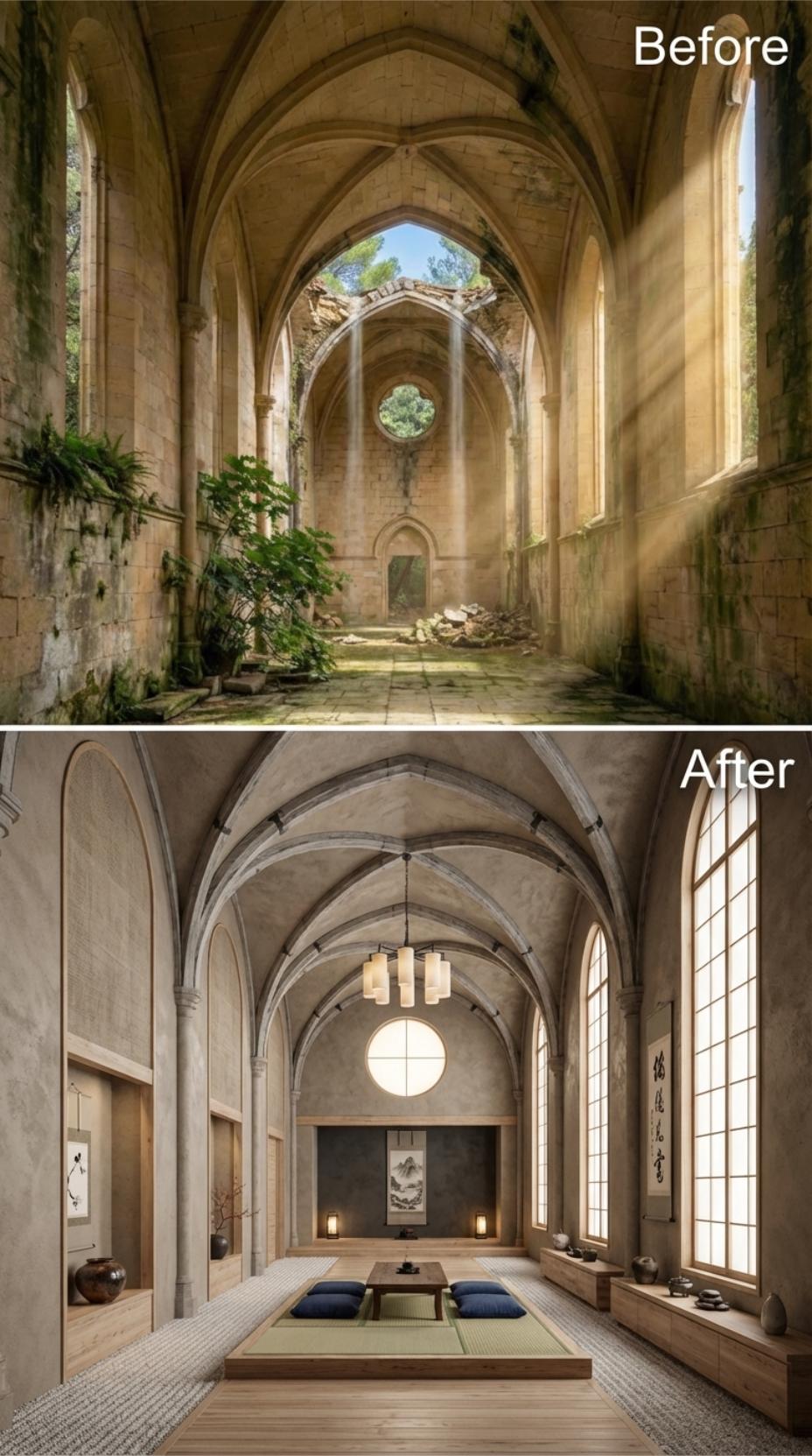
Tatami mats cover a raised timber platform anchoring the room’s center, surrounded by flat zabuton cushions in navy linen and a low-slung walnut table with straight grain visible across its surface. Barrel vaulting overhead runs in raw grey plaster, and a circular oculus window at the far wall mirrors the original church’s rose window geometry almost exactly. Japanese ink-wash scroll paintings hang from recessed niches flanking the entry, while a cluster pendant of cylindrical paper shades drops from the vault’s crown.
Dark Stone Vaulting, Cognac Leather, and an Orb Chandelier Reclaim a Gothic Ruin
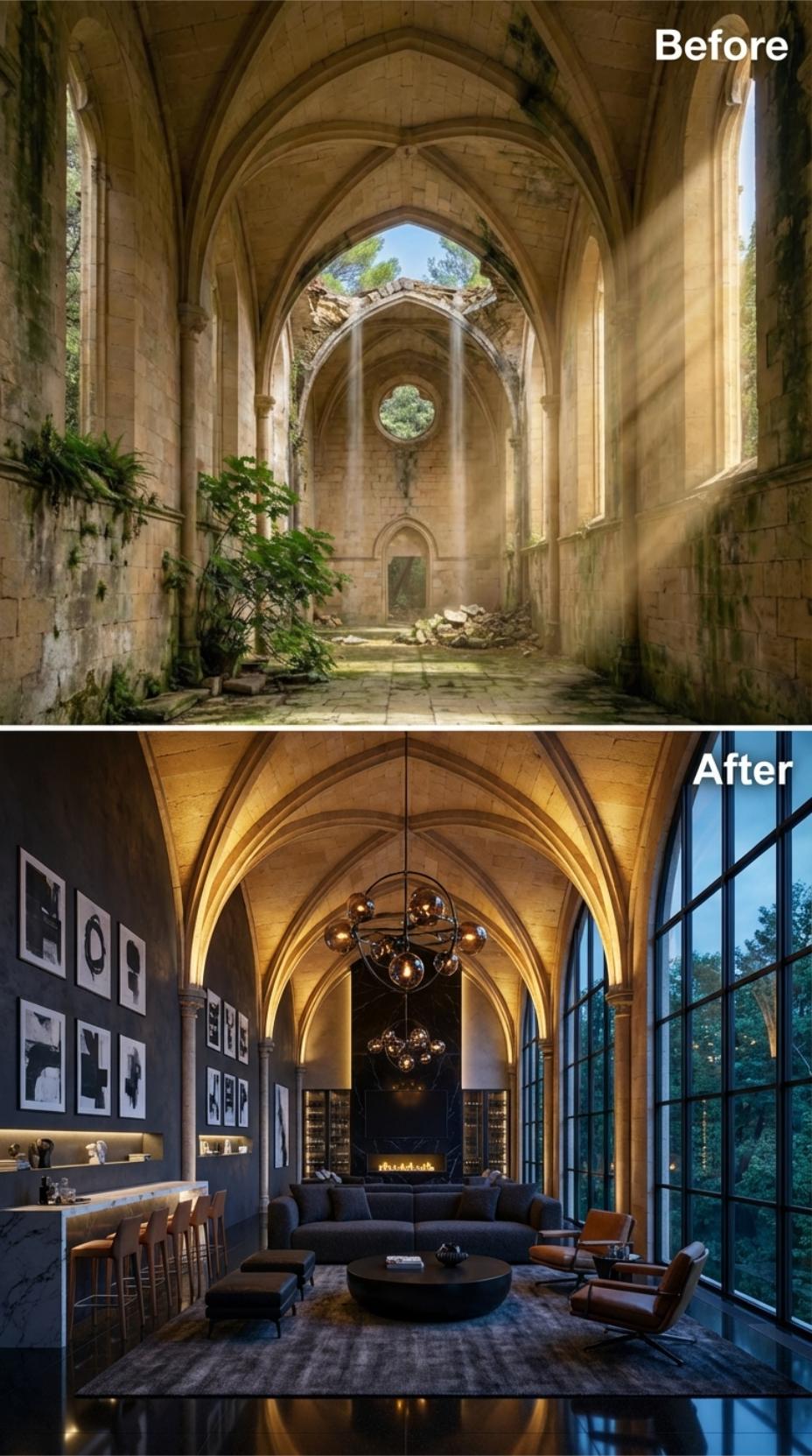
Groin vaults in warm ochre limestone anchor the ceiling while the walls drop to a deep charcoal plaster finish, pulling the eye downward rather than upward. A cluster chandelier of smoked-glass spheres hangs at nave center, its bronze armature echoing the arc of the stone ribs above. Seating runs to a low-profile sectional in slate wool and a pair of cognac leather lounge chairs with tapered legs.
A bar counter in white marble with a honed finish lines the left wall, backed by open shelving under strip lighting. Full-height steel-framed windows at the right flood the space with blue dusk light filtered through forest canopy. A black marble fireplace surround anchors the far wall, flanked by built-in book storage in dark lacquer.
Vaulted Ribs Outlined in LED Strip Light, Linen Sectional Below a Gothic Oculus
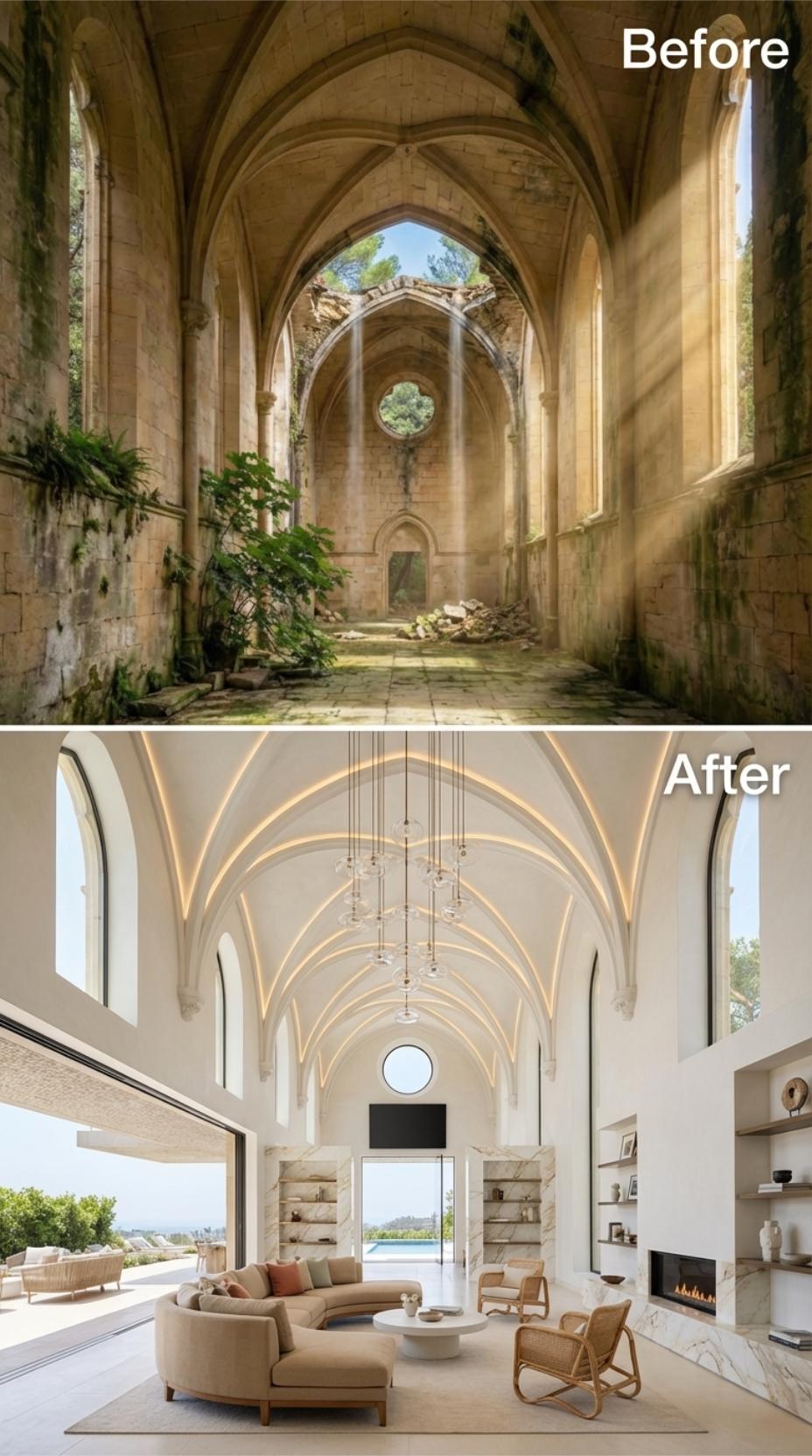
LED strip lighting traces each rib of the whitewashed groin vault, pulling the medieval structure into conversation with a curved linen sectional and a low marble drum table. Rattan armchairs, a wall-mounted TV flush against white plaster, and built-in shelving anchor the nave’s far end.
The Oculus as Focal Point Rather Than Relic
The original circular oculus window, once a collapsed void in a roofless apse, has been retained and reglazed without any decorative framing, letting the stone surround carry the visual weight on its own. Its position above the entry axis draws the eye through the entire length of the room, functioning the way a fireplace traditionally would in a conventional living room. Positioning the television below it rather than beside it was a deliberate choice that keeps the architectural geometry dominant.
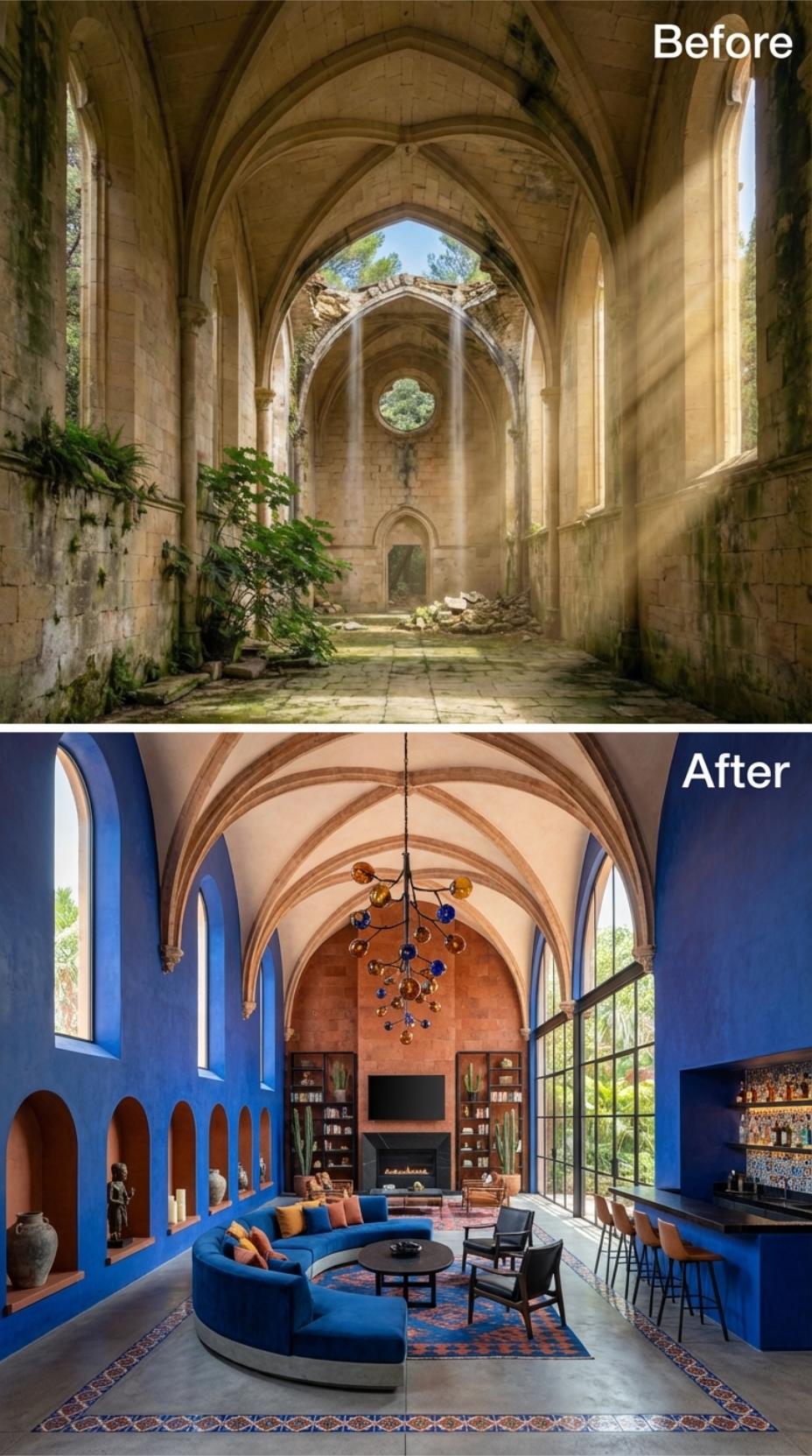
Cobalt Walls and a Blown-Glass Chandelier Inside Gothic Ribbed Stone Vaults
🔥 Would you like to save this?
Saturated cobalt plaster covers every wall surface from floor to springer, making the restored stone ribs read almost like exposed bone by contrast. A curved sectional in royal-blue velvet anchors the center of the nave, paired with a round ebonized wood coffee table and leather armchairs in dark cognac. Amber and cobalt blown-glass orbs cluster on a black branching chandelier suspended from the crown of the vault.
Terracotta-toned plaster lines the altar wall behind built-in bookshelves flanking a fireplace with a black surround. A bar counter along the right wall uses stools upholstered in tan leather. Talavera-style patterned tile borders the floor perimeter in cobalt and rust, referencing Mexican folk craft. Steel-framed floor-to-ceiling windows replace what was once open ruin on the nave’s south side.
- Limiting stone restoration to the vault ribs only, leaving walls free for bold color, keeps the architecture legible without a museum feel
- Pairing a curved sectional with a round table in a rectangular nave softens the axial pull of Gothic geometry
- A built-in bar positioned opposite the fireplace gives the space dual social anchors, reducing dependence on a single focal point
Sandstone Arch and Teardrop Crystal Pendants Over Curved Linen Seating
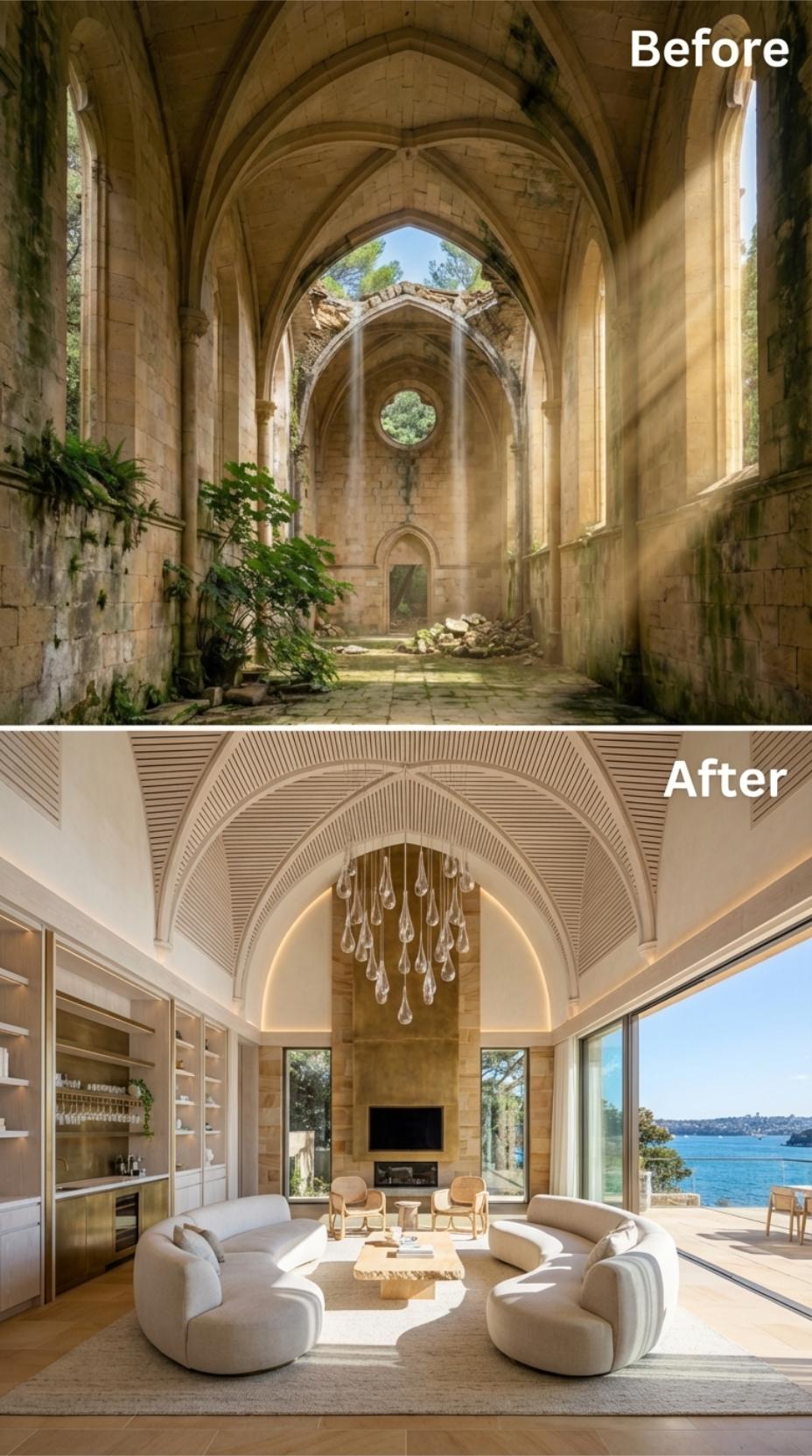
Warm sandstone from the original nave wall anchors a fireplace surround that rises to a restored plaster barrel vault, its ribbed underside lined with slatted timber. Raindrop blown-glass pendants cluster above a travertine coffee table, casting prismatic light across two curved linen sectionals arranged in a near-circular conversation pit. Floor-to-ceiling glazing on the right wall opens to a waterfront terrace, pulling blue harbor water directly into the sightline.
Oak Ribwork and Japanese Floor Seating Reclaim a Crumbling Gothic Nave
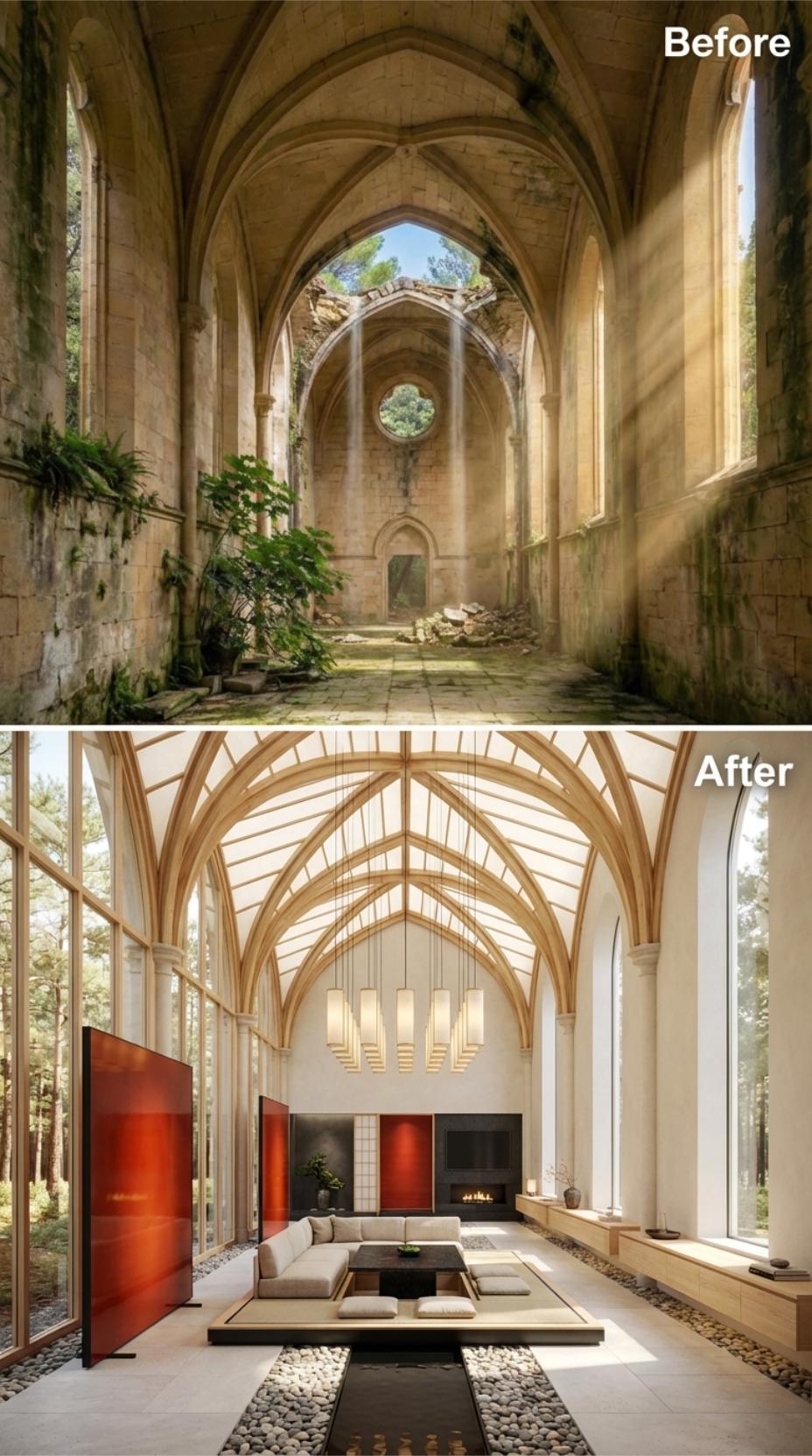
Bare stone walls with moss creeping into every joint gave way to white plaster and pale oak Gothic ribs framing a glass barrel ceiling that floods the nave with forest light. A sunken platform holds a low-profile sectional in cream linen, floor cushions arranged around a lacquered black coffee table. Red lacquer panels anchor the back wall alongside shoji-style screens and a recessed fireplace. River stones line a central channel cut into the limestone floor, pulling the eye toward the seating pit.
Material Matters: Sunken conversation pits, largely dormant since their 1970s peak, are reappearing in adaptive reuse projects where thick stone foundations make below-grade excavation structurally practical. Building down rather than adding furniture height preserves sightlines to the original vaulting, which is often the sole reason the structure merits conversion in the first place. In historic ecclesiastical buildings, this approach also avoids the permitting conflicts that arise when new construction elements compete visually with protected architectural fabric.
Gothic Nave Gutted of Its Ruin, Rebuilt in Marble and Velvet
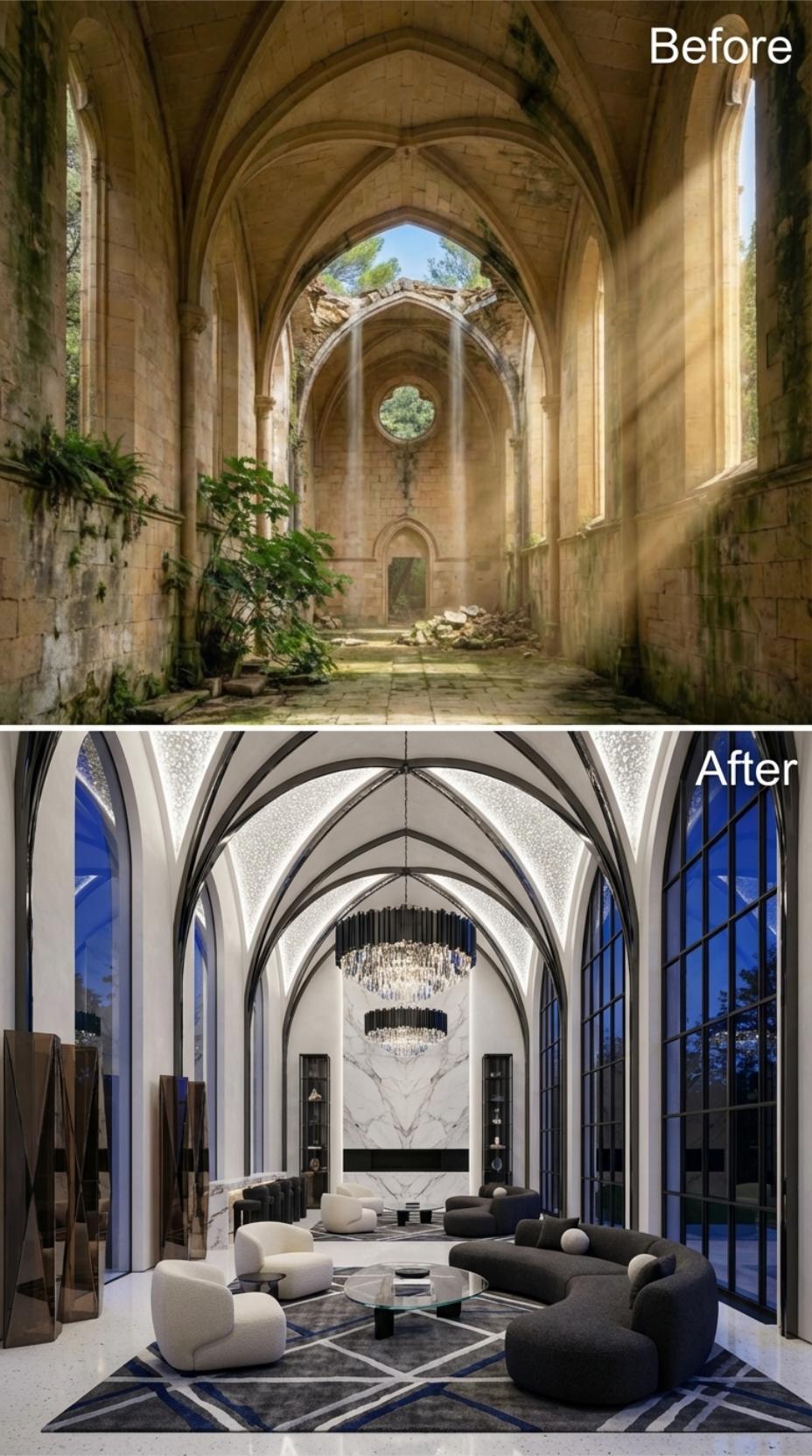
Black-outlined pointed arches rise to a white plaster vault decorated with laser-cut geometric latticework, a pattern that reads almost Islamic in its precision. A layered crystal chandelier with cylindrical black metal extensions anchors the ceiling, and a second smaller pendant drops below it. The floor is white terrazzo inlaid with a dark geometric rug in navy, charcoal, and cream.
Seating divides into two camps: low-profile charcoal bouclé sofas arranged in a curved configuration on one side, and round white upholstered armchairs on the other. A circular glass coffee table sits between them. Floor-to-ceiling steel-framed windows in black fill the flanking walls, and a slab of white Calacatta marble forms the fireplace surround at the far end.
Ask Yourself: If you are drawn to the contrast between the black steel window frames and the white vaulted ceiling, consider how far that single material decision carries the entire room. Gothic ecclesiastical architecture historically used dark iron fittings against pale stone, so the choice here is less modern invention and more direct reference. Ask yourself whether the design choices you are considering borrow from history deliberately or accidentally.
Gothic Ribs Painted Obsidian, Crystal Chandelier, Green Velvet on the Floor
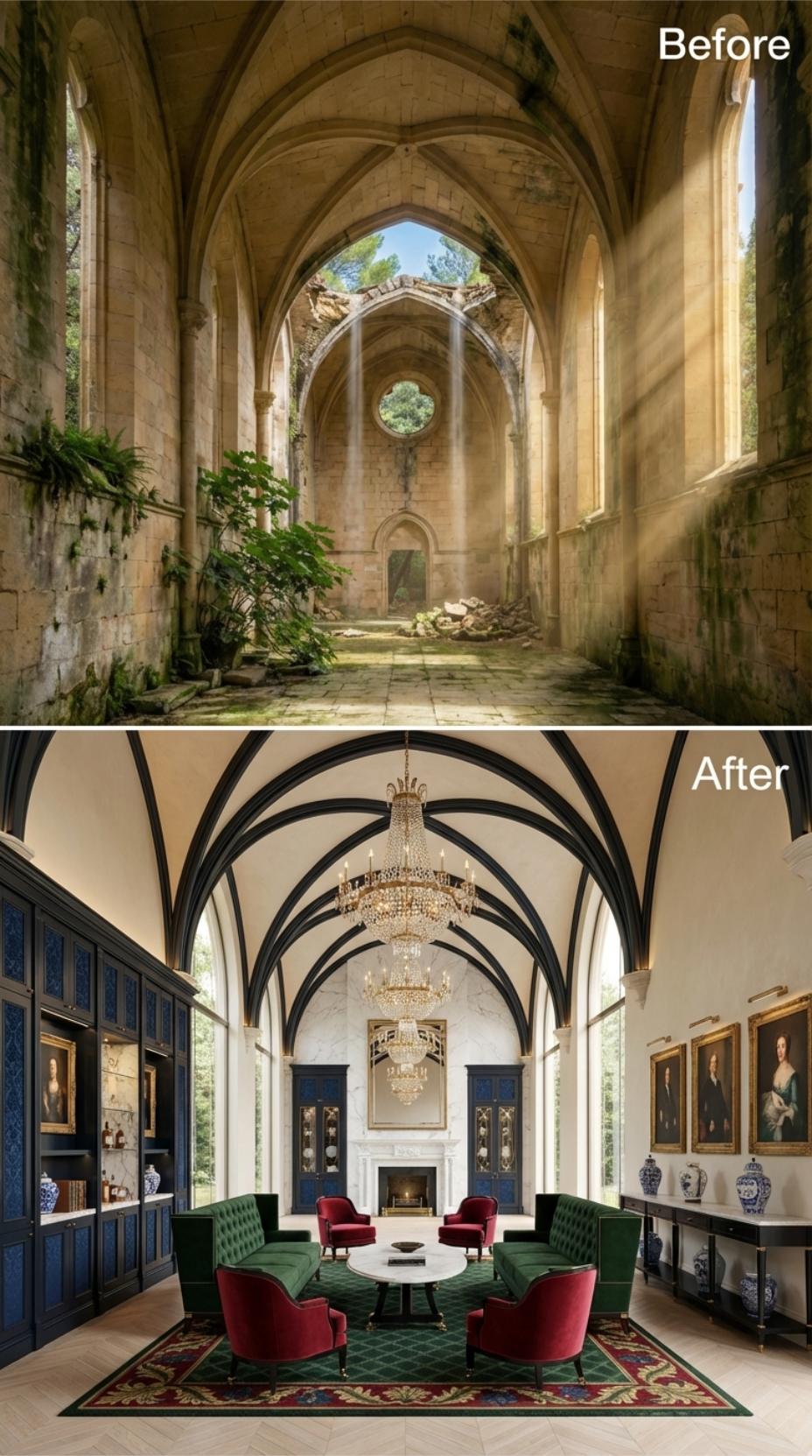
Where crumbling stone once let rain and vines through, dark-outlined groin vaults now arch over a room dressed in jewel tones. The ribs are painted deep black against a plaster ceiling, a decision that turns structural bones into graphic linework. A tiered crystal chandelier anchors the center, its brass fittings catching light from the tall arched windows behind the fireplace.
The seating plan uses forest-green tufted sofas paired with crimson velvet armchairs around a round marble-top table. Blue-paneled cabinetry lines both walls, filled with blue-and-white porcelain. Portrait paintings hang in gilt frames. A wool rug in burgundy and green grounds the whole arrangement on stone flooring.
Trend Alert: Painting structural ribs in a contrasting dark color is one of the most cost-effective ways to draw attention to vaulted architecture in adaptive reuse interiors. Design firms working with converted ecclesiastical spaces report that clients consistently rank ceiling articulation above all other architectural features when choosing a property. That single finish decision can shift the entire visual weight of a room downward, making furnishings read as deliberate rather than incidental.
Teal Sectional and Gothic Ribbed Vaults Reclaim a Roofless Stone Nave
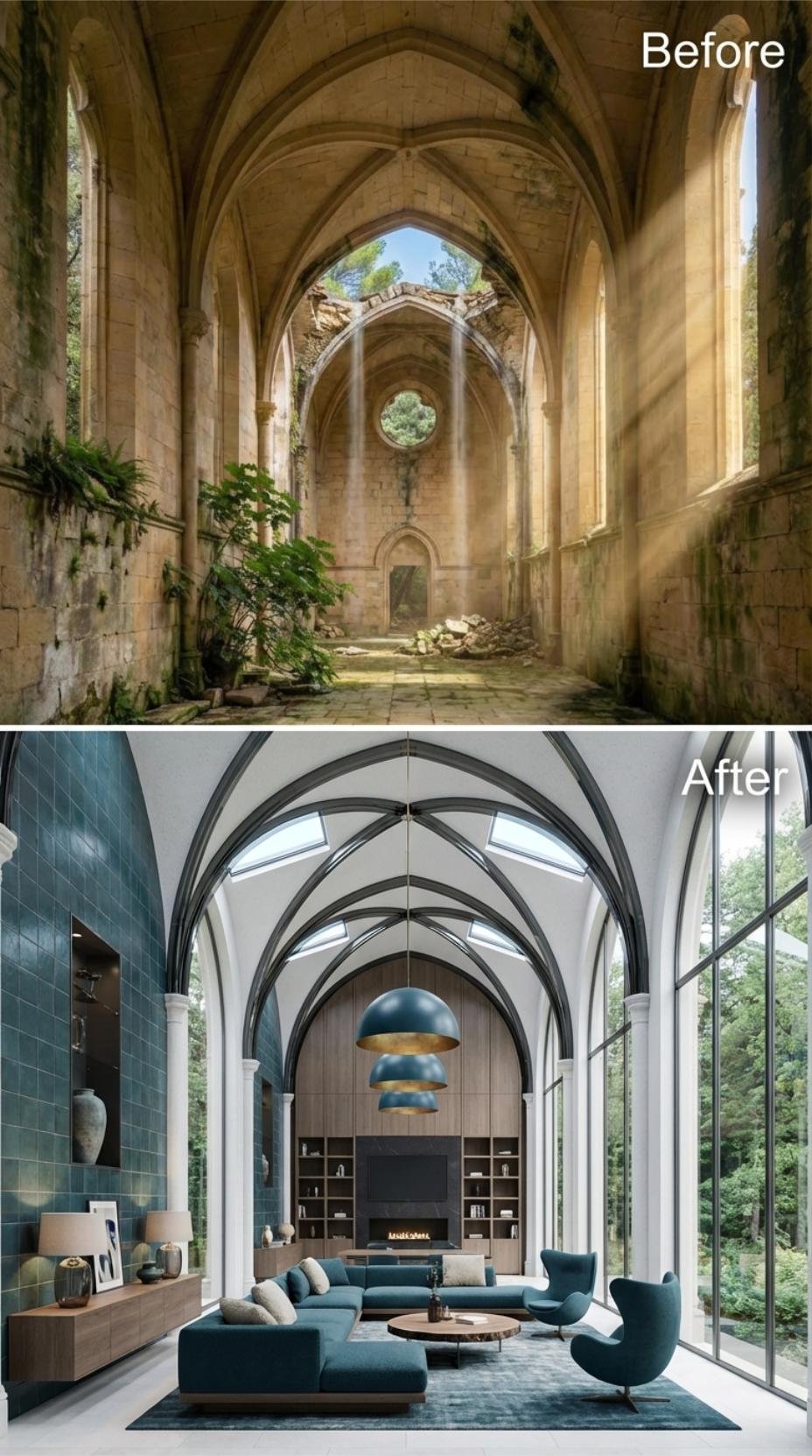
Pointed stone arches that once framed open sky now anchor a living room built around teal upholstery, dark-stained ribwork, and floor-to-ceiling steel-framed glazing. The groin vaults have been plastered white, throwing the painted structural ribs into sharp relief. Three oversized dome pendants in matte navy with brushed-gold interiors hang at staggered heights beneath a skylight cut directly into the vault.
Built-in oak shelving flanks a recessed fireplace at the far wall, its surround clad in vertical-grain wood panels. Zellige-style teal tile runs floor to ceiling on the left wall. An egg chair in teal boucle sits beside a round walnut coffee table, completing a seating arrangement that reads as confidently scaled against the nave’s original proportions.
Designer’s Secret: Skylights cut into masonry vaults require a structural engineer to design a steel curb frame before any glazing can be set, because the vault transfers load laterally rather than straight down. Skipping that step is the single most common and costly mistake in Gothic adaptive reuse projects. Budgeting roughly 15 percent of the glazing cost for that structural assessment is standard practice among firms experienced in religious conversions.
Gold-Trimmed Gothic Arches, Crimson Velvet, and a Teardrop Chandelier Over Marble
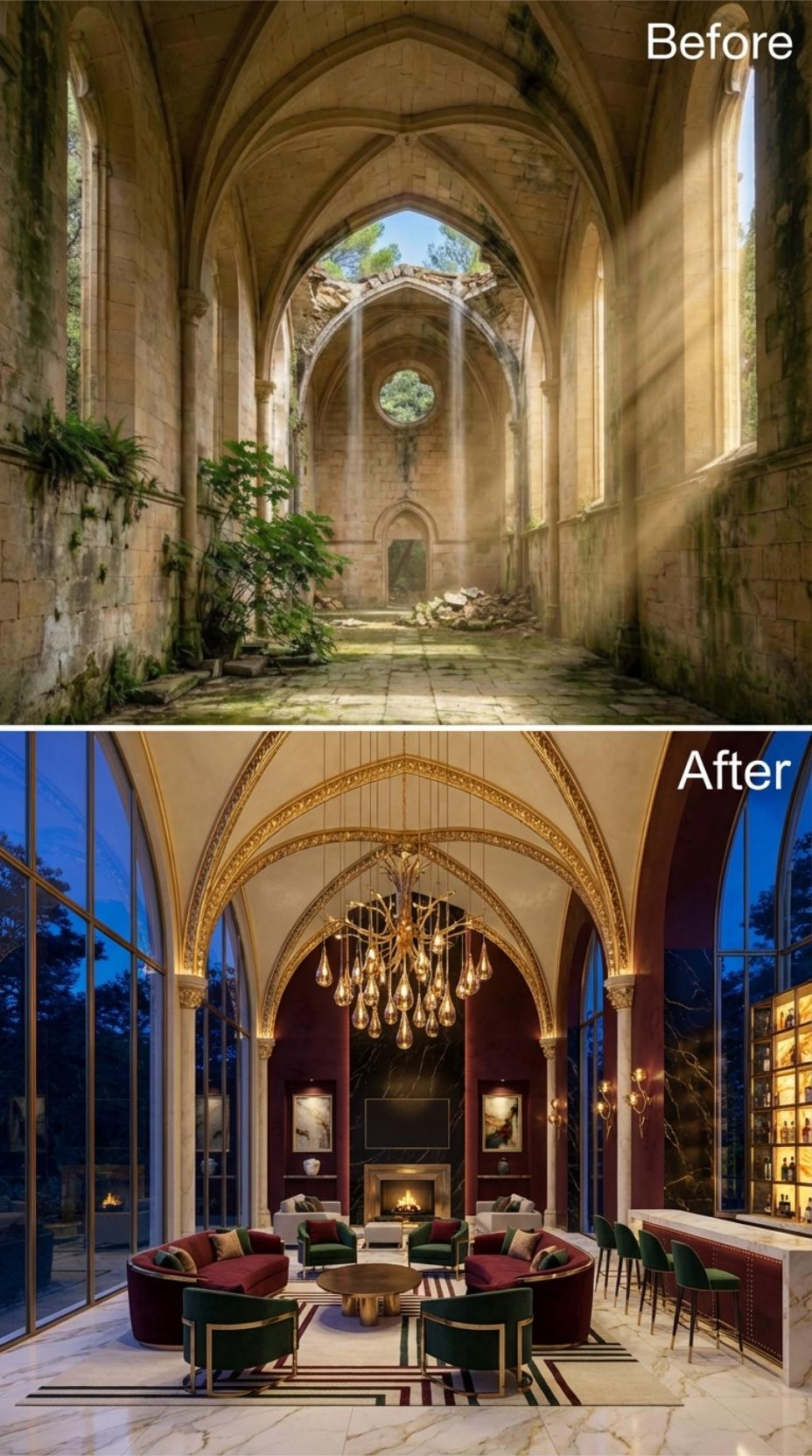
Gilded plasterwork outlines the pointed arches where crumbling stone once stood open to the sky. Curved sofas in deep burgundy velvet anchor a circular seating arrangement around a brass-and-glass coffee table. Green velvet accent chairs and a geometric wool rug in ivory, black, and red lock the palette together. Floor-to-ceiling glazing replaces the collapsed nave walls, and a backlit liquor display occupies the right alcove.
Why It Works: Converting open nave walls into full-height glass curtain walls is one of the most structurally complex decisions in church adaptive reuse, typically requiring new steel moment frames concealed within the masonry reveals. The payoff is a living room that reads as both interior and exterior simultaneously, with the tree canopy visible at eye level after dark. Lighting designers often specify warm amber sources below 2700K in these spaces to counteract the cool blue cast that large glazing panels introduce at night.
Gothic Nave Roofed in Curved Glass, Terrazzo Below, Open Sky Above
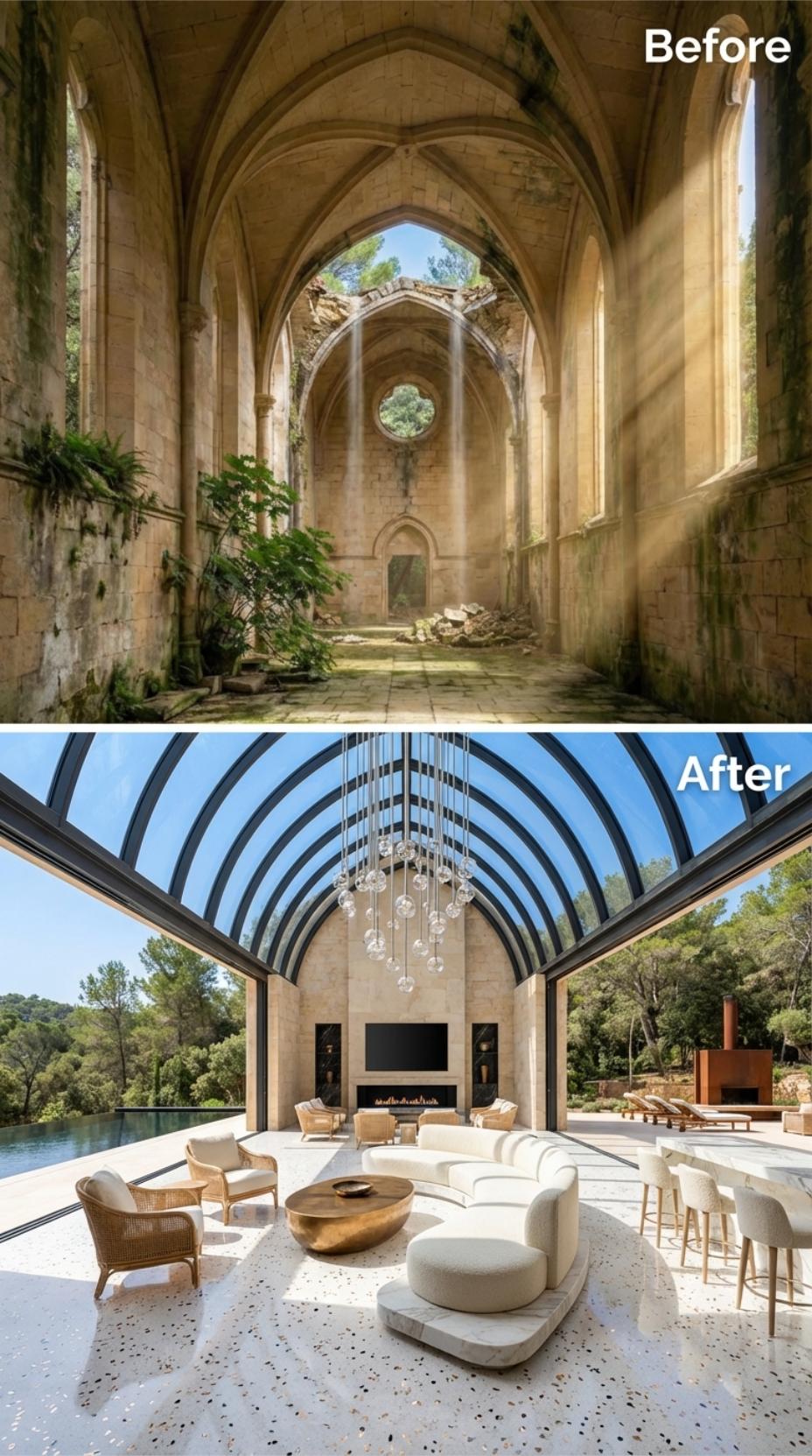
Architects replaced the collapsed vault with a barrel-form glass roof set into black steel ribs, preserving the arch geometry while flooding the nave with unfiltered daylight. The original limestone walls were cleaned and retained, and terrazzo with dark aggregate chips covers the entire floor plane. A cluster of globe pendants drops from the apex on staggered cables.
Seating is arranged in a loose conversation cluster: a low curved sectional in cream bouclé, two rattan armchairs with off-white cushions, and a bronze bowl-form coffee table. A linear fireplace with a black stone surround anchors the far wall below a wall-mounted television. Bar-height stools in pale wood extend toward the open terrace, where the tree canopy begins just past the glass perimeter.
Ribbed Vaults Plastered White, Green Velvet Sectional, Globe Pendants Over an Open Nave
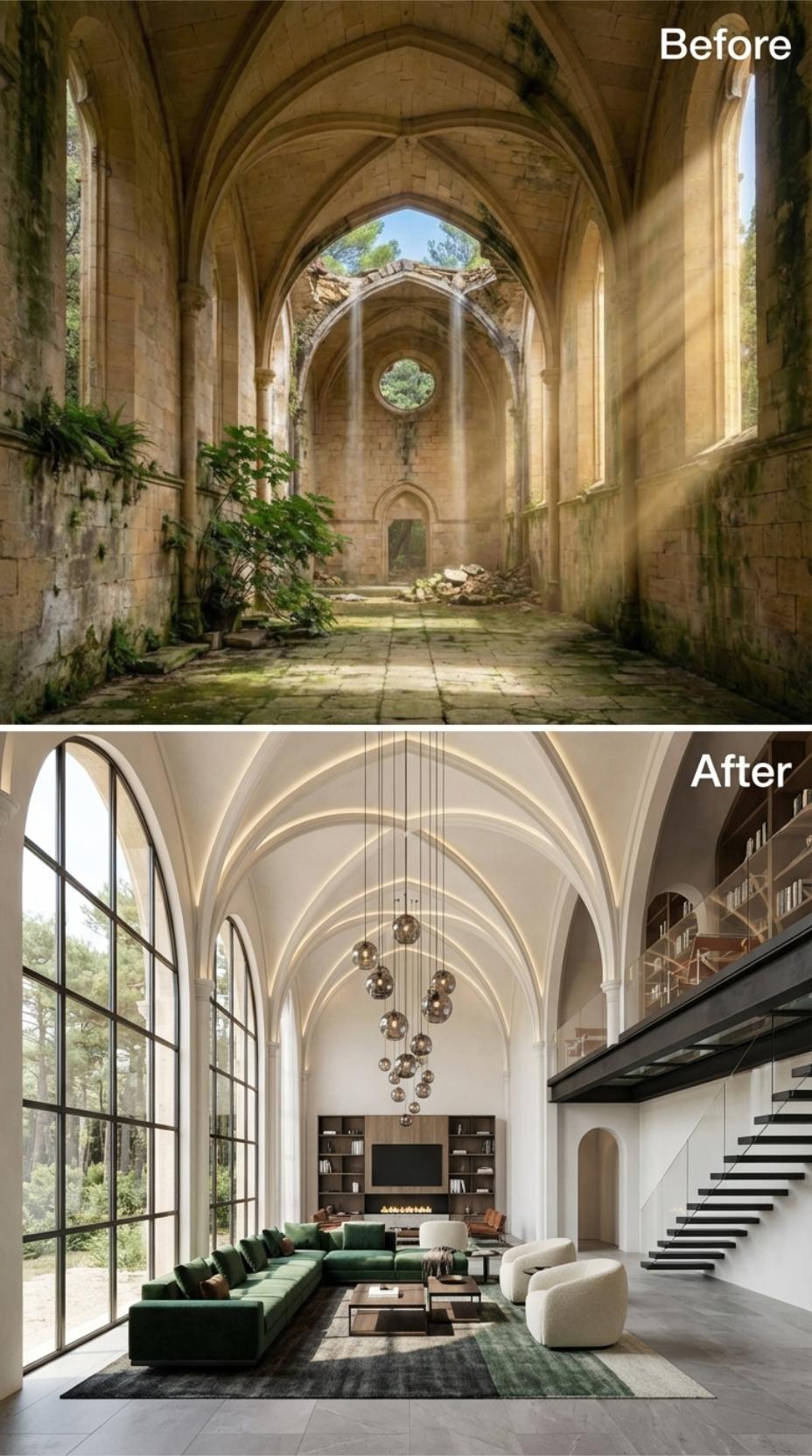
Centuries of decay stripped the roof and collapsed the east wall of this Gothic nave. Reconstruction sealed the structure in smooth white plaster, preserving every rib and groin intersection while erasing the ruin entirely. A cluster of smoked-glass globe pendants drops from the apex on cables of varying lengths, filling the vertical void without competing with the vault geometry above.
The seating plan anchors around a deep forest-green velvet sectional positioned on a charcoal area rug. Two cream boucle lounge chairs face the sectional across a low walnut coffee table. A full-height steel-frame window on the left floods the nave in north light, its black mullions drawing a hard grid against the white arched surround. A cantilevered steel staircase at right leads to a mezzanine library with open shelving.
Suspended Fireplace Box, Curved Sectional, and Gothic Vaults Clad in Warm Stone Panel
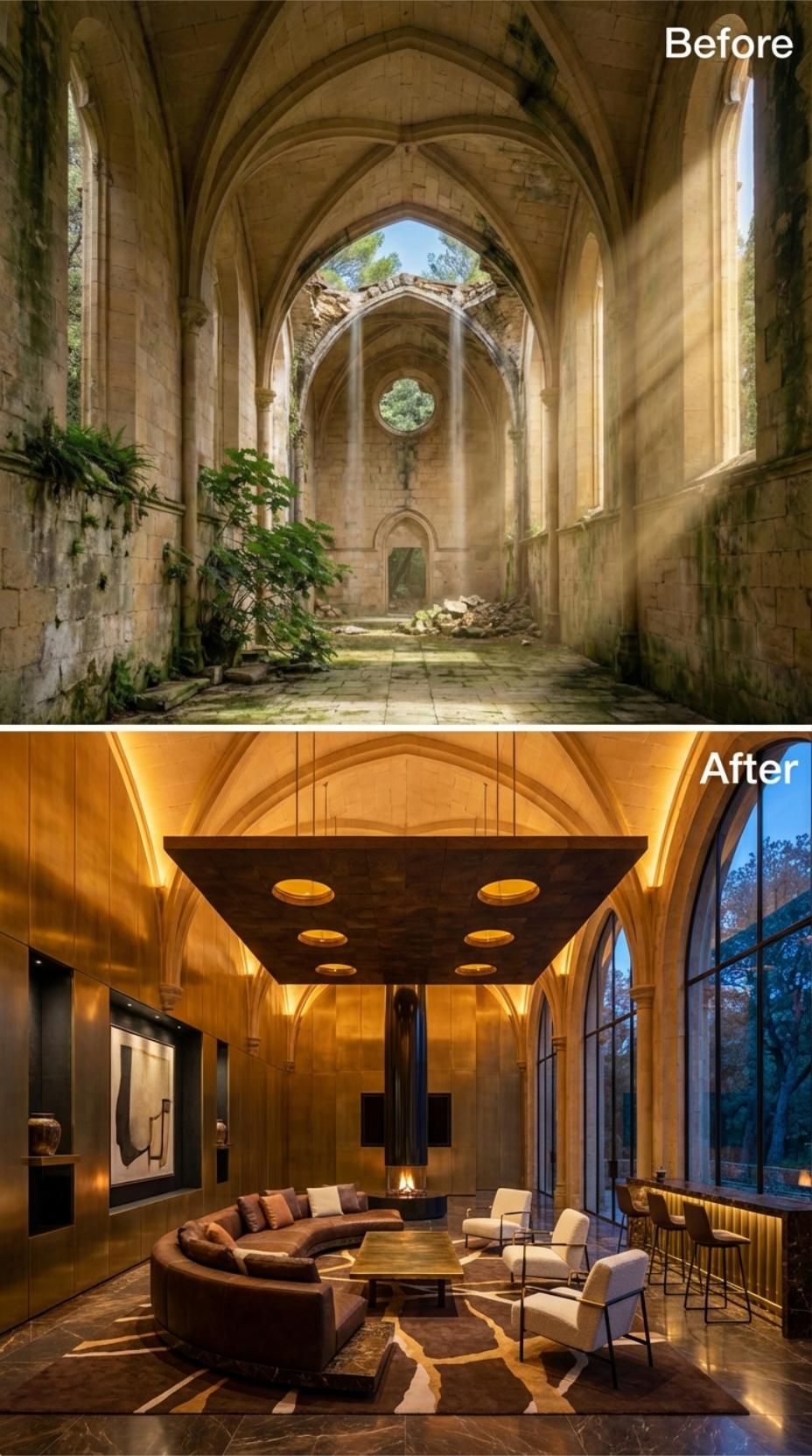
Honey-toned stone cladding runs floor to vault across every wall, pulling the ribbed Gothic arches into the same material palette as the floor, which reads as polished dark marble with a veined geometric inlay. A cantilevered ceiling panel in dark-stained wood hangs on thin rods above the seating area, its six recessed brass-rimmed downlights throwing concentrated pools onto the curved chocolate-brown sectional below. A cylindrical suspended fireplace anchors the center column beneath that panel.
The seating arrangement pairs the sectional with two cream bouclé armchairs and a pair of high bar stools along a counter to the right. Cove lighting traces the underside of each vault rib, shifting the Gothic structure from ecclesiastical ruin into something closer to a private club. Floor-to-ceiling glazing in the far arch frames a blue dusk treeline, replacing what was once open sky through collapsed stonework.
Rusted Corten Steel, Ribbed Stone Vaults, and Low Sectionals Inside a Restored Gothic Nave
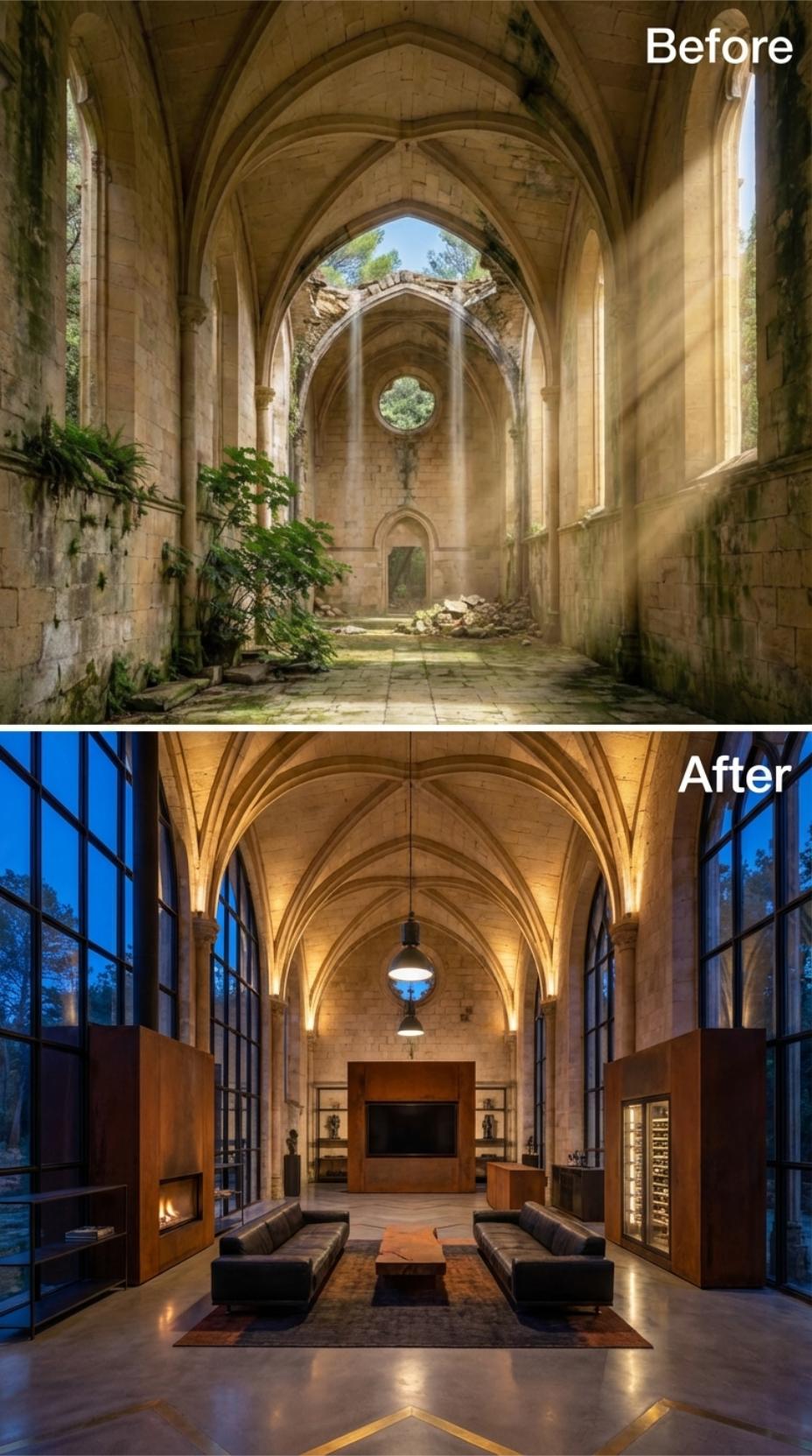
Gothic ribbed vaults, now lit from below by warm uplighting, arch over a low-slung sectional in charcoal upholstery arranged around a wool rug. A Corten steel fireplace surround anchors the far wall, its oxidized finish pulling the rust tones from the stone. Floor-to-ceiling steel-framed windows replace what were open, crumbling nave walls, and the original oculus window survives at the apse end.
Obsidian Ribbed Vaults, Navy Curved Sectional, Fireplace Slab Inside a Restored Stone Nave
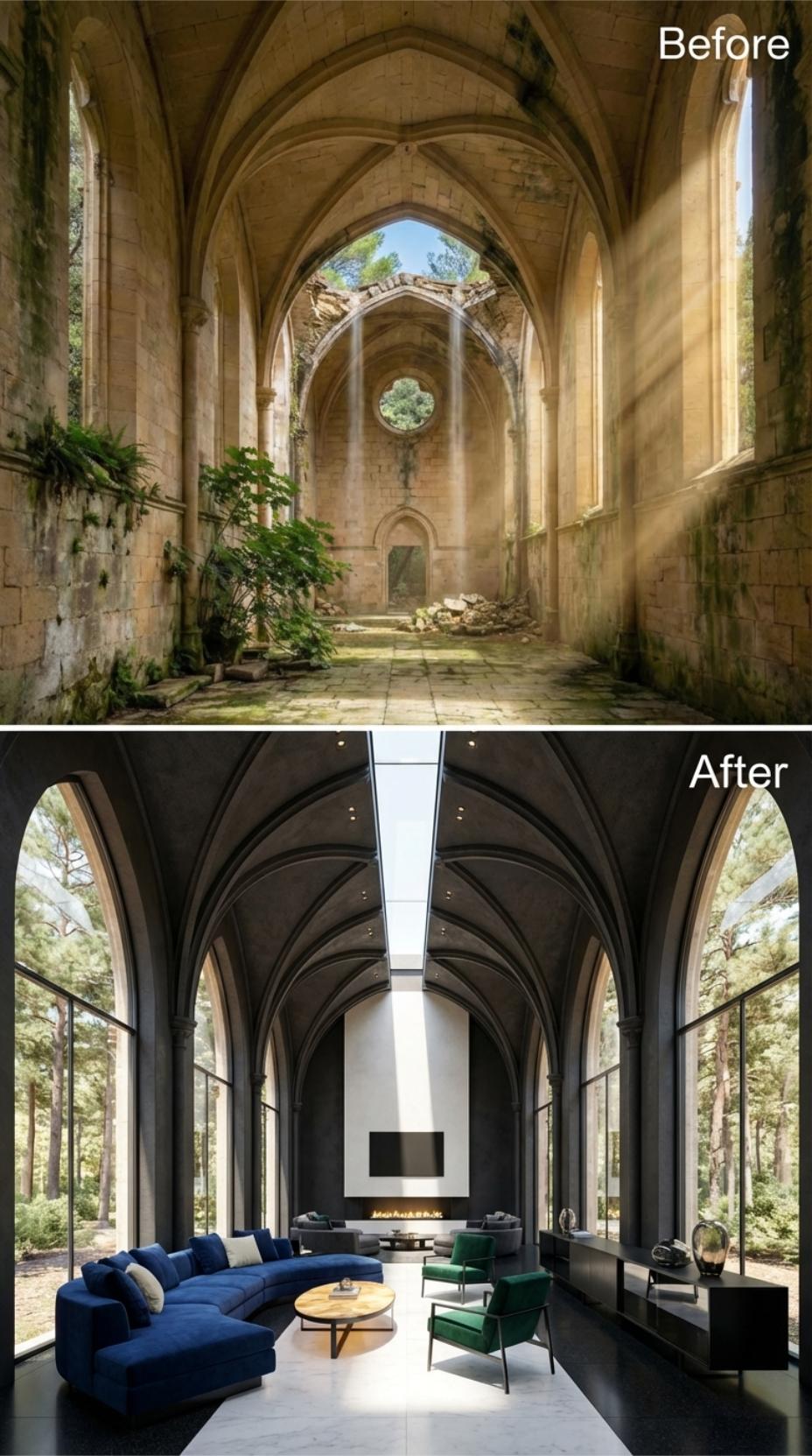
Charcoal plaster applied directly to the Gothic ribbed vaults absorbs light rather than reflecting it, making the skylight strip above the nave the room’s sharpest focal point. A curved navy velvet sectional anchors the near end, paired with a round wood-slab coffee table and two green armchairs in what reads as a deliberate three-color ground plane.
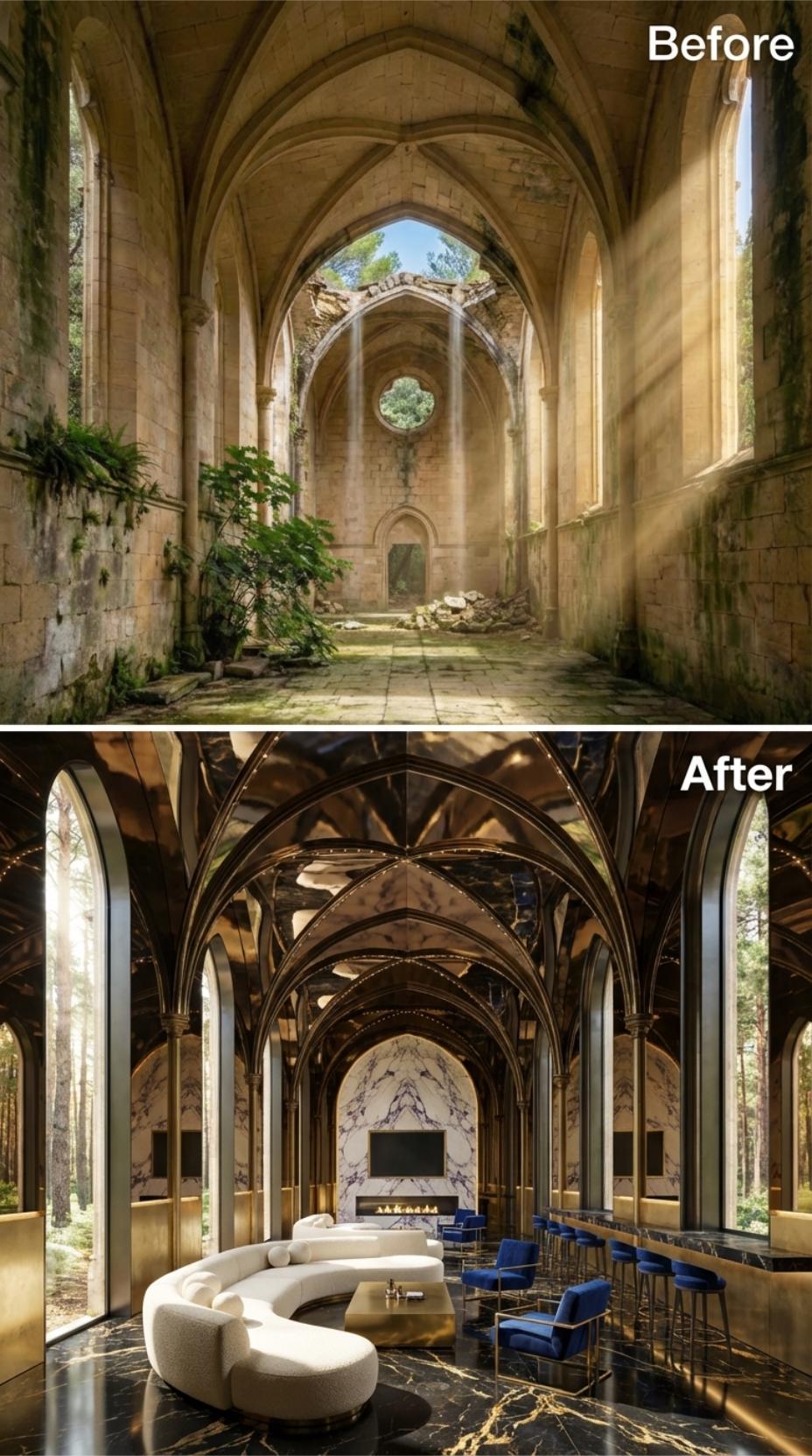
Bronzed Ribbed Vaults, Black Marble, and a Curved Boucle Sectional Inside a Restored Stone Nave
🔥 Would you like to save this?
Cracked flagstone and collapsed masonry gave way to black-and-gold veined marble flooring that runs the full length of the nave. The Gothic ribbed vaults were preserved structurally but finished in a deep bronze lacquer, which pulls warmth from the gold accent trim lining each arch springer. Floor-to-ceiling arched windows on both flanking walls were reglazed with clear glass, keeping the surrounding pine forest as a live backdrop rather than a decorative afterthought.
The furniture plan divides the nave into two distinct zones without a partition wall. A curved boucle sectional in off-white anchors the living area, paired with a low brass-framed coffee table. To the right, a bar counter in black marble seats four navy velvet stools with brass legs. The focal wall at the nave’s terminus is clad in white marble with violet veining, framing a linear gas fireplace below a flush-mounted television.
Stone Nave Opened to Sky, Fitted With Glass Walls and a Blue Sphere Chandelier
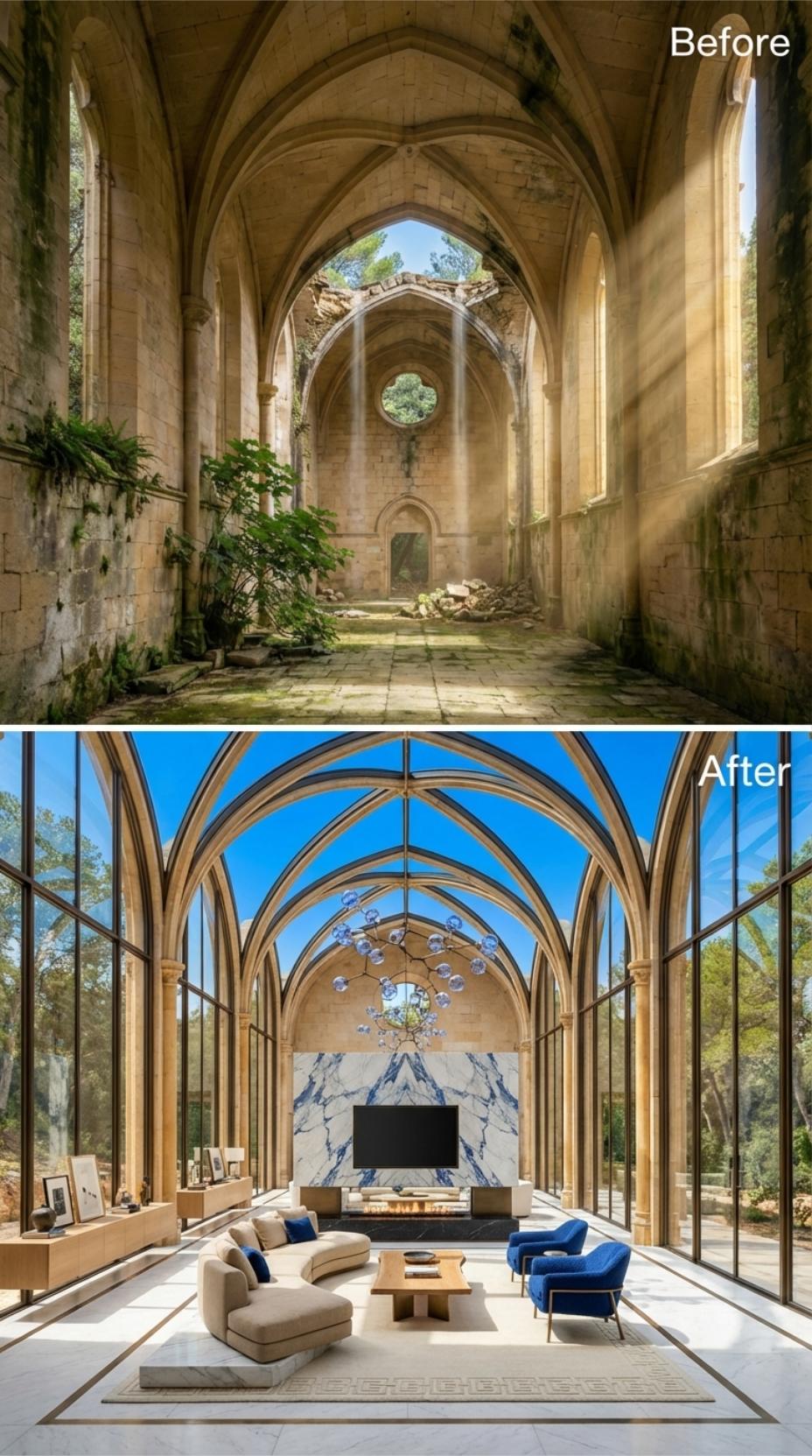
Large-format glass panels now fill the spaces between original limestone ribs, replacing crumbled stone with floor-to-ceiling views of pine canopy and open sky. A sculptural chandelier clusters blue glass spheres at mid-vault height, anchoring the room without touching the restored ribbed ceiling. Below it, a curved cream sectional and a pair of cobalt velvet armchairs face a slab of blue-veined white marble that frames both a fireplace and a wall-mounted television.
Bleached Vaults, Aqua Glass Chandelier, and Blue Velvet Chairs Inside a Restored Stone Nave
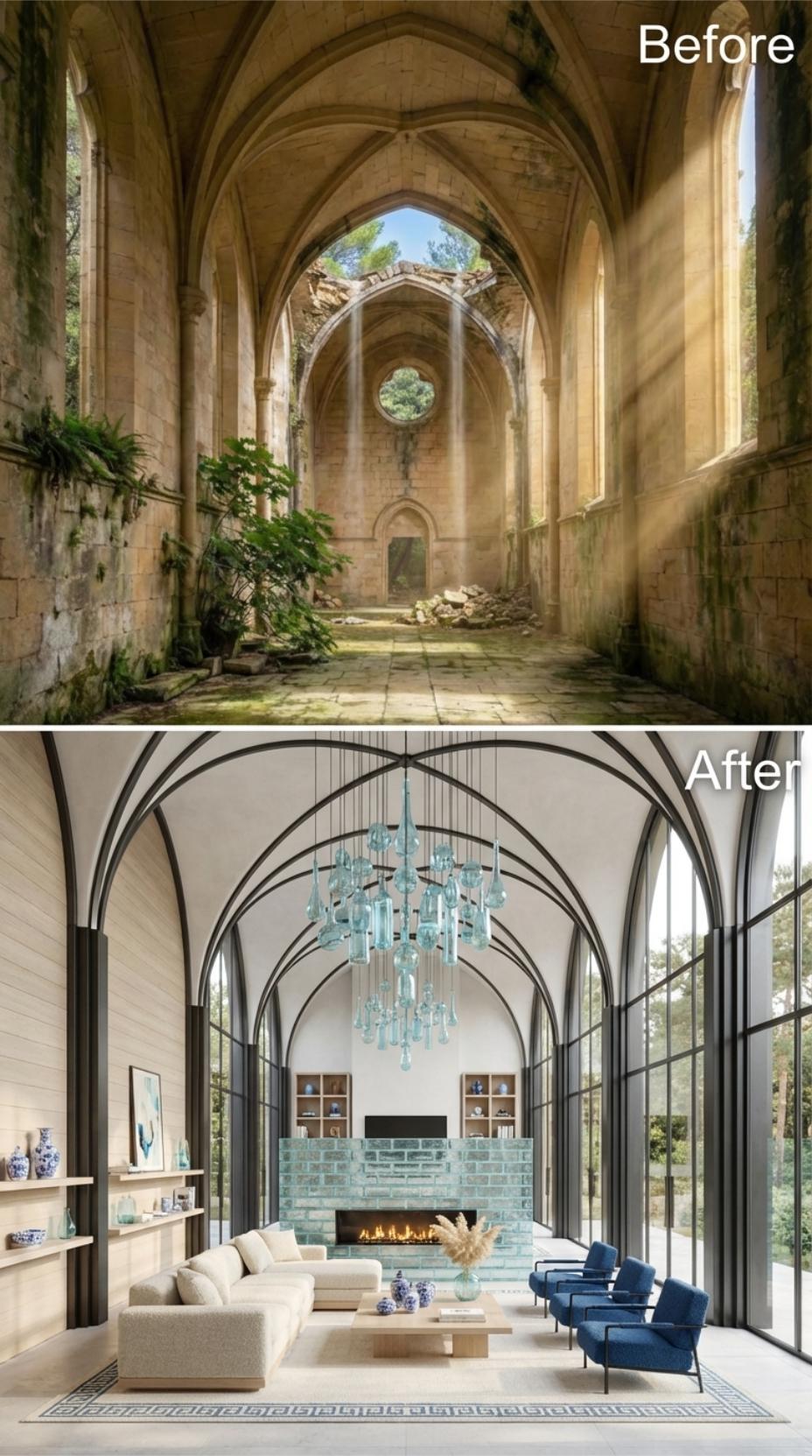
Plasterers stripped the original Gothic ribbed vaults down to bare stone, then finished them in flat white plaster, leaving the dark steel rib outlines exposed as deliberate graphic lines against the ceiling. That contrast does the decorative work without any additional ornament. The chandelier drops from the vault’s crown on thin cables, its clustered aqua glass pendants reading almost like submerged bubbles against the white plaster field above.
At floor level, a cream boucle sectional anchors the left side while four navy velvet armchairs on tapered black steel legs face the fireplace. The fireplace surround is clad entirely in handmade teal zellige tile, stacked floor to ceiling in an irregular grid that catches light differently at every hour. Tall steel-framed windows along the right wall replaced what was once open, crumbling stonework, and they now frame unobstructed tree canopy. A Greek key-bordered area rug in pale blue and cream defines the seating zone on what appears to be bleached oak or limestone-effect flooring.
Whitewashed Ribbed Vaults, a Cylinder Fireplace, and Boucle Seating Inside a Restored Gothic Nave
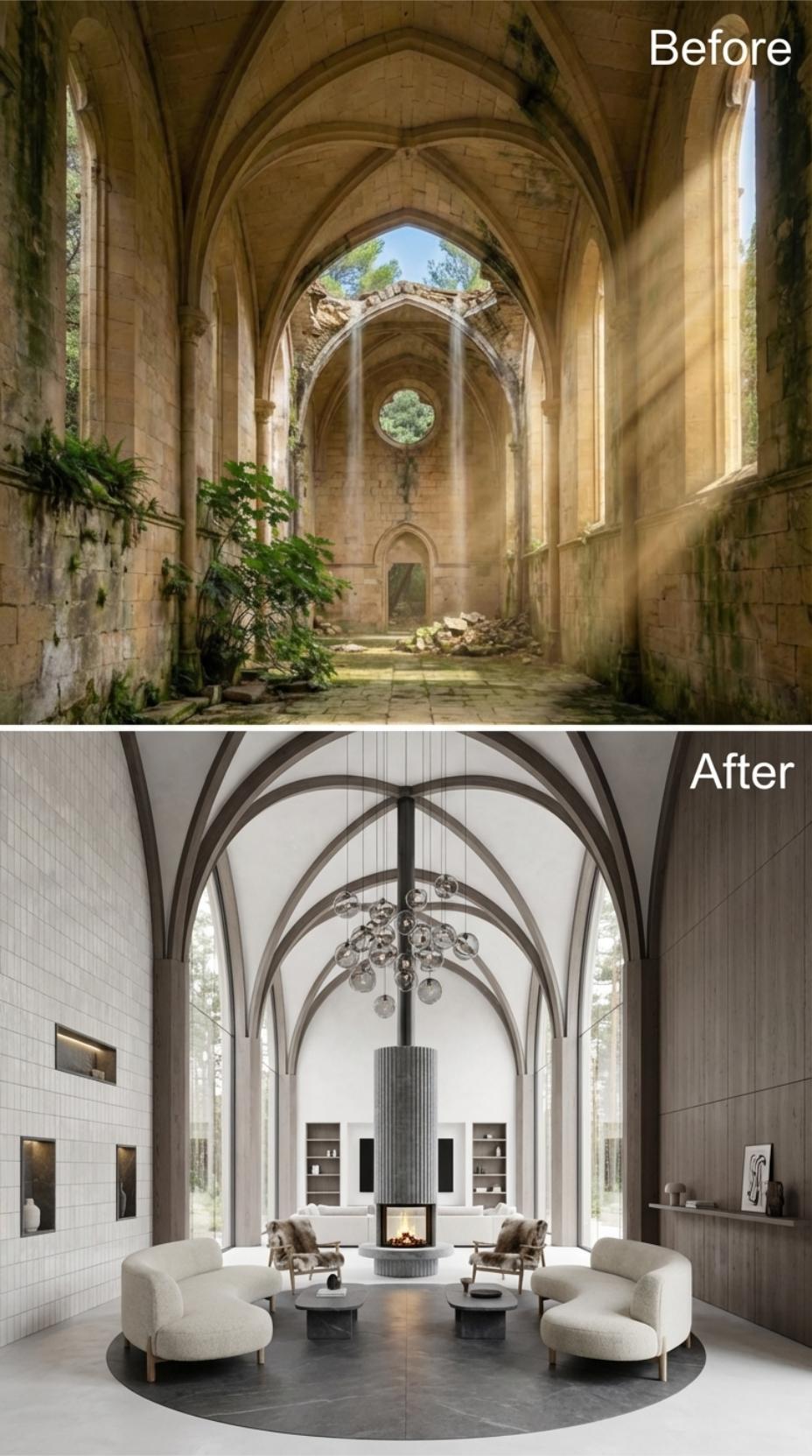
Where rubble once collected beneath collapsed stonework, a cylindrical steel fireplace now anchors a circular seating arrangement of low boucle sofas and open-arm chairs in cream fabric. The ribbed vaults are plastered white, with their structural ribs picked out in dark charcoal-brown, pulling the eye upward without additional ornament. A cluster chandelier of glass spheres and brass hardware drops from the vault’s crown directly above the fireplace column.
The floor shifts to large-format slate tile in a cool blue-grey, grounded by a circular dark area rug that defines the conversation zone. Built-in shelving units flank a glazed opening at the nave’s far end, framing a stand of trees beyond. White subway tile runs floor-to-ceiling on the side walls, swapping the original mossy limestone for a surface that bounces light back into the soaring interior.
Plaster-White Ribbed Vaults, Built-In Oak Shelving, and a Stone Fireplace Slab in a Restored Gothic Nave
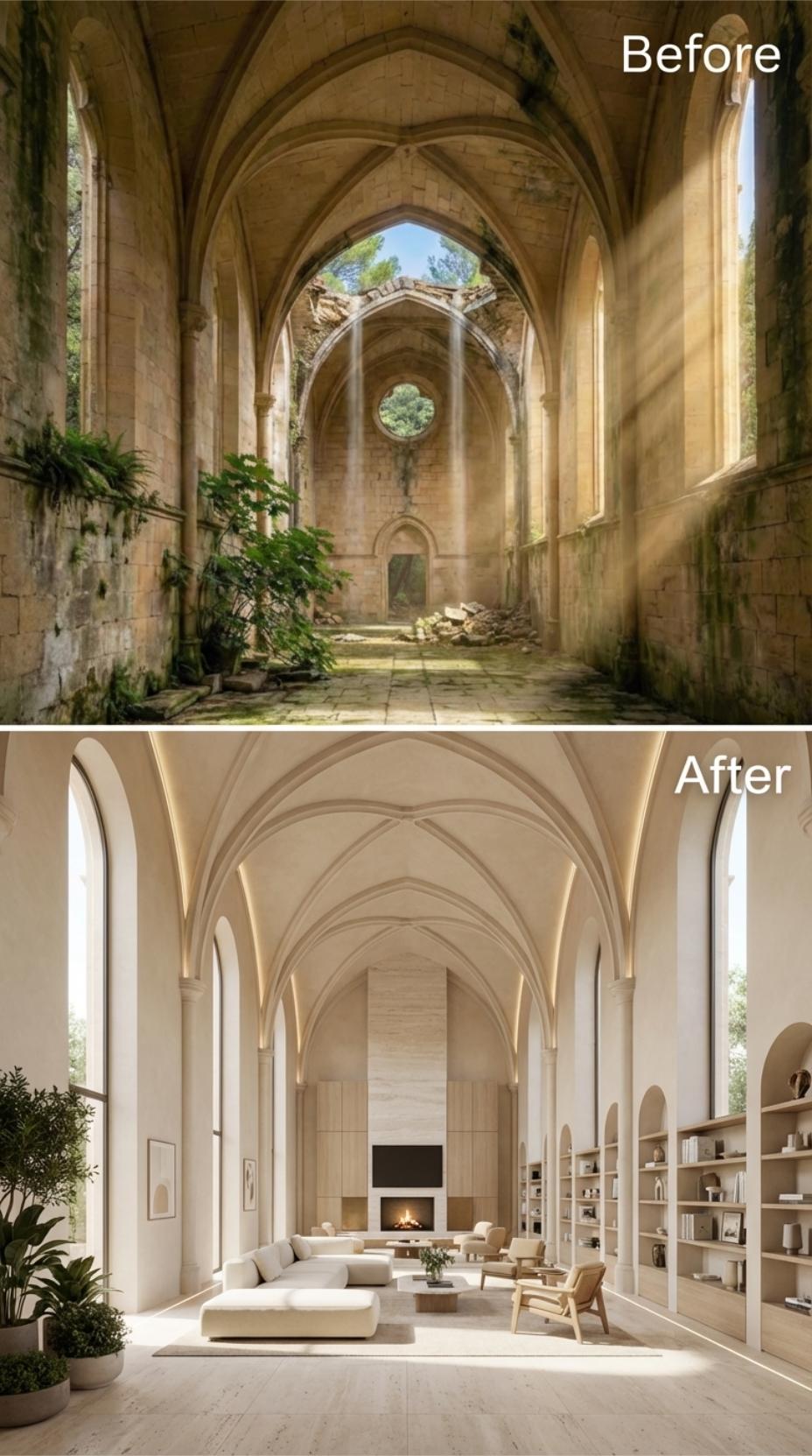
Rubble, moss-covered stonework, and a collapsed rear wall gave way to plastered ribbed vaults finished in flat white, with recessed strip lighting tucked along each rib to replace the sun shafts that once broke through the ruin. A floor-to-ceiling stone slab surrounds the fireplace at the far end, its vertical proportions echoing the nave’s original lancet windows. Low-profile sectional seating in cream bouclé anchors the central axis, flanked by pairs of tan leather armchairs on a pale oak floor. The right wall holds a run of built-in shelving set inside rounded arches, finished in the same warm oak as the flooring.
Plaster Vaults and a Sunken Boucle Pit Open Onto a Pool Through Full-Height Glass
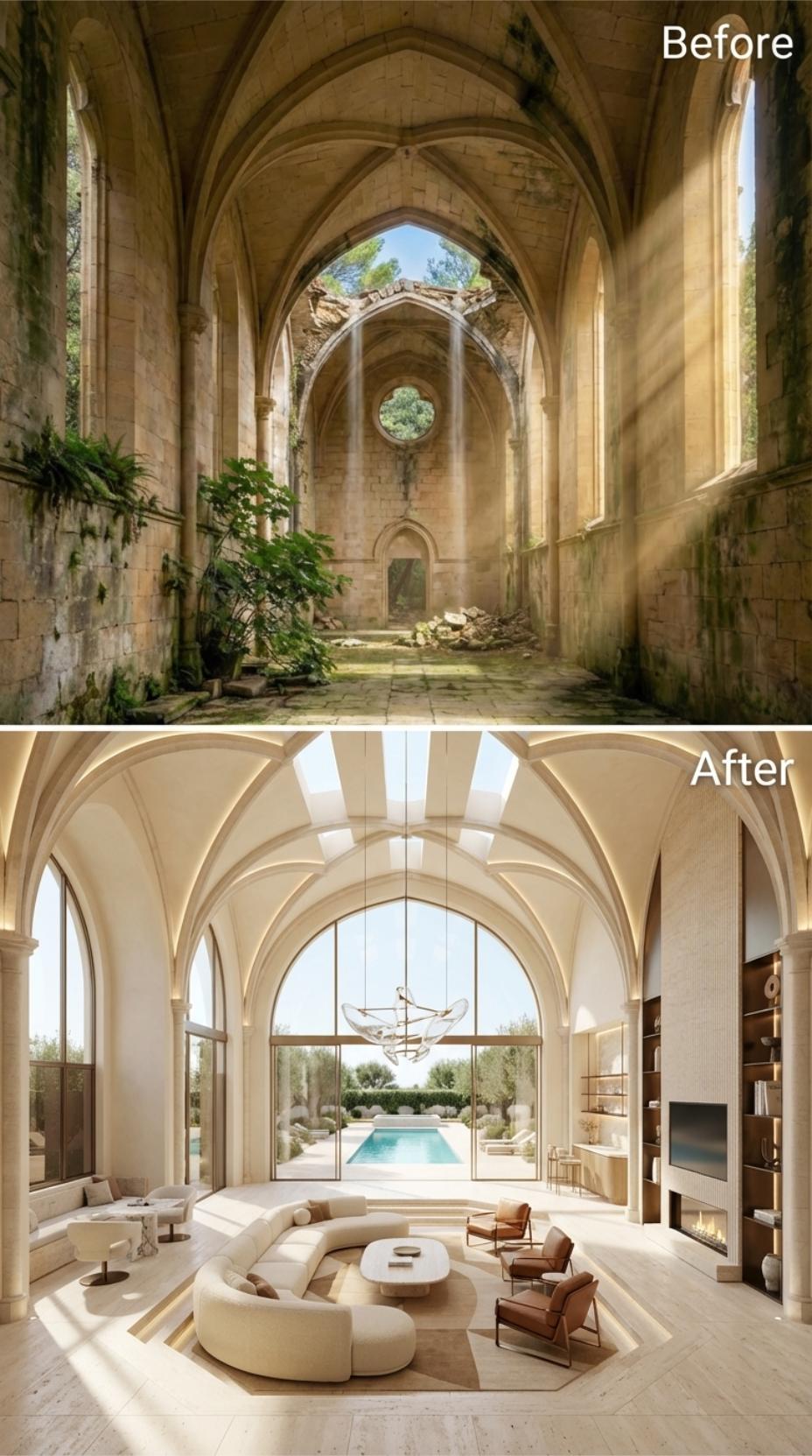
Plasterers smoothed the ribbed Gothic vaults to a uniform cream finish, softening the medieval geometry without erasing the pointed arch profiles overhead. A sculptural glass chandelier hangs at the center, its branching form echoing the vault ribs above it. Warm terrazzo flooring grounds the nave in pale aggregate tones.
The seating configuration sinks slightly into the floor plane, a detail easy to miss at first glance. Curved boucle sectionals wrap around a low stone coffee table, flanked by cognac leather armchairs. A built-in fireplace anchors the right wall beside dark-stained oak shelving. Beyond the arched glass wall, a lap pool sits framed by olive trees.