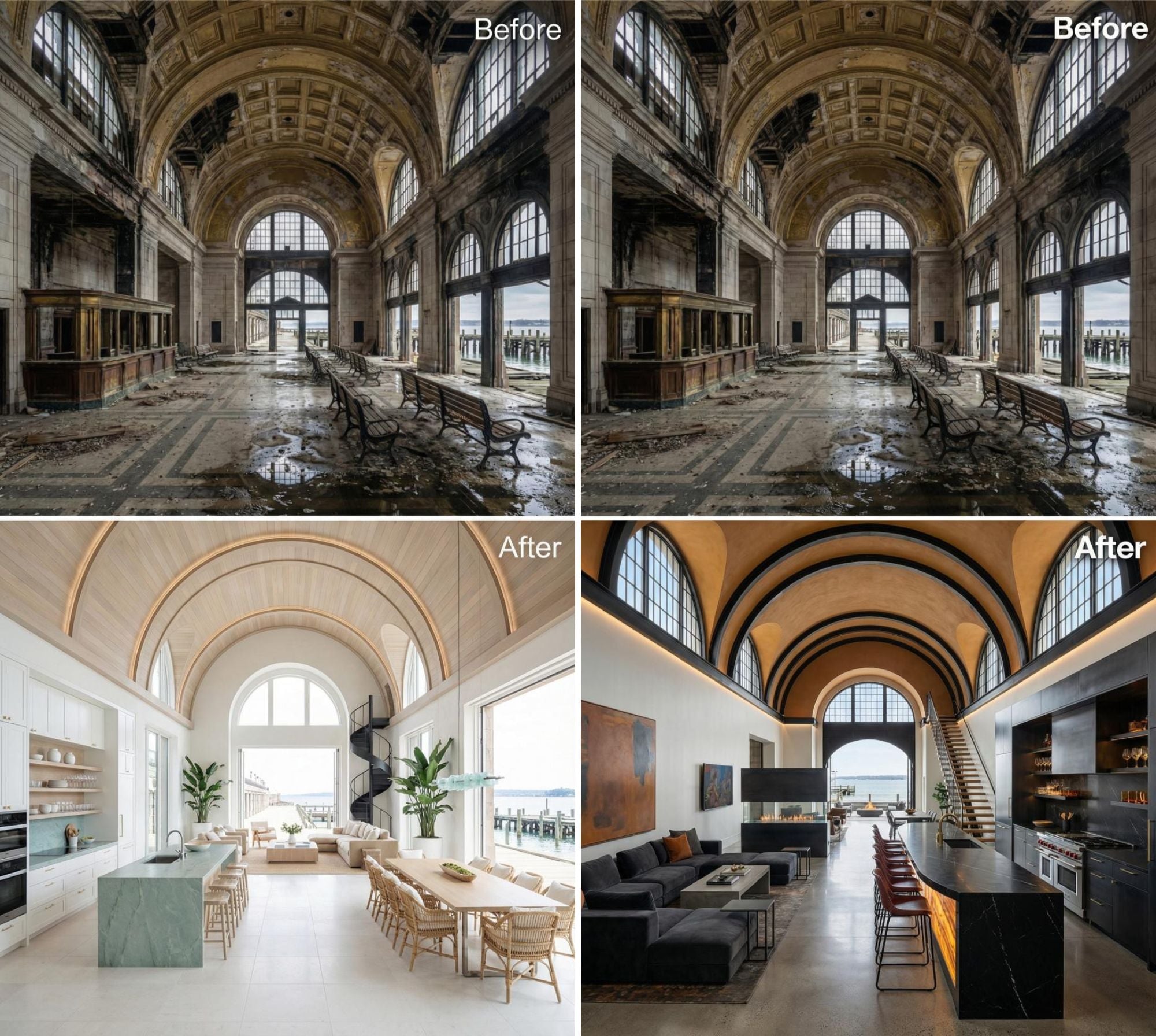
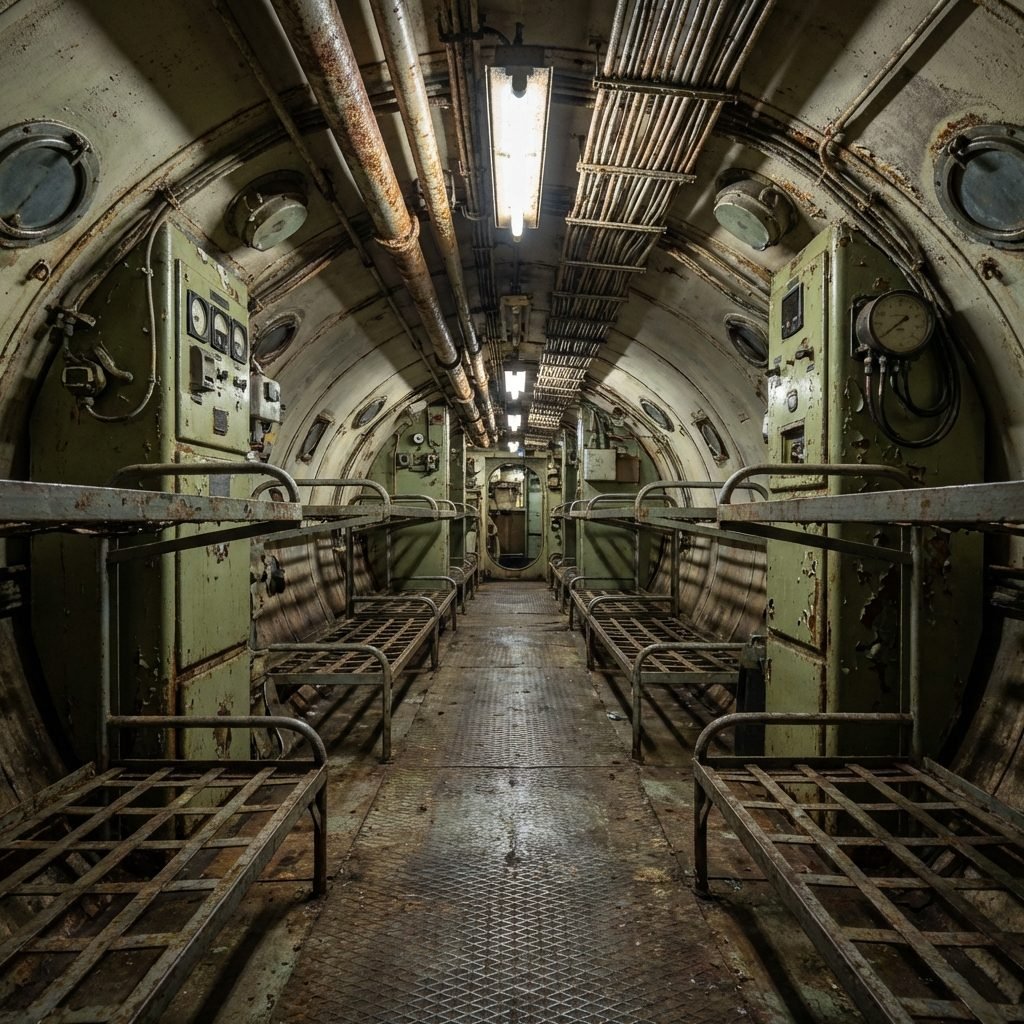
What happens when a decommissioned military submarine stops being a weapon and starts being a home? You get one of the most spatially challenging, psychologically fascinating design puzzles on the planet. Every inch is curved. Every decision is permanent. And every style choice has to fight for its life inside a steel tube that was never meant for living. These 30 redesigns take the same raw, stripped-back submarine interior and push it in wildly different directions, from deep-sea Gothic to sun-drenched Mediterranean, from Tokyo minimalism to full Versailles-level maximalism.
Raw Steel to Obsidian: A Dark Industrial Penthouse Beneath the Waves
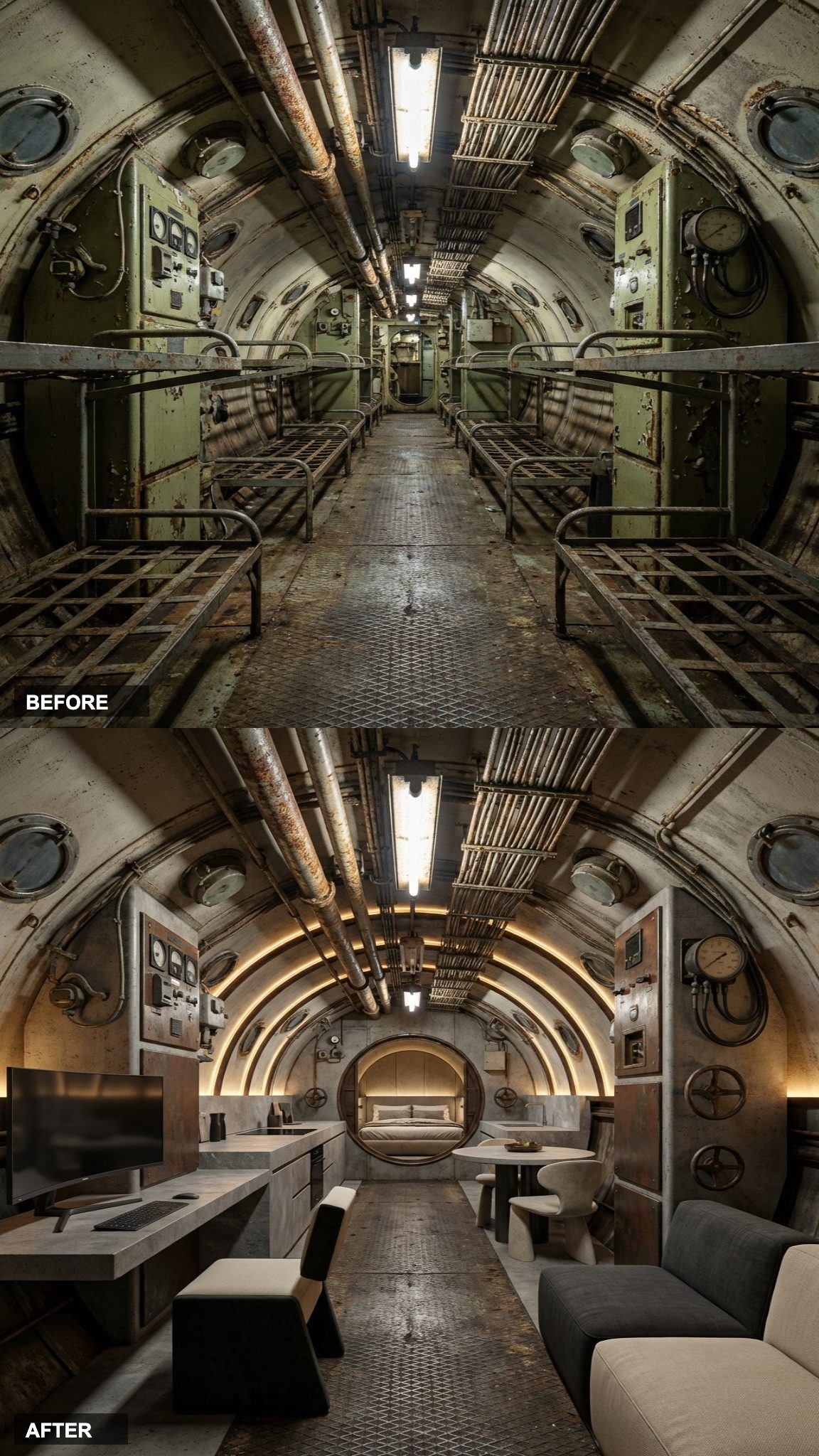
Black powder-coated steel framing meets smoked glass and raw concrete panels in this brutalist-luxe take on submarine living. The cylinder walls get clad in honed basalt tile, that near-black with faint grey veining that catches light like wet stone. Up front, the workspace anchors itself with a floating desk in blackened oak and a task lamp throwing a warm amber cone. Midship, the kitchen shifts to matte black cabinet faces, unlacquered brass hardware, and a polished concrete countertop running the full width of the galley.
In order to come up with the very specific design ideas, we create most designs with the assistance of state-of-the-art AI interior design software. Also, assume links that take you off the site are affiliate links such as links to Amazon. this means we may earn a commission if you buy something.
The rear bedroom goes deep: charcoal linen bedding, low-profile platform bed, and a single wall-mounted reading sconce in aged brass. It reads like a hotel suite that was designed specifically for people who don’t need windows.
Cream, Cane, and Candlelight: A Colonial-Era Study in a Steel Cylinder
This version leans into the absurd contrast fully. The curved hull walls get wrapped in wide-plank teak paneling with a honey finish, and the workspace in the foreground anchors itself with a leather-top writing desk and a brass library lamp. Every piece of furniture sits on ball-and-claw feet, ridiculous in theory, perfect in practice.
The kitchen midship takes on rattan cabinet door inserts, cream-painted wood frames, and open shelving with hand-thrown ceramic vessels. The bedroom rear features a carved teak headboard bolted to the hull, white cotton bedding with eyelet trim, and a pair of wall-mounted hurricane-style sconces.
Tokyo at Midnight: A Japandi Micro-Apartment Under the Ocean
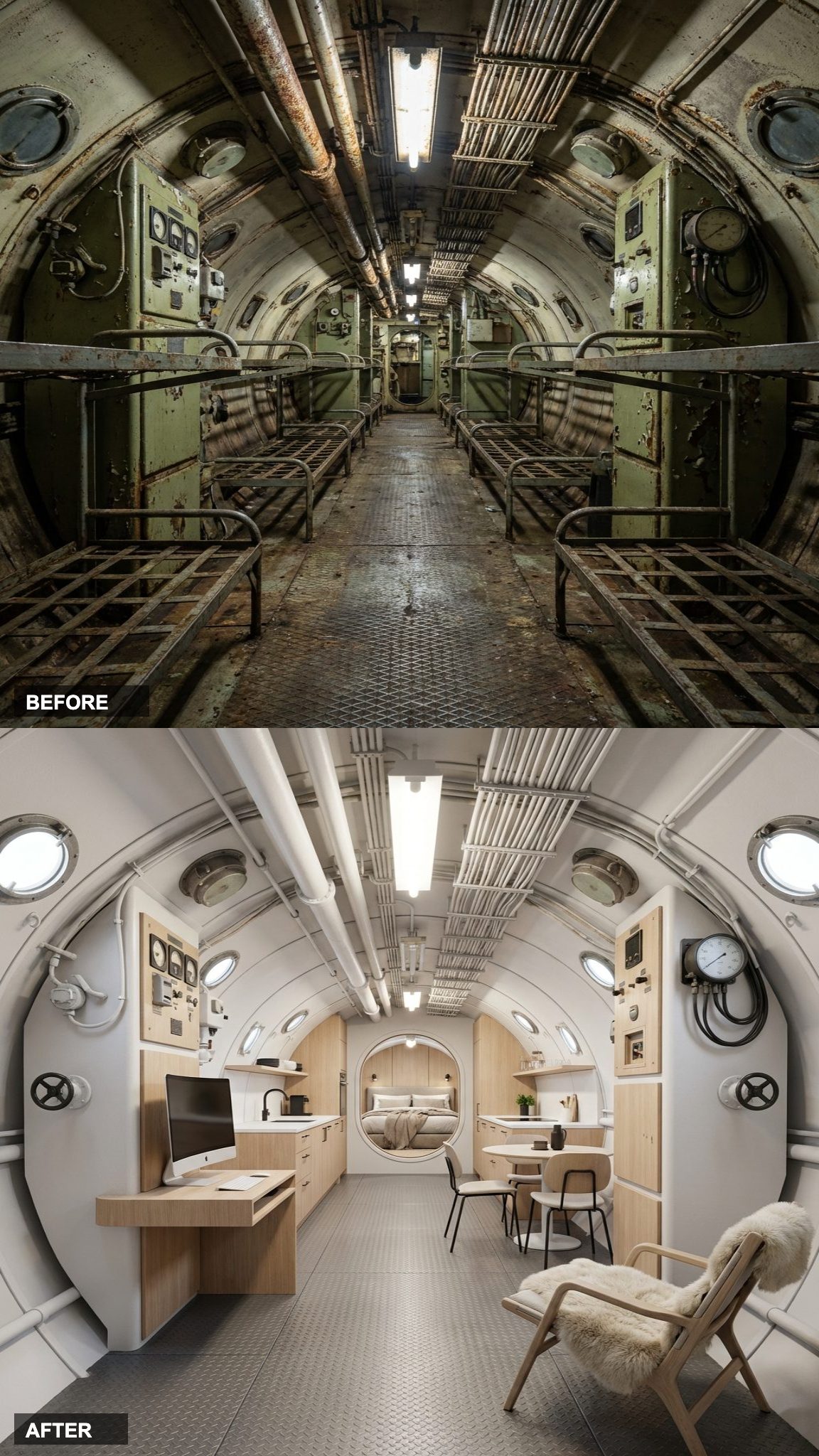
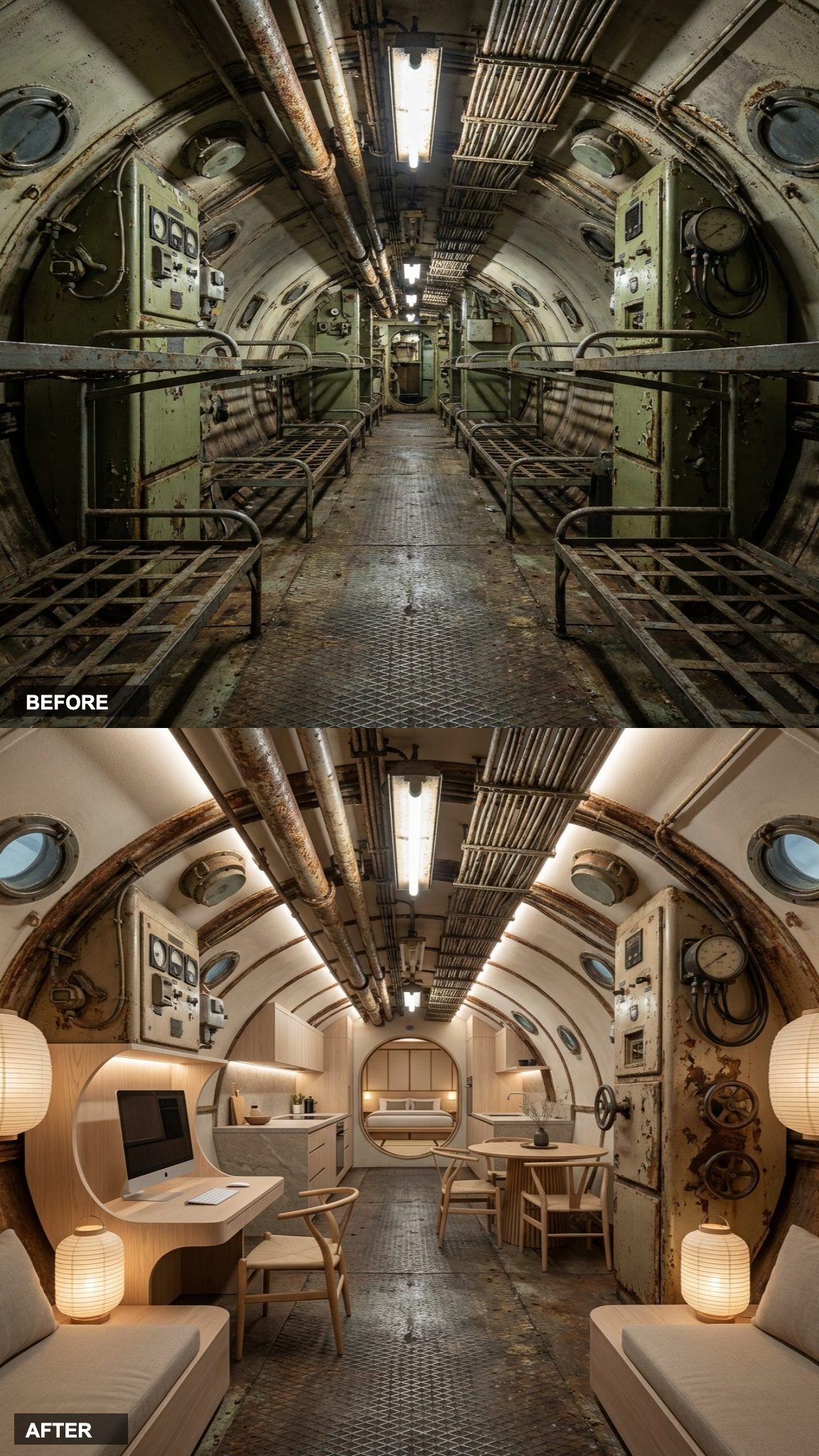
The most spatially intelligent redesign on this list. Japandi, that specific collision of Japanese wabi-sabi and Scandinavian functionalism, turns out to be the perfect answer for a space where every cubic inch counts. The curved walls get a thin coat of white limewash, letting the hull’s geometry do the talking. Natural white oak flooring runs straight down the center corridor. The foreground workspace becomes a low-profile shoji-inspired desk with rice paper panel dividers and a single ceramic bud vase.
Midship, the kitchen goes all white and pale oak: handleless cabinets, a single deep stone sink, and a magnetic knife strip as the only decoration. In the rear, the bed sits directly on a raised tatami platform, and a hand-stitched indigo linen quilt is the only color in the room. Silence has a texture here.
Bourbon and Brass: A Gentleman’s Club Reimagined as a Live-Aboard
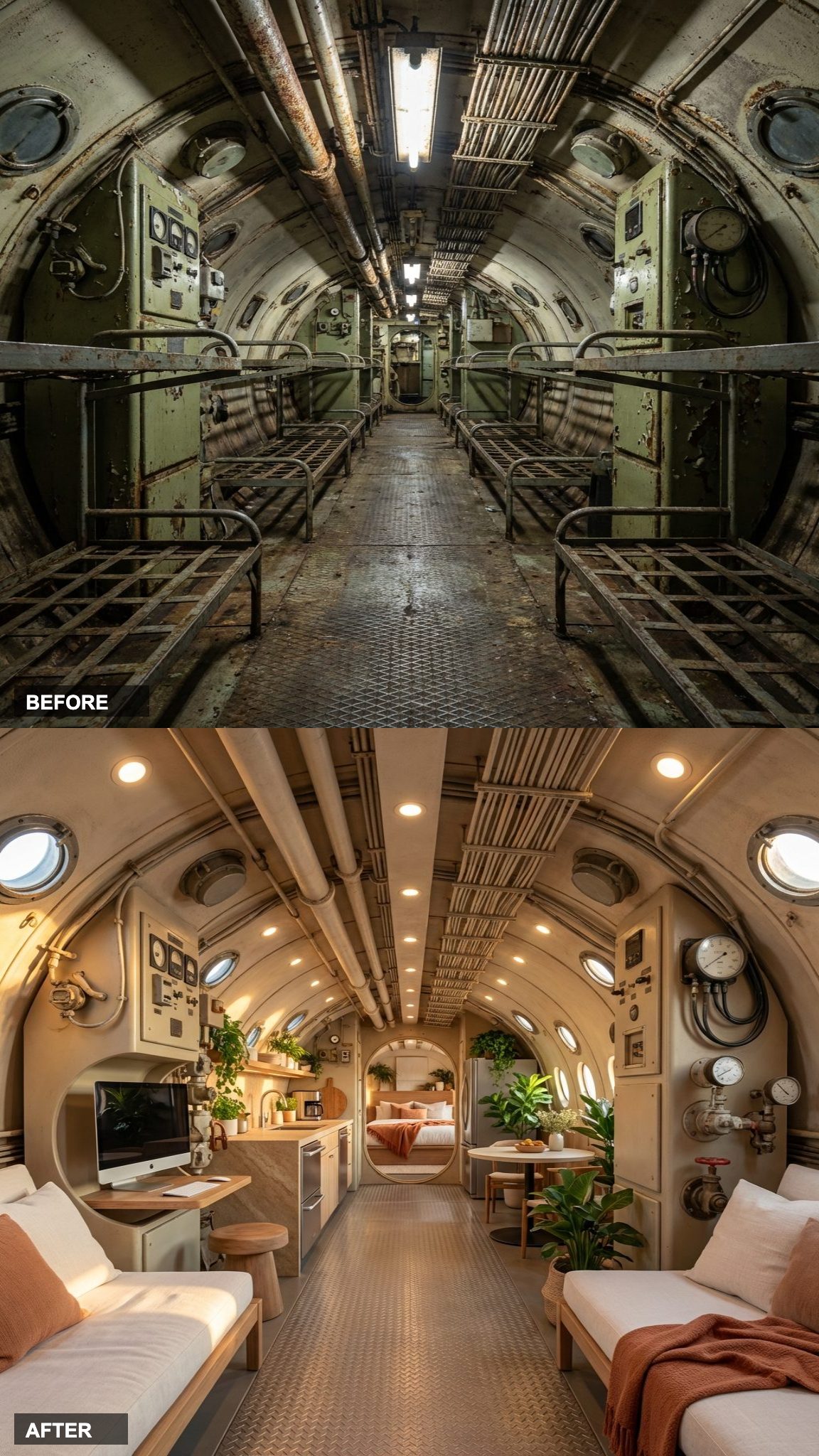
The single most unexpectedly convincing design in the whole series. Dark walnut millwork runs the length of the hull. The foreground workspace becomes a proper library corner: floor-to-ceiling built-in bookshelves curving with the hull, a green-leather Chesterfield armchair, and a brass banker’s lamp. The cylinder’s proportions, which fight every other style, here become an asset, like a private Pullman car, all enclosure and intentionality.
Midship kitchen: mahogany cabinet frames, black granite countertop, under-cabinet brass strip lighting, and a crystal decanter set on open shelving. The bedroom rear features a four-poster bed frame cut to fit the curve, burgundy velvet curtains on each side, and a monogrammed cream linen duvet.
- The curved ceiling works as a barrel vault, it adds gravitas instead of claustrophobia.
- Dark wood absorbs the artificial lighting and makes it feel warmer, not smaller.
- Symmetry at the desk and kitchen zones gives the eye a resting place along the corridor.
Santorini Washed Up Inside a Steel Hull
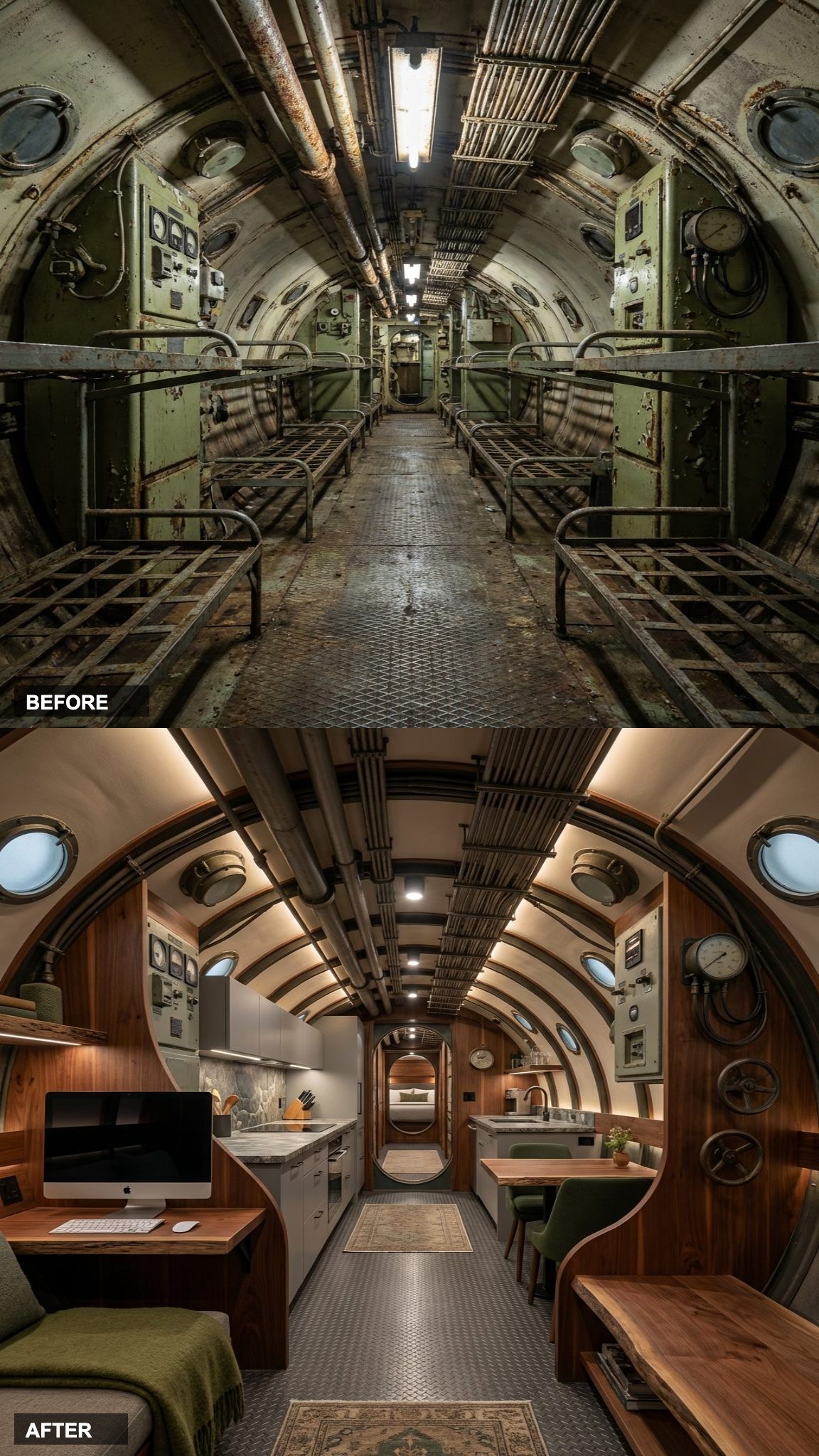
White plaster walls. Cobalt blue accents. Hand-painted ceramic tiles in the kitchen. This is the most aggressively cheerful interpretation of submarine living you’ll find anywhere. The foreground workspace gets a whitewashed wood desk, a terracotta pot of dried lavender, and an open-weave rattan chair. The cylinder walls are smoothed and limewashed in warm white, and every fixture gets swapped for wrought iron in matte black.
The kitchen midship is the showstopper: hand-painted Talavera-style tiles in cobalt and white on the backsplash, open shelving in whitewashed pine, and a deep farmhouse sink in white enamel. The bedroom at the rear gets a whitewashed plank headboard, linen in natural undyed cotton, and a small terracotta amphora on the built-in nightstand shelf.
Green Velvet and Ferns: A Victorian Botanist’s Submarine
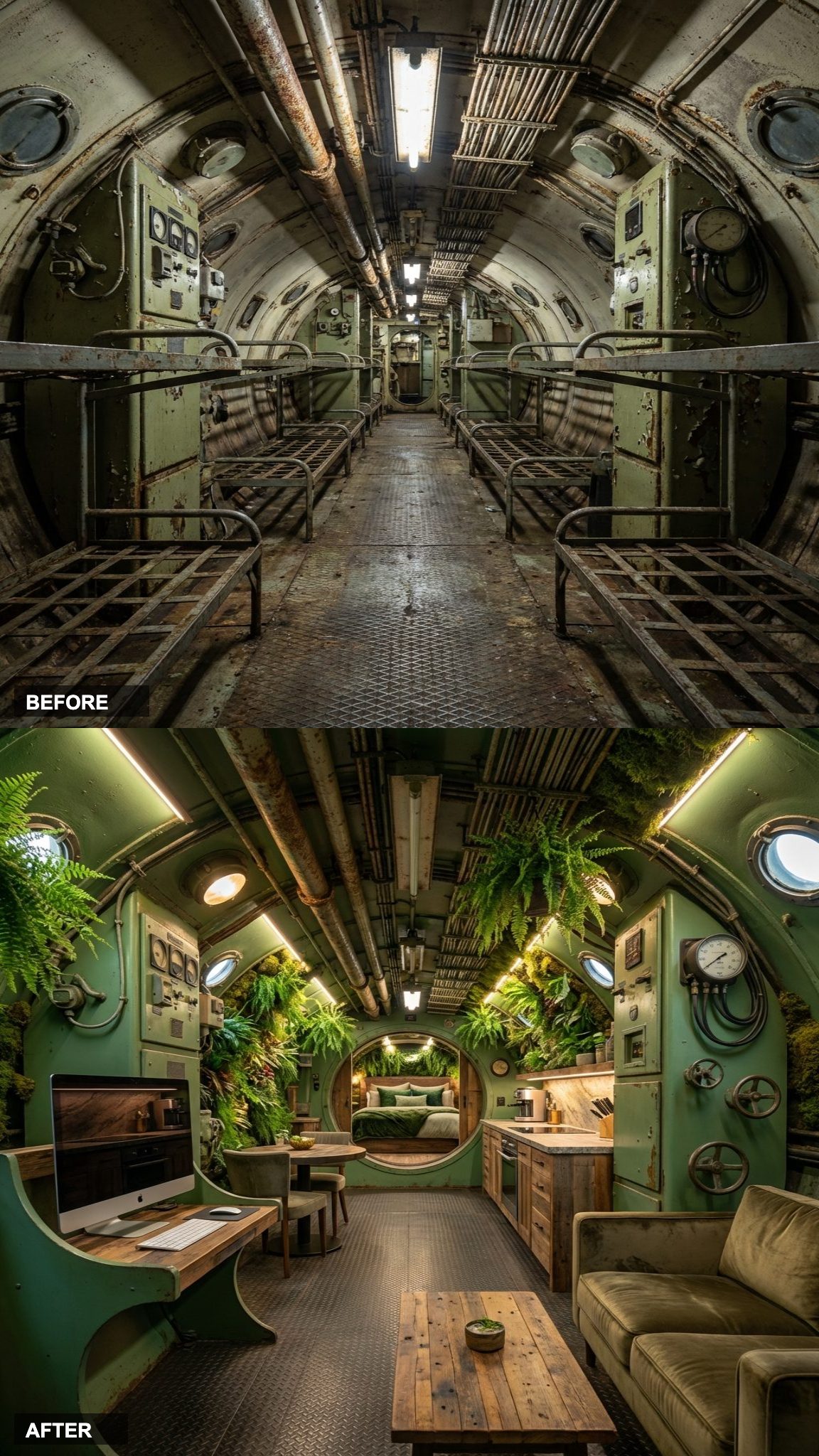
Emerald green velvet upholstery. Hanging brass planters. A specimen cabinet where the kitchen used to be. This redesign treats the cylinder as a greenhouse crossed with a Victorian parlor, and it works in ways that defy logic. The foreground workspace becomes a naturalist’s desk: green baize surface, brass magnifying lamp, wooden specimen drawers, and a glass bell jar display. Curved hull walls get clad in dark bottle-green painted beadboard.
The kitchen midship gets sage green cabinet doors, unlacquered brass pulls, open shelving with terracotta herb pots, and a white marble counter. The bedroom at the rear: deep forest green plaster walls, a wrought-iron bed frame draped in moss-colored velvet, and trailing pothos vines mounted to the curved ceiling in hanging brass pots.
Nautical by Nature: Sailing Yacht Luxury in a Navy Hull
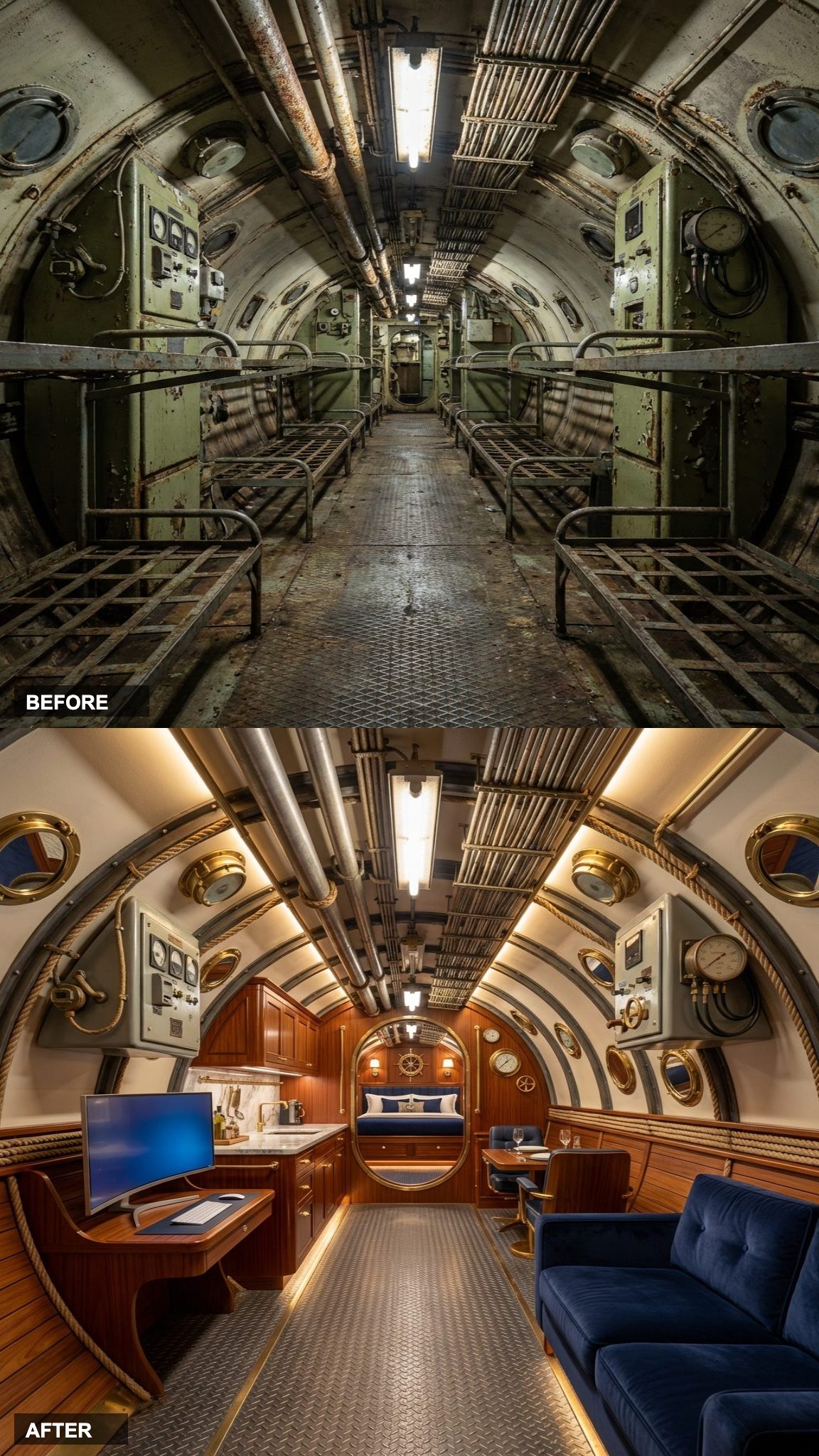
The obvious theme, executed with real precision. Navy and cream. Teak and chrome. This version leans into the boat-interior language rather than fighting it, and that’s why it reads more convincingly than any of the others that try to escape the vessel’s origin. The foreground workspace gets a teak and chrome nav-station desk, a gimbaled lamp, and a chart drawer below. Hull walls: tongue-and-groove teak panels with chrome trims at the bulkhead rings.
“The best boat interiors don’t pretend you’re not on a boat. They make you glad you are.”
Kitchen midship: teak-faced cabinets, chrome hardware, a gimbaled stainless steel range, and a white enamel sink. Bedroom rear: navy blue linen bedding, teak bed frame built into the hull curve, and a porthole-style brass wall mirror above the headboard.
Art Deco Goes Submarine: Gold, Black, and Geometric Obsession
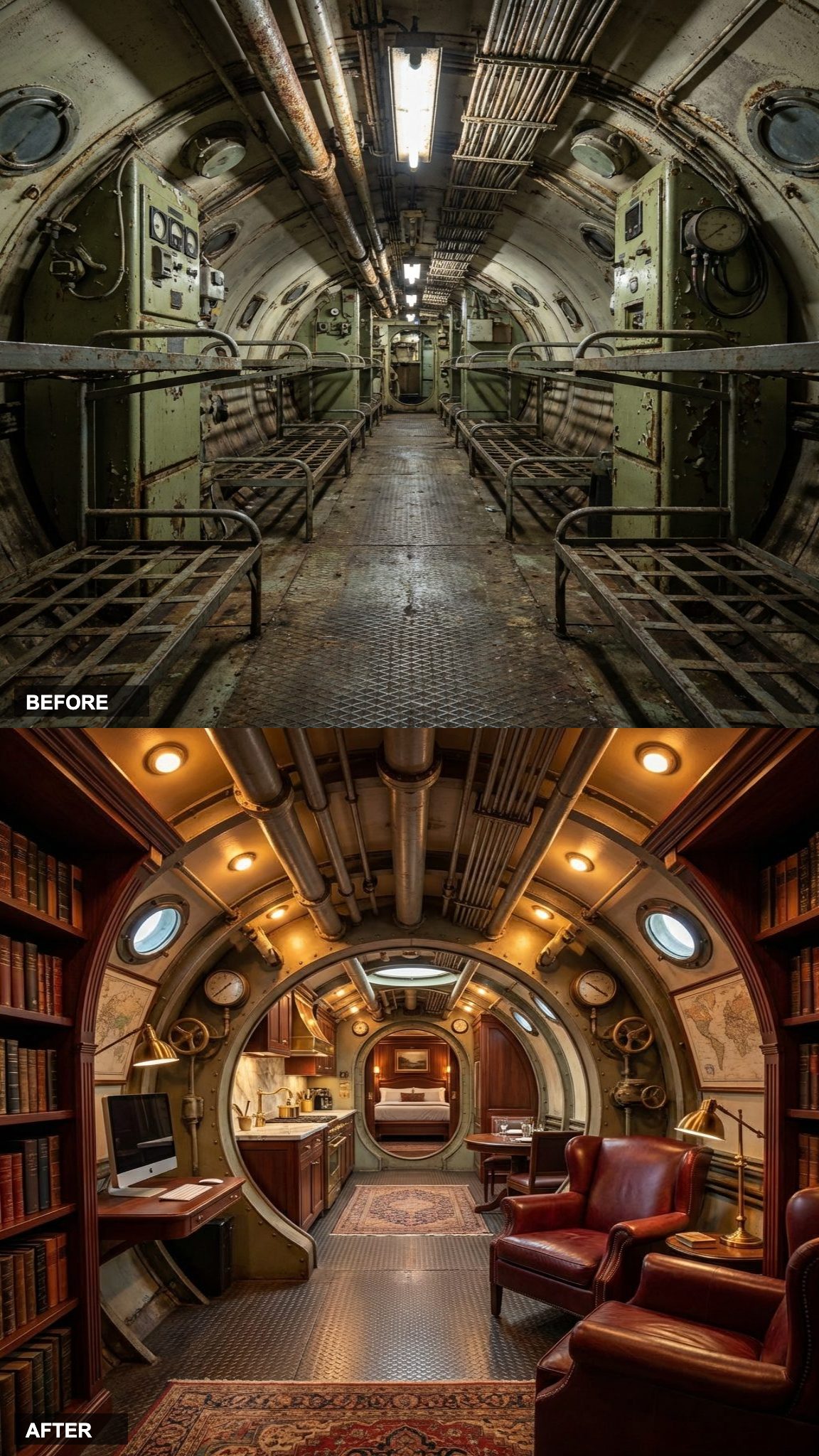
Chevron-inlaid ebony wood floors. Gold-leaf ceiling panels following the hull curve. Stepped geometric cabinet fronts in glossy black lacquer. This is the design that makes you forget you’re underground, underwater, and inside a weapon.
The foreground workspace becomes an Art Deco writing salon: a kidney-shaped desk in black lacquered wood with gold hardware, a geometric brass desk lamp with a frosted glass shade, and a high-backed tufted chair in gold velvet. The kitchen midship goes full Chrysler Building: black gloss cabinets, gold hexagonal tile backsplash, black marble countertop with gold veining. The rear bedroom: a padded black velvet headboard with gold nail-head trim, stepped geometric nightstand shelves, and a domed brass ceiling fixture centered on the hull curve above the bed.
Wabi-Sabi at Depth: The Beauty of Imperfect Steel
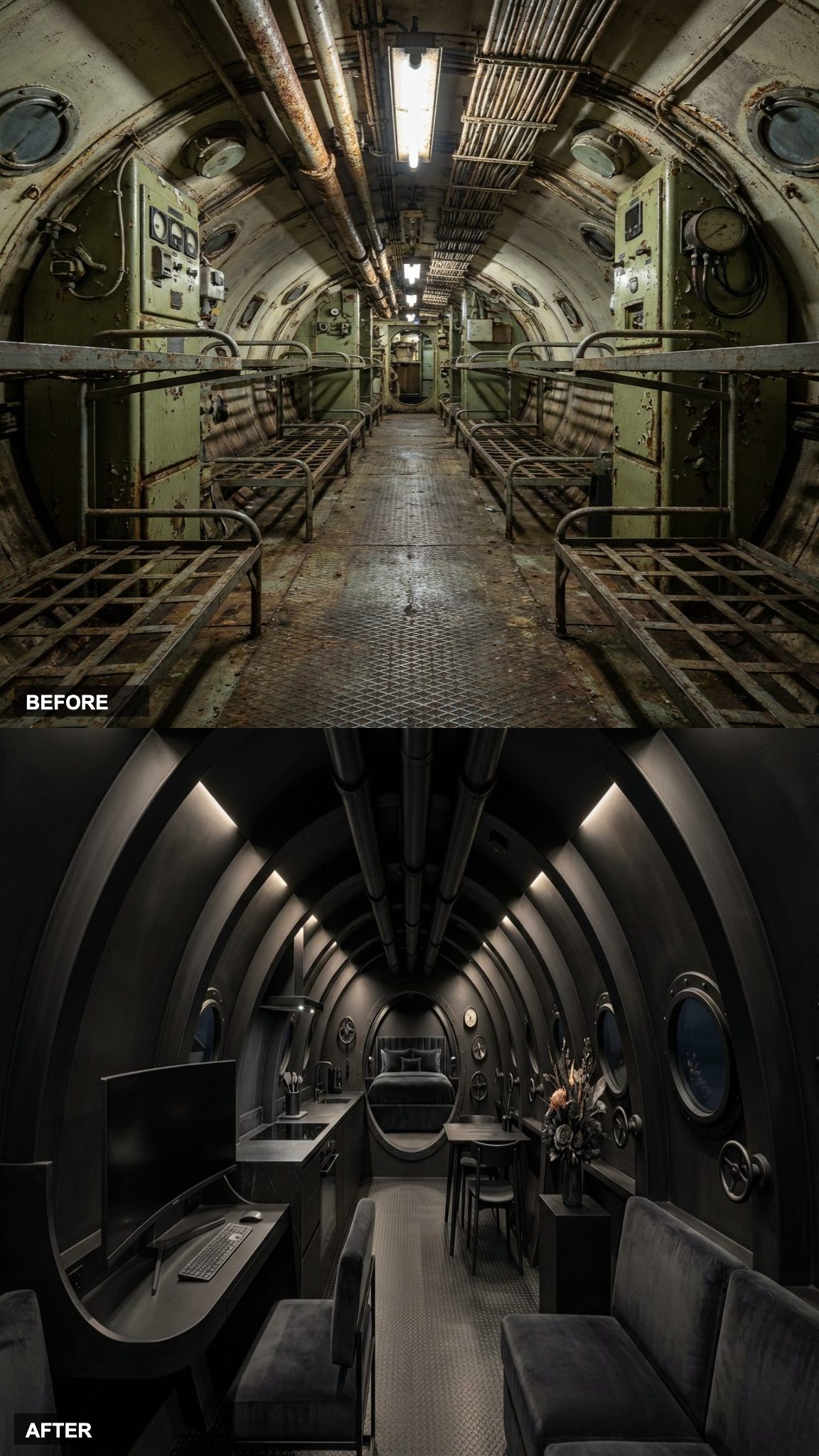
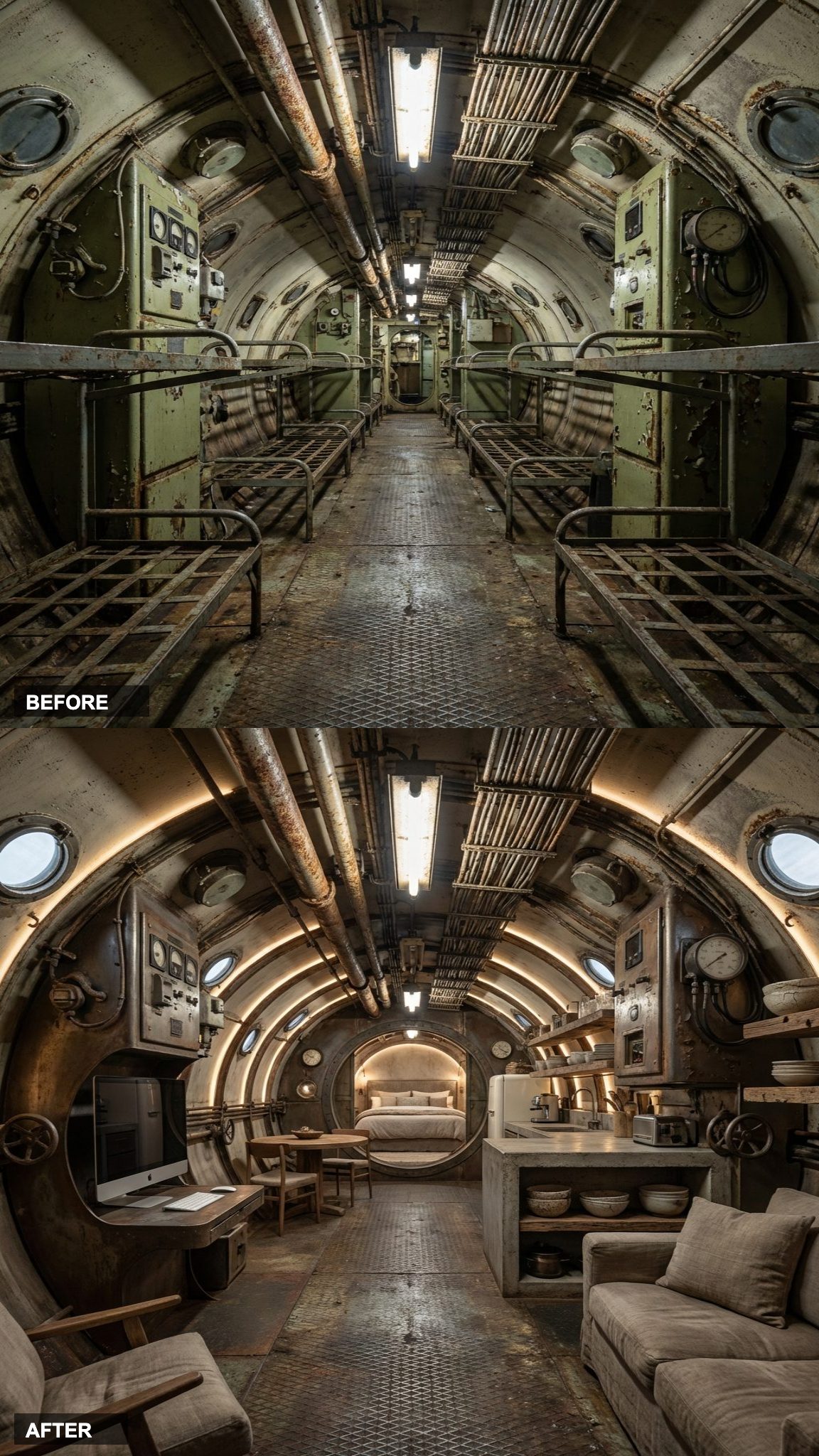
This one does almost nothing to the raw hull, and that’s the entire point. Wabi-sabi, the Japanese philosophy of finding beauty in imperfection and transience, means the original rust patina stays. The rivets stay. The exposed pipe runs stay. What changes is the editing: a low-slung daybed in undyed linen, a hand-thrown ceramic tea set on a raw wood shelf, and a single framed piece of Japanese calligraphy on the hull wall.
The kitchen midship gets a single-basin clay sink, open wood shelving with ceramic bowls, and a gas burner on a reclaimed wood counter. The bedroom rear: a futon on a platform of raw cedar planks, a linen sheet, a single stone candle holder. The whole space breathes a kind of earned serenity.
Miami Vice Down Below: Pastel Peach, Chrome, and Terrazzo
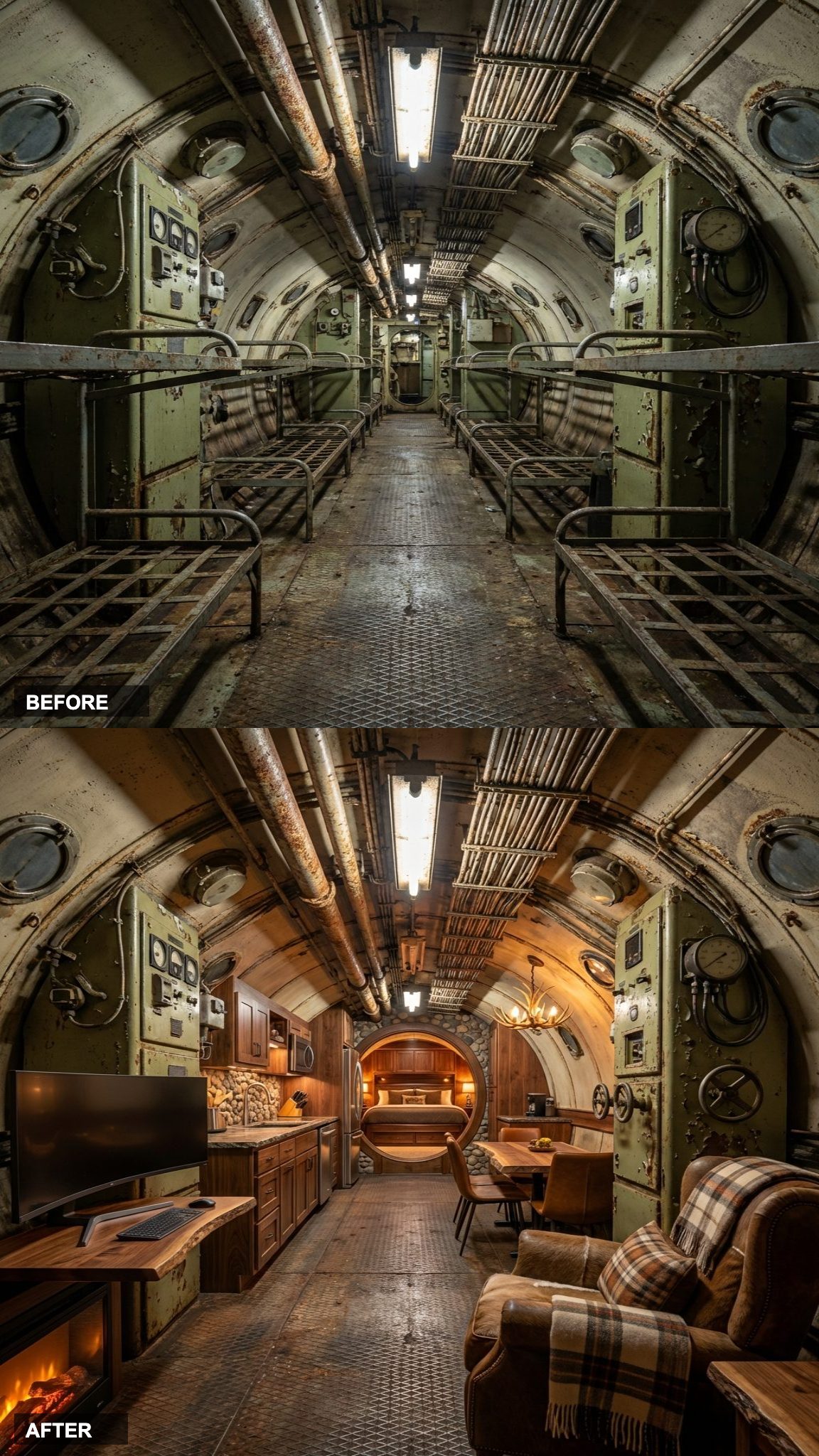
Peach plaster walls. Pink terrazzo floors. Chrome fixtures with neon-tube accent lighting under the kitchen counter. This redesign commits completely to the 1980s Miami palette, and the cylindrical geometry somehow makes it feel more cinematic rather than tacky. The foreground workspace: a rounded-corner laminate desk in pale peach, a chrome architect’s lamp, and a teal Olivetti-style typewriter as decoration.
Kitchen midship: peach and white terrazzo countertop, chrome cabinet hardware on gloss white cabinet doors, and pink fluorescent under-cabinet lighting. Bedroom rear: blush pink linen on a low platform bed with chrome legs, a neon tube reading light arcing over the headboard, and a round chrome mirror mounted to the hull above.
Jungle Fever: A Living Wall Submarine With Biophilic Everything
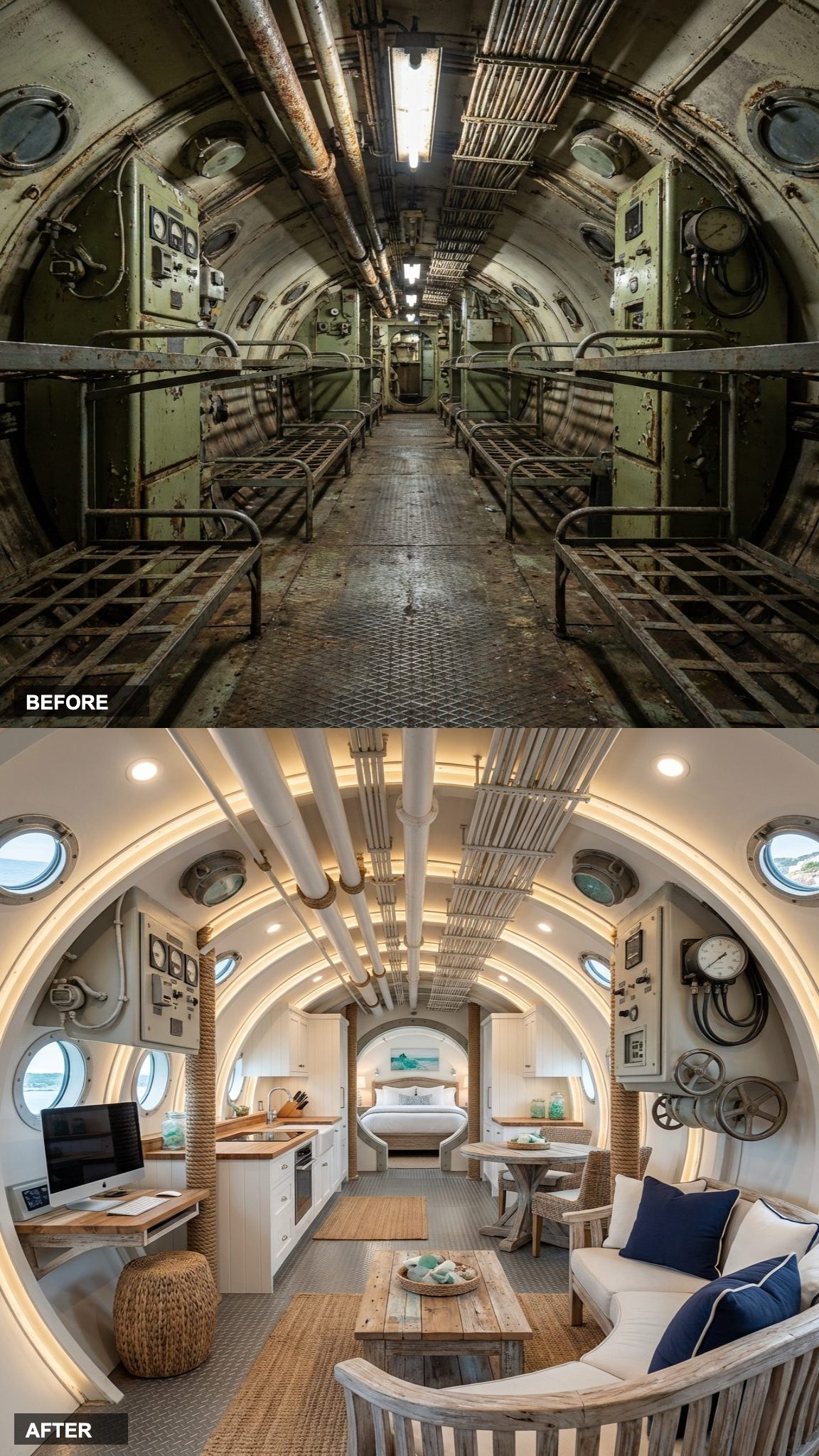
Every surface that can hold a plant, holds a plant. The hull walls get a custom hydroponic vertical garden system running the full length of the cylinder, ferns, philodendrons, monstera, and trailing pothos in staggered pockets. The result is a green tunnel that feels less like a submarine and more like a pressurized rainforest.
The foreground workspace: a reclaimed wood desk with built-in planter troughs on either side, warm LED grow-light strips overhead doubling as ambient lighting. Kitchen midship: open shelving with live herb walls, a stone sink, and bamboo cabinet faces. Bedroom rear: a canopy of hanging moss balls and dried grasses above the bed, with linen bedding in forest green and clay.
Parisian Atelier Energy, Somehow Inside a Submarine
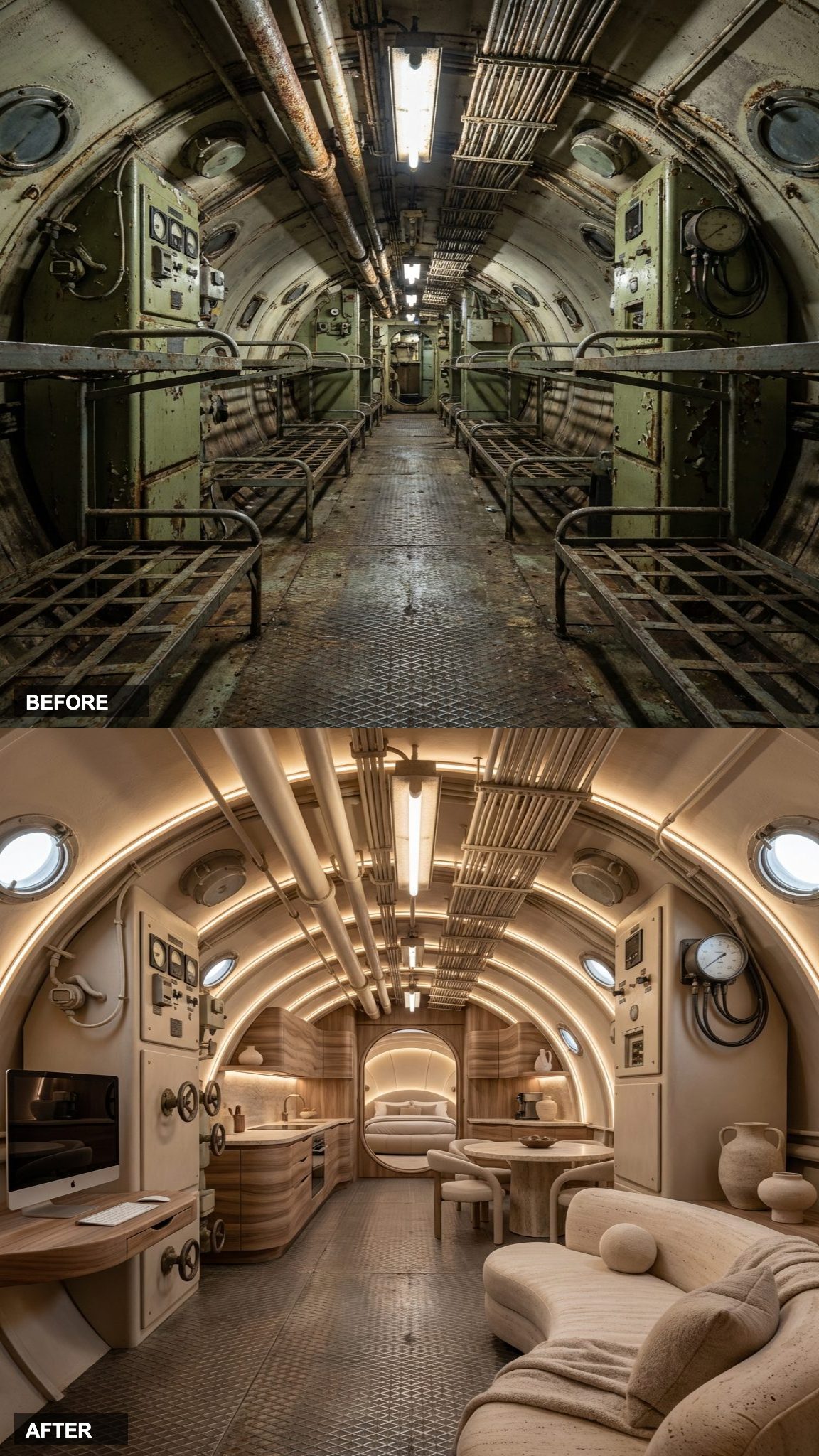
Herringbone parquet floors in pale oak. Aged plaster walls in dusty rose. A chaise longue in worn velvet near the foreground desk. The kitchen midship dressed in soft grey-green with brass bistro-rail shelving. Every choice feels like it belongs to a sixth-floor walk-up in the 11th arrondissement rather than a pressure vessel moored at depth.
The bedroom rear goes fully atelier: a wrought iron bed frame in matte black, a crumpled white linen duvet, a stack of oversized art books as a nightstand, and a single bare Edison bulb hanging on a long cord from the hull apex above. The imperfect, slightly worn quality of every surface is deliberate. Nothing here was bought new.
Bone White and Concrete: A Brutalist Gallery at Sea Level

🔥 Would you like to save this?
Raw concrete panels cover every curved surface, poured to follow the hull’s geometry and left completely unfinished. The foreground workspace: a poured concrete desk with a recessed monitor slot, a concrete task lamp base, and a single black leather chair. The entire color palette is bone white and grey with single-point accent lighting from recessed LED strips at floor level, throwing dramatic upward shadows along the concrete cylinder.
Kitchen midship: poured concrete countertop and backsplash as one continuous surface, handleless white cabinet doors, and a matte black undermount sink. Bedroom rear: a concrete bed platform built directly into the hull floor, white linen bedding, and a single dramatic spot of color, a rust-red wool throw, draped across the foot of the bed.
Spice Route Luxury: A Moroccan Riad Squeezes Into a Steel Tube
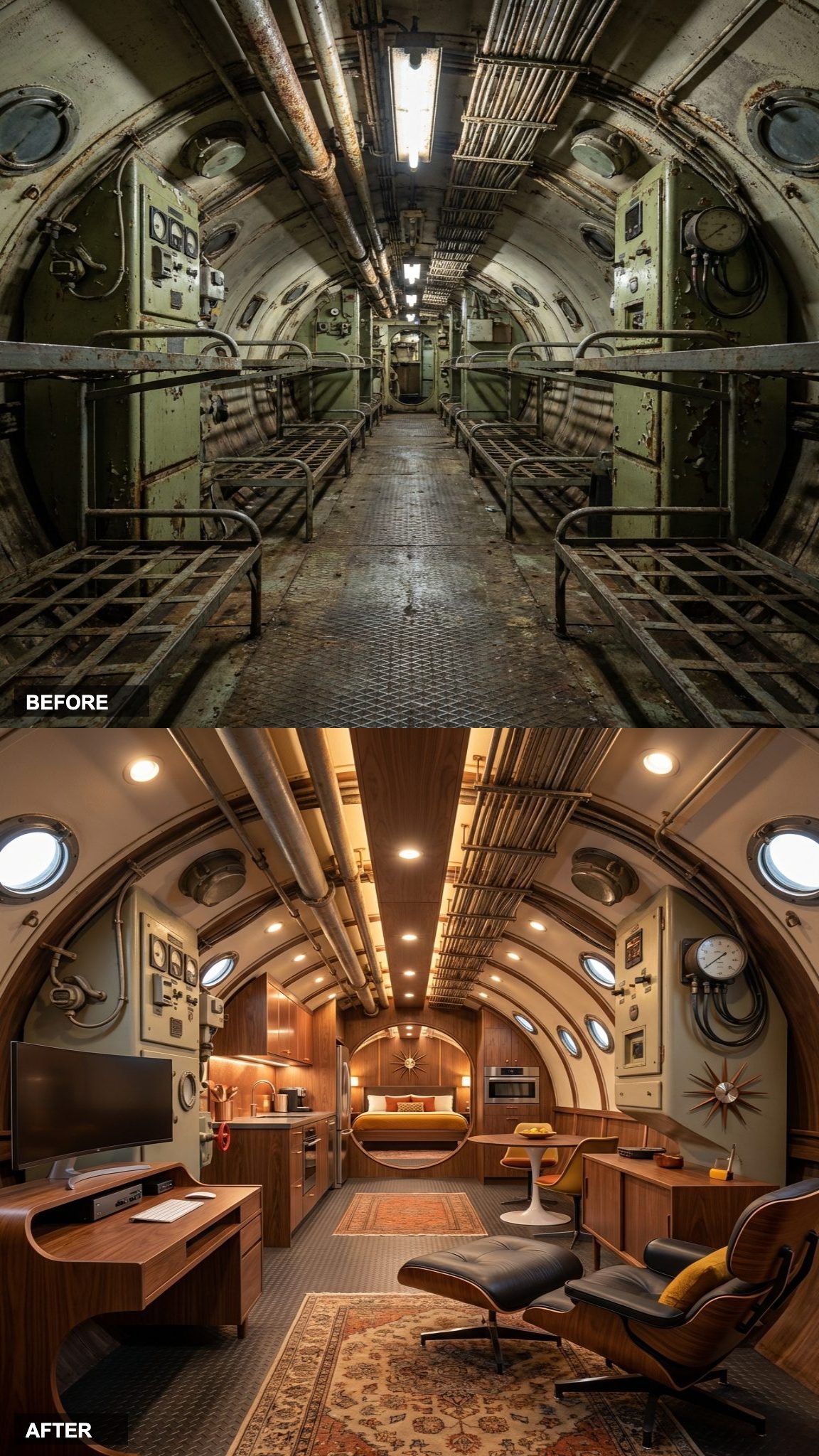
This might be the most visually dense redesign in the series. Hand-cut zellige tiles in cobalt, saffron, and terracotta cover every possible surface in the kitchen zone. Carved plasterwork in geometric arabesque patterns coats the curved hull walls in cream and ochre. Lanterns, real hand-punched brass with colored glass inserts, hang at intervals down the entire length of the cylinder, casting kaleidoscopic light patterns across everything.
The foreground workspace becomes a low carved wood desk with inlaid mother-of-pearl surface details and a carved bone lamp. The bedroom rear: a low-slung bed with a carved cedarwood headboard, silk cushions in jewel tones, and a hand-knotted Beni Ourain rug on the floor. The air in this image practically smells like cedar and argan oil.
Scandinavian Frost: Birch, White Wool, and Blue-Hour Light
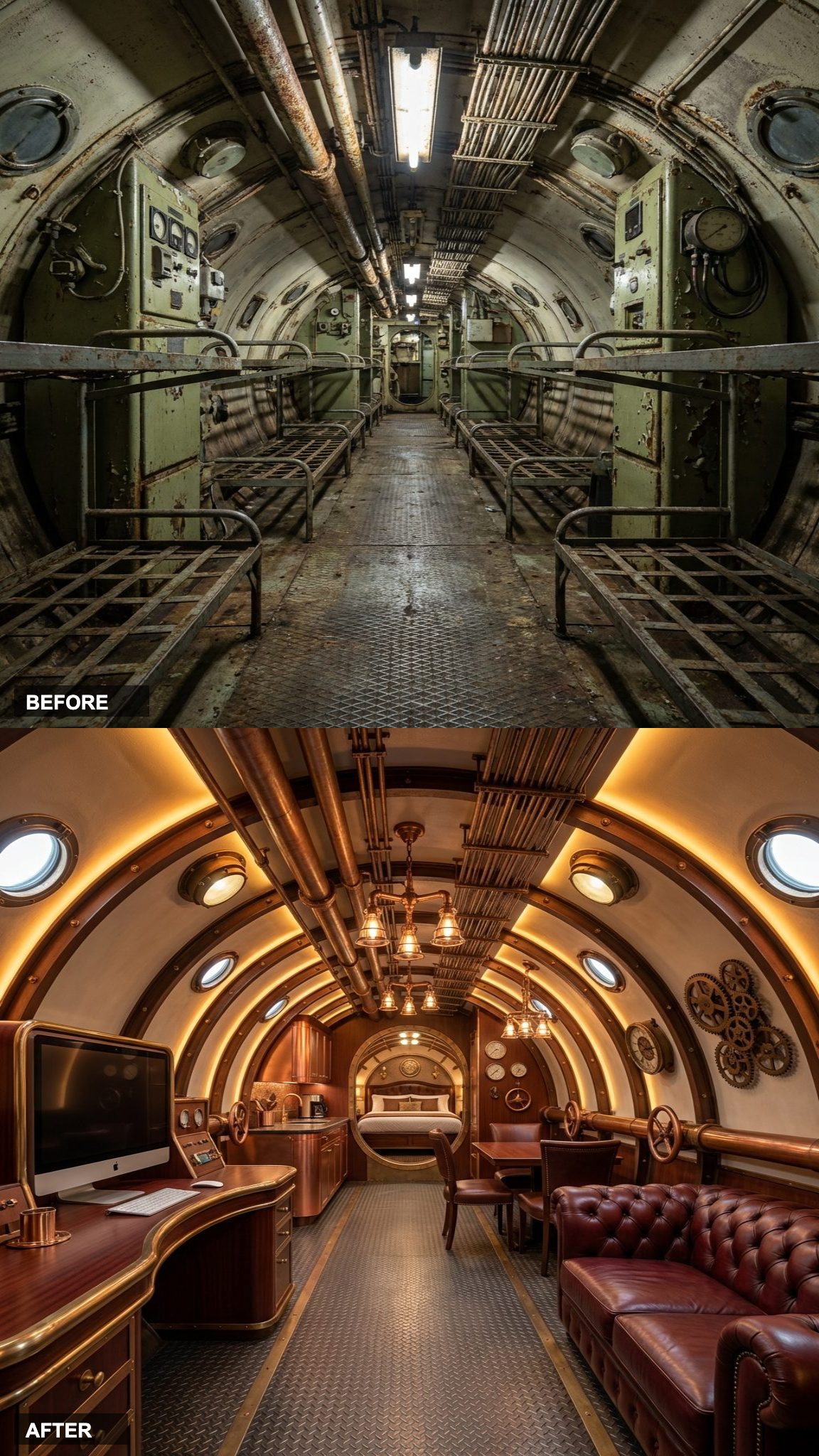
Everything is pale. Birch-ply panels line the hull. The floor is bleached white oak. The foreground desk is birch plywood with rounded corners, and a single warm LED pendant hangs low above it. The kitchen midship goes Nordic all the way: white painted shaker-style doors, birch countertop oiled to a soft sheen, and a ceramic farmhouse sink in matte white.
The whole color palette sits between white linen and pale ash grey, with a single accent color, a deep Nordic blue used for the wool throw on the bedroom bed and the seat pad on the desk chair. No clutter. No art on the walls. Just the curve of the hull and the quality of the light.
Deep-Sea Gothic: Black Arches, Candlelight, and Medieval Steel
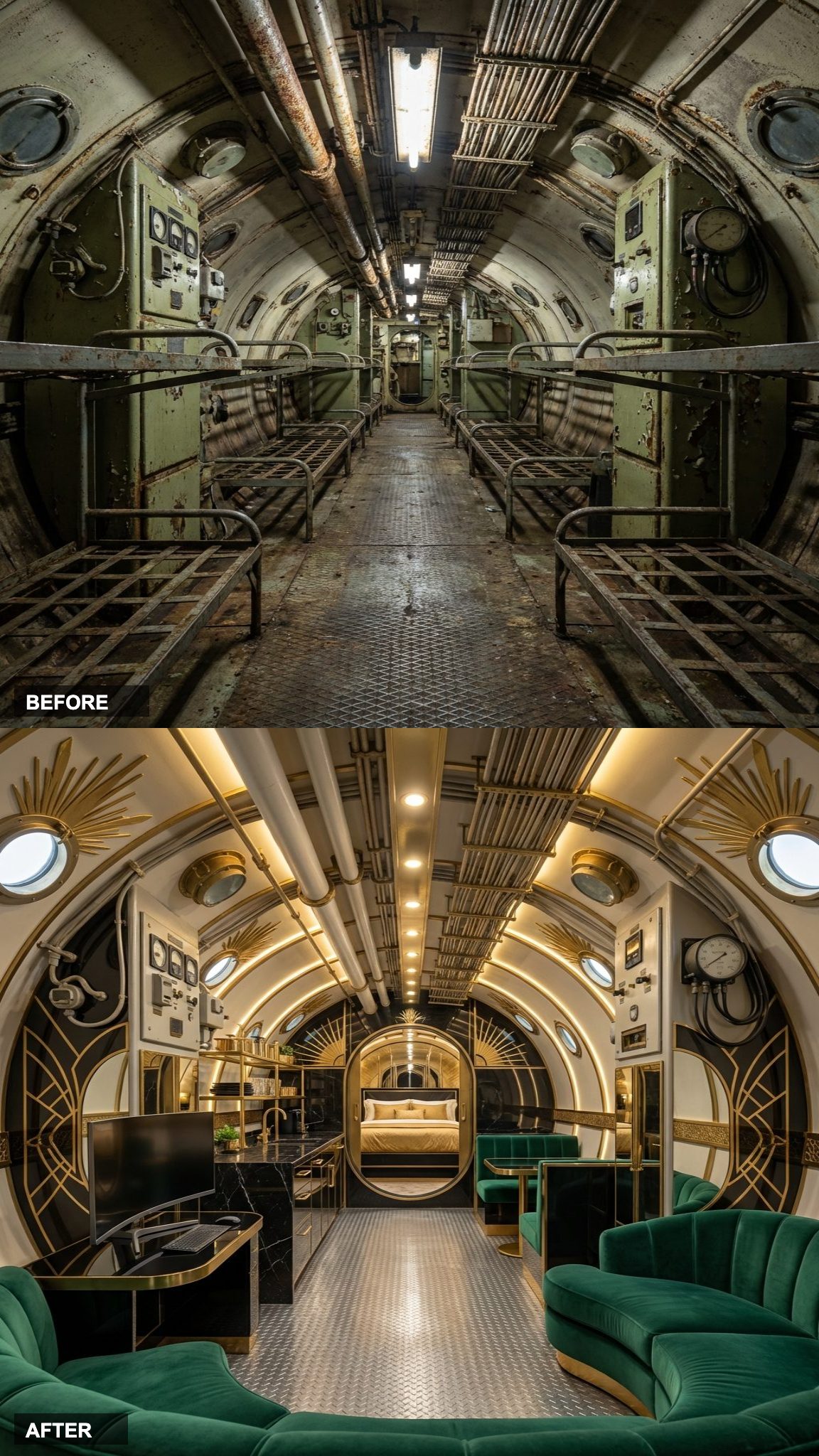
Nobody asked for a Gothic cathedral inside a submarine, and yet here we are. Pointed arched millwork panels line the hull walls, painted in matte soot black. Cast-iron Gothic candelabra bracket lights mount to the bulkhead rings. The floor gets slate flagstone tiles. The foreground workspace: a refectory table in dark stained oak, a tall-backed carved chair, and a cluster of real pillar candles in a black iron holder. It reads like a monk’s scriptorium that happens to be pressure-rated to 300 meters.
Kitchen midship: black arched cabinet doors with iron ring pulls, dark grey slate countertop, and a wide exposed-brick-effect backsplash panel. Bedroom rear: a carved four-poster frame in blackened oak, black linen, and a single hanging iron lantern above the bed.
Glass and Gold: A Maximalist Glam Interior That Defies the Hull
Mirrored wall panels run the full length of one side of the cylinder, bouncing light back and forth and visually doubling the apparent width of the space. The other side of the hull: ivory silk wall fabric with a subtle raised damask pattern. Gold leaf trim at every structural ring. The foreground workspace becomes a vanity-desk hybrid in polished gold brass and ivory lacquer with a tufted ivory velvet chair.
Kitchen midship: ivory gloss cabinets, gold hexagonal hardware, white Calacatta marble countertop with heavy gold veining. Bedroom rear: a tufted ivory velvet headboard, ivory and gold throw cushions, and a small crystal chandelier, somehow, impossibly, hanging from the hull’s apex above the bed.
The Hackerspace: Dark Techy and Brutally Functional
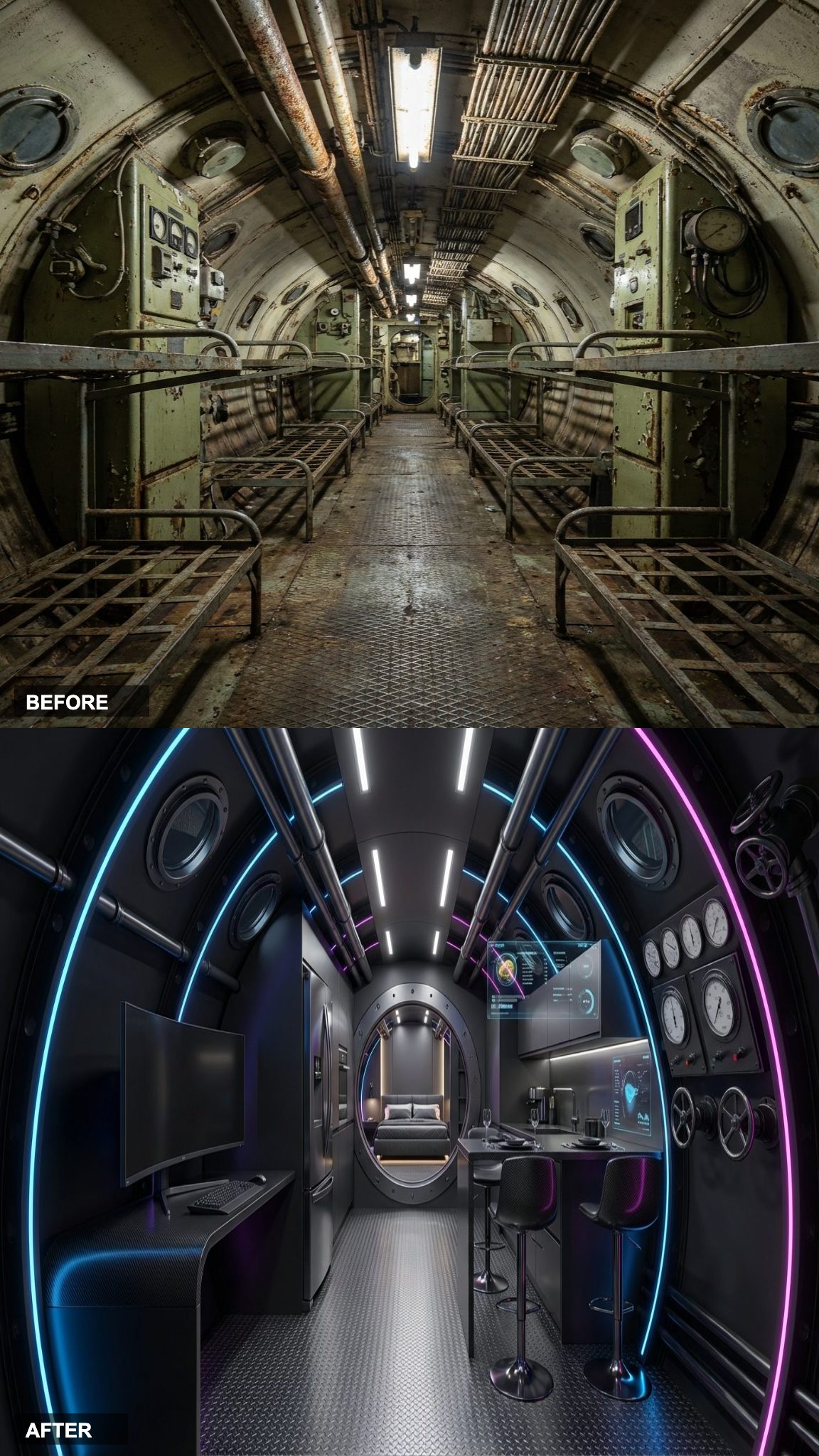
This one is for the person who actually lives in this submarine and works there full-time. The foreground workspace is the most elaborate in the entire series: three monitors on a curved arc mount, mechanical keyboard, full cable management in black braided sleeves, pegboard tool wall on the port side, and a kneeling chair in black mesh. RGB lighting runs in strips along the floor channel, set to a cold blue-white.
The kitchen midship stays simple and fast: all stainless steel, open shelving with labeled containers, a compact induction cooktop, and a drawer fridge integrated under the counter. The rear bedroom: a Murphy-style bed that folds into the hull wall, leaving the rear zone as a secondary work or equipment area when folded. Efficient, specific, and completely honest about what this space is for.
Terra Cotta Dreams: An Italian Farmhouse Tucked Inside the Hull
Terracotta tile floors. Rough whitewashed plaster walls. Open wood shelving with hand-thrown olive oil jars and dried herb bunches. This version of the submarine interior smells like a Tuesday afternoon in Umbria, which is an extraordinary thing to say about a pressure vessel.
The foreground workspace becomes a rustic kitchen table doubling as a writing desk: scarred pine, a ceramic inkwell, a small terracotta pot of pencils. Midship kitchen: terracotta tile backsplash, whitewashed wood cabinet doors with iron handles, a deep white enamel sink, and copper pots hanging from a wall-mounted iron rail. Bedroom rear: a wrought-iron bed frame, white cotton duvet, and a single arched terracotta lamp on the bedside shelf.
Copper and Cognac: A Whiskey Distillery Aesthetic in Deep Water

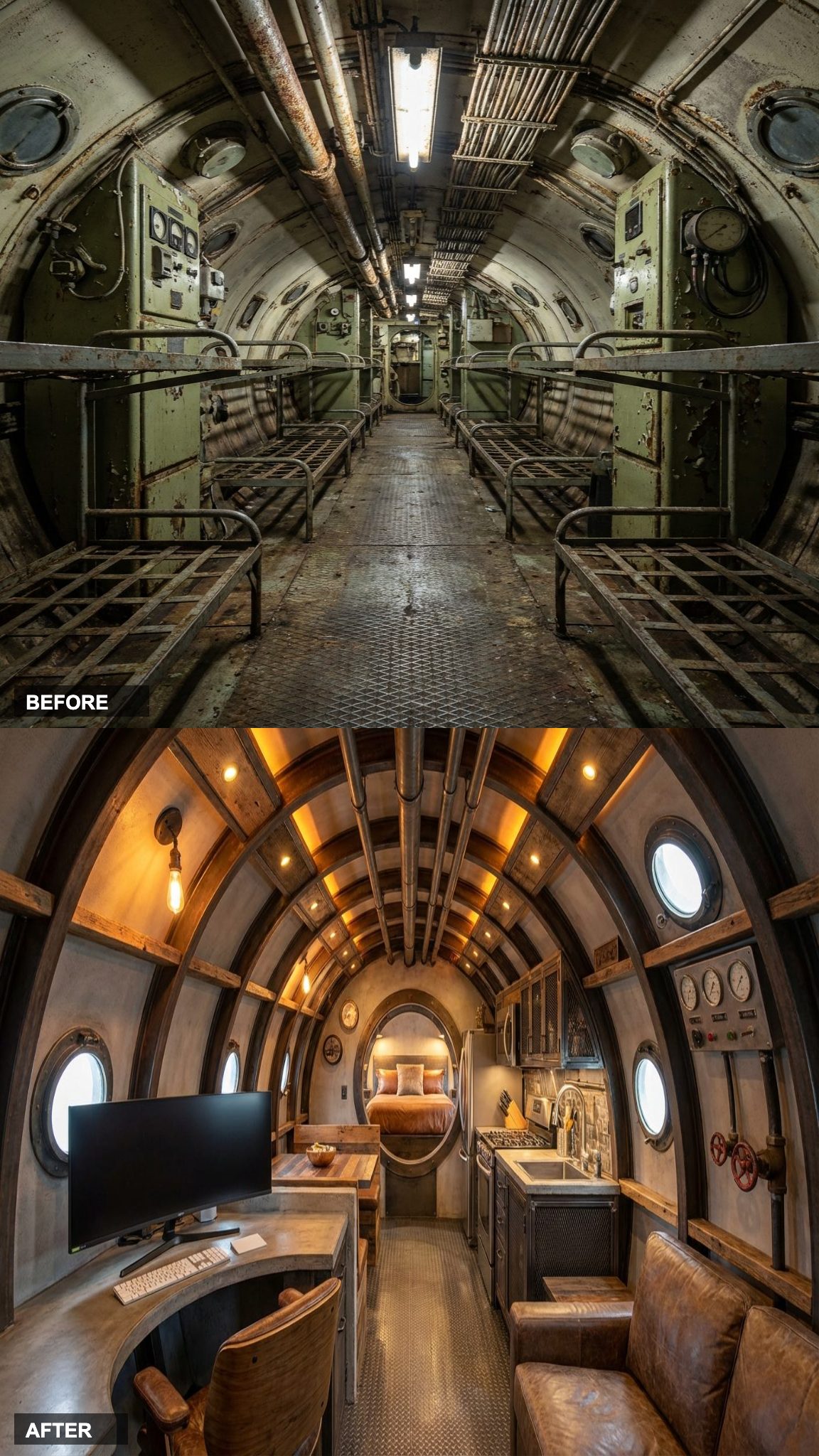
Exposed copper pipe runs, which the original submarine already had, get polished and made into the design’s central element rather than hidden. This is the design that cost the least to conceptualize and looks the most intentional. The hull walls go warm amber plaster. The floor: wide-plank reclaimed bourbon-barrel oak with visible nail heads.
Foreground workspace: an aged leather-top desk, a copper desk lamp with Edison bulb, and open shelving holding amber glass apothecary bottles. Kitchen midship: copper cabinet hardware on cognac-stained wood doors, a copper farmhouse sink, and copper tube shelving brackets. Bedroom rear: a low platform bed in amber-stained oak, cognac linen bedding, and a single copper pipe reading lamp arcing over the headboard. The whole space reads like a very exclusive members’ bar that you also sleep in.
Celestial Navy: A Planetarium Bedroom Suite You Never Have to Leave

The hull ceiling gets the full treatment: a hand-painted star chart in gold ink on navy blue, following the exact curve of the cylinder from bow to stern. Constellation lines connect in faint gold. The floor: deep navy wool carpet running the full length. The entire space becomes a night-sky immersion environment, and the cylindrical geometry, which fights most design styles, here becomes a perfect planetarium dome.
Foreground workspace: a midnight blue lacquered desk with brass astronomical instrument replicas, a constellation map framed in brass on the hull wall above. Kitchen midship: navy shaker cabinets, brass hardware, white marble counter, and small recessed ceiling spots mimicking stars. Bedroom rear: white linen on a navy lacquered bed frame, gold-painted ceiling stars directly above the pillow zone, a brass sextant on the built-in nightstand shelf.
Jungle Lodge at Pressure Depth: Rattan, Raw Wood, and Warm Rain Light

Natural rattan panels line the hull walls. Bamboo flooring runs straight down the center corridor. The overhead lighting simulates the filtered warm gold of sunlight through a forest canopy, diffuse LED panels behind laser-cut leaf-pattern screens. The foreground workspace: a rattan-frame desk with a cane-webbing chair and a terracotta table lamp.
Kitchen midship: natural bamboo cabinet doors, open rattan shelving, a white ceramic farmhouse sink, and fresh banana leaves in a tall ceramic vase as the only decoration. Bedroom rear: a rattan bed frame with natural linen, a hand-woven rattan pendant lamp hanging from the hull apex, and a kilim rug in earthy reds and ochres. It feels more like a treehouse than a submarine, which is exactly the point.
Russian Constructivist: Red, Black, and Stark Industrial Geometry

Vivid cadmium red, black, and raw steel grey, nothing else. The curved hull walls get paneled in matte black with bold red diagonal stripe graphics painted directly on the surface, referencing Soviet Constructivist propaganda poster typography. The foreground workspace: a red-painted steel desk on hairpin legs, a swing-arm lamp in matte black, and a vintage Cyrillic poster in a black frame.
Kitchen midship: matte black cabinet doors with red-painted interior walls visible through the open shelving gaps, steel countertop, and red enamel vintage-style appliances. Bedroom rear: a black metal bed frame, red and white geometric cotton duvet, and a single red-painted overhead dome light above the pillow. Politically charged, historically loaded, and visually arresting.
Palm Springs Modernist: Tangerine, Turquoise, and Atomic Age Curves

The cylindrical hull is, structurally, already the most atomic-age shape imaginable. This redesign leans into that completely: tangerine and turquoise in a 60-40 split, atomic starbursts on the hull wall panels, and boomerang-shaped furniture echoing the cylinder’s own geometry. The foreground workspace: a boomerang-curve desk in tangerine laminate, a white wire Eames-style task chair, and an atomic starburst wall clock above it.
Kitchen midship: turquoise gloss cabinet doors, white laminate countertop with a boomerang edge profile, and chrome bar-pull hardware. Bedroom rear: an orange and turquoise geometric print duvet, a low-profile platform bed in walnut with tapered legs, and a white globe pendant light hanging from the hull apex. It looks like a Googie diner that someone decided to live in, not a complaint.
Côte d’Azur Below the Waterline: Soft Blue, Linen, and Sun-Washed Stone

🔥 Would you like to save this?
Pale stone-washed plaster in warm white with a wash of soft Provence blue at the lower hull. Natural linen everywhere the eye lands. The foreground workspace becomes a writing table in bleached driftwood with a ceramic oil lamp, a loose weave linen curtain hung as a room divider at the foreground/midship boundary.
Kitchen midship: pale blue painted wood cabinet doors, a Carrara marble counter, open shelving with blue and white ceramic dishes, and a copper range hood above the stove. Bedroom rear: a low iron bed painted in chalky blue-white, natural undyed linen bedding layered loosely, and a small painting of the sea, the only window this space will ever have.
Shou Sugi Ban and Silk: Charred Japanese Cedar Meets Kyoto Luxury

The shou sugi ban technique, charring timber to a near-black carbon surface, covers every wood panel in the hull, and the visual effect against polished white marble is almost violent in its contrast. The foreground workspace: a charred cedar desk with a single marble slab surface inset, a white ceramic task lamp, and a black lacquer pen tray. The cylinder walls: alternating panels of charred cedar and polished white marble tile, lit from below by floor-level LED strips.
Kitchen midship: charred cedar cabinet fronts, white Carrara marble countertop and backsplash, matte black fixtures. Bedroom rear: a charred cedar bed frame with polished marble nightstand blocks built into the hull, white silk bedding with a single charcoal wool throw. The combination of burned wood and cold marble is one of those pairings that shouldn’t work and absolutely does.
Deco Provençal: Lavender, Aged Stone, and the Smell of Old France

Pale lavender limewash on the hull walls. Flagstone-look ceramic tile in warm grey-beige on the floor. The foreground workspace doubles as a potting bench in aged oak with a rough-hewn surface, a cast iron inkwell, and a dried lavender bundle in a terracotta pot. Aged wrought iron fixtures throughout, all slightly imperfect, all chosen specifically because they look like they came from a Provence flea market.
Kitchen midship: stone-look tile backsplash, pale wood cabinet doors in a soft grey-green wash, an enamel farmhouse sink, and bunches of dried herbs hanging from the ceiling rod. Bedroom rear: a wrought iron bed in aged white, lavender-trimmed white linen, and a hand-painted ceramic bedside lamp. This is the design for the person who books the same village in Provence every August and has started referring to the owner by first name.
Obsidian and Ember: A Volcano-Inspired Interior at Crush Depth

Matte black volcanic basalt stone cladding on the hull walls. Deep ember orange accent lighting from recessed strips behind every structural ring, creating a glowing seam around the entire perimeter of the cylinder. The foreground workspace: a black basalt desktop on steel supports, a single ember-orange LED task lamp, and a volcanic rock specimen on the desk corner. The lighting turns the cylindrical tube into something that reads less like a room and more like a lava tube, which is either terrifying or thrilling depending on who you are.
Kitchen midship: matte black cabinet doors, black basalt tile countertop and backsplash, a deep matte black undermount sink, and ember-orange under-cabinet LED lighting casting warm glow across the floor. Bedroom rear: a low platform bed in blackened steel with ember-orange linen, a black basalt beside shelf built into the hull, and a single orange globe light at low wattage above the pillow. Nobody asked for this interior, and it is absolutely the best one in the series.
Cold War Bones, Tokyo Penthouse Soul: The Japandi Submarine Nobody Saw Coming

The single biggest psychological trick this redesign pulls off is warmth inside a steel cylinder. The original space reads cold because every surface is the same flat grey, ceiling, walls, floor, all one undifferentiated industrial blur. Swapping that out for white oak paneling that follows the curve of the hull introduces wood grain exactly where your eye needs relief. The contrast does real work.
Heated tatami-style platform seating replaces the torn vinyl chair at the workstation, and a paper lantern pendant above the galley midship cuts the harsh fluorescent brutality completely. The rear bedroom suite, barely visible through the original watertight hatch, gets shoji-inspired translucent panels instead of bare metal, letting soft backlight spill forward through the tube. It reads as depth rather than confinement.
Velvet, Brass, and a Periscope You’ll Actually Want to Touch: The Art Deco Submarine Conversion

Art Deco was always going to be the right answer here. The style was born in the 1920s and 30s, precisely when submarines were becoming sophisticated machines rather than crude underwater bombs, so there’s an honest historical resonance to bringing it back.
Deep jewel tones do something counterintuitive in a narrow tube: they make the space feel more intentional rather than smaller. Navy velvet upholstery on the curved banquette seating at the workstation zone, brass porthole-style accent mirrors mounted along the hull, and a herringbone walnut floor running the full length of the cylinder all conspire to make the original linoleum feel like a distant bad memory.
The galley midship gets the full treatment: black marble counters with gold veining, brushed brass cabinet hardware, and a statement range hood in hammered antique brass. Through the hatch, the bedroom suite shows silk bedding in deep teal with geometric Art Deco embroidery. The original fluorescent strip lights are gone entirely, replaced by recessed amber sconces that throw warm pools of light along the curved walls every few feet.