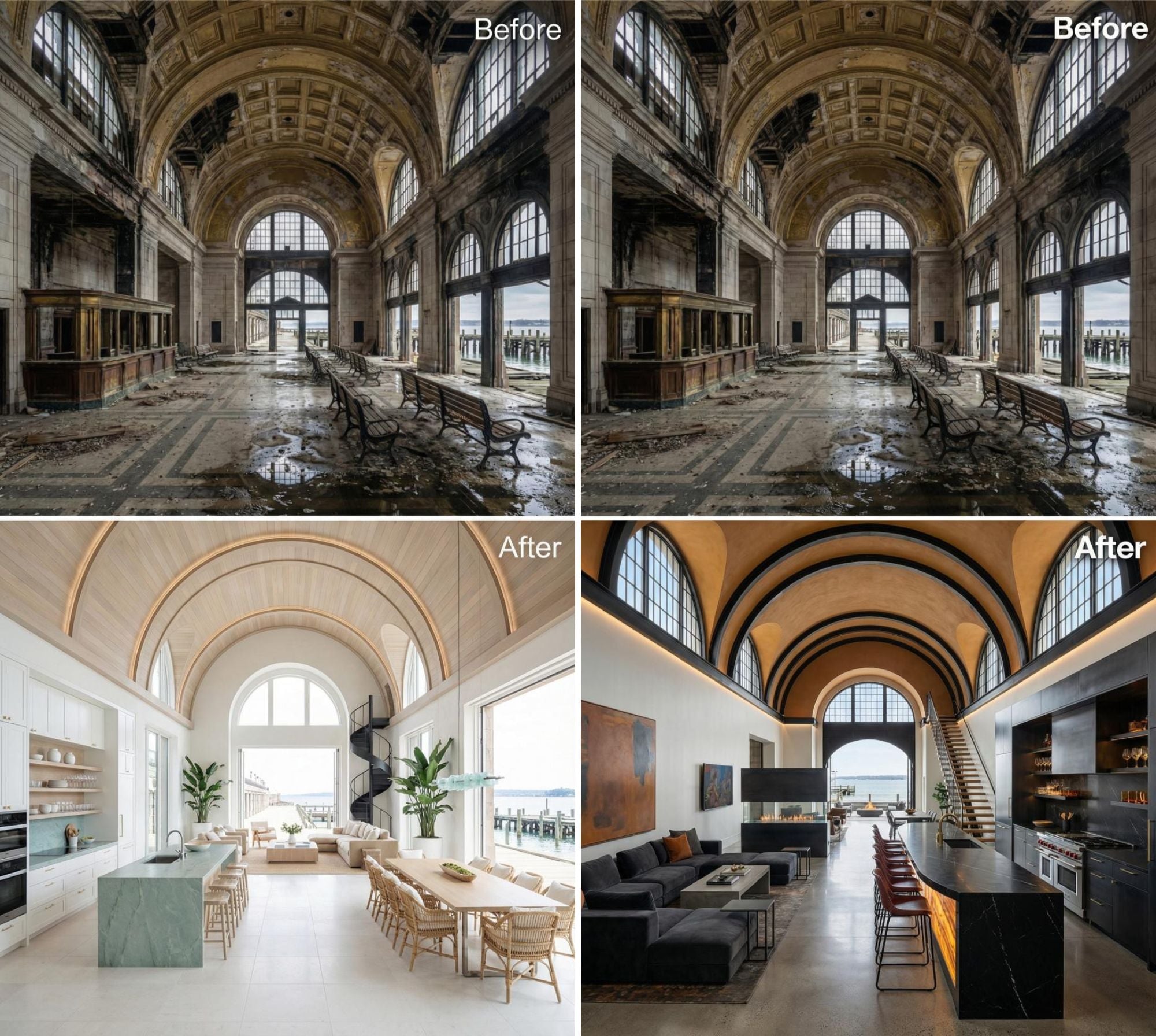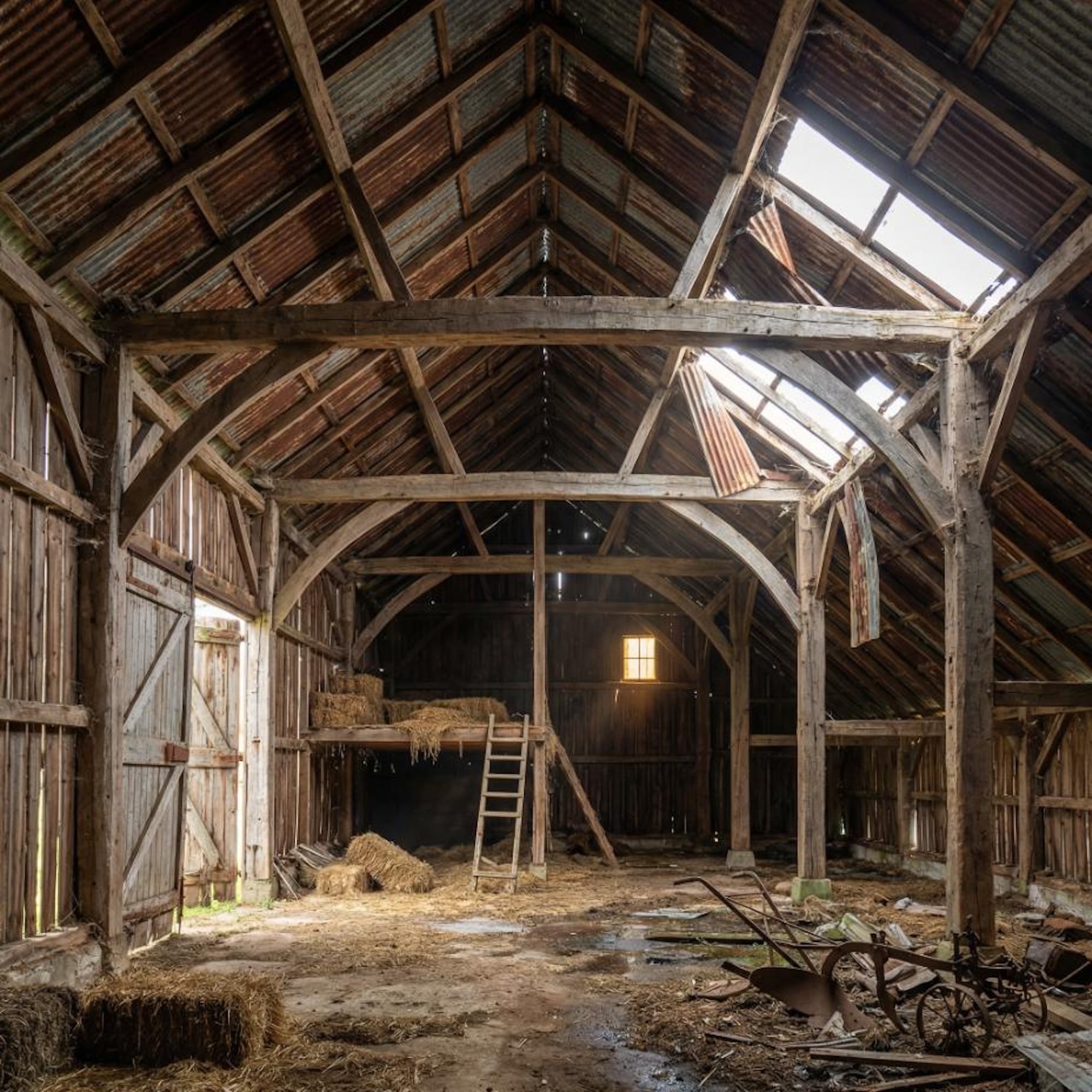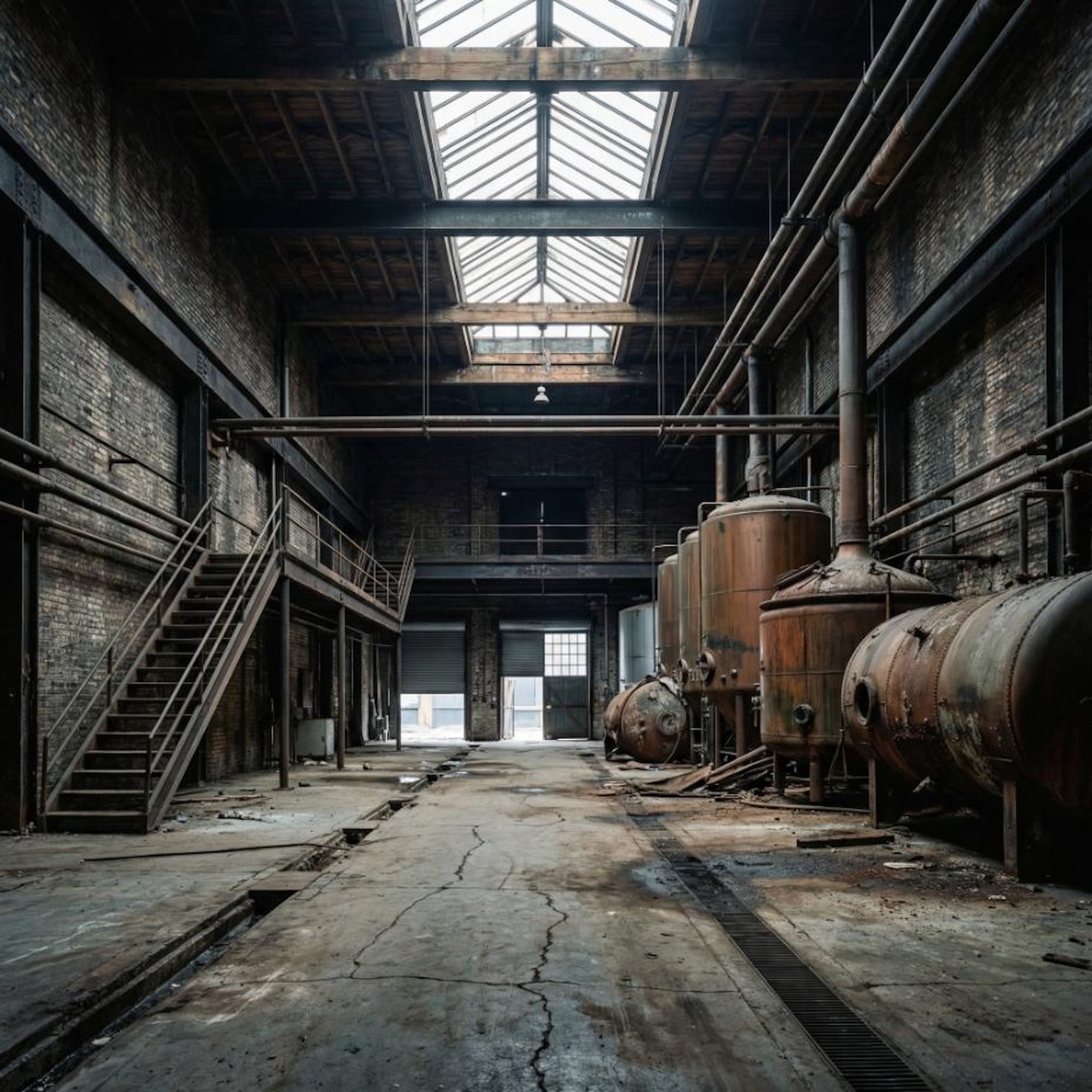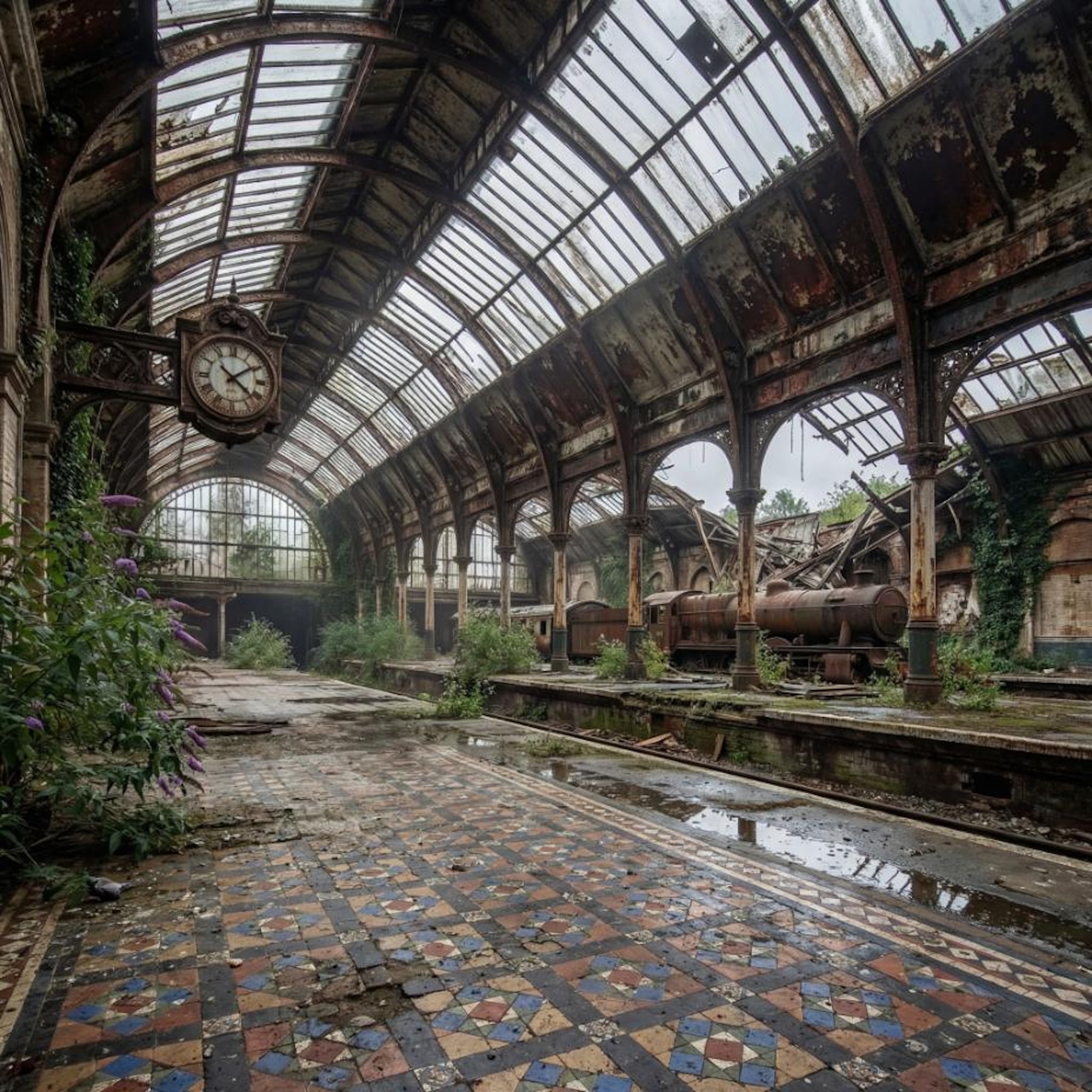
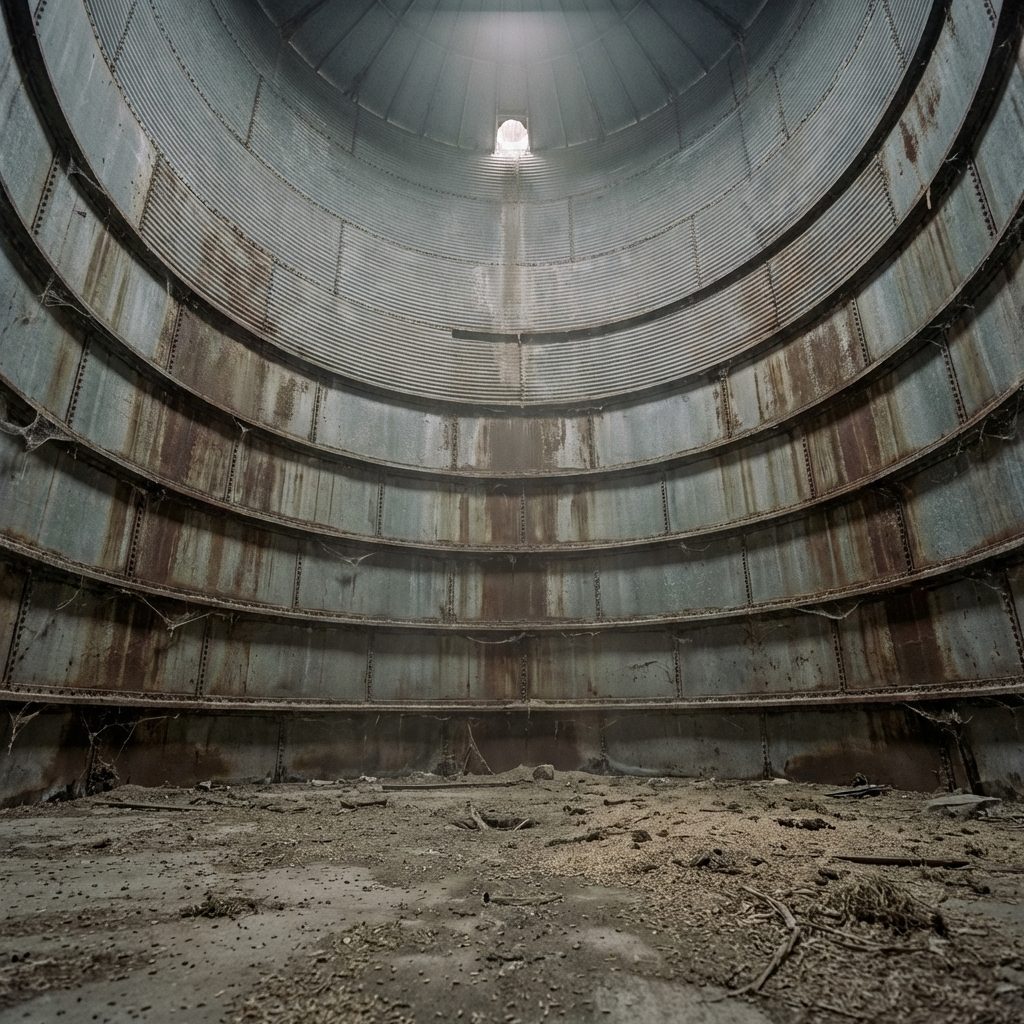
There’s something quietly poetic about a grain silo. For over a century, these cylindrical towers stood as the workhorses of the American farm, functional, weather-beaten, completely unremarkable. Then designers started looking at those curved walls and vaulted heights and asking a different question entirely. What follows is a single forgotten silo reimagined twenty ways, from gilded barn excess to moody Pacific Northwest timber craft. Every concept starts from the same crumbling shell. What they become is something else altogether.
Rustic Glam: When Reclaimed Oak and Champagne Gold Crash a Grain Silo
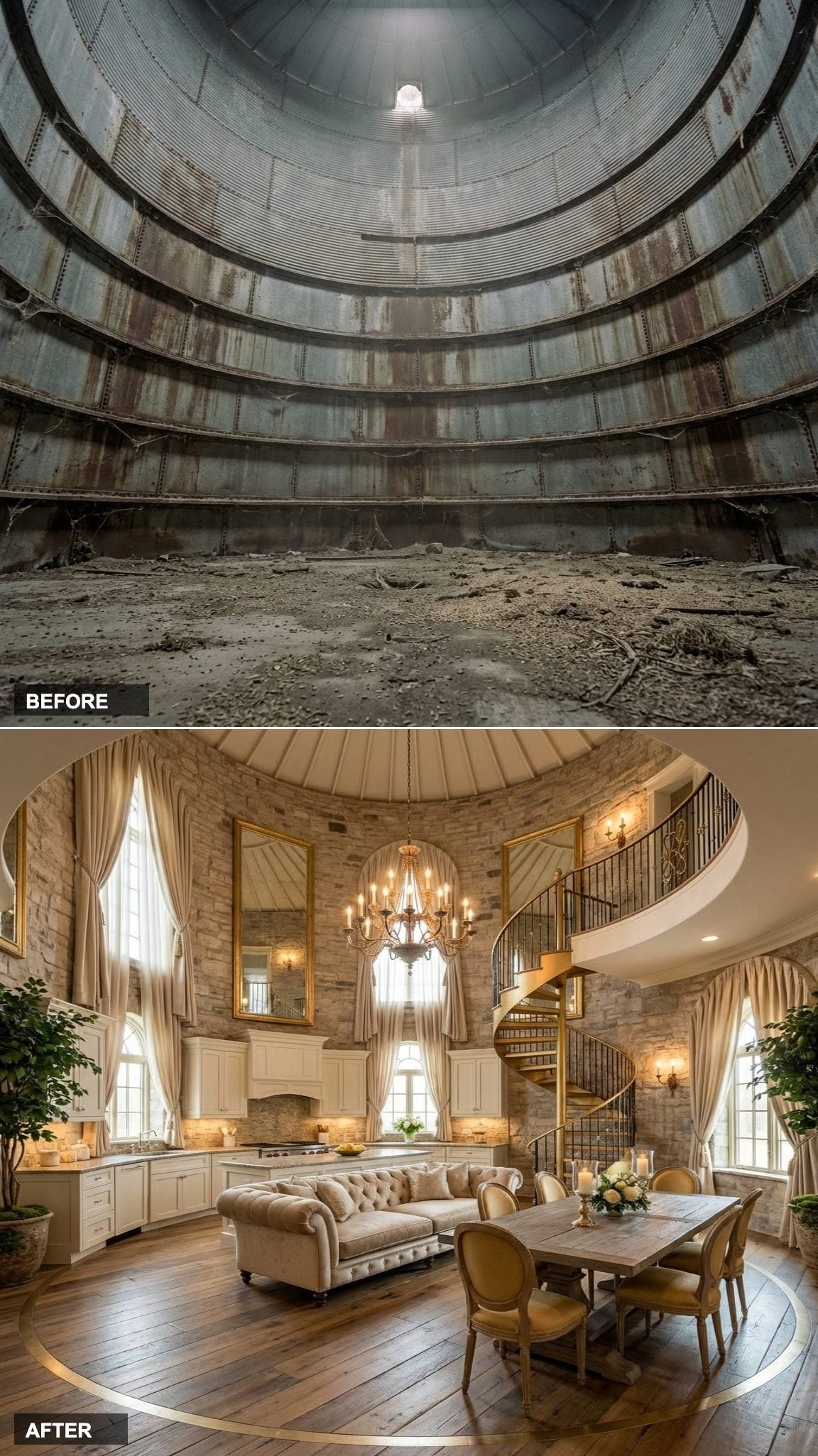
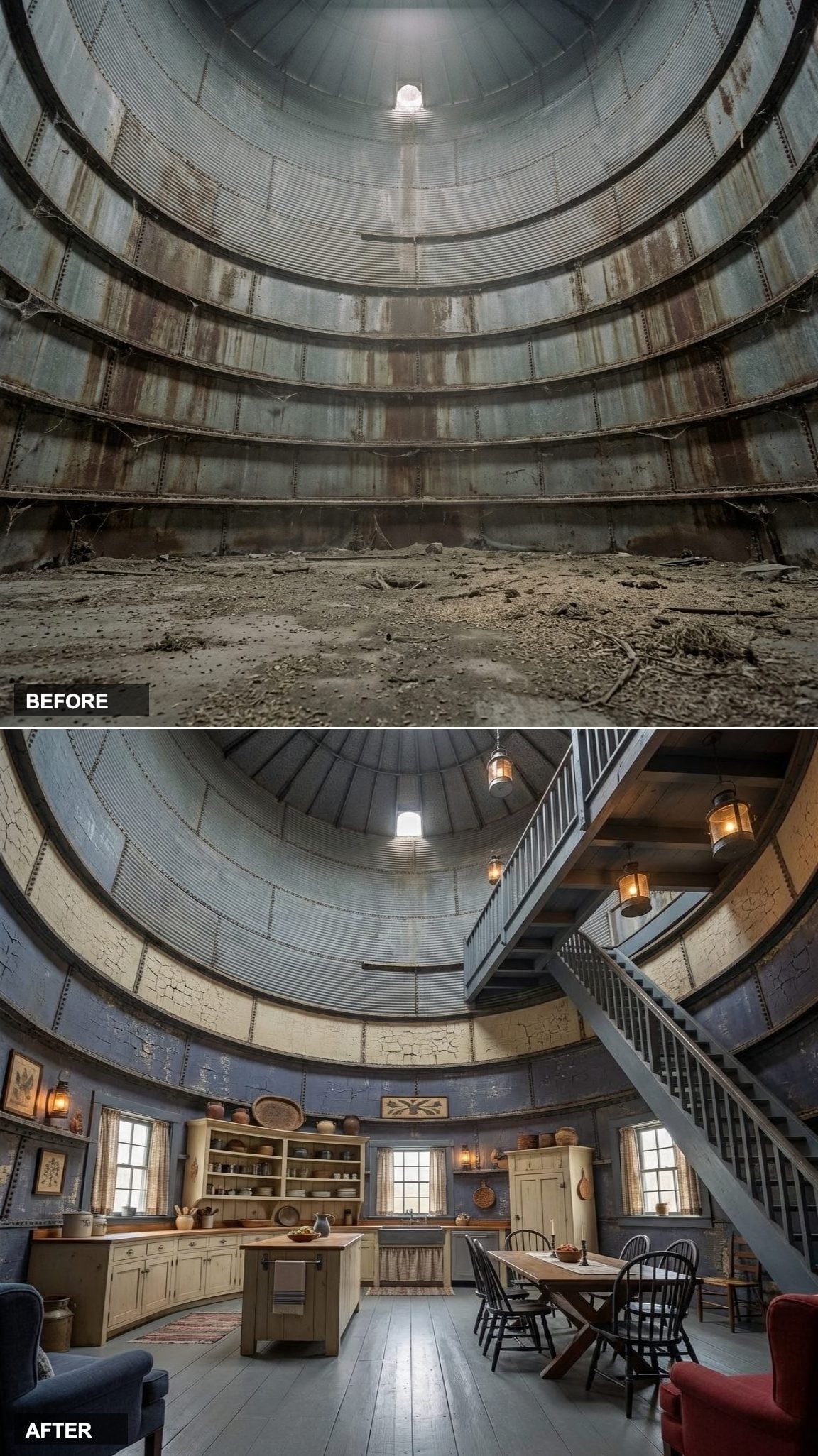
The original silo gave designers almost nothing to work with, rusted ribbed metal, cracked concrete, and a single dying bulb. The rustic glam concept flips that completely by keeping the raw texture but dressing it in serious luxury.
In order to come up with the very specific design ideas, we create most designs with the assistance of state-of-the-art AI interior design software. Also, assume links that take you off the site are affiliate links such as links to Amazon. this means we may earn a commission if you buy something.
Wide plank reclaimed oak with champagne gold inlay borders anchors the floor. The curved stone walls read rough and honest up close but catch the candlelight from wrought iron chandeliers in a way that feels almost theatrical. It’s the tension between grit and glamour that makes this one land.
Appalachian Farmhouse Style Fills Every Inch of This Round Room with Warmth
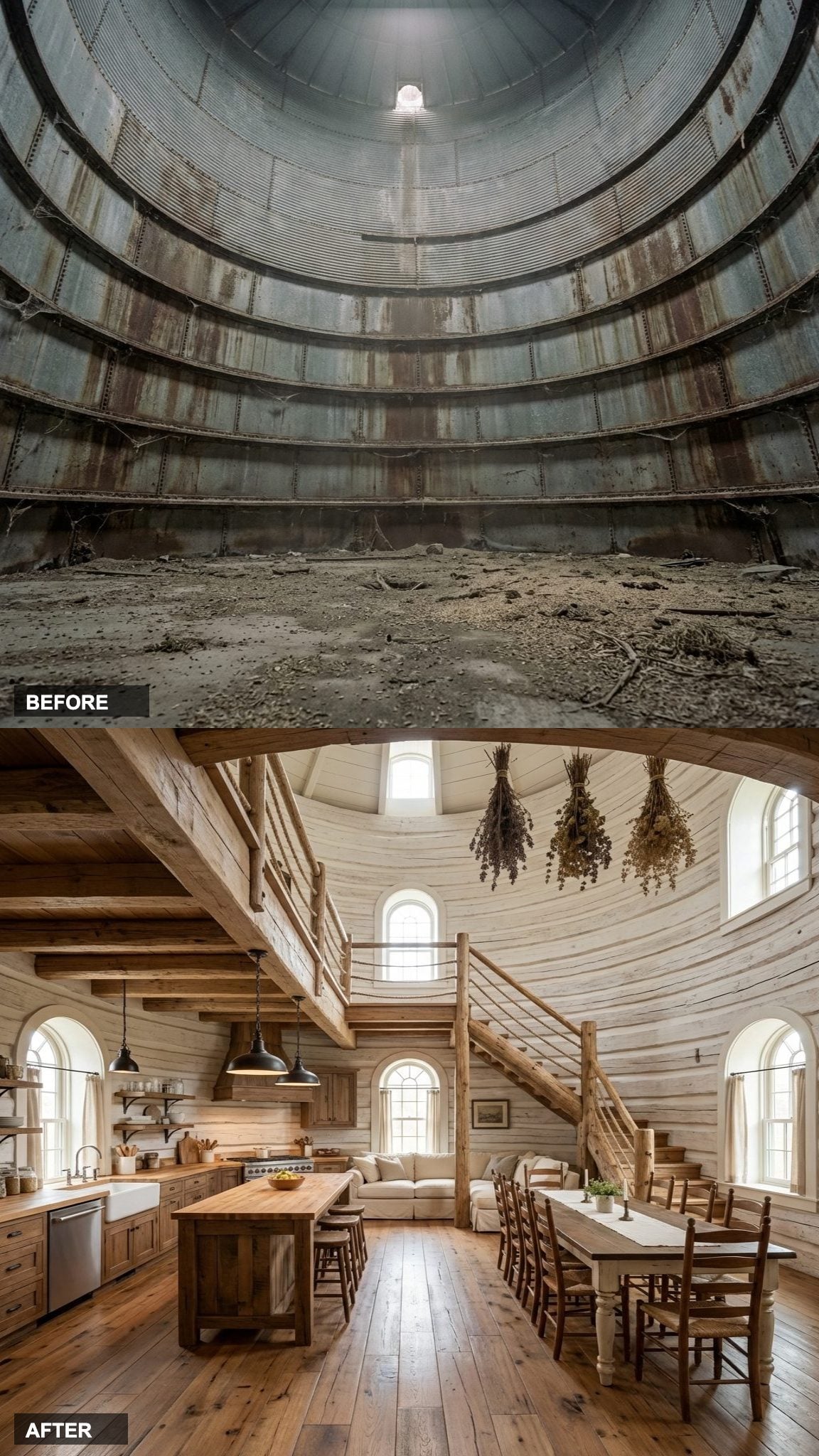
Hand-scraped hickory floors with their irregular grain and soft amber tones do something clever in a circular room, they pull the eye inward toward the center rather than toward any single wall. Paired with whitewashed log walls and chinked mortar seams, the whole space feels like it was carved from the mountain rather than converted from a steel cylinder.
There’s a lived-in honesty here. Nothing is trying too hard. The furnishings are heavy, practical, and worn at the right edges. A farmhouse that happens to be round is still, fundamentally, a home.
Sunken Japanese Onsen Retreat With Volcanic Stone and Shoji Screens
The circular footprint of a silo is practically begging to become a soaking pool. This conversion takes that logic seriously: the concrete floor is excavated at the center to create a deep, volcanic-stone-lined onsen, ringed by smooth river pebbles and moss-filled joints.
Curved shoji screens panel the lower walls, diffusing light into something soft and paper-thin. A single ginkgo branch arrangement anchors one side. The water sits still, dark, and mineral-rich. The kind of room that slows your breathing the moment you step in.
Vaulted Wine Cellar and Tasting Room With Arched Brick and Candlelight
Humidity control. Constant temperature. Total darkness. The structural properties that make a silo a terrible grain storage option after years of neglect make it nearly perfect for aging wine.
The corrugated walls are lined with hand-laid herringbone brick, and recessed bottle niches spiral up the curve in a pattern that doubles as sculpture. A central tasting table in oiled walnut sits beneath a wrought iron chandelier. The floor is dark slate. The whole thing reads less like a wine cellar and more like a private chapel for people who take their Burgundy seriously.
Sky-Lit Tropical Greenhouse Home With Living Walls and Rattan Everything
Plant people will clock what happened here immediately. The silo’s circular skylight opening, once just a drafty gap, is now a fully glazed oculus that floods the interior with the kind of diffused overhead light that tropical plants live for.
Living moss and fern panels cover the curved walls in interlocking vertical garden modules. The floor is warm terracotta tile, the furniture is oversized rattan and cane, and a kentia palm fills the center of the space like a piece of architecture all by itself. Lush, humid-feeling, and completely alive.
Brutalist Art Studio With Polished Concrete and Gallery Track Lighting
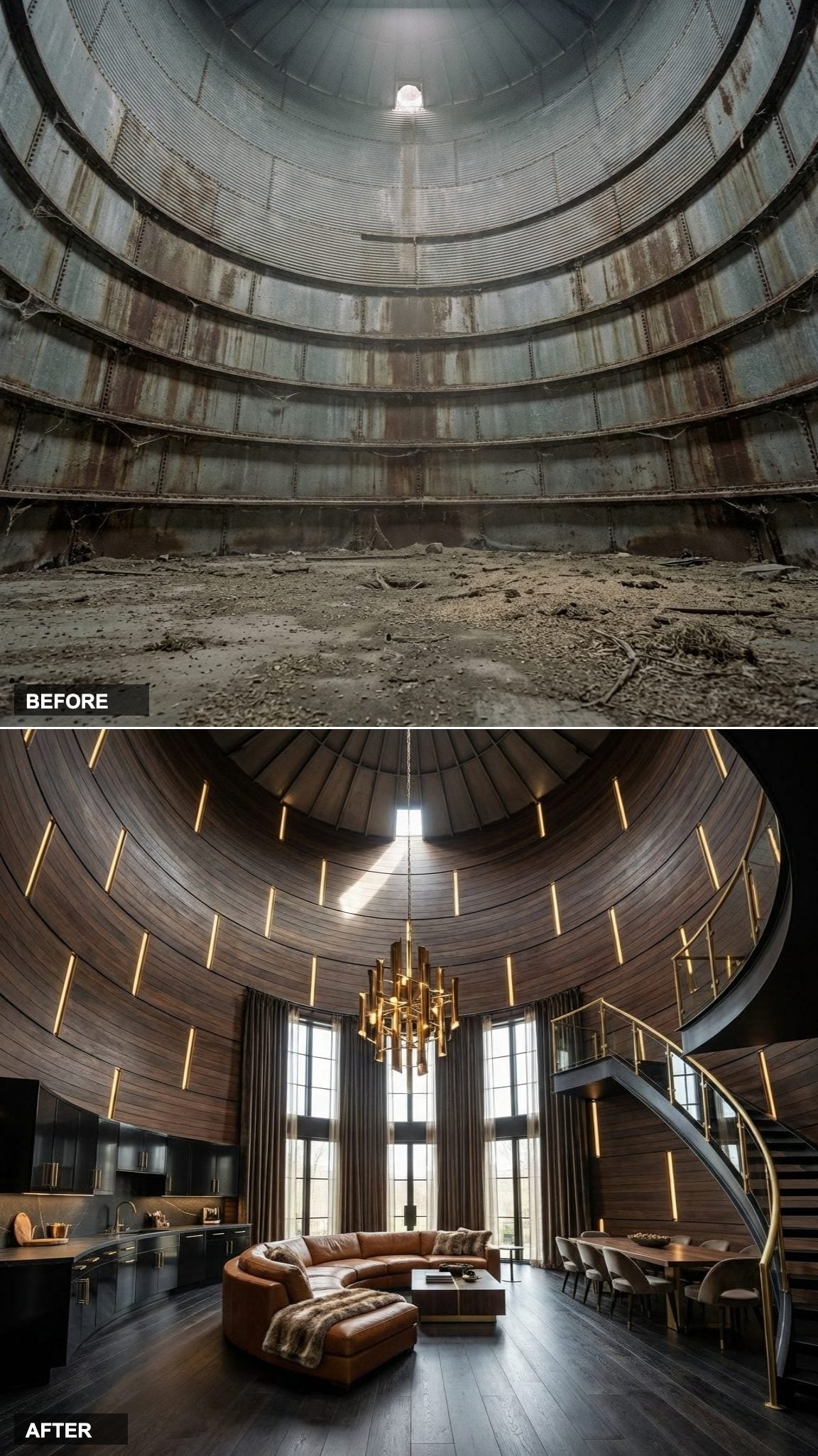
Raw concrete and curved steel are brutalism’s native language, and this conversion barely whispers. The walls stay exactly as they are: corrugated steel cleaned but left exposed, joints intact, the bolt pattern visible as a repeating decorative grid.
The floor gets the one major treatment: a deep grind and diamond polish until the aggregate shows and the surface reads almost like terrazzo. Gallery-grade adjustable track lighting circles the full perimeter. Oversized stretched canvases lean against the walls. This is the artist’s studio that gets written about in architecture magazines and then everyone pretends they always wanted a silo.
Cozy Nordic Hygge Cabin With Stacked Stone Fireplace and Reindeer Hide
Hygge is a Danish concept with no clean English translation, but the closest approximation is: warmth that you feel in your chest, not just on your skin. This silo conversion chases that feeling with real discipline.
A circular stacked-stone fireplace occupies one curved wall segment, its chimney disappearing into the ceiling above. The floor is wide-plank pine, deliberately left a little rough. Reindeer hides layer over low wool sofas. Candles cluster everywhere. The overhead opening is glazed but tinted slightly warm, so even grey winter light arrives feeling like afternoon.
Celestial Observatory Bedroom With Retractable Roof and Star Map Murals
The ceiling is the whole point. A hydraulic retractable panel replaces the top section of the silo, turning this bedroom into a fully open-air sleeping space on clear nights, and a sealed, insulated room when weather demands it.
The curved walls are painted in deep navy with a hand-rendered star map in gold leaf, accurate to the night sky over the property’s coordinates. The bed is round, centered, and oriented to face true north. Midnight blue velvet curtains soften the steel perimeter. It’s theatrical in a way that feels earned rather than overdone.
Mediterranean Hammam With Marble Steam Room and Mosaic Dome
The hammam is one of architecture’s oldest pleasures, and the dome-like upper curve of a silo ceiling is an accidental echo of a North African bathhouse. This conversion commits to that reference completely.
- The lower curved walls are clad in hand-cut white Carrara marble mosaic with cobalt blue geometric insets.
- A central marble heated slab occupies the floor, carved from a single piece.
- The oculus is sealed with a frosted glass dome that scatters light like a lantern from above.
Steam pipes run invisibly behind the walls. The whole interior holds heat the way the original steel never could.
Western Ranch Bunkhouse Bar With Reclaimed Bourbon Barrel Staves and Neon
Not every silo conversion needs to reach for luxury. Some just need a pool table, a long bar, and a playlist that leans country.
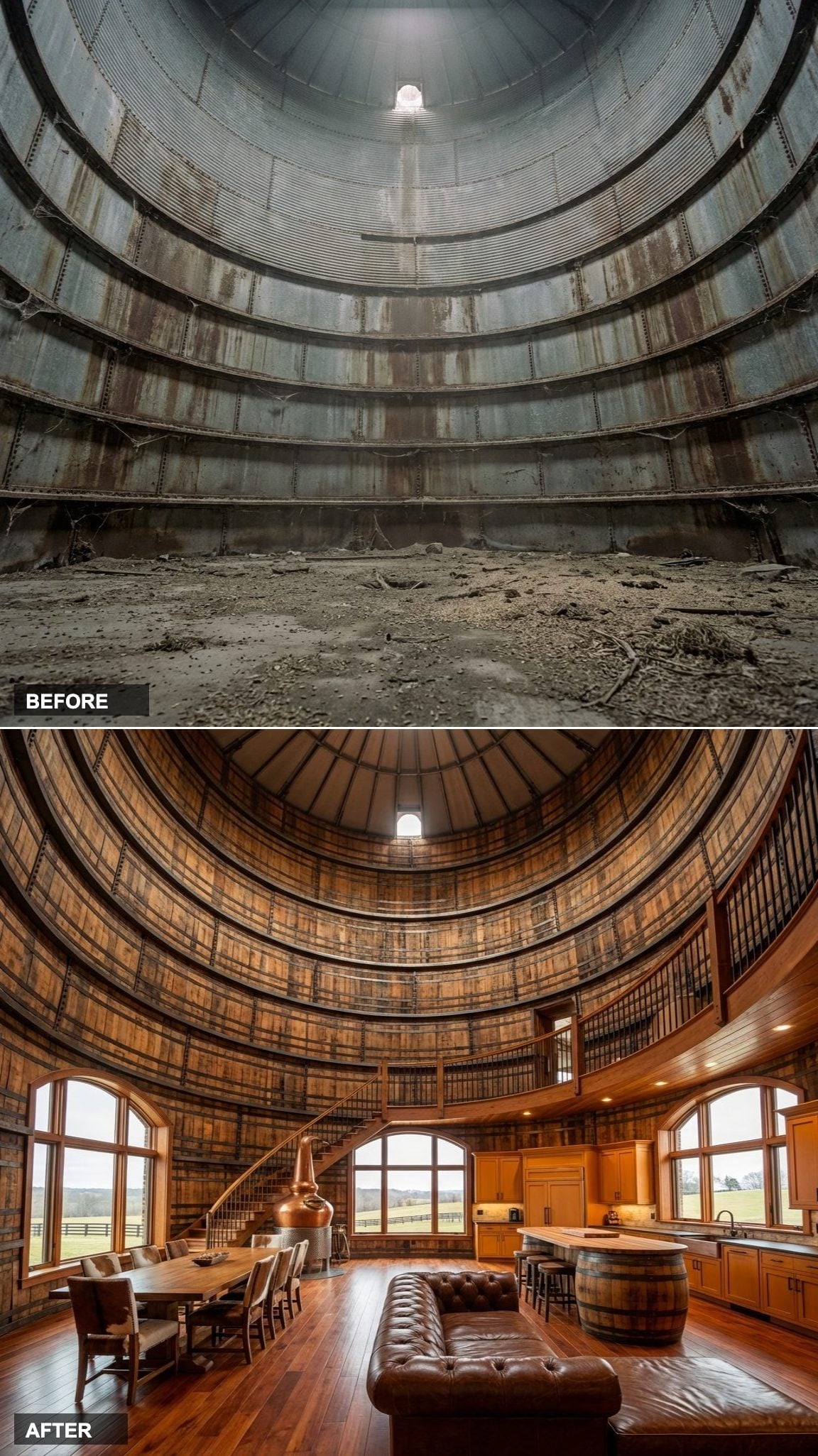
This one uses reclaimed bourbon barrel stave panels, the curved wood actually hugs the circular wall better than flat lumber ever could. The bar top is a single poured epoxy resin over embedded barley grain, a nod to the building’s history. Edison rope lights ring the perimeter. A vintage neon sign in red and white cuts through the warm amber. The floor is salvaged dark oak with visible nail holes. Honest, unpretentious, and deeply fun.
Emerald Art Nouveau Parlor With Curved Ironwork and Hand-Gilded Murals
Art Nouveau was born from a conviction that there should be no division between fine art and functional architecture, that a room itself should feel like a living organism. A silo, with its inherent curves and vertical sweep, is almost too good a fit for the style to be coincidental.
The walls get layers: a deep forest green plaster base, then hand-gilded botanical murals that wind up from the floor like climbing vines. Custom curved ironwork panels divide the space into defined zones without breaking the circular flow. The furniture is carved mahogany with velvet upholstery in emerald and gold. Tiffany-style pendant globes hang at staggered heights, filling the room with amber and green refracted light.
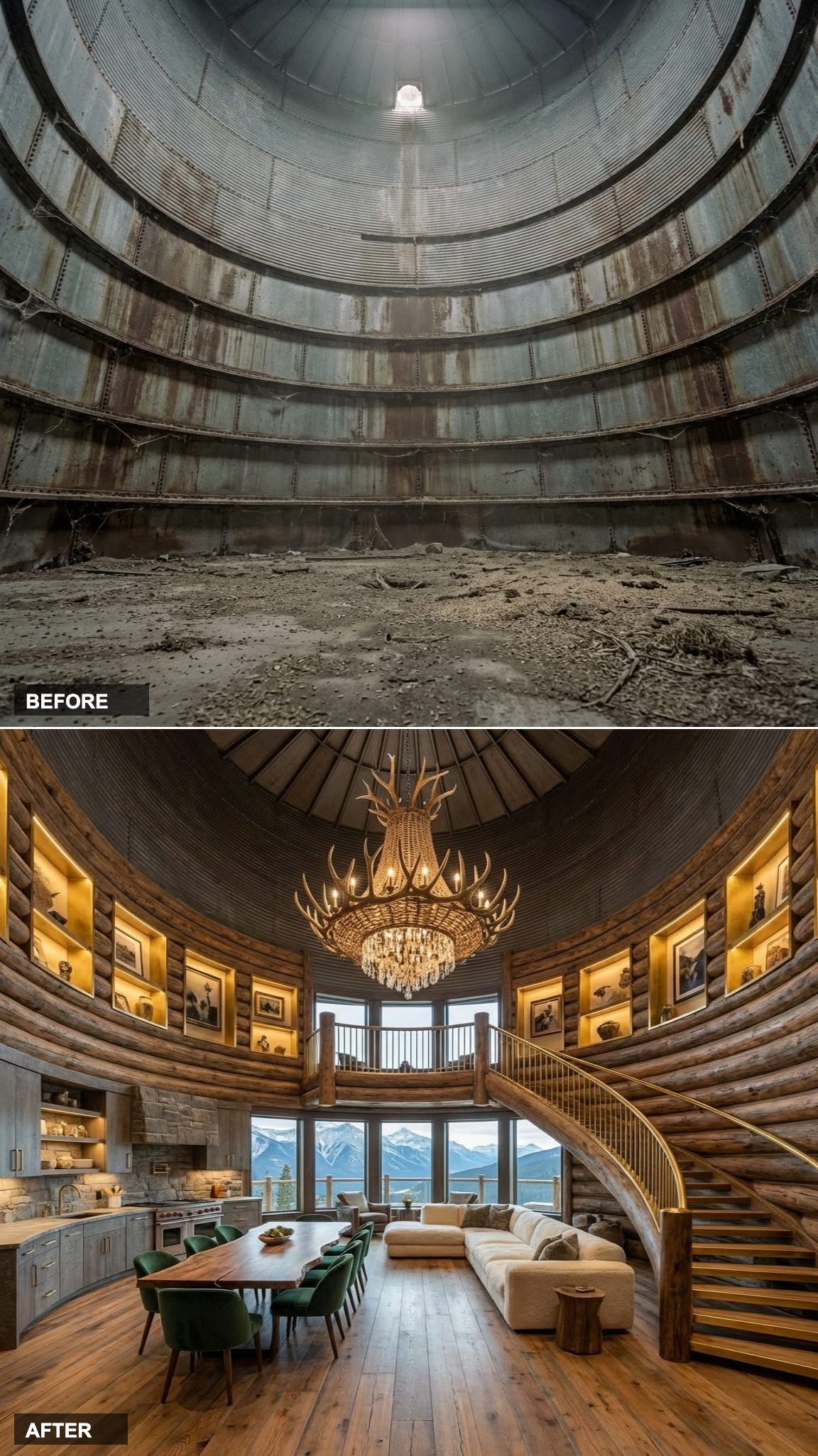
Design 14
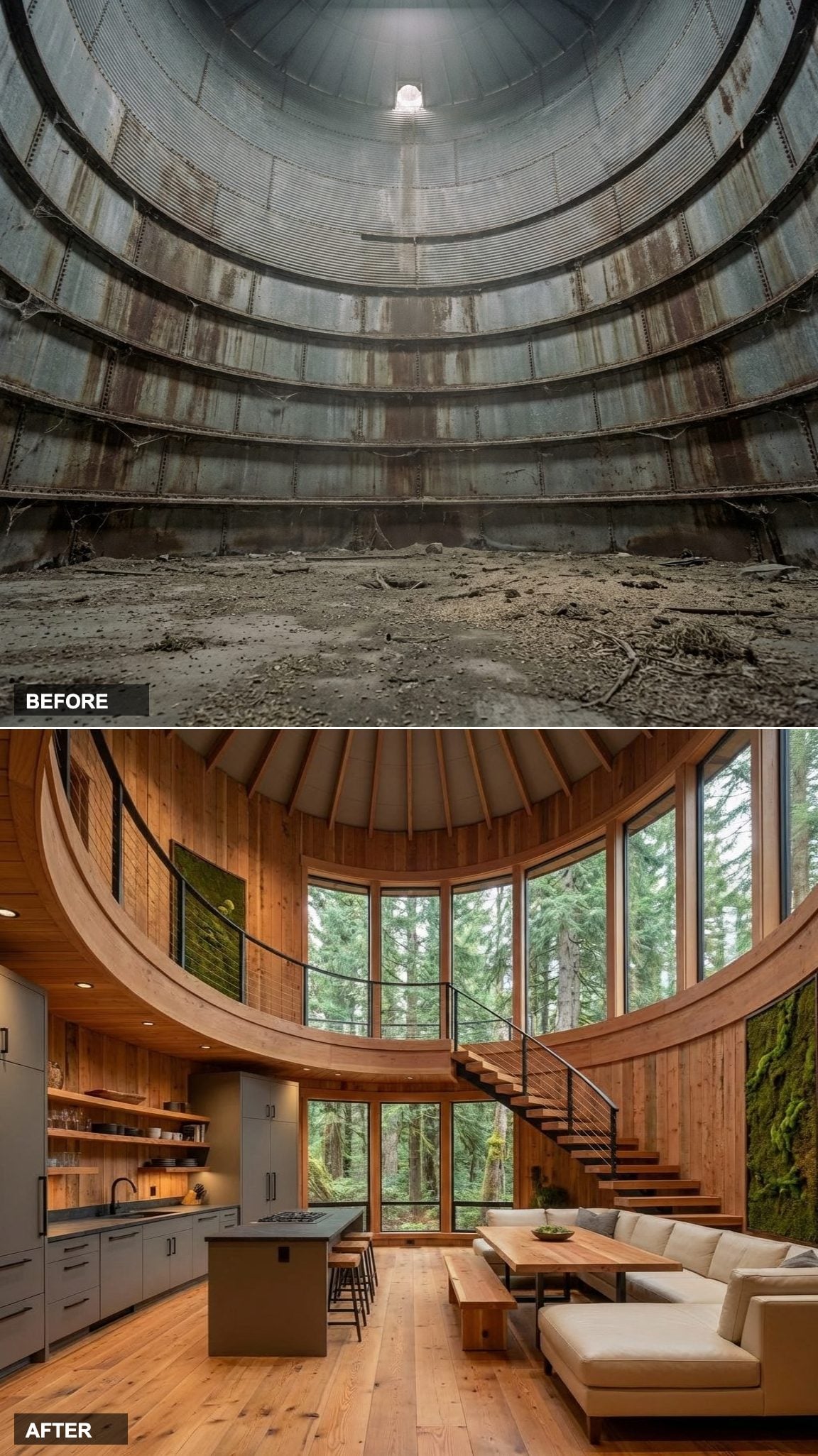
Design 16
🔥 Would you like to save this?
Tuscan Farmhouse Warmth Poured Into a Cylindrical Shell
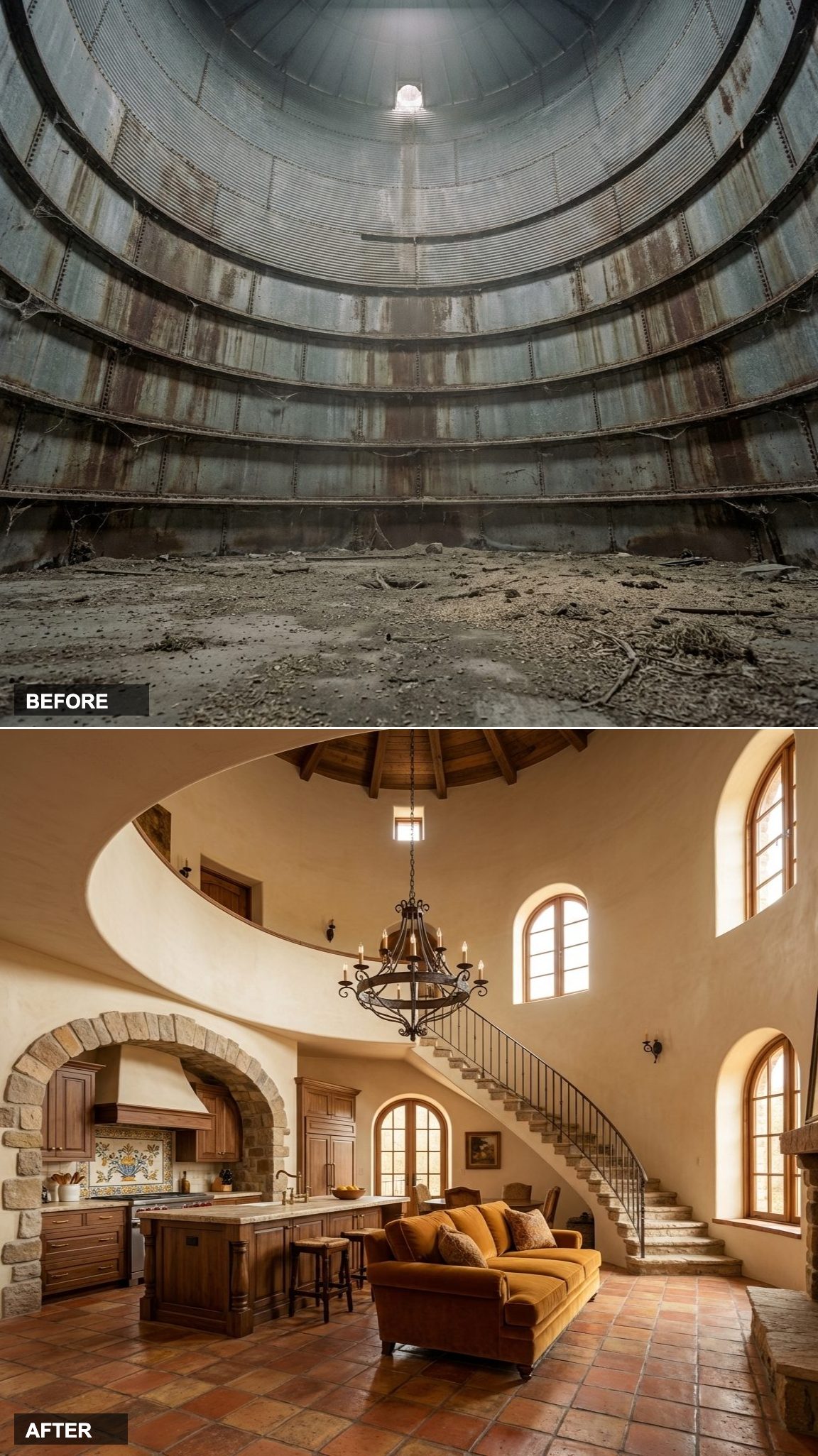
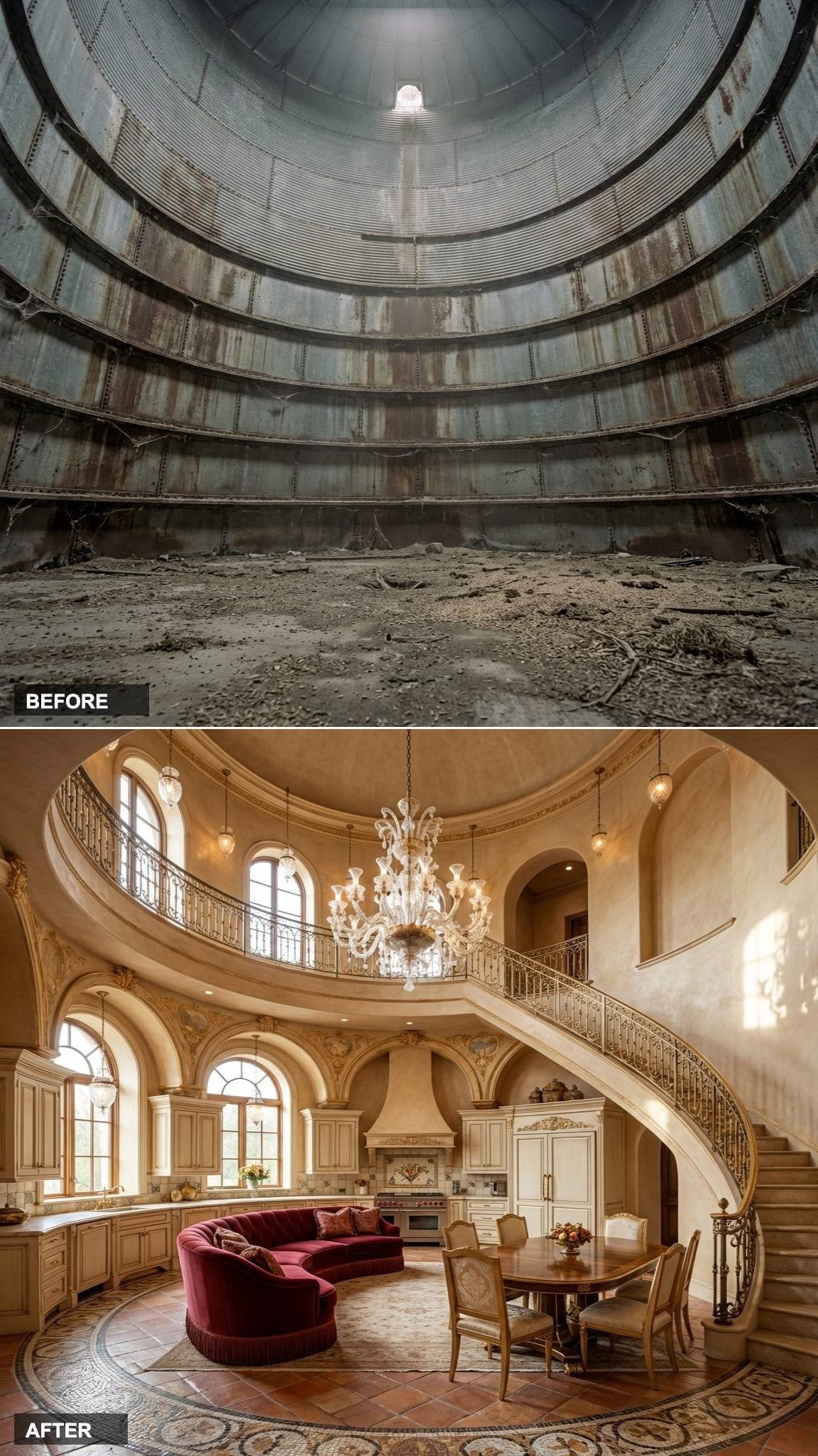
Terracotta tile with an aged patina, ivory plaster walls that feel like they’ve been accumulating character for two centuries, hand-painted ceramic details in the kitchen. The Tuscan conversion works because terracotta and curved plaster walls are a completely natural pairing, Italian hill towns have been building round cisterns and storage towers in almost exactly this way since the Middle Ages.
The warmth is relentless here. Every material choice amplifies the others: the honey tones of the tile pull amber out of the plaster, the plaster softens the heavy hand-painted ceramics. Nothing fights for attention.
Wabi-Sabi Finds Its Perfect Form in a Perfectly Imperfect Circle
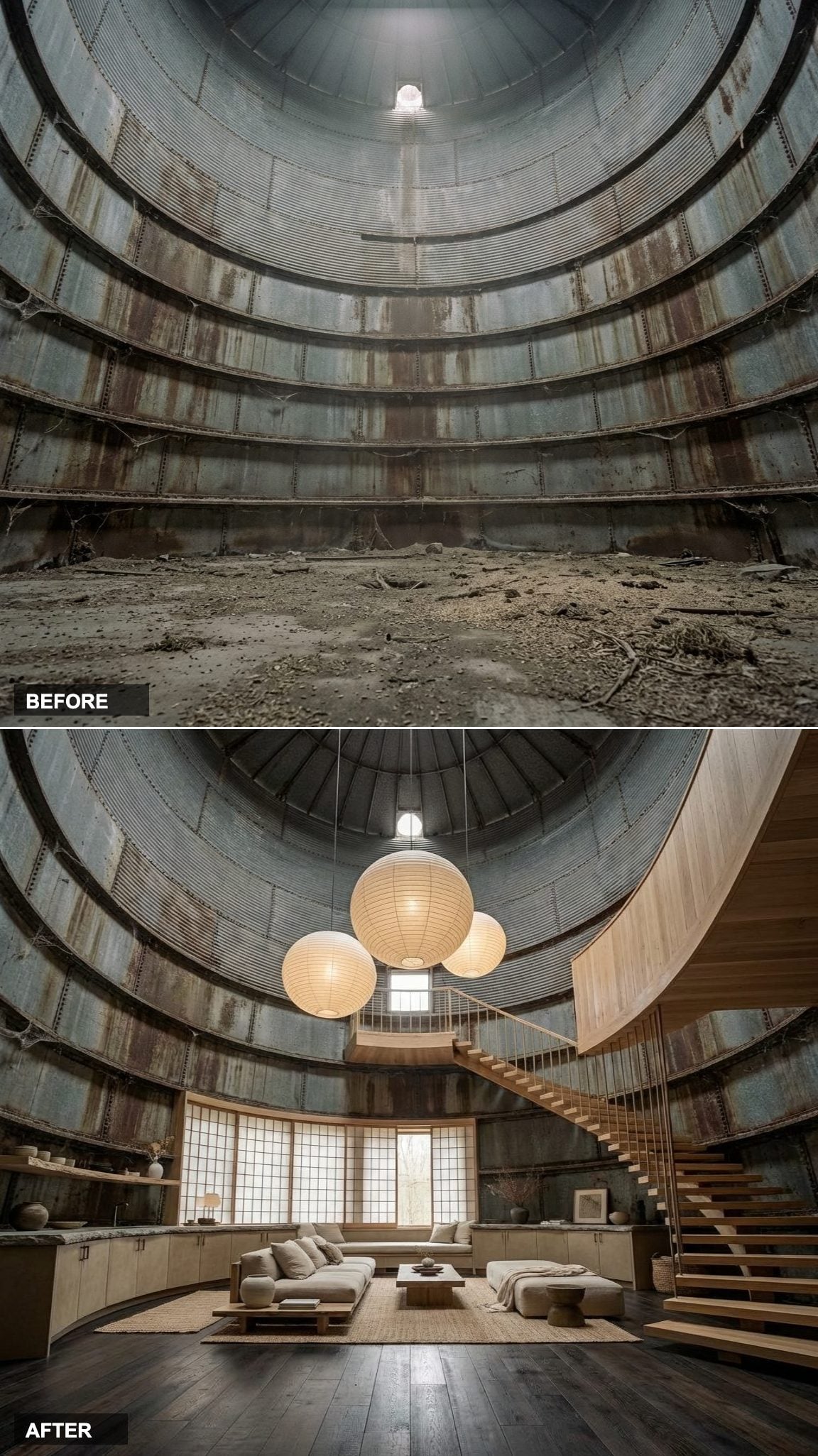
Charred oak planks, handmade putty-toned cabinetry, and a live-edge counter running the full curve of the kitchen. The wabi-sabi conversion is the one that makes the most philosophical sense for a repurposed silo. The whole premise of wabi-sabi, finding beauty in imperfection, age, and incompleteness, maps directly onto a structure built to hold grain and then abandoned for decades.
Nothing here is precious. The floors are deliberately rough-sawn. The walls keep their texture. The lighting is low and warm, almost candlelike. It’s the only style on this list that actually benefits from not trying too hard.
Bleached Oak and White Shaker: California Coast Moves Inland
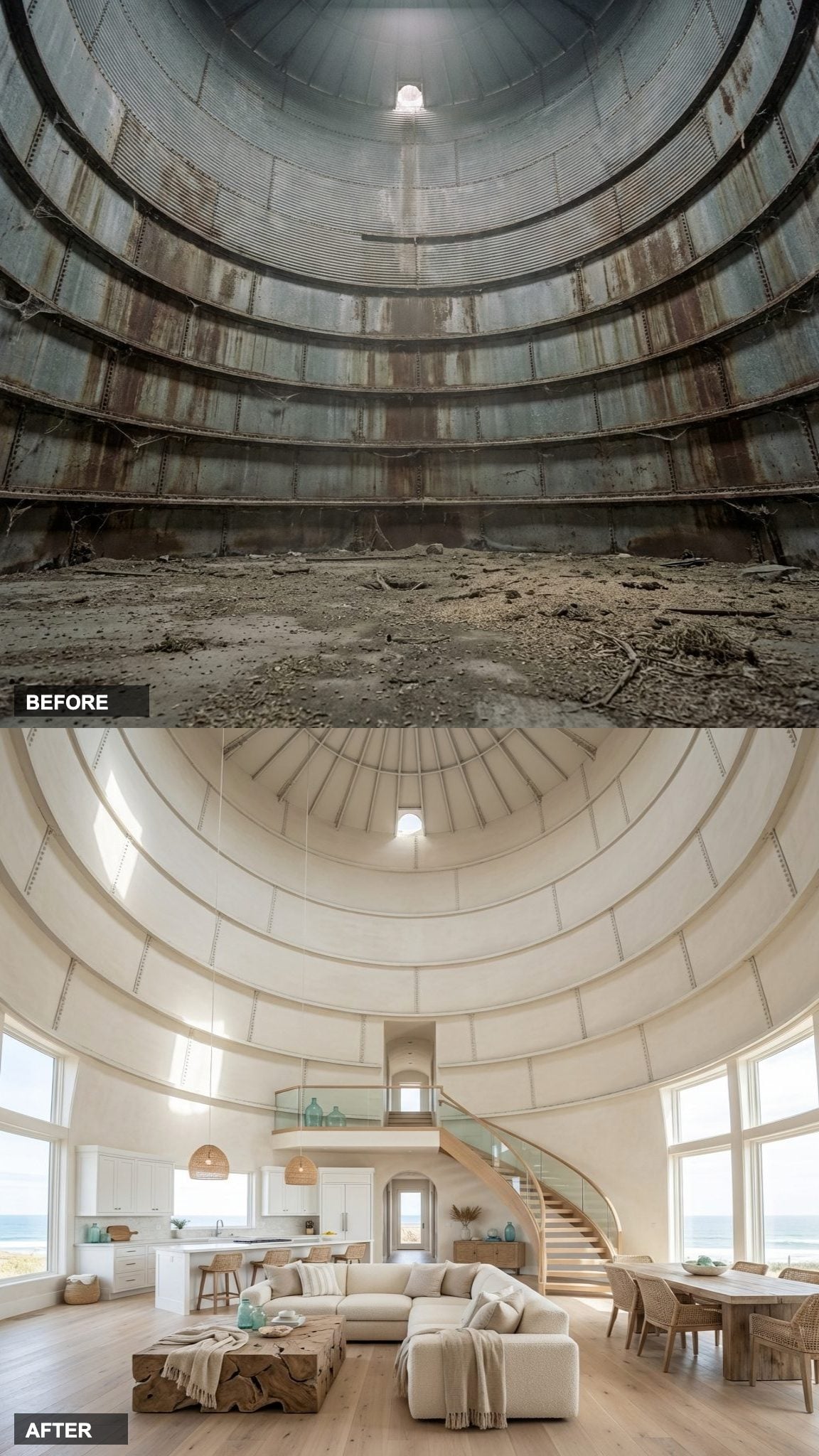
Wide plank bleached oak, white shaker cabinetry, rattan accents, and light that feels like it’s coming off the Pacific. The coastal California conversion is perhaps the most surprising fit for a cylindrical farm structure, but the curved walls do something here that no beach house could replicate: they wrap the whole room in a soft panoramic continuity.
There’s nowhere for the eye to get stuck on a corner. The space breathes differently than a rectangular room, calmer, more enveloping. That’s the coastal effect amplified by the architecture itself.
- Bleached oak keeps the palette airy without going cold
- Rattan breaks up the hard surfaces without adding visual clutter
- The circular skylight overhead mimics a porthole, deepening the nautical reference
Forest Green Lacquer and Brass Hardware: Moody Luxury Done Right
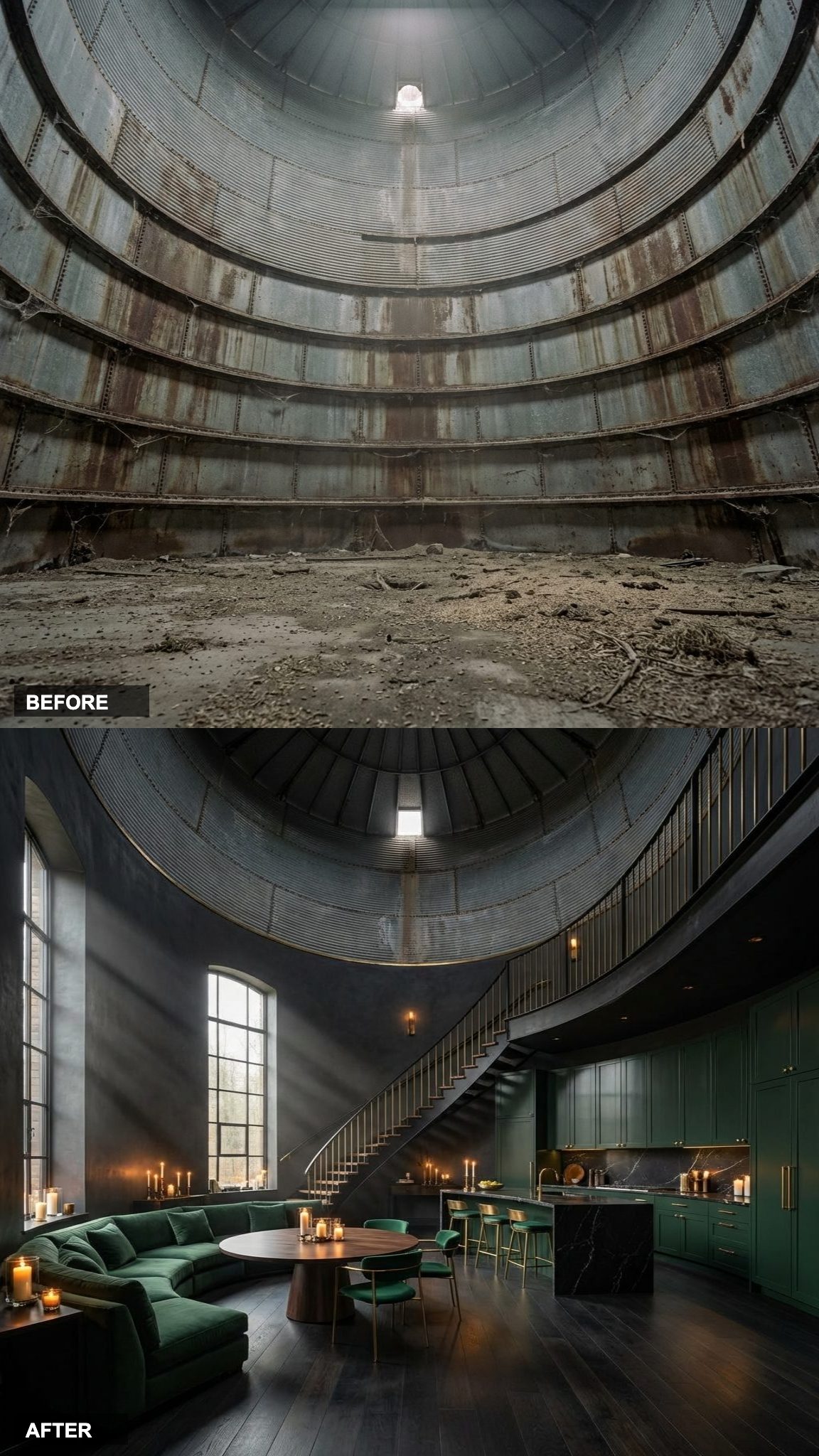
This is the conversion where the silo stops pretending it has anything to do with agriculture. Deep forest green lacquer on every cabinet face, unlacquered brass hardware developing a slow patina, ebony wide plank floors absorbing the light rather than reflecting it. The darkness is the point.
Cylindrical spaces in dark palettes do something counterintuitive: they feel more intimate, not smaller. The absence of corners removes the psychological signal that you’ve reached a wall, so the room reads as continuous rather than confined. That’s a design trick you simply cannot replicate in a rectangle.
Bohemian Luxe Brings the Arched Niche Into Its Natural Habitat
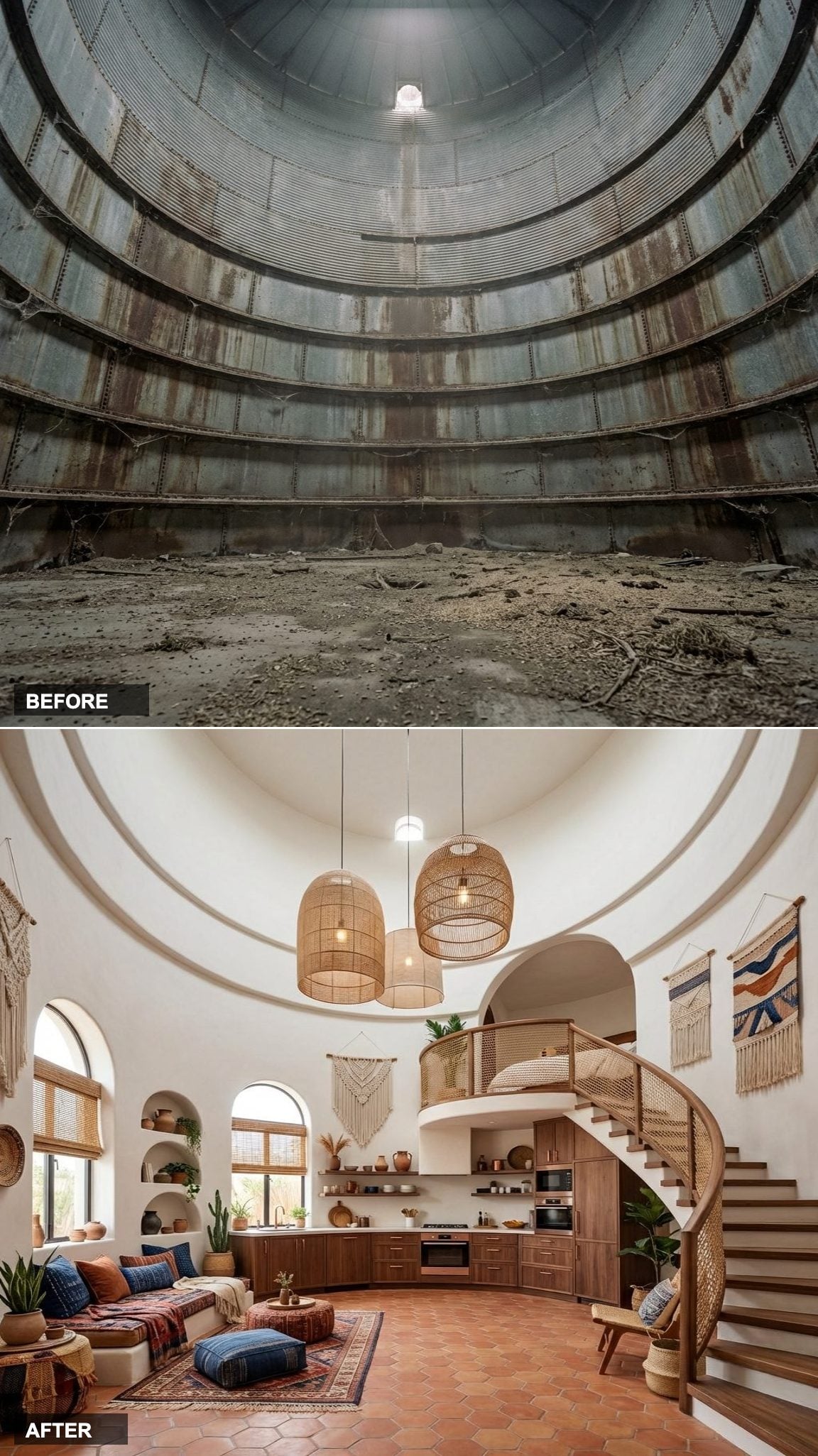
Terracotta hex tile, curved plaster walls carved into arched niches, warm walnut shelving, textiles layered in every direction. The bohemian luxe conversion leans on the silo’s curve to create a feature that would look forced in a flat-walled room: a series of recessed arched niches that follow the wall’s natural arc.
Stacked with ceramics, trailing plants, and amber glassware, those niches do the heavy lifting. The rest of the space can stay relatively unfussy because the niches provide all the visual richness the eye wants.
Mid-Century Modern Finds a New Geometry to Play With
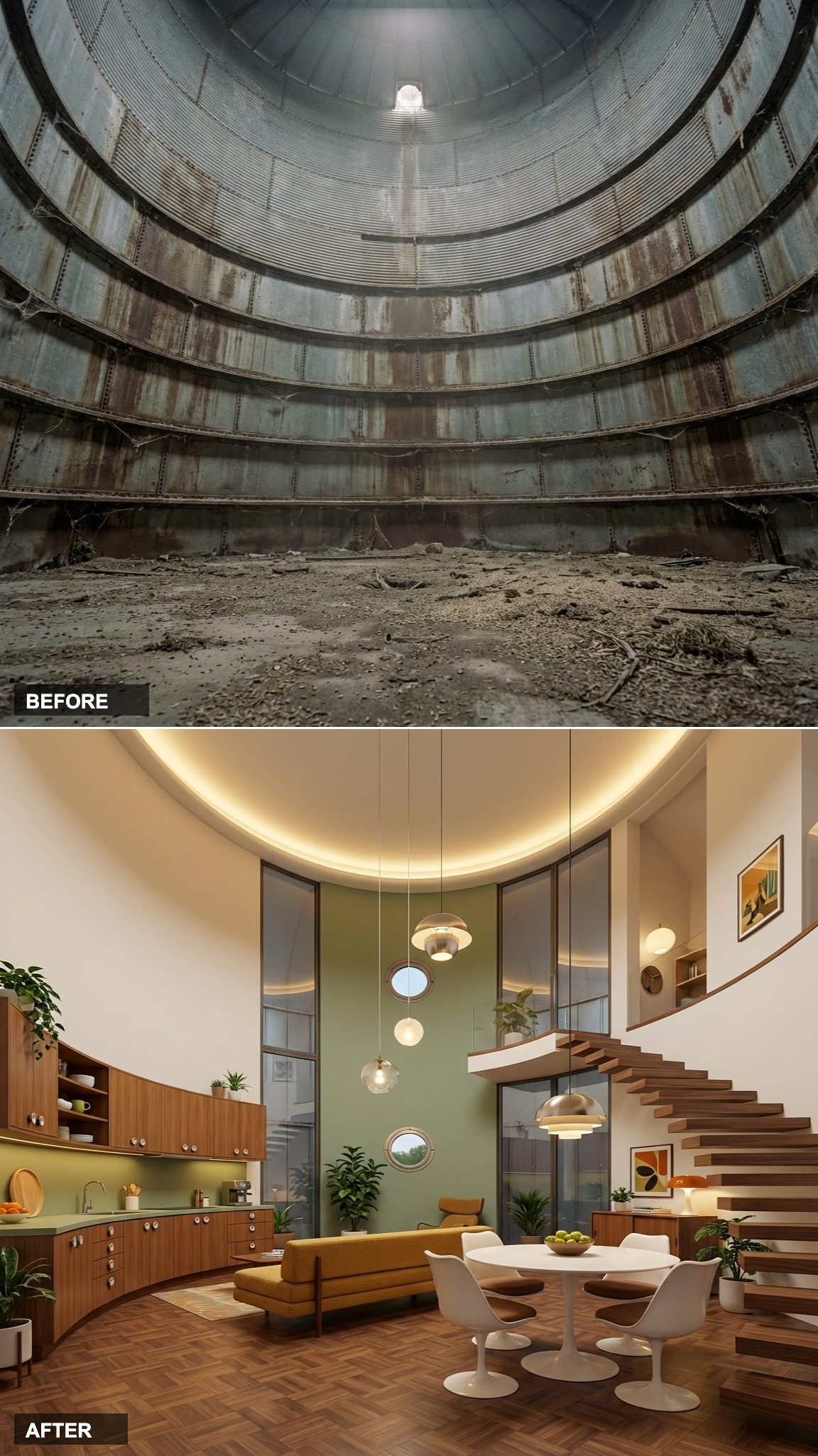
Teak cabinetry, walnut parquet underfoot, saddle leather bar stools, and a Sputnik chandelier hanging dead center in the round. Mid-century modern is built on the tension between organic curves and precise geometry, a tension the silo resolves instantly by being simultaneously both. The circular floor plan is organic. The flat cabinet faces and clean hardware lines are architectural. They don’t compete.
Navy Blue Shaker and Wide Plank Pine: New England Classic Gets a Round Room
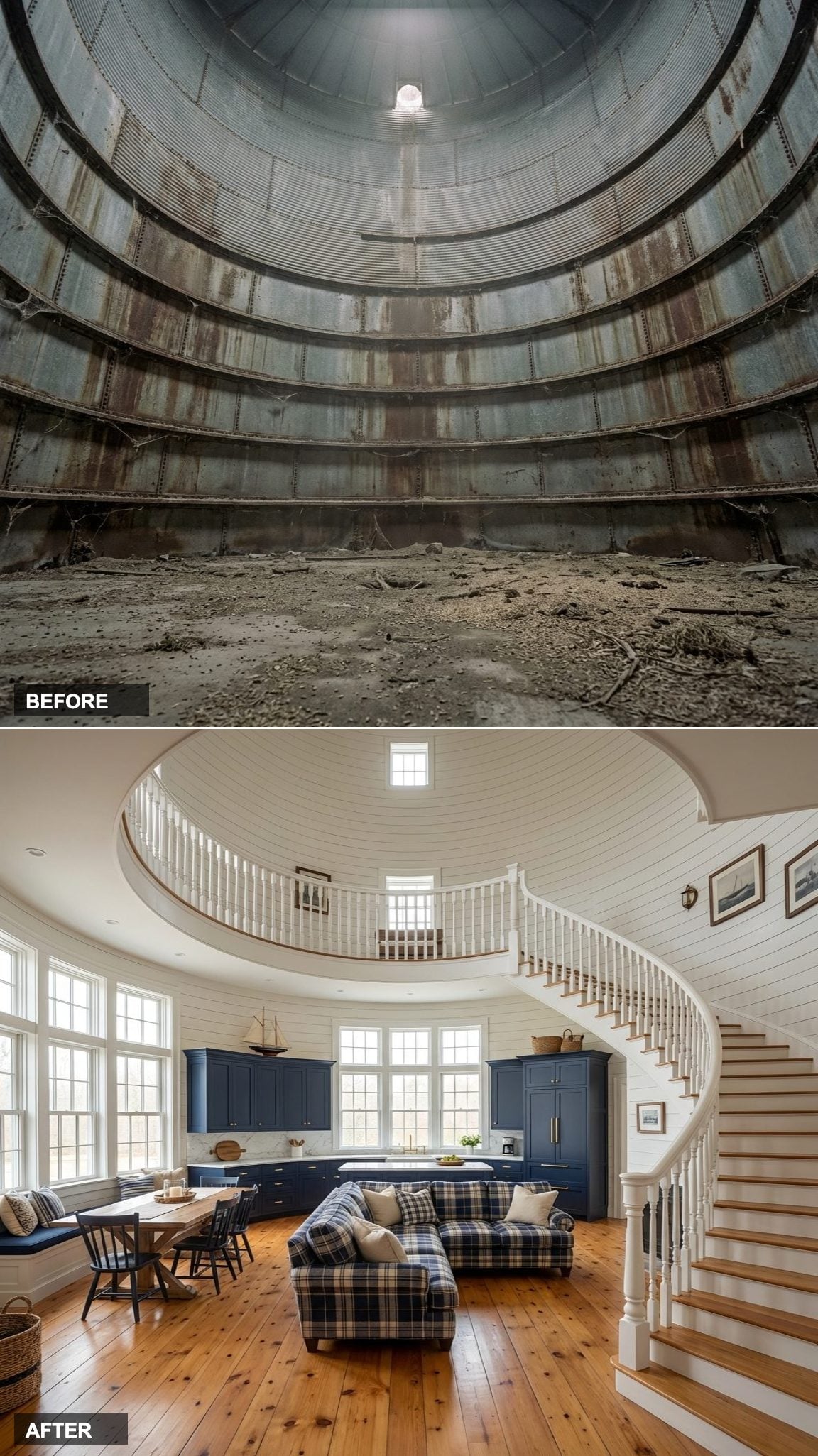
Wide plank honey pine, navy shaker cabinetry, brass hardware, and an American flag-quilt textile hanging on the curved wall as pure art. The New England classic conversion is the most historically grounded read on this list, round stone towers and grain storage structures have been part of New England farm architecture since the 1700s, so a shaker-style interior inside a cylindrical shell carries a real sense of continuity.
The navy and pine combination is doing a lot of heavy lifting. Navy reads as serious, pine reads as warm and unpretentious, and together they hit the exact tone that New England farmhouse style has always aimed for: dignified without being stiff.
Organic Modern in Limestone and Warm Greige Plaster
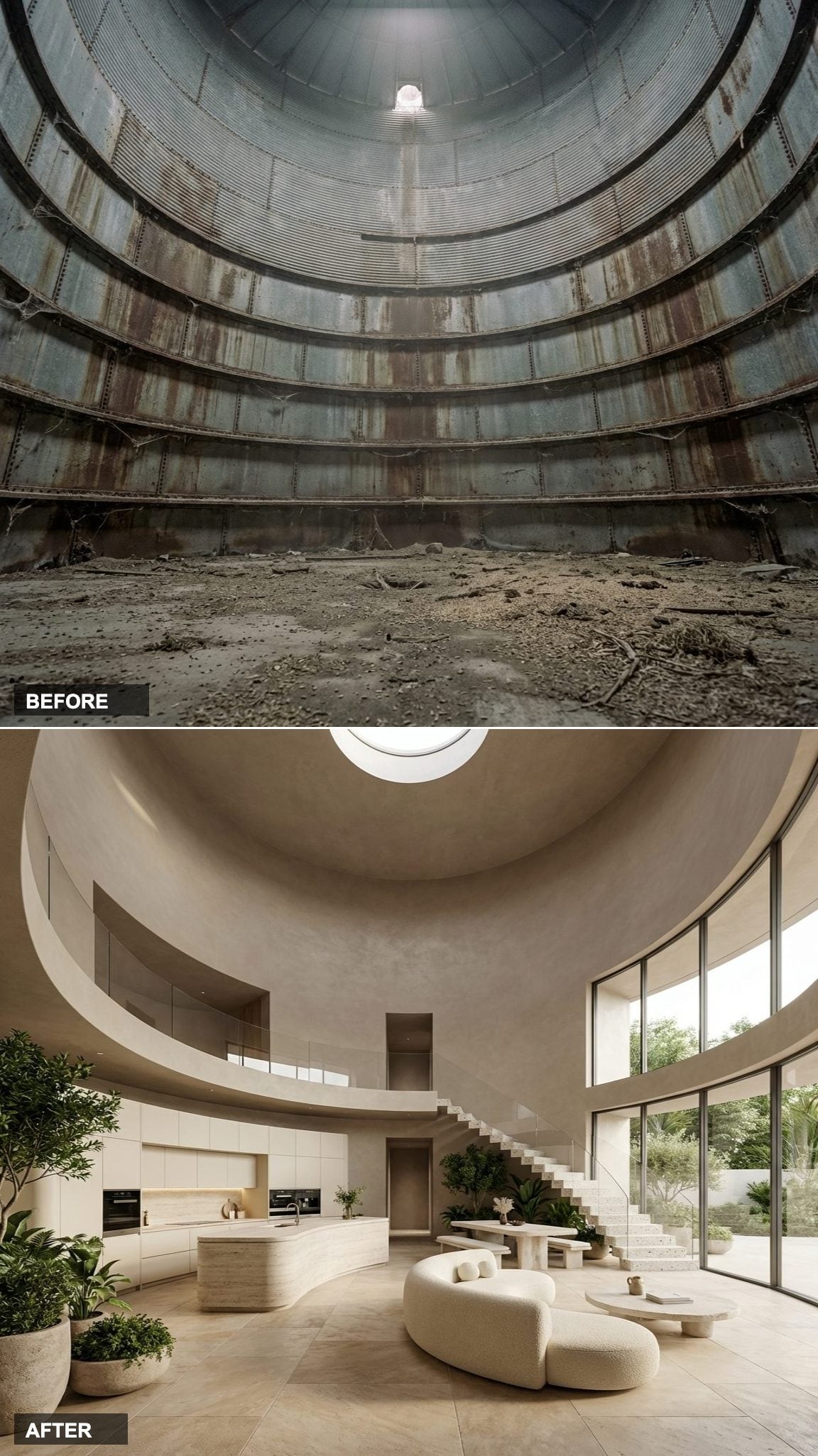
Large format limestone tile, warm greige plaster walls, cream flat-panel cabinetry with integrated pulls. The organic modern conversion is the quietest on the list, and that restraint is a deliberate editorial choice, the curved wall is the design, and the materials are there to support it, not compete with it.
Alpine Lodge Style Turns the Silo Into a Stone-Wrapped Mountain Refuge
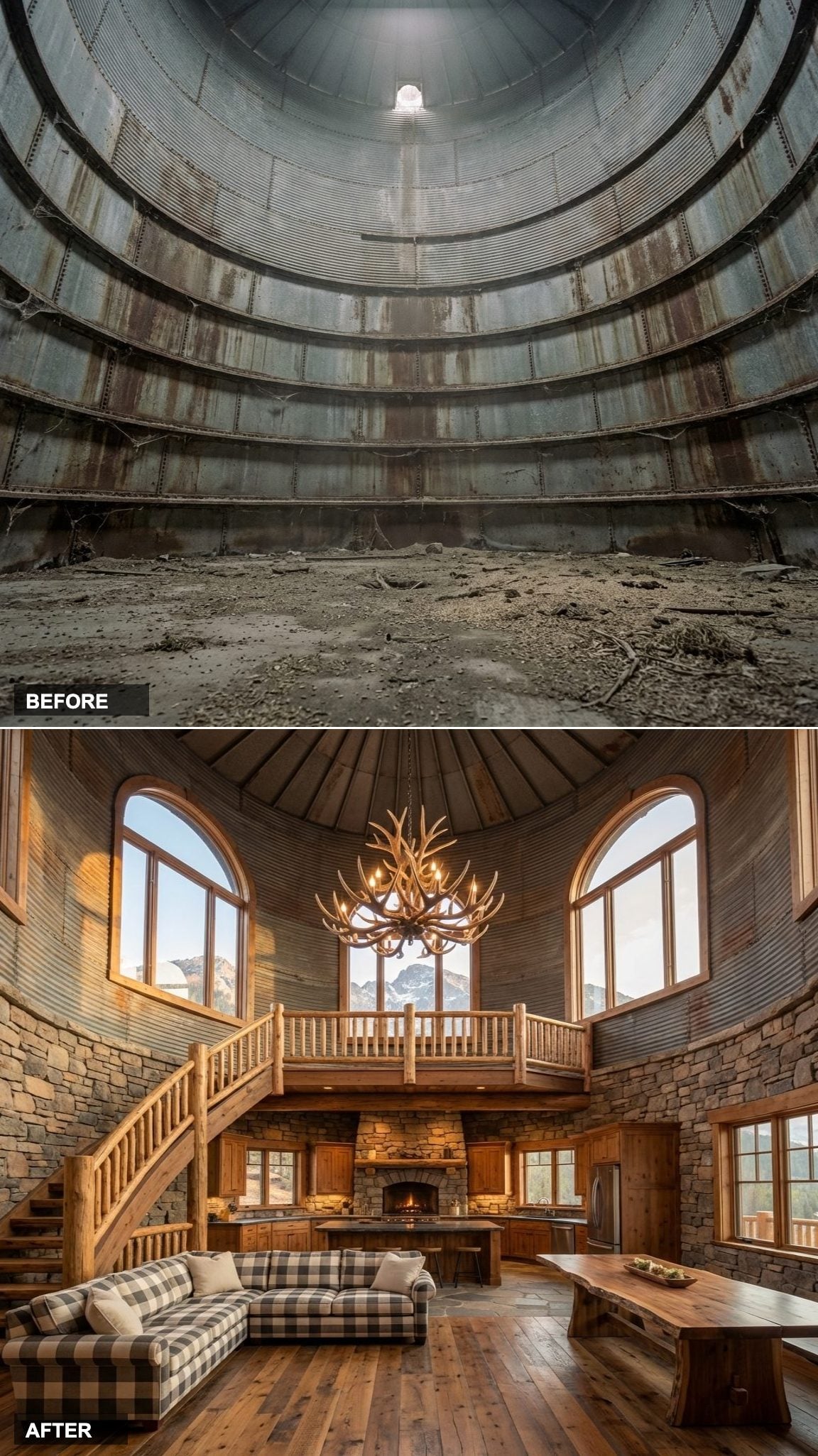
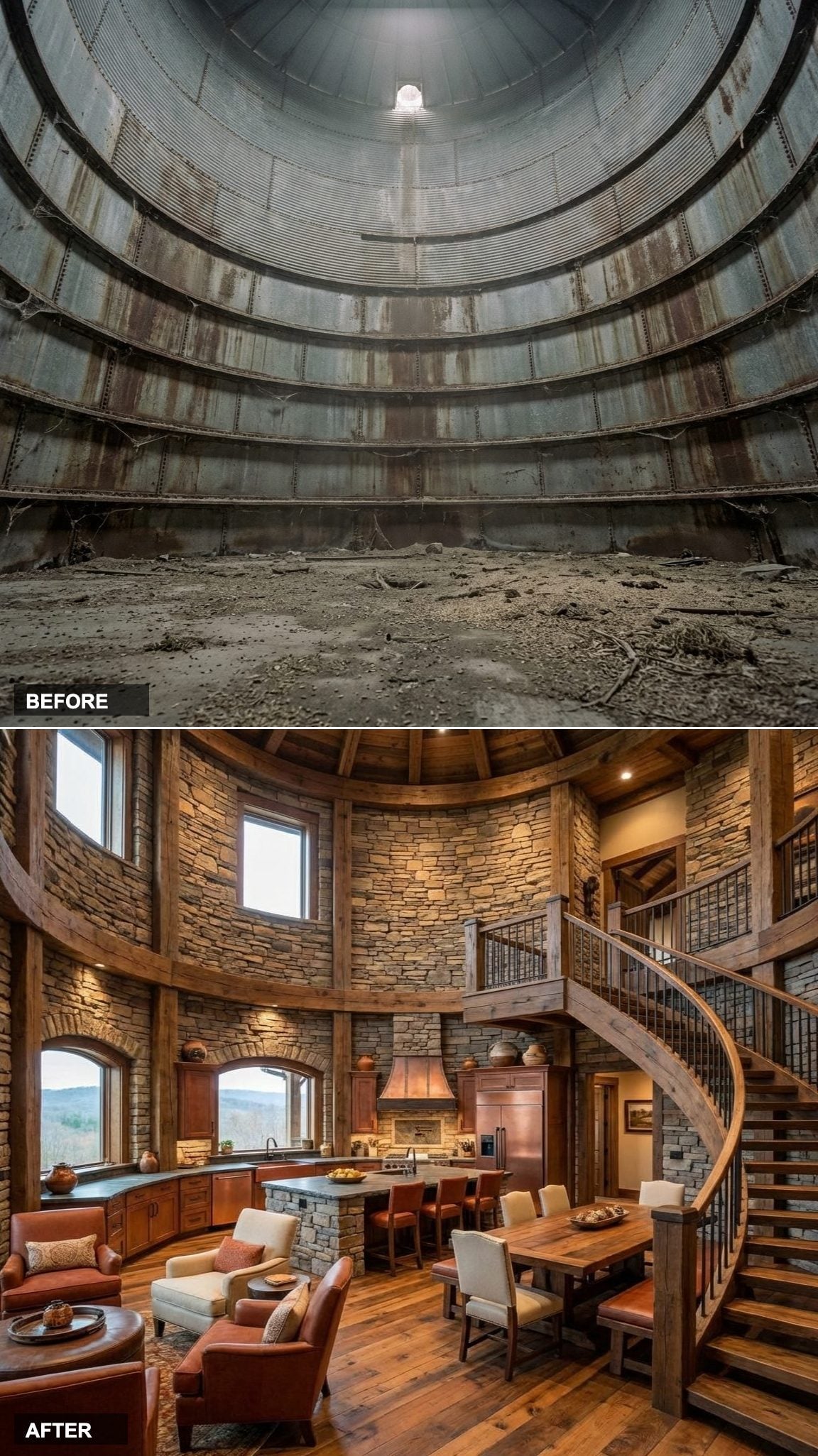
Reclaimed timber floors, curved stone feature walls running the full circle, heavy timber shelving with iron brackets. The alpine lodge conversion leans into the silo’s height more than any other style on this list, because lodges are fundamentally vertical spaces. A double-height stone interior with sleeping loft overhead feels entirely natural inside a grain bin’s proportions.
Parisian Haussmann Refinement Inside a Perfectly Round Room
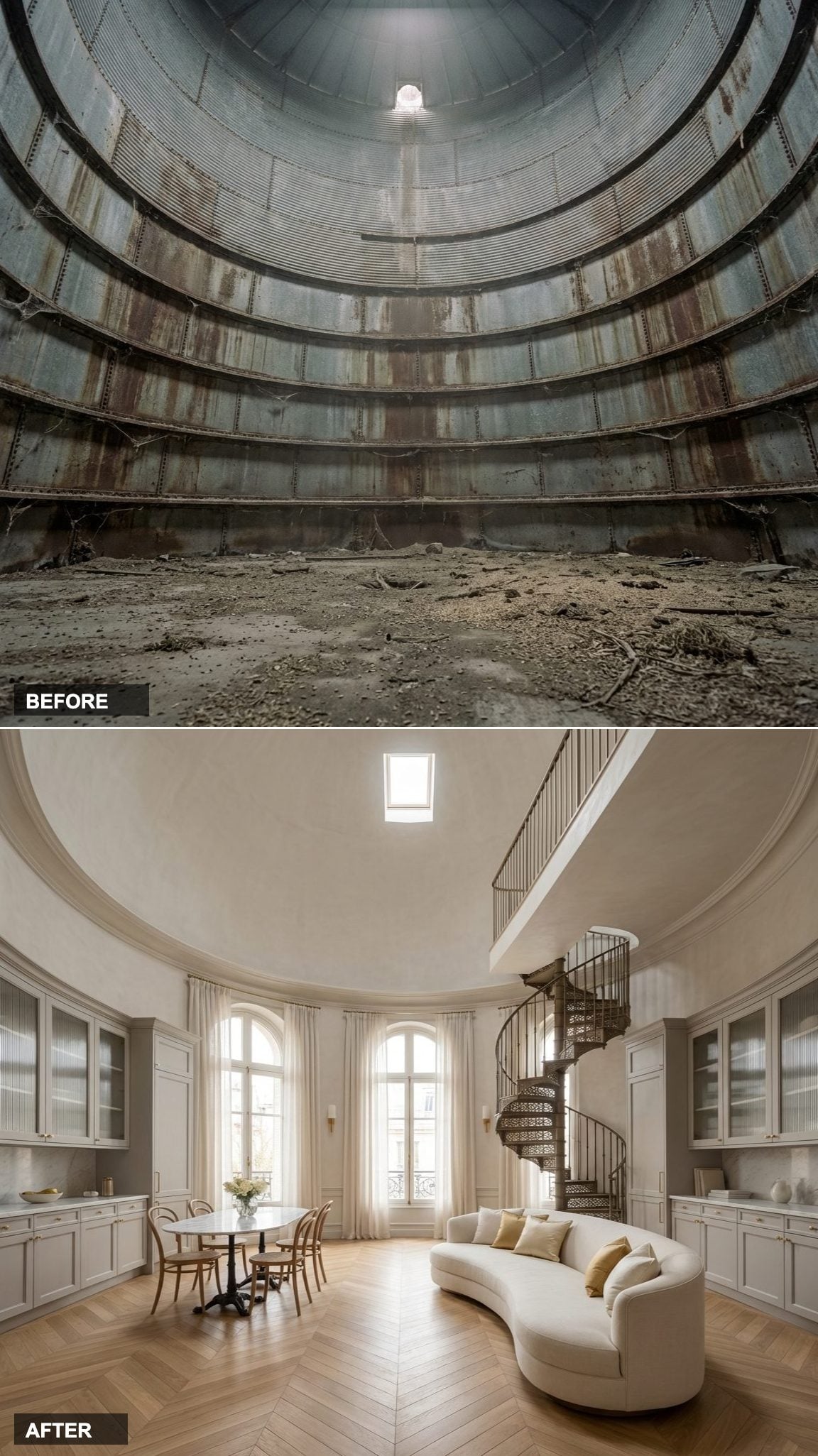
Chevron light oak parquet, soft grey fluted glass cabinetry, gilded hardware, and crown molding following the curve of the wall. The Parisian Haussmann conversion is the most architecturally ambitious on the list because it asks the hardest question: can classical French detailing work in a space with no straight walls? The answer, evidently, is yes, but only if you lean into the curve rather than fight it.
Crown molding traced around a full circle becomes a rotunda. Fluted glass fronts read as columns. Chevron parquet laid in a radial pattern from the center out turns the floor into a formal composition. The whole thing lands closer to a private dining room in a 19th-century Parisian apartment building than anything agricultural.
Adobe Walls and Saltillo Tile: The Desert Southwest Claims the Silo
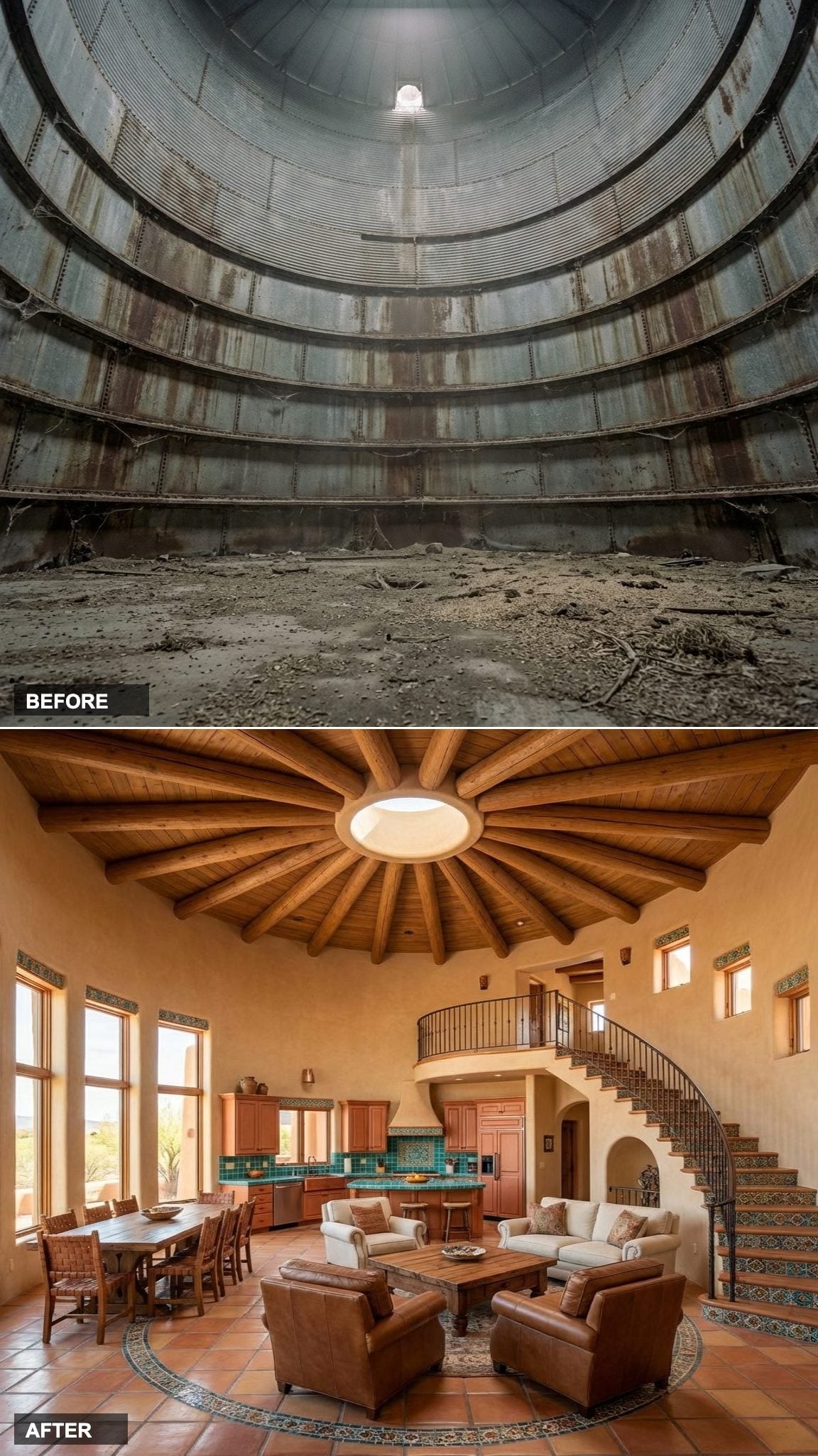
Saltillo tile with mosaic borders, adobe-textured plaster walls in warm sand, turquoise and copper accents threaded through the kitchen hardware and textiles. The desert southwest conversion feels grounded in a way that most stylistic interpretations don’t, because Southwest vernacular architecture has always used round and organic forms. The kiva, the horno, the round adobe room. The silo isn’t being converted so much as recognized.
Hollywood Regency Turns the Grain Bin Into a Gilded Stage Set
🔥 Would you like to save this?
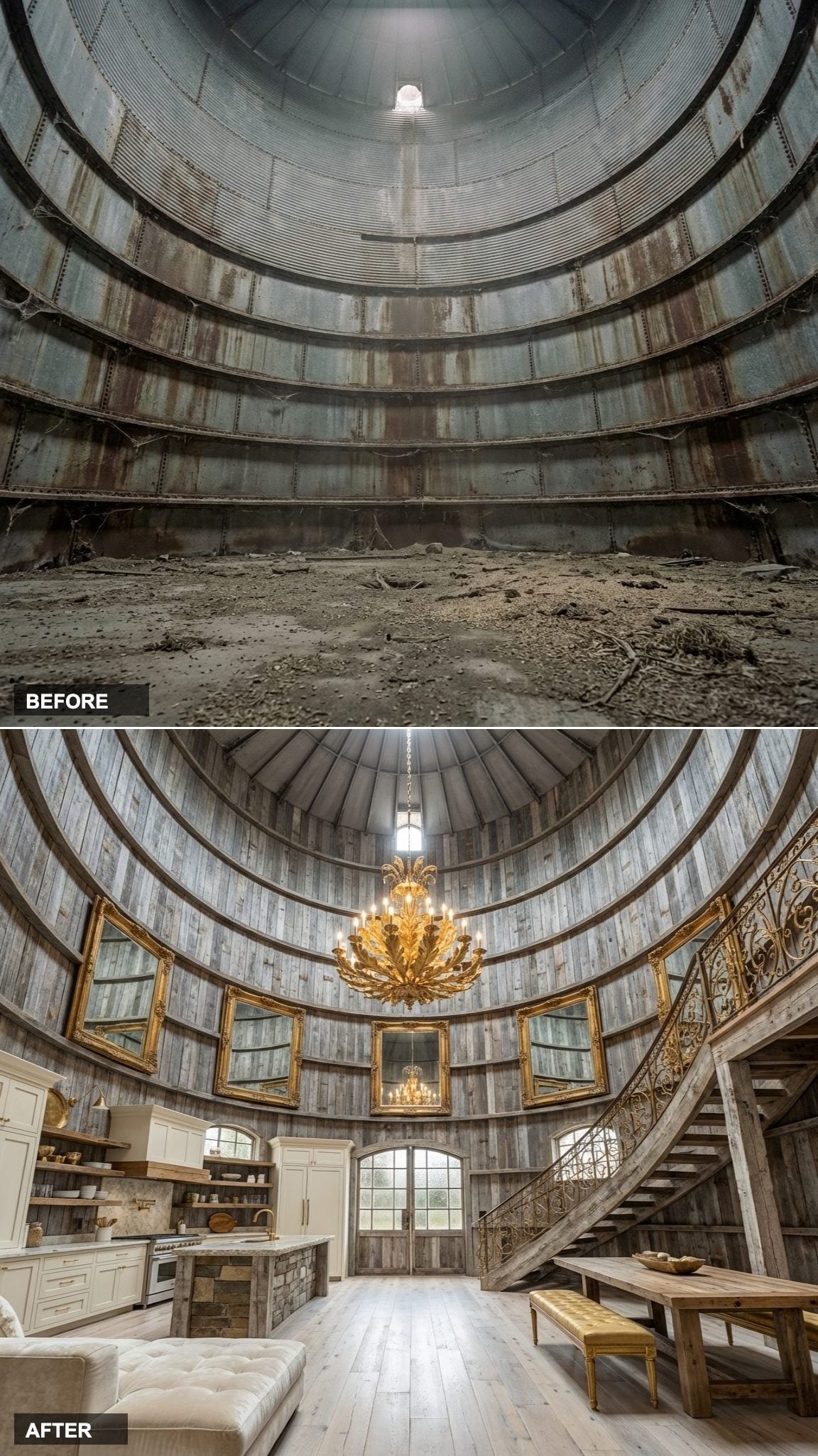
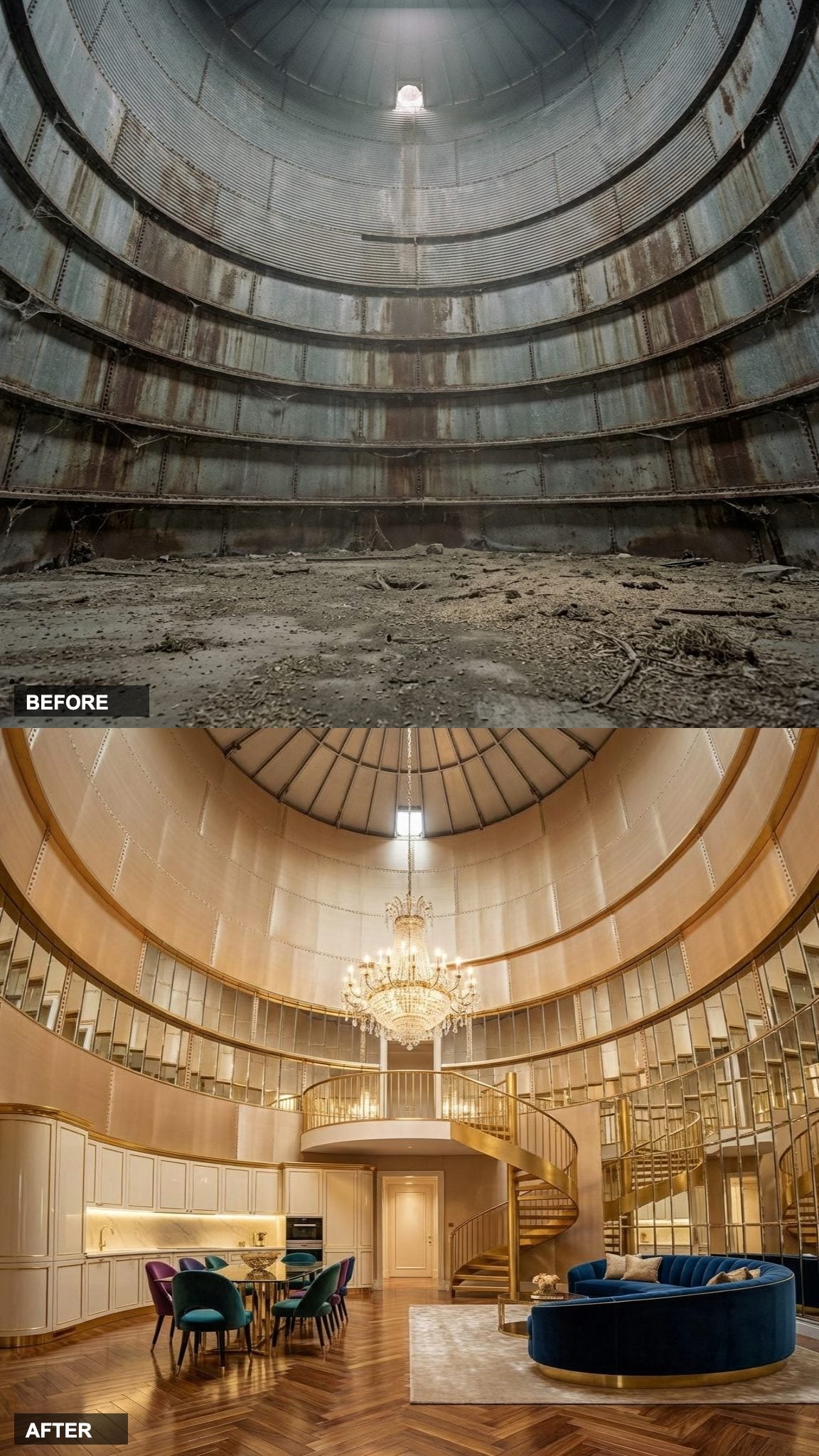
High-gloss herringbone parquet, lacquered ivory and gold cabinetry, curved mirrored panels lining the walls, and a chandelier dripping crystal from the apex. The Hollywood Regency conversion is unapologetically theatrical, and the round room is the perfect stage. Mirrors on a curved wall don’t just reflect, they recurve the reflection, creating infinite soft repetitions that make the space feel like a jewel box.
Art Deco Revival in Deep Navy, Geometric Marble, and Gilded Details
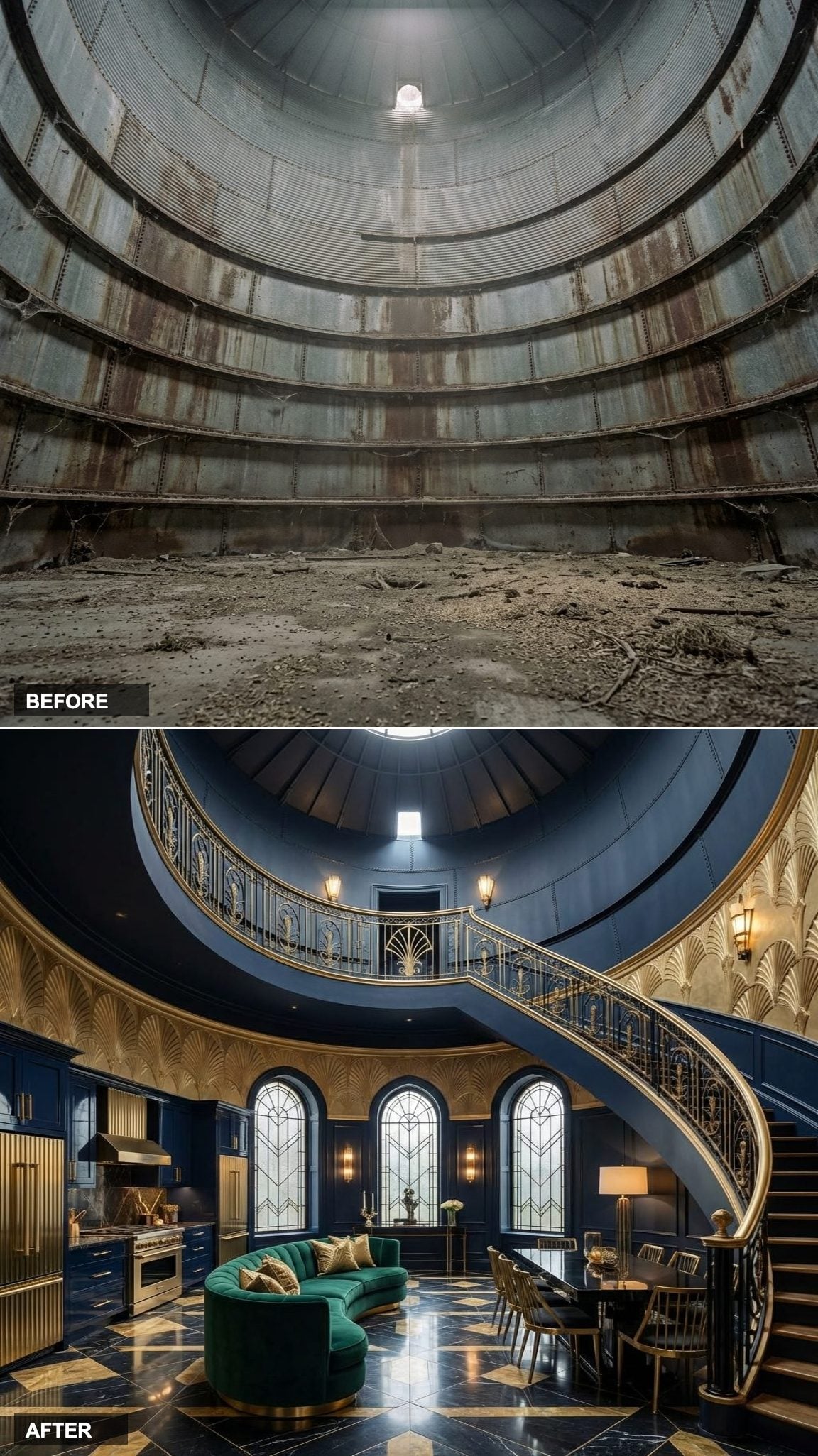
Black and gold geometric marble tile floors, deep navy lacquer kitchen cabinetry, gold fluted column accents following the wall’s curve. Art Deco is perhaps the single most natural stylistic fit for a cylindrical space, the movement was obsessed with rotunda forms, curved facades, and radial geometry. Think of the Chrysler Building’s crown, or the Hoover Factory’s rounded entrance drum.
The geometric marble tile laid in a radial sunburst from the center of the circular floor is the move that locks everything in. Radiating geometry on a round floor plan creates a composition with a single clear focal point, the center of the room. Every other element orbits it.
Board-Formed Concrete and Raw Steel: Warm Brutalism Done With Feeling
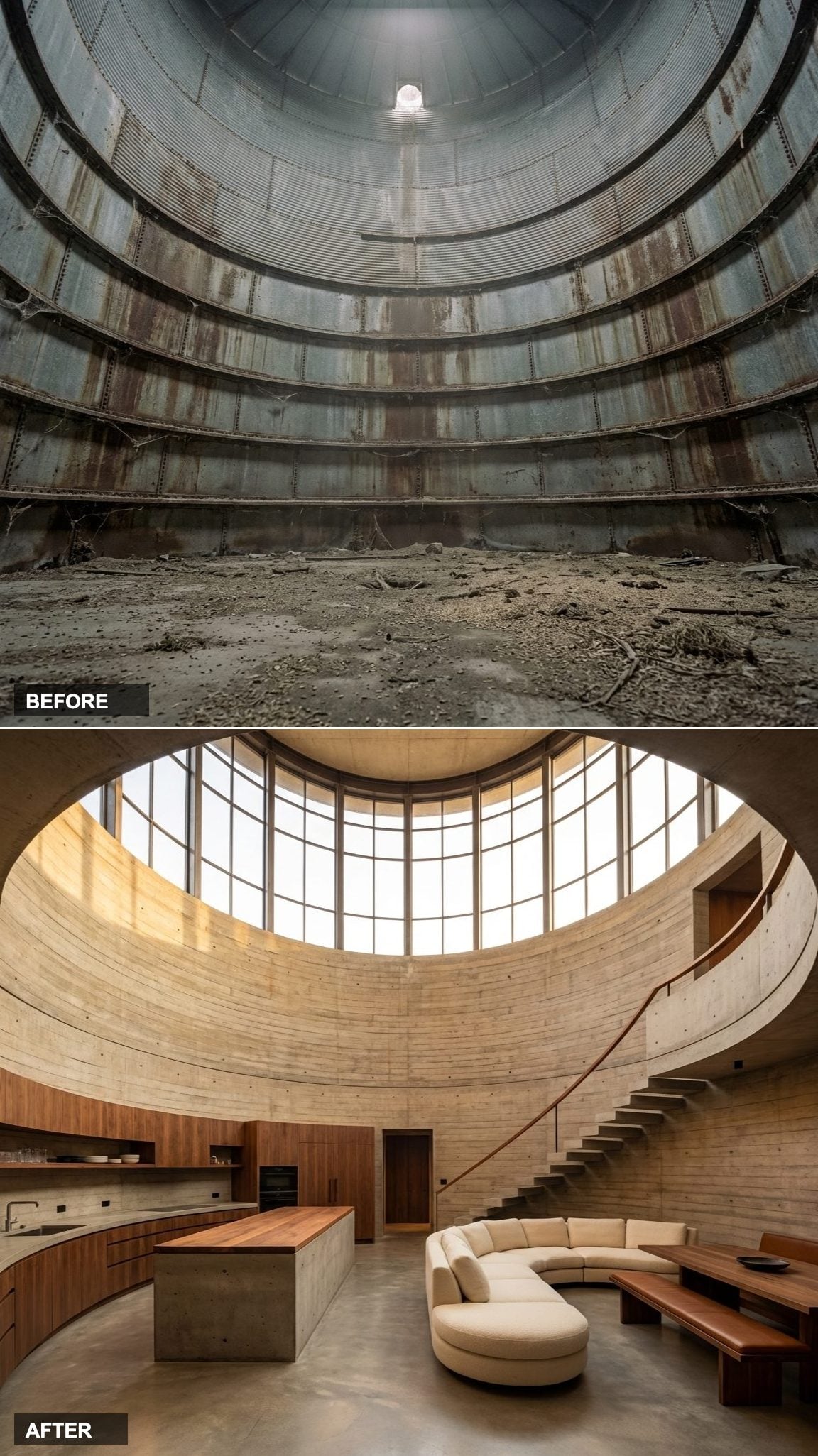
Polished raw concrete floors with radiant heat underneath, board-formed concrete interior walls keeping their grain texture, industrial steel shelving, and warm amber lighting low to the ground. Warm brutalism is one of the more difficult balancing acts in contemporary interiors, the materials are inherently cold and institutional, and making them feel habitable requires precise calibration of light and soft goods.
The silo shell actually helps here. The curved form softens the heaviness of raw concrete in a way that flat walls cannot. A square brutalist room feels like a bunker. A circular brutalist room feels like a chapel.
White-Washed Pine and Micro-Cement: The Luxe Boho Desert Look
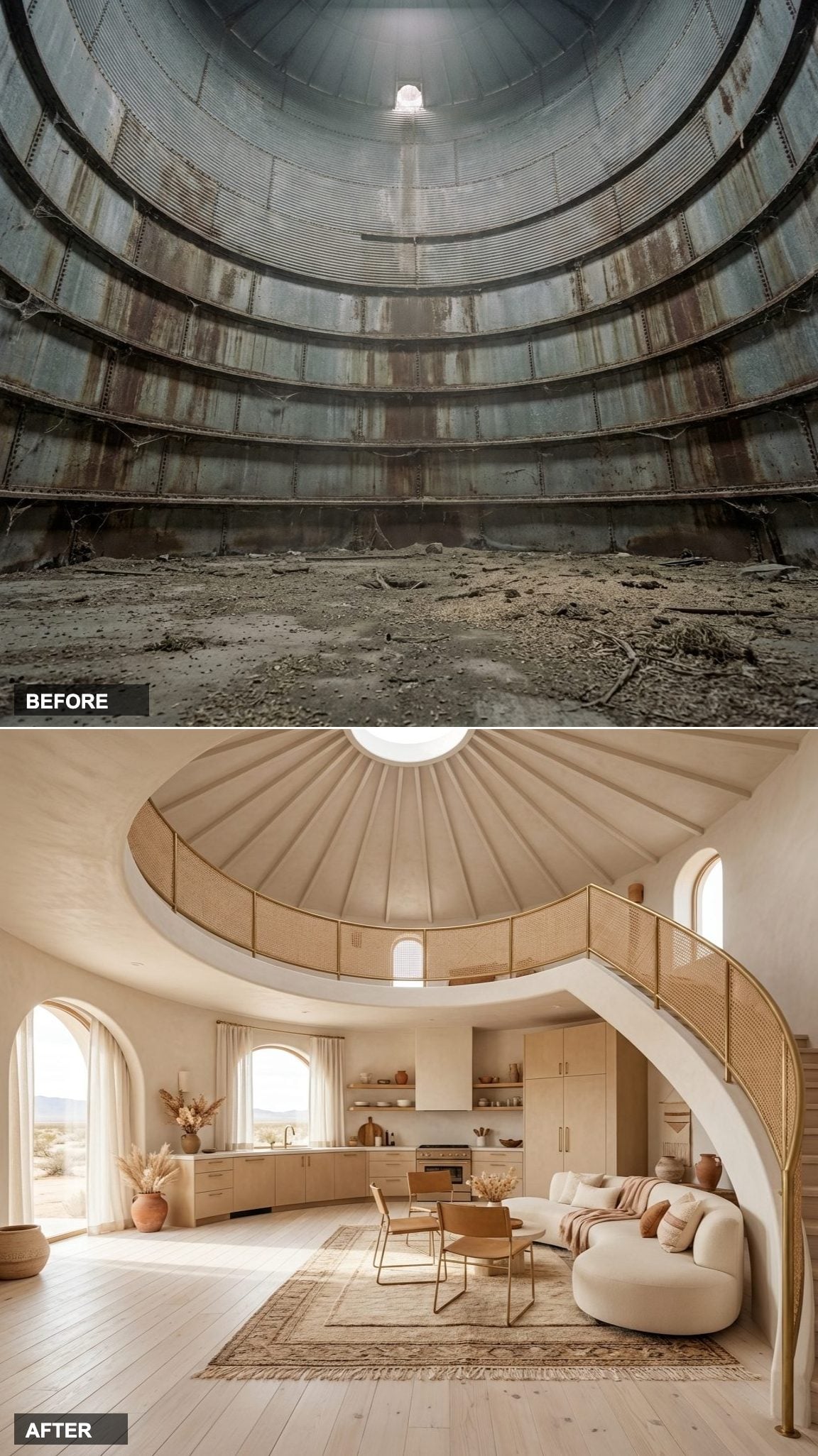
White-washed pine floors, warm white micro-cement curved walls, warm sand-toned textiles layered in linen and macrame, dried pampas grass arrangements at height. The luxe boho desert conversion occupies an interesting stylistic position, it’s neither fully boho nor fully minimalist, but the tension between the two is exactly what gives it character.
Bold Black and White Graphic: Maximum Contrast in a Circular Container
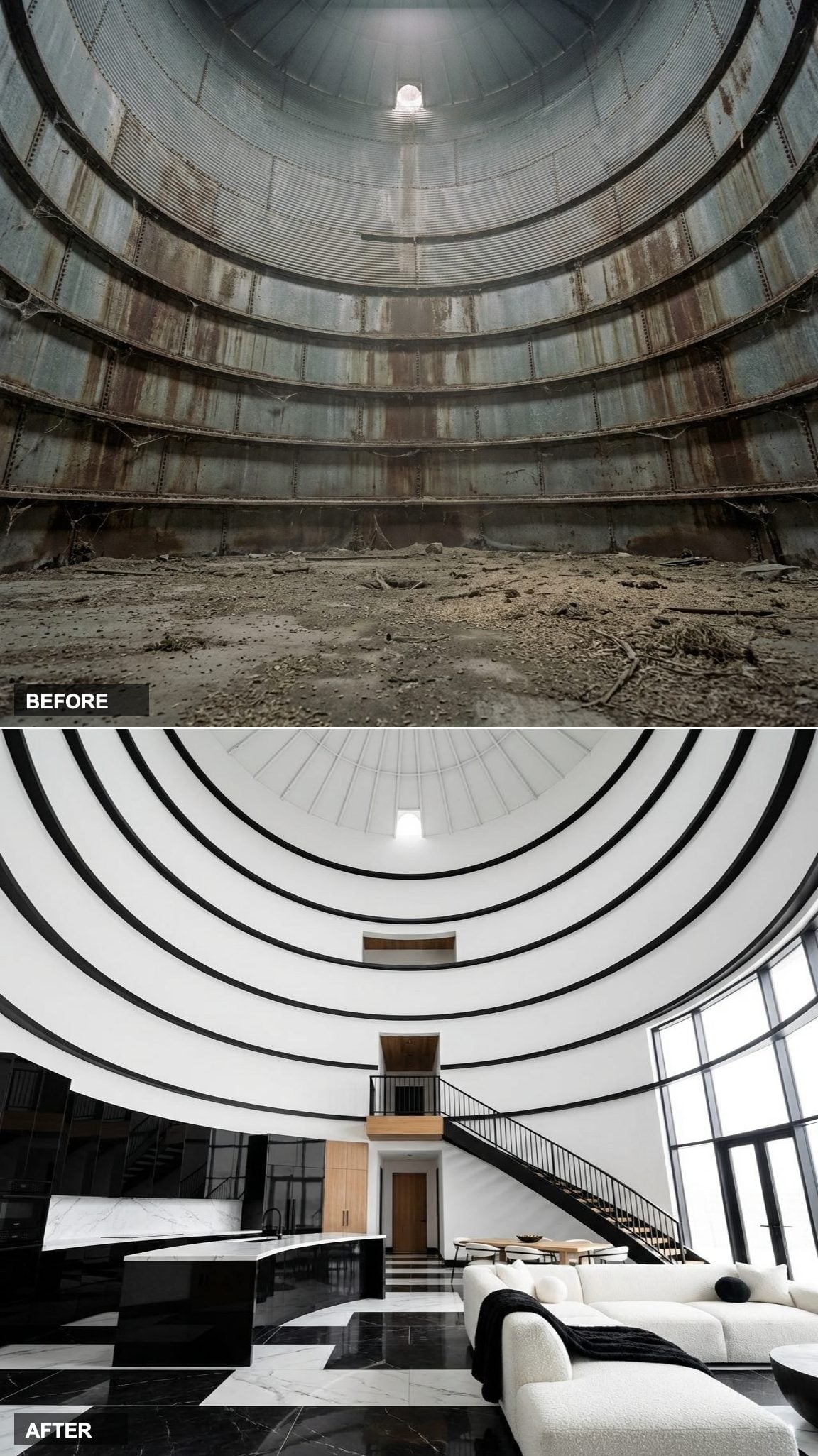
Black and white large format marble tile in a graphic pattern, bright white curved walls, matte black flat-panel cabinetry, a single dramatic circular skylight overhead casting a perfect spotlight on the center of the floor. The black and white graphic conversion is the most visually confrontational on this list, and it earns that confrontation.
In a rectangular room, graphic black and white can feel oppressive, there’s nowhere to rest. In a circular room, the continuous curve softens the contrast and keeps the eye moving. The pattern feels like it flows rather than shouts. The skylight above is the single most important element: it completes the graphic composition by projecting a circle of light onto a geometric tile floor.
Blue and White Cement Tile and Whitewashed Plaster: The Coastal Mediterranean Conversion
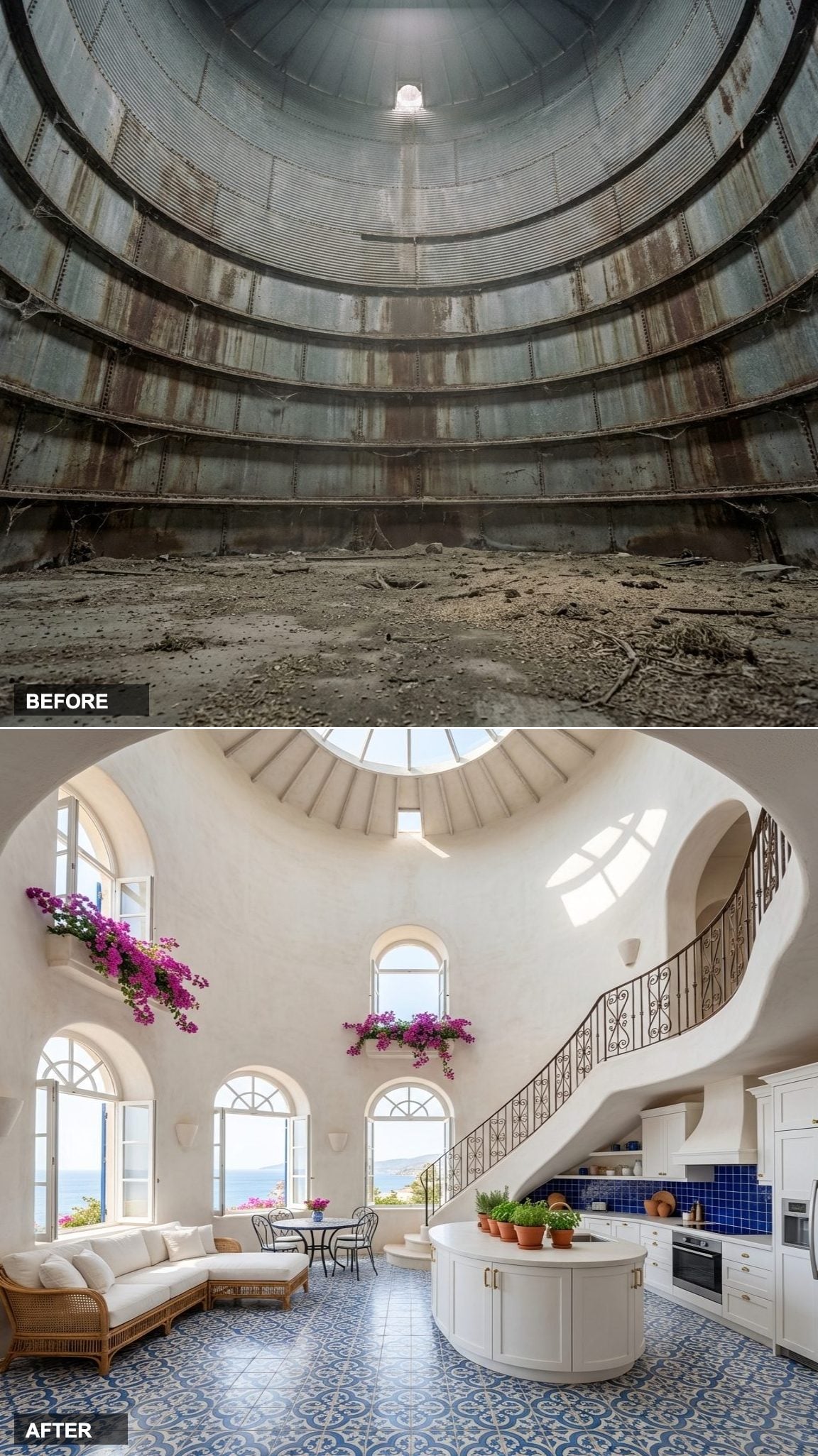
Hand-painted blue and white cement tile floors, whitewashed curved plaster walls, a domed ceiling with a central oculus, and lantern lighting in aged bronze. The coastal Mediterranean conversion is the one that leans hardest into the silo’s height, because a whitewashed dome with a central oculus is essentially a vernacular Mediterranean form. Think of a Greek island chapel, or a traditional riad in Marrakech.
The blue and white cement tile repeating across a full circular floor plan creates a mosaic effect that no other floor shape could produce. Every line of the pattern radiates from the center point and terminates at the curved wall, reinforcing the geometry from every angle simultaneously.
Wire-Brushed Oak and Cream Board and Batten: Modern Ranch Done Properly
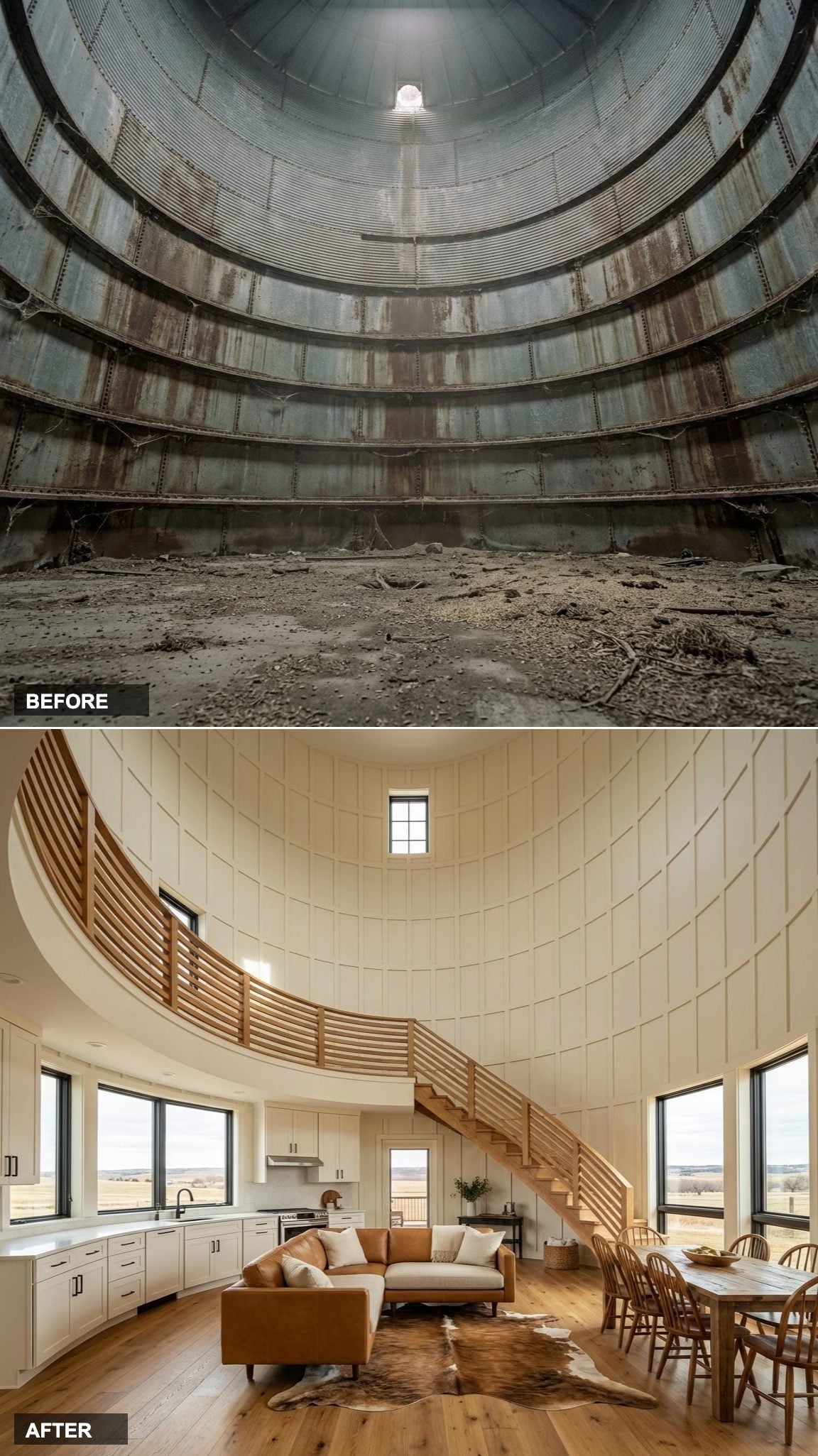
Wide plank wire-brushed oak in warm honey, cream board and batten on the curved walls, warm white shaker cabinetry with matte black hardware. The modern ranch conversion is the most straightforwardly livable on the list, and that’s a compliment, not every silo conversion needs to be a maximalist statement. Sometimes the goal is just a warm, well-resolved home that happens to have an extraordinary floor plan.
Global Collector Style: Every Surface Tells a Different Story
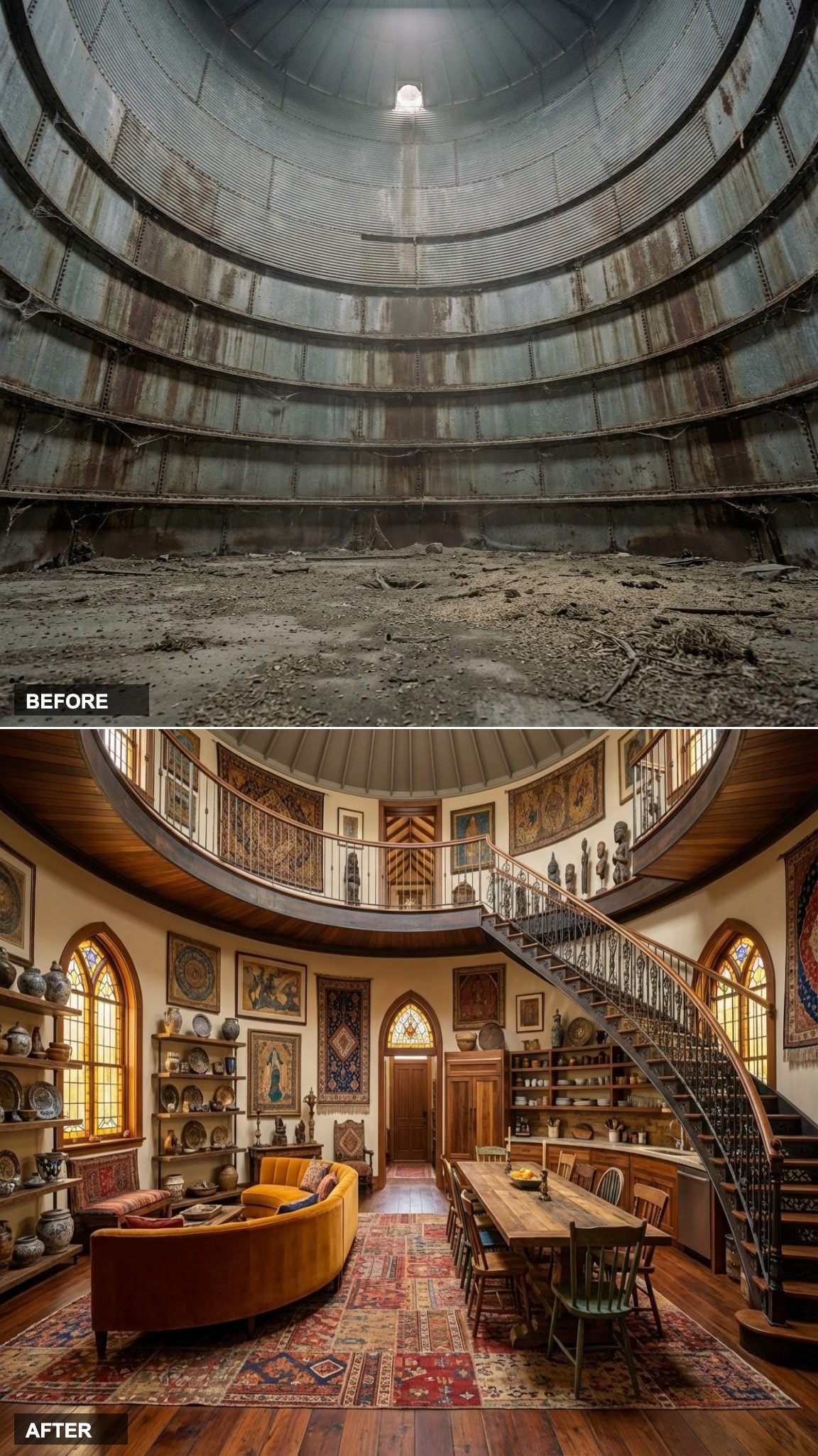
Patchwork antique kilim rug over wide plank mahogany floors, curved walls hung with a rotating salon-style collection of global art and artifacts, open shelving dense with objects from a half-dozen cultures. The eclectic global collector conversion is the most personal on the list, and in a circular room, that density of personal objects takes on a specific quality. There are no feature walls. Every inch of the curved wall carries equal compositional weight, so the collection wraps you completely rather than facing you from one direction.
It’s the difference between looking at a museum display and standing inside one. The round room turns the collector’s instinct into an architectural experience.
Grain Dust to Warm Cream: A Modern Farmhouse Silo That Actually Feels Like Home
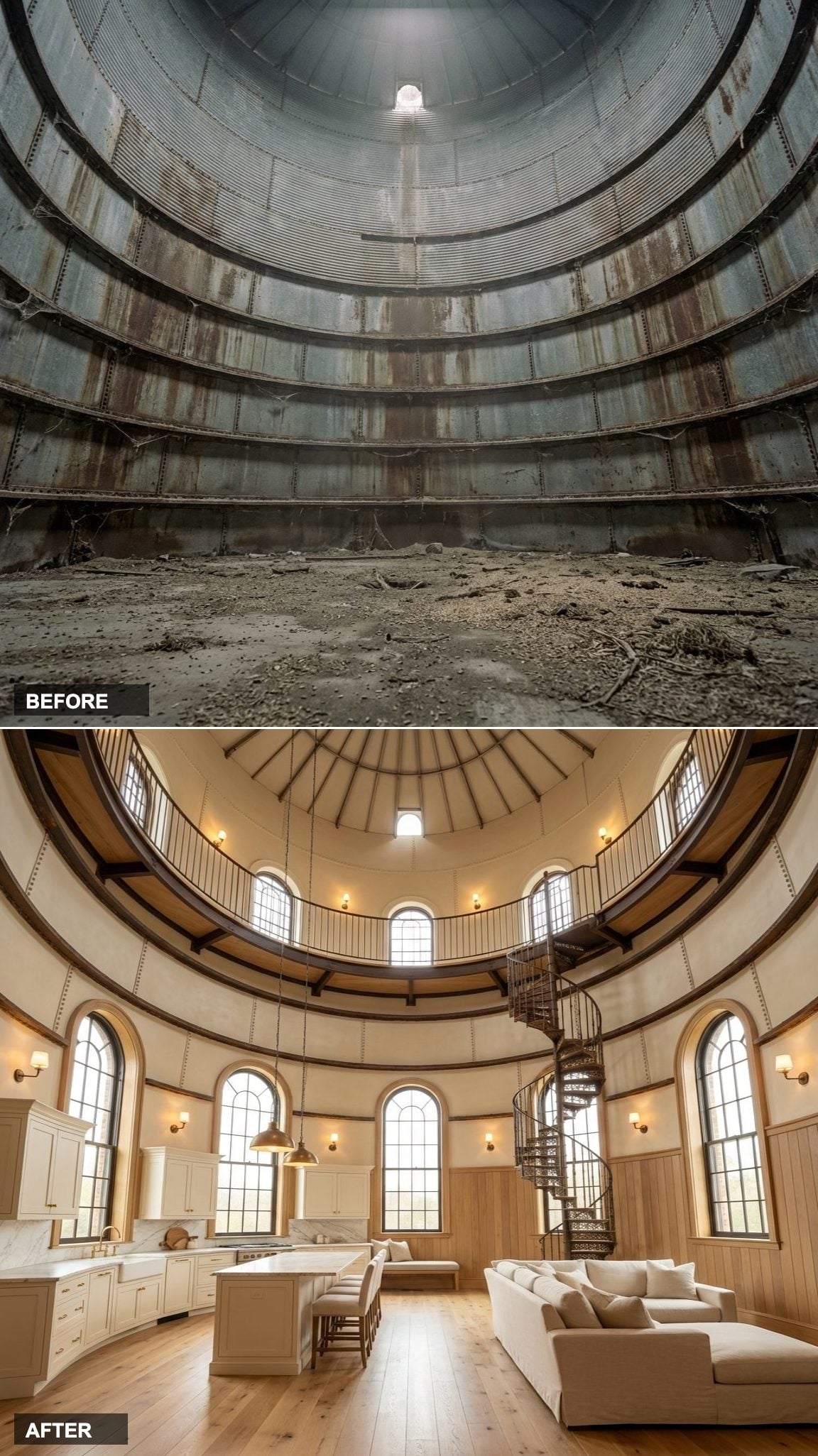
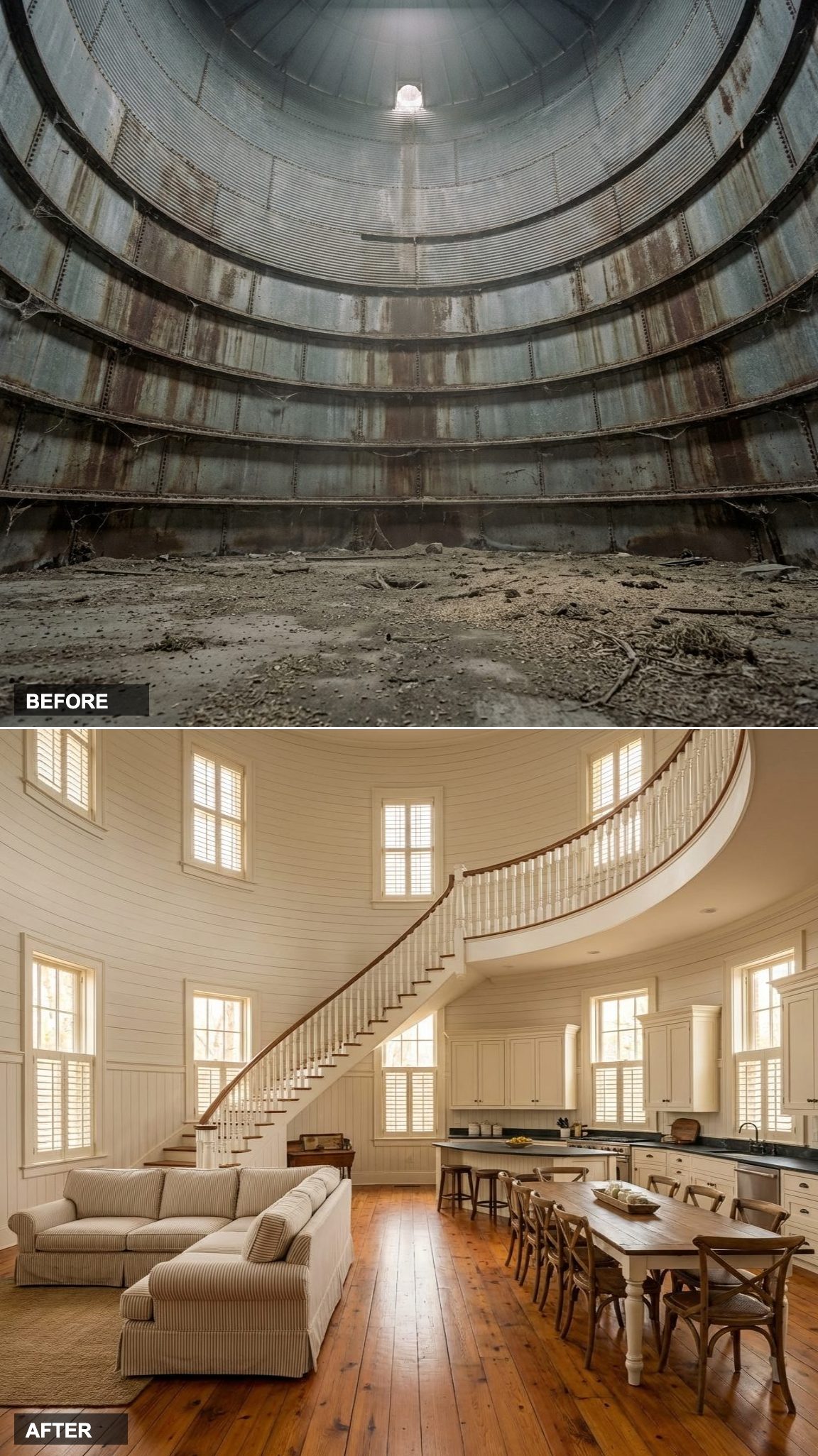
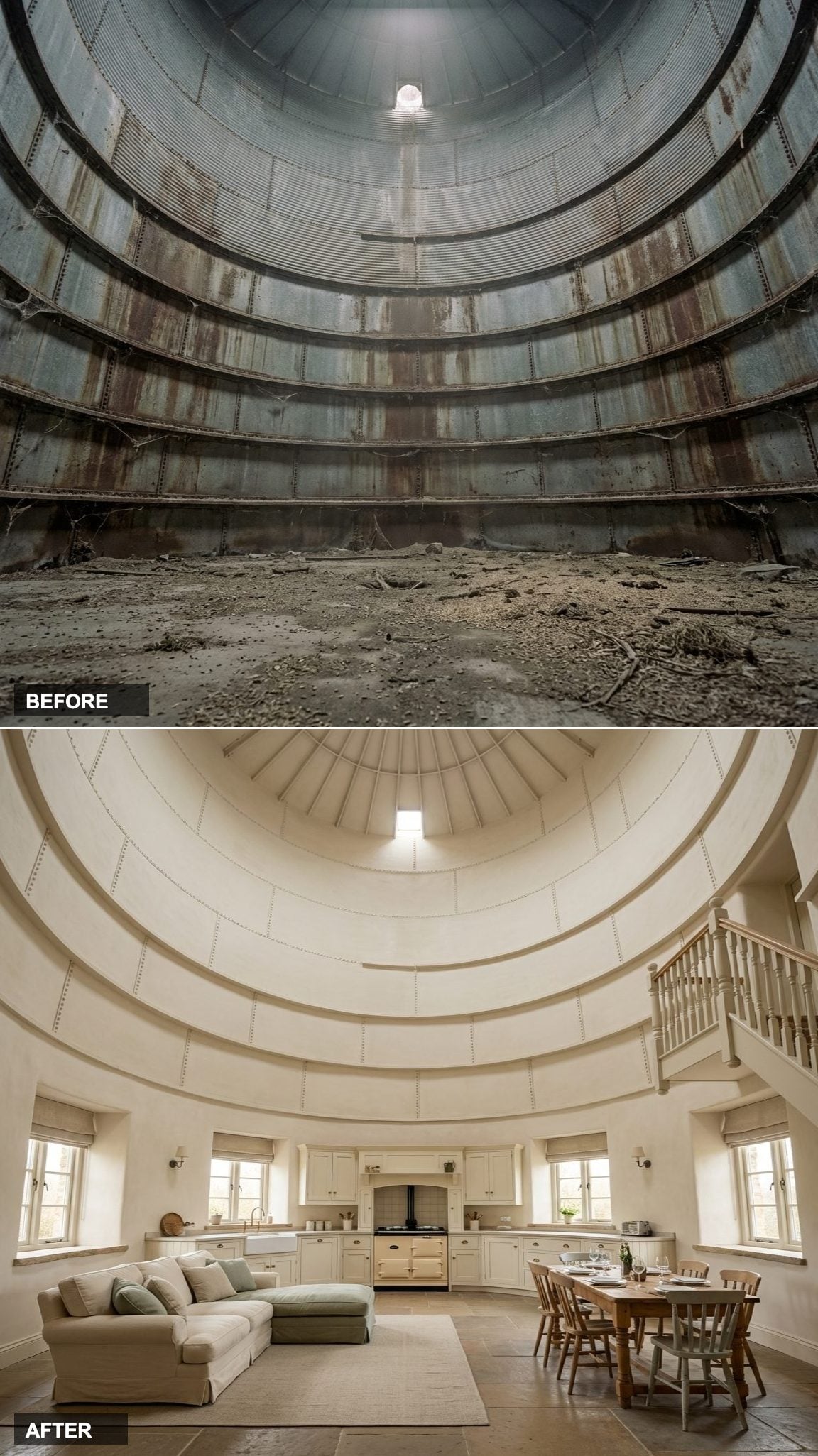
The hardest thing about designing inside a cylinder is resisting the urge to fight the shape. This modern farmhouse conversion does the opposite: it leans directly into the curve, using wide-plank white oak flooring that radiates out from the center like spokes on a wheel, drawing the eye around the room rather than straight to a wall that doesn’t exist. Cream plaster walls replace the corrugated steel, their matte finish soft enough to read as warm even in winter light.
What makes this design hold together is the ceiling treatment: exposed Douglas fir beams arranged in a wagon-wheel pattern converge at a central skylight, flooding the round floor plan with natural light and giving the vertical space a sense of purpose it never had as a grain store. The furniture is deliberately low-profile, a tufted linen sectional, a reclaimed oak coffee table, wrought iron pendant lights hung at varying heights. Nothing competes with the architecture.
The Coolest Cylinder in Scandinavia (That’s Actually in a Cornfield)
🔥 Would you like to save this?
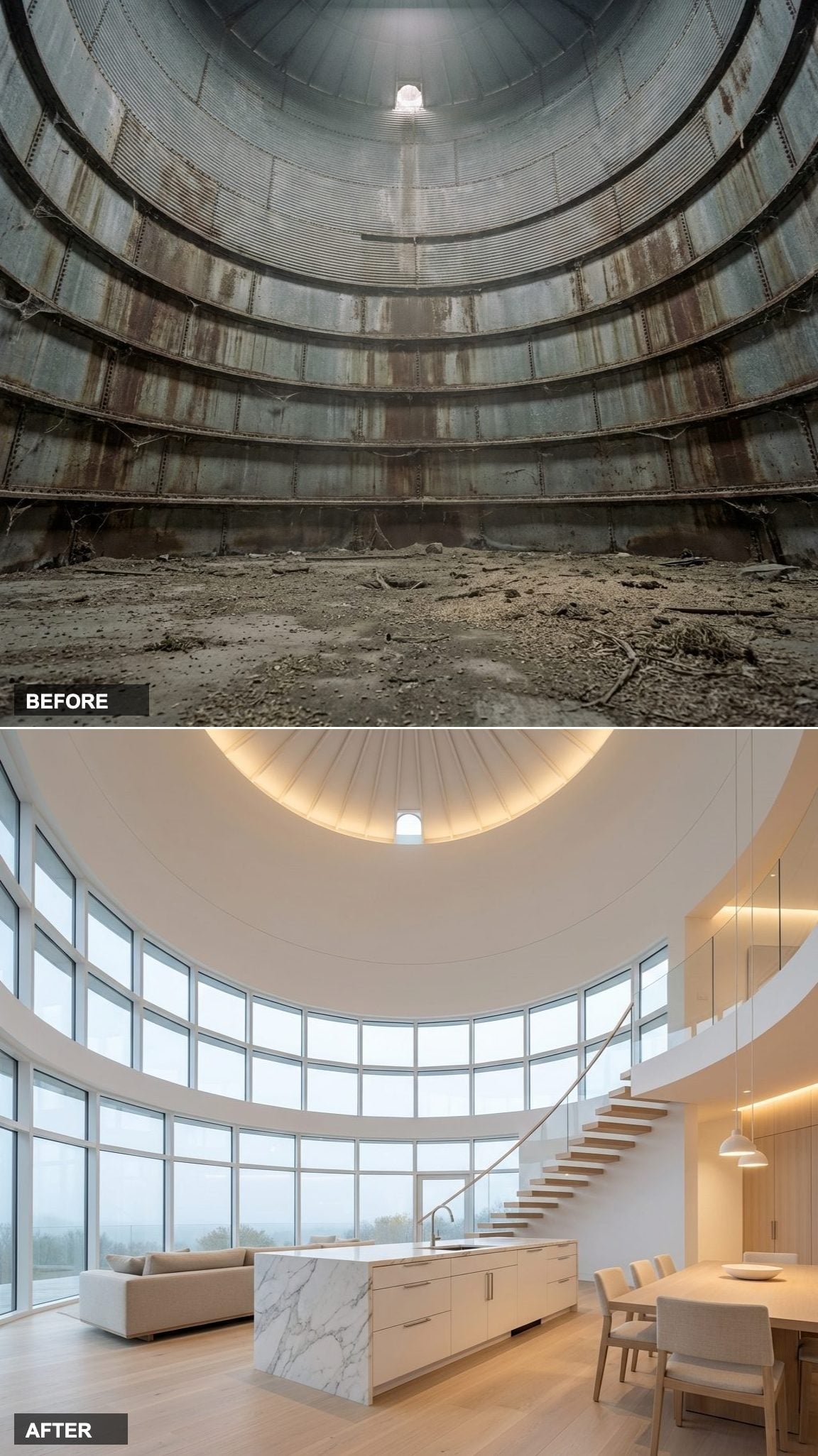
Pale ash hardwood floors, flat-front white cabinetry, and brushed nickel hardware: the Scandinavian minimalist conversion strips the silo down to almost nothing, and the result is quietly arresting. The curved walls are finished in smooth white plaster with a barely-there warm undertone, not stark, not clinical, just clean. Every line is horizontal or vertical, a deliberate counter to the building’s inherent roundness.
“The cylinder stops being a problem the moment you stop trying to decorate around it and start treating it as the room’s only ornament.”
Natural light is the real design material here. North-facing windows cut into the steel shell at precise intervals wash the interior in the kind of diffuse, shadowless light that Scandinavian designers have been chasing for a century. The furniture plan is spare by intention: a single Eames-era lounge chair, a floor lamp with a paper shade, a low platform bed tucked against the curve. Less is doing a tremendous amount of heavy lifting.