🔥 Would you like to save this?
Victorian textile mills were built to house looms, not lives — but their timber frames, vast floor plates and sawtooth rooflines have proven stubbornly difficult to ignore. This collection of 36 before-and-after bedrooms pulls from a single converted mill space, showing what one forgotten corner looked like before work began and what it became after an AI designer decided to carve out a bedroom rather than walk away. The range is wide, the budgets unlimited, and the results consistently specific in a way that no new-build bedroom ever quite manages — raw industrial bones meeting considered domestic need, each transformation offering something concrete to borrow, adapt, or simply study.
In order to come up with the very specific design ideas, we create most designs with the assistance of state-of-the-art AI interior design software. Also, assume links that take you off the site are affiliate links such as links to Amazon. this means we may earn a commission if you buy something.
From Derelict Loom Floor to Rose-Toned Bedroom Suite
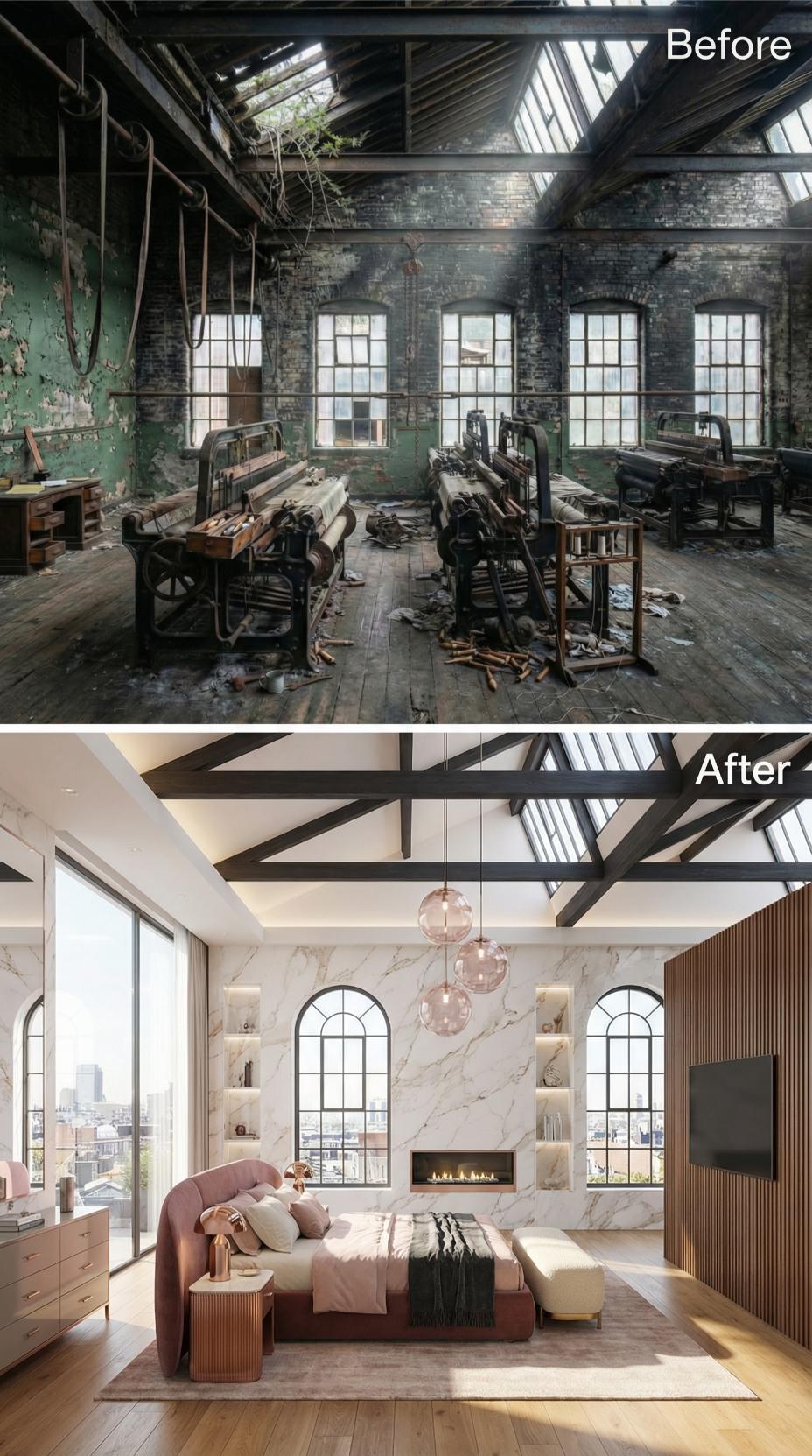
Original steel roof trusses, now painted black, remain exposed above a white plastered ceiling, anchoring the conversion’s industrial roots. Arched factory windows with slim black frames flood the room with light, flanking a floor-to-ceiling white marble fireplace wall with gold veining. A curved terracotta velvet bed sits centered on a blush wool rug, paired with ribbed plaster side tables and rose-tinted glass globe pendants dropping in a cluster overhead.
Raw Concrete Walls and Skylights Reclaim a Derelict Loom Floor
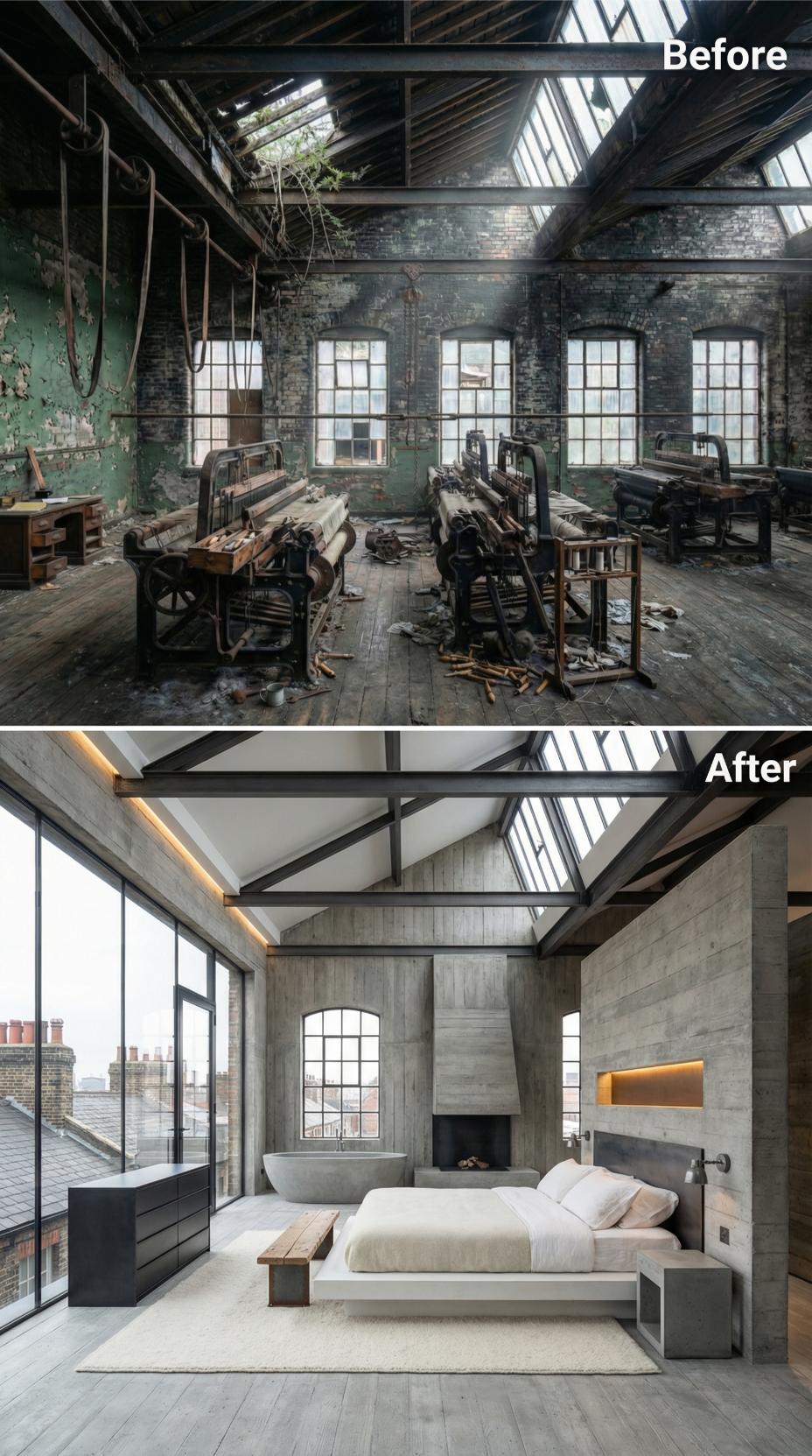
Board-formed concrete cladding covers the walls while exposed steel trusses retain their black finish overhead. A freestanding stone tub sits beside a low-platform bed dressed in white linen, anchored by a wool rug.
Blackened Steel Roof Trusses Anchor a Loft Bedroom
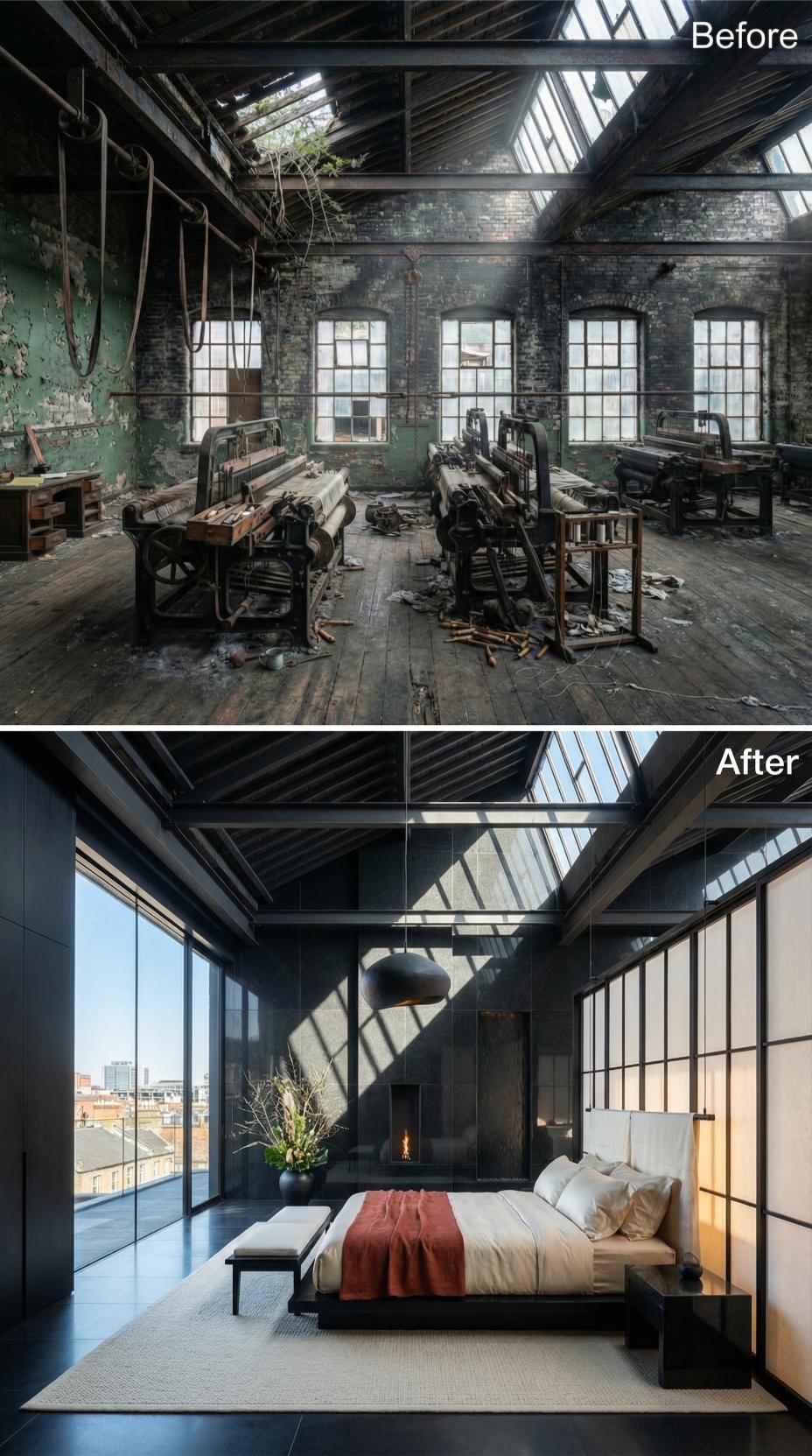
Dark steel trusses and clerestory skylights pulled from the mill’s skeleton frame a low-profile platform bed dressed in linen and a rust wool throw. A wall-mounted bioethanol fireplace sits flush in matte black panel cladding, while a domed pendant in oxidized iron hangs overhead.
Brass Fittings and Black Marble Pull an Abandoned Loom Floor Into the Present
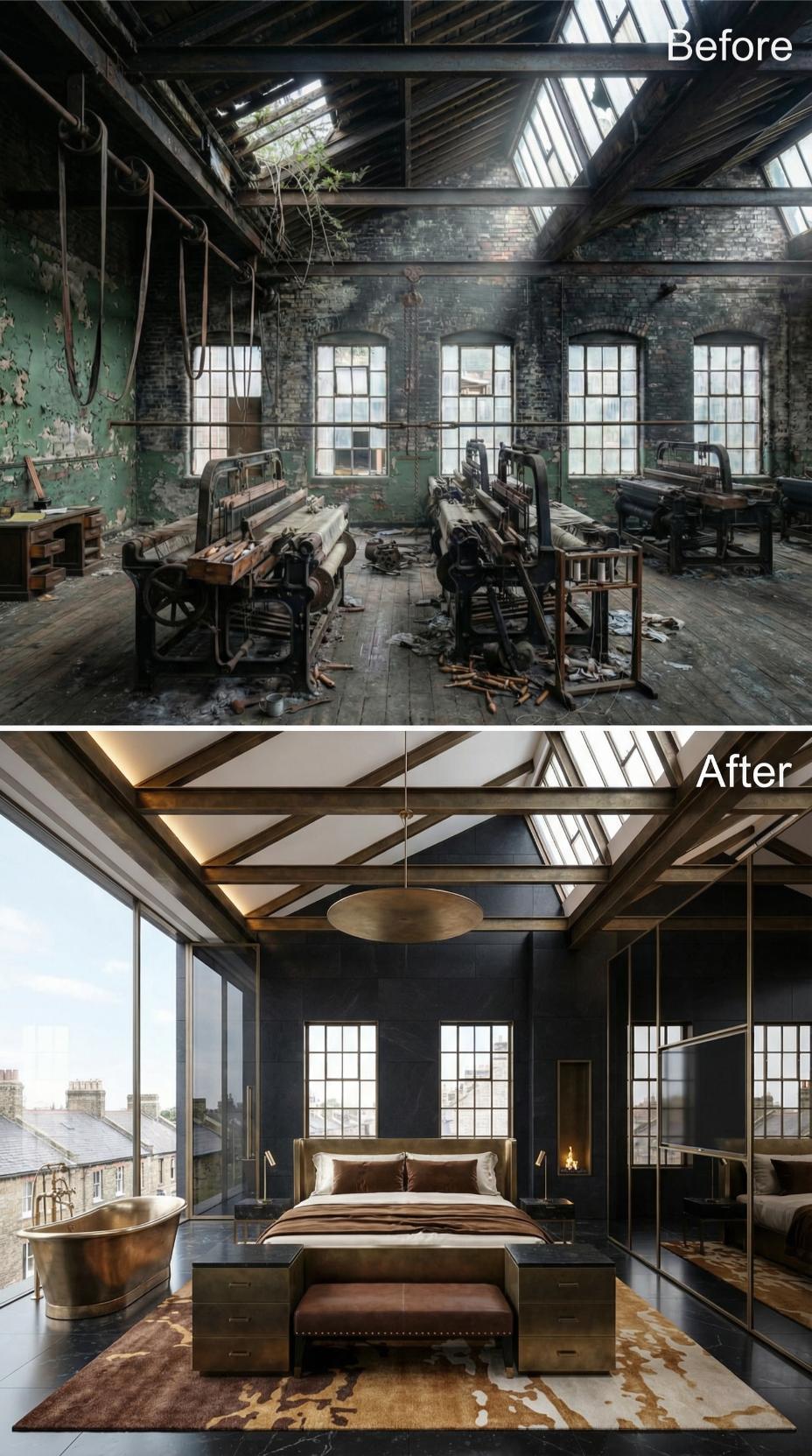
Exposed roof trusses remain, now clad in brushed brass that catches the overhead cove lighting running along each beam. The walls shift from peeling green brick to floor-to-ceiling black marble panels, and the original factory windows are kept intact, their steel-framed grid panes now flanked by full-height glass that opens the corner to city rooftop views.
A copper-finish freestanding soaking tub anchors the left side, positioned where industrial looms once sat. The bed frame is upholstered in cognac leather with brass nail-head trim, set on a cowhide rug in ochre and brown. A broad brass disc pendant hangs centered above the bed, and a recessed fireplace with a simple surround adds warmth between the two window bays.
Trend Alert: Brass as a finish is moving beyond cabinet hardware into structural territory, applied directly to ceiling beams and bed frames within the same room. When it reads across multiple surfaces at once, it functions less as accent and more as the room’s tonal anchor. Pairing it with black marble rather than warm wood keeps the palette from tipping into ornate.
Pale Oak Trusses and Amber Pendants Reclaim a Victorian Loom Floor
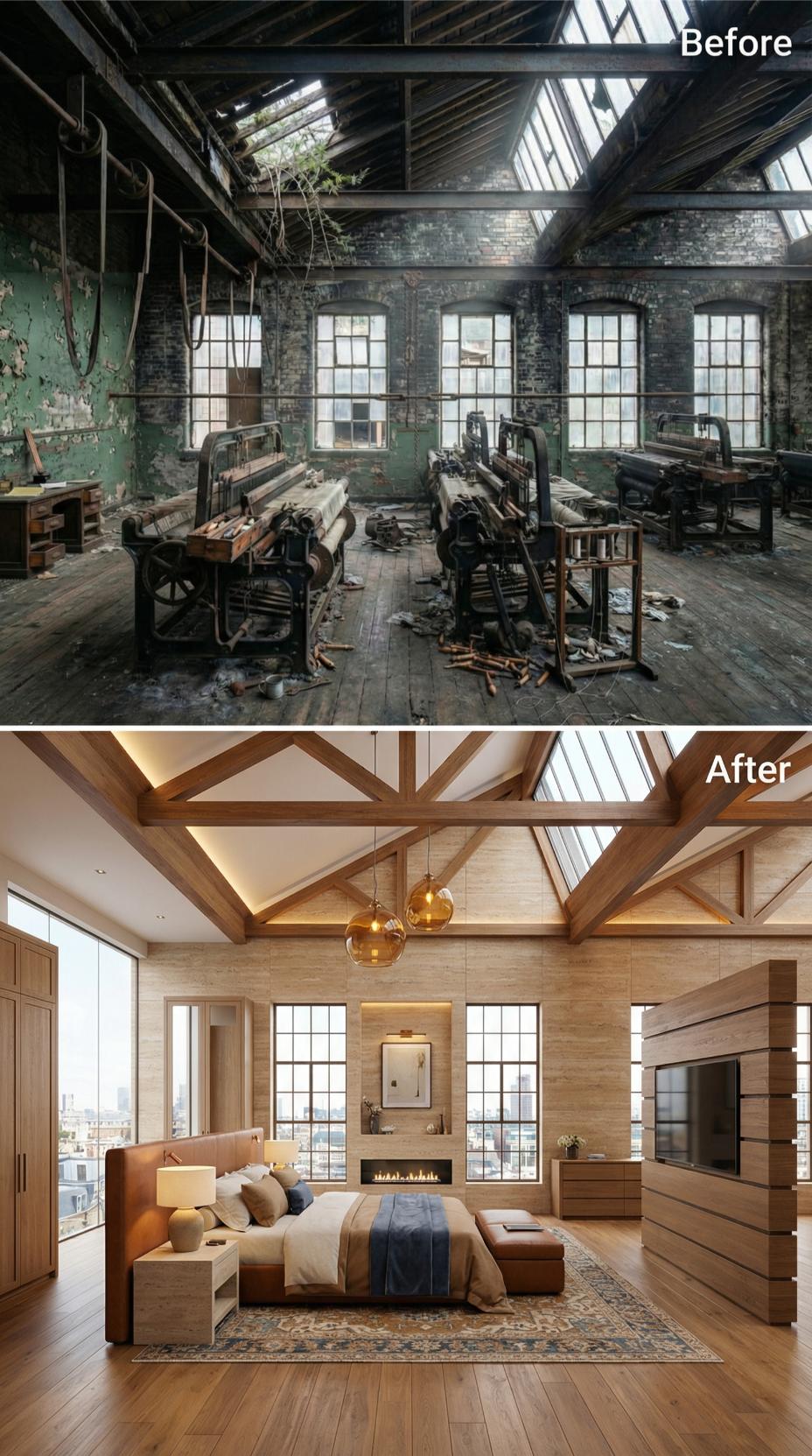
Honey-toned oak cladding runs floor to ceiling across the back wall, framing a linear gas fireplace set flush into travertine stone. The original factory windows survive intact, their steel grid mullions now flooding the space with city views rather than industrial grime.
Warm amber globe pendants hang at staggered heights from the apex of the vaulted ceiling, their blown-glass forms catching light from the skylight above. A leather-upholstered headboard anchors the bed, layered with linen bedding and a wool throw in slate blue. An antique medallion rug grounds the furniture grouping against wide-plank hardwood flooring.
How the Exposed Ceiling Trusses Were Finished
Rather than painting the structural trusses white or leaving them raw, the designers clad each member in pale, quarter-sawn oak with a matte lacquer finish, softening the industrial geometry without concealing it. Recessed LED strip lighting runs along the upper chord of each truss, washing the vaulted ceiling in warm white light and defining the room’s height at night. This approach does something the bare steel originals never could: it introduces warmth from above, pulling the ceiling into the material palette of the floor and furniture below.
Plum Velvet and Gold Rods Reclaim a Victorian Loom Floor at Night
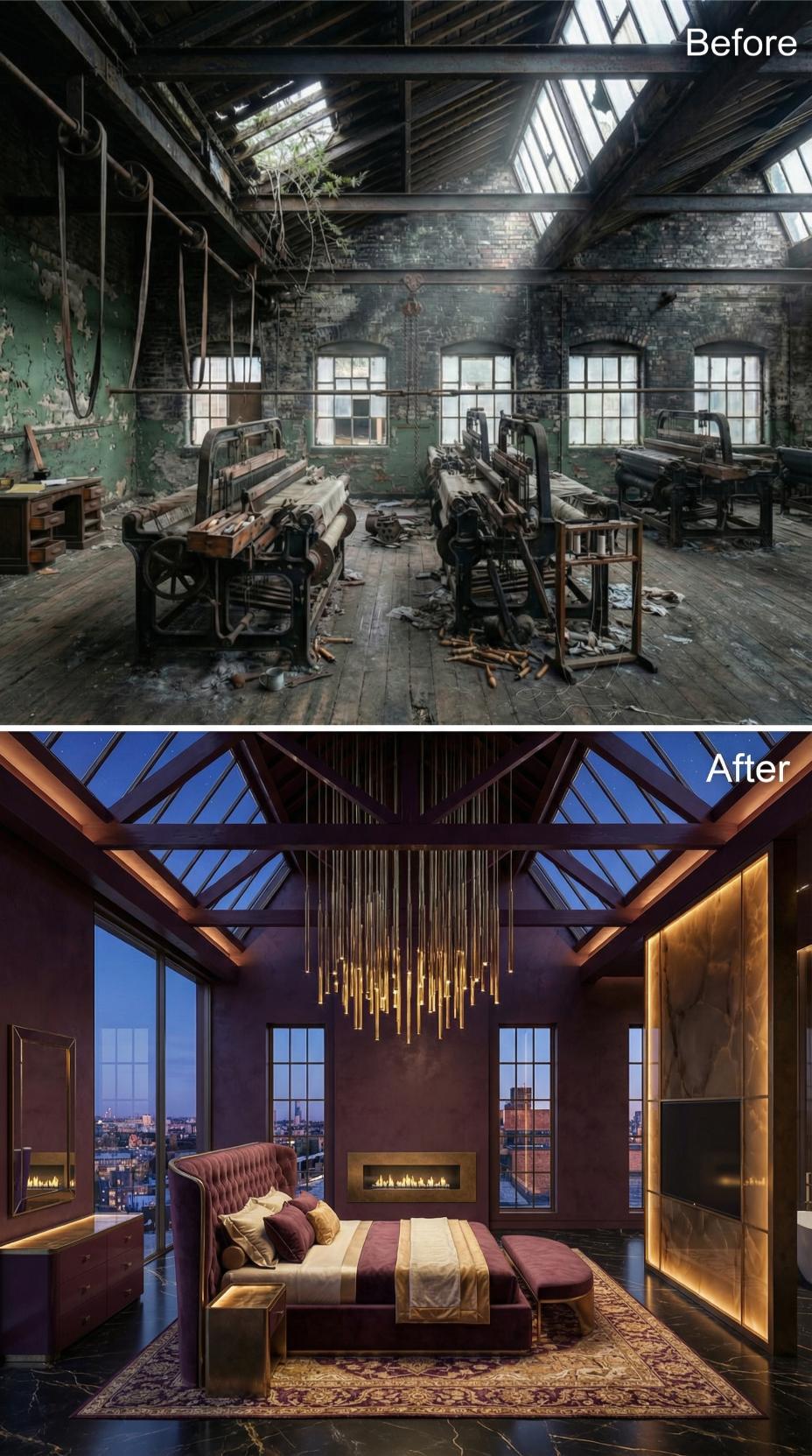
Walls finished in deep aubergine plaster absorb the ambient glow from recessed strip lighting tucked behind skirting and wall panels clad in veined amber marble. The chandelier suspends dozens of brass rods at staggered lengths, catching warm light against the restored sawtooth glazing above. A tufted velvet headboard in burgundy anchors the bed, layered with gold satin bedding and jewel-toned throw cushions. Below, a Persian-style rug in crimson and ochre grounds the composition on black polished stone flooring.
The Psychology Behind This: Rooms lit predominantly from low sources, such as floor-level strips and a fireplace flame, trigger a psychological shift toward rest by mimicking the light conditions of dusk. The aubergine wall tone reinforces this effect, as deeply saturated cool-red hues are consistently linked to lower perceived arousal and faster sleep onset. Retaining the sawtooth industrial roof while filling it with night sky view maintains spatial grandeur without sacrificing that cocooning sense.
Vaulted Beam Ceiling and Arched Windows Rescue a Derelict Mill Floor
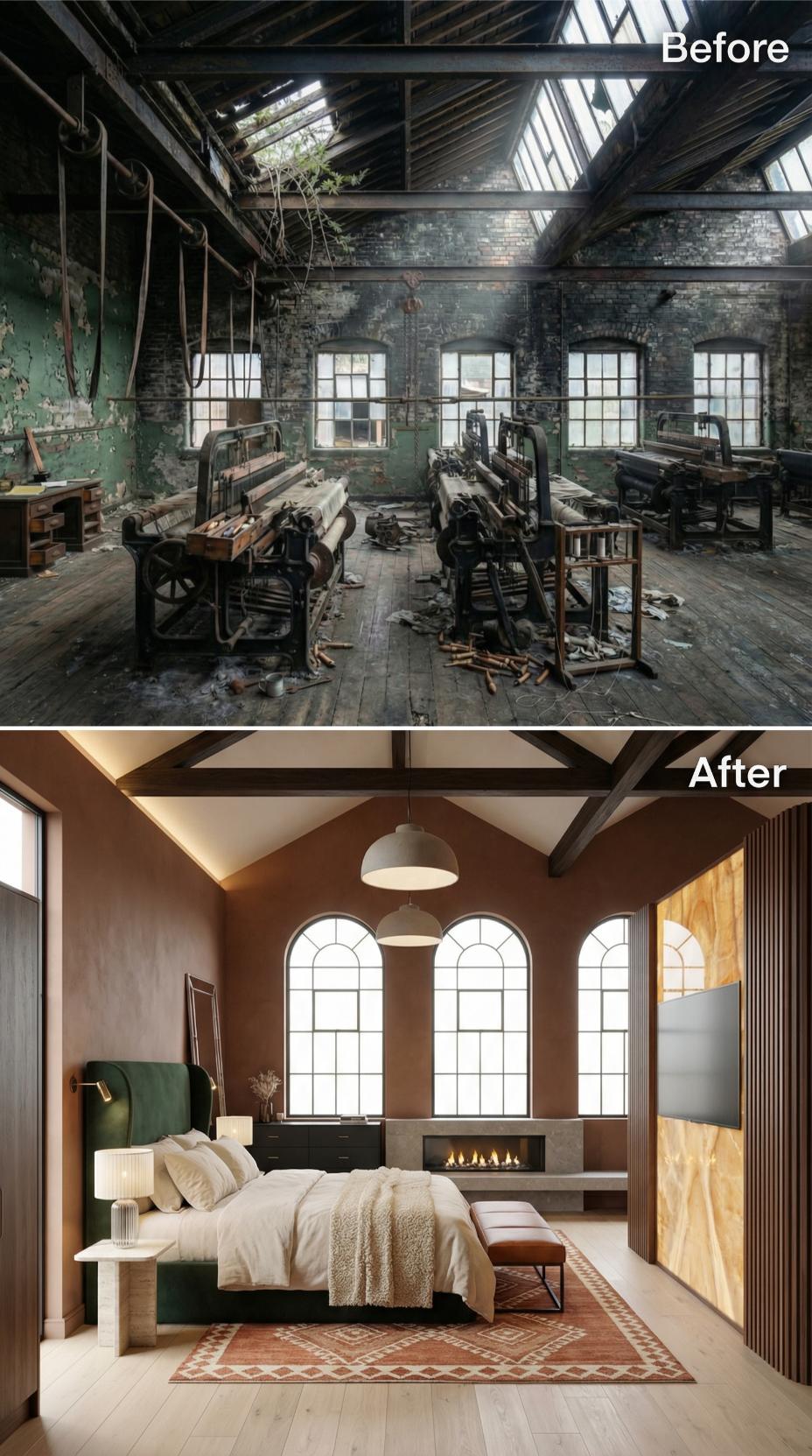
Warm terracotta plaster coats the walls, pulling heat from the geometric wool rug below, where burnt sienna and cream form a repeating diamond border. A forest-green velvet headboard anchors the bed against the left wall, paired with cream linen bedding and a chunky boucle throw. Three arched casement windows replace the mill’s original square industrial glazing, flooding the floor in white daylight. A linear gas fireplace sits low beneath the center window, its flame line visible at foot-of-bed height.
- Low-set fireplace flames signal the brain toward sleep by replicating pre-electric light cues
- Arched window headers soften industrial brick bones without concealing structural depth
- Dark stained ceiling beams read as original mill timber when left rough-sawn rather than planed smooth
Canopy Bed and Freestanding Tub Reclaim a Victorian Mill’s Loom Floor
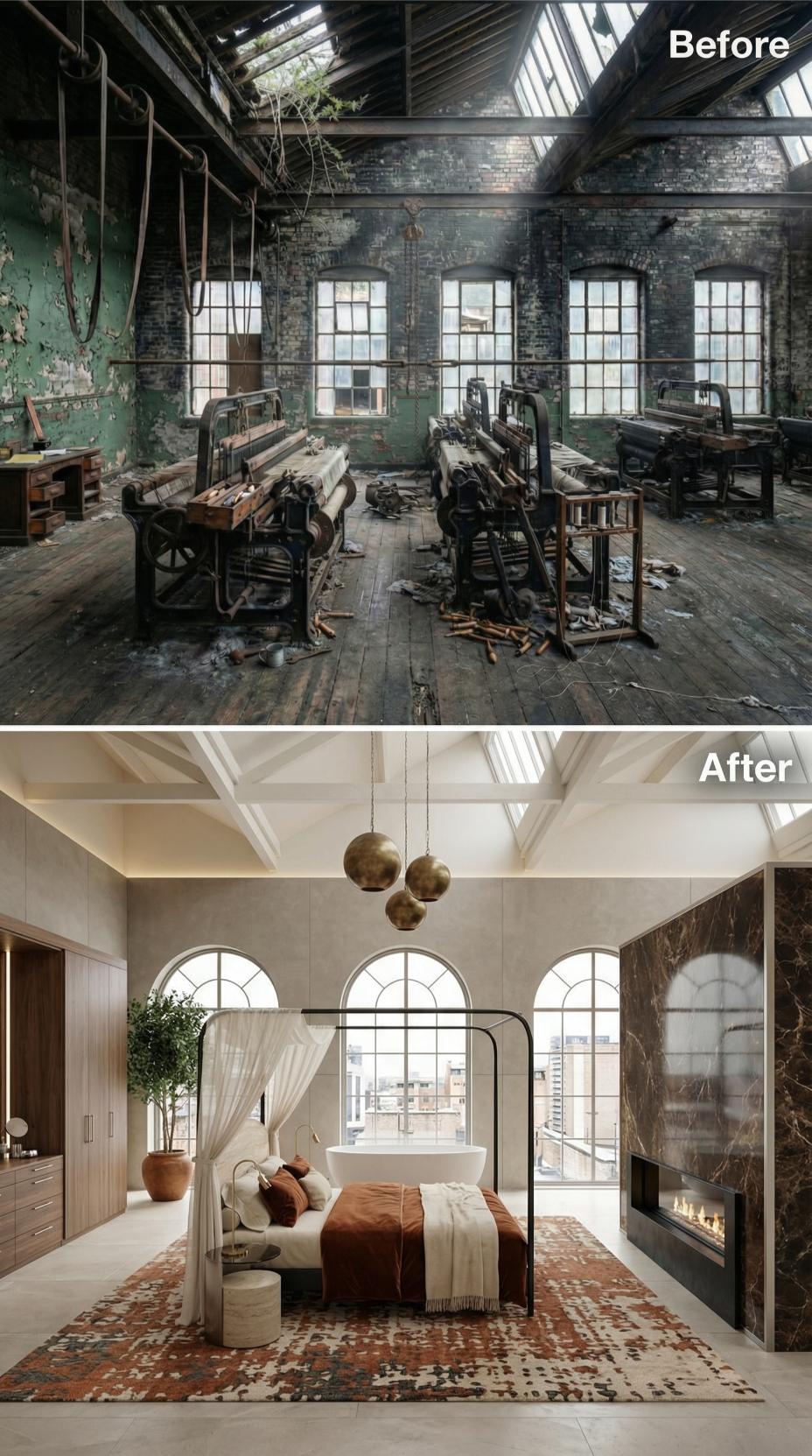
Arched casement windows retained from the mill’s original structure flood the room with grey London light, framing a four-poster canopy bed dressed in rust linen and cream gauze curtains. A freestanding oval soaking tub sits behind the bed frame on polished concrete flooring, anchored by a rust-and-ivory hand-knotted rug with an abrash pattern. Three brass orb pendants hang at staggered heights from the vaulted ceiling, while a linear fireplace set into dark emperador marble closes the right wall.
Quick Fix: Positioning a freestanding soaking tub inside the bedroom rather than the en suite is gaining ground in high-end loft conversions, reducing the need for a separate wet room and keeping sightlines open across a large floor plate. In mill conversions with ceiling heights above four metres, this placement also draws the eye upward, making the architectural volume feel intentional rather than accidental.
Whitewashed Trusses and Paper Pendants Soften a Victorian Mill’s Industrial Bones
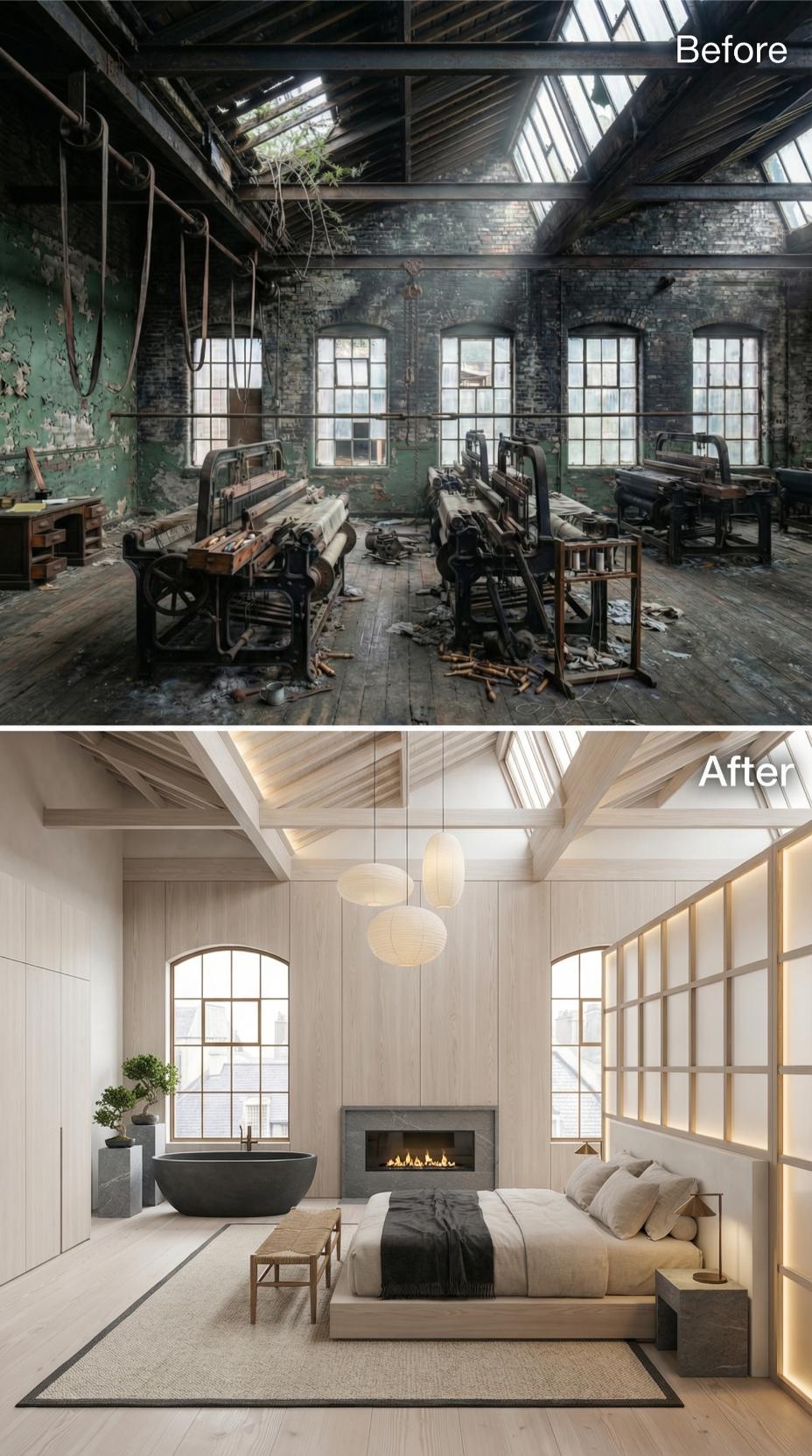
Bleached timber cladding runs floor to ceiling, muting the brick that once absorbed decades of machine oil and textile dust. Three paper globe pendants hang at staggered heights above a low platform bed dressed in linen and charcoal wool throws. A linear gas fireplace sits flush in the wall between two restored arched windows, drawing the eye outward to slate rooftops.
A freestanding concrete tub occupies the left corner without partition or screen, sharing floor space with a bonsai planted in a square stone vessel. The right wall uses a grid of backlit timber panels to echo the original glazed roof structure overhead, now rebuilt in pale wood rather than corroded iron.
Common Mistake: Many mill conversions over-rely on white paint to neutralize industrial surfaces, but applying it to every plane at once flattens the architectural depth that makes these spaces worth converting. Leaving at least one material in its natural state, whether raw concrete, reclaimed timber, or aged brick, gives the eye something to rest on and prevents the finished room from reading like a show home rather than a place someone actually lives.
Gilt Pendants and Arched Windows Reclaim a Victorian Mill’s Loom Floor
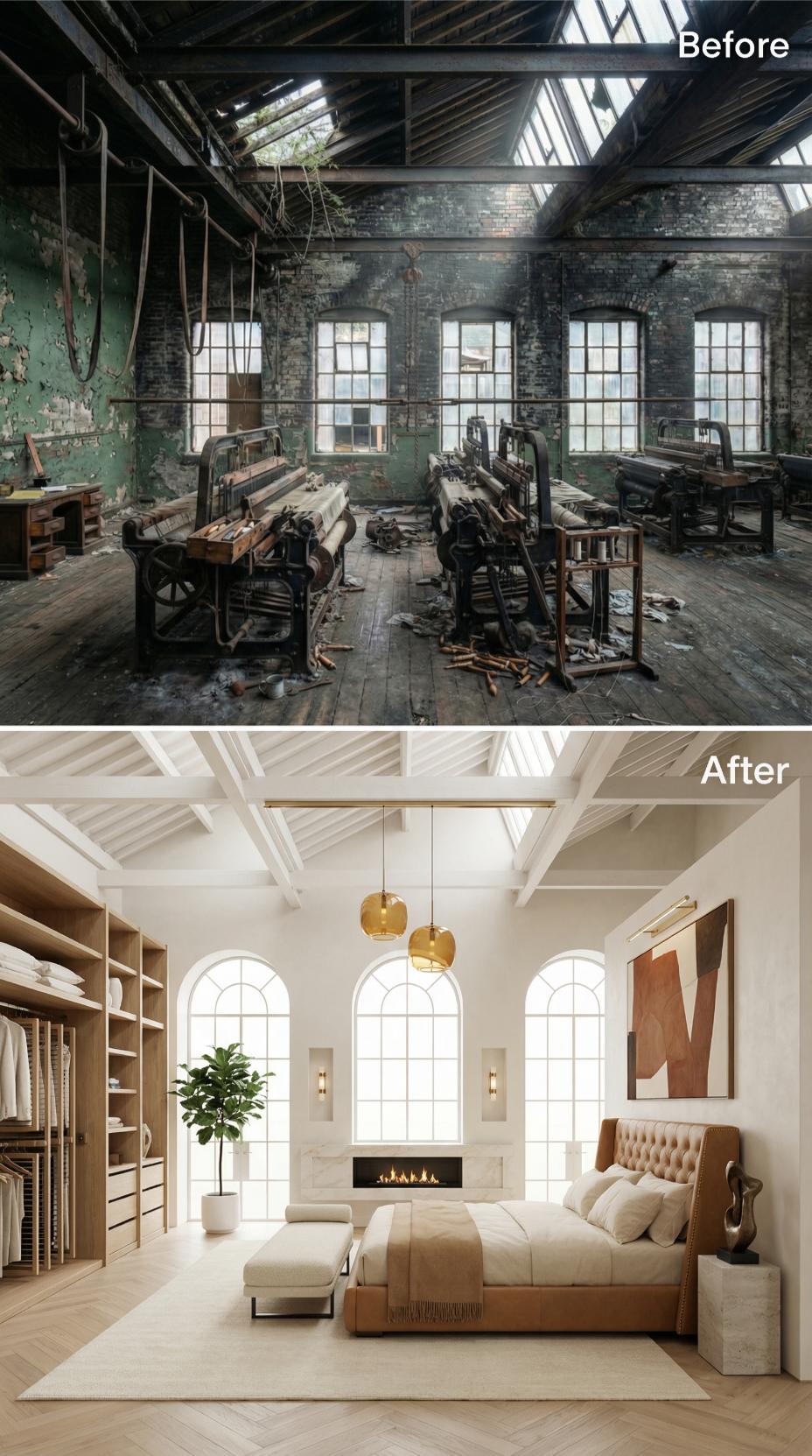
Rift-cut oak shelving lines the left wall floor-to-ceiling, carrying folded linens and hanging whites without a single door to interrupt the grain. Three amber glass pendants drop from white-painted rafters above a tufted camel leather bed, casting a gold pool across the herringbone oak floor.
Designer’s Secret: Preserving the original rafter spacing and painting the structural members white rather than staining them keeps the ceiling readable as architecture without visually lowering it. In high-ceilinged mill conversions, that distinction matters: stain absorbs light and compresses the volume, while white paint holds it open. Designers working with spans above four meters consistently favor the painted route for this reason.
Terracotta Plaster and Copper Pendants Claim an Abandoned Victorian Loom Floor
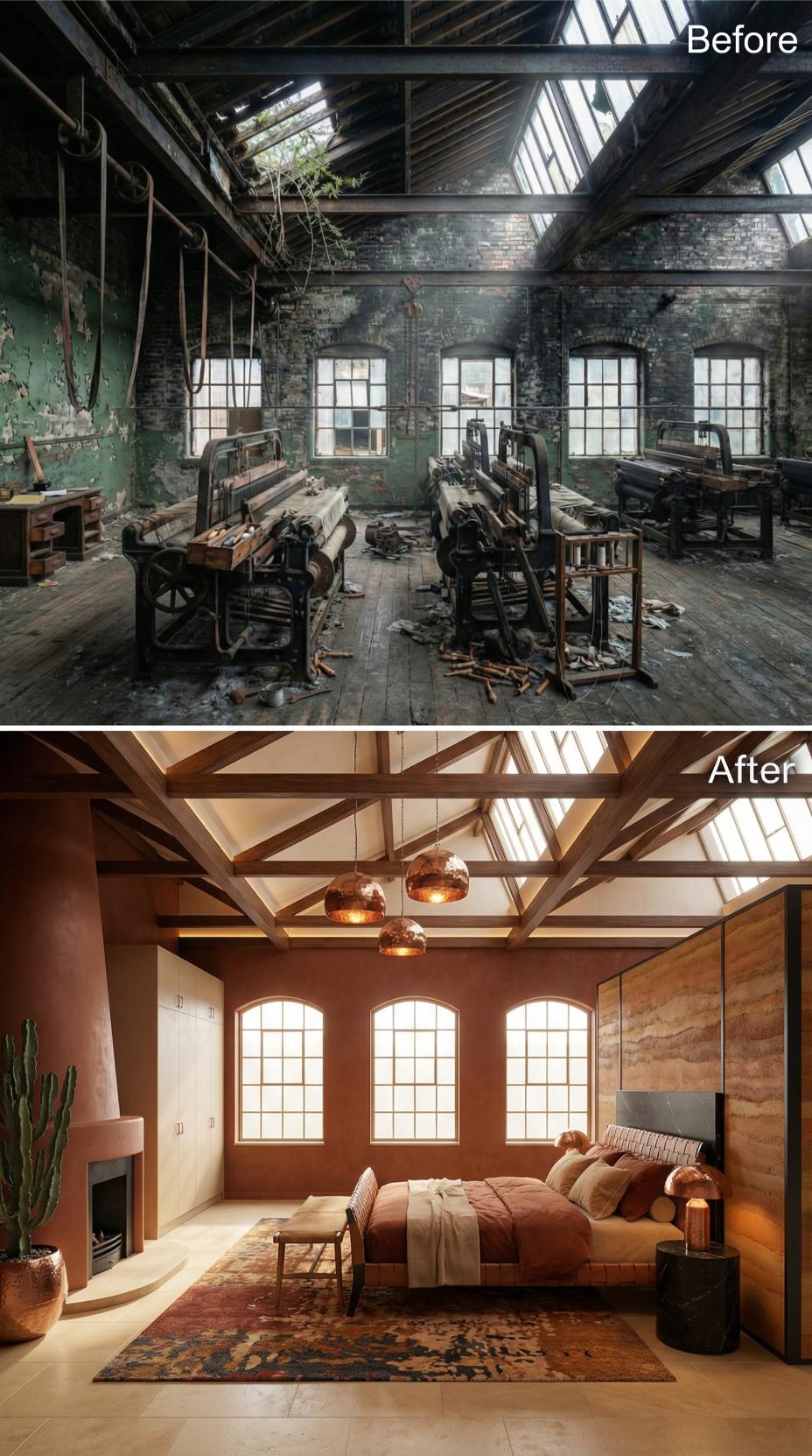
Burnt sienna plaster covers every wall surface, applied in a smooth matte finish that reads warm against the restored timber roof trusses painted cream. Three copper dome pendants hang at staggered heights from the ridge beam, casting amber pools across a king bed dressed in rust-linen bedding and layered with oatmeal throws. The arched industrial windows, retained from the mill’s original envelope, now glow with frosted diffusion rather than broken glass.
A patterned wool rug in deep burgundy and ochre anchors the bed zone, its geometry contrasting the smooth plaster. A cactus planted in a hammered copper vessel anchors the left corner beside a minimal fireplace surround, while a dark-veined marble side table grounds the right. The trusses above follow the same pitch as the derelict roof structure before renovation, making the geometry of the room inseparable from its industrial past.
Three copper dome pendants hang at staggered heights from the ridge beam, casting amber pools across a king bed dressed in rust-linen bedding and layered with oatmeal throws.
Terrazzo Walls and Honeycomb Brass Shelving Reclaim a Loom Floor’s Corner
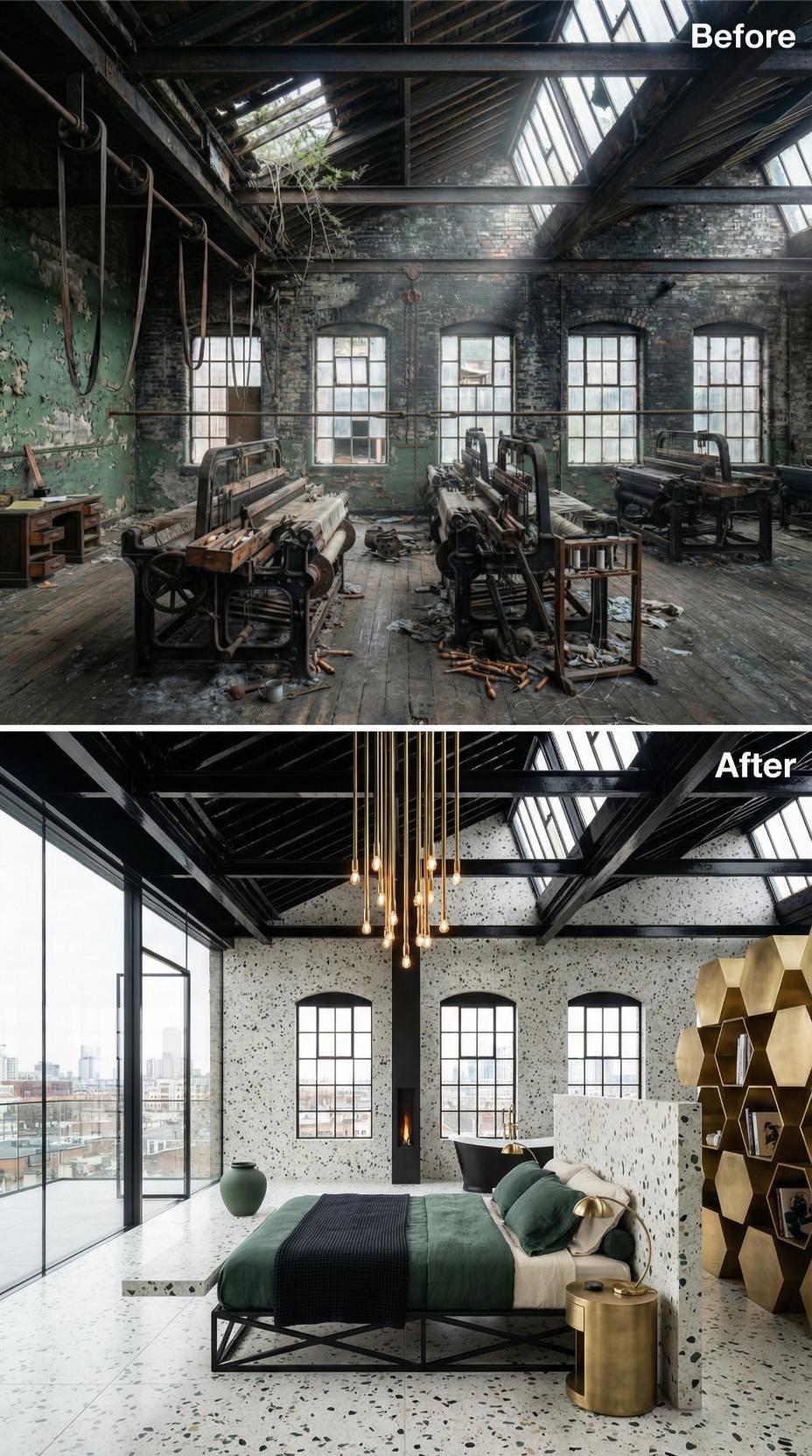
Speckled terrazzo cladding replaces the original peeling green plaster across every wall surface, carrying the same black-fleck pattern from floor to polished floor tile for visual continuity. Gold pendant bulbs drop on bare brass cables from blackened steel trusses, while a hexagonal brass shelving unit anchors the right corner. The bed sits on a matte black steel frame, dressed in forest-green velvet and a charcoal knit throw, with a cylindrical brushed-gold side table beside it.
- Matching terrazzo on both walls and floors unifies a room with irregular mill geometry without requiring additional trim work
- Hexagonal shelving in a metallic finish doubles as room divider and display surface in open-plan loft conversions
- Keeping the bed frame finish consistent with the ceiling steel connects the floor plane to the structural ceiling without added visual complexity
Where previous sections leaned into pale oak and whitewash, this corner swings toward saturated warmth and metallic sculpture.
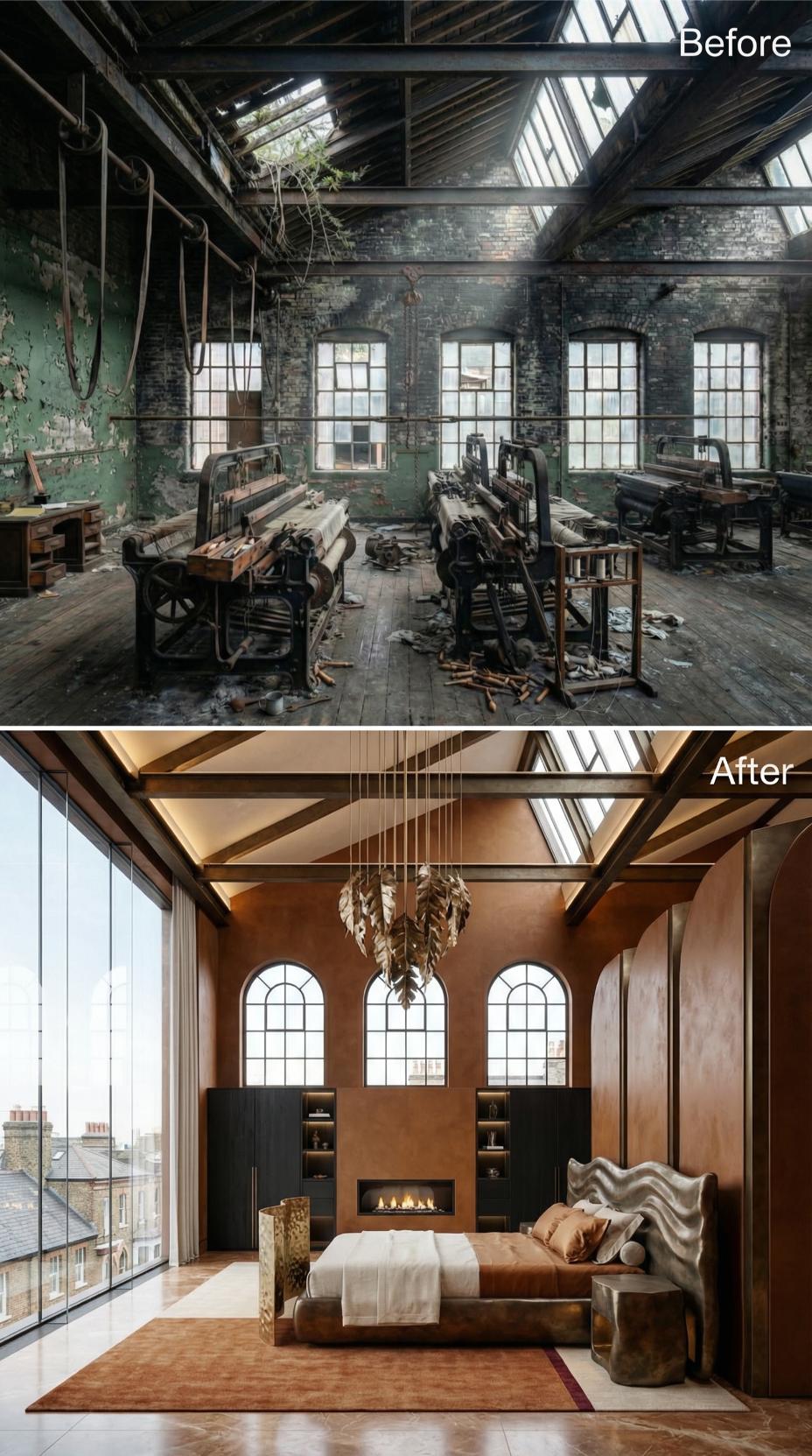
Cognac Leather and a Leaf Chandelier Reclaim a Mill Corner
🔥 Would you like to save this?
Tawny plaster covers the walls floor to ceiling, its matte finish absorbing the glow from a linear gas fireplace set flush into a dark cabinet run. Three arched windows retain the mill’s original proportions but gain clean stone surrounds, flooding the space with diffused daylight. A leaf-form chandelier in aged brass hangs from exposed roof trusses on hairpin wires, its silhouette reading against the skylight above.
The bed sits low on a cognac leather platform, dressed with a cream linen throw. To the right, a sculptural wave chair in poured silver resin anchors the corner as functional art rather than accent. A rust-toned wool rug defines the sleeping zone, its border pulling the amber of the plaster down to floor level. Floor-to-ceiling glazing on the left wall opens across London’s roofscape, leaving the Victorian brick line visible in the middle distance.
Driftwood Chandelier and Kintsugi Plaster Pull a Ruined Loom Floor Into the Present
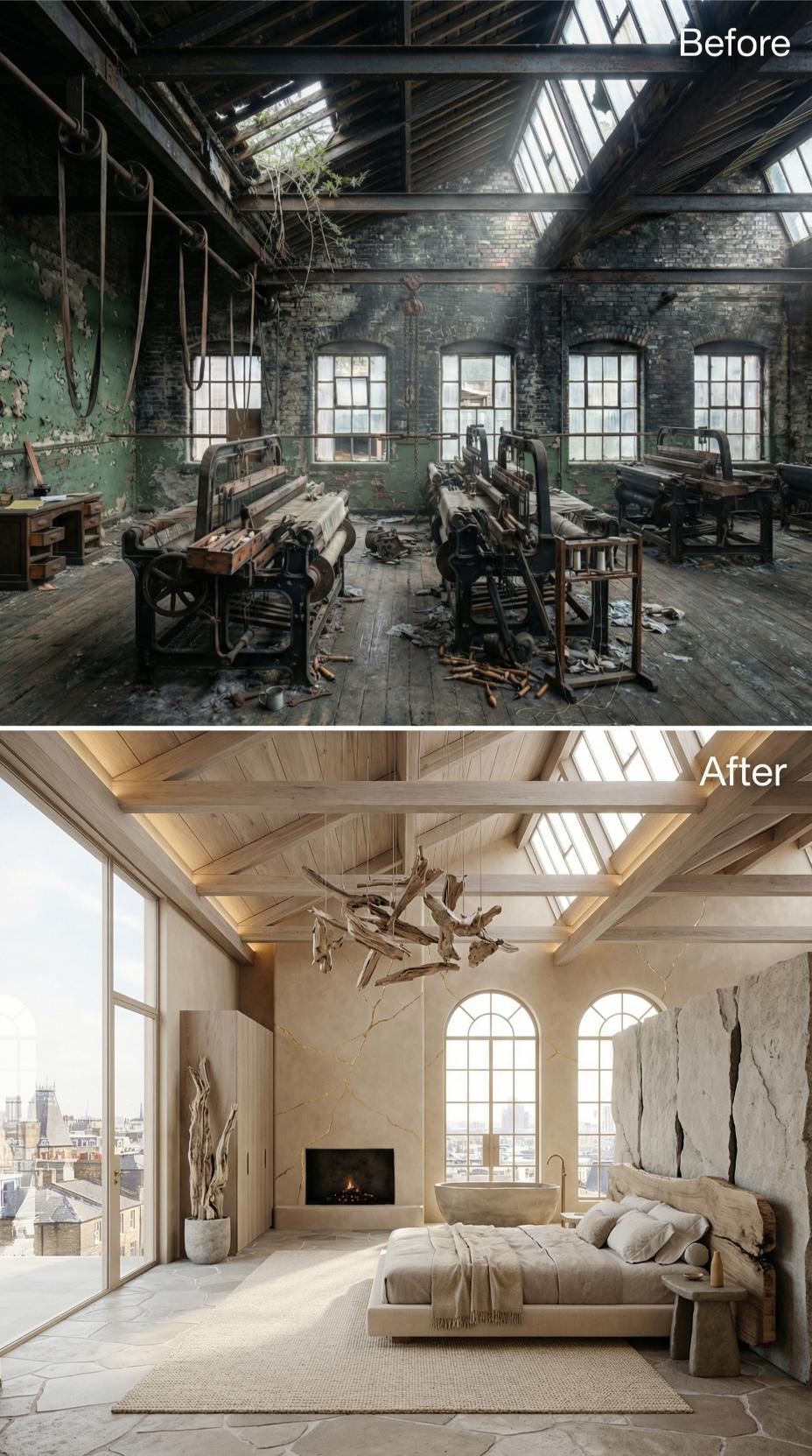
Raw limestone plaster covers the fireplace wall, its surface cracked deliberately in a kintsugi pattern filled with gold-toned resin. A driftwood chandelier hangs low between the exposed pine ceiling beams, its irregular branches casting broken shadows across the stone tile floor. Both arched windows retain their original proportions, now framing city rooftops instead of broken glazing.
The bed sits on a platform upholstered in undyed linen, flanked by a carved wood stool and a freestanding stone bathtub positioned directly beside the fireplace. Every finish runs through the same bleached neutral range, so the room reads as one continuous material rather than a collection of separate decisions.
Try This: Kintsugi-inspired wall treatments, where intentional cracks are filled with metalite grout or resin, are moving from decorative art objects onto full architectural surfaces. Applied to plaster walls in a bedroom, the technique introduces visual texture without adding pattern, color, or furniture. It works especially well in conversions where the original walls already carry damage, because the repair becomes the design rather than something to hide.
Stone Fireplace and Skylight Ceiling Pull a Derelict Mill Corner Into Calm
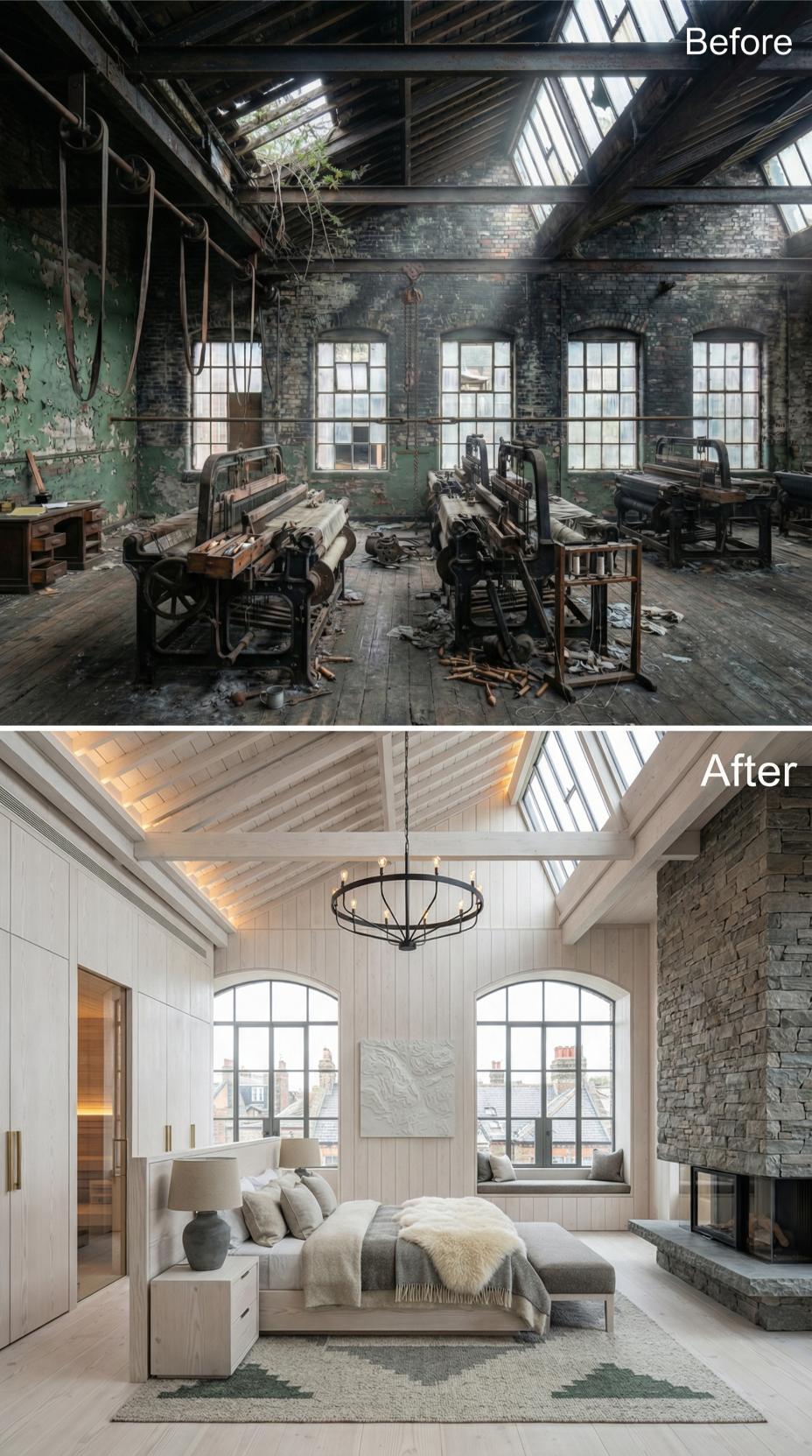
Shiplap planks painted white cover the ceiling between original structural beams, softening the volume without erasing the mill’s bones. A wrought-iron ring chandelier with exposed bulbs holds center. The bed sits flanked by low nightstands in pale wood, dressed in linen, wool throws, and a sheepskin layer. Stacked-stone cladding climbs the fireplace wall to ceiling height, its texture the room’s only unfinished surface.
Style Tip: Stone cladding used floor-to-ceiling on a single wall anchors a pale room without requiring color, because natural texture reads as visual weight on its own. Limiting the rough material to one plane prevents the finish from competing with the architectural windows opposite it.
Emerald Lacquer and a Crystal Chandelier Reclaim a Ruined Victorian Loom Floor
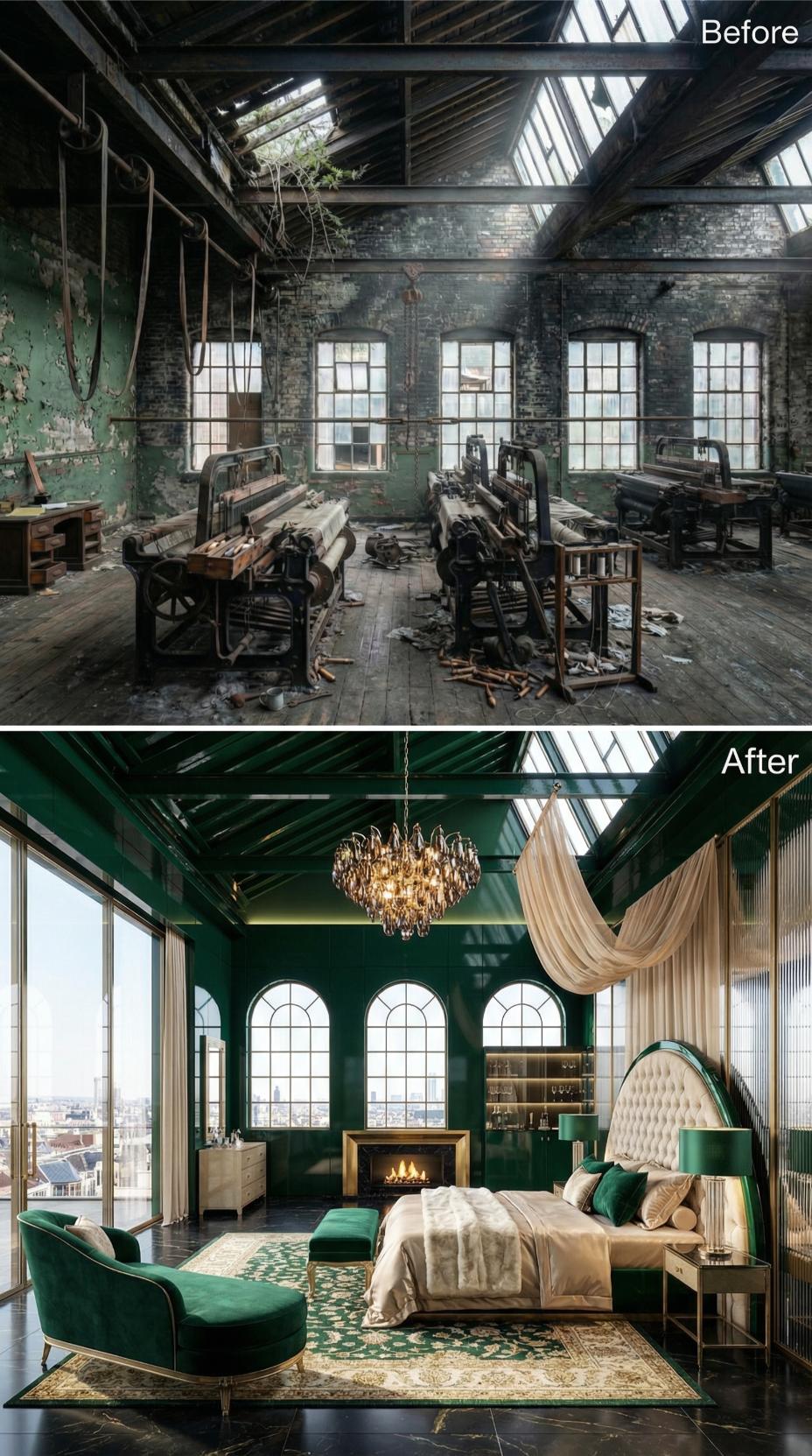
Deep forest-green lacquer covers every ceiling beam and wall plane, pulling the room’s industrial bones into a single saturated field rather than fighting them. A tiered crystal chandelier drops from the ridge, casting gold light across cream tufted headboard panels and a silk-draped canopy. Arched windows replace the original factory glazing, framing a city skyline. An axminster rug in green and ivory anchors the velvet chaise and upholstered ottoman at the foot of the bed.
Did You Know: Lacquering structural timber rather than staining or painting it flat produces a reflective surface that bounces artificial light further into a room, reducing the number of fixtures needed to achieve even illumination. In mill conversions with high ceilings, this technique can cut supplemental lighting requirements by as much as a third. The finish also seals raw Victorian timber against moisture migration, which is a common structural concern in repurposed industrial buildings.
Copper Headboard and Steel-Framed Glass Pull a Derelict Loom Floor Into the Modern World
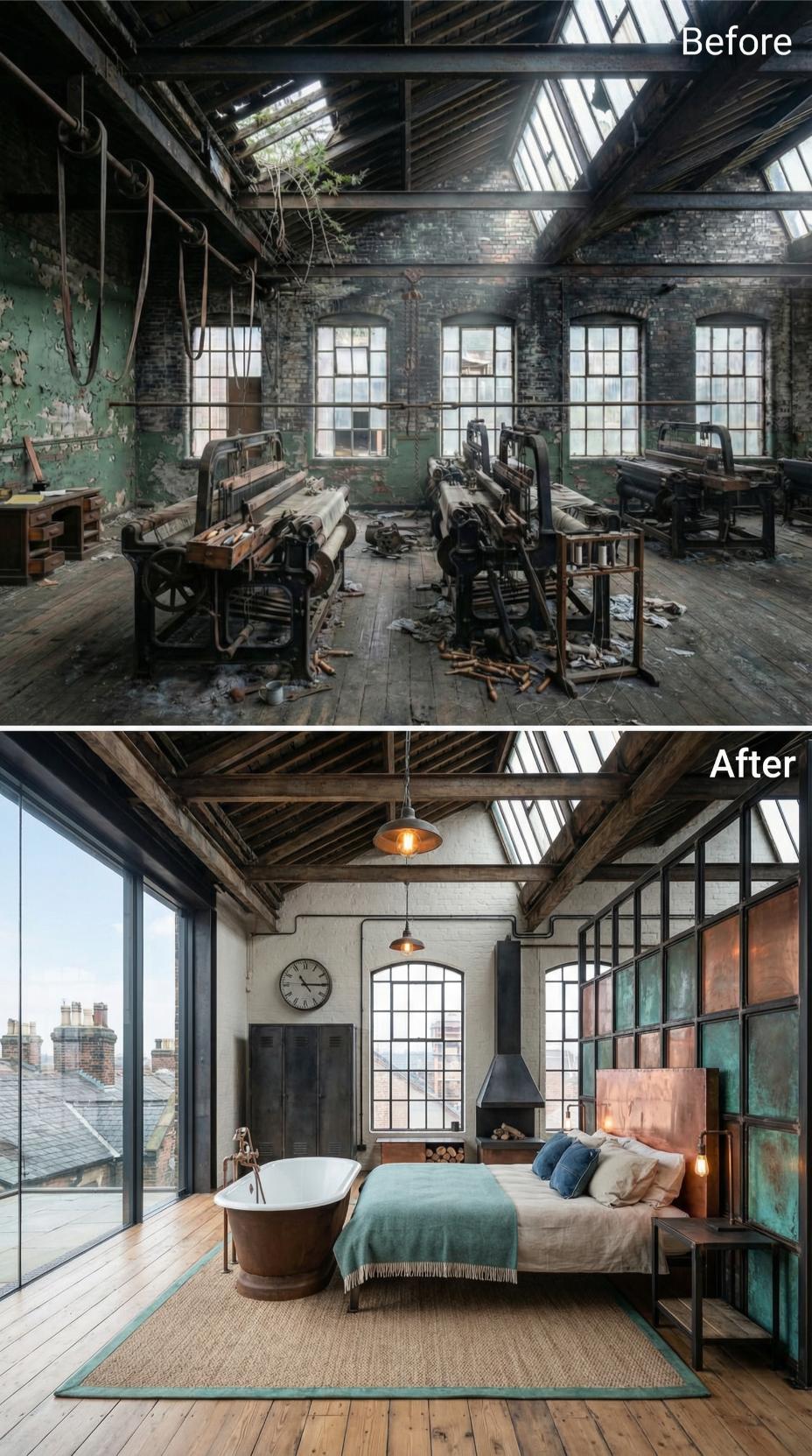
Whitewashed brick replaces peeling green paint on the long wall, while the original softwood floor is sanded back and left bare underfoot. A copper roll-top bath sits open inside the bedroom, its patinated exterior picking up the warm oxide tones of the copper-paneled headboard behind the bed. Steel Crittal-style glazing divides the sleeping area from what appears to be a corridor or dressing zone, using the mill’s original iron-framing language as a room partition. Pendant bulbs hang on long drops from exposed timber rafters, casting light at mid-height rather than ceiling level. A freestanding wood-burning stove anchors the center wall between two arched factory windows.
Style Math: Repeating one finish across unrelated objects, copper here appearing on both the freestanding bath exterior and the full-height headboard panel, creates material continuity without requiring matched furniture sets. Steel-framed internal glazing borrowed from the mill’s original window language doubles as a room divider, avoiding the visual weight of a solid partition wall in a space with low natural light on one side.
Pendant Lights and a Slim Wall Fireplace Claim an Abandoned Mill Corner
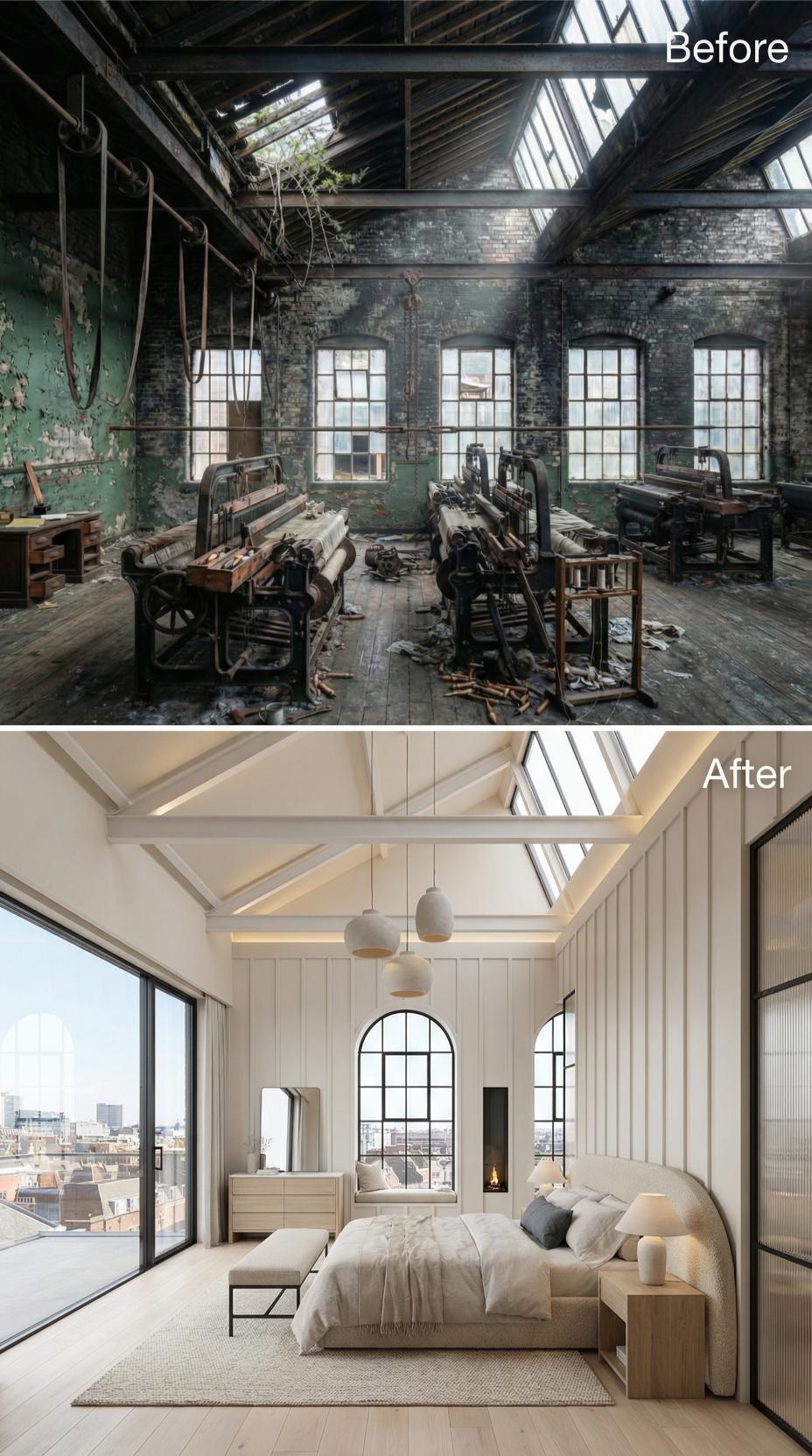
Painted white board-and-batten cladding runs floor to ceiling on the rear wall, cutting the industrial volume down to a bedroom scale without lowering the roof. Pendant lights in unglazed ceramic hang at two heights from exposed white timber trusses. A slim gas fireplace set flush into the paneling sits directly below an arched steel-framed window, pulling the eye toward the city skyline beyond.
History Corner: Victorian textile mills relied on continuous roofline glazing, called sawtooth or monitor skylights, to flood loom floors with diffuse northern light, since even thread color needed to be checked against daylight rather than lamplight. Converting that glazing for residential use now requires acoustic laminate glass to meet urban noise standards, a specification rarely needed in the mill’s working life.
Concrete Panels and Globe Pendants Reclaim a Derelict Victorian Mill Corner
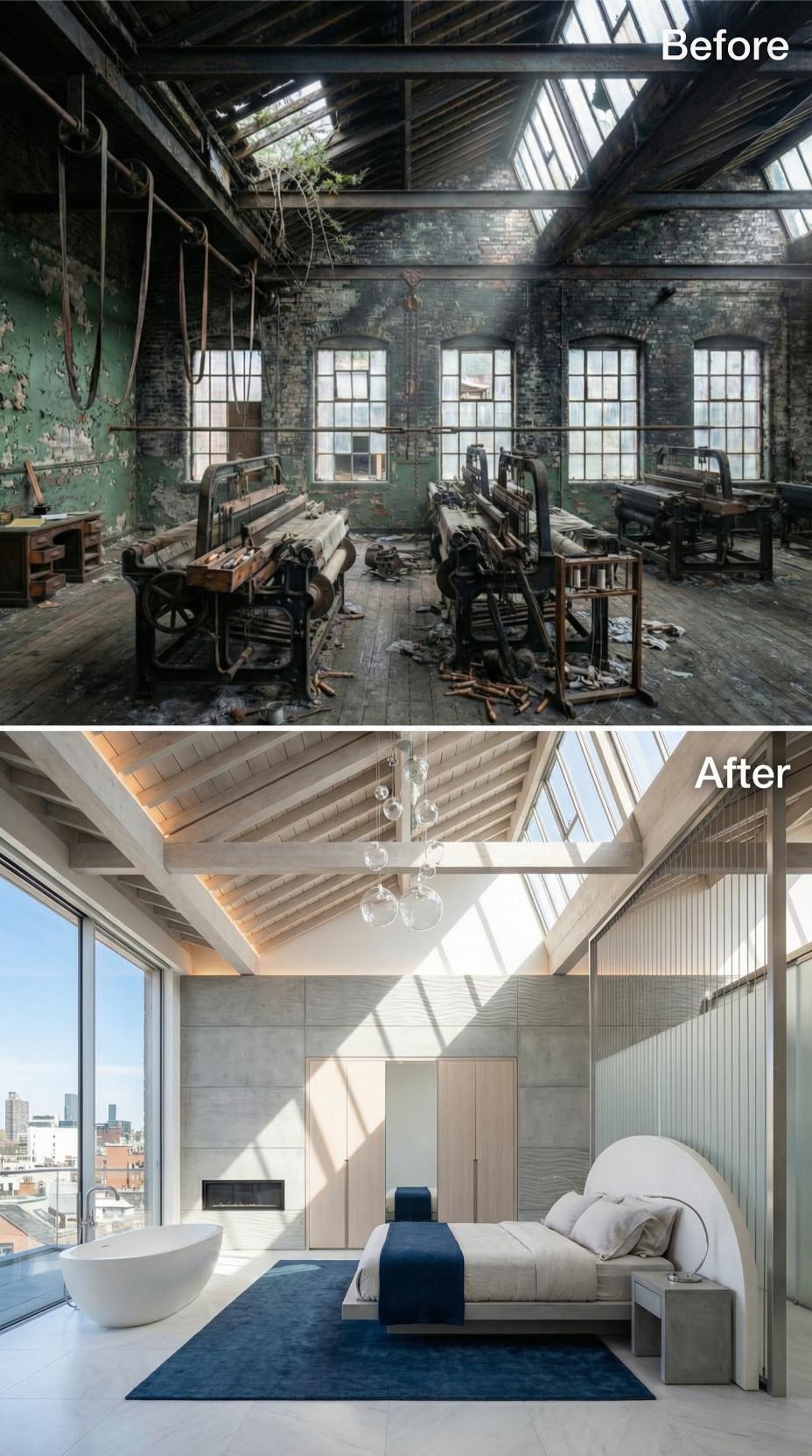
Poured concrete wall panels in a mill bedroom should not work this well, yet here they do.
Smooth board-formed concrete covers the full back wall, its faint formwork lines giving the surface enough texture to avoid looking clinical. A slim linear fireplace sits flush within it, frameless, the flame the only warm tone on that entire plane. The exposed roof structure above has been stripped back and whitened, with the original sawtooth glazing retained and re-sealed so natural light still rakes across the raked ceiling at the same angle Victorian loom operators once relied on. Globe pendants hang at staggered heights from a single ceiling point, their clear borosilicate glass catching that angled daylight without diffusing it. The bed platform is low and concrete-toned, dressed in navy wool, and a sculptural arch headboard in off-white bouclé anchors the composition without competing with the wall behind it. A freestanding oval soaking tub in matte white sits directly on the polished concrete floor to the left, positioned inside the sleeping zone rather than behind a partition wall. The navy wool rug underfoot ties the bed platform and tub into a single zone, making the floor plan feel deliberate rather than oversized.
Dark Green Walls and Gold Rafters Pull a Derelict Loom Floor Into a Majestic Setting
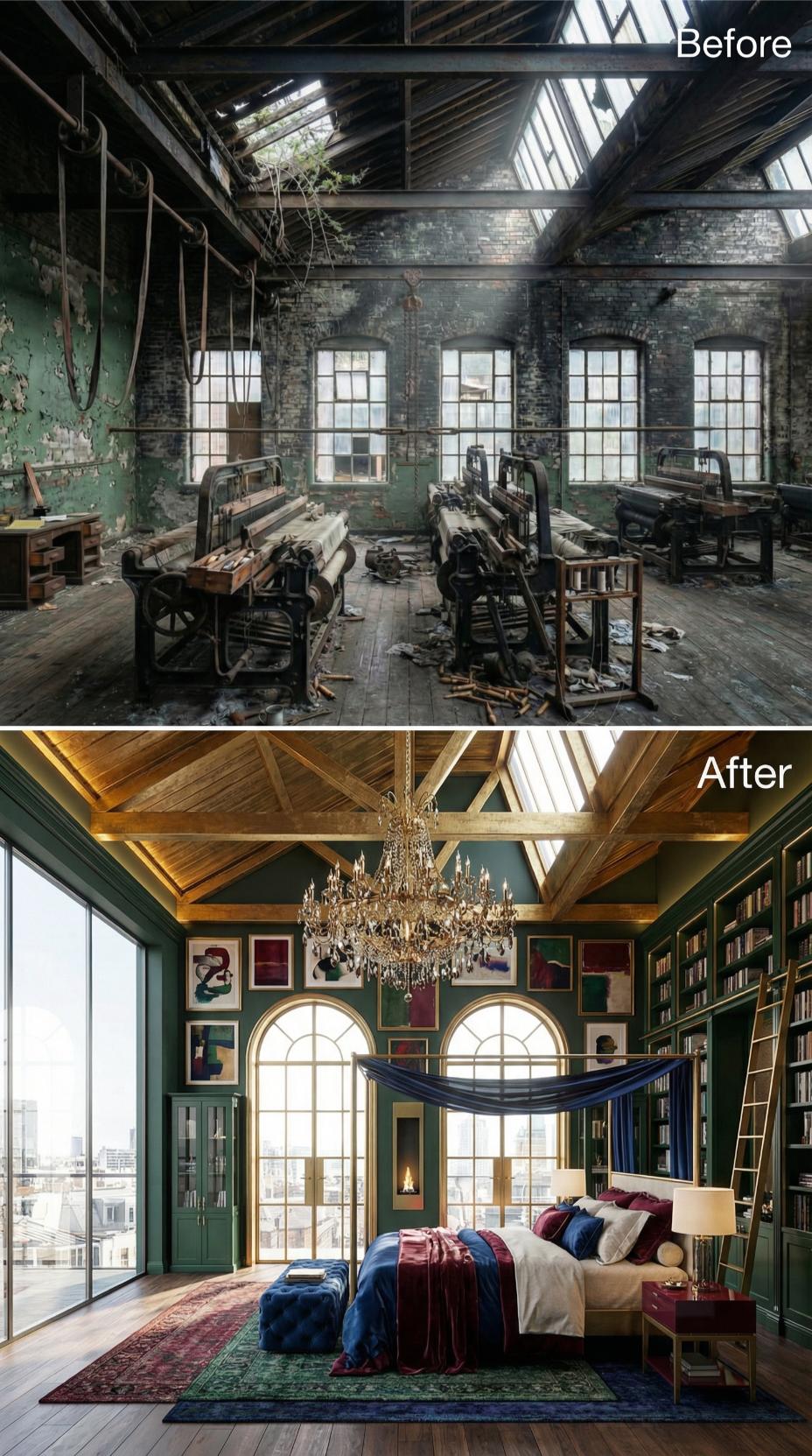
Forest green paint covers every wall plane, and the exposed rafter structure above is gilded rather than stained, pushing warmth down into the room without added fixtures. A crystal candelabra chandelier hangs at center, its brass arms echoing the gold trim on arched double windows fitted where industrial glazing once ran. Built-in bookshelves with a rolling ladder occupy the right wall entirely. The bed sits on wide-plank hardwood under a layered wool rug in burgundy and teal, dressed with velvet and silk bedding in navy and crimson.
Ask Yourself: Before committing to a single dominant wall color, check how it reads at three different times of day in your specific room. Dark greens can shift toward teal in morning light and nearly black by evening, which changes how every other material in the room performs alongside it. The color you approve at noon may not be the color you live with at midnight.
Greige Plaster and Skylight Rafters Reclaim a Ruined Loom Floor as a Bedroom
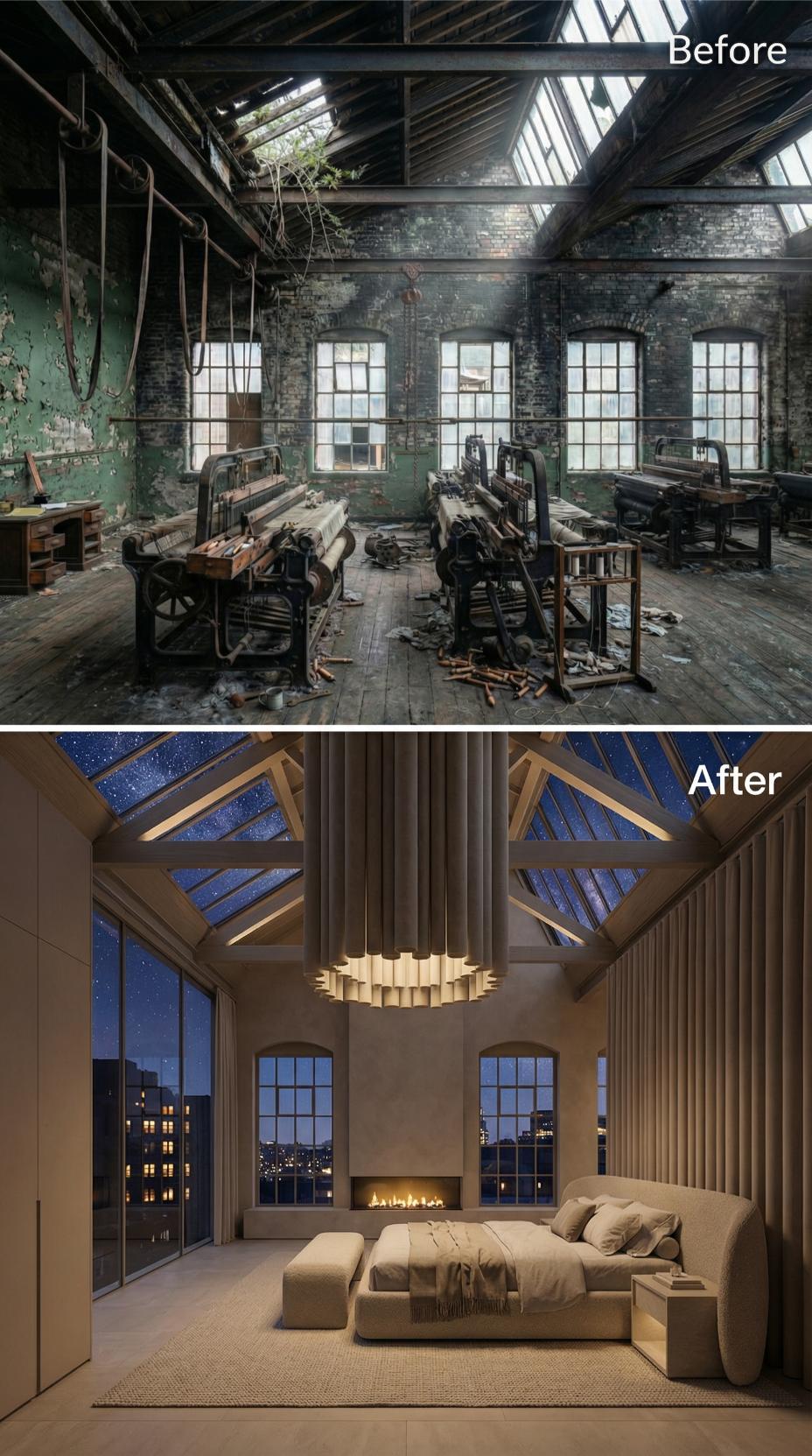
Linen-white plaster covers every wall surface here, but the warmth comes from greige rather than cool white, keeping the room from reading clinical against the restored sawtooth skylights above. The rafters have been stripped and refinished in a pale timber stain, their original Victorian spacing preserved intact. Floor-to-ceiling ripple-fold curtains in undyed fabric run the full height of the side walls, softening the brick volume without concealing it.
A low-profile sectional sofa in boucle sits centered on a flat-weave rug, angled toward a recessed linear gas fireplace set into a plaster surround. Above it hangs a sculptural pendant, its layered petal form cast from what appears to be translucent resin or lacquered paper. The arched windows frame a city at night, while the skylights above reveal open sky, holding both views at once without competing for attention.
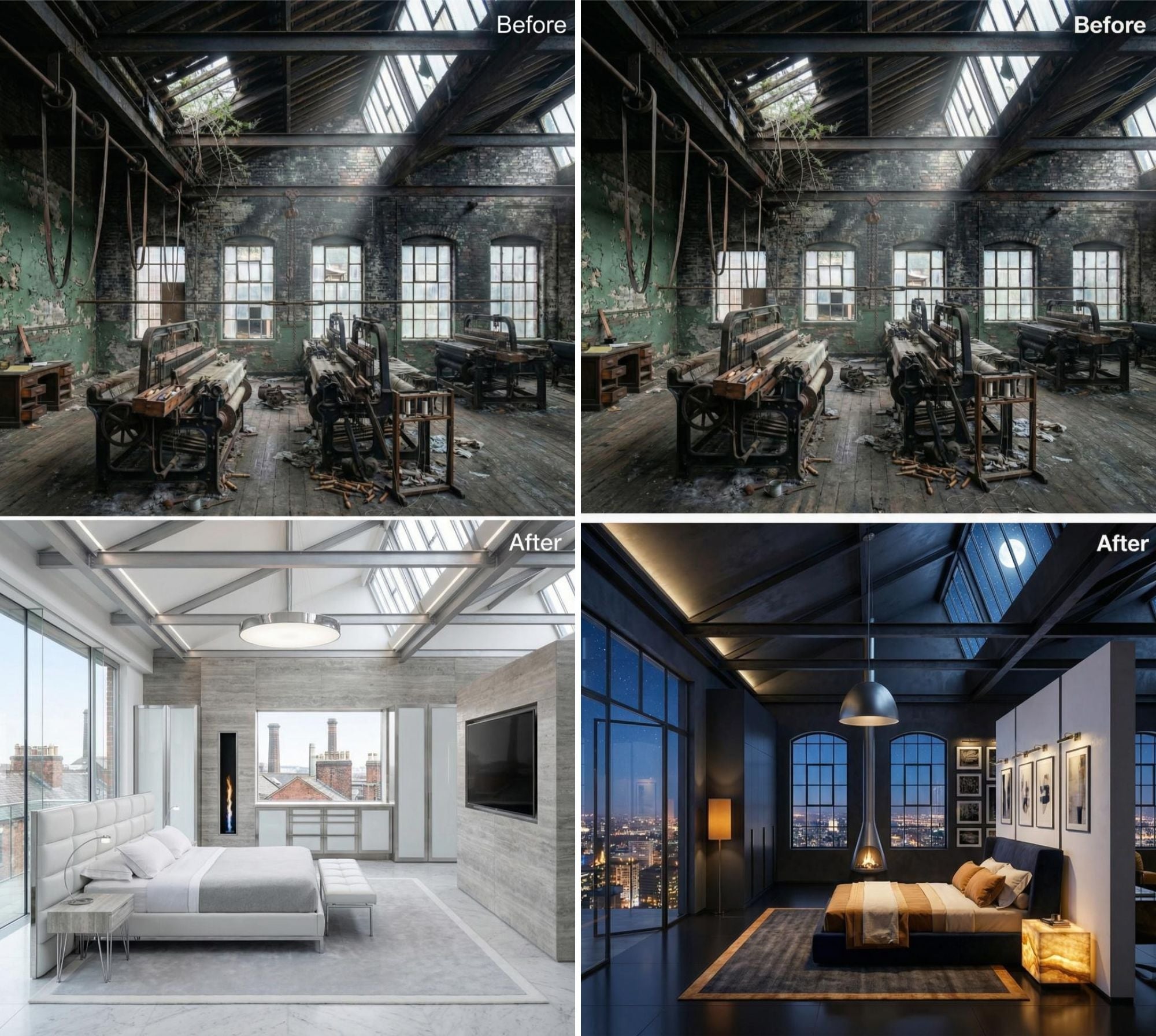
Moon Through Mill Skylights, a Pendant Fireplace, and Onyx Bedside Glow
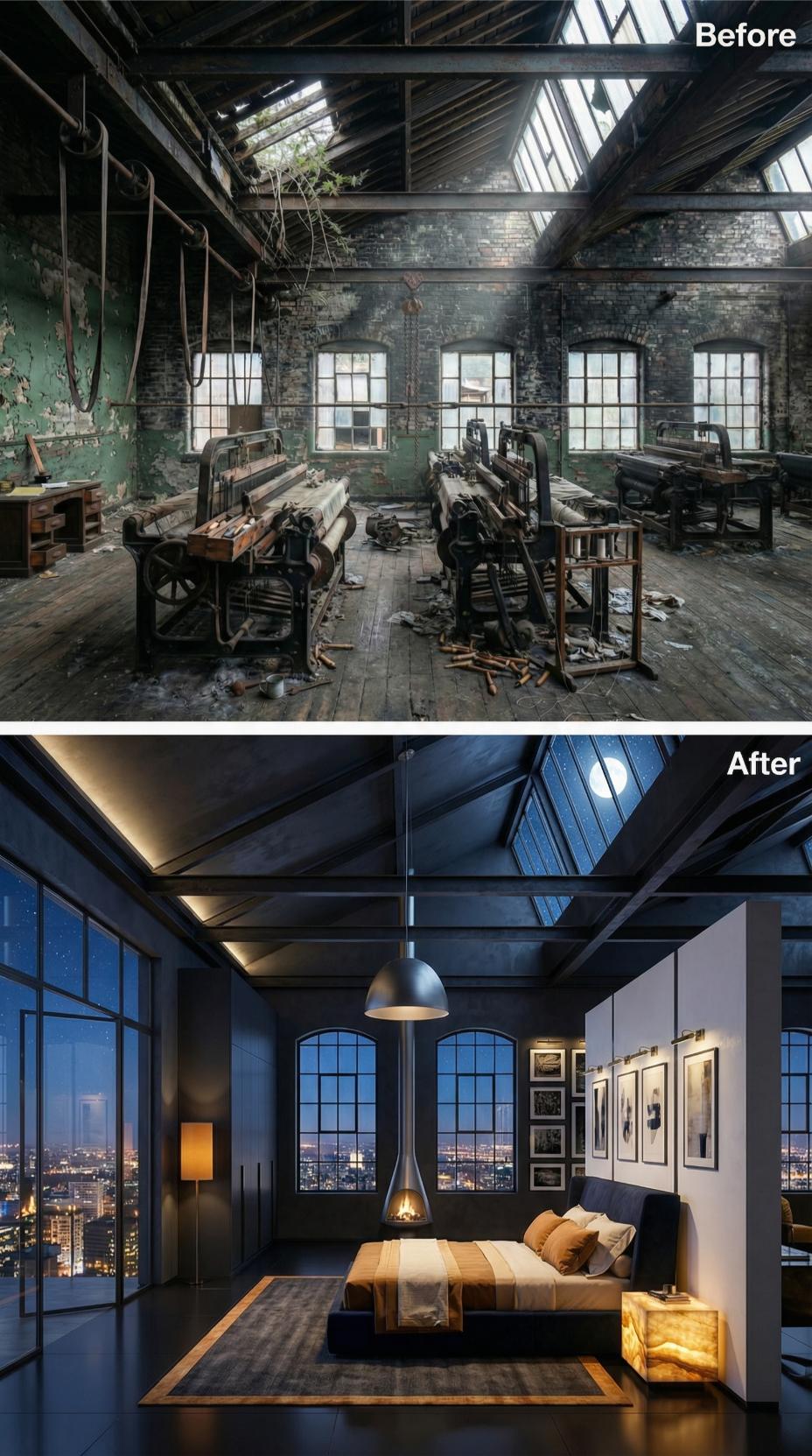
Charcoal-painted steel rafters carry the original sawtooth roofline geometry intact, while a suspended cone pendant and a freestanding cylindrical wood-burning fireplace center the room without touching a wall. The bed sits low on a platform, dressed in ochre and oat wool, flanked by an illuminated onyx slab nightstand that casts amber light upward through its veining. A gallery wall of black-framed prints runs at pillow height along white plaster, and arched factory glazing frames a city skyline under a full moon.
Ivory Plaster and Exposed Rafters Settle a Derelict Loom Floor Into Bedroom Quiet
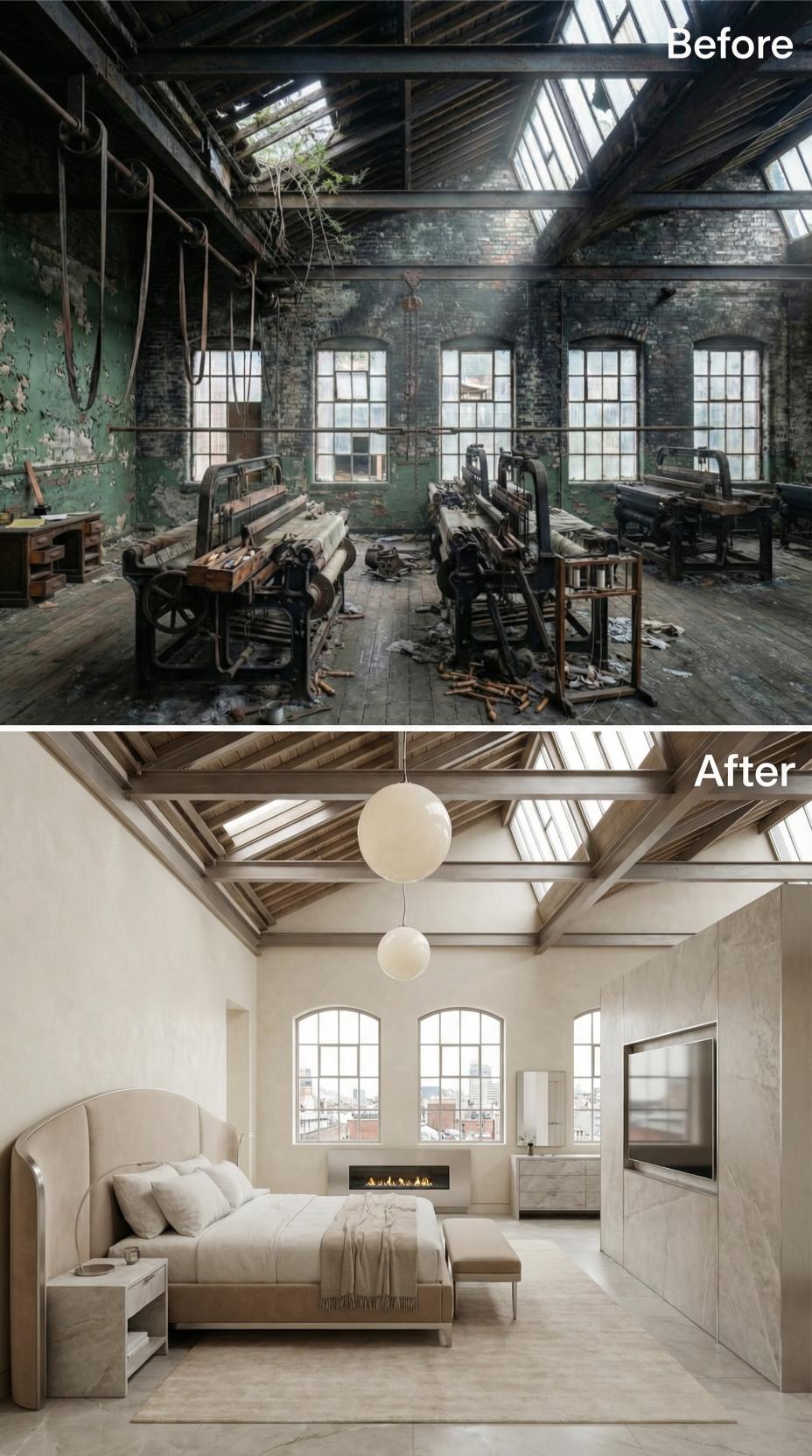
Lime-washed plaster covers the brick shell in warm ivory, while the original sawtooth rafter structure overhead is retained and stained in greyed oak tones, bridging mill bones with bedroom calm. Two globe pendants hang at staggered heights above an upholstered platform bed in oatmeal bouclé, and a slim linear fireplace sits centered beneath arched factory windows.
Warm Terracotta Plaster and Arched Windows Settle a Ruined Loom Floor
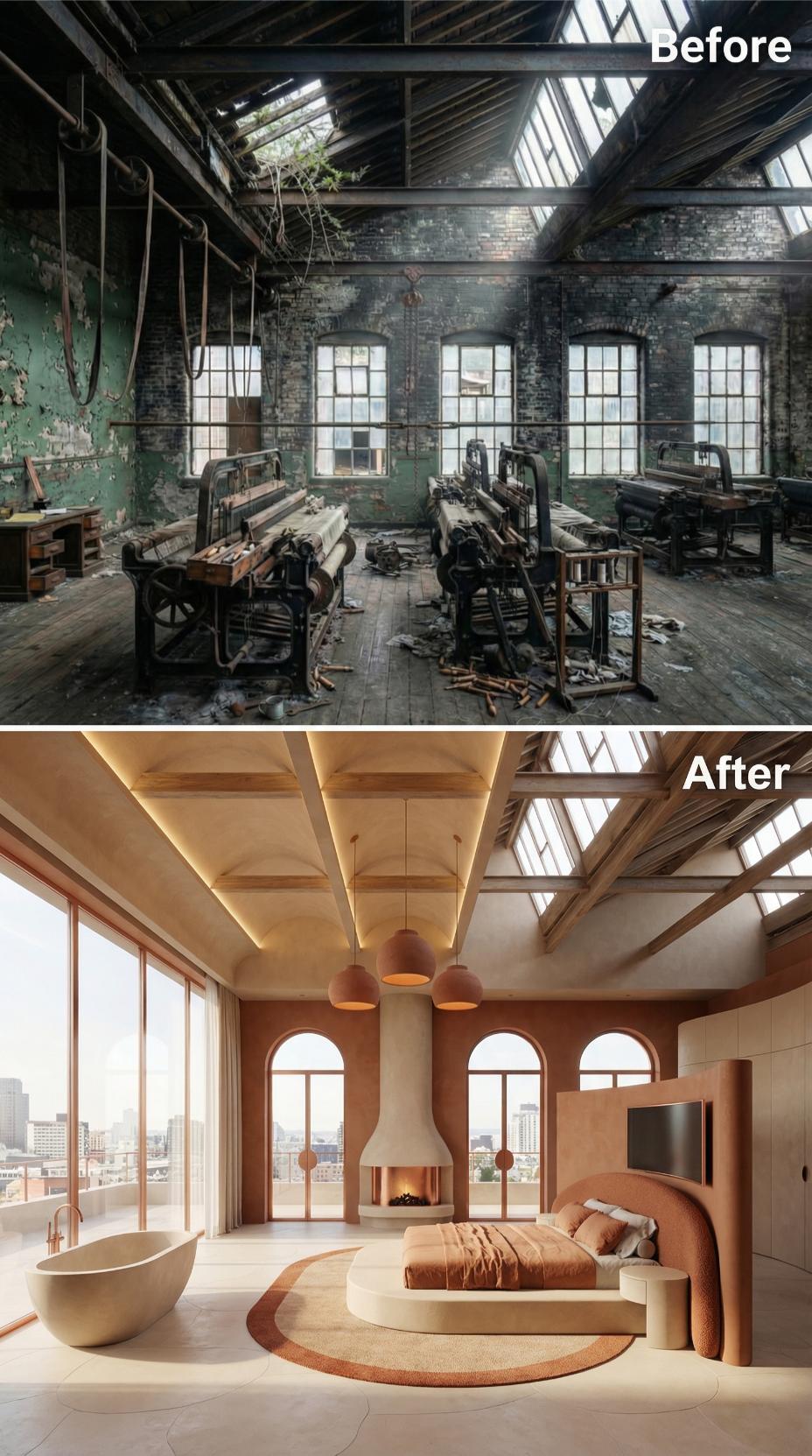
Venetian-style plaster in a muted terracotta coats the walls and bed platform base, pulling the room’s palette toward ochre and burnt sienna without competing with the preserved sawtooth skylights overhead. Pendant lights in a deeper copper-red clay hang in a cluster above the raised circular platform, where a low platform bed sits dressed in rust linen. A freestanding oval soaking tub in pale limestone occupies the left foreground, positioned entirely within the bedroom volume. Arched window surrounds echo the original mill openings while a conical hood fireplace anchors the central wall.
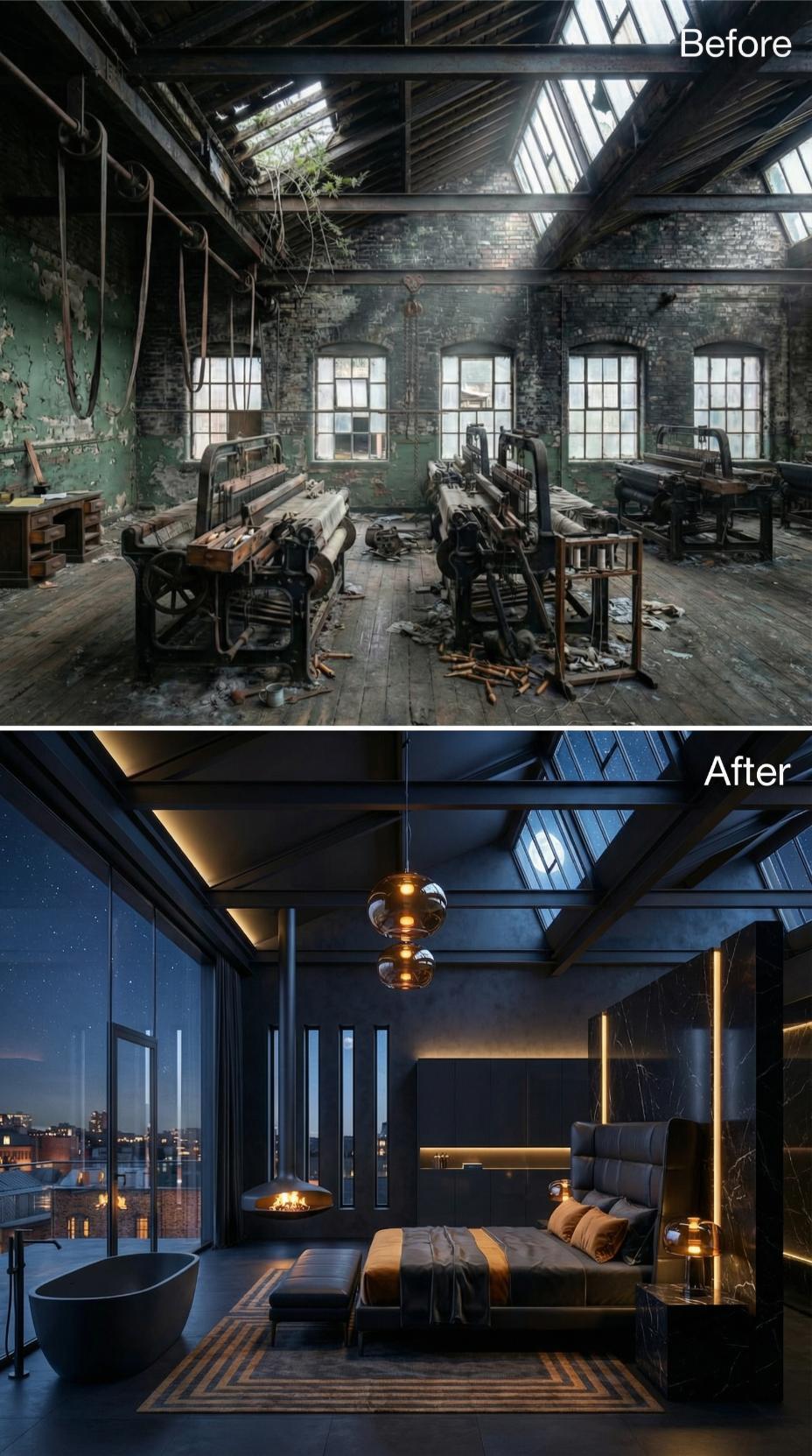
Midnight Steel Rafters and a Pendant Fireplace Claim a Derelict Loom Floor
🔥 Would you like to save this?
Charcoal-finished steel beams replace the rotted timber roof structure, and the original sawtooth skylight geometry survives intact, now glazed with dark-framed panels that frame a night sky and a low moon. A suspended spherical fireplace hangs at mid-room on a single cable, its flame visible from both the upholstered bed and the matte black freestanding tub positioned at the foot.
Dark veined marble clads one full wall beside the bed, running floor to ceiling without interruption. Amber pendant lights with smoked-glass globe shades hang at staggered heights near the headboard, while recessed warm-strip lighting beneath the bed base cuts a thin line of gold across the geometric wool rug below.
Bleached Rafter Boards and Pendant Globes Settle a Ruined Loom Floor Into Bedroom Use
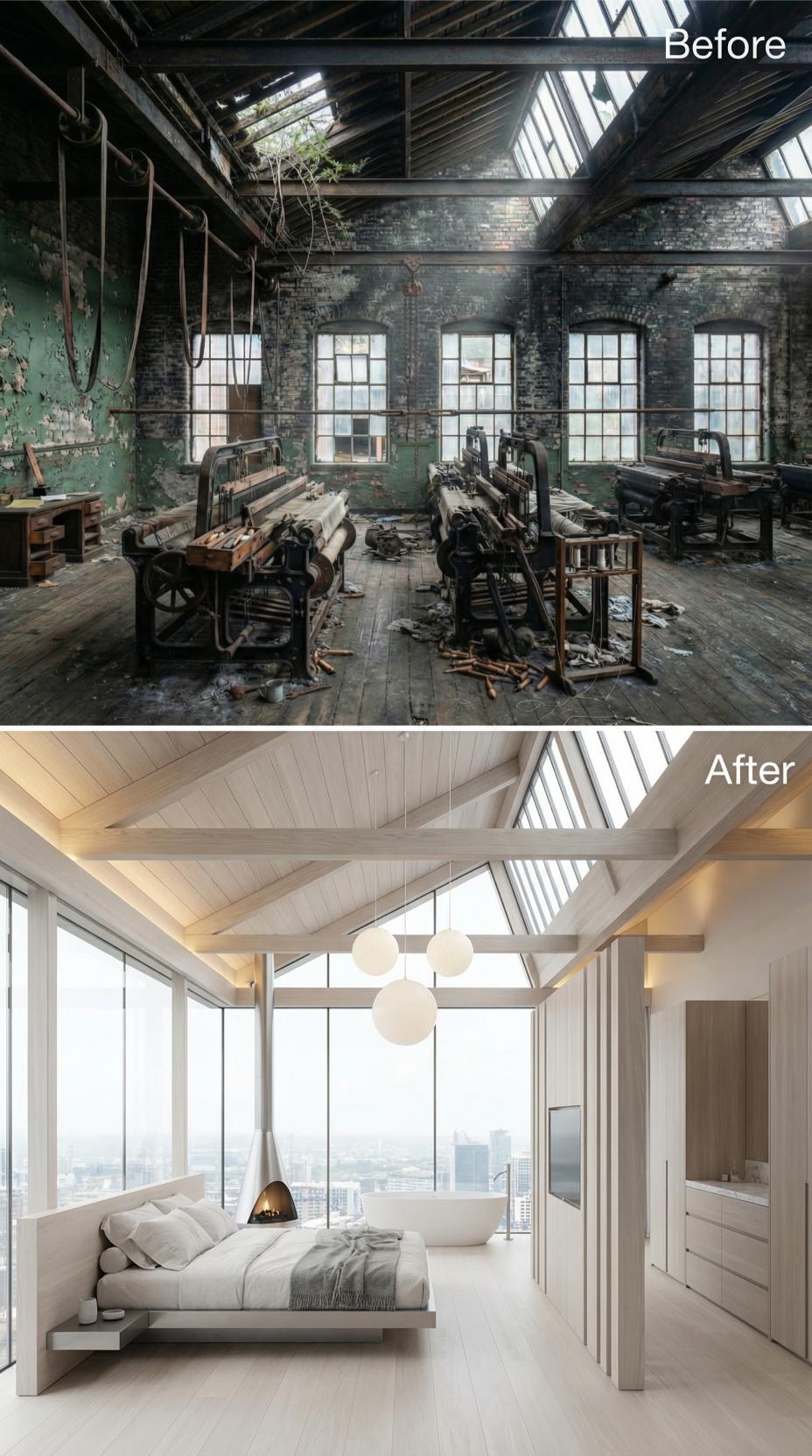
Bare structural rafters, whitened rather than stained, run the full pitch of the original sawtooth roofline and stop just short of floor-to-ceiling glazing that now frames a city skyline. Three matte globe pendants hang at staggered heights above a low-platform bed dressed in grey linen. A tapered pendant fireplace anchors the foot of the bed, its flame visible from both the sleeping position and a freestanding oval tub positioned just beyond it along the glass wall.
Bleached Rafters and a Pendant Fireplace Pull a Ruined Mill Corner Into Bedroom Calm
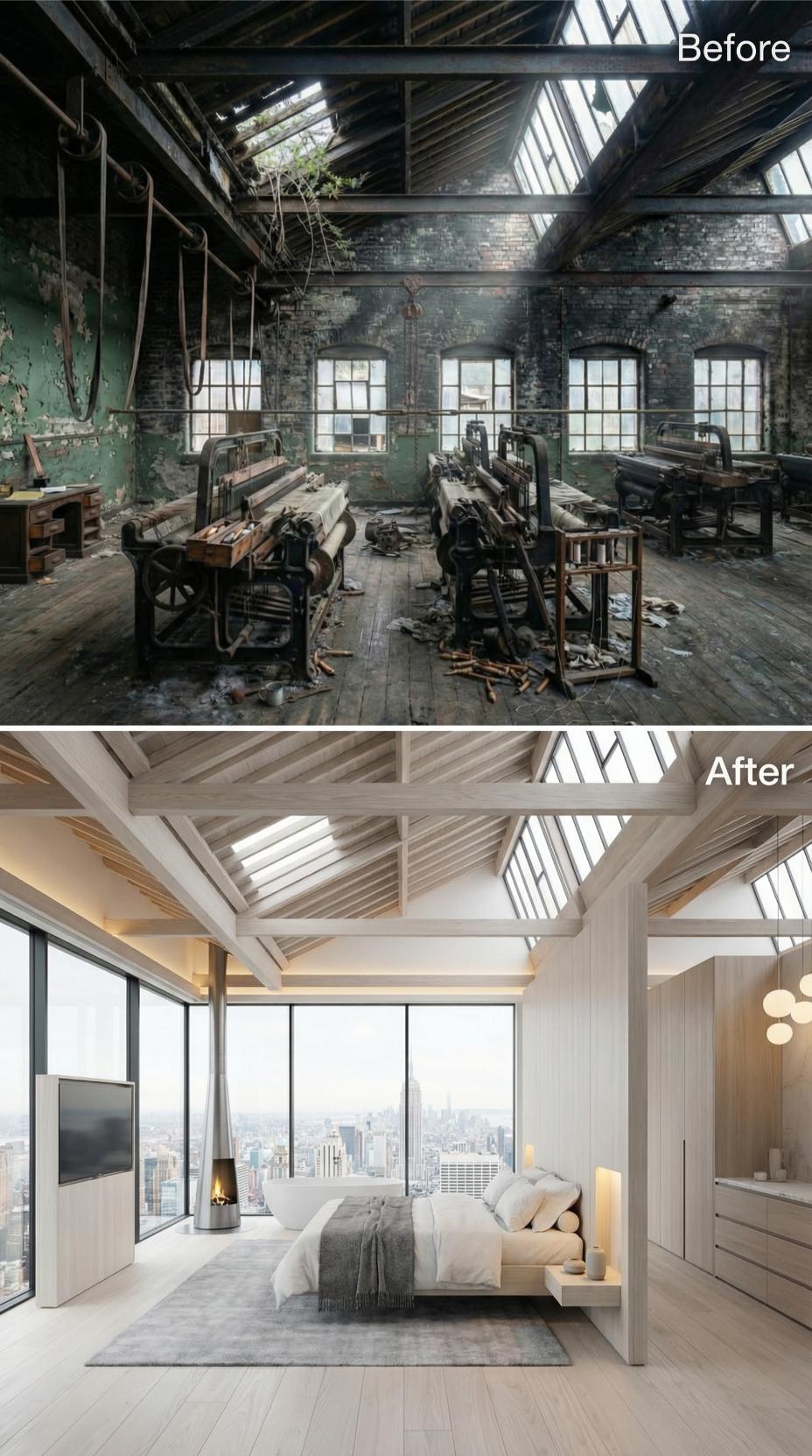
Exposed roof trusses, stripped back to pale ash-toned timber, run the full length of the ceiling and retain the sawtooth glazing that once lit Victorian looms below. The freestanding cylinder fireplace in brushed steel sits on bare concrete-look flooring, its open flame doing the work that overhead lighting would otherwise flatten. Floor-to-ceiling steel-framed glass panels replace what were arched brick apertures, opening the room to a city skyline at height.
The bed sits low on a platform base in bleached oak, dressed in a layered grey wool throw and cylindrical bolster cushions in natural linen. Warm-toned cabinetry lines the right wall in vertical-grain paneling, with pendant globe lights suspended above the vanity counter. The palette holds to white, warm grey, and pale wood throughout, with no single surface competing for attention.
Teal Lacquer and a Freestanding Bath Reclaim a Ruined Loom Floor
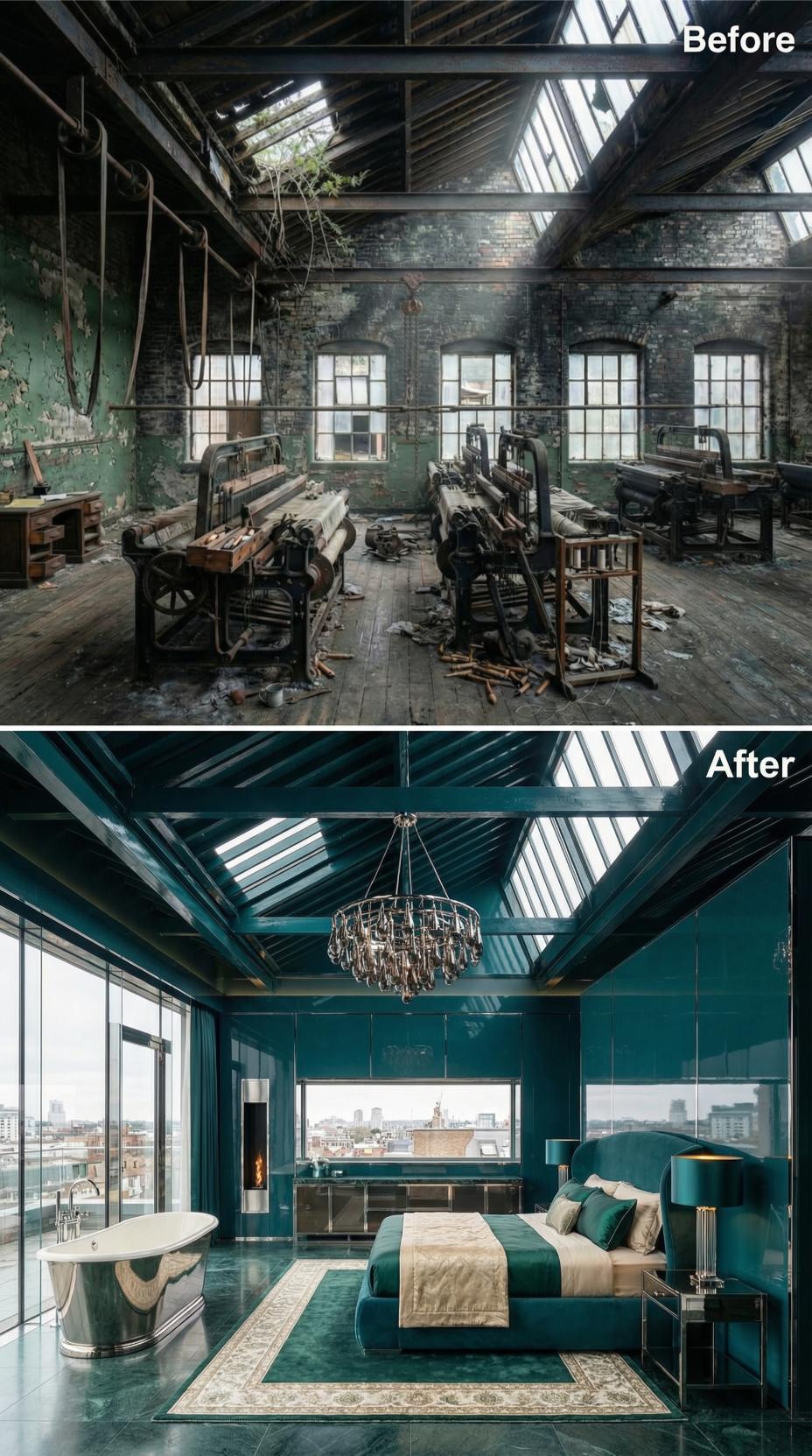
Deep teal lacquer covers every wall panel floor to ceiling, pulling the original sawtooth skylight rafters into a color field that reads almost monolithic from the doorway. The structural beams receive the same treatment, finished in glossy dark teal rather than a contrasting tone, so the ceiling reads as a continuous canopy rather than a grid of competing parts. A chrome-framed chandelier hangs at center, its layered rings scaled to match the rafter span above it.
A freestanding soaking tub in polished nickel sits opposite the velvet upholstered bed, placed directly on the marble tile floor rather than behind a partition wall. A slim gas fireplace column anchors the window bay, its brushed steel body framing a city roofline view. Gold and ivory cushions on the teal velvet headboard provide the only warm contrast in a room that otherwise commits fully to cool depth.
Blush Plaster and Pendant Glass Reclaim a Corner of Ruined Loom Floor as Ideal Bedroom Space
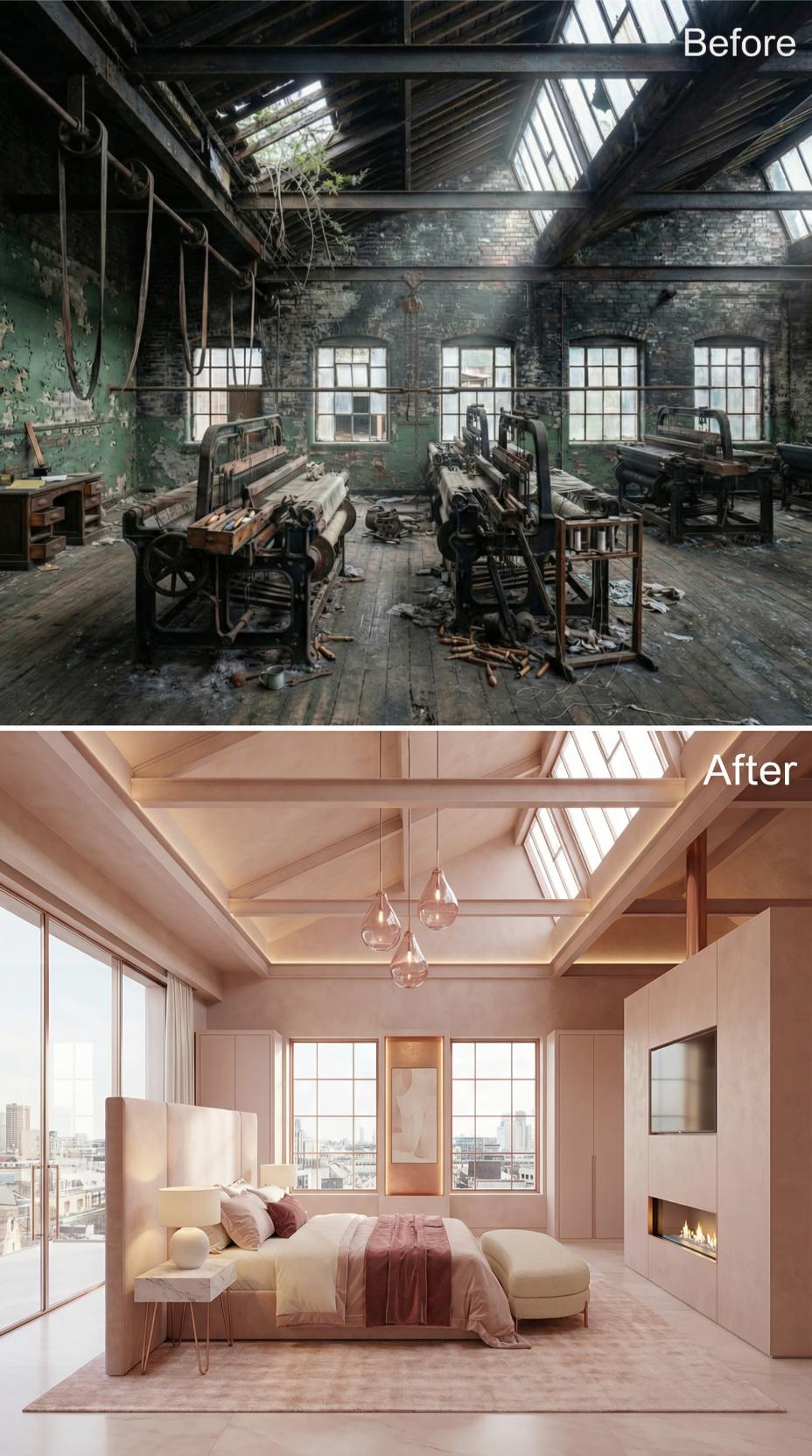
Pale rose plaster covers every vertical surface at the same saturation, but the ceiling breaks that uniformity with raw timber beams left unpainted, their warm grain pulling the eye upward toward original sawtooth glazing that still runs the full roofline. Three teardrop pendants in blown amber glass hang at staggered heights above the bed, casting a warm pool of light that the plaster walls absorb and redistribute rather than reflect.
The bed sits centered on a low-pile dusty rose rug, flanked by a hairpin-leg marble side table on the left. A linear gas fireplace set flush into a full-height paneled surround occupies the right wall, its slot proportions borrowed directly from the mill’s original window rhythm. The chaise at the foot of the bed, upholstered in oatmeal bouclé, reads as punctuation rather than afterthought.
Black Brick, Walnut Cladding, and Sawtooth Skylights Reclaim a Loom Floor
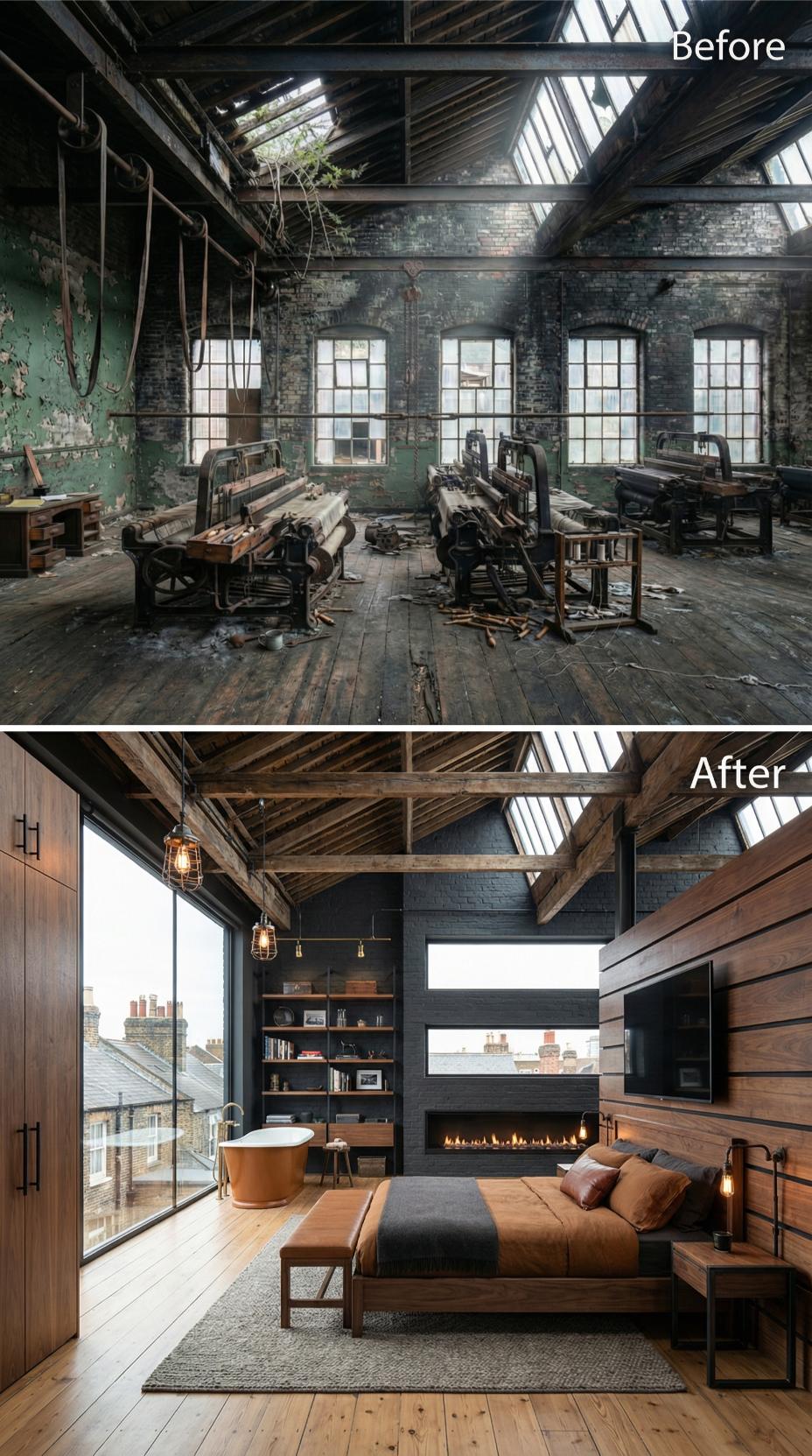
Walnut shiplap runs floor to ceiling on the right-hand wall, anchoring the bed without a single picture or sconce competing for attention. The original sawtooth roofline glazing stays intact overhead, now flanked by rough-sawn timber rafters left unpainted and dark. Cage pendants hang from the ridge on black conduit pipe, and a linear gas fireplace cuts a slot into the painted brick wall at low height.
A copper freestanding bath sits open to the room, positioned beside full-height glazing that frames rooftop chimney stacks outside. The platform bed carries burnt-orange linen and cognac leather cushions. Wide-plank pine flooring, original to the mill, runs beneath a chunky woven rug in natural grey.
Navy Lacquer, Sawtooth Glass, and a Linear Fireplace Settle a Loom Floor Into Night
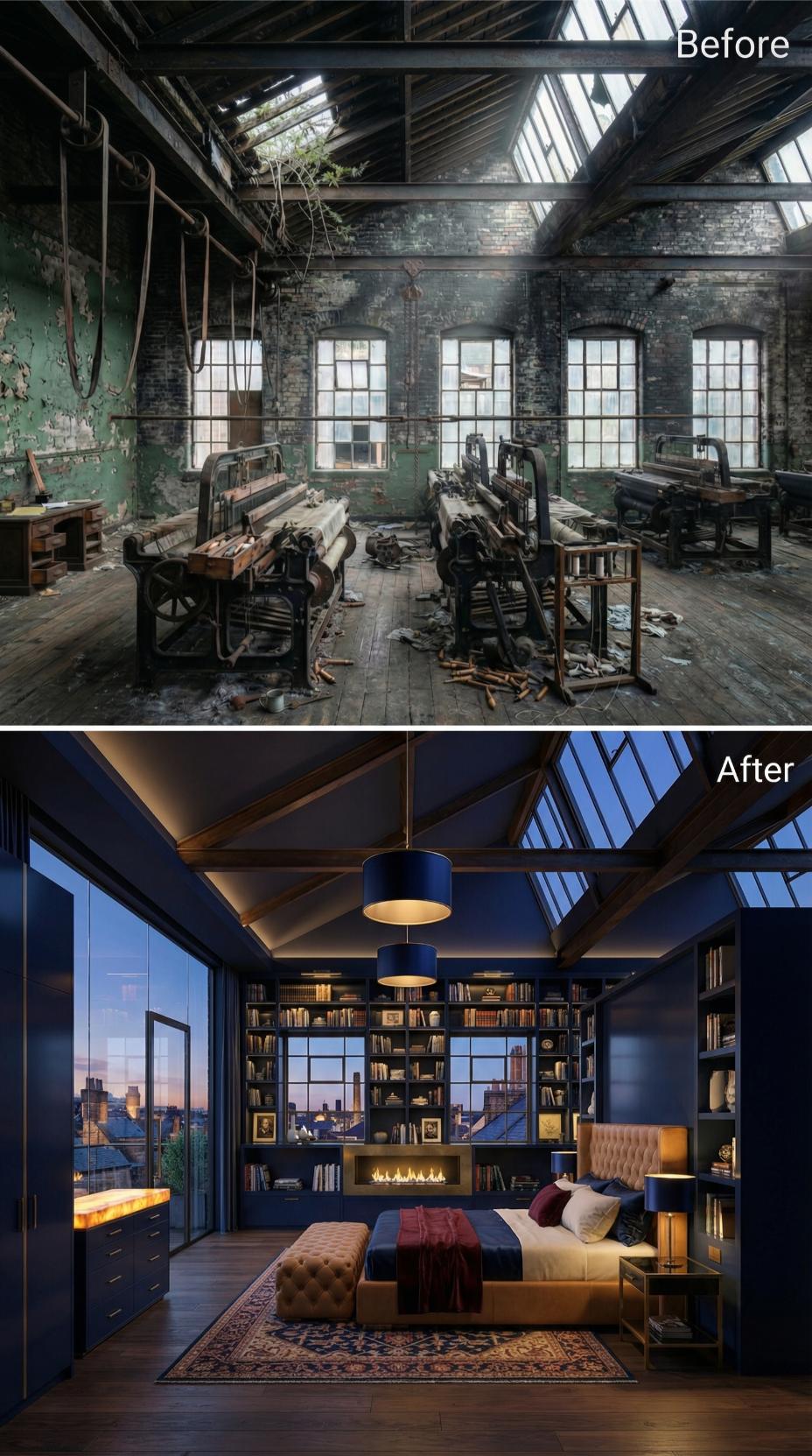
Inky navy cabinetry runs floor to ceiling on three walls, broken only by built-in bookshelves and a recessed linear gas fireplace. A tufted camel velvet bench sits at the foot of the bed, grounding the deep wool rug beneath it.
White-Painted Rafters and Oak Cladding Quiet a Derelict Loom Floor Into Bedroom Use
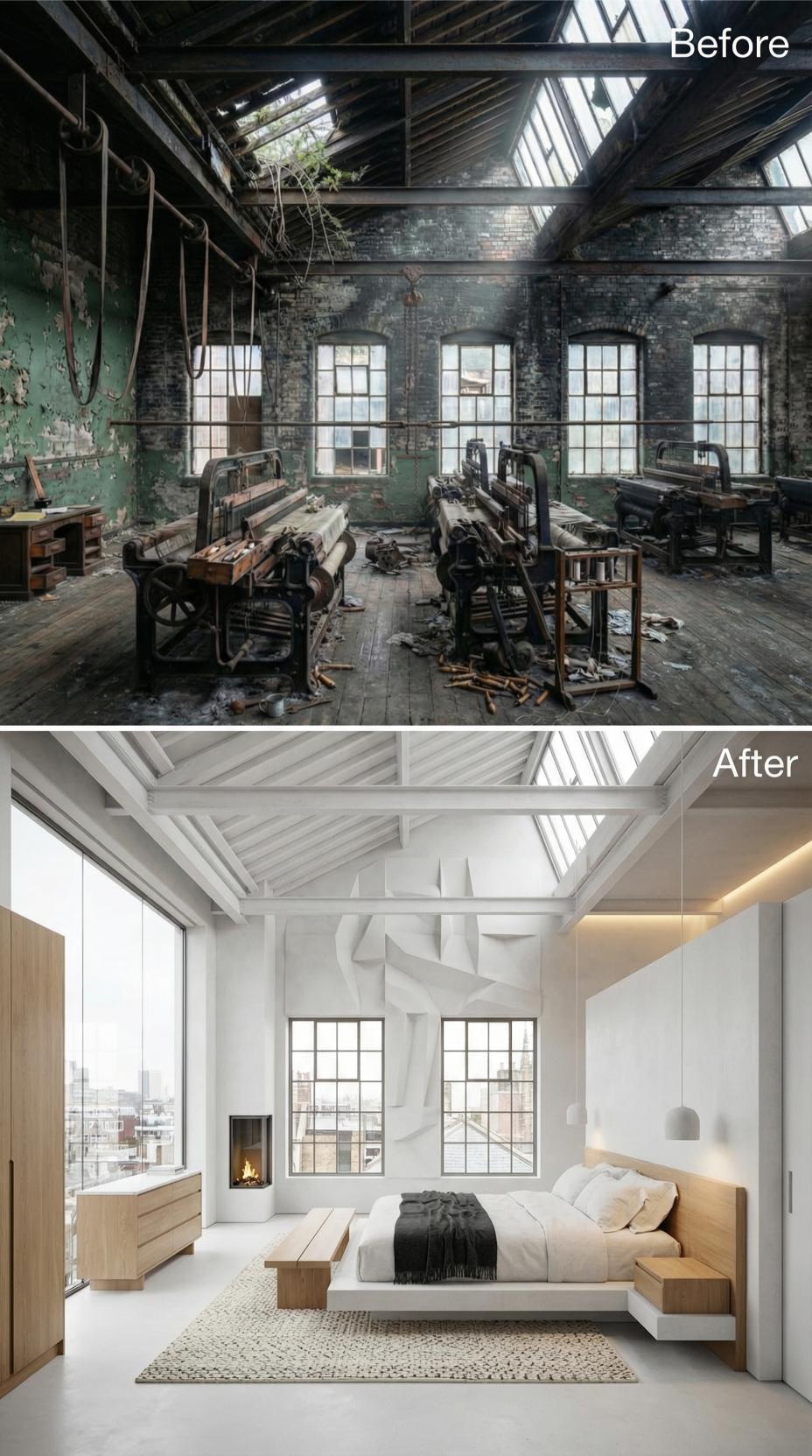
Whitewashed structural beams retain their original spacing above a platform bed in oak-veneer timber, while a slim black-frame fireplace inset into the left wall grounds the room without competing with the grid windows behind it.
Concrete Cladding and Sawtooth Glass Pull a Loom Floor Into the Modern World
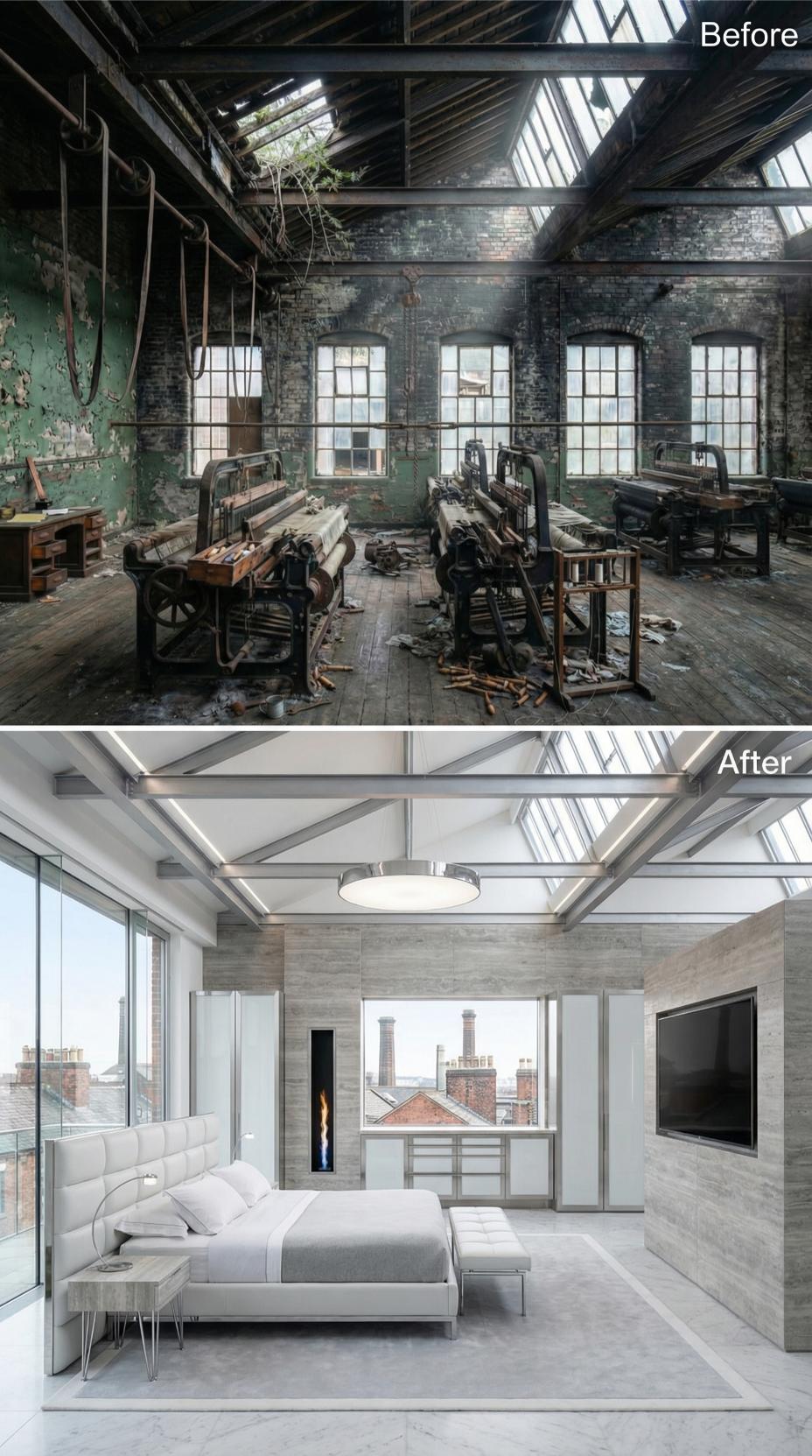
Polished concrete panels run floor-to-ceiling on both side walls, replacing the peeling green brick with a surface that reads cool and continuous without any added color. The original steel rafters remain, now powder-coated white and fitted with recessed strip lighting that traces each structural bay. A linear bioethanol fireplace sits centered beneath the middle window, flanked by low cabinet joinery in matte white lacquer.
The bed sits low to the floor on a platform base upholstered in off-white bouclé, paired with a sectional sofa in matching fabric. Hairpin-leg side tables in brushed steel keep the floor plane open. Outside, factory chimneys are visible through full-height glazing on the left wall, left deliberately unobstructed as the room’s only ornament.
Chainmail Ceiling Panels and Fireplace Flame Pull a Derelict Loom Floor Into Bedroom Use
🔥 Would you like to save this?
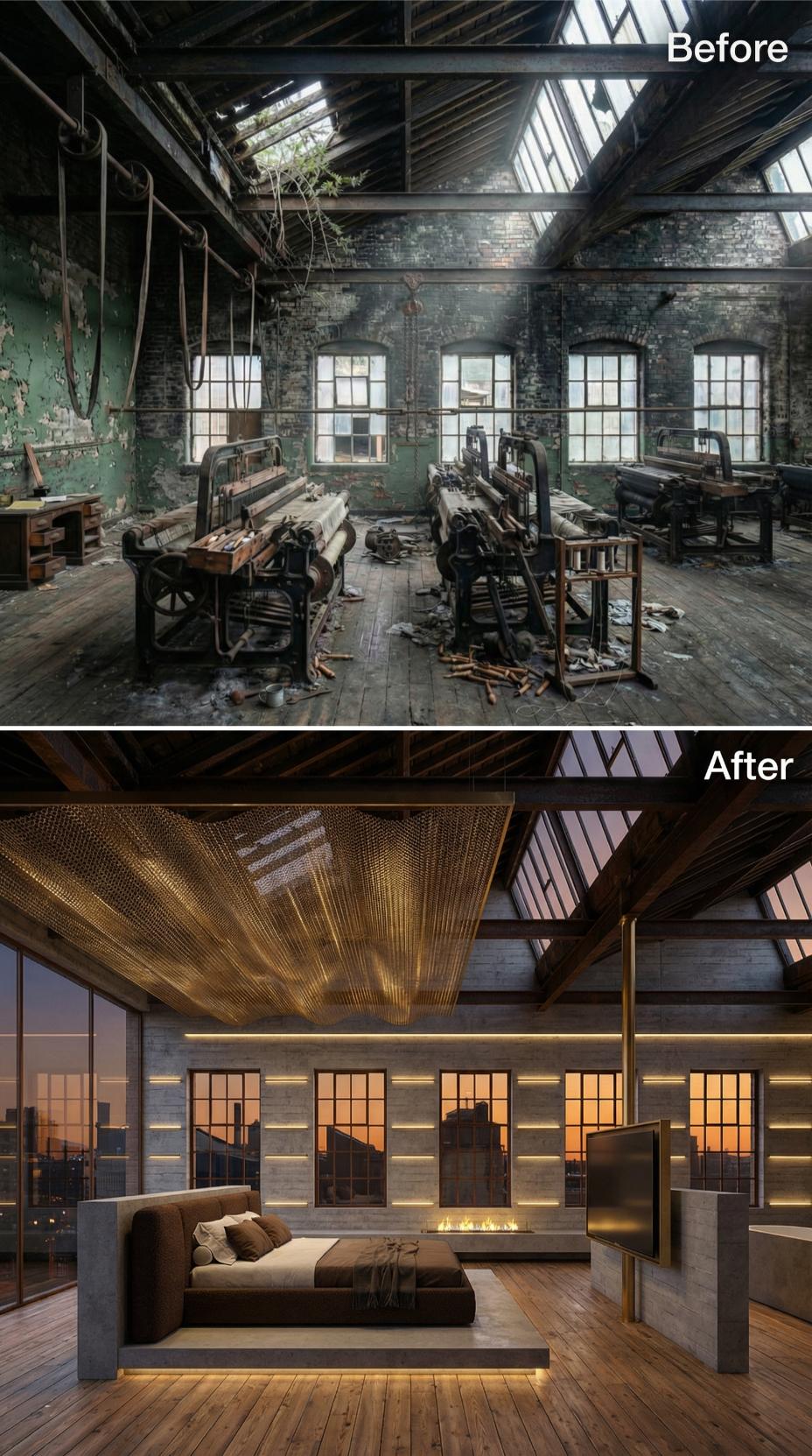
Woven brass chainmail panels hang flat across the ceiling zone above the platform bed, catching warm light from a linear gas fireplace set directly into the raised concrete hearth below. The original sawtooth glazing remains along the rear roofline, now framing a dusk cityscape. Herringbone hardwood runs underfoot.
Marble Cladding and Preserved Steel Trusses Carry a Loom Floor Into Bedroom Calm
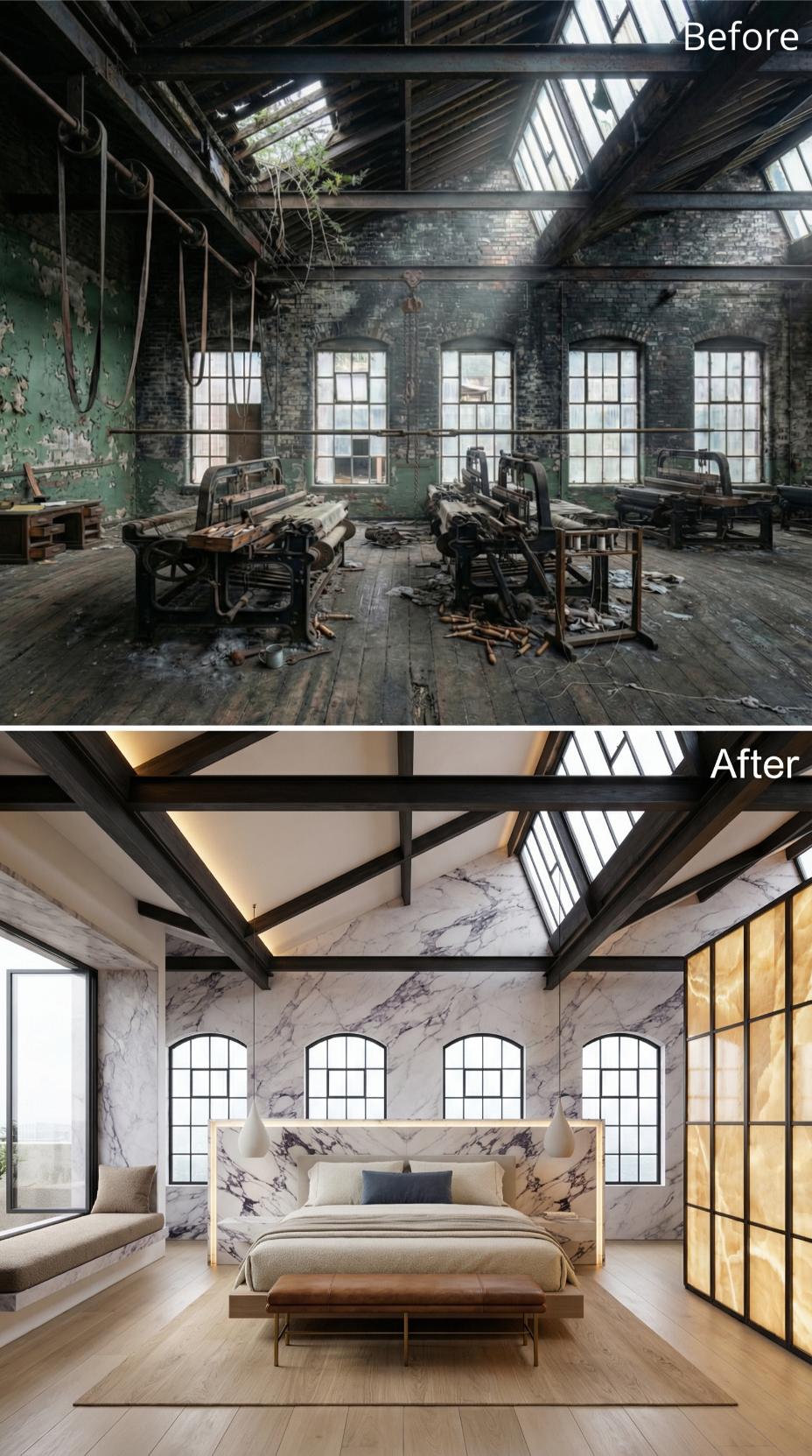
Violet-veined marble runs floor-to-ceiling behind the platform bed, while the original black steel roof trusses remain overhead, their geometry lit by recessed warm strips tucked along the upper planes.
Navy Plaster, Arched Mill Glass, and Sputnik Brass Close Out the Series
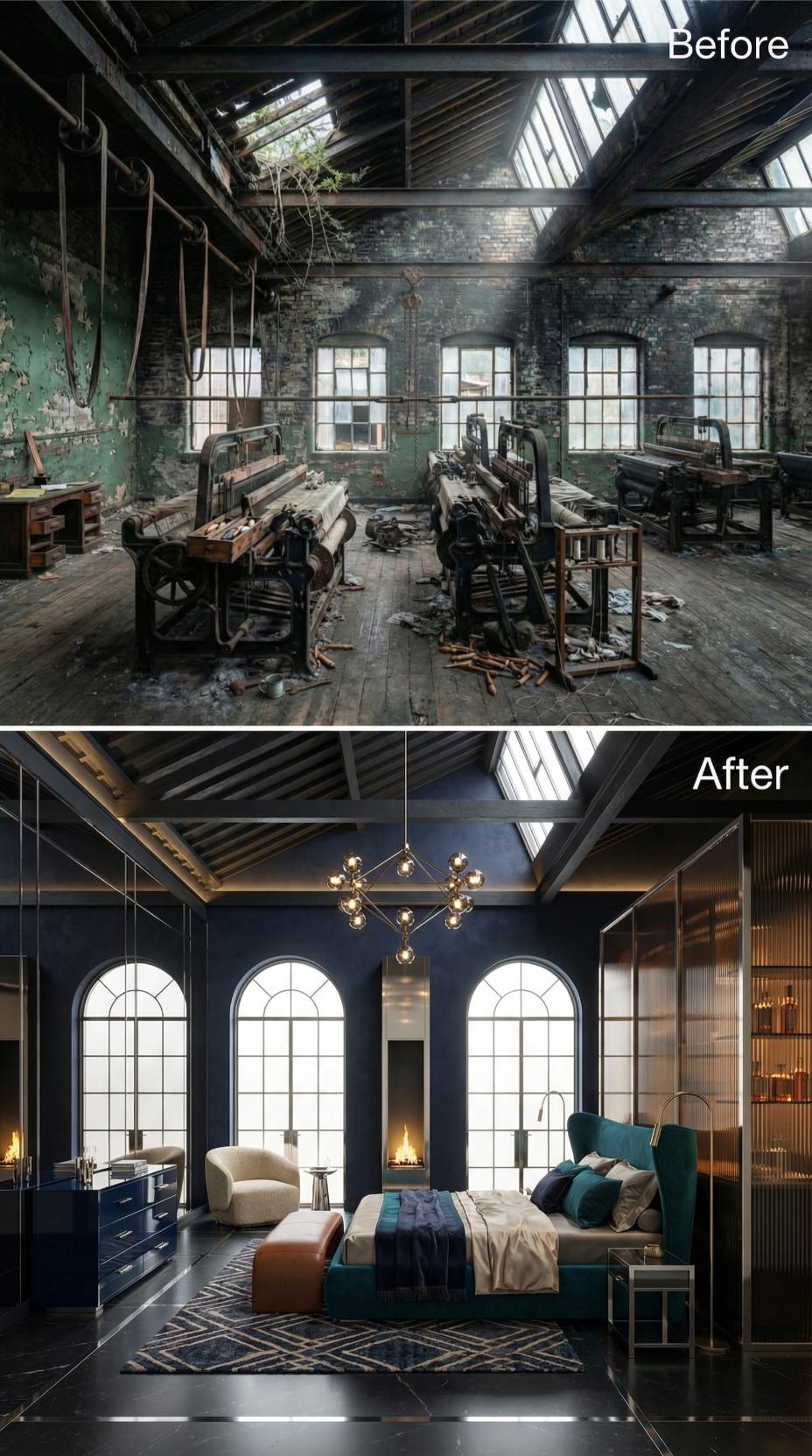
With our final concept the AI design chooses navy plaster over every vertical surface, including the wall behind the teal velvet headboard, to push the room into near-total dark. The original sawtooth roofline survives overhead, its rafters now painted charcoal rather than stripped back, while three arched-top steel casement windows replace the derelict factory glazing and flood the floor with flat white daylight. A sputnik chandelier with bare globe bulbs hangs low over the bed, its brass armature pulling warmth from the teal and cognac leather that appears on the reading chair opposite.
Underfoot, black marble tile replaces the ruined loom-floor boards entirely, and a geometric wool rug in charcoal and cream defines the sleeping zone without interrupting the stone plane around it. A navy lacquer dresser with unlacquered brass pulls sits left of the fireplace, which burns behind a flush rectangular opening cut directly into the plaster wall. Ribbed glass panels on the far right suggest a dressing room partition rather than a solid wall, keeping the footprint open without requiring a door.