🔥 Would you like to save this?
You noticed the builder-grade carpet the moment you walked in. You clocked the mass-produced art, the mismatched throw pillows, the ceiling fan with the light kit. You said nothing, obviously — you’re not a monster. But you thought it. This is the living room for people like you: a space so considered, so layered, so quietly devastating in its references that guests will spend the drive home reconsidering every choice they’ve ever made.
In order to come up with the very specific design ideas, we create most designs with the assistance of state-of-the-art AI interior design software. Also, assume links that take you off the site are affiliate links such as links to Amazon. this means we may earn a commission if you buy something.
Builder grade living rooms share a particular look that most homeowners know well: beige walls, basic trim, flat overhead lighting, and flooring that came with the house because nobody stopped it. These rooms are not offensive, exactly. They are just aggressively average, the kind of spaces that make guests feel nothing and owners feel vaguely embarrassed. What happens after those rooms get a real overhaul is a different story entirely. The before-and-after collection here pulls together 31 living rooms that started from that same flat, forgettable baseline and ended up somewhere worth talking about.
The reason this particular set of makeovers stands out is specificity. Each one shows a clear decision, a choice about color, furniture arrangement, lighting, or texture, that pulled a room out of neutral territory. There is no single formula at work. Some homeowners went bold with dark paint and replaced recessed cans with statement fixtures. Others kept things spare and let one good sofa do the heavy lifting. All of them made choices, and those choices are visible, which is exactly what makes these rooms worth studying.
Beige Carpet and Builder Dreams, Buried Under Black Marble
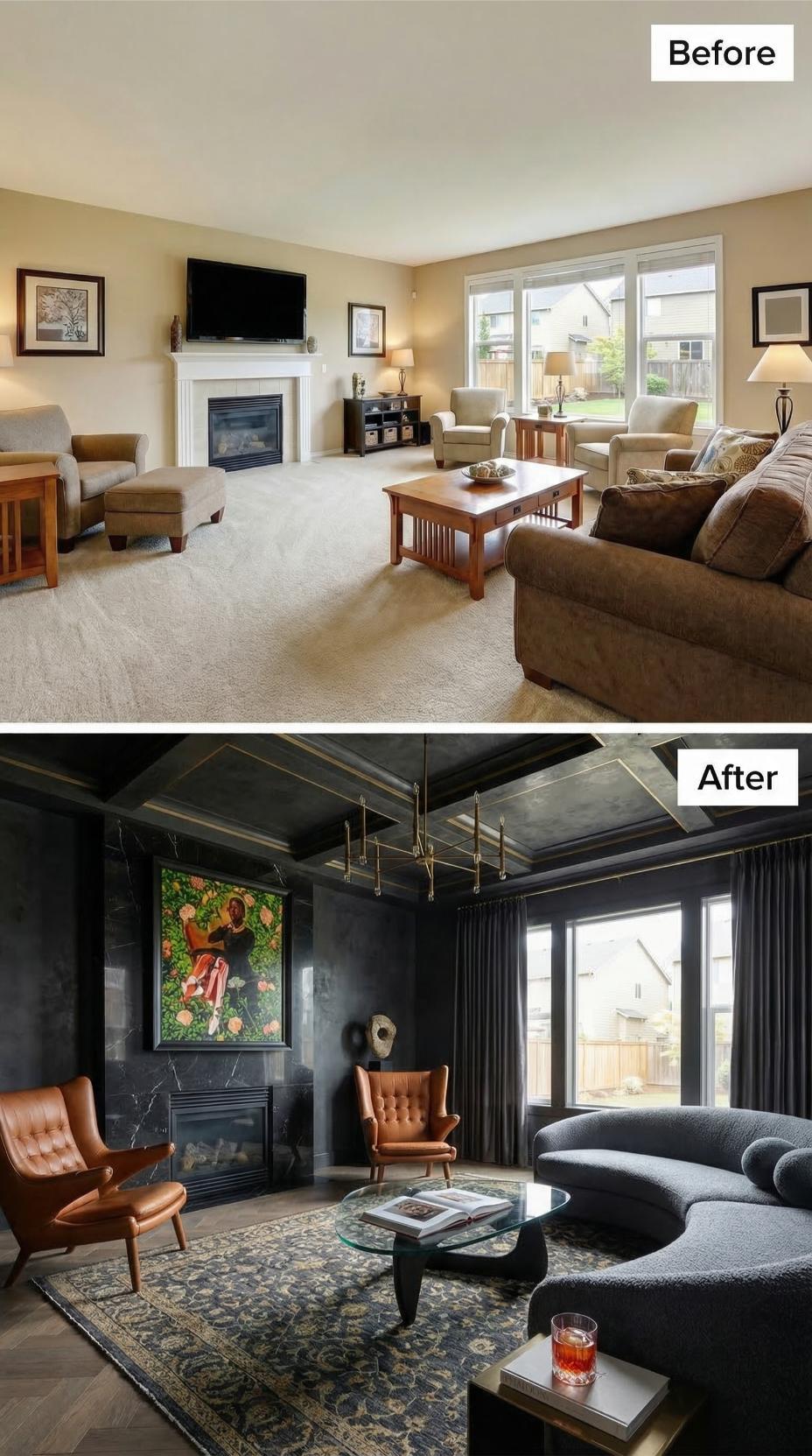
Dark venetian plaster walls, black coffered ceiling trim with brass inlay detail, and black marble surround on the original gas fireplace replace what was once a room full of warm beige paint and cut-pile carpet. Two cognac leather papa bear chairs anchor the fireplace wall beside a glass-top coffee table with a sculptural black base, while a slate-blue bouclé sectional sits opposite on a wool area rug with an indigo floral pattern. A brass sputnik-style chandelier pulls the ceiling metalwork down into the room.
Beige Walls Got a Gold Leaf Intervention Nobody Asked For (But Everyone Wanted)
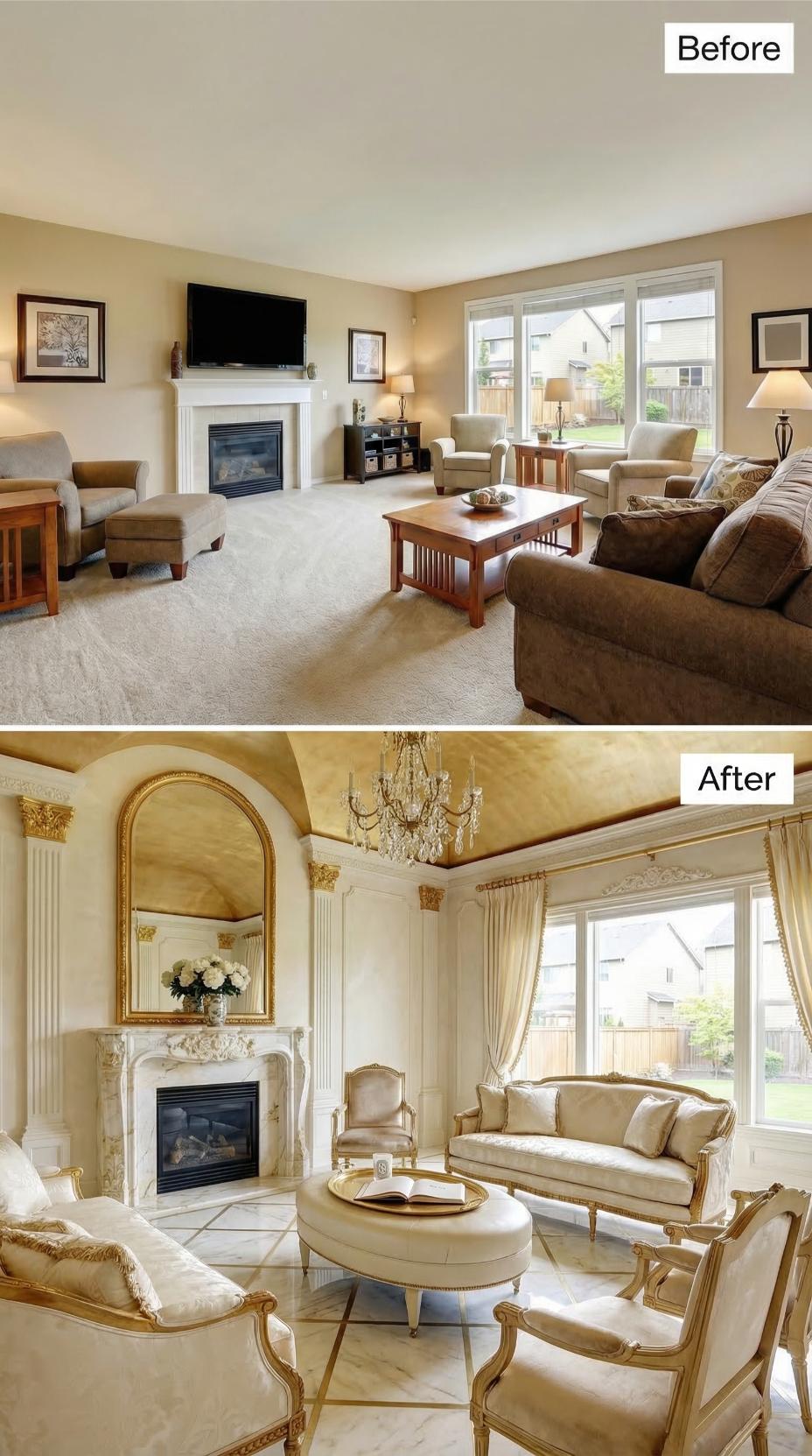
Flat beige walls and builder carpet gave way to Venetian plaster ceilings washed in warm gold, arched niches framed by carved pilasters with gilded Corinthian capitals, and a marble fireplace surround replacing the original painted MDF mantel. The TV disappeared entirely. A crystal candelabra chandelier now anchors the ceiling where recessed cans once sat.
French provincial seating in ivory silk damask clusters around a round ottoman with a lacquered tray top. Marble floor tiles in a large-format cream pattern replaced the wall-to-wall carpet. Gilt wood frames on both the mirror and accent chairs repeat the gold finish throughout without feeling accidental.
Coffered Ceilings and Leather Chairs Finished What Beige Started
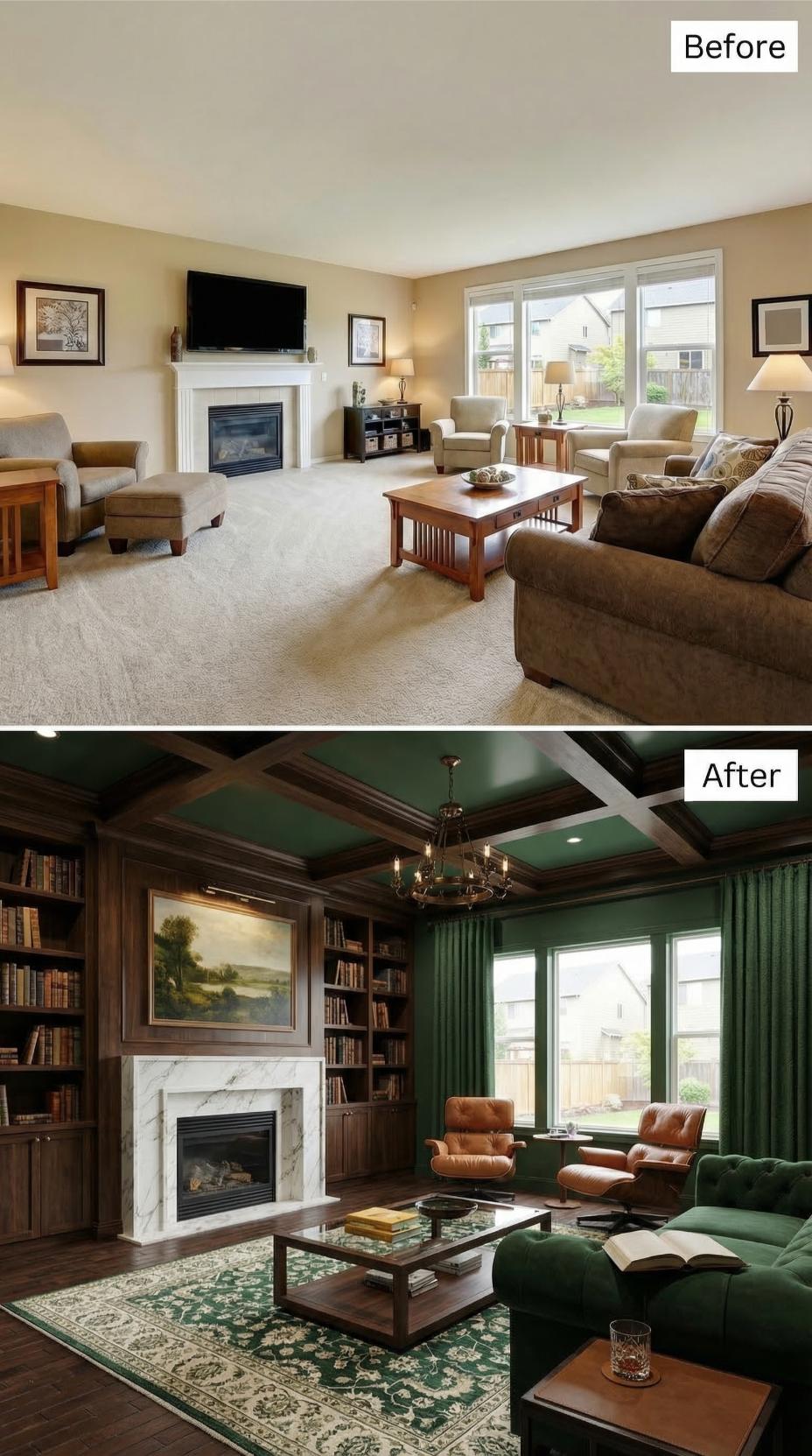
Painted forest green with dark walnut coffered beams, the ceiling alone signals that someone made a very deliberate set of choices here. The white marble fireplace surround replaced builder-grade painted wood trim, and built-in shelving now flanks both sides floor to ceiling, filled with books rather than decorative voids. A wrought iron chandelier hangs at center. The rug beneath the glass-and-walnut coffee table runs a cream-and-green Persian pattern.
Two cognac leather Eames-style lounge chairs anchor the seating arrangement, paired with a tufted green velvet sofa. Emerald linen curtains pool slightly at the floor. Every surface here has a material identity. The before photo had carpet in a shade best described as “nothing in particular.”
Navy paint and portrait galleries aren’t the only way to bury a beige room alive.
Coral Velvet and a Murano Chandelier Walked Into a Builder-Grade Living Room
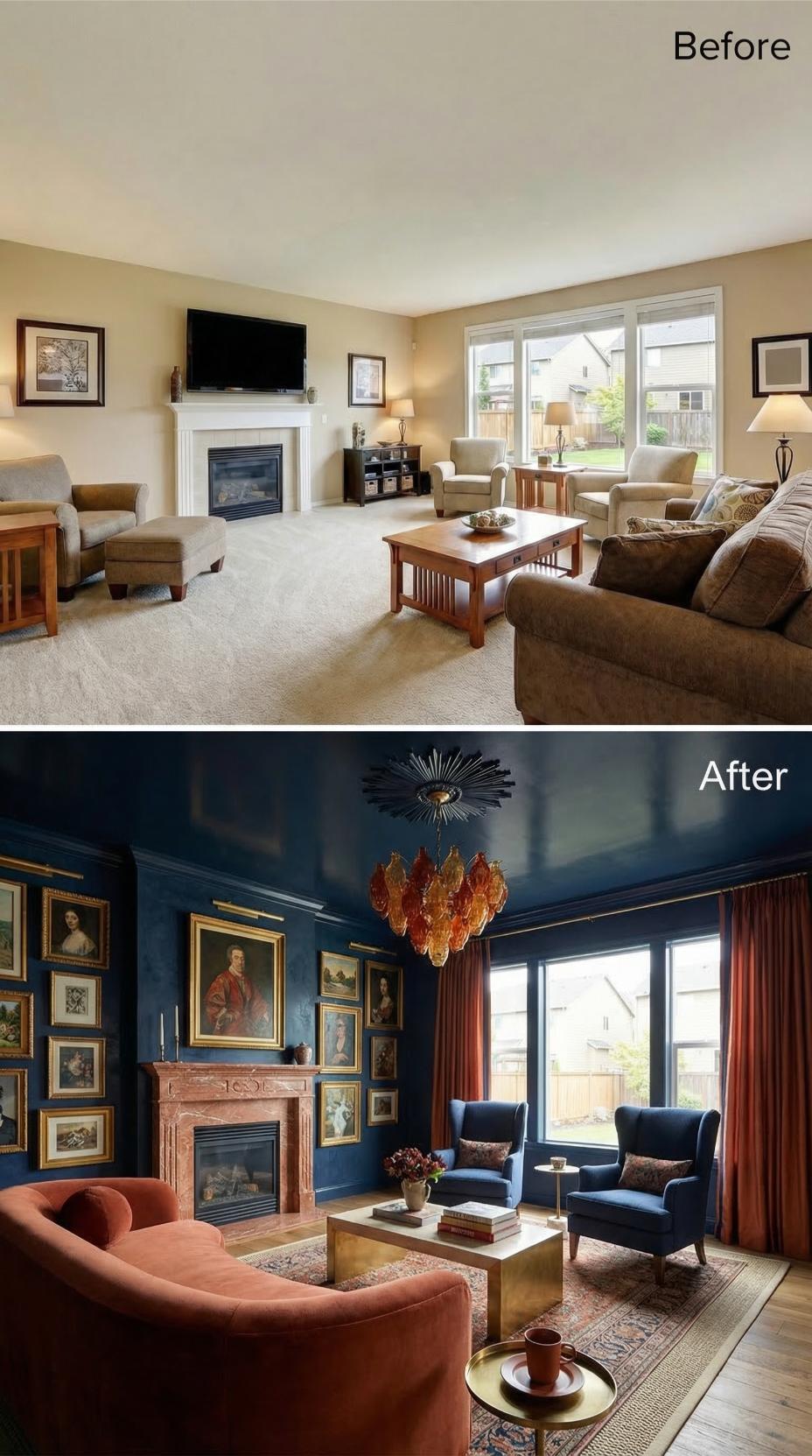
The before photo shows wall-to-wall carpet in a pale oatmeal tone, a white-painted fireplace surround with standard gas insert, and a Mission-style oak coffee table doing its best against beige walls. The after keeps the same window placement but replaces everything else: deep navy lacquer covers walls and ceiling in an unbroken gloss finish, a pink marble fireplace surround swaps out the builder white, and a coral velvet sofa anchors the left side while two navy wingback chairs face the window. An amber Murano glass chandelier with leaf-shaped pendants hangs from a sunburst ceiling medallion. Oil portraits in gilt frames cover the left wall gallery-style, and a Persian rug in rust and navy ties the hardwood floor together.
Rose Marble Walls and a Curved Velvet Sofa Erased Every Trace of Builder Beige
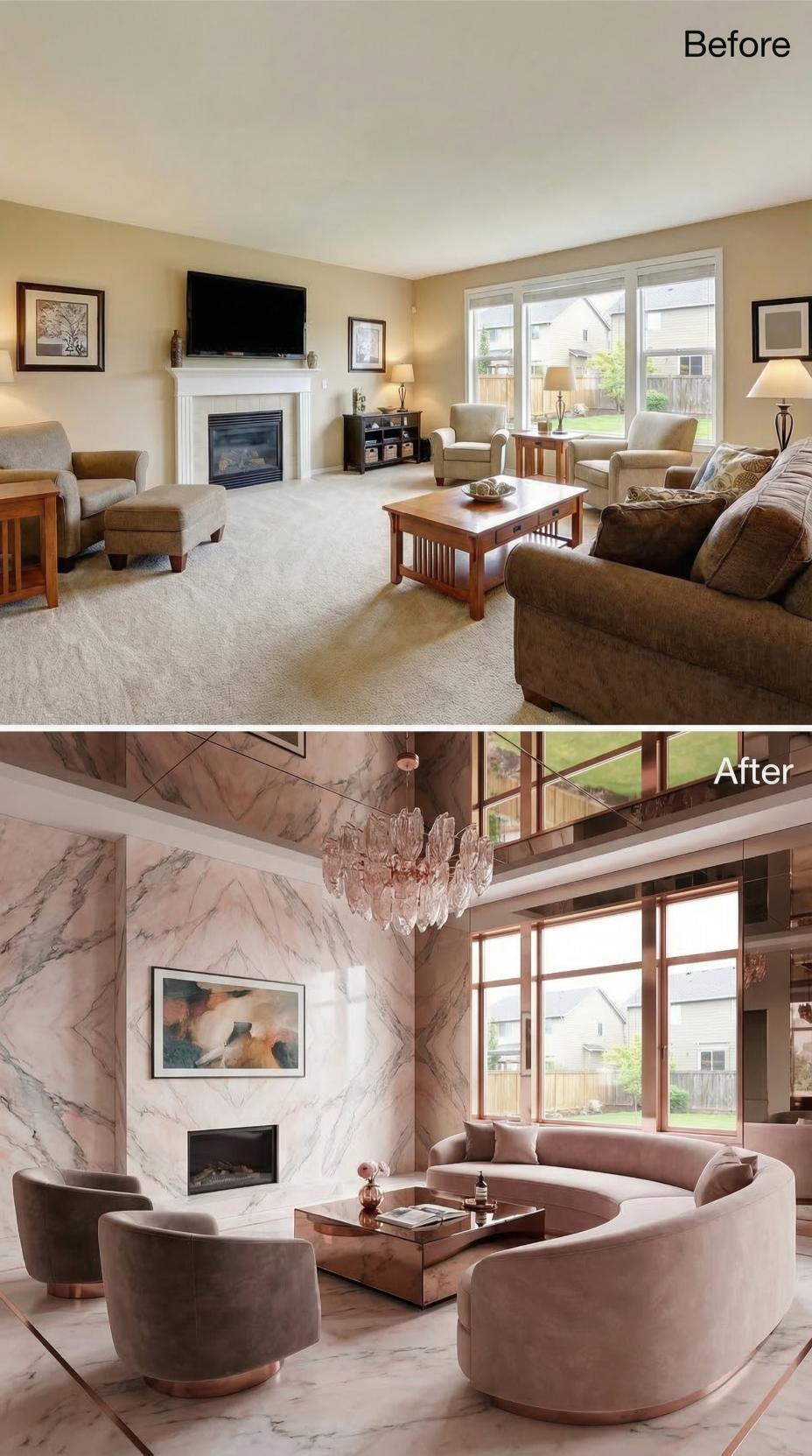
Blush-veined marble cladding runs floor to ceiling on the fireplace wall, replacing what was once flat beige drywall and a white mantel holding a wall-mounted television. The marble’s pink and grey veining pulls directly into the room’s palette, where a circular velvet sofa in dusty rose anchors the space alongside two barrel chairs with copper base legs.
A mirrored copper coffee table sits at the center, and a Murano-style chandelier in pink glass drops from what now reads as a double-height ceiling with a glass-railed mezzanine above. Window frames shifted from white vinyl to copper-toned metal, connecting every finish in the room back to one deliberate choice.
- Barrel chairs with copper leg bases echo the window frame finish
- Marble tile continues across the floor, eliminating any visual break
- Pink glass chandelier repeats the blush tone without adding a new color
Matte Black Tile and Amber Bouclé Buried the Builder Fireplace for Good
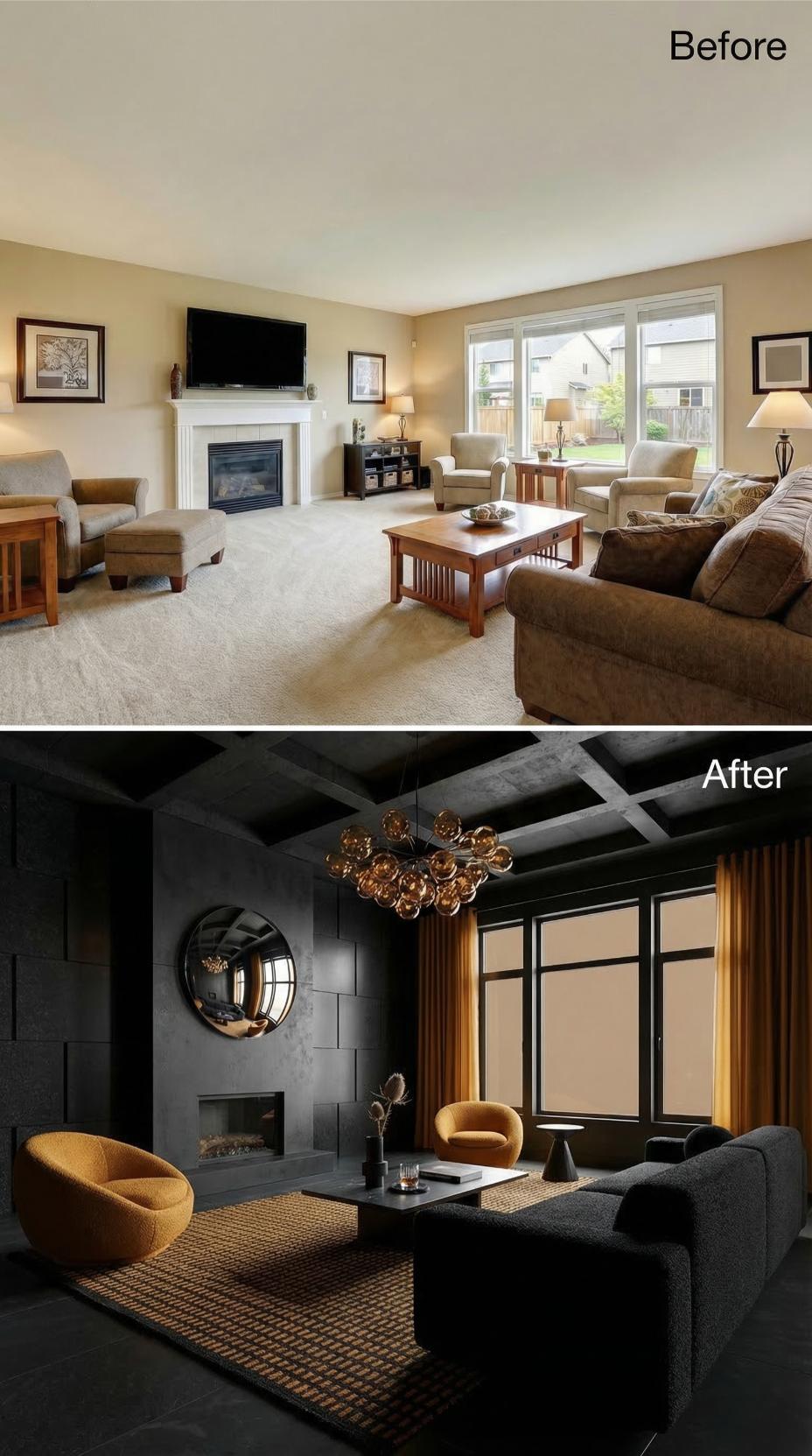
Charcoal wall panels surround a stripped-down fireplace while amber bouclé chairs anchor the seating against a near-black sofa.
In The Details: The globe chandelier, with its cluster of smoked amber glass spheres, does the work three recessed lights never could. Gold curtain panels against black window frames pull the amber from the furniture without repeating it exactly. That round convex mirror above the fireplace reflects the chandelier back into the room, doubling its presence.
Crimson Leather and Floral Wallpaper Finished Off What Beige Carpet Started
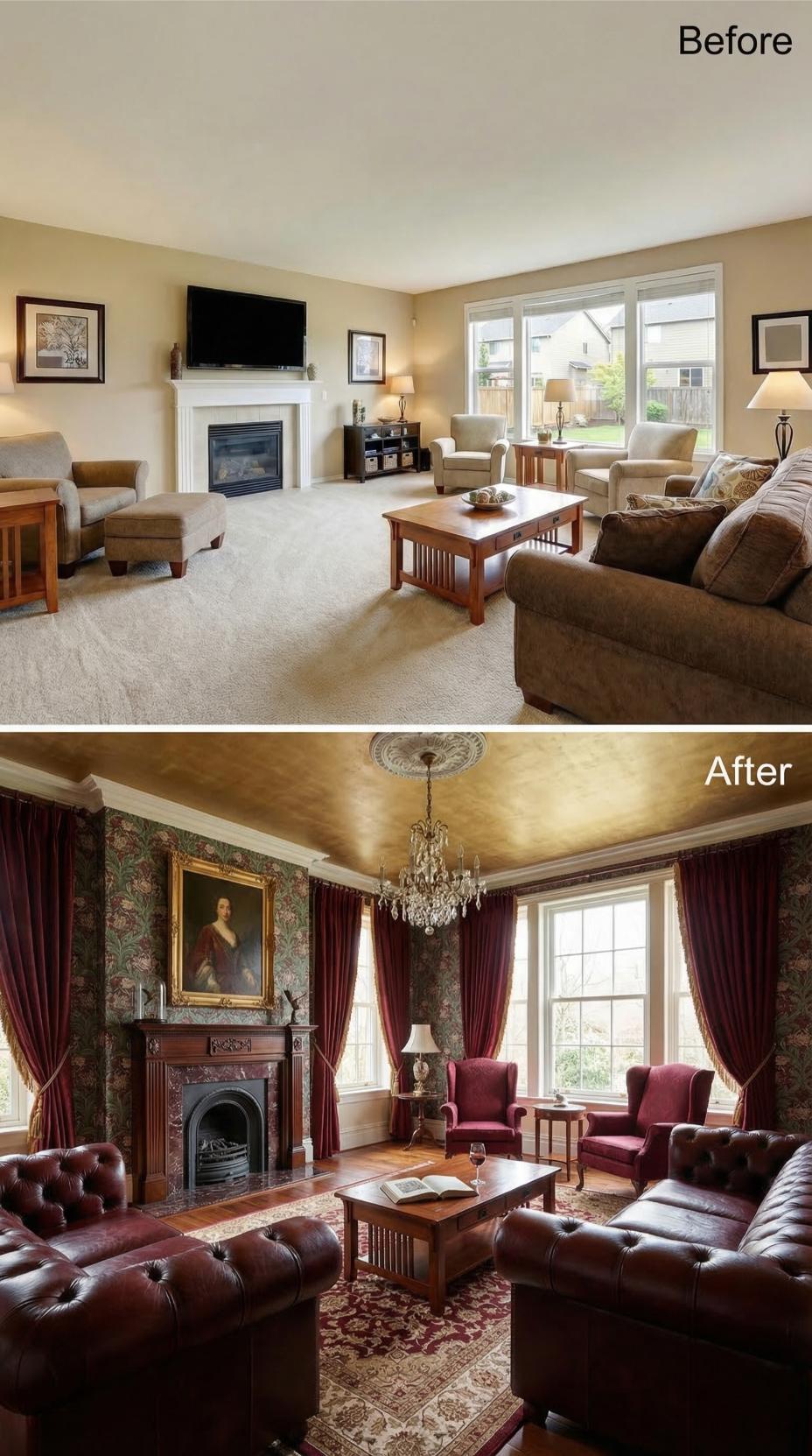
Builder-grade carpet and a gas fireplace with a white painted surround gave way to something far less forgiving. Dark wood floors now anchor the room, while floral wallpaper in deep green and burgundy covers every wall from baseboard to crown molding. A marble fireplace surround with an arched cast-iron insert replaced the original box. Above, a gold-finish plaster ceiling medallion anchors a crystal chandelier that throws warm light across the room.
Oxblood leather Chesterfield sofas face a pair of burgundy wingback chairs upholstered in velvet. A Persian rug in crimson and ivory ties the seating arrangement together. Heavy plum silk curtains pool slightly at the floor beside the window. A gilt-framed portrait of a woman in period dress hangs above the fireplace, doing exactly what a flat-screen television cannot.
Why It Works: Mixing oxblood leather with velvet wingbacks in the same red family works because the contrast in texture keeps the palette from flattening. The portrait above the fireplace adds vertical weight that pulls the eye up toward the medallion, creating a visual loop that holds the room together without additional artwork.
Limewash Walls and a Rattan Pendant Quietly Dismantled the Beige Carpet Era
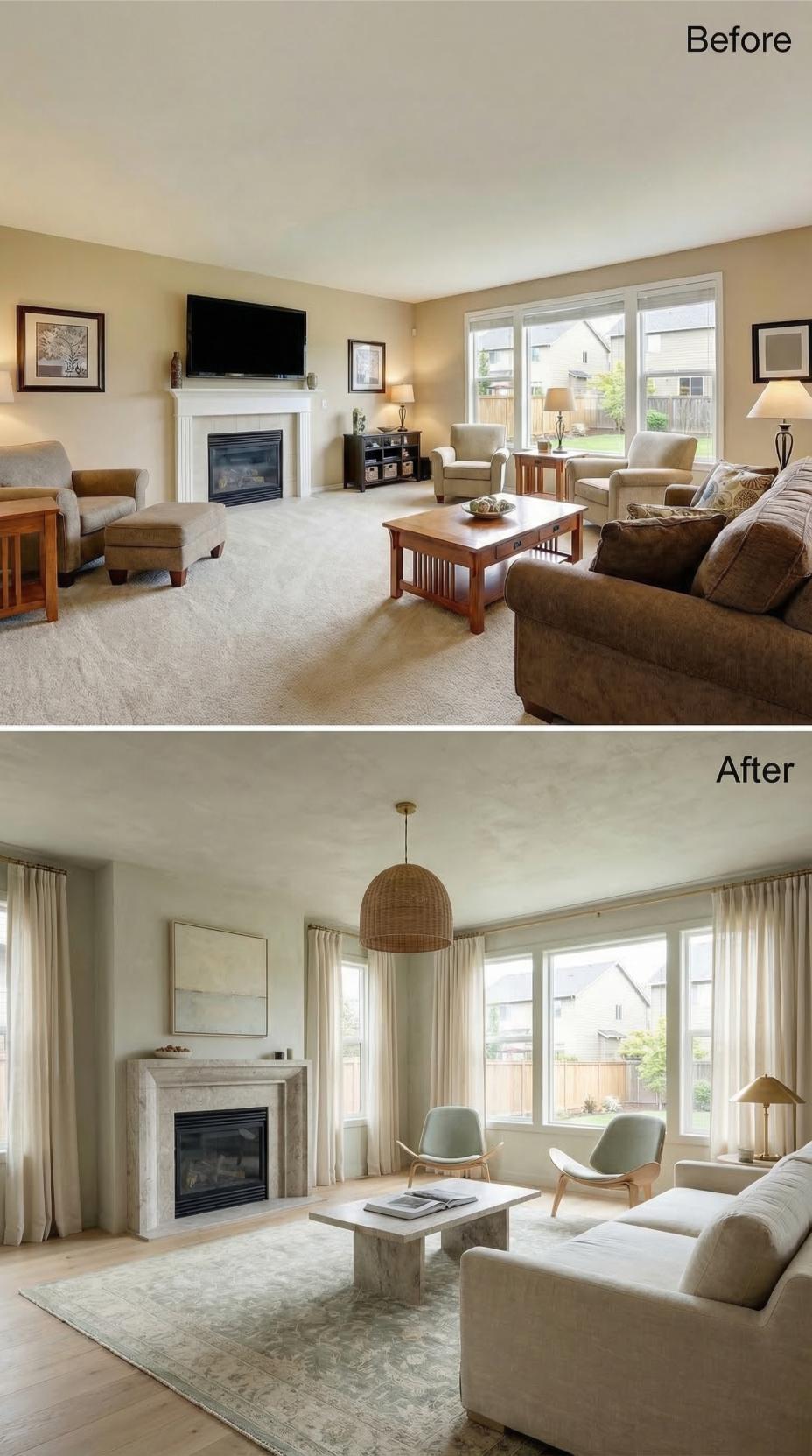
Swapping carpet for wide-plank hardwood changed the acoustics, the light, and the entire social contract of this room.
Limewash paint on the walls replaced flat builder beige with a surface that shifts between warm grey and sage depending on the hour. The fireplace surround got reclad in veined stone tile with a honed finish, and the TV came down entirely. A woven rattan dome pendant now anchors the ceiling where recessed cans once did nothing. Two low-profile chairs in sage upholstery face a concrete or stone-top coffee table, and linen curtains hang floor to ceiling, making the window wall read taller than it is.
Cobalt Blue and White Marble Replaced Every Square Inch of Beige’s Comfort Zone
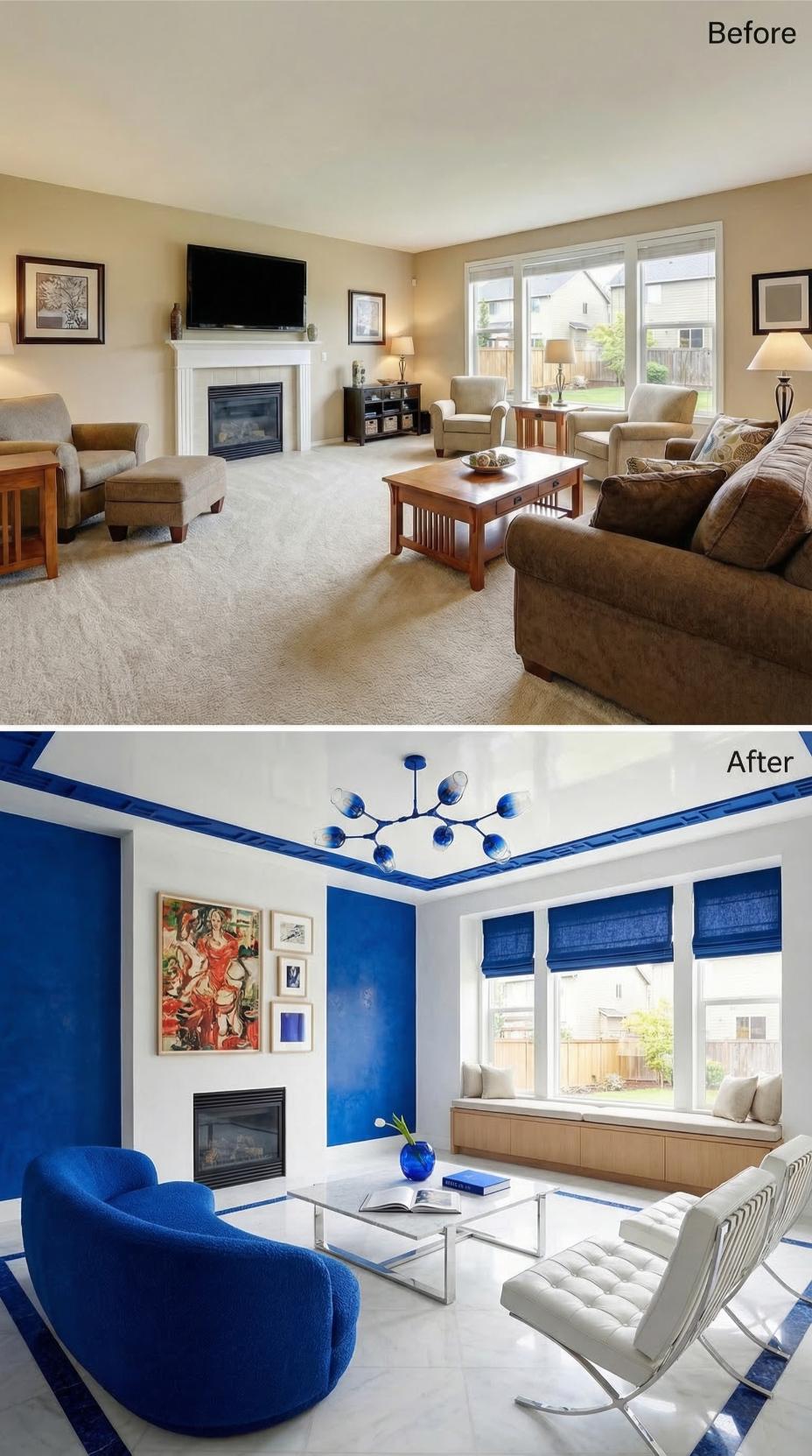
Cobalt blue lacquered walls wrap three sides of the room while white marble tile with inset blue border strips replaces what was once wall-to-wall carpet. A Sputnik-style chandelier with blue glass globes hangs where recessed lighting used to blend into the ceiling. The bouclé swivel chair and Barcelona-style lounge in white leather sit on opposite ends of the coffee table, a chrome-and-glass slab that reflects the fireplace surround below it.
History Corner: Klein blue, the ultramarine shade covering these walls, was famously claimed as a proprietary color by French artist Yves Klein in 1960, who mixed dry pigment with a synthetic resin to achieve its particular depth. Interior designers working with saturated blue lacquer finishes often reference his IKB formula when specifying paint sheen levels, because flat versions of the color absorb light rather than reflect it. The window seat built into the bay window replaced what was originally dead floor space between the sofa and the glass.
Walnut Paneling and a Leather Sofa Settled the Score Against Beige Carpet
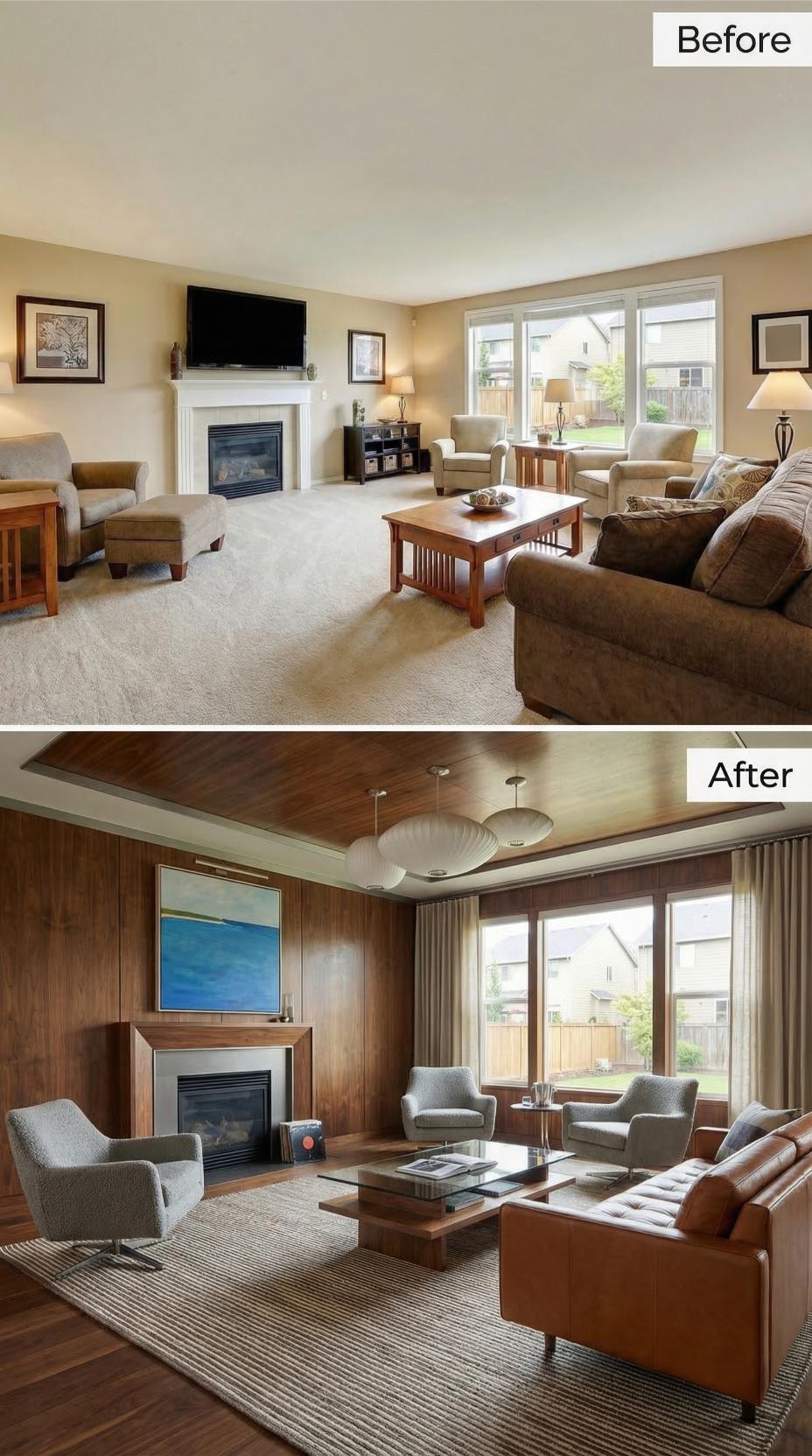
Walnut-toned wall paneling runs floor to ceiling, replacing the original cream paint with something that actually has weight. A tray ceiling with matching wood inset pulls the material upward so the room reads as intentional rather than heavy. The cognac leather sofa sits low and tufted, flanked by bouclé swivel chairs in warm gray. A glass-top coffee table on a walnut platform base keeps the center open, and a single abstract seascape in cerulean and sage gives the fireplace wall its only soft note.
Pro Tip: Mid-century rooms relied on wood paneling not just for warmth but for acoustics, since solid wood surfaces absorb and diffuse sound differently than drywall. If the paneling reads dark on camera or in person, a single large-format artwork in cool tones does more to balance the palette than repainting ever would. Walnut specifically holds its color better than oak or pine under artificial light, which is why it works in rooms that rely on pendant fixtures rather than natural daylight.
Sky Mural Ceiling and Terracotta Floors Handed Beige Its Eviction Notice
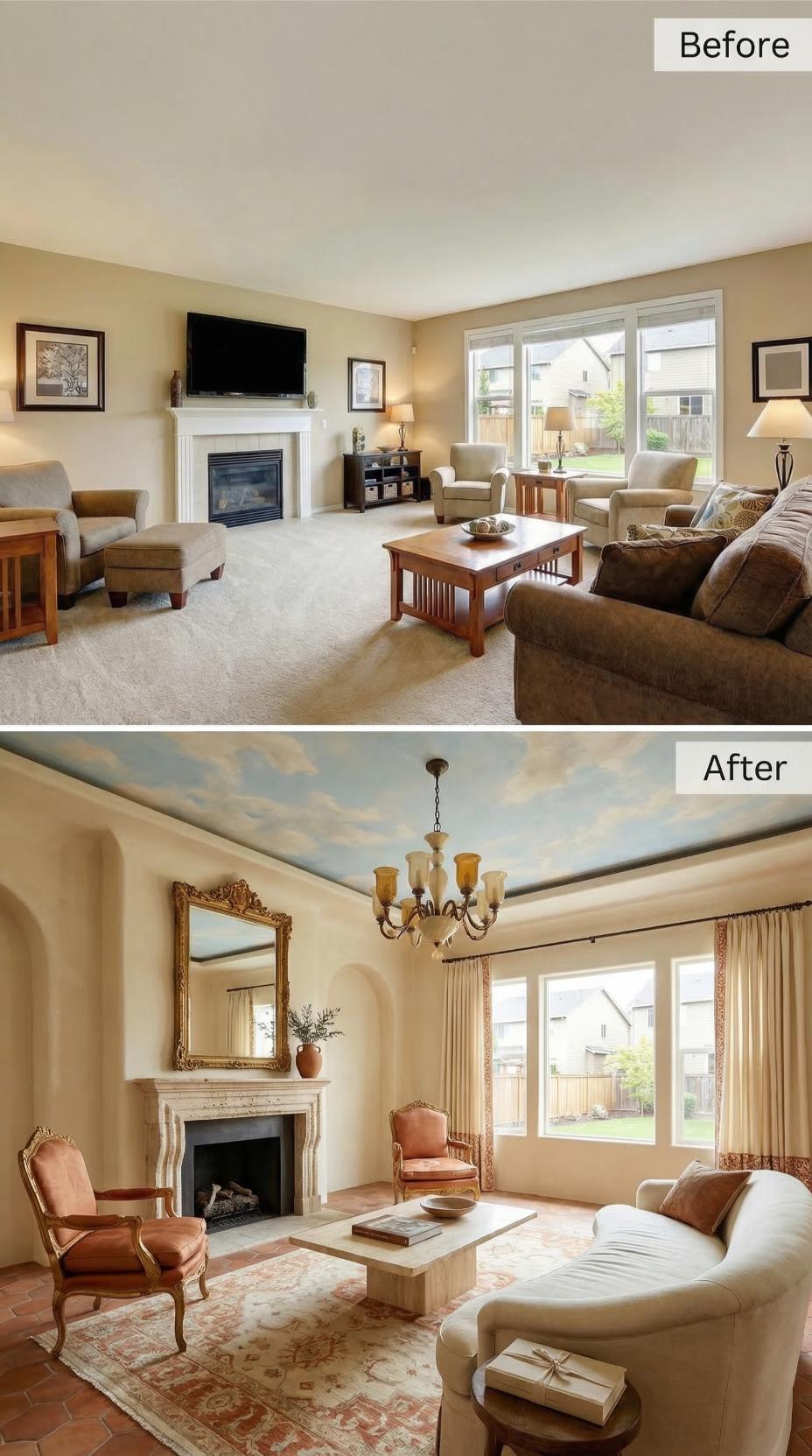
Someone painted clouds on the ceiling. Not decorative wallpaper, not a printed panel — a hand-rendered sky mural covers the entire tray ceiling, trimmed in warm cream plaster that ties it back to the walls below. A wrought iron chandelier with amber glass shades hangs from the center, pulling the eye up without competing with the painted sky.
Below that ceiling, terracotta floor tiles replace the carpet entirely. Two Louis XV-style chairs in salmon-pink velvet face a travertine coffee table. A carved limestone fireplace surround and a gilt mirror complete the shift from tract house to something that feels like it was pulled from a Florentine side street.
Style Math: Tray ceilings gain significant visual depth when the recessed field is treated as a fifth wall rather than left plain. In this room, the sky mural works because the tray edge creates a natural frame, giving the painted clouds a boundary that keeps the effect from reading as chaotic. Ceiling murals date to Roman domestic interiors, where painted architectural illusions were used to make rooms feel open to the sky above.
Navy Walls, Copper Coffered Ceilings, and Zero Apologies for the Beige That Came Before
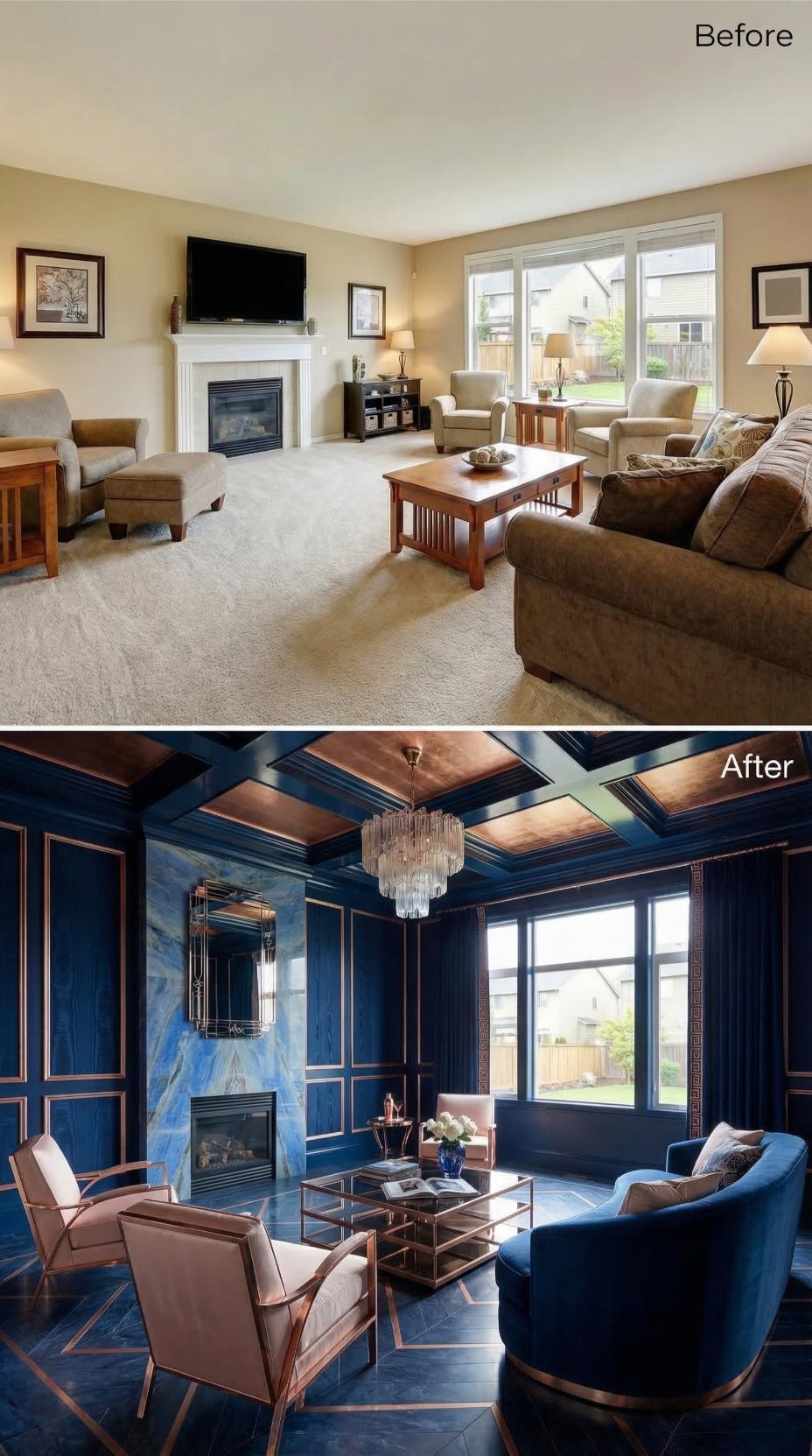
Deep navy wall paneling trimmed in copper-toned molding replaces the original beige carpet room entirely, paired with a tiered glass chandelier, a blue marble fireplace surround, and rose gold accent chairs in linen upholstery around a brass-framed glass coffee table.
Did You Know: Coffered ceilings painted in the same deep color as surrounding walls create a visually enclosed effect that makes rooms feel more intentional and intimate, regardless of square footage. The copper-leafed ceiling panels here reflect warm light back into the space in a way standard recessed lighting cannot replicate. This technique, sometimes called monochromatic architectural layering, originated in formal European interior traditions dating back to 18th-century salon design.
Dark Wood Cladding and Egg Chairs Closed the Case on Beige Carpet
🔥 Would you like to save this?
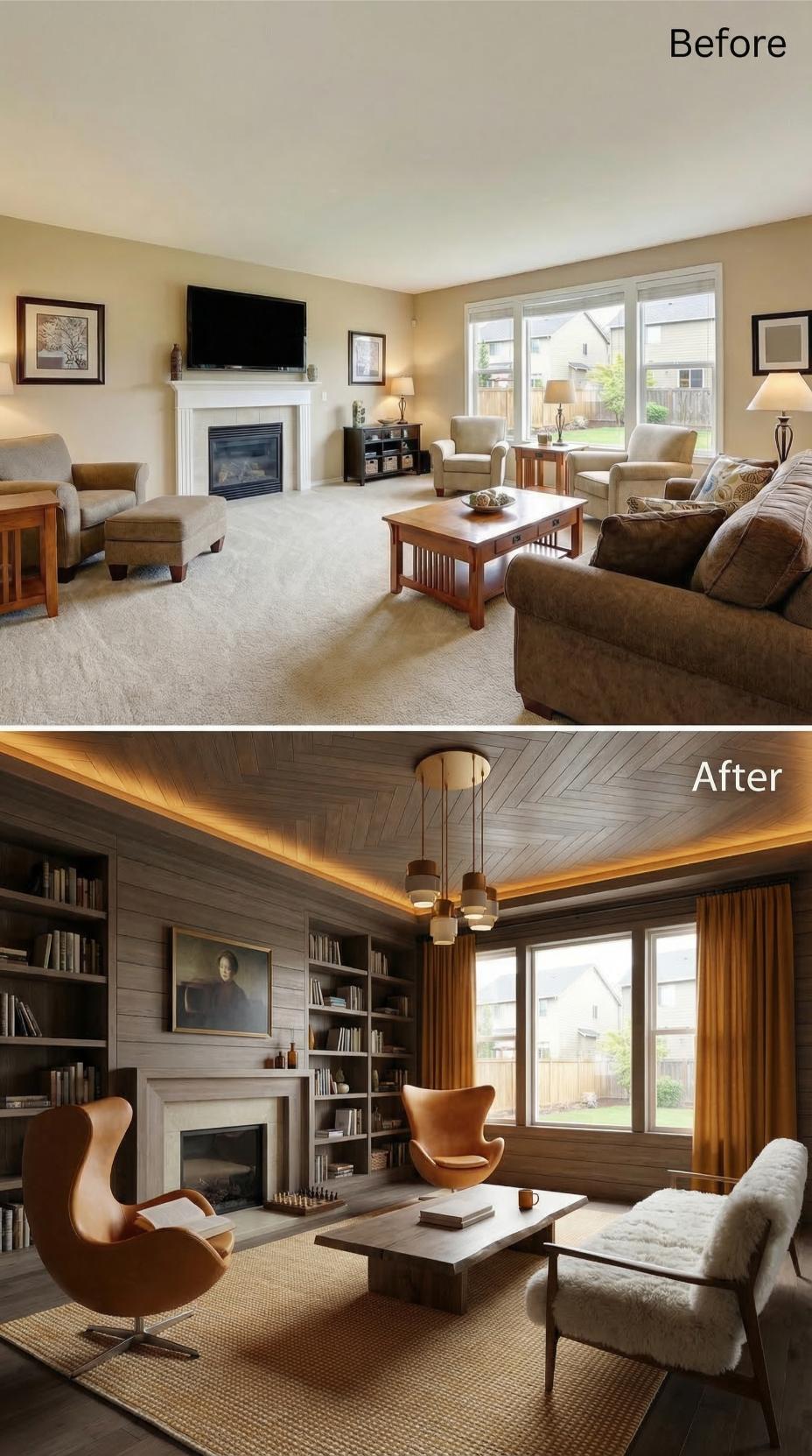
Gray-stained shiplap covers every wall from floor to ceiling, and the herringbone-patterned wood ceiling with perimeter LED cove lighting does something recessed cans never managed: it makes the room feel enclosed on purpose. The fireplace surround, now clad in the same gray wood with a limestone mantel shelf, no longer floats awkwardly against a beige wall. Built-in shelving flanks both sides, filled with books and objects that give the room actual density.
Two Arne Jacobsen Egg chairs in cognac leather anchor the seating arrangement without fighting each other. A low slab coffee table in raw-edge wood sits on a sisal rug. The amber velvet curtains pull the warmth from the cove lighting downward, connecting ceiling to floor in a way the original room never attempted.
Why Cove Lighting Works Harder Than Any Pendant Alone
The LED strip tucked into the ceiling perimeter here runs along a dropped soffit, casting warm-toned indirect light upward onto the herringbone wood surface. That upward wash reveals the texture and grain of the ceiling planks in a way direct overhead lighting would flatten entirely. Pairing it with a pendant cluster centered in the room creates two distinct light layers, one ambient and one focal, which gives the space visual depth after dark that daytime photos can’t fully capture.
Red Lacquer Walls and Paper Lanterns Declared the Beige Era Officially Over
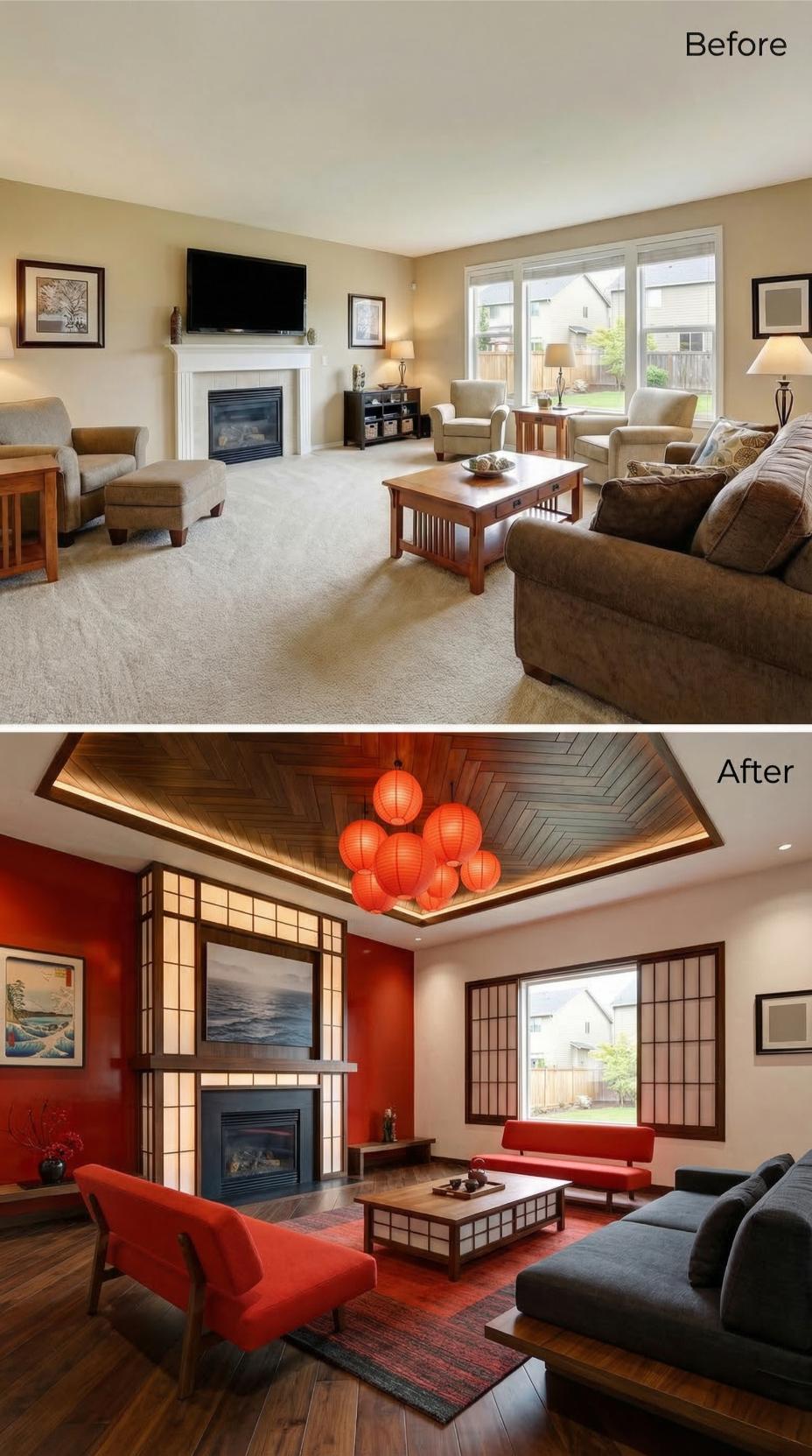
Red-lacquered walls anchor the entire room, paired with shoji-style screens framing both the fireplace surround and the large window where builder-grade trim once stood. A cluster of red paper lanterns hangs from a coffered wood-panel ceiling with integrated cove lighting. Low-profile furniture in charcoal upholstery and red cushions replaces what was a brown sofa arrangement on beige carpet.
Style Tip: Paper lanterns, despite their casual reputation, function as serious diffusers, scattering warm light across a wide area without the harsh directionality of recessed fixtures. Grouping them at varying heights within a single cluster creates the same layered effect as a multi-arm chandelier at a fraction of the weight. The tray ceiling here amplifies that effect by reflecting light back down through the herringbone wood panels.
Not every room in this roundup swings toward dark and moody, but this one does so with maximum conviction.
Painted Murals, Green Marble, and Tufted Velvet Settled the Beige Debate
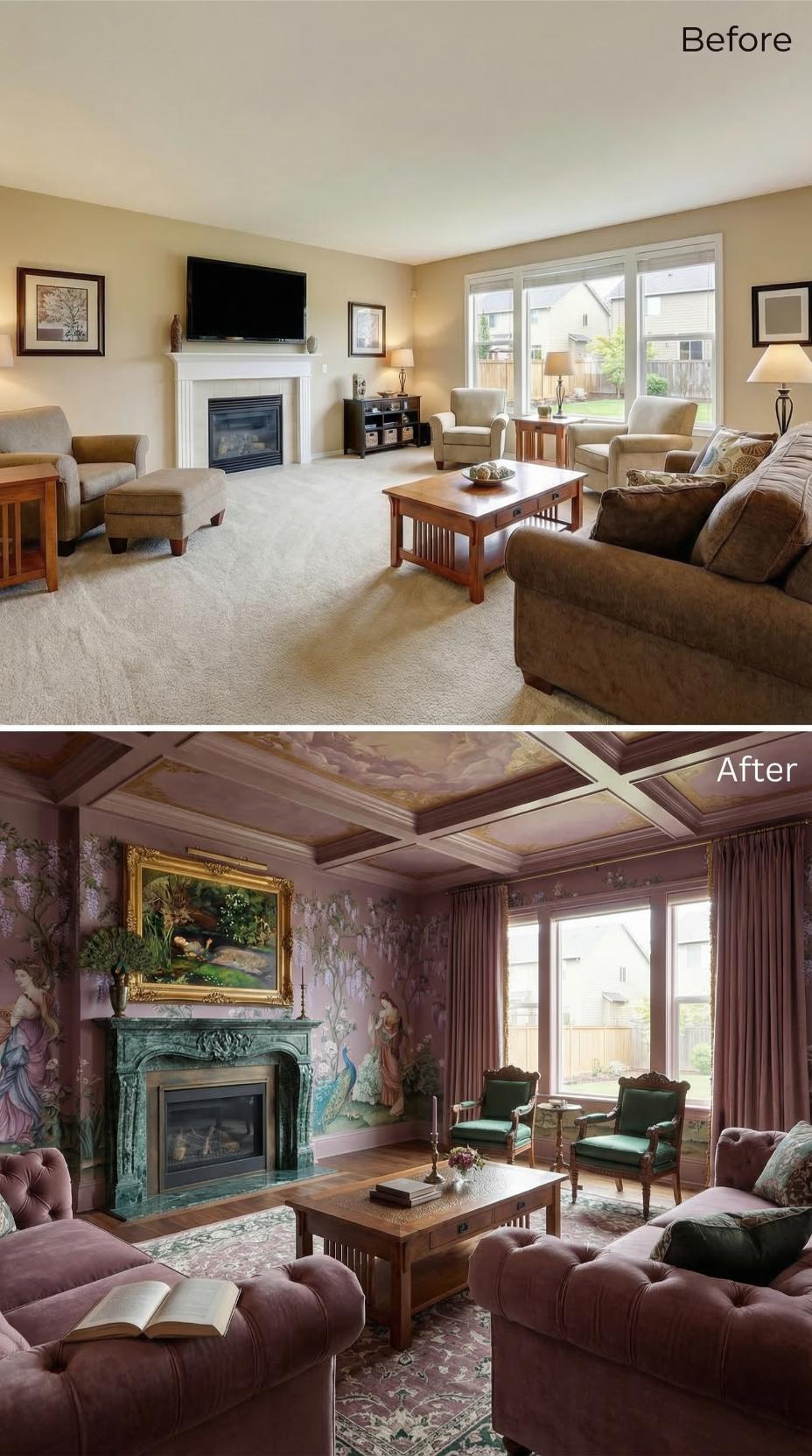
Floral chinoiserie wallpaper in dusty mauve covers every wall, and the coffered ceiling carries painted pastoral scenes between wood-stained beams, treating overhead space as seriously as any vertical surface. The fireplace surround swaps white-painted wood for carved green marble. Mauve tufted sofas and jewel-green wingback chairs hold the palette together without matching.
Mughal Miniatures and Tufted Chesterfields Buried the Beige Without Looking Back
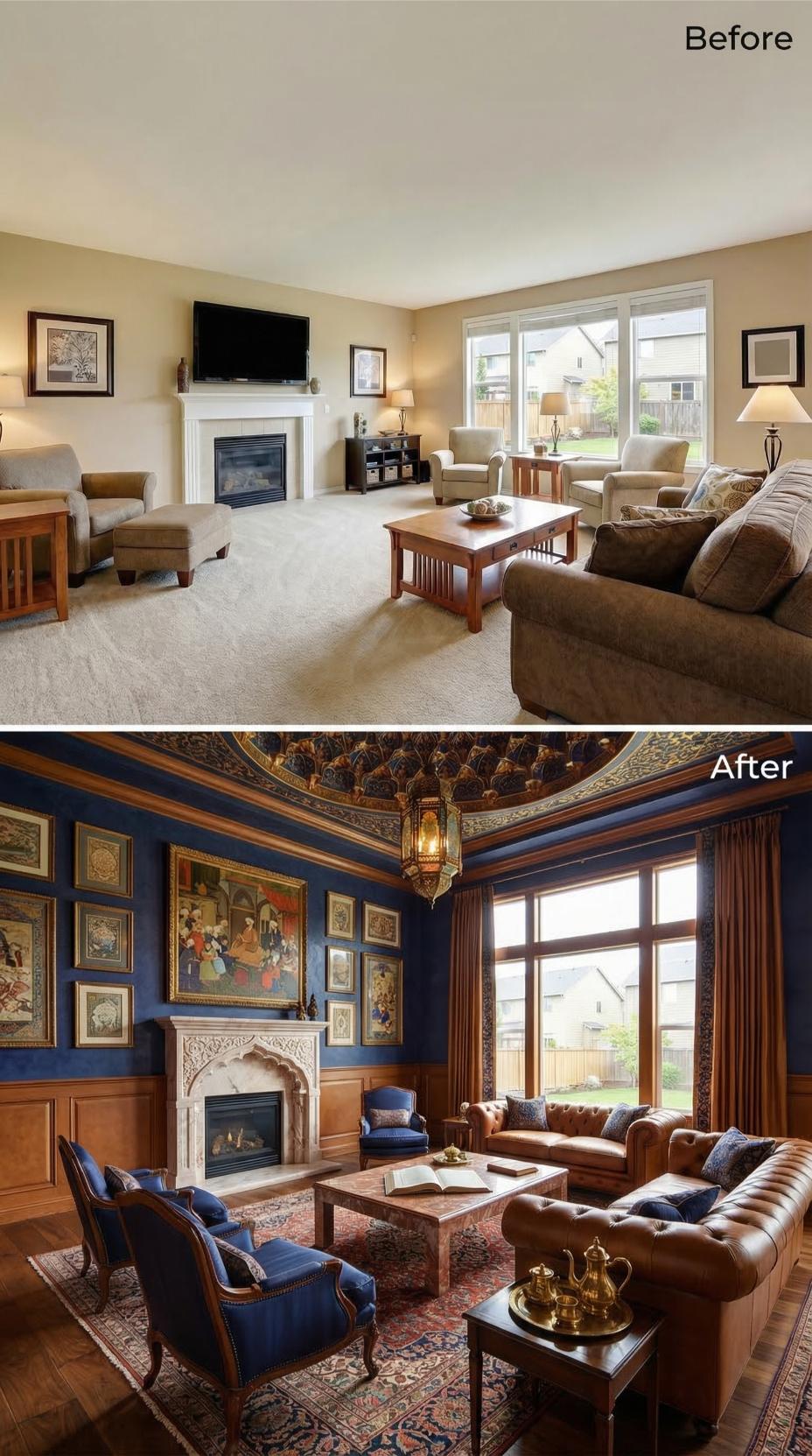
Navy walls with wood wainscoting in what appears to be stained oak replace every inch of builder beige, while an ornately carved white marble fireplace surround with horseshoe arch detailing anchors the room. Cognac leather Chesterfield sofas face off against velvet blue armchairs with nailhead trim, all grounded by a Persian rug in crimson and ivory. The painted ceiling medallion with gold arabesque patterns pulls the whole room upward.
Why That Ceiling Does More Work Than Any Light Fixture in the Room
The ceiling features a painted oval medallion with interlocking arabesque motifs in gold, burgundy, and teal, ringed by dark wood crown molding that acts as a frame. Painted ceiling programs like this one borrow from Mughal architectural tradition, where ceiling ornamentation signaled the importance of a gathering space. Hanging a hammered brass lantern at the medallion’s center reinforces that hierarchy and directs the eye exactly where the composition intends.
Emerald Coffered Ceiling and Dark Walnut Paneling Finished Beige’s Remaining Credibility
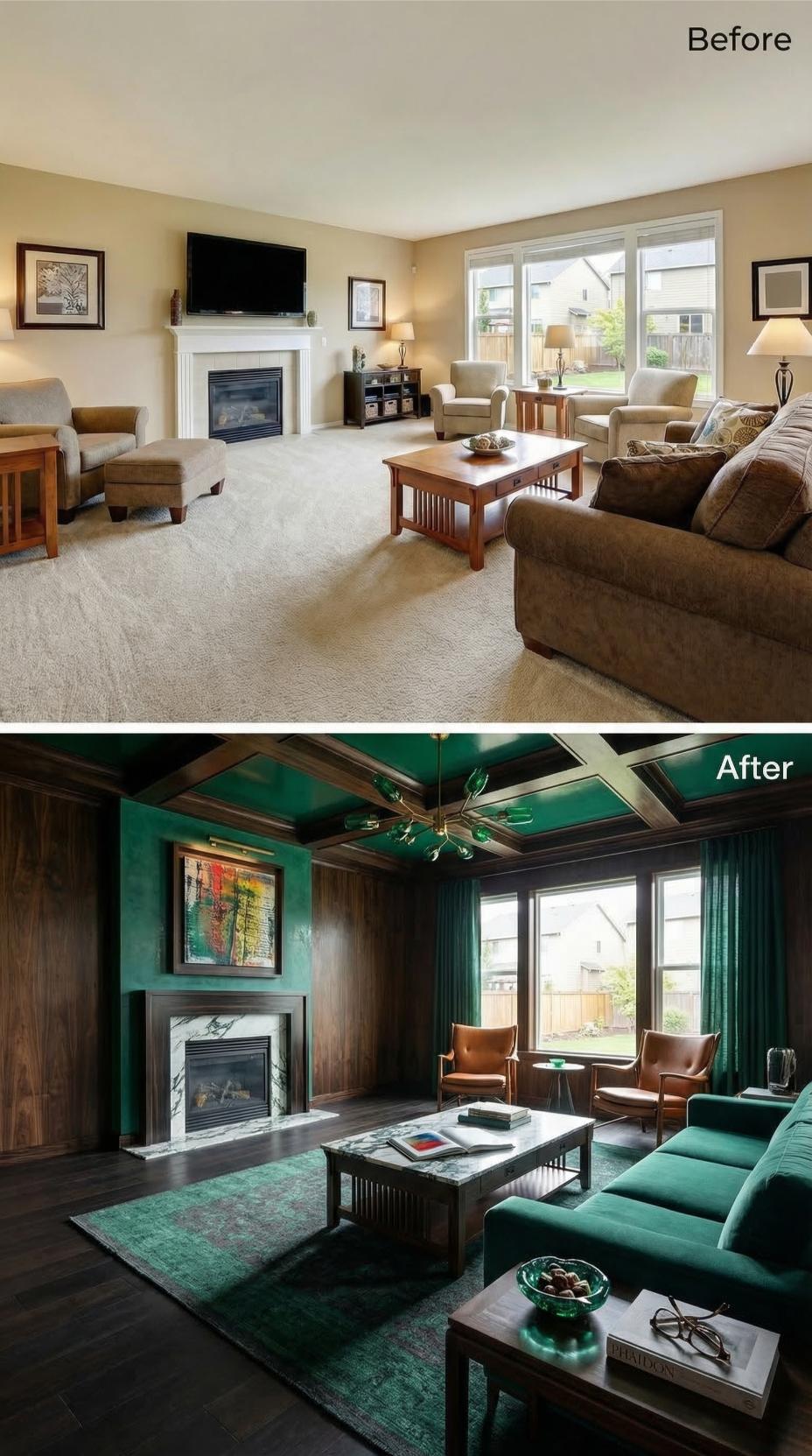
Emerald green covers the recessed panels of a coffered ceiling, framed by dark walnut beams that run in both directions. A brass Sputnik chandelier with green glass globes hangs at center, pulling the ceiling color down into the room’s eye level. The fireplace surround swapped its white paint for veined marble in gray and white. Walls shift between the same emerald and vertical walnut planks, giving the room two textures where the before had none.
A pair of cognac leather armchairs face the window, anchored by an overdyed green rug with a distressed finish. The velvet sofa matches the ceiling almost exactly, which reads less like a coincidence and more like a commitment. Teal curtain panels run floor to ceiling, adding length the original window trim never suggested.
Common Mistake: Painting a coffered ceiling and the walls the same saturated color is one of the fastest ways to make a room feel architecturally intentional, but most people stop short and leave the ceiling white, which flattens the effect entirely and turns structural detail into background noise.
Gold Walls, Coffered Ceilings, and a Chinoiserie Mural That Ended the Conversation
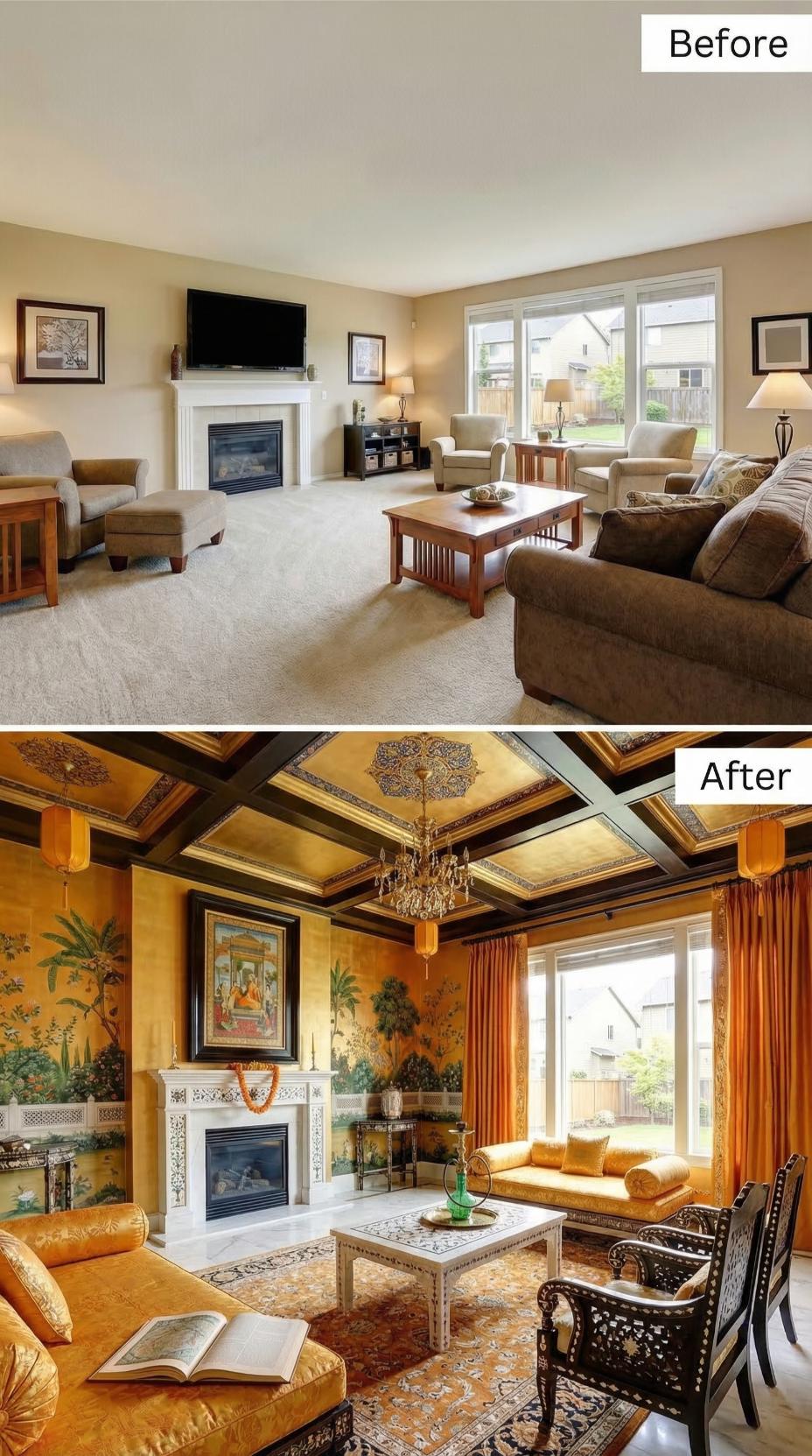
What started as a builder-grade room with beige carpet and a flat white fireplace surround is now a space operating on a completely different register. The walls are covered in hand-painted chinoiserie murals featuring palm trees and garden scenes in sage and forest green against a saffron ground. Above, a dark-stained wood coffered ceiling holds painted gold panels edged in blue botanical motifs, with an ornate brass chandelier anchoring the center.
The fireplace surround was replaced with carved white marble inlaid with geometric tracery. Seating runs to gold silk upholstery on a daybed and a carved dark wood chair with bone or shell inlay work along the frame. An orange silk mala hangs over the mantel below a Mughal-style painting. Persian-style rugs in rust and amber layer across what appears to be marble or stone tile flooring, pulling every surface into the same warm register.
Color Story: Saffron and deep amber sit on the same narrow band of the color wheel, which is why the gold walls, orange curtain panels, and rust-toned rugs read as cohesive rather than chaotic. The chinoiserie mural introduces green as the only true contrast, and that single shift in hue is what keeps the room from collapsing into a single flat tone.
Constructivist Art and Gold Ceiling Trim Sent the Builder-Grade Era Packing
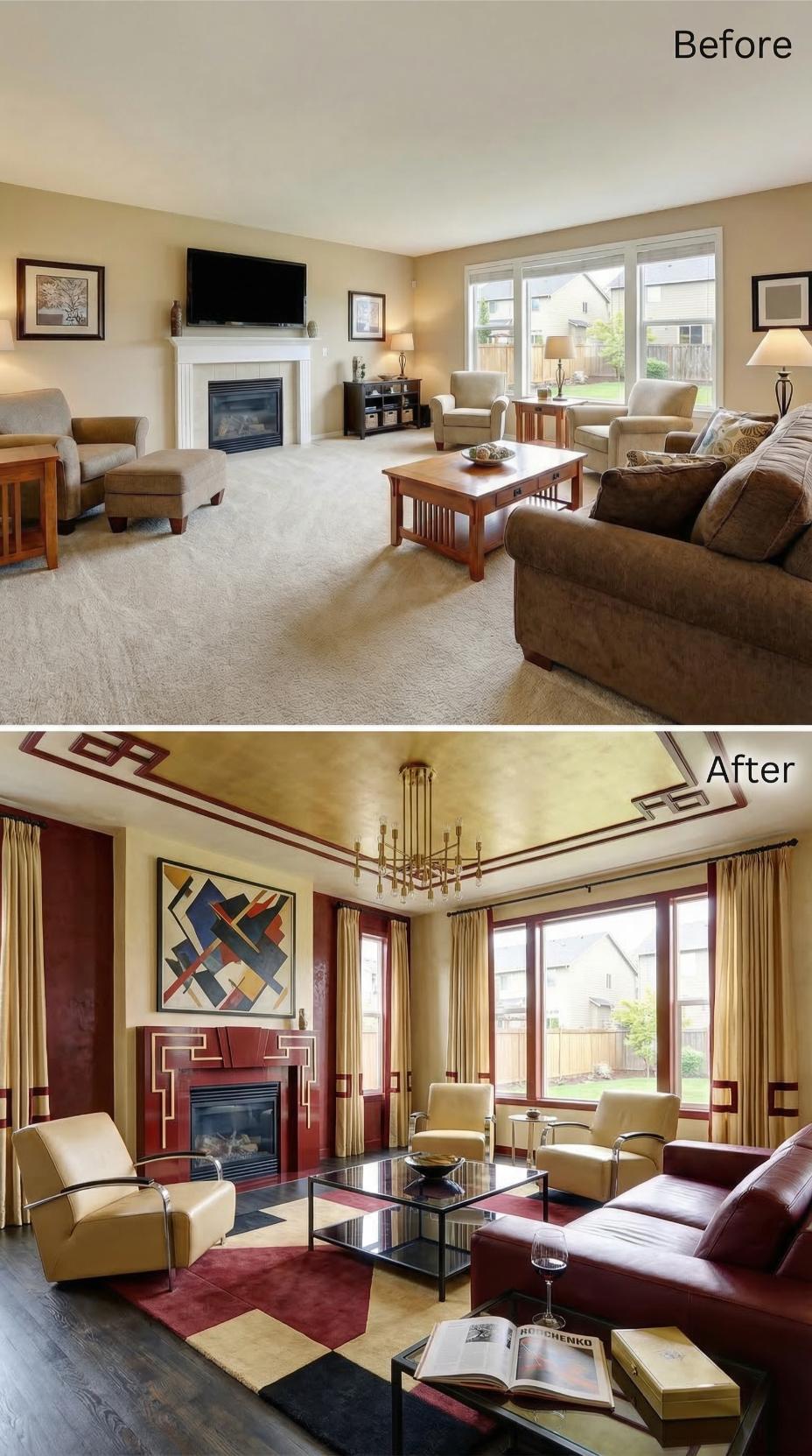
The before room checked every safe box: beige carpet, white fireplace surround, brown microfiber sofa, and recessed lighting doing the absolute minimum. Nothing in it made a decision.
The after room made several at once. Venetian plaster walls in warm ochre run beneath a tray ceiling edged with geometric Greek key banding in deep burgundy and gold. That same burgundy coats the fireplace surround, now framed with its own stepped key pattern. A rod-iron chandelier with exposed candelabra arms replaces what was presumably a flush mount. Cream leather chairs on chrome legs face a red leather sofa across a black lacquer coffee table. Underfoot, a geometric area rug pulls burgundy, black, and cream into the same composition hanging above the fireplace: a Constructivist-style canvas in primary red, blue, and yellow. Floor-length cream drapes with burgundy detail bands flank the original window. Every finish talks to another finish.
Ask Yourself: Before committing to a bold wall treatment, look at your existing architectural bones. The tray ceiling in this room gave the designer a built-in frame for the geometric banding, which means the detail reads as intentional rather than applied. If your ceiling already offers that kind of structure, decorative molding or painted trim will land harder than it would in a flat-ceilinged box.
Bamboo Lattice Wainscoting and a Coffered Ceiling Retired the Carpet for Good
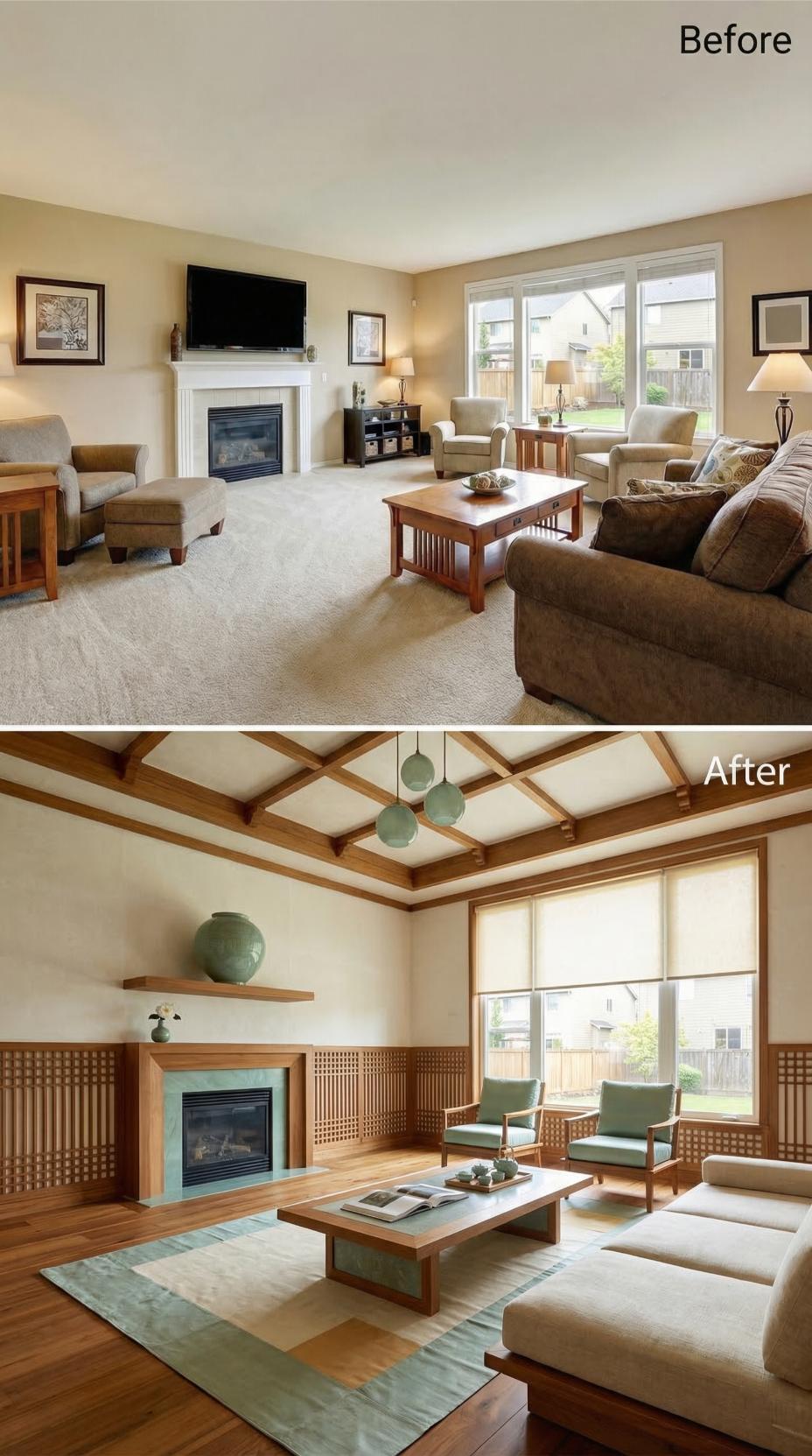
Warm bamboo flooring replaced the builder-grade carpet, and the designer ran wood-slat lattice panels halfway up every wall, framing a teal-surround fireplace that the white box version never earned. Celadon armchairs and a jade pendant cluster anchor the palette without forcing it.
Editor’s Note: Coffered ceilings with exposed wood beams work hardest when the field between the beams stays light, as seen here with cream plaster panels set against warm-toned timber. The contrast reads as handcrafted rather than decorative, which is a distinction worth understanding before specifying any ceiling treatment. Japanese shoji-influenced lattice panels, like the ones lining these walls, also serve a practical function by breaking up flat drywall surfaces that would otherwise reflect sound unevenly across the room.
Painted Ceilings and a Marble Fireplace Surround Retired the White Mantel for Good
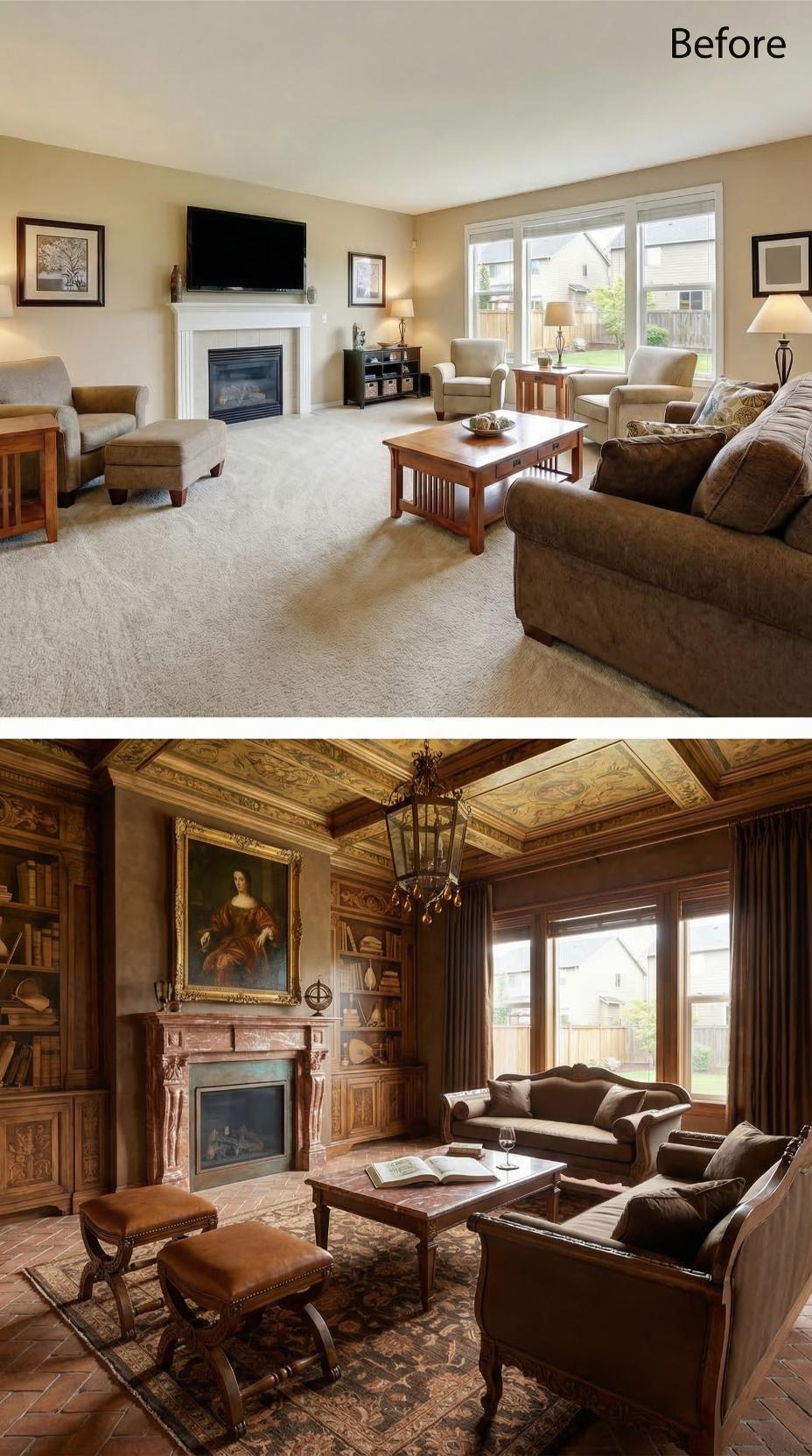
Carved wood paneling climbs every wall from floor to ceiling, and the coffered ceiling above carries hand-painted medallions in ochre, gold, and sienna that no contractor special would ever budget for. The white-painted fireplace with its gas insert got replaced by a pink-veined marble surround with fluted pilasters, and an iron lantern chandelier now hangs where recessed lighting once punched flat circles into the ceiling. A portrait in a gilt frame anchors the fireplace wall with the kind of visual weight that framed prints over a mantel never achieve.
Built-in bookcases flank both sides of the fireplace, finished in the same dark walnut tone as the paneling so the whole room reads as one composition. Herringbone brick flooring replaces the beige carpet, and a wool rug with burgundy and navy medallion patterns grounds the seating group. The sofa and chairs are upholstered in chocolate leather, keeping the palette consistent while the room’s architecture does the actual work.
Fun Fact: Herringbone brick flooring, sometimes called basket-weave or running-bond depending on the angle of the offset, has been used in European manor houses since the 15th century. Its interlocking pattern distributes foot traffic stress across multiple joints rather than concentrating it in one direction, which is why it outlasts most modern flooring materials by decades.
Slate Stone Walls and Undulating Wood Ceiling Fins Closed the Carpet Chapter
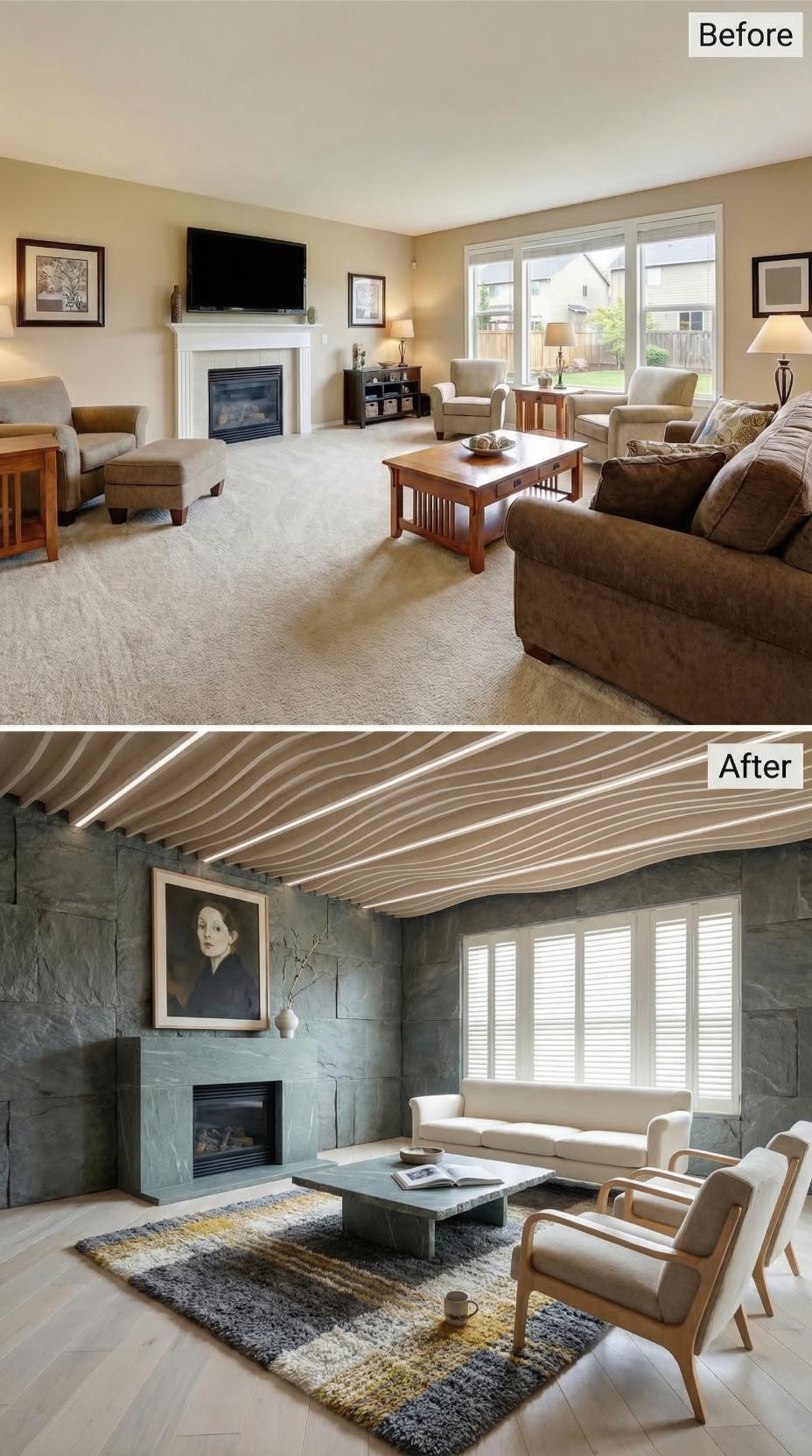
Slate-toned stone cladding runs floor to ceiling on three walls, replacing every trace of beige paint with a surface that reads more geological than decorative. The fireplace surround continues the same material without interruption, which keeps the composition tight. A portrait in a wood frame hangs above the mantel where the flat-screen used to live.
Curved wood fins span the ceiling in parallel waves, each one backlit with a strip of warm LED light. The seating group consists of a low white sofa, two bentwood-framed armchairs with cream upholstery, and a slab coffee table in pale stone. A shag rug in charcoal, ochre, and cream anchors the arrangement over large-format tile flooring.
By The Numbers: Wavy ceiling fins, sometimes called ribbon baffles or acoustic blades, originated in commercial concert hall design before migrating into residential interiors. When spaced evenly and backlit, they add linear rhythm to a room without requiring any change to the structural ceiling beneath them. The stone cladding here uses a dry-stack installation method, meaning no visible mortar joints interrupt the surface texture.
Inky Blue Walls and Built-In Mahogany Shelving Retired the Beige Carpet Permanently
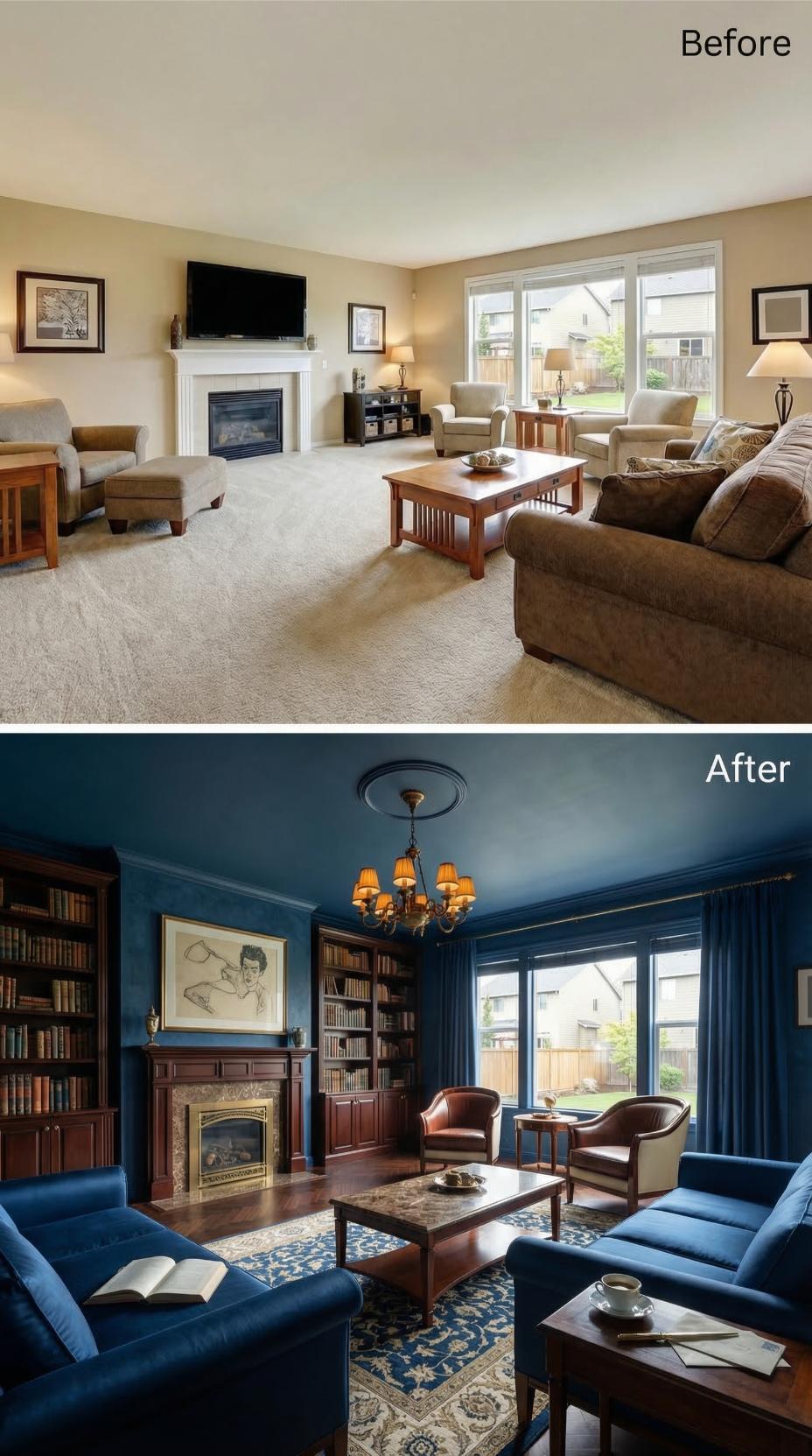
Painting every surface, including the ceiling, the same deep petroleum blue is either a bold decision or a reckless one, and this room proves it lands on the right side.
Dark hardwood flooring replaced the wall-to-wall carpet, and the shift alone restructured the entire room’s credibility. Floor-to-ceiling mahogany bookcases flank the fireplace, which now wears a marble surround in place of the original white mantel. A brass chandelier with amber fabric shades pulls warm light down into a room that could otherwise read cold. The sofas are navy velvet, and the cognac leather club chairs positioned near the window create enough contrast to keep the seating area from collapsing into a single dark mass. A blue-and-ivory wool rug with a medallion pattern anchors the furniture layout and gives the floor something to say. Crown molding painted the same blue as the walls makes the ceiling feel pressed down in the best possible way.
Zellige Tile, Carved Plaster Walls, and a Brass Lantern That Outlasted the Carpet
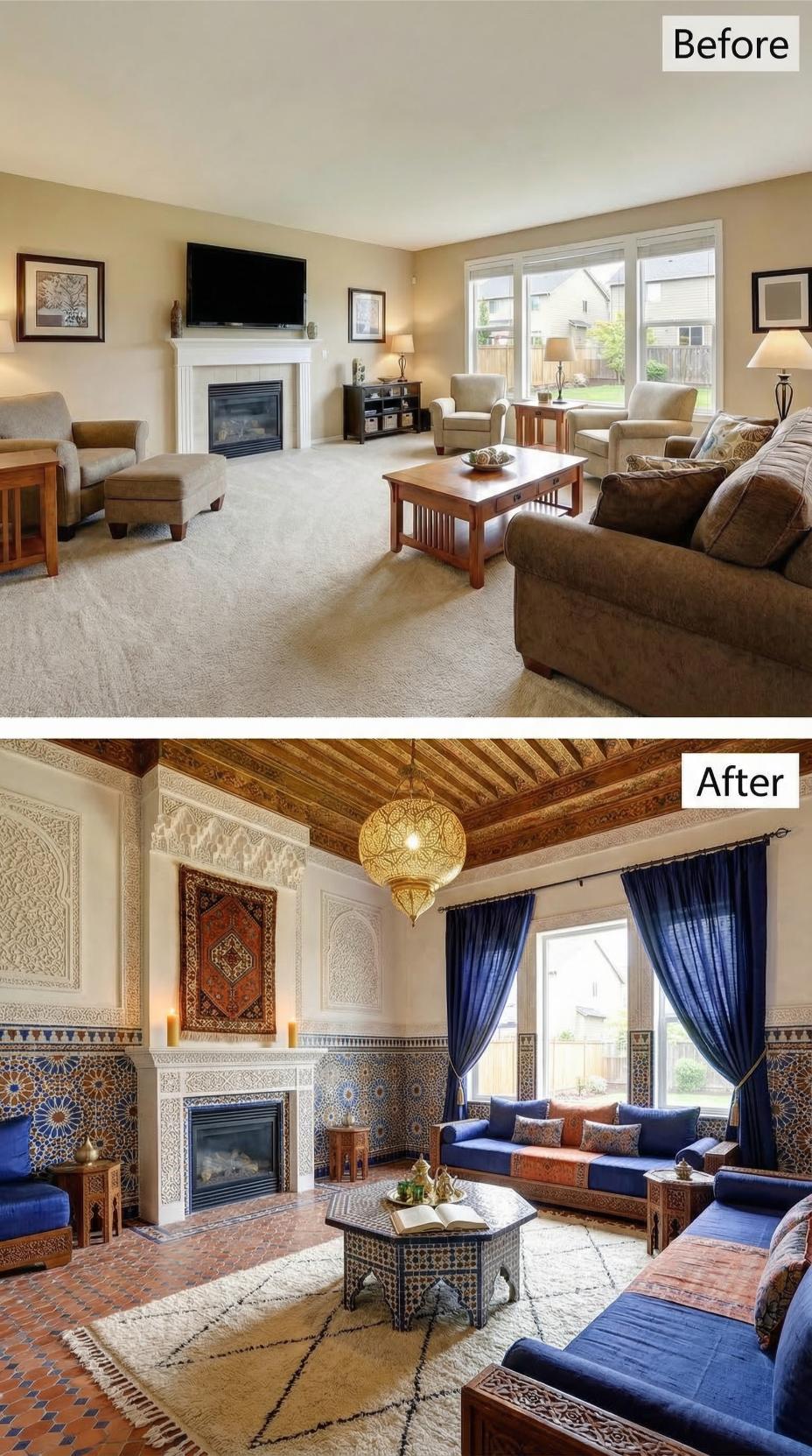
Builder-grade beige gave way to hand-cut zellige tile running along the lower walls in a geometric star pattern of cobalt, rust, and cream, while carved plaster panels climb the upper register in repeating arabesque relief work.
- Moroccan brass pendant lanterns distribute candlelight-temperature glow without any visible bulb
- Low-profile banquette seating upholstered in cobalt linen keeps sightlines open across the room
- Hanging a textile like a framed rug on the wall anchors the fireplace wall without competing with the tilework below
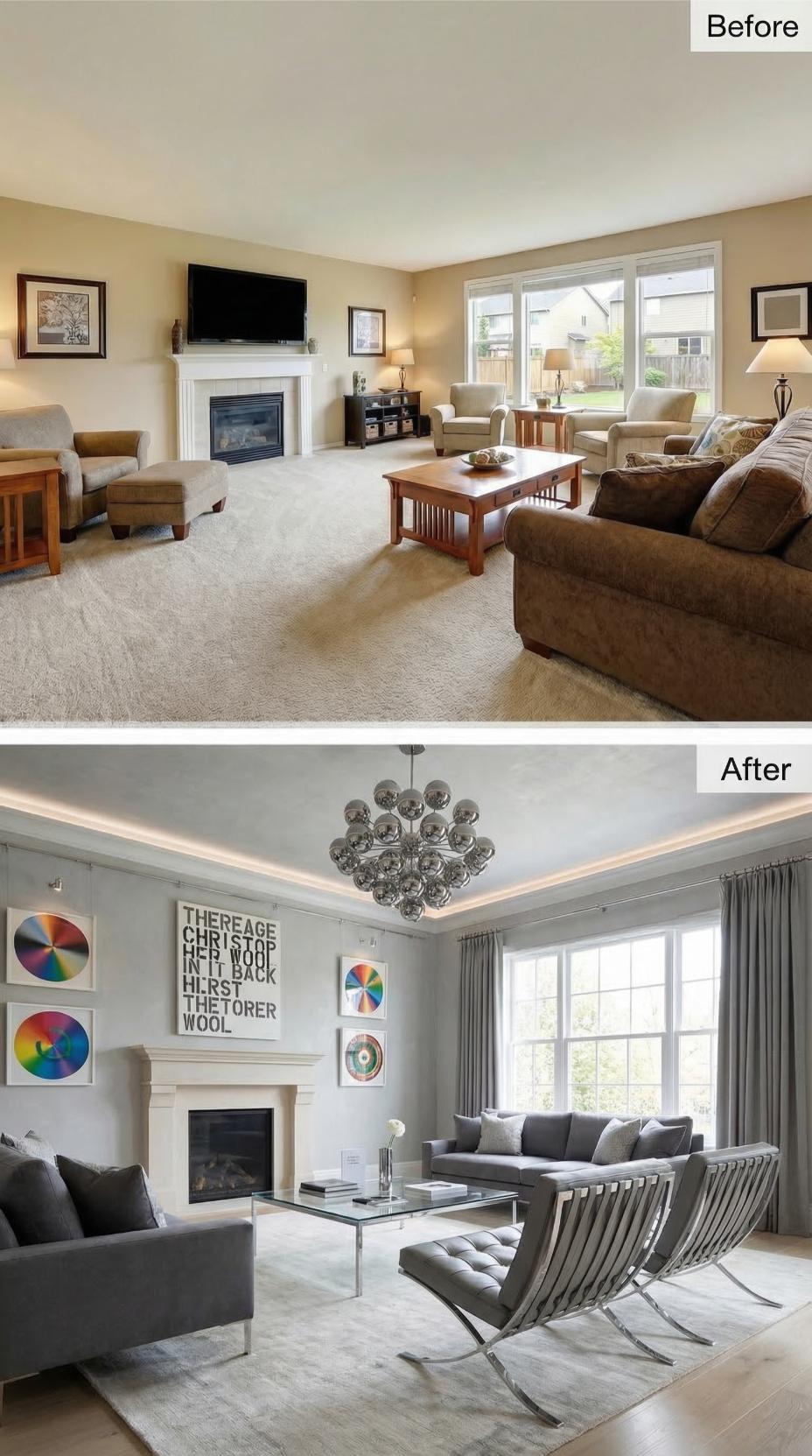
Chrome Orb Chandelier and Barcelona Chairs Closed the Carpet Era Permanently
🔥 Would you like to save this?
Gray linen sofas, a glass-and-chrome coffee table, and a pair of Barcelona chairs with polished steel frames replaced brown microfiber and Mission oak entirely. The fireplace surround got stripped back to a clean limestone surround, and the TV disappeared from the mantel wall altogether.
Cove lighting along the tray ceiling perimeter replaced every recessed can in the original room. Typography art and vinyl record prints now occupy the wall flanking the fireplace, hanging where framed botanicals once collected dust.
Designer’s Secret: Barcelona chairs, designed by Mies van der Rohe for the 1929 German Pavilion, were originally built for royalty to sit in during a ceremonial reception, which makes placing them in a suburban living room a quiet act of architectural overreach that tends to work anyway. Cove lighting installed inside a tray ceiling recess creates indirect illumination that removes all visible light sources from the sightline, making the ceiling appear to glow rather than be lit. Pulling the television off the fireplace wall forces the furniture arrangement to organize around conversation rather than screen viewing, which changes how long people actually stay in the room.
Terracotta Plaster Walls and a Travertine Fireplace Surround Closed the Carpet Era
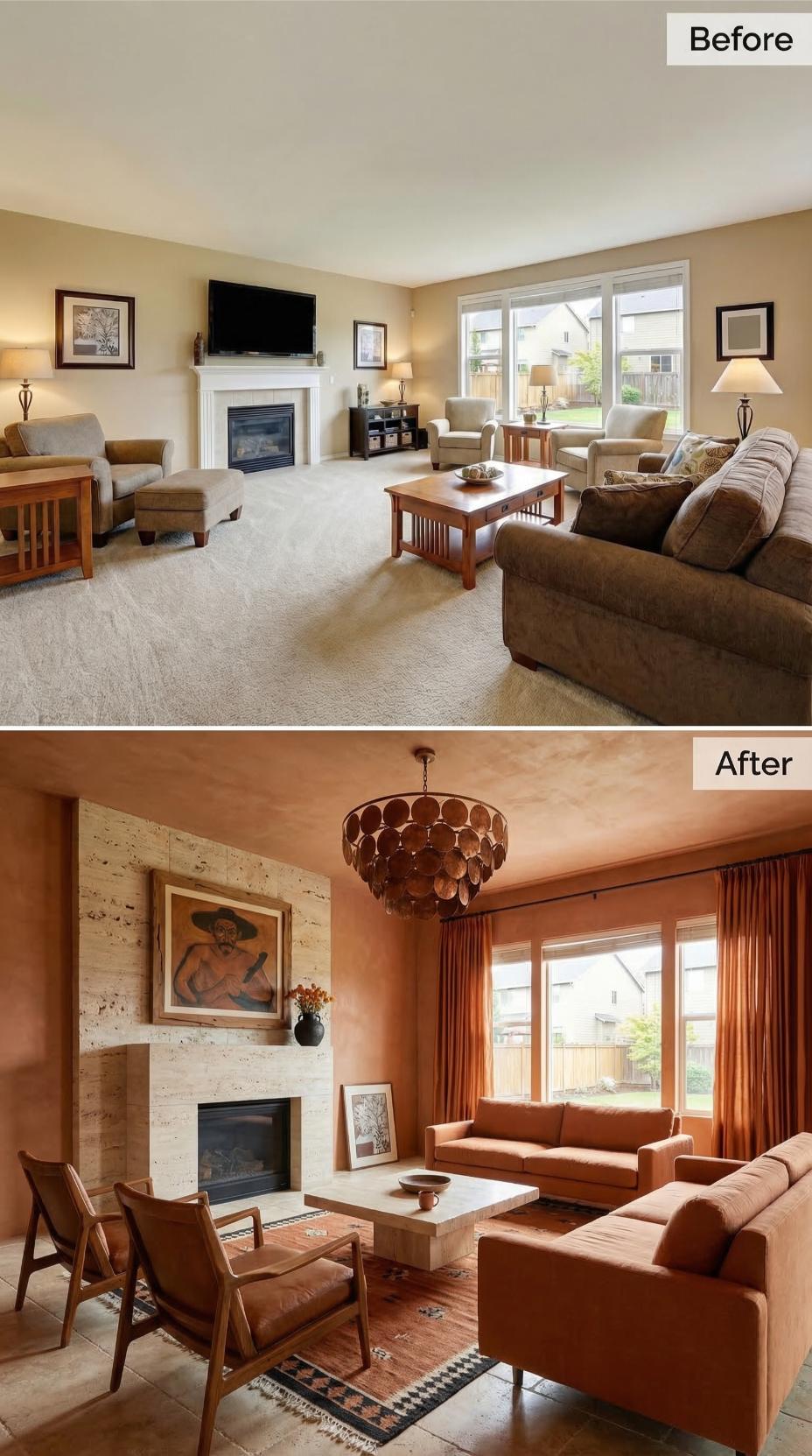
Burnt sienna plaster covers every wall and the ceiling, pulling the room into a cohesive envelope that the beige carpet phase never attempted. Travertine cladding replaces the white mantel, and a disc chandelier made from stacked wood rounds hangs where recessed lights once flatlined. Cognac leather sofas sit opposite a wood-frame lounge chair on a geometric kilim rug.
Travertine cladding replaces the white mantel, and a disc chandelier made from stacked wood rounds hangs where recessed lights once flatlined.
Herringbone Wood Ceiling and a Sputnik Chandelier Closed the Beige Carpet Chapter
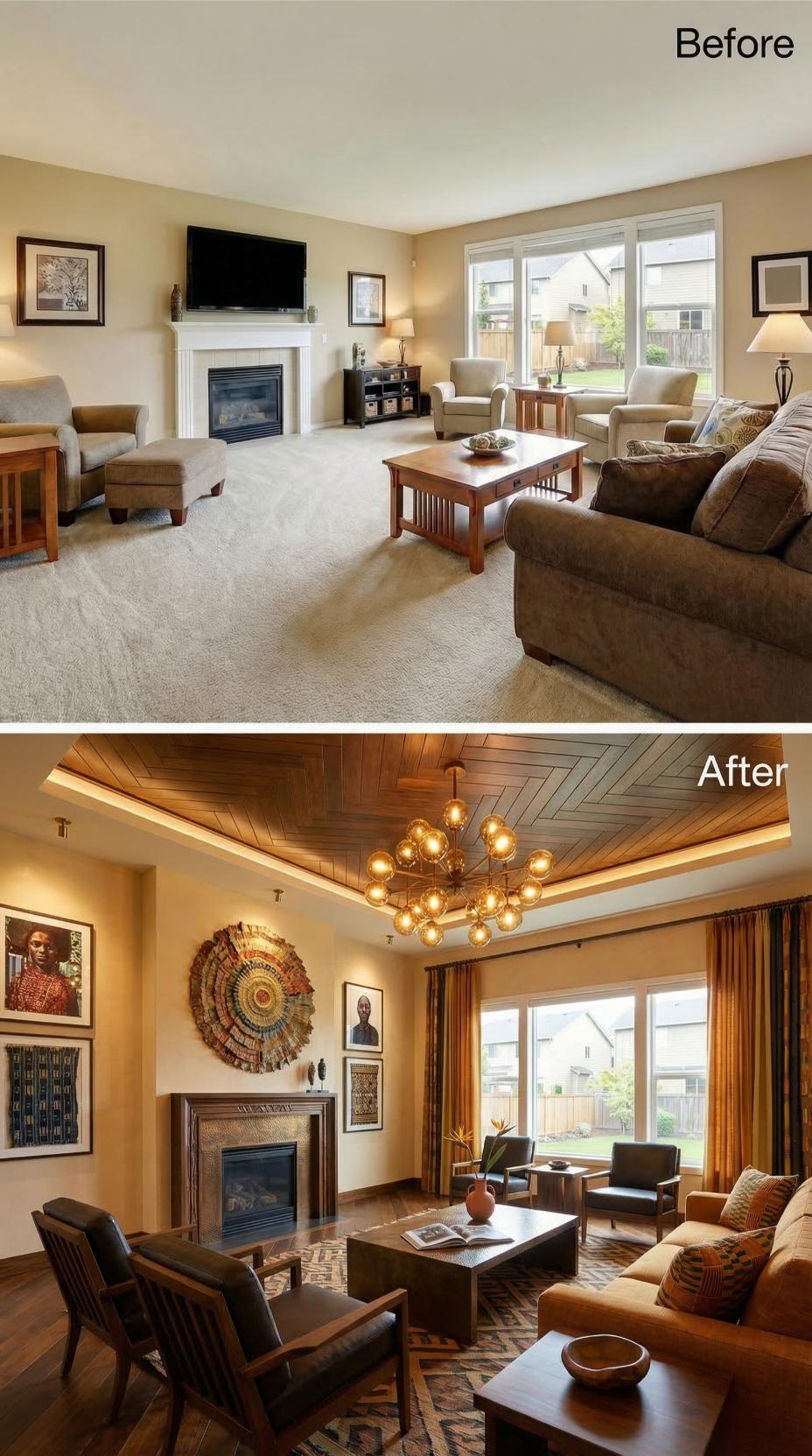
Recessed cove lighting runs the perimeter of a tray ceiling finished in herringbone-patterned wood planks, likely walnut or dark-stained oak, giving the ceiling more visual authority than anything happening below it in the before photo. A Sputnik-style chandelier with exposed globe bulbs on brass arms anchors the seating arrangement without competing with the ceiling treatment. Both elements together pull the eye upward in a room that previously kept all interest at floor level.
On the walls, a large woven fiber medallion with concentric rings of rust, ochre, and indigo reads as sculpture rather than decoration. Portrait photography in simple frames flanks the fireplace, whose surround traded white painted wood for a hammered or textured metal finish in dark bronze. Burnt-sienna upholstery on the sofa, a geometric-patterned area rug, and leather side chairs in near-black complete a palette that the original carpet never could have supported.
A Sputnik-style chandelier with exposed globe bulbs on brass arms anchors the seating arrangement without competing with the ceiling treatment.
Venetian Plaster Walls and a Sputnik Chandelier Declared the Carpet Era Over
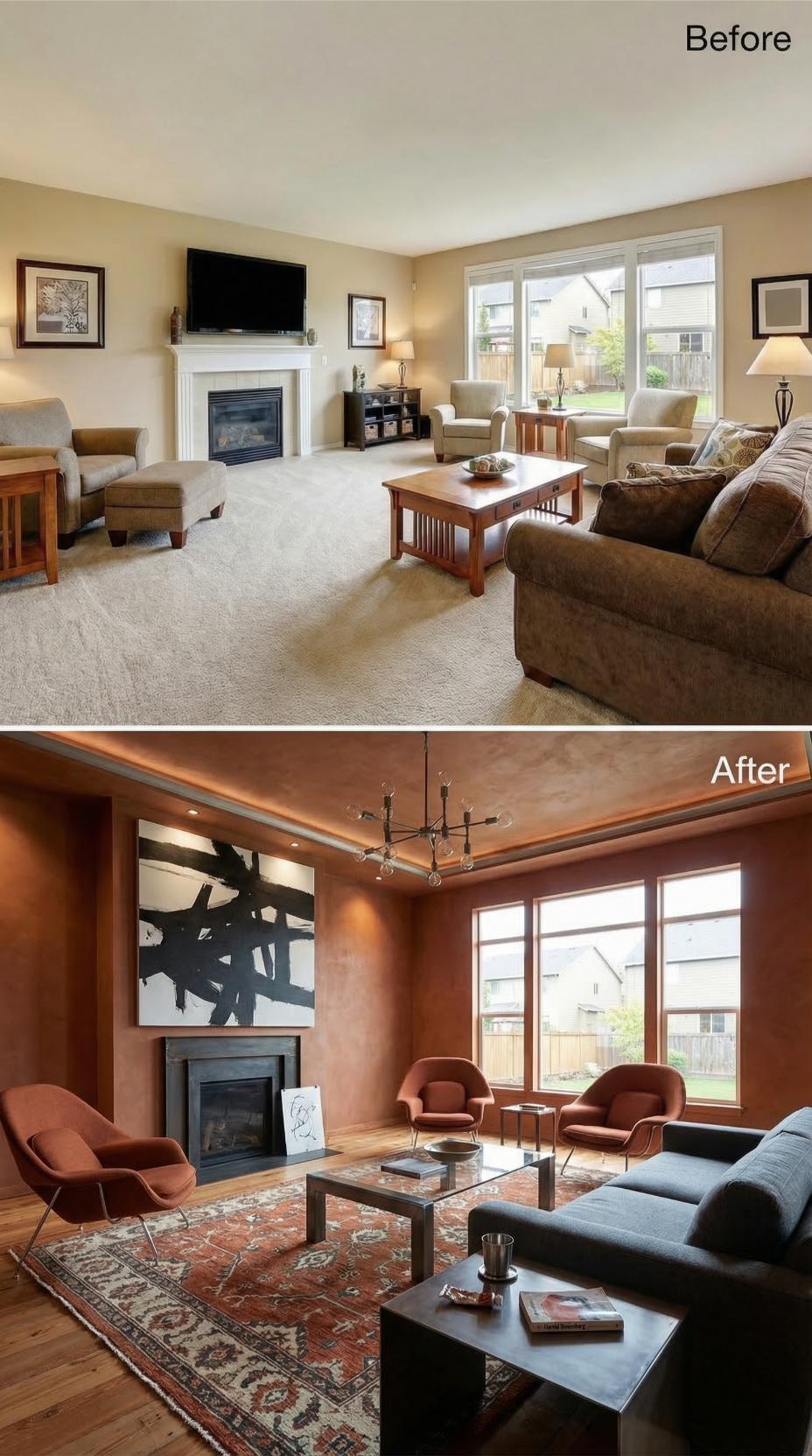
Rust-toned Venetian plaster covers every wall and the tray ceiling surround, pulling the room into a single envelope of color that the beige-and-carpet version never attempted. A mid-century sputnik chandelier in oxidized black iron hangs from the recessed tray field, which glows with concealed strip lighting along its perimeter. The TV disappeared entirely.
A charcoal linen sofa anchors one side while a pair of burnt-sienna velvet pod chairs face the fireplace, now finished in a flat slate surround that replaced the white mantel. A Persian rug in deep red and rust ties every seat to the floor. Large-scale abstract art in black and white provides deliberate contrast against the warm plaster.
Worth Knowing: Venetian plaster, applied in thin layered coats and burnished with a steel trowel, gets its depth from light refraction rather than pigment alone. Because each layer is translucent, the wall color shifts visibly between morning and evening light, which is why plaster rooms read differently in photographs than in person. That optical behavior is one reason designers use it in rooms with mixed or layered lighting.
Cove Lighting, Caramel Leather Chairs, and a Geometric Rug Closed the Carpet Era
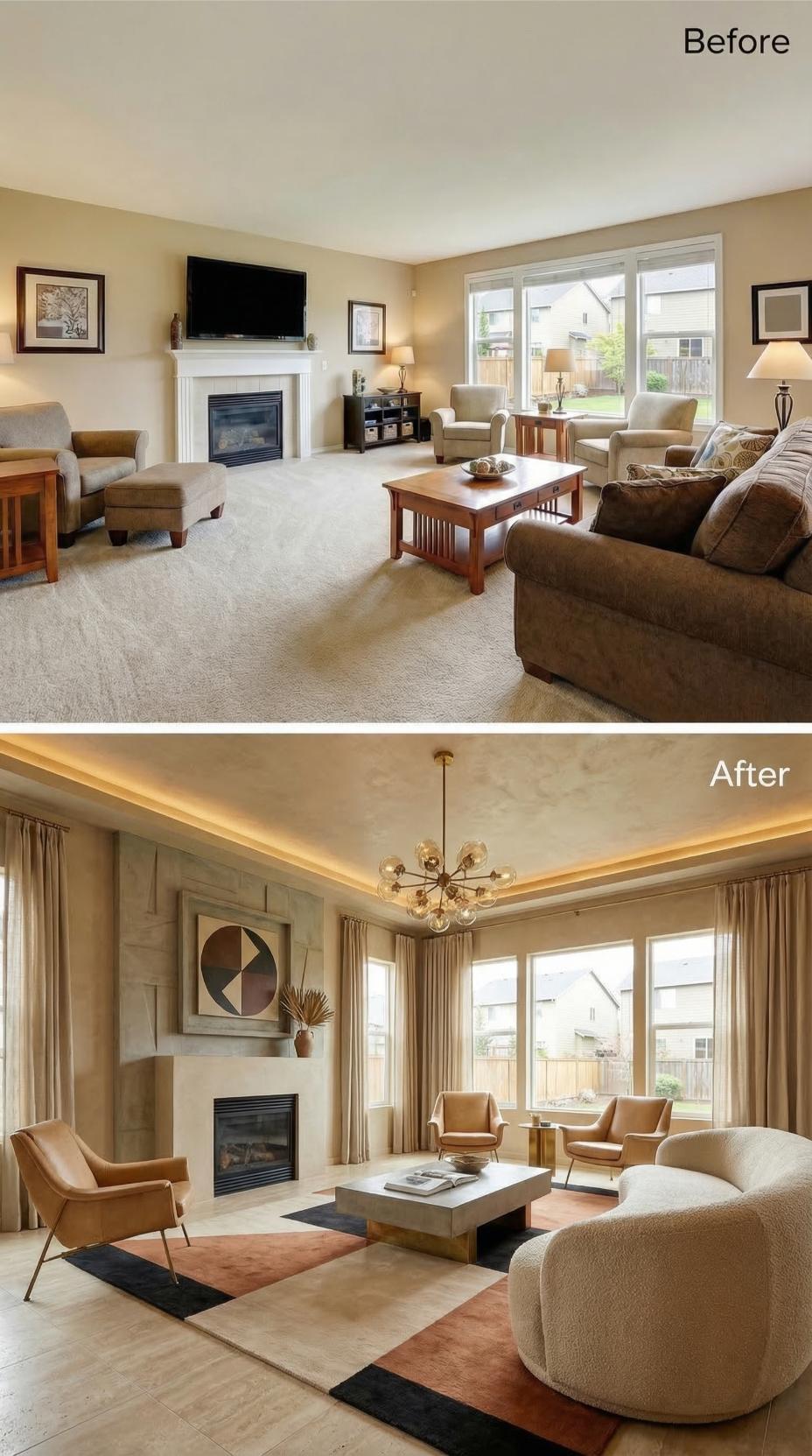
Indirect cove lighting along the tray ceiling replaced every recessed can, while caramel leather accent chairs and a bouclé sofa displaced the brown sectional entirely.
Teal Lacquered Walls and a Herringbone Wood Coffered Ceiling Buried the Beige
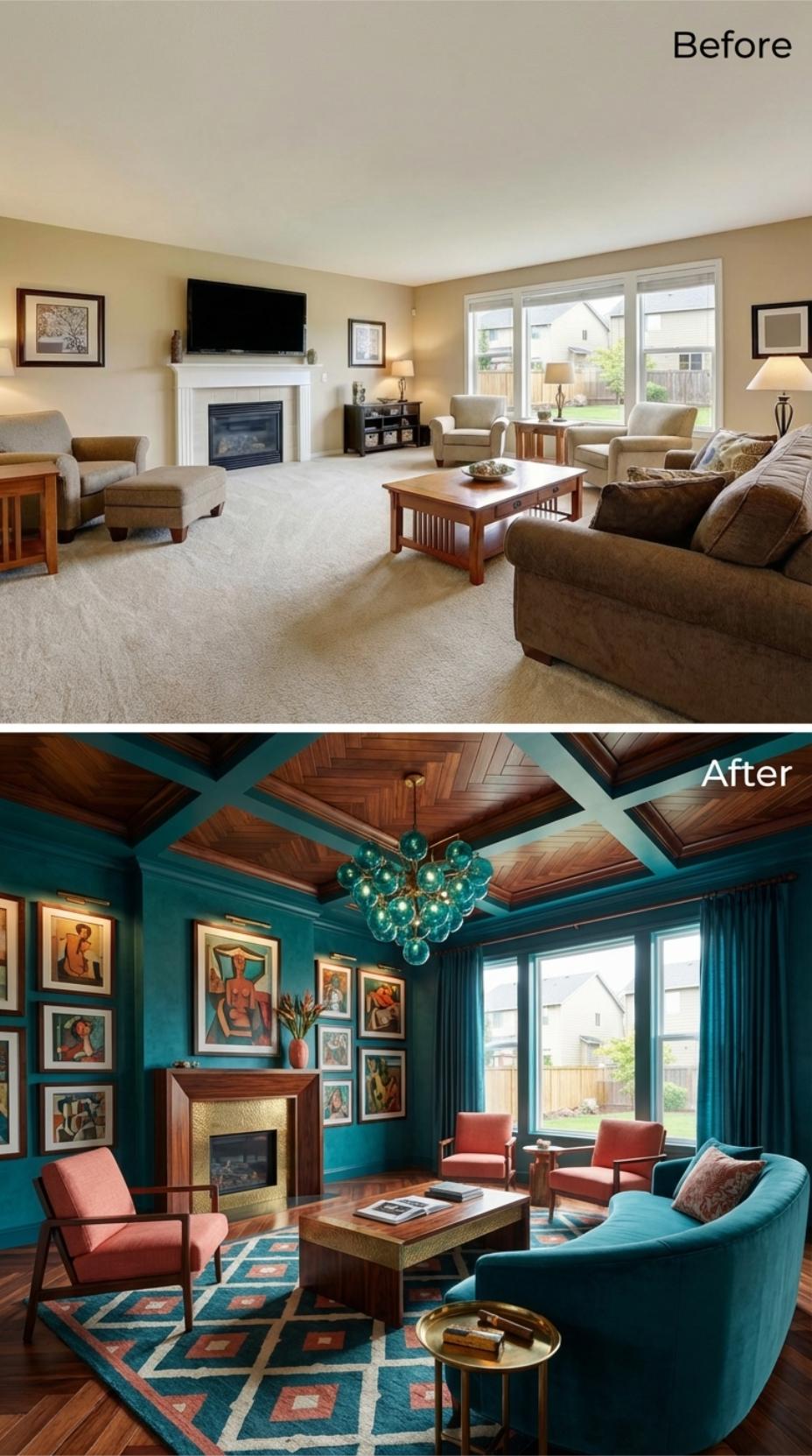
Teal paint covers every wall surface and the coffered ceiling trim, while the recessed panels between the walnut herringbone beams stay wood-toned, creating a color contrast that reads as intentional rather than overwhelming. Coral linen armchairs sit opposite a curved teal velvet sofa, and a cluster chandelier with jade glass globes pulls both colors into the ceiling plane. The geometric wool rug grounds the seating arrangement with coral diamond motifs echoing the chair upholstery.
Paper Lanterns and Black Steel Frames Closed the Brown Carpet Chapter
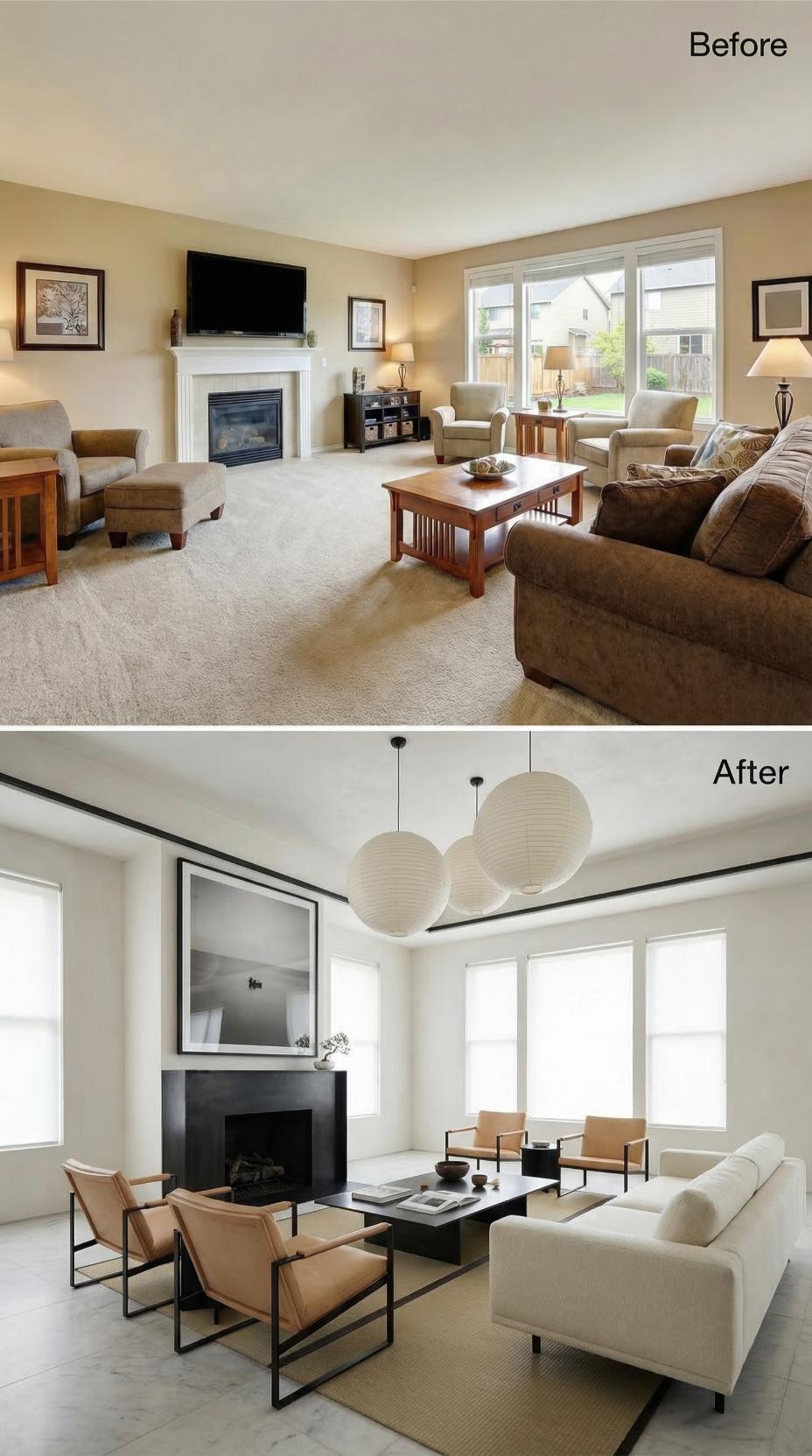
Three oversized rice paper pendants cluster at different drop heights above a low black steel coffee table, replacing what wall sconces and a TV mount once handled. The fireplace surround went from white painted wood trim to flat black, and the mantel disappeared entirely, leaving a clean rectangular firebox framed in matte black.
Lean tan leather armchairs with black powder-coated frames sit opposite a cream linen sofa on a natural jute rug. The wall color shifted from warm beige to a cool white with no yellow undertone, which is why the light reads differently in the after shot. Marble tile flooring replaced carpet, and black crown molding at the ceiling line does the job a tray ceiling would, without the drywall work.